Key English Test
Reading and Writing Parts
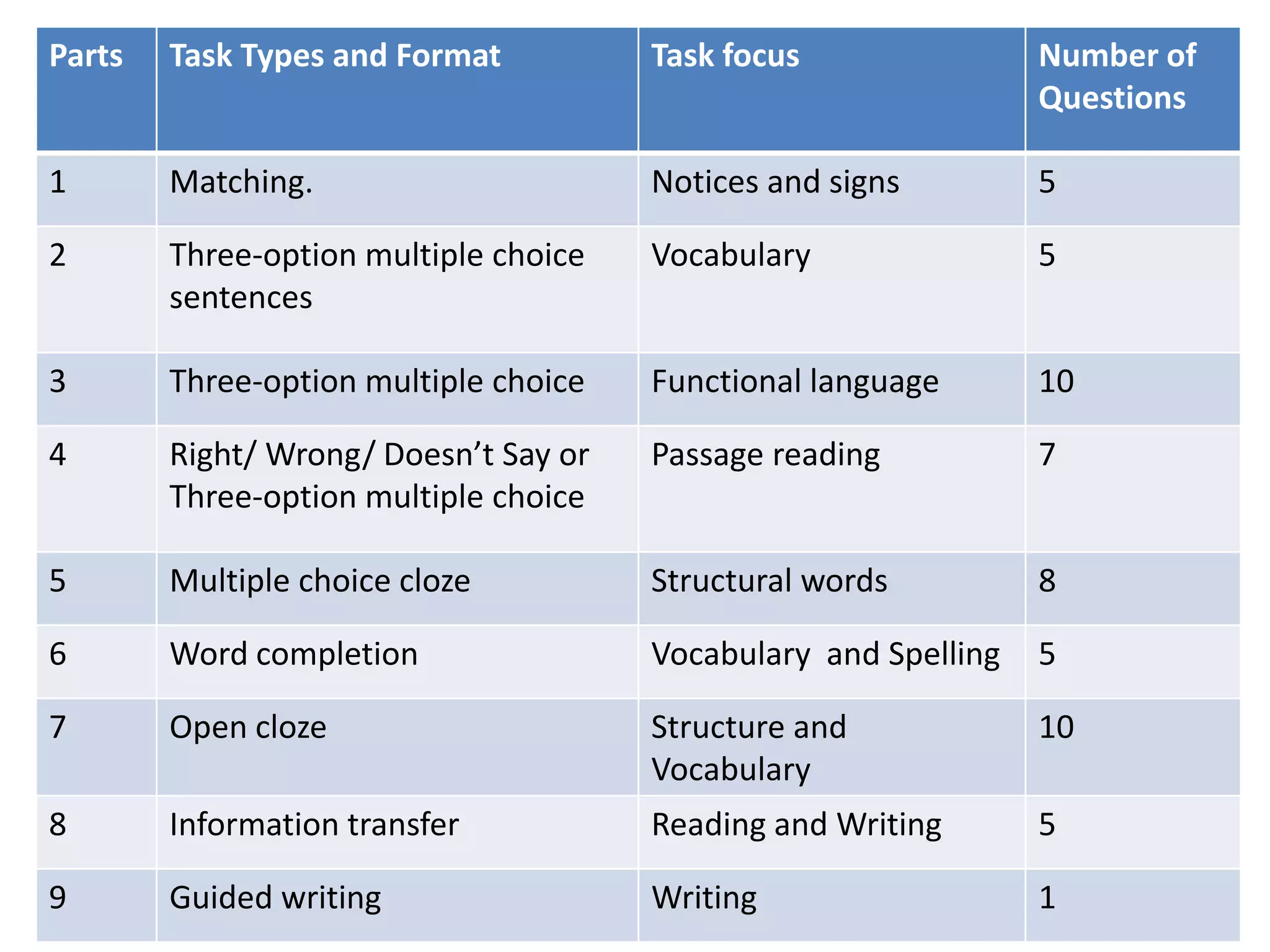
Parts Task Types and Format Task focus Number of
Questions
1 Matching. Notices and signs 5
2 Three-option multiple choice
sentences
Vocabulary 5
3 Three-option multiple choice Functional language 10
4 Right/ Wrong/ Doesn’t Say or
Three-option multiple choice
Passage reading 7
5 Multiple choice cloze Structural words 8
6 Word completion Vocabulary and Spelling 5
7 Open cloze Structure and
Vocabulary
10
8 Information transfer Reading and Writing 5
9 Guided writing Writing 1
PAPER 1: Reading and Writing
Part 1 - Overview
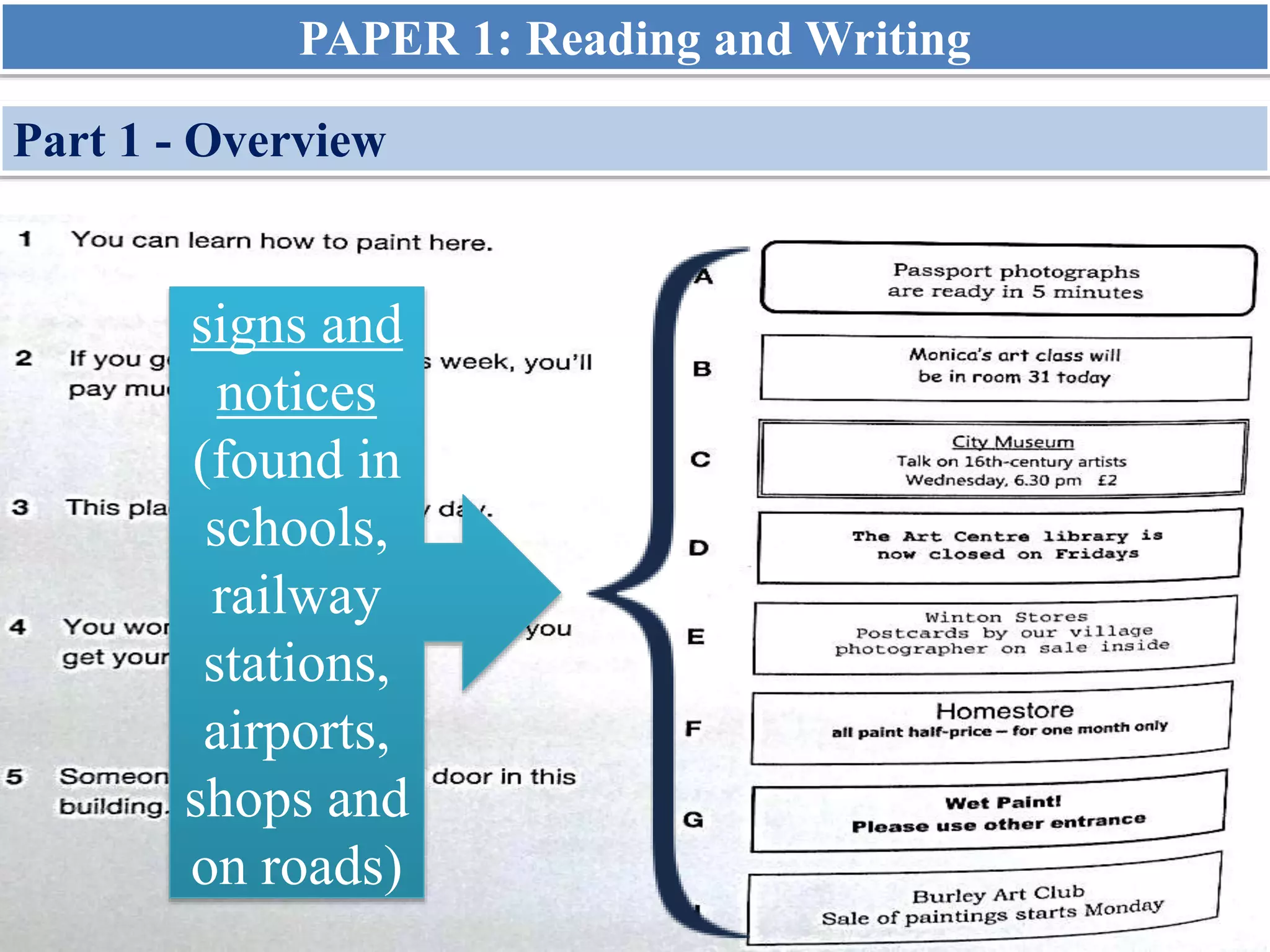
signs and
notices
(found in
schools,
railway
stations,
airports,
shops and
on roads)
PAPER 1: Reading and Writing
Part 1 - Overview
These
sentences
explain
the signs
and
notices.
PAPER 1: Reading and Writing
Part 1 - Overview
PAPER 1: Reading and Writing
Part 1 - Guidance
1. Read the instructions and example
carefully first.
2. Read the sentences and short texts
carefully. Think about where you might find
such signs and notices.
3. You may see the same word appear in a
sign/notice and in a sentence. But you need to be
careful.
PAPER 1: Reading and Writing
Part 1. Examples:
B
F
D
A
G
PAPER 1: Reading and Writing
Part 2 – Overview
PAPER 1: Reading and Writing
Part 2 - Guidance
1. Read the instructions and example before you begin.
That way you will know the topic of the sentences.
2. Read the whole sentence before deciding which word
best fits the gap. When you have chosen, read the sentence
again to make sure it makes sense.
PAPER 1: Reading and Writing
Part 2 – Examples:
Guidance
• Read each
question/statement
carefully
• Think about who
might be asking
the question or
saying the
statement
• How you might
respond to it
PAPER 1: Reading and Writing
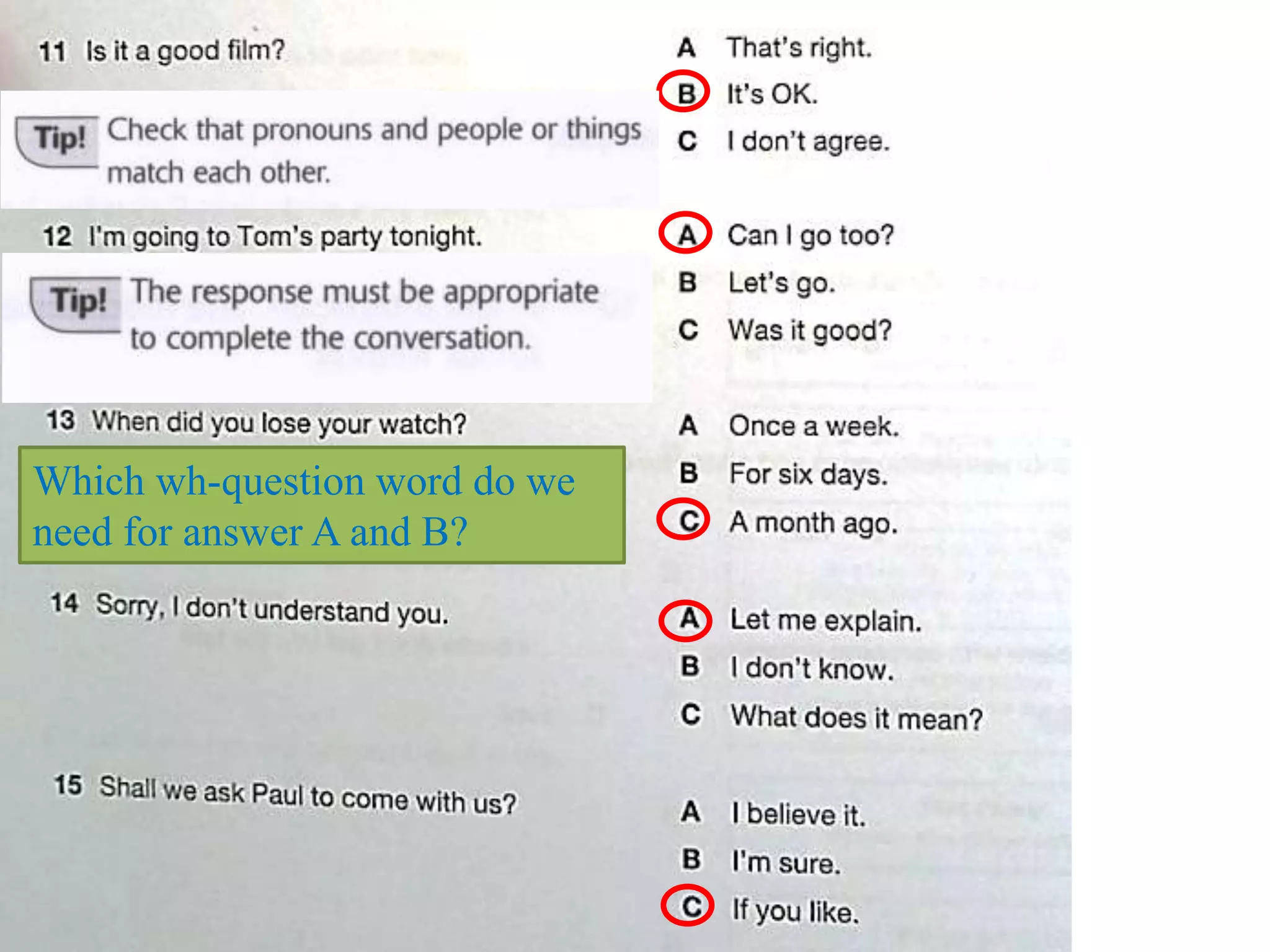
Part 3 a Overview: Complete five
two-line conversations
(Q.11-Q.15) by choosing the
best opion
country/city city
place
place
PAPER 1: Reading and Writing
Which wh-question word do we
need for answer A and B?
Guidance
• Read the
gapped
conversation
on the left-
hand side first
• Read what the
1st speaker says
before and
after each gap
• Read all the
dialogue to
check whether
it makes sense
or not
Part 3 b Overview: Complete a longer
conversation taking place in
study and social situations by
choosing from a list of 8 opions, 3
extra options you do not use
E
G
C
H
D
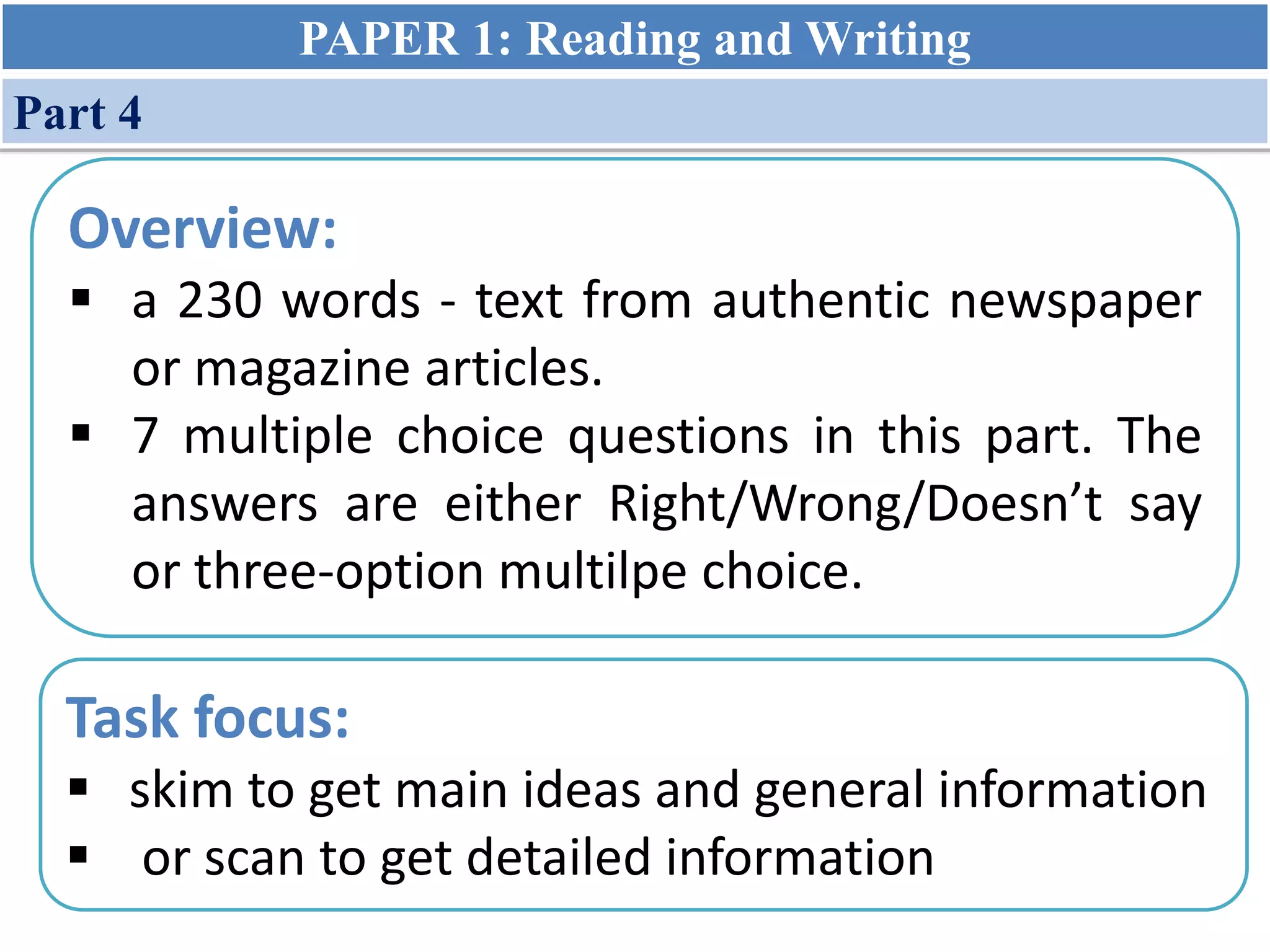
Overview:
 a 230 words - text from authentic newspaper
or magazine articles.
 7 multiple choice questions in this part. The
answers are either Right/Wrong/Doesn’t say
or three-option multilpe choice.
Task focus:
 skim to get main ideas and general information
 or scan to get detailed information
PAPER 1: Reading and Writing
Part 4
1. Read the instructions carefully to know what is the text
about and what answers are expected for these
questions.
2. Skim the text to get general meaning and format order
of the text.
3. Read 7 questions and underline key words.
4. Scan the text carefully to find out detailed information
or answers
Part 4: Guidance
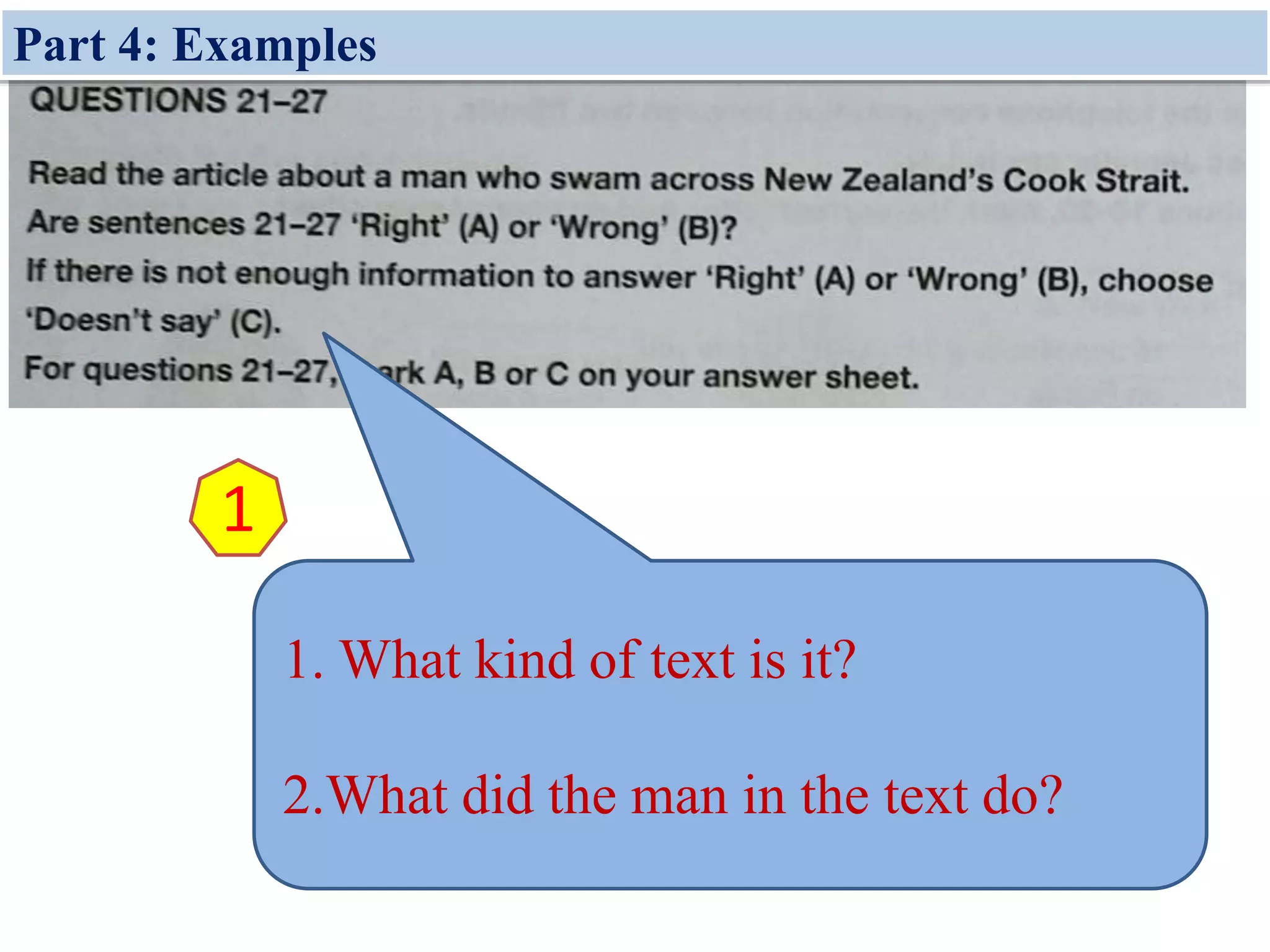
1. What kind of text is it?
2.What did the man in the text do?
1
Part 4: Examples
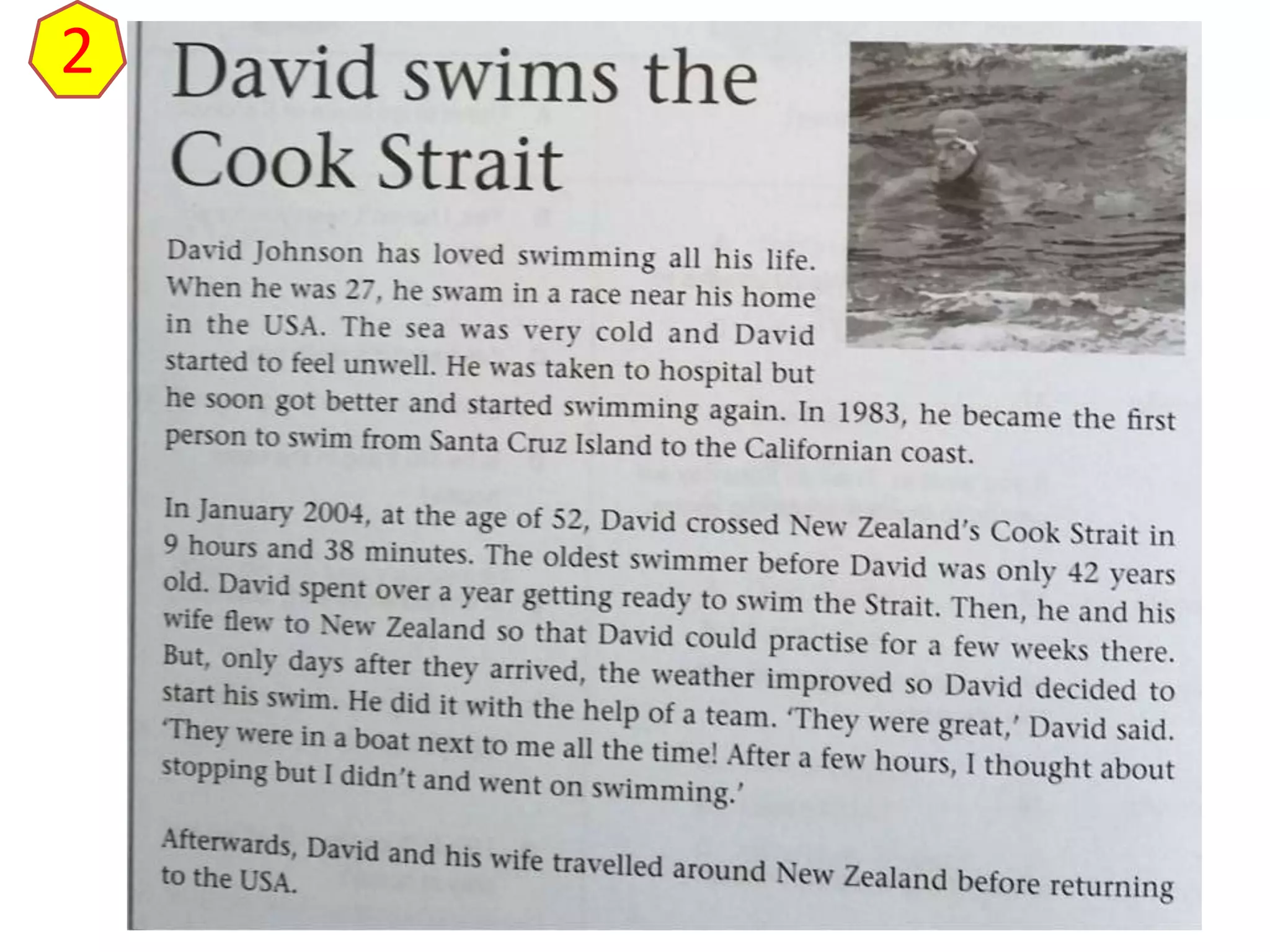
2
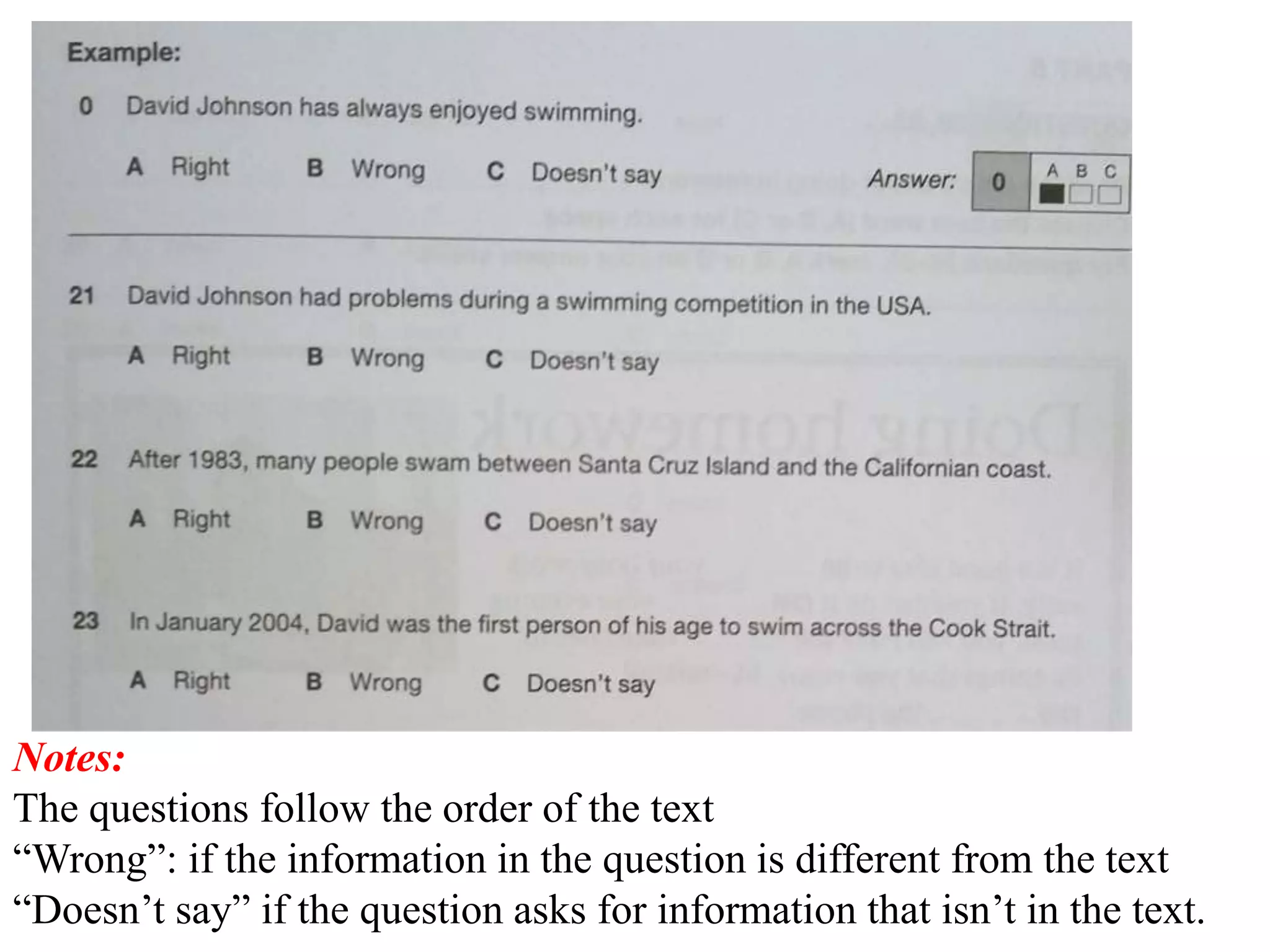
Notes:
The questions follow the order of the text
“Wrong”: if the information in the question is different from the text
“Doesn’t say” if the question asks for information that isn’t in the text.
3
4
Type and format:
• a quite long text from authentic newspaper or
magazine articles or an encyclopaedia entry.
• The text contains 8 gaps about grammar points.
Task focus:
• to have an insight about grammar points such as
verb forms, determiners, prepostions, adverbs,
adjectives and so on.
PAPER 1: Reading and Writing
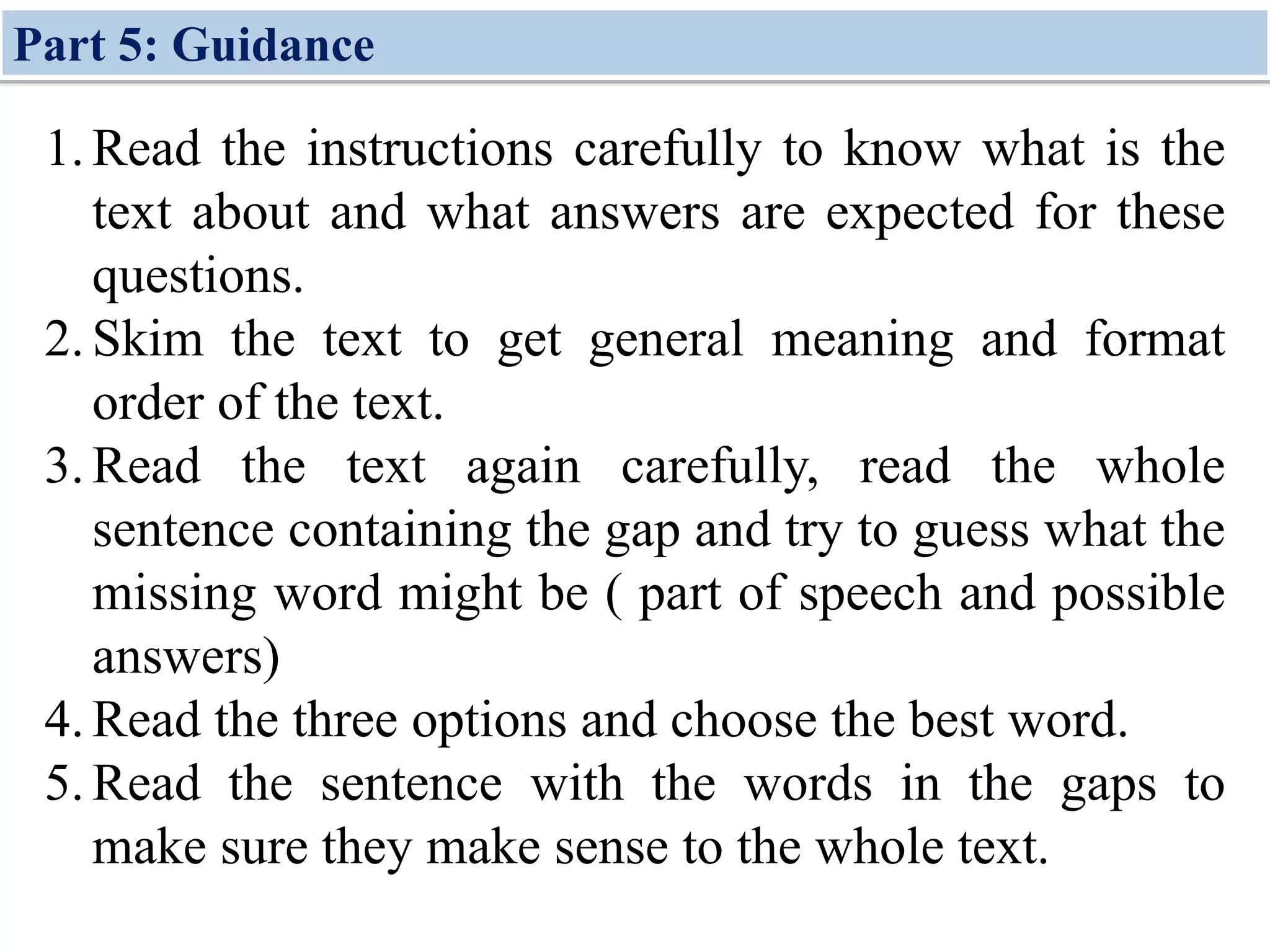
Part 5: Overview
1.Read the instructions carefully to know what is the
text about and what answers are expected for these
questions.
2.Skim the text to get general meaning and format
order of the text.
3.Read the text again carefully, read the whole
sentence containing the gap and try to guess what the
missing word might be ( part of speech and possible
answers)
4.Read the three options and choose the best word.
5.Read the sentence with the words in the gaps to
make sure they make sense to the whole text.
Part 5: Guidance
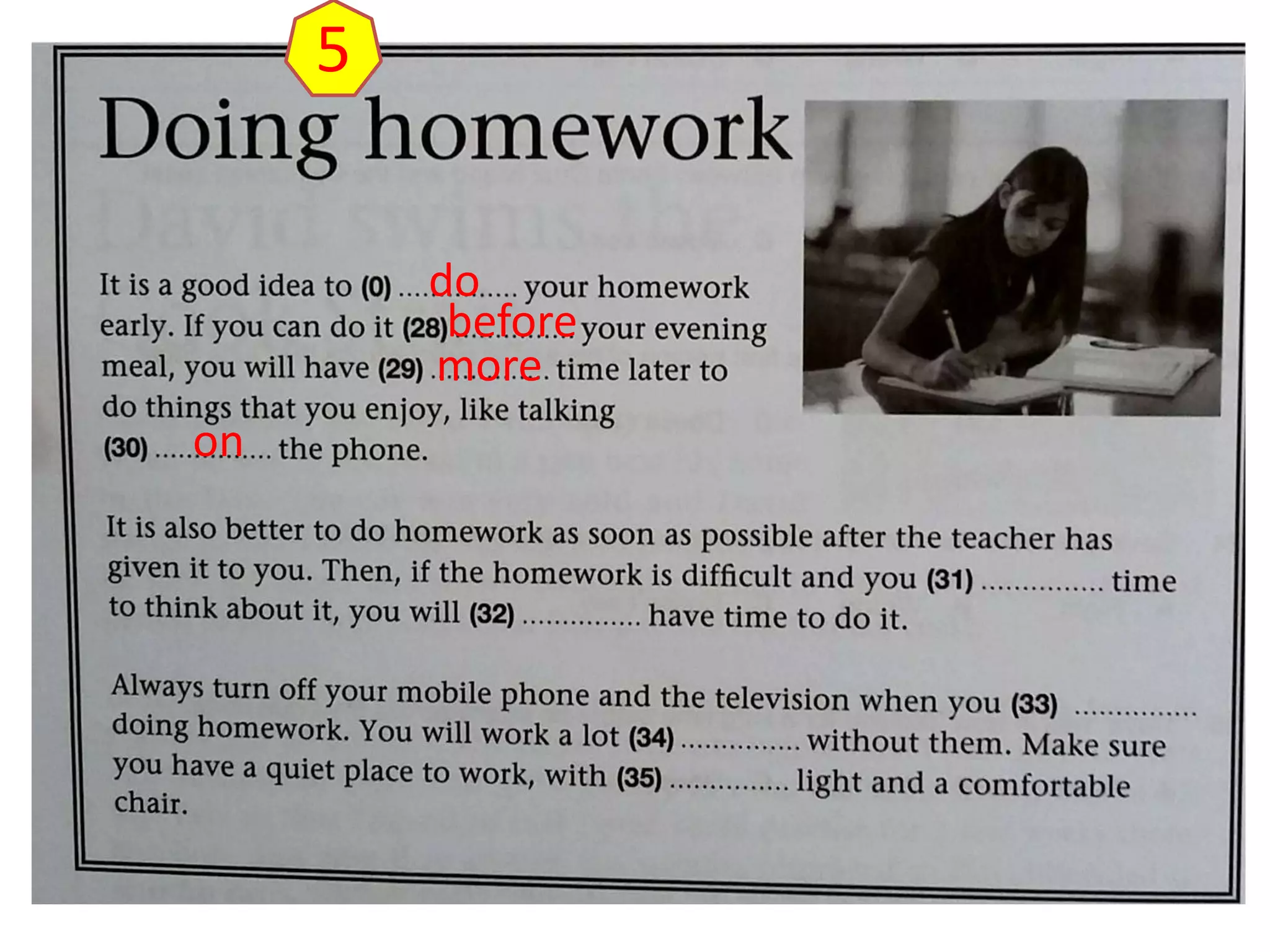
1
Part 5: Examples
prepostion
Adverb of time
determiner
2 3
4
do
before
more
on
5
PAPER 1: Reading and Writing
•You read 5 definitions and
complete 5 words, which you
have to write their spellings
correctly.
•All the words are related to
the topic.
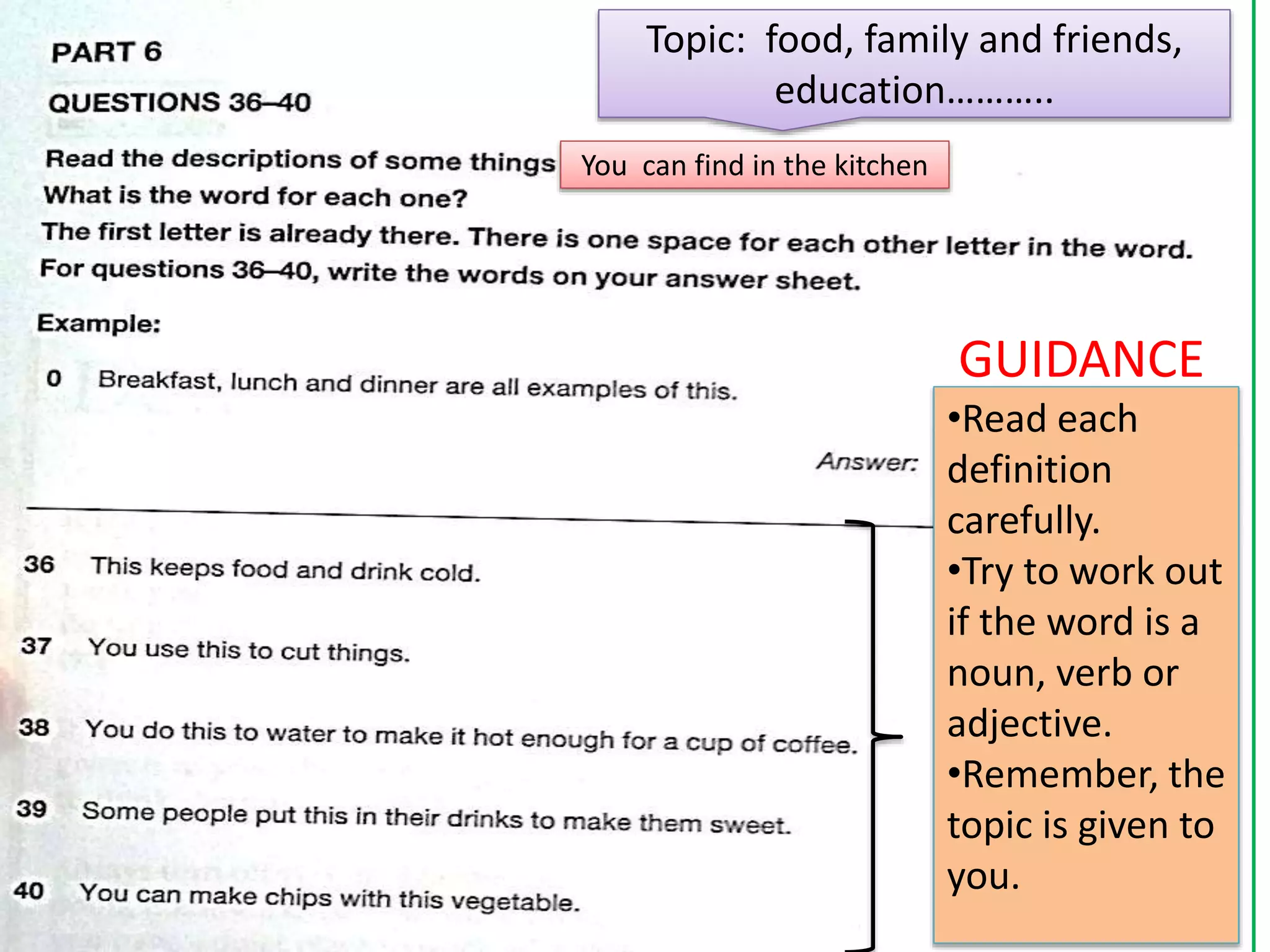
Part 6: Overview
Topic: food, family and friends,
education………..
You can find in the kitchen
•Read each
definition
carefully.
•Try to work out
if the word is a
noun, verb or
adjective.
•Remember, the
topic is given to
you.
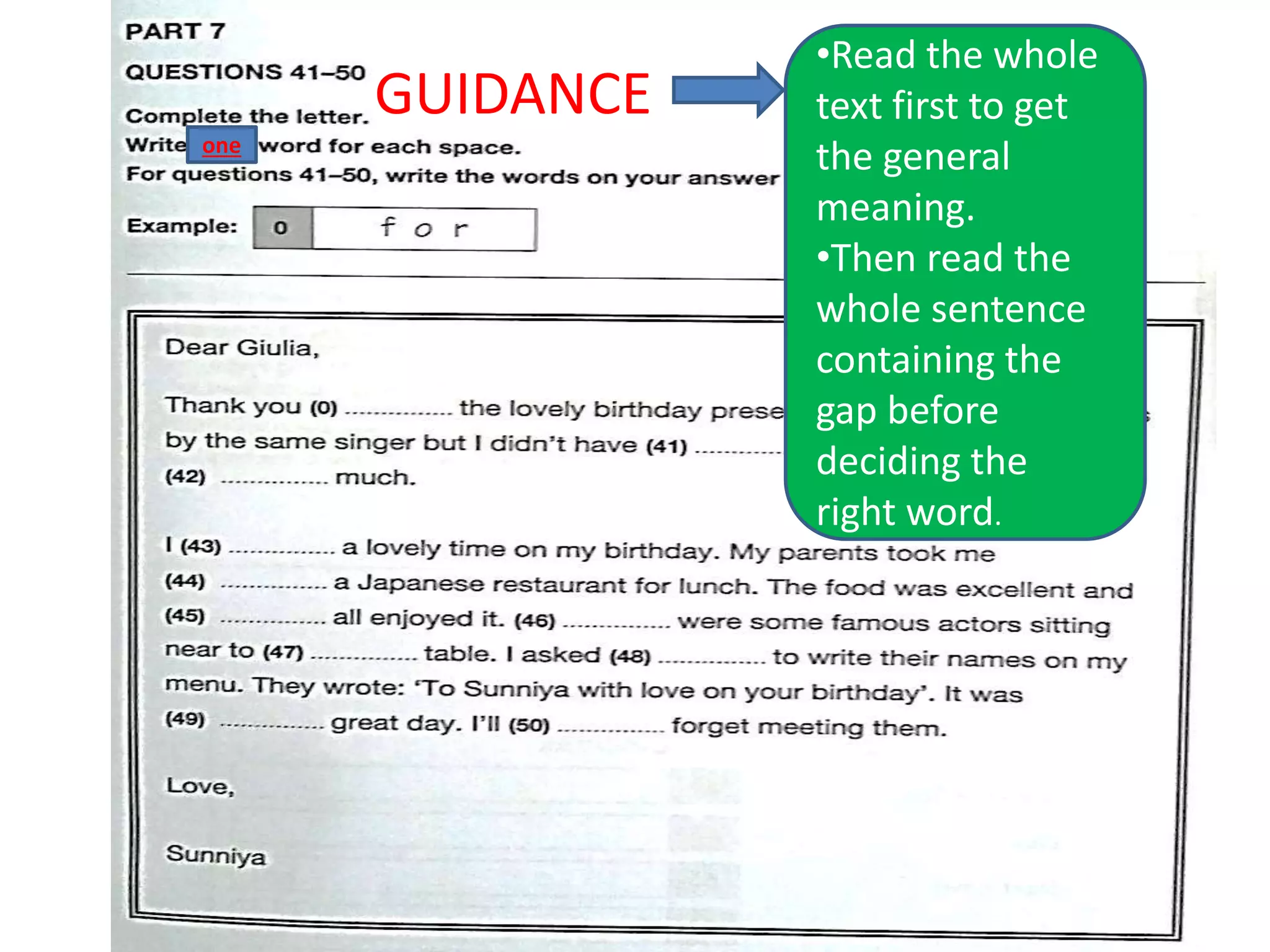
GUIDANCE
•There is one space
for each letter of the
word.
•The first letter of
the word is given to
give you.
•You need to spell
the words correctly
r i d g e
n i f e
o i l
u g a r
o t a t o
PAPER 1: Reading and Writing
•You read a short text, usually a note
,letter or email, with 10 gaps. You have
to think of 1 word to fit each gap.
•Your use of grammar and vocabulary,
as well as your spelling( you must spell
the missing word correctly)
Part 7: Overview
•Read the whole
text first to get
the general
meaning.
•Then read the
whole sentence
containing the
gap before
deciding the
right word.
one
GUIDANCE
Think about the type
of the word
Verb-Form Article Conjunction
Preposition Pronoun Adverb
Ect…..
this/that/
everyvery/so
to
we There
our/my/that them
a not/never
for(preposition
)
(Verb-form)had
(preposition)
(pronoun)
(article)
(subject)
(determiner)
adverb
adverb
(possessive)
Adverb of
frequence
Postcard
Questions
Part 8: Overview
PAPER 1: Reading and Writing
Notice Email
Note
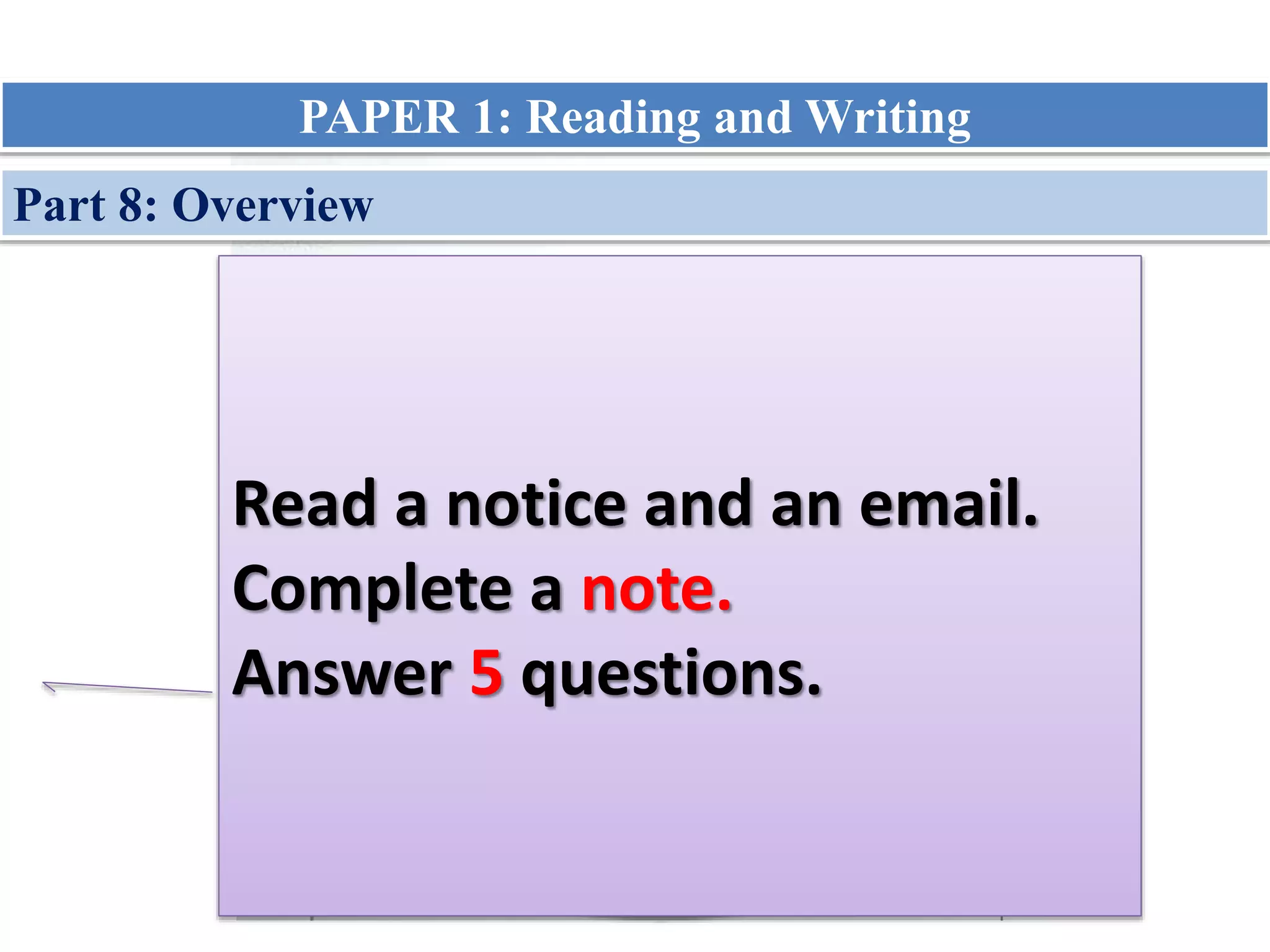
Instruction
Part 8: Overview
Read a notice and an email.
Complete a note.
Answer 5 questions.
PAPER 1: Reading and Writing
1. Read the notice, the letter and the
questions carefully.
2. Figure out what kinds of information
needed in each questions. They can be
names, dates, prices …
3. Double check your spelling.
Part 8: Guidance
PAPER 1: Reading and Writing
Moon Race
Saturday
8.45
5.50
café
Overview
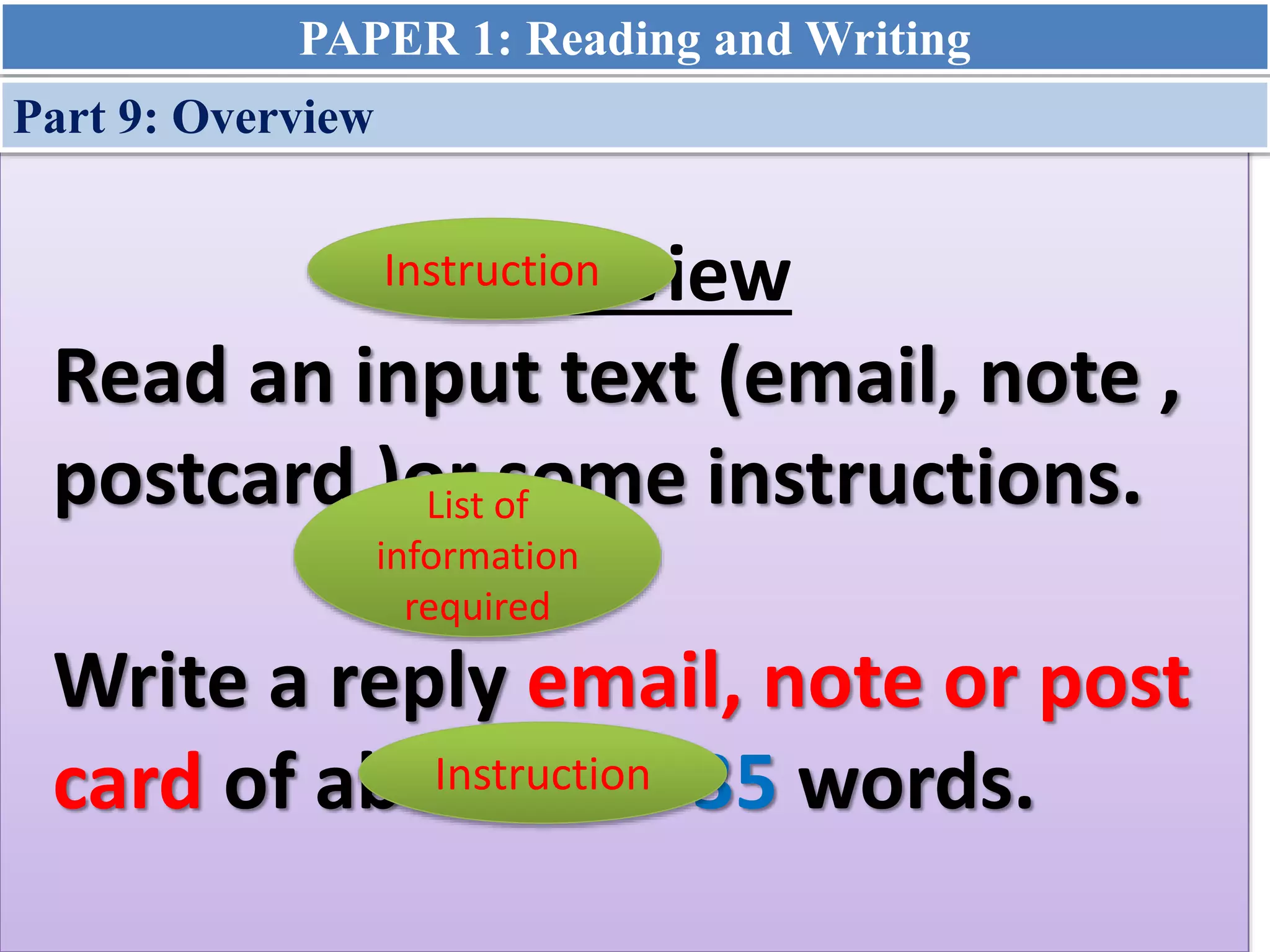
Read an input text (email, note ,
postcard )or some instructions.
Write a reply email, note or post
card of about 25 - 35 words.
Instruction
List of
information
required
Instruction
PAPER 1: Reading and Writing
Part 9: Overview
1. Read the input text or the instructions
carefully.
2. Figure out what types of message you
need to write, who is it for and what
information you need to include.
3. Answer all the questions (usually 3)
4. Double check your spelling.
Part 9: Guidance
PAPER 1: Reading and Writing
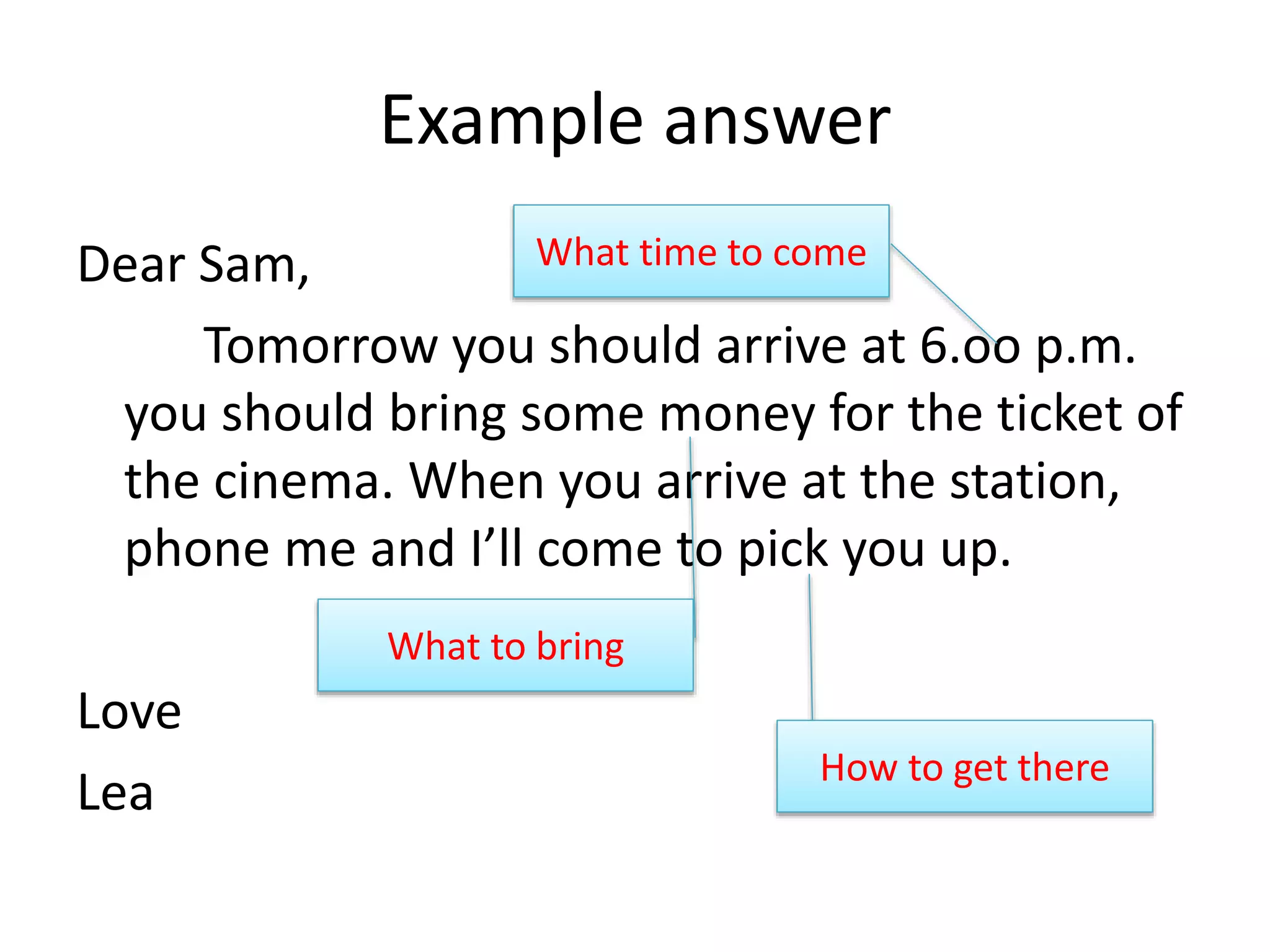
Example answer
Dear Sam,
Tomorrow you should arrive at 6.oo p.m.
you should bring some money for the ticket of
the cinema. When you arrive at the station,
phone me and I’ll come to pick you up.
Love
Lea
What time to come
What to bring
How to get there
KET Reading and Writing Overview

KET Reading and Writing Overview

  • 1.
    Key English Test Readingand Writing Parts
  • 3.
    Parts Task Typesand Format Task focus Number of Questions 1 Matching. Notices and signs 5 2 Three-option multiple choice sentences Vocabulary 5 3 Three-option multiple choice Functional language 10 4 Right/ Wrong/ Doesn’t Say or Three-option multiple choice Passage reading 7 5 Multiple choice cloze Structural words 8 6 Word completion Vocabulary and Spelling 5 7 Open cloze Structure and Vocabulary 10 8 Information transfer Reading and Writing 5 9 Guided writing Writing 1
  • 4.
    PAPER 1: Readingand Writing Part 1 - Overview signs and notices (found in schools, railway stations, airports, shops and on roads)
  • 5.
    PAPER 1: Readingand Writing Part 1 - Overview These sentences explain the signs and notices.
  • 6.
    PAPER 1: Readingand Writing Part 1 - Overview
  • 7.
    PAPER 1: Readingand Writing Part 1 - Guidance 1. Read the instructions and example carefully first. 2. Read the sentences and short texts carefully. Think about where you might find such signs and notices. 3. You may see the same word appear in a sign/notice and in a sentence. But you need to be careful.
  • 8.
    PAPER 1: Readingand Writing Part 1. Examples: B F D A G
  • 9.
    PAPER 1: Readingand Writing Part 2 – Overview
  • 10.
    PAPER 1: Readingand Writing Part 2 - Guidance 1. Read the instructions and example before you begin. That way you will know the topic of the sentences. 2. Read the whole sentence before deciding which word best fits the gap. When you have chosen, read the sentence again to make sure it makes sense.
  • 11.
    PAPER 1: Readingand Writing Part 2 – Examples:
  • 12.
    Guidance • Read each question/statement carefully •Think about who might be asking the question or saying the statement • How you might respond to it PAPER 1: Reading and Writing Part 3 a Overview: Complete five two-line conversations (Q.11-Q.15) by choosing the best opion
  • 13.
  • 14.
    Which wh-question worddo we need for answer A and B?
  • 15.
    Guidance • Read the gapped conversation onthe left- hand side first • Read what the 1st speaker says before and after each gap • Read all the dialogue to check whether it makes sense or not Part 3 b Overview: Complete a longer conversation taking place in study and social situations by choosing from a list of 8 opions, 3 extra options you do not use
  • 16.
  • 17.
    Overview:  a 230words - text from authentic newspaper or magazine articles.  7 multiple choice questions in this part. The answers are either Right/Wrong/Doesn’t say or three-option multilpe choice. Task focus:  skim to get main ideas and general information  or scan to get detailed information PAPER 1: Reading and Writing Part 4
  • 18.
    1. Read theinstructions carefully to know what is the text about and what answers are expected for these questions. 2. Skim the text to get general meaning and format order of the text. 3. Read 7 questions and underline key words. 4. Scan the text carefully to find out detailed information or answers Part 4: Guidance
  • 19.
    1. What kindof text is it? 2.What did the man in the text do? 1 Part 4: Examples
  • 20.
  • 21.
    Notes: The questions followthe order of the text “Wrong”: if the information in the question is different from the text “Doesn’t say” if the question asks for information that isn’t in the text.
  • 22.
  • 23.
  • 24.
    Type and format: •a quite long text from authentic newspaper or magazine articles or an encyclopaedia entry. • The text contains 8 gaps about grammar points. Task focus: • to have an insight about grammar points such as verb forms, determiners, prepostions, adverbs, adjectives and so on. PAPER 1: Reading and Writing Part 5: Overview
  • 25.
    1.Read the instructionscarefully to know what is the text about and what answers are expected for these questions. 2.Skim the text to get general meaning and format order of the text. 3.Read the text again carefully, read the whole sentence containing the gap and try to guess what the missing word might be ( part of speech and possible answers) 4.Read the three options and choose the best word. 5.Read the sentence with the words in the gaps to make sure they make sense to the whole text. Part 5: Guidance
  • 26.
  • 27.
  • 28.
  • 29.
  • 30.
    PAPER 1: Readingand Writing •You read 5 definitions and complete 5 words, which you have to write their spellings correctly. •All the words are related to the topic. Part 6: Overview
  • 31.
    Topic: food, familyand friends, education……….. You can find in the kitchen •Read each definition carefully. •Try to work out if the word is a noun, verb or adjective. •Remember, the topic is given to you. GUIDANCE
  • 32.
    •There is onespace for each letter of the word. •The first letter of the word is given to give you. •You need to spell the words correctly
  • 33.
    r i dg e n i f e o i l u g a r o t a t o
  • 34.
    PAPER 1: Readingand Writing •You read a short text, usually a note ,letter or email, with 10 gaps. You have to think of 1 word to fit each gap. •Your use of grammar and vocabulary, as well as your spelling( you must spell the missing word correctly) Part 7: Overview
  • 35.
    •Read the whole textfirst to get the general meaning. •Then read the whole sentence containing the gap before deciding the right word. one GUIDANCE
  • 36.
    Think about thetype of the word Verb-Form Article Conjunction Preposition Pronoun Adverb Ect…..
  • 37.
    this/that/ everyvery/so to we There our/my/that them anot/never for(preposition ) (Verb-form)had (preposition) (pronoun) (article) (subject) (determiner) adverb adverb (possessive) Adverb of frequence
  • 38.
  • 39.
    Notice Email Note Instruction Part 8:Overview Read a notice and an email. Complete a note. Answer 5 questions. PAPER 1: Reading and Writing
  • 40.
    1. Read thenotice, the letter and the questions carefully. 2. Figure out what kinds of information needed in each questions. They can be names, dates, prices … 3. Double check your spelling. Part 8: Guidance PAPER 1: Reading and Writing
  • 41.
  • 42.
    Overview Read an inputtext (email, note , postcard )or some instructions. Write a reply email, note or post card of about 25 - 35 words. Instruction List of information required Instruction PAPER 1: Reading and Writing Part 9: Overview
  • 43.
    1. Read theinput text or the instructions carefully. 2. Figure out what types of message you need to write, who is it for and what information you need to include. 3. Answer all the questions (usually 3) 4. Double check your spelling. Part 9: Guidance PAPER 1: Reading and Writing
  • 45.
    Example answer Dear Sam, Tomorrowyou should arrive at 6.oo p.m. you should bring some money for the ticket of the cinema. When you arrive at the station, phone me and I’ll come to pick you up. Love Lea What time to come What to bring How to get there