Michael McCarthy
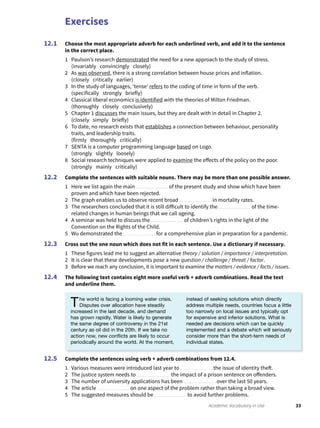
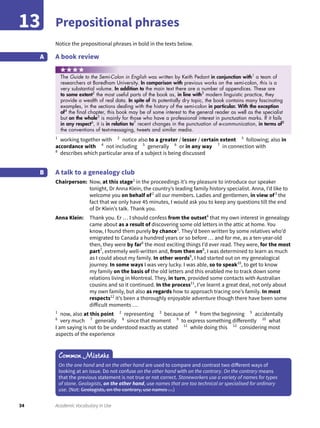
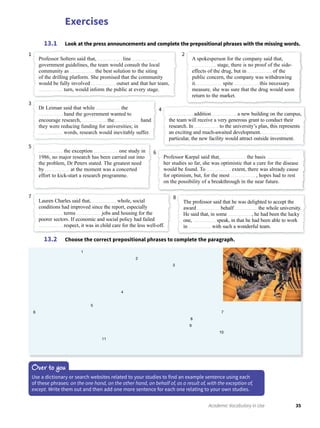
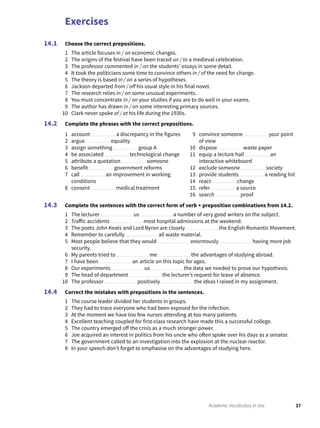
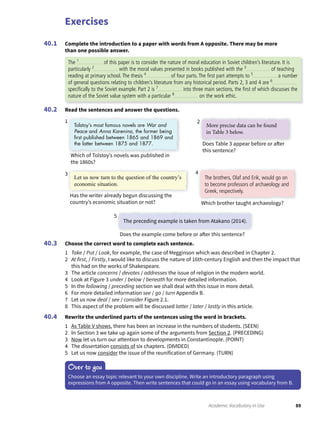
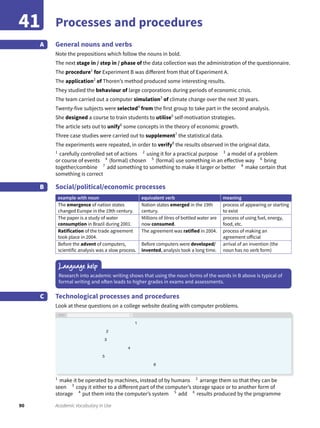
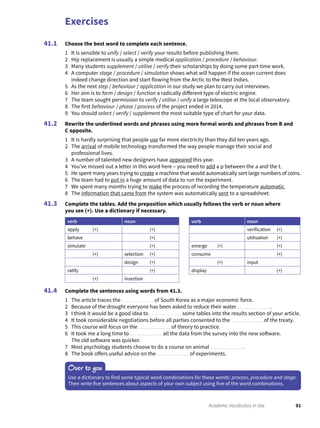
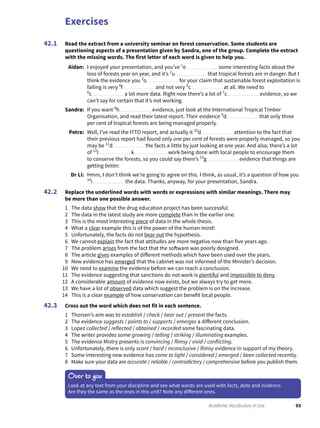
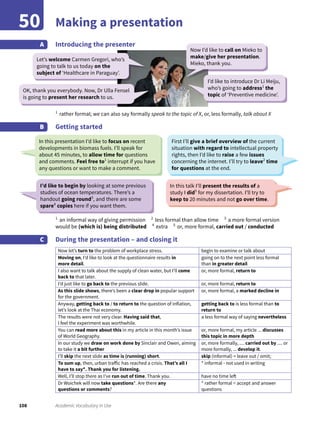
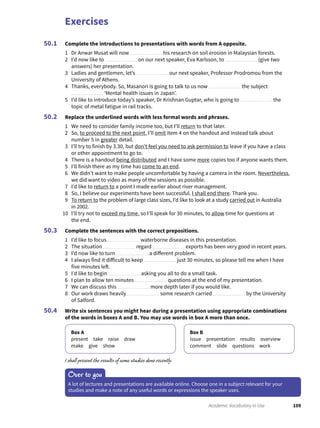
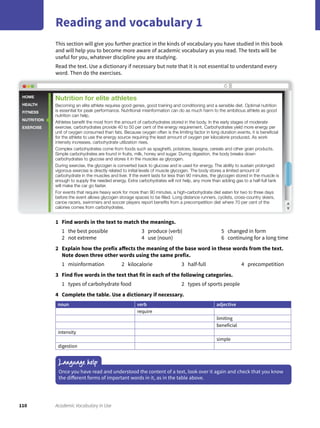
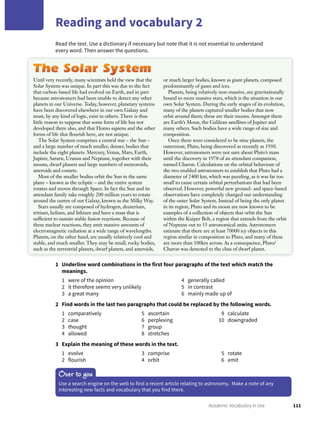
Felicity O’Dell
Vocabulary reference
and practice
Self-study and classroom use
in Use
Second Edition
New Edition
Michael McCarthy
Felicity O’Dell
Vocabulary reference
and practice
Self-study and classroom use
Academic
Vocabulary
in Use
Second Edition
University Printing House, Cambridge CB2 8BS, United Kingdom
One Liberty Plaza, 20th Floor, New York, NY 10006, USA
477 Williamstown Road, Port Melbourne, VIC 3207, Australia
314–321, 3rd Floor, Plot 3, Splendor Forum, Jasola District Centre,
New Delhi – 110025, India
79 Anson Road, #06–04/06, Singapore 079906
Cambridge University Press is part of the University of Cambridge.
It furthers the University’s mission by disseminating knowledge in the pursuit of
education, learning and research at the highest international levels of excellence.
www.cambridge.org
Information on this title: www.cambridge.org/9781107591660
© Cambridge University Press 2016
This publication is in copyright. Subject to statutory exception
and to the provisions of relevant collective licensing agreements,
no reproduction of any part may take place without the written
permission of Cambridge University Press.
First published 2008
Second edition 2016
20 19 18 17 16 15 14 13 12 11 10 9 8
Printed in Dubai by Oriental Press
A catalogue record for this publication is available from the British Library
ISBN 978-1-107-59166-0 Paperback
Cambridge University Press has no responsibility for the persistence or accuracy
of URLs for external or third-party internet websites referred to in this publication,
and does not guarantee that any content on such websites is, or will remain,
accurate or appropriate.
Contents
Acknowledgements 5
To the student and the teacher 6
0 Before you start 8
Getting started:
General academic vocabulary
1 What is special about 10
academic English?
2 Key nouns 12
3 Key verbs 14
4 Key adjectives 16
5 Key adverbs 18
6 Phrasal verbs in academic English 20
7 Key quantifying expressions 22
8 Words with several meanings 24
9 Metaphors and idioms 26
Word combinations
10 Nouns and the words they
combine with 28
11 Adjective and noun combinations 30
12 Verbs and the words they
combine with 32
13 Prepositional phrases 34
14 Verbs and prepositions 36
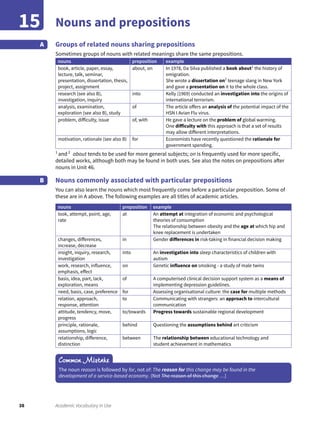
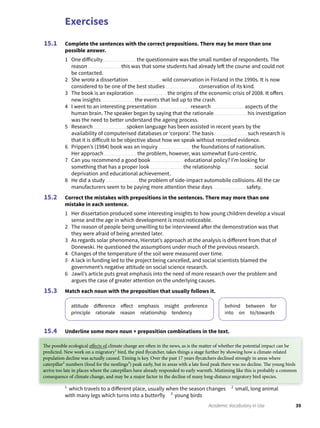
15 Nouns and prepositions 38
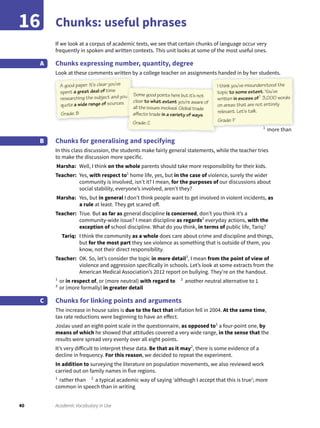
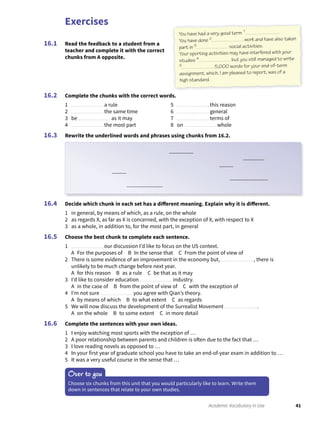
16 Chunks: useful phrases 40
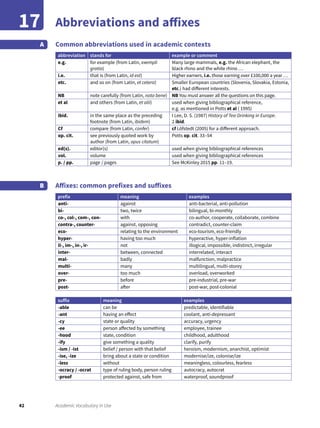
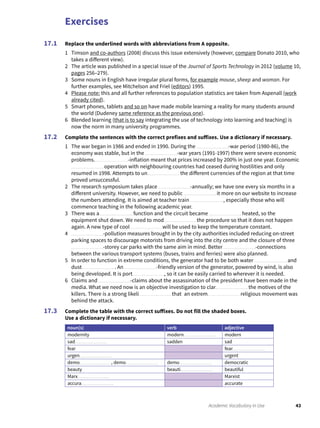
17 Abbreviations and affixes 42
Academic life
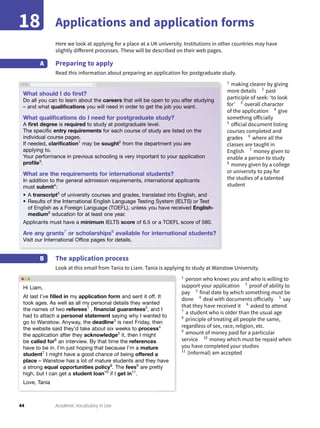
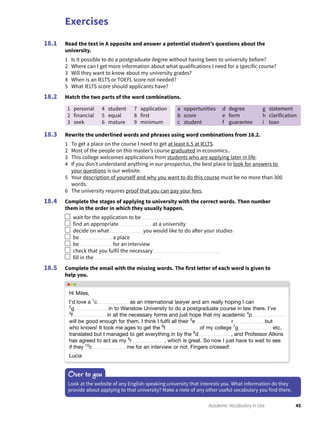
18 Applications and application forms 44
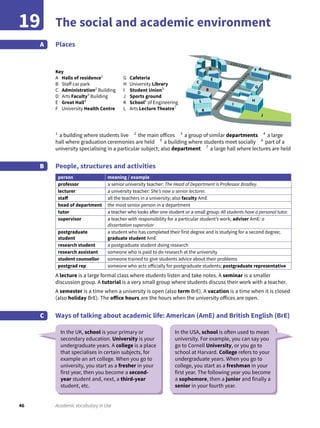
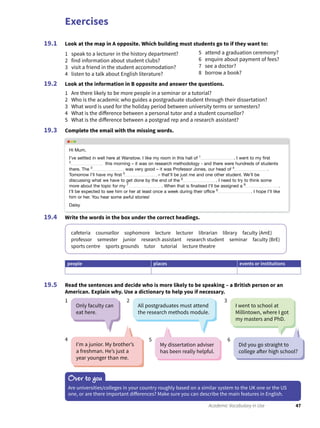
19 The social and academic environment 46
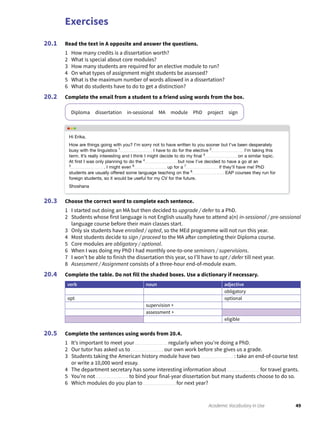
20 Academic courses 48
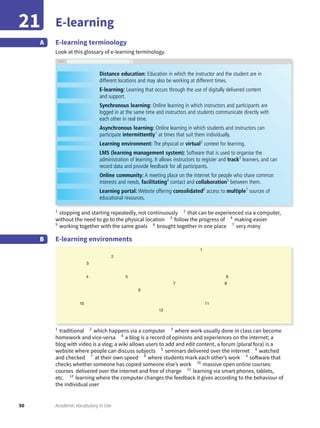
21 E-learning 50
22 Study habits and skills 52
23 Money and education 54
Planning and starting work
24 Identifying goals 56
25 Planning a piece of work 58
26 Describing methods 60
27 Using sources 62
Thinking and interacting
28 Analysing data 64
29 Talking about ideas 66
30 Reporting what others say 68
31 Talking about meaning 70
32 Talking about points of view 72
Ways of talking about …
33 Numbers 74
34 Statistics 76
35 Graphs and diagrams 78
36 Time 80
37 Cause and effect 82
38 Classifying 84
Organising and presenting ideas
39 Structuring an argument 86
40 Organising your writing 88
41 Processes and procedures 90
42 Facts, evidence and data 92
43 Making connections 94
44 Describing problems 96
45 Describing situations 98
46 Comparing and contrasting 100
47 Evaluation and emphasis 102
48 Describing change 104
49 Summarising and concluding 106
50 Making a presentation 108
3Academic Vocabulary in Use
4 Academic Vocabulary in Use
Reading and vocabulary
1 Nutrition for elite athletes 110
2 The solar system 111
3 Graphology 112
4 Measuring time 113
5 Archaeology and medicine 114
6 Seeing things differently 115
Reference
1 Formal and informal academic
words and expressions 116
2 Numbers, units of measurement
and common symbols 120
3 British and North American
academic vocabulary 122
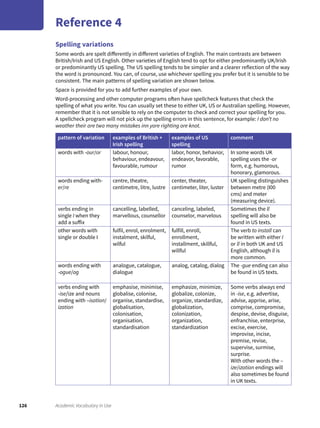
4 Spelling variations 126
5 Word formation 128
Answer key 132
Phonemic symbols 162
Index 163
Acknowledgements
5Academic Vocabulary in Use
The authors wish to thank Helen Freeman, Chris
Capper and Sheila Dignen for their invaluable
intellectual and editorial support during the
course of the preparation of this new edition.
We must also thank the lexicography and
computational team at Cambridge University
Press whose work with the Cambridge
International Corpus, the Cambridge Learner
Corpus and the CANCODE corpus of spoken
English (developed at the University of
Nottingham in association with Cambridge
University Press), enabled us to make a fully
corpus-informed selection of the academic
vocabulary we focus on in these materials.
We acknowledge with gratitude the pioneering
work on academic word lists done by Averil
Coxhead. In planning this book we made
considerable use of her lists at http://www.
victoria.ac.nz/lals/resources/academicwordlist/
We also acknowledge the work of Annette Capel
and the English Vocabulary Profile. The EVP
enabled us to select vocabulary appropriate to
the level.
Michael McCarthy and Felicity O’Dell
Development of this publication has made use
of the Cambridge English Corpus, a multi-billion
word collection of spoken and written English.
It includes the Cambridge Learner Corpus, a
unique collection of candidate exam answers.
Cambridge University Press has built up the
Cambridge English Corpus to provide evidence
about language use that helps to produce better
language teaching materials.
The authors and publishers acknowledge the
following sources of copyright material and
are grateful for the permissions granted. While
every effort has been made, it has not always
been possible to identify the sources of all the
material used, or to trace all copyright holders.
If any omissions are brought to our notice,
we will be happy to include the appropriate
acknowledgements on reprinting and in the next
update to the digital edition, as applicable.
New Scientist for the text on p. 25 adapted from
‘Simulator could predict where epidemics will
strike next’, New Scientist, 30.03.2006. Copyright
© 2006 Reed Business Information UK. All
rights reserved. Distributed by Tribune Media
Services; Scientific American for the text on p.
27 adapted from ‘Shutting Down Alzheimers’ by
Michael S. Wolfe, Scientific American. Reproduced
with permission. Copyright © (2006) Scientific
American, Inc. All rights reserved; Nature
Publishing Group for the text on p. 39 adapted
from ‘Abridged Extract timing is life and death’,
Nature, Vol 441, no. 7089, 04.05.2006. Copyright
© 2006 Nature Publishing Group. Reproduced
with permission; Text on p. 110 adapted from J.
Anderson, Colorado State University Extension
foods and nutrition specialist and professor; S.
Perryman, CSU Extension foods and nutrition
specialist; L. Young, former foods and nutrition
graduate student; and S. Prior, former graduate
intern, food science and human nutrition.
Reviewed and revised, July, 2015 by Colorado
State University Jessica Clifford, Research
Associate and Extension Specialist and K.
Maloney, graduate student in the Dept. of Food
Science Human Nutrition; Dunedin Academic
Press Ltd for the text on p. 111 adapted from
‘Introducing the planets and their moons’ by
Peter Cattermole. Reproduced with permission
from Cattermole Introducing the Planets and
their Moons (Dunedin, Edinburgh, 2014); Text on
p. 112 adapted from David Crystal, The Cambridge
Encyclopedia of Language 2nd Edition, 1997, ©
David Crystal 1997, published by Cambridge
University Press, adapted and reproduced with
permission of the author and publisher; Scientific
American for the text on p. 113 adapted from
‘A Chronicle of timekeeping’ by William J. H.
Andrews, Scientific American, Vol 23. Reproduced
with permission. Copyright © (2014) Scientific
American, Inc. All rights reserved; Text on p. 114
adapted from Patricia A. Baker, The Archaeology
of Medicine in the Greco-Roman World, 2013, ©
Patricia A. Baker 2013, published by Cambridge
University Press, adapted and reproduced with
permission of the author and publisher; Text on
p. 115 adapted from ‘Seeing Things Differently’
by Shaaron Ainsworth, RSA Journal, Issue 2.
Copyright © 2014 RSA Journal. Reproduced with
permission of Shaaron Ainsworth.
Photographs
p. 20: © Lars Wallin/Etsa Images/Corbis; p. 21:
Plume Creative/Getty Images; p. 35: kikujungboy/
Shutterstock; p. 36: © Radius Images/Corbis;
p. 54 (photo 1): picamaniac/Shutterstock; p. 54
(photo 2): payaercan/Getty Images; p. 54 (photo
3): © YAY Media AS/Alamy; p. 64: © Ken Welsh/
Alamy; p. 70: © Radius Images/Alamy; p. 71: ©
Michael Ochs/Corbis; p. 80: © Wavebreak Media
Ltd/Alamy; p. 108: © moodboard/Corbis.
Illustrations
Kamae Design pp. 40, 41, 46, 52, 76, 77, 78, 79.
6 Academic Vocabulary in Use
To the student and the teacher
Who is this book for?
This book is for anyone who wants or needs to learn the kind of English which is used in
academic contexts. It deals with the language used in written works such as textbooks and
journal articles as well as with the spoken language of lectures and seminars. It also presents
vocabulary relating to being a student at a university or college in that it covers topics relating to
university life. It will be particularly useful for students preparing for IELTS, the Pearson Academic
English Test or any other examination aimed at assessing whether candidates’ English is at a
high enough level to study in an institution where English is the medium of instruction. It will be
helpful for people who need to attend – or indeed give – lectures or presentations in English or to
participate in international conferences. It will enable students who have to prepare assignments
or write up a dissertation in English to do so in a much more natural and appropriate way.
What kind of vocabulary does the book deal with?
The book presents and practises the kind of vocabulary that is used in academic contexts
regardless of which discipline you are specialising in. So it considers words and expressions
like concept, put forward a theory and come to a conclusion. It does not deal with the specialist
vocabulary of any particular subject such as anatomy or physics. Specialist terms are often
relatively easy to master – they will be explained and taught as you study the subject and indeed
these words may sometimes be similar in English and your own language. However, it is the more
general vocabulary used for discussing ideas and research and for talking and writing about
academic work that you need to be familiar with in order to feel comfortable in an academic
environment. Despite the fact that such vocabulary items are much more frequent than specialist
vocabulary, they are often felt to be more difficult to learn. It is, therefore, useful to approach
them in the systematic way suggested by this book.
One positive aspect of academic vocabulary is that there are relatively few differences, depending
on whether you are studying in London or New York, Delhi or Sydney, Johannesburg, Dublin,
Wellington, Toronto or Singapore or indeed any other place where you may be using English for
academic purposes. Academic English tends to be a truly international language and the units of
the book focus on vocabulary that will be essential for you regardless of where you are studying
now or where you may be likely to study in the future. There are some differences between words
used to describe people and places and these are highlighted in Unit 19. Reference sections 3 and
4 also focus on some vocabulary and spelling variations. In the units of the book we use British
English spelling conventions, except when quoting texts which originally used American spellings.
Much of the vocabulary used in the book is neutral in that it is equally appropriate in both written
and spoken contexts. We indicate those instances where a word is too formal to be used in
speech or too informal to use in academic writing.
How was the vocabulary for the book selected?
The academic vocabulary focused on in this book was all selected from language identified as
significant by the Cambridge International Corpus of written and spoken English and also the
CANCODE corpus of spoken English developed at the University of Nottingham in association with
Cambridge University Press. These enormous corpora include large collections of written and
spoken academic text and so it was possible to identify language that is distinctive for academic
contexts. We also made considerable use of the Cambridge Learner Corpus, a corpus of more
than 60 million words of text taken from hundreds of thousands of learner scripts from students
taking Cambridge English exams all over the world. From this corpus we were able to learn what
kinds of errors students taking, for example, IELTS, were typically making.
In planning this book we made considerable use of Averil Coxhead’s work on developing
academic wordlists. Her lists can be found at, for example, http://www.uefap.com/vocab/select/
awl.htm
7Academic Vocabulary in Use
How is the book organised?
Each unit consists of two pages. The left-hand page presents the academic vocabulary to be
focused on in the unit. You will usually find words and expressions presented in context with,
where appropriate, any special notes about their meaning and usage. The right-hand page
checks that you have understood the information on the presentation page by giving you a
series of exercises to complete.
The units are organised into different sections: The book begins with a Unit Zero called Before
you start. The first section then includes nine units which look at basic aspects of academic
vocabulary such as what is special about academic vocabulary, key verbs and key quantifying
expressions. The second section devotes eight units to how words typically combine with
one another in academic English. The third section has six units focusing on aspects of life in
academic institutions. The fourth section provides four units considering aspects of planning
and starting a piece of work and the fifth consists of five units relating to thinking and
interacting. The sixth section has six units dealing with ways of talking about different concepts
such as numbers, time and cause and effect. The seventh section includes twelve units covering
aspects of the organisation and presentation of ideas.
Towards the end of the book you will find six reading texts relating to different academic
disciplines with exercises based on the vocabulary in those texts. We hope you will find these
useful examples of how to use texts to expand your knowledge of academic vocabulary in
English and would recommend that you read these texts and do the exercises on them even if
they relate to an academic subject that is very different from your own.
There are five reference sections dealing with some key areas where we felt it would be useful
for you to have lists of items that could not be presented as fully in the main body of the book,
i.e. Formal and informal academic words and expressions, Numbers, units of measurement
and common symbols, British and North American academic vocabulary, Spelling variations
and Word formation. Where appropriate, these reference sections provide space for you to add
further examples of your own.
At the end of the book there is a Key with answers to all the exercises and an Index of all the
key words and expressions, indicating the units where they can be found. The pronunciation is
provided for standard British English.
Do Unit Zero first followed by Unit 1 What is special about academic English? Then work
through the remaining units in any order that suits you.
So, good luck with your work on academic English. We hope that the materials in this book will
help you to enjoy and to benefit fully from your studies. We hope that you will be able to share
ideas in a creative, exciting way with scholars from all over the world and we wish you the very
best for a successful and rewarding academic life.
8 Academic Vocabulary in Use
Before you start0
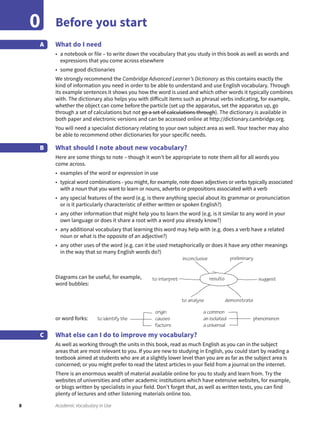
What do I need
• a notebook or file – to write down the vocabulary that you study in this book as well as words and
expressions that you come across elsewhere
• some good dictionaries
We strongly recommend the Cambridge Advanced Learner’s Dictionary as this contains exactly the
kind of information you need in order to be able to understand and use English vocabulary. Through
its example sentences it shows you how the word is used and which other words it typically combines
with. The dictionary also helps you with difficult items such as phrasal verbs indicating, for example,
whether the object can come before the particle (set up the apparatus, set the apparatus up, go
through a set of calculations but not go a set of calculations through). The dictionary is available in
both paper and electronic versions and can be accessed online at http://dictionary.cambridge.org.
You will need a specialist dictionary relating to your own subject area as well. Your teacher may also
be able to recommend other dictionaries for your specific needs.
What should I note about new vocabulary?
Here are some things to note – though it won’t be appropriate to note them all for all words you
come across.
• examples of the word or expression in use
• typical word combinations - you might, for example, note down adjectives or verbs typically associated
with a noun that you want to learn or nouns, adverbs or prepositions associated with a verb
• any special features of the word (e.g. is there anything special about its grammar or pronunciation
or is it particularly characteristic of either written or spoken English?)
• any other information that might help you to learn the word (e.g. is it similar to any word in your
own language or does it share a root with a word you already know?)
• any additional vocabulary that learning this word may help with (e.g. does a verb have a related
noun or what is the opposite of an adjective?)
• any other uses of the word (e.g. can it be used metaphorically or does it have any other meanings
in the way that so many English words do?)
A
B
inconclusive preliminary
to interpret suggest
to analyse demonstrate
results
or word forks:
origin a common
to identify the causes an isolated phenomenon
factors a universal
Diagrams can be useful, for example,
word bubbles:
What else can I do to improve my vocabulary?
As well as working through the units in this book, read as much English as you can in the subject
areas that are most relevant to you. If you are new to studying in English, you could start by reading a
textbook aimed at students who are at a slightly lower level than you are as far as the subject area is
concerned; or you might prefer to read the latest articles in your field from a journal on the internet.
There is an enormous wealth of material available online for you to study and learn from. Try the
websites of universities and other academic institutions which have extensive websites, for example,
or blogs written by specialists in your field. Don’t forget that, as well as written texts, you can find
plenty of lectures and other listening materials online too.
C
9Academic Vocabulary in Use
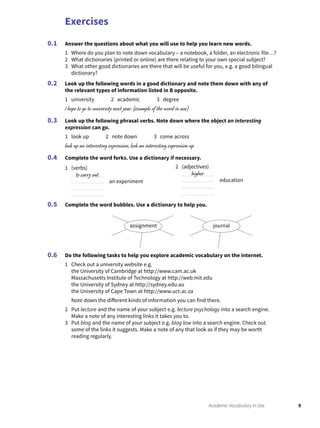
Answer the questions about what you will use to help you learn new words.
1 Where do you plan to note down vocabulary – a notebook, a folder, an electronic file…?
2 What dictionaries (printed or online) are there relating to your own special subject?
3 What other good dictionaries are there that will be useful for you, e.g. a good bilingual
dictionary?
Look up the following words in a good dictionary and note them down with any of
the relevant types of information listed in B opposite.
1 university 2 academic 3 degree
I hope to go to university next year. (example of the word in use)
Look up the following phrasal verbs. Note down where the object an interesting
expression can go.
1 look up 2 note down 3 come across
look up an interesting expression, look an interesting expression up
Complete the word forks. Use a dictionary if necessary.
1 (verbs)
to carry out
an experiment
2 (adjectives)
higher
education
Complete the word bubbles. Use a dictionary to help you.
0.1
0.2
0.3
0.4
0.5
Exercises
assignment journal
Do the following tasks to help you explore academic vocabulary on the internet.
1 Check out a university website e.g.
the University of Cambridge at http://www.cam.ac.uk
Massachusetts Institute of Technology at http://web.mit.edu
the University of Sydney at http://sydney.edu.au
the University of Cape Town at http://www.uct.ac.za
Note down the different kinds of information you can find there.
2 Put lecture and the name of your subject e.g. lecture psychology into a search engine.
Make a note of any interesting links it takes you to.
3 Put blog and the name of your subject e.g. blog law into a search engine. Check out
some of the links it suggests. Make a note of any that look as if they may be worth
reading regularly.
0.6
1
10 Academic Vocabulary in Use
What is special about academic English?
Everyday words and academic uses
Many words in academic English are the same as everyday vocabulary, but they are often used with
a slightly different meaning, which may be specialised.
everyday use meaning academic use meaning
Standards of discipline in
schools have declined.
ability to control yourself
or other people
Nanotechnology is a
relatively new discipline.
area of study
Underline your family
name on the form.
draw a line under it The research underlines the
value of case studies.
gives emphasis to
The lake was frozen solid. not liquid or gas We have no solid evidence
that radiation has caused
the problem.
certain or safe; of a
good standard
Vocabulary and academic style
In writing, academics use many neutral expressions. They also use rather formal expressions which are
not common in everyday language. Knowing whether an expression is formal or just neutral is important.
neutral more formal neutral more formal
in short, briefly, basically in sum, to sum up, fundamentally try attempt
only sole(ly) mainly, mostly primarily
almost, more or less virtually typical of characteristic of
However, very informal vocabulary may be used in spoken academic styles in classes and lectures.
Learn to understand informal language when you hear it but be careful not to use it in essays and
written assignments. Here are some examples of teachers using informal language.
‘OK. Have a shot at doing task number 3.’ [more formal: Try/Attempt to do ... ]
‘There’s no way schools can be held responsible for failures of government policy.’ [more formal:
Schools cannot in any way be held ... ]
Academic language tries to be clear and precise, so it is important to keep a vocabulary notebook
(see page 8) and learn the differences between similar words, as well as typical word combinations
(underlined here).
The building is a prime example of 1920s architecture. [excellent in quality or value]
The group’s primary concern is to protect human rights. [main; most important]
Noun phrases
Academic language often uses complex noun phrases. For example, instead of saying Radiation was
accidentally released over a 24-hour period, damaging a wide area for a long time, an academic might
say The accidental release of radiation over a 24-hour period caused widespread long-term damage.
It is therefore important to learn the different forms of a word, for example:
noun verb adjective(s) adverb(s)
accident accidental accidentally
quantity/quantification quantify quantitative/quantifiable quantitatively/quantifiably
Finally, be aware of ‘chunks’ or
phrases which occur frequently, and
learn them as whole units. Examples:
in terms of, in addition to, for the most
part, in the case of, etc. (See Unit 16).
A
B
C
Language help
Using complex noun phrases improves your writing style and
can contribute to higher grades in essays and assignments.
Exercises
11Academic Vocabulary in Use
The words in the box each have an everyday use and an academic use. Complete each
pair of sentences using the same word in the correct form.
generate turn solid confirm identify underline character pose nature focus
1 She loves to pose for photographs in front of her fabulous house.
The events pose a threat to stability in the region.
2 The photograph was useless. It was blurred and out of
Child poverty should be the of our attention in the coming years.
3 I went online and my flight reservation.
The data the hypothesis that animal-lovers enjoy better health.
4 The power plant electricity for the whole region.
This issue always a great deal of debate among academics.
5 The murderer was from fingerprints discovered at the scene.
In this theory of history, progress is closely with technology.
6 I saw her to her husband and whisper something in his ear.
Let us now to the subject of social networking.
7 He always every new word when he’s reading.
The study the fact that very little research exists.
8 The liquid became as the temperature was lowered.
The study lacks evidence and its conclusions are questionable.
Rewrite the underlined words using more formal words and phrases from B opposite.
1 The book is mainly concerned with the problem of policing the internet.
2 Almost every school in the county had reported problems with the new system.
3 The work of the Institute is not only devoted to cancer research.
4 Basically, we believe we have demonstrated a significant link between the two events.
5 Several research teams have had a shot at solving the problem, without success.
6 The reaction is typical of the way large corporations keep control of their markets.
Read the text and answer the questions.
1 Underline two verbs followed by adverbs
which it would be useful to learn as pairs.
2 Underline two adverbs next to each other
which it would be useful to learn together.
3 What are the noun forms of the verbs
produce, rely, discover and claim?
4 A novel is a kind of book, but what does
the adjective novel mean here?
Complete the second sentence using a noun phrase. Use a dictionary if necessary.
1 People who investigated the problem biologically came to no firm conclusions.
Biological investigations of the problem came to no firm conclusions.
2 When they developed antibiotics, it revolutionised medicine.
The antibiotics caused a in medicine.
3 They solved the problem by altering the deck of the bridge.
The to the problem was an to the deck of the bridge.
4 Exploring Antarctica has always been especially challenging.
The of Antarctica has always presented special .
1.1
1.2
1.3
1.4
The production of plastics depends heavily on
petroleum, but a novel way of making plastics out
of sugar could reduce our reliance on oil.
The discovery that a chemical in sugar can be
converted relatively easily into a substance similar
in structure to the material obtained from petroleum
has led to the claim that plastics could soon be
produced cheaply by the new method.
Over to you
Look at an academic text you have read recently and underline pairs of words which
you think it would be useful to learn and remember together.
12 Academic Vocabulary in Use
Key nouns2
This unit focuses on some important nouns in academic English. See also Units 10, 11 and 15.
General nouns referring to ideas
She wrote an article on the subject of class. [thing which is being discussed, considered or studied]
The theme of the poem is emigration. [main subject of a talk, book, etc.]
The students were given a list of essay topics. [specific subjects that someone discusses or writes about]
There was a lively debate on the issue of globalisation. [important subject or problem]
Political theory is a popular undergraduate subject. Einstein’s theory of gravitation has been
questioned recently. [statement of the rules on which a subject of study is based or, more generally,
an opinion or explanation]
The model of climate change presented in the Stern Review seems to be becoming a reality.
[description of a system or process which explains how it works]
The book is called ‘The Nature of Intelligence’. [basic character of something]
Human behaviour is based on the principle of least effort. [basic idea or rule that explains how
something happens or works]
More specific nouns connected with ideas and phenomena
Repetition is an important aspect of speech development in children. [one individual part of a
situation, problem, subject, etc.]
Automatic backup is a feature of the new software. [a typical quality that something has]
The political motives for the government’s actions are beyond the scope of this essay. [range of a
subject covered by a book, discussion, class, etc.]
The study revealed a pattern of results. [a regularly repeated arrangement]
During 2005, the number of violent attacks increased to an alarming degree. [amount or level]
Nouns referring to ways of thinking, processes and activities
Read these titles of academic books and articles. Note the key nouns and their prepositions.
A
B
C
1
importance 2
ability to establish the identity of something 3
judgement of the amount, quality
or importance of something 4
arguments and facts in support of or against something 5
way of
considering something 6
particular ways of considering something 7
understanding based on
experience or information 8
set of methods used when studying something
Common Mistake
Research is uncountable. Don’t say: They carried out some useful researches. To make it plural, say
research studies or pieces of research. Research is followed by on or into not of. Say, for example, do
research on/into memory loss.
Micro-organisms in water: their
significance1
and identification2
The Case4
for Change: Rethinking Teacher
Education. Towards a New Approach5
Epidemiological research into asthma and allergic
disease: establishing a standardised methodology8
Renewable energy: a critical
assessment3
of recent research
6
7
Citizens’ Views
on Healthcare
Systems in the
European Union
Exercises
13Academic Vocabulary in Use
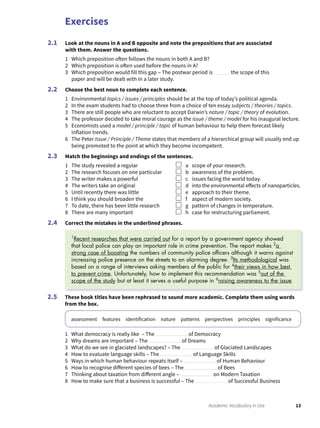
Look at the nouns in A and B opposite and note the prepositions that are associated
with them. Answer the questions.
1 Which preposition often follows the nouns in both A and B?
2 Which preposition is often used before the nouns in A?
3 Which preposition would fill this gap – The postwar period is the scope of this
paper and will be dealt with in a later study.
Choose the best noun to complete each sentence.
1 Environmental topics / issues / principles should be at the top of today’s political agenda.
2 In the exam students had to choose three from a choice of ten essay subjects / theories / topics.
3 There are still people who are reluctant to accept Darwin’s nature / topic / theory of evolution.
4 The professor decided to take moral courage as the issue / theme / model for his inaugural lecture.
5 Economists used a model / principle / topic of human behaviour to help them forecast likely
inflation trends.
6 The Peter Issue / Principle / Theme states that members of a hierarchical group will usually end up
being promoted to the point at which they become incompetent.
Match the beginnings and endings of the sentences.
1 The study revealed a regular a scope of your research.
2 The research focuses on one particular b awareness of the problem.
3 The writer makes a powerful c issues facing the world today.
4 The writers take an original d into the environmental effects of nanoparticles.
5 Until recently there was little e approach to their theme.
6 I think you should broaden the f aspect of modern society.
7 To date, there has been little research g pattern of changes in temperature.
8 There are many important h case for restructuring parliament.
Correct the mistakes in the underlined phrases.
2.1
2.2
2.3
2.4
These book titles have been rephrased to sound more academic. Complete them using words
from the box.
assessment features identification nature patterns perspectives principles significance
1 What democracy is really like – The of Democracy
2 Why dreams are important – The of Dreams
3 What do we see in glaciated landscapes? – The of Glaciated Landscapes
4 How to evaluate language skills – The of Language Skills
5 Ways in which human behaviour repeats itself – of Human Behaviour
6 How to recognise different species of bees – The of Bees
7 Thinking about taxation from different angle – on Modern Taxation
8 How to make sure that a business is successful – The of Successful Business
2.5
1
Recent researches that were carried out for a report by a government agency showed
that local police can play an important role in crime prevention. The report makes 2
a
strong case of boosting the numbers of community police officers although it warns against
increasing police presence on the streets to an alarming degree. 3
Its methodological was
based on a range of interviews asking members of the public for 4
their views in how best
to prevent crime. Unfortunately, how to implement this recommendation was 5
out of the
scope of the study but at least it serves a useful purpose in 6
raising awareness to the issue.
14 Academic Vocabulary in Use
Key verbs3
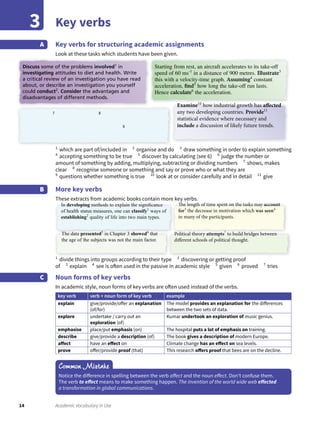
Key verbs for structuring academic assignments
Look at these tasks which students have been given.
A
1
which are part of/included in 2
organise and do 3
draw something in order to explain something
4
accepting something to be true 5
discover by calculating (see 6) 6
judge the number or
amount of something by adding, multiplying, subtracting or dividing numbers 7
shows, makes
clear 8
recognise someone or something and say or prove who or what they are
9
questions whether something is true 10
look at or consider carefully and in detail 11
give
More key verbs
These extracts from academic books contain more key verbs.
B
Noun forms of key verbs
In academic style, noun forms of key verbs are often used instead of the verbs.
key verb verb + noun form of key verb example
explain give/provide/offer an explanation
(of/for)
The model provides an explanation for the differences
between the two sets of data.
explore undertake / carry out an
exploration (of)
Kumar undertook an exploration of music genius.
emphasise place/put emphasis (on) The hospital puts a lot of emphasis on training.
describe give/provide a description (of) The book gives a description of modern Europe.
affect have an effect on Climate change has an effect on sea levels.
prove offer/provide proof (that) This research offers proof that bees are on the decline.
C
1
divide things into groups according to their type 2
discovering or getting proof
of 3
explain 4
see is often used in the passive in academic style 5
given 6
proved 7
tries
Common Mistake
Notice the difference in spelling between the verb affect and the noun effect. Don’t confuse them.
The verb to effect means to make something happen. The invention of the world wide web effected
a transformation in global communications.
Look at these tasks which students have been given.Look at these tasks which students have been given.Look at these tasks which students have been given.
Discuss some of the problems involved1
in
investigating attitudes to diet and health. Write
a critical review of an investigation you have read
about, or describe an investigation you yourself
could conduct2
. Consider the advantages and
disadvantages of different methods.
Starting from rest, an aircraft accelerates to its take-off
speed of 60 ms-1
in a distance of 900 metres. Illustrate3
this with a velocity-time graph. Assuming4
constant
acceleration, find5
how long the take-off run lasts.
Hence calculate6
the acceleration.
7 8
9
In developing methods to explain the significance
of health status measures, one can classify1
ways of
establishing2
quality of life into two main types.
Political theory attempts7
to build bridges between
different schools of political thought.
The length of time spent on the tasks may account
for3
the decrease in motivation which was seen4
in many of the participants.
The data presented5
in Chapter 3 showed6
that
the age of the subjects was not the main factor.
Examine10
how industrial growth has affected
any two developing countries. Provide11
statistical evidence where necessary and
include a discussion of likely future trends.
Exercises
15Academic Vocabulary in Use
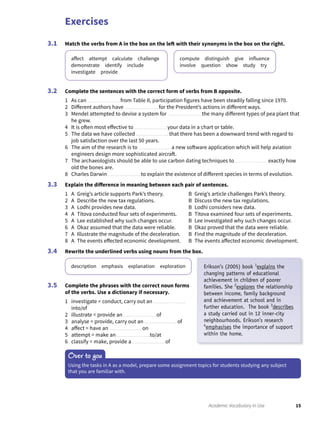
Match the verbs from A in the box on the left with their synonyms in the box on the right.
affect attempt calculate challenge
demonstrate identify include
investigate provide
compute distinguish give influence
involve question show study try
Complete the sentences with the correct form of verbs from B opposite.
1 As can from Table II, participation figures have been steadily falling since 1970.
2 Different authors have for the President’s actions in different ways.
3 Mendel attempted to devise a system for the many different types of pea plant that
he grew.
4 It is often most effective to your data in a chart or table.
5 The data we have collected that there has been a downward trend with regard to
job satisfaction over the last 50 years.
6 The aim of the research is to a new software application which will help aviation
engineers design more sophisticated aircraft.
7 The archaeologists should be able to use carbon dating techniques to exactly how
old the bones are.
8 Charles Darwin to explain the existence of different species in terms of evolution.
Explain the difference in meaning between each pair of sentences.
1 A Greig’s article supports Park’s theory. B Greig’s article challenges Park’s theory.
2 A Describe the new tax regulations. B Discuss the new tax regulations.
3 A Lodhi provides new data. B Lodhi considers new data.
4 A Titova conducted four sets of experiments. B Titova examined four sets of experiments.
5 A Lee established why such changes occur. B Lee investigated why such changes occur.
6 A Okaz assumed that the data were reliable. B Okaz proved that the data were reliable.
7 A Illustrate the magnitude of the deceleration. B Find the magnitude of the deceleration.
8 A The events effected economic development. B The events affected economic development.
Rewrite the underlined verbs using nouns from the box.
description emphasis explanation exploration
Complete the phrases with the correct noun forms
of the verbs. Use a dictionary if necessary.
1 investigate = conduct, carry out an
into/of
2 illustrate = provide an of
3 analyse = provide, carry out an of
4 affect = have an on
5 attempt = make an to/at
6 classify = make, provide a of
3.1
3.2
3.3
3.4
3.5
Over to you
Using the tasks in A as a model, prepare some assignment topics for students studying any subject
that you are familiar with.
Erikson’s (2005) book 1
explains the
changing patterns of educational
achievement in children of poorer
families. She 2
explores the relationship
between income, family background
and achievement at school and in
further education. The book 3
describes
a study carried out in 12 inner-city
neighbourhoods. Erikson’s research
4
emphasises the importance of support
within the home.
16 Academic Vocabulary in Use
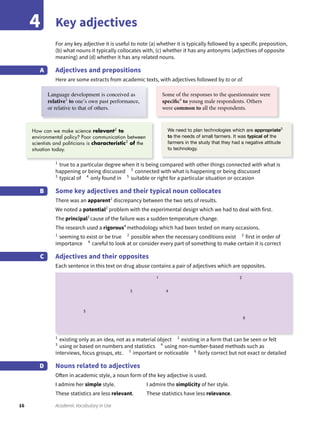
Key adjectives4
For any key adjective it is useful to note (a) whether it is typically followed by a specific preposition,
(b) what nouns it typically collocates with, (c) whether it has any antonyms (adjectives of opposite
meaning) and (d) whether it has any related nouns.
Adjectives and prepositions
Here are some extracts from academic texts, with adjectives followed by to or of.
A
1
true to a particular degree when it is being compared with other things connected with what is
happening or being discussed 2
connected with what is happening or being discussed
3
typical of 4
only found in 5
suitable or right for a particular situation or occasion
Some key adjectives and their typical noun collocates
There was an apparent1
discrepancy between the two sets of results.
We noted a potential2
problem with the experimental design which we had to deal with first.
The principal3
cause of the failure was a sudden temperature change.
The research used a rigorous4
methodology which had been tested on many occasions.
1
seeming to exist or be true 2
possible when the necessary conditions exist 3
first in order of
importance 4
careful to look at or consider every part of something to make certain it is correct
Adjectives and their opposites
Each sentence in this text on drug abuse contains a pair of adjectives which are opposites.
B
C
1
existing only as an idea, not as a material object 2
existing in a form that can be seen or felt
3
using or based on numbers and statistics 4
using non-number-based methods such as
interviews, focus groups, etc. 5
important or noticeable 6
fairly correct but not exact or detailed
Nouns related to adjectives
Often in academic style, a noun form of the key adjective is used.
I admire her simple style. I admire the simplicity of her style.
These statistics are less relevant. These statistics have less relevance.
D
Language development is conceived as
relative1
to one’s own past performance,
or relative to that of others.
Some of the responses to the questionnaire were
specific4
to young male respondents. Others
were common to all the respondents.
How can we make science relevant2
to
environmental policy? Poor communication between
scientists and politicians is characteristic3
of the
situation today.
We need to plan technologies which are appropriate5
to the needs of small farmers. It was typical of the
farmers in the study that they had a negative attitude
to technology.
1 2
3 4
5
6
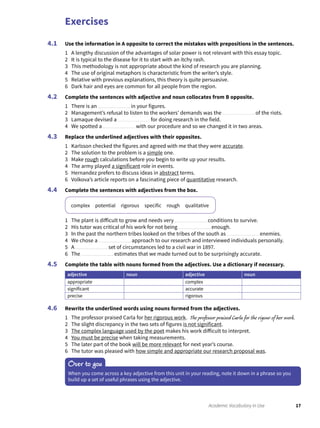
Exercises
17Academic Vocabulary in Use
Use the information in A opposite to correct the mistakes with prepositions in the sentences.
1 A lengthy discussion of the advantages of solar power is not relevant with this essay topic.
2 It is typical to the disease for it to start with an itchy rash.
3 This methodology is not appropriate about the kind of research you are planning.
4 The use of original metaphors is characteristic from the writer’s style.
5 Relative with previous explanations, this theory is quite persuasive.
6 Dark hair and eyes are common for all people from the region.
Complete the sentences with adjective and noun collocates from B opposite.
1 There is an in your figures.
2 Management’s refusal to listen to the workers’ demands was the of the riots.
3 Lamaque devised a for doing research in the field.
4 We spotted a with our procedure and so we changed it in two areas.
Replace the underlined adjectives with their opposites.
1 Karlsson checked the figures and agreed with me that they were accurate.
2 The solution to the problem is a simple one.
3 Make rough calculations before you begin to write up your results.
4 The army played a significant role in events.
5 Hernandez prefers to discuss ideas in abstract terms.
6 Volkova’s article reports on a fascinating piece of quantitative research.
Complete the sentences with adjectives from the box.
complex potential rigorous specific rough qualitative
1 The plant is difficult to grow and needs very conditions to survive.
2 His tutor was critical of his work for not being enough.
3 In the past the northern tribes looked on the tribes of the south as enemies.
4 We chose a approach to our research and interviewed individuals personally.
5 A set of circumstances led to a civil war in 1897.
6 The estimates that we made turned out to be surprisingly accurate.
Complete the table with nouns formed from the adjectives. Use a dictionary if necessary.
adjective noun adjective noun
appropriate complex
significant accurate
precise rigorous
Rewrite the underlined words using nouns formed from the adjectives.
1 The professor praised Carla for her rigorous work. The professor praised Carla for the rigour of her work.
2 The slight discrepancy in the two sets of figures is not significant.
3 The complex language used by the poet makes his work difficult to interpret.
4 You must be precise when taking measurements.
5 The later part of the book will be more relevant for next year’s course.
6 The tutor was pleased with how simple and appropriate our research proposal was.
4.1
4.2
4.3
4.4
4.5
4.6
Over to you
When you come across a key adjective from this unit in your reading, note it down in a phrase so you
build up a set of useful phrases using the adjective.
18 Academic Vocabulary in Use
Key adverbs5
Adverbs that compare
adverb meaning example
comparatively/relatively in comparison with
something else
Our sample was relatively/comparatively
small.
especially/particularly more than usual The process was not especially/particularly
difficult.
specially for a specific purpose We used specially designed equipment.
somewhat (opposite:
considerably)
(slightly formal) rather, to
some degree
The second experiment involved a
somewhat/considerably larger sample.
primarily mainly The article is primarily concerned with the
effects of pesticides.
mostly/largely almost completely (but not
totally so)
The project was largely/mostly successful.
directly (opposite: indirectly) without anything else
being involved
The illness is (in)directly linked to poor
housing.
Adverbs that relate to numbers or time
There are approximately 20,000 pairs of birds on the island. [around, about]
The figure of 17% is roughly equivalent to the decline in population in the north of the country from
1980 to 2010. [more or less]
The phenomenon occurs relatively frequently/infrequently. [often/not often]
We eventually obtained the figures we were hoping for, which were precisely the same as those
found by Rosenberg (2008). [in the end, after some time; completely and accurately]
Ultimately, we plan to repeat the study using exactly
the same number of informants. [finally, after other
things have been completed. Exactly is similar to
precisely, but is more often used to refer to numbers]
The team initially failed to establish the cause
of the death of the whales. [in the early stages]
Adverbs that relate to how things are stated
A
B
C
Common Mistake
Eventually means ‘after some time’. Use
finally or lastly when beginning the last point
in a discussion. Finally/Lastly, let us consider
the impact of tourism on local cultures.
1
referring to its main characteristics; also basically 2
openly 3
usually, also on the whole
4
not directly, suggested or implied rather than stated; opposite of explicitly
5
in particular; opposite of generally 6
in general, without considering minor details
Adverbs that restrict or limit
merely The medication will merely make the symptoms bearable; it will not cure the disease.
[exactly and nothing more]
simply Note that simply can have different meanings. To put it simply, the risks of this approach
would seem to outweigh its advantages. [plainly] The book presents difficult ideas simply, in a way
appropriate for the non-expert. [easily] The exam results were simply dreadful. [without doubt]
solely Certain events are solely confined to our planet. [only, involving nothing else]
D
Hall’s 1968 book essentially1
differs from his earlier work in that it is explicitly2
critical of the
government of the time. Generally3
his disapproval of government was only conveyed implicitly4
in
his previous works, but here he specifically5
condemns their handling of a number of issues. The
1968 work is more broadly6
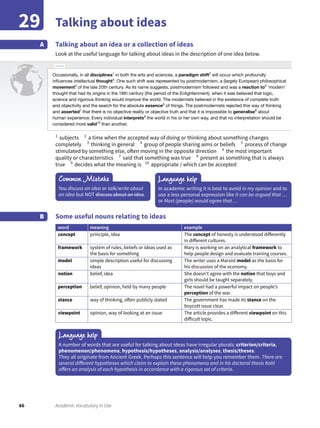
in line with other political commentaries of the period.
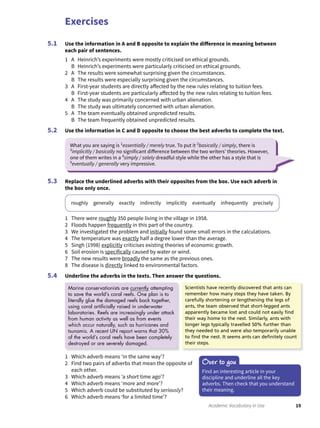
Exercises
19Academic Vocabulary in Use
Use the information in A and B opposite to explain the difference in meaning between
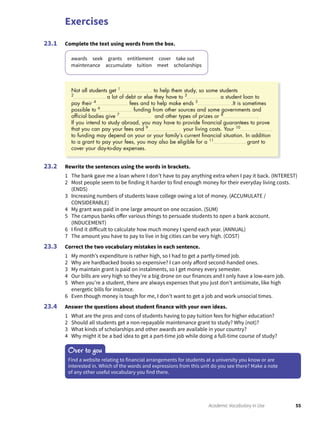
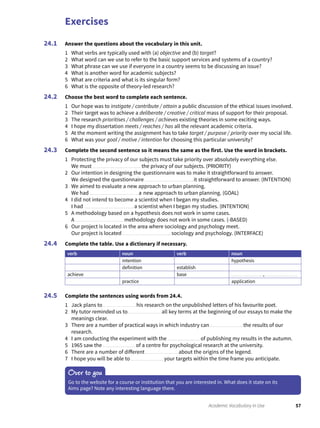
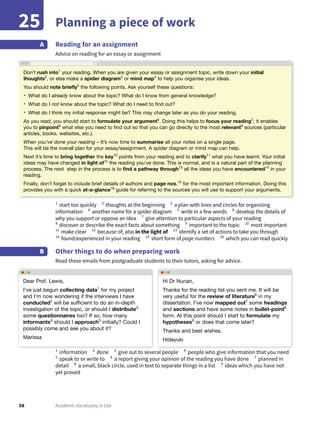
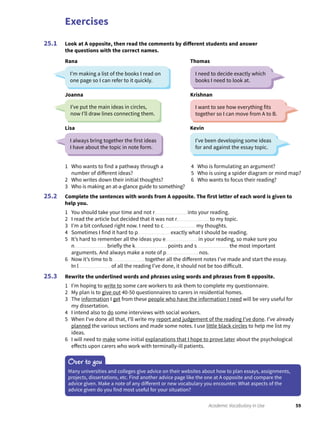
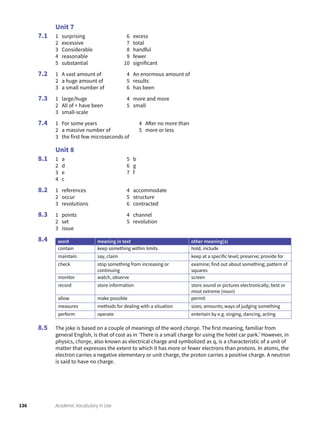
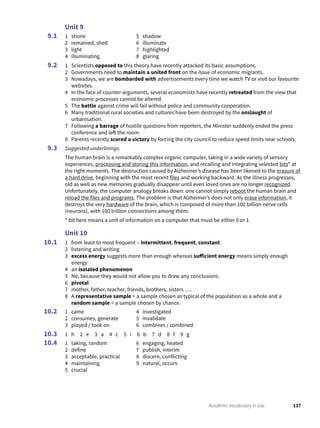
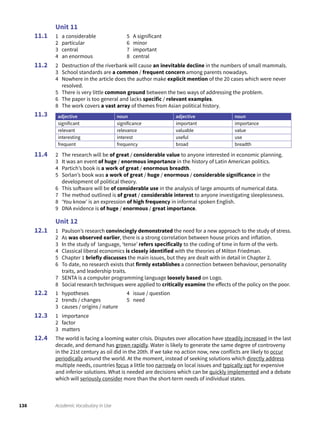
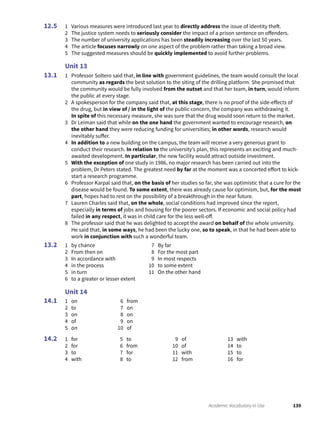
each pair of sentences.
1 A Heinrich’s experiments were mostly criticised on ethical grounds.
B Heinrich’s experiments were particularly criticised on ethical grounds.
2 A The results were somewhat surprising given the circumstances.
B The results were especially surprising given the circumstances.
3 A First-year students are directly affected by the new rules relating to tuition fees.
B First-year students are particularly affected by the new rules relating to tuition fees.
4 A The study was primarily concerned with urban alienation.
B The study was ultimately concerned with urban alienation.
5 A The team eventually obtained unpredicted results.
B The team frequently obtained unpredicted results.
Use the information in C and D opposite to choose the best adverbs to complete the text.
5.1
5.2
Replace the underlined adverbs with their opposites from the box. Use each adverb in
the box only once.
roughly generally exactly indirectly implicitly eventually infrequently precisely
1 There were roughly 350 people living in the village in 1958.
2 Floods happen frequently in this part of the country.
3 We investigated the problem and initially found some small errors in the calculations.
4 The temperature was exactly half a degree lower than the average.
5 Singh (1998) explicitly criticises existing theories of economic growth.
6 Soil erosion is specifically caused by water or wind.
7 The new results were broadly the same as the previous ones.
8 The disease is directly linked to environmental factors.
Underline the adverbs in the texts. Then answer the questions.
5.3
5.4
1 Which adverb means ‘in the same way’?
2 Find two pairs of adverbs that mean the opposite of
each other.
3 Which adverb means ‘a short time ago’?
4 Which adverb means ‘more and more’?
5 Which adverb could be substituted by seriously?
6 Which adverb means ‘for a limited time’?
What you are saying is 1
essentially / merely true. To put it 2
basically / simply, there is
3
implicitly / basically no significant difference between the two writers’ theories. However,
one of them writes in a 4
simply / solely dreadful style while the other has a style that is
5
eventually / generally very impressive.
Over to you
Find an interesting article in your
discipline and underline all the key
adverbs. Then check that you understand
their meaning.
Marine conservationists are currently attempting
to save the world’s coral reefs. One plan is to
literally glue the damaged reefs back together,
using coral artificially raised in underwater
laboratories. Reefs are increasingly under attack
from human activity as well as from events
which occur naturally, such as hurricanes and
tsunamis. A recent UN report warns that 30%
of the world’s coral reefs have been completely
destroyed or are severely damaged.
Scientists have recently discovered that ants can
remember how many steps they have taken. By
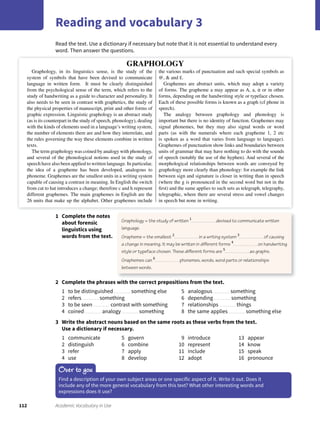
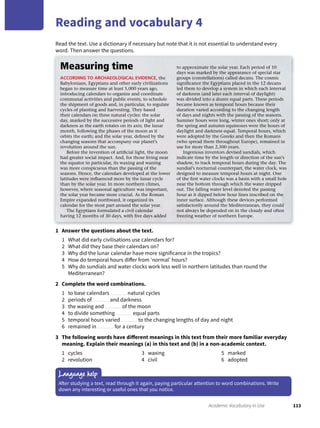
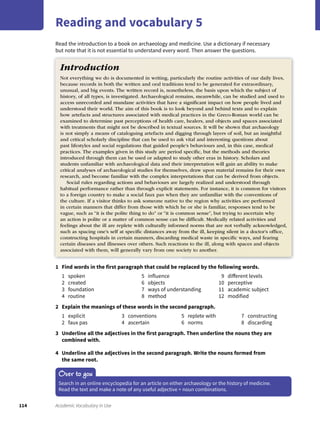
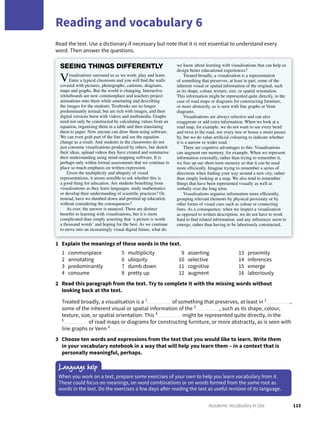
carefully shortening or lengthening the legs of
ants, the team observed that short-legged ants
apparently became lost and could not easily find
their way home to the nest. Similarly, ants with
longer legs typically travelled 50% further than
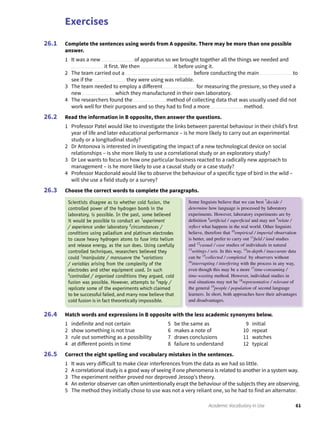
they needed to and were also temporarily unable
to find the nest. It seems ants can definitely count
their steps.
20 Academic Vocabulary in Use
After completing her first degree in zoology Meena went on to1
apply to graduate school. She wanted to work on2
animal behaviour
at a well-known institute in New Zealand. She set up3
a series of
experiments investigating how bees communicate. She has noticed
some curious behaviour patterns but has not yet worked out4
why
her bees behave as they do. What she has observed seems to go
against5
current theories of bee behaviour. When she has completed
all her research she will have to write it all up6
.
Phrasal verbs in academic English6
Although phrasal verbs occur most frequently in more informal spoken and written English, they are
also not uncommon in an academic context. You will hear them used in lectures and will read them
in serious journals. Of the phrasal verbs in this unit, only go/look back over and work out are not
appropriate for a formal written assignment.
Phrasal verbs and one-word synonyms
Phrasal verbs often have one-word synonyms. These sound more formal than their phrasal verb
equivalent but both are appropriate when writing or talking about academic subjects. Vary your
language by using both.
phrasal verb synonym example
put forward (an idea/view/opinion/
theory/plan)
present In her latest article Kaufmann puts forward a
theory which is likely to prove controversial.
carry out (an experiment / research) conduct I intend to carry out a series of experiments.
make up constitute Children under the age of 15 make up nearly half
of the country’s population.
be made up of consist of Parliament is made up of two houses.
point out observe Grenne points out that the increase in life
expectancy has led to some economic problems.
point up highlight The study points up the weaknesses in the current
school system.
set out (to do something) aim In his article Losanov sets out to prove that …
set out describe The document sets out the terms of the treaty.
go into discuss In this book Sergeant goes into the causes
of the Civil War in some depth.
go/look back over revise, review * Please go/look back over this term’s notes.
go through check Go through your calculations carefully.
*Revise is the BrE synonym and review the AmE synonym. (Revise in AmE only means to edit or
change something to make it better; review is not used in BrE in the context of preparing for a test
as focused on here.)
Carrying out research
A
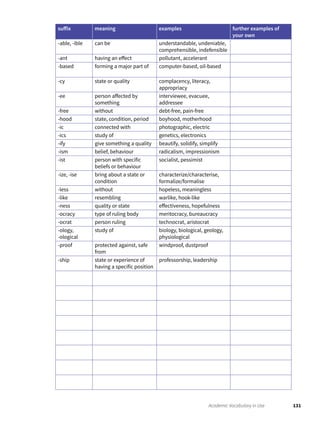
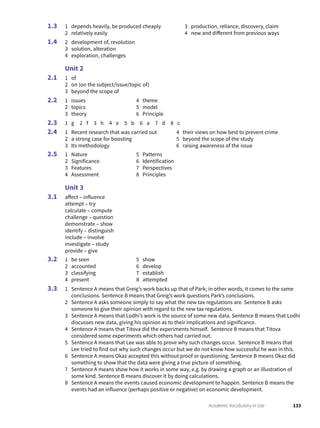
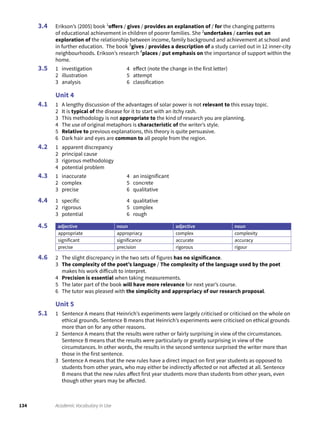
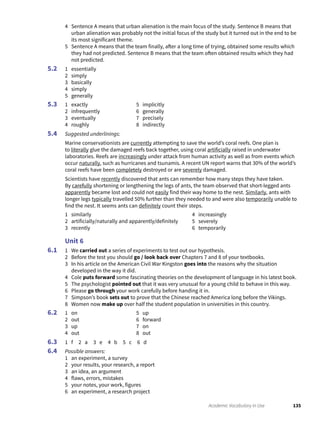
B
1
do something after doing something else 2
study, work in the field of 3
prepared, arranged
4
come to a conclusion about 5
not be in agreement with 6
(of an important document) write
in a final form
Language help
Consult a good dictionary when you use phrasal verbs in your writing. For example, a good dictionary
tells you when the object can be used before the particle (e.g. write your results up) and when it
cannot (e.g. this goes against current theories).
Exercises
21Academic Vocabulary in Use
Rewrite the underlined words using phrasal verbs from A opposite.
1 We conducted a series of experiments to test out our hypothesis.
2 Before the test you should revise Chapters 7 and 8 of your textbooks.
3 In his article on the American Civil War Kingston discusses the reasons why the situation
developed in the way it did.
4 Cole presents some fascinating theories on the development of language in his latest book.
5 The psychologist observed that it was very unusual for a young child to behave in this way.
6 Please check your work carefully before handing it in.
7 Simpson’s book aims to prove that the Chinese reached America long before the Vikings.
8 Women now constitute over half the student population in universities in this country.
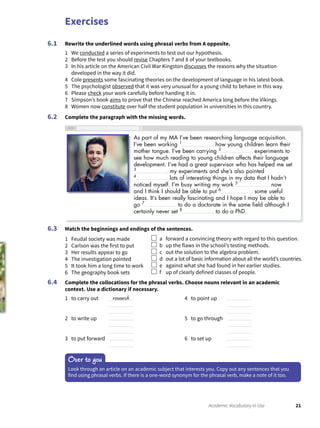
Complete the paragraph with the missing words.
6.1
6.2
Match the beginnings and endings of the sentences.
1 Feudal society was made
2 Carlson was the first to put
3 Her results appear to go
4 The investigation pointed
5 It took him a long time to work
6 The geography book sets
a forward a convincing theory with regard to this question.
b up the flaws in the school’s testing methods.
c out the solution to the algebra problem.
d out a lot of basic information about all the world’s countries.
e against what she had found in her earlier studies.
f up of clearly defined classes of people.
Complete the collocations for the phrasal verbs. Choose nouns relevant in an academic
context. Use a dictionary if necessary.
1 to carry out research
2 to write up
3 to put forward
4 to point up
5 to go through
6 to set up
6.3
6.4
Over to you
Look through an article on an academic subject that interests you. Copy out any sentences that you
find using phrasal verbs. If there is a one-word synonym for the phrasal verb, make a note of it too.
As part of my MA I’ve been researching language acquisition.
I’ve been working 1
how young children learn their
mother tongue. I’ve been carrying 2
experiments to
see how much reading to young children affects their language
development. I’ve had a great supervisor who has helped me set
3
my experiments and she’s also pointed
4
lots of interesting things in my data that I hadn’t
noticed myself. I’m busy writing my work 5
now
and I think I should be able to put 6
some useful
ideas. It’s been really fascinating and I hope I may be able to
go 7
to do a doctorate in the same field although I
certainly never set 8
to do a PhD.
22 Academic Vocabulary in Use
Key quantifying expressions7
Quantifying expressions are important in academic English as it is often necessary to comment on
figures or trends. There is more useful language for talking about numbers in Units 33 and 34.
Expressing numbers and amounts
We use amount with uncountable nouns: a large amount of money/interest/influence.
We use number with plural countable nouns: a small number of articles/books/words.
The words number and amount can be used with adjectives such as small, considerable,
substantial, significant, huge, enormous, vast, total, surprising, excessive [too much/many], fair
[quite a lot] and reasonable [acceptable].
We can also use the phrase a great deal of [a large amount of] with uncountable nouns: a great deal
of time/money/effort.
Other ways of expressing quantity
A
B
1
only involving a small number 2
in all 3
a relatively very small number
4
the majority 5
as regards the greatest number
Comparing numbers and quantities
expression example comment
exceeding Results exceeding 5 cm were eliminated from the
survey.
more than
in excess of The team has secured research grants in excess of
€20m.
more than, used mainly in
official or legal writing
fewer and
fewer / less
and less
Fewer and fewer people are staying in the same job
throughout their lives. Young people are becoming less
and less interested in politics.
a steadily declining/decreasing
number of, decreasingly
more and
more
There is more and more interest in the topic.
People are becoming more and more aware of the
need to conserve energy.
a steadily increasing amount of,
increasingly
more or less The events happened more or less simultaneously. (slightly informal) approximately
no fewer than No fewer than 200 people responded. used to suggest the number was
unexpectedly large
C
Common Mistake
Notice how respondents is in the plural. We use a plural noun after one of: one of our surveys.
But we use a singular verb: One of our surveys was reported on local radio.
The size of our survey was relatively small-scale1
. We sent out 2,500 questionnaires
in total2
. Although a handful3
of people did not respond, the bulk4
(95%) of those
sent questionnaires completed them. The survey shows that, for the most part5
, the
population is becoming more aware of the importance of recycling. All of the people
said that they recycled at least some of their rubbish, and none of them felt that
recycling was a waste of time. Only one of the respondents said that he recycled less
than he used to.
Exercises
23Academic Vocabulary in Use
Complete the sentences using the correct form of the word in brackets.
1 In a number of cases, there was no reaction at all to the drug. (SURPRISE)
2 The analysis demanded an amount of computer time. (EXCEED)
3 numbers of birds inhabit the lake during the winter. (CONSIDER)
4 The course requires a amount of prior knowledge. (REASON)
5 The survey took a amount of research time and costs were high. (SUBSTANCE)
6 The two dams can hold in of two cubic kilometres of water. (EXCEED)
7 In , 12 areas of the Southern Indian Ocean are now closed to deep-sea fishing.
(TOTALITY)
8 Only a of students chose the course, so it was cancelled. (HAND)
9 No than 2,000 new computer viruses are created every year. (FEW)
10 In a number of cases, surface damage was noticed. (SIGNIFY)
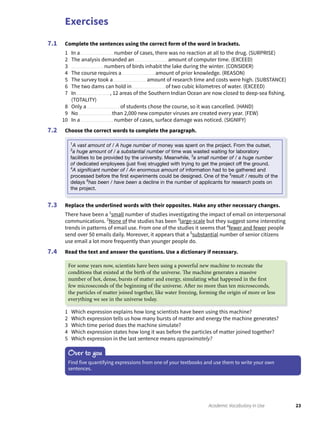
Choose the correct words to complete the paragraph.
7.1
7.2
Replace the underlined words with their opposites. Make any other necessary changes.
There have been a 1
small number of studies investigating the impact of email on interpersonal
communications. 2
None of the studies has been 3
large-scale but they suggest some interesting
trends in patterns of email use. From one of the studies it seems that 4
fewer and fewer people
send over 50 emails daily. Moreover, it appears that a 5
substantial number of senior citizens
use email a lot more frequently than younger people do.
Read the text and answer the questions. Use a dictionary if necessary.
7.3
7.4
1 Which expression explains how long scientists have been using this machine?
2 Which expression tells us how many bursts of matter and energy the machine generates?
3 Which time period does the machine simulate?
4 Which expression states how long it was before the particles of matter joined together?
5 Which expression in the last sentence means approximately?
Over to you
Find five quantifying expressions from one of your textbooks and use them to write your own
sentences.
1
A vast amount of / A huge number of money was spent on the project. From the outset,
2
a huge amount of / a substantial number of time was wasted waiting for laboratory
facilities to be provided by the university. Meanwhile, 3
a small number of / a huge number
of dedicated employees (just five) struggled with trying to get the project off the ground.
4
A significant number of / An enormous amount of information had to be gathered and
processed before the first experiments could be designed. One of the 5
result / results of the
delays 6
has been / have been a decline in the number of applicants for research posts on
the project.
For some years now, scientists have been using a powerful new machine to recreate the
conditions that existed at the birth of the universe. The machine generates a massive
number of hot, dense, bursts of matter and energy, simulating what happened in the first
few microseconds of the beginning of the universe. After no more than ten microseconds,
the particles of matter joined together, like water freezing, forming the origin of more or less
everything we see in the universe today.
24 Academic Vocabulary in Use
Words with several meanings8
Set
Many words in English have more than one meaning. Set, for example, has a large number of
different meanings. Here are some examples which are relevant to academic English.
a) (verb) adjust something to a particular level: Set the instruments to zero.
b) (verb) establish: I would like to set some ground rules for the course.
c) (verb) cause to be in a stated condition: The decision set a number of changes in motion.
d) (verb) arrange: We must set a time for our next meeting.
e) (verb) become solid: Concrete sets as it cools.
f) (noun) group: The condition is associated with a particular set of symptoms.
g) (adjective) that must be studied: We have a number of set texts to read for our course.
Academic uses for familiar words
These words have a distinct academic meaning as well as more familiar meanings.
word academic meaning example
accommodate
(verb)
change to allow something to fit in He had to adapt his theory to
accommodate new information.
charge (verb) refresh the supply of electricity You need to charge the batteries every day.
contract (verb) become smaller, shorten As the metal cools, it contracts.
occur (verb) exist Some valuable minerals occur in these rocks.
reference
(noun)
details of author or book mentioned in a piece
of writing, to show where information was found
You must provide a list of references at the
end of your assignment.
revolution
(noun)
complete turn (e.g. of a wheel) Time is measured by the revolution of the
earth around the sun.
structure
(noun)
way in which parts of a system or object are
organised or arranged
The structure of this element is particularly
complex.
Words with several different academic uses
Many academic words have distinct meanings in different disciplines. Channel, for example,
has specific meanings in electronics, linguistics, biology, physics, social sciences and geography
[e.g. channels of communication, irrigation channels, government channels, to channel
something]. So you will, of course, need a specific dictionary for your own subject.
Other words have several distinct meanings that are important in general academic English.
The writer takes issue with Kwame’s interpretation. [raises arguments against]
In your essay you need to address a number of key issues. [topics]
Have you seen the latest issue of the Malaysian Medical Journal? [edition]
Jackson raises some important points in his article. [opinions, ideas, information]
The writer takes a long time to get to the point. [most significant part]
Only 10.2 [ten point two] per cent of the people who received questionnaires responded.
Draw a straight line between points A and B on the map. [mark showing the position of
something on a plan or diagram]
A
B
C
Language help
If you come across a word that you know but it does not seem to make sense in that context, check
to see whether it has another distinct meaning. If it does, write it down with both (or all) its meanings
in your vocabulary notebook.
Exercises
25Academic Vocabulary in Use
Match the uses of set in the sentences with the meanings a–g in A opposite.
1 Before we start you must all set your watches to precisely the same time.
2 Professors will set a date for the submission of assignments relating to their own courses.
3 We expected the mixture to set quickly but it had not hardened by the morning.
4 Before leaving the area, the retreating army set the farm buildings on fire.
5 The engine’s performance has set a new fuel consumption record.
6 During the first semester, music students have to study a number of set pieces.
7 There are a whole set of issues that you should address in your essays.
Complete the sentences with the correct form of words from B opposite.
1 When you are doing research, you must keep good records of your as it can be
difficult to locate sources later.
2 This medical condition is most likely to in fair-skinned people.
3 Engine speed can be measured in per minute.
4 Hope, the theme of the anthology, is general enough to a variety of approaches.
5 The of society in Ancient Rome has parallels with that of the modern USA.
6 The experiment was designed to discover whether gold or expanded under
different conditions.
Complete each set of phrases with the same word.
1 discuss the following / underline the key / make some insightful
2 to a precedent / a book / a of exercises
3 take with / the current of the New Scientist / a controversial
4 to your energies into / a of communication / an irrigation
5 the French / the of the earth around the sun / a in
science
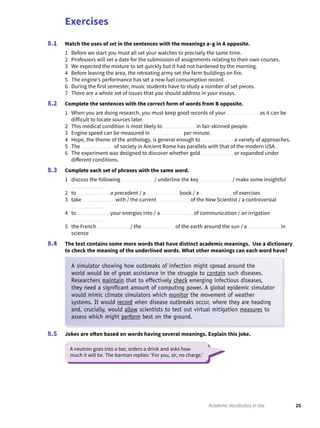
The text contains some more words that have distinct academic meanings. Use a dictionary
to check the meaning of the underlined words. What other meanings can each word have?
8.1
8.2
8.3
8.4
Jokes are often based on words having several meanings. Explain this joke.8.5
A neutron goes into a bar, orders a drink and asks how
much it will be. The barman replies: ‘For you, sir, no charge.’
A simulator showing how outbreaks of infection might spread around the
world would be of great assistance in the struggle to contain such diseases.
Researchers maintain that to effectively check emerging infectious diseases,
they need a significant amount of computing power. A global epidemic simulator
would mimic climate simulators which monitor the movement of weather
systems. It would record when disease outbreaks occur, where they are heading
and, crucially, would allow scientists to test out virtual mitigation measures to
assess which might perform best on the ground.
26 Academic Vocabulary in Use
Metaphors and idioms9
A metaphor is an expression which describes something by comparing it to something else with
similar characteristics. For example, you might say an academic ‘attacks’ or ‘demolishes’ someone’s
theory or argument, just as an army can attack an enemy or workers can demolish a building.
If a metaphor is used so often that the original comparison becomes forgotten, then it may be called
an idiom. For example, people often say, ‘I’m snowed under with work at the moment.’ Originally this
was a metaphor comparing a great deal of work to deep snow (overwhelming everything and making
movement difficult). However, this expression has been used so frequently that it no longer usually
makes people think of snow. Academic English uses various metaphors and idioms.
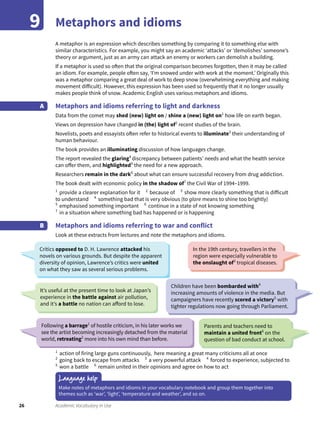
Metaphors and idioms referring to light and darkness
Data from the comet may shed (new) light on / shine a (new) light on1
how life on earth began.
Views on depression have changed in (the) light of2
recent studies of the brain.
Novelists, poets and essayists often refer to historical events to illuminate3
their understanding of
human behaviour.
The book provides an illuminating discussion of how languages change.
The report revealed the glaring4
discrepancy between patients’ needs and what the health service
can offer them, and highlighted5
the need for a new approach.
Researchers remain in the dark6
about what can ensure successful recovery from drug addiction.
The book dealt with economic policy in the shadow of7
the Civil War of 1994–1999.
1
provide a clearer explanation for it 2
because of 3
show more clearly something that is difficult
to understand 4
something bad that is very obvious (to glare means to shine too brightly)
5
emphasised something important 6
continue in a state of not knowing something
7
in a situation where something bad has happened or is happening
Metaphors and idioms referring to war and conflict
Look at these extracts from lectures and note the metaphors and idioms.
A
B
Critics opposed to D. H. Lawrence attacked his
novels on various grounds. But despite the apparent
diversity of opinion, Lawrence’s critics were united
on what they saw as several serious problems.
In the 19th century, travellers in the
region were especially vulnerable to
the onslaught of3
tropical diseases.
Children have been bombarded with4
increasing amounts of violence in the media. But
campaigners have recently scored a victory5
with
tighter regulations now going through Parliament.
Parents and teachers need to
maintain a united front6
on the
question of bad conduct at school.
It’s useful at the present time to look at Japan’s
experience in the battle against air pollution,
and it’s a battle no nation can afford to lose.
Following a barrage1
of hostile criticism, in his later works we
see the artist becoming increasingly detached from the material
world, retreating2
more into his own mind than before.
1
action of firing large guns continuously, here meaning a great many criticisms all at once
2
going back to escape from attacks 3
a very powerful attack 4
forced to experience, subjected to
5
won a battle 6
remain united in their opinions and agree on how to act
Language help
Make notes of metaphors and idioms in your vocabulary notebook and group them together into
themes such as ‘war’, ‘light’, ‘temperature and weather’, and so on.
Exercises
27Academic Vocabulary in Use
Complete the sentences with the correct form of the words in the box.
remain glare illuminating shadow highlight shed illuminate shine light
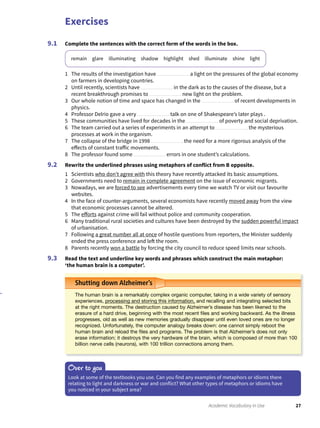
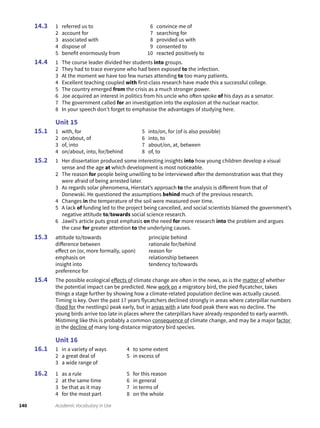
1 The results of the investigation have a light on the pressures of the global economy
on farmers in developing countries.
2 Until recently, scientists have in the dark as to the causes of the disease, but a
recent breakthrough promises to new light on the problem.
3 Our whole notion of time and space has changed in the of recent developments in
physics.
4 Professor Delrio gave a very talk on one of Shakespeare’s later plays .
5 These communities have lived for decades in the of poverty and social deprivation.
6 The team carried out a series of experiments in an attempt to the mysterious
processes at work in the organism.
7 The collapse of the bridge in 1998 the need for a more rigorous analysis of the
effects of constant traffic movements.
8 The professor found some errors in one student’s calculations.
Rewrite the underlined phrases using metaphors of conflict from B opposite.
1 Scientists who don’t agree with this theory have recently attacked its basic assumptions.
2 Governments need to remain in complete agreement on the issue of economic migrants.
3 Nowadays, we are forced to see advertisements every time we watch TV or visit our favourite
websites.
4 In the face of counter-arguments, several economists have recently moved away from the view
that economic processes cannot be altered.
5 The efforts against crime will fail without police and community cooperation.
6 Many traditional rural societies and cultures have been destroyed by the sudden powerful impact
of urbanisation.
7 Following a great number all at once of hostile questions from reporters, the Minister suddenly
ended the press conference and left the room.
8 Parents recently won a battle by forcing the city council to reduce speed limits near schools.
Read the text and underline key words and phrases which construct the main metaphor:
‘the human brain is a computer’.
9.1
9.2
9.3
Over to you
Look at some of the textbooks you use. Can you find any examples of metaphors or idioms there
relating to light and darkness or war and conflict? What other types of metaphors or idioms have
you noticed in your subject area?
Shutting down Alzheimer’s
The human brain is a remarkably complex organic computer, taking in a wide variety of sensory
experiences, processing and storing this information, and recalling and integrating selected bits
at the right moments. The destruction caused by Alzheimer’s disease has been likened to the
erasure of a hard drive, beginning with the most recent files and working backward. As the illness
progresses, old as well as new memories gradually disappear until even loved ones are no longer
recognized. Unfortunately, the computer analogy breaks down: one cannot simply reboot the
human brain and reload the files and programs. The problem is that Alzheimer’s does not only
erase information; it destroys the very hardware of the brain, which is composed of more than 100
billion nerve cells (neurons), with 100 trillion connections among them.
28 Academic Vocabulary in Use
Nouns and the words they combine with10
Nouns often combine with specific adjectives, for example medical research, undivided attention or
with specific verbs, for example carry out research, pay attention.
Nouns and the adjectives they combine with
adjective + noun combinations example
useful, valuable, personal, constant, close, frequent,
intermittent1
contact
I made some useful contacts at the conference.
considerable, heated2
, intense, public, animated3
debate
After the lecture there was a heated debate.
crucial, decisive, fundamental element [=factor] Timing is a crucial element of the experiment.
conflicting, contrasting, constituent4
elements [=parts] There are conflicting elements in the artist’s work.
excess, sufficient, nuclear energy Wind turbines create sufficient energy for the
town’s needs.
common, isolated, natural, recent, universal
phenomenon
Such anti-social behaviour is a recent phenomenon.
conflicting, (in)conclusive, unforeseen5
, preliminary6
,
encouraging, interim7
results
Our preliminary results were encouraging.
decisive, challenging, conflicting, influential, key,
pivotal8
role
Student activists played a pivotal role in the riot.
random, representative sample A representative sample of the population was
surveyed.
alternative, efficient, fair, practical, convenient, proper,
acceptable way
It is important to treat your research subjects in a
fair way.
in absolute, broad, relative, general, practical,
economic terms
People are better off in economic terms.
1
from time to time 2
strong, often angry 3
lively 4
that combine to make something
5
not expected 6
first 7
temporary 8
important
Nouns and the verbs they combine with
Most of the nouns in the table above are also strongly associated with specific verbs.
You can come into contact with someone or something or you can establish, maintain, break off
or lose contact.
Academics may engage in debate or contribute to a debate. You talk about the debate
surrounding an issue.
You can combine, differentiate or discern [recognise] the elements of, for example, a chemical
compound.
You consume [use], conserve, generate [create], save or waste energy.
Phenomena emerge or occur and students will try to observe, investigate and then explain those
phenomena.
Academics collect, collate [organise] and publish their results. Sometimes results are questioned
or invalidated [shown to be wrong]. Occasionally they are even falsified!
Roles may be defined or strengthened. People or factors can play a role or take on a role.
You can take, provide or analyse a sample.
You can discover, devise [think up], work out or develop a way to do something.
A
B
Language help
Whenever you notice a noun that seems to be key as far as your own studies are concerned, write it
down with the adjectives and verbs it is typically associated with.
Exercises
29Academic Vocabulary in Use
Look at the adjective and noun combinations in A opposite. Answer the questions.
1 Put these types of contact in order of frequency – frequent, constant, intermittent.
2 If two of the four constituent elements of most language exams are reading and speaking,
what are the other two?
3 Which adjective suggests more energy than the other – excess or sufficient energy?
4 Which adjective describes the opposite of a common phenomenon?
5 Would you be pleased if you did some research and got inconclusive results?
6 What adjective other than key can be used with role to give a similar meaning?
7 Can you name three people who play an influential role in a child’s development?
8 Which of these is a representative sample and which is a random sample: a sample chosen
by chance, a sample chosen as typical of the population as a whole?
Complete the sentences with the correct form of verbs from B opposite.
1 I first into contact with Abdul when I started my doctoral research in 2007.
2 The country so much energy that we don’t enough to meet
all our needs.
3 The space race an important role in post-war politics.
4 In her research project Diana the phenomenon of extra-sensory perception
but she was not able to come to any significant conclusions.
5 Although Hans’s rivals attempted to his results, they met with no success.
6 Green’s poetry successfully elements from a number of different traditions.
Match the beginnings and endings of the sentences.
1 It took the team a long time to devise
2 During the war we had to break
3 There has been a lot of heated debate
4 Ian Hartmann was invited to take on
5 Part of my role was to collate
6 The doctor wanted me to provide
7 Scientists all over the world contributed
8 A new and unexpected phenomenon
9 Using shading helps to differentiate
a surrounding the issue of global warming.
b a blood sample for analysis.
c the role of project leader.
d to the debate on cloning.
e off contact with colleagues abroad.
f seems to be emerging.
g the key elements in a graph.
h a way to solve their problem.
i the results of our experiments.
Complete the sentences using words from the box.
conflicting heated publish crucial interim random define maintaining
natural discern occurs engaging acceptable taking practical
1 She obtained her results by a sample of the population.
2 Before we go any further we must each of our roles more precisely.
3 We must decide what is an way to proceed, in terms.
4 The group succeeded in contact long after they had all left college.
5 My trip to Africa was the element in my decision to work in conservation.
6 Specialists in the field of bio-engineering have been in
debate on this issue for some time.
7 I am told that Smythe is about to some results. The final
results won’t be available until next year.
8 Professor Powell was able to some elements in different
accounts of the incident.
9 Lightning is a phenomenon which most frequently in the
tropics.
10.1
10.2
10.3
10.4
30 Academic Vocabulary in Use
11 Adjective and noun combinations
Noun phrases are an important feature of academic style. This unit focuses on a number of adjective
+ noun combinations which are particularly frequent in academic English.
Adjectives suggesting importance
adjective comment frequently combines with …
important significant can convey the same
meaning and both adjectives often
go with these nouns
aspect, contribution, difference(s), implications, point,
question, reason, element
major the opposite, minor, also often goes
with these nouns
role, changes, problem, factor, issue, concern, difference,
theme, contribution, point
central means main or most important role, theme, issue, question, concern, feature, focus,
element, problem, argument
particular means special interest, attention, significance, importance, concern
Adjectives suggesting amount/extent
adjective comment frequently combines with …
significant large in size increase, effect, reduction, number, proportion
enormous /
considerable
enormous can mean very large or very
important; considerable means large or
of noticeable importance (i.e. slightly less
strong than enormous)
amount, expansion, number, range, diversity,
difference, variation, extent, degree, impact,
power, influence, significance, interest
vast means extremely big majority, array, amount, range, quantity/
quantities, sums, scale, improvement
widespread means that something happens in many
places or among many people
belief, acceptance, support, opposition,
assumption, use
common* means that something is normal or
frequent and found on many occasions
experience, practice, use, concern, problem,
view
*Common can also mean ‘shared’ and as such it combines with knowledge, ground [areas of
interest], feature, interest, e.g. There is much common ground between the two writers.
Other useful adjective and noun combinations
Specific means relating to one thing and not to things in general. It often combines with context,
information, case, type, form, purpose, characteristics, conditions, example. For example, The reaction
occurs only under specific conditions.
Inevitable is often used with words relating to results or changes such as consequence, outcome,
collapse, decline, conflict, effect, developments. [unavoidable]
Explicit combines with words relating to how things are presented, e.g. reference, statement,
comparison, account, mention. [clear and exact, communicated directly]
Relevant combines with words relating to evidence of different types, e.g. data, documents,
information, details, factors. [connected with what is being discussed]
Adjectives and prepositional phrases
A feature of academic writing is that it often uses the noun form of an adjective in a prepositional
phrase beginning with of, instead of just using an adjective.
Sagan’s contribution is of particular significance. (= particularly significant)
Helvena’s work is of great interest to researchers. (= very interesting)
This is a work of considerable importance. (= very important)
A
B
C
D
Exercises
31Academic Vocabulary in Use
Choose the best adjective to complete each statement about an academic.
1 Davison did a considerable / an important amount of research into earthquake prediction.
2 Rawlinson drew significant / particular attention to the problem of energy consumption.
3 The central / major argument of Parry’s book is that work can be organised in a variety of ways,
some more efficient than others.
4 Werner’s work had a widespread / an enormous impact on the way we design bridges today.
5 An important / A significant proportion of Thomaz’s work was devoted to international law.
Three of her five books were on the subject.
6 Prestyn made only a minor / particular contribution to modern psychology, but it was an
interesting one, nonetheless.
7 Baklov’s work has some extremely important / central implications for our work today.
8 Mortensen’s work has played a central / vast role in changing attitudes to parenthood.
Rewrite the underlined words and phrases using adjective and noun combinations.
1 There is opposition among students in many places to the idea of longer semesters.
There is widespread opposition among students to the idea of longer semesters.
2 Destruction of the riverbank will cause a decline which is bound to happen in the numbers of
small mammals.
3 School standards are a concern which occurs frequently among parents nowadays.
4 Nowhere in the article does the author make mention in a direct, clear and exact way of the 20
cases which were never resolved.
5 There is very little ground which is shared between the two ways of addressing the problem.
6 The paper is too general and lacks examples which relate only to individual things.
7 The work covers an extremely big array of themes from Asian political history.
Complete the table with the noun forms of the adjectives. Use a dictionary if necessary.
adjective noun adjective noun
significant important
relevant valuable
interesting useful
frequent broad
Look at the examples of prepositional phrases in D opposite. Rewrite the underlined words
using prepositional phrases. Use adjectives from the box and appropriate nouns.
huge high enormous great considerable
1 Johnson’s work is very relevant for any student of medical engineering.
Johnson’s work is of great relevance for any student of medical engineering.
2 The research will be very valuable to anyone interested in economic planning.
3 It was an event which was terribly important in the history of Latin American politics.
4 Partich’s book is an extremely broad work.
5 Sorlan’s book was a very significant work in the development of political theory.
6 This software will be quite useful in the analysis of large amounts of numerical data.
7 The method outlined is very interesting to anyone investigating sleeplessness.
8 ‘You know’ is an expression which is very frequent in informal spoken English.
9 DNA evidence is centrally important.
11.1
11.2
11.3
11.4
32 Academic Vocabulary in Use
Verbs and the words they combine with12
How verbs combine with other words
When you learn verbs in an academic context, it is useful to note a number of things about them.
Do they combine with any nouns, and does the noun go before or after the verb, for example,
the research / theory is based on, to pose a problem / question / threat?
Do they combine with any adverbs, for example, mainly / partly / loosely based on?
Are they followed by any prepositions, for example, to base something on something else?
Are they often used in the passive, for example, be based on, be associated with?
verb nouns adverbs examples
base (on) research, theory,
story, hypothesis
mainly, partly
loosely
The story was loosely based on a true event
which occurred in 1892.
The theory is mainly based on the writer’s initial
study.
associate
(with)
word, idea, theory,
term
generally,
commonly,
invariably
A decrease in consumer spending is generally
associated with fears of instability. The word is
commonly associated with youth culture.
discuss idea, problem, issue,
question, topic,
theme
at length, briefly,
thoroughly
Wilson and Crick (1965) discuss the problem
at length. Sim’s article discusses the issue
thoroughly.
establish relationship,
connection
firmly, clearly,
conclusively
Geologists have been unable to firmly establish a
connection between the two types of fossils.
Lopez conclusively establishes a relationship
between the two phenomena.
examine facts, evidence,
effects, aspects
briefly, critically,
thoroughly
We shall now briefly examine the evidence
for the existence of dark matter. Our aim is to
thoroughly examine the effects of stress.
demonstrate existence, need,
effects, importance
clearly,
convincingly
The study clearly demonstrates the importance
of support for dementia sufferers.
Harvey’s work convincingly demonstrates the
need for a new approach to the problem.
identify
(with) (often
used in
passive)
causes, factors,
issues, properties,
needs, approach,
origin
correctly, clearly,
closely
This approach is closely identified with the work
of H. Crowley during the 1950s. The article clearly
identifies the factors influencing the decision to
go to war.
More verbs in combination with nouns, adverbs and prepositions
pose: This inevitably poses a question concerning the stability of society. Parks poses a challenge
to Kahn’s theory.
suggest: The most recent results strongly suggest a different interpretation of the situation.
The article suggests a new approach to the problem.
list: Here I simply list the main hypotheses / causes / features / characteristics; they will be
examined in detail below.
refer: The book refers frequently / specifically / in passing to the 1956 economic crisis.
observe: This is due to the changes / trends / differences we observed earlier.
A
B
Common Mistake
Remember we say based on NOT based in.
We say discuss a problem / an issue NOT discuss about a problem
Exercises
33Academic Vocabulary in Use
Choose the most appropriate adverb for each underlined verb, and add it to the sentence
in the correct place.
1 Paulson’s research demonstrated the need for a new approach to the study of stress.
(invariably convincingly closely)
2 As was observed, there is a strong correlation between house prices and inflation.
(closely critically earlier)
3 In the study of languages, ‘tense’ refers to the coding of time in form of the verb.
(specifically strongly briefly)
4 Classical liberal economics is identified with the theories of Milton Friedman.
(thoroughly closely conclusively)
5 Chapter 1 discusses the main issues, but they are dealt with in detail in Chapter 2.
(closely simply briefly)
6 To date, no research exists that establishes a connection between behaviour, personality
traits, and leadership traits.
(firmly thoroughly critically)
7 SENTA is a computer programming language based on Logo.
(strongly slightly loosely)
8 Social research techniques were applied to examine the effects of the policy on the poor.
(strongly mainly critically)
Complete the sentences with suitable nouns. There may be more than one possible answer.
1 Here we list again the main of the present study and show which have been
proven and which have been rejected.
2 The graph enables us to observe recent broad in mortality rates.
3 The researchers concluded that it is still difficult to identify the of the time-
related changes in human beings that we call ageing.
4 A seminar was held to discuss the of children’s rights in the light of the
Convention on the Rights of the Child.
5 Wu demonstrated the for a comprehensive plan in preparation for a pandemic.
Cross out the one noun which does not fit in each sentence. Use a dictionary if necessary.
1 These figures lead me to suggest an alternative theory / solution / importance / interpretation.
2 It is clear that these developments pose a new question / challenge / threat / factor.
3 Before we reach any conclusion, it is important to examine the matters / evidence / facts / issues.
The following text contains eight more useful verb + adverb combinations. Read the text
and underline them.
12.1
12.2
12.3
12.4
Complete the sentences using verb + adverb combinations from 12.4.
1 Various measures were introduced last year to the issue of identity theft.
2 The justice system needs to the impact of a prison sentence on offenders.
3 The number of university applications has been over the last 50 years.
4 The article on one aspect of the problem rather than taking a broad view.
5 The suggested measures should be to avoid further problems.
12.5
The world is facing a looming water crisis.
Disputes over allocation have steadily
increased in the last decade, and demand
has grown rapidly. Water is likely to generate
the same degree of controversy in the 21st
century as oil did in the 20th. If we take no
action now, new conflicts are likely to occur
periodically around the world. At the moment,
instead of seeking solutions which directly
address multiple needs, countries focus a little
too narrowly on local issues and typically opt
for expensive and inferior solutions. What is
needed are decisions which can be quickly
implemented and a debate which will seriously
consider more than the short-term needs of
individual states.
34 Academic Vocabulary in Use
Prepositional phrases13
Notice the prepositional phrases in bold in the texts below.
A book reviewA
1
working together with 2
notice also to a greater / lesser / certain extent 3
following; also in
accordance with 4
not including 5
generally 6
or in any way 7
in connection with
8
describes which particular area of a subject is being discussed
A talk to a genealogy club
Chairperson: Now, at this stage1
in the proceedings it’s my pleasure to introduce our speaker
tonight, Dr Anna Klein, the country’s leading family history specialist. Anna, I’d like to
welcome you on behalf of2
all our members. Ladies and gentlemen, in view of3
the
fact that we only have 45 minutes, I would ask you to keep any questions till the end
of Dr Klein’s talk. Thank you.
Anna Klein: Thank you. Er … I should confess from the outset4
that my own interest in genealogy
came about as a result of discovering some old letters in the attic at home. You
know, I found them purely by chance5
. They’d been written by some relatives who’d
emigrated to Canada a hundred years or so before … and for me, as a ten-year-old
then, they were by far6
the most exciting things I’d ever read. They were, for the most
part7
, extremely well-written and, from then on8
, I was determined to learn as much
as I could about my family. In other words9
, I had started out on my genealogical
journey. In some ways I was very lucky. I was able, so to speak10
, to get to know
my family on the basis of the old letters and this enabled me to track down some
relations living in Montreal. They, in turn, provided some contacts with Australian
cousins and so it continued. In the process11
, I’ve learnt a great deal, not only about
my own family, but also as regards how to approach tracing one’s family. In most
respects12
it’s been a thoroughly enjoyable adventure though there have been some
difficult moments …
1
now, also at this point 2
representing 3
because of 4
from the beginning 5
accidentally
6
very much 7
generally 8
since that moment 9
to express something differently 10
what
I am saying is not to be understood exactly as stated 11
while doing this 12
considering most
aspects of the experience
B
Common Mistake
On the one hand and on the other hand are used to compare and contrast two different ways of
looking at an issue. Do not confuse on the other hand with on the contrary. On the contrary means
that the previous statement is not true or not correct. Stoneworkers use a variety of names for types
of stone. Geologists, on the other hand, use names that are too technical or specialised for ordinary
use. (Not: Geologists, on the contrary, use names …)
The Guide to the Semi-Colon in English was written by Keith Pedant in conjunction with1
a team of
researchers at Boredham University. In comparison with previous works on the semi-colon, this is a
very substantial volume. In addition to the main text there are a number of appendices. These are
to some extent2
the most useful parts of the book as, in line with3
modern linguistic practice, they
provide a wealth of real data. In spite of its potentially dry topic, the book contains many fascinating
examples, in the sections dealing with the history of the semi-colon in particular. With the exception
of4
the final chapter, this book may be of some interest to the general reader as well as the specialist
but on the whole5
is mainly for those who have a professional interest in punctuation marks. If it fails
in any respect6
, it is in relation to7
recent changes in the punctuation of e-communication, in terms of8
the conventions of text-messaging, tweets and similar media.
Exercises
35Academic Vocabulary in Use
Look at the press announcements and complete the prepositional phrases with the missing words.13.1
Choose the correct prepositional phrases to complete the paragraph.13.2
Over to you
Use a dictionary or search websites related to your studies to find an example sentence using each
of these phrases: on the one hand, on the other hand, on behalf of, as a result of, with the exception of,
except. Write them out and then add one more sentence for each one relating to your own studies.
Professor Soltero said that, line
government guidelines, the team would consult the local
community as the best solution to the siting
of the drilling platform. She promised that the community
would be fully involved outset and that her team,
turn, would inform the public at every stage.
Dr Leiman said that while the
hand the government wanted to
encourage research, the hand
they were reducing funding for universities; in
words, research would inevitably suffer.
addition a new building on the campus,
the team will receive a very generous grant to conduct their
research. In to the university’s plan, this represents
an exciting and much-awaited development.
particular, the new facility would attract outside investment.
the exception one study in
1986, no major research has been carried out into
the problem, Dr Peters stated. The greatest need
by at the moment was a concerted
effort to kick-start a research programme.
Lauren Charles said that, whole, social
conditions had improved since the report, especially
terms jobs and housing for the
poorer sectors. If economic and social policy had failed
respect, it was in child care for the less well-off.
The professor said that he was delighted to accept the
award behalf the whole university.
He said that, in some , he had been the lucky
one, speak, in that he had been able to work
in with such a wonderful team.
Professor Karpal said that, the basis
her studies so far, she was optimistic that a cure for the disease
would be found. To extent, there was already cause
for optimism, but, for the most , hopes had to rest
on the possibility of a breakthrough in the near future.
A spokesperson for the company said that,
stage, there is no proof of the side-
effects of the drug, but in of the
public concern, the company was withdrawing
it. spite this necessary
measure, she was sure that the drug would soon
return to the market.
1
3
4
5
7 8
6
2
1
2
3
4
5
6 7
8
9
10
11
36 Academic Vocabulary in Use
Verbs and prepositions14
Verbs with on – sentences from academic articles
Chapter 1 of Huang’s book focuses on violent human behaviour.
Sura’s article draws on data gathered over a period of ten years. [uses in support of his/her case]
The introduction to the book comments briefly on a case study carried out in Brazil.
In this section I concentrate on the economic aspects of immigration.
The book is based on a number of studies carried out during the 1990s. [often used in passive]
The method used by Scanlon relies on / rests on* two basic principles. [*(formal) is based on]
Verbs with to – teachers talk to students
A
B
1
give a particular job or piece of work to someone 2
say or think that something is the result of
something (often used in passive) 3
deal with something, give your attention to something
4
be the same as something, or have the same effect as something 5
discover the origin of
something by examining how it has developed (often used in passive)
Other verb + preposition combinations
verbs + prepositions examples
associate, provide,
couple, equip + with
We try to equip our laboratories with the latest technology.
Heart disease is often associated with unhealthy lifestyles.
Note: In the active voice, as in the first example, this group of verbs follows the
pattern verb + object + preposition + complement.
Note also that these verbs are often used in the passive, as in the second example.
depart, benefit,
emerge, exclude + from
In this book, Herne departs from his earlier theory. [takes a different view]
Some of the data were excluded from the final analysis.
write, speak, convince,
dispose + of
Abuka writes / speaks of the early years of industrial development. [both are rather
formal] We must convince people of the need for water conservation.
account, search, call,
argue + for
Lung cancer accounted for 20% of deaths in men. [formed a total of]
Hopper (1987) argues for a new approach to English grammar. [opposite: argue
against]
C
Common Mistake
The verbs emphasise and stress are used without any preposition (NOT on). The study emphasises /
stresses the need for more controlled experiments to back up the conclusions.
Divide is followed by into (NOT divide in). The subjects were divided into three groups.
We assigned1
the tasks randomly to
the experimental group and the control
group to see how the subjects would
react to the different problems.
Malaria poses a major health risk to people who are
exposed to infection where malaria is common. Last
year 13% of deaths among children were attributed
to2
malaria in one area of Zaire.
We can’t really say that
an increase in inflation of
two per cent amounts to4
an economic crisis, and I
refer here to some recent
stories in the media which
are highly exaggerated and
which can be traced to5
a
deep misunderstanding of
how inflation operates.
When you’re planning a questionnaire, you
should always attend to3
design issues such as
the number of questions and how clear they are.
OK, let’s turn to the more difficult
cases that I mentioned earlier. How
should a doctor respond to a patient
who doesn’t consent to treatment
when it seems to be essential?
Exercises
37Academic Vocabulary in Use
Choose the correct prepositions.
1 The article focuses in / on economic changes.
2 The origins of the festival have been traced on / to a medieval celebration.
3 The professor commented in / on the students’ essays in some detail.
4 It took the politicians some time to convince others in / of the need for change.
5 The theory is based in / on a series of hypotheses.
6 Jackson departed from / off his usual style in his final novel.
7 The research relies in / on some unusual experiments.
8 You must concentrate in / on your studies if you are to do well in your exams.
9 The author has drawn in / on some interesting primary sources.
10 Clark never spoke of / at his life during the 1930s.
Complete the phrases with the correct prepositions.
1 account a discrepancy in the figures
2 argue equality
3 assign something group A
4 be associated technological change
5 attribute a quotation someone
6 benefit government reforms
7 call an improvement in working
conditions
8 consent medical treatment
9 convince someone your point
of view
10 dispose waste paper
11 equip a lecture hall an
interactive whiteboard
12 exclude someone society
13 provide students a reading list
14 react change
15 refer a source
16 search proof
Complete the sentences with the correct form of verb + preposition combinations from 14.2.
1 The lecturer us a number of very good writers on the subject.
2 Traffic accidents most hospital admissions at the weekend.
3 The poets John Keats and Lord Byron are closely the English Romantic Movement.
4 Remember to carefully all waste material.
5 Most people believe that they would enormously having more job
security.
6 My parents tried to me the advantages of studying abroad.
7 I have been an article on this topic for ages.
8 Our experiments us the data we needed to prove our hypothesis.
9 The head of department the lecturer’s request for leave of absence.
10 The professor positively the ideas I raised in my assignment.
Correct the mistakes with prepositions in the sentences.
1 The course leader divided her students in groups.
2 They had to trace everyone who had been exposed for the infection.
3 At the moment we have too few nurses attending at too many patients.
4 Excellent teaching coupled for first-class research have made this a successful college.
5 The country emerged off the crisis as a much stronger power.
6 Joe acquired an interest in politics from his uncle who often spoke over his days as a senator.
7 The government called to an investigation into the explosion at the nuclear reactor.
8 In your speech don’t forget to emphasise on the advantages of studying here.
14.1
14.2
14.3
14.4
38 Academic Vocabulary in Use
Nouns and prepositions15
Groups of related nouns sharing prepositions
Sometimes groups of nouns with related meanings share the same prepositions.
nouns preposition example
book, article, paper, essay,
lecture, talk, seminar,
presentation, dissertation, thesis,
project, assignment
about, on In 1978, Da Silva published a book about1
the history of
emigration.
She wrote a dissertation on2
teenage slang in New York
and gave a presentation on it to the whole class.
research (see also B),
investigation, inquiry
into Kelly (1969) conducted an investigation into the origins of
international terrorism.
analysis, examination,
exploration (see also B), study
of The article offers an analysis of the potential impact of the
HSN I Avian Flu virus.
problem, difficulty, issue of, with He gave a lecture on the problem of global warming.
One difficulty with this approach is that a set of results
may allow different interpretations.
motivation, rationale (see also B) for Economists have recently questioned the rationale for
government spending.
1
and 2
about tends to be used for more general subjects; on is frequently used for more specific,
detailed works, although both may be found in both uses. See also the notes on prepositions after
nouns in Unit 46.
Nouns commonly associated with particular prepositions
You can also learn the nouns which most frequently come before a particular preposition. Some of
these are in A above. The following examples are all titles of academic articles.
nouns preposition example
look, attempt, point, age,
rate
at An attempt at integration of economic and psychological
theories of consumption
The relationship between obesity and the age at which hip and
knee replacement is undertaken
changes, differences,
increase, decrease
in Gender differences in risk-taking in financial decision making
insight, inquiry, research,
investigation
into An investigation into sleep characteristics of children with
autism
work, research, influence,
emphasis, effect
on Genetic influence on smoking - a study of male twins
basis, idea, part, lack,
exploration, means
of A computerised clinical decision support system as a means of
implementing depression guidelines.
need, basis, case, preference for Assessing organisational culture: the case for multiple methods
relation, approach,
response, attention
to Communicating with strangers: an approach to intercultural
communication
attitude, tendency, move,
progress
to/towards Progress towards sustainable regional development
principle, rationale,
assumptions, logic
behind Questioning the assumptions behind art criticism
relationship, difference,
distinction
between The relationship between educational technology and
student achievement in mathematics
A
B
Common Mistake
The noun reason is followed by for, not of: The reason for this change may be found in the
development of a service-based economy. (Not The reason of this change …)
Exercises
39Academic Vocabulary in Use
Complete the sentences with the correct prepositions. There may be more than one
possible answer.
1 One difficulty the questionnaire was the small number of respondents. The
reason this was that some students had already left the course and could not
be contacted.
2 She wrote a dissertation wild conservation in Finland in the 1990s. It is now
considered to be one of the best studies conservation of its kind.
3 The book is an exploration the origins of the economic crisis of 2008. It offers
new insights the events that led up to the crash.
4 I went to an interesting presentation research aspects of the
human brain. The speaker began by saying that the rationale his investigation
was the need to better understand the ageing process.
5 Research spoken language has been assisted in recent years by the
availability of computerised databases or ‘corpora’. The basis such research is
that it is difficult to be objective about how we speak without recorded evidence.
6 Prippen’s (1984) book was an inquiry the foundations of nationalism.
Her approach the problem, however, was somewhat Euro-centric.
7 Can you recommend a good book educational policy? I’m looking for
something that has a proper look the relationship social
deprivation and educational achievement.
8 He did a study the problem of side-impact automobile collisions. All the car
manufacturers seem to be paying more attention these days safety.
Correct the mistakes with prepositions in the sentences. There may more than one
mistake in each sentence.
1 Her dissertation produced some interesting insights to how young children develop a visual
sense and the age in which development is most noticeable.
2 The reason of people being unwilling to be interviewed after the demonstration was that
they were afraid of being arrested later.
3 As regards solar phenomena, Hierstat’s approach at the analysis is different from that of
Donewski. He questioned the assumptions under much of the previous research.
4 Changes of the temperature of the soil were measured over time.
5 A lack in funding led to the project being cancelled, and social scientists blamed the
government’s negative attitude on social science research.
6 Jawil’s article puts great emphasis into the need of more research over the problem and
argues the case of greater attention on the underlying causes.
Match each noun with the preposition that usually follows it.
attitude difference effect emphasis insight preference
principle rationale reason relationship tendency
behind between for
into on to/towards
Underline some more noun + preposition combinations in the text.
15.1
15.2
15.3
15.4
1
which travels to a different place, usually when the season changes 2
small, long animal
with many legs which turns into a butterfly 3
young birds
which travels to a different place, usually when the season changes small, long animal
The possible ecological effects of climate change are often in the news, as is the matter of whether the potential impact can be
predicted. New work on a migratory1
bird, the pied flycatcher, takes things a stage further by showing how a climate-related
population decline was actually caused. Timing is key. Over the past 17 years flycatchers declined strongly in areas where
caterpillar2
numbers (food for the nestlings3
) peak early, but in areas with a late food peak there was no decline. The young birds
arrive too late in places where the caterpillars have already responded to early warmth. Mistiming like this is probably a common
consequence of climate change, and may be a major factor in the decline of many long-distance migratory bird species.
The possible ecological effects of climate change are often in the news, as is the matter of whether the potential impact can be
predicted. New work on a migratory
40 Academic Vocabulary in Use
Chunks: useful phrases16
If we look at a corpus of academic texts, we see that certain chunks of language occur very
frequently in spoken and written contexts. This unit looks at some of the most useful ones.
Chunks expressing number, quantity, degree
Look at these comments written by a college teacher on assignments handed in by her students.
A
Chunks for generalising and specifying
In this class discussion, the students make fairly general statements, while the teacher tries
to make the discussion more specific.
Marsha: Well, I think on the whole parents should take more responsibility for their kids.
Teacher: Yes, with respect to1
home life, yes, but in the case of violence, surely the wider
community is involved, isn’t it? I mean, for the purposes of our discussions about
social stability, everyone’s involved, aren’t they?
Marsha: Yes, but in general I don’t think people want to get involved in violent incidents, as
a rule at least. They get scared off.
Teacher: True. But as far as general discipline is concerned, don’t you think it’s a
community-wide issue? I mean discipline as regards2
everyday actions, with the
exception of school discipline. What do you think, in terms of public life, Tariq?
Tariq: I think the community as a whole does care about crime and discipline and things,
but for the most part they see violence as something that is outside of them, you
know, not their direct responsibility.
Teacher: OK. So, let’s consider the topic in more detail3
, I mean from the point of view of
violence and aggression specifically in schools. Let’s look at some extracts from the
American Medical Association’s 2012 report on bullying. They’re on the handout.
1
or in respect of, or (more neutral) with regard to 2
another neutral alternative to 1
3
or (more formally) in greater detail
Chunks for linking points and arguments
The increase in house sales is due to the fact that inflation fell in 2004. At the same time,
tax rate reductions were beginning to have an effect.
Joslav used an eight-point scale in the questionnaire, as opposed to1
a four-point one, by
means of which he showed that attitudes covered a very wide range, in the sense that the
results were spread very evenly over all eight points.
It’s very difficult to interpret these data. Be that as it may2
, there is some evidence of a
decline in frequency. For this reason, we decided to repeat the experiment.
In addition to surveying the literature on population movements, we also reviewed work
carried out on family names in five regions.
1
rather than 2
a typical academic way of saying ‘although I accept that this is true’; more
common in speech than in writing
B
C
1
more than
Look at these comments written by a college teacher on assignments handed in by her students.Look at these comments written by a college teacher on assignments handed in by her students.
more than
A good paper. It’s clear you’ve
spent a great deal of time
researching the subject and you
quote a wide range of sources.
Grade: B
Some good points here but it’s not
clear to what extent you’re aware of
all the issues involved. Global trade
affects trade in a variety of ways.
Grade: C
I think you’ve misunderstood the
topic to some extent. You’ve
written in excess of1
3,000 words
on areas that are not entirely
relevant. Let’s talk.
Grade: F
Exercises
41Academic Vocabulary in Use
Read the feedback to a student from a
teacher and complete it with the correct
chunks from A opposite.
16.1
Complete the chunks with the correct words.
1 a rule
2 the same time
3 be as it may
4 the most part
5 this reason
6 general
7 terms of
8 on whole
Rewrite the underlined words and phrases using chunks from 16.2.
16.2
16.3
Decide which chunk in each set has a different meaning. Explain why it is different.
1 in general, by means of which, as a rule, on the whole
2 as regards X, as far as X is concerned, with the exception of X, with respect to X
3 as a whole, in addition to, for the most part, in general
Choose the best chunk to complete each sentence.
1 our discussion I’d like to focus on the US context.
A For the purposes of B In the sense that C From the point of view of
2 There is some evidence of an improvement in the economy but, , there is
unlikely to be much change before next year.
A for this reason B as a rule C be that as it may
3 I’d like to consider education industry.
A in the case of B from the point of view of C with the exception of
4 I’m not sure you agree with Qian’s theory.
A by means of which B to what extent C as regards
5 We will now discuss the development of the Surrealist Movement .
A on the whole B to some extent C in more detail
Complete the sentences with your own ideas.
1 I enjoy watching most sports with the exception of …
2 A poor relationship between parents and children is often due to the fact that …
3 I love reading novels as opposed to …
4 In your first year of graduate school you have to take an end-of-year exam in addition to …
5 It was a very useful course in the sense that …
16.4
16.5
16.6
Over to you
Choose six chunks from this unit that you would particularly like to learn. Write them
down in sentences that relate to your own studies.
You have had a very good term 1 .
You have done 2 work and have also taken
part in 3 social activities.
Your sporting activities may have interfered with your
studies 4 but you still managed to write
5 5,000 words for your end-of-term
assignment, which, I am pleased to report, was of a
high standard.
42 Academic Vocabulary in Use
Abbreviations and affixes17
Common abbreviations used in academic contexts
abbreviation stands for example or comment
e.g. for example (from Latin, exempli
gratia)
Many large mammals, e.g. the African elephant, the
black rhino and the white rhino …
i.e. that is (from Latin, id est) Higher earners, i.e. those earning over £100,000 a year …
etc. and so on (from Latin, et cetera) Smaller European countries (Slovenia, Slovakia, Estonia,
etc.) had different interests.
NB note carefully (from Latin, nota bene) NB You must answer all the questions on this page.
et al and others (from Latin, et alii) used when giving bibliographical reference,
e.g. as mentioned in Potts et al ( 1995)
ibid. in the same place as the preceding
footnote (from Latin, ibidem)
I Lee, D. S. (1987) History of Tea-Drinking in Europe.
2 ibid.
Cf compare (from Latin, confer) cf Löfstedt (2005) for a different approach.
op. cit. see previously quoted work by
author (from Latin, opus citatum)
Potts op. cit. 33–54
ed(s). editor(s) used when giving bibliographical references
vol. volume used when giving bibliographical references
p. / pp. page / pages See McKinley 2015 pp. 11–19.
Affixes: common prefixes and suffixes
prefix meaning examples
anti- against anti-bacterial, anti-pollution
bi- two, twice bilingual, bi-monthly
co-, col-, com-, con- with co-author, cooperate, collaborate, combine
contra-, counter- against, opposing contradict, counter-claim
eco- relating to the environment eco-tourism, eco-friendly
hyper- having too much hyperactive, hyper-inflation
il-, im-, in-, ir- not illogical, impossible, indistinct, irregular
inter- between, connected interrelated, interact
mal- badly malfunction, malpractice
multi- many multilingual, multi-storey
over- too much overload, overworked
pre- before pre-industrial, pre-war
post- after post-war, post-colonial
suffix meaning examples
-able can be predictable, identifiable
-ant having an effect coolant, anti-depressant
-cy state or quality accuracy, urgency
-ee person affected by something employee, trainee
-hood state, condition childhood, adulthood
-ify give something a quality clarify, purify
-ism / -ist belief / person with that belief heroism, modernism, anarchist, optimist
-ise, -ize bring about a state or condition modernise/ize, colonise/ize
-less without meaningless, colourless, fearless
-ocracy / -ocrat type of ruling body, person ruling autocracy, autocrat
-proof protected against, safe from waterproof, soundproof
A
B
Exercises
43Academic Vocabulary in Use
Replace the underlined words with abbreviations from A opposite.
1 Timson and co-authors (2008) discuss this issue extensively (however, compare Donato 2010, who
takes a different view).
2 The article was published in a special issue of the Journal of Sports Technology in 2012 (volume 10,
pages 256–279).
3 Some nouns in English have irregular plural forms, for example mouse, sheep and woman. For
further examples, see Mitchelson and Friel (editors) 1995.
4 Please note: this and all further references to population statistics are taken from Aspenall (work
already cited).
5 Smart phones, tablets and so on have made mobile learning a reality for many students around
the world (Dudeney same reference as the previous one).
6 Blended learning (that is to say integrating the use of technology into learning and teaching) is
now the norm in many university programmes.
Complete the sentences with the correct prefixes and suffixes. Use a dictionary if necessary.
1 The war began in 1986 and ended in 1990. During the -war period (1980-86), the
economy was stable, but in the -war years (1991-1997) there were severe economic
problems. -inflation meant that prices increased by 200% in just one year. Economic
operation with neighbouring countries had ceased during hostilities and only
resumed in 1998. Attempts to un the different currencies of the region at that time
proved unsuccessful.
2 The research symposium takes place -annually; we have one every six months in a
different university. However, we need to public it more on our website to increase
the numbers attending. It is aimed at teacher train , especially those who will
commence teaching in the following academic year.
3 There was a function and the circuit became heated, so the
equipment shut down. We need to mod the procedure so that it does not happen
again. A new type of cool will be used to keep the temperature constant.
4 -pollution measures brought in by the city authorities included reducing on-street
parking spaces to discourage motorists from driving into the city centre and the closure of three
-storey car parks with the same aim in mind. Better -connections
between the various transport systems (buses, trains and ferries) were also planned.
5 In order to function in extreme conditions, the generator had to be both water and
dust . An -friendly version of the generator, powered by wind, is also
being developed. It is port , so it can be easily carried to wherever it is needed.
6 Claims and -claims about the assassination of the president have been made in the
media. What we need now is an objective investigation to clar the motives of the
killers. There is a strong likeli that an extrem religious movement was
behind the attack.
Complete the table with the correct suffixes. Do not fill the shaded boxes.
Use a dictionary if necessary.
noun(s) verb adjective
modernity modern modern
sad sadden sad
fear fear
urgen urgent
demo , demo demo democratic
beauty beauti beautiful
Marx Marxist
accura accurate
17.1
17.2
17.3
44 Academic Vocabulary in Use
Applications and application forms18
Here we look at applying for a place at a UK university. Institutions in other countries may have
slightly different processes. These will be described on their web pages.
Preparing to apply
Read this information about preparing an application for postgraduate study.
A
The application process
Look at this email from Tania to Liam. Tania is applying to study at Wanstow University.
B
1
making clearer by giving
more details 2
past
participle of seek: ‘to look
for’ 3
overall character
of the application 4
give
something officially
5
official document listing
courses completed and
grades 6
where all the
classes are taught in
English 7
money given to
enable a person to study
8
money given by a college
or university to pay for
the studies of a talented
student
1
person who knows you and who is willing to
support your application 2
proof of ability to
pay 3
final date by which something must be
done 4
deal with documents officially 5
say
that they have received it 6
asked to attend
7
a student who is older than the usual age
8
principle of treating all people the same,
regardless of sex, race, religion, etc.
9
amount of money paid for a particular
service 10
money which must be repaid when
you have completed your studies
11
(informal) am accepted
What should I do first?
Do all you can to learn about the careers that will be open to you after studying
– and what qualifications you will need in order to get the job you want.
What qualifications do I need for postgraduate study?
A first degree is required to study at postgraduate level.
The specific entry requirements for each course of study are listed on the
individual course pages.
If needed, clarification1
may be sought2
from the department you are
applying to.
Your performance in previous schooling is very important to your application
profile3
.
What are the requirements for international students?
In addition to the general admission requirements, international applicants
must submit4
:
• A transcript5
of university courses and grades, translated into English, and
• Results of the International English Language Testing System (IELTS) or Test
of English as a Foreign Language (TOEFL), unless you have received English-
medium6
education for at least one year.
Applicants must have a minimum IELTS score of 6.5 or a TOEFL score of 580.
Are any grants7
or scholarships8
available for international students?
Visit our International Office pages for details.
Hi Liam,
At last I’ve filled in my application form and sent it off. It
took ages. As well as all my personal details they wanted
the names of two referees1
, financial guarantees2
, and I
had to attach a personal statement saying why I wanted to
go to Wanstow. Anyway, the deadline3
is next Friday, then
the website said they’d take about six weeks to process4
the application after they acknowledge5
it, then I might
be called for6
an interview. By that time the references
have to be in. I’m just hoping that because I’m a mature
student7
I might have a good chance of being offered a
place – Wanstow has a lot of mature students and they have
a strong equal opportunities policy8
. The fees9
are pretty
high, but I can get a student loan10
if I get in11
.
Love, Tania
Exercises
45Academic Vocabulary in Use
Read the text in A opposite and answer a potential student’s questions about the
university.
1 Is it possible to do a postgraduate degree without having been to university before?
2 Where can I get more information about what qualifications I need for a specific course?
3 Will they want to know about my university grades?
4 When is an IELTS or TOEFL score not needed?
5 What IELTS score should applicants have?
Match the two parts of the word combinations.
1 personal
2 financial
3 seek
4 student
5 equal
6 mature
7 application
8 first
9 minimum
a opportunities
b score
c student
d degree
e form
f guarantee
g statement
h clarification
i loan
Rewrite the underlined words and phrases using word combinations from 18.2.
1 To get a place on the course I need to get at least 6.5 at IELTS.
2 Most of the people on this master’s course graduated in economics..
3 This college welcomes applications from students who are applying later in life.
4 If you don’t understand anything in our prospectus, the best place to look for answers to
your questions is our website.
5 Your description of yourself and why you want to do this course must be no more than 300
words.
6 The university requires proof that you can pay your fees.
Complete the stages of applying to university with the correct words. Then number
them in the order in which they usually happen.
wait for the application to be
find an appropriate at a university
decide on what you would like to do after your studies
be a place
be for an interview
check that you fulfil the necessary
fill in the
Complete the email with the missing words. The first letter of each word is given to
help you.
18.1
18.2
18.3
18.4
18.5
Over to you
Look at the website of any English-speaking university that interests you. What information do they
provide about applying to that university? Make a note of any other useful vocabulary you find there.
Hi Miles,
I’d love a 1
c as an international lawyer and am really hoping I can
2
g in to Wanstow University to do a postgraduate course in law there. I’ve
3
f in all the necessary forms and just hope that my academic 4
p
will be good enough for them. I think I fulfil all their 5
e r but
who knows! It took me ages to get the 6
t of my college 7
g etc.
translated but I managed to get everything in by the 8
d , and Professor Atkins
has agreed to act as my 9
r , which is great. So now I just have to wait to see
if they 10
c me for an interview or not. Fingers crossed!
Lucia
46 Academic Vocabulary in Use
The social and academic environment19
PlacesA
People, structures and activities
person meaning / example
professor a senior university teacher: The Head of Department is Professor Bradley.
lecturer a university teacher: She’s now a senior lecturer.
staff all the teachers in a university; also faculty AmE
head of department the most senior person in a department
tutor a teacher who looks after one student or a small group: All students have a personal tutor.
supervisor a teacher with responsibility for a particular student’s work; adviser AmE: a
dissertation supervisor
postgraduate
student
a student who has completed their first degree and is studying for a second degree;
graduate student AmE
research student a postgraduate student doing research
research assistant someone who is paid to do research at the university
student counsellor someone trained to give students advice about their problems
postgrad rep someone who acts officially for postgraduate students; postgraduate representative
A lecture is a large formal class where students listen and take notes. A seminar is a smaller
discussion group. A tutorial is a very small group where students discuss their work with a teacher.
A semester is a time when a university is open (also term BrE). A vacation is a time when it is closed
(also holiday BrE). The office hours are the hours when the university offices are open.
B
1
a building where students live 2
the main offices 3
a group of similar departments 4
a large
hall where graduation ceremonies are held 5
a building where students meet socially 6
part of a
university specialising in a particular subject; also department 7
a large hall where lectures are held
U
N
IVERSITY
BO
U
LEVARD
COLLEGE
AVENUE
A
B
J
C
D
L
K
E
I
H
G
F
Key
A Halls of residence1
B Staff car park
C Administration2
Building
D Arts Faculty3
Building
E Great Hall4
F University Health Centre
G Cafeteria
H University Library
I Student Union5
J Sports ground
K School6
of Engineering
L Arts Lecture Theatre7
Ways of talking about academic life: American (AmE) and British English (BrE)C
In the UK, school is your primary or
secondary education. University is your
undergraduate years. A college is a place
that specialises in certain subjects, for
example an art college. When you go to
university, you start as a fresher in your
first year, then you become a second-
year student and, next, a third-year
student, etc.
In the USA, school is often used to mean
university. For example, you can say you
go to Cornell University, or you go to
school at Harvard. College refers to your
undergraduate years. When you go to
college, you start as a freshman in your
first year. The following year you become
a sophomore, then a junior and finally a
senior in your fourth year.
Exercises
47Academic Vocabulary in Use
Look at the map in A opposite. Which building must students go to if they want to:
1 speak to a lecturer in the history department?
2 find information about student clubs?
3 visit a friend in the student accommodation?
4 listen to a talk about English literature?
5 attend a graduation ceremony?
6 enquire about payment of fees?
7 see a doctor?
8 borrow a book?
Look at the information in B opposite and answer the questions.
1 Are there likely to be more people in a seminar or a tutorial?
2 Who is the academic who guides a postgraduate student through their dissertation?
3 What word is used for the holiday period between university terms or semesters?
4 What is the difference between a personal tutor and a student counsellor?
5 What is the difference between a postgrad rep and a research assistant?
Complete the email with the missing words.
19.1
19.2
19.3
Write the words in the box under the correct headings.
cafeteria counsellor sophomore lecture lecturer librarian library faculty (AmE)
professor semester junior research assistant research student seminar faculty (BrE)
sports centre sports grounds tutor tutorial lecture theatre
people places events or institutions
Read the sentences and decide who is more likely to be speaking – a British person or an
American. Explain why. Use a dictionary to help you if necessary.
19.4
19.5
Only faculty can
eat here.
All postgraduates must attend
the research methods module.
My dissertation adviser
has been really helpful.
I’m a junior. My brother’s
a freshman. He’s just a
year younger than me.
I went to school at
Millintown, where I got
my masters and PhD.
Did you go straight to
college after high school?
1 2
54
3
6
Over to you
Are universities/colleges in your country roughly based on a similar system to the UK one or the US
one, or are there important differences? Make sure you can describe the main features in English.
Hi Mum,
I’ve settled in well here at Wanstow. I like my room in this hall of 1
. I went to my first
2
this morning – it was on research methodology - and there were hundreds of students
there. The 3
was very good – it was Professor Jones, our head of 4
 .
Tomorrow I’ll have my first 5
– that’ll be just me and one other student. We’ll be
discussing what we have to get done by the end of the 6
. I need to try to think some
more about the topic for my 7
. When that is finalised I’ll be assigned a 8
.
I’ll be expected to see him or her at least once a week during their office 9
. I hope I’ll like
him or her. You hear some awful stories!
Daisy
48 Academic Vocabulary in Use
Academic courses20
Course descriptions
Look at this extract from a university’s web pages.
A
1
a qualification between a bachelor’s degree and a master’s degree 2
unit which represents
a successfully completed part of a course 3
most important parts of a course of study, that all
students must do 4
which are chosen 5
one of the units which together make a complete
course taught especially at a college or university 6
choose 7
put your name on an official
list of course members 8
see Unit 19 for the meaning of these 9
judgements of the quality of
students’ work 10
a piece of written work 11
a collection of documents that represent a person’s
work 12
having the necessary qualities or fulfilling the necessary conditions 13
a special mark
given to students who produce work of an excellent standard
Other aspects of courses
Dr Ward is holding a question-and-answer session for new MA students.
Reza: Can we defer1
the dissertation if we can’t stay here during the summer?
Dr Ward: Yes, you can defer for a year, but don’t forget, if you do go home, you won’t be able to
have face-to-face supervisions2
.
Simon: Are the in-sessional3
language courses compulsory?
Dr Ward: No. Most of you did the pre-sessional, which is the most important. But there are good
in-sessional courses you can sign up for, especially the EAP4
writing course.
Angela: If we get the MA, can we go on to do a PhD immediately?
Dr Ward: Not automatically. You have to show you can do PhD standard work first anyway, and then
upgrade5
to the PhD programme after a year or so.
1
delay until a later time 2
individual meetings with the teacher who is responsible for the student’s
dissertation 3
courses held during the main teaching semesters; pre-sessional courses are held
before the main teaching semesters begin 4
English for Academic Purposes 5
become officially
registered for a higher level degree
B
Common Mistake
When addressing someone with a PhD, always use their family name, e.g. “Excuse me, Dr Lopez.”
Only medical doctors can be addressed simply as Doctor, without using their family name.
• Qualification: Diploma1
or MA. Duration: One year full-time or two years part-time.
The course is a 180-credit2
course, consisting of 120 credits of core3
and elective i.e.
optional4
modules5
plus a 60-credit dissertation module. Core modules are obligatory.
Candidates not wishing to proceed to the MA may opt for6
the Diploma (120 credits without
dissertation).
• Course description: The course covers all the major aspects of present-day English language and
culture. Topics include grammar, vocabulary, language in society, literature in English (for a full
list, see the list of modules). Elective modules only run if a minimum of ten students enrol7
.
The modules consist of a mixture of lectures, seminars, workshops and tutorials8
.
• Assessment9
: A 3,000-word assignment10
must be submitted for each core module. Elective
modules are assessed through essays, projects and portfolios11
. The word limit for the
dissertation is 12,000 to 15,000 words. Candidates who achieve a grade average of 70% or
more over all modules may be eligible12
for a distinction13
.
Diploma/MA in English Language and Culture
Exercises
49Academic Vocabulary in Use
Read the text in A opposite and answer the questions.
1 How many credits is a dissertation worth?
2 What is special about core modules?
3 How many students are required for an elective module to run?
4 On what types of assignment might students be assessed?
5 What is the maximum number of words allowed in a dissertation?
6 What do students have to do to get a distinction?
Complete the email from a student to a friend using words from the box.
Diploma dissertation in-sessional MA module PhD project sign
20.1
20.2
Choose the correct word to complete each sentence.
1 I started out doing an MA but then decided to upgrade / defer to a PhD.
2 Students whose first language is not English usually have to attend a(n) in-sessional / pre-sessional
language course before their main classes start.
3 Only six students have enrolled / opted, so the MEd programme will not run this year.
4 Most students decide to sign / proceed to the MA after completing their Diploma course.
5 Core modules are obligatory / optional.
6 When I was doing my PhD I had monthly one-to-one seminars / supervisions.
7 I won’t be able to finish the dissertation this year, so I’ll have to opt / defer till next year.
8 Assessment / Assignment consists of a three-hour end-of-module exam.
Complete the table. Do not fill the shaded boxes. Use a dictionary if necessary.
verb noun adjective
obligatory
opt optional
supervision +
assessment +
eligible
Complete the sentences using words from 20.4.
1 It’s important to meet your regularly when you’re doing a PhD.
2 Our tutor has asked us to our own work before she gives us a grade.
3 Students taking the American history module have two : take an end-of-course test
or write a 10,000 word essay.
4 The department secretary has some interesting information about for travel grants.
5 You’re not to bind your final-year dissertation but many students choose to do so.
6 Which modules do you plan to for next year?
20.3
20.4
20.5
Hi Erika,
How are things going with you? I’m sorry not to have written to you sooner but I’ve been desperately
busy with the linguistics 1
I have to do for the elective 2
I’m taking this
term. It’s really interesting and I think I might decide to do my final 3
on a similar topic.
At first I was only planning to do the 4
but now I’ve decided to have a go at an
5
. I might even 6
up for a 7
if they’ll have me! PhD
students are usually offered some language teaching on the 8
EAP courses they run for
foreign students, so it would be useful for my CV for the future.
Shoshana
50 Academic Vocabulary in Use
E-learning21
E-learning terminology
Look at this glossary of e-learning terminology.
A
1
stopping and starting repeatedly, not continuously 2
that can be experienced via a computer,
without the need to go to the physical location 3
follow the progress of 4
making easier
5
working together with the same goals 6
brought together in one place 7
very many
E-learning environmentsB
1
traditional 2
which happens via a computer 3
where work usually done in class can become
homework and vice-versa 4
a blog is a record of opinions and experiences on the internet; a
blog with video is a vlog; a wiki allows users to add and edit content, a forum (plural fora) is a
website where people can discuss subjects 5
seminars delivered over the internet 6
watched
and checked 7
at their own speed 8
where students mark each other’s work 9
software that
checks whether someone has copied someone else’s work 10
massive open online courses:
courses delivered over the internet and free of charge 11
learning via smart phones, tablets,
etc. 12
learning where the computer changes the feedback it gives according to the behaviour of
the individual user
1
2
3
4 5 6
7 8
9
10 11
12
Distance education: Education in which the instructor and the student are in
different locations and may also be working at different times.
E-learning: Learning that occurs through the use of digitally delivered content
and support.
Synchronous learning: Online learning in which instructors and participants are
logged in at the same time and instructors and students communicate directly with
each other in real time.
Asynchronous learning: Online learning in which students and instructors can
participate intermittently1
at times that suit them individually.
Learning environment: The physical or virtual2
context for learning.
LMS (learning management system): Software that is used to organise the
administration of learning. It allows instructors to register and track3
learners, and can
record data and provide feedback for all participants.
Online community: A meeting place on the internet for people who share common
interests and needs, facilitating4
contact and collaboration5
between them.
Learning portal: Website offering consolidated6
access to multiple7
sources of
educational resources.
Exercises
51Academic Vocabulary in Use
Match the examples with e-learning phrases from A opposite.
1 a language course in which the teacher gives feedback to work that students deposited
online earlier
2 a classroom
3 a student chat room online where students discuss their courses, problems, etc.
4 an engineering course where the teacher and students are in immediate contact, with each other
5 a college web page where students can find links to websites connected with their course
6 a social work course in which students study at home and correspond with their tutors by phone
or email
7 software that lets a maths teachers see what work their students have done, how long they spent
on it, etc.
8 studying geography via a computer rather than in a face-to-face classroom
Rewrite the underlined parts of the sentences using words and phrases from A opposite.
1 The LMS can follow the progress of courses and see how the students are using them.
2 The online course provides an environment experienced via the computer which makes learning
easier for students.
3 Students can access material from very many sources via the learning portal. The portal gives
them access all joined together to content, support and services.
4 In asynchronous learning, students only interact with their teachers at given times, not
continuously. However, online learning encourages working together, sharing the same goals.
Read what Dr Phelan says about a blended learning programme and complete it with words
from B opposite. The first letter of each word is given to help you.
21.1
21.2
21.3
Complete the sentences using words from the box.
computer-mediated flipped classroom virtual campus
mobile learning MOOCs adaptive learning
1 Smart phones and tablets are useful resources.
2 improves as students input their essays to the system. The computer learns about
each student’s typical behaviour and can give individual feedback.
3 pedagogy only began on a large scale in the first decade of this century. Before that,
most learning was done using books in face-to-face classrooms.
4 The alters the balance between what is done in class and what is done for
homework.
5 When you enrol as a student in a , you do not even need to leave your home.
6 Popular can often attract hundreds of thousands of participants globally.
21.4
Next semester we’ll be going over to the blended learning programme. For the online elements
you’ll record your experience of the course and any thoughts you have on 1
b ,
or 2
v if you want to use video. And you can work together and edit stuff on
3
w and leave messages on the 4
f . The good thing is that, for the
tasks and exercises, you’ll be able to work at your own 5
p . I’ll be 6
m
your work but I won’t be watching you all the time. You’ll be assessed in the normal way for
the assignments, just as you would in the 7
c classroom, but there’ll also be
8
p assessment where you’ll assess each other’s work. One thing I would warn
you about, though: the 9
p detection software is very good these days, so make
sure everything you submit is your own work and not copied from the internet or from another
student. And you won’t have to panic to take notes at lectures and so on because there’ll be
10
w you can watch at any time.
52 Academic Vocabulary in Use
Study habits and skills22
Time management
West Preston University has a web-based self-assessment questionnaire on time management.
A
1
complete your work by the official final day or time 2
ask for more time beyond the deadline
3
try to learn a lot very quickly before an exam 4
make a list of things you should do 5
activities
outside of the subjects you are studying
Study habits and problems studyingB
1
decide which things are the most important so that you can deal with them first 2
I start thinking
of things not connected to my studies 3
read or study again 4
a very short poem or a special
word used to help you remember something 5
forming an image in your mind 6
think of a lot of
ideas very quickly before considering some of them more carefully 7
diagram or drawing showing
how different ideas on a topic are related 8
text containing all the main ideas but not in a fully
developed form 9
(often used with a negative association) learning something so you can repeat it
from memory, rather than understand it 10
learn something in such a way that you can say it from
memory 11
not exact or detailed; approximate 12
I can’t remember a particular thing, or I can’t
remember anything
I try to prioritise1
the most difficult or urgent
task first, when I feel more motivated.
I try to make a study plan each semester
– but I never manage to keep to it!
I’m a slow reader. I need to improve
my reading speed. I find revision
before exams really difficult. I can
only revise for about two hours at a
time. My mind starts to wander2
.
I always try to get the books I need from the library on
long-term loan. Short-term loan is never long enough,
even though you can sometimes extend it for 24 hours.
I always try to review3
my lecture notes
within 24 hours of the time I took them.
I do need to improve my note-taking.
In an exam I make rough11
notes for
each question, otherwise my mind
just goes blank12
.
I use tricks to memorise things, like mnemonics4
and visualising5
. I try to brainstorm6
the topic
and draw mind maps7
before I write a first draft8
of an essay.
I know rote learning9
isn’t very fashionable
nowadays, but I find it useful to learn some
things by heart 10
, especially lists of things.
Time management: Rate your ability to organise your time.
often sometimes never
1 Do you begin end-of-semester assignments early in the semester?
2 Do you meet deadlines1
for submitting work?
3 Do you ever have to request an extension2
for your work?
4 Do you spend hours cramming3
just before an exam?
5 Do you make a to-do list4
each week?
6 Do you include extra-curricular5
activities in your study plan?
Exercises
53Academic Vocabulary in Use
Complete the collocations.
1 to m a deadline
2 to make a t - d list
3 to draw a m m
4 to r an extension
5 extra-c activities
6 r learning
7 a first d
8 time m
9 on long-t loan
10 note-t
11 l notes
12 a study p
22.1
Complete the sentences with the correct form of collocations from 22.1.
1 My essay is due in on Friday. I always try to but this time I’m afraid I’m going
to have to . If only I could stick to the I make at the
beginning of every semester!
2 You should show the of your essay to your tutor before you do any more
work on it.
3 Helena missed the class but she borrowed the from a friend.
4 Some people find it more helpful to when they are studying than to take
traditional notes.
5 This is an incredibly useful book. Fortunately, I’ve been able to take it out of the library
.
6 Students who are working part-time as well as studying have to be particularly good at
.
7 Some students get distracted from their studies by all the which most
universities offer.
8 I always make a when I’m getting ready to go on a trip.
9 is considered a very old-fashioned way of learning nowadays.
10 is very important during lectures; you can’t remember everything.
Answer the questions about study habits with your own ideas.
1 Do you ever use mnemonics to help you memorise things?
2 If you were brainstorming some good study habits, what would you write down?
3 In your opinion, what sorts of things are useful to learn by heart?
4 When do you start revising before an exam? Do you think cramming is effective?
5 Does your mind ever wander when you are studying? If so, what do you start thinking about?
6 Have you ever experienced your mind going blank during an exam?
7 Do you try to prioritise certain types of work? Which types?
8 Why is it a good idea to make rough notes before answering an exam question?
9 What kinds of information do you find it useful to visualise?
10 How often do you review your notes?
The notice below contains more
useful words relating to study
habits. Read it and explain the
meaning of the bold words and
expressions. Use a dictionary
if necessary.
22.2
22.3
22.4
Over to you
Ask some of your fellow students about their study habits using the questions from the questionnaire
in A opposite.
University Library: Notice to all undergraduates
1
2 3
4
5
6
54 Academic Vocabulary in Use
Money and education23
Financing your studies
Read the texts and note in particular the collocations (word combinations).
A
1
what students pay for being taught 2
try to get money to pay for your studies 3
pay for their
daily expenses 4
right to receive 5
money or a prize given following an official decision
6
money available for students to get (e.g. by doing well in an exam or by fulfilling certain
requirements) 7
one large amount on one occasion 8
parts of the money paid at different times
till the total is reached 9
money that can be borrowed from a bank without paying any interest
charges 10
give things that are intended to persuade people 11
have just enough money to pay
for the things you need 12
gone up very quickly 13
owe more and more money to someone
14
how much you spend each month or each year
Spending money
We asked some students about their day-to-day expenditure. Here are some of the responses.
B
1
book with a stiff cover 2
not new, used in the past by someone else 3
amounts of money paid
regularly to receive a product or service 4
expect to happen 5
bills for gas, heating oil and/or
electricity 6
an expense which causes my finances to reduce 7
there was only just enough of it
8
times when other people are not working
Books can be expensive, especially hardbacks1
,
but you can get more and more stuff online
now and you can get second-hand2
books from
people who’ve finished with them.
I’m doing business studies so I’ve taken
out subscriptions3
to a couple of online
business magazines, which was an
expense I didn’t anticipate4
really.
I share a house with three other students
and we split the rent and energy bills5
but it’s still a drain on my finances6
.
Money was a bit tight7
and I had to get a part-
time job in a restaurant but it’s a low-paid job
and it means working pretty unsocial hours8
.
It is important to know in advance what
the fees will be, when they are payable
and whether you will need to provide any
financial guarantees. There are different
ways in which you can seek funding2
to
finance your studies. In many countries,
students can apply to take out a student
loan to help cover their living costs3
while studying. Student loans are
often fixed at a low interest rate. Your
entitlement to4
a loan may have to
be assessed. You may be eligible for a
government grant or a scholarship or
other award5
.
In many countries, full-time
students from lower income
households can apply for a non-
repayable maintenance grant6
.
Grants may be payable as a lump
sum7
or in instalments8
.
Student bank accounts are
similar to normal current
accounts but they often have
additional benefits such as
interest-free overdrafts9
and the
banks may offer inducements10
to
open an account. Students often find
it difficult to make ends meet11
.
In the UK, for example, student
debt has soared12
and many
UK students can now expect to
accumulate considerable debts13
which they will have to pay back over
many years. It is a good idea to budget
carefully and calculate your monthly or
annual expenditure14
and the total cost
of your course. The cost of living in big
cities is often very high, so plan carefully.
Tuition fees1
Your personal finances
banks maybanks may
open an account. Students often find
it difficult to
UK students can now expect to
which they will have to pay back over
many years. It is a good idea to budget
carefully and calculate your
cities is often very high, so plan carefully.
Exercises
55Academic Vocabulary in Use
Complete the text using words from the box.
awards seek grants entitlement cover take out
maintenance accumulate tuition meet scholarships
23.1
Rewrite the sentences using the words in brackets.
1 The bank gave me a loan where I don’t have to pay anything extra when I pay it back. (INTEREST)
2 Most people seem to be finding it harder to find enough money for their everyday living costs.
(ENDS)
3 Increasing numbers of students leave college owing a lot of money. (ACCUMULATE /
CONSIDERABLE)
4 My grant was paid in one large amount on one occasion. (SUM)
5 The campus banks offer various things to persuade students to open a bank account.
(INDUCEMENT)
6 I find it difficult to calculate how much money I spend each year. (ANNUAL)
7 The amount you have to pay to live in big cities can be very high. (COST)
Correct the two vocabulary mistakes in each sentence.
1 My month’s expenditure is rather high, so I had to get a partly-timed job.
2 Why are hardbacked books so expensive? I can only afford second-handed ones.
3 My maintain grant is paid on instalments, so I get money every semester.
4 Our bills are very high so they’re a big drone on our finances and I only have a low-earn job.
5 When you’re a student, there are always expenses that you just don’t antisimate, like high
energetic bills for instance.
6 Even though money is tough for me, I don’t want to get a job and work unsocial times.
Answer the questions about student finance with your own ideas.
1 What are the pros and cons of students having to pay tuition fees for higher education?
2 Should all students get a non-repayable maintenance grant to study? Why (not)?
3 What kinds of scholarships and other awards are available in your country?
4 Why might it be a bad idea to get a part-time job while doing a full-time course of study?
23.2
23.3
23.4
Over to you
Find a website relating to financial arrangements for students at a university you know or are
interested in. Which of the words and expressions from this unit do you see there? Make a note
of any other useful vocabulary you find there.
Not all students get 1
to help them study, so some students
2
a lot of debt or else they have to 3
a student loan to
pay their 4
fees and to help make ends 5
.It is sometimes
possible to 6
funding from other sources and some governments and
official bodies give 7
and other types of prizes or 8
.
If you intend to study abroad, you may have to provide financial guarantees to prove
that you can pay your fees and 9
your living costs. Your 10
to funding may depend on your or your family’s current financial situation. In addition
to a grant to pay your fees, you may also be eligible for a 11
grant to
cover your day-to-day expenses.
56 Academic Vocabulary in Use
Identifying goals24
Talking about goals
word in sentence or collocation comment
goal have something as a goal, achieve your
goal
we don’t usually say ‘reach your goal’
intention with the intention of -ing, have no
intention of -ing
verb = intend followed by the infinitive
motive motive for -ing [reason] verb = motivate; more general noun = motivation
objective meet1
/ achieve objectives = what you plan to do or achieve
priority top priority, take priority over, give
(top) priority to
implies a list of important things
purpose Our purpose was to test our theory. on purpose means deliberately
strategy Their strategy was to proceed slowly. = detailed plan for success
target reach / achieve / attain a target = level or situation you hope to achieve
deliberate We took the deliberate decision to keep
our study small.
= intentional; is often used for something negative
1
we also talk about meeting criteria
An example of a mission statement
Look at this web page for the Centre of Research into Creation in the Performing Arts. Note how it
uses the infinitive to express the aims, and note the formal language.
A
B
1
short written statement of the aims of an organisation 2
move forward, advance
3
encourage people to accept 4
understanding can be used as a countable noun in this context
5
the basic knowledge shared by everyone working in the areas 6
question 7
influential number
8
initiate, cause to start 9
provide knowledge that can influence 10
basic systems and support
services 11
standards or principles that you use to judge something or make a decision; singular =
criterion 12
place where two things come together and affect each other
ResCen exists to further2
the understanding of how artists research and develop new
processes and forms, by working with professional artists and others.
To establish3
new understandings4
of creative methods and their application in practice-as-
research, extending knowledge bases5
in these areas
To explore and challenge6
traditional hypothesis-based and critical-analytical research
methodologies established within the university
To establish a critical mass7
of artist-researchers, meeting regularly, to instigate8
and
inform9
new creative work across disciplines
To provide an infrastructure10
for practice-led and artist-informed postgraduate study within
the university
To further develop criteria11
for the definition and evaluation of creative practice-as-
research, as part of the wider national debate
To contribute to the development of a national infrastructure supporting practice-as-research,
at the interface12
between academic and other centres of art-making and its study.
MISSION STATEMENT1
AIMS
Exercises
57Academic Vocabulary in Use
Answer the questions about the vocabulary in this unit.
1 What verbs are typically used with (a) objective and (b) target?
2 What word can we use to refer to the basic support services and systems of a country?
3 What phrase can we use if everyone in a country seems to be discussing an issue?
4 What is another word for academic subjects?
5 What are criteria and what is its singular form?
6 What is the opposite of theory-led research?
Choose the best word to complete each sentence.
1 Our hope was to instigate / contribute / attain a public discussion of the ethical issues involved.
2 Their target was to achieve a deliberate / creative / critical mass of support for their proposal.
3 The research prioritises / challenges / achieves existing theories in some exciting ways.
4 I hope my dissertation meets / reaches / has all the relevant academic criteria.
5 At the moment writing the assignment has to take target / purpose / priority over my social life.
6 What was your goal / motive / intention for choosing this particular university?
Complete the second sentence so it means the same as the first. Use the word in brackets.
1 Protecting the privacy of our subjects must take priority over absolutely everything else.
We must the privacy of our subjects. (PRIORITY)
2 Our intention in designing the questionnaire was to make it straightforward to answer.
We designed the questionnaire it straightforward to answer. (INTENTION)
3 We aimed to evaluate a new approach to urban planning.
We had a new approach to urban planning. (GOAL)
4 I did not intend to become a scientist when I began my studies.
I had a scientist when I began my studies. (INTENTION)
5 A methodology based on a hypothesis does not work in some cases.
A methodology does not work in some cases. (-BASED)
6 Our project is located in the area where sociology and psychology meet.
Our project is located sociology and psychology. (INTERFACE)
Complete the table. Use a dictionary if necessary.
verb noun verb noun
intention hypothesis
definition establish
achieve base ,
practice application
Complete the sentences using words from 24.4.
1 Jack plans to his research on the unpublished letters of his favourite poet.
2 My tutor reminded us to all key terms at the beginning of our essays to make the
meanings clear.
3 There are a number of practical ways in which industry can the results of our
research.
4 I am conducting the experiment with the of publishing my results in the autumn.
5 1965 saw the of a centre for psychological research at the university.
6 There are a number of different about the origins of the legend.
7 I hope you will be able to your targets within the time frame you anticipate.
24.1
24.2
24.3
24.4
24.5
Over to you
Go to the website for a course or institution that you are interested in. What does it state on its
Aims page? Note any interesting language there.
58 Academic Vocabulary in Use
Planning a piece of work25
Reading for an assignment
Advice on reading for an essay or assignment
A
1
start too quickly 2
thoughts at the beginning 3
a plan with lines and circles for organising
information 4
another name for a spider diagram 5
write in a few words 6
develop the details of
why you support or oppose an idea 7
give attention to particular aspects of your reading
8
discover or describe the exact facts about something 9
important to the topic 10
most important
11
make clear 12
because of; also in the light of 13
identify a set of actions to take you through
14
found/experienced in your reading 15
short form of page numbers 16
which you can read quickly
Other things to do when preparing work
Read these emails from postgraduate students to their tutors, asking for advice.
B
1
information 2
done 3
give out to several people 4
people who give information that you need
5
speak to or write to 6
a report giving your opinion of the reading you have done 7
planned in
detail 8
a small, black circle, used in text to separate things in a list 9
ideas which you have not
yet proved
Don’t rush into1
your reading. When you are given your essay or assignment topic, write down your initial
thoughts2
, or else make a spider diagram3
or mind map4
to help you organise your ideas.
You should note briefly5
the following points. Ask yourself these questions:
· What do I already know about the topic? What do I know from general knowledge?
· What do I not know about the topic? What do I need to find out?
· What do I think my initial response might be? This may change later as you do your reading.
As you read, you should start to formulate your argument6
. Doing this helps to focus your reading7
; it enables
you to pinpoint8
what else you need to find out so that you can go directly to the most relevant9
sources (particular
articles, books, websites, etc.).
When you’ve done your reading – It’s now time to summarise all your notes on a single page.
This will be the overall plan for your essay/assignment. A spider diagram or mind map can help.
Next it’s time to bring together the key10
points from your reading and to clarify11
what you have learnt. Your initial
ideas may have changed in light of12
the reading you’ve done. This is normal, and is a natural part of the planning
process. The next step in the process is to find a pathway through13
all the ideas you have encountered14
in your
reading.
Finally, don’t forget to include brief details of authors and page nos.15
for the most important information. Doing this
provides you with a quick at-a-glance16
guide for referring to the sources you will use to support your arguments.
Dear Prof. Lewis,
I’ve just begun collecting data1
for my project
and I’m now wondering if the interviews I have
conducted2
will be sufficient to do an in-depth
investigation of the topic, or should I distribute3
some questionnaires too? If so, how many
informants4
should I approach5
initially? Could I
possibly come and see you about it?
Marissa
Hi Dr Nunan,
Thanks for the reading list you sent me. It will be
very useful for the review of literature6
in my
dissertation. I’ve now mapped out7
some headings
and sections and have some notes in bullet-point8
form. At this point should I start to formulate my
hypotheses9
or does that come later?
Thanks and best wishes,
Hideyuki
Exercises
59Academic Vocabulary in Use
Look at A opposite, then read the comments by different students and answer
the questions with the correct names.
25.1
1 Who wants to find a pathway through a
number of different ideas?
2 Who writes down their initial thoughts?
3 Who is making an at-a-glance guide to something?
4 Who is formulating an argument?
5 Who is using a spider diagram or mind map?
6 Who wants to focus their reading?
Complete the sentences with words from A opposite. The first letter of each word is given to
help you.
1 You should take your time and not r into your reading.
2 I read the article but decided that it was not r to my topic.
3 I’m a bit confused right now. I need to c my thoughts.
4 Sometimes I find it hard to p exactly what I should be reading.
5 It’s hard to remember all the ideas you e in your reading, so make sure you
n briefly the k points and s the most important
arguments. And always make a note of p nos.
6 Now it’s time to b together all the different notes I’ve made and start the essay.
In l of all the reading I’ve done, it should not be too difficult.
Rewrite the underlined words and phrases using words and phrases from B opposite.
1 I’m hoping to write to some care workers to ask them to complete my questionnaire.
2 My plan is to give out 40-50 questionnaires to carers in residential homes.
3 The information I get from these people who have the information I need will be very useful for
my dissertation.
4 I intend also to do some interviews with social workers.
5 When I’ve done all that, I’ll write my report and judgement of the reading I’ve done. I’ve already
planned the various sections and made some notes. I use little black circles to help me list my
ideas.
6 I will need to make some initial explanations that I hope to prove later about the psychological
effects upon carers who work with terminally-ill patients.
25.2
25.3
Over to you
Many universities and colleges give advice on their websites about how to plan essays, assignments,
projects, dissertations, etc. Find another advice page like the one at A opposite and compare the
advice given. Make a note of any different or new vocabulary you encounter. What aspects of the
advice given do you find most useful for your situation?
I’m making a list of the books I read on
one page so I can refer to it quickly.
I’ve been developing some ideas
for and against the essay topic.
I need to decide exactly which
books I need to look at.
I always bring together the first ideas
I have about the topic in note form.
Rana
Kevin
Joanna Krishnan
Thomas
Lisa
I’ve put the main ideas in circles,
now I’ll draw lines connecting them.
I want to see how everything fits
together so I can move from A to B.
60 Academic Vocabulary in Use
Describing methods26
Useful word combinationsA
Types of research method
method what the researcher does limitation of method
exploratory
study
carries out a preliminary study of
something not previously researched
often uses small samples so conclusions can only be
tentative1
experimental
study
manipulates2
a variable
[anything that can vary] under
controlled conditions to see if
this produces any changes in a
dependent variable
done in the highly controlled conditions of the
laboratory – these conditions are artificial3
and
may not reflect what happens in the more complex
real world; other researchers often try to replicate4
successful experiments
correlational
study
attempts to determine the
relationship between two or more
variables, using mathematical
techniques for summarising data
only shows that two variables are related in a
systematic way, but does not prove or disprove5
that the relationship is a cause-and-effect
relationship
causal study attempts to prove a cause-and-effect
relationship
difficult to eliminate other variables in order to
demonstrate a clear causal relationship
naturalistic
(empirical)
observation
(also known as
field study)
observes and records some
behaviour or phenomenon6
,
often over a prolonged period, in its
natural setting without interfering
with7
the subjects or phenomena in
any way
can be very time-consuming as
researcher may have to wait for some time to
observe the behaviour or phenomenon of interest;
difficult to observe behaviour without disrupting8
it
survey makes inferences from9
data
collected via interviews or
questionnaires
intentional deception, poor memory, or
misunderstanding of the question can all
contribute to inaccuracies in the data
case study keeps in-depth10
descriptive records,
as an outside observer, of an
individual or group
often focuses on a single individual and this person
may not be representative of the general group or
population
longitudinal
study
follows the same sample [e.g. group
of people] over time and makes
repeated observations
takes a long time to gather results; maintaining the
same sample can be difficult over time
1
uncertain 2
makes changes to 3
not natural 4
do in exactly the same way 5
show something
is not true 6
something that exists and can be seen, felt, tasted, etc. 7
altering 8
making it
change 9
comes to conclusions on the basis of 10
detailed
B
an effective
a reliable
an alternative
a common
the traditional
a procedure
an experiment
a pilot study2
a survey
to carry out / conductto carry out / conductto carry out / conduct
is assembled
is checked
a method, a methodology
a technique, a procedure
an approach
an instrument, a device1
to useto useto use
to employto employto employ (more formal)(more formal)(more formal) 1
object or piece of equipment
2
preliminary study
3
equipment for a lab experiment.
Apparatus is an uncountable noun but
you can talk about a piece of apparatus.
Exercises
61Academic Vocabulary in Use
Complete the sentences using words from A opposite. There may be more than one possible
answer.
1 It was a new of apparatus so we brought together all the things we needed and
it first. We then it before using it.
2 The team carried out a before conducting the main to
see if the they were using was reliable.
3 The team needed to employ a different for measuring the pressure, so they used a
new which they manufactured in their own laboratory.
4 The researchers found the method of collecting data that was usually used did not
work well for their purposes and so they had to find a more method.
Read the information in B opposite, then answer the questions.
1 Professor Patel would like to investigate the links between parental behaviour in their child’s first
year of life and later educational performance – is he more likely to carry out an experimental
study or a longitudinal study?
2 Dr Antonova is interested in investigating the impact of a new technological device on social
relationships – is she more likely to use a correlational study or an exploratory study?
3 Dr Lee wants to focus on how one particular business reacted to a radically new approach to
management – is he more likely to use a causal study or a case study?
4 Professor Macdonald would like to observe the behaviour of a specific type of bird in the wild –
will she use a field study or a survey?
Choose the correct words to complete the paragraphs.
26.1
26.2
26.3
Match words and expressions in B opposite with the less academic synonyms below.
1 indefinite and not certain 5 be the same as 9 initial
2 show something is not true 6 makes a note of 10 repeat
3 rule out something as a possibility 7 draws conclusions 11 watches
4 at different points in time 8 failure to understand 12 typical
Correct the eight spelling and vocabulary mistakes in the sentences.
1 It was very difficult to make clear interferences from the data as we had so little.
2 A correlational study is a good way of seeing if one phenomena is related to another in a system way.
3 The experiment neither proved nor deproved Jessop’s theory.
4 An exterior observer can often unintentionally erupt the behaviour of the subjects they are observing.
5 The method they initially chose to use was not a very reliant one, so he had to find an alternator.
26.4
26.5
Scientists disagree as to whether cold fusion, the
controlled power of the hydrogen bomb in the
laboratory, is possible. In the past, some believed
it would be possible to conduct an 1
experiment
/ experience under laboratory 2
circumstances /
conditions using palladium and platinum electrodes
to cause heavy hydrogen atoms to fuse into helium
and release energy, as the sun does. Using carefully
controlled techniques, researchers believed they
could 3
manipulate / manouevre the 4
variations
/ variables arising from the complexity of the
electrodes and other equipment used. In such
5
controlled / organised conditions they argued, cold
fusion was possible. However, attempts to 6
reply /
replicate some of the experiments which claimed
to be successful failed, and many now believe that
cold fusion is in fact theoretically impossible.
Some linguists believe that we can best 7
decide /
determine how language is processed by laboratory
experiments. However, laboratory experiments are by
definition 8
artificial / superficial and may not 9
relate /
reflect what happens in the real world. Other linguists
believe, therefore that 10
empirical / imperial observation
is better, and prefer to carry out 11
field / land studies
and 12
casual / case studies of individuals in natural
13
settings / sets. In this way, 14
in-depth / inaccurate data
can be 15
collected / completed by observers without
16
interrupting / interfering with the process in any way,
even though this may be a more 17
time-consuming /
time-wasting method. However, individual studies in
real situations may not be 18
representative / relevant of
the general 19
people / population of second language
learners. In short, both approaches have their advantages
and disadvantages.
62 Academic Vocabulary in Use
Using sources27
Referring to source materials
Look at these extracts where writers are talking about their sources. Although the writers
occasionally use ‘I’, many academic departments advise against doing this in writing if possible.
A
1
a summary and evaluation of all the important works written on a particular subject 2
an
original document or set of documents giving information about a subject 3
slightly more formal
alternative to refer to 4
books or articles about a subject, not original documents 5
a collection
of documents of historical importance 6
searched for all the important works, summarised and
evaluated them 7
refer to for illustration or proof 8
also ‘body of knowledge/research’; note how
it combines with extensive and exist 9
written about 10
uses information mainly from 11
found
and taken from 12
opened in order to look at them 13
given special mention 14
people often say
that this is the cause 15
recorded, listed
More ways of referring to sourcesB
1
important and original work from which other works grow 2
created the first ideas
from which a major set of ideas grew 3
gave all the details of his ideas, or explained
them clearly (especially used about writing) 4
in another work by him
5
more formal version of dealt with 6
the main part
This paper begins with a review of the
literature on1
patient communication. The
medical literature suggests that patients with
serious illnesses tend to communicate poorly,
especially if the ‘disease’ is not considered by
the patient to be particularly threatening.
This essay draws its data from the most
important primary source2
of information on
manufacturing in Nigeria: the Central Bank of
Nigeria. I shall make reference to3
this source
throughout this essay. Several recent secondary
sources4
were also consulted.
5
6
7
As noted13
in a recent report, Australia has been
at the forefront of developments in e-learning.
This success is often attributed to14
Australia’s
geographical position, but the factors catalogued15
in the report reveal a more complex picture.
An extensive body of literature8
exists
on the effects of wildfires, ie fires
that occur naturally, not caused by
human action. Wildfires have burned
across the western United States for
centuries, but their effects are not fully
known or documented9
. The present
study draws primarily on10
the work of
Gordon (1996), although information
was also retrieved11
from several
relevant websites, all accessed12
during
the last six months.
Beeching’s seminal1
work laid the foundations2
for the field of functional analysis.
Keynes’s ideas were set out3
in his book, The General Theory of Employment, Interest and
Money, published in 1936. This work changed the way we look at how economies function.
Elsewhere4
, Keynes claimed to be developing classical economic theory.
Design of compact heat exchangers is dealt with in Appendix A of the report, treated5
separately from the main body6
of the report.
Exercises
63Academic Vocabulary in Use
Match the beginnings and endings of the sentences.
1 The letters proved to be a valuable
2 An extensive body of
3 Newspapers are a good primary
4 The data are not given in the main
5 Plastics are not dealt with in the present
6 The thesis begins with a review of
a study, which focuses on metals only.
b body of the book; they are in the appendix.
c the literature on intellectual property rights.
d literature exists on human to animal
communication.
e source for the period 1980-1985.
f resource for the study of the poet’s life.
Rewrite the sentences using the words in brackets.
1 The article refers to the work of Hindler and Swartz (1988). (MAKES)
2 I consulted original government papers, and Schunker’s book was also a useful critique for
understanding the pre-war period. (SECONDARY)
3 Tanaka’s book mainly uses data from several Japanese articles on galaxy formation. (DRAWS)
4 In a different paper, Kallen reports on his research into cancer rates among farm workers.
(ELSEWHERE)
5 Han consulted the documents of historical importance in the Vienna Museum. (ARCHIVES)
6 Deneuve went to official websites during the period March to September 2015 and got out
the relevant statistics to support his claim. (ACCESS / RETRIEVE)
Complete the sentences with the correct form of the verbs in the box.
note catalogue cite set out survey consult lay
1 In the first section of the book, Olsen the recent literature on the climate of
Greenland. He then all the recent data on temperature and climate changes.
2 Labov’s early work the foundations for modern sociolinguistics.
3 Reeves several Italian museum archives for her book on the history of violin-
making and revealed some fascinating facts about the instrument.
4 This book the theory of planetary formation in language that ordinary people
can understand.
5 Poliakov some interesting facts about the civil war that other scholars had
overlooked.
6 Three contemporary critics are by Somerton to support her argument about
the evolution of early 20th century poetry.
Complete the table. Do not fill the shaded boxes. Use a dictionary if necessary.
noun verb adjective adverb
attribute
document
consult
primary
catalogue
foundation
note
suggest
extensive
cite
27.1
27.2
27.3
27.4
64 Academic Vocabulary in Use
Analysing data28
Analysis in academic textsA
1
way of doing something 2
are of more importance than 3
disadvantages 4
thinking carefully
about 5
(of a problem or situation) parts, features 6
ideas, opinions or pieces of information that
have been presented in relation to the topic 7
extremely careful 8
reach an answer by thinking
carefully about the known facts 9
reliable, able to stand up to close examination 10
completely,
firmly
Weighing up results
In the text in A did you notice an interesting metaphorical use of language
– the image of weighing up ideas and of considering whether advantages
outweigh disadvantages?
Arguments are, as it were, placed on each side of the scales and the judge or
jury then have to come down on one side or the other. A particularly strong
argument may tip the scales in favour of one side.
B
Interpreting results
The results point to an interesting trend. [show, indicate]
On the basis of our data we would predict continuing social unrest. [say something will happen in
the future]
The survey provides some useful insights into the problem. [points that help us to understand more
clearly]
We found that women constitute 40% of the workforce. [account for]
Critical – several meanings
To analyse results properly a student needs good critical thinking skills. [the process of thinking
carefully about a subject or idea, without allowing feelings or opinions to affect you]
The study begins with a critical review of the literature in the field. [giving opinions]
Most of our respondents were critical of the new law. [not pleased with, negative about]
The results suggest we are reaching a critical period in terms of climate change. [very important]
The results show the economy is in a critical condition. [serious]
It is absolutely critical that students check all
their results carefully. [extremely important]
The tutor was deeply critical of our
conclusions. [very negative about]
C
D
Language help
Language help
Noticing how language can be used metaphorically may help you to extend the use of the words you
know. Make a note of any examples that you come across and try to find other examples of language
based round the same metaphor.
Remember how English words often have several
distinct meanings. Note examples as you meet them.
Analysis in academic texts
way of doing something are of more importance than thinking carefully
Academic texts often include sections which deal with the analysis of data. In analysing a social or political
issue, the writer may need to come to / reach a conclusion about the advantages or disadvantages
of a particular course of action1
. The writer may, for instance, conclude that the benefits outweigh2
the
drawbacks3
or vice versa. An analysis may be a matter of weighing up4
both sides of an argument, taking
into account all the relevant aspects5
of the issue and discussing all the points raised6
by the research.
When analysing the results of an experiment researchers must be rigorous7
in their approach in order to be
taken seriously by their peers. In their analysis scientists try to deduce8
as much as is possible from their
data, drawing conclusions that are robust9
because they are soundly10
based on their results.
Exercises
65Academic Vocabulary in Use
Complete each set of collocations with a word which can combine with all the words given.
1
come to
draw a
reach
2
come down on one
be in favour of one (s) of an argument
see both
3
moment
review
comments
Complete the sentences using collocations from 28.1.
1 You should write a of the literature at the start of your dissertation.
2 It is difficult to any robust without a lot more data.
3 A good essay presents both and evaluates them properly.
4 There were some careless mistakes in my essay and the tutor made some on it.
Complete the extracts with the missing words. The first letter of each word is given to help you.
28.1
28.2
28.3
Explain the meaning of critical or its related form in each sentence.
1 The hospital announced that the President remains critically ill.
2 Dixon was asked to write a critical review of contemporary Irish poetry.
3 The writer was imprisoned for his open criticism of the government.
4 It is absolutely critical all measurements are recorded every hour.
5 The development of critical thinking should begin at primary school.
6 The professor was deeply critical of his colleague’s methodology.
Underline metaphorical uses of language in the sentences. Explain the metaphorical
uses in your own words. Use a dictionary if necessary.
1 A recent survey has unearthed some interesting facts about commuting habits.
2 In predicting trends in inflation, economists often look at which direction the political
winds are blowing.
3 Martin’s controversial article on the causes of the crisis led to a storm of protest.
4 By digging into the archives, Professor Robinson was able to shed important new light
on the history of the period.
28.4
28.5
Which is better the night before an exam?
To study longer and get less sleep or to study
less and sleep longer? After 1
w up
the evidence, scientists have concluded that the
advantages of getting more sleep 2
o
the 3
d . Research has provided
4
i into the link between sleep and
memory development, suggesting that sleep is
essential for memory. There are many variables to
5
t into account in sleep and memory
research – dreaming, phases of sleep and types
of memories, for example – and recent research
considers each of these in a 6
r way
7
c to conclusions that appear to be
8
r . Dreams 9
c about
25% of a typical eight-hour sleep, but research
10
p to a connection between
memory development and non-dreaming
sleep time.
When considering energy conservation, we
have to 11
t i
account various 12
r factors.
But how do we relate a particular
13
c of action to its outcome?
For example, flying from London to Paris
instead of taking the train is quicker but
causes more pollution. You opt to cycle to
work instead of driving in order to avoid adding
to pollution. What can we 14
d
from the evidence? Do our individual choices
make a difference? On the 15
b
of global data we can 16
p that
climate change will increase, but how much
do personal choices affect the big picture?
Could my choice to buy a second car tip
the 17
s and cause a global
catastrophe?
66 Academic Vocabulary in Use
Talking about ideas29
Talking about an idea or a collection of ideas
Look at the useful language for talking about ideas in the description of one idea below.
A
1
subjects 2
a time when the accepted way of doing or thinking about something changes
completely 3
thinking in general 4
group of people sharing aims or beliefs 5
process of change
stimulated by something else, often moving in the opposite direction 6
the most important
quality or characteristics 7
said that something was true 8
present as something that is always
true 9
decides what the meaning is 10
appropriate / which can be accepted
Some useful nouns relating to ideas
word meaning example
concept principle, idea The concept of honesty is understood differently
in different cultures.
framework system of rules, beliefs or ideas used as
the basis for something
Mary is working on an analytical framework to
help people design and evaluate training courses.
model simple description useful for discussing
ideas
The writer uses a Marxist model as the basis for
his discussion of the economy.
notion belief, idea She doesn’t agree with the notion that boys and
girls should be taught separately.
perception belief, opinion, held by many people The novel had a powerful impact on people’s
perception of the war.
stance way of thinking, often publicly stated The government has made its stance on the
boycott issue clear.
viewpoint opinion, way of looking at an issue The article provides a different viewpoint on this
difficult topic.
B
Common Mistake
You discuss an idea or talk/write about
an idea but NOT discuss about an idea.
Language help
Language help
In academic writing it is best to avoid in my opinion and to
use a less personal expression like It can be argued that …
or Most (people) would agree that…
A number of words that are useful for talking about ideas have irregular plurals: criterion/criteria,
phenomenon/phenomena, hypothesis/hypotheses, analysis/analyses, thesis/theses.
They all originate from Ancient Greek. Perhaps this sentence will help you remember them. There are
several different hypotheses which claim to explain these phenomena and in his doctoral thesis Kohl
offers an analysis of each hypothesis in accordance with a rigorous set of criteria.
Article
Occasionally, in all disciplines1
in both the arts and sciences, a paradigm shift2
will occur which profoundly
influences intellectual thought3
. One such shift was represented by postmodernism, a (largely European) philosophical
movement4
of the late 20th century. As its name suggests, postmodernism followed and was a reaction to5
‘modern’
thought that had its origins in the 18th century (the period of the Enlightenment), when it was believed that logic,
science and rigorous thinking would improve the world. The modernists believed in the existence of complete truth
and objectivity and the search for the absolute essence6
of things. The postmodernists rejected this way of thinking
and asserted7
that there is no objective reality or objective truth and that it is impossible to generalise8
about
human experience. Every individual interprets9
the world in his or her own way, and that no interpretation should be
considered more valid10
than another.
Exercises
67Academic Vocabulary in Use
Rewrite the underlined words and phrases using words and phrases from A opposite.
1 Many educators believe that different learning styles are equally acceptable.
2 In the UK a university faculty is a unit where similar subjects are grouped together.
3 The French impressionists were a key group with shared aims in European art.
4 The most important quality of international law is the application of a single standard for strong
and weak nations alike.
5 Researchers spend much of their time trying to understand the meaning of their data.
6 Some 19th-century artistic styles were a direct response to the ugliness of industrialisation.
7 Harvey (2003) stresses that the findings of the study cannot be said to be always true, as only a
small amount of data was used.
8 In the late 20th century, intellectual ways of thinking were greatly influenced by ideas of gender
and race.
9 The article states to be true that internet gaming can provide a useful educational experience.
10 In my opinion, the theory of the big bang represented a complete change in our way of thinking
about the universe.
Rewrite the sentences changing the underlined words from singular to plural or vice versa, as
instructed. Make any other necessary changes.
1 There’s an interesting PhD thesis on water resources in the library. (make plural)
2 What were your main criteria in designing your survey? (make singular)
3 She was interested in strange phenomena connected with comets. (make singular)
4 The hypothesis was never proved, as the data were incomplete. (make plural)
Match the beginnings and endings of the sentences.
1 We must never accept the notion
2 The task of choosing an analytical
3 The book expresses his viewpoint
4 Tannen has always made her stance
5 Consumers have different perceptions
6 The report laid out a new model
7 Physicists developed the concept
a on the role of the United Nations in times of war.
b on gender and language use very clear.
c of dark matter to explain certain observations.
d that intelligence is connected to race.
e of family healthcare which changed everything.
f of what low price and high quality mean.
g framework is an important stage in any research.
Read the text and match the underlined words with the definitions. Use a dictionary if necessary.
29.1
29.2
29.3
29.4
1 relating to standards of good or bad behaviour, what is right and wrong, etc.
2 felt or experienced very strongly or in an extreme way
3 a foundation or basis for something
4 ideas or opinions about something
5 the opposite of ‘the sciences’
6 independence, or the right to think in your own way
7 knowledge about something
Over to you
Choose five words or expressions that you particularly want to learn from this unit and write
sentences using them in relation to your own discipline.
Autonomy and creativity are two key concepts in the humanities which are often thought
to be not part of scientific thinking. However, recent projects in the sciences suggest this
is not true. For example, the attempt to load the components of human consciousness into
a computer is a fundamentally creative activity which has profound implications for our
understanding of what a human being is. Such science may make us change our way of
thinking about moral and philosophical questions and may make it possible for those in the
humanities to find a new grounding for their own work.
68 Academic Vocabulary in Use
Reporting what others say30
Reporting verbs
Reporting what others say is a key aspect of academic English. Notice the verb patterns.
In her latest article Morton explains how information technology is changing society.
Schmidt describes the process of language change.
Lee states that problems arose earlier than was previously thought. [says directly]
Uvarov claims/asserts/contends/maintains/declares that the causes of the revolution can be
traced back to the 1800s. [says something is true, often used when others disagree]
Levack observes/notes/comments/points out that there are contradictions in Day’s
interpretation of the poem. [states but does not develop at length]
In the book Dean mentions some new research in the field. [refers to briefly]
Kim demonstrates/shows how Bach’s music draws on earlier composers’ work.
Gray proves there is a link between obesity and genes. [shows that something must be true]
Kon suggests that all poets are influenced by their childhood. [says indirectly or tentatively]
Van Ek implies that other historians have misinterpreted the period. [suggests indirectly]
Patel argues that governments should fund space research. [states with reasons]
Greenberg emphasises/highlights/stresses the importance of diet. [gives
particular importance to]
McIntosh pinpoints the key features of the period in question. [focuses in on]
Vaz advances/puts forward/proposes a new theory. [used with idea, theory, hypothesis]
Davidson casts doubt on previous research in the field. [suggests it is inaccurate]
Gerhard questions previous interpretations of the play. [expresses doubts about]
Reporting nouns
Academic writing frequently uses reporting nouns. Notice the verbs and patterns with each noun
Morton provides an explanation as to how information technology is changing society.
Schmidt gives a description of the process of language change.
Lee’s statement that problems arose earlier than previously thought has been challenged.
Uvarov makes the claim/assertion that the causes of the revolution can be traced back to the 1800s.
Levack’s observation that there are contradictions in Day’s interpretation of the poem has been
supported by a number of other scholars.
Kim gives a fascinating demonstration of the way in which Bach’s music draws on the work of
earlier composers.
Gray provides proof of the link between obesity and genes.
Kon’s suggestion that poets are influenced by their childhood is convincing.
Van Ek makes the controversial implication that other historians have misinterpreted the period.
Patel puts forward the argument that governments should fund space research.
Greenberg puts emphasis/stress on the importance of diet. [Pl = emphases]
A
B
Common Mistake
According to is used when reporting others’ viewpoints rather than your own. For example, according
to Greene and Willis … but I would argue that … NOT according to me.
Exercises
69Academic Vocabulary in Use
Cross out the word which is not possible in each sentence.
1 Sims notes / observes / pinpoints that commodity prices change depending on the season.
2 Grey puts forward / proves / advances a controversial theory to explain climate change.
3 Philipson claims / questions / challenges the accuracy of Malwar’s figures.
4 Trail stresses / emphasises / asserts the importance of pilot testing before carrying out a survey.
5 Ripoll advances / demonstrates / shows how large-scale urban planning can go wrong.
6 Evans declared / cast doubt / maintained there was no causal link between the events.
Complete the table. Use a dictionary if necessary.
noun verb noun verb
implication describe
observe statement
argument emphasise
assertion explain
contend demonstration
Rewrite the sentences using nouns instead of the underlined verbs.
1 Harkov contends that population growth will be a serious problem, but this is not accepted by
many scientists.
Harkov’s contention that population growth will be a serious problem is not accepted by many scientists.
2 ‘Global symmetry’ states that the laws of physics take the same form when expressed in terms
of distinct variables.
‘Global symmetry’ is …
3 The report implies that no individual government will ever be able to control the internet.
The report …
4 Dudas demonstrates how dangerous genetic modification might be.
Dudas …
5 Groot emphasises the role of schools in preventing teenage drug abuse.
Groot …
6 Lenard observes that women use expressions such as ‘you know’ in English more than men
but this was later proved to be inaccurate.
Lenard’s …
7 Plana explained the possible origins of the pyramids but this has been disputed by Ruiz.
Plana’s …
8 Wilson describes the ancient alphabet of the Guelcoga people.
Wilson …
9 Wu argues that daylight-saving time should be extended throughout the year.
Wu …
10 The President asserts that he cares about fighting poverty.
The President …
Correct the mistakes in the sentences.
1 According to me, courses in academic writing should be compulsory for all new students.
2 It has not yet been proof that the virus can jump from species to species.
3 Richardson emphasises on a number of weaknesses in the theory.
4 Pratt makes a lot of emphasis on the relationship between geography and history.
5 Our latest results cast doubt to our original hypothesis.
30.1
30.2
30.3
30.4
Over to you
Find some examples of reporting what others say in an academic article or textbook in your own
field. Do they use language from this unit? Copy out any interesting examples.
70 Academic Vocabulary in Use
Talking about meaning31
The importance of meaningA
1
individual words or expressions used in relation to a specific context 2
list of words/expressions
with explanations of their meanings 3
a general word for the words/expressions used in relation to
a specific subject 4
clear, often used when referring to meaning 5
small differences
6
understand the difference 7
meanings 8
explaining the meaning of 9
having more than one
possible meaning 10
understand in the wrong way 11
make clear 12
expressing what needs to be
said in a short and clear way 13
carefully organised and making sense
The power of wordsB
1
key idea (e.g. in a book or film) 2
create a feeling or mood 3
feeling or mood
4
written or spoken texts 5
(formal) understand. In this context we can also say apprehend
6
associations 7
mean 8
form an opinion on the basis of indirect evidence
9
small differences in meaning 10
point of view
Language help
Use prefixes to help you work out the meaning of some words that initially look unfamiliar.
For example, the prefix mis- carries the idea of wrongly or badly as in misinterpret/misinterpretation.
Other examples include mistranslate/mistranslation and misquote/misquotation. (See Reference 5.)
Academic study in any subject inevitably requires precision with regard to the meanings
of the terms1
used. Many textbooks provide a glossary2
of the terminology3
of the
subject and this should be referred to frequently, whenever the meaning of some new
term is not transparent4
. Often there are subtle distinctions5
between the way in
which a word is used in a non-academic context and the way in which it is used in a
specific academic discipline and the student needs to be able to distinguish6
between
these different senses7
of the same word. When writing an essay or an article it is
often appropriate to begin by defining8
the key terms relating to the topic. If this is
not done, then the reader may find the writing ambiguous9
and may misinterpret10
the
text. In lectures, too, the audience will require the lecturer to clarify11
what they are
saying by providing a definition of any unfamiliar terminology. This is essential if the
lecturer is to communicate their meaning in a clear, concise12
and coherent13
way.
Writers may use words to express ideas
or to convey a message1
or to evoke2
an
atmosphere3
. In scientific discourse4
, if words
are not used precisely, then it is hard for the
reader to comprehend5
what the writer is
trying to say. In literature, especially in poetry,
the connotations6
that words have may be at
least as important, if not more important, than
what those words denote7
. The reader has to
infer8
the poet’s meaning and this may involve
being sensitive to nuances of meaning9
and the ability to see things from the poet’s
perspective10
.
Exercises
71Academic Vocabulary in Use
Dr Babayan is advising Tomoko, one of his students who is about to start writing up her
dissertation. Complete their conversation using words from A opposite.
Dr Babayan: In the first chapter, you need a section where you 1
d your 2
t .
Tomoko: I’m sorry, what does that involve exactly?
Dr Babayan: You explain the 3
t , of your subject, the special technical words or
phrases you’re going to use and what precise meaning they have so that your text is
4
t , and every reader knows exactly what you mean when you use a word
or phrase.
Tomoko: Does it have to be in the first chapter?
Dr Babayan: Well, usually, yes, though an alternative way of doing it is to provide an alphabetical
5
g at the back of the dissertation where readers can look up the
meaning. And remember, if you’re using different 6
s of the same word
you must explain each one.
Tomoko: That’s my problem. I sometimes find it difficult to 7
d between the
different meanings. There are so many 8
s d between words
and between the different meanings of the same words in English.
Dr Babayan: Yes, I know, but all languages are like that; it’s just that you don’t notice it in your own
language. Look, a dissertation is all about communicating your ideas in a clear,
9
c and 10
c manner. If you use words which are
11
a , your readers might 12
m your text. So it’s always
important to 13
c what you intend to say.
Complete the text using the correct form of words from the box.
denote perspective express comprehend evoke
nuance discourse convey infer connotation
31.1
31.2
Add negative prefixes un-, in- or mis- to the underlined words. Use a dictionary if necessary.
1 The sign had been translated, so no one could understand what it meant.
2 I understood one of the exam questions and wrote about the wrong subject.
3 The text was quite ambiguous, so there was only one way of interpreting it.
4 Some of the totals had evidently been calculated, so the results were unreliable.
5 The essay was quite coherent, so it was almost impossible to follow the argument. There were
also several quotations from well-known sources.
6 The law had been applied frequently and often appropriately before the government
changed it in 2012.
31.3
‘And it’s a hard rain’s a-gonna fall’
The American songwriter Bob Dylan is often considered to be as much a poet as a
musician. He 1
his political ideas through folk songs in his early
period. His melodies were often simple but his words 2
complex
messages, often with subtle 3
of meaning. In one of his songs,
he speaks of a ‘hard rain’ which will fall after a nuclear war. On one level the
words 4
real, radioactive rain, but the 5
of the
words are many: life will be hard, perhaps impossible. Perhaps the consequences
will fall hard on the politicians who started the war too. There are many things
we can 6
from these words. The song reflects the political
7
of the Cold War of the 1960s. It 8
an atmosphere
of fear and hopelessness. Seen from the 9
of the post-Cold-War
era, it may seem difficult to 10
such fear, but at the time, that
fear was very real.
72 Academic Vocabulary in Use
Talking about points of view32
Commenting on others’ viewsA
Word combinations relating to points of view
word combination example meaning
to hold views My grandfather holds some surprisingly progressive
views.
has ..... opinions
to adopt/take a stance It is important that the university should adopt a
principled stance towards research.
take a .... position
to change/shift your
position
Luisa was initially totally opposed to the idea but
she has slightly shifted her position.
changed her point of view a
little
have ethical
objections to
Increasing numbers of people have ethical
objections to the war.
dislike for reasons relating to
morality
the principles
underlying
‘Treat others as you would like to be treated’ is a
principle underlying much religious teaching.
basic idea lying behind
something. You can also say
the underlying principles.
to encounter prejudice Female students in the 1920s encountered a certain
amount of prejudice.
experienced unreasonable
negative behaviour
deep-rooted prejudice John does not share his father’s deep-rooted
prejudices against women.
strong, unreasonably negative
views
B
No one can have a completely objective1
point
of view. Inevitably, we all see things to some
extent subjectively2
. It is impossible to be truly
impartial3
. We tend to be biased in favour
of4
things we’re familiar with and prejudiced
against5
things we have little experience of. Of
course, everyone believes their own views are
totally rational6
.
1
not influenced by personal beliefs or attitudes, based
only on facts; opposite = subjective 2
in a way that
is influenced by personal beliefs or attitudes 3
not
supporting one person or group more than others
4
showing an unreasonable liking for something based
on personal beliefs or opinions; opposite = biased
against 5
showing an unreasonable dislike for, based
on personal beliefs or opinions (stronger and more
pejorative than biased); opposite = prejudiced in favour
of 6
based only on reason; opposite = irrational
1
set of principles or beliefs on the basis of
which opinions are formed 2
believing that
there should be extreme political or social
change 3
(disapproving) opposed to political or
social change or new ideas 4
not inclined to trust
change, especially if it is sudden 5
(disapproving)
lacking in experience; opposite = mature
People’s views tend to change as they grow older and
begin looking at life from a different standpoint1
.
Young people are more likely to be radical2
but then
become more reactionary3
or conservative4
with
age, considering their younger opinions immature5
.
An ideology is a theory or set of beliefs or principles, particularly one on which a
political system or organisation is based. It often has slightly negative associations
in English, implying something that is rigid and restricting. A philosophy, on the
other hand, suggests a set of beliefs that is much more thoughtful and serious.
Common Mistake
You can say in my opinion but NOT in my point of view. You can say from (someone’s) point of view but it
means from that person’s way of looking at something rather than in that person’s opinion. From the
language teacher’s point of view, it’s good that all children have to learn a foreign language at school.
Exercises
73Academic Vocabulary in Use
Replace the underlined words with words from A which mean the opposite.
1 The views she expressed were totally rational.
2 The committee seemed to be biased against applications from younger people.
3 The book is an objective account of life in a small town in the 1920s.
4 The club rules were prejudiced in favour of children.
5 The President’s daughter was quite mature for her age.
6 He has rather radical views about marriage.
7 Her views on education are rather radical. (use a different word from 6)
8 In my opinion that judge always acts in a biased way.
Complete the sentences using the correct form of words from the box.
root shift adopt encounter underlie philosophy hold ethical
1 The principles of Asian and European are very similar.
2 People tend a more conservative stance as they get older.
3 She has always the view that primary education should not start before the
age of seven.
4 Many people have objections to investing in companies which support corrupt
regimes.
5 Some employers still have a deep prejudice against employing older people,
and many older people such prejudice when they apply for jobs.
6 The government seems to have its position recently.
Choose the correct word to complete each sentence.
1 Sandro majored in philosophy / ideology at Berkeley.
2 Most vegetarians do not eat meat because of their ethical principles / objections to killing
animals.
3 After reading widely on the subject, I have changed / adopted my position with regard to the
primary cause of the revolution.
4 It’s worth spending plenty of time planning your essays, in / from my opinion.
5 Nothing will change unless people are prepared to shift / take a firm stance against injustice.
6 In / From the point of view of most local residents, the proposed new motorway would be a
disaster.
Rewrite the sentences using the words in brackets.
1 The people of the area have some unusual views about nature. (HOLD)
2 Most young people seem not to like the proposals on student fees. (OBJECTIONS)
3 Examiners tend to prefer candidates with neat handwriting. (BIASED)
4 Girls look at their careers in a different way from their mothers. (STANDPOINT)
5 Let us now discuss the principles behind this approach. (UNDERLYING)
The following text contains some more words and phrases connected with points of view,
opinions and ideas. Read the text and explain the meaning of the underlined words and
phrases. Use a dictionary if necessary.
32.1
32.2
32.3
32.4
32.5
Academics have traditionally taken the view that their discipline is intellectually
independent from all others. However, inter-disciplinary degrees are becoming more and
more common, suggesting that preconceptions about what and how one should study may
be somewhat misplaced. A more liberal view of education would advocate greater freedom
to explore the links between different fields of learning, thus pushing the frontiers of
knowledge in new and exciting directions. Many academics now feel that the future lies
in this blending of ideas and the cross-fertilisation of thought which emerges from it.
74 Academic Vocabulary in Use
Numbers33
Types of numbersA
Common Mistake
Numbers between 1 and 2 (e.g. 1.6, one and a half, 1 1
4 ) are followed by a plural noun. The population
was studied over a period of one and a half years. (NOT one and a half year).
Working with numbers
The word figure is often used to refer to the symbol used for a number. Write the total number in
words and figures.
You can calculate1
a number, estimate2
a number, round a number up/down3
and total4
a set of
numbers. Numbers can tally5
. My figures don’t seem to tally with yours. You can also deduct6
one
number from another number.
Values are individual numbers in a set of data. The graph shows the temperature values for different
months of the year. Variables are characteristics that can take on different values for different
members of a group or set being studied. In investigating living standards you must take key
variables such as social provision and cost of living into account.
The incidence of something refers to how frequently it occurs. The incidence of twins in the
population is growing. When talking about numbers, magnitude simply refers to the size of
something, whereas in other contexts it indicates large size or importance. Write down the numbers
in order of magnitude, beginning with the smallest.
When making calculations in, say, an exam, it is often a good idea to make an estimate7
first of
what the answer is likely to be. Then you will see if your final answer is in the right area8
or not.
Exam candidates are also often advised to show their workings9
so that the marker can see how they
arrived at their answer and they may get credit for their method even if the final answer is incorrect.
1
work out 2
make a rough guess at 3
make a fraction, e.g. 1
6 or 0.78 into the nearest whole number
4
add up 5
match, agree 6
take away, subtract 7
rough guess 8
approximately the same
9
all the calculations leading up to an answer
B
A series or set of numbers is
a group of numbers together.
A discrete number or unit is something which is separate and
cannot be divided into smaller numbers or units of the same thing.
A random number is one chosen by
chance, i.e. you cannot predict it.
1, 3, 5, 7 ... = odd numbers; 2, 4, 6, 8 ... = even numbers;
2, 3, 5, 7, 11 ... = prime numbers [numbers that cannot be
divided by any other number, apart from themselves and 1].
An aggregate is a number reached
by totalling a set of numbers = the
total. The average exam mark is
calculated by taking the aggregate
of all the marks and dividing by the
number of exam entries.
2 2 2
An approximate number is one which is roughly correct but is not
the precise or exact number. Work out the approximate answer in
your head, then use a calculator to find the exact number.
Exercises
75Academic Vocabulary in Use
Answer the questions.
1 What is five squared?
2 What is the next prime number after 19?
3 How is this sequence of numbers created? 3, 9, 27, 81
4 What is the aggregate of this set of test marks? 6, 8, 9, 5, 6, 7
5 If you round up 6.66, what number do you have?
6 7�9 and 4 – which is a whole number and which is a fraction?
7 In your country is tax automatically deducted from employees’ earnings?
8 Is an accountant pleased or displeased if figures that he/she is checking tally?
Dr Syal is advising one of his dissertation students who is interested in pollution in road
tunnels. Complete the conversation with the correct words.
Dr Syal: You could 1
c the total number of private cars that use the tunnel each week,
based on the day-to-day figures, and get an 2
a figure for how much carbon
they’re all emitting.
Melissa: How 3
p would that figure have to be?
Dr Syal: Oh, it doesn’t have to be exact, you just need to 4
e more or less what the total
pollution will be. Then you can check to see if those figures 5
t with the figures
that have already been published for similar tunnels. And the figure won’t be
6
c of course; it’ll go up and down depending on lots of factors such as
weather conditions, average speed, etc.
Melissa: But can we say if the figures will be true for the future too?
Dr Syal: Well, we do know that traffic has been growing over the past ten years; it hasn’t ever gone
down, so I think you can make some useful predictions.
Melissa: Should I present each daily total as a 7
d item or can I just put them all
together into one figure for each week?
Dr Syal: A weekly total is fine, and you can 8
it up or 9
to the nearest 100.
Melissa: Right, OK. Thanks so much for your help.
Rewrite the sentences using the correct form of the word in brackets.
1 There were fewer accidents last year. (INCIDENCE) The incidence of accidents declined last year.
2 We made a rough guess at what the final figure might be. (ESTIMATE)
3 The graph shows the results from the lowest to the highest. (MAGNITUDE)
4 A computer program helped us work out the significance of the different variables. (CALCULATE)
5 Taking x away from y will help you arrive at the correct answer. (SUBTRACT)
6 The results from the first experiment were not the same as those we got from the repeat
experiment. (TALLY)
Complete the email from a maths tutor using words from the box. There is one word you don’t
need. There is also one deliberate mistake in the email. Can you find it and correct it?
calculations variables
figures reached
area workings
values arrived
33.1
33.2
33.3
33.4
Hi everyone,
Just a quick note before you take the exam. Things to remember:
The exam lasts one and a half hour, so plan your time carefully.
Don’t forget to show all your 1
as we want to see how you
2
at your results. Take great care when you make your 3
– you’d be amazed at how many people submit answers that are hardly
even in the right 4
. And please write legibly – we must be able to
distinguish all your 5
. When doing graphs, plot the 6
carefully and if asked to describe an experiment don’t forget to take all
significant 7
into account. Good luck!
Helen Ward
76 Academic Vocabulary in Use
Statistics34
Basic statistical termsA
1
differ 2
the average 3
average difference from the norm 4
connections, often as cause and
effect 5
the subjects of the experiment or group representing the total population measured
6
the same 7
noticeably
A probability1
problemB
Other useful nouns for talking about statistics
In a class of 8 women and 4 men, what proportion1
are male? Answer: one third
In the same class what is the female to male ratio2
? Answer: 2:1 (two to one)
The figures show a trend3
towards healthier eating habits.
The study investigates the increase in the volume4
of traffic on the roads.
Most of the students achieved marks between 45% and 65% but there were a couple of outliers5
who got 32% and 84%
1
number compared with another number 2
relationship between two numbers showing how
much bigger one is 3
change in a particular direction 4
amount, quantity 5
figures very different
from others in the set
C
1
likelihood of something happening
2
by chance 3
number or element of a
situation that can change
4
results 5
assessment of
probabilities for each possible value
of C
Common Mistake
We say 10 per cent (NOT the 10 per cent or 10 percentage) of students got an A for the exam but the
percentage of students achieving an A has increased.
A normal distribution of data means that most
of the examples in a set of data are close to the
average, also known as the mean, while relatively
few examples tend to one extreme or the other.
Normally distributed data shown on a chart will
typically show a bell curve. It will often be
necessary to work out the extent to which individuals
deviate1
from the norm2
and to calculate the figure
that represents standard deviation3
.
Six children are 7, 8, 8, 8, 11 and 12 years old. Their
average or mean age is 9 years old (the sum of their
ages divided by six). The mode (the most frequent
value) is 8. The median is 9.5 (the halfway point
between the two extremes of the range).
Statisticians are often concerned with working
out correlations4
– the extent to which, say, left-
handedness correlates with intelligence.They must
ensure that any data they collect is valid, i.e. that
it is measuring what it claims to measure – all the
subjects in the sample5
must be appropriately and
accurately assessed as left or right-handed, for example.
The figures must also be reliable, i.e. they would
be consistent6
if the measurements were repeated.
Usually, statisticians hope that their calculations will
show/indicate a tendency, e.g. that left-handed
people will be shown to be significantly7
more
intelligent than right-handed people.
Sue picks a card at random2
from an ordinary pack
of 52 cards. If the card is a king, she stops. If not, she
continues to pick cards at random, without replacing
them, until either a king is picked or six cards have been
picked. The random variable3
, C, is the total number
of cards picked. Construct a diagram to illustrate the
possible outcomes4
of the experiment, and use it to
calculate the probability distribution5
of C.
Exercises
77Academic Vocabulary in Use
Complete the sentences with words from A opposite.
1 The six subjects who took the test scored 24, 22, 16, 16, 16 and 14 points out of 30.
The was 16. The score was 19 and the or
score was 18.
2 The of all donations to the charity in 2003 was $3,938. The smallest donation
was $10 and the largest was $130. Most were around the point of $60.
3 The centre has recorded a wide of temperatures, with the two
being 35 in the summer and –6 in the winter.
Complete the text with words from the box. There are three words you don’t need.
distribution trends varieties significantly probability sample random
correlate outcomes variables insignificantly
34.1
34.2
Answer the questions.
1 There are 12 male students and 6 female students in the class. What is the ratio of
males to females? And what proportion of the class is male?
2 If in a sample of 100 students, 98 evaluate a module as 5 or 6 out of 10 but 1 gives it
1 and 1 gives it 10, what are the scores of 1 and 10 called?
3 If my data show a tendency for students to choose the type of clothing their friends
choose, does it mean that they always, often or rarely choose similar clothes?
4 If I repeat the same experiment three times and the results are not consistent, is my
method reliable?
5 If 20 out of 200 students fail an exam, what proportion, in percentage terms, failed?
6 If the average score in a test is 56, and Barbara scores 38, by how many points has
she deviated from the norm?
7 If the volume of court cases increases, what changes: the type of case, the size of
each case or the total number of cases?
8 What does standard deviation tell us: (a) What the standard of something is, (b) what
the norm is, or (c) what the average difference from the norm is?
9 If a general survey of teenage eating habits asks questions about what teenagers eat
for breakfast and lunch, is the survey likely to be valid?
10 Here is a graph showing how many students got scores
within each 10-mark band in a biology test. Do the
scores show a normal distribution? What is the shape
of the graph called?
34.3
Over to you
What kinds of statistical data are likely to be discussed in
your discipline? Find a relevant chart, graph or table and
write about it using some terms from this unit.
Life insurance companies base their calculations on the laws of 1
, that is they
assess the likely 2
, given the different 3
such as age, sex, lifestyle
and medical history of their clients. The premiums are therefore not chosen at 4
but
are carefully calculated. The 5
of ages at which death occurs and causes of death
are studied to see if they 6
with other factors to be taken into account in setting the
premiums. Naturally, the companies also monitor social 7
and react to any changes
which might 8
affect mortality rates.
0
30–39
5
10
15
20
25
40–49 50–59
range of scores
numberofstudents
60–69 70–79 80–89 90–100
78 Academic Vocabulary in Use
Graphs and diagrams35
Types of diagrams
Diagrams are visual ways of presenting data concisely. They are often also called figures.
In an academic article they are usually labelled Fig. (Figure) 1, Fig. 2, etc.
A
A bar chart is a diagram in which
different amounts are represented by
thin vertical or horizontal bars which
have the same width but vary in
height or length.
A table is a grid with columns and
rows of numbers.
A histogram is a kind of bar chart
but the bar width also varies to
indicate different values.
A cross-section is something, or a model of something, cut across the middle so that
you can see the inside. A cross-section of the earth’s crust, for example, shows the
different layers that make it up. A label gives the name of each part of the cross-section.
Cross-section can also be used to mean a small group that is representative of all the
different types within the total group (e.g. the survey looked at a cross-section of society).
A graphB
Graphs are drawn by plotting points on them and then drawing a line to join adjacent points.
If there are two separate lines on a graph, the lines can cross or intersect at various points.
Lines that run parallel to one another never intersect.
Graphs show how numbers increase or decrease. Numbers can also be said to rise or grow and fall,
drop or decline. Other verbs used about growth include double1
, soar2
, multiply3
, appreciate4
and
exceed5
[another number].
1
increase to twice the number or amount; opposite = halve 2
increase very quickly and by a large
amount; opposite = plummet 3
increase to a very large number 4
increase in value; opposite =
depreciate 5
increase to greater than a particular number or amount; opposite = fall below
1
Number
10
Amount
2 5
3 20
Common Mistake
Don’t use the definite article (the) when referring to a specific diagram. See Table 4 below.
(NOT See the table 4 …)
A flowchart is a diagram which
indicates the stages of a process.
0
5
10
15
amountreceivedin£s
20
25
30
13 14 15 16
age
17 18 19
Weekly
pocket
money
received by
teenagers
in the UK
The graph presents data relating to teenagers and pocket money. A random
sample of 1,000 teenagers were surveyed and the average pocket money
received at each age has been plotted on the graph. The x axis or horizontal
axis indicates age and the y axis or vertical axis shows the amount of money
received per week. The graph shows that 15-year-olds receive twice as much
pocket money as 13-year-olds. From the graph we can see that the amount
received reaches a peak at the age of 18 and then starts to decline. This decline can perhaps be explained
by the fact that many teenagers start earning and stop receiving pocket money at the age of 18.
A pie chart is a circle divided into
segments from the middle (like slices of
a cake) to show how the total is divided
up. A key or legend shows what each
segment represents.
Language help
The verbs increase and decrease are followed by by (e.g. The population of the city has increased by 10%.).
The nouns increase, rise, growth, fall, drop and decline, decrease, are followed by in (to explain what is
rising) or of (to explain the size of the change), e.g. a rise / an increase of 15% in the number of cars.
Exercises
79Academic Vocabulary in Use
Look at the chart and complete the text with the missing words.35.1
Answer the questions.
1 Draw examples of a pie chart and a bar chart.
2 What is the best type of diagram to present the different layers of rock in the Grand Canyon?
3 In a table, what is the difference between columns and rows?
4 What would be the best type of diagram to present the different stages in a research project you did?
5 How many segments are there in the pie chart in A opposite?
6 If you look at two adjacent columns in a table, are they next to each other or separated?
7 What is another name for a legend in a diagram?
8 What type of data collection are you doing if you survey the first 50 people you come across?
9 What do two lines on a graph do if (a) they intersect and (b) they run parallel to each other?
10 Choose the correct sentence: (a) There was an increase in 12% of smart phone sales last year.
(b) There was an increase of 12% in smart phone sales last year.
Replace the underlined words with more precise, academic words.
1 The different bits of the pie chart show the numbers of people in each age group.
2 She kept a record by marking the midday temperature on a graph for a month.
3 People’s salaries usually reach their highest point when they are in their late 40s.
4 This flowchart shows the different bits of our project over the next five years.
5 The two lines on the graph cross each other at point A.
6 Draw a line connecting the points that are next to each other.
7 The government’s popularity in the opinion polls is beginning to go down.
8 If you look along the third line of the table you can see the figures for the 1950s.
Rewrite the underlined words and phrases using words from B opposite. There is also a
deliberate mistake in one of the sentences. Can you find it and correct it?
1 Populations of some bird species in South Asia have crashed by 97% in recent years. The number
of cases of death by poisoning has increased sharply.
2 In 2007 the child mortality rate fell to lower than 60 deaths per 1,000.
3 The average family car in the UK goes down in value by 20% per year. This means its value has
fallen by more than half after just three years.
4 A typical piece of land on the edge of the city will go up in value by 15% per year, and house prices
have gone up rapidly by a large amount in the last six months.
5 Business courses have increased greatly in number while science programmes have gone down.
6 The temperature rose higher than 45°C in some parts of the country. See the figure 3.
7 Between 1983 and 2006, the number of this species of eagle went up from 22 pairs to 58. Other
bird populations have gone up to twice the number in the same period.
8 The numbers of old soldiers attending regimental reunions are becoming smaller each year.
35.2
35.3
35.4
Cars entering downtown West City
The chart 1
the number of cars entering the
downtown area of West City each day over an eight-year
period (years 1-8). The totals are listed on the 2
axis (give two answers), while the years are listed on the
3
axis (give two answers). To the top right of
the graph we see the 4
.The number of cars
5
v over the period. The total rose in the first
few years and 6
r a 7
p in year
5, after which the numbers started to 8
. This
decline can be 9
by the 10
that a new mass transit railway was opened in
year 6, which is a clear illustration of how good public transport can dramatically affect car use.
210,000
220,000
230,000
240,000
250,000
260,000
270,000
1 2 3 4
year
numberofcars
Cars entering downtown West City
number
of cars
per day
5 6 7 8
80 Academic Vocabulary in Use
Time36
Periods of time
A century = 100 years. A decade = 10 years. An annual conference is one that happens every year.
A quarterly journal is one that comes out four times a year. An era is a particular period of time that
is marked by special events or developments, e.g. the post-war era, an era of rapid social change.
A phase is any stage in a series of events or process of development. A project can be at an initial
[beginning], intermediate [middle] or final phase or stage. A phase or stage may also be described
as preceding [happening before now], current [happening now], critical [particularly important] or
transitional [in the process of change].
Adjectives relating to time
Adjective example meaning
concurrent There were concurrent riots in several northern towns. occurring at the same time
contemporary I studied all the contemporary accounts of the battle I
could find.
Jo is researching contemporary music.
dating from the same period
existing now
eventual The eventual cost of the project is likely to exceed €10
million.
happening or existing later; after
effort or problems
forthcoming My article will be published in the forthcoming issue of
the New Scientist.
happening soon
ongoing Helen has a number of ongoing projects. happening now
simultaneous There were simultaneous concerts in several cities. happening at the same time
subsequent The book examines the war and the subsequent
changes in society.
happening after something else
successive Successive governments would face similar problems. happening immediately after
something else
temporary Georgia got a temporary position at the university. not for a long period; not
permanent
How times change
A
B
C
1
at the present time (used to compare with the past, particularly in spoken English or more informal
writing) 2
happened at the same time as 3
appearance 4
gradually changing 5
at a time which
is not far away; opposite = in the distant future; 6
at a period of time in the distant future opposite
= in the short term
Common Mistake
Sometimes words, e.g. early, late, daily can be both adverbs and adjectives, e.g. a(n) early/late/daily
meeting, we met early/late/daily. But nowadays is only an adverb. We talk about present/present-day/
current problems NOT nowadays problems.
In recent times/years – particularly the last three decades – society
has gone through a period of considerable change. Prior to the
1990s very few people had access to a home computer. Nowadays1
the majority of homes have at least one computer. This expansion in
home computing has coincided with2
the emergence3
of internet
technology. At the moment we are at a stage where the situation is
still evolving4
. Subsequent generations will live in a very different
world although we do not know exactly how things will develop in the
near future5
, over the next few years, let alone in the long term6
.
Exercises
81Academic Vocabulary in Use
Complete the emails to university staff with the missing words. The first letter of each word is
given to help you.
36.1
Choose the correct words to complete each sentence.
1 In / At the moment, I’m writing up my thesis. I hope to finish in the near / next future.
2 Our research is at / in an intermediate / ongoing stage – we now need to analyse our data.
3 The emergency / emergence of internet technology has transformed the travel industry.
4 The university has gone / got through a period of great change in the latest / last decade.
5 In the far / distant future, scientists may be able to cure almost all common diseases.
6 Anti-social behaviour is a nowadays problem / a problem nowadays in many big cities.
7 A series / serial of events occurred in 1986 which changed the political climate in the country.
In consequent / subsequent years, two new parties were formed which became engaged in
concurrent / eventual attempts to win over voters.
8 Prior of / to 2012, the industry was unregulated. In recent / the last years, however, the
government has introduced new regulations.
9 In 1968, a monetary crisis coincided with / to a huge budget deficit, and most contemporary /
temporary political commentators warned that the eventual / forthcoming cost to the nation
would be enormous.
10 The Prime Minister asked people to put up with austerity in the short / future term, promising
that they would reap the benefits in the distant / long term.
Complete the table. Do not fill the shaded boxes. Use a dictionary if necessary.
noun verb adjective adverb
eventual
successive
evolve
emergence
coincide
period
36.2
36.3
Over to you
Write five sentences relevant to your discipline using words from 36.3.
Plans have now been finalised for the new sports centre
and the 1
i p of the construction
will begin on 1st March. From that date until completion
of the works, the West Car Park will be closed. A
2
t car park will be available during the period
at Campus East, and a new, 3
p car park will
be opened when the 4
f stage of construction
of the centre is completed.
Please inform your Department Secretary of all
staff publications for the 8
c academic
year, including 9
f papers and books
(with the expected date of publication). These are
needed for the University’s 10
a report.
Include any publication from the 11
p
year which was not listed in last year’s report.
The University today celebrates a 12
c
of research. 100 years ago this month, the Centre
for Medical Research was officially opened. In the
last 13
d alone, five major new research
centres have opened, a record for a ten-year
period. We look forward to the start of a new
14
e of research over the
15
n f years.
Due to 5
o technical problems, emails
with large attachments may not be accepted by the
university’s server. This is likely to continue during the
6
t phase of the project while the new server
is being installed. This will reach a 7
c stage
next week, when problems may be greatest.
We apologise for the inconvenience.
82 Academic Vocabulary in Use
Cause and effect37
Cause and effect is often described using conjunctions like because, prepositional expressions like
due to and because of and adverbs like therefore and consequently. In this unit we focus on verbs and
nouns relating to cause and effect. Pay particular attention to the prepositions they are used with.
Verbs relating to cause and effect
You are probably already familiar with these verbs relating to cause and effect: make, cause, create,
do, produce, force. Here are some other useful verbs.
Her grandmother influenced/had a considerable influence on Sarah’s choice of career.
Parental attitude largely determines how well a child adapts to school. [is the main factor affecting it]
A good teacher motivates their students. [makes them want to do something positive]
The flow of traffic through the town is facilitated by the one-way system. [made easier]
His speech provoked an angry response. [caused, usually something negative]
The explosion was triggered by the heat. [started, usually something sudden and negative]
The tilting of the earth on its axis accounts for the change in the seasons. [explains]
Sid’s determination springs/stems from his desire to improve the world. [is the result of]
The country’s victory gave rise to a new mood in society.
Mobile technology contributed to the information revolution. [was one factor influencing]
Their child was given drugs to stimulate growth. [cause something to develop or function]
Her exhibition generated a lot of interest. [caused something to happen or exist]
The drugs may induce nausea. [cause, often used in a medical context]
A teacher’s presence can often inhibit teenagers’ discussions. [prevent them from being as free as
they might otherwise have been]
A number of benefits can be derived from this situation. [gained as a result of something]
Nouns relating to cause and effect
noun example meaning/comment
chain reaction The incident set off a chain reaction
which affected us all.
set of related events in which each one causes
the next one
consequence The war had major consequences. results
effect, impact The effect/impact of the film on the
audience was very powerful
influence
end Does the end justify the means? note how end here means aim or goal
origin/source The accident was the origin/source of
her later problems.
beginning or cause
outcome The outcome of the discussions was very
positive.
result or effect of an action
precedent There are several precedents for taking
such a decision.
something that already happened and
provides a reason for doing the same
reason What was the reason for his success /
why he succeeded?
note how reason is often
followed by for or why
A
B
Common Mistakes
1 While cause can be both a noun and a verb, effect is usually a noun. The equivalent verb is affect. Her
father’s problems affected her deeply. Her father’s problems had a profound effect on her.
2 The preposition that follows reason is for. What was the reason for the decline in the population?
(NOT the reason of the decline …)
Exercises
83Academic Vocabulary in Use
Choose the best verb to complete each sentence.
1 Researchers are investigating why chocolate provokes / induces headaches in certain people.
2 Wilson’s most recent paper has motivated / generated a great deal of interest among sociologists.
3 The drug triggered / facilitated headaches and dizziness among a number of subjects in the test.
4 Having an end-of-term prize contributes / motivates students to do well in their class tests.
5 Intensive farming has contributed to / provoked the decline of bird populations.
6 The missile test stimulated / provoked an immediate and very strong response from neighbouring
governments and from the United Nations.
7 Astrologists believe that people’s lives are motivated / determined by the planets and stars.
8 The barrier inhibits / induces the flow of water into the area to prevent flooding in the rainy season.
9 A leak in the tank stemmed from / accounted for 40% of the fuel loss, and evaporation took away
another 5%.
10 The renovated college buildings have wider doors to influence / facilitate the use of wheelchairs.
11 The Minister cut taxes in an attempt to stimulate / trigger the economy, which was performing poorly.
12 Britain has facilitated / derived many economic benefits from membership of the European Union.
Match the beginnings and endings of the sentences.
1 The article explores the origins
2 One small explosion set off a chain
3 The confusion probably stemmed
4 The proposed new tax could have
5 The disastrous events of 2003 gave
6 The judge explained that there were
a major consequences for larger families.
b precedents for his decision.
c rise to a widespread sense of disillusionment.
d of the concept of democracy.
e reaction, causing massive damage.
f from a lack of communication.
Complete the sentences with the missing words. In one sentence, it is not necessary
to add a word.
1 De Routa’s work in the 1970s influenced the development of computer science.
2 The acid seemed to have no whatsoever on the plastic, which remained unchanged.
3 Everyone hoped that the outcome the meeting between the two governments
would be a new and better trade agreement.
4 The reason the failure of the project was a lack of funding.
5 The impact of global warming the polar ice caps is now understood more clearly.
6 There is no precedent this kind of decision.
Write the nouns related to these verbs. Use a dictionary if necessary.
motivate influence trigger contribute induce
Complete the sentences using the correct form of nouns from 37.4.
1 Byron’s poetry had a significant on the work of other Romantic poets.
2 Tree pollen can be a for hay fever attacks in vulnerable people.
3 All the political parties illegally offered people to vote for them, such as cash
payments, free tickets for sports events, etc.
4 The made by the burning of fossil fuels to global warming is now beyond dispute.
5 The to get a good job and to travel and see the world is often more effective than
the teacher or the teaching material in language learning.
37.1
37.2
37.3
37.4
37.5
Over to you
Find a text describing a major event or series of events (e.g. an accident, a war, a social change) and
note all the verbs and nouns in it relating to causes and effects or results. Write your own example
sentences using these words.
84 Academic Vocabulary in Use
Classifying38
Classifying means dividing things into groups, according to their type.
Useful nouns when classifying
word example meaning
category Each of our students falls into one of three
categories.
a group that shares some significant
characteristics
component Milk is an essential component of any young
child’s diet.
a part which combines with other parts to
create something bigger
existence The existence of ‘dark matter’ in the universe
was first proposed in 1933.
the fact that something or someone is or exists
feature Effective use of metaphor is a feature of the
poet’s style.
typical part or quality
hierarchy Humans can be described as being at the top
of a hierarchy with amoebas on the bottom
level.
system in which people or things are arranged
according to their importance or power
nature The nature of her work means that she is
under a lot of stress.
type or main characteristic of something
structure In this unit we shall be looking at the
structure of the heart.
the way in which the parts of a system are
arranged
type The lion is one type of large cat. group with similar characteristics, a smaller
division of a larger set
One example of a classification system
A
B
1
thought of, invented 2
is part of 3
includes, is made up of 4
significantly different from
5
place (also assign)
Categorising peopleC
1
sex, male or female 2
racial background 3
city versus countryside 4
aspect, way of considering
something 5
means 6
paid work 7
included as part of a larger group 8
title summing up a group
There is an enormous variety/diversity of living things (or organisms). To help study them,
biologists have devised1
ways of naming and classifying them according to their similarities and
differences. The system most scientists use puts each living thing into seven groups organised
from most general to most specific. Therefore, each species belongs to2
a genus, each genus
belongs to a family, each family belongs to an order, etc. Species are the smallest groups. A
species consists of3
all the animals of the same type who are able to breed and produce young of
the same kind; each species is distinct from4
all other species. Biologists allocate5
all organisms
to a position in this system.
2 3
When categorising people, it is often necessary to take age, gender1
, social class, occupation, marital
status and ethnic background2
into account. It may also be appropriate to consider the urban-
rural3
dimension4
. Age, for example, is important in that different generations tend to have different
attitudes and other characteristics. Social class can be described in different ways;
the term blue collar may be used to mean working class while white collar denotes5
middle class.
The categories of student, homemaker (i.e. housewife/househusband), and senior citizen, as well
as types of employment6
are subsumed7
under the heading8
of occupation or occupational
background/status.
Exercises
85Academic Vocabulary in Use
Complete the extracts from a lecture and a class using the words in the boxes.
belong categories components consist distinct diversity fall feature structure type
38.1
blue collar class devise employment ethnic gender generations
homemakers occupational senior citizens
Complete the table. Do not fill the shaded boxes. Use a dictionary if necessary.
noun verb adjective adverb
similar
different
allocate
describe
Complete the sentences using the correct form of words from 38.2.
1 It is hard to between these two plants. They hardly at all.
2 The professor persuaded the university to more resources to his department.
3 There are some magnificent passages in the writer’s later novels.
4 In your essay comment on the and the between the two poems.
Cross out the word that does not fit in each sentence.
1 It is difficult to categorise / classify / devise human emotions as we know little about their true
nature / structure / characteristics.
2 Sensation and action can both be included / subsumed / allocated under the term ‘behaviour’.
3 The atmosphere of the planet consists / is made up / includes of different gases.
4 The wildlife in this area is characterised by its variety / hierarchy / diversity.
38.2
38.3
38.4
Computer programming languages usually 1
into one of four 2
:
imperative, functional, object-oriented and logic. These languages are 3
from one
another in how they operate. The 4
of imperative languages is based on commands,
you know, “do this, do that thing”. Languages such as Fortran and COBOL 5
to this
6
. Functional languages 7
of mathematical functions . The
8
of object-oriented languages are commands which are combined with the data to
create “Objects”. The main 9
of logic languages is that they state facts or relations
between things. Now, in the case of human languages, 10
is considered a good
thing. In the case of programming languages, it suggests we still haven’t found the best one!
For your end-of-year project, you must carry out a survey of consumer preferences for one
product or a type of product. You’ll need to 11
a questionnaire and you’ll need to
take a lot of factors into account. These include 12
, that is how many males and/or
females are in your sample, social 13
, and so on. And also different 14
;
will it just be adults, or young people too? And what about 15
? They may be retired,
but they still buy a lot of things. Also, what about 16
status? ‘Are you going to
separate 17
and white collar workers? Or are you also interested in people who are
not in 18
such as 19
, but who are often the ones who buy the goods?
And in our multicultural society, don’t forget 20
background.
86 Academic Vocabulary in Use
Structuring an argument39
Developing an argument: what it is about
Read these extracts from the opening paragraphs of student essays. Note the prepositions.
A
Adding points to an argument
Bad diet and high stress levels, as well as lack of exercise, are key factors in causing heart disease,
along with smoking and high alcohol consumption.
In addition to the questionnaire, we also conducted interviews with some of the subjects.
A further argument in support of raising the retirement age is that life expectancy is increasing.
Moreover/Furthermore1
, many people enjoy working; for example / for instance2
, in a recent
survey, 68% of people said they would like to work till they were at least 70.
1
moreover is much more frequently used in academic style than furthermore 2
for example is much
more frequently used in academic style than for instance
Qualifying: limiting and specifying an argument
Dr O’Malley is leading a class discussion on human rights.
O’Malley: OK. ‘Human rights are rights which you possess simply because you are human.’ To what
extent can we say that? What are the pros and cons1
of this view?
Anna: Well, I think it’s too simplistic, in the sense that2
it ignores the rights of victims and
everyone else’s right to life. So, provided that we remember this, then we can give
people basic rights, albeit3
with limitations.
Kirsten: Mm, that’s all very well, but4
if you say human rights depend on, say, government
decisions about national security, then they’re no longer rights, are they? They become
privileges. Having said that5
, it’s a complex issue with no simple answer. Even so, I still
think we must be careful not to give our rights away.
O’Malley: OK. Fine. Apart from victims’ rights, are there other arguments for restricting rights? I
mean we could look at protecting property, ending a chronically sick person’s life, and so
on / and so forth6
. Let’s talk about the degree/extent to which these are relevant.
Ricardo: Every sick person has the right to life, but at the same time / by the same token7
, we
should be free to decide when we want to die.
O’Malley: Well, a lot of sick people can’t make that decision for themselves, despite the fact that
we may respect their right to a dignified death.
Ricardo: Hmm. Nevertheless/Nonetheless8
, I think it’s a key issue.
1
advantages and disadvantages 2
used to explain precisely what has just been said 3
(formal)
although 4
indicates a partial agreement, followed by a disagreement 5
said when you wish to add
a point which contrasts with what has just been said 6
and similar things; the two phrases can be
used separately or together (and so on and so forth) 7
what you are about to say is also true, for the
same reasons as what you have just said 8
however
B
C
This essay is based on findings from
recent research into cold fusion.
Many articles have been published on the
subject of genetic modification of crops.
The political arguments concerning population
control are beyond the scope of this essay.
The arguments I shall put forward are relevant
to our understanding of Newton’s laws.
For the purposes of this essay, two opposing
theories will be examined. I shall refer to
Ashbach’s and Linn’s work, respectively.
The final section
will focus on
childcare, paying
attention to the
pre-school years
in particular.
The first section reviews recent literature,
with reference to the arguments
concerning social policy.
Exercises
87Academic Vocabulary in Use
Complete the text about the first wife of King Henry VIII of England (1491–1547) with the
correct prepositions from A opposite.
39.1
Complete the phrases with the correct words.
1 the pros and
2 at the same
3 and so on and so
4 put (arguments)
5 that’s all very well,
6 the extent to
7 in addition
8 as well
Replace the underlined phrases in the text with phrases from the box with a similar meaning.
nevertheless advantages and disadvantages the degree
for instance as well as furthermore provided that
39.2
39.3
Choose the correct word or phrase to complete each sentence.
1 She wrote an excellent essay, with a certain amount of help.
A even so B albeit C despite the fact
2 A point must also now be made against a change in law.
A furthermore B moreover C further
3 He is an important poet, his work has had a great influence on other writers.
A in the sense that B to what extent C provided that
4 Prices have continued to rise costs have been falling.
A for instance B despite the fact that C so
5 The riots resulted in much damage. , we should not ignore the fact that the disorder
brought benefits to some.
A As well as B With reference to C Having said that
6 But there is a negative side to new technology. the advantages, we also need to
consider a number of disadvantages.
A Be that as it may B Apart from C all very well but
7 The internet has provided immense benefits, but, , it has enabled criminals and
terrorists to exploit new media and means of communication.
A however B by the same token C the extent to which
8 Bangladesh is one of the world’s most densely populated countries, smaller states
such as Malta and Singapore.
A respectively B along with C with reference to
39.4
1
2 3
4
5 6
7 8 9
10
11 12
There are a number of pros and cons to take into account when considering the purchase of a hybrid
(gasoline-electric) car. Such cars are, for example, undoubtedly better for the environment in the sense
that they cause less air pollution. Moreover, the extent to which they rely on oil, a natural resource
which is rapidly becoming depleted, is much less than is the case with conventional cars, Nonetheless,
hybrid cars are not without their problems. Cost may be an issue and also the technical complexity of
the engine. As long as you take these factors into account, there is no reason not to buy a hybrid car.
88 Academic Vocabulary in Use
Organising your writing40
Openings
Look at these openings from students’ written work, and note the items in bold.
This assignment will address the problem of socio-economic data in health studies.
This dissertation is concerned with individual differences in the ability to connect thoughts and
emotions.
The aim of this paper is to explore constant acceleration formulae, with a focus on motion
along a slope.
The purpose of this essay is to investigate the use of focus group interviews.
This thesis consists of four parts. Each part presents and discusses a different set of experiments.
This assignment is divided into three sections, with each section devoted to a different aspect of
world trade.
Organising the main points
useful when ... Items examples
working through
a list of different
things
• first(ly), secondly,
thirdly
• next
• lastly/finally
First(ly), let us look at the history of the problem.
[Firstly is more formal than First]
Next, there is the issue of air resistance.
Finally, let us consider increased taxation as a possible
solution.
changing topics
/ bringing in new
points
• we now turn to
• let us turn to
• at this point
We now turn to the question of which model
provides a better explanation of the phenomenon.
At this point it is important to look again at the data.
referring forward
in the text
• below
• in the next section
• later
• the following
We shall see below that depopulation has been a major factor.
[lower on the page or later in the essay/article]
Later, I shall look at other possible reasons for this.
The following example comes from Hillson (1998).
referring back to
something
• above
• in the preceding
section
• earlier
• (as) we saw / have
seen
The above figures indicate a significant decrease.
Three hypotheses were listed in the preceding section. [the
section immediately before this one]
I noted earlier that lack of fresh water was a serious problem.
As we saw in section 2, this is a complex topic.
referring to
examples,
diagrams, pages,
etc.
• see
• consider
• take, for example,
• as can be seen in
For the complete results, see Appendix A, page 94.
Consider Figure I, which shows changes from 1976–8.
Take, for example, Sweden, where industrialisation was rapid,
as can be seen in Figure 2.
referring
separately to
different people or
things
• respectively
• the former
• the latter
Groups A and B consisted of 14-year-olds and 16-year-olds,
respectively. [i.e. group A was 14-year-olds and group B was
16-year-olds]
Rostov and Krow both studied the problem. The former wrote
a book; the latter published two papers. [the first and then the
second person or thing mentioned]
A
B
Common Mistakes
Don’t confuse, first(ly) with at first. At first means ‘at the beginning’ and refers to situations which
change: At first there was no increase in temperature, but later, the temperature rose by 0.5 °C. See Unit
49 for the difference between lastly and last.
Say as can be seen in Figure 1, NOT as it can be seen in Figure 1.
See Units 16 and 47 for more useful expressions for organising your writing.
Exercises
89Academic Vocabulary in Use
Complete the introduction to a paper with words from A opposite. There may be more
than one possible answer.
40.1
Read the sentences and answer the questions.40.2
Choose the correct word to complete each sentence.
1 Take / Put / Look, for example, the case of Megginson which was described in Chapter 2.
2 At first, / Firstly, I would like to discuss the nature of 16th-century English and then the impact that
this had on the works of Shakespeare.
3 The article concerns / devotes / addresses the issue of religion in the modern world.
4 Look at Figure 3 under / below / beneath for more detailed information.
5 In the following / preceding section we shall deal with this issue in more detail.
6 For more detailed information see / go / turn Appendix B.
7 Let us now deal / see / consider Figure 2.1.
8 This aspect of the problem will be discussed latter / later / lastly in this article.
Rewrite the underlined parts of the sentences using the word in brackets.
1 As Table V shows, there has been an increase in the numbers of students. (SEEN)
2 In Section 3 we take up again some of the arguments from Section 2. (PRECEDING)
3 Now let us turn our attention to developments in Constantinople. (POINT)
4 The dissertation consists of six chapters. (DIVIDED)
5 Let us now consider the issue of the reunification of Germany. (TURN)
40.3
40.4
Over to you
Choose an essay topic relevant to your own discipline. Write an introductory paragraph using
expressions from A opposite. Then write sentences that could go in an essay using vocabulary from B.
The 1
of this paper is to consider the nature of moral education in Soviet children’s literature. It is
particularly 2
with the moral values presented in books published with the 3
of teaching
reading at primary school. The thesis 4
of four parts. The first part attempts to 5
a number
of general questions relating to children’s literature from any historical period. Parts 2, 3 and 4 are 6
specifically to the Soviet example. Part 2 is 7
into three main sections, the first of which discusses the
nature of the Soviet value system with a particular 8
on the work ethic.
Tolstoy’s most famous novels are War and
Peace and Anna Karenina, the former being
first published between 1865 and 1869 and
the latter between 1875 and 1877.
The brothers, Olaf and Erik, would go on
to become professors of archaeology and
Greek, respectively.
The preceding example is taken from Atakano (2014).
More precise data can be found
in Table 3 below.
Let us now turn to the question of the country’s
economic situation.
1
4
5
2
3
Which of Tolstoy’s novels was published in
the 1860s?
Which brother taught archaeology?
Does the example come before or after this sentence?
Does Table 3 appear before or after
this sentence?
Has the writer already begun discussing the
country’s economic situation or not?
90 Academic Vocabulary in Use
Processes and procedures41
General nouns and verbs
Note the prepositions which follow the nouns in bold.
The next stage in / step in / phase of the data collection was the administration of the questionnaire.
The procedure1
for Experiment B was different from that of Experiment A.
The application2
of Thoren’s method produced some interesting results.
They studied the behaviour of large corporations during periods of economic crisis.
The team carried out a computer simulation3
of climate change over the next 30 years.
Twenty-five subjects were selected4
from the first group to take part in the second analysis.
She designed a course to train students to utilise5
self-motivation strategies.
The article sets out to unify6
some concepts in the theory of economic growth.
Three case studies were carried out to supplement7
the statistical data.
The experiments were repeated, in order to verify8
the results observed in the original data.
1
carefully controlled set of actions 2
using it for a practical purpose 3
a model of a problem
or course of events 4
(formal) chosen 5
(formal) use something in an effective way 6
bring
together/combine 7
add something to something to make it larger or better 8
make certain that
something is correct
Social/political/economic processes
example with noun equivalent verb meaning
The emergence of nation states
changed Europe in the 19th century.
Nation states emerged in the 19th
century.
process of appearing or starting
to exist
The paper is a study of water
consumption in Brazil during 2001.
Millions of litres of bottled water are
now consumed.
process of using fuel, energy,
food, etc.
Ratification of the trade agreement
took place in 2004.
The agreement was ratified in 2004. process of making an
agreement official
Before the advent of computers,
scientific analysis was a slow process.
Before computers were developed/
invented, analysis took a long time.
arrival of an invention (the
noun has no verb form)
A
B
Language help
Research into academic writing shows that using the noun forms of the words in B above is typical of
formal writing and often leads to higher grades in exams and assessments.
Technological processes and procedures
Look at these questions on a college website dealing with computer problems.
C
1
make it be operated by machines, instead of by humans 2
arrange them so that they can be
seen 3
copy it either to a different part of the computer’s storage space or to another form of
storage 4
put them into the computer’s system 5
add 6
results produced by the programme
1
2
3
4
5
6
Exercises
91Academic Vocabulary in Use
Choose the best word to complete each sentence.
1 It is sensible to unify / select / verify your results before publishing them.
2 Hip replacement is usually a simple medical application / procedure / behaviour.
3 Many students supplement / utilise / verify their scholarships by doing some part-time work.
4 A computer stage / procedure / simulation shows what will happen if the ocean current does
indeed change direction and start flowing from the Arctic to the West Indies.
5 As the next step / behaviour / application in our study we plan to carry out interviews.
6 Her aim is to form / design / function a radically different type of electric engine.
7 The team sought permission to verify / utilise / unify a large telescope at the local observatory.
8 The first behaviour / phase / process of the project ended in 2014.
9 You should select / verify / supplement the most suitable type of chart for your data.
Rewrite the underlined words and phrases using more formal words and phrases from B and
C opposite.
1 It is hardly surprising that people use far more electricity than they did ten years ago.
2 The arrival of mobile technology transformed the way people manage their social and
professional lives.
3 A number of talented new designers have appeared this year.
4 You’ve missed out a letter in this word here – you need to add a p between the a and the t.
5 He spent many years trying to create a machine that would automatically sort large numbers of coins.
6 The team had to put in a huge amount of data to run the experiment.
7 We spent many months trying to make the process of recording the temperature automatic.
8 The information that came from the system was automatically sent to a spreadsheet.
Complete the tables. Add the preposition which usually follows the verb or noun where
you see (+). Use a dictionary if necessary.
verb noun verb noun
apply (+) (+) verification (+)
behave (+) utilisation (+)
simulate (+) emerge (+) (+)
(+) selection (+) consume (+)
design (+) (+) input
ratify (+) display (+)
(+) insertion
Complete the sentences using words from 41.3.
1 The article traces the of South Korea as a major economic force.
2 Because of the drought everyone has been asked to reduce their water .
3 I think it would be a good idea to some tables into the results section of your article.
4 It took considerable negotiations before all parties consented to the of the treaty.
5 This course will focus on the of theory to practice.
6 It took me a long time to all the data from the survey into the new software.
The old software was quicker.
7 Most psychology students choose to do a course on animal .
8 The book offers useful advice on the of experiments.
41.1
41.2
41.3
41.4
Over to you
Use a dictionary to find some typical word combinations for these words: process, procedure and stage.
Then write five sentences about aspects of your own subject using five of the word combinations.
92 Academic Vocabulary in Use
Facts, evidence and data42
Being able to use the vocabulary in this unit well will help you avoid repetition in your writing.
Facts
Fact is a countable noun.
Researchers try to establish the facts. They hope that the facts will bear out1
or support their
hypothesis. Most carefully check their facts before presenting them to others although there are,
of course, dishonest people prepared to distort2
the facts in order to claim that these facts are
interesting, relevant3
, undeniable or little-known.
Notice how fact is also often used in sentences like the following:
It is hard to account for the fact that share prices rose over this period. [explain why]
The problem stems from the fact that there is a basic conflict of interests. [has arisen because]
The lecturer drew attention to the fact that the economy was now improving. [emphasised that]
1
confirm 2
change 3
connected to the topic being discussed
Evidence
Evidence is uncountable - you can refer to one piece/item of evidence or to the body of evidence
[large amount of evidence].
A
B
look for
Researchers
collect
evidence.
examine
consider
suggest
point to
Evidence may confirm a conclusion.
support
demonstrate
exists.
Evidence
comes to light1
.
accumulates2
.
emerges.
Irrefutable3
, abundant4
, convincing or growing evidence pleases the researcher.
Flimsy5
, conflicting6
, scant7
or inconclusive8
evidence is a problem for the researcher.
Researchers aim to provide or offer enough hard evidence9
to support their theories.
1
becomes known 2
builds up 3
which cannot be denied 4
plenty of 5
not strong
6
contradictory 7
not much 8
neither proving nor disproving in a clear way
9
evidence which is reliable and can be proven, used mainly in spoken English
Data
Some people consider data as a plural noun – these data show an unexpected trend – while others
consider it as uncountable – this data differs from last year’s. This is a particularly interesting piece/
item of data. The tendency is increasingly to use data as an uncountable noun, but you will see both
forms and may use it whichever way you prefer yourself.
Data can be reliable1
, comprehensive2
, accurate, extensive or empirical3
.
You organise, analyse, interpret, record, obtain or collect data.
Data suggests, reflects, indicates, shows or demonstrates something.
1
can be trusted 2
full, complete 3
based on practical observation rather than theory
Giving examples
You often need to give or provide an example to illustrate the facts you’re presenting. A good
example can be described as striking, clear, vivid, illuminating or telling. Sometimes, particularly in
written English, the word instance is used as an alternative to example. There is a striking instance of
the author’s use of metaphor in the final poem. We shall analyse one specific instance of this problem.
Say can be used in informal English to mean for example. Try and finish the report by, say, next Friday.
C
D
Exercises
93Academic Vocabulary in Use
Read the extract from a university seminar on forest conservation. Some students are
questioning aspects of a presentation given by Sandra, one of the group. Complete the extract
with the missing words. The first letter of each word is given to help you.
Aidan: I enjoyed your presentation, and you’ve 1
e some interesting facts about the
loss of forests year on year, and it’s 2
u that tropical forests are in danger. But I
think the evidence you 3
o for your claim that sustainable forest exploitation is
failing is very 4
f and not very 5
c at all. We need to
6
c a lot more data. Right now there’s a lot of 7
c evidence, so we
can’t say for certain that it’s not working.
Sandra: If you want 8
h evidence, just look at the International Tropical Timber
Organisation, and read their latest report. Their evidence 9
d that only three
per cent of tropical forests are being managed properly.
Petra: Well, I’ve read the ITTO report, and actually it 10
d attention to the fact that
their previous report had found only one per cent of forests were properly managed, so you
may be 11
d the facts a little by just looking at one year. And also, there’s a lot
of 12
l k work being done with local people to encourage them
to conserve the forests, so you could say there’s 13
g evidence that things are
getting better.
Dr Li: Hmm, I don’t think we’re going to agree on this. I think, as usual, it’s a question of how you
14
i the data. Thanks, anyway, for your presentation, Sandra.
Replace the underlined words with words or expressions with similar meanings. There may
be more than one possible answer.
1 The data show that the drug education project has been successful.
2 The data in the latest study are more complete than in the earlier one.
3 This is the most interesting piece of data in the whole thesis.
4 What a clear example this is of the power of the human mind!
5 Unfortunately, the facts do not bear out the hypothesis.
6 We cannot explain the fact that attitudes are more negative now than five years ago.
7 The problem arises from the fact that the software was poorly designed.
8 The article gives examples of different methods which have been used over the years.
9 New evidence has emerged that the cabinet was not informed of the Minister’s decision.
10 We need to examine the evidence before we can reach a conclusion.
11 The evidence suggesting that sanctions do not work is plentiful and impossible to deny.
12 A considerable amount of evidence now exists, but we always try to get more.
13 We have a lot of observed data which suggest the problem is on the increase.
14 This is a clear example of how conservation can benefit local people.
Cross out the word which does not fit in each sentence.
1 Thorsen’s aim was to establish / check / bear out / present the facts.
2 The evidence suggests / points to / supports / emerges a different conclusion.
3 Lopez collected / reflected / obtained / recorded some fascinating data.
4 The writer provides some growing / telling / striking / illuminating examples.
5 The evidence Mistry presents is convincing / flimsy / vivid / conflicting.
6 Unfortunately, there is only scant / hard / inconclusive / flimsy evidence in support of my theory.
7 Some interesting new evidence has come to light / considered / emerged / been collected recently.
8 Make sure your data are accurate / reliable / contradictory / comprehensive before you publish them.
42.1
42.2
42.3
Over to you
Look at any text from your discipline and see what words are used with facts, data and evidence.
Are they the same as the ones in this unit? Note any different ones.
94 Academic Vocabulary in Use
Making connections43
Connecting data and evidence
Read how a scientist used 14 cameras to study his baby son learning language.
A
1
which has made the video better or more useful 2
show connections not seen before
3
understand by looking 4
are connected with and influenced by
Expressing links and connections between people and things
Nowadays, the term ‘hacker’ is synonymous with1
a criminal who attacks computer systems.
Originally, the word referred to2
a skilled programmer, and only later did it become associated
with3
malicious attacks.
In humans and in chimpanzees, hand movements accompanied by speech or vocal sounds are
made more often with the right hand than the left hand. Taken together, the data suggest that this
phenomenon may date back as far as 5 million years ago.
In the 1980s, the wages of less-skilled US workers fell relative to4
those of more-skilled workers.
The mutual5
influence of the inflow of less-skilled immigrants and the growth in US imports is also
important.
Scientists have found evidence of an animal that can shrink and then grow again. Galapagos marine
iguanas seem to grow smaller or larger, possibly reflecting changes in the food supply.
The book examines the development of the bond6
between children and their parents. The relationship
between individual development and the strength of the bond varies between sons and daughters.
In questionnaire A, zero corresponds to ‘disagree strongly’ and 5 indicates ‘agree strongly’. In
questionnaire B, the reverse7
is true, in that8
5 is equivalent to ‘disagree strongly’.
The prefix inter- indicates a link or relationship between things (see Reference 5).
Interaction9
between learner and learning material is a defining characteristic of education.
He studied the interrelated10
effects of families and peers on African-American youths.
The article is concerned with the interplay11
between emotions and logical thinking.
1
the two are so closely connected that one suggests the other 2
related to 3
connected in
people’s minds 4
varying according to the speed or level of something else 5
influencing each
other 6
close connection 7
opposite 8
used before giving an explanation for something
9
communication with or reaction to 10
connected and having an effect on each other 11
the
effect two or more things have on each other
B
Common Mistake
Remember that evidence is an uncountable noun. Do not make it plural. The surface of the
material showed evidence of wear and damage. NOT evidences of …
ln a child’s life the progression from just making noises to using words meaningfully is still
not completely understood. So an American scientist has collected 24,000 hours of video,
complemented1
by 33,000 hours of audio, of his baby son. The scientist hopes computers will
reveal links2
between the child’s activities and his learning of language. He has divided each
room into sections such as sink, table, fridge and stove. The computer picks out combinations
of movements between these sections which are repeated. Researchers then piece together3
how these fragments correlate with4
specific activities, such as making coffee or doing the
dishes. Eventually the computer will bring all the information together and provide statistics
on how often the child observed an activity before finally producing a word related to it.
Exercises
95Academic Vocabulary in Use
Match the beginnings and endings of the sentences and complete the sentences with the
correct prepositions.
1 The study revealed links
2 Jill’s thoroughness is complemented
3 Musical talent correlates
4 The sculpture is an unusual combination
5 The conference has brought
6 The team are trying to piece
7 Peter’s new study is closely related
8 The term ‘hacker’ used to refer
a gentle curves and sharp angles.
b scholars from all over the world.
c information from a range of sources.
d his previous research.
e a computer programmer.
f use of the drug and heart problems.
g her co-researcher’s originality.
h mathematical ability.
Correct the mistakes in the sentences.
1 There is usually a very strong bind between a mother and her child.
2 Salaries have fallen over the last few years, not in real terms but relative of inflation.
3 The report on care for the elderly revealed evidences of neglect by health professionals.
4 In the experiment, group A performed best on the manual dexterity test and least well on the
memory test, whereas for group B the reversal was the case.
5 ‘Malicious’ is more or less synonym with ‘nasty’.
6 The problems discussed above are all closely interrelationship.
7 Took together, the studies by Kim and Li suggest earlier theories on the cause of the disease
were flawed.
8 The research is original in this it approaches the topic from a completely fresh angle.
9 The painter loved to explore the interplaying between light and shade.
10 In speech, verbal language is typically acompanied by body language.
Complete the text using words from the box.
associated interaction corresponds mutual equivalent
reflects evidence relationships reveals
43.1
43.2
43.3
The following sentences contain some more words beginning with inter-. Use your knowledge
of what the prefix means to explain the meaning of the words in their context.
1 Alf won a prize in an inter-university chess competition.
2 Interstate highways in the USA are usually wide and well-maintained.
3 Our economic interdependence means that recession in the US also affects us.
4 Intermarriage throughout the centuries had meant that most European monarchs at the
beginning of the twentieth century were quite closely related.
5 The world wide web has enormously facilitated the interchange of information between scholars.
6 The design was a complicated construction of interconnecting parts.
43.4
Over to you
Are there any terms that begin with the prefix inter- in your discipline? Make a list of them and be sure
you know what they mean by checking in a dictionary if necessary.
1
2 3
4
5 6
7
8 9
96 Academic Vocabulary in Use
Describing problems44
Introducing a problem
As the mining operations became deeper and deeper, the problem of flooding arose1
.
In a recent survey, 14% of customers experienced difficulties with online buying.
Walsh’s paper discusses the controversy2
surrounding privatisation of health services.
Conservation driven by market forces seems to be a contradiction in terms3
.
The topic is inadequately treated, and several errors are apparent4
in the analysis.
Integrating the new member states poses5
a challenge to the European Union.
The research raises6
the issue of rainforests and the people who live in them.
The patient had difficulty in remembering very recent events.
Most theories of the origin of the universe contain inconsistencies7
.
The results revealed shortcomings8
in the design of the questionnaire.
1
question/issue/difficulty/controversy also combine with arise 2
a lot of disagreement or argument
about something 3
a combination of words which is nonsense because some of the words suggest
the opposite of others 4
can be seen 5
threat/problem/danger also are often used with pose;
the verb present can also be used with these nouns 6
question/problem also are often used with
raise 7
have different parts that do not agree 8
faults or a failure to reach a particular standard
Responding to a problem
word example meaning
react (v)
reaction (n)
It was a study of how small firms react to the
problem of over-regulation.
act in a particular way as a direct result of
respond (v)
response (n)
The Minister’s response to the problem of
inflation was to impose a price freeze.
his/her reaction to what has happened or
been said
deal with How should training courses deal with the issue
of violence in the healthcare setting?
take action in order to solve a problem
tackle Governments do not seem to be able to tackle
the problem of urban congestion.
try to deal with
address Governments need to address the problem of
waste from nuclear power plants.
(formal) give attention to or deal with
mediate (v)
mediation (n)
The community leaders attempted to mediate
between the police and the people.
talk to the two groups involved to try to
help them find a solution to their problems
Solving a problem
The researchers solved the problem by increasing the temperature.
The team came up with / found a solution to the problem of water damage.
By using video, the researchers overcame the problem of interpreting audio-only data.
The treaty resolved the problem of sharing water resources. [more formal, solved or ended]
A successful resolution to the crisis came in 2014. [noun form of resolve]
The answer to the problem lay in changing the design of the experiment.
The book was entitled: ‘Conflict Resolution: the Management of International Disputes’.
A
B
C
Common Mistake
We say have difficulty (in) doing NOT have difficulty to do We had some difficulty assembling the
apparatus.
Exercises
97Academic Vocabulary in Use
Match the beginnings and endings of the sentences. Use the words in A opposite to help you.
1 Students always seem to have difficulty
2 Ford pointed out that the methodology had
3 The need to find replacement fuels poses
4 The media continue to focus on the controversy
5 In the figures he presented several errors were
6 On their way across Antarctica they experienced
7 The results of the opinion poll raise
8 Problems caused by pollution in this area
a surrounding the President.
b apparent.
c some important questions for the Party.
d many difficulties.
e arose fairly recently.
f in remembering this formula.
g a number of inconsistencies.
h considerable challenges for scientists.
Complete the sentences by adding a preposition in the correct place.
1 It is no easy task mediating unions and management.
2 In this lecture I plan to deal the later novels of Charles Dickens.
3 The answer to most problems in agriculture lies the soil.
4 He thought for a long time but was unable to come with a solution.
5 Green tourism may initially feel like a contradiction terms.
6 I wonder what the professor’s reaction the article will be.
7 The company has experienced a number of difficulties the computer operating system.
8 Have you found a solution the problem yet?
Complete the table. Use a dictionary if necessary.
noun verb noun verb
solve resolution
reaction respond
contain contradiction
reveal mediate
Complete the sentences with the correct form of words from 44.3.
1 The professor was furious that the student him so rudely in public.
2 New investigations have led to the of a major fraud.
3 I hope someone will eventually come up with a to the problem of global warming.
4 The diplomats are hoping to between the two sides and so prevent a conflict.
5 The library many rare and beautiful books.
6 I am still waiting for the committee’s to my request for an extension for my
dissertation.
7 At the beginning of the new academic year Marie to make much more effort with her
assignments.
8 The lecturer very angrily when I questioned one of her conclusions.
9 The title of the article made it sound interesting but its were disappointing.
10 Specialists in conflict were brought in to try to calm the situation.
44.1
44.2
44.3
44.4
Over to you
Much academic work is based on asking questions or raising problems and finding solutions to them.
Find an article relating to your own discipline which discusses a problem. Note down any interesting
vocabulary that you find there.
98 Academic Vocabulary in Use
Describing situations45
Existence and location
Look at these extracts from history lectures.
A
1
basic systems and services, such as
transport and power supplies 2
facts or events
that make the situation the way it is 3
opposite =
presence 4
official position, especially in a social group
Factors affecting situations
word examples notes
constrain (v)
constraint (n)
Scientists are constrained by the amount of funding they
can obtain / are subject to the constraints of funding.
being controlled and limited in
what they can do
restrain (v)
restraint (n)
Growth in car ownership could be restrained by higher
taxes. High land prices are a restraint on the expansion
of private housing in the city.
limiting the growth or force of
something
minimum (n/adj)
(opp) maximum
minimal (adj)
The minimum/maximum temperature was recorded at
each stage.
Damage to buildings was minimal.
smallest/largest amount
allowed or possible
very small in amount
confine (v) Major industrial pollution is confined to the big cities in
the north of the region.
limited to
restrict (v)
restriction (n)
The government took measures to restrict the sale of
tobacco products to young people.
To fight traffic congestion, the city imposed a restriction
of one car per household.
limiting something and
reducing its size or preventing it
from increasing
intrinsic (adj)
(opp) extrinsic
English language is an intrinsic part of the college
curriculum.
extremely important and basic
characteristic of it
integral (adj) Users’ experiences are integral to the way libraries
measure their performance.
necessary and important as a
part of a whole
finite (adj)
(opp) infinite
Oil is a finite resource; it will run out one day.
There is evidence to suggest the universe may be infinite
in size.
having a limit or end /ˈfaɪnaɪt/
having no limit or end
/ˈɪnfɪnət/
stable (adj)
(opp) unstable
stability (n)
(opp) instability
It takes decades to create a stable democracy.
Political instability is a threat to the whole region.
if something is stable, it is
firmly fixed or not likely to
move or change
B
The existence of a large population of migrant
workers put pressure on the country’s infrastructure1
.
The conditions in which the poorest
sector of the population lived were bad.
We need to look at all the circumstances2
surrounding the events of 1926.
Historians noted the absence3
of a clear
political ideology in the actions of the workers.
The status4
of women was not a serious
subject of debate until the 1960s.
Looking at events in their social context
means taking all the factors of a person’s
social environment into account.
Common Mistake
Be careful with the spelling of
environment and circumstances.
Language help
Remember that noun phrases are an important feature of academic style. Note in particular the ways
of expressing verbs using noun phrases in the table above.
Exercises
99Academic Vocabulary in Use
Complete the sentences with words from A opposite.
1 To understand the problem, we need to look at all the many factors which may influence
development in the child’s social and physical .
2 It has been claimed that the of teaching as a profession is not as high as it used to
be or as it should be.
3 The infrared aerial photograph seems to show the of a large village around 1,000
years ago.
4 The company’s president died in rather suspicious and his son took over.
5 In the of any instructions from above, I think we should decide ourselves
how to proceed.
6 The country can never become a major economic player unless it improves its ,
especially the roads and railways.
7 I can’t tell you what the word means unless you tell me it in . Was it in an academic
text?
8 Students today live in very luxurious compared with students in the past.
Replace the underlined words with their opposites.
1 The economy has been stable for several years.
2 Stability has been a feature of government in the country for the last decade.
3 The northern region possesses an apparently finite supply of uranium.
4 The presence of cholera in the area was noted by scientists in 1978.
5 A minimum temperature of 20 degrees must be maintained at all times.
Choose the best word to complete each sentence.
1 The government has introduced legislation to restrict / constrain smoking in public places.
2 Learning from your mistakes is an infinite / intrinsic part of making progress.
3 Her attempt to confine / restrain the children from making a noise in the library met with little
success.
4 The professor always insists that even the most junior research associate is an unstable / integral
part of the team.
5 What are the minimum / minimal requirements for getting a place on the course?
6 During the exam period restrictions are opposed / imposed on visitors to the college.
7 There were some rather curious circumstances / contexts surrounding the case.
8 The level of taxation in the country is a major constraint / restraint on foreign investment there.
Rewrite the sentences using the words in brackets.
1 In the 1960s the government restricted the amount of money people could take out of the
country. (RESTRICTION)
2 The problem exists only in the capital city. (CONFINED)
3 Oil is a resource which will run out one day. (FINITE)
4 In the accident there was very little damage to the car. (MINIMAL)
5 All research is constrained by funding decisions. (SUBJECT/CONSTRAINTS)
6 The fact that the country is socially unstable deters investors. (SOCIAL)
7 Normally we would not behave in this way. (CIRCUMSTANCES)
8 Most small children believe that fairies exist. (OF/FAIRIES)
45.1
45.2
45.3
45.4
Over to you
Find a news article about a scientific development and read the description of the situation which led
to it (often to be found in the introduction). Note any useful nouns used there (and any prepositions
that follow them).
100 Academic Vocabulary in Use
Comparing and contrasting46
Prepositional expressions
Look at the prepositional expressions in these titles of journal articles.
expression notes
Problems in pain measurement a comparison
between verbal and visual rating scales
A comparison of different methods and approaches
to homeschooling
Between is used when two different things are being
compared.
Of is used when different examples of the same thing
are being compared.
Mobility in the EU in comparison with the US
The effects of risk on private investment: Africa
compared with other developing areas
An exploration of the average driver’s speed
compared to driver safety and driving skill
With and to are both used nowadays with similar
meanings in these expressions. American English
generally prefers compared with.
Reduced rate of disease development after HIV-2
infection as compared to HIV-I
This expression indicates that there is indeed a
difference between the things which are compared.
Some psycho-physical analogies between speech
and music
Comparisons between things which have similar
features; often used to help explain a principle or idea
[by drawing an analogy with something]
Differences and similarities between mothers and
teachers as informants on child behaviour
Differences in ethical standards between male and
female managers: myth or reality?
Between is used with difference when different groups
of people or things are compared.
In is used when different aspects of one thing are
compared (here ‘ethical standards’).
Is globalisation today really different from
globalisation a hundred years ago?
Different to is also used in UK academic usage, but
different from is more frequent. Different than is often
found in US English. Verb = differ from
Contrasts between urban and rural living Contrast suggests an obvious difference. Typical
adjectives – marked/sharp/stark contrast
Children’s understanding of the distinction
between real and apparent emotion
A distinction is a difference between two similar things.
Linking expressions
46% of the male subjects responded negatively. Similarly/Likewise, 46% of the female subjects said
they had never voted in any election.
The poet’s early work is full of optimism. In/By contrast, his later work is melancholy.
Older teenagers were found to be more likely than younger teenagers to purchase clothes.
Conversely, younger teenagers purchased more video games. [in an opposite way]
Unlike Scotland at that time, Ireland had mortality rates that were relatively low.
Verb endings in some languages can show present, past or future tense, whereas / while in English,
verb endings can only show present or past.
A recent study suggested that building a network of good friends, rather than maintaining close
family ties, helps people live longer into old age.
On the one hand, critics accuse the police of not protecting the public from crime. On the other
hand, people also complained that the police were too oppressive. [used to compare two different
facts or two opposite ways of thinking about a situation]
In the north, the rains are plentiful. In the south the reverse is true and drought is common.
A
B
Common Mistake
Remember to say the same as, NOT the same that, or the same than. Say similar to, NOT similar as.
Don’t confuse on the other hand (see above) with in contrast. In contrast expresses a marked
opposition between two ideas: Chan sharply condemned the diplomatic moves; in contrast, his
deputy, Tiong, saw them as an attempt to create political stability.
Exercises
101Academic Vocabulary in Use
Complete the sentences with the missing words. There may be more than one possible
answer.
1 The study looked at the different life chances of working-class children
to those of middle-class children.
2 The results showed a marked between the two groups of plants being
tested.
3 The title of her paper was: ‘Retail price differences in large supermarkets: organic foods
to non-organic foods’.
4 My project was a of different styles of industrial architecture in the 1990s.
5 The result of the second experiment was very different that of the first.
6 It would be interesting to do a between the musical skills of teenage girls
and those of teenage boys.
7 The physicist drew an between the big bang and throwing a stone in a pond.
8 Gronsky believes cold fusion will soon be achieved in the laboratory. , his
colleague Ladrass believes cold fusion is simply theoretically impossible.
Rewrite the underlined words using the word in brackets.
1 The two groups were not the same as each other. (DIFFERENT)
2 The three liquids had many things in common with one another. (SIMILAR)
3 The data revealed that the informants’ responses were different. (DIFFERENCES)
4 The title of her paper was ‘A comparison of male attitudes and female attitudes on the
subject of prison sentencing. (COMPARED)
5 The economy of the north is booming, and, in a similar way, the south is also enjoying an
economic upturn. (SIMILARLY)
6 The Gaelic spoken in Ireland differs from the Gaelic spoken in Scotland. [SAME]
7 Lecturers often explain a difficult concept by comparing it with something familiar.
[ANALOGY]
8 In the 1950s, public transportation enjoyed a boom but nowadays it is little used. [REVERSE]
Rewrite the pairs of sentences as one sentence, using the word in brackets.
1 The south of the country has little in the way of forests. The north of the country is covered
with thick forests. (UNLIKE)
Unlike the south of the country, which has little in the way of forests, the north is covered with thick forests.
2 A questionnaire is good. In this case, face-to-face interviews are better. (RATHER)
3 Asian languages such as Vietnamese are quite difficult for learners whose first language is
a European one. The opposite is also true. (CONVERSELY)
4 Oil is plentiful at the present time. It will run out one day. (HAND)
5 Boys tend to prefer aggressive solutions to problems. Girls, on the other hand, prefer more
indirect approaches. (WHEREAS)
Decide if the statements are true (T) or false (F). Use a dictionary to check the meaning
of the bold words if necessary. If the statements are false, explain why.
1 If two things are mutually exclusive, one makes the other impossible. T F
2 If two methods of doing something are compatible, they cannot both be used. T F
3 If two things are equated, they are said to be similar or the same. T F
4 If there are parallels between two phenomena, they are very different from each other. T F
5 If there is an overlap between two things, they share some properties. T F
46.1
46.2
46.3
46.4
102 Academic Vocabulary in Use
Evaluation and emphasis47
Adjectives for evaluating: opening sentences from science articles
The first comprehensive1
survey of coral reefs is being carried out in the Indian Ocean.
Fundamental2
problems exist in current theories of the universe, a physicist claims.
A groundbreaking3
discovery has been made in research into ageing and death.
Important new information about the planets has been gained from the Orbis space probe.
Working hours have increased and pressures at work have become more intense in the UK.
A crucial stage in global warming could be reached within ten years, scientists say.
The search for a unified theory of the human mind is misguided4
, says a psychologist.
The discovery of a dinosaur-like bone fossil in Africa is unique, according to scientists.
In 1997, Irkan published a significant piece of research on open structures in bridges.
Current responses to the global energy crisis are inadequate, a scientist has warned.
1
complete, including everything that is necessary 2
basic, from which everything else originates
3
very new and a big change 4
based on bad judgement or on wrong information or beliefs
Teachers’ evaluations of student assignments
A
B
1
important and deserving attention 2
stated the importance of 3
basis in truth or reason
4
able to exist successfully together 5
of a good standard 6
clear, able to be proven
Other evaluative expressions
It is noteworthy that Holikov (1996) also had difficulty explaining the phenomenon.
It is worth recalling1
that three previous studies failed to find a link between the two events.
We should recognise/acknowledge how difficult it is to interpret these data.
These results are borne out by2
two other studies: Hermann (1998) and Morello (2001).
In his seminal3
work, Abaka challenges4
current techniques, revealing flaws5
in data interpretation.
1
recall is more formal than remember 2
confirmed, shown to be true 3
containing important new
ideas, very influential 4
questions whether they are correct 5
faults, mistakes or weaknesses; we
can say a method is flawed (adj)
Emphasising
The research underlined/highlighted the need for a new social policy for childcare.
When used at the beginning of a sentence for extra emphasis, negative expressions are followed by
inversion of the subject and verb. A form of do is used when there is no other auxiliary or modal verb.
Under/In no circumstances / On no account is it acceptable to video people without consent.
Seldom / Rarely would such data be considered appropriate for normal research purposes, and in no
way / by no means should anyone regard data gathered in this way as meeting the university’s ethical
criteria. Only when full consent had been given in writing did the researcher commence filming.
C
D
Good! The only criticism I have is that there is a notable1
lack of key references to work before 1990. You should
have given credit to2
earlier work by Wilson and Healey.
There are some solid5
arguments in Section A, but
I think your conclusion in B is mistaken and lacks
hard6
evidence. Your data are rather limited.
I am concerned about the validity3
of some of your
analysis, and as a result, some of your conclusions may
be invalid. Significantly, you had problems in Section C.
I don’t think the two different analyses you did are compatible4
.
It is not surprising that you had problems matching the two
results, which could be viewed as almost contradictory.
Exercises
103Academic Vocabulary in Use
Answer the questions about the adjectives in A opposite.
1 Which two adjectives have negative associations?
2 Which adjective sounds most positive and exciting and means ‘new and changing our understanding’?
3 Which two adjectives can be quite close synonyms and could be used, for example, in the phrase
to play a(n) role in the development of?
4 Which adjective has a similar meaning to the adjectives in 3 but is stronger or more extreme?
5 Which adjective means ‘the only one of its type’?
Complete the sentences using words from the box.
acknowledged evidence limited borne flawed mistaken challenged
flaws seminal credit crucial groundbreaking validity viewed
1 Nierinck gave to the input of her research associates and that they
had played a role in the project.
2 Unfortunately, these results are not out by other work in the field and you are
to claim that there is hard to support your theory. There are
in some of your calculations, and they need redoing.
3 Herbert Evensson on the of his conclusions, claiming that his data
were and were too to be reliable.
4 This superb article can be as a piece of work which has made
discoveries about the nature of cancerous cells.
Choose the best word to complete each sentence.
1 The study highlights / gives credit the need for more research.
2 I don’t find your arguments either hard / solid or convincing.
3 Unfortunately, the two studies came up with results which were not compatible / limited.
4 She wrote the first contradictory / comprehensive study of this key / misguided period of
Vietnamese history.
5 It is borne out / worth recalling that his work was initially criticised for being too limited / flawed in
scope.
6 The article underlines / is viewed as the importance of literacy and numeracy skills in early education.
Complete the second sentence so it means the same as the first.
1 It is by no means certain that all the students will pass their final exams.
By no means
2 Rarely had he met such an outstanding student.
He
3 The country has seldom witnessed such a display of public feeling.
Seldom
4 In no way will we be able to halt the process of global warming.
We
5 Students will not be allowed to defer the completion of their dissertation for longer than six
months under any circumstances.
Under no circumstances
6 We will only know the answer when we gather a lot more data.
Only when we
47.1
47.2
47.3
47.4
Over to you
Think of one discovery or development in your discipline which is usually considered groundbreaking
and write a sentence about it. Name one article or book which most people in your discipline would
consider seminal. Why is it viewed as such?
104 Academic Vocabulary in Use
Describing change48
Historical changes and their effectsA
More verbs for describing change
The exchange rate between the euro and the dollar has fluctuated recently. [changed or varied,
especially continuously and between one level and another]
The technicians modified the flow of oil through the engine. [changed it slightly to improve it]
The company’s lawyers amended the contract to take account of the new situation. [changed the
words of a text, typically a law or a legal document]
Seven power plants were converted from oil to gas. [caused to change in form or character]
After 20 years of trading in the US, the firm transferred their operations to Brazil. [moved]
The economy recovered after three years of depression. [returned to a satisfactory condition]
Oil supplies are diminishing rapidly so that acquiring new supplies is vital for many countries.
[becoming less; (formal) obtaining, getting]
We need to refine our analysis to obtain more accurate results. [improve it, especially by removing
unwanted material]
The government relaxed controls on imports in 1997. [make less strict or severe]
Plans have been drawn up to restore 50,000 acres of wetland to their former state. [return
something or someone to an earlier good condition or position]
Adjectives which often describe change
There was a gradual change in attitudes in the 1990s. [slow, over a long period of time]
A sudden change in the temperature of the liquid occurred after some minutes.
There is a marked change in how people perceive antisocial behaviour. [very noticeable]
There was no perceptible change in the learning outcomes. [which could be noticed]
Sweeping changes were introduced in the legal system. [important and on a large scale]
B
C
Common Mistake
A change in temperature/behaviour, etc. suggests a process by which the thing has become different.
A change of approach/government/clothing, etc. suggests the substitution of one thing for another.
1
change from one form to
another 2
the situation as it was at
that time 3
left for ever 4
change in
position or direction 5
change to suit
different conditions 6
become more
familiar with a new situation 7
action
taken to achieve something 8
in
a very basic way 9
not allowing
them to change 10
more and
more 11
removal of 12
changed
completely 13
increase in size or
extent 14
improved the quality
of 15
powerful effect 16
changed
slightly 17
causing little or no damage
to the environment and therefore able
to continue for a long time
The transition1
from agriculture to industry challenged the economic and
political status quo2
in many countries. Millions of people abandoned3
villages and rural areas and moved into cities. The shift4
away from self-
sufficiency meant most people became dependent to some degree on large
corporations and had to adapt5
to new social environments and adjust6
to new ways of doing things. A move7
towards smaller, nuclear families
brought about fundamental8
changes in family patterns. Maintaining9
the old ways became increasingly10
difficult. On the other hand, the
elimination11
of diseases such as smallpox transformed12
millions of
people’s lives, and the expansion13
of healthcare in many countries
saved countless lives. Technology enhanced14
life in various ways. For
many people, nonetheless, the negative impactl5
of technology on the
environment alteredl6
the way we think of our relationship with nature, and
sustainable17
development, rather than development for its own sake,
became an important goal for a number of countries.
Exercises
105Academic Vocabulary in Use
Answer the questions.
1 If prices fluctuate what do they do?
2 If a disease is eliminated, how much of it remains?
3 If interest in something is diminishing, is it becoming less or more?
4 If there is a marked change in someone’s behaviour, is it a big or a small change?
5 If most people think smartphones enhance their lives, do they feel that their lives have
become better or worse?
6 If controls on imports are relaxed, do they become more or less strict?
Choose the best word to complete each sentence.
1 The economy now seems to be recovering / amending.
2 Many people now are converting / transforming to using solar power.
3 Our survey did not succeed in getting all the information we need and so we shall have to
diminish / refine our questions a little.
4 Why do some people abandon / shift their families and disappear without a word?
5 It takes most people some time to alter / adjust to living in a new country.
6 In recent years most societies have seen a major change in the transition / status quo.
7 It is increasingly hard to adapt / maintain traditions in the face of progress.
8 There have been some attempts to restore / alter the environment to its original state.
9 The government introduced sweeping / fluctuating changes to healthcare delivery.
10 The change in the chemical’s colour was so marked / gradual that many students failed to
notice it.
Complete the phrases with the correct prepositions.
1 a change the climate
2 to transfer money a Swiss bank account
3 a shift the countryside towards the towns
4 to have an impact the cost of living
5 to relax controls immigration
6 to adjust changes
7 the transition one period to the next
8 to adapt a new way of life
9 to bring a change shoes on the field trip
10 to observe the impact the weather people’s moods.
Complete the sentences using a word formed from the word in brackets. Use a dictionary
if necessary.
1 There has been an enormous in aviation in recent years. (EXPAND)
2 Economists are increasingly concerned that development should be (SUSTAIN)
3 There has been no change in the patient’s condition. (PERCEIVE)
4 The survey found that most people feel that modern life is becoming difficult.
(INCREASE)
5 Industrial has, of course, transformed people’s working lives. (DEVELOP)
6 The group’s aims include the of famine and poverty. (ELIMINATE)
7 The apparatus worked well after we had made some to it. (MODIFY)
8 With increasing unemployment many people have had to make to their lives.
(ADJUST)
9 Many linguists have studied first language , or how people learn their mother
tongue. (ACQUIRE)
10 There is unlikely to be any of controls in the near future. (RELAX)
48.1
48.2
48.3
48.4
106 Academic Vocabulary in Use
Summarising and concluding49
Conclusions and summaries
Summarising is concerned with expressing the most important facts or ideas about a topic in a
short and clear form.
Concluding is concerned with (a) stating your position or opinion after considering all the
information about something, or (b) stating that you have come to the end of something.
Recapitulating is concerned with briefly repeating your main points.
Read these openings of the final paragraphs of academic articles. Note the useful expressions.
A
1
a less formal alternative is the short form to recap 2
(more formal) can also be in sum
3
used before describing something in as few words and as directly as possible 4
or bring this
paper to an end 5
or the key points
Other useful words and expressions for summarising and concluding
We may summarise the findings in a few words: conserving wetland is an urgent priority.
The final point to stress is that pay is rarely the only factor in industrial disputes. To put it briefly /
Stated briefly, complex motives contribute to strikes. [final is more formal than last. Stated briefly is
more formal than to put it briefly]
Praditsuk (1996) provides/gives a (brief) summary of Asian economic cooperation.
In their abstract, the authors claim to have made a breakthrough in cancer research. [shortened
form of an article, book, etc., giving only the most important facts or arguments]
The government only published a précis of the report, not the full report. [/ˈpreɪsi/ a short form of a
text which briefly summarises the important parts]
In this essay, I have attempted to review concisely the arguments in favour of intellectual property
rights in relation to the internet. [in academic style it is common to say that you have attempted/
tried to argue or demonstrate something instead of directly saying you did it; concisely means in a
short and clear way, without unnecessary words]
On balance, the overall picture seems to be that the political climate influences corporate strategy.
[after thinking about the different facts or opinions; general rather than in particular]
In the final/last analysis/Ultimately, the only safe prediction is that the future is likely to be very
different from the present. [said when talking about what is most important or true in a situation]
B
Common Mistake
Don’t confuse lastly and at last. Lastly refers to the final point or item in a list or a series of points
being discussed, and is similar to finally. At last refers to something which happens after people
have been waiting for it for a long time.
Remember: eventually does NOT mean ‘perhaps’. It means ‘in the end, especially after a long time
or a lot of effort, problems, etc.’
As we have seen / As has been shown, the data
are consistent across the three separate tests. To
conclude / In conclusion, it seems that women’s
greater risk of depression is a consequence of
gender differences in social roles.
To recapitulate1
the findings of the present experiments: mothers’
speech to young children was simpler than their normal speech.
From these comparisons we may draw/come
to the following conclusions. As was expected,
there are large differences between Russia and the
two Nordic countries (Finland and Sweden).
To sum up / To summarise / In summary2
, in the case of high
achievers in all professions, emotional competence is twice as important
as purely mental abilities. In short3
, emotional competence is the key.
To bring this paper to a close4
I summarise the main points5
here: siblings influence the development of behaviour, and
problems among siblings are linked to other problems.
Exercises
107Academic Vocabulary in Use
Rewrite the underlined parts of the sentences using the words in brackets.
1 To conclude, the tests suggest the drug has no dangerous side effects. (CONCLUSION)
2 In short, losing the war was a humiliating defeat for the country on a number of different levels.
(SUMMARISE)
3 To sum up, it is impossible to blame the disaster on one person alone. (SUMMARY / SUM – give
give two answers)
4 From the survey we can conclude that advertising has a stronger effect on teenage girls than on
other groups of the population. (DRAW / COME – give two answers)
5 To recap, there were a number of different reasons why the experiment was less successful than
had been hoped. (RECAPITULATE)
Complete the sentences using words from the box.
abstract key analysis balance close eventually
main provide put end words ultimately
1 On it would seem that more people are against the proposed law than for it.
2 Authors submitting an article for the journal are requested to provide a brief
outlining the contents of their article.
3 To it briefly, General Pachai’s attempts to manipulate the situation to his own
advantage / led to his own downfall. (give two alternatives)
4 Most theses a summary of the literature in the field in their opening chapter.
5 In the final no one can be completely certain as to what caused the crash.
6 To summarise the problem in a few : manufacturing in the country has declined
drastically in the last ten years.
7 Let us now recap the / points of the discussion. (give two alternatives)
8 Before bringing this paper to a(n) / , I should like to suggest some
areas requiring further research. (give two alternatives)
Complete the sentences with lastly or at last.
1 After several months of negotiations, the two sides have reached agreement.
2 First, we shall consider the causes of the war, then we shall look at the events of the war and,
, we shall discuss the consequences of the war.
3 She decided not to apply to Melbourne University. First and foremost, her marks were not likely to
be good enough but also her parents did not want her to apply there. , none of her
friends were considering going there.
4 My brother was very relieved when, , he finished writing his dissertation.
Explain the difference in meaning between in the end and at the end in the two sentences.
Use a dictionary if necessary.
1 In the end, the government realised that the tax law had been a mistake and abolished it.
2 At the end of the book, Tao states that privatisation of public services is the solution.
Correct the six mistakes in the paragraph.
49.1
49.2
49.3
49.4
49.5
The art of writing a précise is to remember, first and foremost, not to include
anything that was not in the original text. Stated brief, it is your job to tempt to
capture the original writer’s ideas conceasely, to provise a summary and, in the
final analyse, to give your reader a shortcut to the original text.
108 Academic Vocabulary in Use
Making a presentation50
Introducing the presenterA
Getting startedB
1
an informal way of giving permission 2
less formal than allow time 3
a more formal version
would be (which is) being distributed 4
extra 5
or, more formal, carried out / conducted
During the presentation – and closing it
Now let’s turn to the problem of workplace stress. begin to examine or talk about
Moving on, I’d like to look at the questionnaire results in
more detail.
going on to the next point less formal
than in greater detail
I also want to talk about the supply of clean water, but I’ll come
back to that later.
or, more formal, return to
I’d just like to go back to the previous slide. or, more formal, return to
As this slide shows, there’s been a clear drop in popular support
for the government.
or, more formal, a marked decline in
Anyway, getting back to / to return to the question of inflation,
let’s look at the Thai economy.
getting back to is less formal than to
return to
The results were not very clear. Having said that,
I feel the experiment was worthwhile.
a less formal way of saying nevertheless
You can read more about this in my article in this month’s issue
of World Geography.
or, more formal, my article ... discusses
this topic in more depth
In our study we draw on work done by Sinclair and Owen, aiming
to take it a bit further
or, more formally, .... carried out by .... or
more formally, ... develop it.
I’ll skip the next slide as time is (running) short. skip (informal) = leave out / omit;
To sum up, then, urban traffic has reached a crisis. That’s all I
have to say*. Thank you for listening.
* informal - not used in writing
Well, I’ll stop there as I’ve run out of time. Thank you. have no time left
Dr Woichek will now take questions*. Are there any
questions or comments?
* rather formal = accept and answer
questions
C
1
rather formal; we can also say formally speak to the topic of X, or, less formally, talk about X
In this presentation I’d like to focus on recent
developments in biomass fuels. I’ll speak for
about 45 minutes, to allow time for questions
and comments. Feel free to1
interrupt if you have
any questions or want to make a comment.
First I’ll give a brief overview of the current
situation with regard to intellectual property
rights, then I’d like to raise a few issues
concerning the internet. I’ll try to leave2
time
for questions at the end.
I’d like to begin by looking at some previous
studies of ocean temperatures. There’s a
handout going round3
, and there are some
spare4
copies here if you want them.
In this talk I’ll present the results of a
study I did5
for my dissertation. I’ll try to
keep to 20 minutes and not go over time.
Let’s welcome Carmen Gregori, who’s
going to talk to us today on the
subject of ‘Healthcare in Paraguay’.
OK, thank you everybody. Now, Dr Ulla Fensel
is going to present her research to us.
Now I’d like to call on Mieko to
make/give her presentation.
Mieko, thank you.
I’d like to introduce Dr Li Meiju,
who’s going to address1
the
topic of ‘Preventive medicine’.
Exercises
109Academic Vocabulary in Use
Complete the introductions to presentations with words from A opposite.
1 Dr Anwar Musat will now his research on soil erosion in Malaysian forests.
2 I’d now like to on our next speaker, Eva Karlsson, to (give two
answers) her presentation.
3 Ladies and gentlemen, let’s our next speaker, Professor Prodromou from the
University of Athens.
4 Thanks, everybody. So, Masanori is going to talk to us now the subject
‘Mental health issues in Japan’.
5 I’d like to introduce today’s speaker, Dr Krishnan Guptar, who is going to the
topic of metal fatigue in rail tracks.
Replace the underlined words with less formal words and phrases.
1 We need to consider family income too, but I’ll return to that later.
2 So, to proceed to the next point, I’ll omit item 4 on the handout and instead talk about
number 5 in greater detail.
3 I’ll try to finish by 3.30, but don’t feel you need to ask permission to leave if you have a class
or other appointment to go to.
4 There is a handout being distributed and I have some more copies too if anyone wants them.
5 I’ll finish there as my time has come to an end.
6 We didn’t want to make people uncomfortable by having a camera in the room. Nevertheless,
we did want to video as many of the sessions as possible.
7 I’d like to return to a point I made earlier about river management.
8 So, I believe our experiments have been successful. I shall end there. Thank you.
9 To return to the problem of large class sizes, I’d like to look at a study carried out in Australia
in 2002.
10 I’ll try not to exceed my time, so I’ll speak for 30 minutes, to allow time for questions at
the end.
Complete the sentences with the correct prepositions.
1 I’d like to focus waterborne diseases in this presentation.
2 The situation regard exports has been very good in recent years.
3 I’d now like to turn a different problem.
4 I always find it difficult to keep just 30 minutes, so please tell me when I have
five minutes left.
5 I’d like to begin asking you all to do a small task.
6 I plan to allow ten minutes questions at the end of my presentation.
7 We can discuss this more depth later if you would like.
8 Our work draws heavily some research carried by the University
of Salford.
Write six sentences you might hear during a presentation using appropriate combinations
of the words in boxes A and B. You may use words in box A more than once.
Box A
present take raise draw
make give show
Box B
issue presentation results overview
comment slide questions work
I shall present the results of some studies done recently.
50.1
50.2
50.3
50.4
Over to you
A lot of lectures and presentations are available online. Choose one in a subject relevant for your
studies and make a note of any useful words or expressions the speaker uses.
110 Academic Vocabulary in Use
Reading and vocabulary 1
This section will give you further practice in the kinds of vocabulary you have studied in this book
and will help you to become more aware of academic vocabulary as you read. The texts will be
useful for you, whatever discipline you are studying.
Read the text. Use a dictionary if necessary but note that it is not essential to understand every
word. Then do the exercises.
1 Find words in the text to match the meanings.
1 the best possible
2 not extreme
3 produce (verb)
4 use (noun)
5 changed in form
6 continuing for a long time
2 Explain how the prefix affects the meaning of the base word in these words from the text.
Note down three other words using the same prefix.
1 misinformation 2 kilocalorie 3 half-full 4 precompetition
3 Find five words in the text that fit in each of the following categories.
1 types of carbohydrate food 2 types of sports people
4 Complete the table. Use a dictionary if necessary.
noun verb adjective
require
limiting
beneficial
intensity
simple
digestion
Language help
Once you have read and understood the content of a text, look over it again and check that you know
the different forms of important words in it, as in the table above.
HOME
HEALTH
FITNESS
NUTRITION
EXERCISE
Nutrition for elite athletes
Becoming an elite athlete requires good genes, good training and conditioning and a sensible diet. Optimal nutrition
is essential for peak performance. Nutritional misinformation can do as much harm to the ambitious athlete as good
nutrition can help.
Athletes benefit the most from the amount of carbohydrates stored in the body. In the early stages of moderate
exercise, carbohydrates provide 40 to 50 per cent of the energy requirement. Carbohydrates yield more energy per
unit of oxygen consumed than fats. Because oxygen often is the limiting factor in long duration events, it is beneficial
for the athlete to use the energy source requiring the least amount of oxygen per kilocalorie produced. As work
intensity increases, carbohydrate utilization rises.
Complex carbohydrates come from foods such as spaghetti, potatoes, lasagna, cereals and other grain products.
Simple carbohydrates are found in fruits, milk, honey and sugar. During digestion, the body breaks down
carbohydrates to glucose and stores it in the muscles as glycogen.
During exercise, the glycogen is converted back to glucose and is used for energy. The ability to sustain prolonged
vigorous exercise is directly related to initial levels of muscle glycogen. The body stores a limited amount of
carbohydrate in the muscles and liver. If the event lasts for less than 90 minutes, the glycogen stored in the muscle is
enough to supply the needed energy. Extra carbohydrates will not help, any more than adding gas to a half-full tank
will make the car go faster.
For events that require heavy work for more than 90 minutes, a high-carbohydrate diet eaten for two to three days
before the event allows glycogen storage spaces to be filled. Long distance runners, cyclists, cross-country skiers,
canoe racers, swimmers and soccer players report benefits from a precompetition diet where 70 per cent of the
calories comes from carbohydrates.
111Academic Vocabulary in Use
Reading and vocabulary 2
Read the text. Use a dictionary if necessary but note that it is not essential to understand
every word. Then answer the questions.
1 Underline word combinations in the first four paragraphs of the text which match the
meanings.
1 were of the opinion
2 it therefore seems very unlikely
3 a great many
4 generally called
5 in contrast
6 mainly made up of
2 Find words in the last two paragraphs that could be replaced by the following words.
1 comparatively
2 case
3 thought
4 allowed
5 ascertain
6 perplexing
7 group
8 stretches
9 calculate
10 downgraded
3 Explain the meaning of these words in the text.
1 evolve
2 flourish
3 comprise
4 orbit
5 rotate
6 emit
Over to you
Use a search engine on the web to find a recent article relating to astronomy. Make a note of any
interesting new facts and vocabulary that you find there.
Until very recently, many scientists held the view that the
Solar System was unique. In part this was due to the fact
that carbon-based life had evolved on Earth, and in part
because astronomers had been unable to detect any other
planets in our Universe. Today, however, planetary systems
have been discovered elsewhere in our own Galaxy and
must, by any kind of logic, exist in others. There is thus
little reason to suppose that some form of life has not
developed there also, and that Homo sapiens and the other
forms of life that flourish here, are not unique.
The Solar System comprises a central star – the Sun –
and a large number of much smaller, denser, bodies that
include the eight planets: Mercury, Venus, Mars, Earth,
Jupiter, Saturn, Uranus and Neptune, together with their
moons, dwarf planets and large numbers of meteoroids,
asteroids and comets.
Most of the smaller bodies orbit the Sun in the same
plane – known as the ecliptic – and the entire system
rotates and moves through Space. In fact the Sun and its
attendant family take roughly 200 million years to rotate
around the centre of our Galaxy, known as the Milky Way.
Stars usually are composed of hydrogen, deuterium,
tritium, helium, and lithium and have a mass that is
sufficient to sustain stable fusion reactions. Because of
these nuclear reactions, they emit massive amounts of
electromagnetic radiation at a wide range of wavelengths.
Planets, on the other hand, are usually relatively cool and
stable, and much smaller. They may be small, rocky bodies,
such as the terrestrial planets, dwarf planets, and asteroids,
or much larger bodies, known as giant planets, composed
predominantly of gases and ices.
Planets, being relatively non-massive, are gravitationally
bound to more massive stars, which is the situation in our
own Solar System. During the early stages of its evolution,
many of the planets captured smaller bodies that now
orbit around them; these are their moons. Amongst them
are Earth’s Moon, the Galilean satellites of Jupiter and
many others. Such bodies have a wide range of size and
composition.
Once there were considered to be nine planets, the
outermost, Pluto, being discovered as recently as 1930.
However, astronomers were not sure about Pluto’s mass
until the discovery in 1978 of an attendant companion,
named Charon. Calculations on the orbital behaviour of
the two enabled astronomers to establish that Pluto had a
diameter of 2400 km, which was puzzling, as it was far too
small to cause certain orbital perturbations that had been
observed. However, powerful new ground- and space-based
observations have completely changed our understanding
of the outer Solar System. Instead of being the only planet
in its region, Pluto and its moon are now known to be
examples of a collection of objects that orbit the Sun
within the Kuiper Belt, a region that extends from the orbit
of Neptune out to 55 astronomical units. Astronomers
estimate that there are at least 70000 icy objects in this
region similar in composition to Pluto, and many of these
are more than 100km across. As a consequence, Pluto/
Charon was demoted to the class of dwarf planet.
112 Academic Vocabulary in Use
Read the text. Use a dictionary if necessary but note that it is not essential to understand every
word. Then answer the questions.
Reading and vocabulary 3
1 Complete the notes
about forensic
linguistics using
words from the text.
2 Complete the phrases with the correct prepositions from the text.
1 to be distinguished something else
2 refers something
3 to be seen contrast with something
4 coined analogy something
5 analogous something
6 depending something
7 relationships things
8 the same applies something else
3 Write the abstract nouns based on the same roots as these verbs from the text.
Use a dictionary if necessary.
1 communicate
2 distinguish
3 refer
4 use
5 govern
6 combine
7 apply
8 develop
9 introduce
10 represent
11 include
12 adopt
13 appear
14 know
15 speak
16 pronounce
Graphology = the study of written 1
devised to communicate written
language.
Grapheme = the smallest 2
in a writing system 3
of causing
a change in meaning. It may be written in different forms 4
on handwriting
style or typeface chosen. These different forms are 5
as graphs.
Graphemes can 6
phonemes, words, word parts or relationships
between words.
Over to you
Find a description of your own subject areas or one specific aspect of it. Write it out. Does it
include any of the more general vocabulary from this text? What other interesting words and
expressions does it use?
Graphology, in its linguistics sense, is the study of the
system of symbols that have been devised to communicate
language in written form. It must be clearly distinguished
from the psychological sense of the term, which refers to the
study of handwriting as a guide to character and personality. It
also needs to be seen in contrast with graphetics, the study of
the physical properties of manuscript, print and other forms of
graphic expression. Linguistic graphology is an abstract study
(as is its counterpart in the study of speech, phonology), dealing
with the kinds of elements used in a language’s writing system,
the number of elements there are and how they interrelate, and
the rules governing the way these elements combine in written
texts.
The term graphology was coined by analogy with phonology,
and several of the phonological notions used in the study of
speech have also been applied to written language. In particular,
the idea of a grapheme has been developed, analogous to
phoneme. Graphemes are the smallest units in a writing system
capable of causing a contrast in meaning. In English the switch
from cat to hat introduces a change; therefore c and h represent
different graphemes. The main graphemes in English are the
26 units that make up the alphabet. Other graphemes include
the various marks of punctuation and such special symbols as
@, & and £.
Graphemes are abstract units, which may adopt a variety
of forms. The grapheme a may appear as A, a, a or in other
forms, depending on the handwriting style or typeface chosen.
Each of these possible forms is known as a graph (cf phone in
speech).
The analogy between graphology and phonology is
important but there is no identity of function. Graphemes may
signal phonemes, but they may also signal words or word
parts (as with the numerals where each grapheme 1, 2 etc
is spoken as a word that varies from language to language).
Graphemes of punctuation show links and boundaries between
units of grammar that may have nothing to do with the sounds
of speech (notably the use of the hyphen). And several of the
morphological relationships between words are conveyed by
graphology more clearly than phonology: for example the link
between sign and signature is closer in writing than in speech
(where the g is pronounced in the second word but not in the
first) and the same applies to such sets as telegraph, telegraphy,
telegraphic, where there are several stress and vowel changes
in speech but none in writing.
GRAPHOLOGY
113Academic Vocabulary in Use
Reading and vocabulary 4
Language help
After studying a text, read through it again, paying particular attention to word combinations. Write
down any interesting or useful ones that you notice.
Measuring time
ACCORDING TO ARCHAEOLOGICAL EVIDENCE, the
Babylonians, Egyptians and other early civilizations
began to measure time at least 5,000 years ago,
introducing calendars to organize and coordinate
communal activities and public events, to schedule
the shipment of goods and, in particular, to regulate
cycles of planting and harvesting. They based
their calendars on three natural cycles: the solar
day, marked by the successive periods of light and
darkness as the earth rotates on its axis; the lunar
month, following the phases of the moon as it
orbits the earth; and the solar year, defined by the
changing seasons that accompany our planet’s
revolution around the sun.
Before the invention of artificial light, the moon
had greater social impact. And, for those living near
the equator in particular, its waxing and waning
was more conspicuous than the passing of the
seasons. Hence, the calendars developed at the lower
latitudes were influenced more by the lunar cycle
than by the solar year. In more northern climes,
however, where seasonal agriculture was important,
the solar year became more crucial. As the Roman
Empire expanded northward, it organized its
calendar for the most part around the solar year.
The Egyptians formulated a civil calendar
having 12 months of 30 days, with five days added
to approximate the solar year. Each period of 10
days was marked by the appearance of special star
groups (constellations) called decans. The cosmic
significance the Egyptians placed in the 12 decans
led them to develop a system in which each interval
of darkness (and later each interval of daylight)
was divided into a dozen equal parts. These periods
became known as temporal hours because their
duration varied according to the changing length
of days and nights with the passing of the seasons.
Summer hours were long, winter ones short; only at
the spring and autumn equinoxes were the hours of
daylight and darkness equal. Temporal hours, which
were adopted by the Greeks and then the Romans
(who spread them throughout Europe), remained in
use for more than 2,500 years.
Ingenious inventors devised sundials, which
indicate time by the length or direction of the sun’s
shadow, to track temporal hours during the day. The
sundial’s nocturnal counterpart, the water clock, was
designed to measure temporal hours at night. One
of the first water clocks was a basin with a small hole
near the bottom through which the water dripped
out. The falling water level denoted the passing
hour as it dipped below hour lines inscribed on the
inner surface. Although these devices performed
satisfactorily around the Mediterranean, they could
not always be depended on in the cloudy and often
freezing weather of northern Europe.
1 Answer the questions about the text.
1 What did early civilisations use calendars for?
2 What did they base their calendars on?
3 Why did the lunar calendar have more significance in the tropics?
4 How do temporal hours differ from ‘normal’ hours?
5 Why do sundials and water clocks work less well in northern latitudes than round the
Mediterranean?
2 Complete the word combinations.
1 to base calendars natural cycles
2 periods of and darkness
3 the waxing and of the moon
4 to divide something equal parts
5 temporal hours varied to the changing lengths of day and night
6 remained in for a century
3 The following words have different meanings in this text from their more familiar everyday
meaning. Explain their meanings (a) in this text and (b) in a non-academic context.
1 cycles
2 revolution
3 waxing
4 civil
5 marked
6 adopted
Read the text. Use a dictionary if necessary but note that it is not essential to understand every
word. Then answer the questions.
114 Academic Vocabulary in Use
Reading and vocabulary 5
Read the introduction to a book on archaeology and medicine. Use a dictionary if necessary
but note that it is not essential to understand every word. Then answer the questions.
1 Find words in the first paragraph that could be replaced by the following words.
1 spoken
2 created
3 foundation
4 routine
5 influence
6 objects
7 ways of understanding
8 method
9 different levels
10 perceptive
11 academic subject
12 modified
2 Explain the meanings of these words in the second paragraph.
1 explicit
2 faux pas
3 conventions
4 ascertain
5 replete with
6 norms
7 constructing
8 discarding
3 Underline all the adjectives in the first paragraph. Then underline the nouns they are
combined with.
4 Underline all the adjectives in the second paragraph. Write the nouns formed from
the same root.
Over to you
Search in an online encyclopedia for an article on either archaeology or the history of medicine.
Read the text and make a note of any useful adjective + noun combinations.
Introduction
Not everything we do is documented in writing, particularly the routine activities of our daily lives,
because records in both the written and oral traditions tend to be generated for extraordinary,
unusual, and big events. The written record is, nonetheless, the basis upon which the subject of
history, of all types, is investigated. Archaeological remains, meanwhile, can be studied and used to
access unrecorded and mundane activities that have a significant impact on how people lived and
understood their world. The aim of this book is to look beyond and behind texts and to explain
how artefacts and structures associated with medical practices in the Greco-Roman world can be
examined to determine past perceptions of health care, healers, and objects and spaces associated
with treatments that might not be described in textual sources. It will be shown that archaeology
is not simply a means of cataloguing artefacts and digging through layers of soil, but an insightful
and critical scholarly discipline that can be used to ask vital and interesting questions about
past lifestyles and social regulations that guided people’s behaviours and, in this case, medical
practices. The examples given in this study are period specific, but the methods and theories
introduced through them can be used or adapted to study other eras in history. Scholars and
students unfamiliar with archaeological data and their interpretation will gain an ability to make
critical analyses of archaeological studies for themselves, draw upon material remains for their own
research, and become familiar with the complex interpretations that can be derived from objects.
Social rules regarding actions and behaviours are largely realized and understood through
habitual performance rather than through explicit statements. For instance, it is common for visitors
to a foreign country to make a social faux pas when they are unfamiliar with the conventions of
the culture. If a visitor thinks to ask someone native to the region why activities are performed
in certain manners that differ from those with which he or she is familiar, responses tend to be
vague, such as “it is the polite thing to do” or “it is common sense”, but trying to ascertain why
an action is polite or a matter of common sense can be difficult. Medically related activities and
feelings about the ill are replete with culturally informed norms that are not verbally acknowledged,
such as spacing one’s self at specific distances away from the ill, keeping silent in a doctor’s office,
constructing hospitals in certain manners, discarding medical waste in specific ways, and fearing
certain diseases and illnesses over others. Such reactions to the ill, along with spaces and objects
associated with them, will generally vary from one society to another.
115Academic Vocabulary in Use
Reading and vocabulary 6
Read the text. Use a dictionary if necessary but note that it is not essential to understand every
word. Then answer the questions.
1 Explain the meanings of these words in the text.
1 commonplace
2 annotating
3 predominantly
4 consume
5 multiplicity
6 ubiquity
7 dumb down
8 pretty up
9 asserting
10 selective
11 cognitive
12 augment
13 proximity
14 inferences
15 emerge
16 laboriously
2 Read this paragraph from the text. Try to complete it with the missing words without
looking back at the text.
Treated broadly, a visualisation is a 1
of something that preserves, at least in 2
,
some of the inherent visual or spatial information of the 3
, such as its shape, colour,
texture, size, or spatial orientation. This 4
might be represented quite directly, in the
5
of road maps or diagrams for constructing furniture, or more abstractly, as is seen with
line graphs or Venn 6
3 Choose ten words and expressions from the text that you would like to learn. Write them
in your vocabulary notebook in a way that will help you learn them – in a context that is
personally meaningful, perhaps.
Language help
When you work on a text, prepare some exercises of your own to help you learn vocabulary from it.
These could focus on meanings, on word combinations or on words formed from the same root as
words in the text. Do the exercises a few days after reading the text as useful revision of its language.
SEEING THINGS DIFFERENTLY
Visualisations surround us as we work, play and learn.
Enter a typical classroom and you will find the walls
covered with pictures, photographs, cartoons, diagrams,
maps and graphs. But the world is changing. Interactive
whiteboards are now commonplace and teachers project
animations onto them while annotating and describing
the images for the students. Textbooks are no longer
predominantly textual, but are rich with images, and their
digital versions burst with videos and multimedia. Graphs
need not only be constructed by calculating values from an
equation, organising them in a table and then translating
them to paper. Now anyone can draw them using software.
We can even grab part of the line and see the equation
change as a result. And students in the classrooms do not
just consume visualisations produced by others, but sketch
their ideas, upload videos they have created and summarise
their understanding using mind-mapping software. It is
perhaps only within formal assessments that we continue to
place so much emphasis on written expression.
Given the multiplicity and ubiquity of visual
representations, it seems sensible to ask whether this is
a good thing for education. Are students benefiting from
visualisations as they learn languages, study mathematics
or develop their understanding of scientific practices? Or,
instead, have we dumbed down and prettied up education
without considering the consequences?
As ever, the answer is nuanced. There are distinct
benefits to learning with visualisations, but it is more
complicated than simply asserting that ‘a picture is worth
a thousand words’ and hoping for the best. As we continue
to move into an increasingly visual digital future, what do
we know about learning with visualisations that can help us
design better educational experiences?
Treated broadly, a visualisation is a representation
of something that preserves, at least in part, some of the
inherent visual or spatial information of the original, such
as its shape, colour, texture, size, or spatial orientation.
This information might be represented quite directly, in the
case of road maps or diagrams for constructing furniture,
or more abstractly, as is seen with line graphs or Venn
diagrams.
Visualisations are always selective and can also
exaggerate or add extra information. When we look at a
road map, for example, we do not want to see every bend
and twist in the road, nor every tree or house a street passes
by, but we do value artificial colouring to indicate whether
it is a narrow or wider road.
There are cognitive advantages to this. Visualisations
can augment our memory, for example. When we represent
information externally, rather than trying to remember it,
we free up our short-term memory so that it can be used
more efficiently. Imagine trying to remember a series of
directions when finding your way around a new city, rather
than simply looking at a map. We also tend to remember
things that have been represented visually as well as
verbally over the long term.
Visualisations organise information more efficiently,
grouping relevant elements by physical proximity or by
other forms of visual cues such as colour or connecting
lines. As a consequence, when we inspect a visualisation
as opposed to written description, we do not have to work
hard to find related information, and any inferences seem to
emerge, rather than having to be laboriously constructed.
116 Academic Vocabulary in Use
Reference I
Formal and informal academic words and expressions
There are many differences between formal, neutral and informal vocabulary in English. Here we list
a number of words and expressions that are frequent in academic contexts and which may present
problems in terms of choosing between formal, neutral and less formal alternatives.
You may often hear some of the informal words and expressions during classes, seminars, etc.,
but be careful not to use them where they are not appropriate, for example in formal essays or
dissertations. Use a good dictionary which gives information about formality if you are in doubt.
Where words are informal, we make a special note here. Space is provided at the end for you to add
further examples of your own.
(n) = noun (v) = verb (adj) =adjective
formal neutral (or informal
where indicated)
example or comment
accord agreement an accord/agreement between two
countries
acquire obtain, get (less formal) See Unit 48
address (v) give attention to address / give attention to a topic / an issue
address, speak to speak/talk about See Unit 50
adjudicate judge adjudicate/judge a contest/dispute
administer give administer/give a drug/medicine to a
patient
advantages and
disadvantages
pros and cons (informal) See Unit 28
advocate (v) support, encourage We do not advocate/support/encourage the
use of questionnaires with young children.
aim set out (to do X) In this paper, we aim/set out to challenge
some current assumptions.
albeit although See Unit 39
appeal for ask for The police are appealing/asking for any
information the public can offer.
attempt try, have a shot at (informal) See Units 1, 3, and 15
attire clothes She always wore rather old-fashioned
attire/clothes.
be accepted / be
offered a place
get in (informal) (for entry into a
university or college)
I hope to get in / be accepted / be offered a
place to study engineering.
call on ask (somebody to do something) See Unit 50
catalogue (v) list See Unit 27
characteristic (adj) typical See Unis 1 and 4
check go through See Units 6 and 42
compose write e.g. a poem/letter/symphony
conduct carry out, do (less formal) (an experiment / research / a study) See
Units 3, 6 and 26
conduct (n) behaviour (in the social sense) Such conduct/behaviour is unacceptable.
consist of be made up of See Units 6, 38 and 40
constitute make up See Units 6 and 28
consult (v) read, look at e.g. a document/archive See Unit 27
117Academic Vocabulary in Use
contest (v) argue against, disagree with contest / argue against / disagree with a
judgement
convention agreement No written convention/agreement existed
until 1984.
cordial friendly cordial/friendly relations between
governments
correct right It took hours of calculations to arrive at the
correct/right answer.
deliver give deliver/give a talk/lecture
demonstrate show See Units 3, 12, 30 and 42
describe set out See Units 3, 6, 30 and 38
diminish decrease, grow smaller The population has diminished/decreased /
grown smaller.
discuss go into See Units 3, 6, 12 and 40
dispose of get rid of dispose of / get rid of nuclear waste
document (v) record, write about See Unit 27
dormitory dorm BrE = hall of residence See Unit 19
dwelling house, flat, apartment There were originally 50 dwellings/houses/
flats/apartments on the site.
endure last The dynasty endured/lasted for eight
centuries.
examination exam (slightly informal) (formal test) degree examinations/exams
examine take, have a look at(informal) See Units 3, 12 and 42
exceed be more, higher; greater than See Unit 35
exchange swap (informal) The tube was exchanged/swapped for one
of a larger calibre.
final last See Unit 49
hierarchy pecking order e.g. in an institution
highlight point up See Units 6 and 30
improper wrong improper/wrong procedure
in excess of over, higher than See Units 7 and 16
in greater detail in more detail See Units 16 and 50
in respect of, with
respect to
with regard to, as far as X is
concerned, as far as X goes
(informal)
See Unit 16
in sum, in
summary
in short, to sum up, summing up See Units 1 and 49
inappropriate unsuitable inappropriate/unsuitable form of words
incorrect wrong (rather more direct than
incorrect)
The totals in column 3 are incorrect/wrong.
incur result in, experience incur costs/expenses
instigate initiate, start something See Unit 24
instruct direct, order instruct/direct/order somebody to carry out
a task
investigate look into (slightly informal) investigate / look into a problem
118 Academic Vocabulary in Use
laboratory lab See Unit 26
maintain keep See Unit 30
make reference to refer to See Unit 27
negotiations talks negotiations/talks between governments
nevertheless having said that See Units 39 and 50
observe point out See Units 6, 26 and 30
occasion time It happened three times / on three
occasions.
occupation job, profession (on a questionnaire) Question 3: What is
your occupation/profession?
omit, not attend to
something
skip (informal) skip a lecture, skip/omit a chapter
pledge promise as a noun or as a verb
pose ask pose/ask a question See Unit 12
postgraduate postgrad (informal) See Unit 19
present put forward an idea/view/theory, etc. See Units 6 and 40
primarily mainly See Units 1 and 5
recapitulate recap See Unit 49
recently lately These animals have not been seen recently/
lately.
representative rep (informal) She’s the student representative/rep on the
Departmental Committee.
resign quit (informal) The President resigned/quit in 1986.
resolve solve, end resolve/solve a problem, resolve/end a
conflict
rest on be based on See Unit 14
return to come back, go back, get back See Unit 50
revise look back over, go over See Units 6 and 22
sanction (v) permit The government cannot sanction/permit
law breaking.
secure (v) obtain, get (informal) secure/obtain/get oil supplies
sole(ly) only See Units 1 and 5
somewhat slightly, a little, a bit (informal) See Unit 5
speak of talk of, talk about (less formal) See Unit 14
spouse husband, wife The President’s spouse/husband/wife
attended the ceremony.
substantial large, big a substantial/large number/amount See
Unit 7
treat deal with This issue was not treated / dealt with fully
in Holstedt’s earlier work.
undergraduate undergrad (informal) The undergrads/undergraduates mostly
live in halls of residence.
undertaking (n) promise an official undertaking/promise to do
something
utilise use something effectively utilise/use a resource/method
virtually almost, more or less See Unit 1
write of write about See Unit 14
119Academic Vocabulary in Use
X is not possible /
not correct
There’s no way X… (rather
informal)
See Unit 1
Yours faithfully Yours sincerely, Best wishes (less
formal), best (informal)
way of ending a letter or email
120 Academic Vocabulary in Use
Reference 2
Numbers, units of measurement and common symbols
You know how to say all the numbers in English. Here we look at how combinations of numbers are
said aloud.
BrE = British English AmE = North American English
For spelling differences between BrE and AmE, see Reference 4.
Fractions
Fractions are normally spoken as in these examples:
1
2 a (one) half
1
4 a (one) quarter
3
4 three quarters
1
5 a (one) fifth
2
3 two thirds
1
4 km a quarter of a kilometre
1
2 cm half a centimetre
Complex fractions and expressions of division are usually said with over.
27
200
twenty-seven over two hundred
twenty-seven divided by two hundred
Decimals
Decimals are normally spoken as in these examples:
0.36 nought point three six (BrE) zero point three six (AmE)
5.2 five point two
Percentages
Percentages are spoken as per cent.
16.3% sixteen point three per cent
Calculations
Calculations are normally said in the following ways:
7 + 3 =10 seven and three is/are ten (informal)
seven plus three equals ten (more formal)
28 – 6 =22 six from twenty-eight is/leaves twenty-two (informal)
twenty-eight minus six equals twenty-two (more formal)
8 x 2 =16 eight twos are sixteen (informal BrE)
eight times two is sixteen (informal) (the most common form in AmE)
eight by two is/equals sixteen (informal)
eight multiplied by two equals/is sixteen (more formal)
27 ÷ 9 =3 twenty-seven divided by nine equals three
500 ± 5 five hundred plus or minus five
>300 greater than three hundred
<200 less than two hundred
32
= 9 three squared is/equals nine
√16 = 4 the (square) root of sixteen is four
33
= 27 three cubed is/equals twenty-seven
A
B
C
D
121Academic Vocabulary in Use
3
√8 = 2 the cube root of eight is two
24
= 16 two to the power of 4 is/equals sixteen (AmE = two to the fourth power … )
Units of measurement
Although the metric system is now common in the UK and other English-speaking countries,
non-metric units are still used in many contexts, especially in the USA.
Units of length and distance are normally spoken as follows:
3 in, 3″ three inches
2 ft 7 in, 2′ 7″ two feet seven inches (or, very informally, two foot seven inches)
500 yds five hundred yards
3m (AmE = 3 mi.)three miles
500mm five hundred millimetres (or, more informally, five hundred m-m)
1.5 cm one point five centimetres
Units of area are normally spoken as follows:
11 sq ft eleven square feet
5 sq m, 5m2
five square metres
7.25 cm2
seven point two five square centimetres
Units of weight are normally spoken as follows:
3 oz three ounces
5 lb five pounds
300 g three hundred grammes
18.75 kg eighteen point seven five kilograms
Units of volume, capacity and temperature are normally spoken as follows:
300 cc three hundred cubic centimetres (or, less formally, three hundred c-c)
5 pt five pints
3.2 gal three point two gallons
75 cl seventy-five centilitres
200 I two hundred litres
20° twenty degrees
Common symbols
& ‘ampersand’ - this symbol is read as ‘and’
* asterisk
© copyright symbol
TM trademark symbol
® registered trademark
• bullet point
✓ BrE = tick; AmE = check
✗ BrE = cross; AmE = an ‘X’
# BrE = hash or hash-tag (Note: in American English, this symbol is used for
numbers, e.g. #28 AmE; no. 28 BrE)
@ this symbol is read as ‘at’ – used in email addresses
. a full stop is said as ‘dot’ in email and web addresses
/ this is said as ‘forward slash’ in web addresses
∞ infinity symbol
″ this symbol is read as ‘ditto’ – used in lists to avoid writing a word if the
same word is written immediately above it
E
F
122 Academic Vocabulary in Use
Reference 3
British and North American academic vocabulary
There are numerous differences in vocabulary between the English of the UK and Ireland and the
English of the USA and Canada, the two dominant areas which have historically influenced English
in many other parts of the world. However, there is also a great amount of mixing, and Americans
and Canadians are often familiar with British and Irish usages, and vice versa. So the table below is
for general guidance only. Also, nowadays, thanks to the global media and the internet, American
vocabulary is influencing and being imported into British, Irish and international English more and
more. Other important varieties of English, such as Indian, Australian, African, Caribbean, etc., also
have their own words and phrases, but have probably, for historical reasons, had less influence
overall on international usage or academic usage in particular.
The first column of the table shows words and phrases that are commonly used in North American
English, but which are not used, or used to a far lesser extent, in British and Irish English, and which
are likely to occur in academic texts or in general college and university contexts and student life. Be
prepared to meet others in everyday life in English-speaking countries.
See also Unit 19 of this book. Space is provided at the end for you to add further examples of your own.
For differences between British and American grammar, see the special chapter in the Cambridge
Grammar of English (published by Cambridge University Press).
AmE = North American English BrE = British/Irish English
North American British/lrish comment
airplane aeroplane
alternate (adj) alternative e.g. Section 7 presents an alternative
approach to this issue.
Alternate (adj) in BrE means ‘every other’,
e.g. The drug was administered on alternate
days.
antenna aerial
apartment flat Both forms are heard increasingly in BrE.
apartment building block of flats
attorney lawyer
ATM (automated teller
machine) cashpoint
cash machine from which one can get money.
The AmE forms are also used in BrE.
bill note e.g. a 100 dollar bill, a 50 euro note
cafeteria canteen Both are common in BrE.
candy sweet(s)
cart trolley used in a supermarket to carry one’s
shopping
cell phone mobile phone
checking account current account bank account for day-to-day use
chips crisps
coach class economy class cheapest class of air travel
condominium, condo
(informal)
block of flats
cookie biscuit small, flat cake
cord lead, cable electrical cable joining an appliance to a
power connection
123Academic Vocabulary in Use
co-worker workmate
crosswalk pedestrian crossing
dirt road unpaved road, track
district attorney public prosecutor
divided highway dual carriageway
doctor’s office surgery
downtown town centre, city centre
(the) draft conscription compulsory military service
drug store chemist’s, pharmacy
eggplant aubergine vegetable
elementary school primary school
elevator lift
emergency room A and E (accident and
emergency)
at a hospital
eraser rubber object used to delete writing in pencil
fall autumn
faucet tap for water
field pitch a sports area, e.g. football pitch/field
flashlight torch a light powered by batteries
freeway motorway
(French) fries chips long, thin pieces of fried potato, eaten hot
(see chips vs crisps)
furnace central heating boiler
garbage, trash rubbish, refuse (more
formal)
gas petrol fuel for motor vehicles
grounded earthed electrical
high school secondary school
highway main road Highway in BrE is normally only used in
technical and legal/official contexts.
intersection crossroads
intermission interval e.g. break in a cinema/theatre performance.
interstate (highway) main/major road,
motorway
jack socket connection for a telephone land line
kindergarten nursery school In AmE, kindergarten refers to school for
five-year old children, the year before
entering first grade. In BrE, nursery refers
to a special room for babies, while nursery
school refers to a school for children aged
2-5 (also called pre-school).
legal holiday bank holiday
license plate, license tag number plate on a vehicle
line queue
locker room changing room for sports
mail post letters and packages delivered to a home or
place of business
124 Academic Vocabulary in Use
mall shopping centre (Shopping) mall is used more and more in
BrE.
mass transit, public
transportation
public transport
movie film Movie is also common in BrE.
movie theatre cinema
normalcy normality
operating room operating theatre in a hospital
outlet socket place to connect for electrical power -BrE
also uses power point
overpass flyover in a road system
parentheses brackets In AmE, the word brackets refers to [ ].ln
AmE, parentheses are ( ).
parking garage multi-storey car park
parking lot car park
penitentiary prison
period full stop referring to punctuation
petroleum crude oil oil when it comes out of the ground
prenatal ante-natal ‘before birth’; concerning mothers-to-be
private school private school, public
school
A public school in the UK is a private
secondary school; schools run by the
government are called state schools.
railroad railway
recess, break break e.g. gap between
activities, for lunch,
etc.
restroom, bathroom,
washroom (Canada)
toilet, loo (informal) Restroom is used for public facilities,
whereas bathroom also refers to facilities in
a home.
resumé curriculum vitae (or CV)
round trip return e.g. a round trip / return ticket
running shoes, sneakers trainers
sales clerk shop assistant
sales tax VAT (value added tax) tax added to goods and services at the point
of purchase
schedule timetable
scotch tape sellotape adhesive tape
server waiter, waitress waitress is less common; waiter is
increasingly used for male and female.
senior pensioner, senior
citizen
sidewalk pavement, footpath
social security number national insurance
number
individual personal number used by officials
in connection with tax, social benefits, etc.
stop lights traffic lights
store shop
subway underground (railway) A subway in BrE is an underground tunnel or
passageway for pedestrians to cross a road.
125Academic Vocabulary in Use
takeout takeaway meals, food
teller cashier person who serves customers in a bank
thumbtack drawing pin e.g. used to fix a notice to a noticeboard
tractor-trailer articulated lorry,
juggernaut
trashcan (dust)bin
truck lorry, truck, wagon
(informal)
two weeks fortnight
vacation holiday Vacation is used in BrE universities to mean
the periods when no teaching takes place.
In AmE, holiday refers to a national day of
observance, for example New Year’s Day.
zee zed last letter of the English alphabet
zucchini courgette vegetable
zip code (USA), postal code
(Canada)
postcode
126 Academic Vocabulary in Use
Reference 4
Spelling variations
Some words are spelt differently in different varieties of English. The main contrasts are between
British/Irish and US English. Other varieties of English tend to opt for either predominantly UK/Irish
or predominantly US spelling. The US spelling tends to be simpler and a clearer reflection of the way
the word is pronounced. You can, of course, use whichever spelling you prefer but it is sensible to be
consistent. The main patterns of spelling variation are shown below.
Space is provided for you to add further examples of your own.
Word-processing and other computer programs often have spellcheck features that check the
spelling of what you write. You can usually set these to either UK, US or Australian spelling. However,
remember that it is not sensible to rely on the computer to check and correct your spelling for you.
A spellcheck program will not pick up the spelling errors in this sentence, for example: I don’t no
weather their are two many mistakes inn yore righting ore knot.
pattern of variation examples of British +
Irish spelling
examples of US
spelling
comment
words with -our/or labour, honour,
behaviour, endeavour,
favourable, rumour
labor, honor, behavior,
endeavor, favorable,
rumor
In some words UK
spelling uses the -or
form, e.g. humorous,
honorary, glamorous.
words ending with-
er/re
centre, theatre,
centimetre, litre, lustre
center, theater,
centimeter, liter, luster
UK spelling distinguishes
between metre (I00
cms) and meter
(measuring device).
verbs ending in
single I when they
add a suffix
cancelling, labelled,
marvellous, counsellor
canceling, labeled,
counselor, marvelous
Sometimes the ll
spelling will also be
found in US texts.
other words with
single or double I
fulfil, enrol, enrolment,
instalment, skilful,
wilful
fulfill, enroll,
enrollment,
installment, skillful,
willful
The verb to install can
be written with either I
or ll in both UK and US
English, although ll is
more common.
words ending with
-ogue/og
analogue, catalogue,
dialogue
analog, catalog, dialog The -gue ending can also
be found in US texts.
verbs ending with
-ise/ize and nouns
ending with –isation/
ization
emphasise, minimise,
globalise, colonise,
organise, standardise,
globalisation,
colonisation,
organisation,
standardisation
emphasize, minimize,
globalize, colonize,
organize, standardize,
globalization,
colonization,
organization,
standardization
Some verbs always end
in -ise, e.g. advertise,
advise, apprise, arise,
comprise, compromise,
despise, devise, disguise,
enfranchise, enterprise,
excise, exercise,
improvise, incise,
premise, revise,
supervise, surmise,
surprise.
With other words the –
ize/ization endings will
also sometimes be found
in UK texts.
127Academic Vocabulary in Use
verbs ending with
-yse/yze
analyse, catalyse,
paralyse
analyze, catalyze,
paralyze
The nouns analysis,
catalysis and paralysis
are spelt the same in
both UK and US texts.
some words ending
with –ce/se
defence, offence,
pretence, practise
(verb) and licence
(noun)
defense, offense,
pretense, practice
(verb and noun),
license (verb and noun)
UK spelling distinguishes
between practice and
licence (nouns) and
practise and license
(verbs).
some words with
-ae or -oe in UK
English
anaesthetic,
gynaecology,
haemorrhage,
orthopaedic,
manoeuvre,
oesophagus
anesthetic, gynecology,
hemorrhage,
orthopedic, maneuvre,
esophagus
Words in this category
are all of Greek origin
and most occur in
medical contexts.
miscellaneous aluminium, cheque,
grey, kerb, mould,
plough, programme
(e.g. TV/research
programme), pyjamas,
storey (of building),
(car) tyre
aluminum, check,gray,
curb, mold, plow,
program, pajamas,
story, tire
In UK spelling note the
spelling of computer
program. In UK spelling
check, curb, story and tire
have distinct meanings
from cheque, kerb, storey
and tyre.
128 Academic Vocabulary in Use
Reference 5
Word formation
One advantage of English vocabulary is that many words are formed from the same root. As a result,
if you know the word friend, it is easy to understand other words from the same root such as friendly,
friendship, unfriendly and befriend. Learning what prefixes (for example un-, mis-, extra-) and suffixes
(-ify -ship, -less) mean can help you to extend your vocabulary in a relatively effortless way. When you
meet a new word, it is a good idea to write it down with other words using the same root + different
prefixes and suffixes. Thus, you might write down together, for example, amoral, morality, immoral,
morally, moralise, moralist, moralistic. See Unit 17 for more work on prefixes and suffixes.
Variation occurs in the use of hyphens, especially in newspapers and popular magazines. For
example the prefix de- may or may not be followed by a hyphen (decontaminate, de-escalate), but
some prefixes are almost always used with a hyphen (e.g. ex-, semi-). Train yourself to be aware of
any prefixes which regularly occur in your academic area and make a note of how they are usually
written. Note that North American English makes much less use of a hyphen after prefixes than
British English.
The following table includes some of the major prefixes and suffixes that are useful as far as
academic vocabulary is concerned. Familiarising yourself with these will not only help you to work
out what unfamiliar words mean but will also help you to remember those words. Space is provided
for you to add further examples of your own.
prefix meaning examples further examples of your
own
a- without amoral /ˌeɪˈmɒrəl/, apolitical
/ˌeɪpəˈlɪtɪkəl/, atypical
/ˌeɪˈtɪpɪkəl/]
ante- before antecedent, antedate
anti- against, opposing anti-establishment,
anti-globalisation, anti-
inflammatory
arch- more extreme arch-capitalist, arch-rebel
auto- self auto-dial, auto-rotate
bi- two, twice biped, bisect
circum- round circumnavigate, circumvent
co- with co-pilot, co-edit
col-, com-,
con-
with collaborator, compose,
concur
contra-,
counter-
against, opposing contra-revolutionary,
contraception,
counter-measure, counter-
intuitive
de- opposite
action
decentralise, declassify
dia across diagonal, diameter
dis- opposite action
or state
disagree, disprove, distrust,
disbelief, disproportionate
dys- abnormal dyslexia, dysfunctional
e- electronic e-literate, e-book
129Academic Vocabulary in Use
eco- relating to the
environment
eco-disaster
equi- equal equidistant, equilateral
ex- previously ex-president, ex-student
extra- very extra-bright, extra-strong
extra- outside extra-curricular, extra-sensory
hyper- having too much hypersensitive
il-, im-, in-,
ir-
not illiterate, improbable,
indecision, irrelevance
in- movement to or
towards the inside of
something
input, inset, intake, import
inter- between, connected interactive, interbreed
intra- within intra-generational,
intramuscular
kilo- thousand kilogram, kilowatt
macro- large in size or scope macro-economics, macro-
scale
mal- badly maladjusted, malnutrition
micro- small in size or scope micro-economics, micro-scale
mis- wrongly mistranslate,
misunderstanding
mono- one monochrome, monoculture
multi- many multicultural, multi-level
neo- based on something
older but in a new
form
neo-classical, neo-
conservative
non- not non-believer, non-competitive
out- more, to a greater
extent
outnumber, outlive
over- too much over-abundance, overflow,
overexcited
post- after post-examination, post-
modern
pre- before pre-existing, pre-pay
pro- in favour of pro-liberal, pro-feminist
pseudo- false pseudo-intellectual, pseudo-
science
quasi- almost, not quite quasi-academic, quasi-legal
re- again rediscover, redefine, rename
retro backwards retrogressive, retrospective
semi- partly semi-organic, semi-precious
sub- under, lesser sub-heading, sub-species
super- above, bigger superpower, supersonic
trans- across transcontinental, transcribe
ultra- extreme ultra-sensitive, ultrasound
130 Academic Vocabulary in Use
un- not uncertain, unusual, unscrew,
unplug
under- insufficient underemployed,
undernourished
well- useful, successful well-designed, well-written,
well-established
131Academic Vocabulary in Use
suffix meaning examples further examples of
your own
-able, -ible can be understandable, undeniable,
comprehensible, indefensible
-ant having an effect pollutant, accelerant
-based forming a major part of computer-based, oil-based
-cy state or quality complacency, literacy,
appropriacy
-ee person affected by
something
interviewee, evacuee,
addressee
-free without debt-free, pain-free
-hood state, condition, period boyhood, motherhood
-ic connected with photographic, electric
-ics study of genetics, electronics
-ify give something a quality beautify, solidify, simplify
-ism belief, behaviour radicalism, impressionism
-ist person with specific
beliefs or behaviour
socialist, pessimist
-ize, -ise bring about a state or
condition
characterize/characterise,
formalize/formalise
-less without hopeless, meaningless
-like resembling warlike, hook-like
-ness quality or state effectiveness, hopefulness
-ocracy type of ruling body meritocracy, bureaucracy
-ocrat person ruling technocrat, aristocrat
-ology,
-ological
study of biology, biological, geology,
physiological
-proof protected against, safe
from
windproof, dustproof
-ship state or experience of
having a specific position
professorship, leadership
132 Academic Vocabulary in Use
Key
Unit 0
Personal answers
Possible answers:
1 university:
to apply to university; a world-famous university [typical word combinations]
a university, not an university [special note]
the university of life [other use]
2 academic:
I’m studying academic vocabulary. [example of word in use]
an academic institution; academic standards; the academic year; academically gifted [typical
word combinations]
can also be a noun for a person who teaches at a university [special note]
an academy; academia; non-academic [additional vocabulary]
3 degree:
My brother is studying for a degree in zoology. [example of word in use]
an honours degree, an arts degree, to do a degree in..., a post-graduate degree [typical word
combinations]
a degree of risk 38 degrees Celsius; a matter of degree [other uses]
2 note down an interesting expression or note an interesting expression down
3 come across an interesting expression
Possible answers:
1 to write up
to conduct
to design
to do
2 special
secondary
further
adult
Possible answers:
0.1
0.2
0.3
0.4
0.5
assignment
to set an to do an
a termly
a reading
a collaborative
journal
a professional
to publish a
a quarterly
a medical
to edit a
Personal answers
Unit 1
2 focus, focus
3 confirmed, confirms / confirmed
4 generates, generates
5 indentified, identified
6 turn, turn
7 underlines, underlines / underlined
8 solid, solid
1 The book is primarily concerned with the problem of policing the internet.
2 Virtually every school in the county had reported problems with the new system.
3 The work of the Institute is not solely devoted to cancer research.
4 Fundamentally, we believe we have demonstrated a significant link between the two events.
5 Several research teams have attempted to solve the problem, without success.
6 The reaction is characteristic of the way large corporations keep control of their markets.
0.6
1.1
1.2
133Academic Vocabulary in Use
1 depends heavily, be produced cheaply
2 relatively easily
3 production, reliance, discovery, claim
4 new and different from previous ways
2 development of, revolution
3 solution, alteration
4 exploration, challenges
Unit 2
1 of
2 on (on the subject/issue/topic of)
3 beyond the scope of
1 issues
2 topics
3 theory
4 theme
5 model
6 Principle
1 g 2 f 3 h 4 e 5 b 6 a 7 d 8 c
1 Recent research that was carried out
2 a strong case for boosting
3 Its methodology
4 their views on how best to prevent crime
5 beyond the scope of the study
6 raising awareness of the issue
1 Nature
2 Significance
3 Features
4 Assessment
5 Patterns
6 Identification
7 Perspectives
8 Principles
Unit 3
affect – influence
attempt – try
calculate – compute
challenge – question
demonstrate – show
identify – distinguish
include – involve
investigate – study
provide – give
1 be seen
2 accounted
3 classifying
4 present
5 show
6 develop
7 establish
8 attempted
1 Sentence A means that Greig’s work backs up that of Park; in other words, it comes to the same
conclusions. Sentence B means that Greig’s work questions Park’s conclusions.
2 Sentence A asks someone simply to say what the new tax regulations are. Sentence B asks
someone to give their opinion with regard to the new tax regulations.
3 Sentence A means that Lodhi’s work is the source of some new data. Sentence B means that Lodhi
discusses new data, giving his opinion as to their implications and significance.
4 Sentence A means that Titova did the experiments himself. Sentence B means that Titova
considered some experiments which others had carried out.
5 Sentence A means that Lee was able to prove why such changes occur. Sentence B means that
Lee tried to find out why such changes occur but we do not know how successful he was in this.
6 Sentence A means Okaz accepted this without proof or questioning. Sentence B means Okaz did
something to show that the data were giving a true picture of something.
7 Sentence A means show how it works in some way, e.g. by drawing a graph or an illustration of
some kind. Sentence B means discover it by doing calculations.
8 Sentence A means the events caused economic development to happen. Sentence B means the
events had an influence (perhaps positive or negative) on economic development.
1.3
1.4
2.1
2.2
2.3
2.4
2.5
3.1
3.2
3.3
134 Academic Vocabulary in Use
Erikson’s (2005) book 1
offers / gives / provides an explanation of / for the changing patterns
of educational achievement in children of poorer families. She 2
undertakes / carries out an
exploration of the relationship between income, family background and achievement at school and
in further education. The book 3
gives / provides a description of a study carried out in 12 inner-city
neighbourhoods. Erikson’s research 4
places / put emphasis on the importance of support within the
home.
1 investigation
2 illustration
3 analysis
4 effect (note the change in the first letter)
5 attempt
6 classification
Unit 4
1 A lengthy discussion of the advantages of solar power is not relevant to this essay topic.
2 It is typical of the disease for it to start with an itchy rash.
3 This methodology is not appropriate to the kind of research you are planning.
4 The use of original metaphors is characteristic of the writer’s style.
5 Relative to previous explanations, this theory is quite persuasive.
6 Dark hair and eyes are common to all people from the region.
1 apparent discrepancy
2 principal cause
3 rigorous methodology
4 potential problem
1 inaccurate
2 complex
3 precise
4 an insignificant
5 concrete
6 qualitative
1 specific
2 rigorous
3 potential
4 qualitative
5 complex
6 rough
adjective noun adjective noun
appropriate appropriacy complex complexity
significant significance accurate accuracy
precise precision rigorous rigour
2 The slight discrepancy in the two sets of figures has no significance.
3 The complexity of the poet’s language / The complexity of the language used by the poet
makes his work difficult to interpret.
4 Precision is essential when taking measurements.
5 The later part of the book will have more relevance for next year’s course.
6 The tutor was pleased with the simplicity and appropriacy of our research proposal.
Unit 5
1 Sentence A means that Heinrich’s experiments were largely criticised or criticised on the whole on
ethical grounds. Sentence B means that Heinrich’s experiments were criticised on ethical grounds
more than on for any other reasons.
2 Sentence A means that the results were rather or fairly surprising in view of the circumstances.
Sentence B means that the results were particularly or greatly surprising in view of the
circumstances. In other words, the results in the second sentence surprised the writer more than
those in the first sentence.
3 Sentence A means that the new rules have a direct impact on first year students as opposed to
students from other years, who may either be indirectly affected or not affected at all. Sentence
B means that the new rules affect first year students more than students from other years, even
though other years may be affected.
3.4
3.5
4.1
4.2
4.3
4.4
4.5
4.6
5.1
135Academic Vocabulary in Use
4 Sentence A means that urban alienation is the main focus of the study. Sentence B means that
urban alienation was probably not the initial focus of the study but it turned out in the end to be
its most significant theme.
5 Sentence A means that the team finally, after a long time of trying, obtained some results which
they had not predicted. Sentence B means that the team often obtained results which they had
not predicted.
1 essentially
2 simply
3 basically
4 simply
5 generally
1 exactly
2 infrequently
3 eventually
4 roughly
5 implicitly
6 generally
7 precisely
8 indirectly
Suggested underlinings:
Marine conservationists are currently attempting to save the world’s coral reefs. One plan is
to literally glue the damaged reefs back together, using coral artificially raised in underwater
laboratories. Reefs are increasingly under attack from human activity as well as from events which
occur naturally, such as hurricanes and tsunamis. A recent UN report warns that 30% of the world’s
coral reefs have been completely destroyed or are severely damaged.
Scientists have recently discovered that ants can remember how many steps they have taken.
By carefully shortening or lengthening the legs of ants, the team observed that short-legged ants
apparently became lost and could not easily find their way home to the nest. Similarly, ants with
longer legs typically travelled 50% further than they needed to and were also temporarily unable to
find the nest. It seems ants can definitely count their steps.
1 similarly
2 artificially/naturally and apparently/definitely
3 recently
4 increasingly
5 severely
6 temporarily
Unit 6
1 We carried out a series of experiments to test out our hypothesis.
2 Before the test you should go / look back over Chapters 7 and 8 of your textbooks.
3 In his article on the American Civil War Kingston goes into the reasons why the situation
developed in the way it did.
4 Cole puts forward some fascinating theories on the development of language in his latest book.
5 The psychologist pointed out that it was very unusual for a young child to behave in this way.
6 Please go through your work carefully before handing it in.
7 Simpson’s book sets out to prove that the Chinese reached America long before the Vikings.
8 Women now make up over half the student population in universities in this country.
1 on
2 out
3 up
4 out
5 up
6 forward
7 on
8 out
1 f 2 a 3 e 4 b 5 c 6 d
Possible answers:
1 an experiment, a survey
2 your results, your research, a report
3 an idea, an argument
4 flaws, errors, mistakes
5 your notes, your work, figures
6 an experiment, a research project
5.2
5.3
5.4
6.1
6.2
6.3
6.4
136 Academic Vocabulary in Use
Unit 7
1 surprising
2 excessive
3 Considerable
4 reasonable
5 substantial
6 excess
7 total
8 handful
9 fewer
10 significant
1 A vast amount of
2 a huge amount of
3 a small number of
4 An enormous amount of
5 results
6 has been
1 large/huge
2 All of + have been
3 small-scale
4 more and more
5 small
1 For some years
2 a massive number of
3 the first few microseconds of
4 After no more than
5 more or less
Unit 8
1 a
2 d
3 e
4 c
5 b
6 g
7 f
1 references
2 occur
3 revolutions
4 accommodate
5 structure
6 contracted
1 points
2 set
3 issue
4 channel
5 revolution
word meaning in text other meaning(s)
contain keep something within limits hold, include
maintain say, claim keep at a specific level; preserve; provide for
check stop something from increasing or
continuing
examine; find out about something; pattern of
squares
monitor watch, observe screen
record store information store sound or pictures electronically; best or
most extreme (noun)
allow make possible permit
measures methods for dealing with a situation sizes; amounts; ways of judging something
perform operate entertain by e.g. singing, dancing, acting
The joke is based on a couple of meanings of the word charge. The first meaning, familiar from
general English, is that of cost as in ‘There is a small charge for using the hotel car park.’ However, in
physics, charge, also known as electrical charge and symbolized as q, is a characteristic of a unit of
matter that expresses the extent to which it has more or fewer electrons than protons. In atoms, the
electron carries a negative elementary or unit charge, the proton carries a positive charge. A neutron
is said to have no charge.
7.1
7.2
7.3
7.4
8.1
8.2
8.3
8.4
8.5
137Academic Vocabulary in Use
Unit 9
1 shone
2 remained, shed
3 light
4 illuminating
5 shadow
6 illuminate
7 highlighted
8 glaring
1 Scientists opposed to this theory have recently attacked its basic assumptions.
2 Governments need to maintain a united front on the issue of economic migrants.
3 Nowadays, we are bombarded with advertisements every time we watch TV or visit our favourite
websites.
4 In the face of counter-arguments, several economists have recently retreated from the view that
economic processes cannot be altered.
5 The battle against crime will fail without police and community cooperation.
6 Many traditional rural societies and cultures have been destroyed by the onslaught of
urbanisation.
7 Following a barrage of hostile questions from reporters, the Minister suddenly ended the press
conference and left the room.
8 Parents recently scored a victory by forcing the city council to reduce speed limits near schools.
Suggested underlinings:
The human brain is a remarkably complex organic computer, taking in a wide variety of sensory
experiences, processing and storing this information, and recalling and integrating selected bits* at
the right moments. The destruction caused by Alzheimer’s disease has been likened to the erasure of
a hard drive, beginning with the most recent files and working backward. As the illness progresses,
old as well as new memories gradually disappear until even loved ones are no longer recognized.
Unfortunately, the computer analogy breaks down: one cannot simply reboot the human brain and
reload the files and programs. The problem is that Alzheimer’s does not only erase information; it
destroys the very hardware of the brain, which is composed of more than 100 billion nerve cells
(neurons), with 100 trillion connections among them.
* bit here means a unit of information on a computer that must be either 0 or 1
Unit 10
1 from least to most frequent – intermittent, frequent, constant.
2 listening and writing
3 excess energy suggests more than enough whereas sufficient energy means simply enough
energy
4 an isolated phenomenon
5 No, because they would not allow you to draw any conclusions.
6 pivotal
7 mother, father, teacher, friends, brothers, sisters ….
8 A representative sample = a sample chosen as typical of the population as a whole and a
random sample = a sample chosen by chance.
1 came
2 consumes, generate
3 played / took on
4 investigated
5 invalidate
6 combines / combined
1 h 2 e 3 a 4 c 5 i 6 b 7 d 8 f 9 g
1 taking, random
2 define
3 acceptable, practical
4 maintaining
5 crucial
6 engaging, heated
7 publish, interim
8 discern, conflicting
9 natural, occurs
9.1
9.2
9.3
10.1
10.2
10.3
10.4
138 Academic Vocabulary in Use
Unit 11
1 a considerable
2 particular
3 central
4 an enormous
5 A significant
6 minor
7 important
8 central
2 Destruction of the riverbank will cause an inevitable decline in the numbers of small mammals.
3 School standards are a common / frequent concern among parents nowadays.
4 Nowhere in the article does the author make explicit mention of the 20 cases which were never
resolved.
5 There is very little common ground between the two ways of addressing the problem.
6 The paper is too general and lacks specific / relevant examples.
8 The work covers a vast array of themes from Asian political history.
adjective noun adjective noun
significant significance important importance
relevant relevance valuable value
interesting interest useful use
frequent frequency broad breadth
2 The research will be of great / considerable value to anyone interested in economic planning.
3 It was an event of huge / enormous importance in the history of Latin American politics.
4 Partich’s book is a work of great / enormous breadth.
5 Sorlan’s book was a work of great / huge / enormous / considerable significance in the
development of political theory.
6 This software will be of considerable use in the analysis of large amounts of numerical data.
7 The method outlined is of great / considerable interest to anyone investigating sleeplessness.
8 ‘You know’ is an expression of high frequency in informal spoken English.
9 DNA evidence is of huge / enormous / great importance.
Unit 12
1 Paulson’s research convincingly demonstrated the need for a new approach to the study of stress.
2 As was observed earlier, there is a strong correlation between house prices and inflation.
3 In the study of language, ‘tense’ refers specifically to the coding of time in form of the verb.
4 Classical liberal economics is closely identified with the theories of Milton Friedman.
5 Chapter 1 briefly discusses the main issues, but they are dealt with in detail in Chapter 2.
6 To date, no research exists that firmly establishes a connection between behaviour, personality
traits, and leadership traits.
7 SENTA is a computer programming language loosely based on Logo.
8 Social research techniques were applied to critically examine the effects of the policy on the poor.
1 hypotheses
2 trends / changes
3 causes / origins / nature
4 issue / question
5 need
1 importance
2 factor
3 matters
The world is facing a looming water crisis. Disputes over allocation have steadily increased in the last
decade, and demand has grown rapidly. Water is likely to generate the same degree of controversy
in the 21st century as oil did in the 20th. If we take no action now, new conflicts are likely to occur
periodically around the world. At the moment, instead of seeking solutions which directly address
multiple needs, countries focus a little too narrowly on local issues and typically opt for expensive
and inferior solutions. What is needed are decisions which can be quickly implemented and a debate
which will seriously consider more than the short-term needs of individual states.
11.1
11.2
11.3
11.4
12.1
12.2
12.3
12.4
139Academic Vocabulary in Use
1 Various measures were introduced last year to directly address the issue of identity theft.
2 The justice system needs to seriously consider the impact of a prison sentence on offenders.
3 The number of university applications has been steadily increasing over the last 50 years.
4 The article focuses narrowly on one aspect of the problem rather than taking a broad view.
5 The suggested measures should be quickly implemented to avoid further problems.
Unit 13
1 Professor Soltero said that, in line with government guidelines, the team would consult the local
community as regards the best solution to the siting of the drilling platform. She promised that
the community would be fully involved from the outset and that her team, in turn, would inform
the public at every stage.
2 A spokesperson for the company said that, at this stage, there is no proof of the side-effects of
the drug, but in view of / in the light of the public concern, the company was withdrawing it.
In spite of this necessary measure, she was sure that the drug would soon return to the market.
3 Dr Leiman said that while on the one hand the government wanted to encourage research, on
the other hand they were reducing funding for universities; in other words, research would
inevitably suffer.
4 In addition to a new building on the campus, the team will receive a very generous grant to
conduct their research. In relation to the university’s plan, this represents an exciting and much-
awaited development. In particular, the new facility would attract outside investment.
5 With the exception of one study in 1986, no major research has been carried out into the
problem, Dr Peters stated. The greatest need by far at the moment was a concerted effort to kick-
start a research programme.
6 Professor Karpal said that, on the basis of her studies so far, she was optimistic that a cure for the
disease would be found. To some extent, there was already cause for optimism, but, for the most
part, hopes had to rest on the possibility of a breakthrough in the near future.
7 Lauren Charles said that, on the whole, social conditions had improved since the report,
especially in terms of jobs and housing for the poorer sectors. If economic and social policy had
failed in any respect, it was in child care for the less well-off.
8 The professor said that he was delighted to accept the award on behalf of the whole university.
He said that, in some ways, he had been the lucky one, so to speak, in that he had been able to
work in conjunction with such a wonderful team.
1 by chance
2 From then on
3 In accordance with
4 in the process
5 in turn
6 to a greater or lesser extent
7 By far
8 For the most part
9 In most respects
10 to some extent
11 On the other hand
Unit 14
1 on
2 to
3 on
4 of
5 on
6 from
7 on
8 on
9 on
10 of
1 for
2 for
3 to
4 with
5 to
6 from
7 for
8 to
9 of
10 of
11 with
12 from
13 with
14 to
15 to
16 for
12.5
13.1
13.2
14.1
14.2
140 Academic Vocabulary in Use
1 referred us to
2 account for
3 associated with
4 dispose of
5 benefit enormously from
6 convince me of
7 searching for
8 provided us with
9 consented to
10 reacted positively to
1 The course leader divided her students into groups.
2 They had to trace everyone who had been exposed to the infection.
3 At the moment we have too few nurses attending to too many patients.
4 Excellent teaching coupled with first-class research have made this a successful college.
5 The country emerged from the crisis as a much stronger power.
6 Joe acquired an interest in politics from his uncle who often spoke of his days as a senator.
7 The government called for an investigation into the explosion at the nuclear reactor.
8 In your speech don’t forget to emphasise the advantages of studying here.
Unit 15
1 with, for
2 on/about, of
3 of, into
4 on/about, into, for/behind
5 into/on, for (of is also possible)
6 into, to
7 about/on, at, between
8 of, to
1 Her dissertation produced some interesting insights into how young children develop a visual
sense and the age at which development is most noticeable.
2 The reason for people being unwilling to be interviewed after the demonstration was that they
were afraid of being arrested later.
3 As regards solar phenomena, Hierstat’s approach to the analysis is different from that of
Donewski. He questioned the assumptions behind much of the previous research.
4 Changes in the temperature of the soil were measured over time.
5 A lack of funding led to the project being cancelled, and social scientists blamed the government’s
negative attitude to/towards social science research.
6 Jawil’s article puts great emphasis on the need for more research into the problem and argues
the case for greater attention to the underlying causes.
attitude to/towards
difference between
effect on (or, more formally, upon)
emphasis on
insight into
preference for
principle behind
rationale for/behind
reason for
relationship between
tendency to/towards
The possible ecological effects of climate change are often in the news, as is the matter of whether
the potential impact can be predicted. New work on a migratory bird, the pied flycatcher, takes
things a stage further by showing how a climate-related population decline was actually caused.
Timing is key. Over the past 17 years flycatchers declined strongly in areas where caterpillar numbers
(food for the nestlings) peak early, but in areas with a late food peak there was no decline. The
young birds arrive too late in places where the caterpillars have already responded to early warmth.
Mistiming like this is probably a common consequence of climate change, and may be a major factor
in the decline of many long-distance migratory bird species.
Unit 16
1 in a variety of ways
2 a great deal of
3 a wide range of
4 to some extent
5 in excess of
1 as a rule
2 at the same time
3 be that as it may
4 for the most part
5 for this reason
6 in general
7 in terms of
8 on the whole
14.3
14.4
15.1
15.2
15.3
15.4
16.1
16.2
141Academic Vocabulary in Use
My dissertation topic may be complicated but, be that as it may, I have absolutely no regrets about
choosing it. I have always been interested in the Romantic movement in English literature and for
this reason I decided to compare Romantic poetry in different European countries. I’ve focused for
the most part on poets from Britain and Germany. Although as a rule essay-writing comes easily to
me, I’m finding it difficult to get down to writing up my research because I’m supposed to be revising
for a couple of exams at the same time. But I shan’t have any problems in terms of finding enough
to say on the subject.
1 by means of which – The others all mean generally or for the most part while by means of which
means using this method.
2 with the exception of X – The others all focus on how X is affected by something whereas with the
exception of X is focusing on other things rather than X.
3 in addition to – The others are all concerned with trying to be more specific in what they are
talking about while in addition to is adding something extra to what is being said.
1 A 2 C 3 B 4 B 5 C
Possible answers:
1 I enjoy watching most sports with the exception of football.
2 A poor relationship between parents and children is often due to the fact that they do not spend
enough time together.
3 I love reading novels as opposed to reading English textbooks / writing English essays / reading
novels in my own language.
4 In your first year of graduate school you have to take an end-of-year exam in addition to writing a
4,000-word essay.
5 It was a very useful course in the sense that I learnt an enormous amount from it.
Unit 17
1 Timson et al (2008) discuss this issue extensively (however, cf Donato 2010, who takes a different
view).
2 The article was published in a special issue of the Journal of Sports Technology in 2012 (vol. 10,
pp. 256-279).
3 Some nouns in English have irregular plural forms, e.g. mouse, sheep and woman. For further
examples, see Mitchelson and Friel (eds.) 1995.
4 NB: this and all further references to population statistics are taken from Aspenall (op. cit.).
5 Smart phones, tablets etc. have made mobile learning a reality for many students around the
world (Dudeney ibid.).
6 Blended learning (i.e. integrating the use of technology into learning and teaching) is now the
norm in many university programmes.
1 The war began in 1986 and ended in 1990. During the pre-war period (1980-86), the economy
was stable, but in the post-war years (1991-1997) there were severe economic problems. Hyper-
inflation meant that prices increased by 200% in just one year. Economic cooperation with
neighbouring countries had ceased during hostilities and only resumed in 1998. Attempts to unify
the different currencies of the region at that time proved unsuccessful.
2 The research symposium takes place bi-annually; we have one every six months in a different
university. However, we need to publicise/ize it more on our website to increase the numbers
attending. It is aimed at teacher trainees, especially those who will commence teaching in the
following academic year.
3 There was a malfunction and the circuit became overheated, so the equipment shut down. We
need to modify the procedure so that it does not happen again. A new type of coolant will be
used to keep the temperature constant.
4 Anti-pollution measures brought in by the city authorities included reducing on-street parking
spaces to discourage motorists from driving into the city centre and the closure of three multi-
storey car parks with the same aim in mind. Better inter-connections between the various
transport systems (buses, trains and ferries) were also planned.
16.3
16.4
16.5
16.6
17.1
17.2
142 Academic Vocabulary in Use
5 In order to function in extreme conditions, the generator had to be both waterproof and
dustproof. An eco-friendly version of the generator, powered by wind, is also being developed. It
is portable, so it can be easily carried to wherever it is needed.
6 Claims and counter-claims about the assassination of the president have been made in the
media. What we need now is an objective investigation to clarify the motives of the killers. There
is a strong likelihood that an extremist religious movement was been behind the attack.
noun(s) verb adjective
modernity modernise/ize modern
sadness sadden sad
fear fearless
urgency urgent
democrat, democracy democratise/ize democratic
beauty beautify beautiful
Marxism Marxist
accuracy accurate
Unit 18
1 No it isn’t.
2 From other pages on the website or by asking the relevant department.
3 Yes, they need a transcript, translated, of your university courses and grades.
4 If you have spent at least one year in English-medium education.
5 At least 6.5.
1 g 2 f 3 h 4 i 5 a 6 c 7 e 8 d 9 b
1 To get a place on the course I need to get a minimum score of 6.5 at IELTS.
2 Most of the students on this master’s course have a first degree in economics.
3 This college welcomes applications from mature students.
4 If you don’t understand anything in our prospectus, the best place to seek clarification is
our website.
5 Your personal statement must be no more than 300 words.
6 The university requires financial guarantees.
Suggested order:
1 decide on what career you would like to do after your studies
2 find an appropriate course at a university
3 check that you fulfil the necessary entry requirements
4 fill in the application form
5 wait for the application to be processed
6 be called for an interview
7 be offered a place
1 career
2 get
3 filled
4 profile
5 entry requirements
6 transcripts
7 grades
8 deadline
9 referee
10 call
Unit 19
1 the Arts Faculty Building
2 the Student Union
3 the halls of residence
4 the Arts Lecture Theatre
5 the Great Hall
6 the Administration Building
7 the University Health Centre
8 the library
17.3
18.1
18.2
18.3
18.4
18.5
19.1
143Academic Vocabulary in Use
1 a seminar; a tutorial is normally a smaller group
2 a supervisor
3 vacation
4 A personal tutor deals with academic matters. A student counsellor deals with personal problems.
5 A postgrad rep is a person, usually elected, who acts officially on behalf of postgraduate students.
A research assistant is a person with a higher degree who is attached to a particular research
project.
1 residence
2 lecture
3 lecturer
4 department
5 tutorial
6 semester
7 dissertation
8 supervisor
9 hours
people places events or institutions
counsellor
sophomore
lecturer
librarian
faculty (AmE)
professor
junior
research assistant
research student
tutor
cafeteria
library
sports centre
sports grounds
lecture theatre
lecture
seminar
faculty (BrE)
tutorial
semester
1 American. In BrE, a faculty is a group of departments or schools in a university which specialise in
a particular group of subjects.
2 British. AmE normally refers to graduate students.
3 American. To go to school in BrE means to attend a primary or secondary school (aged 5–18 years).
4 American. In BrE a junior would be a third-year (student).
5 American. BrE prefers supervisor.
6 American. BrE normally says secondary school instead of high school.
Unit 20
1 60
2 They are obligatory – all students must take them.
3 10
4 Assignment types include essays, projects, portfolios, or dissertations
5 15,000
6 Get an average mark of 70% for all modules
1 project
2 module
3 dissertation
4 Diploma
5 MA
6 sign
7 PhD
8 in-sessional
1 upgrade
2 pre-sesssional
3 enrolled
4 proceed
5 obligatory
6 supervisions
7 defer
8 Assessment
verb noun adjective
oblige obligation obligatory
opt option optional
supervise supervision + supervisor supervisory
assess assessment + assessor
eligibility eligible
19.2
19.3
19.4
19.5
20.1
20.2
20.3
20.4
144 Academic Vocabulary in Use
1 supervisor
2 assess
3 options
4 eligibility
5 obliged
6 opt
Unit 21
1 asynchronous learning
2 learning environment
3 online community
4 synchronous learning
5 learning portal
6 distance education
7 LMS
8 e-learning
1 The LMS can track courses and see how the students are using them.
2 The online course provides a virtual environment which facilitates learning for students.
3 Students can access material from multiple sources via the learning portal. The portal gives them
consolidated access to content, support and services.
4 In asynchronous learning, students only interact with their teachers intermittently. However,
online learning encourages collaboration.
1 blogs
2 vlogs
3 wikis
4 forum/fora
5 pace
6 monitoring
7 conventional
8 peer
9 plagiarism
10 webinars
1 mobile learning
2 Adaptive learning
3 Computer-mediated
4 flipped classroom
5 virtual campus
6 Moocs
Unit 22
1 meet
2 to-do
3 mind map
4 request
5 curricular
6 rote
7 draft
8 management
9 term
10 taking
11 lecture
12 plan
1 meet deadlines, request an extension, study plan
2 first draft
3 lecture notes
4 draw mind maps
5 on long-term loan
6 time management
7 extra-curricular activities
8 to-do list
9 Rote learning
10 Note-taking
Author’s answers:
1 I always remember the order of the colours of the rainbow by saying a mnemonic about English
medieval history – ‘Richard Of York Gained Battles In Vain’ – red, orange, yellow, green, blue,
indigo, violet.
2 I might write down such things as:
• revise regularly
• organise files systematically
• read round the subject
• ask if I don’t understand.
3 Vocabulary in a foreign language, poetry, maths tables, formulae, etc.
4 It depends on the subject – a week before, perhaps.
5 Sometimes it wanders, of course. I probably think about holidays or of all the other things I’d like
to be doing.
6 No, I don’t think I have. Or if I have, I have successfully wiped the memory from my mind.
7 When I was a student I would always prioritise essays that had a deadline.
8 If you have rough notes in front of you, you can plan your answer better and there is less chance
your mind will go blank.
9 Personal answers
10 Personal answers
20.5
21.1
21.2
21.3
21.4
22.1
22.2
22.3
145Academic Vocabulary in Use
1 which have been borrowed
2 brought back
3 not returned on time
4 pay in full
5 permission to take books out of the library
6 books borrowed from other libraries through a special arrangement with them
Unit 23
1 grants
2 accumulate
3 take out
4 tuition
5 meet
6 seek
7 scholarships
8 awards
9 cover
10 entitlement
11 maintenance
1 The bank gave me an interest-free loan.
2 Most people seem to be finding it harder to make ends meet.
3 Increasing numbers of students leave college having accumulated considerable debt.
4 My grant was paid as a lump sum.
5 The campus banks offer inducements to (persuade) students to open a bank account.
6 I find it difficult to calculate my annual expenditure (or: how much I spend annually).
7 The cost of living in big cities can be very high.
1 My monthly expenditure is rather high, so I had to get a part-time job.
2 Why are hardback books so expensive? I can only afford second-hand ones.
3 My maintainance grant is paid in instalments, so I get money every semester.
4 Our bills are very high so they’re a big drain on our finances and I only have a low-paid (or low-
paying) job.
5 When you’re a student, there are always expenses that you just don’t anticipate, like high energy
bills, for instance.
6 Even though money is tight for me, I don’t want to get a job and work unsocial hours.
Possible answers:
1 Pros: encourages students to work hard and to value their education more. Cons: Students often
have to work part-time to pay the fees or else they accumulate debt.
2 Yes, because it makes it possible for students from poorer backgrounds to have the same
opportunities as those from richer backgrounds. No, because students from richer backgrounds
should be able to finance their own studies.
3 Some examples: government grants, grants from educational charities, competitive scholarships.
4 Such jobs often mean working unsocial hours and the work may be tiring, so students may be
exhausted when they should be studying.
Unit 24
1 (a) meet or achieve an objective (b) to reach or achieve or attain a target
2 infrastructure
3 national debate
4 [academic] disciplines
5 standards [by which we judge something]; criterion
6 practice-led research
1 instigate
2 critical
3 challenges
4 meets
5 priority
6 motive
22.4
23.1
23.2
23.3
23.4
24.1
24.2
146 Academic Vocabulary in Use
1 We must give priority to the privacy of our subjects.
2 We designed the questionnaire with the intention of making it straightforward to answer.
3 We had as our goal the evaluation of a new approach to urban planning.
4 I had no intention of becoming a scientist when I began my studies.
5 A hypothesis-based methodology does not work in some cases.
6 Our project is located at the interface between sociology and psychology.
verb noun verb noun
intend intention hypothesise hypothesis
define definition establish establishment
achieve achievement base base, basis
practise practice apply application
1 base
2 define
3 apply
4 intention
5 establishment
6 hypotheses [the plural of hypothesis]
7 achieve
Unit 25
1 Krishnan 2 Lisa 3 Rana 4 Kevin 5 Joanna 6 Thomas
1 rush
2 relevant
3 clarify
4 pinpoint
5 encounter, note, key, summarise, page
6 bring, light
1 I’m hoping to approach some care workers to ask them to complete my questionnaire.
2 My plan is to distribute 40–50 questionnaires to carers in residential homes.
3 The data I collect from these informants will be very useful for my dissertation.
4 I intend also to conduct / carry out some interviews with social workers.
5 When I’ve done all that, I’ll write my review of literature. I’ve already mapped out the various
sections and made some notes. I use bullet points to help me list my ideas.
6 I will need to formulate some initial hypotheses about the psychological effects upon carers who
work with terminally-ill patients.
Unit 26
1 It was a new piece of apparatus so we brought together all the things we needed and assembled
it first. We then checked it before using it.
2 The team carried out a pilot study before conducting the main experiment to see if the
methodology / procedure they were using was reliable.
3 The team needed to employ a different technique / procedure for measuring the pressure, so
they used a new device which they manufactured in their own laboratory.
4 The researchers found the traditional method of collecting data that was usually used did not
work well for their purposes and so they had to find a more effective / reliable method.
1 a longitudinal study
2 an exploratory study
3 a case study
4 a field study
1 experiment
2 conditions
3 manipulate
4 variables
5 controlled
6 replicate
7 determine
8 artificial
9 reflect
10 empirical
11 field
12 case
13 settings
14 in-depth
15 collected
16 interfering
17 time-consuming
18 representative
19 population
1 tentative
2 disprove
3 eliminate
4 over time
5 reflect
6 records
7 make inferences
8 misunderstanding
9 preliminary
10 replicate
11 observes
12 representative
24.3
24.4
24.5
25.1
25.2
25.3
26.1
26.2
26.3
26.4
147Academic Vocabulary in Use
1 It was very difficult to make clear inferences from the data as we had so little.
2 A correlational study is a good way of seeing if one phenomenon is related to another in a
systematic way.
3 The experiment neither proved nor disproved Jessop’s theory.
4 An outside / external observer can often unintentionally disrupt the behaviour the subjects they
are observing.
5 The method they initially chose to use was not a very reliable one, so he had to find an
alternative.
Unit 27
1 f 2 d 3 e 4 b 5 a 6 c
1 The article makes reference to the work of Hindler and Swartz (1988).
2 I consulted original government papers and Schunker’s book was also a useful secondary source
for understanding the pre-war period.
3 Tanaka’s book draws on data from several Japanese articles on galaxy formation.
4 Elsewhere, Kallen reports on his research into cancer rates among farm workers.
5 Han consulted the archives in the Vienna Museum.
6 Deneuve accessed official websites during the period March to September 2015 and retrieved the
relevant statistics to support his claim.
1 surveys, catalogues
2 laid
3 consulted
4 sets out
5 notes
6 cited
noun verb adjective adverb
attribute /ˈætrɪbjuːt/ attribute /əˈtrɪbjʊt/
document document documentary
consultation consult consultative
primary primarily
catalogue catalogue
foundation found
note note notable notably
suggestion suggest suggestive suggestively
extension extend extensive extensively
citation cite
Unit 28
1 conclusion
2 side(s)
3 critical
1 critical review
2 come to/ draw/reach, conclusions
3 sides of the argument
4 critical comments
1 weighing
2 outweigh
3 disadvantages.
4 insights
5 take
6 rigorous
7 coming
8 robust
9 constitute
10 points
11 take into
12 relevant
13 course
14 deduce
15 basis
16 predict
17 scales
26.5
27.1
27.2
27.3
27.4
28.1
28.2
28.3
148 Academic Vocabulary in Use
1 critically = seriously
2 a critical review = a review giving the writer’s own opinion
3 criticism = condemnation
4 critical = essential
5 critical thinking = careful and unbiased thinking
6 critical = negative about
1 A recent survey has unearthed some interesting facts about commuting habits. [revealed – it is as
if the researchers were digging into the ground like archaeologists]
2 In predicting trends in inflation, economists often look at which direction the political winds are
blowing. [what the political mood seems to be; this makes a comparison between changes in the
economy and changes in the weather]
3 Martin’s controversial article on the causes of the crisis led to a storm of protest. [a large amount
of angry protest; this makes a comparison between a protest and a storm]
4 By digging into the archives, Professor Robinson was able to shed important new light on the
history of the period. [looking thoroughly at; give new information about – the first of the
metaphors again relates to archaeology whereas the second makes a connection between
knowledge and light]
Unit 29
1 Many educators believe that different learning styles are equally valid.
2 In the UK a university faculty is a unit where similar disciplines are grouped together.
3 The French impressionists were a key movement in European art.
4 The essence of international law is the application of a single standard for strong and weak
nations alike.
5 Researchers spend much of their time trying to interpret their data.
6 Some 19th-century artistic styles were a reaction to the ugliness of industrialisation.
7 Harvey (2003) stresses that the findings of the study cannot be generalised, as only a small
amount of data was used.
8 In the late 20th century, intellectual thought was greatly influenced by ideas of gender and race.
9 The article asserts that internet gaming can provide a useful educational experience.
10 It can be argued that / Most would agree that the theory of the big bang represented a
paradigm shift in our way of thinking about the universe.
1 There are some interesting PhD theses on water resources in the library.
2 What was your main criterion in designing your survey?
3 She was interested in a strange phenomenon connected with comets.
4 The hypotheses were never proved, as the data were incomplete.
1 d 2 g 3 a 4 b 5 f 6 e 7 c
1 moral
2 profound
3 grounding
4 thinking
5 the humanities
6 autonomy
7 understanding
Unit 30
1 pinpoints – pinpoint would be used to focus on something much more unexpected and worthy of
note, rather than on generally known background information
2 proves – if the theory is highly controversial it can’t have been proved
3 claims – the structure would need to be claims that Malwar’s figures are inaccurate.
4 asserts – the structure would need to be asserts that ... .
5 advances – the structure would need to be advances the theory that ... .
6 cast doubt – the structure would need to be cast doubt on there being a causal link ....
28.4
28.5
29.1
29.2
29.3
29.4
30.1
149Academic Vocabulary in Use
noun verb noun verb
implication imply description describe
observation observe statement state
argument argue emphasis emphasise
assertion assert explanation explain
contention contend demonstration demonstrate
2 ‘Global symmetry’ is the statement that the laws of physics take the same form when expressed in
terms of distinct variables.
3 The report makes the implication that no individual government will be able to control the
internet.
4 Dudas provides a demonstration of / as to how dangerous genetic modification might be.
5 Groot puts an/the emphasis on the role of schools in preventing teenage drug abuse.
6 Lenard’s observation that women use expressions such as ‘you know’ in English more than men
was later proved to be inaccurate.
7 Plana’s explanation of the possible origins of the pyramids has been disputed by Ruiz.
8 Wilson gives a description of the ancient alphabet of the Guelcoga people.
9 Wu puts forward the argument that daylight-saving time should be extended throughout the year.
10 The President makes the assertion that he cares about fighting poverty.
1 In my opinion/view, courses in academic writing should be compulsory for all new students.
2 It has not yet been proved / There is not yet any proof that the virus can jump from species to
species.
3 Richardson emphasises a number of weaknesses in the theory.
4 Pratt puts a lot of emphasis on the relationship between geography and history.
5 Our latest results cast doubt on our original hypothesis.
Unit 31
1 define
2 terms
3 terminology
4 transparent
5 glossary
6 senses
7 distinguish
8 subtle distinctions
9 concise/coherent
10 coherent/concise
11 ambiguous
12 misinterpret
13 clarify
1 expressed
2 conveyed
3 nuances
4 denote
5 connotations
6 infer
7 discourse
8 evokes
9 perspective
10 comprehend
1 mistranslated
2 misunderstood
3 unambiguous
4 miscalculated
5 incoherent, misquotations
6 infrequently, inappropriately
Unit 32
1 The views she expressed were totally irrational.
2 The committee seemed to be biased in favour of applications from younger people.
3 The book is a subjective account of life in a small town in the 1920s.
4 The club rules were prejudiced against children.
5 The President’s daughter was quite immature for her age.
6 He has rather conservative/reactionary views about marriage.
7 Her views on education are rather reactionary/conservative.
8 In my opinion that judge always acts in an unbiased/impartial way.
30.2
30.3
30.4
31.1
31.2
31.3
32.1
150 Academic Vocabulary in Use
1 underlying, philosophies
2 to adopt
3 held
4 ethical
5 -rooted, encounter
6 shifted
1 philosophy (ideology would sound too negative to be the worthy focus of a whole degree)
2 objections (principles would not be followed by ‘to’)
3 changed
4 in
5 take
6 From
1 The people of the area hold some unusual views about nature.
2 Most young people seem to have objections to the proposals on student fees.
3 Examiners tend to be biased in favour of candidates with neat handwriting.
4 Girls look at their careers from a different standpoint than their mothers.
5 Let us now discuss the principles underlying this approach/the underlying principles of this approach.
Suggested meanings
taken the view – been of the opinion
intellectually independent – distinctive in its approach to learning
preconceptions – ideas formed before there was enough information to form accurate ideas
misplaced – inappropriate
liberal – open-minded
advocate – argue in favour of
fields of learning – disciplines
pushing the frontiers of knowledge – extending what we know
blending of ideas – combining of ideas
cross-fertilisation – mixing of ideas to produce something better
thought – ways of thinking
Unit 33
1 25
2 23
3 Each number is multiplied by 3 to produce the next number
4 41
5 7
6 7
9 is a fraction (a vulgar fraction – 0.5 is a decimal fraction) and 4 is a whole number.
7 In my country (the UK), in most salaried jobs tax is deducted automatically, but for other jobs (e.g.
freelance or self-employed work), the worker has to declare their earnings and pay tax later on.
8 Pleased, because it suggests the figures are accurate. If they don’t tally, there may be an error or
omission somewhere.
1 calculate
2 approximate
3 precise
4 estimate
5 tally
6 constant
7 discrete
8 round
9 down
2 We estimated the final figure.
3 The graph shows the results in order of magnitude.
4 A computer program helped us calculate the significance of the different variables.
5 Subtracting x from y will help you arrive at the correct answer. (Do not include away)
6 The results from the first experiment did not tally with those we got from the repeat experiment.
1 workings
2 arrived
3 calculations
4 area
5 figures
6 values
7 variables
The deliberate mistake is one and a half hour. It should be one and a half hours.
32.2
32.3
32.4
32.5
33.1
33.2
33.3
33.4
151Academic Vocabulary in Use
Unit 34
1 mode, median, mean/average, mean/average 2 sum, halfway 3 range, extremes
1 probability
2 outcomes
3 variables
4 random
5 distribution
6 correlate
7 trends
8 significantly
1 Two to one. Two thirds.
2 Outliers.
3 Often.
4 No. To be reliable, results must be similar each time the same method is used.
5 Ten per cent.
6 18.
7 The total number of cases.
8 What the average difference from the norm is.
9 Probably not. To be valid, it must measure what it claims to measure. Breakfast and lunch alone
will not tell us everything about eating habits.
10 It does show a normal distribution. A bell curve.
Unit 35
1 shows/indicates/plots
2 y/vertical
3 x/horizontal
4 key/legend
5 varied
6 reached
7 peak
8 decline/fall/drop
9 explained
10 fact
1 pie chart bar chart
2 A cross-section
3 Columns run vertically, rows run horizontally
4 A flowchart
5 Four
6 Next to each other
7 A key
8 A random sample
9 (a) they cross each other; (b) they run alongside each other with an equal interval between them
10 (b)
1 segments
2 plotting
3 peak
4 stages
5 intersect
6 adjacent (With ‘adjacent’ this sentence does not really need ‘to each other’ and would be best
worded as ‘Draw a line connecting the adjacent points’.)
7 decline
8 row
1 plummeted, risen
2 fell below
3 depreciates, more than halved
4 appreciate, soared
5 multiplied, fallen/decreased
6 exceeded
7 grew/rose, doubled
8 declining/falling
The mistake is in sentence 6. It should be See figure 3, NOT See the figure 3.
34.1
34.2
34.3
35.1
35.2
35.3
35.4
152 Academic Vocabulary in Use
Unit 36
1 initial phase
2 temporary
3 permanent
4 final
5 ongoing
6 transitional
7 critical
8 current
9 forthcoming
10 annual
11 preceding [or previous]
12 century
13 decade
14 era
15 next few
1 At, near
2 at, intermediate
3 emergence
4 gone, last
5 distant
6 a problem nowadays
7 series, subsequent, concurrent
8 to, recent
9 with. contemporary, eventual
10 short, long
noun verb adjective adverb
eventuality eventual eventually
succession succeed successive successively
evolution evolve evolutionary
emergence emerge emergent
coincidence coincide coincidental coincidentally
period periodic periodically
Unit 37
1 induces
2 generated
3 triggered
4 motivates
5 contributed to
6 provoked
7 determined
8 inhibits
9 accounted for
10 facilitate
11 stimulate
12 derived
1 d 2 e 3 f 4 a 5 c 6 b
1 no word is needed
2 effect
3 of
4 for
5 on
6 for
motivation
influence
trigger
contribution
inducement
1 influence
2 trigger
3 inducements
4 contribution
5 motivation
Unit 38
1 fall
2 categories
3 distinct
4 structure
5 belong
6 type
7 consist
8 components
9 feature
10 diversity
11 devise
12 gender
13 class
14 generations
15 senior citizens
16 occupational
17 blue collar
18 employment
19 homemakers
20 ethnic
noun verb adjective adverb
similarity similar similarly
difference differentiate/differ * different differently
allocation allocate
description describe descriptive descriptively
* Differentiate is transitive(i.e. it takes an object) or it can be used with between (to differrentiate
between x and y). Differ is intransitive (it does not take an object).
36.1
36.2
36.3
37.1
37.2
37.3
37.4
37.5
38.1
38.2
153Academic Vocabulary in Use
1 differentiate, similar, differ
2 allocate
3 descriptive
4 similarities, differences
1 devise, structure
2 allocated
3 includes
4 hierarchy
Unit 39
1 on
2 For
3 to
4 beyond
5 of
6 on
7 of
8 with
9 to
10 on
11 to
12 to
1 cons
2 time
3 forth
4 forward
5 but
6 which
7 to
8 as
There are a number of advantages and disadvantages to take into account when considering the
purchase of a hybrid (gasoline-electric) car. Such cars are, for instance, undoubtedly better for the
environment in the sense that they cause less air pollution. Furthermore, the degree to which they
rely on oil, a natural resource which is rapidly becoming depleted, is much less than is the case with
conventional cars, Nevertheless, hybrid cars are not without their problems. Cost may be an issue
as well as the technical complexity of the engine. Provided that you take these factors into account,
there is no reason not to buy a hybrid car.
1 B 2 C 3 A 4 B 5 C 6 B 7 B 8 B
Unit 40
1 aim/purpose
2 concerned
3 aim/purpose
4 consists
5 address/discuss/present/explore
6 devoted
7 divided
8 focus
1 War and Peace
2 After
3 No
4 Olaf
5 Before
1 Take
2 Firstly,
3 addresses
4 below
5 following
6 see
7 consider
8 later
1 As can be seen in Table V, there has been an increase in the numbers of students.
2 In Section 3 we take up again some of the arguments from the preceding section.
3 At this point let us turn our attention to developments in Constantinople.
4 The dissertation is divided into six chapters.
5 Let us now turn to the issue of the reunification of Germany.
Unit 41
1 verify
2 procedure
3 supplement
4 simulation
5 step
6 design
7 utilise
8 phase
9 select
38.3
38.4
39.1
39.2
39.3
39.4
40.1
40.2
40.3
40.4
41.1
154 Academic Vocabulary in Use
1 It is hardly surprising that people utilise far more electricity than they did ten years ago.
2 The advent of mobile technology transformed the way people manage their social and
professional lives.
3 A number of talented new designers have emerged this year.
4 You’ve missed out a letter in this word here – you need to insert a p between the a and the t.
5 He spent many years trying to design a machine that would automatically sort large numbers
of coins.
6 The team had to input a huge amount of data to run the experiment.
7 We spent many months trying to automate the process of recording the temperature.
8 The output from/of the system was automatically exported to a spreadsheet.
verb noun verb noun
apply to application of verify verification of
behave behaviour of utilise utilisation of
simulate simulation of emerge from emergence of
select from selection of consume consumption of
design design of input into input
ratify ratification of display display of
insert into insertion
1 emergence
2 consumption
3 insert
4 ratification
5 application
6 input
7 behaviour
8 design
Unit 42
1 established
2 undeniable
3 offer
4 flimsy
5 convincing
6 collect
7 conflicting
8 hard
9 demonstrates
10 draws
11 distorting
12 little-known
13 growing
14 interpret
1 The data indicate/demonstrate/suggest that the drug education project has been successful.
2 The data in the latest study are more comprehensive than in the earlier one.
3 This is the most interesting item of data in the whole thesis.
4 What a striking/an illuminating example this is of the power of the human mind!
5 Unfortunately, the facts do not support the hypothesis.
6 We cannot account for the fact that attitudes are more negative now than five years ago.
7 The problem stems from the fact that the software was poorly designed.
8 The article provides examples of different methods which have been used over the years.
9 New evidence has come to light that the cabinet was not informed of the Minister’s decision.
10 We need to consider the evidence before we can reach a conclusion.
11 The evidence suggesting that sanctions do not work is abundant and irrefutable.
12 A considerable body of evidence now exists, but we always try to get more.
13 We have a lot of empirical data which suggest the problem is on the increase.
14 This is a clear instance of how conservation can benefit local people.
1 bear out
2 emerges
3 reflected
4 growing
5 vivid
6 hard
7 considered
8 contradictory
Unit 43
1 f between
2 g by
3 h with
4 a of
5 b together
6 c together
7 d to
8 e to
41.2
41.3
41.4
42.1
42.2
42.3
43.1
155Academic Vocabulary in Use
1 There is usually a very strong bond between a mother and her child.
2 Salaries have fallen over the last few years, not in real terms but relative to inflation.
3 The report on care for the elderly revealed evidence of neglect by health professionals.
4 In the experiment, group A performed best on the manual dexterity test and least well on the
memory test, whereas for group B the reverse was the case.
5 ‘Malicious’ is more or less synonymous with ‘nasty’.
6 The problems discussed above are all closely interrelated.
7 Taken together, the studies by Kim and Li suggest earlier theories on the cause of the disease
were flawed.
8 The research is original in that it approaches the topic from a completely fresh angle.
9 The painter loved to explore the interplay between light and shade.
10 In speech, verbal language is typically accompanied (two c’s) by body language.
1 Interaction
2 relationships
3 reveals
4 reflects
5 mutual
6 evidence
7 corresponds
8 equivalent
9 associated
Suggested explanations
1 a chess competition between different universities
2 highways that connect one state to another
3 the fact that states depend on one another economically
4 marrying someone of the same social status
5 scholars can send each other information
6 the parts were all connected/linked to one another
Unit 44
1 f 2 g 3 h 4 a 5 b 6 d 7 c 8 e
1 It is no easy task mediating between unions and management.
2 In this lecture I plan to deal with the later novels of Charles Dickens.
3 The answer to most problems in agriculture lies in the soil.
4 He thought for a long time but was unable to come up with a solution.
5 Green tourism may initially feel like a contradiction in terms.
6 I wonder what the professor’s reaction to the article will be.
7 The company has experienced a number of difficulties with the computer operating system.
8 Have you found a solution to the problem yet?
noun verb noun verb
solution solve resolution resolve
reaction react response respond
content(s) contain contradiction contradict
revelation reveal mediation mediate
1 contradicted
2 revelation
3 solution
4 mediate
5 contains
6 response
7 resolved
8 reacted
9 contents
10 resolution
Unit 45
1 environment (check your spelling!)
2 status
3 presence
4 circumstances (check your spelling!)
5 absence
6 infrastructure
7 context
8 conditions
43.2
43.3
43.4
44.1
44.2
44.3
44.4
45.1
156 Academic Vocabulary in Use
1 The economy has been unstable for several years.
2 Instability has been a feature of government in the country for the last decade.
3 The northern region possesses an apparently infinite supply of uranium.
4 The absence of cholera in the area was noted by scientists in 1978.
5 A maximum temperature of 20 degrees must be maintained at all times.
1 restrict
2 instrinsic
3 restrain
4 integral
5 minimum
6 imposed
7 circumstances
8 restraint
1 In the 1960s the government imposed a restriction / imposed restrictions on the amount of money
people could take out of the country.
2 The problem is confined to the capital city.
3 Oil is a finite resource.
4 In the accident there was minimal damage to the car.
5 All research is subject to the constraints of funding decisions.
6 The fact that the country suffers from social instability deters investors. Or: The social instability of
the country deters investors.
7 In normal circumstances we would not behave in this way.
8 Most small children believe in the existence of fairies.
Unit 46
1 as compared
2 difference/contrast/distinction
3 compared
4 comparison
5 from/to/than
6 comparison
7 analogy
8 In contrast. On the other hand would also be possible here but in contrast better expresses the
sharp difference between the two scientists’ views.
1 The two groups were different from/to/than each other.
2 The three liquids were similar to one another.
3 The data revealed differences in the informants’ responses.
4 The title of her paper was ‘Male attitudes towards prison sentencing compared to/with female
attitudes’.
5 The economy of the north is booming and, similarly, the south is also enjoying an economic
upturn.
6 The Gaelic spoken in Ireland is not the same as the Gaelic spoken in Scotland.
7 Lecturers often explain a difficult concept by drawing an analogy with something familiar.
8 In the 1950s, public transportation enjoyed a boom but nowadays the reverse is true.
Suggested answers
2 In this case, face-to-face interviews, rather than a questionnaire, are better.
3 Asian languages such as Vietnamese are quite difficult for learners whose first language is a
European one and, conversely, European languages are difficult for speakers whose first language
is an Asian one.
4 On the one hand oil is plentiful at the present time but, on the other hand, it will run out one day.
5 Boys tend to prefer aggressive solutions to problems whereas girls, on the other hand, prefer
more indirect approaches.
45.2
45.3
45.4
46.1
46.2
46.3
157Academic Vocabulary in Use
1 T
2 F – they could not both be used if they were incompatible. Compatible means that things can exist
or work together.
3 T
4 F – if there are parallels between two things it means that there are some similarities between
them.
5 T
Unit 47
1 misguided, inadequate
2 groundbreaking
3 important, significant
4 crucial
5 unique
1 credit, acknowledged, crucial
2 borne, mistaken, evidence, flaws
3 challenged, validity, flawed, limited
4 viewed, seminal, groundbreaking
1 highlights
2 solid
3 compatible
4 comprehensive, key
5 worth recalling, limited
6 underlines
1 By no means is it certain that all the students will pass their final exams.
2 He had rarely met such an outstanding student.
3 Seldom has the country witnessed such a display of public feeling.
4 We will in no way be able to halt the process of global warming.
5 Under no circumstances will students be allowed to defer the completion of their dissertation for
longer than six months.
6 Only when we gather a lot more data will we know the answer
Unit 48
1 they go up and down
2 nothing at all
3 less
4 a big change
5 better
6 less strict
1 recovering
2 converting
3 refine
4 abandon
5 adjust
6 status quo
7 maintain
8 restore
9 sweeping
10 gradual
1 in
2 to/from/out of
3 (away) from
4 on
5 on
6 to
7 from
8 to
9 of
10 of; on
1 expansion
2 sustainable
3 perceptible
4 increasingly
5 development
6 elimination
7 modifications
8 adjustments
9 acquisition
10 relaxation
46.4
47.1
47.2
47.3
47.4
48.1
48.2
48.3
48.4
158 Academic Vocabulary in Use
Unit 49
1 In conclusion, the tests suggest the drug has no dangerous side effects.
2 To summarise, losing the war was a humiliating defeat for the country on a number of different
levels.
3 In summary / In sum, it is impossible to blame the disaster on one person alone.
4 From the survey we can draw the conclusion / come to the conclusion that advertising has a
stronger effect on teenage girls than on other groups of the population.
5 To recapitulate, there were a number of different reasons why the experiment was less successful
than had been hoped.
1 balance
2 abstract
3 put, eventually/ultimately
4 provide
5 analysis
6 words
7 main / key
8 a close / an end
1 at last
2 lastly
3 Lastly
4 at last
In the end means ‘finally, after something has been thought about or discussed a lot’. At the end is
usually followed by ‘of (something)’, and refers to the final point of a thing, time or place, e.g. at the
end of the film, at the end of the month, at the end of the street.
The art of writing a précis is to remember, first and foremost, not to include anything that was not
in the original text. Stated briefly, it is your job to attempt to capture the original writer’s ideas
concisely, to provide a summary and, in the final analysis, to give your reader a shortcut to the
original text.
Unit 50
1 present
2 call, make/give
3 welcome
4 on, of
5 discuss/address
1 We need to consider family income too, but I’ll come back to that later.
2 So, moving on, I’ll skip item 4 on the handout and instead talk about number 5 in more detail.
3 I’ll try to finish by 3.30, but feel free to leave if you have a class or other appointment to go to.
4 There is a handout going round and I have some extra/spare copies too if anyone wants them.
5 I’ll finish there as my time has run out.
6 We didn’t want to make people uncomfortable by having a camera in the room. Having said that,
we did want to video as many of the sessions as possible.
7 I’d like to go back to a point I made earlier about river management.
8 So, I believe our experiments have been successful. That’s all I have to say. Thank you.
9 Going back to/To go back to/Getting back to the problem of class sizes, I’d like to look at a study
done in Australia in 2002.
10 I’ll try not to go over time, so I’ll speak for 30 minutes, to leave time for questions at the end.
1 on
2 with, to
3 to
4 to
5 by
6 for
7 in
8 on, out
Possible answers
Dr Fonseca will now take questions.
Our study draws heavily on earlier work done in this university.
I want to raise another issue at this point.
I’d just like to make a comment, if I may.
I will begin by giving an overview of the topic.
This is the first time I’ve given/made a presentation so I’m a bit nervous.
As the slide shows, more men than women support the policy.
49.1
49.2
49.3
49.4
49.5
50.1
50.2
50.3
50.4
159Academic Vocabulary in Use
Reading and vocabulary 1
1
1 optimal
2 moderate
3 yield
4 utilisation
5 converted
6 prolonged
2
1 mis = wrong, false – misspell, mistranslate, misinterpret
2 kilo = 1000 – kilogram, kilobyte, kilometre
3 half = half, partly – half-hearted, half-baked, half-understood
4 pre = before – prewar, preschool, precondition
3
1 spaghetti, potatoes, lasagna, cereals, fruits, milk, honey, sugar
2 (elite) athletes, long distance runners, cyclists, cross-country skiers, canoe racers, swimmers,
soccer players
4
noun verb adjective
requirement require requisite, required
limit, limitation limit limiting
benefit benefit beneficial
intensity intensify intense
simplicity simplify simple
digestion digest digestive
Reading and vocabulary 2
1
1 held the view
2 there is thus little reason to suppose that
3 a large number of
4 known as
5 on the other hand
6 composed predominantly of
2
1 relatively
2 situation
3 considered
4 enabled
5 establish
6 puzzling
7 collection
8 extends
9 estimate
10 demoted
3
1 develop
2 thrive
3 consist of
4 circle, go round
5 turn [regularly round a fixed point]
6 give out
Reading and vocabulary 3
1
1 symbols
2 unit
3 capable
4 depending
5 known
6 signal
2
1 from
2 to
3 in
4 by; with
5 to
6 on
7 between
8 to
160 Academic Vocabulary in Use
3
1 communication
2 distinction
3 reference
4 use
5 government
6 combination
7 application
8 development
9 introduction
10 representation
11 inclusion
12 adoption
13 appearance
14 knowledge
15 speech
16 pronunciation
Reading and vocabulary 4
1
1 For organising communal activities and public events, for scheduling the shipment of goods, for
regulating planting and harvesting.
2 The solar day, the lunar month and the solar year.
3 Because there was less variation in the solar day or solar year than in areas further from the
equator.
4 Normal hours are a fixed period of sixty equal minutes whereas temporal hours vary in length
according to the length of day or night - ie there are always twelve of them and they will be longer
on a long summer day and shorter on a short winter day.
5 In northern latitudes there are more likely to be clouds covering the sun (so sundials cannot
function) and there is also more chance of the water in water clocks freezing thus stopping them
from functioning.
2
1 to base calendars on natural cycles
2 periods of light and darkness
3 the waxing and waning of the moon
4 to divide something into equal parts
5 temporal hours varied according to the changing lengths of day and night
6 remained in use for a century
3
1 cycles (a) set of regular, repeated events (b) short form of bicycles (as noun or verb)
2 revolution (a) turning (b) political upheaval
3 waxing (a) growing in size (b) using wax e.g. to remove hair
4 civil (a) relating to society (b) polite
5 marked (a) characterised, indicated (b) corrected, graded
6 adopted (a) start using (b) legally take responsibility for a child
Reading and vocabulary 5
1
1 oral
2 generated
3 basis
4 mundane
5 impact
6 artefacts
7 perceptions
8 means
9 layers
10 insightful
11 discipline
12 adapted
2
1 clear and direct
2 behaviour considered a social mistake
3 customs
4 discover
5 packed with, full of
6 expected ways of behaving
7 building
8 getting rid of
161Academic Vocabulary in Use
3
routine activities
daily lives
written traditions
oral traditions
extraordinary events
unusual events
big events
written record
archaeological remains
unrecorded activities
mundane activities
significant impact
medical practices
Graeco-Roman world
past perceptions
textual sources
insightful discipline
critical discipline
scholarly discipline
vital questions
interesting questions
past lifestyles
social regulations
archaeological data
critical analyses
archaeological studies
complex interpretations
4
social – society
habitual – habit
explicit – explicitness
common – commonness, common
foreign – foreignness
unfamiliar – unfamiliarity
certain – certainty
familiar – familiarity
vague – vagueness
polite – politeness
replete – repletion
specific – specifics, specificity
silent – silence
medical – medicine
ill – illness
Reading and vocabulary 6
1
1 frequently seen
2 writing notes on
3 mainly
4 make use of
5 large number of
6 being found everywhere
7 simplify (dumb down has negative associations)
8 make to look more attractive (pretty up has negative associations)
9 claiming
10 intentionally choosing some things and not others
11 relating to the mind and learning
12 improve
13 closeness
14 implications, conclusions
15 come out in a clear way
16 painstakingly, painfully, with difficulty
2
1 representation
2 part
3 original
4 information
5 case
6 diagrams
3
Individual responses
162 Academic Vocabulary in Use
Phonemic symbols
Vowel sounds
Symbol Examples
/iː/ sleep me
/i/ happy recipe
/ɪ/ pin dinner
/ʊ/ foot could pull
/uː/ do shoe through
/e/ red head said
/ə/ arrive father colour
/ɜː/ turn bird work
/ɔː/ sort thought walk
/æ/ cat black
/ʌ/ sun enough wonder
/ɒ/ got watch sock
/ɑː/ part heart laugh
/eɪ/ name late aim
/aɪ/ my idea time
/ɔɪ/ boy noise
/eə/ pair where bear
/ɪə/ hear cheers
/əʊ/ go home show
/aʊ/ out cow
/ʊə/ pure fewer
Consonant sounds
Symbol Examples
/p/ put
/b/ book
/t/ take
/d/ dog
/k/ car kick
/g/ go guarantee
/tʃ/ catch church
/dʒ/ age lounge
/f/ for cough photograph
/v/ love vehicle
/θ/ thick path
/ð/ this mother
/s/ since rice
/z/ zoo surprise
/ʃ/ shop sugar machine
/ʒ/ pleasure usual vision
/h/ hear hotel
/m/ make
/n/ name now know
/ŋ/ bring
/l/ look while
/r/ road
/j/ young
/w/ wear
ˈ This shows that the next syllable is the one with the stress.
ˌ This is used when some longer words have a second stress, less strong than on the main
stressed syllable.
The numbers in the index are Unit numbers not page numbers. The pronunciation provided is for standard
British English.
abandon /əˈbændən/ 48
-able /əbəl/ 17
about /əˈbaʊt/ 15
above /əˈbʌv/ 40
absence /ˈæbsəns/ 45
abstract (adj.) /ˈæbstrækt/ 4
abstract (n.) /ˈæbstrækt/ 49
abund ant /əˈbʌndənt/ 42
acceptable /əkˈseptəbəl/ 10
acceptance /əkˈseptəns/ 11
access /ˈækses/ 27
accident /ˈæksɪdənt/ 1
accidental /ˌæksɪˈdentəl/ 1
accidentally /ˌæksɪˈdentəli/ 1
accommodate /əˈkɒmədeɪt/ 8
accompanied by 43
according to 30
account for 3, 14, 37, 42
accumulate /əˈkjuːmjəleɪt/ 23, 42
accuracy /ˈækjʊrəsi/ 17
accurate /ˈækjurət/ 4, 42
achieve /əˈtʃiːv/ 24
acknowledge /əkˈnɒlɪdʒ/ 18, 47
acquire /əˈkwaɪə/ 48
adapt to /əˈdæpt/ 48
adaptive learning 21
address /əˈdres/ 40, 44, 50
adjacent /əˈdʒeɪsənt/ 35
adjust to /əˈdʒʌst/ 48
administration /ədˌmɪnɪˈstreɪʃən/ 19
adopt /əˈdɒpt/ 32
adulthood /ˈædʌlthʊd/ 17
advance /ədˈvɑːns/ 30
advantage /ədˈvɑːntɪdʒ/ 28
advent /ˈædvent/ 41
advisor /ədˈvaɪzə/ 19
affect /əˈfekt/ 3, 37
age /eɪdʒ/ 15
aggregate /ˈægrɪgət/ 33
agree /əˈgriː/ 29
aim /eɪm/ 24, 40
albeit /ɔːlˈbiːɪt/ 39
all of 7
all very well, but 39
allocate /ˈæləkeɪt/ 38
allow time for /əˈlaʊ/ 50
almost /ˈɔːlməʊst/ 1
along with 39
alter /ˈɔːltə/ 48
alternative /ɔːlˈtɜːnətɪv/ 10, 26
ambiguous /æmˈbɪgjuəs/ 31
amend /əˈmend/ 48
amount /əˈmaʊnt/ 7, 11
amount to 14
analogy /əˈnælədʒi/ 46
analyse /ˈænəlaɪz/ 3, 10, 42
analysis /əˈnæləsɪs/ plural analyses
/əˈnæləsiːz/ 15, 29
anarchist /ˈænəkɪst/ 17
and so forth 39
and so on 39
animated /ˈænɪmeɪtɪd/ 10
annual /ˈænjuəl/ 23, 36
answer /ˈɑːnsə/ 44
-ant /ˍənt/ 17
anti- /ˈænti/ 17
anti-bacterial /ˌæntibækˈtɪəriəl/ 17
anticipate /ænˈtɪsɪpeɪt/ 23
anti-depressant /ˌæntidɪˈpresənt/ 17
anti-pollution /ˌæntipəˈluːʃən/ 17
any questions 50
apart from 39
apparatus /ˌæpərˈeɪtəs/ 26
apparent /əˈpærənt/ 44
application /ˌæplɪˈkeɪʃən/ 24
application form 18
application of 41
appreciate /əˈpriːʃieɪt/ 35
apprehend /ˌæprɪˈhend/ 31
approach(n.)/əˈprəʊtʃ/ 2,12,15,26
approach(v.)/əˈprəʊtʃ/ 25
appropriate /əˈprəʊpriət/ 4
approximate /əˈprɒksɪmət/ 33
approximately /əˈprɒksɪmətli/ 5, 7
archives /ˈɑːkaɪvz/ 27
argue /ˈɑːgjuː/ 29, 30
argue against 14
argue for 14
argument /ˈɑːgjumənt/ 11, 25, 30
arise /əˈraɪz/ 44
array /əˈreɪ/ 11
arrive at 33
article /ˈɑːtɪkəl/ 15
artificial /ˌɑːtɪˈfɪʃəl/ 26
as a result of 13
as a rule 16
as a whole 16
as can be seen in 40
as compared to 46
as far as … is concerned 16
as has been shown 49
as opposed to 16
as regards 13, 16
as we have seen 40, 49
as we saw 40
as well as 39
aspect /ˈæspekt/ 2, 11, 12, 28
assemble /əˈsembəl/ 26
assert /əˈsɜːt/ 29, 30
assessment /əˈsesmənt/ 2, 20
assign /əˈsaɪn/ 14, 38
assignment /əˈsaɪnmənt/ 15, 20
associate (with) /əˈsəUsieɪt/ 12,
14, 43
assuming /əˈsjuːmɪŋ/ 3
assumption /əˈsʌmpʃən/ 11, 15
asynchronous learning 21
at /æt/ 15
at-a-glance 25
at first 40
at last 49
at length 12
at random 34
at the moment 36
at the same time 16, 39
at this point 13, 40
at this stage 13
atmosphere /ˈætməsfɪə/ 31
attack /əˈtæk/ 9
attain /əˈteɪn/ 24
attempt /əˈtemt/ 1, 3, 15, 49
attend to /əˈtend/ 14
attention /əˈtenʃən/ 42
attitude /ˈætɪtjuːd/ 15
attribute to /əˈtrɪbjuːt/ 14, 27
autocracy /ɔːˈtɒkrəsi/ 17
autocrat /ˈɔːtəkræt/ 17
automate /ˈɔːtəmeɪt/ 41
average /ˈævərɪdʒ/ 33, 34
award /əˈwɔːd/ 23
awareness /əˈweənəs/ 2
background /ˈbækgraʊnd/ 38
bar chart 35
barrage /ˈbærɑːʒ/ 9
base on 12
based on 12, 14, 39
basically /ˈbeɪsɪkli/ 1, 5
basis /ˈbeɪsɪs/ 15
battle against 9
be that as it may 16
Index
163Academic Vocabulary in Use
164 Academic Vocabulary in Use
bear out 42
because /bɪˈkəz/ 37
because of 37
behaviour /bɪˈheɪvjə/ 41
behind /bɪˈhaɪnd/ 15
belief /bɪˈliːf/ 11, 29
bell curve 34
belong to /bɪˈlɒŋ/ 38
below /bɪˈləU/ 40
benefit from 14
between /bɪˈtwiːn/ 15
bi- /baɪ/ 17
biased against 32
biased in favour of 32
bilingual /baɪˈlɪŋgwəl/ 17
bill /bɪl/ 23
bi-monthly /ˌbaɪˈmʌnθli/ 17
bird-like /ˈbɜːdˌlaɪk/ 17
blended learning 21
blog /blɒg/ 21
blue collar 38
body of evidence 42
body of literature 27
bombard with 9
bond /bɒnd/ 43
book /bʊk/ 15
borne out by 47
brainstorm /ˈbreɪnstɔːm/ 22
break off contact 10
brief /briːf/ 49, 50
briefly /ˈbriːfli/ 1, 12, 49
bring to a close 49
bring to an end 49
bring together 25, 43
broadly /ˈbrɔːdli/ 5
bulk /bʌlk/ 7
bullet-point /ˈbʊlɪtˌpɔɪnt/ 25
by chance 13
by contrast 46
by far 13
by means of 16
by no means 47
by the same token 39
cafeteria /ˌkæfəˈtɪəriə/ 19
calculate /ˈkælkjʊleɪt/ 3, 33
call for 14, 18
call on 50
campus /ˈkæmpəs/ 21
candidate /ˈkændɪdət/ 20
career /kəˈrɪə/ 18
carry out 6, 50
case /keɪs/ 2, 15
case study 26
cast doubt on 30
catalogue /ˈkætəlɒg/ 27
category /ˈkætəgri/ 38
causal /ˈkɔːzəl/ 26
cause /kɔːz/ 12, 37
cause-and-effect /kɔːz ənd ɪˈfekt/
26
central /ˈsentrəl/ 11
century /ˈsentʃəri/ 36
cf 17
chain reaction 37
challenge /ˈtʃæləndʒ/ 3, 24, 30, 47
challenging /ˈtʃælɪndʒɪŋ/ 10
change /tʃeɪndʒ/ 11, 15, 48
channel /ˈtʃænəl/ 8
characteristic /ˌkærɪktəˈrɪstɪk/ 11, 38
characteristic of 1, 4
charge /tʃɑːdʒ/ 8
check /tʃek/ 6, 26, 42
childhood /ˈtʃaɪldhʊd/ 17
child-like /ˈtʃaɪldlaɪk/ 17
circumstances /ˈsɜːkəmstæntsɪz/
45, 47
cite /saɪt/ 27
claim /kleɪm/ 30
clarification /ˌklærɪfɪˈkeɪʃən/ 18
clarify /ˈklærɪfaɪ/ 17, 25, 31
classify /ˈklæsɪfaɪ/ 3
clear /klɪə/ 42, 50
clearly /ˈklɪəli/ 12
close contact 10
closely /ˈkləʊsli/ 12
co- /kəʊ/ 17
co-author /kəʊˈɔːθər/ 17
coherent /kəUˈhɪərənt/ 31
coincide with 36
col- /kɒlˍ/ 17
collaborate /kəˈlæbəreɪt/ 17
collaboration /kəˌlæbəˈreɪʃən/ 21
collapse /kəˈlæps/ 11
collate /kəˈleɪt/ 10
collect /kəˈlekt/ 10, 25, 42
college /ˈkɒlɪdʒ/ 19
colonise /ˈkɒlənaɪz/ 17
colourless /ˈkʌlələs/ 17
column /ˈkɒləm/ 35
com- /kɒmˍ/ 17
combination of /ˌkɒmbɪˈneɪʃən/ 43
combine /kəmˈbaɪn/ 10, 17
come back to 50
come down on the side of 28
come into contact with 10
come to a conclusion 28, 49
come to light 42
come up with 44
comment /ˈkɒment/ 14, 30, 50
common /ˈkɒmən/ 11, 26
common to 4
commonly /ˈkɒmənli/ 12
comparison /kəmˈpærɪsən/ 46
comparatively /kəmˈpærətɪvli/ 5
compared with/to /kəmˈpeəd/ 46
comparison /kəmˈpærɪsən/ 11, 46
compatible /kəmˈpætɪbəl/ 47
complemented by 43
complex /ˈkɒmpleks/ 4
component /kəmˈpəʊnənt/ 38
comprehend /ˌkɒmprɪˈhend/ 31
comprehensive /ˌkɒmprɪˈhensɪv/
42, 47
computer-mediated
/kəmˈpjuːtəˈmiːdieɪtɪd/ 21
con- /kɒnˍ/ 17
concentrate (on) 14
concept /ˈkɒnsept/ 29
concern /kənˈsɜːn / 11
concerned with 40
concise /kənˈsaɪs/ 31
concisely /kənˈsaɪsli/ 49
conclude /kənˈkluːd/ 49
concluding /kənˈkluːdɪŋ/ 49
conclusion /kənˈkluːʒən/ 28
conclusive /kənˈkluːsɪv/ 10
conclusively /kənˈkluːsɪvli/ 12
concrete /ˈkɒŋkriːt/ 4
concurrent /kənˈkʌrənt/ 36
conditions /kənˈdɪʃənz/ 11, 26, 45
conduct /kənˈdʌkt/ 3, 6, 25, 26
confine to /kənˈfaɪn/ 45
confirm /kənˈfɜːm/ 42
conflict /ˈkɒnflɪkt/ 11, 44
conflicting /kənˈflɪktɪŋ/ 10, 42
connection /kəˈnekʃən/ 12
connotation /ˌkɒnəˈteɪʃən/ 31
consent to /kənˈsent/ 14
consequence /ˈkɒnsɪkwəns/ 11, 37
consequently /ˈkɒnsɪkwəntli/ 37
conservative /kənˈsɜːvətɪv/ 32
conserve /kənˈsɜːv/ 10
consider /kənˈsɪdə/ 3, 40, 42
considerable /kənˈsɪdərəbəl/ 7, 10,
11, 37
considerably /kənˈsɪdərəbli/ 5
consist of /kənˈsɪst/ 6, 38, 40
consistent /kənˈsɪstənt/ 34
consolidated /kənˈsɒlɪdeɪtɪd/ 21
165Academic Vocabulary in Use
constant /ˈkɒnstənt/ 10, 33
constituent elements 10
constitute /ˈkɒnstɪtjuːt/ 6, 28
constrain /kənˈstreɪn/ 45
constraint /kənˈstreɪnt/ 45
consult /kənˈsʌlt/ 27
consume /kənˈsjuːm/ 10, 41
consumption /kənˈsʌmʃən/ 41
contact /ˈkɒntækt/ 10
contain /kənˈteɪn/ 44
contemporary /kənˈtempərəri/ 36
contend /kənˈtend/ 30
context /ˈkɒntekst/ 11, 45
contra- /ˈkɒntrə/ 17
contract /kənˈtrækt/ 8
contradict /ˌkɒntrəˈdɪkt/ 17
contradiction in terms 44
contradictory /ˌkɒntrəˈdɪktəri/ 47
contrast /ˈkɒntrɑːst/ 46
contrasting /kənˈtrɑːstɪŋ/ 10
contribute to /kənˈtrɪbjuːt/ 10,
24, 37
contribution /ˌkɒntrɪˈbjuːʃən/ 11
controlled conditions 26
controversy /ˈkɒntrəvɜːsi/
/kəntˈtrɒvəsi/ 44
convenient /kənˈviːniənt/ 10
conventional /kənˈvenʃənəl/ 21
conversely /kənˈvɜːsli/ 46
convert /kənˈvɜːt/ 48
convey /kənˈveɪ/ 31
convince /kənˈvɪns/ 14
convincing /kənˈvɪnsɪŋ/ 30, 42
convincingly /kənˈvɪnsɪŋli/ 12
coolant /ˈkuːlənt/ 17
cooperate /kəʊˈɒpəreɪt/ 17
core /kɔː/ 20
correctly /kəˈrektli/ 12
correlate with /ˈkɒrələɪt/ 34, 43
correlation /ˌkɒrəˈleɪʃən/ 34
correlational study 26
correspond to /ˌkɒrɪˈspɒnd/ 43
cost of living 23
counter- /kaʊntə/ 17
counter-claim /ˈkaʊntəˌkleɪm/ 17
couple with 14
course of action 28
cover /ˈkʌvər/ 23
cram /kræm/ 22
create /kriˈeɪt/ 37
creative /kriˈeɪtɪv/ 24
credit /ˈkredɪt/ 20
criterion /kraɪˈtɪəriən/ plural
criteria 24, 29
critical /ˈkrɪtɪkəl/ 24, 28, 36
critical mass 24
critical thinking 28
critically /ˈkrɪtɪkli/ 12
criticism /ˈkrɪtɪsɪzəm/ 47
cross /krɒs/ 35
cross-section /ˌkrɒsˈsekʃən/ 35
crucial /ˈkruːʃəl/ 10, 47
current /ˈkʌrənt/ 36
-cy /si/ 17
daily /ˈdeɪli/ 36
data /ˈdeɪtə/ 11, 25, 26, 35, 42
deadline /ˈdedlaɪn/ 18
deal with 27, 44
debate /dɪˈbeɪt/ 10
debt /det/ 23
decade /ˈdekeɪd/ 36
decisive /dɪˈsaɪsɪv/ 10
declare /dɪˈkleə/ 30
decline /dɪˈklaɪn/ 11, 35, 50
decrease /ˈdiːkriːs/ 15, 35
decreasingly /dɪˈkriːsɪŋli/ 7
deduce /dɪˈdjuːs/ 28
deduct /dɪˈdʌkt/ 33
deeply /ˈdiːpli/ 28
deep-rooted /ˌdiːpˈruːtɪd/ 32
defer /dɪˈfɜː/ 20
define /dɪˈfaɪn/ 10, 31
definition /ˌdefɪˈnɪʃən/ 24
degree /dɪˈgriː/ 11, 39
deliberate /dɪˈlɪbərət/ 24
demolish /dɪˈmɒlɪʃ/ 9
demonstrate /ˈdemənstreɪt/ 3, 12,
30, 42
demonstration /ˌdemənˈstreɪʃən/ 30
denote /dɪˈnəʊt/ 31, 38
depart from 14
department /ˈdɪpaːtmənt/ 19
dependent variable 26
depreciate /dɪˈpriːʃieɪt/ 35
derived from 37
describe /dɪˈskraɪb/ 3, 6, 30, 38
description /dɪˈskrɪpʃən/ 3, 30
design /dɪˈzaɪn/ 41
despite (the fact that) /dɪˈspaɪt/ 39
detail /ˈdiːteɪl/ 11, 16, 50
determine /dɪˈtɜːmɪn/ 26, 37
develop /dɪˈveləp/ 3, 10, 41, 50
development /dɪˈveləpmənt/ 11
deviate /ˈdiːvieɪt/ 34
device /dɪˈvaɪs/ 26
devise /dɪˈvaɪz/ 10, 38
devoted to 40
differ /ˈdɪfər/ 46
difference /ˈdɪfərəns/ 11, 12, 15,
38, 46
different /ˈdɪfərənt/ 46
differentiate /ˌdɪfəˈrenʃieɪt/ 10
difficulty /ˈdɪfɪkəlti/ 15, 44
dimension /ˌdaɪˈmenʃən/ 38
diminishing /dɪˈmɪnɪʃɪŋ/ 48
Diploma /dɪˈpləʊmə/ 20
directly /dɪˈrektli/ 5
disadvantage /ˌdɪsədˈvɑːntɪdʒ/ 28
discern /dɪˈsɜːn/ 10
discipline /ˈdɪsəplɪn/ 1, 24, 29
discourse /ˈdɪskɔːs/ 31
discover /dɪˈskʌvər/ 10
discrete /dɪˈskriːt/ 33
discuss /dɪˈskʌs/ 3, 6, 12, 29,
40, 50
display /dɪˈspleɪ/ 41
dispose of 14
disprove /dɪˈspruːv/ 26
disrupt /dɪsˈrʌpt/ 26
dissertation /ˌdɪsəˈteɪʃən/ 15, 20
distance education 21
distinct from 38
distinction /dɪˈstɪŋʃən/ 15, 20,
31, 46
distinguish /dɪˈstɪŋgwɪʃ/ 31
distort /dɪˈstɔːt/ 42
distribute /dɪˈstrɪbjuːt/ 25
distribution /ˌdɪstrɪˈbjuːʃən/ 34
diversity /daɪˈvɜːsəti/ 11, 38
divide into 14, 40
doctor /ˈdɒktər/ 19
document (n.) /ˈdɒkjʊmənt/ 11
document (v.) /ˈdɒkjʊment/ 27
double /ˈdʌbəl/ 35
draft /drɑːft/ 22
drain /dreɪn/ 23
draw an analogy 46
draw attention to 42
draw conclusions 28, 49
draw on 14, 27, 50
drawback /ˈdrɔːbæk/ 28
drop /drɒp/ 35, 50
due to 16, 37
duration /djUəˈreɪʃən/ 20
e.g. /iːˈdʒiː/ 17
e-learning /ˈiːˌlɜːnɪŋ/ 21
EAP 20
earlier /ˈɜːliə/ 40
early /ˈɜːli/ 36
166 Academic Vocabulary in Use
eco- /iːkəʊˍ/ 17
eco-friendly /ˈiːkəʊˌfrendli/ 17
eco-tourism /ˈiːkəʊˌtʊərɪzəm/ 17
economic /ˌiːkəˈnɒmɪk/ 10
ed(s). /ed/ 17
-ee /ˍiː/ 17
effect /ɪˈfekt/ 3, 11, 12, 15, 37
effective /ɪˈfektɪv/ 26
efficient /ɪˈfɪʃənt/ 10
elective /ɪˈlektɪv/ 20
element /ˈelɪmənt/ 10, 11
eligible /ˈelɪdʒəbəl/ 20
eliminate /ɪˈlɪmɪneɪt/ 26
elimination /ɪˌlɪmɪˈneɪʃən/ 48
elsewhere /ˌelsˈweə/ 27
emerge /ɪˈmɜːdʒ/ 14, 41, 42
emergence /ɪˈmɜːdʒəns/ 36, 41
emphasis /ˈemfəsɪs/ 3, 15, 30
emphasise /ˈemfəsaɪz/ 3, 14, 30
empirical /ɪmˈpɪrɪkəl/ 26, 42
employ /ɪmˈplɔɪ/ 26
employee /ɪmˈplɔɪiː/ 17
employment /ɪmˈplɔɪmənt/ 38
encounter /ɪnˈkaʊntə/ 25, 32
encouraging /ɪnˈkʌrɪdʒɪŋ/ 10
end /end/ 37
end-of-semester /end əv
sɪˈmestə/ 22
energy /ˈenədʒi/ 10, 23
engage in 10
English-medium /ˈɪŋglɪʃ ˈmiːdiəm/ 18
enhance /ɪnˈhɑːns/ 48
enormous /ɪˈnɔːməs/ 7, 11
enrol /ɪnˈrəʊl/ 20
entitlement to /ɪnˈtaɪtəlmənt/ 23
entry requirements 18
environment /ɪnˈvaɪrənmənt/ 45
equal opportunities 18
equip with 14
equivalent to /ɪˈkwɪvələnt/ 43
era /ˈɪərə/ 36
error /ˈerə/ 44
especially /ɪˈspeʃəli/ 5
essay /ˈeseɪ/ 15, 20
essence /ˈesəns/ 29
essentially /ɪˈsentʃəli/ 5
establish /ɪˈstæblɪʃ/ 3, 10, 12, 24, 42
estimate /ˈestɪmət/ 33
et al /etˈæl/ 17
etc. /ɪtˈsetərə/ 17
ethical /ˈeθɪkəl/ 32
ethnic (background) /ˈeθnɪk/ 38
evaluation /ɪˌvæljuˈeɪʃən/ 24
even number 33
even so 39
eventual /ɪˈventʃuəl/ 36
eventually /ɪˈventʃuəli/ 5, 49
evidence /ˈevɪdəns/ 12, 42, 43
evoke /ɪˈvəʊk/ 31
evolve /ɪˈvɒlv/ 36
exact /ɪgˈzækt/ 33
exactly /ɪgˈzæktli/ 5
examination /ɪgˌzæmɪˈneɪʃən/ 15
examine /ɪgˈzæmɪn/ 3, 12, 42
example /ɪgˈzɑːmpˌl/ 11, 42
exceed /ɪkˈsiːd/ 35
exceeding /ɪkˈsiːdɪŋ/ 7
excess /ɪkˈses/ 10
excessive /ɪkˈsesɪv/ 7
exclude from 14
exist /ɪgˈzɪst/ 27, 42
existence /ɪgˈzɪstəns/ 12, 38, 45
expansion /ɪkˈspænʃən/ 11, 48
expenditure /ɪkˈspendɪtʃə/ 23
experience /ɪkˈspɪəriəns/ 11, 44
experiment /ɪkˈsperɪmənt/ 26
experimental /ɪkˌsperɪˈmentəl/ 26
explain /ɪkˈspleɪn/ 3, 10, 30, 35
explanation /ˌekspləˈneɪʃən/ 3, 30
explicit /ɪkˈsplɪsɪt/ 11
explicitly /ɪkˈsplɪsɪtli/ 5
exploration /ˌekspləˈreɪʃən/ 3, 15
exploratory /ekˈsplɒrətəri/ 26
explore /ɪkˈsplɔː/ 3, 40
export /ɪksˈpɔːt/ 41
expose to 14
express /ɪkˈspres/ 31
extension /ɪkˈstenʃən/ 22
extensive /ɪkˈstensɪv/ 27, 42
extent /ɪkˈstent/ 11, 16, 39
extra-curricular activities 22
extreme /ɪkˈstriːm/ 34
extrinsic /ekˈstrɪnzɪk/ 45
facilitate /fəˈsɪlɪteɪt/ 21, 37
fact /fækt/ 12, 16, 35, 42
factor /ˈfæktə/ 11, 12
faculty /ˈfækəlti/ 19
fair /feə/ 7, 10
fall /fɔːl/ 35
fall into 38
falsify /ˈfɒlsɪfaɪ/ 10
fearless /ˈfɪələs/ 17
feature /ˈfiːtʃə/ 2, 11, 12, 38
feel free 50
fees /fiːz/ 18
fewer and fewer 7
field study 26
figure /ˈfɪgə/ 33, 35
fill in 18
final /ˈfaɪnəl/ 36, 49
finally /ˈfaɪnəli/ 5, 40, 49
finance (v.) /ˈfaɪnæns/ 23
finances (n.) /ˈfaɪnænsɪz/ 23
financial /faɪˈnænʃəl/ 18
find /faɪnd/ 3, 25, 44
finite /ˈfaɪnaɪt/ 45
firmly /ˈfɜːmli/ 12
first degree 18
first(ly) /ˈfɜːst/ 40
flawed /flɔːd/ 47
flaw /flɔː/ 47
flimsy /ˈflɪmzi/ 42
flipped classroom 21
flowchart /ˈfləʊtʃaːt/ 35
fluctuate /ˈflʌktʃueɪt/ 48
focus (n.) /ˈfəʊkəs/ 11
focus on (v.) 14, 25, 39, 50
following /ˈfɒləʊɪŋ/ 40, 49
for /fɔːr/ 14, 15
for example 39
for instance 39
for the most part 7, 13, 16
for the purposes of 16, 39
for this reason 16
force /fɔːs/ 37
form /fɔːm/ 11
former /ˈfɔːmə/ 40
formulate /ˈfɔːmjʊleɪt/ 25
forthcoming /ˌfɔːθˈkʌmɪŋ/ 36
forum /ˈfɔːrəm/ plural fora /
ˈfɔːrə/ 21
foundations /faʊnˈdeɪʃənz/ 27
fraction /ˈfrækʃən/ 33
framework /ˈfreɪmwɜːk/ 29
frequent /ˈfriːkwənt/ 10
frequently /ˈfriːkwəntli/ 5, 12
fresher /ˈfreʃər/ 19
freshman /ˈfreʃmən/ 19
from /frɒm/ 14
from the outset 13
from the point of view of 16
from then on 13
full-time /ˌfʊlˈtaɪm/ 23
fundamental /ˌfʌndəˈmentəl/
10, 47, 48
fundamentally /ˌfʌndəˈmentəli/ 1
further /ˈfɜːðə/ 24, 39, 50
furthermore /ˌfɜːðəˈmɔː/ 39
future /ˈfjuːtʃər/ 36
167Academic Vocabulary in Use
gather /ˈgæðər/ 26
gender /ˈdʒendə/ 38
general /ˈdʒenərəl/ 38
generalise /ˈdʒenrəlaɪz/ 29
generally /ˈdʒenrəli/ 5, 12
generate /ˈdʒenəreɪt/ 10, 37
generation /ˌdʒenəˈreɪʃən/ 38
get in 18
getting back to 50
give a description of 3, 30
give an example 42
give an overview of 50
give a presentation 50
give a summary 49
give attention to 44
give credit to 47
give (top) priority to 24
give rise to 37
glaring /ˈgleərɪŋ/ 9
glossary /ˈglɒsəri/ 31
go against 6
go back over 6
go back to 50
go blank 22
go into 6
go on to 6
go over time 50
go round 50
go through 6, 36
goal /gəʊl/ 24
gradual /ˈgrædʒuəl/ 48
graduate student 19
grant /grɑːnt/ 23
graph /grɑːf/ 35
(a) great deal of 7
Great Hall 19
ground /graʊnd/ 11
groundbreaking 47
grow /grəʊ/ 35
growing /ˈgrəʊɪŋ/ 42
guarantee /ˌgærənˈtiː/ 18
half /hɑːf/ 33
halfway point 34
halls of residence 19
halve /hɑːv/ 35
handful /ˈhændfʊl/ 7
happiness /ˈhæpinəs/ 17
hard evidence 42, 47
hardback /ˈhɑːdbæk/ 23
have an effect on 3
have an influence on 37
have a shot at 1
have (something) as a goal 24
have difficulty 44
have ethical objections to 32
have no intention of 24
have no time left 50
having said that 39, 50
head of department 19
heading /ˈhedɪŋ/ 25, 38
health centre 19
heated debate 10
heroism /ˈherəʊɪzəm/ 17
hierarchy /ˈhaɪərɑːki/ 38
highlight /ˈhaɪlaɪt/ 6, 9, 30, 47
histogram /ˈhɪstəgræm/ 35
hold a view 32
holiday /ˈhɒlɪdeɪ/ 19
homemaker /ˈhəʊmˌmeɪkə/ 38
-hood /hʊd/ 17
horizontal axis 35
huge /hjuːdʒ/ 7
hyper- /ˈhaɪpər/ 17
hyperactive /ˌhaɪpərˈæktɪv/ 17
hyper-inflation /ˌhaɪpərɪnˈfleɪʃən/
17
hypothesis /haɪˈpɒθəsɪs/ plural
hypotheses /haɪˈpɒθəsiːz/ 12, 25, 29
hypothesis-based
/haɪˈpɒθəsɪs beɪst/ 24
Iˈd like to begin by 50
i.e. /ˌaɪˈiː/ 17
I would argue that 30
ibid. /ˈɪbɪd/ 17
idea /aɪˈdɪə/ 12, 15, 29
identifiable /aɪˈdentɪfaɪəbˌl/ 17
identification /aɪˌdentɪfɪˈkeɪʃən/ 2
identify /aɪˈdentɪfaɪ/ 3, 12
ideology /ˌaɪdiˈɒlədʒi/ 32
-ify /ɪfaɪ/ 17
il- /ɪl/ 17
illogical /ɪˈlɒdʒɪkəl/ 17
illuminate /ɪˈluːmɪneɪt/ 9
illuminating /ɪˈluːmɪneɪtɪŋ/ 9, 42
illustrate /ˈɪləstreɪt/ 3, 42
im- /ɪm/ 17
immature /ˌɪməˈtjʊə/ 32
impact /ˈɪmpækt/ 11, 37, 48
impartial /ɪmˈpɑːʃəl/ 32
implication /ˌɪmplɪˈkeɪʃən/ 11
implicitly /ɪmˈplɪsɪtli/ 5
imply /ɪmˈplaɪ/ 30
importance /ɪmˈpɔːtəns/ 11, 12
important /ɪmˈpɔːtənt/ 11, 47
impose /ɪmˈpəʊz/ 45
impossible /ɪmˈpɒsɪbˌl/ 17
improvement /ɪmˈpruːvmənt/ 11
in- /ɪn/ 17
in /ɪn/ 15
in a few words 49
in a systematic way 26
in a variety of ways 16
in absolute terms 10
in accordance with 13
in addition to 1, 13, 16, 39
in any respect 13
in any way 13
in broad terms 10
in comparison with 13, 46
in conclusion 49
in conjunction with 13
in contrast 13, 46
in-depth /ˌɪnˈdepθ/ 26, 50
in economic terms 10
in excess of 7, 16
in general 16
in general terms 10
in greater detail 16, 50
in light of 9, 25
in line with 13
in more detail 16, 50
in most respects 13
in my opinion 32
in no circumstances 47
in no way 47
in other words 13
in particular 13
in passing 12
in practical terms 10
in recent times/years 36
in relation to 13
in relative terms 10
in respect of 16
in-sessional /ɪn ˈseʃənəl/ 20
in short 1
in some ways 13
in spite of 13
in sum 1, 49
in summary 49
in terms of 13, 16
in that 43
in the case of 16
in the distant future 36
in the final/last analysis 49
in the light of 9, 25
in the long term 36
in the near future 36
in the next section 40
in the preceding section 40
168 Academic Vocabulary in Use
in the process 13
in the right area 33
in the sense that 16, 39
in the shadow of 9
in the short term 36
in total 7
in turn 13
in view of 13
inaccuracies /ɪnˈækjʊrəsiːz/ 26
inaccurate /ɪnˈækjʊrət/ 4
inadequate /ɪˈnædɪkwət/ 47
incidence /ˈɪnsɪdəns/ 33
include /ɪnˈkluːd/ 3
inconclusive /ˌɪnkəŋˈkluːsɪv/ 10, 42
inconsistency /ˌɪnkənˈsɪstənsi/ 44
increase /ˈɪnkriːs/ 11, 15, 35
increasingly /ɪnˈkriːsɪŋli/ 7, 48
indicate /ˈɪndɪkeɪt/ 28, 34, 35, 42
indirectly /ˌɪndɪˈrekli/ /ˌɪndaɪˈrekli/ 5
indistinct /ˌɪndɪˈstɪŋkt/ 17
induce /ɪnˈdjuːs/ 37
inevitable /ɪˈnevɪtəbl/ 11
inevitably /ɪˈnevɪtəbli/ 12
infer /ɪnˈfɜː/ 31
infinite /ˈɪnfɪnət/ 45
influence (n.) /ˈɪnfluəns/ 11, 15, 37
influence (v.) /ˈɪnfluəns/ 37
influential /ˌɪnfluˈenʃəl/ 10
inform /ɪnˈfɔːm/ 24
informant /ɪnˈfɔːmənt/ 25
information /ˌɪnfəˈmeɪʃən/ 11
infrastructure /ˈɪnfrəˌstrʌktʃə/
24, 45
infrequently / ɪnˈfriːkwəntli/ 5
inhibit /ɪnˈhɪbɪt/ 37
initial /ɪˈnɪʃəl/ 25, 36
initially /ɪˈnɪʃəli/ 5
input /ˈɪnpʊt/ 41
inquiry /ɪnˈkwaɪəri/ 15
insert /ɪnˈsɜːt/ 41
insight /ˈɪnsaɪt/ 15, 28
insignificant /ˌɪnsɪgˈnɪfɪkənt/ 4
instability /ˌɪnstəˈbɪləti/ 45
instalments /ɪnˈstɔːlmənt/ 23
instance /ˈɪnstəns/ 42
instigate /ˈɪnstɪgeɪt/ 24
instrument /ˈɪnstrəmənt/ 26
integral to /ˈɪntɪgrəl/ 45
intend /ɪnˈtend/ 24
intense /ɪnˈtens/ 10, 47
intention /ɪnˈtenʃən/ 24
inter- /ɪnˈtɜː/ 17, 43
interact /ˌɪntəˈrækt/ 17
interaction /ˌɪntəˈrækʃən/ 43
interest /ˈɪntrəst/ 11
interest-free /ˈɪntrəst friː/ 23
interesting /ˈɪntrəstɪŋ/ 42
interface /ˈɪntəfeɪs/ 24
interfere with /ˌɪntəˈfɪə/ 26
interim /ˈɪntərɪm/ 10
intermediate /ˌɪntəˈmiːdiət/ 36
intermittent /ˌɪntəˈmɪtənt/ 10
intermittently /ˌɪntəˈmɪtəntli/ 21
interplay /ˈɪntəpleɪ/ 43
interpret /ɪnˈtɜːprɪt/ 29, 42
interpretation /ɪnˌtɜːprɪˈteɪʃən/ 12
interrelated /ˌɪntərɪˈleɪtɪd/ 17, 43
intersect /ˌɪntəˈsekt/ 35
into /ˈɪntuː/ 15
intrinsic /ɪnˈtrɪnsɪk/ 45
invalid /ɪnˈvælɪd/ 47
invalidated /ɪnˈvælɪdeɪtɪd/ 10
invariably /ɪnˈveəriəbli/ 12
invent /ɪnˈvent/ 41
investigate /ɪnˈvestɪgeɪt/ 3, 10, 40
investigation /ɪnˌvestɪˈgeɪʃən/ 15
involved /ɪnˈvɒlvd/ 3
ir- /ɪr/ 17
irrational /ɪˈræʃənəl/ 32
irrefutable /ˌɪrɪˈfjuːtəbˌl/ 42
irregular /ɪˈregjələr/ 17
-ise /ˍaɪz/ 17
-ism /ˈɪzəm/ 17
isolated /ˈaɪsəleɪtɪd/ 10
issue /ˈɪʃuː/ 2, 8, 11, 12, 15, 44, 50
-ist /ˍɪst/ 17
it can be argued that 29
it is not surprising that 47
it is worth recalling that 47
item of evidence 42
-ize /ˍaɪz/ 17
junior /ˈdʒuːniə/ 19
keep to 50
key /kiː/ 10, 25, 35, 47, 49
knowledge /ˈnɒlɪdʒ/ 11
knowledge base 24
label /ˈleɪbəl/ 35
laboratory /ləˈbɒrətri/ 26
lack of /læk/ 15
largely /ˈlɑːdʒli/ 5
last /lɑːst/ 49
lastly /ˈlɑːstli/ 5, 40, 49
late /leɪt/ 36
later /ˈleɪtə/ 40
latter /ˈlætə/ 40
lay the foundations 27
layer /leɪə/ 35
-less /ləs/ 17
learn by heart 22
learning environment 21
learning management system
(LMS) 21
learning portal 21
leave out 50
leave time for questions 50
lecture /ˈlektʃə/ 15, 19, 20
lecture notes 22
lecture theatre 19
lecturer /ˈlektʃərə/ 19
legend /ˈledʒənd/ 35
less and less 7
let us turn to 40
library /ˈlaɪbrəri/ 19
lie in 44
likewise /ˈlaɪkwaɪz/ 46
limited /ˈlɪmɪtɪd/ 45, 47
link /lɪŋk/ 43
list /lɪst/ 12
literature /ˈlɪtrətʃə/ 27
little-known /ˈlɪtl nəʊn/ 42
LMS (learning management
system) 21
loan /ləʊn/ 23
logic /ˈlɒdʒɪk/ 15
long-term /ˌlɒŋˈtɜːm/ 22
longitudinal study 26
look at 15
look back over 6
look for 42
loosely /ˈluːsli/ 12
lose contact 10
low-paid /ˌləʊˈpeɪd/ 23
lump sum 23
MA 20
made up of 6
magnitude /ˈmægnɪtjuːd/ 33
main /meɪn/ 49
main body 27
mainly /ˈmeɪnli/ 1, 12
maintain /meɪnˈteɪn/ 9, 10, 30, 48
maintenance grant 23
major /ˈmeɪdʒə/ 11
majority /məˈdʒɒrəti/ 11
make a calculation 33
make a claim 30
make a presentation 50
make a to-do list 22
make an assertion 30
make an implication 30
169Academic Vocabulary in Use
make ends meet 23
make inferences from 26
make reference to 27
make up 6
mal- /mæl/ 17
malfunction /ˌmælˈfʌŋkʃən/ 17
malpractice /ˌmælˈpræktɪs/ 17
manipulate /məˈnɪpjʊleɪt/ 26
mapped out 25
marital status 38
marked /mɑːkt/ 46, 48, 50
mathematical /ˌmæθəmˈætɪkəl/ 26
mature /məˈtjʊə/ 32
mature student 18
maximum /ˈmæksɪməm/ 33, 45
mean /miːn/ 34
meaningless /ˈmiːnɪŋləs/ 17
means of /miːnz/ 15
median /ˈmiːdiən/ 34
mediate between /ˈmiːdieɪt/ 44
mediation /ˌmiːdiˈeɪʃən/ 44
medical /ˈmedɪkəl/ 10
meet a deadline 22
meet an objective 24
memorise /ˈmeməraɪz/ 22
mention /ˈmenʃən/ 11, 30
merely /ˈmɪəli/ 5
message /ˈmesɪdʒ/ 31
method /ˈmeθəd/ 26
methodology /ˌmeθəˈdɒlədʒi/ 2, 26
(my) mind goes blank 22
mind map 22, 25
(my) mind starts to wander 22
minimal /ˈmɪnɪməl/ 45
minimum /ˈmɪnɪməm/ 18, 33, 45
minor /ˈmaɪnə/ 11
mis- /mɪsˍ/ 31
misguided /mɪsˈgaɪdɪd/ 47
misinterpret /ˌmɪsɪnˈtɜːprɪt/ 31
misinterpretation /
ˌmɪsɪnˌtɜːprɪˈteɪʃən/ 31
misquote /ˌmɪsˈkwəʊt/ 31
misquotation /ˌmɪskwəʊˈteɪʃən/ 31
mission statement 24
mistaken /mɪˈsteɪkən/ 47
mistranslate /ˌmɪstrænˈsleɪt/ 31
mistranslation /ˌmɪstrænˈsleɪʃən/
31
misunderstanding
/ˌmɪsʌndəˈstændɪŋ/ 26
mnemonics /nɪˈmɒnɪks/ 22
mobile learning 21
mode /məʊd/ 34
model /ˈmɒdəl/ 2, 29
modernise /ˈmɒdənaɪz/ 17
modernism /ˈmɒdənɪzəm/ 17
modify /ˈmɒdɪfaɪ/ 48
module /ˈmɒdjuːl/ 20
monitor /ˈmɒnɪtə/ 21
monthly /ˈmʌnθli/ 23
MOOCs /muːks/ 21
more and more 7
more or less 1, 7
more than 7
moreover /mɔːˈrəʊvə/ 39
most (people) would agree that 29
mostly /ˈməʊstli/ 1, 5
motivate /ˈməʊtɪveɪt/ 24, 37
motivation /ˌməʊtɪˈveɪʃən/ 15, 24
motive for -ing /ˈməʊtɪv/ 24
move to/towards /muːv/ 15, 48
movement /ˈmuːvmənt/ 29
moving on 50
multi- /mʌltiˍ/ 17
multilingual /ˌmʌltiˈlɪŋgwəl/ 17
multiple /ˈmʌltɪpˌl/ 21
multiply /ˈmʌltɪplaɪ/ 35
multi-storey /ˌmʌltiˈstɔːri/ 17
mutual /ˈmjuːtʃuəl/ 43
national debate 24
natural /ˈnætʃərəl/ 10, 26
naturalistic /ˌnætʃərəlˈɪstɪk/ 26
nature /ˈneɪtʃə/ 2, 38
NB /ˌenˈbiː/ 17
need for 12, 15
nevertheless /ˌnevəðəˈles/ 39, 50
next /nekst/ 40, 41
no fewer than 7
none of 7
nonetheless /ˌnʌnðəˈles/ 39
normal distribution 34
notable /ˈnəʊtəbəl/ 47
note (v.) /nəʊt/ 25, 27, 30
note-taking /ˈnəʊt teɪkɪŋ/ 22
notes (n.) /nəʊts/ 22
noteworthy /ˈnəʊtˌwɜːði/ 47
notion /ˈnəʊʃən/ 29
nowadays /ˈnaʊədeɪz/ 36
nuances of meaning 31
nuclear energy 10
number /ˈnʌmbə/ 2, 7, 11, 33
objection /əbˈdʒekʃən/ 32
objective /əbˈdʒektɪv/ 24, 32
obligatory /əˈblɪgətri/ 20
observation /ˌɒbzəˈveɪʃən/ 26, 30
observe /əbˈzɜːv/ 6, 10, 12, 26, 30
observer /əbˈzɜːvə/ 26
obtain /əbˈteɪn/ 42
occupation /ˌɒkjʊˈpeɪʃən/ 38
occupational /ˌɒkjʊˈpeɪʃənəl/ 38
occur /əˈkɜː/ 8
-ocracy /ɒkrəsi/ 17
-ocrat /əkræt/ 17
odd number 33
of /ɒv/ 14, 15
of considerable importance 11
of great interest 11
of particular significance 11
offer /ˈɒfə/ 18, 42
offer a place 18
offer inducements 23
offer proof 3
office hours 19
omit /əˈmɪt/ /əʊˈmɪt/ 50
on /ɒn/ 14, 15
on balance 49
on behalf of 13
on no account 47
on purpose 24
on the basis of 13, 28
on the contrary 13
on the one hand 13, 46
on the other hand 13, 46
on the subject of 39, 50
on the whole 5, 13, 16
one of 7
ongoing /ˈɒnˌgəʊɪŋ/ 36
online community 21
only /ˈəʊnli/ 1, 47
onslaught /ˈɒnslɔːt/ 9
op. cit. 17
openness /ˈəʊpənnəs/ 17
opinion /əˈpɪnjən/ 29, 32
opposed to 9
opposition /ˌɒpəˈzɪʃən/ 11
opt for 20
optimist /ˈɒptɪmɪst/ 17
optional /ˈɒpʃənəl/ 20
order of magnitude 33
organise /ˈɔːgənaɪz/ 42
origin of /ˈɒrɪdʒɪn/ 12, 37
outcome /ˈaʊtkʌm/ 11, 34, 37
outliers /ˈaʊtˌlaɪərz / 34
output /ˈaʊtpʊt/ 41
outside observer 26
outweigh /ˌaʊtˈweɪ/ 28
over- /əʊvə/ 17
over the next few years 36
over time 26
170 Academic Vocabulary in Use
overall /ˌəʊvərˈɔːl/ 49
overcome /ˌəʊvəˈkʌm/ 44
overdraft /ˈəʊvədrɑːft/ 23
overload /ˌəʊvəˈləʊd/ 17
overview /ˈəʊvəvjuː/ 50
overworked /ˌəʊvəˈwɜːkt/ 17
p. / pp. /piː/ 17
pace /peɪs/ 21
page nos. 25
paper /ˈpeɪpər/ 15, 49
paradigm shift 29
part of 15
part-time /ˌpɑːtˈtaɪm/ 23
particular /pəˈtɪkjʊlə/ 11
particularly /pəˈtɪkjʊləli/ 5
partly /ˈpɑːtli/ 12
pathway through 25
pattern /ˈpætən/ 2
pay attention 10, 39
peak /piːk/ 35
peer assessment 21
per cent /pəˈsent/ 34
percentage /pəˈsentɪdʒ/ 34
perceptible /pəˈseptəbəl/ 48
perception /pəˈsepʃən/ 29
period /ˈpɪəriəd/ 28, 36
permanent /ˈpɜːmənənt/ 36
personal /ˈpɜːsənəl/ 10, 23
personal statement 18
perspective /pəˈspektɪv/ 2, 31
phase /feɪz/ 36, 41
PhD /ˌpiːeɪtʃˈdiː/ 20
phenomenon /fəˈnɒmɪnən/ plural
phenomena /fəˈnɒmɪnə/ 10, 11, 26,
29
philosophy /fɪˈlɒsəfi/ 32
pie chart 35
piece of apparatus 26
piece of evidence 42
piece of research 2
piece together 43
pilot study 26
pinpoint /ˈpɪnpɔɪnt/ 25, 30
pivotal /ˈpɪvətəl/ 10
place /pleɪs/ 18
plagiarism detection software /
ˈpleɪdʒərɪzəm/ 21
play a role 10
plot /plɒt/ 35
plummet /ˈplʌmɪt/ 35
point (n.) /pɔɪnt/ 8, 11, 13, 28,
40, 49
point at 15
point of view 16, 32
point out 6, 30
point to 28, 42
point up 6
policy /ˈpɒləsi/ 18
population /ˌpɒpjʊˈleɪʃən/ 26
portfolio /ˌpɔːtˈfəʊliəʊ/ 20
pose /pəʊz/ 12, 44
position /pəˈzɪʃən/ 32
post- /pəʊst/ 17
post-colonial /pəʊstkəˈləʊniəl/ 17
postgrad rep 19
postgraduate representative 19
postgraduate student 19
post-war /ˈpəʊstwɔː/ 17, 36
potential /pəˈtenʃəl/ 4
power /paʊər/ 11
practical /ˈpræktɪkəl/ 10
practice /ˈpræktɪs/ 11
practice-as-research /ˈpræktɪs əz
rɪˈsɜːtʃ/ 24
practice-led /ˈpræktɪs led/ 24
pre- /priː/ 17
precedent /ˈpresɪdənt/ 37
preceding /prɪˈsiːdɪŋ/ 36, 40
précis /ˈpreɪsiː/ 49
precise /prɪˈsaɪs/ 4, 33
precisely /prɪˈsaɪsli/ 5
predict /prɪˈdɪkt/ 28
predictable /prɪˈdɪktəbˌl/ 17
preference for 15
pre-industrial /priːɪnˈdʌstriəl/ 17
prejudice /ˈpredʒʊdɪs/ 32
prejudiced against 32
prejudiced in favour of 32
preliminary /prɪˈlɪmɪnəri/ 10, 26
presence /ˈprezəns/ 45
present (v.) /prɪˈzent/ 3, 6, 35, 40,
42, 44, 50
present (adj.) /ˈprezənt/ 27
present-day problems 36
presentation /ˌprezənˈteɪʃən/ 15
pre-sessional /priː ˈseʃənəl/ 20
pre-war /ˌpriːˈwɔːr/ 17
primarily /praɪˈmerəli/ 1, 5, 27
primary /ˈpraɪməri/ 1
primary source 27
prime /praɪm/ 1
prime number 33
principal /ˈprɪnsɪpəl/ 4
principle /ˈprɪnsɪpəl/ 2, 15, 29, 32
prior to 36
prioritise /praɪˈɒrɪtaɪz/ 22
priority /praɪˈɒrəti/ 24
probability distribution 34
problem /ˈprɒbləm/ 11, 12, 15, 44
procedure /prəˈsiːdʒə/ 26, 41
proceed /prəˈsiːd/ 20
process /ˈprəʊses/ 18
produce /prəˈdjuːs/ 37
professor /prəˈfesə/ 19
profile /ˈprəʊfaɪl/ 18
progress to/towards /ˈprəʊgres/ 15
project /ˈprɒdʒekt/ 15, 20
-proof /pruːf/ 17
proof /pruːf/ 3, 30
proper /ˈprɒpər/ 10
properties /ˈprɒpətiːz/ 12
proportion /prəˈpɔːʃən/ 11, 34
propose /prəˈpəʊz/ 30
pros and cons 39
prove /pruːv/ 3, 26, 30
provide /prəˈvaɪd/ 3
provide a sample 10
provide a summary 49
provide an example 42
provide an explanation 3, 30
provide proof of 30
provide with 14
provided that 39
provoke /prəˈvəʊk/ 37
public debate 10
publish /ˈpʌblɪʃ/ 10
purify /ˈpjʊərɪfaɪ/ 17
purpose /ˈpɜːpəs/ 11, 24, 40
put emphasis/stress on 3, 30
put forward 6, 30, 39
put (something) simply 5
qualification /ˌkwɒlɪfɪˈkeɪʃən/ 18
qualitative /ˈkwɒlɪtətɪv/ 4
quantifiable /ˈkwɒntɪfaɪəbəl/ 1
quantifiably /ˈkwɒntɪfaɪəbli/ 1
quantification /ˌkwɒntɪfɪˈkeɪʃən/ 1
quantify /ˈkwɒntɪfaɪ/ 1
quantitative /ˈkwɒntɪtətɪv/ 1, 4
quantitatively /ˈkwɒntɪtətɪvli/ 1
quantity /ˈkwɒntɪti/ 1, 11
quarterly /ˈkwɔːtəli/ 36
question (n.) /ˈkwestʃən/ 11, 12, 50
question (v.) /ˈkwestʃən/ 10, 30
questionnaire /ˌkwestʃəˈneər/ 25
quite a lot 7
radical /ˈrædɪkəl/ 32
raise /reɪz/ 28, 44, 50
random /ˈrændəm/ 10, 33, 34, 35
range /reɪndʒ/ 11, 16, 34
171Academic Vocabulary in Use
rapid 36
rarely /ˈreəli/ 47
rate /reɪt/ 15
rather than 46
ratification /ˌrætɪfɪˈkeɪʃən/ 41
ratify /ˈrætɪfaɪ/ 41
ratio /ˈreɪʃiəʊ/ 34
rational /ˈræʃənəl/ 32
rationale /ˌræʃəˈnɑːl/ 15
reach a conclusion 28
reach a peak 35
reach a target 24
react to 14, 44
reaction (to) /riˈækʃən/ 29, 44
reactionary /riˈækʃənri/ 32
read /riːd/ 50
reading speed 22
reason /ˈriːzən/ 11, 15, 37
reasonable /ˈriːzənəbəl/ 7
recall /rɪˈkɔːl/ 47
recap /ˈriːkæp/ 49
recapitulate /ˌriːkəˈpɪtjʊleɪt/ 49
recent /ˈriːsənt/ 10
recognise /ˈrekəgnaɪz/ 47
record /rɪˈkɔːd/ 26, 42
recover /rɪˈkʌvə/ 48
reduction /rɪˈdʌkʃən/ 11
refer to 12, 14, 27, 39, 43
referee /ˌrefərˈiː/ 18
reference /ˈrefrəns/ 8, 11, 18
refine /rɪˈfaɪn/ 48
reflect /rɪˈflekt/ 26, 42, 43
related to /rɪˈleɪtɪd/ 43
relation to /rɪˈleɪʃən/ 15
relationship /rɪˈleɪʃənʃɪp/ 12, 15,
26, 43
relative to /ˈrelətɪv/ 4, 43
relatively /ˈrelətɪvli/ 5
relaxed /rɪˈlækst/ 48
relevance /ˈreləvəns/ 4
relevant /ˈreləvənt/ 4, 11, 25, 28,
39, 42
reliable /rɪˈlaɪəbəl/ 26, 34, 42
rely on 14
remain in the dark 9
remember /rɪˈmembər/ 47
replicate /ˈreplɪkeɪt/ 26
representative /ˌreprɪˈzentətɪv/ 10,
26
request /rɪˈkwest/ 22
required /rɪˈkwaɪəd/ 18
requirement /rɪˈkwaɪəmənt/ 18
research /rɪˈsɜːtʃ/ 2, 10, 12, 15, 50
research assistant 19
research methodologies 24
research student 19
resolution /ˌrezəlˈuːʃən/ 44
resolve /rɪˈzɒlv/ 44
resource /rɪˈzɔːs/ 27
respectively /rɪˈspektɪvli/ 40
respond to 14, 44
response /rɪˈspɒns/ 15, 44
response to 15
rest on 14
restore /rɪˈstɔː/ 48
restrain /rɪˈstreɪn/ 45
restraint /rɪˈstreɪnt/ 45
restrict /rɪˈstrɪkt/ 45
restriction /rɪˈstrɪkʃən/ 45
results /rɪˈzʌlts/ 10, 26, 50
retreat /rɪˈtriːt/ 9
retrieve /rɪˈtriːv/ 27
return to 50
reveal links 43
reveal shortcomings 44
reverse /rɪˈvɜːs/ 43
(the) reverse is true 46
review /rɪˈvjuː/ 6, 22, 28
review of the literature 25, 27
revise /rɪˈvaɪz/ 6, 22
revision /rɪˈvɪʒən/ 22
revolution /ˌrevəˈluːʃən/ 8
rigorous /ˈrɪgərəs/ 4, 28
rise /raɪz/ 35
robust /rəʊˈbʌst/ 28
role /rəʊl/ 10, 11
rote learning 22
rough /rʌf/ 4, 22
roughly /ˈrʌfli/ 5
round (a number) up/down 33
row /rəʊ/ 35
run out of time 50
run parallel /rʌn/ 35
rush into 25
(the) same as 46
sample /ˈsɑːmpəl/ 10, 26, 34, 35
save energy 10
say /seɪ/ 39, 42
scale /skeɪl/ 11
scant /skænt/ 42
scholarship /ˈskɒləʃɪp/ 23
school /skuːl/ 19
scope /skəʊp/ 2, 39
score 18
score a victory 9
search for 14
second(ly) /ˈsekənd/ 40
second-hand /ˌsekəndˈhænd/ 23
second-year /ˈsekəndjɪər/ 19
secondary sources 27
section /ˈsekʃən/ 25, 40
see /siː/ 3, 40
see … below 35
seek funding 23
segment /ˈsegmənt/ 35
seldom /ˈseldəm/ 47
select /sɪˈlekt/ 41
semester /sɪˈmestə/ 19
seminal /ˈsemɪnəl/ 27, 47
seminar /ˈsemɪnɑː/ 15, 19, 20
senior /ˈsiːniə/ 19
senior citizen 38
senses (of a word) 31
sequence /ˈsiːkwəns/ 33
series /ˈsɪəriːz/ 33, 36
set /set/ 8, 33, 34
set out 6, 27
set up 6
setting /ˈsetɪŋ/ 26
sharp contrast 46
shed (new) light on 9
shift away from /ʃɪft/ 48
shift your position 32
shine a (new) light on 9
short-term /ˌʃɔːtˈtɜːm/ 22
shortcomings /ˈʃɔːtˌkʌmɪŋz/ 44
show /ʃəU/ 3, 30, 34, 35, 42, 49, 50
side /saɪd/ 28
sign up for 20
significance /sɪgˈnɪfɪkəns/ 2, 11
significant /sɪgˈnɪfɪkənt/ 4, 7, 11, 47
significantly /sɪgˈnɪfɪkəntli/ 34, 47
similar to /ˈsɪmɪlə/ 46
similarity /ˌsɪmɪˈlærɪti/ 38, 46
similarly /ˈsɪmɪləli/ 46
simple /ˈsɪmpəl/ 4
simplicity /sɪmˈplɪsɪti/ 4
simply /ˈsɪmpli/ 5, 12
simulation of 41
simultaneous /ˌsɪməlˈteɪniəs/ 36
skip /skɪp/ 50
slide /slaɪd/ 50
small /smɔːl/ 7
small-scale /ˈsmɔlˈskeɪl/ 7
snowed under 9
so to speak 13
soar /sɔː/ 23, 35
social /ˈsəʊʃəl/ 36, 38
sole(ly) /ˈsəʊl/ 1, 5
172 Academic Vocabulary in Use
solid /ˈsɒlɪd/ 1, 47
solution /səˈluːʃən/ 44
solve /sɒlv/ 44
somewhat /ˈsʌmwɒt/ 5
sophomore /ˈsɒfəmɔː/ 19
sought /sɔːt/ 18
soundly /ˈsaʊndli/ 28
soundproof /ˈsaʊndpruːf/ 17
source /sɔːs/ 37
sources 27
spare copies 50
speak of 14
speak to the topic of 50
specially /ˈspəʃli/ 5
specific /spəˈsɪfɪk/ 4, 11, 38
specifically /ˈspəˈsɪfɪkəli/ 5, 12
spider diagram 25
sports ground 19
spring from 37
squared /skweəd/ 33
stability /stəˈbɪlɪti/ 45
stable /ˈsteɪbəl/ 45
staff /stɑːf/ 19
stage /steɪdʒ/ 13, 35, 36, 41
stance /stɑːns/ 29, 32
standard deviation 34
standpoint /ˈstænpɔɪnt/ 32
stark contrast 46
state /steɪt/ 30, 49
statement /ˈsteɪtmənt/ 11, 30
status /ˈsteɪtəs/ 38, 45
status quo /ˌsteɪtəsˈkwəU/ 48
stem from 37, 42
step in /step/ 41
stimulate /ˈstɪmjʊleɪt/ 37
story /ˈstɔːri/ 12
strategy /ˈstrætədʒi/ 24
strengthened /ˈstreŋθənd/ 10
stress /stres/ 3, 14, 30
striking /ˈstraɪkɪŋ/ 42
strongly suggest 12
structure /ˈstrʌktʃə/ 8, 38
student counsellor 19
student loan 18, 23
Student Union 19
study /ˈstʌdi/ 15, 26, 27, 50
study plan 22
subject /ˈsʌbdʒekt/ 2, 26
subject to 45
subjectively /səbˈdʒektɪvli/ 32
submit /səbˈmɪt/ 18
subscription /səbˈskrɪpʃən/ 23
subsequent /ˈsʌbsɪkwənt/ 36
substantial /səbˈstænʃəl/ 7
subsume /səbˈsjuːm/ 38
subtle /ˈsʌtəl/ 31
successive /səkˈsesɪv/ 36
sudden /ˈsʌdən/ 48
sufficient /səˈfɪʃənt/ 10
suggest /səˈdʒest/ 12, 27, 30, 42
suggestion /səˈdʒestʃən/ 30
sum /sʌm/ 11, 34
sum up 1
summarise /ˈsʌməraɪz/ 25, 49
summary /ˈsʌməri/ 49
supervision /ˌsuːpəˈvɪʒən/ 20
supervisor /ˈsuːpəvaɪzə/ 19
supplement /ˈsʌplɪmənt/ 41
support /səˈpɔːt/ 3, 11, 30, 42
surprising /səˈpraɪzɪŋ/ 7, 47
surrounding /səˈraʊndɪŋ/ 10, 45
survey /ˈsɜːveɪ/ 26
survey the literature 27
sustainable development 48
sweeping (changes) 48
synchronous learning 21
synonymous with /sɪˈnɒnɪməs/ 43
systematic /ˌsɪstəˈmætɪk/ 26
table /ˈteɪbəl/ 35
tackle /ˈtækəl/ 44
take a sample 10
take a stance 32
take, for example 40
take into account 28
take issue with 8
take on a role 10
take out a student loan 23
take priority over 24
take questions 50
taken together 43
talk /tɔːk/ 15, 29, 50
tally /ˈtæli/ 33
target /ˈtɑːgɪt/ 24
technique /tekˈniːk/ 26
telling /ˈtelɪŋ/ 42
temporary /ˈtempərəri/ 36
tendency to/towards /ˈtendənsi/
15, 34
tentative /ˈtentətɪv/ 26
term /tɜːm/ 10, 12, 19, 31
terminology /ˌtɜːmɪˈnɒlədʒi/ 31
thank you for listening 50
thatˈs all I have to say 50
theme /θiːm/ 2, 11, 12
theory /ˈθɪəri/ 2, 12
thereˈs no way 1
therefore /ˈðeəfɔːr/ 37
thesis /ˈθiːsɪs/ plural theses /
ˈθiːsiːz/ 15, 29
third(ly) /θɜːd/ 40
third-year /ˈθɜːdjɪər/ 19
thoroughly /ˈθʌrəli/ 12
thought /θɔːt/ 25, 29
threat /θret/ 12
tight /taɪt/ 23
time is running short 50
time-consuming
/ˈtaɪmkənˌsjuːmɪŋ/ 26
time management 22
tip the scales in favour of 28
to /tuː/ 14, 15
to a certain extent 13
to a greater extent 13
to a lesser extent 13
to conclude /kənˈkluːd/ 49
to put it briefly 49
to recap 49
to recapitulate /ˌriːkəˈpɪtjʊleɪt/ 49
to return to 50
to some extent 13, 16
to sum up 1, 49, 50
to summarise /ˈsʌməraɪz/ 49
to what extent 16, 39
together /təˈgeðər/ 43
too many 7
too much 7
top priority 24
topic /ˈtɒpɪk/ 2, 12, 50
total /ˈtəʊtəl/ 7, 33
towards /təˈwɔːdz/ 15
trace 14
traditional /trəˈdɪʃənəl/ 26
trainee /ˌtreɪˈniː/ 17
transcript /ˈtrænskrɪpt/ 18
transfer /trænsˈfɜː/ 48
transform /trænsˈfɔːm/ 48
transition /trænˈzɪʃən/ 48
transitional /trænˈzɪʃənəl/ 36
transparent /trænˈspærənt/ 31
treat /triːt/ 27
trend /trend/ 12, 34
trigger /ˈtrɪgə/ 37
try /traɪ/ 1
tuition fees 23
turn to /tɜːn/ 14, 40, 50
tutor /ˈtjuːtə/ 19
tutorial /tjuːˈtɔːriəl/ 19, 20
type /taɪp/ 11, 38
typical of /ˈtɪpɪkəl/ 1, 4
173Academic Vocabulary in Use
ultimately /ˈʌltɪmətli/ 5, 49
undeniable /ˌʌndɪˈnaɪəbəl/ 42
under no circumstances 47
underline /ˈʌndəˈlaɪn/ 1, 47
underlying /ˌʌndəˈlaɪɪŋ/ 32
understanding /ˌʌndəˈstændɪŋ/ 24
undertake /ˌʌndəˈteɪk/ 3
undivided attention 10
unforeseen /ˌʌnfɔːˈsiːn/ 10
unify /ˈjuːnɪfaɪ/ 41
unique /juːˈniːk/ 47
united /jʊˈnaɪtɪd/ 9
united front 9
universal /ˌjuːnɪˈvɜːsəl/ 10
university /ˌjuːnɪˈvɜːsəti/ 19
unlike /ʌnˈlaɪk/ 46
unsocial hours 23
unstable /ʌnˈsteɪbəl/ 45
upgrade /ʌpˈgreɪd/ 20
urban-rural dimension 38
urgency /ˈɜːdʒənsi/ 17
use /juːz/ 11, 26
useful /ˈjuːsfəl/ 10
utilise /ˈjuːtɪlaɪz/ 41
vacation /vəˈkeɪʃən/ 19
valid /ˈvælɪd/ 29, 34
validity /vəˈlɪdəti/ 47
valuable 10, 27
values /ˈvæljuːz/ 33
variable /ˈveəriəbəl/ 26, 33, 34
variation /ˌveəriˈeɪʃən/ 11
variety /vəˈraɪəti/ 38
vary /ˈveəri/ 35
vast /vɑːst/ 7, 11
verify /ˈverɪfaɪ/ 41
vertical axis 35
victory /ˈvɪktəri/ 9
view /vjuː/ 2, 11, 32, 47
viewpoint /ˈvjuːpɔɪnt/ 29
virtual /ˈvɜːtjuəl/ 21
virtually /ˈvɜːtjuəli/ 1
visualise /ˈvɪʒuəlaɪz/ 22
vivid /ˈvɪvɪd/ 42
vlog /vlɒg/ 21
vol. 17
volume /ˈvɒljuːm/ 34
wander /ˈwɒndər/ 22
waste /weɪst/ 10
waterproof /ˈwɔːtəpruːf/ 17
way /weɪ/ 1, 10
webinar /ˈwebɪnɑːr/ 21
weigh up 28
welcome /ˈwelkəm/ 50
whereas /weəˈræz/ 46
while /waɪl/ 46
white collar 38
whole number 33
wide range 16
widespread /ˈwaɪdspred/ 11
wiki /ˈwɪki/ 21
with /wɪð/ 14, 15
with a focus on 40
with reference to 39
with regard to 16, 50
with respect to 16
with the exception of 13, 16
with the intention of -ing 24
word /wɜːd/ 12
word limit 20
work /wɜːk/ 15, 50
work on 6
work out 6, 10
workings /ˈwɜːkɪŋz/ 33
workshop /ˈwɜːkʃɒp/ 20
write about 29
write of 14
write up 6
x axis 35
y axis 35
Academic vocabulary in use second edition

Academic vocabulary in use second edition

  • 1.
    Michael McCarthy Felicity O’Dell Vocabularyreference and practice Self-study and classroom use in Use Second Edition New Edition
  • 3.
    Michael McCarthy Felicity O’Dell Vocabularyreference and practice Self-study and classroom use Academic Vocabulary in Use Second Edition
  • 4.
    University Printing House,Cambridge CB2 8BS, United Kingdom One Liberty Plaza, 20th Floor, New York, NY 10006, USA 477 Williamstown Road, Port Melbourne, VIC 3207, Australia 314–321, 3rd Floor, Plot 3, Splendor Forum, Jasola District Centre, New Delhi – 110025, India 79 Anson Road, #06–04/06, Singapore 079906 Cambridge University Press is part of the University of Cambridge. It furthers the University’s mission by disseminating knowledge in the pursuit of education, learning and research at the highest international levels of excellence. www.cambridge.org Information on this title: www.cambridge.org/9781107591660 © Cambridge University Press 2016 This publication is in copyright. Subject to statutory exception and to the provisions of relevant collective licensing agreements, no reproduction of any part may take place without the written permission of Cambridge University Press. First published 2008 Second edition 2016 20 19 18 17 16 15 14 13 12 11 10 9 8 Printed in Dubai by Oriental Press A catalogue record for this publication is available from the British Library ISBN 978-1-107-59166-0 Paperback Cambridge University Press has no responsibility for the persistence or accuracy of URLs for external or third-party internet websites referred to in this publication, and does not guarantee that any content on such websites is, or will remain, accurate or appropriate.
  • 5.
    Contents Acknowledgements 5 To thestudent and the teacher 6 0 Before you start 8 Getting started: General academic vocabulary 1 What is special about 10 academic English? 2 Key nouns 12 3 Key verbs 14 4 Key adjectives 16 5 Key adverbs 18 6 Phrasal verbs in academic English 20 7 Key quantifying expressions 22 8 Words with several meanings 24 9 Metaphors and idioms 26 Word combinations 10 Nouns and the words they combine with 28 11 Adjective and noun combinations 30 12 Verbs and the words they combine with 32 13 Prepositional phrases 34 14 Verbs and prepositions 36 15 Nouns and prepositions 38 16 Chunks: useful phrases 40 17 Abbreviations and affixes 42 Academic life 18 Applications and application forms 44 19 The social and academic environment 46 20 Academic courses 48 21 E-learning 50 22 Study habits and skills 52 23 Money and education 54 Planning and starting work 24 Identifying goals 56 25 Planning a piece of work 58 26 Describing methods 60 27 Using sources 62 Thinking and interacting 28 Analysing data 64 29 Talking about ideas 66 30 Reporting what others say 68 31 Talking about meaning 70 32 Talking about points of view 72 Ways of talking about … 33 Numbers 74 34 Statistics 76 35 Graphs and diagrams 78 36 Time 80 37 Cause and effect 82 38 Classifying 84 Organising and presenting ideas 39 Structuring an argument 86 40 Organising your writing 88 41 Processes and procedures 90 42 Facts, evidence and data 92 43 Making connections 94 44 Describing problems 96 45 Describing situations 98 46 Comparing and contrasting 100 47 Evaluation and emphasis 102 48 Describing change 104 49 Summarising and concluding 106 50 Making a presentation 108 3Academic Vocabulary in Use
  • 6.
    4 Academic Vocabularyin Use Reading and vocabulary 1 Nutrition for elite athletes 110 2 The solar system 111 3 Graphology 112 4 Measuring time 113 5 Archaeology and medicine 114 6 Seeing things differently 115 Reference 1 Formal and informal academic words and expressions 116 2 Numbers, units of measurement and common symbols 120 3 British and North American academic vocabulary 122 4 Spelling variations 126 5 Word formation 128 Answer key 132 Phonemic symbols 162 Index 163
  • 7.
    Acknowledgements 5Academic Vocabulary inUse The authors wish to thank Helen Freeman, Chris Capper and Sheila Dignen for their invaluable intellectual and editorial support during the course of the preparation of this new edition. We must also thank the lexicography and computational team at Cambridge University Press whose work with the Cambridge International Corpus, the Cambridge Learner Corpus and the CANCODE corpus of spoken English (developed at the University of Nottingham in association with Cambridge University Press), enabled us to make a fully corpus-informed selection of the academic vocabulary we focus on in these materials. We acknowledge with gratitude the pioneering work on academic word lists done by Averil Coxhead. In planning this book we made considerable use of her lists at http://www. victoria.ac.nz/lals/resources/academicwordlist/ We also acknowledge the work of Annette Capel and the English Vocabulary Profile. The EVP enabled us to select vocabulary appropriate to the level. Michael McCarthy and Felicity O’Dell Development of this publication has made use of the Cambridge English Corpus, a multi-billion word collection of spoken and written English. It includes the Cambridge Learner Corpus, a unique collection of candidate exam answers. Cambridge University Press has built up the Cambridge English Corpus to provide evidence about language use that helps to produce better language teaching materials. The authors and publishers acknowledge the following sources of copyright material and are grateful for the permissions granted. While every effort has been made, it has not always been possible to identify the sources of all the material used, or to trace all copyright holders. If any omissions are brought to our notice, we will be happy to include the appropriate acknowledgements on reprinting and in the next update to the digital edition, as applicable. New Scientist for the text on p. 25 adapted from ‘Simulator could predict where epidemics will strike next’, New Scientist, 30.03.2006. Copyright © 2006 Reed Business Information UK. All rights reserved. Distributed by Tribune Media Services; Scientific American for the text on p. 27 adapted from ‘Shutting Down Alzheimers’ by Michael S. Wolfe, Scientific American. Reproduced with permission. Copyright © (2006) Scientific American, Inc. All rights reserved; Nature Publishing Group for the text on p. 39 adapted from ‘Abridged Extract timing is life and death’, Nature, Vol 441, no. 7089, 04.05.2006. Copyright © 2006 Nature Publishing Group. Reproduced with permission; Text on p. 110 adapted from J. Anderson, Colorado State University Extension foods and nutrition specialist and professor; S. Perryman, CSU Extension foods and nutrition specialist; L. Young, former foods and nutrition graduate student; and S. Prior, former graduate intern, food science and human nutrition. Reviewed and revised, July, 2015 by Colorado State University Jessica Clifford, Research Associate and Extension Specialist and K. Maloney, graduate student in the Dept. of Food Science Human Nutrition; Dunedin Academic Press Ltd for the text on p. 111 adapted from ‘Introducing the planets and their moons’ by Peter Cattermole. Reproduced with permission from Cattermole Introducing the Planets and their Moons (Dunedin, Edinburgh, 2014); Text on p. 112 adapted from David Crystal, The Cambridge Encyclopedia of Language 2nd Edition, 1997, © David Crystal 1997, published by Cambridge University Press, adapted and reproduced with permission of the author and publisher; Scientific American for the text on p. 113 adapted from ‘A Chronicle of timekeeping’ by William J. H. Andrews, Scientific American, Vol 23. Reproduced with permission. Copyright © (2014) Scientific American, Inc. All rights reserved; Text on p. 114 adapted from Patricia A. Baker, The Archaeology of Medicine in the Greco-Roman World, 2013, © Patricia A. Baker 2013, published by Cambridge University Press, adapted and reproduced with permission of the author and publisher; Text on p. 115 adapted from ‘Seeing Things Differently’ by Shaaron Ainsworth, RSA Journal, Issue 2. Copyright © 2014 RSA Journal. Reproduced with permission of Shaaron Ainsworth. Photographs p. 20: © Lars Wallin/Etsa Images/Corbis; p. 21: Plume Creative/Getty Images; p. 35: kikujungboy/ Shutterstock; p. 36: © Radius Images/Corbis; p. 54 (photo 1): picamaniac/Shutterstock; p. 54 (photo 2): payaercan/Getty Images; p. 54 (photo 3): © YAY Media AS/Alamy; p. 64: © Ken Welsh/ Alamy; p. 70: © Radius Images/Alamy; p. 71: © Michael Ochs/Corbis; p. 80: © Wavebreak Media Ltd/Alamy; p. 108: © moodboard/Corbis. Illustrations Kamae Design pp. 40, 41, 46, 52, 76, 77, 78, 79.
  • 8.
    6 Academic Vocabularyin Use To the student and the teacher Who is this book for? This book is for anyone who wants or needs to learn the kind of English which is used in academic contexts. It deals with the language used in written works such as textbooks and journal articles as well as with the spoken language of lectures and seminars. It also presents vocabulary relating to being a student at a university or college in that it covers topics relating to university life. It will be particularly useful for students preparing for IELTS, the Pearson Academic English Test or any other examination aimed at assessing whether candidates’ English is at a high enough level to study in an institution where English is the medium of instruction. It will be helpful for people who need to attend – or indeed give – lectures or presentations in English or to participate in international conferences. It will enable students who have to prepare assignments or write up a dissertation in English to do so in a much more natural and appropriate way. What kind of vocabulary does the book deal with? The book presents and practises the kind of vocabulary that is used in academic contexts regardless of which discipline you are specialising in. So it considers words and expressions like concept, put forward a theory and come to a conclusion. It does not deal with the specialist vocabulary of any particular subject such as anatomy or physics. Specialist terms are often relatively easy to master – they will be explained and taught as you study the subject and indeed these words may sometimes be similar in English and your own language. However, it is the more general vocabulary used for discussing ideas and research and for talking and writing about academic work that you need to be familiar with in order to feel comfortable in an academic environment. Despite the fact that such vocabulary items are much more frequent than specialist vocabulary, they are often felt to be more difficult to learn. It is, therefore, useful to approach them in the systematic way suggested by this book. One positive aspect of academic vocabulary is that there are relatively few differences, depending on whether you are studying in London or New York, Delhi or Sydney, Johannesburg, Dublin, Wellington, Toronto or Singapore or indeed any other place where you may be using English for academic purposes. Academic English tends to be a truly international language and the units of the book focus on vocabulary that will be essential for you regardless of where you are studying now or where you may be likely to study in the future. There are some differences between words used to describe people and places and these are highlighted in Unit 19. Reference sections 3 and 4 also focus on some vocabulary and spelling variations. In the units of the book we use British English spelling conventions, except when quoting texts which originally used American spellings. Much of the vocabulary used in the book is neutral in that it is equally appropriate in both written and spoken contexts. We indicate those instances where a word is too formal to be used in speech or too informal to use in academic writing. How was the vocabulary for the book selected? The academic vocabulary focused on in this book was all selected from language identified as significant by the Cambridge International Corpus of written and spoken English and also the CANCODE corpus of spoken English developed at the University of Nottingham in association with Cambridge University Press. These enormous corpora include large collections of written and spoken academic text and so it was possible to identify language that is distinctive for academic contexts. We also made considerable use of the Cambridge Learner Corpus, a corpus of more than 60 million words of text taken from hundreds of thousands of learner scripts from students taking Cambridge English exams all over the world. From this corpus we were able to learn what kinds of errors students taking, for example, IELTS, were typically making. In planning this book we made considerable use of Averil Coxhead’s work on developing academic wordlists. Her lists can be found at, for example, http://www.uefap.com/vocab/select/ awl.htm
  • 9.
    7Academic Vocabulary inUse How is the book organised? Each unit consists of two pages. The left-hand page presents the academic vocabulary to be focused on in the unit. You will usually find words and expressions presented in context with, where appropriate, any special notes about their meaning and usage. The right-hand page checks that you have understood the information on the presentation page by giving you a series of exercises to complete. The units are organised into different sections: The book begins with a Unit Zero called Before you start. The first section then includes nine units which look at basic aspects of academic vocabulary such as what is special about academic vocabulary, key verbs and key quantifying expressions. The second section devotes eight units to how words typically combine with one another in academic English. The third section has six units focusing on aspects of life in academic institutions. The fourth section provides four units considering aspects of planning and starting a piece of work and the fifth consists of five units relating to thinking and interacting. The sixth section has six units dealing with ways of talking about different concepts such as numbers, time and cause and effect. The seventh section includes twelve units covering aspects of the organisation and presentation of ideas. Towards the end of the book you will find six reading texts relating to different academic disciplines with exercises based on the vocabulary in those texts. We hope you will find these useful examples of how to use texts to expand your knowledge of academic vocabulary in English and would recommend that you read these texts and do the exercises on them even if they relate to an academic subject that is very different from your own. There are five reference sections dealing with some key areas where we felt it would be useful for you to have lists of items that could not be presented as fully in the main body of the book, i.e. Formal and informal academic words and expressions, Numbers, units of measurement and common symbols, British and North American academic vocabulary, Spelling variations and Word formation. Where appropriate, these reference sections provide space for you to add further examples of your own. At the end of the book there is a Key with answers to all the exercises and an Index of all the key words and expressions, indicating the units where they can be found. The pronunciation is provided for standard British English. Do Unit Zero first followed by Unit 1 What is special about academic English? Then work through the remaining units in any order that suits you. So, good luck with your work on academic English. We hope that the materials in this book will help you to enjoy and to benefit fully from your studies. We hope that you will be able to share ideas in a creative, exciting way with scholars from all over the world and we wish you the very best for a successful and rewarding academic life.
  • 10.
    8 Academic Vocabularyin Use Before you start0 What do I need • a notebook or file – to write down the vocabulary that you study in this book as well as words and expressions that you come across elsewhere • some good dictionaries We strongly recommend the Cambridge Advanced Learner’s Dictionary as this contains exactly the kind of information you need in order to be able to understand and use English vocabulary. Through its example sentences it shows you how the word is used and which other words it typically combines with. The dictionary also helps you with difficult items such as phrasal verbs indicating, for example, whether the object can come before the particle (set up the apparatus, set the apparatus up, go through a set of calculations but not go a set of calculations through). The dictionary is available in both paper and electronic versions and can be accessed online at http://dictionary.cambridge.org. You will need a specialist dictionary relating to your own subject area as well. Your teacher may also be able to recommend other dictionaries for your specific needs. What should I note about new vocabulary? Here are some things to note – though it won’t be appropriate to note them all for all words you come across. • examples of the word or expression in use • typical word combinations - you might, for example, note down adjectives or verbs typically associated with a noun that you want to learn or nouns, adverbs or prepositions associated with a verb • any special features of the word (e.g. is there anything special about its grammar or pronunciation or is it particularly characteristic of either written or spoken English?) • any other information that might help you to learn the word (e.g. is it similar to any word in your own language or does it share a root with a word you already know?) • any additional vocabulary that learning this word may help with (e.g. does a verb have a related noun or what is the opposite of an adjective?) • any other uses of the word (e.g. can it be used metaphorically or does it have any other meanings in the way that so many English words do?) A B inconclusive preliminary to interpret suggest to analyse demonstrate results or word forks: origin a common to identify the causes an isolated phenomenon factors a universal Diagrams can be useful, for example, word bubbles: What else can I do to improve my vocabulary? As well as working through the units in this book, read as much English as you can in the subject areas that are most relevant to you. If you are new to studying in English, you could start by reading a textbook aimed at students who are at a slightly lower level than you are as far as the subject area is concerned; or you might prefer to read the latest articles in your field from a journal on the internet. There is an enormous wealth of material available online for you to study and learn from. Try the websites of universities and other academic institutions which have extensive websites, for example, or blogs written by specialists in your field. Don’t forget that, as well as written texts, you can find plenty of lectures and other listening materials online too. C
  • 11.
    9Academic Vocabulary inUse Answer the questions about what you will use to help you learn new words. 1 Where do you plan to note down vocabulary – a notebook, a folder, an electronic file…? 2 What dictionaries (printed or online) are there relating to your own special subject? 3 What other good dictionaries are there that will be useful for you, e.g. a good bilingual dictionary? Look up the following words in a good dictionary and note them down with any of the relevant types of information listed in B opposite. 1 university 2 academic 3 degree I hope to go to university next year. (example of the word in use) Look up the following phrasal verbs. Note down where the object an interesting expression can go. 1 look up 2 note down 3 come across look up an interesting expression, look an interesting expression up Complete the word forks. Use a dictionary if necessary. 1 (verbs) to carry out an experiment 2 (adjectives) higher education Complete the word bubbles. Use a dictionary to help you. 0.1 0.2 0.3 0.4 0.5 Exercises assignment journal Do the following tasks to help you explore academic vocabulary on the internet. 1 Check out a university website e.g. the University of Cambridge at http://www.cam.ac.uk Massachusetts Institute of Technology at http://web.mit.edu the University of Sydney at http://sydney.edu.au the University of Cape Town at http://www.uct.ac.za Note down the different kinds of information you can find there. 2 Put lecture and the name of your subject e.g. lecture psychology into a search engine. Make a note of any interesting links it takes you to. 3 Put blog and the name of your subject e.g. blog law into a search engine. Check out some of the links it suggests. Make a note of any that look as if they may be worth reading regularly. 0.6
  • 12.
    1 10 Academic Vocabularyin Use What is special about academic English? Everyday words and academic uses Many words in academic English are the same as everyday vocabulary, but they are often used with a slightly different meaning, which may be specialised. everyday use meaning academic use meaning Standards of discipline in schools have declined. ability to control yourself or other people Nanotechnology is a relatively new discipline. area of study Underline your family name on the form. draw a line under it The research underlines the value of case studies. gives emphasis to The lake was frozen solid. not liquid or gas We have no solid evidence that radiation has caused the problem. certain or safe; of a good standard Vocabulary and academic style In writing, academics use many neutral expressions. They also use rather formal expressions which are not common in everyday language. Knowing whether an expression is formal or just neutral is important. neutral more formal neutral more formal in short, briefly, basically in sum, to sum up, fundamentally try attempt only sole(ly) mainly, mostly primarily almost, more or less virtually typical of characteristic of However, very informal vocabulary may be used in spoken academic styles in classes and lectures. Learn to understand informal language when you hear it but be careful not to use it in essays and written assignments. Here are some examples of teachers using informal language. ‘OK. Have a shot at doing task number 3.’ [more formal: Try/Attempt to do ... ] ‘There’s no way schools can be held responsible for failures of government policy.’ [more formal: Schools cannot in any way be held ... ] Academic language tries to be clear and precise, so it is important to keep a vocabulary notebook (see page 8) and learn the differences between similar words, as well as typical word combinations (underlined here). The building is a prime example of 1920s architecture. [excellent in quality or value] The group’s primary concern is to protect human rights. [main; most important] Noun phrases Academic language often uses complex noun phrases. For example, instead of saying Radiation was accidentally released over a 24-hour period, damaging a wide area for a long time, an academic might say The accidental release of radiation over a 24-hour period caused widespread long-term damage. It is therefore important to learn the different forms of a word, for example: noun verb adjective(s) adverb(s) accident accidental accidentally quantity/quantification quantify quantitative/quantifiable quantitatively/quantifiably Finally, be aware of ‘chunks’ or phrases which occur frequently, and learn them as whole units. Examples: in terms of, in addition to, for the most part, in the case of, etc. (See Unit 16). A B C Language help Using complex noun phrases improves your writing style and can contribute to higher grades in essays and assignments.
  • 13.
    Exercises 11Academic Vocabulary inUse The words in the box each have an everyday use and an academic use. Complete each pair of sentences using the same word in the correct form. generate turn solid confirm identify underline character pose nature focus 1 She loves to pose for photographs in front of her fabulous house. The events pose a threat to stability in the region. 2 The photograph was useless. It was blurred and out of Child poverty should be the of our attention in the coming years. 3 I went online and my flight reservation. The data the hypothesis that animal-lovers enjoy better health. 4 The power plant electricity for the whole region. This issue always a great deal of debate among academics. 5 The murderer was from fingerprints discovered at the scene. In this theory of history, progress is closely with technology. 6 I saw her to her husband and whisper something in his ear. Let us now to the subject of social networking. 7 He always every new word when he’s reading. The study the fact that very little research exists. 8 The liquid became as the temperature was lowered. The study lacks evidence and its conclusions are questionable. Rewrite the underlined words using more formal words and phrases from B opposite. 1 The book is mainly concerned with the problem of policing the internet. 2 Almost every school in the county had reported problems with the new system. 3 The work of the Institute is not only devoted to cancer research. 4 Basically, we believe we have demonstrated a significant link between the two events. 5 Several research teams have had a shot at solving the problem, without success. 6 The reaction is typical of the way large corporations keep control of their markets. Read the text and answer the questions. 1 Underline two verbs followed by adverbs which it would be useful to learn as pairs. 2 Underline two adverbs next to each other which it would be useful to learn together. 3 What are the noun forms of the verbs produce, rely, discover and claim? 4 A novel is a kind of book, but what does the adjective novel mean here? Complete the second sentence using a noun phrase. Use a dictionary if necessary. 1 People who investigated the problem biologically came to no firm conclusions. Biological investigations of the problem came to no firm conclusions. 2 When they developed antibiotics, it revolutionised medicine. The antibiotics caused a in medicine. 3 They solved the problem by altering the deck of the bridge. The to the problem was an to the deck of the bridge. 4 Exploring Antarctica has always been especially challenging. The of Antarctica has always presented special . 1.1 1.2 1.3 1.4 The production of plastics depends heavily on petroleum, but a novel way of making plastics out of sugar could reduce our reliance on oil. The discovery that a chemical in sugar can be converted relatively easily into a substance similar in structure to the material obtained from petroleum has led to the claim that plastics could soon be produced cheaply by the new method. Over to you Look at an academic text you have read recently and underline pairs of words which you think it would be useful to learn and remember together.
  • 14.
    12 Academic Vocabularyin Use Key nouns2 This unit focuses on some important nouns in academic English. See also Units 10, 11 and 15. General nouns referring to ideas She wrote an article on the subject of class. [thing which is being discussed, considered or studied] The theme of the poem is emigration. [main subject of a talk, book, etc.] The students were given a list of essay topics. [specific subjects that someone discusses or writes about] There was a lively debate on the issue of globalisation. [important subject or problem] Political theory is a popular undergraduate subject. Einstein’s theory of gravitation has been questioned recently. [statement of the rules on which a subject of study is based or, more generally, an opinion or explanation] The model of climate change presented in the Stern Review seems to be becoming a reality. [description of a system or process which explains how it works] The book is called ‘The Nature of Intelligence’. [basic character of something] Human behaviour is based on the principle of least effort. [basic idea or rule that explains how something happens or works] More specific nouns connected with ideas and phenomena Repetition is an important aspect of speech development in children. [one individual part of a situation, problem, subject, etc.] Automatic backup is a feature of the new software. [a typical quality that something has] The political motives for the government’s actions are beyond the scope of this essay. [range of a subject covered by a book, discussion, class, etc.] The study revealed a pattern of results. [a regularly repeated arrangement] During 2005, the number of violent attacks increased to an alarming degree. [amount or level] Nouns referring to ways of thinking, processes and activities Read these titles of academic books and articles. Note the key nouns and their prepositions. A B C 1 importance 2 ability to establish the identity of something 3 judgement of the amount, quality or importance of something 4 arguments and facts in support of or against something 5 way of considering something 6 particular ways of considering something 7 understanding based on experience or information 8 set of methods used when studying something Common Mistake Research is uncountable. Don’t say: They carried out some useful researches. To make it plural, say research studies or pieces of research. Research is followed by on or into not of. Say, for example, do research on/into memory loss. Micro-organisms in water: their significance1 and identification2 The Case4 for Change: Rethinking Teacher Education. Towards a New Approach5 Epidemiological research into asthma and allergic disease: establishing a standardised methodology8 Renewable energy: a critical assessment3 of recent research 6 7 Citizens’ Views on Healthcare Systems in the European Union
  • 15.
    Exercises 13Academic Vocabulary inUse Look at the nouns in A and B opposite and note the prepositions that are associated with them. Answer the questions. 1 Which preposition often follows the nouns in both A and B? 2 Which preposition is often used before the nouns in A? 3 Which preposition would fill this gap – The postwar period is the scope of this paper and will be dealt with in a later study. Choose the best noun to complete each sentence. 1 Environmental topics / issues / principles should be at the top of today’s political agenda. 2 In the exam students had to choose three from a choice of ten essay subjects / theories / topics. 3 There are still people who are reluctant to accept Darwin’s nature / topic / theory of evolution. 4 The professor decided to take moral courage as the issue / theme / model for his inaugural lecture. 5 Economists used a model / principle / topic of human behaviour to help them forecast likely inflation trends. 6 The Peter Issue / Principle / Theme states that members of a hierarchical group will usually end up being promoted to the point at which they become incompetent. Match the beginnings and endings of the sentences. 1 The study revealed a regular a scope of your research. 2 The research focuses on one particular b awareness of the problem. 3 The writer makes a powerful c issues facing the world today. 4 The writers take an original d into the environmental effects of nanoparticles. 5 Until recently there was little e approach to their theme. 6 I think you should broaden the f aspect of modern society. 7 To date, there has been little research g pattern of changes in temperature. 8 There are many important h case for restructuring parliament. Correct the mistakes in the underlined phrases. 2.1 2.2 2.3 2.4 These book titles have been rephrased to sound more academic. Complete them using words from the box. assessment features identification nature patterns perspectives principles significance 1 What democracy is really like – The of Democracy 2 Why dreams are important – The of Dreams 3 What do we see in glaciated landscapes? – The of Glaciated Landscapes 4 How to evaluate language skills – The of Language Skills 5 Ways in which human behaviour repeats itself – of Human Behaviour 6 How to recognise different species of bees – The of Bees 7 Thinking about taxation from different angle – on Modern Taxation 8 How to make sure that a business is successful – The of Successful Business 2.5 1 Recent researches that were carried out for a report by a government agency showed that local police can play an important role in crime prevention. The report makes 2 a strong case of boosting the numbers of community police officers although it warns against increasing police presence on the streets to an alarming degree. 3 Its methodological was based on a range of interviews asking members of the public for 4 their views in how best to prevent crime. Unfortunately, how to implement this recommendation was 5 out of the scope of the study but at least it serves a useful purpose in 6 raising awareness to the issue.
  • 16.
    14 Academic Vocabularyin Use Key verbs3 Key verbs for structuring academic assignments Look at these tasks which students have been given. A 1 which are part of/included in 2 organise and do 3 draw something in order to explain something 4 accepting something to be true 5 discover by calculating (see 6) 6 judge the number or amount of something by adding, multiplying, subtracting or dividing numbers 7 shows, makes clear 8 recognise someone or something and say or prove who or what they are 9 questions whether something is true 10 look at or consider carefully and in detail 11 give More key verbs These extracts from academic books contain more key verbs. B Noun forms of key verbs In academic style, noun forms of key verbs are often used instead of the verbs. key verb verb + noun form of key verb example explain give/provide/offer an explanation (of/for) The model provides an explanation for the differences between the two sets of data. explore undertake / carry out an exploration (of) Kumar undertook an exploration of music genius. emphasise place/put emphasis (on) The hospital puts a lot of emphasis on training. describe give/provide a description (of) The book gives a description of modern Europe. affect have an effect on Climate change has an effect on sea levels. prove offer/provide proof (that) This research offers proof that bees are on the decline. C 1 divide things into groups according to their type 2 discovering or getting proof of 3 explain 4 see is often used in the passive in academic style 5 given 6 proved 7 tries Common Mistake Notice the difference in spelling between the verb affect and the noun effect. Don’t confuse them. The verb to effect means to make something happen. The invention of the world wide web effected a transformation in global communications. Look at these tasks which students have been given.Look at these tasks which students have been given.Look at these tasks which students have been given. Discuss some of the problems involved1 in investigating attitudes to diet and health. Write a critical review of an investigation you have read about, or describe an investigation you yourself could conduct2 . Consider the advantages and disadvantages of different methods. Starting from rest, an aircraft accelerates to its take-off speed of 60 ms-1 in a distance of 900 metres. Illustrate3 this with a velocity-time graph. Assuming4 constant acceleration, find5 how long the take-off run lasts. Hence calculate6 the acceleration. 7 8 9 In developing methods to explain the significance of health status measures, one can classify1 ways of establishing2 quality of life into two main types. Political theory attempts7 to build bridges between different schools of political thought. The length of time spent on the tasks may account for3 the decrease in motivation which was seen4 in many of the participants. The data presented5 in Chapter 3 showed6 that the age of the subjects was not the main factor. Examine10 how industrial growth has affected any two developing countries. Provide11 statistical evidence where necessary and include a discussion of likely future trends.
  • 17.
    Exercises 15Academic Vocabulary inUse Match the verbs from A in the box on the left with their synonyms in the box on the right. affect attempt calculate challenge demonstrate identify include investigate provide compute distinguish give influence involve question show study try Complete the sentences with the correct form of verbs from B opposite. 1 As can from Table II, participation figures have been steadily falling since 1970. 2 Different authors have for the President’s actions in different ways. 3 Mendel attempted to devise a system for the many different types of pea plant that he grew. 4 It is often most effective to your data in a chart or table. 5 The data we have collected that there has been a downward trend with regard to job satisfaction over the last 50 years. 6 The aim of the research is to a new software application which will help aviation engineers design more sophisticated aircraft. 7 The archaeologists should be able to use carbon dating techniques to exactly how old the bones are. 8 Charles Darwin to explain the existence of different species in terms of evolution. Explain the difference in meaning between each pair of sentences. 1 A Greig’s article supports Park’s theory. B Greig’s article challenges Park’s theory. 2 A Describe the new tax regulations. B Discuss the new tax regulations. 3 A Lodhi provides new data. B Lodhi considers new data. 4 A Titova conducted four sets of experiments. B Titova examined four sets of experiments. 5 A Lee established why such changes occur. B Lee investigated why such changes occur. 6 A Okaz assumed that the data were reliable. B Okaz proved that the data were reliable. 7 A Illustrate the magnitude of the deceleration. B Find the magnitude of the deceleration. 8 A The events effected economic development. B The events affected economic development. Rewrite the underlined verbs using nouns from the box. description emphasis explanation exploration Complete the phrases with the correct noun forms of the verbs. Use a dictionary if necessary. 1 investigate = conduct, carry out an into/of 2 illustrate = provide an of 3 analyse = provide, carry out an of 4 affect = have an on 5 attempt = make an to/at 6 classify = make, provide a of 3.1 3.2 3.3 3.4 3.5 Over to you Using the tasks in A as a model, prepare some assignment topics for students studying any subject that you are familiar with. Erikson’s (2005) book 1 explains the changing patterns of educational achievement in children of poorer families. She 2 explores the relationship between income, family background and achievement at school and in further education. The book 3 describes a study carried out in 12 inner-city neighbourhoods. Erikson’s research 4 emphasises the importance of support within the home.
  • 18.
    16 Academic Vocabularyin Use Key adjectives4 For any key adjective it is useful to note (a) whether it is typically followed by a specific preposition, (b) what nouns it typically collocates with, (c) whether it has any antonyms (adjectives of opposite meaning) and (d) whether it has any related nouns. Adjectives and prepositions Here are some extracts from academic texts, with adjectives followed by to or of. A 1 true to a particular degree when it is being compared with other things connected with what is happening or being discussed 2 connected with what is happening or being discussed 3 typical of 4 only found in 5 suitable or right for a particular situation or occasion Some key adjectives and their typical noun collocates There was an apparent1 discrepancy between the two sets of results. We noted a potential2 problem with the experimental design which we had to deal with first. The principal3 cause of the failure was a sudden temperature change. The research used a rigorous4 methodology which had been tested on many occasions. 1 seeming to exist or be true 2 possible when the necessary conditions exist 3 first in order of importance 4 careful to look at or consider every part of something to make certain it is correct Adjectives and their opposites Each sentence in this text on drug abuse contains a pair of adjectives which are opposites. B C 1 existing only as an idea, not as a material object 2 existing in a form that can be seen or felt 3 using or based on numbers and statistics 4 using non-number-based methods such as interviews, focus groups, etc. 5 important or noticeable 6 fairly correct but not exact or detailed Nouns related to adjectives Often in academic style, a noun form of the key adjective is used. I admire her simple style. I admire the simplicity of her style. These statistics are less relevant. These statistics have less relevance. D Language development is conceived as relative1 to one’s own past performance, or relative to that of others. Some of the responses to the questionnaire were specific4 to young male respondents. Others were common to all the respondents. How can we make science relevant2 to environmental policy? Poor communication between scientists and politicians is characteristic3 of the situation today. We need to plan technologies which are appropriate5 to the needs of small farmers. It was typical of the farmers in the study that they had a negative attitude to technology. 1 2 3 4 5 6
  • 19.
    Exercises 17Academic Vocabulary inUse Use the information in A opposite to correct the mistakes with prepositions in the sentences. 1 A lengthy discussion of the advantages of solar power is not relevant with this essay topic. 2 It is typical to the disease for it to start with an itchy rash. 3 This methodology is not appropriate about the kind of research you are planning. 4 The use of original metaphors is characteristic from the writer’s style. 5 Relative with previous explanations, this theory is quite persuasive. 6 Dark hair and eyes are common for all people from the region. Complete the sentences with adjective and noun collocates from B opposite. 1 There is an in your figures. 2 Management’s refusal to listen to the workers’ demands was the of the riots. 3 Lamaque devised a for doing research in the field. 4 We spotted a with our procedure and so we changed it in two areas. Replace the underlined adjectives with their opposites. 1 Karlsson checked the figures and agreed with me that they were accurate. 2 The solution to the problem is a simple one. 3 Make rough calculations before you begin to write up your results. 4 The army played a significant role in events. 5 Hernandez prefers to discuss ideas in abstract terms. 6 Volkova’s article reports on a fascinating piece of quantitative research. Complete the sentences with adjectives from the box. complex potential rigorous specific rough qualitative 1 The plant is difficult to grow and needs very conditions to survive. 2 His tutor was critical of his work for not being enough. 3 In the past the northern tribes looked on the tribes of the south as enemies. 4 We chose a approach to our research and interviewed individuals personally. 5 A set of circumstances led to a civil war in 1897. 6 The estimates that we made turned out to be surprisingly accurate. Complete the table with nouns formed from the adjectives. Use a dictionary if necessary. adjective noun adjective noun appropriate complex significant accurate precise rigorous Rewrite the underlined words using nouns formed from the adjectives. 1 The professor praised Carla for her rigorous work. The professor praised Carla for the rigour of her work. 2 The slight discrepancy in the two sets of figures is not significant. 3 The complex language used by the poet makes his work difficult to interpret. 4 You must be precise when taking measurements. 5 The later part of the book will be more relevant for next year’s course. 6 The tutor was pleased with how simple and appropriate our research proposal was. 4.1 4.2 4.3 4.4 4.5 4.6 Over to you When you come across a key adjective from this unit in your reading, note it down in a phrase so you build up a set of useful phrases using the adjective.
  • 20.
    18 Academic Vocabularyin Use Key adverbs5 Adverbs that compare adverb meaning example comparatively/relatively in comparison with something else Our sample was relatively/comparatively small. especially/particularly more than usual The process was not especially/particularly difficult. specially for a specific purpose We used specially designed equipment. somewhat (opposite: considerably) (slightly formal) rather, to some degree The second experiment involved a somewhat/considerably larger sample. primarily mainly The article is primarily concerned with the effects of pesticides. mostly/largely almost completely (but not totally so) The project was largely/mostly successful. directly (opposite: indirectly) without anything else being involved The illness is (in)directly linked to poor housing. Adverbs that relate to numbers or time There are approximately 20,000 pairs of birds on the island. [around, about] The figure of 17% is roughly equivalent to the decline in population in the north of the country from 1980 to 2010. [more or less] The phenomenon occurs relatively frequently/infrequently. [often/not often] We eventually obtained the figures we were hoping for, which were precisely the same as those found by Rosenberg (2008). [in the end, after some time; completely and accurately] Ultimately, we plan to repeat the study using exactly the same number of informants. [finally, after other things have been completed. Exactly is similar to precisely, but is more often used to refer to numbers] The team initially failed to establish the cause of the death of the whales. [in the early stages] Adverbs that relate to how things are stated A B C Common Mistake Eventually means ‘after some time’. Use finally or lastly when beginning the last point in a discussion. Finally/Lastly, let us consider the impact of tourism on local cultures. 1 referring to its main characteristics; also basically 2 openly 3 usually, also on the whole 4 not directly, suggested or implied rather than stated; opposite of explicitly 5 in particular; opposite of generally 6 in general, without considering minor details Adverbs that restrict or limit merely The medication will merely make the symptoms bearable; it will not cure the disease. [exactly and nothing more] simply Note that simply can have different meanings. To put it simply, the risks of this approach would seem to outweigh its advantages. [plainly] The book presents difficult ideas simply, in a way appropriate for the non-expert. [easily] The exam results were simply dreadful. [without doubt] solely Certain events are solely confined to our planet. [only, involving nothing else] D Hall’s 1968 book essentially1 differs from his earlier work in that it is explicitly2 critical of the government of the time. Generally3 his disapproval of government was only conveyed implicitly4 in his previous works, but here he specifically5 condemns their handling of a number of issues. The 1968 work is more broadly6 in line with other political commentaries of the period.
  • 21.
    Exercises 19Academic Vocabulary inUse Use the information in A and B opposite to explain the difference in meaning between each pair of sentences. 1 A Heinrich’s experiments were mostly criticised on ethical grounds. B Heinrich’s experiments were particularly criticised on ethical grounds. 2 A The results were somewhat surprising given the circumstances. B The results were especially surprising given the circumstances. 3 A First-year students are directly affected by the new rules relating to tuition fees. B First-year students are particularly affected by the new rules relating to tuition fees. 4 A The study was primarily concerned with urban alienation. B The study was ultimately concerned with urban alienation. 5 A The team eventually obtained unpredicted results. B The team frequently obtained unpredicted results. Use the information in C and D opposite to choose the best adverbs to complete the text. 5.1 5.2 Replace the underlined adverbs with their opposites from the box. Use each adverb in the box only once. roughly generally exactly indirectly implicitly eventually infrequently precisely 1 There were roughly 350 people living in the village in 1958. 2 Floods happen frequently in this part of the country. 3 We investigated the problem and initially found some small errors in the calculations. 4 The temperature was exactly half a degree lower than the average. 5 Singh (1998) explicitly criticises existing theories of economic growth. 6 Soil erosion is specifically caused by water or wind. 7 The new results were broadly the same as the previous ones. 8 The disease is directly linked to environmental factors. Underline the adverbs in the texts. Then answer the questions. 5.3 5.4 1 Which adverb means ‘in the same way’? 2 Find two pairs of adverbs that mean the opposite of each other. 3 Which adverb means ‘a short time ago’? 4 Which adverb means ‘more and more’? 5 Which adverb could be substituted by seriously? 6 Which adverb means ‘for a limited time’? What you are saying is 1 essentially / merely true. To put it 2 basically / simply, there is 3 implicitly / basically no significant difference between the two writers’ theories. However, one of them writes in a 4 simply / solely dreadful style while the other has a style that is 5 eventually / generally very impressive. Over to you Find an interesting article in your discipline and underline all the key adverbs. Then check that you understand their meaning. Marine conservationists are currently attempting to save the world’s coral reefs. One plan is to literally glue the damaged reefs back together, using coral artificially raised in underwater laboratories. Reefs are increasingly under attack from human activity as well as from events which occur naturally, such as hurricanes and tsunamis. A recent UN report warns that 30% of the world’s coral reefs have been completely destroyed or are severely damaged. Scientists have recently discovered that ants can remember how many steps they have taken. By carefully shortening or lengthening the legs of ants, the team observed that short-legged ants apparently became lost and could not easily find their way home to the nest. Similarly, ants with longer legs typically travelled 50% further than they needed to and were also temporarily unable to find the nest. It seems ants can definitely count their steps.
  • 22.
    20 Academic Vocabularyin Use After completing her first degree in zoology Meena went on to1 apply to graduate school. She wanted to work on2 animal behaviour at a well-known institute in New Zealand. She set up3 a series of experiments investigating how bees communicate. She has noticed some curious behaviour patterns but has not yet worked out4 why her bees behave as they do. What she has observed seems to go against5 current theories of bee behaviour. When she has completed all her research she will have to write it all up6 . Phrasal verbs in academic English6 Although phrasal verbs occur most frequently in more informal spoken and written English, they are also not uncommon in an academic context. You will hear them used in lectures and will read them in serious journals. Of the phrasal verbs in this unit, only go/look back over and work out are not appropriate for a formal written assignment. Phrasal verbs and one-word synonyms Phrasal verbs often have one-word synonyms. These sound more formal than their phrasal verb equivalent but both are appropriate when writing or talking about academic subjects. Vary your language by using both. phrasal verb synonym example put forward (an idea/view/opinion/ theory/plan) present In her latest article Kaufmann puts forward a theory which is likely to prove controversial. carry out (an experiment / research) conduct I intend to carry out a series of experiments. make up constitute Children under the age of 15 make up nearly half of the country’s population. be made up of consist of Parliament is made up of two houses. point out observe Grenne points out that the increase in life expectancy has led to some economic problems. point up highlight The study points up the weaknesses in the current school system. set out (to do something) aim In his article Losanov sets out to prove that … set out describe The document sets out the terms of the treaty. go into discuss In this book Sergeant goes into the causes of the Civil War in some depth. go/look back over revise, review * Please go/look back over this term’s notes. go through check Go through your calculations carefully. *Revise is the BrE synonym and review the AmE synonym. (Revise in AmE only means to edit or change something to make it better; review is not used in BrE in the context of preparing for a test as focused on here.) Carrying out research A B 1 do something after doing something else 2 study, work in the field of 3 prepared, arranged 4 come to a conclusion about 5 not be in agreement with 6 (of an important document) write in a final form Language help Consult a good dictionary when you use phrasal verbs in your writing. For example, a good dictionary tells you when the object can be used before the particle (e.g. write your results up) and when it cannot (e.g. this goes against current theories).
  • 23.
    Exercises 21Academic Vocabulary inUse Rewrite the underlined words using phrasal verbs from A opposite. 1 We conducted a series of experiments to test out our hypothesis. 2 Before the test you should revise Chapters 7 and 8 of your textbooks. 3 In his article on the American Civil War Kingston discusses the reasons why the situation developed in the way it did. 4 Cole presents some fascinating theories on the development of language in his latest book. 5 The psychologist observed that it was very unusual for a young child to behave in this way. 6 Please check your work carefully before handing it in. 7 Simpson’s book aims to prove that the Chinese reached America long before the Vikings. 8 Women now constitute over half the student population in universities in this country. Complete the paragraph with the missing words. 6.1 6.2 Match the beginnings and endings of the sentences. 1 Feudal society was made 2 Carlson was the first to put 3 Her results appear to go 4 The investigation pointed 5 It took him a long time to work 6 The geography book sets a forward a convincing theory with regard to this question. b up the flaws in the school’s testing methods. c out the solution to the algebra problem. d out a lot of basic information about all the world’s countries. e against what she had found in her earlier studies. f up of clearly defined classes of people. Complete the collocations for the phrasal verbs. Choose nouns relevant in an academic context. Use a dictionary if necessary. 1 to carry out research 2 to write up 3 to put forward 4 to point up 5 to go through 6 to set up 6.3 6.4 Over to you Look through an article on an academic subject that interests you. Copy out any sentences that you find using phrasal verbs. If there is a one-word synonym for the phrasal verb, make a note of it too. As part of my MA I’ve been researching language acquisition. I’ve been working 1 how young children learn their mother tongue. I’ve been carrying 2 experiments to see how much reading to young children affects their language development. I’ve had a great supervisor who has helped me set 3 my experiments and she’s also pointed 4 lots of interesting things in my data that I hadn’t noticed myself. I’m busy writing my work 5 now and I think I should be able to put 6 some useful ideas. It’s been really fascinating and I hope I may be able to go 7 to do a doctorate in the same field although I certainly never set 8 to do a PhD.
  • 24.
    22 Academic Vocabularyin Use Key quantifying expressions7 Quantifying expressions are important in academic English as it is often necessary to comment on figures or trends. There is more useful language for talking about numbers in Units 33 and 34. Expressing numbers and amounts We use amount with uncountable nouns: a large amount of money/interest/influence. We use number with plural countable nouns: a small number of articles/books/words. The words number and amount can be used with adjectives such as small, considerable, substantial, significant, huge, enormous, vast, total, surprising, excessive [too much/many], fair [quite a lot] and reasonable [acceptable]. We can also use the phrase a great deal of [a large amount of] with uncountable nouns: a great deal of time/money/effort. Other ways of expressing quantity A B 1 only involving a small number 2 in all 3 a relatively very small number 4 the majority 5 as regards the greatest number Comparing numbers and quantities expression example comment exceeding Results exceeding 5 cm were eliminated from the survey. more than in excess of The team has secured research grants in excess of €20m. more than, used mainly in official or legal writing fewer and fewer / less and less Fewer and fewer people are staying in the same job throughout their lives. Young people are becoming less and less interested in politics. a steadily declining/decreasing number of, decreasingly more and more There is more and more interest in the topic. People are becoming more and more aware of the need to conserve energy. a steadily increasing amount of, increasingly more or less The events happened more or less simultaneously. (slightly informal) approximately no fewer than No fewer than 200 people responded. used to suggest the number was unexpectedly large C Common Mistake Notice how respondents is in the plural. We use a plural noun after one of: one of our surveys. But we use a singular verb: One of our surveys was reported on local radio. The size of our survey was relatively small-scale1 . We sent out 2,500 questionnaires in total2 . Although a handful3 of people did not respond, the bulk4 (95%) of those sent questionnaires completed them. The survey shows that, for the most part5 , the population is becoming more aware of the importance of recycling. All of the people said that they recycled at least some of their rubbish, and none of them felt that recycling was a waste of time. Only one of the respondents said that he recycled less than he used to.
  • 25.
    Exercises 23Academic Vocabulary inUse Complete the sentences using the correct form of the word in brackets. 1 In a number of cases, there was no reaction at all to the drug. (SURPRISE) 2 The analysis demanded an amount of computer time. (EXCEED) 3 numbers of birds inhabit the lake during the winter. (CONSIDER) 4 The course requires a amount of prior knowledge. (REASON) 5 The survey took a amount of research time and costs were high. (SUBSTANCE) 6 The two dams can hold in of two cubic kilometres of water. (EXCEED) 7 In , 12 areas of the Southern Indian Ocean are now closed to deep-sea fishing. (TOTALITY) 8 Only a of students chose the course, so it was cancelled. (HAND) 9 No than 2,000 new computer viruses are created every year. (FEW) 10 In a number of cases, surface damage was noticed. (SIGNIFY) Choose the correct words to complete the paragraph. 7.1 7.2 Replace the underlined words with their opposites. Make any other necessary changes. There have been a 1 small number of studies investigating the impact of email on interpersonal communications. 2 None of the studies has been 3 large-scale but they suggest some interesting trends in patterns of email use. From one of the studies it seems that 4 fewer and fewer people send over 50 emails daily. Moreover, it appears that a 5 substantial number of senior citizens use email a lot more frequently than younger people do. Read the text and answer the questions. Use a dictionary if necessary. 7.3 7.4 1 Which expression explains how long scientists have been using this machine? 2 Which expression tells us how many bursts of matter and energy the machine generates? 3 Which time period does the machine simulate? 4 Which expression states how long it was before the particles of matter joined together? 5 Which expression in the last sentence means approximately? Over to you Find five quantifying expressions from one of your textbooks and use them to write your own sentences. 1 A vast amount of / A huge number of money was spent on the project. From the outset, 2 a huge amount of / a substantial number of time was wasted waiting for laboratory facilities to be provided by the university. Meanwhile, 3 a small number of / a huge number of dedicated employees (just five) struggled with trying to get the project off the ground. 4 A significant number of / An enormous amount of information had to be gathered and processed before the first experiments could be designed. One of the 5 result / results of the delays 6 has been / have been a decline in the number of applicants for research posts on the project. For some years now, scientists have been using a powerful new machine to recreate the conditions that existed at the birth of the universe. The machine generates a massive number of hot, dense, bursts of matter and energy, simulating what happened in the first few microseconds of the beginning of the universe. After no more than ten microseconds, the particles of matter joined together, like water freezing, forming the origin of more or less everything we see in the universe today.
  • 26.
    24 Academic Vocabularyin Use Words with several meanings8 Set Many words in English have more than one meaning. Set, for example, has a large number of different meanings. Here are some examples which are relevant to academic English. a) (verb) adjust something to a particular level: Set the instruments to zero. b) (verb) establish: I would like to set some ground rules for the course. c) (verb) cause to be in a stated condition: The decision set a number of changes in motion. d) (verb) arrange: We must set a time for our next meeting. e) (verb) become solid: Concrete sets as it cools. f) (noun) group: The condition is associated with a particular set of symptoms. g) (adjective) that must be studied: We have a number of set texts to read for our course. Academic uses for familiar words These words have a distinct academic meaning as well as more familiar meanings. word academic meaning example accommodate (verb) change to allow something to fit in He had to adapt his theory to accommodate new information. charge (verb) refresh the supply of electricity You need to charge the batteries every day. contract (verb) become smaller, shorten As the metal cools, it contracts. occur (verb) exist Some valuable minerals occur in these rocks. reference (noun) details of author or book mentioned in a piece of writing, to show where information was found You must provide a list of references at the end of your assignment. revolution (noun) complete turn (e.g. of a wheel) Time is measured by the revolution of the earth around the sun. structure (noun) way in which parts of a system or object are organised or arranged The structure of this element is particularly complex. Words with several different academic uses Many academic words have distinct meanings in different disciplines. Channel, for example, has specific meanings in electronics, linguistics, biology, physics, social sciences and geography [e.g. channels of communication, irrigation channels, government channels, to channel something]. So you will, of course, need a specific dictionary for your own subject. Other words have several distinct meanings that are important in general academic English. The writer takes issue with Kwame’s interpretation. [raises arguments against] In your essay you need to address a number of key issues. [topics] Have you seen the latest issue of the Malaysian Medical Journal? [edition] Jackson raises some important points in his article. [opinions, ideas, information] The writer takes a long time to get to the point. [most significant part] Only 10.2 [ten point two] per cent of the people who received questionnaires responded. Draw a straight line between points A and B on the map. [mark showing the position of something on a plan or diagram] A B C Language help If you come across a word that you know but it does not seem to make sense in that context, check to see whether it has another distinct meaning. If it does, write it down with both (or all) its meanings in your vocabulary notebook.
  • 27.
    Exercises 25Academic Vocabulary inUse Match the uses of set in the sentences with the meanings a–g in A opposite. 1 Before we start you must all set your watches to precisely the same time. 2 Professors will set a date for the submission of assignments relating to their own courses. 3 We expected the mixture to set quickly but it had not hardened by the morning. 4 Before leaving the area, the retreating army set the farm buildings on fire. 5 The engine’s performance has set a new fuel consumption record. 6 During the first semester, music students have to study a number of set pieces. 7 There are a whole set of issues that you should address in your essays. Complete the sentences with the correct form of words from B opposite. 1 When you are doing research, you must keep good records of your as it can be difficult to locate sources later. 2 This medical condition is most likely to in fair-skinned people. 3 Engine speed can be measured in per minute. 4 Hope, the theme of the anthology, is general enough to a variety of approaches. 5 The of society in Ancient Rome has parallels with that of the modern USA. 6 The experiment was designed to discover whether gold or expanded under different conditions. Complete each set of phrases with the same word. 1 discuss the following / underline the key / make some insightful 2 to a precedent / a book / a of exercises 3 take with / the current of the New Scientist / a controversial 4 to your energies into / a of communication / an irrigation 5 the French / the of the earth around the sun / a in science The text contains some more words that have distinct academic meanings. Use a dictionary to check the meaning of the underlined words. What other meanings can each word have? 8.1 8.2 8.3 8.4 Jokes are often based on words having several meanings. Explain this joke.8.5 A neutron goes into a bar, orders a drink and asks how much it will be. The barman replies: ‘For you, sir, no charge.’ A simulator showing how outbreaks of infection might spread around the world would be of great assistance in the struggle to contain such diseases. Researchers maintain that to effectively check emerging infectious diseases, they need a significant amount of computing power. A global epidemic simulator would mimic climate simulators which monitor the movement of weather systems. It would record when disease outbreaks occur, where they are heading and, crucially, would allow scientists to test out virtual mitigation measures to assess which might perform best on the ground.
  • 28.
    26 Academic Vocabularyin Use Metaphors and idioms9 A metaphor is an expression which describes something by comparing it to something else with similar characteristics. For example, you might say an academic ‘attacks’ or ‘demolishes’ someone’s theory or argument, just as an army can attack an enemy or workers can demolish a building. If a metaphor is used so often that the original comparison becomes forgotten, then it may be called an idiom. For example, people often say, ‘I’m snowed under with work at the moment.’ Originally this was a metaphor comparing a great deal of work to deep snow (overwhelming everything and making movement difficult). However, this expression has been used so frequently that it no longer usually makes people think of snow. Academic English uses various metaphors and idioms. Metaphors and idioms referring to light and darkness Data from the comet may shed (new) light on / shine a (new) light on1 how life on earth began. Views on depression have changed in (the) light of2 recent studies of the brain. Novelists, poets and essayists often refer to historical events to illuminate3 their understanding of human behaviour. The book provides an illuminating discussion of how languages change. The report revealed the glaring4 discrepancy between patients’ needs and what the health service can offer them, and highlighted5 the need for a new approach. Researchers remain in the dark6 about what can ensure successful recovery from drug addiction. The book dealt with economic policy in the shadow of7 the Civil War of 1994–1999. 1 provide a clearer explanation for it 2 because of 3 show more clearly something that is difficult to understand 4 something bad that is very obvious (to glare means to shine too brightly) 5 emphasised something important 6 continue in a state of not knowing something 7 in a situation where something bad has happened or is happening Metaphors and idioms referring to war and conflict Look at these extracts from lectures and note the metaphors and idioms. A B Critics opposed to D. H. Lawrence attacked his novels on various grounds. But despite the apparent diversity of opinion, Lawrence’s critics were united on what they saw as several serious problems. In the 19th century, travellers in the region were especially vulnerable to the onslaught of3 tropical diseases. Children have been bombarded with4 increasing amounts of violence in the media. But campaigners have recently scored a victory5 with tighter regulations now going through Parliament. Parents and teachers need to maintain a united front6 on the question of bad conduct at school. It’s useful at the present time to look at Japan’s experience in the battle against air pollution, and it’s a battle no nation can afford to lose. Following a barrage1 of hostile criticism, in his later works we see the artist becoming increasingly detached from the material world, retreating2 more into his own mind than before. 1 action of firing large guns continuously, here meaning a great many criticisms all at once 2 going back to escape from attacks 3 a very powerful attack 4 forced to experience, subjected to 5 won a battle 6 remain united in their opinions and agree on how to act Language help Make notes of metaphors and idioms in your vocabulary notebook and group them together into themes such as ‘war’, ‘light’, ‘temperature and weather’, and so on.
  • 29.
    Exercises 27Academic Vocabulary inUse Complete the sentences with the correct form of the words in the box. remain glare illuminating shadow highlight shed illuminate shine light 1 The results of the investigation have a light on the pressures of the global economy on farmers in developing countries. 2 Until recently, scientists have in the dark as to the causes of the disease, but a recent breakthrough promises to new light on the problem. 3 Our whole notion of time and space has changed in the of recent developments in physics. 4 Professor Delrio gave a very talk on one of Shakespeare’s later plays . 5 These communities have lived for decades in the of poverty and social deprivation. 6 The team carried out a series of experiments in an attempt to the mysterious processes at work in the organism. 7 The collapse of the bridge in 1998 the need for a more rigorous analysis of the effects of constant traffic movements. 8 The professor found some errors in one student’s calculations. Rewrite the underlined phrases using metaphors of conflict from B opposite. 1 Scientists who don’t agree with this theory have recently attacked its basic assumptions. 2 Governments need to remain in complete agreement on the issue of economic migrants. 3 Nowadays, we are forced to see advertisements every time we watch TV or visit our favourite websites. 4 In the face of counter-arguments, several economists have recently moved away from the view that economic processes cannot be altered. 5 The efforts against crime will fail without police and community cooperation. 6 Many traditional rural societies and cultures have been destroyed by the sudden powerful impact of urbanisation. 7 Following a great number all at once of hostile questions from reporters, the Minister suddenly ended the press conference and left the room. 8 Parents recently won a battle by forcing the city council to reduce speed limits near schools. Read the text and underline key words and phrases which construct the main metaphor: ‘the human brain is a computer’. 9.1 9.2 9.3 Over to you Look at some of the textbooks you use. Can you find any examples of metaphors or idioms there relating to light and darkness or war and conflict? What other types of metaphors or idioms have you noticed in your subject area? Shutting down Alzheimer’s The human brain is a remarkably complex organic computer, taking in a wide variety of sensory experiences, processing and storing this information, and recalling and integrating selected bits at the right moments. The destruction caused by Alzheimer’s disease has been likened to the erasure of a hard drive, beginning with the most recent files and working backward. As the illness progresses, old as well as new memories gradually disappear until even loved ones are no longer recognized. Unfortunately, the computer analogy breaks down: one cannot simply reboot the human brain and reload the files and programs. The problem is that Alzheimer’s does not only erase information; it destroys the very hardware of the brain, which is composed of more than 100 billion nerve cells (neurons), with 100 trillion connections among them.
  • 30.
    28 Academic Vocabularyin Use Nouns and the words they combine with10 Nouns often combine with specific adjectives, for example medical research, undivided attention or with specific verbs, for example carry out research, pay attention. Nouns and the adjectives they combine with adjective + noun combinations example useful, valuable, personal, constant, close, frequent, intermittent1 contact I made some useful contacts at the conference. considerable, heated2 , intense, public, animated3 debate After the lecture there was a heated debate. crucial, decisive, fundamental element [=factor] Timing is a crucial element of the experiment. conflicting, contrasting, constituent4 elements [=parts] There are conflicting elements in the artist’s work. excess, sufficient, nuclear energy Wind turbines create sufficient energy for the town’s needs. common, isolated, natural, recent, universal phenomenon Such anti-social behaviour is a recent phenomenon. conflicting, (in)conclusive, unforeseen5 , preliminary6 , encouraging, interim7 results Our preliminary results were encouraging. decisive, challenging, conflicting, influential, key, pivotal8 role Student activists played a pivotal role in the riot. random, representative sample A representative sample of the population was surveyed. alternative, efficient, fair, practical, convenient, proper, acceptable way It is important to treat your research subjects in a fair way. in absolute, broad, relative, general, practical, economic terms People are better off in economic terms. 1 from time to time 2 strong, often angry 3 lively 4 that combine to make something 5 not expected 6 first 7 temporary 8 important Nouns and the verbs they combine with Most of the nouns in the table above are also strongly associated with specific verbs. You can come into contact with someone or something or you can establish, maintain, break off or lose contact. Academics may engage in debate or contribute to a debate. You talk about the debate surrounding an issue. You can combine, differentiate or discern [recognise] the elements of, for example, a chemical compound. You consume [use], conserve, generate [create], save or waste energy. Phenomena emerge or occur and students will try to observe, investigate and then explain those phenomena. Academics collect, collate [organise] and publish their results. Sometimes results are questioned or invalidated [shown to be wrong]. Occasionally they are even falsified! Roles may be defined or strengthened. People or factors can play a role or take on a role. You can take, provide or analyse a sample. You can discover, devise [think up], work out or develop a way to do something. A B Language help Whenever you notice a noun that seems to be key as far as your own studies are concerned, write it down with the adjectives and verbs it is typically associated with.
  • 31.
    Exercises 29Academic Vocabulary inUse Look at the adjective and noun combinations in A opposite. Answer the questions. 1 Put these types of contact in order of frequency – frequent, constant, intermittent. 2 If two of the four constituent elements of most language exams are reading and speaking, what are the other two? 3 Which adjective suggests more energy than the other – excess or sufficient energy? 4 Which adjective describes the opposite of a common phenomenon? 5 Would you be pleased if you did some research and got inconclusive results? 6 What adjective other than key can be used with role to give a similar meaning? 7 Can you name three people who play an influential role in a child’s development? 8 Which of these is a representative sample and which is a random sample: a sample chosen by chance, a sample chosen as typical of the population as a whole? Complete the sentences with the correct form of verbs from B opposite. 1 I first into contact with Abdul when I started my doctoral research in 2007. 2 The country so much energy that we don’t enough to meet all our needs. 3 The space race an important role in post-war politics. 4 In her research project Diana the phenomenon of extra-sensory perception but she was not able to come to any significant conclusions. 5 Although Hans’s rivals attempted to his results, they met with no success. 6 Green’s poetry successfully elements from a number of different traditions. Match the beginnings and endings of the sentences. 1 It took the team a long time to devise 2 During the war we had to break 3 There has been a lot of heated debate 4 Ian Hartmann was invited to take on 5 Part of my role was to collate 6 The doctor wanted me to provide 7 Scientists all over the world contributed 8 A new and unexpected phenomenon 9 Using shading helps to differentiate a surrounding the issue of global warming. b a blood sample for analysis. c the role of project leader. d to the debate on cloning. e off contact with colleagues abroad. f seems to be emerging. g the key elements in a graph. h a way to solve their problem. i the results of our experiments. Complete the sentences using words from the box. conflicting heated publish crucial interim random define maintaining natural discern occurs engaging acceptable taking practical 1 She obtained her results by a sample of the population. 2 Before we go any further we must each of our roles more precisely. 3 We must decide what is an way to proceed, in terms. 4 The group succeeded in contact long after they had all left college. 5 My trip to Africa was the element in my decision to work in conservation. 6 Specialists in the field of bio-engineering have been in debate on this issue for some time. 7 I am told that Smythe is about to some results. The final results won’t be available until next year. 8 Professor Powell was able to some elements in different accounts of the incident. 9 Lightning is a phenomenon which most frequently in the tropics. 10.1 10.2 10.3 10.4
  • 32.
    30 Academic Vocabularyin Use 11 Adjective and noun combinations Noun phrases are an important feature of academic style. This unit focuses on a number of adjective + noun combinations which are particularly frequent in academic English. Adjectives suggesting importance adjective comment frequently combines with … important significant can convey the same meaning and both adjectives often go with these nouns aspect, contribution, difference(s), implications, point, question, reason, element major the opposite, minor, also often goes with these nouns role, changes, problem, factor, issue, concern, difference, theme, contribution, point central means main or most important role, theme, issue, question, concern, feature, focus, element, problem, argument particular means special interest, attention, significance, importance, concern Adjectives suggesting amount/extent adjective comment frequently combines with … significant large in size increase, effect, reduction, number, proportion enormous / considerable enormous can mean very large or very important; considerable means large or of noticeable importance (i.e. slightly less strong than enormous) amount, expansion, number, range, diversity, difference, variation, extent, degree, impact, power, influence, significance, interest vast means extremely big majority, array, amount, range, quantity/ quantities, sums, scale, improvement widespread means that something happens in many places or among many people belief, acceptance, support, opposition, assumption, use common* means that something is normal or frequent and found on many occasions experience, practice, use, concern, problem, view *Common can also mean ‘shared’ and as such it combines with knowledge, ground [areas of interest], feature, interest, e.g. There is much common ground between the two writers. Other useful adjective and noun combinations Specific means relating to one thing and not to things in general. It often combines with context, information, case, type, form, purpose, characteristics, conditions, example. For example, The reaction occurs only under specific conditions. Inevitable is often used with words relating to results or changes such as consequence, outcome, collapse, decline, conflict, effect, developments. [unavoidable] Explicit combines with words relating to how things are presented, e.g. reference, statement, comparison, account, mention. [clear and exact, communicated directly] Relevant combines with words relating to evidence of different types, e.g. data, documents, information, details, factors. [connected with what is being discussed] Adjectives and prepositional phrases A feature of academic writing is that it often uses the noun form of an adjective in a prepositional phrase beginning with of, instead of just using an adjective. Sagan’s contribution is of particular significance. (= particularly significant) Helvena’s work is of great interest to researchers. (= very interesting) This is a work of considerable importance. (= very important) A B C D
  • 33.
    Exercises 31Academic Vocabulary inUse Choose the best adjective to complete each statement about an academic. 1 Davison did a considerable / an important amount of research into earthquake prediction. 2 Rawlinson drew significant / particular attention to the problem of energy consumption. 3 The central / major argument of Parry’s book is that work can be organised in a variety of ways, some more efficient than others. 4 Werner’s work had a widespread / an enormous impact on the way we design bridges today. 5 An important / A significant proportion of Thomaz’s work was devoted to international law. Three of her five books were on the subject. 6 Prestyn made only a minor / particular contribution to modern psychology, but it was an interesting one, nonetheless. 7 Baklov’s work has some extremely important / central implications for our work today. 8 Mortensen’s work has played a central / vast role in changing attitudes to parenthood. Rewrite the underlined words and phrases using adjective and noun combinations. 1 There is opposition among students in many places to the idea of longer semesters. There is widespread opposition among students to the idea of longer semesters. 2 Destruction of the riverbank will cause a decline which is bound to happen in the numbers of small mammals. 3 School standards are a concern which occurs frequently among parents nowadays. 4 Nowhere in the article does the author make mention in a direct, clear and exact way of the 20 cases which were never resolved. 5 There is very little ground which is shared between the two ways of addressing the problem. 6 The paper is too general and lacks examples which relate only to individual things. 7 The work covers an extremely big array of themes from Asian political history. Complete the table with the noun forms of the adjectives. Use a dictionary if necessary. adjective noun adjective noun significant important relevant valuable interesting useful frequent broad Look at the examples of prepositional phrases in D opposite. Rewrite the underlined words using prepositional phrases. Use adjectives from the box and appropriate nouns. huge high enormous great considerable 1 Johnson’s work is very relevant for any student of medical engineering. Johnson’s work is of great relevance for any student of medical engineering. 2 The research will be very valuable to anyone interested in economic planning. 3 It was an event which was terribly important in the history of Latin American politics. 4 Partich’s book is an extremely broad work. 5 Sorlan’s book was a very significant work in the development of political theory. 6 This software will be quite useful in the analysis of large amounts of numerical data. 7 The method outlined is very interesting to anyone investigating sleeplessness. 8 ‘You know’ is an expression which is very frequent in informal spoken English. 9 DNA evidence is centrally important. 11.1 11.2 11.3 11.4
  • 34.
    32 Academic Vocabularyin Use Verbs and the words they combine with12 How verbs combine with other words When you learn verbs in an academic context, it is useful to note a number of things about them. Do they combine with any nouns, and does the noun go before or after the verb, for example, the research / theory is based on, to pose a problem / question / threat? Do they combine with any adverbs, for example, mainly / partly / loosely based on? Are they followed by any prepositions, for example, to base something on something else? Are they often used in the passive, for example, be based on, be associated with? verb nouns adverbs examples base (on) research, theory, story, hypothesis mainly, partly loosely The story was loosely based on a true event which occurred in 1892. The theory is mainly based on the writer’s initial study. associate (with) word, idea, theory, term generally, commonly, invariably A decrease in consumer spending is generally associated with fears of instability. The word is commonly associated with youth culture. discuss idea, problem, issue, question, topic, theme at length, briefly, thoroughly Wilson and Crick (1965) discuss the problem at length. Sim’s article discusses the issue thoroughly. establish relationship, connection firmly, clearly, conclusively Geologists have been unable to firmly establish a connection between the two types of fossils. Lopez conclusively establishes a relationship between the two phenomena. examine facts, evidence, effects, aspects briefly, critically, thoroughly We shall now briefly examine the evidence for the existence of dark matter. Our aim is to thoroughly examine the effects of stress. demonstrate existence, need, effects, importance clearly, convincingly The study clearly demonstrates the importance of support for dementia sufferers. Harvey’s work convincingly demonstrates the need for a new approach to the problem. identify (with) (often used in passive) causes, factors, issues, properties, needs, approach, origin correctly, clearly, closely This approach is closely identified with the work of H. Crowley during the 1950s. The article clearly identifies the factors influencing the decision to go to war. More verbs in combination with nouns, adverbs and prepositions pose: This inevitably poses a question concerning the stability of society. Parks poses a challenge to Kahn’s theory. suggest: The most recent results strongly suggest a different interpretation of the situation. The article suggests a new approach to the problem. list: Here I simply list the main hypotheses / causes / features / characteristics; they will be examined in detail below. refer: The book refers frequently / specifically / in passing to the 1956 economic crisis. observe: This is due to the changes / trends / differences we observed earlier. A B Common Mistake Remember we say based on NOT based in. We say discuss a problem / an issue NOT discuss about a problem
  • 35.
    Exercises 33Academic Vocabulary inUse Choose the most appropriate adverb for each underlined verb, and add it to the sentence in the correct place. 1 Paulson’s research demonstrated the need for a new approach to the study of stress. (invariably convincingly closely) 2 As was observed, there is a strong correlation between house prices and inflation. (closely critically earlier) 3 In the study of languages, ‘tense’ refers to the coding of time in form of the verb. (specifically strongly briefly) 4 Classical liberal economics is identified with the theories of Milton Friedman. (thoroughly closely conclusively) 5 Chapter 1 discusses the main issues, but they are dealt with in detail in Chapter 2. (closely simply briefly) 6 To date, no research exists that establishes a connection between behaviour, personality traits, and leadership traits. (firmly thoroughly critically) 7 SENTA is a computer programming language based on Logo. (strongly slightly loosely) 8 Social research techniques were applied to examine the effects of the policy on the poor. (strongly mainly critically) Complete the sentences with suitable nouns. There may be more than one possible answer. 1 Here we list again the main of the present study and show which have been proven and which have been rejected. 2 The graph enables us to observe recent broad in mortality rates. 3 The researchers concluded that it is still difficult to identify the of the time- related changes in human beings that we call ageing. 4 A seminar was held to discuss the of children’s rights in the light of the Convention on the Rights of the Child. 5 Wu demonstrated the for a comprehensive plan in preparation for a pandemic. Cross out the one noun which does not fit in each sentence. Use a dictionary if necessary. 1 These figures lead me to suggest an alternative theory / solution / importance / interpretation. 2 It is clear that these developments pose a new question / challenge / threat / factor. 3 Before we reach any conclusion, it is important to examine the matters / evidence / facts / issues. The following text contains eight more useful verb + adverb combinations. Read the text and underline them. 12.1 12.2 12.3 12.4 Complete the sentences using verb + adverb combinations from 12.4. 1 Various measures were introduced last year to the issue of identity theft. 2 The justice system needs to the impact of a prison sentence on offenders. 3 The number of university applications has been over the last 50 years. 4 The article on one aspect of the problem rather than taking a broad view. 5 The suggested measures should be to avoid further problems. 12.5 The world is facing a looming water crisis. Disputes over allocation have steadily increased in the last decade, and demand has grown rapidly. Water is likely to generate the same degree of controversy in the 21st century as oil did in the 20th. If we take no action now, new conflicts are likely to occur periodically around the world. At the moment, instead of seeking solutions which directly address multiple needs, countries focus a little too narrowly on local issues and typically opt for expensive and inferior solutions. What is needed are decisions which can be quickly implemented and a debate which will seriously consider more than the short-term needs of individual states.
  • 36.
    34 Academic Vocabularyin Use Prepositional phrases13 Notice the prepositional phrases in bold in the texts below. A book reviewA 1 working together with 2 notice also to a greater / lesser / certain extent 3 following; also in accordance with 4 not including 5 generally 6 or in any way 7 in connection with 8 describes which particular area of a subject is being discussed A talk to a genealogy club Chairperson: Now, at this stage1 in the proceedings it’s my pleasure to introduce our speaker tonight, Dr Anna Klein, the country’s leading family history specialist. Anna, I’d like to welcome you on behalf of2 all our members. Ladies and gentlemen, in view of3 the fact that we only have 45 minutes, I would ask you to keep any questions till the end of Dr Klein’s talk. Thank you. Anna Klein: Thank you. Er … I should confess from the outset4 that my own interest in genealogy came about as a result of discovering some old letters in the attic at home. You know, I found them purely by chance5 . They’d been written by some relatives who’d emigrated to Canada a hundred years or so before … and for me, as a ten-year-old then, they were by far6 the most exciting things I’d ever read. They were, for the most part7 , extremely well-written and, from then on8 , I was determined to learn as much as I could about my family. In other words9 , I had started out on my genealogical journey. In some ways I was very lucky. I was able, so to speak10 , to get to know my family on the basis of the old letters and this enabled me to track down some relations living in Montreal. They, in turn, provided some contacts with Australian cousins and so it continued. In the process11 , I’ve learnt a great deal, not only about my own family, but also as regards how to approach tracing one’s family. In most respects12 it’s been a thoroughly enjoyable adventure though there have been some difficult moments … 1 now, also at this point 2 representing 3 because of 4 from the beginning 5 accidentally 6 very much 7 generally 8 since that moment 9 to express something differently 10 what I am saying is not to be understood exactly as stated 11 while doing this 12 considering most aspects of the experience B Common Mistake On the one hand and on the other hand are used to compare and contrast two different ways of looking at an issue. Do not confuse on the other hand with on the contrary. On the contrary means that the previous statement is not true or not correct. Stoneworkers use a variety of names for types of stone. Geologists, on the other hand, use names that are too technical or specialised for ordinary use. (Not: Geologists, on the contrary, use names …) The Guide to the Semi-Colon in English was written by Keith Pedant in conjunction with1 a team of researchers at Boredham University. In comparison with previous works on the semi-colon, this is a very substantial volume. In addition to the main text there are a number of appendices. These are to some extent2 the most useful parts of the book as, in line with3 modern linguistic practice, they provide a wealth of real data. In spite of its potentially dry topic, the book contains many fascinating examples, in the sections dealing with the history of the semi-colon in particular. With the exception of4 the final chapter, this book may be of some interest to the general reader as well as the specialist but on the whole5 is mainly for those who have a professional interest in punctuation marks. If it fails in any respect6 , it is in relation to7 recent changes in the punctuation of e-communication, in terms of8 the conventions of text-messaging, tweets and similar media.
  • 37.
    Exercises 35Academic Vocabulary inUse Look at the press announcements and complete the prepositional phrases with the missing words.13.1 Choose the correct prepositional phrases to complete the paragraph.13.2 Over to you Use a dictionary or search websites related to your studies to find an example sentence using each of these phrases: on the one hand, on the other hand, on behalf of, as a result of, with the exception of, except. Write them out and then add one more sentence for each one relating to your own studies. Professor Soltero said that, line government guidelines, the team would consult the local community as the best solution to the siting of the drilling platform. She promised that the community would be fully involved outset and that her team, turn, would inform the public at every stage. Dr Leiman said that while the hand the government wanted to encourage research, the hand they were reducing funding for universities; in words, research would inevitably suffer. addition a new building on the campus, the team will receive a very generous grant to conduct their research. In to the university’s plan, this represents an exciting and much-awaited development. particular, the new facility would attract outside investment. the exception one study in 1986, no major research has been carried out into the problem, Dr Peters stated. The greatest need by at the moment was a concerted effort to kick-start a research programme. Lauren Charles said that, whole, social conditions had improved since the report, especially terms jobs and housing for the poorer sectors. If economic and social policy had failed respect, it was in child care for the less well-off. The professor said that he was delighted to accept the award behalf the whole university. He said that, in some , he had been the lucky one, speak, in that he had been able to work in with such a wonderful team. Professor Karpal said that, the basis her studies so far, she was optimistic that a cure for the disease would be found. To extent, there was already cause for optimism, but, for the most , hopes had to rest on the possibility of a breakthrough in the near future. A spokesperson for the company said that, stage, there is no proof of the side- effects of the drug, but in of the public concern, the company was withdrawing it. spite this necessary measure, she was sure that the drug would soon return to the market. 1 3 4 5 7 8 6 2 1 2 3 4 5 6 7 8 9 10 11
  • 38.
    36 Academic Vocabularyin Use Verbs and prepositions14 Verbs with on – sentences from academic articles Chapter 1 of Huang’s book focuses on violent human behaviour. Sura’s article draws on data gathered over a period of ten years. [uses in support of his/her case] The introduction to the book comments briefly on a case study carried out in Brazil. In this section I concentrate on the economic aspects of immigration. The book is based on a number of studies carried out during the 1990s. [often used in passive] The method used by Scanlon relies on / rests on* two basic principles. [*(formal) is based on] Verbs with to – teachers talk to students A B 1 give a particular job or piece of work to someone 2 say or think that something is the result of something (often used in passive) 3 deal with something, give your attention to something 4 be the same as something, or have the same effect as something 5 discover the origin of something by examining how it has developed (often used in passive) Other verb + preposition combinations verbs + prepositions examples associate, provide, couple, equip + with We try to equip our laboratories with the latest technology. Heart disease is often associated with unhealthy lifestyles. Note: In the active voice, as in the first example, this group of verbs follows the pattern verb + object + preposition + complement. Note also that these verbs are often used in the passive, as in the second example. depart, benefit, emerge, exclude + from In this book, Herne departs from his earlier theory. [takes a different view] Some of the data were excluded from the final analysis. write, speak, convince, dispose + of Abuka writes / speaks of the early years of industrial development. [both are rather formal] We must convince people of the need for water conservation. account, search, call, argue + for Lung cancer accounted for 20% of deaths in men. [formed a total of] Hopper (1987) argues for a new approach to English grammar. [opposite: argue against] C Common Mistake The verbs emphasise and stress are used without any preposition (NOT on). The study emphasises / stresses the need for more controlled experiments to back up the conclusions. Divide is followed by into (NOT divide in). The subjects were divided into three groups. We assigned1 the tasks randomly to the experimental group and the control group to see how the subjects would react to the different problems. Malaria poses a major health risk to people who are exposed to infection where malaria is common. Last year 13% of deaths among children were attributed to2 malaria in one area of Zaire. We can’t really say that an increase in inflation of two per cent amounts to4 an economic crisis, and I refer here to some recent stories in the media which are highly exaggerated and which can be traced to5 a deep misunderstanding of how inflation operates. When you’re planning a questionnaire, you should always attend to3 design issues such as the number of questions and how clear they are. OK, let’s turn to the more difficult cases that I mentioned earlier. How should a doctor respond to a patient who doesn’t consent to treatment when it seems to be essential?
  • 39.
    Exercises 37Academic Vocabulary inUse Choose the correct prepositions. 1 The article focuses in / on economic changes. 2 The origins of the festival have been traced on / to a medieval celebration. 3 The professor commented in / on the students’ essays in some detail. 4 It took the politicians some time to convince others in / of the need for change. 5 The theory is based in / on a series of hypotheses. 6 Jackson departed from / off his usual style in his final novel. 7 The research relies in / on some unusual experiments. 8 You must concentrate in / on your studies if you are to do well in your exams. 9 The author has drawn in / on some interesting primary sources. 10 Clark never spoke of / at his life during the 1930s. Complete the phrases with the correct prepositions. 1 account a discrepancy in the figures 2 argue equality 3 assign something group A 4 be associated technological change 5 attribute a quotation someone 6 benefit government reforms 7 call an improvement in working conditions 8 consent medical treatment 9 convince someone your point of view 10 dispose waste paper 11 equip a lecture hall an interactive whiteboard 12 exclude someone society 13 provide students a reading list 14 react change 15 refer a source 16 search proof Complete the sentences with the correct form of verb + preposition combinations from 14.2. 1 The lecturer us a number of very good writers on the subject. 2 Traffic accidents most hospital admissions at the weekend. 3 The poets John Keats and Lord Byron are closely the English Romantic Movement. 4 Remember to carefully all waste material. 5 Most people believe that they would enormously having more job security. 6 My parents tried to me the advantages of studying abroad. 7 I have been an article on this topic for ages. 8 Our experiments us the data we needed to prove our hypothesis. 9 The head of department the lecturer’s request for leave of absence. 10 The professor positively the ideas I raised in my assignment. Correct the mistakes with prepositions in the sentences. 1 The course leader divided her students in groups. 2 They had to trace everyone who had been exposed for the infection. 3 At the moment we have too few nurses attending at too many patients. 4 Excellent teaching coupled for first-class research have made this a successful college. 5 The country emerged off the crisis as a much stronger power. 6 Joe acquired an interest in politics from his uncle who often spoke over his days as a senator. 7 The government called to an investigation into the explosion at the nuclear reactor. 8 In your speech don’t forget to emphasise on the advantages of studying here. 14.1 14.2 14.3 14.4
  • 40.
    38 Academic Vocabularyin Use Nouns and prepositions15 Groups of related nouns sharing prepositions Sometimes groups of nouns with related meanings share the same prepositions. nouns preposition example book, article, paper, essay, lecture, talk, seminar, presentation, dissertation, thesis, project, assignment about, on In 1978, Da Silva published a book about1 the history of emigration. She wrote a dissertation on2 teenage slang in New York and gave a presentation on it to the whole class. research (see also B), investigation, inquiry into Kelly (1969) conducted an investigation into the origins of international terrorism. analysis, examination, exploration (see also B), study of The article offers an analysis of the potential impact of the HSN I Avian Flu virus. problem, difficulty, issue of, with He gave a lecture on the problem of global warming. One difficulty with this approach is that a set of results may allow different interpretations. motivation, rationale (see also B) for Economists have recently questioned the rationale for government spending. 1 and 2 about tends to be used for more general subjects; on is frequently used for more specific, detailed works, although both may be found in both uses. See also the notes on prepositions after nouns in Unit 46. Nouns commonly associated with particular prepositions You can also learn the nouns which most frequently come before a particular preposition. Some of these are in A above. The following examples are all titles of academic articles. nouns preposition example look, attempt, point, age, rate at An attempt at integration of economic and psychological theories of consumption The relationship between obesity and the age at which hip and knee replacement is undertaken changes, differences, increase, decrease in Gender differences in risk-taking in financial decision making insight, inquiry, research, investigation into An investigation into sleep characteristics of children with autism work, research, influence, emphasis, effect on Genetic influence on smoking - a study of male twins basis, idea, part, lack, exploration, means of A computerised clinical decision support system as a means of implementing depression guidelines. need, basis, case, preference for Assessing organisational culture: the case for multiple methods relation, approach, response, attention to Communicating with strangers: an approach to intercultural communication attitude, tendency, move, progress to/towards Progress towards sustainable regional development principle, rationale, assumptions, logic behind Questioning the assumptions behind art criticism relationship, difference, distinction between The relationship between educational technology and student achievement in mathematics A B Common Mistake The noun reason is followed by for, not of: The reason for this change may be found in the development of a service-based economy. (Not The reason of this change …)
  • 41.
    Exercises 39Academic Vocabulary inUse Complete the sentences with the correct prepositions. There may be more than one possible answer. 1 One difficulty the questionnaire was the small number of respondents. The reason this was that some students had already left the course and could not be contacted. 2 She wrote a dissertation wild conservation in Finland in the 1990s. It is now considered to be one of the best studies conservation of its kind. 3 The book is an exploration the origins of the economic crisis of 2008. It offers new insights the events that led up to the crash. 4 I went to an interesting presentation research aspects of the human brain. The speaker began by saying that the rationale his investigation was the need to better understand the ageing process. 5 Research spoken language has been assisted in recent years by the availability of computerised databases or ‘corpora’. The basis such research is that it is difficult to be objective about how we speak without recorded evidence. 6 Prippen’s (1984) book was an inquiry the foundations of nationalism. Her approach the problem, however, was somewhat Euro-centric. 7 Can you recommend a good book educational policy? I’m looking for something that has a proper look the relationship social deprivation and educational achievement. 8 He did a study the problem of side-impact automobile collisions. All the car manufacturers seem to be paying more attention these days safety. Correct the mistakes with prepositions in the sentences. There may more than one mistake in each sentence. 1 Her dissertation produced some interesting insights to how young children develop a visual sense and the age in which development is most noticeable. 2 The reason of people being unwilling to be interviewed after the demonstration was that they were afraid of being arrested later. 3 As regards solar phenomena, Hierstat’s approach at the analysis is different from that of Donewski. He questioned the assumptions under much of the previous research. 4 Changes of the temperature of the soil were measured over time. 5 A lack in funding led to the project being cancelled, and social scientists blamed the government’s negative attitude on social science research. 6 Jawil’s article puts great emphasis into the need of more research over the problem and argues the case of greater attention on the underlying causes. Match each noun with the preposition that usually follows it. attitude difference effect emphasis insight preference principle rationale reason relationship tendency behind between for into on to/towards Underline some more noun + preposition combinations in the text. 15.1 15.2 15.3 15.4 1 which travels to a different place, usually when the season changes 2 small, long animal with many legs which turns into a butterfly 3 young birds which travels to a different place, usually when the season changes small, long animal The possible ecological effects of climate change are often in the news, as is the matter of whether the potential impact can be predicted. New work on a migratory1 bird, the pied flycatcher, takes things a stage further by showing how a climate-related population decline was actually caused. Timing is key. Over the past 17 years flycatchers declined strongly in areas where caterpillar2 numbers (food for the nestlings3 ) peak early, but in areas with a late food peak there was no decline. The young birds arrive too late in places where the caterpillars have already responded to early warmth. Mistiming like this is probably a common consequence of climate change, and may be a major factor in the decline of many long-distance migratory bird species. The possible ecological effects of climate change are often in the news, as is the matter of whether the potential impact can be predicted. New work on a migratory
  • 42.
    40 Academic Vocabularyin Use Chunks: useful phrases16 If we look at a corpus of academic texts, we see that certain chunks of language occur very frequently in spoken and written contexts. This unit looks at some of the most useful ones. Chunks expressing number, quantity, degree Look at these comments written by a college teacher on assignments handed in by her students. A Chunks for generalising and specifying In this class discussion, the students make fairly general statements, while the teacher tries to make the discussion more specific. Marsha: Well, I think on the whole parents should take more responsibility for their kids. Teacher: Yes, with respect to1 home life, yes, but in the case of violence, surely the wider community is involved, isn’t it? I mean, for the purposes of our discussions about social stability, everyone’s involved, aren’t they? Marsha: Yes, but in general I don’t think people want to get involved in violent incidents, as a rule at least. They get scared off. Teacher: True. But as far as general discipline is concerned, don’t you think it’s a community-wide issue? I mean discipline as regards2 everyday actions, with the exception of school discipline. What do you think, in terms of public life, Tariq? Tariq: I think the community as a whole does care about crime and discipline and things, but for the most part they see violence as something that is outside of them, you know, not their direct responsibility. Teacher: OK. So, let’s consider the topic in more detail3 , I mean from the point of view of violence and aggression specifically in schools. Let’s look at some extracts from the American Medical Association’s 2012 report on bullying. They’re on the handout. 1 or in respect of, or (more neutral) with regard to 2 another neutral alternative to 1 3 or (more formally) in greater detail Chunks for linking points and arguments The increase in house sales is due to the fact that inflation fell in 2004. At the same time, tax rate reductions were beginning to have an effect. Joslav used an eight-point scale in the questionnaire, as opposed to1 a four-point one, by means of which he showed that attitudes covered a very wide range, in the sense that the results were spread very evenly over all eight points. It’s very difficult to interpret these data. Be that as it may2 , there is some evidence of a decline in frequency. For this reason, we decided to repeat the experiment. In addition to surveying the literature on population movements, we also reviewed work carried out on family names in five regions. 1 rather than 2 a typical academic way of saying ‘although I accept that this is true’; more common in speech than in writing B C 1 more than Look at these comments written by a college teacher on assignments handed in by her students.Look at these comments written by a college teacher on assignments handed in by her students. more than A good paper. It’s clear you’ve spent a great deal of time researching the subject and you quote a wide range of sources. Grade: B Some good points here but it’s not clear to what extent you’re aware of all the issues involved. Global trade affects trade in a variety of ways. Grade: C I think you’ve misunderstood the topic to some extent. You’ve written in excess of1 3,000 words on areas that are not entirely relevant. Let’s talk. Grade: F
  • 43.
    Exercises 41Academic Vocabulary inUse Read the feedback to a student from a teacher and complete it with the correct chunks from A opposite. 16.1 Complete the chunks with the correct words. 1 a rule 2 the same time 3 be as it may 4 the most part 5 this reason 6 general 7 terms of 8 on whole Rewrite the underlined words and phrases using chunks from 16.2. 16.2 16.3 Decide which chunk in each set has a different meaning. Explain why it is different. 1 in general, by means of which, as a rule, on the whole 2 as regards X, as far as X is concerned, with the exception of X, with respect to X 3 as a whole, in addition to, for the most part, in general Choose the best chunk to complete each sentence. 1 our discussion I’d like to focus on the US context. A For the purposes of B In the sense that C From the point of view of 2 There is some evidence of an improvement in the economy but, , there is unlikely to be much change before next year. A for this reason B as a rule C be that as it may 3 I’d like to consider education industry. A in the case of B from the point of view of C with the exception of 4 I’m not sure you agree with Qian’s theory. A by means of which B to what extent C as regards 5 We will now discuss the development of the Surrealist Movement . A on the whole B to some extent C in more detail Complete the sentences with your own ideas. 1 I enjoy watching most sports with the exception of … 2 A poor relationship between parents and children is often due to the fact that … 3 I love reading novels as opposed to … 4 In your first year of graduate school you have to take an end-of-year exam in addition to … 5 It was a very useful course in the sense that … 16.4 16.5 16.6 Over to you Choose six chunks from this unit that you would particularly like to learn. Write them down in sentences that relate to your own studies. You have had a very good term 1 . You have done 2 work and have also taken part in 3 social activities. Your sporting activities may have interfered with your studies 4 but you still managed to write 5 5,000 words for your end-of-term assignment, which, I am pleased to report, was of a high standard.
  • 44.
    42 Academic Vocabularyin Use Abbreviations and affixes17 Common abbreviations used in academic contexts abbreviation stands for example or comment e.g. for example (from Latin, exempli gratia) Many large mammals, e.g. the African elephant, the black rhino and the white rhino … i.e. that is (from Latin, id est) Higher earners, i.e. those earning over £100,000 a year … etc. and so on (from Latin, et cetera) Smaller European countries (Slovenia, Slovakia, Estonia, etc.) had different interests. NB note carefully (from Latin, nota bene) NB You must answer all the questions on this page. et al and others (from Latin, et alii) used when giving bibliographical reference, e.g. as mentioned in Potts et al ( 1995) ibid. in the same place as the preceding footnote (from Latin, ibidem) I Lee, D. S. (1987) History of Tea-Drinking in Europe. 2 ibid. Cf compare (from Latin, confer) cf Löfstedt (2005) for a different approach. op. cit. see previously quoted work by author (from Latin, opus citatum) Potts op. cit. 33–54 ed(s). editor(s) used when giving bibliographical references vol. volume used when giving bibliographical references p. / pp. page / pages See McKinley 2015 pp. 11–19. Affixes: common prefixes and suffixes prefix meaning examples anti- against anti-bacterial, anti-pollution bi- two, twice bilingual, bi-monthly co-, col-, com-, con- with co-author, cooperate, collaborate, combine contra-, counter- against, opposing contradict, counter-claim eco- relating to the environment eco-tourism, eco-friendly hyper- having too much hyperactive, hyper-inflation il-, im-, in-, ir- not illogical, impossible, indistinct, irregular inter- between, connected interrelated, interact mal- badly malfunction, malpractice multi- many multilingual, multi-storey over- too much overload, overworked pre- before pre-industrial, pre-war post- after post-war, post-colonial suffix meaning examples -able can be predictable, identifiable -ant having an effect coolant, anti-depressant -cy state or quality accuracy, urgency -ee person affected by something employee, trainee -hood state, condition childhood, adulthood -ify give something a quality clarify, purify -ism / -ist belief / person with that belief heroism, modernism, anarchist, optimist -ise, -ize bring about a state or condition modernise/ize, colonise/ize -less without meaningless, colourless, fearless -ocracy / -ocrat type of ruling body, person ruling autocracy, autocrat -proof protected against, safe from waterproof, soundproof A B
  • 45.
    Exercises 43Academic Vocabulary inUse Replace the underlined words with abbreviations from A opposite. 1 Timson and co-authors (2008) discuss this issue extensively (however, compare Donato 2010, who takes a different view). 2 The article was published in a special issue of the Journal of Sports Technology in 2012 (volume 10, pages 256–279). 3 Some nouns in English have irregular plural forms, for example mouse, sheep and woman. For further examples, see Mitchelson and Friel (editors) 1995. 4 Please note: this and all further references to population statistics are taken from Aspenall (work already cited). 5 Smart phones, tablets and so on have made mobile learning a reality for many students around the world (Dudeney same reference as the previous one). 6 Blended learning (that is to say integrating the use of technology into learning and teaching) is now the norm in many university programmes. Complete the sentences with the correct prefixes and suffixes. Use a dictionary if necessary. 1 The war began in 1986 and ended in 1990. During the -war period (1980-86), the economy was stable, but in the -war years (1991-1997) there were severe economic problems. -inflation meant that prices increased by 200% in just one year. Economic operation with neighbouring countries had ceased during hostilities and only resumed in 1998. Attempts to un the different currencies of the region at that time proved unsuccessful. 2 The research symposium takes place -annually; we have one every six months in a different university. However, we need to public it more on our website to increase the numbers attending. It is aimed at teacher train , especially those who will commence teaching in the following academic year. 3 There was a function and the circuit became heated, so the equipment shut down. We need to mod the procedure so that it does not happen again. A new type of cool will be used to keep the temperature constant. 4 -pollution measures brought in by the city authorities included reducing on-street parking spaces to discourage motorists from driving into the city centre and the closure of three -storey car parks with the same aim in mind. Better -connections between the various transport systems (buses, trains and ferries) were also planned. 5 In order to function in extreme conditions, the generator had to be both water and dust . An -friendly version of the generator, powered by wind, is also being developed. It is port , so it can be easily carried to wherever it is needed. 6 Claims and -claims about the assassination of the president have been made in the media. What we need now is an objective investigation to clar the motives of the killers. There is a strong likeli that an extrem religious movement was behind the attack. Complete the table with the correct suffixes. Do not fill the shaded boxes. Use a dictionary if necessary. noun(s) verb adjective modernity modern modern sad sadden sad fear fear urgen urgent demo , demo demo democratic beauty beauti beautiful Marx Marxist accura accurate 17.1 17.2 17.3
  • 46.
    44 Academic Vocabularyin Use Applications and application forms18 Here we look at applying for a place at a UK university. Institutions in other countries may have slightly different processes. These will be described on their web pages. Preparing to apply Read this information about preparing an application for postgraduate study. A The application process Look at this email from Tania to Liam. Tania is applying to study at Wanstow University. B 1 making clearer by giving more details 2 past participle of seek: ‘to look for’ 3 overall character of the application 4 give something officially 5 official document listing courses completed and grades 6 where all the classes are taught in English 7 money given to enable a person to study 8 money given by a college or university to pay for the studies of a talented student 1 person who knows you and who is willing to support your application 2 proof of ability to pay 3 final date by which something must be done 4 deal with documents officially 5 say that they have received it 6 asked to attend 7 a student who is older than the usual age 8 principle of treating all people the same, regardless of sex, race, religion, etc. 9 amount of money paid for a particular service 10 money which must be repaid when you have completed your studies 11 (informal) am accepted What should I do first? Do all you can to learn about the careers that will be open to you after studying – and what qualifications you will need in order to get the job you want. What qualifications do I need for postgraduate study? A first degree is required to study at postgraduate level. The specific entry requirements for each course of study are listed on the individual course pages. If needed, clarification1 may be sought2 from the department you are applying to. Your performance in previous schooling is very important to your application profile3 . What are the requirements for international students? In addition to the general admission requirements, international applicants must submit4 : • A transcript5 of university courses and grades, translated into English, and • Results of the International English Language Testing System (IELTS) or Test of English as a Foreign Language (TOEFL), unless you have received English- medium6 education for at least one year. Applicants must have a minimum IELTS score of 6.5 or a TOEFL score of 580. Are any grants7 or scholarships8 available for international students? Visit our International Office pages for details. Hi Liam, At last I’ve filled in my application form and sent it off. It took ages. As well as all my personal details they wanted the names of two referees1 , financial guarantees2 , and I had to attach a personal statement saying why I wanted to go to Wanstow. Anyway, the deadline3 is next Friday, then the website said they’d take about six weeks to process4 the application after they acknowledge5 it, then I might be called for6 an interview. By that time the references have to be in. I’m just hoping that because I’m a mature student7 I might have a good chance of being offered a place – Wanstow has a lot of mature students and they have a strong equal opportunities policy8 . The fees9 are pretty high, but I can get a student loan10 if I get in11 . Love, Tania
  • 47.
    Exercises 45Academic Vocabulary inUse Read the text in A opposite and answer a potential student’s questions about the university. 1 Is it possible to do a postgraduate degree without having been to university before? 2 Where can I get more information about what qualifications I need for a specific course? 3 Will they want to know about my university grades? 4 When is an IELTS or TOEFL score not needed? 5 What IELTS score should applicants have? Match the two parts of the word combinations. 1 personal 2 financial 3 seek 4 student 5 equal 6 mature 7 application 8 first 9 minimum a opportunities b score c student d degree e form f guarantee g statement h clarification i loan Rewrite the underlined words and phrases using word combinations from 18.2. 1 To get a place on the course I need to get at least 6.5 at IELTS. 2 Most of the people on this master’s course graduated in economics.. 3 This college welcomes applications from students who are applying later in life. 4 If you don’t understand anything in our prospectus, the best place to look for answers to your questions is our website. 5 Your description of yourself and why you want to do this course must be no more than 300 words. 6 The university requires proof that you can pay your fees. Complete the stages of applying to university with the correct words. Then number them in the order in which they usually happen. wait for the application to be find an appropriate at a university decide on what you would like to do after your studies be a place be for an interview check that you fulfil the necessary fill in the Complete the email with the missing words. The first letter of each word is given to help you. 18.1 18.2 18.3 18.4 18.5 Over to you Look at the website of any English-speaking university that interests you. What information do they provide about applying to that university? Make a note of any other useful vocabulary you find there. Hi Miles, I’d love a 1 c as an international lawyer and am really hoping I can 2 g in to Wanstow University to do a postgraduate course in law there. I’ve 3 f in all the necessary forms and just hope that my academic 4 p will be good enough for them. I think I fulfil all their 5 e r but who knows! It took me ages to get the 6 t of my college 7 g etc. translated but I managed to get everything in by the 8 d , and Professor Atkins has agreed to act as my 9 r , which is great. So now I just have to wait to see if they 10 c me for an interview or not. Fingers crossed! Lucia
  • 48.
    46 Academic Vocabularyin Use The social and academic environment19 PlacesA People, structures and activities person meaning / example professor a senior university teacher: The Head of Department is Professor Bradley. lecturer a university teacher: She’s now a senior lecturer. staff all the teachers in a university; also faculty AmE head of department the most senior person in a department tutor a teacher who looks after one student or a small group: All students have a personal tutor. supervisor a teacher with responsibility for a particular student’s work; adviser AmE: a dissertation supervisor postgraduate student a student who has completed their first degree and is studying for a second degree; graduate student AmE research student a postgraduate student doing research research assistant someone who is paid to do research at the university student counsellor someone trained to give students advice about their problems postgrad rep someone who acts officially for postgraduate students; postgraduate representative A lecture is a large formal class where students listen and take notes. A seminar is a smaller discussion group. A tutorial is a very small group where students discuss their work with a teacher. A semester is a time when a university is open (also term BrE). A vacation is a time when it is closed (also holiday BrE). The office hours are the hours when the university offices are open. B 1 a building where students live 2 the main offices 3 a group of similar departments 4 a large hall where graduation ceremonies are held 5 a building where students meet socially 6 part of a university specialising in a particular subject; also department 7 a large hall where lectures are held U N IVERSITY BO U LEVARD COLLEGE AVENUE A B J C D L K E I H G F Key A Halls of residence1 B Staff car park C Administration2 Building D Arts Faculty3 Building E Great Hall4 F University Health Centre G Cafeteria H University Library I Student Union5 J Sports ground K School6 of Engineering L Arts Lecture Theatre7 Ways of talking about academic life: American (AmE) and British English (BrE)C In the UK, school is your primary or secondary education. University is your undergraduate years. A college is a place that specialises in certain subjects, for example an art college. When you go to university, you start as a fresher in your first year, then you become a second- year student and, next, a third-year student, etc. In the USA, school is often used to mean university. For example, you can say you go to Cornell University, or you go to school at Harvard. College refers to your undergraduate years. When you go to college, you start as a freshman in your first year. The following year you become a sophomore, then a junior and finally a senior in your fourth year.
  • 49.
    Exercises 47Academic Vocabulary inUse Look at the map in A opposite. Which building must students go to if they want to: 1 speak to a lecturer in the history department? 2 find information about student clubs? 3 visit a friend in the student accommodation? 4 listen to a talk about English literature? 5 attend a graduation ceremony? 6 enquire about payment of fees? 7 see a doctor? 8 borrow a book? Look at the information in B opposite and answer the questions. 1 Are there likely to be more people in a seminar or a tutorial? 2 Who is the academic who guides a postgraduate student through their dissertation? 3 What word is used for the holiday period between university terms or semesters? 4 What is the difference between a personal tutor and a student counsellor? 5 What is the difference between a postgrad rep and a research assistant? Complete the email with the missing words. 19.1 19.2 19.3 Write the words in the box under the correct headings. cafeteria counsellor sophomore lecture lecturer librarian library faculty (AmE) professor semester junior research assistant research student seminar faculty (BrE) sports centre sports grounds tutor tutorial lecture theatre people places events or institutions Read the sentences and decide who is more likely to be speaking – a British person or an American. Explain why. Use a dictionary to help you if necessary. 19.4 19.5 Only faculty can eat here. All postgraduates must attend the research methods module. My dissertation adviser has been really helpful. I’m a junior. My brother’s a freshman. He’s just a year younger than me. I went to school at Millintown, where I got my masters and PhD. Did you go straight to college after high school? 1 2 54 3 6 Over to you Are universities/colleges in your country roughly based on a similar system to the UK one or the US one, or are there important differences? Make sure you can describe the main features in English. Hi Mum, I’ve settled in well here at Wanstow. I like my room in this hall of 1 . I went to my first 2 this morning – it was on research methodology - and there were hundreds of students there. The 3 was very good – it was Professor Jones, our head of 4  . Tomorrow I’ll have my first 5 – that’ll be just me and one other student. We’ll be discussing what we have to get done by the end of the 6 . I need to try to think some more about the topic for my 7 . When that is finalised I’ll be assigned a 8 . I’ll be expected to see him or her at least once a week during their office 9 . I hope I’ll like him or her. You hear some awful stories! Daisy
  • 50.
    48 Academic Vocabularyin Use Academic courses20 Course descriptions Look at this extract from a university’s web pages. A 1 a qualification between a bachelor’s degree and a master’s degree 2 unit which represents a successfully completed part of a course 3 most important parts of a course of study, that all students must do 4 which are chosen 5 one of the units which together make a complete course taught especially at a college or university 6 choose 7 put your name on an official list of course members 8 see Unit 19 for the meaning of these 9 judgements of the quality of students’ work 10 a piece of written work 11 a collection of documents that represent a person’s work 12 having the necessary qualities or fulfilling the necessary conditions 13 a special mark given to students who produce work of an excellent standard Other aspects of courses Dr Ward is holding a question-and-answer session for new MA students. Reza: Can we defer1 the dissertation if we can’t stay here during the summer? Dr Ward: Yes, you can defer for a year, but don’t forget, if you do go home, you won’t be able to have face-to-face supervisions2 . Simon: Are the in-sessional3 language courses compulsory? Dr Ward: No. Most of you did the pre-sessional, which is the most important. But there are good in-sessional courses you can sign up for, especially the EAP4 writing course. Angela: If we get the MA, can we go on to do a PhD immediately? Dr Ward: Not automatically. You have to show you can do PhD standard work first anyway, and then upgrade5 to the PhD programme after a year or so. 1 delay until a later time 2 individual meetings with the teacher who is responsible for the student’s dissertation 3 courses held during the main teaching semesters; pre-sessional courses are held before the main teaching semesters begin 4 English for Academic Purposes 5 become officially registered for a higher level degree B Common Mistake When addressing someone with a PhD, always use their family name, e.g. “Excuse me, Dr Lopez.” Only medical doctors can be addressed simply as Doctor, without using their family name. • Qualification: Diploma1 or MA. Duration: One year full-time or two years part-time. The course is a 180-credit2 course, consisting of 120 credits of core3 and elective i.e. optional4 modules5 plus a 60-credit dissertation module. Core modules are obligatory. Candidates not wishing to proceed to the MA may opt for6 the Diploma (120 credits without dissertation). • Course description: The course covers all the major aspects of present-day English language and culture. Topics include grammar, vocabulary, language in society, literature in English (for a full list, see the list of modules). Elective modules only run if a minimum of ten students enrol7 . The modules consist of a mixture of lectures, seminars, workshops and tutorials8 . • Assessment9 : A 3,000-word assignment10 must be submitted for each core module. Elective modules are assessed through essays, projects and portfolios11 . The word limit for the dissertation is 12,000 to 15,000 words. Candidates who achieve a grade average of 70% or more over all modules may be eligible12 for a distinction13 . Diploma/MA in English Language and Culture
  • 51.
    Exercises 49Academic Vocabulary inUse Read the text in A opposite and answer the questions. 1 How many credits is a dissertation worth? 2 What is special about core modules? 3 How many students are required for an elective module to run? 4 On what types of assignment might students be assessed? 5 What is the maximum number of words allowed in a dissertation? 6 What do students have to do to get a distinction? Complete the email from a student to a friend using words from the box. Diploma dissertation in-sessional MA module PhD project sign 20.1 20.2 Choose the correct word to complete each sentence. 1 I started out doing an MA but then decided to upgrade / defer to a PhD. 2 Students whose first language is not English usually have to attend a(n) in-sessional / pre-sessional language course before their main classes start. 3 Only six students have enrolled / opted, so the MEd programme will not run this year. 4 Most students decide to sign / proceed to the MA after completing their Diploma course. 5 Core modules are obligatory / optional. 6 When I was doing my PhD I had monthly one-to-one seminars / supervisions. 7 I won’t be able to finish the dissertation this year, so I’ll have to opt / defer till next year. 8 Assessment / Assignment consists of a three-hour end-of-module exam. Complete the table. Do not fill the shaded boxes. Use a dictionary if necessary. verb noun adjective obligatory opt optional supervision + assessment + eligible Complete the sentences using words from 20.4. 1 It’s important to meet your regularly when you’re doing a PhD. 2 Our tutor has asked us to our own work before she gives us a grade. 3 Students taking the American history module have two : take an end-of-course test or write a 10,000 word essay. 4 The department secretary has some interesting information about for travel grants. 5 You’re not to bind your final-year dissertation but many students choose to do so. 6 Which modules do you plan to for next year? 20.3 20.4 20.5 Hi Erika, How are things going with you? I’m sorry not to have written to you sooner but I’ve been desperately busy with the linguistics 1 I have to do for the elective 2 I’m taking this term. It’s really interesting and I think I might decide to do my final 3 on a similar topic. At first I was only planning to do the 4 but now I’ve decided to have a go at an 5 . I might even 6 up for a 7 if they’ll have me! PhD students are usually offered some language teaching on the 8 EAP courses they run for foreign students, so it would be useful for my CV for the future. Shoshana
  • 52.
    50 Academic Vocabularyin Use E-learning21 E-learning terminology Look at this glossary of e-learning terminology. A 1 stopping and starting repeatedly, not continuously 2 that can be experienced via a computer, without the need to go to the physical location 3 follow the progress of 4 making easier 5 working together with the same goals 6 brought together in one place 7 very many E-learning environmentsB 1 traditional 2 which happens via a computer 3 where work usually done in class can become homework and vice-versa 4 a blog is a record of opinions and experiences on the internet; a blog with video is a vlog; a wiki allows users to add and edit content, a forum (plural fora) is a website where people can discuss subjects 5 seminars delivered over the internet 6 watched and checked 7 at their own speed 8 where students mark each other’s work 9 software that checks whether someone has copied someone else’s work 10 massive open online courses: courses delivered over the internet and free of charge 11 learning via smart phones, tablets, etc. 12 learning where the computer changes the feedback it gives according to the behaviour of the individual user 1 2 3 4 5 6 7 8 9 10 11 12 Distance education: Education in which the instructor and the student are in different locations and may also be working at different times. E-learning: Learning that occurs through the use of digitally delivered content and support. Synchronous learning: Online learning in which instructors and participants are logged in at the same time and instructors and students communicate directly with each other in real time. Asynchronous learning: Online learning in which students and instructors can participate intermittently1 at times that suit them individually. Learning environment: The physical or virtual2 context for learning. LMS (learning management system): Software that is used to organise the administration of learning. It allows instructors to register and track3 learners, and can record data and provide feedback for all participants. Online community: A meeting place on the internet for people who share common interests and needs, facilitating4 contact and collaboration5 between them. Learning portal: Website offering consolidated6 access to multiple7 sources of educational resources.
  • 53.
    Exercises 51Academic Vocabulary inUse Match the examples with e-learning phrases from A opposite. 1 a language course in which the teacher gives feedback to work that students deposited online earlier 2 a classroom 3 a student chat room online where students discuss their courses, problems, etc. 4 an engineering course where the teacher and students are in immediate contact, with each other 5 a college web page where students can find links to websites connected with their course 6 a social work course in which students study at home and correspond with their tutors by phone or email 7 software that lets a maths teachers see what work their students have done, how long they spent on it, etc. 8 studying geography via a computer rather than in a face-to-face classroom Rewrite the underlined parts of the sentences using words and phrases from A opposite. 1 The LMS can follow the progress of courses and see how the students are using them. 2 The online course provides an environment experienced via the computer which makes learning easier for students. 3 Students can access material from very many sources via the learning portal. The portal gives them access all joined together to content, support and services. 4 In asynchronous learning, students only interact with their teachers at given times, not continuously. However, online learning encourages working together, sharing the same goals. Read what Dr Phelan says about a blended learning programme and complete it with words from B opposite. The first letter of each word is given to help you. 21.1 21.2 21.3 Complete the sentences using words from the box. computer-mediated flipped classroom virtual campus mobile learning MOOCs adaptive learning 1 Smart phones and tablets are useful resources. 2 improves as students input their essays to the system. The computer learns about each student’s typical behaviour and can give individual feedback. 3 pedagogy only began on a large scale in the first decade of this century. Before that, most learning was done using books in face-to-face classrooms. 4 The alters the balance between what is done in class and what is done for homework. 5 When you enrol as a student in a , you do not even need to leave your home. 6 Popular can often attract hundreds of thousands of participants globally. 21.4 Next semester we’ll be going over to the blended learning programme. For the online elements you’ll record your experience of the course and any thoughts you have on 1 b , or 2 v if you want to use video. And you can work together and edit stuff on 3 w and leave messages on the 4 f . The good thing is that, for the tasks and exercises, you’ll be able to work at your own 5 p . I’ll be 6 m your work but I won’t be watching you all the time. You’ll be assessed in the normal way for the assignments, just as you would in the 7 c classroom, but there’ll also be 8 p assessment where you’ll assess each other’s work. One thing I would warn you about, though: the 9 p detection software is very good these days, so make sure everything you submit is your own work and not copied from the internet or from another student. And you won’t have to panic to take notes at lectures and so on because there’ll be 10 w you can watch at any time.
  • 54.
    52 Academic Vocabularyin Use Study habits and skills22 Time management West Preston University has a web-based self-assessment questionnaire on time management. A 1 complete your work by the official final day or time 2 ask for more time beyond the deadline 3 try to learn a lot very quickly before an exam 4 make a list of things you should do 5 activities outside of the subjects you are studying Study habits and problems studyingB 1 decide which things are the most important so that you can deal with them first 2 I start thinking of things not connected to my studies 3 read or study again 4 a very short poem or a special word used to help you remember something 5 forming an image in your mind 6 think of a lot of ideas very quickly before considering some of them more carefully 7 diagram or drawing showing how different ideas on a topic are related 8 text containing all the main ideas but not in a fully developed form 9 (often used with a negative association) learning something so you can repeat it from memory, rather than understand it 10 learn something in such a way that you can say it from memory 11 not exact or detailed; approximate 12 I can’t remember a particular thing, or I can’t remember anything I try to prioritise1 the most difficult or urgent task first, when I feel more motivated. I try to make a study plan each semester – but I never manage to keep to it! I’m a slow reader. I need to improve my reading speed. I find revision before exams really difficult. I can only revise for about two hours at a time. My mind starts to wander2 . I always try to get the books I need from the library on long-term loan. Short-term loan is never long enough, even though you can sometimes extend it for 24 hours. I always try to review3 my lecture notes within 24 hours of the time I took them. I do need to improve my note-taking. In an exam I make rough11 notes for each question, otherwise my mind just goes blank12 . I use tricks to memorise things, like mnemonics4 and visualising5 . I try to brainstorm6 the topic and draw mind maps7 before I write a first draft8 of an essay. I know rote learning9 isn’t very fashionable nowadays, but I find it useful to learn some things by heart 10 , especially lists of things. Time management: Rate your ability to organise your time. often sometimes never 1 Do you begin end-of-semester assignments early in the semester? 2 Do you meet deadlines1 for submitting work? 3 Do you ever have to request an extension2 for your work? 4 Do you spend hours cramming3 just before an exam? 5 Do you make a to-do list4 each week? 6 Do you include extra-curricular5 activities in your study plan?
  • 55.
    Exercises 53Academic Vocabulary inUse Complete the collocations. 1 to m a deadline 2 to make a t - d list 3 to draw a m m 4 to r an extension 5 extra-c activities 6 r learning 7 a first d 8 time m 9 on long-t loan 10 note-t 11 l notes 12 a study p 22.1 Complete the sentences with the correct form of collocations from 22.1. 1 My essay is due in on Friday. I always try to but this time I’m afraid I’m going to have to . If only I could stick to the I make at the beginning of every semester! 2 You should show the of your essay to your tutor before you do any more work on it. 3 Helena missed the class but she borrowed the from a friend. 4 Some people find it more helpful to when they are studying than to take traditional notes. 5 This is an incredibly useful book. Fortunately, I’ve been able to take it out of the library . 6 Students who are working part-time as well as studying have to be particularly good at . 7 Some students get distracted from their studies by all the which most universities offer. 8 I always make a when I’m getting ready to go on a trip. 9 is considered a very old-fashioned way of learning nowadays. 10 is very important during lectures; you can’t remember everything. Answer the questions about study habits with your own ideas. 1 Do you ever use mnemonics to help you memorise things? 2 If you were brainstorming some good study habits, what would you write down? 3 In your opinion, what sorts of things are useful to learn by heart? 4 When do you start revising before an exam? Do you think cramming is effective? 5 Does your mind ever wander when you are studying? If so, what do you start thinking about? 6 Have you ever experienced your mind going blank during an exam? 7 Do you try to prioritise certain types of work? Which types? 8 Why is it a good idea to make rough notes before answering an exam question? 9 What kinds of information do you find it useful to visualise? 10 How often do you review your notes? The notice below contains more useful words relating to study habits. Read it and explain the meaning of the bold words and expressions. Use a dictionary if necessary. 22.2 22.3 22.4 Over to you Ask some of your fellow students about their study habits using the questions from the questionnaire in A opposite. University Library: Notice to all undergraduates 1 2 3 4 5 6
  • 56.
    54 Academic Vocabularyin Use Money and education23 Financing your studies Read the texts and note in particular the collocations (word combinations). A 1 what students pay for being taught 2 try to get money to pay for your studies 3 pay for their daily expenses 4 right to receive 5 money or a prize given following an official decision 6 money available for students to get (e.g. by doing well in an exam or by fulfilling certain requirements) 7 one large amount on one occasion 8 parts of the money paid at different times till the total is reached 9 money that can be borrowed from a bank without paying any interest charges 10 give things that are intended to persuade people 11 have just enough money to pay for the things you need 12 gone up very quickly 13 owe more and more money to someone 14 how much you spend each month or each year Spending money We asked some students about their day-to-day expenditure. Here are some of the responses. B 1 book with a stiff cover 2 not new, used in the past by someone else 3 amounts of money paid regularly to receive a product or service 4 expect to happen 5 bills for gas, heating oil and/or electricity 6 an expense which causes my finances to reduce 7 there was only just enough of it 8 times when other people are not working Books can be expensive, especially hardbacks1 , but you can get more and more stuff online now and you can get second-hand2 books from people who’ve finished with them. I’m doing business studies so I’ve taken out subscriptions3 to a couple of online business magazines, which was an expense I didn’t anticipate4 really. I share a house with three other students and we split the rent and energy bills5 but it’s still a drain on my finances6 . Money was a bit tight7 and I had to get a part- time job in a restaurant but it’s a low-paid job and it means working pretty unsocial hours8 . It is important to know in advance what the fees will be, when they are payable and whether you will need to provide any financial guarantees. There are different ways in which you can seek funding2 to finance your studies. In many countries, students can apply to take out a student loan to help cover their living costs3 while studying. Student loans are often fixed at a low interest rate. Your entitlement to4 a loan may have to be assessed. You may be eligible for a government grant or a scholarship or other award5 . In many countries, full-time students from lower income households can apply for a non- repayable maintenance grant6 . Grants may be payable as a lump sum7 or in instalments8 . Student bank accounts are similar to normal current accounts but they often have additional benefits such as interest-free overdrafts9 and the banks may offer inducements10 to open an account. Students often find it difficult to make ends meet11 . In the UK, for example, student debt has soared12 and many UK students can now expect to accumulate considerable debts13 which they will have to pay back over many years. It is a good idea to budget carefully and calculate your monthly or annual expenditure14 and the total cost of your course. The cost of living in big cities is often very high, so plan carefully. Tuition fees1 Your personal finances banks maybanks may open an account. Students often find it difficult to UK students can now expect to which they will have to pay back over many years. It is a good idea to budget carefully and calculate your cities is often very high, so plan carefully.
  • 57.
    Exercises 55Academic Vocabulary inUse Complete the text using words from the box. awards seek grants entitlement cover take out maintenance accumulate tuition meet scholarships 23.1 Rewrite the sentences using the words in brackets. 1 The bank gave me a loan where I don’t have to pay anything extra when I pay it back. (INTEREST) 2 Most people seem to be finding it harder to find enough money for their everyday living costs. (ENDS) 3 Increasing numbers of students leave college owing a lot of money. (ACCUMULATE / CONSIDERABLE) 4 My grant was paid in one large amount on one occasion. (SUM) 5 The campus banks offer various things to persuade students to open a bank account. (INDUCEMENT) 6 I find it difficult to calculate how much money I spend each year. (ANNUAL) 7 The amount you have to pay to live in big cities can be very high. (COST) Correct the two vocabulary mistakes in each sentence. 1 My month’s expenditure is rather high, so I had to get a partly-timed job. 2 Why are hardbacked books so expensive? I can only afford second-handed ones. 3 My maintain grant is paid on instalments, so I get money every semester. 4 Our bills are very high so they’re a big drone on our finances and I only have a low-earn job. 5 When you’re a student, there are always expenses that you just don’t antisimate, like high energetic bills for instance. 6 Even though money is tough for me, I don’t want to get a job and work unsocial times. Answer the questions about student finance with your own ideas. 1 What are the pros and cons of students having to pay tuition fees for higher education? 2 Should all students get a non-repayable maintenance grant to study? Why (not)? 3 What kinds of scholarships and other awards are available in your country? 4 Why might it be a bad idea to get a part-time job while doing a full-time course of study? 23.2 23.3 23.4 Over to you Find a website relating to financial arrangements for students at a university you know or are interested in. Which of the words and expressions from this unit do you see there? Make a note of any other useful vocabulary you find there. Not all students get 1 to help them study, so some students 2 a lot of debt or else they have to 3 a student loan to pay their 4 fees and to help make ends 5 .It is sometimes possible to 6 funding from other sources and some governments and official bodies give 7 and other types of prizes or 8 . If you intend to study abroad, you may have to provide financial guarantees to prove that you can pay your fees and 9 your living costs. Your 10 to funding may depend on your or your family’s current financial situation. In addition to a grant to pay your fees, you may also be eligible for a 11 grant to cover your day-to-day expenses.
  • 58.
    56 Academic Vocabularyin Use Identifying goals24 Talking about goals word in sentence or collocation comment goal have something as a goal, achieve your goal we don’t usually say ‘reach your goal’ intention with the intention of -ing, have no intention of -ing verb = intend followed by the infinitive motive motive for -ing [reason] verb = motivate; more general noun = motivation objective meet1 / achieve objectives = what you plan to do or achieve priority top priority, take priority over, give (top) priority to implies a list of important things purpose Our purpose was to test our theory. on purpose means deliberately strategy Their strategy was to proceed slowly. = detailed plan for success target reach / achieve / attain a target = level or situation you hope to achieve deliberate We took the deliberate decision to keep our study small. = intentional; is often used for something negative 1 we also talk about meeting criteria An example of a mission statement Look at this web page for the Centre of Research into Creation in the Performing Arts. Note how it uses the infinitive to express the aims, and note the formal language. A B 1 short written statement of the aims of an organisation 2 move forward, advance 3 encourage people to accept 4 understanding can be used as a countable noun in this context 5 the basic knowledge shared by everyone working in the areas 6 question 7 influential number 8 initiate, cause to start 9 provide knowledge that can influence 10 basic systems and support services 11 standards or principles that you use to judge something or make a decision; singular = criterion 12 place where two things come together and affect each other ResCen exists to further2 the understanding of how artists research and develop new processes and forms, by working with professional artists and others. To establish3 new understandings4 of creative methods and their application in practice-as- research, extending knowledge bases5 in these areas To explore and challenge6 traditional hypothesis-based and critical-analytical research methodologies established within the university To establish a critical mass7 of artist-researchers, meeting regularly, to instigate8 and inform9 new creative work across disciplines To provide an infrastructure10 for practice-led and artist-informed postgraduate study within the university To further develop criteria11 for the definition and evaluation of creative practice-as- research, as part of the wider national debate To contribute to the development of a national infrastructure supporting practice-as-research, at the interface12 between academic and other centres of art-making and its study. MISSION STATEMENT1 AIMS
  • 59.
    Exercises 57Academic Vocabulary inUse Answer the questions about the vocabulary in this unit. 1 What verbs are typically used with (a) objective and (b) target? 2 What word can we use to refer to the basic support services and systems of a country? 3 What phrase can we use if everyone in a country seems to be discussing an issue? 4 What is another word for academic subjects? 5 What are criteria and what is its singular form? 6 What is the opposite of theory-led research? Choose the best word to complete each sentence. 1 Our hope was to instigate / contribute / attain a public discussion of the ethical issues involved. 2 Their target was to achieve a deliberate / creative / critical mass of support for their proposal. 3 The research prioritises / challenges / achieves existing theories in some exciting ways. 4 I hope my dissertation meets / reaches / has all the relevant academic criteria. 5 At the moment writing the assignment has to take target / purpose / priority over my social life. 6 What was your goal / motive / intention for choosing this particular university? Complete the second sentence so it means the same as the first. Use the word in brackets. 1 Protecting the privacy of our subjects must take priority over absolutely everything else. We must the privacy of our subjects. (PRIORITY) 2 Our intention in designing the questionnaire was to make it straightforward to answer. We designed the questionnaire it straightforward to answer. (INTENTION) 3 We aimed to evaluate a new approach to urban planning. We had a new approach to urban planning. (GOAL) 4 I did not intend to become a scientist when I began my studies. I had a scientist when I began my studies. (INTENTION) 5 A methodology based on a hypothesis does not work in some cases. A methodology does not work in some cases. (-BASED) 6 Our project is located in the area where sociology and psychology meet. Our project is located sociology and psychology. (INTERFACE) Complete the table. Use a dictionary if necessary. verb noun verb noun intention hypothesis definition establish achieve base , practice application Complete the sentences using words from 24.4. 1 Jack plans to his research on the unpublished letters of his favourite poet. 2 My tutor reminded us to all key terms at the beginning of our essays to make the meanings clear. 3 There are a number of practical ways in which industry can the results of our research. 4 I am conducting the experiment with the of publishing my results in the autumn. 5 1965 saw the of a centre for psychological research at the university. 6 There are a number of different about the origins of the legend. 7 I hope you will be able to your targets within the time frame you anticipate. 24.1 24.2 24.3 24.4 24.5 Over to you Go to the website for a course or institution that you are interested in. What does it state on its Aims page? Note any interesting language there.
  • 60.
    58 Academic Vocabularyin Use Planning a piece of work25 Reading for an assignment Advice on reading for an essay or assignment A 1 start too quickly 2 thoughts at the beginning 3 a plan with lines and circles for organising information 4 another name for a spider diagram 5 write in a few words 6 develop the details of why you support or oppose an idea 7 give attention to particular aspects of your reading 8 discover or describe the exact facts about something 9 important to the topic 10 most important 11 make clear 12 because of; also in the light of 13 identify a set of actions to take you through 14 found/experienced in your reading 15 short form of page numbers 16 which you can read quickly Other things to do when preparing work Read these emails from postgraduate students to their tutors, asking for advice. B 1 information 2 done 3 give out to several people 4 people who give information that you need 5 speak to or write to 6 a report giving your opinion of the reading you have done 7 planned in detail 8 a small, black circle, used in text to separate things in a list 9 ideas which you have not yet proved Don’t rush into1 your reading. When you are given your essay or assignment topic, write down your initial thoughts2 , or else make a spider diagram3 or mind map4 to help you organise your ideas. You should note briefly5 the following points. Ask yourself these questions: · What do I already know about the topic? What do I know from general knowledge? · What do I not know about the topic? What do I need to find out? · What do I think my initial response might be? This may change later as you do your reading. As you read, you should start to formulate your argument6 . Doing this helps to focus your reading7 ; it enables you to pinpoint8 what else you need to find out so that you can go directly to the most relevant9 sources (particular articles, books, websites, etc.). When you’ve done your reading – It’s now time to summarise all your notes on a single page. This will be the overall plan for your essay/assignment. A spider diagram or mind map can help. Next it’s time to bring together the key10 points from your reading and to clarify11 what you have learnt. Your initial ideas may have changed in light of12 the reading you’ve done. This is normal, and is a natural part of the planning process. The next step in the process is to find a pathway through13 all the ideas you have encountered14 in your reading. Finally, don’t forget to include brief details of authors and page nos.15 for the most important information. Doing this provides you with a quick at-a-glance16 guide for referring to the sources you will use to support your arguments. Dear Prof. Lewis, I’ve just begun collecting data1 for my project and I’m now wondering if the interviews I have conducted2 will be sufficient to do an in-depth investigation of the topic, or should I distribute3 some questionnaires too? If so, how many informants4 should I approach5 initially? Could I possibly come and see you about it? Marissa Hi Dr Nunan, Thanks for the reading list you sent me. It will be very useful for the review of literature6 in my dissertation. I’ve now mapped out7 some headings and sections and have some notes in bullet-point8 form. At this point should I start to formulate my hypotheses9 or does that come later? Thanks and best wishes, Hideyuki
  • 61.
    Exercises 59Academic Vocabulary inUse Look at A opposite, then read the comments by different students and answer the questions with the correct names. 25.1 1 Who wants to find a pathway through a number of different ideas? 2 Who writes down their initial thoughts? 3 Who is making an at-a-glance guide to something? 4 Who is formulating an argument? 5 Who is using a spider diagram or mind map? 6 Who wants to focus their reading? Complete the sentences with words from A opposite. The first letter of each word is given to help you. 1 You should take your time and not r into your reading. 2 I read the article but decided that it was not r to my topic. 3 I’m a bit confused right now. I need to c my thoughts. 4 Sometimes I find it hard to p exactly what I should be reading. 5 It’s hard to remember all the ideas you e in your reading, so make sure you n briefly the k points and s the most important arguments. And always make a note of p nos. 6 Now it’s time to b together all the different notes I’ve made and start the essay. In l of all the reading I’ve done, it should not be too difficult. Rewrite the underlined words and phrases using words and phrases from B opposite. 1 I’m hoping to write to some care workers to ask them to complete my questionnaire. 2 My plan is to give out 40-50 questionnaires to carers in residential homes. 3 The information I get from these people who have the information I need will be very useful for my dissertation. 4 I intend also to do some interviews with social workers. 5 When I’ve done all that, I’ll write my report and judgement of the reading I’ve done. I’ve already planned the various sections and made some notes. I use little black circles to help me list my ideas. 6 I will need to make some initial explanations that I hope to prove later about the psychological effects upon carers who work with terminally-ill patients. 25.2 25.3 Over to you Many universities and colleges give advice on their websites about how to plan essays, assignments, projects, dissertations, etc. Find another advice page like the one at A opposite and compare the advice given. Make a note of any different or new vocabulary you encounter. What aspects of the advice given do you find most useful for your situation? I’m making a list of the books I read on one page so I can refer to it quickly. I’ve been developing some ideas for and against the essay topic. I need to decide exactly which books I need to look at. I always bring together the first ideas I have about the topic in note form. Rana Kevin Joanna Krishnan Thomas Lisa I’ve put the main ideas in circles, now I’ll draw lines connecting them. I want to see how everything fits together so I can move from A to B.
  • 62.
    60 Academic Vocabularyin Use Describing methods26 Useful word combinationsA Types of research method method what the researcher does limitation of method exploratory study carries out a preliminary study of something not previously researched often uses small samples so conclusions can only be tentative1 experimental study manipulates2 a variable [anything that can vary] under controlled conditions to see if this produces any changes in a dependent variable done in the highly controlled conditions of the laboratory – these conditions are artificial3 and may not reflect what happens in the more complex real world; other researchers often try to replicate4 successful experiments correlational study attempts to determine the relationship between two or more variables, using mathematical techniques for summarising data only shows that two variables are related in a systematic way, but does not prove or disprove5 that the relationship is a cause-and-effect relationship causal study attempts to prove a cause-and-effect relationship difficult to eliminate other variables in order to demonstrate a clear causal relationship naturalistic (empirical) observation (also known as field study) observes and records some behaviour or phenomenon6 , often over a prolonged period, in its natural setting without interfering with7 the subjects or phenomena in any way can be very time-consuming as researcher may have to wait for some time to observe the behaviour or phenomenon of interest; difficult to observe behaviour without disrupting8 it survey makes inferences from9 data collected via interviews or questionnaires intentional deception, poor memory, or misunderstanding of the question can all contribute to inaccuracies in the data case study keeps in-depth10 descriptive records, as an outside observer, of an individual or group often focuses on a single individual and this person may not be representative of the general group or population longitudinal study follows the same sample [e.g. group of people] over time and makes repeated observations takes a long time to gather results; maintaining the same sample can be difficult over time 1 uncertain 2 makes changes to 3 not natural 4 do in exactly the same way 5 show something is not true 6 something that exists and can be seen, felt, tasted, etc. 7 altering 8 making it change 9 comes to conclusions on the basis of 10 detailed B an effective a reliable an alternative a common the traditional a procedure an experiment a pilot study2 a survey to carry out / conductto carry out / conductto carry out / conduct is assembled is checked a method, a methodology a technique, a procedure an approach an instrument, a device1 to useto useto use to employto employto employ (more formal)(more formal)(more formal) 1 object or piece of equipment 2 preliminary study 3 equipment for a lab experiment. Apparatus is an uncountable noun but you can talk about a piece of apparatus.
  • 63.
    Exercises 61Academic Vocabulary inUse Complete the sentences using words from A opposite. There may be more than one possible answer. 1 It was a new of apparatus so we brought together all the things we needed and it first. We then it before using it. 2 The team carried out a before conducting the main to see if the they were using was reliable. 3 The team needed to employ a different for measuring the pressure, so they used a new which they manufactured in their own laboratory. 4 The researchers found the method of collecting data that was usually used did not work well for their purposes and so they had to find a more method. Read the information in B opposite, then answer the questions. 1 Professor Patel would like to investigate the links between parental behaviour in their child’s first year of life and later educational performance – is he more likely to carry out an experimental study or a longitudinal study? 2 Dr Antonova is interested in investigating the impact of a new technological device on social relationships – is she more likely to use a correlational study or an exploratory study? 3 Dr Lee wants to focus on how one particular business reacted to a radically new approach to management – is he more likely to use a causal study or a case study? 4 Professor Macdonald would like to observe the behaviour of a specific type of bird in the wild – will she use a field study or a survey? Choose the correct words to complete the paragraphs. 26.1 26.2 26.3 Match words and expressions in B opposite with the less academic synonyms below. 1 indefinite and not certain 5 be the same as 9 initial 2 show something is not true 6 makes a note of 10 repeat 3 rule out something as a possibility 7 draws conclusions 11 watches 4 at different points in time 8 failure to understand 12 typical Correct the eight spelling and vocabulary mistakes in the sentences. 1 It was very difficult to make clear interferences from the data as we had so little. 2 A correlational study is a good way of seeing if one phenomena is related to another in a system way. 3 The experiment neither proved nor deproved Jessop’s theory. 4 An exterior observer can often unintentionally erupt the behaviour of the subjects they are observing. 5 The method they initially chose to use was not a very reliant one, so he had to find an alternator. 26.4 26.5 Scientists disagree as to whether cold fusion, the controlled power of the hydrogen bomb in the laboratory, is possible. In the past, some believed it would be possible to conduct an 1 experiment / experience under laboratory 2 circumstances / conditions using palladium and platinum electrodes to cause heavy hydrogen atoms to fuse into helium and release energy, as the sun does. Using carefully controlled techniques, researchers believed they could 3 manipulate / manouevre the 4 variations / variables arising from the complexity of the electrodes and other equipment used. In such 5 controlled / organised conditions they argued, cold fusion was possible. However, attempts to 6 reply / replicate some of the experiments which claimed to be successful failed, and many now believe that cold fusion is in fact theoretically impossible. Some linguists believe that we can best 7 decide / determine how language is processed by laboratory experiments. However, laboratory experiments are by definition 8 artificial / superficial and may not 9 relate / reflect what happens in the real world. Other linguists believe, therefore that 10 empirical / imperial observation is better, and prefer to carry out 11 field / land studies and 12 casual / case studies of individuals in natural 13 settings / sets. In this way, 14 in-depth / inaccurate data can be 15 collected / completed by observers without 16 interrupting / interfering with the process in any way, even though this may be a more 17 time-consuming / time-wasting method. However, individual studies in real situations may not be 18 representative / relevant of the general 19 people / population of second language learners. In short, both approaches have their advantages and disadvantages.
  • 64.
    62 Academic Vocabularyin Use Using sources27 Referring to source materials Look at these extracts where writers are talking about their sources. Although the writers occasionally use ‘I’, many academic departments advise against doing this in writing if possible. A 1 a summary and evaluation of all the important works written on a particular subject 2 an original document or set of documents giving information about a subject 3 slightly more formal alternative to refer to 4 books or articles about a subject, not original documents 5 a collection of documents of historical importance 6 searched for all the important works, summarised and evaluated them 7 refer to for illustration or proof 8 also ‘body of knowledge/research’; note how it combines with extensive and exist 9 written about 10 uses information mainly from 11 found and taken from 12 opened in order to look at them 13 given special mention 14 people often say that this is the cause 15 recorded, listed More ways of referring to sourcesB 1 important and original work from which other works grow 2 created the first ideas from which a major set of ideas grew 3 gave all the details of his ideas, or explained them clearly (especially used about writing) 4 in another work by him 5 more formal version of dealt with 6 the main part This paper begins with a review of the literature on1 patient communication. The medical literature suggests that patients with serious illnesses tend to communicate poorly, especially if the ‘disease’ is not considered by the patient to be particularly threatening. This essay draws its data from the most important primary source2 of information on manufacturing in Nigeria: the Central Bank of Nigeria. I shall make reference to3 this source throughout this essay. Several recent secondary sources4 were also consulted. 5 6 7 As noted13 in a recent report, Australia has been at the forefront of developments in e-learning. This success is often attributed to14 Australia’s geographical position, but the factors catalogued15 in the report reveal a more complex picture. An extensive body of literature8 exists on the effects of wildfires, ie fires that occur naturally, not caused by human action. Wildfires have burned across the western United States for centuries, but their effects are not fully known or documented9 . The present study draws primarily on10 the work of Gordon (1996), although information was also retrieved11 from several relevant websites, all accessed12 during the last six months. Beeching’s seminal1 work laid the foundations2 for the field of functional analysis. Keynes’s ideas were set out3 in his book, The General Theory of Employment, Interest and Money, published in 1936. This work changed the way we look at how economies function. Elsewhere4 , Keynes claimed to be developing classical economic theory. Design of compact heat exchangers is dealt with in Appendix A of the report, treated5 separately from the main body6 of the report.
  • 65.
    Exercises 63Academic Vocabulary inUse Match the beginnings and endings of the sentences. 1 The letters proved to be a valuable 2 An extensive body of 3 Newspapers are a good primary 4 The data are not given in the main 5 Plastics are not dealt with in the present 6 The thesis begins with a review of a study, which focuses on metals only. b body of the book; they are in the appendix. c the literature on intellectual property rights. d literature exists on human to animal communication. e source for the period 1980-1985. f resource for the study of the poet’s life. Rewrite the sentences using the words in brackets. 1 The article refers to the work of Hindler and Swartz (1988). (MAKES) 2 I consulted original government papers, and Schunker’s book was also a useful critique for understanding the pre-war period. (SECONDARY) 3 Tanaka’s book mainly uses data from several Japanese articles on galaxy formation. (DRAWS) 4 In a different paper, Kallen reports on his research into cancer rates among farm workers. (ELSEWHERE) 5 Han consulted the documents of historical importance in the Vienna Museum. (ARCHIVES) 6 Deneuve went to official websites during the period March to September 2015 and got out the relevant statistics to support his claim. (ACCESS / RETRIEVE) Complete the sentences with the correct form of the verbs in the box. note catalogue cite set out survey consult lay 1 In the first section of the book, Olsen the recent literature on the climate of Greenland. He then all the recent data on temperature and climate changes. 2 Labov’s early work the foundations for modern sociolinguistics. 3 Reeves several Italian museum archives for her book on the history of violin- making and revealed some fascinating facts about the instrument. 4 This book the theory of planetary formation in language that ordinary people can understand. 5 Poliakov some interesting facts about the civil war that other scholars had overlooked. 6 Three contemporary critics are by Somerton to support her argument about the evolution of early 20th century poetry. Complete the table. Do not fill the shaded boxes. Use a dictionary if necessary. noun verb adjective adverb attribute document consult primary catalogue foundation note suggest extensive cite 27.1 27.2 27.3 27.4
  • 66.
    64 Academic Vocabularyin Use Analysing data28 Analysis in academic textsA 1 way of doing something 2 are of more importance than 3 disadvantages 4 thinking carefully about 5 (of a problem or situation) parts, features 6 ideas, opinions or pieces of information that have been presented in relation to the topic 7 extremely careful 8 reach an answer by thinking carefully about the known facts 9 reliable, able to stand up to close examination 10 completely, firmly Weighing up results In the text in A did you notice an interesting metaphorical use of language – the image of weighing up ideas and of considering whether advantages outweigh disadvantages? Arguments are, as it were, placed on each side of the scales and the judge or jury then have to come down on one side or the other. A particularly strong argument may tip the scales in favour of one side. B Interpreting results The results point to an interesting trend. [show, indicate] On the basis of our data we would predict continuing social unrest. [say something will happen in the future] The survey provides some useful insights into the problem. [points that help us to understand more clearly] We found that women constitute 40% of the workforce. [account for] Critical – several meanings To analyse results properly a student needs good critical thinking skills. [the process of thinking carefully about a subject or idea, without allowing feelings or opinions to affect you] The study begins with a critical review of the literature in the field. [giving opinions] Most of our respondents were critical of the new law. [not pleased with, negative about] The results suggest we are reaching a critical period in terms of climate change. [very important] The results show the economy is in a critical condition. [serious] It is absolutely critical that students check all their results carefully. [extremely important] The tutor was deeply critical of our conclusions. [very negative about] C D Language help Language help Noticing how language can be used metaphorically may help you to extend the use of the words you know. Make a note of any examples that you come across and try to find other examples of language based round the same metaphor. Remember how English words often have several distinct meanings. Note examples as you meet them. Analysis in academic texts way of doing something are of more importance than thinking carefully Academic texts often include sections which deal with the analysis of data. In analysing a social or political issue, the writer may need to come to / reach a conclusion about the advantages or disadvantages of a particular course of action1 . The writer may, for instance, conclude that the benefits outweigh2 the drawbacks3 or vice versa. An analysis may be a matter of weighing up4 both sides of an argument, taking into account all the relevant aspects5 of the issue and discussing all the points raised6 by the research. When analysing the results of an experiment researchers must be rigorous7 in their approach in order to be taken seriously by their peers. In their analysis scientists try to deduce8 as much as is possible from their data, drawing conclusions that are robust9 because they are soundly10 based on their results.
  • 67.
    Exercises 65Academic Vocabulary inUse Complete each set of collocations with a word which can combine with all the words given. 1 come to draw a reach 2 come down on one be in favour of one (s) of an argument see both 3 moment review comments Complete the sentences using collocations from 28.1. 1 You should write a of the literature at the start of your dissertation. 2 It is difficult to any robust without a lot more data. 3 A good essay presents both and evaluates them properly. 4 There were some careless mistakes in my essay and the tutor made some on it. Complete the extracts with the missing words. The first letter of each word is given to help you. 28.1 28.2 28.3 Explain the meaning of critical or its related form in each sentence. 1 The hospital announced that the President remains critically ill. 2 Dixon was asked to write a critical review of contemporary Irish poetry. 3 The writer was imprisoned for his open criticism of the government. 4 It is absolutely critical all measurements are recorded every hour. 5 The development of critical thinking should begin at primary school. 6 The professor was deeply critical of his colleague’s methodology. Underline metaphorical uses of language in the sentences. Explain the metaphorical uses in your own words. Use a dictionary if necessary. 1 A recent survey has unearthed some interesting facts about commuting habits. 2 In predicting trends in inflation, economists often look at which direction the political winds are blowing. 3 Martin’s controversial article on the causes of the crisis led to a storm of protest. 4 By digging into the archives, Professor Robinson was able to shed important new light on the history of the period. 28.4 28.5 Which is better the night before an exam? To study longer and get less sleep or to study less and sleep longer? After 1 w up the evidence, scientists have concluded that the advantages of getting more sleep 2 o the 3 d . Research has provided 4 i into the link between sleep and memory development, suggesting that sleep is essential for memory. There are many variables to 5 t into account in sleep and memory research – dreaming, phases of sleep and types of memories, for example – and recent research considers each of these in a 6 r way 7 c to conclusions that appear to be 8 r . Dreams 9 c about 25% of a typical eight-hour sleep, but research 10 p to a connection between memory development and non-dreaming sleep time. When considering energy conservation, we have to 11 t i account various 12 r factors. But how do we relate a particular 13 c of action to its outcome? For example, flying from London to Paris instead of taking the train is quicker but causes more pollution. You opt to cycle to work instead of driving in order to avoid adding to pollution. What can we 14 d from the evidence? Do our individual choices make a difference? On the 15 b of global data we can 16 p that climate change will increase, but how much do personal choices affect the big picture? Could my choice to buy a second car tip the 17 s and cause a global catastrophe?
  • 68.
    66 Academic Vocabularyin Use Talking about ideas29 Talking about an idea or a collection of ideas Look at the useful language for talking about ideas in the description of one idea below. A 1 subjects 2 a time when the accepted way of doing or thinking about something changes completely 3 thinking in general 4 group of people sharing aims or beliefs 5 process of change stimulated by something else, often moving in the opposite direction 6 the most important quality or characteristics 7 said that something was true 8 present as something that is always true 9 decides what the meaning is 10 appropriate / which can be accepted Some useful nouns relating to ideas word meaning example concept principle, idea The concept of honesty is understood differently in different cultures. framework system of rules, beliefs or ideas used as the basis for something Mary is working on an analytical framework to help people design and evaluate training courses. model simple description useful for discussing ideas The writer uses a Marxist model as the basis for his discussion of the economy. notion belief, idea She doesn’t agree with the notion that boys and girls should be taught separately. perception belief, opinion, held by many people The novel had a powerful impact on people’s perception of the war. stance way of thinking, often publicly stated The government has made its stance on the boycott issue clear. viewpoint opinion, way of looking at an issue The article provides a different viewpoint on this difficult topic. B Common Mistake You discuss an idea or talk/write about an idea but NOT discuss about an idea. Language help Language help In academic writing it is best to avoid in my opinion and to use a less personal expression like It can be argued that … or Most (people) would agree that… A number of words that are useful for talking about ideas have irregular plurals: criterion/criteria, phenomenon/phenomena, hypothesis/hypotheses, analysis/analyses, thesis/theses. They all originate from Ancient Greek. Perhaps this sentence will help you remember them. There are several different hypotheses which claim to explain these phenomena and in his doctoral thesis Kohl offers an analysis of each hypothesis in accordance with a rigorous set of criteria. Article Occasionally, in all disciplines1 in both the arts and sciences, a paradigm shift2 will occur which profoundly influences intellectual thought3 . One such shift was represented by postmodernism, a (largely European) philosophical movement4 of the late 20th century. As its name suggests, postmodernism followed and was a reaction to5 ‘modern’ thought that had its origins in the 18th century (the period of the Enlightenment), when it was believed that logic, science and rigorous thinking would improve the world. The modernists believed in the existence of complete truth and objectivity and the search for the absolute essence6 of things. The postmodernists rejected this way of thinking and asserted7 that there is no objective reality or objective truth and that it is impossible to generalise8 about human experience. Every individual interprets9 the world in his or her own way, and that no interpretation should be considered more valid10 than another.
  • 69.
    Exercises 67Academic Vocabulary inUse Rewrite the underlined words and phrases using words and phrases from A opposite. 1 Many educators believe that different learning styles are equally acceptable. 2 In the UK a university faculty is a unit where similar subjects are grouped together. 3 The French impressionists were a key group with shared aims in European art. 4 The most important quality of international law is the application of a single standard for strong and weak nations alike. 5 Researchers spend much of their time trying to understand the meaning of their data. 6 Some 19th-century artistic styles were a direct response to the ugliness of industrialisation. 7 Harvey (2003) stresses that the findings of the study cannot be said to be always true, as only a small amount of data was used. 8 In the late 20th century, intellectual ways of thinking were greatly influenced by ideas of gender and race. 9 The article states to be true that internet gaming can provide a useful educational experience. 10 In my opinion, the theory of the big bang represented a complete change in our way of thinking about the universe. Rewrite the sentences changing the underlined words from singular to plural or vice versa, as instructed. Make any other necessary changes. 1 There’s an interesting PhD thesis on water resources in the library. (make plural) 2 What were your main criteria in designing your survey? (make singular) 3 She was interested in strange phenomena connected with comets. (make singular) 4 The hypothesis was never proved, as the data were incomplete. (make plural) Match the beginnings and endings of the sentences. 1 We must never accept the notion 2 The task of choosing an analytical 3 The book expresses his viewpoint 4 Tannen has always made her stance 5 Consumers have different perceptions 6 The report laid out a new model 7 Physicists developed the concept a on the role of the United Nations in times of war. b on gender and language use very clear. c of dark matter to explain certain observations. d that intelligence is connected to race. e of family healthcare which changed everything. f of what low price and high quality mean. g framework is an important stage in any research. Read the text and match the underlined words with the definitions. Use a dictionary if necessary. 29.1 29.2 29.3 29.4 1 relating to standards of good or bad behaviour, what is right and wrong, etc. 2 felt or experienced very strongly or in an extreme way 3 a foundation or basis for something 4 ideas or opinions about something 5 the opposite of ‘the sciences’ 6 independence, or the right to think in your own way 7 knowledge about something Over to you Choose five words or expressions that you particularly want to learn from this unit and write sentences using them in relation to your own discipline. Autonomy and creativity are two key concepts in the humanities which are often thought to be not part of scientific thinking. However, recent projects in the sciences suggest this is not true. For example, the attempt to load the components of human consciousness into a computer is a fundamentally creative activity which has profound implications for our understanding of what a human being is. Such science may make us change our way of thinking about moral and philosophical questions and may make it possible for those in the humanities to find a new grounding for their own work.
  • 70.
    68 Academic Vocabularyin Use Reporting what others say30 Reporting verbs Reporting what others say is a key aspect of academic English. Notice the verb patterns. In her latest article Morton explains how information technology is changing society. Schmidt describes the process of language change. Lee states that problems arose earlier than was previously thought. [says directly] Uvarov claims/asserts/contends/maintains/declares that the causes of the revolution can be traced back to the 1800s. [says something is true, often used when others disagree] Levack observes/notes/comments/points out that there are contradictions in Day’s interpretation of the poem. [states but does not develop at length] In the book Dean mentions some new research in the field. [refers to briefly] Kim demonstrates/shows how Bach’s music draws on earlier composers’ work. Gray proves there is a link between obesity and genes. [shows that something must be true] Kon suggests that all poets are influenced by their childhood. [says indirectly or tentatively] Van Ek implies that other historians have misinterpreted the period. [suggests indirectly] Patel argues that governments should fund space research. [states with reasons] Greenberg emphasises/highlights/stresses the importance of diet. [gives particular importance to] McIntosh pinpoints the key features of the period in question. [focuses in on] Vaz advances/puts forward/proposes a new theory. [used with idea, theory, hypothesis] Davidson casts doubt on previous research in the field. [suggests it is inaccurate] Gerhard questions previous interpretations of the play. [expresses doubts about] Reporting nouns Academic writing frequently uses reporting nouns. Notice the verbs and patterns with each noun Morton provides an explanation as to how information technology is changing society. Schmidt gives a description of the process of language change. Lee’s statement that problems arose earlier than previously thought has been challenged. Uvarov makes the claim/assertion that the causes of the revolution can be traced back to the 1800s. Levack’s observation that there are contradictions in Day’s interpretation of the poem has been supported by a number of other scholars. Kim gives a fascinating demonstration of the way in which Bach’s music draws on the work of earlier composers. Gray provides proof of the link between obesity and genes. Kon’s suggestion that poets are influenced by their childhood is convincing. Van Ek makes the controversial implication that other historians have misinterpreted the period. Patel puts forward the argument that governments should fund space research. Greenberg puts emphasis/stress on the importance of diet. [Pl = emphases] A B Common Mistake According to is used when reporting others’ viewpoints rather than your own. For example, according to Greene and Willis … but I would argue that … NOT according to me.
  • 71.
    Exercises 69Academic Vocabulary inUse Cross out the word which is not possible in each sentence. 1 Sims notes / observes / pinpoints that commodity prices change depending on the season. 2 Grey puts forward / proves / advances a controversial theory to explain climate change. 3 Philipson claims / questions / challenges the accuracy of Malwar’s figures. 4 Trail stresses / emphasises / asserts the importance of pilot testing before carrying out a survey. 5 Ripoll advances / demonstrates / shows how large-scale urban planning can go wrong. 6 Evans declared / cast doubt / maintained there was no causal link between the events. Complete the table. Use a dictionary if necessary. noun verb noun verb implication describe observe statement argument emphasise assertion explain contend demonstration Rewrite the sentences using nouns instead of the underlined verbs. 1 Harkov contends that population growth will be a serious problem, but this is not accepted by many scientists. Harkov’s contention that population growth will be a serious problem is not accepted by many scientists. 2 ‘Global symmetry’ states that the laws of physics take the same form when expressed in terms of distinct variables. ‘Global symmetry’ is … 3 The report implies that no individual government will ever be able to control the internet. The report … 4 Dudas demonstrates how dangerous genetic modification might be. Dudas … 5 Groot emphasises the role of schools in preventing teenage drug abuse. Groot … 6 Lenard observes that women use expressions such as ‘you know’ in English more than men but this was later proved to be inaccurate. Lenard’s … 7 Plana explained the possible origins of the pyramids but this has been disputed by Ruiz. Plana’s … 8 Wilson describes the ancient alphabet of the Guelcoga people. Wilson … 9 Wu argues that daylight-saving time should be extended throughout the year. Wu … 10 The President asserts that he cares about fighting poverty. The President … Correct the mistakes in the sentences. 1 According to me, courses in academic writing should be compulsory for all new students. 2 It has not yet been proof that the virus can jump from species to species. 3 Richardson emphasises on a number of weaknesses in the theory. 4 Pratt makes a lot of emphasis on the relationship between geography and history. 5 Our latest results cast doubt to our original hypothesis. 30.1 30.2 30.3 30.4 Over to you Find some examples of reporting what others say in an academic article or textbook in your own field. Do they use language from this unit? Copy out any interesting examples.
  • 72.
    70 Academic Vocabularyin Use Talking about meaning31 The importance of meaningA 1 individual words or expressions used in relation to a specific context 2 list of words/expressions with explanations of their meanings 3 a general word for the words/expressions used in relation to a specific subject 4 clear, often used when referring to meaning 5 small differences 6 understand the difference 7 meanings 8 explaining the meaning of 9 having more than one possible meaning 10 understand in the wrong way 11 make clear 12 expressing what needs to be said in a short and clear way 13 carefully organised and making sense The power of wordsB 1 key idea (e.g. in a book or film) 2 create a feeling or mood 3 feeling or mood 4 written or spoken texts 5 (formal) understand. In this context we can also say apprehend 6 associations 7 mean 8 form an opinion on the basis of indirect evidence 9 small differences in meaning 10 point of view Language help Use prefixes to help you work out the meaning of some words that initially look unfamiliar. For example, the prefix mis- carries the idea of wrongly or badly as in misinterpret/misinterpretation. Other examples include mistranslate/mistranslation and misquote/misquotation. (See Reference 5.) Academic study in any subject inevitably requires precision with regard to the meanings of the terms1 used. Many textbooks provide a glossary2 of the terminology3 of the subject and this should be referred to frequently, whenever the meaning of some new term is not transparent4 . Often there are subtle distinctions5 between the way in which a word is used in a non-academic context and the way in which it is used in a specific academic discipline and the student needs to be able to distinguish6 between these different senses7 of the same word. When writing an essay or an article it is often appropriate to begin by defining8 the key terms relating to the topic. If this is not done, then the reader may find the writing ambiguous9 and may misinterpret10 the text. In lectures, too, the audience will require the lecturer to clarify11 what they are saying by providing a definition of any unfamiliar terminology. This is essential if the lecturer is to communicate their meaning in a clear, concise12 and coherent13 way. Writers may use words to express ideas or to convey a message1 or to evoke2 an atmosphere3 . In scientific discourse4 , if words are not used precisely, then it is hard for the reader to comprehend5 what the writer is trying to say. In literature, especially in poetry, the connotations6 that words have may be at least as important, if not more important, than what those words denote7 . The reader has to infer8 the poet’s meaning and this may involve being sensitive to nuances of meaning9 and the ability to see things from the poet’s perspective10 .
  • 73.
    Exercises 71Academic Vocabulary inUse Dr Babayan is advising Tomoko, one of his students who is about to start writing up her dissertation. Complete their conversation using words from A opposite. Dr Babayan: In the first chapter, you need a section where you 1 d your 2 t . Tomoko: I’m sorry, what does that involve exactly? Dr Babayan: You explain the 3 t , of your subject, the special technical words or phrases you’re going to use and what precise meaning they have so that your text is 4 t , and every reader knows exactly what you mean when you use a word or phrase. Tomoko: Does it have to be in the first chapter? Dr Babayan: Well, usually, yes, though an alternative way of doing it is to provide an alphabetical 5 g at the back of the dissertation where readers can look up the meaning. And remember, if you’re using different 6 s of the same word you must explain each one. Tomoko: That’s my problem. I sometimes find it difficult to 7 d between the different meanings. There are so many 8 s d between words and between the different meanings of the same words in English. Dr Babayan: Yes, I know, but all languages are like that; it’s just that you don’t notice it in your own language. Look, a dissertation is all about communicating your ideas in a clear, 9 c and 10 c manner. If you use words which are 11 a , your readers might 12 m your text. So it’s always important to 13 c what you intend to say. Complete the text using the correct form of words from the box. denote perspective express comprehend evoke nuance discourse convey infer connotation 31.1 31.2 Add negative prefixes un-, in- or mis- to the underlined words. Use a dictionary if necessary. 1 The sign had been translated, so no one could understand what it meant. 2 I understood one of the exam questions and wrote about the wrong subject. 3 The text was quite ambiguous, so there was only one way of interpreting it. 4 Some of the totals had evidently been calculated, so the results were unreliable. 5 The essay was quite coherent, so it was almost impossible to follow the argument. There were also several quotations from well-known sources. 6 The law had been applied frequently and often appropriately before the government changed it in 2012. 31.3 ‘And it’s a hard rain’s a-gonna fall’ The American songwriter Bob Dylan is often considered to be as much a poet as a musician. He 1 his political ideas through folk songs in his early period. His melodies were often simple but his words 2 complex messages, often with subtle 3 of meaning. In one of his songs, he speaks of a ‘hard rain’ which will fall after a nuclear war. On one level the words 4 real, radioactive rain, but the 5 of the words are many: life will be hard, perhaps impossible. Perhaps the consequences will fall hard on the politicians who started the war too. There are many things we can 6 from these words. The song reflects the political 7 of the Cold War of the 1960s. It 8 an atmosphere of fear and hopelessness. Seen from the 9 of the post-Cold-War era, it may seem difficult to 10 such fear, but at the time, that fear was very real.
  • 74.
    72 Academic Vocabularyin Use Talking about points of view32 Commenting on others’ viewsA Word combinations relating to points of view word combination example meaning to hold views My grandfather holds some surprisingly progressive views. has ..... opinions to adopt/take a stance It is important that the university should adopt a principled stance towards research. take a .... position to change/shift your position Luisa was initially totally opposed to the idea but she has slightly shifted her position. changed her point of view a little have ethical objections to Increasing numbers of people have ethical objections to the war. dislike for reasons relating to morality the principles underlying ‘Treat others as you would like to be treated’ is a principle underlying much religious teaching. basic idea lying behind something. You can also say the underlying principles. to encounter prejudice Female students in the 1920s encountered a certain amount of prejudice. experienced unreasonable negative behaviour deep-rooted prejudice John does not share his father’s deep-rooted prejudices against women. strong, unreasonably negative views B No one can have a completely objective1 point of view. Inevitably, we all see things to some extent subjectively2 . It is impossible to be truly impartial3 . We tend to be biased in favour of4 things we’re familiar with and prejudiced against5 things we have little experience of. Of course, everyone believes their own views are totally rational6 . 1 not influenced by personal beliefs or attitudes, based only on facts; opposite = subjective 2 in a way that is influenced by personal beliefs or attitudes 3 not supporting one person or group more than others 4 showing an unreasonable liking for something based on personal beliefs or opinions; opposite = biased against 5 showing an unreasonable dislike for, based on personal beliefs or opinions (stronger and more pejorative than biased); opposite = prejudiced in favour of 6 based only on reason; opposite = irrational 1 set of principles or beliefs on the basis of which opinions are formed 2 believing that there should be extreme political or social change 3 (disapproving) opposed to political or social change or new ideas 4 not inclined to trust change, especially if it is sudden 5 (disapproving) lacking in experience; opposite = mature People’s views tend to change as they grow older and begin looking at life from a different standpoint1 . Young people are more likely to be radical2 but then become more reactionary3 or conservative4 with age, considering their younger opinions immature5 . An ideology is a theory or set of beliefs or principles, particularly one on which a political system or organisation is based. It often has slightly negative associations in English, implying something that is rigid and restricting. A philosophy, on the other hand, suggests a set of beliefs that is much more thoughtful and serious. Common Mistake You can say in my opinion but NOT in my point of view. You can say from (someone’s) point of view but it means from that person’s way of looking at something rather than in that person’s opinion. From the language teacher’s point of view, it’s good that all children have to learn a foreign language at school.
  • 75.
    Exercises 73Academic Vocabulary inUse Replace the underlined words with words from A which mean the opposite. 1 The views she expressed were totally rational. 2 The committee seemed to be biased against applications from younger people. 3 The book is an objective account of life in a small town in the 1920s. 4 The club rules were prejudiced in favour of children. 5 The President’s daughter was quite mature for her age. 6 He has rather radical views about marriage. 7 Her views on education are rather radical. (use a different word from 6) 8 In my opinion that judge always acts in a biased way. Complete the sentences using the correct form of words from the box. root shift adopt encounter underlie philosophy hold ethical 1 The principles of Asian and European are very similar. 2 People tend a more conservative stance as they get older. 3 She has always the view that primary education should not start before the age of seven. 4 Many people have objections to investing in companies which support corrupt regimes. 5 Some employers still have a deep prejudice against employing older people, and many older people such prejudice when they apply for jobs. 6 The government seems to have its position recently. Choose the correct word to complete each sentence. 1 Sandro majored in philosophy / ideology at Berkeley. 2 Most vegetarians do not eat meat because of their ethical principles / objections to killing animals. 3 After reading widely on the subject, I have changed / adopted my position with regard to the primary cause of the revolution. 4 It’s worth spending plenty of time planning your essays, in / from my opinion. 5 Nothing will change unless people are prepared to shift / take a firm stance against injustice. 6 In / From the point of view of most local residents, the proposed new motorway would be a disaster. Rewrite the sentences using the words in brackets. 1 The people of the area have some unusual views about nature. (HOLD) 2 Most young people seem not to like the proposals on student fees. (OBJECTIONS) 3 Examiners tend to prefer candidates with neat handwriting. (BIASED) 4 Girls look at their careers in a different way from their mothers. (STANDPOINT) 5 Let us now discuss the principles behind this approach. (UNDERLYING) The following text contains some more words and phrases connected with points of view, opinions and ideas. Read the text and explain the meaning of the underlined words and phrases. Use a dictionary if necessary. 32.1 32.2 32.3 32.4 32.5 Academics have traditionally taken the view that their discipline is intellectually independent from all others. However, inter-disciplinary degrees are becoming more and more common, suggesting that preconceptions about what and how one should study may be somewhat misplaced. A more liberal view of education would advocate greater freedom to explore the links between different fields of learning, thus pushing the frontiers of knowledge in new and exciting directions. Many academics now feel that the future lies in this blending of ideas and the cross-fertilisation of thought which emerges from it.
  • 76.
    74 Academic Vocabularyin Use Numbers33 Types of numbersA Common Mistake Numbers between 1 and 2 (e.g. 1.6, one and a half, 1 1 4 ) are followed by a plural noun. The population was studied over a period of one and a half years. (NOT one and a half year). Working with numbers The word figure is often used to refer to the symbol used for a number. Write the total number in words and figures. You can calculate1 a number, estimate2 a number, round a number up/down3 and total4 a set of numbers. Numbers can tally5 . My figures don’t seem to tally with yours. You can also deduct6 one number from another number. Values are individual numbers in a set of data. The graph shows the temperature values for different months of the year. Variables are characteristics that can take on different values for different members of a group or set being studied. In investigating living standards you must take key variables such as social provision and cost of living into account. The incidence of something refers to how frequently it occurs. The incidence of twins in the population is growing. When talking about numbers, magnitude simply refers to the size of something, whereas in other contexts it indicates large size or importance. Write down the numbers in order of magnitude, beginning with the smallest. When making calculations in, say, an exam, it is often a good idea to make an estimate7 first of what the answer is likely to be. Then you will see if your final answer is in the right area8 or not. Exam candidates are also often advised to show their workings9 so that the marker can see how they arrived at their answer and they may get credit for their method even if the final answer is incorrect. 1 work out 2 make a rough guess at 3 make a fraction, e.g. 1 6 or 0.78 into the nearest whole number 4 add up 5 match, agree 6 take away, subtract 7 rough guess 8 approximately the same 9 all the calculations leading up to an answer B A series or set of numbers is a group of numbers together. A discrete number or unit is something which is separate and cannot be divided into smaller numbers or units of the same thing. A random number is one chosen by chance, i.e. you cannot predict it. 1, 3, 5, 7 ... = odd numbers; 2, 4, 6, 8 ... = even numbers; 2, 3, 5, 7, 11 ... = prime numbers [numbers that cannot be divided by any other number, apart from themselves and 1]. An aggregate is a number reached by totalling a set of numbers = the total. The average exam mark is calculated by taking the aggregate of all the marks and dividing by the number of exam entries. 2 2 2 An approximate number is one which is roughly correct but is not the precise or exact number. Work out the approximate answer in your head, then use a calculator to find the exact number.
  • 77.
    Exercises 75Academic Vocabulary inUse Answer the questions. 1 What is five squared? 2 What is the next prime number after 19? 3 How is this sequence of numbers created? 3, 9, 27, 81 4 What is the aggregate of this set of test marks? 6, 8, 9, 5, 6, 7 5 If you round up 6.66, what number do you have? 6 7�9 and 4 – which is a whole number and which is a fraction? 7 In your country is tax automatically deducted from employees’ earnings? 8 Is an accountant pleased or displeased if figures that he/she is checking tally? Dr Syal is advising one of his dissertation students who is interested in pollution in road tunnels. Complete the conversation with the correct words. Dr Syal: You could 1 c the total number of private cars that use the tunnel each week, based on the day-to-day figures, and get an 2 a figure for how much carbon they’re all emitting. Melissa: How 3 p would that figure have to be? Dr Syal: Oh, it doesn’t have to be exact, you just need to 4 e more or less what the total pollution will be. Then you can check to see if those figures 5 t with the figures that have already been published for similar tunnels. And the figure won’t be 6 c of course; it’ll go up and down depending on lots of factors such as weather conditions, average speed, etc. Melissa: But can we say if the figures will be true for the future too? Dr Syal: Well, we do know that traffic has been growing over the past ten years; it hasn’t ever gone down, so I think you can make some useful predictions. Melissa: Should I present each daily total as a 7 d item or can I just put them all together into one figure for each week? Dr Syal: A weekly total is fine, and you can 8 it up or 9 to the nearest 100. Melissa: Right, OK. Thanks so much for your help. Rewrite the sentences using the correct form of the word in brackets. 1 There were fewer accidents last year. (INCIDENCE) The incidence of accidents declined last year. 2 We made a rough guess at what the final figure might be. (ESTIMATE) 3 The graph shows the results from the lowest to the highest. (MAGNITUDE) 4 A computer program helped us work out the significance of the different variables. (CALCULATE) 5 Taking x away from y will help you arrive at the correct answer. (SUBTRACT) 6 The results from the first experiment were not the same as those we got from the repeat experiment. (TALLY) Complete the email from a maths tutor using words from the box. There is one word you don’t need. There is also one deliberate mistake in the email. Can you find it and correct it? calculations variables figures reached area workings values arrived 33.1 33.2 33.3 33.4 Hi everyone, Just a quick note before you take the exam. Things to remember: The exam lasts one and a half hour, so plan your time carefully. Don’t forget to show all your 1 as we want to see how you 2 at your results. Take great care when you make your 3 – you’d be amazed at how many people submit answers that are hardly even in the right 4 . And please write legibly – we must be able to distinguish all your 5 . When doing graphs, plot the 6 carefully and if asked to describe an experiment don’t forget to take all significant 7 into account. Good luck! Helen Ward
  • 78.
    76 Academic Vocabularyin Use Statistics34 Basic statistical termsA 1 differ 2 the average 3 average difference from the norm 4 connections, often as cause and effect 5 the subjects of the experiment or group representing the total population measured 6 the same 7 noticeably A probability1 problemB Other useful nouns for talking about statistics In a class of 8 women and 4 men, what proportion1 are male? Answer: one third In the same class what is the female to male ratio2 ? Answer: 2:1 (two to one) The figures show a trend3 towards healthier eating habits. The study investigates the increase in the volume4 of traffic on the roads. Most of the students achieved marks between 45% and 65% but there were a couple of outliers5 who got 32% and 84% 1 number compared with another number 2 relationship between two numbers showing how much bigger one is 3 change in a particular direction 4 amount, quantity 5 figures very different from others in the set C 1 likelihood of something happening 2 by chance 3 number or element of a situation that can change 4 results 5 assessment of probabilities for each possible value of C Common Mistake We say 10 per cent (NOT the 10 per cent or 10 percentage) of students got an A for the exam but the percentage of students achieving an A has increased. A normal distribution of data means that most of the examples in a set of data are close to the average, also known as the mean, while relatively few examples tend to one extreme or the other. Normally distributed data shown on a chart will typically show a bell curve. It will often be necessary to work out the extent to which individuals deviate1 from the norm2 and to calculate the figure that represents standard deviation3 . Six children are 7, 8, 8, 8, 11 and 12 years old. Their average or mean age is 9 years old (the sum of their ages divided by six). The mode (the most frequent value) is 8. The median is 9.5 (the halfway point between the two extremes of the range). Statisticians are often concerned with working out correlations4 – the extent to which, say, left- handedness correlates with intelligence.They must ensure that any data they collect is valid, i.e. that it is measuring what it claims to measure – all the subjects in the sample5 must be appropriately and accurately assessed as left or right-handed, for example. The figures must also be reliable, i.e. they would be consistent6 if the measurements were repeated. Usually, statisticians hope that their calculations will show/indicate a tendency, e.g. that left-handed people will be shown to be significantly7 more intelligent than right-handed people. Sue picks a card at random2 from an ordinary pack of 52 cards. If the card is a king, she stops. If not, she continues to pick cards at random, without replacing them, until either a king is picked or six cards have been picked. The random variable3 , C, is the total number of cards picked. Construct a diagram to illustrate the possible outcomes4 of the experiment, and use it to calculate the probability distribution5 of C.
  • 79.
    Exercises 77Academic Vocabulary inUse Complete the sentences with words from A opposite. 1 The six subjects who took the test scored 24, 22, 16, 16, 16 and 14 points out of 30. The was 16. The score was 19 and the or score was 18. 2 The of all donations to the charity in 2003 was $3,938. The smallest donation was $10 and the largest was $130. Most were around the point of $60. 3 The centre has recorded a wide of temperatures, with the two being 35 in the summer and –6 in the winter. Complete the text with words from the box. There are three words you don’t need. distribution trends varieties significantly probability sample random correlate outcomes variables insignificantly 34.1 34.2 Answer the questions. 1 There are 12 male students and 6 female students in the class. What is the ratio of males to females? And what proportion of the class is male? 2 If in a sample of 100 students, 98 evaluate a module as 5 or 6 out of 10 but 1 gives it 1 and 1 gives it 10, what are the scores of 1 and 10 called? 3 If my data show a tendency for students to choose the type of clothing their friends choose, does it mean that they always, often or rarely choose similar clothes? 4 If I repeat the same experiment three times and the results are not consistent, is my method reliable? 5 If 20 out of 200 students fail an exam, what proportion, in percentage terms, failed? 6 If the average score in a test is 56, and Barbara scores 38, by how many points has she deviated from the norm? 7 If the volume of court cases increases, what changes: the type of case, the size of each case or the total number of cases? 8 What does standard deviation tell us: (a) What the standard of something is, (b) what the norm is, or (c) what the average difference from the norm is? 9 If a general survey of teenage eating habits asks questions about what teenagers eat for breakfast and lunch, is the survey likely to be valid? 10 Here is a graph showing how many students got scores within each 10-mark band in a biology test. Do the scores show a normal distribution? What is the shape of the graph called? 34.3 Over to you What kinds of statistical data are likely to be discussed in your discipline? Find a relevant chart, graph or table and write about it using some terms from this unit. Life insurance companies base their calculations on the laws of 1 , that is they assess the likely 2 , given the different 3 such as age, sex, lifestyle and medical history of their clients. The premiums are therefore not chosen at 4 but are carefully calculated. The 5 of ages at which death occurs and causes of death are studied to see if they 6 with other factors to be taken into account in setting the premiums. Naturally, the companies also monitor social 7 and react to any changes which might 8 affect mortality rates. 0 30–39 5 10 15 20 25 40–49 50–59 range of scores numberofstudents 60–69 70–79 80–89 90–100
  • 80.
    78 Academic Vocabularyin Use Graphs and diagrams35 Types of diagrams Diagrams are visual ways of presenting data concisely. They are often also called figures. In an academic article they are usually labelled Fig. (Figure) 1, Fig. 2, etc. A A bar chart is a diagram in which different amounts are represented by thin vertical or horizontal bars which have the same width but vary in height or length. A table is a grid with columns and rows of numbers. A histogram is a kind of bar chart but the bar width also varies to indicate different values. A cross-section is something, or a model of something, cut across the middle so that you can see the inside. A cross-section of the earth’s crust, for example, shows the different layers that make it up. A label gives the name of each part of the cross-section. Cross-section can also be used to mean a small group that is representative of all the different types within the total group (e.g. the survey looked at a cross-section of society). A graphB Graphs are drawn by plotting points on them and then drawing a line to join adjacent points. If there are two separate lines on a graph, the lines can cross or intersect at various points. Lines that run parallel to one another never intersect. Graphs show how numbers increase or decrease. Numbers can also be said to rise or grow and fall, drop or decline. Other verbs used about growth include double1 , soar2 , multiply3 , appreciate4 and exceed5 [another number]. 1 increase to twice the number or amount; opposite = halve 2 increase very quickly and by a large amount; opposite = plummet 3 increase to a very large number 4 increase in value; opposite = depreciate 5 increase to greater than a particular number or amount; opposite = fall below 1 Number 10 Amount 2 5 3 20 Common Mistake Don’t use the definite article (the) when referring to a specific diagram. See Table 4 below. (NOT See the table 4 …) A flowchart is a diagram which indicates the stages of a process. 0 5 10 15 amountreceivedin£s 20 25 30 13 14 15 16 age 17 18 19 Weekly pocket money received by teenagers in the UK The graph presents data relating to teenagers and pocket money. A random sample of 1,000 teenagers were surveyed and the average pocket money received at each age has been plotted on the graph. The x axis or horizontal axis indicates age and the y axis or vertical axis shows the amount of money received per week. The graph shows that 15-year-olds receive twice as much pocket money as 13-year-olds. From the graph we can see that the amount received reaches a peak at the age of 18 and then starts to decline. This decline can perhaps be explained by the fact that many teenagers start earning and stop receiving pocket money at the age of 18. A pie chart is a circle divided into segments from the middle (like slices of a cake) to show how the total is divided up. A key or legend shows what each segment represents. Language help The verbs increase and decrease are followed by by (e.g. The population of the city has increased by 10%.). The nouns increase, rise, growth, fall, drop and decline, decrease, are followed by in (to explain what is rising) or of (to explain the size of the change), e.g. a rise / an increase of 15% in the number of cars.
  • 81.
    Exercises 79Academic Vocabulary inUse Look at the chart and complete the text with the missing words.35.1 Answer the questions. 1 Draw examples of a pie chart and a bar chart. 2 What is the best type of diagram to present the different layers of rock in the Grand Canyon? 3 In a table, what is the difference between columns and rows? 4 What would be the best type of diagram to present the different stages in a research project you did? 5 How many segments are there in the pie chart in A opposite? 6 If you look at two adjacent columns in a table, are they next to each other or separated? 7 What is another name for a legend in a diagram? 8 What type of data collection are you doing if you survey the first 50 people you come across? 9 What do two lines on a graph do if (a) they intersect and (b) they run parallel to each other? 10 Choose the correct sentence: (a) There was an increase in 12% of smart phone sales last year. (b) There was an increase of 12% in smart phone sales last year. Replace the underlined words with more precise, academic words. 1 The different bits of the pie chart show the numbers of people in each age group. 2 She kept a record by marking the midday temperature on a graph for a month. 3 People’s salaries usually reach their highest point when they are in their late 40s. 4 This flowchart shows the different bits of our project over the next five years. 5 The two lines on the graph cross each other at point A. 6 Draw a line connecting the points that are next to each other. 7 The government’s popularity in the opinion polls is beginning to go down. 8 If you look along the third line of the table you can see the figures for the 1950s. Rewrite the underlined words and phrases using words from B opposite. There is also a deliberate mistake in one of the sentences. Can you find it and correct it? 1 Populations of some bird species in South Asia have crashed by 97% in recent years. The number of cases of death by poisoning has increased sharply. 2 In 2007 the child mortality rate fell to lower than 60 deaths per 1,000. 3 The average family car in the UK goes down in value by 20% per year. This means its value has fallen by more than half after just three years. 4 A typical piece of land on the edge of the city will go up in value by 15% per year, and house prices have gone up rapidly by a large amount in the last six months. 5 Business courses have increased greatly in number while science programmes have gone down. 6 The temperature rose higher than 45°C in some parts of the country. See the figure 3. 7 Between 1983 and 2006, the number of this species of eagle went up from 22 pairs to 58. Other bird populations have gone up to twice the number in the same period. 8 The numbers of old soldiers attending regimental reunions are becoming smaller each year. 35.2 35.3 35.4 Cars entering downtown West City The chart 1 the number of cars entering the downtown area of West City each day over an eight-year period (years 1-8). The totals are listed on the 2 axis (give two answers), while the years are listed on the 3 axis (give two answers). To the top right of the graph we see the 4 .The number of cars 5 v over the period. The total rose in the first few years and 6 r a 7 p in year 5, after which the numbers started to 8 . This decline can be 9 by the 10 that a new mass transit railway was opened in year 6, which is a clear illustration of how good public transport can dramatically affect car use. 210,000 220,000 230,000 240,000 250,000 260,000 270,000 1 2 3 4 year numberofcars Cars entering downtown West City number of cars per day 5 6 7 8
  • 82.
    80 Academic Vocabularyin Use Time36 Periods of time A century = 100 years. A decade = 10 years. An annual conference is one that happens every year. A quarterly journal is one that comes out four times a year. An era is a particular period of time that is marked by special events or developments, e.g. the post-war era, an era of rapid social change. A phase is any stage in a series of events or process of development. A project can be at an initial [beginning], intermediate [middle] or final phase or stage. A phase or stage may also be described as preceding [happening before now], current [happening now], critical [particularly important] or transitional [in the process of change]. Adjectives relating to time Adjective example meaning concurrent There were concurrent riots in several northern towns. occurring at the same time contemporary I studied all the contemporary accounts of the battle I could find. Jo is researching contemporary music. dating from the same period existing now eventual The eventual cost of the project is likely to exceed €10 million. happening or existing later; after effort or problems forthcoming My article will be published in the forthcoming issue of the New Scientist. happening soon ongoing Helen has a number of ongoing projects. happening now simultaneous There were simultaneous concerts in several cities. happening at the same time subsequent The book examines the war and the subsequent changes in society. happening after something else successive Successive governments would face similar problems. happening immediately after something else temporary Georgia got a temporary position at the university. not for a long period; not permanent How times change A B C 1 at the present time (used to compare with the past, particularly in spoken English or more informal writing) 2 happened at the same time as 3 appearance 4 gradually changing 5 at a time which is not far away; opposite = in the distant future; 6 at a period of time in the distant future opposite = in the short term Common Mistake Sometimes words, e.g. early, late, daily can be both adverbs and adjectives, e.g. a(n) early/late/daily meeting, we met early/late/daily. But nowadays is only an adverb. We talk about present/present-day/ current problems NOT nowadays problems. In recent times/years – particularly the last three decades – society has gone through a period of considerable change. Prior to the 1990s very few people had access to a home computer. Nowadays1 the majority of homes have at least one computer. This expansion in home computing has coincided with2 the emergence3 of internet technology. At the moment we are at a stage where the situation is still evolving4 . Subsequent generations will live in a very different world although we do not know exactly how things will develop in the near future5 , over the next few years, let alone in the long term6 .
  • 83.
    Exercises 81Academic Vocabulary inUse Complete the emails to university staff with the missing words. The first letter of each word is given to help you. 36.1 Choose the correct words to complete each sentence. 1 In / At the moment, I’m writing up my thesis. I hope to finish in the near / next future. 2 Our research is at / in an intermediate / ongoing stage – we now need to analyse our data. 3 The emergency / emergence of internet technology has transformed the travel industry. 4 The university has gone / got through a period of great change in the latest / last decade. 5 In the far / distant future, scientists may be able to cure almost all common diseases. 6 Anti-social behaviour is a nowadays problem / a problem nowadays in many big cities. 7 A series / serial of events occurred in 1986 which changed the political climate in the country. In consequent / subsequent years, two new parties were formed which became engaged in concurrent / eventual attempts to win over voters. 8 Prior of / to 2012, the industry was unregulated. In recent / the last years, however, the government has introduced new regulations. 9 In 1968, a monetary crisis coincided with / to a huge budget deficit, and most contemporary / temporary political commentators warned that the eventual / forthcoming cost to the nation would be enormous. 10 The Prime Minister asked people to put up with austerity in the short / future term, promising that they would reap the benefits in the distant / long term. Complete the table. Do not fill the shaded boxes. Use a dictionary if necessary. noun verb adjective adverb eventual successive evolve emergence coincide period 36.2 36.3 Over to you Write five sentences relevant to your discipline using words from 36.3. Plans have now been finalised for the new sports centre and the 1 i p of the construction will begin on 1st March. From that date until completion of the works, the West Car Park will be closed. A 2 t car park will be available during the period at Campus East, and a new, 3 p car park will be opened when the 4 f stage of construction of the centre is completed. Please inform your Department Secretary of all staff publications for the 8 c academic year, including 9 f papers and books (with the expected date of publication). These are needed for the University’s 10 a report. Include any publication from the 11 p year which was not listed in last year’s report. The University today celebrates a 12 c of research. 100 years ago this month, the Centre for Medical Research was officially opened. In the last 13 d alone, five major new research centres have opened, a record for a ten-year period. We look forward to the start of a new 14 e of research over the 15 n f years. Due to 5 o technical problems, emails with large attachments may not be accepted by the university’s server. This is likely to continue during the 6 t phase of the project while the new server is being installed. This will reach a 7 c stage next week, when problems may be greatest. We apologise for the inconvenience.
  • 84.
    82 Academic Vocabularyin Use Cause and effect37 Cause and effect is often described using conjunctions like because, prepositional expressions like due to and because of and adverbs like therefore and consequently. In this unit we focus on verbs and nouns relating to cause and effect. Pay particular attention to the prepositions they are used with. Verbs relating to cause and effect You are probably already familiar with these verbs relating to cause and effect: make, cause, create, do, produce, force. Here are some other useful verbs. Her grandmother influenced/had a considerable influence on Sarah’s choice of career. Parental attitude largely determines how well a child adapts to school. [is the main factor affecting it] A good teacher motivates their students. [makes them want to do something positive] The flow of traffic through the town is facilitated by the one-way system. [made easier] His speech provoked an angry response. [caused, usually something negative] The explosion was triggered by the heat. [started, usually something sudden and negative] The tilting of the earth on its axis accounts for the change in the seasons. [explains] Sid’s determination springs/stems from his desire to improve the world. [is the result of] The country’s victory gave rise to a new mood in society. Mobile technology contributed to the information revolution. [was one factor influencing] Their child was given drugs to stimulate growth. [cause something to develop or function] Her exhibition generated a lot of interest. [caused something to happen or exist] The drugs may induce nausea. [cause, often used in a medical context] A teacher’s presence can often inhibit teenagers’ discussions. [prevent them from being as free as they might otherwise have been] A number of benefits can be derived from this situation. [gained as a result of something] Nouns relating to cause and effect noun example meaning/comment chain reaction The incident set off a chain reaction which affected us all. set of related events in which each one causes the next one consequence The war had major consequences. results effect, impact The effect/impact of the film on the audience was very powerful influence end Does the end justify the means? note how end here means aim or goal origin/source The accident was the origin/source of her later problems. beginning or cause outcome The outcome of the discussions was very positive. result or effect of an action precedent There are several precedents for taking such a decision. something that already happened and provides a reason for doing the same reason What was the reason for his success / why he succeeded? note how reason is often followed by for or why A B Common Mistakes 1 While cause can be both a noun and a verb, effect is usually a noun. The equivalent verb is affect. Her father’s problems affected her deeply. Her father’s problems had a profound effect on her. 2 The preposition that follows reason is for. What was the reason for the decline in the population? (NOT the reason of the decline …)
  • 85.
    Exercises 83Academic Vocabulary inUse Choose the best verb to complete each sentence. 1 Researchers are investigating why chocolate provokes / induces headaches in certain people. 2 Wilson’s most recent paper has motivated / generated a great deal of interest among sociologists. 3 The drug triggered / facilitated headaches and dizziness among a number of subjects in the test. 4 Having an end-of-term prize contributes / motivates students to do well in their class tests. 5 Intensive farming has contributed to / provoked the decline of bird populations. 6 The missile test stimulated / provoked an immediate and very strong response from neighbouring governments and from the United Nations. 7 Astrologists believe that people’s lives are motivated / determined by the planets and stars. 8 The barrier inhibits / induces the flow of water into the area to prevent flooding in the rainy season. 9 A leak in the tank stemmed from / accounted for 40% of the fuel loss, and evaporation took away another 5%. 10 The renovated college buildings have wider doors to influence / facilitate the use of wheelchairs. 11 The Minister cut taxes in an attempt to stimulate / trigger the economy, which was performing poorly. 12 Britain has facilitated / derived many economic benefits from membership of the European Union. Match the beginnings and endings of the sentences. 1 The article explores the origins 2 One small explosion set off a chain 3 The confusion probably stemmed 4 The proposed new tax could have 5 The disastrous events of 2003 gave 6 The judge explained that there were a major consequences for larger families. b precedents for his decision. c rise to a widespread sense of disillusionment. d of the concept of democracy. e reaction, causing massive damage. f from a lack of communication. Complete the sentences with the missing words. In one sentence, it is not necessary to add a word. 1 De Routa’s work in the 1970s influenced the development of computer science. 2 The acid seemed to have no whatsoever on the plastic, which remained unchanged. 3 Everyone hoped that the outcome the meeting between the two governments would be a new and better trade agreement. 4 The reason the failure of the project was a lack of funding. 5 The impact of global warming the polar ice caps is now understood more clearly. 6 There is no precedent this kind of decision. Write the nouns related to these verbs. Use a dictionary if necessary. motivate influence trigger contribute induce Complete the sentences using the correct form of nouns from 37.4. 1 Byron’s poetry had a significant on the work of other Romantic poets. 2 Tree pollen can be a for hay fever attacks in vulnerable people. 3 All the political parties illegally offered people to vote for them, such as cash payments, free tickets for sports events, etc. 4 The made by the burning of fossil fuels to global warming is now beyond dispute. 5 The to get a good job and to travel and see the world is often more effective than the teacher or the teaching material in language learning. 37.1 37.2 37.3 37.4 37.5 Over to you Find a text describing a major event or series of events (e.g. an accident, a war, a social change) and note all the verbs and nouns in it relating to causes and effects or results. Write your own example sentences using these words.
  • 86.
    84 Academic Vocabularyin Use Classifying38 Classifying means dividing things into groups, according to their type. Useful nouns when classifying word example meaning category Each of our students falls into one of three categories. a group that shares some significant characteristics component Milk is an essential component of any young child’s diet. a part which combines with other parts to create something bigger existence The existence of ‘dark matter’ in the universe was first proposed in 1933. the fact that something or someone is or exists feature Effective use of metaphor is a feature of the poet’s style. typical part or quality hierarchy Humans can be described as being at the top of a hierarchy with amoebas on the bottom level. system in which people or things are arranged according to their importance or power nature The nature of her work means that she is under a lot of stress. type or main characteristic of something structure In this unit we shall be looking at the structure of the heart. the way in which the parts of a system are arranged type The lion is one type of large cat. group with similar characteristics, a smaller division of a larger set One example of a classification system A B 1 thought of, invented 2 is part of 3 includes, is made up of 4 significantly different from 5 place (also assign) Categorising peopleC 1 sex, male or female 2 racial background 3 city versus countryside 4 aspect, way of considering something 5 means 6 paid work 7 included as part of a larger group 8 title summing up a group There is an enormous variety/diversity of living things (or organisms). To help study them, biologists have devised1 ways of naming and classifying them according to their similarities and differences. The system most scientists use puts each living thing into seven groups organised from most general to most specific. Therefore, each species belongs to2 a genus, each genus belongs to a family, each family belongs to an order, etc. Species are the smallest groups. A species consists of3 all the animals of the same type who are able to breed and produce young of the same kind; each species is distinct from4 all other species. Biologists allocate5 all organisms to a position in this system. 2 3 When categorising people, it is often necessary to take age, gender1 , social class, occupation, marital status and ethnic background2 into account. It may also be appropriate to consider the urban- rural3 dimension4 . Age, for example, is important in that different generations tend to have different attitudes and other characteristics. Social class can be described in different ways; the term blue collar may be used to mean working class while white collar denotes5 middle class. The categories of student, homemaker (i.e. housewife/househusband), and senior citizen, as well as types of employment6 are subsumed7 under the heading8 of occupation or occupational background/status.
  • 87.
    Exercises 85Academic Vocabulary inUse Complete the extracts from a lecture and a class using the words in the boxes. belong categories components consist distinct diversity fall feature structure type 38.1 blue collar class devise employment ethnic gender generations homemakers occupational senior citizens Complete the table. Do not fill the shaded boxes. Use a dictionary if necessary. noun verb adjective adverb similar different allocate describe Complete the sentences using the correct form of words from 38.2. 1 It is hard to between these two plants. They hardly at all. 2 The professor persuaded the university to more resources to his department. 3 There are some magnificent passages in the writer’s later novels. 4 In your essay comment on the and the between the two poems. Cross out the word that does not fit in each sentence. 1 It is difficult to categorise / classify / devise human emotions as we know little about their true nature / structure / characteristics. 2 Sensation and action can both be included / subsumed / allocated under the term ‘behaviour’. 3 The atmosphere of the planet consists / is made up / includes of different gases. 4 The wildlife in this area is characterised by its variety / hierarchy / diversity. 38.2 38.3 38.4 Computer programming languages usually 1 into one of four 2 : imperative, functional, object-oriented and logic. These languages are 3 from one another in how they operate. The 4 of imperative languages is based on commands, you know, “do this, do that thing”. Languages such as Fortran and COBOL 5 to this 6 . Functional languages 7 of mathematical functions . The 8 of object-oriented languages are commands which are combined with the data to create “Objects”. The main 9 of logic languages is that they state facts or relations between things. Now, in the case of human languages, 10 is considered a good thing. In the case of programming languages, it suggests we still haven’t found the best one! For your end-of-year project, you must carry out a survey of consumer preferences for one product or a type of product. You’ll need to 11 a questionnaire and you’ll need to take a lot of factors into account. These include 12 , that is how many males and/or females are in your sample, social 13 , and so on. And also different 14 ; will it just be adults, or young people too? And what about 15 ? They may be retired, but they still buy a lot of things. Also, what about 16 status? ‘Are you going to separate 17 and white collar workers? Or are you also interested in people who are not in 18 such as 19 , but who are often the ones who buy the goods? And in our multicultural society, don’t forget 20 background.
  • 88.
    86 Academic Vocabularyin Use Structuring an argument39 Developing an argument: what it is about Read these extracts from the opening paragraphs of student essays. Note the prepositions. A Adding points to an argument Bad diet and high stress levels, as well as lack of exercise, are key factors in causing heart disease, along with smoking and high alcohol consumption. In addition to the questionnaire, we also conducted interviews with some of the subjects. A further argument in support of raising the retirement age is that life expectancy is increasing. Moreover/Furthermore1 , many people enjoy working; for example / for instance2 , in a recent survey, 68% of people said they would like to work till they were at least 70. 1 moreover is much more frequently used in academic style than furthermore 2 for example is much more frequently used in academic style than for instance Qualifying: limiting and specifying an argument Dr O’Malley is leading a class discussion on human rights. O’Malley: OK. ‘Human rights are rights which you possess simply because you are human.’ To what extent can we say that? What are the pros and cons1 of this view? Anna: Well, I think it’s too simplistic, in the sense that2 it ignores the rights of victims and everyone else’s right to life. So, provided that we remember this, then we can give people basic rights, albeit3 with limitations. Kirsten: Mm, that’s all very well, but4 if you say human rights depend on, say, government decisions about national security, then they’re no longer rights, are they? They become privileges. Having said that5 , it’s a complex issue with no simple answer. Even so, I still think we must be careful not to give our rights away. O’Malley: OK. Fine. Apart from victims’ rights, are there other arguments for restricting rights? I mean we could look at protecting property, ending a chronically sick person’s life, and so on / and so forth6 . Let’s talk about the degree/extent to which these are relevant. Ricardo: Every sick person has the right to life, but at the same time / by the same token7 , we should be free to decide when we want to die. O’Malley: Well, a lot of sick people can’t make that decision for themselves, despite the fact that we may respect their right to a dignified death. Ricardo: Hmm. Nevertheless/Nonetheless8 , I think it’s a key issue. 1 advantages and disadvantages 2 used to explain precisely what has just been said 3 (formal) although 4 indicates a partial agreement, followed by a disagreement 5 said when you wish to add a point which contrasts with what has just been said 6 and similar things; the two phrases can be used separately or together (and so on and so forth) 7 what you are about to say is also true, for the same reasons as what you have just said 8 however B C This essay is based on findings from recent research into cold fusion. Many articles have been published on the subject of genetic modification of crops. The political arguments concerning population control are beyond the scope of this essay. The arguments I shall put forward are relevant to our understanding of Newton’s laws. For the purposes of this essay, two opposing theories will be examined. I shall refer to Ashbach’s and Linn’s work, respectively. The final section will focus on childcare, paying attention to the pre-school years in particular. The first section reviews recent literature, with reference to the arguments concerning social policy.
  • 89.
    Exercises 87Academic Vocabulary inUse Complete the text about the first wife of King Henry VIII of England (1491–1547) with the correct prepositions from A opposite. 39.1 Complete the phrases with the correct words. 1 the pros and 2 at the same 3 and so on and so 4 put (arguments) 5 that’s all very well, 6 the extent to 7 in addition 8 as well Replace the underlined phrases in the text with phrases from the box with a similar meaning. nevertheless advantages and disadvantages the degree for instance as well as furthermore provided that 39.2 39.3 Choose the correct word or phrase to complete each sentence. 1 She wrote an excellent essay, with a certain amount of help. A even so B albeit C despite the fact 2 A point must also now be made against a change in law. A furthermore B moreover C further 3 He is an important poet, his work has had a great influence on other writers. A in the sense that B to what extent C provided that 4 Prices have continued to rise costs have been falling. A for instance B despite the fact that C so 5 The riots resulted in much damage. , we should not ignore the fact that the disorder brought benefits to some. A As well as B With reference to C Having said that 6 But there is a negative side to new technology. the advantages, we also need to consider a number of disadvantages. A Be that as it may B Apart from C all very well but 7 The internet has provided immense benefits, but, , it has enabled criminals and terrorists to exploit new media and means of communication. A however B by the same token C the extent to which 8 Bangladesh is one of the world’s most densely populated countries, smaller states such as Malta and Singapore. A respectively B along with C with reference to 39.4 1 2 3 4 5 6 7 8 9 10 11 12 There are a number of pros and cons to take into account when considering the purchase of a hybrid (gasoline-electric) car. Such cars are, for example, undoubtedly better for the environment in the sense that they cause less air pollution. Moreover, the extent to which they rely on oil, a natural resource which is rapidly becoming depleted, is much less than is the case with conventional cars, Nonetheless, hybrid cars are not without their problems. Cost may be an issue and also the technical complexity of the engine. As long as you take these factors into account, there is no reason not to buy a hybrid car.
  • 90.
    88 Academic Vocabularyin Use Organising your writing40 Openings Look at these openings from students’ written work, and note the items in bold. This assignment will address the problem of socio-economic data in health studies. This dissertation is concerned with individual differences in the ability to connect thoughts and emotions. The aim of this paper is to explore constant acceleration formulae, with a focus on motion along a slope. The purpose of this essay is to investigate the use of focus group interviews. This thesis consists of four parts. Each part presents and discusses a different set of experiments. This assignment is divided into three sections, with each section devoted to a different aspect of world trade. Organising the main points useful when ... Items examples working through a list of different things • first(ly), secondly, thirdly • next • lastly/finally First(ly), let us look at the history of the problem. [Firstly is more formal than First] Next, there is the issue of air resistance. Finally, let us consider increased taxation as a possible solution. changing topics / bringing in new points • we now turn to • let us turn to • at this point We now turn to the question of which model provides a better explanation of the phenomenon. At this point it is important to look again at the data. referring forward in the text • below • in the next section • later • the following We shall see below that depopulation has been a major factor. [lower on the page or later in the essay/article] Later, I shall look at other possible reasons for this. The following example comes from Hillson (1998). referring back to something • above • in the preceding section • earlier • (as) we saw / have seen The above figures indicate a significant decrease. Three hypotheses were listed in the preceding section. [the section immediately before this one] I noted earlier that lack of fresh water was a serious problem. As we saw in section 2, this is a complex topic. referring to examples, diagrams, pages, etc. • see • consider • take, for example, • as can be seen in For the complete results, see Appendix A, page 94. Consider Figure I, which shows changes from 1976–8. Take, for example, Sweden, where industrialisation was rapid, as can be seen in Figure 2. referring separately to different people or things • respectively • the former • the latter Groups A and B consisted of 14-year-olds and 16-year-olds, respectively. [i.e. group A was 14-year-olds and group B was 16-year-olds] Rostov and Krow both studied the problem. The former wrote a book; the latter published two papers. [the first and then the second person or thing mentioned] A B Common Mistakes Don’t confuse, first(ly) with at first. At first means ‘at the beginning’ and refers to situations which change: At first there was no increase in temperature, but later, the temperature rose by 0.5 °C. See Unit 49 for the difference between lastly and last. Say as can be seen in Figure 1, NOT as it can be seen in Figure 1. See Units 16 and 47 for more useful expressions for organising your writing.
  • 91.
    Exercises 89Academic Vocabulary inUse Complete the introduction to a paper with words from A opposite. There may be more than one possible answer. 40.1 Read the sentences and answer the questions.40.2 Choose the correct word to complete each sentence. 1 Take / Put / Look, for example, the case of Megginson which was described in Chapter 2. 2 At first, / Firstly, I would like to discuss the nature of 16th-century English and then the impact that this had on the works of Shakespeare. 3 The article concerns / devotes / addresses the issue of religion in the modern world. 4 Look at Figure 3 under / below / beneath for more detailed information. 5 In the following / preceding section we shall deal with this issue in more detail. 6 For more detailed information see / go / turn Appendix B. 7 Let us now deal / see / consider Figure 2.1. 8 This aspect of the problem will be discussed latter / later / lastly in this article. Rewrite the underlined parts of the sentences using the word in brackets. 1 As Table V shows, there has been an increase in the numbers of students. (SEEN) 2 In Section 3 we take up again some of the arguments from Section 2. (PRECEDING) 3 Now let us turn our attention to developments in Constantinople. (POINT) 4 The dissertation consists of six chapters. (DIVIDED) 5 Let us now consider the issue of the reunification of Germany. (TURN) 40.3 40.4 Over to you Choose an essay topic relevant to your own discipline. Write an introductory paragraph using expressions from A opposite. Then write sentences that could go in an essay using vocabulary from B. The 1 of this paper is to consider the nature of moral education in Soviet children’s literature. It is particularly 2 with the moral values presented in books published with the 3 of teaching reading at primary school. The thesis 4 of four parts. The first part attempts to 5 a number of general questions relating to children’s literature from any historical period. Parts 2, 3 and 4 are 6 specifically to the Soviet example. Part 2 is 7 into three main sections, the first of which discusses the nature of the Soviet value system with a particular 8 on the work ethic. Tolstoy’s most famous novels are War and Peace and Anna Karenina, the former being first published between 1865 and 1869 and the latter between 1875 and 1877. The brothers, Olaf and Erik, would go on to become professors of archaeology and Greek, respectively. The preceding example is taken from Atakano (2014). More precise data can be found in Table 3 below. Let us now turn to the question of the country’s economic situation. 1 4 5 2 3 Which of Tolstoy’s novels was published in the 1860s? Which brother taught archaeology? Does the example come before or after this sentence? Does Table 3 appear before or after this sentence? Has the writer already begun discussing the country’s economic situation or not?
  • 92.
    90 Academic Vocabularyin Use Processes and procedures41 General nouns and verbs Note the prepositions which follow the nouns in bold. The next stage in / step in / phase of the data collection was the administration of the questionnaire. The procedure1 for Experiment B was different from that of Experiment A. The application2 of Thoren’s method produced some interesting results. They studied the behaviour of large corporations during periods of economic crisis. The team carried out a computer simulation3 of climate change over the next 30 years. Twenty-five subjects were selected4 from the first group to take part in the second analysis. She designed a course to train students to utilise5 self-motivation strategies. The article sets out to unify6 some concepts in the theory of economic growth. Three case studies were carried out to supplement7 the statistical data. The experiments were repeated, in order to verify8 the results observed in the original data. 1 carefully controlled set of actions 2 using it for a practical purpose 3 a model of a problem or course of events 4 (formal) chosen 5 (formal) use something in an effective way 6 bring together/combine 7 add something to something to make it larger or better 8 make certain that something is correct Social/political/economic processes example with noun equivalent verb meaning The emergence of nation states changed Europe in the 19th century. Nation states emerged in the 19th century. process of appearing or starting to exist The paper is a study of water consumption in Brazil during 2001. Millions of litres of bottled water are now consumed. process of using fuel, energy, food, etc. Ratification of the trade agreement took place in 2004. The agreement was ratified in 2004. process of making an agreement official Before the advent of computers, scientific analysis was a slow process. Before computers were developed/ invented, analysis took a long time. arrival of an invention (the noun has no verb form) A B Language help Research into academic writing shows that using the noun forms of the words in B above is typical of formal writing and often leads to higher grades in exams and assessments. Technological processes and procedures Look at these questions on a college website dealing with computer problems. C 1 make it be operated by machines, instead of by humans 2 arrange them so that they can be seen 3 copy it either to a different part of the computer’s storage space or to another form of storage 4 put them into the computer’s system 5 add 6 results produced by the programme 1 2 3 4 5 6
  • 93.
    Exercises 91Academic Vocabulary inUse Choose the best word to complete each sentence. 1 It is sensible to unify / select / verify your results before publishing them. 2 Hip replacement is usually a simple medical application / procedure / behaviour. 3 Many students supplement / utilise / verify their scholarships by doing some part-time work. 4 A computer stage / procedure / simulation shows what will happen if the ocean current does indeed change direction and start flowing from the Arctic to the West Indies. 5 As the next step / behaviour / application in our study we plan to carry out interviews. 6 Her aim is to form / design / function a radically different type of electric engine. 7 The team sought permission to verify / utilise / unify a large telescope at the local observatory. 8 The first behaviour / phase / process of the project ended in 2014. 9 You should select / verify / supplement the most suitable type of chart for your data. Rewrite the underlined words and phrases using more formal words and phrases from B and C opposite. 1 It is hardly surprising that people use far more electricity than they did ten years ago. 2 The arrival of mobile technology transformed the way people manage their social and professional lives. 3 A number of talented new designers have appeared this year. 4 You’ve missed out a letter in this word here – you need to add a p between the a and the t. 5 He spent many years trying to create a machine that would automatically sort large numbers of coins. 6 The team had to put in a huge amount of data to run the experiment. 7 We spent many months trying to make the process of recording the temperature automatic. 8 The information that came from the system was automatically sent to a spreadsheet. Complete the tables. Add the preposition which usually follows the verb or noun where you see (+). Use a dictionary if necessary. verb noun verb noun apply (+) (+) verification (+) behave (+) utilisation (+) simulate (+) emerge (+) (+) (+) selection (+) consume (+) design (+) (+) input ratify (+) display (+) (+) insertion Complete the sentences using words from 41.3. 1 The article traces the of South Korea as a major economic force. 2 Because of the drought everyone has been asked to reduce their water . 3 I think it would be a good idea to some tables into the results section of your article. 4 It took considerable negotiations before all parties consented to the of the treaty. 5 This course will focus on the of theory to practice. 6 It took me a long time to all the data from the survey into the new software. The old software was quicker. 7 Most psychology students choose to do a course on animal . 8 The book offers useful advice on the of experiments. 41.1 41.2 41.3 41.4 Over to you Use a dictionary to find some typical word combinations for these words: process, procedure and stage. Then write five sentences about aspects of your own subject using five of the word combinations.
  • 94.
    92 Academic Vocabularyin Use Facts, evidence and data42 Being able to use the vocabulary in this unit well will help you avoid repetition in your writing. Facts Fact is a countable noun. Researchers try to establish the facts. They hope that the facts will bear out1 or support their hypothesis. Most carefully check their facts before presenting them to others although there are, of course, dishonest people prepared to distort2 the facts in order to claim that these facts are interesting, relevant3 , undeniable or little-known. Notice how fact is also often used in sentences like the following: It is hard to account for the fact that share prices rose over this period. [explain why] The problem stems from the fact that there is a basic conflict of interests. [has arisen because] The lecturer drew attention to the fact that the economy was now improving. [emphasised that] 1 confirm 2 change 3 connected to the topic being discussed Evidence Evidence is uncountable - you can refer to one piece/item of evidence or to the body of evidence [large amount of evidence]. A B look for Researchers collect evidence. examine consider suggest point to Evidence may confirm a conclusion. support demonstrate exists. Evidence comes to light1 . accumulates2 . emerges. Irrefutable3 , abundant4 , convincing or growing evidence pleases the researcher. Flimsy5 , conflicting6 , scant7 or inconclusive8 evidence is a problem for the researcher. Researchers aim to provide or offer enough hard evidence9 to support their theories. 1 becomes known 2 builds up 3 which cannot be denied 4 plenty of 5 not strong 6 contradictory 7 not much 8 neither proving nor disproving in a clear way 9 evidence which is reliable and can be proven, used mainly in spoken English Data Some people consider data as a plural noun – these data show an unexpected trend – while others consider it as uncountable – this data differs from last year’s. This is a particularly interesting piece/ item of data. The tendency is increasingly to use data as an uncountable noun, but you will see both forms and may use it whichever way you prefer yourself. Data can be reliable1 , comprehensive2 , accurate, extensive or empirical3 . You organise, analyse, interpret, record, obtain or collect data. Data suggests, reflects, indicates, shows or demonstrates something. 1 can be trusted 2 full, complete 3 based on practical observation rather than theory Giving examples You often need to give or provide an example to illustrate the facts you’re presenting. A good example can be described as striking, clear, vivid, illuminating or telling. Sometimes, particularly in written English, the word instance is used as an alternative to example. There is a striking instance of the author’s use of metaphor in the final poem. We shall analyse one specific instance of this problem. Say can be used in informal English to mean for example. Try and finish the report by, say, next Friday. C D
  • 95.
    Exercises 93Academic Vocabulary inUse Read the extract from a university seminar on forest conservation. Some students are questioning aspects of a presentation given by Sandra, one of the group. Complete the extract with the missing words. The first letter of each word is given to help you. Aidan: I enjoyed your presentation, and you’ve 1 e some interesting facts about the loss of forests year on year, and it’s 2 u that tropical forests are in danger. But I think the evidence you 3 o for your claim that sustainable forest exploitation is failing is very 4 f and not very 5 c at all. We need to 6 c a lot more data. Right now there’s a lot of 7 c evidence, so we can’t say for certain that it’s not working. Sandra: If you want 8 h evidence, just look at the International Tropical Timber Organisation, and read their latest report. Their evidence 9 d that only three per cent of tropical forests are being managed properly. Petra: Well, I’ve read the ITTO report, and actually it 10 d attention to the fact that their previous report had found only one per cent of forests were properly managed, so you may be 11 d the facts a little by just looking at one year. And also, there’s a lot of 12 l k work being done with local people to encourage them to conserve the forests, so you could say there’s 13 g evidence that things are getting better. Dr Li: Hmm, I don’t think we’re going to agree on this. I think, as usual, it’s a question of how you 14 i the data. Thanks, anyway, for your presentation, Sandra. Replace the underlined words with words or expressions with similar meanings. There may be more than one possible answer. 1 The data show that the drug education project has been successful. 2 The data in the latest study are more complete than in the earlier one. 3 This is the most interesting piece of data in the whole thesis. 4 What a clear example this is of the power of the human mind! 5 Unfortunately, the facts do not bear out the hypothesis. 6 We cannot explain the fact that attitudes are more negative now than five years ago. 7 The problem arises from the fact that the software was poorly designed. 8 The article gives examples of different methods which have been used over the years. 9 New evidence has emerged that the cabinet was not informed of the Minister’s decision. 10 We need to examine the evidence before we can reach a conclusion. 11 The evidence suggesting that sanctions do not work is plentiful and impossible to deny. 12 A considerable amount of evidence now exists, but we always try to get more. 13 We have a lot of observed data which suggest the problem is on the increase. 14 This is a clear example of how conservation can benefit local people. Cross out the word which does not fit in each sentence. 1 Thorsen’s aim was to establish / check / bear out / present the facts. 2 The evidence suggests / points to / supports / emerges a different conclusion. 3 Lopez collected / reflected / obtained / recorded some fascinating data. 4 The writer provides some growing / telling / striking / illuminating examples. 5 The evidence Mistry presents is convincing / flimsy / vivid / conflicting. 6 Unfortunately, there is only scant / hard / inconclusive / flimsy evidence in support of my theory. 7 Some interesting new evidence has come to light / considered / emerged / been collected recently. 8 Make sure your data are accurate / reliable / contradictory / comprehensive before you publish them. 42.1 42.2 42.3 Over to you Look at any text from your discipline and see what words are used with facts, data and evidence. Are they the same as the ones in this unit? Note any different ones.
  • 96.
    94 Academic Vocabularyin Use Making connections43 Connecting data and evidence Read how a scientist used 14 cameras to study his baby son learning language. A 1 which has made the video better or more useful 2 show connections not seen before 3 understand by looking 4 are connected with and influenced by Expressing links and connections between people and things Nowadays, the term ‘hacker’ is synonymous with1 a criminal who attacks computer systems. Originally, the word referred to2 a skilled programmer, and only later did it become associated with3 malicious attacks. In humans and in chimpanzees, hand movements accompanied by speech or vocal sounds are made more often with the right hand than the left hand. Taken together, the data suggest that this phenomenon may date back as far as 5 million years ago. In the 1980s, the wages of less-skilled US workers fell relative to4 those of more-skilled workers. The mutual5 influence of the inflow of less-skilled immigrants and the growth in US imports is also important. Scientists have found evidence of an animal that can shrink and then grow again. Galapagos marine iguanas seem to grow smaller or larger, possibly reflecting changes in the food supply. The book examines the development of the bond6 between children and their parents. The relationship between individual development and the strength of the bond varies between sons and daughters. In questionnaire A, zero corresponds to ‘disagree strongly’ and 5 indicates ‘agree strongly’. In questionnaire B, the reverse7 is true, in that8 5 is equivalent to ‘disagree strongly’. The prefix inter- indicates a link or relationship between things (see Reference 5). Interaction9 between learner and learning material is a defining characteristic of education. He studied the interrelated10 effects of families and peers on African-American youths. The article is concerned with the interplay11 between emotions and logical thinking. 1 the two are so closely connected that one suggests the other 2 related to 3 connected in people’s minds 4 varying according to the speed or level of something else 5 influencing each other 6 close connection 7 opposite 8 used before giving an explanation for something 9 communication with or reaction to 10 connected and having an effect on each other 11 the effect two or more things have on each other B Common Mistake Remember that evidence is an uncountable noun. Do not make it plural. The surface of the material showed evidence of wear and damage. NOT evidences of … ln a child’s life the progression from just making noises to using words meaningfully is still not completely understood. So an American scientist has collected 24,000 hours of video, complemented1 by 33,000 hours of audio, of his baby son. The scientist hopes computers will reveal links2 between the child’s activities and his learning of language. He has divided each room into sections such as sink, table, fridge and stove. The computer picks out combinations of movements between these sections which are repeated. Researchers then piece together3 how these fragments correlate with4 specific activities, such as making coffee or doing the dishes. Eventually the computer will bring all the information together and provide statistics on how often the child observed an activity before finally producing a word related to it.
  • 97.
    Exercises 95Academic Vocabulary inUse Match the beginnings and endings of the sentences and complete the sentences with the correct prepositions. 1 The study revealed links 2 Jill’s thoroughness is complemented 3 Musical talent correlates 4 The sculpture is an unusual combination 5 The conference has brought 6 The team are trying to piece 7 Peter’s new study is closely related 8 The term ‘hacker’ used to refer a gentle curves and sharp angles. b scholars from all over the world. c information from a range of sources. d his previous research. e a computer programmer. f use of the drug and heart problems. g her co-researcher’s originality. h mathematical ability. Correct the mistakes in the sentences. 1 There is usually a very strong bind between a mother and her child. 2 Salaries have fallen over the last few years, not in real terms but relative of inflation. 3 The report on care for the elderly revealed evidences of neglect by health professionals. 4 In the experiment, group A performed best on the manual dexterity test and least well on the memory test, whereas for group B the reversal was the case. 5 ‘Malicious’ is more or less synonym with ‘nasty’. 6 The problems discussed above are all closely interrelationship. 7 Took together, the studies by Kim and Li suggest earlier theories on the cause of the disease were flawed. 8 The research is original in this it approaches the topic from a completely fresh angle. 9 The painter loved to explore the interplaying between light and shade. 10 In speech, verbal language is typically acompanied by body language. Complete the text using words from the box. associated interaction corresponds mutual equivalent reflects evidence relationships reveals 43.1 43.2 43.3 The following sentences contain some more words beginning with inter-. Use your knowledge of what the prefix means to explain the meaning of the words in their context. 1 Alf won a prize in an inter-university chess competition. 2 Interstate highways in the USA are usually wide and well-maintained. 3 Our economic interdependence means that recession in the US also affects us. 4 Intermarriage throughout the centuries had meant that most European monarchs at the beginning of the twentieth century were quite closely related. 5 The world wide web has enormously facilitated the interchange of information between scholars. 6 The design was a complicated construction of interconnecting parts. 43.4 Over to you Are there any terms that begin with the prefix inter- in your discipline? Make a list of them and be sure you know what they mean by checking in a dictionary if necessary. 1 2 3 4 5 6 7 8 9
  • 98.
    96 Academic Vocabularyin Use Describing problems44 Introducing a problem As the mining operations became deeper and deeper, the problem of flooding arose1 . In a recent survey, 14% of customers experienced difficulties with online buying. Walsh’s paper discusses the controversy2 surrounding privatisation of health services. Conservation driven by market forces seems to be a contradiction in terms3 . The topic is inadequately treated, and several errors are apparent4 in the analysis. Integrating the new member states poses5 a challenge to the European Union. The research raises6 the issue of rainforests and the people who live in them. The patient had difficulty in remembering very recent events. Most theories of the origin of the universe contain inconsistencies7 . The results revealed shortcomings8 in the design of the questionnaire. 1 question/issue/difficulty/controversy also combine with arise 2 a lot of disagreement or argument about something 3 a combination of words which is nonsense because some of the words suggest the opposite of others 4 can be seen 5 threat/problem/danger also are often used with pose; the verb present can also be used with these nouns 6 question/problem also are often used with raise 7 have different parts that do not agree 8 faults or a failure to reach a particular standard Responding to a problem word example meaning react (v) reaction (n) It was a study of how small firms react to the problem of over-regulation. act in a particular way as a direct result of respond (v) response (n) The Minister’s response to the problem of inflation was to impose a price freeze. his/her reaction to what has happened or been said deal with How should training courses deal with the issue of violence in the healthcare setting? take action in order to solve a problem tackle Governments do not seem to be able to tackle the problem of urban congestion. try to deal with address Governments need to address the problem of waste from nuclear power plants. (formal) give attention to or deal with mediate (v) mediation (n) The community leaders attempted to mediate between the police and the people. talk to the two groups involved to try to help them find a solution to their problems Solving a problem The researchers solved the problem by increasing the temperature. The team came up with / found a solution to the problem of water damage. By using video, the researchers overcame the problem of interpreting audio-only data. The treaty resolved the problem of sharing water resources. [more formal, solved or ended] A successful resolution to the crisis came in 2014. [noun form of resolve] The answer to the problem lay in changing the design of the experiment. The book was entitled: ‘Conflict Resolution: the Management of International Disputes’. A B C Common Mistake We say have difficulty (in) doing NOT have difficulty to do We had some difficulty assembling the apparatus.
  • 99.
    Exercises 97Academic Vocabulary inUse Match the beginnings and endings of the sentences. Use the words in A opposite to help you. 1 Students always seem to have difficulty 2 Ford pointed out that the methodology had 3 The need to find replacement fuels poses 4 The media continue to focus on the controversy 5 In the figures he presented several errors were 6 On their way across Antarctica they experienced 7 The results of the opinion poll raise 8 Problems caused by pollution in this area a surrounding the President. b apparent. c some important questions for the Party. d many difficulties. e arose fairly recently. f in remembering this formula. g a number of inconsistencies. h considerable challenges for scientists. Complete the sentences by adding a preposition in the correct place. 1 It is no easy task mediating unions and management. 2 In this lecture I plan to deal the later novels of Charles Dickens. 3 The answer to most problems in agriculture lies the soil. 4 He thought for a long time but was unable to come with a solution. 5 Green tourism may initially feel like a contradiction terms. 6 I wonder what the professor’s reaction the article will be. 7 The company has experienced a number of difficulties the computer operating system. 8 Have you found a solution the problem yet? Complete the table. Use a dictionary if necessary. noun verb noun verb solve resolution reaction respond contain contradiction reveal mediate Complete the sentences with the correct form of words from 44.3. 1 The professor was furious that the student him so rudely in public. 2 New investigations have led to the of a major fraud. 3 I hope someone will eventually come up with a to the problem of global warming. 4 The diplomats are hoping to between the two sides and so prevent a conflict. 5 The library many rare and beautiful books. 6 I am still waiting for the committee’s to my request for an extension for my dissertation. 7 At the beginning of the new academic year Marie to make much more effort with her assignments. 8 The lecturer very angrily when I questioned one of her conclusions. 9 The title of the article made it sound interesting but its were disappointing. 10 Specialists in conflict were brought in to try to calm the situation. 44.1 44.2 44.3 44.4 Over to you Much academic work is based on asking questions or raising problems and finding solutions to them. Find an article relating to your own discipline which discusses a problem. Note down any interesting vocabulary that you find there.
  • 100.
    98 Academic Vocabularyin Use Describing situations45 Existence and location Look at these extracts from history lectures. A 1 basic systems and services, such as transport and power supplies 2 facts or events that make the situation the way it is 3 opposite = presence 4 official position, especially in a social group Factors affecting situations word examples notes constrain (v) constraint (n) Scientists are constrained by the amount of funding they can obtain / are subject to the constraints of funding. being controlled and limited in what they can do restrain (v) restraint (n) Growth in car ownership could be restrained by higher taxes. High land prices are a restraint on the expansion of private housing in the city. limiting the growth or force of something minimum (n/adj) (opp) maximum minimal (adj) The minimum/maximum temperature was recorded at each stage. Damage to buildings was minimal. smallest/largest amount allowed or possible very small in amount confine (v) Major industrial pollution is confined to the big cities in the north of the region. limited to restrict (v) restriction (n) The government took measures to restrict the sale of tobacco products to young people. To fight traffic congestion, the city imposed a restriction of one car per household. limiting something and reducing its size or preventing it from increasing intrinsic (adj) (opp) extrinsic English language is an intrinsic part of the college curriculum. extremely important and basic characteristic of it integral (adj) Users’ experiences are integral to the way libraries measure their performance. necessary and important as a part of a whole finite (adj) (opp) infinite Oil is a finite resource; it will run out one day. There is evidence to suggest the universe may be infinite in size. having a limit or end /ˈfaɪnaɪt/ having no limit or end /ˈɪnfɪnət/ stable (adj) (opp) unstable stability (n) (opp) instability It takes decades to create a stable democracy. Political instability is a threat to the whole region. if something is stable, it is firmly fixed or not likely to move or change B The existence of a large population of migrant workers put pressure on the country’s infrastructure1 . The conditions in which the poorest sector of the population lived were bad. We need to look at all the circumstances2 surrounding the events of 1926. Historians noted the absence3 of a clear political ideology in the actions of the workers. The status4 of women was not a serious subject of debate until the 1960s. Looking at events in their social context means taking all the factors of a person’s social environment into account. Common Mistake Be careful with the spelling of environment and circumstances. Language help Remember that noun phrases are an important feature of academic style. Note in particular the ways of expressing verbs using noun phrases in the table above.
  • 101.
    Exercises 99Academic Vocabulary inUse Complete the sentences with words from A opposite. 1 To understand the problem, we need to look at all the many factors which may influence development in the child’s social and physical . 2 It has been claimed that the of teaching as a profession is not as high as it used to be or as it should be. 3 The infrared aerial photograph seems to show the of a large village around 1,000 years ago. 4 The company’s president died in rather suspicious and his son took over. 5 In the of any instructions from above, I think we should decide ourselves how to proceed. 6 The country can never become a major economic player unless it improves its , especially the roads and railways. 7 I can’t tell you what the word means unless you tell me it in . Was it in an academic text? 8 Students today live in very luxurious compared with students in the past. Replace the underlined words with their opposites. 1 The economy has been stable for several years. 2 Stability has been a feature of government in the country for the last decade. 3 The northern region possesses an apparently finite supply of uranium. 4 The presence of cholera in the area was noted by scientists in 1978. 5 A minimum temperature of 20 degrees must be maintained at all times. Choose the best word to complete each sentence. 1 The government has introduced legislation to restrict / constrain smoking in public places. 2 Learning from your mistakes is an infinite / intrinsic part of making progress. 3 Her attempt to confine / restrain the children from making a noise in the library met with little success. 4 The professor always insists that even the most junior research associate is an unstable / integral part of the team. 5 What are the minimum / minimal requirements for getting a place on the course? 6 During the exam period restrictions are opposed / imposed on visitors to the college. 7 There were some rather curious circumstances / contexts surrounding the case. 8 The level of taxation in the country is a major constraint / restraint on foreign investment there. Rewrite the sentences using the words in brackets. 1 In the 1960s the government restricted the amount of money people could take out of the country. (RESTRICTION) 2 The problem exists only in the capital city. (CONFINED) 3 Oil is a resource which will run out one day. (FINITE) 4 In the accident there was very little damage to the car. (MINIMAL) 5 All research is constrained by funding decisions. (SUBJECT/CONSTRAINTS) 6 The fact that the country is socially unstable deters investors. (SOCIAL) 7 Normally we would not behave in this way. (CIRCUMSTANCES) 8 Most small children believe that fairies exist. (OF/FAIRIES) 45.1 45.2 45.3 45.4 Over to you Find a news article about a scientific development and read the description of the situation which led to it (often to be found in the introduction). Note any useful nouns used there (and any prepositions that follow them).
  • 102.
    100 Academic Vocabularyin Use Comparing and contrasting46 Prepositional expressions Look at the prepositional expressions in these titles of journal articles. expression notes Problems in pain measurement a comparison between verbal and visual rating scales A comparison of different methods and approaches to homeschooling Between is used when two different things are being compared. Of is used when different examples of the same thing are being compared. Mobility in the EU in comparison with the US The effects of risk on private investment: Africa compared with other developing areas An exploration of the average driver’s speed compared to driver safety and driving skill With and to are both used nowadays with similar meanings in these expressions. American English generally prefers compared with. Reduced rate of disease development after HIV-2 infection as compared to HIV-I This expression indicates that there is indeed a difference between the things which are compared. Some psycho-physical analogies between speech and music Comparisons between things which have similar features; often used to help explain a principle or idea [by drawing an analogy with something] Differences and similarities between mothers and teachers as informants on child behaviour Differences in ethical standards between male and female managers: myth or reality? Between is used with difference when different groups of people or things are compared. In is used when different aspects of one thing are compared (here ‘ethical standards’). Is globalisation today really different from globalisation a hundred years ago? Different to is also used in UK academic usage, but different from is more frequent. Different than is often found in US English. Verb = differ from Contrasts between urban and rural living Contrast suggests an obvious difference. Typical adjectives – marked/sharp/stark contrast Children’s understanding of the distinction between real and apparent emotion A distinction is a difference between two similar things. Linking expressions 46% of the male subjects responded negatively. Similarly/Likewise, 46% of the female subjects said they had never voted in any election. The poet’s early work is full of optimism. In/By contrast, his later work is melancholy. Older teenagers were found to be more likely than younger teenagers to purchase clothes. Conversely, younger teenagers purchased more video games. [in an opposite way] Unlike Scotland at that time, Ireland had mortality rates that were relatively low. Verb endings in some languages can show present, past or future tense, whereas / while in English, verb endings can only show present or past. A recent study suggested that building a network of good friends, rather than maintaining close family ties, helps people live longer into old age. On the one hand, critics accuse the police of not protecting the public from crime. On the other hand, people also complained that the police were too oppressive. [used to compare two different facts or two opposite ways of thinking about a situation] In the north, the rains are plentiful. In the south the reverse is true and drought is common. A B Common Mistake Remember to say the same as, NOT the same that, or the same than. Say similar to, NOT similar as. Don’t confuse on the other hand (see above) with in contrast. In contrast expresses a marked opposition between two ideas: Chan sharply condemned the diplomatic moves; in contrast, his deputy, Tiong, saw them as an attempt to create political stability.
  • 103.
    Exercises 101Academic Vocabulary inUse Complete the sentences with the missing words. There may be more than one possible answer. 1 The study looked at the different life chances of working-class children to those of middle-class children. 2 The results showed a marked between the two groups of plants being tested. 3 The title of her paper was: ‘Retail price differences in large supermarkets: organic foods to non-organic foods’. 4 My project was a of different styles of industrial architecture in the 1990s. 5 The result of the second experiment was very different that of the first. 6 It would be interesting to do a between the musical skills of teenage girls and those of teenage boys. 7 The physicist drew an between the big bang and throwing a stone in a pond. 8 Gronsky believes cold fusion will soon be achieved in the laboratory. , his colleague Ladrass believes cold fusion is simply theoretically impossible. Rewrite the underlined words using the word in brackets. 1 The two groups were not the same as each other. (DIFFERENT) 2 The three liquids had many things in common with one another. (SIMILAR) 3 The data revealed that the informants’ responses were different. (DIFFERENCES) 4 The title of her paper was ‘A comparison of male attitudes and female attitudes on the subject of prison sentencing. (COMPARED) 5 The economy of the north is booming, and, in a similar way, the south is also enjoying an economic upturn. (SIMILARLY) 6 The Gaelic spoken in Ireland differs from the Gaelic spoken in Scotland. [SAME] 7 Lecturers often explain a difficult concept by comparing it with something familiar. [ANALOGY] 8 In the 1950s, public transportation enjoyed a boom but nowadays it is little used. [REVERSE] Rewrite the pairs of sentences as one sentence, using the word in brackets. 1 The south of the country has little in the way of forests. The north of the country is covered with thick forests. (UNLIKE) Unlike the south of the country, which has little in the way of forests, the north is covered with thick forests. 2 A questionnaire is good. In this case, face-to-face interviews are better. (RATHER) 3 Asian languages such as Vietnamese are quite difficult for learners whose first language is a European one. The opposite is also true. (CONVERSELY) 4 Oil is plentiful at the present time. It will run out one day. (HAND) 5 Boys tend to prefer aggressive solutions to problems. Girls, on the other hand, prefer more indirect approaches. (WHEREAS) Decide if the statements are true (T) or false (F). Use a dictionary to check the meaning of the bold words if necessary. If the statements are false, explain why. 1 If two things are mutually exclusive, one makes the other impossible. T F 2 If two methods of doing something are compatible, they cannot both be used. T F 3 If two things are equated, they are said to be similar or the same. T F 4 If there are parallels between two phenomena, they are very different from each other. T F 5 If there is an overlap between two things, they share some properties. T F 46.1 46.2 46.3 46.4
  • 104.
    102 Academic Vocabularyin Use Evaluation and emphasis47 Adjectives for evaluating: opening sentences from science articles The first comprehensive1 survey of coral reefs is being carried out in the Indian Ocean. Fundamental2 problems exist in current theories of the universe, a physicist claims. A groundbreaking3 discovery has been made in research into ageing and death. Important new information about the planets has been gained from the Orbis space probe. Working hours have increased and pressures at work have become more intense in the UK. A crucial stage in global warming could be reached within ten years, scientists say. The search for a unified theory of the human mind is misguided4 , says a psychologist. The discovery of a dinosaur-like bone fossil in Africa is unique, according to scientists. In 1997, Irkan published a significant piece of research on open structures in bridges. Current responses to the global energy crisis are inadequate, a scientist has warned. 1 complete, including everything that is necessary 2 basic, from which everything else originates 3 very new and a big change 4 based on bad judgement or on wrong information or beliefs Teachers’ evaluations of student assignments A B 1 important and deserving attention 2 stated the importance of 3 basis in truth or reason 4 able to exist successfully together 5 of a good standard 6 clear, able to be proven Other evaluative expressions It is noteworthy that Holikov (1996) also had difficulty explaining the phenomenon. It is worth recalling1 that three previous studies failed to find a link between the two events. We should recognise/acknowledge how difficult it is to interpret these data. These results are borne out by2 two other studies: Hermann (1998) and Morello (2001). In his seminal3 work, Abaka challenges4 current techniques, revealing flaws5 in data interpretation. 1 recall is more formal than remember 2 confirmed, shown to be true 3 containing important new ideas, very influential 4 questions whether they are correct 5 faults, mistakes or weaknesses; we can say a method is flawed (adj) Emphasising The research underlined/highlighted the need for a new social policy for childcare. When used at the beginning of a sentence for extra emphasis, negative expressions are followed by inversion of the subject and verb. A form of do is used when there is no other auxiliary or modal verb. Under/In no circumstances / On no account is it acceptable to video people without consent. Seldom / Rarely would such data be considered appropriate for normal research purposes, and in no way / by no means should anyone regard data gathered in this way as meeting the university’s ethical criteria. Only when full consent had been given in writing did the researcher commence filming. C D Good! The only criticism I have is that there is a notable1 lack of key references to work before 1990. You should have given credit to2 earlier work by Wilson and Healey. There are some solid5 arguments in Section A, but I think your conclusion in B is mistaken and lacks hard6 evidence. Your data are rather limited. I am concerned about the validity3 of some of your analysis, and as a result, some of your conclusions may be invalid. Significantly, you had problems in Section C. I don’t think the two different analyses you did are compatible4 . It is not surprising that you had problems matching the two results, which could be viewed as almost contradictory.
  • 105.
    Exercises 103Academic Vocabulary inUse Answer the questions about the adjectives in A opposite. 1 Which two adjectives have negative associations? 2 Which adjective sounds most positive and exciting and means ‘new and changing our understanding’? 3 Which two adjectives can be quite close synonyms and could be used, for example, in the phrase to play a(n) role in the development of? 4 Which adjective has a similar meaning to the adjectives in 3 but is stronger or more extreme? 5 Which adjective means ‘the only one of its type’? Complete the sentences using words from the box. acknowledged evidence limited borne flawed mistaken challenged flaws seminal credit crucial groundbreaking validity viewed 1 Nierinck gave to the input of her research associates and that they had played a role in the project. 2 Unfortunately, these results are not out by other work in the field and you are to claim that there is hard to support your theory. There are in some of your calculations, and they need redoing. 3 Herbert Evensson on the of his conclusions, claiming that his data were and were too to be reliable. 4 This superb article can be as a piece of work which has made discoveries about the nature of cancerous cells. Choose the best word to complete each sentence. 1 The study highlights / gives credit the need for more research. 2 I don’t find your arguments either hard / solid or convincing. 3 Unfortunately, the two studies came up with results which were not compatible / limited. 4 She wrote the first contradictory / comprehensive study of this key / misguided period of Vietnamese history. 5 It is borne out / worth recalling that his work was initially criticised for being too limited / flawed in scope. 6 The article underlines / is viewed as the importance of literacy and numeracy skills in early education. Complete the second sentence so it means the same as the first. 1 It is by no means certain that all the students will pass their final exams. By no means 2 Rarely had he met such an outstanding student. He 3 The country has seldom witnessed such a display of public feeling. Seldom 4 In no way will we be able to halt the process of global warming. We 5 Students will not be allowed to defer the completion of their dissertation for longer than six months under any circumstances. Under no circumstances 6 We will only know the answer when we gather a lot more data. Only when we 47.1 47.2 47.3 47.4 Over to you Think of one discovery or development in your discipline which is usually considered groundbreaking and write a sentence about it. Name one article or book which most people in your discipline would consider seminal. Why is it viewed as such?
  • 106.
    104 Academic Vocabularyin Use Describing change48 Historical changes and their effectsA More verbs for describing change The exchange rate between the euro and the dollar has fluctuated recently. [changed or varied, especially continuously and between one level and another] The technicians modified the flow of oil through the engine. [changed it slightly to improve it] The company’s lawyers amended the contract to take account of the new situation. [changed the words of a text, typically a law or a legal document] Seven power plants were converted from oil to gas. [caused to change in form or character] After 20 years of trading in the US, the firm transferred their operations to Brazil. [moved] The economy recovered after three years of depression. [returned to a satisfactory condition] Oil supplies are diminishing rapidly so that acquiring new supplies is vital for many countries. [becoming less; (formal) obtaining, getting] We need to refine our analysis to obtain more accurate results. [improve it, especially by removing unwanted material] The government relaxed controls on imports in 1997. [make less strict or severe] Plans have been drawn up to restore 50,000 acres of wetland to their former state. [return something or someone to an earlier good condition or position] Adjectives which often describe change There was a gradual change in attitudes in the 1990s. [slow, over a long period of time] A sudden change in the temperature of the liquid occurred after some minutes. There is a marked change in how people perceive antisocial behaviour. [very noticeable] There was no perceptible change in the learning outcomes. [which could be noticed] Sweeping changes were introduced in the legal system. [important and on a large scale] B C Common Mistake A change in temperature/behaviour, etc. suggests a process by which the thing has become different. A change of approach/government/clothing, etc. suggests the substitution of one thing for another. 1 change from one form to another 2 the situation as it was at that time 3 left for ever 4 change in position or direction 5 change to suit different conditions 6 become more familiar with a new situation 7 action taken to achieve something 8 in a very basic way 9 not allowing them to change 10 more and more 11 removal of 12 changed completely 13 increase in size or extent 14 improved the quality of 15 powerful effect 16 changed slightly 17 causing little or no damage to the environment and therefore able to continue for a long time The transition1 from agriculture to industry challenged the economic and political status quo2 in many countries. Millions of people abandoned3 villages and rural areas and moved into cities. The shift4 away from self- sufficiency meant most people became dependent to some degree on large corporations and had to adapt5 to new social environments and adjust6 to new ways of doing things. A move7 towards smaller, nuclear families brought about fundamental8 changes in family patterns. Maintaining9 the old ways became increasingly10 difficult. On the other hand, the elimination11 of diseases such as smallpox transformed12 millions of people’s lives, and the expansion13 of healthcare in many countries saved countless lives. Technology enhanced14 life in various ways. For many people, nonetheless, the negative impactl5 of technology on the environment alteredl6 the way we think of our relationship with nature, and sustainable17 development, rather than development for its own sake, became an important goal for a number of countries.
  • 107.
    Exercises 105Academic Vocabulary inUse Answer the questions. 1 If prices fluctuate what do they do? 2 If a disease is eliminated, how much of it remains? 3 If interest in something is diminishing, is it becoming less or more? 4 If there is a marked change in someone’s behaviour, is it a big or a small change? 5 If most people think smartphones enhance their lives, do they feel that their lives have become better or worse? 6 If controls on imports are relaxed, do they become more or less strict? Choose the best word to complete each sentence. 1 The economy now seems to be recovering / amending. 2 Many people now are converting / transforming to using solar power. 3 Our survey did not succeed in getting all the information we need and so we shall have to diminish / refine our questions a little. 4 Why do some people abandon / shift their families and disappear without a word? 5 It takes most people some time to alter / adjust to living in a new country. 6 In recent years most societies have seen a major change in the transition / status quo. 7 It is increasingly hard to adapt / maintain traditions in the face of progress. 8 There have been some attempts to restore / alter the environment to its original state. 9 The government introduced sweeping / fluctuating changes to healthcare delivery. 10 The change in the chemical’s colour was so marked / gradual that many students failed to notice it. Complete the phrases with the correct prepositions. 1 a change the climate 2 to transfer money a Swiss bank account 3 a shift the countryside towards the towns 4 to have an impact the cost of living 5 to relax controls immigration 6 to adjust changes 7 the transition one period to the next 8 to adapt a new way of life 9 to bring a change shoes on the field trip 10 to observe the impact the weather people’s moods. Complete the sentences using a word formed from the word in brackets. Use a dictionary if necessary. 1 There has been an enormous in aviation in recent years. (EXPAND) 2 Economists are increasingly concerned that development should be (SUSTAIN) 3 There has been no change in the patient’s condition. (PERCEIVE) 4 The survey found that most people feel that modern life is becoming difficult. (INCREASE) 5 Industrial has, of course, transformed people’s working lives. (DEVELOP) 6 The group’s aims include the of famine and poverty. (ELIMINATE) 7 The apparatus worked well after we had made some to it. (MODIFY) 8 With increasing unemployment many people have had to make to their lives. (ADJUST) 9 Many linguists have studied first language , or how people learn their mother tongue. (ACQUIRE) 10 There is unlikely to be any of controls in the near future. (RELAX) 48.1 48.2 48.3 48.4
  • 108.
    106 Academic Vocabularyin Use Summarising and concluding49 Conclusions and summaries Summarising is concerned with expressing the most important facts or ideas about a topic in a short and clear form. Concluding is concerned with (a) stating your position or opinion after considering all the information about something, or (b) stating that you have come to the end of something. Recapitulating is concerned with briefly repeating your main points. Read these openings of the final paragraphs of academic articles. Note the useful expressions. A 1 a less formal alternative is the short form to recap 2 (more formal) can also be in sum 3 used before describing something in as few words and as directly as possible 4 or bring this paper to an end 5 or the key points Other useful words and expressions for summarising and concluding We may summarise the findings in a few words: conserving wetland is an urgent priority. The final point to stress is that pay is rarely the only factor in industrial disputes. To put it briefly / Stated briefly, complex motives contribute to strikes. [final is more formal than last. Stated briefly is more formal than to put it briefly] Praditsuk (1996) provides/gives a (brief) summary of Asian economic cooperation. In their abstract, the authors claim to have made a breakthrough in cancer research. [shortened form of an article, book, etc., giving only the most important facts or arguments] The government only published a précis of the report, not the full report. [/ˈpreɪsi/ a short form of a text which briefly summarises the important parts] In this essay, I have attempted to review concisely the arguments in favour of intellectual property rights in relation to the internet. [in academic style it is common to say that you have attempted/ tried to argue or demonstrate something instead of directly saying you did it; concisely means in a short and clear way, without unnecessary words] On balance, the overall picture seems to be that the political climate influences corporate strategy. [after thinking about the different facts or opinions; general rather than in particular] In the final/last analysis/Ultimately, the only safe prediction is that the future is likely to be very different from the present. [said when talking about what is most important or true in a situation] B Common Mistake Don’t confuse lastly and at last. Lastly refers to the final point or item in a list or a series of points being discussed, and is similar to finally. At last refers to something which happens after people have been waiting for it for a long time. Remember: eventually does NOT mean ‘perhaps’. It means ‘in the end, especially after a long time or a lot of effort, problems, etc.’ As we have seen / As has been shown, the data are consistent across the three separate tests. To conclude / In conclusion, it seems that women’s greater risk of depression is a consequence of gender differences in social roles. To recapitulate1 the findings of the present experiments: mothers’ speech to young children was simpler than their normal speech. From these comparisons we may draw/come to the following conclusions. As was expected, there are large differences between Russia and the two Nordic countries (Finland and Sweden). To sum up / To summarise / In summary2 , in the case of high achievers in all professions, emotional competence is twice as important as purely mental abilities. In short3 , emotional competence is the key. To bring this paper to a close4 I summarise the main points5 here: siblings influence the development of behaviour, and problems among siblings are linked to other problems.
  • 109.
    Exercises 107Academic Vocabulary inUse Rewrite the underlined parts of the sentences using the words in brackets. 1 To conclude, the tests suggest the drug has no dangerous side effects. (CONCLUSION) 2 In short, losing the war was a humiliating defeat for the country on a number of different levels. (SUMMARISE) 3 To sum up, it is impossible to blame the disaster on one person alone. (SUMMARY / SUM – give give two answers) 4 From the survey we can conclude that advertising has a stronger effect on teenage girls than on other groups of the population. (DRAW / COME – give two answers) 5 To recap, there were a number of different reasons why the experiment was less successful than had been hoped. (RECAPITULATE) Complete the sentences using words from the box. abstract key analysis balance close eventually main provide put end words ultimately 1 On it would seem that more people are against the proposed law than for it. 2 Authors submitting an article for the journal are requested to provide a brief outlining the contents of their article. 3 To it briefly, General Pachai’s attempts to manipulate the situation to his own advantage / led to his own downfall. (give two alternatives) 4 Most theses a summary of the literature in the field in their opening chapter. 5 In the final no one can be completely certain as to what caused the crash. 6 To summarise the problem in a few : manufacturing in the country has declined drastically in the last ten years. 7 Let us now recap the / points of the discussion. (give two alternatives) 8 Before bringing this paper to a(n) / , I should like to suggest some areas requiring further research. (give two alternatives) Complete the sentences with lastly or at last. 1 After several months of negotiations, the two sides have reached agreement. 2 First, we shall consider the causes of the war, then we shall look at the events of the war and, , we shall discuss the consequences of the war. 3 She decided not to apply to Melbourne University. First and foremost, her marks were not likely to be good enough but also her parents did not want her to apply there. , none of her friends were considering going there. 4 My brother was very relieved when, , he finished writing his dissertation. Explain the difference in meaning between in the end and at the end in the two sentences. Use a dictionary if necessary. 1 In the end, the government realised that the tax law had been a mistake and abolished it. 2 At the end of the book, Tao states that privatisation of public services is the solution. Correct the six mistakes in the paragraph. 49.1 49.2 49.3 49.4 49.5 The art of writing a précise is to remember, first and foremost, not to include anything that was not in the original text. Stated brief, it is your job to tempt to capture the original writer’s ideas conceasely, to provise a summary and, in the final analyse, to give your reader a shortcut to the original text.
  • 110.
    108 Academic Vocabularyin Use Making a presentation50 Introducing the presenterA Getting startedB 1 an informal way of giving permission 2 less formal than allow time 3 a more formal version would be (which is) being distributed 4 extra 5 or, more formal, carried out / conducted During the presentation – and closing it Now let’s turn to the problem of workplace stress. begin to examine or talk about Moving on, I’d like to look at the questionnaire results in more detail. going on to the next point less formal than in greater detail I also want to talk about the supply of clean water, but I’ll come back to that later. or, more formal, return to I’d just like to go back to the previous slide. or, more formal, return to As this slide shows, there’s been a clear drop in popular support for the government. or, more formal, a marked decline in Anyway, getting back to / to return to the question of inflation, let’s look at the Thai economy. getting back to is less formal than to return to The results were not very clear. Having said that, I feel the experiment was worthwhile. a less formal way of saying nevertheless You can read more about this in my article in this month’s issue of World Geography. or, more formal, my article ... discusses this topic in more depth In our study we draw on work done by Sinclair and Owen, aiming to take it a bit further or, more formally, .... carried out by .... or more formally, ... develop it. I’ll skip the next slide as time is (running) short. skip (informal) = leave out / omit; To sum up, then, urban traffic has reached a crisis. That’s all I have to say*. Thank you for listening. * informal - not used in writing Well, I’ll stop there as I’ve run out of time. Thank you. have no time left Dr Woichek will now take questions*. Are there any questions or comments? * rather formal = accept and answer questions C 1 rather formal; we can also say formally speak to the topic of X, or, less formally, talk about X In this presentation I’d like to focus on recent developments in biomass fuels. I’ll speak for about 45 minutes, to allow time for questions and comments. Feel free to1 interrupt if you have any questions or want to make a comment. First I’ll give a brief overview of the current situation with regard to intellectual property rights, then I’d like to raise a few issues concerning the internet. I’ll try to leave2 time for questions at the end. I’d like to begin by looking at some previous studies of ocean temperatures. There’s a handout going round3 , and there are some spare4 copies here if you want them. In this talk I’ll present the results of a study I did5 for my dissertation. I’ll try to keep to 20 minutes and not go over time. Let’s welcome Carmen Gregori, who’s going to talk to us today on the subject of ‘Healthcare in Paraguay’. OK, thank you everybody. Now, Dr Ulla Fensel is going to present her research to us. Now I’d like to call on Mieko to make/give her presentation. Mieko, thank you. I’d like to introduce Dr Li Meiju, who’s going to address1 the topic of ‘Preventive medicine’.
  • 111.
    Exercises 109Academic Vocabulary inUse Complete the introductions to presentations with words from A opposite. 1 Dr Anwar Musat will now his research on soil erosion in Malaysian forests. 2 I’d now like to on our next speaker, Eva Karlsson, to (give two answers) her presentation. 3 Ladies and gentlemen, let’s our next speaker, Professor Prodromou from the University of Athens. 4 Thanks, everybody. So, Masanori is going to talk to us now the subject ‘Mental health issues in Japan’. 5 I’d like to introduce today’s speaker, Dr Krishnan Guptar, who is going to the topic of metal fatigue in rail tracks. Replace the underlined words with less formal words and phrases. 1 We need to consider family income too, but I’ll return to that later. 2 So, to proceed to the next point, I’ll omit item 4 on the handout and instead talk about number 5 in greater detail. 3 I’ll try to finish by 3.30, but don’t feel you need to ask permission to leave if you have a class or other appointment to go to. 4 There is a handout being distributed and I have some more copies too if anyone wants them. 5 I’ll finish there as my time has come to an end. 6 We didn’t want to make people uncomfortable by having a camera in the room. Nevertheless, we did want to video as many of the sessions as possible. 7 I’d like to return to a point I made earlier about river management. 8 So, I believe our experiments have been successful. I shall end there. Thank you. 9 To return to the problem of large class sizes, I’d like to look at a study carried out in Australia in 2002. 10 I’ll try not to exceed my time, so I’ll speak for 30 minutes, to allow time for questions at the end. Complete the sentences with the correct prepositions. 1 I’d like to focus waterborne diseases in this presentation. 2 The situation regard exports has been very good in recent years. 3 I’d now like to turn a different problem. 4 I always find it difficult to keep just 30 minutes, so please tell me when I have five minutes left. 5 I’d like to begin asking you all to do a small task. 6 I plan to allow ten minutes questions at the end of my presentation. 7 We can discuss this more depth later if you would like. 8 Our work draws heavily some research carried by the University of Salford. Write six sentences you might hear during a presentation using appropriate combinations of the words in boxes A and B. You may use words in box A more than once. Box A present take raise draw make give show Box B issue presentation results overview comment slide questions work I shall present the results of some studies done recently. 50.1 50.2 50.3 50.4 Over to you A lot of lectures and presentations are available online. Choose one in a subject relevant for your studies and make a note of any useful words or expressions the speaker uses.
  • 112.
    110 Academic Vocabularyin Use Reading and vocabulary 1 This section will give you further practice in the kinds of vocabulary you have studied in this book and will help you to become more aware of academic vocabulary as you read. The texts will be useful for you, whatever discipline you are studying. Read the text. Use a dictionary if necessary but note that it is not essential to understand every word. Then do the exercises. 1 Find words in the text to match the meanings. 1 the best possible 2 not extreme 3 produce (verb) 4 use (noun) 5 changed in form 6 continuing for a long time 2 Explain how the prefix affects the meaning of the base word in these words from the text. Note down three other words using the same prefix. 1 misinformation 2 kilocalorie 3 half-full 4 precompetition 3 Find five words in the text that fit in each of the following categories. 1 types of carbohydrate food 2 types of sports people 4 Complete the table. Use a dictionary if necessary. noun verb adjective require limiting beneficial intensity simple digestion Language help Once you have read and understood the content of a text, look over it again and check that you know the different forms of important words in it, as in the table above. HOME HEALTH FITNESS NUTRITION EXERCISE Nutrition for elite athletes Becoming an elite athlete requires good genes, good training and conditioning and a sensible diet. Optimal nutrition is essential for peak performance. Nutritional misinformation can do as much harm to the ambitious athlete as good nutrition can help. Athletes benefit the most from the amount of carbohydrates stored in the body. In the early stages of moderate exercise, carbohydrates provide 40 to 50 per cent of the energy requirement. Carbohydrates yield more energy per unit of oxygen consumed than fats. Because oxygen often is the limiting factor in long duration events, it is beneficial for the athlete to use the energy source requiring the least amount of oxygen per kilocalorie produced. As work intensity increases, carbohydrate utilization rises. Complex carbohydrates come from foods such as spaghetti, potatoes, lasagna, cereals and other grain products. Simple carbohydrates are found in fruits, milk, honey and sugar. During digestion, the body breaks down carbohydrates to glucose and stores it in the muscles as glycogen. During exercise, the glycogen is converted back to glucose and is used for energy. The ability to sustain prolonged vigorous exercise is directly related to initial levels of muscle glycogen. The body stores a limited amount of carbohydrate in the muscles and liver. If the event lasts for less than 90 minutes, the glycogen stored in the muscle is enough to supply the needed energy. Extra carbohydrates will not help, any more than adding gas to a half-full tank will make the car go faster. For events that require heavy work for more than 90 minutes, a high-carbohydrate diet eaten for two to three days before the event allows glycogen storage spaces to be filled. Long distance runners, cyclists, cross-country skiers, canoe racers, swimmers and soccer players report benefits from a precompetition diet where 70 per cent of the calories comes from carbohydrates.
  • 113.
    111Academic Vocabulary inUse Reading and vocabulary 2 Read the text. Use a dictionary if necessary but note that it is not essential to understand every word. Then answer the questions. 1 Underline word combinations in the first four paragraphs of the text which match the meanings. 1 were of the opinion 2 it therefore seems very unlikely 3 a great many 4 generally called 5 in contrast 6 mainly made up of 2 Find words in the last two paragraphs that could be replaced by the following words. 1 comparatively 2 case 3 thought 4 allowed 5 ascertain 6 perplexing 7 group 8 stretches 9 calculate 10 downgraded 3 Explain the meaning of these words in the text. 1 evolve 2 flourish 3 comprise 4 orbit 5 rotate 6 emit Over to you Use a search engine on the web to find a recent article relating to astronomy. Make a note of any interesting new facts and vocabulary that you find there. Until very recently, many scientists held the view that the Solar System was unique. In part this was due to the fact that carbon-based life had evolved on Earth, and in part because astronomers had been unable to detect any other planets in our Universe. Today, however, planetary systems have been discovered elsewhere in our own Galaxy and must, by any kind of logic, exist in others. There is thus little reason to suppose that some form of life has not developed there also, and that Homo sapiens and the other forms of life that flourish here, are not unique. The Solar System comprises a central star – the Sun – and a large number of much smaller, denser, bodies that include the eight planets: Mercury, Venus, Mars, Earth, Jupiter, Saturn, Uranus and Neptune, together with their moons, dwarf planets and large numbers of meteoroids, asteroids and comets. Most of the smaller bodies orbit the Sun in the same plane – known as the ecliptic – and the entire system rotates and moves through Space. In fact the Sun and its attendant family take roughly 200 million years to rotate around the centre of our Galaxy, known as the Milky Way. Stars usually are composed of hydrogen, deuterium, tritium, helium, and lithium and have a mass that is sufficient to sustain stable fusion reactions. Because of these nuclear reactions, they emit massive amounts of electromagnetic radiation at a wide range of wavelengths. Planets, on the other hand, are usually relatively cool and stable, and much smaller. They may be small, rocky bodies, such as the terrestrial planets, dwarf planets, and asteroids, or much larger bodies, known as giant planets, composed predominantly of gases and ices. Planets, being relatively non-massive, are gravitationally bound to more massive stars, which is the situation in our own Solar System. During the early stages of its evolution, many of the planets captured smaller bodies that now orbit around them; these are their moons. Amongst them are Earth’s Moon, the Galilean satellites of Jupiter and many others. Such bodies have a wide range of size and composition. Once there were considered to be nine planets, the outermost, Pluto, being discovered as recently as 1930. However, astronomers were not sure about Pluto’s mass until the discovery in 1978 of an attendant companion, named Charon. Calculations on the orbital behaviour of the two enabled astronomers to establish that Pluto had a diameter of 2400 km, which was puzzling, as it was far too small to cause certain orbital perturbations that had been observed. However, powerful new ground- and space-based observations have completely changed our understanding of the outer Solar System. Instead of being the only planet in its region, Pluto and its moon are now known to be examples of a collection of objects that orbit the Sun within the Kuiper Belt, a region that extends from the orbit of Neptune out to 55 astronomical units. Astronomers estimate that there are at least 70000 icy objects in this region similar in composition to Pluto, and many of these are more than 100km across. As a consequence, Pluto/ Charon was demoted to the class of dwarf planet.
  • 114.
    112 Academic Vocabularyin Use Read the text. Use a dictionary if necessary but note that it is not essential to understand every word. Then answer the questions. Reading and vocabulary 3 1 Complete the notes about forensic linguistics using words from the text. 2 Complete the phrases with the correct prepositions from the text. 1 to be distinguished something else 2 refers something 3 to be seen contrast with something 4 coined analogy something 5 analogous something 6 depending something 7 relationships things 8 the same applies something else 3 Write the abstract nouns based on the same roots as these verbs from the text. Use a dictionary if necessary. 1 communicate 2 distinguish 3 refer 4 use 5 govern 6 combine 7 apply 8 develop 9 introduce 10 represent 11 include 12 adopt 13 appear 14 know 15 speak 16 pronounce Graphology = the study of written 1 devised to communicate written language. Grapheme = the smallest 2 in a writing system 3 of causing a change in meaning. It may be written in different forms 4 on handwriting style or typeface chosen. These different forms are 5 as graphs. Graphemes can 6 phonemes, words, word parts or relationships between words. Over to you Find a description of your own subject areas or one specific aspect of it. Write it out. Does it include any of the more general vocabulary from this text? What other interesting words and expressions does it use? Graphology, in its linguistics sense, is the study of the system of symbols that have been devised to communicate language in written form. It must be clearly distinguished from the psychological sense of the term, which refers to the study of handwriting as a guide to character and personality. It also needs to be seen in contrast with graphetics, the study of the physical properties of manuscript, print and other forms of graphic expression. Linguistic graphology is an abstract study (as is its counterpart in the study of speech, phonology), dealing with the kinds of elements used in a language’s writing system, the number of elements there are and how they interrelate, and the rules governing the way these elements combine in written texts. The term graphology was coined by analogy with phonology, and several of the phonological notions used in the study of speech have also been applied to written language. In particular, the idea of a grapheme has been developed, analogous to phoneme. Graphemes are the smallest units in a writing system capable of causing a contrast in meaning. In English the switch from cat to hat introduces a change; therefore c and h represent different graphemes. The main graphemes in English are the 26 units that make up the alphabet. Other graphemes include the various marks of punctuation and such special symbols as @, & and £. Graphemes are abstract units, which may adopt a variety of forms. The grapheme a may appear as A, a, a or in other forms, depending on the handwriting style or typeface chosen. Each of these possible forms is known as a graph (cf phone in speech). The analogy between graphology and phonology is important but there is no identity of function. Graphemes may signal phonemes, but they may also signal words or word parts (as with the numerals where each grapheme 1, 2 etc is spoken as a word that varies from language to language). Graphemes of punctuation show links and boundaries between units of grammar that may have nothing to do with the sounds of speech (notably the use of the hyphen). And several of the morphological relationships between words are conveyed by graphology more clearly than phonology: for example the link between sign and signature is closer in writing than in speech (where the g is pronounced in the second word but not in the first) and the same applies to such sets as telegraph, telegraphy, telegraphic, where there are several stress and vowel changes in speech but none in writing. GRAPHOLOGY
  • 115.
    113Academic Vocabulary inUse Reading and vocabulary 4 Language help After studying a text, read through it again, paying particular attention to word combinations. Write down any interesting or useful ones that you notice. Measuring time ACCORDING TO ARCHAEOLOGICAL EVIDENCE, the Babylonians, Egyptians and other early civilizations began to measure time at least 5,000 years ago, introducing calendars to organize and coordinate communal activities and public events, to schedule the shipment of goods and, in particular, to regulate cycles of planting and harvesting. They based their calendars on three natural cycles: the solar day, marked by the successive periods of light and darkness as the earth rotates on its axis; the lunar month, following the phases of the moon as it orbits the earth; and the solar year, defined by the changing seasons that accompany our planet’s revolution around the sun. Before the invention of artificial light, the moon had greater social impact. And, for those living near the equator in particular, its waxing and waning was more conspicuous than the passing of the seasons. Hence, the calendars developed at the lower latitudes were influenced more by the lunar cycle than by the solar year. In more northern climes, however, where seasonal agriculture was important, the solar year became more crucial. As the Roman Empire expanded northward, it organized its calendar for the most part around the solar year. The Egyptians formulated a civil calendar having 12 months of 30 days, with five days added to approximate the solar year. Each period of 10 days was marked by the appearance of special star groups (constellations) called decans. The cosmic significance the Egyptians placed in the 12 decans led them to develop a system in which each interval of darkness (and later each interval of daylight) was divided into a dozen equal parts. These periods became known as temporal hours because their duration varied according to the changing length of days and nights with the passing of the seasons. Summer hours were long, winter ones short; only at the spring and autumn equinoxes were the hours of daylight and darkness equal. Temporal hours, which were adopted by the Greeks and then the Romans (who spread them throughout Europe), remained in use for more than 2,500 years. Ingenious inventors devised sundials, which indicate time by the length or direction of the sun’s shadow, to track temporal hours during the day. The sundial’s nocturnal counterpart, the water clock, was designed to measure temporal hours at night. One of the first water clocks was a basin with a small hole near the bottom through which the water dripped out. The falling water level denoted the passing hour as it dipped below hour lines inscribed on the inner surface. Although these devices performed satisfactorily around the Mediterranean, they could not always be depended on in the cloudy and often freezing weather of northern Europe. 1 Answer the questions about the text. 1 What did early civilisations use calendars for? 2 What did they base their calendars on? 3 Why did the lunar calendar have more significance in the tropics? 4 How do temporal hours differ from ‘normal’ hours? 5 Why do sundials and water clocks work less well in northern latitudes than round the Mediterranean? 2 Complete the word combinations. 1 to base calendars natural cycles 2 periods of and darkness 3 the waxing and of the moon 4 to divide something equal parts 5 temporal hours varied to the changing lengths of day and night 6 remained in for a century 3 The following words have different meanings in this text from their more familiar everyday meaning. Explain their meanings (a) in this text and (b) in a non-academic context. 1 cycles 2 revolution 3 waxing 4 civil 5 marked 6 adopted Read the text. Use a dictionary if necessary but note that it is not essential to understand every word. Then answer the questions.
  • 116.
    114 Academic Vocabularyin Use Reading and vocabulary 5 Read the introduction to a book on archaeology and medicine. Use a dictionary if necessary but note that it is not essential to understand every word. Then answer the questions. 1 Find words in the first paragraph that could be replaced by the following words. 1 spoken 2 created 3 foundation 4 routine 5 influence 6 objects 7 ways of understanding 8 method 9 different levels 10 perceptive 11 academic subject 12 modified 2 Explain the meanings of these words in the second paragraph. 1 explicit 2 faux pas 3 conventions 4 ascertain 5 replete with 6 norms 7 constructing 8 discarding 3 Underline all the adjectives in the first paragraph. Then underline the nouns they are combined with. 4 Underline all the adjectives in the second paragraph. Write the nouns formed from the same root. Over to you Search in an online encyclopedia for an article on either archaeology or the history of medicine. Read the text and make a note of any useful adjective + noun combinations. Introduction Not everything we do is documented in writing, particularly the routine activities of our daily lives, because records in both the written and oral traditions tend to be generated for extraordinary, unusual, and big events. The written record is, nonetheless, the basis upon which the subject of history, of all types, is investigated. Archaeological remains, meanwhile, can be studied and used to access unrecorded and mundane activities that have a significant impact on how people lived and understood their world. The aim of this book is to look beyond and behind texts and to explain how artefacts and structures associated with medical practices in the Greco-Roman world can be examined to determine past perceptions of health care, healers, and objects and spaces associated with treatments that might not be described in textual sources. It will be shown that archaeology is not simply a means of cataloguing artefacts and digging through layers of soil, but an insightful and critical scholarly discipline that can be used to ask vital and interesting questions about past lifestyles and social regulations that guided people’s behaviours and, in this case, medical practices. The examples given in this study are period specific, but the methods and theories introduced through them can be used or adapted to study other eras in history. Scholars and students unfamiliar with archaeological data and their interpretation will gain an ability to make critical analyses of archaeological studies for themselves, draw upon material remains for their own research, and become familiar with the complex interpretations that can be derived from objects. Social rules regarding actions and behaviours are largely realized and understood through habitual performance rather than through explicit statements. For instance, it is common for visitors to a foreign country to make a social faux pas when they are unfamiliar with the conventions of the culture. If a visitor thinks to ask someone native to the region why activities are performed in certain manners that differ from those with which he or she is familiar, responses tend to be vague, such as “it is the polite thing to do” or “it is common sense”, but trying to ascertain why an action is polite or a matter of common sense can be difficult. Medically related activities and feelings about the ill are replete with culturally informed norms that are not verbally acknowledged, such as spacing one’s self at specific distances away from the ill, keeping silent in a doctor’s office, constructing hospitals in certain manners, discarding medical waste in specific ways, and fearing certain diseases and illnesses over others. Such reactions to the ill, along with spaces and objects associated with them, will generally vary from one society to another.
  • 117.
    115Academic Vocabulary inUse Reading and vocabulary 6 Read the text. Use a dictionary if necessary but note that it is not essential to understand every word. Then answer the questions. 1 Explain the meanings of these words in the text. 1 commonplace 2 annotating 3 predominantly 4 consume 5 multiplicity 6 ubiquity 7 dumb down 8 pretty up 9 asserting 10 selective 11 cognitive 12 augment 13 proximity 14 inferences 15 emerge 16 laboriously 2 Read this paragraph from the text. Try to complete it with the missing words without looking back at the text. Treated broadly, a visualisation is a 1 of something that preserves, at least in 2 , some of the inherent visual or spatial information of the 3 , such as its shape, colour, texture, size, or spatial orientation. This 4 might be represented quite directly, in the 5 of road maps or diagrams for constructing furniture, or more abstractly, as is seen with line graphs or Venn 6 3 Choose ten words and expressions from the text that you would like to learn. Write them in your vocabulary notebook in a way that will help you learn them – in a context that is personally meaningful, perhaps. Language help When you work on a text, prepare some exercises of your own to help you learn vocabulary from it. These could focus on meanings, on word combinations or on words formed from the same root as words in the text. Do the exercises a few days after reading the text as useful revision of its language. SEEING THINGS DIFFERENTLY Visualisations surround us as we work, play and learn. Enter a typical classroom and you will find the walls covered with pictures, photographs, cartoons, diagrams, maps and graphs. But the world is changing. Interactive whiteboards are now commonplace and teachers project animations onto them while annotating and describing the images for the students. Textbooks are no longer predominantly textual, but are rich with images, and their digital versions burst with videos and multimedia. Graphs need not only be constructed by calculating values from an equation, organising them in a table and then translating them to paper. Now anyone can draw them using software. We can even grab part of the line and see the equation change as a result. And students in the classrooms do not just consume visualisations produced by others, but sketch their ideas, upload videos they have created and summarise their understanding using mind-mapping software. It is perhaps only within formal assessments that we continue to place so much emphasis on written expression. Given the multiplicity and ubiquity of visual representations, it seems sensible to ask whether this is a good thing for education. Are students benefiting from visualisations as they learn languages, study mathematics or develop their understanding of scientific practices? Or, instead, have we dumbed down and prettied up education without considering the consequences? As ever, the answer is nuanced. There are distinct benefits to learning with visualisations, but it is more complicated than simply asserting that ‘a picture is worth a thousand words’ and hoping for the best. As we continue to move into an increasingly visual digital future, what do we know about learning with visualisations that can help us design better educational experiences? Treated broadly, a visualisation is a representation of something that preserves, at least in part, some of the inherent visual or spatial information of the original, such as its shape, colour, texture, size, or spatial orientation. This information might be represented quite directly, in the case of road maps or diagrams for constructing furniture, or more abstractly, as is seen with line graphs or Venn diagrams. Visualisations are always selective and can also exaggerate or add extra information. When we look at a road map, for example, we do not want to see every bend and twist in the road, nor every tree or house a street passes by, but we do value artificial colouring to indicate whether it is a narrow or wider road. There are cognitive advantages to this. Visualisations can augment our memory, for example. When we represent information externally, rather than trying to remember it, we free up our short-term memory so that it can be used more efficiently. Imagine trying to remember a series of directions when finding your way around a new city, rather than simply looking at a map. We also tend to remember things that have been represented visually as well as verbally over the long term. Visualisations organise information more efficiently, grouping relevant elements by physical proximity or by other forms of visual cues such as colour or connecting lines. As a consequence, when we inspect a visualisation as opposed to written description, we do not have to work hard to find related information, and any inferences seem to emerge, rather than having to be laboriously constructed.
  • 118.
    116 Academic Vocabularyin Use Reference I Formal and informal academic words and expressions There are many differences between formal, neutral and informal vocabulary in English. Here we list a number of words and expressions that are frequent in academic contexts and which may present problems in terms of choosing between formal, neutral and less formal alternatives. You may often hear some of the informal words and expressions during classes, seminars, etc., but be careful not to use them where they are not appropriate, for example in formal essays or dissertations. Use a good dictionary which gives information about formality if you are in doubt. Where words are informal, we make a special note here. Space is provided at the end for you to add further examples of your own. (n) = noun (v) = verb (adj) =adjective formal neutral (or informal where indicated) example or comment accord agreement an accord/agreement between two countries acquire obtain, get (less formal) See Unit 48 address (v) give attention to address / give attention to a topic / an issue address, speak to speak/talk about See Unit 50 adjudicate judge adjudicate/judge a contest/dispute administer give administer/give a drug/medicine to a patient advantages and disadvantages pros and cons (informal) See Unit 28 advocate (v) support, encourage We do not advocate/support/encourage the use of questionnaires with young children. aim set out (to do X) In this paper, we aim/set out to challenge some current assumptions. albeit although See Unit 39 appeal for ask for The police are appealing/asking for any information the public can offer. attempt try, have a shot at (informal) See Units 1, 3, and 15 attire clothes She always wore rather old-fashioned attire/clothes. be accepted / be offered a place get in (informal) (for entry into a university or college) I hope to get in / be accepted / be offered a place to study engineering. call on ask (somebody to do something) See Unit 50 catalogue (v) list See Unit 27 characteristic (adj) typical See Unis 1 and 4 check go through See Units 6 and 42 compose write e.g. a poem/letter/symphony conduct carry out, do (less formal) (an experiment / research / a study) See Units 3, 6 and 26 conduct (n) behaviour (in the social sense) Such conduct/behaviour is unacceptable. consist of be made up of See Units 6, 38 and 40 constitute make up See Units 6 and 28 consult (v) read, look at e.g. a document/archive See Unit 27
  • 119.
    117Academic Vocabulary inUse contest (v) argue against, disagree with contest / argue against / disagree with a judgement convention agreement No written convention/agreement existed until 1984. cordial friendly cordial/friendly relations between governments correct right It took hours of calculations to arrive at the correct/right answer. deliver give deliver/give a talk/lecture demonstrate show See Units 3, 12, 30 and 42 describe set out See Units 3, 6, 30 and 38 diminish decrease, grow smaller The population has diminished/decreased / grown smaller. discuss go into See Units 3, 6, 12 and 40 dispose of get rid of dispose of / get rid of nuclear waste document (v) record, write about See Unit 27 dormitory dorm BrE = hall of residence See Unit 19 dwelling house, flat, apartment There were originally 50 dwellings/houses/ flats/apartments on the site. endure last The dynasty endured/lasted for eight centuries. examination exam (slightly informal) (formal test) degree examinations/exams examine take, have a look at(informal) See Units 3, 12 and 42 exceed be more, higher; greater than See Unit 35 exchange swap (informal) The tube was exchanged/swapped for one of a larger calibre. final last See Unit 49 hierarchy pecking order e.g. in an institution highlight point up See Units 6 and 30 improper wrong improper/wrong procedure in excess of over, higher than See Units 7 and 16 in greater detail in more detail See Units 16 and 50 in respect of, with respect to with regard to, as far as X is concerned, as far as X goes (informal) See Unit 16 in sum, in summary in short, to sum up, summing up See Units 1 and 49 inappropriate unsuitable inappropriate/unsuitable form of words incorrect wrong (rather more direct than incorrect) The totals in column 3 are incorrect/wrong. incur result in, experience incur costs/expenses instigate initiate, start something See Unit 24 instruct direct, order instruct/direct/order somebody to carry out a task investigate look into (slightly informal) investigate / look into a problem
  • 120.
    118 Academic Vocabularyin Use laboratory lab See Unit 26 maintain keep See Unit 30 make reference to refer to See Unit 27 negotiations talks negotiations/talks between governments nevertheless having said that See Units 39 and 50 observe point out See Units 6, 26 and 30 occasion time It happened three times / on three occasions. occupation job, profession (on a questionnaire) Question 3: What is your occupation/profession? omit, not attend to something skip (informal) skip a lecture, skip/omit a chapter pledge promise as a noun or as a verb pose ask pose/ask a question See Unit 12 postgraduate postgrad (informal) See Unit 19 present put forward an idea/view/theory, etc. See Units 6 and 40 primarily mainly See Units 1 and 5 recapitulate recap See Unit 49 recently lately These animals have not been seen recently/ lately. representative rep (informal) She’s the student representative/rep on the Departmental Committee. resign quit (informal) The President resigned/quit in 1986. resolve solve, end resolve/solve a problem, resolve/end a conflict rest on be based on See Unit 14 return to come back, go back, get back See Unit 50 revise look back over, go over See Units 6 and 22 sanction (v) permit The government cannot sanction/permit law breaking. secure (v) obtain, get (informal) secure/obtain/get oil supplies sole(ly) only See Units 1 and 5 somewhat slightly, a little, a bit (informal) See Unit 5 speak of talk of, talk about (less formal) See Unit 14 spouse husband, wife The President’s spouse/husband/wife attended the ceremony. substantial large, big a substantial/large number/amount See Unit 7 treat deal with This issue was not treated / dealt with fully in Holstedt’s earlier work. undergraduate undergrad (informal) The undergrads/undergraduates mostly live in halls of residence. undertaking (n) promise an official undertaking/promise to do something utilise use something effectively utilise/use a resource/method virtually almost, more or less See Unit 1 write of write about See Unit 14
  • 121.
    119Academic Vocabulary inUse X is not possible / not correct There’s no way X… (rather informal) See Unit 1 Yours faithfully Yours sincerely, Best wishes (less formal), best (informal) way of ending a letter or email
  • 122.
    120 Academic Vocabularyin Use Reference 2 Numbers, units of measurement and common symbols You know how to say all the numbers in English. Here we look at how combinations of numbers are said aloud. BrE = British English AmE = North American English For spelling differences between BrE and AmE, see Reference 4. Fractions Fractions are normally spoken as in these examples: 1 2 a (one) half 1 4 a (one) quarter 3 4 three quarters 1 5 a (one) fifth 2 3 two thirds 1 4 km a quarter of a kilometre 1 2 cm half a centimetre Complex fractions and expressions of division are usually said with over. 27 200 twenty-seven over two hundred twenty-seven divided by two hundred Decimals Decimals are normally spoken as in these examples: 0.36 nought point three six (BrE) zero point three six (AmE) 5.2 five point two Percentages Percentages are spoken as per cent. 16.3% sixteen point three per cent Calculations Calculations are normally said in the following ways: 7 + 3 =10 seven and three is/are ten (informal) seven plus three equals ten (more formal) 28 – 6 =22 six from twenty-eight is/leaves twenty-two (informal) twenty-eight minus six equals twenty-two (more formal) 8 x 2 =16 eight twos are sixteen (informal BrE) eight times two is sixteen (informal) (the most common form in AmE) eight by two is/equals sixteen (informal) eight multiplied by two equals/is sixteen (more formal) 27 ÷ 9 =3 twenty-seven divided by nine equals three 500 ± 5 five hundred plus or minus five >300 greater than three hundred <200 less than two hundred 32 = 9 three squared is/equals nine √16 = 4 the (square) root of sixteen is four 33 = 27 three cubed is/equals twenty-seven A B C D
  • 123.
    121Academic Vocabulary inUse 3 √8 = 2 the cube root of eight is two 24 = 16 two to the power of 4 is/equals sixteen (AmE = two to the fourth power … ) Units of measurement Although the metric system is now common in the UK and other English-speaking countries, non-metric units are still used in many contexts, especially in the USA. Units of length and distance are normally spoken as follows: 3 in, 3″ three inches 2 ft 7 in, 2′ 7″ two feet seven inches (or, very informally, two foot seven inches) 500 yds five hundred yards 3m (AmE = 3 mi.)three miles 500mm five hundred millimetres (or, more informally, five hundred m-m) 1.5 cm one point five centimetres Units of area are normally spoken as follows: 11 sq ft eleven square feet 5 sq m, 5m2 five square metres 7.25 cm2 seven point two five square centimetres Units of weight are normally spoken as follows: 3 oz three ounces 5 lb five pounds 300 g three hundred grammes 18.75 kg eighteen point seven five kilograms Units of volume, capacity and temperature are normally spoken as follows: 300 cc three hundred cubic centimetres (or, less formally, three hundred c-c) 5 pt five pints 3.2 gal three point two gallons 75 cl seventy-five centilitres 200 I two hundred litres 20° twenty degrees Common symbols & ‘ampersand’ - this symbol is read as ‘and’ * asterisk © copyright symbol TM trademark symbol ® registered trademark • bullet point ✓ BrE = tick; AmE = check ✗ BrE = cross; AmE = an ‘X’ # BrE = hash or hash-tag (Note: in American English, this symbol is used for numbers, e.g. #28 AmE; no. 28 BrE) @ this symbol is read as ‘at’ – used in email addresses . a full stop is said as ‘dot’ in email and web addresses / this is said as ‘forward slash’ in web addresses ∞ infinity symbol ″ this symbol is read as ‘ditto’ – used in lists to avoid writing a word if the same word is written immediately above it E F
  • 124.
    122 Academic Vocabularyin Use Reference 3 British and North American academic vocabulary There are numerous differences in vocabulary between the English of the UK and Ireland and the English of the USA and Canada, the two dominant areas which have historically influenced English in many other parts of the world. However, there is also a great amount of mixing, and Americans and Canadians are often familiar with British and Irish usages, and vice versa. So the table below is for general guidance only. Also, nowadays, thanks to the global media and the internet, American vocabulary is influencing and being imported into British, Irish and international English more and more. Other important varieties of English, such as Indian, Australian, African, Caribbean, etc., also have their own words and phrases, but have probably, for historical reasons, had less influence overall on international usage or academic usage in particular. The first column of the table shows words and phrases that are commonly used in North American English, but which are not used, or used to a far lesser extent, in British and Irish English, and which are likely to occur in academic texts or in general college and university contexts and student life. Be prepared to meet others in everyday life in English-speaking countries. See also Unit 19 of this book. Space is provided at the end for you to add further examples of your own. For differences between British and American grammar, see the special chapter in the Cambridge Grammar of English (published by Cambridge University Press). AmE = North American English BrE = British/Irish English North American British/lrish comment airplane aeroplane alternate (adj) alternative e.g. Section 7 presents an alternative approach to this issue. Alternate (adj) in BrE means ‘every other’, e.g. The drug was administered on alternate days. antenna aerial apartment flat Both forms are heard increasingly in BrE. apartment building block of flats attorney lawyer ATM (automated teller machine) cashpoint cash machine from which one can get money. The AmE forms are also used in BrE. bill note e.g. a 100 dollar bill, a 50 euro note cafeteria canteen Both are common in BrE. candy sweet(s) cart trolley used in a supermarket to carry one’s shopping cell phone mobile phone checking account current account bank account for day-to-day use chips crisps coach class economy class cheapest class of air travel condominium, condo (informal) block of flats cookie biscuit small, flat cake cord lead, cable electrical cable joining an appliance to a power connection
  • 125.
    123Academic Vocabulary inUse co-worker workmate crosswalk pedestrian crossing dirt road unpaved road, track district attorney public prosecutor divided highway dual carriageway doctor’s office surgery downtown town centre, city centre (the) draft conscription compulsory military service drug store chemist’s, pharmacy eggplant aubergine vegetable elementary school primary school elevator lift emergency room A and E (accident and emergency) at a hospital eraser rubber object used to delete writing in pencil fall autumn faucet tap for water field pitch a sports area, e.g. football pitch/field flashlight torch a light powered by batteries freeway motorway (French) fries chips long, thin pieces of fried potato, eaten hot (see chips vs crisps) furnace central heating boiler garbage, trash rubbish, refuse (more formal) gas petrol fuel for motor vehicles grounded earthed electrical high school secondary school highway main road Highway in BrE is normally only used in technical and legal/official contexts. intersection crossroads intermission interval e.g. break in a cinema/theatre performance. interstate (highway) main/major road, motorway jack socket connection for a telephone land line kindergarten nursery school In AmE, kindergarten refers to school for five-year old children, the year before entering first grade. In BrE, nursery refers to a special room for babies, while nursery school refers to a school for children aged 2-5 (also called pre-school). legal holiday bank holiday license plate, license tag number plate on a vehicle line queue locker room changing room for sports mail post letters and packages delivered to a home or place of business
  • 126.
    124 Academic Vocabularyin Use mall shopping centre (Shopping) mall is used more and more in BrE. mass transit, public transportation public transport movie film Movie is also common in BrE. movie theatre cinema normalcy normality operating room operating theatre in a hospital outlet socket place to connect for electrical power -BrE also uses power point overpass flyover in a road system parentheses brackets In AmE, the word brackets refers to [ ].ln AmE, parentheses are ( ). parking garage multi-storey car park parking lot car park penitentiary prison period full stop referring to punctuation petroleum crude oil oil when it comes out of the ground prenatal ante-natal ‘before birth’; concerning mothers-to-be private school private school, public school A public school in the UK is a private secondary school; schools run by the government are called state schools. railroad railway recess, break break e.g. gap between activities, for lunch, etc. restroom, bathroom, washroom (Canada) toilet, loo (informal) Restroom is used for public facilities, whereas bathroom also refers to facilities in a home. resumé curriculum vitae (or CV) round trip return e.g. a round trip / return ticket running shoes, sneakers trainers sales clerk shop assistant sales tax VAT (value added tax) tax added to goods and services at the point of purchase schedule timetable scotch tape sellotape adhesive tape server waiter, waitress waitress is less common; waiter is increasingly used for male and female. senior pensioner, senior citizen sidewalk pavement, footpath social security number national insurance number individual personal number used by officials in connection with tax, social benefits, etc. stop lights traffic lights store shop subway underground (railway) A subway in BrE is an underground tunnel or passageway for pedestrians to cross a road.
  • 127.
    125Academic Vocabulary inUse takeout takeaway meals, food teller cashier person who serves customers in a bank thumbtack drawing pin e.g. used to fix a notice to a noticeboard tractor-trailer articulated lorry, juggernaut trashcan (dust)bin truck lorry, truck, wagon (informal) two weeks fortnight vacation holiday Vacation is used in BrE universities to mean the periods when no teaching takes place. In AmE, holiday refers to a national day of observance, for example New Year’s Day. zee zed last letter of the English alphabet zucchini courgette vegetable zip code (USA), postal code (Canada) postcode
  • 128.
    126 Academic Vocabularyin Use Reference 4 Spelling variations Some words are spelt differently in different varieties of English. The main contrasts are between British/Irish and US English. Other varieties of English tend to opt for either predominantly UK/Irish or predominantly US spelling. The US spelling tends to be simpler and a clearer reflection of the way the word is pronounced. You can, of course, use whichever spelling you prefer but it is sensible to be consistent. The main patterns of spelling variation are shown below. Space is provided for you to add further examples of your own. Word-processing and other computer programs often have spellcheck features that check the spelling of what you write. You can usually set these to either UK, US or Australian spelling. However, remember that it is not sensible to rely on the computer to check and correct your spelling for you. A spellcheck program will not pick up the spelling errors in this sentence, for example: I don’t no weather their are two many mistakes inn yore righting ore knot. pattern of variation examples of British + Irish spelling examples of US spelling comment words with -our/or labour, honour, behaviour, endeavour, favourable, rumour labor, honor, behavior, endeavor, favorable, rumor In some words UK spelling uses the -or form, e.g. humorous, honorary, glamorous. words ending with- er/re centre, theatre, centimetre, litre, lustre center, theater, centimeter, liter, luster UK spelling distinguishes between metre (I00 cms) and meter (measuring device). verbs ending in single I when they add a suffix cancelling, labelled, marvellous, counsellor canceling, labeled, counselor, marvelous Sometimes the ll spelling will also be found in US texts. other words with single or double I fulfil, enrol, enrolment, instalment, skilful, wilful fulfill, enroll, enrollment, installment, skillful, willful The verb to install can be written with either I or ll in both UK and US English, although ll is more common. words ending with -ogue/og analogue, catalogue, dialogue analog, catalog, dialog The -gue ending can also be found in US texts. verbs ending with -ise/ize and nouns ending with –isation/ ization emphasise, minimise, globalise, colonise, organise, standardise, globalisation, colonisation, organisation, standardisation emphasize, minimize, globalize, colonize, organize, standardize, globalization, colonization, organization, standardization Some verbs always end in -ise, e.g. advertise, advise, apprise, arise, comprise, compromise, despise, devise, disguise, enfranchise, enterprise, excise, exercise, improvise, incise, premise, revise, supervise, surmise, surprise. With other words the – ize/ization endings will also sometimes be found in UK texts.
  • 129.
    127Academic Vocabulary inUse verbs ending with -yse/yze analyse, catalyse, paralyse analyze, catalyze, paralyze The nouns analysis, catalysis and paralysis are spelt the same in both UK and US texts. some words ending with –ce/se defence, offence, pretence, practise (verb) and licence (noun) defense, offense, pretense, practice (verb and noun), license (verb and noun) UK spelling distinguishes between practice and licence (nouns) and practise and license (verbs). some words with -ae or -oe in UK English anaesthetic, gynaecology, haemorrhage, orthopaedic, manoeuvre, oesophagus anesthetic, gynecology, hemorrhage, orthopedic, maneuvre, esophagus Words in this category are all of Greek origin and most occur in medical contexts. miscellaneous aluminium, cheque, grey, kerb, mould, plough, programme (e.g. TV/research programme), pyjamas, storey (of building), (car) tyre aluminum, check,gray, curb, mold, plow, program, pajamas, story, tire In UK spelling note the spelling of computer program. In UK spelling check, curb, story and tire have distinct meanings from cheque, kerb, storey and tyre.
  • 130.
    128 Academic Vocabularyin Use Reference 5 Word formation One advantage of English vocabulary is that many words are formed from the same root. As a result, if you know the word friend, it is easy to understand other words from the same root such as friendly, friendship, unfriendly and befriend. Learning what prefixes (for example un-, mis-, extra-) and suffixes (-ify -ship, -less) mean can help you to extend your vocabulary in a relatively effortless way. When you meet a new word, it is a good idea to write it down with other words using the same root + different prefixes and suffixes. Thus, you might write down together, for example, amoral, morality, immoral, morally, moralise, moralist, moralistic. See Unit 17 for more work on prefixes and suffixes. Variation occurs in the use of hyphens, especially in newspapers and popular magazines. For example the prefix de- may or may not be followed by a hyphen (decontaminate, de-escalate), but some prefixes are almost always used with a hyphen (e.g. ex-, semi-). Train yourself to be aware of any prefixes which regularly occur in your academic area and make a note of how they are usually written. Note that North American English makes much less use of a hyphen after prefixes than British English. The following table includes some of the major prefixes and suffixes that are useful as far as academic vocabulary is concerned. Familiarising yourself with these will not only help you to work out what unfamiliar words mean but will also help you to remember those words. Space is provided for you to add further examples of your own. prefix meaning examples further examples of your own a- without amoral /ˌeɪˈmɒrəl/, apolitical /ˌeɪpəˈlɪtɪkəl/, atypical /ˌeɪˈtɪpɪkəl/] ante- before antecedent, antedate anti- against, opposing anti-establishment, anti-globalisation, anti- inflammatory arch- more extreme arch-capitalist, arch-rebel auto- self auto-dial, auto-rotate bi- two, twice biped, bisect circum- round circumnavigate, circumvent co- with co-pilot, co-edit col-, com-, con- with collaborator, compose, concur contra-, counter- against, opposing contra-revolutionary, contraception, counter-measure, counter- intuitive de- opposite action decentralise, declassify dia across diagonal, diameter dis- opposite action or state disagree, disprove, distrust, disbelief, disproportionate dys- abnormal dyslexia, dysfunctional e- electronic e-literate, e-book
  • 131.
    129Academic Vocabulary inUse eco- relating to the environment eco-disaster equi- equal equidistant, equilateral ex- previously ex-president, ex-student extra- very extra-bright, extra-strong extra- outside extra-curricular, extra-sensory hyper- having too much hypersensitive il-, im-, in-, ir- not illiterate, improbable, indecision, irrelevance in- movement to or towards the inside of something input, inset, intake, import inter- between, connected interactive, interbreed intra- within intra-generational, intramuscular kilo- thousand kilogram, kilowatt macro- large in size or scope macro-economics, macro- scale mal- badly maladjusted, malnutrition micro- small in size or scope micro-economics, micro-scale mis- wrongly mistranslate, misunderstanding mono- one monochrome, monoculture multi- many multicultural, multi-level neo- based on something older but in a new form neo-classical, neo- conservative non- not non-believer, non-competitive out- more, to a greater extent outnumber, outlive over- too much over-abundance, overflow, overexcited post- after post-examination, post- modern pre- before pre-existing, pre-pay pro- in favour of pro-liberal, pro-feminist pseudo- false pseudo-intellectual, pseudo- science quasi- almost, not quite quasi-academic, quasi-legal re- again rediscover, redefine, rename retro backwards retrogressive, retrospective semi- partly semi-organic, semi-precious sub- under, lesser sub-heading, sub-species super- above, bigger superpower, supersonic trans- across transcontinental, transcribe ultra- extreme ultra-sensitive, ultrasound
  • 132.
    130 Academic Vocabularyin Use un- not uncertain, unusual, unscrew, unplug under- insufficient underemployed, undernourished well- useful, successful well-designed, well-written, well-established
  • 133.
    131Academic Vocabulary inUse suffix meaning examples further examples of your own -able, -ible can be understandable, undeniable, comprehensible, indefensible -ant having an effect pollutant, accelerant -based forming a major part of computer-based, oil-based -cy state or quality complacency, literacy, appropriacy -ee person affected by something interviewee, evacuee, addressee -free without debt-free, pain-free -hood state, condition, period boyhood, motherhood -ic connected with photographic, electric -ics study of genetics, electronics -ify give something a quality beautify, solidify, simplify -ism belief, behaviour radicalism, impressionism -ist person with specific beliefs or behaviour socialist, pessimist -ize, -ise bring about a state or condition characterize/characterise, formalize/formalise -less without hopeless, meaningless -like resembling warlike, hook-like -ness quality or state effectiveness, hopefulness -ocracy type of ruling body meritocracy, bureaucracy -ocrat person ruling technocrat, aristocrat -ology, -ological study of biology, biological, geology, physiological -proof protected against, safe from windproof, dustproof -ship state or experience of having a specific position professorship, leadership
  • 134.
    132 Academic Vocabularyin Use Key Unit 0 Personal answers Possible answers: 1 university: to apply to university; a world-famous university [typical word combinations] a university, not an university [special note] the university of life [other use] 2 academic: I’m studying academic vocabulary. [example of word in use] an academic institution; academic standards; the academic year; academically gifted [typical word combinations] can also be a noun for a person who teaches at a university [special note] an academy; academia; non-academic [additional vocabulary] 3 degree: My brother is studying for a degree in zoology. [example of word in use] an honours degree, an arts degree, to do a degree in..., a post-graduate degree [typical word combinations] a degree of risk 38 degrees Celsius; a matter of degree [other uses] 2 note down an interesting expression or note an interesting expression down 3 come across an interesting expression Possible answers: 1 to write up to conduct to design to do 2 special secondary further adult Possible answers: 0.1 0.2 0.3 0.4 0.5 assignment to set an to do an a termly a reading a collaborative journal a professional to publish a a quarterly a medical to edit a Personal answers Unit 1 2 focus, focus 3 confirmed, confirms / confirmed 4 generates, generates 5 indentified, identified 6 turn, turn 7 underlines, underlines / underlined 8 solid, solid 1 The book is primarily concerned with the problem of policing the internet. 2 Virtually every school in the county had reported problems with the new system. 3 The work of the Institute is not solely devoted to cancer research. 4 Fundamentally, we believe we have demonstrated a significant link between the two events. 5 Several research teams have attempted to solve the problem, without success. 6 The reaction is characteristic of the way large corporations keep control of their markets. 0.6 1.1 1.2
  • 135.
    133Academic Vocabulary inUse 1 depends heavily, be produced cheaply 2 relatively easily 3 production, reliance, discovery, claim 4 new and different from previous ways 2 development of, revolution 3 solution, alteration 4 exploration, challenges Unit 2 1 of 2 on (on the subject/issue/topic of) 3 beyond the scope of 1 issues 2 topics 3 theory 4 theme 5 model 6 Principle 1 g 2 f 3 h 4 e 5 b 6 a 7 d 8 c 1 Recent research that was carried out 2 a strong case for boosting 3 Its methodology 4 their views on how best to prevent crime 5 beyond the scope of the study 6 raising awareness of the issue 1 Nature 2 Significance 3 Features 4 Assessment 5 Patterns 6 Identification 7 Perspectives 8 Principles Unit 3 affect – influence attempt – try calculate – compute challenge – question demonstrate – show identify – distinguish include – involve investigate – study provide – give 1 be seen 2 accounted 3 classifying 4 present 5 show 6 develop 7 establish 8 attempted 1 Sentence A means that Greig’s work backs up that of Park; in other words, it comes to the same conclusions. Sentence B means that Greig’s work questions Park’s conclusions. 2 Sentence A asks someone simply to say what the new tax regulations are. Sentence B asks someone to give their opinion with regard to the new tax regulations. 3 Sentence A means that Lodhi’s work is the source of some new data. Sentence B means that Lodhi discusses new data, giving his opinion as to their implications and significance. 4 Sentence A means that Titova did the experiments himself. Sentence B means that Titova considered some experiments which others had carried out. 5 Sentence A means that Lee was able to prove why such changes occur. Sentence B means that Lee tried to find out why such changes occur but we do not know how successful he was in this. 6 Sentence A means Okaz accepted this without proof or questioning. Sentence B means Okaz did something to show that the data were giving a true picture of something. 7 Sentence A means show how it works in some way, e.g. by drawing a graph or an illustration of some kind. Sentence B means discover it by doing calculations. 8 Sentence A means the events caused economic development to happen. Sentence B means the events had an influence (perhaps positive or negative) on economic development. 1.3 1.4 2.1 2.2 2.3 2.4 2.5 3.1 3.2 3.3
  • 136.
    134 Academic Vocabularyin Use Erikson’s (2005) book 1 offers / gives / provides an explanation of / for the changing patterns of educational achievement in children of poorer families. She 2 undertakes / carries out an exploration of the relationship between income, family background and achievement at school and in further education. The book 3 gives / provides a description of a study carried out in 12 inner-city neighbourhoods. Erikson’s research 4 places / put emphasis on the importance of support within the home. 1 investigation 2 illustration 3 analysis 4 effect (note the change in the first letter) 5 attempt 6 classification Unit 4 1 A lengthy discussion of the advantages of solar power is not relevant to this essay topic. 2 It is typical of the disease for it to start with an itchy rash. 3 This methodology is not appropriate to the kind of research you are planning. 4 The use of original metaphors is characteristic of the writer’s style. 5 Relative to previous explanations, this theory is quite persuasive. 6 Dark hair and eyes are common to all people from the region. 1 apparent discrepancy 2 principal cause 3 rigorous methodology 4 potential problem 1 inaccurate 2 complex 3 precise 4 an insignificant 5 concrete 6 qualitative 1 specific 2 rigorous 3 potential 4 qualitative 5 complex 6 rough adjective noun adjective noun appropriate appropriacy complex complexity significant significance accurate accuracy precise precision rigorous rigour 2 The slight discrepancy in the two sets of figures has no significance. 3 The complexity of the poet’s language / The complexity of the language used by the poet makes his work difficult to interpret. 4 Precision is essential when taking measurements. 5 The later part of the book will have more relevance for next year’s course. 6 The tutor was pleased with the simplicity and appropriacy of our research proposal. Unit 5 1 Sentence A means that Heinrich’s experiments were largely criticised or criticised on the whole on ethical grounds. Sentence B means that Heinrich’s experiments were criticised on ethical grounds more than on for any other reasons. 2 Sentence A means that the results were rather or fairly surprising in view of the circumstances. Sentence B means that the results were particularly or greatly surprising in view of the circumstances. In other words, the results in the second sentence surprised the writer more than those in the first sentence. 3 Sentence A means that the new rules have a direct impact on first year students as opposed to students from other years, who may either be indirectly affected or not affected at all. Sentence B means that the new rules affect first year students more than students from other years, even though other years may be affected. 3.4 3.5 4.1 4.2 4.3 4.4 4.5 4.6 5.1
  • 137.
    135Academic Vocabulary inUse 4 Sentence A means that urban alienation is the main focus of the study. Sentence B means that urban alienation was probably not the initial focus of the study but it turned out in the end to be its most significant theme. 5 Sentence A means that the team finally, after a long time of trying, obtained some results which they had not predicted. Sentence B means that the team often obtained results which they had not predicted. 1 essentially 2 simply 3 basically 4 simply 5 generally 1 exactly 2 infrequently 3 eventually 4 roughly 5 implicitly 6 generally 7 precisely 8 indirectly Suggested underlinings: Marine conservationists are currently attempting to save the world’s coral reefs. One plan is to literally glue the damaged reefs back together, using coral artificially raised in underwater laboratories. Reefs are increasingly under attack from human activity as well as from events which occur naturally, such as hurricanes and tsunamis. A recent UN report warns that 30% of the world’s coral reefs have been completely destroyed or are severely damaged. Scientists have recently discovered that ants can remember how many steps they have taken. By carefully shortening or lengthening the legs of ants, the team observed that short-legged ants apparently became lost and could not easily find their way home to the nest. Similarly, ants with longer legs typically travelled 50% further than they needed to and were also temporarily unable to find the nest. It seems ants can definitely count their steps. 1 similarly 2 artificially/naturally and apparently/definitely 3 recently 4 increasingly 5 severely 6 temporarily Unit 6 1 We carried out a series of experiments to test out our hypothesis. 2 Before the test you should go / look back over Chapters 7 and 8 of your textbooks. 3 In his article on the American Civil War Kingston goes into the reasons why the situation developed in the way it did. 4 Cole puts forward some fascinating theories on the development of language in his latest book. 5 The psychologist pointed out that it was very unusual for a young child to behave in this way. 6 Please go through your work carefully before handing it in. 7 Simpson’s book sets out to prove that the Chinese reached America long before the Vikings. 8 Women now make up over half the student population in universities in this country. 1 on 2 out 3 up 4 out 5 up 6 forward 7 on 8 out 1 f 2 a 3 e 4 b 5 c 6 d Possible answers: 1 an experiment, a survey 2 your results, your research, a report 3 an idea, an argument 4 flaws, errors, mistakes 5 your notes, your work, figures 6 an experiment, a research project 5.2 5.3 5.4 6.1 6.2 6.3 6.4
  • 138.
    136 Academic Vocabularyin Use Unit 7 1 surprising 2 excessive 3 Considerable 4 reasonable 5 substantial 6 excess 7 total 8 handful 9 fewer 10 significant 1 A vast amount of 2 a huge amount of 3 a small number of 4 An enormous amount of 5 results 6 has been 1 large/huge 2 All of + have been 3 small-scale 4 more and more 5 small 1 For some years 2 a massive number of 3 the first few microseconds of 4 After no more than 5 more or less Unit 8 1 a 2 d 3 e 4 c 5 b 6 g 7 f 1 references 2 occur 3 revolutions 4 accommodate 5 structure 6 contracted 1 points 2 set 3 issue 4 channel 5 revolution word meaning in text other meaning(s) contain keep something within limits hold, include maintain say, claim keep at a specific level; preserve; provide for check stop something from increasing or continuing examine; find out about something; pattern of squares monitor watch, observe screen record store information store sound or pictures electronically; best or most extreme (noun) allow make possible permit measures methods for dealing with a situation sizes; amounts; ways of judging something perform operate entertain by e.g. singing, dancing, acting The joke is based on a couple of meanings of the word charge. The first meaning, familiar from general English, is that of cost as in ‘There is a small charge for using the hotel car park.’ However, in physics, charge, also known as electrical charge and symbolized as q, is a characteristic of a unit of matter that expresses the extent to which it has more or fewer electrons than protons. In atoms, the electron carries a negative elementary or unit charge, the proton carries a positive charge. A neutron is said to have no charge. 7.1 7.2 7.3 7.4 8.1 8.2 8.3 8.4 8.5
  • 139.
    137Academic Vocabulary inUse Unit 9 1 shone 2 remained, shed 3 light 4 illuminating 5 shadow 6 illuminate 7 highlighted 8 glaring 1 Scientists opposed to this theory have recently attacked its basic assumptions. 2 Governments need to maintain a united front on the issue of economic migrants. 3 Nowadays, we are bombarded with advertisements every time we watch TV or visit our favourite websites. 4 In the face of counter-arguments, several economists have recently retreated from the view that economic processes cannot be altered. 5 The battle against crime will fail without police and community cooperation. 6 Many traditional rural societies and cultures have been destroyed by the onslaught of urbanisation. 7 Following a barrage of hostile questions from reporters, the Minister suddenly ended the press conference and left the room. 8 Parents recently scored a victory by forcing the city council to reduce speed limits near schools. Suggested underlinings: The human brain is a remarkably complex organic computer, taking in a wide variety of sensory experiences, processing and storing this information, and recalling and integrating selected bits* at the right moments. The destruction caused by Alzheimer’s disease has been likened to the erasure of a hard drive, beginning with the most recent files and working backward. As the illness progresses, old as well as new memories gradually disappear until even loved ones are no longer recognized. Unfortunately, the computer analogy breaks down: one cannot simply reboot the human brain and reload the files and programs. The problem is that Alzheimer’s does not only erase information; it destroys the very hardware of the brain, which is composed of more than 100 billion nerve cells (neurons), with 100 trillion connections among them. * bit here means a unit of information on a computer that must be either 0 or 1 Unit 10 1 from least to most frequent – intermittent, frequent, constant. 2 listening and writing 3 excess energy suggests more than enough whereas sufficient energy means simply enough energy 4 an isolated phenomenon 5 No, because they would not allow you to draw any conclusions. 6 pivotal 7 mother, father, teacher, friends, brothers, sisters …. 8 A representative sample = a sample chosen as typical of the population as a whole and a random sample = a sample chosen by chance. 1 came 2 consumes, generate 3 played / took on 4 investigated 5 invalidate 6 combines / combined 1 h 2 e 3 a 4 c 5 i 6 b 7 d 8 f 9 g 1 taking, random 2 define 3 acceptable, practical 4 maintaining 5 crucial 6 engaging, heated 7 publish, interim 8 discern, conflicting 9 natural, occurs 9.1 9.2 9.3 10.1 10.2 10.3 10.4
  • 140.
    138 Academic Vocabularyin Use Unit 11 1 a considerable 2 particular 3 central 4 an enormous 5 A significant 6 minor 7 important 8 central 2 Destruction of the riverbank will cause an inevitable decline in the numbers of small mammals. 3 School standards are a common / frequent concern among parents nowadays. 4 Nowhere in the article does the author make explicit mention of the 20 cases which were never resolved. 5 There is very little common ground between the two ways of addressing the problem. 6 The paper is too general and lacks specific / relevant examples. 8 The work covers a vast array of themes from Asian political history. adjective noun adjective noun significant significance important importance relevant relevance valuable value interesting interest useful use frequent frequency broad breadth 2 The research will be of great / considerable value to anyone interested in economic planning. 3 It was an event of huge / enormous importance in the history of Latin American politics. 4 Partich’s book is a work of great / enormous breadth. 5 Sorlan’s book was a work of great / huge / enormous / considerable significance in the development of political theory. 6 This software will be of considerable use in the analysis of large amounts of numerical data. 7 The method outlined is of great / considerable interest to anyone investigating sleeplessness. 8 ‘You know’ is an expression of high frequency in informal spoken English. 9 DNA evidence is of huge / enormous / great importance. Unit 12 1 Paulson’s research convincingly demonstrated the need for a new approach to the study of stress. 2 As was observed earlier, there is a strong correlation between house prices and inflation. 3 In the study of language, ‘tense’ refers specifically to the coding of time in form of the verb. 4 Classical liberal economics is closely identified with the theories of Milton Friedman. 5 Chapter 1 briefly discusses the main issues, but they are dealt with in detail in Chapter 2. 6 To date, no research exists that firmly establishes a connection between behaviour, personality traits, and leadership traits. 7 SENTA is a computer programming language loosely based on Logo. 8 Social research techniques were applied to critically examine the effects of the policy on the poor. 1 hypotheses 2 trends / changes 3 causes / origins / nature 4 issue / question 5 need 1 importance 2 factor 3 matters The world is facing a looming water crisis. Disputes over allocation have steadily increased in the last decade, and demand has grown rapidly. Water is likely to generate the same degree of controversy in the 21st century as oil did in the 20th. If we take no action now, new conflicts are likely to occur periodically around the world. At the moment, instead of seeking solutions which directly address multiple needs, countries focus a little too narrowly on local issues and typically opt for expensive and inferior solutions. What is needed are decisions which can be quickly implemented and a debate which will seriously consider more than the short-term needs of individual states. 11.1 11.2 11.3 11.4 12.1 12.2 12.3 12.4
  • 141.
    139Academic Vocabulary inUse 1 Various measures were introduced last year to directly address the issue of identity theft. 2 The justice system needs to seriously consider the impact of a prison sentence on offenders. 3 The number of university applications has been steadily increasing over the last 50 years. 4 The article focuses narrowly on one aspect of the problem rather than taking a broad view. 5 The suggested measures should be quickly implemented to avoid further problems. Unit 13 1 Professor Soltero said that, in line with government guidelines, the team would consult the local community as regards the best solution to the siting of the drilling platform. She promised that the community would be fully involved from the outset and that her team, in turn, would inform the public at every stage. 2 A spokesperson for the company said that, at this stage, there is no proof of the side-effects of the drug, but in view of / in the light of the public concern, the company was withdrawing it. In spite of this necessary measure, she was sure that the drug would soon return to the market. 3 Dr Leiman said that while on the one hand the government wanted to encourage research, on the other hand they were reducing funding for universities; in other words, research would inevitably suffer. 4 In addition to a new building on the campus, the team will receive a very generous grant to conduct their research. In relation to the university’s plan, this represents an exciting and much- awaited development. In particular, the new facility would attract outside investment. 5 With the exception of one study in 1986, no major research has been carried out into the problem, Dr Peters stated. The greatest need by far at the moment was a concerted effort to kick- start a research programme. 6 Professor Karpal said that, on the basis of her studies so far, she was optimistic that a cure for the disease would be found. To some extent, there was already cause for optimism, but, for the most part, hopes had to rest on the possibility of a breakthrough in the near future. 7 Lauren Charles said that, on the whole, social conditions had improved since the report, especially in terms of jobs and housing for the poorer sectors. If economic and social policy had failed in any respect, it was in child care for the less well-off. 8 The professor said that he was delighted to accept the award on behalf of the whole university. He said that, in some ways, he had been the lucky one, so to speak, in that he had been able to work in conjunction with such a wonderful team. 1 by chance 2 From then on 3 In accordance with 4 in the process 5 in turn 6 to a greater or lesser extent 7 By far 8 For the most part 9 In most respects 10 to some extent 11 On the other hand Unit 14 1 on 2 to 3 on 4 of 5 on 6 from 7 on 8 on 9 on 10 of 1 for 2 for 3 to 4 with 5 to 6 from 7 for 8 to 9 of 10 of 11 with 12 from 13 with 14 to 15 to 16 for 12.5 13.1 13.2 14.1 14.2
  • 142.
    140 Academic Vocabularyin Use 1 referred us to 2 account for 3 associated with 4 dispose of 5 benefit enormously from 6 convince me of 7 searching for 8 provided us with 9 consented to 10 reacted positively to 1 The course leader divided her students into groups. 2 They had to trace everyone who had been exposed to the infection. 3 At the moment we have too few nurses attending to too many patients. 4 Excellent teaching coupled with first-class research have made this a successful college. 5 The country emerged from the crisis as a much stronger power. 6 Joe acquired an interest in politics from his uncle who often spoke of his days as a senator. 7 The government called for an investigation into the explosion at the nuclear reactor. 8 In your speech don’t forget to emphasise the advantages of studying here. Unit 15 1 with, for 2 on/about, of 3 of, into 4 on/about, into, for/behind 5 into/on, for (of is also possible) 6 into, to 7 about/on, at, between 8 of, to 1 Her dissertation produced some interesting insights into how young children develop a visual sense and the age at which development is most noticeable. 2 The reason for people being unwilling to be interviewed after the demonstration was that they were afraid of being arrested later. 3 As regards solar phenomena, Hierstat’s approach to the analysis is different from that of Donewski. He questioned the assumptions behind much of the previous research. 4 Changes in the temperature of the soil were measured over time. 5 A lack of funding led to the project being cancelled, and social scientists blamed the government’s negative attitude to/towards social science research. 6 Jawil’s article puts great emphasis on the need for more research into the problem and argues the case for greater attention to the underlying causes. attitude to/towards difference between effect on (or, more formally, upon) emphasis on insight into preference for principle behind rationale for/behind reason for relationship between tendency to/towards The possible ecological effects of climate change are often in the news, as is the matter of whether the potential impact can be predicted. New work on a migratory bird, the pied flycatcher, takes things a stage further by showing how a climate-related population decline was actually caused. Timing is key. Over the past 17 years flycatchers declined strongly in areas where caterpillar numbers (food for the nestlings) peak early, but in areas with a late food peak there was no decline. The young birds arrive too late in places where the caterpillars have already responded to early warmth. Mistiming like this is probably a common consequence of climate change, and may be a major factor in the decline of many long-distance migratory bird species. Unit 16 1 in a variety of ways 2 a great deal of 3 a wide range of 4 to some extent 5 in excess of 1 as a rule 2 at the same time 3 be that as it may 4 for the most part 5 for this reason 6 in general 7 in terms of 8 on the whole 14.3 14.4 15.1 15.2 15.3 15.4 16.1 16.2
  • 143.
    141Academic Vocabulary inUse My dissertation topic may be complicated but, be that as it may, I have absolutely no regrets about choosing it. I have always been interested in the Romantic movement in English literature and for this reason I decided to compare Romantic poetry in different European countries. I’ve focused for the most part on poets from Britain and Germany. Although as a rule essay-writing comes easily to me, I’m finding it difficult to get down to writing up my research because I’m supposed to be revising for a couple of exams at the same time. But I shan’t have any problems in terms of finding enough to say on the subject. 1 by means of which – The others all mean generally or for the most part while by means of which means using this method. 2 with the exception of X – The others all focus on how X is affected by something whereas with the exception of X is focusing on other things rather than X. 3 in addition to – The others are all concerned with trying to be more specific in what they are talking about while in addition to is adding something extra to what is being said. 1 A 2 C 3 B 4 B 5 C Possible answers: 1 I enjoy watching most sports with the exception of football. 2 A poor relationship between parents and children is often due to the fact that they do not spend enough time together. 3 I love reading novels as opposed to reading English textbooks / writing English essays / reading novels in my own language. 4 In your first year of graduate school you have to take an end-of-year exam in addition to writing a 4,000-word essay. 5 It was a very useful course in the sense that I learnt an enormous amount from it. Unit 17 1 Timson et al (2008) discuss this issue extensively (however, cf Donato 2010, who takes a different view). 2 The article was published in a special issue of the Journal of Sports Technology in 2012 (vol. 10, pp. 256-279). 3 Some nouns in English have irregular plural forms, e.g. mouse, sheep and woman. For further examples, see Mitchelson and Friel (eds.) 1995. 4 NB: this and all further references to population statistics are taken from Aspenall (op. cit.). 5 Smart phones, tablets etc. have made mobile learning a reality for many students around the world (Dudeney ibid.). 6 Blended learning (i.e. integrating the use of technology into learning and teaching) is now the norm in many university programmes. 1 The war began in 1986 and ended in 1990. During the pre-war period (1980-86), the economy was stable, but in the post-war years (1991-1997) there were severe economic problems. Hyper- inflation meant that prices increased by 200% in just one year. Economic cooperation with neighbouring countries had ceased during hostilities and only resumed in 1998. Attempts to unify the different currencies of the region at that time proved unsuccessful. 2 The research symposium takes place bi-annually; we have one every six months in a different university. However, we need to publicise/ize it more on our website to increase the numbers attending. It is aimed at teacher trainees, especially those who will commence teaching in the following academic year. 3 There was a malfunction and the circuit became overheated, so the equipment shut down. We need to modify the procedure so that it does not happen again. A new type of coolant will be used to keep the temperature constant. 4 Anti-pollution measures brought in by the city authorities included reducing on-street parking spaces to discourage motorists from driving into the city centre and the closure of three multi- storey car parks with the same aim in mind. Better inter-connections between the various transport systems (buses, trains and ferries) were also planned. 16.3 16.4 16.5 16.6 17.1 17.2
  • 144.
    142 Academic Vocabularyin Use 5 In order to function in extreme conditions, the generator had to be both waterproof and dustproof. An eco-friendly version of the generator, powered by wind, is also being developed. It is portable, so it can be easily carried to wherever it is needed. 6 Claims and counter-claims about the assassination of the president have been made in the media. What we need now is an objective investigation to clarify the motives of the killers. There is a strong likelihood that an extremist religious movement was been behind the attack. noun(s) verb adjective modernity modernise/ize modern sadness sadden sad fear fearless urgency urgent democrat, democracy democratise/ize democratic beauty beautify beautiful Marxism Marxist accuracy accurate Unit 18 1 No it isn’t. 2 From other pages on the website or by asking the relevant department. 3 Yes, they need a transcript, translated, of your university courses and grades. 4 If you have spent at least one year in English-medium education. 5 At least 6.5. 1 g 2 f 3 h 4 i 5 a 6 c 7 e 8 d 9 b 1 To get a place on the course I need to get a minimum score of 6.5 at IELTS. 2 Most of the students on this master’s course have a first degree in economics. 3 This college welcomes applications from mature students. 4 If you don’t understand anything in our prospectus, the best place to seek clarification is our website. 5 Your personal statement must be no more than 300 words. 6 The university requires financial guarantees. Suggested order: 1 decide on what career you would like to do after your studies 2 find an appropriate course at a university 3 check that you fulfil the necessary entry requirements 4 fill in the application form 5 wait for the application to be processed 6 be called for an interview 7 be offered a place 1 career 2 get 3 filled 4 profile 5 entry requirements 6 transcripts 7 grades 8 deadline 9 referee 10 call Unit 19 1 the Arts Faculty Building 2 the Student Union 3 the halls of residence 4 the Arts Lecture Theatre 5 the Great Hall 6 the Administration Building 7 the University Health Centre 8 the library 17.3 18.1 18.2 18.3 18.4 18.5 19.1
  • 145.
    143Academic Vocabulary inUse 1 a seminar; a tutorial is normally a smaller group 2 a supervisor 3 vacation 4 A personal tutor deals with academic matters. A student counsellor deals with personal problems. 5 A postgrad rep is a person, usually elected, who acts officially on behalf of postgraduate students. A research assistant is a person with a higher degree who is attached to a particular research project. 1 residence 2 lecture 3 lecturer 4 department 5 tutorial 6 semester 7 dissertation 8 supervisor 9 hours people places events or institutions counsellor sophomore lecturer librarian faculty (AmE) professor junior research assistant research student tutor cafeteria library sports centre sports grounds lecture theatre lecture seminar faculty (BrE) tutorial semester 1 American. In BrE, a faculty is a group of departments or schools in a university which specialise in a particular group of subjects. 2 British. AmE normally refers to graduate students. 3 American. To go to school in BrE means to attend a primary or secondary school (aged 5–18 years). 4 American. In BrE a junior would be a third-year (student). 5 American. BrE prefers supervisor. 6 American. BrE normally says secondary school instead of high school. Unit 20 1 60 2 They are obligatory – all students must take them. 3 10 4 Assignment types include essays, projects, portfolios, or dissertations 5 15,000 6 Get an average mark of 70% for all modules 1 project 2 module 3 dissertation 4 Diploma 5 MA 6 sign 7 PhD 8 in-sessional 1 upgrade 2 pre-sesssional 3 enrolled 4 proceed 5 obligatory 6 supervisions 7 defer 8 Assessment verb noun adjective oblige obligation obligatory opt option optional supervise supervision + supervisor supervisory assess assessment + assessor eligibility eligible 19.2 19.3 19.4 19.5 20.1 20.2 20.3 20.4
  • 146.
    144 Academic Vocabularyin Use 1 supervisor 2 assess 3 options 4 eligibility 5 obliged 6 opt Unit 21 1 asynchronous learning 2 learning environment 3 online community 4 synchronous learning 5 learning portal 6 distance education 7 LMS 8 e-learning 1 The LMS can track courses and see how the students are using them. 2 The online course provides a virtual environment which facilitates learning for students. 3 Students can access material from multiple sources via the learning portal. The portal gives them consolidated access to content, support and services. 4 In asynchronous learning, students only interact with their teachers intermittently. However, online learning encourages collaboration. 1 blogs 2 vlogs 3 wikis 4 forum/fora 5 pace 6 monitoring 7 conventional 8 peer 9 plagiarism 10 webinars 1 mobile learning 2 Adaptive learning 3 Computer-mediated 4 flipped classroom 5 virtual campus 6 Moocs Unit 22 1 meet 2 to-do 3 mind map 4 request 5 curricular 6 rote 7 draft 8 management 9 term 10 taking 11 lecture 12 plan 1 meet deadlines, request an extension, study plan 2 first draft 3 lecture notes 4 draw mind maps 5 on long-term loan 6 time management 7 extra-curricular activities 8 to-do list 9 Rote learning 10 Note-taking Author’s answers: 1 I always remember the order of the colours of the rainbow by saying a mnemonic about English medieval history – ‘Richard Of York Gained Battles In Vain’ – red, orange, yellow, green, blue, indigo, violet. 2 I might write down such things as: • revise regularly • organise files systematically • read round the subject • ask if I don’t understand. 3 Vocabulary in a foreign language, poetry, maths tables, formulae, etc. 4 It depends on the subject – a week before, perhaps. 5 Sometimes it wanders, of course. I probably think about holidays or of all the other things I’d like to be doing. 6 No, I don’t think I have. Or if I have, I have successfully wiped the memory from my mind. 7 When I was a student I would always prioritise essays that had a deadline. 8 If you have rough notes in front of you, you can plan your answer better and there is less chance your mind will go blank. 9 Personal answers 10 Personal answers 20.5 21.1 21.2 21.3 21.4 22.1 22.2 22.3
  • 147.
    145Academic Vocabulary inUse 1 which have been borrowed 2 brought back 3 not returned on time 4 pay in full 5 permission to take books out of the library 6 books borrowed from other libraries through a special arrangement with them Unit 23 1 grants 2 accumulate 3 take out 4 tuition 5 meet 6 seek 7 scholarships 8 awards 9 cover 10 entitlement 11 maintenance 1 The bank gave me an interest-free loan. 2 Most people seem to be finding it harder to make ends meet. 3 Increasing numbers of students leave college having accumulated considerable debt. 4 My grant was paid as a lump sum. 5 The campus banks offer inducements to (persuade) students to open a bank account. 6 I find it difficult to calculate my annual expenditure (or: how much I spend annually). 7 The cost of living in big cities can be very high. 1 My monthly expenditure is rather high, so I had to get a part-time job. 2 Why are hardback books so expensive? I can only afford second-hand ones. 3 My maintainance grant is paid in instalments, so I get money every semester. 4 Our bills are very high so they’re a big drain on our finances and I only have a low-paid (or low- paying) job. 5 When you’re a student, there are always expenses that you just don’t anticipate, like high energy bills, for instance. 6 Even though money is tight for me, I don’t want to get a job and work unsocial hours. Possible answers: 1 Pros: encourages students to work hard and to value their education more. Cons: Students often have to work part-time to pay the fees or else they accumulate debt. 2 Yes, because it makes it possible for students from poorer backgrounds to have the same opportunities as those from richer backgrounds. No, because students from richer backgrounds should be able to finance their own studies. 3 Some examples: government grants, grants from educational charities, competitive scholarships. 4 Such jobs often mean working unsocial hours and the work may be tiring, so students may be exhausted when they should be studying. Unit 24 1 (a) meet or achieve an objective (b) to reach or achieve or attain a target 2 infrastructure 3 national debate 4 [academic] disciplines 5 standards [by which we judge something]; criterion 6 practice-led research 1 instigate 2 critical 3 challenges 4 meets 5 priority 6 motive 22.4 23.1 23.2 23.3 23.4 24.1 24.2
  • 148.
    146 Academic Vocabularyin Use 1 We must give priority to the privacy of our subjects. 2 We designed the questionnaire with the intention of making it straightforward to answer. 3 We had as our goal the evaluation of a new approach to urban planning. 4 I had no intention of becoming a scientist when I began my studies. 5 A hypothesis-based methodology does not work in some cases. 6 Our project is located at the interface between sociology and psychology. verb noun verb noun intend intention hypothesise hypothesis define definition establish establishment achieve achievement base base, basis practise practice apply application 1 base 2 define 3 apply 4 intention 5 establishment 6 hypotheses [the plural of hypothesis] 7 achieve Unit 25 1 Krishnan 2 Lisa 3 Rana 4 Kevin 5 Joanna 6 Thomas 1 rush 2 relevant 3 clarify 4 pinpoint 5 encounter, note, key, summarise, page 6 bring, light 1 I’m hoping to approach some care workers to ask them to complete my questionnaire. 2 My plan is to distribute 40–50 questionnaires to carers in residential homes. 3 The data I collect from these informants will be very useful for my dissertation. 4 I intend also to conduct / carry out some interviews with social workers. 5 When I’ve done all that, I’ll write my review of literature. I’ve already mapped out the various sections and made some notes. I use bullet points to help me list my ideas. 6 I will need to formulate some initial hypotheses about the psychological effects upon carers who work with terminally-ill patients. Unit 26 1 It was a new piece of apparatus so we brought together all the things we needed and assembled it first. We then checked it before using it. 2 The team carried out a pilot study before conducting the main experiment to see if the methodology / procedure they were using was reliable. 3 The team needed to employ a different technique / procedure for measuring the pressure, so they used a new device which they manufactured in their own laboratory. 4 The researchers found the traditional method of collecting data that was usually used did not work well for their purposes and so they had to find a more effective / reliable method. 1 a longitudinal study 2 an exploratory study 3 a case study 4 a field study 1 experiment 2 conditions 3 manipulate 4 variables 5 controlled 6 replicate 7 determine 8 artificial 9 reflect 10 empirical 11 field 12 case 13 settings 14 in-depth 15 collected 16 interfering 17 time-consuming 18 representative 19 population 1 tentative 2 disprove 3 eliminate 4 over time 5 reflect 6 records 7 make inferences 8 misunderstanding 9 preliminary 10 replicate 11 observes 12 representative 24.3 24.4 24.5 25.1 25.2 25.3 26.1 26.2 26.3 26.4
  • 149.
    147Academic Vocabulary inUse 1 It was very difficult to make clear inferences from the data as we had so little. 2 A correlational study is a good way of seeing if one phenomenon is related to another in a systematic way. 3 The experiment neither proved nor disproved Jessop’s theory. 4 An outside / external observer can often unintentionally disrupt the behaviour the subjects they are observing. 5 The method they initially chose to use was not a very reliable one, so he had to find an alternative. Unit 27 1 f 2 d 3 e 4 b 5 a 6 c 1 The article makes reference to the work of Hindler and Swartz (1988). 2 I consulted original government papers and Schunker’s book was also a useful secondary source for understanding the pre-war period. 3 Tanaka’s book draws on data from several Japanese articles on galaxy formation. 4 Elsewhere, Kallen reports on his research into cancer rates among farm workers. 5 Han consulted the archives in the Vienna Museum. 6 Deneuve accessed official websites during the period March to September 2015 and retrieved the relevant statistics to support his claim. 1 surveys, catalogues 2 laid 3 consulted 4 sets out 5 notes 6 cited noun verb adjective adverb attribute /ˈætrɪbjuːt/ attribute /əˈtrɪbjʊt/ document document documentary consultation consult consultative primary primarily catalogue catalogue foundation found note note notable notably suggestion suggest suggestive suggestively extension extend extensive extensively citation cite Unit 28 1 conclusion 2 side(s) 3 critical 1 critical review 2 come to/ draw/reach, conclusions 3 sides of the argument 4 critical comments 1 weighing 2 outweigh 3 disadvantages. 4 insights 5 take 6 rigorous 7 coming 8 robust 9 constitute 10 points 11 take into 12 relevant 13 course 14 deduce 15 basis 16 predict 17 scales 26.5 27.1 27.2 27.3 27.4 28.1 28.2 28.3
  • 150.
    148 Academic Vocabularyin Use 1 critically = seriously 2 a critical review = a review giving the writer’s own opinion 3 criticism = condemnation 4 critical = essential 5 critical thinking = careful and unbiased thinking 6 critical = negative about 1 A recent survey has unearthed some interesting facts about commuting habits. [revealed – it is as if the researchers were digging into the ground like archaeologists] 2 In predicting trends in inflation, economists often look at which direction the political winds are blowing. [what the political mood seems to be; this makes a comparison between changes in the economy and changes in the weather] 3 Martin’s controversial article on the causes of the crisis led to a storm of protest. [a large amount of angry protest; this makes a comparison between a protest and a storm] 4 By digging into the archives, Professor Robinson was able to shed important new light on the history of the period. [looking thoroughly at; give new information about – the first of the metaphors again relates to archaeology whereas the second makes a connection between knowledge and light] Unit 29 1 Many educators believe that different learning styles are equally valid. 2 In the UK a university faculty is a unit where similar disciplines are grouped together. 3 The French impressionists were a key movement in European art. 4 The essence of international law is the application of a single standard for strong and weak nations alike. 5 Researchers spend much of their time trying to interpret their data. 6 Some 19th-century artistic styles were a reaction to the ugliness of industrialisation. 7 Harvey (2003) stresses that the findings of the study cannot be generalised, as only a small amount of data was used. 8 In the late 20th century, intellectual thought was greatly influenced by ideas of gender and race. 9 The article asserts that internet gaming can provide a useful educational experience. 10 It can be argued that / Most would agree that the theory of the big bang represented a paradigm shift in our way of thinking about the universe. 1 There are some interesting PhD theses on water resources in the library. 2 What was your main criterion in designing your survey? 3 She was interested in a strange phenomenon connected with comets. 4 The hypotheses were never proved, as the data were incomplete. 1 d 2 g 3 a 4 b 5 f 6 e 7 c 1 moral 2 profound 3 grounding 4 thinking 5 the humanities 6 autonomy 7 understanding Unit 30 1 pinpoints – pinpoint would be used to focus on something much more unexpected and worthy of note, rather than on generally known background information 2 proves – if the theory is highly controversial it can’t have been proved 3 claims – the structure would need to be claims that Malwar’s figures are inaccurate. 4 asserts – the structure would need to be asserts that ... . 5 advances – the structure would need to be advances the theory that ... . 6 cast doubt – the structure would need to be cast doubt on there being a causal link .... 28.4 28.5 29.1 29.2 29.3 29.4 30.1
  • 151.
    149Academic Vocabulary inUse noun verb noun verb implication imply description describe observation observe statement state argument argue emphasis emphasise assertion assert explanation explain contention contend demonstration demonstrate 2 ‘Global symmetry’ is the statement that the laws of physics take the same form when expressed in terms of distinct variables. 3 The report makes the implication that no individual government will be able to control the internet. 4 Dudas provides a demonstration of / as to how dangerous genetic modification might be. 5 Groot puts an/the emphasis on the role of schools in preventing teenage drug abuse. 6 Lenard’s observation that women use expressions such as ‘you know’ in English more than men was later proved to be inaccurate. 7 Plana’s explanation of the possible origins of the pyramids has been disputed by Ruiz. 8 Wilson gives a description of the ancient alphabet of the Guelcoga people. 9 Wu puts forward the argument that daylight-saving time should be extended throughout the year. 10 The President makes the assertion that he cares about fighting poverty. 1 In my opinion/view, courses in academic writing should be compulsory for all new students. 2 It has not yet been proved / There is not yet any proof that the virus can jump from species to species. 3 Richardson emphasises a number of weaknesses in the theory. 4 Pratt puts a lot of emphasis on the relationship between geography and history. 5 Our latest results cast doubt on our original hypothesis. Unit 31 1 define 2 terms 3 terminology 4 transparent 5 glossary 6 senses 7 distinguish 8 subtle distinctions 9 concise/coherent 10 coherent/concise 11 ambiguous 12 misinterpret 13 clarify 1 expressed 2 conveyed 3 nuances 4 denote 5 connotations 6 infer 7 discourse 8 evokes 9 perspective 10 comprehend 1 mistranslated 2 misunderstood 3 unambiguous 4 miscalculated 5 incoherent, misquotations 6 infrequently, inappropriately Unit 32 1 The views she expressed were totally irrational. 2 The committee seemed to be biased in favour of applications from younger people. 3 The book is a subjective account of life in a small town in the 1920s. 4 The club rules were prejudiced against children. 5 The President’s daughter was quite immature for her age. 6 He has rather conservative/reactionary views about marriage. 7 Her views on education are rather reactionary/conservative. 8 In my opinion that judge always acts in an unbiased/impartial way. 30.2 30.3 30.4 31.1 31.2 31.3 32.1
  • 152.
    150 Academic Vocabularyin Use 1 underlying, philosophies 2 to adopt 3 held 4 ethical 5 -rooted, encounter 6 shifted 1 philosophy (ideology would sound too negative to be the worthy focus of a whole degree) 2 objections (principles would not be followed by ‘to’) 3 changed 4 in 5 take 6 From 1 The people of the area hold some unusual views about nature. 2 Most young people seem to have objections to the proposals on student fees. 3 Examiners tend to be biased in favour of candidates with neat handwriting. 4 Girls look at their careers from a different standpoint than their mothers. 5 Let us now discuss the principles underlying this approach/the underlying principles of this approach. Suggested meanings taken the view – been of the opinion intellectually independent – distinctive in its approach to learning preconceptions – ideas formed before there was enough information to form accurate ideas misplaced – inappropriate liberal – open-minded advocate – argue in favour of fields of learning – disciplines pushing the frontiers of knowledge – extending what we know blending of ideas – combining of ideas cross-fertilisation – mixing of ideas to produce something better thought – ways of thinking Unit 33 1 25 2 23 3 Each number is multiplied by 3 to produce the next number 4 41 5 7 6 7 9 is a fraction (a vulgar fraction – 0.5 is a decimal fraction) and 4 is a whole number. 7 In my country (the UK), in most salaried jobs tax is deducted automatically, but for other jobs (e.g. freelance or self-employed work), the worker has to declare their earnings and pay tax later on. 8 Pleased, because it suggests the figures are accurate. If they don’t tally, there may be an error or omission somewhere. 1 calculate 2 approximate 3 precise 4 estimate 5 tally 6 constant 7 discrete 8 round 9 down 2 We estimated the final figure. 3 The graph shows the results in order of magnitude. 4 A computer program helped us calculate the significance of the different variables. 5 Subtracting x from y will help you arrive at the correct answer. (Do not include away) 6 The results from the first experiment did not tally with those we got from the repeat experiment. 1 workings 2 arrived 3 calculations 4 area 5 figures 6 values 7 variables The deliberate mistake is one and a half hour. It should be one and a half hours. 32.2 32.3 32.4 32.5 33.1 33.2 33.3 33.4
  • 153.
    151Academic Vocabulary inUse Unit 34 1 mode, median, mean/average, mean/average 2 sum, halfway 3 range, extremes 1 probability 2 outcomes 3 variables 4 random 5 distribution 6 correlate 7 trends 8 significantly 1 Two to one. Two thirds. 2 Outliers. 3 Often. 4 No. To be reliable, results must be similar each time the same method is used. 5 Ten per cent. 6 18. 7 The total number of cases. 8 What the average difference from the norm is. 9 Probably not. To be valid, it must measure what it claims to measure. Breakfast and lunch alone will not tell us everything about eating habits. 10 It does show a normal distribution. A bell curve. Unit 35 1 shows/indicates/plots 2 y/vertical 3 x/horizontal 4 key/legend 5 varied 6 reached 7 peak 8 decline/fall/drop 9 explained 10 fact 1 pie chart bar chart 2 A cross-section 3 Columns run vertically, rows run horizontally 4 A flowchart 5 Four 6 Next to each other 7 A key 8 A random sample 9 (a) they cross each other; (b) they run alongside each other with an equal interval between them 10 (b) 1 segments 2 plotting 3 peak 4 stages 5 intersect 6 adjacent (With ‘adjacent’ this sentence does not really need ‘to each other’ and would be best worded as ‘Draw a line connecting the adjacent points’.) 7 decline 8 row 1 plummeted, risen 2 fell below 3 depreciates, more than halved 4 appreciate, soared 5 multiplied, fallen/decreased 6 exceeded 7 grew/rose, doubled 8 declining/falling The mistake is in sentence 6. It should be See figure 3, NOT See the figure 3. 34.1 34.2 34.3 35.1 35.2 35.3 35.4
  • 154.
    152 Academic Vocabularyin Use Unit 36 1 initial phase 2 temporary 3 permanent 4 final 5 ongoing 6 transitional 7 critical 8 current 9 forthcoming 10 annual 11 preceding [or previous] 12 century 13 decade 14 era 15 next few 1 At, near 2 at, intermediate 3 emergence 4 gone, last 5 distant 6 a problem nowadays 7 series, subsequent, concurrent 8 to, recent 9 with. contemporary, eventual 10 short, long noun verb adjective adverb eventuality eventual eventually succession succeed successive successively evolution evolve evolutionary emergence emerge emergent coincidence coincide coincidental coincidentally period periodic periodically Unit 37 1 induces 2 generated 3 triggered 4 motivates 5 contributed to 6 provoked 7 determined 8 inhibits 9 accounted for 10 facilitate 11 stimulate 12 derived 1 d 2 e 3 f 4 a 5 c 6 b 1 no word is needed 2 effect 3 of 4 for 5 on 6 for motivation influence trigger contribution inducement 1 influence 2 trigger 3 inducements 4 contribution 5 motivation Unit 38 1 fall 2 categories 3 distinct 4 structure 5 belong 6 type 7 consist 8 components 9 feature 10 diversity 11 devise 12 gender 13 class 14 generations 15 senior citizens 16 occupational 17 blue collar 18 employment 19 homemakers 20 ethnic noun verb adjective adverb similarity similar similarly difference differentiate/differ * different differently allocation allocate description describe descriptive descriptively * Differentiate is transitive(i.e. it takes an object) or it can be used with between (to differrentiate between x and y). Differ is intransitive (it does not take an object). 36.1 36.2 36.3 37.1 37.2 37.3 37.4 37.5 38.1 38.2
  • 155.
    153Academic Vocabulary inUse 1 differentiate, similar, differ 2 allocate 3 descriptive 4 similarities, differences 1 devise, structure 2 allocated 3 includes 4 hierarchy Unit 39 1 on 2 For 3 to 4 beyond 5 of 6 on 7 of 8 with 9 to 10 on 11 to 12 to 1 cons 2 time 3 forth 4 forward 5 but 6 which 7 to 8 as There are a number of advantages and disadvantages to take into account when considering the purchase of a hybrid (gasoline-electric) car. Such cars are, for instance, undoubtedly better for the environment in the sense that they cause less air pollution. Furthermore, the degree to which they rely on oil, a natural resource which is rapidly becoming depleted, is much less than is the case with conventional cars, Nevertheless, hybrid cars are not without their problems. Cost may be an issue as well as the technical complexity of the engine. Provided that you take these factors into account, there is no reason not to buy a hybrid car. 1 B 2 C 3 A 4 B 5 C 6 B 7 B 8 B Unit 40 1 aim/purpose 2 concerned 3 aim/purpose 4 consists 5 address/discuss/present/explore 6 devoted 7 divided 8 focus 1 War and Peace 2 After 3 No 4 Olaf 5 Before 1 Take 2 Firstly, 3 addresses 4 below 5 following 6 see 7 consider 8 later 1 As can be seen in Table V, there has been an increase in the numbers of students. 2 In Section 3 we take up again some of the arguments from the preceding section. 3 At this point let us turn our attention to developments in Constantinople. 4 The dissertation is divided into six chapters. 5 Let us now turn to the issue of the reunification of Germany. Unit 41 1 verify 2 procedure 3 supplement 4 simulation 5 step 6 design 7 utilise 8 phase 9 select 38.3 38.4 39.1 39.2 39.3 39.4 40.1 40.2 40.3 40.4 41.1
  • 156.
    154 Academic Vocabularyin Use 1 It is hardly surprising that people utilise far more electricity than they did ten years ago. 2 The advent of mobile technology transformed the way people manage their social and professional lives. 3 A number of talented new designers have emerged this year. 4 You’ve missed out a letter in this word here – you need to insert a p between the a and the t. 5 He spent many years trying to design a machine that would automatically sort large numbers of coins. 6 The team had to input a huge amount of data to run the experiment. 7 We spent many months trying to automate the process of recording the temperature. 8 The output from/of the system was automatically exported to a spreadsheet. verb noun verb noun apply to application of verify verification of behave behaviour of utilise utilisation of simulate simulation of emerge from emergence of select from selection of consume consumption of design design of input into input ratify ratification of display display of insert into insertion 1 emergence 2 consumption 3 insert 4 ratification 5 application 6 input 7 behaviour 8 design Unit 42 1 established 2 undeniable 3 offer 4 flimsy 5 convincing 6 collect 7 conflicting 8 hard 9 demonstrates 10 draws 11 distorting 12 little-known 13 growing 14 interpret 1 The data indicate/demonstrate/suggest that the drug education project has been successful. 2 The data in the latest study are more comprehensive than in the earlier one. 3 This is the most interesting item of data in the whole thesis. 4 What a striking/an illuminating example this is of the power of the human mind! 5 Unfortunately, the facts do not support the hypothesis. 6 We cannot account for the fact that attitudes are more negative now than five years ago. 7 The problem stems from the fact that the software was poorly designed. 8 The article provides examples of different methods which have been used over the years. 9 New evidence has come to light that the cabinet was not informed of the Minister’s decision. 10 We need to consider the evidence before we can reach a conclusion. 11 The evidence suggesting that sanctions do not work is abundant and irrefutable. 12 A considerable body of evidence now exists, but we always try to get more. 13 We have a lot of empirical data which suggest the problem is on the increase. 14 This is a clear instance of how conservation can benefit local people. 1 bear out 2 emerges 3 reflected 4 growing 5 vivid 6 hard 7 considered 8 contradictory Unit 43 1 f between 2 g by 3 h with 4 a of 5 b together 6 c together 7 d to 8 e to 41.2 41.3 41.4 42.1 42.2 42.3 43.1
  • 157.
    155Academic Vocabulary inUse 1 There is usually a very strong bond between a mother and her child. 2 Salaries have fallen over the last few years, not in real terms but relative to inflation. 3 The report on care for the elderly revealed evidence of neglect by health professionals. 4 In the experiment, group A performed best on the manual dexterity test and least well on the memory test, whereas for group B the reverse was the case. 5 ‘Malicious’ is more or less synonymous with ‘nasty’. 6 The problems discussed above are all closely interrelated. 7 Taken together, the studies by Kim and Li suggest earlier theories on the cause of the disease were flawed. 8 The research is original in that it approaches the topic from a completely fresh angle. 9 The painter loved to explore the interplay between light and shade. 10 In speech, verbal language is typically accompanied (two c’s) by body language. 1 Interaction 2 relationships 3 reveals 4 reflects 5 mutual 6 evidence 7 corresponds 8 equivalent 9 associated Suggested explanations 1 a chess competition between different universities 2 highways that connect one state to another 3 the fact that states depend on one another economically 4 marrying someone of the same social status 5 scholars can send each other information 6 the parts were all connected/linked to one another Unit 44 1 f 2 g 3 h 4 a 5 b 6 d 7 c 8 e 1 It is no easy task mediating between unions and management. 2 In this lecture I plan to deal with the later novels of Charles Dickens. 3 The answer to most problems in agriculture lies in the soil. 4 He thought for a long time but was unable to come up with a solution. 5 Green tourism may initially feel like a contradiction in terms. 6 I wonder what the professor’s reaction to the article will be. 7 The company has experienced a number of difficulties with the computer operating system. 8 Have you found a solution to the problem yet? noun verb noun verb solution solve resolution resolve reaction react response respond content(s) contain contradiction contradict revelation reveal mediation mediate 1 contradicted 2 revelation 3 solution 4 mediate 5 contains 6 response 7 resolved 8 reacted 9 contents 10 resolution Unit 45 1 environment (check your spelling!) 2 status 3 presence 4 circumstances (check your spelling!) 5 absence 6 infrastructure 7 context 8 conditions 43.2 43.3 43.4 44.1 44.2 44.3 44.4 45.1
  • 158.
    156 Academic Vocabularyin Use 1 The economy has been unstable for several years. 2 Instability has been a feature of government in the country for the last decade. 3 The northern region possesses an apparently infinite supply of uranium. 4 The absence of cholera in the area was noted by scientists in 1978. 5 A maximum temperature of 20 degrees must be maintained at all times. 1 restrict 2 instrinsic 3 restrain 4 integral 5 minimum 6 imposed 7 circumstances 8 restraint 1 In the 1960s the government imposed a restriction / imposed restrictions on the amount of money people could take out of the country. 2 The problem is confined to the capital city. 3 Oil is a finite resource. 4 In the accident there was minimal damage to the car. 5 All research is subject to the constraints of funding decisions. 6 The fact that the country suffers from social instability deters investors. Or: The social instability of the country deters investors. 7 In normal circumstances we would not behave in this way. 8 Most small children believe in the existence of fairies. Unit 46 1 as compared 2 difference/contrast/distinction 3 compared 4 comparison 5 from/to/than 6 comparison 7 analogy 8 In contrast. On the other hand would also be possible here but in contrast better expresses the sharp difference between the two scientists’ views. 1 The two groups were different from/to/than each other. 2 The three liquids were similar to one another. 3 The data revealed differences in the informants’ responses. 4 The title of her paper was ‘Male attitudes towards prison sentencing compared to/with female attitudes’. 5 The economy of the north is booming and, similarly, the south is also enjoying an economic upturn. 6 The Gaelic spoken in Ireland is not the same as the Gaelic spoken in Scotland. 7 Lecturers often explain a difficult concept by drawing an analogy with something familiar. 8 In the 1950s, public transportation enjoyed a boom but nowadays the reverse is true. Suggested answers 2 In this case, face-to-face interviews, rather than a questionnaire, are better. 3 Asian languages such as Vietnamese are quite difficult for learners whose first language is a European one and, conversely, European languages are difficult for speakers whose first language is an Asian one. 4 On the one hand oil is plentiful at the present time but, on the other hand, it will run out one day. 5 Boys tend to prefer aggressive solutions to problems whereas girls, on the other hand, prefer more indirect approaches. 45.2 45.3 45.4 46.1 46.2 46.3
  • 159.
    157Academic Vocabulary inUse 1 T 2 F – they could not both be used if they were incompatible. Compatible means that things can exist or work together. 3 T 4 F – if there are parallels between two things it means that there are some similarities between them. 5 T Unit 47 1 misguided, inadequate 2 groundbreaking 3 important, significant 4 crucial 5 unique 1 credit, acknowledged, crucial 2 borne, mistaken, evidence, flaws 3 challenged, validity, flawed, limited 4 viewed, seminal, groundbreaking 1 highlights 2 solid 3 compatible 4 comprehensive, key 5 worth recalling, limited 6 underlines 1 By no means is it certain that all the students will pass their final exams. 2 He had rarely met such an outstanding student. 3 Seldom has the country witnessed such a display of public feeling. 4 We will in no way be able to halt the process of global warming. 5 Under no circumstances will students be allowed to defer the completion of their dissertation for longer than six months. 6 Only when we gather a lot more data will we know the answer Unit 48 1 they go up and down 2 nothing at all 3 less 4 a big change 5 better 6 less strict 1 recovering 2 converting 3 refine 4 abandon 5 adjust 6 status quo 7 maintain 8 restore 9 sweeping 10 gradual 1 in 2 to/from/out of 3 (away) from 4 on 5 on 6 to 7 from 8 to 9 of 10 of; on 1 expansion 2 sustainable 3 perceptible 4 increasingly 5 development 6 elimination 7 modifications 8 adjustments 9 acquisition 10 relaxation 46.4 47.1 47.2 47.3 47.4 48.1 48.2 48.3 48.4
  • 160.
    158 Academic Vocabularyin Use Unit 49 1 In conclusion, the tests suggest the drug has no dangerous side effects. 2 To summarise, losing the war was a humiliating defeat for the country on a number of different levels. 3 In summary / In sum, it is impossible to blame the disaster on one person alone. 4 From the survey we can draw the conclusion / come to the conclusion that advertising has a stronger effect on teenage girls than on other groups of the population. 5 To recapitulate, there were a number of different reasons why the experiment was less successful than had been hoped. 1 balance 2 abstract 3 put, eventually/ultimately 4 provide 5 analysis 6 words 7 main / key 8 a close / an end 1 at last 2 lastly 3 Lastly 4 at last In the end means ‘finally, after something has been thought about or discussed a lot’. At the end is usually followed by ‘of (something)’, and refers to the final point of a thing, time or place, e.g. at the end of the film, at the end of the month, at the end of the street. The art of writing a précis is to remember, first and foremost, not to include anything that was not in the original text. Stated briefly, it is your job to attempt to capture the original writer’s ideas concisely, to provide a summary and, in the final analysis, to give your reader a shortcut to the original text. Unit 50 1 present 2 call, make/give 3 welcome 4 on, of 5 discuss/address 1 We need to consider family income too, but I’ll come back to that later. 2 So, moving on, I’ll skip item 4 on the handout and instead talk about number 5 in more detail. 3 I’ll try to finish by 3.30, but feel free to leave if you have a class or other appointment to go to. 4 There is a handout going round and I have some extra/spare copies too if anyone wants them. 5 I’ll finish there as my time has run out. 6 We didn’t want to make people uncomfortable by having a camera in the room. Having said that, we did want to video as many of the sessions as possible. 7 I’d like to go back to a point I made earlier about river management. 8 So, I believe our experiments have been successful. That’s all I have to say. Thank you. 9 Going back to/To go back to/Getting back to the problem of class sizes, I’d like to look at a study done in Australia in 2002. 10 I’ll try not to go over time, so I’ll speak for 30 minutes, to leave time for questions at the end. 1 on 2 with, to 3 to 4 to 5 by 6 for 7 in 8 on, out Possible answers Dr Fonseca will now take questions. Our study draws heavily on earlier work done in this university. I want to raise another issue at this point. I’d just like to make a comment, if I may. I will begin by giving an overview of the topic. This is the first time I’ve given/made a presentation so I’m a bit nervous. As the slide shows, more men than women support the policy. 49.1 49.2 49.3 49.4 49.5 50.1 50.2 50.3 50.4
  • 161.
    159Academic Vocabulary inUse Reading and vocabulary 1 1 1 optimal 2 moderate 3 yield 4 utilisation 5 converted 6 prolonged 2 1 mis = wrong, false – misspell, mistranslate, misinterpret 2 kilo = 1000 – kilogram, kilobyte, kilometre 3 half = half, partly – half-hearted, half-baked, half-understood 4 pre = before – prewar, preschool, precondition 3 1 spaghetti, potatoes, lasagna, cereals, fruits, milk, honey, sugar 2 (elite) athletes, long distance runners, cyclists, cross-country skiers, canoe racers, swimmers, soccer players 4 noun verb adjective requirement require requisite, required limit, limitation limit limiting benefit benefit beneficial intensity intensify intense simplicity simplify simple digestion digest digestive Reading and vocabulary 2 1 1 held the view 2 there is thus little reason to suppose that 3 a large number of 4 known as 5 on the other hand 6 composed predominantly of 2 1 relatively 2 situation 3 considered 4 enabled 5 establish 6 puzzling 7 collection 8 extends 9 estimate 10 demoted 3 1 develop 2 thrive 3 consist of 4 circle, go round 5 turn [regularly round a fixed point] 6 give out Reading and vocabulary 3 1 1 symbols 2 unit 3 capable 4 depending 5 known 6 signal 2 1 from 2 to 3 in 4 by; with 5 to 6 on 7 between 8 to
  • 162.
    160 Academic Vocabularyin Use 3 1 communication 2 distinction 3 reference 4 use 5 government 6 combination 7 application 8 development 9 introduction 10 representation 11 inclusion 12 adoption 13 appearance 14 knowledge 15 speech 16 pronunciation Reading and vocabulary 4 1 1 For organising communal activities and public events, for scheduling the shipment of goods, for regulating planting and harvesting. 2 The solar day, the lunar month and the solar year. 3 Because there was less variation in the solar day or solar year than in areas further from the equator. 4 Normal hours are a fixed period of sixty equal minutes whereas temporal hours vary in length according to the length of day or night - ie there are always twelve of them and they will be longer on a long summer day and shorter on a short winter day. 5 In northern latitudes there are more likely to be clouds covering the sun (so sundials cannot function) and there is also more chance of the water in water clocks freezing thus stopping them from functioning. 2 1 to base calendars on natural cycles 2 periods of light and darkness 3 the waxing and waning of the moon 4 to divide something into equal parts 5 temporal hours varied according to the changing lengths of day and night 6 remained in use for a century 3 1 cycles (a) set of regular, repeated events (b) short form of bicycles (as noun or verb) 2 revolution (a) turning (b) political upheaval 3 waxing (a) growing in size (b) using wax e.g. to remove hair 4 civil (a) relating to society (b) polite 5 marked (a) characterised, indicated (b) corrected, graded 6 adopted (a) start using (b) legally take responsibility for a child Reading and vocabulary 5 1 1 oral 2 generated 3 basis 4 mundane 5 impact 6 artefacts 7 perceptions 8 means 9 layers 10 insightful 11 discipline 12 adapted 2 1 clear and direct 2 behaviour considered a social mistake 3 customs 4 discover 5 packed with, full of 6 expected ways of behaving 7 building 8 getting rid of
  • 163.
    161Academic Vocabulary inUse 3 routine activities daily lives written traditions oral traditions extraordinary events unusual events big events written record archaeological remains unrecorded activities mundane activities significant impact medical practices Graeco-Roman world past perceptions textual sources insightful discipline critical discipline scholarly discipline vital questions interesting questions past lifestyles social regulations archaeological data critical analyses archaeological studies complex interpretations 4 social – society habitual – habit explicit – explicitness common – commonness, common foreign – foreignness unfamiliar – unfamiliarity certain – certainty familiar – familiarity vague – vagueness polite – politeness replete – repletion specific – specifics, specificity silent – silence medical – medicine ill – illness Reading and vocabulary 6 1 1 frequently seen 2 writing notes on 3 mainly 4 make use of 5 large number of 6 being found everywhere 7 simplify (dumb down has negative associations) 8 make to look more attractive (pretty up has negative associations) 9 claiming 10 intentionally choosing some things and not others 11 relating to the mind and learning 12 improve 13 closeness 14 implications, conclusions 15 come out in a clear way 16 painstakingly, painfully, with difficulty 2 1 representation 2 part 3 original 4 information 5 case 6 diagrams 3 Individual responses
  • 164.
    162 Academic Vocabularyin Use Phonemic symbols Vowel sounds Symbol Examples /iː/ sleep me /i/ happy recipe /ɪ/ pin dinner /ʊ/ foot could pull /uː/ do shoe through /e/ red head said /ə/ arrive father colour /ɜː/ turn bird work /ɔː/ sort thought walk /æ/ cat black /ʌ/ sun enough wonder /ɒ/ got watch sock /ɑː/ part heart laugh /eɪ/ name late aim /aɪ/ my idea time /ɔɪ/ boy noise /eə/ pair where bear /ɪə/ hear cheers /əʊ/ go home show /aʊ/ out cow /ʊə/ pure fewer Consonant sounds Symbol Examples /p/ put /b/ book /t/ take /d/ dog /k/ car kick /g/ go guarantee /tʃ/ catch church /dʒ/ age lounge /f/ for cough photograph /v/ love vehicle /θ/ thick path /ð/ this mother /s/ since rice /z/ zoo surprise /ʃ/ shop sugar machine /ʒ/ pleasure usual vision /h/ hear hotel /m/ make /n/ name now know /ŋ/ bring /l/ look while /r/ road /j/ young /w/ wear ˈ This shows that the next syllable is the one with the stress. ˌ This is used when some longer words have a second stress, less strong than on the main stressed syllable.
  • 165.
    The numbers inthe index are Unit numbers not page numbers. The pronunciation provided is for standard British English. abandon /əˈbændən/ 48 -able /əbəl/ 17 about /əˈbaʊt/ 15 above /əˈbʌv/ 40 absence /ˈæbsəns/ 45 abstract (adj.) /ˈæbstrækt/ 4 abstract (n.) /ˈæbstrækt/ 49 abund ant /əˈbʌndənt/ 42 acceptable /əkˈseptəbəl/ 10 acceptance /əkˈseptəns/ 11 access /ˈækses/ 27 accident /ˈæksɪdənt/ 1 accidental /ˌæksɪˈdentəl/ 1 accidentally /ˌæksɪˈdentəli/ 1 accommodate /əˈkɒmədeɪt/ 8 accompanied by 43 according to 30 account for 3, 14, 37, 42 accumulate /əˈkjuːmjəleɪt/ 23, 42 accuracy /ˈækjʊrəsi/ 17 accurate /ˈækjurət/ 4, 42 achieve /əˈtʃiːv/ 24 acknowledge /əkˈnɒlɪdʒ/ 18, 47 acquire /əˈkwaɪə/ 48 adapt to /əˈdæpt/ 48 adaptive learning 21 address /əˈdres/ 40, 44, 50 adjacent /əˈdʒeɪsənt/ 35 adjust to /əˈdʒʌst/ 48 administration /ədˌmɪnɪˈstreɪʃən/ 19 adopt /əˈdɒpt/ 32 adulthood /ˈædʌlthʊd/ 17 advance /ədˈvɑːns/ 30 advantage /ədˈvɑːntɪdʒ/ 28 advent /ˈædvent/ 41 advisor /ədˈvaɪzə/ 19 affect /əˈfekt/ 3, 37 age /eɪdʒ/ 15 aggregate /ˈægrɪgət/ 33 agree /əˈgriː/ 29 aim /eɪm/ 24, 40 albeit /ɔːlˈbiːɪt/ 39 all of 7 all very well, but 39 allocate /ˈæləkeɪt/ 38 allow time for /əˈlaʊ/ 50 almost /ˈɔːlməʊst/ 1 along with 39 alter /ˈɔːltə/ 48 alternative /ɔːlˈtɜːnətɪv/ 10, 26 ambiguous /æmˈbɪgjuəs/ 31 amend /əˈmend/ 48 amount /əˈmaʊnt/ 7, 11 amount to 14 analogy /əˈnælədʒi/ 46 analyse /ˈænəlaɪz/ 3, 10, 42 analysis /əˈnæləsɪs/ plural analyses /əˈnæləsiːz/ 15, 29 anarchist /ˈænəkɪst/ 17 and so forth 39 and so on 39 animated /ˈænɪmeɪtɪd/ 10 annual /ˈænjuəl/ 23, 36 answer /ˈɑːnsə/ 44 -ant /ˍənt/ 17 anti- /ˈænti/ 17 anti-bacterial /ˌæntibækˈtɪəriəl/ 17 anticipate /ænˈtɪsɪpeɪt/ 23 anti-depressant /ˌæntidɪˈpresənt/ 17 anti-pollution /ˌæntipəˈluːʃən/ 17 any questions 50 apart from 39 apparatus /ˌæpərˈeɪtəs/ 26 apparent /əˈpærənt/ 44 application /ˌæplɪˈkeɪʃən/ 24 application form 18 application of 41 appreciate /əˈpriːʃieɪt/ 35 apprehend /ˌæprɪˈhend/ 31 approach(n.)/əˈprəʊtʃ/ 2,12,15,26 approach(v.)/əˈprəʊtʃ/ 25 appropriate /əˈprəʊpriət/ 4 approximate /əˈprɒksɪmət/ 33 approximately /əˈprɒksɪmətli/ 5, 7 archives /ˈɑːkaɪvz/ 27 argue /ˈɑːgjuː/ 29, 30 argue against 14 argue for 14 argument /ˈɑːgjumənt/ 11, 25, 30 arise /əˈraɪz/ 44 array /əˈreɪ/ 11 arrive at 33 article /ˈɑːtɪkəl/ 15 artificial /ˌɑːtɪˈfɪʃəl/ 26 as a result of 13 as a rule 16 as a whole 16 as can be seen in 40 as compared to 46 as far as … is concerned 16 as has been shown 49 as opposed to 16 as regards 13, 16 as we have seen 40, 49 as we saw 40 as well as 39 aspect /ˈæspekt/ 2, 11, 12, 28 assemble /əˈsembəl/ 26 assert /əˈsɜːt/ 29, 30 assessment /əˈsesmənt/ 2, 20 assign /əˈsaɪn/ 14, 38 assignment /əˈsaɪnmənt/ 15, 20 associate (with) /əˈsəUsieɪt/ 12, 14, 43 assuming /əˈsjuːmɪŋ/ 3 assumption /əˈsʌmpʃən/ 11, 15 asynchronous learning 21 at /æt/ 15 at-a-glance 25 at first 40 at last 49 at length 12 at random 34 at the moment 36 at the same time 16, 39 at this point 13, 40 at this stage 13 atmosphere /ˈætməsfɪə/ 31 attack /əˈtæk/ 9 attain /əˈteɪn/ 24 attempt /əˈtemt/ 1, 3, 15, 49 attend to /əˈtend/ 14 attention /əˈtenʃən/ 42 attitude /ˈætɪtjuːd/ 15 attribute to /əˈtrɪbjuːt/ 14, 27 autocracy /ɔːˈtɒkrəsi/ 17 autocrat /ˈɔːtəkræt/ 17 automate /ˈɔːtəmeɪt/ 41 average /ˈævərɪdʒ/ 33, 34 award /əˈwɔːd/ 23 awareness /əˈweənəs/ 2 background /ˈbækgraʊnd/ 38 bar chart 35 barrage /ˈbærɑːʒ/ 9 base on 12 based on 12, 14, 39 basically /ˈbeɪsɪkli/ 1, 5 basis /ˈbeɪsɪs/ 15 battle against 9 be that as it may 16 Index 163Academic Vocabulary in Use
  • 166.
    164 Academic Vocabularyin Use bear out 42 because /bɪˈkəz/ 37 because of 37 behaviour /bɪˈheɪvjə/ 41 behind /bɪˈhaɪnd/ 15 belief /bɪˈliːf/ 11, 29 bell curve 34 belong to /bɪˈlɒŋ/ 38 below /bɪˈləU/ 40 benefit from 14 between /bɪˈtwiːn/ 15 bi- /baɪ/ 17 biased against 32 biased in favour of 32 bilingual /baɪˈlɪŋgwəl/ 17 bill /bɪl/ 23 bi-monthly /ˌbaɪˈmʌnθli/ 17 bird-like /ˈbɜːdˌlaɪk/ 17 blended learning 21 blog /blɒg/ 21 blue collar 38 body of evidence 42 body of literature 27 bombard with 9 bond /bɒnd/ 43 book /bʊk/ 15 borne out by 47 brainstorm /ˈbreɪnstɔːm/ 22 break off contact 10 brief /briːf/ 49, 50 briefly /ˈbriːfli/ 1, 12, 49 bring to a close 49 bring to an end 49 bring together 25, 43 broadly /ˈbrɔːdli/ 5 bulk /bʌlk/ 7 bullet-point /ˈbʊlɪtˌpɔɪnt/ 25 by chance 13 by contrast 46 by far 13 by means of 16 by no means 47 by the same token 39 cafeteria /ˌkæfəˈtɪəriə/ 19 calculate /ˈkælkjʊleɪt/ 3, 33 call for 14, 18 call on 50 campus /ˈkæmpəs/ 21 candidate /ˈkændɪdət/ 20 career /kəˈrɪə/ 18 carry out 6, 50 case /keɪs/ 2, 15 case study 26 cast doubt on 30 catalogue /ˈkætəlɒg/ 27 category /ˈkætəgri/ 38 causal /ˈkɔːzəl/ 26 cause /kɔːz/ 12, 37 cause-and-effect /kɔːz ənd ɪˈfekt/ 26 central /ˈsentrəl/ 11 century /ˈsentʃəri/ 36 cf 17 chain reaction 37 challenge /ˈtʃæləndʒ/ 3, 24, 30, 47 challenging /ˈtʃælɪndʒɪŋ/ 10 change /tʃeɪndʒ/ 11, 15, 48 channel /ˈtʃænəl/ 8 characteristic /ˌkærɪktəˈrɪstɪk/ 11, 38 characteristic of 1, 4 charge /tʃɑːdʒ/ 8 check /tʃek/ 6, 26, 42 childhood /ˈtʃaɪldhʊd/ 17 child-like /ˈtʃaɪldlaɪk/ 17 circumstances /ˈsɜːkəmstæntsɪz/ 45, 47 cite /saɪt/ 27 claim /kleɪm/ 30 clarification /ˌklærɪfɪˈkeɪʃən/ 18 clarify /ˈklærɪfaɪ/ 17, 25, 31 classify /ˈklæsɪfaɪ/ 3 clear /klɪə/ 42, 50 clearly /ˈklɪəli/ 12 close contact 10 closely /ˈkləʊsli/ 12 co- /kəʊ/ 17 co-author /kəʊˈɔːθər/ 17 coherent /kəUˈhɪərənt/ 31 coincide with 36 col- /kɒlˍ/ 17 collaborate /kəˈlæbəreɪt/ 17 collaboration /kəˌlæbəˈreɪʃən/ 21 collapse /kəˈlæps/ 11 collate /kəˈleɪt/ 10 collect /kəˈlekt/ 10, 25, 42 college /ˈkɒlɪdʒ/ 19 colonise /ˈkɒlənaɪz/ 17 colourless /ˈkʌlələs/ 17 column /ˈkɒləm/ 35 com- /kɒmˍ/ 17 combination of /ˌkɒmbɪˈneɪʃən/ 43 combine /kəmˈbaɪn/ 10, 17 come back to 50 come down on the side of 28 come into contact with 10 come to a conclusion 28, 49 come to light 42 come up with 44 comment /ˈkɒment/ 14, 30, 50 common /ˈkɒmən/ 11, 26 common to 4 commonly /ˈkɒmənli/ 12 comparison /kəmˈpærɪsən/ 46 comparatively /kəmˈpærətɪvli/ 5 compared with/to /kəmˈpeəd/ 46 comparison /kəmˈpærɪsən/ 11, 46 compatible /kəmˈpætɪbəl/ 47 complemented by 43 complex /ˈkɒmpleks/ 4 component /kəmˈpəʊnənt/ 38 comprehend /ˌkɒmprɪˈhend/ 31 comprehensive /ˌkɒmprɪˈhensɪv/ 42, 47 computer-mediated /kəmˈpjuːtəˈmiːdieɪtɪd/ 21 con- /kɒnˍ/ 17 concentrate (on) 14 concept /ˈkɒnsept/ 29 concern /kənˈsɜːn / 11 concerned with 40 concise /kənˈsaɪs/ 31 concisely /kənˈsaɪsli/ 49 conclude /kənˈkluːd/ 49 concluding /kənˈkluːdɪŋ/ 49 conclusion /kənˈkluːʒən/ 28 conclusive /kənˈkluːsɪv/ 10 conclusively /kənˈkluːsɪvli/ 12 concrete /ˈkɒŋkriːt/ 4 concurrent /kənˈkʌrənt/ 36 conditions /kənˈdɪʃənz/ 11, 26, 45 conduct /kənˈdʌkt/ 3, 6, 25, 26 confine to /kənˈfaɪn/ 45 confirm /kənˈfɜːm/ 42 conflict /ˈkɒnflɪkt/ 11, 44 conflicting /kənˈflɪktɪŋ/ 10, 42 connection /kəˈnekʃən/ 12 connotation /ˌkɒnəˈteɪʃən/ 31 consent to /kənˈsent/ 14 consequence /ˈkɒnsɪkwəns/ 11, 37 consequently /ˈkɒnsɪkwəntli/ 37 conservative /kənˈsɜːvətɪv/ 32 conserve /kənˈsɜːv/ 10 consider /kənˈsɪdə/ 3, 40, 42 considerable /kənˈsɪdərəbəl/ 7, 10, 11, 37 considerably /kənˈsɪdərəbli/ 5 consist of /kənˈsɪst/ 6, 38, 40 consistent /kənˈsɪstənt/ 34 consolidated /kənˈsɒlɪdeɪtɪd/ 21
  • 167.
    165Academic Vocabulary inUse constant /ˈkɒnstənt/ 10, 33 constituent elements 10 constitute /ˈkɒnstɪtjuːt/ 6, 28 constrain /kənˈstreɪn/ 45 constraint /kənˈstreɪnt/ 45 consult /kənˈsʌlt/ 27 consume /kənˈsjuːm/ 10, 41 consumption /kənˈsʌmʃən/ 41 contact /ˈkɒntækt/ 10 contain /kənˈteɪn/ 44 contemporary /kənˈtempərəri/ 36 contend /kənˈtend/ 30 context /ˈkɒntekst/ 11, 45 contra- /ˈkɒntrə/ 17 contract /kənˈtrækt/ 8 contradict /ˌkɒntrəˈdɪkt/ 17 contradiction in terms 44 contradictory /ˌkɒntrəˈdɪktəri/ 47 contrast /ˈkɒntrɑːst/ 46 contrasting /kənˈtrɑːstɪŋ/ 10 contribute to /kənˈtrɪbjuːt/ 10, 24, 37 contribution /ˌkɒntrɪˈbjuːʃən/ 11 controlled conditions 26 controversy /ˈkɒntrəvɜːsi/ /kəntˈtrɒvəsi/ 44 convenient /kənˈviːniənt/ 10 conventional /kənˈvenʃənəl/ 21 conversely /kənˈvɜːsli/ 46 convert /kənˈvɜːt/ 48 convey /kənˈveɪ/ 31 convince /kənˈvɪns/ 14 convincing /kənˈvɪnsɪŋ/ 30, 42 convincingly /kənˈvɪnsɪŋli/ 12 coolant /ˈkuːlənt/ 17 cooperate /kəʊˈɒpəreɪt/ 17 core /kɔː/ 20 correctly /kəˈrektli/ 12 correlate with /ˈkɒrələɪt/ 34, 43 correlation /ˌkɒrəˈleɪʃən/ 34 correlational study 26 correspond to /ˌkɒrɪˈspɒnd/ 43 cost of living 23 counter- /kaʊntə/ 17 counter-claim /ˈkaʊntəˌkleɪm/ 17 couple with 14 course of action 28 cover /ˈkʌvər/ 23 cram /kræm/ 22 create /kriˈeɪt/ 37 creative /kriˈeɪtɪv/ 24 credit /ˈkredɪt/ 20 criterion /kraɪˈtɪəriən/ plural criteria 24, 29 critical /ˈkrɪtɪkəl/ 24, 28, 36 critical mass 24 critical thinking 28 critically /ˈkrɪtɪkli/ 12 criticism /ˈkrɪtɪsɪzəm/ 47 cross /krɒs/ 35 cross-section /ˌkrɒsˈsekʃən/ 35 crucial /ˈkruːʃəl/ 10, 47 current /ˈkʌrənt/ 36 -cy /si/ 17 daily /ˈdeɪli/ 36 data /ˈdeɪtə/ 11, 25, 26, 35, 42 deadline /ˈdedlaɪn/ 18 deal with 27, 44 debate /dɪˈbeɪt/ 10 debt /det/ 23 decade /ˈdekeɪd/ 36 decisive /dɪˈsaɪsɪv/ 10 declare /dɪˈkleə/ 30 decline /dɪˈklaɪn/ 11, 35, 50 decrease /ˈdiːkriːs/ 15, 35 decreasingly /dɪˈkriːsɪŋli/ 7 deduce /dɪˈdjuːs/ 28 deduct /dɪˈdʌkt/ 33 deeply /ˈdiːpli/ 28 deep-rooted /ˌdiːpˈruːtɪd/ 32 defer /dɪˈfɜː/ 20 define /dɪˈfaɪn/ 10, 31 definition /ˌdefɪˈnɪʃən/ 24 degree /dɪˈgriː/ 11, 39 deliberate /dɪˈlɪbərət/ 24 demolish /dɪˈmɒlɪʃ/ 9 demonstrate /ˈdemənstreɪt/ 3, 12, 30, 42 demonstration /ˌdemənˈstreɪʃən/ 30 denote /dɪˈnəʊt/ 31, 38 depart from 14 department /ˈdɪpaːtmənt/ 19 dependent variable 26 depreciate /dɪˈpriːʃieɪt/ 35 derived from 37 describe /dɪˈskraɪb/ 3, 6, 30, 38 description /dɪˈskrɪpʃən/ 3, 30 design /dɪˈzaɪn/ 41 despite (the fact that) /dɪˈspaɪt/ 39 detail /ˈdiːteɪl/ 11, 16, 50 determine /dɪˈtɜːmɪn/ 26, 37 develop /dɪˈveləp/ 3, 10, 41, 50 development /dɪˈveləpmənt/ 11 deviate /ˈdiːvieɪt/ 34 device /dɪˈvaɪs/ 26 devise /dɪˈvaɪz/ 10, 38 devoted to 40 differ /ˈdɪfər/ 46 difference /ˈdɪfərəns/ 11, 12, 15, 38, 46 different /ˈdɪfərənt/ 46 differentiate /ˌdɪfəˈrenʃieɪt/ 10 difficulty /ˈdɪfɪkəlti/ 15, 44 dimension /ˌdaɪˈmenʃən/ 38 diminishing /dɪˈmɪnɪʃɪŋ/ 48 Diploma /dɪˈpləʊmə/ 20 directly /dɪˈrektli/ 5 disadvantage /ˌdɪsədˈvɑːntɪdʒ/ 28 discern /dɪˈsɜːn/ 10 discipline /ˈdɪsəplɪn/ 1, 24, 29 discourse /ˈdɪskɔːs/ 31 discover /dɪˈskʌvər/ 10 discrete /dɪˈskriːt/ 33 discuss /dɪˈskʌs/ 3, 6, 12, 29, 40, 50 display /dɪˈspleɪ/ 41 dispose of 14 disprove /dɪˈspruːv/ 26 disrupt /dɪsˈrʌpt/ 26 dissertation /ˌdɪsəˈteɪʃən/ 15, 20 distance education 21 distinct from 38 distinction /dɪˈstɪŋʃən/ 15, 20, 31, 46 distinguish /dɪˈstɪŋgwɪʃ/ 31 distort /dɪˈstɔːt/ 42 distribute /dɪˈstrɪbjuːt/ 25 distribution /ˌdɪstrɪˈbjuːʃən/ 34 diversity /daɪˈvɜːsəti/ 11, 38 divide into 14, 40 doctor /ˈdɒktər/ 19 document (n.) /ˈdɒkjʊmənt/ 11 document (v.) /ˈdɒkjʊment/ 27 double /ˈdʌbəl/ 35 draft /drɑːft/ 22 drain /dreɪn/ 23 draw an analogy 46 draw attention to 42 draw conclusions 28, 49 draw on 14, 27, 50 drawback /ˈdrɔːbæk/ 28 drop /drɒp/ 35, 50 due to 16, 37 duration /djUəˈreɪʃən/ 20 e.g. /iːˈdʒiː/ 17 e-learning /ˈiːˌlɜːnɪŋ/ 21 EAP 20 earlier /ˈɜːliə/ 40 early /ˈɜːli/ 36
  • 168.
    166 Academic Vocabularyin Use eco- /iːkəʊˍ/ 17 eco-friendly /ˈiːkəʊˌfrendli/ 17 eco-tourism /ˈiːkəʊˌtʊərɪzəm/ 17 economic /ˌiːkəˈnɒmɪk/ 10 ed(s). /ed/ 17 -ee /ˍiː/ 17 effect /ɪˈfekt/ 3, 11, 12, 15, 37 effective /ɪˈfektɪv/ 26 efficient /ɪˈfɪʃənt/ 10 elective /ɪˈlektɪv/ 20 element /ˈelɪmənt/ 10, 11 eligible /ˈelɪdʒəbəl/ 20 eliminate /ɪˈlɪmɪneɪt/ 26 elimination /ɪˌlɪmɪˈneɪʃən/ 48 elsewhere /ˌelsˈweə/ 27 emerge /ɪˈmɜːdʒ/ 14, 41, 42 emergence /ɪˈmɜːdʒəns/ 36, 41 emphasis /ˈemfəsɪs/ 3, 15, 30 emphasise /ˈemfəsaɪz/ 3, 14, 30 empirical /ɪmˈpɪrɪkəl/ 26, 42 employ /ɪmˈplɔɪ/ 26 employee /ɪmˈplɔɪiː/ 17 employment /ɪmˈplɔɪmənt/ 38 encounter /ɪnˈkaʊntə/ 25, 32 encouraging /ɪnˈkʌrɪdʒɪŋ/ 10 end /end/ 37 end-of-semester /end əv sɪˈmestə/ 22 energy /ˈenədʒi/ 10, 23 engage in 10 English-medium /ˈɪŋglɪʃ ˈmiːdiəm/ 18 enhance /ɪnˈhɑːns/ 48 enormous /ɪˈnɔːməs/ 7, 11 enrol /ɪnˈrəʊl/ 20 entitlement to /ɪnˈtaɪtəlmənt/ 23 entry requirements 18 environment /ɪnˈvaɪrənmənt/ 45 equal opportunities 18 equip with 14 equivalent to /ɪˈkwɪvələnt/ 43 era /ˈɪərə/ 36 error /ˈerə/ 44 especially /ɪˈspeʃəli/ 5 essay /ˈeseɪ/ 15, 20 essence /ˈesəns/ 29 essentially /ɪˈsentʃəli/ 5 establish /ɪˈstæblɪʃ/ 3, 10, 12, 24, 42 estimate /ˈestɪmət/ 33 et al /etˈæl/ 17 etc. /ɪtˈsetərə/ 17 ethical /ˈeθɪkəl/ 32 ethnic (background) /ˈeθnɪk/ 38 evaluation /ɪˌvæljuˈeɪʃən/ 24 even number 33 even so 39 eventual /ɪˈventʃuəl/ 36 eventually /ɪˈventʃuəli/ 5, 49 evidence /ˈevɪdəns/ 12, 42, 43 evoke /ɪˈvəʊk/ 31 evolve /ɪˈvɒlv/ 36 exact /ɪgˈzækt/ 33 exactly /ɪgˈzæktli/ 5 examination /ɪgˌzæmɪˈneɪʃən/ 15 examine /ɪgˈzæmɪn/ 3, 12, 42 example /ɪgˈzɑːmpˌl/ 11, 42 exceed /ɪkˈsiːd/ 35 exceeding /ɪkˈsiːdɪŋ/ 7 excess /ɪkˈses/ 10 excessive /ɪkˈsesɪv/ 7 exclude from 14 exist /ɪgˈzɪst/ 27, 42 existence /ɪgˈzɪstəns/ 12, 38, 45 expansion /ɪkˈspænʃən/ 11, 48 expenditure /ɪkˈspendɪtʃə/ 23 experience /ɪkˈspɪəriəns/ 11, 44 experiment /ɪkˈsperɪmənt/ 26 experimental /ɪkˌsperɪˈmentəl/ 26 explain /ɪkˈspleɪn/ 3, 10, 30, 35 explanation /ˌekspləˈneɪʃən/ 3, 30 explicit /ɪkˈsplɪsɪt/ 11 explicitly /ɪkˈsplɪsɪtli/ 5 exploration /ˌekspləˈreɪʃən/ 3, 15 exploratory /ekˈsplɒrətəri/ 26 explore /ɪkˈsplɔː/ 3, 40 export /ɪksˈpɔːt/ 41 expose to 14 express /ɪkˈspres/ 31 extension /ɪkˈstenʃən/ 22 extensive /ɪkˈstensɪv/ 27, 42 extent /ɪkˈstent/ 11, 16, 39 extra-curricular activities 22 extreme /ɪkˈstriːm/ 34 extrinsic /ekˈstrɪnzɪk/ 45 facilitate /fəˈsɪlɪteɪt/ 21, 37 fact /fækt/ 12, 16, 35, 42 factor /ˈfæktə/ 11, 12 faculty /ˈfækəlti/ 19 fair /feə/ 7, 10 fall /fɔːl/ 35 fall into 38 falsify /ˈfɒlsɪfaɪ/ 10 fearless /ˈfɪələs/ 17 feature /ˈfiːtʃə/ 2, 11, 12, 38 feel free 50 fees /fiːz/ 18 fewer and fewer 7 field study 26 figure /ˈfɪgə/ 33, 35 fill in 18 final /ˈfaɪnəl/ 36, 49 finally /ˈfaɪnəli/ 5, 40, 49 finance (v.) /ˈfaɪnæns/ 23 finances (n.) /ˈfaɪnænsɪz/ 23 financial /faɪˈnænʃəl/ 18 find /faɪnd/ 3, 25, 44 finite /ˈfaɪnaɪt/ 45 firmly /ˈfɜːmli/ 12 first degree 18 first(ly) /ˈfɜːst/ 40 flawed /flɔːd/ 47 flaw /flɔː/ 47 flimsy /ˈflɪmzi/ 42 flipped classroom 21 flowchart /ˈfləʊtʃaːt/ 35 fluctuate /ˈflʌktʃueɪt/ 48 focus (n.) /ˈfəʊkəs/ 11 focus on (v.) 14, 25, 39, 50 following /ˈfɒləʊɪŋ/ 40, 49 for /fɔːr/ 14, 15 for example 39 for instance 39 for the most part 7, 13, 16 for the purposes of 16, 39 for this reason 16 force /fɔːs/ 37 form /fɔːm/ 11 former /ˈfɔːmə/ 40 formulate /ˈfɔːmjʊleɪt/ 25 forthcoming /ˌfɔːθˈkʌmɪŋ/ 36 forum /ˈfɔːrəm/ plural fora / ˈfɔːrə/ 21 foundations /faʊnˈdeɪʃənz/ 27 fraction /ˈfrækʃən/ 33 framework /ˈfreɪmwɜːk/ 29 frequent /ˈfriːkwənt/ 10 frequently /ˈfriːkwəntli/ 5, 12 fresher /ˈfreʃər/ 19 freshman /ˈfreʃmən/ 19 from /frɒm/ 14 from the outset 13 from the point of view of 16 from then on 13 full-time /ˌfʊlˈtaɪm/ 23 fundamental /ˌfʌndəˈmentəl/ 10, 47, 48 fundamentally /ˌfʌndəˈmentəli/ 1 further /ˈfɜːðə/ 24, 39, 50 furthermore /ˌfɜːðəˈmɔː/ 39 future /ˈfjuːtʃər/ 36
  • 169.
    167Academic Vocabulary inUse gather /ˈgæðər/ 26 gender /ˈdʒendə/ 38 general /ˈdʒenərəl/ 38 generalise /ˈdʒenrəlaɪz/ 29 generally /ˈdʒenrəli/ 5, 12 generate /ˈdʒenəreɪt/ 10, 37 generation /ˌdʒenəˈreɪʃən/ 38 get in 18 getting back to 50 give a description of 3, 30 give an example 42 give an overview of 50 give a presentation 50 give a summary 49 give attention to 44 give credit to 47 give (top) priority to 24 give rise to 37 glaring /ˈgleərɪŋ/ 9 glossary /ˈglɒsəri/ 31 go against 6 go back over 6 go back to 50 go blank 22 go into 6 go on to 6 go over time 50 go round 50 go through 6, 36 goal /gəʊl/ 24 gradual /ˈgrædʒuəl/ 48 graduate student 19 grant /grɑːnt/ 23 graph /grɑːf/ 35 (a) great deal of 7 Great Hall 19 ground /graʊnd/ 11 groundbreaking 47 grow /grəʊ/ 35 growing /ˈgrəʊɪŋ/ 42 guarantee /ˌgærənˈtiː/ 18 half /hɑːf/ 33 halfway point 34 halls of residence 19 halve /hɑːv/ 35 handful /ˈhændfʊl/ 7 happiness /ˈhæpinəs/ 17 hard evidence 42, 47 hardback /ˈhɑːdbæk/ 23 have an effect on 3 have an influence on 37 have a shot at 1 have (something) as a goal 24 have difficulty 44 have ethical objections to 32 have no intention of 24 have no time left 50 having said that 39, 50 head of department 19 heading /ˈhedɪŋ/ 25, 38 health centre 19 heated debate 10 heroism /ˈherəʊɪzəm/ 17 hierarchy /ˈhaɪərɑːki/ 38 highlight /ˈhaɪlaɪt/ 6, 9, 30, 47 histogram /ˈhɪstəgræm/ 35 hold a view 32 holiday /ˈhɒlɪdeɪ/ 19 homemaker /ˈhəʊmˌmeɪkə/ 38 -hood /hʊd/ 17 horizontal axis 35 huge /hjuːdʒ/ 7 hyper- /ˈhaɪpər/ 17 hyperactive /ˌhaɪpərˈæktɪv/ 17 hyper-inflation /ˌhaɪpərɪnˈfleɪʃən/ 17 hypothesis /haɪˈpɒθəsɪs/ plural hypotheses /haɪˈpɒθəsiːz/ 12, 25, 29 hypothesis-based /haɪˈpɒθəsɪs beɪst/ 24 Iˈd like to begin by 50 i.e. /ˌaɪˈiː/ 17 I would argue that 30 ibid. /ˈɪbɪd/ 17 idea /aɪˈdɪə/ 12, 15, 29 identifiable /aɪˈdentɪfaɪəbˌl/ 17 identification /aɪˌdentɪfɪˈkeɪʃən/ 2 identify /aɪˈdentɪfaɪ/ 3, 12 ideology /ˌaɪdiˈɒlədʒi/ 32 -ify /ɪfaɪ/ 17 il- /ɪl/ 17 illogical /ɪˈlɒdʒɪkəl/ 17 illuminate /ɪˈluːmɪneɪt/ 9 illuminating /ɪˈluːmɪneɪtɪŋ/ 9, 42 illustrate /ˈɪləstreɪt/ 3, 42 im- /ɪm/ 17 immature /ˌɪməˈtjʊə/ 32 impact /ˈɪmpækt/ 11, 37, 48 impartial /ɪmˈpɑːʃəl/ 32 implication /ˌɪmplɪˈkeɪʃən/ 11 implicitly /ɪmˈplɪsɪtli/ 5 imply /ɪmˈplaɪ/ 30 importance /ɪmˈpɔːtəns/ 11, 12 important /ɪmˈpɔːtənt/ 11, 47 impose /ɪmˈpəʊz/ 45 impossible /ɪmˈpɒsɪbˌl/ 17 improvement /ɪmˈpruːvmənt/ 11 in- /ɪn/ 17 in /ɪn/ 15 in a few words 49 in a systematic way 26 in a variety of ways 16 in absolute terms 10 in accordance with 13 in addition to 1, 13, 16, 39 in any respect 13 in any way 13 in broad terms 10 in comparison with 13, 46 in conclusion 49 in conjunction with 13 in contrast 13, 46 in-depth /ˌɪnˈdepθ/ 26, 50 in economic terms 10 in excess of 7, 16 in general 16 in general terms 10 in greater detail 16, 50 in light of 9, 25 in line with 13 in more detail 16, 50 in most respects 13 in my opinion 32 in no circumstances 47 in no way 47 in other words 13 in particular 13 in passing 12 in practical terms 10 in recent times/years 36 in relation to 13 in relative terms 10 in respect of 16 in-sessional /ɪn ˈseʃənəl/ 20 in short 1 in some ways 13 in spite of 13 in sum 1, 49 in summary 49 in terms of 13, 16 in that 43 in the case of 16 in the distant future 36 in the final/last analysis 49 in the light of 9, 25 in the long term 36 in the near future 36 in the next section 40 in the preceding section 40
  • 170.
    168 Academic Vocabularyin Use in the process 13 in the right area 33 in the sense that 16, 39 in the shadow of 9 in the short term 36 in total 7 in turn 13 in view of 13 inaccuracies /ɪnˈækjʊrəsiːz/ 26 inaccurate /ɪnˈækjʊrət/ 4 inadequate /ɪˈnædɪkwət/ 47 incidence /ˈɪnsɪdəns/ 33 include /ɪnˈkluːd/ 3 inconclusive /ˌɪnkəŋˈkluːsɪv/ 10, 42 inconsistency /ˌɪnkənˈsɪstənsi/ 44 increase /ˈɪnkriːs/ 11, 15, 35 increasingly /ɪnˈkriːsɪŋli/ 7, 48 indicate /ˈɪndɪkeɪt/ 28, 34, 35, 42 indirectly /ˌɪndɪˈrekli/ /ˌɪndaɪˈrekli/ 5 indistinct /ˌɪndɪˈstɪŋkt/ 17 induce /ɪnˈdjuːs/ 37 inevitable /ɪˈnevɪtəbl/ 11 inevitably /ɪˈnevɪtəbli/ 12 infer /ɪnˈfɜː/ 31 infinite /ˈɪnfɪnət/ 45 influence (n.) /ˈɪnfluəns/ 11, 15, 37 influence (v.) /ˈɪnfluəns/ 37 influential /ˌɪnfluˈenʃəl/ 10 inform /ɪnˈfɔːm/ 24 informant /ɪnˈfɔːmənt/ 25 information /ˌɪnfəˈmeɪʃən/ 11 infrastructure /ˈɪnfrəˌstrʌktʃə/ 24, 45 infrequently / ɪnˈfriːkwəntli/ 5 inhibit /ɪnˈhɪbɪt/ 37 initial /ɪˈnɪʃəl/ 25, 36 initially /ɪˈnɪʃəli/ 5 input /ˈɪnpʊt/ 41 inquiry /ɪnˈkwaɪəri/ 15 insert /ɪnˈsɜːt/ 41 insight /ˈɪnsaɪt/ 15, 28 insignificant /ˌɪnsɪgˈnɪfɪkənt/ 4 instability /ˌɪnstəˈbɪləti/ 45 instalments /ɪnˈstɔːlmənt/ 23 instance /ˈɪnstəns/ 42 instigate /ˈɪnstɪgeɪt/ 24 instrument /ˈɪnstrəmənt/ 26 integral to /ˈɪntɪgrəl/ 45 intend /ɪnˈtend/ 24 intense /ɪnˈtens/ 10, 47 intention /ɪnˈtenʃən/ 24 inter- /ɪnˈtɜː/ 17, 43 interact /ˌɪntəˈrækt/ 17 interaction /ˌɪntəˈrækʃən/ 43 interest /ˈɪntrəst/ 11 interest-free /ˈɪntrəst friː/ 23 interesting /ˈɪntrəstɪŋ/ 42 interface /ˈɪntəfeɪs/ 24 interfere with /ˌɪntəˈfɪə/ 26 interim /ˈɪntərɪm/ 10 intermediate /ˌɪntəˈmiːdiət/ 36 intermittent /ˌɪntəˈmɪtənt/ 10 intermittently /ˌɪntəˈmɪtəntli/ 21 interplay /ˈɪntəpleɪ/ 43 interpret /ɪnˈtɜːprɪt/ 29, 42 interpretation /ɪnˌtɜːprɪˈteɪʃən/ 12 interrelated /ˌɪntərɪˈleɪtɪd/ 17, 43 intersect /ˌɪntəˈsekt/ 35 into /ˈɪntuː/ 15 intrinsic /ɪnˈtrɪnsɪk/ 45 invalid /ɪnˈvælɪd/ 47 invalidated /ɪnˈvælɪdeɪtɪd/ 10 invariably /ɪnˈveəriəbli/ 12 invent /ɪnˈvent/ 41 investigate /ɪnˈvestɪgeɪt/ 3, 10, 40 investigation /ɪnˌvestɪˈgeɪʃən/ 15 involved /ɪnˈvɒlvd/ 3 ir- /ɪr/ 17 irrational /ɪˈræʃənəl/ 32 irrefutable /ˌɪrɪˈfjuːtəbˌl/ 42 irregular /ɪˈregjələr/ 17 -ise /ˍaɪz/ 17 -ism /ˈɪzəm/ 17 isolated /ˈaɪsəleɪtɪd/ 10 issue /ˈɪʃuː/ 2, 8, 11, 12, 15, 44, 50 -ist /ˍɪst/ 17 it can be argued that 29 it is not surprising that 47 it is worth recalling that 47 item of evidence 42 -ize /ˍaɪz/ 17 junior /ˈdʒuːniə/ 19 keep to 50 key /kiː/ 10, 25, 35, 47, 49 knowledge /ˈnɒlɪdʒ/ 11 knowledge base 24 label /ˈleɪbəl/ 35 laboratory /ləˈbɒrətri/ 26 lack of /læk/ 15 largely /ˈlɑːdʒli/ 5 last /lɑːst/ 49 lastly /ˈlɑːstli/ 5, 40, 49 late /leɪt/ 36 later /ˈleɪtə/ 40 latter /ˈlætə/ 40 lay the foundations 27 layer /leɪə/ 35 -less /ləs/ 17 learn by heart 22 learning environment 21 learning management system (LMS) 21 learning portal 21 leave out 50 leave time for questions 50 lecture /ˈlektʃə/ 15, 19, 20 lecture notes 22 lecture theatre 19 lecturer /ˈlektʃərə/ 19 legend /ˈledʒənd/ 35 less and less 7 let us turn to 40 library /ˈlaɪbrəri/ 19 lie in 44 likewise /ˈlaɪkwaɪz/ 46 limited /ˈlɪmɪtɪd/ 45, 47 link /lɪŋk/ 43 list /lɪst/ 12 literature /ˈlɪtrətʃə/ 27 little-known /ˈlɪtl nəʊn/ 42 LMS (learning management system) 21 loan /ləʊn/ 23 logic /ˈlɒdʒɪk/ 15 long-term /ˌlɒŋˈtɜːm/ 22 longitudinal study 26 look at 15 look back over 6 look for 42 loosely /ˈluːsli/ 12 lose contact 10 low-paid /ˌləʊˈpeɪd/ 23 lump sum 23 MA 20 made up of 6 magnitude /ˈmægnɪtjuːd/ 33 main /meɪn/ 49 main body 27 mainly /ˈmeɪnli/ 1, 12 maintain /meɪnˈteɪn/ 9, 10, 30, 48 maintenance grant 23 major /ˈmeɪdʒə/ 11 majority /məˈdʒɒrəti/ 11 make a calculation 33 make a claim 30 make a presentation 50 make a to-do list 22 make an assertion 30 make an implication 30
  • 171.
    169Academic Vocabulary inUse make ends meet 23 make inferences from 26 make reference to 27 make up 6 mal- /mæl/ 17 malfunction /ˌmælˈfʌŋkʃən/ 17 malpractice /ˌmælˈpræktɪs/ 17 manipulate /məˈnɪpjʊleɪt/ 26 mapped out 25 marital status 38 marked /mɑːkt/ 46, 48, 50 mathematical /ˌmæθəmˈætɪkəl/ 26 mature /məˈtjʊə/ 32 mature student 18 maximum /ˈmæksɪməm/ 33, 45 mean /miːn/ 34 meaningless /ˈmiːnɪŋləs/ 17 means of /miːnz/ 15 median /ˈmiːdiən/ 34 mediate between /ˈmiːdieɪt/ 44 mediation /ˌmiːdiˈeɪʃən/ 44 medical /ˈmedɪkəl/ 10 meet a deadline 22 meet an objective 24 memorise /ˈmeməraɪz/ 22 mention /ˈmenʃən/ 11, 30 merely /ˈmɪəli/ 5 message /ˈmesɪdʒ/ 31 method /ˈmeθəd/ 26 methodology /ˌmeθəˈdɒlədʒi/ 2, 26 (my) mind goes blank 22 mind map 22, 25 (my) mind starts to wander 22 minimal /ˈmɪnɪməl/ 45 minimum /ˈmɪnɪməm/ 18, 33, 45 minor /ˈmaɪnə/ 11 mis- /mɪsˍ/ 31 misguided /mɪsˈgaɪdɪd/ 47 misinterpret /ˌmɪsɪnˈtɜːprɪt/ 31 misinterpretation / ˌmɪsɪnˌtɜːprɪˈteɪʃən/ 31 misquote /ˌmɪsˈkwəʊt/ 31 misquotation /ˌmɪskwəʊˈteɪʃən/ 31 mission statement 24 mistaken /mɪˈsteɪkən/ 47 mistranslate /ˌmɪstrænˈsleɪt/ 31 mistranslation /ˌmɪstrænˈsleɪʃən/ 31 misunderstanding /ˌmɪsʌndəˈstændɪŋ/ 26 mnemonics /nɪˈmɒnɪks/ 22 mobile learning 21 mode /məʊd/ 34 model /ˈmɒdəl/ 2, 29 modernise /ˈmɒdənaɪz/ 17 modernism /ˈmɒdənɪzəm/ 17 modify /ˈmɒdɪfaɪ/ 48 module /ˈmɒdjuːl/ 20 monitor /ˈmɒnɪtə/ 21 monthly /ˈmʌnθli/ 23 MOOCs /muːks/ 21 more and more 7 more or less 1, 7 more than 7 moreover /mɔːˈrəʊvə/ 39 most (people) would agree that 29 mostly /ˈməʊstli/ 1, 5 motivate /ˈməʊtɪveɪt/ 24, 37 motivation /ˌməʊtɪˈveɪʃən/ 15, 24 motive for -ing /ˈməʊtɪv/ 24 move to/towards /muːv/ 15, 48 movement /ˈmuːvmənt/ 29 moving on 50 multi- /mʌltiˍ/ 17 multilingual /ˌmʌltiˈlɪŋgwəl/ 17 multiple /ˈmʌltɪpˌl/ 21 multiply /ˈmʌltɪplaɪ/ 35 multi-storey /ˌmʌltiˈstɔːri/ 17 mutual /ˈmjuːtʃuəl/ 43 national debate 24 natural /ˈnætʃərəl/ 10, 26 naturalistic /ˌnætʃərəlˈɪstɪk/ 26 nature /ˈneɪtʃə/ 2, 38 NB /ˌenˈbiː/ 17 need for 12, 15 nevertheless /ˌnevəðəˈles/ 39, 50 next /nekst/ 40, 41 no fewer than 7 none of 7 nonetheless /ˌnʌnðəˈles/ 39 normal distribution 34 notable /ˈnəʊtəbəl/ 47 note (v.) /nəʊt/ 25, 27, 30 note-taking /ˈnəʊt teɪkɪŋ/ 22 notes (n.) /nəʊts/ 22 noteworthy /ˈnəʊtˌwɜːði/ 47 notion /ˈnəʊʃən/ 29 nowadays /ˈnaʊədeɪz/ 36 nuances of meaning 31 nuclear energy 10 number /ˈnʌmbə/ 2, 7, 11, 33 objection /əbˈdʒekʃən/ 32 objective /əbˈdʒektɪv/ 24, 32 obligatory /əˈblɪgətri/ 20 observation /ˌɒbzəˈveɪʃən/ 26, 30 observe /əbˈzɜːv/ 6, 10, 12, 26, 30 observer /əbˈzɜːvə/ 26 obtain /əbˈteɪn/ 42 occupation /ˌɒkjʊˈpeɪʃən/ 38 occupational /ˌɒkjʊˈpeɪʃənəl/ 38 occur /əˈkɜː/ 8 -ocracy /ɒkrəsi/ 17 -ocrat /əkræt/ 17 odd number 33 of /ɒv/ 14, 15 of considerable importance 11 of great interest 11 of particular significance 11 offer /ˈɒfə/ 18, 42 offer a place 18 offer inducements 23 offer proof 3 office hours 19 omit /əˈmɪt/ /əʊˈmɪt/ 50 on /ɒn/ 14, 15 on balance 49 on behalf of 13 on no account 47 on purpose 24 on the basis of 13, 28 on the contrary 13 on the one hand 13, 46 on the other hand 13, 46 on the subject of 39, 50 on the whole 5, 13, 16 one of 7 ongoing /ˈɒnˌgəʊɪŋ/ 36 online community 21 only /ˈəʊnli/ 1, 47 onslaught /ˈɒnslɔːt/ 9 op. cit. 17 openness /ˈəʊpənnəs/ 17 opinion /əˈpɪnjən/ 29, 32 opposed to 9 opposition /ˌɒpəˈzɪʃən/ 11 opt for 20 optimist /ˈɒptɪmɪst/ 17 optional /ˈɒpʃənəl/ 20 order of magnitude 33 organise /ˈɔːgənaɪz/ 42 origin of /ˈɒrɪdʒɪn/ 12, 37 outcome /ˈaʊtkʌm/ 11, 34, 37 outliers /ˈaʊtˌlaɪərz / 34 output /ˈaʊtpʊt/ 41 outside observer 26 outweigh /ˌaʊtˈweɪ/ 28 over- /əʊvə/ 17 over the next few years 36 over time 26
  • 172.
    170 Academic Vocabularyin Use overall /ˌəʊvərˈɔːl/ 49 overcome /ˌəʊvəˈkʌm/ 44 overdraft /ˈəʊvədrɑːft/ 23 overload /ˌəʊvəˈləʊd/ 17 overview /ˈəʊvəvjuː/ 50 overworked /ˌəʊvəˈwɜːkt/ 17 p. / pp. /piː/ 17 pace /peɪs/ 21 page nos. 25 paper /ˈpeɪpər/ 15, 49 paradigm shift 29 part of 15 part-time /ˌpɑːtˈtaɪm/ 23 particular /pəˈtɪkjʊlə/ 11 particularly /pəˈtɪkjʊləli/ 5 partly /ˈpɑːtli/ 12 pathway through 25 pattern /ˈpætən/ 2 pay attention 10, 39 peak /piːk/ 35 peer assessment 21 per cent /pəˈsent/ 34 percentage /pəˈsentɪdʒ/ 34 perceptible /pəˈseptəbəl/ 48 perception /pəˈsepʃən/ 29 period /ˈpɪəriəd/ 28, 36 permanent /ˈpɜːmənənt/ 36 personal /ˈpɜːsənəl/ 10, 23 personal statement 18 perspective /pəˈspektɪv/ 2, 31 phase /feɪz/ 36, 41 PhD /ˌpiːeɪtʃˈdiː/ 20 phenomenon /fəˈnɒmɪnən/ plural phenomena /fəˈnɒmɪnə/ 10, 11, 26, 29 philosophy /fɪˈlɒsəfi/ 32 pie chart 35 piece of apparatus 26 piece of evidence 42 piece of research 2 piece together 43 pilot study 26 pinpoint /ˈpɪnpɔɪnt/ 25, 30 pivotal /ˈpɪvətəl/ 10 place /pleɪs/ 18 plagiarism detection software / ˈpleɪdʒərɪzəm/ 21 play a role 10 plot /plɒt/ 35 plummet /ˈplʌmɪt/ 35 point (n.) /pɔɪnt/ 8, 11, 13, 28, 40, 49 point at 15 point of view 16, 32 point out 6, 30 point to 28, 42 point up 6 policy /ˈpɒləsi/ 18 population /ˌpɒpjʊˈleɪʃən/ 26 portfolio /ˌpɔːtˈfəʊliəʊ/ 20 pose /pəʊz/ 12, 44 position /pəˈzɪʃən/ 32 post- /pəʊst/ 17 post-colonial /pəʊstkəˈləʊniəl/ 17 postgrad rep 19 postgraduate representative 19 postgraduate student 19 post-war /ˈpəʊstwɔː/ 17, 36 potential /pəˈtenʃəl/ 4 power /paʊər/ 11 practical /ˈpræktɪkəl/ 10 practice /ˈpræktɪs/ 11 practice-as-research /ˈpræktɪs əz rɪˈsɜːtʃ/ 24 practice-led /ˈpræktɪs led/ 24 pre- /priː/ 17 precedent /ˈpresɪdənt/ 37 preceding /prɪˈsiːdɪŋ/ 36, 40 précis /ˈpreɪsiː/ 49 precise /prɪˈsaɪs/ 4, 33 precisely /prɪˈsaɪsli/ 5 predict /prɪˈdɪkt/ 28 predictable /prɪˈdɪktəbˌl/ 17 preference for 15 pre-industrial /priːɪnˈdʌstriəl/ 17 prejudice /ˈpredʒʊdɪs/ 32 prejudiced against 32 prejudiced in favour of 32 preliminary /prɪˈlɪmɪnəri/ 10, 26 presence /ˈprezəns/ 45 present (v.) /prɪˈzent/ 3, 6, 35, 40, 42, 44, 50 present (adj.) /ˈprezənt/ 27 present-day problems 36 presentation /ˌprezənˈteɪʃən/ 15 pre-sessional /priː ˈseʃənəl/ 20 pre-war /ˌpriːˈwɔːr/ 17 primarily /praɪˈmerəli/ 1, 5, 27 primary /ˈpraɪməri/ 1 primary source 27 prime /praɪm/ 1 prime number 33 principal /ˈprɪnsɪpəl/ 4 principle /ˈprɪnsɪpəl/ 2, 15, 29, 32 prior to 36 prioritise /praɪˈɒrɪtaɪz/ 22 priority /praɪˈɒrəti/ 24 probability distribution 34 problem /ˈprɒbləm/ 11, 12, 15, 44 procedure /prəˈsiːdʒə/ 26, 41 proceed /prəˈsiːd/ 20 process /ˈprəʊses/ 18 produce /prəˈdjuːs/ 37 professor /prəˈfesə/ 19 profile /ˈprəʊfaɪl/ 18 progress to/towards /ˈprəʊgres/ 15 project /ˈprɒdʒekt/ 15, 20 -proof /pruːf/ 17 proof /pruːf/ 3, 30 proper /ˈprɒpər/ 10 properties /ˈprɒpətiːz/ 12 proportion /prəˈpɔːʃən/ 11, 34 propose /prəˈpəʊz/ 30 pros and cons 39 prove /pruːv/ 3, 26, 30 provide /prəˈvaɪd/ 3 provide a sample 10 provide a summary 49 provide an example 42 provide an explanation 3, 30 provide proof of 30 provide with 14 provided that 39 provoke /prəˈvəʊk/ 37 public debate 10 publish /ˈpʌblɪʃ/ 10 purify /ˈpjʊərɪfaɪ/ 17 purpose /ˈpɜːpəs/ 11, 24, 40 put emphasis/stress on 3, 30 put forward 6, 30, 39 put (something) simply 5 qualification /ˌkwɒlɪfɪˈkeɪʃən/ 18 qualitative /ˈkwɒlɪtətɪv/ 4 quantifiable /ˈkwɒntɪfaɪəbəl/ 1 quantifiably /ˈkwɒntɪfaɪəbli/ 1 quantification /ˌkwɒntɪfɪˈkeɪʃən/ 1 quantify /ˈkwɒntɪfaɪ/ 1 quantitative /ˈkwɒntɪtətɪv/ 1, 4 quantitatively /ˈkwɒntɪtətɪvli/ 1 quantity /ˈkwɒntɪti/ 1, 11 quarterly /ˈkwɔːtəli/ 36 question (n.) /ˈkwestʃən/ 11, 12, 50 question (v.) /ˈkwestʃən/ 10, 30 questionnaire /ˌkwestʃəˈneər/ 25 quite a lot 7 radical /ˈrædɪkəl/ 32 raise /reɪz/ 28, 44, 50 random /ˈrændəm/ 10, 33, 34, 35 range /reɪndʒ/ 11, 16, 34
  • 173.
    171Academic Vocabulary inUse rapid 36 rarely /ˈreəli/ 47 rate /reɪt/ 15 rather than 46 ratification /ˌrætɪfɪˈkeɪʃən/ 41 ratify /ˈrætɪfaɪ/ 41 ratio /ˈreɪʃiəʊ/ 34 rational /ˈræʃənəl/ 32 rationale /ˌræʃəˈnɑːl/ 15 reach a conclusion 28 reach a peak 35 reach a target 24 react to 14, 44 reaction (to) /riˈækʃən/ 29, 44 reactionary /riˈækʃənri/ 32 read /riːd/ 50 reading speed 22 reason /ˈriːzən/ 11, 15, 37 reasonable /ˈriːzənəbəl/ 7 recall /rɪˈkɔːl/ 47 recap /ˈriːkæp/ 49 recapitulate /ˌriːkəˈpɪtjʊleɪt/ 49 recent /ˈriːsənt/ 10 recognise /ˈrekəgnaɪz/ 47 record /rɪˈkɔːd/ 26, 42 recover /rɪˈkʌvə/ 48 reduction /rɪˈdʌkʃən/ 11 refer to 12, 14, 27, 39, 43 referee /ˌrefərˈiː/ 18 reference /ˈrefrəns/ 8, 11, 18 refine /rɪˈfaɪn/ 48 reflect /rɪˈflekt/ 26, 42, 43 related to /rɪˈleɪtɪd/ 43 relation to /rɪˈleɪʃən/ 15 relationship /rɪˈleɪʃənʃɪp/ 12, 15, 26, 43 relative to /ˈrelətɪv/ 4, 43 relatively /ˈrelətɪvli/ 5 relaxed /rɪˈlækst/ 48 relevance /ˈreləvəns/ 4 relevant /ˈreləvənt/ 4, 11, 25, 28, 39, 42 reliable /rɪˈlaɪəbəl/ 26, 34, 42 rely on 14 remain in the dark 9 remember /rɪˈmembər/ 47 replicate /ˈreplɪkeɪt/ 26 representative /ˌreprɪˈzentətɪv/ 10, 26 request /rɪˈkwest/ 22 required /rɪˈkwaɪəd/ 18 requirement /rɪˈkwaɪəmənt/ 18 research /rɪˈsɜːtʃ/ 2, 10, 12, 15, 50 research assistant 19 research methodologies 24 research student 19 resolution /ˌrezəlˈuːʃən/ 44 resolve /rɪˈzɒlv/ 44 resource /rɪˈzɔːs/ 27 respectively /rɪˈspektɪvli/ 40 respond to 14, 44 response /rɪˈspɒns/ 15, 44 response to 15 rest on 14 restore /rɪˈstɔː/ 48 restrain /rɪˈstreɪn/ 45 restraint /rɪˈstreɪnt/ 45 restrict /rɪˈstrɪkt/ 45 restriction /rɪˈstrɪkʃən/ 45 results /rɪˈzʌlts/ 10, 26, 50 retreat /rɪˈtriːt/ 9 retrieve /rɪˈtriːv/ 27 return to 50 reveal links 43 reveal shortcomings 44 reverse /rɪˈvɜːs/ 43 (the) reverse is true 46 review /rɪˈvjuː/ 6, 22, 28 review of the literature 25, 27 revise /rɪˈvaɪz/ 6, 22 revision /rɪˈvɪʒən/ 22 revolution /ˌrevəˈluːʃən/ 8 rigorous /ˈrɪgərəs/ 4, 28 rise /raɪz/ 35 robust /rəʊˈbʌst/ 28 role /rəʊl/ 10, 11 rote learning 22 rough /rʌf/ 4, 22 roughly /ˈrʌfli/ 5 round (a number) up/down 33 row /rəʊ/ 35 run out of time 50 run parallel /rʌn/ 35 rush into 25 (the) same as 46 sample /ˈsɑːmpəl/ 10, 26, 34, 35 save energy 10 say /seɪ/ 39, 42 scale /skeɪl/ 11 scant /skænt/ 42 scholarship /ˈskɒləʃɪp/ 23 school /skuːl/ 19 scope /skəʊp/ 2, 39 score 18 score a victory 9 search for 14 second(ly) /ˈsekənd/ 40 second-hand /ˌsekəndˈhænd/ 23 second-year /ˈsekəndjɪər/ 19 secondary sources 27 section /ˈsekʃən/ 25, 40 see /siː/ 3, 40 see … below 35 seek funding 23 segment /ˈsegmənt/ 35 seldom /ˈseldəm/ 47 select /sɪˈlekt/ 41 semester /sɪˈmestə/ 19 seminal /ˈsemɪnəl/ 27, 47 seminar /ˈsemɪnɑː/ 15, 19, 20 senior /ˈsiːniə/ 19 senior citizen 38 senses (of a word) 31 sequence /ˈsiːkwəns/ 33 series /ˈsɪəriːz/ 33, 36 set /set/ 8, 33, 34 set out 6, 27 set up 6 setting /ˈsetɪŋ/ 26 sharp contrast 46 shed (new) light on 9 shift away from /ʃɪft/ 48 shift your position 32 shine a (new) light on 9 short-term /ˌʃɔːtˈtɜːm/ 22 shortcomings /ˈʃɔːtˌkʌmɪŋz/ 44 show /ʃəU/ 3, 30, 34, 35, 42, 49, 50 side /saɪd/ 28 sign up for 20 significance /sɪgˈnɪfɪkəns/ 2, 11 significant /sɪgˈnɪfɪkənt/ 4, 7, 11, 47 significantly /sɪgˈnɪfɪkəntli/ 34, 47 similar to /ˈsɪmɪlə/ 46 similarity /ˌsɪmɪˈlærɪti/ 38, 46 similarly /ˈsɪmɪləli/ 46 simple /ˈsɪmpəl/ 4 simplicity /sɪmˈplɪsɪti/ 4 simply /ˈsɪmpli/ 5, 12 simulation of 41 simultaneous /ˌsɪməlˈteɪniəs/ 36 skip /skɪp/ 50 slide /slaɪd/ 50 small /smɔːl/ 7 small-scale /ˈsmɔlˈskeɪl/ 7 snowed under 9 so to speak 13 soar /sɔː/ 23, 35 social /ˈsəʊʃəl/ 36, 38 sole(ly) /ˈsəʊl/ 1, 5
  • 174.
    172 Academic Vocabularyin Use solid /ˈsɒlɪd/ 1, 47 solution /səˈluːʃən/ 44 solve /sɒlv/ 44 somewhat /ˈsʌmwɒt/ 5 sophomore /ˈsɒfəmɔː/ 19 sought /sɔːt/ 18 soundly /ˈsaʊndli/ 28 soundproof /ˈsaʊndpruːf/ 17 source /sɔːs/ 37 sources 27 spare copies 50 speak of 14 speak to the topic of 50 specially /ˈspəʃli/ 5 specific /spəˈsɪfɪk/ 4, 11, 38 specifically /ˈspəˈsɪfɪkəli/ 5, 12 spider diagram 25 sports ground 19 spring from 37 squared /skweəd/ 33 stability /stəˈbɪlɪti/ 45 stable /ˈsteɪbəl/ 45 staff /stɑːf/ 19 stage /steɪdʒ/ 13, 35, 36, 41 stance /stɑːns/ 29, 32 standard deviation 34 standpoint /ˈstænpɔɪnt/ 32 stark contrast 46 state /steɪt/ 30, 49 statement /ˈsteɪtmənt/ 11, 30 status /ˈsteɪtəs/ 38, 45 status quo /ˌsteɪtəsˈkwəU/ 48 stem from 37, 42 step in /step/ 41 stimulate /ˈstɪmjʊleɪt/ 37 story /ˈstɔːri/ 12 strategy /ˈstrætədʒi/ 24 strengthened /ˈstreŋθənd/ 10 stress /stres/ 3, 14, 30 striking /ˈstraɪkɪŋ/ 42 strongly suggest 12 structure /ˈstrʌktʃə/ 8, 38 student counsellor 19 student loan 18, 23 Student Union 19 study /ˈstʌdi/ 15, 26, 27, 50 study plan 22 subject /ˈsʌbdʒekt/ 2, 26 subject to 45 subjectively /səbˈdʒektɪvli/ 32 submit /səbˈmɪt/ 18 subscription /səbˈskrɪpʃən/ 23 subsequent /ˈsʌbsɪkwənt/ 36 substantial /səbˈstænʃəl/ 7 subsume /səbˈsjuːm/ 38 subtle /ˈsʌtəl/ 31 successive /səkˈsesɪv/ 36 sudden /ˈsʌdən/ 48 sufficient /səˈfɪʃənt/ 10 suggest /səˈdʒest/ 12, 27, 30, 42 suggestion /səˈdʒestʃən/ 30 sum /sʌm/ 11, 34 sum up 1 summarise /ˈsʌməraɪz/ 25, 49 summary /ˈsʌməri/ 49 supervision /ˌsuːpəˈvɪʒən/ 20 supervisor /ˈsuːpəvaɪzə/ 19 supplement /ˈsʌplɪmənt/ 41 support /səˈpɔːt/ 3, 11, 30, 42 surprising /səˈpraɪzɪŋ/ 7, 47 surrounding /səˈraʊndɪŋ/ 10, 45 survey /ˈsɜːveɪ/ 26 survey the literature 27 sustainable development 48 sweeping (changes) 48 synchronous learning 21 synonymous with /sɪˈnɒnɪməs/ 43 systematic /ˌsɪstəˈmætɪk/ 26 table /ˈteɪbəl/ 35 tackle /ˈtækəl/ 44 take a sample 10 take a stance 32 take, for example 40 take into account 28 take issue with 8 take on a role 10 take out a student loan 23 take priority over 24 take questions 50 taken together 43 talk /tɔːk/ 15, 29, 50 tally /ˈtæli/ 33 target /ˈtɑːgɪt/ 24 technique /tekˈniːk/ 26 telling /ˈtelɪŋ/ 42 temporary /ˈtempərəri/ 36 tendency to/towards /ˈtendənsi/ 15, 34 tentative /ˈtentətɪv/ 26 term /tɜːm/ 10, 12, 19, 31 terminology /ˌtɜːmɪˈnɒlədʒi/ 31 thank you for listening 50 thatˈs all I have to say 50 theme /θiːm/ 2, 11, 12 theory /ˈθɪəri/ 2, 12 thereˈs no way 1 therefore /ˈðeəfɔːr/ 37 thesis /ˈθiːsɪs/ plural theses / ˈθiːsiːz/ 15, 29 third(ly) /θɜːd/ 40 third-year /ˈθɜːdjɪər/ 19 thoroughly /ˈθʌrəli/ 12 thought /θɔːt/ 25, 29 threat /θret/ 12 tight /taɪt/ 23 time is running short 50 time-consuming /ˈtaɪmkənˌsjuːmɪŋ/ 26 time management 22 tip the scales in favour of 28 to /tuː/ 14, 15 to a certain extent 13 to a greater extent 13 to a lesser extent 13 to conclude /kənˈkluːd/ 49 to put it briefly 49 to recap 49 to recapitulate /ˌriːkəˈpɪtjʊleɪt/ 49 to return to 50 to some extent 13, 16 to sum up 1, 49, 50 to summarise /ˈsʌməraɪz/ 49 to what extent 16, 39 together /təˈgeðər/ 43 too many 7 too much 7 top priority 24 topic /ˈtɒpɪk/ 2, 12, 50 total /ˈtəʊtəl/ 7, 33 towards /təˈwɔːdz/ 15 trace 14 traditional /trəˈdɪʃənəl/ 26 trainee /ˌtreɪˈniː/ 17 transcript /ˈtrænskrɪpt/ 18 transfer /trænsˈfɜː/ 48 transform /trænsˈfɔːm/ 48 transition /trænˈzɪʃən/ 48 transitional /trænˈzɪʃənəl/ 36 transparent /trænˈspærənt/ 31 treat /triːt/ 27 trend /trend/ 12, 34 trigger /ˈtrɪgə/ 37 try /traɪ/ 1 tuition fees 23 turn to /tɜːn/ 14, 40, 50 tutor /ˈtjuːtə/ 19 tutorial /tjuːˈtɔːriəl/ 19, 20 type /taɪp/ 11, 38 typical of /ˈtɪpɪkəl/ 1, 4
  • 175.
    173Academic Vocabulary inUse ultimately /ˈʌltɪmətli/ 5, 49 undeniable /ˌʌndɪˈnaɪəbəl/ 42 under no circumstances 47 underline /ˈʌndəˈlaɪn/ 1, 47 underlying /ˌʌndəˈlaɪɪŋ/ 32 understanding /ˌʌndəˈstændɪŋ/ 24 undertake /ˌʌndəˈteɪk/ 3 undivided attention 10 unforeseen /ˌʌnfɔːˈsiːn/ 10 unify /ˈjuːnɪfaɪ/ 41 unique /juːˈniːk/ 47 united /jʊˈnaɪtɪd/ 9 united front 9 universal /ˌjuːnɪˈvɜːsəl/ 10 university /ˌjuːnɪˈvɜːsəti/ 19 unlike /ʌnˈlaɪk/ 46 unsocial hours 23 unstable /ʌnˈsteɪbəl/ 45 upgrade /ʌpˈgreɪd/ 20 urban-rural dimension 38 urgency /ˈɜːdʒənsi/ 17 use /juːz/ 11, 26 useful /ˈjuːsfəl/ 10 utilise /ˈjuːtɪlaɪz/ 41 vacation /vəˈkeɪʃən/ 19 valid /ˈvælɪd/ 29, 34 validity /vəˈlɪdəti/ 47 valuable 10, 27 values /ˈvæljuːz/ 33 variable /ˈveəriəbəl/ 26, 33, 34 variation /ˌveəriˈeɪʃən/ 11 variety /vəˈraɪəti/ 38 vary /ˈveəri/ 35 vast /vɑːst/ 7, 11 verify /ˈverɪfaɪ/ 41 vertical axis 35 victory /ˈvɪktəri/ 9 view /vjuː/ 2, 11, 32, 47 viewpoint /ˈvjuːpɔɪnt/ 29 virtual /ˈvɜːtjuəl/ 21 virtually /ˈvɜːtjuəli/ 1 visualise /ˈvɪʒuəlaɪz/ 22 vivid /ˈvɪvɪd/ 42 vlog /vlɒg/ 21 vol. 17 volume /ˈvɒljuːm/ 34 wander /ˈwɒndər/ 22 waste /weɪst/ 10 waterproof /ˈwɔːtəpruːf/ 17 way /weɪ/ 1, 10 webinar /ˈwebɪnɑːr/ 21 weigh up 28 welcome /ˈwelkəm/ 50 whereas /weəˈræz/ 46 while /waɪl/ 46 white collar 38 whole number 33 wide range 16 widespread /ˈwaɪdspred/ 11 wiki /ˈwɪki/ 21 with /wɪð/ 14, 15 with a focus on 40 with reference to 39 with regard to 16, 50 with respect to 16 with the exception of 13, 16 with the intention of -ing 24 word /wɜːd/ 12 word limit 20 work /wɜːk/ 15, 50 work on 6 work out 6, 10 workings /ˈwɜːkɪŋz/ 33 workshop /ˈwɜːkʃɒp/ 20 write about 29 write of 14 write up 6 x axis 35 y axis 35