Pre-intermediate A2+
Get Ready for IELTS
SPEAKING
® 7
with CD = POWERED BY COBUILD
www.hasanboy.uz dan olindi
Unit
1
2
3
4
5
6
7
8
9
10
11
12
Title
Introduction
Family
Free time
Special
occasions
Review 1
Hometown
TV and radio
Weather
Review 2
Studying
Work
Holidays and
travel
Review 3
Health
Important
events
Possessions
Review 4
Practice test
Audio scripts
Answer key
Glossary
Pronunciation
chart
Topic Exam focus
Family and
describing people
Free time
activities
Special occasions
Pronunciation: /6 /; Possessive adjectives;Talking about
your own life and experience;
Expressing preferences; Present simple; Identifying key
words in questions
Connecting ideas; Past simple; Pronunciation: Past simple
verbs and -ed Giving longer answers
Describing cities Pronunciation: Syllables and word stress; There is /There
are; Fluency
TV and radio Adverbs of frequency; Organizing your answer
programmes
Weather Pronunciation: Vowel sounds; Can/ can't, Giving
relevant answers
Studying and Pronunciation: Word stress; Collocations; Present
academic subjects continuous; Using a range of vocabulary
Work and jobs Have to; Using phrases to give you time to think
Holidays and Opposite adjectives; Be going to; Pronunciation: / э / and
travel sentence stress; Taking notes and preparing your answers
Health Giving explanations; Pronunciation: Contractions; Should/
shouldn't Understanding different types of questions
Important life Describing feelings; Pronunciation: Giving emphasis;
events Comparing; Using the right tenses in answers
Talking about Describing objects; Pronunciation: Linking words; Present
possessions perfect with /brand since] Exam skills review
Page
4
8
14
20
26
28
34
40
46
48
54
60
66
68
74
80
86
88
89
99
129
134
Introduction
Who is this book for?
Get Ready for IELTS Speaking has been written for learners with a band score of 3 or 4 who want to
achieve a higher score. Using this book will help you improve your pre-intermediate speaking skills for
the IELTS Academic Speaking test.
You can use Get Ready for IELTS Speaking:
• as a self-study course. We recommend that you work systematically through the 12 units in
order to benefit from its progressive structure.
• as a supplementary speaking skills course for IELTS preparation classes.The book provides
enough material for approximately 50 hours of classroom activity.
Get Ready for IELTS Speaking
• This comprises a book and a CD.
• The book contains 12 units. Each unit focuses on a different topic and these topics are ones
that often appear in the IELTS exam.
• After every three units, there is a Review unit which helps you to revise the language and
skills covered in the previous units.
• At the end of the book the Practice test gives you the opportunity to take an lELTS-style test
under test conditions.
• There is also a full answer key at the back of the book so you can check your answers. Here
you will find suggested answers for more open-ended questions and model answers for the
exam practice questions in Part 3 of the unit.
• The glossary at the back of the book lists the useful words from each unit with their Cobuild
dictionary definitions.
• The audio CD contains the listening exercises. When you see this icon ^))) please play the CD.
Unit structure
Each unit starts with the Aims of the unit. They outline the key language and skills covered.
Part 1: Language development introduces vocabulary related to the topic, as well as phrases
and language that can be applied to any topic. The vocabulary exercises give you the opportunity
to express complex ideas and opinions so that you are able to do so in the IELTS Speaking test. In
addition, each unit covers one or more pronunciation and grammar points. The pronunciation and
grammar exercises help you to develop accurate pronunciation, and grammatical range and accuracy
to enable you to succeed in the IELTS test.
Part 2: Skills development teaches you exam skills. The information and exercises help you to
understand what a good IELTS answer is and also provide you with strategies on how to achieve
this. Skills include making notes for Part 2 of the IELTS Speaking test, developing your fluency, and
improving the length and quality of your answers to Part 3 of the test by using news articles.
Part 3: Exam practice gives you the opportunity to practise the new language you have learnt by
attempting questions from Part 1, Part 2 and Part 3 of the IELTS Speaking test. These test questions
increase your familiarity with the exam format and help build your confidence.
Finally, a checklist summarises the key points covered in the unit.
Other features
Exam information boxes in each unit provide key background information about the IELTS Speaking
exam.
Exam tip boxes provide essential exam techniques and strategies.
Watch out! boxes highlight common errors in the exam.
Study tips
• Each unit contains approximately three hours of study material.
• Try to answer the questions without looking at a dictionary to develop the skill of guessing the
meaning of unknown words from context. This is important because dictionaries cannot be
used during the actual exam.
• Use a pencil to complete the exercises, so that you can erase your first answers and do the
exercises again for revision.
• Try to revise what you have learnt in Parts 1 and 2 before doing the practice IELTS questions in
Part 3.This will improve the quality of your answers, and using the new language will help you
to remember it.
• It's recommended that you try and complete all questions in the unit as the skills needed to
do well at the IELTS test can only be improved through extensive practice.
• Read the answer key carefully as this provides information on what kind of answer is awarded
high marks.
• Listen to the sample answers on the CD and practise reading these out loud as you listen,
copying the native speakers' pronunciation as closely as you can.
• Record your answers if you can. It will develop your self-awareness: you will be able to hear
what you are good at and where you need to improve. Also, hearing how your speaking has
improved over time will increase your confidence. Remember that there are no 'right' or
'wrong' answers to the exam questions: the examiner is interested in your English, not in
testing the validity of your opinions.
• It is very important that you do not memorise entire sentences or answers. IELTS examiners
are trained to spot this and will change the topic if they think you are repeating memorised
answers.
Other titles
Also available in the Collins Get Ready for IELTS series: Reading, Listening and Writing.
The International English Language
Testing System (IELTS) Test
IELTS is jointly managed by the British Council, Cambridge ESOL Examinations and IDP Education, Australia.
There are two versions of the test:
• Academic
• General Training
Academic is for students wishing to study at undergraduate or postgraduate levels in an English-medium
environment.
General Training is for people who wish to migrate to an English-speaking country.
This book is primarily for students taking the Academic version.
The Test
There are four modules:
Listening 30 minutes, plus 10 minutes for transferring answers to the answer sheet
NB: the audio is heard only once.
Approx. 10 questions per section
Section 1: two speakers discuss a social situation
Section 2: one speaker talks about a non-academic topic
Section 3: up to four speakers discuss an educational project
Section 4: one speaker gives a talk of general academic interest
Reading 60 minutes
3 texts, taken from authentic sources, on general, academic topics. They may contain
diagrams, charts, etc.
40 questions: may include multiple choice, sentence completion, completing a diagram, graph
or chart, choosing headings, yes/no, true/false questions, classification and matching exercises
Writing Task 1: 20 minutes: description of a table, chart, graph or diagram (150 words minimum)
Task 2: 40 minutes: an essay in response to an argument or problem (250 words minimum)
Speaking 11-14 minutes
A three-part face-to-face oral interview with an examiner.
The interview is recorded.
Part 1: introductions and general questions (4-5 mins)
Part 2: individual long turn (3-4 mins) - the candidate is given a task, has one minute to
prepare, then talks for 1-2 minutes, with some questions from the examiner.
Part 3: two-way discussion (4-5 mins): the examiner asks further questions on the topic from
Part 2, and gives the candidate the opportunity to discuss more abstract issues or ideas.
Timetabling Listening, Reading and Writing must be taken on the same day, and in the order listed above
Speaking can be taken up to 7 days before or after the other modules.
Scoring Each section is given a band score. The average of the four scores produces the Overall
Band Score. You do not pass or fail IELTS; you receive a score.
IELTS and the Common European Framework of Reference
The CEFR shows the level of the learner and is used for many English as a Foreign Language examinations.
The table below shows the approximate CEFR level and the equivalent IELTS Overall Band Score:
CEFR description CEFR code IELTS Band Score
Proficient user C2 9
(Advanced) C1 7-8
Independent user B2 5-6.5
(Intermediate - Upper Intermediate) B1 4-5
This table contains the general descriptors for the band scores 1-9:
IELTS Band
Scores
Expert user
8 Very good user
7 Good user
Competent user
Modest user
4 Limited user
3 Extremely limited
user
2 Intermittent user
1 Non user
0 Did not attempt
the test
Has fully operational command of the language: appropriate, accurate and fluent
with complete understanding.
Has fully operational command of the language, with only occasional unsystematic
inaccuracies and inappropriacies. Misunderstandings may occur in unfamiliar
situations. Handles complex detailed argumentation well.
Has operational command of the language, though with occasional inaccuracies,
inappropriacies and misunderstandings in some situations. Generally handles
complex language well and understands detailed reasoning.
Has generally effective command of the language despite some inaccuracies,
inappropriacies and misunderstandings. Can use and understand fairly complex
language, particularly in familiar situations.
Has partial command of the language, coping with overall meaning in most
situations, though is likely to make many mistakes. Should be able to handle basic
communication in own field.
Basic competence is limited to familiar situations. Has frequent problems in
understanding and expression. Is not able to use complex language.
Conveys and understands only general meaning in very familiar situations.
Frequent breakdowns in communication occur.
No real communication is possible except for the most basic information using
isolated words or short formulae in familiar situations and to meet immediate
needs. Has great difficulty understanding spoken and written English.
Essentially has no ability to use the language beyond possibly a few isolated
words.
No assessable information provided.
Marking
The Listening and Reading papers have 40 items, each worth one mark if correctly answered. Here are
some examples of how marks are translated into band scores:
Listening: 16 out of 40 correct answers: band score 5
23 out of 40 correct answers: band score 6
30 out of 40 correct answers: band score 7
Reading 15 out of 40 correct answers: band score 5
23 out of 40 correct answers: band score 6
30 out of 40 correct answers: band score 7
Writing and Speaking are marked according to performance descriptors.
Writing: examiners award a band score for each of four areas with equal weighting:
• Task achievement (Task 1)
• Task response (Task 2)
• Coherence and cohesion
• Lexical resource and grammatical range and accuracy
Speaking: examiners award a band score for each of four areas with equal weighting:
• Fluency and coherence
• Lexical resource
• Grammatical range
• Accuracy and pronunciation
For full details of how the examination is scored and marked, go to: www.ielts.org
7
Family
AIMS: Talking about family • Describing people • Pronunciation: /6/ • Possessive adjectives • Skills
development: Understanding Part 1 • Exam practice: Part 1
Part 1: Language development
Vocabulary: Family
1 Look at Andrew’s family tree. Complete the sentences with the words below.
• brothers daughter grandparents husband mother parents sister sons wife ;
1 Clare is Andrew's.........................
2 Andrew and Jon are Clare's.........................
3 Andrew's.......................are called Simon and Anna.
4 Anna is Andrew's.......................and Simon's..........................
5 Simon and Anna have three children - one.......................and tw o ........................
6 Pat and Bill are Andrew's.........................Bill is Pat's..........................
2 Read and complete the text about Andrew’s family.
My name’s Andrew. I’ve got one (1 )....................... Her name is Clare. I’ve got one (2)
....................... His name’s Jon. He’s a student. My (3 ).......................’s name is Anna and
she’s a teacher. My (4 )......................’s name is Simon and he’s a doctor.
1л/а£с&Out/
Use the contraction's in spoken English.
My name's Andrew. My name is-Andrew.
3 Rewrite the text in Exercise 2 to describe your family.
Get Ready for IELTS: Speaking
Unit 1
Pronunciation: /6 /
ф)) 4 Listen and repeat each word. The words below use the phonetic alphabet. This shows you
01 how to pronounce the words. Can you pronounce the / 6 / sound?
brother /'Ь глбэ/ father /Т а :б э/ grandfather /'graendfaida/
ф)) 5 Listen and repeat each word. Then listen again and write each word.
02
/'Ь гл б э /....................... /'ш л б а /....................... /'д гаепйш л бэ/.......................
Vocabulary: Describing people
6 Find nine personality adjectives below. Use your dictionary to help you. Which can describe you?
7 Complete the descriptions below with personality adjectives from Exercise 6.
1 My mother understands new things quickly. She's very....................................
2 My father is very.................................... He tells me what to do every day.
3 I'm ...................................because I believe in my ability. For example, I'm good at
speaking English!
4 My sister is never angry or worried. She's always....................................
5 My brother is .................................... He enjoys meeting people. He's
...................................too. He always makes people laugh.
Listen to three people describing someone in their family. Write the personality adjectives
that each speaker uses.
Speaker 1 .............................................................................
Speaker 2 ...................................
Speaker 3 .............................................................................
Listen again. Complete the gaps with the words you hear. Use the audio script on page 89 to
check your answers.
Speaker 1 She...................................like her sister. They've both got curly hair.
Speaker 2 I don't have any...................................or sisters. I'm an only child.
Speaker 3 But their son is really funny! He's m y...................................cousin.
Describe someone in your family. Use personality adjectives and include extra information.
Н») 8
03
Н») 9
03
10
Family 9
Grammar: Possessive adjectives
11 How would you describe your family? Read the description of Antony’s family. Listen and
complete the gaps with the words you hear.
My family? Well, we’re a big family actually. (1 )................house is large! I’ve got five
brothers. (2 )................names are Carlos, Gino, Luca, Alex and Marco. Carlos is 14 and
he’s the youngest. He’s good looking and very funny. Marco is 27 and he’s the oldest.
(3 )................wife teaches at my college. (4 ).................name is Maria.
My mother is an only child, so (5 )................family is very small. But (6 )................ father is
from a big family. He has three brothers. He looks like his brother, my uncle Georgio. They
are both bossy but kind. My uncle has four children and one cat. (7 )................name is Lola.
Tell me about (8 )................family.
l/l/b tc d D io t/
look like = have the same appearance
I look like my mother.
He looks like his father.
They look like their father.
12 Complete the table below.
............ you he ............
my ............ ............ her
1 3 Answer the questions below. Write full sentences.
1 Do you have any brothers or sisters? What are their names?
Example: Yes, I have two sisters. Their names are Ela and Liz.
2 What is your father's name?
3 Who do you look like in your family? What is his/her name?
4 Have you got a pet? What is its name?
5 Who makes you laugh in your family?
6 Is someone in your family bossy?
1 4 Add one more sentence to your answers in Exercise 13.
Example: 1 Yes, I have two sisters. Their names are Ela and Liz. Ela looks like my mother
and they are both very kind.
1 5 How would you describe your family? Record your answer.
they
our
Get Ready for IELTS: Speaking
Unit 1
Part 2: Skills development
Exam information
The complete Speaking test takes 11-14 minutes. The examiner asks questions and you
give answers. The answers are recorded.
Part 1: Introduction and interview
• Part 1 takes 4-5 minutes.
• In the introduction, the examiner introduces himself/herself to you. The examiner
asks you to confirm your identity.
• Then the interview starts. The examiner asks you questions on general topics,
e.g. family, hobbies, studying.
• Part 1 tests your ability to give full answers and to give extra information on general
topics with descriptions or explanations.
1 Read the Part 1 questions 1-5 below. Match each question with the correct topic a-e.
1 Are you a student? a Your country
2 Describe your family. b Your family
3 Which country are you from? с Your hobbies
4 What do you do? d Your studies
5 Do you do any sports? e Your work
b /a ,tc & O u t /
What do you do? = What is your job?
ф)) 2 Read and listen to the examiner’s instructions in Part 1. Complete the gaps.
05
Hello. My (1) ......................... is Steve Smith. Could you tell me your (2) .................
......................... . please?
Thank you. Can you show me your (3)..........................please?
I'd now like to ask you some questions about yourself.
Tell me about your (4 ).........................
What does your father (5)......................... ?
(6) ......................... much time do you spend with your family?
Are people in your (7)......................... close to their family?
Do you prefer to go out with your family or your (8) ......................... ?
Where do you (9)......................... at the moment?
Ц))) 3 Listen to a candidate answering a question from Exercise 2. Which question is it?
06
Family l i
4 Listen to the candidate’s answer again and assess it. Choose the best description.
1 The information in the answer is relevant/ not relevant.
2 The answer is very sh o rt/O K / very long.
3 The candidate speaks with pauses/at normal speed/very fast.
4 The vocabulary is relevant / not relevant to the topic.
5 The pronunciation is poor/ OK/ clear.
6 There are a lot of errors/one or two errors/no errors in the grammar.
5 Record your answer to the same question.
6 Listen to your answer and assess it. Choose the best description.
1 The information in the answer is relevant/ not relevant.
2 The answer is very sh o rt/O K / very long.
3 I speak with pauses/at normal speed/ very fast.
4 The vocabulary is relevant/not relevant to the topic.
5 The pronunciation is poor/ OK/ clear.
6 There are a lot of errors / one or two errors / no errors in the grammar.
7 How can you improve your answer? Choose one or two pieces of advice below to improve
your answer. Then record your answer again.
• Give a longer answer. Practise giving answers that are two or three full sentences.
• Imagine you are speaking to a friend and speak at your normal speed - not fast and
not slow.
• Go back to the Vocabulary sections and learn more words for family.
• Go back to the Pronunciation section or use your dictionary and practise saying
difficult words.
• Go back to the Grammar section and check you understand everything.
8 Choose one more question from Exercise 2 and record your answer. Assess your answer,
then try to improve it.
Exam tip
The questions in Part 1 are on general topics about your life. Your answers are from your
life and experience. There is no right or wrong answer.
Get Ready for IELTS: Speaking
Unit 1
Part 3: Exam practice
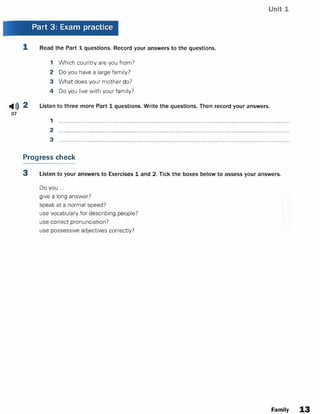
1. Read the Part 1 questions. Record your answers to the questions.
1 Which country are you from?
2 Do you have a large family?
3 What does your mother do?
4 Do you live with your family?
ф)) 2 Listen to three more Part 1 questions. Write the questions. Then record your answers.
07
1
2
3
Progress check
3 Listen to your answers to Exercises 1 and 2. Tick the boxes below to assess your answers.
Do you ...
give a long answer?
speak at a normal speed?
use vocabulary for describing people?
use correct pronunciation?
use possessive adjectives correctly?
Family 13
AIMS: Talking about your free time • Expressing preferences • Present simple • Skills development:
Understanding Part 2 and the task card • Exam practice: Part 2
Part 1: Language development
Vocabulary: Free time activities
1 Match the photos A-D to four of the activities below.
: going shopping jogging listening to music playing computer games
chatting online playing tennis reading magazines watching a film
2 Complete the table with the nouns below. How many activities can you make?
( a DVD exercise football to the gym nothing for walks tennis TV j
doing
going
playing
watching
3 What do you think about the activities in Exercises 1 and 2? Write each activity next to an
adjective. Can you add any more activities?
1 boring.................
2 relaxing.............
3 interesting.........
4 exciting...............
14 Get Ready for IELTS: Speaking
Unit 2
4 Write sentences for each activity. Use I like ... / 1don't like ... and an adjective from Exercise 3.
Example: I don't like playing computer games. I think it's very boring.
Vocabulary: Expressing preferences
4))) 5 Listen to three people answering the question ‘What do you like doing in your free time?’
08 What does each speaker enjoy doing? Write the activities from the box.
/ doing nothing going for walks going shopping
playing computer games reading magazines U3ing the Internet
Speaker 1 Speaker 2 Speaker 3
USLIA^ the llA/teriA^t
ф )) 6 Listen to extracts from the answers in Exercise 6. Complete the gaps with the phrases below.
09 ...................................................................................................................................................................
i I don't like I love I prefer I really like It depends My favourite thing i
1 using the Internet.
2 chatting online with him.
3 doing nothing to doing exercise.
4 going to the gym.
5 Sometimes I like going for walks.
6 is going shopping.
WbtdOut/
We can use really + verb to give emphasis. We cannot use very + verb.
I really like going to the cinema. l-very fike going to the cinema.
7 Write a short answer to the question ‘What do you like doing?’ Use the phrases from
Exercise 6 and the audio script on page 89 to help you.
Free time 15
Grammar: Present simple
8 Read the rule and look at the table. Use the information to choose the correct answer
(a or b) to questions 1-5.
• Use the present simple to make general statements about your life.
+ —
I like don't like
You like don't like
He/She/It likes doesn't like
We/You/They like don't like
1 Does your best friend play tennis?
a No, he doesn't play tennis but he likes playing computer games,
b No, he not play tennis but he likes playing computer games.
2 Do you watch DVDs?
a Yes. I likes watch DVDs at the weekend. But I don't like watching TV.
b Yes. I like watching DVDs at the weekend. But I don't like watching TV.
3 Tell me about something you like doing.
a I liking go to museums. It's very interesting,
b I like going to museums. It's very relaxing.
4 Do you do any exercise?
a Yes, I go to the gym every morning at 6 a.m.
b Yes, I going to the gym every morning at 6 a.m.
5 Do you like reading newspapers?
a It depends. Sometimes I read the newspapers on Saturdays,
b It depends. Sometimes I liking the newspapers on Saturdays.
9 Answer each of the questions in Exercise 8.
l/l/btafc 0 to t/
on + day. on Saturdays
at + time: at 6 a.m.
at + the weekend: at the weekend
Use every to say how often you do something: every morning
Get Ready for IELTS: Speaking
Unit 2
Part 2: Skills development
Exam information
The complete Speaking test (Parts 1, 2 and 3) takes 11-14 minutes. The examiner asks
questions and the candidate gives answers. The answers are recorded.
Part 2: Individual Iona turn
• Part 2 takes 3-4 minutes.
• The examiner gives you a 'task card' with written prompts. The examiner asks
you to talk about the topic and include the points on the card. The topic is about a
personal experience.
• You have one minute to prepare your talk, and the examiner gives you a pencil and
paper to make notes.
• You talk for one to two minutes about the topic. You can use your notes to help you.
• Then the examiner asks you one or two more questions on the same topic.
• Part 2 tests your ability to talk about a topic, develop your ideas about a topic, and
relevant vocabulary and grammar.
ф)) 1 Listen to the examiner’s instructions for the task card below. What newspaper or magazine
10 do you enjoy reading? What is the title?
Г ^Describe a newspaper or magazine you enjoy reading.
You should say:
what kind of newspaper or magazine it is
which parts of it you read
when and where you read it
and explain whv you enjoy reading it.
V__________________________________________у
ф)) 2 Notice the underlined key words on the task card. Read the notes on each key word below.
11 Listen to a model answer. Circle the notes that the speaker talks about.
1 newspaper or magazine: < l ^ 0flzwAg>| newspaper
2 what kind: fashion | sport | travel
3 which parts: adverts | Interviews | Letters | news
4 when: every day | the weeteend | son/tetimes
5 where: Иоил.е | school
6 explain why: it's very InterestliA^. | it's relaxing.
Free time n
Exam tip
Identify key words = important words which show you what to include in your answer
3 Match the sentences below to the key words in Exercise 2. Listen again and check.
a I enjoy reading a magazine called Fab Football.
b I prefer reading the interviews with famous players or the news..........................
с I read Fab Football every weekend...........................
d It's about sport...........................
e It's very interesting...........................
f Then I go home and read..........................
4 Look back at the task card in Exercise 1 and prepare your answer. Make notes for each
key word.
1 newspaper or magazine:...............................................................................................
2 what kind: ...............................................................................................
3 which parts: ...............................................................................................
4 when: ...............................................................................................
5 where: ...............................................................................................
6 explain why: ...............................................................................................
5 Make sentences from your notes. Use Exercise 3 to help you.
1 newspaper or magazine:...............................................................................................
2 what kind: ...............................................................................................
3 which parts: ...............................................................................................
4 when: ...............................................................................................
5 where: ...............................................................................................
6 explain why: ...............................................................................................
6 Record your answer to the task card in Exercise 1. Use your notes to help you.
Exam tip
Use a stopwatch to time your answer. You have one to two minutes to give your answer
in the exam.
Get Ready for IELTS: Speaking
Unit 2
Part 3: Exam practice
4))) 1 Read the task card below and listen to the examiner’s instructions. Underline the key words.
Describe an activity you like doing.
You should say:
what activity is it
where and when you do you do it
who you like doing it with
And explain why you enjoy doing it.
V ____________ J
2 Plan your answer. Write notes for each of the key words. You have one minute for this
in the exam.
3 Record your answer. You have one to two minutes for this in the exam.
Progress check
4 Listen to your answer. Tick the boxes below to assess your answers.
Do you ...
talk about all the key words on the task card?
use vocabulary for expressing preferences?
use vocabulary for free time activities?
use the present simple?
Free time 19
Special occasions
AIMS: Talking about special occasions • Connecting ideas • Pronunciation: Past tense endings
• Past simple • Skills development: Understanding Part 3 • Exam practice: Part 2 and Part 3
Part 1: Language development
Vocabulary: Special occasions
1 Look at the photos of special occasions. Which of the things in the box below can you see?
( balloons cake cards carnival costume family
 fireworks friends parade presents traditional food
2 Complete the descriptions of special occasions with the words below.
! family give make presents
In my country, we celebrate name days. We (1)..........................cards and (2).......................
traditional food. I enjoy visiting my (3)..........................on my name day and I love receiving
(4)..........................!
fireworks parade watch wear
New Year is a very special occasion. There's a (5)..........................through the streets and
people (6) ..........................beautiful costumes. We (7)........................... the parade and we
celebrate the start of a new year with (8) ............................
Get Ready for IELTS: Speaking
Unit 3
Vocabulary: Connecting ideas
ф)) 3 Read the description of Steven’s trip. Put a-f in gaps 1-6. Then listen and check.
13
a It was a special trip for me because ... d My best friend went too.
b but it wasn't very nice. e Then we visited another city
с it was very exciting! f we walked to the city centre.
Last year I travelled to Rio and visited my cousin and his family. (1) ..........................We
went to my cousin's house and we had a delicious traditional meal. After we ate dinner,
(2)............................When we saw the carnival, (3)............................We danced and sang.
We watched the parade. It was fun, but we were very tired. (4).......................... and stayed
at a famous hotel (5).......................... We stayed for two days then we went home.
(6) ..........................I travelled without my parents for the first time.
4 Look at the bold words in Exercise 3. Then choose the correct word to complete the sentences.
1 I enjoyed the parade and the carnival, but/ because I was very tired.
2 We went to a local restaurant for lunch, then / but we went to visit some friends.
3 I got a present from my parents. I got a present from my brother after/too.
4 After /W hen the graduation ceremony, my family met my friends from university.
5 I didn't enjoy the trip too/ because I don't like travelling by bus.
6 When / but the fireworks started, we were very excited.
Grammar: Past simple
Read the rules and look at the table. Complete the past simple form of the irregular verbs
below. Use your dictionary to help you.
• Use the past simple for past actions that are finished.
• For regular verbs, add -d o r -ed.
• For irregular verbs, learn the different forms.
• For the verb be, learn the different forms for different persons.
1
2
Regular verbs
Irregular verbs
The verb be
eat ..........
give ..........
Infinitive
dance
sing
be
Past simple +
danced
sang
was / were
3 make
4 meet
Past simple -
didn't dance
didn't sing
wasn't / weren't
5 wear
6 see
Special occasions 21
6 Complete the sentences with the words below.
! danced didn't stay graduated was went were I
1 I wasn't at the carnival. I ..........................to my sister's wedding.
2 I ..........................last year. My parents came to England for the ceremony.
3 People wore colourful costumes. I t ..........................an exciting day!
4 We watched the parade. We sang and..........................to the music.
5 I stayed with my friends. I ..........................in a hotel.
6 We didn't see the fireworks. W e..........................tired and went to the hotel.
Pronunciation: Past simple verbs and -ed
Ц))) 7 The -e d ending is pronounced in three different ways. Listen to the different sounds and the
14 past simple verbs in the table below.
А / /d/ /id/
danced stayed hated
watched travelled visited
Ф)) 8 Listen to six past simple verbs and add them to the table above.
15
k/atc& О u ,t/
The -ed ending adds a sound to the end. Sometimes it adds an extra syllable to
the verb.
For example:
dance + -ed = danced (one syllable)
hate + -ed = ha-ted (two syllables)
9 Complete the sentences with the words below. Use the correct form of the verbs.
[ but meet travel watch
I ................
and...........
......my friends in the park after the carnival. W e .
...........home. We had a great tim e,.......................
......................the fireworks
.we were very tired.
! see play wear when
My hometown has a big festival each year. Last year, I .......................a costume
and.......................traditional music at the parade. My parents were very
happy.......................they........................the parade.
22 Get Ready for IELTS: Speaking
Unit 3
Part 2: Skills development
Exam information
The complete Speaking test (Parts 1, 2 and 3) takes 11-14 minutes. The examiner asks
questions and the candidate gives answers. The answers are recorded.
Part 3: Two-wav discussion
• Part 3 takes 4-5 minutes.
• The questions in Part 3 relate to the topic in Part 2.
• The discussion is between the examiner and you.
• The examiner asks you questions. You talk about different issues and ideas on the
topic.
• Part 3 tests your ability to talk about other topics related to Part 2's topic and to
express and justify your personal opinions and ideas.
Look at beginnings of Part 2 task cards 1-3. Match each card with a general topic a-c.
Describe someone in
your family who you like.
You should say:
what kind of person
he/she is
Describe an activity
that you like doing.
You should say:
what activity is it
Describe a special
occasion in your life.
You should say:
where this occasion
took place
a events..................
b hobbies..................
с people..................
Now match each question a-с with a task card 1-3 from Exercise 1.
a Do young people in your country celebrate special occasions?..................
b What do you think are the differences between sports now and in the past?
с What is the role of grandparents in your culture?..................
Exam tip
The Part 2 task prepares you for Part 3 because you talk about a related topic.
Special occasions 23
^))) 3 Look at the underlined key words in the Part 3 question below. Listen to two more Part 3
16 questions. Write the questions and underline the key words.
Do vou think computer games are
1
2
ф)) 4 Listen again and check.
16 i-
Э Read the model answers to a question in Exercise 3. Which question do the answers match?
a
Yes, I think, yes. In my country, we have one or two big festivals. We visit family or we
remember people or events. It is important. It is a serious thing but it is fun. I like travelling
to other countries for festivals too. It is interesting to learn about the world.
b
I went to a festival in my country last year and I enjoyed it. It was important to me because
I saw my friends and family.
6 Look at the model answers in Exercise 5 again. Answer the questions below for each
model answer.
1 Is the answer on the same general topic?
2 Is it relevant to the question?
3 Does it include the key words or words similar to the key words?
4 How long is the answer?
Exam tip
Try to give an answer with four or more sentences. Do not give short answers.
7 Choose a Part 3 question from Exercise 2 or Exercise 3 and write your own answer.
8 Record your answer, then use the questions in Exercise 6 to check your answer.
24 Get Ready for IELTS: Speaking
Unit 3
Part 3: Exam practice
Part 2
1 Read the Part 2 task card below and write notes for your answer. You have one minute for
this in the exam.
Describe a special occasion in your life
You should say:
where this occasion took place
when it took place
who was there
and explain how your feelings on this
occasion.
2 Record your answer. You have one to two minutes for this in the exam.
Part 3
4))) 3 Read and listen to the Part 3 questions.
17
What is an important festival in your country?
What are your favourite parts of this festival?
How have special occasions such as weddings changed in your country?
Do you think special occasions and festivals are important for a society?
4 Record your answers to each question in Exercise 3.
Progress check
5 Listen to your answers. Tick the boxes below to assess your answers.
Do you ...
talk about all the key words on the task card in Part 2?
talk about the right topic in Part 3?
answer with four or more sentences in Part 3?
use vocabulary for special occasions?
use vocabulary for connecting ideas?
use the past simple?
use correct pronunciation for past simple -ec/endings?
Special occasions 25
Review 1
1 Complete the table with family words.
mother wife (2)....... sister (4}........ granddaughter
father (1)....... son (3)....... grandfather (5)........
2 Circle the correct word to describe people.
1 A funny/kind person cares about other people.
2 A bossy / friendly person tells other people what to do.
3 A calm / creative person uses their imagination to make new things.
4 A confident / happy person believes in their ability.
5 A clever / friendly person likes meeting new people.
3 Complete the sentences with possessive adjectives in the box.
( her his our my (x2) your ;
1 name is Abdul. I am 19 years old.
2 Is .............................family big or small?
3 My grandmother is 80.............................. name is Ana.
4 I'm not an only child. This is .............................sister Maria.
5 My husband is from Australia...............................relatives still live there.
4 Read the sentences about free time activities. Cross out the incorrect options below. There is
one incorrect option in each sentence.
1 My favourite thing is playing computer games / tennis / the Internet.
2 I really like chatting online. It's boring/ exciting/ relaxing.
3 I don't like watching DVDs / films / magazines.
4 I love doing exercise/to the gym / nothing
5 I prefer going shopping / to the gym / to music.
Get Ready for IELTS: Speaking
Review 1
Listen and choose the correct sentence (a or b).
1 a It's boring.
2 a I like doing nothing.
3 a I don't like using the internet.
b It's interesting
b I like doing exercise,
b I like using the internet.
Correct the errors with the present simple in the sentences below.
1 I like really playing computer games.
2 Children in my country don't like go shopping.
3 My brother and I likes going to museums.
4 I no like going for walks.
Complete the time expressions with the correct preposition: at or on.
1 I like doing nothing.............................the weekend.
2 I play tennis.............................Saturday.
3 I go to the gym .............................6 a.m. every day.
Match the verbs with the words in the box below to describe special occasions.
[ give visit watch wear ] : a costume family fireworks presents ;
Connect the ideas in the sentences with the best word.
1 The journey was very long, b .............................I was excited and happy.
2 We saw the parade on Saturday. T.............................we visited friends on Sunday.
3 A .............................the fireworks, I went home. I was very tired.
4 I made traditional food for my family. My mother made some food t ...............................
5 ZV.............................I arrived at the restaurant, all my family were there.
6 We wore new clothes b .............................it was special day.
Complete the sentences with the past simple form of the verbs in brackets.
1 I .............................England last summer. I t ..............................great, (visit, is)
2 My parents.............................at the parade, but they..............................it. (are, not like)
3 W e.............................and..............................at the carnival, (sing, dance)
4 I .............................last year and.............................. my first job. (graduate, get)
5 I .............................to the restaurant because I ..............................very tired, (not go, is)
Review 1
Hometown
AIMS: Talking about places in cities • Describing cities • Pronunciation: Syllables and word stress
• There is/There are • Skills development: Building fluency • Exam practice: Part 1 and Part 2
Part 1: Language development
Vocabulary: Places in cities
X Match photos A-С to the places below. There are three extra places.
( football stadium gallery harbour market museum shopping mall j
2 Look at the photos again. What can you do in each place? Choose activities from the list.
( buy clothes go on a boat trip have a coffee see an exhibition ]
Example: You can buy clothes in a shopping mall.
3 In which place below can you do activites 1-5? Can you add more places?
i beach bridge cafe factory gallery hotel park river skyscraper theatre
1 eat or drink something
2 go for a walk
3 relax and meet friends
4 work
5 see a view of the city
Get Ready for IELTS: Speaking
Unit 4
Vocabulary: Describing cities
Match the meanings of sentences 1-5 with a-e.
1 It's a busy city.
2 It's near the beach.
3 It's got different neighbourhoods.
4 It is famous for the markets.
5 I really like it because the people
are very friendly.
I go swimming there at the weekend.
Sometimes we go sailing too.
They are polite and they're very happy
when you speak their language.
There's a lot of traffic and people say the
city never sleeps!
Tourists buy clothes or souvenirs. You can
even go on tours.
There's a financial district, a busy
downtown and quiet suburbs.
Replace the underlined words and phrases in Exercise 4 to make more sentences about
cities. Use the ideas below or your own ideas.
airport beautiful museums mountains traditional food
lots of tourist attractions modern the weather is good
Example: It's a modern city.
6 Complete the sentences below so they are true for your hometown.
1 It's a ..........................city.
2 It's near the ...
3 It's g o t...
4 It is famous for the ...
5 I really like it because ...
Pronunciation: Syllables and word stress
4))) 7 Look at the words in Exercise 3 again. How many syllables (different word parts) are there?
19 Complete the table, then listen and check.
one syllable two syllables three syllables
beach cafe
Ф » 8 Listen to the words again and underline the syllable with the word stress.
20
Hometown 29
Grammar: There is/There are
9 Listen to Sam describing a city. Write the words below next to the correct heading.
( accommodation beach harbours markets
 museum people shopping malls traffic
There's a m useum .............................
There isn't .................................................
There are ...................................................
There a re n't.............................
10 Complete the table with the correct words.
+ There 's (is) a museum.
(1)............ some galleries.
- There (2)............ / is not a beach.
aren't / (3)............ any harbours.
? Is
there
a football stadium? Yes, there is.
(4)............ any shopping malls? Yes, there (6)............
No, there (7)............
b /o ,tc & O u t /
Countable nouns have two forms: Uncountable nouns have one form:
There is a museum, (singular) There isn't any accommodation.
There are two museums, (plural) There aren't any accommodations;
11 Read the text and complete each paragraph with the correct words.
( bridge famous got near skyscrapers
My hometown is (1)..........................the border. It's a busy city and it's (2)...........................
for the different neighbourhoods. It's (3)..........................a financial district with lots of tall
(4)........................... You can walk over a modern (5)...........................into the harbour.
( are can favourite meet traditional
My (6) ..........................place is the historic centre. You (7)...........................go to lots of small
restaurants and eat (8) ..........................food. It's delicious! It's a great place to
(9)..........................friends. There (10)...........................always lots of people there. It's a
popular place.
Get Ready for IELTS: Speaking
Unit 4
Part 2: Skills development
Exam information
Part 1 tests your ability to talk to people about everyday topics.
Part 2 tests your ability to talk about a specific topic and to organize your ideas.
Part 1
Exam tip
Try to give long answers - not just two or three words.
Speak at a natural speed - not fast and not slow - without lots of pauses.
Use synonyms and show your vocabulary.
Practise your grammar to help you use the correct forms.
1 Read the Part 1 question and answer below. What are the good and bad points about the
answer?
A: How would you describe your hometown?
B: Busy. Dirty. I don't like it.
2 Prepare your answer to the question in Exercise 1. Make notes on the ideas below.
• location of the city (area? country?) and size (population?)
• positive words to describe a city
• places tourists visit
• your opinion and an example
3 Record your answer to the question. Use your notes to help you.
ф)) 4 Listen to a model answer. Assess the answer in the table below.
22
model answer your answer
Is the answer too slow or too fast?
Are there pauses?
Are there any grammar errors?
Are words repeated?
5 Now listen to your answer and complete the table above.
6 How can you improve your answer? Record your answer again and try to improve your
technique and language.
Hometown 31
Part 2
Exam tip
In Part 2 of the exam, use the one minute to think and plan.
Identify the topic on the card.
Make notes on the three points and the summary point. This organizes your answer.
Choose topic vocabulary and suitable grammar structures.
Then speak at a natural speed for two minutes.
7 Read the Part 2 topic card and the candidate’s notes below. Which notes are not useful?
Why?
ллмл.е of citn (gt^llsh translation?)
description of coucntri/]_____________
it's near...________________________
it's g o t... /There's ...______________
tourists - trn -food, tatee photos_____
wz - relax, meet friends, -plan sports
other cities I llt e e ________________
m.v opinion aiAsd example________
8 Prepare your answer to the Part 2 task in Exercise 7. You have one minute to make notes.
Use the Exam tip box to help you.
9 Look at your notes again. Can you improve them? Now record your answer. You have two
minutes to give your answer.
10 Listen to your answer. Did you follow the points in the Exam tip box? How can you improve?
Record your answer again for extra practice.
Describe an area of your country you
know and like.
You should say:
where it is
what its special features are
what you and other people do in this area
And explain why you like it.
32 Get Ready for IELTS: Speaking
Unit 4
Part 3: Exam practice
Part 1
4 $ 1
23
Read the Part 1 questions below. Then listen and match the answers a-g to the questions.
1 Do you work or are you a student?............
2 What do you like about your job? / What do you like about studying?............
3 When do you see your friends and family?............
4 Where is your hometown located?............
5 What do people in your town do?............
6 Is it easy to travel around your hometown?............
7 Is there a good health system where you live?............
Record your answers to the questions in Exercise 1.
Part 2
Read the instructions for the Part 2 topic card below. You have one minute to make notes
for your answer.
Describe an interesting city you know
and like.
You should say:
where it is
how you went there
what you did there
And explain why you found it so interesting.
Now record your answer to the task in Exercise 3. You have two minutes to give your answer.
Progress check
5 Listen to your answers to Part 1 and Part 2. Tick the boxes below to assess your answers.
Part 1
Do you ...
give extra information or an example?
use topic vocabulary and phrases?
use the correct stress for the words?
use correct grammar?
Part 2
Do you ...
keep talking and not have too many pauses?
use topic vocabulary and useful phrases?
use the correct stress for the words ?
use correct grammar?
sound interested in the city?
Hometown 33
TV and radio
AIMS: Talking about types of TV and radio programme • Describing programmes • Adverbs of
frequency • Skills development: Organizing your answers • Exam practice: Part 1 and Part 2
Part 1: Language development
Vocabulary:Types of programme
1. Read the descriptions 1-6 of different types of programme. Match the descriptions with the
photos A-D above. There are two extra descriptions.
1 I love watching documentaries because we can learn about new things. My favourite is
a series about nature and animals.
2 I watch a game show every weekend with my family. I think the presenter is very
funny. I like it when the contestants win big prizes.
3 I always listen to the news. I think it's important to understand the events in your
country and listen to business reports. You can find out about your sports team too.
4 I enjoy watching soap operas because they are similar to real life and I like the
characters. I usually watch TV on my laptop in my room.
5 I sometimes watch talk shows.The quests are really interesting. You can learn about
their lives and new films or new music.
6 I'm a sports fan so I watch a lot of sport on TV. I enjoy listening to the experts talking
about the results, too.
2 Check the meaning of the underlined words in Exercise 1. Then answer the questions below.
1 Do you have a favourite TV presenter Why do you like him/her?
2 What is a popular documentary series in your country?
3 Are there any characters in a soap opera you really like?
4 Do you think most quests on a talk show are interesting?
Get Ready for IELTS: Speaking
Unit 5
Vocabulary: Describing programmes
ф)) 3 Listen to three people talking about programmes they listen to or watch. Match the
24 speakers 1-3 with the type of programme they watch a-c.
a documentary series.............................
b drama series.............................
с reality TV show .............................
ф)) 4 Read the sentences a-h below. Listen again and decide which speaker 1-3 says each
24 sentence. Which three sentences express an opinion?
a It's about clothes and fashion...............
b It's set in London...............
с It's presented by different models each week...............
d It stars some famous actors...............
e The participants are famous people..............
f It's very exciting...............
g I think it's good entertainment...............
h The thing I like best is the hotel manager..............
5 Think about a programme you enjoy watching or listening to. Write sentences to describe it
and express your opinion about it. Use the sentences in Exercise 5 to help you.
b J b tc A О u > t!
actors = people who play characters in a story
characters = people in a story
contestants = real people in a game show or reality TV show
Grammar: Adverbs of frequency
6 Match sentences 1-6 to explanations a-f. Which sentences are true for you?
1 I always watch soap operas.
2 I usually listen to the news in the
morning.
3 I often watch game shows.
4 I sometimes watch dramas.
5 I rarely listen to sports programmes.
6 I never watch documentaries.
a I'm not interested in any sports.
b I think they're very boring.
с I like it when contestants win big
prizes.
d I think the plots are sometimes
interesting.
e I watch them every day. I never miss
an episode.
f I like listening to the business reports.
TV and radio 35
7 Look at the arrow and the adverbs of frequency. Put the words always, often and rarely in
the correct position on the arrow.
never (1) ..................... sometimes (2) ..................... usually (3) ...............
k /d tc & O u t /
Put the adverb before the verb: I always watch soap operas.
BUT put the adverb after the verb to be: I think the plots are sometimes interesting.
8 Complete the prompts below so that they are true for you. Include an explanation.
1 I always watch ...
Example; I always watch dramas. I think they're exciting and I like the plots.
2 I usually listen to ...
3 I often watch ...
4 I sometimes watch ...
5 I rarely listen to ...
6 I never watch ...
9 Complete the texts with the words below.
1 i by contestants every favourite )
M y .............................programme is a quiz show called In, Out. I watch it ..............................
weekend. The.............................are very clever. It's presented..............................a university
professor.
2 [ about actors interesting operas )
I enjoy watching documentaries.............................science. They are very................................
I rarely watch soap.............................because I think th e ..............................are terrible.
3 f always exciting series stars ;
I like watching a drama.............................called School Time. I ..............................watch it
with my brother. It.............................our favourite actor and it's a very..............................
programme.
4 ; contestants funny sometimes talk ;
I like.............................shows. The guests are usually very................................I like game
shows too. The.............................on game shows are..............................really good.
Get Ready for IELTS: Speaking
Unit5
Part 2: Skills development
Exam information
Part 2 tests your ability to talk without pausing and also your ability to plan and organize
your answer.
Read the Part 2 task card below. Look at the underlined key words. Match the key words to
the notes 1-5 below. There is one extra note.
Talk about a programme you
learned something from.
You should say:
what type of programme it was
which were your favourite parts
who you watched it with
And explain what you learned from it.
1 Interesting Interviews with the writer's
famllt/) and friends________________
2 learned about the writer's lift, e.g. poor
family, no qualifications, lived In
different countries, now lives In her
hometown.
with m^ classmates.
2 Read the example answer below. Answer true or false for sentences 1-3.
I'd like to talk about a programme I learned something from. I learned about the writer's
life. I learned she was from a poor family. I learned she had no qualifications from school.
Then she lived in different countries. I learned that she now lives in her hometown and she
writes there.
I watched it with my classmates. We watched it at college in a seminar. Then we talked
about her life.
It was a documentary and it was about a famous writer. I enjoy reading her books. She
writes about college students and their lives.
1 All the key words and notes are included. True/False
2 The answer follows the order on the task card. True/False
3 The answer is clear and easy to follow. True/False
Exam tip
Follow the order of the points on the task card. These organize your answer and help
you to keep talking.
TV and radio 37
3 Read the example answer below. Answer true or false for sentences 1-3.
I'd like to talk about a programme I learned something from.
The programme was a very interesting documentary and it was about a famous writer. I enjoy
watching this documentary series. It always has really interesting people or topics.
Firstly, I liked everything in the documentary, but my favourite parts were the interviews
with her family and friends. A good example of this is the interview with her sister. She
talked about their life when they were young children. She was very funny. There was one
old friend from the writer's school and they are still friends today. I liked learning about the
writer's personal life.
I watched it with my classmates. We watched it at college in a seminar. It was part of the
course and then we gave a presentation about her life.
I learned lots of things from the documentary. For example, I learned she was from a poor
family. I learned she had no qualifications from school and then she lived in different countries.
Finally, I learned that she now lives in her hometown and she writes there.
1 All the key words and notes are included. True/False
2 The answer follows the order on the task card. True/False
3 The answer is clear and easy to follow. True/False
4 Read the example answer in Exercise 3 again. Find and underline two phrases for giving
examples and two phrases for organizing your answers.
5 Look back at the task card in Exercise 1. Plan your answer. Follow the points below:
• Make notes on each key word.
• Write sentences using your notes.
• Include the underlined phrases from Exercise 3.
6 Record your answer. Use your notes to help you.
7 Listen to your answer. Can you improve it? Try to give your answer again. Refer to the task
card in Exercise 1 but do not use your notes this time.
Exam tip
Remember there are different topics and different task cards in each IELTS exam. Do
not memorise a speech on a topic for the exam.
Get Ready for IELTS: Speaking
Unit 5
Part 3: Exam practice
Part 1
1 Read the Part 1 questions. Record your answer to each question.
When did you last watch television?
What do you usually watch on television?
What are some popular programmes in your country?
Why do you think some TV programmes are popular?
Part 2
2 Read the Part 2 task card. Plan your answer. You have one minute for this in the exam. Then
record your answer. You have one to two minutes for this in the exam.
f 
Talk about aTV programme you
enjoy watching.
You should say:
what type of programme it is
which are your favourite parts
when and where you watch it
And explain why you enjoy watching it.
V ______________J
Exam tip
Remember to use phrases for expressing preferences. See page 15.
Progress check
3 Listen to your answers. Tick the boxes below to assess your answers.
Do you ...
include all the key words in your notes?
follow the order on the task card?
give an answer that is clear and easy to follow?
include phrases to organize your answer?
use vocabulary for describing types of programme?
use adverbs of frequency?
use phrases for expressing preferences?
TV and radio 39
Weather
AIMS: Talking about the weather • Can / can't • Pronunciation: Vowel sounds
• Skills development: Expanding your answers • Exam practice: Part 1 and Part 2
Part 1: Language development
Vocabulary: The weather
в
1 Match two words with each picture A-D above.
I cold hot rainy snowy stormy sunny wet windy
2 Use your answers from Exercise 1 to complete the descriptions below.
Picture A In my country, the monsoon season is from September to November. It's very
..............................and.................................
Picture В In my country winter lasts from December to February. It's ..............................
and................................
Picture С We often have thunderstorms in March or April in my country. It's ........
and................................
Picture D The dry season lasts from May until October in my country. It's ..........
and................................
3 Complete the table below with information about the seasons in your country.
season Months weather
autumn October and November cold and windy
dry season
rainy season
spring
summer
winter
Get Ready for IELTS: Speaking
Unit 6
Vocabulary:Talking about the weather
4 Complete the sentences with the words and phrases in the box.
; favourite it's lasts makes really like There's
1 M y .............................season is summer.
2 lots of rain during the monsoon season.
3 In w inter,.............................wet and stormy in my country.
4 Hot weather...................................me feel really happy.
5 W inter.............................for two months.
6 I .............................stormy weather because it's exciting.
M a d O u t /
lt's + adjective = It's rainy/snowy/windy.
There's/There are + noun = There's lots of rain/snow/wind.
5 Complete the sentences below with your own ideas.
1 My favourites season is ... 4
2 In summer, it's ... 5
3 There's lots of rain/sun during ... 6
Pronunciation: Vowel sounds
ф)) 6 Listen to the vowel sounds and the words, and repeat them.
25
u: au л ei о: эи
monsoon now summer favourite stormy cold
ф)) 7 Listen to the words below and add them to the correct vowel sound in the table. Use a
26 dictionary to check the meaning of the words.
( April autumn drought humid June month
November outside rainy snowy stormy sunny
ф )) 8 Listen and check. Then listen again and repeat the vowel sounds and the words.
27
Summer /The dry season lasts fo r...
Cold weather makes me feel ...
I really like ...
Weather 41
Grammar: Can I can't
9 Listen and complete the sentences with can or can’t
1 You.............................go to the beach in the summer.
2 You.............................do anything when the weather is very hot.
3 You.............................play tennis outside when it's rainy.
4 The rainy season.............................last for weeks.
5 You.............................go skiing in hot and dry climates.
6 The weather.............................change quickly in the mountains.
1 0 Read the rules about can and can’t. Then complete the sentences with your own ideas.
• We use can to say that it is possible to do something.
• We use can't to say that it is not possible to do something.
• Put can or can't before the main verb.
• The form of the main verb doesn't change.
1 When it's sunny, you can ...
2 In cold weather you can't...
3 In summer, you can ...
4 In the rainy season, you c a n 't...
1 1 Complete the sentences with the words below. There is one extra word in each set.
1
; can it's makes season weather j
My favourite.............................is summer. I really like the summer because..............................
always hot and sunny. You.............................do lots of sports or you can sunbathe and relax
with friends. The hot weather always.............................me feel happy and cheerful. I think
everybody likes the hot weather.
2 ; can't drought dry for monsoon }
A .............................means lots of rainy weather! In my country, this season
lasts.............................about three or four months. It's boring and you..............................
do anything outside. It's humid and I don't like it. I prefer th e .............................weather
because I like being outside.
! can from stormy there's thunderstorms !
In my country, it's very cold in winter.............................. lots of snow and you..............................
go skiing or visit the mountains. This is my favourite season. It lasts.............................
November to February. It's different from summer because summer lasts for about six
months. It's really hot and dry and there are.............................at night.
Get Ready for IELTS: Speaking
Unit 6
Part 2: Skills development
Exam information
Part 1 tests your ability to understand general questions and to give relevant answers. It
also tests your ability to expand your answers.
Part 2 tests your ability to give a fluent and organized answer. It also tests your ability to
include extra information using relevant language.
Part 1
1 Read the Part 1 questions and answers below. Choose the correct answer (a or b).
1 How many seasons does your country have?
a My country has four seasons.
b There are many seasons in my country.
2 What's your favourite season of the year?
a Hot and sunny. This is my favourite weather,
b Summer. This is my favourite season.
3 How do rainy days make you feel?
a I feel very sad on rainy days.
b Yes, rainy days make you feel.
4 What do you like doing when it's hot?
a I like it when it's hot, yes.
b I like going to the beach.
ф)) 2 Listen and check.
29
Exam tip
Listen carefully to the question and give a relevant answer. Then expand your answer,
for example give a reason or an explanation.
3 Read the correct answers again. Can you make the answers longer? Add a sentence to each
correct answer in Exercise 1.
1 I like it because the weather is hot and sunny.
2 The seasons are spring, summer, autumn and winter.
3 You can go swimming or you can meet friends there.
4 You can't go outside and do any sports.
4 Answer each question in Exercise 1. Include a reason or an explanation in each answer.
Weather 43
Part 2
Read the task card and the example answer. What is the problem with the example answer?
a It includes lots of extra information,
b It doesn't include extra information.
Describe your favourite type of weather.
You should say:
what the type of weather is
how often you experience this type of weather
what you like doing in this weather
And explain why it is your favourite type of weather.
7
8
9
I'd like to describe my favourite type of weather. My country has three seasons and there
are lots of types of weather. (1) .............................
Yes, wet weather is my favourite. I like going shopping when the weather is wet because
the shops are all indoors. (2) .............................
I often experience this weather in other countries. I like travelling in Europe and I always
take my umbrella with me. The wet weather lasts for a long time there. (3)...........................
This weather is good for relaxing. For example, you can stay at home and just watch
television. (4).............................
Read the sentences below. These all add extra information to the example answer in
Exercise 5. Read the example answer again and add a sentence to the end of each paragraph.
a You can chat to your friends online too.
b It is different from my country because the rainy season only lasts for two months,
с I also like cooking delicious meals for my family when there's lots of rain,
d It is a difficult choice for me, but I think my favourite is wet weather.
Add two more sentences to expand the example answer in Exercise 5. Choose where to add
the extra information. Then practise saying the answer.
Read the task card in Exercise 5 again. Plan your own answer. Remember to add extra
information to each part of your answer.
Record your answer.
44 Get Ready for IELTS: Speaking
Unit 6
Part 3: Exam practice
Part 1
1 Read the Part 1 questions. Record your answer to each question.
1 How many seasons does your country have?
2 What's the weather like in your country?
3 How do rainy days make you feel?
4 What do you like doing when it's hot?
Part 2
2 Read the Part 2 task card. Plan your answer. You have one minute for this in the exam. Then
record your answer. You have one to two minutes for this in the exam.
Describe your favourite season in your country.
You should say:
when that season is from and to
what the weather is like
how it is different from other seasons in your
country
And explain why it is your favourite season.
V____________________________________________ J
Exam tip
You can also use vocabulary for free time activities when you talk about the weather.
See page 14.
Progress check
3 Listen to your answers. Tick the boxes below to assess your answers.
Do you ...
give a relevant answer and expand your answer in Part 1?
add extra information to your answer in Part 2?
use vocabulary for talking about the weather?
use vocabulary for free time activities?
pronounce vowel sounds correctly?
use can / can't correctly?
Weather 45
Review 2
Find 12 places in cities below.
Match 1-5 to a-e to make descriptions of a city.
1 It's a a the people are very friendly.
2 It's near the b lots of accommodation for tourists.
3 It's got с airport.
4 It is famous for d modern city.
5 I really like it because e its university.
Write sentences with There is, There isn’t, There are or There aren't
There is a harbour.1 / a harbour
2 / lots of people
3 X much traffic
4 X any markets
5 / two museums
6 X a beach
7 X any shopping malls
8 / a football stadium
Add the words to the table.
actors characters contestants documentary game show guests news
participants presenter reality TV show soap opera talk show
types of people types of programme
Get Ready for IELTS: Speaking
Review 2
Complete the descriptions of programmes with the words in the box below.
about best good presented set stars j
1 It's.............................a school.
2 It's.............................in Australia.
3 It's.............................by different people every week.
4 It.............................lots of great actors.
5 It's.............................entertainment.
6 The thing I like.............................is the exciting plots.
Read the table which shows how often Matteo watches TV programmes. Write sentences
with an adverb of frequency.
100% sports programmes Matteo always watches sport programmes.
80% documentaries (1)
60% chat shows Matteo often watches chat shows.
40% dramas (2)
10% reality TV shows (3)
0% soap operas (4)
Find four pairs of opposite words about the weather in the box.
i. cold drought dry hot monsoon rainy sunny wet
Choose the correct option for talking about the weather.
1 My favourite season / weather is summer.
2 Winter lasts for/from four months.
3 In spring, it's rain/rainy.
4 Cold weather makes me like /fe el sad.
5 In my country, we often have /it's storms.
Complete the sentences with can or can’t
1 In cold weather, you.............................go to the beach.
2 You.............................go to the gym when it's rainy or when it's sunny.
3 The dry season.............................last for months in my country.
4 In the rainy season, you.............................go outside because it's very wet.
5 You.............................go skiing when it's snowy.
6 You.............................play tennis outside when it's windy.
Review 2
Studying
AIMS: Talking about studying • Using collocations • Pronunciation: Word stress • Present continuous *
• Skills development: Using a range of vocabulary • Exam practice: Part 1, Part 2, and Part 3
Part 1: Language development
Vocabulary: Academic subjects
1 Match four of the subjects below to the pictures above. Use your dictionary to help you.
art business studies computer science engineering
 history law linguistics literature mathematics medicine
2 Listen to three students talking about their course. Complete each description with the
words below. Then listen again and check.
f course difficult director doctor interesting
I law lawyer lectures medicine
1 I'm studying................................... It's hard work and there are lots o f.................................
but I enjoy helping people. I'm in my first year and I'd like to be a ....................................
2 I'm doing a business studies.................................... It's about the different parts of a
business, like finance, people, or marketing. It's really.................................... I'd like to
be a company....................................
3 I'm studying.................................... It's about the legal system in different countries. I
think it's a very...................................course and there are lots of deadlines. I'd like to be
a ....................................
1л/ь€сЯ O to t/
I'm studying medicine.
I'm learning about health and illness.
Get Ready for IELTS: Speaking
Unit 7
Pronunciation: Word stress
How many syllables are In these words?
business............................. mathematics
literature............................. university.....
ф)) 4 Listen and check. Then listen again and add the words to the correct stress patterns in the
31 table below.
1 [O o] 2 [О о о] 3 [о о О о] 4 [о о О о о]
^))) 5 Listen to the words below and add them to the table in Exercise 4.
32
chemistry college deadline engineering graduate graduation
 history lecture medicine presentation project timetable
ф )) 6 Listen and check your answers to Exercises 4 and 5. Listen again and repeat the words.
33
Vocabulary: Collocations
Match the verbs 1 -5 with the nouns a-e to make collocations about studying. Then match
the verbs 6 -1 0 with the nouns f-j to make more collocations.
apply
be
1
2
3 do
4 get
5 give
presentations
for a scholarship
good results
my homework
in my first/second/final year
6
7
go
graduate
8 have
9 live
10 write
f in halls / with my family
g extra tuition
h to lectures / college
i an essay
j from university
Studying 49
8 Complete the sentences below with nouns from Exercise 7.
1 I hope I get good.............................this semester.
2 I graduated fro m .............................last summer.
3 I'm in my final.............................at university.
4 I don't like giving...............................
5 I'm writing an.............................on international finance.
Grammar: Present continuous
Ц))) 9 Listen to the three speakers. Complete the sentences with the correct names: Lara, Dee or
34 Marcel.
a .............................is filling out an application form.
b .............................is having extra tuition.
с .............................is preparing a presentation.
10 Look at the table and complete the rule.
• Use the present continuous to talk about an activity happening in the past/ now.
I 'm 'm not
studying English this
He /She/ It 's 'snot semester.
You/We/They 're 're not
* » ) l i Listen to the speakers again and read the texts below. Underline the twelve examples of the
34 present continuous.
1 I'm revising for an exam. It's my final year and I'm working very hard. I'm having extra
tuition and my grades are improving.
2 I'm visiting my brother at college. He's living in halls this year and he's having a great
time. I'm helping him with his coursework this semester and we're preparing a
presentation at the moment.
3 I'm thinking about doing another course next year. I'm applying for a scholarship at a
university in my hometown and I'm filling out the application form now.
12 Complete the sentences below to describe what you are doing.
1 At the moment, I'm ...
2 This semester I'm ...
b /b tc & O u t /
at the m oment = now or the next two/three days
50 Get Ready for IELTS: Speaking
Unit 7
Part 2: Skills development
Exam information
In Part 2, you talk for one to two minutes about the task card. Then the examiner asks
you one or two questions related to your answer and this completes Part 2. These
questions test your ability to give a relevant answer with a range of vocabulary.
Part 2
ф )) 1 Imagine you have completed your two-minute talk on the Part 2 task card below. The
35 examiner will ask you one more question to complete Part 2. Listen to an example answer.
Which question (1 or 2) does it answer?
Talk about a subject you are studying.
You should say:
what subject you are studying
what the subject is about
how you feel about it
And explain why you are interested in it.
4») 2
35
4») 4
36
1 Would you like a job connected to the subject you are studying?
2 Are your friends or family interested in the subject too?
Read and listen to the example answer again. Write T (true) or F (false) for sentences 1-3 below.
Yes, yes they are. My father and my brother studied law at university, and they think it is a
very nice subject. My mother thinks it is nice and always asks me questions about law. I
have lots of friends on the course, and we want to get a nice job when we graduate.
1 The answer is relevant to the topic...............................
2 The answer includes all parts of the question..............................
3 The speaker repeats some words...............................
Look at the example answer in Exercise 2 again. Underline the three adjectives. Replace
each adjective with one of the adjectives below.
I good important interesting i
Listen and check. Assess the answer again using sentences 1-3 in Exercise 2. Which answer
has changed?
Exam tip
Use a range of adjectives (good, important, interesting). Try not to repeat words.
Studying 51
5 Record your answers to the questions in Exercise 1.
6 Listen to your answers and assess them.
• Are your answers relevant to the topic?
• Do you answer all parts of the question?
• Do you repeat any words?
• How many different adjectives did you use?
Part 3
Exam information
Part 3 tests your ability to express your opinion in a clear way and to use relevant
language and a range of vocabulary.
7 Read the three questions below. Then listen to three people answering the questions. Match
each question a-с to a speaker 1-3.
a Is it a good idea to live with your family when you are studying? .............................
b Compare your experience of education to your parents' generation..................................
с Do you think your country has a good education system? .............................
8 Look at three adverbs from the answers in Exercise 7. Match them to the correct meaning.
1 definitely a I'm pleased about this.
2 fortunately b I'm not happy about this.
3 unfortunately с I agree completely.
Exam tip
Using adverbs shows the examiner you can express your opinion in different ways.
9 Look at the Part 3 questions in Exercise 7 again. Think about your answers and how you will
express your opinions. Which adverbs will you use?
10 Record your answers. Then listen to your answers and assess each one. Choose T (true) or
F (false) for the points below.
1 The answer is four or more sentences long. T F
2 The answer is relevant to the topic. T F
3 The answer includes a range of adjectives and adverbs. T F
11 For extra practice, go to page 25 and answer the Part 3 questions again. Try to use a range
of vocabulary in your answers.
Get Ready for IELTS: Speaking
Unit 7
Part 3: Exam practice
Part 1
ф )) X Listen to five Part 1 questions. Record your answer to each question.
38
Part 2
2 Read the Part 2 task card. Plan your answer. You have one minute for this in the exam. Then
record your answer. You have one to two minutes for this in the exam.
Talk about a subject you are studying.
You should say:
which subject you are studying
what the subject is about
how you feel about it
And explain why you are interested in it.
3 Answer the question below to complete Part 2. Record your answer.
Would you like a job related to this subject?
Part 3
ф)) 4 Listen to five Part 3 questions. Answer two of the questions and record your answer.
39
Exam tip
Remember to include other relevant grammar like the past simple and the present simple.
Progress check
5 Listen to your answers. Tick the boxes below to assess your answers.
Do you ...
answer all parts of the task in Part 2?
use a range of adjectives and adverbs in your answers?
give an answer four or more sentences long in Part 3?
use vocabulary and collocations for talking about studying?
use study and learn correctly?
use the correct word stress?
use the present continuous?
Studying 53
Work
AIMS: Talking about jobs • Describing your job • Have to • Skills development: Useful phrases
• Exam practice: Part 1, Part 2, and Part 3
Part 1: Language development
Vocabulary: Jobs
1 Which jobs can you see in the photos? Match four of the jobs below with the photos above.
businessman chef journalist lawyer nurse
 police officer personal assistant teacher volunteer
2 Complete the descriptions below with the jobs from Exercise 1. Use your dictionary to
help you.
1 I'm a .................................. and I work different shifts each week. My job is to keep
people safe.
2 I work for a national newspaper. I interview people and write articles. I'm a
3 I help my patients every day. I work in a hospital and I'm a ....................................
4 I work as a .................................... I work with animals and I have to look after them
every day. I don't get paid for my work.
5 I'm a .................................. and I work in the city. I work with different companies and I
make lots of money.
6 I work in a school and my job is to help students pass exams. I'm a ..................................
3 Listen and check.
Get Ready for IELTS: Speaking
Unit 8
4 What do you do? Write a short description of a job you have now or had in the past.
l/l/n tc fc O u t /
Learn the correct prepositions.
I work in a hospital / the city / a school.
I work for a national newspaper.
work with animals / different companies.
Vocabulary: Your job
5 Read the different reasons for applying for a job below. In your opinion, which ones are
important to you for your next job?
и») 6
41
to work flexible hours
to work for a well-known company
to work in a modern office
to work with different people
worked during the summer?
worked as a volunteer?.......
to earn a good salary
to help people
to travel the world
to use languages
Listen to three people talking about how they got a job. Which speaker (a, b or c)
1 wrote to the company director?........... 3
2 had a part-time job?........... 4
Listen to the three speakers again. Choose the correct options below.
a I had a part-time / temporary job at the company and I really enjoyed it. My boss and
my colleagues were professional but very friendly. I volunteered/ applied for a full-time
job in my final year at university and I got it. The job is well-paid so I'm earning/ saving a
good salary and I also travel to lots of different countries. It's an exciting job.
b I work as a personal assistant at a very well-known company/ office. I love my job. I got
my job last year. I worked here as a volunteer to get work experience / a qualification.
I really enjoyed it, so I wrote to the company director and asked for a job. I use my
languages /travel the world regularly and I work with different people / flexible hours.
с Two years ago, I worked as a volunteer in a hospital because I wanted to help people/
work with different people. I went to university, but I worked at the hospital each
summer. I didn't want to travel the world/ work in a modern office, so I applied for the
job. Now I'm working flexible hours / earning a good salary and it's my dream job!
k /& te & O u t /
My brother has two jobs. He works in a cafe and he works a fitness instructor. = specific jobs
It's difficult for people to find work in my country. = general description
8 Think about a job you applied for in the past. Write a short description. Include answers to
these questions.
• Was it a full-time or part-time job?What was the job?
Where was it? Why did you apply for this job?
Work 55
Grammar: Have to
9 Read the rule and look at the table. Then read the interview below and complete the gaps
with the correct form of have to.
• Have to = there is an obligation or requirement to do something.
(present) have to don't have to
/W e/You/They
H e/S he/ It
(past) had to didn t have to work long hours,
(present) has to doesn't have to get 8 qualification.
(past) had to didn't have to
A: What do you do?
B: I'm a manager. I work for a well-known international company, so I often (1).................
travel to different offices around the world.
A: Did you have to get any qualifications or do any training for your job?
B: Yes, I did. I (2)................. complete three training courses. Thankfully, I (3)...................
revise for any exams because the assessment was an interview and giving a presentation.
A: Do you have to wear a uniform or smart clothes?
В: I (4)................. wear a uniform, but I (5)...................wear a suit to meetings.
A: Do you have to work long hours?
B: Yes. At the moment, I need to work hard to complete a project.
A: What does your job involve?
B: Well, I (6)................. meet lots of people, but I (7)...................speak different languages
because we all speak English. I often (8)................. prepare reports or give presentations.
1 0 Listen and check.
1 1 Answer the interview questions in Exercise 9 about your job.
12 Complete the text with the words below. There is one extra word.
as for salary to use well-known well-paid
I really like my job. I work (1).......................a part-time manager in a university. I applied
for the job last year and then I had (2).......................go for an interview with the manager.
We talked about my work experience and why I wanted to work (3).......................the
university. The university department is very (4).......................all over the world and I
wanted to (5).......................my languages and meet new people. My job isn't
(6).......................but I don't have to worry about money because I live with my family.
Get Ready for IELTS: Speaking
Unit 8
Part 2: Skills development
Exam information
The Speaking test assesses your ability to speak coherently (to give answers that are
easy to follow and understand) and fluently (to keep talking without repeating words
and without pauses).
Part 3
1 Read the Part 3 questions below and underline the key words.
1 Compare your experience of finding a job to your parents' generation.
2 Many people think that work experience is the best way to learn about a job. What is
your point of view?
3 In your opinion, do people work more now than in the past?
4 Do you think companies need people to travel to an office and work there, or can
people work from home?
2 Read the Part 3 questions again. What are the questions asking you to do?
a to give your opinion on an issue
b to compare the past to the present
3 Read the example answer below. Which question from Exercise 1 is it answering?
That's an (1 )................. question. Let me (2 ).................... I definitely think that work
experience is an important way to learn about a job. I studied business for three years and
I graduated with honours. Then I got a good job, but it was really hard work and tiring. I
(3 ).................. that your first job is always difficult. I learnt lots in my first year there. But
my course did help me, for example I understood lots of basic points about business and
finance. There are pros and (4 )................. Work experience is an excellent way to learn
about a job in real life, but education or training gives you time to learn the theories.
ф )) 4 Look at the bold phrases in Exercise 3. Listen to the example answer and complete the gaps
43 in the phrases. How do the useful phrases help the speaker and improve the answer?
Exam tip
Including useful phrases in your answers gives you time to think and relax in the test. It
also shows the examiner you are speaking at a natural pace and without pauses.
Work 57
ф )) 5 Listen to another example answer. Which question from Exercise 1 does it answer?
44
6 Listen again and complete the useful phrases below.
1 That's...................
2 Let m e ...................
3 I ................. th a t...
4 I'm n o t...................
5 There are advantages and...................
7 Look back at question 2 in Exercise 1. Think about your answer and which relevant useful
phrases you can include. Record your answer.
8 Listen to your answer. Does your answer sound natural? Practise saying your answer again
and sounding natural. Then record your answer again.
Exam tip
In Part 3, you can ask the examiner to repeat the question if you don't understand or if
you don't hear. Say: Can you repeat the question, please?
Listen to two Part 3 questions. Then answer the questions below.
a Do you have to give your opinion on an issue or to compare the past to the present?
b Which useful phrases can you include?
Close your book. Listen to the two Part 3 questions again. Record your answers.
Listen to your answers. Answer the questions below.
1 Do the answers sound natural?
2 How many pauses are there?
3 How many useful phrases are there?
12 Practise saying your answers again to improve your performance. Record your answers
again.
Н») 9
45
Ц») 10
45
11
58 Get Ready for IELTS: Speaking
Unit 8
Part 3: Exam practice
Part 1
1 Read the Part 1 questions. Record your answer to each question.
1 What do you do?
2 Do you enjoy your work? Why? Why not?
3 Is there another type of work you would like to do?
4 Describe the company or organization you work for.
5 Describe a typical day in your job.
Part 2
Read the Part 2 task card. Plan your answer. You have one minute for this in the exam. Then
record your answer. You have one to two minutes for this in the exam.
Describe a job you have now or had in the past. You should say:
how you got the job
what the job involves
why you wanted the job
And describe how well you do or did the job.
3 Answer the question below to complete Part 2. Record your answer.
What are / were your colleagues like?
Part 3
4 Read the Part 3 questions. Answer two of the questions and record your answer.
1 In your opinion, is it a good idea for families to work together?
2 Many people think that work experience is the best way to learn about a job. What is
your point of view?
3 In your opinion, do people work more now than in the past?
4 Do you think working from home is a good idea?
Progress check
5 Listen to your answers. Tick the boxes below to assess your answers.
Do you ...
answer the Part 3 questions by speculating or comparing?
include useful phrases in Part 3 to give you time to think?
speak at a natural speed without pauses?
use vocabulary for talking about your job?
use the correct propositions with work?
use have to to talk about an obligation?
Work 59
Holidays and travel
AIMS: Talking about holidays • Using adjectives in descriptions • Be going to • Pronunciation: /э/
and sentence stress • Skills development: Using a range of vocabulary • Exam practice:
Part 1, Part 2, and Part 3
Part 1: Language development
Vocabulary: Holidays
1 Match the photos to four types of holidays below. Use your dictionary to help you.
( activity holiday beach holiday city break coach tour cruise
 family holiday honeymoon learning holiday round-the-world trip safari
2 Put the words in the box with the correct verb in the table below.
day trips historical sites lessons or a course local festivals
new sports photos sightseeing swimming in the sea
tourist attractions traditional restaurants water sports
do
eat in
go
go on
learn
take
visit
watch
3 Write a short description of your last holiday. Use the expressions from Exercise 2 to
describe what you did.
Get Ready for IELTS: Speaking
Unit 9
Vocabulary: Opposite adjectives
4 Match the adjectives 1 -6 to their opposites a-f.
1 beautiful a traditional
2 comfortable b unfriendly
3 delicious с boring
4 exciting d horrible
5 friendly e disgusting
6 modern f uncomfortable
5 Complete the sentences with a suitable adjective from Exercise 4.
1 The beaches w ere..................and the weather was lovely!
2 We stayed in a ..................hotel, it was lovely!
3 I learnt water sports. It w as..................and I'd like to do it again.
4 We went on a family holiday last year and my mother cooked..................meals.
5 I went on a city break to New York City and the people were s o ....................
6 My sister and I did an English course abroad and the teachers were very....................
7 There was a short bus ride to the hotel, but the journey was really....................
Grammar: Future: Be going to
ф )) 6 Listen to Richard talking about his holiday plans. Which activities is he going to do?
46 Put a / or a X in the table.
Richard my last holiday my next holiday
1 learn new sports
2 take lessons
3 go swimming in the sea
4 go sightseeing
5 visit local festivals
6 eat in traditional restaurants
7 go on day trips
7 Look at the activities in Exercise 8 again and complete the table with your own answers. Put
a / or a X for activities you did on your last holiday and activities you’re going to do on your
next holiday.
Holidays and travel 6 i
8 Read the rule and look at the table below. Then look at your answers to Exercise 7 and
describe what you’re going to do on your next holiday.
• Use be going to + an infinitive.
• Use be going to for future plans.
I
He/She/ It
We /You /They
'm/am
's / is
're / are
'm not / am not
isn't / is not
aren't / are not
going to take lots of
photos.
going to visit Europe
next year.
l/l/b ta & D u ,t/
I'd like to travel the world. = a hope for the future
Г т going to visit Europe next year. = a plan or decision about the future
Pronunciation: /э/ and sentence stress
4») 9
47
«I») 1 0
48
Ф )) 1 1
49
Listen to the two sentences below. How is to pronounced - strong (with stress) / t u : / or
weak (no stress) /ta /?
1 I'm going to study in America. 2 I'm going to study in America.
Read and listen to the sentences below. Pay attention to the underlined stressed words. The
listen again and repeat each sentence.
1 I'm aoina to visit England. 2 I'm not going to visit Spain.
Listen to the sentences below. Underline the stressed words.
1 I'm going to stay in a hotel.
2 I'm not going to take any photos.
3 I'm going to eat in traditional restaurants.
4 We're going to visit historical sites.
5 We're not going to learn a new sport.
6 We're going to go sightseeing.
Ц») 12 Listen again to the sentences in Exercise 11 and repeat. Practise using the /Э / sound and
49 using correct sentence stress.
Exam tip
/э/ is a very common and important sound in English. Practise using /э/ to improve your
English pronunciation.
62 Get Ready for IELTS: Speaking
Unit 9
Part 2: Skills development
Exam information
The Speaking test assesses your ability to use a range of relevant vocabulary to talk
about the different IELTS topics.
Part 1
1 Match the topics 1 -8 to the groups of words a-h.
1 Family a characters, dramatic, plots, series, soap operas
2 Free time activities b accommodation, busy, gallery, skyscraper, traditional food
3 Special occasions с colleague, office, part-time, salary, volunteer
4 Cities d business studies, grades, literature, medicine, university
5 TV and radio e boring, chatting online, doing nothing, meeting friends,
programmes prefer
6 The weather f costume, dance, make, parade, presents
7 Studying 9 bossy, funny, husband, look like, parents
8 Work h autumn, monsoon, November, season, snowy
2 Look at the topics in Exercise 1 again. Choose three topics. Can you say all the words
correctly? Can you use each word in a sentence? If not, go back to the relevant unit and
revise the vocabulary.
Exam tip
Revise your vocabulary regularly and practise using it. This helps you to remember your
vocabulary in the test and to use your vocabulary with the correct topics.
3 Use the topics in Exercise 1 to answer the Part 1 questions below. Record your answers.
1 Do you have a large family?
2 How often do you read newspapers?
3 Do you enjoy going to special occasions?
4 Where is your hometown located?
5 What do you usually watch on television?
6 What's the weather like in your country?
7 What are you studying now?
8 What do you do?
4 Listen to your answers. Go to the glossary on page 129 and tick the words you used. Could
you use more words? Answer the questions again and try to use more words.
Holidays and travel 63
Part 2
5 Read the Part 2 task card below. Think and plan your answer. Which words and phrases
can you include to show your range of vocabulary? Which useful phrases can you include to
organize your answer?
f 
Describe a friend that you like spending time with.
You should say:
when and how you met
how often you see this friend
what kind of personality your friend has
And say why you like spending time with this friend.
4 ____________________________________________________ у
Exam tip
Remember to use your one minute preparation time to think about suitable vocabulary
and useful phrases.
6 Record your answer. Then listen to your answer. Could you include more vocabulary and
more useful phrases? Record your answer again and try to improve it.
Ц))) 7 Listen to a question related to the task card in Exercise 5. Record your answer.
50
Part 3
ф )) 8 Listen to four Part 3 questions. What is each question asking you to do? Write 0 (give your
51 opinion) or С (compare the past to the present).
1 2 ...................... 3 ...................... 4 ...................
9 Which useful phrases below could you include in your answers? Can you think of other
useful phrases?
! I'm not sure. Let me see. That's interesting. There are pros and cons.
Н») 10 Listen to the Part 3 questions in Exercise 8 again. Record your answers.
51
i i Listen to your answers. Could you include more vocabulary and more useful phrases?
Record your answer again and try to improve it.
64 Get Ready for IELTS: Speaking
Unit 9
Part 3: Exam practice
Part 1
^))) 1 Listen to five Part 1 questions. Record your answer to each question.
52
Part 2
2 Listen to and read the Part 2 task card below. Plan your answer. You have one minute for
this in the exam. Then record your answer. You have one to two minutes for this in the exam.
' N
Talk about a special holiday or trip.
You should say:
what it was
when and where you went
what you did
And explain why it is special to you.
4___________ __________ J
3 Answer the question below to complete Part 2. Record your answer.
Are you going to go on a similar trip in the future?
Part 3
ф)) 4 Listen to four Part 3 questions. Answer the questions and record your answer.
53
Progress check
5 Listen to your answers. Tick the boxes below to assess your answers.
Do you ...
include a range of vocabulary in all your answers?
understand Part 3 questions and compare/give your opinion?
use vocabulary for talking about holidays?
use adjectives to improve your descriptions?
use be going to to talk about future plans?
pronounce /э/ correctly and use correct sentence stress?
Holidays and travel 65
■ Review 3
1 Write the academic subject in which you learn about the things below.
1 calculations and formulas m ..............
2 designing and building e ...............
3 drugs and treatment m ..............
4 how computers work с ............... ............ s
5 important events in the past h ...............
6 the legal system I.................
2 Choose the correct verb to complete the collocations about studying.
1 I'm applying/ writing for a scholarship for university.
2 I feel very nervous before giving/ saying presentations.
3 It's important to get /w rite good results in tests.
4 I had/ went extra tuition in my final year.
5 I graduated/passed from university in June.
6 I prefer applying / writing essays to exams.
3 Complete the sentences with the correct present continuous form of the verb in brackets.
1 I .............................my best friend at college, (visit)
2 I .............................about studying overseas, (think)
3 My grades.............................this semester, (improve)
4 I .............................hard because I want to pass my exams, (work)
5 W e .............................a presentation for my tutor, (prepare)
6 I .............................about different cultures and languages, (learn)
4 Match the statements 1 -8 with the jobs below.
i businessman chef journalist lawyer nurse police officer teacher volunteer
1 I write articles for newspapers.
2 I don't get a salary.
3 I catch criminals.
4 I help companies make money.
5 I work in a hospital with doctors.
6 I use the legal system to help people.
7 I work in a classroom.
8 I cook lots of different food.
Get Ready for IELTS: Speaking
Review 3
5 Choose the correct word in the descriptions of work below.
1 I think it's important to earn/save a good salary.
2 I had a temporary job/w ork in the summer.
3 I'd like to be a volunteer/ part-time overseas.
4 Most people like working flexible hours/time.
5 I enjoy talking/ using my languages in my job.
6 I did career/ work experience before I got the job.
6 Write sentences with the correct form of have to or (don’t) have to.
1 / I ............................. work long hours in my job.
2 X I ............................. wear a uniform.
3 / I ............................. take a course last year.
4 / My colleague and I ............................. prepare reports.
5 X I ............................. give presentations.
6 / In my job, you............................. use your languages.
7 Match the words to make places you visit or activities you do on holiday.
1 historical a restaurants
2 local b sightseeing
3 go с sites
4 tourist d attractions
5 traditional e sports
6 water f festivals
8 Find five pairs of opposite adjectives in the box.
f beautiful boring comfortable exciting friendly horrible
V modern traditional uncomfortable unfriendly
Ф )) 9 Listen and complete the sentences about Aftab’s holiday plans with I’m going to or
54 I’m not going to.
1 learn new sports.
2 go swimming in the sea.
3 go sightseeing.
4 visit local festivals.
5 eat in traditional restaurants.
6 take lots of photos.
Review 3 67
Health
AIMS: Talking about healthy activities • Giving explanations • Pronunciation: Contractions
• should/ shouldn't • Skills development: Understanding questions in Part 1 and Part 3
• Exam practice: Part 1 and Part 3
Part 1: Language development
Vocabulary: healthy activities
X Match the activities below with the photos A-D.
j do sports eat well play board games sleep for eight hours every night j
W u tc /l O u t/
Use an adverb with a verb. Don't use an adjective with a verb.
It's important to eat well. It's important to eat good.
2 Complete the table with the activities from Exercise 1 and the activities below.
do tae kwon do do yoga draw pictures have a healthy diet
play a musical instrument play brain training games play table tennis
good for your mind good for your body good for both
Get Ready for IELTS: Speaking
Unit 10
ф)) 3 Listen to Jack talking about things he does to keep healthy. Complete the description below.
55 ,................................................................................................................................................................................... .
( brain training games doing yoga good for important to makes me feel on my own
I like (1)...................................and playing (2)....................................I enjoy doing these
activities (3)...................................because I work in a busy, noisy office every day. It's
(4)...................................relax after a hard day. Yoga (5)....................................relaxed and I
think brain training games are (6)...................................my mind.
4 Write a short description of something you do to keep healthy. Say:
• what it is
• how often you do it
• where you do it
• who you do it with
Vocabulary: Giving explanations
ф)) 5 Listen to Charles and Rosa talking about healthy activities they do. What is the activity they
56 like doing and who do they do it with?
ф)) 6 Listen again and write the words in the box next to the correct sentence beginnings.
56 ...................................................................................................................
( happy hard keep your mind active j
1 It's..........................................
2 It's important to ..........................................
3 It makes me feel..........................................
7 Match the words and phrases below to the sentence beginnings in Exercise 6.
( challenging great healthy interesting keep fit 
 relax after college relaxed relaxing work in a team J
8 Think of two healthy activities you do and give an explanation about why you like each one.
Use the expressions in Exercises 6 and 7 to help you.
1
2
Health 69
Pronunciation: Contractions
9 Circle the contraction (= two words made into one word) in each sentence.
1 It's good for you.
2 It isn't good for you.
3 It's really bad for you.
4 It's important to stay healthy.
5 You shouldn't eat junk food.
Listen and repeat each sentence. Pay attention to the contractions.
Exam tip
Try to pronounce contractions clearly to make your speaking sound natural.
Grammar: Should / shouldn't
1 1 Read the rules. Then choose the correct words to complete the sentences.
• Use should or shouldn't to make a suggestion.
• Use should to say something is a good idea.
• Use shouldn't to say something is a bad idea.
• Put should and shouldn't before the main verb.
1 I should/shouldn't eat lots of junk food. It isn't good for my body.
2 I should/ shouldn't try to do more exercise. It's important to stay healthy.
3 Playing the piano makes me feel relaxed. You should/shouldn't try it.
4 You should/ shouldn't study late at night. It's really bad for your health.
5 People should/ shouldn't play board games, like chess. It's good for your mind.
6 You should/ shouldn't ask your friend to do your homework.
Н») 10
57
70 Get Ready for IELTS: Speaking
Unit 10
Part 2: Skills development
Exam information
Part 1 tests your ability to answer different questions about your life. Part 3 tests your
ability to give your opinion on different topics.
Part 1
1 Read the Part 1 questions and answers below. For each question, choose the answer (a or b)
which is relevant.
1 Do you enjoy watching sports?
a Yes, I enjoy watching sports. I like watching football and golf.
b Yes, I enjoy sports. I play football every week and I think doing sports is good for
you.
2 Do you work or are you a student?
a I'm a student and I'm studying English. I'm in my first year at university,
b I started studying English when I was at school. It was my favourite subject.
3 When do you see your friends and family?
a Every day. I'm living with my parents at the moment and I see my friends at college
every day.
b Every day. I'm living with my parents at the moment and I visit my grandparents
every weekend.
4 What do you like doing in your free time?
a I don't have lots of hobbies because I work long hours.
b I like meeting my friends and relaxing. I really enjoy going to the cinema and going
shopping.
2 Now read the questions in Exercise 1 again and record your answers.
3 Listen to your answers and assess them. Are your answers relevant to the question?
Exam tip
Remember to only talk about relevant points or information in your answer.
Health 71
Part 3
Ц))) 4 Listen to three Part 3 questions. Are the questions asking you (a) to give your opinion on an
58 issue, (b) to compare the past to the present or (c) to make a suggestion?
1
2
3
Exam tip
Pay attention to the examiner's questions. Understand the type of question you have to
answer: opinion, comparison, or suggestion.
5 Read the three answers below. Match the answers with the questions 1 -3 in Exercise 4.
a Definitely. I think relaxing is a very important part of being healthy. We are always busy.
We're travelling to work or college, we're meeting friends, we're doing homework. So
in my opinion, I think it's important to slow down and relax. It is good for our bodies and
our minds.
b That's a difficult question. Let me see. Unfortunately, in my country, young people like
playing computer games, and they usually like eating junk food. We should encourage
them to play game outdoors. For example, they could go to the beach and do water
sports. We should encourage them to learn about food and cook some healthy food
with their families.
с That's interesting. I think it's important to play sports. There are lots of different sports
now, and you can learn a new sport wherever you live. Sports people earn a good
salary. I think it's a good job. I'd like to be a professional golfer. But there are some
boring sports. For example, I don't like watching motor racing.
ф )) 6 Listen and check. Then read the answers again and complete the table below.
59
Answer a Answer b Answer с
1 Is the answer relevant to the question?
2 What is the opinion, comparison or suggestion?
7 Listen to the questions in Exercise 4 again and record your answers.
8 Listen to your answers and assess each of your answers.
• Is your answer relevant to the question?
• What is your opinion, comparison and suggestion?
ф )) 9 Close your book and listen to three Part 3 questions. Decide what the question is asking for
60 (opinion, comparison or suggestion) and then give your answers.
72 Get Ready for IELTS: Speaking
Unit 10
Part 3: Exam practice
Part 1
ф )) 1 Listen to five Part 1 questions. Record your answer to each question.
61
Part 2
Read the Part 2 task card below. Plan your answer. You have one minute for this in the
exam. Then record your answer. You have one to two minutes for this in the exam.
Describe an activity you like doing to keep
healthy. You should say:
what it is
when and where you do it
how it keeps you healthy
And explain why you like doing it.
Exam tip
Remember to use the Present simple to talk about things you like doing in your life.
3 Answer the questions below to complete Part 2. Record your answer.
1 Do your family like doing this activity?
2 Would you like to spend more time on this activity?
Part 3
ф)) 4 Listen to four Part 3 questions. Answer the questions and record your answers.
62
Progress check
5 Listen to your answers. Tick the boxes below to assess your answers.
Do you ...
include relevant points in your answer?
recognise the different Part 3 questions?
use vocabulary for talking about healthy activities?
use vocabulary for giving explanations about why you like an activity?
use should and shouldn't to make suggestions?
pronounce contractions correctly?
Health 73
Important events
AIMS: Talking about important events • Describing feelings • Pronunciation: Giving emphasis
• Comparing • Skills development: Using a range of grammar • Exam practice: Part 1,
Part 2, and Part 3
Part 1: Language development
Vocabulary: important events
1 Match the photos to the events below. There are two extra events.
coming of age getting married getting your first job graduating from university
 travelling on your own for the first time winning a sports competition
2 Listen to John talking about one of the events in Exercise 1. Answer the questions below.
1 What was the event?
2 Who was there?
3 How did he feel?
3 Have you experienced one of the events in Exercise 1 or a similar event? How did you feel?
Make notes. Then write a short description and record your description.
• What was the event?
• Who was there?
• How did you feel?
!n /a ,tc & O u t /
Learn the endings of irregular verbs: feel - felt
How did he feel?
I felt very excited.
Get Ready for IELTS: Speaking
Unit 11
Vocabulary: Describing feelings
4 Put the pairs of adjectives below into the correct group.
bored/boring delighted excited/exciting relaxed/relaxing satisfied/satisfying
surprised/surprising terrified/terrifying tired/tiring
negative feelings positive feelings
ф)) 5 Listen to Paul talking about an important event. Circle the adjectives from Exercise 4 that
64 you hear.
6 Complete the gaps with your answers from Exercise 5. Then listen again and check.
I was very nervous before the national championships. I felt (1)..................! We travelled
to the city the night before and it was a long and (2)..................journey on the bus. We
were all really (3)..................when we woke up the next day. Finally, our match started. I
was (4)..................because some of the players on my team were very (5).....................The
opposition were an excellent team and the match was (6)....................but thankfully we
won! We were all (7)..................and I think our manager was (8)...................with the result.
It was a really (9)..................event for me.
b /b tc & O u t /
Use adjectives ending with -ed to describe your feelings. We were all tired.
Use adjectives ending with -ing to describe a thing or an event. The match was tiring.
Pronunciation: Giving emphasis
Ф)) 7 Listen to the sentences. Which word has the most stress in each sentence?
65
1 I was very bored at my brother's graduation.
2 I feel really tired at the end of the week.
3 I was very surprised when I passed all my exams.
4 I felt really excited when I travelled on my own.
Ф)) 8 Listen again and repeat. Remember to stress really and very to give emphasis.
65
Important events 75
Grammar: Comparing
9 Listen to Peter comparing different events a student experiences. Match the sentence halves
below. Then listen again and check.
1 I think the most important event
2 It is more important than
3 Graduates are happier than
4 Finding a job is more worrying than
10 Choose the correct word in each sentence.
1 It was the m ore/m ost exciting day (
2 I think graduation day is a more /m ost important day than your first day at school.
3 In my opinion, studying in your hometown is better than/best studying in another town.
4 I really like travelling with friends. It's more/m ost interesting than travelling alone.
5 My more /m ost important event at university was passing my end-of-year exams.
6 I was happier/ happiest when I passed my driving test than when I passed my exams.
7 The first day in my job was more / most worrying than my first day college.
k /b tc /l O u t /
Learn the different forms of adjectives:
good-* better (comparative form) best (superlative form)
1 1 Read the statements below. Do you agree? Change the statements to make them true for
you.
1 Studying in your hometown is better than studying in another town or country.
2 People who are getting married are happier than people who are coming of age.
3 Travelling on your own is more boring than travelling with others.
4 Passing a driving test is more exciting than passing exams at school.
5 The most important event for a student is end-of-year exams.
12 Complete the paragraph with the words below. There is one extra word.
boring felt happier most nervous than the wasn't younger
For me, I think (1)..................most important event in my life was passing my driving test.
lam (2)..................than all my friends and they all passed their test before me. I remember
I was really (3)..................before each of my driving lessons. I (4)...................very good at
the theory because I found it (5)................... I was (6)................... driving a car (7)...................
reading about the rules. But when the day of the test came, I (8)..................confident.
a undergraduates,
b taking exams,
с for a student is graduation day.
d end-of-year exams.
of my life.
Get Ready for IELTS: Speaking
Unit 11
Part 2: Skills development
Exam information
The Speaking test assesses your ability to use a range of relevant grammar to talk about
the different IELTS topics.
Part 1
Exam tip
Listen carefully to the examiner's question in Part 1. What is the grammatical tense?
Answer with the best tense: past, present or future.
1 Read the Part 1 questions and choose the correct answer (a or b). What is the mistake in
the other answer?
1 Did you play any sports when you were a child?
a Yes, I play lots of sports.
b Yes, I played lots of sports.
2 What do you usually do on the internet?
a I use the internet for chatting online and buying things,
b I'm using the internet for chatting online and buying things.
3 Do you like travelling?
a Yes, I love travelling. I'm going to go on a round-the-world trip next year and I'm
really excited.
b Yes, I love travelling. I'm going go on a round-the-world trip next year and I'm really
excited.
4 Are you a student or do you have a job?
a I'm a student. I've been a student at university since two years,
b I'm a student. I've been a student at university for two years.
ф )) 2 Listen to five Part 1 questions and choose the best beginning (a or b) for each answer.
67
1 a It was in ... b It is in ...
2 a I was ... b I am ...
3 a I watched... b I watch...
4 a I studied... b I'm studying ...
5 a I chose... b I choose...
3 Now listen again and answer the questions.
4 Listen to your answers. Did you use the best tense? Use your answers in Exercise 2 to help you.
Important events 77
Part 2
5 Read the Part 2 task card below. Which grammatical phrases and tenses below would be
relevant in your answer?
present simple past simple there is/are there was/were can/can't
 present continuous have to be going to should present perfect
Describe an enjoyable event you experienced
when you were at school.
You should say:
when it happened
what was good about it
who was there
And what made it enjoyable.
4___________________________ J
ф )) 6 Listen to a model answer and read the audio script on page 97. How many grammatical
68 phrases and tenses are in the answer?
7 Plan your answer in one minute. Then record your answer. Try to talk for one to two minutes.
Part 3
8 Read the Part 3 question and answer below. Match the underlined phrases with the
grammatical tenses and phrases below.
1 obligation 3 comparing 5 future
2 present simple 4 present continuous
In your opinion, what are the most important events at school?
That's an interesting question. I think there are lots of important events. For example, the
first day is an important event because you meet new friends and your teacher. You have to
remember lots of names and new things. Tests are important too. Tests are usually
more difficult at a new school. Finally, your last day at school is important. Thankfully, there
are no more tests and you're going to start a new job or go to university. In my opinion,
you're starting a new life. It's an important day to celebrate.
9 Read the Part 3 question in Exercise 8 again and record your answer. Which grammatical
tenses and phrases did you use?
Exam tip
Listen to the grammatical tense in the Part 3 question and use this tense in the first
part of your answer. Then use a range of grammatical phrases and tenses.
78 Get Ready for IELTS: Speaking
Part 3: Exam practice
Unit 11
Part 1
ф)) 1 Listen to five Part 1 questions. Record your answer to each question.
69
1 Do you come from a large family?
2 Did you have a favourite teacher at school?
3 Do you have any hobbies?
4 Describe your hometown.
5 What's your experience of travelling to other countries?
Part 2
ф)) 2 Listen to and read the Part 2 task card below. Plan your answer. You have one minute for
70 this in the exam. Then record your answer. You have one to two minutes for this in the exam.
N
Describe an important event in your life.
You should say:
what the event was
where and when it took place
who was there
And explain what made it important to you.
V_________________ ___________________J
3 Answer the questions below to complete Part 2. Record your answer.
1 Do you think it's important to remember these types of event?
2 Do you think planned events are more enjoyable than events that aren't planned?
Part 3
Ц))) 4 Listen to four Part 3 questions. Answer the questions and record your answers.
71
Progress check
5 Listen to your answers. Tick the boxes below to assess your answers.
Do you ...
use a range of grammatical phrases and tenses in your answers?
use vocabulary for talking about important events?
use the correct endings of irregular verbs?
use vocabulary for describing feelings?
use intonation for giving emphasis?
use comparing language?
Important events 79
12 Possessions
AIMS: Describing objects • Pronunciation: linking words • Present perfect with /brand since • Skills
development: Using a range of grammar • Exam practice: Part 1, Part 2, and Part 3
Part 1: Language development
Vocabulary: objects
* P:
m m m
A * я
V i £
В С D
Look at the photos above. Which of the objects do you own? Which would you like to own?
Why?
2 Match some of the words below to the objects in the photos.
( black glass green large leather metal modern
 new old-fashioned plastic red silver small wood J
3 Add the words from Exercise 2 to the table below.
size age colour materialage colour
4 Listen to two people talking about their favourite possessions. What is the object? Which
words do they use to describe the objects?
In /a ,tc & O u t /
Put adjectives in the correct order:
(1) size, (2) age, (3) colour, (4) material: a small, brown, leather bag.
Get Ready for IELTS: Speaking
Unit 12
5 Choose an object from the photos or an object you own and make notes on the points below:
• size • colour • why you like it
• age • material
Vocabulary: Describing objects
6 Match the sentence beginnings 1 -6 with the groups of endings a-f.
1 I wear it a cotton / glass / metal
2 I got it for b carrying all my things / downloading music /
studying and reading
3 It's made of с my birthday / my graduation / my wedding
4 It's important to me because d a brilliant holiday / a special day / my country
5 I use it for e every day / for special occasions / when I go on
long trips
6 It reminds me of f I bought it on my first trip overseas / I saved up to
buy it / my best friend gave it to me
7 Complete the descriptions below with the beginning of a sentence (1-6) in Exercise 6.
1 One of my favourite possessions is my laptop...................................... chatting online or
watching films with my friends.
2 I wear this necklace every day...................................... my wedding day, because my
husband bought it for me. It's very special.
3 I have a very large suitcase. I've had it since I was eighteen......................................
I bought it for my first trip to America.
4 My mobile is important to me, It's small and.................................... metal and plastic. It's
got lots of things on it - music, apps, photos and internet.
8 Look back at your notes from Exercise 5. Use the notes and the phrases from Exercise 6 to
write a description.
Pronunciation: Linking words
ф )) 9 Read and listen to the sentences below. Pay attention to the link u between the two words.
73
1 It's madeof leather. 4 It'^important to me because...
2 I u^ejt for texting my friends. 5 It reminds m e o f ...
3 I li(<ejt because ...
4») i o Listen again and repeat each sentence. Complete each sentence with your own ideas.
73
Exam tip
Practise linking consonant sounds and vowel sounds in your sentences to help you
speak at a natural pace.
Possessions 81
Grammar: Present perfect with for and since
Н») 11 Listen and complete the sentences with the correct past participles and for or since.
74
1 I've.......................my mobile.................. about three months.
2 I've.......................this guitar..................2002.
3 I've.......................this laptop..................a year.
4 I've.......................this photo in my bag..................my graduation.
5 I've.......................this w atch..................years.
6 I've.......................a new car..................I passed my driving test.
12 Answer the questions below. Use the present perfect with for or since in your answers.
What important object have you ...
... owned since you were a child?
... used for years?
... had for a few months?
... wanted since you were a teenager?
b /a ,tc & O u t /
Use the past simple for a finished event in the past.
I bought it last year.
13 Complete the text with the words below. There are two extra words.
/ bought carry favourite had important it
green modern possessions reminds wear
I've got lots of really great (1)......................... But I think my (2).........................possession
is my coat. I got (3)....................... for my graduation and celebrate getting my degree. I've
(4)....................... it for two years. My parents (5).........................it for me and I was really
surprised. It's beautiful. It's a (6).........................black, leather coat. It's (7).........................to
me because I know my parents were very proud. It (8)....................... me of studying for my
degree and my time at university. I only (9)....................... it for special occasions because
it's really expensive.
82 Get Ready for IELTS: Speaking
Unit 12
Part 2: Skills development
Exam information
In each part of the test you are assessed on four main points: (1) fluency and coherence
(speaking without pauses and in an organized way), (2) accuracy and range of grammar,
(3) accuracy and range of vocabulary and (4) pronunciation.
1 Complete the tips below on how to give answers with fluency and coherence.
natural notes organize pause
1 Try not to ................. when you are answering - speak at a ...................pace.
2 Make................. on each point on the task card.
3 Include useful phrases to ................. your answer.
2 Read the Part 2 task card below and plan your answer for one minute. Use the tips from
Exercise 1 to help you. Then record your answer.
Г 
Describe a gift you bought for someone.
You should say:
what it was
who you bought it for
why you bought it
And say how you felt when you gave the gift.
V_____________________________________ s
3 Complete the tips below about how to demonstrate your range of grammar.
I carefully choose tenses
1 Revise different grammatical....................... and phrases from earlier units.
2 Listen....................... to the examiner's questions and........................ suitable tenses for
your answer.
4 Read the Part 3 questions below and think about your answers. Use the tips from Exercise 3
to help you. Then record your answers.
1 Do you think going shopping with friends is a good way to relax?
2 In your opinion, are there more advantages than disadvantages to studying in
another country?
3 How has looking for a job changed compared with in the past?
4 How should we encourage people to be active in their free time?
Possessions 83
5 Complete the tips below about how to demonstrate your range of vocabulary.
I adverbs describing repeat similar topic
1 Revise....................... vocabulary from earlier units.
2 Do n o t....................... words when you are........................ something.
3 Try to use words w ith ....................... meanings, e.g. adjectives o r..........................
6 Read the Part 2 task card below and plan your answer for one minute. Use the tips from
Exercise 5 to help you. Then record your answer.
Г 
Talk about a photograph you took.
You should say:
when you took it
who was there
what it shows
And why you like this particular photograph.
7 Complete the tips below about how to demonstrate good pronunciation.
clearly model pronunciation repeat stress suitable
1 Listen to th e .................. .... answers in the book and............... ....... the answers. Try to
sound like the speakers.
2 Learn the correct........... ...........and w ord........................ of all new words.
3 Practise using................ ......intonation in your answers.
4 Remember to speak ................. and at a natural pace.
8 Read the Part 1 and part 3 questions below and think about your answers. Use the tips from
Exercise 10 to help you. Then record your answers.
1 Can you describe your family?
2 What do you like doing in your free time?
3 Have you planned any holidays?
4 Do you think your country is good for tourists?
5 Many people think that young people today are not healthy. Do you agree?
Get Ready for IELTS: Speaking
Unit 12
Part 3: Exam practice
Part 1
ф)) 1 Listen to five Part 1 questions. Record your answer to each question.
75
Part 2
ф)) 2 Listen to and read the Part 2 task card below. Plan your answer. You have one minute for
76 this in the exam. Then record your answer. You have one to two minutes for this in the exam.
Describe something you own which is very
important to you.
You should say:
what it is and what it looks like
what it is made of
how long you have had it
V
And explain why it is important to you.
Answer the questions below to complete Part 2. Record your answer.
1 Would it be easy to replace this object?
2 Do your friends like this object?
Part 3
ф)) 4 Listen to four Part 3 questions. Answer the questions and record your answer.
77
Progress check
5 Listen to your answers. Tick the boxes below to assess your answers.
Do you ...
demonstrate fluency and coherence in your answers?
include a range of vocabulary and grammar in your answers?
use correct pronunciation and stress?
speak clearly and use suitable intonation?
use vocabulary for describing objects?
use the present perfect with /brand since?
Possessions 85
Review 4
Unscramble the words to make healthy activities.
1 do strops....................................................5 play a sculiam instrument..................
2 do oyag...................................................... 6 play board sagem..................
3 eat lewl...................................................... 7 play nirba training games..................
4 have a aheltyh diet................. .................. 8 sleep for eight ushor every night.....
Cross out the incorrect word in each sentence.
1 I like doing yoga. It's hard/ healthy / keep your mind active.
2 It's important to challenging / relax after college / work in a team.
3 It makes me feel great/ happy/ keep fit.
Match topics (a-с) with two pieces of advice: one with should and one with shouldn’t.
a getting fit 1 Doing yoga makes me feel relaxed. You should try it.
2 You should always eat well,
b healthy diet 3 You shouldn't drive everywhere. You can walk or cycle.
4 You shouldn't study late at night. It's bad for you.
с feeling stressed 5 You shouldn't eat junk food. It's bad for you.
6 You should try to do more exercise.
Complete the important events with the missing word.
1 c .............. ..............of age
2 9 .............. ..............married
3 9 .............. ..............your first job
4 9 .............. ..............from university
5 t ............... ............ on your own for the first time
6 w ............ ...............a sports competition
Add the words to the table.
! bored delighted excited happy nervous relaxed satisfied terrified tired
positive feelings
negative feelings
Get Ready for IELTS: Speaking
Review 4
Complete the comparing sentences with a word from the box.
! are is more than the ;
1 Students in their final year.............................happier than students in their first year.
2 Winning a sports competition is better.............................passing an exam.
3 Applying for college courses is .............................boring than applying for jobs.
4 Getting your first jo b .............................more exciting than starting college.
5 One o f.............................most important events for a student is the graduation ceremony.
Put the adjectives in the correct order to describe the objects.
1 A .................................. coat, (brown, large, leather)
2 A ...................................mobile phone, (modern, plastic, small)
3 A ...................................watch, (metal, new, red)
4 A ...................................necklace, (green, old-fashioned, small)
Complete the sentences with the words in the box.
I for got important made me use j
1 It's.............................of wood and glass.
2 I wear it .............................special occasions.
3 I .............................it for my birthday.
4 It's.............................to me because I bought it on holiday.
5 I .............................it for chatting online.
6 It reminds.............................of my family and my country.
Correct the mistakes in the present perfect sentences. There is one correct sentence.
1 I've own it for five years.
2 I wanted a phone since I was ten years old.
3 I've wore it every day since I got it.
4 I've use my computer for two years.
5 I've had it since three years.
6 I carry it in my bag since my graduation.
7 I've be to England three times.
8 I've had this coat since my birthday.
Review 4
Practice test
Listen to the examiner and answer the questions in each part.
Ц») Part 1
78
4») Part 2
79
1 Do you work or are you a student?
2 Do you have a large family?
3 Describe your hometown.
4 What's the weather like in your country?
5 What are some of your hobbies?
Describe a person who helped you.
You should say:
where you met the person
what relationship this person was to you
what was special about them
And explain how this person helped you.
Would you like to help someone in this way?
4») Part 3
1 Do you think we can learn anything from older generations?
2 Compare the role of the family in today's world to the past.
3 Should we ask our family for help, or should we try being independent?
4 In your opinion, when does a child become an adult?
88 Get Ready for IELTS: Speaking
Audio scripts
Unit 1 Family
Track 01
brother
father
grandfather
Track 02
brother
mother
grandmother
Track 03
1 My mother is very kind. She loves everybody!
She looks like her sister. They’ve both got curly
hair. My mum is a creative person. She makes
things all the time.
2 I don’t have any brothers or sisters. I’m
an only child. But I’ve got seven aunts! My
favourite aunt is called Betty. She’s very clever.
She’s a teacher and she helps me with my
studies.
3 My uncle is so bossy. He tells me what to
do all the time! He is married and his wife is
bossy too. But their son is really funny! He’s my
favourite cousin. We go to the same college.
Track 04
My family? Well, we’re a big family actually. Our
house is large! I’ve got five brothers. Their names
are Carlos, Gino, Luca, Alex and Marco. Carlos is
14 and he’s the youngest. He’s good looking and
very funny. Marco is 27 and he’s the oldest. His wife
teaches at my college. Her name is Maria.
My mother is an only child, so her family is very
small. But my father is from a big family. He has
three brothers. He looks like his brother, my uncle
Georgio. They are both bossy but kind. My uncle has
four children and one cat. Its name is Lola.
Tell me about your family.
Track 05
Hello. My name is Steve Smith. Could you tell me
your full name, please?
Thank you. Can you show me your identification,
please?
I’d now like to ask you some questions about
yourself. Tell me about your family.
What does your father do?
How much time do you spend with your family?
Are people in your country close to their family?
Do you prefer to go out with your family or your
friends?
Where do you live at the moment?
Track 06
My father is a doctor. He helps people. He works in
a hospital. He’s very kind to people.
Track 07
What do you do?
How would you describe your family?
Who is important to you in your family?
Unit 2 Free time
Track 08
1 I love using the Internet. My brother is at
university in England, so I really like chatting
online with him. He’s very funny. I enjoy playing
computer games with my friends. My computer
is very important to me.
2 I study long hours every day, so I don’t have
much free time. I prefer doing nothing to
doing exercise. I don’t like going to the gym.
It’s boring. I enjoy relaxing and reading
magazines.
3 It depends. Sometimes I like doing exercise.
Sometimes I like going for walks. My favourite
thing is going shopping at the weekends. It’s
relaxing and good fun.
Track 09
1 I love using the Internet.
2 I really like chatting online with him.
3 I prefer doing nothing to doing exercise.
4 I don’t like going to the gym.
5 It depends. Sometimes I like going for walks.
6 My favourite thing is going shopping.
Audio scripts
Now I’m going to give you a topic and I’d like you
to talk about it for one to two minutes. You’ll have
one minute to think about what you’re going to
say before you begin talking. You can make some
notes if you wish. Here is a pencil and some paper.
I’d like you to describe a newspaper or magazine
you enjoy reading. You should say what kind of
newspaper or magazine it is, which parts of it you
read, when and where you read it, and explain why
you enjoy reading it.
Track 11
I enjoy reading a magazine called Fab Football. It is
about sport, of course, and it’s my favourite sport. I
love watching football from different countries and I
love reading about it.
The magazine’s got lots of good information. I
don’t like reading the letters or adverts. I prefer
reading the interviews with famous players, or the
news.
I read Fab Football every weekend. I buy it on
Saturday morning and go home and read.
I enjoy meeting friends and reading the magazine
together. I don’t mind sharing it. We like chatting
about the news, the players. It’s very interesting.
Track 12
Now I’m going to give you a topic and I’d like you
to talk about it for one to two minutes. You’ll have
one minute to think about what you’re going to say
before you begin talking. You can make some notes
if you wish. Here is a pencil and some paper. I’d like
you to describe an activity that you like doing. You
should say what activity it is, when and where you
do it, who you like doing it with, and explain why you
enjoy doing it.
Track 10
Unit 3 Special occasions
Track 13
Last year I travelled to Rio and visited my cousin and
his family. My best friend went too.
We went to my cousin’s house and we had a
delicious traditional meal. After we ate dinner, we
walked to the city centre. When we saw the carnival,
it was very exciting! We danced and sang. We
watched the parade. It was fun, but we were very
tired. Then we visited another city and stayed at a
famous hotel, but it wasn’t very nice. We stayed for
two days then we went home. It was a special trip
for me because I travelled without my parents for
the first time.
Track 14
/ V
danced
watched
/d /
stayed
travelled
/ id /
hated
visited
Track 15
1 liked
2 loved
3 started
4 studied
5 walked
6 wanted
Track 16
1 Is it important for a country to have festivals?
2 Are friends more important than family?
Track 17
What is an important festival in your country?
What are your favourite parts of this festival?
How have special occasions such as weddings
changed in your country?
Do you think special occasions and festivals are
important for a society?
Review 1
Track 18
1 I don’t like reading magazines.
2 I really like going to the gym.
3 My favourite thing is chatting online.
Get ready for IELTS: Speaking
Units 3-6
Track 19
one syllable: beach, bridge, park
two syllables: cafe, hotel, river
three syllables: factory, gallery, skyscraper, theatre
Track 20
cafe
hotel
river
factory
gallery
skyscraper
theatre
Track 21
There is a museum, yes. It’s very famous. Culture
is important to my city. So there are lots of tourist
attractions such as galleries, tours, theatres, that
sort of thing. There’s lots of traffic in the centre.
Everybody has a car! There are some shopping
malls, which is good because I love going shopping
with my friends. There are always lots of people
in the malls. And there are some traditional food
markets. You can buy lots of strange food there.
There isn’t a beach but it doesn’t matter. And there
aren’t any harbours. One problem is that there isn’t
any accommodation for students. It’s very difficult to
study here.
Track 22
Yes, I like the capital city. I like this very much.
I live in the capital city. I know it very well. It is in
the north of my country. It is very nice. It’s got lots
of business and lots of tourists. There’s a beach in
the city and you can see mountains. People shop in
the city and people work in the city.
I like it because it’s my hometown. It is clean. It is
modern. I like living there.
Track 23
a I’m a student. I’m studying Business.
b In my country, I see my family everyday. We all
live together. In London, it isn’t possible. I see
my uncle sometimes.
с There are many jobs. People can work in
factories, schools, or offices. There are lots of
international businesses, too.
Unit 4 Hometown
d The subject is very interesting. I want a good
job in my country and I can get a promotion with
this qualification. The exams are difficult but I’m
improving.
e It’s OK. It’s the same as other countries, I think.
f Beijing is in the north of China.
g No, there is a problem with traffic. The roads are
always busy and pollution is bad.
Unit 5 TV and radio
Track 24
1 I enjoy listening to a programme called Fashion
Today. It’s a documentary series. It’s about
clothes and the fashion industry. It’s presented
by different models each week. I like learning
about the different fashions.
2 In my country, reality TV shows are very
popular. My favourite show is Hello Hotel. The
participants are famous people. They work
in the hotel. The thing I like best is the hotel
manager. He’s always angry.
3 I often watch a drama series called Patrol. It’s
set in London. It stars some famous actors. It’s
about the police. It’s very exciting. I think it’s
good entertainment.
Unit 6 Weather
Track 25
u:
monsoon
au
now
Л
summer
ei
favourite
o:
stormy
эи
cold
Track 26
April
autumn
Audio scripts
drought
humid
June
month
November
outside
rainy
snowy
stormy
sunny
Track 27
u:
humid
June
QU
drought
outside
л
month
sunny
ei
April
rainy
o:
autumn
stormy
эи
November
snowy
Track 28
1 You can go to the beach in the summer.
2 You can’t do anything when the weather is very
hot.
3 You can’t play tennis outside when it’s rainy.
4 The rainy season can last for weeks.
5 You can’t go skiing in hot and dry climates.
6 The weather can change quickly in the
mountains.
Track 29
1
How many seasons does your country have?
My country has four seasons.
2
What’s your favourite season of the year?
Summer. This is my favourite season.
3
How do rainy days make you feel?
I feel very sad on rainy days.
4
What do you like doing when it’s hot?
I like going to the beach.
Unit 7 Studying
Track 30
1 I’m studying medicine. It’s hard work and there
are lots of lectures, but I enjoy helping people.
I’m in my first year and I’d like to be a doctor.
2 I’m doing a business studies course. I’m
learning about all the different parts of a
business. This semester I’m learning about
finance and marketing. It’s really interesting. I’d
like to be a company director.
3 I’m studying law, so I’m learning about the legal
system. It’s a very difficult course and there are
lots of deadlines. I’d like to be a lawyer.
Track 31
1 business, two syllables, business
2 literature, three syllables, literature
3 mathematics, four syllables, mathematics
4 university, five syllable, university
Track 32
chemistry
college
deadline
engineering
graduate
graduation
history
lecture
medicine
presentation
project
timetable
Track 33
1Юо]
business
college
Get ready for IELTS: Speaking
Unit 7
deadline
lecture
project
2 [О о o]
chemistry
literature
graduate
history
medicine
timetable
3 [о о О о]
mathematics
engineering
graduation
presentation
4 [о о О о о]
university
Track 34
1 Marcel
I’m revising for an exam. It’s my final year and
I’m working very hard. I’m having extra tuition,
and my grades are improving.
2 Dee
I’m visiting my brother at college. He’s living in
halls this year, and he’s having a great time. I’m
helping him with his coursework this semester,
and we’re preparing a presentation at the
moment.
3 Lara
I’m thinking about doing another course
next year. I’m applying for a scholarship at a
university in my hometown, and I’m filling out
the application form now.
Track 35
Yes, yes they are. My father and my brother studied
law at university and they think it is a very nice
subject. My mother thinks it is nice and always asks
me questions about law. I have lots of friends on
the course and we want to get a nice job when we
graduate.
Track 36
Yes, yes they are. My father and my brother studied
law at university and they think it is a very important
subject. My mother thinks it is interesting and
always asks me questions about law. I have lots of
friends on the course and we want to get a good job
when we graduate.
1 No, I don’t think so. Unfortunately, I think lots
of changes were made to the education system
last year and teachers and professors aren’t
happy. They want more money for the schools
and universities, but the government can’t give
them more money.
2 Yes, definitely. I live with my family. I enjoy living
at home because I can relax and just study.
For example, my parents cook meals, wash my
clothes and clean my room. I can spend more
time studying and I think this is good.
3 My parents went to a school in my hometown.
The school is a very popular one and they
enjoyed it. I went to school in anther country
and I didn't like living away from home. My
father went to university but I don’t think there
were lots of universities in my country at the
time. Fortunately, there are lots of universities
and colleges there today. I’m visiting different
universities at the moment because I’m
choosing which course to study next year.
Track 38
1 What are you studying now?
2 Why did you choose that subject?
3 Do you enjoy it? Why?
4 What is the best thing about studying?
5 Are there many jobs for you after you finish
studying?
Track 39
1 Do you think young children enjoy going to
school and learning?
2 Is it a good idea to live with your family when
you are studying?
3 Compare your experience of education to your
parents’ generation.
4 Many people think there are benefits to studying
in another country. Do you agree?
5 Do you think your country has a good education
system?
Track 37
Audio scripts 93
Unit 8 Work
Track 40
1 I’m a police officer and I work different shifts
each week. My job is to keep people safe.
2 I work for a national newspaper. I interview
people and write articles. I’m a journalist.
3 I help my patients every day. I work in a hospital
and I’m a nurse.
4 I work as a volunteer. I work with animals and I
have to look after them every day.
5 I’m a businessman and I work in the city. I work
with different companies and I make lots of
money.
6 I work in a school and myjob is to help students
pass exams. I’m a teacher.
Track 41
a I had a part-time job at the company and I really
enjoyed it. My boss and my colleagues were
professional but very friendly. I applied for a
full-time job in my final year at university and
I got it. The job is well-paid, so I’m earning a
good salary, and I also travel to lots of different
countries. It’s an exciting job.
b I work as a personal assistant at a very well-
known company. I love my job. I got my job
last year. I worked here as a volunteer to get
work experience. I really enjoyed it so I wrote
to the company director and asked for a job. I
use my languages regularly, and I work flexible
hours.
с Two years ago, I worked as a volunteer in a
hospital because I wanted to help people. I
went to university, but I worked at the hospital
each summer. I didn’t want to travel the world,
so I applied for the job. Now I’m earning a good
salary, and it’s my dream job!
Track 42
What do you do?
I’m a manager. I work for a well-known international
company, so I often have to travel to different offices
around the world.
Did you have to get any qualifications or do any
training for yourjob?
Yes, I did. I had to complete three training courses.
Thankfully, I didn’t have to revise for any exams
because the assessment was an interview and
giving a presentation.
Do you have to wear a uniform or smart clothes?
I don’t have to wear a uniform, but I have to wear a
suit to meetings.
Do you have to work long hours?
Yes. At the moment, I need to work hard to complete
a project.
What does yourjob involve?
Well, I have to meet lots of people, but I don’t have
to speak different languages because we all speak
English. I often have to prepare reports or give
presentations.
Track 43
That’s an interesting question. Let me think. I
definitely think that work experience is an important
way to learn about a job. I studied business for
three years and I graduated with honours. Then I got
a good job, but it was really hard work and tiring. I
suppose that your first job is always difficult. I learnt
lots in my first year there. But my course did help
me, for example I understood lots of basic points
about business and finance. There are pros and
cons. Work experience is an excellent way to learn
about a job in real life, but education or training
gives you time to learn the theories.
Track 44
That’s interesting. Let me see. I think my
parents didn’t have lots of choices. They worked
in their hometown or maybe the capital city. I
guess that they wrote letters to apply for jobs
advertised in the local newspaper. I don’t think
my parents’ generation usually travelled for work.
I’m not sure. But I can apply for jobs anywhere
in the world. I look for jobs online and email
application forms from my laptop. So I think it’s
easy for my generation. There are advantages
and disadvantages, because today I have lots of
different opportunities and it’s sometimes difficult
to make a decision.
Track 45
1 In your opinion, do people work more now than
in the past?
2 Do you think companies need people to travel
to an office and work there, or can people work
from home?
Get ready for IELTS: Speaking
Units 8-10
Unit 9 Holidays and travel
Track 46
I’m going to go on an activity holiday next month. I’m
very excited. I’m going to America. I like Americans.
I think the people are very friendly.
I’m going to learn new sports, like basketball
and American football. I think both sports are very
exciting. I’m also going to take lessons in water
sports, but I’m not going to go swimming in the sea
because I’m not a very good swimmer.
I’m not going to go sightseeing, but I’m going to
visit local festivals and I’m going to eat in traditional
restaurants. The food is going to be delicious.
I’m going to go on day trips because there are
some beautiful places in America.
Track 47
1 I’m going to study in America.
2 I’m going to study in America.
Track 48
1 I’m going to visit England.
2 I’m not going to visit Spain.
Track 49
1 I’m going to stay in a hotel.
2 I’m not going to take any photos.
3 I’m going to eat in traditional restaurants.
4 We’re going to visit historical sites.
5 We’re not going to learn a new sport.
6 We’re going to go sightseeing.
Track 50
Do you have lots of close friends?
Track 51
1 Do you think holidays and travelling were more
important in the past?
2 In your opinion, is it a good idea for families to
work together?
3 Many people think there are benefits to studying
in another country. Do you agree?
4 Compare your experience of finding a job to your
parents’ generation.
Track 52
1 When was your last holiday?
2 Do you like travelling? Why? Why not?
3 What kinds of places do you like visiting?
4 Is there a country you would like to visit?
5 Do you think tourists enjoy visiting your country?
Track 53
1 Compare your experience of holidays and
travelling with your parents’ generation.
2 Many people think it is a good idea to go on
holiday in your own country. Do you agree?
3 In your opinion, is it important to speak the
language of the country you’re visiting?
4 Do you think travelling with friends is a good way
to travel?
Review 3
Track 54
1 I’m going to learn new sports. I’d like to go
skiing.
2 I’m not going to go swimming in the sea
because I can’t swim.
3 I’m going to go sightseeing. There are lots of
tourist attractions.
4 I’m not going to visit local festivals. I think
they’ve boring.
5 I’m going to eat in traditional restaurants. I
enjoy trying new food.
6 I’m going to take lots of photos because I’ve got
a new camera.
Unit 10 Health
Track 55
I like doing yoga and playing brain training games.
I enjoy doing these activities on my own, because I
work in a busy, noisy office every day. It’s important
to relax after a hard day. Yoga makes me feel relaxed
and I think brain training games are good for my mind.
Audio scripts
Charles
I like playing chess. I spend lots of time playing
chess with my father. I think it’s good for you. It’s
good for your mind because it’s challenging and you
have to think and plan all the time. It’s hard! In my
opinion, it’s important to keep your mind active.
Rosa
A healthy activity I enjoy doing is cooking. I cook
every day because I think it’s important to have a
healthy diet. You shouldn’t’ eat junk food because it’s
not good for you. I like cooking at home and inviting
friends and family for dinner. It makes me feel happy
because everybody thinks the food is delicious.
Track 57
1 It’s good for you.
2 It isn't good for you.
3 It’s really bad for you.
4 It’s important to stay healthy.
5 You shouldn’t eat junk food.
Track 58
1 Compare the differences between sports now
and in the past.
2 In your opinion, do you think relaxing is an
important part of being healthy?
3 How can we encourage young people to be
healthy?
Track 59
1 Compare the differences between sports now
and in the past.
That’s interesting. I think it’s important to play
sports. There are lots of different sports now
and you can learn a new sport wherever you live.
Sports people earn a good salary. I think it’s a
good job. I’d like to be a professional golfer. But
there are some boring sports. For example, I
don’t like watching motor racing.
2 In your opinion, do you think relaxing is an
important part of being healthy?
Definitely. I think relaxing is a very important
part of being healthy. We are always busy. We’re
travelling to work or college, we’re meeting
friends, we’re doing homework. So in my opinion,
I think it’s important to slow down and relax. It
is good for our bodies and our minds.
Track 56 3 How can we encourage young people to be
healthy?
That’s a difficult question. Let me see.
Unfortunately, in my country, young people like
playing computer games and they usually like
eating junk food. We should encourage them to
play game outdoors. For example, they could go
to the beach and do water sports. We should
encourage them to learn about food and cook
some healthy food with their families.
Track 60
1 In your opinion, what are the main advantages
of children’s games?
2 How can a school help students have healthy
lives?
3 Do you think there is more opportunity to learn
sports now than in the past?
Track 61
1 What do you like doing in your free time?
2 Do you enjoy watching sports?
3 Do you enjoy participating in any sports?
4 Which sports are most popular in your country?
5 How much time do you spend on your hobbies?
Track 62
1 Compare the differences between sports now
and in the past.
2 In your opinion, do people in your country eat
better or worse nowadays?
3 How can we encourage young people to be
healthy?
4 Do you think a country’s government should help
people to be healthy?
Unit 11 Important events
Track 63
I remember getting to the airport and feeling really
nervous. I had lots of bags, my passport, my
currency and I looked for the check-in desk. Then I
couldn’t find my ticket but my mother had it in her
bag. My parents came with me to say goodbye. They
Get ready for IELTS: Speaking
Units 11-12
knew it was an important day for me because I was
travelling on my own for the first time. I checked in
my luggage and then I felt very excited.
Track 64
I was very nervous before the national
championships. I felt terrified! We travelled to the
city the night before and it was a long and boring
journey on the bus. We were all really tired when
we woke up the next day. Finally, our match started.
I was surprised because some of the players on
my team were very relaxed. The opposition were
an excellent team and the match was tiring, but
thankfully we won! We were all delighted and I think
our manager was satisfied with the result. It was a
really exciting event for me.
Track 65
1 I was very bored at my brother’s graduation.
2 I feel really tired at the end of the week.
3 I was very surprised when I passed all my
exams.
4 I felt really excited when I travelled on my own.
Track 66
I think the most important event for a student is
graduation day. It is more important than end-of-year
exams because you are celebrating the end of
university. I think graduates are happier than
undergraduates because there are no more exams.
Finding a job is more worrying than taking exams.
Track 67
1 When was your last holiday?
2 What do you do?
3 What do you usually watch on TV?
4 What are you studying now?
5 Why did you choose that subject?
Track 68
I’d like to talk about an enjoyable event I
experienced when I was at school.
It happened in my senior school and I was about
fifteen or sixteen years old. There was a story
writing competition in the local newspaper and my
teacher said I should enter it. I really enjoyed writing
stories and poems, so I wrote a story and I entered
the competition. I was very nervous, but thankfully I
won! I was really surprised.
It was good because I won some money and
some books. It made me more confident about
studying, too. I applied for college after winning the
competition.
I went to the presentation ceremony in my
hometown. I went with my parents and my sister.
There were lots of people there, and there was a
photographer taking photos. It was one of the most
exciting days of my life.
Finally, it was enjoyable because my parents were
very proud and we celebrated with a party at home.
I often look at the photo from the competition. I’ve
had the photo on my bookcase
for about six years. It’s very special to me.
Track 69
1 Do you come from a large family?
2 Did you have a favourite teacher at school?
3 Do you have any hobbies?
4 Describe your hometown.
5 What’s your experience of travelling to other
countries?
Track 70
I’d like you to describe an important event in your
life. You should say what the event was, where and
when it took place, who was there at the time and
explain what made it important to you.
Track 71
1 Compare how important events, like weddings,
have changed compared to your parents’
generation.
2 In your opinion, how should people remember
important events from their country’s past?
3 How do schools in your country help pupils
prepare for events like sports competitions or
end-of-year exams?
4 Many people think photos are the best way to
remember special occasions. Do you agree?
Unit 12 Possessions
Track 72
One of my favourite possessions is my electric
guitar. It was very expensive and it was a
birthday present for my eighteenth birthday. My
Audio scripts
grandparents gave it to me. It’s modern and red
and white. I play it every day. I think it’s made of
wood and plastic. I like it because my grandparents
gave it to me and my birthday was a very special
day.
One of my favourite possessions is a handbag.
It’s large, old-fashioned, and it’s made of red
leather. I love it. It’s beautiful. My older sister
gave it to me when I graduated. I like it because
it reminds me of my graduation, and I use it for
carrying all my things.
Track 73
1 It’s made of leather.
2 I use it for texting my friends.
3 I like it because it’s unusual.
4 It’s important to me because my father gave it
to me.
5 It reminds me of home.
Track 74
1 I’ve had my mobile for about three months.
2 I’ve owned this guitar since 2002.
3 I’ve used this laptop for a year.
4 I’ve carried this photo in my bag since my
graduation.
5 I’ve worn this watch for years.
6 I’ve wanted a new car since I passed my driving
test.
Track 75
1 Which country are you from?
2 Which is the most popular place to go shopping
in your hometown?
3 How often do you shop online?
4 When did you last buy a present for someone?
5 What do you like doing when you go out?
Track 76
I’d like you to describe something you own which
is very important to you. You should say what it is
and what it looks like, what it is made of, how long
you have had it and explain why it is important to
you.
Track 77
1 In your opinion, do possessions make people
happy?
2 Compare the important possessions you have with
the important possessions your parents have.
3 Many people think that shopping is a good way
to relax. Do you agree?
4 Is it better to receive a present or to give a
present?
Practice test
Track 78
Good morning. My name is Katy Green. Can you tell
me your full name please?
Thank you. Can I see your identification, please?
Thank you, that’s fine
Now I’d like to ask you some questions about yourself.
Do you work or are you a student?
Do you have a large family?
Describe your hometown.
What’s the weather like in your country?
What are some of your hobbies?
Track 79
Now, I’m going to give you a topic and I’d like you to
talk about it for one to two minutes. Before you talk,
you’ll have one minute to think about what you’re
going to say. You can make some notes if you wish.
Do you understand?
I’d like you to describe a person who helped
you. You should say, where you met the person,
what relationship this person was to you, what was
special about them and explain how this person
helped you.
Would you like to help someone in this way?
Track 80
We’ve been talking about a person who you admire,
and now I’d like to ask you some more general
questions about people.
Do you think we can learn anything from older
generations?
Compare the role of the family in today’s world to
the past.
Should we ask our family for help, or should we try
being independent?
In your opinion, when does a child become an adult?
Get ready for IELTS: Speaking
Answer key
Unit 1 Family
Part 1: Language development
Vocabulary: Family
Exercise 1
1 sister
2 brothers
3 parents
4 mother, wife
5 daughter, sons
6 grandparents, husband
Exercise 2
1 sister
2 brother
3 mother
4 father
Pronunciation: /3/
Exercise 5
brother
mother
grandmother
Vocabulary: Describing people
Exercise 6
bossy, calm, clever, confident, creative, friendly,
funny, happy, kind
Students’ own answers.
Exercise 7
1 clever
2 bossy
3 confident
4 calm
5 friendly, funny
Exercise 8
Speaker 1: kind, creative
Speaker 2: clever
Speaker 3: bossy, funny
Exercise 9
Speaker 1: looks
Speaker 2: brothers
Speaker 3: favourite
Grammar: Possessive adjectives
Exercise 11
1 Our
2 Their
3 His
4 Her
5 her
6 my
7 Its
8 your
Exercise 12
I you he she it we they
my your his her its our their
Part 2: Skills development
Exercise 1
I d 4 e
2 b 5 c
3 a
Exercise 2
1 name
2 full name
3 identification
4 family
Answer key
5 do
6 How
7 country
8 friends
9 live
Exercise 3
What does your father do?
Exercise 4
1 Most is relevant, but some is not relevant: He’s
very kind to people.
2 OK.
3 at normal speed
4 relevant: doctor, helps, people, hospital; not
relevant: kind to people
5 clear
6 no errors
Part 3: Exam practice
Exercise 1
Model answer:
1 I’m from Dubai. It’s in the United Arab
Emirates.
2 No, it’s a small family. I’m an only child. There
are my parents and my grandmother.
3 My mother is a manager in an office.
4 Yes, we live in a big flat in the centre of the city.
Exercise 2
What do you do?
How would you describe your family?
Who is important to you in your family?
Model answer:
1 I’m a teacher. I work in a language school.
2 My family is large. I have two brothers and
three sisters. My parents have got lots of
brothers and sisters too.
3 My father is important to me. He works every
day but he always helps me with my studies.
We like going for walks together.
100 Get Ready for IELTS: Speaking
Unit 2
Part 1: Language development
Vocabulary: Free time activities
Exercise 1
A chatting online
В reading magazines
С jogging
D going shopping
Exercise 2
doing: exercise, nothing
going: to the gym, for walks
playing: football, tennis
watching: a DVD, TV
Vocabulary: Expressing preferences
Exercise 5
Speaker 1: using the Internet, playing computer
games
Speaker 2: doing nothing, reading magazines
Speaker 3: going shopping, going for walks
Exercise 6
1 I love
2 I really like
3 I prefer
4 I don’t like
5 It depends
6 My favourite thing
Grammar: Present simple
Exercise 8
l a 3 b 5a
2 b 4 a
Part 2: Skills development
Exercise 2
1 magazine
2 sport
3 interviews, news
4 the weekend
Unit 2 Free time 5 home
6 It’s very interesting.
Exercise 3
1 newspaper or magazine
2 which parts
3 when
4 what kind
5 explain why
6 where
Part 3: Exam practice
Exercise 1
Key words: activity, like, where, when, who with, why
Exercise 2
Model answer:
Activity: watching DVDs
Where: home or at brother’s flat
When: every weekend
Who with: my family
Why: relaxing, spend time with my family, eating
Exercise 3
Model answer:
The activity I like doing is watching DVDs. I love
watching films. I watch DVDs every weekend and
sometimes in the week. I prefer watching films
at home to going to the cinema. I watch films at
my brother’s flat too. I like watching films with my
family. We cook a meal and then we enjoy eating
and watching a funny film. It’s fun and I like
spending time with my family.
Answer key 101
Unit 3 Special occasions
Part 1: Language development
Vocabulary: Special occasions
Exercise 1
A family, balloons
В fireworks
С carnival, costumes, parade
Exercise 2
1 give
2 make
3 family
4 presents
5 parade
6 wear
7 watch
8 fireworks
Vocabulary: Connecting ideas
Exercise 3
I d 4 e
2 f 5 b
3 c 6 a
Exercise 4
1 but
2 then
3 too
4 After
5 because
6 When
Grammar: Past simple
Exercise 5
1 ate
2 gave
3 made
4 met
5 wore
6 saw
Exercise 6
1 went
2 graduated
3 was
4 danced
5 didn’t stay
6 were
Pronunciation: Past simple verbs and -ed
Exercise 8
N
liked
walked
/d/
loved
studied
/id/
started
wanted
Exercise 9
1 met, watched, travelled, but
2 wore, played, when, saw
Part 2: Skills development
Exercise 1
a 3 c l
b 2
Exercise 2
a 3 c l
b 2
Exercise 3
1 Is it important for a country to have festivals?
2 Are friends more important than family?
102 Get Ready for IELTS: Speaking
Unit 3
Exercise 5
1 Is it important for a country to have festivals?
Exercise 6
1 a Yes
b Yes
2 a Yes, the speaker also extends the answer to
include other countries.
b No, the speaker talks about a personal
experience of a festival not about the
importance of a country having festivals.
3 a Yes, I think, yes. In mv country, we have one
or two big festivals. We visit family or we
remember people or events. It is important.
It is a serious thing but it is fun. I like
travelling to other countries for festivals too.
It is interesting to learn about the world.
b I went to a festival in my country last year
and I enjoyed it. It was important to me
because I saw my friends and family.
4 a seven sentences
b two sentences
Part 3: Exam practice
Part 2
Exercise 1
Model answer:
Special occasion: graduation
where: university, England
when: last summer
who: my family
explain how you felt: excited, nervous
Exercise 2
Model answer:
My special occasion was my graduation ceremony.
There was a parade with the professors and the
other students. Then we went into a hall for the
ceremony and we got our certificates.
I graduated in England from Oxford University. It
was last summer. It was very hot. My family flew
to England for the ceremony and we celebrated
together. I was very excited because my family
came to visit me. I was nervous too. It was a
very important day.
Part 3
Exercise 4
Model answer:
What is an important festival in your country?
An important festival in my country is New Year.
There is a big parade and a carnival. Tourists
visit the city and watch the festival. It is a special
evening.
What are your favourite parts of this festival?
My favourite parts of the festival are the music
and the clothes. I enjoy watching the parade and
the beautiful costumes. I really like singing and
dancing to the music. It’s fun.
How have special occasions such as weddings
changed in your country?
I think that weddings are the same. I live in
a traditional country and we have the same
traditions today. The family go to a special building
for the wedding ceremony. Then there are two or
three other meals for other family and friends.
Do you think special occasions and festivals are
important for a society?
Yes, it is important for people to learn about their
country. I think it is interesting to learn about a
different society too. When you go to a festival,
you remember special events in the past and you
celebrate. It is important to celebrate special
occasions with your family and people from your
country - it makes you happy.
Answer key 103
Review 1
Exercise 1
1 husband
2 daughter
3 brother
4 grandmother
5 grandson
Exercise 2
1 kind
2 bossy
3 creative
4 confident
5 friendly
Exercise 3
1 My
2 your
3 Her
4 my
5 His
Exercise 4
1 the Internet
2 boring
3 magazines
4 to the gym
5 to music
Exercise 5
1 a
Exercise 7
1 at
2 on
3 at
Exercise 8
give presents
visit family
watch fireworks
wear a costume
Exercise 9
1 but
2 Then
3 After
4 too
5 When
6 because
Exercise 10
1 visited, was
2 were, didn’t like
3 sang,danced
4 graduated, got
5 didn’t go, was
2 b 3 b
Exercise 6
1 I really like playing computer games.
2 Children in my country don’t like going shopping.
3 My brother and I like going to museums.
4 I don’t like going for walks.
104 Get Ready for IELTS: Speaking
Unit 4
Part 1: Language development
Vocabulary: Places in cities
Exercise 1
A harbour
В shopping mall
С museum
Exercise 2
Model answers:
harbour: go on a boat trip, have a coffee
shopping mall: buy clothes, have a coffee
museum: have a coffee, see an exhibition
Exercise 3
Model answers:
1 caf§, hotel (restaurant)
2 beach, river (harbour)
3 beach, cafe, gallery, theatre (cinema)
4 skyscraper (office)
5 bridge, skyscraper (hill)
Vocabulary: Describing cities
Exercise 4
1 с 4 d
2 a 5 b
3 e
Exercise 5
Model answers:
1 modern, beautiful
2 airport, mountains
3 lots of tourist attractions
4 traditional food, museums
5 the weather is good
Unit 4 Hometown Pronunciation: Syllables and word stress
Exercise 7
one syllable: beach, bridge, park
two syllables: cafe, hotel, river
three syllables: factory, gallery, skyscraper,
theatre
Exercise 8
two syllables: cafe, hotel, liver
three syllables: factory, gallery, skyscraper,
theatre
Grammar: There is/There are
Exercise 9
There is (a) museum, (lots of) traffic
There isn’t (a) beach, (any) accommodation
There are (some) shopping malls, (lots of) people,
markets
There aren’t (any) harbours
Exercise 10
1 are
2 isn’t
3 are not
4 Are
5 No
6 are
7 aren’t
Exercise 11
1 near
ro
famous
3 got
4 skyscrapers
(Л
bridge
6 favourite
7 can
00
traditional
9 meet
10 are
Answer key 105
Part 2: Skills development
Exercise 1
Good: The grammar is correct and the vocabulary
is appropriate for the topic.
Bad: The answer is too short for Part 1.
Exercise 2
Possible answers:
• near the border, population 100,000
• clean, exciting, friendly
• museums, theatres
• very friendly, people always kind
met me, and we drove to Dubai. It was maybe
one hour until the outskirts, then the traffic was
very bad. In Dubai, you have to take the car
everywhere. We relaxed and went to the shopping
malls, they are great, and the beaches. We
chatted mainly. We haven’t seen each other for
long time. And we went skiing! In the shopping
mall there is a slope. It was interesting because
it has many contrasts, because you have lots of
poor people and lots of very, very rich people.
There is no middle class there and the places
you go, there is gold, too much gold and, on the
other hand there are many people living there,
they are immigrants.
Exercise 4
The answer is too fast. There are some pauses.
There are no grammar errors. Some words are
repeated, e.g. capital city, I like, people.
Exercise 7
• description of my country
• other cities I like
The topic card does not ask for this information
and it will waste time.
Part 3: Exam practice
Part 1
Exercise 1
l a 5 c
2 d 6 g
3 b 7 e
4 f
Part 2
Exercise 4
Model answer:
Yes, last week I went to Dubai and I was there
because I was visiting my best friend. So what
I really like about Dubai was the fact that I was
there visiting my friend and I found it very, a very
great place. It’s not so far from my country, first
of all, and it is in the UAE. It is near Abu Dhabi
and I flew to the airport there. My friend, he
106 Get Ready for IELTS: Speaking
Unit 5
Unit 5 TV and radio
Part 1: Language development
Vocabulary: Types of programme
Exercise 1
1 В
2 extra description
3 С
4 A
5 extra description
6 D
Vocabulary: Describing programmes
Exercise 3
a Speaker 1
b Speaker 3
с Speaker 2
Exercise 4
a 1
b 3
с 1
d 3
e 2
f 3
g 3
h 2
It’s very exciting.
I think it’s good entertainment.
The thing I like best is the hotel manager.
Grammar: Adverbs of frequency
Exercise 6
1 e 4 d
2 f
3 с
Exercise 7
1 rarely
2 often
3 always
5 a
6 b
Exercise 9
1 favourite, every, contestants, by
2 about, interesting, operas, actors
3 series, always, stars, exciting
4 talk, funny, contestants, sometimes
Part 2: Skills development
Part 2
Exercise 1
type of programme: 3
favourite parts: 1
who: 5
explain what: 2
extra note: 4
Exercise 2
1 False. ‘Favourite parts’ is missing.
2 False. The order in the answer is:
explain what: I learned about the writer’s life. I
learned she was from a poor family. I learned
she had no qualifications from school. Then she
lived in different countries. I learned that she
now lives in her hometown and she writes there.
who: I watched it with my classmates. We
watched it at college in a seminar. Then we
talked about her life.
type of programme: It was a documentary and
it was about a famous writer. I enjoy reading her
books. She writes about college students and
their lives.
3 False. The answer is out of order and
incomplete.
Exercise 3
1 True
2 True
3 True
Exercise 4
Giving examples: A good example of this is; For
example,
Organizing your answers: Firstly, Finally,
Answer key 107
Part 3: Exam practice
Part 1
Exercise 1
Model answers:
When did you last watch television?
I watched television yesterday. I finished my
homework and I watched a couple of soap
operas with my friends.
What do you usually watch on television?
I usually watch reality TV shows or game shows. I
sometimes watch drama series too.
What are some popular programmes in your
country?
TV is very popular in my country. There are lots
of channels. Soap operas are very popular.
Everybody watches them.
Why do you think some TV programmes are
popular?
I think soap operas are popular because we like
watching characters in real life. The characters
are like friends or neighbours. It’s good
entertainment, because it is sometimes relaxing
and sometimes exciting.
Part 2
Exercise 2
Model answer:
I’d like to talk about a TV programme I enjoy
watching called Chat Chat.
It's a popular talk show and the guests are usually
famous actors or singers. For example, two Oscar
winners were on the show lat week.
Firstly, my favourite parts are the presenter
and the music. The presenter is very funny and
very good at is job. A good example of this is
when he interviews guests. He is very kind and
patient, so he can ask difficult questions and get
honest answers. There is always a music part at
the end of the show. A singer or group sing a song.
I usually watch this show on Saturday afternoons
when I’m at my cousin’s house. We love watching
this show and we eat some snacks and just relax.
Finally, I enjoy watching this programme because
it is funny, interesting and relaxing. I forget about
my studies and my problems, and I enjoy learning
about these famous people.
108 Get Ready for IELTS: Speaking
Unit 6
Part 1: Language development
Vocabulary: The weather
Exercise 1
A rainy, wet
В cold, snowy
С stormy, windy
D hot, sunny
Exercise 2
A rainy, wet
В cold, snowy
С stormy, windy
D hot, sunny
Vocabulary: Talking about the weather
Exercise 4
1 favourite
2 it’s
3 There’s
4 lasts
5 makes
6 really like
Pronunciation: Vowel sounds
Exercise 7
u: humid, June
au: drought, outside
л: month, sunny
ei: April, rainy
o: autumn, stormy
эи: November, snowy
Grammar: Can and can’t
Exercise 9
1 can
2 can’t
3 can’t
4 can
Unit 6 Weather 5 can’t
6 can
Exercise 11
1 season, it’s, can, makes
weather = extra
2 monsoon, for, can’t, dry
drought = extra
3 There’s, can, from, thunderstorms
stormy = extra
Part 2: Skills development
Part 1
Exercise 1
1 a My country has four seasons. Answer b does
not say how many seasons.
2 b Summer. This is my favourite season. Answer
a is not relevant. The question is about the
season not the type of weather.
3 a I feel very sad on rainy days. In Answer b, the
speaker doesn’t say how he/she feels.
4 b I like going to the beach. In Answer a, the
speaker doesn’t understand the question and
the use of like. He/She thinks the question is
Do you like it when it's hot?
Exercise 3
1 answer 2b
2 answer la
3 answer 4b
4 answer 3a
Exercise 5
b It doesn’t include extra information.
Exercise 6
1 d
2 с
3 b
4 a
Answer key 109
Exercise 7
Possible answers:
I’d like to describe my favourite type of weather.
My country has three seasons and there are lots
of types of weather. It is a difficult choice for me,
but I think my favourite is wet weather. I prefer
this to the dry weather.
Yes, wet weather is my favourite. I like going
shopping when the weather is wet because
the shops are all indoors. I also like cooking
delicious meals for my family when there’s lots of
rain. My favourite dish is a traditional meal with
chicken and rice.
I often experience this weather in other
countries. I like travelling in Europe and I always
take my umbrella with me. The wet weather
lasts for a long time there. It is different from my
country because the rainy season only lasts for
two months. It lasts from May to June.
This weather is good for relaxing. For example,
you can stay at home and just watch television.
You can chat to your friends online too. I speak
to my friends for two or three hours.
Part 3: Exam practice
Part 1
Exercise 1
Model answers
1 My country has four seasons.
2 The weather in my country is very dry. There’s
a rainy season in January and February.
3 I feel very sad on rainy days.
4 I like going to the beach when it’s hot.
I really like the weather in spring. It’s often warm
but it is sometimes very hot. It’s often cold too.
There’s lots of rain in spring. I like the different
types of weather because you can’t answer the
question ‘what’s the weather like today?’ We
don’t know!
It is different from other season in my country
because it changes quickly. On Monday it’s
sunny, but on Tuesday there are thunderstorms.
In summer, the weather is always hot. In autumn,
the weather is usually cold and dry. In winter, it
is always very cold and windy. Winter makes me
feel sad.
The main reason why it is my favourite season
is because there’s lots of sun and you can do
sports outside or just enjoy the warm weather
with friends. Spring is also the end of winter
which I don’t like.
Part 2
Exercise 2
Model answer:
I’d like to describe my favourite season in my
country. My country has four seasons and there
are lots of types of weather. I think my favourite
season is spring. I prefer this to the summer.
Spring lasts for about three months. It lasts from
March to May. Some people think that spring
is short and only lasts for about two months.
Maybe this is true.
n o Get Ready for IELTS: Speaking
Review 2
Review 2
Exercise 1
gallery, beach, bridge, cafe, factory, harbour, hotel,
park, river, stadium, theatre, skyscraper
Exercise 2
I d 4 e
2 c 5 a
3 b
Exercise 3
1 There is a harbour.
2 There are lots of people.
3 There isn’t much traffic.
4 There aren’t any markets.
5 There are two museums.
6 There isn’t a beach.
7 There aren’t any shopping malls.
8 There is a football stadium.
Exercise 4
Types of people: actors, characters, contestants,
guests, participants, presenter
Types of programme: documentary, game show,
news, reality TV show, soap opera, talk show
Exercise 5
1 about
2 set
3 presented
4 stars
5 good
6 best
Exercise 6
1 Matteo usually watches documentaries.
2 Matteo sometimes watches dramas.
3 Matteo rarely watches reality TV shows.
4 Matteo never watches soap operas.
Exercise 7
cold * hot
drought * monsoon
dry * wet
rainy ф sunny
Exercise 8
1 season
2 for
3 rainy
4 feel
5 have
Exercise 9
1 can’t
2 can
3 can
4 can’t
5 can
6 can’t
Answer key i n
Part 1: Language development
Vocabulary: Academic subjects
Exercise 1
A computer science
В engineering
С mathematics
D medicine
Exercise 2
1 medicine, lectures, doctor
2 course, interesting, director
3 law, difficult, lawyer
Unit 7 Studying
Pronunciation: Word stress
Exercise 3
business 2
literature 3
mathematics 4
university 5
Exercise 4
i[O o] 2 [Ooo] з [ooOo]
business literature mathematics
Exercise 5
i[O o] 2 [Ooo] з [ooOo]
business literature mathematics
college chemistry engineering
deadline graduate graduation
lecture history presentation
project medicine
timetable
Vocabulary: Collocations
Exercise 7
1 В 6 H
2 E 7 J
3 D 8 G
4 С 9 F
5 A 10 1
4 [ooOoo]
university
4 [ooOoo]
university
Exercise 8
1 results
2 university
3 year
4 presentations
5 essay
Grammar: Present continuous
Exercise 9
a Lara
b Marcel
с Dee
Exercise 10
now
Exercise 11
1 I’m revising for an exam. It’s my final year and
I’m working very hard. I’m having extra tuition
and my grades are improving.
2 I’m visiting my brother at college. He’s living in
halls this year and he’s having a great time. I’m
helping him with his coursework this semester
and we’re preparing a presentation at the
moment.
3 I’m thinking about doing another course
next year. I’m applying for a scholarship at a
university in my hometown and I’m filling out
the application form now.
Part 2: Skills development
Part 2
Exercise 1
question 2
Exercise 2
1 T
2 T The answer includes friends and family and
answers the question correctly.
3 T The speaker repeats nice three times.
112 Get Ready for IELTS: Speaking
Unit 7
Exercise 3
Yes, yes they are. My father and my brother
studied law at university and they think it is a
very important subject. My mother thinks it is
interesting and always asks me question about
law. I have lots of friends on the course and we
want to get a good job when we graduate.
Exercise 4
1 T
2 T The answer includes friends and family and
answers the question correctly.
3 F
Answer 3 is different. The speaker now uses a
range of vocabulary.
Part 3
Exercise 7
a 2 c l
b 3
Exercise 8
1 с 3 b
2 a
Part 3: Exam practice
Part 1
Exercise 1
Model answers:
1 I’m studying Literature. I’m in my second year
at university now.
2 I chose Literature because I love reading
books and because I’d like to be a teacher.
3 Yes, the course is really interesting. I have
great teachers and I like learning about new
types of literature al the time.
4 That’s interesting. There are lots of things I
like. I think the best thing is going to lectures
and learning about new topics.
5 I’m not sure. In my country, there are lots
of good schools and colleges and I’d like to
teach there. Or maybe I can apply for another
course.
Part 2
Exercise 2
Model answers:
I’m going to talk about the subject I’m studying
at university. I’m studying Literature.
The subject is about different types of literature
from different times and from different
countries.
For example, we learn about literature from
Shakespeare’s time to today’s writers and
modern literature. We go to the theatre to
watch plays or we have seminars to talk about
writers and novels. We’re learning about
American literature this semester which is really
interesting.
I really enjoy the subject. I love reading books
and now I can read new writers and experience
different literature. I enjoy giving presentations
and we do this every week on my course. Then
we discuss our opinions. It’s good fun.
Finally, I’m interested in the subject because I
like learning about different times and different
places and I can learn this from literature. We
can learn about the world and about people.
I think language is very beautiful and I enjoy
reading different styles of writing.
Exercise 3
Model answers:
Yes, absolutely. I’d like to be a teacher. I’d like
to work with school children and teach them
about literature and about plays. I’d like a good
job after my course. Or maybe I could write a
book.
Part 3
Exercise 4
Model answers:
1 Yes, definitely. Children love meeting people
and finding about new things. Unfortunately,
some schools don’t have good teachers and
then the children don’t enjoy school. But I
think they always like learning and they can
learn from their family or the internet. I enjoyed
going to school when I was young.
Answer key 113
2 Yes, absolutely. I live with my family. I enjoy
living at home because I can relax and just
study. For example, my parents cook meals,
wash my clothes and clean my room. I can
spend more time studying and I think this is
good.
3 My parents went to a school in my hometown.
The school is a very popular one and they
enjoyed it. I went to school in anther country
and I didn’t like living away from home. My
father went to university but I don’t think there
were lots of universities in my country at the
time. Fortunately, there are lots of universities
and colleges there today. I’m visiting different
universities at the moment because I’m
choosing which course to study next year.
4 Yes, definitely. You can learn about a new
country and meet new people and I think we
learn about life. It’s very exciting. It’s difficult
to study in another language and it’s hard
work. But many students have extra tuition to
help them and they learn the language of the
country very quickly. Then the subject is easy
and life is easy, I agree there are benefits but
it’s hard work.
114 Get Ready for IELTS: Speaking
Unite
Unit 8 Work
Part 1: Language development
Vocabulary: Jobs
Exercise 1
A nurse
В journalist
С police officer
D teacher
Exercise 2
1 police officer
2 journalist
3 nurse
4 volunteer
5 businessman
6 teacher
Vocabulary: Your job
Exercise 6
1 b
2 a
Exercise 7
a part-time, applied, earning
b company, work experience, use my languages,
flexible hours
с help people, travel the world, earning a good
salary
Grammar: Have to
Exercise 9
1 have to
2 had to
3 didn’t have to
4 don’t have to
5 have to
6 have to
7 don’t have to
8 have to
Exercise 12
1 as
2 to
3 for
4 well-known
5 use
6 well-paid
Part 2: Skills development
Exercise 1
1 Compare your experience of finding a iob to
your parents’ generation.
2 Many people think that work experience is the
best wav to learn about a iob. What is vour
point of view?
3 In vour opinion, do people work more now than
in the_B_ast?
4 Do you think companies need people to travel
to an office and work there, or can people work
from home?
Exercise 2
a to give your opinion on an issue: 2, 4
b to compare past and present: 1, 3
Exercise 3
Question 2
Exercise 4
1 interesting
2 think
3 suppose...
4 cons
help the speaker = gives the speaker time to
think and to relax
improve the answer = speak at a natural pace
and without pauses
Exercise 5
Question 1
3 с
4 b, с
Answer key 115
Exercise 6
1 interesting 4 sure
2 see 5 disadvantages
3 guess
Exercise 9
A Question 1: give your opinion on an issue
Question 2: compare the past to the present
useful phrases = all
Part 3: Exam practice
Part 1
Exercise 1
Model answers:
1 I’m a nurse. I work in a hospital near my home.
2 Yes, I enjoy my work. My job is great because I
help people every day.
3 No, I don’t think so. Maybe I can train as a
chef because I like cooking.
4 I work for a private hospital. It is very well-
known in my country. It is a friendly place to
work. We get lots of training and we can work
flexible hours. It’s a good company.
5 Well, I work different shifts so I start work at
different times. I get to the hospital and I talk to
the other nurses about what we have to do that
day. Then we visit all the patients and help them.
I prepare food and medicine for the doctors.
Part 2
Exercise 2
Model answer:
I’d like to talk about a job I had in the past.
When I was at college, I worked in an office as a
receptionist.
I got the job because I applied for it. I saw an
advert on a college notice board for a temporary
receptionist. It was well-paid and the office was
near the college. I emailed my CV and then I
visited the office for an interview.
The job involved computer work and talking
to people on the telephone. I liked using my
languages and I enjoyed working with different
people. I had to organize meetings and prepare
reports. I sometimes visited another office and
worked there.
I wanted the job because it was well-paid and I
saved for a holiday. I also got work experience in
a busy and exciting company and I think that’s
important. I leant a lot.
Finally, I did the job well. They gave me a good
report for my college and they also brought me
some flowers and a card to say thank you. I’d like
to work there again.
Exercise 3
Model answers:
My colleagues were really nice. They were very
friendly and helpful. My boss was friendly too.
Part 3
Exercise 4
Model answers:
1 That’s an interesting question. In my opinion,
I don’t think it’s a good idea for families to
work together. For example, I have to work very
hard in my job and I often feel sad or angry.
But then I go home to my family and it’s OK.
It would be difficult if I had an argument at
work, with my family, and then the argument
continued at home.
2 Maybe. I think that work experience is very
useful and you can learn a lot about the job.
For example, maybe you don’t like the job and
want to look for a different career. I think
it’s also important to get a qualification and
to go to college, then you can learn about
background of the job.
3 Yes, definitely. We have computers and mobile
phones and lots of people work from home
today. It is normal. In the past, I think people
travelled to a company and worked there, and
then went home. All the work was done in the
company. Today the world is very busy and
people work more in their free time because they
need money or because they have to work hard.
4 I’m not sure. I think it’s a relaxing way to do a
job because there aren’t any noisy colleagues
there. You can work flexible hours too which
is good. But you need a big house and a desk
and equipment, so it’s difficult and expensive.
Maybe it’s a good idea to work at home for a
day or two days but not every day.
lie Get Ready for IELTS: Speaking
Unit 9
Unit 9 Holidays and travel
Part 1: Language development
Vocabulary: Holidays
Exercise 1
A beach holiday С activity holiday
В coach tour D safari
Exercise 2
do: new sports, water sports
eat in: traditional restaurants
go: sightseeing, swimming in the sea
go on: day trips
learn: new sports, water sports
take: lessons or a course
visit: tourist attractions, traditional restaurants
watch: local festivals
Vocabulary: Opposite adjectives
Exercise 4
I d 3 e 5 b
2 f 4 c 6 a
Exercise 5
Possible answers
1 beautiful
2 comfortable / modern
3 exciting
4 delicious / disgusting
5 friendly / unfriendly
6 boring / friendly / unfriendly
7 comfortable / uncomfortable
Grammar: Future: Be going to
Exercise 6
1 learn new sports /
2 take lessons /
3 go swimming in the sea X
4 go sightseeing X
5 visit local festivals /
6 eat in traditional restaurants /
7 go on day trips /
Pronunciation: /э/ and sentence stress
Exercise 9
1 with stress
2 no stress
Exercise 11
1 I’m going to stay in a hotel.
2 I’m not going to take any photos.
3 I’m going to eat in traditional restaurants.
4 We’re going to visit historical sites.
5 We’re not going to learn a new sport.
6 We’re going to go sightseeing.
Part 2: Skills development
Exercise 1
1 G 4 В 7 D
2 E 5 A 8 С
3 F 6 H
Exercise 8
1 C 3 0
2 0 4 С
Part 3: Exam practice
Part 1
Exercise 1
Model answers:
1 My last holiday was last winter. I went on a
family holiday to Australia.
2 Yes, I like travelling. I like visiting new
countries or new places in my country, but I
don’t enjoy flying.
3 I like visiting friendly cities. I enjoy meeting
new people and making new friends. I like old
cities with traditional restaurants.
4 That’s an interesting question. Yes, I’d like to
visit Canada. I’d like to go skiing there.
5 No, I don’t think so. Sadly, it’s very expensive
and the weather is bad. There are lots of
tourist attractions and historical sites but the
weather is always bad.
Answer key 117
Part 2
Exercise 2
Model answers:
I’d like to talk about a special holiday I went on
about two years ago. It was a learning holiday
with my school.
Ten people from my class went to London in
England and we went to take an English course
at a university. It was about two years ago and it
was in the summer. The course lasted for three
weeks. We stayed in university halls and the
beds were very uncomfortable.
We did lots of things. First of all, we studied very
hard but we made lots of new friends. At the
weekends, we went sightseeing and we visited
tourist attractions. There are lots of beautiful
places in London. I really enjoyed visiting the
historical sites and going to the art galleries. We
learnt new sports in the evenings. For example,
we played cricket and rugby. Another thing we did
was go on a day trip to Stratford to see a play by
Shakespeare. It was a beautiful city but I didn’t
understand the play. We had an exam on the last
day and thankfully I passed.
Finally, it’s a special holiday because it was the
first time I went on holiday without my family.
It was also the first time I visited England and
practised my English. It was very exciting.
Exercise 3
Model answer:
Yes, I’m going to do a language programme next
year. I’m going to America and I’m going to work
in a school for work experience.
Part 3
Exercise 4
Model answers:
1 I think travelling is very easy for my generation. It
is cheap and quick to buy tickets on the internet
and lots of people travel every day, for work or
for holidays. But for my parents’ generation,
I think tickets were expensive and travelling
wasn’t very common. I don’t think people went
on long holidays to different countries, I think
they probably stayed in their own country.
2 Yes, absolutely. My country is beautiful and the
people are very friendly. Tourists come to my
country every day so I think it's a good idea for
us to visit the different areas of the country
too. You can learn more about your country
and its history and you can try local food or
visit ancient ruins. I think it’s a good idea.
3 That’s interesting. I’m not sure. Most hotels or
businesses speak lots of different languages
so it’s not important. Tourist attractions
have guides that translate too. But it’s polite
to speak the language and to understand
the people. I think it makes the visit more
interesting.
4 Yes, absolutely. My favourite holidays or day
trips are with my friends. Fortunately, we all
have the same interests and like doing the
same things and we can have a great time. I
think it’s nice to share experiences and take
photos. It makes the trip special.
118 Get Ready for IELTS: Speaking
Review 3
Review 3
Exercise 1
1 mathematics
2 engineering
3 medicine
4 computer science
5 history
6 law
Exercise 2
1 applying
2 giving
3 get
4 had
5 graduated
6 writing
Exercise 3
1 ‘mvisiting
2 ’mthinking
3 are improving
4 ’m working
5 ’re preparing
6 ’m learning
Exercise 4
1 journalist
2 volunteer
3 police officer
4 businessman
5 nurse
6 lawyer
7 teacher
8 chef
Exercise 5
1 earn
2 job
3 volunteer
4 hours
5 using
6 work
Exercise 6
1 have to
2 don’t have to
3 had to
4 have to
5 don’t have to
6 have to
Exercise 7
1 с 4 d
2 f 5 a
3 b 6 e
Exercise 8
beautiful * horrible
comfortable * uncomfortable
exciting ф boring
friendly * unfriendly
modern * traditional
Exercise 9
1 I’m going to learn new sports.
2 I’m not going to go swimming in the sea.
3 I’m going to go sightseeing.
4 I’m not going to visit local festivals.
5 I’m going to eat in traditional restaurants.
6 I’m going to take lots of photos.
Answer key 119
Part 1: Language development
Vocabulary: Health
Exercise 1
A sleep for eight hours
В do sports
С eat well
D play board games
Exercise 2
Suggested answers:
good for your mind good for your body good for both
Unit 10 Health
play board games eat well do sports
do tae kwon do sleep for eight
have a healthy diet hours every
play table tennis night
do yoga
draw pictures
play a musical
instrument
play brain training
games
Exercise 3
1 doing yoga
2 brain training games
3 on my own
4 important to
5 makes me feel
6 good for
Vocabulary: Giving explanations
Exercise 5
Charles: chess, father
Rosa: cooking, family and friends
Exercise 6
1 hard
2 keep your mind active
3 happy
Exercise 7
It’s: challenging / great / interesting / relaxing
It’s important to: work in a team / relax after
college / keep fit
It makes me feel: great / relaxed / healthy
Pronunciation: Contractions
Exercise 9
l(j§ )good for you.
2 lt(jsr?j)good for you.
3(@)really bad for you.
4 @)important to stay healthy.
5 You (^houidiVft eat junk food.
Grammar: Should / shouldn’t
Exercise 12
1 shouldn’t 4 shouldn’t
2 should
3 should
5 should
6 shouldn’t
Part 2: Skills development
Part 1
Exercise 1
1 a
2 a
Part 3
Exercise 4
1 b
Exercise 5
a question 2
b question 3
3 a
4 b
2 a 3 с
с question 1
Exercise 6
1 Is the answer relevant?
Answer a yes
Answer b yes
Answer с no - the student talks about different
sports and sports he/he’d like to do.
2 What is the opinion, comparison or suggestion?
Answer a suggestion: encourage young people
to play outdoors and learn about food
120 Get Ready for IELTS: Speaking
Unit 10
Answer b opinion: important to slow and relax
Answer с comparison: not made
Exercise 9
1 opinion 3 comparison
2 suggestion
Part 3: Exam practice
Part 1
Exercise 1
Model answers:
1 I like doing sports. My favourite sport is tennis.
I enjoy playing tennis outdoors when it’s hot.
2 It depends. Sometimes I watch important
football games on TV. I prefer listening to
sports on the radio or on my mobile.
3 Yes, I like playing golf. I always play at the
weekend with my friends. I often go to the gym
too. It’s important to keep fit.
4 In my country, the most popular sport is
football. Everybody loves it. Young boys
play football every day and they’d like to be
professional football players.
5 I spend four or five hours a week on my hobbies.
I’d like to spend more time on my hobbies and
interests, but my university course is very hard.
Part 2
Exercise 2
Model answers:
I’d like to describe an activity I like doing to keep
healthy. The activity is yoga.
I really enjoy doing yoga. I do yoga every week and
I do it in two different places. Firstly, I do yoga in
my bedroom. Sometimes I do it after a hard day
at university but I usually do it in the morning.
Secondly, I do yoga at a yoga centre near university.
In my opinion, it keeps me healthy in different
ways. It is good for my body because I have to be
strong and fit. It’s really challenging! It is good for
my mind too, because I have to focus my mind
on one thing. It’s good to forget about studying
and exams when you are tired.
Finally, I like doing it because it’s important to
keep fit and it makes me feel very relaxed and
calm. I don’t like going to gyms or noisy places, so
doing yoga at home or in a quiet class is great.
Exercise 3
Model answers:
1 No. My sister likes doing tae kwon do. She
tried yoga but she didn’t like it. My brother
prefers playing football or cricket. He likes
team sports.
2 Yes, I’d like to do yoga every day. I’m going to
do more yoga after my exams finish. In fact,
I’m going on a yoga holiday in the summer.
Part 3
Exercise 4
Model answers:
1 That’s an interesting question. There are lots
of differences between sports now and in the
past. I think money is one big difference. For
example, big companies sponsor some sports
competitions and competitors can win lots of
money. Technology is another difference. For
example, motor racing is different compared
to the past. Today the cars are very fast and
drivers often make new records.
2 I’m not sure. I think some people eat better
because they have lots of money. They can buy
different fresh food or they can go to the best
restaurants. Cooking is a popular hobby for
some people. But there are lots of poor people
in my country and they don’t eat well. For
example, they have to eat cheap food or junk
food and this is bad for them.
3 That’s interesting. Firstly, I think we should
encourage young people to be healthy. It’s
important to stay healthy. We should use the
media and famous people to encourage young
people. For example, TV shows can show people
exciting sports. Famous people can describe
activities or healthy diets. Finally, parents should
show their children how to be healthy.
4 Yes, definitely. In my opinion, I think the
government should teach people about healthy
lifestyles. For example, give people information
about healthy diets so people can eat well.
They should describe different activities that
are good for your mind and for your body. Then
people in the country can be fit and happy and
healthy.
Answer key 121
Unit 11 Important events
Part 1: Language development
Vocabulary: Important events
Exercise 1
A graduating from university
В getting married
С travelling on your own for the first time
D winning a sports competition
extra = coming of age, getting your first job
Exercise 2
1 travelling on his own for the first time
2 parents
3 very nervous, very excited
Vocabulary: Describing feelings
Exercise 4
negative feelings positive feeliings
bored/boring delighted
terrified/terrifying excited/exciting
tired/tiring relaxed/relaxing
satisfied/satisfying
surprised/surprising
Exercise 5
terrified, boring, tired, surprised, relaxed, tiring,
delighted, satisfied, exciting
Exercise 6
1 terrified
2 boring
3 tired
4 surprised
5 relaxed
6 tiring
7 delighted
8 satisfied
9 exciting
Pronunciation: Giving emphasis
Exercise 7
really and very
Grammar: Comparing
Exercise 9
1 с З а
2 d 4 b
Exercise 10
1 most
2 more
3 better than
4 more
5 most
6 happier
7 more
Exercise 12
1 the
2 younger
3 nervous extra = most
4 wasn't
5 boring
6 happier
7 than
8 felt
Part 2: Skills development
Part 1
Exercise 1
1 b Answer a uses the present simple (/play) but
the question is about events in the past. The
answer has to include a past tense.
2 a Answer b uses the present continuous (I’m
using) but the question is about habits that
are repeated in the present. The answer has
to be the present simple.
3 a Answer b doesn’t include the to in going to.
The answer has to include the correct form
of (to be) going to.
122 Get Ready for IELTS: Speaking
Unit 11
4 b Answer a uses since with a period of time.
For is correct with a period of time and since
is correct with a point in time, e.g. since
2011.The present perfect is practised in
Unit 12.
Exercise 2
l a 4 b
2 b 5 a
3 b
Part 2
Exercise 5
Past simple
There was/were
Present perfect
Exercise 6
present simple
past simple
present perfect
should
there was/were
Part 3
Exercise 8
1 have to
2 meet, is
3 more difficult
4 ’re starting
5 ’re going to
Part 3: Exam practice
Part 1
Exercise 1
Model answers:
1 Yes, I have a large family. There is my mother,
my father, four brothers and one sister. My
parents are from big families too, so I’ve got
lots of cousins.
2 Yes, my favourite teacher at school was Mrs
Holder. She was very kind and she taught
English and French. Everybody enjoyed her
lessons. She was clever and funny.
3 Yes, I’m a creative person, so I enjoy making
things. For example, I like drawing pictures or
making cakes. I make lots of traditional food
and I like eating out at restaurants.
4 My hometown is very small. It’s near the
border and it’s very pretty. There’s a beach and
a harbour. There aren’t many shops or offices.
It’s very friendly and it’s famous for the old
bridge in the town centre.
5 I’ve been to lots of countries. I’ve been to
Europe three or four times. I’ve been to
America and I’ve been to Australia. I really
enjoy travelling. I think it’s important to learn
about other countries.
Part 2
Exercise 2
Model answers:
I’d like to describe an important event in my
life. I’d like to describe my graduation from high
school.
This took place in 2010 and in my hometown.
I live near my school and my father went to the
school. My grandfather went to the school too
and my mother taught there when I was young.
It’s important to my family. The graduation didn’t
happen at the school. It happened at the town
hall. It’s a beautiful, old building and it opens for
special occasions.
My family were there. All of my friends from
school were there. There were some important
people from the town too. They made a speech
and gave me the graduation certificate.
Finally, it was important to me for lots of
different reasons. Firstly, my grandparents
live in another town but they made the trip
to see my graduation. I was surprised to see
them. Secondly, I had extra tuition in my final
year at school and it was very challenging for
me. I felt really satisfied when I passed my
exams. Finally, it was my birthday too, so I got
lots of presents. It was one of the best days of
my life.
Answer key 123
Exercise 3
Model answers:
1 Definitely. Life is very busy and it’s important
to remember special days. It’s good to talk
about it with your family and friends and look
at photos of the event. It makes me feel very
happy.
2 That’s a difficult question. Let me think. I think
planned events are more enjoyable because
planned events are usually bigger and more
important. For example, a graduation ro a
wedding.
Part 3
Exercise 4
Model answers:
1 That’s interesting. Let me see. Firstly, I think
people are getting married when they are
older now. People got married really young in
my parents’ generation. In my opinion, I think
organizing events is very different. Today we
can plan things using the internet at home, but
in the past people spent lots of time travelling
to shops or places to discuss events.
2 That’s an interesting question. There are lots
of ways to remember important events. I think
people should remember the most important
events by learning about the event and then
going to a celebration each year. In my country,
we have parades or festivals to remember
important events. I think this is a good way.
3 In my country, sports and exams are very
important. For example, there are lots of
schools with special departments that teach
sports and the teachers are sometimes
professional sports people. I think all schools
organize lots of extra tuition to help students
before exams. I had problems in my last year
at school and I had extra classes to help me.
It’s important to work hard.
4 Yes, definitely. I’ve got lots of photos on my
mobile and on my laptop. They make me feel
happy and they remind me of a special day
or a funny day. It’s one of the best ways to
remember special occasions. Some people
like making videos of the special occasion or
buying gifts. I think these are good but in my
opinion photos are the best.
124 Get Ready for IELTS: Speaking
Unit 12
Unit 12 Possessions
Part 1: Language development
Vocabulary: Objects
Exercise 3
Size
large
small
age
modern
new
old-fashioned
colour
black
red
green
material
glass
leather
metal
plastic
silver
wood
Exercise 4
1 guitar: modern, red, silver, wood, plastic
2 handbag: large, old-fashioned, red, leather
Vocabulary: Describing objects
Exercise 6
1 e 3 a 5 b
6 d2 c 4 f
Exercise 7
1 I use it for
2 It reminds me of
3 It’s important to me because
4 it’s made of
Pronunciation: Linking words
Exercise 9
1 It’s made of leather.
2 I use it for texting my friends.
3 I like it because
4 It’s important to me because
5 It reminds me of
Grammar: Present perfect with for and since
Exercise 11
1 had, for
2 owned, since
3 used, for
4 carried, since
5 worn, for
6 wanted, since
Exercise 13
1 possessions
2 favourite
3 it
4 had
5 bought
6 modern
7 important
8 reminds
9 wear
extra = carry, green
Part 2: Skills development
Exercise 1
1 pause, natural
2 notes
3 organize
Exercise 3
1 tenses
2 carefully, choose
Exercise 5
1 topic
2 repeat, describing
3 similar, adverbs
Exercise 7
1 model, repeat
2 pronunciation, stress
3 suitable
4 clearly
Answer key 125
Part 3: Exam practice
Part 1
Exercise 1
Model answers:
1 I’m from China. My hometown is Beijing. I’ve
lived there since I was a baby.
2 The most popular place to go shopping in
my hometown is the shopping mall near the
stadium. It’s really big and has lots of different
shops and cafes.
3 I rarely shop online. I like going to shops and
looking at things. I sometimes buy music online.
4 I bought a present for my best friend last
week. I bought her a silver necklace for her
birthday. She was very surprised.
5 I like visiting galleries and museums. I really
enjoy meeting friends for coffee and chatting.
It’s very relaxing.
Part 2
Exercise 2
Model answers:
I’d like to describe something which is very
important to me. The possession is my mobile
phone.
It’s very small, modern and red and silver. I think
it’s made of metal and plastic. It looks great. It’s
very fashionable and expensive too. I carry it in
my bag every day
I’ve had it for six months. I got it when I was on
holiday in England. It reminds me of my holiday
and the rainy weather. I’ve used it every day
since I bought it. I use it to download apps and
listen to music. I text or call my family with it.
I can use the internet and I can organize my
diary. I can do everything with it. It’s really good.
Finally, it’s important to me because it’s my
connection with my family. Now I’m living and
studying in another country, I rarely see my
family. I can make video calls with my phone and
see my parents. It makes me feel happy.
tomorrow and buy a new mobile phone. I enjoy
shopping so it would be fun.
2 Yes, absolutely. I think my mobile phone is one
of the best phones. My best friend likes my
mobile, because its’ smaller than his mobile
phone.
Part 3
Exercise 4
Model answers:
1 That’s an interesting question. It depends. I
think possessions can make people happy,
yes. For example, you’re working really hard
for your exams and then someone buys you a
‘good luck’ present. I think that would make
people happy. Lots of people own expensive
objects but they feel sad. In my opinion, I think
friends and family make people happier than
objects.
2 My most important possession is probably my
mobile phone. I always carry it in my bag and I
use it every day. I think my parents’ important
possessions are probably big things like cars
or houses. I think family photos are probably
more important to my mother. I suppose young
people think modern, electrical things are
more important than big, expensive objects.
3 Yes, absolutely. I love shopping. It’s a relaxing
activity for me and I spend lots of my free
time going to the shopping mall. It’s relaxing
because you can meet your friends and go
shopping together. I like shopping online too.
When the shopping mall is very busy or when
you are really tired, you can look online and
then buy things.
4 That’s interesting. Let me see. I really enjoy
giving presents to people. I like thinking about
the present, buying it and wrapping it. When
the person opens the present, it makes me
feel satisfied. But I like getting presents too.
I got this coat for my birthday and I’ve worn it
every day since my birthday. I think it’s better
to receive a present.
Exercise 3
Model answers:
1 Yes, there are lots of mobile phones in shops.
I can go to the shopping mall
126 Get Ready for IELTS: Speaking
Review 4
Review 4
Exercise 1
1 sports
2 yoga
3 well
4 healthy
5 musical
6 games
7 brain
8 hours
Exercise 2
1 keep your mind active
2 challenging
3 keep fit
Exercise 3
a 3, 6 b 2, 5 с 1, 4
Exercise 4
1 come
2 get
3 get
4 graduate
5 travel
6 win
Exercise 5
positive feelings: delighted, excited, happy,
relaxed, satisfied
negative feelings: bored, nervous, terrified,
tired
Exercise 7
1 A large, brown, leather coat.
2 A small, modern, plastic mobile phone.
3 A new, red, metal watch.
4 A small, old-fashioned, green, necklace.
Exercise 8
1 made
2 for
3 got
4 important
5 use
6 me
Exercise 9
1 I’ve owned it for five years.
2 I’ve wanted a phone since I was ten years old.
3 I’ve worn it every day since I got it.
4 I’ve used my computer for two years.
5 I’ve had it for three years.
6 I’ve carried it in my bag since my graduation.
7 I’ve been to England three times.
8 correct
Exercise 6
1 are
2 than
3 more
4 is
5 the
Answer key 127
Practice test
Part 1
Model answers:
1 I’m a student. I’m studying medicine and I’m
in my second year at university. And I study
English too. It’s my favourite subject.
2 No, I’m an only child, so I don’t have any brothers
or sisters. But I have lots of cousins and aunts
and uncles, because my parents have lots of
brothers and sisters. I have three nephews too.
3 My hometown is very big. It’s very busy and
dirty. There are lots of cars and there’s lots of
traffic. But the people are really friendly and
it’s a good city for tourists. You can go to the
beach, you can go shopping or you can eat in
a traditional restaurant.
4 It’s always hot and sunny. I think tourists enjoy
the weather. We have a rainy season and this
lasts for about two months. I don’t like the
rainy season, because it makes me feel sad.
5 In my country, football is very popular and it’s my
favourite hobby. I love playing football with my
friends. We play in competitions every weekend.
I enjoy watching sports programmes on TV too.
I also like going to the gym or goingjogging, but
sometimes I like doing nothing or watching films
with my cousins. It’s important to relax.
Part 2
Model answers:
I’d like to describe a person who helped me.
I’m going to talk about a teacher from my high
school. Her name was Mrs. White.
I met Mrs. White on my first day at school. I felt
very nervous because I didn’t know anyone. My
family moved to the city about one month before
school term, so I didn’t have any friends. She
talked to my parents and then we walked to her
classroom. I sat at a table with two funny boys.
We’ve been friends since my first day.
Mrs. White was a very friendly and kind person.
She always listened to students and helped
them. She was a great teacher and her lessons
were very interesting. It made me feel confident
about studying.
I think she was special because she liked
everybody in her class. She encouraged everybody
to work hard and to think about jobs and careers.
But she was really funny and the class had fun too.
Finally, Mrs. White helped me because she
encouraged me to apply for a university course.
She helped me with my application form and she
organized a scholarship for me. She was great.
Yes, I’d like to help someone in this way. I
think it’s important to help others. Actually, I’m
training to be a teacher, so I’m going to help
lots of children. I’m going to graduate in the
summer, then I’m going to work in a school in my
hometown. I’m very excited.
Part 3
Model answers:
1 Yes, definitely. In my opinion, we can learn lots
of things from older generations. Firstly, we
can learn about history or tradition and what
happened in the past. Secondly, we can listen
to advice from people with lots of experience.
Finally, I think it’s important to listen to a
different opinion because it helps people to
understand the world.
2 That’s an interesting question. Let me think. I
think today’s family rarely live together. People
live and work all over the world. Families often
don’t live in the same town or country. I’m not
sure, but I think families lived together in the
past. In my opinion, I think it was easier for
families to help family members in the past. It
is harder when people live in another place.
3 That’s a very difficult question. I’m not sure.
I think families should help but we should
be independent too. It depends. I think we
should ask families for help with big problems,
because they can give advice or money. But
I think we should try being independent with
smaller problems.
4 In my country, we have a coming-of-age
ceremony on your eighteenth birthday. This is
when you’re going to be an adult. It’s a very
important occasion and we celebrate it with
family and friends. But I think some people
become adults after they are eighteen. For
example, when you are independent and live in
another country, or when you get married.
128 Get Ready for IELTS: Speaking
Glossary
Key
adj. = adjective
n. = noun
v. = verb
Unit 1
bossy adj. - A bossy person enjoys telling other
people what to do.
brother n. - Your brother is a boy or man who has
the same parents as you.
calm adj. - Someone who is calm is quiet and
does not show any worry or excitement.
clever adj. - intelligent and quick to understand
things
confident adj. - People who are confident are
sure of their own abilities or qualities.
creative adj. - Creative people are able to invent
and develop original ideas.
daughter n. - Someone’s daughter is their female
child.
friendly adj. - If you are friendly to someone, you
behave in a kind and pleasant way to them.
funny adj. - causing amusement or laughter
grandparent n. - Your grandparents are your
parents’ parents.
happy adj. - feeling, showing, or producing
contentment or pleasure
husband n. - A woman’s husband is the man she
is married to.
kind adj. - Someone who is kind is considerate
and generous towards other people.
mother n. - Your mother is the woman who gave
birth to you.
parent n. - Your parents are your father and
mother.
sister n. - Your sister is a girl or woman who has
the same parents as you.
son n. - Someone’s son is their male child.
wife n. - A man’s wife is the woman he is
married to.
Unit 2
boring adj. - dull and lacking interest
exciting adj. - making you feel happy and
enthusiastic
interesting adj. - making you want to know, learn
or hear more
Unit 3
cake n. - a sweet food made by baking flour,
eggs, fat, and sugar
card n. - a piece of stiff paper or plastic with
information or a message on it
carnival n. - a public festival with music,
processions, and dancing
costume n. - a set of clothes worn by an actor
dance v. - To dance means to move your feet and
body rhythmically in time to music.
eat v. - To eat means to chew and swallow food.
family n. - a group consisting of parents and their
children; also all the people who are related
to each other, including aunts and uncles,
cousins, and grandparents
fireworks n. - small containers of gunpowder
and other chemicals which explode or produce
coloured sparks or smoke when lit
Glossary 129
parade n. - a line of people or vehicles standing
or moving together as a display
present n. - something that you give to someone
for them to keep
visit v. - If you visit someone, you go to see them
and spend time with them.
wear v. - When you wear something such as
clothes, make-up, or jewellery, you have them
on your body or face.
Unit 4
airport n. - a place where people go to catch
planes
beach n. - an area of sand or pebbles beside the
sea
beautiful adj. - very attractive or pleasing
bridge n. - a structure built over a river, road, or
railway so that vehicles and people can cross
busy adj. - A busy place is full of people doing
things or moving about.
cafe n. - a place where you can buy light meals,
snacks, and drinks
factory n. - a building or group of buildings where
goods are made in large quantities
gallery n. - a building or room where works of art
are shown
harbour n. - a protected area of deep water
where boats can be moored
market n. - a place where goods or animals are
bought and sold
modern adj. - relating to the present time
museum n. - a building where many interesting or
valuable objects are kept and displayed
park n. - a public area with grass and trees
river n. - a natural feature consisting of
water flowing for a long distance between two
banks
shopping mall n. - a large building that contains a
lot of shops all close to each other
skyscraper n. - a very tall building
theatre n. - a building where plays and
other entertainments are performed on
a stage
Unit 5
actor n. - a man or woman whose job is acting in
plays, television, or films
character n. - The characters in a film, play, or
book are the people in it.
contestant n. - The contestants in a competition
are the people taking part in it.
documentary n. - a radio or television
programme, or a film, which provides
information on a particular subject
drama series n. - a television series which tells a
serious story over several episodes
game show n. - a television show in which
contestants play a game, often to win
money
guest n. - someone, especially a famous
person, who is interviewed on a television
show
presenter n. - someone who introduces a
television programme
reality TV show n. - a television show which
shows ordinary people doing tasks and
reacting to each other
series n. - a set of radio or television
programmes with the same title
soap opera n. - a popular television drama serial
about people’s daily lives
the news n. - a television or radio programme
which gives information about things that are
happening in the world
130 Get Ready for IELTS: Speaking
Units 4-8
Unit 6
autumn n. - the season between summer and
winter
cold adj. - having a low temperature
dry season n. - the time of year in some parts of
the world when there is very little rain
hot adj. - having a high temperature
last v. - If something lasts, it continues to exist
or happen.
monsoon season n. - the time of year in some
parts of the world when there is very heavy rain
rain n. - water falling from the clouds in small
drops
rainy adj. - When it is rainy, there is a lot of rain.
snowy adj. - When it is snowy, there is snow.
spring n. - Spring is the season between winter
and summer.
stormy adj. - When it is stormy, there is heavy
rain and strong winds.
summer n. - Summer is the season between
spring and autumn.
sunny adj. - When it is sunny, the sun is shining.
thunderstorm n. - a storm in which there is
thunder and lightning
wet adj. - If something is wet, it is covered in
water or another liquid.
windy adj. - If it is windy, there is a lot of wind.
winter n. - Winter is the season between autumn
and spring.
Unit 7
art n. - Art is the creation of objects such as
paintings and sculptures, which are thought
to be beautiful or which express a particular
idea; also used to refer to the objects
themselves
business studies n. - the study of how to set up
and manage businesses
computer science n. - the study of computers
and computer programming
engineering n. - Engineering is the profession
of designing and constructing machinery and
electrical devices, or roads and bridges.
history n. - History is the study of the past. A
history is a record of the past.
law n. - The law is the system of rules
developed by the government of a country,
which regulate what people may and may not
do and deals with people who break these
rules.
linguistics n. - Linguistics is the study of
language and of how it works.
literature n. - Literature consists of novels, plays,
and poetry.
mathematics n. - Mathematics is the study of
numbers, quantities, and shapes.
medicine n. - Medicine is the treatment of illness
and injuries by doctors and nurses.
Unit 8
businessman n. - a man who works in business
chef n. - a head cook in a restaurant or hotel
lawyer n. - a person who is qualified in law, and
whose job is to advise people about the law
and represent them in court
nurse n. - a person whose job is to look after
people who are ill
police officer n. - a member of the police
personal assistant n. - someone who works for
a senior person in an organization, and helps
them do their job
teacher n. - a person who teaches other people,
especially children
volunteer n. - someone who does work for which
they are not paid
Glossary 131
Unit 9
activity holiday n. - a holiday during which you do
sports or other physical activities
beach holiday n. - a holiday during which you
spend a lot of time relaxing on a beach
city break n. - a short holiday to a city
coach tour n. - a tour of an area, travelling on a
bus
cruise n. - a holiday in which you travel on a ship
and visit places
day trip n. - a journey for pleasure to a place and
back again on the same day
honeymoon n. - a holiday taken by a couple who
have just got married
safari n. - an expedition for hunting or observing
wild animals
water sports n. - sports that you play in water
Unit 10
challenging adj. - difficult in a way that is
interesting and enjoyable
interesting adj. - making you want to know, learn
or hear more
relax v. - If you relax, you become calm and your
muscles lose their tension.
relaxed adj. - calm and not worried or tense
relaxing adj. - making you feel calm and not
worried or tense
Unit 11
bored adj. - If you are bored, you are impatient
because you do not find something interesting
or because you have nothing to do.
boring adj. - dull and lacking interest
delighted adj. - extremely pleased and happy
excited adj. - happy and unable to relax
exciting adj. - making you feel happy and
enthusiastic
relaxed adj. - calm and not worried or tense
satisfied adj. - happy because you have got what
you want
satisfying adj. - Something that is satisfying gives
you a feeling of pleasure and fulfilment.
surprised adj. - If you are surprised, you have
a feeling of surprise because something
unexpected has happened.
surprising adj. - unusual or unexpected
terrified adj. - extremely frightened
terrifying adj. - making you feel extremely
frightened
tired adj. - having little energy
tiring adj. - Something that is tiring makes you
tired.
Unit 12
black adj. n. - Black is the darkest possible
colour, like tar or soot.
glass n. - Glass is a hard, transparent substance
that is easily broken, used to make windows
and bottles.
green adj. n. - Green is a colour between yellow
and blue on the spectrum.
large adj. - Someone or something that is large
is much bigger than average.
leather n. - Leather is the tanned skin of
some animals, used to make shoes and
clothes.
metal n. - Metal is a chemical element such as
iron, steel, copper, or lead. Metals are good
conductors of heat and electricity and form
positive ions.
132 Get Ready for IELTS: Speaking
Units 9-12
modern adj. - relating to the present time
new adj. - recently made, created, or discovered
old-fashioned adj. - Something which is old-
fashioned is no longer fashionable.
photo n. - a photograph
plastic n. - a substance made by a chemical
process that can be moulded when soft to
make a wide range of objects
red n. adj. - Red is the colour of blood or of a
ripe tomato.
silver adj. n. - greyish-white
small adj. - Small means not large in size,
number, or amount.
smart phone n. - a mobile phone on which you
can make phone calls and send texts, and also
use the internet
wood n. - Wood is the substance which forms the
trunks and branches of trees.
Glossary 133
Pronunciation chart
In this book the International Phonetic Alphabet (IPA) is used to show how some words are pronounced.
The symbols used in the International Phonetic Alphabet are shown in the table below.
IPA Symbols
Vowel Sounds Consonant Sounds
a calm, ah b bed, rub
эе act, cat d done, red
ai dive, cry f fit, if
аю fire, tyre 9 good,dog
au out, down h hat, horse
СШЭ flour, sour j yellow, you
e met, lend, pen к king, pick
ei say, weight 1 lip, biN
еэ fair, care m mat, jam
i fit, win n not, tin
i seem, me P pay, lip
1Э near, beard r run, read
D lot, spot s soon,bus
эи note, coat t talk, bet
0 raw, more V van, love
Э1 boy, joint w win, wool
и could, stood X loch
u you»use z zoo, buzz
иэ cure, pure J ship, wish
3 turn, third 3 measure, television
л fund, must 4 sing, working
э about tj cheap, witch
0 thin, earth
I lengthens the vowel 6 then, bathe
sound d3 joy, bridge
134 Get Ready for IELTS: Speaking
Collins What's next?
Improve your IELTS score!
IELTS 5.0-6+
CEF Level: Bi+
978-0-00-742324-8 978-0-00-742327-9 978-0-00-742326-2
Includes 2 audio CDs j
978-0-00-742325-5
^ Includes 2 audio CDs
: © Include audio CDs
978-0-00-745683-3 978-0-00-745682-6
Sign up for your free IELTS word and exercise of the week at www.collinselt.com!
Grammar
and Vocabulary
for IELTS
v; - v к
Key Words for IELTS
IELTS 4.0-5.5
CEF Level: B1-B2
978-O-OO-736545-6 978-O-OO-736546-3 978-O-OO-736547-O
Available internationally from all good bookshops and online. If you need help finding our books,
please e-mail us, telling us where you live, at collins.elt@harpercollins.co.uk.
www.collinselt.com = POWERED BY COBUILD
Collins Learn to speak English fluently
in life and business
English for Life:
Speaking
Intermediate
Cheryl Pelteret
978-0-00-745783-0
ncludes audio CD
English for Life:
Speaking
Pre-Intermediate
Rhona Snelling
978-0-00-749777-5
@ Includes audio CD j
English for Business: Щ
Speaking
James Schofield & Anna Osborn
978-0-00-742323-1
ncludes audio CD j
Also available from Collins
Master key areas of the English language.
Work on your Accent
Helen Ashton & Sarah Shepherd
978-0-00-746291-9
Work on your Phrasal Verbs
Jamie Flockhart & Cheryl Pelteret
978-0-00-746466-1
Work on your Idioms
Sandra Anderson & Cheryl Pelteret
978-0-00-746467-8
[~f) facebook.com/collinselt
^ @CollinsELT
Join us on facebook and Twitter
for free language tips!
Collins COBUILD English Usage
978-0-00-742374-3 Е Я В у
COBUILD
Available internationally from all good bookshops and online. If you need help finding our
books, please e-mail us, telling us where you live, at collins.elt@harpercollins.co.uk.
www.collinselt.com = POWERED BY C OBU IL
Collins
English for Exams
Make a start on your IELTS preparation with Collins Get Ready
for IELTS.This book gives you everything you need to improve
your pre-intermediate speaking skills for the IELTS Speaking test.
• Twelve units of carefully graded
material for pre-intermediate
students, all with clear examples
• Four review units to check and
consolidate key language and skills
• Key IELTS Speaking grammar
and vocabulary in every unit
• Exam tips and information
• 'Watch out!' sections that highlight
common errors in the IELTS
Speaking test
• Complete IELTS Speaking practice
test, answer keys, glossary, audio
scripts and audio CD provided
ALSO AVAILABLE in the Collins Get
Ready for IELTS series:
Get Ready for IELTS Listening
Get Ready for IELTS Reading
Get Ready for IELTS Writing
|gyg|- Ideal for learners with band score 3-4 who want to achieve a higher score.
A2+ Perfect for self-study or for use in the classroom.
=. You can trust Collins COBUILD
The 4.5-billion-word Collins corpus is the
world's largest database of the English
language. It is updated every month and
has been at the heart of Collins COBUILD
publishing for over 20 years. www.collinselt.com
CollinsColHns
eady fo r 1Е1-Т5л^штттшЩ1^ШЩ
READIINC Get Ready fo r IELTS
ш ш т т w ritin g
eady for IELTS
l is te n in g

Get ready-for-ielts-speaking-pre-intermediate

  • 1.
    Pre-intermediate A2+ Get Readyfor IELTS SPEAKING ® 7 with CD = POWERED BY COBUILD www.hasanboy.uz dan olindi
  • 2.
    Unit 1 2 3 4 5 6 7 8 9 10 11 12 Title Introduction Family Free time Special occasions Review 1 Hometown TVand radio Weather Review 2 Studying Work Holidays and travel Review 3 Health Important events Possessions Review 4 Practice test Audio scripts Answer key Glossary Pronunciation chart Topic Exam focus Family and describing people Free time activities Special occasions Pronunciation: /6 /; Possessive adjectives;Talking about your own life and experience; Expressing preferences; Present simple; Identifying key words in questions Connecting ideas; Past simple; Pronunciation: Past simple verbs and -ed Giving longer answers Describing cities Pronunciation: Syllables and word stress; There is /There are; Fluency TV and radio Adverbs of frequency; Organizing your answer programmes Weather Pronunciation: Vowel sounds; Can/ can't, Giving relevant answers Studying and Pronunciation: Word stress; Collocations; Present academic subjects continuous; Using a range of vocabulary Work and jobs Have to; Using phrases to give you time to think Holidays and Opposite adjectives; Be going to; Pronunciation: / э / and travel sentence stress; Taking notes and preparing your answers Health Giving explanations; Pronunciation: Contractions; Should/ shouldn't Understanding different types of questions Important life Describing feelings; Pronunciation: Giving emphasis; events Comparing; Using the right tenses in answers Talking about Describing objects; Pronunciation: Linking words; Present possessions perfect with /brand since] Exam skills review Page 4 8 14 20 26 28 34 40 46 48 54 60 66 68 74 80 86 88 89 99 129 134
  • 3.
    Introduction Who is thisbook for? Get Ready for IELTS Speaking has been written for learners with a band score of 3 or 4 who want to achieve a higher score. Using this book will help you improve your pre-intermediate speaking skills for the IELTS Academic Speaking test. You can use Get Ready for IELTS Speaking: • as a self-study course. We recommend that you work systematically through the 12 units in order to benefit from its progressive structure. • as a supplementary speaking skills course for IELTS preparation classes.The book provides enough material for approximately 50 hours of classroom activity. Get Ready for IELTS Speaking • This comprises a book and a CD. • The book contains 12 units. Each unit focuses on a different topic and these topics are ones that often appear in the IELTS exam. • After every three units, there is a Review unit which helps you to revise the language and skills covered in the previous units. • At the end of the book the Practice test gives you the opportunity to take an lELTS-style test under test conditions. • There is also a full answer key at the back of the book so you can check your answers. Here you will find suggested answers for more open-ended questions and model answers for the exam practice questions in Part 3 of the unit. • The glossary at the back of the book lists the useful words from each unit with their Cobuild dictionary definitions. • The audio CD contains the listening exercises. When you see this icon ^))) please play the CD. Unit structure Each unit starts with the Aims of the unit. They outline the key language and skills covered. Part 1: Language development introduces vocabulary related to the topic, as well as phrases and language that can be applied to any topic. The vocabulary exercises give you the opportunity to express complex ideas and opinions so that you are able to do so in the IELTS Speaking test. In addition, each unit covers one or more pronunciation and grammar points. The pronunciation and grammar exercises help you to develop accurate pronunciation, and grammatical range and accuracy to enable you to succeed in the IELTS test. Part 2: Skills development teaches you exam skills. The information and exercises help you to understand what a good IELTS answer is and also provide you with strategies on how to achieve this. Skills include making notes for Part 2 of the IELTS Speaking test, developing your fluency, and improving the length and quality of your answers to Part 3 of the test by using news articles. Part 3: Exam practice gives you the opportunity to practise the new language you have learnt by attempting questions from Part 1, Part 2 and Part 3 of the IELTS Speaking test. These test questions increase your familiarity with the exam format and help build your confidence. Finally, a checklist summarises the key points covered in the unit.
  • 4.
    Other features Exam informationboxes in each unit provide key background information about the IELTS Speaking exam. Exam tip boxes provide essential exam techniques and strategies. Watch out! boxes highlight common errors in the exam. Study tips • Each unit contains approximately three hours of study material. • Try to answer the questions without looking at a dictionary to develop the skill of guessing the meaning of unknown words from context. This is important because dictionaries cannot be used during the actual exam. • Use a pencil to complete the exercises, so that you can erase your first answers and do the exercises again for revision. • Try to revise what you have learnt in Parts 1 and 2 before doing the practice IELTS questions in Part 3.This will improve the quality of your answers, and using the new language will help you to remember it. • It's recommended that you try and complete all questions in the unit as the skills needed to do well at the IELTS test can only be improved through extensive practice. • Read the answer key carefully as this provides information on what kind of answer is awarded high marks. • Listen to the sample answers on the CD and practise reading these out loud as you listen, copying the native speakers' pronunciation as closely as you can. • Record your answers if you can. It will develop your self-awareness: you will be able to hear what you are good at and where you need to improve. Also, hearing how your speaking has improved over time will increase your confidence. Remember that there are no 'right' or 'wrong' answers to the exam questions: the examiner is interested in your English, not in testing the validity of your opinions. • It is very important that you do not memorise entire sentences or answers. IELTS examiners are trained to spot this and will change the topic if they think you are repeating memorised answers. Other titles Also available in the Collins Get Ready for IELTS series: Reading, Listening and Writing.
  • 5.
    The International EnglishLanguage Testing System (IELTS) Test IELTS is jointly managed by the British Council, Cambridge ESOL Examinations and IDP Education, Australia. There are two versions of the test: • Academic • General Training Academic is for students wishing to study at undergraduate or postgraduate levels in an English-medium environment. General Training is for people who wish to migrate to an English-speaking country. This book is primarily for students taking the Academic version. The Test There are four modules: Listening 30 minutes, plus 10 minutes for transferring answers to the answer sheet NB: the audio is heard only once. Approx. 10 questions per section Section 1: two speakers discuss a social situation Section 2: one speaker talks about a non-academic topic Section 3: up to four speakers discuss an educational project Section 4: one speaker gives a talk of general academic interest Reading 60 minutes 3 texts, taken from authentic sources, on general, academic topics. They may contain diagrams, charts, etc. 40 questions: may include multiple choice, sentence completion, completing a diagram, graph or chart, choosing headings, yes/no, true/false questions, classification and matching exercises Writing Task 1: 20 minutes: description of a table, chart, graph or diagram (150 words minimum) Task 2: 40 minutes: an essay in response to an argument or problem (250 words minimum) Speaking 11-14 minutes A three-part face-to-face oral interview with an examiner. The interview is recorded. Part 1: introductions and general questions (4-5 mins) Part 2: individual long turn (3-4 mins) - the candidate is given a task, has one minute to prepare, then talks for 1-2 minutes, with some questions from the examiner. Part 3: two-way discussion (4-5 mins): the examiner asks further questions on the topic from Part 2, and gives the candidate the opportunity to discuss more abstract issues or ideas. Timetabling Listening, Reading and Writing must be taken on the same day, and in the order listed above Speaking can be taken up to 7 days before or after the other modules. Scoring Each section is given a band score. The average of the four scores produces the Overall Band Score. You do not pass or fail IELTS; you receive a score. IELTS and the Common European Framework of Reference The CEFR shows the level of the learner and is used for many English as a Foreign Language examinations. The table below shows the approximate CEFR level and the equivalent IELTS Overall Band Score: CEFR description CEFR code IELTS Band Score Proficient user C2 9 (Advanced) C1 7-8 Independent user B2 5-6.5 (Intermediate - Upper Intermediate) B1 4-5
  • 6.
    This table containsthe general descriptors for the band scores 1-9: IELTS Band Scores Expert user 8 Very good user 7 Good user Competent user Modest user 4 Limited user 3 Extremely limited user 2 Intermittent user 1 Non user 0 Did not attempt the test Has fully operational command of the language: appropriate, accurate and fluent with complete understanding. Has fully operational command of the language, with only occasional unsystematic inaccuracies and inappropriacies. Misunderstandings may occur in unfamiliar situations. Handles complex detailed argumentation well. Has operational command of the language, though with occasional inaccuracies, inappropriacies and misunderstandings in some situations. Generally handles complex language well and understands detailed reasoning. Has generally effective command of the language despite some inaccuracies, inappropriacies and misunderstandings. Can use and understand fairly complex language, particularly in familiar situations. Has partial command of the language, coping with overall meaning in most situations, though is likely to make many mistakes. Should be able to handle basic communication in own field. Basic competence is limited to familiar situations. Has frequent problems in understanding and expression. Is not able to use complex language. Conveys and understands only general meaning in very familiar situations. Frequent breakdowns in communication occur. No real communication is possible except for the most basic information using isolated words or short formulae in familiar situations and to meet immediate needs. Has great difficulty understanding spoken and written English. Essentially has no ability to use the language beyond possibly a few isolated words. No assessable information provided. Marking The Listening and Reading papers have 40 items, each worth one mark if correctly answered. Here are some examples of how marks are translated into band scores: Listening: 16 out of 40 correct answers: band score 5 23 out of 40 correct answers: band score 6 30 out of 40 correct answers: band score 7 Reading 15 out of 40 correct answers: band score 5 23 out of 40 correct answers: band score 6 30 out of 40 correct answers: band score 7 Writing and Speaking are marked according to performance descriptors. Writing: examiners award a band score for each of four areas with equal weighting: • Task achievement (Task 1) • Task response (Task 2) • Coherence and cohesion • Lexical resource and grammatical range and accuracy Speaking: examiners award a band score for each of four areas with equal weighting: • Fluency and coherence • Lexical resource • Grammatical range • Accuracy and pronunciation For full details of how the examination is scored and marked, go to: www.ielts.org 7
  • 7.
    Family AIMS: Talking aboutfamily • Describing people • Pronunciation: /6/ • Possessive adjectives • Skills development: Understanding Part 1 • Exam practice: Part 1 Part 1: Language development Vocabulary: Family 1 Look at Andrew’s family tree. Complete the sentences with the words below. • brothers daughter grandparents husband mother parents sister sons wife ; 1 Clare is Andrew's......................... 2 Andrew and Jon are Clare's......................... 3 Andrew's.......................are called Simon and Anna. 4 Anna is Andrew's.......................and Simon's.......................... 5 Simon and Anna have three children - one.......................and tw o ........................ 6 Pat and Bill are Andrew's.........................Bill is Pat's.......................... 2 Read and complete the text about Andrew’s family. My name’s Andrew. I’ve got one (1 )....................... Her name is Clare. I’ve got one (2) ....................... His name’s Jon. He’s a student. My (3 ).......................’s name is Anna and she’s a teacher. My (4 )......................’s name is Simon and he’s a doctor. 1л/а£с&Out/ Use the contraction's in spoken English. My name's Andrew. My name is-Andrew. 3 Rewrite the text in Exercise 2 to describe your family. Get Ready for IELTS: Speaking
  • 8.
    Unit 1 Pronunciation: /6/ ф)) 4 Listen and repeat each word. The words below use the phonetic alphabet. This shows you 01 how to pronounce the words. Can you pronounce the / 6 / sound? brother /'Ь глбэ/ father /Т а :б э/ grandfather /'graendfaida/ ф)) 5 Listen and repeat each word. Then listen again and write each word. 02 /'Ь гл б э /....................... /'ш л б а /....................... /'д гаепйш л бэ/....................... Vocabulary: Describing people 6 Find nine personality adjectives below. Use your dictionary to help you. Which can describe you? 7 Complete the descriptions below with personality adjectives from Exercise 6. 1 My mother understands new things quickly. She's very.................................... 2 My father is very.................................... He tells me what to do every day. 3 I'm ...................................because I believe in my ability. For example, I'm good at speaking English! 4 My sister is never angry or worried. She's always.................................... 5 My brother is .................................... He enjoys meeting people. He's ...................................too. He always makes people laugh. Listen to three people describing someone in their family. Write the personality adjectives that each speaker uses. Speaker 1 ............................................................................. Speaker 2 ................................... Speaker 3 ............................................................................. Listen again. Complete the gaps with the words you hear. Use the audio script on page 89 to check your answers. Speaker 1 She...................................like her sister. They've both got curly hair. Speaker 2 I don't have any...................................or sisters. I'm an only child. Speaker 3 But their son is really funny! He's m y...................................cousin. Describe someone in your family. Use personality adjectives and include extra information. Н») 8 03 Н») 9 03 10 Family 9
  • 9.
    Grammar: Possessive adjectives 11How would you describe your family? Read the description of Antony’s family. Listen and complete the gaps with the words you hear. My family? Well, we’re a big family actually. (1 )................house is large! I’ve got five brothers. (2 )................names are Carlos, Gino, Luca, Alex and Marco. Carlos is 14 and he’s the youngest. He’s good looking and very funny. Marco is 27 and he’s the oldest. (3 )................wife teaches at my college. (4 ).................name is Maria. My mother is an only child, so (5 )................family is very small. But (6 )................ father is from a big family. He has three brothers. He looks like his brother, my uncle Georgio. They are both bossy but kind. My uncle has four children and one cat. (7 )................name is Lola. Tell me about (8 )................family. l/l/b tc d D io t/ look like = have the same appearance I look like my mother. He looks like his father. They look like their father. 12 Complete the table below. ............ you he ............ my ............ ............ her 1 3 Answer the questions below. Write full sentences. 1 Do you have any brothers or sisters? What are their names? Example: Yes, I have two sisters. Their names are Ela and Liz. 2 What is your father's name? 3 Who do you look like in your family? What is his/her name? 4 Have you got a pet? What is its name? 5 Who makes you laugh in your family? 6 Is someone in your family bossy? 1 4 Add one more sentence to your answers in Exercise 13. Example: 1 Yes, I have two sisters. Their names are Ela and Liz. Ela looks like my mother and they are both very kind. 1 5 How would you describe your family? Record your answer. they our Get Ready for IELTS: Speaking
  • 10.
    Unit 1 Part 2:Skills development Exam information The complete Speaking test takes 11-14 minutes. The examiner asks questions and you give answers. The answers are recorded. Part 1: Introduction and interview • Part 1 takes 4-5 minutes. • In the introduction, the examiner introduces himself/herself to you. The examiner asks you to confirm your identity. • Then the interview starts. The examiner asks you questions on general topics, e.g. family, hobbies, studying. • Part 1 tests your ability to give full answers and to give extra information on general topics with descriptions or explanations. 1 Read the Part 1 questions 1-5 below. Match each question with the correct topic a-e. 1 Are you a student? a Your country 2 Describe your family. b Your family 3 Which country are you from? с Your hobbies 4 What do you do? d Your studies 5 Do you do any sports? e Your work b /a ,tc & O u t / What do you do? = What is your job? ф)) 2 Read and listen to the examiner’s instructions in Part 1. Complete the gaps. 05 Hello. My (1) ......................... is Steve Smith. Could you tell me your (2) ................. ......................... . please? Thank you. Can you show me your (3)..........................please? I'd now like to ask you some questions about yourself. Tell me about your (4 )......................... What does your father (5)......................... ? (6) ......................... much time do you spend with your family? Are people in your (7)......................... close to their family? Do you prefer to go out with your family or your (8) ......................... ? Where do you (9)......................... at the moment? Ц))) 3 Listen to a candidate answering a question from Exercise 2. Which question is it? 06 Family l i
  • 11.
    4 Listen tothe candidate’s answer again and assess it. Choose the best description. 1 The information in the answer is relevant/ not relevant. 2 The answer is very sh o rt/O K / very long. 3 The candidate speaks with pauses/at normal speed/very fast. 4 The vocabulary is relevant / not relevant to the topic. 5 The pronunciation is poor/ OK/ clear. 6 There are a lot of errors/one or two errors/no errors in the grammar. 5 Record your answer to the same question. 6 Listen to your answer and assess it. Choose the best description. 1 The information in the answer is relevant/ not relevant. 2 The answer is very sh o rt/O K / very long. 3 I speak with pauses/at normal speed/ very fast. 4 The vocabulary is relevant/not relevant to the topic. 5 The pronunciation is poor/ OK/ clear. 6 There are a lot of errors / one or two errors / no errors in the grammar. 7 How can you improve your answer? Choose one or two pieces of advice below to improve your answer. Then record your answer again. • Give a longer answer. Practise giving answers that are two or three full sentences. • Imagine you are speaking to a friend and speak at your normal speed - not fast and not slow. • Go back to the Vocabulary sections and learn more words for family. • Go back to the Pronunciation section or use your dictionary and practise saying difficult words. • Go back to the Grammar section and check you understand everything. 8 Choose one more question from Exercise 2 and record your answer. Assess your answer, then try to improve it. Exam tip The questions in Part 1 are on general topics about your life. Your answers are from your life and experience. There is no right or wrong answer. Get Ready for IELTS: Speaking
  • 12.
    Unit 1 Part 3:Exam practice 1. Read the Part 1 questions. Record your answers to the questions. 1 Which country are you from? 2 Do you have a large family? 3 What does your mother do? 4 Do you live with your family? ф)) 2 Listen to three more Part 1 questions. Write the questions. Then record your answers. 07 1 2 3 Progress check 3 Listen to your answers to Exercises 1 and 2. Tick the boxes below to assess your answers. Do you ... give a long answer? speak at a normal speed? use vocabulary for describing people? use correct pronunciation? use possessive adjectives correctly? Family 13
  • 13.
    AIMS: Talking aboutyour free time • Expressing preferences • Present simple • Skills development: Understanding Part 2 and the task card • Exam practice: Part 2 Part 1: Language development Vocabulary: Free time activities 1 Match the photos A-D to four of the activities below. : going shopping jogging listening to music playing computer games chatting online playing tennis reading magazines watching a film 2 Complete the table with the nouns below. How many activities can you make? ( a DVD exercise football to the gym nothing for walks tennis TV j doing going playing watching 3 What do you think about the activities in Exercises 1 and 2? Write each activity next to an adjective. Can you add any more activities? 1 boring................. 2 relaxing............. 3 interesting......... 4 exciting............... 14 Get Ready for IELTS: Speaking
  • 14.
    Unit 2 4 Writesentences for each activity. Use I like ... / 1don't like ... and an adjective from Exercise 3. Example: I don't like playing computer games. I think it's very boring. Vocabulary: Expressing preferences 4))) 5 Listen to three people answering the question ‘What do you like doing in your free time?’ 08 What does each speaker enjoy doing? Write the activities from the box. / doing nothing going for walks going shopping playing computer games reading magazines U3ing the Internet Speaker 1 Speaker 2 Speaker 3 USLIA^ the llA/teriA^t ф )) 6 Listen to extracts from the answers in Exercise 6. Complete the gaps with the phrases below. 09 ................................................................................................................................................................... i I don't like I love I prefer I really like It depends My favourite thing i 1 using the Internet. 2 chatting online with him. 3 doing nothing to doing exercise. 4 going to the gym. 5 Sometimes I like going for walks. 6 is going shopping. WbtdOut/ We can use really + verb to give emphasis. We cannot use very + verb. I really like going to the cinema. l-very fike going to the cinema. 7 Write a short answer to the question ‘What do you like doing?’ Use the phrases from Exercise 6 and the audio script on page 89 to help you. Free time 15
  • 15.
    Grammar: Present simple 8Read the rule and look at the table. Use the information to choose the correct answer (a or b) to questions 1-5. • Use the present simple to make general statements about your life. + — I like don't like You like don't like He/She/It likes doesn't like We/You/They like don't like 1 Does your best friend play tennis? a No, he doesn't play tennis but he likes playing computer games, b No, he not play tennis but he likes playing computer games. 2 Do you watch DVDs? a Yes. I likes watch DVDs at the weekend. But I don't like watching TV. b Yes. I like watching DVDs at the weekend. But I don't like watching TV. 3 Tell me about something you like doing. a I liking go to museums. It's very interesting, b I like going to museums. It's very relaxing. 4 Do you do any exercise? a Yes, I go to the gym every morning at 6 a.m. b Yes, I going to the gym every morning at 6 a.m. 5 Do you like reading newspapers? a It depends. Sometimes I read the newspapers on Saturdays, b It depends. Sometimes I liking the newspapers on Saturdays. 9 Answer each of the questions in Exercise 8. l/l/btafc 0 to t/ on + day. on Saturdays at + time: at 6 a.m. at + the weekend: at the weekend Use every to say how often you do something: every morning Get Ready for IELTS: Speaking
  • 16.
    Unit 2 Part 2:Skills development Exam information The complete Speaking test (Parts 1, 2 and 3) takes 11-14 minutes. The examiner asks questions and the candidate gives answers. The answers are recorded. Part 2: Individual Iona turn • Part 2 takes 3-4 minutes. • The examiner gives you a 'task card' with written prompts. The examiner asks you to talk about the topic and include the points on the card. The topic is about a personal experience. • You have one minute to prepare your talk, and the examiner gives you a pencil and paper to make notes. • You talk for one to two minutes about the topic. You can use your notes to help you. • Then the examiner asks you one or two more questions on the same topic. • Part 2 tests your ability to talk about a topic, develop your ideas about a topic, and relevant vocabulary and grammar. ф)) 1 Listen to the examiner’s instructions for the task card below. What newspaper or magazine 10 do you enjoy reading? What is the title? Г ^Describe a newspaper or magazine you enjoy reading. You should say: what kind of newspaper or magazine it is which parts of it you read when and where you read it and explain whv you enjoy reading it. V__________________________________________у ф)) 2 Notice the underlined key words on the task card. Read the notes on each key word below. 11 Listen to a model answer. Circle the notes that the speaker talks about. 1 newspaper or magazine: < l ^ 0flzwAg>| newspaper 2 what kind: fashion | sport | travel 3 which parts: adverts | Interviews | Letters | news 4 when: every day | the weeteend | son/tetimes 5 where: Иоил.е | school 6 explain why: it's very InterestliA^. | it's relaxing. Free time n
  • 17.
    Exam tip Identify keywords = important words which show you what to include in your answer 3 Match the sentences below to the key words in Exercise 2. Listen again and check. a I enjoy reading a magazine called Fab Football. b I prefer reading the interviews with famous players or the news.......................... с I read Fab Football every weekend........................... d It's about sport........................... e It's very interesting........................... f Then I go home and read.......................... 4 Look back at the task card in Exercise 1 and prepare your answer. Make notes for each key word. 1 newspaper or magazine:............................................................................................... 2 what kind: ............................................................................................... 3 which parts: ............................................................................................... 4 when: ............................................................................................... 5 where: ............................................................................................... 6 explain why: ............................................................................................... 5 Make sentences from your notes. Use Exercise 3 to help you. 1 newspaper or magazine:............................................................................................... 2 what kind: ............................................................................................... 3 which parts: ............................................................................................... 4 when: ............................................................................................... 5 where: ............................................................................................... 6 explain why: ............................................................................................... 6 Record your answer to the task card in Exercise 1. Use your notes to help you. Exam tip Use a stopwatch to time your answer. You have one to two minutes to give your answer in the exam. Get Ready for IELTS: Speaking
  • 18.
    Unit 2 Part 3:Exam practice 4))) 1 Read the task card below and listen to the examiner’s instructions. Underline the key words. Describe an activity you like doing. You should say: what activity is it where and when you do you do it who you like doing it with And explain why you enjoy doing it. V ____________ J 2 Plan your answer. Write notes for each of the key words. You have one minute for this in the exam. 3 Record your answer. You have one to two minutes for this in the exam. Progress check 4 Listen to your answer. Tick the boxes below to assess your answers. Do you ... talk about all the key words on the task card? use vocabulary for expressing preferences? use vocabulary for free time activities? use the present simple? Free time 19
  • 19.
    Special occasions AIMS: Talkingabout special occasions • Connecting ideas • Pronunciation: Past tense endings • Past simple • Skills development: Understanding Part 3 • Exam practice: Part 2 and Part 3 Part 1: Language development Vocabulary: Special occasions 1 Look at the photos of special occasions. Which of the things in the box below can you see? ( balloons cake cards carnival costume family fireworks friends parade presents traditional food 2 Complete the descriptions of special occasions with the words below. ! family give make presents In my country, we celebrate name days. We (1)..........................cards and (2)....................... traditional food. I enjoy visiting my (3)..........................on my name day and I love receiving (4)..........................! fireworks parade watch wear New Year is a very special occasion. There's a (5)..........................through the streets and people (6) ..........................beautiful costumes. We (7)........................... the parade and we celebrate the start of a new year with (8) ............................ Get Ready for IELTS: Speaking
  • 20.
    Unit 3 Vocabulary: Connectingideas ф)) 3 Read the description of Steven’s trip. Put a-f in gaps 1-6. Then listen and check. 13 a It was a special trip for me because ... d My best friend went too. b but it wasn't very nice. e Then we visited another city с it was very exciting! f we walked to the city centre. Last year I travelled to Rio and visited my cousin and his family. (1) ..........................We went to my cousin's house and we had a delicious traditional meal. After we ate dinner, (2)............................When we saw the carnival, (3)............................We danced and sang. We watched the parade. It was fun, but we were very tired. (4).......................... and stayed at a famous hotel (5).......................... We stayed for two days then we went home. (6) ..........................I travelled without my parents for the first time. 4 Look at the bold words in Exercise 3. Then choose the correct word to complete the sentences. 1 I enjoyed the parade and the carnival, but/ because I was very tired. 2 We went to a local restaurant for lunch, then / but we went to visit some friends. 3 I got a present from my parents. I got a present from my brother after/too. 4 After /W hen the graduation ceremony, my family met my friends from university. 5 I didn't enjoy the trip too/ because I don't like travelling by bus. 6 When / but the fireworks started, we were very excited. Grammar: Past simple Read the rules and look at the table. Complete the past simple form of the irregular verbs below. Use your dictionary to help you. • Use the past simple for past actions that are finished. • For regular verbs, add -d o r -ed. • For irregular verbs, learn the different forms. • For the verb be, learn the different forms for different persons. 1 2 Regular verbs Irregular verbs The verb be eat .......... give .......... Infinitive dance sing be Past simple + danced sang was / were 3 make 4 meet Past simple - didn't dance didn't sing wasn't / weren't 5 wear 6 see Special occasions 21
  • 21.
    6 Complete thesentences with the words below. ! danced didn't stay graduated was went were I 1 I wasn't at the carnival. I ..........................to my sister's wedding. 2 I ..........................last year. My parents came to England for the ceremony. 3 People wore colourful costumes. I t ..........................an exciting day! 4 We watched the parade. We sang and..........................to the music. 5 I stayed with my friends. I ..........................in a hotel. 6 We didn't see the fireworks. W e..........................tired and went to the hotel. Pronunciation: Past simple verbs and -ed Ц))) 7 The -e d ending is pronounced in three different ways. Listen to the different sounds and the 14 past simple verbs in the table below. А / /d/ /id/ danced stayed hated watched travelled visited Ф)) 8 Listen to six past simple verbs and add them to the table above. 15 k/atc& О u ,t/ The -ed ending adds a sound to the end. Sometimes it adds an extra syllable to the verb. For example: dance + -ed = danced (one syllable) hate + -ed = ha-ted (two syllables) 9 Complete the sentences with the words below. Use the correct form of the verbs. [ but meet travel watch I ................ and........... ......my friends in the park after the carnival. W e . ...........home. We had a great tim e,....................... ......................the fireworks .we were very tired. ! see play wear when My hometown has a big festival each year. Last year, I .......................a costume and.......................traditional music at the parade. My parents were very happy.......................they........................the parade. 22 Get Ready for IELTS: Speaking
  • 22.
    Unit 3 Part 2:Skills development Exam information The complete Speaking test (Parts 1, 2 and 3) takes 11-14 minutes. The examiner asks questions and the candidate gives answers. The answers are recorded. Part 3: Two-wav discussion • Part 3 takes 4-5 minutes. • The questions in Part 3 relate to the topic in Part 2. • The discussion is between the examiner and you. • The examiner asks you questions. You talk about different issues and ideas on the topic. • Part 3 tests your ability to talk about other topics related to Part 2's topic and to express and justify your personal opinions and ideas. Look at beginnings of Part 2 task cards 1-3. Match each card with a general topic a-c. Describe someone in your family who you like. You should say: what kind of person he/she is Describe an activity that you like doing. You should say: what activity is it Describe a special occasion in your life. You should say: where this occasion took place a events.................. b hobbies.................. с people.................. Now match each question a-с with a task card 1-3 from Exercise 1. a Do young people in your country celebrate special occasions?.................. b What do you think are the differences between sports now and in the past? с What is the role of grandparents in your culture?.................. Exam tip The Part 2 task prepares you for Part 3 because you talk about a related topic. Special occasions 23
  • 23.
    ^))) 3 Lookat the underlined key words in the Part 3 question below. Listen to two more Part 3 16 questions. Write the questions and underline the key words. Do vou think computer games are 1 2 ф)) 4 Listen again and check. 16 i- Э Read the model answers to a question in Exercise 3. Which question do the answers match? a Yes, I think, yes. In my country, we have one or two big festivals. We visit family or we remember people or events. It is important. It is a serious thing but it is fun. I like travelling to other countries for festivals too. It is interesting to learn about the world. b I went to a festival in my country last year and I enjoyed it. It was important to me because I saw my friends and family. 6 Look at the model answers in Exercise 5 again. Answer the questions below for each model answer. 1 Is the answer on the same general topic? 2 Is it relevant to the question? 3 Does it include the key words or words similar to the key words? 4 How long is the answer? Exam tip Try to give an answer with four or more sentences. Do not give short answers. 7 Choose a Part 3 question from Exercise 2 or Exercise 3 and write your own answer. 8 Record your answer, then use the questions in Exercise 6 to check your answer. 24 Get Ready for IELTS: Speaking
  • 24.
    Unit 3 Part 3:Exam practice Part 2 1 Read the Part 2 task card below and write notes for your answer. You have one minute for this in the exam. Describe a special occasion in your life You should say: where this occasion took place when it took place who was there and explain how your feelings on this occasion. 2 Record your answer. You have one to two minutes for this in the exam. Part 3 4))) 3 Read and listen to the Part 3 questions. 17 What is an important festival in your country? What are your favourite parts of this festival? How have special occasions such as weddings changed in your country? Do you think special occasions and festivals are important for a society? 4 Record your answers to each question in Exercise 3. Progress check 5 Listen to your answers. Tick the boxes below to assess your answers. Do you ... talk about all the key words on the task card in Part 2? talk about the right topic in Part 3? answer with four or more sentences in Part 3? use vocabulary for special occasions? use vocabulary for connecting ideas? use the past simple? use correct pronunciation for past simple -ec/endings? Special occasions 25
  • 25.
    Review 1 1 Completethe table with family words. mother wife (2)....... sister (4}........ granddaughter father (1)....... son (3)....... grandfather (5)........ 2 Circle the correct word to describe people. 1 A funny/kind person cares about other people. 2 A bossy / friendly person tells other people what to do. 3 A calm / creative person uses their imagination to make new things. 4 A confident / happy person believes in their ability. 5 A clever / friendly person likes meeting new people. 3 Complete the sentences with possessive adjectives in the box. ( her his our my (x2) your ; 1 name is Abdul. I am 19 years old. 2 Is .............................family big or small? 3 My grandmother is 80.............................. name is Ana. 4 I'm not an only child. This is .............................sister Maria. 5 My husband is from Australia...............................relatives still live there. 4 Read the sentences about free time activities. Cross out the incorrect options below. There is one incorrect option in each sentence. 1 My favourite thing is playing computer games / tennis / the Internet. 2 I really like chatting online. It's boring/ exciting/ relaxing. 3 I don't like watching DVDs / films / magazines. 4 I love doing exercise/to the gym / nothing 5 I prefer going shopping / to the gym / to music. Get Ready for IELTS: Speaking
  • 26.
    Review 1 Listen andchoose the correct sentence (a or b). 1 a It's boring. 2 a I like doing nothing. 3 a I don't like using the internet. b It's interesting b I like doing exercise, b I like using the internet. Correct the errors with the present simple in the sentences below. 1 I like really playing computer games. 2 Children in my country don't like go shopping. 3 My brother and I likes going to museums. 4 I no like going for walks. Complete the time expressions with the correct preposition: at or on. 1 I like doing nothing.............................the weekend. 2 I play tennis.............................Saturday. 3 I go to the gym .............................6 a.m. every day. Match the verbs with the words in the box below to describe special occasions. [ give visit watch wear ] : a costume family fireworks presents ; Connect the ideas in the sentences with the best word. 1 The journey was very long, b .............................I was excited and happy. 2 We saw the parade on Saturday. T.............................we visited friends on Sunday. 3 A .............................the fireworks, I went home. I was very tired. 4 I made traditional food for my family. My mother made some food t ............................... 5 ZV.............................I arrived at the restaurant, all my family were there. 6 We wore new clothes b .............................it was special day. Complete the sentences with the past simple form of the verbs in brackets. 1 I .............................England last summer. I t ..............................great, (visit, is) 2 My parents.............................at the parade, but they..............................it. (are, not like) 3 W e.............................and..............................at the carnival, (sing, dance) 4 I .............................last year and.............................. my first job. (graduate, get) 5 I .............................to the restaurant because I ..............................very tired, (not go, is) Review 1
  • 27.
    Hometown AIMS: Talking aboutplaces in cities • Describing cities • Pronunciation: Syllables and word stress • There is/There are • Skills development: Building fluency • Exam practice: Part 1 and Part 2 Part 1: Language development Vocabulary: Places in cities X Match photos A-С to the places below. There are three extra places. ( football stadium gallery harbour market museum shopping mall j 2 Look at the photos again. What can you do in each place? Choose activities from the list. ( buy clothes go on a boat trip have a coffee see an exhibition ] Example: You can buy clothes in a shopping mall. 3 In which place below can you do activites 1-5? Can you add more places? i beach bridge cafe factory gallery hotel park river skyscraper theatre 1 eat or drink something 2 go for a walk 3 relax and meet friends 4 work 5 see a view of the city Get Ready for IELTS: Speaking
  • 28.
    Unit 4 Vocabulary: Describingcities Match the meanings of sentences 1-5 with a-e. 1 It's a busy city. 2 It's near the beach. 3 It's got different neighbourhoods. 4 It is famous for the markets. 5 I really like it because the people are very friendly. I go swimming there at the weekend. Sometimes we go sailing too. They are polite and they're very happy when you speak their language. There's a lot of traffic and people say the city never sleeps! Tourists buy clothes or souvenirs. You can even go on tours. There's a financial district, a busy downtown and quiet suburbs. Replace the underlined words and phrases in Exercise 4 to make more sentences about cities. Use the ideas below or your own ideas. airport beautiful museums mountains traditional food lots of tourist attractions modern the weather is good Example: It's a modern city. 6 Complete the sentences below so they are true for your hometown. 1 It's a ..........................city. 2 It's near the ... 3 It's g o t... 4 It is famous for the ... 5 I really like it because ... Pronunciation: Syllables and word stress 4))) 7 Look at the words in Exercise 3 again. How many syllables (different word parts) are there? 19 Complete the table, then listen and check. one syllable two syllables three syllables beach cafe Ф » 8 Listen to the words again and underline the syllable with the word stress. 20 Hometown 29
  • 29.
    Grammar: There is/Thereare 9 Listen to Sam describing a city. Write the words below next to the correct heading. ( accommodation beach harbours markets museum people shopping malls traffic There's a m useum ............................. There isn't ................................................. There are ................................................... There a re n't............................. 10 Complete the table with the correct words. + There 's (is) a museum. (1)............ some galleries. - There (2)............ / is not a beach. aren't / (3)............ any harbours. ? Is there a football stadium? Yes, there is. (4)............ any shopping malls? Yes, there (6)............ No, there (7)............ b /o ,tc & O u t / Countable nouns have two forms: Uncountable nouns have one form: There is a museum, (singular) There isn't any accommodation. There are two museums, (plural) There aren't any accommodations; 11 Read the text and complete each paragraph with the correct words. ( bridge famous got near skyscrapers My hometown is (1)..........................the border. It's a busy city and it's (2)........................... for the different neighbourhoods. It's (3)..........................a financial district with lots of tall (4)........................... You can walk over a modern (5)...........................into the harbour. ( are can favourite meet traditional My (6) ..........................place is the historic centre. You (7)...........................go to lots of small restaurants and eat (8) ..........................food. It's delicious! It's a great place to (9)..........................friends. There (10)...........................always lots of people there. It's a popular place. Get Ready for IELTS: Speaking
  • 30.
    Unit 4 Part 2:Skills development Exam information Part 1 tests your ability to talk to people about everyday topics. Part 2 tests your ability to talk about a specific topic and to organize your ideas. Part 1 Exam tip Try to give long answers - not just two or three words. Speak at a natural speed - not fast and not slow - without lots of pauses. Use synonyms and show your vocabulary. Practise your grammar to help you use the correct forms. 1 Read the Part 1 question and answer below. What are the good and bad points about the answer? A: How would you describe your hometown? B: Busy. Dirty. I don't like it. 2 Prepare your answer to the question in Exercise 1. Make notes on the ideas below. • location of the city (area? country?) and size (population?) • positive words to describe a city • places tourists visit • your opinion and an example 3 Record your answer to the question. Use your notes to help you. ф)) 4 Listen to a model answer. Assess the answer in the table below. 22 model answer your answer Is the answer too slow or too fast? Are there pauses? Are there any grammar errors? Are words repeated? 5 Now listen to your answer and complete the table above. 6 How can you improve your answer? Record your answer again and try to improve your technique and language. Hometown 31
  • 31.
    Part 2 Exam tip InPart 2 of the exam, use the one minute to think and plan. Identify the topic on the card. Make notes on the three points and the summary point. This organizes your answer. Choose topic vocabulary and suitable grammar structures. Then speak at a natural speed for two minutes. 7 Read the Part 2 topic card and the candidate’s notes below. Which notes are not useful? Why? ллмл.е of citn (gt^llsh translation?) description of coucntri/]_____________ it's near...________________________ it's g o t... /There's ...______________ tourists - trn -food, tatee photos_____ wz - relax, meet friends, -plan sports other cities I llt e e ________________ m.v opinion aiAsd example________ 8 Prepare your answer to the Part 2 task in Exercise 7. You have one minute to make notes. Use the Exam tip box to help you. 9 Look at your notes again. Can you improve them? Now record your answer. You have two minutes to give your answer. 10 Listen to your answer. Did you follow the points in the Exam tip box? How can you improve? Record your answer again for extra practice. Describe an area of your country you know and like. You should say: where it is what its special features are what you and other people do in this area And explain why you like it. 32 Get Ready for IELTS: Speaking
  • 32.
    Unit 4 Part 3:Exam practice Part 1 4 $ 1 23 Read the Part 1 questions below. Then listen and match the answers a-g to the questions. 1 Do you work or are you a student?............ 2 What do you like about your job? / What do you like about studying?............ 3 When do you see your friends and family?............ 4 Where is your hometown located?............ 5 What do people in your town do?............ 6 Is it easy to travel around your hometown?............ 7 Is there a good health system where you live?............ Record your answers to the questions in Exercise 1. Part 2 Read the instructions for the Part 2 topic card below. You have one minute to make notes for your answer. Describe an interesting city you know and like. You should say: where it is how you went there what you did there And explain why you found it so interesting. Now record your answer to the task in Exercise 3. You have two minutes to give your answer. Progress check 5 Listen to your answers to Part 1 and Part 2. Tick the boxes below to assess your answers. Part 1 Do you ... give extra information or an example? use topic vocabulary and phrases? use the correct stress for the words? use correct grammar? Part 2 Do you ... keep talking and not have too many pauses? use topic vocabulary and useful phrases? use the correct stress for the words ? use correct grammar? sound interested in the city? Hometown 33
  • 33.
    TV and radio AIMS:Talking about types of TV and radio programme • Describing programmes • Adverbs of frequency • Skills development: Organizing your answers • Exam practice: Part 1 and Part 2 Part 1: Language development Vocabulary:Types of programme 1. Read the descriptions 1-6 of different types of programme. Match the descriptions with the photos A-D above. There are two extra descriptions. 1 I love watching documentaries because we can learn about new things. My favourite is a series about nature and animals. 2 I watch a game show every weekend with my family. I think the presenter is very funny. I like it when the contestants win big prizes. 3 I always listen to the news. I think it's important to understand the events in your country and listen to business reports. You can find out about your sports team too. 4 I enjoy watching soap operas because they are similar to real life and I like the characters. I usually watch TV on my laptop in my room. 5 I sometimes watch talk shows.The quests are really interesting. You can learn about their lives and new films or new music. 6 I'm a sports fan so I watch a lot of sport on TV. I enjoy listening to the experts talking about the results, too. 2 Check the meaning of the underlined words in Exercise 1. Then answer the questions below. 1 Do you have a favourite TV presenter Why do you like him/her? 2 What is a popular documentary series in your country? 3 Are there any characters in a soap opera you really like? 4 Do you think most quests on a talk show are interesting? Get Ready for IELTS: Speaking
  • 34.
    Unit 5 Vocabulary: Describingprogrammes ф)) 3 Listen to three people talking about programmes they listen to or watch. Match the 24 speakers 1-3 with the type of programme they watch a-c. a documentary series............................. b drama series............................. с reality TV show ............................. ф)) 4 Read the sentences a-h below. Listen again and decide which speaker 1-3 says each 24 sentence. Which three sentences express an opinion? a It's about clothes and fashion............... b It's set in London............... с It's presented by different models each week............... d It stars some famous actors............... e The participants are famous people.............. f It's very exciting............... g I think it's good entertainment............... h The thing I like best is the hotel manager.............. 5 Think about a programme you enjoy watching or listening to. Write sentences to describe it and express your opinion about it. Use the sentences in Exercise 5 to help you. b J b tc A О u > t! actors = people who play characters in a story characters = people in a story contestants = real people in a game show or reality TV show Grammar: Adverbs of frequency 6 Match sentences 1-6 to explanations a-f. Which sentences are true for you? 1 I always watch soap operas. 2 I usually listen to the news in the morning. 3 I often watch game shows. 4 I sometimes watch dramas. 5 I rarely listen to sports programmes. 6 I never watch documentaries. a I'm not interested in any sports. b I think they're very boring. с I like it when contestants win big prizes. d I think the plots are sometimes interesting. e I watch them every day. I never miss an episode. f I like listening to the business reports. TV and radio 35
  • 35.
    7 Look atthe arrow and the adverbs of frequency. Put the words always, often and rarely in the correct position on the arrow. never (1) ..................... sometimes (2) ..................... usually (3) ............... k /d tc & O u t / Put the adverb before the verb: I always watch soap operas. BUT put the adverb after the verb to be: I think the plots are sometimes interesting. 8 Complete the prompts below so that they are true for you. Include an explanation. 1 I always watch ... Example; I always watch dramas. I think they're exciting and I like the plots. 2 I usually listen to ... 3 I often watch ... 4 I sometimes watch ... 5 I rarely listen to ... 6 I never watch ... 9 Complete the texts with the words below. 1 i by contestants every favourite ) M y .............................programme is a quiz show called In, Out. I watch it .............................. weekend. The.............................are very clever. It's presented..............................a university professor. 2 [ about actors interesting operas ) I enjoy watching documentaries.............................science. They are very................................ I rarely watch soap.............................because I think th e ..............................are terrible. 3 f always exciting series stars ; I like watching a drama.............................called School Time. I ..............................watch it with my brother. It.............................our favourite actor and it's a very.............................. programme. 4 ; contestants funny sometimes talk ; I like.............................shows. The guests are usually very................................I like game shows too. The.............................on game shows are..............................really good. Get Ready for IELTS: Speaking
  • 36.
    Unit5 Part 2: Skillsdevelopment Exam information Part 2 tests your ability to talk without pausing and also your ability to plan and organize your answer. Read the Part 2 task card below. Look at the underlined key words. Match the key words to the notes 1-5 below. There is one extra note. Talk about a programme you learned something from. You should say: what type of programme it was which were your favourite parts who you watched it with And explain what you learned from it. 1 Interesting Interviews with the writer's famllt/) and friends________________ 2 learned about the writer's lift, e.g. poor family, no qualifications, lived In different countries, now lives In her hometown. with m^ classmates. 2 Read the example answer below. Answer true or false for sentences 1-3. I'd like to talk about a programme I learned something from. I learned about the writer's life. I learned she was from a poor family. I learned she had no qualifications from school. Then she lived in different countries. I learned that she now lives in her hometown and she writes there. I watched it with my classmates. We watched it at college in a seminar. Then we talked about her life. It was a documentary and it was about a famous writer. I enjoy reading her books. She writes about college students and their lives. 1 All the key words and notes are included. True/False 2 The answer follows the order on the task card. True/False 3 The answer is clear and easy to follow. True/False Exam tip Follow the order of the points on the task card. These organize your answer and help you to keep talking. TV and radio 37
  • 37.
    3 Read theexample answer below. Answer true or false for sentences 1-3. I'd like to talk about a programme I learned something from. The programme was a very interesting documentary and it was about a famous writer. I enjoy watching this documentary series. It always has really interesting people or topics. Firstly, I liked everything in the documentary, but my favourite parts were the interviews with her family and friends. A good example of this is the interview with her sister. She talked about their life when they were young children. She was very funny. There was one old friend from the writer's school and they are still friends today. I liked learning about the writer's personal life. I watched it with my classmates. We watched it at college in a seminar. It was part of the course and then we gave a presentation about her life. I learned lots of things from the documentary. For example, I learned she was from a poor family. I learned she had no qualifications from school and then she lived in different countries. Finally, I learned that she now lives in her hometown and she writes there. 1 All the key words and notes are included. True/False 2 The answer follows the order on the task card. True/False 3 The answer is clear and easy to follow. True/False 4 Read the example answer in Exercise 3 again. Find and underline two phrases for giving examples and two phrases for organizing your answers. 5 Look back at the task card in Exercise 1. Plan your answer. Follow the points below: • Make notes on each key word. • Write sentences using your notes. • Include the underlined phrases from Exercise 3. 6 Record your answer. Use your notes to help you. 7 Listen to your answer. Can you improve it? Try to give your answer again. Refer to the task card in Exercise 1 but do not use your notes this time. Exam tip Remember there are different topics and different task cards in each IELTS exam. Do not memorise a speech on a topic for the exam. Get Ready for IELTS: Speaking
  • 38.
    Unit 5 Part 3:Exam practice Part 1 1 Read the Part 1 questions. Record your answer to each question. When did you last watch television? What do you usually watch on television? What are some popular programmes in your country? Why do you think some TV programmes are popular? Part 2 2 Read the Part 2 task card. Plan your answer. You have one minute for this in the exam. Then record your answer. You have one to two minutes for this in the exam. f Talk about aTV programme you enjoy watching. You should say: what type of programme it is which are your favourite parts when and where you watch it And explain why you enjoy watching it. V ______________J Exam tip Remember to use phrases for expressing preferences. See page 15. Progress check 3 Listen to your answers. Tick the boxes below to assess your answers. Do you ... include all the key words in your notes? follow the order on the task card? give an answer that is clear and easy to follow? include phrases to organize your answer? use vocabulary for describing types of programme? use adverbs of frequency? use phrases for expressing preferences? TV and radio 39
  • 39.
    Weather AIMS: Talking aboutthe weather • Can / can't • Pronunciation: Vowel sounds • Skills development: Expanding your answers • Exam practice: Part 1 and Part 2 Part 1: Language development Vocabulary: The weather в 1 Match two words with each picture A-D above. I cold hot rainy snowy stormy sunny wet windy 2 Use your answers from Exercise 1 to complete the descriptions below. Picture A In my country, the monsoon season is from September to November. It's very ..............................and................................. Picture В In my country winter lasts from December to February. It's .............................. and................................ Picture С We often have thunderstorms in March or April in my country. It's ........ and................................ Picture D The dry season lasts from May until October in my country. It's .......... and................................ 3 Complete the table below with information about the seasons in your country. season Months weather autumn October and November cold and windy dry season rainy season spring summer winter Get Ready for IELTS: Speaking
  • 40.
    Unit 6 Vocabulary:Talking aboutthe weather 4 Complete the sentences with the words and phrases in the box. ; favourite it's lasts makes really like There's 1 M y .............................season is summer. 2 lots of rain during the monsoon season. 3 In w inter,.............................wet and stormy in my country. 4 Hot weather...................................me feel really happy. 5 W inter.............................for two months. 6 I .............................stormy weather because it's exciting. M a d O u t / lt's + adjective = It's rainy/snowy/windy. There's/There are + noun = There's lots of rain/snow/wind. 5 Complete the sentences below with your own ideas. 1 My favourites season is ... 4 2 In summer, it's ... 5 3 There's lots of rain/sun during ... 6 Pronunciation: Vowel sounds ф)) 6 Listen to the vowel sounds and the words, and repeat them. 25 u: au л ei о: эи monsoon now summer favourite stormy cold ф)) 7 Listen to the words below and add them to the correct vowel sound in the table. Use a 26 dictionary to check the meaning of the words. ( April autumn drought humid June month November outside rainy snowy stormy sunny ф )) 8 Listen and check. Then listen again and repeat the vowel sounds and the words. 27 Summer /The dry season lasts fo r... Cold weather makes me feel ... I really like ... Weather 41
  • 41.
    Grammar: Can Ican't 9 Listen and complete the sentences with can or can’t 1 You.............................go to the beach in the summer. 2 You.............................do anything when the weather is very hot. 3 You.............................play tennis outside when it's rainy. 4 The rainy season.............................last for weeks. 5 You.............................go skiing in hot and dry climates. 6 The weather.............................change quickly in the mountains. 1 0 Read the rules about can and can’t. Then complete the sentences with your own ideas. • We use can to say that it is possible to do something. • We use can't to say that it is not possible to do something. • Put can or can't before the main verb. • The form of the main verb doesn't change. 1 When it's sunny, you can ... 2 In cold weather you can't... 3 In summer, you can ... 4 In the rainy season, you c a n 't... 1 1 Complete the sentences with the words below. There is one extra word in each set. 1 ; can it's makes season weather j My favourite.............................is summer. I really like the summer because.............................. always hot and sunny. You.............................do lots of sports or you can sunbathe and relax with friends. The hot weather always.............................me feel happy and cheerful. I think everybody likes the hot weather. 2 ; can't drought dry for monsoon } A .............................means lots of rainy weather! In my country, this season lasts.............................about three or four months. It's boring and you.............................. do anything outside. It's humid and I don't like it. I prefer th e .............................weather because I like being outside. ! can from stormy there's thunderstorms ! In my country, it's very cold in winter.............................. lots of snow and you.............................. go skiing or visit the mountains. This is my favourite season. It lasts............................. November to February. It's different from summer because summer lasts for about six months. It's really hot and dry and there are.............................at night. Get Ready for IELTS: Speaking
  • 42.
    Unit 6 Part 2:Skills development Exam information Part 1 tests your ability to understand general questions and to give relevant answers. It also tests your ability to expand your answers. Part 2 tests your ability to give a fluent and organized answer. It also tests your ability to include extra information using relevant language. Part 1 1 Read the Part 1 questions and answers below. Choose the correct answer (a or b). 1 How many seasons does your country have? a My country has four seasons. b There are many seasons in my country. 2 What's your favourite season of the year? a Hot and sunny. This is my favourite weather, b Summer. This is my favourite season. 3 How do rainy days make you feel? a I feel very sad on rainy days. b Yes, rainy days make you feel. 4 What do you like doing when it's hot? a I like it when it's hot, yes. b I like going to the beach. ф)) 2 Listen and check. 29 Exam tip Listen carefully to the question and give a relevant answer. Then expand your answer, for example give a reason or an explanation. 3 Read the correct answers again. Can you make the answers longer? Add a sentence to each correct answer in Exercise 1. 1 I like it because the weather is hot and sunny. 2 The seasons are spring, summer, autumn and winter. 3 You can go swimming or you can meet friends there. 4 You can't go outside and do any sports. 4 Answer each question in Exercise 1. Include a reason or an explanation in each answer. Weather 43
  • 43.
    Part 2 Read thetask card and the example answer. What is the problem with the example answer? a It includes lots of extra information, b It doesn't include extra information. Describe your favourite type of weather. You should say: what the type of weather is how often you experience this type of weather what you like doing in this weather And explain why it is your favourite type of weather. 7 8 9 I'd like to describe my favourite type of weather. My country has three seasons and there are lots of types of weather. (1) ............................. Yes, wet weather is my favourite. I like going shopping when the weather is wet because the shops are all indoors. (2) ............................. I often experience this weather in other countries. I like travelling in Europe and I always take my umbrella with me. The wet weather lasts for a long time there. (3)........................... This weather is good for relaxing. For example, you can stay at home and just watch television. (4)............................. Read the sentences below. These all add extra information to the example answer in Exercise 5. Read the example answer again and add a sentence to the end of each paragraph. a You can chat to your friends online too. b It is different from my country because the rainy season only lasts for two months, с I also like cooking delicious meals for my family when there's lots of rain, d It is a difficult choice for me, but I think my favourite is wet weather. Add two more sentences to expand the example answer in Exercise 5. Choose where to add the extra information. Then practise saying the answer. Read the task card in Exercise 5 again. Plan your own answer. Remember to add extra information to each part of your answer. Record your answer. 44 Get Ready for IELTS: Speaking
  • 44.
    Unit 6 Part 3:Exam practice Part 1 1 Read the Part 1 questions. Record your answer to each question. 1 How many seasons does your country have? 2 What's the weather like in your country? 3 How do rainy days make you feel? 4 What do you like doing when it's hot? Part 2 2 Read the Part 2 task card. Plan your answer. You have one minute for this in the exam. Then record your answer. You have one to two minutes for this in the exam. Describe your favourite season in your country. You should say: when that season is from and to what the weather is like how it is different from other seasons in your country And explain why it is your favourite season. V____________________________________________ J Exam tip You can also use vocabulary for free time activities when you talk about the weather. See page 14. Progress check 3 Listen to your answers. Tick the boxes below to assess your answers. Do you ... give a relevant answer and expand your answer in Part 1? add extra information to your answer in Part 2? use vocabulary for talking about the weather? use vocabulary for free time activities? pronounce vowel sounds correctly? use can / can't correctly? Weather 45
  • 45.
    Review 2 Find 12places in cities below. Match 1-5 to a-e to make descriptions of a city. 1 It's a a the people are very friendly. 2 It's near the b lots of accommodation for tourists. 3 It's got с airport. 4 It is famous for d modern city. 5 I really like it because e its university. Write sentences with There is, There isn’t, There are or There aren't There is a harbour.1 / a harbour 2 / lots of people 3 X much traffic 4 X any markets 5 / two museums 6 X a beach 7 X any shopping malls 8 / a football stadium Add the words to the table. actors characters contestants documentary game show guests news participants presenter reality TV show soap opera talk show types of people types of programme Get Ready for IELTS: Speaking
  • 46.
    Review 2 Complete thedescriptions of programmes with the words in the box below. about best good presented set stars j 1 It's.............................a school. 2 It's.............................in Australia. 3 It's.............................by different people every week. 4 It.............................lots of great actors. 5 It's.............................entertainment. 6 The thing I like.............................is the exciting plots. Read the table which shows how often Matteo watches TV programmes. Write sentences with an adverb of frequency. 100% sports programmes Matteo always watches sport programmes. 80% documentaries (1) 60% chat shows Matteo often watches chat shows. 40% dramas (2) 10% reality TV shows (3) 0% soap operas (4) Find four pairs of opposite words about the weather in the box. i. cold drought dry hot monsoon rainy sunny wet Choose the correct option for talking about the weather. 1 My favourite season / weather is summer. 2 Winter lasts for/from four months. 3 In spring, it's rain/rainy. 4 Cold weather makes me like /fe el sad. 5 In my country, we often have /it's storms. Complete the sentences with can or can’t 1 In cold weather, you.............................go to the beach. 2 You.............................go to the gym when it's rainy or when it's sunny. 3 The dry season.............................last for months in my country. 4 In the rainy season, you.............................go outside because it's very wet. 5 You.............................go skiing when it's snowy. 6 You.............................play tennis outside when it's windy. Review 2
  • 47.
    Studying AIMS: Talking aboutstudying • Using collocations • Pronunciation: Word stress • Present continuous * • Skills development: Using a range of vocabulary • Exam practice: Part 1, Part 2, and Part 3 Part 1: Language development Vocabulary: Academic subjects 1 Match four of the subjects below to the pictures above. Use your dictionary to help you. art business studies computer science engineering history law linguistics literature mathematics medicine 2 Listen to three students talking about their course. Complete each description with the words below. Then listen again and check. f course difficult director doctor interesting I law lawyer lectures medicine 1 I'm studying................................... It's hard work and there are lots o f................................. but I enjoy helping people. I'm in my first year and I'd like to be a .................................... 2 I'm doing a business studies.................................... It's about the different parts of a business, like finance, people, or marketing. It's really.................................... I'd like to be a company.................................... 3 I'm studying.................................... It's about the legal system in different countries. I think it's a very...................................course and there are lots of deadlines. I'd like to be a .................................... 1л/ь€сЯ O to t/ I'm studying medicine. I'm learning about health and illness. Get Ready for IELTS: Speaking
  • 48.
    Unit 7 Pronunciation: Wordstress How many syllables are In these words? business............................. mathematics literature............................. university..... ф)) 4 Listen and check. Then listen again and add the words to the correct stress patterns in the 31 table below. 1 [O o] 2 [О о о] 3 [о о О о] 4 [о о О о о] ^))) 5 Listen to the words below and add them to the table in Exercise 4. 32 chemistry college deadline engineering graduate graduation history lecture medicine presentation project timetable ф )) 6 Listen and check your answers to Exercises 4 and 5. Listen again and repeat the words. 33 Vocabulary: Collocations Match the verbs 1 -5 with the nouns a-e to make collocations about studying. Then match the verbs 6 -1 0 with the nouns f-j to make more collocations. apply be 1 2 3 do 4 get 5 give presentations for a scholarship good results my homework in my first/second/final year 6 7 go graduate 8 have 9 live 10 write f in halls / with my family g extra tuition h to lectures / college i an essay j from university Studying 49
  • 49.
    8 Complete thesentences below with nouns from Exercise 7. 1 I hope I get good.............................this semester. 2 I graduated fro m .............................last summer. 3 I'm in my final.............................at university. 4 I don't like giving............................... 5 I'm writing an.............................on international finance. Grammar: Present continuous Ц))) 9 Listen to the three speakers. Complete the sentences with the correct names: Lara, Dee or 34 Marcel. a .............................is filling out an application form. b .............................is having extra tuition. с .............................is preparing a presentation. 10 Look at the table and complete the rule. • Use the present continuous to talk about an activity happening in the past/ now. I 'm 'm not studying English this He /She/ It 's 'snot semester. You/We/They 're 're not * » ) l i Listen to the speakers again and read the texts below. Underline the twelve examples of the 34 present continuous. 1 I'm revising for an exam. It's my final year and I'm working very hard. I'm having extra tuition and my grades are improving. 2 I'm visiting my brother at college. He's living in halls this year and he's having a great time. I'm helping him with his coursework this semester and we're preparing a presentation at the moment. 3 I'm thinking about doing another course next year. I'm applying for a scholarship at a university in my hometown and I'm filling out the application form now. 12 Complete the sentences below to describe what you are doing. 1 At the moment, I'm ... 2 This semester I'm ... b /b tc & O u t / at the m oment = now or the next two/three days 50 Get Ready for IELTS: Speaking
  • 50.
    Unit 7 Part 2:Skills development Exam information In Part 2, you talk for one to two minutes about the task card. Then the examiner asks you one or two questions related to your answer and this completes Part 2. These questions test your ability to give a relevant answer with a range of vocabulary. Part 2 ф )) 1 Imagine you have completed your two-minute talk on the Part 2 task card below. The 35 examiner will ask you one more question to complete Part 2. Listen to an example answer. Which question (1 or 2) does it answer? Talk about a subject you are studying. You should say: what subject you are studying what the subject is about how you feel about it And explain why you are interested in it. 4») 2 35 4») 4 36 1 Would you like a job connected to the subject you are studying? 2 Are your friends or family interested in the subject too? Read and listen to the example answer again. Write T (true) or F (false) for sentences 1-3 below. Yes, yes they are. My father and my brother studied law at university, and they think it is a very nice subject. My mother thinks it is nice and always asks me questions about law. I have lots of friends on the course, and we want to get a nice job when we graduate. 1 The answer is relevant to the topic............................... 2 The answer includes all parts of the question.............................. 3 The speaker repeats some words............................... Look at the example answer in Exercise 2 again. Underline the three adjectives. Replace each adjective with one of the adjectives below. I good important interesting i Listen and check. Assess the answer again using sentences 1-3 in Exercise 2. Which answer has changed? Exam tip Use a range of adjectives (good, important, interesting). Try not to repeat words. Studying 51
  • 51.
    5 Record youranswers to the questions in Exercise 1. 6 Listen to your answers and assess them. • Are your answers relevant to the topic? • Do you answer all parts of the question? • Do you repeat any words? • How many different adjectives did you use? Part 3 Exam information Part 3 tests your ability to express your opinion in a clear way and to use relevant language and a range of vocabulary. 7 Read the three questions below. Then listen to three people answering the questions. Match each question a-с to a speaker 1-3. a Is it a good idea to live with your family when you are studying? ............................. b Compare your experience of education to your parents' generation.................................. с Do you think your country has a good education system? ............................. 8 Look at three adverbs from the answers in Exercise 7. Match them to the correct meaning. 1 definitely a I'm pleased about this. 2 fortunately b I'm not happy about this. 3 unfortunately с I agree completely. Exam tip Using adverbs shows the examiner you can express your opinion in different ways. 9 Look at the Part 3 questions in Exercise 7 again. Think about your answers and how you will express your opinions. Which adverbs will you use? 10 Record your answers. Then listen to your answers and assess each one. Choose T (true) or F (false) for the points below. 1 The answer is four or more sentences long. T F 2 The answer is relevant to the topic. T F 3 The answer includes a range of adjectives and adverbs. T F 11 For extra practice, go to page 25 and answer the Part 3 questions again. Try to use a range of vocabulary in your answers. Get Ready for IELTS: Speaking
  • 52.
    Unit 7 Part 3:Exam practice Part 1 ф )) X Listen to five Part 1 questions. Record your answer to each question. 38 Part 2 2 Read the Part 2 task card. Plan your answer. You have one minute for this in the exam. Then record your answer. You have one to two minutes for this in the exam. Talk about a subject you are studying. You should say: which subject you are studying what the subject is about how you feel about it And explain why you are interested in it. 3 Answer the question below to complete Part 2. Record your answer. Would you like a job related to this subject? Part 3 ф)) 4 Listen to five Part 3 questions. Answer two of the questions and record your answer. 39 Exam tip Remember to include other relevant grammar like the past simple and the present simple. Progress check 5 Listen to your answers. Tick the boxes below to assess your answers. Do you ... answer all parts of the task in Part 2? use a range of adjectives and adverbs in your answers? give an answer four or more sentences long in Part 3? use vocabulary and collocations for talking about studying? use study and learn correctly? use the correct word stress? use the present continuous? Studying 53
  • 53.
    Work AIMS: Talking aboutjobs • Describing your job • Have to • Skills development: Useful phrases • Exam practice: Part 1, Part 2, and Part 3 Part 1: Language development Vocabulary: Jobs 1 Which jobs can you see in the photos? Match four of the jobs below with the photos above. businessman chef journalist lawyer nurse police officer personal assistant teacher volunteer 2 Complete the descriptions below with the jobs from Exercise 1. Use your dictionary to help you. 1 I'm a .................................. and I work different shifts each week. My job is to keep people safe. 2 I work for a national newspaper. I interview people and write articles. I'm a 3 I help my patients every day. I work in a hospital and I'm a .................................... 4 I work as a .................................... I work with animals and I have to look after them every day. I don't get paid for my work. 5 I'm a .................................. and I work in the city. I work with different companies and I make lots of money. 6 I work in a school and my job is to help students pass exams. I'm a .................................. 3 Listen and check. Get Ready for IELTS: Speaking
  • 54.
    Unit 8 4 Whatdo you do? Write a short description of a job you have now or had in the past. l/l/n tc fc O u t / Learn the correct prepositions. I work in a hospital / the city / a school. I work for a national newspaper. work with animals / different companies. Vocabulary: Your job 5 Read the different reasons for applying for a job below. In your opinion, which ones are important to you for your next job? и») 6 41 to work flexible hours to work for a well-known company to work in a modern office to work with different people worked during the summer? worked as a volunteer?....... to earn a good salary to help people to travel the world to use languages Listen to three people talking about how they got a job. Which speaker (a, b or c) 1 wrote to the company director?........... 3 2 had a part-time job?........... 4 Listen to the three speakers again. Choose the correct options below. a I had a part-time / temporary job at the company and I really enjoyed it. My boss and my colleagues were professional but very friendly. I volunteered/ applied for a full-time job in my final year at university and I got it. The job is well-paid so I'm earning/ saving a good salary and I also travel to lots of different countries. It's an exciting job. b I work as a personal assistant at a very well-known company/ office. I love my job. I got my job last year. I worked here as a volunteer to get work experience / a qualification. I really enjoyed it, so I wrote to the company director and asked for a job. I use my languages /travel the world regularly and I work with different people / flexible hours. с Two years ago, I worked as a volunteer in a hospital because I wanted to help people/ work with different people. I went to university, but I worked at the hospital each summer. I didn't want to travel the world/ work in a modern office, so I applied for the job. Now I'm working flexible hours / earning a good salary and it's my dream job! k /& te & O u t / My brother has two jobs. He works in a cafe and he works a fitness instructor. = specific jobs It's difficult for people to find work in my country. = general description 8 Think about a job you applied for in the past. Write a short description. Include answers to these questions. • Was it a full-time or part-time job?What was the job? Where was it? Why did you apply for this job? Work 55
  • 55.
    Grammar: Have to 9Read the rule and look at the table. Then read the interview below and complete the gaps with the correct form of have to. • Have to = there is an obligation or requirement to do something. (present) have to don't have to /W e/You/They H e/S he/ It (past) had to didn t have to work long hours, (present) has to doesn't have to get 8 qualification. (past) had to didn't have to A: What do you do? B: I'm a manager. I work for a well-known international company, so I often (1)................. travel to different offices around the world. A: Did you have to get any qualifications or do any training for your job? B: Yes, I did. I (2)................. complete three training courses. Thankfully, I (3)................... revise for any exams because the assessment was an interview and giving a presentation. A: Do you have to wear a uniform or smart clothes? В: I (4)................. wear a uniform, but I (5)...................wear a suit to meetings. A: Do you have to work long hours? B: Yes. At the moment, I need to work hard to complete a project. A: What does your job involve? B: Well, I (6)................. meet lots of people, but I (7)...................speak different languages because we all speak English. I often (8)................. prepare reports or give presentations. 1 0 Listen and check. 1 1 Answer the interview questions in Exercise 9 about your job. 12 Complete the text with the words below. There is one extra word. as for salary to use well-known well-paid I really like my job. I work (1).......................a part-time manager in a university. I applied for the job last year and then I had (2).......................go for an interview with the manager. We talked about my work experience and why I wanted to work (3).......................the university. The university department is very (4).......................all over the world and I wanted to (5).......................my languages and meet new people. My job isn't (6).......................but I don't have to worry about money because I live with my family. Get Ready for IELTS: Speaking
  • 56.
    Unit 8 Part 2:Skills development Exam information The Speaking test assesses your ability to speak coherently (to give answers that are easy to follow and understand) and fluently (to keep talking without repeating words and without pauses). Part 3 1 Read the Part 3 questions below and underline the key words. 1 Compare your experience of finding a job to your parents' generation. 2 Many people think that work experience is the best way to learn about a job. What is your point of view? 3 In your opinion, do people work more now than in the past? 4 Do you think companies need people to travel to an office and work there, or can people work from home? 2 Read the Part 3 questions again. What are the questions asking you to do? a to give your opinion on an issue b to compare the past to the present 3 Read the example answer below. Which question from Exercise 1 is it answering? That's an (1 )................. question. Let me (2 ).................... I definitely think that work experience is an important way to learn about a job. I studied business for three years and I graduated with honours. Then I got a good job, but it was really hard work and tiring. I (3 ).................. that your first job is always difficult. I learnt lots in my first year there. But my course did help me, for example I understood lots of basic points about business and finance. There are pros and (4 )................. Work experience is an excellent way to learn about a job in real life, but education or training gives you time to learn the theories. ф )) 4 Look at the bold phrases in Exercise 3. Listen to the example answer and complete the gaps 43 in the phrases. How do the useful phrases help the speaker and improve the answer? Exam tip Including useful phrases in your answers gives you time to think and relax in the test. It also shows the examiner you are speaking at a natural pace and without pauses. Work 57
  • 57.
    ф )) 5Listen to another example answer. Which question from Exercise 1 does it answer? 44 6 Listen again and complete the useful phrases below. 1 That's................... 2 Let m e ................... 3 I ................. th a t... 4 I'm n o t................... 5 There are advantages and................... 7 Look back at question 2 in Exercise 1. Think about your answer and which relevant useful phrases you can include. Record your answer. 8 Listen to your answer. Does your answer sound natural? Practise saying your answer again and sounding natural. Then record your answer again. Exam tip In Part 3, you can ask the examiner to repeat the question if you don't understand or if you don't hear. Say: Can you repeat the question, please? Listen to two Part 3 questions. Then answer the questions below. a Do you have to give your opinion on an issue or to compare the past to the present? b Which useful phrases can you include? Close your book. Listen to the two Part 3 questions again. Record your answers. Listen to your answers. Answer the questions below. 1 Do the answers sound natural? 2 How many pauses are there? 3 How many useful phrases are there? 12 Practise saying your answers again to improve your performance. Record your answers again. Н») 9 45 Ц») 10 45 11 58 Get Ready for IELTS: Speaking
  • 58.
    Unit 8 Part 3:Exam practice Part 1 1 Read the Part 1 questions. Record your answer to each question. 1 What do you do? 2 Do you enjoy your work? Why? Why not? 3 Is there another type of work you would like to do? 4 Describe the company or organization you work for. 5 Describe a typical day in your job. Part 2 Read the Part 2 task card. Plan your answer. You have one minute for this in the exam. Then record your answer. You have one to two minutes for this in the exam. Describe a job you have now or had in the past. You should say: how you got the job what the job involves why you wanted the job And describe how well you do or did the job. 3 Answer the question below to complete Part 2. Record your answer. What are / were your colleagues like? Part 3 4 Read the Part 3 questions. Answer two of the questions and record your answer. 1 In your opinion, is it a good idea for families to work together? 2 Many people think that work experience is the best way to learn about a job. What is your point of view? 3 In your opinion, do people work more now than in the past? 4 Do you think working from home is a good idea? Progress check 5 Listen to your answers. Tick the boxes below to assess your answers. Do you ... answer the Part 3 questions by speculating or comparing? include useful phrases in Part 3 to give you time to think? speak at a natural speed without pauses? use vocabulary for talking about your job? use the correct propositions with work? use have to to talk about an obligation? Work 59
  • 59.
    Holidays and travel AIMS:Talking about holidays • Using adjectives in descriptions • Be going to • Pronunciation: /э/ and sentence stress • Skills development: Using a range of vocabulary • Exam practice: Part 1, Part 2, and Part 3 Part 1: Language development Vocabulary: Holidays 1 Match the photos to four types of holidays below. Use your dictionary to help you. ( activity holiday beach holiday city break coach tour cruise family holiday honeymoon learning holiday round-the-world trip safari 2 Put the words in the box with the correct verb in the table below. day trips historical sites lessons or a course local festivals new sports photos sightseeing swimming in the sea tourist attractions traditional restaurants water sports do eat in go go on learn take visit watch 3 Write a short description of your last holiday. Use the expressions from Exercise 2 to describe what you did. Get Ready for IELTS: Speaking
  • 60.
    Unit 9 Vocabulary: Oppositeadjectives 4 Match the adjectives 1 -6 to their opposites a-f. 1 beautiful a traditional 2 comfortable b unfriendly 3 delicious с boring 4 exciting d horrible 5 friendly e disgusting 6 modern f uncomfortable 5 Complete the sentences with a suitable adjective from Exercise 4. 1 The beaches w ere..................and the weather was lovely! 2 We stayed in a ..................hotel, it was lovely! 3 I learnt water sports. It w as..................and I'd like to do it again. 4 We went on a family holiday last year and my mother cooked..................meals. 5 I went on a city break to New York City and the people were s o .................... 6 My sister and I did an English course abroad and the teachers were very.................... 7 There was a short bus ride to the hotel, but the journey was really.................... Grammar: Future: Be going to ф )) 6 Listen to Richard talking about his holiday plans. Which activities is he going to do? 46 Put a / or a X in the table. Richard my last holiday my next holiday 1 learn new sports 2 take lessons 3 go swimming in the sea 4 go sightseeing 5 visit local festivals 6 eat in traditional restaurants 7 go on day trips 7 Look at the activities in Exercise 8 again and complete the table with your own answers. Put a / or a X for activities you did on your last holiday and activities you’re going to do on your next holiday. Holidays and travel 6 i
  • 61.
    8 Read therule and look at the table below. Then look at your answers to Exercise 7 and describe what you’re going to do on your next holiday. • Use be going to + an infinitive. • Use be going to for future plans. I He/She/ It We /You /They 'm/am 's / is 're / are 'm not / am not isn't / is not aren't / are not going to take lots of photos. going to visit Europe next year. l/l/b ta & D u ,t/ I'd like to travel the world. = a hope for the future Г т going to visit Europe next year. = a plan or decision about the future Pronunciation: /э/ and sentence stress 4») 9 47 «I») 1 0 48 Ф )) 1 1 49 Listen to the two sentences below. How is to pronounced - strong (with stress) / t u : / or weak (no stress) /ta /? 1 I'm going to study in America. 2 I'm going to study in America. Read and listen to the sentences below. Pay attention to the underlined stressed words. The listen again and repeat each sentence. 1 I'm aoina to visit England. 2 I'm not going to visit Spain. Listen to the sentences below. Underline the stressed words. 1 I'm going to stay in a hotel. 2 I'm not going to take any photos. 3 I'm going to eat in traditional restaurants. 4 We're going to visit historical sites. 5 We're not going to learn a new sport. 6 We're going to go sightseeing. Ц») 12 Listen again to the sentences in Exercise 11 and repeat. Practise using the /Э / sound and 49 using correct sentence stress. Exam tip /э/ is a very common and important sound in English. Practise using /э/ to improve your English pronunciation. 62 Get Ready for IELTS: Speaking
  • 62.
    Unit 9 Part 2:Skills development Exam information The Speaking test assesses your ability to use a range of relevant vocabulary to talk about the different IELTS topics. Part 1 1 Match the topics 1 -8 to the groups of words a-h. 1 Family a characters, dramatic, plots, series, soap operas 2 Free time activities b accommodation, busy, gallery, skyscraper, traditional food 3 Special occasions с colleague, office, part-time, salary, volunteer 4 Cities d business studies, grades, literature, medicine, university 5 TV and radio e boring, chatting online, doing nothing, meeting friends, programmes prefer 6 The weather f costume, dance, make, parade, presents 7 Studying 9 bossy, funny, husband, look like, parents 8 Work h autumn, monsoon, November, season, snowy 2 Look at the topics in Exercise 1 again. Choose three topics. Can you say all the words correctly? Can you use each word in a sentence? If not, go back to the relevant unit and revise the vocabulary. Exam tip Revise your vocabulary regularly and practise using it. This helps you to remember your vocabulary in the test and to use your vocabulary with the correct topics. 3 Use the topics in Exercise 1 to answer the Part 1 questions below. Record your answers. 1 Do you have a large family? 2 How often do you read newspapers? 3 Do you enjoy going to special occasions? 4 Where is your hometown located? 5 What do you usually watch on television? 6 What's the weather like in your country? 7 What are you studying now? 8 What do you do? 4 Listen to your answers. Go to the glossary on page 129 and tick the words you used. Could you use more words? Answer the questions again and try to use more words. Holidays and travel 63
  • 63.
    Part 2 5 Readthe Part 2 task card below. Think and plan your answer. Which words and phrases can you include to show your range of vocabulary? Which useful phrases can you include to organize your answer? f Describe a friend that you like spending time with. You should say: when and how you met how often you see this friend what kind of personality your friend has And say why you like spending time with this friend. 4 ____________________________________________________ у Exam tip Remember to use your one minute preparation time to think about suitable vocabulary and useful phrases. 6 Record your answer. Then listen to your answer. Could you include more vocabulary and more useful phrases? Record your answer again and try to improve it. Ц))) 7 Listen to a question related to the task card in Exercise 5. Record your answer. 50 Part 3 ф )) 8 Listen to four Part 3 questions. What is each question asking you to do? Write 0 (give your 51 opinion) or С (compare the past to the present). 1 2 ...................... 3 ...................... 4 ................... 9 Which useful phrases below could you include in your answers? Can you think of other useful phrases? ! I'm not sure. Let me see. That's interesting. There are pros and cons. Н») 10 Listen to the Part 3 questions in Exercise 8 again. Record your answers. 51 i i Listen to your answers. Could you include more vocabulary and more useful phrases? Record your answer again and try to improve it. 64 Get Ready for IELTS: Speaking
  • 64.
    Unit 9 Part 3:Exam practice Part 1 ^))) 1 Listen to five Part 1 questions. Record your answer to each question. 52 Part 2 2 Listen to and read the Part 2 task card below. Plan your answer. You have one minute for this in the exam. Then record your answer. You have one to two minutes for this in the exam. ' N Talk about a special holiday or trip. You should say: what it was when and where you went what you did And explain why it is special to you. 4___________ __________ J 3 Answer the question below to complete Part 2. Record your answer. Are you going to go on a similar trip in the future? Part 3 ф)) 4 Listen to four Part 3 questions. Answer the questions and record your answer. 53 Progress check 5 Listen to your answers. Tick the boxes below to assess your answers. Do you ... include a range of vocabulary in all your answers? understand Part 3 questions and compare/give your opinion? use vocabulary for talking about holidays? use adjectives to improve your descriptions? use be going to to talk about future plans? pronounce /э/ correctly and use correct sentence stress? Holidays and travel 65
  • 65.
    ■ Review 3 1Write the academic subject in which you learn about the things below. 1 calculations and formulas m .............. 2 designing and building e ............... 3 drugs and treatment m .............. 4 how computers work с ............... ............ s 5 important events in the past h ............... 6 the legal system I................. 2 Choose the correct verb to complete the collocations about studying. 1 I'm applying/ writing for a scholarship for university. 2 I feel very nervous before giving/ saying presentations. 3 It's important to get /w rite good results in tests. 4 I had/ went extra tuition in my final year. 5 I graduated/passed from university in June. 6 I prefer applying / writing essays to exams. 3 Complete the sentences with the correct present continuous form of the verb in brackets. 1 I .............................my best friend at college, (visit) 2 I .............................about studying overseas, (think) 3 My grades.............................this semester, (improve) 4 I .............................hard because I want to pass my exams, (work) 5 W e .............................a presentation for my tutor, (prepare) 6 I .............................about different cultures and languages, (learn) 4 Match the statements 1 -8 with the jobs below. i businessman chef journalist lawyer nurse police officer teacher volunteer 1 I write articles for newspapers. 2 I don't get a salary. 3 I catch criminals. 4 I help companies make money. 5 I work in a hospital with doctors. 6 I use the legal system to help people. 7 I work in a classroom. 8 I cook lots of different food. Get Ready for IELTS: Speaking
  • 66.
    Review 3 5 Choosethe correct word in the descriptions of work below. 1 I think it's important to earn/save a good salary. 2 I had a temporary job/w ork in the summer. 3 I'd like to be a volunteer/ part-time overseas. 4 Most people like working flexible hours/time. 5 I enjoy talking/ using my languages in my job. 6 I did career/ work experience before I got the job. 6 Write sentences with the correct form of have to or (don’t) have to. 1 / I ............................. work long hours in my job. 2 X I ............................. wear a uniform. 3 / I ............................. take a course last year. 4 / My colleague and I ............................. prepare reports. 5 X I ............................. give presentations. 6 / In my job, you............................. use your languages. 7 Match the words to make places you visit or activities you do on holiday. 1 historical a restaurants 2 local b sightseeing 3 go с sites 4 tourist d attractions 5 traditional e sports 6 water f festivals 8 Find five pairs of opposite adjectives in the box. f beautiful boring comfortable exciting friendly horrible V modern traditional uncomfortable unfriendly Ф )) 9 Listen and complete the sentences about Aftab’s holiday plans with I’m going to or 54 I’m not going to. 1 learn new sports. 2 go swimming in the sea. 3 go sightseeing. 4 visit local festivals. 5 eat in traditional restaurants. 6 take lots of photos. Review 3 67
  • 67.
    Health AIMS: Talking abouthealthy activities • Giving explanations • Pronunciation: Contractions • should/ shouldn't • Skills development: Understanding questions in Part 1 and Part 3 • Exam practice: Part 1 and Part 3 Part 1: Language development Vocabulary: healthy activities X Match the activities below with the photos A-D. j do sports eat well play board games sleep for eight hours every night j W u tc /l O u t/ Use an adverb with a verb. Don't use an adjective with a verb. It's important to eat well. It's important to eat good. 2 Complete the table with the activities from Exercise 1 and the activities below. do tae kwon do do yoga draw pictures have a healthy diet play a musical instrument play brain training games play table tennis good for your mind good for your body good for both Get Ready for IELTS: Speaking
  • 68.
    Unit 10 ф)) 3Listen to Jack talking about things he does to keep healthy. Complete the description below. 55 ,................................................................................................................................................................................... . ( brain training games doing yoga good for important to makes me feel on my own I like (1)...................................and playing (2)....................................I enjoy doing these activities (3)...................................because I work in a busy, noisy office every day. It's (4)...................................relax after a hard day. Yoga (5)....................................relaxed and I think brain training games are (6)...................................my mind. 4 Write a short description of something you do to keep healthy. Say: • what it is • how often you do it • where you do it • who you do it with Vocabulary: Giving explanations ф)) 5 Listen to Charles and Rosa talking about healthy activities they do. What is the activity they 56 like doing and who do they do it with? ф)) 6 Listen again and write the words in the box next to the correct sentence beginnings. 56 ................................................................................................................... ( happy hard keep your mind active j 1 It's.......................................... 2 It's important to .......................................... 3 It makes me feel.......................................... 7 Match the words and phrases below to the sentence beginnings in Exercise 6. ( challenging great healthy interesting keep fit relax after college relaxed relaxing work in a team J 8 Think of two healthy activities you do and give an explanation about why you like each one. Use the expressions in Exercises 6 and 7 to help you. 1 2 Health 69
  • 69.
    Pronunciation: Contractions 9 Circlethe contraction (= two words made into one word) in each sentence. 1 It's good for you. 2 It isn't good for you. 3 It's really bad for you. 4 It's important to stay healthy. 5 You shouldn't eat junk food. Listen and repeat each sentence. Pay attention to the contractions. Exam tip Try to pronounce contractions clearly to make your speaking sound natural. Grammar: Should / shouldn't 1 1 Read the rules. Then choose the correct words to complete the sentences. • Use should or shouldn't to make a suggestion. • Use should to say something is a good idea. • Use shouldn't to say something is a bad idea. • Put should and shouldn't before the main verb. 1 I should/shouldn't eat lots of junk food. It isn't good for my body. 2 I should/ shouldn't try to do more exercise. It's important to stay healthy. 3 Playing the piano makes me feel relaxed. You should/shouldn't try it. 4 You should/ shouldn't study late at night. It's really bad for your health. 5 People should/ shouldn't play board games, like chess. It's good for your mind. 6 You should/ shouldn't ask your friend to do your homework. Н») 10 57 70 Get Ready for IELTS: Speaking
  • 70.
    Unit 10 Part 2:Skills development Exam information Part 1 tests your ability to answer different questions about your life. Part 3 tests your ability to give your opinion on different topics. Part 1 1 Read the Part 1 questions and answers below. For each question, choose the answer (a or b) which is relevant. 1 Do you enjoy watching sports? a Yes, I enjoy watching sports. I like watching football and golf. b Yes, I enjoy sports. I play football every week and I think doing sports is good for you. 2 Do you work or are you a student? a I'm a student and I'm studying English. I'm in my first year at university, b I started studying English when I was at school. It was my favourite subject. 3 When do you see your friends and family? a Every day. I'm living with my parents at the moment and I see my friends at college every day. b Every day. I'm living with my parents at the moment and I visit my grandparents every weekend. 4 What do you like doing in your free time? a I don't have lots of hobbies because I work long hours. b I like meeting my friends and relaxing. I really enjoy going to the cinema and going shopping. 2 Now read the questions in Exercise 1 again and record your answers. 3 Listen to your answers and assess them. Are your answers relevant to the question? Exam tip Remember to only talk about relevant points or information in your answer. Health 71
  • 71.
    Part 3 Ц))) 4Listen to three Part 3 questions. Are the questions asking you (a) to give your opinion on an 58 issue, (b) to compare the past to the present or (c) to make a suggestion? 1 2 3 Exam tip Pay attention to the examiner's questions. Understand the type of question you have to answer: opinion, comparison, or suggestion. 5 Read the three answers below. Match the answers with the questions 1 -3 in Exercise 4. a Definitely. I think relaxing is a very important part of being healthy. We are always busy. We're travelling to work or college, we're meeting friends, we're doing homework. So in my opinion, I think it's important to slow down and relax. It is good for our bodies and our minds. b That's a difficult question. Let me see. Unfortunately, in my country, young people like playing computer games, and they usually like eating junk food. We should encourage them to play game outdoors. For example, they could go to the beach and do water sports. We should encourage them to learn about food and cook some healthy food with their families. с That's interesting. I think it's important to play sports. There are lots of different sports now, and you can learn a new sport wherever you live. Sports people earn a good salary. I think it's a good job. I'd like to be a professional golfer. But there are some boring sports. For example, I don't like watching motor racing. ф )) 6 Listen and check. Then read the answers again and complete the table below. 59 Answer a Answer b Answer с 1 Is the answer relevant to the question? 2 What is the opinion, comparison or suggestion? 7 Listen to the questions in Exercise 4 again and record your answers. 8 Listen to your answers and assess each of your answers. • Is your answer relevant to the question? • What is your opinion, comparison and suggestion? ф )) 9 Close your book and listen to three Part 3 questions. Decide what the question is asking for 60 (opinion, comparison or suggestion) and then give your answers. 72 Get Ready for IELTS: Speaking
  • 72.
    Unit 10 Part 3:Exam practice Part 1 ф )) 1 Listen to five Part 1 questions. Record your answer to each question. 61 Part 2 Read the Part 2 task card below. Plan your answer. You have one minute for this in the exam. Then record your answer. You have one to two minutes for this in the exam. Describe an activity you like doing to keep healthy. You should say: what it is when and where you do it how it keeps you healthy And explain why you like doing it. Exam tip Remember to use the Present simple to talk about things you like doing in your life. 3 Answer the questions below to complete Part 2. Record your answer. 1 Do your family like doing this activity? 2 Would you like to spend more time on this activity? Part 3 ф)) 4 Listen to four Part 3 questions. Answer the questions and record your answers. 62 Progress check 5 Listen to your answers. Tick the boxes below to assess your answers. Do you ... include relevant points in your answer? recognise the different Part 3 questions? use vocabulary for talking about healthy activities? use vocabulary for giving explanations about why you like an activity? use should and shouldn't to make suggestions? pronounce contractions correctly? Health 73
  • 73.
    Important events AIMS: Talkingabout important events • Describing feelings • Pronunciation: Giving emphasis • Comparing • Skills development: Using a range of grammar • Exam practice: Part 1, Part 2, and Part 3 Part 1: Language development Vocabulary: important events 1 Match the photos to the events below. There are two extra events. coming of age getting married getting your first job graduating from university travelling on your own for the first time winning a sports competition 2 Listen to John talking about one of the events in Exercise 1. Answer the questions below. 1 What was the event? 2 Who was there? 3 How did he feel? 3 Have you experienced one of the events in Exercise 1 or a similar event? How did you feel? Make notes. Then write a short description and record your description. • What was the event? • Who was there? • How did you feel? !n /a ,tc & O u t / Learn the endings of irregular verbs: feel - felt How did he feel? I felt very excited. Get Ready for IELTS: Speaking
  • 74.
    Unit 11 Vocabulary: Describingfeelings 4 Put the pairs of adjectives below into the correct group. bored/boring delighted excited/exciting relaxed/relaxing satisfied/satisfying surprised/surprising terrified/terrifying tired/tiring negative feelings positive feelings ф)) 5 Listen to Paul talking about an important event. Circle the adjectives from Exercise 4 that 64 you hear. 6 Complete the gaps with your answers from Exercise 5. Then listen again and check. I was very nervous before the national championships. I felt (1)..................! We travelled to the city the night before and it was a long and (2)..................journey on the bus. We were all really (3)..................when we woke up the next day. Finally, our match started. I was (4)..................because some of the players on my team were very (5).....................The opposition were an excellent team and the match was (6)....................but thankfully we won! We were all (7)..................and I think our manager was (8)...................with the result. It was a really (9)..................event for me. b /b tc & O u t / Use adjectives ending with -ed to describe your feelings. We were all tired. Use adjectives ending with -ing to describe a thing or an event. The match was tiring. Pronunciation: Giving emphasis Ф)) 7 Listen to the sentences. Which word has the most stress in each sentence? 65 1 I was very bored at my brother's graduation. 2 I feel really tired at the end of the week. 3 I was very surprised when I passed all my exams. 4 I felt really excited when I travelled on my own. Ф)) 8 Listen again and repeat. Remember to stress really and very to give emphasis. 65 Important events 75
  • 75.
    Grammar: Comparing 9 Listento Peter comparing different events a student experiences. Match the sentence halves below. Then listen again and check. 1 I think the most important event 2 It is more important than 3 Graduates are happier than 4 Finding a job is more worrying than 10 Choose the correct word in each sentence. 1 It was the m ore/m ost exciting day ( 2 I think graduation day is a more /m ost important day than your first day at school. 3 In my opinion, studying in your hometown is better than/best studying in another town. 4 I really like travelling with friends. It's more/m ost interesting than travelling alone. 5 My more /m ost important event at university was passing my end-of-year exams. 6 I was happier/ happiest when I passed my driving test than when I passed my exams. 7 The first day in my job was more / most worrying than my first day college. k /b tc /l O u t / Learn the different forms of adjectives: good-* better (comparative form) best (superlative form) 1 1 Read the statements below. Do you agree? Change the statements to make them true for you. 1 Studying in your hometown is better than studying in another town or country. 2 People who are getting married are happier than people who are coming of age. 3 Travelling on your own is more boring than travelling with others. 4 Passing a driving test is more exciting than passing exams at school. 5 The most important event for a student is end-of-year exams. 12 Complete the paragraph with the words below. There is one extra word. boring felt happier most nervous than the wasn't younger For me, I think (1)..................most important event in my life was passing my driving test. lam (2)..................than all my friends and they all passed their test before me. I remember I was really (3)..................before each of my driving lessons. I (4)...................very good at the theory because I found it (5)................... I was (6)................... driving a car (7)................... reading about the rules. But when the day of the test came, I (8)..................confident. a undergraduates, b taking exams, с for a student is graduation day. d end-of-year exams. of my life. Get Ready for IELTS: Speaking
  • 76.
    Unit 11 Part 2:Skills development Exam information The Speaking test assesses your ability to use a range of relevant grammar to talk about the different IELTS topics. Part 1 Exam tip Listen carefully to the examiner's question in Part 1. What is the grammatical tense? Answer with the best tense: past, present or future. 1 Read the Part 1 questions and choose the correct answer (a or b). What is the mistake in the other answer? 1 Did you play any sports when you were a child? a Yes, I play lots of sports. b Yes, I played lots of sports. 2 What do you usually do on the internet? a I use the internet for chatting online and buying things, b I'm using the internet for chatting online and buying things. 3 Do you like travelling? a Yes, I love travelling. I'm going to go on a round-the-world trip next year and I'm really excited. b Yes, I love travelling. I'm going go on a round-the-world trip next year and I'm really excited. 4 Are you a student or do you have a job? a I'm a student. I've been a student at university since two years, b I'm a student. I've been a student at university for two years. ф )) 2 Listen to five Part 1 questions and choose the best beginning (a or b) for each answer. 67 1 a It was in ... b It is in ... 2 a I was ... b I am ... 3 a I watched... b I watch... 4 a I studied... b I'm studying ... 5 a I chose... b I choose... 3 Now listen again and answer the questions. 4 Listen to your answers. Did you use the best tense? Use your answers in Exercise 2 to help you. Important events 77
  • 77.
    Part 2 5 Readthe Part 2 task card below. Which grammatical phrases and tenses below would be relevant in your answer? present simple past simple there is/are there was/were can/can't present continuous have to be going to should present perfect Describe an enjoyable event you experienced when you were at school. You should say: when it happened what was good about it who was there And what made it enjoyable. 4___________________________ J ф )) 6 Listen to a model answer and read the audio script on page 97. How many grammatical 68 phrases and tenses are in the answer? 7 Plan your answer in one minute. Then record your answer. Try to talk for one to two minutes. Part 3 8 Read the Part 3 question and answer below. Match the underlined phrases with the grammatical tenses and phrases below. 1 obligation 3 comparing 5 future 2 present simple 4 present continuous In your opinion, what are the most important events at school? That's an interesting question. I think there are lots of important events. For example, the first day is an important event because you meet new friends and your teacher. You have to remember lots of names and new things. Tests are important too. Tests are usually more difficult at a new school. Finally, your last day at school is important. Thankfully, there are no more tests and you're going to start a new job or go to university. In my opinion, you're starting a new life. It's an important day to celebrate. 9 Read the Part 3 question in Exercise 8 again and record your answer. Which grammatical tenses and phrases did you use? Exam tip Listen to the grammatical tense in the Part 3 question and use this tense in the first part of your answer. Then use a range of grammatical phrases and tenses. 78 Get Ready for IELTS: Speaking
  • 78.
    Part 3: Exampractice Unit 11 Part 1 ф)) 1 Listen to five Part 1 questions. Record your answer to each question. 69 1 Do you come from a large family? 2 Did you have a favourite teacher at school? 3 Do you have any hobbies? 4 Describe your hometown. 5 What's your experience of travelling to other countries? Part 2 ф)) 2 Listen to and read the Part 2 task card below. Plan your answer. You have one minute for 70 this in the exam. Then record your answer. You have one to two minutes for this in the exam. N Describe an important event in your life. You should say: what the event was where and when it took place who was there And explain what made it important to you. V_________________ ___________________J 3 Answer the questions below to complete Part 2. Record your answer. 1 Do you think it's important to remember these types of event? 2 Do you think planned events are more enjoyable than events that aren't planned? Part 3 Ц))) 4 Listen to four Part 3 questions. Answer the questions and record your answers. 71 Progress check 5 Listen to your answers. Tick the boxes below to assess your answers. Do you ... use a range of grammatical phrases and tenses in your answers? use vocabulary for talking about important events? use the correct endings of irregular verbs? use vocabulary for describing feelings? use intonation for giving emphasis? use comparing language? Important events 79
  • 79.
    12 Possessions AIMS: Describingobjects • Pronunciation: linking words • Present perfect with /brand since • Skills development: Using a range of grammar • Exam practice: Part 1, Part 2, and Part 3 Part 1: Language development Vocabulary: objects * P: m m m A * я V i £ В С D Look at the photos above. Which of the objects do you own? Which would you like to own? Why? 2 Match some of the words below to the objects in the photos. ( black glass green large leather metal modern new old-fashioned plastic red silver small wood J 3 Add the words from Exercise 2 to the table below. size age colour materialage colour 4 Listen to two people talking about their favourite possessions. What is the object? Which words do they use to describe the objects? In /a ,tc & O u t / Put adjectives in the correct order: (1) size, (2) age, (3) colour, (4) material: a small, brown, leather bag. Get Ready for IELTS: Speaking
  • 80.
    Unit 12 5 Choosean object from the photos or an object you own and make notes on the points below: • size • colour • why you like it • age • material Vocabulary: Describing objects 6 Match the sentence beginnings 1 -6 with the groups of endings a-f. 1 I wear it a cotton / glass / metal 2 I got it for b carrying all my things / downloading music / studying and reading 3 It's made of с my birthday / my graduation / my wedding 4 It's important to me because d a brilliant holiday / a special day / my country 5 I use it for e every day / for special occasions / when I go on long trips 6 It reminds me of f I bought it on my first trip overseas / I saved up to buy it / my best friend gave it to me 7 Complete the descriptions below with the beginning of a sentence (1-6) in Exercise 6. 1 One of my favourite possessions is my laptop...................................... chatting online or watching films with my friends. 2 I wear this necklace every day...................................... my wedding day, because my husband bought it for me. It's very special. 3 I have a very large suitcase. I've had it since I was eighteen...................................... I bought it for my first trip to America. 4 My mobile is important to me, It's small and.................................... metal and plastic. It's got lots of things on it - music, apps, photos and internet. 8 Look back at your notes from Exercise 5. Use the notes and the phrases from Exercise 6 to write a description. Pronunciation: Linking words ф )) 9 Read and listen to the sentences below. Pay attention to the link u between the two words. 73 1 It's madeof leather. 4 It'^important to me because... 2 I u^ejt for texting my friends. 5 It reminds m e o f ... 3 I li(<ejt because ... 4») i o Listen again and repeat each sentence. Complete each sentence with your own ideas. 73 Exam tip Practise linking consonant sounds and vowel sounds in your sentences to help you speak at a natural pace. Possessions 81
  • 81.
    Grammar: Present perfectwith for and since Н») 11 Listen and complete the sentences with the correct past participles and for or since. 74 1 I've.......................my mobile.................. about three months. 2 I've.......................this guitar..................2002. 3 I've.......................this laptop..................a year. 4 I've.......................this photo in my bag..................my graduation. 5 I've.......................this w atch..................years. 6 I've.......................a new car..................I passed my driving test. 12 Answer the questions below. Use the present perfect with for or since in your answers. What important object have you ... ... owned since you were a child? ... used for years? ... had for a few months? ... wanted since you were a teenager? b /a ,tc & O u t / Use the past simple for a finished event in the past. I bought it last year. 13 Complete the text with the words below. There are two extra words. / bought carry favourite had important it green modern possessions reminds wear I've got lots of really great (1)......................... But I think my (2).........................possession is my coat. I got (3)....................... for my graduation and celebrate getting my degree. I've (4)....................... it for two years. My parents (5).........................it for me and I was really surprised. It's beautiful. It's a (6).........................black, leather coat. It's (7).........................to me because I know my parents were very proud. It (8)....................... me of studying for my degree and my time at university. I only (9)....................... it for special occasions because it's really expensive. 82 Get Ready for IELTS: Speaking
  • 82.
    Unit 12 Part 2:Skills development Exam information In each part of the test you are assessed on four main points: (1) fluency and coherence (speaking without pauses and in an organized way), (2) accuracy and range of grammar, (3) accuracy and range of vocabulary and (4) pronunciation. 1 Complete the tips below on how to give answers with fluency and coherence. natural notes organize pause 1 Try not to ................. when you are answering - speak at a ...................pace. 2 Make................. on each point on the task card. 3 Include useful phrases to ................. your answer. 2 Read the Part 2 task card below and plan your answer for one minute. Use the tips from Exercise 1 to help you. Then record your answer. Г Describe a gift you bought for someone. You should say: what it was who you bought it for why you bought it And say how you felt when you gave the gift. V_____________________________________ s 3 Complete the tips below about how to demonstrate your range of grammar. I carefully choose tenses 1 Revise different grammatical....................... and phrases from earlier units. 2 Listen....................... to the examiner's questions and........................ suitable tenses for your answer. 4 Read the Part 3 questions below and think about your answers. Use the tips from Exercise 3 to help you. Then record your answers. 1 Do you think going shopping with friends is a good way to relax? 2 In your opinion, are there more advantages than disadvantages to studying in another country? 3 How has looking for a job changed compared with in the past? 4 How should we encourage people to be active in their free time? Possessions 83
  • 83.
    5 Complete thetips below about how to demonstrate your range of vocabulary. I adverbs describing repeat similar topic 1 Revise....................... vocabulary from earlier units. 2 Do n o t....................... words when you are........................ something. 3 Try to use words w ith ....................... meanings, e.g. adjectives o r.......................... 6 Read the Part 2 task card below and plan your answer for one minute. Use the tips from Exercise 5 to help you. Then record your answer. Г Talk about a photograph you took. You should say: when you took it who was there what it shows And why you like this particular photograph. 7 Complete the tips below about how to demonstrate good pronunciation. clearly model pronunciation repeat stress suitable 1 Listen to th e .................. .... answers in the book and............... ....... the answers. Try to sound like the speakers. 2 Learn the correct........... ...........and w ord........................ of all new words. 3 Practise using................ ......intonation in your answers. 4 Remember to speak ................. and at a natural pace. 8 Read the Part 1 and part 3 questions below and think about your answers. Use the tips from Exercise 10 to help you. Then record your answers. 1 Can you describe your family? 2 What do you like doing in your free time? 3 Have you planned any holidays? 4 Do you think your country is good for tourists? 5 Many people think that young people today are not healthy. Do you agree? Get Ready for IELTS: Speaking
  • 84.
    Unit 12 Part 3:Exam practice Part 1 ф)) 1 Listen to five Part 1 questions. Record your answer to each question. 75 Part 2 ф)) 2 Listen to and read the Part 2 task card below. Plan your answer. You have one minute for 76 this in the exam. Then record your answer. You have one to two minutes for this in the exam. Describe something you own which is very important to you. You should say: what it is and what it looks like what it is made of how long you have had it V And explain why it is important to you. Answer the questions below to complete Part 2. Record your answer. 1 Would it be easy to replace this object? 2 Do your friends like this object? Part 3 ф)) 4 Listen to four Part 3 questions. Answer the questions and record your answer. 77 Progress check 5 Listen to your answers. Tick the boxes below to assess your answers. Do you ... demonstrate fluency and coherence in your answers? include a range of vocabulary and grammar in your answers? use correct pronunciation and stress? speak clearly and use suitable intonation? use vocabulary for describing objects? use the present perfect with /brand since? Possessions 85
  • 85.
    Review 4 Unscramble thewords to make healthy activities. 1 do strops....................................................5 play a sculiam instrument.................. 2 do oyag...................................................... 6 play board sagem.................. 3 eat lewl...................................................... 7 play nirba training games.................. 4 have a aheltyh diet................. .................. 8 sleep for eight ushor every night..... Cross out the incorrect word in each sentence. 1 I like doing yoga. It's hard/ healthy / keep your mind active. 2 It's important to challenging / relax after college / work in a team. 3 It makes me feel great/ happy/ keep fit. Match topics (a-с) with two pieces of advice: one with should and one with shouldn’t. a getting fit 1 Doing yoga makes me feel relaxed. You should try it. 2 You should always eat well, b healthy diet 3 You shouldn't drive everywhere. You can walk or cycle. 4 You shouldn't study late at night. It's bad for you. с feeling stressed 5 You shouldn't eat junk food. It's bad for you. 6 You should try to do more exercise. Complete the important events with the missing word. 1 c .............. ..............of age 2 9 .............. ..............married 3 9 .............. ..............your first job 4 9 .............. ..............from university 5 t ............... ............ on your own for the first time 6 w ............ ...............a sports competition Add the words to the table. ! bored delighted excited happy nervous relaxed satisfied terrified tired positive feelings negative feelings Get Ready for IELTS: Speaking
  • 86.
    Review 4 Complete thecomparing sentences with a word from the box. ! are is more than the ; 1 Students in their final year.............................happier than students in their first year. 2 Winning a sports competition is better.............................passing an exam. 3 Applying for college courses is .............................boring than applying for jobs. 4 Getting your first jo b .............................more exciting than starting college. 5 One o f.............................most important events for a student is the graduation ceremony. Put the adjectives in the correct order to describe the objects. 1 A .................................. coat, (brown, large, leather) 2 A ...................................mobile phone, (modern, plastic, small) 3 A ...................................watch, (metal, new, red) 4 A ...................................necklace, (green, old-fashioned, small) Complete the sentences with the words in the box. I for got important made me use j 1 It's.............................of wood and glass. 2 I wear it .............................special occasions. 3 I .............................it for my birthday. 4 It's.............................to me because I bought it on holiday. 5 I .............................it for chatting online. 6 It reminds.............................of my family and my country. Correct the mistakes in the present perfect sentences. There is one correct sentence. 1 I've own it for five years. 2 I wanted a phone since I was ten years old. 3 I've wore it every day since I got it. 4 I've use my computer for two years. 5 I've had it since three years. 6 I carry it in my bag since my graduation. 7 I've be to England three times. 8 I've had this coat since my birthday. Review 4
  • 87.
    Practice test Listen tothe examiner and answer the questions in each part. Ц») Part 1 78 4») Part 2 79 1 Do you work or are you a student? 2 Do you have a large family? 3 Describe your hometown. 4 What's the weather like in your country? 5 What are some of your hobbies? Describe a person who helped you. You should say: where you met the person what relationship this person was to you what was special about them And explain how this person helped you. Would you like to help someone in this way? 4») Part 3 1 Do you think we can learn anything from older generations? 2 Compare the role of the family in today's world to the past. 3 Should we ask our family for help, or should we try being independent? 4 In your opinion, when does a child become an adult? 88 Get Ready for IELTS: Speaking
  • 88.
    Audio scripts Unit 1Family Track 01 brother father grandfather Track 02 brother mother grandmother Track 03 1 My mother is very kind. She loves everybody! She looks like her sister. They’ve both got curly hair. My mum is a creative person. She makes things all the time. 2 I don’t have any brothers or sisters. I’m an only child. But I’ve got seven aunts! My favourite aunt is called Betty. She’s very clever. She’s a teacher and she helps me with my studies. 3 My uncle is so bossy. He tells me what to do all the time! He is married and his wife is bossy too. But their son is really funny! He’s my favourite cousin. We go to the same college. Track 04 My family? Well, we’re a big family actually. Our house is large! I’ve got five brothers. Their names are Carlos, Gino, Luca, Alex and Marco. Carlos is 14 and he’s the youngest. He’s good looking and very funny. Marco is 27 and he’s the oldest. His wife teaches at my college. Her name is Maria. My mother is an only child, so her family is very small. But my father is from a big family. He has three brothers. He looks like his brother, my uncle Georgio. They are both bossy but kind. My uncle has four children and one cat. Its name is Lola. Tell me about your family. Track 05 Hello. My name is Steve Smith. Could you tell me your full name, please? Thank you. Can you show me your identification, please? I’d now like to ask you some questions about yourself. Tell me about your family. What does your father do? How much time do you spend with your family? Are people in your country close to their family? Do you prefer to go out with your family or your friends? Where do you live at the moment? Track 06 My father is a doctor. He helps people. He works in a hospital. He’s very kind to people. Track 07 What do you do? How would you describe your family? Who is important to you in your family? Unit 2 Free time Track 08 1 I love using the Internet. My brother is at university in England, so I really like chatting online with him. He’s very funny. I enjoy playing computer games with my friends. My computer is very important to me. 2 I study long hours every day, so I don’t have much free time. I prefer doing nothing to doing exercise. I don’t like going to the gym. It’s boring. I enjoy relaxing and reading magazines. 3 It depends. Sometimes I like doing exercise. Sometimes I like going for walks. My favourite thing is going shopping at the weekends. It’s relaxing and good fun. Track 09 1 I love using the Internet. 2 I really like chatting online with him. 3 I prefer doing nothing to doing exercise. 4 I don’t like going to the gym. 5 It depends. Sometimes I like going for walks. 6 My favourite thing is going shopping. Audio scripts
  • 89.
    Now I’m goingto give you a topic and I’d like you to talk about it for one to two minutes. You’ll have one minute to think about what you’re going to say before you begin talking. You can make some notes if you wish. Here is a pencil and some paper. I’d like you to describe a newspaper or magazine you enjoy reading. You should say what kind of newspaper or magazine it is, which parts of it you read, when and where you read it, and explain why you enjoy reading it. Track 11 I enjoy reading a magazine called Fab Football. It is about sport, of course, and it’s my favourite sport. I love watching football from different countries and I love reading about it. The magazine’s got lots of good information. I don’t like reading the letters or adverts. I prefer reading the interviews with famous players, or the news. I read Fab Football every weekend. I buy it on Saturday morning and go home and read. I enjoy meeting friends and reading the magazine together. I don’t mind sharing it. We like chatting about the news, the players. It’s very interesting. Track 12 Now I’m going to give you a topic and I’d like you to talk about it for one to two minutes. You’ll have one minute to think about what you’re going to say before you begin talking. You can make some notes if you wish. Here is a pencil and some paper. I’d like you to describe an activity that you like doing. You should say what activity it is, when and where you do it, who you like doing it with, and explain why you enjoy doing it. Track 10 Unit 3 Special occasions Track 13 Last year I travelled to Rio and visited my cousin and his family. My best friend went too. We went to my cousin’s house and we had a delicious traditional meal. After we ate dinner, we walked to the city centre. When we saw the carnival, it was very exciting! We danced and sang. We watched the parade. It was fun, but we were very tired. Then we visited another city and stayed at a famous hotel, but it wasn’t very nice. We stayed for two days then we went home. It was a special trip for me because I travelled without my parents for the first time. Track 14 / V danced watched /d / stayed travelled / id / hated visited Track 15 1 liked 2 loved 3 started 4 studied 5 walked 6 wanted Track 16 1 Is it important for a country to have festivals? 2 Are friends more important than family? Track 17 What is an important festival in your country? What are your favourite parts of this festival? How have special occasions such as weddings changed in your country? Do you think special occasions and festivals are important for a society? Review 1 Track 18 1 I don’t like reading magazines. 2 I really like going to the gym. 3 My favourite thing is chatting online. Get ready for IELTS: Speaking
  • 90.
    Units 3-6 Track 19 onesyllable: beach, bridge, park two syllables: cafe, hotel, river three syllables: factory, gallery, skyscraper, theatre Track 20 cafe hotel river factory gallery skyscraper theatre Track 21 There is a museum, yes. It’s very famous. Culture is important to my city. So there are lots of tourist attractions such as galleries, tours, theatres, that sort of thing. There’s lots of traffic in the centre. Everybody has a car! There are some shopping malls, which is good because I love going shopping with my friends. There are always lots of people in the malls. And there are some traditional food markets. You can buy lots of strange food there. There isn’t a beach but it doesn’t matter. And there aren’t any harbours. One problem is that there isn’t any accommodation for students. It’s very difficult to study here. Track 22 Yes, I like the capital city. I like this very much. I live in the capital city. I know it very well. It is in the north of my country. It is very nice. It’s got lots of business and lots of tourists. There’s a beach in the city and you can see mountains. People shop in the city and people work in the city. I like it because it’s my hometown. It is clean. It is modern. I like living there. Track 23 a I’m a student. I’m studying Business. b In my country, I see my family everyday. We all live together. In London, it isn’t possible. I see my uncle sometimes. с There are many jobs. People can work in factories, schools, or offices. There are lots of international businesses, too. Unit 4 Hometown d The subject is very interesting. I want a good job in my country and I can get a promotion with this qualification. The exams are difficult but I’m improving. e It’s OK. It’s the same as other countries, I think. f Beijing is in the north of China. g No, there is a problem with traffic. The roads are always busy and pollution is bad. Unit 5 TV and radio Track 24 1 I enjoy listening to a programme called Fashion Today. It’s a documentary series. It’s about clothes and the fashion industry. It’s presented by different models each week. I like learning about the different fashions. 2 In my country, reality TV shows are very popular. My favourite show is Hello Hotel. The participants are famous people. They work in the hotel. The thing I like best is the hotel manager. He’s always angry. 3 I often watch a drama series called Patrol. It’s set in London. It stars some famous actors. It’s about the police. It’s very exciting. I think it’s good entertainment. Unit 6 Weather Track 25 u: monsoon au now Л summer ei favourite o: stormy эи cold Track 26 April autumn Audio scripts
  • 91.
    drought humid June month November outside rainy snowy stormy sunny Track 27 u: humid June QU drought outside л month sunny ei April rainy o: autumn stormy эи November snowy Track 28 1You can go to the beach in the summer. 2 You can’t do anything when the weather is very hot. 3 You can’t play tennis outside when it’s rainy. 4 The rainy season can last for weeks. 5 You can’t go skiing in hot and dry climates. 6 The weather can change quickly in the mountains. Track 29 1 How many seasons does your country have? My country has four seasons. 2 What’s your favourite season of the year? Summer. This is my favourite season. 3 How do rainy days make you feel? I feel very sad on rainy days. 4 What do you like doing when it’s hot? I like going to the beach. Unit 7 Studying Track 30 1 I’m studying medicine. It’s hard work and there are lots of lectures, but I enjoy helping people. I’m in my first year and I’d like to be a doctor. 2 I’m doing a business studies course. I’m learning about all the different parts of a business. This semester I’m learning about finance and marketing. It’s really interesting. I’d like to be a company director. 3 I’m studying law, so I’m learning about the legal system. It’s a very difficult course and there are lots of deadlines. I’d like to be a lawyer. Track 31 1 business, two syllables, business 2 literature, three syllables, literature 3 mathematics, four syllables, mathematics 4 university, five syllable, university Track 32 chemistry college deadline engineering graduate graduation history lecture medicine presentation project timetable Track 33 1Юо] business college Get ready for IELTS: Speaking
  • 92.
    Unit 7 deadline lecture project 2 [Оо o] chemistry literature graduate history medicine timetable 3 [о о О о] mathematics engineering graduation presentation 4 [о о О о о] university Track 34 1 Marcel I’m revising for an exam. It’s my final year and I’m working very hard. I’m having extra tuition, and my grades are improving. 2 Dee I’m visiting my brother at college. He’s living in halls this year, and he’s having a great time. I’m helping him with his coursework this semester, and we’re preparing a presentation at the moment. 3 Lara I’m thinking about doing another course next year. I’m applying for a scholarship at a university in my hometown, and I’m filling out the application form now. Track 35 Yes, yes they are. My father and my brother studied law at university and they think it is a very nice subject. My mother thinks it is nice and always asks me questions about law. I have lots of friends on the course and we want to get a nice job when we graduate. Track 36 Yes, yes they are. My father and my brother studied law at university and they think it is a very important subject. My mother thinks it is interesting and always asks me questions about law. I have lots of friends on the course and we want to get a good job when we graduate. 1 No, I don’t think so. Unfortunately, I think lots of changes were made to the education system last year and teachers and professors aren’t happy. They want more money for the schools and universities, but the government can’t give them more money. 2 Yes, definitely. I live with my family. I enjoy living at home because I can relax and just study. For example, my parents cook meals, wash my clothes and clean my room. I can spend more time studying and I think this is good. 3 My parents went to a school in my hometown. The school is a very popular one and they enjoyed it. I went to school in anther country and I didn't like living away from home. My father went to university but I don’t think there were lots of universities in my country at the time. Fortunately, there are lots of universities and colleges there today. I’m visiting different universities at the moment because I’m choosing which course to study next year. Track 38 1 What are you studying now? 2 Why did you choose that subject? 3 Do you enjoy it? Why? 4 What is the best thing about studying? 5 Are there many jobs for you after you finish studying? Track 39 1 Do you think young children enjoy going to school and learning? 2 Is it a good idea to live with your family when you are studying? 3 Compare your experience of education to your parents’ generation. 4 Many people think there are benefits to studying in another country. Do you agree? 5 Do you think your country has a good education system? Track 37 Audio scripts 93
  • 93.
    Unit 8 Work Track40 1 I’m a police officer and I work different shifts each week. My job is to keep people safe. 2 I work for a national newspaper. I interview people and write articles. I’m a journalist. 3 I help my patients every day. I work in a hospital and I’m a nurse. 4 I work as a volunteer. I work with animals and I have to look after them every day. 5 I’m a businessman and I work in the city. I work with different companies and I make lots of money. 6 I work in a school and myjob is to help students pass exams. I’m a teacher. Track 41 a I had a part-time job at the company and I really enjoyed it. My boss and my colleagues were professional but very friendly. I applied for a full-time job in my final year at university and I got it. The job is well-paid, so I’m earning a good salary, and I also travel to lots of different countries. It’s an exciting job. b I work as a personal assistant at a very well- known company. I love my job. I got my job last year. I worked here as a volunteer to get work experience. I really enjoyed it so I wrote to the company director and asked for a job. I use my languages regularly, and I work flexible hours. с Two years ago, I worked as a volunteer in a hospital because I wanted to help people. I went to university, but I worked at the hospital each summer. I didn’t want to travel the world, so I applied for the job. Now I’m earning a good salary, and it’s my dream job! Track 42 What do you do? I’m a manager. I work for a well-known international company, so I often have to travel to different offices around the world. Did you have to get any qualifications or do any training for yourjob? Yes, I did. I had to complete three training courses. Thankfully, I didn’t have to revise for any exams because the assessment was an interview and giving a presentation. Do you have to wear a uniform or smart clothes? I don’t have to wear a uniform, but I have to wear a suit to meetings. Do you have to work long hours? Yes. At the moment, I need to work hard to complete a project. What does yourjob involve? Well, I have to meet lots of people, but I don’t have to speak different languages because we all speak English. I often have to prepare reports or give presentations. Track 43 That’s an interesting question. Let me think. I definitely think that work experience is an important way to learn about a job. I studied business for three years and I graduated with honours. Then I got a good job, but it was really hard work and tiring. I suppose that your first job is always difficult. I learnt lots in my first year there. But my course did help me, for example I understood lots of basic points about business and finance. There are pros and cons. Work experience is an excellent way to learn about a job in real life, but education or training gives you time to learn the theories. Track 44 That’s interesting. Let me see. I think my parents didn’t have lots of choices. They worked in their hometown or maybe the capital city. I guess that they wrote letters to apply for jobs advertised in the local newspaper. I don’t think my parents’ generation usually travelled for work. I’m not sure. But I can apply for jobs anywhere in the world. I look for jobs online and email application forms from my laptop. So I think it’s easy for my generation. There are advantages and disadvantages, because today I have lots of different opportunities and it’s sometimes difficult to make a decision. Track 45 1 In your opinion, do people work more now than in the past? 2 Do you think companies need people to travel to an office and work there, or can people work from home? Get ready for IELTS: Speaking
  • 94.
    Units 8-10 Unit 9Holidays and travel Track 46 I’m going to go on an activity holiday next month. I’m very excited. I’m going to America. I like Americans. I think the people are very friendly. I’m going to learn new sports, like basketball and American football. I think both sports are very exciting. I’m also going to take lessons in water sports, but I’m not going to go swimming in the sea because I’m not a very good swimmer. I’m not going to go sightseeing, but I’m going to visit local festivals and I’m going to eat in traditional restaurants. The food is going to be delicious. I’m going to go on day trips because there are some beautiful places in America. Track 47 1 I’m going to study in America. 2 I’m going to study in America. Track 48 1 I’m going to visit England. 2 I’m not going to visit Spain. Track 49 1 I’m going to stay in a hotel. 2 I’m not going to take any photos. 3 I’m going to eat in traditional restaurants. 4 We’re going to visit historical sites. 5 We’re not going to learn a new sport. 6 We’re going to go sightseeing. Track 50 Do you have lots of close friends? Track 51 1 Do you think holidays and travelling were more important in the past? 2 In your opinion, is it a good idea for families to work together? 3 Many people think there are benefits to studying in another country. Do you agree? 4 Compare your experience of finding a job to your parents’ generation. Track 52 1 When was your last holiday? 2 Do you like travelling? Why? Why not? 3 What kinds of places do you like visiting? 4 Is there a country you would like to visit? 5 Do you think tourists enjoy visiting your country? Track 53 1 Compare your experience of holidays and travelling with your parents’ generation. 2 Many people think it is a good idea to go on holiday in your own country. Do you agree? 3 In your opinion, is it important to speak the language of the country you’re visiting? 4 Do you think travelling with friends is a good way to travel? Review 3 Track 54 1 I’m going to learn new sports. I’d like to go skiing. 2 I’m not going to go swimming in the sea because I can’t swim. 3 I’m going to go sightseeing. There are lots of tourist attractions. 4 I’m not going to visit local festivals. I think they’ve boring. 5 I’m going to eat in traditional restaurants. I enjoy trying new food. 6 I’m going to take lots of photos because I’ve got a new camera. Unit 10 Health Track 55 I like doing yoga and playing brain training games. I enjoy doing these activities on my own, because I work in a busy, noisy office every day. It’s important to relax after a hard day. Yoga makes me feel relaxed and I think brain training games are good for my mind. Audio scripts
  • 95.
    Charles I like playingchess. I spend lots of time playing chess with my father. I think it’s good for you. It’s good for your mind because it’s challenging and you have to think and plan all the time. It’s hard! In my opinion, it’s important to keep your mind active. Rosa A healthy activity I enjoy doing is cooking. I cook every day because I think it’s important to have a healthy diet. You shouldn’t’ eat junk food because it’s not good for you. I like cooking at home and inviting friends and family for dinner. It makes me feel happy because everybody thinks the food is delicious. Track 57 1 It’s good for you. 2 It isn't good for you. 3 It’s really bad for you. 4 It’s important to stay healthy. 5 You shouldn’t eat junk food. Track 58 1 Compare the differences between sports now and in the past. 2 In your opinion, do you think relaxing is an important part of being healthy? 3 How can we encourage young people to be healthy? Track 59 1 Compare the differences between sports now and in the past. That’s interesting. I think it’s important to play sports. There are lots of different sports now and you can learn a new sport wherever you live. Sports people earn a good salary. I think it’s a good job. I’d like to be a professional golfer. But there are some boring sports. For example, I don’t like watching motor racing. 2 In your opinion, do you think relaxing is an important part of being healthy? Definitely. I think relaxing is a very important part of being healthy. We are always busy. We’re travelling to work or college, we’re meeting friends, we’re doing homework. So in my opinion, I think it’s important to slow down and relax. It is good for our bodies and our minds. Track 56 3 How can we encourage young people to be healthy? That’s a difficult question. Let me see. Unfortunately, in my country, young people like playing computer games and they usually like eating junk food. We should encourage them to play game outdoors. For example, they could go to the beach and do water sports. We should encourage them to learn about food and cook some healthy food with their families. Track 60 1 In your opinion, what are the main advantages of children’s games? 2 How can a school help students have healthy lives? 3 Do you think there is more opportunity to learn sports now than in the past? Track 61 1 What do you like doing in your free time? 2 Do you enjoy watching sports? 3 Do you enjoy participating in any sports? 4 Which sports are most popular in your country? 5 How much time do you spend on your hobbies? Track 62 1 Compare the differences between sports now and in the past. 2 In your opinion, do people in your country eat better or worse nowadays? 3 How can we encourage young people to be healthy? 4 Do you think a country’s government should help people to be healthy? Unit 11 Important events Track 63 I remember getting to the airport and feeling really nervous. I had lots of bags, my passport, my currency and I looked for the check-in desk. Then I couldn’t find my ticket but my mother had it in her bag. My parents came with me to say goodbye. They Get ready for IELTS: Speaking
  • 96.
    Units 11-12 knew itwas an important day for me because I was travelling on my own for the first time. I checked in my luggage and then I felt very excited. Track 64 I was very nervous before the national championships. I felt terrified! We travelled to the city the night before and it was a long and boring journey on the bus. We were all really tired when we woke up the next day. Finally, our match started. I was surprised because some of the players on my team were very relaxed. The opposition were an excellent team and the match was tiring, but thankfully we won! We were all delighted and I think our manager was satisfied with the result. It was a really exciting event for me. Track 65 1 I was very bored at my brother’s graduation. 2 I feel really tired at the end of the week. 3 I was very surprised when I passed all my exams. 4 I felt really excited when I travelled on my own. Track 66 I think the most important event for a student is graduation day. It is more important than end-of-year exams because you are celebrating the end of university. I think graduates are happier than undergraduates because there are no more exams. Finding a job is more worrying than taking exams. Track 67 1 When was your last holiday? 2 What do you do? 3 What do you usually watch on TV? 4 What are you studying now? 5 Why did you choose that subject? Track 68 I’d like to talk about an enjoyable event I experienced when I was at school. It happened in my senior school and I was about fifteen or sixteen years old. There was a story writing competition in the local newspaper and my teacher said I should enter it. I really enjoyed writing stories and poems, so I wrote a story and I entered the competition. I was very nervous, but thankfully I won! I was really surprised. It was good because I won some money and some books. It made me more confident about studying, too. I applied for college after winning the competition. I went to the presentation ceremony in my hometown. I went with my parents and my sister. There were lots of people there, and there was a photographer taking photos. It was one of the most exciting days of my life. Finally, it was enjoyable because my parents were very proud and we celebrated with a party at home. I often look at the photo from the competition. I’ve had the photo on my bookcase for about six years. It’s very special to me. Track 69 1 Do you come from a large family? 2 Did you have a favourite teacher at school? 3 Do you have any hobbies? 4 Describe your hometown. 5 What’s your experience of travelling to other countries? Track 70 I’d like you to describe an important event in your life. You should say what the event was, where and when it took place, who was there at the time and explain what made it important to you. Track 71 1 Compare how important events, like weddings, have changed compared to your parents’ generation. 2 In your opinion, how should people remember important events from their country’s past? 3 How do schools in your country help pupils prepare for events like sports competitions or end-of-year exams? 4 Many people think photos are the best way to remember special occasions. Do you agree? Unit 12 Possessions Track 72 One of my favourite possessions is my electric guitar. It was very expensive and it was a birthday present for my eighteenth birthday. My Audio scripts
  • 97.
    grandparents gave itto me. It’s modern and red and white. I play it every day. I think it’s made of wood and plastic. I like it because my grandparents gave it to me and my birthday was a very special day. One of my favourite possessions is a handbag. It’s large, old-fashioned, and it’s made of red leather. I love it. It’s beautiful. My older sister gave it to me when I graduated. I like it because it reminds me of my graduation, and I use it for carrying all my things. Track 73 1 It’s made of leather. 2 I use it for texting my friends. 3 I like it because it’s unusual. 4 It’s important to me because my father gave it to me. 5 It reminds me of home. Track 74 1 I’ve had my mobile for about three months. 2 I’ve owned this guitar since 2002. 3 I’ve used this laptop for a year. 4 I’ve carried this photo in my bag since my graduation. 5 I’ve worn this watch for years. 6 I’ve wanted a new car since I passed my driving test. Track 75 1 Which country are you from? 2 Which is the most popular place to go shopping in your hometown? 3 How often do you shop online? 4 When did you last buy a present for someone? 5 What do you like doing when you go out? Track 76 I’d like you to describe something you own which is very important to you. You should say what it is and what it looks like, what it is made of, how long you have had it and explain why it is important to you. Track 77 1 In your opinion, do possessions make people happy? 2 Compare the important possessions you have with the important possessions your parents have. 3 Many people think that shopping is a good way to relax. Do you agree? 4 Is it better to receive a present or to give a present? Practice test Track 78 Good morning. My name is Katy Green. Can you tell me your full name please? Thank you. Can I see your identification, please? Thank you, that’s fine Now I’d like to ask you some questions about yourself. Do you work or are you a student? Do you have a large family? Describe your hometown. What’s the weather like in your country? What are some of your hobbies? Track 79 Now, I’m going to give you a topic and I’d like you to talk about it for one to two minutes. Before you talk, you’ll have one minute to think about what you’re going to say. You can make some notes if you wish. Do you understand? I’d like you to describe a person who helped you. You should say, where you met the person, what relationship this person was to you, what was special about them and explain how this person helped you. Would you like to help someone in this way? Track 80 We’ve been talking about a person who you admire, and now I’d like to ask you some more general questions about people. Do you think we can learn anything from older generations? Compare the role of the family in today’s world to the past. Should we ask our family for help, or should we try being independent? In your opinion, when does a child become an adult? Get ready for IELTS: Speaking
  • 98.
    Answer key Unit 1Family Part 1: Language development Vocabulary: Family Exercise 1 1 sister 2 brothers 3 parents 4 mother, wife 5 daughter, sons 6 grandparents, husband Exercise 2 1 sister 2 brother 3 mother 4 father Pronunciation: /3/ Exercise 5 brother mother grandmother Vocabulary: Describing people Exercise 6 bossy, calm, clever, confident, creative, friendly, funny, happy, kind Students’ own answers. Exercise 7 1 clever 2 bossy 3 confident 4 calm 5 friendly, funny Exercise 8 Speaker 1: kind, creative Speaker 2: clever Speaker 3: bossy, funny Exercise 9 Speaker 1: looks Speaker 2: brothers Speaker 3: favourite Grammar: Possessive adjectives Exercise 11 1 Our 2 Their 3 His 4 Her 5 her 6 my 7 Its 8 your Exercise 12 I you he she it we they my your his her its our their Part 2: Skills development Exercise 1 I d 4 e 2 b 5 c 3 a Exercise 2 1 name 2 full name 3 identification 4 family Answer key
  • 99.
    5 do 6 How 7country 8 friends 9 live Exercise 3 What does your father do? Exercise 4 1 Most is relevant, but some is not relevant: He’s very kind to people. 2 OK. 3 at normal speed 4 relevant: doctor, helps, people, hospital; not relevant: kind to people 5 clear 6 no errors Part 3: Exam practice Exercise 1 Model answer: 1 I’m from Dubai. It’s in the United Arab Emirates. 2 No, it’s a small family. I’m an only child. There are my parents and my grandmother. 3 My mother is a manager in an office. 4 Yes, we live in a big flat in the centre of the city. Exercise 2 What do you do? How would you describe your family? Who is important to you in your family? Model answer: 1 I’m a teacher. I work in a language school. 2 My family is large. I have two brothers and three sisters. My parents have got lots of brothers and sisters too. 3 My father is important to me. He works every day but he always helps me with my studies. We like going for walks together. 100 Get Ready for IELTS: Speaking
  • 100.
    Unit 2 Part 1:Language development Vocabulary: Free time activities Exercise 1 A chatting online В reading magazines С jogging D going shopping Exercise 2 doing: exercise, nothing going: to the gym, for walks playing: football, tennis watching: a DVD, TV Vocabulary: Expressing preferences Exercise 5 Speaker 1: using the Internet, playing computer games Speaker 2: doing nothing, reading magazines Speaker 3: going shopping, going for walks Exercise 6 1 I love 2 I really like 3 I prefer 4 I don’t like 5 It depends 6 My favourite thing Grammar: Present simple Exercise 8 l a 3 b 5a 2 b 4 a Part 2: Skills development Exercise 2 1 magazine 2 sport 3 interviews, news 4 the weekend Unit 2 Free time 5 home 6 It’s very interesting. Exercise 3 1 newspaper or magazine 2 which parts 3 when 4 what kind 5 explain why 6 where Part 3: Exam practice Exercise 1 Key words: activity, like, where, when, who with, why Exercise 2 Model answer: Activity: watching DVDs Where: home or at brother’s flat When: every weekend Who with: my family Why: relaxing, spend time with my family, eating Exercise 3 Model answer: The activity I like doing is watching DVDs. I love watching films. I watch DVDs every weekend and sometimes in the week. I prefer watching films at home to going to the cinema. I watch films at my brother’s flat too. I like watching films with my family. We cook a meal and then we enjoy eating and watching a funny film. It’s fun and I like spending time with my family. Answer key 101
  • 101.
    Unit 3 Specialoccasions Part 1: Language development Vocabulary: Special occasions Exercise 1 A family, balloons В fireworks С carnival, costumes, parade Exercise 2 1 give 2 make 3 family 4 presents 5 parade 6 wear 7 watch 8 fireworks Vocabulary: Connecting ideas Exercise 3 I d 4 e 2 f 5 b 3 c 6 a Exercise 4 1 but 2 then 3 too 4 After 5 because 6 When Grammar: Past simple Exercise 5 1 ate 2 gave 3 made 4 met 5 wore 6 saw Exercise 6 1 went 2 graduated 3 was 4 danced 5 didn’t stay 6 were Pronunciation: Past simple verbs and -ed Exercise 8 N liked walked /d/ loved studied /id/ started wanted Exercise 9 1 met, watched, travelled, but 2 wore, played, when, saw Part 2: Skills development Exercise 1 a 3 c l b 2 Exercise 2 a 3 c l b 2 Exercise 3 1 Is it important for a country to have festivals? 2 Are friends more important than family? 102 Get Ready for IELTS: Speaking
  • 102.
    Unit 3 Exercise 5 1Is it important for a country to have festivals? Exercise 6 1 a Yes b Yes 2 a Yes, the speaker also extends the answer to include other countries. b No, the speaker talks about a personal experience of a festival not about the importance of a country having festivals. 3 a Yes, I think, yes. In mv country, we have one or two big festivals. We visit family or we remember people or events. It is important. It is a serious thing but it is fun. I like travelling to other countries for festivals too. It is interesting to learn about the world. b I went to a festival in my country last year and I enjoyed it. It was important to me because I saw my friends and family. 4 a seven sentences b two sentences Part 3: Exam practice Part 2 Exercise 1 Model answer: Special occasion: graduation where: university, England when: last summer who: my family explain how you felt: excited, nervous Exercise 2 Model answer: My special occasion was my graduation ceremony. There was a parade with the professors and the other students. Then we went into a hall for the ceremony and we got our certificates. I graduated in England from Oxford University. It was last summer. It was very hot. My family flew to England for the ceremony and we celebrated together. I was very excited because my family came to visit me. I was nervous too. It was a very important day. Part 3 Exercise 4 Model answer: What is an important festival in your country? An important festival in my country is New Year. There is a big parade and a carnival. Tourists visit the city and watch the festival. It is a special evening. What are your favourite parts of this festival? My favourite parts of the festival are the music and the clothes. I enjoy watching the parade and the beautiful costumes. I really like singing and dancing to the music. It’s fun. How have special occasions such as weddings changed in your country? I think that weddings are the same. I live in a traditional country and we have the same traditions today. The family go to a special building for the wedding ceremony. Then there are two or three other meals for other family and friends. Do you think special occasions and festivals are important for a society? Yes, it is important for people to learn about their country. I think it is interesting to learn about a different society too. When you go to a festival, you remember special events in the past and you celebrate. It is important to celebrate special occasions with your family and people from your country - it makes you happy. Answer key 103
  • 103.
    Review 1 Exercise 1 1husband 2 daughter 3 brother 4 grandmother 5 grandson Exercise 2 1 kind 2 bossy 3 creative 4 confident 5 friendly Exercise 3 1 My 2 your 3 Her 4 my 5 His Exercise 4 1 the Internet 2 boring 3 magazines 4 to the gym 5 to music Exercise 5 1 a Exercise 7 1 at 2 on 3 at Exercise 8 give presents visit family watch fireworks wear a costume Exercise 9 1 but 2 Then 3 After 4 too 5 When 6 because Exercise 10 1 visited, was 2 were, didn’t like 3 sang,danced 4 graduated, got 5 didn’t go, was 2 b 3 b Exercise 6 1 I really like playing computer games. 2 Children in my country don’t like going shopping. 3 My brother and I like going to museums. 4 I don’t like going for walks. 104 Get Ready for IELTS: Speaking
  • 104.
    Unit 4 Part 1:Language development Vocabulary: Places in cities Exercise 1 A harbour В shopping mall С museum Exercise 2 Model answers: harbour: go on a boat trip, have a coffee shopping mall: buy clothes, have a coffee museum: have a coffee, see an exhibition Exercise 3 Model answers: 1 caf§, hotel (restaurant) 2 beach, river (harbour) 3 beach, cafe, gallery, theatre (cinema) 4 skyscraper (office) 5 bridge, skyscraper (hill) Vocabulary: Describing cities Exercise 4 1 с 4 d 2 a 5 b 3 e Exercise 5 Model answers: 1 modern, beautiful 2 airport, mountains 3 lots of tourist attractions 4 traditional food, museums 5 the weather is good Unit 4 Hometown Pronunciation: Syllables and word stress Exercise 7 one syllable: beach, bridge, park two syllables: cafe, hotel, river three syllables: factory, gallery, skyscraper, theatre Exercise 8 two syllables: cafe, hotel, liver three syllables: factory, gallery, skyscraper, theatre Grammar: There is/There are Exercise 9 There is (a) museum, (lots of) traffic There isn’t (a) beach, (any) accommodation There are (some) shopping malls, (lots of) people, markets There aren’t (any) harbours Exercise 10 1 are 2 isn’t 3 are not 4 Are 5 No 6 are 7 aren’t Exercise 11 1 near ro famous 3 got 4 skyscrapers (Л bridge 6 favourite 7 can 00 traditional 9 meet 10 are Answer key 105
  • 105.
    Part 2: Skillsdevelopment Exercise 1 Good: The grammar is correct and the vocabulary is appropriate for the topic. Bad: The answer is too short for Part 1. Exercise 2 Possible answers: • near the border, population 100,000 • clean, exciting, friendly • museums, theatres • very friendly, people always kind met me, and we drove to Dubai. It was maybe one hour until the outskirts, then the traffic was very bad. In Dubai, you have to take the car everywhere. We relaxed and went to the shopping malls, they are great, and the beaches. We chatted mainly. We haven’t seen each other for long time. And we went skiing! In the shopping mall there is a slope. It was interesting because it has many contrasts, because you have lots of poor people and lots of very, very rich people. There is no middle class there and the places you go, there is gold, too much gold and, on the other hand there are many people living there, they are immigrants. Exercise 4 The answer is too fast. There are some pauses. There are no grammar errors. Some words are repeated, e.g. capital city, I like, people. Exercise 7 • description of my country • other cities I like The topic card does not ask for this information and it will waste time. Part 3: Exam practice Part 1 Exercise 1 l a 5 c 2 d 6 g 3 b 7 e 4 f Part 2 Exercise 4 Model answer: Yes, last week I went to Dubai and I was there because I was visiting my best friend. So what I really like about Dubai was the fact that I was there visiting my friend and I found it very, a very great place. It’s not so far from my country, first of all, and it is in the UAE. It is near Abu Dhabi and I flew to the airport there. My friend, he 106 Get Ready for IELTS: Speaking
  • 106.
    Unit 5 Unit 5TV and radio Part 1: Language development Vocabulary: Types of programme Exercise 1 1 В 2 extra description 3 С 4 A 5 extra description 6 D Vocabulary: Describing programmes Exercise 3 a Speaker 1 b Speaker 3 с Speaker 2 Exercise 4 a 1 b 3 с 1 d 3 e 2 f 3 g 3 h 2 It’s very exciting. I think it’s good entertainment. The thing I like best is the hotel manager. Grammar: Adverbs of frequency Exercise 6 1 e 4 d 2 f 3 с Exercise 7 1 rarely 2 often 3 always 5 a 6 b Exercise 9 1 favourite, every, contestants, by 2 about, interesting, operas, actors 3 series, always, stars, exciting 4 talk, funny, contestants, sometimes Part 2: Skills development Part 2 Exercise 1 type of programme: 3 favourite parts: 1 who: 5 explain what: 2 extra note: 4 Exercise 2 1 False. ‘Favourite parts’ is missing. 2 False. The order in the answer is: explain what: I learned about the writer’s life. I learned she was from a poor family. I learned she had no qualifications from school. Then she lived in different countries. I learned that she now lives in her hometown and she writes there. who: I watched it with my classmates. We watched it at college in a seminar. Then we talked about her life. type of programme: It was a documentary and it was about a famous writer. I enjoy reading her books. She writes about college students and their lives. 3 False. The answer is out of order and incomplete. Exercise 3 1 True 2 True 3 True Exercise 4 Giving examples: A good example of this is; For example, Organizing your answers: Firstly, Finally, Answer key 107
  • 107.
    Part 3: Exampractice Part 1 Exercise 1 Model answers: When did you last watch television? I watched television yesterday. I finished my homework and I watched a couple of soap operas with my friends. What do you usually watch on television? I usually watch reality TV shows or game shows. I sometimes watch drama series too. What are some popular programmes in your country? TV is very popular in my country. There are lots of channels. Soap operas are very popular. Everybody watches them. Why do you think some TV programmes are popular? I think soap operas are popular because we like watching characters in real life. The characters are like friends or neighbours. It’s good entertainment, because it is sometimes relaxing and sometimes exciting. Part 2 Exercise 2 Model answer: I’d like to talk about a TV programme I enjoy watching called Chat Chat. It's a popular talk show and the guests are usually famous actors or singers. For example, two Oscar winners were on the show lat week. Firstly, my favourite parts are the presenter and the music. The presenter is very funny and very good at is job. A good example of this is when he interviews guests. He is very kind and patient, so he can ask difficult questions and get honest answers. There is always a music part at the end of the show. A singer or group sing a song. I usually watch this show on Saturday afternoons when I’m at my cousin’s house. We love watching this show and we eat some snacks and just relax. Finally, I enjoy watching this programme because it is funny, interesting and relaxing. I forget about my studies and my problems, and I enjoy learning about these famous people. 108 Get Ready for IELTS: Speaking
  • 108.
    Unit 6 Part 1:Language development Vocabulary: The weather Exercise 1 A rainy, wet В cold, snowy С stormy, windy D hot, sunny Exercise 2 A rainy, wet В cold, snowy С stormy, windy D hot, sunny Vocabulary: Talking about the weather Exercise 4 1 favourite 2 it’s 3 There’s 4 lasts 5 makes 6 really like Pronunciation: Vowel sounds Exercise 7 u: humid, June au: drought, outside л: month, sunny ei: April, rainy o: autumn, stormy эи: November, snowy Grammar: Can and can’t Exercise 9 1 can 2 can’t 3 can’t 4 can Unit 6 Weather 5 can’t 6 can Exercise 11 1 season, it’s, can, makes weather = extra 2 monsoon, for, can’t, dry drought = extra 3 There’s, can, from, thunderstorms stormy = extra Part 2: Skills development Part 1 Exercise 1 1 a My country has four seasons. Answer b does not say how many seasons. 2 b Summer. This is my favourite season. Answer a is not relevant. The question is about the season not the type of weather. 3 a I feel very sad on rainy days. In Answer b, the speaker doesn’t say how he/she feels. 4 b I like going to the beach. In Answer a, the speaker doesn’t understand the question and the use of like. He/She thinks the question is Do you like it when it's hot? Exercise 3 1 answer 2b 2 answer la 3 answer 4b 4 answer 3a Exercise 5 b It doesn’t include extra information. Exercise 6 1 d 2 с 3 b 4 a Answer key 109
  • 109.
    Exercise 7 Possible answers: I’dlike to describe my favourite type of weather. My country has three seasons and there are lots of types of weather. It is a difficult choice for me, but I think my favourite is wet weather. I prefer this to the dry weather. Yes, wet weather is my favourite. I like going shopping when the weather is wet because the shops are all indoors. I also like cooking delicious meals for my family when there’s lots of rain. My favourite dish is a traditional meal with chicken and rice. I often experience this weather in other countries. I like travelling in Europe and I always take my umbrella with me. The wet weather lasts for a long time there. It is different from my country because the rainy season only lasts for two months. It lasts from May to June. This weather is good for relaxing. For example, you can stay at home and just watch television. You can chat to your friends online too. I speak to my friends for two or three hours. Part 3: Exam practice Part 1 Exercise 1 Model answers 1 My country has four seasons. 2 The weather in my country is very dry. There’s a rainy season in January and February. 3 I feel very sad on rainy days. 4 I like going to the beach when it’s hot. I really like the weather in spring. It’s often warm but it is sometimes very hot. It’s often cold too. There’s lots of rain in spring. I like the different types of weather because you can’t answer the question ‘what’s the weather like today?’ We don’t know! It is different from other season in my country because it changes quickly. On Monday it’s sunny, but on Tuesday there are thunderstorms. In summer, the weather is always hot. In autumn, the weather is usually cold and dry. In winter, it is always very cold and windy. Winter makes me feel sad. The main reason why it is my favourite season is because there’s lots of sun and you can do sports outside or just enjoy the warm weather with friends. Spring is also the end of winter which I don’t like. Part 2 Exercise 2 Model answer: I’d like to describe my favourite season in my country. My country has four seasons and there are lots of types of weather. I think my favourite season is spring. I prefer this to the summer. Spring lasts for about three months. It lasts from March to May. Some people think that spring is short and only lasts for about two months. Maybe this is true. n o Get Ready for IELTS: Speaking
  • 110.
    Review 2 Review 2 Exercise1 gallery, beach, bridge, cafe, factory, harbour, hotel, park, river, stadium, theatre, skyscraper Exercise 2 I d 4 e 2 c 5 a 3 b Exercise 3 1 There is a harbour. 2 There are lots of people. 3 There isn’t much traffic. 4 There aren’t any markets. 5 There are two museums. 6 There isn’t a beach. 7 There aren’t any shopping malls. 8 There is a football stadium. Exercise 4 Types of people: actors, characters, contestants, guests, participants, presenter Types of programme: documentary, game show, news, reality TV show, soap opera, talk show Exercise 5 1 about 2 set 3 presented 4 stars 5 good 6 best Exercise 6 1 Matteo usually watches documentaries. 2 Matteo sometimes watches dramas. 3 Matteo rarely watches reality TV shows. 4 Matteo never watches soap operas. Exercise 7 cold * hot drought * monsoon dry * wet rainy ф sunny Exercise 8 1 season 2 for 3 rainy 4 feel 5 have Exercise 9 1 can’t 2 can 3 can 4 can’t 5 can 6 can’t Answer key i n
  • 111.
    Part 1: Languagedevelopment Vocabulary: Academic subjects Exercise 1 A computer science В engineering С mathematics D medicine Exercise 2 1 medicine, lectures, doctor 2 course, interesting, director 3 law, difficult, lawyer Unit 7 Studying Pronunciation: Word stress Exercise 3 business 2 literature 3 mathematics 4 university 5 Exercise 4 i[O o] 2 [Ooo] з [ooOo] business literature mathematics Exercise 5 i[O o] 2 [Ooo] з [ooOo] business literature mathematics college chemistry engineering deadline graduate graduation lecture history presentation project medicine timetable Vocabulary: Collocations Exercise 7 1 В 6 H 2 E 7 J 3 D 8 G 4 С 9 F 5 A 10 1 4 [ooOoo] university 4 [ooOoo] university Exercise 8 1 results 2 university 3 year 4 presentations 5 essay Grammar: Present continuous Exercise 9 a Lara b Marcel с Dee Exercise 10 now Exercise 11 1 I’m revising for an exam. It’s my final year and I’m working very hard. I’m having extra tuition and my grades are improving. 2 I’m visiting my brother at college. He’s living in halls this year and he’s having a great time. I’m helping him with his coursework this semester and we’re preparing a presentation at the moment. 3 I’m thinking about doing another course next year. I’m applying for a scholarship at a university in my hometown and I’m filling out the application form now. Part 2: Skills development Part 2 Exercise 1 question 2 Exercise 2 1 T 2 T The answer includes friends and family and answers the question correctly. 3 T The speaker repeats nice three times. 112 Get Ready for IELTS: Speaking
  • 112.
    Unit 7 Exercise 3 Yes,yes they are. My father and my brother studied law at university and they think it is a very important subject. My mother thinks it is interesting and always asks me question about law. I have lots of friends on the course and we want to get a good job when we graduate. Exercise 4 1 T 2 T The answer includes friends and family and answers the question correctly. 3 F Answer 3 is different. The speaker now uses a range of vocabulary. Part 3 Exercise 7 a 2 c l b 3 Exercise 8 1 с 3 b 2 a Part 3: Exam practice Part 1 Exercise 1 Model answers: 1 I’m studying Literature. I’m in my second year at university now. 2 I chose Literature because I love reading books and because I’d like to be a teacher. 3 Yes, the course is really interesting. I have great teachers and I like learning about new types of literature al the time. 4 That’s interesting. There are lots of things I like. I think the best thing is going to lectures and learning about new topics. 5 I’m not sure. In my country, there are lots of good schools and colleges and I’d like to teach there. Or maybe I can apply for another course. Part 2 Exercise 2 Model answers: I’m going to talk about the subject I’m studying at university. I’m studying Literature. The subject is about different types of literature from different times and from different countries. For example, we learn about literature from Shakespeare’s time to today’s writers and modern literature. We go to the theatre to watch plays or we have seminars to talk about writers and novels. We’re learning about American literature this semester which is really interesting. I really enjoy the subject. I love reading books and now I can read new writers and experience different literature. I enjoy giving presentations and we do this every week on my course. Then we discuss our opinions. It’s good fun. Finally, I’m interested in the subject because I like learning about different times and different places and I can learn this from literature. We can learn about the world and about people. I think language is very beautiful and I enjoy reading different styles of writing. Exercise 3 Model answers: Yes, absolutely. I’d like to be a teacher. I’d like to work with school children and teach them about literature and about plays. I’d like a good job after my course. Or maybe I could write a book. Part 3 Exercise 4 Model answers: 1 Yes, definitely. Children love meeting people and finding about new things. Unfortunately, some schools don’t have good teachers and then the children don’t enjoy school. But I think they always like learning and they can learn from their family or the internet. I enjoyed going to school when I was young. Answer key 113
  • 113.
    2 Yes, absolutely.I live with my family. I enjoy living at home because I can relax and just study. For example, my parents cook meals, wash my clothes and clean my room. I can spend more time studying and I think this is good. 3 My parents went to a school in my hometown. The school is a very popular one and they enjoyed it. I went to school in anther country and I didn’t like living away from home. My father went to university but I don’t think there were lots of universities in my country at the time. Fortunately, there are lots of universities and colleges there today. I’m visiting different universities at the moment because I’m choosing which course to study next year. 4 Yes, definitely. You can learn about a new country and meet new people and I think we learn about life. It’s very exciting. It’s difficult to study in another language and it’s hard work. But many students have extra tuition to help them and they learn the language of the country very quickly. Then the subject is easy and life is easy, I agree there are benefits but it’s hard work. 114 Get Ready for IELTS: Speaking
  • 114.
    Unite Unit 8 Work Part1: Language development Vocabulary: Jobs Exercise 1 A nurse В journalist С police officer D teacher Exercise 2 1 police officer 2 journalist 3 nurse 4 volunteer 5 businessman 6 teacher Vocabulary: Your job Exercise 6 1 b 2 a Exercise 7 a part-time, applied, earning b company, work experience, use my languages, flexible hours с help people, travel the world, earning a good salary Grammar: Have to Exercise 9 1 have to 2 had to 3 didn’t have to 4 don’t have to 5 have to 6 have to 7 don’t have to 8 have to Exercise 12 1 as 2 to 3 for 4 well-known 5 use 6 well-paid Part 2: Skills development Exercise 1 1 Compare your experience of finding a iob to your parents’ generation. 2 Many people think that work experience is the best wav to learn about a iob. What is vour point of view? 3 In vour opinion, do people work more now than in the_B_ast? 4 Do you think companies need people to travel to an office and work there, or can people work from home? Exercise 2 a to give your opinion on an issue: 2, 4 b to compare past and present: 1, 3 Exercise 3 Question 2 Exercise 4 1 interesting 2 think 3 suppose... 4 cons help the speaker = gives the speaker time to think and to relax improve the answer = speak at a natural pace and without pauses Exercise 5 Question 1 3 с 4 b, с Answer key 115
  • 115.
    Exercise 6 1 interesting4 sure 2 see 5 disadvantages 3 guess Exercise 9 A Question 1: give your opinion on an issue Question 2: compare the past to the present useful phrases = all Part 3: Exam practice Part 1 Exercise 1 Model answers: 1 I’m a nurse. I work in a hospital near my home. 2 Yes, I enjoy my work. My job is great because I help people every day. 3 No, I don’t think so. Maybe I can train as a chef because I like cooking. 4 I work for a private hospital. It is very well- known in my country. It is a friendly place to work. We get lots of training and we can work flexible hours. It’s a good company. 5 Well, I work different shifts so I start work at different times. I get to the hospital and I talk to the other nurses about what we have to do that day. Then we visit all the patients and help them. I prepare food and medicine for the doctors. Part 2 Exercise 2 Model answer: I’d like to talk about a job I had in the past. When I was at college, I worked in an office as a receptionist. I got the job because I applied for it. I saw an advert on a college notice board for a temporary receptionist. It was well-paid and the office was near the college. I emailed my CV and then I visited the office for an interview. The job involved computer work and talking to people on the telephone. I liked using my languages and I enjoyed working with different people. I had to organize meetings and prepare reports. I sometimes visited another office and worked there. I wanted the job because it was well-paid and I saved for a holiday. I also got work experience in a busy and exciting company and I think that’s important. I leant a lot. Finally, I did the job well. They gave me a good report for my college and they also brought me some flowers and a card to say thank you. I’d like to work there again. Exercise 3 Model answers: My colleagues were really nice. They were very friendly and helpful. My boss was friendly too. Part 3 Exercise 4 Model answers: 1 That’s an interesting question. In my opinion, I don’t think it’s a good idea for families to work together. For example, I have to work very hard in my job and I often feel sad or angry. But then I go home to my family and it’s OK. It would be difficult if I had an argument at work, with my family, and then the argument continued at home. 2 Maybe. I think that work experience is very useful and you can learn a lot about the job. For example, maybe you don’t like the job and want to look for a different career. I think it’s also important to get a qualification and to go to college, then you can learn about background of the job. 3 Yes, definitely. We have computers and mobile phones and lots of people work from home today. It is normal. In the past, I think people travelled to a company and worked there, and then went home. All the work was done in the company. Today the world is very busy and people work more in their free time because they need money or because they have to work hard. 4 I’m not sure. I think it’s a relaxing way to do a job because there aren’t any noisy colleagues there. You can work flexible hours too which is good. But you need a big house and a desk and equipment, so it’s difficult and expensive. Maybe it’s a good idea to work at home for a day or two days but not every day. lie Get Ready for IELTS: Speaking
  • 116.
    Unit 9 Unit 9Holidays and travel Part 1: Language development Vocabulary: Holidays Exercise 1 A beach holiday С activity holiday В coach tour D safari Exercise 2 do: new sports, water sports eat in: traditional restaurants go: sightseeing, swimming in the sea go on: day trips learn: new sports, water sports take: lessons or a course visit: tourist attractions, traditional restaurants watch: local festivals Vocabulary: Opposite adjectives Exercise 4 I d 3 e 5 b 2 f 4 c 6 a Exercise 5 Possible answers 1 beautiful 2 comfortable / modern 3 exciting 4 delicious / disgusting 5 friendly / unfriendly 6 boring / friendly / unfriendly 7 comfortable / uncomfortable Grammar: Future: Be going to Exercise 6 1 learn new sports / 2 take lessons / 3 go swimming in the sea X 4 go sightseeing X 5 visit local festivals / 6 eat in traditional restaurants / 7 go on day trips / Pronunciation: /э/ and sentence stress Exercise 9 1 with stress 2 no stress Exercise 11 1 I’m going to stay in a hotel. 2 I’m not going to take any photos. 3 I’m going to eat in traditional restaurants. 4 We’re going to visit historical sites. 5 We’re not going to learn a new sport. 6 We’re going to go sightseeing. Part 2: Skills development Exercise 1 1 G 4 В 7 D 2 E 5 A 8 С 3 F 6 H Exercise 8 1 C 3 0 2 0 4 С Part 3: Exam practice Part 1 Exercise 1 Model answers: 1 My last holiday was last winter. I went on a family holiday to Australia. 2 Yes, I like travelling. I like visiting new countries or new places in my country, but I don’t enjoy flying. 3 I like visiting friendly cities. I enjoy meeting new people and making new friends. I like old cities with traditional restaurants. 4 That’s an interesting question. Yes, I’d like to visit Canada. I’d like to go skiing there. 5 No, I don’t think so. Sadly, it’s very expensive and the weather is bad. There are lots of tourist attractions and historical sites but the weather is always bad. Answer key 117
  • 117.
    Part 2 Exercise 2 Modelanswers: I’d like to talk about a special holiday I went on about two years ago. It was a learning holiday with my school. Ten people from my class went to London in England and we went to take an English course at a university. It was about two years ago and it was in the summer. The course lasted for three weeks. We stayed in university halls and the beds were very uncomfortable. We did lots of things. First of all, we studied very hard but we made lots of new friends. At the weekends, we went sightseeing and we visited tourist attractions. There are lots of beautiful places in London. I really enjoyed visiting the historical sites and going to the art galleries. We learnt new sports in the evenings. For example, we played cricket and rugby. Another thing we did was go on a day trip to Stratford to see a play by Shakespeare. It was a beautiful city but I didn’t understand the play. We had an exam on the last day and thankfully I passed. Finally, it’s a special holiday because it was the first time I went on holiday without my family. It was also the first time I visited England and practised my English. It was very exciting. Exercise 3 Model answer: Yes, I’m going to do a language programme next year. I’m going to America and I’m going to work in a school for work experience. Part 3 Exercise 4 Model answers: 1 I think travelling is very easy for my generation. It is cheap and quick to buy tickets on the internet and lots of people travel every day, for work or for holidays. But for my parents’ generation, I think tickets were expensive and travelling wasn’t very common. I don’t think people went on long holidays to different countries, I think they probably stayed in their own country. 2 Yes, absolutely. My country is beautiful and the people are very friendly. Tourists come to my country every day so I think it's a good idea for us to visit the different areas of the country too. You can learn more about your country and its history and you can try local food or visit ancient ruins. I think it’s a good idea. 3 That’s interesting. I’m not sure. Most hotels or businesses speak lots of different languages so it’s not important. Tourist attractions have guides that translate too. But it’s polite to speak the language and to understand the people. I think it makes the visit more interesting. 4 Yes, absolutely. My favourite holidays or day trips are with my friends. Fortunately, we all have the same interests and like doing the same things and we can have a great time. I think it’s nice to share experiences and take photos. It makes the trip special. 118 Get Ready for IELTS: Speaking
  • 118.
    Review 3 Review 3 Exercise1 1 mathematics 2 engineering 3 medicine 4 computer science 5 history 6 law Exercise 2 1 applying 2 giving 3 get 4 had 5 graduated 6 writing Exercise 3 1 ‘mvisiting 2 ’mthinking 3 are improving 4 ’m working 5 ’re preparing 6 ’m learning Exercise 4 1 journalist 2 volunteer 3 police officer 4 businessman 5 nurse 6 lawyer 7 teacher 8 chef Exercise 5 1 earn 2 job 3 volunteer 4 hours 5 using 6 work Exercise 6 1 have to 2 don’t have to 3 had to 4 have to 5 don’t have to 6 have to Exercise 7 1 с 4 d 2 f 5 a 3 b 6 e Exercise 8 beautiful * horrible comfortable * uncomfortable exciting ф boring friendly * unfriendly modern * traditional Exercise 9 1 I’m going to learn new sports. 2 I’m not going to go swimming in the sea. 3 I’m going to go sightseeing. 4 I’m not going to visit local festivals. 5 I’m going to eat in traditional restaurants. 6 I’m going to take lots of photos. Answer key 119
  • 119.
    Part 1: Languagedevelopment Vocabulary: Health Exercise 1 A sleep for eight hours В do sports С eat well D play board games Exercise 2 Suggested answers: good for your mind good for your body good for both Unit 10 Health play board games eat well do sports do tae kwon do sleep for eight have a healthy diet hours every play table tennis night do yoga draw pictures play a musical instrument play brain training games Exercise 3 1 doing yoga 2 brain training games 3 on my own 4 important to 5 makes me feel 6 good for Vocabulary: Giving explanations Exercise 5 Charles: chess, father Rosa: cooking, family and friends Exercise 6 1 hard 2 keep your mind active 3 happy Exercise 7 It’s: challenging / great / interesting / relaxing It’s important to: work in a team / relax after college / keep fit It makes me feel: great / relaxed / healthy Pronunciation: Contractions Exercise 9 l(j§ )good for you. 2 lt(jsr?j)good for you. 3(@)really bad for you. 4 @)important to stay healthy. 5 You (^houidiVft eat junk food. Grammar: Should / shouldn’t Exercise 12 1 shouldn’t 4 shouldn’t 2 should 3 should 5 should 6 shouldn’t Part 2: Skills development Part 1 Exercise 1 1 a 2 a Part 3 Exercise 4 1 b Exercise 5 a question 2 b question 3 3 a 4 b 2 a 3 с с question 1 Exercise 6 1 Is the answer relevant? Answer a yes Answer b yes Answer с no - the student talks about different sports and sports he/he’d like to do. 2 What is the opinion, comparison or suggestion? Answer a suggestion: encourage young people to play outdoors and learn about food 120 Get Ready for IELTS: Speaking
  • 120.
    Unit 10 Answer bopinion: important to slow and relax Answer с comparison: not made Exercise 9 1 opinion 3 comparison 2 suggestion Part 3: Exam practice Part 1 Exercise 1 Model answers: 1 I like doing sports. My favourite sport is tennis. I enjoy playing tennis outdoors when it’s hot. 2 It depends. Sometimes I watch important football games on TV. I prefer listening to sports on the radio or on my mobile. 3 Yes, I like playing golf. I always play at the weekend with my friends. I often go to the gym too. It’s important to keep fit. 4 In my country, the most popular sport is football. Everybody loves it. Young boys play football every day and they’d like to be professional football players. 5 I spend four or five hours a week on my hobbies. I’d like to spend more time on my hobbies and interests, but my university course is very hard. Part 2 Exercise 2 Model answers: I’d like to describe an activity I like doing to keep healthy. The activity is yoga. I really enjoy doing yoga. I do yoga every week and I do it in two different places. Firstly, I do yoga in my bedroom. Sometimes I do it after a hard day at university but I usually do it in the morning. Secondly, I do yoga at a yoga centre near university. In my opinion, it keeps me healthy in different ways. It is good for my body because I have to be strong and fit. It’s really challenging! It is good for my mind too, because I have to focus my mind on one thing. It’s good to forget about studying and exams when you are tired. Finally, I like doing it because it’s important to keep fit and it makes me feel very relaxed and calm. I don’t like going to gyms or noisy places, so doing yoga at home or in a quiet class is great. Exercise 3 Model answers: 1 No. My sister likes doing tae kwon do. She tried yoga but she didn’t like it. My brother prefers playing football or cricket. He likes team sports. 2 Yes, I’d like to do yoga every day. I’m going to do more yoga after my exams finish. In fact, I’m going on a yoga holiday in the summer. Part 3 Exercise 4 Model answers: 1 That’s an interesting question. There are lots of differences between sports now and in the past. I think money is one big difference. For example, big companies sponsor some sports competitions and competitors can win lots of money. Technology is another difference. For example, motor racing is different compared to the past. Today the cars are very fast and drivers often make new records. 2 I’m not sure. I think some people eat better because they have lots of money. They can buy different fresh food or they can go to the best restaurants. Cooking is a popular hobby for some people. But there are lots of poor people in my country and they don’t eat well. For example, they have to eat cheap food or junk food and this is bad for them. 3 That’s interesting. Firstly, I think we should encourage young people to be healthy. It’s important to stay healthy. We should use the media and famous people to encourage young people. For example, TV shows can show people exciting sports. Famous people can describe activities or healthy diets. Finally, parents should show their children how to be healthy. 4 Yes, definitely. In my opinion, I think the government should teach people about healthy lifestyles. For example, give people information about healthy diets so people can eat well. They should describe different activities that are good for your mind and for your body. Then people in the country can be fit and happy and healthy. Answer key 121
  • 121.
    Unit 11 Importantevents Part 1: Language development Vocabulary: Important events Exercise 1 A graduating from university В getting married С travelling on your own for the first time D winning a sports competition extra = coming of age, getting your first job Exercise 2 1 travelling on his own for the first time 2 parents 3 very nervous, very excited Vocabulary: Describing feelings Exercise 4 negative feelings positive feeliings bored/boring delighted terrified/terrifying excited/exciting tired/tiring relaxed/relaxing satisfied/satisfying surprised/surprising Exercise 5 terrified, boring, tired, surprised, relaxed, tiring, delighted, satisfied, exciting Exercise 6 1 terrified 2 boring 3 tired 4 surprised 5 relaxed 6 tiring 7 delighted 8 satisfied 9 exciting Pronunciation: Giving emphasis Exercise 7 really and very Grammar: Comparing Exercise 9 1 с З а 2 d 4 b Exercise 10 1 most 2 more 3 better than 4 more 5 most 6 happier 7 more Exercise 12 1 the 2 younger 3 nervous extra = most 4 wasn't 5 boring 6 happier 7 than 8 felt Part 2: Skills development Part 1 Exercise 1 1 b Answer a uses the present simple (/play) but the question is about events in the past. The answer has to include a past tense. 2 a Answer b uses the present continuous (I’m using) but the question is about habits that are repeated in the present. The answer has to be the present simple. 3 a Answer b doesn’t include the to in going to. The answer has to include the correct form of (to be) going to. 122 Get Ready for IELTS: Speaking
  • 122.
    Unit 11 4 bAnswer a uses since with a period of time. For is correct with a period of time and since is correct with a point in time, e.g. since 2011.The present perfect is practised in Unit 12. Exercise 2 l a 4 b 2 b 5 a 3 b Part 2 Exercise 5 Past simple There was/were Present perfect Exercise 6 present simple past simple present perfect should there was/were Part 3 Exercise 8 1 have to 2 meet, is 3 more difficult 4 ’re starting 5 ’re going to Part 3: Exam practice Part 1 Exercise 1 Model answers: 1 Yes, I have a large family. There is my mother, my father, four brothers and one sister. My parents are from big families too, so I’ve got lots of cousins. 2 Yes, my favourite teacher at school was Mrs Holder. She was very kind and she taught English and French. Everybody enjoyed her lessons. She was clever and funny. 3 Yes, I’m a creative person, so I enjoy making things. For example, I like drawing pictures or making cakes. I make lots of traditional food and I like eating out at restaurants. 4 My hometown is very small. It’s near the border and it’s very pretty. There’s a beach and a harbour. There aren’t many shops or offices. It’s very friendly and it’s famous for the old bridge in the town centre. 5 I’ve been to lots of countries. I’ve been to Europe three or four times. I’ve been to America and I’ve been to Australia. I really enjoy travelling. I think it’s important to learn about other countries. Part 2 Exercise 2 Model answers: I’d like to describe an important event in my life. I’d like to describe my graduation from high school. This took place in 2010 and in my hometown. I live near my school and my father went to the school. My grandfather went to the school too and my mother taught there when I was young. It’s important to my family. The graduation didn’t happen at the school. It happened at the town hall. It’s a beautiful, old building and it opens for special occasions. My family were there. All of my friends from school were there. There were some important people from the town too. They made a speech and gave me the graduation certificate. Finally, it was important to me for lots of different reasons. Firstly, my grandparents live in another town but they made the trip to see my graduation. I was surprised to see them. Secondly, I had extra tuition in my final year at school and it was very challenging for me. I felt really satisfied when I passed my exams. Finally, it was my birthday too, so I got lots of presents. It was one of the best days of my life. Answer key 123
  • 123.
    Exercise 3 Model answers: 1Definitely. Life is very busy and it’s important to remember special days. It’s good to talk about it with your family and friends and look at photos of the event. It makes me feel very happy. 2 That’s a difficult question. Let me think. I think planned events are more enjoyable because planned events are usually bigger and more important. For example, a graduation ro a wedding. Part 3 Exercise 4 Model answers: 1 That’s interesting. Let me see. Firstly, I think people are getting married when they are older now. People got married really young in my parents’ generation. In my opinion, I think organizing events is very different. Today we can plan things using the internet at home, but in the past people spent lots of time travelling to shops or places to discuss events. 2 That’s an interesting question. There are lots of ways to remember important events. I think people should remember the most important events by learning about the event and then going to a celebration each year. In my country, we have parades or festivals to remember important events. I think this is a good way. 3 In my country, sports and exams are very important. For example, there are lots of schools with special departments that teach sports and the teachers are sometimes professional sports people. I think all schools organize lots of extra tuition to help students before exams. I had problems in my last year at school and I had extra classes to help me. It’s important to work hard. 4 Yes, definitely. I’ve got lots of photos on my mobile and on my laptop. They make me feel happy and they remind me of a special day or a funny day. It’s one of the best ways to remember special occasions. Some people like making videos of the special occasion or buying gifts. I think these are good but in my opinion photos are the best. 124 Get Ready for IELTS: Speaking
  • 124.
    Unit 12 Unit 12Possessions Part 1: Language development Vocabulary: Objects Exercise 3 Size large small age modern new old-fashioned colour black red green material glass leather metal plastic silver wood Exercise 4 1 guitar: modern, red, silver, wood, plastic 2 handbag: large, old-fashioned, red, leather Vocabulary: Describing objects Exercise 6 1 e 3 a 5 b 6 d2 c 4 f Exercise 7 1 I use it for 2 It reminds me of 3 It’s important to me because 4 it’s made of Pronunciation: Linking words Exercise 9 1 It’s made of leather. 2 I use it for texting my friends. 3 I like it because 4 It’s important to me because 5 It reminds me of Grammar: Present perfect with for and since Exercise 11 1 had, for 2 owned, since 3 used, for 4 carried, since 5 worn, for 6 wanted, since Exercise 13 1 possessions 2 favourite 3 it 4 had 5 bought 6 modern 7 important 8 reminds 9 wear extra = carry, green Part 2: Skills development Exercise 1 1 pause, natural 2 notes 3 organize Exercise 3 1 tenses 2 carefully, choose Exercise 5 1 topic 2 repeat, describing 3 similar, adverbs Exercise 7 1 model, repeat 2 pronunciation, stress 3 suitable 4 clearly Answer key 125
  • 125.
    Part 3: Exampractice Part 1 Exercise 1 Model answers: 1 I’m from China. My hometown is Beijing. I’ve lived there since I was a baby. 2 The most popular place to go shopping in my hometown is the shopping mall near the stadium. It’s really big and has lots of different shops and cafes. 3 I rarely shop online. I like going to shops and looking at things. I sometimes buy music online. 4 I bought a present for my best friend last week. I bought her a silver necklace for her birthday. She was very surprised. 5 I like visiting galleries and museums. I really enjoy meeting friends for coffee and chatting. It’s very relaxing. Part 2 Exercise 2 Model answers: I’d like to describe something which is very important to me. The possession is my mobile phone. It’s very small, modern and red and silver. I think it’s made of metal and plastic. It looks great. It’s very fashionable and expensive too. I carry it in my bag every day I’ve had it for six months. I got it when I was on holiday in England. It reminds me of my holiday and the rainy weather. I’ve used it every day since I bought it. I use it to download apps and listen to music. I text or call my family with it. I can use the internet and I can organize my diary. I can do everything with it. It’s really good. Finally, it’s important to me because it’s my connection with my family. Now I’m living and studying in another country, I rarely see my family. I can make video calls with my phone and see my parents. It makes me feel happy. tomorrow and buy a new mobile phone. I enjoy shopping so it would be fun. 2 Yes, absolutely. I think my mobile phone is one of the best phones. My best friend likes my mobile, because its’ smaller than his mobile phone. Part 3 Exercise 4 Model answers: 1 That’s an interesting question. It depends. I think possessions can make people happy, yes. For example, you’re working really hard for your exams and then someone buys you a ‘good luck’ present. I think that would make people happy. Lots of people own expensive objects but they feel sad. In my opinion, I think friends and family make people happier than objects. 2 My most important possession is probably my mobile phone. I always carry it in my bag and I use it every day. I think my parents’ important possessions are probably big things like cars or houses. I think family photos are probably more important to my mother. I suppose young people think modern, electrical things are more important than big, expensive objects. 3 Yes, absolutely. I love shopping. It’s a relaxing activity for me and I spend lots of my free time going to the shopping mall. It’s relaxing because you can meet your friends and go shopping together. I like shopping online too. When the shopping mall is very busy or when you are really tired, you can look online and then buy things. 4 That’s interesting. Let me see. I really enjoy giving presents to people. I like thinking about the present, buying it and wrapping it. When the person opens the present, it makes me feel satisfied. But I like getting presents too. I got this coat for my birthday and I’ve worn it every day since my birthday. I think it’s better to receive a present. Exercise 3 Model answers: 1 Yes, there are lots of mobile phones in shops. I can go to the shopping mall 126 Get Ready for IELTS: Speaking
  • 126.
    Review 4 Review 4 Exercise1 1 sports 2 yoga 3 well 4 healthy 5 musical 6 games 7 brain 8 hours Exercise 2 1 keep your mind active 2 challenging 3 keep fit Exercise 3 a 3, 6 b 2, 5 с 1, 4 Exercise 4 1 come 2 get 3 get 4 graduate 5 travel 6 win Exercise 5 positive feelings: delighted, excited, happy, relaxed, satisfied negative feelings: bored, nervous, terrified, tired Exercise 7 1 A large, brown, leather coat. 2 A small, modern, plastic mobile phone. 3 A new, red, metal watch. 4 A small, old-fashioned, green, necklace. Exercise 8 1 made 2 for 3 got 4 important 5 use 6 me Exercise 9 1 I’ve owned it for five years. 2 I’ve wanted a phone since I was ten years old. 3 I’ve worn it every day since I got it. 4 I’ve used my computer for two years. 5 I’ve had it for three years. 6 I’ve carried it in my bag since my graduation. 7 I’ve been to England three times. 8 correct Exercise 6 1 are 2 than 3 more 4 is 5 the Answer key 127
  • 127.
    Practice test Part 1 Modelanswers: 1 I’m a student. I’m studying medicine and I’m in my second year at university. And I study English too. It’s my favourite subject. 2 No, I’m an only child, so I don’t have any brothers or sisters. But I have lots of cousins and aunts and uncles, because my parents have lots of brothers and sisters. I have three nephews too. 3 My hometown is very big. It’s very busy and dirty. There are lots of cars and there’s lots of traffic. But the people are really friendly and it’s a good city for tourists. You can go to the beach, you can go shopping or you can eat in a traditional restaurant. 4 It’s always hot and sunny. I think tourists enjoy the weather. We have a rainy season and this lasts for about two months. I don’t like the rainy season, because it makes me feel sad. 5 In my country, football is very popular and it’s my favourite hobby. I love playing football with my friends. We play in competitions every weekend. I enjoy watching sports programmes on TV too. I also like going to the gym or goingjogging, but sometimes I like doing nothing or watching films with my cousins. It’s important to relax. Part 2 Model answers: I’d like to describe a person who helped me. I’m going to talk about a teacher from my high school. Her name was Mrs. White. I met Mrs. White on my first day at school. I felt very nervous because I didn’t know anyone. My family moved to the city about one month before school term, so I didn’t have any friends. She talked to my parents and then we walked to her classroom. I sat at a table with two funny boys. We’ve been friends since my first day. Mrs. White was a very friendly and kind person. She always listened to students and helped them. She was a great teacher and her lessons were very interesting. It made me feel confident about studying. I think she was special because she liked everybody in her class. She encouraged everybody to work hard and to think about jobs and careers. But she was really funny and the class had fun too. Finally, Mrs. White helped me because she encouraged me to apply for a university course. She helped me with my application form and she organized a scholarship for me. She was great. Yes, I’d like to help someone in this way. I think it’s important to help others. Actually, I’m training to be a teacher, so I’m going to help lots of children. I’m going to graduate in the summer, then I’m going to work in a school in my hometown. I’m very excited. Part 3 Model answers: 1 Yes, definitely. In my opinion, we can learn lots of things from older generations. Firstly, we can learn about history or tradition and what happened in the past. Secondly, we can listen to advice from people with lots of experience. Finally, I think it’s important to listen to a different opinion because it helps people to understand the world. 2 That’s an interesting question. Let me think. I think today’s family rarely live together. People live and work all over the world. Families often don’t live in the same town or country. I’m not sure, but I think families lived together in the past. In my opinion, I think it was easier for families to help family members in the past. It is harder when people live in another place. 3 That’s a very difficult question. I’m not sure. I think families should help but we should be independent too. It depends. I think we should ask families for help with big problems, because they can give advice or money. But I think we should try being independent with smaller problems. 4 In my country, we have a coming-of-age ceremony on your eighteenth birthday. This is when you’re going to be an adult. It’s a very important occasion and we celebrate it with family and friends. But I think some people become adults after they are eighteen. For example, when you are independent and live in another country, or when you get married. 128 Get Ready for IELTS: Speaking
  • 128.
    Glossary Key adj. = adjective n.= noun v. = verb Unit 1 bossy adj. - A bossy person enjoys telling other people what to do. brother n. - Your brother is a boy or man who has the same parents as you. calm adj. - Someone who is calm is quiet and does not show any worry or excitement. clever adj. - intelligent and quick to understand things confident adj. - People who are confident are sure of their own abilities or qualities. creative adj. - Creative people are able to invent and develop original ideas. daughter n. - Someone’s daughter is their female child. friendly adj. - If you are friendly to someone, you behave in a kind and pleasant way to them. funny adj. - causing amusement or laughter grandparent n. - Your grandparents are your parents’ parents. happy adj. - feeling, showing, or producing contentment or pleasure husband n. - A woman’s husband is the man she is married to. kind adj. - Someone who is kind is considerate and generous towards other people. mother n. - Your mother is the woman who gave birth to you. parent n. - Your parents are your father and mother. sister n. - Your sister is a girl or woman who has the same parents as you. son n. - Someone’s son is their male child. wife n. - A man’s wife is the woman he is married to. Unit 2 boring adj. - dull and lacking interest exciting adj. - making you feel happy and enthusiastic interesting adj. - making you want to know, learn or hear more Unit 3 cake n. - a sweet food made by baking flour, eggs, fat, and sugar card n. - a piece of stiff paper or plastic with information or a message on it carnival n. - a public festival with music, processions, and dancing costume n. - a set of clothes worn by an actor dance v. - To dance means to move your feet and body rhythmically in time to music. eat v. - To eat means to chew and swallow food. family n. - a group consisting of parents and their children; also all the people who are related to each other, including aunts and uncles, cousins, and grandparents fireworks n. - small containers of gunpowder and other chemicals which explode or produce coloured sparks or smoke when lit Glossary 129
  • 129.
    parade n. -a line of people or vehicles standing or moving together as a display present n. - something that you give to someone for them to keep visit v. - If you visit someone, you go to see them and spend time with them. wear v. - When you wear something such as clothes, make-up, or jewellery, you have them on your body or face. Unit 4 airport n. - a place where people go to catch planes beach n. - an area of sand or pebbles beside the sea beautiful adj. - very attractive or pleasing bridge n. - a structure built over a river, road, or railway so that vehicles and people can cross busy adj. - A busy place is full of people doing things or moving about. cafe n. - a place where you can buy light meals, snacks, and drinks factory n. - a building or group of buildings where goods are made in large quantities gallery n. - a building or room where works of art are shown harbour n. - a protected area of deep water where boats can be moored market n. - a place where goods or animals are bought and sold modern adj. - relating to the present time museum n. - a building where many interesting or valuable objects are kept and displayed park n. - a public area with grass and trees river n. - a natural feature consisting of water flowing for a long distance between two banks shopping mall n. - a large building that contains a lot of shops all close to each other skyscraper n. - a very tall building theatre n. - a building where plays and other entertainments are performed on a stage Unit 5 actor n. - a man or woman whose job is acting in plays, television, or films character n. - The characters in a film, play, or book are the people in it. contestant n. - The contestants in a competition are the people taking part in it. documentary n. - a radio or television programme, or a film, which provides information on a particular subject drama series n. - a television series which tells a serious story over several episodes game show n. - a television show in which contestants play a game, often to win money guest n. - someone, especially a famous person, who is interviewed on a television show presenter n. - someone who introduces a television programme reality TV show n. - a television show which shows ordinary people doing tasks and reacting to each other series n. - a set of radio or television programmes with the same title soap opera n. - a popular television drama serial about people’s daily lives the news n. - a television or radio programme which gives information about things that are happening in the world 130 Get Ready for IELTS: Speaking
  • 130.
    Units 4-8 Unit 6 autumnn. - the season between summer and winter cold adj. - having a low temperature dry season n. - the time of year in some parts of the world when there is very little rain hot adj. - having a high temperature last v. - If something lasts, it continues to exist or happen. monsoon season n. - the time of year in some parts of the world when there is very heavy rain rain n. - water falling from the clouds in small drops rainy adj. - When it is rainy, there is a lot of rain. snowy adj. - When it is snowy, there is snow. spring n. - Spring is the season between winter and summer. stormy adj. - When it is stormy, there is heavy rain and strong winds. summer n. - Summer is the season between spring and autumn. sunny adj. - When it is sunny, the sun is shining. thunderstorm n. - a storm in which there is thunder and lightning wet adj. - If something is wet, it is covered in water or another liquid. windy adj. - If it is windy, there is a lot of wind. winter n. - Winter is the season between autumn and spring. Unit 7 art n. - Art is the creation of objects such as paintings and sculptures, which are thought to be beautiful or which express a particular idea; also used to refer to the objects themselves business studies n. - the study of how to set up and manage businesses computer science n. - the study of computers and computer programming engineering n. - Engineering is the profession of designing and constructing machinery and electrical devices, or roads and bridges. history n. - History is the study of the past. A history is a record of the past. law n. - The law is the system of rules developed by the government of a country, which regulate what people may and may not do and deals with people who break these rules. linguistics n. - Linguistics is the study of language and of how it works. literature n. - Literature consists of novels, plays, and poetry. mathematics n. - Mathematics is the study of numbers, quantities, and shapes. medicine n. - Medicine is the treatment of illness and injuries by doctors and nurses. Unit 8 businessman n. - a man who works in business chef n. - a head cook in a restaurant or hotel lawyer n. - a person who is qualified in law, and whose job is to advise people about the law and represent them in court nurse n. - a person whose job is to look after people who are ill police officer n. - a member of the police personal assistant n. - someone who works for a senior person in an organization, and helps them do their job teacher n. - a person who teaches other people, especially children volunteer n. - someone who does work for which they are not paid Glossary 131
  • 131.
    Unit 9 activity holidayn. - a holiday during which you do sports or other physical activities beach holiday n. - a holiday during which you spend a lot of time relaxing on a beach city break n. - a short holiday to a city coach tour n. - a tour of an area, travelling on a bus cruise n. - a holiday in which you travel on a ship and visit places day trip n. - a journey for pleasure to a place and back again on the same day honeymoon n. - a holiday taken by a couple who have just got married safari n. - an expedition for hunting or observing wild animals water sports n. - sports that you play in water Unit 10 challenging adj. - difficult in a way that is interesting and enjoyable interesting adj. - making you want to know, learn or hear more relax v. - If you relax, you become calm and your muscles lose their tension. relaxed adj. - calm and not worried or tense relaxing adj. - making you feel calm and not worried or tense Unit 11 bored adj. - If you are bored, you are impatient because you do not find something interesting or because you have nothing to do. boring adj. - dull and lacking interest delighted adj. - extremely pleased and happy excited adj. - happy and unable to relax exciting adj. - making you feel happy and enthusiastic relaxed adj. - calm and not worried or tense satisfied adj. - happy because you have got what you want satisfying adj. - Something that is satisfying gives you a feeling of pleasure and fulfilment. surprised adj. - If you are surprised, you have a feeling of surprise because something unexpected has happened. surprising adj. - unusual or unexpected terrified adj. - extremely frightened terrifying adj. - making you feel extremely frightened tired adj. - having little energy tiring adj. - Something that is tiring makes you tired. Unit 12 black adj. n. - Black is the darkest possible colour, like tar or soot. glass n. - Glass is a hard, transparent substance that is easily broken, used to make windows and bottles. green adj. n. - Green is a colour between yellow and blue on the spectrum. large adj. - Someone or something that is large is much bigger than average. leather n. - Leather is the tanned skin of some animals, used to make shoes and clothes. metal n. - Metal is a chemical element such as iron, steel, copper, or lead. Metals are good conductors of heat and electricity and form positive ions. 132 Get Ready for IELTS: Speaking
  • 132.
    Units 9-12 modern adj.- relating to the present time new adj. - recently made, created, or discovered old-fashioned adj. - Something which is old- fashioned is no longer fashionable. photo n. - a photograph plastic n. - a substance made by a chemical process that can be moulded when soft to make a wide range of objects red n. adj. - Red is the colour of blood or of a ripe tomato. silver adj. n. - greyish-white small adj. - Small means not large in size, number, or amount. smart phone n. - a mobile phone on which you can make phone calls and send texts, and also use the internet wood n. - Wood is the substance which forms the trunks and branches of trees. Glossary 133
  • 133.
    Pronunciation chart In thisbook the International Phonetic Alphabet (IPA) is used to show how some words are pronounced. The symbols used in the International Phonetic Alphabet are shown in the table below. IPA Symbols Vowel Sounds Consonant Sounds a calm, ah b bed, rub эе act, cat d done, red ai dive, cry f fit, if аю fire, tyre 9 good,dog au out, down h hat, horse СШЭ flour, sour j yellow, you e met, lend, pen к king, pick ei say, weight 1 lip, biN еэ fair, care m mat, jam i fit, win n not, tin i seem, me P pay, lip 1Э near, beard r run, read D lot, spot s soon,bus эи note, coat t talk, bet 0 raw, more V van, love Э1 boy, joint w win, wool и could, stood X loch u you»use z zoo, buzz иэ cure, pure J ship, wish 3 turn, third 3 measure, television л fund, must 4 sing, working э about tj cheap, witch 0 thin, earth I lengthens the vowel 6 then, bathe sound d3 joy, bridge 134 Get Ready for IELTS: Speaking
  • 134.
    Collins What's next? Improveyour IELTS score! IELTS 5.0-6+ CEF Level: Bi+ 978-0-00-742324-8 978-0-00-742327-9 978-0-00-742326-2 Includes 2 audio CDs j 978-0-00-742325-5 ^ Includes 2 audio CDs : © Include audio CDs 978-0-00-745683-3 978-0-00-745682-6 Sign up for your free IELTS word and exercise of the week at www.collinselt.com! Grammar and Vocabulary for IELTS v; - v к Key Words for IELTS IELTS 4.0-5.5 CEF Level: B1-B2 978-O-OO-736545-6 978-O-OO-736546-3 978-O-OO-736547-O Available internationally from all good bookshops and online. If you need help finding our books, please e-mail us, telling us where you live, at collins.elt@harpercollins.co.uk. www.collinselt.com = POWERED BY COBUILD
  • 135.
    Collins Learn tospeak English fluently in life and business English for Life: Speaking Intermediate Cheryl Pelteret 978-0-00-745783-0 ncludes audio CD English for Life: Speaking Pre-Intermediate Rhona Snelling 978-0-00-749777-5 @ Includes audio CD j English for Business: Щ Speaking James Schofield & Anna Osborn 978-0-00-742323-1 ncludes audio CD j Also available from Collins Master key areas of the English language. Work on your Accent Helen Ashton & Sarah Shepherd 978-0-00-746291-9 Work on your Phrasal Verbs Jamie Flockhart & Cheryl Pelteret 978-0-00-746466-1 Work on your Idioms Sandra Anderson & Cheryl Pelteret 978-0-00-746467-8 [~f) facebook.com/collinselt ^ @CollinsELT Join us on facebook and Twitter for free language tips! Collins COBUILD English Usage 978-0-00-742374-3 Е Я В у COBUILD Available internationally from all good bookshops and online. If you need help finding our books, please e-mail us, telling us where you live, at collins.elt@harpercollins.co.uk. www.collinselt.com = POWERED BY C OBU IL
  • 136.
    Collins English for Exams Makea start on your IELTS preparation with Collins Get Ready for IELTS.This book gives you everything you need to improve your pre-intermediate speaking skills for the IELTS Speaking test. • Twelve units of carefully graded material for pre-intermediate students, all with clear examples • Four review units to check and consolidate key language and skills • Key IELTS Speaking grammar and vocabulary in every unit • Exam tips and information • 'Watch out!' sections that highlight common errors in the IELTS Speaking test • Complete IELTS Speaking practice test, answer keys, glossary, audio scripts and audio CD provided ALSO AVAILABLE in the Collins Get Ready for IELTS series: Get Ready for IELTS Listening Get Ready for IELTS Reading Get Ready for IELTS Writing |gyg|- Ideal for learners with band score 3-4 who want to achieve a higher score. A2+ Perfect for self-study or for use in the classroom. =. You can trust Collins COBUILD The 4.5-billion-word Collins corpus is the world's largest database of the English language. It is updated every month and has been at the heart of Collins COBUILD publishing for over 20 years. www.collinselt.com CollinsColHns eady fo r 1Е1-Т5л^штттшЩ1^ШЩ READIINC Get Ready fo r IELTS ш ш т т w ritin g eady for IELTS l is te n in g