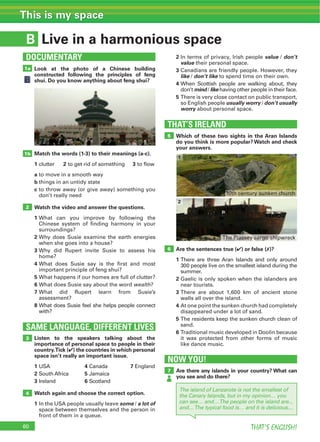
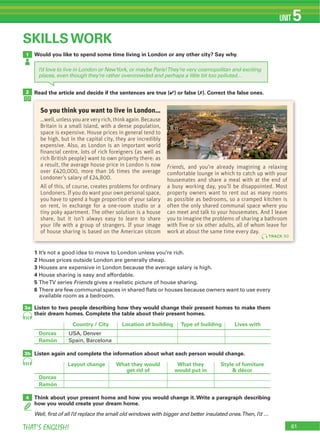
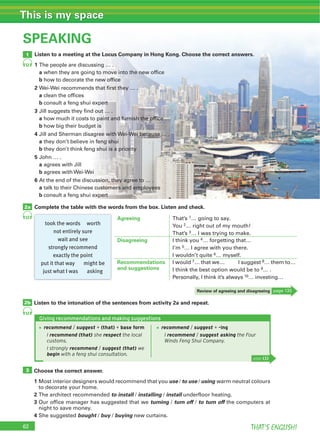
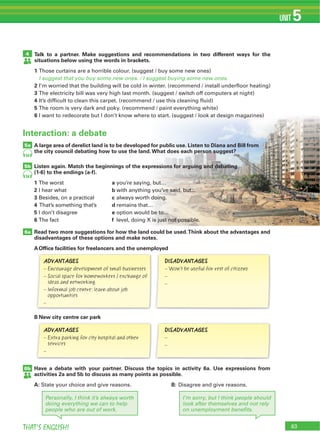
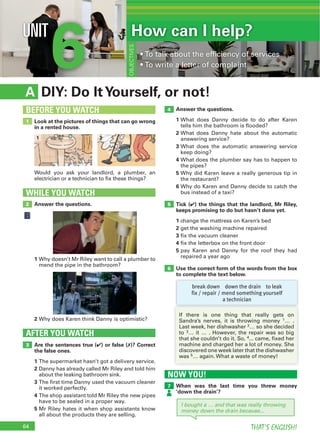
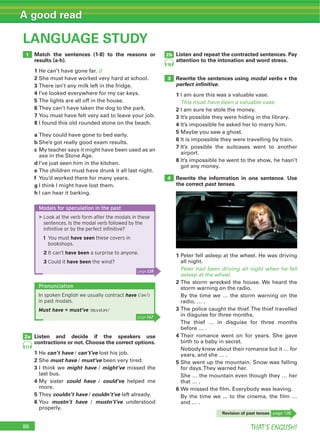
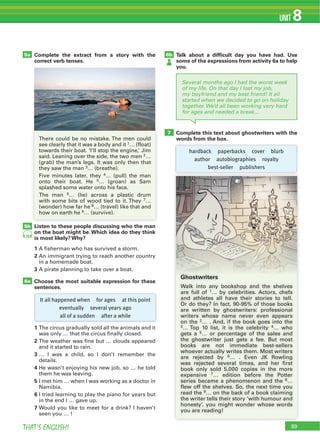
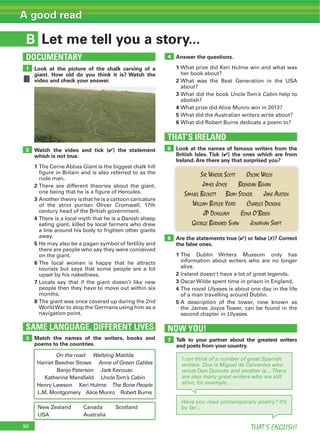
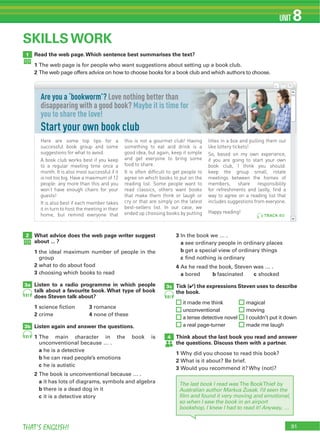
10
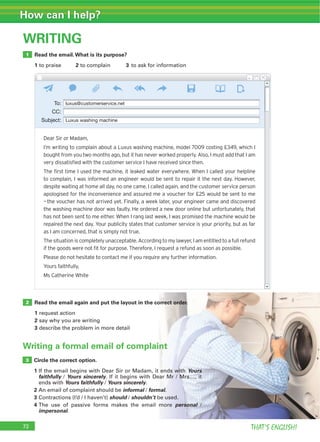
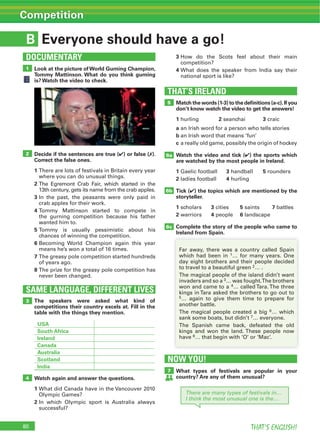
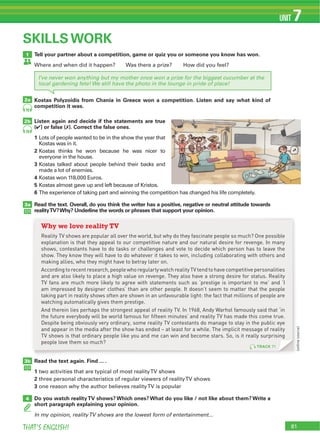
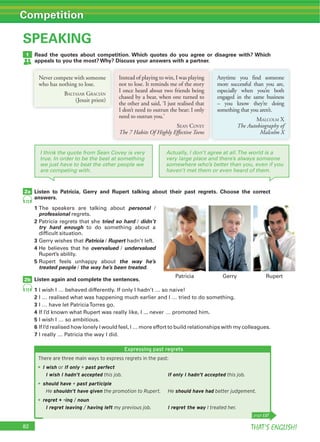
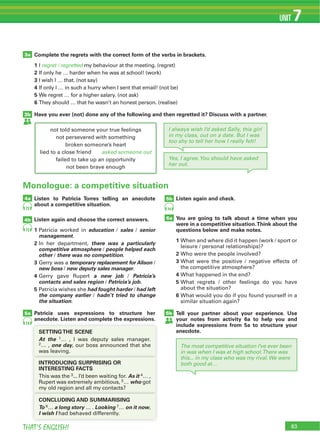
B2
THAT’S
ENGLISH!
Module
Autores
Caroline Cooke; Anna Cowper; Susan Lea-Wilson;
Denise O’Brien; Meryl Wilford; Alejandro Zarzalejos
Edición
Gregory Backes; Valerie Clark; Sarah Jackson; Esther
Lema; Verónica Moro
Corrección y traducción
Michelle Armstrong
Ilustración
Chema García
Grabación
EFS Motivation Sound Studios
Edición gráfica
Fidel Puerta
Maquetación
Maritxu Eizaguirre
Coordinación técnica y de diseño
Maritxu Eizaguirre
Dirección del proyecto
Vicki Caballero Anderson
Diseño curricular y seguimiento técnico del proceso de elaboración de los materiales didácticos de Inglés a Distancia
desde el CIDEAD realizado por:
Rocío Arias Bejarano
Silvia Ávila Duez
Nuria Cambronero Sicilia
Rafael Fernández Alonso
María Ángeles Fernández Melón
Ana Mª García Romero
Karen Ludlow
Cleo Merino de Diego
Ángel Nieto Serrano
Marta PurasTellaeche
María Jesús Sierra Delgado
ElenaTerán Herranz
Alejandro Zarzalejos Alonso
MINISTERIO DE EDUCACIÓN, CULTURAY DEPORTE
SECRETARÍA DE ESTADO DE EDUCACIÓN, FORMACIÓN PROFESIONALY UNIVERSIDADES
Centro para la Innovación y Desarrollo de la Educación a Distancia (CIDEAD)
Edita:
© SECRETARÍA GENERALTÉCNICA
Subdirección General de Publicaciones y Documentación
Catálogo de publicaciones del Ministerio de Educación, Cultura y Deporte: http://www.educacion.es
Catálogo general de publicaciones oficiales: www.060.es
Fecha de edición: diciembre 2014
NIPO: 030-14-103-5
ISBN: 978-84-369-5569-9
Depósito legal: M-17666-2014
Impreso en la UE - Printed in EU
Imprime: Reyper, S.L.
THAT’S ENGLISH!
Este material se ha elaborado con papel
certificado por la cadena de custodia PEFC
(Programme for the Endorsement of Forest
Certification), procedente de plantaciones
forestales, totalmente libre de cloro
(TCF –Totally Chlorine Free) y cumpliendo
la ISO14001, siguiendo lo estipulado en
la Orden PRE/116/2008, de 21 de enero.
Fotografía
Fidel Puerta; Javier Calbet / ARCHIVO SM; CONTACTO; EFE; PRISMA; CORBIS; BANANASTOCK; ALAMY IMAGES;
PHOVOIR;THINKSTOCK; CORDON PRESS; 123RF; SHUTTERSTOCK; GETTY IMAGES; AGE FOTOSTOCK; ALBUM
Fuentes
P. 27: European CEO (22/07/14); P. 37: Quibblo (11/06/14): P. 42: Santa Clara Strength of Religious Faith Questionnaire
(07/07/14); P. 42-43: The Official Website of Kumbh Mela Allahabad, The Telegraph (07/07/14); P. 45: Office for National
Statistics (10/07/14); P. 52: Huffington Post, The Guardian (02/10/14); P. 58: BBC, New York Times (30/06/2014); P. 66-67:
The Telegraph (14/06/14); P. 81: Psychology Today (22/07/14); P. 96-97: BBC, SBS (12/07/14); P. 99: Stetson (19/07/14); P.
101: Sofeminine (01/08/14); P. 106: Habitat for Humanity, Projects Abroad (06/11/14); P. 108-109: Wikipedia, Charity Water
(31/07/14); P. 109: BBC (31/07/14); P. 122: BBB (22/07/14)
THAT’S ENGLISH!
3
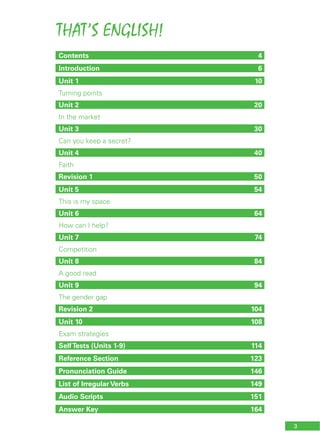
Contents 4
Introduction 6
Unit 1 10
Turning points
Unit 2 20
In the market
Unit 3 30
Can you keep a secret?
Unit 4 40
Faith
Revision 1 50
Unit 5 54
This is my space
Unit 6 64
How can I help?
Unit 7 74
Competition
Unit 8 84
A good read
Unit 9 94
The gender gap
Revision 2 104
Unit 10 108
Exam strategies
SelfTests (Units 1-9) 114
Reference Section 123
Pronunciation Guide 146
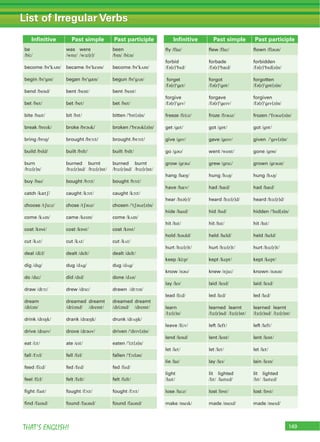
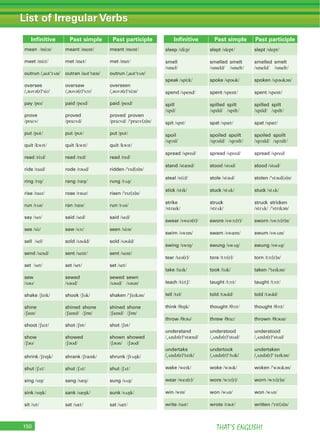
List of Irregular Verbs 149
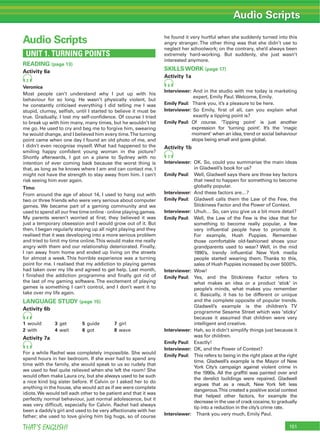
Audio Scripts 151
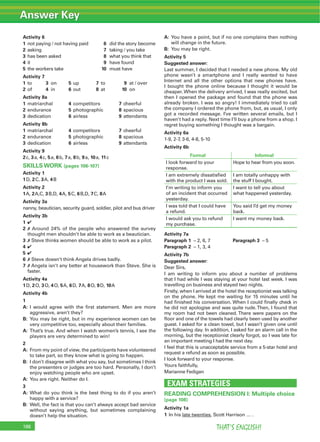
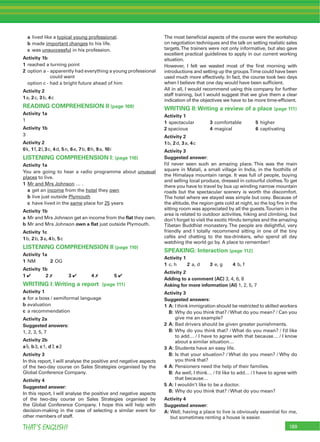
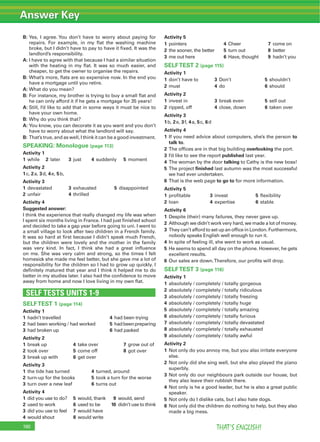
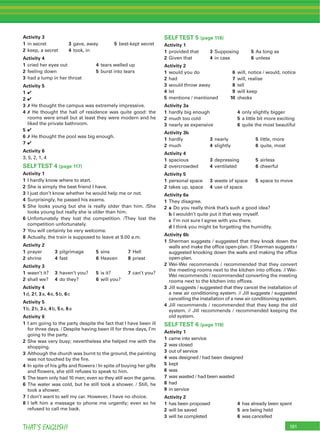
Answer Key 164
4 THAT’S ENGLISH!
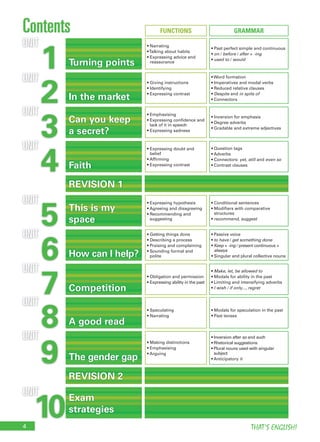
FUNCTIONS GRAMMARContents
1
UNIT
on before after -ing
used to would
Turning points
2
UNIT
Despite in spite of
In the market
3
UNIT
Can you keep
a secret?
4
UNIT
yet, still even so
Faith
REVISION 1
REVISION 2
Exam
strategies
5
UNIT
recommend suggest
This is my
space
6
UNIT to have get something done
Keep -ing
always
How can I help?
7
UNIT Make let be allowed to
I wish / if only..., regretCompetition
8
UNIT
A good read
9
10
UNIT
10
UNIT
so such
itThe gender gap
5THAT’S ENGLISH!
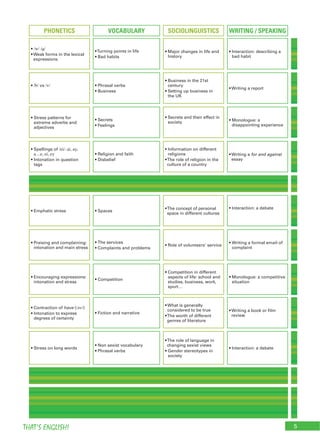
PHONETICS VOCABULARY SOCIOLINGUISTICS WRITING / SPEAKING
/w/ /g/
/b/ /v/
/ei/: ai, ay,
a...e, ei, ey for and against
have /əv/)
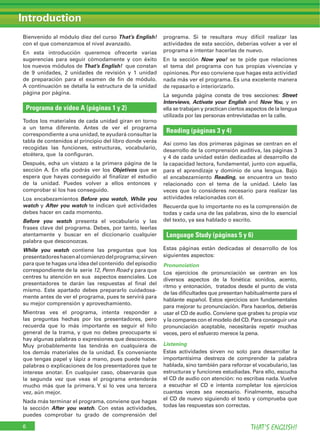
Bienvenido al módulo diez del curso That’s English!
con el que comenzamos el nivel avanzado.
En esta introducción queremos ofrecerte varias
sugerencias para seguir cómodamente y con éxito
los nuevos módulos de That’s English! que constan
de 9 unidades, 2 unidades de revisión y 1 unidad
de preparación para el examen de fin de módulo.
A continuación se detalla la estructura de la unidad
página por página.
Programa de vídeo A (páginas 1 y 2)
Todos los materiales de cada unidad giran en torno
a un tema diferente. Antes de ver el programa
correspondiente a una unidad, te ayudará consultar la
tabla de contenidos al principio del libro donde verás
recogidas las funciones, estructuras, vocabulario,
etcétera, que la configuran.
Después, echa un vistazo a la primera página de la
sección A. En ella podrás ver los Objetivos que se
espera que hayas conseguido al finalizar el estudio
de la unidad. Puedes volver a ellos entonces y
comprobar si los has conseguido.
Los encabezamientos Before you watch, While you
watch y After you watch te indican qué actividades
debes hacer en cada momento.
Before you watch presenta el vocabulario y las
frases clave del programa. Debes, por tanto, leerlas
atentamente y buscar en el diccionario cualquier
palabra que desconozcas.
While you watch contiene las preguntas que los
presentadoreshacenalcomienzodelprograma;sirven
para que te hagas una idea del contenido del episodio
correspondiente de la serie 12, Penn Road y para que
centres tu atención en sus aspectos esenciales. Los
presentadores te darán las respuestas al final del
mismo. Este apartado debes prepararlo cuidadosa-
mente antes de ver el programa, pues te servirá para
su mejor comprensión y aprovechamiento.
Mientras ves el programa, intenta responder a
las preguntas hechas por los presentadores, pero
recuerda que lo más importante es seguir el hilo
general de la trama, y que no debes preocuparte si
hay algunas palabras o expresiones que desconoces.
Muy probablemente las tendrás en cualquiera de
los demás materiales de la unidad. Es conveniente
que tengas papel y lápiz a mano, pues puede haber
palabras o explicaciones de los presentadores que te
interese anotar. En cualquier caso, observarás que
la segunda vez que veas el programa entenderás
mucho más que la primera. Y si lo ves una tercera
vez, aún mejor.
Nada más terminar el programa, conviene que hagas
la sección After you watch. Con estas actividades,
puedes comprobar tu grado de comprensión del
programa. Si te resultara muy difícil realizar las
actividades de esta sección, deberías volver a ver el
programa e intentar hacerlas de nuevo.
En la sección Now you! se te pide que relaciones
el tema del programa con tus propias vivencias y
opiniones. Por eso conviene que hagas esta actividad
nada más ver el programa. Es una excelente manera
de repasarlo e interiorizarlo.
La segunda página consta de tres secciones: Street
Interviews, Activate your English and Now You, y en
ella se trabajan y practican ciertos aspectos de la lengua
utilizada por las personas entrevistadas en la calle.
Reading (páginas 3 y 4)
Así como las dos primeras páginas se centran en el
desarrollo de la comprensión auditiva, las páginas 3
y 4 de cada unidad están dedicadas al desarrollo de
la capacidad lectora, fundamental, junto con aquella,
para el aprendizaje y dominio de una lengua. Bajo
el encabezamiento Reading, se encuentra un texto
relacionado con el tema de la unidad. Léelo las
veces que lo consideres necesario para realizar las
actividades relacionadas con él.
Recuerda que lo importante no es la comprensión de
todas y cada una de las palabras, sino de lo esencial
del texto, ya sea hablado o escrito.
Language Study (páginas 5 y 6)
Estas páginas están dedicadas al desarrollo de los
siguientes aspectos:
Pronunciation
Los ejercicios de pronunciación se centran en los
diversos aspectos de la fonética: sonidos, acento,
ritmo y entonación, tratados desde el punto de vista
de las dificultades que presentan habitualmente para el
hablante español. Estos ejercicios son fundamentales
para mejorar tu pronunciación. Para hacerlos, deberás
usar el CD de audio. Conviene que grabes tu propia voz
y la compares con el modelo del CD. Para conseguir una
pronunciación aceptable, necesitarás repetir muchas
veces, pero el esfuerzo merece la pena.
Listening
Estas actividades sirven no solo para desarrollar la
importantísima destreza de comprender la palabra
hablada, sino también para reforzar el vocabulario, las
estructuras y funciones estudiadas. Para ello, escucha
el CD de audio con atención: no escribas nada. Vuelve
a escuchar el CD e intenta completar los ejercicios
cuantas veces sea necesario. Finalmente, escucha
el CD de nuevo siguiendo el texto y comprueba que
todas las respuestas son correctas.
Introduction
THAT’S ENGLISH!6
Vocabulary
Se presenta y practica vocabulario tanto en el
programa de vídeo A como en las páginas de
Reading, Language Study, Speaking y Writing. Las
actividades de vocabulario tienen como objetivo
practicar el vocabulario ya presentado en el vídeo, en
el texto de Reading o presentar vocabulario nuevo de
forma contextualizada.
Grammar
La gramática juega un papel importante, pero
no esencial en el aprendizaje de una lengua. El
conocimiento de las reglas no lleva automáticamente
a aplicarlas bien a la hora de hablar o escribir; por
tanto, no debes obsesionarte con la gramática.
Es más importante ser capaz de participar en una
conversación, leer un libro o escribir un correo que
saber todas las reglas de la lengua. Conviene buscar
un equilibrio.
El conocimiento de las reglas gramaticales te
ayudará a entender ciertas estructuras complejas
o simplemente distintas a las españolas. También
te permitirá corregir tus propias producciones,
probablemente a posteriori, y te dará una cierta
sensación de confianza. Recuerda, sin embargo, que
se pueden saber todas las reglas de una lengua y ser
incapaz de expresarse en la misma, así como también
es posible expresarse con toda fluidez y corrección
sin conocer las reglas.
En este nivel avanzado las estructuras gramaticales
nuevas se presentan a traves de help boxes
inductivas para poder inferir las reglas gramaticales,
de color morado, y con otras de carácter informativo
de color verde. En ambas se proporcionan llamadas
de referencia para acudir a Reference section donde
se proporciona una explicación más detallada de las
estructuras presentadas.
Así pues, conviene que estudies los recuadros de
explicaciones gramaticales, que comprendas bien los
ejemplos y que hagas los ejercicios correspondientes.
Speaking
Hay dos clases de actividades de speaking: de
producción y de interacción, señalizadas con
sus correspondientes iconos. Las actividades de
producción las puedes hacer solo. Sin embargo, para
las actividades de interacción necesitas a alguien
con quien interactuar. Si conoces a alguien que
también esté estudiando inglés, sería muy útil que
pudieras hacer estas actividades con esta persona.
Siempre tienes, por supuesto, la sesión de tutoría,
donde podrás realizar estas actividades con tus
compañeros de clase. Un consejo: no seas tímido.
Lánzate a hablar. No te preocupes por los errores que
puedas cometer. No hay nada más que una forma de
aprender a hablar y es hablando.
Writing
Para muchos de los ejercicios de expresión escrita
de estas páginas no hay una solución correcta única.
Esto no debe preocuparte. No es necesario que todo
lo que escribas sea absolutamente correcto. Escribe
sin miedo, echa mano de tus fuentes de consulta:
diccionarios, gramáticas, amigos, internet; de nuevo,
no tengas miedo de cometer errores, y piensa que es
a base de práctica como se aprende a escribir.
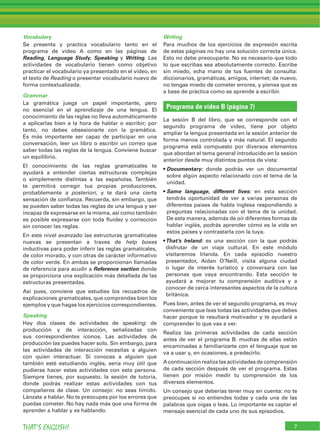
Programa de vídeo B (página 7)
La sesión B del libro, que se corresponde con el
segundo programa de vídeo, tiene por objeto
ampliar la lengua presentada en la sesión anterior de
forma menos controlada y más natural. El segundo
programa está compuesto por diversos elementos
que abordan el tema general introducido en la sesión
anterior desde muy distintos puntos de vista:
Documentary: donde podrás ver un documental
sobre algún aspecto relacionado con el tema de la
unidad.
Same language, different lives: en esta sección
tendrás oportunidad de ver a varias personas de
diferentes países de habla inglesa respondiendo a
preguntas relacionadas con el tema de la unidad.
De esta manera, además de oír diferentes formas de
hablar inglés, podrás aprender cómo es la vida en
estos países y contrastarla con la tuya.
That’s Ireland: es una sección con la que podrás
disfrutar de un viaje cultural. En este módulo
visitaremos Irlanda. En cada episodio nuestro
presentador, Aidan O’Neill, visita alguna ciudad
o lugar de interés turístico y conversará con las
personas que vaya encontrando. Esta sección te
ayudará a mejorar tu comprensión auditiva y a
conocer de cerca interesantes aspectos de la cultura
británica.
Pues bien, antes de ver el segundo programa, es muy
conveniente que leas todas las actividades que debes
hacer porque te resultará motivador y te ayudará a
comprender lo que vas a ver.
Realiza las primeras actividades de cada sección
antes de ver el programa B: muchas de ellas están
encaminadas a familiarizarte con el lenguaje que se
va a usar y, en ocasiones, a predecirlo.
A continuación realiza las actividades de comprensión
de cada sección después de ver el programa. Estas
tienen por misión medir tu comprensión de los
diversos elementos.
Un consejo que deberías tener muy en cuenta: no te
preocupes si no entiendes todas y cada una de las
palabras que oigas o leas. Lo importante es captar el
mensaje esencial de cada uno de sus episodios.
7THAT’S ENGLISH!
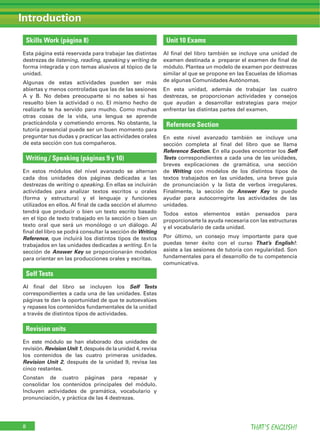
Skills Work (página 8)
Esta página está reservada para trabajar las distintas
destrezas de listening, reading, speaking y writing de
forma integrada y con temas alusivos al tópico de la
unidad.
Algunas de estas actividades pueden ser más
abiertas y menos controladas que las de las sesiones
A y B. No debes preocuparte si no sabes si has
resuelto bien la actividad o no. El mismo hecho de
realizarla te ha servido para mucho. Como muchas
otras cosas de la vida, una lengua se aprende
practicándola y cometiendo errores. No obstante, la
tutoría presencial puede ser un buen momento para
preguntar tus dudas y practicar las actividades orales
de esta sección con tus compañeros.
Writing / Speaking (páginas 9 y 10)
En estos módulos del nivel avanzado se alternan
cada dos unidades dos páginas dedicadas a las
destrezas de writing o speaking. En ellas se incluirán
actividades para analizar textos escritos u orales
(forma y estructura) y el lenguaje y funciones
utilizados en ellos. Al final de cada sección el alumno
tendrá que producir o bien un texto escrito basado
en el tipo de texto trabajado en la sección o bien un
texto oral que será un monólogo o un diálogo. Al
final del libro se podrá consultar la sección de Writing
Reference, que incluirá los distintos tipos de textos
trabajados en las unidades dedicadas a writing. En la
sección de Answer Key se proporcionarán modelos
para orientar en las producciones orales y escritas.
Self Tests
Al final del libro se incluyen los Self Tests
correspondientes a cada una de las unidades. Estas
páginas te dan la oportunidad de que te autoevalúes
y repases los contenidos fundamentales de la unidad
a través de distintos tipos de actividades.
Revision units
En este módulo se han elaborado dos unidades de
revisión. Revision Unit 1, después de la unidad 4, revisa
los contenidos de las cuatro primeras unidades.
Revision Unit 2, después de la unidad 9, revisa las
cinco restantes.
Constan de cuatro páginas para repasar y
consolidar los contenidos principales del módulo.
Incluyen actividades de gramática, vocabulario y
pronunciación, y práctica de las 4 destrezas.
Unit 10 Exams
Al final del libro también se incluye una unidad de
examen destinada a preparar el examen de final de
módulo. Plantea un modelo de examen por destrezas
similar al que se propone en las Escuelas de Idiomas
de algunas Comunidades Autónomas.
En esta unidad, además de trabajar las cuatro
destrezas, se proporcionan actividades y consejos
que ayudan a desarrollar estrategias para mejor
enfrentar las distintas partes del examen.
Reference Section
En este nivel avanzado también se incluye una
sección completa al final del libro que se llama
Reference Section. En ella puedes encontrar los Self
Tests correspondientes a cada una de las unidades,
breves explicaciones de gramática, una sección
de Writing con modelos de los distintos tipos de
textos trabajados en las unidades, una breve guía
de pronunciación y la lista de verbos irregulares.
Finalmente, la sección de Answer Key te puede
ayudar para autocorregirte las actividades de las
unidades.
Todos estos elementos están pensados para
proporcionarte la ayuda necesaria con las estructuras
y el vocabulario de cada unidad.
Por último, un consejo muy importante para que
puedas tener éxito con el curso That’s English!:
asiste a las sesiones de tutoría con regularidad. Son
fundamentales para el desarrollo de tu competencia
comunicativa.
IntroductionIntroduction
THAT’S ENGLISH!8
10 THAT’S ENGLISH!
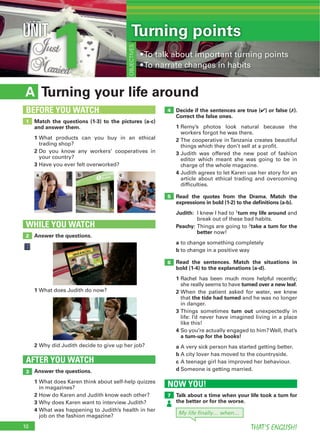
1UNIT Turning points
OBJECTIVES
Turning your life aroundA
Decide if the sentences are true (4) or false (7).
Correct the false ones.
1
2
3
4
Read the quotes from the Drama. Match the
expressions in bold (1-2) to the definitions (a-b).
Judith: 1turn my life around
Peachy: 2take a turn for the
better
a
b
Read the sentences. Match the situations in
bold (1-4) to the explanations (a-d).
1
turned over a new leaf
2
the tide had turned
3 turn out
4
a turn-up for the books!
a
b
c
dAnswer the questions.
1
2
3
4
AFTER YOU WATCH
3
4
5
6
Match the questions (1-3) to the pictures (a-c)
and answer them.
1
2
3
1
BEFORE YOU WATCH
Answer the questions.
WHILE YOU WATCH
2
NOW YOU!
Talk about a time when your life took a turn for
the better or for the worse.
7
1
2
b c
My life finally… when…
a
11THAT’S ENGLISH!
ACTIVATE YOUR ENGLISH!
10a
11
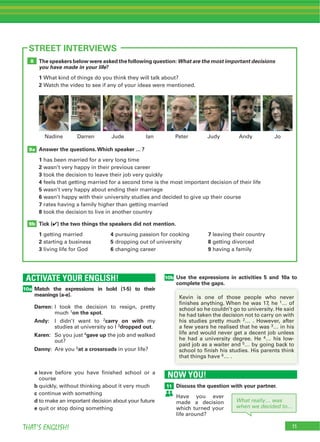
STREET INTERVIEWS
NOW YOU!
11
10b
Match the expressions in bold (1-5) to their
meanings (a-e).
Darren:
1on the spot
Andy: 2carry on with
3dropped out
Karen: 4gave up
Danny: 5at a crossroads
a
b
c
d
e
Discuss the question with your partner.
Use the expressions in activities 5 and 10a to
complete the gaps.
The speakers below were asked the following question: What are the most important decisions
you have made in your life?
1
2
Answer the questions.Which speaker ... ?
1
2
3
4
5
6
7
8
Tick (4) the two things the speakers did not mention.
1 4 7
2 5 8
3 6 9
9b
9a
8
1
2
3
4
5
6
What really… was
when we decided to…
12 THAT’S ENGLISH!
Turning points
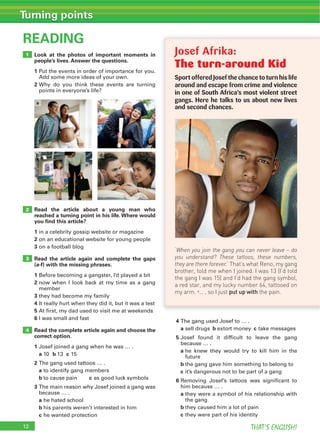
Look at the photos of important moments in
people’s lives. Answer the questions.
1
2
READING
Read the article about a young man who
reached a turning point in his life. Where would
you find this article?
1
2
3
Read the article again and complete the gaps
(a-f) with the missing phrases.
1
2
3
4
5
6
Read the complete article again and choose the
correct option.
1
a b c
2
a
b c
3
a
b
c
4
a b c
5
a
b
c
6
a
b
c
3
4
2
1
a c
b d
Josef Afrika:
The turn-around Kid
SportofferedJosefthechancetoturnhislife
around and escape from crime and violence
in one of South Africa’s most violent street
gangs. Here he talks to us about new lives
and second chances.
‘When you join the gang you can never leave – do
you understand? These tattoos, these numbers,
they are there forever.’ That’s what Reno, my gang
brother, told me when I joined. I was 13 (I’d told
the gang I was 15) and I’d had the gang symbol,
a red star, and my lucky number 64, tattooed on
my arm. a… , so I just put up with the pain.
13THAT’S ENGLISH!
UNIT 1
6b
Look at the phrasal verbs in bold in the article.
What do they mean? Choose the correct answer.
1 avoid accept
2 becomeinvolvedin ignore
3 avoid spend time with
4 avoid accept
5 start stop
6 no longer have acquire
7 start end
Listen to two people talking about turning
points and answer the questions.
Tell your partner about something / someone
you … .
1
2
3
4
5
6
1
2
Complete the summaries with the correct form
of the verbs from the box.
75
6a
I’ve been really getting into
watching Kung Fu films recently.
TRACK 1
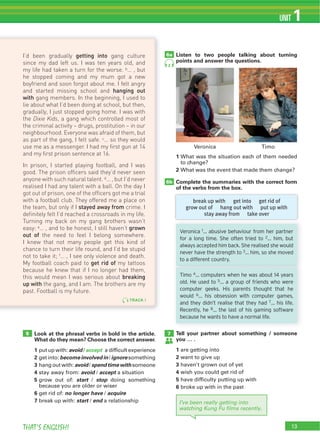
I’d been gradually getting into gang culture
since my dad left us. I was ten years old, and
my life had taken a turn for the worse. b… , but
he stopped coming and my mum got a new
boyfriend and soon forgot about me. I felt angry
and started missing school and hanging out
with gang members. In the beginning, I used to
lie about what I’d been doing at school, but then,
gradually, I just stopped going home. I was with
the Dixie Kids, a gang which controlled most of
the criminal activity – drugs, prostitution – in our
neighbourhood. Everyone was afraid of them, but
as part of the gang, I felt safe. c… so they would
use me as a messenger. I had my first gun at 14
and my first prison sentence at 16.
In prison, I started playing football, and I was
good. The prison officers said they’d never seen
anyone with such natural talent. d… , but I’d never
realised I had any talent with a ball. On the day I
got out of prison, one of the officers got me a trial
with a football club. They offered me a place on
the team, but only if I stayed away from crime. I
definitely felt I’d reached a crossroads in my life.
Turning my back on my gang brothers wasn’t
easy: e… , and to be honest, I still haven’t grown
out of the need to feel I belong somewhere.
I knew that not many people get this kind of
chance to turn their life round, and I’d be stupid
not to take it; f… , I see only violence and death.
My football coach paid to get rid of my tattoos
because he knew that if I no longer had them,
this would mean I was serious about breaking
up with the gang, and I am. The brothers are my
past. Football is my future.
break up with get into get rid of
grow out of hang out with put up with
stay away from take over
2
Veronica 1… abusive behaviour from her partner
for a long time. She often tried to 2… him, but
always accepted him back. She realised she would
never have the strength to 3… him, so she moved
to a different country.
Timo 4… computers when he was about 14 years
old. He used to 5… a group of friends who were
computer geeks. His parents thought that he
would 6… his obsession with computer games,
and they didn’t realise that they had 7… his life.
Recently, he 8… the last of his gaming software
because he wants to have a normal life.
14 THAT’S ENGLISH!
Turning points
14
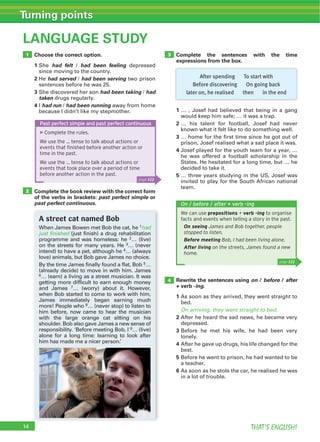
LANGUAGE STUDY
1 3
4
2
On / before / after + verb -ing
We can use prepositions + verb -ing to organise
facts and events when telling a story in the past.
On seeing James and Bob together, people
stopped to listen.
Before meeting Bob, I had been living alone.
After living on the streets, James found a new
home.
page 123
Past perfect simple and past perfect continuous
▶Complete the rules.
We use the … tense to talk about actions or
events that finished before another action or
time in the past.
We use the … tense to talk about actions or
events that took place over a period of time
before another action in the past.
page 123
After spending To start with
Before discovering On going back
later on, he realised then in the end
A street cat named Bob
1had
just finished
2
3
4
5
6
8
9
Choose the correct option.
1 had felt had been feeling
2 had served had been serving
3 had been taking had
taken
4 had run had been running
Complete the sentences with the time
expressions from the box.
1
2
3
4
5
Rewrite the sentences using on / before / after
+ verb -ing.
1
On arriving, they went straight to bed.
2
3
4
5
6
Complete the book review with the correct form
of the verbs in brackets: past perfect simple or
past perfect continuous.
15THAT’S ENGLISH!
UNIT 1
6a
7b
7c
6b
7a
5
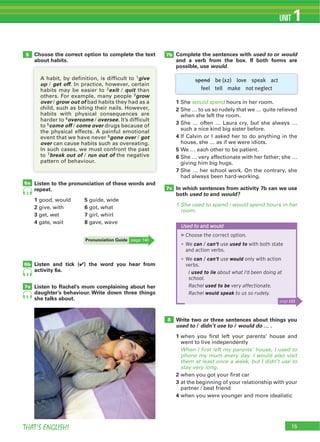
Used to and would
▶Choose the correct option.
We can / can’t use used to with both state
and action verbs.
We can / can’t use would only with action
verbs.
I used to lie about what I’d been doing at
school.
Rachel used to be very affectionate.
Rachel would speak to us so rudely.
page 123
spend be (x2) love speak act
feel tell make not neglect
Choose the correct option to complete the text
about habits.
Complete the sentences with used to or would
and a verb from the box. If both forms are
possible, use would.
1 would spend
2
3
4
5
6
7
In which sentences from activity 7b can we use
both used to and would?
1 She used to spend / would spend hours in her
room.
8 Write two or three sentences about things you
used to / didn’t use to / would do … .
1
When I first left my parents’ house, I used to
phone my mum every day. I would also visit
them at least once a week, but I didn’t use to
stay very long.
2
3
4
Listen to the pronunciation of these words and
repeat.
1 5
2 6
3 7
4 8
Listen and tick (4) the word you hear from
activity 6a.
Listen to Rachel’s mum complaining about her
daughter’s behaviour. Write down three things
she talks about.
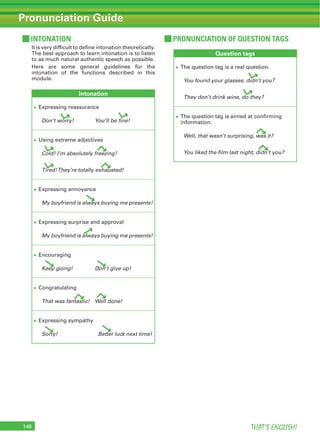
Pronunciation Guide
3
4
5
1give
up get off
2exit quit
3grow
over grow out of
4overcome oversee
5come off come over
6gone over got
over
break out of run out of
16 THAT’S ENGLISH!
Turning points
B
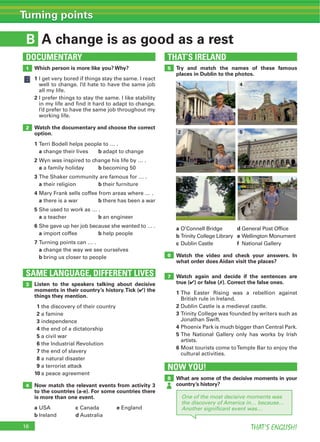
THAT’S IRELAND
SAME LANGUAGE, DIFFERENT LIVES
DOCUMENTARY
NOW YOU!
A change is as good as a rest
1 5
6
7
8
2
3
4
Which person is more like you? Why?
1
2
Watch the documentary and choose the correct
option.
1
a b
2
a b
3
a b
4
a b
5
a b
6
a b
7
a
b
Try and match the names of these famous
places in Dublin to the photos.
a d
b e
c f
Watch the video and check your answers. In
what order does Aidan visit the places?
Watch again and decide if the sentences are
true (4) or false (7). Correct the false ones.
1
2
3
4
5
6
What are some of the decisive moments in your
country’s history?
Listen to the speakers talking about decisive
moments in their country’s history.Tick (4) the
things they mention.
1
2
3
4
5
6
7
8
9
10
Now match the relevant events from activity 3
to the countries (a-e). For some countries there
is more than one event.
a c e
b d
1 4
2
3
5
6
One of the most decisive moments was
the discovery of America in… because…
Another significant event was…
THAT’S ENGLISH!
UNIT 1
1a
1b
SKILLS WORK
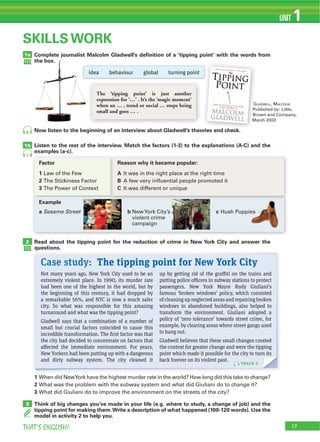
Complete journalist Malcolm Gladwell’s definition of a ‘tipping point’ with the words from
the box.
Now listen to the beginning of an interview about Gladwell’s theories and check.
Listen to the rest of the interview. Match the factors (1-3) to the explanations (A-C) and the
examples (a-c).
6
7
2 Read about the tipping point for the reduction of crime in New York City and answer the
questions.
3
idea behaviour global turning point
Now listen to the beginning of an interview about Gladwell’s theories and check.
The ‘tipping point’ is just another
expression for ‘…’ . It’s the ‘magic moment’
when an … , trend or social … stops being
small and goes … .
questions.
Not many years ago, New York City used to be an
extremely violent place. In 1990, its murder rate
had been one of the highest in the world, but by
the beginning of this century, it had dropped by
a remarkable 56%, and NYC is now a much safer
city. So what was responsible for this amazing
turnaround and what was the tipping point?
Gladwell says that a combination of a number of
small but crucial factors coincided to cause this
incredible transformation. The first factor was that
the city had decided to concentrate on factors that
affected the immediate environment. For years,
New Yorkers had been putting up with a dangerous
and dirty subway system. The city cleaned it
up by getting rid of the graffiti on the trains and
putting police officers in subway stations to protect
passengers. New York Mayor Rudy Giuliani’s
famous ‘broken windows’ policy, which consisted
ofcleaningupneglectedareasandrepairingbroken
windows in abandoned buildings, also helped to
transform the environment. Giuliani adopted a
policy of ‘zero tolerance’ towards street crime, for
example, by clearing areas where street gangs used
to hang out.
Gladwell believes that these small changes created
the context for greater change and were the tipping
point which made it possible for the city to turn its
back forever on its violent past.
Case study: The tipping point for New York City
TRACK 8
1
2
3
Think of big changes you’ve made in your life (e.g. where to study, a change of job) and the
tipping point for making them.Write a description of what happened (100-120 words). Use the
model in activity 2 to help you.
Factor
1
2
3
Example
Reason why it became popular:
A
B
C
a Sesame Street b c
GLADWELL, MALCOLM
18 THAT’S ENGLISH!
Turning points
SPEAKING
Interaction: describing a bad habit
9
9
10
1
3b
4
5a
2a
2b
3a
What bad habits do you find most annoying in other people (e.g. always being late, smoking,
gossiping, etc.)?Tell your partner.
Look at the expressions in bold from activity 3a. Complete the gaps (a-g) with expressions
that describe:
1 a It started as a cool thing to do b …
2 c d e …
3 f g …
Make notes about any (invented) bad habits you want to give up. Include the following:
Listen to Courtney asking someone for advice about her habit. Who is she talking to: her
credit card company or a friend?
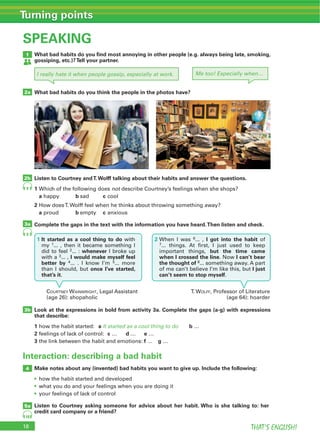
What bad habits do you think the people in the photos have?
Listen to Courtney andT.Wolff talking about their habits and answer the questions.
1 not
a b c
2
a b c
Complete the gaps in the text with the information you have heard.Then listen and check.
I really hate it when people gossip, especially at work. Me too! Especially when…
a b
COURTNEY WAINWRIGHT T. WOLFF
2 6 I got into the habit
but the time came
when I crossed the line I can’t bear
the thought of 8
I just
can’t seem to stop myself
1 It started as a cool thing to do
1
2 whenever
3 I would make myself feel
better by 4 5
once I’ve started,
that’s it
19THAT’S ENGLISH!
UNIT 1
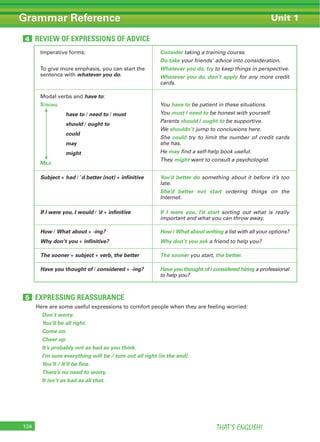
Review of expressions of advice
10
5b
7b
Match the beginnings of the expressions for asking for and giving advice (1-6) to the endings (a-f).
1 a
2 b
3 c
4 d
5 e
6 f
Listen and check.
11
6a Listen and complete the sentences to express reassurance.
1 4
2 5
3
Change roles with your partner. Use a variety of expressions.
11
6b
7a
Listen again to the sentences from activity 6a.What words are stressed?
Now listen again and repeat.
Work with a partner.Talk about a bad habit you want to give up. Use your notes from activity 4.
B:
A:
A:
B:
A:
B:
It started as a cool thing to do with my
friends. Whenever I felt bad, it would
make me feel better. I think it’s gone
too far. What can I do?
Well, the sooner you do something
about it, the better. But if you take
positive action, you’ll be fine.
Well, whatever you do, don’t give
up. Come on, it’s probably not as
bad as you think.
Buying lots of things worked for a while,
but now I really want to stop. Help me
out here, please!
Cheer up, you’ll be fine! I’m sure
everything will turn out all right.Yes, but I feel I’ve lost control over my life.
Expressing reassurance
We offer reassurance when people are worried and
need help. Intonation is very important to show you
are interested and concerned about the problem.
Don’t worry!
If we stress don’t we sound kind. If we stress worry
we sound annoyed.
page 124
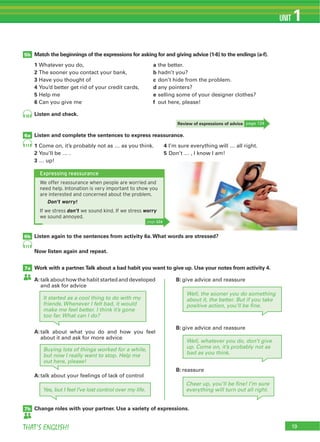
20 THAT’S ENGLISH!
2UNIT In the market
OBJECTIVES
NOW YOU!
Give some business advice toAngela and Charles.7
Money doesn't grow on treesA
2
3
4
Answer the questions.
1
2
3
4
Match the two parts of the sentences to form
Gary and Kirsty’s business advice.
1
2
a
b
Use the words in the box to complete Kirsty's
business advice.
Decide if the sentences are true (4) or false (7).
Correct the false ones.
1
AFTER YOU WATCH
3
5
4
6
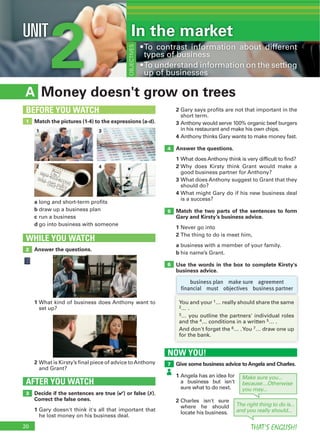
Match the pictures (1-4) to the expressions (a-d).
a
b
c
d
1
BEFORE YOU WATCH
Answer the questions.
WHILE YOU WATCH
2
1
2
business plan make sure agreement
financial must objectives business partner
1 3
2 4
2
3
4 5
6 7
Make sure you...
because…Otherwise
you may...
The right thing to do is...
and you really should...
1
2
THAT’S ENGLISH!
ACTIVATE YOUR ENGLISH!
10a
STREET INTERVIEWS
Look at what was said in the Street Interviews.
Match the words or expressions in bold (1-7) to
their meanings (a-g).
Darren: actually
Nip: 2scope
Karen:
3set up and run
4have a passion for
Andy: 5a good lump of
Rosie: 6all to do with
7online
a
b
c
d
e
f
g
The speakers below were asked the following questions: If you could set up a business, what
kind of business would it be? Why?
1
2
Answer the questions.
1
2
3
4
Darren, Karen and Rosie have all set up their own businesses. Match each speaker to their
business.
1
2
3
9b
9a
8
10b Use the words or expressions in activity 10a to
complete the gaps.complete the gaps.
2 3
4
5 6
7
NOW YOU!
11 Answer the questions using some of the words
and expressions from the Street Interviews.
1
Everyone needs a... because...
I have a passion for... so I'd love to...
a company which is all to do with...
2
22 THAT’S ENGLISH!
In the market
Which of the following do you think are
important if you want to succeed with a new
business?
1
2
3
4
5
Listen to Joni Pitt, who runs a consultancy
service for people starting their own small
businesses, and check your answers.
Read the first paragraph about the oldest
business in the world. Where do you think you
would find this text?
1
2
3
4
Use the missing first lines (1-3) to complete the
paragraphs (a-c) in the article.
1
assets
2
set up
3
running at a profit
Read the article again. Decide if the statements
are true (4) or false (7). Correct the false ones.
1
2
3
4
5
6
7
READING
4
3
1a
1b
2 What do you need to do to make sure your
business stays successful? Lots of people would
like to know the answer to that question: could the
oldest company in the world have the answers?
a … , it has stayed in business for over 1,400 years,
and specialises in building Buddhist temples.
The Shitennoji temple in Osaka, still standing
today, was the company’s first job and the
Kongõ family have repaired and maintained the
temple for more than 1,000 years. One reason
for this company’s long life is that the temple-
building market is very stable: the demand for
Buddhist temples doesn’t fluctuate greatly, and
there isn’t a lot of competition. Also because it
takes ten years to train Kongõ Gumi employees,
they have unique skills and expertise. So, if you
want a Buddhist temple, they are definitely the
people to speak to! However, despite being very
specialised, the company can be flexible too.
For example, when there wasn’t much demand
for Buddhist temples during the Second World
War, the company temporarily changed their
activity to making coffins.
b … Kongõ Gumi had over 100 employees and an
annual revenue of ¥7.5 billion ($70 million). But
then, only a year later, the company suddenly and
surprisingly lost a lot of money and went into
liquidation. So what had happened? Apparently,
in the 1980s, instead of ploughing back their
profits into the business as they had always done
before, Kongõ Gumi had invested their profits in
the housing market and also borrowed money
from banks to buy more buildings. Unfortunately,
when the value of property decreased in the 90s,
the buildings lost their value and Kongõ Gumi
weren’t able to keep up the repayments on
their loans to the banks.
12
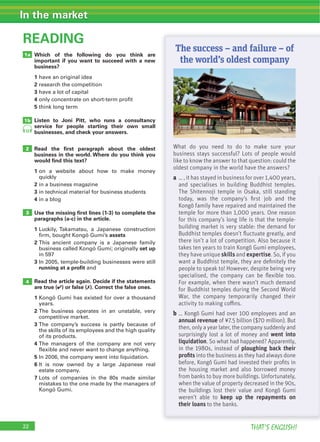
The success – and failure – of
the world’s oldest company
23THAT’S ENGLISH!
UNIT 2
6b
Listen to Cara and Felix talking about their new
businesses. Answer the questions.
1
2
Listen again. Who did what? Complete (4) the
table.
6a
Think of three things you would do and three
things you wouldn’t do if you were starting your
own small business. Compare with a partner.
Complete the dos and don’ts for success in
business with the expressions in bold from
activity 3 and the article. Make any necessary
changes.
7
5
I wouldn’t borrow any money from my family
or friends. I'd work from home. I…
TRACK 13
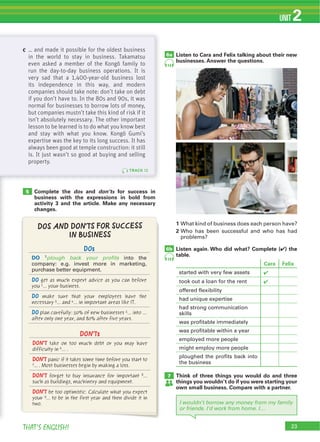
c … and made it possible for the oldest business
in the world to stay in business. Takamatsu
even asked a member of the Kongõ family to
run the day-to-day business operations. It is
very sad that a 1,400-year-old business lost
its independence in this way, and modern
companies should take note: don’t take on debt
if you don’t have to. In the 80s and 90s, it was
normal for businesses to borrow lots of money,
but companies mustn’t take this kind of risk if it
isn’t absolutely necessary. The other important
lesson to be learned is to do what you know best
and stay with what you know. Kongõ Gumi’s
expertise was the key to its long success. It has
always been good at temple construction: it still
is. It just wasn’t so good at buying and selling
property.
14
14
Cara Felix
4
4
DOs
DO plough back your profits
DO get as much expert advice as you can before
you 2... your business.
DO make sure that your employees have the
necessary 3… and 4… in important areas like IT.
DO plan carefully: 50% of new businesses 5… into ...
after only one year, and 80% after five years.
DON'Ts
DON’T take on too much debt or you may have
difficulty in 6… .
DON’T panic if it takes some time before you start to
7... . Most businesses begin by making a loss.
DON’T forget to buy insurance for important 8…
such as buildings, machinery and equipment.
DON’T be too optimistic. Calculate what you expect
your 9… to be in the first year and then divide it in
two.
DOS AND DON'TS FOR SUCCESS
IN BUSINESS
24 THAT’S ENGLISH!
In the market
24
LANGUAGE STUDY
1
2
3b
4b
4a
3a
Population
Main business
activity
Finland
Saudi
Arabia
apologise remember don’t be
don’t expect don’t interrupt don’t feel
should call should try be
mustn’t show don’t have to make
Match the beginnings of the sentences (1-6) to
the endings (a-f) to tell the story of a business.
1 set up
2
3
4
sell out
5
6
a rip off
b close down
c
d
take over
e break even
f
1 c
Match the phrasal verbs in bold from activity 1
to the definitions.
1 set up
2
3
4
5
6
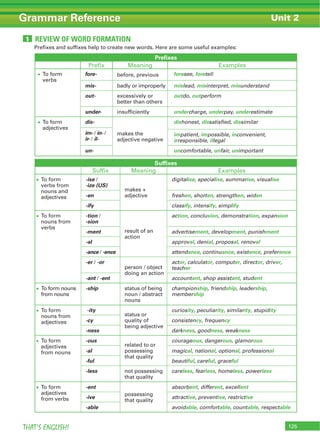
Complete the table of word formation. Use a
dictionary to help you.
Complete the sentences with the correct form
of the word in brackets.
1
2
3
4
5
6
Listen to a talk about Finnish and Saudi business
culture. Complete the table.
Complete the tips about doing business in
Saudi Arabia and Finland with the words from
the box.
Review of word formation
15
Noun Verb Adjective
compete
2…
3…
4…
5…
6…
7…
…
…
…
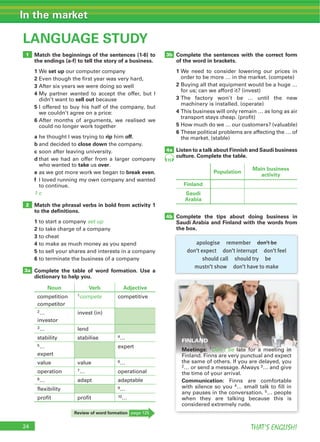
FINLAND
Meetings: Don’t be
2 3
Communication:
4
5
25THAT’S ENGLISH!
UNIT 2
7
8a
8b
6
5 Match the beginnings of the sentences (1-4) to
the endings (a-d).
1
2
3
4
a
b
c
d
Rewrite these sentences using reduced relative
clauses and the structure in brackets.
1 who need
Those seats are for people needing special
assistance.
2 which
is
3
who live
4 who you must
go
5 which was aimed
6 who ought to lead
Reduce the relative clauses in the sentences.
1 The Managing Director is the person who is in
charge of the company.
2
3
4
5
6
Listen to the differences between the /b/ and
/v/ sound in these pairs of words.
1 5
2 6
3 7
4 8
Listen again and repeat.
Listen to the words.Tick (4) the word they say
first in the recording.
1 5
2 6
3 7
4 8
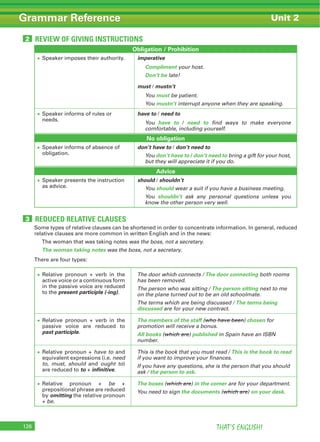
Review of giving instructions
16
17
16
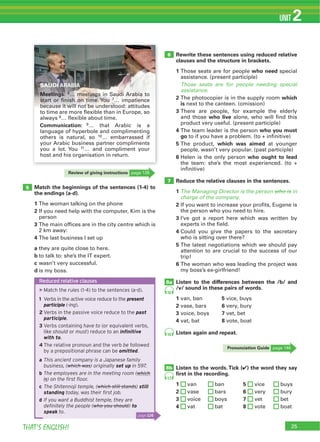
SAUDI ARABIA
Meetings: 6
7
Communication:
Reduced relative clauses
▶Match the rules (1-4) to the sentences (a-d).
1 Verbs in the active voice reduce to the present
participle (-ing).
2 Verbs in the passive voice reduce to the past
participle.
3 Verbs containing have to (or equivalent verbs,
like should or must) reduce to an infinitive
with to.
4 The relative pronoun and the verb be followed
by a prepositional phrase can be omitted.
a This ancient company is a Japanese family
business, (which was) originally set up in 597.
b The employees are in the meeting room (which
is) on the first floor.
c The Shitennoji temple, (which still stands) still
standing today, was their first job.
d If you want a Buddhist temple, they are
definitely the people (who you should) to
speak to.
page 126
Pronunciation Guide
26 THAT’S ENGLISH!
In the market
B
SAME LANGUAGE, DIFFERENT LIVES
DOCUMENTARY
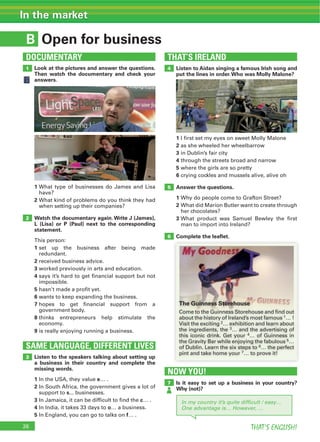
Open for business
1
2
3
Look at the pictures and answer the questions.
Then watch the documentary and check your
answers.
1
2
Watch the documentary again. Write J (James),
L (Lisa) or P (Paul) next to the corresponding
statement.
1
2
3
4
5
6
7
8
9
Listen to the speakers talking about setting up
a business in their country and complete the
missing words.
1 e
2
s
3 c
4 o
5 f
THAT’S IRELAND
4
6
5
1
2
3
4
5
6
Answer the questions.
1
2
3
Complete the leaflet.
Listen to Aidan singing a famous Irish song and
put the lines in order.Who was Molly Malone?
NOW YOU!
7 Is it easy to set up a business in your country?
Why (not)?
In my country it’s quite difficult / easy…
One advantage is… However, …
The Guinness Storehouse
2
3
4
5
6
7
27THAT’S ENGLISH!
UNIT 2
1a
SKILLS WORK
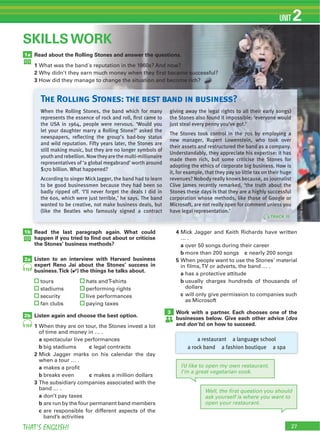
Read about the Rolling Stones and answer the questions.
1
2
3
1b
2a
2b
Read the last paragraph again. What could
happen if you tried to find out about or criticise
the Stones’ business methods?
Listen to an interview with Harvard business
expert Reno Jai about the Stones’ success in
business.Tick (4) the things he talks about.
Listen again and choose the best option.
1
a
b c
2
a
b c
3
a
b
c
4
a
b c
5
a
b
c
Work with a partner. Each chooses one of the
businesses below. Give each other advice (dos
and don’ts) on how to succeed.
19
19
3
a restaurant a language school
a rock band a fashion boutique a spa
Well, the first question you should
ask yourself is where you want to
open your restaurant.
I’d like to open my own restaurant.
I’m a great vegetarian cook.
When the Rolling Stones, the band which for many
represents the essence of rock and roll, first came to
the USA in 1964, people were nervous. ‘Would you
let your daughter marry a Rolling Stone?’ asked the
newspapers, reflecting the group’s bad-boy status
and wild reputation. Fifty years later, the Stones are
still making music, but they are no longer symbols of
youth and rebellion. Now theyare the multi-millionaire
representatives of ‘a global megabrand’ worth around
$170 billion. What happened?
According to singer Mick Jagger, the band had to learn
to be good businessmen because they had been so
badly ripped off. ‘I’ll never forget the deals I did in
the 60s, which were just terrible,’ he says. The band
wanted to be creative, not make business deals, but
(like the Beatles who famously signed a contract
giving away the legal rights to all their early songs)
the Stones also found it impossible: ‘everyone would
just steal every penny you’ve got.’
The Stones took control in the 70s by employing a
new manager, Rupert Lowenstein, who took over
their assets and restructured the band as a company.
Understandably, they appreciate his expertise: it has
made them rich, but some criticise the Stones for
adopting the ethics of corporate big business. How is
it, for example, that they pay so little tax on their huge
revenues? Nobody really knows because, as journalist
Clive James recently remarked, ‘the truth about the
Stones these days is that they are a highly successful
corporation whose methods, like those of Google or
Microsoft, are not really open for comment unless you
have legal representation.’
The Rolling Stones: the best band in business?
(onlinesource)
TRACK 18
THAT’S ENGLISH!
In the market
WRITING
1a
2
1b
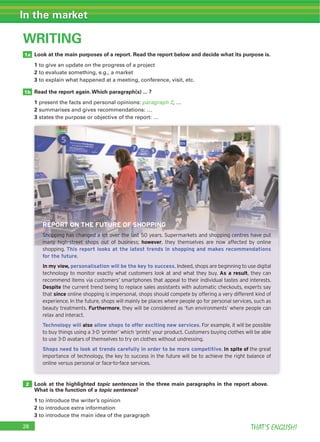
Look at the main purposes of a report. Read the report below and decide what its purpose is.
1
2
3
Read the report again.Which paragraph(s) ... ?
1 paragraph 2
2
3
Look at the highlighted topic sentences in the three main paragraphs in the report above.
What is the function of a topic sentence?
1
2
3
REPORT ON THE FUTURE OF SHOPPING
Shopping has changed a lot over the last 50 years. Supermarkets and shopping centres have put
many high-street shops out of business; however, they themselves are now affected by online
shopping. This report looks at the latest trends in shopping and makes recommendations
for the future.
In my view, personalisation will be the key to success. Indeed, shops are beginning to use digital
technology to monitor exactly what customers look at and what they buy. As a result, they can
recommend items via customers’ smartphones that appeal to their individual tastes and interests.
Despite the current trend being to replace sales assistants with automatic checkouts, experts say
that since online shopping is impersonal, shops should compete by offering a very different kind of
experience. In the future, shops will mainly be places where people go for personal services, such as
beauty treatments. Furthermore, they will be considered as ‘fun environments’ where people can
relax and interact.
Technology will also allow shops to offer exciting new services. For example, it will be possible
to buy things using a 3-D ‘printer’ which ‘prints’ your product. Customers buying clothes will be able
to use 3-D avatars of themselves to try on clothes without undressing.
Shops need to look at trends carefully in order to be more competitive. In spite of the great
importance of technology, the key to success in the future will be to achieve the right balance of
online versus personal or face-to-face services.
THAT’S ENGLISH!
UNIT 2
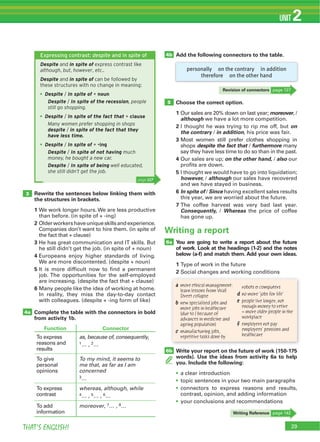
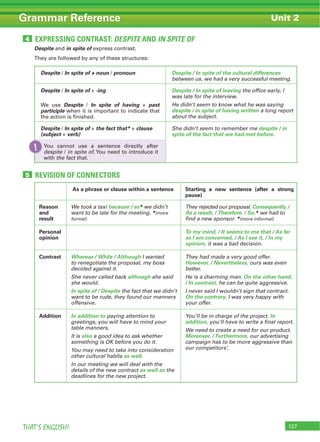
Expressing contrast: despite and in spite of
Despite and in spite of express contrast like
although, but, however, etc..
Despite and in spite of can be followed by
these structures with no change in meaning:
Despite / In spite of + noun
Despite / In spite of the recession, people
still go shopping.
Despite / In spite of the fact that + clause
Many women prefer shopping in shops
despite / in spite of the fact that they
have less time.
Despite / In spite of + -ing
Despite / In spite of not having much
money, he bought a new car.
Despite / In spite of being well educated,
she still didn’t get the job.
4b
5
3
4a
Add the following connectors to the table.
Choose the correct option.
1 moreover
although
2 on
the contrary in addition
3
despite the fact that furthermore
4 on the other hand, also
5
however, although
6 In spite of Since
7
Consequently, Whereas
Rewrite the sentences below linking them with
the structures in brackets.
1
2
3
4
5
6
Complete the table with the connectors in bold
from activity 1b.
Function Connector
as, because of, consequently,
2…
To my mind, it seems to
me that, as far as I am
concerned
3…
whereas, although, while
4 5 6…
moreover 7 …
personally on the contrary in addition
therefore on the other hand
Revision of connectors
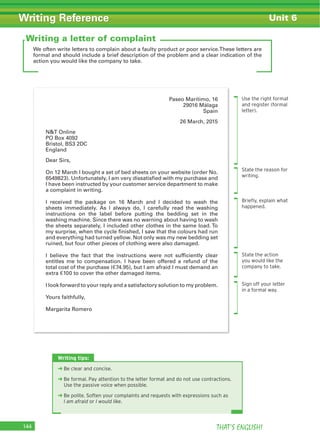
Writing Reference
You are going to write a report about the future
of work. Look at the headings (1-2) and the notes
below (a-f) and match them. Add your own ideas.
1
2
6a
Write your report on the future of work (150-175
words). Use the ideas from activity 6a to help
you. Include the following:
6b
Writing a report
a more ethical management:
learn lessons from Wall
Street collapse
b new specialised jobs and
more jobs in healthcare
(due to / because of
advances in medicine and
ageing population)
c manufacturing jobs,
repetitive tasks done by
robots & computers
d no more ‘jobs for life’
e people live longer, not
enough money to retire
= more older people in the
workplace
f employers not pay
employees’ pensions and
healthcare
page 127
30 THAT’S ENGLISH!
3UNIT
Can I let you in on a little secret?A
WHILE YOU WATCH
2
5
1
BEFORE YOU WATCH
NOW YOU!
6AFTER YOU WATCH
3
Canyoukeepasecret?
OBJECTIVES
4
Decide which of the secrets below you would
keep.
1
2
Answer the questions.
2
Answer the questions.
1
2
3
4
5
Tick (4) the things which are true for Bridget.
Correct the false ones.
1
1
Answer the following questions.
1
3
2
3
4
5
6
Choose the expression that best matches what
Bridget, Anthony and Luc say.
Bridget: 1burst into tears
a
b
Bridget: 2find out
a
b
Anthony: 3let you down
a
b
Luc: 4let you in on a little secret
a
b
I remember… told me a secret and she…
I’m a very trustworthy person so... all
sorts of secrets like...
2
I once let… down because...
31THAT’S ENGLISH!
ACTIVATE YOUR ENGLISH!
9a
9b
31
STREET INTERVIEWS
Read some of the answers in the Street
Interviews and tick (4) the ones which are true
for you.
1
2 a gossip
3
4
Use the correct form of the words in bold in
activities 5, 8b and 9a to complete the text below.
The speakers below were asked the following questions: Are you good at keeping secrets?
What kind of secrets do you find it hard to keep and why?
1
2
Which speaker thinks that ... ?
1
2
3
Look at some of the things the speakers said about secrets.What do you think they mean?
1 Darren: slips out
a
b
2 Rosie: pass it on
a
b
3 Charlotte: cheated on
feel so guilty
a
b
8b
8a
7
1
2
3
4
5
6
7
NOW YOU!
10 Are you good at keeping secrets?
I try my best to… , but…
32 THAT’S ENGLISH!
Can you keep a secret?
READING
1b
2a
2b
32
1a
20
20
Look at the photos. Which of the secret
situations do you think are positive or negative?
Have you ever had a secret or planned something
secret? How did it make you feel?
Listen to the conversation. What secret didn’t
Katie keep?
Listen again and match the expressions (1-8) to
the meanings (a-h).
1
2
3
4
5
6
7
8
a
b
c
d
e
f
g
h
3
4
1
2
5
The secret of the Blue
Moon café
Sophie stood at the window of the Blue Moon
café and sighed. Not only was it raining heavily,
but it was also absolutely freezing. There was
nobody on the High Street. Business would
be fairly slow today. A solitary customer was
drinking his coffee slowly.
At times like these, she wondered why she
stayed in such an extremely dull town as
Churchfield. It was an open secret that she
longed to return to London and take advantage
of everything there: theatre, art, music and
better job opportunities. She was feeling pretty
miserable until she remembered the next day
was Friday and that she would see Jamie again.
And of course, Jamie was the real reason she
stayed around. He was based there and so she
would put up with anything to be near him.
Just thinking about him made her smile. She
could never feel down for long while she had
the chance of seeing him.
The important thing was that Jamie was quite
different to Andy, her ex-fiancé. Andy had
seemed so charming and she had been madly
in love. He had asked her to marry him and
she had trusted him completely, but then just
one month before the wedding, Andy had let
her down badly, leaving her to travel around
the world just when she had needed him
most. She knew now he had simply taken her
in with false promises and had never really
intended to marry her. Sophie had been totally
devastated. She had a lump in her throat
when she thought about that time. Sadly, she
hadn’t been able to tell her secret to her best
friend, Gina. Gina could never keep a secret,
5
10
15
20
25
30
35
3
4
Read the story.What is the relationship between
… ?
a
b
c
Read the story and put the events in the order
they happened.
1
33THAT’S ENGLISH!
UNIT 3
33
5
6
TRACK 21
Read the story again and choose the correct
answer.
1
a
b
2
a
b
3
a
b
4
a
b
5
a
b
6
a
b
7
a
b
8
a
b
Complete the sentences with the correct form
of an expression from activity 2b.
1
2
3
4
5
6
7
8
40
45
50
55
and Sophie hadn’t wanted anyone to know.
Anyway, she finally moved out of the big city
and lost contact with her London friends.
Friday eventually came and Jamie arrived as
usual after his guitar lesson. Not only did he
play the guitar rather well, but he also sang
beautifully. Sophie had often heard him sing
in the café with his friends. He chatted to her
and chose his favourite cake as usual. Sophie
took it to his table and managed to listen to
most of his conversation without anyone
realising. She could never give away her secret.
Jamie wasn’t old enough to understand yet, he
was only fifteen. But when he was an adult,
Sophie would explain everything to him: how
she had watched over him in secret after her
former boss and his wife had adopted him.
It had taken Sophie a few years to find them
after they had moved to Churchfield. No one
else knew: it was the best-kept secret ever that
Jamie was her son, and Andy was his father.
2
3
4
5
6
7
8
9
34 THAT’S ENGLISH!
Can you keep a secret?
34
LANGUAGE STUDY
1
2
3a
3b
4
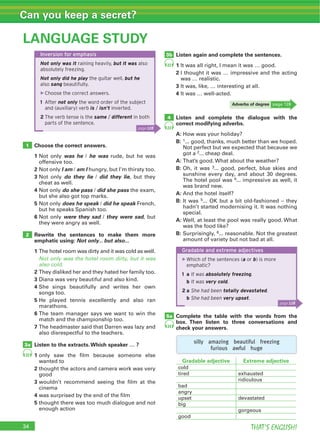
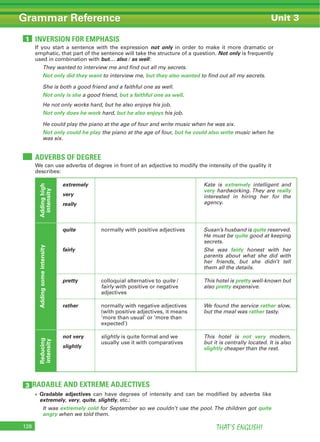
Inversion for emphasis
Not only was it raining heavily, but it was also
absolutely freezing.
Not only did he play the guitar well, but he
also sang beautifully.
▶Choose the correct answers.
1 After not only the word order of the subject
and (auxiliary) verb is / isn’t inverted.
2 The verb tense is the same / different in both
parts of the sentence.
page 128
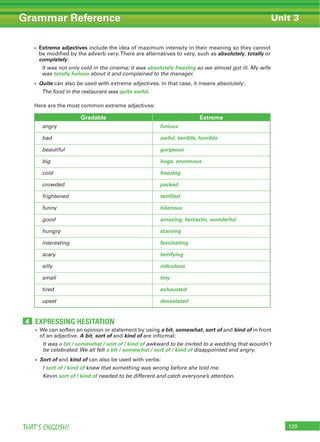
Gradable and extreme adjectives
▶Which of the sentences (a or b) is more
emphatic?
1 a It was absolutely freezing.
b It was very cold.
2 a She had been totally devastated.
b She had been very upset.
page 128
22
22
23
Choose the correct answers.
1 was he he was
2 I am am I
3 do they lie did they lie
4 do she pass did she pass
5 does he speak did he speak
6 were they sad they were sad
Rewrite the sentences to make them more
emphatic using: Not only... but also...
1
Not only was the hotel room dirty, but it was
also cold.
2
3
4
5
6
7
Listen to the extracts.Which speaker … ?
1
2
3
4
5
Listen again and complete the sentences.
1
2
3
4
Listen and complete the dialogue with the
correct modifying adverbs.
A:
B: 1
2
A:
B: 3
4
A:
B: 5
A:
B: 6
5a
silly amazing beautiful freezing
furious awful huge
24
Complete the table with the words from the
box. Then listen to three conversations and
check your answers.
Adverbs of degree
Gradable adjective Extreme adjective
35THAT’S ENGLISH!
UNIT 3
6
7
8
9b
9a
9c
10
11
25
26
26
5b
took in secret gave the secret away also
eyes devastated only furious let
24
Listen again. Tick the adverbs the speakers use
with extreme adjectives.
Complete the sentences using an extreme
adjective from activity 5a.
1
2
3
4
5
6
7
8
Circle the correct adverbs.
1 very absolutely
2 rather totally
3 absolutely very
4 quite totally
5 completely very
6
totally very
7 pretty
absolutely
Listen to the sentences. Repeat and copy the
intonation.
1
2
3
4
When someone hears some sad news, they
may do the things below. Put the events in the
correct order.
a
b
c
d
e
1 b to feel sad
Listen to the conversation. What is Denise’s
problem?
Listen again. Complete the expressions (1-5)
with the words from the box.Then match them
to the events (a-e) from activity 9a.
1 4
2 5
3
Complete the text with the correct form of the
expressions (1-5) from activity 9c.
Complete the text with the correct word or
phrase from the box.
Me and my wives
A London man has been arrested for bigamy.
Niall Stuart, aged 40, was arrested at his home
in Enfield. His wife, Tanya, learned she was not
legally married. ‘I’m totally 1... . I cried my 2...
out all last night.’ Not 3... is Niall already married,
but he 4... has three children with his ‘real’ wife,
Clare! Mrs Clare Stuart said she was absolutely
5... with Niall and she felt sorry for Tanya. ‘Niall
6... her in and she trusted him, as I did. How can
I tell my children the truth? He has 7... his family
down.’ Mr Stuart 8... when he left a letter from
Tanya in his coat pocket, and Clare found it. He
married Tanya 9... four years ago.
1
2
3
4
5
burst down up out lump tears throat cry
Pronunciation Guide
36 THAT’S ENGLISH!
Can you keep a secret?
2
B
THAT’S IRELAND
SAME LANGUAGE, DIFFERENT LIVES
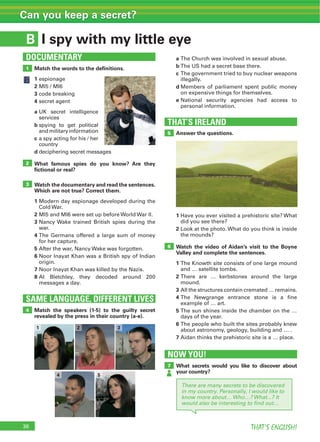
DOCUMENTARY
I spy with my little eye
1
5
6
2
3
4
Match the words to the definitions.
1
2
3
4
a
b
c
d
What famous spies do you know? Are they
fictional or real?
Watch the documentary and read the sentences.
Which are not true? Correct them.
1
2
3
4
5
6
7
8
Answer the questions.
1
2
Watch the video of Aidan’s visit to the Boyne
Valley and complete the sentences.
1
2
3
4
5
6
7
Match the speakers (1-5) to the guilty secret
revealed by the press in their country (a-e).
a
b
c
d
e
1 3
54
NOW YOU!
7 What secrets would you like to discover about
your country?
There are many secrets to be discovered
in my country. Personally, I would like to
know more about… Who…? What...? It
would also be interesting to find out…
37THAT’S ENGLISH!
UNIT 3
4a3
4b
(onlinesource)
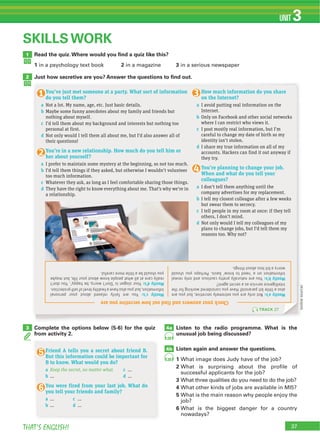
SKILLS WORK
Complete the options below (5-6) for the quiz
from activity 2.
Listen to the radio programme. What is the
unusual job being discussed?
Listen again and answer the questions.
1
2
3
4
5
6
28
28
Read the quiz.Where would you find a quiz like this?
1 2 3
Just how secretive are you? Answer the questions to find out.
1
2
Mostlya’s:Notonlyareyouextremelysecretive,butyouare
alsoalittlebitparanoid!Haveyouconsideredworkingforthe
intelligenceserviceasasecretagent?
Mostlyb’s:Youarenaturallyprettycautiousandonlyreveal
informationona‘needtoknow’basis.Perhapsyoushould
worryabitlessaboutthings.
Mostlyc’s:Youarefairlyrelaxedaboutyourpersonal
information,butyoualsohaveahealthylevelofself-protection.
Mostlyd’s:Yoursloganis‘Don’tworry,behappy’.Youdon’t
reallycareatallwhatpeopleknowaboutyourlife,butmaybe
youshouldbealittlemorecareful.
Checkyouranswersandfindouthowsecretiveyouare
How much information do you share
on the Internet?
a I avoid putting real information on the
Internet.
b Only on Facebook and other social networks
where I can restrict who views it.
c I post mostly real information, but I’m
careful to change my date of birth so my
identity isn’t stolen.
d I share my true information on all of my
accounts. Hackers can find it out anyway if
they try.
You’re planning to change your job.
When and what do you tell your
colleagues?
a I don’t tell them anything until the
company advertises for my replacement.
b I tell my closest colleague after a few weeks
but swear them to secrecy.
c I tell people in my room at once: if they tell
others, I don’t mind.
d Not only would I tell my colleagues of my
plans to change jobs, but I’d tell them my
reasons too. Why not?
You’ve just met someone at a party. What sort of information
do you tell them?
a Not a lot. My name, age, etc. Just basic details.
b Maybe some funny anecdotes about my family and friends but
nothing about myself.
c I’d tell them about my background and interests but nothing too
personal at first.
d Not only would I tell them all about me, but I’d also answer all of
their questions!
You’re in a new relationship. How much do you tell him or
her about yourself?
a I prefer to maintain some mystery at the beginning, so not too much.
b I’d tell them things if they asked, but otherwise I wouldn’t volunteer
too much information.
c Whatever they ask, as long as I feel comfortable sharing those things.
d They have the right to know everything about me. That’s why we’re in
a relationship.
TRACK 27
Friend A tells you a secret about friend B.
But this information could be important for
B to know. What would you do?
a Keep the secret, no matter what. c ...
b ... d …
You were fired from your last job. What do
you tell your friends and family?
a … c …
b … d …
THAT’S ENGLISH!
Can you keep a secret?
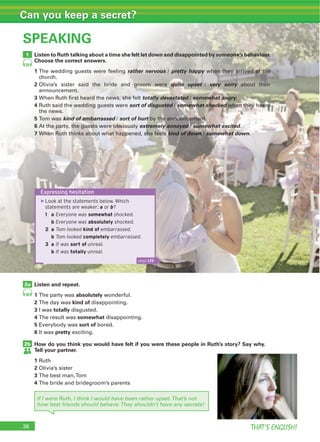
SPEAKING
1
29
Listen to Ruth talking about a time she felt let down and disappointed by someone’s behaviour.
Choose the correct answers.
1 rather nervous pretty happy
2 quite upset very sorry
3 totally devastated somewhat angry
4 sort of disgusted somewhat shocked
5 kind of embarrassed sort of hurt
6 extremely annoyed somewhat excited
7 kind of down somewhat down
2a
2b
30
Listen and repeat.
1 absolutely
2 kind of
3 totally
4 somewhat
5 sort of
6 pretty
How do you think you would have felt if you were these people in Ruth’s story? Say why.
Tell your partner.
1
2
3
4
Expressing hesitation
▶Look at the statements below. Which
statements are weaker: a or b?
1 a Everyone was somewhat shocked.
b Everyone was absolutely shocked.
2 a Tom looked kind of embarrassed.
b Tom looked completely embarrassed.
3 a It was sort of unreal.
b It was totally unreal.
page 129
If I were Ruth, I think I would have been rather upset.That’s not
how best friends should behave.They shouldn’t have any secrets!
39THAT’S ENGLISH!
UNIT 3
3
4a
4b
5a
5b
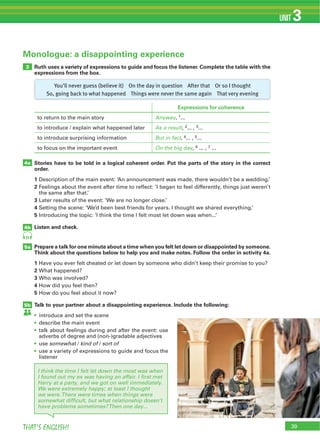
Monologue: a disappointing experience
31
Ruth uses a variety of expressions to guide and focus the listener. Complete the table with the
expressions from the box.
Stories have to be told in a logical coherent order. Put the parts of the story in the correct
order.
1
2
3
4
5
Listen and check.
Prepare a talk for one minute about a time when you felt let down or disappointed by someone.
Think about the questions below to help you and make notes. Follow the order in activity 4a.
1
2
3
4
5
Talk to your partner about a disappointing experience. Include the following:
somewhat kind of sort of
Expressions for coherence
Anyway 1
As a result 2 3
But in fact 4 5
On the big day 6 7
I think the time I felt let down the most was when
I found out my ex was having an affair. I first met
Harry at a party, and we got on well immediately.
We were extremely happy; at least I thought
we were.There were times when things were
somewhat difficult, but what relationship doesn’t
have problems sometimes?Then one day...
You’ll never guess (believe it) On the day in question After that Or so I thought
So, going back to what happened Things were never the same again That very evening
40 THAT’S ENGLISH!
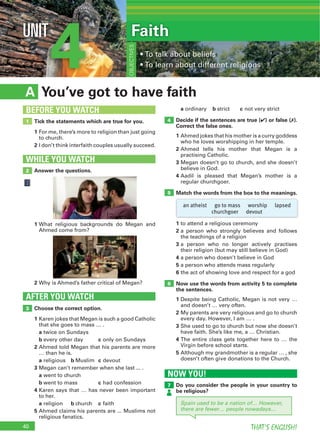
4UNIT
You’ve got to have faithA
a ordinary b strict c not very strict
Decide if the sentences are true (4) or false (7).
Correct the false ones.
1 Ahmed jokes that his mother is a curry goddess
who he loves worshipping in her temple.
2 Ahmed tells his mother that Megan is a
practising Catholic.
3 Megan doesn’t go to church, and she doesn’t
believe in God.
4 Aadil is pleased that Megan’s mother is a
regular churchgoer.
Match the words from the box to the meanings.
Choose the correct option.
1 Karen jokes that Megan is such a good Catholic
that she goes to mass … .
a twice on Sundays
b every other day c only on Sundays
2 Ahmed told Megan that his parents are more
… than he is.
a religious b Muslim c devout
3 Megan can’t remember when she last ... .
a went to church
b went to mass c had confession
4 Karen says that … has never been important
to her.
a religion b church c faith
5 Ahmed claims his parents are ... Muslims not
religious fanatics.
AFTER YOU WATCH
3
4
5
Tick the statements which are true for you.
1 For me, there’s more to religion than just going
to church.
2 I don’t think interfaith couples usually succeed.
1
BEFORE YOU WATCH
Faith
OBJECTIVES
Answer the questions.
WHILE YOU WATCH
2
1 What religious backgrounds do Megan and
Ahmed come from?
2 Why is Ahmed’s father critical of Megan?
NOW YOU!
Do you consider the people in your country to
be religious?
7
6
an atheist go to mass worship lapsed
churchgoer devout
Spain used to be a nation of… However,
there are fewer… people nowadays…
1 to attend a religious ceremony
2 a person who strongly believes and follows
the teachings of a religion
3 a person who no longer actively practises
their religion (but may still believe in God)
4 a person who doesn’t believe in God
5 a person who attends mass regularly
6 the act of showing love and respect for a god
Now use the words from activity 5 to complete
the sentences.
1 Despite being Catholic, Megan is not very …
and doesn’t … very often.
2 My parents are very religious and go to church
every day. However, I am … .
3 She used to go to church but now she doesn’t
have faith. She’s like me, a … Christian.
4
Virgin before school starts.
5 Although my grandmother is a regular … , she
doesn’t often give donations to the Church.
41THAT’S ENGLISH!
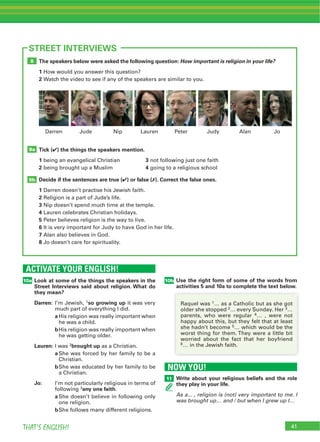
STREET INTERVIEWS
The speakers below were asked the following question: How important is religion in your life?
1 How would you answer this question?
2 Watch the video to see if any of the speakers are similar to you.
Tick (4) the things the speakers mention.
1 being an evangelical Christian 3 not following just one faith
2 being brought up a Muslim 4 going to a religious school
Decide if the sentences are true (4) or false (7). Correct the false ones.
1 Darren doesn’t practise his Jewish faith.
2 Religion is a part of Jude’s life.
3 Nip doesn’t spend much time at the temple.
4 Lauren celebrates Christian holidays.
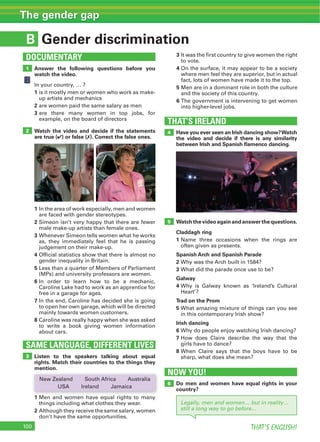
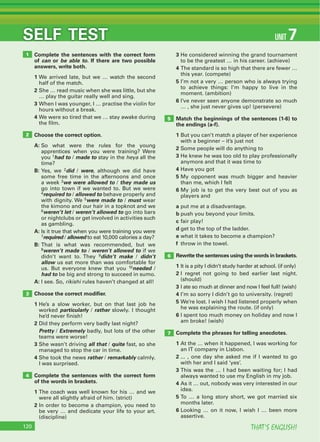
5 Peter believes religion is the way to live.
6 It is very important for Judy to have God in her life.
7 Alan also believes in God.
8 Jo doesn’t care for spirituality.
9b
9a
8
ACTIVATE YOUR ENGLISH!
Look at some of the things the speakers in the
Street Interviews said about religion. What do
they mean?
Darren: I’m Jewish, 1so growing up it was very
much part of everything I did.
a His religion was really important when
he was a child.
bHis religion was really important when
he was getting older.
Lauren: I was 2brought up as a Christian.
a She was forced by her family to be a
Christian.
bShe was educated by her family to be
a Christian.
Jo: I’m not particularly religious in terms of
following 3any one faith.
a She doesn’t believe in following only
one religion.
bShe follows many different religions.
10a
41
Nip Lauren Peter Judy AlanJude JoDarren
NOW YOU!
11
10b
Write about your religious beliefs and the role
they play in your life.
As a... , religion is (not) very important to me. I
was brought up… and / but when I grew up I…
Use the right form of some of the words from
activities 5 and 10a to complete the text below.
Raquel was 1… as a Catholic but as she got
older she stopped 2… every Sunday. Her 3…
parents, who were regular 4… , were not
happy about this, but they felt that at least
she hadn’t become 5… which would be the
worried about the fact that her boyfriend
6… in the Jewish faith.
42 THAT’S ENGLISH!
Faith
Read and answer the questionnaire on religious
faith.
READING
Listen to two people discussing the faith test.
Who has the strongest faith, Paul or Jane?
Listen again. Complete the sentences with Paul
or Jane.
1 … is an agnostic.
2 … prays every day.
3 … doesn’t often go to church.
4 … doesn’t believe in Heaven and Hell.
5 … believes in miracles.
Read the article and choose the best summary.
1 Yoga festival attracts enormous crowds to
northern India.
2 Millions of Hindu pilgrims travel to the Ganges
to take a ritual bath.
3 Holy men lead millions of Hindu believers on
spiritual journey.
Read the pilgrimage text again. What do these
numbers refer to?
1 3 4 55 7 10,000
2 1 billion 5 nearly a million 8 50,000
3 millions 6 20,000
Answer the questions.
1 Is the festival always held in the same place?
2 Why do pilgrims bathe in the river?
3 What is a sadhu?
4 Name four physical challenges the sadhus
undertake.
5 What is the biggest danger for the pilgrims?
6 In the comments section, what worry does
Frog have?
Find words in the text which mean … .
1 a person who travels to a holy place for
religious or spiritual reasons (paragraph 1)
2 a journey with a spiritual purpose (paragraph 1)
3 an immoral act (paragraph 2)
4 holy people who perform religious rituals
(paragraph 2)
3
2a
6
4
5
2b
42
1
33
33
The Kumbh Mela Festival takes place every three
years in India at different locations along the banks
of India’s sacred rivers: the Ganges, the Yamuna and
the ancient lost Saraswati River. It is hardly surprising
in a country with over one billion Hindus, that simply
millions of pilgrims travel great distances to attend
the celebration, making it the largest religious festival
and pilgrimage in the world.
Hindus believe that the water of the sacred rivers
actually washes away sin, so unsurprisingly, bathing
is central to the festival and pilgrims gather next to
the rivers to perform this act of faith and patiently
wait to take a ritual bath. At sunrise on the first day
of the 55-day festival, the sadhus or holy men lead
the way to the water. Like many other religions,
Hindus have a variety of priests, or holy men and
women, and follow a number of spiritual practices to
understand the Divine more clearly. This often means
undertaking difficult physical challenges and acting
in blind faith, simply trusting that God will take care
of them. Some sadhus don’t wear clothes and never
cut their hair, some have taken a vow of silence and
never speak, others simply stop eating and drinking
and follow a strict fast. Nearly a million sadhus attend
the festival and give blessings to the other pilgrims.
Despite the immense crowds at the Kumbh Mela
Festival, it is a moment of pure joy when pilgrims finally
wash in the river, and of course, a highly emotional
experience too. Once they have bathed, the pilgrims
say prayers, make offerings at the shrines of different
Hindu deities and listen to the words of the sadhus.
Pilgrimage sites of the world
Does faith play a big part in your life?
a I pray every day.
b My faith gives my life meaning and purpose.
c I am active in my faith or church.
d I like being with people who share my faith.
e Many of my decisions in life are based on my
faith.
Totalscore:5(lowfaith);20(highfaith)
1 strongly disagree 3 agree
2 disagree 4 strongly agree
(onlinesource)
43THAT’S ENGLISH!
UNIT 4
43
5 a period of time when a person doesn’t eat or
drink (paragraph 2)
6 a promise to do something (paragraph 2)
7 a prayer for God’s protection made by a holy
person (paragraph 2)
8 a request or thanks to God (paragraph 3)
9 temples (paragraph 3)
Match the correct meanings of the expressions
in bold (1-8) to the sentences (a or b).
1 acted in
good faith, but the results were disastrous.
a
but they didn’t care about the consequences.
b
thing, but they were mistaken.
2 He is an honest hardworking politician. He has
restored my faith in politics.
a I have always believed that politicians are
honest.
b I used to be cynical about politicians, but now
I believe they are not all corrupt.
3 Her blind faith in alternative medicine is a
danger to her health.
a She uses scientific evidence to choose her
medical treatment.
b Her belief in alternative medicine puts her at
risk.
4 Walking across a fire in bare feet is an act of
faith.
a People believe they will not be hurt by the fire.
b People know the fire will burn them but do it
anyway.
5 Bless you!
a You have just sneezed.
b You have just coughed.
6 However difficult life seems, count your
blessings!
a Life is hard and there is sometimes nothing to
be positive about.
b
situation, even when everything seems to be
going wrong.
7 What a beautiful baby, bless!
a Isn’t that baby adorable!
b
8 He didn’t agree with their decision to go and
live in Australia, but he gave them his blessing.
a He gave them advice not to go.
b He supported their decision even though he
disagreed with them.
7
(onlinesource)(onlinesource)
TRACK 34
The next Kumbh Mela Festival is in 2016!
Don’t forget, will you! Tessie
People who go there should just count their
blessings that they don’t get ill! A million people
all bathing in the same water. I doubt if anyone
is very clean or healthy after that. Frog 23
These photos are inspiring, but I wonder if I
will be strong enough to complete my own
pilgrimage. Duncan
Look how happy everyone is. With God on
your side everything is OK, isn’t it? Klaus
COMMENTS
The practicalities of housing and feeding millions
of pilgrims over the two months of the festival
may seem an impossible task. Nevertheless, the
officials do manage to organise the crowds. In fact, a
temporary city of over a million tents is put up along
with 20,000 portable toilets, and 10,000 sweepers
are employed to keep the place clean. Unfortunately,
one of the biggest dangers for pilgrims is being
injured by the enormous crowds, so there are about
50,000 policemen to help control the vast crowds.
THAT’S ENGLISH!
Faith
THAT’S ENGLISH!44
LANGUAGE STUDY
Match the sentences (1-8) to the question tags
(a-h).
1
2 Don’t tell them,
3
4 Let’s have an ice-cream,
5 You never call me,
6 Somebody took the money,
7 Open the window,
8 I am leaving tomorrow,
a wasn’t it? d do you? g aren’t I?
b didn’t they? e shall we? h will you?
c could you? f aren’t they?
Rewrite the sentences using the word(s) in
brackets.
1 Do you think you did the right thing? (wonder)
I wonder if you did the right thing.
2 He believes in ghosts. (sure)
3
to win the World Cup. (doubted)
4 I am not sure she took enough money for the
train fare. (wonder)
5 I am convinced he really loves her. (do believe)
6 I am not sure she has enough qualifications
for the job. (doubt)
Choose the correct adverb.
Listen to these sentences. Are the speakers
asking real questions or asking for confirmation?
1 You are from Germany, aren’t you?
2 You won’t forget, will you?
3 He never phones you, does he?
4 Anyone could do this, couldn’t they?
5 Let’s do this together, shall we?
6 He hasn’t been here for years, has he?
7 Come here, will you?
8 I’m terrible at football, aren’t I?
Listen again, repeat and copy the intonation.
1
2
3
4
35
35
Pronunciation: intonation in question tags
Question tags can be used for real questions or
simply to ask for confirmation of information.
▶Choose the correct option.
When it is a real question the intonation rises /
falls on the tag. If we just want confirmation, then
the intonation rises / falls.
I was brought up in the Catholic faith, but
1simply / actually as I got older, I lost my
faith and I 2hardly / simply stopped going to
church.A couple of years ago, a friend of mine
got very ill and 3hardly / unfortunately died,
and it 4just / really affected me very deeply. I
decided to take some time for reflection and
walk the Camino de Santiago in the north of
Spain. 5Firmly / Surprisingly, it was one of the
best decisions I have ever made. It took me
about 3 weeks, and I met all kinds of people
on the way. Some had a strong religious faith
but 6hardly / just anyone was there for the
same reason. Some 7just / certainly wanted
to follow a historic route and others, like me,
8simply / hardly wanted some time on their
own to think about their lives.
Review of question tags page 130
Expressing doubt and belief
To express doubt:
A million people all bathing in the same water.
I doubt if / whether anyone is very clean
after that…
I wonder if / whether I will be strong
enough…
To express belief:
I do firmly believe there’s something after
death.
I am sure miracles are possible.
We also use adverbs like really, actually,
simply, just, certainly, hardly, firmly,
unfortunately, surprisingly to modify
expressions of doubt or belief.
It is hardly surprising in a country with over
one billion Hindus, that simply millions of
pilgrims travel great distances to attend the
celebration.
Surprisingly, many non-believers send their
children to religious schools.
page 130
44
page 148
THAT’S ENGLISH!
UNIT 4
Look at the figures and complete the report
below with the words from the box.
Now listen and check.
Complete the sentences with the missing
words.
1 When we got married, we made a vow to
always love one another.
2 During Ramadan, Muslims observe a strict f…
between sunrise and sunset: no food or drink.
3 He is an evil man, but I believe he will be
punished for his s… .
4 We are going to Lourdes on a p… .
5 Please say a p… with us for world peace.
6 She was a wonderfully kind woman; when she
dies, she will go straight to H… .
7 p… made the sign of the cross and gave
us a blessing.
8
frightening vision of the torments in H… .
6
5
7
8a
8b
36
37
37
38
9 m… .
10 Since his wife died he hasn’t changed a thing
in the house: it’s like a s… to her.
Complete the sentences with the expressions
from the box.
1 I lost my purse with £300 in it but someone
handed it in to the police with all that money
restored my faith in
people.
2
Rome.
3 ‘I’ve got a cold. Atchoooo!’ ‘… ’
4 He gave her the money … and thought she
would pay him back, but she never returned
the money.
5
they were told.
6 You are always complaining but at least you
have got a job, you should … .
7 Look at that cat and its kittens. …
8
in a supreme … because they believed that
God would provide for them.
Listen and look at the different spellings for the
sound /ei/.
1 faith, sail, waist, wait
2 always, stay, pray, today
3 ache, snake, behave, face
4 weight, eight, neighbour, reign
5 prey, grey, obey, hey
Listen again and repeat.
Listen to the sentences. Which is the correct
spelling according to the context?
1 a wait b weight
2 a rain b reign
3 a male b mail
4 a ate b eight
5 a sail b sale
6 a waste b waist
7 a pray b prey
8 a great b grate
in good faith restored my faith Bless!
gives his blessing blind faith Bless you!
act of faith count your blessings
agnostics Muslims non-believers
Buddhists Hindus Christianity
Jewish believers atheists Sikhs
Britain may no longer be a Christian country
in just 20 years, according to the report above.
1… is losing more than half a million believers
every year, while the number of 2… and 3…
is increasing by almost 750,000 annually. If
trends continue, the number of 4… will overtake
the number of Christians by 2030. In the last
six years, the number of 5… , 6… and 7… has
8… has remained stable
while the number of 9… has fallen slightly.
45
Religious affiliation in Great Britain
Population
Q4 2004 Q4 2010
Christian 44,820,000 41,410,000
No religion 9,010,000 13,390,000
Muslim 1,890,000 2,580,000
Hindu 550,000 790,000
Sikh 340,000 340,000
Jewish 280,000 270,000
Buddhist 160,000 270,000
Any other religion 390,000 610,000
(onlinesource)
Pronunciation Guide page 147
46 THAT’S ENGLISH!
Faith
B Believe it or not!
THAT’S IRELAND
SAME LANGUAGE, DIFFERENT LIVES
DOCUMENTARY
1 6
2
3
4
5
Which of these statements about the Church do
you agree with?
1
2 Priests should be allowed to get married.
3
4
Watch the first part of the documentary and
answer the questions.
1 What does the word Anglican mean?
2 What is the main difference between the
3
the Church?
4 What does the general synod do?
Watch the rest of the documentary and
complete the summaries of what the two
priests say.
Susannah:Although 1… never changes, the
Church must adapt to the 2… in
which it finds itself. Having a 3… and
being a vicar is a 4… but also a joy.
Jody: My parish has people from different
5… and the majority are 6… . I
don’t want every Sunday to be the
7… . Sometimes we put the 8… in a
circle or people of different ages sit
together at 9… .
Match the photos (1-3) to the sentences (a-c).
Listen to people talking about the importance
of faith and religion in their country. What
religions are mentioned?
Listen again. According to the speakers, which
country … ?
1 was founded by religious people
2 has two main religions
3 does not have high church attendance
4 has religious education in schools
5 has people from at least four different religions
6 is officially Christian
1
2
3
7
a
b
colours.
c
Watch the video of Aidan’s visit to Kilkenny and
decide if the sentences are true (4) or false (7).
Correct the false ones.
1 Kilkenny used to be the capital of Ireland.
2 St Canice’s Cathedral is a 6th-century building.
3
holding it in place.
4
steep challenging climb to get to the top.
5
6
NOW YOU!
8 What are some of the most significant religious
buildings in your country?
My country has many religious buildings.
Many of them represent the … religion.
For example, … However there are also
buildings from other religions such as…
Susannah Jody
47THAT’S ENGLISH!
UNIT 4
Answer the question.
Can you name a place where people go on a pilgrimage or a retreat?
Look at the photo.Where are these pilgrims? Read the text and check your answer.
1
2a
Read the text and answer the questions.
1 Why do Muslims pray towards Mecca?
2 How old is the Kaaba?
3 What do people believe is the origin of the
Black Stone?
4 Do all Muslims have to go on the Hajj?
5 How many times do pilgrims circle the Kaaba?
Listen to a pilgrim describing the Hajj. Are the
statements true (4) or false (7)? Correct the
false ones.
1 She was very emotional when she first saw
the Kaaba.
2 People only wash in the Zamzam water.
3
was standing in the hot sun all afternoon.
Listen again and match the day of the pilgrimage
(1-3) to the activities (a-c).
Day 1 Day 2 Day 3
a throw stones at three pillars which represent
Satan
b pray on the Mount of Mercy between midday
and sunset
c drink the holy water from the spring of Zamzam
Imagine you want to go on a retreat or
pilgrimage. Answer the questions.
1 Which reason would the journey mainly be for?
a religious c historic or cultural
b sport d escape from modern life
2 How would you prefer to travel?
a on foot c on horseback
b by bicycle d other
3 How long would you like to travel?
a a month b a weekend c a week d a lifetime
4 What would the destination be?
a a holy shrine c a natural feature
b an ancient cultural icon d other
Compare your answers with a partner and
discuss where you might go and whether you
could travel together.
2b 4a
4b
3a
3b
40
40
SKILLS WORK
I’m not sure…Too many people for
me. I’m looking for peace and quiet.
I’d love to do the Camino de Santiago.
I’ve heard it’s very beautiful and
everyone is really friendly.
Look at the photo.Where are these pilgrims? Read the text and check your answer.
Muslims all around the world pray in the
direction of Mecca in Saudi Arabia. But why
is this?
Mecca is the location of the Grand Mosque which is
the most sacred place in the Islamic world because
at its centre there is an ancient building called the
Kaaba. This black marble building dates back to pre-
Islamic times, to about 2000 BC. It has been a place
of pilgrimage since then and wherever they are and
whatever they are doing, Muslims stop and pray in the
direction of the Kaaba five times a day.
In a corner of the Kaaba, there are pieces of an ancient
stone, the Black Stone, which Muslims believe actually
date back to the time of Adam and Eve. Muslims
believe the Black Stone originally fell from Heaven as
a sign from God to show Adam and Eve where to build
an altar. Others think that the stone may simply be a
meteorite. But whatever you believe, it is clear that
the stone has always had a special sacred significance.
All Muslims should go on a pilgrimage to Mecca once
in their lifetime if they have enough money to do
so and are in good health. When pilgrims travel to
Mecca to complete the Hajj or pilgrimage, they walk
anticlockwise seven times around the Kaaba and
many try to touch or kiss the Black Stone, so the stone
is highly polished from the millions of hands which
have touched it.
The Hajj:pilgrimage to Mecca
TRACK 39
48 THAT’S ENGLISH!
Faith
WRITING
Read the description of a faith school below and look at the photos. Which photo shows a
faith school?
You are going to read an essay entitled: Should faith schools receive government funding?
Decide if the sentences (1-6) are arguments for or against.
1 Some faiths have messages which are incompatible with the national curriculum.
2 Religious organisations have historically always played a part in education.
3 Parents should be able to choose an education which reflects their moral codes.
4 Faith schools can cause segregation of communities.
5 Faith schools are important for sustaining the religion, culture, identity and language of
different groups.
6 Children should study all types of religion to understand different values.
Read the text. Is the writer for or against religious schools being funded by the government?
1a
1b
2a
Should faith schools receive government funding?
Faith schools in Britain have existed since the Middle Ages. Both the Church of England and the
Catholic Church first founded faith schools in the 16th century to provide education to children
from all social classes. These schools today receive some government funding, and parents also
contribute. Yet, surprisingly, there is now considerable debate in Britain about whether faith schools
should receive any government money.
Many people think children should learn about all faiths, and they also believe that one religion
should never be more important than another. However, I think parents have the right to choose an
education for their children which reflects their personal beliefs. Despite being true that children
should learn to respect others’opinions,they also need to identify with their own religion and culture.
As regards the argument that faith schools lead to segregation of communities, personally I think
this is simply not true. In countries with no state-funded faith schools, for example France, there
are still problems with social integration. Another argument against faith schools is that certain
beliefs might be incompatible with the national curriculum. For example, some religions believe in
creationism, but the national curriculum teaches evolution. This is true in some extreme cases, even
so, I firmly believe that if all schools teach respect and understanding, then faith schools are a valid
educational option.
To conclude, while schools need to teach children about all religions, still, nevertheless people should
be able to maintain their own cultural and religious values. For this reason, I support the view that
faith schools should be government funded.
Faith schools have to follow the national curriculum except for religious studies, where they teach their own religion.
1 2
49THAT’S ENGLISH!
UNIT 4
Look at the structure and contents of the for
and against text. Choose the correct answers.
1 In the introduction (paragraph 1) you should
include anecdotes / general facts and context.
2 only
listed / compared and contrasted.
3 In the conclusion (paragraph 4) you should refer
to only your personal opinion / both sides of
the discussion and your personal opinion.
Match the functions (1-3) to the connectors (a-c).
1 to introduce a topic 3 to conclude
2 to compare and contrast
a as we have seen, for this reason (for these
reasons), on the whole, to conclude
b as regards, regarding, with regard to, as far as
... is concerned
c however, still, in spite of, despite, yet,
nevertheless, although, even so, in comparison
Rewrite the sentences with the word(s) in
brackets.
1 Despite the fact that the rescue teams stopped
the search for survivors, his wife never gave
up believing he was alive. (yet)
The rescue teams stopped the search for
survivors.Yet his wife never gave up believing
he was alive.
2 Although the rescue teams stopped the search
for survivors, she never gave up believing he
was alive. (even so)
3
I don’t trust her. (yet)
4 Although she seems to be telling the truth, I
don’t trust her. (even so)
5 She is the richest woman in the country, but
she isn’t happy. (still)
2b
3
4
5
6 She has an enormous salary, but still it isn’t
enough. (yet)
Which word cannot be used in the sentences?
1 My parents were devout Christians.
Nevertheless / Even so / As regards, they never
took me to church with them.
2 In spite of / Despite / Still being devout
Christians, they never took me to church.
3 He stole all my money. Even so / In spite of /
Nevertheless, I still love him.
4 In spite of / Despite / However the fact that he
stole my money, I still love him.
5
election, to conclude / yet / even so, most
people would not vote for him again.
6
regarding / on the whole / as regards the price
of the hotel.
7 Stephen was an agnostic. Even so / Still / In
comparison, he went to church every Sunday.
8 He couldn’t explain how it happened, yet / in
spite of / even so, he still didn’t believe it was
a miracle.
Connectors: yet, still and even so
We use yet, still and even so to express contrast
or surprise. They are less formal than however
and nevertheless.
Yet and still are used to introduce a surprising
contrast.
He’s always extremely rude, and yet people
like him.
The weather was terrible. Still, we enjoyed
being on holiday.
Even so means however.
They are very rich. Even so, they’re not very
generous.
Writing Reference page 143
Prepare to write an essay with the title: Should
religion be taught in schools?
Complete the table with your own ideas.
6a
Writing a for and against essay
Put similar ideas together and think of
appropriate connectors to link contrasting
ideas.
On balance, which side has the strongest
arguments? Decide what your opinion is.
Write your essay (175-200 words). Remember to
include the following:
a clear introduction: facts, general views, context
arguments for and against
connectors for introducing topics
connectors for comparing and contrasting
connectors for concluding
a balanced conclusion
a personal recommendation
6b
For Against
page 131
50 THAT’S ENGLISH!
Revision 1
OBJECTIVES
LANGUAGE REVISION
Look at the past simple verbs in bold in the
text and decide which ones could be used with
would / used to, both or neither.
The director of the detention centre is talking to
the guard. Complete the question tags.
1
2
3
4
5
6
7
1b
2a
2b
3
50
Complete the text with the correct tense of
the verbs in brackets. Use past simple, past
continuous, past perfect simple and past perfect
continuous. Sometimes more than one tense is
possible.
1a
possible.
found out
2
was
3
decided
5
came
left 6
7 arrived
8
went
saw 9
Listen and check.
Listen again. Is the director asking real questions
or asking for confirmation in each case?
Read the email from Yannus and choose the
correct option.
Choose the correct option.4
absolutely actually pretty
2firmly hardly surprisingly
3kindly unfortunately
pretty
firmly very quite
5very absolutely rather
6simply
actually completely
7hardly really sadly
8totally really kindly
ADVICE ON TEMPORARY SUMMER WORK
IN THE UK
1… on the Internet for websites for job advertisements.
a You must look b You should look c Don’t look
2… if you don’t have any experience, there are plenty
of unskilled jobs
a You should worry b You must worry c Don’t worry
but 3… show you are keen.
a you should b you mustn’t c don’t
4… check you have the necessary work permits.
a You shouldn’t b You should c Don’t
If you are an EU citizen, 5… have a permit.
a you mustn’t need to b you don’t need to c you shouldn’t
6… prepared to work for low wages at first.
a You can be b You can’t be c You should be
7… that you have a contract before you go.
a Try b Make sure c You should try
8… speak English very well for some jobs, so this is a
good opportunity to learn.
a You mustn’t b You don’t have to c You shouldn’t try to
42
42
THAT’S ENGLISH!
Revision 1
9
10
6
7
8
Rewrite the sentences using reduced relative
clauses.
1
2
3
4
Rewrite the sentences using the words in
brackets.
1
2
3
4
5
6
7
8
9
10
Complete the second sentence so that it has a
similar meaning to the first. Use the words in
brackets.Write between two and five words.
1
2
3
4
5
Complete the sentences with a particle.
1
2
3
4
5
6
7
Complete the sentences with the correct form
of the words in brackets.
1
2
3
4
5
6
Complete the texts with the words from the box.
assets blessings blind debts faith
fast leaf liquidation prayers sins
5
A
2 3
B
5
6
7
C
8
9
52 THAT’S ENGLISH!
Revision 1
52
SKILLS WORK
Do you think these statements are true (4) or false (7)?
1
2
3
4
Read the text and check your answers.
Read the text again and answer the questions.
1
2
3
4
5
6
Listen to the conversation and tick (4) the
secrets that the people talk about.
1
2
3
4
5
6
1
2 3a
Buddhism is often described as a
way of life rather than a religion.
The teachings of Siddhartha
Gotama, or Buddha, are used to
inspire followers to live a life
of peace, to be aware of their
thoughts and actions, and to
develop understanding or wisdom.
The final goal is enlightenment and
true happiness. Buddhism is not
regarded as a religion because the
Buddha is not a deity but simply
a wise man. One of the principal
beliefs of Buddhists is that when we
die, we are reincarnated as another
body. Depending on the way we
have lived our lives, this rebirth can
be as any living creature: human or
animal.
The Dalai Lama is the spiritual
leader of the Tibetan Buddhists.
Not only is he a religious figure, but
he is also the head of the Tibetan
government in exile. He is the 14th
Dalai Lama, and at the age of 79, he
is thinking about his successor. In a
recent announcement, he has said
that he may be the last Dalai Lama,
but that this is not significant in the
continuation of the faith. Buddhism
existed 1,800 years before the first
Dalai Lama, so the role has not
always been essential.
In this era of democracy and
growing international pressure, it
has been suggested that the political
leader of the Tibetan government
should be elected democratically.
The Dalai Lama has also referred
to the possible selection of a
woman as the 15th Dalai Lama,
adapting the traditional customs
to the modern world. Whatever
the outcome is, when he dies, he
would like to be reincarnated in a
position where he can continue to
help humanity.
The Dalai Lama, as well as other
lamas, is chosen after the death of
the spiritual teacher. Elderly monks
search for the new lama and when
they believe they have found a
young boy who has connections
with the deceased lama, they
conduct a simple test. The child
is shown certain objects, some of
which belonged to the previous
lama. If the boy selects the correct
objects, then this is the sign that
he recognises them, and he is the
reincarnation. This happened to a
Spanish child, Ösel Hita, who was
found in 1986 and sent to be trained
in an Indian monastery. However,
when he reached the age of 18, he
chose to leave the order and returned
to Spain where he currently lives
and studies. Even so, this has not
perturbed the Buddhists who firmly
believe that he is the reincarnation
of Lama Yeshe, and ultimately,
events will run their course.
44
TRACK 43
Buddhist tradition – moving towards change?
(onlinesource)
53THAT’S ENGLISH!
Revision 1
Listen again and complete the table. Do the
speakers believe the secrets?
a
b
c
d
e
f
Now talk about how your own language
learning experience has changed over the years.
Use these questions to help you.
1
2
3
4
5
What are the positive and negative aspects of
starting your own business? Choose the correct
option.
1 since yet
2 Although Despite
3 On the other hand,
Also
4
moreover, whereas
5
On the other hand, Despite
6 Moreover,
However,
Match the headings (a-b) to the notes (1-6) from
activity 7. Add your own ideas.
a
b
Write an essay with the title: Starting your own
business – an opportunity or a risk? Use the
ideas in activities 7, 8 and the models in units 2
and 4 to help you.Write 150-175 words.
With a partner, role play the following situation.
You are going to give a talk for two minutes.
Before you start, match the stages of the talk
(1-6) to the sentences (a-f).
1
2
3
4
5
6
3b
7
6
4
5
44
Secret Where? When? Believable?
ATell your partner about a secret you kept
from somebody close to you.
Use some of these ideas to help you:
Something you did when you were young
that you didn’t want your parents to know.
Something you kept from your partner.
Something you kept from your children.
BListen to your partner’s story, make
comments and ask some of these questions:
— How did you feel?
— What happened?
— Did they ever find out?
— Did it change your relationship?
— Would you do it again?
In the summer, when I was a
teenager, I used to climb out of the
window at night to go to parties.
Really? Did your
parents ever find out?
9
8
54 THAT’S ENGLISH!
5UNIT
Sharing spaceA
Are the sentences true (4) or false (7)? Correct
the false ones.
1 Charles says that in the old office there wasn’t
enough space or light.
2 Danny complains that the room is too cold.
3 Danny also complains that Malcolm’s desk is
not big enough for all the things he has.
4 Mr Finchley thinks that Danny could move his
desk away from Malcolm and near the window.
5 Maria has met Danny before.
Charles and Danny discuss the new open-plan
office. Match the words in bold from the box to
their meanings.
1 with a large amount of space
2 occupies
3 with a lot of floor space and windows
4 lacking fresh air
5 area you have to move around in
6 the physical distance between yourself and
others
Use the correct form of some of the words from
the box in activity 5 to complete the text below.
Tick (4) the reasons why Danny is not very
happy with the move to the open-plan office.
1 He won’t have his own space.
2 Teamwork can develop.
3 It will be difficult to concentrate.
4 The company will become more productive.
5 He feels the company is watching the workers.
AFTER YOU WATCH
3
4
5
6
Match the pictures (1-3) to the words (a-c).
a a small airless office c a spacious office
b an open-plan office
In which office is there: no space to move, lots
of personal space, no personal space?
1a
1b
BEFORE YOU WATCH
This is my space
OBJECTIVES
Answer the questions.
WHILE YOU WATCH
2
1 Why is Charles in favour of an open-plan office?
2 Why does Maria like the open-plan office?
there’s no space to move it’s airy and roomy
it’s a spacious environment
there’s no personal space it’s airless
(Malcolm) takes up a lot of space
NOW YOU!
Talk about your bedroom. Is it airy and roomy?
Is it spacious or too small? Do you share it with
a member of your family? Is there any piece of
furniture which takes up a lot of space?
7
My bedroom is... I like it because it...
2 31
Jason has to share a bedroom with his older
brother and so he doesn’t have his own 1… . His
brother has lots of computer equipment, games
and books and 2… nearly all the space which
means that there is almost no 3... . Jason dreams
that one day he will live in a lovely, 4… flat and
will have a(n) 5… bedroom all for himself.
55THAT’S ENGLISH!
The speakers below were asked the question: How important is it for you to have your own
private space?
1 How many of the eight speakers do you think will say it is important to have their own
private space?
2 Watch the video to see if you were right.
Complete the sentences with one word.
1 Having his own space is important to Darren because he is an … child.
2 When Jude has had a long day she just wants to come home and … off.
3 Lauren thinks everyone needs their own space to … .
4 Peter thinks … space is important to be able to contemplate things like your goals.
5 Adrian thinks that nowadays we are too … .
6 Andy doesn’t like having his own private space because he gets … of his own company.
Tick (4) the sentences which are true. Correct the false ones.
1 Darren often likes being by himself just for a short time.
2 Lauren doesn’t need her own space to chill out after a busy day at work.
3 Alan thinks personal space is important because there are times when everything around
you just annoys you.
4 Andy likes spending time at home.
9b
9a
8
55
STREET INTERVIEWS
Lauren Peter Adrian Alan AlanJude AndyDarren
ACTIVATE YOUR ENGLISH!
10a
NOW YOU!
11
10b
Look at the words in bold from activity 9b and
match them to the words below with a similar
meaning.
1 gets on your nerves
2 for a bit
3 staying in
4 wind down
5 hectic
6 be on his own
Use the correct form of the words and
expressions from activity 10a to complete the
sentences below.
1 In a shared flat, the lack of personal space can
really … .
2 I need a place where I can … and … , especially
after I’ve had a difficult day.
How important is it for you to have your own
personal space?
3 I don’t need my own personal space for a long
time, just … .
4 I love … on a Friday night, especially if I’ve had
a … day in the office.
I come from a big family so
having my own personal space
is… . Although I like to spend
time…
I live on my own so… . However,
there are times when…
56 THAT’S ENGLISH!
This is my space
Match the list of different types of housing and
living spaces (1-6) to the definitions (a-f).
1 slum 4 shanty town
2 outskirts 5 shack
3 suburb 6 shelter
a a simple small building made of bits of wood
and other materials
b a place that provides protection
c a middle-class residential area or town near a city
d the outer parts of a town or city that are
farthest away from the city centre
e poor area of a town or city where the housing
is in a terrible condition
f area near a city where poor people live in
cheap housing they have built illegally
Listen and check your answers.
Read an account of a visit to a slum in Mumbai.
Where does it come from?
1 a magazine article about slums in India
2 a travel website about Mumbai
3 an autobiographical novel set in Mumbai
Find evidence in the text to support these
statements.
1 The writer doesn’t live in the slum.
2 The writer isn’t used to unsanitary conditions.
3 The writer is aware of the potential danger to
herself in Dharavi.
4 Far too many people live and work in Dharavi.
5 Where the writer lives is a more peaceful and
open place.
6 The writer has disguised herself.
7 The writer is surprised but impressed by the
cleanliness and tidiness of Sunlil’s home.
8 Sunlil’s home has basic necessities but no
luxuries.
What can you infer about events before and
after this passage? Answer the questions.
1 Why has the writer come to Dharavi? Is she
trying to find or hide from someone? How do
you know?
2 Do you think the writer stays in Dharavi that
night? Give reasons for your answer.
READING
Complete the definitions with the words in bold
in the text.
1 If a space is described as … , it is very small
and difficult to move around in.
2 If a space is … something, it means it contains
a lot of something.
3 It’s difficult to breathe in an … place.
1b
3
4
5
2
56
1a
45
We left behind the bright lights of Bandra-Kurla,
Mumbai’s financial district, and started walking
towards the slum. We passed rows and rows
of tiny cramped shacks made of all sorts of
materials – sheets of metal, pieces of wood and
bits of plastic. To reach the entrance to the slum,
we had to go past a huge pile of rubbish and
open toilets. The smell was terrible, far stronger
than anything I had experienced before, but I
held my breath and hurried after Sunlil. Provided
that I was with him, I knew I would be safe.
As we entered the slum’s narrow streets,
I remembered that only 35% of Mumbai’s
population of 18 million live in legal housing.
The other 65%, or at least the luckier ones,
those who aren’t living under bridges or on the
roadside without any shelter at all, live crammed
into places like this. I was walking into Dharavi,
Mumbai’s biggest zhopadpatti (the local word
for slum or shanty town), where the population
density is one of the highest in the world. Half a
million people live here, 12,000 people for every
4,000 square metres. Everywhere I looked, I saw
children, dogs, people sitting in their doorways
talking, cooking, making things, drinking tea,
sewing, sleeping... I had never been anywhere
so overcrowded: the concept of personal space
just doesn’t exist. The streets were so narrow
Down in Dharavi
57THAT’S ENGLISH!
UNIT 5
57
4 A place is … when there are too many people
in it.
5 … is the opposite of wide.
6 If people or things are … into a place, there
is not much room for them and they are very
close together.
Listen to an interview
with filmmaker Parvati
Chowdry and answer
the question.
Why did Parvati want
to make a film
about Dharavi?
Listen again and complete the expressions.
1 The government thinks Dharavi is a … of space.
2 Inside their tiny houses, the people hardly
have any space to … .
3 Parvati missed not having any privacy or …
space.
4 In Dharavi people don’t let things … valuable
space.
5 Parvati admires how people … the best
possible … of the space they have.
6 The Kumars … space for Parvati in their home.
Complete the summary with the words from
the box.
6a
6b
7
Are there any slums and shanty towns in your
country? Where are they? Why do you think
they exist?
8
Where I live there aren’t any slums like there
are in India, but there are areas with poor
infrastructure and a low standard of living…
47
47
TRACK 46
there was hardly enough space to move, yet I felt
strangely relaxed. Dressed in a sari with a scarf
over my head, I was completely anonymous. As
long as I didn’t do anything to draw attention to
myself, who would notice me here?
After about 20 minutes, Sunlil went through
a small doorway. Inside, it was airless and
dark. A tiny window let in some light but not
nearly enough to see clearly. However, when
my eyes finally adjusted, I saw that we were
in a small clean room painted bright blue. The
walls were full of shelves packed with all the
owners’ possessions, tidily arranged to make
the best use of the limited space. There was a
cooking platform with an oil stove on it, and
a whole row of metal containers, which were
used for collecting water. Unless you were lucky
enough to live next to one of the communal
water taps, carrying and fetching water would
inevitably be a big part of your daily routine in
the zhopadpatti. Although Sunlil’s family had a
fridge and a TV set, there were no toilet facilities
in the house because there was no municipal
system to take away waste water. My visits to
the communal women’s latrine would be my
least favourite part of my life in Dharavi, the
only thing I sometimes found almost too hard
to bear.
While making the film, Parvati shared a tiny
1… house, where she was 2… in with a family
of eight who somehow 3… space for her. She
found life there difficult, especially the lack
of 4… space, but she admired how people
made the best possible 5… of any space and
resources they had. She wants the world to
know what life is like for people in the 6…
slums. The government thinks that Dharavi
is 7… valuable space in the city and wants to
destroy it.
cramped personal made overcrowded
taking up use packed
THAT’S ENGLISH!
This is my space
58
LANGUAGE STUDY
Complete the text (1-6) with the missing
sentences (a-f).
Listen to a description of a house and tick the
facilities it has.
meeting room temple library
banquet hall roof terrace bank
swimming pool cinema gym
ice room ballroom sauna
helipad
Complete the conversation with the verbs in
brackets. Use first and second conditional forms.
If you think more than one form is possible,
write both.
A: Supposing that you 1had enough money,
2would you ever build such an extravagant
house (have / build)?
B: Never! I 3… to live in such an enormous
place unless I 4… it with lots of people (not
want / share).
A: Well, given that there 5… a ballroom and a
banquet hall, I expect that Mr Ambani 6… the
building for business too (be / use).Wouldn’t
you love to go to a party there?
B: Not at all! It’s immoral to spend that much
money on a private house. I 7… refuse the
invitation in case any of my friends 8… (have
to / find out)!
A: Oh come on. I 9… anyone as long as you 10…
it a secret (not tell / keep). Anyway, I don’t
see what your problem is. Provided that Mr
Ambani 11… his money honestly, why 12…
he spend it any way he wants (earn / should
not)?
a provided that their friends and family weren’t
too far away
b unless the developers paid them a fair price
for their homes
c as long as the developers are supported by
the local government,
d supposing that the developers offered the real
market value,
e in case it became a scandal
f Given that most residents have always lived
in the city centre,
1
2b
2a
48
If, unless, in case, provided that…
We can use unless, in case, provided (that), as
long as, supposing (that) and given (that) in
conditional sentences.
▶Choose the correct answer to complete the
information.
To talk about events that are likely to happen
we use:
If + present / past simple, will + infinitive
Provided (that) I am with him, I will be safe.
To speculate about hypothetical (unreal)
events, we use:
If + present / past simple, would + infinitive
Supposing (that) we lived in the city, we
wouldn’t need a car.
Property developers in Rio want to move
inner city families to the suburbs, but
there is considerable resistance among
the residents. 1Given that most residents
have always lived in the city centre, it’s
not surprising that they wouldn’t want
to leave. However, 2… it’s clear that they
will continue to try to persuade people to
move. Most residents say they would be
quite happy to move to a more modern flat
3… . But they would never agree to move
4… . Land prices are constantly rising so
even 5… it still wouldn’t be profitable for
most families to sell, and in the present
political climate, the developers wouldn’t
dare force people to sell 6… .
page 132
THAT’S ENGLISH!
UNIT 5
Look at the adjectives in the box. Choose the
correct option to complete the sentences.
1 Due to the large windows, the room felt
spacious / cramped even though it wasn’t.
2 How did she cram all her possessions into
such a huge / tiny space?
3 With the hot sun and closed windows, the
atmosphere was unbearably stuffy / cramped.
4 He thought of his dark poky / spacious flat with
its cramped / cheerful, airless / airy rooms and
felt depressed.
5 The tent was surprisingly roomy / airy inside:
there was room for five people.
6 The hotel lobby was well-ventilated / stuffy
thanks to the large windows, and was a dark /
bright cheerful place to be.
Put the adjectives and modifiers in the correct
order.
1 We can’t possibly rent this flat; it’s small / too /
far.
3
4
5
6b
7
6a
2 I’m sorry this is taking so long but the legal
aspect is much / complicated / more than we
had thought.
3 I’m sorry but your computer is enough / not
nearly / advanced for this software.
4 Our holiday was too / short / much.
5 We’ve booked a hotel room for you, but don’t
worry, it’s expensive / not / all that.
6 Bring a sweater because the weather is warm /
less / slightly than we anticipated.
Fill in the gaps with the correct modifiers and
adjectives.
1 It’s … today than yesterday.
2 He’s … for the post.
3 It’s relatively easy to buy a house here – it’s …
as in London.
4 Those kids are … to be drinking alcohol!
5 Listen, you can save money!The property here
is … than in the city centre.
6 Of the two apartments, I prefer this one. It’s
got bigger windows and it’s … .
Underline the word you think is stressed for
emphasis in each phrase.
1 They’re far too attached to their own offices.
2 It’s not nearly light enough to see.
3 It’s slightly more expensive, but not much.
4 It’s not all that difficult.
5 They’re much more complicated.
Listen, check and repeat.
Describe the spaces below to your partner. Use
a variety of modifiers.
a personal space you like or dislike
a public space you like or dislike
59
Modifiers
Modifiers with comparative structures:
much / far bigger than
The streets in India are far narrower than the
streets in Europe.
a (little) bit / not much / slightly bigger than
Sunlil’s shack was slightly bigger than his
neighbour’s.
not nearly as big as
Your house is not nearly as nice as mine.
Modifiers with too and enough:
much / far too small
It’s much too cramped in this house.
not nearly / hardly big enough
It’s not nearly cheerful enough for a baby’s
room.
It’s hardly spacious enough for a fridge.
page 132
49
Positive
spacious
huge / enormous
airy
well-ventilated
bright / cheerful
roomy
Negative
cramped
tiny / minute
airless
stuffy
gloomy / dark
poky
much cheaper far more spacious
not nearly as difficult
slightly colder hardly qualified enough
not nearly old enough
My garage isn’t nearly big enough for both
our cars and the children’s bikes, and it’s far
too dusty and dirty – I hate going there.
Pronunciation Guide page 147
60 THAT’S ENGLISH!
This is my space
B Live in a harmonious space
Look at the photo of a Chinese building
constructed following the principles of feng
shui. Do you know anything about feng shui?
2 In terms of privacy, Irish people value / don’t
value their personal space.
3 Canadians are friendly people. However, they
like / don’t like to spend time on their own.
4 When Scottish people are walking about, they
don’t mind / like having other people in their face.
5 There is very close contact on public transport,
so English people usually worry / don’t usually
worry about personal space.
Which of these two sights in the Aran Islands
do you think is more popular? Watch and check
your answers.
Are the sentences true (4) or false (7)?
1 There are three Aran Islands and only around
300 people live on the smallest island during the
summer.
2 Gaelic is only spoken when the islanders are
near tourists.
3 There are about 1,600 km of ancient stone
walls all over the island.
4 At one point the sunken church had completely
disappeared under a lot of sand.
5 The residents keep the sunken church clean of
sand.
6 Traditional music developed in Doolin because
it was protected from other forms of music
like dance music.
THAT’S IRELAND
4
Listen to the speakers talking about the
importance of personal space to people in their
country.Tick (4) the countries in which personal
space isn’t really an important issue.
1 USA 4 Canada 7 England
2 South Africa 5 Jamaica
3 Ireland 6 Scotland
Watch again and choose the correct option.
1 In the USA people usually leave some / a lot of
space between themselves and the person in
front of them in a queue.
SAME LANGUAGE, DIFFERENT LIVES
3
Match the words (1-3) to their meanings (a-c).
1 clutter 2 to get rid of something 3 to flow
a to move in a smooth way
b things in an untidy state
c to throw away (or give away) something you
don’t really need
Watch the video and answer the questions.
1 What can you improve by following the
Chinese system of finding harmony in your
surroundings?
2 Why does Susie examine the earth energies
when she goes into a house?
3 Why did Rupert invite Susie to assess his
home?
4 What does Susie say is the first and most
important principle of feng shui?
5 What happens if our homes are full of clutter?
6 What does Susie say about the word wealth?
7 What did Rupert learn from Susie’s
assessment?
8 What does Susie feel she helps people connect
with?
1b
5
6
1a
DOCUMENTARY
NOW YOU!
7 Are there any islands in your country? What can
you see and do there?
The island of Lanzarote is not the smallest of
the Canary Islands, but in my opinion… you
can see… and…The people on the island are...
and…The typical food is… and it is delicious…
2
1
10th century sunken church
The Plassey cargo shipwreck
2
61THAT’S ENGLISH!
UNIT 5
So you think you want to live in London…
…well, unless you are very rich, think again. Because
Britain is a small island, with a dense population,
space is expensive. House prices in general tend to
be high, but in the capital city, they are incredibly
expensive. Also, as London is an important world
financial centre, lots of rich foreigners (as well as
rich British people) want to own property there: as
a result, the average house price in London is now
over £420,000, more than 16 times the average
Londoner’s salary of £24,800.
All of this, of course, creates problems for ordinary
Londoners. If you do want your own personal space,
you have to spend a huge proportion of your salary
on rent, in exchange for a one-room studio or a
tiny poky apartment. The other solution is a house
share, but it isn’t always easy to learn to share
your life with a group of strangers. If your image
of house sharing is based on the American sitcom
Friends, and you’re already imagining a relaxing
comfortable lounge in which to catch up with your
housemates and share a meal with at the end of
a busy working day, you’ll be disappointed. Most
property owners want to rent out as many rooms
as possible as bedrooms, so a cramped kitchen is
often the only shared communal space where you
can meet and talk to your housemates. And I leave
you to imagine the problems of sharing a bathroom
with five or six other adults, all of whom leave for
work at about the same time every day.
Would you like to spend some time living in London or any other city? Say why.
Read the article and decide if the sentences are true (4) or false (7). Correct the false ones.
1
2
SKILLS WORK
I’d love to live in London or NewYork, or maybe Paris!They’re very cosmopolitan and exciting
places, even though they’re rather overcrowded and perhaps a little bit too polluted…
1 It’s not a good idea to move to London unless you’re rich.
2 House prices outside London are generally cheap.
3 Houses are expensive in London because the average salary is high.
4 House sharing is easy and affordable.
5 TheTV series Friends gives a realistic picture of house sharing.
6 There are few communal spaces in shared flats or houses because owners want to use every
available room as a bedroom.
Listen to two people describing how they would change their present homes to make them
their dream homes. Complete the table about their present homes.
Country / City Location of building Type of building Lives with
Dorcas USA, Denver
Ramón Spain, Barcelona
Listen again and complete the information about what each person would change.
Layout change What they would
get rid of
What they
would put in
Style of furniture
& décor
Dorcas
Ramón
Think about your present home and how you would change it. Write a paragraph describing
how you would create your dream home.
Well, first of all I’d replace the small old windows with bigger and better insulated ones.Then, I’d …
4
3a
3b
51
51
TRACK 50
62 THAT’S ENGLISH!
This is my space
SPEAKING
Listen to a meeting at the Locus Company in Hong Kong. Choose the correct answers.
1 The people are discussing … .
a when they are going to move into the new office
b how to decorate the new office
2 Wei-Wei recommends that first they … .
a clean the offices
b consult a feng shui expert
3 Jill suggests they find out … .
a how much it costs to paint and furnish the office
b how big their budget is
4 Jill and Sherman disagree with Wei-Wei because … .
a they don’t believe in feng shui
b they don’t think feng shui is a priority
5 John … .
a agrees with Jill
b agrees with Wei-Wei
6 At the end of the discussion, they agree to … .
a talk to their Chinese customers and employees
b consult a feng shui expert
Complete the table with the words from the box. Listen and check.
1
2b
3
2a
52
53
53
Listen to the intonation of the sentences from activity 2a and repeat.
Choose the correct answer.
1 Most interior designers would recommend that you use / to use / using warm neutral colours
to decorate your home.
2 The architect recommended to install / installing / install underfloor heating.
3 Our office manager has suggested that we turning / turn off / to turn off the computers at
night to save money.
4 She suggested bought / buy / buying new curtains.
took the words worth
not entirely sure
wait and see
strongly recommend
exactly the point
put it that way might be
just what I was asking
Agreeing That’s 1… going to say.
You 2… right out of my mouth!
That’s 3… I was trying to make.
Disagreeing I think you 4… forgetting that…
I’m 5… I agree with you there.
I wouldn’t quite 6… myself.
Recommendations
and suggestions
I would 7… that we… I suggest 8… them to…
I think the best option would be to 9… .
Personally, I think it’s always 10… investing…
Review of agreeing and disagreeing page 133
Giving recommendations and making suggestions
page 133
recommend / suggest + -ing
I recommend / suggest asking the Four
Winds Feng Shui Company.
recommend / suggest + (that) + base form
I recommend (that) she respect the local
customs.
I strongly recommend / suggest (that) we
begin with a feng shui consultation.
63THAT’S ENGLISH!
UNIT 5
5a
5b
6a
Talk to a partner. Make suggestions and recommendations in two different ways for the
situations below using the words in brackets.
1 Those curtains are a horrible colour. (suggest / buy some new ones)
I suggest that you buy some new ones. / I suggest buying some new ones.
2 I’m worried that the building will be cold in winter. (recommend / install underfloor heating)
3 The electricity bill was very high last month. (suggest / switch off computers at night)
4 It’s difficult to clean this carpet. (recommend / use this cleaning fluid)
5 The room is very dark and poky. (recommend / paint everything white)
6 I want to redecorate but I don’t know where to start. (suggest / look at design magazines)
4
Interaction: a debate
A large area of derelict land is to be developed for public use. Listen to Diana and Bill from
the city council debating how to use the land.What does each person suggest?
Listen again. Match the beginnings of the expressions for arguing and debating
(1-6) to the endings (a-f).
1 The worst a you’re saying, but…
2 I hear what b with anything you’ve said, but...
3 Besides, on a practical c always worth doing.
4 That’s something that’s d remains that…
5 I don’t disagree e option would be to…
6 The fact f level, doing X is just not possible.
Read two more suggestions for how the land could be used.Think about the advantages and
disadvantages of these options and make notes.
AOffice facilities for freelancers and the unemployed
B New city centre car park
54
54
ADVANTAGES
– Encourage development of small businesses
– Social space for homeworkers / exchange of
ideas and networking
– Informal job centre: learn about job
opportunities
–
DISADVANTAGES
– Won’t be useful for rest of citizens
–
–
ADVANTAGES
– Extra parking for city hospital and other
services
–
DISADVANTAGES
–
–
6b Have a debate with your partner. Discuss the topics in activity 6a. Use expressions from
activities 2a and 5b to discuss as many points as possible.
A: State your choice and give reasons. B: Disagree and give reasons.
Personally, I think it’s always worth
doing everything we can to help
people who are out of work.
I’m sorry, but I think people should
look after themselves and not rely
on unemployment benefits.
64 THAT’S ENGLISH!
6UNIT
DIY: Do ItYourself, or not!A
Answer the questions.
1 What does Danny decide to do after Karen
tells him the bathroom is flooded?
2 What does Danny hate about the automatic
answering service?
3 What does the automatic answering service
keep doing?
4 What does the plumber say has to happen to
the pipes?
5 Why did Karen leave a really generous tip in
the restaurant?
6 Why do Karen and Danny decide to catch the
bus instead of a taxi?
Tick (4) the things that the landlord, Mr Riley,
keeps promising to do but hasn’t done yet.
1 change the mattress on Karen’s bed
2 get the washing machine repaired
3 fix the vacuum cleaner
4 fix the letterbox on the front door
5 pay Karen and Danny for the roof they had
repaired a year ago
Use the correct form of the words from the box
to complete the text below.
Are the sentences true (4) or false (7)? Correct
the false ones.
1 The supermarket hasn’t got a delivery service.
2 Danny has already called Mr Riley and told him
about the leaking bathroom sink.
3 The first time Danny used the vacuum cleaner
it worked perfectly.
4 The shop assistant told Mr Riley the new pipes
have to be sealed in a proper way.
5 Mr Riley hates it when shop assistants know
all about the products they are selling.
AFTER YOU WATCH
3
4
5
6
Look at the pictures of things that can go wrong
in a rented house.
Would you ask your landlord, a plumber, an
electrician or a technician to fix these things?
1
BEFORE YOU WATCH
How can I help?
OBJECTIVES
Answer the questions.
WHILE YOU WATCH
2
1 Why doesn’t Mr Riley want to call a plumber to
mend the pipe in the bathroom?
2 Why does Karen think Danny is optimistic?
break down down the drain to leak
fix / repair / mend something yourself
a technician
NOW YOU!
When was the last time you threw money
‘down the drain’?
7
I bought a … and that was really throwing
money down the drain because...
If there is one thing that really gets on
Sandra’s nerves, it is throwing money 1… .
Last week, her dishwasher 2… so she decided
to 3… it … . However, the repair was so big
that she couldn’t do it. So, 4... came, fixed her
machine and charged her a lot of money. She
discovered one week later that the dishwasher
was 5… again. What a waste of money!
1 2
65THAT’S ENGLISH!
The speakers below were asked the following questions: Have you ever complained about
services in public places, restaurants, hotels...? What happened?
1 Think of two types of things the speakers might have complained about.
2 Watch the video to see if any of your ideas were mentioned.
Complete the table below with the names of the speakers who:
Answer the questions.
1 What does Nadine think she should complain about?
2 When does Jude occasionally complain?
3 What did the restaurant offer Nip after he lodged a complaint?
4 Where does Ian mainly complain?
5 What is Peter always complaining about?
6 What did McDonald’s give to Charlotte after she complained about the stale bread?
9b
9a
8
ACTIVATE YOUR ENGLISH!
Jude, Ian, Peter and Jo use conditional sentences.
Match the two halves.
1 If food isn’t cooked well, or if there’s a hair or
something in it,
2 If you are unhappy with the service,
3 If things are wrong,
4 If they can improve themselves,
5 If you don’t tell them,
a don’t sit there and moan about it to yourself.
b then I’ll complain.
c they won’t know.
d I like to point it out.
e then tell them.
Match the expressions in bold from activities 9b
and 10a to their meanings.
1 complain about things but not in an official
way or to anyone else
2 bring something to someone’s attention
3 make an official complaint
10a
65
STREET INTERVIEWS
NOW YOU!
Write about a time you complained or about
something you think you should complain
about.
I have never lodged a formal complaint
because... However, …
11
10b
Use the correct form of the expressions in bold
to complete the sentences below.
1 When John is annoyed by the service he has
received, he usually … so it won’t happen
again.
2 Jane’s food was cold and awful, so she went to
the manager to … .
3 Yolanda can’t stand people who … everything
to … and never make an official complaint.
Nip Ian Peter CharlotteJude JoNadine
have never complained have complained on one
occasion or only occasionally
regularly complain
10c
66 THAT’S ENGLISH!
How can I help?
Which of the activities in the photos would you
prefer to do yourself? Why?
READING
Which ones would you like someone to do for
you? Why?
Read Eva Galang’s interview about her job.
Which job is most like hers?
1 a researcher
2 a personal assistant
3 a shop assistant
Complete the gaps in the text (1-6) with the
questions Eva answered (a-g).There is one extra
question.
a Are there any drawbacks or disadvantages?
b What kind of clients employ a VA?
c What are some of the more unusual tasks
you’ve done?
d How did the virtual assistant service first start?
e What about job satisfaction?
f Do you mind being paid less than you would
get if you worked in Britain?
g What kind of jobs can you cover?
Read the text again and choose the correct
option.
1 When a company outsources, they … .
a employ another company or expert to do a
particular task
b use one of their own employees who is an
expert
2 Employing a virtual assistant is ... .
a half the cost of a full-time assistant
b relatively inexpensive
3 Virtual assistants are ... .
a good at arranging for repairs to be done
b good at doing repairs themselves
4 When Eva says she can’t praise her company
highly enough, she means they are … .
a a great company to work for
b a terrible company to work for
5 Eva ... .
a can’t say her company is good
b can’t find anything negative to say about her
company
1b
2b
3
2a
66
1a
3
4
1
2
At your
service
– I’m Eva,
your virtual
assistant!
Do you always have a to-do list which
never seems to get done? Do you
envy celebrities who have a personal
assistant to efficiently take care of all
the boring jobs? The Internet has now
made it possible for anyone to have a
virtual assistant (VA). Meet Eva to find
out how it works.
1 ...
With the growth of the Internet, many
businesses realised they could save money
by outsourcing or employing staff in English-
speaking countries like the Philippines to
do specific jobs at specific times. A number
of agencies came into service which provide
virtual assistants for a fraction of the cost of
employing someone full-time. Now employing
a VA is hugely popular.
2 ...
I’m well qualified to perform all sorts of
office tasks, like writing reports, making
spreadsheets or organising information. But
I am often asked to undertake more personal
67THAT’S ENGLISH!
UNIT 6
67
6 Technology problems ... .
a are one of the reasons communication
breaks down
b are the only reason communication breaks
down
7 Customers ... .
a admit that they can’t understand the
Philippine accent
b prefer to blame technology when they can’t
understand the Philippine accent
8 Eva … .
a is sometimes asked to do personal things
for her customers
b is only asked to deal with work-related issues
for her customers
Listen to the conversation between a hotel
concierge and a guest and choose the correct
option.
1 James offers / doesn’t offer to help the guest.
2 The hotel’s fitness centre closed / opened last
week.
3 The lift to the fitness centre is / isn’t working.
4 The hotel guests can / can’t use the swimming
pool.
5 The hotel tennis courts are open / closed.
6 The woman thinks the hotel is / isn’t concerned
about its sports facilities.
7 James was / wasn’t happy to help the guest.
Listen again and match the expressions (1-6) to
the meanings (a-f).
1 at your service
2 to come into service
3 out of service
4 in service
5 to pay lip service
6 to be of service
a to begin to operate
b currently functioning
c ready and available to help someone when
they need it
d to state something publicly but do nothing to
support it
e not currently functioning
f to help someone or be useful to them
Complete the sentences with a suitable
expression from activity 4b.
1 I couldn’t get you a coffee as the vending
machine is ... .
2 I’m your guide while you are in the UK, Terry
Morris ... .
3 The new jetliners ... on the transatlantic route
early this year.
4 Our company has over 300 buses ... at the
moment.
5 I tried to pay the man who helped us after the
car broke down, but he refused and said he
was glad ... .
6 Many companies just ... to equality between
the sexes because they promote male
employees first.
4a
4b
5
(onlinesource)
58
58
(onlinesource)
TRACK 57
tasks. If a client’s washing machine keeps
making a strange noise, I email to get some
prices and then get it repaired. Last week, a
client forgot his wife’s birthday so I quickly had
some flowers delivered to her!
3 ...
Our salaries are much higher than the average
here and the working conditions are excellent.
We have tens of thousands of graduates
entering the job market here every year so any
opportunites are welcome. The government
is actively encouraging service industries like
ours with reduced taxes.
4 ...
I can’t praise my company highly enough. It’s
absolutely first class working here: we have
superb modern offices and helpful managers.
I love it when clients appreciate the work I’ve
done, and I know I’ve made a difference in their
busy lives. I love to be of service.
5 ...
It can be frustrating when we try to Skype
and the connection keeps failing or when the
Internet is out of service. Sometimes messages
are misunderstood if the client isn’t used to the
Philippine accent. Customers hate it when they
have to ask us to repeat something: they’re
embarrassed and say, ‘I’m afraid there’s a
problem with the line’.
6 ...
I’ve created a diet plan for a client and had the
special food delivered to him. I’ve read bedtime
stories down the phone and even chosen an
engagement ring for a client’s girlfriend from
a selection which was sent to me!
THAT’S ENGLISH!
How can I help?
68
LANGUAGE STUDY
Rewrite the sentences in the passive.
1 Painters were painting the room.
The room was being painted (by the painters).
2 We will consider your offer.
3 The team had lost the game.
4 She will have finished the project.
5 He is going to repair the roof.
6 They can replace the motor.
Rewrite the sentences in two different ways in
the passive.
1 Sarah’s boss is going to give her a pay rise for
all her hard work.
Sarah is going to be given a pay rise for all her
hard work (by her boss).
A pay rise is going to be given to Sarah for all
her hard work (by her boss).
2 The shop offered the customers a discount.
3 The hotel manager has given the concierge a
bonus.
4 The judges will present the winner with a medal.
5 Teachers can give their students surprise exams.
3 Tony suggests asking a builder to repair the
ceiling.
4 The previous owners installed the kitchen
themselves.
5 Tony first suggests asking painters to repaint
the bedrooms.
6 Tony doesn’t think that he and Sally can repaint
the bedrooms.
Complete the sentences with the correct form
of have / get + object + past participle.
1 Before the party, she ... (her hair, do).
Before the party, she had her hair done.
2 My car broke down so I ... (it, repair) at the
garage.
3 I ... (my eyes, test) this week as I need new
glasses.
4 Do you like this colour? We’ve ... (the room,
decorate) recently.
5 Have you seen Betty? She’s ... (her hair, dye)
blue!
6 My hair is too long, I’m going to ... (it, cut)
tomorrow.
7 My parents ... (a new bathroom, build) last year.
8 Sorry about the mess, we ... (new windows,
install) at the moment.
Listen to three conversations. For each one
decide:
1 what they are discussing
2 if they are praising or complaining
Rewrite the highlighted information in the passive.
Eliminate the agent when it is not needed.
Listen to Tony and Sally discussing renovation
plans for their new house. Choose the correct
answer.
1 They are going to do all the work themselves.
2 They are going to ask other people to do most
of the work.
Listen again and decide if the sentences are true
(4) or false (7). Correct the false ones.
1 Tony tidied up the garden himself.
2 A company is going to replace the windows.
1a
1b
2
3a
4
5a
60
59
Causative have: to have / get something done
▶Look at the sentences below. Which sentences
mean: 1 I did the job myself or 2 I arranged for
someone else to do it?
a Tony had tidied up the garden.
b Tony had / got the garden tidied up.
c The previous owners had installed a new kitchen.
d The previous owners had / got a new kitchen
installed.
Builders have started work on the Crossrail
project in London, which is one of the largest
building projects in Europe. Engineers have
designed a huge tunnel which will run for
42 km from east to west and workers are
excavating it with eight huge machines. The
tunnel will reduce travelling time for millions
of commuters in the future. Planners had
proposed the original tunnel in 1948 but no
one built it due to lack of money. Someone
will open the tunnel in 2018 and by then, the
builders will have moved 5 million tonnes of
earth to Essex.
Review of passive forms page 134
page 134
Praising and criticising
I love it when clients appreciate the work I’ve
done.
I love clients appreciating the work I’ve done.
I can’t praise her work highly enough.
She hates it when her children won’t eat their
supper.
She can’t stand her children watching so
much TV.
page 134
3b
59
THAT’S ENGLISH!
UNIT 6
Listen and complete the extracts with the
missing words.
1 I can’t praise the … .
2 Everything was … .
3 I’m ... there’s a … with this fish.
4 I … drinking warm white wine.
5 It was ... first class.
6 It was the ... .
Listen again. Repeat and copy the stress and
intonation.
Complete the text with the correct form of the
verbs in brackets.
Listen and decide if the speakers are expressing
annoyance (A) or surprise and approval (SA).
1 My boyfriend’s always buying me presents.
Speaker 1 SA Speaker 2 A
6
5b
5c
8a
7
8b
62
2 She’s kept writing to me after all these years.
Speaker 1 Speaker 2
3 My girlfriend’s always cooking me special
meals.
Speaker 1 Speaker 2
4 Sam keeps saying I’m beautiful.
Speaker 1 Speaker 2
Listen again and repeat.
Read the text and look at the nouns in bold.
Which are singular and which are plural?
Circle the correct verb form.
1 The team was / were well-prepared for the match.
2 The youth in many towns suffers / suffer from
boredom.
3 The police has been / have been looking for an
escaped prisoner.
4 The committee hasn’t / haven’t reached a
decision.
5 The staff disagrees / disagree with each other
about the new timetable proposals.
6 People worries / worry about online danger.
7 The government keeps / keep proposing new
laws to protect the rich.
We live in a pleasant street. People 1…
(always, help) each other. Mrs Brown at
no. 56 2… (always, bake) delicious cakes for
everyone. She 3… (keep, say) she’ll invite us
to tea one day and I just can’t wait! But there
are a few annoying problems. The people in
no. 54 4... (always, park) their car outside our
house. We’ve asked them not to but they 5...
(keep, do) it.Their dog is left outside all night
and 6... (always, bark). They’ve promised
to keep the dog inside, but they 7... (keep,
forget). My husband 8... (always, say) he‘ll
report them to the police but he never does!
69
Singular and plural collective nouns
Police, people and youth are plural forms and
must be used with plural verb forms.
Government, committee, team, club, jury,
orchestra, staff, etc. are used with singular
verbs when they refer to a unit rather than
individual members.
The jury decides if the accused is guilty or
innocent.
The (members of the) jury were
accommodated in a hotel.
page 135
Keep + -ing / present continuous + always
We can use keep + -ing or present continuous +
always to complain about an irritating habit or
to show we are pleased about a repeated action.
You’re always losing your keys.
Why does he keep calling me?
My girlfriend’s always cooking me lovely meals.
My friends keep telling me how beautiful I am.
page 135
Pronunciation: expressing annoyance or
surprise and approval
keep + -ing / present continuous + always can
express annoyance or surprise and approval
depending on the tone of voice.
My boyfriend’s always buying me presents.
This can mean I love it or I wish he would stop.
page 148
61
61
62
Action against Internet trolls
Police are becoming concerned over the
misuse of the Internet by unkind people
(known as trolls) who write abusive messages
online. ‘The government is planning to take
action against such harmful behaviour’ said
the Home Secretary. The youth of Britain are
facing verbal attack online and this is a serious
problem. The committee is investigating the
situation and will report next month.
70 THAT’S ENGLISH!
How can I help?
B
Look at the pictures of people volunteering.
What do you think they are volunteering to do?
Look at the Cliffs of Moher and the beach
of Lahinch in County Clare and answer the
questions. Watch the video to check your
answers.
THAT’S IRELAND
4
5
1 How long do you think it would take to walk
along the top of the cliffs?
2 What sports do you think are popular in Lahinch?
Now watch the video again and answer the
questions.
The Cliffs of Moher
1 Why might it take you quite a long time to
walk the cliffs?
2 What two things does Katherine think people
come to see?
3 What was the main reason for O’Brien’s tower
being built in 1835?
The base of the Cliffs of Moher
4 What kind of view can you get from the base
of the cliffs?
5 How many years did it take for the different
layers of rock to form the cliffs?
6 What can you see on the cliffs?
Lahinch
7 Why is Lahinch a popular surfing destination?
8 How long has surfing been popular in Lahinch?
9 Why is the winter the best time to come
surfing?
6
1
DOCUMENTARY
Would you like to volunteer your time?
1
2
3
4
Match the countries to the social services
mentioned. Which two people didn’t mention
any specific social care?
USA Australia India
Canada Jamaica England
Watch the documentary and choose the correct
option.
1 … people volunteered so that the 2012 Olympic
Games went well.
a 17,000 b 70,000 c 700,000
2 The WoodlandTrust’s objective is to plant trees,
… woods and inspire others to enjoy nature.
a protect b look after c take care of
3 The time Brian Legg spends volunteering … at
different times of the year, but he usually does
one or two days a week.
a changes b rotates c varies
4 The second volunteer enjoys the total …
between being outdoors and the job he did
before he retired.
a difference b contrast c freedom
5 Some people volunteer to get … experience
for a future career.
a valuable b important c essential
6 Rose Ellen thinks that as well as being kind,
friendly and … , volunteers also have to turn
up at the right time.
a dependable b honest c reliable
Listen to the speakers talking about the social
services provided in their country. Tick (4) the
one they don’t mention.
SAME LANGUAGE, DIFFERENT LIVES
3
2
student loans childcare healthcare
help for young school leavers
care for the disabled care for the elderly
old age pensions help with rent
unemployment benefits
What do you think the most visited landmarks
in your country are?
7
NOW YOU!
There are so many landmarks in my
country that it is difficult to pick one...
Maybe… or… which is also very popular.
71THAT’S ENGLISH!
UNIT 6
Read the entries for the consumer blog.Tick (4) the topics that are discussed.
buying online poor staff training getting a refund unreliable repairmen
automated call answering delivery difficulties out-of-stock items rude staff
1
SKILLS WORK
Match the blog posts (1-4) to the summaries (a-d).
a There should be a financial penalty for companies who waste customers’ time.
b The delivery schedules of many companies are based on out-of-date practices.
c Businesses should make better use of technology to supply what customers want.
d Some aspects of technology in customer service are very unhelpful.
Listen to the radio interview.What issue are they discussing?
1 the high quality of the emergency phone services
2 the low quality of the emergency phone services
3 the misuse of the emergency phone services
Listen again. Match the numbers (1-6) to the things they refer to (a-f).
1 95% a emergency phone number
2 101 b real emergency phone calls made
3 100,000 c number of non-essential calls to ambulance service last year
4 40% d increase in non-essential calls to police
5 999 e money wasted every year
6 30 million f phone number for non-essential advice
Talk with a partner about some aspect of customer service that annoys you.
2
4
3a
3b
64
64
I can’t stand it when... I think it’s absolutely ridiculous... Why not...?
The customer is always right?
This week our consumer news blog focuses on customer service
1 I can’t stand it when you ring a company and you are taken through a series of automated
messages: press 1 if you want customer service, press 2 if you want to order, press 3 if you
want to go crazy..., and then when you finally pick a number, they keep playing that awful
music. They’re always interrupting it with another extremely irritating message like, ‘Your
call is important to us’. Is it really? If it was, they’d answer it and let me speak to a real
person, not a robot! Gary T
2 Another annoying thing is the complete inability of companies to find a way of delivering
goods to fit in with modern lifestyles. We can’t all stay in all day just to receive parcels! It
drives me crazy when I get home in the evening and find a note to say they couldn’t deliver
my stuff, so now they’ve taken it back to the post office. Why not change the schedules and
deliver between 7 and 10:30 p.m. instead? Monica B
3 Yes, I totally agree; and don’t mention having things repaired, like the washing machine or
the dishwasher. I hate it when you have to take time off work and wait in all day and then,
no one turns up! It’s absolutely ridiculous. They should give you an agreed time period of
say two hours, and if they don’t come on time, the customer pays less. They might get
more efficient if they lost money! Terri J
4 On another topic, even with computer databases and ordering, why is it that shops never
have enough shoes in small or large sizes? My feet are size 44 but whenever I try to buy
shoes, they keep saying, ‘Oh, we had one pair of 44’s but we sold them. We won’t be getting
any more in till next week’. It’s simple supply and demand. It’s not rocket science! Ben MTRACK 63
72 THAT’S ENGLISH!
How can I help?
WRITING
Read the email.What is its purpose?
1 to praise 2 to complain 3 to ask for information
Read the email again and put the layout in the correct order.
1 request action
2 say why you are writing
3 describe the problem in more detail
1
2
Writing a formal email of complaint
Circle the correct option.
1 If the email begins with Dear Sir or Madam, it ends with Yours
faithfully / Yours sincerely. If it begins with Dear Mr / Mrs…, it
ends with Yours faithfully / Yours sincerely.
2 An email of complaint should be informal / formal.
3 Contractions (I’d / I haven’t) should / shouldn’t be used.
4 The use of passive forms makes the email more personal /
impersonal.
3
Dear Sir or Madam,
I’m writing to complain about a Luxus washing machine, model 7009 costing £349, which I
bought from you two months ago, but it has never worked properly. Also, I must add that I am
very dissatisfied with the customer service I have received since then.
The first time I used the machine, it leaked water everywhere. When I called your helpline
to complain, I was informed an engineer would be sent to repair it the next day. However,
despite waiting at home all day, no one came. I called again, and the customer service person
apologised for the inconvenience and assured me a voucher for £25 would be sent to me
—the voucher has not arrived yet. Finally, a week later, your engineer came and discovered
the washing machine door was faulty. He ordered a new door online but unfortunately, that
has not been sent to me either. When I rang last week, I was promised the machine would be
repaired the next day. Your publicity states that customer service is your priority, but as far
as I am concerned, that is simply not true.
The situation is completely unacceptable. According to my lawyer, I am entitled to a full refund
if the goods were not fit for purpose. Therefore, I request a refund as soon as possible.
Please do not hesitate to contact me if you require any further information.
Yours faithfully,
Ms Catherine White
To: luxus@customerservice.net
CC:
Subject: Luxus washing machine
73THAT’S ENGLISH!
UNIT 6
The passive is used to indicate a formal, business relationship. Rewrite the sentences in the passive.
1 The manager informed us it was ready.
We were informed it was ready (by the manager).
2 You told me I could have a refund.
3 You offered a reduction in price to my husband.
4 The engineer told me he had fixed the problem.
5 Customer service didn’t provide a complaint number.
6 You haven’t delivered the spare part.
7 Your sales assistant gave my secretary a delivery date.
8 The supply manager has already ordered the new supplies.
Put the expressions (1-9) into the correct category (a-i) from the box.
1 The computer keeps crashing.
2 I believe this failure entitles me to compensation.
3 I have already written to… about it but have received no reply.
4 The item has not been replaced.
5 Taking everything into consideration, I hope I can expect...
6 The reason I am writing is…
7 It suddenly stopped working.
8 In this situation I am afraid I must ask for...
9 It makes a strange noise when...
You are going to write a formal email of complaint to a shop about a faulty product or poor service.
Write a plan for your email.
Paragraph 1: state your reason for writing. Be clear and concise.
Paragraph 2: provide some background detail of the problems you’ve had.
Paragraph 3: state the action you would like the company to take.
Write your formal letter of complaint (150–200 words). Use some of the ideas in activity 4 and
include the following:
formal style
passive structures
some expressions from activity 5
4
5
6a
6b
Writing Reference page 144
Explaining your reason for writing
(Complaining)
I am writing because…; I am very dissatisfied with
…; I am sorry, but there is a problem with this; I am
afraid I have to make a serious complaint; a… , b…
Describing the problem The first time I used the machine, it leaked… The
washing machine door was faulty. Goods were not fit
for purpose, c…, d… , e… , f…
Requesting action Therefore, I request…, g… , h… , i…
Review of features to indicate formality page 135
74 THAT’S ENGLISH!
7UNIT
Stop being so competitive all the time!A
Answer the questions.
1 What was Jason’s excuse for losing the tennis
match?
2 What did Anthony think about Charlie´s new
house?
3 Why was Jason jealous of Charlie when they
were kids?
4 How did Jason describe his new colleague?
5 How did Jason react when Jess invited him to
their new home?
6 What did Jess tell Charlie about the scan?
Look at some of the things which were said by
Jason and Charles. Match the words in bold (1-4)
to their meanings (a-d).
1 I thought you wouldn’t be able to beat me.
2 I have to keep ahead of the game.
3 Mum and dad are over the moon (about the
new baby).
4 Charlie never had to make an effort.
a do more to have the advantage over your
competitors
b try hard to do something
c win against an opponent
d are really happy about something
Use the words in bold from activity 5 to
complete the sentences below.
1 I failed my last two maths exams so I’m going
to have to … to pass the next one.
2 I was … when I passed my driving test.
3 My brother is brilliant at tennis. It’s impossible
to … him.
4 Nowadays, companies have to invest a lot of
money in new technology to … .
Tick (4) the two things which are not true for
Jason.
1 He was surprised that Anthony was able to
beat him.
2 When he was a child, he couldn’t beat his
brother Charlie easily.
3 He says he can’t let his brother win because he
is related to him.
4 He works on Sundays because he is scared he
might lose his job.
5 He thinks Charlie only won the race because
his wife is having a baby.
6 He is sure their parents must be really happy
about becoming grandparents.
AFTER YOU WATCH
3
4
5
6
Tick (4) the option which is true for you.
When someone beats me in a game, … .
1 I’m a good loser and I accept the result
gracefully
2 I’m a bad loser and I get annoyed with myself
for losing and decide to try better the next time
1
BEFORE YOU WATCH
Competition
OBJECTIVES
Answer the questions.
WHILE YOU WATCH
2
1 What kind of relationship does Jason have
with his brother Charlie?
2 What reason does Jason give Anthony to
explain how he feels about his brother?
NOW YOU!
Do you consider yourself to be a competitive
person?
7
I would(n’t) consider
myself to… As I love
winning / don’t mind
losing… We live in a very…
75THAT’S ENGLISH!
The speakers below were asked the following question: In what ways are you competitive?
1 Apart from sport, business or academically, can you think of any other areas where people
might be competitive?
2 Watch the video to see if any of your ideas were mentioned.
Fill the table with the names of the speakers.
1 Massively competitive 4 Quite competitive
2 Really competitive 5 Not particularly competitive
3 Very competitive 6 Used to be competitive
Answer the questions.
1 Who does Nadine think is better at cooking – herself or her husband?
2 What things does Lauren say she is competitive with?
3 Who was Ian very competitive with when he was younger?
4 Why does Peter think he is very competitive?
5 What do Judy and Charlotte have in common?
9b
9a
8
ACTIVATE YOUR ENGLISH!
Look at some things said in the Street
Interviews. Match the beginnings of the
sentences (1-5) to the ends (a-e).
1 I’m really competitive
2 I always try to be up
3 If there is some way to make a competition
out of something,
4 I like to do
5 I’m a triplet, and… it’s a constant
a I will find it.
b competition to be the best.
c top.
d better than everyone else.
e when I’m cooking.
10a
75
STREET INTERVIEWS
NOW YOU!
Discuss with your partner the ways in which
you are competitive in the following situations:
1 with your brothers and sisters / friends
2 at work
3 in sport
11
I am massively competitive when I play…
Use some of the words in bold from activity 10a
to complete the text.
Lauren Ian Peter JudyDarren Alan CharlotteNadine
10b
to complete the text.
I’ve always been massively 1… . I’m always
trying to 2… a challenge … anything I can. I’m
like this because I’m a 3… . My whole life has
been a 4… with my two sisters. Maybe that’s
why when I’m playing sport I like to do 5…
than my opponent. I always try to be 6… .
76 THAT’S ENGLISH!
Competition
What do you know about sumo wrestling?
Choose the correct option.Then listen and check.
READING
1 Sumo wrestling is the national sport of China /
Japan.
2 In a sumo game / tournament, pairs of
wrestlers fight in a circular ring / court called a
dohyo.
3 rikishi (wrestler) needs to push his
opponent / team onto the ground or out of the
ring.
4 It’s a very peaceful / competitive sport.
5 Sumo is physically and mentally exciting /
exhausting as the rikishi have to have both
great strength of will and physical strength to
win.
Read the article about training to be a sumo
wrestler. Where do you think the article comes
from?
1 a specialist magazine for sumo fans
2 a Japanese newspaper
3 a magazine for people interested in Japanese
culture
Choose the correct answers.
1 Kenzo is crying because he lost the fight and
the coach is angry / is very tired and has hurt
his shoulder / hates being an apprentice.
2 Sumo wrestlers eat a big breakfast / only
seafood and vegetables to gain weight / very
large meals and then rest.
3 rikishi, you need to be strict /
disciplined / slim.
4 Life for apprentice rikishi is hard because they
have to do a lot of cooking and housework /
follow a lot of rules / they’re too young.
5 Kenzo’s coach has never lost a tournament /
beat an apprentice to death / is dedicated to
sumo.
6
are afraid of strict teachers / give up too easily /
push people beyond their limits.
Read the text again and find the information
below.
1 how much rikishi have to eat every day
2 what chanko nabe is and what’s in it
3 why trainees have to sleep in the afternoon
4 what rikishi have to wear in public
5 the qualities you need to succeed as a rikishi
6 why sumo trainers need to be so strict
2
4
3
76
1
66
The good heart of sumo
Kenzo Tashiro is exhausted and sweating heavily,
and his whole body trembles as he tries to push
his opponent Satoshi out of the ring. But Satoshi
is 10 centimetres taller than Kenzo and fifty
pounds heavier, and he quite easily throws him
to the ground. Kenzo falls on his already injured
shoulder and cries out.
Kenzo, at 17 years old, is the youngest apprentice
at the Taiomori heya (sumo training school). He
had to get up at 5:00 a.m. this morning, two hours
before everyone else, to prepare the chanko nabe,
the special dish of vegetables, seafood and meat
thatthe traineeseatto gain weight.Sumo trainees
must eat 10,000 calories per day; they also sleep
after lunch to ensure the food turns into fat. Now
it’s 11:00 a.m. and Kenzo, like everyone, has eaten
nothing and been training for four hours. He’s
persevered,buthisslimbodyandhisinexperience
put him at a disadvantage and he’s beaten again.
The coach makes him get up. ‘Stop crying’, he
says. ‘You mustn’t lose your concentration. Do
it again.’ And, somehow, despite the pain and
the exhaustion, he does. Surprisingly, or maybe
not, there are no words of encouragement, and I
never hear ‘Well done!’ or ‘Good for you!’ pass the
coach’s lips.
Recently, a young apprentice from another heya
ran away because he was unable to endure
the strict discipline. He was caught and beaten
to death by his coach, which caused a pretty
huge scandal. But although many people were
shocked, few were surprised. Sumo is highly
competitive and is well known for its strictness,
and above all, fair play. There are many rules, not
just in the ring but also outside it: for example,
when rikishi (professional sumo wrestlers) aren’t
77THAT’S ENGLISH!
UNIT 7
77
Complete the sentences with the correct form
of the expressions in bold from the text.
1 Have you got what it takes to run a marathon?
2 I was very small for my age as a child and this
… when doing sports.
3 After he was beaten three times in a row, he
decided to … and retire from professional
boxing.
4 Some children will do anything to win and
have no sense of … .
3 a situation in which it’s a good / bad thing to
push people beyond their limits
4 a situation when you felt you were put at a
disadvantage
5
to a higher level.
6 He was an exceptional young athlete who
… for the highest number of Olympic gold
medals.
7 Neither team scored and the match ended in a
… .
8 If you want to … , you must never give up.
Complete the table with the missing words.
Complete the sentences with the correct form
of a word from activity 6a.
1 He’s often late for practice and he eats too
much chocolate: he’s not very … .
2 If you go to the tournament, you will … with
the best players in the world.
3 She’s very … : she never gives up no matter
how many times she’s beaten!
4 I had a terrible time as an apprentice; but I … it
all and the experience made me stronger.
5 My coach never married or had a family – he
… his whole life to sumo.
6 She was the … teacher I’ve ever had. We were
all terrified of her!
Talk about... .
1 a goal you achieved in life
2 a time when you’d had enough and wanted to
throw in the towel
5
6a
7
6b
TRACK 67
competing, they are required to wear a traditional
Japanese kimono in public. Apprentices have to
live and train together, and life for the youngest
is particularly hard since they are required to cook
and act as servants for the seniors.
I spoke to Kenzo’s coach, Yatsuko Taiomori. In
his youth he was a grand champion, a yokozuna,
and broke the record for the highest number of
successivewins:forsixmonthshedidn’tloseonce
or even draw! Taiomori thinks that few modern
trainees have got what it takes to become top-
class rikishi. ‘You need perseverance to achieve a
goalinlife,youneedwillpower;butespeciallyyou
need a good heart. Young people nowadays, they
throw in the towel too easily. They just give up.
I know how you westerners think, but remember
this: it’s not easy to push people beyond their
limits.We do itbecause ofour dedication to sumo.
The teacher’s strictness is his gift to his students.
It makes them strong.’
I’d never learnt to drive when I was
younger, my husband always drove.Then
one day, my husband had an accident and
couldn’t drive anymore. So, I had to learn.
I was 60 years old and absolutely terrified.
But I didn’t throw in the towel...
Noun Verb Adjective
1 2
persevering
3
strict
endurance
4
enduring
competition /
competitor
5 6
dedication
7 8
discipline discipline
9
THAT’S ENGLISH!
Competition
78
LANGUAGE STUDY
Look at the people in George’s sports club.
Complete the descriptions with the correct form
of the phrases from the box.
1
in the country. She’s going to … one day. I’m
sure of it.
2 He works in my office and he’s very ambitious.
He’s determined to succeed and … , but he
doesn’t know how to collaborate or work with
others. He’s definitely not a … .
3
always trying to … .
4 He’s quite a good player, but I don’t think he
… to be a champion. He’s too lazy and … too
easily.
5 We’re at about the same level, but I don’t like
playing with her. She’s so much taller than me
that I feel it … .
Listen and check your answers.
1a
1b
2 Rewrite the sentences in the past tense using
the words in brackets.
1 We mustn’t leave the school playground.
(allowed)
We weren’t allowed to leave the school
playground.
2 All students have to arrive on time for class.
(required)
3
hours a day. (had)
4 He doesn’t have to come if he doesn’t want to.
(need to)
5
(allowed)
6 We must be team players. (had)
Complete the sentences with the missing
phrases from the box.
3
1 My mother … for my awful behaviour.
2 Did someone … that ugly dress?
3 Our teacher … very hard.
4 When I was younger, I … vegetables, even
though I hated them.
5
were too noisy.
6 Does your coach … junk food?
7 My parents never … on holiday with my
friends.
8 Our old boss … early on Fridays, but our new
boss never … .
9
Rewrite the sentences using the words in
brackets.
1 Our father lets us go out at the weekend.
We … . (allowed)
2 I’m not allowed to ride my brother’s bike.
My brother … . (let)
3 His parents let him stay up late last night.
He … . (allowed)
4
5 I used to have to train every day.
My athletics coach … . (make)
6 We weren’t allowed to leave the building.
4
68
push someone beyond their limits
put someone at a disadvantage team player
break a record get to the top of the ladder
throw in the towel have got what it takes
were allowed to let us go home let you eat
was made to eat makes us work
made me apologise lets us make you wear
were made to leave used to let me go
page 136
Obligation and permission
Obligation
Make + object + infinitive
The coach made the apprentice run 10 kms.
In the passive, make takes infinitive with to.
The apprentice was made to run 10 kms.
Require + object + to infinitive
This sport requires athletes to train hard.
Permission
Let + person + infinitive
She let me wear her new trainers.
In the passive, let becomes be allowed to.
They aren’t allowed to throw in the towel.
THAT’S ENGLISH!
UNIT 7
Complete the dialogue with an appropriate
form of can or be able to.
A:
1been able to play this well?
B: Of course not! When I started learning, I 2…
play a single note.
A: So, if I’d started learning when I was younger,
do you think I might 3… play reasonably well
by now?
B: I believe most people 4… do most things if
they really try. It’s psychological. But if you
really believe you 5… do something, then of
course you 6… to do it.
A: Yes, that’s true; I 7… pass my driving test
because my mum encouraged me so much
that I believed I 8… do it.
Choose the correct option to modify the adverb.
1 He performed fairly / exceedingly well last
year, but we believe he could do better.
2 ‘Was he driving fast?’ ‘Pretty / Particularly fast,
I suppose, but he wasn’t over the speed limit.’
3 I just can’t believe how amazingly / rather
badly they played last night!
4 I only managed to pass the exam by working
exceptionally / quite hard.
5 We were talking quietly…, well perhaps not all
that / extremely quietly because the children
woke up!
6 We climbed extremely / quite carefully. If we
fell, we would be killed instantly.
Complete the sentences so they are true for you.
1 At school I was never able to… get better
marks in Maths than my best friend Lynne, but
I could always beat her in French.
2 I used to think everybody could…
3 When I was younger, I couldn’t…
4 Once in my life I was unable to…
5 Despite being quite poor when I first started
working, I was able to…
Listen to the expressions for encouraging and
congratulating. Mark the stressed syllables.
1
2
3 You really deserved that promotion, good for
you!
4 Good try!
5 Never mind, better luck next time.
Listen again and repeat. Pay attention to the
sentence stress and intonation. Answer the
questions.
1 Which expression expresses sympathy with
someone who has not performed well?
2 Which expression congratulates someone for
effort rather than result?
Read about a person with very special abilities
and complete the text with the verb forms from
the box.
5
6
8
9
7a
7b
69
69
Leslie Lemke was born blind and with brain
damage. As a child, he 1wasn’t even able to eat
by himself and he 2… speak. With the help of
his adopted mother, he learned to stand and
3… walk by the time he was 15. His mother
bought him a piano and he 4… soon play the
piano concerto
No 1 and astonished his parents by 5… to play
6… believe
their ears. But they soon discovered that Leslie
had a special gift: if he heard any piece of music
just once, he 7… play it perfectly. He is now a
well-known musician in the United States.
Pronunciation Guide page 148
79
Ability in the past: could vs was / were able to
To talk about a general ability in the past we
can use could or was / were able to.
I could / was able to run very fast when I was
young.
To talk about a particular success in the past we
can only use was / were able to.
Despite her injury, she was able to finish the
race that day.
In the negative we can use couldn’t, was / were
unable to, wasn’t / weren’t able to for both
general and particular ability in the past.
She was unable to / wasn’t able to / couldn’t
finish the race because she was injured.
page 136
wasn’t even able to couldn’t (x2) being able
could was finally able to was able to
Limiting and intensifying adverbs
page 137
limiting
fairly, pretty,
quite, not all
that, rather
intensifying
very, really, extremely,
exceptionally, particularly,
exceedingly, astonishingly,
remarkably, amazingly
80 THAT’S ENGLISH!
Competition
B
Look at the picture ofWorld Gurning Champion,
Tommy Mattinson. What do you think gurning
is? Watch the video to check.
3 How do the Scots feel about their main
competition?
4 What does the speaker from India say their
national sport is like?
Decide if the sentences are true (4) or false (7).
Correct the false ones.
1
where you can do unusual things.
2
13th century, gets its name from the crab apples.
3 In the past, the peasants were only paid in
crab apples for their work.
4
the gurning competition because his father
wanted him to.
5
chances of winning the competition.
6 Becoming World Champion again this year
means he’s won a total of 16 times.
7
of years ago.
8
never been changed.
Match the words (1-3) to the definitions (a-c).If you
don’t know watch the video to get the answers!
1 hurling 2 seanchaí 3 craic
a an Irish word for a person who tells stories
b an Irish word that means ‘fun’
c a really old game, possibly the origin of hockey
Watch the video and tick (4) the sports which
are watched by the most people in Ireland.
1 Gaelic football 3 handball 5 rounders
2 ladies football 4 hurling
Tick (4) the topics which are mentioned by the
storyteller.
1 scholars 3 cities 5 saints 7 battles
2 warriors 4 people 6 landscape
Complete the story of the people who came to
Ireland from Spain.
THAT’S IRELAND
The speakers were asked what kind of
competitions their country excels at. Fill in the
table with the things they mention.
USA
South Africa
Ireland
Canada
Australia
Scotland
India
Watch again and answer the questions.
1
Olympic Games?
2 In which Olympic sport is Australia always
successful?
SAME LANGUAGE, DIFFERENT LIVES
3
4
2
5
6a
6b
6c
7
1
DOCUMENTARY
NOW YOU!
Everyone should have a go!
Far away, there was a country called Spain
which had been in 1… for many years. One
day eight brothers and their people decided
to travel to a beautiful green 2… .
invaders and so a 3
won and came to a 4
5… again to give them time to prepare for
another battle.
6… which
sank some boats, but didn’t 7… everyone.
have 8… that begin with ‘O’ or ‘Mac’.
What types of festivals are popular in your
country? Are any of them unusual?
There are many types of festivals in…
I think the most unusual one is the…
81THAT’S ENGLISH!
UNIT 7
Tell your partner about a competition, game or quiz you or someone you know has won.
Where and when did it happen? Was there a prize? How did you feel?
Kostas Polyzoidis from Chania in Greece won a competition. Listen and say what kind of
competition it was.
Listen again and decide if the statements are true
(4) or false (7). Correct the false ones.
1 Lots of people wanted to be in the show the year that
Kostas was in it.
2 Kostas thinks he won because he was nicer to
everyone in the house.
3 Kostas talked about people behind their backs and
made a lot of enemies.
4
5 Kostas almost gave up and left because of Kristos.
6
Read the text. Overall, do you think the writer has a positive, negative or neutral attitude towards
realityTV?Why? Underline the words or phrases that support your opinion.
1
2a
2b
3a
3b
4
SKILLS WORK
70
70
I’ve never won anything but my mother once won a prize for the biggest cucumber at the
local gardening fete! We still have the photo in the lounge in pride of place!
Read the text again. Find ... .
1
2
3
Do you watch realityTV shows? Which ones? What do you like / not like about them? Write a
short paragraph explaining your opinion.
In my opinion, realityTV shows are the lowest form of entertainment...
TRACK 71
Why we love reality TV
Reality TV shows are popular all over the world, but why do they fascinate people so much? One possible
explanation is that they appeal to our competitive nature and our natural desire for revenge. In many
shows, contestants have to do tasks or challenges and vote to decide which person has to leave the
show. They know they will have to do whatever it takes to win, including collaborating with others and
making allies, who they might have to betray later on.
According to recent research, people who regularly watch reality TV tend to have competitive personalities
and are also likely to place a high value on revenge. They also have a strong desire for status. Reality
TV fans are much more likely to agree with statements such as ‘prestige is important to me’ and ‘I
am impressed by designer clothes’ than are other people. It doesn’t seem to matter that the people
taking part in reality shows often are shown in an unfavourable light: the fact that millions of people are
watching automatically gives them prestige.
And therein lies perhaps the strongest appeal of reality TV. In 1968, Andy Warhol famously said that ‘in
the future everybody will be world famous for fifteen minutes’ and reality TV has made this come true.
Despite being obviously very ordinary, some reality TV contestants do manage to stay in the public eye
and appear in the media after the show has ended – at least for a while. The implicit message of reality
TV shows is that ordinary people like you and me can win and become stars. So, is it really surprising
people love them so much?
(onlinesource)
82 THAT’S ENGLISH!
Competition
SPEAKING
Read the quotes about competition. Which quotes do you agree or disagree with? Which
appeals to you the most? Why? Discuss your answers with a partner.
1
72
72
Listen to Patricia, Gerry and Rupert talking about their past regrets. Choose the correct
answers.
1 personal /
professional regrets.
2 Patricia regrets that she tried so hard / didn’t
try hard enough to do something about a
difficult situation.
3 Gerry wishes that Patricia / Rupert hadn’t left.
4 He believes that he overvalued / undervalued
Rupert’s ability.
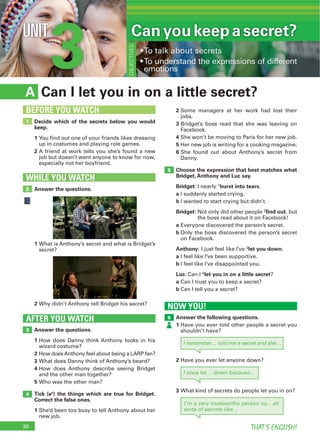
5 Rupert feels unhappy about the way he’s
treated people / the way he’s been treated.
Listen again and complete the sentences.
1 I wish I … behaved differently. If only I hadn’t … so naive!
2 I … realised what was happening much earlier and I … tried to do something.
3
4 If I’d known what Rupert was really like, I ... never … promoted him.
5 I wish I … so ambitious.
6 If I’d realised how lonely I would feel, I … more effort to build relationships with my colleagues.
7 I really … Patricia the way I did.
2a
2b
I think the quote from Sean Covey is very
true. In order to be the best at something
we just have to beat the other people we
are competing with.
Actually, I don’t agree at all.The world is a
very large place and there’s always someone
somewhere who’s better than you, even if you
haven’t met them or even heard of them.
Never compete with someone
who has nothing to lose.
BALTASAR GRACIÁN
(Jesuit priest)
Instead of playing to win, I was playing
not to lose. It reminds me of the story
I once heard about two friends being
chased by a bear, when one turned to
the other and said, ‘I just realised that
I don’t need to outrun the bear; I only
need to outrun you.’
SEAN COVEY
The 7 Habits Of Highly Effective Teens
Anytime you find someone
more successful than you are,
especially when you’re both
engaged in the same business
– you know they’re doing
something that you aren’t.
MALCOLM X
The Autobiography of
Malcolm X
Expressing past regrets
There are three main ways to express regrets in the past:
I wish or If only + past perfect
I wish I hadn’t accepted this job. If only I hadn’t accepted this job.
should have + past participle
He shouldn’t have given the promotion to Rupert. He should have had better judgement.
regret + -ing / noun
I regret leaving / having left my previous job. I regret the way I treated her.
page 137
Patricia Gerry Rupert
83THAT’S ENGLISH!
UNIT 7
73
74
73
74
Complete the regrets with the correct form of the verbs in brackets.
1 I regret / regretted my behaviour at the meeting. (regret)
2 If only he … harder when he was at school! (work)
3 I wish I … that. (not say)
4 If only I … in such a hurry when I sent that email! (not be)
5 We regret … for a higher salary. (not ask)
6
Have you ever (not) done any of the following and then regretted it? Discuss with a partner.
3a
3b
not told someone your true feelings
not persevered with something
broken someone’s heart
lied to a close friend asked someone out
failed to take up an opportunity
not been brave enough
4a
4b
5b
5a
6a
Monologue: a competitive situation
Listen to Patricia Torres telling an anecdote
about a competitive situation.
Listen again and choose the correct answers.
1 Patricia worked in education / sales / senior
management.
2 In her department, there was a particularly
competitive atmosphere / people helped each
other / there was no competition.
3 Gerry was a temporary replacement for Alison /
new boss / new deputy sales manager.
4 Gerry gave Rupert a new job / Patricia’s
contacts and sales region / Patricia’s job.
5 Patricia wishes she had fought harder / had left
the company earlier / hadn’t tried to change
the situation.
Patricia uses expressions to structure her
anecdote. Listen and complete the expressions.
Listen again and check.
You are going to talk about a time when you
were in a competitive situation.Think about the
questions below and make notes.
1 When and where did it happen (work / sport or
leisure / personal relationships)?
2 Who were the people involved?
3 What were the positive / negative effects of
the competitive atmosphere?
4 What happened in the end?
5 What regrets / other feelings do you have
about the situation?
6 What would you do if you found yourself in a
similar situation again?
Tell your partner about your experience. Use
your notes from activity 6a to help you and
include expressions from 5a to structure your
anecdote.SETTINGTHE SCENE
At the 1… , I was deputy sales manager.
2… , one day, our boss announced that she
was leaving.was leaving.
INTRODUCING SURPRISING OR
INTERESTING FACTS
3... I’d been waiting for. As it 4… ,
Rupert was extremely ambitious, 5… who got
my old region and all my contacts?my old region and all my contacts?
CONCLUDING AND SUMMARISING
To 6… a long story … . Looking 7… on it now,
I wish I had behaved differently.
I always wish I’d asked Sally, this girl
in my class, out on a date. But I was
too shy to tell her how I really felt!
Yes, I agree.You should have asked
her out.
6b
The most competitive situation I’ve ever been
in was when I was at high school.There was
this... in my class who was my rival.We were
both good at…
84 THAT’S ENGLISH!
NOW YOU!
Do you know any ghost stories? Tell your
partner about them.
6
8UNIT
Ghost storiesA
7 Colin wanted to stay at the guesthouse so that
he and Karen could investigate and … .
Answer the questions.
1 What did Karen do when she heard the
moaning sound?
2 Why didn’t Karen go and tell Colin about the
sound?
3 What confession did Colin make?
4 According to the landlady, where was the killer
when he told his story?
5 Why had the killer asked to use the woman’s
phone?
6 Who had cut the woman’s finger off?
Use the correct form of the verbs from the box
to complete the story.
Complete the sentences.
1 The Daltons had gone to London to celebrate
their ... wedding anniversary.
2 It must’ve ... when the Daltons went to bed.
3 During the night Mr Dalton heard a kind of
strange … sound.
4 Mrs Dalton thought that Mr Dalton had seen
the face at the window because he … .
5 The newspaper article told the story of a
murdered woman whose … finger had been
cut off.
6 The stories of moaning noises coming from
room 6 started after … .
AFTER YOU WATCH
3
5
4
Tick (4) the things you would do if someone
told you a house had a ghost in it.
1 I’d want to spend the night there to see if it was
true.
2 I wouldn’t believe a word of it.
3 I’d want to hear any stories about who the
ghost supposedly was.
1
BEFORE YOU WATCH
A good read
OBJECTIVES
Answer the questions.
WHILE YOU WATCH
2
1 Why do Karen and Colin want to stay at the
guesthouse in Hazel Lane?
2 Who are the two main characters in Karen’s
story?
attack send carry whisper haunt see
moan murder help
I’m going to tell you the story of the ghost
of the little Raimunda. On the corner of
Alcalá Street is the Palacio de Linares
which is supposedly… by…
In the 18th century, 46 Spanish soldiers 1…
to Scotland to 2… the Jacobite Rebellion.
The soldiers were stationed in Eilean
Donan Castle. One day, the English 3… and
all the soldiers 4… . People say the castle
5… by one of the soldiers who 6… on many
an occasion 7… his head under his arm and
has been heard 8… and 9… in the gift shop!
85THAT’S ENGLISH!
The speakers below were asked the following question: Are you more interested in non-fiction
or fiction? Why? Give examples.
1 How many of the five speakers do you think will say they prefer non-fiction to fiction?
2 Watch the video to see if you were right.
Complete the sentences below with the names of the speakers.
1 ... prefer to read non-fiction. 3 ... reads both fiction and non-fiction.
2 ... prefer to read fiction.
Are the statements true (4) or false (7)? Correct the false ones.
1 Nip prefers to go to quizzes in pubs rather than read books.
2 Lauren’s taste in books has changed as she has got older.
3 Karen chooses to read either non-fiction or fiction depending on how she feels at the time.
4 Ruth enjoys books where the actual story doesn’t matter.
5 Andy doesn’t like non-fiction because it isn’t exciting enough.
8b
8a
7
ACTIVATE YOUR ENGLISH!
Tick (4) the statements you agree with.
1 I don’t particularly read too many fiction stories
or books.
2 As I’ve got older, I like to read about true life
events and people’s experiences.
3 I like reading a bit of both (fiction and non-
fiction). It will just depend on how I’m feeling.
One you are learning from, and one you can
lose yourself in.
4 I’m pretty conventional in my reading. I like
things with a good story.
5 Fiction because it’s nothing like real life, so
that’s perfect.
Match the words in bold (1-5) from activity 9a to
the synonyms (a-e).
a disconnect from reality d quite / rather
b similar to e really
c things that really happened
Use the words in bold from activity 9a to
complete the text below.
9a
85
STREET INTERVIEWS
9b
9c
just been images ever colourful loved
Use the words from the box to complete Karen’s
description of her favourite childhood book.
Karen Ruth AndyLaurenNip
ever happens again, but who knows? I must
admit I find science fiction 4… boring, but
whenever I get my hands on a war story I just
5… myself … it.
My favourite book from my childhood is The
Cat in the Hat. I don’t know why, I 1… always
2... that story, and it was one of those that the
3… were so fantastic, they were so 4… . I read
it to my brothers and that I would say has 5…
one of my favourite books 6… .
complete the text below.
I love books about 1... that happened during
wars. I’m 2… interested in the First and
Second World Wars. I hope nothing 3… that
10
NOW YOU!
Tell your partner about your favourite book from
your childhood.
11
My favourite book from my childhood
is… It’s about… and I like it because...
I used to read it with / when...
86 THAT’S ENGLISH!
A good read
Match the book covers (1-6) to the genres (a-f).
READING
a science fiction (sci-fi) d thriller
b romance e historical
c crime f gothic
What kind of fiction do you prefer? Why?
Read the first paragraph of the story.What kind
of novel does the writer want to produce?
Complete the story with the missing sentences.
a All of a sudden, the wind stopped and the only
sound was the lonely call of a bird.
b When I brushed it away, the woman had gone.
c The plot would follow Magenta’s journey to
look for her brother who had disappeared
several years before.
d I was happy to be on my own and far away
from my busy life in London.
e It was rainy and cold outside, the kind of day
which reminds you that winter must be just
around the corner.
f So it can’t have been a surprise to anyone when
I decided to write a gothic novel of my own.
Which words from the text could you use to
describe... ?
1 a dark cold place (adj: paragraph 1)
2 the loud noise of a door being closed (vb:
paragraph 4)
3 a sharp rise or fall (adj: paragraph 5)
4 a quick short movement of air (n: paragraph 5)
5 an involuntary shake of the body (vb: paragraph 5)
6 feeling uncomfortable and worried (adj:
paragraph 5)
1b
2b
3
2a
86
1a
1
2
3
4
5
6 1
You must have seen these covers in bookshops, the
ones with the dark tower; the gloomy churchyard;
the pale girl with a body as fragile as glass; perhaps
a vampire, perhaps a tormented poet. Books with
covers that promised more of this shadowy world
had been the ones I had always chosen to read as
a teenage girl. 1... I dreamed that my gothic novel
would get published, be short-listed for a prize and
become a best-seller!
2
Thinking about the story and setting, I had
decided that my main character would be a girl
called Magenta, who never speaks and who lives in
Scotland in an old castle by the sea. 2… .
Voices from
the tomb
Karen Wilkens
87THAT’S ENGLISH!
UNIT 8
87
Read the story again. Are these sentences true
(4) or false (7)? Correct the false ones.
1 The writer assumes that the reader knows
nothing about gothic fiction.
2 The writer has been attracted to gothic fiction
since she was a teenager.
3 The writer travels to Scotland to start writing.
4 The writer had worked nearly all day before
deciding to go out.
5 It was raining when the writer left the house.
Put the events in the order they happened.
1 The rain stopped.
2 It was getting dark.
3 The writer decided on the setting and main
characters for a novel.
4 The writer saw a mysterious woman.
5 The writer dreamed of writing a novel.
6 The writer left London to stay in a cottage.
7 The writer walked up the hill.
8 The writer was working all afternoon.
Work with a partner and discuss what you think
will happen next.Which of these options do you
prefer? Explain why.
1 A stranger knocks at the door and tells the
writer to leave the house immediately.
2 There is a violent storm and the mysterious
woman from the hill appears in the house.
3 The writer dreams that the house is on fire.
Listen and check. Which option does the writer
choose to continue the story?
Match the words from the box to the questions.
1 Where does the story take place?
2 Who is the story about?
3 Has the story been rewritten as the script for a
film?
4 What big issue is the novel about?
5 What important events happen in the story?
6 Is there another book after this one with the
same characters?
7 What kind of fiction is this?
8 Is the book part of a sequence of books with
the same characters?
Think about your favourite book and answer the
questions in activity 7a.
4
5
6a
7a
6b
7b
76
TRACK 75
3
I finally started writing in October when I rented
an old cottage in the north of England. It was three
kilometres from the nearest neighbour and there
was no television or Internet to distract me. 3… .
4
On the third day, I had been working until late
afternoon. 4… . After a while, the rain had stopped
and I decided to get some fresh air so I pulled on
my heavy coat and boots and slammed the front
door behind me as I headed up the hill.
5
Marching up the steep stony path behind the
house, I arrived at an open field which gave me
a view of the valley and the full force of the cold
wind in my face. 5… . As I turned to go back down
the hill, I suddenly became aware of the silhouette
of a woman. At that moment, a gust of wind blew
hair into my eyes. 6… . I shivered. I was cold.
Clearly there was no one there, but at that point, I
started to feel uneasy so I hurried home.
6
By the time I got back to the cottage, it was
completely dark outside and it was starting to
rain. I was glad to switch on the lights and be back
inside a warm dry house, but I suddenly felt very
tired. I decided to have a light supper and go to
bed early.
I much prefer the second option. I
love the idea of the narrator actually
meeting the strange woman and…
plot theme setting main characters
sequel screen play genre series
THAT’S ENGLISH!
A good read
88
LANGUAGE STUDY
Match the sentences (1-8) to the reasons or
results (a-h).
1 He can’t have gone far. d
2 She must have worked very hard at school.
3 There isn’t any milk left in the fridge.
4 I’ve looked everywhere for my car keys.
5 The lights are all off in the house.
6 They can’t have taken the dog to the park.
7 You must have felt very sad to leave your job.
8 I found this old rounded stone on the beach.
a They could have gone to bed early.
b She’s got really good exam results.
c My teacher says it might have been used as an
axe in the Stone Age.
d I’ve just seen him in the kitchen.
e The children must have drunk it all last night.
f You’d worked there for many years.
g I think I might have lost them.
h I can hear it barking.
Listen and repeat the contracted sentences. Pay
attention to the intonation and word stress.
Rewrite the sentences using modal verbs + the
perfect infinitive.
1 I am sure this was a valuable vase.
This must have been a valuable vase.
2 I am sure he stole the money.
3 It’s possible they were hiding in the library.
4 It’s impossible he asked her to marry him.
5 Maybe you saw a ghost.
6 It is impossible they were travelling by train.
7 It’s possible the suitcases went to another
airport.
8 It’s impossible he went to the show, he hasn’t
got any money.
Rewrite the information in one sentence. Use
the correct past tenses.
1 Peter fell asleep at the wheel. He was driving
all night.
Peter had been driving all night when he fell
asleep at the wheel.
2 The storm wrecked the house. We heard the
storm warning on the radio.
By the time we … the storm warning on the
radio, … .
3 The police caught the thief.The thief travelled
in disguise for three months.
The thief … in disguise for three months
before … .
4 Their romance went on for years. She gave
birth to a baby in secret.
Nobody knew about their romance but it … for
years, and she … .
5 She went up the mountain. Snow was falling
for days.They warned her.
She … the mountain even though they … her
that … .
6 We missed the film. Everybody was leaving.
By the time we ... to the cinema, the film …
and … .
Listen and decide if the speakers use
contractions or not. Choose the correct options.
1 He can’t have / can’t’ve lost his job.
2 She must have / must’ve been very tired.
3 I think we might have / might’ve missed the
last bus.
4 My sister could have / could’ve helped me
more.
5 They couldn’t have / couldn’t’ve left already.
6 You mustn’t have / mustn’t’ve understood
properly.
1
2a
3
4
2b
77
78
Modals for speculation in the past
▶Look at the verb form after the modals in these
sentences. Is the modal verb followed by the
infinitive or by the perfect infinitive?
1 You must have seen these covers in
bookshops.
2 It can’t have been a surprise to anyone.
3 Could it have been the wind?
Revision of past tenses page 138
page 138
Pronunciation
In spoken English we usually contract have (/əv/)
in past modals.
Must have = must’ve /mʌstəv/
page 147
THAT’S ENGLISH!
UNIT 8
Several months ago I had the worst week
of my life. On that day I lost my job,
my boyfriend and my best friend! It all
started when we decided to go on holiday
together. We’d all been working very hard
for ages and needed a break…
Listen to these people discussing who the man
on the boat might be. Which idea do they think
is most likely? Why?
1 A fisherman who has survived a storm.
2 An immigrant trying to reach another country
in a homemade boat.
3 A pirate planning to take over a boat.
Choose the most suitable expression for these
sentences.
1 The circus gradually sold all the animals and it
was only … that the circus finally closed.
2 The weather was fine but … clouds appeared
and it started to rain.
3 … I was a child, so I don’t remember the
details.
4 He wasn’t enjoying his new job, so … he told
them he was leaving.
5 I met him … when I was working as a doctor in
Namibia.
6 I tried learning to play the piano for years but
in the end I … gave up.
7 Would you like to meet for a drink? I haven’t
seen you … !
Complete the extract from a story with the
correct verb tenses.
Talk about a difficult day you have had. Use
some of the expressions from activity 6a to help
you.
Complete this text about ghostwriters with the
words from the box.
5b
6a
5a 6b
7
There could be no mistake. The men could
see clearly that it was a body and it 1… (float)
towards their boat. ‘I’ll stop the engine,’ Jim
said. Leaning over the side, the two men 2…
(grab) the man’s legs. It was only then that
they saw the man 3… (breathe).
Five minutes later, they 4… (pull) the man
onto their boat. He 5… (groan) as Sam
splashed some water onto his face.
The man 6… (lie) across a plastic drum
with some bits of wood tied to it. They 7…
(wonder) how far he 8… (travel) like that and
how on earth he 9… (survive).
89
79
It all happened when for ages at this point
eventually several years ago
all of a sudden after a while
hardback paperbacks cover blurb
author autobiographies royalty
best-seller publishers
Ghostwriters
Walk into any bookshop and the shelves
are full of 1… by celebrities. Actors, chefs
and athletes all have their stories to tell.
Or do they? In fact, 90-95% of those books
are written by ghostwriters: professional
writers whose name never even appears
on the 2… . And, if the book goes into the
3… Top 10 list, it is the celebrity 4… who
gets a 5… or percentage of the sales and
the ghostwriter just gets a fee. But most
books are not immediate best-sellers
whoever actually writes them. Most writers
are rejected by 6… . Even JK Rowling
was rejected several times, and her first
book only sold 5,000 copies in the more
expensive 7… edition before the Potter
series became a phenomenon and the 8…
flew off the shelves. So, the next time you
read the 9… on the back of a book claiming
the writer tells their story ‘with humour and
honesty’, you might wonder whose words
you are reading!
90 THAT’S ENGLISH!
A good read
B
Look at the picture of the chalk carving of a
giant. How old do you think it is? Watch the
video and check your answer.
Answer the questions.
1 What prize did Keri Hulme win and what was
her book about?
2 What was the Beat Generation in the USA
about?
3 What did the book Uncle Tom’s Cabin help to
abolish?
4 What prize did Alice Munro win in 2013?
5 What did the Australian writers write about?
6 What did Robert Burns dedicate a poem to?
Look at the names of famous writers from the
British Isles. Tick (4) the ones which are from
Ireland. Are there any that surprised you?
Are the statements true (4) or false (7)? Correct
the false ones.
1 The Dublin Writers Museum only has
information about writers who are no longer
alive.
2 Ireland doesn’t have a lot of great legends.
3 Oscar Wilde spent time in prison in England.
4 The novel Ulysses is about one day in the life
of a man travelling around Dublin.
5 A description of the tower, now known as
the James Joyce Tower, can be found in the
second chapter in Ulysses.
THAT’S IRELAND
4
Match the names of the writers, books and
poems to the countries.
SAME LANGUAGE, DIFFERENT LIVES
3
Watch the video and tick (4) the statement
which is not true.
1 The Cerne Abbas Giant is the biggest chalk hill
figure in Britain and is also referred to as the
rude man.
2 There are different theories about the giant,
one being that he is a figure of Hercules.
3 Another theory is that he is a cartoon caricature
of the strict puritan Oliver Cromwell, 17th
century head of the British government.
4 There is a local myth that he is a Danish sheep
eating giant, killed by local farmers who drew
a line around his body to frighten other giants
away.
5 He may also be a pagan symbol of fertility and
there are people who say they were conceived
on the giant.
6 The local woman is happy that he attracts
tourists but says that some people are a bit
upset by his nakedness.
7 Locals say that if the giant doesn’t like new
people then they have to move out within six
months.
8 The giant was once covered up during the 2nd
WorldWar to stop the Germans using him as a
navigation point.
2 5
1
DOCUMENTARY
Let me tell you a story...
6
NOW YOU!
7 Talk to your partner about the greatest writers
and poets from your country.
I can think of a number of great Spanish
writers. One is Miguel de Cervantes who
wrote Don Quixote and another is…There
are also many great writers who are still
alive, for example, …
Have you read contemporary poetry? It’s
by far...
On the road Waltzing Matilda
Harriet Beecher Stowe Anne of Green Gables
Banjo Paterson Jack Kerouac
Katherine Mansfield UncleTom’s Cabin
Henry Lawson Keri Hulme The Bone People
L.M. Montgomery Alice Munro Robert Burns
New Zealand Canada Scotland
USA Australia
SIR WALTER SCOTT OSCAR WILDE
JAMES JOYCE BRENDAN BEHAN
SAMUEL BECKETT BRAM STOKER JANE AUSTEN
WILLIAM BUTLER YEATS CHARLES DICKENS
JP DONLEAVY EDNA O’BRIEN
GEORGE BERNARD SHAW JONATHAN SWIFT
91THAT’S ENGLISH!
UNIT 8
Read the web page.Which sentence best summarises the text?
1 The web page is for people who want suggestions about setting up a book club.
2 The web page offers advice on how to choose books for a book club and which authors to choose.
1
SKILLS WORK
What advice does the web page writer suggest
about ... ?
1 the ideal maximum number of people in the
group
2 what to do about food
3 choosing which books to read
Listen to a radio programme in which people
talk about a favourite book. What type of book
does Steven talk about?
1 science fiction 3 romance
2 crime 4 none of these
Listen again and answer the questions.
1 The main character in the book is
unconventional because … .
a he is a detective
b he can read people’s emotions
c he is autistic
2 The book is unconventional because … .
a it has lots of diagrams, symbols and algebra
b there is a dead dog in it
c it is a detective story
3 In the book we … .
a see ordinary people in ordinary places
b get a special view of ordinary things
c find nothing is ordinary
4 As he read the book, Steven was … .
a bored b fascinated c shocked
Tick (4) the expressions Steven uses to describe
the book.
it made me think magical
unconventional moving
a tense detective novel I couldn’t put it down
a real page-turner made me laugh
Think about the last book you read and answer
the questions. Discuss them with a partner.
1 Why did you choose to read this book?
2 What is it about? Be brief.
3 Would you recommend it? Why (not)?
2
3a
3b
81
The last book I read was The BookThief by
Australian author Markus Zusak. I’d seen the
film and found it very moving and emotional,
so when I saw the book in an airport
bookshop, I knew I had to read it! Anyway, …
4
3c
8181
Here are some top tips for a
successful book group and some
suggestions for what to avoid.
A book club works best if you keep
to a regular meeting time once a
month. It is also most successful if it
is not too big. Have a maximum of 12
people: any more than this and you
won’t have enough chairs for your
guests!
It is also best if each member takes
it in turn to host the meeting in their
home, but remind everyone that
this is not a gourmet club! Having
something to eat and drink is a
good idea, but again, keep it simple
and get everyone to bring some
food to share.
It is often difficult to get people to
agree on which books to put on the
reading list. Some people want to
read classics, others want books
that make them think or laugh or
cry or that are simply on the latest
best-sellers list. In our case, we
ended up choosing books by putting
titles in a box and pulling them out
like lottery tickets!
So, based on my own experience,
if you are going to start your own
book club, I think you should:
keep the group small, rotate
meetings between the homes of
members, share responsibility
for refreshments and lastly, find a
way to agree on a reading list that
includes suggestions from everyone.
Happy reading!
Are you a ‘bookworm’? Love nothing better than
disappearing with a good book? Maybe it is time for
you to share the love!
Start your own book club
TRACK 80
92 THAT’S ENGLISH!
A good read
WRITING
Answer these questions.
1 Do you ever read book or film reviews? Why (not)?
2 What kind of information would you expect to find in a book or film review?
3 Have you ever recommended books or films to people? Why did you recommend them?
Read the reviews about The Hobbit and A Most Wanted Man and answer the questions.
1 How does the writer describe Bilbo Baggins and Gandalf?
2 What two reasons does the writer give for recommending The Hobbit?
3 What type of film is A Most Wanted Man?
4 How does the writer describe Seymour Hoffman’s performance?
1
2
The film begins when a thin exhausted man pulls
himself out of the sea. Who is he and what is
he doing in Hamburg? In the post 9/11 world,
any stranger is a potential terror suspect and
the security forces are certainly interested in
finding this man.
This thriller keeps you in suspense from the
beginning, but the film is less about the stranger
than about the secret agents and spies who
suddenly appear on his trail. Philip Seymour
Hoffman plays the world-weary spy who puts the
pieces of the puzzle together. It is an extremely
convincing performance and Seymour Hoffman
is totally believable as the secret agent who has
to win the trust of people around him but can
trust no one himself.
The urban setting and the soundtrack add to the
oppressive atmosphere in which the threat of
violence is ever present. This is a psychological
thriller and one that will keep you on the edge
of your seat.
A Most Wanted Man
By Brad Spath
FilmReviewFilmReview
Although it is now part of a mega successful
film franchise, this adventure story began life
as a book by J.R.R. Tolkien, and if you haven’t
read it, then my advice is to start with the book
itself. Tolkien is a master storyteller and it is
spellbinding, not just for children, but for anyone
who enjoys a classic fantasy adventure set in a
world inhabited by giants, dwarfs and hobbits.
The story begins with an unexpected party at
the house of the hobbit, Bilbo Baggins, and it
continues as a series of captivating adventures
in the quest to find the dragon’s gold. Bilbo is
the reluctant hero of the story and the journey
is punctuated by extraordinary danger, and
unexpected magical help from Gandalf, a wise,
elusive wizard.
I would strongly recommend this book to readers
of all ages for its pure escapist entertainment. It
also has a very positive message of loyalty and
friendship expressed by characters who help or
rescue one another from the constant dangers of
the shared journey.
The Hobbit
By Lynn Ashraf
BookReview
93THAT’S ENGLISH!
UNIT 8
Categorise these sentences depending on whether they refer to films (f), books (b) or both (f/b).
1 The music score and sound effects create a terrifying atmosphere. f
2 The plot is full of surprises and unexpected events.
3 The cast gave magnificent performances.
4 The author has won several prizes.
5 It took a team of three writers to come up with the script.
6 All the scenes were shot on location in Ireland.
7 Most critics think it is a masterpiece.
8 The descriptions of places are poetic and beautiful.
Complete the sentences with the adjectives from the box.
1 The actor gave a … performance because he lacked confidence.
2 We were all crying at the end of the film because the plot was … .
3 The special effects were worth every penny because they were … to the success of the film.
4 I didn’t believe that the characters would behave like that: I found the plot totally … .
5 The plot was too … so I couldn’t understand the story.
6 The show holds your attention from beginning to end, it is … .
4
5
Writing Reference page 145
Look at the review of The Hobbit and match the paragraphs (1-3) to the contents (a-h).
a the main characters
b suitable readers
c reasons for recommendation
d background information about the book
e themes and message
f name of author
g the setting
h the plot
3
The Hobbit
Paragraph 1
Paragraph 2
Paragraph 3
heartbreaking unconvincing disappointing spellbinding crucial complicated
6a
6b
6c
Writing a book or film review
Think about a book or film you would like to review and make notes about the following:
1 Background information: title and author or director.
2 Location and setting: find adjectives to describe the setting and atmosphere.
3 Main characters: write two adjectives to describe each character.
4 Plot or story: summarise the main story in not more than three sentences.
5 Strengths: what did you like best about it? What adjectives describe your reaction to the
book or film?
6 Weaknesses: what aspects were less successful? What adjectives describe these aspects?
7 Recommendation: what kind of people would like this film or book? Make your
recommendations.
Group the information in activity 6a into three paragraphs.
Write your review (175-200 words). Remember to include the following:
a brief description of the plot, characters and / or actors: but don’t spoil the ending!
a description of what you liked most and least and explain why
your recommendation
94 THAT’S ENGLISH!
9UNIT The gender gap
OBJECTIVES
It is okay for girls to be boxers, isn’t it?A
6
a b c
Answer the questions.
1
2
3
4
5
Match the expressions in bold (1-5) to their
synonyms (a-e).
1 stand up for
2 put down
3 laughed at
4 Real
5
sexist
a c e
b d
Use the words in bold in activity 5 to complete
the text.Choose the correct option.
1
a b c
2
a b c
3
a b c
4
a b c
5
a b c
AFTER YOU WATCH
3
5
4
6
Do you agree with the statements below?
1
2
1
BEFORE YOU WATCH
Answer the questions.
WHILE YOU WATCH
2
1
2
NOW YOU!
Explain how you feel about sexist behaviour
and language.
7
I get really angry when people…
I also hate it when…
1
2 3
4
5
95THAT’S ENGLISH!
ACTIVATE YOUR ENGLISH!
10a
95
STREET INTERVIEWS
Match the words in bold (1-4) to their meanings
(a-d).
Jude: 1stay-at-home
dads
Lauren:
2entrepreneurs
Karen:
3push boundaries further
Charlotte:
4atrocious
a
b
c
d
The speakers below were asked the following question: What are the main differences
between women and men’s roles in today’s society?
1
2
Complete the sentences with the names of Jude, Peter and Charlotte.
1
2
3
Are the sentences true (4) or false (7)? Correct the false ones.
1
2
3
4
5
6
9b
9a
8
10b Use the words in bold in activity 10a to complete
the sentences below.
1
2
3
NOW YOU!
11 Have you ever been or felt discriminated against
for gender reasons? Do you know anyone who
has?
As I’m a man, I’ve never felt discriminated
against for gender reasons, but my sister…
96 THAT’S ENGLISH!
The gender gap
Which of the photos do you think show typical
behaviour associated with boys and girls in
your culture? Why?
‘Boys will be boys’ is a well-known English
saying. What do you think it means? Do you
think it’s true?
1
2
3
Read the text.What is it about?
1
2
3
Read the article again. Are the following
statements true (4) or false (7)? Find information
in the text to justify your answers.
1
2
3 fa’afafine
4
5
READING
3
1a
1b
2
6 bacha posh
7
8
Boys will be boys...
(or sometimes girls)
It’s the 21st century and things are looking up
for gender equality. There are female priests and
presidents, male nannies – the mannie – and an
awareness of the need to avoid gender stereotyping
when raising children. But how far would you go in
reversing gender stereotyping? Some cultures take
it to unusual lengths.
Samoa’s third gender
In Samoa, there is a widely-accepted practice of
raising boys as girls known as fa’afafine – ‘in the
manner of a woman’. Gender identity is closely
linked to a person’s role in the family. So essential
is it to have a daughter, parents with several sons
look to raise one as a girl to take on the traditional
role of caring for elderly parents. Sometimes,
parents believe a child has been born with the
fa’afafine spirit and is naturally drawn towards
more feminine behaviour. But what are the results
of such a momentous decision?
Leo was raised as a fafa and has somewhat negative
views of his experience. ‘Frankly, I felt very isolated
growing up, and I used to look on while my brothers
played football and wish I could be one of the boys.’
3
4
1
2
97THAT’S ENGLISH!
UNIT 9
6
Match the phrasal verbs (1-6) to their meanings
(a-f).
1 4
2 5
3 6
a
b
c
d
e
f
Complete the sentences with a suitable form of
a phrasal verb from activity 5.
1
2
3
4
5
6
Discuss the questions with a partner.
1
2
3
4
5
(onlinesource)
7
I look up to those who stand up for what they
believe is right… and I look down on those
who bully others.
TRACK 83
However, some fafas find the experience very
enjoyable even though they later decide to live as
men in adulthood. Many continue to live as women,
though. ‘It’s important that we understand fa’afafine
within the matriarchal cultural context of Samoa. It’s
looked at as perfectly normal,’ said a spokesperson
for Samoan affairs.
Girls will be… boys
Such is the importance of having a son in some
patriarchal cultures that parents will disguise girls
as boys. In Afghanistan, this is an old tradition
known as bacha posh which began centuries ago to
protect girls from attacks by invaders.
The Rafhat family dress one
of their four daughters as a
boy. ‘We did it because, in
Afghanistan, society looks
down on people who have no
son,evenifyouaresuccessful
in life,’ said Mrs Rafhat. ‘Now
that we have a son, everyone
looks up to the whole family.
I used to live as a boy myself
and it gave me confidence
and helped me succeed. A
good parent always tries to
do the best for their child.’
Unlike in Samoa, those girls brought up as the
opposite sex always revert to their true gender
when they become teenagers. Although human
rights campaigners are critical of the tradition, it is
still extremely popular. Many women delighted in
the freedom they had when they lived as boys and
want to give their daughters the same opportunity.
However, few ask the important question behind it
all: when will girls have the same freedom as boys
without denying their identity?
Complete the summary: write S for Samoa,A for
Afghanistan, B for both Samoa andAfghanistan.
4
1
2
3
4
5
6
7
8
9
98 THAT’S ENGLISH!
The gender gap
98
LANGUAGE STUDY
1
2
4c
4a
4b
3
is the importance was the wind was he
did she arrive had he lied was the place
is the drug problem
Join the two sentences using so / such + that to
make the first part more emphatic.
1
We were so late that we missed the plane.
2
3
4
5
6
Complete the sentences with the missing
phrases from the box.
Rewrite the sentences to make them more
emphatic using so / such at the beginning.
1
So old was the book that it fell apart in my
hands.
2
1 is the drug problem
2
3
4
5
6
7
3
4
5
6
7
Listen to the conversations and answer the
questions.
1
2
Listen again and choose the correct terms used
nowadays.
1
2
3
4
5
6
7
8
Complete the sentences with the correct word
from activity 4b.
1
2
3
4
5
Titanic
6
7
8
Revision of so and such + that
84
84
Questions for effect: rhetorical questions
▶Which is more dramatic and emphatic?
1 We don’t know what the results of such a
momentous decision are.
2 What are the results of such a momentous
decision?
page 140
Inversion after so and such
After so and such, an affirmative sentence
structure is replaced by the question form
(auxiliary + subject + main verb).
So essential is it to have a daughter that
parents decide to raise one son as a girl.
Such is the importance of having a son in
some male-dominated cultures that parents
will disguise girls as boys.
page 140
99THAT’S ENGLISH!
UNIT 9
7
8
6b5
6a
look at so such look up to
look to chair their
Rewrite the sentences in bold to make them
more dramatic and emphatic. Start with the
words in brackets.
1
They didn’t know if they would ever overcome
them.
Would they ever overcome the problems?
2
They didn’t
know if he would ever learn to change his
ways.
3
I wonder what adventures lie ahead.
4
She was worried about who would look
after it after she had gone.
5
We are not sure
they will ever happen.
6
I have to tell you the same thing again and
again.
Read the text and answer the questions.
1
2
Rewrite the sentences so that they are gender
neutral.
1
The moon landing was a small step for humans
but a giant leap for humankind.
2
3
4
5
6
7
Underline the stressed syllable. Listen, check
and repeat.
1 4 7
2 5 8
3 6
Complete the text with the correct form of a
word from the box.
85
Plural pronouns used with a singular subject
A good parent always tries to do the best for
their child.
page 141
If you love somebody
SET THEM FREE
Languages always reflect the culture they
developed in. The patriarchal nature of
English society in the past favoured the
use of the singular with he and his, e.g.
‘If a child is forced to write with his right
hand, he may suffer frustration.’ Currently,
a growing revelation in society of the need
for greater equality has led to the use of
plural pronouns as singular (they, them and
their), e.g. in the song, If you love somebody,
set them free (Sting). Additionally, the terms
man in a generic sense and mankind should
be replaced by humans, or humankind.
Male
primary
teachers
in demand
A quarter of British
primary schools have
no male teachers,
according to the 1... of a government committee
researching the effects of male teachers. ‘The
Ministry of Education is 2... increase the number
of male primary teachers by 10%. 3... strong is
the belief that women are better at caring for
young children that men don’t even apply for jobs
in primary schools. Of course, a good teacher is
effective whatever 4... sex. Men are 5... as being
a threat to young children whereas in fact, male
teachers have a positive effect. Girls are generally
more willing to learn but boys need someone to
6... and inspire them. 7... is the importance of male
role models that we are actively promoting male
teacher recruitment.’
(onlinesource)
Pronunciation Guide
THAT’S ENGLISH!
The gender gap
B
DOCUMENTARY
Legally, men and women… but in reality…
still a long way to go before…
Gender discrimination
1
5
2
Answer the following questions before you
watch the video.
1
2
3
Watch the video and decide if the statements
are true (4) or false (7). Correct the false ones.
1
2
3
4
5
6
7
8
SAME LANGUAGE, DIFFERENT LIVES
3 Listen to the speakers talking about equal
rights. Match their countries to the things they
mention.
1
2
3
4
5
6
THAT’S IRELAND
NOW YOU!
4
6
Have you ever seen an Irish dancing show?Watch
the video and decide if there is any similarity
between Irish and Spanish flamenco dancing.
Do men and women have equal rights in your
country?
Watchthevideoagainandanswerthequestions.
Claddagh ring
1
Spanish Arch and Spanish Parade
2
3
Galway
4
Trad on the Prom
5
Irish dancing
6
7
8
THAT’S ENGLISH!
UNIT 9
1
SKILLS WORK
Do the quiz to find out your brain gender.
2a
3
2b
Listen to the radio programme and choose the correct answers.
1 each other themselves
2 male female balanced
Listen again to the radio programme and complete the boxes.
Type of brain Advantages Disadvantages
7
Write a summary of your strengths and weaknesses according to the quiz and the radio
programme (100 words).
87
87
(onlinesource)
Mostlya:youhaveafemalebrainandareintuitiveandcaring.
Mostlyb:youhaveabalanceofmaleandfemalequalities.
Mostlyc:youhaveamalebrainandareindependentandcompetitive.
Results:Addupyourscores.
According to the quiz, I have a mostly female brain, and I agree I’m good at understanding
others and social situations. I think ...
If you upset someone, do you
usually understand why?
a Yes, almost immediately.
b In most situations.
c No, it often comes as a
surprise.
Do you like to be in charge of
things at work?
a I’d rather be one of the team.
b Sometimes, but I don’t mind
not leading.
c Yes. Why not when I can see
what needs to be done?
At a social event, how quickly
do you realise someone wants
to join in your conversation?
a I’m instantly aware when
someone is ready to join in.
b I notice fairly quickly.
c Pretty slowly, to be honest.
Why don’t they just join in?
When life is hard, which are you
more likely to experience: anger
or sadness?
a I usually feel very down.
b I experience a mixture of both.
c I tend to lose my temper a lot
at such times.
What kind of things do you
enjoy reading?
a Human interest stories, fiction
and magazines.
b I like a mixture of factual and
fictional books.
c Biographies, newspapers and
factual material.
When you are on a journey, how
do you navigate?
a I use landmarks like churches
and shops.
b I use landmarks and compass
directions.
c I use distances and compass
directions.
Are you good at explaining
things differently if someone
doesn’t understand at first?
a Yes, because there are many
ways to look at things.
b It can be a challenge but there
are usually other options.
c No, because the correct way is
quite clear to me.
If you upset someone, do you1
Do you like to be in charge of2
At a social event, how quickly3
When life is hard, which are you4
When you are on a journey, how6
What kind of things do you5
Are you good at explaining7
HOW DOES YOUR MIND WORK?
DO YOU THINK LIKE A MAN, A WOMAN OR SOMETHING IN-BETWEEN?
Do our quiz and find out if your brain gender is the same as your physical gender!
TRACK 86
THAT’S ENGLISH!
The gender gap
SPEAKING
90
88
89
1
2
3a
3b
3c
In what aspects of life have men and women achieved greater equality so far?What areas still
need improvement? Discuss with a partner.
Listen to Gordon, Adam and Jess having a discussion and answer the questions.
1
2
a
b
c
Match the quotes (1-5) to the photos (a-c) from activity 2. Listen and check.
1 You’ve certainly got a point, but
What’s the point of it?
2 Hang on a minute
3 How else can we show
4 I can see where you’re coming from, but
5 Sorry, can I just stop you there
Look at the expressions in bold from activity 3a. Complete the table with the expression
which is used to:
1 a b
2 c d
3 e f
Listen to the expressions in 3b and repeat using the correct stress and intonation.
We’ve made a lot of progress in education,
but I don’t think there are enough women
in politics or business.
Well, maybe, but women can now choose to
take on those roles or not. Perhaps women
just prefer different types of careers.
a b c
THAT’S ENGLISH!
UNIT 9
91
4a
5
4b
Listen and complete the sentences.
Gordon:
Jess:
Do you think the speakers use this structure to make their point more or less emphatic?
Rewrite the sentences to emphasise the point being made.
1 summer
It’s in summer that I feel happiest.
2 Who what you know
3 meeting his wife
4 The best singer not the prettiest
5 My boss not me
Do you think boys and girls should be treated
differently? Think about the topics below and
make notes.
1 4
2 5
3
6a Work with a partner and discuss the topic. Use
activities 3a, 4b and 6a to help you.
A:
6b
Interaction: a debate
Emphasising a point
We stress the object after It’s in sentences which are emphasising a point.
It’s what you do that’s important.
It’s women who aren’t taken seriously.
It was in the 20th century that gender equality became a social reality.
This expression is often followed by a short contrastive clause with not, which is also stressed
for emphasis.
It’s women who aren’t taken seriously, not men.
page 141
As far as I’m concerned, it
doesn’t matter whether…
Sorry, ....
I can see where you’re coming from,
but I can’t agree with you completely...
As I see it, we need to move on…
You’ve got a point, but…
TOYS: guns for boys and dolls for girls?
Ridiculous!
SINGLE SEX SCHOOLS: girls do better
academically if no boys around, but what
about social interaction?
DISCIPLINE: girls generally better behaved
than boys. Parents often stricter with
boys. 'Big boys don’t cry', etc.
OTHER ISSUES: society more protective of girls;
boys have more freedom and can stay out
later.
B:
A:
B:
A: It’s
104 THAT’S ENGLISH!
Revision 2
OBJECTIVES
LANGUAGE REVISION
2
5
3
104
Complete the text with the correct tense or
form of the verbs in brackets. Sometimes more
than one tense is possible.
1
The Client
1
2
4
6
7 8
10
11
12
14
16
17
The character of Reggie Love was an ex-alcoholic
who had had many problems. Write sentences
about her life with I wish or If only.
1
I wish / If only I hadn’t had to give up my job.
2
3
4
5
6
The character Barry Muldanno was a rather
stupid person and made mistakes. Rewrite these
sentences with should to show his regrets.
1
I should have thrown the body into the river.
2
3
4
5
This is what Reggie wrote about Mark
afterwards. Choose the correct option.
Underline the words you think are stressed for
emphasis in each sentence.
1
2
3
4
5
Listen and check.
4
Mark and his family taught me a lot. When he first came
for help, I was 1really / loads surprised that a child could
be so confident. He certainly has got what it 2brings /
takes to stand up for himself. I felt 3slightly / fairly more
worried about his mother who has had a hard life, but
even she was 4somewhat / quite a lot stronger than
I expected. The police only paid 5lip / mouth service to
their obligation to protect a child so I knew I had to
help. At one point, when Mark ran away I was ready to
6throw / give in the towel and 7nearly / hardly went back
to drinking, but the situation was far 8too / enough
dangerous to give up on him. Anyway, a good lawyer
should never abandon 9their / my client.
92
THAT’S ENGLISH!
Revision 2
8b
9
7
8aComplete the second sentence so that it has a
similar meaning to the first. Write between one
and four words.
1
2
3
4
5
6
7
8
9
10
Complete the sentences with a particle.
1
2
3
4
5
6
7
8
9
10
Complete the sentences with the correct form
of the words in brackets.
1
2
3
4
5
6
7
8
9
Underline the stressed syllable in each word
you formed in activity 8a. Listen and check.
Complete the texts with the correct option below.
1 a b c
2 a b c
3 a b c
4 a b c
5 a b c
6 a b c
7 a b c
8 a b c
9 a b c
10 a b c
11 a b c
6
A
1slums
2
4
6
7
B
8
10
11
93
106 THAT’S ENGLISH!
Revision 2
106
SKILLS WORK
Read the texts and match the headlines to the advertisements.
1 3
2 4
1
VOLUNTEERING
Read the texts again and answer the questions.
Which projects … ?
1
2
3
4
5
6
7
8
Listen to the conversation between Steve and
Angela and tick (4) the jobs that are mentioned.
2
3a
95
The aim of our organisation
is to empower women and
provide decent housing for
families, not only in the USA,
but in many other countries
in the world. We work to train
volunteers in building skills.
Our primary goal is to teach
women how to solve problems
for themselves through training
in practical areas, such as
making cement or plumbing
and dealing with general house
repairs. However, men are also
welcome! Our volunteers work
together with homeowners to
rebuild or restore deteriorated
houses and give disadvantaged
families a place to live. We
welcome volunteers but also
need donations to buy materials
and support our training
programmes.
The aim of our organisation
A
Even if you only have a couple
of weeks to spare, you can join
our volunteer programme in
Tanzania. We need enthusiastic
open-minded people to help
support our permanent team in the
southern area of the country. The
work consists of helping to build
schools in remote areas. This can
include making desks, chairs and
bookshelves as well as helping
in the schools once they have
been established. Volunteers may
be asked to give English classes
or lessons in environmental
awareness to protect the local
forests. Other projects that we
run in the area are related to
reforestation, preparing land and
plantingtrees,andtheconstruction
of wells to provide clean water for
village communities.
Even if you only have a couple
B
The mission of our project is to
improve conditions for children
and teachers in slum areas in
Bangladesh. If you volunteer
with us, you may be asked to
help renovate a classroom in an
existing school, carry out repairs
to roofs or windows or even help
to build extra facilities for the
school. Traditional materials
and techniques are used, but
you don’t need any special skills
because you will be supervised
by local builders and carpenters.
However, you should be fit and
healthy and ready to work in
all weather! You will stay in
the school where the project
is taking place, but it won’t be
like home. Take a mat to sleep
on and remember there are no
showers, just a bucket of water.
The mission of our project is to
C
After the typhoon in 2013, we started this long-term rebuilding project in the
Philippines. Hundreds of schools were destroyed in the north of Cebu Island
and many families lost their homes. Not only do schools need to be rebuilt,
but many children need care while their families struggle to get their lives
back. So, if you don’t feel you could learn carpentry or basic building skills,
we also need volunteers to play games with the children, read stories to
them and help their teachers in the classroom. Accommodation is provided
with local families that have not been harmed by the storms. The price
you pay covers food, your room, insurance and airport transfers. You will
have to arrange your own flights. The minimum stay is one week, but most
volunteers spend at least a month on the island.
After the typhoon in 2013, we started this long-term rebuilding project in the
D
TRACK 94
(onlinesource)
107THAT’S ENGLISH!
Revision 2
Listen again and decide if the statements are
true (4) or false (7). Correct the false ones.
1
2
3
4
5
6
7
Look at each expression below. Write (D) if it
introduces polite disagreement,(O) if it introduces
an opinion and (A) if it asks for an opinion.
1
2
3
4
5
6
7
8
9
10
Discuss the following statements with a partner.
Give examples from your own experience. Use
some of the expressions from activity 4a.
1
2
3
You are going to give a talk for two minutes
about a problem you had with a piece of
equipment. Use these points to help you.
4a
4b
5
3b
I would agree with the first statement.
Men are more aggressive, aren’t they?
I bought a
smartphone
online,
and...
You may be right, but in my experience…
95
Match the pairs of sentences that have a similar
meaning.
1
2
3
4
5
6
7
8
9
10
Complete the table with the sentences from 6a.
Formal Informal
You are going to write a letter of complaint to
a hotel where you stayed. Put the ideas in the
appropriate paragraphs.
Paragraph 1:
Paragraph 2:
Paragraph 3:
1
2
3
4
5
6
7
Now, write your letter. Use the ideas in activities
6a/6b, 7a and the model in unit 6 to help you.
Write 150-175 words.
6a
6b
7a
7b
Useful language:
108 THAT’S ENGLISH!
Underline the key words in the options below.
1 In his late twenties, Scott Harrison … .
a lived like a typical young professional
b made important changes to his life
c was unsuccessful in his profession
Look at paragraph 3 and answer the questions.
1 Which of the highlighted expressions prove
that option b is correct?
2 Which of the highlighted expressions prove
that options a and c are not correct?
Now read the text and choose the correct option
for each question.
1 According to the article, one element of
success can be defined as … .
a being of service to the world
b being true to your ideals
c being a social person
2 Before he was successful, James Dyson spent
15 years … .
a creating prototypes for his vacuum cleaner
b trying to sell his prototypes
c promoting his vacuum cleaner
3 Charity Water was … .
a the first charity Scott joined
b started by Scott
c never successful
4 Jan Stocker’s story illustrates that … .
a her son has had a stimulating life
b her life has been exciting
c it’s possible to overcome problems
1a
1b
2
READING COMPREHENSION I
THAT’S ENGLISH!
The meaning of success
Success in life is often considered to be mainly related
to the quality and quantity of the possessions we
have, or simply to our professional and social status.
However,wecanalsodefinepersonalsuccessinother
terms, those of being satisfied with the simpler things
in life like enjoying life and helping others. If we look
forward to each day with anticipation and feel good
about what we are doing, then we actually already
have a successful life.
'If at first you don’t succeed, then try, try, try
again.' (W.E. Hickson)
Many successful people have had to deal with failure
in their lives. The inventor of the bagless vacuum
cleaner, James Dyson, tried 5,127 prototypes before
he eventually developed his revolutionary model, and
moreover, he also spent 15 years trying to market it
before becoming rich and famous. Yet another famous
inventor, Thomas Edison, failed at school but later
went on to invent devices that changed the world.
'Success is liking yourself, liking what you do
and liking how you do it.' (Maya Angelou)
At the age of 28, Scott Harrison reached a turning point
in his life. He had been working in marketing in New
York for several years and apparently had everything
a young professional could want. Not only did he work
with famous clients and mix with the jet set, but he also
had a bright future ahead of him. However, after an
eye-opening trip abroad, he realised that his lifestyle
was selfish and shallow. So he joined a volunteer
organisation that provided medical treatment in
some of the poorest countries in West Africa. By the
time Scott was 30, he knew that he could use his
experiencetohelpothersanddecidedtofoundCharity
Water, which aims to provide clean water for people
in developing countries. Since it began, the charity
has funded over 13,000 projects in 22 countries and
brought water nearer to nearly 4.5 million people.
That is success!
Multiple choice
Exam tips
Q Highlight key words in the question and options.
While you are reading the text, look for synonyms,
opposites or expressions that refer to the key
words.
Q Find the information that explains why one option
is right and the other options are wrong.
10UNIT Exam Strategies
109THAT’S ENGLISH!
UNIT 10
h many of them have very complicated injuries
i initial investigative research was carried out
j operation is new
k because of spinal injuries
l required cutting into the man’s skull
m has its dangers
n despite daily physiotherapy
READING COMPREHENSION II
'Count the garden by the flowers, never by the
leaves that fall. Count your life with smiles
and not the tears that roll.' (Unknown)
Jan Stocker was told at the birth of her second child
thathewouldneverwalk,talkorbeabletodoanything
by himself. Not wanting to believe such terrible news,
Jan and her husband spent every day stimulating their
tiny baby both physically and mentally. Now at age
10, their child has enough physical mobility to be able
to walk short distances and is even beginning to read
and write. Jan says that despite the difficulties and
effort over the years, just seeing the excitement on her
boy’s face as he sets off for school shows her life has
been a success.
Completing the missing
information
As important as humankind
walking on the moon!
In the not too distant future, thousands of people
who are paralysed 0because of spinal injuries
may be helped by an extraordinary development
in cell transplant research. Surgeons in Poland
have already successfully treated a man, 1…
walk and had no sensation in his lower body,
by using nerve cells from the patient’s olfactory
nerve system to
reconstruct the part
of his spine that
had been severed in
a knife attack. The
operation 2… and
removing cells from
the olfactory bulb in
his brain.
Amazingly, these olfactory cells have a great
capacity for reproducing themselves and so they
canworktogethertoconnectthe3….The38-year-
old man, 4… walk with the aid of a frame, now has
sensation back in his legs and will soon even be
able to drive a car and go hunting with his friends
again. After two years of being in a wheelchair
with no signs of recovery, 5… , the man now feels
like his life is starting over again.
Although this 6… , doctors don’t want to raise
people’s hopes too much and have warned
that the procedure is not guaranteed to work
with all patients. The 7… other patients with
spinal injuries to continue this experimental
project. However, they will only be able to treat a
maximum of ten people over the next few years.
There are currently around 40,000 people with
paralysis from spinal cord damage in the UK but
8…thatmaynotrespondtothistypeoftreatment.
The project 9… a charity that was founded by the
father of a boy who was confined to a wheelchair
after a swimming accident. The 10… in London
but a team of neurosurgeons then collaborated
to perform the actual operation in a Polish
hospital.
Exam tips
Q Look at the information before and after the gap
and try to predict what comes in it.
Q Once you have chosen an option, make sure
the sentence fits by checking the grammar,
punctuation, etc.
(onlinesource)
(onlinesource)
UNIT 10
TRACK 96
Look at the highlighted sentence in the text and
decide what kind of information should go into
the gap.
1 why the people are paralysed
2 when the people became paralysed
3 what kind of people are paralysed
Look again and decide which option fits best
grammatically.
1 many have very complicated injuries
2 the broken nerves in the spine
3 because of spinal injuries
Now complete the text (1-10) with the missing
information (a-n).There are three extra phrases
you don’t need.
a is funded by
b surgical team is looking for
c broken nerves in the spine
d who has already begun to
e seems to be a miracle cure
f who was unable to
g other patients in the project
1a
1b
2
TRACK 97
110 THAT’S ENGLISH!
Exam Strategies
Look at the introduction, statement and options
in the sample question below. Underline the key
words.
Options a and b above are incorrect. Listen to
the first part of the recording and correct the
information that is wrong.
Now listen to the rest of the programme. Choose
the correct option. You will hear the recording
twice.
1 Mr and Mrs Johnson pay less for staying in a
motel because … .
a they help with the redecorating
b they book a room the year before
c they book a less comfortable room
2 The motel room has … .
a cooking facilities and aTV
b cleaning services
c a lot of space for clothes
3 HarryYoung … .
a built his own accommodation
b lived in a car park
c worked in a team to make a shopping mall
4 HarryYoung’s room … .
a had a toilet
b had basic furniture
c was complicated to get in and out of
5 HarryYoung … .
a now lives in a temporary home
b now works in building
c has been lucky
1a
1b
1c
Multiple choice
LISTENING COMPREHENSION I
98
99
Exam tips
Q Look at the introduction, the statements and
options before you listen to get an idea of the
situation.
True or false
You are going to hear an extract from a job
interview. Listen to the first part of the recording
and decide whether the information below is
not mentioned (NM) or is an over generalisation
(OG).
1 Ms Connor obtained a degree in Arts from
Oxford.
2 Ms Connor wasn’t a good science student.
Listen to the rest of the extract and decide if the
statements are true (4) or false (7).You will hear
the recording twice.
1 The students at Oxford worried a lot about
their grades.
2 Ms Connor set up a company called Travel
Choice to organise holidays and business trips.
3 Hotels use the software to learn about good
and bad comments from clients.
4 A rich American bought the Travel Choice
business.
5 Ms Connor says that customers are sometimes
uncertain about what problems they have.
1b
1a
101
100
LISTENING COMPREHENSION II
Exam tips
Q If something is not mentioned, you can’t consider it
to be true.
Q Do not over generalise. For example: I don’t like that
cat doesn’t mean I don’t like cats is true.
Exam tip
Q Be careful of distractors – words that may seem to
give you the right answer but they don’t.
You are going to hear a radio programme
about unusual places to live in. Listen and
choose the correct option.
1 Mr and Mrs Johnson … .
a get an income from the motel they own
b live just outside Plymouth
c have lived in the same place for 25 years
111THAT’S ENGLISH!
UNIT 10
Read the following writing task and answer the
questions below.
1
WRITING I
Writing a report
Identify the topic sentence in the following
introductory paragraph.
Now write the report. Include a description of
the course, evaluate its positive and negative
aspects and say whether you would recommend
it.Write about 150-180 words.
3
4
Which of these ideas would be important to
include in your report?
1 There was a variety of practical activities.
2 The focus of the course would definitely apply to
members of our department.
3 The course was a week long.
4 The lunch breaks were very short.
5 The course was on sales strategies.
6 One of my fellow students was very interesting.
7 There were few opportunities to ask questions.
8 I have been working in this field for two years.
Now, match the ideas (1-8) you chose from
activity 2a to the sections of the report (a-e).
a introduction c positive aspects e conclusion
b description d negative aspects
2a
2b
Exam tips
Q Think of the topic of your report, make a list of
ideas about it and group them into paragraphs.
Exam tip
Q Think of a topic sentence for each paragraph and
develop it adding details and examples. Use linkers.
introductory paragraph.
In this report, I will analyse the positive and
negative aspects of the two-day course on
sales strategies organised by the Global
Conference Company. I hope it will help with
decision-making when selecting a similar
course for other members of staff.
Who is the report for? Should the language
be formal, semiformal or informal?
Is it an update or an evaluation?
What should your conclusion include?
You are going to write a report for your boss
on a course you followed.You’ve been asked
to analyse if the course would be useful for
other members of staff.
I’d never seen such an amazing place!This was…
Writing a review of a place
WRITING II
WIN A FREE HOLIDAY
FOR TWO!
What can you tell us about
a place you have visited?
Write a review of a city,
area or tourist attraction
you have been to. The three
best reviews will win airline
tickets to Paris for the
weekend of your choice.
Exam tip
Q Use interesting adjectives to attract the
reader’s attention and make suggestions or
recommendations for the reader.
Complete the sentences with the adjectives
from the box.
1 The view from the top of the hill was … . You
could see the whole town below.
2 The rooms were far more … than I imagined –
bigger than my bedroom at home.
3 The bed was extremely … so I slept really well.
4 The atmosphere was … , just like a fairy tale.
5 I had to pay a slightly … price than I expected.
6 The little girls who performed a dance in the
evening were … .They were so adorable!
Match the beginnings (1-4) to the ends (a-d) of
the suggestions.
1 If I were you, 3 I totally recommend
2 I firmly believe that 4 By far, the best way to
a trying the little restaurant in the corner of the
square.
b I’d make sure to visit the art museum.
c get around the city is walking.
d you won’t regret spending a day there.
Read the advertisement on a holiday booking
website and write a review of a place you have
visited.Write about 150 words.
1
2
3
captivating comfortable higher magical
spacious spectacular
112 THAT’S ENGLISH!
Exam Strategies
SPEAKING: Interaction
Yes, I agree. You don’t have to worry about
paying for repairs. For example, in my flat...
Read the initial ideas (1-4) and decide which
extra points (a-h) could be added to each of
them.There are two points for each idea.
1 I think having a job you enjoy is important in
life.
2 I’m sure that most people don’t worry about
being healthy until they are ill.
3 Nowadays I worry about supporting my family.
4 The Beatles sang All you need is love but I’m
not so sure that is all you need.
a After all, everyone has bad habits that aren’t
good for their health.
b What’s more, I reckon true friendship is more
important than love.
c For example, being a nurse is not well paid but
can be very satisfying.
d For instance, a lot of people smoke and drink.
e Don’t you think that money is important when
you have people who depend on you?
f We all need to eat as well!
g In my case, I have three children who are still
students.
h Personally, I love what I do.
Are these expressions used for adding to a
comment (AC) or asking for more information
(AI)?
1 What do you mean?
2 Can you give me an example?
3 I’d like to add…
4 As well, I think…
5 Is that your situation?
6 I know about a similar situation…
7 Why do you think that?
8 I have to agree with that because…
1
2
Discussion
Exam tip
Q You can develop your arguments in a discussion by
adding extra points to an initial idea.
Exam tip
Q Don’t worry if you can’t think of an opinion
immediately. Keep the conversation going by adding
to your partner’s comments or by helping them to
expand on their ideas.
Imagine you are having a discussion and your
partner makes these comments. Think of a
response using any of the expressions from
activity 2.
1 I think immigration should be restricted to
skilled workers.
2 Bad drivers should be given greater
punishments.
3 Students have an easy life.
4 Pensioners need the help of their families.
5 I wouldn’t like to be a doctor.
Look at the question and discussion points
below with your partner(s).Talk about them for
about 4-5 minutes if you are doing the exam in
pairs, or for 6-7 minutes if it is a group of three
candidates.
4
3
Well, having a place to live is obviously
essential for me, but sometimes renting a
house is easier.
Owning your own home only brings
problems.
It’s better to have one or two really good
friends than know lots of people.
Family is more important than friends.
We should work to live not live to work.
Holidays are essential to be able to work well.
Challenges give meaning to life.
What is important in life? Look at the
statements and discuss whether you agree
and why.
113THAT’S ENGLISH!
UNIT 10
Exam tips
Q Use time references to describe a sequence of
events.
SPEAKING: Monologue
Choose the correct option.
1 When I couldn’t get onto the course I wanted, I
was devastated / awful, because I had wanted
to do it very much.
2 At first, I thought my boss was old-
fashioned / unfair because he always gave the
best projects to my colleague.
3 After I had finished the marathon, I was
absolutely gorgeous / exhausted.
4 I was thrilled / upset to be chosen out of 500
contestants.
5 The day I found out that Sam was leaving, I
felt disappointed / intrigued because it meant
our team was losing one of the best players.
Talk about an experience you have had that
was important or changed your life.Talk for 2-3
minutes. Include the following:
the events that led up to this experience
the people or person that most influenced
you at that time
how you felt at the time
how this change has affected your life today
3
4
Complete the text with the words from the box.
Match the questions (1-5) to the answers (a-e).
1 Who were they?
2 How did you meet?
3 What was your first impression of them?
4 What were they like?
5 What was special about them?
a On my very first day, I was walking along the
corridor looking for my classroom when he
stopped to help me.
b The reason he influenced me so much was
because he loved politics and inspired me to
study political science at university.
c He was my tutor, though I only had classes
with him twice a week.
d I thought he was kind because he took the
time to show me where to go.
e I got to know him quite well because he was
very open and in class he treated us all as
adults. He was a great motivator and encouraged
us to give and justify our opinions.
1
2
Describing an event
Exam tips
Q Give detailed descriptions.
just later moment suddenly while
1… I was living in Ibiza, my father was
promoted, so a week 2… the whole family
moved to Valencia. I must have been about
sixteen because I’d 3… finished my fourth year
of secondary school, so I 4… had to look for a
new school to go to. I managed to get a place
in a school pretty near my house and from that
5… on, my life changed.
Exam tips
Q Give details of how you felt about an experience.
THAT’S ENGLISH!114
SELF TEST
Complete the sentences with the correct form
of the verb in brackets: past perfect simple or
past perfect continuous.
1 Some of these kids … outside NewYork before
they joined the programme. (not travel)
2 He … for the gang for a year before he was
first arrested. (work)
3 It wasn’t the first time they … , but this time he
knew he couldn’t go back to her. (break up)
4 She … to lose weight for ages when we met
and now she finally has! (try)
5 I think they … to leave when the police arrived:
there were suitcases everywhere. (prepare)
6 When we arrived, they … their cases and were
putting them in the car. (pack)
Which verb cannot be used in each sentence?
1 I can’t seem to give up / break up / grow out of
my habit of always being late.
2 I was almost 40 when I got into / took up / took
over online gaming.
3 I’ve decided to break up with / get rid of /
throw away my old school books.
4 It’s a horrible situation and I don’t know if I can
put up with / bear / take over it.
5 My father died a year ago, but I still haven’t
got over / come off / recovered from the shock.
6 He’s finding it difficult to break away from / get
over / turn his back on his old gang friends.
7 If you hang out with / don’t stay away from /
grow out of that kind of person, you’re going
to end up in prison.
8 He’s been a different person since he came off /
gave up / got over drugs.
Complete the quotes with the correct form of an
expression from the box.
Complete the interview with Eric. Use the verbs
in brackets with would or used to. If both forms
are possible, use would.
I: So, Eric, what 1… (do) before you became a
full-time dad?
Eric: I 2… (work) in a bank. It was well-paid, but I
hated it. I was depressed.
I: Why 3… (feel) so miserable?
Eric: I disliked my boss. He 4… (shout) at us.
And no matter what you did for him, he
5… never … (thank) you. There 6… (be) an
awful atmosphere in the office.
I: So how have things changed for you?
Eric: Well, I sleep better now! I 7… (have) this
awful dream about just walking out of
the office. And I’m more relaxed: when
things were really bad, I 8… (write) angry
resignation emails, but I 9… never … (send)
them. Until the day I did!
I: So when was the turning point for you?
Eric: When my son was born. I 10… (not think)
that anything was more important than
money, but his arrival changed that.
Complete the three dialogues with appropriate
expressions for reassurance and advice.
Dialogue 1
A: I forgot my mum’s birthday and she’s very
upset. Can you give me any 1… ?
B: Give her a huge bunch of flowers, the 2… ,
the … . And apologise!
Dialogue 2
A: I keep trying to give up smoking, but I just
can’t! Help 3… ! I’m desperate!
B: 4… up! There are lots of people in the same
position. I’m sure everything will 5… all right
in the end. 6… you … of trying hypnosis?
Dialogue 3
A: I hate my job!
B: Oh, 7… , it can’t be as bad as all that. But if
you really hate it, then you’d 8… start looking
for a new one, 9… ?
1
2
3
4
5
UNIT 1
turn-up for the books turn around
turn out the tide has turned
take a turn for the worse turn over a new leaf
I thought the economic recession would
never end, but now it seems as if 1… and the
job market is improving.
It was a real 2… when he left the company.
Nobody had been expecting it!
After I last spent too much, I decided to 3… .
I’ve thrown away my credit cards.
Since he’s been here, the new head teacher
has 4… the school … : it’s completely different!
He was progressing well, but then his parents’
marriage broke up and his behaviour 5… .
It was really amazing: it 6… my new boss and
I come from the same place!
115THAT’S ENGLISH!
SELF TEST
Complete the text about starting a business with
the modal and auxiliary verbs from the box.
Complete the sentences with a word from box
A and a word from box B. Use the correct tense
and form.
a or we will never manage to make a profit.
b apart from a few computers.
c it would have grown faster.
d we’re a subsidiary of a much larger company.
e and went into liquidation.
f with disastrous results for many homeowners.
Rewrite the sentences using reduced relative
clauses.
1 If you need advice about computers, she is the
person who you should talk to.
2 The offices are in that big building which
overlooks the port.
3 I’d like to see the report which was published
last year.
4 The woman by the door who is talking to
Cathy is the new boss!
5 The project which was finished last autumn
was the most successful we had ever
undertaken.
6 That is the web page that you should go to for
more information.
Choose the correct option.
1 It was interesting work but, because of the
high travel costs, it wasn’t very profitable /
profit.
2 The company has been losing money for the
last six months: we need to ask the bank for a
lend / loan.
3 The new Managing Director plans to
investment / invest more money in technology.
4 We need to employ a person with lots of
computing expertise / expert.
5 Customers appreciate the flexible / flexibility
of the service we offer.
6 The market fluctuated wildly last year but it
seems to be stability / stable now.
Use the prompts to write sentences. Join the
clauses with the connector in brackets.
1 they failed many times / they never gave up
(despite + noun)
2 we didn’t work very hard / made a lot of money
(although)
3 they can’t afford to set up an office in London /
nobody speaks English well enough to run it
(furthermore)
4 she feels ill / she went into work as usual (in
spite of + -ing)
5 he seems to spend all day on the phone / gets
excellent results (however)
6 our sales are down / profits will drop
(therefore)
1 We didn’t have as much capital as we needed,
so we tried to persuade some of our friends to
… the business.
2 Our suppliers … us ... by charging us for lots
of material we hadn’t ordered.
3 We’re not going to make a profit this year, but
we should at least … .
4 It’s very sad: the business has been in the
family for over 100 years, but they’ve been
losing money and they’re going to have to …
it … .
5 He decided to … of the company he had
created and use the money to travel round the
world.
6 The firm was … by a big American company
two years ago and lots of the old staff left.
Match the beginnings of the sentences (1-6) to
the endings (a-f).
1 We had almost no assets
2 The company couldn’t keep up the repayments
on their loans
3 The real estate market collapsed in the early
90s
4 Our expenses mustn’t exceed our revenues
5 If he had ploughed back the profits into the
business,
6 We’re not an independent business:
1
2
3
5
6
4
UNIT 2
don’t don’t have to do
must should shouldn’t
You 1… invest a lot of money to start your
own business. Some businesses, for
example, an online company which you
run from home, cost very little to set up.
However, you 2… have a clear business
plan and financial targets. 3… borrow more
money from the bank than you have to, but
4… try to get as much free advice as possible
from professional business advisors before
you start. If you have a family, you 5… risk
your home by using it as a guarantee for a
bank loan. You 6… always have some extra
money for emergencies as well.
A B
break close rip
invest sell take
down over in
off out even
THAT’S ENGLISH!116
SELF TEST UNIT 3
Replace the words in bold using the adverbs
absolutely, completely and totally and an
adjective from the box.
1 Her engagement ring was very beautiful.
2 She looks very silly in that hat.
3 Our trip to New York was fun but it was very
cold.
4 We didn’t see everything at the museum as it
was very big.
5 Everything about the hotel was very good.
6 I was very angry when my brother borrowed
my laptop without asking me first.
7 Susie was very upset when her fiancé split up
with her.
8 We were all very tired after the long flight from
Australia.
9 Don’t go to that restaurant for a meal – the
food and service are very bad.
Rewrite the sentences using not only… , but
also to make them more emphatic.
1 You annoy me and you irritate everyone else.
2 She sang well and played the piano superbly.
3 Our neighbours park outside our house and
leave their rubbish there.
4 He is a good leader and a great public speaker.
5 I dislike cats and I hate dogs.
6 The children did nothing to help and they
made a big mess.
Complete the text with the correct form of the
expressions from the box.
Complete the sentences with a suitable
expression.
1 Her eyes were red because she had ... for
hours last night.
2 I’m ... because it’s raining, I’ve got no money
and my friends are all on holiday.
3 When she found the old photo of her parents,
she ... and couldn’t speak or answer my
questions.
4 I could see she was nearly crying as ... in her
eyes.
5 Gemma opened the letter with her awful exam
results and suddenly ... and ran from the room.
Listen to the conversation about Dan’s university
visit. Decide if the sentences are true (4) or false
(7). Correct the false ones.
1 Dan was pleased with his visit to the university.
2 Dan thinks he’ll enjoy the web design course.
3 He wasn’t impressed by the campus.
4 He absolutely loved the hall of residence.
5 He didn’t like the university’s sports facilities.
6 He thought the swimming pool was too small.
7 He hated the gym.
Put the parts of the story in the correct order.
1 Later, my old aunt noticed the clown was
missing and asked everyone but I said nothing.
2 I was looking at a porcelain figure of a clown
when suddenly I dropped it and it broke. I was
terrified! So I quickly ran to the bathroom and
put the pieces in the top of the toilet – you
know, the water tank.
3 The biggest secret I ever kept from my parents
happened when I was about ten years old.
I suppose I was frightened of what would
happen if I told the truth, so I kept quiet.
4 It was quite valuable, in fact. It’s probably still
there in the water tank, I’m ashamed to say.
5 We were visiting an old aunt of my father’s
who had lots of interesting objects in her
house.The adults were all talking outside and
I was bored so I started playing with things.
1
2
3
4
6
5
give (a secret) away in secret
take someone in best-kept secret
keep (something) a secret
awful gorgeous furious huge ridiculous
exhausted amazing devastated freezing
Juan Pujol García
was one of the most
successful secret agents
working for the Allies
in World War II. While
he was really working
in Portugal 1... , he
managed to convince
the Germans he was in
Britain and sent them
detailed information. At
the same time, he began
working for the Allies and he managed to
2... his true identity ... from the Germans.
He nearly 3... the secret ... when he reported
British workers loved drinking wine, when in
fact they only drank beer at that time! His
greatest success was when he convinced the
Germans that the D-Day landings would take
place near Calais. He sent 500 messages
which 4... the enemy ... so that they were
unprepared for the invasion in Normandy. It
was the 5 ... ever!
32
117THAT’S ENGLISH!
SELF TEST UNIT 4
Rewrite the sentences using the word in
brackets.
1 I don’t know where to start. (hardly)
2 She is the best friend I have. (simply)
3 I don’t know whether he will help me or not. (just)
4 It is a surprise that he passed his exams.
(surprisingly)
5 She looks young but she is in fact older than
him. (really)
6 It is a pity they lost the competition.
(unfortunately)
7 I am sure you will be very welcome. (certainly)
8 The train is supposed to leave at 9.00 a.m.
(actually)
Complete the sentences with the correct words
from the box.
1 Please say a … for me.
2 Take this offering to the … .
3 We are going on a ... to the Holy City.
4 He has been on a … for three weeks – he’s lost
a lot of weight.
5 The holy water will wash away your … .
6 Some people believe that if you live a good
life, you will go to … .
7 Some people believe that … is a punishment
for sin.
8 The … gave the couple a blessing.
Complete the dialogue with the correct question
tags.
Sally: The Canterbury Tales was written by
Geoffrey Chaucer, 1… ?
Teacher: Yes, it was. It’s a collection of stories
told by a group of pilgrims at the end
of the 14th century. Let’s read one of
the stories, 2… ?You’ve read one of the
stories already, 3… ?
Sally: Yes, but it was difficult. Not everybody
has to study it at school, 4… ?
Teacher: No, and I’m not surprised you found it
difficult. It’s not like modern English, 5… ?
Sally: Not really. It sounds different too. Don’t
ask me what it all means, 6… ?
Teacher: Don’t worry! I’ll explain the stories,
they’re very funny. You can see I love
Chaucer, 7… ? And you will too.
Match the two halves of the sentences.
1 She has blind faith in
2 He cannot be trusted because he is
3 The respectful way the soldiers treated the
civilian prisoners
4 Count your blessings, you only lost your
house and car in the flood,
5 Bless you!
6 It was an act of faith for me to walk into the
lion’s cage
a restored my faith in humanity.
b You came to help me just in time.
c even though the keeper said that I would not
be attacked.
d the miraculous power of this holy water.
e it could have been worse.
f dishonest and is not acting in good faith.
Listen to the conversation about a retreat and
answer the questions.
1 What is Meg?
a an atheist b a Buddhist c a Christian
2 Where is Meg going on her retreat?
a India b Scotland c Greece
3 Which of these activities is on offer?
a yoga b dance c sailing
4 What is Meg going to find difficult about the
retreat?
a no mobile phone
b no speaking c no smoking
5 How long is the retreat?
a a week b a weekend c a month
6 What kind of food is provided?
a vegetarian b none c only fruit
Rewrite the sentences using the connector in
brackets.
1 I am going to the party even though I have
been ill for three days. (despite)
2 In spite of being very busy, she helped me
with the shopping. (nevertheless)
3 The church was burnt to the ground, yet the
painting was not touched by the fire. (although)
4 He buys her gifts and flowers, yet she refuses
to speak to him. (in spite of)
5 The team only had ten men, yet they won the
game. (even so)
6 The water was cold. Nevertheless, he took a
shower. (still)
7 Although I don’t want to sell my car, I have no
choice. (however)
8 I left him a message to phone me urgently, yet
he refused to call me back. (even so)
1
2
3
5
6
shrine Heaven priest sins fast
Hell prayer pilgrimage
4
41
THAT’S ENGLISH!118
SELF TEST UNIT 5
Choose the correct option.
1 He’ll agree to move to a smaller office, provided
that / unless he doesn’t have to share.
2 Given that / As long as she was a feng shui
expert, it wasn’t surprising that she had strong
opinions about room layout.
3 Supposing / Providing you could live anywhere
in the world, where would you choose?
4 I wouldn’t want to leave her alone in case /
given that she fell over and hurt herself.
5 As long as / In case there are no more problems,
we should be able to move next week.
6 He would never sell the land to developers
unless / if he was forced to.
Complete the dialogue with the correct form of
the verbs in brackets.
A: What 1… you … to improve our living space,
supposing that we 2… enough money? (do /
have)
B: To start with, I 3… those boxes of football
magazines – as long as Jez 4… me! (throw
away / let)
A: Well, providing nobody 5… it to him, I don’t
think he 6… even … . (mention / notice)
B: Do you think so?
A: Yes. He 7… never … unless you 8… him.
(realise / tell)
B: OK, I will! But I think I 9… just one box in case
he 10… . (keep / check)
Put the words in the box in the correct order to
make phrases. Complete the sentences.
1 Come on, those apartments aren’t just small,
they’re … to live in!
2 Could you turn on the heating? It’s … in here.
3 We could afford a feng shui consultation after
all; they aren’t … as we thought.
4 This office is … than the one next door.
5 The problem is the boring view: people want
to look at something … than a car park.
6 It’s lovely here: in fact, I think it’s … place I’ve
ever been in.
Underline the words in the phrases that are
stressed for emphasis in activity 3a.
Listen, check and repeat.
Complete the sentences with the correct form of
the words in brackets.
1 The ground floor feels very … thanks to the
open-plan layout. (space)
2 More and more people arrive every day and
the camp is now badly … . (crowd)
3 They didn’t like the apartment: they found it
dark and … . (depress)
4 Thanks to the big windows, the office was
well-… . (ventilate)
5 Open the windows. It’s so stuffy and … in here
– I can hardly breathe! (air)
6 The kitchen was painted in bright … colours,
so it was a lovely room. (cheer)
Complete the sentences using expressions with
the word space.
1 It makes me feel uncomfortable when he
stands so close – he’s always in my … .
2 He’s a big tall man and he … too much … in
our tiny office!
3 Storing all these old computers is a … . We
could use this room for other things.
4 Their apartment is very small, so they’ve
learned to make the best possible … .
5 Living in a house is great! When we lived in a
caravan, there wasn’t any … .
Listen to two conversations about office
improvements. Answer the questions.
1 Do the people in each conversation agree or
disagree?
2 How do they express their opinion? Complete
the sentences.
a Do you...? c I’m not sure…
b I wouldn’t… d I think…
Use the prompts and the verbs in brackets to
write complete sentences in two different ways.
1 Sherman / knock down the walls and make the
office open-plan. (suggest)
2 Wei-Wei / convert the meeting rooms next to
the kitchen into offices. (recommend)
3 Jill / cancel the installation of a new air
conditioning system. (suggest)
4 Jill / keep the old system. (recommend)
1
2
3a
3b
3c
4
5
6a
6b
56
55
expensive as nearly bigger slightly only
most beautiful quite the cold much too
exciting bit a more little enough big hardly
119THAT’S ENGLISH!
SELF TEST UNIT 6
Complete the gaps with the correct form of a word
or phrase from the box or the verbs in brackets.
Complete the text with the correct tense of the
passive of the verbs in brackets.
Complete the sentences using the words in
brackets.
1 I … every six months. (my teeth, get, check)
2 We … two years ago. (the house, have,
redecorate)
3 We … next month. (the roof, get, replace)
4 She … since I last saw her. (a tattoo, have, do)
5 You should … every year. (your eyes, have,
test)
6 They … while I was staying with them. (a new
kitchen, get, install)
Complete the dialogues with the expressions
from the box.
1
2
3
4
out of service keep come into service
in service have
the best I’ve ever first class keeps making
always switching off make a complaint
afraid… a problem with can’t praise it highly
The Millennium Bridge in London 1... in June
2000, but it 2... (close) by safety engineers
only two days later and was 3... for over two
years.The new pedestrian bridge 4... (design)
by a famous architect, but it 5... moving when
people walked over it. The government 6...
(be) anxious to avoid criticism that money
7... (waste) on the project, so it 8... extra
weights fitted to resolve the problem. The
repaired bridge has been 9... since 2002 with
no further problems.
A high-speed train service (HS2) 1... (propose)
between London and Birmingham. 50
minutes 2... (save) on the journey when
the line is operational. Work will start on
the project in 2017 and it 3... (complete)
by 2027. £300 million 4... (already / spend)
on planning. Discussions 5... (hold) at the
moment with farmers and businesses who
will be affected. The previous scheme, the
Advanced Passenger Train 6... (cancel) six
months ago due to technical problems.
A:I’m 1… there’s … the heating.
B: What’s wrong with it?
A:It’s 2… . Also, I’d like to 3… about the radio. It
4… a beeping noise.
A:Was everything all right with your meal?
B: Wonderful, I 5… enough.
A:And what about the wine?
B: It was 6… had.
A:And the service?
B: It was absolutely 7… .
Listen and decide if the speaker is expressing
annoyance (A) or surprise and approval (SA).
1 My mother’s always sending me money.
2 Sally is always telling me what to do.
3 They are always trying to help everyone.
4 If you keep buying me presents, I’ll always
love you.
5 Joe keeps asking me out.
6 I keep losing my keys.
Choose the correct option.6
5
65
Dear Sir or Madam / Restaurant manager,
I ‘m / am writing to complain about the
poor service and disappointing food
you served me / I was served at your
restaurant last night.
The table was booked / We booked the
table for 8 p.m., but we did not sit down
until 8:45 p.m. It took another hour for
the first course to arrive. You offered us /
We were offered a free bottle of wine, but
it never arrived. When the main course
came, the fish was not fresh. We finally
ordered / were ordered steak but that was
tough.
I am extremely pleased / dissatisfied, and
I want you to give me / would like a full
refund of £60.
Please do not hesitate / don’t hesitate
to contact me if you require any further
information / don’t understand.
Yours faithfully / sincerely,
Martin Vaughan
THAT’S ENGLISH!120
SELF TEST
Complete the sentences with the correct form
of can or be able to. If there are two possible
answers, write both.
1 We arrived late, but we … watch the second
half of the match.
2 She … read music when she was little, but she
… play the guitar really well and sing.
3 When I was younger, I … practise the violin for
hours without a break.
4 We were so tired that we … stay awake during
the film.
Choose the correct option.
A: So what were the rules for the young
apprentices when you were training? Were
you 1had to / made to stay in the heya all the
time?
B: Yes, we 2did / were, although we did have
some free time in the afternoons and once
a week 3we were allowed to / they made us
go into town if we wanted to. But we were
4required to / allowed to behave properly and
with dignity. We 5were made to / must wear
the kimono and our hair in a topknot and we
6weren’t let / weren’t allowed to go into bars
or nightclubs or get involved in activities such
as gambling.
A: Is it true that when you were training you were
7required / allowed to eat 10,000 calories a day?
B: That is what was recommended, but we
8weren’t made to / weren’t allowed to if we
didn’t want to. They 9didn’t make / didn’t
allow us eat more than was comfortable for
us. But everyone knew that you 10needed /
had to be big and strong to succeed in sumo.
A: I see. So, rikishi rules haven’t changed at all!
Choose the correct modifier.
1 He’s a slow worker, but on that last job he
worked particularly / rather slowly. I thought
he’d never finish!
2 Did they perform very badly last night?
Pretty / Extremely badly, but lots of the other
teams were worse!
3 She wasn’t driving all that / quite fast, so she
managed to stop the car in time.
4 She took the news rather / remarkably calmly.
I was surprised.
Complete the sentences with the correct form
of the words in brackets.
1 The coach was well known for his … and we
were all slightly afraid of him. (strict)
2 In order to become a champion, you need to
be very … and dedicate your life to your art.
(discipline)
3 He considered winning the grand tournament
to be the greatest … in his career. (achieve)
4 The standard is so high that there are fewer …
this year. (compete)
5 I’m not a very … person who is always trying
to achieve things: I’m happy to live in the
moment. (ambition)
6 I’ve never seen anyone demonstrate so much
… , she just never gives up! (persevere)
Match the beginnings of the sentences (1-6) to
the endings (a-f).
1 But you can’t match a player of her experience
with a beginner – it’s just not
2 Some people will do anything to
3 He knew he was too old to play professionally
anymore and that it was time to
4 Have you got
5 My opponent was much bigger and heavier
than me, which I felt
6 My job is to get the very best out of you as
players and
a put me at a disadvantage.
b push you beyond your limits.
c fair play!
d get to the top of the ladder.
e what it takes to become a champion?
f throw in the towel.
Rewrite the sentences using the words in brackets.
1 It is a pity I didn’t study harder at school. (if only)
2 I regret not going to bed earlier last night.
(should)
3 I ate so much at dinner and now I feel full! (wish)
4 I’m so sorry I didn’t go to university. (regret)
5 We’re lost. I wish I had listened properly when
he was explaining the route. (if only)
6 I spent too much money on holiday and now I
am broke! (wish)
Complete the phrases for telling anecdotes.
1 At the … when it happened, I was working for
an IT company in Lisbon.
2 ... , one day she asked me if I wanted to go
with her and I said ‘yes’.
3 This was the … I had been waiting for; I had
always wanted to use my English in my job.
4 As it … out, nobody was very interested in our
idea.
5 To … a long story short, we got married six
months later.
6 Looking … on it now, I wish I … been more
assertive.
1
2
3
4
5
6
7
UNIT 7
121THAT’S ENGLISH!
SELF TEST
Write the words to match the definitions.
1 books with hard covers
2 a document which contains the dialogue which
characters speak in a film
3 the place where the events happen in a book
4 the sequence of events in a novel or film
5 a book which is very successful and sells a lot
of copies
6 actors who work together in a film or play
7 the people who watch a film, play or other
performance
8 books based on someone else’s real life story
Listen to the conversation. Choose the correct
option to explain what has happened.
1 The woman must have / can’t have / might
have forgotten where she parked the car.
2 Her husband might have / can’t have / must
have taken the car.
3 Someone must have / might have / can’t have
stolen the car.
4 The neighbours might have / can’t have / must
have seen what happened.
Complete the text with the correct form of the
verbs in brackets or a word from the box.
Match the two halves of the sentences.
1 Eventually, the rain stopped,
2 I really can’t remember the details of the crime
anymore,
3 Several years ago, there was an enormous
scandal about that woman,
4 The sound of drumming went on for ages,
5 The woman started screaming,
6 The audience clapped and cheered,
a and she had to retire from public life.
b and it was at this point that the gun went off.
c and we were able to go outside.
d and then it stopped as abruptly as it had begun.
e it all happened when I was very young.
f and after a while the orchestra came on again
to play an encore.
Replace the words in bold with a synonym.
1 He closed the window so hard, the glass broke.
2 Glenda looked across the lake but could see
nothing in the dark evening.
3 The fugitive was shaking with fear when they
found him.
4 They can’t have climbed up that hill; the incline
is much too extreme.
5 I feel very worried about this; I don’t think it is
a good idea at all.
6 We are experiencing the end of a hurricane
with sudden currents of air up to 80 km/hour.
Complete the sentences you might find in a
book or film review with the words below.
1 It was a … film which held their attention from
the moment it started.
2 One of the best things about the film is the …
because it’s the music which adds to the terror.
3 What I liked best were the descriptions of the
snowy landscapes and as the story developed,
the … became another character in the book.
4 The … is so witty and full of humour, it made
me laugh out loud.
5 He deserves to win an Oscar for his … , it is
convincing from start to finish.
6 I couldn’t put it down, and I raced through the
pages following the twists and turns of the … .
7 The critics praised it but I found the film
unrelentingly violent and … .
a script e soundtrack
b setting f performance
c spellbinding g oppressive
d plot
1
2
3
4
5
6
82
fiction best-sellers novelist
publisher crime autobiography
1… is a work of
imagination, but it can
also be based on fact. For
2… writer Dick Francis,
it was his knowledge of
horse racing which he
included in his stories,
and which contributed
to his success as a 3… .
Dick 4… (grow up) with
horses and his father was
a jockey, so when Dick left
school, he too became a
professional jockey. By
the time he 5… (reach) the
age of 37, he 6… (ride) over 350 winners. But
he also had many falls and was injured quite
badly in some of them. In 1957, he was at the
top of his career and 7… (ride) as a jockey for
Queen Elizabeth the Queen Mother. But after
another serious fall, he stopped racing and
began writing his 8… . He rejected the idea
from his 9… of using a ghostwriter. Instead,
he 10… (write) it himself and so began a new
career in journalism and writing. With one
exception, Dick wrote a novel every year for
38 years and had over 40 international 11… .
FRANCIS, DICK
Penguin, February
1990
UNIT 8
THAT’S ENGLISH!
SELF TEST
Complete the text with the correct form of a
phrasal verb with look.
6 The bride looked so lovely that everyone cried.
Complete the text (1-4) with the correct question
(a-d).
Replace the word in bold with a gender neutral
term.
1 A spokesman for the government said they
were looking into the problem.
2 The shoplifter was arrested by a policewoman.
3 A child should listen to his parents.
4 Dame Judi Dench is one of Britain’s most
famous actresses.
5 ‘Please welcome Sir David Knight, chairman
of the committee.’
6 The air steward who looked after us was very
helpful.
7 One of the biggest problems facing mankind
is climate change.
8 Someone has left his briefcase behind. Would
he please collect it from reception?
Rewrite the sentences to make them more
emphatic.
1 The rain was so heavy that the match was
cancelled.
2 They had such a difficult climb that they nearly
gave up.
3 The concert was such a success that they
decided to repeat it.
4 The train was so crowded that we couldn’t get
a seat.
5 The noise was such that we couldn’t hear what
was being said.
a Why does this only affect women and not
men?
b But how long will that take?
c ‘Was it difficult for you “having it all”?’
d Can women have both children and a
professional life?
Rewrite the sentences to emphasise your point
using it’s + the words in bold.
1 How she said it hurt most.
2 People remember what you do, not why.
3 Society needs to change its plans, not women.
4 You need to adapt, not me.
Complete the dialogues with an appropriate
word to partially agree, interrupt or emphasise
a point.
Dialogue 1
A: I think there are too many female presenters
onTV. Where are the men?
B: You’ve got a 1... , but it’s good women are
getting the chance.
Dialogue 2
A: As I see it, the school leaving age should be
lowered to 15, not increased to 18, because
it’s a waste of money in some cases.
B: 2... on a minute, 3... the future of young people
that’s important, 4... saving money.
Dialogue 3
A: I think children do better in single sex schools
because they concentrate better.
B: I can see where you’re 5... from, but I think it’s
because the teachers change their style of
teaching. Anyway, mixed schools are more fun.
A: Sorry, can I just 6… you there? Because my
mixed school was very strict.
1
4
5
6
2
3
In China, over the last 15 years the ratio of
girls born compared to boys has dropped
dramatically. The authorities are concerned
about this and are 1... restore the balance by
2020. In rural areas, the birth of a daughter is
still 2... as a misfortune. A family with sons is
3... in the community, whereas a mother who
only produces daughters is 4... as a failure.
TheCareforGirlsprogrammerewardsfamilies
with daughters with free education and now
the future for girls in rural China is 5... .
Forty years on from the birth of feminism,
the demands of a career and childcare are
still as problematic as ever. So, 1... ?
Ruby, a manager, said, ‘I’d choose a family
over a career but it’s unfair that men don’t
have to choose’. 2... .
Stella, a journalist, said she went back to
work when her son was nine months old.
3… . ‘Yes, of course! But luckily we could afford
childcare. Women don’t need to change their
plans - society needs to change. 4... .’
(onlinesource)
122
UNIT 9SELF TEST
123THAT’S ENGLISH!
Grammar Reference
Past perfect simple: had + past participle Past perfect continuous: had been + -ing
To indicate that an action took place before
another action in the past:
I had removed my tattoos when I started playing
football (first I removed my tattoos and then I started
playing football).*
When she got home, she was out of cigarettes.
She had smoked more than ten that evening.
To indicate that an action started and still
continued at a given point in the past:
She had been suffering abuse for many
years before she decided to go to the police.
He had been playing football in prison for
several months when the football team
found out about him.
It is often used to emphasise the fact that the
action was repeated many times or lasted for
a long time:
She had been smoking too much in the last
few years, and she felt terribly out of shape.
They had been dreaming of buying a new
house for years, but it was still a dream.
On*+ verb -ing = when + subject + past simple
*Sometimes upon, in more formal or literary contexts.
It indicates that something happened
immediately after or as a result of an action.
On realising / When he realised that people
paid more attention to him with the cat,
he started carrying it on his shoulder as he
played music.
Before + verb -ing = before + subject + past simple Before becoming / Before he became an actor,
he was homeless.
After + verb -ing = after + subject + past simple /
past perfect
After accusing him / After they accused /
had accused him of being obsessed with
computer games, his parents realised he had
a special talent for programming.
PAST PERFECT SIMPLE AND PAST PERFECT CONTINUOUS1
ON / BEFORE / AFTER + VERB -ING2
USED TO AND WOULD3
We can use both used to and would + infinitive to speak about past habits and typical
behaviours or actions which were often repeated in the past:
When I was a student I would / used to go to bed really late at night, and then I would /
used to have trouble waking up in the morning. At the weekend, I wouldn’t / didn’t use to
get up before noon.
Would is more common than used to when we are telling stories or describing events from
the past:
On Sundays, I would ask my father if I could borrow his car, but he would always say no.
He’d ask me to drive my mother to church, but he wouldn’t let me take the car by myself
in the evening.
We generally use used to (but not would) to speak about past states or stable situations
in the past (e.g. residence or occupation), and with stative verbs (i.e. verbs not used in the
continuous form):
She used to be a famous actress. Now, very few people remember her.
We used to live in Dublin.
He didn’t use to work from home.
I didn’t use to like vegetables, but now I love them.
Unit 1
*Compare with I removed my tattoos when I started playing football (first I started playing football, and then I
removed my tattoos).
THAT’S ENGLISH!124
Grammar Reference
EXPRESSING REASSURANCE5
REVIEW OF EXPRESSIONS OF ADVICE4
Imperative forms:
To give more emphasis, you can start the
sentence with whatever you do.
Consider taking a training course.
Do take your friends’ advice into consideration.
Whatever you do, try to keep things in perspective.
Whatever you do, don’t apply for any more credit
cards.
Modal verbs and have to:
STRONG
have to / need to / must
should / ought to
could
may
might
MILD
You have to be patient in these situations.
You must / need to be honest with yourself.
Parents should / ought to be supportive.
We shouldn’t jump to conclusions here.
She could try to limit the number of credit cards
she has.
He may find a self-help book useful.
They might want to consult a psychologist.
Subject + had / ’d better (not) + infinitive You’d better do something about it before it’s too
late.
She’d better not start ordering things on the
Internet.
If I were you, I would / ’d + infinitive If I were you, I’d start sorting out what is really
important and what you can throw away.
How / What about + -ing?
Why don’t you + infinitive?
How / What about writing a list with all your options?
Why don’t you ask a friend to help you?
The sooner + subject + verb, the better The sooner you start, the better.
Have you thought of / considered + -ing? Have you thought of / considered hiring a professional
to help you?
Unit 1
Here are some useful expressions to comfort people when they are feeling worried:
Don’t worry.
You’ll be all right.
Come on.
Cheer up.
It’s probably not as bad as you think.
I’m sure everything will be / turn out all right (in the end).
You’ll / It’ll be fine.
There’s no need to worry.
It isn’t as bad as all that.
125THAT’S ENGLISH!
Grammar Reference Unit 2
Prefixes and suffixes help to create new words. Here are some useful examples:
REVIEW OF WORD FORMATION1
Prefixes
Prefix Meaning Examples
To form
verbs
fore- before, previous foresee, foretell
mis- badly or improperly mislead, misinterpret, misunderstand
out- excessively or
better than others
outdo, outperform
under- insufficiently undercharge, underpay, underestimate
To form
adjectives
dis-
makes the
adjective negative
dishonest, dissatisfied, dissimilar
im- / in- /
ir- / il-
impatient, impossible, inconvenient,
irresponsible, illegal
un- uncomfortable, unfair, unimportant
Suffixes
Suffix Meaning Examples
To form
verbs from
nouns and
adjectives
-ise /
-ize (US)
makes +
adjective
digitalise, specialise, summarise, visualise
-en freshen, shorten, strengthen, widen
-ify classify, intensify, simplify
To form
nouns from
verbs
-tion /
-sion
result of an
action
action, conclusion, demonstration, expansion
-ment advertisement, development, punishment
-al approval, denial, proposal, renoval
-ance / -ence attendance, continuance, existence, preference
-er / -or
person / object
doing an action
actor, calculator, computer, director, driver,
teacher
-ant / -ent accountant, shop assistant, student
To form nouns
from nouns
-ship status of being
noun / abstract
nouns
championship, friendship, leadership,
membership
To form
nouns from
adjectives
-ity
status or
quality of
being adjective
curiosity, peculiarity, similarity, stupidity
-cy consistency, frequency
-ness darkness, goodness, weakness
To form
adjectives
from nouns
-ous
related to or
possessing
that quality
courageous, dangerous, glamorous
-al magical, national, optional, professional
-ful beautiful, careful, graceful
-less not possessing
that quality
careless, fearless, homeless, powerless
To form
adjectives
from verbs
-ent
possessing
that quality
absorbent, different, excellent
-ive attractive, preventive, restrictive
-able avoidable, comfortable, countable, respectable
THAT’S ENGLISH!126
Grammar Reference
REVIEW OF GIVING INSTRUCTIONS2
REDUCED RELATIVE CLAUSES3
Obligation / Prohibition
Speaker imposes their authority. imperative
Compliment your host.
Don’t be late!
must / mustn’t
You must be patient.
You mustn’t interrupt anyone when they are speaking.
Speaker informs of rules or
needs.
have to / need to
You have to / need to find ways to make everyone
comfortable, including yourself.
Some types of relative clauses can be shortened in order to concentrate information. In general, reduced
relative clauses are more common in written English and in the news:
The woman that was taking notes was the boss, not a secretary.
The woman taking notes was the boss, not a secretary.
There are four types:
Relative pronoun + verb in the
active voice or a continuous form
in the passive voice are reduced
to the present participle (-ing).
The door which connects / The door connecting both rooms
has been removed.
The person who was sitting / The person sitting next to me
on the plane turned out to be an old schoolmate.
The terms which are being discussed / The terms being
discussed are for your new contract.
Relative pronoun + verb in the
passive voice are reduced to
past participle.
The members of the staff (who have been) chosen for
promotion will receive a bonus.
All books (which are) published in Spain have an ISBN
number.
Relative pronoun + have to and
equivalent expressions (i.e. need
to, must, should and ought to)
are reduced to to + infinitive.
This is the book that you must read / This is the book to read
if you want to improve your finances.
If you have any questions, she is the person that you should
ask / the person to ask.
Relative pronoun + be +
prepositional phrase are reduced
by omitting the relative pronoun
+ be.
The boxes (which are) in the corner are for your department.
You need to sign the documents (which are) on your desk.
No obligation
Speaker informs of absence of
obligation.
don’t have to / don’t need to
You don’t have to / don’t need to bring a gift for your host,
but they will appreciate it if you do.
Advice
Speaker presents the instruction
as advice.
should / shouldn’t
You should wear a suit if you have a business meeting.
You shouldn’t ask any personal questions unless you
know the other person very well.
Unit 2
127THAT’S ENGLISH!
Grammar Reference
Despite and in spite of express contrast.
They are followed by any of these structures:
Despite / In spite of + noun / pronoun Despite / In spite of the cultural differences
between us, we had a very successful meeting.
Despite / In spite of + -ing
We use Despite / In spite of having + past
participle when it is important to indicate that
the action is finished.
Despite / In spite of leaving the office early, I
was late for the interview.
He didn’t seem to know what he was saying
despite / in spite of having written a long report
about the subject.
Despite / In spite of + the fact that* + clause
(subject + verb)
She didn’t seem to remember me despite / in
spite of the fact that we had met before.
You cannot use a sentence directly after
despite / in spite of. You need to introduce it
with the fact that.
As a phrase or clause within a sentence Starting a new sentence (after a strong
pause)
Reason
and
result
We took a taxi because / as* we didn’t
want to be late for the meeting. *(more
formal)
They rejected our proposal. Consequently, /
As a result, / Therefore, / So,* we had to
find a new sponsor. *(more informal)
Personal
opinion
To my mind, / It seems to me that / As far
as I am concerned, / As I see it, / In my
opinion, it was a bad decision.
Contrast Whereas / While / Although I wanted
to renegotiate the proposal, my boss
decided against it.
She never called back although she said
she would.
In spite of / Despite the fact that we didn’t
want to be rude, they found our manners
offensive.
They had made a very good offer.
However, / Nevertheless, ours was even
better.
He is a charming man. On the other hand,
/ In contrast, he can be quite aggressive.
I never said I wouldn’t sign that contract.
On the contrary, I was very happy with
your offer.
Addition In addition to paying attention to
greetings, you will have to mind your
table manners.
It is also a good idea to ask whether
something is OK before you do it.
You may need to take into consideration
other cultural habits as well.
In our meeting we will deal with the
details of the new contract as well as the
deadlines for the new project.
You’ll be in charge of the project. In
addition, you’ll have to write a final report.
We need to create a need for our product.
Moreover, / Furthermore, our advertising
campaign has to be more aggressive than
our competitors’.
EXPRESSING CONTRAST: DESPITE AND IN SPITE OF4
REVISION OF CONNECTORS5
!
Unit 2
THAT’S ENGLISH!128
Grammar Reference Unit 3
INVERSION FOR EMPHASIS1
ADVERBS OF DEGREE2
GRADABLE AND EXTREME ADJECTIVES3
If you start a sentence with the expression not only in order to make it more dramatic or
emphatic, that part of the sentence will take the structure of a question. Not only is frequently
used in combination with but… also / as well:
They wanted to interview me and find out all my secrets.
Not only did they want to interview me, but they also wanted to find out all my secrets.
She is both a good friend and a faithful one as well.
Not only is she a good friend, but a faithful one as well.
He not only works hard, but he also enjoys his job.
Not only does he work hard, but he also enjoys his job.
He could play the piano at the age of four and write music when he was six.
Not only could he play the piano at the age of four, but he could also write music when he
was six.
We can use adverbs of degree in front of an adjective to modify the intensity of the quality it
describes:
Gradable adjectives can have degrees of intensity and can be modified by adverbs like
extremely, very, quite, slightly, etc.:
It was extremely cold for September so we couldn’t use the pool. The children got quite
angry when we told them.
Addinghigh
intensity
extremely
very
really
Kate is extremely intelligent and
very hardworking. They are really
interested in hiring her for the
agency.
Addingsomeintensity
quite
fairly
normally with positive adjectives Susan’s husband is quite reserved.
He must be quite good at keeping
secrets.
She was fairly honest with her
parents about what she did with
her friends, but she didn’t tell
them all the details.
pretty colloquial alternative to quite /
fairly with positive or negative
adjectives
This hotel is pretty well-known but
also pretty expensive.
rather normally with negative adjectives
(with positive adjectives, it means
‘more than usual’ or ‘more than
expected’)
We found the service rather slow,
but the meal was rather tasty.
Reducing
intensity
not very
slightly
slightly is quite formal and we
usually use it with comparatives
This hotel is not very modern,
but it is centrally located. It is also
slightly cheaper than the rest.
129THAT’S ENGLISH!
Grammar Reference Unit 3
EXPRESSING HESITATION4
We can soften an opinion or statement by using a bit, somewhat, sort of and kind of in front
of an adjective. A bit, sort of and kind of are informal:
It was a bit / somewhat / sort of / kind of awkward to be invited to a wedding that wouldn’t
be celebrated. We all felt a bit / somewhat / sort of / kind of disappointed and angry.
Sort of and kind of can also be used with verbs:
I sort of / kind of knew that something was wrong before she told me.
Kevin sort of / kind of needed to be different and catch everyone’s attention.
Extreme adjectives include the idea of maximum intensity in their meaning so they cannot
be modified by the adverb very.There are alternatives to very, such as absolutely, totally or
completely:
It was not only cold in the cinema; it was absolutely freezing so we almost got ill. My wife
was totally furious about it and complained to the manager.
Quite can also be used with extreme adjectives. In that case, it means absolutely:
The food in the restaurant was quite awful.
Here are the most common extreme adjectives:
Gradable Extreme
angry furious
bad awful, terrible, horrible
beautiful gorgeous
big huge, enormous
cold freezing
crowded packed
frightened terrified
funny hilarious
good amazing, fantastic, wonderful
hungry starving
interesting fascinating
scary terrifying
silly ridiculous
small tiny
tired exhausted
upset devastated
THAT’S ENGLISH!130
Grammar Reference
REVIEW OF QUESTION TAGS1
EXPRESSING DOUBT AND BELIEF2
We use question tags at the end of a sentence to check information or ask for agreement
(see Pronunciation Guide, page 148). If the main sentence is affirmative, the question tag is
usually negative and vice versa. Keep in mind that words like nothing, no one, never, hardly,
etc. make sentences negative:
Affirmative sentence – negative tag Negative sentence – affirmative tag
Jane married a Muslim, didn’t she? You wouldn’t mind eating pork, would you?
But she’s a Muslim, isn’t she? Your children have never been to a religious
service, have they?
It is possible to have affirmative question tags after an affirmative sentence when we expect
an affirmative answer (generally because we’ve seen or heard information that would
confirm our statement):
You’re from India, are you? (I’m quite sure you’re from India.)
They want to build another temple, do they?
As question tags are abbreviated questions, we use the same auxiliary as we would use to
transform the main sentence into a question:
We’d never argue over religion, would we?
They went to Mecca last year, didn’t they?
Here are some special structures of question tags:
Here are the most common expressions to speak about doubt and belief:
I am ‘ aren’t I?
I’m a good Christian, aren’t I?
let’s ‘ shall we?
Let’s stop and rethink the situation, shall we?
Imperatives ‘ will you / won’t you?
Read this article before the lecture, will you /
won’t you?
Please try to understand her, will you / won’t
you?
nothing, anything, something, etc. ‘ …it?
Something seems to be wrong, doesn’t it?
Everything is important, isn’t it?
anyone, somebody, everybody, etc. ‘ …they?
Somebody will have to tell them they’re
wrong, won’t they?
No one seems to agree on this at least, do they?
Unit 4
Remember: ‘d rather = would rather / ‘d better = had better
He’d rather avoid the subject of religion, wouldn’t he?
She’d better be careful not to upset her in-laws, hadn’t she?
Remember: ‘!
Doubt
I doubt, It’s doubtful
I’m not sure
I have my doubts
I doubt if / whether / (that) they will pay me back
all the money they owe me.
I wonder
I don’t know, I can’t tell
It’s hard to tell / say
I can’t tell if / whether he was telling the truth
or not.
It’s very / highly unlikely (that)… It’s very unlikely (that) they’ll regret their decision.
I wouldn’t be too sure about…
I wouldn’t be too sure about his parents
agreeing to the wedding.
if / whether / (that)…
if / whether…
131THAT’S ENGLISH!
Grammar Reference
CONNECTORS: YET, STILL AND EVEN SO3
We can add emphasis to these expressions of doubt or belief by using adverbs like really,
actually, simply, just, certainly, hardly, etc. These adverbs are usually placed before main
verbs and negative verb forms but after the verb be:
I simply wonder whether they actually believe in what they preach.
I just couldn’t tell whether they were pleased to meet me or not.
It is certainly very unlikely (that) she will ever change religions.
Alternatively, we can start our sentences with adverbs like unfortunately or surprisingly to
add an opinion:
Unfortunately, it’s very unlikely (that) they will confess to their crimes.
Surprisingly, I doubt (that) they will ever accept me in their church.
These three connectors add information which comes in contrast with what the speaker has
said immediately before:
Many students came from different backgrounds, yet everyone got on really well.
The crowds were enormous. Still, the atmosphere was relaxed and cheerful.
The majority of people in Britain consider themselves Christian. Even so, very few go to
church regularly.
Yet can function like but and be used between two adjectives or after a comma:
It’s a simple yet / but effective way to deal with cultural differences.
I was brought up as a Christian, yet / but I respect the customs of the country where I live.
And yet and but… still are equivalent expressions:
Millions of pilgrims arrive at the same time and yet the number of incidents is minimal / but
the number of incidents is still minimal.
Yet, still and even so can also function like however. In this case, they need to be preceded
by a strong pause and followed by a comma:
They say they have been neutral in the conflict. Yet / Still / Even so, all evidence points to
the contrary / However, all evidence points to the contrary.
We come from very different religious backgrounds. Yet / Still / Even so, we've never argued
over moral issues.
Unit 4
Remember that hardly has a very restrictive meaning and functions like a negative adverb:
There’s hardly any doubt (that) she will convert to Judaism.
Remember that!
Belief
I (do) (firmly) believe
I have no doubt
There’s no doubt
I’m convinced
I’m sure
I’m certain
I’m positive
There’s no doubt (that) religious disputes will
only make matters worse.
(that)…
THAT’S ENGLISH!132
Grammar Reference
Conditional sentences are used to speak about events that will take place if a condition is met.
These are the two types which are used to speak about the present or the future:
If we want to add or reduce the intensity of comparative structures or the adverbs too and
enough, we can use the following modifiers:
Comparatives
much / far + comparative London is much / far more expensive than
Madrid.
a (little) bit / not much /
slightly
Valencia is a (little) bit / slightly cheaper than
Madrid.
Pollution isn’t much worse now than it was
last month.
not nearly + as + adjective + as Living in a shared flat isn’t nearly as expensive
as having your own apartment.
First conditional
If + present simple, will +
infinitive
For situations which are
possible in the future.The
condition is probable.
If I find a cheap apartment
in the suburbs, I’ll move
out of the city centre.
Second conditional
If + past simple, would +
infinitive
For situations that are
impossible in the present
or improbable in the
future. The condition is
improbable.
If we had more money,
we would live in a bigger
house.
They would accept the
offer if the government
gave them a good price.
With first conditional sentences, we can use the following alternatives to if:
– As long as, provided (that), providing and on condition that:
You will be happy in London as long as / provided (that) / providing / on condition that
you have enough money to pay for the high cost of living.
– Unless can also be used with first or second conditional sentences and it is equivalent to if
+ a negative sentence:
I won’t move out of this house unless they give me a fair price for it (if they don’t give me
a fair price for it).
I wouldn’t take that job unless they offered me a lot of money (if they didn’t offer me a lot of
money).
With second conditionals we can use supposing (that) and imagine (that) as alternatives to
if:
Supposing (that) / Imagine (that) you had all the money in the world, where would you
live?
IF, UNLESS, IN CASE, PROVIDED THAT1
MODIFIERS WITH COMPARATIVE STRUCTURES, TOO AND ENOUGH2
Unit 5
In case does not introduce a condition. It is used to speak about an action which is taken
as a precaution:
Take some money with you in case you need to put petrol in the car (because you may
need to put petrol in the car).
!
133THAT’S ENGLISH!
Grammar Reference
Here are some useful expressions to show agreement and disagreement:
The following structures and expressions can be used to give recommendations and suggestions:
Recommend / Suggest + -ing:
I would strongly recommend visiting the local temples.
The tour guide suggested spending some time in the local market.
Recommend / Suggest + that + subject + (should) infinitive:
He also recommended / suggested that we (should) go to a typical restaurant in the centre.
Our guidebook strongly recommended / suggested that tourists (should) avoid the slums
outside the city.
Other expressions:
–I think the best option would be to + infinitive:
I think the best option would be to visit the centre of town.
–If I were you, I’d + infinitive:
If I were you, I’d stay away from the slums.
–Personally, I think it’s always worth + -ing:
Personally, I think it’s always worth spending some time talking with the locals.
–How about / What about + -ing:
How about / What about doing some shopping in the local market?
Too and enough
much / far + too + adjective This area is much / far too crowded for me. I need
to see open spaces.
hardly / not nearly + adjective + enough Our house is hardly / not nearly big enough for
four people.
Agreeing Disagreeing
That’s just what I was going to say.
That’s exactly the point I was trying to make.
You took the words right out of my mouth.
That’s exactly how I feel.
I agree with you 100 per cent.
I couldn't agree (with you) more.
Exactly!
Absolutely!
There’s (absolutely) no doubt about that.
You have a point there.
I think that you might be forgetting that…
I’m not entirely sure I agree with you there.
I’m not so sure about that.
I wouldn’t quite put it that way myself.
That’s not necessarily / always true.
That’s not always / necessarily the case.
I totally disagree.
I see your point, but…
I agree up to a point, but…
That’s nonsense / rubbish! (Colloquial)
AGREEING AND DISAGREEING3
GIVING RECOMMENDATIONS AND MAKING SUGGESTIONS4
Unit 5
THAT’S ENGLISH!134
Grammar Reference
REVIEW OF PASSIVE FORMS1
CAUSATIVE HAVE: TO HAVE / GET SOMETHING DONE2
PRAISING AND CRITICISING3
Unit 6
The passive voice is used when we want to emphasise the action, not the agent. If we do want
to mention the agent, we use the preposition by:
Extra workers were hired right before Christmas.
A new campaign has been launched by the local council.
Verbs like ask, give, lend, offer, send, show and tell can have two objects, a direct object and
an indirect object. In this case, it is common to have the indirect object (the person receiving
the action) as the subject in the passive voice.This makes it appear at the beginning of the
sentence and makes it more prominent:
They offered me a discount. They told her that they would give her a refund.
I was offered a discount. She was told that they would give her a refund.
–When it is the direct object that becomes the subject of the passive sentence, the indirect
object is preceded by to:
They offered me a discount. A discount was offered to me.
With the structure have / get + something + past participle, we imply that the subject doesn’t
do the action but someone else does it for them. Get is more informal:
We had / got our house painted (someone painted the house for us).
She had / got her ears pierced (someone pierced her ears).
This structure is similar to the passive voice so if we want to indicate the agent of the action,
we use the preposition by:
I had my eyes checked by an optician, not a doctor.
We can use the following structures to express praise and criticism:
*the use of possessives is more formal
There is a non-causative use of have which means that an unwanted action was done to
the subject. Get is also used in this context, but it is less common:
I had / got my mobile phone stolen.
He had his house searched by the police.
!
Ind. O.
Ind. O.
Ind. O.Dir. O.
Dir. O.
Dir. O.
love it
hate it
She loves it when her guests look satisfied.
I hate it when they put me on hold.
love
hate
can’t stand
We hate our mother(‘s) interfering with
everything we do.
My boss loves us / our getting new customers.
I can’t stand you / your imposing your views in
every meeting.
Other structures:
I can’t praise + noun / pronoun + highly enough
Noun / pronoun + be + adjective
Noun / pronoun + be + absolutely first class
It was the best + (noun) + I’ve ever + past participle
I’m afraid there is a problem with + noun
I really can’t praise her work highly enough.
The service at the restaurant was perfect.
It was absolutely first class.
It was the best (performance) I’ve ever seen.
I’m afraid there’s a problem with the heating
in my room.
when + sentence
noun(‘s)* / pronoun /
possessive adj.* + -ing
135THAT’S ENGLISH!
Grammar Reference
KEEP + -ING AND PRESENT CONTINUOUS WITH ALWAYS4
REVIEW OF FEATURES TO INDICATE FORMALITY6
SINGULAR AND PLURAL COLLECTIVE NOUNS5
Unit 6
When we want to express that something is repeated many times, we can use the verb keep
+ -ing or a verb in the present continuous with always. We often use these structures to speak
about something that we find particularly annoying or pleasantly surprising:
These telemarketing people keep phoning me every afternoon!
Customers are always complaining about having to wait too long to be served.
Our company keeps bringing out new products at even better prices.
My neighbour is always giving us vegetables from her garden.
There are a number of features you can use to make your language more formal:
In a letter, use the right salutation and closing:
Dear Mr / Ms… Dear Sir or Madam / Dear Sirs,
Yours sincerely, Yours faithfully,
Use sentences in the passive voice:
I was told that an agent would get in touch with me.
My watch was never properly repaired.
Do not use contractions:
The server did not offer an apology at any time.
Soften your complaints with expressions like I am afraid or I am sorry, but...:
I am afraid there is a problem with the item you sent me.
I am sorry, but I do not think I deserve the treatment I received from your staff.
Use polite equivalents for I want such as I would like, I request, I hope I can expect, I believe
I am entitled to, etc:
I would like / I request a full refund of the money I paid.
I hope I can expect / I believe I am entitled to a discount on my next order.
Collective nouns
people,
police, youth
always plural The police are coming immediately.
Our youth deserve more support.
committee,
family,
government,
group, team,
etc.
British English:
– verb in singular if they
refer to the whole unit
– verb in plural if they
refer to the individual
members
American English:
usually singular
The committee decides on the budget.
The committee meet once a week.
My family isn’t very large.
My family are coming for a visit this weekend.
The government is also known as ‘the executive’.
The government are a group of well-prepared people.
My family is coming for a visit.
The government is a group of well-prepared people.
THAT’S ENGLISH!136
Grammar Reference Unit 7
OBLIGATION AND PERMISSION1
EXPRESSING ABILITY IN THE PAST2
We often use verbs like can or must to indicate that someone has permission or an obligation.
However, if we want to indicate that someone or something is imposing an obligation or
granting permission, we use the following structures:
Be able to is used as an alternative to can in all tenses, including the past:
I could / was able to participate in the Olympics.
However, when we speak about ability in general in the past, we usually use could:
She could dance very well, so the coach thought she would be good at gymnastics.
In contrast, when we want to speak about a particular situation in the past or a single action
that was particularly difficult, we use was / were able to. In this case, was / were able to is
equivalent to managed to:
The match was tough but our team were able to / managed to classify for the finals.
He was able to / managed to find tickets for the game through an online provider.
In the negative, it is often not important to make a distinction between general or particular
reference, so we can often use either couldn’t or wasn’t / weren’t able to for both. Was /
were unable to can be used as an alternative to wasn’t / weren’t able to:
Although I tried hard, I wasn’t able to / was unable to / couldn’t win the match.
Obligation
make + object + infinitive My parents made me play tennis when I was a
child, but I hated it.
Our coach makes us train for two hours a day.
In the passive voice: subject + be +
made + to + infinitive
I was made to play tennis when I was a child and
I hated it.
We were made to train for hours.
require / force + object + to + infinitive
In the passive voice: subject + be +
required / forced + to + infinitive
They required us to fill in a form to enter the
competition.
She forces her children to take piano lessons.
He was required to take blood tests after the race
to check for doping.
Trainees are required to wear a kimono in public.
Sumo fighters are forced to eat a lot in order to
gain weight.
Permission
let + object + infinitive They let trainees take a nap in the afternoon,
after lunch.
My coach doesn’t let me eat sweets or ice cream.
allow + object + to + infinitive He allowed his children to watch the game onTV
although it finished at midnight.
In the passive voice you can only use
allow: subject + be + allowed + to +
infinitive
Trainees are allowed to go home once a month
to visit their families.
Players aren’t allowed to take any medication
before the race.
In the passive voice:
made
!
In the passive voice you can only use
allow:
!
137THAT’S ENGLISH!
Grammar Reference Unit 7
LIMITING AND INTENSIFYING ADVERBS3
EXPRESSING PAST REGRETS4
We can use adverbs to modify other adverbs:
Limiting
(reducing strength)
fairly, pretty, quite, not
all that, rather + adverb
She had trained quite hard so she was able to
win rather easily.
He doesn’t run all that fast after all, but he
plays fairly well and scores goals pretty often.
Intensifying
(adding speaker's
opinion)
very, really + adverb
amazingly,
astonishingly,
exceptionally,
extremely, particularly,
remarkably + adverb
His opponent reacted really slowly, so he took
the lead.
The whole team has played exceptionally /
extremely / particularly / remarkably well this
season.
Things move amazingly / extremely fast on
the field, so you need to be alert all the time.
wish / If only + past perfect I don’t really feel fit for the race. I wish I had trained
more during the winter.
He wishes he hadn’t left the team so early in the season
because he would be in the major league now.
I’ve put on a few pounds lately. If only I had followed my
trainer’s advice on healthy eating! But there´s nothing
I can do now!
should have + past participle I should have been more patient with the players.
Nobody wants to train with me now!
I shouldn’t have been so competitive during the game.
I missed all the fun!
regret + noun
regret + -ing / having + past participle
If we want to emphasise that the action
was completed in the past, we use
regret + having + past participle
The coach regretted some of his decisions, but he
thought the final result was worth the extra effort.
I regret telling him he was hopeless at football. Now
he’s depressed.
I regret hiring him as a coach. He’s ruining the team (he
is still the coach).
I regret having hired him as a coach. He almost ruined
the team. I’m glad he moved on (he is no longer the coach).
THAT’S ENGLISH!138
Grammar Reference Unit 8
We use the perfect infinitive have + past participle to indicate that a modal refers to a past
action or event:
I was alone in the house that night. I heard a noise outside but there was no one there when
I looked… It must have been the wind.
Possibility
possible may
could
more remote might
We need to confirm your version, but you
may have found the solution to the mystery.
It could have been my imagination, but I
thought I saw something weird.
She might have been at the scene of the
crime, but the police don’t think so.
Certainty
must
can’t
Of course, there wasn't a monster in your
room.You must have been dreaming.
You can’t have seen a ghost. Ghosts don’t
exist!
Past continuous
To indicate that an action was in progress at a specific point in the past:
What was that mysterious woman doing when you saw her?
He was riding his favourite horse when he fell.
To describe the setting of a story in the past:
I was sitting alone in the living room when suddenly I felt a ghostly presence.
Present perfect vs past simple
To indicate that an action started (and maybe
finished) in the past but still affects the
present:
She has broken her leg.
I have lost my car keys so I can’t go to work.
To indicate that an action finished in the past
and has no connection to the present:
She broke her leg last year.
I waited for two hours and then I left.
For general experiences:
Have you ever seen a ghost?
I have seen ghosts in this house.
For specific experiences:
When did you see the ghost?
I saw a ghost last night.
With periods of time that are unspecific or
not finished: ever, never, so far, today, this
year, etc.:
He has written two books so far.
With the expression this is the first / second /
third… time:
This is the first time she’s driven this car.
This is the third time I’ve seen this film.
With periods of time that are specific and
finished: a minute ago, yesterday, last night,
in April, in 2005, etc.:
He published his latest book last year.
MODALS FOR SPECULATION IN THE PAST1
REVISION OF PAST TENSES2
+ have + past participle
139THAT’S ENGLISH!
Grammar Reference Unit 8
Past perfect
To indicate that an action finished before another action in the past:
When we arrived home, somebody had moved all the furniture around.
I couldn’t write the review last night because I hadn’t finished the book.
Had you read the book when you saw The Hobbit?
Present perfect continuous and past perfect continuous
To indicate that an action started in the past
and still continues:
I have been writing novels for years.
Have you been waiting long?
We have been living in this cottage for over
thirty years.
To indicate that an action had started before
another action and still continued at a given
point in the past:
They had been investigating the murder for
a few days when they asked me for help.
I hadn't been paying attention to where I
was going so I got lost in the forest.
When compared with the present perfect
simple, to emphasise the fact that:
– the action is not finished.
I have been reading this novel for three
weeks now.
She has been looking for a logical
explanation to what happened for all these
years but still hasn't found one.
– the action has lasted a long time.
They have been working on this project
for years!
I've been waiting for months to see this
film.
– the action has been repeated many times.
We have been hearing funny noises all
evening.
I haven't been watching any of my
favourite shows recently.
When compared with the past perfect simple,
to emphasise the fact that:
– the action had not finished.
Had you been reading a horror story
before you saw the ghost?
We had been thinking of writing a novel
together but he lost interest when he got
a better proposal.
– the action had been repeated many times.
She had been drinking whisky all day
when she supposedly saw the monster.
I had been reading his reviews in the
paper for years before I met him.
– the action had lasted for a long time.
I had been living in that house for years
before I saw the ghost for the first time.
We had been waiting for three hours
when he finally showed up.
THAT’S ENGLISH!140
Grammar Reference Unit 9
REVISION OF SO AND SUCH + THAT1
To describe a reason and its result:
so + adjective / adverb + that
such (a / an) + adjective + noun + that
Her story was so sad that it made us all cry.
Our society is changing so quickly that some people
may feel they can’t cope.
It was such a moving story that they turned it into a film.
They have such strong views on equality that they will
never tolerate your behaviour.
To refer to quantity or intensity as
cause:
so much + that
so much + uncountable noun + that
so many + plural noun + that
such + that
There is still so much to do that we can’t stop working.
We have so much support from society that we feel very
strong.
They have so many children that everyone has to help
with the housework.
The strength of that woman was such that she could
support her whole family on her own.
In these structures, that is often omitted:
Their plans were so convincing (that) it was easy for them to get financing.
The women showed such enthusiasm with the project (that) we felt very optimistic.
There was so much to do (that) we didn’t know where to start.
In these structures,!
INVERSION AFTER SO AND SUCH2
QUESTIONS FOR EFFECT: RHETORICAL QUESTIONS3
We may decide to start our sentences with so or such to make them more dramatic. In that
case, the part of the sentence containing so or such takes the form of a question:
So important was it to have the support of society that they lied about not having children.
Such was the power of their arguments that they convinced everyone.
So many problems did they encounter that they ended up giving up their fight.
Such diverse habits have we encountered that we can no longer say something is normal.
We use rhetorical questions when we already know the answer or when no answer is
expected:
Will women ever have the same opportunities as men?
Is this the best we can do?
A speaker may ask a question, which will be later on answered by themselves, at the
beginning of a text or a speech in order to catch the listeners’ or readers’ attention.
Rhetorical questions are also used as a more dramatic way of expressing an opinion or as a
way to make the listener or reader think:
So, what are the consequences of these social changes?
Is it easier in our society to be a man?
Are we all crazy?
Will this be the end of the world as we know it?
141THAT’S ENGLISH!
Grammar Reference Unit 9
We can avoid using he / his / him to refer to both men and women by using he or she, his or
her or him or her. However, it is more common and practical to use they / their / them with a
singular subject for generic reference:
When a person knows that his or her boss appreciates him or her, he or she works better.
If a student loses their ID card, they will need to apply for a new one.
This generic use of the third person plural is common with indefinite pronouns (i.e.
anybody, anyone, nobody, no one, somebody, someone):
If anyone needs any help, they can contact me for assistance.
Nobody should count on their children to look after them when they are old.
Somebody is using their influence to prevent women from becoming independent.
When we want to stress a particular part of a sentence, we can introduce this part at the
beginning of the sentence using the anticipatory it. The rest of the sentence becomes a relative
clause with who, that or when. For more emphasis, we often include a short phrase with not
and some contrastive information:
Women in Africa are starting small businesses now:
It is women (not men) that / who are starting small businesses in Africa now.
It is in Africa (not here in the UK) that women are starting small businesses now.
It is small businesses (not big farms) that women are starting in Africa now.
It is now that / when women are starting small businesses in Africa.
PLURAL PRONOUNS USED WITH A SINGULAR SUBJECT4
EMPHASISING A POINT5
THAT’S ENGLISH!142
Writing Reference Unit 2
A report describes and analyses facts that are relevant to a particular problem or issue.
Recommendations for actions based on findings should be included. It is very important to
present the facts and conclusions in a logical order: group ideas into paragraphs, introduce
the main idea of each paragraph in a topic sentence and use logical connectors.
Writing tips:
‹ Present your report with a short descriptive title.
‹ Organise your ideas before you start writing and arrange them into paragraphs.
‹ Use topic sentences to introduce the main idea of each paragraph.
‹ Use formal language throughout the report.
‹ Use a variety of formal connectors, such as despite, however, although, whereas, on
the contrary, on the other hand, as a result, in addition, furthermore, moreover…
‹ Support your personal opinions with facts.
Writing a report
SELF-EMPLOYMENT
In times of crisis, it gets harder to find or even keep a steady job. As a
result, there has been a continual rise in self-employment in the last
few years. The purpose of this report is to analyse self-employment
as a viable option in today’s job market.
In the last ten years, the number of self-employed workers has risen
significantly. In fact, 90% of the jobs created in Britain last year were
classified as self-employment because they belonged to people having
their own business or working under contracts for a specific project.
If we analyse the reason for this new trend, first, there seems to be a
connection between self-employment and the rate of unemployment.
When people can’t find a job, they may consider becoming their
own boss. This is especially true among people over 50. In addition,
companies and governments encourage self-employment because it
helps them make production costs and retirement plans cheaper.
It is true that self-employed people tend to work longer hours
and earn less than salaried employees. However, despite these
difficulties, people who run their own businesses are generally happier
than other types of workers: they feel rewarded and they value their
independence.
In conclusion, now seems to be a good time to become self-employed,
both as a response to unemployment and as a way to delay retirement.
As I see it, the only potential problem is that the new trend can cause
even further deterioration in working conditions, such as working
hours and salaries.
In the introduction,
explain the purpose
of the report and the
reason for writing it.
In the second paragraph,
analyse one aspect of
the issue (in this case,
the present situation).
In each of the following
paragraph(s), analyse a
different aspect (reasons
for the new trends and
their consequences).
In the conclusion,
summarise your
findings and provide
your conclusions. Give
recommendations.
143THAT’S ENGLISH!
Writing Reference
A for and against essay discusses and analyses arguments supporting and opposing a
particular issue. In order to write this type of essay, you will need to brainstorm ideas and
divide them into paragraphs. Use logical connectors to introduce the topic, to compare and
contrast ideas and to introduce your conclusion.
Writing tips:
‹ Think of arguments for and against the issue before you start writing.
‹ Group the information into paragraphs.
‹ Use a variety of linking words and phrases to introduce each section and
link sentences: While...others..., As a result, In contrast, Moreover, As we have
seen...
‹ Write a balanced conclusion based on what you think are the strongest
arguments.
Writing a for and against essay
Unit 4
SHOULD RELIGION BE TAUGHT IN THE CLASSROOM?
Whether religion should be part of the school curriculum is always
a controversial issue. While many people defend its presence,
many others consider it bad for the development of children as free
individuals.
For many parents, school is the place where children establish the
base of their education. They are convinced that, during their school
years, children create their own views of the world. As a result, during
that time, students should be taught what is right and be given moral
rules that will shape them as persons. In addition, many parents and
educators think religion can help you understand history, art and
many other cultural references.
In contrast, many believe all religions–not just one–should be taught
in schools for cultural reasons. Moreover, for a large number of
people, education is a process of discovery, and therefore, children
should be raised free from any type of prejudice. That is, students
should only learn scientifically proven facts and universally accepted
ethical values.
As we have seen, there are a number of reasons why religion should
be taught in schools. Still, in my view, the only way to respect every
single opinion and guarantee a better education and total religious
freedom is not to deal with beliefs and moral values in the classroom.
In the introduction,
summarise the points
that you are going to
cover in your essay.
In the second paragraph,
analyse the reasons
for teaching religion in
schools.
In the following
paragraph, concentrate
on the reasons against
including religion in the
curriculum.
In the last paragraph,
summarise the different
views on the topic and
provide your conclusions
and your personal
opinion.
THAT’S ENGLISH!144
Writing Reference Unit 6
We often write letters to complain about a faulty product or poor service.These letters are
formal and should include a brief description of the problem and a clear indication of the
action you would like the company to take.
Writing a letter of complaint
Use the right format
and register (formal
letter).
State the reason for
writing.
Briefly, explain what
happened.
State the action
you would like the
company to take.
Sign off your letter
in a formal way.
Paseo Marítimo, 16
29016 Málaga
Spain
26 March, 2015
N&T Online
PO Box 4092
Bristol, BS3 2DC
England
Dear Sirs,
On 12 March I bought a set of bed sheets on your website (order No.
6549823). Unfortunately, I am very dissatisfied with my purchase and
I have been instructed by your customer service department to make
a complaint in writing.
I received the package on 16 March and I decided to wash the
sheets immediately. As I always do, I carefully read the washing
instructions on the label before putting the bedding set in the
washing machine. Since there was no warning about having to wash
the sheets separately, I included other clothes in the same load. To
my surprise, when the cycle finished, I saw that the colours had run
and everything had turned yellow. Not only was my new bedding set
ruined, but four other pieces of clothing were also damaged.
I believe the fact that the instructions were not sufficiently clear
entitles me to compensation. I have been offered a refund of the
total cost of the purchase (€74.95), but I am afraid I must demand an
extra €100 to cover the other damaged items.
I look forward to your reply and a satisfactory solution to my problem.
Yours faithfully,
Margarita Romero
Writing tips:
‹ Be clear and concise.
‹ Be formal. Pay attention to the letter format and do not use contractions.
Use the passive voice when possible.
‹ Be polite. Soften your complaints and requests with expressions such as
I am afraid or I would like.
145THAT’S ENGLISH!
Writing Reference Unit 8
In a film or book review, the writer gives basic information about the work they are analysing,
such as the author, the director or the cast, and a brief description of the plot. Reviews also
include the writer’s opinion on whether the film or book is good and on whether it is worth
seeing or reading.
Saturday,byIanMcEwan,tracesthestepsofitsmaincharacter,
Henry Perowne, a successful middle-aged surgeon, during his
day off in London. His seemingly perfect life is affected by
what is happening around him, because Saturday 15 February
2003 was the day of the massive street protest against the
Iraq War, the largest in British history. As Perowne tries to
drive away from the demonstration, he has a minor accident
with a car driven by an extremely violent man called Baxter.
Although he is threatened by the gangster, Perowne manages
to escape from the incident unharmed. Yet, Baxter will come
back into his life in two shocking ways.
Saturday is a well-constructed story that shows the contrast
between the seemingly secure life of a rich professional man
and the extremely insecure world surrounding him. The
novel includes other important themes such as the meaning
of success, the power of literature and whether an individual
can contribute to changing the world. One of the best things
about the book is its detailed thrilling descriptions of ordinary
life. Its only negative aspect is the fact that the plot is too well
constructed to be totally believable. In fact, some of the crucial
scenes and the end may even seem a bit unreal although they
do work.
Engaging, thought-provoking, thrilling and very well written,
Saturday is an introspective look into the meaning of
happiness in the 21st century. This book is an excellent choice
if you want a good mixture between a captivating thriller and
quality literature.
Writing a film or book review
In the first paragraph,
give relevant
information about
the book or film (title,
author or director,
setting, etc.) and a
summary of the plot.
In the second
paragraph, analyse the
most relevant positive
and negative aspects
of the book or film.
In the conclusion, give
your opinion and a
recommendation.
Writing tips:
‹ Give relevant facts and a good description of the plot, but do not give
away too much information. Don’t spoil the ending!
‹ Use a variety of descriptive adjectives.
‹ Give solid reasons for your opinion about the book or film.
THAT’S ENGLISH!146
Pronunciation Guide
PHONEMIC CHART
SOUNDS FREQUENTLY CONFUSED
DIPHTHONGSVOWELS
i:
cheap
ɪ
chip
ʊ
put
u:
you
ɪə
here
eɪ
wait
e
bed
ə
teacher
ɜ:
bird
ɔ:
door
ʊə
tour
ɔɪ
boy
əʊ
show
æ
cat
ʌ
up
ɑ:
far
ɒ
on
eə
hair
aɪ
my
aʊ
cow
CONSONANTS
p
pea
t
tea
f
fly
θ
think
tʃ
cheese
s
say
ʃ
shoe
k
car
b
boat
d
dog
v
video
ð
this
dʒ
June
z
zoo
ʒ
vision
g
go
m
man
n
now
ŋ
sing
h
hat
l
love
r
red
w
wet
j
yellow
voiced sounds: vocal cords vibrate
unvoiced sounds: vocal cords don’t vibrate
/g/ get /w/ wet
It’s pronounced with your soft palate touching
the back of your tongue.
The air is stopped and then released suddenly.
It’s similar to the /k/ sound.
The sound can’t be maintained.
It’s pronounced by forming a circle with your
lips (your soft palate doesn’t touch your throat).
The air flows uninterrupted.
It’s similar to the /u:/ sound.
The sound can be maintained.
/b/ boat /v/ vote
It’s pronounced by pressing your lips together.
The air is stopped and then released suddenly.
It’s similar to the /p/ sound.
The sound can’t be maintained.
It’s pronounced by creating friction between
your lower lip and the bottom of your front
teeth.
The air flows uninterrupted.
It’s similar to the /f/ sound.
The sound can be maintained.
147THAT’S ENGLISH!
Pronunciation Guide
WORD STRESS
STRONG FORMS & WEAK FORMS:
PRONUNCIATION OF PAST MODALS
/eɪ/ face,faith, always, eight, obey
/əʊ/ note, go, coat, low
/ɔː/ more, or, almost, draw, caught,
bought
can’t have
/ˈkɑːntəv/
must have
/ˈmʌstəv/
mustn’t have
/ˈmʌsəntəv/
might have
/ˈmaɪtəv/
could have
/ˈkʊdəv/
couldn’t have
/ˈkʊdəntəv/
The stressed syllable in a word sounds louder,
longer, clearer, and has a higher pitch than the
rest: gen-der, equal-i-ty.
Word stress is marked in dictionaries by placing
this symbol /ˈ/ in front of the stressed syllable: /
ˈdʒendə/, /ɪˈkwɒlɪtɪ/.
Although rules about word stress are very
complex, there are some patterns which can
be useful. For example, words with the same
prefixes or suffixes will generally follow the
same stress pattern.
1 Suffixes that don’t change the stress of the
root word
2 Suffixes that alter the stress of the root word
-able, -ly, -ful
comfort
respect
question
comfortable
respectable
questionable
repeated
regular
dangerous
repeatedly
regularly
dangerously
beauty
success
wonder
beautiful
successful
wonderful
-al, -ion, -ic
universe
matriarch
patriarch
universal
matriarchal
patriarchal
object
institute
renovate
objection
institution
renovation
geography
democracy
economy
geographic
democratic
economic
FREQUENT SPELLINGS FOR THE
SOUNDS /eɪ/ /əʊ/ AND /ɔː/
STRESSING FOR EMPHASIS
Many functional words (like articles, pronouns,
auxiliary verbs and some prepositions) have a
strong form (e.g. the /ði:/, at /æt/, them /ðem/,
have /hæv/) and a weak form (e.g. the /ðə/, at
/ət/, them /ðəm/, have /həv/ or /əv/).
Weak forms are used in normal speech. Strong
forms are only used when it is important to
stress them (e.g. to mark a difference: I said,
‘Meet me at /æt/ the party, not after the party!’).
In the case of past modals, the auxiliary verb
have only has grammatical meaning, so it is
normally reduced or contracted to /əv/.
In normal speech, the words that carry more
meaning (nouns, main verbs, negative forms,
adjectives and adverbs) are stressed. Personal
pronouns, prepositions and positive auxiliary
verbs are normally not stressed.
I wouldn’t like to live in a house like that!
However, words can be given special emphasis
by stressing them (i.e. making a change in pitch
and intonation).
Well, maybe you would, but I wouldn’t like to
live in a house like that!
When modifiers like far, much, nearly, hardly,
slightly are used for emphasis, they are usually
stressed.
That’s far too much money for a small
apartment!
It’s slightly more expensive, but not much.
THAT’S ENGLISH!148
Pronunciation Guide
PRONUNCIATION OF QUESTION TAGS
Question tags
The question tag is a real question.
You found your glasses, didn’t you?
They don’t drink wine, do they?
The question tag is aimed at confirming
information.
Well, that wasn’t surprising, was it?
You liked the film last night, didn’t you?
INTONATION
It is very difficult to define intonation theoretically.
The best approach to learn intonation is to listen
to as much natural authentic speech as possible.
Here are some general guidelines for the
intonation of the functions described in this
module.
Intonation
Expressing reassurance
Don’t worry! You’ll be fine!
Using extreme adjectives
Cold! I’m absolutely freezing!
Tired!They’re totally exhausted!
Expressing annoyance
My boyfriend is always buying me presents!
Expressing surprise and approval
My boyfriend is always buying me presents!
Encouraging
Keep going! Don’t give up!
Congratulating
That was fantastic! Well done!
Expressing sympathy
Sorry! Better luck next time!
149THAT’S ENGLISH!
Infinitive Past simple Past participle
be
/biː/
was were
/wɒz/ /wɜː(r)/
been
/bɪn/ /biːn/
become /bɪˈkʌm/ became /bɪˈkeɪm/ become /bɪˈkʌm/
begin /bɪˈɡɪn/ began /bɪˈɡæn/ begun /bɪˈɡʌn/
bend /bend/ bent /bent/ bent /bent/
bet /bet/ bet /bet/ bet /bet/
bite /baɪt/ bit /bɪt/ bitten /ˈbɪt(ə)n/
break /breɪk/ broke /brəʊk/ broken /ˈbrəʊk(ə)n/
bring /brɪŋ/ brought /brɔːt/ brought /brɔːt/
build /bɪld/ built /bɪlt/ built /bɪlt/
burn
/bɜː(r)n/
burned burnt
/bɜː(r)nd/ /bɜː(r)nt/
burned burnt
/bɜː(r)nd/ /bɜː(r)nt/
buy /baɪ/ bought /bɔːt/ bought /bɔːt/
catch /kætʃ/ caught /kɔːt/ caught /kɔːt/
choose /tʃuːz/ chose /tʃəʊz/ chosen /ˈtʃəʊz(ə)n/
come /kʌm/ came /keɪm/ come /kʌm/
cost /kɒst/ cost /kɒst/ cost /kɒst/
cut /kʌt/ cut /kʌt/ cut /kʌt/
deal /diːl/ dealt /delt/ dealt /delt/
dig /dɪɡ/ dug /dʌɡ/ dug /dʌɡ/
do /duː/ did /dɪd/ done /dʌn/
draw /drɔː/ drew /druː/ drawn /drɔːn/
dream
/driːm/
dreamed dreamt
/driːmd/ /dremt/
dreamed dreamt
/driːmd/ /dremt/
drink /drɪŋk/ drank /dræŋk/ drunk /drʌŋk/
drive /draɪv/ drove /drəʊv/ driven /ˈdrɪv(ə)n/
eat /iːt/ ate /eɪt/ eaten /ˈiːt(ə)n/
fall /fɔːl/ fell /fel/ fallen /ˈfɔːlən/
feed /fiːd/ fed /fed/ fed /fed/
feel /fiːl/ felt /felt/ felt /felt/
fight /faɪt/ fought /fɔːt/ fought /fɔːt/
find /faɪnd/ found /faʊnd/ found /faʊnd/
Infinitive Past simple Past participle
fly /flaɪ/ flew /fluː/ flown /fləʊn/
forbid
/fə(r)ˈbɪd/
forbade
/fə(r)ˈbæd/
forbidden
/fə(r)ˈbɪd(ə)n/
forget
/fə(r)ˈɡet/
forgot
/fə(r)ˈɡɒt/
forgotten
/fə(r)ˈɡɒt(ə)n/
forgive
/fə(r)ˈɡɪv/
forgave
/fə(r)ˈɡeɪv/
forgiven
/fə(r)ˈɡɪv(ə)n/
freeze /friːz/ froze /frəʊz/ frozen /ˈfrəʊz(ə)n/
get /ɡet/ got /ɡɒt/ got /ɡɒt/
give /ɡɪv/ gave /ɡeɪv/ given /ˈɡɪv(ə)n/
go /ɡəʊ/ went /went/ gone /ɡɒn/
grow /ɡrəʊ/ grew /ɡruː/ grown /ɡrəʊn/
hang /hæŋ/ hung /hʌŋ/ hung /hʌŋ/
have /hæv/ had /hæd/ had /hæd/
hear /hɪə(r)/ heard /hɜː(r)d/ heard /hɜː(r)d/
hide /haɪd/ hid /hɪd/ hidden /ˈhɪd(ə)n/
hit /hɪt/ hit /hɪt/ hit /hɪt/
hold /həʊld/ held /held/ held /held/
hurt /hɜː(r)t/ hurt /hɜː(r)t/ hurt /hɜː(r)t/
keep /kiːp/ kept /kept/ kept /kept/
know /nəʊ/ knew /njuː/ known /nəʊn/
lay /leɪ/ laid /leɪd/ laid /leɪd/
lead /liːd/ led /led/ led /led/
learn
/lɜː(r)n/
learned learnt
/lɜː(r)nd/ /lɜː(r)nt/
learned learnt
/lɜː(r)nd/ /lɜː(r)nt/
leave /liːv/ left /left/ left /left/
lend /lend/ lent /lent/ lent /lent/
let /let/ let /let/ let /let/
lie /laɪ/ lay /leɪ/ lain /leɪn/
light
/laɪt/
lit lighted
/lɪt/ /laɪted/
lit lighted
/lɪt/ /laɪted/
lose /luːz/ lost /lɒst/ lost /lɒst/
make /meɪk/ made /meɪd/ made /meɪd/
List of Irregular Verbs
THAT’S ENGLISH!150
List of Irregular Verbs
Infinitive Past simple Past participle
mean /miːn/ meant /ment/ meant /ment/
meet /miːt/ met /met/ met /met/
outrun /ˌaʊtˈrʌn/ outran /aʊtˈræn/ outrun /ˌaʊtˈrʌn/
oversee
/ˌəʊvə(r)ˈsiː/
oversaw
/ˌəʊvə(r)ˈsɔː/
overseen
/ˌəʊvə(r)ˈsiːn/
pay /peɪ/ paid /peɪd/ paid /peɪd/
prove
/pruːv/
proved
/pruːvd/
proved proven
/pruːvd/ /ˈpruːv(ə)n/
put /pʊt/ put /pʊt/ put /pʊt/
quit /kwɪt/ quit /kwɪt/ quit /kwɪt/
read /riːd/ read /red/ read /red/
ride /raɪd/ rode /rəʊd/ ridden /ˈrɪd(ə)n/
ring /rɪŋ/ rang /ræŋ/ rung /rʌŋ/
rise /raɪz/ rose /rəʊz/ risen /ˈrɪz(ə)n/
run /rʌn/ ran /ræn/ run /rʌn/
say /seɪ/ said /sed/ said /sed/
see /siː/ saw /sɔː/ seen /siːn/
sell /sel/ sold /səʊld/ sold /səʊld/
send /send/ sent /sent/ sent /sent/
set /set/ set /set/ set /set/
sew
/səʊ/
sewed
/səʊd/
sewed sewn
/səʊd/ /səʊn/
shake /ʃeɪk/ shook /ʃʊk/ shaken /ˈʃeɪkən/
shine
/ʃaɪn/
shined shone
/ʃaɪnd/ /ʃɒn/
shined shone
/ʃaɪnd/ /ʃɒn/
shoot /ʃuːt/ shot /ʃɒt/ shot /ʃɒt/
show
/ʃəʊ/
showed
/ʃəʊd/
shown showed
/ʃəʊn/ /ʃəʊd/
shrink /ʃrɪŋk/ shrank /ʃrænk/ shrunk /ʃrʌŋk/
shut /ʃʌt/ shut /ʃʌt/ shut /ʃʌt/
sing /sɪŋ/ sang /sæŋ/ sung /sʌŋ/
sink /sɪŋk/ sank /sæŋk/ sunk /sʌŋk/
sit /sɪt/ sat /sæt/ sat /sæt/
Infinitive Past simple Past participle
sleep /sliːp/ slept /slept/ slept /slept/
smell
/smel/
smelled smelt
/smeld/ /smelt/
smelled smelt
/smeld/ /smelt/
speak /spiːk/ spoke /spəʊk/ spoken /spəʊkən/
spend /spend/ spent /spent/ spent /spent/
spill
/spɪl/
spilled spilt
/spɪld/ /spɪlt/
spilled spilt
/spɪld/ /spɪlt/
spit /spɪt/ spat /spæt/ spat /spæt/
spoil
/spɔɪl/
spoiled spoilt
/spɔɪld/ /spɔɪlt/
spoiled spoilt
/spɔɪld/ /spɔɪlt/
spread /spred/ spread /spred/ spread /spred/
stand /stænd/ stood /stʊd/ stood /stʊd/
steal /stiːl/ stole /stəʊl/ stolen /ˈstəʊl(ə)n/
stick /stɪk/ stuck /stʌk/ stuck /stʌk/
strike
/straɪk/
struck
/strʌk/
struck stricken
/strʌk/ /ˈstrɪkən/
swear /sweə(r)/ swore /swɔː(r)/ sworn /swɔː(r)n/
swim /swɪm/ swam /swæm/ swum /swʌm/
swing /swɪŋ/ swung /swʌŋ/ swung /swʌŋ/
tear /teə(r)/ tore /tɔː(r)/ torn /tɔː(r)n/
take /teɪk/ took /tʊk/ taken /ˈteɪkən/
teach /tiːtʃ/ taught /tɔːt/ taught /tɔːt/
tell /tel/ told /təʊld/ told /təʊld/
think /θɪŋk/ thought /θɔːt/ thought /θɔːt/
throw /θrəʊ/ threw /θruː/ thrown /θrəʊn/
understand
/ˌʌndə(r)ˈstænd/
understood
/ˌʌndə(r)ˈstʊd/
understood
/ˌʌndə(r)ˈstʊd/
undertake
/ˌʌndə(r)ˈteɪk/
undertook
/ˌʌndə(r)ˈ/tʊk/
undertaken
/ˌʌndə(r)ˈ teɪkən/
wake /weɪk/ woke /wəʊk/ woken /ˈwəʊkən/
wear /weə(r)/ wore /wɔː(r)/ worn /wɔː(r)n/
win /wɪn/ won /wʌn/ won /wʌn/
write /raɪt/ wrote /rəʊt/ written /ˈrɪt(ə)n/
List of Irregular Verbs
151THAT’S ENGLISH!
Audio Scripts
UNIT 1. TURNING POINTS
READING (page 13)
Activity 6a
2
Veronica
Most people can’t understand why I put up with his
behaviour for so long. He wasn’t physically violent, but
he constantly criticised everything I did telling me I was
stupid, clumsy, selfish, until I started to believe it must be
true. Gradually, I lost my self-confidence. Of course I tried
to break up with him many, many times, but he wouldn’t let
me go. He used to cry and beg me to forgive him, swearing
he would change, and I believed him every time.The turning
point came when one day I found an old photo of me, and
I didn’t even recognise myself. What had happened to the
smiling happy confident young woman in the picture?
Shortly afterwards, I got on a plane to Sydney with no
intention of ever coming back because the worst thing is
that, as long as he knows where I am and can contact me, I
might not have the strength to stay away from him. I can’t
risk seeing him ever again.
Timo
From around the age of about 14, I used to hang out with
two or three friends who were very serious about computer
games. We became part of a gaming community and we
used to spend all our free time online - online playing games.
My parents weren’t worried at first; they believed it was
just a temporary obsession and I would grow out of it. But
then, I began regularly staying up all night playing and they
realised that it was developing into a more serious problem
and tried to limit my time online.This would make me really
angry with them and our relationship deteriorated. Finally,
I ran away from home and ended up living on the streets
for almost a week. This horrible experience was a turning
point for me. I realised that my addiction to playing games
had taken over my life and agreed to get help. Last month,
I finished the addiction programme and finally got rid of
the last of my gaming software. The excitement of playing
games is something I can’t control, and I don’t want it to
take over my life again.
LANGUAGE STUDY (page 15)
Activity 6b
4
1 would 3 get 5 guide 7 girl
2 with 4 wait 6 got 8 wave
Activity 7a
5
For a while Rachel was completely impossible. She would
spend hours in her bedroom. If she ever had to spend any
time with the family, she would speak to us so rudely that
we used to feel quite relieved when she left the room! She
would often make Laura cry, but she always used to be such
a nice kind big sister before. If Calvin or I asked her to do
anything in the house, she would act as if we were complete
idiots. We would tell each other to be patient and that it was
perfectly normal behaviour, just normal adolescence, but it
was very difficult, especially for Calvin. Rachel had always
been a daddy’s girl and used to be very affectionate with her
father; she used to love giving him big hugs, so of course
he found it very hurtful when she suddenly turned into this
angry stranger. The other thing was that she didn’t use to
neglect her schoolwork; on the contrary, she’d always been
extremely hard-working. But suddenly, she just wasn’t
interested anymore.
SKILLS WORK (page 17)
Activity 1a
6
Interviewer: And in the studio with me today is marketing
expert, Emily Paul. Welcome, Emily.
Emily Paul: Thank you, it’s a pleasure to be here.
Interviewer: So Emily, first of all, can you explain what
exactly a tipping point is?
Emily Paul: Of course. ‘Tipping point’ is just another
expression for ‘turning point’. It’s the ‘magic
moment’ when an idea, trend or social behaviour
stops being small and goes global.
Activity 1b
7
Interviewer: OK. So, could you summarise the main ideas
in Gladwell’s book for us?
Emily Paul: Well, Gladwell says there are three key factors
that need to happen for something to become
globally popular.
Interviewer: And these factors are…?
Emily Paul: Gladwell calls them the Law of the Few, the
Stickiness Factor and the Power of Context.
Interviewer: Uhuh… So, can you give us a bit more detail?
Emily Paul: Well, the Law of the Few is the idea that for
something to become really popular, a few
very influential people have to promote it.
For example, Hush Puppies. Remember
those comfortable old-fashioned shoes your
grandparents used to wear? Well, in the mid
1990’s, trendy influential New York media
people started wearing them. Thanks to this,
sales of Hush Puppies increased by over 5000%.
Interviewer: Wow!
Emily Paul: Yes, and the Stickiness Factor refers to
what makes an idea or a product ‘stick’ in
people’s minds, what makes you remember
it. Basically, it has to be different or unique
and the complete opposite of popular trends.
Gladwell’s example is the children’s TV
programme Sesame Street which was ‘sticky’
because it assumed that children were very
intelligent and creative.
Interviewer: Hah, so it didn’t simplify things just because it
was for children.
Emily Paul: Exactly!
Interviewer: OK, and the Power of Context?
Emily Paul: This refers to being in the right place at the right
time. Gladwell’s example is the Mayor of New
York City’s campaign against violent crime in
the 1990s. All the graffiti was painted over and
the derelict buildings were repaired. Gladwell
argues that as a result, New York felt less
dangerous.This created a positive social context
that helped other factors, for example the
decrease in the use of crack cocaine, to gradually
tip into a reduction in the city’s crime rate.
Interviewer: Thank you very much, Emily Paul.
Audio Scripts
Audio Scripts
THAT’S ENGLISH!152
SPEAKING (pages 18-19)
Activities 5a and 5b
10
Courtney: Oh Ritchie, I owe so much money! I don’t know
what to do! I haven’t even opened the letters
from the bank! Help me out here, please!
Ritchie: Well,whateveryoudo,don’thidefromtheproblem,
Courtney! Come on, it’s probably not as bad as you
think, but you need to take some action.
Courtney: I know, but what should I do? Can you give me
any pointers?
Ritchie: Well, the sooner you contact your bank, the
better. If you don’t, your problems will only get
worse; but if the bank sees that you are taking
responsibility, you’ll be fine.
Courtney: Do you really think so?
Ritchie: Absolutely! Cheer up! I’ll stay here with you while
you call them if you want. I’m sure everything
will turn out all right.
Courtney: Thanks, Ritchie. But how am I going to find the
money?
Ritchie: Well, have you thought of selling some of your
designer clothes?
Courtney: Good idea. I could probably get a lot of money for
them.There are lots of great websites for buying
and selling designer clothes and I think that…
Ritchie: And Courtney…
Courtney: Yes?
Ritchie: You’d better get rid of your credit cards, hadn’t you?
Courtney: Yes, I suppose you’re right.
Ritchie: Don’t worry, I know I am!
UNIT 2. IN THE MARKET
READING (pages 22-23)
Activity 1b
12
The first thing I say to people who want to set up their own
business is: ‘who are your customers?’ Where are they?
Because the most essential question to ask yourself when
you are thinking of starting a business is: ‘Is this something
that people really need?’ Having an original idea isn’t the
most important thing. Just because something is original,
doesn’t mean that lots of people are going to want it or need
it.The second most important thing to do is to research the
competition.That’s absolutely essential! It doesn’t matter if
other people are already doing what you want to do; you
just have to do it better than your competitors. In fact, you
should learn from your competitors’ mistakes. Some people
believe that you need lots of capital to start a business, but
that isn’t always true.You can start an online business from
home with very little money. And don’t borrow too much
from the bank to start up because you’ll want to pay back
the money you owe as soon as possible, and you’ll become
obsessed with short-term profit. And focusing on the short
term is not a good idea.You should always try to think long
term and to see the big picture.
Activities 6a and 6b
14
Cara
Starting my own company had always been just a daydream,
but when I lost my job three years ago, I thought, ‘Why not
try?’ So I set up ‘Cara’s sewing club’ from nothing. My only
asset was my sewing machine, which I’d already had for
years, and of course my sewing expertise. I’d noticed that
fewer and fewer people knew how to sew, so I thought I
could offer services such as clothes alterations and perhaps
lessons. I took out a small bank loan to pay the rent on my
shop for the first six months because I didn’t expect to make
a profit immediately, but I did! My expertise was unique at
the time – nobody else could offer what I did – and there was
a huge demand for my services. Now I have much more work
than I can do by myself and I’m thinking of employing an
assistant, perhaps just part-time, and I’ll see how it goes.
Felix
When we set up our computer consultancy business about
five years ago, there were a lot of local companies who liked
the flexibility of our services. They wanted help with their
computer systems quickly when necessary but didn’t want
to employ a full-time IT person. Our other strength was
our communication skills: I’d seen enough communication
problems between technical and non-technical employees
when I was working for other companies and so I knew this
was important. Anyway, we did really well at the beginning.
We started running at a profit within a year. And because
we ploughed the profits back into the company by investing
in some great marketing, we started doing even better.
We expanded and employed more people. But then the
recession came. We didn’t lose customers completely, but
we worked fewer hours, our revenue went down and we
had to get rid of most of our new employees. But then,
disaster! Our biggest customer went into liquidation. We
lost almost a third of our business in one day, and they still
owe us a lot of money.
LANGUAGE STUDY (page 24)
Activity 4a
15
Speaker 1
Finland is a small country – only 5.2 million people live there
– with an advanced industrial economy.The most important
export is the mobile phone and Finland is one of the few
European countries whose exports exceed imports in
communications technology. Business meetings in Finland
usually begin and end on time and it’s important to be
punctual. Equality is important in Finnish culture, so Finns
treat each other as equals at work. However, communication
styles are fairly formal because Finns don’t really like
showing emotions. They also tend to distrust people who
talk too much, so you should learn to be comfortable with
silence in both business and social situations.Their working
style is individualistic and people usually work alone
although teamwork is becoming more common.
Speaker 2
Saudi Arabia’s economy relies heavily on the oil industry
since most of the country is desert, so there is no agricultural
activity. Most of its population of 26 million live in the
cities and coastal areas. It is a highly conservative, deeply
religious patriarchal society and women take little part in
public or business life.When doing business in Saudi Arabia
it is important to dress smartly, even in hot weather, and
to respect social and religious traditions. Be more relaxed
about time than in a western business context and take
time to get to know your prospective partners. Hospitality is
extremely important and Saudis are generally sociable and
friendly people who are likely to entertain you magnificently
even though they may decide not to do business with you.
153THAT’S ENGLISH!
SKILLS WORK (page 27)
Activities 2a and 2b
19
Ira: So, Reno, why are the Rolling Stones so successful as
a business?
Reno: Well, many people think that the Rolling Stones are
the most successful rock ’n’ roll band ever, and one of
the reasons that might be true is actually that they are
the best touring band ever.
Ira: Why’s that?
Reno: Because a Rolling Stones concert isn’t just a concert,
it’s a spectacular theatrical event. In 1989, the Stones’
tour manager started booking really big stadiums
for the band’s concerts and when Mick Jagger saw
these enormous places he said, ‘We have to fill this
space!’ So, since then, the Stones have made their
live performances absolutely spectacular. And it’s not
just the music, there’s amazing lighting, scenery and
incredible special effects. But of course, this is very
expensive. So for the first part of a tour, the band is
actually losing money. Apparently, Jagger writes on his
calendar the day when the tour will start to break even.
Ira: I see. So is that why the tickets for a Stones’ concert
are so expensive?
Reno: Well, I’m sure that’s what the band would say. The
second reason why the Stones are successful as
a business is that they are very well organised. For
example, the four permanent band members – Mick
Jagger, Keith Richards, Charlie Watts and Ronnie
Wood – are all partners in the main company; but
there is also a group of smaller subsidiary companies.
Each subsidiary company is responsible for one of the
band’s activities – record sales, tours and concerts,
merchandising – you know, like hats, T-shirts, pens,
posters. These subsidiary companies are in different
countries so that the band can pay the lowest amount
of tax.
Ira: Very clever.
Reno: Yes, it is. And the final two reasons why the Stones are
soricharefirstlybecausetheyearnalotfromperforming
rights. Every time somebody plays a Stones’ song on
the radio, in a bar, at a sports event, the band is paid.
And since Jagger and Richards have written over 200
songs over the last 50 years, that’s quite a lot of money.
Ira: Really? Wow! And what’s the second reason?
Reno: Well, many bands are protective of their music, but the
Stones will usually let people use their music in films
or for ads, but I understand that they charge hundreds
of thousands of dollars or more! Apparently, Microsoft
paid them $4 million in 2004 to use their song Start me
up in an advertising campaign.
Ira: Wow!
UNIT 3. SECRETS
READING (page 32)
Activities 2a and 2b
20
Mum: Hi darling. Oh dear, you look pretty miserable.
Alice: Oh Mum, everything’s gone wrong! I’ve had a terrible
day.
Mum: Come on, now, tell me all about it. I’m sure we can
work something out.
Alice: Well, first of all Josh’s surprise party is no longer a
surprise. I’m absolutely furious with Katie because she
said to Josh, ’See you at the party’ and he said, ‘What
party?’
Mum: Oh dear, and what did she say then?
Alice: She said, ‘Your 20th on Friday!’ She gave the secret
away and I wanted it to be a surprise.
Mum: Well, Katie never was good at keeping secrets.
Alice: Well, I’m never telling her a secret again, she’s such a
gossip.
Mum: But sweetheart, the party was an open secret really, I
mean all your friends knew about it.
Alice: Yes, but Josh didn’t! And it was really difficult
preparing everything in secret. I always had to leave
the room when people phoned me about it so Josh
wouldn’t hear.
Mum: Oh well, never mind. I’m sure you’ll have a good time
anyway.
Alice: No, that’s just it. We won’t because the guy who
promised me the disco has disappeared. He won’t
answer his phone and I paid him £100 in advance.
I was completely taken in by him. I can´t believe I
trusted him. How could I be so stupid?
Mum: Oh dear…
Alice: And he´s run off with all the money!
Mum: That’s absolutely awful to let you down like that
you must be so disappointed. Look, I’ll give you the
money for another disco.
Alice: Oh thanks, Mum.You’re the best.
Mum: And between you and me, I never really liked Katie.
She’s rather selfish. In fact, I always hoped you’d stop
being friends with her.
Alice: Really? I didn’t know that.
Mum: Yes, that’s my best-kept secret ever!
LANGUAGE STUDY (pages 34-35)
Activities 3a and 3b
22
Speaker 1
Yeah, well, it was all right. I mean it was fairly good but a
bit predictable. Nothing special but OK. I wouldn’t bother
going to see it at the cinema; I’d wait till it comes out on
DVD.
Speaker 2
Actually, I thought it was rather impressive, and it kept my
attention all the way through.The acting was pretty realistic
and the photography was lovely. So yes, it’s well worth
seeing.
Speaker 3
It was, like, not very interesting at all, not for me. There
wasn’t much action. Just a lot of people sitting around
talking. Really, really boring. My grandma would like it.
Speaker 4
I loved every minute of it – it was extremely well-acted.The
dialogue was excellent and the story had an interesting
twist at the end. I highly recommend it. In fact, I can’t wait
to see it again.
Speaker 5
To be honest, I wasn’t bothered about seeing it but my wife
wanted to go and actually, it was quite intriguing. I enjoyed
it much more than I expected. I mean, it won’t win any
Oscars but definitely better than average.
Audio Scripts
THAT’S ENGLISH!154
Activities 5a and 5b
24
Conversation 1
Dad: Get in the car.You look very cold.
Lara: Cheers, Dad. Cold! I’m absolutely freezing.
Dad: How did the exams go?
Lara: Not bad, but I’ve got two more tomorrow.
Dad: Well, you need to get a good night’s sleep.You must be
tired.
Lara: Yes, I know. I’m totally exhausted.
Dad: I think it’s rather silly having more than one exam in a
day.
Lara: Yeah, it’s absolutely ridiculous. How can I study and
get enough sleep when they are so close together?
Conversation 2
Rich: Hi, Sarah. I’m home.
Sarah: Hi, darling. How was your day?
Rich: Well, it was bad. In fact, it was absolutely awful.
Sarah: Oh no! What on earth went wrong?
Rich: You know Pete in my department, well, he asked me
to do a report on the Australian market. So, I did the
report in time for the big meeting today.
Sarah: So what was the problem?
Rich: The problem was I didn’t read the email properly.
I did the report on the Austrian market! Pete was
pretty angry.
Sarah: Knowing Pete, I expect he was absolutely furious!
Rich: You’re right. So now he says I’ll have to work over the
weekend to do it again so we won’t be able to go to
Paris for our anniversary. I know you’ll be quite upset.
Sarah: Upset! I’m completely devastated.
Conversation 3
Jack: Wow!This room is pretty big!
Kim: It’s absolutely huge! You could fit four beds in here
easily.
Jack: Look over here Kim – we’ve got a beautiful view of the
sea.
Kim: Yes, it’s absolutely gorgeous!
Jack: Well, I think this hotel’s really rather good.
Kim: Oh, Jack, it’s totally amazing!Thank you!
Jack: Happy honeymoon, Kim.
Activities 9b and 9c
26
Man: I’ve just seen Denise rush out of the building. She
was crying. What on earth’s happened?
Woman: Well, she seemed to be feeling a bit down this
morning when she arrived.Then she got a phone
call from her husband and that made it worse. I
asked her if she was OK, but she had a lump in her
throat and she didn’t reply.
Man: Then what happened?
Woman: I tried again a few minutes later and tears welled
up in her eyes as she told me her husband had lost
his job this morning.Then she burst into tears and
ran out of the room.
Man: That’s really bad news. Hasn’t she just bought a
new house?
Woman: Yes, that’s right. Anyway, I found her in the
bathroom crying her eyes out. So the boss told her
to go home and rest.
Man: Right. Poor Denise!
SKILLS WORK (page 37)
Activities 4a and 4b
28
Matt: Hi, I’m Matt Johnson and this is Judy Garvey and
welcome to this edition of Britain now. This evening
we focus on interesting and unusual career choices.
First up is something very intriguing. Would you like
to be a secret agent?Then visit MI5’s website!
Judy:You can’t be serious, Matt, surely? The British secret
service doesn’t advertise for spies on a website –
that’s absolutely ridiculous!
Matt: No, Judy.You’re wrong, MI5 is a modern organisation
and a few years ago they decided to be more open
about finding staff. So now you can just log on to
the website and find out all about the modern secret
service, but of course, there are no photos of the
people who work there!
Judy:So what kind of person are they looking for: James
Bond types?
Matt: No, contrary to what the films show, the life of a
modern spy is not fast cars and glamour. Someone
like James Bond would be too obvious. In fact, some
of the most successful secret agents are older people
or young mothers with babies, just ordinary people
who fit in on a normal street.
Judy:So what other qualities do you need apart from
looking ordinary?
Matt: You need to be intelligent, good at solving problems
and making decisions quickly, and of course, secretive
or discreet.You can’t tell your friends and family what
your job is.
Judy:Hmmm, I wouldn’t be any good at that! Are there
different jobs available in MI5?
Matt: Yes, there’s a huge variety of careers from car
mechanics, psychologists, language translators and
IT. In fact, computer specialists make up most of the
current jobs on offer.
Judy:Well, that sounds very useful but not very glamorous.
SowhyarepeopleattractedtoworkforMI5nowadays?
Matt: Well, obviously the employees get a great sense of
fulfilment because they are protecting their country
from danger. But apparently, it’s the great sense of
team spirit that really attracts people to the job.
Judy:Of course, there’s been a big threat from terrorism in
recent years.
Matt: Yes, but there’s also massive danger from cyber
terrorism – attacking a country’s defence by hacking
the government’s computers. In fact, that’s considered
a bigger danger than traditional terrorism. So, if you
are good at IT, your country needs you!
SPEAKING (pages 38-39)
Activity 1
29
I think the time I felt let down the most was when I was a
bridesmaid at my best friend Olivia’s wedding.We had been
best friends for years.We met at university and shared a flat,
actually we shared everything. Or so I thought. Anyway, she
was getting married to Brad – he was from Australia – and
they were having a big wedding. I was the chief bridesmaid
and we’d spent weeks preparing. On the big day, we arrived
at the church and all the guests looked pretty happy. Then
Olivia’s sister stood up and said she wanted to make an
announcement. She said Olivia and Brad were very sorry
but in fact, they were already married! And there wouldn’t
155THAT’S ENGLISH!
be an actual wedding, but there would still be an after-
wedding party.
I felt totally devastated. Everyone else was somewhat
shocked too. It was sort of unreal – like watching a film.There
was complete silence. Then everyone started asking, ‘Did
you know?’ But no one did, except forTom, the best man. He
looked kind of embarrassed and avoided eye contact.
Anyway, the party went ahead, but it was obvious that
everyone was extremely annoyed. I sort of understood when
Olivia finally explained. Brad’s visa had to be renewed the
year before the wedding and the easiest way to do it was
to get married. But why not tell everyone at the time? That
would’ve been far better!
After that, I began to feel differently, things just weren’t
the same. I felt Olivia had let me and all her friends down.
What kind of friendship was it if she couldn’t trust me with
the truth? I felt kind of disgusted. She had taken us all in: we
had spent time and effort on a wedding that wasn’t real. As a
result, Olivia and I are no longer close. I realised she wasn’t
the person I thought she was.That makes me feel somewhat
down at times.
Activity 4b
31
I think the time I felt most let down was when my best friend
lied to me about her marriage.We’d been best friends for years.
I thought we shared everything. But I was totally stunned
when an announcement was made that there wouldn’t be
a wedding. I began to feel differently, things just weren’t the
same after that. Nowadays, we are no longer close.
SELFTEST (page 116)
Activity 5
32
Teacher: Hi, Dan. How did you get on with your university
visit yesterday? Oldcastle, wasn’t it?
Dan: Yeah, it went rather well thanks. The web design
course is pretty cool, lots of practical work and really
interesting topics. I think it would be great for me.
Teacher: What about the university campus?
Dan: It’s totally amazing, huge and lots of modern
buildings and trees. Extremely impressive.
Teacher: Yes, I’d heard it was excellent. Did you see the
accommodation?
Dan: Yes, I visited a hall of residence, and it was quite
good. The rooms were sort of small but modern,
and they all have a private bathroom. But I was
disappointed in the sports facilities.
Teacher: Yes, I know you are very keen on swimming.
Dan: Well, the pool was fairly OK, somewhat old, but big
enough.
Teacher: And the gym?
Dan: The gym was absolutely awful – very small and
sort of dark. I won’t be using it if I go there!
UNIT 4. FAITH
READING (page 42)
Activities 2a and 2b
33
Jane: Let’s compare our score for the faith test, shall we?
Paul: Yeah, OK. What did you get?
Jane: I’ve got a low faith score. What about you?
Paul: Interesting, we seem to have very different opinions,
don’t we? I’m just the opposite. My faith, the god I
believe in, is a very important part of my life, even
though I don’t often go to church.You see, to me, faith
is a private matter.
Jane: I hardly ever go to church – mainly just for weddings
and funerals. But I do pray sometimes – not often
though – I suppose I’m an agnostic really. I’m just not
convinced that there is a god – any god.
Paul: I do pray every day. It really helps me.
Jane: Yes, I’m sure it does. Lots of people do it, but what
I have real problems with believing in is the idea of
Heaven or hell.You know, good people go to paradise
and bad people burn in eternal fires.
Paul: Hmmm, well, I firmly believe there’s something after
death. When my mum died, I just knew we’d meet
again. I feel that she’s been with me often since she
died. I’m sure miracles are possible.
Jane: Well, maybe you’re right. But I’m a scientist and so
I need evidence. I just can’t understand blind faith; I
need proof to believe in something. I need to see it or
touch it.
Paul: That’s the thing. It isn’t blind faith for me. I’ve seen
that my god has made a difference to my life and that
is clear enough evidence for me.
Jane: Yeah, well…
LANGUAGE STUDY (page 45)
Activity 8b
38
1 I really have put on a lot of weight: I can’t get my dress on.
2 Queen Elizabeth II’s reign has lasted a very long time.
3 A bull is male, a cow is female.
4 Who ate the last apple?
5 When is the summer sale? I need some new shoes.
6 What a waste of time!
7 I used to pray every night when I was a child.
8 Could you grate some cheese for me, please?
SKILLS WORK (page 47)
Activities 3a and 3b
40
The Hajj is a different experience for everyone, but for me it
was a very special time and one I will never forget.
It took me a long time to save up enough money for the Hajj,
so when I finally got to Mecca and saw the Kaaba, I simply
cried with happiness.
The first thing we did when we arrived on the first day was
to walk seven times around the Kaaba. But it wasn’t easy.
There are thousands of people, so you have to stay very
calm and move very slowly.
The next thing pilgrims do is to run seven times between
two nearby hills. This sounds difficult but now there’s an
air-conditioned tunnel for pilgrims to go through. Tradition
says this is the route that Ibrahim’s wife took when she was
looking for water in the desert and that she found some
water at the spring of Zamzam. So pilgrims do the same
and drink some Zamzam water or wash in it.
At the end of the first day, we travelled to Mina and camped
there to get ready for the next day.
On the second day, we travelled to the Mount of Mercy.
Pilgrims pray in the hot sun between midday and sunset.
That was the most difficult part of the whole pilgrimage for
me because it was so hot! In the evening, we travelled to
another town to spend the night, and we collected some
small stones in preparation for the next day.
On the third day, we travelled back to Mina and threw our
stones at three pillars which symbolise devils: you throw
the stones at the pillars to show you are strong enough to
Audio Scripts
THAT’S ENGLISH!156
resist the devil, or Satan.Then you kill and eat a sheep and
after that men usually shave their heads and women cut off
some of their hair.
We stayed in Mina for three days and then we went back
to Mecca to circle the Kaaba another seven times and that
completed our pilgrimage.
SELFTEST (page 117)
Activity 5
41
Phil: Hi, Meg.
Meg: Oh hello, Phil. I’m about to leave for the Buddhist
retreat.
Phil: You’re leaving for Scotland tomorrow, aren’t you?
Meg: Yes, taking the train!You wish you were coming with
me, don’t you!
Phil: I’m not sure. I like a cup of tea when I wake up, not
three hours of yoga on a mountain at sunrise. I am not
very good at getting up early.
Meg: Neither am I. But we’ll go to bed early so getting up
won’t be so difficult. The difficult thing will be not
speaking.
Phil: What do you mean?
Meg: Well, you knew we all take a vow of silence when we’re
there, didn’t you?
Phil: No, I didn’t know. Nobody can take a vow of silence for
a week, can they? Especially you!
Meg: Ha ha!Yes, I will find that hard. And you’re not allowed
to look at anyone directly in the eyes.
Phil: So no talking or looking at people.What about the food?
Meg: All vegetarian food, so perfect for me.
Phil: Yes. Well, anyway, have a great time. I’m sure you’ll
have a lot to say when you get back.
Meg: And you take care too. Lots of love.
Phil: Bye.
Meg: Bye.
REVISION 1
SKILLS WORK (pages 52-53)
Activities 3a and 3b
44
Susie: Hey Ken, look at this blog! It’s called What we never
knew. It’s all about government and business secrets.
There’s one here about World War II and it says that
while scientists were working on the atomic bomb,
others were trying to create bombs to cause a tsunami!
Ken: What? How could they do that?
Susie: Well, they tried it out off the coast of New Zealand,
but it seems they weren’t very successful so the
project was abandoned, but it does sound like
something out of a novel. They planned to set off
explosions under the sea to create a huge wave that
would destroy the defences on the coast, ships and
even cities!
Ken: How come they know about this?
Susie: I think it was classified information until recently.
You know, decades after the event people can start
seeing the documents, but these show it’s true.
Ken: Hey, here’s another secret I didn’t know about!
Susie: What’s that?
Ken: They’ve found where Jesus Christ’s body was buried.
Susie: You’re joking!That’s impossible!
Ken: Actually, it looks like a strange claim. Some
archaeologists found a tomb in Jerusalem with the
names of Jesus, Mary, Joseph and Matthew together
with several bodies.
Susie: I don’t think that can be true – it was so long ago,
2,000 years, nobody will ever know. Anyway, let’s
see what else there is that’s new. Here’s another
one. You know that even after the documents were
published about the assassination of Kennedy in the
60s, there are still different theories about what really
happened and why.
Ken: Really? What’s the story?
Susie: Well, experts have decided that Lee Harvey Oswald
was the only person to shoot the President. However,
some people still think that one of the secret service
agents, who was travelling with him in Dallas,
accidentally fired his gun when he heard the first
shot and injured Kennedy as well.
Ken: Wow! The history books will probably talk about
that forever, but I would believe the experts. Hmm,
there’s a lot of nonsense here but here’s a business
secret that’s definitely true.
Susie: What is it?
Ken: The world famous secret formula for Coca-Cola
invented last century. You know, there are only two
people at any one time who know how to mix in the
special ingredient. They are never allowed to travel
together on a plane in case there is an accident and
the secret is lost.
Susie: I thought the recipe was kept safely locked away in
Atlanta.
Ken: It is but the mixing method is apparently the secret.
Though Coca-Cola probably wouldn’t mind if
someone found out because no one could make
another drink saying it was the real thing.
UNIT 5. THIS IS MY SPACE
READING (page 56-57)
Activity 1b
45
1 Nowadays, we use the word slums to describe any type of
housing that’s in a bad state of repair, dirty, neglected or
without essential facilities like running water or inside toilets.
2 The outskirts refer to any district or area of a town or city
that is away from the city centre.They are the areas of land
that are on the border between rural and urban areas.
3 Suburbs are the name for areas of land with houses just
outside the city. Some people like living in the suburbs
rather than in the city centre because they are less
noisy and there is more open space. Housing may be
cheaper, though some city suburbs are actually extremely
expensive, for example, La Moraleja in Madrid.
4 Shanty towns have grown up round big cities in some
parts of the world. People arrive from the country to find
work in the city but can’t afford to live in the city itself
so they start building their own houses illegally on land
outside the city.
5 A shack is a small building made of cheap light material.The
buildings in shanty towns might be described as shacks.
6 The right to housing or shelter is a recognised international
human right. People need a place to live that protects them
from bad weather and danger, whether that is a house, a
tent, a flat, a shack or a mansion.
Activities 6a and 6b
47
Interviewer: So Parvati, why did you want to make a
film about Dharavi?
157THAT’S ENGLISH!
Parvati Chowdry:Mumbai is one of the richest cities in India
so I wanted to show what life is like for its
poorest citizens, who live crammed into
tiny houses with hardly any space to move.
The government think that a slum like
Dharavi is a waste of space so they want
to destroy it and sell the valuable land. All
my friends could lose their homes. I want
people to know about this.
Interviewer: What was your experience of daily life in
Dharavi?
Parvati Chowdry:The overcrowding is terrible! I found it
difficult not having any privacy or personal
space, but the positive side was the strong
sense of community and the way everyone
helps each other. I also really admired the
way the people make the best possible use
of the space and resources they do have.
For example, they make furniture out of
the rubbish other people throw away, it’s
amazing! They can’t allow things to take
up valuable space if they aren’t useful, so
everything is used!
Interviewer: And where did you live during your time
there?
Parvati Chowdry:I lived with the Kumars, a family of eight,
who all live in a tiny cramped house with
only three rooms, in which they somehow
made space for me, too! They were very
kind to me, but they could soon be forced
to leave Dharavi and lose their home.
Interviewer: Well, this gives us a clearer idea of…
LANGUAGE STUDY (page 58)
Activity 2a
48
The most expensive house in the world belongs to Mukesh
Ambani, an Indian businessman. The house in Mumbai
was completed in 2011 and cost over $1 billion to build. It
is a magnificent 27-storey building made of glass and steel
and is sometimes home to Mr Ambani’s wife and three
children – although it is also used occasionally for business
entertaining. Given that the house is in the extremely busy
centre of Mumbai, you might think that parking would be a
problem, but in fact the first six floors of the building are one
enormous car park, and there are also three helicopter pads
on the roof! The building is luxurious and has everything
you could imagine. There’s a temple, and a library, and
several wonderful hanging gardens.There are also various
swimming pools, a ballroom, a banquet hall, a cinema, and
a fully-equipped gym, a yoga room and juice bar, and even
an ice room which makes artificial snow so you can cool off
when the temperature is too high. 600 employees work hard
to maintain this incredible building where only five people
live. If you are lucky enough to be invited to Mr. Ambani’s
home, make sure you visit the huge roof terrace which has,
by far, the most amazing panoramic views of the Arabian
Sea in the whole of Mumbai. As long as you can ignore the
views of the surrounding slums, of course.
SKILLS WORK (page 61)
Activities 3a and 3b
51
Dorcas
I live in a small house that was built in the 1950s in the
suburbs of Denver, which is an expensive city. It’s OK. I rent
because I simply couldn’t afford to buy anything here. I’ve
got a roommate called Annika, but she’s almost never there
because she travels a lot. She’s a flight attendant. Because
the house doesn’t belong to us, we really don’t make much
effort with the decoration, but if I could change what I wanted
to make it my ideal home, I’d do a lot!To start with, I’d take
down all the walls downstairs. We’ve got a living room, a
kitchen and a very small dining room, but all the rooms are
small and poky, so I think it’d be much nicer with an open-
plan layout and it’d feel more spacious. I’d get rid of all the
hideous rented-house furniture we’ve got and especially the
awful dark red carpet that’s everywhere! Oh!That would be
so satisfying! I’d paint everything cream or white and I’d have
lots of plants everywhere, and I’d install an indoor water
feature, like a small fountain. I love the sound of running
water. I’d want a Zen minimalist style of decoration with
only basic furniture, but not modern furniture, traditional…,
in light wood and a beautiful wooden floor. It would be
awesome!
Ramón
I live on my own in a small apartment on the top floor of a
19th century building in the old part of Barcelona. I bought it
about 25 years ago when property here was very cheap and
now it’s worth quite a lot more. I should try to sell it really
and get something bigger and more convenient, but I really
like the neighbourhood. So, what changes would I make to
turn my apartment into my ideal living space? Well to start
with, if I had enough money, I’d install a lift! I’m on the 6th
floor and that’s a lot of stairs. Apart from that, I’d basically
modernise everything. I wouldn’t change the layout because
I think it already makes the best use of quite a limited space.
There’s one main living room which is also the kitchen and
which opens out onto a small roof terrace, but I’d definitely
change the décor. I’d like an ultra-modern look. I’d get rid of
the traditional tiles in the kitchen, for example. I know a lot of
people like that kind of thing so maybe I could sell them, but
I prefer something more contemporary. I’d get some decent
modern furniture – I’ve seen some glass chairs I really like,
and I’d get a leather sofa too! Finally, and this would be very
important, I’d put in a really good efficient modern lighting
system that you can control from anywhere in the house.
SPEAKING (pages 62-63)
Activity 1
52
John: OK, so we need to discuss how we are going to
redecorate the new offices and get them ready so
we can move in.
Jill: Yes, they’re in an awful state, and the decoration
is terrible. Have you seen the reception area? It’s
like being in a 1980s discotheque.
John: Well, I wouldn’t quite put it that way myself, but
we do need to clean and redecorate before we
move in as well as get some new office furniture.
The question is where to start?
Wei-Wei: I would strongly recommend that we begin with
the feng shui consultation. I suggest asking the
Four Winds Feng Shui Company to help: they’re
supposed to be the best. They aren’t cheap, but
they’ve got an excellent reputation.
Sherman: I’m not entirely sure I agree with you there, Wei-
Wei. I know it’s part of the local culture, but as you
say, it’ll be expensive. We’d have to make quite
a big investment before the business has even
started earning money. Do you really think that’s
such a good idea? Surely feng shui isn’t a priority?
Personally, I think it’s always worth investing in a
really good interior decorator.
Audio Scripts
THAT’S ENGLISH!158
Jill: That’s just what I was going to say, Sherman!
You took the words right out of my mouth.
Buying furniture and getting prices from interior
decorators should be our priorities. As far as feng
shui is concerned, I think the best option would
be to wait and see how much the basic things,
like new office furniture and painting the walls,
are going to cost.
John: I think you might be forgetting where we are, Jill.
We’re in Hong Kong, remember. Here nobody
woulddreamofstartinganimportantconstruction
project without consulting a feng shui expert first.
Wei-Wei: That’s exactly the point I was trying to make. If the
officeisn’tsetupwiththerightfengshui,ourChinese
employees won’t feel comfortable here and it might
make a bad impression on our customers. And
feng shui isn’t just superstition. I think most people
would agree that our environment influences how
we feel and how productive we are.
Sherman: OK, OK.You’ve convinced me it’s important!
Jill: Yes, all right, you win. We’ll call Four Winds Feng
Shui tomorrow, then.
Activities 5a and 5b
54
Diana: Come on, Bill, the worst option would be to sell the
land to developers. They’ll build expensive luxury
apartments on it and that won’t bring any benefit to
the ordinary people living in the city.Turning it into
a city park is a much better idea. Just imagine how
fantastic it would be to have green space right in
the city centre.
Bill: I hear what you’re saying, Diana, but we’ve already
got a big park down by the river. We don’t need
another one. Besides, on a practical level, turning
the land into a park is just not possible. As you
know very well, the city council has serious financial
problems. How would the city pay for it?
Diana: But Bill, the river park is miles away. Just think
of the difference green space would make to the
environment in the city centre! It would improve
the quality of life for everyone, and that’s something
that’s always worth doing. I’m sure we could raise
the money to clear the land.
Bill: I don’t disagree with anything you’ve said, Diana,
but the fact remains that the city can’t afford another
park. It’s not just the cost of clearing the land but we
would have to pay to maintain the park and look
after it. But if we sell the land to developers, we can
earn some money and that’s what the city needs
more than anything else at the moment.
SELFTEST (page 118)
Activity 3c
55
1 They’re hardly big enough to live in.
2 It’s much too cold in here.
3 They aren’t nearly as expensive as we thought.
4 This office is only slightly bigger than the one next door.
5 People want to look at something a little bit more exciting
than a car park.
6 In fact, I think it’s quite the most beautiful place I’ve ever
been in.
Activity 6a
56
Conversation 1
Sherman: I suggest that we knock down all the walls and
make the office open-plan.
Wei-Wei: Do you really think that’s such a good idea? People
are far too attached to their own offices and
personal space for this to be a popular decision.
Sherman: Jill says that we have an overcrowding crisis and
there’s no other solution.
Wei-Wei: I wouldn’t quite put it that way myself. It’s true
that we need to find office space for the new
people starting next week, but that’s hardly a
crisis! I would recommend converting the two
meeting rooms next to the kitchen into offices.
Conversation 2
Jill: Installing a new air-conditioning system is a waste of
money. I suggest cancelling the work.
John: I’m not sure I agree with you there, Jill. It can get
extremely hot here in the summer.
Jill: But there’s nothing wrong with the system we’ve got.
I would recommend that we keep it.
John: I think you might be forgetting the humidity.That’s the
problem as much as the heat, and the new system will
deal with it much more efficiently.
UNIT 6. HOW CAN I HELP?
READING (page 67)
Activities 4a and 4b
58
James: Good afternoon, madam. Welcome to the Hillcrest
Hotel.
Woman: Thank you. I wonder if someone could help me
with a few questions I have.
James: Of course. Allow me to introduce myself, James
Harris, concierge, at your service. How can I help?
Woman: Well, I’d like to do some exercise while I’m here. Is
there a gym?
James: Yes, madam, our new fitness centre came into
service only last week. It’s on the fifteenth floor.
Woman: Marvellous. And where is the lift for that?
James: I’m very sorry but that lift is out of service. The
engineer is repairing it. However, you could use
the stairs.
Woman: Oh no, I think I’ll wait. Do you have a swimming pool?
James: Yes, madam, on the terrace. But I’m afraid it’s
temporarily out of service as the water has gone
green.
Woman: Do you have any sports facilities that are working
today?
James: Of course, madam, the tennis courts are in service.
But they are fully booked today. Would you like to
book one for tomorrow?
Woman: I must say I’m rather disappointed as your website
says the hotel has excellent sports facilities, but it
seems you are just paying lip service. Either you
don’t have any facilities or they are unavailable.
James: I do apologise, madam. I can assure you we are
not just paying lip service to providing sports
facilities. We are doing our best to provide quality
sports facilities. We are just experiencing some
difficulties this week.
Woman: Well, I’ll take your word for it. Thank you for the
information.
James: My pleasure. I’m glad to be of service.
159THAT’S ENGLISH!
LANGUAGE STUDY (page 68)
Activities 3a and 3b
59
Tony: Here we are my dear, number 10 Dorset Avenue.
Sally: The garden looks neat and tidy.
Tony: Yes, I got it tidied up as a surprise, and it wasn’t even
very expensive; the gardener only charged £100 to do
everything. Well, this is it! What do you think?
Sally: Well, it’s certainly big enough. Oh! But it needs so
much work, Tony! And we need to move in in six
weeks!The windows are in a terrible state.
Tony: That’s no problem, we’ll have them replaced. It’ll only
take a couple of days with a good company.
Sally: And look at the ceiling – it’s about to fall down.
Tony: We can easily get it repaired – we can ask that builder
who did your sister’s house.
Sally: Oh!The kitchen looks pretty new.
Tony: Yes, the previous owners had it installed six months
ago. It was done by that shop on Market Street.
Sally: At least that’s OK. What about upstairs?
Tony: Well, the bedrooms are painted dark red and black,
but we’ll have them decorated. I know a great painter,
and he’s very cheap.
Sally: Oh! It will cost a fortune to do all this work,Tony. I’m
not sure it was a good idea to buy this house.
Tony: Don’t worry, Sally. Tell you what, we won’t have the
bedrooms decorated.We’ll do it ourselves, that’ll save
money. It’ll be fine.
Activity 5a
60
Conversation 1
Amy: Hi there, Linda. Oh! You look well. How was your
holiday?
Linda: Fantastic, thanks. We had a great time.
Amy: What about the hotel?
Linda: I can’t praise the service highly enough. Everything
was perfect.
Amy: Oh!You’ll have to give me the name of the hotel...
Conversation 2
Man: Excuse me.
Waiter: Yes, sir. How can I help?
Man: I’m afraid there’s a problem with this fish. It isn’t
very fresh.
Waiter: I’m terribly sorry, sir. I’ll take it back to the kitchen. Is
there anything else?
Man: Yes, this wine is warm, and I can’t stand drinking
warm white wine.
Waiter: I’ll get you another cold bottle immediately, sir.
Conversation 3
Interviewer: Good afternoon, madam. Can I ask you a few
questions about your flight today on Goldjet?
Woman: Yes, OK.
Interviewer: First, how would you rate the service from the
cabin staff?
Woman: It was absolutely first class.
Interviewer: And what about the in-flight meal?
Woman: It was the best I’ve ever had.
Interviewer: And would you recommend Goldjet to your
friends and family?
Woman: Absolutely.
Interviewer: Thank you very much.
SKILLS WORK (page 71)
Activities 3a and 3b
64
Molly: Hello, I’m Molly Banks and welcome to the
programme. Tonight, we’ll be looking at a problem
which is costing the emergency services a huge
amount of money. With me is Callum Clark, an
emergency telephone operator. So Callum, what’s
been happening?
Callum: Well, in recent years there’s been a huge increase
in the number of non-essential calls made to the
police or ambulance service. Only around 40% of
calls made to the emergency 999 number are real
emergencies.
Molly: I see. So what kind of non-essential problems do
people call about?
Callum: Well, some people call the ambulance service just
because they have a cough or a cold.
Molly: That’s not really an emergency!
Callum: Of course not; they don’t need to go to hospital!
Molly: That must mean a huge amount of extra work for the
ambulance service.
Callum: Absolutely. Last year, there were over 100,000 non-
essential calls to the ambulance service.
Molly: Oh! And what about calls to the police?
Callum: There’s been a 95% increase in non-essential calls to
the police. Some of the reasons are quite ridiculous.
Molly: Can you give us some examples?
Callum: One man called the police because he was angry
that he’d been waiting 45 minutes for his Chinese
takeaway meal! Someone else phoned the police
because he couldn’t find his glasses!
Molly: Presumably, all this is costing the taxpayer a lot of
money.
Callum: Yes, we estimate at least 30 million pounds a year is
wasted in this way.
Molly: So what can be done to prevent this?
Callum: Wearepublicisinganewnumberforallnon-essential
police matters – people can ring 101 and get advice.
Molly: Let’s hope it reduces time wasting calls.
UNIT 7. COMPETITION
READING (page 76)
Activity 1
66
Sumo wrestling is the national sport of Japan and dates
back to the eighth century. In a sumo tournament, pairs of
wrestlers fight in a circular ring called a dohyo.To win a fight,
a wrestler needs to push his opponent onto the ground or
out of the ring. It’s a very competitive sport which is both
physically and mentally exhausting as the rikishi (wrestlers)
have to develop not only great physical strength but also
great strength of will in order to win.
SKILLS WORK (page 81)
Activities 2a and 2b
70
It was the eighth season of theTV reality series WatchingYou
in 2009 which I won, and by then, people were losing interest.
The show was very popular in Greece in the beginning, but
not so much later on, and theTV company took it off the air the
year afterwards because there weren’t enough viewers. But
even if the public didn’t want to watch it, the number of people
Audio Scripts
THAT’S ENGLISH!160
who applied to be contestants on WatchingYou that year broke
the record. So there was a very, very competitive atmosphere
in the house from the beginning, and people were prepared to
do anything to get ahead of each other and win. It was vicious.
There was no sense of fair play at all. I think I won because I
didn’t get involved in all the fighting and talking about people
behind their backs – so I didn’t make too many enemies. I
also became really good friends with Kristos, one of the other
contestants. If he hadn’t been there, I would definitely have
thrown in the towel, but in the end, only one of us could win
and it was me. I won €180,000 which I invested in a nightclub
business. I still feel bad I didn’t offer some of it to Kristos. I think
he was a bit jealous of me and disappointed. We didn’t stay
friends after the show and that’s what I regret the most. My
business hasn’t failed, but it isn’t doing very well either and my
life doesn’t feel very different from how it was before I was on
the show. People in Chania used to recognise me on the street
for a couple of years afterwards but they don’t now. It was an
interesting experience, but I wouldn’t do it again.
SPEAKING (pages 82-83)
Activities 2a and 2b
72
Patricia
Ohhh,what’smybiggestregretinlife?Well,onaprofessional
level I think it must be the way I behaved when I left my last
job. I’ve got a new job now and I’m much happier, but looking
back on it, I wish I had behaved differently. If only I hadn’t
been so naïve. I should’ve realised what was happening
much earlier and I should’ve tried to do something about it.
If I found myself in the same situation again, I think I would
fight harder.
Gerry
I regret the way I reorganised the department. I shouldn’t
have let Patricia Torres go. She was one of our best sales
people and a nice decent person. If I had known what
Rupert was really like, I would never have promoted him.
There used to be a good atmosphere in the department, but
nobody trusts each other anymore.
Rupert
I managed to get promoted at work, but I wish I hadn’t been
so ambitious. I don’t really have enough experience for the
job and none of my colleagues like me. If I had realised how
lonely I would feel, I would have made more effort to build
relationships with my colleagues. I really regret treating
Patricia the way I did.
Activities 4a and 4b
73
The most competitive situation I’ve been in was a couple
of years ago. At the time, I was deputy sales manager for
a small educational publishing company. Working in sales
is naturally competitive, but there was a good atmosphere
in our department and everyone used to help each other.
Anyway, one day our boss, Alison, announced that she was
leaving and this guy called Gerry was going to take over
temporarily until the company found a replacement. Well,
I’d liked Alison, but this was the opportunity I’d been waiting
for: I thought I had a good chance of getting her job, but
there was this other young salesperson called Rupert who
had the same idea. I wasn’t worried because I didn’t think
he had enough experience. As it turned out, Rupert – who
I had believed was a nice guy – was extremely ambitious
and prepared to do anything to get to the top of the ladder.
Gerry really liked him and they were always going to the pub
together after work. So, it shouldn’t have been a surprise that
when Gerry introduced a new way of working that involved
us exchanging the regions and competing against each other
– guess who got my old region and all my contacts? Rupert,
of course! Anyway, to cut a long story short, the atmosphere
in the office changed completely, people even stopped
talking to each other. I left after about eight months and got
another job and I’m much happier, but looking back on it
now, I wish I had behaved differently. If I found myself in the
same situation again, I think I would fight harder.
UNIT 8. A GOOD READ
READING (page 87)
Activity 6b
76
I woke to the sound of a violent storm and of heavy rain
hammering down on the roof.The storm lit up the sky through
the window, but when I tried to turn on the light, there was no
electricity. I decided to try and feel my way downstairs.
The storm wasn’t so loud now, but all of a sudden, there
was the sound of movement from the kitchen. Could it
have been the wind? Or a cat perhaps? I stopped and held
my breath. Nothing. Breathing again, I slowly pushed the
kitchen door. As it opened, I felt my blood run cold. There
at the kitchen table was the silhouette of a woman. The
same woman I had seen earlier and on the table in front of
her were the pages of my story. My mouth opened but no
sound came out. My legs collapsed, and I fell down onto the
darkness of the floor.
LANGUAGE STUDY (pages 88-89)
Activity 2b
78
1 He can’t’ve lost his job.
2 She must’ve been very tired.
3 I think we might’ve missed the last bus.
4 My sister could’ve helped me more.
5 They couldn’t’ve left already.
6 You mustn’t’ve understood properly.
Activity 5b
79
Speaker 1: I think that he must be a fisherman whose boat’s
been destroyed in a storm. He might’ve saved
himself by climbing onto some wood and plastic.
Speaker 2: I disagree. He can’t be a fisherman because he
isn’t wearing a lifejacket. All fishermen wear
lifejackets in a storm. I think he’s an illegal
immigrant trying to get to another country in a
homemade boat.
Speaker 3: I agree that he can’t be a fisherman because
the other sailors would’ve heard a message for
help on their radio. I think he must be an illegal
immigrant trying to enter the country by sea.
Speaker 1: Yes,Iguessyou’reright.He’sanillegalimmigrant.
SKILLS WORK (page 91)
Activities 3a, 3b and 3c
81
Presenter: Hello and welcome. You are listening to The
ReadingTree and my guests today are here to talk
about a favourite book. Steve, let’s start with you.
Steve: Well, it was a difficult choice, but in the end, I chose
The Curious Incident of the Dog in the Night-Time
by Mark Haddon.
Marta: Oh yes, I really enjoyed reading that book too!
161THAT’S ENGLISH!
Presenter: So, tell us.Why did you choose it?
Steve: What I liked about it was the way it made me think
and also made me laugh: a great combination!
Presenter: So, what is it about?
Steve: In a way, the book is simply about the main
character, Christopher. He’s a fifteen year old boy
who has a form of autism and knows all sorts
of obscure information, but who finds emotions
and people’s behaviour much more difficult to
understand.
Presenter: The blurb calls it a murder mystery. Is it a
detective story?
Steve: Not in a conventional sense, no, although
Christopher does try to solve the mystery of the
neighbour’s dead dog.
Marta: Did anything else about the book surprise you?
Steve: Well, you are immediately aware that this is not
a conventional novel when you first turn the
pages and find that the text is interrupted by
Christopher’s diagrams, symbols, plans, lists and
algebra. It looks very different to other novels.
Marta: Why did it make you laugh?
Steve: Well, although the setting is a modern suburban
street with ordinary houses and ordinary
neighbours, when this is described through
Christopher’s eyes, things can seem absurdly
funny.
Presenter: So, would you recommend it?
Steve: Absolutely! It’s moving and a real page-turner. I
couldn’t put it down.You’ve got to read it!
Presenter: Thanks. Now Marta, what about your choice?
SELFTEST (page 121)
Activity 2
82
Sheila:Good morning, Jean. It’s very early.
Jean: Oh hello, Sheila.Yes, sorry to bother you so early, but
something really strange has happened. My car isn’t
outside the house!
Sheila:Really? But I saw you parking the car in front of the
house last night.
Jean: Yes, and I didn’t use the car after that.
Sheila:Maybe your husband took the car.
Jean: Impossible! We only have one set of keys and look:
the keys are still in my bag!
Sheila:Oh dear. I think you’d better phone the police. A lot of
cars get stolen around here.
Jean: I didn’t hear anything. Maybe one of the other
neighbours saw something. Oh, what a nuisance, and
how am I going to get to work?
Sheila:Don’t worry. I can give you a lift to work, but I think
you’d better ring the police immediately.
UNIT 9. THE GENDER GAP
LANGUAGE STUDY (page 98)
Activities 4a and 4b
84
Conversation 1
Lucy: Hello, Granny. It’s so good to see you.You look well.
Granny: Hello, Lucy sweetheart, lovely to see you. So, how
was your trip to Florida?
Lucy: It was amazing! We had the best time.
Granny: I’m dying to hear all about it.
Lucy: Look, I’ve got loads of photos on my phone. Here
we are.This is me and Natalie.
Granny: You both look so brown! Isn’t Natalie training to be
an actress?
Lucy: Yes, that’s right – but nowadays she insists we say
‘an actor.’
Granny: Oh, I see. And who’s that with you in the pool?
Lucy: That’s Susanna, you know, who got us the cheap air
tickets through her job.
Granny: Oh yes, she’s an air stewardess, isn’t she?
Lucy: Yes, but everyone says ‘flight attendant’ now.
Granny: Right. Flight attendant. Oh dear, all the names seem
to have changed.
Lucy: Well, we’ve got to be non-sexist now, Granny.
And this is one of me and Julia: she’s a customer
services manager now.
Granny: All your friends are doing so well. Where’s our
waitress? I’m dying for a cup of tea.
Lucy: Sssh, don’t say waitress – nowadays people say
‘server’.
Granny: I don’t know, sometimes I think all this political
correctness is going too far.
Conversation 2
Patricia Haslam: Ladies and gentlemen, good morning!
For those who don’t know me, I’m
Patricia Haslam and I’m the chair of the
Equality and Diversity Committee. I’d like
to welcome some special guests today –
if you could just introduce yourselves...
Angela, first.
Angela Harris: Hello, yes, I’m Angela Harris and I’m a
firefighter and I am the representative for
gender issues in the County Fire Service.
Patricia Haslam: Thank you and welcome. And, Lauren...
Lauren Chambers: Good morning everyone, I’m Lauren
Chambers and I’m a police officer. I’m
also responsible for promoting equality
in the police service here.
Patricia Haslam: Welcome to the committee. Oh, I
should also mention that another of our
members, Diana Jones, has just been
appointed as spokesperson for Equality
and Diversity for the Council, so we’ll be
seeing a lot of her in the media hopefully.
Congratulations, Diana. So, the first item
on the agenda is...
SKILLS WORK (page 101)
Activities 2a and 2b
87
Presenter: Hello, I’m Joanna Maxwell and welcome
to this edition of Nine to five all about the
modern workplace.Today we’re looking at the
role of life coaches and we have in the studio
Sanjay Rajeev, a life and business coach.
Thank you for being with us today, Sanjay.
Sanjay Rajeev: Thank you for having me.
Presenter: So Sanjay, tell us what a life and business
coach does exactly.
Sanjay Rajeev: Well, as we all know, our personal
relationships are the key to a happy life. If we
are getting on well with the people around us,
theneverythingiseasier,andthisiseventruer
in business. In fact, such is the importance of
successful work relationships that they are
Audio Scripts
THAT’S ENGLISH!162
even more significant than any business
strategy. So to answer your question,
basically as a life and business coach, I help
my clients understand themselves better and
change their behaviour so that they improve
their relationships at work.
Presenter: I gather that you focus on how male and
female type thinking affects the workplace.
I assume most people’s brains work
depending on their gender.
Sanjay Rajeev: Actually, it’s not that simple. It’s surprising
how many people think in ways not
associated with their gender. Once someone
recognises their own style of thinking, then
they can take advantage of their strong
points and address any weaknesses.
Presenter: Most people tend to think that in order to
succeed in business we need to think like
men. Is this true?
Sanjay Rajeev: Traditionally that was true, as generally
male type brains are associated with being
focused on tasks and good at problem
solving.The disadvantage is that male type
thinkers always want to prove they are right
and attack. They tend to be less aware of
how other people feel and are poor listeners.
Nowadays, companies want people who
can work together constructively rather
than as single individuals.
Presenter: Does that mean female type approaches are
more popular?
Sanjay Rajeev: Yes, to a certain extent. Broadly speaking,
those with a female type brain are good at
communicating and being supportive. They
are especially good at creating strong groups
and this is excellent for team work. Again,
the disadvantages of this approach are these
people find it difficult to make hard decisions
and stick to them or voice unpopular ideas.
Presenter: I see. So neither one is ideal. So, what’s the
best approach?
Sanjay Rajeev: Having a balanced brain where someone
combines male and female ways of thinking
so that they are aware of people’s feelings
as well as being decisive and assertive.
Businesses want this combination as when
employees feel someone is listening to
them they are happier and more successful.
SPEAKING (page 102)
Activity 2
88
Gordon: What are you looking at there, Adam?
Adam: Oh, just some adverts for student summer jobs
abroad.
Gordon: Sounds interesting. Anything good?
Adam: Yeah, a few: bartender, server in a restaurant, that
kind of thing.
Gordon: Bartender? Sounds like the Wild West of America.
Why don’t they just say barman?
Adam: Well, we have to be non-sexist nowadays, don’t we?
Employers can’t specify whether they want a man
or a woman, it’s equal opportunities now. Seems
reasonable to me.
Gordon: Well, I’m sorry but that’s a lot of nonsense
because...
Jess: Excuse me, Dad, what do you mean? Surely you
believe in equal opportunities?
Gordon: Of course, I do. You’ve certainly got a point, but
you’re not going to change people’s attitudes just
by using politically correct terms like bartender.
What’s the point of it?
Jess: Well, I think using gender neutral language does
affect how people treat others.
Gordon: And I think it’s what you do that’s important, not
the names you use. You can change the names,
but if people’s attitudes don’t change too, then it’s
a waste of time.
Adam: Hang on a minute, Dad. I think changing names
does help to change attitudes.
Jess: You’re absolutely right, Adam. How else can we
show that the old names that discriminate against
women are unacceptable?
Gordon: Yes, yes, but I don’t think it results in change.
Jess: All right then, what about this? It’s against the law
to use racist language, which shows that language
is important and affects attitudes. So why should
we tolerate sexist terms?
Adam: I can see where you’re coming from Jess, but
Dad has a point, I mean, sometimes these neutral
terms do sound a bit weird, you know, unnatural,
like humankind instead of mankind and...
Jess: Sorry, can I just stop you there? Because you’re
looking at it as a man, so you have no idea how
excluded a woman may feel when she hears all
mankind.What about the women? It’s women who
aren’t taken seriously, not men.
Adam: OK, OK I get it. Sorry, Jess.
Gordon: Yes, sorry. Right then, who’s for some lunch?
Activity 3c
90
a You’ve certainly got a point, but…
b I can see where you’re coming from, but…
c What’s the point of it?
d How else can we show that’s unacceptable?
e Hang on a minute.
f Sorry, can I just stop you there?
REVISION 2
LANGUAGE REVISION (page 105)
Activity 8b
93
1 matriarchal 4 competitors 7 cheerful
2 endurance 5 photographic 8 spacious
3 dedication 6 airless 9 attendants
SKILLS WORK (pages 106-107)
Activities 3a and 3b
95
Steve: Hey Angela! Have you seen this survey and the
results in the paper?
Angela: No. What’s it about?
Steve: It’s all to do with how men and women see each
other and what men and women think about people
doing a job that is traditionally associated with the
opposite sex.
Angela: Really? What kind of questions did they ask?
163THAT’S ENGLISH!
Steve: Here’s one. Should men become nannies?
Angela: What do you mean Steve? Should men look after
children? Why not?
Steve: Well, it says here that 24% of the people interviewed
thought that being a nanny is not a suitable job for
a man. Nearly the same number of people said a
man shouldn’t be a beautician either.
Angela: People certainly have stereotypes – why can’t a
man be a beautician? I wouldn’t mind a man giving
me a manicure. And what about women doing
traditionally male jobs?
Steve: They asked about that too. Some people thought
that women shouldn’t be security guards, soldiers
or even pilots! Hmm, I wouldn’t agree with that.
Angela: That’s terrible! I bet the people they interviewed
were men.
Steve: Now you’re being sexist.You’d be surprised. In fact,
more women than men thought a woman wouldn’t
be a good bus driver. Hmm. Actually, it’s not that
bad – most people interviewed said they thought
that men and women could do all the jobs.
Angela: Ok then. So the majority are reasonable. Anyway,
what do they say about why some people think that
way?
Steve: It says here that men think women are more caring,
compassionate, persuasive and patient than men,
whereas women think men are stronger, braver,
calmer and better at driving!
Angela: I’d agree with that, except the comment about
driving!
Steve: OK, OK. I know you drive well, but you can see why
more women work in service industries. In general,
they are better suited to looking after other people.
Angela: Well, as long as you don’t think that you don’t have
to help at home because I’m better at washing up
and cleaning.
Steve: Of course not! Although you must admit, you are
much faster than I am, so maybe you should do it.
Ouch!
EXAM STRATEGIES
LISTENING COMPREHENSION I (page 110)
Activity 1b
98
Presenter: Today’s programme is all about lifestyles.
While most of the population of Britain lives in
suburban areas or inner cities, we’re going to take
a look at some people who’ve chosen unusual
accommodation. Sally, you’ve been investigating
some of these homes. What’ve you found out?
Sally: Well, first of all, there is the case of Mr and Mrs
Johnson. They’ve been living in a Green Lodge
motel for the past 25 years.
Presenter: Really? Why? Don’t they have a house to live in?
Sally: Yes, they actually own a flat just outside
Plymouth, but they rent it out and use the
income to pay for the motel room.
Presenter: Oh! Why would they do that?
Activity 1c
99
Sally: Well, they first stayed in the motel when they were
having their flat redecorated, but then decided that
it’d be cheaper and more comfortable to stay there
permanently. And, the company that owns the
motel chain now gives them a special rate because
they book the room over a year in advance.
Presenter: Wow, they must want to be there forever!
Sally: That’s right. The couple are happy to be in a
place where they don’t have to pay for electricity,
heating or cleaning and they can get reasonably
priced meals in the café over the road. Though
the room’s not very large, they have their ownTV
and tea-making facilities, free shampoo and toilet
rolls, which means they only need space for their
clothes and a few other personal items.
Presenter: Amazing! It sounds like a good idea to me! What
else have you come up with?
Sally: The next tale is the story of HarryYoung, a young
man who found himself with nowhere to live
when he was made redundant from his job in
construction.
Presenter: So, what happened to him?
Sally: Well, actually, he noticed that building work was
taking place for a big shopping mall and while
this was happening, he built himself a small
room next to the planned parking area.
Presenter: How did he manage that?
Sally: Would you believe it? No one noticed there was
a wall enclosing a space on the corner of the
building and even the workers thought he was
part of their team.
Presenter:Oh right! What was his room like?
Sally: He furnished his space with a table, bed and
armchair, and even managed to set up a TV
connection. He had to use the shopping mall toilet
facilities, which was sometimes complicated!
Presenter: Didn’t anyone notice?
Sally: You know, he wasn’t discovered for a year until a
securityguardnoticedhimcominginandoutofthe
door to the car park. However, he can now count
his blessings! Although he’s lost his temporary
home, he received an offer from the supermarket
owners to work in maintenance of the building and
can now afford to rent a flat, with a bathroom!
Presenter: A happy ending then! Did you find any other
unusual properties?
Sally: Yes, Ian Brown’s made his home from a train! He
bought…
LISTENING COMPREHENSION II (page 110)
Activity 1a
100
Interviewer: Well Ms Connor, thank you very much for
coming here today. If you’re ready, we’d like to
ask you a few questions.
Ms Connor: Of course.
Interviewer: To begin with, can you tell us a little about
your education? You say here that you were
at Oxford University for two years studying
physics but then you changed to Reading
University to study a completely different
degree in business management.
Ms Connor: Ah yes, well, it turned out that I wasn’t much
good at physics, and I found the whole
atmosphere in college far too competitive.
Activity 1b
101
Ms Connor: Everyone studied all the time, even on
Saturday nights!They were all obsessed with
results.
THAT’S ENGLISH!164
Interviewer: I see.
Ms Connor: So I moved to Reading where I could relax
more and the course was easier too.
Interviewer: Hmmm…, doesn’t like challenges.
Ms Connor: No, no, I could’ve finished at Oxford, but then
I wouldn’t have got involved in the Travel
Choice project. Now that was a challenge.
Interviewer: Tell us about it.
Ms Connor: This was a business venture I set up with
two friends from uni. While I was studying
business management, I became interested in
the marketing side and how much clients use
information from the Internet to make their
holiday and business travel choices.
Interviewer: Right.
Ms Connor: So, together with my colleague Dave, who was
doing computing, and Sue, who was studying
design, we created software that would enable
a hotel to easily measure customer comments,
both praise and complaints.
Interviewer: That sounds interesting. And how do you think
this relates to taking up a post with us as a
logistics manager?
Ms Connor: Well, I have great faith in my organisational
abilities. After all, my colleagues were
the creative ones; whereas I did all the
administrative work in the company we
founded to sell our product.
Interviewer: Ah yes, I see on here that you were managing
director of Travel Choice Software until last
year. What happened to the company?
Ms Connor: Well, we sold out to an American firm, and
since then, I have been working as a consultant
for hotels and restaurant chains.
Interviewer: And what difficulties have you encountered in
this job?
Ms Connor: The main problem is being able to calculate
the real service that the customer wants.
I mean, they ask you to help them solve
problems, but then they aren’t really sure
what the real problem is. Sometimes it can be
tricky to explain that a certain member of staff
is responsible for a drop in standards or that a
manager is not really doing their job properly.
Interviewer: So you think you are able to deal with difficult
situations?
Ms Connor: Indeed. They keep calling me back from the
same companies, so I think I must’ve made a
good impression.
Interviewer: Thank you. Well, now we’d like you to do one
or two written tests before the CEO has a word.
Ms Connor: Fine.Thank you.
Answer Key
UNIT 1. TURNING POINTS
Turning your life around (pages 10-11)
Activity 1
1b, 2c, 3a
Activity 2
1 She has a company which sells African fabrics and
designs.
2 She realised that she’d been living a lie. She wasn’t being
true to herself.
Activity 3
1 She thinks they can be revealing.
2 They worked together at a magazine for three or four years.
3 Because she is writing an article about ethical trading.
4 Her health was suffering.
Activity 4
1 4
2 7 Any profits they make are shared.
3 7 She was going to be in charge of the whole department.
4 4
Activity 5
1a, 2b
Activity 6
1c, 2a, 3b, 4d
Activity 7
Suggested answer:
My life finally took a turn for the better when I found my first
job. I was able to become independent and find my own flat.
I met a lot of new friends and a special woman, Anne, and
things started going really well for me. I married Anne and
things couldn’t look any better for us.
Activity 8
Student’s own answers.
Activity 9a
1 Judy 3 Darren 5 Jo 7 Peter
2 Jude 4 Ian 6 Andy 8 Nadine
Activity 9b
2, 4
Activity 10a
1b, 2c, 3a, 4e, 5d
Activity 10b
1 dropped out 4 gave up
2 on the spot 5 turned his life around
3 at a crossroads 6 taken a turn for the better
Activity 11
Suggested answer:
I suppose what really turned my life around was when we
decided to start a family.
Having children brought on new responsibilities and it
totally changed our lifestyle. We began saving money,
eating healthier, going to bed earlier and just being more
responsible. We spent a lot of our time taking care of the
children, but I wouldn’t trade it for anything in the world.
READING (pages 12-13)
Activity 1
Student’s own answers.
Activity 2
3
Activity 3
1d, 2f, 3e, 4a, 5b, 6c
Activity 4
1b, 2a, 3b, 4c, 5b, 6a
Activity 5
2 become involved in 4 avoid 6 no longer have
3 spend time with 5 stop 7 end
Activity 6a
1
Veronica: she needed to end her relationship with her partner.
Answer Key
165THAT’S ENGLISH!
Timo: he needed to recognise his addiction to gaming.
2
Veronica: seeing an old photo of herself
Timo: running away from home and ended up living on the
streets for almost a week
Activity 6b
1 put up with 4 got into 7 taken over
2 break up with 5 hang out with 8 got rid of
3 stay away from 6 grow out of
Activity 7
Suggested answers:
1 I’m really getting into watching series in the original
version onTV. I find it helps a lot with my English.
2 I want to give up smoking. It’s really bad for my health and
expensive.
3 I really haven’t grown out of playing video games yet. I’d
have a lot more free time to study English if I did.
4 I wish I could get rid of those ugly chairs.Then we could
buy some new ones.
5 I have difficulty putting up with being in noisy places. It
just doesn’t let me relax.
6 I broke up with my childhood friends. They were
influencing me in a bad way and I’m glad I did it.
LANGUAGE STUDY (pages 14-15)
Activity 1
1 had been feeling 3 had been taking
2 had served 4 had run
Help box – Past perfect simple and past perfect continuous
past perfect simple
past perfect continuous
Activity 2
2 had been living 6 had been earning
3 had never intended 7 had been worrying
4 had always loved 8 had never stopped
5 had already decided 9 had been living
Activity 3
1 To start with, later on, he realised 4 then, in the end
2 Before discovering 5 After spending
3 On going back
Activity 4
2 After hearing the sad news, he became very depressed.
3 Before meeting his wife, he had been very lonely.
4 After giving up drugs, his life changed for the best.
5 Before going to prison, he had wanted to be a teacher.
6 On stealing the car, he realised he was in a lot of trouble.
Activity 5
1 give up 3 grow out of 5 come off 7 break out of
2 quit 4 overcome 6 got over
Activity 6b
1 would 3 get 5 guide 7 girl
2 with 4 wait 6 got 8 wave
Activity 7a
Suggested answers:
She would spend hours in her bedroom.
She would speak rudely to her family.
She would often make Laura cry.
If Calvin or I asked her to do something, she would act as if
we were idiots.
She stopped being affectionate with her father.
She just wasn’t interested in her schoolwork anymore.
Activity 7b
2 would speak, would feel 5 would tell
3 would often make, used to be 6 used to be, used to love
4 would act 7 would neglect
Activity 7c
2 used to speak / would speak, used to feel / would feel
3 used to make / would make
4 used to act / would act
5 used to tell / would tell
7 used to neglect / would neglect
Help box – Used to and would
can can
Activity 8
Suggested answers:
2 When I got my first car, I used to wash it every week. I would
drive it to school, but I didn’t use to let my friends eat in it.
3 At the beginning of my relationship, I used to take flowers
to my girlfriend.We would often go to the cinema, but we
didn’t use to go out for dinner.
4 When I was younger and more idealistic, I used to go
to demonstrations for world peace. I would protest for
hours, but I didn’t use to damage public property.
A change is as good as a rest (page 16)
Activity 1
Student’s own answers.
Activity 2
1b, 2a, 3b, 4b, 5a, 6b, 7a
Activity 3
1, 3, 6, 7, 9,10
Activity 4
USA 3, 7, 9 Canada 3 England 6
Ireland 3, 10 Australia 1
Activity 5
1d, 2f, 3e, 4c, 5b, 6a
Activity 6
a, d, c, b, f, e
Activity 7
1 4
2 7The present castle dates from the 17th century and early
18th century.
3 7 Writers such as Jonathan Swift were former students.
4 4
5 7There are also major works by other artists.
6 7They come to enjoy the nightlife.
Activity 8
Suggested answer:
One of the most decisive moments in my country’s history
was the discovery of America in 1492 because this led to
the colonisation of this continent and a huge increase in the
country’s wealth. Another significant event was the death of
General Franco in 1975, which signified the end of 40 years
of dictatorship and the coming of democracy to Spain.
SKILLS WORK (page 17)
Activity 1a
turning point, idea, behaviour, global
Activity 1b
1, B, c 2, C, a 3, A, b
Answer Key
Answer Key
THAT’S ENGLISH!166
Activity 2
1 NewYork had the highest murder rate in the world in 1990.
It took about 10 years to change this.
2 The subway was dangerous and dirty.The city cleaned it
up by getting rid of the graffiti on the trains and putting
more police officers in subway stations.
3 Giuliani started a ‘broken window’ policy, which consisted
of cleaning up neglected areas and repairing broken
windows in abandoned buildings.This helped to transform
the environment.
Activity 3
Suggested answer:
After I graduated from university with a degree in physics,
I found it impossible to find a job in my area of study. I had
been working in a café as a waiter for three years when a
young group of university students came in. That was the
tipping point for me. I realised that I used to have dreams like
these young students, that I would spend hours imagining
what type of work I would do.
I decided to take action and to find a post in the field of
physics. I began to send out my CV via LinkedIn, InfoJobs
and Internet research.
Finally, I decided to move to Germany where there is more
funding for research than in Spain. Within eight weeks I had
found a job. If it weren’t for those university students, I’d still
be waiting tables back in Spain.
SPEAKING (pages 18-19)
Activity 1
Student’s own answers.
Activity 2a
Student’s own answers.
Activity 2b
1b, 2c
Activity 3a
1 friends 3 boyfriend 5 spending 7 saving
2 better 4 shopping 6 younger 8 throwing
Activity 3b
1 b I got into the habit
2 c once I’ve started, that’s it, d but the time came when I
crossed the line, e I just can’t seem to stop myself
3 f whenever… I would make myself feel better by..., g I can’t
bear the thought of...
Activity 4
Suggested answer:
1 Biting nails, not sure when started, as a child teacher and
parents were always telling me to stop biting my nails.
2 Feel nervous and I start doing it, then feel bad and guilty
for doing it. Feel like everybody is watching me and
judging me.
3 Can’t help doing it and once I start, I can’t stop. Need more
willpower to quit.
Activity 5a
She is talking to her friend.
Activity 5b
1c, 2a, 3e, 4b, 5f, 6d
Activity 6a
1 bad 2 fine 3 Cheer 4 turn out 5 worry
Activity 6b
1 Come on, it’s probably not as bad as you think.
2 You’ll be fine.
3 Cheer up!
4 I’m sure everything will turn out all right.
5 Don’t worry.
Activities 7a and 7b
Student’s own answers.
UNIT 2. IN THE MARKET
Money doesn’t grow on trees (pages 20-21)
Activity 1
1d, 2b, 3a, 4c
Activity 2
1 Anthony wants to set up an eco-friendly / organic restaurant.
2 They should present their business plan to the business
advisor at the bank.
Activity 3
1 4
2 7You must think of your profits, though.
3 4
4 4
Activity 4
1 It’s difficult to find the right person to have as a business
partner.
2 Because they have a lot in common. Because Grant has
an ecological background.
3 They should meet next week and put their ideas on paper.
4 He might invest in Anthony’s business.
Activity 5
1a, 2b,
Activity 6
1 business partner 3 Make sure 5 agreement 7 must
2 objectives 4 financial 6 business plan
Activity 7
Suggested answers:
For Angela: If you are going to start a business with a
partner, make sure you talk about each person’s
responsibilities otherwise you may have
problems.Then, you should write up a business
plan and take it to the bank in order to get a loan.
For Charles: First of all, don’t forget to find a good location for
your business. The right thing to do is to find a
busy area with little competition.Then, take good
care of your customers, and remember that they
are always right.
Activity 8
Student’s own answers.
Activity 9a
1 Nip says there is a lot of scope. We are living longer and
there is more demand on our health.
2 Lauren says that she is quite good at choosing what
people like and what would sell.
3 Ian says he would like to serve Asian food.
4 Andy says he would need a good lump of / a lot of money.
Activity 9b
1 Rosie 2 Karen 3 Darren
Activity 10a
1d, 2f, 3a, 4c, 5e, 6b, 7g
Activity 10b
1 actually 4 all to do with 7 a good lump of
2 has a passion for 5 online
3 set up and run 6 scope
167THAT’S ENGLISH!
Activity 11
Suggested answer:
I have a passion for food so I’d like to set up a restaurant.
We’d need a good lump of money to get started, but with
the business plan and a good location, I feel confident that
the bank would lend us the money. I’d start up an Indian
restaurant with delicious curries. Indian restaurants are very
popular in England and I’m sure it’d be a huge success.
READING (pages 22-23)
Activity 1a
Student’s own answers.
Activity 1b
2 research the competition 5 think long term
Activity 2
2
Activity 3
1c, 2a, 3b
Activity 4
1 4
2 7The market is very stable and there isn’t much competition.
3 4
4 7The company is flexible. For example, they changed their
activity to building coffins during the SecondWorldWar.
5 4
6 7 It is owned by a Japanese construction company.
7 4
Activity 5
2 set up 7 run at a profit
3 skills 8 assets
4 expertise 9 annual revenue
5 go, liquidation
6 keeping up the repayments
on your loans
Activity 6a
1 Cara has a sewing business; Felix has a computer
consultancy company.
2 Cara’s business is small but very successful; Felix is
having problems at the moment.
Activity 6b
Cara Felix
started with very few assets 4
took out a loan for the rent 4
offered flexibility 4
had unique expertise 4
had strong communication skills 4
was profitable immediately 4
was profitable after a year 4
employed more people 4
might employ more people 4
ploughed the profits back into the business 4
Activity 7
Student’s own answers.
LANGUAGE STUDY (pages 24-25)
Activity 1
2e, 3d, 4f, 5a, 6b
Activity 2
2 take over 4 break even 6 close down
3 rip off 5 sell out
Activity 3a
2 investment 5 expertise 8 adaptability
3 loan 6 valuable 9 flexible
4 stable 7 operate 10 profitable
Activity 3b
1 competitive 3 operational 5 value
2 investment 4 profitable 6 stability
Activity 4a
Population Main business activity
Finland 5.2 million communications
technology
Saudi Arabia 26 million activities related to the oil
industry
Activity 4b
2 should call 6 Don’t expect 10 don’t feel
3 apologise 7 mustn’t show 11 should try
4 don’t have to make 8 be
5 Don’t interrupt 9 Remember
Activity 5
1d, 2b, 3a, 4c
Help box – Reduce relative clauses
1c, 2a, 3d, 4b
Activity 6
2 The photocopier is in the supply room which is next to the
canteen.
3 There are people, for example the elderly and those living
alone, who will find this product very useful.
4 The team leader is the person to go to if you have a problem.
5 The product, aimed at younger people, wasn’t very popular.
6 Helen is the only person to lead the team: she’s the most
experienced.
Activity 7
2 If you want to increase your profits, Eugene is the person
who you need to hire.
3 I’ve got a report here which was written by experts in the
field.
4 Could you give the papers to the secretary who is sitting
over there?
5 The latest negotiations to pay attention to are crucial to
the success of our trip!
6 The woman who was leading the project was my boss’s
ex-girlfriend!
Activity 8b
1 ban 3 voice 5 vice 7 bet
2 vase 4 bat 6 very 8 boat
Open for business (page 26)
Activity 1
1 James has an LED lighting company, and Lisa makes
quilts.
2 Student’s own answers.
Activity 2
1J, 2J, 3L, 4P, 5J, 6L, 7L, 8P, 9L
Activity 3
1 entrepreneurship 3 capital 5 funding
2 small 4 open
Answer Key
THAT’S ENGLISH!168
Activity 4
3, 5, 1, 2, 4, 6
Activity 5
1 to go shopping 3 tea
2 little moments of happiness
Activity 6
1 brand 3 process 5 views 7 certificate
2 interactive 4 free pint 6 pulling
Activity 7
Suggested answer:
In my country it is quite difficult to set up a business.There is
a lot of paperwork and bureauracy involved and also taxes
to pay. However, the government has an advice service to
help people and it is sometimes possible to get business
loans with lower rates of interest.
SKILLS WORK (page 27)
Activity 1a
1 The Band’s reputation in the 60s: wild reputation, people
were nervous about them, considering them bad boys,
symbols of youth and rebellion.
The band’s reputation now: rich and respectable but sold
out to big business.
2 Because they were ripped off – people stole their money.
3 They hired a new manager who took over their assets and
restructured the band as a company.
Activity 1b
He suggests that you would come under attack from
the bands’ corporate lawyers (unless you have legal
representation). Google and Microsoft are known for having
aggressive legal representatives and for being secretive
about the detail of their business affairs.
Activity 2a
tours, stadiums, hats and T-shirts, performing rights, live
performances, paying taxes
Activity 2b
1a, 2b, 3c, 4b, 5b
Activity 3
Student’s own answers.
WRITING (pages 28-29)
Activity 1a
2
Activity 1b
1 paragraphs 2, 3 2 paragraph 4 3 paragraph 1
Activity 2
3
Activity 3
1 In spite of working longer hours, we are less productive
than before.
2 In spite of the fact that older workers have unique skills
and experience, companies don’t want to hire them.
3 In spite of his great communication and IT skills, he still
didn’t get the job.
4 Despite higher standards of living, Europeans are
discontented.
5 Despite the fact that it’s more difficult now to find a
permanent job, the opportunities for the self-employed
are increasing.
6 Despite liking the idea of working at home, in reality,
many people miss the day-to-day contact with colleagues.
Activity 4a
1 as a result 3 In my view 5 in spite of 7 also
2 since 4 despite 6 however 8 furthermore
Activity 4b
personally: to give personal opinions
on the contrary: to express contrast
in addition: to add information
therefore: to express reasons and results
on the other hand: to express contrast
Activity 5
1 moreover 4 on the other hand 7 consequently
2 on the contrary 5 however
3 despite the fact that 6 In spite of
Activity 6a
1 b, c 2 a, d, e, f
Activity 6b
The future of work in the next ten years will be quite different
to what our parents and grandparents lived in their lifetimes.
Many of our parents had the same job all of their lives and
retired at the age of 60-65.
Due to the lack of work opportunities in Spain, university
graduates will most likely have to go abroad to work, despite
having solid qualifications.As a result, they will need to know
two or three languages. Moreover, if young people stay in
Spain, they will be lucky to work from temporary contract to
temporary contract.
Improved medical care will allow older people to work longer.
The days of taking early retirement will be something of the
past. However, the elderly may have less responsibility, as
those in their forties and fifties will cover upper-management
posts.The elderly that did not carefully design their pension
plan to cover their retirement years will have to continue
working.
To my mind, I would advise students to learn languages and
to open a pension plan when they start working so that they
will not have to work in their retirement years.
UNIT 3. CAN YOU KEEP A SECRET?
Can I let you in on a little secret? (pages 30-31)
Activity 1
Student’s own answers.
Activity 2
1 Anthony belongs to a group called Live Action Role Play
(LARP). Bridget has got a new job in Paris.
2 Because he thought she’d think he was immature.
Activity 3
1 Danny thinks Anthony looks absolutely hilarious.
2 Anthony feels it is slightly embarrassing.
3 Danny thinks the beard is pretty amazing.
4 Anthony thinks that Bridget and the other man look quite
suspicious.
5 The other man is Luc, Bridget’s new boss.
Activity 4
1 4
2 4
3 7 Bridget’s boss read on Facebook about a girl at work
who was thinking of leaving her job.
4 4
5 4
169THAT’S ENGLISH!
6 7 Danny didn’t give Anthony’s secret away. Bridget knew
there was something strange because of the beard at the
bottom of Anthony’s wardrobe.
Activity 5
1b, 2a, 3b, 4b
Activity 6
Suggested answers:
1 I remember my sister told me a secret and she didn’t want
me to tell anyone, but I told our parents and she got into
trouble.
2 I once let my parents down because I failed nearly all of
my exams in my first year of secondary school.
3 I’m a very trustworthy person so people let me in on all
sorts of secrets like if they have been unfaithful to their
partner.
Activity 7
Student’s own answers.
Activity 8a
1 Jo 2 Andy 3 Karen
Activity 8b
1 a 2 b 3 a
Activity 9a
Student’s own answers.
Activity 9b
1 found out 5 burst into tears / felt really guilty
2 cheating on 6 pass (the secret) on
3 let (him) down 7 a gossip
4 slipped out
Activity 10
Suggested answer:
I try my best to keep secrets, but they just slip out, not
intentionally. It’s terrible, I think it’s because I’m very talkative.
READING (pages 32-33)
Activity 1a
In picture 1, someone is taking some papers out of an
envelope with the heading confidential.This means that only
certain people can have access to that information. If the
papers are being looked at by people other than those they
were addressed to, then the situation can be quite serious.
In picture 2, two young adults are gossiping. The boy is
whispering a secret to his friend. If he is telling her good
news, then there is nothing wrong with it. However, if he
is criticising somebody, for example a teacher, behind their
back, then this is an unacceptable lack of respect.
In picture 3, there is a man who seems to be spying on
his girlfriend or wife while she is speaking on the phone.
Although he may suspect his partner is having an affair, this
doesn’t mean he has the right to listen in to her conversation
as this means he has lost faith in her.
In picture 4, two people are passing notes to each other.They
are probably arranging to meet later on.They could have had
a crush on each other. Nevertheless, if either of them have
a partner, then they would be dishonest (if they cheated on
their partners).
In picture 5, a bunch of friends are celebrating. They have
organised a surprise party for a good friend who may be
having a birthday party or who has finished his degree.This
shows he’s well-regarded and loved.
Activity 1b
Student’s own answers.
Activity 2a
Katie told Josh about the surprise party that Alice was
planning for him.
Activity 2b
1h, 2c, 3e, 4b, 5g, 6a, 7d, 8f
Activity 3
a Sophie and Andy were engaged at one time.
b Sophie and Jamie are mother and son.
c Sophie and Gina were best friends.
Activity 4
4, 5, 1, 6, 8, 9, 3, 2, 7
Activity 5
1b, 2a, 3b, 4a, 5b, 6b, 7b, 8b
Activity 6
1 taken in 4 keeping 7 the best-kept secret
2 in secret 5 open secret 8 let, down
3 gave, away 6 tell
LANGUAGE STUDY (pages 34-35)
Help box – Inversion for emphasis
1 is 2 same
Activity 1
1 was he 3 do they lie 5 does he speak
2 am I 4 did she pass 6 were they sad
Activity 2
2 Not only did they dislike her, but they also hated her
family.
3 Not only was Diana very beautiful, but she was also kind.
4 Not only does she sing beautifully, but she also writes her
own songs.
5 Not only did he play tennis excellently, but he also ran
marathons.
6 The team manager says (that) not only do we want to win
the match, but also the championship. / Not only does the
team manager say that we want to win the match, but also
the championship.
7 The headmaster said (that) not only was Darren lazy, but
he was also disrespectful to the teachers. / Not only did
the headmaster say that Darren was lazy, but that he was
also disrespectful to the teachers.
Activity 3a
1 Speaker 5 3 Speaker 1 5 Speaker 3
2 Speaker 2 4 Speaker 4
Activity 3b
1 fairly 2 rather, pretty 3 not very 4 extremely
Activity 4
1 Pretty 3 extremely 5 fairly
2 very 4 rather 6 quite
Help box – Gradable and extreme adjectives
1 a 2 a
Activity 5a
Gradable adjective Extreme adjective
cold freezing
tired exhausted
silly ridiculous
bad awful
angry furious
upset devastated
Answer Key
THAT’S ENGLISH!170
big huge
beautiful gorgeous
good amazing
Activity 5b
absolutely, totally, completely
Activity 6
1 huge 4 gorgeous 7 devastated
2 exhausted 5 freezing 8 amazing
3 furious 6 ridiculous / awful
Activity 7
1 absolutely 3 absolutely 5 completely 7 pretty
2 rather 4 quite 6 totally
Activity 9a
b, d, e, a, c
Activity 9b
Her husband has lost his job, and they have just bought a
new house.
Activity 9c
1 down, b 3 tears, up, e 5 cry, out, c
2 lump, throat, d 4 burst, a
Activity 10
1 down 3 welled up 5 cried, eyes
2 lump, throat 4 burst, tears
Activity 11
1 devastated 4 also 7 let
2 eyes 5 furious 8 gave the secret away
3 only 6 took 9 in secret
I spy with my little eye (page 36)
Activity 1
1b, 2a, 3d, 4c
Activity 2
Student’s own answers.
Activity 3
1 7 It developed during the Second World War.
2 4
3 7 She trained French Resistance troops.
4 4
5 7 She received awards for bravery.
6 4
7 4
8 7 They decoded around 2000 messages a day.
Activity 4
1e, 2c, 3a, 4b, 5d
Activity 5
Student’s own answers.
Activity 6
1 18 3 human 5 shortest 7 spiritual
2 127 4 megalithic 6 engineering
Activity 7
Suggested answer:
There are many secrets to be discovered in my country.
Personally, I would like to know more about the arms
trade. Who does my country sell arms to and what kind of
weapons do they sell? It would also be interesting to find out
more about our intelligence service. In which countries do
we have spies and what is the objective of their missions?
SKILLS WORK (page 37)
Activity 1
2
Activity 2
Student’s own answers.
Activity 3
Suggested answer:
Question 5
b Only tell my friend if she asked me about it.
c Tell my friend if it was necessary.
d Of course, tell my friend because it could be important for
her to know.
Question 6
a Not only would I not tell my parents, but I wouldn’t tell my
friends either. It isn’t any of their business.
b I would tell my best friends the truth but not my family.
My friends would understand me, but my family would be
angry and disappointed.
c I’d tell my family and friends that I lost my job because of a
reorganisation plan in the company. However, I wouldn’t
tell them the real reasons for being fired.
d Not only would I tell my family the truth, but I would tell
my friends as well.They would support me.
Activity 4a
secret agent / spy
Activity 4b
1 The job requires James Bond types.
2 They are ordinary-looking people who fit in on a normal
street, often older people and young mothers.
3 You need to be intelligent, good at problem-solving and
decision-making and discreet.
4 Other jobs available are for car mechanics, psychologists,
translators and IT workers.
5 They feel a sense of fulfilment protecting their country
and like the good team spirit.
6 The biggest danger for a country is cyber terrorism.
SPEAKING (pages 38-39)
Activity 1
1 pretty happy 5 kind of embarrassed
2 very sorry 6 extremely annoyed
3 totally devastated 7 somewhat down
4 somewhat shocked
Help box – Expressing hesitation
1a, 2a, 3a
Activity 2b
Suggested answers:
1
If I were Ruth, I would have been totally upset. After all, best
friends shouldn’t keep secrets from each other. / I would’ve
completely understood her problem and been absolutely
happy for both of them.
2
IfIwereOlivia’ssister,Iwouldhavebeenratherembarrassed.
Having to make this announcement to all the guests and
knowing that they would be shocked, angry and hurt is a
big responsibility.
3
If I were Tom, I would have been kind of embarrassed that
I already knew that Olivia and Brad were married and the
chief bridesmaid and guests didn’t.
171THAT’S ENGLISH!
4
If I were the parents, I would have been very hurt. Not only
did our children keep their marriage a secret from us, but
they didn’t think about how it would affect us!
Activity 3
1 So, going back to what happened
2 After that,
3 Things were never the same again.
4 Or so I thought
5 You’ll never guess (believe it).
6 On the day in question,
7 That very evening,
Activity 4a
5, 4, 1, 2, 3
Activity 5a
Suggested answer:
1 I felt let down by my husband when I learnt he was having
an affair.
2 My husband had an affair with a workmate of his.
3 My husband, Harry; his workmate and I were involved.
4 I felt very angry and hurt.
5 I feel OK with it now as I have got on with my life.
Activity 5b
Suggested answer:
I think the time I felt let down the most was when I found
out my ex was having an affair. I first met Harry at a party,
and we got on well immediately.We were extremely happy;
at least I thought we were. There were times when things
were somewhat difficult, but what relationship doesn’t have
problems sometimes? Then one day, Harry told me about
his affair. I was extremely angry and hurt. I realised that I
would never be able to forgive him or trust him again. After
that, we got a divorce, and as a result, I have met the most
wonderful trusting man, and I am absolutely elated. As a
matter of fact, we are getting married next June. Anyway, I
have forgiven Harry, and we are good friends now.
UNIT 4. FAITH
You’ve got to have faith (pages 40-41)
Activity 1
Student’s own answers.
Activity 2
1 Megan is a Catholic and Ahmed is a Muslim.
2 Because she doesn’t go to church regularly.
Activity 3
1a, 2c, 3c, 4c, 5a
Activity 4
1 4
2 7 Ahmed tells his mother that Megan is a lapsed Catholic.
3 7 Megan doesn’t go to church, but she does believe in God.
4 4
Activity 5
1 go to mass 3 lapsed 5 churchgoer
2 devout 4 atheist 6 worship
Activity 6
1 devout, go to mass 3 lapsed 5 churchgoer
2 an atheist 4 worship
Activity 7
Suggested answer:
Spain used to be a nation of churchgoers. However, there
are fewer religious people nowadays. Many people claim
to have faith, but few actually go every Sunday to worship.
I think more and more people are lapsed these days.
Although people still feel it is important to receive the first
Holy Communion, they don’t feel the need to go to mass
regularly.
Activity 8
Student’s own answers.
Activity 9a
The speakers mention 1, 3 and 4.
Activity 9b
1 4(He says as he has grown older it has become less
important.)
2 7 She says it is not a part of her life.
3 7 He says he’s fairly religious, goes to temple every month
and spends some time there.
4 4(She says she celebrates Easter and Christmas.)
5 4(He says religion is in the way you live.)
6 4(She says she wouldn’t be without the presence of God
in her life.)
7 7 He says he’s an atheist.
8 7 She says she likes the thought of spirituality.
Activity 10a
1a, 2b, 3a
Activity 10b
1 brought up 3 devout 5 an atheist
2 going to mass 4 churchgoers 6 had grown up
Activity 11
Suggested answer:
As a lapsed Catholic, religion is not very important to me. I
was brought up as a Catholic, but when I grew up I didn’t
go to mass as often as I used to when I was a child. After I
had moved to Madrid to go to university, I stopped going
altogether. My parents are not happy about this at all, but I
imagine I will get married in a church and if I have children
they will be baptised there as well.
READING (pages 42-43)
Activity 1
Student’s own answers.
Activity 2a
Paul has the strongest faith.
Activity 2b
1 Jane 2 Paul 3 Paul 4 Jane 5 Paul
Activity 3
2
Activity 4
1 The festival takes place every 3 years.
2 1 billion Hindu believers
3 Millions of pilgrims attend the celebration.
4 55-day festival
5 nearly a million sadhus
6 20,000 portable toilets
7 10,000 sweepers
8 50,000 policemen
Activity 5
1 No, it takes place in different locations.
2 Because they believe it washes away sin.
3 A sadhu is a Hindu holy man or a priest.
Answer Key
THAT’S ENGLISH!172
4 They do not wear clothes, cut their hair, never speak, stop
eating or drinking.
5 The biggest danger is being injured in the crowds.
6 Frog worries that the water isn’t very clean and people
can get ill.
Activity 6
1 pilgrim 4 priest / sadhu 7 blessing
2 pilgrimage 5 fast 8 prayer
3 sin 6 vow 9 shrines
Activity 7
1b, 2b, 3b, 4a, 5a, 6b, 7a, 8b
LANGUAGE STUDY (pages 44-45)
Activity 1
1f, 2h, 3a, 4e, 5d, 6b, 7c, 8g
Activity 2
1 Falling - confirmation 5 Rising – real question
2 Rising – real question 6 Falling - confirmation
3 Falling - confirmation 7 Rising – real question
4 Falling - confirmation 8 Falling – confirmation
Help box: Intonation in question tags
Real question – rises. Confirmation - falls
Activity 3
2 He is sure that ghosts exist.
3 They doubted whether / if the team were good enough to
win the World Cup.
4 I wonder whether / if she took enough money for the train
fare.
5 I do believe he really loves her.
6 I doubt if / whether she has enough qualifications for the job.
Activity 4
1 actually 4 really 7 just
2 simply 5 Surprisingly, 8 simply
3 unfortunately 6 hardly
Activity 5
1 Christianity 4 non-believers 7 Buddhists
2 atheists 5 Muslims 8 Sikhs
3 agnostics 6 Hindus 9 Jewish believers
Activity 6
2 fast 5 prayer 8 Hell
3 sins 6 Heaven 9 miracle
4 pilgrimage 7 priest 10 shrine
Activity 7
2 gives his blessing 5 blind faith 8 act of faith
3 Bless you 6 count your blessings
4 in good faith 7 Bless
Activity 8b
1b, 2b, 3a, 4a, 5b, 6a, 7a, 8b
Believe it or not! (page 46)
Activity 1
Student’s own answers.
Activity 2
1 English Church. A Christian who is a member of the Church
of England.
2 The Pope is the main authority in the Catholic Church
whereas the Church of England is independent from Rome.
3 Henry VIII.
4 It runs the Church of England.
Activity 3
1 God 4 challenge 7 same
2 culture 5 faiths 8 chairs
3 family 6 older / over 50 9 tables
Activity 4
Christianity, Muslim (Islam), Hinduism, Judaism,
Rastafarianism, Church of England
Activity 5
1 the USA 3 Australia 5 Canada
2 Jamaica 4 England 6 New Zealand
Activity 6
1b, 2c, 3a
Activity 7
1 4
2 7 It’s a 13th century building.
3 4
4 7The RoundTower is 30 metres high.
5 7 It sells Irish products.
6 7They are made down the road.
Activity 8
Suggested answer:
My country has many religious buildings. Many of them
represent the Catholic religion, for example, the Cathedral
Basilica of Saints Peter and Paul in Philadelphia. However there
are also buildings from other religions such asTemples Square
in Salt Lake City, Utah which represents the Mormon faith.
SKILLS WORK (page 47)
Activity 1
Student’s own answers.
Activity 2a
They are in the Mecca at the Kaaba.
Activity 2b
1 Muslims pray towards Mecca because it is the most
sacred site in Islam.
2 The Kaaba is about 4,000 years old.
3 Some people think it was a sign from God. Others believe
it is a meteorite.
4 Yes, all Muslims have to go on the Hajj if they can afford it
and are in good health.
5 Pilgrims circle the Kaaba seven times.
Activity 3a
1 4
2 7 Pilgrims drink some Zamzam water or wash in it.
3 4
Activity 3b
Day 1: c Day 2: b Day 3: a
Activity 4a
Student’s own answers.
Activity 4b
Student’s own answers.
WRITING SKILLS (pages 48-49)
Activity 1a
2
Activity 1b
1 against 3 for 5 for
2 for 4 against 6 against
173THAT’S ENGLISH!
Activity 2a
The writer is in favour of religious schools receiving
government funding.
Activity 2b
1 general facts and context
2 compared and contrasted
3 both sides of the discussion and your personal opinion
Activity 3
1b, 2c, 3a
Activity 4
2 The rescue teams stopped the search for survivors; even
so, she never gave up believing he was alive.
3 She seems to be telling the truth, and yet I don’t trust her.
/Yet, I don’t trust her.
4 She seems to be telling the truth, even so I don’t trust her
5 She is the richest woman in the country, but still she isn’t
happy. / Still, she isn’t happy.
6 She has an enormous salary, yet it isn’t enough.
Activity 5
1 as regards 4 however 7 In comparison,
2 still 5 to conclude
3 in spite of 6 on the whole
Activity 6a
Student’s own answers.
Activity 6b
Suggested Answer:
Should religion be taught in schools?
Catholicism has always played an important role in Spanish
society and education.Yet, it wasn’t until after Franco’s death
that a law was passed for religion or an ‘optional’ subject to
be taught in primary and secondary education.
This law still holds true today. However, apart from
Catholicism (of the 69% the majority are said to be non-
practising), Islam, Judaism, Protestantism and Hinduism are
also practised in present-day Spain.
In spite of being a culturally diverse country, the Catholic
Religion still continues to be taught in the classroom,
although it is no longer a practical tradition to continue to
do so. It would be more logical to cut this subject from the
national curriculum. Families can educate their children in the
church, mosque, or temple of their choice to ensure that their
personal belief system is being conserved and developed.
If this subject were cut, our students would be able to take
a true optional class that would enrich their education such
as computer programming, Mythology, Sign Language,
Cooking, Choir, Psychology, etc.
On the one hand, It would be a good idea to keep to the
tradition and continue offering religion in schools, but on
the other hand, it would be good for this subject to be cut
from the curriculum and let people decide what they want to
study. It is time for the Spanish curriculum to move towards
the needs of 21st century students and families.
REVISION 1
LANGUAGE REVISION (pages 50-51)
Activity 1a
1 had been living 6 had compiled
2 wasn’t going 7 was
3 had suffered / was suffering 8 left
4 had 9 knocked
5 noted 10 had walked
Activity 1b
found out: neither came: both went: both
was: used to be left: both saw: neither
decided: neither arrived: both
Activity 2a
1 will you? 4 weren’t you? 7 shall we?
2 didn’t they? 5 will you?
3 were you? 6 don’t you?
Activity 2b
1 real question 4 confirmation 7 real question
2 confirmation 5 real question
3 confirmation 6 real question
Activity 3
1 pretty 4 firmly 7 hardly
2 surprisingly 5 absolutely 8 kindly
3 unfortunately 6 actually
Activity 4
1b, 2c, 3a, 4b, 5b, 6c, 7b, 8b
Activity 5
1 Have you met the woman living in the house on the
corner?
2 He is the man to ask if you need help.
3 This is the message given to the followers.
4 This is the way to go to get home.
Activity 6
1 Not only did he leave his family, but he gave all his
money to the Church as well.
2 I thought the acting was awful, whereas the plot wasn’t
bad.
Whereas I thought the acting was awful, the plot wasn’t
bad.
3 I wonder whether / if they took the right road.
4 Despite not feeling very confident, she passed the exam.
She passed the exam despite not feeling very confident.
5 I realised it would mean a great sacrifice. Even so, I
decided to help them.
6 The report is interesting. However, it needs more
research.
7 Not only can you ski, but you can go the beach too / you
can also go to the beach in Granada.
8 He lost his keys. Still, he managed to climb in through
the window.
He lost his keys but he still managed to climb in through
the window.
9 I doubt whether / if / that he’ll enjoy the show.
10 On seeing the results, she was relieved.
Activity 7
1 plough back 3 got rid of 5 took a turn
2 let them down 4 get over
Activity 8
1 out 3 off 5 out 7 into
2 away / out 4 up 6 over
Activity 9
1 flexibility 3 competitor 5 operation
2 adaptable 4 stabilise 6 investment
Activity 10
1 liquidation 4 faith 7 fast 10 blessings
2 assets 5 sins 8 blind
3 debts 6 prayers 9 leaf
Answer Key
THAT’S ENGLISH!174
SKILLS WORK (pages 52-53)
Activity 1
1 7 Buddhists follow the teachings of Buddha, but Buddha
is not a god.
2 4
3 4
4 7 Ösel Hita is an example of aTibetan Buddhist Lama who
was born in Spain.
Activity 2
1 The followers of Buddhism try to achieve enlightenment
and true happiness.
2 The way we have lived influences the creature we
reincarnate as.
3 The Dalai Lama leads the Tibetan people spiritually and
politically.
4 The leader might be elected democratically and there
might be a female Dalai Lama.
5 They need to choose the objects that belonged to the
deceased lama.
6 Ösel Hita lived in India when he was a child.
Activity 3a
1 a bomb that causes a tsunami
2 a secret service agent who might have injured JF Kennedy
4 the location of the tomb of Jesus Christ
5 the formula for Coca-Cola
Activity 3b
Secret Where? When? Believable?
tsunami bomb New
Zealand
in World
War II
yes
Jesus’s tomb Jerusalem 2,000 years
ago
no
Kennedy’s
assassin
Dallas in the 60s yes
Coca-Cola
formula
Atlanta nowadays yes
Activity 4
Student’s own answers.
Activity 5
1b, 2a, 3f, 4c, 5d, 6e
Activity 6
Suggested answer:
I started learning English when I was 14 years old. I absolutely
loved the idea of learning a new language. After a while, I felt
I was learning a lot and was able to speak English quite well.
For instance, not only was I able to understand my teacher,
but I was even able to answer most of her questions.Then, I
went to Milwaukee for a 3-week exchange and realised that I
couldn’t understand the native speakers nor could I speak to
them. The turning point for me was when I met a very nice
American friend who was very patient with me and made me
realise that I would be able to learn the language one day.As a
result, I started speaking with more confidence.
As far as I’m concerned, it is very important to have an interest
in learning a language and to be patient. However, a good
teacher also helps. If I had a language school, I would make
sure that students got plenty of speaking practice and organise
trips to English-speaking countries.
Activity 7
1 yet 3 On the other hand 5 On the other hand
2 Although 4 moreover 6 However
Activity 8
a You can make a lot of money.
b You can lose a lot too.
a You can be independent.
b You have to work long hours.
b The risks may be high.
a The profits may be greater.
a The government wants to encourage entrepreneurs. The
EU provides loans too.
b You devote 100% of your time to your business.
a Owning a company gives you more satisfaction.
a Hiring good employees is essential.
b The labour costs are high.
Activity 9
Suggested answer:
Starting your own business can be both very risky and
an opportunity. For those who are daring, there are many
opportunities for an entrepreneur to be successful.Yet, there
are many people who would prefer to be employed by a
company and not take the financial risk.
The main difficulties for people who start up their own
business are financial backing, the hours and finding good
employees. It is complicated to persuade a bank to give you
a loan, and without this loan, most people don’t have the
money for the initial investment. In addition, those who run
their own company work long hours and are often under great
pressure and stress. Hiring good employees is also essential
even though labour costs are very high.
As far as I’m concerned, in spite of all the risks and difficulties
of starting up a company, it would certainly be worth it. It gives
you personal satisfaction, the profits may be great, and what’s
more, nowadays the EU provides loans to new businesses.
In summary, although there are drawbacks of starting up a
business, I believe the benefits can often outweigh the risks.
UNIT 5. THIS IS MY SPACE
Sharing space (pages 54-55)
Activities 1a and 1b
1 b – an open-plan office – no personal space
2 c – a spacious office – lots of personal space
3 a – a small airless office – no space to move
Activity 2
1 Because he thinks it will help increase productivity.
2 Because she can meet her colleagues and get around in
her wheelchair more easily.
Activity 3
The reasons Danny is unhappy are: 1, 3 and 5
Activity 4
1 4 Charles says in the old office there was no space to
move and there wasn’t nearly enough air or light.
2 7 Danny complains about the temperature being too high.
He says that if it’s any more than twenty-one degrees he
can’t concentrate.
3 4 Danny says that Malcolm’s desk is too small to hold all
his possessions.
4 4 Mr Finchley says that there is just about enough space
for a desk by the window.
5 7 Danny says he must have sent Maria about 50 emails
but they had never met.
Activity 5
1 spacious 3 airy and roomy 5 space to move
2 takes up 4 airless 6 personal space
175THAT’S ENGLISH!
Activity 6
1 personal space 4 spacious (airy and roomy)
2 takes up 5 airy and roomy (spacious)
3 space to move
Activity 7
Suggested answer:
MybedroomisroomyandIlikeitbecauseitismyownpersonal
space and I don’t have to share it with anyone else. However,
there are things that I’m not happy about, for example, it’s not
very airy because it only has one small window.
Activity 8
1 Student’s own answers.
2 All the speakers except one said that private space was
important.
Activity 9a
1 only 3 relax 5 connected
2 switch 4 private 6 bored
Activity 9b
1 4
2 7 She says she thinks everyone needs their own space,
just to relax and wind down after a hectic day.
3 4
4 7 Andy says he hates staying in.
Activity 10a
1 annoys you 4 chill out
2 for a short time 5 busy
3 spending time at home 6 being by himself
Activity 10b
1 get on your nerves 3 for a bit
2 wind down, be on my own 4 staying in, hectic
Activity 11
Suggested answer:
I come from a big family so having my own personal space
is really important to me. Although I like to spend time with
my family, there are times, especially if I’ve had a hectic day
at work, when I just need to wind down and relax on my own.
I live on my own so I have my own private space and spend
a lot of time on my own. However, there are times when you
just don’t want to stay in and be on your own, and that is
when I go out with my friends.
READING (pages 56-57)
Activity 1a
1e, 2d, 3c, 4f, 5a, 6b
Activity 2
3
Activity 3
1 To reach the entrance to the slum, we had to go past a huge
pile of rubbish and open toilets.The smell was terrible, far
stronger than anything I had experienced before.
2 There were no toilet facilities in the house because there
was no municipal system to take away waste water. My
visits to the communal women’s latrine would be my least
favourite part of my life.
3 I hurried after Sunlil. Provided that I was with him, I knew I
would be safe.
4 The population density is one of the highest in the world.
Half a million people live here, 12,000 people for every
4,000 square metres.
5 I had never been anywhere so overcrowded: the concept of
personal space just doesn’t exist.
6 Dressedinasariwithascarfovermyhead,Iwascompletely
anonymous.
7 I saw that we were in a small clean room painted bright
blue. The walls were full of shelves packed with all the
owners’ possessions, tidily arranged to make the best use
of the limited space.
8 There was a cooking platform with an oil stove on it and
Sunlil’s family had a fridge and aTV set.
Activity 4
1 We can’t exactly know why she is in Dharavi. She says
that dressed in a sari with a scarf on her head, she was
completely anonymous and would pass unnoticed,
but we can’t be completely sure that she is hiding from
someone.
2 She says that the visits to the latrine would be her least
favourite part of her life in Dharavi, so she must have
spent several days there.
Activity 5
1 cramped 3 airless 5 Narrow
2 packed with 4 overcrowded 6 crammed
Activity 6a
To show what life is like for the people who live in Dharavi and
to let people know about the government’s plans to destroy it.
Activity 6b
1 waste 3 personal 5 make, use
2 move 4 take up 6 made
Activity 7
1 cramped / overcrowded 5 use
2 packed 6 cramped / overcrowded
3 made 7 taking up
4 personal
Activity 8
Student’s own answers.
LANGUAGE STUDY (pages 58-59)
Activity 1
2c, 3a, 4b, 5d, 6e
Help box – If, unless, in case, provided that…
present past
Activity 2a
helipad, temple, library, swimming pool, ballroom, banquet
hall, cinema, gym, ice room, roof terrace
Activity 2b
3 wouldn’t want 7 would have to 11 earns
4 shared 8 found out 12 shouldn’t
5 is 9 won’t tell, wouldn’t tell
6 uses 10 keep, kept
Activity 3
1 spacious 4 poky, cramped, airless
2 tiny 5 roomy
3 stuffy 6 well-ventilated, bright
Activity 4
1 far too small 4 much too short
2 much more complicated 5 not all that expensive
3 not nearly advanced enough 6 slightly less warm
Activity 5
1 slightly colder 4 not nearly old enough
2 hardly qualified enough 5 much cheaper
3 not nearly as difficult 6 far more spacious
Answer Key
THAT’S ENGLISH!176
Activity 6a
1 far 3 slightly 5 much
2 nearly 4 that
Activity 7
Student’s own answers.
Live in a harmonious space (page 60)
Activity 1a
Student’s own answers
Activity 1b
1b, 2c, 3a
Activity 2
1 You can improve your health and good fortune.
2 She examines the earth energies to know they are in
harmony with the client.
3 He invited Susie to assess his home because he never
seems to have enough money to spend to do things.
Money seems to go out faster than it comes in.
4 The first and most important principle of feng shui is to
clear your clutter (get rid of it).
5 If our homes are full of clutter it holds us back in life.
6 Wealth is not just about money, it’s also the wealth we feel
inside.
7 Rupert learnt that there are earth energies, things that
move and you can block them.
8 She feels she helps people in their life and to connect with
their space.
Activity 3
2 ,7
Activity 4
1 a lot of 3 like 5 don’t usually worry
2 value 4 like
Activity 5
2 The Plassey cargo shipwreck is now one of Inisheer’s
most popular tourist attractions.
Activity 6
1 4
2 7 Gaelic is the main language spoken on the island.
3 4
4 7 It had almost been buried by sand.
5 4
6 4
Activity 7
Suggested answer:
The island of Lanzarote is not the smallest of the Canary
Islands,butinmyopinionitisthemostbeautifulbecausethere
you can see some amazing things like live volcanoes and a
green lake.The people on the island are also very welcoming
and friendly towards tourists. The typical food is varied and
you have a sauce called mojo picón and it is delicious. I really
love Lanzarote and I hope to go back again soon.
SKILLS WORK (page 61)
Activity 1
Student’s own answers.
Activity 2
1 4
2 7 House prices in general tend to be high.
3 7 Because there are lots of rich people who want to own
property there.
4 7 It’s affordable but not easy.
5 7 If your image of house sharing is based on the American
sitcom Friends, you’ll be disappointed.
6 4
Activity 3a
Dorcas Ramón
Country/City USA, Denver Spain, Barcelona
Location of
building
suburbs old part of Barcelona
Type of building house apartment
Lives with Annika-roommate on his own
Activity 3b
Dorcas Ramón
Layout change take down walls no change
What they would
get rid of
hideous furniture /
red carpet
kitchen tiles
What they would
put in
plants / indoor
small fountain
a lift
Style of furniture
& décor
basic furniture,
traditional, light
wood and wooden
floors, white or
cream walls
ultra modern
look, glass chairs
and a leather
sofa, modern
lighting system
Activity 4
Suggested answer:
I live in a four-bedroom detached house in the suburbs
of Atlanta. The house is 20 years old and needs some
remodelling. To build my dream house, first of all I would
replace the small old windows with bigger and better
insulated ones. Not only would this give me more light,
but it would make the house look more spacious. I would
like the kitchen, dining room and living room to have an
open-plan layout. The furniture would be modern but
comfortable, and the floors would be made of dark wood.
I would paint the walls white and add colourful paintings.
The garden patio would have a place to barbecue, a large
picnic style table and a Jacuzzi to relax in after entertaining
friends.
SPEAKING (pages 62-63)
Activity 1
1b, 2b, 3a, 4b, 5b, 6b
Activity 2a
1 just what I was 6 put it that way
2 took the words 7 strongly recommend
3 exactly the point 8 asking
4 might be 9 wait and see
5 not entirely sure 10 worth
Activity 3
1 use 2 installing 3 turn off 4 buying
Activity 4
2 I would recommend installing underfloor heating. / I
would recommend that you install underfloor heating.
3 I suggest switching off the computers at night. / I suggest
that you switch off the computers at night.
4 I recommend using this cleaning fluid. / I recommend that
you use this cleaning fluid.
5 I recommend painting everything white. / I recommend
that you paint everything white.
6 I suggest looking at design magazines. / I suggest that you
look at design magazines.
177THAT’S ENGLISH!
Activity 5a
Diana suggests turning the land into a city park.
Bill suggests selling the land to developers.
Activity 5b
1e, 2a, 3f, 4c, 5b, 6d
Activity 6a
Student’s own answers.
Activity 6b
A: Personally, I think a new city centre car park is a waste of
the taxpayers’ money.
B: You took the words right out of my mouth.The last thing
we need is another car park.This would only mean more
traffic in the city centre.
A: I hear what you’re saying. But on the other hand, it would
make it easier to park and more people could shop and
have lunch or dinner in the city centre. The shop and
restaurant owners would support this.
B: Well, I don’t disagree with what you’ve said, but I would
strongly recommend cutting off traffic in the city centre
and allowing only pedestrians.
A: I think the worst option would be cutting off the traffic. I
suppose the best option would be to wait and see what
happens.
UNIT 6. HOW CAN I HELP?
DIY – Do ItYourself – or not! (pages 64-65)
Activity 1
1 a leaking pipe / tap. I’d call a plumber.
2 a broken vacuum cleaner. I’d call a technician.
Activity 2
1 Because he thinks he can mend it himself.
2 Because he thinks that Mr Riley, the landlord, will give
them the money for the plumber.
Activity 3
1 7 She said the supermarket was delivering the rest later.
2 4 (Karen told him about the leaking sink and Danny said
he knew about it and had called Mr Riley.)
3 7 The first time he used the vacuum cleaner he was
covered in dust.
4 4 (She said they need to be properly sealed.)
5 7 He said he hates it when they don’t know anything about
what they are selling.
Activity 4
1 Danny decides to get the sink fixed properly and so he
calls a plumber.
2 Danny hates it when you have to listen to all the options.
3 It keeps repeating the same message.
4 They have to be taken out and replaced. /They need to get
new pipes.
5 She left a generous tip because the service was excellent
and it wasn’t included in the bill.
6 They realise they might not get the money they paid to
the plumber from Mr Riley.
Activity 5
The things that Mr Riley keeps promising to do but hasn’t
done yet are: 1, 2, 4, 5.
Activity 6
1 down the drain 4 a technician
2 broke down 5 leaking
3 fix / repair / mend ... herself
Activity 7
Suggested answer:
I remember once I bought an old second-hand car and that
was really throwing money down the drain. It broke down
the first week I had it and the repair cost me an arm and a
leg! It was continuously breaking down and I finally had to
get rid of it.
Activity 8
Student’s own answers.
Activity 9a
have never
complained
have complained on one
occasion or only occasionally
regularly
complain
Nadine Jude, Nip, Charlotte Ian, Peter, Jo
Activity 9b
1 Nadine thinks she should complain is some places about
the service and the food.
2 In restaurants if food isn’t cooked well or there’s a hair or
something in it.
3 They offered him the hot chocolate for free.
4 Ian mainly complains in restaurants.
5 Peter is always complaining about services in public places.
6 McDonald’s gave Charlotte a free meal.
Activity 10a
1b, 2a, 3d, 4e, 5c
Activity 10b
a moan (about something) to yourself c lodge a complaint
b point (something) out
Activity 10c
1 points it out 3 moanabout...themselves
2 lodge a complaint
Activity 11
Suggested answer.
I have never lodged a formal complaint because I find it
really embarrassing to do that kind of thing. However, I am
thinking about lodging a complaint about the state of the
recycling bins in my city. They are never cleaned and the
smell from these bins is absolutely disgusting.
READING (pages 66-67)
Activity 1a
Suggested answers:
1 repairing my car
2 choosing my engagement ring
3 reading bedtime stories to my children
4 writing a difficult report
Activity 1b
Student’s own answers.
Activity 2a
2
Activity 2b
1d, 2g, 3f, 4e, 5a, 6c
Activity 3
1a, 2b, 3a, 4a, 5b, 6a, 7b, 8a
Activity 4a
1 offers 3 isn’t 5 open 7 was
2 opened 4 can’t 6 isn’t
Activity 4b
1c, 2a, 3e, 4b, 5d, 6f
Answer Key
THAT’S ENGLISH!178
Activity 5
1 out of service 3 came into service 5 to be of service
2 at your service 4 in service 6 pay lip service
LANGUAGE STUDY (pages 68-69)
Activity 1a
2 Your offer will be considered.
3 The game had been lost.
4 The project will have been finished.
5 The roof is going to be repaired.
6 The motor can be replaced.
Activity 1b
2 The customers were offered a discount (by the shop).
A discount was offered to the customers (by the shop).
3 The concierge has been given a bonus by the hotel manager.
A bonus has been given to the concierge by the hotel
manager.
4 The winner will be presented with a medal by the judges.
A medal will be presented to the winner by the judges.
5 Students can be given surprise exams (by their teachers).
Surprise exams can be given to students (by their teachers).
Activity 2
Work has been started on the Crossrail project in London,
which is one of the largest building projects in Europe. A
huge tunnel has been designed which will run for 42 km
from east to west and it is being excavated by eight huge
machines. Travelling time for millions of commuters will be
reduced in the future. The original tunnel had been proposed
in 1948 but it was not built due to lack of money. The tunnel
will be opened in 2018 and by then, 5 million tonnes of earth
will have been moved to Essex.
Activity 3a
2
Activity 3b
1 7 Tony got the garden tidied up.
2 4
3 4
4 7 The previous owner had it installed six months ago.
5 4
6 7Tony suggests that he and Sally can repaint the bedrooms.
Help box – Causative have: to have /get something done
1a, c 2b, d
Activity 4
2 had / got it repaired
3 am having / getting my eyes tested
4 had / got the room decorated
5 had / got her haired dyed
6 have / get it cut
7 had / got a new bathroom built
8 are having / getting new windows installed
Activity 5a
Conversation 1
a holiday hotel b praising
Conversation 2
a food in a restaurant b complaining
Conversation 3
a flight b praising
Activity 5b
1 service highly enough 4 can’t stand
2 perfect 5 absolutely
3 afraid, problem 6 best I’ve ever had
Activity 6
1 are always helping 5 keep doing
2 is always baking 6 is always barking
3 keeps saying 7 keep forgetting
4 are always parking 8 is always saying
Activity 7
2 Speaker 1 SA Speaker 2 A
3 Speaker 1 A Speaker 2 SA
4 Speaker 1 A Speaker 2 SA
Activity 8a
police-plural youth-plural
people-plural committee-singular
government-singular
Activity 8b
1 was / were 3 have been 5 disagree 7 keeps
2 suffer 4 hasn’t / haven’t 6 worry
Would you like to volunteer your time? (page 70)
Activity 1
1 They are volunteering to clean up the local area.
2 They are volunteering to help with elderly people.
3 They are volunteering to help the environment by planting
trees.
4 They are volunteering to help with disabled people.
Activity 2
1b, 2a, 3c, 4b, 5a, 6c
Activity 3
Help for young school leavers isn’t mentioned.
Activity 4
USA: childcare, unemployment benefits, care for the elderly
Canada: unemployment benefits, healthcare
Australia: old age pensions, help with rent, student loans,
healthcare
England: care for the elderly, care for the disabled
The people from Jamaica and India don’t mention any
specific social care.
Activity 5
It takes about two hours to walk along the cliffs of Mohar
and swimming and surfing are the most popular sports in
Lahinch.
Activity 6
1 Because you will want to stop along the way to look at the
spectacular views.
2 She thinks they come to see the wonderful beauty of the
cliffs and the wildlife.
3 It was built as an observation point for visitors to the area.
4 You get an amazing view.
5 It took 320 million years for the different layers of rock to
form the cliffs.
6 You can see colonies of seabirds.
7 Because it faces directly west into the Atlantic and so it
receives a lot of waves.
8 Surfing has been popular for about 20 years.
9 Because that is when they get the big waves.
Activity 7
Suggested answer:
There are so many famous landmarks in my country that
it is difficult to pick one. La playa de la Concha is a very
popular destination and the Camino de Santiago has lots of
famous landmarks all along the route.
179THAT’S ENGLISH!
SKILLS WORK (page 71)
Activity 1
automated call answer, delivery difficulties, unreliable
repairmen, out-of-stock items
Activity 2
1d, 2b, 3a, 4c
Activity 3a
3
Activity 3b
1d, 2a, 3c, 4b, 5f, 6e
Activity 4
Suggested answer:
I can’t stand it when customer service puts me on hold. After
finally being able to talk to a real person, they ask you to
wait! I end up wasting a lot of time. It irritates me so much
that I often lose my temper and hang up.Then, I have to call
back later, only to go through the whole experience again.
WRITING (pages 72-73)
Activity 1
2
Activity 2
2, 3, 1
Activity 3
1 Yours faithfully,Yours sincerely 3 shouldn’t
2 formal 4 impersonal
Activity 4
2 I was told I could have a refund.
3 My husband was offered a reduction in price.
4 I was told (by the engineer) (that) the problem had been
fixed.
5 A complaint number was not provided by customer service.
6 The spare part has not been delivered.
7 My secretary was given a delivery date (by your sales
assistant).
8 The new supplies have already been ordered (by the
supply manager).
Activity 5
1c, 2g, 3a, 4d, 5h, 6b, 7e, 8i, 9f
Activity 6a
1 unhappy with the complexity of the webpage and the
customer service department
2 PlayStation too difficult to install, customer service not
answer phone, poor service received
3 call technician to have it installed
Activity 6b
Suggested answer:
Dear Sir or Madam,
Recently, I bought a Play Station 4 for when my grandchildren
come to play at our house. I am writing to complain about
the complexity of your webpage and the horrible customer
service that was given over the phone.
I found it challenging to install the device so I consulted your
webpage.There was not an option for ‘how to install your Play
Station’, so I clicked on ‘where can I get help?’ and a service
number was provided. First of all, no one answered the phone
and I literally called over a seven-day period. Secondly, I could
not understand the person who was helping me and they
asked me to call back at another time. Finally, I did speak to
someone. I was able to understand but he confused me more
than he helped me! After spending over €400 on this new
game, I cannot believe the poor service received. I cannot ask
for a refund as I have promised this gift to my grandchildren.
This situation is completely unacceptable. I am afraid I must
ask you to send a technician to install this game as soon as
possible. If not, I will be forced to take legal action.
Please do not hesitate to call me if you require further
information.
Yours faithfully,
Mr Richard W. Banks
UNIT 7. COMPETITION
Stop being so competitive all the time! (pages 74-75)
Activity 1
Student’s own answers.
Activity 2
1 He has a very competitive relationship with his brother.
2 He says that his parents preferred Charlie and told Jason
that he should try to be more like him.
Activity 3
1 4He says, ’I thought you wouldn’t be able to beat me –
but you did’.
2 7 He says, ‘ When we were kids I could always beat him
pretty easily’.
3 4He says, ‘I can’t let him win, he’s family’.
4 4He says he has to keep ahead of the game because he
doesn’t want a new boy taking his place.
5 7 He thinks Charlie won because he (Jason) was tired
because he’d done ten rounds of boxing that morning.
6 4He says, ‘I bet they are thrilled’.
Activity 4
1 The sun was in his eyes and he missed the shot.
2 He thought it was massive and he would have to work 24
hours a day to pay the mortgage on a house like that.
3 Because his brother was the golden boy and didn’t have
to make an effort.
4 He said his new colleague was brilliant.
5 He was pleased and accepted the invitation.
6 Jess told Charlie that they were going to have twins.
Activity 5
1c, 2a, 3d, 4b
Activity 6
1 make an effort 3 beat
2 over the moon 4 keep ahead of the game
Activity 7
Suggested answer:
I wouldn’t consider myself to be a really competitive person as
I don’t mind losing. I don’t really understand very competitive
people; I think they get upset over nothing.
We live in a very competitive world, so it is very important to
keep ahead of the game. People have to turn themselves into
products which they can sell to companies so they have to
invest in things like learning languages.They also have to get
certificates to prove that they have learnt these languages!
Activity 8
Student’s own answers.
Answer Key
THAT’S ENGLISH!180
Activity 9a
Massively
competitive
Darren Quite competitive Lauren
Really
competitive
Nadine Not particularly
competitive
Alan
Very
competitive
Ian,
Peter,
Charlotte
Used to be
competitive
Judy
Activity 9b
1 Nadine thinks her husband is better.
2 Lauren is competitive with other shops, making money
and meeting the targets.
3 Ian was very competitive with his twin brother.
4 Peter thinks he is very competitive because he is a triplet.
5 Sport. Judy used to be competitive but just wants her team
to win now, but Charlotte is still competitive.
Activity 10a
1e, 2c, 3a, 4d, 5b
Activity 10b
1 competitive 3 triplet 5 better
2 make … out of 4 constant competition 6 up top
Activity 11
Suggested answer:
I am massively competitive when I play tennis with my best
friend Karen. She is a better player than me and usually beats
me. So whenever I get the chance to beat her, I am over the
moon.
I’m not very competitive with my brothers and sisters. I know
some people like to compete in things like who has the
biggest house and things like that, but I never really compare
myself to my siblings.
Some of my colleagues are very competitive.They are always
trying to go beyond the sales targets. I think that as long
as you do your job well then that should be enough. Why
complicate life for yourself?
READING (pages 76-77)
Activity 1
1 Japan 3 opponent 5 exhausting
2 tournament, ring 4 competitive
Activity 2
3 a magazine for people interested in Japanese culture
Activity 3
1 is very tired and has hurt his shoulder
2 very large meals and then rest
3 disciplined
4 have to do a lot of cooking and housework
5 is dedicated to sumo
6 give up too easily
Activity 4
1 10,000 calories
2 a special dish sumo wrestlers eat to gain weight / seafood,
meat and vegetables
3 in order to gain weight
4 a kimono
5 Rikishi need perseverance to achieve a goal in life, will
power, and a good heart to succeed.
6 Coaches are strict and this is their gift to their students. It
makes them strong.
Activity 5
2 put me at a disadvantage 6 broke the record
3 throw in the towel 7 draw
4 fair play 8 achieve a goal in life
5 push us beyond our limits /
push people beyond their limits
Activity 6a
Noun Verb Adjective
1perserverance 2persevere persevering
3strictness strict
endurance 4endure enduring
competition/competitor 5compete 6competitive
dedication 7dedicate 8dedicated
discipline discipline 9disciplined
1 perseverance 4 endure 7 dedicate
2 persevere 5 compete 8 dedicated
3 strictness 6 competitive 9 disciplined
Activity 6b
1 disciplined 3 persevering 5 dedicated
2 compete 4 endured 6 strictest / the most strict
Activity 7
Suggested answers:
1. 2. I’d never learnt to drive when I was younger, my husband
always drove. Then one day, my husband had an accident
and couldn’t drive anymore. So, I had to learn. I was 60 years
old and absolutely terrified. But I didn’t throw in the towel,
even though I had more than 100 driving lessons. It was one
of the proudest days of my life when I finally passed my test!
3. 4. I used to play American football and we had a coach
who pushed us beyond our limits. I was much smaller than
the other players and had a disadvantage when it came to
tackling players. One day, the coach decided to make us do a
tackling drill. He put the biggest players against the smallest
players. Many of the smaller players got injured and decided
to quit the team. I think what the coach did was a bad thing
because it caused quite a few boys to stop playing football, a
game they really liked.
LANGUAGE SKILLS (pages 78-79)
Activity 1a
1 break a record
2 get to the top of the ladder, team player
3 push us beyond our limits
4 has got what it takes, throws in the towel
5 puts me at a disadvantage
Activity 2
2 All students are required to arrive on time for class.
3 They had to practise for at least four hours a day.
4 He doesn’t need to / needn’t come if he doesn’t want to.
5 My daughter is allowed to watchTV only at the weekend.
6 We had to be team players.
Activity 3
1 made me apologise 6 let you eat
2 make you wear 7 used to let me go
3 makes us work 8 let us go home, lets us
4 was made to eat 9 were allowed to
5 were made to leave
Activity 4
1 We’re allowed to go out at the weekend.
2 My brother doesn’t let me ride his bike.
181THAT’S ENGLISH!
3 He was allowed to stay up late last night.
4 Their boss won’t make them work overtime.
5 My athletics coach used to make / made me train every day.
6 They didn’t let us leave the building.
Activity 5
2 couldn’t 4 could 6 couldn’t
3 was finally able to 5 being able 7 was able to
Activity 6
2 couldn’t / wasn’t able to 6 will be able to / are able to
3 have been able to 7 was able to
4 can / are able to 8 could / was able to
5 can / are able to
Activity 7a
1 That was fantastic, keep going! Don’t give up.
2 Well done, team!That was great stuff!
3 You really deserved that promotion. Good for you!
4 Good try!
5 Never mind, better luck next time.
Activity 7b
1 Never mind, better luck next time. 2 Good try!
Activity 8
1 fairly 3 rather 5 not all that
2 pretty 4 exceptionally 6 extremely
Activity 9
Suggested answers:
2 I used to think everybody could speak English. I never
understood why some people never answered me when
I spoke to them. Then my mum explained that they were
from different countries and spoke different languages.
3 When I was younger, I couldn’t pronounce my R’s correctly.
Everyone used to make fun of me and imitate me. It really
made me angry.
4 Once in my life I was unable to go downstairs to the
basement of my house. I was terrified that there was
someone down there waiting to kidnap me.
5 Despite being quite poor when I first started working, I was
able to rent a flat, pay all my utility bills and buy a second-
hand car. All of this with just £1000.
Everyone should have a go! (page 80)
Activity 1
Gurning is the act of pulling the silliest face possible and at
the same time wearing an old horse collar known as a braffin.
Activity 2
1 4
2 4
3 7The Lord of the Manor would give the peasants apples
as part of their wages.
4 7 He started to compete in the gurning championships
because his father was the World Champion.
5 4
6 4
7 4
8 7 Over the years the prizes have tended to change.
Activity 3
USA swimming, basketball, American football
South Africa rugby, cricket
Ireland boxing
Canada winter sports
Australia cricket, swimming
Scotland football
India cricket
Activity 4
1 fantastic achievements 3 They are quite big fanatics.
2 swimming 4 a religion
Activity 5
1c, 2a, 3b
Activity 6a
1 Gaelic football, 4 hurling
Activity 6b
All topics are mentioned except number 7, battles.
Activity 6c
1 crisis 3 battle 5 sea 7 kill
2 island 4 magical place 6 storm 8 names
Activity 7
Suggested answer:
There are many types of festivals in my country. I think
the most unusual one is the Tomatina which takes place
in Buñol, a village located in Valencia. It’s a tradition that
happens on the last Wednesday of August – just in the
middle of the week when the whole town celebrates and
eats paella (typical food from the area). The day of the
Tomatina, everybody is ready at 11:00 a.m. to start battle.
People put on their goggles and start throwing tomatoes,
which are brought from Extremadura, at each other.The fun
ends an hour later with the water cannons which indicate
that nobody is allowed to throw any more tomatoes. The
Tomatina has become so popular that if you want to join it,
you have to pay 10€ a ticket. It’s still worth it.
SKILLS WORK (page 81)
Activity 1
Student’s own answers.
Activity 2a
Kostas won a realityTV show called WatchingYou.
Activity 2b
1 4
2 4
3 7 He won because he didn’t do this.
4 7 He won 180,000.
5 7 His friendship with Kristos was what made it possible
for him to stay.
6 7 He thinks his life is now like it was before he took part in
WatchingYou.
Activity 3a
The writer’s attitude to reality TV is negative. He / She
describes reality TV shows as involving a ‘high degree of
competitiveness’ and ‘the opportunity for revenge’ neither
of which are particularly socially positive attributes.
Activity 3b
1 Contestants have to do tasks or challenges and vote to
decide which person has to leave the show.
2 Regular viewers of reality TV shows tend to have
competitive personalities and place a high value on
revenge.They also have a desire for status or prestige.
3 The author believes realityTV shows are popular because
it lets ordinary people win and become stars.
Activity 4
Suggested answer:
In my opinion, reality TV shows are the lowest form of
entertainment.They reflect the worst values of our society and
Answer Key
THAT’S ENGLISH!182
encourage people to behave badly simply in order to be onTV
and have their fifteen minutes of fame. I hate Big Brother, for
example. I can’t relate to people whose goal in life is just to be
a contestant on a programme where privacy is not a right and
conflict is valued.What do people do there? Sitting around all
day long!
Besides, I have always believed they are a sneaky way to
keep society ignorant of current political and social issues.
Citizens could be better informed if more talk shows were
broadcasted instead of so much trashy TV. In my opinion,
these kinds of programmes do not set a good example for
society and I’d be glad if production companies stopped
investing money in them.
SPEAKING (pages 82-83)
Activity 1
Student’s own answers.
Activity 2a
1 professional 4 overvalued
2 didn’t try hard enough 5 the way he’s treated people
3 Patricia
Activity 2b
1 had, been 5 hadn’t been
2 should have, should have 6 would have made
3 shouldn’t 7 regret treating
4 would, have
Activity 3a
2 had worked 5 not asking / not having asked
3 hadn’t said 6 should have realised
4 hadn’t been
Activity 3b
Suggested answers:
1 I wish / If only I hadn’t told Michael my true feelings.
He wasn’t interested in me and now I get embarrassed
whenever I see him.
2 I regret not persevering with my degree. Finding a job is
totally impossible.
3 I regret breaking my boyfriend’s heart but I fell in love with
Adam and nothing could have stopped me from leaving
Peter.
4 I shouldn’t have lied to Mary. It was a white lie but she’s
got a different point of view and says she doesn’t want to
be best friends anymore.
5 I wish I had accepted that job in England. Now I would be
more fluent in English.
6 If only I had been brave enough to speak my mind! My
situation is very unfair.
Activity 4b
1 sales
2 people helped each other
3 a temporary replacement for Alison
4 Patricia’s contacts and sales region
5 had fought harder
Activity 5a
1 time 3 opportunity 5 guess 7 back
2 anyway 4 turned out 6 cut, short
Activity 6a
Suggested answers:
1 at high school
2 a boy from my class and myself
3 the physical pain and the boy apologising to me
4 We became friends.
5 no regrets and happy it happened
6 do the same if it happened again
Activity 6b
Suggested answer:
The most competitive situation I’ve ever been in was when
I was at high school. There was this guy in my class who
was my rival. We were both good at football and liked the
same things but unfortunately we didn’t like each other!
Anyway, one day, we were competing for the same position
on the team, and this guy kicked me on the knee as hard as
he could. The worst thing was the pain. I couldn’t walk for
about 10 minutes.That was dirty. I got very angry when he
crossed the line and we were not on speaking terms during
the term. However, one day, the best thing happened.This
guy apologised for his behaviour. I accepted his apology
and we started a friendship that has lasted ever since then.
We became best mates.
Looking back on it now, I’m glad this happened to me. It
was a lesson that has helped me cope with competitive
colleagues I’ve met during my professional life. At the time,
I was furious but now I can see the bright side of things.
UNIT 8. A GOOD READ
Ghost stories (pages 84-85)
Activity 1
Student’s own answers.
Activity 2
1 To investigate the story about the ghost in room 6.
2 The murdered woman and her killer.
Activity 3
1 second 5 wedding
2 been after midnight 6 a man was arrested for the crime
3 moaning 7 write a best-seller
4 had read a lot of
ghost stories
Activity 4
1 She woke up and lay in bed for a long time listening.
2 Because she was scared to move.
3 Colin confessed that he had played a recording outside
Karen’s door.
4 The landlady said that the killer was apparently in prison
when he told the story.
5 Because his car had run out of petrol.
6 The man whose car had run out of petrol (the killer).
Activity 5
1 were sent 4 were murdered 7 carrying
2 help 5 is haunted 8 moaning/whispering
3 attacked 6 has been seen 9 moaning/whispering
Activity 6
Suggested answer:
On the corner of Alcalá Street is the Palacio de Linares which
is supposedly haunted by the ghost of a little girl called
Raimunda. Apparently the son of the Marquis of Linares fell
in love with and married a poor girl from the area of Lavapiés.
The son later discovered that this girl was in fact his half sister.
Legend says that the parents murdered the daughter they had
and bricked her body up behind a wall because they didn’t
want anyone to know about her.To this day the daughter can
be heard crying and singing children’s songs in the Palacio de
Linares (now known as the Casa de America).
Activity 7
Student’s own answers.
183THAT’S ENGLISH!
Activity 8a
1 Nip and Lauren prefer to read non-fiction.
2 Ruth and Andy prefer to read fiction.
3 Karen reads both fiction and non-fiction.
Activity 8b
1 7 He reads non-fiction to help him get information which
he can use in pub quizzes.
2 4
3 4
4 7 She likes things with a good story.
5 4
Activity 9a
Student’s own answers.
Activity 9b
1e, 2c, 3a, 4d, 5b
Activity 9c
1 true life events 3 like 5 lose ... in
2 particularly 4 pretty
Activity 10
1 just 3 images 5 been
2 loved 4 colourful 6 ever
Activity 11
Suggested answer:
My favourite book from my childhood is Struwwelpeter. It’s
a book of poems written at the end of the 19th century. I like
it because it is a wonderful book with amazing pictures and
it is also very funny. I used to read it with my sister and then
when I had children of my own I read it to them. Apparently,
the book is not allowed in public libraries because it is too
scary for children, but I think it’s a great way to teach kids
about the dangers in life.The book has been translated into
many languages, even Basque and Catalan. In Spanish it is
called Pedro Melenas.
READING (pages 86-87)
Activity 1a
1a, 2c, 3d, 4b, 5e, 6f
Activity 1b
Student’s own answers.
Activity 2a
The author wants to produce a gothic novel.
Activity 2b
1f, 2c, 3d, 4e, 5a, 6b
Activity 3
1 gloomy 3 steep 5 shivered
2 slammed 4 gust of wind 6 uneasy
Activity 4
a 7 The writer assumes the reader has seen gothic novels
before.
b 4
c 7The writer travels to a cottage in the north of England.
d 4
e 7The rain had stopped.
Activity 5
5, 3, 6, 8, 1, 7, 4, 2
Activity 6a
Student’s own answers.
Activity 6b
Option 2
Activity 7a
1 setting 3 screen play 5 plot 7 genre
2 main characters 4 theme 6 sequel 8 series
Activity 7b
Student’s own answers.
LANGUAGE STUDY (pages 88-89)
Activity 1
2b, 3e, 4g, 5a, 6h, 7f, 8c
Help box – Modals for speculation in the past
by the perfect infinitive
Activity 2a
1 can’t’ve 3 might have 5 couldn’t’ve
2 must have 4 could’ve 6 mustn’t’ve
Activity 2b
1 He can’t’ve lost his job.
2 She must’ve been very tired.
3 I think we might’ve missed the last bus.
4 My sister could’ve helped me more.
5 They couldn’t’ve left already.
6 You mustn’t’ve understood properly.
Activity 3
2 He must have stolen the money.
3 They might / could / may have been hiding in the library.
4 He can’t have asked her to marry him.
5 You might / could / may have seen a ghost.
6 They can’t have been travelling by train.
7 The suitcases might / could / may have gone to another
airport.
8 He can’t have gone to the show, he hasn’t got any money.
Activity 4
2 heard, the storm had wrecked the house.
3 had been travelling, the police caught him.
4 had been going on, had given birth to a baby in secret.
5 went up, had warned, snow had been falling for days.
6 got, had finished, everybody was leaving.
Activity 5a
1 was floating 4 had pulled / pulled 7 wondered
2 grabbed 5 groaned 8 had travelled
3 was breathing 6 had been lying 9 had survived
Activity 5b
2 because the fisherman would have been wearing a
lifejacket and they would have heard a message for help
from the fisherman’s boat.
Activity 6a
1 at this point 5 several years ago
2 all of a sudden 6 eventually
3 It all happened when 7 for ages
4 after a while
Activity 6b
Suggested answer:
Several months ago, I had the worst week of my life. On that
day I lost my job, my boyfriend and my best friend! It all started
when we decided to go on holiday together several years ago.
We’d all been working very hard for ages and needed a break,
so we went to the countryside for a long weekend. All of a
sudden, I got an unexpected phone call from my boss.To my
surprise, he told me that the company was in financial trouble
and that I was being made redundant. At this point I wanted
some comforting so I went to find my boyfriend and my best
Answer Key
THAT’S ENGLISH!184
friend.They told me that they would be in the bar so I decided
to go there.After a while, I got to the bar, and I couldn’t believe
what I saw. My boyfriend and best friend were kissing! I had
not only lost my job, but my best friend and boyfriend as well.
Activity 7
1 autobiographies 4 author 7 hardback
2 cover 5 royalty 8 paperbacks
3 best-seller 6 publishers 9 blurb
Let me tell you a story (page 90)
Activity 1
Nobody really knows the age of the Giant.There are several
theories as to why he might be here and when he was drawn.
Activity 2
6 The woman says that she thinks people don’t mind the
giant at all.
Activity 3
New Zealand: Katherine Mansfield, Keri Hulme, The Bone
People
USA: Jack Kerouac, On the Road, Harriet Beecher Stowe,
UncleTom’s Cabin
Canada: Alice Munro, L.M. Montgomery, Anne of Green
Gables
Australia: Banjo Peterson, Henry Lawson, Waltzing Matilda
Scotland: Robert Burns
Activity 4
1 She won the Booker Prize and the book was about Maori
and European culture in New Zealand.
2 The Beat Generation was about the search for
independence and freedom of expression.
3 It helped to abolish slavery.
4 The Nobel prize for literature.
5 They wrote about the outlaws, the Australian settlers and
the Australian outback.
6 He dedicated a poem to a haggis. (A type of food which
is made from the insides of a sheep, it tastes a bit like
Spanish morcilla.)
Activity 5
The following authors are Irish: James Joyce, Samuel
Beckett , Edna O’Brien, Jonathan Swift, OscarWilde, Brendan
Behan, Bram Stoker, William ButlerYeats, JP Donleavy and
George Bernard Shaw.
Activity 6
1 7 It mainly features writers who are dead but they are
collecting portraits of writers who are living.
2 4
3 4
4 7The novel follows the lives of two characters.
5 7 He used the tower (and the characters that were with
him) as the basis for the opening chapter.
Activity 7
Suggested answers:
A: I can think of a number of great Spanish writers. One
is Miguel de Cervantes who wrote Don Quixote* and
another is the great playwright Lope de Vega.There are
also many great writers who are still alive, for example
Javier Marías, who many people think will win the Nobel
Prize for Literature in the near future.
B: Have you read contemporary poetry? It’s by far the best.
In my spare time, I love reading José Manuel Caballero
Bonald’s lines while drinking a hot cup of tea.You should
have a go at reading poetry!
* English speakers know El Quijote as Don Quixote.
SKILLS WORK (page 91)
Activity 1
1
Activity 2
1 The ideal number of people in the group is a maximum of
12 people.
2 Keep it simple and get everyone to bring some food to
share.
3 Find a way to agree on a reading list that includes
suggestions from everyone.
Activity 3a
4
Activity 3b
1c, 2a, 3b, 4b
Activity 3c
it made me think, I couldn’t put it down, unconventional, a
real page-turner, moving
Activity 4
Suggested answer:
The last book I read was The BookThief by Australian author
Markus Zusak. I’d seen the film and found it very moving and
emotional, so when I saw the book in an airport bookshop,
I knew I had to read it! Anyway, it’s about a girl, Liesel, who
lives in Nazi Germany during the WW II era. She has lost her
brother and is living with a foster family. She doesn’t know
how to read, but one day, she finds a book on her brother’s
grave. A neighbour friend of hers teaches her how to read
and she becomes an obsessive reader. But in times of war,
there are many threats and the lives of Liesel and her family
and friends will change forever. I would definitely recommend
reading this book because it is full of historical facts and the
plot is both powerful and moving.
WRITING (pages 92-93)
Activity 1
Student’s own answers.
Activity 2
1 Bilbo: reluctant hero; Gandalf: a wise, elusive wizard
2 It is pure escapist entertainment and it has a positive
message of loyalty and friendship.
3 A MostWanted Man is a thriller.
4 Seymour Hoffman’s performance is extremely convincing
and totally believable.
Activity 3
The Hobbit
Paragraph 1 b, d, f, g
Paragraph 2 a, h
Paragraph 3 b, c, e
Activity 4
1f, 2f / b, 3f, 4b, 5f, 6f, 7f / b, 8b
Activity 5
1 disappointing 3 crucial 5 complicated
2 heartbreaking 4 unconvincing 6 spellbinding
Activity 6c
Suggested answer:
Lucy, a science fiction movie directed by Luc Besson, starts
out as a fun action film taking place in Taiwan. Its futuristic
settingandboxofficefavouriteactorsmakethefilmextremely
exciting at first. Lucy is a young woman who is kidnapped
185THAT’S ENGLISH!
and forced to become a human mule.The drug leaks into her
system and causes her to be able to use 100% of her brain
capacity, which she uses to get back at her kidnappers.
Although this twist in the plot looked promising, Scarlett
Johansson does nothing to make you connect with her
character and the use of repetitive scientific gibberish to
develop a story line becomes boring. Morgan Freeman is not
any better and adds nothing to the film.
IfeltfascinatedbyScarlettJohansson’sroleandthepossibility
of being able to imagine what it would be like to use 100% of
your brain, but terribly disappointed by the acting of both the
male and female star actors and the weak plot.I think younger
people will really enjoy this sci-fi film. However, most adults
will probably find it absurd and ridiculous. One thing for sure
is that it will leave nobody indifferent.You will either love it
or hate it.
UNIT 9. THE GENDER GAP
It is okay for girls to be boxers, isn’t it? (pages 94-95)
Activity 1
Student’s own answers.
Activity 2
1 Lesley has chosen boxing because she’s good at it and
enjoys it and Nick in order to defend himself.
2 She tells her not to worry about what other people say
and to walk away from trouble.
Activity 3
1 bullying 3 wrong with 5 judging
2 stand up 4 stays in 6 guys
Activity 4
1 Lesley thinks the other girls want to be models, actors or
air hostesses.
2 They will get into trouble.
3 They were not nice, unkind and sexist.
4 Because they will ruin everything.
5 Nick thinks Eve is just jealous of Lesley.
Activity 5
1d, 2c, 3a, 4b, 5e
Activity 6
1 real 3 put (her) down 5 standing up for
2 laughed at 4 sexist
Activity 7
Suggested answer:
I get really angry when people behave in a sexist way. I also
hate it when people use sexist language. I don’t think there
is any room for these things in our society today. Everyone
should be treated equally regardless of sex, race or age.
Activity 8
Student’s own answers.
Activity 9a
1 Charlotte 2 Jude 3 Peter
Activity 9b
1 4
2 7 She thinks that it is nice because that seems to be
changing at the moment.
3 4
4 4
5 7 He thinks that women are in second place but that it
shouldn’t be like that.
6 4
Activity 10a
1c, 2d, 3a, 4b
Activity 10b
1 atrocious, entrepreneurs 3 push (those) boundaries further
2 stay-at-home dads
Activity 11
Suggested answer:
As I’m a man, I’ve never felt discriminated against for gender
reasons, but my sister was really left behind in her previous
job. She was doing great and her boss was happy with her
until a new colleague, a man, was hired to collaborate in the
department. He had no experience in the field but quickly
got into a higher-level position because he was available for
work 24 hours a day. Of course, my sister, a mother of three,
wasn’t and so she wasn’t promoted. Obviously, her boss
was not for gender parity.
READING (pages 96-97)
Activity 1a
Student’s own answers.
Activity 1b
2
Activity 2
3
Activity 3
1 7 Gender identity is closely linked to a person’s role in the
family.
2 7 Sometimes, parents believe a child has been born with
the fa’afafine spirit and is naturally drawn towards more
feminine behaviour.
3 7 Some fafas find the experience very enjoyable even
though they later decide to live as men in adulthood.
4 4 It’s important that we understand fa’afafine within the
matriarchal cultural context of Samoa.
5 4 We did it because in Afghanistan society looks down on
people who have no son,
6 7 In Afghanistan, this is an old tradition known as bacha
posh which began centuries ago to protect girls from
attacks by invaders.
7 7 Although human rights campaigners are critical of the
tradition, it is very popular among Afghan women.
8 7 Many women revelled in the freedom they had when
they lived as boys and want to give their daughters
the same opportunity. However, few ask the important
question behind it all. When will girls have the same
freedom as boys without denying their identity?
Activity 4
1B, 2A, 3S, 4A, 5S, 6A, 7S, 8A, 9S
Activity 5
1d, 2f, 3b, 4c, 5a, 6e
Activity 6
1 looking to 3 looked at 5 look up to
2 looking up 4 looked down on 6 looked on
Activity 7
I look up to those who stand up for what they believe is right.
It is important to take a stand and defend it. I look down on
those who bully others. It is not right to bully people and
bullies should be punished for it.
Unfortunately, I think the situation for gender equality is
not looking up in my country.There is still a large difference
in salaries between men and women, and there are very
few women in upper-management. I think we should have
demonstrations to improve the situation, and I regret just
looking on and not doing anything about it.
Answer Key
THAT’S ENGLISH!186
LANGUAGE STUDY (pages 98-99)
Activity 1
2 There was such a big crowd that I didn’t see the Queen.
3 It was so wet that the football pitch flooded.
4 Lily seemed so unhappy that the teacher asked her to stay
behind.
5 There was such a lot of noise from the neighbour’s party
that we couldn’t sleep.
6 It was such a big problem getting a licence that we had to
cancel the event.
Activity 2
2 was the place 4 had he lied 6 is the importance
3 was the wind 5 was he 7 did she arrive
Activity 3
2 So long had we waited that we gave up hope.
3 Such difficulty had they / did they have starting the car
that they called a taxi.
4 Such a bad experience had she / did she have that she
never went there again.
5 So ill was he that the doctors thought he would die.
6 So valuable were the jewels that they were kept under
guard 24 hours a day.
7 So exhausted were we that we went to bed without
undressing.
Activity 4a
Conversation 1
1 The speakers are at a café.
2 They are grandmother and granddaughter.
Conversation 2
1 The speakers are at a meeting.
2 They are members of a committee.
Activity 4b
1 actor 4 chair 7 server
2 flight attendant 5 firefighter 8 spokesperson
3 manager 6 police officer
Activity 4c
1 chair 4 server 7 manager
2 police officer 5 actor 8 flight attendant
3 firefighters 6 spokesperson
Help box – Questions for effect: Rhetorical questions
2
Activity 5
2 Would he ever learn to change his ways?
3 What adventures lie ahead?
4 Who would look after it after she had gone?
5 Will they ever happen?
6 Do I have to tell you the same thing again and again?
Activity 6a
a He and his were favoured due to the patriarchal nature of
English in the past.
b They, them and their, humans and humankind are
preferred today due to a growing revelation in society of
the need for greater equality.
Activity 6b
2 If a candidate disagrees with the result they may appeal
within one month.
3 Anyone who has not brought their ID, cannot take the
exam today.
4 Please, will everyone return to their seats.
5 The customer should be told at the beginning how much
they will need to pay.
6 A doctor will always respect their patients’ secrets.
7 Humans face / Humankind faces great danger from
bacteria resistant to antibiotics.
Activity 7
1 matriarchal 4 institution 7 geographic
2 patriarchal 5 exception 8 demographic
3 frustration 6 revelation
Activity 8
1 chair 3 so 5 looked at 7 such
2 looking to 4 their 6 look up to
Gender discrimination (page 100)
Activity 1
Student’s own answers.
Activity 2
1 4
2 7 Thankfully, men have it much easier than women just
because there aren’t that many.
3 4
4 7 Figures from the Office for National Statistics show how
gender inequality exists in the UK.
5 4
6 4
7 7 She has already set up her garage.
8 4
Activity 3
New Zealand 3 South Africa 6 Australia 2
USA 1 Ireland 5 Jamaica 4
Activity 4
Suggested answer:
I think there are some similarities between Irish and flamenco
dancing. Both are very traditional dances and the dancers
need to practise for many years to learn how to master the
dance. Not only are specific dresses used by both, but the foot
movements are also similar; shuffle and sharp movements. I
believe, however, that flamenco dancing is more difficult and
demands a higher technical training.
Activity 5
1 Claddagh rings are often given as friendship, engagement
and weddings and they are worn by both men and women.
2 It was built as part of a wall to protect the city from flooding.
3 It used to be a dock for Spanish and French ships.
4 It is known as ‘Ireland’s Cultural Heart’ because of its
strong connection with the Irish language and with its
music, song and dance traditions.
5 You can see traditional Irish music, song and dance.
6 They hear the music in the taps.
7 The girls have to be very elegant and stylish.
8 Sharp means that they have to move their foot up and
down really fast.
Activity 6
Legally, men and women in Spain have equal rights, but in
reality many women receive a lower salary for doing the same
job as a man. Also it is very difficult for women to get to the
top.There are almost no women on the Boards of Directors in
many of the top companies so there is still a long way to go
before we could say that women are equal to men.
SKILLS WORK (page 101)
Activity 1
Student’s own answers.
187THAT’S ENGLISH!
Activity 2a
1 themselves 2 balanced
Activity 2b
Type of brain Advantages Disadvantages
Male Focused on tasks
and good at
problem solving
Want to prove they
are right and go on
the attack.
Less aware of how
other people feel and
are poor listeners.
Female Good at
communicating and
being supportive.
Good at creating
strong groups and
working as a team.
Find it difficult to
make hard decisions
and stick to them
or voice unpopular
ideas.
Balanced Aware of people’s
feelings as well
as being able to
be decisive and
assertive
x
Activity 3
Suggested answer:
According to the quiz, I have a mostly female brain, and I
agree I’m good at understanding others and social situations.
I think I’m aware of how people are feeling and I try to make
them feel comfortable and accepted. I am very good at
communicating and expressing my feelings and this helps
people to feel more relaxed and to fit in more easily. On the
other hand, I must say that when an important decision needs
to be made, I often hesitate and it takes me a long time to
decide. It is sometimes quite difficult for me to focus on one
task for a long time too. I think I’m much better multi-tasking.
SPEAKING (pages 102-103)
Activity 1
Suggested answer:
A: Well, I think men and women have achieved equality in
society.
B: Sorry, but I don’t agree at all.
A: Come on! We now share chores at home and we bring
up our children as women do.
B: Oh, you’ve got a point in what you are saying, but there is
a long way to go to get equality in our professional lives.
A: Don’t you think gender parity exists?
B: No!The number of women holding positions of power is
much lower than the number of male bosses.
A: Yes, that’s true. I guess I agree with you.
Activity 2
1 The use of gender neutral terms like ‘bartender’.
2 important – Jess: ridiculous – Gordon: fairly important –
Adam
Activity 3a
1a, 2b, 3c, 4b, 5c
Activity 3b
1 a You’ve certainly got a point, but…
b I can see where you’re coming from, but..
2 c What’s the point of it?
d How else can we show …
3 e Hang on a minute.
f Sorry, can I just stop you there?
Activity 4a
Gordon: what, that, not
Jess: women who, not
Activity 4b
They use it to make the point more emphatic.
Activity 5
2 It’s who you know that’s important, not what you know.
3 It was meeting his wife that changed him most.
4 It’s the best singer who should win the competition, not
the prettiest.
5 It’s my boss that needs to work harder, not me.
Activity 6a
Student’s own answers.
Activity 6b
A: As far as I’m concerned, it doesn’t matter whether boys
play with guns and girls play with dolls or vice versa.
B: Sorry, Can I just stop you there? I think it’s important for
each one to learn to behave as society wants them to.
A: Hang on a minute. I can’t agree with you on that. It’s the
children who should decide what they want to play with
and how to interact with each other, not society.
B: Well, you’ve got a point, but I’m afraid I wouldn’t want
my son to play with dolls.
A: Well, I think we need to be more understanding. It’s what
your child is comfortable with, not you.
REVISION 2
LANGUAGE REVISION (pages 104-105)
Activity 1
1 was made 10 killed
2 protecting / to be protected 11 refuse
3 were smoking / had been smoking 12 threatening
4 was forced 13 put
5 escape 14 escaped
6 be taken 15 have killed
7 were 16 told
8 had told 17 would / ’d receive
9 had murdered
Activity 2
2 I wish / If only I hadn’t drunk too / so much.
3 I wish / If only I had been able to work.
4 I wish / If only my husband hadn’t left me.
5 I wish / If only I had (some) confidence.
6 I wish / If only my children wanted to see me.
Activity 3
2 I shouldn’t have told the lawyer where the body was.
3 I should have moved the body earlier.
4 I should have killed Mark when I had the chance.
5 I shouldn’t have trusted my partners.
Activity 4
1 really 3 slightly 5 lip 7 nearly 9 their
2 takes 4 quite 6 throw 8 too
Activity 5
1 The boys were not nearly old enough to be smoking.
2 I can’t praise Mark highly enough.
3 We can’t stand the police threats.
4 The problem was much more complicated than I expected.
5 Well done, everyone.That was great!
Answer Key
THAT’S ENGLISH!188
Activity 6
1 not paying / not having paid 6 did the story become
2 asking 7 taking / you take
3 has been asked 8 what you think that
4 it 9 have found
5 the workers take 10 must have
Activity 7
1 to 3 on 5 up 7 to 9 at / over
2 of 4 in 6 out 8 at 10 on
Activity 8a
1 matriarchal 4 competitors 7 cheerful
2 endurance 5 photographic 8 spacious
3 dedication 6 airless 9 attendants
Activity 8b
1 matriarchal 4 competitors 7 cheerful
2 endurance 5 photographic 8 spacious
3 dedication 6 airless 9 attendants
Activity 9
2c, 3a, 4c, 5a, 6b, 7a, 8b, 9a, 10a, 11c
SKILLS WORK (pages 106-107)
Activity 1
1D, 2C, 3A, 4B
Activity 2
1A, 2A,C, 3B,D, 4A, 5C, 6B,D, 7C, 8A
Activity 3a
nanny, beautician, security guard, soldier, pilot and bus driver
Activity 3b
1 4
2 7 Around 24% of the people who answered the survey
thought men shouldn’t be able to work as a beautician.
3 7 Steve thinks women should be able to work as a pilot.
4 4
5 4
6 7 Steve doesn’t think Angela drives badly.
7 7 Angela isn’t any better at housework than Steve. She is
faster.
Activity 4a
1D, 2O, 3O, 4O, 5A, 6D, 7A, 8O, 9D, 10A
Activity 4b
1
A: I would agree with the first statement. Men are more
aggressive, aren’t they?
B: You may be right, but in my experience women can be
very competitive too, especially about their families.
A: That’s true. And when I watch women’s tennis, I see the
players are very determined to win!
2
A: From my point of view, the participants have volunteered
to take part, so they know what is going to happen.
B: I don’t disagree with what you say, but sometimes I think
the presenters or judges are too hard. Personally, I don’t
enjoy watching people who are upset.
A: You are right. Neither do I.
3
A: What do you think is the best thing to do if you aren’t
happy with a service?
B: Well, the fact is that you can’t always accept bad service
without saying anything, but sometimes complaining
doesn’t help the situation.
A: You have a point, but if no one complains then nothing
will change in the future.
B: You may be right.
Activity 5
Suggested answer:
Last summer, I decided that I needed a new phone. My old
phone wasn’t a smartphone and I really wanted to have
Internet and all the other options that new phones have.
I bought the phone online because I thought it would be
cheaper. When the delivery arrived, I was really excited, but
then I opened the package and found that the phone was
already broken. I was so angry! I immediately tried to call
the company I ordered the phone from, but, as usual, I only
got a recorded message. I’ve written several emails, but I
haven’t had a reply. Next time I’ll buy a phone from a shop. I
regret buying something I thought was a bargain.
Activity 6a
1-9, 2-7, 3-6, 4-8, 5-10
Activity 6b
Formal Informal
I look forward to your
response.
Hope to hear from you soon.
I am extremely dissatisfied
with the product I was sold.
I am totally unhappy with
the stuff I bought.
I’m writing to inform you
of an incident that occurred
yesterday.
I want to tell you about
what happened yesterday.
I was told that I could have
a refund.
You said I’d get my money
back.
I would ask you to refund
my purchase.
I want my money back.
Activity 7a
Paragraph 1 – 2, 6, 7 Paragraph 3 – 5
Paragraph 2 – 1, 3, 4
Activity 7b
Suggested answer:
Dear Sirs,
I am writing to inform you about a number of problems
that I had while I was staying at your hotel last week. I was
travelling on business and stayed two nights.
Firstly, when I arrived at the hotel the receptionist was talking
on the phone. He kept me waiting for 15 minutes until he
had finished his conversation. When I could finally check in
he did not apologise and was quite rude.Then, I found that
my room had not been cleaned. There were papers on the
floor and one of the towels had clearly been used by another
guest. I asked for a clean towel, but I wasn’t given one until
the following day. In addition, I asked for an alarm call in the
morning, but the receptionist clearly forgot, so I was late for
an important meeting I had the next day.
I feel that this is unacceptable service from a 5-star hotel and
request a refund as soon as possible.
I look forward to your response.
Yours faithfully,
Marianne Fedigan
EXAM STRATEGIES
READING COMPREHENSION I: Multiple choice
(page 108)
Activity 1a
1 In his late twenties, Scott Harrison … .
189THAT’S ENGLISH!
a lived like a typical young professional.
b made important changes to his life.
c was unsuccessful in his profession.
Activity 1b
1 reached a turning point
2 option a - apparently had everything a young professional
could want
option c - had a bright future ahead of him
Activity 2
1a, 2c, 3b, 4c
READING COMPREHENSION II (page 109)
Activity 1a
1
Activity 1b
3
Activity 2
0k, 1f, 2l,3c, 4d, 5n, 6e, 7b, 8h, 9a, 10i
LISTENING COMPREHENSION I: (page 110)
Activity 1a
You are going to hear a radio programme about unusual
places to live.
1 Mr and Mrs Johnson … .
a get an income from the hotel they own
b live just outside Plymouth
c have lived in the same place for 25 years
Activity 1b
a Mr and Mrs Johnson get an income from the flat they own.
b Mr and Mrs Johnson own a flat just outside Plymouth.
Activity 1c
1b, 2b, 3a, 4b, 5c
LISTENING COMPREHENSION II (page 110)
Activity 1a
1 NM 2 OG
Activity 1b
1 4 2 7 3 4 4 7 5 4
WRITING I:Writing a report (page 111)
Activity 1
a for a boss / semiformal language
b evaluation
c a recommendation
Activity 2a
Suggested answers:
1, 2, 3, 5, 7
Activity 2b
a5, b3, c1, d7, e2
Activity 3
In this report, I will analyse the positive and negative aspects
of the two-day course on Sales Strategies organised by the
Global Conference Company.
Activity 4
Suggested answer:
In this report, I will analyse the positive and negative aspects
of the two-day course on Sales Strategies organised by
the Global Conference Company. I hope this will help with
decision-making in the case of selecting a similar event for
other members of staff.
The most beneficial aspects of the course were the workshop
on negotiation techniques and the talk on setting realistic sales
targets.The trainers were not only informative, but also gave
excellent practical guidelines to apply in our current working
situation.
However, I felt we wasted most of the first morning with
introductions and setting up the groups.Time could have been
used much more effectively. In fact, the course took two days
when I believe that one day would have been sufficient.
All in all, I would recommend using this company for further
staff training, but I would suggest that we give them a clear
indication of the objectives we have to be more time-efficient.
WRITING II:Writing a review of a place (page 111)
Activity 1
1 spectacular 3 comfortable 5 higher
2 spacious 4 magical 6 captivating
Activity 2
1b, 2d, 3a, 4c
Activity 3
Suggested answer:
I’d never seen such an amazing place. This was the main
square in Matali, a small village in India, in the foothills of
the Himalaya mountain range. It was full of people, buying
and selling local produce, dressed in colourful clothes.To get
there you have to travel by bus up winding narrow mountain
roads but the spectacular scenery is worth the discomfort.
The hotel where we stayed was simple but cosy. Because of
the altitude, the region gets cold at night, so the log fire in the
sitting room was appreciated by all the guests.Tourism in the
area is related to outdoor activities, hiking and climbing, but
don’t forget to visit the exotic Hindu temples and the amazing
Tibetan Buddhist monastery.The people are delightful, very
friendly and I totally recommend sitting in one of the tiny
cafés and chatting to the tea-drinkers, who spend all day
watching the world go by. A place to remember!
SPEAKING: Interaction (page 112)
Activity 1
1 c, h 2 a, d 3 e, g 4 b, f
Activity 2
Adding to a comment (AC) 3, 4, 6, 8
Asking for more information (AI) 1, 2, 5, 7
Activity 3
Suggested answers:
1 A: I think immigration should be restricted to skilled workers
B: Why do you think that? /What do you mean? / Can you
give me an example?
2 A: Bad drivers should be given greater punishments.
B: Why do you think that? / What do you mean? / I’d like
to add… / I have to agree with that because… / I know
about a similar situation…
3 A: Students have an easy life.
B: Is that your situation? / What do you mean? / Why do
you think that?
4 A: Pensioners need the help of their families.
B: As well, I think… / I’d like to add… / I have to agree with
that because…
5 A: I wouldn’t like to be a doctor.
B: Why do you think that? / What do you mean?
Activity 4
Suggested answer:
A: Well, having a place to live is obviously essential for me,
but sometimes renting a house is easier.
Answer Key
THAT’S ENGLISH!190
B: Yes, I agree. You don’t have to worry about paying for
repairs. For example, in my flat the washing machine
broke, but I didn’t have to pay to have it fixed. It was the
landlord’s responsibility.
A: I have to agree with that because I had a similar situation
with the heating in my flat. It was so much easier, and
cheaper, to get the owner to organise the repairs.
B: What’s more, flats are so expensive now. In the end you
have a mortgage until you retire.
A: What do you mean?
B: For instance, my brother is trying to buy a small flat and
he can only afford it if he gets a mortgage for 35 years!
A: Still, I’d like to add that in some ways it must be nice to
have your own home.
B: Why do you think that?
A: You know, you can decorate it as you want and you don’t
have to worry about what the landlord will say.
B: That’s true, and as well, I think it can be a good investment.
SPEAKING: Monologue (page 113)
Activity 1
1 while 2 later 3 just 4 suddenly 5 moment
Activity 2
1c, 2a, 3d, 4e, 5b,
Activity 3
1 devastated 3 exhausted 5 disappointed
2 unfair 4 thrilled
Activity 4
Suggested answer:
I think the experience that really changed my life was when
I spent six months living in France. I had just finished school
and decided to take a gap year before going to uni. I went to
a small village to look after two children in a French family.
It was so hard at first because I didn’t speak much French,
but the children were lovely and the mother in the family
was very kind. In fact, I think she had a great influence
on me. She was very calm and strong, so the times I felt
homesick she made me feel better, but she gave me a lot of
responsibility for the children so I had to grow up quickly. I
definitely matured that year and I think it helped me to do
better in my studies later. I also had the confidence to move
away from home and now I love living in my own flat.
SELF TESTS UNITS 1-9
SELFTEST 1 (page 114)
Activity 1
1 hadn’t travelled 4 had been trying
2 had been working / had worked 5 hadbeenpreparing
3 had broken up 6 had packed
Activity 2
1 break up 4 take over 7 grow out of
2 took over 5 come off 8 got over
3 break up with 6 get over
Activity 3
1 the tide has turned 4 turned, around
2 turn-up for the books 5 took a turn for the worse
3 turn over a new leaf 6 turns out
Activity 4
1 did you use to do? 5 would, thank 9 would, send
2 used to work 6 used to be 10 didn’t use to think
3 did you use to feel 7 would have
4 would shout 8 would write
Activity 5
1 pointers 4 Cheer 7 come on
2 the sooner, the better 5 turn out 8 better
3 me out here 6 Have, thought 9 hadn’t you
SELFTEST 2 (page 115)
Activity 1
1 don’t have to 3 Don’t 5 shouldn’t
2 must 4 do 6 should
Activity 2
1 invest in 3 break even 5 sell out
2 ripped, off 4 close, down 6 taken over
Activity 3
1b, 2e, 3f, 4a, 5c, 6d
Activity 4
1 If you need advice about computers, she’s the person to
talk to.
2 The offices are in that big building overlooking the port.
3 I’d like to see the report published last year.
4 The woman by the door talking to Cathy is the new boss!
5 The project finished last autumn was the most successful
we had ever undertaken.
6 That is the web page to go to for more information.
Activity 5
1 profitable 3 invest 5 flexibility
2 loan 4 expertise 6 stable
Activity 6
1 Despite (their) many failures, they never gave up.
2 Although we didn’t work very hard, we made a lot of money.
3 They can’t afford to set up an office in London. Furthermore,
nobody speaks English well enough to run it.
4 In spite of feeling ill, she went to work as usual.
5 He seems to spend all day on the phone. However, he gets
excellent results.
6 Our sales are down.Therefore, our profits will drop.
SELFTEST 3 (page 116)
Activity 1
1 absolutely / completely / totally gorgeous
2 absolutely / completely / totally ridiculous
3 absolutely / completely / totally freezing
4 absolutely / completely / totally huge
5 absolutely / completely / totally amazing
6 absolutely / completely / totally furious
7 absolutely / completely / totally devastated
8 absolutely / completely / totally exhausted
9 absolutely / completely / totally awful
Activity 2
1 Not only do you annoy me, but you also irritate everyone
else.
2 Not only did she sing well, but she also played the piano
superbly.
3 Not only do our neighbours park outside our house, but
they also leave their rubbish there.
4 Not only is he a good leader, but he is also a great public
speaker.
5 Not only do I dislike cats, but I also hate dogs.
6 Not only did the children do nothing to help, but they also
made a big mess.
191THAT’S ENGLISH!
Activity 3
1 in secret 3 gave, away 5 best-kept secret
2 keep, a secret 4 took, in
Activity 4
1 cried her eyes out 4 tears welled up
2 feeling down 5 burst into tears
3 had a lump in her throat
Activity 5
1 4
2 4
3 7 He thought the campus was extremely impressive.
4 7 He thought the hall of residence was quite good: the
rooms were small but at least they were modern and he
liked the private bathroom.
5 4
6 7 He thought the pool was big enough.
7 4
Activity 6
3, 5, 2, 1, 4
SELFTEST 4 (page 117)
Activity 1
1 I hardly know where to start.
2 She is simply the best friend I have.
3 I just don’t know whether he would help me or not.
4 Surprisingly, he passed his exams.
5 She looks young but she is really older than him. /She
looks young but really she is older than him.
6 Unfortunately they lost the competition. /They lost the
competition unfortunately.
7 You will certainly be very welcome.
8 Actually, the train is supposed to leave at 9.00 a.m.
Activity 2
1 prayer 3 pilgrimage 5 sins 7 Hell
2 shrine 4 fast 6 Heaven 8 priest
Activity 3
1 wasn’t it? 3 haven’t you? 5 is it? 7 can’t you?
2 shall we? 4 do they? 6 will you?
Activity 4
1d, 2f, 3a, 4e, 5b, 6c
Activity 5
1b, 2b, 3a, 4b, 5a, 6a
Activity 6
1 I am going to the party despite the fact that I have been ill
for three days. / Despite having been ill for three days, I’m
going to the party.
2 She was very busy; nevertheless she helped me with the
shopping.
3 Although the church was burnt to the ground, the painting
was not touched by the fire.
4 In spite of his gifts and flowers / In spite of buying her gifts
and flowers, she still refuses to speak to him.
5 The team only had 10 men; even so they still won the game.
6 The water was cold, but he still took a shower. / Still, he
took a shower.
7 I don’t want to sell my car. However, I have no choice.
8 I left him a message to phone me urgently; even so he
refused to call me back.
SELFTEST 5 (page 118)
Activity 1
1 provided that 3 Supposing 5 As long as
2 Given that 4 in case 6 unless
Activity 2
1 would you do 6 will, notice / would, notice
2 had 7 will, realise
3 would throw away 8 tell
4 let 9 will keep
5 mentions / mentioned 10 checks
Activity 3a
1 hardly big enough 4 only slightly bigger
2 much too cold 5 a little bit more exciting
3 nearly as expensive 6 quite the most beautiful
Activity 3b
1 hardly 3 nearly 5 little, more
2 much 4 slightly 6 quite, most
Activity 4
1 spacious 3 depressing 5 airless
2 overcrowded 4 ventilated 6 cheerful
Activity 5
1 personal space 3 waste of space 5 space to move
2 takes up, space 4 use of space
Activity 6a
1 They disagree.
2 a Do you really think that’s such a good idea?
b I wouldn’t quite put it that way myself.
c I’m not sure I agree with you there.
d I think you might be forgetting the humidity.
Activity 6b
1 Sherman suggests / suggested that they knock down the
walls and make the office open-plan. // Sherman suggests /
suggested knocking down the walls and making the office
open-plan.
2 Wei-Wei recommends / recommended that they convert
the meeting rooms next to the kitchen into offices. // Wei-
Wei recommends / recommended converting the meeting
rooms next to the kitchen into offices.
3 Jill suggests / suggested that they cancel the installation of
a new air conditioning system. // Jill suggests / suggested
cancelling the installation of a new air conditioning system.
4 Jill recommends / recommended that they keep the old
system. // Jill recommends / recommended keeping the
old system.
SELFTEST 6 (page 119)
Activity 1
1 came into service
2 was closed
3 out of service
4 was designed / had been designed
5 kept
6 was
7 was wasted / had been wasted
8 had
9 in service
Activity 2
1 has been proposed 4 has already been spent
2 will be saved 5 are being held
3 will be completed 6 was cancelled
Answer Key
THAT’S ENGLISH!192
Activity 3
1 get my teeth checked 4 has had a tattoo done
2 had the house redecorated 5 have your eyes tested
3 are getting the roof replaced 6 were getting / got a new
kitchen installed
Activity 4
1 afraid, a problem with 5 can’t praise it highly
2 always swiching off 6 the best I’ve ever
3 make a complaint 7 first class
4 keeps making
Activity 5
1 SA 2 A 3 SA 4 SA 5 A 6 A
Activity 6
Dear Sir or Madam, I am, I was served, The table was
booked, We were offered, ordered, dissatisfied, would like,
do not hesitate, require any further information, faithfully
SELFTEST 7 (page 120)
Activity 1
1 were able to
2 couldn’t / wasn’t able to, could, was able to
3 could / was able to
4 weren’t able to / couldn’t
Activity 2
1 made to 6 weren’t allowed to
2 were 7 required
3 we were allowed to 8 weren’t made to
4 required to 9 didn’t make
5 were made to 10 had to
Activity 3
1 particularly 2 pretty 3 all that 4 remarkably
Activity 4
1 strictness 3 achievement 5 ambitious
2 disciplined 4 competitors 6 perseverance
Activity 5
1c, 2d, 3f, 4e, 5a, 6b
Activity 6
1 If only I had studied harder at school.
2 I should have gone to bed earlier last night.
3 I wish I hadn’t eaten so much at dinner.
4 I regret not going / not having gone to university.
5 If only I had listened properly when he was explaining the
route.
6 I wish I hadn’t spent so much money on holiday.
Activity 7
1 time 3 opportunity 5 cut
2 Anyway 4 turned 6 back, had
SELFTEST 8 (page 121)
Activity 1
1 hardbacks 3 setting 5 best-seller 7 audience
2 script 4 plot 6 cast 8 biography
Activity 2
1 can’t have 2 can’t have 3 must have 4 might have
Activity 3
1 Fiction 5 reached / had reached 9 publisher
2 crime 6 had ridden 10 wrote
3 novelist 7 was riding 11 best-sellers
4 had grown up 8 autobiography
Activity 4
1c, 2e, 3a, 4d, 5b, 6f
Activity 5
1 slammed 3 was shivering 5 uneasy
2 gloomy 4 steep 6 gusts of wind
Activity 6
1c, 2e, 3b, 4a, 5f, 6d, 7g
SELFTEST 9 (page 122)
Activity 1
1 looking to 4 looked down on / looked at
2 looked at / looked down on 5 looking up
3 looked up to
Activity 2
1 spokesperson 4 actors 7 humankind
2 police officer 5 chair 8 their, they
3 their 6 flight attendant
Activity 3
1 So heavy was the rain that the match was cancelled.
2 Such a difficult climb had they / did they have that they
nearly gave up trying to reach the summit.
3 Such a success was the concert that they decided to repeat
it next week.
4 So crowded was the train that we couldn’t get a seat.
5 Such was the noise that we couldn’t hear what was being
said.
6 So lovely looked the bride / did the bride look that everyone
cried.
Activity 4
1d, 2a, 3c, 4b
Activity 5
1 It’s how she said it that hurt most.
2 It’s what you do that people remember, not why.
3 It’s society that needs to change its plans, not women.
4 It’s you who needs to adapt, not me.
Activity 6
1 point 2 Hold 3 It’s 4 not 5 coming 6 stop
10 English Book B2

10 English Book B2

  • 2.
  • 3.
    Autores Caroline Cooke; AnnaCowper; Susan Lea-Wilson; Denise O’Brien; Meryl Wilford; Alejandro Zarzalejos Edición Gregory Backes; Valerie Clark; Sarah Jackson; Esther Lema; Verónica Moro Corrección y traducción Michelle Armstrong Ilustración Chema García Grabación EFS Motivation Sound Studios Edición gráfica Fidel Puerta Maquetación Maritxu Eizaguirre Coordinación técnica y de diseño Maritxu Eizaguirre Dirección del proyecto Vicki Caballero Anderson Diseño curricular y seguimiento técnico del proceso de elaboración de los materiales didácticos de Inglés a Distancia desde el CIDEAD realizado por: Rocío Arias Bejarano Silvia Ávila Duez Nuria Cambronero Sicilia Rafael Fernández Alonso María Ángeles Fernández Melón Ana Mª García Romero Karen Ludlow Cleo Merino de Diego Ángel Nieto Serrano Marta PurasTellaeche María Jesús Sierra Delgado ElenaTerán Herranz Alejandro Zarzalejos Alonso MINISTERIO DE EDUCACIÓN, CULTURAY DEPORTE SECRETARÍA DE ESTADO DE EDUCACIÓN, FORMACIÓN PROFESIONALY UNIVERSIDADES Centro para la Innovación y Desarrollo de la Educación a Distancia (CIDEAD) Edita: © SECRETARÍA GENERALTÉCNICA Subdirección General de Publicaciones y Documentación Catálogo de publicaciones del Ministerio de Educación, Cultura y Deporte: http://www.educacion.es Catálogo general de publicaciones oficiales: www.060.es Fecha de edición: diciembre 2014 NIPO: 030-14-103-5 ISBN: 978-84-369-5569-9 Depósito legal: M-17666-2014 Impreso en la UE - Printed in EU Imprime: Reyper, S.L. THAT’S ENGLISH! Este material se ha elaborado con papel certificado por la cadena de custodia PEFC (Programme for the Endorsement of Forest Certification), procedente de plantaciones forestales, totalmente libre de cloro (TCF –Totally Chlorine Free) y cumpliendo la ISO14001, siguiendo lo estipulado en la Orden PRE/116/2008, de 21 de enero. Fotografía Fidel Puerta; Javier Calbet / ARCHIVO SM; CONTACTO; EFE; PRISMA; CORBIS; BANANASTOCK; ALAMY IMAGES; PHOVOIR;THINKSTOCK; CORDON PRESS; 123RF; SHUTTERSTOCK; GETTY IMAGES; AGE FOTOSTOCK; ALBUM Fuentes P. 27: European CEO (22/07/14); P. 37: Quibblo (11/06/14): P. 42: Santa Clara Strength of Religious Faith Questionnaire (07/07/14); P. 42-43: The Official Website of Kumbh Mela Allahabad, The Telegraph (07/07/14); P. 45: Office for National Statistics (10/07/14); P. 52: Huffington Post, The Guardian (02/10/14); P. 58: BBC, New York Times (30/06/2014); P. 66-67: The Telegraph (14/06/14); P. 81: Psychology Today (22/07/14); P. 96-97: BBC, SBS (12/07/14); P. 99: Stetson (19/07/14); P. 101: Sofeminine (01/08/14); P. 106: Habitat for Humanity, Projects Abroad (06/11/14); P. 108-109: Wikipedia, Charity Water (31/07/14); P. 109: BBC (31/07/14); P. 122: BBB (22/07/14)
  • 4.
    THAT’S ENGLISH! 3 Contents 4 Introduction6 Unit 1 10 Turning points Unit 2 20 In the market Unit 3 30 Can you keep a secret? Unit 4 40 Faith Revision 1 50 Unit 5 54 This is my space Unit 6 64 How can I help? Unit 7 74 Competition Unit 8 84 A good read Unit 9 94 The gender gap Revision 2 104 Unit 10 108 Exam strategies SelfTests (Units 1-9) 114 Reference Section 123 Pronunciation Guide 146 List of Irregular Verbs 149 Audio Scripts 151 Answer Key 164
  • 5.
    4 THAT’S ENGLISH! FUNCTIONSGRAMMARContents 1 UNIT on before after -ing used to would Turning points 2 UNIT Despite in spite of In the market 3 UNIT Can you keep a secret? 4 UNIT yet, still even so Faith REVISION 1 REVISION 2 Exam strategies 5 UNIT recommend suggest This is my space 6 UNIT to have get something done Keep -ing always How can I help? 7 UNIT Make let be allowed to I wish / if only..., regretCompetition 8 UNIT A good read 9 10 UNIT 10 UNIT so such itThe gender gap
  • 6.
    5THAT’S ENGLISH! PHONETICS VOCABULARYSOCIOLINGUISTICS WRITING / SPEAKING /w/ /g/ /b/ /v/ /ei/: ai, ay, a...e, ei, ey for and against have /əv/)
  • 7.
    Bienvenido al módulodiez del curso That’s English! con el que comenzamos el nivel avanzado. En esta introducción queremos ofrecerte varias sugerencias para seguir cómodamente y con éxito los nuevos módulos de That’s English! que constan de 9 unidades, 2 unidades de revisión y 1 unidad de preparación para el examen de fin de módulo. A continuación se detalla la estructura de la unidad página por página. Programa de vídeo A (páginas 1 y 2) Todos los materiales de cada unidad giran en torno a un tema diferente. Antes de ver el programa correspondiente a una unidad, te ayudará consultar la tabla de contenidos al principio del libro donde verás recogidas las funciones, estructuras, vocabulario, etcétera, que la configuran. Después, echa un vistazo a la primera página de la sección A. En ella podrás ver los Objetivos que se espera que hayas conseguido al finalizar el estudio de la unidad. Puedes volver a ellos entonces y comprobar si los has conseguido. Los encabezamientos Before you watch, While you watch y After you watch te indican qué actividades debes hacer en cada momento. Before you watch presenta el vocabulario y las frases clave del programa. Debes, por tanto, leerlas atentamente y buscar en el diccionario cualquier palabra que desconozcas. While you watch contiene las preguntas que los presentadoreshacenalcomienzodelprograma;sirven para que te hagas una idea del contenido del episodio correspondiente de la serie 12, Penn Road y para que centres tu atención en sus aspectos esenciales. Los presentadores te darán las respuestas al final del mismo. Este apartado debes prepararlo cuidadosa- mente antes de ver el programa, pues te servirá para su mejor comprensión y aprovechamiento. Mientras ves el programa, intenta responder a las preguntas hechas por los presentadores, pero recuerda que lo más importante es seguir el hilo general de la trama, y que no debes preocuparte si hay algunas palabras o expresiones que desconoces. Muy probablemente las tendrás en cualquiera de los demás materiales de la unidad. Es conveniente que tengas papel y lápiz a mano, pues puede haber palabras o explicaciones de los presentadores que te interese anotar. En cualquier caso, observarás que la segunda vez que veas el programa entenderás mucho más que la primera. Y si lo ves una tercera vez, aún mejor. Nada más terminar el programa, conviene que hagas la sección After you watch. Con estas actividades, puedes comprobar tu grado de comprensión del programa. Si te resultara muy difícil realizar las actividades de esta sección, deberías volver a ver el programa e intentar hacerlas de nuevo. En la sección Now you! se te pide que relaciones el tema del programa con tus propias vivencias y opiniones. Por eso conviene que hagas esta actividad nada más ver el programa. Es una excelente manera de repasarlo e interiorizarlo. La segunda página consta de tres secciones: Street Interviews, Activate your English and Now You, y en ella se trabajan y practican ciertos aspectos de la lengua utilizada por las personas entrevistadas en la calle. Reading (páginas 3 y 4) Así como las dos primeras páginas se centran en el desarrollo de la comprensión auditiva, las páginas 3 y 4 de cada unidad están dedicadas al desarrollo de la capacidad lectora, fundamental, junto con aquella, para el aprendizaje y dominio de una lengua. Bajo el encabezamiento Reading, se encuentra un texto relacionado con el tema de la unidad. Léelo las veces que lo consideres necesario para realizar las actividades relacionadas con él. Recuerda que lo importante no es la comprensión de todas y cada una de las palabras, sino de lo esencial del texto, ya sea hablado o escrito. Language Study (páginas 5 y 6) Estas páginas están dedicadas al desarrollo de los siguientes aspectos: Pronunciation Los ejercicios de pronunciación se centran en los diversos aspectos de la fonética: sonidos, acento, ritmo y entonación, tratados desde el punto de vista de las dificultades que presentan habitualmente para el hablante español. Estos ejercicios son fundamentales para mejorar tu pronunciación. Para hacerlos, deberás usar el CD de audio. Conviene que grabes tu propia voz y la compares con el modelo del CD. Para conseguir una pronunciación aceptable, necesitarás repetir muchas veces, pero el esfuerzo merece la pena. Listening Estas actividades sirven no solo para desarrollar la importantísima destreza de comprender la palabra hablada, sino también para reforzar el vocabulario, las estructuras y funciones estudiadas. Para ello, escucha el CD de audio con atención: no escribas nada. Vuelve a escuchar el CD e intenta completar los ejercicios cuantas veces sea necesario. Finalmente, escucha el CD de nuevo siguiendo el texto y comprueba que todas las respuestas son correctas. Introduction THAT’S ENGLISH!6
  • 8.
    Vocabulary Se presenta ypractica vocabulario tanto en el programa de vídeo A como en las páginas de Reading, Language Study, Speaking y Writing. Las actividades de vocabulario tienen como objetivo practicar el vocabulario ya presentado en el vídeo, en el texto de Reading o presentar vocabulario nuevo de forma contextualizada. Grammar La gramática juega un papel importante, pero no esencial en el aprendizaje de una lengua. El conocimiento de las reglas no lleva automáticamente a aplicarlas bien a la hora de hablar o escribir; por tanto, no debes obsesionarte con la gramática. Es más importante ser capaz de participar en una conversación, leer un libro o escribir un correo que saber todas las reglas de la lengua. Conviene buscar un equilibrio. El conocimiento de las reglas gramaticales te ayudará a entender ciertas estructuras complejas o simplemente distintas a las españolas. También te permitirá corregir tus propias producciones, probablemente a posteriori, y te dará una cierta sensación de confianza. Recuerda, sin embargo, que se pueden saber todas las reglas de una lengua y ser incapaz de expresarse en la misma, así como también es posible expresarse con toda fluidez y corrección sin conocer las reglas. En este nivel avanzado las estructuras gramaticales nuevas se presentan a traves de help boxes inductivas para poder inferir las reglas gramaticales, de color morado, y con otras de carácter informativo de color verde. En ambas se proporcionan llamadas de referencia para acudir a Reference section donde se proporciona una explicación más detallada de las estructuras presentadas. Así pues, conviene que estudies los recuadros de explicaciones gramaticales, que comprendas bien los ejemplos y que hagas los ejercicios correspondientes. Speaking Hay dos clases de actividades de speaking: de producción y de interacción, señalizadas con sus correspondientes iconos. Las actividades de producción las puedes hacer solo. Sin embargo, para las actividades de interacción necesitas a alguien con quien interactuar. Si conoces a alguien que también esté estudiando inglés, sería muy útil que pudieras hacer estas actividades con esta persona. Siempre tienes, por supuesto, la sesión de tutoría, donde podrás realizar estas actividades con tus compañeros de clase. Un consejo: no seas tímido. Lánzate a hablar. No te preocupes por los errores que puedas cometer. No hay nada más que una forma de aprender a hablar y es hablando. Writing Para muchos de los ejercicios de expresión escrita de estas páginas no hay una solución correcta única. Esto no debe preocuparte. No es necesario que todo lo que escribas sea absolutamente correcto. Escribe sin miedo, echa mano de tus fuentes de consulta: diccionarios, gramáticas, amigos, internet; de nuevo, no tengas miedo de cometer errores, y piensa que es a base de práctica como se aprende a escribir. Programa de vídeo B (página 7) La sesión B del libro, que se corresponde con el segundo programa de vídeo, tiene por objeto ampliar la lengua presentada en la sesión anterior de forma menos controlada y más natural. El segundo programa está compuesto por diversos elementos que abordan el tema general introducido en la sesión anterior desde muy distintos puntos de vista: Documentary: donde podrás ver un documental sobre algún aspecto relacionado con el tema de la unidad. Same language, different lives: en esta sección tendrás oportunidad de ver a varias personas de diferentes países de habla inglesa respondiendo a preguntas relacionadas con el tema de la unidad. De esta manera, además de oír diferentes formas de hablar inglés, podrás aprender cómo es la vida en estos países y contrastarla con la tuya. That’s Ireland: es una sección con la que podrás disfrutar de un viaje cultural. En este módulo visitaremos Irlanda. En cada episodio nuestro presentador, Aidan O’Neill, visita alguna ciudad o lugar de interés turístico y conversará con las personas que vaya encontrando. Esta sección te ayudará a mejorar tu comprensión auditiva y a conocer de cerca interesantes aspectos de la cultura británica. Pues bien, antes de ver el segundo programa, es muy conveniente que leas todas las actividades que debes hacer porque te resultará motivador y te ayudará a comprender lo que vas a ver. Realiza las primeras actividades de cada sección antes de ver el programa B: muchas de ellas están encaminadas a familiarizarte con el lenguaje que se va a usar y, en ocasiones, a predecirlo. A continuación realiza las actividades de comprensión de cada sección después de ver el programa. Estas tienen por misión medir tu comprensión de los diversos elementos. Un consejo que deberías tener muy en cuenta: no te preocupes si no entiendes todas y cada una de las palabras que oigas o leas. Lo importante es captar el mensaje esencial de cada uno de sus episodios. 7THAT’S ENGLISH!
  • 9.
    Skills Work (página8) Esta página está reservada para trabajar las distintas destrezas de listening, reading, speaking y writing de forma integrada y con temas alusivos al tópico de la unidad. Algunas de estas actividades pueden ser más abiertas y menos controladas que las de las sesiones A y B. No debes preocuparte si no sabes si has resuelto bien la actividad o no. El mismo hecho de realizarla te ha servido para mucho. Como muchas otras cosas de la vida, una lengua se aprende practicándola y cometiendo errores. No obstante, la tutoría presencial puede ser un buen momento para preguntar tus dudas y practicar las actividades orales de esta sección con tus compañeros. Writing / Speaking (páginas 9 y 10) En estos módulos del nivel avanzado se alternan cada dos unidades dos páginas dedicadas a las destrezas de writing o speaking. En ellas se incluirán actividades para analizar textos escritos u orales (forma y estructura) y el lenguaje y funciones utilizados en ellos. Al final de cada sección el alumno tendrá que producir o bien un texto escrito basado en el tipo de texto trabajado en la sección o bien un texto oral que será un monólogo o un diálogo. Al final del libro se podrá consultar la sección de Writing Reference, que incluirá los distintos tipos de textos trabajados en las unidades dedicadas a writing. En la sección de Answer Key se proporcionarán modelos para orientar en las producciones orales y escritas. Self Tests Al final del libro se incluyen los Self Tests correspondientes a cada una de las unidades. Estas páginas te dan la oportunidad de que te autoevalúes y repases los contenidos fundamentales de la unidad a través de distintos tipos de actividades. Revision units En este módulo se han elaborado dos unidades de revisión. Revision Unit 1, después de la unidad 4, revisa los contenidos de las cuatro primeras unidades. Revision Unit 2, después de la unidad 9, revisa las cinco restantes. Constan de cuatro páginas para repasar y consolidar los contenidos principales del módulo. Incluyen actividades de gramática, vocabulario y pronunciación, y práctica de las 4 destrezas. Unit 10 Exams Al final del libro también se incluye una unidad de examen destinada a preparar el examen de final de módulo. Plantea un modelo de examen por destrezas similar al que se propone en las Escuelas de Idiomas de algunas Comunidades Autónomas. En esta unidad, además de trabajar las cuatro destrezas, se proporcionan actividades y consejos que ayudan a desarrollar estrategias para mejor enfrentar las distintas partes del examen. Reference Section En este nivel avanzado también se incluye una sección completa al final del libro que se llama Reference Section. En ella puedes encontrar los Self Tests correspondientes a cada una de las unidades, breves explicaciones de gramática, una sección de Writing con modelos de los distintos tipos de textos trabajados en las unidades, una breve guía de pronunciación y la lista de verbos irregulares. Finalmente, la sección de Answer Key te puede ayudar para autocorregirte las actividades de las unidades. Todos estos elementos están pensados para proporcionarte la ayuda necesaria con las estructuras y el vocabulario de cada unidad. Por último, un consejo muy importante para que puedas tener éxito con el curso That’s English!: asiste a las sesiones de tutoría con regularidad. Son fundamentales para el desarrollo de tu competencia comunicativa. IntroductionIntroduction THAT’S ENGLISH!8
  • 11.
    10 THAT’S ENGLISH! 1UNITTurning points OBJECTIVES Turning your life aroundA Decide if the sentences are true (4) or false (7). Correct the false ones. 1 2 3 4 Read the quotes from the Drama. Match the expressions in bold (1-2) to the definitions (a-b). Judith: 1turn my life around Peachy: 2take a turn for the better a b Read the sentences. Match the situations in bold (1-4) to the explanations (a-d). 1 turned over a new leaf 2 the tide had turned 3 turn out 4 a turn-up for the books! a b c dAnswer the questions. 1 2 3 4 AFTER YOU WATCH 3 4 5 6 Match the questions (1-3) to the pictures (a-c) and answer them. 1 2 3 1 BEFORE YOU WATCH Answer the questions. WHILE YOU WATCH 2 NOW YOU! Talk about a time when your life took a turn for the better or for the worse. 7 1 2 b c My life finally… when… a
  • 12.
    11THAT’S ENGLISH! ACTIVATE YOURENGLISH! 10a 11 STREET INTERVIEWS NOW YOU! 11 10b Match the expressions in bold (1-5) to their meanings (a-e). Darren: 1on the spot Andy: 2carry on with 3dropped out Karen: 4gave up Danny: 5at a crossroads a b c d e Discuss the question with your partner. Use the expressions in activities 5 and 10a to complete the gaps. The speakers below were asked the following question: What are the most important decisions you have made in your life? 1 2 Answer the questions.Which speaker ... ? 1 2 3 4 5 6 7 8 Tick (4) the two things the speakers did not mention. 1 4 7 2 5 8 3 6 9 9b 9a 8 1 2 3 4 5 6 What really… was when we decided to…
  • 13.
    12 THAT’S ENGLISH! Turningpoints Look at the photos of important moments in people’s lives. Answer the questions. 1 2 READING Read the article about a young man who reached a turning point in his life. Where would you find this article? 1 2 3 Read the article again and complete the gaps (a-f) with the missing phrases. 1 2 3 4 5 6 Read the complete article again and choose the correct option. 1 a b c 2 a b c 3 a b c 4 a b c 5 a b c 6 a b c 3 4 2 1 a c b d Josef Afrika: The turn-around Kid SportofferedJosefthechancetoturnhislife around and escape from crime and violence in one of South Africa’s most violent street gangs. Here he talks to us about new lives and second chances. ‘When you join the gang you can never leave – do you understand? These tattoos, these numbers, they are there forever.’ That’s what Reno, my gang brother, told me when I joined. I was 13 (I’d told the gang I was 15) and I’d had the gang symbol, a red star, and my lucky number 64, tattooed on my arm. a… , so I just put up with the pain.
  • 14.
    13THAT’S ENGLISH! UNIT 1 6b Lookat the phrasal verbs in bold in the article. What do they mean? Choose the correct answer. 1 avoid accept 2 becomeinvolvedin ignore 3 avoid spend time with 4 avoid accept 5 start stop 6 no longer have acquire 7 start end Listen to two people talking about turning points and answer the questions. Tell your partner about something / someone you … . 1 2 3 4 5 6 1 2 Complete the summaries with the correct form of the verbs from the box. 75 6a I’ve been really getting into watching Kung Fu films recently. TRACK 1 I’d been gradually getting into gang culture since my dad left us. I was ten years old, and my life had taken a turn for the worse. b… , but he stopped coming and my mum got a new boyfriend and soon forgot about me. I felt angry and started missing school and hanging out with gang members. In the beginning, I used to lie about what I’d been doing at school, but then, gradually, I just stopped going home. I was with the Dixie Kids, a gang which controlled most of the criminal activity – drugs, prostitution – in our neighbourhood. Everyone was afraid of them, but as part of the gang, I felt safe. c… so they would use me as a messenger. I had my first gun at 14 and my first prison sentence at 16. In prison, I started playing football, and I was good. The prison officers said they’d never seen anyone with such natural talent. d… , but I’d never realised I had any talent with a ball. On the day I got out of prison, one of the officers got me a trial with a football club. They offered me a place on the team, but only if I stayed away from crime. I definitely felt I’d reached a crossroads in my life. Turning my back on my gang brothers wasn’t easy: e… , and to be honest, I still haven’t grown out of the need to feel I belong somewhere. I knew that not many people get this kind of chance to turn their life round, and I’d be stupid not to take it; f… , I see only violence and death. My football coach paid to get rid of my tattoos because he knew that if I no longer had them, this would mean I was serious about breaking up with the gang, and I am. The brothers are my past. Football is my future. break up with get into get rid of grow out of hang out with put up with stay away from take over 2 Veronica 1… abusive behaviour from her partner for a long time. She often tried to 2… him, but always accepted him back. She realised she would never have the strength to 3… him, so she moved to a different country. Timo 4… computers when he was about 14 years old. He used to 5… a group of friends who were computer geeks. His parents thought that he would 6… his obsession with computer games, and they didn’t realise that they had 7… his life. Recently, he 8… the last of his gaming software because he wants to have a normal life.
  • 15.
    14 THAT’S ENGLISH! Turningpoints 14 LANGUAGE STUDY 1 3 4 2 On / before / after + verb -ing We can use prepositions + verb -ing to organise facts and events when telling a story in the past. On seeing James and Bob together, people stopped to listen. Before meeting Bob, I had been living alone. After living on the streets, James found a new home. page 123 Past perfect simple and past perfect continuous ▶Complete the rules. We use the … tense to talk about actions or events that finished before another action or time in the past. We use the … tense to talk about actions or events that took place over a period of time before another action in the past. page 123 After spending To start with Before discovering On going back later on, he realised then in the end A street cat named Bob 1had just finished 2 3 4 5 6 8 9 Choose the correct option. 1 had felt had been feeling 2 had served had been serving 3 had been taking had taken 4 had run had been running Complete the sentences with the time expressions from the box. 1 2 3 4 5 Rewrite the sentences using on / before / after + verb -ing. 1 On arriving, they went straight to bed. 2 3 4 5 6 Complete the book review with the correct form of the verbs in brackets: past perfect simple or past perfect continuous.
  • 16.
    15THAT’S ENGLISH! UNIT 1 6a 7b 7c 6b 7a 5 Usedto and would ▶Choose the correct option. We can / can’t use used to with both state and action verbs. We can / can’t use would only with action verbs. I used to lie about what I’d been doing at school. Rachel used to be very affectionate. Rachel would speak to us so rudely. page 123 spend be (x2) love speak act feel tell make not neglect Choose the correct option to complete the text about habits. Complete the sentences with used to or would and a verb from the box. If both forms are possible, use would. 1 would spend 2 3 4 5 6 7 In which sentences from activity 7b can we use both used to and would? 1 She used to spend / would spend hours in her room. 8 Write two or three sentences about things you used to / didn’t use to / would do … . 1 When I first left my parents’ house, I used to phone my mum every day. I would also visit them at least once a week, but I didn’t use to stay very long. 2 3 4 Listen to the pronunciation of these words and repeat. 1 5 2 6 3 7 4 8 Listen and tick (4) the word you hear from activity 6a. Listen to Rachel’s mum complaining about her daughter’s behaviour. Write down three things she talks about. Pronunciation Guide 3 4 5 1give up get off 2exit quit 3grow over grow out of 4overcome oversee 5come off come over 6gone over got over break out of run out of
  • 17.
    16 THAT’S ENGLISH! Turningpoints B THAT’S IRELAND SAME LANGUAGE, DIFFERENT LIVES DOCUMENTARY NOW YOU! A change is as good as a rest 1 5 6 7 8 2 3 4 Which person is more like you? Why? 1 2 Watch the documentary and choose the correct option. 1 a b 2 a b 3 a b 4 a b 5 a b 6 a b 7 a b Try and match the names of these famous places in Dublin to the photos. a d b e c f Watch the video and check your answers. In what order does Aidan visit the places? Watch again and decide if the sentences are true (4) or false (7). Correct the false ones. 1 2 3 4 5 6 What are some of the decisive moments in your country’s history? Listen to the speakers talking about decisive moments in their country’s history.Tick (4) the things they mention. 1 2 3 4 5 6 7 8 9 10 Now match the relevant events from activity 3 to the countries (a-e). For some countries there is more than one event. a c e b d 1 4 2 3 5 6 One of the most decisive moments was the discovery of America in… because… Another significant event was…
  • 18.
    THAT’S ENGLISH! UNIT 1 1a 1b SKILLSWORK Complete journalist Malcolm Gladwell’s definition of a ‘tipping point’ with the words from the box. Now listen to the beginning of an interview about Gladwell’s theories and check. Listen to the rest of the interview. Match the factors (1-3) to the explanations (A-C) and the examples (a-c). 6 7 2 Read about the tipping point for the reduction of crime in New York City and answer the questions. 3 idea behaviour global turning point Now listen to the beginning of an interview about Gladwell’s theories and check. The ‘tipping point’ is just another expression for ‘…’ . It’s the ‘magic moment’ when an … , trend or social … stops being small and goes … . questions. Not many years ago, New York City used to be an extremely violent place. In 1990, its murder rate had been one of the highest in the world, but by the beginning of this century, it had dropped by a remarkable 56%, and NYC is now a much safer city. So what was responsible for this amazing turnaround and what was the tipping point? Gladwell says that a combination of a number of small but crucial factors coincided to cause this incredible transformation. The first factor was that the city had decided to concentrate on factors that affected the immediate environment. For years, New Yorkers had been putting up with a dangerous and dirty subway system. The city cleaned it up by getting rid of the graffiti on the trains and putting police officers in subway stations to protect passengers. New York Mayor Rudy Giuliani’s famous ‘broken windows’ policy, which consisted ofcleaningupneglectedareasandrepairingbroken windows in abandoned buildings, also helped to transform the environment. Giuliani adopted a policy of ‘zero tolerance’ towards street crime, for example, by clearing areas where street gangs used to hang out. Gladwell believes that these small changes created the context for greater change and were the tipping point which made it possible for the city to turn its back forever on its violent past. Case study: The tipping point for New York City TRACK 8 1 2 3 Think of big changes you’ve made in your life (e.g. where to study, a change of job) and the tipping point for making them.Write a description of what happened (100-120 words). Use the model in activity 2 to help you. Factor 1 2 3 Example Reason why it became popular: A B C a Sesame Street b c GLADWELL, MALCOLM
  • 19.
    18 THAT’S ENGLISH! Turningpoints SPEAKING Interaction: describing a bad habit 9 9 10 1 3b 4 5a 2a 2b 3a What bad habits do you find most annoying in other people (e.g. always being late, smoking, gossiping, etc.)?Tell your partner. Look at the expressions in bold from activity 3a. Complete the gaps (a-g) with expressions that describe: 1 a It started as a cool thing to do b … 2 c d e … 3 f g … Make notes about any (invented) bad habits you want to give up. Include the following: Listen to Courtney asking someone for advice about her habit. Who is she talking to: her credit card company or a friend? What bad habits do you think the people in the photos have? Listen to Courtney andT.Wolff talking about their habits and answer the questions. 1 not a b c 2 a b c Complete the gaps in the text with the information you have heard.Then listen and check. I really hate it when people gossip, especially at work. Me too! Especially when… a b COURTNEY WAINWRIGHT T. WOLFF 2 6 I got into the habit but the time came when I crossed the line I can’t bear the thought of 8 I just can’t seem to stop myself 1 It started as a cool thing to do 1 2 whenever 3 I would make myself feel better by 4 5 once I’ve started, that’s it
  • 20.
    19THAT’S ENGLISH! UNIT 1 Reviewof expressions of advice 10 5b 7b Match the beginnings of the expressions for asking for and giving advice (1-6) to the endings (a-f). 1 a 2 b 3 c 4 d 5 e 6 f Listen and check. 11 6a Listen and complete the sentences to express reassurance. 1 4 2 5 3 Change roles with your partner. Use a variety of expressions. 11 6b 7a Listen again to the sentences from activity 6a.What words are stressed? Now listen again and repeat. Work with a partner.Talk about a bad habit you want to give up. Use your notes from activity 4. B: A: A: B: A: B: It started as a cool thing to do with my friends. Whenever I felt bad, it would make me feel better. I think it’s gone too far. What can I do? Well, the sooner you do something about it, the better. But if you take positive action, you’ll be fine. Well, whatever you do, don’t give up. Come on, it’s probably not as bad as you think. Buying lots of things worked for a while, but now I really want to stop. Help me out here, please! Cheer up, you’ll be fine! I’m sure everything will turn out all right.Yes, but I feel I’ve lost control over my life. Expressing reassurance We offer reassurance when people are worried and need help. Intonation is very important to show you are interested and concerned about the problem. Don’t worry! If we stress don’t we sound kind. If we stress worry we sound annoyed. page 124
  • 21.
    20 THAT’S ENGLISH! 2UNITIn the market OBJECTIVES NOW YOU! Give some business advice toAngela and Charles.7 Money doesn't grow on treesA 2 3 4 Answer the questions. 1 2 3 4 Match the two parts of the sentences to form Gary and Kirsty’s business advice. 1 2 a b Use the words in the box to complete Kirsty's business advice. Decide if the sentences are true (4) or false (7). Correct the false ones. 1 AFTER YOU WATCH 3 5 4 6 Match the pictures (1-4) to the expressions (a-d). a b c d 1 BEFORE YOU WATCH Answer the questions. WHILE YOU WATCH 2 1 2 business plan make sure agreement financial must objectives business partner 1 3 2 4 2 3 4 5 6 7 Make sure you... because…Otherwise you may... The right thing to do is... and you really should... 1 2
  • 22.
    THAT’S ENGLISH! ACTIVATE YOURENGLISH! 10a STREET INTERVIEWS Look at what was said in the Street Interviews. Match the words or expressions in bold (1-7) to their meanings (a-g). Darren: actually Nip: 2scope Karen: 3set up and run 4have a passion for Andy: 5a good lump of Rosie: 6all to do with 7online a b c d e f g The speakers below were asked the following questions: If you could set up a business, what kind of business would it be? Why? 1 2 Answer the questions. 1 2 3 4 Darren, Karen and Rosie have all set up their own businesses. Match each speaker to their business. 1 2 3 9b 9a 8 10b Use the words or expressions in activity 10a to complete the gaps.complete the gaps. 2 3 4 5 6 7 NOW YOU! 11 Answer the questions using some of the words and expressions from the Street Interviews. 1 Everyone needs a... because... I have a passion for... so I'd love to... a company which is all to do with... 2
  • 23.
    22 THAT’S ENGLISH! Inthe market Which of the following do you think are important if you want to succeed with a new business? 1 2 3 4 5 Listen to Joni Pitt, who runs a consultancy service for people starting their own small businesses, and check your answers. Read the first paragraph about the oldest business in the world. Where do you think you would find this text? 1 2 3 4 Use the missing first lines (1-3) to complete the paragraphs (a-c) in the article. 1 assets 2 set up 3 running at a profit Read the article again. Decide if the statements are true (4) or false (7). Correct the false ones. 1 2 3 4 5 6 7 READING 4 3 1a 1b 2 What do you need to do to make sure your business stays successful? Lots of people would like to know the answer to that question: could the oldest company in the world have the answers? a … , it has stayed in business for over 1,400 years, and specialises in building Buddhist temples. The Shitennoji temple in Osaka, still standing today, was the company’s first job and the Kongõ family have repaired and maintained the temple for more than 1,000 years. One reason for this company’s long life is that the temple- building market is very stable: the demand for Buddhist temples doesn’t fluctuate greatly, and there isn’t a lot of competition. Also because it takes ten years to train Kongõ Gumi employees, they have unique skills and expertise. So, if you want a Buddhist temple, they are definitely the people to speak to! However, despite being very specialised, the company can be flexible too. For example, when there wasn’t much demand for Buddhist temples during the Second World War, the company temporarily changed their activity to making coffins. b … Kongõ Gumi had over 100 employees and an annual revenue of ¥7.5 billion ($70 million). But then, only a year later, the company suddenly and surprisingly lost a lot of money and went into liquidation. So what had happened? Apparently, in the 1980s, instead of ploughing back their profits into the business as they had always done before, Kongõ Gumi had invested their profits in the housing market and also borrowed money from banks to buy more buildings. Unfortunately, when the value of property decreased in the 90s, the buildings lost their value and Kongõ Gumi weren’t able to keep up the repayments on their loans to the banks. 12 The success – and failure – of the world’s oldest company
  • 24.
    23THAT’S ENGLISH! UNIT 2 6b Listento Cara and Felix talking about their new businesses. Answer the questions. 1 2 Listen again. Who did what? Complete (4) the table. 6a Think of three things you would do and three things you wouldn’t do if you were starting your own small business. Compare with a partner. Complete the dos and don’ts for success in business with the expressions in bold from activity 3 and the article. Make any necessary changes. 7 5 I wouldn’t borrow any money from my family or friends. I'd work from home. I… TRACK 13 c … and made it possible for the oldest business in the world to stay in business. Takamatsu even asked a member of the Kongõ family to run the day-to-day business operations. It is very sad that a 1,400-year-old business lost its independence in this way, and modern companies should take note: don’t take on debt if you don’t have to. In the 80s and 90s, it was normal for businesses to borrow lots of money, but companies mustn’t take this kind of risk if it isn’t absolutely necessary. The other important lesson to be learned is to do what you know best and stay with what you know. Kongõ Gumi’s expertise was the key to its long success. It has always been good at temple construction: it still is. It just wasn’t so good at buying and selling property. 14 14 Cara Felix 4 4 DOs DO plough back your profits DO get as much expert advice as you can before you 2... your business. DO make sure that your employees have the necessary 3… and 4… in important areas like IT. DO plan carefully: 50% of new businesses 5… into ... after only one year, and 80% after five years. DON'Ts DON’T take on too much debt or you may have difficulty in 6… . DON’T panic if it takes some time before you start to 7... . Most businesses begin by making a loss. DON’T forget to buy insurance for important 8… such as buildings, machinery and equipment. DON’T be too optimistic. Calculate what you expect your 9… to be in the first year and then divide it in two. DOS AND DON'TS FOR SUCCESS IN BUSINESS
  • 25.
    24 THAT’S ENGLISH! Inthe market 24 LANGUAGE STUDY 1 2 3b 4b 4a 3a Population Main business activity Finland Saudi Arabia apologise remember don’t be don’t expect don’t interrupt don’t feel should call should try be mustn’t show don’t have to make Match the beginnings of the sentences (1-6) to the endings (a-f) to tell the story of a business. 1 set up 2 3 4 sell out 5 6 a rip off b close down c d take over e break even f 1 c Match the phrasal verbs in bold from activity 1 to the definitions. 1 set up 2 3 4 5 6 Complete the table of word formation. Use a dictionary to help you. Complete the sentences with the correct form of the word in brackets. 1 2 3 4 5 6 Listen to a talk about Finnish and Saudi business culture. Complete the table. Complete the tips about doing business in Saudi Arabia and Finland with the words from the box. Review of word formation 15 Noun Verb Adjective compete 2… 3… 4… 5… 6… 7… … … … FINLAND Meetings: Don’t be 2 3 Communication: 4 5
  • 26.
    25THAT’S ENGLISH! UNIT 2 7 8a 8b 6 5Match the beginnings of the sentences (1-4) to the endings (a-d). 1 2 3 4 a b c d Rewrite these sentences using reduced relative clauses and the structure in brackets. 1 who need Those seats are for people needing special assistance. 2 which is 3 who live 4 who you must go 5 which was aimed 6 who ought to lead Reduce the relative clauses in the sentences. 1 The Managing Director is the person who is in charge of the company. 2 3 4 5 6 Listen to the differences between the /b/ and /v/ sound in these pairs of words. 1 5 2 6 3 7 4 8 Listen again and repeat. Listen to the words.Tick (4) the word they say first in the recording. 1 5 2 6 3 7 4 8 Review of giving instructions 16 17 16 SAUDI ARABIA Meetings: 6 7 Communication: Reduced relative clauses ▶Match the rules (1-4) to the sentences (a-d). 1 Verbs in the active voice reduce to the present participle (-ing). 2 Verbs in the passive voice reduce to the past participle. 3 Verbs containing have to (or equivalent verbs, like should or must) reduce to an infinitive with to. 4 The relative pronoun and the verb be followed by a prepositional phrase can be omitted. a This ancient company is a Japanese family business, (which was) originally set up in 597. b The employees are in the meeting room (which is) on the first floor. c The Shitennoji temple, (which still stands) still standing today, was their first job. d If you want a Buddhist temple, they are definitely the people (who you should) to speak to. page 126 Pronunciation Guide
  • 27.
    26 THAT’S ENGLISH! Inthe market B SAME LANGUAGE, DIFFERENT LIVES DOCUMENTARY Open for business 1 2 3 Look at the pictures and answer the questions. Then watch the documentary and check your answers. 1 2 Watch the documentary again. Write J (James), L (Lisa) or P (Paul) next to the corresponding statement. 1 2 3 4 5 6 7 8 9 Listen to the speakers talking about setting up a business in their country and complete the missing words. 1 e 2 s 3 c 4 o 5 f THAT’S IRELAND 4 6 5 1 2 3 4 5 6 Answer the questions. 1 2 3 Complete the leaflet. Listen to Aidan singing a famous Irish song and put the lines in order.Who was Molly Malone? NOW YOU! 7 Is it easy to set up a business in your country? Why (not)? In my country it’s quite difficult / easy… One advantage is… However, … The Guinness Storehouse 2 3 4 5 6 7
  • 28.
    27THAT’S ENGLISH! UNIT 2 1a SKILLSWORK Read about the Rolling Stones and answer the questions. 1 2 3 1b 2a 2b Read the last paragraph again. What could happen if you tried to find out about or criticise the Stones’ business methods? Listen to an interview with Harvard business expert Reno Jai about the Stones’ success in business.Tick (4) the things he talks about. Listen again and choose the best option. 1 a b c 2 a b c 3 a b c 4 a b c 5 a b c Work with a partner. Each chooses one of the businesses below. Give each other advice (dos and don’ts) on how to succeed. 19 19 3 a restaurant a language school a rock band a fashion boutique a spa Well, the first question you should ask yourself is where you want to open your restaurant. I’d like to open my own restaurant. I’m a great vegetarian cook. When the Rolling Stones, the band which for many represents the essence of rock and roll, first came to the USA in 1964, people were nervous. ‘Would you let your daughter marry a Rolling Stone?’ asked the newspapers, reflecting the group’s bad-boy status and wild reputation. Fifty years later, the Stones are still making music, but they are no longer symbols of youth and rebellion. Now theyare the multi-millionaire representatives of ‘a global megabrand’ worth around $170 billion. What happened? According to singer Mick Jagger, the band had to learn to be good businessmen because they had been so badly ripped off. ‘I’ll never forget the deals I did in the 60s, which were just terrible,’ he says. The band wanted to be creative, not make business deals, but (like the Beatles who famously signed a contract giving away the legal rights to all their early songs) the Stones also found it impossible: ‘everyone would just steal every penny you’ve got.’ The Stones took control in the 70s by employing a new manager, Rupert Lowenstein, who took over their assets and restructured the band as a company. Understandably, they appreciate his expertise: it has made them rich, but some criticise the Stones for adopting the ethics of corporate big business. How is it, for example, that they pay so little tax on their huge revenues? Nobody really knows because, as journalist Clive James recently remarked, ‘the truth about the Stones these days is that they are a highly successful corporation whose methods, like those of Google or Microsoft, are not really open for comment unless you have legal representation.’ The Rolling Stones: the best band in business? (onlinesource) TRACK 18
  • 29.
    THAT’S ENGLISH! In themarket WRITING 1a 2 1b Look at the main purposes of a report. Read the report below and decide what its purpose is. 1 2 3 Read the report again.Which paragraph(s) ... ? 1 paragraph 2 2 3 Look at the highlighted topic sentences in the three main paragraphs in the report above. What is the function of a topic sentence? 1 2 3 REPORT ON THE FUTURE OF SHOPPING Shopping has changed a lot over the last 50 years. Supermarkets and shopping centres have put many high-street shops out of business; however, they themselves are now affected by online shopping. This report looks at the latest trends in shopping and makes recommendations for the future. In my view, personalisation will be the key to success. Indeed, shops are beginning to use digital technology to monitor exactly what customers look at and what they buy. As a result, they can recommend items via customers’ smartphones that appeal to their individual tastes and interests. Despite the current trend being to replace sales assistants with automatic checkouts, experts say that since online shopping is impersonal, shops should compete by offering a very different kind of experience. In the future, shops will mainly be places where people go for personal services, such as beauty treatments. Furthermore, they will be considered as ‘fun environments’ where people can relax and interact. Technology will also allow shops to offer exciting new services. For example, it will be possible to buy things using a 3-D ‘printer’ which ‘prints’ your product. Customers buying clothes will be able to use 3-D avatars of themselves to try on clothes without undressing. Shops need to look at trends carefully in order to be more competitive. In spite of the great importance of technology, the key to success in the future will be to achieve the right balance of online versus personal or face-to-face services.
  • 30.
    THAT’S ENGLISH! UNIT 2 Expressingcontrast: despite and in spite of Despite and in spite of express contrast like although, but, however, etc.. Despite and in spite of can be followed by these structures with no change in meaning: Despite / In spite of + noun Despite / In spite of the recession, people still go shopping. Despite / In spite of the fact that + clause Many women prefer shopping in shops despite / in spite of the fact that they have less time. Despite / In spite of + -ing Despite / In spite of not having much money, he bought a new car. Despite / In spite of being well educated, she still didn’t get the job. 4b 5 3 4a Add the following connectors to the table. Choose the correct option. 1 moreover although 2 on the contrary in addition 3 despite the fact that furthermore 4 on the other hand, also 5 however, although 6 In spite of Since 7 Consequently, Whereas Rewrite the sentences below linking them with the structures in brackets. 1 2 3 4 5 6 Complete the table with the connectors in bold from activity 1b. Function Connector as, because of, consequently, 2… To my mind, it seems to me that, as far as I am concerned 3… whereas, although, while 4 5 6… moreover 7 … personally on the contrary in addition therefore on the other hand Revision of connectors Writing Reference You are going to write a report about the future of work. Look at the headings (1-2) and the notes below (a-f) and match them. Add your own ideas. 1 2 6a Write your report on the future of work (150-175 words). Use the ideas from activity 6a to help you. Include the following: 6b Writing a report a more ethical management: learn lessons from Wall Street collapse b new specialised jobs and more jobs in healthcare (due to / because of advances in medicine and ageing population) c manufacturing jobs, repetitive tasks done by robots & computers d no more ‘jobs for life’ e people live longer, not enough money to retire = more older people in the workplace f employers not pay employees’ pensions and healthcare page 127
  • 31.
    30 THAT’S ENGLISH! 3UNIT CanI let you in on a little secret?A WHILE YOU WATCH 2 5 1 BEFORE YOU WATCH NOW YOU! 6AFTER YOU WATCH 3 Canyoukeepasecret? OBJECTIVES 4 Decide which of the secrets below you would keep. 1 2 Answer the questions. 2 Answer the questions. 1 2 3 4 5 Tick (4) the things which are true for Bridget. Correct the false ones. 1 1 Answer the following questions. 1 3 2 3 4 5 6 Choose the expression that best matches what Bridget, Anthony and Luc say. Bridget: 1burst into tears a b Bridget: 2find out a b Anthony: 3let you down a b Luc: 4let you in on a little secret a b I remember… told me a secret and she… I’m a very trustworthy person so... all sorts of secrets like... 2 I once let… down because...
  • 32.
    31THAT’S ENGLISH! ACTIVATE YOURENGLISH! 9a 9b 31 STREET INTERVIEWS Read some of the answers in the Street Interviews and tick (4) the ones which are true for you. 1 2 a gossip 3 4 Use the correct form of the words in bold in activities 5, 8b and 9a to complete the text below. The speakers below were asked the following questions: Are you good at keeping secrets? What kind of secrets do you find it hard to keep and why? 1 2 Which speaker thinks that ... ? 1 2 3 Look at some of the things the speakers said about secrets.What do you think they mean? 1 Darren: slips out a b 2 Rosie: pass it on a b 3 Charlotte: cheated on feel so guilty a b 8b 8a 7 1 2 3 4 5 6 7 NOW YOU! 10 Are you good at keeping secrets? I try my best to… , but…
  • 33.
    32 THAT’S ENGLISH! Canyou keep a secret? READING 1b 2a 2b 32 1a 20 20 Look at the photos. Which of the secret situations do you think are positive or negative? Have you ever had a secret or planned something secret? How did it make you feel? Listen to the conversation. What secret didn’t Katie keep? Listen again and match the expressions (1-8) to the meanings (a-h). 1 2 3 4 5 6 7 8 a b c d e f g h 3 4 1 2 5 The secret of the Blue Moon café Sophie stood at the window of the Blue Moon café and sighed. Not only was it raining heavily, but it was also absolutely freezing. There was nobody on the High Street. Business would be fairly slow today. A solitary customer was drinking his coffee slowly. At times like these, she wondered why she stayed in such an extremely dull town as Churchfield. It was an open secret that she longed to return to London and take advantage of everything there: theatre, art, music and better job opportunities. She was feeling pretty miserable until she remembered the next day was Friday and that she would see Jamie again. And of course, Jamie was the real reason she stayed around. He was based there and so she would put up with anything to be near him. Just thinking about him made her smile. She could never feel down for long while she had the chance of seeing him. The important thing was that Jamie was quite different to Andy, her ex-fiancé. Andy had seemed so charming and she had been madly in love. He had asked her to marry him and she had trusted him completely, but then just one month before the wedding, Andy had let her down badly, leaving her to travel around the world just when she had needed him most. She knew now he had simply taken her in with false promises and had never really intended to marry her. Sophie had been totally devastated. She had a lump in her throat when she thought about that time. Sadly, she hadn’t been able to tell her secret to her best friend, Gina. Gina could never keep a secret, 5 10 15 20 25 30 35 3 4 Read the story.What is the relationship between … ? a b c Read the story and put the events in the order they happened. 1
  • 34.
    33THAT’S ENGLISH! UNIT 3 33 5 6 TRACK21 Read the story again and choose the correct answer. 1 a b 2 a b 3 a b 4 a b 5 a b 6 a b 7 a b 8 a b Complete the sentences with the correct form of an expression from activity 2b. 1 2 3 4 5 6 7 8 40 45 50 55 and Sophie hadn’t wanted anyone to know. Anyway, she finally moved out of the big city and lost contact with her London friends. Friday eventually came and Jamie arrived as usual after his guitar lesson. Not only did he play the guitar rather well, but he also sang beautifully. Sophie had often heard him sing in the café with his friends. He chatted to her and chose his favourite cake as usual. Sophie took it to his table and managed to listen to most of his conversation without anyone realising. She could never give away her secret. Jamie wasn’t old enough to understand yet, he was only fifteen. But when he was an adult, Sophie would explain everything to him: how she had watched over him in secret after her former boss and his wife had adopted him. It had taken Sophie a few years to find them after they had moved to Churchfield. No one else knew: it was the best-kept secret ever that Jamie was her son, and Andy was his father. 2 3 4 5 6 7 8 9
  • 35.
    34 THAT’S ENGLISH! Canyou keep a secret? 34 LANGUAGE STUDY 1 2 3a 3b 4 Inversion for emphasis Not only was it raining heavily, but it was also absolutely freezing. Not only did he play the guitar well, but he also sang beautifully. ▶Choose the correct answers. 1 After not only the word order of the subject and (auxiliary) verb is / isn’t inverted. 2 The verb tense is the same / different in both parts of the sentence. page 128 Gradable and extreme adjectives ▶Which of the sentences (a or b) is more emphatic? 1 a It was absolutely freezing. b It was very cold. 2 a She had been totally devastated. b She had been very upset. page 128 22 22 23 Choose the correct answers. 1 was he he was 2 I am am I 3 do they lie did they lie 4 do she pass did she pass 5 does he speak did he speak 6 were they sad they were sad Rewrite the sentences to make them more emphatic using: Not only... but also... 1 Not only was the hotel room dirty, but it was also cold. 2 3 4 5 6 7 Listen to the extracts.Which speaker … ? 1 2 3 4 5 Listen again and complete the sentences. 1 2 3 4 Listen and complete the dialogue with the correct modifying adverbs. A: B: 1 2 A: B: 3 4 A: B: 5 A: B: 6 5a silly amazing beautiful freezing furious awful huge 24 Complete the table with the words from the box. Then listen to three conversations and check your answers. Adverbs of degree Gradable adjective Extreme adjective
  • 36.
    35THAT’S ENGLISH! UNIT 3 6 7 8 9b 9a 9c 10 11 25 26 26 5b tookin secret gave the secret away also eyes devastated only furious let 24 Listen again. Tick the adverbs the speakers use with extreme adjectives. Complete the sentences using an extreme adjective from activity 5a. 1 2 3 4 5 6 7 8 Circle the correct adverbs. 1 very absolutely 2 rather totally 3 absolutely very 4 quite totally 5 completely very 6 totally very 7 pretty absolutely Listen to the sentences. Repeat and copy the intonation. 1 2 3 4 When someone hears some sad news, they may do the things below. Put the events in the correct order. a b c d e 1 b to feel sad Listen to the conversation. What is Denise’s problem? Listen again. Complete the expressions (1-5) with the words from the box.Then match them to the events (a-e) from activity 9a. 1 4 2 5 3 Complete the text with the correct form of the expressions (1-5) from activity 9c. Complete the text with the correct word or phrase from the box. Me and my wives A London man has been arrested for bigamy. Niall Stuart, aged 40, was arrested at his home in Enfield. His wife, Tanya, learned she was not legally married. ‘I’m totally 1... . I cried my 2... out all last night.’ Not 3... is Niall already married, but he 4... has three children with his ‘real’ wife, Clare! Mrs Clare Stuart said she was absolutely 5... with Niall and she felt sorry for Tanya. ‘Niall 6... her in and she trusted him, as I did. How can I tell my children the truth? He has 7... his family down.’ Mr Stuart 8... when he left a letter from Tanya in his coat pocket, and Clare found it. He married Tanya 9... four years ago. 1 2 3 4 5 burst down up out lump tears throat cry Pronunciation Guide
  • 37.
    36 THAT’S ENGLISH! Canyou keep a secret? 2 B THAT’S IRELAND SAME LANGUAGE, DIFFERENT LIVES DOCUMENTARY I spy with my little eye 1 5 6 2 3 4 Match the words to the definitions. 1 2 3 4 a b c d What famous spies do you know? Are they fictional or real? Watch the documentary and read the sentences. Which are not true? Correct them. 1 2 3 4 5 6 7 8 Answer the questions. 1 2 Watch the video of Aidan’s visit to the Boyne Valley and complete the sentences. 1 2 3 4 5 6 7 Match the speakers (1-5) to the guilty secret revealed by the press in their country (a-e). a b c d e 1 3 54 NOW YOU! 7 What secrets would you like to discover about your country? There are many secrets to be discovered in my country. Personally, I would like to know more about… Who…? What...? It would also be interesting to find out…
  • 38.
    37THAT’S ENGLISH! UNIT 3 4a3 4b (onlinesource) SKILLSWORK Complete the options below (5-6) for the quiz from activity 2. Listen to the radio programme. What is the unusual job being discussed? Listen again and answer the questions. 1 2 3 4 5 6 28 28 Read the quiz.Where would you find a quiz like this? 1 2 3 Just how secretive are you? Answer the questions to find out. 1 2 Mostlya’s:Notonlyareyouextremelysecretive,butyouare alsoalittlebitparanoid!Haveyouconsideredworkingforthe intelligenceserviceasasecretagent? Mostlyb’s:Youarenaturallyprettycautiousandonlyreveal informationona‘needtoknow’basis.Perhapsyoushould worryabitlessaboutthings. Mostlyc’s:Youarefairlyrelaxedaboutyourpersonal information,butyoualsohaveahealthylevelofself-protection. Mostlyd’s:Yoursloganis‘Don’tworry,behappy’.Youdon’t reallycareatallwhatpeopleknowaboutyourlife,butmaybe youshouldbealittlemorecareful. Checkyouranswersandfindouthowsecretiveyouare How much information do you share on the Internet? a I avoid putting real information on the Internet. b Only on Facebook and other social networks where I can restrict who views it. c I post mostly real information, but I’m careful to change my date of birth so my identity isn’t stolen. d I share my true information on all of my accounts. Hackers can find it out anyway if they try. You’re planning to change your job. When and what do you tell your colleagues? a I don’t tell them anything until the company advertises for my replacement. b I tell my closest colleague after a few weeks but swear them to secrecy. c I tell people in my room at once: if they tell others, I don’t mind. d Not only would I tell my colleagues of my plans to change jobs, but I’d tell them my reasons too. Why not? You’ve just met someone at a party. What sort of information do you tell them? a Not a lot. My name, age, etc. Just basic details. b Maybe some funny anecdotes about my family and friends but nothing about myself. c I’d tell them about my background and interests but nothing too personal at first. d Not only would I tell them all about me, but I’d also answer all of their questions! You’re in a new relationship. How much do you tell him or her about yourself? a I prefer to maintain some mystery at the beginning, so not too much. b I’d tell them things if they asked, but otherwise I wouldn’t volunteer too much information. c Whatever they ask, as long as I feel comfortable sharing those things. d They have the right to know everything about me. That’s why we’re in a relationship. TRACK 27 Friend A tells you a secret about friend B. But this information could be important for B to know. What would you do? a Keep the secret, no matter what. c ... b ... d … You were fired from your last job. What do you tell your friends and family? a … c … b … d …
  • 39.
    THAT’S ENGLISH! Can youkeep a secret? SPEAKING 1 29 Listen to Ruth talking about a time she felt let down and disappointed by someone’s behaviour. Choose the correct answers. 1 rather nervous pretty happy 2 quite upset very sorry 3 totally devastated somewhat angry 4 sort of disgusted somewhat shocked 5 kind of embarrassed sort of hurt 6 extremely annoyed somewhat excited 7 kind of down somewhat down 2a 2b 30 Listen and repeat. 1 absolutely 2 kind of 3 totally 4 somewhat 5 sort of 6 pretty How do you think you would have felt if you were these people in Ruth’s story? Say why. Tell your partner. 1 2 3 4 Expressing hesitation ▶Look at the statements below. Which statements are weaker: a or b? 1 a Everyone was somewhat shocked. b Everyone was absolutely shocked. 2 a Tom looked kind of embarrassed. b Tom looked completely embarrassed. 3 a It was sort of unreal. b It was totally unreal. page 129 If I were Ruth, I think I would have been rather upset.That’s not how best friends should behave.They shouldn’t have any secrets!
  • 40.
    39THAT’S ENGLISH! UNIT 3 3 4a 4b 5a 5b Monologue:a disappointing experience 31 Ruth uses a variety of expressions to guide and focus the listener. Complete the table with the expressions from the box. Stories have to be told in a logical coherent order. Put the parts of the story in the correct order. 1 2 3 4 5 Listen and check. Prepare a talk for one minute about a time when you felt let down or disappointed by someone. Think about the questions below to help you and make notes. Follow the order in activity 4a. 1 2 3 4 5 Talk to your partner about a disappointing experience. Include the following: somewhat kind of sort of Expressions for coherence Anyway 1 As a result 2 3 But in fact 4 5 On the big day 6 7 I think the time I felt let down the most was when I found out my ex was having an affair. I first met Harry at a party, and we got on well immediately. We were extremely happy; at least I thought we were.There were times when things were somewhat difficult, but what relationship doesn’t have problems sometimes?Then one day... You’ll never guess (believe it) On the day in question After that Or so I thought So, going back to what happened Things were never the same again That very evening
  • 41.
    40 THAT’S ENGLISH! 4UNIT You’vegot to have faithA a ordinary b strict c not very strict Decide if the sentences are true (4) or false (7). Correct the false ones. 1 Ahmed jokes that his mother is a curry goddess who he loves worshipping in her temple. 2 Ahmed tells his mother that Megan is a practising Catholic. 3 Megan doesn’t go to church, and she doesn’t believe in God. 4 Aadil is pleased that Megan’s mother is a regular churchgoer. Match the words from the box to the meanings. Choose the correct option. 1 Karen jokes that Megan is such a good Catholic that she goes to mass … . a twice on Sundays b every other day c only on Sundays 2 Ahmed told Megan that his parents are more … than he is. a religious b Muslim c devout 3 Megan can’t remember when she last ... . a went to church b went to mass c had confession 4 Karen says that … has never been important to her. a religion b church c faith 5 Ahmed claims his parents are ... Muslims not religious fanatics. AFTER YOU WATCH 3 4 5 Tick the statements which are true for you. 1 For me, there’s more to religion than just going to church. 2 I don’t think interfaith couples usually succeed. 1 BEFORE YOU WATCH Faith OBJECTIVES Answer the questions. WHILE YOU WATCH 2 1 What religious backgrounds do Megan and Ahmed come from? 2 Why is Ahmed’s father critical of Megan? NOW YOU! Do you consider the people in your country to be religious? 7 6 an atheist go to mass worship lapsed churchgoer devout Spain used to be a nation of… However, there are fewer… people nowadays… 1 to attend a religious ceremony 2 a person who strongly believes and follows the teachings of a religion 3 a person who no longer actively practises their religion (but may still believe in God) 4 a person who doesn’t believe in God 5 a person who attends mass regularly 6 the act of showing love and respect for a god Now use the words from activity 5 to complete the sentences. 1 Despite being Catholic, Megan is not very … and doesn’t … very often. 2 My parents are very religious and go to church every day. However, I am … . 3 She used to go to church but now she doesn’t have faith. She’s like me, a … Christian. 4 Virgin before school starts. 5 Although my grandmother is a regular … , she doesn’t often give donations to the Church.
  • 42.
    41THAT’S ENGLISH! STREET INTERVIEWS Thespeakers below were asked the following question: How important is religion in your life? 1 How would you answer this question? 2 Watch the video to see if any of the speakers are similar to you. Tick (4) the things the speakers mention. 1 being an evangelical Christian 3 not following just one faith 2 being brought up a Muslim 4 going to a religious school Decide if the sentences are true (4) or false (7). Correct the false ones. 1 Darren doesn’t practise his Jewish faith. 2 Religion is a part of Jude’s life. 3 Nip doesn’t spend much time at the temple. 4 Lauren celebrates Christian holidays. 5 Peter believes religion is the way to live. 6 It is very important for Judy to have God in her life. 7 Alan also believes in God. 8 Jo doesn’t care for spirituality. 9b 9a 8 ACTIVATE YOUR ENGLISH! Look at some of the things the speakers in the Street Interviews said about religion. What do they mean? Darren: I’m Jewish, 1so growing up it was very much part of everything I did. a His religion was really important when he was a child. bHis religion was really important when he was getting older. Lauren: I was 2brought up as a Christian. a She was forced by her family to be a Christian. bShe was educated by her family to be a Christian. Jo: I’m not particularly religious in terms of following 3any one faith. a She doesn’t believe in following only one religion. bShe follows many different religions. 10a 41 Nip Lauren Peter Judy AlanJude JoDarren NOW YOU! 11 10b Write about your religious beliefs and the role they play in your life. As a... , religion is (not) very important to me. I was brought up… and / but when I grew up I… Use the right form of some of the words from activities 5 and 10a to complete the text below. Raquel was 1… as a Catholic but as she got older she stopped 2… every Sunday. Her 3… parents, who were regular 4… , were not happy about this, but they felt that at least she hadn’t become 5… which would be the worried about the fact that her boyfriend 6… in the Jewish faith.
  • 43.
    42 THAT’S ENGLISH! Faith Readand answer the questionnaire on religious faith. READING Listen to two people discussing the faith test. Who has the strongest faith, Paul or Jane? Listen again. Complete the sentences with Paul or Jane. 1 … is an agnostic. 2 … prays every day. 3 … doesn’t often go to church. 4 … doesn’t believe in Heaven and Hell. 5 … believes in miracles. Read the article and choose the best summary. 1 Yoga festival attracts enormous crowds to northern India. 2 Millions of Hindu pilgrims travel to the Ganges to take a ritual bath. 3 Holy men lead millions of Hindu believers on spiritual journey. Read the pilgrimage text again. What do these numbers refer to? 1 3 4 55 7 10,000 2 1 billion 5 nearly a million 8 50,000 3 millions 6 20,000 Answer the questions. 1 Is the festival always held in the same place? 2 Why do pilgrims bathe in the river? 3 What is a sadhu? 4 Name four physical challenges the sadhus undertake. 5 What is the biggest danger for the pilgrims? 6 In the comments section, what worry does Frog have? Find words in the text which mean … . 1 a person who travels to a holy place for religious or spiritual reasons (paragraph 1) 2 a journey with a spiritual purpose (paragraph 1) 3 an immoral act (paragraph 2) 4 holy people who perform religious rituals (paragraph 2) 3 2a 6 4 5 2b 42 1 33 33 The Kumbh Mela Festival takes place every three years in India at different locations along the banks of India’s sacred rivers: the Ganges, the Yamuna and the ancient lost Saraswati River. It is hardly surprising in a country with over one billion Hindus, that simply millions of pilgrims travel great distances to attend the celebration, making it the largest religious festival and pilgrimage in the world. Hindus believe that the water of the sacred rivers actually washes away sin, so unsurprisingly, bathing is central to the festival and pilgrims gather next to the rivers to perform this act of faith and patiently wait to take a ritual bath. At sunrise on the first day of the 55-day festival, the sadhus or holy men lead the way to the water. Like many other religions, Hindus have a variety of priests, or holy men and women, and follow a number of spiritual practices to understand the Divine more clearly. This often means undertaking difficult physical challenges and acting in blind faith, simply trusting that God will take care of them. Some sadhus don’t wear clothes and never cut their hair, some have taken a vow of silence and never speak, others simply stop eating and drinking and follow a strict fast. Nearly a million sadhus attend the festival and give blessings to the other pilgrims. Despite the immense crowds at the Kumbh Mela Festival, it is a moment of pure joy when pilgrims finally wash in the river, and of course, a highly emotional experience too. Once they have bathed, the pilgrims say prayers, make offerings at the shrines of different Hindu deities and listen to the words of the sadhus. Pilgrimage sites of the world Does faith play a big part in your life? a I pray every day. b My faith gives my life meaning and purpose. c I am active in my faith or church. d I like being with people who share my faith. e Many of my decisions in life are based on my faith. Totalscore:5(lowfaith);20(highfaith) 1 strongly disagree 3 agree 2 disagree 4 strongly agree (onlinesource)
  • 44.
    43THAT’S ENGLISH! UNIT 4 43 5a period of time when a person doesn’t eat or drink (paragraph 2) 6 a promise to do something (paragraph 2) 7 a prayer for God’s protection made by a holy person (paragraph 2) 8 a request or thanks to God (paragraph 3) 9 temples (paragraph 3) Match the correct meanings of the expressions in bold (1-8) to the sentences (a or b). 1 acted in good faith, but the results were disastrous. a but they didn’t care about the consequences. b thing, but they were mistaken. 2 He is an honest hardworking politician. He has restored my faith in politics. a I have always believed that politicians are honest. b I used to be cynical about politicians, but now I believe they are not all corrupt. 3 Her blind faith in alternative medicine is a danger to her health. a She uses scientific evidence to choose her medical treatment. b Her belief in alternative medicine puts her at risk. 4 Walking across a fire in bare feet is an act of faith. a People believe they will not be hurt by the fire. b People know the fire will burn them but do it anyway. 5 Bless you! a You have just sneezed. b You have just coughed. 6 However difficult life seems, count your blessings! a Life is hard and there is sometimes nothing to be positive about. b situation, even when everything seems to be going wrong. 7 What a beautiful baby, bless! a Isn’t that baby adorable! b 8 He didn’t agree with their decision to go and live in Australia, but he gave them his blessing. a He gave them advice not to go. b He supported their decision even though he disagreed with them. 7 (onlinesource)(onlinesource) TRACK 34 The next Kumbh Mela Festival is in 2016! Don’t forget, will you! Tessie People who go there should just count their blessings that they don’t get ill! A million people all bathing in the same water. I doubt if anyone is very clean or healthy after that. Frog 23 These photos are inspiring, but I wonder if I will be strong enough to complete my own pilgrimage. Duncan Look how happy everyone is. With God on your side everything is OK, isn’t it? Klaus COMMENTS The practicalities of housing and feeding millions of pilgrims over the two months of the festival may seem an impossible task. Nevertheless, the officials do manage to organise the crowds. In fact, a temporary city of over a million tents is put up along with 20,000 portable toilets, and 10,000 sweepers are employed to keep the place clean. Unfortunately, one of the biggest dangers for pilgrims is being injured by the enormous crowds, so there are about 50,000 policemen to help control the vast crowds.
  • 45.
    THAT’S ENGLISH! Faith THAT’S ENGLISH!44 LANGUAGESTUDY Match the sentences (1-8) to the question tags (a-h). 1 2 Don’t tell them, 3 4 Let’s have an ice-cream, 5 You never call me, 6 Somebody took the money, 7 Open the window, 8 I am leaving tomorrow, a wasn’t it? d do you? g aren’t I? b didn’t they? e shall we? h will you? c could you? f aren’t they? Rewrite the sentences using the word(s) in brackets. 1 Do you think you did the right thing? (wonder) I wonder if you did the right thing. 2 He believes in ghosts. (sure) 3 to win the World Cup. (doubted) 4 I am not sure she took enough money for the train fare. (wonder) 5 I am convinced he really loves her. (do believe) 6 I am not sure she has enough qualifications for the job. (doubt) Choose the correct adverb. Listen to these sentences. Are the speakers asking real questions or asking for confirmation? 1 You are from Germany, aren’t you? 2 You won’t forget, will you? 3 He never phones you, does he? 4 Anyone could do this, couldn’t they? 5 Let’s do this together, shall we? 6 He hasn’t been here for years, has he? 7 Come here, will you? 8 I’m terrible at football, aren’t I? Listen again, repeat and copy the intonation. 1 2 3 4 35 35 Pronunciation: intonation in question tags Question tags can be used for real questions or simply to ask for confirmation of information. ▶Choose the correct option. When it is a real question the intonation rises / falls on the tag. If we just want confirmation, then the intonation rises / falls. I was brought up in the Catholic faith, but 1simply / actually as I got older, I lost my faith and I 2hardly / simply stopped going to church.A couple of years ago, a friend of mine got very ill and 3hardly / unfortunately died, and it 4just / really affected me very deeply. I decided to take some time for reflection and walk the Camino de Santiago in the north of Spain. 5Firmly / Surprisingly, it was one of the best decisions I have ever made. It took me about 3 weeks, and I met all kinds of people on the way. Some had a strong religious faith but 6hardly / just anyone was there for the same reason. Some 7just / certainly wanted to follow a historic route and others, like me, 8simply / hardly wanted some time on their own to think about their lives. Review of question tags page 130 Expressing doubt and belief To express doubt: A million people all bathing in the same water. I doubt if / whether anyone is very clean after that… I wonder if / whether I will be strong enough… To express belief: I do firmly believe there’s something after death. I am sure miracles are possible. We also use adverbs like really, actually, simply, just, certainly, hardly, firmly, unfortunately, surprisingly to modify expressions of doubt or belief. It is hardly surprising in a country with over one billion Hindus, that simply millions of pilgrims travel great distances to attend the celebration. Surprisingly, many non-believers send their children to religious schools. page 130 44 page 148
  • 46.
    THAT’S ENGLISH! UNIT 4 Lookat the figures and complete the report below with the words from the box. Now listen and check. Complete the sentences with the missing words. 1 When we got married, we made a vow to always love one another. 2 During Ramadan, Muslims observe a strict f… between sunrise and sunset: no food or drink. 3 He is an evil man, but I believe he will be punished for his s… . 4 We are going to Lourdes on a p… . 5 Please say a p… with us for world peace. 6 She was a wonderfully kind woman; when she dies, she will go straight to H… . 7 p… made the sign of the cross and gave us a blessing. 8 frightening vision of the torments in H… . 6 5 7 8a 8b 36 37 37 38 9 m… . 10 Since his wife died he hasn’t changed a thing in the house: it’s like a s… to her. Complete the sentences with the expressions from the box. 1 I lost my purse with £300 in it but someone handed it in to the police with all that money restored my faith in people. 2 Rome. 3 ‘I’ve got a cold. Atchoooo!’ ‘… ’ 4 He gave her the money … and thought she would pay him back, but she never returned the money. 5 they were told. 6 You are always complaining but at least you have got a job, you should … . 7 Look at that cat and its kittens. … 8 in a supreme … because they believed that God would provide for them. Listen and look at the different spellings for the sound /ei/. 1 faith, sail, waist, wait 2 always, stay, pray, today 3 ache, snake, behave, face 4 weight, eight, neighbour, reign 5 prey, grey, obey, hey Listen again and repeat. Listen to the sentences. Which is the correct spelling according to the context? 1 a wait b weight 2 a rain b reign 3 a male b mail 4 a ate b eight 5 a sail b sale 6 a waste b waist 7 a pray b prey 8 a great b grate in good faith restored my faith Bless! gives his blessing blind faith Bless you! act of faith count your blessings agnostics Muslims non-believers Buddhists Hindus Christianity Jewish believers atheists Sikhs Britain may no longer be a Christian country in just 20 years, according to the report above. 1… is losing more than half a million believers every year, while the number of 2… and 3… is increasing by almost 750,000 annually. If trends continue, the number of 4… will overtake the number of Christians by 2030. In the last six years, the number of 5… , 6… and 7… has 8… has remained stable while the number of 9… has fallen slightly. 45 Religious affiliation in Great Britain Population Q4 2004 Q4 2010 Christian 44,820,000 41,410,000 No religion 9,010,000 13,390,000 Muslim 1,890,000 2,580,000 Hindu 550,000 790,000 Sikh 340,000 340,000 Jewish 280,000 270,000 Buddhist 160,000 270,000 Any other religion 390,000 610,000 (onlinesource) Pronunciation Guide page 147
  • 47.
    46 THAT’S ENGLISH! Faith BBelieve it or not! THAT’S IRELAND SAME LANGUAGE, DIFFERENT LIVES DOCUMENTARY 1 6 2 3 4 5 Which of these statements about the Church do you agree with? 1 2 Priests should be allowed to get married. 3 4 Watch the first part of the documentary and answer the questions. 1 What does the word Anglican mean? 2 What is the main difference between the 3 the Church? 4 What does the general synod do? Watch the rest of the documentary and complete the summaries of what the two priests say. Susannah:Although 1… never changes, the Church must adapt to the 2… in which it finds itself. Having a 3… and being a vicar is a 4… but also a joy. Jody: My parish has people from different 5… and the majority are 6… . I don’t want every Sunday to be the 7… . Sometimes we put the 8… in a circle or people of different ages sit together at 9… . Match the photos (1-3) to the sentences (a-c). Listen to people talking about the importance of faith and religion in their country. What religions are mentioned? Listen again. According to the speakers, which country … ? 1 was founded by religious people 2 has two main religions 3 does not have high church attendance 4 has religious education in schools 5 has people from at least four different religions 6 is officially Christian 1 2 3 7 a b colours. c Watch the video of Aidan’s visit to Kilkenny and decide if the sentences are true (4) or false (7). Correct the false ones. 1 Kilkenny used to be the capital of Ireland. 2 St Canice’s Cathedral is a 6th-century building. 3 holding it in place. 4 steep challenging climb to get to the top. 5 6 NOW YOU! 8 What are some of the most significant religious buildings in your country? My country has many religious buildings. Many of them represent the … religion. For example, … However there are also buildings from other religions such as… Susannah Jody
  • 48.
    47THAT’S ENGLISH! UNIT 4 Answerthe question. Can you name a place where people go on a pilgrimage or a retreat? Look at the photo.Where are these pilgrims? Read the text and check your answer. 1 2a Read the text and answer the questions. 1 Why do Muslims pray towards Mecca? 2 How old is the Kaaba? 3 What do people believe is the origin of the Black Stone? 4 Do all Muslims have to go on the Hajj? 5 How many times do pilgrims circle the Kaaba? Listen to a pilgrim describing the Hajj. Are the statements true (4) or false (7)? Correct the false ones. 1 She was very emotional when she first saw the Kaaba. 2 People only wash in the Zamzam water. 3 was standing in the hot sun all afternoon. Listen again and match the day of the pilgrimage (1-3) to the activities (a-c). Day 1 Day 2 Day 3 a throw stones at three pillars which represent Satan b pray on the Mount of Mercy between midday and sunset c drink the holy water from the spring of Zamzam Imagine you want to go on a retreat or pilgrimage. Answer the questions. 1 Which reason would the journey mainly be for? a religious c historic or cultural b sport d escape from modern life 2 How would you prefer to travel? a on foot c on horseback b by bicycle d other 3 How long would you like to travel? a a month b a weekend c a week d a lifetime 4 What would the destination be? a a holy shrine c a natural feature b an ancient cultural icon d other Compare your answers with a partner and discuss where you might go and whether you could travel together. 2b 4a 4b 3a 3b 40 40 SKILLS WORK I’m not sure…Too many people for me. I’m looking for peace and quiet. I’d love to do the Camino de Santiago. I’ve heard it’s very beautiful and everyone is really friendly. Look at the photo.Where are these pilgrims? Read the text and check your answer. Muslims all around the world pray in the direction of Mecca in Saudi Arabia. But why is this? Mecca is the location of the Grand Mosque which is the most sacred place in the Islamic world because at its centre there is an ancient building called the Kaaba. This black marble building dates back to pre- Islamic times, to about 2000 BC. It has been a place of pilgrimage since then and wherever they are and whatever they are doing, Muslims stop and pray in the direction of the Kaaba five times a day. In a corner of the Kaaba, there are pieces of an ancient stone, the Black Stone, which Muslims believe actually date back to the time of Adam and Eve. Muslims believe the Black Stone originally fell from Heaven as a sign from God to show Adam and Eve where to build an altar. Others think that the stone may simply be a meteorite. But whatever you believe, it is clear that the stone has always had a special sacred significance. All Muslims should go on a pilgrimage to Mecca once in their lifetime if they have enough money to do so and are in good health. When pilgrims travel to Mecca to complete the Hajj or pilgrimage, they walk anticlockwise seven times around the Kaaba and many try to touch or kiss the Black Stone, so the stone is highly polished from the millions of hands which have touched it. The Hajj:pilgrimage to Mecca TRACK 39
  • 49.
    48 THAT’S ENGLISH! Faith WRITING Readthe description of a faith school below and look at the photos. Which photo shows a faith school? You are going to read an essay entitled: Should faith schools receive government funding? Decide if the sentences (1-6) are arguments for or against. 1 Some faiths have messages which are incompatible with the national curriculum. 2 Religious organisations have historically always played a part in education. 3 Parents should be able to choose an education which reflects their moral codes. 4 Faith schools can cause segregation of communities. 5 Faith schools are important for sustaining the religion, culture, identity and language of different groups. 6 Children should study all types of religion to understand different values. Read the text. Is the writer for or against religious schools being funded by the government? 1a 1b 2a Should faith schools receive government funding? Faith schools in Britain have existed since the Middle Ages. Both the Church of England and the Catholic Church first founded faith schools in the 16th century to provide education to children from all social classes. These schools today receive some government funding, and parents also contribute. Yet, surprisingly, there is now considerable debate in Britain about whether faith schools should receive any government money. Many people think children should learn about all faiths, and they also believe that one religion should never be more important than another. However, I think parents have the right to choose an education for their children which reflects their personal beliefs. Despite being true that children should learn to respect others’opinions,they also need to identify with their own religion and culture. As regards the argument that faith schools lead to segregation of communities, personally I think this is simply not true. In countries with no state-funded faith schools, for example France, there are still problems with social integration. Another argument against faith schools is that certain beliefs might be incompatible with the national curriculum. For example, some religions believe in creationism, but the national curriculum teaches evolution. This is true in some extreme cases, even so, I firmly believe that if all schools teach respect and understanding, then faith schools are a valid educational option. To conclude, while schools need to teach children about all religions, still, nevertheless people should be able to maintain their own cultural and religious values. For this reason, I support the view that faith schools should be government funded. Faith schools have to follow the national curriculum except for religious studies, where they teach their own religion. 1 2
  • 50.
    49THAT’S ENGLISH! UNIT 4 Lookat the structure and contents of the for and against text. Choose the correct answers. 1 In the introduction (paragraph 1) you should include anecdotes / general facts and context. 2 only listed / compared and contrasted. 3 In the conclusion (paragraph 4) you should refer to only your personal opinion / both sides of the discussion and your personal opinion. Match the functions (1-3) to the connectors (a-c). 1 to introduce a topic 3 to conclude 2 to compare and contrast a as we have seen, for this reason (for these reasons), on the whole, to conclude b as regards, regarding, with regard to, as far as ... is concerned c however, still, in spite of, despite, yet, nevertheless, although, even so, in comparison Rewrite the sentences with the word(s) in brackets. 1 Despite the fact that the rescue teams stopped the search for survivors, his wife never gave up believing he was alive. (yet) The rescue teams stopped the search for survivors.Yet his wife never gave up believing he was alive. 2 Although the rescue teams stopped the search for survivors, she never gave up believing he was alive. (even so) 3 I don’t trust her. (yet) 4 Although she seems to be telling the truth, I don’t trust her. (even so) 5 She is the richest woman in the country, but she isn’t happy. (still) 2b 3 4 5 6 She has an enormous salary, but still it isn’t enough. (yet) Which word cannot be used in the sentences? 1 My parents were devout Christians. Nevertheless / Even so / As regards, they never took me to church with them. 2 In spite of / Despite / Still being devout Christians, they never took me to church. 3 He stole all my money. Even so / In spite of / Nevertheless, I still love him. 4 In spite of / Despite / However the fact that he stole my money, I still love him. 5 election, to conclude / yet / even so, most people would not vote for him again. 6 regarding / on the whole / as regards the price of the hotel. 7 Stephen was an agnostic. Even so / Still / In comparison, he went to church every Sunday. 8 He couldn’t explain how it happened, yet / in spite of / even so, he still didn’t believe it was a miracle. Connectors: yet, still and even so We use yet, still and even so to express contrast or surprise. They are less formal than however and nevertheless. Yet and still are used to introduce a surprising contrast. He’s always extremely rude, and yet people like him. The weather was terrible. Still, we enjoyed being on holiday. Even so means however. They are very rich. Even so, they’re not very generous. Writing Reference page 143 Prepare to write an essay with the title: Should religion be taught in schools? Complete the table with your own ideas. 6a Writing a for and against essay Put similar ideas together and think of appropriate connectors to link contrasting ideas. On balance, which side has the strongest arguments? Decide what your opinion is. Write your essay (175-200 words). Remember to include the following: a clear introduction: facts, general views, context arguments for and against connectors for introducing topics connectors for comparing and contrasting connectors for concluding a balanced conclusion a personal recommendation 6b For Against page 131
  • 51.
    50 THAT’S ENGLISH! Revision1 OBJECTIVES LANGUAGE REVISION Look at the past simple verbs in bold in the text and decide which ones could be used with would / used to, both or neither. The director of the detention centre is talking to the guard. Complete the question tags. 1 2 3 4 5 6 7 1b 2a 2b 3 50 Complete the text with the correct tense of the verbs in brackets. Use past simple, past continuous, past perfect simple and past perfect continuous. Sometimes more than one tense is possible. 1a possible. found out 2 was 3 decided 5 came left 6 7 arrived 8 went saw 9 Listen and check. Listen again. Is the director asking real questions or asking for confirmation in each case? Read the email from Yannus and choose the correct option. Choose the correct option.4 absolutely actually pretty 2firmly hardly surprisingly 3kindly unfortunately pretty firmly very quite 5very absolutely rather 6simply actually completely 7hardly really sadly 8totally really kindly ADVICE ON TEMPORARY SUMMER WORK IN THE UK 1… on the Internet for websites for job advertisements. a You must look b You should look c Don’t look 2… if you don’t have any experience, there are plenty of unskilled jobs a You should worry b You must worry c Don’t worry but 3… show you are keen. a you should b you mustn’t c don’t 4… check you have the necessary work permits. a You shouldn’t b You should c Don’t If you are an EU citizen, 5… have a permit. a you mustn’t need to b you don’t need to c you shouldn’t 6… prepared to work for low wages at first. a You can be b You can’t be c You should be 7… that you have a contract before you go. a Try b Make sure c You should try 8… speak English very well for some jobs, so this is a good opportunity to learn. a You mustn’t b You don’t have to c You shouldn’t try to 42 42
  • 52.
    THAT’S ENGLISH! Revision 1 9 10 6 7 8 Rewritethe sentences using reduced relative clauses. 1 2 3 4 Rewrite the sentences using the words in brackets. 1 2 3 4 5 6 7 8 9 10 Complete the second sentence so that it has a similar meaning to the first. Use the words in brackets.Write between two and five words. 1 2 3 4 5 Complete the sentences with a particle. 1 2 3 4 5 6 7 Complete the sentences with the correct form of the words in brackets. 1 2 3 4 5 6 Complete the texts with the words from the box. assets blessings blind debts faith fast leaf liquidation prayers sins 5 A 2 3 B 5 6 7 C 8 9
  • 53.
    52 THAT’S ENGLISH! Revision1 52 SKILLS WORK Do you think these statements are true (4) or false (7)? 1 2 3 4 Read the text and check your answers. Read the text again and answer the questions. 1 2 3 4 5 6 Listen to the conversation and tick (4) the secrets that the people talk about. 1 2 3 4 5 6 1 2 3a Buddhism is often described as a way of life rather than a religion. The teachings of Siddhartha Gotama, or Buddha, are used to inspire followers to live a life of peace, to be aware of their thoughts and actions, and to develop understanding or wisdom. The final goal is enlightenment and true happiness. Buddhism is not regarded as a religion because the Buddha is not a deity but simply a wise man. One of the principal beliefs of Buddhists is that when we die, we are reincarnated as another body. Depending on the way we have lived our lives, this rebirth can be as any living creature: human or animal. The Dalai Lama is the spiritual leader of the Tibetan Buddhists. Not only is he a religious figure, but he is also the head of the Tibetan government in exile. He is the 14th Dalai Lama, and at the age of 79, he is thinking about his successor. In a recent announcement, he has said that he may be the last Dalai Lama, but that this is not significant in the continuation of the faith. Buddhism existed 1,800 years before the first Dalai Lama, so the role has not always been essential. In this era of democracy and growing international pressure, it has been suggested that the political leader of the Tibetan government should be elected democratically. The Dalai Lama has also referred to the possible selection of a woman as the 15th Dalai Lama, adapting the traditional customs to the modern world. Whatever the outcome is, when he dies, he would like to be reincarnated in a position where he can continue to help humanity. The Dalai Lama, as well as other lamas, is chosen after the death of the spiritual teacher. Elderly monks search for the new lama and when they believe they have found a young boy who has connections with the deceased lama, they conduct a simple test. The child is shown certain objects, some of which belonged to the previous lama. If the boy selects the correct objects, then this is the sign that he recognises them, and he is the reincarnation. This happened to a Spanish child, Ösel Hita, who was found in 1986 and sent to be trained in an Indian monastery. However, when he reached the age of 18, he chose to leave the order and returned to Spain where he currently lives and studies. Even so, this has not perturbed the Buddhists who firmly believe that he is the reincarnation of Lama Yeshe, and ultimately, events will run their course. 44 TRACK 43 Buddhist tradition – moving towards change? (onlinesource)
  • 54.
    53THAT’S ENGLISH! Revision 1 Listenagain and complete the table. Do the speakers believe the secrets? a b c d e f Now talk about how your own language learning experience has changed over the years. Use these questions to help you. 1 2 3 4 5 What are the positive and negative aspects of starting your own business? Choose the correct option. 1 since yet 2 Although Despite 3 On the other hand, Also 4 moreover, whereas 5 On the other hand, Despite 6 Moreover, However, Match the headings (a-b) to the notes (1-6) from activity 7. Add your own ideas. a b Write an essay with the title: Starting your own business – an opportunity or a risk? Use the ideas in activities 7, 8 and the models in units 2 and 4 to help you.Write 150-175 words. With a partner, role play the following situation. You are going to give a talk for two minutes. Before you start, match the stages of the talk (1-6) to the sentences (a-f). 1 2 3 4 5 6 3b 7 6 4 5 44 Secret Where? When? Believable? ATell your partner about a secret you kept from somebody close to you. Use some of these ideas to help you: Something you did when you were young that you didn’t want your parents to know. Something you kept from your partner. Something you kept from your children. BListen to your partner’s story, make comments and ask some of these questions: — How did you feel? — What happened? — Did they ever find out? — Did it change your relationship? — Would you do it again? In the summer, when I was a teenager, I used to climb out of the window at night to go to parties. Really? Did your parents ever find out? 9 8
  • 55.
    54 THAT’S ENGLISH! 5UNIT SharingspaceA Are the sentences true (4) or false (7)? Correct the false ones. 1 Charles says that in the old office there wasn’t enough space or light. 2 Danny complains that the room is too cold. 3 Danny also complains that Malcolm’s desk is not big enough for all the things he has. 4 Mr Finchley thinks that Danny could move his desk away from Malcolm and near the window. 5 Maria has met Danny before. Charles and Danny discuss the new open-plan office. Match the words in bold from the box to their meanings. 1 with a large amount of space 2 occupies 3 with a lot of floor space and windows 4 lacking fresh air 5 area you have to move around in 6 the physical distance between yourself and others Use the correct form of some of the words from the box in activity 5 to complete the text below. Tick (4) the reasons why Danny is not very happy with the move to the open-plan office. 1 He won’t have his own space. 2 Teamwork can develop. 3 It will be difficult to concentrate. 4 The company will become more productive. 5 He feels the company is watching the workers. AFTER YOU WATCH 3 4 5 6 Match the pictures (1-3) to the words (a-c). a a small airless office c a spacious office b an open-plan office In which office is there: no space to move, lots of personal space, no personal space? 1a 1b BEFORE YOU WATCH This is my space OBJECTIVES Answer the questions. WHILE YOU WATCH 2 1 Why is Charles in favour of an open-plan office? 2 Why does Maria like the open-plan office? there’s no space to move it’s airy and roomy it’s a spacious environment there’s no personal space it’s airless (Malcolm) takes up a lot of space NOW YOU! Talk about your bedroom. Is it airy and roomy? Is it spacious or too small? Do you share it with a member of your family? Is there any piece of furniture which takes up a lot of space? 7 My bedroom is... I like it because it... 2 31 Jason has to share a bedroom with his older brother and so he doesn’t have his own 1… . His brother has lots of computer equipment, games and books and 2… nearly all the space which means that there is almost no 3... . Jason dreams that one day he will live in a lovely, 4… flat and will have a(n) 5… bedroom all for himself.
  • 56.
    55THAT’S ENGLISH! The speakersbelow were asked the question: How important is it for you to have your own private space? 1 How many of the eight speakers do you think will say it is important to have their own private space? 2 Watch the video to see if you were right. Complete the sentences with one word. 1 Having his own space is important to Darren because he is an … child. 2 When Jude has had a long day she just wants to come home and … off. 3 Lauren thinks everyone needs their own space to … . 4 Peter thinks … space is important to be able to contemplate things like your goals. 5 Adrian thinks that nowadays we are too … . 6 Andy doesn’t like having his own private space because he gets … of his own company. Tick (4) the sentences which are true. Correct the false ones. 1 Darren often likes being by himself just for a short time. 2 Lauren doesn’t need her own space to chill out after a busy day at work. 3 Alan thinks personal space is important because there are times when everything around you just annoys you. 4 Andy likes spending time at home. 9b 9a 8 55 STREET INTERVIEWS Lauren Peter Adrian Alan AlanJude AndyDarren ACTIVATE YOUR ENGLISH! 10a NOW YOU! 11 10b Look at the words in bold from activity 9b and match them to the words below with a similar meaning. 1 gets on your nerves 2 for a bit 3 staying in 4 wind down 5 hectic 6 be on his own Use the correct form of the words and expressions from activity 10a to complete the sentences below. 1 In a shared flat, the lack of personal space can really … . 2 I need a place where I can … and … , especially after I’ve had a difficult day. How important is it for you to have your own personal space? 3 I don’t need my own personal space for a long time, just … . 4 I love … on a Friday night, especially if I’ve had a … day in the office. I come from a big family so having my own personal space is… . Although I like to spend time… I live on my own so… . However, there are times when…
  • 57.
    56 THAT’S ENGLISH! Thisis my space Match the list of different types of housing and living spaces (1-6) to the definitions (a-f). 1 slum 4 shanty town 2 outskirts 5 shack 3 suburb 6 shelter a a simple small building made of bits of wood and other materials b a place that provides protection c a middle-class residential area or town near a city d the outer parts of a town or city that are farthest away from the city centre e poor area of a town or city where the housing is in a terrible condition f area near a city where poor people live in cheap housing they have built illegally Listen and check your answers. Read an account of a visit to a slum in Mumbai. Where does it come from? 1 a magazine article about slums in India 2 a travel website about Mumbai 3 an autobiographical novel set in Mumbai Find evidence in the text to support these statements. 1 The writer doesn’t live in the slum. 2 The writer isn’t used to unsanitary conditions. 3 The writer is aware of the potential danger to herself in Dharavi. 4 Far too many people live and work in Dharavi. 5 Where the writer lives is a more peaceful and open place. 6 The writer has disguised herself. 7 The writer is surprised but impressed by the cleanliness and tidiness of Sunlil’s home. 8 Sunlil’s home has basic necessities but no luxuries. What can you infer about events before and after this passage? Answer the questions. 1 Why has the writer come to Dharavi? Is she trying to find or hide from someone? How do you know? 2 Do you think the writer stays in Dharavi that night? Give reasons for your answer. READING Complete the definitions with the words in bold in the text. 1 If a space is described as … , it is very small and difficult to move around in. 2 If a space is … something, it means it contains a lot of something. 3 It’s difficult to breathe in an … place. 1b 3 4 5 2 56 1a 45 We left behind the bright lights of Bandra-Kurla, Mumbai’s financial district, and started walking towards the slum. We passed rows and rows of tiny cramped shacks made of all sorts of materials – sheets of metal, pieces of wood and bits of plastic. To reach the entrance to the slum, we had to go past a huge pile of rubbish and open toilets. The smell was terrible, far stronger than anything I had experienced before, but I held my breath and hurried after Sunlil. Provided that I was with him, I knew I would be safe. As we entered the slum’s narrow streets, I remembered that only 35% of Mumbai’s population of 18 million live in legal housing. The other 65%, or at least the luckier ones, those who aren’t living under bridges or on the roadside without any shelter at all, live crammed into places like this. I was walking into Dharavi, Mumbai’s biggest zhopadpatti (the local word for slum or shanty town), where the population density is one of the highest in the world. Half a million people live here, 12,000 people for every 4,000 square metres. Everywhere I looked, I saw children, dogs, people sitting in their doorways talking, cooking, making things, drinking tea, sewing, sleeping... I had never been anywhere so overcrowded: the concept of personal space just doesn’t exist. The streets were so narrow Down in Dharavi
  • 58.
    57THAT’S ENGLISH! UNIT 5 57 4A place is … when there are too many people in it. 5 … is the opposite of wide. 6 If people or things are … into a place, there is not much room for them and they are very close together. Listen to an interview with filmmaker Parvati Chowdry and answer the question. Why did Parvati want to make a film about Dharavi? Listen again and complete the expressions. 1 The government thinks Dharavi is a … of space. 2 Inside their tiny houses, the people hardly have any space to … . 3 Parvati missed not having any privacy or … space. 4 In Dharavi people don’t let things … valuable space. 5 Parvati admires how people … the best possible … of the space they have. 6 The Kumars … space for Parvati in their home. Complete the summary with the words from the box. 6a 6b 7 Are there any slums and shanty towns in your country? Where are they? Why do you think they exist? 8 Where I live there aren’t any slums like there are in India, but there are areas with poor infrastructure and a low standard of living… 47 47 TRACK 46 there was hardly enough space to move, yet I felt strangely relaxed. Dressed in a sari with a scarf over my head, I was completely anonymous. As long as I didn’t do anything to draw attention to myself, who would notice me here? After about 20 minutes, Sunlil went through a small doorway. Inside, it was airless and dark. A tiny window let in some light but not nearly enough to see clearly. However, when my eyes finally adjusted, I saw that we were in a small clean room painted bright blue. The walls were full of shelves packed with all the owners’ possessions, tidily arranged to make the best use of the limited space. There was a cooking platform with an oil stove on it, and a whole row of metal containers, which were used for collecting water. Unless you were lucky enough to live next to one of the communal water taps, carrying and fetching water would inevitably be a big part of your daily routine in the zhopadpatti. Although Sunlil’s family had a fridge and a TV set, there were no toilet facilities in the house because there was no municipal system to take away waste water. My visits to the communal women’s latrine would be my least favourite part of my life in Dharavi, the only thing I sometimes found almost too hard to bear. While making the film, Parvati shared a tiny 1… house, where she was 2… in with a family of eight who somehow 3… space for her. She found life there difficult, especially the lack of 4… space, but she admired how people made the best possible 5… of any space and resources they had. She wants the world to know what life is like for people in the 6… slums. The government thinks that Dharavi is 7… valuable space in the city and wants to destroy it. cramped personal made overcrowded taking up use packed
  • 59.
    THAT’S ENGLISH! This ismy space 58 LANGUAGE STUDY Complete the text (1-6) with the missing sentences (a-f). Listen to a description of a house and tick the facilities it has. meeting room temple library banquet hall roof terrace bank swimming pool cinema gym ice room ballroom sauna helipad Complete the conversation with the verbs in brackets. Use first and second conditional forms. If you think more than one form is possible, write both. A: Supposing that you 1had enough money, 2would you ever build such an extravagant house (have / build)? B: Never! I 3… to live in such an enormous place unless I 4… it with lots of people (not want / share). A: Well, given that there 5… a ballroom and a banquet hall, I expect that Mr Ambani 6… the building for business too (be / use).Wouldn’t you love to go to a party there? B: Not at all! It’s immoral to spend that much money on a private house. I 7… refuse the invitation in case any of my friends 8… (have to / find out)! A: Oh come on. I 9… anyone as long as you 10… it a secret (not tell / keep). Anyway, I don’t see what your problem is. Provided that Mr Ambani 11… his money honestly, why 12… he spend it any way he wants (earn / should not)? a provided that their friends and family weren’t too far away b unless the developers paid them a fair price for their homes c as long as the developers are supported by the local government, d supposing that the developers offered the real market value, e in case it became a scandal f Given that most residents have always lived in the city centre, 1 2b 2a 48 If, unless, in case, provided that… We can use unless, in case, provided (that), as long as, supposing (that) and given (that) in conditional sentences. ▶Choose the correct answer to complete the information. To talk about events that are likely to happen we use: If + present / past simple, will + infinitive Provided (that) I am with him, I will be safe. To speculate about hypothetical (unreal) events, we use: If + present / past simple, would + infinitive Supposing (that) we lived in the city, we wouldn’t need a car. Property developers in Rio want to move inner city families to the suburbs, but there is considerable resistance among the residents. 1Given that most residents have always lived in the city centre, it’s not surprising that they wouldn’t want to leave. However, 2… it’s clear that they will continue to try to persuade people to move. Most residents say they would be quite happy to move to a more modern flat 3… . But they would never agree to move 4… . Land prices are constantly rising so even 5… it still wouldn’t be profitable for most families to sell, and in the present political climate, the developers wouldn’t dare force people to sell 6… . page 132
  • 60.
    THAT’S ENGLISH! UNIT 5 Lookat the adjectives in the box. Choose the correct option to complete the sentences. 1 Due to the large windows, the room felt spacious / cramped even though it wasn’t. 2 How did she cram all her possessions into such a huge / tiny space? 3 With the hot sun and closed windows, the atmosphere was unbearably stuffy / cramped. 4 He thought of his dark poky / spacious flat with its cramped / cheerful, airless / airy rooms and felt depressed. 5 The tent was surprisingly roomy / airy inside: there was room for five people. 6 The hotel lobby was well-ventilated / stuffy thanks to the large windows, and was a dark / bright cheerful place to be. Put the adjectives and modifiers in the correct order. 1 We can’t possibly rent this flat; it’s small / too / far. 3 4 5 6b 7 6a 2 I’m sorry this is taking so long but the legal aspect is much / complicated / more than we had thought. 3 I’m sorry but your computer is enough / not nearly / advanced for this software. 4 Our holiday was too / short / much. 5 We’ve booked a hotel room for you, but don’t worry, it’s expensive / not / all that. 6 Bring a sweater because the weather is warm / less / slightly than we anticipated. Fill in the gaps with the correct modifiers and adjectives. 1 It’s … today than yesterday. 2 He’s … for the post. 3 It’s relatively easy to buy a house here – it’s … as in London. 4 Those kids are … to be drinking alcohol! 5 Listen, you can save money!The property here is … than in the city centre. 6 Of the two apartments, I prefer this one. It’s got bigger windows and it’s … . Underline the word you think is stressed for emphasis in each phrase. 1 They’re far too attached to their own offices. 2 It’s not nearly light enough to see. 3 It’s slightly more expensive, but not much. 4 It’s not all that difficult. 5 They’re much more complicated. Listen, check and repeat. Describe the spaces below to your partner. Use a variety of modifiers. a personal space you like or dislike a public space you like or dislike 59 Modifiers Modifiers with comparative structures: much / far bigger than The streets in India are far narrower than the streets in Europe. a (little) bit / not much / slightly bigger than Sunlil’s shack was slightly bigger than his neighbour’s. not nearly as big as Your house is not nearly as nice as mine. Modifiers with too and enough: much / far too small It’s much too cramped in this house. not nearly / hardly big enough It’s not nearly cheerful enough for a baby’s room. It’s hardly spacious enough for a fridge. page 132 49 Positive spacious huge / enormous airy well-ventilated bright / cheerful roomy Negative cramped tiny / minute airless stuffy gloomy / dark poky much cheaper far more spacious not nearly as difficult slightly colder hardly qualified enough not nearly old enough My garage isn’t nearly big enough for both our cars and the children’s bikes, and it’s far too dusty and dirty – I hate going there. Pronunciation Guide page 147
  • 61.
    60 THAT’S ENGLISH! Thisis my space B Live in a harmonious space Look at the photo of a Chinese building constructed following the principles of feng shui. Do you know anything about feng shui? 2 In terms of privacy, Irish people value / don’t value their personal space. 3 Canadians are friendly people. However, they like / don’t like to spend time on their own. 4 When Scottish people are walking about, they don’t mind / like having other people in their face. 5 There is very close contact on public transport, so English people usually worry / don’t usually worry about personal space. Which of these two sights in the Aran Islands do you think is more popular? Watch and check your answers. Are the sentences true (4) or false (7)? 1 There are three Aran Islands and only around 300 people live on the smallest island during the summer. 2 Gaelic is only spoken when the islanders are near tourists. 3 There are about 1,600 km of ancient stone walls all over the island. 4 At one point the sunken church had completely disappeared under a lot of sand. 5 The residents keep the sunken church clean of sand. 6 Traditional music developed in Doolin because it was protected from other forms of music like dance music. THAT’S IRELAND 4 Listen to the speakers talking about the importance of personal space to people in their country.Tick (4) the countries in which personal space isn’t really an important issue. 1 USA 4 Canada 7 England 2 South Africa 5 Jamaica 3 Ireland 6 Scotland Watch again and choose the correct option. 1 In the USA people usually leave some / a lot of space between themselves and the person in front of them in a queue. SAME LANGUAGE, DIFFERENT LIVES 3 Match the words (1-3) to their meanings (a-c). 1 clutter 2 to get rid of something 3 to flow a to move in a smooth way b things in an untidy state c to throw away (or give away) something you don’t really need Watch the video and answer the questions. 1 What can you improve by following the Chinese system of finding harmony in your surroundings? 2 Why does Susie examine the earth energies when she goes into a house? 3 Why did Rupert invite Susie to assess his home? 4 What does Susie say is the first and most important principle of feng shui? 5 What happens if our homes are full of clutter? 6 What does Susie say about the word wealth? 7 What did Rupert learn from Susie’s assessment? 8 What does Susie feel she helps people connect with? 1b 5 6 1a DOCUMENTARY NOW YOU! 7 Are there any islands in your country? What can you see and do there? The island of Lanzarote is not the smallest of the Canary Islands, but in my opinion… you can see… and…The people on the island are... and…The typical food is… and it is delicious… 2 1 10th century sunken church The Plassey cargo shipwreck 2
  • 62.
    61THAT’S ENGLISH! UNIT 5 Soyou think you want to live in London… …well, unless you are very rich, think again. Because Britain is a small island, with a dense population, space is expensive. House prices in general tend to be high, but in the capital city, they are incredibly expensive. Also, as London is an important world financial centre, lots of rich foreigners (as well as rich British people) want to own property there: as a result, the average house price in London is now over £420,000, more than 16 times the average Londoner’s salary of £24,800. All of this, of course, creates problems for ordinary Londoners. If you do want your own personal space, you have to spend a huge proportion of your salary on rent, in exchange for a one-room studio or a tiny poky apartment. The other solution is a house share, but it isn’t always easy to learn to share your life with a group of strangers. If your image of house sharing is based on the American sitcom Friends, and you’re already imagining a relaxing comfortable lounge in which to catch up with your housemates and share a meal with at the end of a busy working day, you’ll be disappointed. Most property owners want to rent out as many rooms as possible as bedrooms, so a cramped kitchen is often the only shared communal space where you can meet and talk to your housemates. And I leave you to imagine the problems of sharing a bathroom with five or six other adults, all of whom leave for work at about the same time every day. Would you like to spend some time living in London or any other city? Say why. Read the article and decide if the sentences are true (4) or false (7). Correct the false ones. 1 2 SKILLS WORK I’d love to live in London or NewYork, or maybe Paris!They’re very cosmopolitan and exciting places, even though they’re rather overcrowded and perhaps a little bit too polluted… 1 It’s not a good idea to move to London unless you’re rich. 2 House prices outside London are generally cheap. 3 Houses are expensive in London because the average salary is high. 4 House sharing is easy and affordable. 5 TheTV series Friends gives a realistic picture of house sharing. 6 There are few communal spaces in shared flats or houses because owners want to use every available room as a bedroom. Listen to two people describing how they would change their present homes to make them their dream homes. Complete the table about their present homes. Country / City Location of building Type of building Lives with Dorcas USA, Denver Ramón Spain, Barcelona Listen again and complete the information about what each person would change. Layout change What they would get rid of What they would put in Style of furniture & décor Dorcas Ramón Think about your present home and how you would change it. Write a paragraph describing how you would create your dream home. Well, first of all I’d replace the small old windows with bigger and better insulated ones.Then, I’d … 4 3a 3b 51 51 TRACK 50
  • 63.
    62 THAT’S ENGLISH! Thisis my space SPEAKING Listen to a meeting at the Locus Company in Hong Kong. Choose the correct answers. 1 The people are discussing … . a when they are going to move into the new office b how to decorate the new office 2 Wei-Wei recommends that first they … . a clean the offices b consult a feng shui expert 3 Jill suggests they find out … . a how much it costs to paint and furnish the office b how big their budget is 4 Jill and Sherman disagree with Wei-Wei because … . a they don’t believe in feng shui b they don’t think feng shui is a priority 5 John … . a agrees with Jill b agrees with Wei-Wei 6 At the end of the discussion, they agree to … . a talk to their Chinese customers and employees b consult a feng shui expert Complete the table with the words from the box. Listen and check. 1 2b 3 2a 52 53 53 Listen to the intonation of the sentences from activity 2a and repeat. Choose the correct answer. 1 Most interior designers would recommend that you use / to use / using warm neutral colours to decorate your home. 2 The architect recommended to install / installing / install underfloor heating. 3 Our office manager has suggested that we turning / turn off / to turn off the computers at night to save money. 4 She suggested bought / buy / buying new curtains. took the words worth not entirely sure wait and see strongly recommend exactly the point put it that way might be just what I was asking Agreeing That’s 1… going to say. You 2… right out of my mouth! That’s 3… I was trying to make. Disagreeing I think you 4… forgetting that… I’m 5… I agree with you there. I wouldn’t quite 6… myself. Recommendations and suggestions I would 7… that we… I suggest 8… them to… I think the best option would be to 9… . Personally, I think it’s always 10… investing… Review of agreeing and disagreeing page 133 Giving recommendations and making suggestions page 133 recommend / suggest + -ing I recommend / suggest asking the Four Winds Feng Shui Company. recommend / suggest + (that) + base form I recommend (that) she respect the local customs. I strongly recommend / suggest (that) we begin with a feng shui consultation.
  • 64.
    63THAT’S ENGLISH! UNIT 5 5a 5b 6a Talkto a partner. Make suggestions and recommendations in two different ways for the situations below using the words in brackets. 1 Those curtains are a horrible colour. (suggest / buy some new ones) I suggest that you buy some new ones. / I suggest buying some new ones. 2 I’m worried that the building will be cold in winter. (recommend / install underfloor heating) 3 The electricity bill was very high last month. (suggest / switch off computers at night) 4 It’s difficult to clean this carpet. (recommend / use this cleaning fluid) 5 The room is very dark and poky. (recommend / paint everything white) 6 I want to redecorate but I don’t know where to start. (suggest / look at design magazines) 4 Interaction: a debate A large area of derelict land is to be developed for public use. Listen to Diana and Bill from the city council debating how to use the land.What does each person suggest? Listen again. Match the beginnings of the expressions for arguing and debating (1-6) to the endings (a-f). 1 The worst a you’re saying, but… 2 I hear what b with anything you’ve said, but... 3 Besides, on a practical c always worth doing. 4 That’s something that’s d remains that… 5 I don’t disagree e option would be to… 6 The fact f level, doing X is just not possible. Read two more suggestions for how the land could be used.Think about the advantages and disadvantages of these options and make notes. AOffice facilities for freelancers and the unemployed B New city centre car park 54 54 ADVANTAGES – Encourage development of small businesses – Social space for homeworkers / exchange of ideas and networking – Informal job centre: learn about job opportunities – DISADVANTAGES – Won’t be useful for rest of citizens – – ADVANTAGES – Extra parking for city hospital and other services – DISADVANTAGES – – 6b Have a debate with your partner. Discuss the topics in activity 6a. Use expressions from activities 2a and 5b to discuss as many points as possible. A: State your choice and give reasons. B: Disagree and give reasons. Personally, I think it’s always worth doing everything we can to help people who are out of work. I’m sorry, but I think people should look after themselves and not rely on unemployment benefits.
  • 65.
    64 THAT’S ENGLISH! 6UNIT DIY:Do ItYourself, or not!A Answer the questions. 1 What does Danny decide to do after Karen tells him the bathroom is flooded? 2 What does Danny hate about the automatic answering service? 3 What does the automatic answering service keep doing? 4 What does the plumber say has to happen to the pipes? 5 Why did Karen leave a really generous tip in the restaurant? 6 Why do Karen and Danny decide to catch the bus instead of a taxi? Tick (4) the things that the landlord, Mr Riley, keeps promising to do but hasn’t done yet. 1 change the mattress on Karen’s bed 2 get the washing machine repaired 3 fix the vacuum cleaner 4 fix the letterbox on the front door 5 pay Karen and Danny for the roof they had repaired a year ago Use the correct form of the words from the box to complete the text below. Are the sentences true (4) or false (7)? Correct the false ones. 1 The supermarket hasn’t got a delivery service. 2 Danny has already called Mr Riley and told him about the leaking bathroom sink. 3 The first time Danny used the vacuum cleaner it worked perfectly. 4 The shop assistant told Mr Riley the new pipes have to be sealed in a proper way. 5 Mr Riley hates it when shop assistants know all about the products they are selling. AFTER YOU WATCH 3 4 5 6 Look at the pictures of things that can go wrong in a rented house. Would you ask your landlord, a plumber, an electrician or a technician to fix these things? 1 BEFORE YOU WATCH How can I help? OBJECTIVES Answer the questions. WHILE YOU WATCH 2 1 Why doesn’t Mr Riley want to call a plumber to mend the pipe in the bathroom? 2 Why does Karen think Danny is optimistic? break down down the drain to leak fix / repair / mend something yourself a technician NOW YOU! When was the last time you threw money ‘down the drain’? 7 I bought a … and that was really throwing money down the drain because... If there is one thing that really gets on Sandra’s nerves, it is throwing money 1… . Last week, her dishwasher 2… so she decided to 3… it … . However, the repair was so big that she couldn’t do it. So, 4... came, fixed her machine and charged her a lot of money. She discovered one week later that the dishwasher was 5… again. What a waste of money! 1 2
  • 66.
    65THAT’S ENGLISH! The speakersbelow were asked the following questions: Have you ever complained about services in public places, restaurants, hotels...? What happened? 1 Think of two types of things the speakers might have complained about. 2 Watch the video to see if any of your ideas were mentioned. Complete the table below with the names of the speakers who: Answer the questions. 1 What does Nadine think she should complain about? 2 When does Jude occasionally complain? 3 What did the restaurant offer Nip after he lodged a complaint? 4 Where does Ian mainly complain? 5 What is Peter always complaining about? 6 What did McDonald’s give to Charlotte after she complained about the stale bread? 9b 9a 8 ACTIVATE YOUR ENGLISH! Jude, Ian, Peter and Jo use conditional sentences. Match the two halves. 1 If food isn’t cooked well, or if there’s a hair or something in it, 2 If you are unhappy with the service, 3 If things are wrong, 4 If they can improve themselves, 5 If you don’t tell them, a don’t sit there and moan about it to yourself. b then I’ll complain. c they won’t know. d I like to point it out. e then tell them. Match the expressions in bold from activities 9b and 10a to their meanings. 1 complain about things but not in an official way or to anyone else 2 bring something to someone’s attention 3 make an official complaint 10a 65 STREET INTERVIEWS NOW YOU! Write about a time you complained or about something you think you should complain about. I have never lodged a formal complaint because... However, … 11 10b Use the correct form of the expressions in bold to complete the sentences below. 1 When John is annoyed by the service he has received, he usually … so it won’t happen again. 2 Jane’s food was cold and awful, so she went to the manager to … . 3 Yolanda can’t stand people who … everything to … and never make an official complaint. Nip Ian Peter CharlotteJude JoNadine have never complained have complained on one occasion or only occasionally regularly complain 10c
  • 67.
    66 THAT’S ENGLISH! Howcan I help? Which of the activities in the photos would you prefer to do yourself? Why? READING Which ones would you like someone to do for you? Why? Read Eva Galang’s interview about her job. Which job is most like hers? 1 a researcher 2 a personal assistant 3 a shop assistant Complete the gaps in the text (1-6) with the questions Eva answered (a-g).There is one extra question. a Are there any drawbacks or disadvantages? b What kind of clients employ a VA? c What are some of the more unusual tasks you’ve done? d How did the virtual assistant service first start? e What about job satisfaction? f Do you mind being paid less than you would get if you worked in Britain? g What kind of jobs can you cover? Read the text again and choose the correct option. 1 When a company outsources, they … . a employ another company or expert to do a particular task b use one of their own employees who is an expert 2 Employing a virtual assistant is ... . a half the cost of a full-time assistant b relatively inexpensive 3 Virtual assistants are ... . a good at arranging for repairs to be done b good at doing repairs themselves 4 When Eva says she can’t praise her company highly enough, she means they are … . a a great company to work for b a terrible company to work for 5 Eva ... . a can’t say her company is good b can’t find anything negative to say about her company 1b 2b 3 2a 66 1a 3 4 1 2 At your service – I’m Eva, your virtual assistant! Do you always have a to-do list which never seems to get done? Do you envy celebrities who have a personal assistant to efficiently take care of all the boring jobs? The Internet has now made it possible for anyone to have a virtual assistant (VA). Meet Eva to find out how it works. 1 ... With the growth of the Internet, many businesses realised they could save money by outsourcing or employing staff in English- speaking countries like the Philippines to do specific jobs at specific times. A number of agencies came into service which provide virtual assistants for a fraction of the cost of employing someone full-time. Now employing a VA is hugely popular. 2 ... I’m well qualified to perform all sorts of office tasks, like writing reports, making spreadsheets or organising information. But I am often asked to undertake more personal
  • 68.
    67THAT’S ENGLISH! UNIT 6 67 6Technology problems ... . a are one of the reasons communication breaks down b are the only reason communication breaks down 7 Customers ... . a admit that they can’t understand the Philippine accent b prefer to blame technology when they can’t understand the Philippine accent 8 Eva … . a is sometimes asked to do personal things for her customers b is only asked to deal with work-related issues for her customers Listen to the conversation between a hotel concierge and a guest and choose the correct option. 1 James offers / doesn’t offer to help the guest. 2 The hotel’s fitness centre closed / opened last week. 3 The lift to the fitness centre is / isn’t working. 4 The hotel guests can / can’t use the swimming pool. 5 The hotel tennis courts are open / closed. 6 The woman thinks the hotel is / isn’t concerned about its sports facilities. 7 James was / wasn’t happy to help the guest. Listen again and match the expressions (1-6) to the meanings (a-f). 1 at your service 2 to come into service 3 out of service 4 in service 5 to pay lip service 6 to be of service a to begin to operate b currently functioning c ready and available to help someone when they need it d to state something publicly but do nothing to support it e not currently functioning f to help someone or be useful to them Complete the sentences with a suitable expression from activity 4b. 1 I couldn’t get you a coffee as the vending machine is ... . 2 I’m your guide while you are in the UK, Terry Morris ... . 3 The new jetliners ... on the transatlantic route early this year. 4 Our company has over 300 buses ... at the moment. 5 I tried to pay the man who helped us after the car broke down, but he refused and said he was glad ... . 6 Many companies just ... to equality between the sexes because they promote male employees first. 4a 4b 5 (onlinesource) 58 58 (onlinesource) TRACK 57 tasks. If a client’s washing machine keeps making a strange noise, I email to get some prices and then get it repaired. Last week, a client forgot his wife’s birthday so I quickly had some flowers delivered to her! 3 ... Our salaries are much higher than the average here and the working conditions are excellent. We have tens of thousands of graduates entering the job market here every year so any opportunites are welcome. The government is actively encouraging service industries like ours with reduced taxes. 4 ... I can’t praise my company highly enough. It’s absolutely first class working here: we have superb modern offices and helpful managers. I love it when clients appreciate the work I’ve done, and I know I’ve made a difference in their busy lives. I love to be of service. 5 ... It can be frustrating when we try to Skype and the connection keeps failing or when the Internet is out of service. Sometimes messages are misunderstood if the client isn’t used to the Philippine accent. Customers hate it when they have to ask us to repeat something: they’re embarrassed and say, ‘I’m afraid there’s a problem with the line’. 6 ... I’ve created a diet plan for a client and had the special food delivered to him. I’ve read bedtime stories down the phone and even chosen an engagement ring for a client’s girlfriend from a selection which was sent to me!
  • 69.
    THAT’S ENGLISH! How canI help? 68 LANGUAGE STUDY Rewrite the sentences in the passive. 1 Painters were painting the room. The room was being painted (by the painters). 2 We will consider your offer. 3 The team had lost the game. 4 She will have finished the project. 5 He is going to repair the roof. 6 They can replace the motor. Rewrite the sentences in two different ways in the passive. 1 Sarah’s boss is going to give her a pay rise for all her hard work. Sarah is going to be given a pay rise for all her hard work (by her boss). A pay rise is going to be given to Sarah for all her hard work (by her boss). 2 The shop offered the customers a discount. 3 The hotel manager has given the concierge a bonus. 4 The judges will present the winner with a medal. 5 Teachers can give their students surprise exams. 3 Tony suggests asking a builder to repair the ceiling. 4 The previous owners installed the kitchen themselves. 5 Tony first suggests asking painters to repaint the bedrooms. 6 Tony doesn’t think that he and Sally can repaint the bedrooms. Complete the sentences with the correct form of have / get + object + past participle. 1 Before the party, she ... (her hair, do). Before the party, she had her hair done. 2 My car broke down so I ... (it, repair) at the garage. 3 I ... (my eyes, test) this week as I need new glasses. 4 Do you like this colour? We’ve ... (the room, decorate) recently. 5 Have you seen Betty? She’s ... (her hair, dye) blue! 6 My hair is too long, I’m going to ... (it, cut) tomorrow. 7 My parents ... (a new bathroom, build) last year. 8 Sorry about the mess, we ... (new windows, install) at the moment. Listen to three conversations. For each one decide: 1 what they are discussing 2 if they are praising or complaining Rewrite the highlighted information in the passive. Eliminate the agent when it is not needed. Listen to Tony and Sally discussing renovation plans for their new house. Choose the correct answer. 1 They are going to do all the work themselves. 2 They are going to ask other people to do most of the work. Listen again and decide if the sentences are true (4) or false (7). Correct the false ones. 1 Tony tidied up the garden himself. 2 A company is going to replace the windows. 1a 1b 2 3a 4 5a 60 59 Causative have: to have / get something done ▶Look at the sentences below. Which sentences mean: 1 I did the job myself or 2 I arranged for someone else to do it? a Tony had tidied up the garden. b Tony had / got the garden tidied up. c The previous owners had installed a new kitchen. d The previous owners had / got a new kitchen installed. Builders have started work on the Crossrail project in London, which is one of the largest building projects in Europe. Engineers have designed a huge tunnel which will run for 42 km from east to west and workers are excavating it with eight huge machines. The tunnel will reduce travelling time for millions of commuters in the future. Planners had proposed the original tunnel in 1948 but no one built it due to lack of money. Someone will open the tunnel in 2018 and by then, the builders will have moved 5 million tonnes of earth to Essex. Review of passive forms page 134 page 134 Praising and criticising I love it when clients appreciate the work I’ve done. I love clients appreciating the work I’ve done. I can’t praise her work highly enough. She hates it when her children won’t eat their supper. She can’t stand her children watching so much TV. page 134 3b 59
  • 70.
    THAT’S ENGLISH! UNIT 6 Listenand complete the extracts with the missing words. 1 I can’t praise the … . 2 Everything was … . 3 I’m ... there’s a … with this fish. 4 I … drinking warm white wine. 5 It was ... first class. 6 It was the ... . Listen again. Repeat and copy the stress and intonation. Complete the text with the correct form of the verbs in brackets. Listen and decide if the speakers are expressing annoyance (A) or surprise and approval (SA). 1 My boyfriend’s always buying me presents. Speaker 1 SA Speaker 2 A 6 5b 5c 8a 7 8b 62 2 She’s kept writing to me after all these years. Speaker 1 Speaker 2 3 My girlfriend’s always cooking me special meals. Speaker 1 Speaker 2 4 Sam keeps saying I’m beautiful. Speaker 1 Speaker 2 Listen again and repeat. Read the text and look at the nouns in bold. Which are singular and which are plural? Circle the correct verb form. 1 The team was / were well-prepared for the match. 2 The youth in many towns suffers / suffer from boredom. 3 The police has been / have been looking for an escaped prisoner. 4 The committee hasn’t / haven’t reached a decision. 5 The staff disagrees / disagree with each other about the new timetable proposals. 6 People worries / worry about online danger. 7 The government keeps / keep proposing new laws to protect the rich. We live in a pleasant street. People 1… (always, help) each other. Mrs Brown at no. 56 2… (always, bake) delicious cakes for everyone. She 3… (keep, say) she’ll invite us to tea one day and I just can’t wait! But there are a few annoying problems. The people in no. 54 4... (always, park) their car outside our house. We’ve asked them not to but they 5... (keep, do) it.Their dog is left outside all night and 6... (always, bark). They’ve promised to keep the dog inside, but they 7... (keep, forget). My husband 8... (always, say) he‘ll report them to the police but he never does! 69 Singular and plural collective nouns Police, people and youth are plural forms and must be used with plural verb forms. Government, committee, team, club, jury, orchestra, staff, etc. are used with singular verbs when they refer to a unit rather than individual members. The jury decides if the accused is guilty or innocent. The (members of the) jury were accommodated in a hotel. page 135 Keep + -ing / present continuous + always We can use keep + -ing or present continuous + always to complain about an irritating habit or to show we are pleased about a repeated action. You’re always losing your keys. Why does he keep calling me? My girlfriend’s always cooking me lovely meals. My friends keep telling me how beautiful I am. page 135 Pronunciation: expressing annoyance or surprise and approval keep + -ing / present continuous + always can express annoyance or surprise and approval depending on the tone of voice. My boyfriend’s always buying me presents. This can mean I love it or I wish he would stop. page 148 61 61 62 Action against Internet trolls Police are becoming concerned over the misuse of the Internet by unkind people (known as trolls) who write abusive messages online. ‘The government is planning to take action against such harmful behaviour’ said the Home Secretary. The youth of Britain are facing verbal attack online and this is a serious problem. The committee is investigating the situation and will report next month.
  • 71.
    70 THAT’S ENGLISH! Howcan I help? B Look at the pictures of people volunteering. What do you think they are volunteering to do? Look at the Cliffs of Moher and the beach of Lahinch in County Clare and answer the questions. Watch the video to check your answers. THAT’S IRELAND 4 5 1 How long do you think it would take to walk along the top of the cliffs? 2 What sports do you think are popular in Lahinch? Now watch the video again and answer the questions. The Cliffs of Moher 1 Why might it take you quite a long time to walk the cliffs? 2 What two things does Katherine think people come to see? 3 What was the main reason for O’Brien’s tower being built in 1835? The base of the Cliffs of Moher 4 What kind of view can you get from the base of the cliffs? 5 How many years did it take for the different layers of rock to form the cliffs? 6 What can you see on the cliffs? Lahinch 7 Why is Lahinch a popular surfing destination? 8 How long has surfing been popular in Lahinch? 9 Why is the winter the best time to come surfing? 6 1 DOCUMENTARY Would you like to volunteer your time? 1 2 3 4 Match the countries to the social services mentioned. Which two people didn’t mention any specific social care? USA Australia India Canada Jamaica England Watch the documentary and choose the correct option. 1 … people volunteered so that the 2012 Olympic Games went well. a 17,000 b 70,000 c 700,000 2 The WoodlandTrust’s objective is to plant trees, … woods and inspire others to enjoy nature. a protect b look after c take care of 3 The time Brian Legg spends volunteering … at different times of the year, but he usually does one or two days a week. a changes b rotates c varies 4 The second volunteer enjoys the total … between being outdoors and the job he did before he retired. a difference b contrast c freedom 5 Some people volunteer to get … experience for a future career. a valuable b important c essential 6 Rose Ellen thinks that as well as being kind, friendly and … , volunteers also have to turn up at the right time. a dependable b honest c reliable Listen to the speakers talking about the social services provided in their country. Tick (4) the one they don’t mention. SAME LANGUAGE, DIFFERENT LIVES 3 2 student loans childcare healthcare help for young school leavers care for the disabled care for the elderly old age pensions help with rent unemployment benefits What do you think the most visited landmarks in your country are? 7 NOW YOU! There are so many landmarks in my country that it is difficult to pick one... Maybe… or… which is also very popular.
  • 72.
    71THAT’S ENGLISH! UNIT 6 Readthe entries for the consumer blog.Tick (4) the topics that are discussed. buying online poor staff training getting a refund unreliable repairmen automated call answering delivery difficulties out-of-stock items rude staff 1 SKILLS WORK Match the blog posts (1-4) to the summaries (a-d). a There should be a financial penalty for companies who waste customers’ time. b The delivery schedules of many companies are based on out-of-date practices. c Businesses should make better use of technology to supply what customers want. d Some aspects of technology in customer service are very unhelpful. Listen to the radio interview.What issue are they discussing? 1 the high quality of the emergency phone services 2 the low quality of the emergency phone services 3 the misuse of the emergency phone services Listen again. Match the numbers (1-6) to the things they refer to (a-f). 1 95% a emergency phone number 2 101 b real emergency phone calls made 3 100,000 c number of non-essential calls to ambulance service last year 4 40% d increase in non-essential calls to police 5 999 e money wasted every year 6 30 million f phone number for non-essential advice Talk with a partner about some aspect of customer service that annoys you. 2 4 3a 3b 64 64 I can’t stand it when... I think it’s absolutely ridiculous... Why not...? The customer is always right? This week our consumer news blog focuses on customer service 1 I can’t stand it when you ring a company and you are taken through a series of automated messages: press 1 if you want customer service, press 2 if you want to order, press 3 if you want to go crazy..., and then when you finally pick a number, they keep playing that awful music. They’re always interrupting it with another extremely irritating message like, ‘Your call is important to us’. Is it really? If it was, they’d answer it and let me speak to a real person, not a robot! Gary T 2 Another annoying thing is the complete inability of companies to find a way of delivering goods to fit in with modern lifestyles. We can’t all stay in all day just to receive parcels! It drives me crazy when I get home in the evening and find a note to say they couldn’t deliver my stuff, so now they’ve taken it back to the post office. Why not change the schedules and deliver between 7 and 10:30 p.m. instead? Monica B 3 Yes, I totally agree; and don’t mention having things repaired, like the washing machine or the dishwasher. I hate it when you have to take time off work and wait in all day and then, no one turns up! It’s absolutely ridiculous. They should give you an agreed time period of say two hours, and if they don’t come on time, the customer pays less. They might get more efficient if they lost money! Terri J 4 On another topic, even with computer databases and ordering, why is it that shops never have enough shoes in small or large sizes? My feet are size 44 but whenever I try to buy shoes, they keep saying, ‘Oh, we had one pair of 44’s but we sold them. We won’t be getting any more in till next week’. It’s simple supply and demand. It’s not rocket science! Ben MTRACK 63
  • 73.
    72 THAT’S ENGLISH! Howcan I help? WRITING Read the email.What is its purpose? 1 to praise 2 to complain 3 to ask for information Read the email again and put the layout in the correct order. 1 request action 2 say why you are writing 3 describe the problem in more detail 1 2 Writing a formal email of complaint Circle the correct option. 1 If the email begins with Dear Sir or Madam, it ends with Yours faithfully / Yours sincerely. If it begins with Dear Mr / Mrs…, it ends with Yours faithfully / Yours sincerely. 2 An email of complaint should be informal / formal. 3 Contractions (I’d / I haven’t) should / shouldn’t be used. 4 The use of passive forms makes the email more personal / impersonal. 3 Dear Sir or Madam, I’m writing to complain about a Luxus washing machine, model 7009 costing £349, which I bought from you two months ago, but it has never worked properly. Also, I must add that I am very dissatisfied with the customer service I have received since then. The first time I used the machine, it leaked water everywhere. When I called your helpline to complain, I was informed an engineer would be sent to repair it the next day. However, despite waiting at home all day, no one came. I called again, and the customer service person apologised for the inconvenience and assured me a voucher for £25 would be sent to me —the voucher has not arrived yet. Finally, a week later, your engineer came and discovered the washing machine door was faulty. He ordered a new door online but unfortunately, that has not been sent to me either. When I rang last week, I was promised the machine would be repaired the next day. Your publicity states that customer service is your priority, but as far as I am concerned, that is simply not true. The situation is completely unacceptable. According to my lawyer, I am entitled to a full refund if the goods were not fit for purpose. Therefore, I request a refund as soon as possible. Please do not hesitate to contact me if you require any further information. Yours faithfully, Ms Catherine White To: luxus@customerservice.net CC: Subject: Luxus washing machine
  • 74.
    73THAT’S ENGLISH! UNIT 6 Thepassive is used to indicate a formal, business relationship. Rewrite the sentences in the passive. 1 The manager informed us it was ready. We were informed it was ready (by the manager). 2 You told me I could have a refund. 3 You offered a reduction in price to my husband. 4 The engineer told me he had fixed the problem. 5 Customer service didn’t provide a complaint number. 6 You haven’t delivered the spare part. 7 Your sales assistant gave my secretary a delivery date. 8 The supply manager has already ordered the new supplies. Put the expressions (1-9) into the correct category (a-i) from the box. 1 The computer keeps crashing. 2 I believe this failure entitles me to compensation. 3 I have already written to… about it but have received no reply. 4 The item has not been replaced. 5 Taking everything into consideration, I hope I can expect... 6 The reason I am writing is… 7 It suddenly stopped working. 8 In this situation I am afraid I must ask for... 9 It makes a strange noise when... You are going to write a formal email of complaint to a shop about a faulty product or poor service. Write a plan for your email. Paragraph 1: state your reason for writing. Be clear and concise. Paragraph 2: provide some background detail of the problems you’ve had. Paragraph 3: state the action you would like the company to take. Write your formal letter of complaint (150–200 words). Use some of the ideas in activity 4 and include the following: formal style passive structures some expressions from activity 5 4 5 6a 6b Writing Reference page 144 Explaining your reason for writing (Complaining) I am writing because…; I am very dissatisfied with …; I am sorry, but there is a problem with this; I am afraid I have to make a serious complaint; a… , b… Describing the problem The first time I used the machine, it leaked… The washing machine door was faulty. Goods were not fit for purpose, c…, d… , e… , f… Requesting action Therefore, I request…, g… , h… , i… Review of features to indicate formality page 135
  • 75.
    74 THAT’S ENGLISH! 7UNIT Stopbeing so competitive all the time!A Answer the questions. 1 What was Jason’s excuse for losing the tennis match? 2 What did Anthony think about Charlie´s new house? 3 Why was Jason jealous of Charlie when they were kids? 4 How did Jason describe his new colleague? 5 How did Jason react when Jess invited him to their new home? 6 What did Jess tell Charlie about the scan? Look at some of the things which were said by Jason and Charles. Match the words in bold (1-4) to their meanings (a-d). 1 I thought you wouldn’t be able to beat me. 2 I have to keep ahead of the game. 3 Mum and dad are over the moon (about the new baby). 4 Charlie never had to make an effort. a do more to have the advantage over your competitors b try hard to do something c win against an opponent d are really happy about something Use the words in bold from activity 5 to complete the sentences below. 1 I failed my last two maths exams so I’m going to have to … to pass the next one. 2 I was … when I passed my driving test. 3 My brother is brilliant at tennis. It’s impossible to … him. 4 Nowadays, companies have to invest a lot of money in new technology to … . Tick (4) the two things which are not true for Jason. 1 He was surprised that Anthony was able to beat him. 2 When he was a child, he couldn’t beat his brother Charlie easily. 3 He says he can’t let his brother win because he is related to him. 4 He works on Sundays because he is scared he might lose his job. 5 He thinks Charlie only won the race because his wife is having a baby. 6 He is sure their parents must be really happy about becoming grandparents. AFTER YOU WATCH 3 4 5 6 Tick (4) the option which is true for you. When someone beats me in a game, … . 1 I’m a good loser and I accept the result gracefully 2 I’m a bad loser and I get annoyed with myself for losing and decide to try better the next time 1 BEFORE YOU WATCH Competition OBJECTIVES Answer the questions. WHILE YOU WATCH 2 1 What kind of relationship does Jason have with his brother Charlie? 2 What reason does Jason give Anthony to explain how he feels about his brother? NOW YOU! Do you consider yourself to be a competitive person? 7 I would(n’t) consider myself to… As I love winning / don’t mind losing… We live in a very…
  • 76.
    75THAT’S ENGLISH! The speakersbelow were asked the following question: In what ways are you competitive? 1 Apart from sport, business or academically, can you think of any other areas where people might be competitive? 2 Watch the video to see if any of your ideas were mentioned. Fill the table with the names of the speakers. 1 Massively competitive 4 Quite competitive 2 Really competitive 5 Not particularly competitive 3 Very competitive 6 Used to be competitive Answer the questions. 1 Who does Nadine think is better at cooking – herself or her husband? 2 What things does Lauren say she is competitive with? 3 Who was Ian very competitive with when he was younger? 4 Why does Peter think he is very competitive? 5 What do Judy and Charlotte have in common? 9b 9a 8 ACTIVATE YOUR ENGLISH! Look at some things said in the Street Interviews. Match the beginnings of the sentences (1-5) to the ends (a-e). 1 I’m really competitive 2 I always try to be up 3 If there is some way to make a competition out of something, 4 I like to do 5 I’m a triplet, and… it’s a constant a I will find it. b competition to be the best. c top. d better than everyone else. e when I’m cooking. 10a 75 STREET INTERVIEWS NOW YOU! Discuss with your partner the ways in which you are competitive in the following situations: 1 with your brothers and sisters / friends 2 at work 3 in sport 11 I am massively competitive when I play… Use some of the words in bold from activity 10a to complete the text. Lauren Ian Peter JudyDarren Alan CharlotteNadine 10b to complete the text. I’ve always been massively 1… . I’m always trying to 2… a challenge … anything I can. I’m like this because I’m a 3… . My whole life has been a 4… with my two sisters. Maybe that’s why when I’m playing sport I like to do 5… than my opponent. I always try to be 6… .
  • 77.
    76 THAT’S ENGLISH! Competition Whatdo you know about sumo wrestling? Choose the correct option.Then listen and check. READING 1 Sumo wrestling is the national sport of China / Japan. 2 In a sumo game / tournament, pairs of wrestlers fight in a circular ring / court called a dohyo. 3 rikishi (wrestler) needs to push his opponent / team onto the ground or out of the ring. 4 It’s a very peaceful / competitive sport. 5 Sumo is physically and mentally exciting / exhausting as the rikishi have to have both great strength of will and physical strength to win. Read the article about training to be a sumo wrestler. Where do you think the article comes from? 1 a specialist magazine for sumo fans 2 a Japanese newspaper 3 a magazine for people interested in Japanese culture Choose the correct answers. 1 Kenzo is crying because he lost the fight and the coach is angry / is very tired and has hurt his shoulder / hates being an apprentice. 2 Sumo wrestlers eat a big breakfast / only seafood and vegetables to gain weight / very large meals and then rest. 3 rikishi, you need to be strict / disciplined / slim. 4 Life for apprentice rikishi is hard because they have to do a lot of cooking and housework / follow a lot of rules / they’re too young. 5 Kenzo’s coach has never lost a tournament / beat an apprentice to death / is dedicated to sumo. 6 are afraid of strict teachers / give up too easily / push people beyond their limits. Read the text again and find the information below. 1 how much rikishi have to eat every day 2 what chanko nabe is and what’s in it 3 why trainees have to sleep in the afternoon 4 what rikishi have to wear in public 5 the qualities you need to succeed as a rikishi 6 why sumo trainers need to be so strict 2 4 3 76 1 66 The good heart of sumo Kenzo Tashiro is exhausted and sweating heavily, and his whole body trembles as he tries to push his opponent Satoshi out of the ring. But Satoshi is 10 centimetres taller than Kenzo and fifty pounds heavier, and he quite easily throws him to the ground. Kenzo falls on his already injured shoulder and cries out. Kenzo, at 17 years old, is the youngest apprentice at the Taiomori heya (sumo training school). He had to get up at 5:00 a.m. this morning, two hours before everyone else, to prepare the chanko nabe, the special dish of vegetables, seafood and meat thatthe traineeseatto gain weight.Sumo trainees must eat 10,000 calories per day; they also sleep after lunch to ensure the food turns into fat. Now it’s 11:00 a.m. and Kenzo, like everyone, has eaten nothing and been training for four hours. He’s persevered,buthisslimbodyandhisinexperience put him at a disadvantage and he’s beaten again. The coach makes him get up. ‘Stop crying’, he says. ‘You mustn’t lose your concentration. Do it again.’ And, somehow, despite the pain and the exhaustion, he does. Surprisingly, or maybe not, there are no words of encouragement, and I never hear ‘Well done!’ or ‘Good for you!’ pass the coach’s lips. Recently, a young apprentice from another heya ran away because he was unable to endure the strict discipline. He was caught and beaten to death by his coach, which caused a pretty huge scandal. But although many people were shocked, few were surprised. Sumo is highly competitive and is well known for its strictness, and above all, fair play. There are many rules, not just in the ring but also outside it: for example, when rikishi (professional sumo wrestlers) aren’t
  • 78.
    77THAT’S ENGLISH! UNIT 7 77 Completethe sentences with the correct form of the expressions in bold from the text. 1 Have you got what it takes to run a marathon? 2 I was very small for my age as a child and this … when doing sports. 3 After he was beaten three times in a row, he decided to … and retire from professional boxing. 4 Some children will do anything to win and have no sense of … . 3 a situation in which it’s a good / bad thing to push people beyond their limits 4 a situation when you felt you were put at a disadvantage 5 to a higher level. 6 He was an exceptional young athlete who … for the highest number of Olympic gold medals. 7 Neither team scored and the match ended in a … . 8 If you want to … , you must never give up. Complete the table with the missing words. Complete the sentences with the correct form of a word from activity 6a. 1 He’s often late for practice and he eats too much chocolate: he’s not very … . 2 If you go to the tournament, you will … with the best players in the world. 3 She’s very … : she never gives up no matter how many times she’s beaten! 4 I had a terrible time as an apprentice; but I … it all and the experience made me stronger. 5 My coach never married or had a family – he … his whole life to sumo. 6 She was the … teacher I’ve ever had. We were all terrified of her! Talk about... . 1 a goal you achieved in life 2 a time when you’d had enough and wanted to throw in the towel 5 6a 7 6b TRACK 67 competing, they are required to wear a traditional Japanese kimono in public. Apprentices have to live and train together, and life for the youngest is particularly hard since they are required to cook and act as servants for the seniors. I spoke to Kenzo’s coach, Yatsuko Taiomori. In his youth he was a grand champion, a yokozuna, and broke the record for the highest number of successivewins:forsixmonthshedidn’tloseonce or even draw! Taiomori thinks that few modern trainees have got what it takes to become top- class rikishi. ‘You need perseverance to achieve a goalinlife,youneedwillpower;butespeciallyyou need a good heart. Young people nowadays, they throw in the towel too easily. They just give up. I know how you westerners think, but remember this: it’s not easy to push people beyond their limits.We do itbecause ofour dedication to sumo. The teacher’s strictness is his gift to his students. It makes them strong.’ I’d never learnt to drive when I was younger, my husband always drove.Then one day, my husband had an accident and couldn’t drive anymore. So, I had to learn. I was 60 years old and absolutely terrified. But I didn’t throw in the towel... Noun Verb Adjective 1 2 persevering 3 strict endurance 4 enduring competition / competitor 5 6 dedication 7 8 discipline discipline 9
  • 79.
    THAT’S ENGLISH! Competition 78 LANGUAGE STUDY Lookat the people in George’s sports club. Complete the descriptions with the correct form of the phrases from the box. 1 in the country. She’s going to … one day. I’m sure of it. 2 He works in my office and he’s very ambitious. He’s determined to succeed and … , but he doesn’t know how to collaborate or work with others. He’s definitely not a … . 3 always trying to … . 4 He’s quite a good player, but I don’t think he … to be a champion. He’s too lazy and … too easily. 5 We’re at about the same level, but I don’t like playing with her. She’s so much taller than me that I feel it … . Listen and check your answers. 1a 1b 2 Rewrite the sentences in the past tense using the words in brackets. 1 We mustn’t leave the school playground. (allowed) We weren’t allowed to leave the school playground. 2 All students have to arrive on time for class. (required) 3 hours a day. (had) 4 He doesn’t have to come if he doesn’t want to. (need to) 5 (allowed) 6 We must be team players. (had) Complete the sentences with the missing phrases from the box. 3 1 My mother … for my awful behaviour. 2 Did someone … that ugly dress? 3 Our teacher … very hard. 4 When I was younger, I … vegetables, even though I hated them. 5 were too noisy. 6 Does your coach … junk food? 7 My parents never … on holiday with my friends. 8 Our old boss … early on Fridays, but our new boss never … . 9 Rewrite the sentences using the words in brackets. 1 Our father lets us go out at the weekend. We … . (allowed) 2 I’m not allowed to ride my brother’s bike. My brother … . (let) 3 His parents let him stay up late last night. He … . (allowed) 4 5 I used to have to train every day. My athletics coach … . (make) 6 We weren’t allowed to leave the building. 4 68 push someone beyond their limits put someone at a disadvantage team player break a record get to the top of the ladder throw in the towel have got what it takes were allowed to let us go home let you eat was made to eat makes us work made me apologise lets us make you wear were made to leave used to let me go page 136 Obligation and permission Obligation Make + object + infinitive The coach made the apprentice run 10 kms. In the passive, make takes infinitive with to. The apprentice was made to run 10 kms. Require + object + to infinitive This sport requires athletes to train hard. Permission Let + person + infinitive She let me wear her new trainers. In the passive, let becomes be allowed to. They aren’t allowed to throw in the towel.
  • 80.
    THAT’S ENGLISH! UNIT 7 Completethe dialogue with an appropriate form of can or be able to. A: 1been able to play this well? B: Of course not! When I started learning, I 2… play a single note. A: So, if I’d started learning when I was younger, do you think I might 3… play reasonably well by now? B: I believe most people 4… do most things if they really try. It’s psychological. But if you really believe you 5… do something, then of course you 6… to do it. A: Yes, that’s true; I 7… pass my driving test because my mum encouraged me so much that I believed I 8… do it. Choose the correct option to modify the adverb. 1 He performed fairly / exceedingly well last year, but we believe he could do better. 2 ‘Was he driving fast?’ ‘Pretty / Particularly fast, I suppose, but he wasn’t over the speed limit.’ 3 I just can’t believe how amazingly / rather badly they played last night! 4 I only managed to pass the exam by working exceptionally / quite hard. 5 We were talking quietly…, well perhaps not all that / extremely quietly because the children woke up! 6 We climbed extremely / quite carefully. If we fell, we would be killed instantly. Complete the sentences so they are true for you. 1 At school I was never able to… get better marks in Maths than my best friend Lynne, but I could always beat her in French. 2 I used to think everybody could… 3 When I was younger, I couldn’t… 4 Once in my life I was unable to… 5 Despite being quite poor when I first started working, I was able to… Listen to the expressions for encouraging and congratulating. Mark the stressed syllables. 1 2 3 You really deserved that promotion, good for you! 4 Good try! 5 Never mind, better luck next time. Listen again and repeat. Pay attention to the sentence stress and intonation. Answer the questions. 1 Which expression expresses sympathy with someone who has not performed well? 2 Which expression congratulates someone for effort rather than result? Read about a person with very special abilities and complete the text with the verb forms from the box. 5 6 8 9 7a 7b 69 69 Leslie Lemke was born blind and with brain damage. As a child, he 1wasn’t even able to eat by himself and he 2… speak. With the help of his adopted mother, he learned to stand and 3… walk by the time he was 15. His mother bought him a piano and he 4… soon play the piano concerto No 1 and astonished his parents by 5… to play 6… believe their ears. But they soon discovered that Leslie had a special gift: if he heard any piece of music just once, he 7… play it perfectly. He is now a well-known musician in the United States. Pronunciation Guide page 148 79 Ability in the past: could vs was / were able to To talk about a general ability in the past we can use could or was / were able to. I could / was able to run very fast when I was young. To talk about a particular success in the past we can only use was / were able to. Despite her injury, she was able to finish the race that day. In the negative we can use couldn’t, was / were unable to, wasn’t / weren’t able to for both general and particular ability in the past. She was unable to / wasn’t able to / couldn’t finish the race because she was injured. page 136 wasn’t even able to couldn’t (x2) being able could was finally able to was able to Limiting and intensifying adverbs page 137 limiting fairly, pretty, quite, not all that, rather intensifying very, really, extremely, exceptionally, particularly, exceedingly, astonishingly, remarkably, amazingly
  • 81.
    80 THAT’S ENGLISH! Competition B Lookat the picture ofWorld Gurning Champion, Tommy Mattinson. What do you think gurning is? Watch the video to check. 3 How do the Scots feel about their main competition? 4 What does the speaker from India say their national sport is like? Decide if the sentences are true (4) or false (7). Correct the false ones. 1 where you can do unusual things. 2 13th century, gets its name from the crab apples. 3 In the past, the peasants were only paid in crab apples for their work. 4 the gurning competition because his father wanted him to. 5 chances of winning the competition. 6 Becoming World Champion again this year means he’s won a total of 16 times. 7 of years ago. 8 never been changed. Match the words (1-3) to the definitions (a-c).If you don’t know watch the video to get the answers! 1 hurling 2 seanchaí 3 craic a an Irish word for a person who tells stories b an Irish word that means ‘fun’ c a really old game, possibly the origin of hockey Watch the video and tick (4) the sports which are watched by the most people in Ireland. 1 Gaelic football 3 handball 5 rounders 2 ladies football 4 hurling Tick (4) the topics which are mentioned by the storyteller. 1 scholars 3 cities 5 saints 7 battles 2 warriors 4 people 6 landscape Complete the story of the people who came to Ireland from Spain. THAT’S IRELAND The speakers were asked what kind of competitions their country excels at. Fill in the table with the things they mention. USA South Africa Ireland Canada Australia Scotland India Watch again and answer the questions. 1 Olympic Games? 2 In which Olympic sport is Australia always successful? SAME LANGUAGE, DIFFERENT LIVES 3 4 2 5 6a 6b 6c 7 1 DOCUMENTARY NOW YOU! Everyone should have a go! Far away, there was a country called Spain which had been in 1… for many years. One day eight brothers and their people decided to travel to a beautiful green 2… . invaders and so a 3 won and came to a 4 5… again to give them time to prepare for another battle. 6… which sank some boats, but didn’t 7… everyone. have 8… that begin with ‘O’ or ‘Mac’. What types of festivals are popular in your country? Are any of them unusual? There are many types of festivals in… I think the most unusual one is the…
  • 82.
    81THAT’S ENGLISH! UNIT 7 Tellyour partner about a competition, game or quiz you or someone you know has won. Where and when did it happen? Was there a prize? How did you feel? Kostas Polyzoidis from Chania in Greece won a competition. Listen and say what kind of competition it was. Listen again and decide if the statements are true (4) or false (7). Correct the false ones. 1 Lots of people wanted to be in the show the year that Kostas was in it. 2 Kostas thinks he won because he was nicer to everyone in the house. 3 Kostas talked about people behind their backs and made a lot of enemies. 4 5 Kostas almost gave up and left because of Kristos. 6 Read the text. Overall, do you think the writer has a positive, negative or neutral attitude towards realityTV?Why? Underline the words or phrases that support your opinion. 1 2a 2b 3a 3b 4 SKILLS WORK 70 70 I’ve never won anything but my mother once won a prize for the biggest cucumber at the local gardening fete! We still have the photo in the lounge in pride of place! Read the text again. Find ... . 1 2 3 Do you watch realityTV shows? Which ones? What do you like / not like about them? Write a short paragraph explaining your opinion. In my opinion, realityTV shows are the lowest form of entertainment... TRACK 71 Why we love reality TV Reality TV shows are popular all over the world, but why do they fascinate people so much? One possible explanation is that they appeal to our competitive nature and our natural desire for revenge. In many shows, contestants have to do tasks or challenges and vote to decide which person has to leave the show. They know they will have to do whatever it takes to win, including collaborating with others and making allies, who they might have to betray later on. According to recent research, people who regularly watch reality TV tend to have competitive personalities and are also likely to place a high value on revenge. They also have a strong desire for status. Reality TV fans are much more likely to agree with statements such as ‘prestige is important to me’ and ‘I am impressed by designer clothes’ than are other people. It doesn’t seem to matter that the people taking part in reality shows often are shown in an unfavourable light: the fact that millions of people are watching automatically gives them prestige. And therein lies perhaps the strongest appeal of reality TV. In 1968, Andy Warhol famously said that ‘in the future everybody will be world famous for fifteen minutes’ and reality TV has made this come true. Despite being obviously very ordinary, some reality TV contestants do manage to stay in the public eye and appear in the media after the show has ended – at least for a while. The implicit message of reality TV shows is that ordinary people like you and me can win and become stars. So, is it really surprising people love them so much? (onlinesource)
  • 83.
    82 THAT’S ENGLISH! Competition SPEAKING Readthe quotes about competition. Which quotes do you agree or disagree with? Which appeals to you the most? Why? Discuss your answers with a partner. 1 72 72 Listen to Patricia, Gerry and Rupert talking about their past regrets. Choose the correct answers. 1 personal / professional regrets. 2 Patricia regrets that she tried so hard / didn’t try hard enough to do something about a difficult situation. 3 Gerry wishes that Patricia / Rupert hadn’t left. 4 He believes that he overvalued / undervalued Rupert’s ability. 5 Rupert feels unhappy about the way he’s treated people / the way he’s been treated. Listen again and complete the sentences. 1 I wish I … behaved differently. If only I hadn’t … so naive! 2 I … realised what was happening much earlier and I … tried to do something. 3 4 If I’d known what Rupert was really like, I ... never … promoted him. 5 I wish I … so ambitious. 6 If I’d realised how lonely I would feel, I … more effort to build relationships with my colleagues. 7 I really … Patricia the way I did. 2a 2b I think the quote from Sean Covey is very true. In order to be the best at something we just have to beat the other people we are competing with. Actually, I don’t agree at all.The world is a very large place and there’s always someone somewhere who’s better than you, even if you haven’t met them or even heard of them. Never compete with someone who has nothing to lose. BALTASAR GRACIÁN (Jesuit priest) Instead of playing to win, I was playing not to lose. It reminds me of the story I once heard about two friends being chased by a bear, when one turned to the other and said, ‘I just realised that I don’t need to outrun the bear; I only need to outrun you.’ SEAN COVEY The 7 Habits Of Highly Effective Teens Anytime you find someone more successful than you are, especially when you’re both engaged in the same business – you know they’re doing something that you aren’t. MALCOLM X The Autobiography of Malcolm X Expressing past regrets There are three main ways to express regrets in the past: I wish or If only + past perfect I wish I hadn’t accepted this job. If only I hadn’t accepted this job. should have + past participle He shouldn’t have given the promotion to Rupert. He should have had better judgement. regret + -ing / noun I regret leaving / having left my previous job. I regret the way I treated her. page 137 Patricia Gerry Rupert
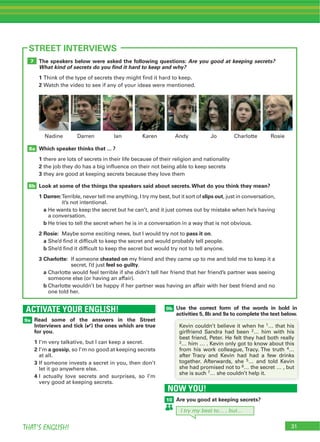
  • 84.
    83THAT’S ENGLISH! UNIT 7 73 74 73 74 Completethe regrets with the correct form of the verbs in brackets. 1 I regret / regretted my behaviour at the meeting. (regret) 2 If only he … harder when he was at school! (work) 3 I wish I … that. (not say) 4 If only I … in such a hurry when I sent that email! (not be) 5 We regret … for a higher salary. (not ask) 6 Have you ever (not) done any of the following and then regretted it? Discuss with a partner. 3a 3b not told someone your true feelings not persevered with something broken someone’s heart lied to a close friend asked someone out failed to take up an opportunity not been brave enough 4a 4b 5b 5a 6a Monologue: a competitive situation Listen to Patricia Torres telling an anecdote about a competitive situation. Listen again and choose the correct answers. 1 Patricia worked in education / sales / senior management. 2 In her department, there was a particularly competitive atmosphere / people helped each other / there was no competition. 3 Gerry was a temporary replacement for Alison / new boss / new deputy sales manager. 4 Gerry gave Rupert a new job / Patricia’s contacts and sales region / Patricia’s job. 5 Patricia wishes she had fought harder / had left the company earlier / hadn’t tried to change the situation. Patricia uses expressions to structure her anecdote. Listen and complete the expressions. Listen again and check. You are going to talk about a time when you were in a competitive situation.Think about the questions below and make notes. 1 When and where did it happen (work / sport or leisure / personal relationships)? 2 Who were the people involved? 3 What were the positive / negative effects of the competitive atmosphere? 4 What happened in the end? 5 What regrets / other feelings do you have about the situation? 6 What would you do if you found yourself in a similar situation again? Tell your partner about your experience. Use your notes from activity 6a to help you and include expressions from 5a to structure your anecdote.SETTINGTHE SCENE At the 1… , I was deputy sales manager. 2… , one day, our boss announced that she was leaving.was leaving. INTRODUCING SURPRISING OR INTERESTING FACTS 3... I’d been waiting for. As it 4… , Rupert was extremely ambitious, 5… who got my old region and all my contacts?my old region and all my contacts? CONCLUDING AND SUMMARISING To 6… a long story … . Looking 7… on it now, I wish I had behaved differently. I always wish I’d asked Sally, this girl in my class, out on a date. But I was too shy to tell her how I really felt! Yes, I agree.You should have asked her out. 6b The most competitive situation I’ve ever been in was when I was at high school.There was this... in my class who was my rival.We were both good at…
  • 85.
    84 THAT’S ENGLISH! NOWYOU! Do you know any ghost stories? Tell your partner about them. 6 8UNIT Ghost storiesA 7 Colin wanted to stay at the guesthouse so that he and Karen could investigate and … . Answer the questions. 1 What did Karen do when she heard the moaning sound? 2 Why didn’t Karen go and tell Colin about the sound? 3 What confession did Colin make? 4 According to the landlady, where was the killer when he told his story? 5 Why had the killer asked to use the woman’s phone? 6 Who had cut the woman’s finger off? Use the correct form of the verbs from the box to complete the story. Complete the sentences. 1 The Daltons had gone to London to celebrate their ... wedding anniversary. 2 It must’ve ... when the Daltons went to bed. 3 During the night Mr Dalton heard a kind of strange … sound. 4 Mrs Dalton thought that Mr Dalton had seen the face at the window because he … . 5 The newspaper article told the story of a murdered woman whose … finger had been cut off. 6 The stories of moaning noises coming from room 6 started after … . AFTER YOU WATCH 3 5 4 Tick (4) the things you would do if someone told you a house had a ghost in it. 1 I’d want to spend the night there to see if it was true. 2 I wouldn’t believe a word of it. 3 I’d want to hear any stories about who the ghost supposedly was. 1 BEFORE YOU WATCH A good read OBJECTIVES Answer the questions. WHILE YOU WATCH 2 1 Why do Karen and Colin want to stay at the guesthouse in Hazel Lane? 2 Who are the two main characters in Karen’s story? attack send carry whisper haunt see moan murder help I’m going to tell you the story of the ghost of the little Raimunda. On the corner of Alcalá Street is the Palacio de Linares which is supposedly… by… In the 18th century, 46 Spanish soldiers 1… to Scotland to 2… the Jacobite Rebellion. The soldiers were stationed in Eilean Donan Castle. One day, the English 3… and all the soldiers 4… . People say the castle 5… by one of the soldiers who 6… on many an occasion 7… his head under his arm and has been heard 8… and 9… in the gift shop!
  • 86.
    85THAT’S ENGLISH! The speakersbelow were asked the following question: Are you more interested in non-fiction or fiction? Why? Give examples. 1 How many of the five speakers do you think will say they prefer non-fiction to fiction? 2 Watch the video to see if you were right. Complete the sentences below with the names of the speakers. 1 ... prefer to read non-fiction. 3 ... reads both fiction and non-fiction. 2 ... prefer to read fiction. Are the statements true (4) or false (7)? Correct the false ones. 1 Nip prefers to go to quizzes in pubs rather than read books. 2 Lauren’s taste in books has changed as she has got older. 3 Karen chooses to read either non-fiction or fiction depending on how she feels at the time. 4 Ruth enjoys books where the actual story doesn’t matter. 5 Andy doesn’t like non-fiction because it isn’t exciting enough. 8b 8a 7 ACTIVATE YOUR ENGLISH! Tick (4) the statements you agree with. 1 I don’t particularly read too many fiction stories or books. 2 As I’ve got older, I like to read about true life events and people’s experiences. 3 I like reading a bit of both (fiction and non- fiction). It will just depend on how I’m feeling. One you are learning from, and one you can lose yourself in. 4 I’m pretty conventional in my reading. I like things with a good story. 5 Fiction because it’s nothing like real life, so that’s perfect. Match the words in bold (1-5) from activity 9a to the synonyms (a-e). a disconnect from reality d quite / rather b similar to e really c things that really happened Use the words in bold from activity 9a to complete the text below. 9a 85 STREET INTERVIEWS 9b 9c just been images ever colourful loved Use the words from the box to complete Karen’s description of her favourite childhood book. Karen Ruth AndyLaurenNip ever happens again, but who knows? I must admit I find science fiction 4… boring, but whenever I get my hands on a war story I just 5… myself … it. My favourite book from my childhood is The Cat in the Hat. I don’t know why, I 1… always 2... that story, and it was one of those that the 3… were so fantastic, they were so 4… . I read it to my brothers and that I would say has 5… one of my favourite books 6… . complete the text below. I love books about 1... that happened during wars. I’m 2… interested in the First and Second World Wars. I hope nothing 3… that 10 NOW YOU! Tell your partner about your favourite book from your childhood. 11 My favourite book from my childhood is… It’s about… and I like it because... I used to read it with / when...
  • 87.
    86 THAT’S ENGLISH! Agood read Match the book covers (1-6) to the genres (a-f). READING a science fiction (sci-fi) d thriller b romance e historical c crime f gothic What kind of fiction do you prefer? Why? Read the first paragraph of the story.What kind of novel does the writer want to produce? Complete the story with the missing sentences. a All of a sudden, the wind stopped and the only sound was the lonely call of a bird. b When I brushed it away, the woman had gone. c The plot would follow Magenta’s journey to look for her brother who had disappeared several years before. d I was happy to be on my own and far away from my busy life in London. e It was rainy and cold outside, the kind of day which reminds you that winter must be just around the corner. f So it can’t have been a surprise to anyone when I decided to write a gothic novel of my own. Which words from the text could you use to describe... ? 1 a dark cold place (adj: paragraph 1) 2 the loud noise of a door being closed (vb: paragraph 4) 3 a sharp rise or fall (adj: paragraph 5) 4 a quick short movement of air (n: paragraph 5) 5 an involuntary shake of the body (vb: paragraph 5) 6 feeling uncomfortable and worried (adj: paragraph 5) 1b 2b 3 2a 86 1a 1 2 3 4 5 6 1 You must have seen these covers in bookshops, the ones with the dark tower; the gloomy churchyard; the pale girl with a body as fragile as glass; perhaps a vampire, perhaps a tormented poet. Books with covers that promised more of this shadowy world had been the ones I had always chosen to read as a teenage girl. 1... I dreamed that my gothic novel would get published, be short-listed for a prize and become a best-seller! 2 Thinking about the story and setting, I had decided that my main character would be a girl called Magenta, who never speaks and who lives in Scotland in an old castle by the sea. 2… . Voices from the tomb Karen Wilkens
  • 88.
    87THAT’S ENGLISH! UNIT 8 87 Readthe story again. Are these sentences true (4) or false (7)? Correct the false ones. 1 The writer assumes that the reader knows nothing about gothic fiction. 2 The writer has been attracted to gothic fiction since she was a teenager. 3 The writer travels to Scotland to start writing. 4 The writer had worked nearly all day before deciding to go out. 5 It was raining when the writer left the house. Put the events in the order they happened. 1 The rain stopped. 2 It was getting dark. 3 The writer decided on the setting and main characters for a novel. 4 The writer saw a mysterious woman. 5 The writer dreamed of writing a novel. 6 The writer left London to stay in a cottage. 7 The writer walked up the hill. 8 The writer was working all afternoon. Work with a partner and discuss what you think will happen next.Which of these options do you prefer? Explain why. 1 A stranger knocks at the door and tells the writer to leave the house immediately. 2 There is a violent storm and the mysterious woman from the hill appears in the house. 3 The writer dreams that the house is on fire. Listen and check. Which option does the writer choose to continue the story? Match the words from the box to the questions. 1 Where does the story take place? 2 Who is the story about? 3 Has the story been rewritten as the script for a film? 4 What big issue is the novel about? 5 What important events happen in the story? 6 Is there another book after this one with the same characters? 7 What kind of fiction is this? 8 Is the book part of a sequence of books with the same characters? Think about your favourite book and answer the questions in activity 7a. 4 5 6a 7a 6b 7b 76 TRACK 75 3 I finally started writing in October when I rented an old cottage in the north of England. It was three kilometres from the nearest neighbour and there was no television or Internet to distract me. 3… . 4 On the third day, I had been working until late afternoon. 4… . After a while, the rain had stopped and I decided to get some fresh air so I pulled on my heavy coat and boots and slammed the front door behind me as I headed up the hill. 5 Marching up the steep stony path behind the house, I arrived at an open field which gave me a view of the valley and the full force of the cold wind in my face. 5… . As I turned to go back down the hill, I suddenly became aware of the silhouette of a woman. At that moment, a gust of wind blew hair into my eyes. 6… . I shivered. I was cold. Clearly there was no one there, but at that point, I started to feel uneasy so I hurried home. 6 By the time I got back to the cottage, it was completely dark outside and it was starting to rain. I was glad to switch on the lights and be back inside a warm dry house, but I suddenly felt very tired. I decided to have a light supper and go to bed early. I much prefer the second option. I love the idea of the narrator actually meeting the strange woman and… plot theme setting main characters sequel screen play genre series
  • 89.
    THAT’S ENGLISH! A goodread 88 LANGUAGE STUDY Match the sentences (1-8) to the reasons or results (a-h). 1 He can’t have gone far. d 2 She must have worked very hard at school. 3 There isn’t any milk left in the fridge. 4 I’ve looked everywhere for my car keys. 5 The lights are all off in the house. 6 They can’t have taken the dog to the park. 7 You must have felt very sad to leave your job. 8 I found this old rounded stone on the beach. a They could have gone to bed early. b She’s got really good exam results. c My teacher says it might have been used as an axe in the Stone Age. d I’ve just seen him in the kitchen. e The children must have drunk it all last night. f You’d worked there for many years. g I think I might have lost them. h I can hear it barking. Listen and repeat the contracted sentences. Pay attention to the intonation and word stress. Rewrite the sentences using modal verbs + the perfect infinitive. 1 I am sure this was a valuable vase. This must have been a valuable vase. 2 I am sure he stole the money. 3 It’s possible they were hiding in the library. 4 It’s impossible he asked her to marry him. 5 Maybe you saw a ghost. 6 It is impossible they were travelling by train. 7 It’s possible the suitcases went to another airport. 8 It’s impossible he went to the show, he hasn’t got any money. Rewrite the information in one sentence. Use the correct past tenses. 1 Peter fell asleep at the wheel. He was driving all night. Peter had been driving all night when he fell asleep at the wheel. 2 The storm wrecked the house. We heard the storm warning on the radio. By the time we … the storm warning on the radio, … . 3 The police caught the thief.The thief travelled in disguise for three months. The thief … in disguise for three months before … . 4 Their romance went on for years. She gave birth to a baby in secret. Nobody knew about their romance but it … for years, and she … . 5 She went up the mountain. Snow was falling for days.They warned her. She … the mountain even though they … her that … . 6 We missed the film. Everybody was leaving. By the time we ... to the cinema, the film … and … . Listen and decide if the speakers use contractions or not. Choose the correct options. 1 He can’t have / can’t’ve lost his job. 2 She must have / must’ve been very tired. 3 I think we might have / might’ve missed the last bus. 4 My sister could have / could’ve helped me more. 5 They couldn’t have / couldn’t’ve left already. 6 You mustn’t have / mustn’t’ve understood properly. 1 2a 3 4 2b 77 78 Modals for speculation in the past ▶Look at the verb form after the modals in these sentences. Is the modal verb followed by the infinitive or by the perfect infinitive? 1 You must have seen these covers in bookshops. 2 It can’t have been a surprise to anyone. 3 Could it have been the wind? Revision of past tenses page 138 page 138 Pronunciation In spoken English we usually contract have (/əv/) in past modals. Must have = must’ve /mʌstəv/ page 147
  • 90.
    THAT’S ENGLISH! UNIT 8 Severalmonths ago I had the worst week of my life. On that day I lost my job, my boyfriend and my best friend! It all started when we decided to go on holiday together. We’d all been working very hard for ages and needed a break… Listen to these people discussing who the man on the boat might be. Which idea do they think is most likely? Why? 1 A fisherman who has survived a storm. 2 An immigrant trying to reach another country in a homemade boat. 3 A pirate planning to take over a boat. Choose the most suitable expression for these sentences. 1 The circus gradually sold all the animals and it was only … that the circus finally closed. 2 The weather was fine but … clouds appeared and it started to rain. 3 … I was a child, so I don’t remember the details. 4 He wasn’t enjoying his new job, so … he told them he was leaving. 5 I met him … when I was working as a doctor in Namibia. 6 I tried learning to play the piano for years but in the end I … gave up. 7 Would you like to meet for a drink? I haven’t seen you … ! Complete the extract from a story with the correct verb tenses. Talk about a difficult day you have had. Use some of the expressions from activity 6a to help you. Complete this text about ghostwriters with the words from the box. 5b 6a 5a 6b 7 There could be no mistake. The men could see clearly that it was a body and it 1… (float) towards their boat. ‘I’ll stop the engine,’ Jim said. Leaning over the side, the two men 2… (grab) the man’s legs. It was only then that they saw the man 3… (breathe). Five minutes later, they 4… (pull) the man onto their boat. He 5… (groan) as Sam splashed some water onto his face. The man 6… (lie) across a plastic drum with some bits of wood tied to it. They 7… (wonder) how far he 8… (travel) like that and how on earth he 9… (survive). 89 79 It all happened when for ages at this point eventually several years ago all of a sudden after a while hardback paperbacks cover blurb author autobiographies royalty best-seller publishers Ghostwriters Walk into any bookshop and the shelves are full of 1… by celebrities. Actors, chefs and athletes all have their stories to tell. Or do they? In fact, 90-95% of those books are written by ghostwriters: professional writers whose name never even appears on the 2… . And, if the book goes into the 3… Top 10 list, it is the celebrity 4… who gets a 5… or percentage of the sales and the ghostwriter just gets a fee. But most books are not immediate best-sellers whoever actually writes them. Most writers are rejected by 6… . Even JK Rowling was rejected several times, and her first book only sold 5,000 copies in the more expensive 7… edition before the Potter series became a phenomenon and the 8… flew off the shelves. So, the next time you read the 9… on the back of a book claiming the writer tells their story ‘with humour and honesty’, you might wonder whose words you are reading!
  • 91.
    90 THAT’S ENGLISH! Agood read B Look at the picture of the chalk carving of a giant. How old do you think it is? Watch the video and check your answer. Answer the questions. 1 What prize did Keri Hulme win and what was her book about? 2 What was the Beat Generation in the USA about? 3 What did the book Uncle Tom’s Cabin help to abolish? 4 What prize did Alice Munro win in 2013? 5 What did the Australian writers write about? 6 What did Robert Burns dedicate a poem to? Look at the names of famous writers from the British Isles. Tick (4) the ones which are from Ireland. Are there any that surprised you? Are the statements true (4) or false (7)? Correct the false ones. 1 The Dublin Writers Museum only has information about writers who are no longer alive. 2 Ireland doesn’t have a lot of great legends. 3 Oscar Wilde spent time in prison in England. 4 The novel Ulysses is about one day in the life of a man travelling around Dublin. 5 A description of the tower, now known as the James Joyce Tower, can be found in the second chapter in Ulysses. THAT’S IRELAND 4 Match the names of the writers, books and poems to the countries. SAME LANGUAGE, DIFFERENT LIVES 3 Watch the video and tick (4) the statement which is not true. 1 The Cerne Abbas Giant is the biggest chalk hill figure in Britain and is also referred to as the rude man. 2 There are different theories about the giant, one being that he is a figure of Hercules. 3 Another theory is that he is a cartoon caricature of the strict puritan Oliver Cromwell, 17th century head of the British government. 4 There is a local myth that he is a Danish sheep eating giant, killed by local farmers who drew a line around his body to frighten other giants away. 5 He may also be a pagan symbol of fertility and there are people who say they were conceived on the giant. 6 The local woman is happy that he attracts tourists but says that some people are a bit upset by his nakedness. 7 Locals say that if the giant doesn’t like new people then they have to move out within six months. 8 The giant was once covered up during the 2nd WorldWar to stop the Germans using him as a navigation point. 2 5 1 DOCUMENTARY Let me tell you a story... 6 NOW YOU! 7 Talk to your partner about the greatest writers and poets from your country. I can think of a number of great Spanish writers. One is Miguel de Cervantes who wrote Don Quixote and another is…There are also many great writers who are still alive, for example, … Have you read contemporary poetry? It’s by far... On the road Waltzing Matilda Harriet Beecher Stowe Anne of Green Gables Banjo Paterson Jack Kerouac Katherine Mansfield UncleTom’s Cabin Henry Lawson Keri Hulme The Bone People L.M. Montgomery Alice Munro Robert Burns New Zealand Canada Scotland USA Australia SIR WALTER SCOTT OSCAR WILDE JAMES JOYCE BRENDAN BEHAN SAMUEL BECKETT BRAM STOKER JANE AUSTEN WILLIAM BUTLER YEATS CHARLES DICKENS JP DONLEAVY EDNA O’BRIEN GEORGE BERNARD SHAW JONATHAN SWIFT
  • 92.
    91THAT’S ENGLISH! UNIT 8 Readthe web page.Which sentence best summarises the text? 1 The web page is for people who want suggestions about setting up a book club. 2 The web page offers advice on how to choose books for a book club and which authors to choose. 1 SKILLS WORK What advice does the web page writer suggest about ... ? 1 the ideal maximum number of people in the group 2 what to do about food 3 choosing which books to read Listen to a radio programme in which people talk about a favourite book. What type of book does Steven talk about? 1 science fiction 3 romance 2 crime 4 none of these Listen again and answer the questions. 1 The main character in the book is unconventional because … . a he is a detective b he can read people’s emotions c he is autistic 2 The book is unconventional because … . a it has lots of diagrams, symbols and algebra b there is a dead dog in it c it is a detective story 3 In the book we … . a see ordinary people in ordinary places b get a special view of ordinary things c find nothing is ordinary 4 As he read the book, Steven was … . a bored b fascinated c shocked Tick (4) the expressions Steven uses to describe the book. it made me think magical unconventional moving a tense detective novel I couldn’t put it down a real page-turner made me laugh Think about the last book you read and answer the questions. Discuss them with a partner. 1 Why did you choose to read this book? 2 What is it about? Be brief. 3 Would you recommend it? Why (not)? 2 3a 3b 81 The last book I read was The BookThief by Australian author Markus Zusak. I’d seen the film and found it very moving and emotional, so when I saw the book in an airport bookshop, I knew I had to read it! Anyway, … 4 3c 8181 Here are some top tips for a successful book group and some suggestions for what to avoid. A book club works best if you keep to a regular meeting time once a month. It is also most successful if it is not too big. Have a maximum of 12 people: any more than this and you won’t have enough chairs for your guests! It is also best if each member takes it in turn to host the meeting in their home, but remind everyone that this is not a gourmet club! Having something to eat and drink is a good idea, but again, keep it simple and get everyone to bring some food to share. It is often difficult to get people to agree on which books to put on the reading list. Some people want to read classics, others want books that make them think or laugh or cry or that are simply on the latest best-sellers list. In our case, we ended up choosing books by putting titles in a box and pulling them out like lottery tickets! So, based on my own experience, if you are going to start your own book club, I think you should: keep the group small, rotate meetings between the homes of members, share responsibility for refreshments and lastly, find a way to agree on a reading list that includes suggestions from everyone. Happy reading! Are you a ‘bookworm’? Love nothing better than disappearing with a good book? Maybe it is time for you to share the love! Start your own book club TRACK 80
  • 93.
    92 THAT’S ENGLISH! Agood read WRITING Answer these questions. 1 Do you ever read book or film reviews? Why (not)? 2 What kind of information would you expect to find in a book or film review? 3 Have you ever recommended books or films to people? Why did you recommend them? Read the reviews about The Hobbit and A Most Wanted Man and answer the questions. 1 How does the writer describe Bilbo Baggins and Gandalf? 2 What two reasons does the writer give for recommending The Hobbit? 3 What type of film is A Most Wanted Man? 4 How does the writer describe Seymour Hoffman’s performance? 1 2 The film begins when a thin exhausted man pulls himself out of the sea. Who is he and what is he doing in Hamburg? In the post 9/11 world, any stranger is a potential terror suspect and the security forces are certainly interested in finding this man. This thriller keeps you in suspense from the beginning, but the film is less about the stranger than about the secret agents and spies who suddenly appear on his trail. Philip Seymour Hoffman plays the world-weary spy who puts the pieces of the puzzle together. It is an extremely convincing performance and Seymour Hoffman is totally believable as the secret agent who has to win the trust of people around him but can trust no one himself. The urban setting and the soundtrack add to the oppressive atmosphere in which the threat of violence is ever present. This is a psychological thriller and one that will keep you on the edge of your seat. A Most Wanted Man By Brad Spath FilmReviewFilmReview Although it is now part of a mega successful film franchise, this adventure story began life as a book by J.R.R. Tolkien, and if you haven’t read it, then my advice is to start with the book itself. Tolkien is a master storyteller and it is spellbinding, not just for children, but for anyone who enjoys a classic fantasy adventure set in a world inhabited by giants, dwarfs and hobbits. The story begins with an unexpected party at the house of the hobbit, Bilbo Baggins, and it continues as a series of captivating adventures in the quest to find the dragon’s gold. Bilbo is the reluctant hero of the story and the journey is punctuated by extraordinary danger, and unexpected magical help from Gandalf, a wise, elusive wizard. I would strongly recommend this book to readers of all ages for its pure escapist entertainment. It also has a very positive message of loyalty and friendship expressed by characters who help or rescue one another from the constant dangers of the shared journey. The Hobbit By Lynn Ashraf BookReview
  • 94.
    93THAT’S ENGLISH! UNIT 8 Categorisethese sentences depending on whether they refer to films (f), books (b) or both (f/b). 1 The music score and sound effects create a terrifying atmosphere. f 2 The plot is full of surprises and unexpected events. 3 The cast gave magnificent performances. 4 The author has won several prizes. 5 It took a team of three writers to come up with the script. 6 All the scenes were shot on location in Ireland. 7 Most critics think it is a masterpiece. 8 The descriptions of places are poetic and beautiful. Complete the sentences with the adjectives from the box. 1 The actor gave a … performance because he lacked confidence. 2 We were all crying at the end of the film because the plot was … . 3 The special effects were worth every penny because they were … to the success of the film. 4 I didn’t believe that the characters would behave like that: I found the plot totally … . 5 The plot was too … so I couldn’t understand the story. 6 The show holds your attention from beginning to end, it is … . 4 5 Writing Reference page 145 Look at the review of The Hobbit and match the paragraphs (1-3) to the contents (a-h). a the main characters b suitable readers c reasons for recommendation d background information about the book e themes and message f name of author g the setting h the plot 3 The Hobbit Paragraph 1 Paragraph 2 Paragraph 3 heartbreaking unconvincing disappointing spellbinding crucial complicated 6a 6b 6c Writing a book or film review Think about a book or film you would like to review and make notes about the following: 1 Background information: title and author or director. 2 Location and setting: find adjectives to describe the setting and atmosphere. 3 Main characters: write two adjectives to describe each character. 4 Plot or story: summarise the main story in not more than three sentences. 5 Strengths: what did you like best about it? What adjectives describe your reaction to the book or film? 6 Weaknesses: what aspects were less successful? What adjectives describe these aspects? 7 Recommendation: what kind of people would like this film or book? Make your recommendations. Group the information in activity 6a into three paragraphs. Write your review (175-200 words). Remember to include the following: a brief description of the plot, characters and / or actors: but don’t spoil the ending! a description of what you liked most and least and explain why your recommendation
  • 95.
    94 THAT’S ENGLISH! 9UNITThe gender gap OBJECTIVES It is okay for girls to be boxers, isn’t it?A 6 a b c Answer the questions. 1 2 3 4 5 Match the expressions in bold (1-5) to their synonyms (a-e). 1 stand up for 2 put down 3 laughed at 4 Real 5 sexist a c e b d Use the words in bold in activity 5 to complete the text.Choose the correct option. 1 a b c 2 a b c 3 a b c 4 a b c 5 a b c AFTER YOU WATCH 3 5 4 6 Do you agree with the statements below? 1 2 1 BEFORE YOU WATCH Answer the questions. WHILE YOU WATCH 2 1 2 NOW YOU! Explain how you feel about sexist behaviour and language. 7 I get really angry when people… I also hate it when… 1 2 3 4 5
  • 96.
    95THAT’S ENGLISH! ACTIVATE YOURENGLISH! 10a 95 STREET INTERVIEWS Match the words in bold (1-4) to their meanings (a-d). Jude: 1stay-at-home dads Lauren: 2entrepreneurs Karen: 3push boundaries further Charlotte: 4atrocious a b c d The speakers below were asked the following question: What are the main differences between women and men’s roles in today’s society? 1 2 Complete the sentences with the names of Jude, Peter and Charlotte. 1 2 3 Are the sentences true (4) or false (7)? Correct the false ones. 1 2 3 4 5 6 9b 9a 8 10b Use the words in bold in activity 10a to complete the sentences below. 1 2 3 NOW YOU! 11 Have you ever been or felt discriminated against for gender reasons? Do you know anyone who has? As I’m a man, I’ve never felt discriminated against for gender reasons, but my sister…
  • 97.
    96 THAT’S ENGLISH! Thegender gap Which of the photos do you think show typical behaviour associated with boys and girls in your culture? Why? ‘Boys will be boys’ is a well-known English saying. What do you think it means? Do you think it’s true? 1 2 3 Read the text.What is it about? 1 2 3 Read the article again. Are the following statements true (4) or false (7)? Find information in the text to justify your answers. 1 2 3 fa’afafine 4 5 READING 3 1a 1b 2 6 bacha posh 7 8 Boys will be boys... (or sometimes girls) It’s the 21st century and things are looking up for gender equality. There are female priests and presidents, male nannies – the mannie – and an awareness of the need to avoid gender stereotyping when raising children. But how far would you go in reversing gender stereotyping? Some cultures take it to unusual lengths. Samoa’s third gender In Samoa, there is a widely-accepted practice of raising boys as girls known as fa’afafine – ‘in the manner of a woman’. Gender identity is closely linked to a person’s role in the family. So essential is it to have a daughter, parents with several sons look to raise one as a girl to take on the traditional role of caring for elderly parents. Sometimes, parents believe a child has been born with the fa’afafine spirit and is naturally drawn towards more feminine behaviour. But what are the results of such a momentous decision? Leo was raised as a fafa and has somewhat negative views of his experience. ‘Frankly, I felt very isolated growing up, and I used to look on while my brothers played football and wish I could be one of the boys.’ 3 4 1 2
  • 98.
    97THAT’S ENGLISH! UNIT 9 6 Matchthe phrasal verbs (1-6) to their meanings (a-f). 1 4 2 5 3 6 a b c d e f Complete the sentences with a suitable form of a phrasal verb from activity 5. 1 2 3 4 5 6 Discuss the questions with a partner. 1 2 3 4 5 (onlinesource) 7 I look up to those who stand up for what they believe is right… and I look down on those who bully others. TRACK 83 However, some fafas find the experience very enjoyable even though they later decide to live as men in adulthood. Many continue to live as women, though. ‘It’s important that we understand fa’afafine within the matriarchal cultural context of Samoa. It’s looked at as perfectly normal,’ said a spokesperson for Samoan affairs. Girls will be… boys Such is the importance of having a son in some patriarchal cultures that parents will disguise girls as boys. In Afghanistan, this is an old tradition known as bacha posh which began centuries ago to protect girls from attacks by invaders. The Rafhat family dress one of their four daughters as a boy. ‘We did it because, in Afghanistan, society looks down on people who have no son,evenifyouaresuccessful in life,’ said Mrs Rafhat. ‘Now that we have a son, everyone looks up to the whole family. I used to live as a boy myself and it gave me confidence and helped me succeed. A good parent always tries to do the best for their child.’ Unlike in Samoa, those girls brought up as the opposite sex always revert to their true gender when they become teenagers. Although human rights campaigners are critical of the tradition, it is still extremely popular. Many women delighted in the freedom they had when they lived as boys and want to give their daughters the same opportunity. However, few ask the important question behind it all: when will girls have the same freedom as boys without denying their identity? Complete the summary: write S for Samoa,A for Afghanistan, B for both Samoa andAfghanistan. 4 1 2 3 4 5 6 7 8 9
  • 99.
    98 THAT’S ENGLISH! Thegender gap 98 LANGUAGE STUDY 1 2 4c 4a 4b 3 is the importance was the wind was he did she arrive had he lied was the place is the drug problem Join the two sentences using so / such + that to make the first part more emphatic. 1 We were so late that we missed the plane. 2 3 4 5 6 Complete the sentences with the missing phrases from the box. Rewrite the sentences to make them more emphatic using so / such at the beginning. 1 So old was the book that it fell apart in my hands. 2 1 is the drug problem 2 3 4 5 6 7 3 4 5 6 7 Listen to the conversations and answer the questions. 1 2 Listen again and choose the correct terms used nowadays. 1 2 3 4 5 6 7 8 Complete the sentences with the correct word from activity 4b. 1 2 3 4 5 Titanic 6 7 8 Revision of so and such + that 84 84 Questions for effect: rhetorical questions ▶Which is more dramatic and emphatic? 1 We don’t know what the results of such a momentous decision are. 2 What are the results of such a momentous decision? page 140 Inversion after so and such After so and such, an affirmative sentence structure is replaced by the question form (auxiliary + subject + main verb). So essential is it to have a daughter that parents decide to raise one son as a girl. Such is the importance of having a son in some male-dominated cultures that parents will disguise girls as boys. page 140
  • 100.
    99THAT’S ENGLISH! UNIT 9 7 8 6b5 6a lookat so such look up to look to chair their Rewrite the sentences in bold to make them more dramatic and emphatic. Start with the words in brackets. 1 They didn’t know if they would ever overcome them. Would they ever overcome the problems? 2 They didn’t know if he would ever learn to change his ways. 3 I wonder what adventures lie ahead. 4 She was worried about who would look after it after she had gone. 5 We are not sure they will ever happen. 6 I have to tell you the same thing again and again. Read the text and answer the questions. 1 2 Rewrite the sentences so that they are gender neutral. 1 The moon landing was a small step for humans but a giant leap for humankind. 2 3 4 5 6 7 Underline the stressed syllable. Listen, check and repeat. 1 4 7 2 5 8 3 6 Complete the text with the correct form of a word from the box. 85 Plural pronouns used with a singular subject A good parent always tries to do the best for their child. page 141 If you love somebody SET THEM FREE Languages always reflect the culture they developed in. The patriarchal nature of English society in the past favoured the use of the singular with he and his, e.g. ‘If a child is forced to write with his right hand, he may suffer frustration.’ Currently, a growing revelation in society of the need for greater equality has led to the use of plural pronouns as singular (they, them and their), e.g. in the song, If you love somebody, set them free (Sting). Additionally, the terms man in a generic sense and mankind should be replaced by humans, or humankind. Male primary teachers in demand A quarter of British primary schools have no male teachers, according to the 1... of a government committee researching the effects of male teachers. ‘The Ministry of Education is 2... increase the number of male primary teachers by 10%. 3... strong is the belief that women are better at caring for young children that men don’t even apply for jobs in primary schools. Of course, a good teacher is effective whatever 4... sex. Men are 5... as being a threat to young children whereas in fact, male teachers have a positive effect. Girls are generally more willing to learn but boys need someone to 6... and inspire them. 7... is the importance of male role models that we are actively promoting male teacher recruitment.’ (onlinesource) Pronunciation Guide
  • 101.
    THAT’S ENGLISH! The gendergap B DOCUMENTARY Legally, men and women… but in reality… still a long way to go before… Gender discrimination 1 5 2 Answer the following questions before you watch the video. 1 2 3 Watch the video and decide if the statements are true (4) or false (7). Correct the false ones. 1 2 3 4 5 6 7 8 SAME LANGUAGE, DIFFERENT LIVES 3 Listen to the speakers talking about equal rights. Match their countries to the things they mention. 1 2 3 4 5 6 THAT’S IRELAND NOW YOU! 4 6 Have you ever seen an Irish dancing show?Watch the video and decide if there is any similarity between Irish and Spanish flamenco dancing. Do men and women have equal rights in your country? Watchthevideoagainandanswerthequestions. Claddagh ring 1 Spanish Arch and Spanish Parade 2 3 Galway 4 Trad on the Prom 5 Irish dancing 6 7 8
  • 102.
    THAT’S ENGLISH! UNIT 9 1 SKILLSWORK Do the quiz to find out your brain gender. 2a 3 2b Listen to the radio programme and choose the correct answers. 1 each other themselves 2 male female balanced Listen again to the radio programme and complete the boxes. Type of brain Advantages Disadvantages 7 Write a summary of your strengths and weaknesses according to the quiz and the radio programme (100 words). 87 87 (onlinesource) Mostlya:youhaveafemalebrainandareintuitiveandcaring. Mostlyb:youhaveabalanceofmaleandfemalequalities. Mostlyc:youhaveamalebrainandareindependentandcompetitive. Results:Addupyourscores. According to the quiz, I have a mostly female brain, and I agree I’m good at understanding others and social situations. I think ... If you upset someone, do you usually understand why? a Yes, almost immediately. b In most situations. c No, it often comes as a surprise. Do you like to be in charge of things at work? a I’d rather be one of the team. b Sometimes, but I don’t mind not leading. c Yes. Why not when I can see what needs to be done? At a social event, how quickly do you realise someone wants to join in your conversation? a I’m instantly aware when someone is ready to join in. b I notice fairly quickly. c Pretty slowly, to be honest. Why don’t they just join in? When life is hard, which are you more likely to experience: anger or sadness? a I usually feel very down. b I experience a mixture of both. c I tend to lose my temper a lot at such times. What kind of things do you enjoy reading? a Human interest stories, fiction and magazines. b I like a mixture of factual and fictional books. c Biographies, newspapers and factual material. When you are on a journey, how do you navigate? a I use landmarks like churches and shops. b I use landmarks and compass directions. c I use distances and compass directions. Are you good at explaining things differently if someone doesn’t understand at first? a Yes, because there are many ways to look at things. b It can be a challenge but there are usually other options. c No, because the correct way is quite clear to me. If you upset someone, do you1 Do you like to be in charge of2 At a social event, how quickly3 When life is hard, which are you4 When you are on a journey, how6 What kind of things do you5 Are you good at explaining7 HOW DOES YOUR MIND WORK? DO YOU THINK LIKE A MAN, A WOMAN OR SOMETHING IN-BETWEEN? Do our quiz and find out if your brain gender is the same as your physical gender! TRACK 86
  • 103.
    THAT’S ENGLISH! The gendergap SPEAKING 90 88 89 1 2 3a 3b 3c In what aspects of life have men and women achieved greater equality so far?What areas still need improvement? Discuss with a partner. Listen to Gordon, Adam and Jess having a discussion and answer the questions. 1 2 a b c Match the quotes (1-5) to the photos (a-c) from activity 2. Listen and check. 1 You’ve certainly got a point, but What’s the point of it? 2 Hang on a minute 3 How else can we show 4 I can see where you’re coming from, but 5 Sorry, can I just stop you there Look at the expressions in bold from activity 3a. Complete the table with the expression which is used to: 1 a b 2 c d 3 e f Listen to the expressions in 3b and repeat using the correct stress and intonation. We’ve made a lot of progress in education, but I don’t think there are enough women in politics or business. Well, maybe, but women can now choose to take on those roles or not. Perhaps women just prefer different types of careers. a b c
  • 104.
    THAT’S ENGLISH! UNIT 9 91 4a 5 4b Listenand complete the sentences. Gordon: Jess: Do you think the speakers use this structure to make their point more or less emphatic? Rewrite the sentences to emphasise the point being made. 1 summer It’s in summer that I feel happiest. 2 Who what you know 3 meeting his wife 4 The best singer not the prettiest 5 My boss not me Do you think boys and girls should be treated differently? Think about the topics below and make notes. 1 4 2 5 3 6a Work with a partner and discuss the topic. Use activities 3a, 4b and 6a to help you. A: 6b Interaction: a debate Emphasising a point We stress the object after It’s in sentences which are emphasising a point. It’s what you do that’s important. It’s women who aren’t taken seriously. It was in the 20th century that gender equality became a social reality. This expression is often followed by a short contrastive clause with not, which is also stressed for emphasis. It’s women who aren’t taken seriously, not men. page 141 As far as I’m concerned, it doesn’t matter whether… Sorry, .... I can see where you’re coming from, but I can’t agree with you completely... As I see it, we need to move on… You’ve got a point, but… TOYS: guns for boys and dolls for girls? Ridiculous! SINGLE SEX SCHOOLS: girls do better academically if no boys around, but what about social interaction? DISCIPLINE: girls generally better behaved than boys. Parents often stricter with boys. 'Big boys don’t cry', etc. OTHER ISSUES: society more protective of girls; boys have more freedom and can stay out later. B: A: B: A: It’s
  • 105.
    104 THAT’S ENGLISH! Revision2 OBJECTIVES LANGUAGE REVISION 2 5 3 104 Complete the text with the correct tense or form of the verbs in brackets. Sometimes more than one tense is possible. 1 The Client 1 2 4 6 7 8 10 11 12 14 16 17 The character of Reggie Love was an ex-alcoholic who had had many problems. Write sentences about her life with I wish or If only. 1 I wish / If only I hadn’t had to give up my job. 2 3 4 5 6 The character Barry Muldanno was a rather stupid person and made mistakes. Rewrite these sentences with should to show his regrets. 1 I should have thrown the body into the river. 2 3 4 5 This is what Reggie wrote about Mark afterwards. Choose the correct option. Underline the words you think are stressed for emphasis in each sentence. 1 2 3 4 5 Listen and check. 4 Mark and his family taught me a lot. When he first came for help, I was 1really / loads surprised that a child could be so confident. He certainly has got what it 2brings / takes to stand up for himself. I felt 3slightly / fairly more worried about his mother who has had a hard life, but even she was 4somewhat / quite a lot stronger than I expected. The police only paid 5lip / mouth service to their obligation to protect a child so I knew I had to help. At one point, when Mark ran away I was ready to 6throw / give in the towel and 7nearly / hardly went back to drinking, but the situation was far 8too / enough dangerous to give up on him. Anyway, a good lawyer should never abandon 9their / my client. 92
  • 106.
    THAT’S ENGLISH! Revision 2 8b 9 7 8aCompletethe second sentence so that it has a similar meaning to the first. Write between one and four words. 1 2 3 4 5 6 7 8 9 10 Complete the sentences with a particle. 1 2 3 4 5 6 7 8 9 10 Complete the sentences with the correct form of the words in brackets. 1 2 3 4 5 6 7 8 9 Underline the stressed syllable in each word you formed in activity 8a. Listen and check. Complete the texts with the correct option below. 1 a b c 2 a b c 3 a b c 4 a b c 5 a b c 6 a b c 7 a b c 8 a b c 9 a b c 10 a b c 11 a b c 6 A 1slums 2 4 6 7 B 8 10 11 93
  • 107.
    106 THAT’S ENGLISH! Revision2 106 SKILLS WORK Read the texts and match the headlines to the advertisements. 1 3 2 4 1 VOLUNTEERING Read the texts again and answer the questions. Which projects … ? 1 2 3 4 5 6 7 8 Listen to the conversation between Steve and Angela and tick (4) the jobs that are mentioned. 2 3a 95 The aim of our organisation is to empower women and provide decent housing for families, not only in the USA, but in many other countries in the world. We work to train volunteers in building skills. Our primary goal is to teach women how to solve problems for themselves through training in practical areas, such as making cement or plumbing and dealing with general house repairs. However, men are also welcome! Our volunteers work together with homeowners to rebuild or restore deteriorated houses and give disadvantaged families a place to live. We welcome volunteers but also need donations to buy materials and support our training programmes. The aim of our organisation A Even if you only have a couple of weeks to spare, you can join our volunteer programme in Tanzania. We need enthusiastic open-minded people to help support our permanent team in the southern area of the country. The work consists of helping to build schools in remote areas. This can include making desks, chairs and bookshelves as well as helping in the schools once they have been established. Volunteers may be asked to give English classes or lessons in environmental awareness to protect the local forests. Other projects that we run in the area are related to reforestation, preparing land and plantingtrees,andtheconstruction of wells to provide clean water for village communities. Even if you only have a couple B The mission of our project is to improve conditions for children and teachers in slum areas in Bangladesh. If you volunteer with us, you may be asked to help renovate a classroom in an existing school, carry out repairs to roofs or windows or even help to build extra facilities for the school. Traditional materials and techniques are used, but you don’t need any special skills because you will be supervised by local builders and carpenters. However, you should be fit and healthy and ready to work in all weather! You will stay in the school where the project is taking place, but it won’t be like home. Take a mat to sleep on and remember there are no showers, just a bucket of water. The mission of our project is to C After the typhoon in 2013, we started this long-term rebuilding project in the Philippines. Hundreds of schools were destroyed in the north of Cebu Island and many families lost their homes. Not only do schools need to be rebuilt, but many children need care while their families struggle to get their lives back. So, if you don’t feel you could learn carpentry or basic building skills, we also need volunteers to play games with the children, read stories to them and help their teachers in the classroom. Accommodation is provided with local families that have not been harmed by the storms. The price you pay covers food, your room, insurance and airport transfers. You will have to arrange your own flights. The minimum stay is one week, but most volunteers spend at least a month on the island. After the typhoon in 2013, we started this long-term rebuilding project in the D TRACK 94 (onlinesource)
  • 108.
    107THAT’S ENGLISH! Revision 2 Listenagain and decide if the statements are true (4) or false (7). Correct the false ones. 1 2 3 4 5 6 7 Look at each expression below. Write (D) if it introduces polite disagreement,(O) if it introduces an opinion and (A) if it asks for an opinion. 1 2 3 4 5 6 7 8 9 10 Discuss the following statements with a partner. Give examples from your own experience. Use some of the expressions from activity 4a. 1 2 3 You are going to give a talk for two minutes about a problem you had with a piece of equipment. Use these points to help you. 4a 4b 5 3b I would agree with the first statement. Men are more aggressive, aren’t they? I bought a smartphone online, and... You may be right, but in my experience… 95 Match the pairs of sentences that have a similar meaning. 1 2 3 4 5 6 7 8 9 10 Complete the table with the sentences from 6a. Formal Informal You are going to write a letter of complaint to a hotel where you stayed. Put the ideas in the appropriate paragraphs. Paragraph 1: Paragraph 2: Paragraph 3: 1 2 3 4 5 6 7 Now, write your letter. Use the ideas in activities 6a/6b, 7a and the model in unit 6 to help you. Write 150-175 words. 6a 6b 7a 7b Useful language:
  • 109.
    108 THAT’S ENGLISH! Underlinethe key words in the options below. 1 In his late twenties, Scott Harrison … . a lived like a typical young professional b made important changes to his life c was unsuccessful in his profession Look at paragraph 3 and answer the questions. 1 Which of the highlighted expressions prove that option b is correct? 2 Which of the highlighted expressions prove that options a and c are not correct? Now read the text and choose the correct option for each question. 1 According to the article, one element of success can be defined as … . a being of service to the world b being true to your ideals c being a social person 2 Before he was successful, James Dyson spent 15 years … . a creating prototypes for his vacuum cleaner b trying to sell his prototypes c promoting his vacuum cleaner 3 Charity Water was … . a the first charity Scott joined b started by Scott c never successful 4 Jan Stocker’s story illustrates that … . a her son has had a stimulating life b her life has been exciting c it’s possible to overcome problems 1a 1b 2 READING COMPREHENSION I THAT’S ENGLISH! The meaning of success Success in life is often considered to be mainly related to the quality and quantity of the possessions we have, or simply to our professional and social status. However,wecanalsodefinepersonalsuccessinother terms, those of being satisfied with the simpler things in life like enjoying life and helping others. If we look forward to each day with anticipation and feel good about what we are doing, then we actually already have a successful life. 'If at first you don’t succeed, then try, try, try again.' (W.E. Hickson) Many successful people have had to deal with failure in their lives. The inventor of the bagless vacuum cleaner, James Dyson, tried 5,127 prototypes before he eventually developed his revolutionary model, and moreover, he also spent 15 years trying to market it before becoming rich and famous. Yet another famous inventor, Thomas Edison, failed at school but later went on to invent devices that changed the world. 'Success is liking yourself, liking what you do and liking how you do it.' (Maya Angelou) At the age of 28, Scott Harrison reached a turning point in his life. He had been working in marketing in New York for several years and apparently had everything a young professional could want. Not only did he work with famous clients and mix with the jet set, but he also had a bright future ahead of him. However, after an eye-opening trip abroad, he realised that his lifestyle was selfish and shallow. So he joined a volunteer organisation that provided medical treatment in some of the poorest countries in West Africa. By the time Scott was 30, he knew that he could use his experiencetohelpothersanddecidedtofoundCharity Water, which aims to provide clean water for people in developing countries. Since it began, the charity has funded over 13,000 projects in 22 countries and brought water nearer to nearly 4.5 million people. That is success! Multiple choice Exam tips Q Highlight key words in the question and options. While you are reading the text, look for synonyms, opposites or expressions that refer to the key words. Q Find the information that explains why one option is right and the other options are wrong. 10UNIT Exam Strategies
  • 110.
    109THAT’S ENGLISH! UNIT 10 hmany of them have very complicated injuries i initial investigative research was carried out j operation is new k because of spinal injuries l required cutting into the man’s skull m has its dangers n despite daily physiotherapy READING COMPREHENSION II 'Count the garden by the flowers, never by the leaves that fall. Count your life with smiles and not the tears that roll.' (Unknown) Jan Stocker was told at the birth of her second child thathewouldneverwalk,talkorbeabletodoanything by himself. Not wanting to believe such terrible news, Jan and her husband spent every day stimulating their tiny baby both physically and mentally. Now at age 10, their child has enough physical mobility to be able to walk short distances and is even beginning to read and write. Jan says that despite the difficulties and effort over the years, just seeing the excitement on her boy’s face as he sets off for school shows her life has been a success. Completing the missing information As important as humankind walking on the moon! In the not too distant future, thousands of people who are paralysed 0because of spinal injuries may be helped by an extraordinary development in cell transplant research. Surgeons in Poland have already successfully treated a man, 1… walk and had no sensation in his lower body, by using nerve cells from the patient’s olfactory nerve system to reconstruct the part of his spine that had been severed in a knife attack. The operation 2… and removing cells from the olfactory bulb in his brain. Amazingly, these olfactory cells have a great capacity for reproducing themselves and so they canworktogethertoconnectthe3….The38-year- old man, 4… walk with the aid of a frame, now has sensation back in his legs and will soon even be able to drive a car and go hunting with his friends again. After two years of being in a wheelchair with no signs of recovery, 5… , the man now feels like his life is starting over again. Although this 6… , doctors don’t want to raise people’s hopes too much and have warned that the procedure is not guaranteed to work with all patients. The 7… other patients with spinal injuries to continue this experimental project. However, they will only be able to treat a maximum of ten people over the next few years. There are currently around 40,000 people with paralysis from spinal cord damage in the UK but 8…thatmaynotrespondtothistypeoftreatment. The project 9… a charity that was founded by the father of a boy who was confined to a wheelchair after a swimming accident. The 10… in London but a team of neurosurgeons then collaborated to perform the actual operation in a Polish hospital. Exam tips Q Look at the information before and after the gap and try to predict what comes in it. Q Once you have chosen an option, make sure the sentence fits by checking the grammar, punctuation, etc. (onlinesource) (onlinesource) UNIT 10 TRACK 96 Look at the highlighted sentence in the text and decide what kind of information should go into the gap. 1 why the people are paralysed 2 when the people became paralysed 3 what kind of people are paralysed Look again and decide which option fits best grammatically. 1 many have very complicated injuries 2 the broken nerves in the spine 3 because of spinal injuries Now complete the text (1-10) with the missing information (a-n).There are three extra phrases you don’t need. a is funded by b surgical team is looking for c broken nerves in the spine d who has already begun to e seems to be a miracle cure f who was unable to g other patients in the project 1a 1b 2 TRACK 97
  • 111.
    110 THAT’S ENGLISH! ExamStrategies Look at the introduction, statement and options in the sample question below. Underline the key words. Options a and b above are incorrect. Listen to the first part of the recording and correct the information that is wrong. Now listen to the rest of the programme. Choose the correct option. You will hear the recording twice. 1 Mr and Mrs Johnson pay less for staying in a motel because … . a they help with the redecorating b they book a room the year before c they book a less comfortable room 2 The motel room has … . a cooking facilities and aTV b cleaning services c a lot of space for clothes 3 HarryYoung … . a built his own accommodation b lived in a car park c worked in a team to make a shopping mall 4 HarryYoung’s room … . a had a toilet b had basic furniture c was complicated to get in and out of 5 HarryYoung … . a now lives in a temporary home b now works in building c has been lucky 1a 1b 1c Multiple choice LISTENING COMPREHENSION I 98 99 Exam tips Q Look at the introduction, the statements and options before you listen to get an idea of the situation. True or false You are going to hear an extract from a job interview. Listen to the first part of the recording and decide whether the information below is not mentioned (NM) or is an over generalisation (OG). 1 Ms Connor obtained a degree in Arts from Oxford. 2 Ms Connor wasn’t a good science student. Listen to the rest of the extract and decide if the statements are true (4) or false (7).You will hear the recording twice. 1 The students at Oxford worried a lot about their grades. 2 Ms Connor set up a company called Travel Choice to organise holidays and business trips. 3 Hotels use the software to learn about good and bad comments from clients. 4 A rich American bought the Travel Choice business. 5 Ms Connor says that customers are sometimes uncertain about what problems they have. 1b 1a 101 100 LISTENING COMPREHENSION II Exam tips Q If something is not mentioned, you can’t consider it to be true. Q Do not over generalise. For example: I don’t like that cat doesn’t mean I don’t like cats is true. Exam tip Q Be careful of distractors – words that may seem to give you the right answer but they don’t. You are going to hear a radio programme about unusual places to live in. Listen and choose the correct option. 1 Mr and Mrs Johnson … . a get an income from the motel they own b live just outside Plymouth c have lived in the same place for 25 years
  • 112.
    111THAT’S ENGLISH! UNIT 10 Readthe following writing task and answer the questions below. 1 WRITING I Writing a report Identify the topic sentence in the following introductory paragraph. Now write the report. Include a description of the course, evaluate its positive and negative aspects and say whether you would recommend it.Write about 150-180 words. 3 4 Which of these ideas would be important to include in your report? 1 There was a variety of practical activities. 2 The focus of the course would definitely apply to members of our department. 3 The course was a week long. 4 The lunch breaks were very short. 5 The course was on sales strategies. 6 One of my fellow students was very interesting. 7 There were few opportunities to ask questions. 8 I have been working in this field for two years. Now, match the ideas (1-8) you chose from activity 2a to the sections of the report (a-e). a introduction c positive aspects e conclusion b description d negative aspects 2a 2b Exam tips Q Think of the topic of your report, make a list of ideas about it and group them into paragraphs. Exam tip Q Think of a topic sentence for each paragraph and develop it adding details and examples. Use linkers. introductory paragraph. In this report, I will analyse the positive and negative aspects of the two-day course on sales strategies organised by the Global Conference Company. I hope it will help with decision-making when selecting a similar course for other members of staff. Who is the report for? Should the language be formal, semiformal or informal? Is it an update or an evaluation? What should your conclusion include? You are going to write a report for your boss on a course you followed.You’ve been asked to analyse if the course would be useful for other members of staff. I’d never seen such an amazing place!This was… Writing a review of a place WRITING II WIN A FREE HOLIDAY FOR TWO! What can you tell us about a place you have visited? Write a review of a city, area or tourist attraction you have been to. The three best reviews will win airline tickets to Paris for the weekend of your choice. Exam tip Q Use interesting adjectives to attract the reader’s attention and make suggestions or recommendations for the reader. Complete the sentences with the adjectives from the box. 1 The view from the top of the hill was … . You could see the whole town below. 2 The rooms were far more … than I imagined – bigger than my bedroom at home. 3 The bed was extremely … so I slept really well. 4 The atmosphere was … , just like a fairy tale. 5 I had to pay a slightly … price than I expected. 6 The little girls who performed a dance in the evening were … .They were so adorable! Match the beginnings (1-4) to the ends (a-d) of the suggestions. 1 If I were you, 3 I totally recommend 2 I firmly believe that 4 By far, the best way to a trying the little restaurant in the corner of the square. b I’d make sure to visit the art museum. c get around the city is walking. d you won’t regret spending a day there. Read the advertisement on a holiday booking website and write a review of a place you have visited.Write about 150 words. 1 2 3 captivating comfortable higher magical spacious spectacular
  • 113.
    112 THAT’S ENGLISH! ExamStrategies SPEAKING: Interaction Yes, I agree. You don’t have to worry about paying for repairs. For example, in my flat... Read the initial ideas (1-4) and decide which extra points (a-h) could be added to each of them.There are two points for each idea. 1 I think having a job you enjoy is important in life. 2 I’m sure that most people don’t worry about being healthy until they are ill. 3 Nowadays I worry about supporting my family. 4 The Beatles sang All you need is love but I’m not so sure that is all you need. a After all, everyone has bad habits that aren’t good for their health. b What’s more, I reckon true friendship is more important than love. c For example, being a nurse is not well paid but can be very satisfying. d For instance, a lot of people smoke and drink. e Don’t you think that money is important when you have people who depend on you? f We all need to eat as well! g In my case, I have three children who are still students. h Personally, I love what I do. Are these expressions used for adding to a comment (AC) or asking for more information (AI)? 1 What do you mean? 2 Can you give me an example? 3 I’d like to add… 4 As well, I think… 5 Is that your situation? 6 I know about a similar situation… 7 Why do you think that? 8 I have to agree with that because… 1 2 Discussion Exam tip Q You can develop your arguments in a discussion by adding extra points to an initial idea. Exam tip Q Don’t worry if you can’t think of an opinion immediately. Keep the conversation going by adding to your partner’s comments or by helping them to expand on their ideas. Imagine you are having a discussion and your partner makes these comments. Think of a response using any of the expressions from activity 2. 1 I think immigration should be restricted to skilled workers. 2 Bad drivers should be given greater punishments. 3 Students have an easy life. 4 Pensioners need the help of their families. 5 I wouldn’t like to be a doctor. Look at the question and discussion points below with your partner(s).Talk about them for about 4-5 minutes if you are doing the exam in pairs, or for 6-7 minutes if it is a group of three candidates. 4 3 Well, having a place to live is obviously essential for me, but sometimes renting a house is easier. Owning your own home only brings problems. It’s better to have one or two really good friends than know lots of people. Family is more important than friends. We should work to live not live to work. Holidays are essential to be able to work well. Challenges give meaning to life. What is important in life? Look at the statements and discuss whether you agree and why.
  • 114.
    113THAT’S ENGLISH! UNIT 10 Examtips Q Use time references to describe a sequence of events. SPEAKING: Monologue Choose the correct option. 1 When I couldn’t get onto the course I wanted, I was devastated / awful, because I had wanted to do it very much. 2 At first, I thought my boss was old- fashioned / unfair because he always gave the best projects to my colleague. 3 After I had finished the marathon, I was absolutely gorgeous / exhausted. 4 I was thrilled / upset to be chosen out of 500 contestants. 5 The day I found out that Sam was leaving, I felt disappointed / intrigued because it meant our team was losing one of the best players. Talk about an experience you have had that was important or changed your life.Talk for 2-3 minutes. Include the following: the events that led up to this experience the people or person that most influenced you at that time how you felt at the time how this change has affected your life today 3 4 Complete the text with the words from the box. Match the questions (1-5) to the answers (a-e). 1 Who were they? 2 How did you meet? 3 What was your first impression of them? 4 What were they like? 5 What was special about them? a On my very first day, I was walking along the corridor looking for my classroom when he stopped to help me. b The reason he influenced me so much was because he loved politics and inspired me to study political science at university. c He was my tutor, though I only had classes with him twice a week. d I thought he was kind because he took the time to show me where to go. e I got to know him quite well because he was very open and in class he treated us all as adults. He was a great motivator and encouraged us to give and justify our opinions. 1 2 Describing an event Exam tips Q Give detailed descriptions. just later moment suddenly while 1… I was living in Ibiza, my father was promoted, so a week 2… the whole family moved to Valencia. I must have been about sixteen because I’d 3… finished my fourth year of secondary school, so I 4… had to look for a new school to go to. I managed to get a place in a school pretty near my house and from that 5… on, my life changed. Exam tips Q Give details of how you felt about an experience.
  • 115.
    THAT’S ENGLISH!114 SELF TEST Completethe sentences with the correct form of the verb in brackets: past perfect simple or past perfect continuous. 1 Some of these kids … outside NewYork before they joined the programme. (not travel) 2 He … for the gang for a year before he was first arrested. (work) 3 It wasn’t the first time they … , but this time he knew he couldn’t go back to her. (break up) 4 She … to lose weight for ages when we met and now she finally has! (try) 5 I think they … to leave when the police arrived: there were suitcases everywhere. (prepare) 6 When we arrived, they … their cases and were putting them in the car. (pack) Which verb cannot be used in each sentence? 1 I can’t seem to give up / break up / grow out of my habit of always being late. 2 I was almost 40 when I got into / took up / took over online gaming. 3 I’ve decided to break up with / get rid of / throw away my old school books. 4 It’s a horrible situation and I don’t know if I can put up with / bear / take over it. 5 My father died a year ago, but I still haven’t got over / come off / recovered from the shock. 6 He’s finding it difficult to break away from / get over / turn his back on his old gang friends. 7 If you hang out with / don’t stay away from / grow out of that kind of person, you’re going to end up in prison. 8 He’s been a different person since he came off / gave up / got over drugs. Complete the quotes with the correct form of an expression from the box. Complete the interview with Eric. Use the verbs in brackets with would or used to. If both forms are possible, use would. I: So, Eric, what 1… (do) before you became a full-time dad? Eric: I 2… (work) in a bank. It was well-paid, but I hated it. I was depressed. I: Why 3… (feel) so miserable? Eric: I disliked my boss. He 4… (shout) at us. And no matter what you did for him, he 5… never … (thank) you. There 6… (be) an awful atmosphere in the office. I: So how have things changed for you? Eric: Well, I sleep better now! I 7… (have) this awful dream about just walking out of the office. And I’m more relaxed: when things were really bad, I 8… (write) angry resignation emails, but I 9… never … (send) them. Until the day I did! I: So when was the turning point for you? Eric: When my son was born. I 10… (not think) that anything was more important than money, but his arrival changed that. Complete the three dialogues with appropriate expressions for reassurance and advice. Dialogue 1 A: I forgot my mum’s birthday and she’s very upset. Can you give me any 1… ? B: Give her a huge bunch of flowers, the 2… , the … . And apologise! Dialogue 2 A: I keep trying to give up smoking, but I just can’t! Help 3… ! I’m desperate! B: 4… up! There are lots of people in the same position. I’m sure everything will 5… all right in the end. 6… you … of trying hypnosis? Dialogue 3 A: I hate my job! B: Oh, 7… , it can’t be as bad as all that. But if you really hate it, then you’d 8… start looking for a new one, 9… ? 1 2 3 4 5 UNIT 1 turn-up for the books turn around turn out the tide has turned take a turn for the worse turn over a new leaf I thought the economic recession would never end, but now it seems as if 1… and the job market is improving. It was a real 2… when he left the company. Nobody had been expecting it! After I last spent too much, I decided to 3… . I’ve thrown away my credit cards. Since he’s been here, the new head teacher has 4… the school … : it’s completely different! He was progressing well, but then his parents’ marriage broke up and his behaviour 5… . It was really amazing: it 6… my new boss and I come from the same place!
  • 116.
    115THAT’S ENGLISH! SELF TEST Completethe text about starting a business with the modal and auxiliary verbs from the box. Complete the sentences with a word from box A and a word from box B. Use the correct tense and form. a or we will never manage to make a profit. b apart from a few computers. c it would have grown faster. d we’re a subsidiary of a much larger company. e and went into liquidation. f with disastrous results for many homeowners. Rewrite the sentences using reduced relative clauses. 1 If you need advice about computers, she is the person who you should talk to. 2 The offices are in that big building which overlooks the port. 3 I’d like to see the report which was published last year. 4 The woman by the door who is talking to Cathy is the new boss! 5 The project which was finished last autumn was the most successful we had ever undertaken. 6 That is the web page that you should go to for more information. Choose the correct option. 1 It was interesting work but, because of the high travel costs, it wasn’t very profitable / profit. 2 The company has been losing money for the last six months: we need to ask the bank for a lend / loan. 3 The new Managing Director plans to investment / invest more money in technology. 4 We need to employ a person with lots of computing expertise / expert. 5 Customers appreciate the flexible / flexibility of the service we offer. 6 The market fluctuated wildly last year but it seems to be stability / stable now. Use the prompts to write sentences. Join the clauses with the connector in brackets. 1 they failed many times / they never gave up (despite + noun) 2 we didn’t work very hard / made a lot of money (although) 3 they can’t afford to set up an office in London / nobody speaks English well enough to run it (furthermore) 4 she feels ill / she went into work as usual (in spite of + -ing) 5 he seems to spend all day on the phone / gets excellent results (however) 6 our sales are down / profits will drop (therefore) 1 We didn’t have as much capital as we needed, so we tried to persuade some of our friends to … the business. 2 Our suppliers … us ... by charging us for lots of material we hadn’t ordered. 3 We’re not going to make a profit this year, but we should at least … . 4 It’s very sad: the business has been in the family for over 100 years, but they’ve been losing money and they’re going to have to … it … . 5 He decided to … of the company he had created and use the money to travel round the world. 6 The firm was … by a big American company two years ago and lots of the old staff left. Match the beginnings of the sentences (1-6) to the endings (a-f). 1 We had almost no assets 2 The company couldn’t keep up the repayments on their loans 3 The real estate market collapsed in the early 90s 4 Our expenses mustn’t exceed our revenues 5 If he had ploughed back the profits into the business, 6 We’re not an independent business: 1 2 3 5 6 4 UNIT 2 don’t don’t have to do must should shouldn’t You 1… invest a lot of money to start your own business. Some businesses, for example, an online company which you run from home, cost very little to set up. However, you 2… have a clear business plan and financial targets. 3… borrow more money from the bank than you have to, but 4… try to get as much free advice as possible from professional business advisors before you start. If you have a family, you 5… risk your home by using it as a guarantee for a bank loan. You 6… always have some extra money for emergencies as well. A B break close rip invest sell take down over in off out even
  • 117.
    THAT’S ENGLISH!116 SELF TESTUNIT 3 Replace the words in bold using the adverbs absolutely, completely and totally and an adjective from the box. 1 Her engagement ring was very beautiful. 2 She looks very silly in that hat. 3 Our trip to New York was fun but it was very cold. 4 We didn’t see everything at the museum as it was very big. 5 Everything about the hotel was very good. 6 I was very angry when my brother borrowed my laptop without asking me first. 7 Susie was very upset when her fiancé split up with her. 8 We were all very tired after the long flight from Australia. 9 Don’t go to that restaurant for a meal – the food and service are very bad. Rewrite the sentences using not only… , but also to make them more emphatic. 1 You annoy me and you irritate everyone else. 2 She sang well and played the piano superbly. 3 Our neighbours park outside our house and leave their rubbish there. 4 He is a good leader and a great public speaker. 5 I dislike cats and I hate dogs. 6 The children did nothing to help and they made a big mess. Complete the text with the correct form of the expressions from the box. Complete the sentences with a suitable expression. 1 Her eyes were red because she had ... for hours last night. 2 I’m ... because it’s raining, I’ve got no money and my friends are all on holiday. 3 When she found the old photo of her parents, she ... and couldn’t speak or answer my questions. 4 I could see she was nearly crying as ... in her eyes. 5 Gemma opened the letter with her awful exam results and suddenly ... and ran from the room. Listen to the conversation about Dan’s university visit. Decide if the sentences are true (4) or false (7). Correct the false ones. 1 Dan was pleased with his visit to the university. 2 Dan thinks he’ll enjoy the web design course. 3 He wasn’t impressed by the campus. 4 He absolutely loved the hall of residence. 5 He didn’t like the university’s sports facilities. 6 He thought the swimming pool was too small. 7 He hated the gym. Put the parts of the story in the correct order. 1 Later, my old aunt noticed the clown was missing and asked everyone but I said nothing. 2 I was looking at a porcelain figure of a clown when suddenly I dropped it and it broke. I was terrified! So I quickly ran to the bathroom and put the pieces in the top of the toilet – you know, the water tank. 3 The biggest secret I ever kept from my parents happened when I was about ten years old. I suppose I was frightened of what would happen if I told the truth, so I kept quiet. 4 It was quite valuable, in fact. It’s probably still there in the water tank, I’m ashamed to say. 5 We were visiting an old aunt of my father’s who had lots of interesting objects in her house.The adults were all talking outside and I was bored so I started playing with things. 1 2 3 4 6 5 give (a secret) away in secret take someone in best-kept secret keep (something) a secret awful gorgeous furious huge ridiculous exhausted amazing devastated freezing Juan Pujol García was one of the most successful secret agents working for the Allies in World War II. While he was really working in Portugal 1... , he managed to convince the Germans he was in Britain and sent them detailed information. At the same time, he began working for the Allies and he managed to 2... his true identity ... from the Germans. He nearly 3... the secret ... when he reported British workers loved drinking wine, when in fact they only drank beer at that time! His greatest success was when he convinced the Germans that the D-Day landings would take place near Calais. He sent 500 messages which 4... the enemy ... so that they were unprepared for the invasion in Normandy. It was the 5 ... ever! 32
  • 118.
    117THAT’S ENGLISH! SELF TESTUNIT 4 Rewrite the sentences using the word in brackets. 1 I don’t know where to start. (hardly) 2 She is the best friend I have. (simply) 3 I don’t know whether he will help me or not. (just) 4 It is a surprise that he passed his exams. (surprisingly) 5 She looks young but she is in fact older than him. (really) 6 It is a pity they lost the competition. (unfortunately) 7 I am sure you will be very welcome. (certainly) 8 The train is supposed to leave at 9.00 a.m. (actually) Complete the sentences with the correct words from the box. 1 Please say a … for me. 2 Take this offering to the … . 3 We are going on a ... to the Holy City. 4 He has been on a … for three weeks – he’s lost a lot of weight. 5 The holy water will wash away your … . 6 Some people believe that if you live a good life, you will go to … . 7 Some people believe that … is a punishment for sin. 8 The … gave the couple a blessing. Complete the dialogue with the correct question tags. Sally: The Canterbury Tales was written by Geoffrey Chaucer, 1… ? Teacher: Yes, it was. It’s a collection of stories told by a group of pilgrims at the end of the 14th century. Let’s read one of the stories, 2… ?You’ve read one of the stories already, 3… ? Sally: Yes, but it was difficult. Not everybody has to study it at school, 4… ? Teacher: No, and I’m not surprised you found it difficult. It’s not like modern English, 5… ? Sally: Not really. It sounds different too. Don’t ask me what it all means, 6… ? Teacher: Don’t worry! I’ll explain the stories, they’re very funny. You can see I love Chaucer, 7… ? And you will too. Match the two halves of the sentences. 1 She has blind faith in 2 He cannot be trusted because he is 3 The respectful way the soldiers treated the civilian prisoners 4 Count your blessings, you only lost your house and car in the flood, 5 Bless you! 6 It was an act of faith for me to walk into the lion’s cage a restored my faith in humanity. b You came to help me just in time. c even though the keeper said that I would not be attacked. d the miraculous power of this holy water. e it could have been worse. f dishonest and is not acting in good faith. Listen to the conversation about a retreat and answer the questions. 1 What is Meg? a an atheist b a Buddhist c a Christian 2 Where is Meg going on her retreat? a India b Scotland c Greece 3 Which of these activities is on offer? a yoga b dance c sailing 4 What is Meg going to find difficult about the retreat? a no mobile phone b no speaking c no smoking 5 How long is the retreat? a a week b a weekend c a month 6 What kind of food is provided? a vegetarian b none c only fruit Rewrite the sentences using the connector in brackets. 1 I am going to the party even though I have been ill for three days. (despite) 2 In spite of being very busy, she helped me with the shopping. (nevertheless) 3 The church was burnt to the ground, yet the painting was not touched by the fire. (although) 4 He buys her gifts and flowers, yet she refuses to speak to him. (in spite of) 5 The team only had ten men, yet they won the game. (even so) 6 The water was cold. Nevertheless, he took a shower. (still) 7 Although I don’t want to sell my car, I have no choice. (however) 8 I left him a message to phone me urgently, yet he refused to call me back. (even so) 1 2 3 5 6 shrine Heaven priest sins fast Hell prayer pilgrimage 4 41
  • 119.
    THAT’S ENGLISH!118 SELF TESTUNIT 5 Choose the correct option. 1 He’ll agree to move to a smaller office, provided that / unless he doesn’t have to share. 2 Given that / As long as she was a feng shui expert, it wasn’t surprising that she had strong opinions about room layout. 3 Supposing / Providing you could live anywhere in the world, where would you choose? 4 I wouldn’t want to leave her alone in case / given that she fell over and hurt herself. 5 As long as / In case there are no more problems, we should be able to move next week. 6 He would never sell the land to developers unless / if he was forced to. Complete the dialogue with the correct form of the verbs in brackets. A: What 1… you … to improve our living space, supposing that we 2… enough money? (do / have) B: To start with, I 3… those boxes of football magazines – as long as Jez 4… me! (throw away / let) A: Well, providing nobody 5… it to him, I don’t think he 6… even … . (mention / notice) B: Do you think so? A: Yes. He 7… never … unless you 8… him. (realise / tell) B: OK, I will! But I think I 9… just one box in case he 10… . (keep / check) Put the words in the box in the correct order to make phrases. Complete the sentences. 1 Come on, those apartments aren’t just small, they’re … to live in! 2 Could you turn on the heating? It’s … in here. 3 We could afford a feng shui consultation after all; they aren’t … as we thought. 4 This office is … than the one next door. 5 The problem is the boring view: people want to look at something … than a car park. 6 It’s lovely here: in fact, I think it’s … place I’ve ever been in. Underline the words in the phrases that are stressed for emphasis in activity 3a. Listen, check and repeat. Complete the sentences with the correct form of the words in brackets. 1 The ground floor feels very … thanks to the open-plan layout. (space) 2 More and more people arrive every day and the camp is now badly … . (crowd) 3 They didn’t like the apartment: they found it dark and … . (depress) 4 Thanks to the big windows, the office was well-… . (ventilate) 5 Open the windows. It’s so stuffy and … in here – I can hardly breathe! (air) 6 The kitchen was painted in bright … colours, so it was a lovely room. (cheer) Complete the sentences using expressions with the word space. 1 It makes me feel uncomfortable when he stands so close – he’s always in my … . 2 He’s a big tall man and he … too much … in our tiny office! 3 Storing all these old computers is a … . We could use this room for other things. 4 Their apartment is very small, so they’ve learned to make the best possible … . 5 Living in a house is great! When we lived in a caravan, there wasn’t any … . Listen to two conversations about office improvements. Answer the questions. 1 Do the people in each conversation agree or disagree? 2 How do they express their opinion? Complete the sentences. a Do you...? c I’m not sure… b I wouldn’t… d I think… Use the prompts and the verbs in brackets to write complete sentences in two different ways. 1 Sherman / knock down the walls and make the office open-plan. (suggest) 2 Wei-Wei / convert the meeting rooms next to the kitchen into offices. (recommend) 3 Jill / cancel the installation of a new air conditioning system. (suggest) 4 Jill / keep the old system. (recommend) 1 2 3a 3b 3c 4 5 6a 6b 56 55 expensive as nearly bigger slightly only most beautiful quite the cold much too exciting bit a more little enough big hardly
  • 120.
    119THAT’S ENGLISH! SELF TESTUNIT 6 Complete the gaps with the correct form of a word or phrase from the box or the verbs in brackets. Complete the text with the correct tense of the passive of the verbs in brackets. Complete the sentences using the words in brackets. 1 I … every six months. (my teeth, get, check) 2 We … two years ago. (the house, have, redecorate) 3 We … next month. (the roof, get, replace) 4 She … since I last saw her. (a tattoo, have, do) 5 You should … every year. (your eyes, have, test) 6 They … while I was staying with them. (a new kitchen, get, install) Complete the dialogues with the expressions from the box. 1 2 3 4 out of service keep come into service in service have the best I’ve ever first class keeps making always switching off make a complaint afraid… a problem with can’t praise it highly The Millennium Bridge in London 1... in June 2000, but it 2... (close) by safety engineers only two days later and was 3... for over two years.The new pedestrian bridge 4... (design) by a famous architect, but it 5... moving when people walked over it. The government 6... (be) anxious to avoid criticism that money 7... (waste) on the project, so it 8... extra weights fitted to resolve the problem. The repaired bridge has been 9... since 2002 with no further problems. A high-speed train service (HS2) 1... (propose) between London and Birmingham. 50 minutes 2... (save) on the journey when the line is operational. Work will start on the project in 2017 and it 3... (complete) by 2027. £300 million 4... (already / spend) on planning. Discussions 5... (hold) at the moment with farmers and businesses who will be affected. The previous scheme, the Advanced Passenger Train 6... (cancel) six months ago due to technical problems. A:I’m 1… there’s … the heating. B: What’s wrong with it? A:It’s 2… . Also, I’d like to 3… about the radio. It 4… a beeping noise. A:Was everything all right with your meal? B: Wonderful, I 5… enough. A:And what about the wine? B: It was 6… had. A:And the service? B: It was absolutely 7… . Listen and decide if the speaker is expressing annoyance (A) or surprise and approval (SA). 1 My mother’s always sending me money. 2 Sally is always telling me what to do. 3 They are always trying to help everyone. 4 If you keep buying me presents, I’ll always love you. 5 Joe keeps asking me out. 6 I keep losing my keys. Choose the correct option.6 5 65 Dear Sir or Madam / Restaurant manager, I ‘m / am writing to complain about the poor service and disappointing food you served me / I was served at your restaurant last night. The table was booked / We booked the table for 8 p.m., but we did not sit down until 8:45 p.m. It took another hour for the first course to arrive. You offered us / We were offered a free bottle of wine, but it never arrived. When the main course came, the fish was not fresh. We finally ordered / were ordered steak but that was tough. I am extremely pleased / dissatisfied, and I want you to give me / would like a full refund of £60. Please do not hesitate / don’t hesitate to contact me if you require any further information / don’t understand. Yours faithfully / sincerely, Martin Vaughan
  • 121.
    THAT’S ENGLISH!120 SELF TEST Completethe sentences with the correct form of can or be able to. If there are two possible answers, write both. 1 We arrived late, but we … watch the second half of the match. 2 She … read music when she was little, but she … play the guitar really well and sing. 3 When I was younger, I … practise the violin for hours without a break. 4 We were so tired that we … stay awake during the film. Choose the correct option. A: So what were the rules for the young apprentices when you were training? Were you 1had to / made to stay in the heya all the time? B: Yes, we 2did / were, although we did have some free time in the afternoons and once a week 3we were allowed to / they made us go into town if we wanted to. But we were 4required to / allowed to behave properly and with dignity. We 5were made to / must wear the kimono and our hair in a topknot and we 6weren’t let / weren’t allowed to go into bars or nightclubs or get involved in activities such as gambling. A: Is it true that when you were training you were 7required / allowed to eat 10,000 calories a day? B: That is what was recommended, but we 8weren’t made to / weren’t allowed to if we didn’t want to. They 9didn’t make / didn’t allow us eat more than was comfortable for us. But everyone knew that you 10needed / had to be big and strong to succeed in sumo. A: I see. So, rikishi rules haven’t changed at all! Choose the correct modifier. 1 He’s a slow worker, but on that last job he worked particularly / rather slowly. I thought he’d never finish! 2 Did they perform very badly last night? Pretty / Extremely badly, but lots of the other teams were worse! 3 She wasn’t driving all that / quite fast, so she managed to stop the car in time. 4 She took the news rather / remarkably calmly. I was surprised. Complete the sentences with the correct form of the words in brackets. 1 The coach was well known for his … and we were all slightly afraid of him. (strict) 2 In order to become a champion, you need to be very … and dedicate your life to your art. (discipline) 3 He considered winning the grand tournament to be the greatest … in his career. (achieve) 4 The standard is so high that there are fewer … this year. (compete) 5 I’m not a very … person who is always trying to achieve things: I’m happy to live in the moment. (ambition) 6 I’ve never seen anyone demonstrate so much … , she just never gives up! (persevere) Match the beginnings of the sentences (1-6) to the endings (a-f). 1 But you can’t match a player of her experience with a beginner – it’s just not 2 Some people will do anything to 3 He knew he was too old to play professionally anymore and that it was time to 4 Have you got 5 My opponent was much bigger and heavier than me, which I felt 6 My job is to get the very best out of you as players and a put me at a disadvantage. b push you beyond your limits. c fair play! d get to the top of the ladder. e what it takes to become a champion? f throw in the towel. Rewrite the sentences using the words in brackets. 1 It is a pity I didn’t study harder at school. (if only) 2 I regret not going to bed earlier last night. (should) 3 I ate so much at dinner and now I feel full! (wish) 4 I’m so sorry I didn’t go to university. (regret) 5 We’re lost. I wish I had listened properly when he was explaining the route. (if only) 6 I spent too much money on holiday and now I am broke! (wish) Complete the phrases for telling anecdotes. 1 At the … when it happened, I was working for an IT company in Lisbon. 2 ... , one day she asked me if I wanted to go with her and I said ‘yes’. 3 This was the … I had been waiting for; I had always wanted to use my English in my job. 4 As it … out, nobody was very interested in our idea. 5 To … a long story short, we got married six months later. 6 Looking … on it now, I wish I … been more assertive. 1 2 3 4 5 6 7 UNIT 7
  • 122.
    121THAT’S ENGLISH! SELF TEST Writethe words to match the definitions. 1 books with hard covers 2 a document which contains the dialogue which characters speak in a film 3 the place where the events happen in a book 4 the sequence of events in a novel or film 5 a book which is very successful and sells a lot of copies 6 actors who work together in a film or play 7 the people who watch a film, play or other performance 8 books based on someone else’s real life story Listen to the conversation. Choose the correct option to explain what has happened. 1 The woman must have / can’t have / might have forgotten where she parked the car. 2 Her husband might have / can’t have / must have taken the car. 3 Someone must have / might have / can’t have stolen the car. 4 The neighbours might have / can’t have / must have seen what happened. Complete the text with the correct form of the verbs in brackets or a word from the box. Match the two halves of the sentences. 1 Eventually, the rain stopped, 2 I really can’t remember the details of the crime anymore, 3 Several years ago, there was an enormous scandal about that woman, 4 The sound of drumming went on for ages, 5 The woman started screaming, 6 The audience clapped and cheered, a and she had to retire from public life. b and it was at this point that the gun went off. c and we were able to go outside. d and then it stopped as abruptly as it had begun. e it all happened when I was very young. f and after a while the orchestra came on again to play an encore. Replace the words in bold with a synonym. 1 He closed the window so hard, the glass broke. 2 Glenda looked across the lake but could see nothing in the dark evening. 3 The fugitive was shaking with fear when they found him. 4 They can’t have climbed up that hill; the incline is much too extreme. 5 I feel very worried about this; I don’t think it is a good idea at all. 6 We are experiencing the end of a hurricane with sudden currents of air up to 80 km/hour. Complete the sentences you might find in a book or film review with the words below. 1 It was a … film which held their attention from the moment it started. 2 One of the best things about the film is the … because it’s the music which adds to the terror. 3 What I liked best were the descriptions of the snowy landscapes and as the story developed, the … became another character in the book. 4 The … is so witty and full of humour, it made me laugh out loud. 5 He deserves to win an Oscar for his … , it is convincing from start to finish. 6 I couldn’t put it down, and I raced through the pages following the twists and turns of the … . 7 The critics praised it but I found the film unrelentingly violent and … . a script e soundtrack b setting f performance c spellbinding g oppressive d plot 1 2 3 4 5 6 82 fiction best-sellers novelist publisher crime autobiography 1… is a work of imagination, but it can also be based on fact. For 2… writer Dick Francis, it was his knowledge of horse racing which he included in his stories, and which contributed to his success as a 3… . Dick 4… (grow up) with horses and his father was a jockey, so when Dick left school, he too became a professional jockey. By the time he 5… (reach) the age of 37, he 6… (ride) over 350 winners. But he also had many falls and was injured quite badly in some of them. In 1957, he was at the top of his career and 7… (ride) as a jockey for Queen Elizabeth the Queen Mother. But after another serious fall, he stopped racing and began writing his 8… . He rejected the idea from his 9… of using a ghostwriter. Instead, he 10… (write) it himself and so began a new career in journalism and writing. With one exception, Dick wrote a novel every year for 38 years and had over 40 international 11… . FRANCIS, DICK Penguin, February 1990 UNIT 8
  • 123.
    THAT’S ENGLISH! SELF TEST Completethe text with the correct form of a phrasal verb with look. 6 The bride looked so lovely that everyone cried. Complete the text (1-4) with the correct question (a-d). Replace the word in bold with a gender neutral term. 1 A spokesman for the government said they were looking into the problem. 2 The shoplifter was arrested by a policewoman. 3 A child should listen to his parents. 4 Dame Judi Dench is one of Britain’s most famous actresses. 5 ‘Please welcome Sir David Knight, chairman of the committee.’ 6 The air steward who looked after us was very helpful. 7 One of the biggest problems facing mankind is climate change. 8 Someone has left his briefcase behind. Would he please collect it from reception? Rewrite the sentences to make them more emphatic. 1 The rain was so heavy that the match was cancelled. 2 They had such a difficult climb that they nearly gave up. 3 The concert was such a success that they decided to repeat it. 4 The train was so crowded that we couldn’t get a seat. 5 The noise was such that we couldn’t hear what was being said. a Why does this only affect women and not men? b But how long will that take? c ‘Was it difficult for you “having it all”?’ d Can women have both children and a professional life? Rewrite the sentences to emphasise your point using it’s + the words in bold. 1 How she said it hurt most. 2 People remember what you do, not why. 3 Society needs to change its plans, not women. 4 You need to adapt, not me. Complete the dialogues with an appropriate word to partially agree, interrupt or emphasise a point. Dialogue 1 A: I think there are too many female presenters onTV. Where are the men? B: You’ve got a 1... , but it’s good women are getting the chance. Dialogue 2 A: As I see it, the school leaving age should be lowered to 15, not increased to 18, because it’s a waste of money in some cases. B: 2... on a minute, 3... the future of young people that’s important, 4... saving money. Dialogue 3 A: I think children do better in single sex schools because they concentrate better. B: I can see where you’re 5... from, but I think it’s because the teachers change their style of teaching. Anyway, mixed schools are more fun. A: Sorry, can I just 6… you there? Because my mixed school was very strict. 1 4 5 6 2 3 In China, over the last 15 years the ratio of girls born compared to boys has dropped dramatically. The authorities are concerned about this and are 1... restore the balance by 2020. In rural areas, the birth of a daughter is still 2... as a misfortune. A family with sons is 3... in the community, whereas a mother who only produces daughters is 4... as a failure. TheCareforGirlsprogrammerewardsfamilies with daughters with free education and now the future for girls in rural China is 5... . Forty years on from the birth of feminism, the demands of a career and childcare are still as problematic as ever. So, 1... ? Ruby, a manager, said, ‘I’d choose a family over a career but it’s unfair that men don’t have to choose’. 2... . Stella, a journalist, said she went back to work when her son was nine months old. 3… . ‘Yes, of course! But luckily we could afford childcare. Women don’t need to change their plans - society needs to change. 4... .’ (onlinesource) 122 UNIT 9SELF TEST
  • 124.
    123THAT’S ENGLISH! Grammar Reference Pastperfect simple: had + past participle Past perfect continuous: had been + -ing To indicate that an action took place before another action in the past: I had removed my tattoos when I started playing football (first I removed my tattoos and then I started playing football).* When she got home, she was out of cigarettes. She had smoked more than ten that evening. To indicate that an action started and still continued at a given point in the past: She had been suffering abuse for many years before she decided to go to the police. He had been playing football in prison for several months when the football team found out about him. It is often used to emphasise the fact that the action was repeated many times or lasted for a long time: She had been smoking too much in the last few years, and she felt terribly out of shape. They had been dreaming of buying a new house for years, but it was still a dream. On*+ verb -ing = when + subject + past simple *Sometimes upon, in more formal or literary contexts. It indicates that something happened immediately after or as a result of an action. On realising / When he realised that people paid more attention to him with the cat, he started carrying it on his shoulder as he played music. Before + verb -ing = before + subject + past simple Before becoming / Before he became an actor, he was homeless. After + verb -ing = after + subject + past simple / past perfect After accusing him / After they accused / had accused him of being obsessed with computer games, his parents realised he had a special talent for programming. PAST PERFECT SIMPLE AND PAST PERFECT CONTINUOUS1 ON / BEFORE / AFTER + VERB -ING2 USED TO AND WOULD3 We can use both used to and would + infinitive to speak about past habits and typical behaviours or actions which were often repeated in the past: When I was a student I would / used to go to bed really late at night, and then I would / used to have trouble waking up in the morning. At the weekend, I wouldn’t / didn’t use to get up before noon. Would is more common than used to when we are telling stories or describing events from the past: On Sundays, I would ask my father if I could borrow his car, but he would always say no. He’d ask me to drive my mother to church, but he wouldn’t let me take the car by myself in the evening. We generally use used to (but not would) to speak about past states or stable situations in the past (e.g. residence or occupation), and with stative verbs (i.e. verbs not used in the continuous form): She used to be a famous actress. Now, very few people remember her. We used to live in Dublin. He didn’t use to work from home. I didn’t use to like vegetables, but now I love them. Unit 1 *Compare with I removed my tattoos when I started playing football (first I started playing football, and then I removed my tattoos).
  • 125.
    THAT’S ENGLISH!124 Grammar Reference EXPRESSINGREASSURANCE5 REVIEW OF EXPRESSIONS OF ADVICE4 Imperative forms: To give more emphasis, you can start the sentence with whatever you do. Consider taking a training course. Do take your friends’ advice into consideration. Whatever you do, try to keep things in perspective. Whatever you do, don’t apply for any more credit cards. Modal verbs and have to: STRONG have to / need to / must should / ought to could may might MILD You have to be patient in these situations. You must / need to be honest with yourself. Parents should / ought to be supportive. We shouldn’t jump to conclusions here. She could try to limit the number of credit cards she has. He may find a self-help book useful. They might want to consult a psychologist. Subject + had / ’d better (not) + infinitive You’d better do something about it before it’s too late. She’d better not start ordering things on the Internet. If I were you, I would / ’d + infinitive If I were you, I’d start sorting out what is really important and what you can throw away. How / What about + -ing? Why don’t you + infinitive? How / What about writing a list with all your options? Why don’t you ask a friend to help you? The sooner + subject + verb, the better The sooner you start, the better. Have you thought of / considered + -ing? Have you thought of / considered hiring a professional to help you? Unit 1 Here are some useful expressions to comfort people when they are feeling worried: Don’t worry. You’ll be all right. Come on. Cheer up. It’s probably not as bad as you think. I’m sure everything will be / turn out all right (in the end). You’ll / It’ll be fine. There’s no need to worry. It isn’t as bad as all that.
  • 126.
    125THAT’S ENGLISH! Grammar ReferenceUnit 2 Prefixes and suffixes help to create new words. Here are some useful examples: REVIEW OF WORD FORMATION1 Prefixes Prefix Meaning Examples To form verbs fore- before, previous foresee, foretell mis- badly or improperly mislead, misinterpret, misunderstand out- excessively or better than others outdo, outperform under- insufficiently undercharge, underpay, underestimate To form adjectives dis- makes the adjective negative dishonest, dissatisfied, dissimilar im- / in- / ir- / il- impatient, impossible, inconvenient, irresponsible, illegal un- uncomfortable, unfair, unimportant Suffixes Suffix Meaning Examples To form verbs from nouns and adjectives -ise / -ize (US) makes + adjective digitalise, specialise, summarise, visualise -en freshen, shorten, strengthen, widen -ify classify, intensify, simplify To form nouns from verbs -tion / -sion result of an action action, conclusion, demonstration, expansion -ment advertisement, development, punishment -al approval, denial, proposal, renoval -ance / -ence attendance, continuance, existence, preference -er / -or person / object doing an action actor, calculator, computer, director, driver, teacher -ant / -ent accountant, shop assistant, student To form nouns from nouns -ship status of being noun / abstract nouns championship, friendship, leadership, membership To form nouns from adjectives -ity status or quality of being adjective curiosity, peculiarity, similarity, stupidity -cy consistency, frequency -ness darkness, goodness, weakness To form adjectives from nouns -ous related to or possessing that quality courageous, dangerous, glamorous -al magical, national, optional, professional -ful beautiful, careful, graceful -less not possessing that quality careless, fearless, homeless, powerless To form adjectives from verbs -ent possessing that quality absorbent, different, excellent -ive attractive, preventive, restrictive -able avoidable, comfortable, countable, respectable
  • 127.
    THAT’S ENGLISH!126 Grammar Reference REVIEWOF GIVING INSTRUCTIONS2 REDUCED RELATIVE CLAUSES3 Obligation / Prohibition Speaker imposes their authority. imperative Compliment your host. Don’t be late! must / mustn’t You must be patient. You mustn’t interrupt anyone when they are speaking. Speaker informs of rules or needs. have to / need to You have to / need to find ways to make everyone comfortable, including yourself. Some types of relative clauses can be shortened in order to concentrate information. In general, reduced relative clauses are more common in written English and in the news: The woman that was taking notes was the boss, not a secretary. The woman taking notes was the boss, not a secretary. There are four types: Relative pronoun + verb in the active voice or a continuous form in the passive voice are reduced to the present participle (-ing). The door which connects / The door connecting both rooms has been removed. The person who was sitting / The person sitting next to me on the plane turned out to be an old schoolmate. The terms which are being discussed / The terms being discussed are for your new contract. Relative pronoun + verb in the passive voice are reduced to past participle. The members of the staff (who have been) chosen for promotion will receive a bonus. All books (which are) published in Spain have an ISBN number. Relative pronoun + have to and equivalent expressions (i.e. need to, must, should and ought to) are reduced to to + infinitive. This is the book that you must read / This is the book to read if you want to improve your finances. If you have any questions, she is the person that you should ask / the person to ask. Relative pronoun + be + prepositional phrase are reduced by omitting the relative pronoun + be. The boxes (which are) in the corner are for your department. You need to sign the documents (which are) on your desk. No obligation Speaker informs of absence of obligation. don’t have to / don’t need to You don’t have to / don’t need to bring a gift for your host, but they will appreciate it if you do. Advice Speaker presents the instruction as advice. should / shouldn’t You should wear a suit if you have a business meeting. You shouldn’t ask any personal questions unless you know the other person very well. Unit 2
  • 128.
    127THAT’S ENGLISH! Grammar Reference Despiteand in spite of express contrast. They are followed by any of these structures: Despite / In spite of + noun / pronoun Despite / In spite of the cultural differences between us, we had a very successful meeting. Despite / In spite of + -ing We use Despite / In spite of having + past participle when it is important to indicate that the action is finished. Despite / In spite of leaving the office early, I was late for the interview. He didn’t seem to know what he was saying despite / in spite of having written a long report about the subject. Despite / In spite of + the fact that* + clause (subject + verb) She didn’t seem to remember me despite / in spite of the fact that we had met before. You cannot use a sentence directly after despite / in spite of. You need to introduce it with the fact that. As a phrase or clause within a sentence Starting a new sentence (after a strong pause) Reason and result We took a taxi because / as* we didn’t want to be late for the meeting. *(more formal) They rejected our proposal. Consequently, / As a result, / Therefore, / So,* we had to find a new sponsor. *(more informal) Personal opinion To my mind, / It seems to me that / As far as I am concerned, / As I see it, / In my opinion, it was a bad decision. Contrast Whereas / While / Although I wanted to renegotiate the proposal, my boss decided against it. She never called back although she said she would. In spite of / Despite the fact that we didn’t want to be rude, they found our manners offensive. They had made a very good offer. However, / Nevertheless, ours was even better. He is a charming man. On the other hand, / In contrast, he can be quite aggressive. I never said I wouldn’t sign that contract. On the contrary, I was very happy with your offer. Addition In addition to paying attention to greetings, you will have to mind your table manners. It is also a good idea to ask whether something is OK before you do it. You may need to take into consideration other cultural habits as well. In our meeting we will deal with the details of the new contract as well as the deadlines for the new project. You’ll be in charge of the project. In addition, you’ll have to write a final report. We need to create a need for our product. Moreover, / Furthermore, our advertising campaign has to be more aggressive than our competitors’. EXPRESSING CONTRAST: DESPITE AND IN SPITE OF4 REVISION OF CONNECTORS5 ! Unit 2
  • 129.
    THAT’S ENGLISH!128 Grammar ReferenceUnit 3 INVERSION FOR EMPHASIS1 ADVERBS OF DEGREE2 GRADABLE AND EXTREME ADJECTIVES3 If you start a sentence with the expression not only in order to make it more dramatic or emphatic, that part of the sentence will take the structure of a question. Not only is frequently used in combination with but… also / as well: They wanted to interview me and find out all my secrets. Not only did they want to interview me, but they also wanted to find out all my secrets. She is both a good friend and a faithful one as well. Not only is she a good friend, but a faithful one as well. He not only works hard, but he also enjoys his job. Not only does he work hard, but he also enjoys his job. He could play the piano at the age of four and write music when he was six. Not only could he play the piano at the age of four, but he could also write music when he was six. We can use adverbs of degree in front of an adjective to modify the intensity of the quality it describes: Gradable adjectives can have degrees of intensity and can be modified by adverbs like extremely, very, quite, slightly, etc.: It was extremely cold for September so we couldn’t use the pool. The children got quite angry when we told them. Addinghigh intensity extremely very really Kate is extremely intelligent and very hardworking. They are really interested in hiring her for the agency. Addingsomeintensity quite fairly normally with positive adjectives Susan’s husband is quite reserved. He must be quite good at keeping secrets. She was fairly honest with her parents about what she did with her friends, but she didn’t tell them all the details. pretty colloquial alternative to quite / fairly with positive or negative adjectives This hotel is pretty well-known but also pretty expensive. rather normally with negative adjectives (with positive adjectives, it means ‘more than usual’ or ‘more than expected’) We found the service rather slow, but the meal was rather tasty. Reducing intensity not very slightly slightly is quite formal and we usually use it with comparatives This hotel is not very modern, but it is centrally located. It is also slightly cheaper than the rest.
  • 130.
    129THAT’S ENGLISH! Grammar ReferenceUnit 3 EXPRESSING HESITATION4 We can soften an opinion or statement by using a bit, somewhat, sort of and kind of in front of an adjective. A bit, sort of and kind of are informal: It was a bit / somewhat / sort of / kind of awkward to be invited to a wedding that wouldn’t be celebrated. We all felt a bit / somewhat / sort of / kind of disappointed and angry. Sort of and kind of can also be used with verbs: I sort of / kind of knew that something was wrong before she told me. Kevin sort of / kind of needed to be different and catch everyone’s attention. Extreme adjectives include the idea of maximum intensity in their meaning so they cannot be modified by the adverb very.There are alternatives to very, such as absolutely, totally or completely: It was not only cold in the cinema; it was absolutely freezing so we almost got ill. My wife was totally furious about it and complained to the manager. Quite can also be used with extreme adjectives. In that case, it means absolutely: The food in the restaurant was quite awful. Here are the most common extreme adjectives: Gradable Extreme angry furious bad awful, terrible, horrible beautiful gorgeous big huge, enormous cold freezing crowded packed frightened terrified funny hilarious good amazing, fantastic, wonderful hungry starving interesting fascinating scary terrifying silly ridiculous small tiny tired exhausted upset devastated
  • 131.
    THAT’S ENGLISH!130 Grammar Reference REVIEWOF QUESTION TAGS1 EXPRESSING DOUBT AND BELIEF2 We use question tags at the end of a sentence to check information or ask for agreement (see Pronunciation Guide, page 148). If the main sentence is affirmative, the question tag is usually negative and vice versa. Keep in mind that words like nothing, no one, never, hardly, etc. make sentences negative: Affirmative sentence – negative tag Negative sentence – affirmative tag Jane married a Muslim, didn’t she? You wouldn’t mind eating pork, would you? But she’s a Muslim, isn’t she? Your children have never been to a religious service, have they? It is possible to have affirmative question tags after an affirmative sentence when we expect an affirmative answer (generally because we’ve seen or heard information that would confirm our statement): You’re from India, are you? (I’m quite sure you’re from India.) They want to build another temple, do they? As question tags are abbreviated questions, we use the same auxiliary as we would use to transform the main sentence into a question: We’d never argue over religion, would we? They went to Mecca last year, didn’t they? Here are some special structures of question tags: Here are the most common expressions to speak about doubt and belief: I am ‘ aren’t I? I’m a good Christian, aren’t I? let’s ‘ shall we? Let’s stop and rethink the situation, shall we? Imperatives ‘ will you / won’t you? Read this article before the lecture, will you / won’t you? Please try to understand her, will you / won’t you? nothing, anything, something, etc. ‘ …it? Something seems to be wrong, doesn’t it? Everything is important, isn’t it? anyone, somebody, everybody, etc. ‘ …they? Somebody will have to tell them they’re wrong, won’t they? No one seems to agree on this at least, do they? Unit 4 Remember: ‘d rather = would rather / ‘d better = had better He’d rather avoid the subject of religion, wouldn’t he? She’d better be careful not to upset her in-laws, hadn’t she? Remember: ‘! Doubt I doubt, It’s doubtful I’m not sure I have my doubts I doubt if / whether / (that) they will pay me back all the money they owe me. I wonder I don’t know, I can’t tell It’s hard to tell / say I can’t tell if / whether he was telling the truth or not. It’s very / highly unlikely (that)… It’s very unlikely (that) they’ll regret their decision. I wouldn’t be too sure about… I wouldn’t be too sure about his parents agreeing to the wedding. if / whether / (that)… if / whether…
  • 132.
    131THAT’S ENGLISH! Grammar Reference CONNECTORS:YET, STILL AND EVEN SO3 We can add emphasis to these expressions of doubt or belief by using adverbs like really, actually, simply, just, certainly, hardly, etc. These adverbs are usually placed before main verbs and negative verb forms but after the verb be: I simply wonder whether they actually believe in what they preach. I just couldn’t tell whether they were pleased to meet me or not. It is certainly very unlikely (that) she will ever change religions. Alternatively, we can start our sentences with adverbs like unfortunately or surprisingly to add an opinion: Unfortunately, it’s very unlikely (that) they will confess to their crimes. Surprisingly, I doubt (that) they will ever accept me in their church. These three connectors add information which comes in contrast with what the speaker has said immediately before: Many students came from different backgrounds, yet everyone got on really well. The crowds were enormous. Still, the atmosphere was relaxed and cheerful. The majority of people in Britain consider themselves Christian. Even so, very few go to church regularly. Yet can function like but and be used between two adjectives or after a comma: It’s a simple yet / but effective way to deal with cultural differences. I was brought up as a Christian, yet / but I respect the customs of the country where I live. And yet and but… still are equivalent expressions: Millions of pilgrims arrive at the same time and yet the number of incidents is minimal / but the number of incidents is still minimal. Yet, still and even so can also function like however. In this case, they need to be preceded by a strong pause and followed by a comma: They say they have been neutral in the conflict. Yet / Still / Even so, all evidence points to the contrary / However, all evidence points to the contrary. We come from very different religious backgrounds. Yet / Still / Even so, we've never argued over moral issues. Unit 4 Remember that hardly has a very restrictive meaning and functions like a negative adverb: There’s hardly any doubt (that) she will convert to Judaism. Remember that! Belief I (do) (firmly) believe I have no doubt There’s no doubt I’m convinced I’m sure I’m certain I’m positive There’s no doubt (that) religious disputes will only make matters worse. (that)…
  • 133.
    THAT’S ENGLISH!132 Grammar Reference Conditionalsentences are used to speak about events that will take place if a condition is met. These are the two types which are used to speak about the present or the future: If we want to add or reduce the intensity of comparative structures or the adverbs too and enough, we can use the following modifiers: Comparatives much / far + comparative London is much / far more expensive than Madrid. a (little) bit / not much / slightly Valencia is a (little) bit / slightly cheaper than Madrid. Pollution isn’t much worse now than it was last month. not nearly + as + adjective + as Living in a shared flat isn’t nearly as expensive as having your own apartment. First conditional If + present simple, will + infinitive For situations which are possible in the future.The condition is probable. If I find a cheap apartment in the suburbs, I’ll move out of the city centre. Second conditional If + past simple, would + infinitive For situations that are impossible in the present or improbable in the future. The condition is improbable. If we had more money, we would live in a bigger house. They would accept the offer if the government gave them a good price. With first conditional sentences, we can use the following alternatives to if: – As long as, provided (that), providing and on condition that: You will be happy in London as long as / provided (that) / providing / on condition that you have enough money to pay for the high cost of living. – Unless can also be used with first or second conditional sentences and it is equivalent to if + a negative sentence: I won’t move out of this house unless they give me a fair price for it (if they don’t give me a fair price for it). I wouldn’t take that job unless they offered me a lot of money (if they didn’t offer me a lot of money). With second conditionals we can use supposing (that) and imagine (that) as alternatives to if: Supposing (that) / Imagine (that) you had all the money in the world, where would you live? IF, UNLESS, IN CASE, PROVIDED THAT1 MODIFIERS WITH COMPARATIVE STRUCTURES, TOO AND ENOUGH2 Unit 5 In case does not introduce a condition. It is used to speak about an action which is taken as a precaution: Take some money with you in case you need to put petrol in the car (because you may need to put petrol in the car). !
  • 134.
    133THAT’S ENGLISH! Grammar Reference Hereare some useful expressions to show agreement and disagreement: The following structures and expressions can be used to give recommendations and suggestions: Recommend / Suggest + -ing: I would strongly recommend visiting the local temples. The tour guide suggested spending some time in the local market. Recommend / Suggest + that + subject + (should) infinitive: He also recommended / suggested that we (should) go to a typical restaurant in the centre. Our guidebook strongly recommended / suggested that tourists (should) avoid the slums outside the city. Other expressions: –I think the best option would be to + infinitive: I think the best option would be to visit the centre of town. –If I were you, I’d + infinitive: If I were you, I’d stay away from the slums. –Personally, I think it’s always worth + -ing: Personally, I think it’s always worth spending some time talking with the locals. –How about / What about + -ing: How about / What about doing some shopping in the local market? Too and enough much / far + too + adjective This area is much / far too crowded for me. I need to see open spaces. hardly / not nearly + adjective + enough Our house is hardly / not nearly big enough for four people. Agreeing Disagreeing That’s just what I was going to say. That’s exactly the point I was trying to make. You took the words right out of my mouth. That’s exactly how I feel. I agree with you 100 per cent. I couldn't agree (with you) more. Exactly! Absolutely! There’s (absolutely) no doubt about that. You have a point there. I think that you might be forgetting that… I’m not entirely sure I agree with you there. I’m not so sure about that. I wouldn’t quite put it that way myself. That’s not necessarily / always true. That’s not always / necessarily the case. I totally disagree. I see your point, but… I agree up to a point, but… That’s nonsense / rubbish! (Colloquial) AGREEING AND DISAGREEING3 GIVING RECOMMENDATIONS AND MAKING SUGGESTIONS4 Unit 5
  • 135.
    THAT’S ENGLISH!134 Grammar Reference REVIEWOF PASSIVE FORMS1 CAUSATIVE HAVE: TO HAVE / GET SOMETHING DONE2 PRAISING AND CRITICISING3 Unit 6 The passive voice is used when we want to emphasise the action, not the agent. If we do want to mention the agent, we use the preposition by: Extra workers were hired right before Christmas. A new campaign has been launched by the local council. Verbs like ask, give, lend, offer, send, show and tell can have two objects, a direct object and an indirect object. In this case, it is common to have the indirect object (the person receiving the action) as the subject in the passive voice.This makes it appear at the beginning of the sentence and makes it more prominent: They offered me a discount. They told her that they would give her a refund. I was offered a discount. She was told that they would give her a refund. –When it is the direct object that becomes the subject of the passive sentence, the indirect object is preceded by to: They offered me a discount. A discount was offered to me. With the structure have / get + something + past participle, we imply that the subject doesn’t do the action but someone else does it for them. Get is more informal: We had / got our house painted (someone painted the house for us). She had / got her ears pierced (someone pierced her ears). This structure is similar to the passive voice so if we want to indicate the agent of the action, we use the preposition by: I had my eyes checked by an optician, not a doctor. We can use the following structures to express praise and criticism: *the use of possessives is more formal There is a non-causative use of have which means that an unwanted action was done to the subject. Get is also used in this context, but it is less common: I had / got my mobile phone stolen. He had his house searched by the police. ! Ind. O. Ind. O. Ind. O.Dir. O. Dir. O. Dir. O. love it hate it She loves it when her guests look satisfied. I hate it when they put me on hold. love hate can’t stand We hate our mother(‘s) interfering with everything we do. My boss loves us / our getting new customers. I can’t stand you / your imposing your views in every meeting. Other structures: I can’t praise + noun / pronoun + highly enough Noun / pronoun + be + adjective Noun / pronoun + be + absolutely first class It was the best + (noun) + I’ve ever + past participle I’m afraid there is a problem with + noun I really can’t praise her work highly enough. The service at the restaurant was perfect. It was absolutely first class. It was the best (performance) I’ve ever seen. I’m afraid there’s a problem with the heating in my room. when + sentence noun(‘s)* / pronoun / possessive adj.* + -ing
  • 136.
    135THAT’S ENGLISH! Grammar Reference KEEP+ -ING AND PRESENT CONTINUOUS WITH ALWAYS4 REVIEW OF FEATURES TO INDICATE FORMALITY6 SINGULAR AND PLURAL COLLECTIVE NOUNS5 Unit 6 When we want to express that something is repeated many times, we can use the verb keep + -ing or a verb in the present continuous with always. We often use these structures to speak about something that we find particularly annoying or pleasantly surprising: These telemarketing people keep phoning me every afternoon! Customers are always complaining about having to wait too long to be served. Our company keeps bringing out new products at even better prices. My neighbour is always giving us vegetables from her garden. There are a number of features you can use to make your language more formal: In a letter, use the right salutation and closing: Dear Mr / Ms… Dear Sir or Madam / Dear Sirs, Yours sincerely, Yours faithfully, Use sentences in the passive voice: I was told that an agent would get in touch with me. My watch was never properly repaired. Do not use contractions: The server did not offer an apology at any time. Soften your complaints with expressions like I am afraid or I am sorry, but...: I am afraid there is a problem with the item you sent me. I am sorry, but I do not think I deserve the treatment I received from your staff. Use polite equivalents for I want such as I would like, I request, I hope I can expect, I believe I am entitled to, etc: I would like / I request a full refund of the money I paid. I hope I can expect / I believe I am entitled to a discount on my next order. Collective nouns people, police, youth always plural The police are coming immediately. Our youth deserve more support. committee, family, government, group, team, etc. British English: – verb in singular if they refer to the whole unit – verb in plural if they refer to the individual members American English: usually singular The committee decides on the budget. The committee meet once a week. My family isn’t very large. My family are coming for a visit this weekend. The government is also known as ‘the executive’. The government are a group of well-prepared people. My family is coming for a visit. The government is a group of well-prepared people.
  • 137.
    THAT’S ENGLISH!136 Grammar ReferenceUnit 7 OBLIGATION AND PERMISSION1 EXPRESSING ABILITY IN THE PAST2 We often use verbs like can or must to indicate that someone has permission or an obligation. However, if we want to indicate that someone or something is imposing an obligation or granting permission, we use the following structures: Be able to is used as an alternative to can in all tenses, including the past: I could / was able to participate in the Olympics. However, when we speak about ability in general in the past, we usually use could: She could dance very well, so the coach thought she would be good at gymnastics. In contrast, when we want to speak about a particular situation in the past or a single action that was particularly difficult, we use was / were able to. In this case, was / were able to is equivalent to managed to: The match was tough but our team were able to / managed to classify for the finals. He was able to / managed to find tickets for the game through an online provider. In the negative, it is often not important to make a distinction between general or particular reference, so we can often use either couldn’t or wasn’t / weren’t able to for both. Was / were unable to can be used as an alternative to wasn’t / weren’t able to: Although I tried hard, I wasn’t able to / was unable to / couldn’t win the match. Obligation make + object + infinitive My parents made me play tennis when I was a child, but I hated it. Our coach makes us train for two hours a day. In the passive voice: subject + be + made + to + infinitive I was made to play tennis when I was a child and I hated it. We were made to train for hours. require / force + object + to + infinitive In the passive voice: subject + be + required / forced + to + infinitive They required us to fill in a form to enter the competition. She forces her children to take piano lessons. He was required to take blood tests after the race to check for doping. Trainees are required to wear a kimono in public. Sumo fighters are forced to eat a lot in order to gain weight. Permission let + object + infinitive They let trainees take a nap in the afternoon, after lunch. My coach doesn’t let me eat sweets or ice cream. allow + object + to + infinitive He allowed his children to watch the game onTV although it finished at midnight. In the passive voice you can only use allow: subject + be + allowed + to + infinitive Trainees are allowed to go home once a month to visit their families. Players aren’t allowed to take any medication before the race. In the passive voice: made ! In the passive voice you can only use allow: !
  • 138.
    137THAT’S ENGLISH! Grammar ReferenceUnit 7 LIMITING AND INTENSIFYING ADVERBS3 EXPRESSING PAST REGRETS4 We can use adverbs to modify other adverbs: Limiting (reducing strength) fairly, pretty, quite, not all that, rather + adverb She had trained quite hard so she was able to win rather easily. He doesn’t run all that fast after all, but he plays fairly well and scores goals pretty often. Intensifying (adding speaker's opinion) very, really + adverb amazingly, astonishingly, exceptionally, extremely, particularly, remarkably + adverb His opponent reacted really slowly, so he took the lead. The whole team has played exceptionally / extremely / particularly / remarkably well this season. Things move amazingly / extremely fast on the field, so you need to be alert all the time. wish / If only + past perfect I don’t really feel fit for the race. I wish I had trained more during the winter. He wishes he hadn’t left the team so early in the season because he would be in the major league now. I’ve put on a few pounds lately. If only I had followed my trainer’s advice on healthy eating! But there´s nothing I can do now! should have + past participle I should have been more patient with the players. Nobody wants to train with me now! I shouldn’t have been so competitive during the game. I missed all the fun! regret + noun regret + -ing / having + past participle If we want to emphasise that the action was completed in the past, we use regret + having + past participle The coach regretted some of his decisions, but he thought the final result was worth the extra effort. I regret telling him he was hopeless at football. Now he’s depressed. I regret hiring him as a coach. He’s ruining the team (he is still the coach). I regret having hired him as a coach. He almost ruined the team. I’m glad he moved on (he is no longer the coach).
  • 139.
    THAT’S ENGLISH!138 Grammar ReferenceUnit 8 We use the perfect infinitive have + past participle to indicate that a modal refers to a past action or event: I was alone in the house that night. I heard a noise outside but there was no one there when I looked… It must have been the wind. Possibility possible may could more remote might We need to confirm your version, but you may have found the solution to the mystery. It could have been my imagination, but I thought I saw something weird. She might have been at the scene of the crime, but the police don’t think so. Certainty must can’t Of course, there wasn't a monster in your room.You must have been dreaming. You can’t have seen a ghost. Ghosts don’t exist! Past continuous To indicate that an action was in progress at a specific point in the past: What was that mysterious woman doing when you saw her? He was riding his favourite horse when he fell. To describe the setting of a story in the past: I was sitting alone in the living room when suddenly I felt a ghostly presence. Present perfect vs past simple To indicate that an action started (and maybe finished) in the past but still affects the present: She has broken her leg. I have lost my car keys so I can’t go to work. To indicate that an action finished in the past and has no connection to the present: She broke her leg last year. I waited for two hours and then I left. For general experiences: Have you ever seen a ghost? I have seen ghosts in this house. For specific experiences: When did you see the ghost? I saw a ghost last night. With periods of time that are unspecific or not finished: ever, never, so far, today, this year, etc.: He has written two books so far. With the expression this is the first / second / third… time: This is the first time she’s driven this car. This is the third time I’ve seen this film. With periods of time that are specific and finished: a minute ago, yesterday, last night, in April, in 2005, etc.: He published his latest book last year. MODALS FOR SPECULATION IN THE PAST1 REVISION OF PAST TENSES2 + have + past participle + have + past participle
  • 140.
    139THAT’S ENGLISH! Grammar ReferenceUnit 8 Past perfect To indicate that an action finished before another action in the past: When we arrived home, somebody had moved all the furniture around. I couldn’t write the review last night because I hadn’t finished the book. Had you read the book when you saw The Hobbit? Present perfect continuous and past perfect continuous To indicate that an action started in the past and still continues: I have been writing novels for years. Have you been waiting long? We have been living in this cottage for over thirty years. To indicate that an action had started before another action and still continued at a given point in the past: They had been investigating the murder for a few days when they asked me for help. I hadn't been paying attention to where I was going so I got lost in the forest. When compared with the present perfect simple, to emphasise the fact that: – the action is not finished. I have been reading this novel for three weeks now. She has been looking for a logical explanation to what happened for all these years but still hasn't found one. – the action has lasted a long time. They have been working on this project for years! I've been waiting for months to see this film. – the action has been repeated many times. We have been hearing funny noises all evening. I haven't been watching any of my favourite shows recently. When compared with the past perfect simple, to emphasise the fact that: – the action had not finished. Had you been reading a horror story before you saw the ghost? We had been thinking of writing a novel together but he lost interest when he got a better proposal. – the action had been repeated many times. She had been drinking whisky all day when she supposedly saw the monster. I had been reading his reviews in the paper for years before I met him. – the action had lasted for a long time. I had been living in that house for years before I saw the ghost for the first time. We had been waiting for three hours when he finally showed up.
  • 141.
    THAT’S ENGLISH!140 Grammar ReferenceUnit 9 REVISION OF SO AND SUCH + THAT1 To describe a reason and its result: so + adjective / adverb + that such (a / an) + adjective + noun + that Her story was so sad that it made us all cry. Our society is changing so quickly that some people may feel they can’t cope. It was such a moving story that they turned it into a film. They have such strong views on equality that they will never tolerate your behaviour. To refer to quantity or intensity as cause: so much + that so much + uncountable noun + that so many + plural noun + that such + that There is still so much to do that we can’t stop working. We have so much support from society that we feel very strong. They have so many children that everyone has to help with the housework. The strength of that woman was such that she could support her whole family on her own. In these structures, that is often omitted: Their plans were so convincing (that) it was easy for them to get financing. The women showed such enthusiasm with the project (that) we felt very optimistic. There was so much to do (that) we didn’t know where to start. In these structures,! INVERSION AFTER SO AND SUCH2 QUESTIONS FOR EFFECT: RHETORICAL QUESTIONS3 We may decide to start our sentences with so or such to make them more dramatic. In that case, the part of the sentence containing so or such takes the form of a question: So important was it to have the support of society that they lied about not having children. Such was the power of their arguments that they convinced everyone. So many problems did they encounter that they ended up giving up their fight. Such diverse habits have we encountered that we can no longer say something is normal. We use rhetorical questions when we already know the answer or when no answer is expected: Will women ever have the same opportunities as men? Is this the best we can do? A speaker may ask a question, which will be later on answered by themselves, at the beginning of a text or a speech in order to catch the listeners’ or readers’ attention. Rhetorical questions are also used as a more dramatic way of expressing an opinion or as a way to make the listener or reader think: So, what are the consequences of these social changes? Is it easier in our society to be a man? Are we all crazy? Will this be the end of the world as we know it?
  • 142.
    141THAT’S ENGLISH! Grammar ReferenceUnit 9 We can avoid using he / his / him to refer to both men and women by using he or she, his or her or him or her. However, it is more common and practical to use they / their / them with a singular subject for generic reference: When a person knows that his or her boss appreciates him or her, he or she works better. If a student loses their ID card, they will need to apply for a new one. This generic use of the third person plural is common with indefinite pronouns (i.e. anybody, anyone, nobody, no one, somebody, someone): If anyone needs any help, they can contact me for assistance. Nobody should count on their children to look after them when they are old. Somebody is using their influence to prevent women from becoming independent. When we want to stress a particular part of a sentence, we can introduce this part at the beginning of the sentence using the anticipatory it. The rest of the sentence becomes a relative clause with who, that or when. For more emphasis, we often include a short phrase with not and some contrastive information: Women in Africa are starting small businesses now: It is women (not men) that / who are starting small businesses in Africa now. It is in Africa (not here in the UK) that women are starting small businesses now. It is small businesses (not big farms) that women are starting in Africa now. It is now that / when women are starting small businesses in Africa. PLURAL PRONOUNS USED WITH A SINGULAR SUBJECT4 EMPHASISING A POINT5
  • 143.
    THAT’S ENGLISH!142 Writing ReferenceUnit 2 A report describes and analyses facts that are relevant to a particular problem or issue. Recommendations for actions based on findings should be included. It is very important to present the facts and conclusions in a logical order: group ideas into paragraphs, introduce the main idea of each paragraph in a topic sentence and use logical connectors. Writing tips: ‹ Present your report with a short descriptive title. ‹ Organise your ideas before you start writing and arrange them into paragraphs. ‹ Use topic sentences to introduce the main idea of each paragraph. ‹ Use formal language throughout the report. ‹ Use a variety of formal connectors, such as despite, however, although, whereas, on the contrary, on the other hand, as a result, in addition, furthermore, moreover… ‹ Support your personal opinions with facts. Writing a report SELF-EMPLOYMENT In times of crisis, it gets harder to find or even keep a steady job. As a result, there has been a continual rise in self-employment in the last few years. The purpose of this report is to analyse self-employment as a viable option in today’s job market. In the last ten years, the number of self-employed workers has risen significantly. In fact, 90% of the jobs created in Britain last year were classified as self-employment because they belonged to people having their own business or working under contracts for a specific project. If we analyse the reason for this new trend, first, there seems to be a connection between self-employment and the rate of unemployment. When people can’t find a job, they may consider becoming their own boss. This is especially true among people over 50. In addition, companies and governments encourage self-employment because it helps them make production costs and retirement plans cheaper. It is true that self-employed people tend to work longer hours and earn less than salaried employees. However, despite these difficulties, people who run their own businesses are generally happier than other types of workers: they feel rewarded and they value their independence. In conclusion, now seems to be a good time to become self-employed, both as a response to unemployment and as a way to delay retirement. As I see it, the only potential problem is that the new trend can cause even further deterioration in working conditions, such as working hours and salaries. In the introduction, explain the purpose of the report and the reason for writing it. In the second paragraph, analyse one aspect of the issue (in this case, the present situation). In each of the following paragraph(s), analyse a different aspect (reasons for the new trends and their consequences). In the conclusion, summarise your findings and provide your conclusions. Give recommendations.
  • 144.
    143THAT’S ENGLISH! Writing Reference Afor and against essay discusses and analyses arguments supporting and opposing a particular issue. In order to write this type of essay, you will need to brainstorm ideas and divide them into paragraphs. Use logical connectors to introduce the topic, to compare and contrast ideas and to introduce your conclusion. Writing tips: ‹ Think of arguments for and against the issue before you start writing. ‹ Group the information into paragraphs. ‹ Use a variety of linking words and phrases to introduce each section and link sentences: While...others..., As a result, In contrast, Moreover, As we have seen... ‹ Write a balanced conclusion based on what you think are the strongest arguments. Writing a for and against essay Unit 4 SHOULD RELIGION BE TAUGHT IN THE CLASSROOM? Whether religion should be part of the school curriculum is always a controversial issue. While many people defend its presence, many others consider it bad for the development of children as free individuals. For many parents, school is the place where children establish the base of their education. They are convinced that, during their school years, children create their own views of the world. As a result, during that time, students should be taught what is right and be given moral rules that will shape them as persons. In addition, many parents and educators think religion can help you understand history, art and many other cultural references. In contrast, many believe all religions–not just one–should be taught in schools for cultural reasons. Moreover, for a large number of people, education is a process of discovery, and therefore, children should be raised free from any type of prejudice. That is, students should only learn scientifically proven facts and universally accepted ethical values. As we have seen, there are a number of reasons why religion should be taught in schools. Still, in my view, the only way to respect every single opinion and guarantee a better education and total religious freedom is not to deal with beliefs and moral values in the classroom. In the introduction, summarise the points that you are going to cover in your essay. In the second paragraph, analyse the reasons for teaching religion in schools. In the following paragraph, concentrate on the reasons against including religion in the curriculum. In the last paragraph, summarise the different views on the topic and provide your conclusions and your personal opinion.
  • 145.
    THAT’S ENGLISH!144 Writing ReferenceUnit 6 We often write letters to complain about a faulty product or poor service.These letters are formal and should include a brief description of the problem and a clear indication of the action you would like the company to take. Writing a letter of complaint Use the right format and register (formal letter). State the reason for writing. Briefly, explain what happened. State the action you would like the company to take. Sign off your letter in a formal way. Paseo Marítimo, 16 29016 Málaga Spain 26 March, 2015 N&T Online PO Box 4092 Bristol, BS3 2DC England Dear Sirs, On 12 March I bought a set of bed sheets on your website (order No. 6549823). Unfortunately, I am very dissatisfied with my purchase and I have been instructed by your customer service department to make a complaint in writing. I received the package on 16 March and I decided to wash the sheets immediately. As I always do, I carefully read the washing instructions on the label before putting the bedding set in the washing machine. Since there was no warning about having to wash the sheets separately, I included other clothes in the same load. To my surprise, when the cycle finished, I saw that the colours had run and everything had turned yellow. Not only was my new bedding set ruined, but four other pieces of clothing were also damaged. I believe the fact that the instructions were not sufficiently clear entitles me to compensation. I have been offered a refund of the total cost of the purchase (€74.95), but I am afraid I must demand an extra €100 to cover the other damaged items. I look forward to your reply and a satisfactory solution to my problem. Yours faithfully, Margarita Romero Writing tips: ‹ Be clear and concise. ‹ Be formal. Pay attention to the letter format and do not use contractions. Use the passive voice when possible. ‹ Be polite. Soften your complaints and requests with expressions such as I am afraid or I would like.
  • 146.
    145THAT’S ENGLISH! Writing ReferenceUnit 8 In a film or book review, the writer gives basic information about the work they are analysing, such as the author, the director or the cast, and a brief description of the plot. Reviews also include the writer’s opinion on whether the film or book is good and on whether it is worth seeing or reading. Saturday,byIanMcEwan,tracesthestepsofitsmaincharacter, Henry Perowne, a successful middle-aged surgeon, during his day off in London. His seemingly perfect life is affected by what is happening around him, because Saturday 15 February 2003 was the day of the massive street protest against the Iraq War, the largest in British history. As Perowne tries to drive away from the demonstration, he has a minor accident with a car driven by an extremely violent man called Baxter. Although he is threatened by the gangster, Perowne manages to escape from the incident unharmed. Yet, Baxter will come back into his life in two shocking ways. Saturday is a well-constructed story that shows the contrast between the seemingly secure life of a rich professional man and the extremely insecure world surrounding him. The novel includes other important themes such as the meaning of success, the power of literature and whether an individual can contribute to changing the world. One of the best things about the book is its detailed thrilling descriptions of ordinary life. Its only negative aspect is the fact that the plot is too well constructed to be totally believable. In fact, some of the crucial scenes and the end may even seem a bit unreal although they do work. Engaging, thought-provoking, thrilling and very well written, Saturday is an introspective look into the meaning of happiness in the 21st century. This book is an excellent choice if you want a good mixture between a captivating thriller and quality literature. Writing a film or book review In the first paragraph, give relevant information about the book or film (title, author or director, setting, etc.) and a summary of the plot. In the second paragraph, analyse the most relevant positive and negative aspects of the book or film. In the conclusion, give your opinion and a recommendation. Writing tips: ‹ Give relevant facts and a good description of the plot, but do not give away too much information. Don’t spoil the ending! ‹ Use a variety of descriptive adjectives. ‹ Give solid reasons for your opinion about the book or film.
  • 147.
    THAT’S ENGLISH!146 Pronunciation Guide PHONEMICCHART SOUNDS FREQUENTLY CONFUSED DIPHTHONGSVOWELS i: cheap ɪ chip ʊ put u: you ɪə here eɪ wait e bed ə teacher ɜ: bird ɔ: door ʊə tour ɔɪ boy əʊ show æ cat ʌ up ɑ: far ɒ on eə hair aɪ my aʊ cow CONSONANTS p pea t tea f fly θ think tʃ cheese s say ʃ shoe k car b boat d dog v video ð this dʒ June z zoo ʒ vision g go m man n now ŋ sing h hat l love r red w wet j yellow voiced sounds: vocal cords vibrate unvoiced sounds: vocal cords don’t vibrate /g/ get /w/ wet It’s pronounced with your soft palate touching the back of your tongue. The air is stopped and then released suddenly. It’s similar to the /k/ sound. The sound can’t be maintained. It’s pronounced by forming a circle with your lips (your soft palate doesn’t touch your throat). The air flows uninterrupted. It’s similar to the /u:/ sound. The sound can be maintained. /b/ boat /v/ vote It’s pronounced by pressing your lips together. The air is stopped and then released suddenly. It’s similar to the /p/ sound. The sound can’t be maintained. It’s pronounced by creating friction between your lower lip and the bottom of your front teeth. The air flows uninterrupted. It’s similar to the /f/ sound. The sound can be maintained.
  • 148.
    147THAT’S ENGLISH! Pronunciation Guide WORDSTRESS STRONG FORMS & WEAK FORMS: PRONUNCIATION OF PAST MODALS /eɪ/ face,faith, always, eight, obey /əʊ/ note, go, coat, low /ɔː/ more, or, almost, draw, caught, bought can’t have /ˈkɑːntəv/ must have /ˈmʌstəv/ mustn’t have /ˈmʌsəntəv/ might have /ˈmaɪtəv/ could have /ˈkʊdəv/ couldn’t have /ˈkʊdəntəv/ The stressed syllable in a word sounds louder, longer, clearer, and has a higher pitch than the rest: gen-der, equal-i-ty. Word stress is marked in dictionaries by placing this symbol /ˈ/ in front of the stressed syllable: / ˈdʒendə/, /ɪˈkwɒlɪtɪ/. Although rules about word stress are very complex, there are some patterns which can be useful. For example, words with the same prefixes or suffixes will generally follow the same stress pattern. 1 Suffixes that don’t change the stress of the root word 2 Suffixes that alter the stress of the root word -able, -ly, -ful comfort respect question comfortable respectable questionable repeated regular dangerous repeatedly regularly dangerously beauty success wonder beautiful successful wonderful -al, -ion, -ic universe matriarch patriarch universal matriarchal patriarchal object institute renovate objection institution renovation geography democracy economy geographic democratic economic FREQUENT SPELLINGS FOR THE SOUNDS /eɪ/ /əʊ/ AND /ɔː/ STRESSING FOR EMPHASIS Many functional words (like articles, pronouns, auxiliary verbs and some prepositions) have a strong form (e.g. the /ði:/, at /æt/, them /ðem/, have /hæv/) and a weak form (e.g. the /ðə/, at /ət/, them /ðəm/, have /həv/ or /əv/). Weak forms are used in normal speech. Strong forms are only used when it is important to stress them (e.g. to mark a difference: I said, ‘Meet me at /æt/ the party, not after the party!’). In the case of past modals, the auxiliary verb have only has grammatical meaning, so it is normally reduced or contracted to /əv/. In normal speech, the words that carry more meaning (nouns, main verbs, negative forms, adjectives and adverbs) are stressed. Personal pronouns, prepositions and positive auxiliary verbs are normally not stressed. I wouldn’t like to live in a house like that! However, words can be given special emphasis by stressing them (i.e. making a change in pitch and intonation). Well, maybe you would, but I wouldn’t like to live in a house like that! When modifiers like far, much, nearly, hardly, slightly are used for emphasis, they are usually stressed. That’s far too much money for a small apartment! It’s slightly more expensive, but not much.
  • 149.
    THAT’S ENGLISH!148 Pronunciation Guide PRONUNCIATIONOF QUESTION TAGS Question tags The question tag is a real question. You found your glasses, didn’t you? They don’t drink wine, do they? The question tag is aimed at confirming information. Well, that wasn’t surprising, was it? You liked the film last night, didn’t you? INTONATION It is very difficult to define intonation theoretically. The best approach to learn intonation is to listen to as much natural authentic speech as possible. Here are some general guidelines for the intonation of the functions described in this module. Intonation Expressing reassurance Don’t worry! You’ll be fine! Using extreme adjectives Cold! I’m absolutely freezing! Tired!They’re totally exhausted! Expressing annoyance My boyfriend is always buying me presents! Expressing surprise and approval My boyfriend is always buying me presents! Encouraging Keep going! Don’t give up! Congratulating That was fantastic! Well done! Expressing sympathy Sorry! Better luck next time!
  • 150.
    149THAT’S ENGLISH! Infinitive Pastsimple Past participle be /biː/ was were /wɒz/ /wɜː(r)/ been /bɪn/ /biːn/ become /bɪˈkʌm/ became /bɪˈkeɪm/ become /bɪˈkʌm/ begin /bɪˈɡɪn/ began /bɪˈɡæn/ begun /bɪˈɡʌn/ bend /bend/ bent /bent/ bent /bent/ bet /bet/ bet /bet/ bet /bet/ bite /baɪt/ bit /bɪt/ bitten /ˈbɪt(ə)n/ break /breɪk/ broke /brəʊk/ broken /ˈbrəʊk(ə)n/ bring /brɪŋ/ brought /brɔːt/ brought /brɔːt/ build /bɪld/ built /bɪlt/ built /bɪlt/ burn /bɜː(r)n/ burned burnt /bɜː(r)nd/ /bɜː(r)nt/ burned burnt /bɜː(r)nd/ /bɜː(r)nt/ buy /baɪ/ bought /bɔːt/ bought /bɔːt/ catch /kætʃ/ caught /kɔːt/ caught /kɔːt/ choose /tʃuːz/ chose /tʃəʊz/ chosen /ˈtʃəʊz(ə)n/ come /kʌm/ came /keɪm/ come /kʌm/ cost /kɒst/ cost /kɒst/ cost /kɒst/ cut /kʌt/ cut /kʌt/ cut /kʌt/ deal /diːl/ dealt /delt/ dealt /delt/ dig /dɪɡ/ dug /dʌɡ/ dug /dʌɡ/ do /duː/ did /dɪd/ done /dʌn/ draw /drɔː/ drew /druː/ drawn /drɔːn/ dream /driːm/ dreamed dreamt /driːmd/ /dremt/ dreamed dreamt /driːmd/ /dremt/ drink /drɪŋk/ drank /dræŋk/ drunk /drʌŋk/ drive /draɪv/ drove /drəʊv/ driven /ˈdrɪv(ə)n/ eat /iːt/ ate /eɪt/ eaten /ˈiːt(ə)n/ fall /fɔːl/ fell /fel/ fallen /ˈfɔːlən/ feed /fiːd/ fed /fed/ fed /fed/ feel /fiːl/ felt /felt/ felt /felt/ fight /faɪt/ fought /fɔːt/ fought /fɔːt/ find /faɪnd/ found /faʊnd/ found /faʊnd/ Infinitive Past simple Past participle fly /flaɪ/ flew /fluː/ flown /fləʊn/ forbid /fə(r)ˈbɪd/ forbade /fə(r)ˈbæd/ forbidden /fə(r)ˈbɪd(ə)n/ forget /fə(r)ˈɡet/ forgot /fə(r)ˈɡɒt/ forgotten /fə(r)ˈɡɒt(ə)n/ forgive /fə(r)ˈɡɪv/ forgave /fə(r)ˈɡeɪv/ forgiven /fə(r)ˈɡɪv(ə)n/ freeze /friːz/ froze /frəʊz/ frozen /ˈfrəʊz(ə)n/ get /ɡet/ got /ɡɒt/ got /ɡɒt/ give /ɡɪv/ gave /ɡeɪv/ given /ˈɡɪv(ə)n/ go /ɡəʊ/ went /went/ gone /ɡɒn/ grow /ɡrəʊ/ grew /ɡruː/ grown /ɡrəʊn/ hang /hæŋ/ hung /hʌŋ/ hung /hʌŋ/ have /hæv/ had /hæd/ had /hæd/ hear /hɪə(r)/ heard /hɜː(r)d/ heard /hɜː(r)d/ hide /haɪd/ hid /hɪd/ hidden /ˈhɪd(ə)n/ hit /hɪt/ hit /hɪt/ hit /hɪt/ hold /həʊld/ held /held/ held /held/ hurt /hɜː(r)t/ hurt /hɜː(r)t/ hurt /hɜː(r)t/ keep /kiːp/ kept /kept/ kept /kept/ know /nəʊ/ knew /njuː/ known /nəʊn/ lay /leɪ/ laid /leɪd/ laid /leɪd/ lead /liːd/ led /led/ led /led/ learn /lɜː(r)n/ learned learnt /lɜː(r)nd/ /lɜː(r)nt/ learned learnt /lɜː(r)nd/ /lɜː(r)nt/ leave /liːv/ left /left/ left /left/ lend /lend/ lent /lent/ lent /lent/ let /let/ let /let/ let /let/ lie /laɪ/ lay /leɪ/ lain /leɪn/ light /laɪt/ lit lighted /lɪt/ /laɪted/ lit lighted /lɪt/ /laɪted/ lose /luːz/ lost /lɒst/ lost /lɒst/ make /meɪk/ made /meɪd/ made /meɪd/ List of Irregular Verbs
  • 151.
    THAT’S ENGLISH!150 List ofIrregular Verbs Infinitive Past simple Past participle mean /miːn/ meant /ment/ meant /ment/ meet /miːt/ met /met/ met /met/ outrun /ˌaʊtˈrʌn/ outran /aʊtˈræn/ outrun /ˌaʊtˈrʌn/ oversee /ˌəʊvə(r)ˈsiː/ oversaw /ˌəʊvə(r)ˈsɔː/ overseen /ˌəʊvə(r)ˈsiːn/ pay /peɪ/ paid /peɪd/ paid /peɪd/ prove /pruːv/ proved /pruːvd/ proved proven /pruːvd/ /ˈpruːv(ə)n/ put /pʊt/ put /pʊt/ put /pʊt/ quit /kwɪt/ quit /kwɪt/ quit /kwɪt/ read /riːd/ read /red/ read /red/ ride /raɪd/ rode /rəʊd/ ridden /ˈrɪd(ə)n/ ring /rɪŋ/ rang /ræŋ/ rung /rʌŋ/ rise /raɪz/ rose /rəʊz/ risen /ˈrɪz(ə)n/ run /rʌn/ ran /ræn/ run /rʌn/ say /seɪ/ said /sed/ said /sed/ see /siː/ saw /sɔː/ seen /siːn/ sell /sel/ sold /səʊld/ sold /səʊld/ send /send/ sent /sent/ sent /sent/ set /set/ set /set/ set /set/ sew /səʊ/ sewed /səʊd/ sewed sewn /səʊd/ /səʊn/ shake /ʃeɪk/ shook /ʃʊk/ shaken /ˈʃeɪkən/ shine /ʃaɪn/ shined shone /ʃaɪnd/ /ʃɒn/ shined shone /ʃaɪnd/ /ʃɒn/ shoot /ʃuːt/ shot /ʃɒt/ shot /ʃɒt/ show /ʃəʊ/ showed /ʃəʊd/ shown showed /ʃəʊn/ /ʃəʊd/ shrink /ʃrɪŋk/ shrank /ʃrænk/ shrunk /ʃrʌŋk/ shut /ʃʌt/ shut /ʃʌt/ shut /ʃʌt/ sing /sɪŋ/ sang /sæŋ/ sung /sʌŋ/ sink /sɪŋk/ sank /sæŋk/ sunk /sʌŋk/ sit /sɪt/ sat /sæt/ sat /sæt/ Infinitive Past simple Past participle sleep /sliːp/ slept /slept/ slept /slept/ smell /smel/ smelled smelt /smeld/ /smelt/ smelled smelt /smeld/ /smelt/ speak /spiːk/ spoke /spəʊk/ spoken /spəʊkən/ spend /spend/ spent /spent/ spent /spent/ spill /spɪl/ spilled spilt /spɪld/ /spɪlt/ spilled spilt /spɪld/ /spɪlt/ spit /spɪt/ spat /spæt/ spat /spæt/ spoil /spɔɪl/ spoiled spoilt /spɔɪld/ /spɔɪlt/ spoiled spoilt /spɔɪld/ /spɔɪlt/ spread /spred/ spread /spred/ spread /spred/ stand /stænd/ stood /stʊd/ stood /stʊd/ steal /stiːl/ stole /stəʊl/ stolen /ˈstəʊl(ə)n/ stick /stɪk/ stuck /stʌk/ stuck /stʌk/ strike /straɪk/ struck /strʌk/ struck stricken /strʌk/ /ˈstrɪkən/ swear /sweə(r)/ swore /swɔː(r)/ sworn /swɔː(r)n/ swim /swɪm/ swam /swæm/ swum /swʌm/ swing /swɪŋ/ swung /swʌŋ/ swung /swʌŋ/ tear /teə(r)/ tore /tɔː(r)/ torn /tɔː(r)n/ take /teɪk/ took /tʊk/ taken /ˈteɪkən/ teach /tiːtʃ/ taught /tɔːt/ taught /tɔːt/ tell /tel/ told /təʊld/ told /təʊld/ think /θɪŋk/ thought /θɔːt/ thought /θɔːt/ throw /θrəʊ/ threw /θruː/ thrown /θrəʊn/ understand /ˌʌndə(r)ˈstænd/ understood /ˌʌndə(r)ˈstʊd/ understood /ˌʌndə(r)ˈstʊd/ undertake /ˌʌndə(r)ˈteɪk/ undertook /ˌʌndə(r)ˈ/tʊk/ undertaken /ˌʌndə(r)ˈ teɪkən/ wake /weɪk/ woke /wəʊk/ woken /ˈwəʊkən/ wear /weə(r)/ wore /wɔː(r)/ worn /wɔː(r)n/ win /wɪn/ won /wʌn/ won /wʌn/ write /raɪt/ wrote /rəʊt/ written /ˈrɪt(ə)n/ List of Irregular Verbs
  • 152.
    151THAT’S ENGLISH! Audio Scripts UNIT1. TURNING POINTS READING (page 13) Activity 6a 2 Veronica Most people can’t understand why I put up with his behaviour for so long. He wasn’t physically violent, but he constantly criticised everything I did telling me I was stupid, clumsy, selfish, until I started to believe it must be true. Gradually, I lost my self-confidence. Of course I tried to break up with him many, many times, but he wouldn’t let me go. He used to cry and beg me to forgive him, swearing he would change, and I believed him every time.The turning point came when one day I found an old photo of me, and I didn’t even recognise myself. What had happened to the smiling happy confident young woman in the picture? Shortly afterwards, I got on a plane to Sydney with no intention of ever coming back because the worst thing is that, as long as he knows where I am and can contact me, I might not have the strength to stay away from him. I can’t risk seeing him ever again. Timo From around the age of about 14, I used to hang out with two or three friends who were very serious about computer games. We became part of a gaming community and we used to spend all our free time online - online playing games. My parents weren’t worried at first; they believed it was just a temporary obsession and I would grow out of it. But then, I began regularly staying up all night playing and they realised that it was developing into a more serious problem and tried to limit my time online.This would make me really angry with them and our relationship deteriorated. Finally, I ran away from home and ended up living on the streets for almost a week. This horrible experience was a turning point for me. I realised that my addiction to playing games had taken over my life and agreed to get help. Last month, I finished the addiction programme and finally got rid of the last of my gaming software. The excitement of playing games is something I can’t control, and I don’t want it to take over my life again. LANGUAGE STUDY (page 15) Activity 6b 4 1 would 3 get 5 guide 7 girl 2 with 4 wait 6 got 8 wave Activity 7a 5 For a while Rachel was completely impossible. She would spend hours in her bedroom. If she ever had to spend any time with the family, she would speak to us so rudely that we used to feel quite relieved when she left the room! She would often make Laura cry, but she always used to be such a nice kind big sister before. If Calvin or I asked her to do anything in the house, she would act as if we were complete idiots. We would tell each other to be patient and that it was perfectly normal behaviour, just normal adolescence, but it was very difficult, especially for Calvin. Rachel had always been a daddy’s girl and used to be very affectionate with her father; she used to love giving him big hugs, so of course he found it very hurtful when she suddenly turned into this angry stranger. The other thing was that she didn’t use to neglect her schoolwork; on the contrary, she’d always been extremely hard-working. But suddenly, she just wasn’t interested anymore. SKILLS WORK (page 17) Activity 1a 6 Interviewer: And in the studio with me today is marketing expert, Emily Paul. Welcome, Emily. Emily Paul: Thank you, it’s a pleasure to be here. Interviewer: So Emily, first of all, can you explain what exactly a tipping point is? Emily Paul: Of course. ‘Tipping point’ is just another expression for ‘turning point’. It’s the ‘magic moment’ when an idea, trend or social behaviour stops being small and goes global. Activity 1b 7 Interviewer: OK. So, could you summarise the main ideas in Gladwell’s book for us? Emily Paul: Well, Gladwell says there are three key factors that need to happen for something to become globally popular. Interviewer: And these factors are…? Emily Paul: Gladwell calls them the Law of the Few, the Stickiness Factor and the Power of Context. Interviewer: Uhuh… So, can you give us a bit more detail? Emily Paul: Well, the Law of the Few is the idea that for something to become really popular, a few very influential people have to promote it. For example, Hush Puppies. Remember those comfortable old-fashioned shoes your grandparents used to wear? Well, in the mid 1990’s, trendy influential New York media people started wearing them. Thanks to this, sales of Hush Puppies increased by over 5000%. Interviewer: Wow! Emily Paul: Yes, and the Stickiness Factor refers to what makes an idea or a product ‘stick’ in people’s minds, what makes you remember it. Basically, it has to be different or unique and the complete opposite of popular trends. Gladwell’s example is the children’s TV programme Sesame Street which was ‘sticky’ because it assumed that children were very intelligent and creative. Interviewer: Hah, so it didn’t simplify things just because it was for children. Emily Paul: Exactly! Interviewer: OK, and the Power of Context? Emily Paul: This refers to being in the right place at the right time. Gladwell’s example is the Mayor of New York City’s campaign against violent crime in the 1990s. All the graffiti was painted over and the derelict buildings were repaired. Gladwell argues that as a result, New York felt less dangerous.This created a positive social context that helped other factors, for example the decrease in the use of crack cocaine, to gradually tip into a reduction in the city’s crime rate. Interviewer: Thank you very much, Emily Paul. Audio Scripts
  • 153.
    Audio Scripts THAT’S ENGLISH!152 SPEAKING(pages 18-19) Activities 5a and 5b 10 Courtney: Oh Ritchie, I owe so much money! I don’t know what to do! I haven’t even opened the letters from the bank! Help me out here, please! Ritchie: Well,whateveryoudo,don’thidefromtheproblem, Courtney! Come on, it’s probably not as bad as you think, but you need to take some action. Courtney: I know, but what should I do? Can you give me any pointers? Ritchie: Well, the sooner you contact your bank, the better. If you don’t, your problems will only get worse; but if the bank sees that you are taking responsibility, you’ll be fine. Courtney: Do you really think so? Ritchie: Absolutely! Cheer up! I’ll stay here with you while you call them if you want. I’m sure everything will turn out all right. Courtney: Thanks, Ritchie. But how am I going to find the money? Ritchie: Well, have you thought of selling some of your designer clothes? Courtney: Good idea. I could probably get a lot of money for them.There are lots of great websites for buying and selling designer clothes and I think that… Ritchie: And Courtney… Courtney: Yes? Ritchie: You’d better get rid of your credit cards, hadn’t you? Courtney: Yes, I suppose you’re right. Ritchie: Don’t worry, I know I am! UNIT 2. IN THE MARKET READING (pages 22-23) Activity 1b 12 The first thing I say to people who want to set up their own business is: ‘who are your customers?’ Where are they? Because the most essential question to ask yourself when you are thinking of starting a business is: ‘Is this something that people really need?’ Having an original idea isn’t the most important thing. Just because something is original, doesn’t mean that lots of people are going to want it or need it.The second most important thing to do is to research the competition.That’s absolutely essential! It doesn’t matter if other people are already doing what you want to do; you just have to do it better than your competitors. In fact, you should learn from your competitors’ mistakes. Some people believe that you need lots of capital to start a business, but that isn’t always true.You can start an online business from home with very little money. And don’t borrow too much from the bank to start up because you’ll want to pay back the money you owe as soon as possible, and you’ll become obsessed with short-term profit. And focusing on the short term is not a good idea.You should always try to think long term and to see the big picture. Activities 6a and 6b 14 Cara Starting my own company had always been just a daydream, but when I lost my job three years ago, I thought, ‘Why not try?’ So I set up ‘Cara’s sewing club’ from nothing. My only asset was my sewing machine, which I’d already had for years, and of course my sewing expertise. I’d noticed that fewer and fewer people knew how to sew, so I thought I could offer services such as clothes alterations and perhaps lessons. I took out a small bank loan to pay the rent on my shop for the first six months because I didn’t expect to make a profit immediately, but I did! My expertise was unique at the time – nobody else could offer what I did – and there was a huge demand for my services. Now I have much more work than I can do by myself and I’m thinking of employing an assistant, perhaps just part-time, and I’ll see how it goes. Felix When we set up our computer consultancy business about five years ago, there were a lot of local companies who liked the flexibility of our services. They wanted help with their computer systems quickly when necessary but didn’t want to employ a full-time IT person. Our other strength was our communication skills: I’d seen enough communication problems between technical and non-technical employees when I was working for other companies and so I knew this was important. Anyway, we did really well at the beginning. We started running at a profit within a year. And because we ploughed the profits back into the company by investing in some great marketing, we started doing even better. We expanded and employed more people. But then the recession came. We didn’t lose customers completely, but we worked fewer hours, our revenue went down and we had to get rid of most of our new employees. But then, disaster! Our biggest customer went into liquidation. We lost almost a third of our business in one day, and they still owe us a lot of money. LANGUAGE STUDY (page 24) Activity 4a 15 Speaker 1 Finland is a small country – only 5.2 million people live there – with an advanced industrial economy.The most important export is the mobile phone and Finland is one of the few European countries whose exports exceed imports in communications technology. Business meetings in Finland usually begin and end on time and it’s important to be punctual. Equality is important in Finnish culture, so Finns treat each other as equals at work. However, communication styles are fairly formal because Finns don’t really like showing emotions. They also tend to distrust people who talk too much, so you should learn to be comfortable with silence in both business and social situations.Their working style is individualistic and people usually work alone although teamwork is becoming more common. Speaker 2 Saudi Arabia’s economy relies heavily on the oil industry since most of the country is desert, so there is no agricultural activity. Most of its population of 26 million live in the cities and coastal areas. It is a highly conservative, deeply religious patriarchal society and women take little part in public or business life.When doing business in Saudi Arabia it is important to dress smartly, even in hot weather, and to respect social and religious traditions. Be more relaxed about time than in a western business context and take time to get to know your prospective partners. Hospitality is extremely important and Saudis are generally sociable and friendly people who are likely to entertain you magnificently even though they may decide not to do business with you.
  • 154.
    153THAT’S ENGLISH! SKILLS WORK(page 27) Activities 2a and 2b 19 Ira: So, Reno, why are the Rolling Stones so successful as a business? Reno: Well, many people think that the Rolling Stones are the most successful rock ’n’ roll band ever, and one of the reasons that might be true is actually that they are the best touring band ever. Ira: Why’s that? Reno: Because a Rolling Stones concert isn’t just a concert, it’s a spectacular theatrical event. In 1989, the Stones’ tour manager started booking really big stadiums for the band’s concerts and when Mick Jagger saw these enormous places he said, ‘We have to fill this space!’ So, since then, the Stones have made their live performances absolutely spectacular. And it’s not just the music, there’s amazing lighting, scenery and incredible special effects. But of course, this is very expensive. So for the first part of a tour, the band is actually losing money. Apparently, Jagger writes on his calendar the day when the tour will start to break even. Ira: I see. So is that why the tickets for a Stones’ concert are so expensive? Reno: Well, I’m sure that’s what the band would say. The second reason why the Stones are successful as a business is that they are very well organised. For example, the four permanent band members – Mick Jagger, Keith Richards, Charlie Watts and Ronnie Wood – are all partners in the main company; but there is also a group of smaller subsidiary companies. Each subsidiary company is responsible for one of the band’s activities – record sales, tours and concerts, merchandising – you know, like hats, T-shirts, pens, posters. These subsidiary companies are in different countries so that the band can pay the lowest amount of tax. Ira: Very clever. Reno: Yes, it is. And the final two reasons why the Stones are soricharefirstlybecausetheyearnalotfromperforming rights. Every time somebody plays a Stones’ song on the radio, in a bar, at a sports event, the band is paid. And since Jagger and Richards have written over 200 songs over the last 50 years, that’s quite a lot of money. Ira: Really? Wow! And what’s the second reason? Reno: Well, many bands are protective of their music, but the Stones will usually let people use their music in films or for ads, but I understand that they charge hundreds of thousands of dollars or more! Apparently, Microsoft paid them $4 million in 2004 to use their song Start me up in an advertising campaign. Ira: Wow! UNIT 3. SECRETS READING (page 32) Activities 2a and 2b 20 Mum: Hi darling. Oh dear, you look pretty miserable. Alice: Oh Mum, everything’s gone wrong! I’ve had a terrible day. Mum: Come on, now, tell me all about it. I’m sure we can work something out. Alice: Well, first of all Josh’s surprise party is no longer a surprise. I’m absolutely furious with Katie because she said to Josh, ’See you at the party’ and he said, ‘What party?’ Mum: Oh dear, and what did she say then? Alice: She said, ‘Your 20th on Friday!’ She gave the secret away and I wanted it to be a surprise. Mum: Well, Katie never was good at keeping secrets. Alice: Well, I’m never telling her a secret again, she’s such a gossip. Mum: But sweetheart, the party was an open secret really, I mean all your friends knew about it. Alice: Yes, but Josh didn’t! And it was really difficult preparing everything in secret. I always had to leave the room when people phoned me about it so Josh wouldn’t hear. Mum: Oh well, never mind. I’m sure you’ll have a good time anyway. Alice: No, that’s just it. We won’t because the guy who promised me the disco has disappeared. He won’t answer his phone and I paid him £100 in advance. I was completely taken in by him. I can´t believe I trusted him. How could I be so stupid? Mum: Oh dear… Alice: And he´s run off with all the money! Mum: That’s absolutely awful to let you down like that you must be so disappointed. Look, I’ll give you the money for another disco. Alice: Oh thanks, Mum.You’re the best. Mum: And between you and me, I never really liked Katie. She’s rather selfish. In fact, I always hoped you’d stop being friends with her. Alice: Really? I didn’t know that. Mum: Yes, that’s my best-kept secret ever! LANGUAGE STUDY (pages 34-35) Activities 3a and 3b 22 Speaker 1 Yeah, well, it was all right. I mean it was fairly good but a bit predictable. Nothing special but OK. I wouldn’t bother going to see it at the cinema; I’d wait till it comes out on DVD. Speaker 2 Actually, I thought it was rather impressive, and it kept my attention all the way through.The acting was pretty realistic and the photography was lovely. So yes, it’s well worth seeing. Speaker 3 It was, like, not very interesting at all, not for me. There wasn’t much action. Just a lot of people sitting around talking. Really, really boring. My grandma would like it. Speaker 4 I loved every minute of it – it was extremely well-acted.The dialogue was excellent and the story had an interesting twist at the end. I highly recommend it. In fact, I can’t wait to see it again. Speaker 5 To be honest, I wasn’t bothered about seeing it but my wife wanted to go and actually, it was quite intriguing. I enjoyed it much more than I expected. I mean, it won’t win any Oscars but definitely better than average.
  • 155.
    Audio Scripts THAT’S ENGLISH!154 Activities5a and 5b 24 Conversation 1 Dad: Get in the car.You look very cold. Lara: Cheers, Dad. Cold! I’m absolutely freezing. Dad: How did the exams go? Lara: Not bad, but I’ve got two more tomorrow. Dad: Well, you need to get a good night’s sleep.You must be tired. Lara: Yes, I know. I’m totally exhausted. Dad: I think it’s rather silly having more than one exam in a day. Lara: Yeah, it’s absolutely ridiculous. How can I study and get enough sleep when they are so close together? Conversation 2 Rich: Hi, Sarah. I’m home. Sarah: Hi, darling. How was your day? Rich: Well, it was bad. In fact, it was absolutely awful. Sarah: Oh no! What on earth went wrong? Rich: You know Pete in my department, well, he asked me to do a report on the Australian market. So, I did the report in time for the big meeting today. Sarah: So what was the problem? Rich: The problem was I didn’t read the email properly. I did the report on the Austrian market! Pete was pretty angry. Sarah: Knowing Pete, I expect he was absolutely furious! Rich: You’re right. So now he says I’ll have to work over the weekend to do it again so we won’t be able to go to Paris for our anniversary. I know you’ll be quite upset. Sarah: Upset! I’m completely devastated. Conversation 3 Jack: Wow!This room is pretty big! Kim: It’s absolutely huge! You could fit four beds in here easily. Jack: Look over here Kim – we’ve got a beautiful view of the sea. Kim: Yes, it’s absolutely gorgeous! Jack: Well, I think this hotel’s really rather good. Kim: Oh, Jack, it’s totally amazing!Thank you! Jack: Happy honeymoon, Kim. Activities 9b and 9c 26 Man: I’ve just seen Denise rush out of the building. She was crying. What on earth’s happened? Woman: Well, she seemed to be feeling a bit down this morning when she arrived.Then she got a phone call from her husband and that made it worse. I asked her if she was OK, but she had a lump in her throat and she didn’t reply. Man: Then what happened? Woman: I tried again a few minutes later and tears welled up in her eyes as she told me her husband had lost his job this morning.Then she burst into tears and ran out of the room. Man: That’s really bad news. Hasn’t she just bought a new house? Woman: Yes, that’s right. Anyway, I found her in the bathroom crying her eyes out. So the boss told her to go home and rest. Man: Right. Poor Denise! SKILLS WORK (page 37) Activities 4a and 4b 28 Matt: Hi, I’m Matt Johnson and this is Judy Garvey and welcome to this edition of Britain now. This evening we focus on interesting and unusual career choices. First up is something very intriguing. Would you like to be a secret agent?Then visit MI5’s website! Judy:You can’t be serious, Matt, surely? The British secret service doesn’t advertise for spies on a website – that’s absolutely ridiculous! Matt: No, Judy.You’re wrong, MI5 is a modern organisation and a few years ago they decided to be more open about finding staff. So now you can just log on to the website and find out all about the modern secret service, but of course, there are no photos of the people who work there! Judy:So what kind of person are they looking for: James Bond types? Matt: No, contrary to what the films show, the life of a modern spy is not fast cars and glamour. Someone like James Bond would be too obvious. In fact, some of the most successful secret agents are older people or young mothers with babies, just ordinary people who fit in on a normal street. Judy:So what other qualities do you need apart from looking ordinary? Matt: You need to be intelligent, good at solving problems and making decisions quickly, and of course, secretive or discreet.You can’t tell your friends and family what your job is. Judy:Hmmm, I wouldn’t be any good at that! Are there different jobs available in MI5? Matt: Yes, there’s a huge variety of careers from car mechanics, psychologists, language translators and IT. In fact, computer specialists make up most of the current jobs on offer. Judy:Well, that sounds very useful but not very glamorous. SowhyarepeopleattractedtoworkforMI5nowadays? Matt: Well, obviously the employees get a great sense of fulfilment because they are protecting their country from danger. But apparently, it’s the great sense of team spirit that really attracts people to the job. Judy:Of course, there’s been a big threat from terrorism in recent years. Matt: Yes, but there’s also massive danger from cyber terrorism – attacking a country’s defence by hacking the government’s computers. In fact, that’s considered a bigger danger than traditional terrorism. So, if you are good at IT, your country needs you! SPEAKING (pages 38-39) Activity 1 29 I think the time I felt let down the most was when I was a bridesmaid at my best friend Olivia’s wedding.We had been best friends for years.We met at university and shared a flat, actually we shared everything. Or so I thought. Anyway, she was getting married to Brad – he was from Australia – and they were having a big wedding. I was the chief bridesmaid and we’d spent weeks preparing. On the big day, we arrived at the church and all the guests looked pretty happy. Then Olivia’s sister stood up and said she wanted to make an announcement. She said Olivia and Brad were very sorry but in fact, they were already married! And there wouldn’t
  • 156.
    155THAT’S ENGLISH! be anactual wedding, but there would still be an after- wedding party. I felt totally devastated. Everyone else was somewhat shocked too. It was sort of unreal – like watching a film.There was complete silence. Then everyone started asking, ‘Did you know?’ But no one did, except forTom, the best man. He looked kind of embarrassed and avoided eye contact. Anyway, the party went ahead, but it was obvious that everyone was extremely annoyed. I sort of understood when Olivia finally explained. Brad’s visa had to be renewed the year before the wedding and the easiest way to do it was to get married. But why not tell everyone at the time? That would’ve been far better! After that, I began to feel differently, things just weren’t the same. I felt Olivia had let me and all her friends down. What kind of friendship was it if she couldn’t trust me with the truth? I felt kind of disgusted. She had taken us all in: we had spent time and effort on a wedding that wasn’t real. As a result, Olivia and I are no longer close. I realised she wasn’t the person I thought she was.That makes me feel somewhat down at times. Activity 4b 31 I think the time I felt most let down was when my best friend lied to me about her marriage.We’d been best friends for years. I thought we shared everything. But I was totally stunned when an announcement was made that there wouldn’t be a wedding. I began to feel differently, things just weren’t the same after that. Nowadays, we are no longer close. SELFTEST (page 116) Activity 5 32 Teacher: Hi, Dan. How did you get on with your university visit yesterday? Oldcastle, wasn’t it? Dan: Yeah, it went rather well thanks. The web design course is pretty cool, lots of practical work and really interesting topics. I think it would be great for me. Teacher: What about the university campus? Dan: It’s totally amazing, huge and lots of modern buildings and trees. Extremely impressive. Teacher: Yes, I’d heard it was excellent. Did you see the accommodation? Dan: Yes, I visited a hall of residence, and it was quite good. The rooms were sort of small but modern, and they all have a private bathroom. But I was disappointed in the sports facilities. Teacher: Yes, I know you are very keen on swimming. Dan: Well, the pool was fairly OK, somewhat old, but big enough. Teacher: And the gym? Dan: The gym was absolutely awful – very small and sort of dark. I won’t be using it if I go there! UNIT 4. FAITH READING (page 42) Activities 2a and 2b 33 Jane: Let’s compare our score for the faith test, shall we? Paul: Yeah, OK. What did you get? Jane: I’ve got a low faith score. What about you? Paul: Interesting, we seem to have very different opinions, don’t we? I’m just the opposite. My faith, the god I believe in, is a very important part of my life, even though I don’t often go to church.You see, to me, faith is a private matter. Jane: I hardly ever go to church – mainly just for weddings and funerals. But I do pray sometimes – not often though – I suppose I’m an agnostic really. I’m just not convinced that there is a god – any god. Paul: I do pray every day. It really helps me. Jane: Yes, I’m sure it does. Lots of people do it, but what I have real problems with believing in is the idea of Heaven or hell.You know, good people go to paradise and bad people burn in eternal fires. Paul: Hmmm, well, I firmly believe there’s something after death. When my mum died, I just knew we’d meet again. I feel that she’s been with me often since she died. I’m sure miracles are possible. Jane: Well, maybe you’re right. But I’m a scientist and so I need evidence. I just can’t understand blind faith; I need proof to believe in something. I need to see it or touch it. Paul: That’s the thing. It isn’t blind faith for me. I’ve seen that my god has made a difference to my life and that is clear enough evidence for me. Jane: Yeah, well… LANGUAGE STUDY (page 45) Activity 8b 38 1 I really have put on a lot of weight: I can’t get my dress on. 2 Queen Elizabeth II’s reign has lasted a very long time. 3 A bull is male, a cow is female. 4 Who ate the last apple? 5 When is the summer sale? I need some new shoes. 6 What a waste of time! 7 I used to pray every night when I was a child. 8 Could you grate some cheese for me, please? SKILLS WORK (page 47) Activities 3a and 3b 40 The Hajj is a different experience for everyone, but for me it was a very special time and one I will never forget. It took me a long time to save up enough money for the Hajj, so when I finally got to Mecca and saw the Kaaba, I simply cried with happiness. The first thing we did when we arrived on the first day was to walk seven times around the Kaaba. But it wasn’t easy. There are thousands of people, so you have to stay very calm and move very slowly. The next thing pilgrims do is to run seven times between two nearby hills. This sounds difficult but now there’s an air-conditioned tunnel for pilgrims to go through. Tradition says this is the route that Ibrahim’s wife took when she was looking for water in the desert and that she found some water at the spring of Zamzam. So pilgrims do the same and drink some Zamzam water or wash in it. At the end of the first day, we travelled to Mina and camped there to get ready for the next day. On the second day, we travelled to the Mount of Mercy. Pilgrims pray in the hot sun between midday and sunset. That was the most difficult part of the whole pilgrimage for me because it was so hot! In the evening, we travelled to another town to spend the night, and we collected some small stones in preparation for the next day. On the third day, we travelled back to Mina and threw our stones at three pillars which symbolise devils: you throw the stones at the pillars to show you are strong enough to
  • 157.
    Audio Scripts THAT’S ENGLISH!156 resistthe devil, or Satan.Then you kill and eat a sheep and after that men usually shave their heads and women cut off some of their hair. We stayed in Mina for three days and then we went back to Mecca to circle the Kaaba another seven times and that completed our pilgrimage. SELFTEST (page 117) Activity 5 41 Phil: Hi, Meg. Meg: Oh hello, Phil. I’m about to leave for the Buddhist retreat. Phil: You’re leaving for Scotland tomorrow, aren’t you? Meg: Yes, taking the train!You wish you were coming with me, don’t you! Phil: I’m not sure. I like a cup of tea when I wake up, not three hours of yoga on a mountain at sunrise. I am not very good at getting up early. Meg: Neither am I. But we’ll go to bed early so getting up won’t be so difficult. The difficult thing will be not speaking. Phil: What do you mean? Meg: Well, you knew we all take a vow of silence when we’re there, didn’t you? Phil: No, I didn’t know. Nobody can take a vow of silence for a week, can they? Especially you! Meg: Ha ha!Yes, I will find that hard. And you’re not allowed to look at anyone directly in the eyes. Phil: So no talking or looking at people.What about the food? Meg: All vegetarian food, so perfect for me. Phil: Yes. Well, anyway, have a great time. I’m sure you’ll have a lot to say when you get back. Meg: And you take care too. Lots of love. Phil: Bye. Meg: Bye. REVISION 1 SKILLS WORK (pages 52-53) Activities 3a and 3b 44 Susie: Hey Ken, look at this blog! It’s called What we never knew. It’s all about government and business secrets. There’s one here about World War II and it says that while scientists were working on the atomic bomb, others were trying to create bombs to cause a tsunami! Ken: What? How could they do that? Susie: Well, they tried it out off the coast of New Zealand, but it seems they weren’t very successful so the project was abandoned, but it does sound like something out of a novel. They planned to set off explosions under the sea to create a huge wave that would destroy the defences on the coast, ships and even cities! Ken: How come they know about this? Susie: I think it was classified information until recently. You know, decades after the event people can start seeing the documents, but these show it’s true. Ken: Hey, here’s another secret I didn’t know about! Susie: What’s that? Ken: They’ve found where Jesus Christ’s body was buried. Susie: You’re joking!That’s impossible! Ken: Actually, it looks like a strange claim. Some archaeologists found a tomb in Jerusalem with the names of Jesus, Mary, Joseph and Matthew together with several bodies. Susie: I don’t think that can be true – it was so long ago, 2,000 years, nobody will ever know. Anyway, let’s see what else there is that’s new. Here’s another one. You know that even after the documents were published about the assassination of Kennedy in the 60s, there are still different theories about what really happened and why. Ken: Really? What’s the story? Susie: Well, experts have decided that Lee Harvey Oswald was the only person to shoot the President. However, some people still think that one of the secret service agents, who was travelling with him in Dallas, accidentally fired his gun when he heard the first shot and injured Kennedy as well. Ken: Wow! The history books will probably talk about that forever, but I would believe the experts. Hmm, there’s a lot of nonsense here but here’s a business secret that’s definitely true. Susie: What is it? Ken: The world famous secret formula for Coca-Cola invented last century. You know, there are only two people at any one time who know how to mix in the special ingredient. They are never allowed to travel together on a plane in case there is an accident and the secret is lost. Susie: I thought the recipe was kept safely locked away in Atlanta. Ken: It is but the mixing method is apparently the secret. Though Coca-Cola probably wouldn’t mind if someone found out because no one could make another drink saying it was the real thing. UNIT 5. THIS IS MY SPACE READING (page 56-57) Activity 1b 45 1 Nowadays, we use the word slums to describe any type of housing that’s in a bad state of repair, dirty, neglected or without essential facilities like running water or inside toilets. 2 The outskirts refer to any district or area of a town or city that is away from the city centre.They are the areas of land that are on the border between rural and urban areas. 3 Suburbs are the name for areas of land with houses just outside the city. Some people like living in the suburbs rather than in the city centre because they are less noisy and there is more open space. Housing may be cheaper, though some city suburbs are actually extremely expensive, for example, La Moraleja in Madrid. 4 Shanty towns have grown up round big cities in some parts of the world. People arrive from the country to find work in the city but can’t afford to live in the city itself so they start building their own houses illegally on land outside the city. 5 A shack is a small building made of cheap light material.The buildings in shanty towns might be described as shacks. 6 The right to housing or shelter is a recognised international human right. People need a place to live that protects them from bad weather and danger, whether that is a house, a tent, a flat, a shack or a mansion. Activities 6a and 6b 47 Interviewer: So Parvati, why did you want to make a film about Dharavi?
  • 158.
    157THAT’S ENGLISH! Parvati Chowdry:Mumbaiis one of the richest cities in India so I wanted to show what life is like for its poorest citizens, who live crammed into tiny houses with hardly any space to move. The government think that a slum like Dharavi is a waste of space so they want to destroy it and sell the valuable land. All my friends could lose their homes. I want people to know about this. Interviewer: What was your experience of daily life in Dharavi? Parvati Chowdry:The overcrowding is terrible! I found it difficult not having any privacy or personal space, but the positive side was the strong sense of community and the way everyone helps each other. I also really admired the way the people make the best possible use of the space and resources they do have. For example, they make furniture out of the rubbish other people throw away, it’s amazing! They can’t allow things to take up valuable space if they aren’t useful, so everything is used! Interviewer: And where did you live during your time there? Parvati Chowdry:I lived with the Kumars, a family of eight, who all live in a tiny cramped house with only three rooms, in which they somehow made space for me, too! They were very kind to me, but they could soon be forced to leave Dharavi and lose their home. Interviewer: Well, this gives us a clearer idea of… LANGUAGE STUDY (page 58) Activity 2a 48 The most expensive house in the world belongs to Mukesh Ambani, an Indian businessman. The house in Mumbai was completed in 2011 and cost over $1 billion to build. It is a magnificent 27-storey building made of glass and steel and is sometimes home to Mr Ambani’s wife and three children – although it is also used occasionally for business entertaining. Given that the house is in the extremely busy centre of Mumbai, you might think that parking would be a problem, but in fact the first six floors of the building are one enormous car park, and there are also three helicopter pads on the roof! The building is luxurious and has everything you could imagine. There’s a temple, and a library, and several wonderful hanging gardens.There are also various swimming pools, a ballroom, a banquet hall, a cinema, and a fully-equipped gym, a yoga room and juice bar, and even an ice room which makes artificial snow so you can cool off when the temperature is too high. 600 employees work hard to maintain this incredible building where only five people live. If you are lucky enough to be invited to Mr. Ambani’s home, make sure you visit the huge roof terrace which has, by far, the most amazing panoramic views of the Arabian Sea in the whole of Mumbai. As long as you can ignore the views of the surrounding slums, of course. SKILLS WORK (page 61) Activities 3a and 3b 51 Dorcas I live in a small house that was built in the 1950s in the suburbs of Denver, which is an expensive city. It’s OK. I rent because I simply couldn’t afford to buy anything here. I’ve got a roommate called Annika, but she’s almost never there because she travels a lot. She’s a flight attendant. Because the house doesn’t belong to us, we really don’t make much effort with the decoration, but if I could change what I wanted to make it my ideal home, I’d do a lot!To start with, I’d take down all the walls downstairs. We’ve got a living room, a kitchen and a very small dining room, but all the rooms are small and poky, so I think it’d be much nicer with an open- plan layout and it’d feel more spacious. I’d get rid of all the hideous rented-house furniture we’ve got and especially the awful dark red carpet that’s everywhere! Oh!That would be so satisfying! I’d paint everything cream or white and I’d have lots of plants everywhere, and I’d install an indoor water feature, like a small fountain. I love the sound of running water. I’d want a Zen minimalist style of decoration with only basic furniture, but not modern furniture, traditional…, in light wood and a beautiful wooden floor. It would be awesome! Ramón I live on my own in a small apartment on the top floor of a 19th century building in the old part of Barcelona. I bought it about 25 years ago when property here was very cheap and now it’s worth quite a lot more. I should try to sell it really and get something bigger and more convenient, but I really like the neighbourhood. So, what changes would I make to turn my apartment into my ideal living space? Well to start with, if I had enough money, I’d install a lift! I’m on the 6th floor and that’s a lot of stairs. Apart from that, I’d basically modernise everything. I wouldn’t change the layout because I think it already makes the best use of quite a limited space. There’s one main living room which is also the kitchen and which opens out onto a small roof terrace, but I’d definitely change the décor. I’d like an ultra-modern look. I’d get rid of the traditional tiles in the kitchen, for example. I know a lot of people like that kind of thing so maybe I could sell them, but I prefer something more contemporary. I’d get some decent modern furniture – I’ve seen some glass chairs I really like, and I’d get a leather sofa too! Finally, and this would be very important, I’d put in a really good efficient modern lighting system that you can control from anywhere in the house. SPEAKING (pages 62-63) Activity 1 52 John: OK, so we need to discuss how we are going to redecorate the new offices and get them ready so we can move in. Jill: Yes, they’re in an awful state, and the decoration is terrible. Have you seen the reception area? It’s like being in a 1980s discotheque. John: Well, I wouldn’t quite put it that way myself, but we do need to clean and redecorate before we move in as well as get some new office furniture. The question is where to start? Wei-Wei: I would strongly recommend that we begin with the feng shui consultation. I suggest asking the Four Winds Feng Shui Company to help: they’re supposed to be the best. They aren’t cheap, but they’ve got an excellent reputation. Sherman: I’m not entirely sure I agree with you there, Wei- Wei. I know it’s part of the local culture, but as you say, it’ll be expensive. We’d have to make quite a big investment before the business has even started earning money. Do you really think that’s such a good idea? Surely feng shui isn’t a priority? Personally, I think it’s always worth investing in a really good interior decorator.
  • 159.
    Audio Scripts THAT’S ENGLISH!158 Jill:That’s just what I was going to say, Sherman! You took the words right out of my mouth. Buying furniture and getting prices from interior decorators should be our priorities. As far as feng shui is concerned, I think the best option would be to wait and see how much the basic things, like new office furniture and painting the walls, are going to cost. John: I think you might be forgetting where we are, Jill. We’re in Hong Kong, remember. Here nobody woulddreamofstartinganimportantconstruction project without consulting a feng shui expert first. Wei-Wei: That’s exactly the point I was trying to make. If the officeisn’tsetupwiththerightfengshui,ourChinese employees won’t feel comfortable here and it might make a bad impression on our customers. And feng shui isn’t just superstition. I think most people would agree that our environment influences how we feel and how productive we are. Sherman: OK, OK.You’ve convinced me it’s important! Jill: Yes, all right, you win. We’ll call Four Winds Feng Shui tomorrow, then. Activities 5a and 5b 54 Diana: Come on, Bill, the worst option would be to sell the land to developers. They’ll build expensive luxury apartments on it and that won’t bring any benefit to the ordinary people living in the city.Turning it into a city park is a much better idea. Just imagine how fantastic it would be to have green space right in the city centre. Bill: I hear what you’re saying, Diana, but we’ve already got a big park down by the river. We don’t need another one. Besides, on a practical level, turning the land into a park is just not possible. As you know very well, the city council has serious financial problems. How would the city pay for it? Diana: But Bill, the river park is miles away. Just think of the difference green space would make to the environment in the city centre! It would improve the quality of life for everyone, and that’s something that’s always worth doing. I’m sure we could raise the money to clear the land. Bill: I don’t disagree with anything you’ve said, Diana, but the fact remains that the city can’t afford another park. It’s not just the cost of clearing the land but we would have to pay to maintain the park and look after it. But if we sell the land to developers, we can earn some money and that’s what the city needs more than anything else at the moment. SELFTEST (page 118) Activity 3c 55 1 They’re hardly big enough to live in. 2 It’s much too cold in here. 3 They aren’t nearly as expensive as we thought. 4 This office is only slightly bigger than the one next door. 5 People want to look at something a little bit more exciting than a car park. 6 In fact, I think it’s quite the most beautiful place I’ve ever been in. Activity 6a 56 Conversation 1 Sherman: I suggest that we knock down all the walls and make the office open-plan. Wei-Wei: Do you really think that’s such a good idea? People are far too attached to their own offices and personal space for this to be a popular decision. Sherman: Jill says that we have an overcrowding crisis and there’s no other solution. Wei-Wei: I wouldn’t quite put it that way myself. It’s true that we need to find office space for the new people starting next week, but that’s hardly a crisis! I would recommend converting the two meeting rooms next to the kitchen into offices. Conversation 2 Jill: Installing a new air-conditioning system is a waste of money. I suggest cancelling the work. John: I’m not sure I agree with you there, Jill. It can get extremely hot here in the summer. Jill: But there’s nothing wrong with the system we’ve got. I would recommend that we keep it. John: I think you might be forgetting the humidity.That’s the problem as much as the heat, and the new system will deal with it much more efficiently. UNIT 6. HOW CAN I HELP? READING (page 67) Activities 4a and 4b 58 James: Good afternoon, madam. Welcome to the Hillcrest Hotel. Woman: Thank you. I wonder if someone could help me with a few questions I have. James: Of course. Allow me to introduce myself, James Harris, concierge, at your service. How can I help? Woman: Well, I’d like to do some exercise while I’m here. Is there a gym? James: Yes, madam, our new fitness centre came into service only last week. It’s on the fifteenth floor. Woman: Marvellous. And where is the lift for that? James: I’m very sorry but that lift is out of service. The engineer is repairing it. However, you could use the stairs. Woman: Oh no, I think I’ll wait. Do you have a swimming pool? James: Yes, madam, on the terrace. But I’m afraid it’s temporarily out of service as the water has gone green. Woman: Do you have any sports facilities that are working today? James: Of course, madam, the tennis courts are in service. But they are fully booked today. Would you like to book one for tomorrow? Woman: I must say I’m rather disappointed as your website says the hotel has excellent sports facilities, but it seems you are just paying lip service. Either you don’t have any facilities or they are unavailable. James: I do apologise, madam. I can assure you we are not just paying lip service to providing sports facilities. We are doing our best to provide quality sports facilities. We are just experiencing some difficulties this week. Woman: Well, I’ll take your word for it. Thank you for the information. James: My pleasure. I’m glad to be of service.
  • 160.
    159THAT’S ENGLISH! LANGUAGE STUDY(page 68) Activities 3a and 3b 59 Tony: Here we are my dear, number 10 Dorset Avenue. Sally: The garden looks neat and tidy. Tony: Yes, I got it tidied up as a surprise, and it wasn’t even very expensive; the gardener only charged £100 to do everything. Well, this is it! What do you think? Sally: Well, it’s certainly big enough. Oh! But it needs so much work, Tony! And we need to move in in six weeks!The windows are in a terrible state. Tony: That’s no problem, we’ll have them replaced. It’ll only take a couple of days with a good company. Sally: And look at the ceiling – it’s about to fall down. Tony: We can easily get it repaired – we can ask that builder who did your sister’s house. Sally: Oh!The kitchen looks pretty new. Tony: Yes, the previous owners had it installed six months ago. It was done by that shop on Market Street. Sally: At least that’s OK. What about upstairs? Tony: Well, the bedrooms are painted dark red and black, but we’ll have them decorated. I know a great painter, and he’s very cheap. Sally: Oh! It will cost a fortune to do all this work,Tony. I’m not sure it was a good idea to buy this house. Tony: Don’t worry, Sally. Tell you what, we won’t have the bedrooms decorated.We’ll do it ourselves, that’ll save money. It’ll be fine. Activity 5a 60 Conversation 1 Amy: Hi there, Linda. Oh! You look well. How was your holiday? Linda: Fantastic, thanks. We had a great time. Amy: What about the hotel? Linda: I can’t praise the service highly enough. Everything was perfect. Amy: Oh!You’ll have to give me the name of the hotel... Conversation 2 Man: Excuse me. Waiter: Yes, sir. How can I help? Man: I’m afraid there’s a problem with this fish. It isn’t very fresh. Waiter: I’m terribly sorry, sir. I’ll take it back to the kitchen. Is there anything else? Man: Yes, this wine is warm, and I can’t stand drinking warm white wine. Waiter: I’ll get you another cold bottle immediately, sir. Conversation 3 Interviewer: Good afternoon, madam. Can I ask you a few questions about your flight today on Goldjet? Woman: Yes, OK. Interviewer: First, how would you rate the service from the cabin staff? Woman: It was absolutely first class. Interviewer: And what about the in-flight meal? Woman: It was the best I’ve ever had. Interviewer: And would you recommend Goldjet to your friends and family? Woman: Absolutely. Interviewer: Thank you very much. SKILLS WORK (page 71) Activities 3a and 3b 64 Molly: Hello, I’m Molly Banks and welcome to the programme. Tonight, we’ll be looking at a problem which is costing the emergency services a huge amount of money. With me is Callum Clark, an emergency telephone operator. So Callum, what’s been happening? Callum: Well, in recent years there’s been a huge increase in the number of non-essential calls made to the police or ambulance service. Only around 40% of calls made to the emergency 999 number are real emergencies. Molly: I see. So what kind of non-essential problems do people call about? Callum: Well, some people call the ambulance service just because they have a cough or a cold. Molly: That’s not really an emergency! Callum: Of course not; they don’t need to go to hospital! Molly: That must mean a huge amount of extra work for the ambulance service. Callum: Absolutely. Last year, there were over 100,000 non- essential calls to the ambulance service. Molly: Oh! And what about calls to the police? Callum: There’s been a 95% increase in non-essential calls to the police. Some of the reasons are quite ridiculous. Molly: Can you give us some examples? Callum: One man called the police because he was angry that he’d been waiting 45 minutes for his Chinese takeaway meal! Someone else phoned the police because he couldn’t find his glasses! Molly: Presumably, all this is costing the taxpayer a lot of money. Callum: Yes, we estimate at least 30 million pounds a year is wasted in this way. Molly: So what can be done to prevent this? Callum: Wearepublicisinganewnumberforallnon-essential police matters – people can ring 101 and get advice. Molly: Let’s hope it reduces time wasting calls. UNIT 7. COMPETITION READING (page 76) Activity 1 66 Sumo wrestling is the national sport of Japan and dates back to the eighth century. In a sumo tournament, pairs of wrestlers fight in a circular ring called a dohyo.To win a fight, a wrestler needs to push his opponent onto the ground or out of the ring. It’s a very competitive sport which is both physically and mentally exhausting as the rikishi (wrestlers) have to develop not only great physical strength but also great strength of will in order to win. SKILLS WORK (page 81) Activities 2a and 2b 70 It was the eighth season of theTV reality series WatchingYou in 2009 which I won, and by then, people were losing interest. The show was very popular in Greece in the beginning, but not so much later on, and theTV company took it off the air the year afterwards because there weren’t enough viewers. But even if the public didn’t want to watch it, the number of people
  • 161.
    Audio Scripts THAT’S ENGLISH!160 whoapplied to be contestants on WatchingYou that year broke the record. So there was a very, very competitive atmosphere in the house from the beginning, and people were prepared to do anything to get ahead of each other and win. It was vicious. There was no sense of fair play at all. I think I won because I didn’t get involved in all the fighting and talking about people behind their backs – so I didn’t make too many enemies. I also became really good friends with Kristos, one of the other contestants. If he hadn’t been there, I would definitely have thrown in the towel, but in the end, only one of us could win and it was me. I won €180,000 which I invested in a nightclub business. I still feel bad I didn’t offer some of it to Kristos. I think he was a bit jealous of me and disappointed. We didn’t stay friends after the show and that’s what I regret the most. My business hasn’t failed, but it isn’t doing very well either and my life doesn’t feel very different from how it was before I was on the show. People in Chania used to recognise me on the street for a couple of years afterwards but they don’t now. It was an interesting experience, but I wouldn’t do it again. SPEAKING (pages 82-83) Activities 2a and 2b 72 Patricia Ohhh,what’smybiggestregretinlife?Well,onaprofessional level I think it must be the way I behaved when I left my last job. I’ve got a new job now and I’m much happier, but looking back on it, I wish I had behaved differently. If only I hadn’t been so naïve. I should’ve realised what was happening much earlier and I should’ve tried to do something about it. If I found myself in the same situation again, I think I would fight harder. Gerry I regret the way I reorganised the department. I shouldn’t have let Patricia Torres go. She was one of our best sales people and a nice decent person. If I had known what Rupert was really like, I would never have promoted him. There used to be a good atmosphere in the department, but nobody trusts each other anymore. Rupert I managed to get promoted at work, but I wish I hadn’t been so ambitious. I don’t really have enough experience for the job and none of my colleagues like me. If I had realised how lonely I would feel, I would have made more effort to build relationships with my colleagues. I really regret treating Patricia the way I did. Activities 4a and 4b 73 The most competitive situation I’ve been in was a couple of years ago. At the time, I was deputy sales manager for a small educational publishing company. Working in sales is naturally competitive, but there was a good atmosphere in our department and everyone used to help each other. Anyway, one day our boss, Alison, announced that she was leaving and this guy called Gerry was going to take over temporarily until the company found a replacement. Well, I’d liked Alison, but this was the opportunity I’d been waiting for: I thought I had a good chance of getting her job, but there was this other young salesperson called Rupert who had the same idea. I wasn’t worried because I didn’t think he had enough experience. As it turned out, Rupert – who I had believed was a nice guy – was extremely ambitious and prepared to do anything to get to the top of the ladder. Gerry really liked him and they were always going to the pub together after work. So, it shouldn’t have been a surprise that when Gerry introduced a new way of working that involved us exchanging the regions and competing against each other – guess who got my old region and all my contacts? Rupert, of course! Anyway, to cut a long story short, the atmosphere in the office changed completely, people even stopped talking to each other. I left after about eight months and got another job and I’m much happier, but looking back on it now, I wish I had behaved differently. If I found myself in the same situation again, I think I would fight harder. UNIT 8. A GOOD READ READING (page 87) Activity 6b 76 I woke to the sound of a violent storm and of heavy rain hammering down on the roof.The storm lit up the sky through the window, but when I tried to turn on the light, there was no electricity. I decided to try and feel my way downstairs. The storm wasn’t so loud now, but all of a sudden, there was the sound of movement from the kitchen. Could it have been the wind? Or a cat perhaps? I stopped and held my breath. Nothing. Breathing again, I slowly pushed the kitchen door. As it opened, I felt my blood run cold. There at the kitchen table was the silhouette of a woman. The same woman I had seen earlier and on the table in front of her were the pages of my story. My mouth opened but no sound came out. My legs collapsed, and I fell down onto the darkness of the floor. LANGUAGE STUDY (pages 88-89) Activity 2b 78 1 He can’t’ve lost his job. 2 She must’ve been very tired. 3 I think we might’ve missed the last bus. 4 My sister could’ve helped me more. 5 They couldn’t’ve left already. 6 You mustn’t’ve understood properly. Activity 5b 79 Speaker 1: I think that he must be a fisherman whose boat’s been destroyed in a storm. He might’ve saved himself by climbing onto some wood and plastic. Speaker 2: I disagree. He can’t be a fisherman because he isn’t wearing a lifejacket. All fishermen wear lifejackets in a storm. I think he’s an illegal immigrant trying to get to another country in a homemade boat. Speaker 3: I agree that he can’t be a fisherman because the other sailors would’ve heard a message for help on their radio. I think he must be an illegal immigrant trying to enter the country by sea. Speaker 1: Yes,Iguessyou’reright.He’sanillegalimmigrant. SKILLS WORK (page 91) Activities 3a, 3b and 3c 81 Presenter: Hello and welcome. You are listening to The ReadingTree and my guests today are here to talk about a favourite book. Steve, let’s start with you. Steve: Well, it was a difficult choice, but in the end, I chose The Curious Incident of the Dog in the Night-Time by Mark Haddon. Marta: Oh yes, I really enjoyed reading that book too!
  • 162.
    161THAT’S ENGLISH! Presenter: So,tell us.Why did you choose it? Steve: What I liked about it was the way it made me think and also made me laugh: a great combination! Presenter: So, what is it about? Steve: In a way, the book is simply about the main character, Christopher. He’s a fifteen year old boy who has a form of autism and knows all sorts of obscure information, but who finds emotions and people’s behaviour much more difficult to understand. Presenter: The blurb calls it a murder mystery. Is it a detective story? Steve: Not in a conventional sense, no, although Christopher does try to solve the mystery of the neighbour’s dead dog. Marta: Did anything else about the book surprise you? Steve: Well, you are immediately aware that this is not a conventional novel when you first turn the pages and find that the text is interrupted by Christopher’s diagrams, symbols, plans, lists and algebra. It looks very different to other novels. Marta: Why did it make you laugh? Steve: Well, although the setting is a modern suburban street with ordinary houses and ordinary neighbours, when this is described through Christopher’s eyes, things can seem absurdly funny. Presenter: So, would you recommend it? Steve: Absolutely! It’s moving and a real page-turner. I couldn’t put it down.You’ve got to read it! Presenter: Thanks. Now Marta, what about your choice? SELFTEST (page 121) Activity 2 82 Sheila:Good morning, Jean. It’s very early. Jean: Oh hello, Sheila.Yes, sorry to bother you so early, but something really strange has happened. My car isn’t outside the house! Sheila:Really? But I saw you parking the car in front of the house last night. Jean: Yes, and I didn’t use the car after that. Sheila:Maybe your husband took the car. Jean: Impossible! We only have one set of keys and look: the keys are still in my bag! Sheila:Oh dear. I think you’d better phone the police. A lot of cars get stolen around here. Jean: I didn’t hear anything. Maybe one of the other neighbours saw something. Oh, what a nuisance, and how am I going to get to work? Sheila:Don’t worry. I can give you a lift to work, but I think you’d better ring the police immediately. UNIT 9. THE GENDER GAP LANGUAGE STUDY (page 98) Activities 4a and 4b 84 Conversation 1 Lucy: Hello, Granny. It’s so good to see you.You look well. Granny: Hello, Lucy sweetheart, lovely to see you. So, how was your trip to Florida? Lucy: It was amazing! We had the best time. Granny: I’m dying to hear all about it. Lucy: Look, I’ve got loads of photos on my phone. Here we are.This is me and Natalie. Granny: You both look so brown! Isn’t Natalie training to be an actress? Lucy: Yes, that’s right – but nowadays she insists we say ‘an actor.’ Granny: Oh, I see. And who’s that with you in the pool? Lucy: That’s Susanna, you know, who got us the cheap air tickets through her job. Granny: Oh yes, she’s an air stewardess, isn’t she? Lucy: Yes, but everyone says ‘flight attendant’ now. Granny: Right. Flight attendant. Oh dear, all the names seem to have changed. Lucy: Well, we’ve got to be non-sexist now, Granny. And this is one of me and Julia: she’s a customer services manager now. Granny: All your friends are doing so well. Where’s our waitress? I’m dying for a cup of tea. Lucy: Sssh, don’t say waitress – nowadays people say ‘server’. Granny: I don’t know, sometimes I think all this political correctness is going too far. Conversation 2 Patricia Haslam: Ladies and gentlemen, good morning! For those who don’t know me, I’m Patricia Haslam and I’m the chair of the Equality and Diversity Committee. I’d like to welcome some special guests today – if you could just introduce yourselves... Angela, first. Angela Harris: Hello, yes, I’m Angela Harris and I’m a firefighter and I am the representative for gender issues in the County Fire Service. Patricia Haslam: Thank you and welcome. And, Lauren... Lauren Chambers: Good morning everyone, I’m Lauren Chambers and I’m a police officer. I’m also responsible for promoting equality in the police service here. Patricia Haslam: Welcome to the committee. Oh, I should also mention that another of our members, Diana Jones, has just been appointed as spokesperson for Equality and Diversity for the Council, so we’ll be seeing a lot of her in the media hopefully. Congratulations, Diana. So, the first item on the agenda is... SKILLS WORK (page 101) Activities 2a and 2b 87 Presenter: Hello, I’m Joanna Maxwell and welcome to this edition of Nine to five all about the modern workplace.Today we’re looking at the role of life coaches and we have in the studio Sanjay Rajeev, a life and business coach. Thank you for being with us today, Sanjay. Sanjay Rajeev: Thank you for having me. Presenter: So Sanjay, tell us what a life and business coach does exactly. Sanjay Rajeev: Well, as we all know, our personal relationships are the key to a happy life. If we are getting on well with the people around us, theneverythingiseasier,andthisiseventruer in business. In fact, such is the importance of successful work relationships that they are
  • 163.
    Audio Scripts THAT’S ENGLISH!162 evenmore significant than any business strategy. So to answer your question, basically as a life and business coach, I help my clients understand themselves better and change their behaviour so that they improve their relationships at work. Presenter: I gather that you focus on how male and female type thinking affects the workplace. I assume most people’s brains work depending on their gender. Sanjay Rajeev: Actually, it’s not that simple. It’s surprising how many people think in ways not associated with their gender. Once someone recognises their own style of thinking, then they can take advantage of their strong points and address any weaknesses. Presenter: Most people tend to think that in order to succeed in business we need to think like men. Is this true? Sanjay Rajeev: Traditionally that was true, as generally male type brains are associated with being focused on tasks and good at problem solving.The disadvantage is that male type thinkers always want to prove they are right and attack. They tend to be less aware of how other people feel and are poor listeners. Nowadays, companies want people who can work together constructively rather than as single individuals. Presenter: Does that mean female type approaches are more popular? Sanjay Rajeev: Yes, to a certain extent. Broadly speaking, those with a female type brain are good at communicating and being supportive. They are especially good at creating strong groups and this is excellent for team work. Again, the disadvantages of this approach are these people find it difficult to make hard decisions and stick to them or voice unpopular ideas. Presenter: I see. So neither one is ideal. So, what’s the best approach? Sanjay Rajeev: Having a balanced brain where someone combines male and female ways of thinking so that they are aware of people’s feelings as well as being decisive and assertive. Businesses want this combination as when employees feel someone is listening to them they are happier and more successful. SPEAKING (page 102) Activity 2 88 Gordon: What are you looking at there, Adam? Adam: Oh, just some adverts for student summer jobs abroad. Gordon: Sounds interesting. Anything good? Adam: Yeah, a few: bartender, server in a restaurant, that kind of thing. Gordon: Bartender? Sounds like the Wild West of America. Why don’t they just say barman? Adam: Well, we have to be non-sexist nowadays, don’t we? Employers can’t specify whether they want a man or a woman, it’s equal opportunities now. Seems reasonable to me. Gordon: Well, I’m sorry but that’s a lot of nonsense because... Jess: Excuse me, Dad, what do you mean? Surely you believe in equal opportunities? Gordon: Of course, I do. You’ve certainly got a point, but you’re not going to change people’s attitudes just by using politically correct terms like bartender. What’s the point of it? Jess: Well, I think using gender neutral language does affect how people treat others. Gordon: And I think it’s what you do that’s important, not the names you use. You can change the names, but if people’s attitudes don’t change too, then it’s a waste of time. Adam: Hang on a minute, Dad. I think changing names does help to change attitudes. Jess: You’re absolutely right, Adam. How else can we show that the old names that discriminate against women are unacceptable? Gordon: Yes, yes, but I don’t think it results in change. Jess: All right then, what about this? It’s against the law to use racist language, which shows that language is important and affects attitudes. So why should we tolerate sexist terms? Adam: I can see where you’re coming from Jess, but Dad has a point, I mean, sometimes these neutral terms do sound a bit weird, you know, unnatural, like humankind instead of mankind and... Jess: Sorry, can I just stop you there? Because you’re looking at it as a man, so you have no idea how excluded a woman may feel when she hears all mankind.What about the women? It’s women who aren’t taken seriously, not men. Adam: OK, OK I get it. Sorry, Jess. Gordon: Yes, sorry. Right then, who’s for some lunch? Activity 3c 90 a You’ve certainly got a point, but… b I can see where you’re coming from, but… c What’s the point of it? d How else can we show that’s unacceptable? e Hang on a minute. f Sorry, can I just stop you there? REVISION 2 LANGUAGE REVISION (page 105) Activity 8b 93 1 matriarchal 4 competitors 7 cheerful 2 endurance 5 photographic 8 spacious 3 dedication 6 airless 9 attendants SKILLS WORK (pages 106-107) Activities 3a and 3b 95 Steve: Hey Angela! Have you seen this survey and the results in the paper? Angela: No. What’s it about? Steve: It’s all to do with how men and women see each other and what men and women think about people doing a job that is traditionally associated with the opposite sex. Angela: Really? What kind of questions did they ask?
  • 164.
    163THAT’S ENGLISH! Steve: Here’sone. Should men become nannies? Angela: What do you mean Steve? Should men look after children? Why not? Steve: Well, it says here that 24% of the people interviewed thought that being a nanny is not a suitable job for a man. Nearly the same number of people said a man shouldn’t be a beautician either. Angela: People certainly have stereotypes – why can’t a man be a beautician? I wouldn’t mind a man giving me a manicure. And what about women doing traditionally male jobs? Steve: They asked about that too. Some people thought that women shouldn’t be security guards, soldiers or even pilots! Hmm, I wouldn’t agree with that. Angela: That’s terrible! I bet the people they interviewed were men. Steve: Now you’re being sexist.You’d be surprised. In fact, more women than men thought a woman wouldn’t be a good bus driver. Hmm. Actually, it’s not that bad – most people interviewed said they thought that men and women could do all the jobs. Angela: Ok then. So the majority are reasonable. Anyway, what do they say about why some people think that way? Steve: It says here that men think women are more caring, compassionate, persuasive and patient than men, whereas women think men are stronger, braver, calmer and better at driving! Angela: I’d agree with that, except the comment about driving! Steve: OK, OK. I know you drive well, but you can see why more women work in service industries. In general, they are better suited to looking after other people. Angela: Well, as long as you don’t think that you don’t have to help at home because I’m better at washing up and cleaning. Steve: Of course not! Although you must admit, you are much faster than I am, so maybe you should do it. Ouch! EXAM STRATEGIES LISTENING COMPREHENSION I (page 110) Activity 1b 98 Presenter: Today’s programme is all about lifestyles. While most of the population of Britain lives in suburban areas or inner cities, we’re going to take a look at some people who’ve chosen unusual accommodation. Sally, you’ve been investigating some of these homes. What’ve you found out? Sally: Well, first of all, there is the case of Mr and Mrs Johnson. They’ve been living in a Green Lodge motel for the past 25 years. Presenter: Really? Why? Don’t they have a house to live in? Sally: Yes, they actually own a flat just outside Plymouth, but they rent it out and use the income to pay for the motel room. Presenter: Oh! Why would they do that? Activity 1c 99 Sally: Well, they first stayed in the motel when they were having their flat redecorated, but then decided that it’d be cheaper and more comfortable to stay there permanently. And, the company that owns the motel chain now gives them a special rate because they book the room over a year in advance. Presenter: Wow, they must want to be there forever! Sally: That’s right. The couple are happy to be in a place where they don’t have to pay for electricity, heating or cleaning and they can get reasonably priced meals in the café over the road. Though the room’s not very large, they have their ownTV and tea-making facilities, free shampoo and toilet rolls, which means they only need space for their clothes and a few other personal items. Presenter: Amazing! It sounds like a good idea to me! What else have you come up with? Sally: The next tale is the story of HarryYoung, a young man who found himself with nowhere to live when he was made redundant from his job in construction. Presenter: So, what happened to him? Sally: Well, actually, he noticed that building work was taking place for a big shopping mall and while this was happening, he built himself a small room next to the planned parking area. Presenter: How did he manage that? Sally: Would you believe it? No one noticed there was a wall enclosing a space on the corner of the building and even the workers thought he was part of their team. Presenter:Oh right! What was his room like? Sally: He furnished his space with a table, bed and armchair, and even managed to set up a TV connection. He had to use the shopping mall toilet facilities, which was sometimes complicated! Presenter: Didn’t anyone notice? Sally: You know, he wasn’t discovered for a year until a securityguardnoticedhimcominginandoutofthe door to the car park. However, he can now count his blessings! Although he’s lost his temporary home, he received an offer from the supermarket owners to work in maintenance of the building and can now afford to rent a flat, with a bathroom! Presenter: A happy ending then! Did you find any other unusual properties? Sally: Yes, Ian Brown’s made his home from a train! He bought… LISTENING COMPREHENSION II (page 110) Activity 1a 100 Interviewer: Well Ms Connor, thank you very much for coming here today. If you’re ready, we’d like to ask you a few questions. Ms Connor: Of course. Interviewer: To begin with, can you tell us a little about your education? You say here that you were at Oxford University for two years studying physics but then you changed to Reading University to study a completely different degree in business management. Ms Connor: Ah yes, well, it turned out that I wasn’t much good at physics, and I found the whole atmosphere in college far too competitive. Activity 1b 101 Ms Connor: Everyone studied all the time, even on Saturday nights!They were all obsessed with results.
  • 165.
    THAT’S ENGLISH!164 Interviewer: Isee. Ms Connor: So I moved to Reading where I could relax more and the course was easier too. Interviewer: Hmmm…, doesn’t like challenges. Ms Connor: No, no, I could’ve finished at Oxford, but then I wouldn’t have got involved in the Travel Choice project. Now that was a challenge. Interviewer: Tell us about it. Ms Connor: This was a business venture I set up with two friends from uni. While I was studying business management, I became interested in the marketing side and how much clients use information from the Internet to make their holiday and business travel choices. Interviewer: Right. Ms Connor: So, together with my colleague Dave, who was doing computing, and Sue, who was studying design, we created software that would enable a hotel to easily measure customer comments, both praise and complaints. Interviewer: That sounds interesting. And how do you think this relates to taking up a post with us as a logistics manager? Ms Connor: Well, I have great faith in my organisational abilities. After all, my colleagues were the creative ones; whereas I did all the administrative work in the company we founded to sell our product. Interviewer: Ah yes, I see on here that you were managing director of Travel Choice Software until last year. What happened to the company? Ms Connor: Well, we sold out to an American firm, and since then, I have been working as a consultant for hotels and restaurant chains. Interviewer: And what difficulties have you encountered in this job? Ms Connor: The main problem is being able to calculate the real service that the customer wants. I mean, they ask you to help them solve problems, but then they aren’t really sure what the real problem is. Sometimes it can be tricky to explain that a certain member of staff is responsible for a drop in standards or that a manager is not really doing their job properly. Interviewer: So you think you are able to deal with difficult situations? Ms Connor: Indeed. They keep calling me back from the same companies, so I think I must’ve made a good impression. Interviewer: Thank you. Well, now we’d like you to do one or two written tests before the CEO has a word. Ms Connor: Fine.Thank you. Answer Key UNIT 1. TURNING POINTS Turning your life around (pages 10-11) Activity 1 1b, 2c, 3a Activity 2 1 She has a company which sells African fabrics and designs. 2 She realised that she’d been living a lie. She wasn’t being true to herself. Activity 3 1 She thinks they can be revealing. 2 They worked together at a magazine for three or four years. 3 Because she is writing an article about ethical trading. 4 Her health was suffering. Activity 4 1 4 2 7 Any profits they make are shared. 3 7 She was going to be in charge of the whole department. 4 4 Activity 5 1a, 2b Activity 6 1c, 2a, 3b, 4d Activity 7 Suggested answer: My life finally took a turn for the better when I found my first job. I was able to become independent and find my own flat. I met a lot of new friends and a special woman, Anne, and things started going really well for me. I married Anne and things couldn’t look any better for us. Activity 8 Student’s own answers. Activity 9a 1 Judy 3 Darren 5 Jo 7 Peter 2 Jude 4 Ian 6 Andy 8 Nadine Activity 9b 2, 4 Activity 10a 1b, 2c, 3a, 4e, 5d Activity 10b 1 dropped out 4 gave up 2 on the spot 5 turned his life around 3 at a crossroads 6 taken a turn for the better Activity 11 Suggested answer: I suppose what really turned my life around was when we decided to start a family. Having children brought on new responsibilities and it totally changed our lifestyle. We began saving money, eating healthier, going to bed earlier and just being more responsible. We spent a lot of our time taking care of the children, but I wouldn’t trade it for anything in the world. READING (pages 12-13) Activity 1 Student’s own answers. Activity 2 3 Activity 3 1d, 2f, 3e, 4a, 5b, 6c Activity 4 1b, 2a, 3b, 4c, 5b, 6a Activity 5 2 become involved in 4 avoid 6 no longer have 3 spend time with 5 stop 7 end Activity 6a 1 Veronica: she needed to end her relationship with her partner. Answer Key
  • 166.
    165THAT’S ENGLISH! Timo: heneeded to recognise his addiction to gaming. 2 Veronica: seeing an old photo of herself Timo: running away from home and ended up living on the streets for almost a week Activity 6b 1 put up with 4 got into 7 taken over 2 break up with 5 hang out with 8 got rid of 3 stay away from 6 grow out of Activity 7 Suggested answers: 1 I’m really getting into watching series in the original version onTV. I find it helps a lot with my English. 2 I want to give up smoking. It’s really bad for my health and expensive. 3 I really haven’t grown out of playing video games yet. I’d have a lot more free time to study English if I did. 4 I wish I could get rid of those ugly chairs.Then we could buy some new ones. 5 I have difficulty putting up with being in noisy places. It just doesn’t let me relax. 6 I broke up with my childhood friends. They were influencing me in a bad way and I’m glad I did it. LANGUAGE STUDY (pages 14-15) Activity 1 1 had been feeling 3 had been taking 2 had served 4 had run Help box – Past perfect simple and past perfect continuous past perfect simple past perfect continuous Activity 2 2 had been living 6 had been earning 3 had never intended 7 had been worrying 4 had always loved 8 had never stopped 5 had already decided 9 had been living Activity 3 1 To start with, later on, he realised 4 then, in the end 2 Before discovering 5 After spending 3 On going back Activity 4 2 After hearing the sad news, he became very depressed. 3 Before meeting his wife, he had been very lonely. 4 After giving up drugs, his life changed for the best. 5 Before going to prison, he had wanted to be a teacher. 6 On stealing the car, he realised he was in a lot of trouble. Activity 5 1 give up 3 grow out of 5 come off 7 break out of 2 quit 4 overcome 6 got over Activity 6b 1 would 3 get 5 guide 7 girl 2 with 4 wait 6 got 8 wave Activity 7a Suggested answers: She would spend hours in her bedroom. She would speak rudely to her family. She would often make Laura cry. If Calvin or I asked her to do something, she would act as if we were idiots. She stopped being affectionate with her father. She just wasn’t interested in her schoolwork anymore. Activity 7b 2 would speak, would feel 5 would tell 3 would often make, used to be 6 used to be, used to love 4 would act 7 would neglect Activity 7c 2 used to speak / would speak, used to feel / would feel 3 used to make / would make 4 used to act / would act 5 used to tell / would tell 7 used to neglect / would neglect Help box – Used to and would can can Activity 8 Suggested answers: 2 When I got my first car, I used to wash it every week. I would drive it to school, but I didn’t use to let my friends eat in it. 3 At the beginning of my relationship, I used to take flowers to my girlfriend.We would often go to the cinema, but we didn’t use to go out for dinner. 4 When I was younger and more idealistic, I used to go to demonstrations for world peace. I would protest for hours, but I didn’t use to damage public property. A change is as good as a rest (page 16) Activity 1 Student’s own answers. Activity 2 1b, 2a, 3b, 4b, 5a, 6b, 7a Activity 3 1, 3, 6, 7, 9,10 Activity 4 USA 3, 7, 9 Canada 3 England 6 Ireland 3, 10 Australia 1 Activity 5 1d, 2f, 3e, 4c, 5b, 6a Activity 6 a, d, c, b, f, e Activity 7 1 4 2 7The present castle dates from the 17th century and early 18th century. 3 7 Writers such as Jonathan Swift were former students. 4 4 5 7There are also major works by other artists. 6 7They come to enjoy the nightlife. Activity 8 Suggested answer: One of the most decisive moments in my country’s history was the discovery of America in 1492 because this led to the colonisation of this continent and a huge increase in the country’s wealth. Another significant event was the death of General Franco in 1975, which signified the end of 40 years of dictatorship and the coming of democracy to Spain. SKILLS WORK (page 17) Activity 1a turning point, idea, behaviour, global Activity 1b 1, B, c 2, C, a 3, A, b Answer Key
  • 167.
    Answer Key THAT’S ENGLISH!166 Activity2 1 NewYork had the highest murder rate in the world in 1990. It took about 10 years to change this. 2 The subway was dangerous and dirty.The city cleaned it up by getting rid of the graffiti on the trains and putting more police officers in subway stations. 3 Giuliani started a ‘broken window’ policy, which consisted of cleaning up neglected areas and repairing broken windows in abandoned buildings.This helped to transform the environment. Activity 3 Suggested answer: After I graduated from university with a degree in physics, I found it impossible to find a job in my area of study. I had been working in a café as a waiter for three years when a young group of university students came in. That was the tipping point for me. I realised that I used to have dreams like these young students, that I would spend hours imagining what type of work I would do. I decided to take action and to find a post in the field of physics. I began to send out my CV via LinkedIn, InfoJobs and Internet research. Finally, I decided to move to Germany where there is more funding for research than in Spain. Within eight weeks I had found a job. If it weren’t for those university students, I’d still be waiting tables back in Spain. SPEAKING (pages 18-19) Activity 1 Student’s own answers. Activity 2a Student’s own answers. Activity 2b 1b, 2c Activity 3a 1 friends 3 boyfriend 5 spending 7 saving 2 better 4 shopping 6 younger 8 throwing Activity 3b 1 b I got into the habit 2 c once I’ve started, that’s it, d but the time came when I crossed the line, e I just can’t seem to stop myself 3 f whenever… I would make myself feel better by..., g I can’t bear the thought of... Activity 4 Suggested answer: 1 Biting nails, not sure when started, as a child teacher and parents were always telling me to stop biting my nails. 2 Feel nervous and I start doing it, then feel bad and guilty for doing it. Feel like everybody is watching me and judging me. 3 Can’t help doing it and once I start, I can’t stop. Need more willpower to quit. Activity 5a She is talking to her friend. Activity 5b 1c, 2a, 3e, 4b, 5f, 6d Activity 6a 1 bad 2 fine 3 Cheer 4 turn out 5 worry Activity 6b 1 Come on, it’s probably not as bad as you think. 2 You’ll be fine. 3 Cheer up! 4 I’m sure everything will turn out all right. 5 Don’t worry. Activities 7a and 7b Student’s own answers. UNIT 2. IN THE MARKET Money doesn’t grow on trees (pages 20-21) Activity 1 1d, 2b, 3a, 4c Activity 2 1 Anthony wants to set up an eco-friendly / organic restaurant. 2 They should present their business plan to the business advisor at the bank. Activity 3 1 4 2 7You must think of your profits, though. 3 4 4 4 Activity 4 1 It’s difficult to find the right person to have as a business partner. 2 Because they have a lot in common. Because Grant has an ecological background. 3 They should meet next week and put their ideas on paper. 4 He might invest in Anthony’s business. Activity 5 1a, 2b, Activity 6 1 business partner 3 Make sure 5 agreement 7 must 2 objectives 4 financial 6 business plan Activity 7 Suggested answers: For Angela: If you are going to start a business with a partner, make sure you talk about each person’s responsibilities otherwise you may have problems.Then, you should write up a business plan and take it to the bank in order to get a loan. For Charles: First of all, don’t forget to find a good location for your business. The right thing to do is to find a busy area with little competition.Then, take good care of your customers, and remember that they are always right. Activity 8 Student’s own answers. Activity 9a 1 Nip says there is a lot of scope. We are living longer and there is more demand on our health. 2 Lauren says that she is quite good at choosing what people like and what would sell. 3 Ian says he would like to serve Asian food. 4 Andy says he would need a good lump of / a lot of money. Activity 9b 1 Rosie 2 Karen 3 Darren Activity 10a 1d, 2f, 3a, 4c, 5e, 6b, 7g Activity 10b 1 actually 4 all to do with 7 a good lump of 2 has a passion for 5 online 3 set up and run 6 scope
  • 168.
    167THAT’S ENGLISH! Activity 11 Suggestedanswer: I have a passion for food so I’d like to set up a restaurant. We’d need a good lump of money to get started, but with the business plan and a good location, I feel confident that the bank would lend us the money. I’d start up an Indian restaurant with delicious curries. Indian restaurants are very popular in England and I’m sure it’d be a huge success. READING (pages 22-23) Activity 1a Student’s own answers. Activity 1b 2 research the competition 5 think long term Activity 2 2 Activity 3 1c, 2a, 3b Activity 4 1 4 2 7The market is very stable and there isn’t much competition. 3 4 4 7The company is flexible. For example, they changed their activity to building coffins during the SecondWorldWar. 5 4 6 7 It is owned by a Japanese construction company. 7 4 Activity 5 2 set up 7 run at a profit 3 skills 8 assets 4 expertise 9 annual revenue 5 go, liquidation 6 keeping up the repayments on your loans Activity 6a 1 Cara has a sewing business; Felix has a computer consultancy company. 2 Cara’s business is small but very successful; Felix is having problems at the moment. Activity 6b Cara Felix started with very few assets 4 took out a loan for the rent 4 offered flexibility 4 had unique expertise 4 had strong communication skills 4 was profitable immediately 4 was profitable after a year 4 employed more people 4 might employ more people 4 ploughed the profits back into the business 4 Activity 7 Student’s own answers. LANGUAGE STUDY (pages 24-25) Activity 1 2e, 3d, 4f, 5a, 6b Activity 2 2 take over 4 break even 6 close down 3 rip off 5 sell out Activity 3a 2 investment 5 expertise 8 adaptability 3 loan 6 valuable 9 flexible 4 stable 7 operate 10 profitable Activity 3b 1 competitive 3 operational 5 value 2 investment 4 profitable 6 stability Activity 4a Population Main business activity Finland 5.2 million communications technology Saudi Arabia 26 million activities related to the oil industry Activity 4b 2 should call 6 Don’t expect 10 don’t feel 3 apologise 7 mustn’t show 11 should try 4 don’t have to make 8 be 5 Don’t interrupt 9 Remember Activity 5 1d, 2b, 3a, 4c Help box – Reduce relative clauses 1c, 2a, 3d, 4b Activity 6 2 The photocopier is in the supply room which is next to the canteen. 3 There are people, for example the elderly and those living alone, who will find this product very useful. 4 The team leader is the person to go to if you have a problem. 5 The product, aimed at younger people, wasn’t very popular. 6 Helen is the only person to lead the team: she’s the most experienced. Activity 7 2 If you want to increase your profits, Eugene is the person who you need to hire. 3 I’ve got a report here which was written by experts in the field. 4 Could you give the papers to the secretary who is sitting over there? 5 The latest negotiations to pay attention to are crucial to the success of our trip! 6 The woman who was leading the project was my boss’s ex-girlfriend! Activity 8b 1 ban 3 voice 5 vice 7 bet 2 vase 4 bat 6 very 8 boat Open for business (page 26) Activity 1 1 James has an LED lighting company, and Lisa makes quilts. 2 Student’s own answers. Activity 2 1J, 2J, 3L, 4P, 5J, 6L, 7L, 8P, 9L Activity 3 1 entrepreneurship 3 capital 5 funding 2 small 4 open
  • 169.
    Answer Key THAT’S ENGLISH!168 Activity4 3, 5, 1, 2, 4, 6 Activity 5 1 to go shopping 3 tea 2 little moments of happiness Activity 6 1 brand 3 process 5 views 7 certificate 2 interactive 4 free pint 6 pulling Activity 7 Suggested answer: In my country it is quite difficult to set up a business.There is a lot of paperwork and bureauracy involved and also taxes to pay. However, the government has an advice service to help people and it is sometimes possible to get business loans with lower rates of interest. SKILLS WORK (page 27) Activity 1a 1 The Band’s reputation in the 60s: wild reputation, people were nervous about them, considering them bad boys, symbols of youth and rebellion. The band’s reputation now: rich and respectable but sold out to big business. 2 Because they were ripped off – people stole their money. 3 They hired a new manager who took over their assets and restructured the band as a company. Activity 1b He suggests that you would come under attack from the bands’ corporate lawyers (unless you have legal representation). Google and Microsoft are known for having aggressive legal representatives and for being secretive about the detail of their business affairs. Activity 2a tours, stadiums, hats and T-shirts, performing rights, live performances, paying taxes Activity 2b 1a, 2b, 3c, 4b, 5b Activity 3 Student’s own answers. WRITING (pages 28-29) Activity 1a 2 Activity 1b 1 paragraphs 2, 3 2 paragraph 4 3 paragraph 1 Activity 2 3 Activity 3 1 In spite of working longer hours, we are less productive than before. 2 In spite of the fact that older workers have unique skills and experience, companies don’t want to hire them. 3 In spite of his great communication and IT skills, he still didn’t get the job. 4 Despite higher standards of living, Europeans are discontented. 5 Despite the fact that it’s more difficult now to find a permanent job, the opportunities for the self-employed are increasing. 6 Despite liking the idea of working at home, in reality, many people miss the day-to-day contact with colleagues. Activity 4a 1 as a result 3 In my view 5 in spite of 7 also 2 since 4 despite 6 however 8 furthermore Activity 4b personally: to give personal opinions on the contrary: to express contrast in addition: to add information therefore: to express reasons and results on the other hand: to express contrast Activity 5 1 moreover 4 on the other hand 7 consequently 2 on the contrary 5 however 3 despite the fact that 6 In spite of Activity 6a 1 b, c 2 a, d, e, f Activity 6b The future of work in the next ten years will be quite different to what our parents and grandparents lived in their lifetimes. Many of our parents had the same job all of their lives and retired at the age of 60-65. Due to the lack of work opportunities in Spain, university graduates will most likely have to go abroad to work, despite having solid qualifications.As a result, they will need to know two or three languages. Moreover, if young people stay in Spain, they will be lucky to work from temporary contract to temporary contract. Improved medical care will allow older people to work longer. The days of taking early retirement will be something of the past. However, the elderly may have less responsibility, as those in their forties and fifties will cover upper-management posts.The elderly that did not carefully design their pension plan to cover their retirement years will have to continue working. To my mind, I would advise students to learn languages and to open a pension plan when they start working so that they will not have to work in their retirement years. UNIT 3. CAN YOU KEEP A SECRET? Can I let you in on a little secret? (pages 30-31) Activity 1 Student’s own answers. Activity 2 1 Anthony belongs to a group called Live Action Role Play (LARP). Bridget has got a new job in Paris. 2 Because he thought she’d think he was immature. Activity 3 1 Danny thinks Anthony looks absolutely hilarious. 2 Anthony feels it is slightly embarrassing. 3 Danny thinks the beard is pretty amazing. 4 Anthony thinks that Bridget and the other man look quite suspicious. 5 The other man is Luc, Bridget’s new boss. Activity 4 1 4 2 4 3 7 Bridget’s boss read on Facebook about a girl at work who was thinking of leaving her job. 4 4 5 4
  • 170.
    169THAT’S ENGLISH! 6 7Danny didn’t give Anthony’s secret away. Bridget knew there was something strange because of the beard at the bottom of Anthony’s wardrobe. Activity 5 1b, 2a, 3b, 4b Activity 6 Suggested answers: 1 I remember my sister told me a secret and she didn’t want me to tell anyone, but I told our parents and she got into trouble. 2 I once let my parents down because I failed nearly all of my exams in my first year of secondary school. 3 I’m a very trustworthy person so people let me in on all sorts of secrets like if they have been unfaithful to their partner. Activity 7 Student’s own answers. Activity 8a 1 Jo 2 Andy 3 Karen Activity 8b 1 a 2 b 3 a Activity 9a Student’s own answers. Activity 9b 1 found out 5 burst into tears / felt really guilty 2 cheating on 6 pass (the secret) on 3 let (him) down 7 a gossip 4 slipped out Activity 10 Suggested answer: I try my best to keep secrets, but they just slip out, not intentionally. It’s terrible, I think it’s because I’m very talkative. READING (pages 32-33) Activity 1a In picture 1, someone is taking some papers out of an envelope with the heading confidential.This means that only certain people can have access to that information. If the papers are being looked at by people other than those they were addressed to, then the situation can be quite serious. In picture 2, two young adults are gossiping. The boy is whispering a secret to his friend. If he is telling her good news, then there is nothing wrong with it. However, if he is criticising somebody, for example a teacher, behind their back, then this is an unacceptable lack of respect. In picture 3, there is a man who seems to be spying on his girlfriend or wife while she is speaking on the phone. Although he may suspect his partner is having an affair, this doesn’t mean he has the right to listen in to her conversation as this means he has lost faith in her. In picture 4, two people are passing notes to each other.They are probably arranging to meet later on.They could have had a crush on each other. Nevertheless, if either of them have a partner, then they would be dishonest (if they cheated on their partners). In picture 5, a bunch of friends are celebrating. They have organised a surprise party for a good friend who may be having a birthday party or who has finished his degree.This shows he’s well-regarded and loved. Activity 1b Student’s own answers. Activity 2a Katie told Josh about the surprise party that Alice was planning for him. Activity 2b 1h, 2c, 3e, 4b, 5g, 6a, 7d, 8f Activity 3 a Sophie and Andy were engaged at one time. b Sophie and Jamie are mother and son. c Sophie and Gina were best friends. Activity 4 4, 5, 1, 6, 8, 9, 3, 2, 7 Activity 5 1b, 2a, 3b, 4a, 5b, 6b, 7b, 8b Activity 6 1 taken in 4 keeping 7 the best-kept secret 2 in secret 5 open secret 8 let, down 3 gave, away 6 tell LANGUAGE STUDY (pages 34-35) Help box – Inversion for emphasis 1 is 2 same Activity 1 1 was he 3 do they lie 5 does he speak 2 am I 4 did she pass 6 were they sad Activity 2 2 Not only did they dislike her, but they also hated her family. 3 Not only was Diana very beautiful, but she was also kind. 4 Not only does she sing beautifully, but she also writes her own songs. 5 Not only did he play tennis excellently, but he also ran marathons. 6 The team manager says (that) not only do we want to win the match, but also the championship. / Not only does the team manager say that we want to win the match, but also the championship. 7 The headmaster said (that) not only was Darren lazy, but he was also disrespectful to the teachers. / Not only did the headmaster say that Darren was lazy, but that he was also disrespectful to the teachers. Activity 3a 1 Speaker 5 3 Speaker 1 5 Speaker 3 2 Speaker 2 4 Speaker 4 Activity 3b 1 fairly 2 rather, pretty 3 not very 4 extremely Activity 4 1 Pretty 3 extremely 5 fairly 2 very 4 rather 6 quite Help box – Gradable and extreme adjectives 1 a 2 a Activity 5a Gradable adjective Extreme adjective cold freezing tired exhausted silly ridiculous bad awful angry furious upset devastated
  • 171.
    Answer Key THAT’S ENGLISH!170 bighuge beautiful gorgeous good amazing Activity 5b absolutely, totally, completely Activity 6 1 huge 4 gorgeous 7 devastated 2 exhausted 5 freezing 8 amazing 3 furious 6 ridiculous / awful Activity 7 1 absolutely 3 absolutely 5 completely 7 pretty 2 rather 4 quite 6 totally Activity 9a b, d, e, a, c Activity 9b Her husband has lost his job, and they have just bought a new house. Activity 9c 1 down, b 3 tears, up, e 5 cry, out, c 2 lump, throat, d 4 burst, a Activity 10 1 down 3 welled up 5 cried, eyes 2 lump, throat 4 burst, tears Activity 11 1 devastated 4 also 7 let 2 eyes 5 furious 8 gave the secret away 3 only 6 took 9 in secret I spy with my little eye (page 36) Activity 1 1b, 2a, 3d, 4c Activity 2 Student’s own answers. Activity 3 1 7 It developed during the Second World War. 2 4 3 7 She trained French Resistance troops. 4 4 5 7 She received awards for bravery. 6 4 7 4 8 7 They decoded around 2000 messages a day. Activity 4 1e, 2c, 3a, 4b, 5d Activity 5 Student’s own answers. Activity 6 1 18 3 human 5 shortest 7 spiritual 2 127 4 megalithic 6 engineering Activity 7 Suggested answer: There are many secrets to be discovered in my country. Personally, I would like to know more about the arms trade. Who does my country sell arms to and what kind of weapons do they sell? It would also be interesting to find out more about our intelligence service. In which countries do we have spies and what is the objective of their missions? SKILLS WORK (page 37) Activity 1 2 Activity 2 Student’s own answers. Activity 3 Suggested answer: Question 5 b Only tell my friend if she asked me about it. c Tell my friend if it was necessary. d Of course, tell my friend because it could be important for her to know. Question 6 a Not only would I not tell my parents, but I wouldn’t tell my friends either. It isn’t any of their business. b I would tell my best friends the truth but not my family. My friends would understand me, but my family would be angry and disappointed. c I’d tell my family and friends that I lost my job because of a reorganisation plan in the company. However, I wouldn’t tell them the real reasons for being fired. d Not only would I tell my family the truth, but I would tell my friends as well.They would support me. Activity 4a secret agent / spy Activity 4b 1 The job requires James Bond types. 2 They are ordinary-looking people who fit in on a normal street, often older people and young mothers. 3 You need to be intelligent, good at problem-solving and decision-making and discreet. 4 Other jobs available are for car mechanics, psychologists, translators and IT workers. 5 They feel a sense of fulfilment protecting their country and like the good team spirit. 6 The biggest danger for a country is cyber terrorism. SPEAKING (pages 38-39) Activity 1 1 pretty happy 5 kind of embarrassed 2 very sorry 6 extremely annoyed 3 totally devastated 7 somewhat down 4 somewhat shocked Help box – Expressing hesitation 1a, 2a, 3a Activity 2b Suggested answers: 1 If I were Ruth, I would have been totally upset. After all, best friends shouldn’t keep secrets from each other. / I would’ve completely understood her problem and been absolutely happy for both of them. 2 IfIwereOlivia’ssister,Iwouldhavebeenratherembarrassed. Having to make this announcement to all the guests and knowing that they would be shocked, angry and hurt is a big responsibility. 3 If I were Tom, I would have been kind of embarrassed that I already knew that Olivia and Brad were married and the chief bridesmaid and guests didn’t.
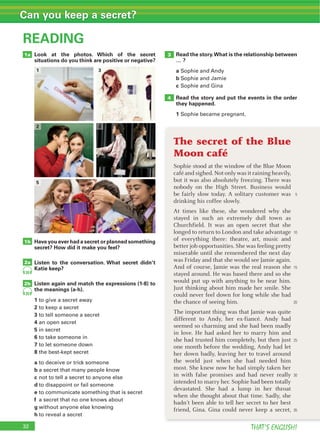
  • 172.
    171THAT’S ENGLISH! 4 If Iwere the parents, I would have been very hurt. Not only did our children keep their marriage a secret from us, but they didn’t think about how it would affect us! Activity 3 1 So, going back to what happened 2 After that, 3 Things were never the same again. 4 Or so I thought 5 You’ll never guess (believe it). 6 On the day in question, 7 That very evening, Activity 4a 5, 4, 1, 2, 3 Activity 5a Suggested answer: 1 I felt let down by my husband when I learnt he was having an affair. 2 My husband had an affair with a workmate of his. 3 My husband, Harry; his workmate and I were involved. 4 I felt very angry and hurt. 5 I feel OK with it now as I have got on with my life. Activity 5b Suggested answer: I think the time I felt let down the most was when I found out my ex was having an affair. I first met Harry at a party, and we got on well immediately.We were extremely happy; at least I thought we were. There were times when things were somewhat difficult, but what relationship doesn’t have problems sometimes? Then one day, Harry told me about his affair. I was extremely angry and hurt. I realised that I would never be able to forgive him or trust him again. After that, we got a divorce, and as a result, I have met the most wonderful trusting man, and I am absolutely elated. As a matter of fact, we are getting married next June. Anyway, I have forgiven Harry, and we are good friends now. UNIT 4. FAITH You’ve got to have faith (pages 40-41) Activity 1 Student’s own answers. Activity 2 1 Megan is a Catholic and Ahmed is a Muslim. 2 Because she doesn’t go to church regularly. Activity 3 1a, 2c, 3c, 4c, 5a Activity 4 1 4 2 7 Ahmed tells his mother that Megan is a lapsed Catholic. 3 7 Megan doesn’t go to church, but she does believe in God. 4 4 Activity 5 1 go to mass 3 lapsed 5 churchgoer 2 devout 4 atheist 6 worship Activity 6 1 devout, go to mass 3 lapsed 5 churchgoer 2 an atheist 4 worship Activity 7 Suggested answer: Spain used to be a nation of churchgoers. However, there are fewer religious people nowadays. Many people claim to have faith, but few actually go every Sunday to worship. I think more and more people are lapsed these days. Although people still feel it is important to receive the first Holy Communion, they don’t feel the need to go to mass regularly. Activity 8 Student’s own answers. Activity 9a The speakers mention 1, 3 and 4. Activity 9b 1 4(He says as he has grown older it has become less important.) 2 7 She says it is not a part of her life. 3 7 He says he’s fairly religious, goes to temple every month and spends some time there. 4 4(She says she celebrates Easter and Christmas.) 5 4(He says religion is in the way you live.) 6 4(She says she wouldn’t be without the presence of God in her life.) 7 7 He says he’s an atheist. 8 7 She says she likes the thought of spirituality. Activity 10a 1a, 2b, 3a Activity 10b 1 brought up 3 devout 5 an atheist 2 going to mass 4 churchgoers 6 had grown up Activity 11 Suggested answer: As a lapsed Catholic, religion is not very important to me. I was brought up as a Catholic, but when I grew up I didn’t go to mass as often as I used to when I was a child. After I had moved to Madrid to go to university, I stopped going altogether. My parents are not happy about this at all, but I imagine I will get married in a church and if I have children they will be baptised there as well. READING (pages 42-43) Activity 1 Student’s own answers. Activity 2a Paul has the strongest faith. Activity 2b 1 Jane 2 Paul 3 Paul 4 Jane 5 Paul Activity 3 2 Activity 4 1 The festival takes place every 3 years. 2 1 billion Hindu believers 3 Millions of pilgrims attend the celebration. 4 55-day festival 5 nearly a million sadhus 6 20,000 portable toilets 7 10,000 sweepers 8 50,000 policemen Activity 5 1 No, it takes place in different locations. 2 Because they believe it washes away sin. 3 A sadhu is a Hindu holy man or a priest.
  • 173.
    Answer Key THAT’S ENGLISH!172 4They do not wear clothes, cut their hair, never speak, stop eating or drinking. 5 The biggest danger is being injured in the crowds. 6 Frog worries that the water isn’t very clean and people can get ill. Activity 6 1 pilgrim 4 priest / sadhu 7 blessing 2 pilgrimage 5 fast 8 prayer 3 sin 6 vow 9 shrines Activity 7 1b, 2b, 3b, 4a, 5a, 6b, 7a, 8b LANGUAGE STUDY (pages 44-45) Activity 1 1f, 2h, 3a, 4e, 5d, 6b, 7c, 8g Activity 2 1 Falling - confirmation 5 Rising – real question 2 Rising – real question 6 Falling - confirmation 3 Falling - confirmation 7 Rising – real question 4 Falling - confirmation 8 Falling – confirmation Help box: Intonation in question tags Real question – rises. Confirmation - falls Activity 3 2 He is sure that ghosts exist. 3 They doubted whether / if the team were good enough to win the World Cup. 4 I wonder whether / if she took enough money for the train fare. 5 I do believe he really loves her. 6 I doubt if / whether she has enough qualifications for the job. Activity 4 1 actually 4 really 7 just 2 simply 5 Surprisingly, 8 simply 3 unfortunately 6 hardly Activity 5 1 Christianity 4 non-believers 7 Buddhists 2 atheists 5 Muslims 8 Sikhs 3 agnostics 6 Hindus 9 Jewish believers Activity 6 2 fast 5 prayer 8 Hell 3 sins 6 Heaven 9 miracle 4 pilgrimage 7 priest 10 shrine Activity 7 2 gives his blessing 5 blind faith 8 act of faith 3 Bless you 6 count your blessings 4 in good faith 7 Bless Activity 8b 1b, 2b, 3a, 4a, 5b, 6a, 7a, 8b Believe it or not! (page 46) Activity 1 Student’s own answers. Activity 2 1 English Church. A Christian who is a member of the Church of England. 2 The Pope is the main authority in the Catholic Church whereas the Church of England is independent from Rome. 3 Henry VIII. 4 It runs the Church of England. Activity 3 1 God 4 challenge 7 same 2 culture 5 faiths 8 chairs 3 family 6 older / over 50 9 tables Activity 4 Christianity, Muslim (Islam), Hinduism, Judaism, Rastafarianism, Church of England Activity 5 1 the USA 3 Australia 5 Canada 2 Jamaica 4 England 6 New Zealand Activity 6 1b, 2c, 3a Activity 7 1 4 2 7 It’s a 13th century building. 3 4 4 7The RoundTower is 30 metres high. 5 7 It sells Irish products. 6 7They are made down the road. Activity 8 Suggested answer: My country has many religious buildings. Many of them represent the Catholic religion, for example, the Cathedral Basilica of Saints Peter and Paul in Philadelphia. However there are also buildings from other religions such asTemples Square in Salt Lake City, Utah which represents the Mormon faith. SKILLS WORK (page 47) Activity 1 Student’s own answers. Activity 2a They are in the Mecca at the Kaaba. Activity 2b 1 Muslims pray towards Mecca because it is the most sacred site in Islam. 2 The Kaaba is about 4,000 years old. 3 Some people think it was a sign from God. Others believe it is a meteorite. 4 Yes, all Muslims have to go on the Hajj if they can afford it and are in good health. 5 Pilgrims circle the Kaaba seven times. Activity 3a 1 4 2 7 Pilgrims drink some Zamzam water or wash in it. 3 4 Activity 3b Day 1: c Day 2: b Day 3: a Activity 4a Student’s own answers. Activity 4b Student’s own answers. WRITING SKILLS (pages 48-49) Activity 1a 2 Activity 1b 1 against 3 for 5 for 2 for 4 against 6 against
  • 174.
    173THAT’S ENGLISH! Activity 2a Thewriter is in favour of religious schools receiving government funding. Activity 2b 1 general facts and context 2 compared and contrasted 3 both sides of the discussion and your personal opinion Activity 3 1b, 2c, 3a Activity 4 2 The rescue teams stopped the search for survivors; even so, she never gave up believing he was alive. 3 She seems to be telling the truth, and yet I don’t trust her. /Yet, I don’t trust her. 4 She seems to be telling the truth, even so I don’t trust her 5 She is the richest woman in the country, but still she isn’t happy. / Still, she isn’t happy. 6 She has an enormous salary, yet it isn’t enough. Activity 5 1 as regards 4 however 7 In comparison, 2 still 5 to conclude 3 in spite of 6 on the whole Activity 6a Student’s own answers. Activity 6b Suggested Answer: Should religion be taught in schools? Catholicism has always played an important role in Spanish society and education.Yet, it wasn’t until after Franco’s death that a law was passed for religion or an ‘optional’ subject to be taught in primary and secondary education. This law still holds true today. However, apart from Catholicism (of the 69% the majority are said to be non- practising), Islam, Judaism, Protestantism and Hinduism are also practised in present-day Spain. In spite of being a culturally diverse country, the Catholic Religion still continues to be taught in the classroom, although it is no longer a practical tradition to continue to do so. It would be more logical to cut this subject from the national curriculum. Families can educate their children in the church, mosque, or temple of their choice to ensure that their personal belief system is being conserved and developed. If this subject were cut, our students would be able to take a true optional class that would enrich their education such as computer programming, Mythology, Sign Language, Cooking, Choir, Psychology, etc. On the one hand, It would be a good idea to keep to the tradition and continue offering religion in schools, but on the other hand, it would be good for this subject to be cut from the curriculum and let people decide what they want to study. It is time for the Spanish curriculum to move towards the needs of 21st century students and families. REVISION 1 LANGUAGE REVISION (pages 50-51) Activity 1a 1 had been living 6 had compiled 2 wasn’t going 7 was 3 had suffered / was suffering 8 left 4 had 9 knocked 5 noted 10 had walked Activity 1b found out: neither came: both went: both was: used to be left: both saw: neither decided: neither arrived: both Activity 2a 1 will you? 4 weren’t you? 7 shall we? 2 didn’t they? 5 will you? 3 were you? 6 don’t you? Activity 2b 1 real question 4 confirmation 7 real question 2 confirmation 5 real question 3 confirmation 6 real question Activity 3 1 pretty 4 firmly 7 hardly 2 surprisingly 5 absolutely 8 kindly 3 unfortunately 6 actually Activity 4 1b, 2c, 3a, 4b, 5b, 6c, 7b, 8b Activity 5 1 Have you met the woman living in the house on the corner? 2 He is the man to ask if you need help. 3 This is the message given to the followers. 4 This is the way to go to get home. Activity 6 1 Not only did he leave his family, but he gave all his money to the Church as well. 2 I thought the acting was awful, whereas the plot wasn’t bad. Whereas I thought the acting was awful, the plot wasn’t bad. 3 I wonder whether / if they took the right road. 4 Despite not feeling very confident, she passed the exam. She passed the exam despite not feeling very confident. 5 I realised it would mean a great sacrifice. Even so, I decided to help them. 6 The report is interesting. However, it needs more research. 7 Not only can you ski, but you can go the beach too / you can also go to the beach in Granada. 8 He lost his keys. Still, he managed to climb in through the window. He lost his keys but he still managed to climb in through the window. 9 I doubt whether / if / that he’ll enjoy the show. 10 On seeing the results, she was relieved. Activity 7 1 plough back 3 got rid of 5 took a turn 2 let them down 4 get over Activity 8 1 out 3 off 5 out 7 into 2 away / out 4 up 6 over Activity 9 1 flexibility 3 competitor 5 operation 2 adaptable 4 stabilise 6 investment Activity 10 1 liquidation 4 faith 7 fast 10 blessings 2 assets 5 sins 8 blind 3 debts 6 prayers 9 leaf
  • 175.
    Answer Key THAT’S ENGLISH!174 SKILLSWORK (pages 52-53) Activity 1 1 7 Buddhists follow the teachings of Buddha, but Buddha is not a god. 2 4 3 4 4 7 Ösel Hita is an example of aTibetan Buddhist Lama who was born in Spain. Activity 2 1 The followers of Buddhism try to achieve enlightenment and true happiness. 2 The way we have lived influences the creature we reincarnate as. 3 The Dalai Lama leads the Tibetan people spiritually and politically. 4 The leader might be elected democratically and there might be a female Dalai Lama. 5 They need to choose the objects that belonged to the deceased lama. 6 Ösel Hita lived in India when he was a child. Activity 3a 1 a bomb that causes a tsunami 2 a secret service agent who might have injured JF Kennedy 4 the location of the tomb of Jesus Christ 5 the formula for Coca-Cola Activity 3b Secret Where? When? Believable? tsunami bomb New Zealand in World War II yes Jesus’s tomb Jerusalem 2,000 years ago no Kennedy’s assassin Dallas in the 60s yes Coca-Cola formula Atlanta nowadays yes Activity 4 Student’s own answers. Activity 5 1b, 2a, 3f, 4c, 5d, 6e Activity 6 Suggested answer: I started learning English when I was 14 years old. I absolutely loved the idea of learning a new language. After a while, I felt I was learning a lot and was able to speak English quite well. For instance, not only was I able to understand my teacher, but I was even able to answer most of her questions.Then, I went to Milwaukee for a 3-week exchange and realised that I couldn’t understand the native speakers nor could I speak to them. The turning point for me was when I met a very nice American friend who was very patient with me and made me realise that I would be able to learn the language one day.As a result, I started speaking with more confidence. As far as I’m concerned, it is very important to have an interest in learning a language and to be patient. However, a good teacher also helps. If I had a language school, I would make sure that students got plenty of speaking practice and organise trips to English-speaking countries. Activity 7 1 yet 3 On the other hand 5 On the other hand 2 Although 4 moreover 6 However Activity 8 a You can make a lot of money. b You can lose a lot too. a You can be independent. b You have to work long hours. b The risks may be high. a The profits may be greater. a The government wants to encourage entrepreneurs. The EU provides loans too. b You devote 100% of your time to your business. a Owning a company gives you more satisfaction. a Hiring good employees is essential. b The labour costs are high. Activity 9 Suggested answer: Starting your own business can be both very risky and an opportunity. For those who are daring, there are many opportunities for an entrepreneur to be successful.Yet, there are many people who would prefer to be employed by a company and not take the financial risk. The main difficulties for people who start up their own business are financial backing, the hours and finding good employees. It is complicated to persuade a bank to give you a loan, and without this loan, most people don’t have the money for the initial investment. In addition, those who run their own company work long hours and are often under great pressure and stress. Hiring good employees is also essential even though labour costs are very high. As far as I’m concerned, in spite of all the risks and difficulties of starting up a company, it would certainly be worth it. It gives you personal satisfaction, the profits may be great, and what’s more, nowadays the EU provides loans to new businesses. In summary, although there are drawbacks of starting up a business, I believe the benefits can often outweigh the risks. UNIT 5. THIS IS MY SPACE Sharing space (pages 54-55) Activities 1a and 1b 1 b – an open-plan office – no personal space 2 c – a spacious office – lots of personal space 3 a – a small airless office – no space to move Activity 2 1 Because he thinks it will help increase productivity. 2 Because she can meet her colleagues and get around in her wheelchair more easily. Activity 3 The reasons Danny is unhappy are: 1, 3 and 5 Activity 4 1 4 Charles says in the old office there was no space to move and there wasn’t nearly enough air or light. 2 7 Danny complains about the temperature being too high. He says that if it’s any more than twenty-one degrees he can’t concentrate. 3 4 Danny says that Malcolm’s desk is too small to hold all his possessions. 4 4 Mr Finchley says that there is just about enough space for a desk by the window. 5 7 Danny says he must have sent Maria about 50 emails but they had never met. Activity 5 1 spacious 3 airy and roomy 5 space to move 2 takes up 4 airless 6 personal space
  • 176.
    175THAT’S ENGLISH! Activity 6 1personal space 4 spacious (airy and roomy) 2 takes up 5 airy and roomy (spacious) 3 space to move Activity 7 Suggested answer: MybedroomisroomyandIlikeitbecauseitismyownpersonal space and I don’t have to share it with anyone else. However, there are things that I’m not happy about, for example, it’s not very airy because it only has one small window. Activity 8 1 Student’s own answers. 2 All the speakers except one said that private space was important. Activity 9a 1 only 3 relax 5 connected 2 switch 4 private 6 bored Activity 9b 1 4 2 7 She says she thinks everyone needs their own space, just to relax and wind down after a hectic day. 3 4 4 7 Andy says he hates staying in. Activity 10a 1 annoys you 4 chill out 2 for a short time 5 busy 3 spending time at home 6 being by himself Activity 10b 1 get on your nerves 3 for a bit 2 wind down, be on my own 4 staying in, hectic Activity 11 Suggested answer: I come from a big family so having my own personal space is really important to me. Although I like to spend time with my family, there are times, especially if I’ve had a hectic day at work, when I just need to wind down and relax on my own. I live on my own so I have my own private space and spend a lot of time on my own. However, there are times when you just don’t want to stay in and be on your own, and that is when I go out with my friends. READING (pages 56-57) Activity 1a 1e, 2d, 3c, 4f, 5a, 6b Activity 2 3 Activity 3 1 To reach the entrance to the slum, we had to go past a huge pile of rubbish and open toilets.The smell was terrible, far stronger than anything I had experienced before. 2 There were no toilet facilities in the house because there was no municipal system to take away waste water. My visits to the communal women’s latrine would be my least favourite part of my life. 3 I hurried after Sunlil. Provided that I was with him, I knew I would be safe. 4 The population density is one of the highest in the world. Half a million people live here, 12,000 people for every 4,000 square metres. 5 I had never been anywhere so overcrowded: the concept of personal space just doesn’t exist. 6 Dressedinasariwithascarfovermyhead,Iwascompletely anonymous. 7 I saw that we were in a small clean room painted bright blue. The walls were full of shelves packed with all the owners’ possessions, tidily arranged to make the best use of the limited space. 8 There was a cooking platform with an oil stove on it and Sunlil’s family had a fridge and aTV set. Activity 4 1 We can’t exactly know why she is in Dharavi. She says that dressed in a sari with a scarf on her head, she was completely anonymous and would pass unnoticed, but we can’t be completely sure that she is hiding from someone. 2 She says that the visits to the latrine would be her least favourite part of her life in Dharavi, so she must have spent several days there. Activity 5 1 cramped 3 airless 5 Narrow 2 packed with 4 overcrowded 6 crammed Activity 6a To show what life is like for the people who live in Dharavi and to let people know about the government’s plans to destroy it. Activity 6b 1 waste 3 personal 5 make, use 2 move 4 take up 6 made Activity 7 1 cramped / overcrowded 5 use 2 packed 6 cramped / overcrowded 3 made 7 taking up 4 personal Activity 8 Student’s own answers. LANGUAGE STUDY (pages 58-59) Activity 1 2c, 3a, 4b, 5d, 6e Help box – If, unless, in case, provided that… present past Activity 2a helipad, temple, library, swimming pool, ballroom, banquet hall, cinema, gym, ice room, roof terrace Activity 2b 3 wouldn’t want 7 would have to 11 earns 4 shared 8 found out 12 shouldn’t 5 is 9 won’t tell, wouldn’t tell 6 uses 10 keep, kept Activity 3 1 spacious 4 poky, cramped, airless 2 tiny 5 roomy 3 stuffy 6 well-ventilated, bright Activity 4 1 far too small 4 much too short 2 much more complicated 5 not all that expensive 3 not nearly advanced enough 6 slightly less warm Activity 5 1 slightly colder 4 not nearly old enough 2 hardly qualified enough 5 much cheaper 3 not nearly as difficult 6 far more spacious
  • 177.
    Answer Key THAT’S ENGLISH!176 Activity6a 1 far 3 slightly 5 much 2 nearly 4 that Activity 7 Student’s own answers. Live in a harmonious space (page 60) Activity 1a Student’s own answers Activity 1b 1b, 2c, 3a Activity 2 1 You can improve your health and good fortune. 2 She examines the earth energies to know they are in harmony with the client. 3 He invited Susie to assess his home because he never seems to have enough money to spend to do things. Money seems to go out faster than it comes in. 4 The first and most important principle of feng shui is to clear your clutter (get rid of it). 5 If our homes are full of clutter it holds us back in life. 6 Wealth is not just about money, it’s also the wealth we feel inside. 7 Rupert learnt that there are earth energies, things that move and you can block them. 8 She feels she helps people in their life and to connect with their space. Activity 3 2 ,7 Activity 4 1 a lot of 3 like 5 don’t usually worry 2 value 4 like Activity 5 2 The Plassey cargo shipwreck is now one of Inisheer’s most popular tourist attractions. Activity 6 1 4 2 7 Gaelic is the main language spoken on the island. 3 4 4 7 It had almost been buried by sand. 5 4 6 4 Activity 7 Suggested answer: The island of Lanzarote is not the smallest of the Canary Islands,butinmyopinionitisthemostbeautifulbecausethere you can see some amazing things like live volcanoes and a green lake.The people on the island are also very welcoming and friendly towards tourists. The typical food is varied and you have a sauce called mojo picón and it is delicious. I really love Lanzarote and I hope to go back again soon. SKILLS WORK (page 61) Activity 1 Student’s own answers. Activity 2 1 4 2 7 House prices in general tend to be high. 3 7 Because there are lots of rich people who want to own property there. 4 7 It’s affordable but not easy. 5 7 If your image of house sharing is based on the American sitcom Friends, you’ll be disappointed. 6 4 Activity 3a Dorcas Ramón Country/City USA, Denver Spain, Barcelona Location of building suburbs old part of Barcelona Type of building house apartment Lives with Annika-roommate on his own Activity 3b Dorcas Ramón Layout change take down walls no change What they would get rid of hideous furniture / red carpet kitchen tiles What they would put in plants / indoor small fountain a lift Style of furniture & décor basic furniture, traditional, light wood and wooden floors, white or cream walls ultra modern look, glass chairs and a leather sofa, modern lighting system Activity 4 Suggested answer: I live in a four-bedroom detached house in the suburbs of Atlanta. The house is 20 years old and needs some remodelling. To build my dream house, first of all I would replace the small old windows with bigger and better insulated ones. Not only would this give me more light, but it would make the house look more spacious. I would like the kitchen, dining room and living room to have an open-plan layout. The furniture would be modern but comfortable, and the floors would be made of dark wood. I would paint the walls white and add colourful paintings. The garden patio would have a place to barbecue, a large picnic style table and a Jacuzzi to relax in after entertaining friends. SPEAKING (pages 62-63) Activity 1 1b, 2b, 3a, 4b, 5b, 6b Activity 2a 1 just what I was 6 put it that way 2 took the words 7 strongly recommend 3 exactly the point 8 asking 4 might be 9 wait and see 5 not entirely sure 10 worth Activity 3 1 use 2 installing 3 turn off 4 buying Activity 4 2 I would recommend installing underfloor heating. / I would recommend that you install underfloor heating. 3 I suggest switching off the computers at night. / I suggest that you switch off the computers at night. 4 I recommend using this cleaning fluid. / I recommend that you use this cleaning fluid. 5 I recommend painting everything white. / I recommend that you paint everything white. 6 I suggest looking at design magazines. / I suggest that you look at design magazines.
  • 178.
    177THAT’S ENGLISH! Activity 5a Dianasuggests turning the land into a city park. Bill suggests selling the land to developers. Activity 5b 1e, 2a, 3f, 4c, 5b, 6d Activity 6a Student’s own answers. Activity 6b A: Personally, I think a new city centre car park is a waste of the taxpayers’ money. B: You took the words right out of my mouth.The last thing we need is another car park.This would only mean more traffic in the city centre. A: I hear what you’re saying. But on the other hand, it would make it easier to park and more people could shop and have lunch or dinner in the city centre. The shop and restaurant owners would support this. B: Well, I don’t disagree with what you’ve said, but I would strongly recommend cutting off traffic in the city centre and allowing only pedestrians. A: I think the worst option would be cutting off the traffic. I suppose the best option would be to wait and see what happens. UNIT 6. HOW CAN I HELP? DIY – Do ItYourself – or not! (pages 64-65) Activity 1 1 a leaking pipe / tap. I’d call a plumber. 2 a broken vacuum cleaner. I’d call a technician. Activity 2 1 Because he thinks he can mend it himself. 2 Because he thinks that Mr Riley, the landlord, will give them the money for the plumber. Activity 3 1 7 She said the supermarket was delivering the rest later. 2 4 (Karen told him about the leaking sink and Danny said he knew about it and had called Mr Riley.) 3 7 The first time he used the vacuum cleaner he was covered in dust. 4 4 (She said they need to be properly sealed.) 5 7 He said he hates it when they don’t know anything about what they are selling. Activity 4 1 Danny decides to get the sink fixed properly and so he calls a plumber. 2 Danny hates it when you have to listen to all the options. 3 It keeps repeating the same message. 4 They have to be taken out and replaced. /They need to get new pipes. 5 She left a generous tip because the service was excellent and it wasn’t included in the bill. 6 They realise they might not get the money they paid to the plumber from Mr Riley. Activity 5 The things that Mr Riley keeps promising to do but hasn’t done yet are: 1, 2, 4, 5. Activity 6 1 down the drain 4 a technician 2 broke down 5 leaking 3 fix / repair / mend ... herself Activity 7 Suggested answer: I remember once I bought an old second-hand car and that was really throwing money down the drain. It broke down the first week I had it and the repair cost me an arm and a leg! It was continuously breaking down and I finally had to get rid of it. Activity 8 Student’s own answers. Activity 9a have never complained have complained on one occasion or only occasionally regularly complain Nadine Jude, Nip, Charlotte Ian, Peter, Jo Activity 9b 1 Nadine thinks she should complain is some places about the service and the food. 2 In restaurants if food isn’t cooked well or there’s a hair or something in it. 3 They offered him the hot chocolate for free. 4 Ian mainly complains in restaurants. 5 Peter is always complaining about services in public places. 6 McDonald’s gave Charlotte a free meal. Activity 10a 1b, 2a, 3d, 4e, 5c Activity 10b a moan (about something) to yourself c lodge a complaint b point (something) out Activity 10c 1 points it out 3 moanabout...themselves 2 lodge a complaint Activity 11 Suggested answer. I have never lodged a formal complaint because I find it really embarrassing to do that kind of thing. However, I am thinking about lodging a complaint about the state of the recycling bins in my city. They are never cleaned and the smell from these bins is absolutely disgusting. READING (pages 66-67) Activity 1a Suggested answers: 1 repairing my car 2 choosing my engagement ring 3 reading bedtime stories to my children 4 writing a difficult report Activity 1b Student’s own answers. Activity 2a 2 Activity 2b 1d, 2g, 3f, 4e, 5a, 6c Activity 3 1a, 2b, 3a, 4a, 5b, 6a, 7b, 8a Activity 4a 1 offers 3 isn’t 5 open 7 was 2 opened 4 can’t 6 isn’t Activity 4b 1c, 2a, 3e, 4b, 5d, 6f
  • 179.
    Answer Key THAT’S ENGLISH!178 Activity5 1 out of service 3 came into service 5 to be of service 2 at your service 4 in service 6 pay lip service LANGUAGE STUDY (pages 68-69) Activity 1a 2 Your offer will be considered. 3 The game had been lost. 4 The project will have been finished. 5 The roof is going to be repaired. 6 The motor can be replaced. Activity 1b 2 The customers were offered a discount (by the shop). A discount was offered to the customers (by the shop). 3 The concierge has been given a bonus by the hotel manager. A bonus has been given to the concierge by the hotel manager. 4 The winner will be presented with a medal by the judges. A medal will be presented to the winner by the judges. 5 Students can be given surprise exams (by their teachers). Surprise exams can be given to students (by their teachers). Activity 2 Work has been started on the Crossrail project in London, which is one of the largest building projects in Europe. A huge tunnel has been designed which will run for 42 km from east to west and it is being excavated by eight huge machines. Travelling time for millions of commuters will be reduced in the future. The original tunnel had been proposed in 1948 but it was not built due to lack of money. The tunnel will be opened in 2018 and by then, 5 million tonnes of earth will have been moved to Essex. Activity 3a 2 Activity 3b 1 7 Tony got the garden tidied up. 2 4 3 4 4 7 The previous owner had it installed six months ago. 5 4 6 7Tony suggests that he and Sally can repaint the bedrooms. Help box – Causative have: to have /get something done 1a, c 2b, d Activity 4 2 had / got it repaired 3 am having / getting my eyes tested 4 had / got the room decorated 5 had / got her haired dyed 6 have / get it cut 7 had / got a new bathroom built 8 are having / getting new windows installed Activity 5a Conversation 1 a holiday hotel b praising Conversation 2 a food in a restaurant b complaining Conversation 3 a flight b praising Activity 5b 1 service highly enough 4 can’t stand 2 perfect 5 absolutely 3 afraid, problem 6 best I’ve ever had Activity 6 1 are always helping 5 keep doing 2 is always baking 6 is always barking 3 keeps saying 7 keep forgetting 4 are always parking 8 is always saying Activity 7 2 Speaker 1 SA Speaker 2 A 3 Speaker 1 A Speaker 2 SA 4 Speaker 1 A Speaker 2 SA Activity 8a police-plural youth-plural people-plural committee-singular government-singular Activity 8b 1 was / were 3 have been 5 disagree 7 keeps 2 suffer 4 hasn’t / haven’t 6 worry Would you like to volunteer your time? (page 70) Activity 1 1 They are volunteering to clean up the local area. 2 They are volunteering to help with elderly people. 3 They are volunteering to help the environment by planting trees. 4 They are volunteering to help with disabled people. Activity 2 1b, 2a, 3c, 4b, 5a, 6c Activity 3 Help for young school leavers isn’t mentioned. Activity 4 USA: childcare, unemployment benefits, care for the elderly Canada: unemployment benefits, healthcare Australia: old age pensions, help with rent, student loans, healthcare England: care for the elderly, care for the disabled The people from Jamaica and India don’t mention any specific social care. Activity 5 It takes about two hours to walk along the cliffs of Mohar and swimming and surfing are the most popular sports in Lahinch. Activity 6 1 Because you will want to stop along the way to look at the spectacular views. 2 She thinks they come to see the wonderful beauty of the cliffs and the wildlife. 3 It was built as an observation point for visitors to the area. 4 You get an amazing view. 5 It took 320 million years for the different layers of rock to form the cliffs. 6 You can see colonies of seabirds. 7 Because it faces directly west into the Atlantic and so it receives a lot of waves. 8 Surfing has been popular for about 20 years. 9 Because that is when they get the big waves. Activity 7 Suggested answer: There are so many famous landmarks in my country that it is difficult to pick one. La playa de la Concha is a very popular destination and the Camino de Santiago has lots of famous landmarks all along the route.
  • 180.
    179THAT’S ENGLISH! SKILLS WORK(page 71) Activity 1 automated call answer, delivery difficulties, unreliable repairmen, out-of-stock items Activity 2 1d, 2b, 3a, 4c Activity 3a 3 Activity 3b 1d, 2a, 3c, 4b, 5f, 6e Activity 4 Suggested answer: I can’t stand it when customer service puts me on hold. After finally being able to talk to a real person, they ask you to wait! I end up wasting a lot of time. It irritates me so much that I often lose my temper and hang up.Then, I have to call back later, only to go through the whole experience again. WRITING (pages 72-73) Activity 1 2 Activity 2 2, 3, 1 Activity 3 1 Yours faithfully,Yours sincerely 3 shouldn’t 2 formal 4 impersonal Activity 4 2 I was told I could have a refund. 3 My husband was offered a reduction in price. 4 I was told (by the engineer) (that) the problem had been fixed. 5 A complaint number was not provided by customer service. 6 The spare part has not been delivered. 7 My secretary was given a delivery date (by your sales assistant). 8 The new supplies have already been ordered (by the supply manager). Activity 5 1c, 2g, 3a, 4d, 5h, 6b, 7e, 8i, 9f Activity 6a 1 unhappy with the complexity of the webpage and the customer service department 2 PlayStation too difficult to install, customer service not answer phone, poor service received 3 call technician to have it installed Activity 6b Suggested answer: Dear Sir or Madam, Recently, I bought a Play Station 4 for when my grandchildren come to play at our house. I am writing to complain about the complexity of your webpage and the horrible customer service that was given over the phone. I found it challenging to install the device so I consulted your webpage.There was not an option for ‘how to install your Play Station’, so I clicked on ‘where can I get help?’ and a service number was provided. First of all, no one answered the phone and I literally called over a seven-day period. Secondly, I could not understand the person who was helping me and they asked me to call back at another time. Finally, I did speak to someone. I was able to understand but he confused me more than he helped me! After spending over €400 on this new game, I cannot believe the poor service received. I cannot ask for a refund as I have promised this gift to my grandchildren. This situation is completely unacceptable. I am afraid I must ask you to send a technician to install this game as soon as possible. If not, I will be forced to take legal action. Please do not hesitate to call me if you require further information. Yours faithfully, Mr Richard W. Banks UNIT 7. COMPETITION Stop being so competitive all the time! (pages 74-75) Activity 1 Student’s own answers. Activity 2 1 He has a very competitive relationship with his brother. 2 He says that his parents preferred Charlie and told Jason that he should try to be more like him. Activity 3 1 4He says, ’I thought you wouldn’t be able to beat me – but you did’. 2 7 He says, ‘ When we were kids I could always beat him pretty easily’. 3 4He says, ‘I can’t let him win, he’s family’. 4 4He says he has to keep ahead of the game because he doesn’t want a new boy taking his place. 5 7 He thinks Charlie won because he (Jason) was tired because he’d done ten rounds of boxing that morning. 6 4He says, ‘I bet they are thrilled’. Activity 4 1 The sun was in his eyes and he missed the shot. 2 He thought it was massive and he would have to work 24 hours a day to pay the mortgage on a house like that. 3 Because his brother was the golden boy and didn’t have to make an effort. 4 He said his new colleague was brilliant. 5 He was pleased and accepted the invitation. 6 Jess told Charlie that they were going to have twins. Activity 5 1c, 2a, 3d, 4b Activity 6 1 make an effort 3 beat 2 over the moon 4 keep ahead of the game Activity 7 Suggested answer: I wouldn’t consider myself to be a really competitive person as I don’t mind losing. I don’t really understand very competitive people; I think they get upset over nothing. We live in a very competitive world, so it is very important to keep ahead of the game. People have to turn themselves into products which they can sell to companies so they have to invest in things like learning languages.They also have to get certificates to prove that they have learnt these languages! Activity 8 Student’s own answers.
  • 181.
    Answer Key THAT’S ENGLISH!180 Activity9a Massively competitive Darren Quite competitive Lauren Really competitive Nadine Not particularly competitive Alan Very competitive Ian, Peter, Charlotte Used to be competitive Judy Activity 9b 1 Nadine thinks her husband is better. 2 Lauren is competitive with other shops, making money and meeting the targets. 3 Ian was very competitive with his twin brother. 4 Peter thinks he is very competitive because he is a triplet. 5 Sport. Judy used to be competitive but just wants her team to win now, but Charlotte is still competitive. Activity 10a 1e, 2c, 3a, 4d, 5b Activity 10b 1 competitive 3 triplet 5 better 2 make … out of 4 constant competition 6 up top Activity 11 Suggested answer: I am massively competitive when I play tennis with my best friend Karen. She is a better player than me and usually beats me. So whenever I get the chance to beat her, I am over the moon. I’m not very competitive with my brothers and sisters. I know some people like to compete in things like who has the biggest house and things like that, but I never really compare myself to my siblings. Some of my colleagues are very competitive.They are always trying to go beyond the sales targets. I think that as long as you do your job well then that should be enough. Why complicate life for yourself? READING (pages 76-77) Activity 1 1 Japan 3 opponent 5 exhausting 2 tournament, ring 4 competitive Activity 2 3 a magazine for people interested in Japanese culture Activity 3 1 is very tired and has hurt his shoulder 2 very large meals and then rest 3 disciplined 4 have to do a lot of cooking and housework 5 is dedicated to sumo 6 give up too easily Activity 4 1 10,000 calories 2 a special dish sumo wrestlers eat to gain weight / seafood, meat and vegetables 3 in order to gain weight 4 a kimono 5 Rikishi need perseverance to achieve a goal in life, will power, and a good heart to succeed. 6 Coaches are strict and this is their gift to their students. It makes them strong. Activity 5 2 put me at a disadvantage 6 broke the record 3 throw in the towel 7 draw 4 fair play 8 achieve a goal in life 5 push us beyond our limits / push people beyond their limits Activity 6a Noun Verb Adjective 1perserverance 2persevere persevering 3strictness strict endurance 4endure enduring competition/competitor 5compete 6competitive dedication 7dedicate 8dedicated discipline discipline 9disciplined 1 perseverance 4 endure 7 dedicate 2 persevere 5 compete 8 dedicated 3 strictness 6 competitive 9 disciplined Activity 6b 1 disciplined 3 persevering 5 dedicated 2 compete 4 endured 6 strictest / the most strict Activity 7 Suggested answers: 1. 2. I’d never learnt to drive when I was younger, my husband always drove. Then one day, my husband had an accident and couldn’t drive anymore. So, I had to learn. I was 60 years old and absolutely terrified. But I didn’t throw in the towel, even though I had more than 100 driving lessons. It was one of the proudest days of my life when I finally passed my test! 3. 4. I used to play American football and we had a coach who pushed us beyond our limits. I was much smaller than the other players and had a disadvantage when it came to tackling players. One day, the coach decided to make us do a tackling drill. He put the biggest players against the smallest players. Many of the smaller players got injured and decided to quit the team. I think what the coach did was a bad thing because it caused quite a few boys to stop playing football, a game they really liked. LANGUAGE SKILLS (pages 78-79) Activity 1a 1 break a record 2 get to the top of the ladder, team player 3 push us beyond our limits 4 has got what it takes, throws in the towel 5 puts me at a disadvantage Activity 2 2 All students are required to arrive on time for class. 3 They had to practise for at least four hours a day. 4 He doesn’t need to / needn’t come if he doesn’t want to. 5 My daughter is allowed to watchTV only at the weekend. 6 We had to be team players. Activity 3 1 made me apologise 6 let you eat 2 make you wear 7 used to let me go 3 makes us work 8 let us go home, lets us 4 was made to eat 9 were allowed to 5 were made to leave Activity 4 1 We’re allowed to go out at the weekend. 2 My brother doesn’t let me ride his bike.
  • 182.
    181THAT’S ENGLISH! 3 Hewas allowed to stay up late last night. 4 Their boss won’t make them work overtime. 5 My athletics coach used to make / made me train every day. 6 They didn’t let us leave the building. Activity 5 2 couldn’t 4 could 6 couldn’t 3 was finally able to 5 being able 7 was able to Activity 6 2 couldn’t / wasn’t able to 6 will be able to / are able to 3 have been able to 7 was able to 4 can / are able to 8 could / was able to 5 can / are able to Activity 7a 1 That was fantastic, keep going! Don’t give up. 2 Well done, team!That was great stuff! 3 You really deserved that promotion. Good for you! 4 Good try! 5 Never mind, better luck next time. Activity 7b 1 Never mind, better luck next time. 2 Good try! Activity 8 1 fairly 3 rather 5 not all that 2 pretty 4 exceptionally 6 extremely Activity 9 Suggested answers: 2 I used to think everybody could speak English. I never understood why some people never answered me when I spoke to them. Then my mum explained that they were from different countries and spoke different languages. 3 When I was younger, I couldn’t pronounce my R’s correctly. Everyone used to make fun of me and imitate me. It really made me angry. 4 Once in my life I was unable to go downstairs to the basement of my house. I was terrified that there was someone down there waiting to kidnap me. 5 Despite being quite poor when I first started working, I was able to rent a flat, pay all my utility bills and buy a second- hand car. All of this with just £1000. Everyone should have a go! (page 80) Activity 1 Gurning is the act of pulling the silliest face possible and at the same time wearing an old horse collar known as a braffin. Activity 2 1 4 2 4 3 7The Lord of the Manor would give the peasants apples as part of their wages. 4 7 He started to compete in the gurning championships because his father was the World Champion. 5 4 6 4 7 4 8 7 Over the years the prizes have tended to change. Activity 3 USA swimming, basketball, American football South Africa rugby, cricket Ireland boxing Canada winter sports Australia cricket, swimming Scotland football India cricket Activity 4 1 fantastic achievements 3 They are quite big fanatics. 2 swimming 4 a religion Activity 5 1c, 2a, 3b Activity 6a 1 Gaelic football, 4 hurling Activity 6b All topics are mentioned except number 7, battles. Activity 6c 1 crisis 3 battle 5 sea 7 kill 2 island 4 magical place 6 storm 8 names Activity 7 Suggested answer: There are many types of festivals in my country. I think the most unusual one is the Tomatina which takes place in Buñol, a village located in Valencia. It’s a tradition that happens on the last Wednesday of August – just in the middle of the week when the whole town celebrates and eats paella (typical food from the area). The day of the Tomatina, everybody is ready at 11:00 a.m. to start battle. People put on their goggles and start throwing tomatoes, which are brought from Extremadura, at each other.The fun ends an hour later with the water cannons which indicate that nobody is allowed to throw any more tomatoes. The Tomatina has become so popular that if you want to join it, you have to pay 10€ a ticket. It’s still worth it. SKILLS WORK (page 81) Activity 1 Student’s own answers. Activity 2a Kostas won a realityTV show called WatchingYou. Activity 2b 1 4 2 4 3 7 He won because he didn’t do this. 4 7 He won 180,000. 5 7 His friendship with Kristos was what made it possible for him to stay. 6 7 He thinks his life is now like it was before he took part in WatchingYou. Activity 3a The writer’s attitude to reality TV is negative. He / She describes reality TV shows as involving a ‘high degree of competitiveness’ and ‘the opportunity for revenge’ neither of which are particularly socially positive attributes. Activity 3b 1 Contestants have to do tasks or challenges and vote to decide which person has to leave the show. 2 Regular viewers of reality TV shows tend to have competitive personalities and place a high value on revenge.They also have a desire for status or prestige. 3 The author believes realityTV shows are popular because it lets ordinary people win and become stars. Activity 4 Suggested answer: In my opinion, reality TV shows are the lowest form of entertainment.They reflect the worst values of our society and
  • 183.
    Answer Key THAT’S ENGLISH!182 encouragepeople to behave badly simply in order to be onTV and have their fifteen minutes of fame. I hate Big Brother, for example. I can’t relate to people whose goal in life is just to be a contestant on a programme where privacy is not a right and conflict is valued.What do people do there? Sitting around all day long! Besides, I have always believed they are a sneaky way to keep society ignorant of current political and social issues. Citizens could be better informed if more talk shows were broadcasted instead of so much trashy TV. In my opinion, these kinds of programmes do not set a good example for society and I’d be glad if production companies stopped investing money in them. SPEAKING (pages 82-83) Activity 1 Student’s own answers. Activity 2a 1 professional 4 overvalued 2 didn’t try hard enough 5 the way he’s treated people 3 Patricia Activity 2b 1 had, been 5 hadn’t been 2 should have, should have 6 would have made 3 shouldn’t 7 regret treating 4 would, have Activity 3a 2 had worked 5 not asking / not having asked 3 hadn’t said 6 should have realised 4 hadn’t been Activity 3b Suggested answers: 1 I wish / If only I hadn’t told Michael my true feelings. He wasn’t interested in me and now I get embarrassed whenever I see him. 2 I regret not persevering with my degree. Finding a job is totally impossible. 3 I regret breaking my boyfriend’s heart but I fell in love with Adam and nothing could have stopped me from leaving Peter. 4 I shouldn’t have lied to Mary. It was a white lie but she’s got a different point of view and says she doesn’t want to be best friends anymore. 5 I wish I had accepted that job in England. Now I would be more fluent in English. 6 If only I had been brave enough to speak my mind! My situation is very unfair. Activity 4b 1 sales 2 people helped each other 3 a temporary replacement for Alison 4 Patricia’s contacts and sales region 5 had fought harder Activity 5a 1 time 3 opportunity 5 guess 7 back 2 anyway 4 turned out 6 cut, short Activity 6a Suggested answers: 1 at high school 2 a boy from my class and myself 3 the physical pain and the boy apologising to me 4 We became friends. 5 no regrets and happy it happened 6 do the same if it happened again Activity 6b Suggested answer: The most competitive situation I’ve ever been in was when I was at high school. There was this guy in my class who was my rival. We were both good at football and liked the same things but unfortunately we didn’t like each other! Anyway, one day, we were competing for the same position on the team, and this guy kicked me on the knee as hard as he could. The worst thing was the pain. I couldn’t walk for about 10 minutes.That was dirty. I got very angry when he crossed the line and we were not on speaking terms during the term. However, one day, the best thing happened.This guy apologised for his behaviour. I accepted his apology and we started a friendship that has lasted ever since then. We became best mates. Looking back on it now, I’m glad this happened to me. It was a lesson that has helped me cope with competitive colleagues I’ve met during my professional life. At the time, I was furious but now I can see the bright side of things. UNIT 8. A GOOD READ Ghost stories (pages 84-85) Activity 1 Student’s own answers. Activity 2 1 To investigate the story about the ghost in room 6. 2 The murdered woman and her killer. Activity 3 1 second 5 wedding 2 been after midnight 6 a man was arrested for the crime 3 moaning 7 write a best-seller 4 had read a lot of ghost stories Activity 4 1 She woke up and lay in bed for a long time listening. 2 Because she was scared to move. 3 Colin confessed that he had played a recording outside Karen’s door. 4 The landlady said that the killer was apparently in prison when he told the story. 5 Because his car had run out of petrol. 6 The man whose car had run out of petrol (the killer). Activity 5 1 were sent 4 were murdered 7 carrying 2 help 5 is haunted 8 moaning/whispering 3 attacked 6 has been seen 9 moaning/whispering Activity 6 Suggested answer: On the corner of Alcalá Street is the Palacio de Linares which is supposedly haunted by the ghost of a little girl called Raimunda. Apparently the son of the Marquis of Linares fell in love with and married a poor girl from the area of Lavapiés. The son later discovered that this girl was in fact his half sister. Legend says that the parents murdered the daughter they had and bricked her body up behind a wall because they didn’t want anyone to know about her.To this day the daughter can be heard crying and singing children’s songs in the Palacio de Linares (now known as the Casa de America). Activity 7 Student’s own answers.
  • 184.
    183THAT’S ENGLISH! Activity 8a 1Nip and Lauren prefer to read non-fiction. 2 Ruth and Andy prefer to read fiction. 3 Karen reads both fiction and non-fiction. Activity 8b 1 7 He reads non-fiction to help him get information which he can use in pub quizzes. 2 4 3 4 4 7 She likes things with a good story. 5 4 Activity 9a Student’s own answers. Activity 9b 1e, 2c, 3a, 4d, 5b Activity 9c 1 true life events 3 like 5 lose ... in 2 particularly 4 pretty Activity 10 1 just 3 images 5 been 2 loved 4 colourful 6 ever Activity 11 Suggested answer: My favourite book from my childhood is Struwwelpeter. It’s a book of poems written at the end of the 19th century. I like it because it is a wonderful book with amazing pictures and it is also very funny. I used to read it with my sister and then when I had children of my own I read it to them. Apparently, the book is not allowed in public libraries because it is too scary for children, but I think it’s a great way to teach kids about the dangers in life.The book has been translated into many languages, even Basque and Catalan. In Spanish it is called Pedro Melenas. READING (pages 86-87) Activity 1a 1a, 2c, 3d, 4b, 5e, 6f Activity 1b Student’s own answers. Activity 2a The author wants to produce a gothic novel. Activity 2b 1f, 2c, 3d, 4e, 5a, 6b Activity 3 1 gloomy 3 steep 5 shivered 2 slammed 4 gust of wind 6 uneasy Activity 4 a 7 The writer assumes the reader has seen gothic novels before. b 4 c 7The writer travels to a cottage in the north of England. d 4 e 7The rain had stopped. Activity 5 5, 3, 6, 8, 1, 7, 4, 2 Activity 6a Student’s own answers. Activity 6b Option 2 Activity 7a 1 setting 3 screen play 5 plot 7 genre 2 main characters 4 theme 6 sequel 8 series Activity 7b Student’s own answers. LANGUAGE STUDY (pages 88-89) Activity 1 2b, 3e, 4g, 5a, 6h, 7f, 8c Help box – Modals for speculation in the past by the perfect infinitive Activity 2a 1 can’t’ve 3 might have 5 couldn’t’ve 2 must have 4 could’ve 6 mustn’t’ve Activity 2b 1 He can’t’ve lost his job. 2 She must’ve been very tired. 3 I think we might’ve missed the last bus. 4 My sister could’ve helped me more. 5 They couldn’t’ve left already. 6 You mustn’t’ve understood properly. Activity 3 2 He must have stolen the money. 3 They might / could / may have been hiding in the library. 4 He can’t have asked her to marry him. 5 You might / could / may have seen a ghost. 6 They can’t have been travelling by train. 7 The suitcases might / could / may have gone to another airport. 8 He can’t have gone to the show, he hasn’t got any money. Activity 4 2 heard, the storm had wrecked the house. 3 had been travelling, the police caught him. 4 had been going on, had given birth to a baby in secret. 5 went up, had warned, snow had been falling for days. 6 got, had finished, everybody was leaving. Activity 5a 1 was floating 4 had pulled / pulled 7 wondered 2 grabbed 5 groaned 8 had travelled 3 was breathing 6 had been lying 9 had survived Activity 5b 2 because the fisherman would have been wearing a lifejacket and they would have heard a message for help from the fisherman’s boat. Activity 6a 1 at this point 5 several years ago 2 all of a sudden 6 eventually 3 It all happened when 7 for ages 4 after a while Activity 6b Suggested answer: Several months ago, I had the worst week of my life. On that day I lost my job, my boyfriend and my best friend! It all started when we decided to go on holiday together several years ago. We’d all been working very hard for ages and needed a break, so we went to the countryside for a long weekend. All of a sudden, I got an unexpected phone call from my boss.To my surprise, he told me that the company was in financial trouble and that I was being made redundant. At this point I wanted some comforting so I went to find my boyfriend and my best
  • 185.
    Answer Key THAT’S ENGLISH!184 friend.Theytold me that they would be in the bar so I decided to go there.After a while, I got to the bar, and I couldn’t believe what I saw. My boyfriend and best friend were kissing! I had not only lost my job, but my best friend and boyfriend as well. Activity 7 1 autobiographies 4 author 7 hardback 2 cover 5 royalty 8 paperbacks 3 best-seller 6 publishers 9 blurb Let me tell you a story (page 90) Activity 1 Nobody really knows the age of the Giant.There are several theories as to why he might be here and when he was drawn. Activity 2 6 The woman says that she thinks people don’t mind the giant at all. Activity 3 New Zealand: Katherine Mansfield, Keri Hulme, The Bone People USA: Jack Kerouac, On the Road, Harriet Beecher Stowe, UncleTom’s Cabin Canada: Alice Munro, L.M. Montgomery, Anne of Green Gables Australia: Banjo Peterson, Henry Lawson, Waltzing Matilda Scotland: Robert Burns Activity 4 1 She won the Booker Prize and the book was about Maori and European culture in New Zealand. 2 The Beat Generation was about the search for independence and freedom of expression. 3 It helped to abolish slavery. 4 The Nobel prize for literature. 5 They wrote about the outlaws, the Australian settlers and the Australian outback. 6 He dedicated a poem to a haggis. (A type of food which is made from the insides of a sheep, it tastes a bit like Spanish morcilla.) Activity 5 The following authors are Irish: James Joyce, Samuel Beckett , Edna O’Brien, Jonathan Swift, OscarWilde, Brendan Behan, Bram Stoker, William ButlerYeats, JP Donleavy and George Bernard Shaw. Activity 6 1 7 It mainly features writers who are dead but they are collecting portraits of writers who are living. 2 4 3 4 4 7The novel follows the lives of two characters. 5 7 He used the tower (and the characters that were with him) as the basis for the opening chapter. Activity 7 Suggested answers: A: I can think of a number of great Spanish writers. One is Miguel de Cervantes who wrote Don Quixote* and another is the great playwright Lope de Vega.There are also many great writers who are still alive, for example Javier Marías, who many people think will win the Nobel Prize for Literature in the near future. B: Have you read contemporary poetry? It’s by far the best. In my spare time, I love reading José Manuel Caballero Bonald’s lines while drinking a hot cup of tea.You should have a go at reading poetry! * English speakers know El Quijote as Don Quixote. SKILLS WORK (page 91) Activity 1 1 Activity 2 1 The ideal number of people in the group is a maximum of 12 people. 2 Keep it simple and get everyone to bring some food to share. 3 Find a way to agree on a reading list that includes suggestions from everyone. Activity 3a 4 Activity 3b 1c, 2a, 3b, 4b Activity 3c it made me think, I couldn’t put it down, unconventional, a real page-turner, moving Activity 4 Suggested answer: The last book I read was The BookThief by Australian author Markus Zusak. I’d seen the film and found it very moving and emotional, so when I saw the book in an airport bookshop, I knew I had to read it! Anyway, it’s about a girl, Liesel, who lives in Nazi Germany during the WW II era. She has lost her brother and is living with a foster family. She doesn’t know how to read, but one day, she finds a book on her brother’s grave. A neighbour friend of hers teaches her how to read and she becomes an obsessive reader. But in times of war, there are many threats and the lives of Liesel and her family and friends will change forever. I would definitely recommend reading this book because it is full of historical facts and the plot is both powerful and moving. WRITING (pages 92-93) Activity 1 Student’s own answers. Activity 2 1 Bilbo: reluctant hero; Gandalf: a wise, elusive wizard 2 It is pure escapist entertainment and it has a positive message of loyalty and friendship. 3 A MostWanted Man is a thriller. 4 Seymour Hoffman’s performance is extremely convincing and totally believable. Activity 3 The Hobbit Paragraph 1 b, d, f, g Paragraph 2 a, h Paragraph 3 b, c, e Activity 4 1f, 2f / b, 3f, 4b, 5f, 6f, 7f / b, 8b Activity 5 1 disappointing 3 crucial 5 complicated 2 heartbreaking 4 unconvincing 6 spellbinding Activity 6c Suggested answer: Lucy, a science fiction movie directed by Luc Besson, starts out as a fun action film taking place in Taiwan. Its futuristic settingandboxofficefavouriteactorsmakethefilmextremely exciting at first. Lucy is a young woman who is kidnapped
  • 186.
    185THAT’S ENGLISH! and forcedto become a human mule.The drug leaks into her system and causes her to be able to use 100% of her brain capacity, which she uses to get back at her kidnappers. Although this twist in the plot looked promising, Scarlett Johansson does nothing to make you connect with her character and the use of repetitive scientific gibberish to develop a story line becomes boring. Morgan Freeman is not any better and adds nothing to the film. IfeltfascinatedbyScarlettJohansson’sroleandthepossibility of being able to imagine what it would be like to use 100% of your brain, but terribly disappointed by the acting of both the male and female star actors and the weak plot.I think younger people will really enjoy this sci-fi film. However, most adults will probably find it absurd and ridiculous. One thing for sure is that it will leave nobody indifferent.You will either love it or hate it. UNIT 9. THE GENDER GAP It is okay for girls to be boxers, isn’t it? (pages 94-95) Activity 1 Student’s own answers. Activity 2 1 Lesley has chosen boxing because she’s good at it and enjoys it and Nick in order to defend himself. 2 She tells her not to worry about what other people say and to walk away from trouble. Activity 3 1 bullying 3 wrong with 5 judging 2 stand up 4 stays in 6 guys Activity 4 1 Lesley thinks the other girls want to be models, actors or air hostesses. 2 They will get into trouble. 3 They were not nice, unkind and sexist. 4 Because they will ruin everything. 5 Nick thinks Eve is just jealous of Lesley. Activity 5 1d, 2c, 3a, 4b, 5e Activity 6 1 real 3 put (her) down 5 standing up for 2 laughed at 4 sexist Activity 7 Suggested answer: I get really angry when people behave in a sexist way. I also hate it when people use sexist language. I don’t think there is any room for these things in our society today. Everyone should be treated equally regardless of sex, race or age. Activity 8 Student’s own answers. Activity 9a 1 Charlotte 2 Jude 3 Peter Activity 9b 1 4 2 7 She thinks that it is nice because that seems to be changing at the moment. 3 4 4 4 5 7 He thinks that women are in second place but that it shouldn’t be like that. 6 4 Activity 10a 1c, 2d, 3a, 4b Activity 10b 1 atrocious, entrepreneurs 3 push (those) boundaries further 2 stay-at-home dads Activity 11 Suggested answer: As I’m a man, I’ve never felt discriminated against for gender reasons, but my sister was really left behind in her previous job. She was doing great and her boss was happy with her until a new colleague, a man, was hired to collaborate in the department. He had no experience in the field but quickly got into a higher-level position because he was available for work 24 hours a day. Of course, my sister, a mother of three, wasn’t and so she wasn’t promoted. Obviously, her boss was not for gender parity. READING (pages 96-97) Activity 1a Student’s own answers. Activity 1b 2 Activity 2 3 Activity 3 1 7 Gender identity is closely linked to a person’s role in the family. 2 7 Sometimes, parents believe a child has been born with the fa’afafine spirit and is naturally drawn towards more feminine behaviour. 3 7 Some fafas find the experience very enjoyable even though they later decide to live as men in adulthood. 4 4 It’s important that we understand fa’afafine within the matriarchal cultural context of Samoa. 5 4 We did it because in Afghanistan society looks down on people who have no son, 6 7 In Afghanistan, this is an old tradition known as bacha posh which began centuries ago to protect girls from attacks by invaders. 7 7 Although human rights campaigners are critical of the tradition, it is very popular among Afghan women. 8 7 Many women revelled in the freedom they had when they lived as boys and want to give their daughters the same opportunity. However, few ask the important question behind it all. When will girls have the same freedom as boys without denying their identity? Activity 4 1B, 2A, 3S, 4A, 5S, 6A, 7S, 8A, 9S Activity 5 1d, 2f, 3b, 4c, 5a, 6e Activity 6 1 looking to 3 looked at 5 look up to 2 looking up 4 looked down on 6 looked on Activity 7 I look up to those who stand up for what they believe is right. It is important to take a stand and defend it. I look down on those who bully others. It is not right to bully people and bullies should be punished for it. Unfortunately, I think the situation for gender equality is not looking up in my country.There is still a large difference in salaries between men and women, and there are very few women in upper-management. I think we should have demonstrations to improve the situation, and I regret just looking on and not doing anything about it.
  • 187.
    Answer Key THAT’S ENGLISH!186 LANGUAGESTUDY (pages 98-99) Activity 1 2 There was such a big crowd that I didn’t see the Queen. 3 It was so wet that the football pitch flooded. 4 Lily seemed so unhappy that the teacher asked her to stay behind. 5 There was such a lot of noise from the neighbour’s party that we couldn’t sleep. 6 It was such a big problem getting a licence that we had to cancel the event. Activity 2 2 was the place 4 had he lied 6 is the importance 3 was the wind 5 was he 7 did she arrive Activity 3 2 So long had we waited that we gave up hope. 3 Such difficulty had they / did they have starting the car that they called a taxi. 4 Such a bad experience had she / did she have that she never went there again. 5 So ill was he that the doctors thought he would die. 6 So valuable were the jewels that they were kept under guard 24 hours a day. 7 So exhausted were we that we went to bed without undressing. Activity 4a Conversation 1 1 The speakers are at a café. 2 They are grandmother and granddaughter. Conversation 2 1 The speakers are at a meeting. 2 They are members of a committee. Activity 4b 1 actor 4 chair 7 server 2 flight attendant 5 firefighter 8 spokesperson 3 manager 6 police officer Activity 4c 1 chair 4 server 7 manager 2 police officer 5 actor 8 flight attendant 3 firefighters 6 spokesperson Help box – Questions for effect: Rhetorical questions 2 Activity 5 2 Would he ever learn to change his ways? 3 What adventures lie ahead? 4 Who would look after it after she had gone? 5 Will they ever happen? 6 Do I have to tell you the same thing again and again? Activity 6a a He and his were favoured due to the patriarchal nature of English in the past. b They, them and their, humans and humankind are preferred today due to a growing revelation in society of the need for greater equality. Activity 6b 2 If a candidate disagrees with the result they may appeal within one month. 3 Anyone who has not brought their ID, cannot take the exam today. 4 Please, will everyone return to their seats. 5 The customer should be told at the beginning how much they will need to pay. 6 A doctor will always respect their patients’ secrets. 7 Humans face / Humankind faces great danger from bacteria resistant to antibiotics. Activity 7 1 matriarchal 4 institution 7 geographic 2 patriarchal 5 exception 8 demographic 3 frustration 6 revelation Activity 8 1 chair 3 so 5 looked at 7 such 2 looking to 4 their 6 look up to Gender discrimination (page 100) Activity 1 Student’s own answers. Activity 2 1 4 2 7 Thankfully, men have it much easier than women just because there aren’t that many. 3 4 4 7 Figures from the Office for National Statistics show how gender inequality exists in the UK. 5 4 6 4 7 7 She has already set up her garage. 8 4 Activity 3 New Zealand 3 South Africa 6 Australia 2 USA 1 Ireland 5 Jamaica 4 Activity 4 Suggested answer: I think there are some similarities between Irish and flamenco dancing. Both are very traditional dances and the dancers need to practise for many years to learn how to master the dance. Not only are specific dresses used by both, but the foot movements are also similar; shuffle and sharp movements. I believe, however, that flamenco dancing is more difficult and demands a higher technical training. Activity 5 1 Claddagh rings are often given as friendship, engagement and weddings and they are worn by both men and women. 2 It was built as part of a wall to protect the city from flooding. 3 It used to be a dock for Spanish and French ships. 4 It is known as ‘Ireland’s Cultural Heart’ because of its strong connection with the Irish language and with its music, song and dance traditions. 5 You can see traditional Irish music, song and dance. 6 They hear the music in the taps. 7 The girls have to be very elegant and stylish. 8 Sharp means that they have to move their foot up and down really fast. Activity 6 Legally, men and women in Spain have equal rights, but in reality many women receive a lower salary for doing the same job as a man. Also it is very difficult for women to get to the top.There are almost no women on the Boards of Directors in many of the top companies so there is still a long way to go before we could say that women are equal to men. SKILLS WORK (page 101) Activity 1 Student’s own answers.
  • 188.
    187THAT’S ENGLISH! Activity 2a 1themselves 2 balanced Activity 2b Type of brain Advantages Disadvantages Male Focused on tasks and good at problem solving Want to prove they are right and go on the attack. Less aware of how other people feel and are poor listeners. Female Good at communicating and being supportive. Good at creating strong groups and working as a team. Find it difficult to make hard decisions and stick to them or voice unpopular ideas. Balanced Aware of people’s feelings as well as being able to be decisive and assertive x Activity 3 Suggested answer: According to the quiz, I have a mostly female brain, and I agree I’m good at understanding others and social situations. I think I’m aware of how people are feeling and I try to make them feel comfortable and accepted. I am very good at communicating and expressing my feelings and this helps people to feel more relaxed and to fit in more easily. On the other hand, I must say that when an important decision needs to be made, I often hesitate and it takes me a long time to decide. It is sometimes quite difficult for me to focus on one task for a long time too. I think I’m much better multi-tasking. SPEAKING (pages 102-103) Activity 1 Suggested answer: A: Well, I think men and women have achieved equality in society. B: Sorry, but I don’t agree at all. A: Come on! We now share chores at home and we bring up our children as women do. B: Oh, you’ve got a point in what you are saying, but there is a long way to go to get equality in our professional lives. A: Don’t you think gender parity exists? B: No!The number of women holding positions of power is much lower than the number of male bosses. A: Yes, that’s true. I guess I agree with you. Activity 2 1 The use of gender neutral terms like ‘bartender’. 2 important – Jess: ridiculous – Gordon: fairly important – Adam Activity 3a 1a, 2b, 3c, 4b, 5c Activity 3b 1 a You’ve certainly got a point, but… b I can see where you’re coming from, but.. 2 c What’s the point of it? d How else can we show … 3 e Hang on a minute. f Sorry, can I just stop you there? Activity 4a Gordon: what, that, not Jess: women who, not Activity 4b They use it to make the point more emphatic. Activity 5 2 It’s who you know that’s important, not what you know. 3 It was meeting his wife that changed him most. 4 It’s the best singer who should win the competition, not the prettiest. 5 It’s my boss that needs to work harder, not me. Activity 6a Student’s own answers. Activity 6b A: As far as I’m concerned, it doesn’t matter whether boys play with guns and girls play with dolls or vice versa. B: Sorry, Can I just stop you there? I think it’s important for each one to learn to behave as society wants them to. A: Hang on a minute. I can’t agree with you on that. It’s the children who should decide what they want to play with and how to interact with each other, not society. B: Well, you’ve got a point, but I’m afraid I wouldn’t want my son to play with dolls. A: Well, I think we need to be more understanding. It’s what your child is comfortable with, not you. REVISION 2 LANGUAGE REVISION (pages 104-105) Activity 1 1 was made 10 killed 2 protecting / to be protected 11 refuse 3 were smoking / had been smoking 12 threatening 4 was forced 13 put 5 escape 14 escaped 6 be taken 15 have killed 7 were 16 told 8 had told 17 would / ’d receive 9 had murdered Activity 2 2 I wish / If only I hadn’t drunk too / so much. 3 I wish / If only I had been able to work. 4 I wish / If only my husband hadn’t left me. 5 I wish / If only I had (some) confidence. 6 I wish / If only my children wanted to see me. Activity 3 2 I shouldn’t have told the lawyer where the body was. 3 I should have moved the body earlier. 4 I should have killed Mark when I had the chance. 5 I shouldn’t have trusted my partners. Activity 4 1 really 3 slightly 5 lip 7 nearly 9 their 2 takes 4 quite 6 throw 8 too Activity 5 1 The boys were not nearly old enough to be smoking. 2 I can’t praise Mark highly enough. 3 We can’t stand the police threats. 4 The problem was much more complicated than I expected. 5 Well done, everyone.That was great!
  • 189.
    Answer Key THAT’S ENGLISH!188 Activity6 1 not paying / not having paid 6 did the story become 2 asking 7 taking / you take 3 has been asked 8 what you think that 4 it 9 have found 5 the workers take 10 must have Activity 7 1 to 3 on 5 up 7 to 9 at / over 2 of 4 in 6 out 8 at 10 on Activity 8a 1 matriarchal 4 competitors 7 cheerful 2 endurance 5 photographic 8 spacious 3 dedication 6 airless 9 attendants Activity 8b 1 matriarchal 4 competitors 7 cheerful 2 endurance 5 photographic 8 spacious 3 dedication 6 airless 9 attendants Activity 9 2c, 3a, 4c, 5a, 6b, 7a, 8b, 9a, 10a, 11c SKILLS WORK (pages 106-107) Activity 1 1D, 2C, 3A, 4B Activity 2 1A, 2A,C, 3B,D, 4A, 5C, 6B,D, 7C, 8A Activity 3a nanny, beautician, security guard, soldier, pilot and bus driver Activity 3b 1 4 2 7 Around 24% of the people who answered the survey thought men shouldn’t be able to work as a beautician. 3 7 Steve thinks women should be able to work as a pilot. 4 4 5 4 6 7 Steve doesn’t think Angela drives badly. 7 7 Angela isn’t any better at housework than Steve. She is faster. Activity 4a 1D, 2O, 3O, 4O, 5A, 6D, 7A, 8O, 9D, 10A Activity 4b 1 A: I would agree with the first statement. Men are more aggressive, aren’t they? B: You may be right, but in my experience women can be very competitive too, especially about their families. A: That’s true. And when I watch women’s tennis, I see the players are very determined to win! 2 A: From my point of view, the participants have volunteered to take part, so they know what is going to happen. B: I don’t disagree with what you say, but sometimes I think the presenters or judges are too hard. Personally, I don’t enjoy watching people who are upset. A: You are right. Neither do I. 3 A: What do you think is the best thing to do if you aren’t happy with a service? B: Well, the fact is that you can’t always accept bad service without saying anything, but sometimes complaining doesn’t help the situation. A: You have a point, but if no one complains then nothing will change in the future. B: You may be right. Activity 5 Suggested answer: Last summer, I decided that I needed a new phone. My old phone wasn’t a smartphone and I really wanted to have Internet and all the other options that new phones have. I bought the phone online because I thought it would be cheaper. When the delivery arrived, I was really excited, but then I opened the package and found that the phone was already broken. I was so angry! I immediately tried to call the company I ordered the phone from, but, as usual, I only got a recorded message. I’ve written several emails, but I haven’t had a reply. Next time I’ll buy a phone from a shop. I regret buying something I thought was a bargain. Activity 6a 1-9, 2-7, 3-6, 4-8, 5-10 Activity 6b Formal Informal I look forward to your response. Hope to hear from you soon. I am extremely dissatisfied with the product I was sold. I am totally unhappy with the stuff I bought. I’m writing to inform you of an incident that occurred yesterday. I want to tell you about what happened yesterday. I was told that I could have a refund. You said I’d get my money back. I would ask you to refund my purchase. I want my money back. Activity 7a Paragraph 1 – 2, 6, 7 Paragraph 3 – 5 Paragraph 2 – 1, 3, 4 Activity 7b Suggested answer: Dear Sirs, I am writing to inform you about a number of problems that I had while I was staying at your hotel last week. I was travelling on business and stayed two nights. Firstly, when I arrived at the hotel the receptionist was talking on the phone. He kept me waiting for 15 minutes until he had finished his conversation. When I could finally check in he did not apologise and was quite rude.Then, I found that my room had not been cleaned. There were papers on the floor and one of the towels had clearly been used by another guest. I asked for a clean towel, but I wasn’t given one until the following day. In addition, I asked for an alarm call in the morning, but the receptionist clearly forgot, so I was late for an important meeting I had the next day. I feel that this is unacceptable service from a 5-star hotel and request a refund as soon as possible. I look forward to your response. Yours faithfully, Marianne Fedigan EXAM STRATEGIES READING COMPREHENSION I: Multiple choice (page 108) Activity 1a 1 In his late twenties, Scott Harrison … .
  • 190.
    189THAT’S ENGLISH! a livedlike a typical young professional. b made important changes to his life. c was unsuccessful in his profession. Activity 1b 1 reached a turning point 2 option a - apparently had everything a young professional could want option c - had a bright future ahead of him Activity 2 1a, 2c, 3b, 4c READING COMPREHENSION II (page 109) Activity 1a 1 Activity 1b 3 Activity 2 0k, 1f, 2l,3c, 4d, 5n, 6e, 7b, 8h, 9a, 10i LISTENING COMPREHENSION I: (page 110) Activity 1a You are going to hear a radio programme about unusual places to live. 1 Mr and Mrs Johnson … . a get an income from the hotel they own b live just outside Plymouth c have lived in the same place for 25 years Activity 1b a Mr and Mrs Johnson get an income from the flat they own. b Mr and Mrs Johnson own a flat just outside Plymouth. Activity 1c 1b, 2b, 3a, 4b, 5c LISTENING COMPREHENSION II (page 110) Activity 1a 1 NM 2 OG Activity 1b 1 4 2 7 3 4 4 7 5 4 WRITING I:Writing a report (page 111) Activity 1 a for a boss / semiformal language b evaluation c a recommendation Activity 2a Suggested answers: 1, 2, 3, 5, 7 Activity 2b a5, b3, c1, d7, e2 Activity 3 In this report, I will analyse the positive and negative aspects of the two-day course on Sales Strategies organised by the Global Conference Company. Activity 4 Suggested answer: In this report, I will analyse the positive and negative aspects of the two-day course on Sales Strategies organised by the Global Conference Company. I hope this will help with decision-making in the case of selecting a similar event for other members of staff. The most beneficial aspects of the course were the workshop on negotiation techniques and the talk on setting realistic sales targets.The trainers were not only informative, but also gave excellent practical guidelines to apply in our current working situation. However, I felt we wasted most of the first morning with introductions and setting up the groups.Time could have been used much more effectively. In fact, the course took two days when I believe that one day would have been sufficient. All in all, I would recommend using this company for further staff training, but I would suggest that we give them a clear indication of the objectives we have to be more time-efficient. WRITING II:Writing a review of a place (page 111) Activity 1 1 spectacular 3 comfortable 5 higher 2 spacious 4 magical 6 captivating Activity 2 1b, 2d, 3a, 4c Activity 3 Suggested answer: I’d never seen such an amazing place. This was the main square in Matali, a small village in India, in the foothills of the Himalaya mountain range. It was full of people, buying and selling local produce, dressed in colourful clothes.To get there you have to travel by bus up winding narrow mountain roads but the spectacular scenery is worth the discomfort. The hotel where we stayed was simple but cosy. Because of the altitude, the region gets cold at night, so the log fire in the sitting room was appreciated by all the guests.Tourism in the area is related to outdoor activities, hiking and climbing, but don’t forget to visit the exotic Hindu temples and the amazing Tibetan Buddhist monastery.The people are delightful, very friendly and I totally recommend sitting in one of the tiny cafés and chatting to the tea-drinkers, who spend all day watching the world go by. A place to remember! SPEAKING: Interaction (page 112) Activity 1 1 c, h 2 a, d 3 e, g 4 b, f Activity 2 Adding to a comment (AC) 3, 4, 6, 8 Asking for more information (AI) 1, 2, 5, 7 Activity 3 Suggested answers: 1 A: I think immigration should be restricted to skilled workers B: Why do you think that? /What do you mean? / Can you give me an example? 2 A: Bad drivers should be given greater punishments. B: Why do you think that? / What do you mean? / I’d like to add… / I have to agree with that because… / I know about a similar situation… 3 A: Students have an easy life. B: Is that your situation? / What do you mean? / Why do you think that? 4 A: Pensioners need the help of their families. B: As well, I think… / I’d like to add… / I have to agree with that because… 5 A: I wouldn’t like to be a doctor. B: Why do you think that? / What do you mean? Activity 4 Suggested answer: A: Well, having a place to live is obviously essential for me, but sometimes renting a house is easier.
  • 191.
    Answer Key THAT’S ENGLISH!190 B:Yes, I agree. You don’t have to worry about paying for repairs. For example, in my flat the washing machine broke, but I didn’t have to pay to have it fixed. It was the landlord’s responsibility. A: I have to agree with that because I had a similar situation with the heating in my flat. It was so much easier, and cheaper, to get the owner to organise the repairs. B: What’s more, flats are so expensive now. In the end you have a mortgage until you retire. A: What do you mean? B: For instance, my brother is trying to buy a small flat and he can only afford it if he gets a mortgage for 35 years! A: Still, I’d like to add that in some ways it must be nice to have your own home. B: Why do you think that? A: You know, you can decorate it as you want and you don’t have to worry about what the landlord will say. B: That’s true, and as well, I think it can be a good investment. SPEAKING: Monologue (page 113) Activity 1 1 while 2 later 3 just 4 suddenly 5 moment Activity 2 1c, 2a, 3d, 4e, 5b, Activity 3 1 devastated 3 exhausted 5 disappointed 2 unfair 4 thrilled Activity 4 Suggested answer: I think the experience that really changed my life was when I spent six months living in France. I had just finished school and decided to take a gap year before going to uni. I went to a small village to look after two children in a French family. It was so hard at first because I didn’t speak much French, but the children were lovely and the mother in the family was very kind. In fact, I think she had a great influence on me. She was very calm and strong, so the times I felt homesick she made me feel better, but she gave me a lot of responsibility for the children so I had to grow up quickly. I definitely matured that year and I think it helped me to do better in my studies later. I also had the confidence to move away from home and now I love living in my own flat. SELF TESTS UNITS 1-9 SELFTEST 1 (page 114) Activity 1 1 hadn’t travelled 4 had been trying 2 had been working / had worked 5 hadbeenpreparing 3 had broken up 6 had packed Activity 2 1 break up 4 take over 7 grow out of 2 took over 5 come off 8 got over 3 break up with 6 get over Activity 3 1 the tide has turned 4 turned, around 2 turn-up for the books 5 took a turn for the worse 3 turn over a new leaf 6 turns out Activity 4 1 did you use to do? 5 would, thank 9 would, send 2 used to work 6 used to be 10 didn’t use to think 3 did you use to feel 7 would have 4 would shout 8 would write Activity 5 1 pointers 4 Cheer 7 come on 2 the sooner, the better 5 turn out 8 better 3 me out here 6 Have, thought 9 hadn’t you SELFTEST 2 (page 115) Activity 1 1 don’t have to 3 Don’t 5 shouldn’t 2 must 4 do 6 should Activity 2 1 invest in 3 break even 5 sell out 2 ripped, off 4 close, down 6 taken over Activity 3 1b, 2e, 3f, 4a, 5c, 6d Activity 4 1 If you need advice about computers, she’s the person to talk to. 2 The offices are in that big building overlooking the port. 3 I’d like to see the report published last year. 4 The woman by the door talking to Cathy is the new boss! 5 The project finished last autumn was the most successful we had ever undertaken. 6 That is the web page to go to for more information. Activity 5 1 profitable 3 invest 5 flexibility 2 loan 4 expertise 6 stable Activity 6 1 Despite (their) many failures, they never gave up. 2 Although we didn’t work very hard, we made a lot of money. 3 They can’t afford to set up an office in London. Furthermore, nobody speaks English well enough to run it. 4 In spite of feeling ill, she went to work as usual. 5 He seems to spend all day on the phone. However, he gets excellent results. 6 Our sales are down.Therefore, our profits will drop. SELFTEST 3 (page 116) Activity 1 1 absolutely / completely / totally gorgeous 2 absolutely / completely / totally ridiculous 3 absolutely / completely / totally freezing 4 absolutely / completely / totally huge 5 absolutely / completely / totally amazing 6 absolutely / completely / totally furious 7 absolutely / completely / totally devastated 8 absolutely / completely / totally exhausted 9 absolutely / completely / totally awful Activity 2 1 Not only do you annoy me, but you also irritate everyone else. 2 Not only did she sing well, but she also played the piano superbly. 3 Not only do our neighbours park outside our house, but they also leave their rubbish there. 4 Not only is he a good leader, but he is also a great public speaker. 5 Not only do I dislike cats, but I also hate dogs. 6 Not only did the children do nothing to help, but they also made a big mess.
  • 192.
    191THAT’S ENGLISH! Activity 3 1in secret 3 gave, away 5 best-kept secret 2 keep, a secret 4 took, in Activity 4 1 cried her eyes out 4 tears welled up 2 feeling down 5 burst into tears 3 had a lump in her throat Activity 5 1 4 2 4 3 7 He thought the campus was extremely impressive. 4 7 He thought the hall of residence was quite good: the rooms were small but at least they were modern and he liked the private bathroom. 5 4 6 7 He thought the pool was big enough. 7 4 Activity 6 3, 5, 2, 1, 4 SELFTEST 4 (page 117) Activity 1 1 I hardly know where to start. 2 She is simply the best friend I have. 3 I just don’t know whether he would help me or not. 4 Surprisingly, he passed his exams. 5 She looks young but she is really older than him. /She looks young but really she is older than him. 6 Unfortunately they lost the competition. /They lost the competition unfortunately. 7 You will certainly be very welcome. 8 Actually, the train is supposed to leave at 9.00 a.m. Activity 2 1 prayer 3 pilgrimage 5 sins 7 Hell 2 shrine 4 fast 6 Heaven 8 priest Activity 3 1 wasn’t it? 3 haven’t you? 5 is it? 7 can’t you? 2 shall we? 4 do they? 6 will you? Activity 4 1d, 2f, 3a, 4e, 5b, 6c Activity 5 1b, 2b, 3a, 4b, 5a, 6a Activity 6 1 I am going to the party despite the fact that I have been ill for three days. / Despite having been ill for three days, I’m going to the party. 2 She was very busy; nevertheless she helped me with the shopping. 3 Although the church was burnt to the ground, the painting was not touched by the fire. 4 In spite of his gifts and flowers / In spite of buying her gifts and flowers, she still refuses to speak to him. 5 The team only had 10 men; even so they still won the game. 6 The water was cold, but he still took a shower. / Still, he took a shower. 7 I don’t want to sell my car. However, I have no choice. 8 I left him a message to phone me urgently; even so he refused to call me back. SELFTEST 5 (page 118) Activity 1 1 provided that 3 Supposing 5 As long as 2 Given that 4 in case 6 unless Activity 2 1 would you do 6 will, notice / would, notice 2 had 7 will, realise 3 would throw away 8 tell 4 let 9 will keep 5 mentions / mentioned 10 checks Activity 3a 1 hardly big enough 4 only slightly bigger 2 much too cold 5 a little bit more exciting 3 nearly as expensive 6 quite the most beautiful Activity 3b 1 hardly 3 nearly 5 little, more 2 much 4 slightly 6 quite, most Activity 4 1 spacious 3 depressing 5 airless 2 overcrowded 4 ventilated 6 cheerful Activity 5 1 personal space 3 waste of space 5 space to move 2 takes up, space 4 use of space Activity 6a 1 They disagree. 2 a Do you really think that’s such a good idea? b I wouldn’t quite put it that way myself. c I’m not sure I agree with you there. d I think you might be forgetting the humidity. Activity 6b 1 Sherman suggests / suggested that they knock down the walls and make the office open-plan. // Sherman suggests / suggested knocking down the walls and making the office open-plan. 2 Wei-Wei recommends / recommended that they convert the meeting rooms next to the kitchen into offices. // Wei- Wei recommends / recommended converting the meeting rooms next to the kitchen into offices. 3 Jill suggests / suggested that they cancel the installation of a new air conditioning system. // Jill suggests / suggested cancelling the installation of a new air conditioning system. 4 Jill recommends / recommended that they keep the old system. // Jill recommends / recommended keeping the old system. SELFTEST 6 (page 119) Activity 1 1 came into service 2 was closed 3 out of service 4 was designed / had been designed 5 kept 6 was 7 was wasted / had been wasted 8 had 9 in service Activity 2 1 has been proposed 4 has already been spent 2 will be saved 5 are being held 3 will be completed 6 was cancelled
  • 193.
    Answer Key THAT’S ENGLISH!192 Activity3 1 get my teeth checked 4 has had a tattoo done 2 had the house redecorated 5 have your eyes tested 3 are getting the roof replaced 6 were getting / got a new kitchen installed Activity 4 1 afraid, a problem with 5 can’t praise it highly 2 always swiching off 6 the best I’ve ever 3 make a complaint 7 first class 4 keeps making Activity 5 1 SA 2 A 3 SA 4 SA 5 A 6 A Activity 6 Dear Sir or Madam, I am, I was served, The table was booked, We were offered, ordered, dissatisfied, would like, do not hesitate, require any further information, faithfully SELFTEST 7 (page 120) Activity 1 1 were able to 2 couldn’t / wasn’t able to, could, was able to 3 could / was able to 4 weren’t able to / couldn’t Activity 2 1 made to 6 weren’t allowed to 2 were 7 required 3 we were allowed to 8 weren’t made to 4 required to 9 didn’t make 5 were made to 10 had to Activity 3 1 particularly 2 pretty 3 all that 4 remarkably Activity 4 1 strictness 3 achievement 5 ambitious 2 disciplined 4 competitors 6 perseverance Activity 5 1c, 2d, 3f, 4e, 5a, 6b Activity 6 1 If only I had studied harder at school. 2 I should have gone to bed earlier last night. 3 I wish I hadn’t eaten so much at dinner. 4 I regret not going / not having gone to university. 5 If only I had listened properly when he was explaining the route. 6 I wish I hadn’t spent so much money on holiday. Activity 7 1 time 3 opportunity 5 cut 2 Anyway 4 turned 6 back, had SELFTEST 8 (page 121) Activity 1 1 hardbacks 3 setting 5 best-seller 7 audience 2 script 4 plot 6 cast 8 biography Activity 2 1 can’t have 2 can’t have 3 must have 4 might have Activity 3 1 Fiction 5 reached / had reached 9 publisher 2 crime 6 had ridden 10 wrote 3 novelist 7 was riding 11 best-sellers 4 had grown up 8 autobiography Activity 4 1c, 2e, 3a, 4d, 5b, 6f Activity 5 1 slammed 3 was shivering 5 uneasy 2 gloomy 4 steep 6 gusts of wind Activity 6 1c, 2e, 3b, 4a, 5f, 6d, 7g SELFTEST 9 (page 122) Activity 1 1 looking to 4 looked down on / looked at 2 looked at / looked down on 5 looking up 3 looked up to Activity 2 1 spokesperson 4 actors 7 humankind 2 police officer 5 chair 8 their, they 3 their 6 flight attendant Activity 3 1 So heavy was the rain that the match was cancelled. 2 Such a difficult climb had they / did they have that they nearly gave up trying to reach the summit. 3 Such a success was the concert that they decided to repeat it next week. 4 So crowded was the train that we couldn’t get a seat. 5 Such was the noise that we couldn’t hear what was being said. 6 So lovely looked the bride / did the bride look that everyone cried. Activity 4 1d, 2a, 3c, 4b Activity 5 1 It’s how she said it that hurt most. 2 It’s what you do that people remember, not why. 3 It’s society that needs to change its plans, not women. 4 It’s you who needs to adapt, not me. Activity 6 1 point 2 Hold 3 It’s 4 not 5 coming 6 stop