Quantitative Research
Design
Prepared by
Sarah Sinks
Imam Wahyudi
Quantitative Research
Systematic scientific investigation of data
and their relationships.
Overview of Quantitative
research
• The objective of quantitative research is to
develop and employ mathematical
models, theories and hypotheses
pertaining to natural phenomena.
• Measuring is key in quantitative research
because it shows the relationship between
data and observation.
THE RESEARCH PROCESS
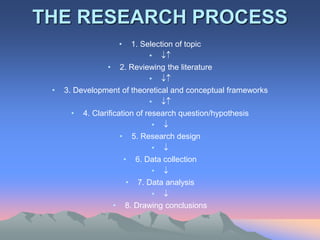
• 1. Selection of topic
• 
• 2. Reviewing the literature
• 
• 3. Development of theoretical and conceptual frameworks
• 
• 4. Clarification of research question/hypothesis
• 
• 5. Research design
• 
• 6. Data collection
• 
• 7. Data analysis
• 
• 8. Drawing conclusions
STAGE 1
SELECTION OF TOPIC
1.A crucial stage, as an inappropriate topic or
question will often lead to irretrievable
difficulties later in the research.
2.It is unlikely that you will develop a final
question and set of objectives at this stage
of the research process, and stages 2 and
3 are important in developing and
assessing your question more fully.
STAGE 2
REVIEWING THE LITERATURE
• A literature review essentially consists of
critically reading, evaluating and
organising existing literature on the topic
to assess the state of knowledge in the
area.
• During this stage you should aim to
become an ‘expert’ in your field of
research.
STAGE 3
DEVELOPMENT OF THEORETICAL AND
CONCEPTUAL FRAMEWORKS
• As you read the literature, you should be continually
developing and refining your theoretical and conceptual
frameworks.
• Your theoretical framework refers to the underlying
theoretical approach that you adopt to underpin your study.
• The conceptual framework defines and organises the
concepts important within your study.
STAGE 4
CLARIFICATION OF THE RESEARCH
QUESTION
Initial research questions are chosen, investigated and
often rejected for a number of reasons, for example:
• The question lacks sufficient focus.
• The conceptual framework has identified problems in
either defining and/or measuring the appropriate concepts.
• There are too many moderating or intervening variables.
• The project is unfeasible in terms of complexity, access,
facilities or resources.
STAGE 5
RESEARCH DESIGN
• What data do I need to collect to answer this question?
• What is the best way to collect this data?
• What overall research design should I use? For example,
a cross-sectional, experimental or longitudinal design?
• Will I need to collect primary or secondary data?
• What methods, for example interviews, questionnaire
surveys and so on, will be best to collect the primary data?
STAGE 6
DATA COLLECTION
You have to consider
• which methodology to choose, and
• which methods to utilise.
•Who should participate in the research?
•How will I gain access to them?
•What are the exact procedures that I should adopt in my
data collection to ensure reliability and validity?
•Are there any ethical issues associated with the research?
STAGE 7
DATA ANALYSIS AND DISCUSSION OF
THE FINDINGS
1. The data you collect in stage 6 needs to be analysed to
provide answers to your research question.
2. In your discussion of the results, reference should also
be made back to the literature reviewed in stage 2, for
example
How do the findings add to this literature?
Do they support the literature?
If not, what are the possible reasons why?
STAGE 8
DRAWING CONCLUSIONS
• Conclusions should relate back to the
focused research question.
• You can evaluate how successful you
have been in achieving your research
objectives, and highlight the strengths and
weaknesses of the research.
• You may also want to make
recommendations for further research.
TYPES OF QUANTITATIVE
RESEARCH
1. Experimental Research Approach 
Intervention research that explaining
whether an intervention influences an
outcome for one group as opposed to
another group. This is called between
subject approach
2. Correlational approach  Associating
or relating variables in a predictable
pattern for one group of individuals
3. Survey Approach  Describing trends
for the population of people
Survey Research Approach
1. Cross sectional survey
Observational surveys conducted in situations where
the researcher intends to collect data from a sample
of the target population at a given point in time.
Disadvantage of cross-sectional surveys is that the
cause-effect relationship of variables cannot be
established as it usually evaluates variables at a
particular time and not across a continuous time
frame.
Survey Research Approach
2. Longitudinal survey
Unlike cross-sectional surveys, surveys are
conducted across various time durations to observe
a change in respondent behavior and thought-
processes.
When there are research subjects that need to be
thoroughly inspected before concluding, they rely on
longitudinal surveys.
It is usually used in medicine and applied sciences
Correlational Research
Approach
• To find if the data has an observable
relationship that can be further specified
in terms of magnitude and/or an increase
or decrease.
Characteristics of Correlational
Research
• Correlation indicates the strength and
direction of a linear relationship between
variables.
Correlation and Significance
• Is there a relationship
between two
variables/data?
• What is the direction
of the relationship?
• What is the
magnitude?
• These relationships
may show any
tendency for the
variables to vary
consistently.
• Pearson’s product
moment coefficient
correlation: -1.0 to
+1.0
Ex Post Facto
‘from what is done afterwards’
What is Ex Post Facto
• Studies that investigate possible cause
and effect relationships by observing an
existing condition or state of affairs and
searching back in time for plausible causal
factors.
Characteristics of Ex Post
Facto
• Researcher takes the effect/dependent
variable and examines it retrospectively
• Establishes causes, relationships or
associations and their meanings.
• Researcher has little to or no control over
independent variables.
• Flexible by nature.
When to use this?
• You can use this when:
1. more powerful experimental designs are
not possible;
2.when you are unable to select, control and
manipulate the factors necessary to study
cause and effect relationships directly, or
when control variables except a single
independent variable may be unrealistic
and artificial.
Ex post facto advantages and
disadvantages
Advantages
• Show a correlation where
more rigorous
experimentation is not
possible
• Exploratory tool
• Useful to avoid articiality
in the research.
• Shows cause and effect
relationships
Disadvantages
• Lack of control for
independent variable and
randomizing subjects.
• Never certain if causative
factor has been included
or identified
• Relationship between two
factors does not establish
cause and effect.
• May be regarded as too
flexible.
Experimental Research
• Research in which the investigator
deliberately controls and manipulates the
independent variable to observe the effect
of that change on another the dependent
variable.
How and when to use
Experimental Research
• Most commonly used in physical sciences
and educational research
• You vary the independent variable and
look for the effect it has on the dependent
variable.
How and When to use Quasi-
experimental research
• Used when you have control over the
“when and the whom of measurement”,
but lack control over the “when and to
whom of exposure.”
• Common in management accounting
research.
How and when to use Single
Case research
• Process of continuous assessment of
some aspect of human behavior over a
period of time.
• Involves “intervention effects”, that are
replicated in the same subject(s) over
time.
• Used in many fields including psychology,
nursing studies, education and social
work.
Useful Terms
• Correlation- Indicates the strength and direction
of a linear relationship between two random
variables.
• Ex post facto- from the Latin for "from
something done afterward"
• Quasi- the prefix 'quasi' denotes methods that
are "almost" or "socially approximate"
• Variable- a measurable factor, characteristic, or
attribute of an individual or a system
References
• Research Methods in Education 5th
Edition, Louis Cohen, Lawrence, Manion
and Keith Morrison 2004, New York
• Creswell, J.W. Research Design. 2009

Quantitative Research Design.ppt

  • 1.
  • 2.
    Quantitative Research Systematic scientificinvestigation of data and their relationships.
  • 3.
    Overview of Quantitative research •The objective of quantitative research is to develop and employ mathematical models, theories and hypotheses pertaining to natural phenomena. • Measuring is key in quantitative research because it shows the relationship between data and observation.
  • 4.
    THE RESEARCH PROCESS •1. Selection of topic •  • 2. Reviewing the literature •  • 3. Development of theoretical and conceptual frameworks •  • 4. Clarification of research question/hypothesis •  • 5. Research design •  • 6. Data collection •  • 7. Data analysis •  • 8. Drawing conclusions
  • 5.
    STAGE 1 SELECTION OFTOPIC 1.A crucial stage, as an inappropriate topic or question will often lead to irretrievable difficulties later in the research. 2.It is unlikely that you will develop a final question and set of objectives at this stage of the research process, and stages 2 and 3 are important in developing and assessing your question more fully.
  • 6.
    STAGE 2 REVIEWING THELITERATURE • A literature review essentially consists of critically reading, evaluating and organising existing literature on the topic to assess the state of knowledge in the area. • During this stage you should aim to become an ‘expert’ in your field of research.
  • 7.
    STAGE 3 DEVELOPMENT OFTHEORETICAL AND CONCEPTUAL FRAMEWORKS • As you read the literature, you should be continually developing and refining your theoretical and conceptual frameworks. • Your theoretical framework refers to the underlying theoretical approach that you adopt to underpin your study. • The conceptual framework defines and organises the concepts important within your study.
  • 8.
    STAGE 4 CLARIFICATION OFTHE RESEARCH QUESTION Initial research questions are chosen, investigated and often rejected for a number of reasons, for example: • The question lacks sufficient focus. • The conceptual framework has identified problems in either defining and/or measuring the appropriate concepts. • There are too many moderating or intervening variables. • The project is unfeasible in terms of complexity, access, facilities or resources.
  • 9.
    STAGE 5 RESEARCH DESIGN •What data do I need to collect to answer this question? • What is the best way to collect this data? • What overall research design should I use? For example, a cross-sectional, experimental or longitudinal design? • Will I need to collect primary or secondary data? • What methods, for example interviews, questionnaire surveys and so on, will be best to collect the primary data?
  • 10.
    STAGE 6 DATA COLLECTION Youhave to consider • which methodology to choose, and • which methods to utilise. •Who should participate in the research? •How will I gain access to them? •What are the exact procedures that I should adopt in my data collection to ensure reliability and validity? •Are there any ethical issues associated with the research?
  • 11.
    STAGE 7 DATA ANALYSISAND DISCUSSION OF THE FINDINGS 1. The data you collect in stage 6 needs to be analysed to provide answers to your research question. 2. In your discussion of the results, reference should also be made back to the literature reviewed in stage 2, for example How do the findings add to this literature? Do they support the literature? If not, what are the possible reasons why?
  • 12.
    STAGE 8 DRAWING CONCLUSIONS •Conclusions should relate back to the focused research question. • You can evaluate how successful you have been in achieving your research objectives, and highlight the strengths and weaknesses of the research. • You may also want to make recommendations for further research.
  • 13.
  • 14.
    1. Experimental ResearchApproach  Intervention research that explaining whether an intervention influences an outcome for one group as opposed to another group. This is called between subject approach 2. Correlational approach  Associating or relating variables in a predictable pattern for one group of individuals 3. Survey Approach  Describing trends for the population of people
  • 15.
    Survey Research Approach 1.Cross sectional survey Observational surveys conducted in situations where the researcher intends to collect data from a sample of the target population at a given point in time. Disadvantage of cross-sectional surveys is that the cause-effect relationship of variables cannot be established as it usually evaluates variables at a particular time and not across a continuous time frame.
  • 16.
    Survey Research Approach 2.Longitudinal survey Unlike cross-sectional surveys, surveys are conducted across various time durations to observe a change in respondent behavior and thought- processes. When there are research subjects that need to be thoroughly inspected before concluding, they rely on longitudinal surveys. It is usually used in medicine and applied sciences
  • 17.
    Correlational Research Approach • Tofind if the data has an observable relationship that can be further specified in terms of magnitude and/or an increase or decrease.
  • 18.
    Characteristics of Correlational Research •Correlation indicates the strength and direction of a linear relationship between variables.
  • 19.
    Correlation and Significance •Is there a relationship between two variables/data? • What is the direction of the relationship? • What is the magnitude? • These relationships may show any tendency for the variables to vary consistently. • Pearson’s product moment coefficient correlation: -1.0 to +1.0
  • 20.
    Ex Post Facto ‘fromwhat is done afterwards’
  • 21.
    What is ExPost Facto • Studies that investigate possible cause and effect relationships by observing an existing condition or state of affairs and searching back in time for plausible causal factors.
  • 22.
    Characteristics of ExPost Facto • Researcher takes the effect/dependent variable and examines it retrospectively • Establishes causes, relationships or associations and their meanings. • Researcher has little to or no control over independent variables. • Flexible by nature.
  • 23.
    When to usethis? • You can use this when: 1. more powerful experimental designs are not possible; 2.when you are unable to select, control and manipulate the factors necessary to study cause and effect relationships directly, or when control variables except a single independent variable may be unrealistic and artificial.
  • 24.
    Ex post factoadvantages and disadvantages Advantages • Show a correlation where more rigorous experimentation is not possible • Exploratory tool • Useful to avoid articiality in the research. • Shows cause and effect relationships Disadvantages • Lack of control for independent variable and randomizing subjects. • Never certain if causative factor has been included or identified • Relationship between two factors does not establish cause and effect. • May be regarded as too flexible.
  • 25.
    Experimental Research • Researchin which the investigator deliberately controls and manipulates the independent variable to observe the effect of that change on another the dependent variable.
  • 26.
    How and whento use Experimental Research • Most commonly used in physical sciences and educational research • You vary the independent variable and look for the effect it has on the dependent variable.
  • 27.
    How and Whento use Quasi- experimental research • Used when you have control over the “when and the whom of measurement”, but lack control over the “when and to whom of exposure.” • Common in management accounting research.
  • 28.
    How and whento use Single Case research • Process of continuous assessment of some aspect of human behavior over a period of time. • Involves “intervention effects”, that are replicated in the same subject(s) over time. • Used in many fields including psychology, nursing studies, education and social work.
  • 29.
    Useful Terms • Correlation-Indicates the strength and direction of a linear relationship between two random variables. • Ex post facto- from the Latin for "from something done afterward" • Quasi- the prefix 'quasi' denotes methods that are "almost" or "socially approximate" • Variable- a measurable factor, characteristic, or attribute of an individual or a system
  • 30.
    References • Research Methodsin Education 5th Edition, Louis Cohen, Lawrence, Manion and Keith Morrison 2004, New York • Creswell, J.W. Research Design. 2009