Age and EWT: Children
L/O: To be able to describe what research has shown about
       children and the accuracy of testimony.

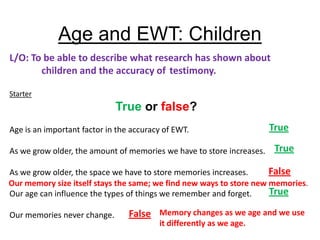
Starter
                             True or false?
Age is an important factor in the accuracy of EWT.                     True

As we grow older, the amount of memories we have to store increases.    True

As we grow older, the space we have to store memories increases.     False
Our memory size itself stays the same; we find new ways to store new memories.
Our age can influence the types of things we remember and forget.    True

Our memories never change.       False Memory changes as we age and we use
                                         it differently as we age.
L/O: To be able to describe what research has shown about
       children and the accuracy of testimony.

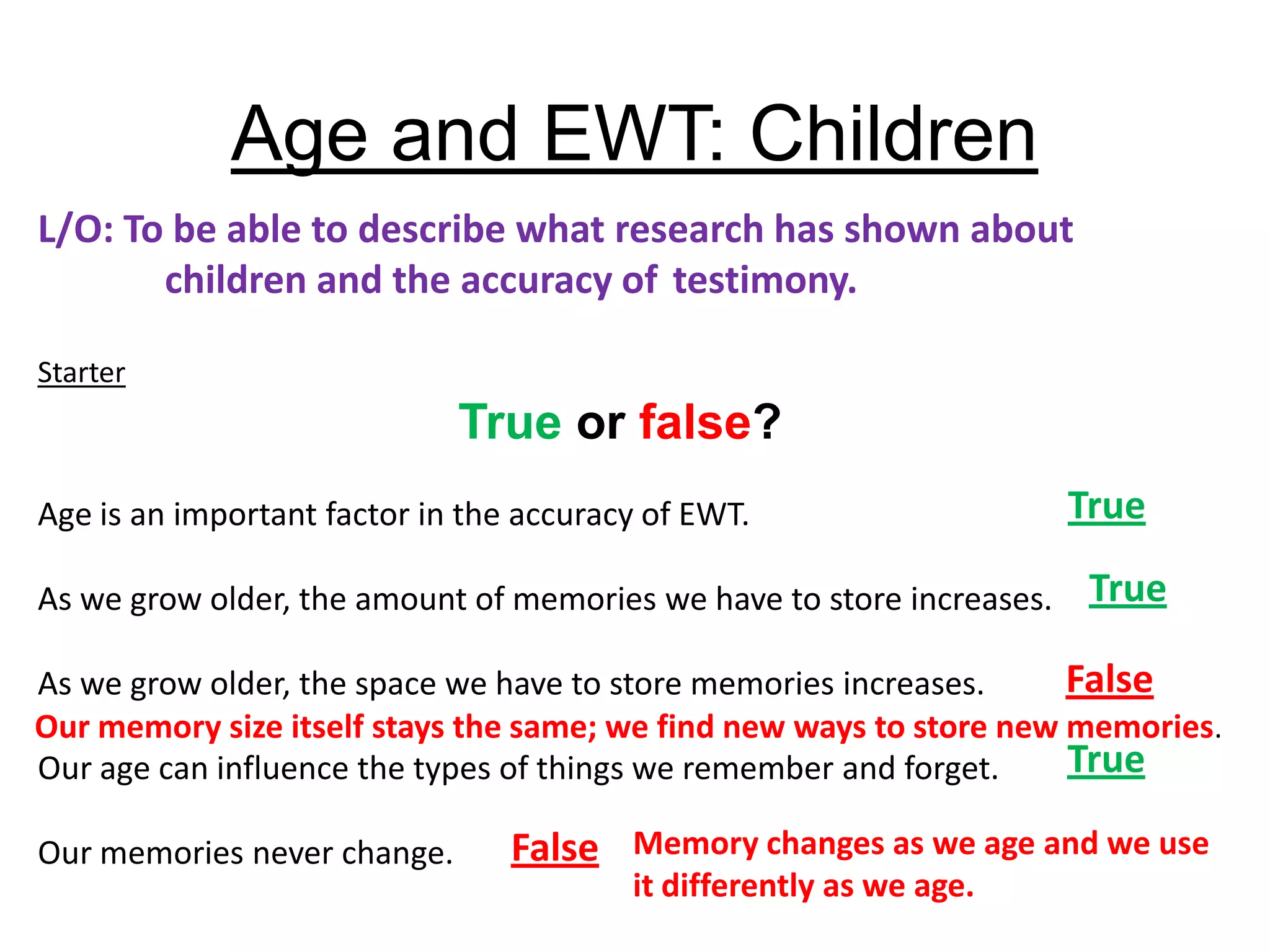
  Children as eyewitnesses
  The younger the child, the less eyewitness information they will
  provide spontaneously (without questions).

 Therefore, children are often interviewed so as to get a more
 detailed account of events.
                                                 Why is this
 Influence of cognitive factors:                problematic?
 The way questions are asked.


           Influence of social factors:
           Power and status of interviewer.
L/O: To be able to describe what research has shown about
        children and the accuracy of testimony.
                      Children as eyewitnesses
                 3 factors you need to know about
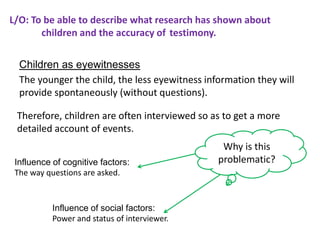
1. Suggestibility
Children are more sensitive to leading questions.
The younger the child, the bigger the influence.

Ceci et al. (2000)
• Researched children aged 3-12 years.
• Found 3-4 year olds were most susceptible to leading questions.
• Argued that 3-5 year olds form ‘weaker’ memories and so they are
  more vulnerable to reconstruction.
L/O: To be able to describe what research has shown about
        children and the accuracy of testimony.
                      Children as eyewitnesses
                  3 factors you need to know about
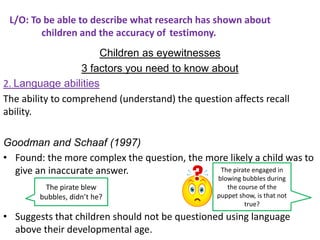
2. Language abilities
The ability to comprehend (understand) the question affects recall
ability.

Goodman and Schaaf (1997)
• Found: the more complex the question, the more likely a child was to
  give an inaccurate answer.                  The pirate engaged in
                                                 blowing bubbles during
         The pirate blew                            the course of the
        bubbles, didn’t he?                      puppet show, is that not
                                                          true?
• Suggests that children should not be questioned using language
  above their developmental age.
L/O: To be able to describe what research has shown about
        children and the accuracy of testimony.
                      Children as eyewitnesses
                  3 factors you need to know about
3. Memory processes
Young children form and recall more simple memories than older
children.

Saywitz (1987)
• Asked children aged 8-15 years to listen to a crime tape recording.
• After 5 days, they had to recall the incident.
• Found: The youngest ones (8 year olds) recalled less detail but no less
  accurately than the oldest (11-15 year olds) who recalled more
  details.
• Also found: The 8 year olds were more likely to embellish and
  exaggerate.
L/O: To be able to describe what research has shown about
       children and the accuracy of testimony.


  QUICK TEST

     What are the 3 key factors affecting accuracy of EWT
     in children?

     One study for each?
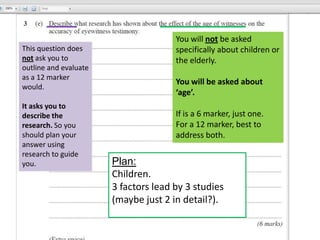
You will not be asked
This question does                    specifically about children or
not ask you to                        the elderly.
outline and evaluate
as a 12 marker
                                      You will be asked about
would.
                                      ‘age’.
It asks you to
describe the                          If is a 6 marker, just one.
research. So you                      For a 12 marker, best to
should plan your                      address both.
answer using
research to guide
you.                   Plan:
                       Children.
                       3 factors lead by 3 studies
                       (maybe just 2 in detail?).
• You have a 6 year old to interview.
• She was in a shop buying a curly wurly when a
  man came in and held up the shop for the cash in
  the till.
• She remained in the shop for the robbery.

Compose a series of questions that allow for the 3
factors that affect accuracy of eye witness
testimony in children. Your aim is to get the most
accurate testimony.
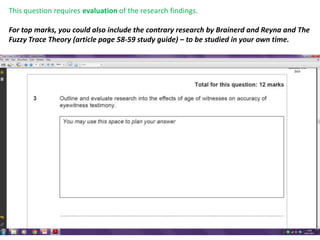
This question requires evaluation of the research findings.

For top marks, you could also include the contrary research by Brainerd and Reyna and The
Fuzzy Trace Theory (article page 58-59 study guide) – to be studied in your own time.

Ewt children

  • 1.
    Age and EWT:Children L/O: To be able to describe what research has shown about children and the accuracy of testimony. Starter True or false? Age is an important factor in the accuracy of EWT. True As we grow older, the amount of memories we have to store increases. True As we grow older, the space we have to store memories increases. False Our memory size itself stays the same; we find new ways to store new memories. Our age can influence the types of things we remember and forget. True Our memories never change. False Memory changes as we age and we use it differently as we age.
  • 2.
    L/O: To beable to describe what research has shown about children and the accuracy of testimony. Children as eyewitnesses The younger the child, the less eyewitness information they will provide spontaneously (without questions). Therefore, children are often interviewed so as to get a more detailed account of events. Why is this Influence of cognitive factors: problematic? The way questions are asked. Influence of social factors: Power and status of interviewer.
  • 3.
    L/O: To beable to describe what research has shown about children and the accuracy of testimony. Children as eyewitnesses 3 factors you need to know about 1. Suggestibility Children are more sensitive to leading questions. The younger the child, the bigger the influence. Ceci et al. (2000) • Researched children aged 3-12 years. • Found 3-4 year olds were most susceptible to leading questions. • Argued that 3-5 year olds form ‘weaker’ memories and so they are more vulnerable to reconstruction.
  • 4.
    L/O: To beable to describe what research has shown about children and the accuracy of testimony. Children as eyewitnesses 3 factors you need to know about 2. Language abilities The ability to comprehend (understand) the question affects recall ability. Goodman and Schaaf (1997) • Found: the more complex the question, the more likely a child was to give an inaccurate answer. The pirate engaged in blowing bubbles during The pirate blew the course of the bubbles, didn’t he? puppet show, is that not true? • Suggests that children should not be questioned using language above their developmental age.
  • 5.
    L/O: To beable to describe what research has shown about children and the accuracy of testimony. Children as eyewitnesses 3 factors you need to know about 3. Memory processes Young children form and recall more simple memories than older children. Saywitz (1987) • Asked children aged 8-15 years to listen to a crime tape recording. • After 5 days, they had to recall the incident. • Found: The youngest ones (8 year olds) recalled less detail but no less accurately than the oldest (11-15 year olds) who recalled more details. • Also found: The 8 year olds were more likely to embellish and exaggerate.
  • 6.
    L/O: To beable to describe what research has shown about children and the accuracy of testimony. QUICK TEST What are the 3 key factors affecting accuracy of EWT in children? One study for each?
  • 7.
    You will notbe asked This question does specifically about children or not ask you to the elderly. outline and evaluate as a 12 marker You will be asked about would. ‘age’. It asks you to describe the If is a 6 marker, just one. research. So you For a 12 marker, best to should plan your address both. answer using research to guide you. Plan: Children. 3 factors lead by 3 studies (maybe just 2 in detail?).
  • 8.
    • You havea 6 year old to interview. • She was in a shop buying a curly wurly when a man came in and held up the shop for the cash in the till. • She remained in the shop for the robbery. Compose a series of questions that allow for the 3 factors that affect accuracy of eye witness testimony in children. Your aim is to get the most accurate testimony.
  • 9.
    This question requiresevaluation of the research findings. For top marks, you could also include the contrary research by Brainerd and Reyna and The Fuzzy Trace Theory (article page 58-59 study guide) – to be studied in your own time.