Nursing the older adult with a
mental illness
+ Compulsory clinical briefing
Paul McNamara
RGN (RAH), RPN (SAMHS), BN (Flin.), MMHN (USQ), Cert IMH (WCHN), CMHN, FACMHN
@meta4RN
#NS3360
Acknowledgements
Tanya Park @Tanya_M_Park
Elizabeth Emmanual via @SCUonline
Geraldine Swift via @cwpnhs
+ Nurses 1988-2015
Learning Outcomes
 Dementia, Delirium or Depression?
 Clinical features
 Common conditions
 MMSE (Mini Mental State Examination)
 Nurses and screening
 Nurses and managing/supporting
 Your understanding/ideas
Today’s Presentation
 Overview
 Dementia
 Delirium
 Screening Tools
 MMSE
 Clockface
 CAM
 Supporting
Today’s Presentation
 Overview
 Dementia
 Delirium
 Screening Tools
 MMSE
 Clockface
 CAM
 Supporting
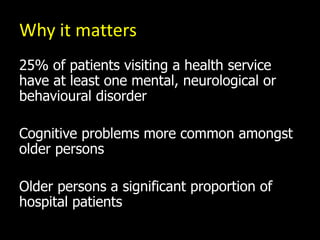
Why it matters
25% of patients visiting a health service
have at least one mental, neurological or
behavioural disorder
Cognitive problems more common amongst
older persons
Older persons a significant proportion of
hospital patients
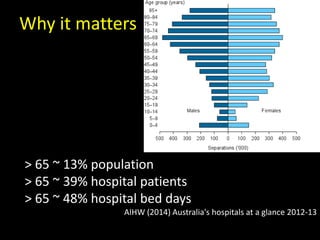
> 65 ~ 13% population
> 65 ~ 39% hospital patients
> 65 ~ 48% hospital bed days
AIHW (2014) Australia's hospitals at a glance 2012-13
Why it matters
Cognition
cognōscere
“to know”
the process of knowing
thinking, thoughts
capacity to understand / interpret information
Cognition
processing of information
memory + thoughts
store, retrieve and manipulate information
disruption to this process = cognitive disorder
Disorders of Cognition Sx
impaired awareness
reasoning
memory
judgment
perception
disorientation (time +/or place +/or person)
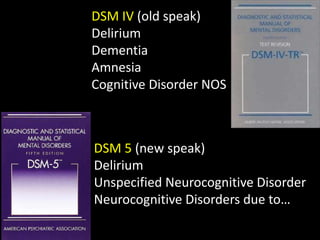
DSM IV (old speak)
Delirium
Dementia
Amnesia
Cognitive Disorder NOS
DSM 5 (new speak)
Delirium
Unspecified Neurocognitive Disorder
Neurocognitive Disorders due to…
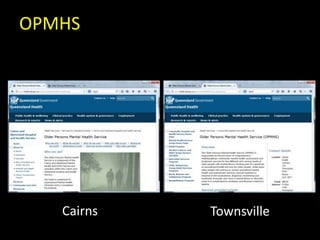
OPMHS
Cairns Townsville
Today’s Presentation
 Overview
 Dementia
 Delirium
 Screening Tools
 MMSE
 Clockface
 CAM
 Supporting
Dementia
“a progressive illness that involves cognitive and
non-cognitive abnormalities and disorders of
behaviour; presents as a gradual failure of brain
function. It is not a normal part of life or aging.”
Elder, Evans & Nizette (2013) pp 525
Dementia
aka Neurocognitive Disorders due to…
Alzheimer’s Disease
Vascular Disease
Lewy Bodies
Prion Disease
HIV Infection
Traumatic Brain Injury
Multiple Aetiologies
Dementia
~ 1.9% > 65 years
~ 8.4% > 75 years
~ 22.4% > 85 years
Elder, Evans & Nizette (2013) pg 256
2009 ~ 1.1% Australian population
2050 ~ 3.2% Australian population
Today’s Presentation
 Overview
 Dementia
 Delirium
 Screening Tools
 MMSE
 Clockface
 CAM
 Supporting
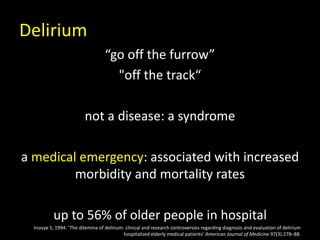
Delirium
“go off the furrow”
"off the track“
not a disease: a syndrome
a medical emergency: associated with increased
morbidity and mortality rates
up to 56% of older people in hospital
Inouye S, 1994. ‘The dilemma of delirium: clinical and research controversies regarding diagnosis and evaluation of delirium
hospitalized elderly medical patients’ American Journal of Medicine 97(3):278–88.
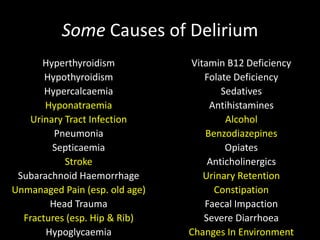
Some Causes of Delirium
Hyperthyroidism
Hypothyroidism
Hypercalcaemia
Hyponatraemia
Urinary Tract Infection
Pneumonia
Septicaemia
Stroke
Subarachnoid Haemorrhage
Unmanaged Pain (esp. old age)
Head Trauma
Fractures (esp. Hip & Rib)
Hypoglycaemia
Vitamin B12 Deficiency
Folate Deficiency
Sedatives
Antihistamines
Alcohol
Benzodiazepines
Opiates
Anticholinergics
Urinary Retention
Constipation
Faecal Impaction
Severe Diarrhoea
Changes In Environment
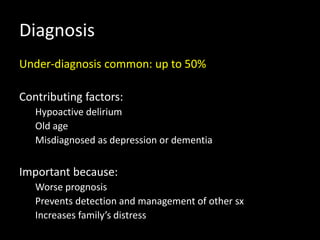
Diagnosis
Under-diagnosis common: up to 50%
Contributing factors:
Hypoactive delirium
Old age
Misdiagnosed as depression or dementia
Important because:
Worse prognosis
Prevents detection and management of other sx
Increases family’s distress
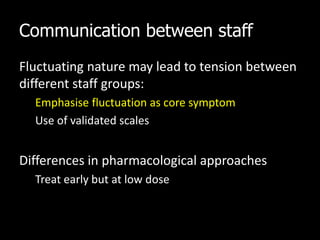
Communication between staff
Fluctuating nature may lead to tension between
different staff groups:
Emphasise fluctuation as core symptom
Use of validated scales
Differences in pharmacological approaches
Treat early but at low dose
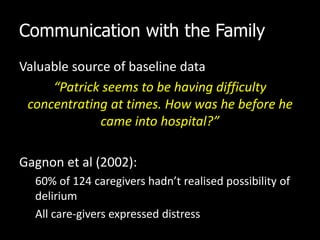
Communication with the Family
Valuable source of baseline data
“Patrick seems to be having difficulty
concentrating at times. How was he before he
came into hospital?”
Gagnon et al (2002):
60% of 124 caregivers hadn’t realised possibility of
delirium
All care-givers expressed distress
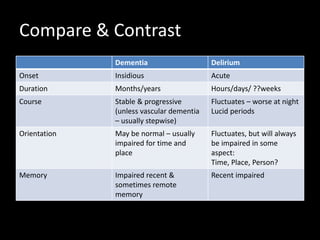
Compare & Contrast
Dementia Delirium
Onset Insidious Acute
Duration Months/years Hours/days/ ??weeks
Course Stable & progressive
(unless vascular dementia
– usually stepwise)
Fluctuates – worse at night
Lucid periods
Orientation May be normal – usually
impaired for time and
place
Fluctuates, but will always
be impaired in some
aspect:
Time, Place, Person?
Memory Impaired recent &
sometimes remote
memory
Recent impaired
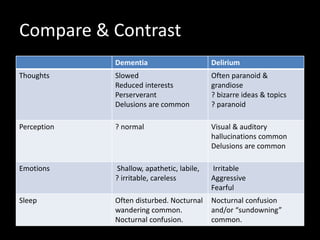
Compare & Contrast
Dementia Delirium
Thoughts Slowed
Reduced interests
Perserverant
Delusions are common
Often paranoid &
grandiose
? bizarre ideas & topics
? paranoid
Perception ? normal Visual & auditory
hallucinations common
Delusions are common
Emotions Shallow, apathetic, labile,
? irritable, careless
Irritable
Aggressive
Fearful
Sleep Often disturbed. Nocturnal
wandering common.
Nocturnal confusion.
Nocturnal confusion
and/or “sundowning”
common.
Today’s Presentation
 Overview
 Dementia
 Delirium
 Screening Tools
 MMSE
 Clockface
 CAM
 Supporting
©TheStateofQueensland(QueenslandHealth)2012ContactCIM@health.qld.gov.au
ÌSW025n
ÎSW025
v2.00-03/2012
MHS-MINIMENTALSTATEEXAMINATION
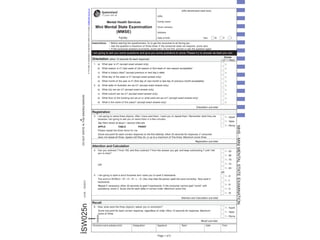
Instructions: • Before starting the questionnaire, try to get the consumer to sit facing you.
• Ask the question a maximum of three times. If the consumer does not respond, score zero.
• If the consumer answers incorrectly, score zero. Do not hint, prompt or ask the question again.
I am going to ask you some questions and give you some problems to solve. Please try to answer as best you can.
Orientation (allow 10 seconds for each response)
Points
( = Pass)
1. a) What year is it? (accept exact answer only)
b) What season is it? (last week of old season or first week of new season acceptable)
c) What is today’s date? (accept previous or next day’s date)
d) What day of the week is it? (accept exact answer only)
e) What month of the year is it? (first day of new month or last day of previous month acceptable)
2. a) What state of Australia are we in? (accept exact answer only)
b) What city are we in? (accept exact answer only)
c) What suburb are we in? (accept exact answer only)
d) What floor of the building are we on or what ward are we on? (accept exact answer only)
e) What is the name of this place? (accept exact answer only)
1
1
1
1
1
1
1
1
1
1
Orientation sub-total:
Registration
3. I am going to name three objects. After I have said them, I want you to repeat them. Remember what they are
because I am going to ask you to name them in a few minutes.
Say them slowly at about 1 second intervals
APPLE TABLE PENNY
Please repeat the three items for me.
Score one point for each correct response on the first attempt. Allow 20 seconds for response; if consumer
does not repeat all three, repeat until they do, or up to a maximum of five times. Maximum score three.
1 - Apple
1 - Table
1 - Penny
Registration sub-total:
Attention and Calculation
4. Can you subtract 7 from 100, and then subtract 7 from the answer you get, and keep subtracting 7 until I tell
you to stop?
OR
1 - 93
1 - 86
1 - 79
1 - 72
1 - 65
OR
5. I am going to spell a word forwards and I want you to spell it backwards.
The word is WORLD – W – O – R – L – D. (You may help the person spell the word correctly). Now spell it
backwards.
Repeat if necessary. Allow 30 seconds to spell it backwards. If the consumer cannot spell “world” with
assistance, score 0. Score one for each letter in correct order. Maximum score five.
1 - D
1 - L
1 - R
1 - O
1 - W
Attention and Calculation sub-total:
Recall
6. Now, what were the three objects I asked you to remember?
Score one point for each correct response, regardless of order. Allow 10 seconds for response. Maximum
score of three.
1 - Apple
1 - Table
1 - Penny
Recall sub-total:
DONOTWRITEINTHISBINDINGMARGIN
Page 1 of 2
(Affix identification label here)
URN:
Family name:
Given name(s):
Address:
Date of birth: Sex: M F I
Mental Health Services
Mini Mental State Examination
(MMSE)
Facility:
.........................................................................................................
Clinician’s name (please print): Designation: Signature: Team: Date: Time:
Language
Points
( = Pass)
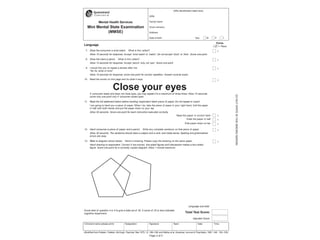
7. Show the consumer a wrist watch. What is this called?
Allow 10 seconds for response. Accept ‘wrist watch’ or ‘watch’. Do not accept ‘clock’ or ‘time’. Score one point.
1
8. Show the client a pencil. What is this called?
Allow 10 seconds for response. Accept ‘pencil’ only, not ‘pen’. Score one point.
1
9. I would like you to repeat a phrase after me:
“No ifs, ands or buts”
Allow 10 seconds for response, score one point for correct repetition. Answer must be exact.
1
10. Read the words on this page and do what it says.
Close your eyesIf consumer reads and does not close eyes, you may repeat it to a maximum of three times. Allow 10 seconds,
score only one point only if consumer closes eyes.
11. Read the full statement below before handing respondent blank piece of paper. Do not repeat or coach.
I am going to hand you a piece of paper. When I do, take the piece of paper in your right hand, fold the paper
in half with both hands and put the paper down on your lap.
Allow 30 seconds. Score one point for each instruction executed correctly.
Takes the paper in correct hand
Folds the paper in half
Puts paper down on lap
1
1
1
1
12. Hand consumer a piece of paper. and a pencil. Write any complete sentence on that piece of paper.
Allow 30 seconds. The sentence should have a subject and a verb, and make sense. Spelling and grammatical
errors are okay.
1
13. Refer to diagram shown below. Here’s a drawing. Please copy the drawing on the same paper.
Hand drawing to respondent. Correct if two convex, five-sided figures and intersection makes a four-sided
figure. Score one point for a correctly copied diagram. Allow 1 minute maximum.
1
Language sub-total:
Score best of question 4 or 5 to give a total out of 30. A score of 23 or less indicates
cognitive impairment. Total Test Score:
Adjusted Score:
(Modified from Folstein, Folstein, McHugh, Psychiat. Res 1975, 12, 189–198, and Molloy et al, American Journal of Psychiatry, 1991; 148: 102–105)
Page 2 of 2 DONOTWRITEINTHISBINDINGMARGIN
(Affix identification label here)
URN:
Family name:
Given name(s):
Address:
Date of birth: Sex: M F I
Mental Health Services
Mini Mental State Examination
(MMSE)
Clinician’s name (please print): Designation: Signature: Team: Date: Time:
MMSE
Screening tool not diagnostic tool
Does not differentiate between dementia and
delirium
English literacy and numeracy
Considerations as per Brown (2007) pg 54
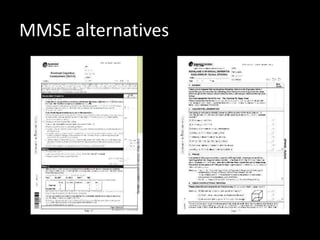
MMSE alternatives
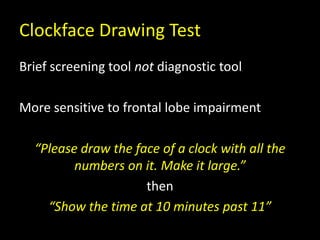
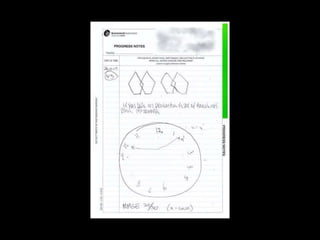
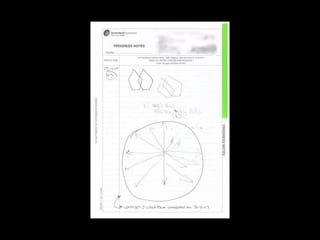
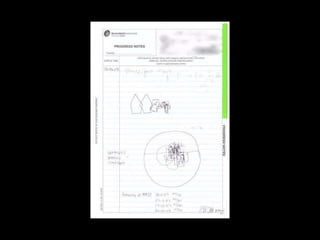
Clockface Drawing Test
Brief screening tool not diagnostic tool
More sensitive to frontal lobe impairment
“Please draw the face of a clock with all the
numbers on it. Make it large.”
then
“Show the time at 10 minutes past 11”
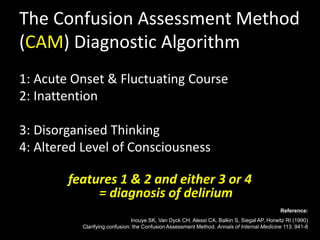
The Confusion Assessment Method
(CAM) Diagnostic Algorithm
1: Acute Onset & Fluctuating Course
2: Inattention
3: Disorganised Thinking
4: Altered Level of Consciousness
features 1 & 2 and either 3 or 4
= diagnosis of delirium
Reference:
Inouye SK, Van Dyck CH, Alessi CA, Balkin S, Siegal AP, Horwitz RI (1990)
Clarifying confusion: the Confusion Assessment Method. Annals of Internal Medicine 113: 941-8
Today’s Presentation
 Overview
 Dementia
 Delirium
 Screening Tools
 MMSE
 Clockface
 CAM
 Supporting
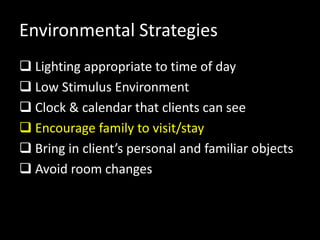
Environmental Strategies
 Lighting appropriate to time of day
 Low Stimulus Environment
 Clock & calendar that clients can see
 Encourage family to visit/stay
 Bring in client’s personal and familiar objects
 Avoid room changes
Clinical Practice Strategies [1]
 Interpreter for culturally & linguistically
diverse (CALD) patients/clients
 Indigenous Liaison Officer
 Eating & Drinking
 Hearing Aids?
 Glasses?
 Bowels – avoid constipation
 Mobilisation
Clinical Practice Strategies [2]
 Encourage independence in basic ADLs
 Medication review
 Promote sufficient sleep at night
 Manage discomfort or pain
 Provide orienting information
 Minimise use of indwelling catheters
 Avoid use of physical restraints
 Avoid polypharmacy/psychoactive drugs
After Delirium Resolves
Many patients remember being delirious
Symptoms resolve, but the feelings remain
Not always discussed:
Fear of being thought mad
Health professionals may assume no recall
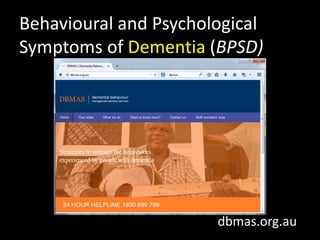
dbmas.org.au
Behavioural and Psychological
Symptoms of Dementia (BPSD)
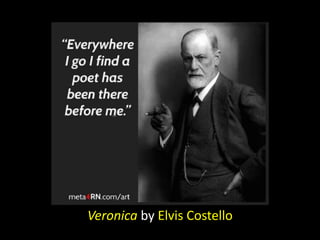
Veronica by Elvis Costello
Today’s Presentation
 Overview
 Dementia
 Delirium
 Screening Tools
 MMSE
 Clockface
 CAM
 Supporting

Dementia and Delirium

  • 1.
    Nursing the olderadult with a mental illness + Compulsory clinical briefing Paul McNamara RGN (RAH), RPN (SAMHS), BN (Flin.), MMHN (USQ), Cert IMH (WCHN), CMHN, FACMHN @meta4RN #NS3360
  • 2.
    Acknowledgements Tanya Park @Tanya_M_Park ElizabethEmmanual via @SCUonline Geraldine Swift via @cwpnhs + Nurses 1988-2015
  • 3.
    Learning Outcomes  Dementia,Delirium or Depression?  Clinical features  Common conditions  MMSE (Mini Mental State Examination)  Nurses and screening  Nurses and managing/supporting  Your understanding/ideas
  • 4.
    Today’s Presentation  Overview Dementia  Delirium  Screening Tools  MMSE  Clockface  CAM  Supporting
  • 5.
    Today’s Presentation  Overview Dementia  Delirium  Screening Tools  MMSE  Clockface  CAM  Supporting
  • 6.
    Why it matters 25%of patients visiting a health service have at least one mental, neurological or behavioural disorder Cognitive problems more common amongst older persons Older persons a significant proportion of hospital patients
  • 7.
    > 65 ~13% population > 65 ~ 39% hospital patients > 65 ~ 48% hospital bed days AIHW (2014) Australia's hospitals at a glance 2012-13 Why it matters
  • 8.
    Cognition cognōscere “to know” the processof knowing thinking, thoughts capacity to understand / interpret information
  • 9.
    Cognition processing of information memory+ thoughts store, retrieve and manipulate information disruption to this process = cognitive disorder
  • 10.
    Disorders of CognitionSx impaired awareness reasoning memory judgment perception disorientation (time +/or place +/or person)
  • 11.
    DSM IV (oldspeak) Delirium Dementia Amnesia Cognitive Disorder NOS DSM 5 (new speak) Delirium Unspecified Neurocognitive Disorder Neurocognitive Disorders due to…
  • 12.
  • 13.
    Today’s Presentation  Overview Dementia  Delirium  Screening Tools  MMSE  Clockface  CAM  Supporting
  • 14.
    Dementia “a progressive illnessthat involves cognitive and non-cognitive abnormalities and disorders of behaviour; presents as a gradual failure of brain function. It is not a normal part of life or aging.” Elder, Evans & Nizette (2013) pp 525
  • 15.
    Dementia aka Neurocognitive Disordersdue to… Alzheimer’s Disease Vascular Disease Lewy Bodies Prion Disease HIV Infection Traumatic Brain Injury Multiple Aetiologies
  • 16.
    Dementia ~ 1.9% >65 years ~ 8.4% > 75 years ~ 22.4% > 85 years Elder, Evans & Nizette (2013) pg 256 2009 ~ 1.1% Australian population 2050 ~ 3.2% Australian population
  • 17.
    Today’s Presentation  Overview Dementia  Delirium  Screening Tools  MMSE  Clockface  CAM  Supporting
  • 18.
    Delirium “go off thefurrow” "off the track“ not a disease: a syndrome a medical emergency: associated with increased morbidity and mortality rates up to 56% of older people in hospital Inouye S, 1994. ‘The dilemma of delirium: clinical and research controversies regarding diagnosis and evaluation of delirium hospitalized elderly medical patients’ American Journal of Medicine 97(3):278–88.
  • 19.
    Some Causes ofDelirium Hyperthyroidism Hypothyroidism Hypercalcaemia Hyponatraemia Urinary Tract Infection Pneumonia Septicaemia Stroke Subarachnoid Haemorrhage Unmanaged Pain (esp. old age) Head Trauma Fractures (esp. Hip & Rib) Hypoglycaemia Vitamin B12 Deficiency Folate Deficiency Sedatives Antihistamines Alcohol Benzodiazepines Opiates Anticholinergics Urinary Retention Constipation Faecal Impaction Severe Diarrhoea Changes In Environment
  • 20.
    Diagnosis Under-diagnosis common: upto 50% Contributing factors: Hypoactive delirium Old age Misdiagnosed as depression or dementia Important because: Worse prognosis Prevents detection and management of other sx Increases family’s distress
  • 21.
    Communication between staff Fluctuatingnature may lead to tension between different staff groups: Emphasise fluctuation as core symptom Use of validated scales Differences in pharmacological approaches Treat early but at low dose
  • 22.
    Communication with theFamily Valuable source of baseline data “Patrick seems to be having difficulty concentrating at times. How was he before he came into hospital?” Gagnon et al (2002): 60% of 124 caregivers hadn’t realised possibility of delirium All care-givers expressed distress
  • 23.
    Compare & Contrast DementiaDelirium Onset Insidious Acute Duration Months/years Hours/days/ ??weeks Course Stable & progressive (unless vascular dementia – usually stepwise) Fluctuates – worse at night Lucid periods Orientation May be normal – usually impaired for time and place Fluctuates, but will always be impaired in some aspect: Time, Place, Person? Memory Impaired recent & sometimes remote memory Recent impaired
  • 24.
    Compare & Contrast DementiaDelirium Thoughts Slowed Reduced interests Perserverant Delusions are common Often paranoid & grandiose ? bizarre ideas & topics ? paranoid Perception ? normal Visual & auditory hallucinations common Delusions are common Emotions Shallow, apathetic, labile, ? irritable, careless Irritable Aggressive Fearful Sleep Often disturbed. Nocturnal wandering common. Nocturnal confusion. Nocturnal confusion and/or “sundowning” common.
  • 26.
    Today’s Presentation  Overview Dementia  Delirium  Screening Tools  MMSE  Clockface  CAM  Supporting
  • 27.
    ©TheStateofQueensland(QueenslandHealth)2012ContactCIM@health.qld.gov.au ÌSW025n ÎSW025 v2.00-03/2012 MHS-MINIMENTALSTATEEXAMINATION Instructions: • Beforestarting the questionnaire, try to get the consumer to sit facing you. • Ask the question a maximum of three times. If the consumer does not respond, score zero. • If the consumer answers incorrectly, score zero. Do not hint, prompt or ask the question again. I am going to ask you some questions and give you some problems to solve. Please try to answer as best you can. Orientation (allow 10 seconds for each response) Points ( = Pass) 1. a) What year is it? (accept exact answer only) b) What season is it? (last week of old season or first week of new season acceptable) c) What is today’s date? (accept previous or next day’s date) d) What day of the week is it? (accept exact answer only) e) What month of the year is it? (first day of new month or last day of previous month acceptable) 2. a) What state of Australia are we in? (accept exact answer only) b) What city are we in? (accept exact answer only) c) What suburb are we in? (accept exact answer only) d) What floor of the building are we on or what ward are we on? (accept exact answer only) e) What is the name of this place? (accept exact answer only) 1 1 1 1 1 1 1 1 1 1 Orientation sub-total: Registration 3. I am going to name three objects. After I have said them, I want you to repeat them. Remember what they are because I am going to ask you to name them in a few minutes. Say them slowly at about 1 second intervals APPLE TABLE PENNY Please repeat the three items for me. Score one point for each correct response on the first attempt. Allow 20 seconds for response; if consumer does not repeat all three, repeat until they do, or up to a maximum of five times. Maximum score three. 1 - Apple 1 - Table 1 - Penny Registration sub-total: Attention and Calculation 4. Can you subtract 7 from 100, and then subtract 7 from the answer you get, and keep subtracting 7 until I tell you to stop? OR 1 - 93 1 - 86 1 - 79 1 - 72 1 - 65 OR 5. I am going to spell a word forwards and I want you to spell it backwards. The word is WORLD – W – O – R – L – D. (You may help the person spell the word correctly). Now spell it backwards. Repeat if necessary. Allow 30 seconds to spell it backwards. If the consumer cannot spell “world” with assistance, score 0. Score one for each letter in correct order. Maximum score five. 1 - D 1 - L 1 - R 1 - O 1 - W Attention and Calculation sub-total: Recall 6. Now, what were the three objects I asked you to remember? Score one point for each correct response, regardless of order. Allow 10 seconds for response. Maximum score of three. 1 - Apple 1 - Table 1 - Penny Recall sub-total: DONOTWRITEINTHISBINDINGMARGIN Page 1 of 2 (Affix identification label here) URN: Family name: Given name(s): Address: Date of birth: Sex: M F I Mental Health Services Mini Mental State Examination (MMSE) Facility: ......................................................................................................... Clinician’s name (please print): Designation: Signature: Team: Date: Time:
  • 28.
    Language Points ( = Pass) 7.Show the consumer a wrist watch. What is this called? Allow 10 seconds for response. Accept ‘wrist watch’ or ‘watch’. Do not accept ‘clock’ or ‘time’. Score one point. 1 8. Show the client a pencil. What is this called? Allow 10 seconds for response. Accept ‘pencil’ only, not ‘pen’. Score one point. 1 9. I would like you to repeat a phrase after me: “No ifs, ands or buts” Allow 10 seconds for response, score one point for correct repetition. Answer must be exact. 1 10. Read the words on this page and do what it says. Close your eyesIf consumer reads and does not close eyes, you may repeat it to a maximum of three times. Allow 10 seconds, score only one point only if consumer closes eyes. 11. Read the full statement below before handing respondent blank piece of paper. Do not repeat or coach. I am going to hand you a piece of paper. When I do, take the piece of paper in your right hand, fold the paper in half with both hands and put the paper down on your lap. Allow 30 seconds. Score one point for each instruction executed correctly. Takes the paper in correct hand Folds the paper in half Puts paper down on lap 1 1 1 1 12. Hand consumer a piece of paper. and a pencil. Write any complete sentence on that piece of paper. Allow 30 seconds. The sentence should have a subject and a verb, and make sense. Spelling and grammatical errors are okay. 1 13. Refer to diagram shown below. Here’s a drawing. Please copy the drawing on the same paper. Hand drawing to respondent. Correct if two convex, five-sided figures and intersection makes a four-sided figure. Score one point for a correctly copied diagram. Allow 1 minute maximum. 1 Language sub-total: Score best of question 4 or 5 to give a total out of 30. A score of 23 or less indicates cognitive impairment. Total Test Score: Adjusted Score: (Modified from Folstein, Folstein, McHugh, Psychiat. Res 1975, 12, 189–198, and Molloy et al, American Journal of Psychiatry, 1991; 148: 102–105) Page 2 of 2 DONOTWRITEINTHISBINDINGMARGIN (Affix identification label here) URN: Family name: Given name(s): Address: Date of birth: Sex: M F I Mental Health Services Mini Mental State Examination (MMSE) Clinician’s name (please print): Designation: Signature: Team: Date: Time:
  • 29.
    MMSE Screening tool notdiagnostic tool Does not differentiate between dementia and delirium English literacy and numeracy Considerations as per Brown (2007) pg 54
  • 30.
  • 31.
    Clockface Drawing Test Briefscreening tool not diagnostic tool More sensitive to frontal lobe impairment “Please draw the face of a clock with all the numbers on it. Make it large.” then “Show the time at 10 minutes past 11”
  • 35.
    The Confusion AssessmentMethod (CAM) Diagnostic Algorithm 1: Acute Onset & Fluctuating Course 2: Inattention 3: Disorganised Thinking 4: Altered Level of Consciousness features 1 & 2 and either 3 or 4 = diagnosis of delirium Reference: Inouye SK, Van Dyck CH, Alessi CA, Balkin S, Siegal AP, Horwitz RI (1990) Clarifying confusion: the Confusion Assessment Method. Annals of Internal Medicine 113: 941-8
  • 37.
    Today’s Presentation  Overview Dementia  Delirium  Screening Tools  MMSE  Clockface  CAM  Supporting
  • 38.
    Environmental Strategies  Lightingappropriate to time of day  Low Stimulus Environment  Clock & calendar that clients can see  Encourage family to visit/stay  Bring in client’s personal and familiar objects  Avoid room changes
  • 39.
    Clinical Practice Strategies[1]  Interpreter for culturally & linguistically diverse (CALD) patients/clients  Indigenous Liaison Officer  Eating & Drinking  Hearing Aids?  Glasses?  Bowels – avoid constipation  Mobilisation
  • 40.
    Clinical Practice Strategies[2]  Encourage independence in basic ADLs  Medication review  Promote sufficient sleep at night  Manage discomfort or pain  Provide orienting information  Minimise use of indwelling catheters  Avoid use of physical restraints  Avoid polypharmacy/psychoactive drugs
  • 41.
    After Delirium Resolves Manypatients remember being delirious Symptoms resolve, but the feelings remain Not always discussed: Fear of being thought mad Health professionals may assume no recall
  • 42.
  • 43.
  • 44.
    Today’s Presentation  Overview Dementia  Delirium  Screening Tools  MMSE  Clockface  CAM  Supporting