


The Idea Monopoly? Keith De La Rue http://www.flickr.com/photos/http2007/
Or… Orgsourcing? http://www.flickr.com/photos/jamescridland/
Why does change fail? “ Nearly 60 percent of projects aimed at achieving business change do not fully meet their objectives” 2008 IBM study of more than 1,500 change management executives from 15 countries http://www.flickr.com/photos/misserion/ http://www-03.ibm.com/press/us/en/pressrelease/25492.wss
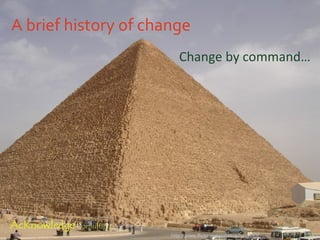
A brief history of change Change by command… http://www.flickr.com/photos/lyng883/
Change management… http://www.flickr.com/photos/cote/
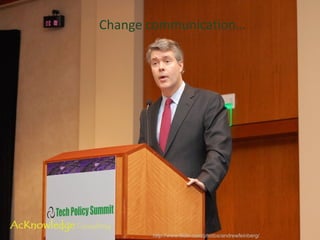
Change communication… http://www.flickr.com/photos/andrewfeinberg/
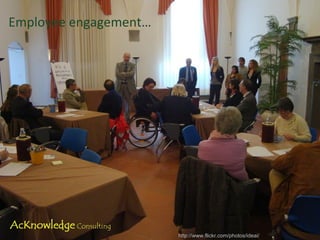
Employee engagement… http://www.flickr.com/photos/ideai/
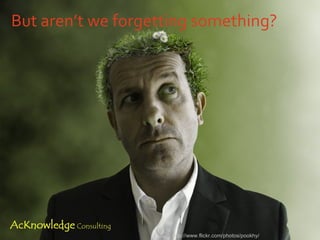
But aren’t we forgetting something? http://www.flickr.com/photos/pookhy/
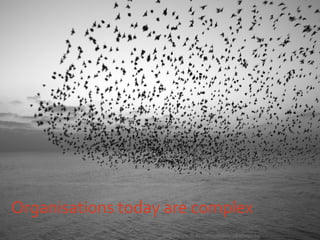
Organisations today are complex http://www.flickr.com/photos/odreiuqzide/
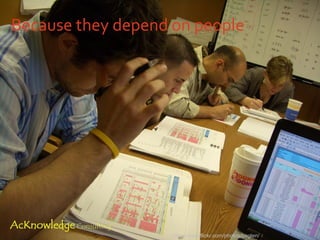
Because they depend on people http://www.flickr.com/photos/beglen/
Complexity theory? We need to understand how organisations work, before we can effectively change them People are: Complex, unpredictable, dynamic Resistant to engineering Change is only made possible by people http://www.flickr.com/photos/kevindooley/
The Cynefin Framework A way to look at the nature of organisations Tools to work with the environment Developed by David Snowden, Cognitive Edge Welsh: “habitat, place” Conveys the sense that we all have multiple pasts of which we are only partly aware: cultural, religious, geographic, tribal, etc http://www.flickr.com/photos/clspeace/
Complex Cause and effect coherent in retrospect, repeat accidentally – unpredictable Complicated Cause and effect separated over time & space, but repeat – analysable Knowable Simple Cause & effect relations repeatable & predictable Known Chaos No cause and effect relationships generally perceivable http://www.flickr.com/photos/joestump/ http://www.flickr.com/photos/clspeace/ http://www.flickr.com/photos/g_kovacs/ http://www.flickr.com/photos/111 emergency/
Complex Multiple small and diverse interventions to create options Probe-sense-respond Complicated Analytical techniques to determine facts and option range Sense-analyse-respond Simple Standard processes with review cycles and clear measures Sense-categorise-respond Chaos Single or multi actions to stabilise situations Act-sense-respond
Complex Informal Emergence Social Media Complicated Domain of experts Good practice 20 th  Century Simple “ Business as usual” Best practice 19 th  Century Chaos Novel Crisis Catastrophic change Ordered Unordered Disorder
Organisations are complex Dynamic, with rich interactions Different people operating at different levels Feedback Non-linear, unpredictable Emergent  characteristics Whole different to sum of parts Small changes can have large impacts History can make a difference http://www.flickr.com/photos/randysonofrobert/
Emergence Fly to the centre Match speed Avoid collision http://www.flickr.com/photos/moriza/
Simple wisdom doesn’t apply  “ The definition of insanity is doing the same thing twice and expecting a different result” In a complex environment, doing the same thing twice  will  give a different result “ You can't fix what you can't measure” You  can  intervene in a complex environment, even though you  can’t  measure it reliably http://www.flickr.com/photos/emmettanderson/
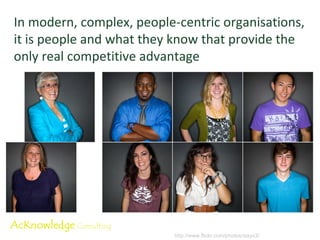
In modern, complex, people-centric organisations, it is people and what they know that provide the only real competitive advantage http://www.flickr.com/photos/isayx3/
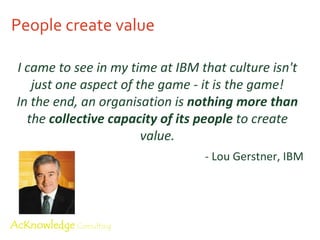
People create value I came to see in my time at IBM that culture isn't just one aspect of the game - it  is  the game! In the end, an organisation is  nothing more than  the  collective capacity of its people  to create value. - Lou Gerstner, IBM
There is no monopoly on ideas! http://www.flickr.com/photos/gaetanlee/
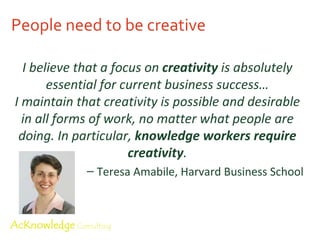
People need to be creative I believe that a focus on  creativity  is absolutely essential for current business success… I maintain that creativity is possible and desirable in all forms of work, no matter what people are doing. In particular,  knowledge workers require creativity . Teresa Amabile, Harvard Business School
How to encourage creativity Support people emotionally Monitor work in a positive way Recognise good performance, in public Consult with people on the team Collaborate –spend time with team on tasks
Cognitive rewards Monetary rewards don't work where more cognitive work required: Autonomy Mastery Purpose Self-directed = better engagement eg Atlassian Dan Pink,  Drive
The myth of control Peter Drucker constantly advised businesses to give  employees   direct control   over their  own work and environment , with teams of “knowledge workers” responsible for work toward goals stated as broad business objectives rather than prescriptive plans. Drucker stated that management could only achieve sustainable profits by treating people as an enterprise’s most  valued resources ,  not as costs .   - Greg Lloyd  http://traction.tractionsoftware.com/traction/permalink/Blog1163
Everyone can contribute When leaders learn to  creatively engage  their subordinates in  everyday decision making , they can  make change happen .   - John Smythe, Engage for change
McKinsey Research 2008 report 59 organisations researched globally Single, most influential cause of more engaged employees: The appetite and ability of leaders at every level to   engage their subordinates in everyday decision making and bigger-ticket change   http://www.flickr.com/photos/cell105/
All  of us are smarter than  any  of us The Wisdom of Crowds  - James Surowiecki Under certain conditions Works for cognition problems Diversity Independence http://www.flickr.com/photos/stephanridgway/
Tools for complexity Anecdote circles Safe-fail probes Social Network Stimulation The Future, Backwards Sensemaking Knowledge cafés Change Cards Organizational Zoo
Build trust through social media
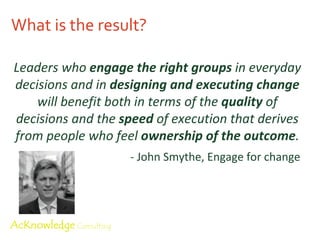
What is the result? Leaders who  engage the right groups  in everyday decisions and in  designing and executing change  will benefit both in terms of the  quality  of decisions and the  speed  of execution that derives from people who feel  ownership of the outcome . - John Smythe, Engage for change
What is your experience? Can we make this work? What can we do? Let’s go and create our future… @kdelarue 0418 51 7676 [email_address] http://acknowledgeconsulting.com/

The Idea Monopoly? Why change fails.

  • 1.
    The Idea Monopoly?Keith De La Rue http://www.flickr.com/photos/http2007/
  • 2.
  • 3.
    Why does changefail? “ Nearly 60 percent of projects aimed at achieving business change do not fully meet their objectives” 2008 IBM study of more than 1,500 change management executives from 15 countries http://www.flickr.com/photos/misserion/ http://www-03.ibm.com/press/us/en/pressrelease/25492.wss
  • 4.
    A brief historyof change Change by command… http://www.flickr.com/photos/lyng883/
  • 5.
  • 6.
  • 7.
  • 8.
    But aren’t weforgetting something? http://www.flickr.com/photos/pookhy/
  • 9.
    Organisations today arecomplex http://www.flickr.com/photos/odreiuqzide/
  • 10.
    Because they dependon people http://www.flickr.com/photos/beglen/
  • 11.
    Complexity theory? Weneed to understand how organisations work, before we can effectively change them People are: Complex, unpredictable, dynamic Resistant to engineering Change is only made possible by people http://www.flickr.com/photos/kevindooley/
  • 12.
    The Cynefin FrameworkA way to look at the nature of organisations Tools to work with the environment Developed by David Snowden, Cognitive Edge Welsh: “habitat, place” Conveys the sense that we all have multiple pasts of which we are only partly aware: cultural, religious, geographic, tribal, etc http://www.flickr.com/photos/clspeace/
  • 13.
    Complex Cause andeffect coherent in retrospect, repeat accidentally – unpredictable Complicated Cause and effect separated over time & space, but repeat – analysable Knowable Simple Cause & effect relations repeatable & predictable Known Chaos No cause and effect relationships generally perceivable http://www.flickr.com/photos/joestump/ http://www.flickr.com/photos/clspeace/ http://www.flickr.com/photos/g_kovacs/ http://www.flickr.com/photos/111 emergency/
  • 14.
    Complex Multiple smalland diverse interventions to create options Probe-sense-respond Complicated Analytical techniques to determine facts and option range Sense-analyse-respond Simple Standard processes with review cycles and clear measures Sense-categorise-respond Chaos Single or multi actions to stabilise situations Act-sense-respond
  • 15.
    Complex Informal EmergenceSocial Media Complicated Domain of experts Good practice 20 th Century Simple “ Business as usual” Best practice 19 th Century Chaos Novel Crisis Catastrophic change Ordered Unordered Disorder
  • 16.
    Organisations are complexDynamic, with rich interactions Different people operating at different levels Feedback Non-linear, unpredictable Emergent characteristics Whole different to sum of parts Small changes can have large impacts History can make a difference http://www.flickr.com/photos/randysonofrobert/
  • 17.
    Emergence Fly tothe centre Match speed Avoid collision http://www.flickr.com/photos/moriza/
  • 18.
    Simple wisdom doesn’tapply “ The definition of insanity is doing the same thing twice and expecting a different result” In a complex environment, doing the same thing twice will give a different result “ You can't fix what you can't measure” You can intervene in a complex environment, even though you can’t measure it reliably http://www.flickr.com/photos/emmettanderson/
  • 19.
    In modern, complex,people-centric organisations, it is people and what they know that provide the only real competitive advantage http://www.flickr.com/photos/isayx3/
  • 20.
    People create valueI came to see in my time at IBM that culture isn't just one aspect of the game - it is the game! In the end, an organisation is nothing more than the collective capacity of its people to create value. - Lou Gerstner, IBM
  • 21.
    There is nomonopoly on ideas! http://www.flickr.com/photos/gaetanlee/
  • 22.
    People need tobe creative I believe that a focus on creativity is absolutely essential for current business success… I maintain that creativity is possible and desirable in all forms of work, no matter what people are doing. In particular, knowledge workers require creativity . Teresa Amabile, Harvard Business School
  • 23.
    How to encouragecreativity Support people emotionally Monitor work in a positive way Recognise good performance, in public Consult with people on the team Collaborate –spend time with team on tasks
  • 24.
    Cognitive rewards Monetaryrewards don't work where more cognitive work required: Autonomy Mastery Purpose Self-directed = better engagement eg Atlassian Dan Pink, Drive
  • 25.
    The myth ofcontrol Peter Drucker constantly advised businesses to give employees direct control over their own work and environment , with teams of “knowledge workers” responsible for work toward goals stated as broad business objectives rather than prescriptive plans. Drucker stated that management could only achieve sustainable profits by treating people as an enterprise’s most valued resources , not as costs . - Greg Lloyd http://traction.tractionsoftware.com/traction/permalink/Blog1163
  • 26.
    Everyone can contributeWhen leaders learn to creatively engage their subordinates in everyday decision making , they can make change happen . - John Smythe, Engage for change
  • 27.
    McKinsey Research 2008report 59 organisations researched globally Single, most influential cause of more engaged employees: The appetite and ability of leaders at every level to engage their subordinates in everyday decision making and bigger-ticket change http://www.flickr.com/photos/cell105/
  • 28.
    All ofus are smarter than any of us The Wisdom of Crowds - James Surowiecki Under certain conditions Works for cognition problems Diversity Independence http://www.flickr.com/photos/stephanridgway/
  • 29.
    Tools for complexityAnecdote circles Safe-fail probes Social Network Stimulation The Future, Backwards Sensemaking Knowledge cafés Change Cards Organizational Zoo
  • 30.
    Build trust throughsocial media
  • 31.
    What is theresult? Leaders who engage the right groups in everyday decisions and in designing and executing change will benefit both in terms of the quality of decisions and the speed of execution that derives from people who feel ownership of the outcome . - John Smythe, Engage for change
  • 32.
    What is yourexperience? Can we make this work? What can we do? Let’s go and create our future… @kdelarue 0418 51 7676 [email_address] http://acknowledgeconsulting.com/