Two practitioners’ reflections on
                    action
               An attempt to create a common
              Gestalt in a re-organization process

Lars Marmgren, MSc                                  Anette Strömberg, PhD
Marmgren Konsulter AB/Gestaltakademin Scandinavia   Mälardalen University
(works as organizational consultant)                (works as lecturer and are just
                                                    about going in to science)
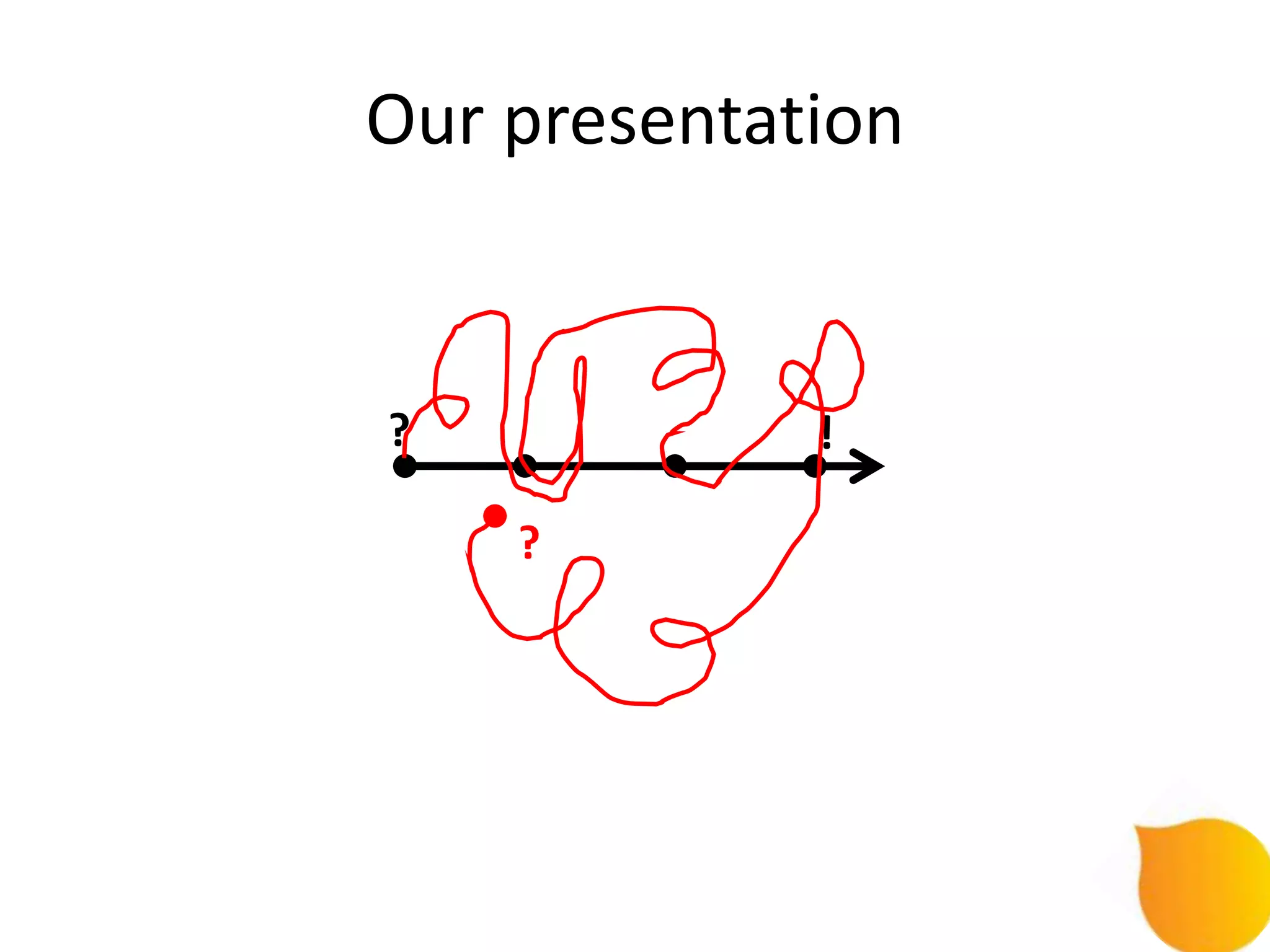
Our presentation


?            !

    ?
Gestalt theory in short; Figure - Ground and the
          process of creating meaning

• As human beings we are predisposed to create meaning!
• The gestalt principle of figure formation is a process in which
  the individual creates meaning in the here and now, based on:
   – Perceived data through all available senses
   – The contextual framework of the situation at hand
   – All personal life experience, education and knowledge
• The gestalt is the meaningful whole, a figure against the
  ground, that in the moment, tells us who where and what we
  are in the world,
• This process is not controlled by our will but is an
  automatic, internal, self-organizing process that helps us to
  navigate in the world at the same time as it helps us to create
  energy to act in the world.
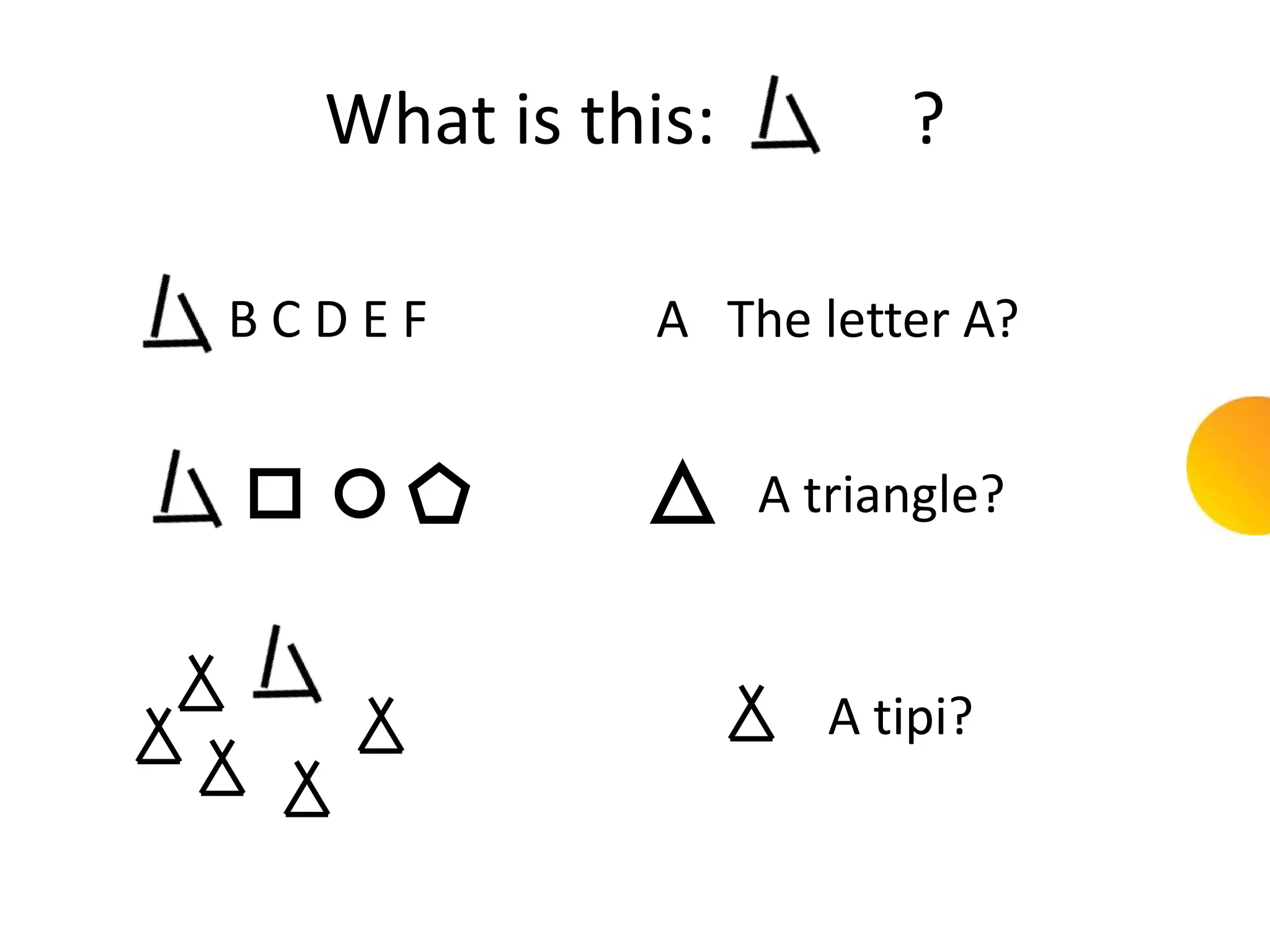
What is this:         ?

BCDEF        A The letter A?


                  A triangle?


                     A tipi?
© Szorstki@stock.xchng.hu
Our research intention

WE STARTED WITH IDENTIFYING
RESULTS AND COMPARING METHODS
We intended to do a small research
                study
A re-organization process was initiated at MDH. The
study dealt with:
• In total 12 interviews with middle managers,
• The ”consultants task” was to:
  explore change resistance,
  find dilemmas,
  find what is precious in existing organization.
• At first the research interest was how to use
  consultant practice in research.
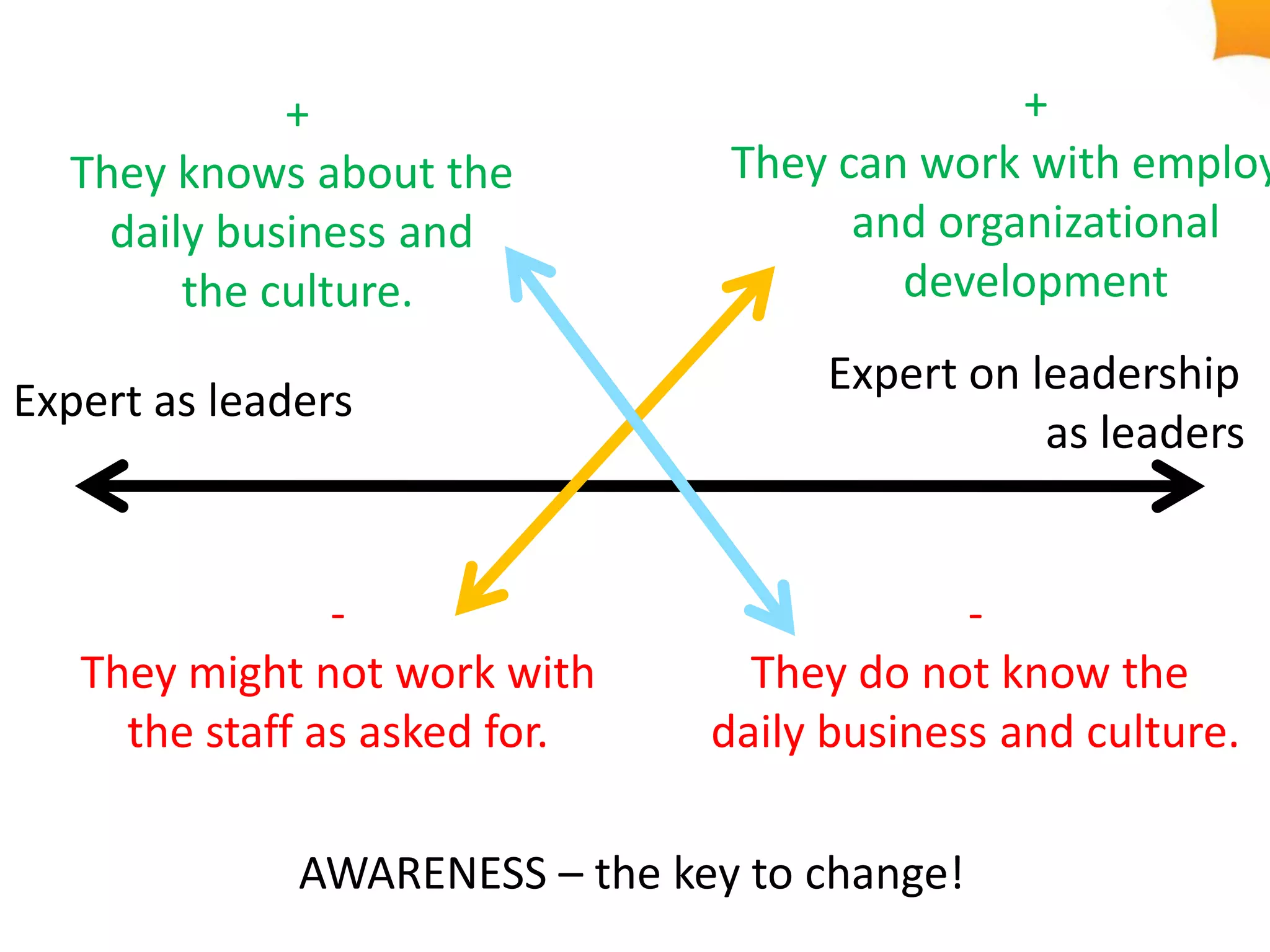
+                                 +
  They knows about the           They can work with employ
    daily business and                 and organizational
        the culture.                     development
                                     Expert on leadership
Expert as leaders
                                                as leaders


                -                            -
   They might not work with       They do not know the
     the staff as asked for.    daily business and culture.

              AWARENESS – the key to change!
Reflections on: our (humans) ability to
          simulate/fantasize
• Generally, the informants seemed to or expressed having difficulties
  in understanding (fantasize about/imagine/intending) what the
  organization to come actually would mean to them.

Alternative explanations
1. An organization scheme does not provide enough information to
     provide as ground,
2. According to adult development theories* a high degree of ego
     development is needed for that kind of imagination.
3. Thinking about the new organization and its consequences upon
     ones work situation, is according to phenomenology, an empty
     intention. It differs between peoples ability to engage in empty
     intentions.
  * Se for example Handbook of adult development, J. Demick and C. Andreoletti
  Eds, The Springer series in adult development and ageing
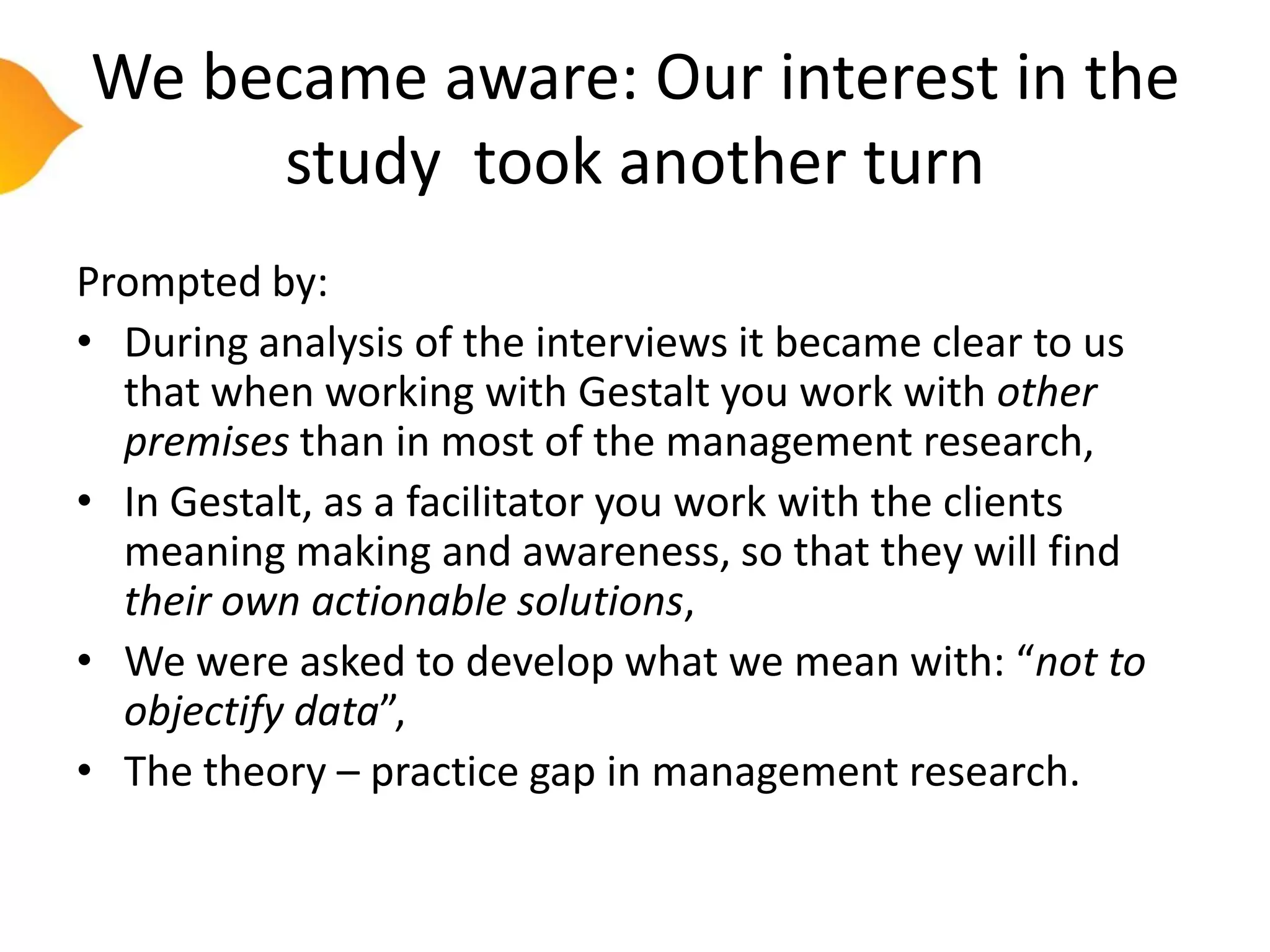
Reflections on: Sharing data
• For the interviewer short notes (the third level) might be
  enough since the meaning of that data is influenced by the
  ground consisting of everything that is in transcript (second
  level) and the full experience of the interview (first level).
• Particularly, this is the case when the interviewer also has a
  long experience of her own working within the organization.
• For somebody else, solely sharing the data at the third level
  may give little meaning.
• The figure in this case (the short notes) holds little meaning
  without the ground (the full experience from the interviews +
  the interviewers own experience from working in the
  organization).
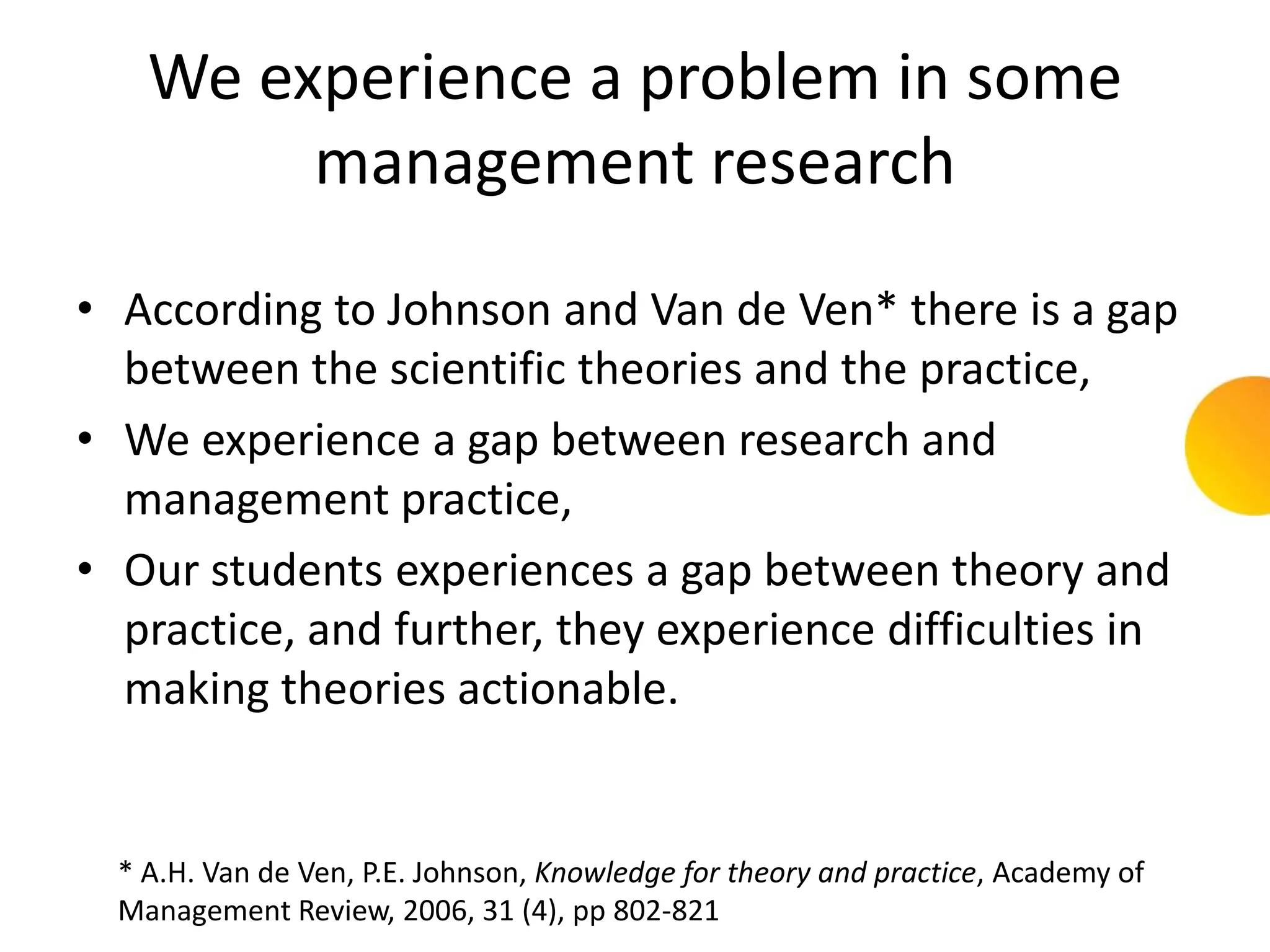
We became aware: Our interest in the
     study took another turn
Prompted by:
• During analysis of the interviews it became clear to us
  that when working with Gestalt you work with other
  premises than in most of the management research,
• In Gestalt, as a facilitator you work with the clients
  meaning making and awareness, so that they will find
  their own actionable solutions,
• We were asked to develop what we mean with: “not to
  objectify data”,
• The theory – practice gap in management research.
We experience a problem in some
         management research

• According to Johnson and Van de Ven* there is a gap
  between the scientific theories and the practice,
• We experience a gap between research and
  management practice,
• Our students experiences a gap between theory and
  practice, and further, they experience difficulties in
  making theories actionable.


  * A.H. Van de Ven, P.E. Johnson, Knowledge for theory and practice, Academy of
  Management Review, 2006, 31 (4), pp 802-821
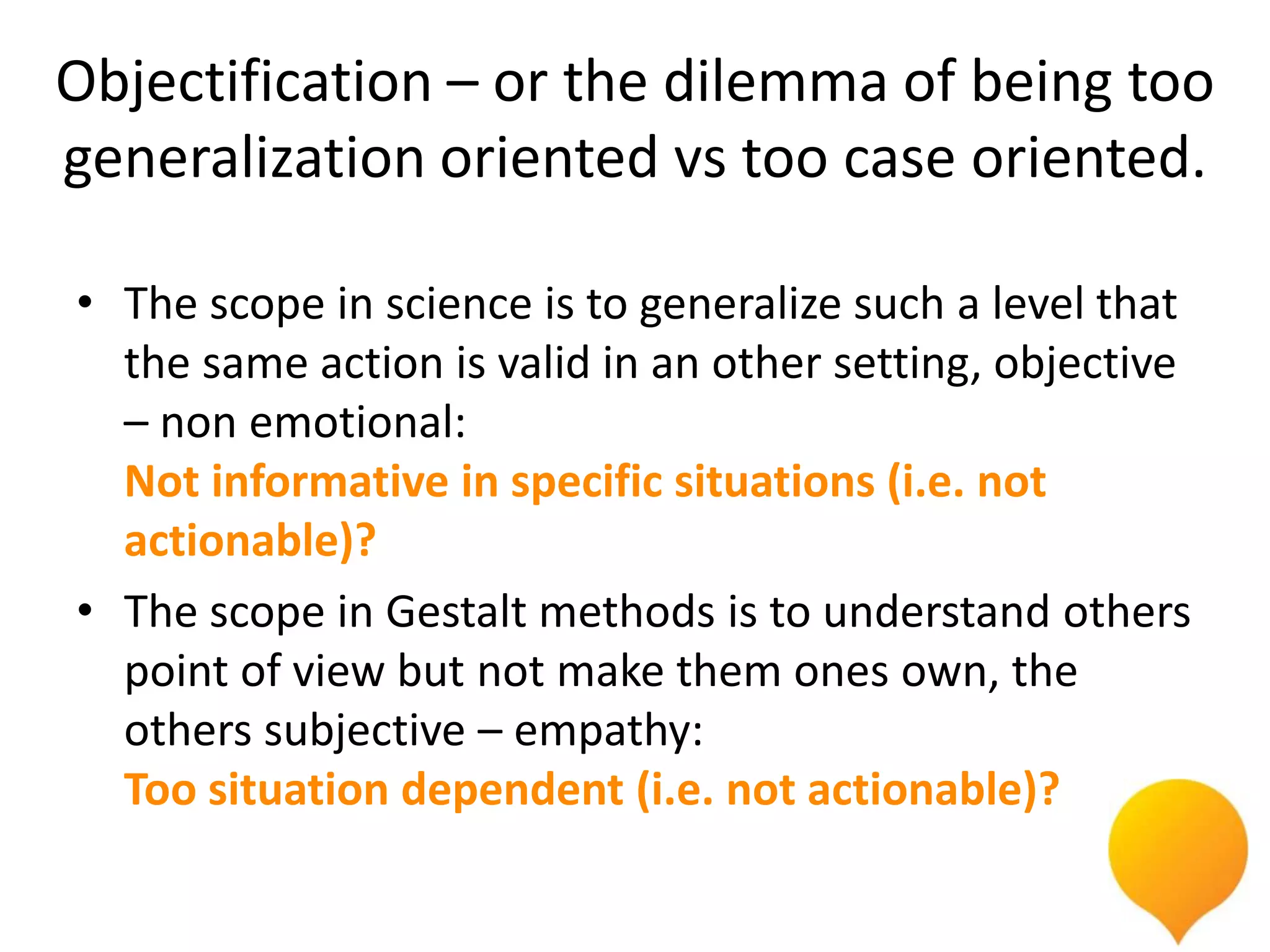
Objectification – or the dilemma of being too
generalization oriented vs too case oriented.

• The scope in science is to generalize such a level that
  the same action is valid in an other setting, objective
  – non emotional:
  Not informative in specific situations (i.e. not
  actionable)?
• The scope in Gestalt methods is to understand others
  point of view but not make them ones own, the
  others subjective – empathy:
  Too situation dependent (i.e. not actionable)?
Different purposes in research and
               consulting
The scientist
• Trying to establish if a proposition is false or true.


The Gestalt consultant
• Supporting the client system to meaningful and
  purposeful action.
The expert paradigm
According to adult development theories,
  “The Conscientious stage is the target stage for
  Western culture.”*:
• “Persons at this stage are interested in reasons,
  causes, goals, consequences and the effective use of
  time.”
• “..(they) generally believe in the perfectibility of
  humankind and in the scientific method to “uncover”
  truth.”

*S. Cook-Greuter, Nine levels of increasing embrace, p 17 and ff, http://www.cook-
greuter.com/9%20levels%20of%20increasing%20embrace%20update%201%2007.pdf
We suggest an alternative understanding
           of organizations

  The new understanding is based on two simple
    assumptions about organizations:
  • Actions by people and groups of people are
    governed by subjective rationality.
  • Organizations are held together and kept in
    dynamical balance by feedback (in its biological
    meaning).
Subjective rationality
• We assume that it is the perceived reality of an
  individual that guides the actions of that
  individual,
• In the same way, a perceived reality shared by a
  group of people will guide the actions of that
  group,
• Any action taken, whether by an individual, a
  group or an entire organization is not guided by
  objective truths(in the scientifically meaning) but
  by subjective perceptions of what is true,
©ramasamy chidambaram@stock.xchng.hu
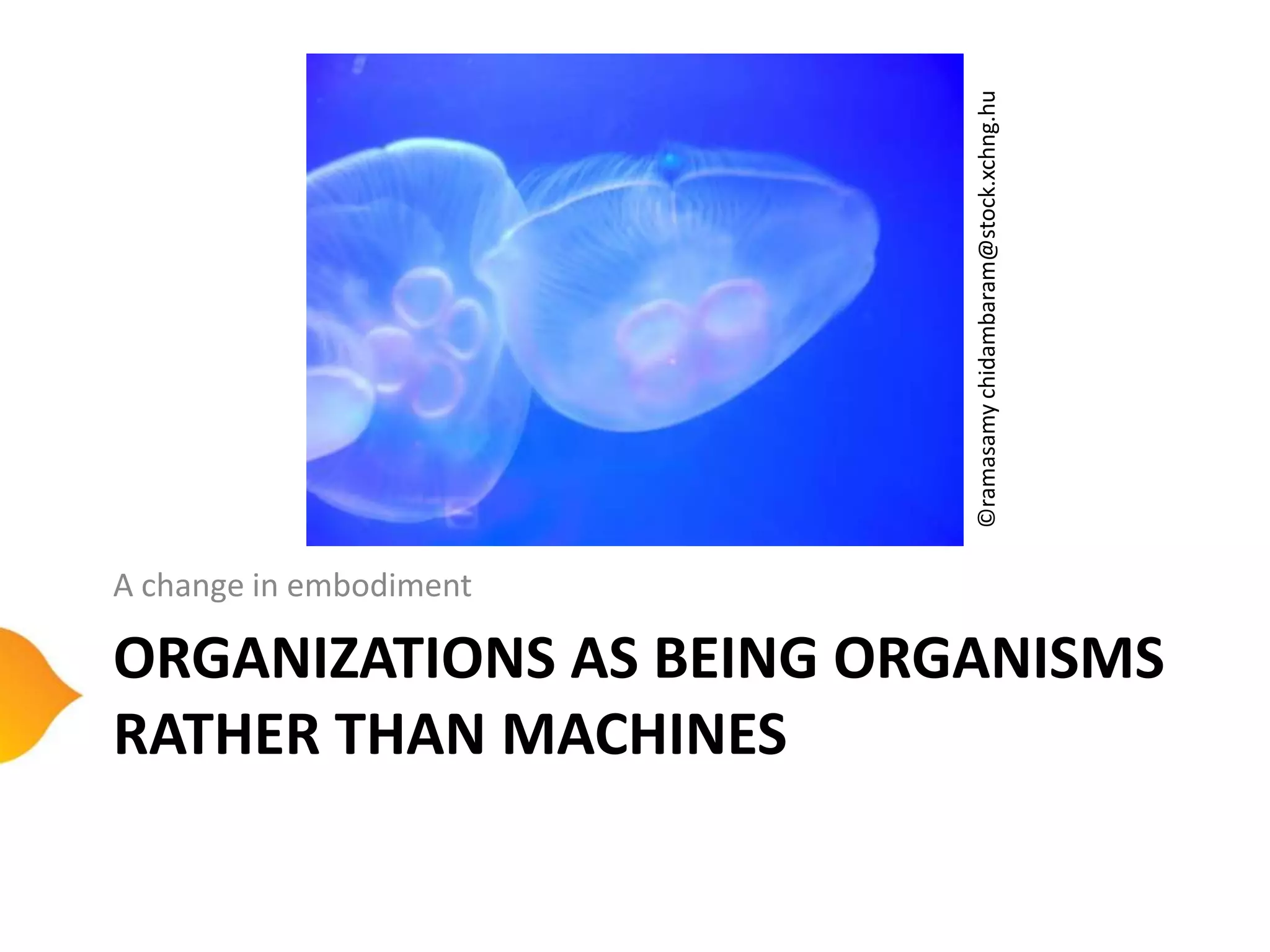
A change in embodiment

ORGANIZATIONS AS BEING ORGANISMS
RATHER THAN MACHINES
http://www.bordalierinstitute.com/target1.html
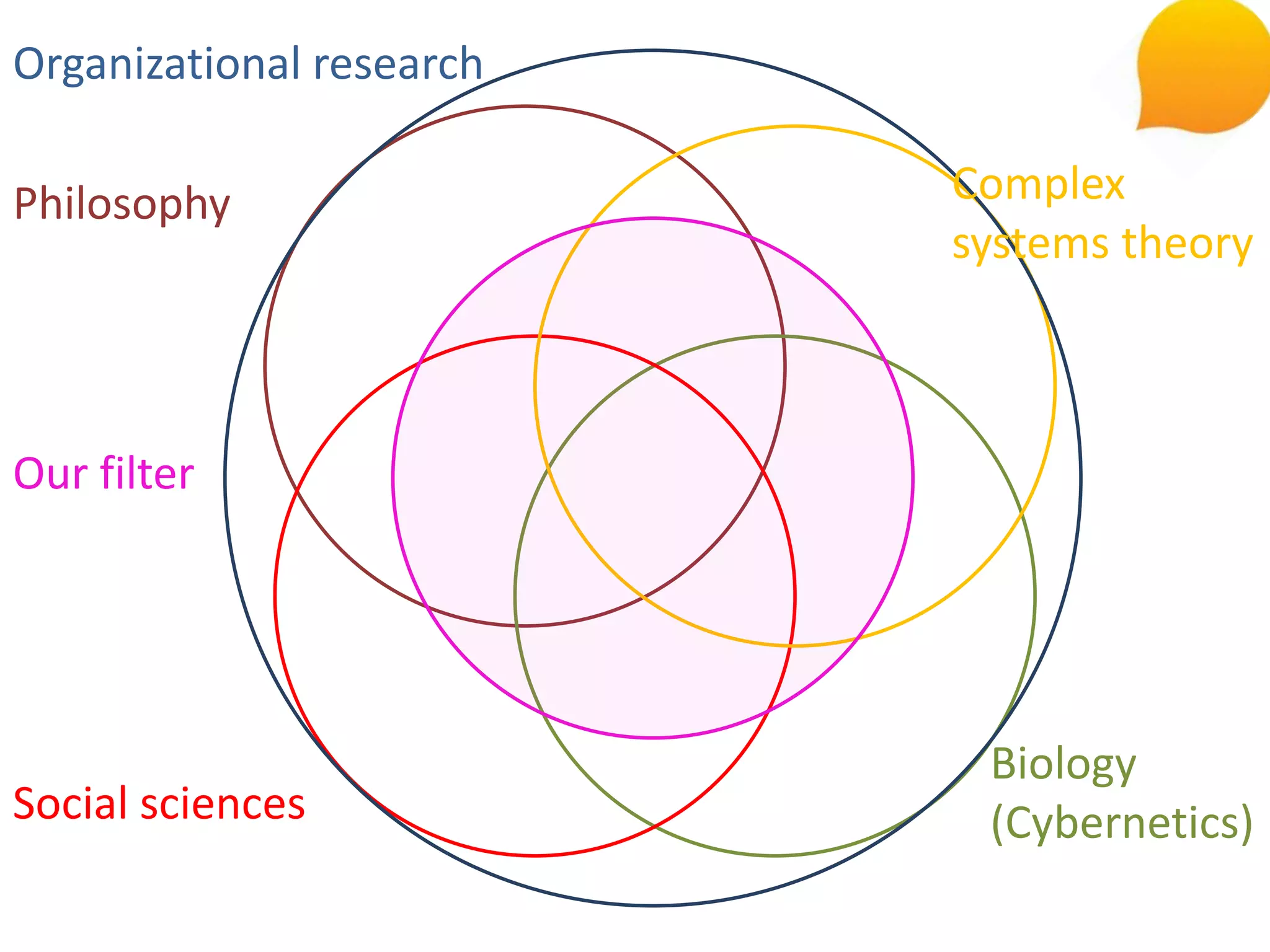
Organizational research

Philosophy                Complex
                          systems theory


Our filter


                           Biology
Social sciences            (Cybernetics)
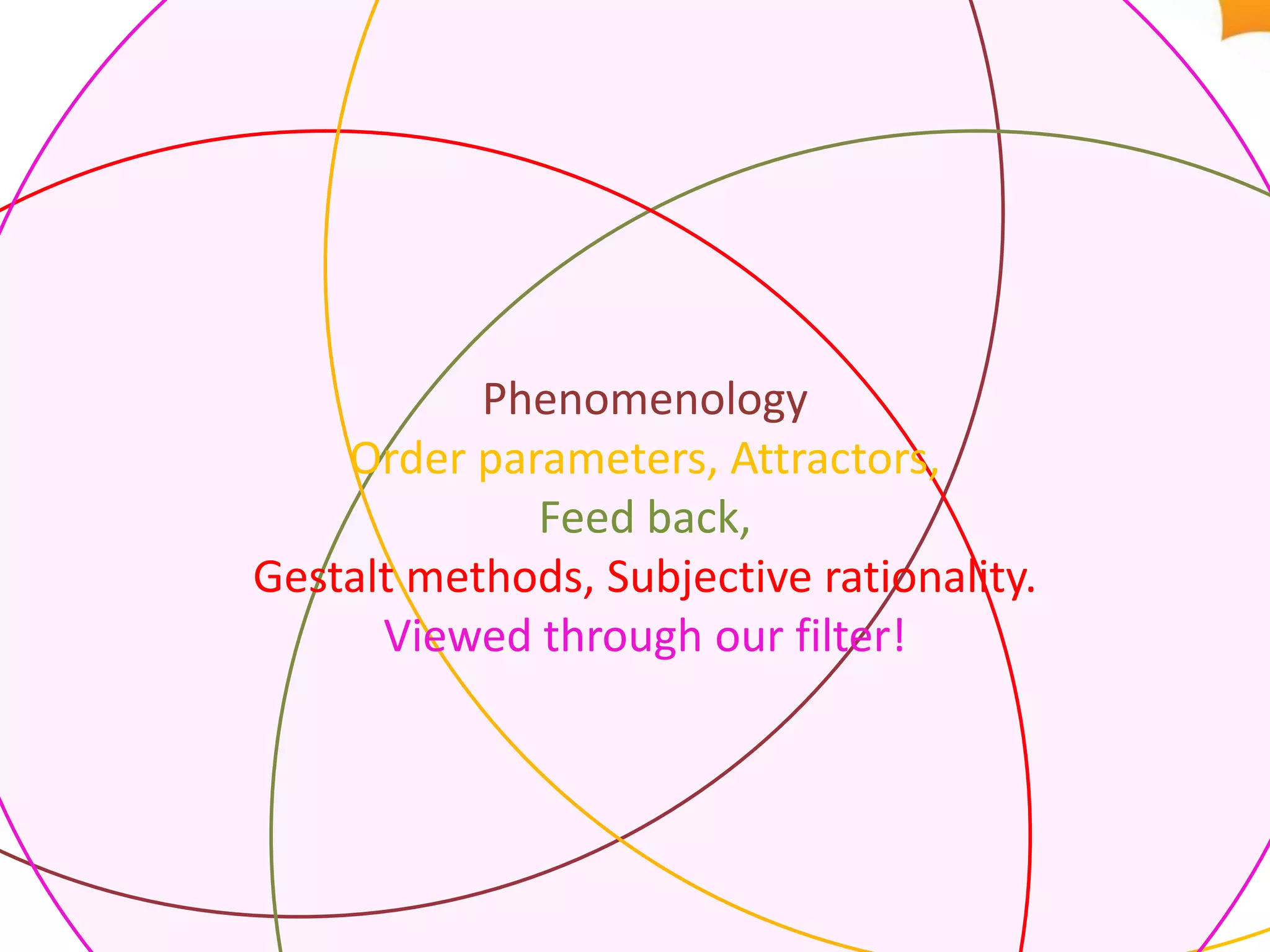
Phenomenology
    Order parameters, Attractors,
             Feed back,
Gestalt methods, Subjective rationality.
      Viewed through our filter!
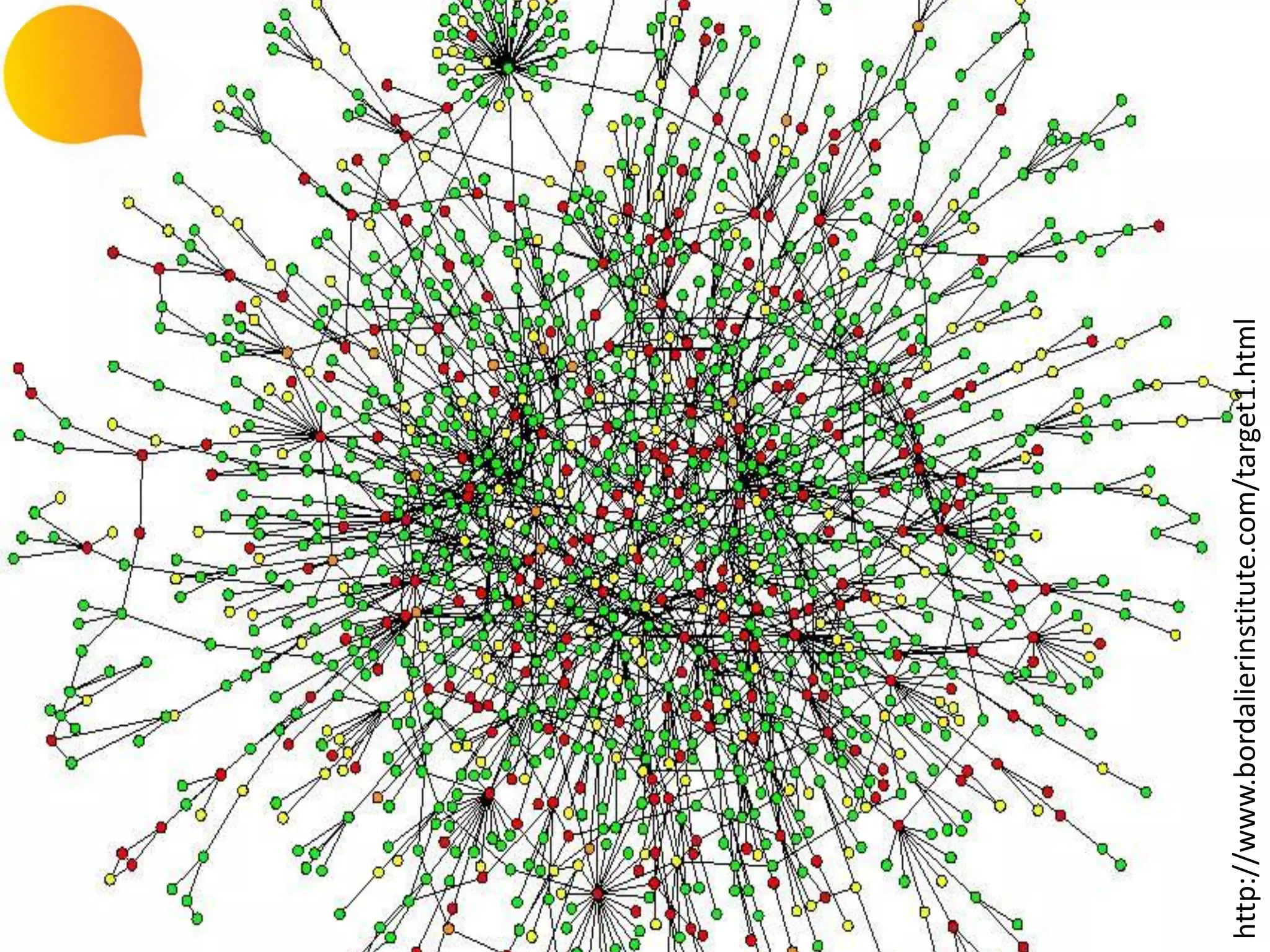
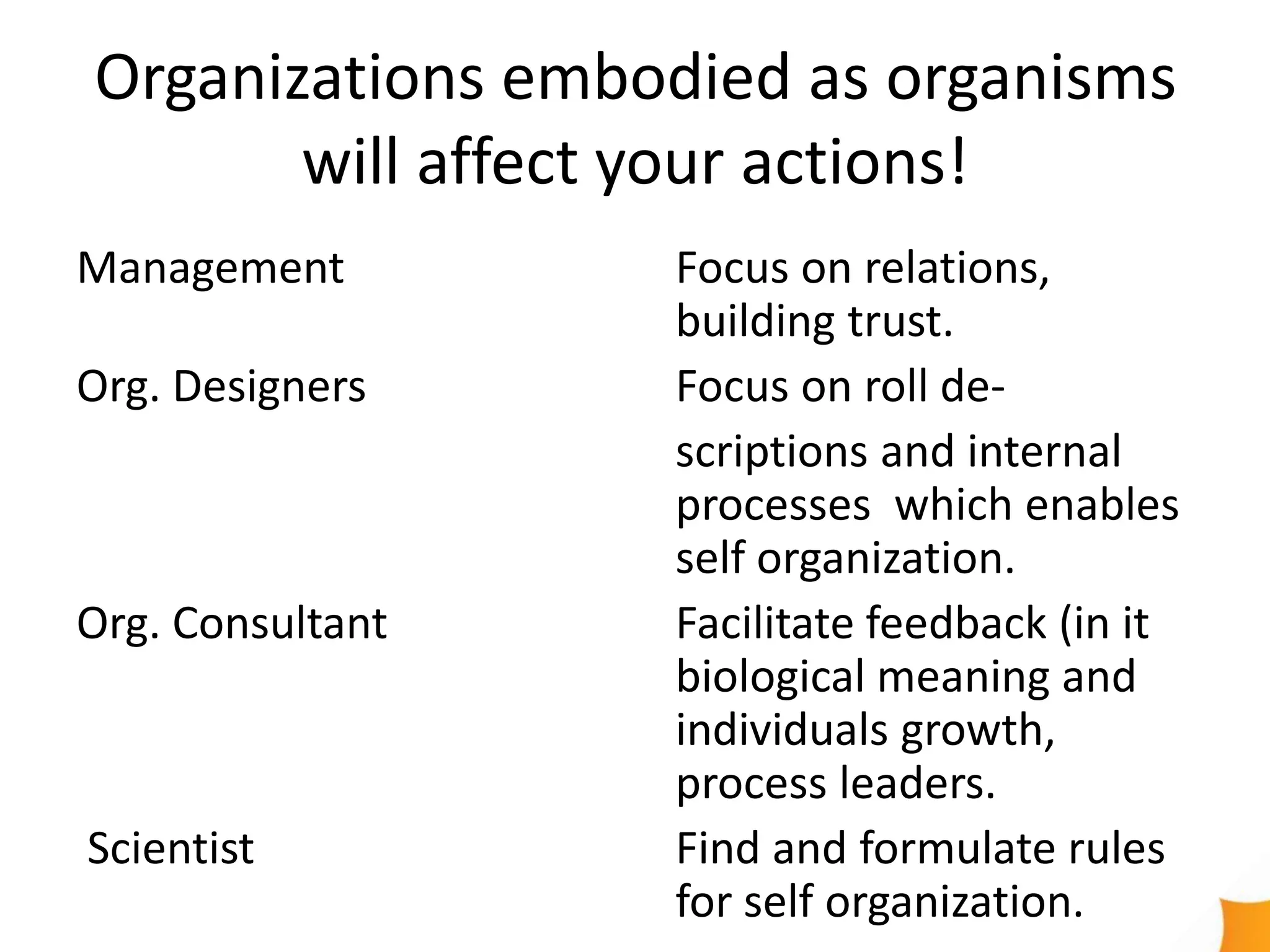
Organizations embodied as organisms
       will affect your actions!
Management        Focus on relations,
                  building trust.
Org. Designers    Focus on roll de-
                  scriptions and internal
                  processes which enables
                  self organization.
Org. Consultant   Facilitate feedback (in it
                  biological meaning and
                  individuals growth,
                  process leaders.
Scientist         Find and formulate rules
                  for self organization.
*
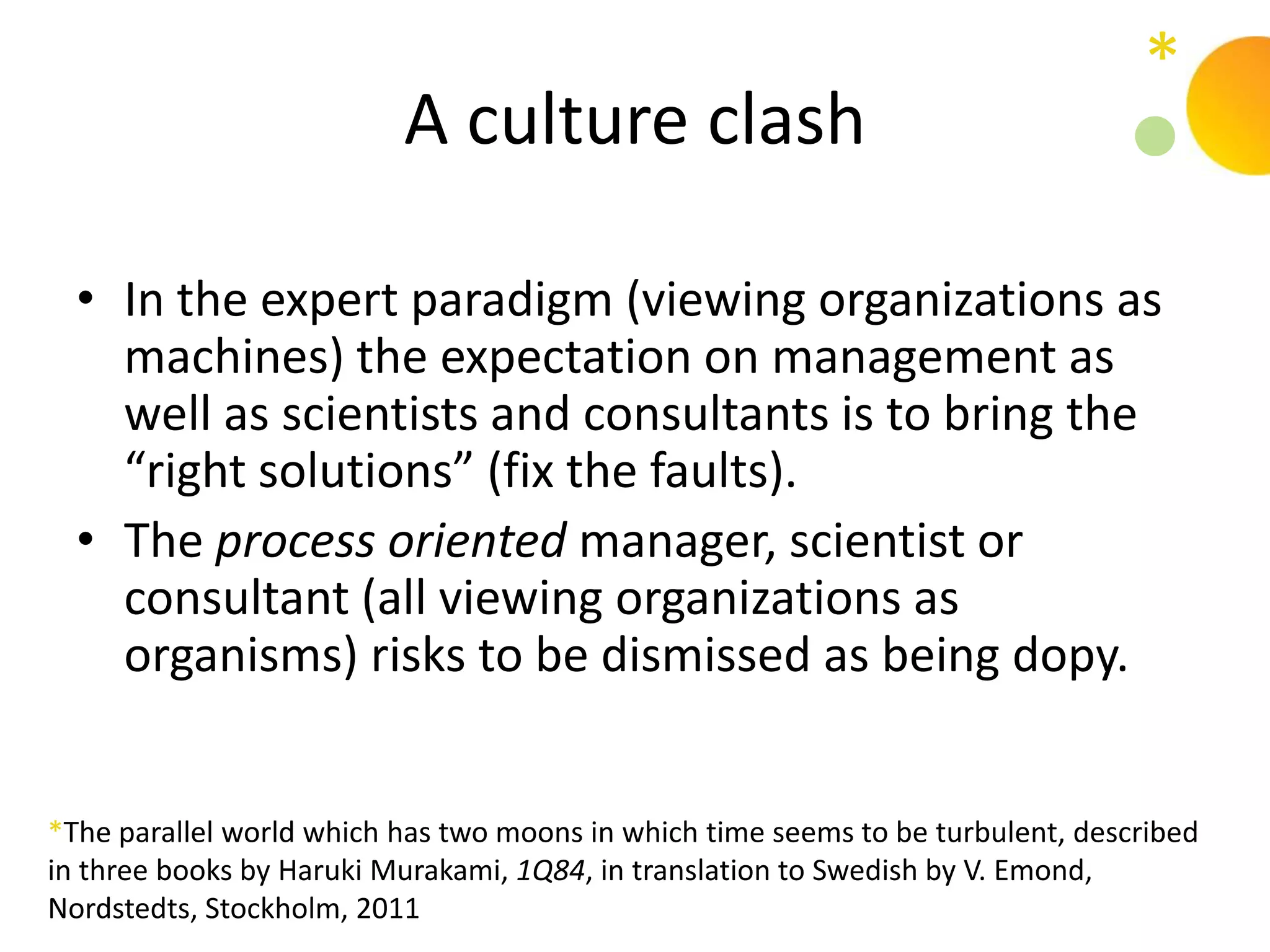
                          A culture clash

  • In the expert paradigm (viewing organizations as
    machines) the expectation on management as
    well as scientists and consultants is to bring the
    “right solutions” (fix the faults).
  • The process oriented manager, scientist or
    consultant (all viewing organizations as
    organisms) risks to be dismissed as being dopy.


*The parallel world which has two moons in which time seems to be turbulent, described
in three books by Haruki Murakami, 1Q84, in translation to Swedish by V. Emond,
Nordstedts, Stockholm, 2011
Where are we heading?


How does managers/organizational consultants/
employees … set the scene* for creating learning
organizations?


 * L. Marmgren and M. Ragnarsson, Organizing projects, Thomson
 Fakta, Stockholm, 2001
Acknowledgements


Thank you!
                          For Your attention
  The conference organizers for giving us this
                                 opportunity
  Mälardalen University for sharing their/our
       experiences and supporting this work

Gestalt methodolgies in organisation research

  • 1.
    Two practitioners’ reflectionson action An attempt to create a common Gestalt in a re-organization process Lars Marmgren, MSc Anette Strömberg, PhD Marmgren Konsulter AB/Gestaltakademin Scandinavia Mälardalen University (works as organizational consultant) (works as lecturer and are just about going in to science)
  • 2.
  • 3.
    Gestalt theory inshort; Figure - Ground and the process of creating meaning • As human beings we are predisposed to create meaning! • The gestalt principle of figure formation is a process in which the individual creates meaning in the here and now, based on: – Perceived data through all available senses – The contextual framework of the situation at hand – All personal life experience, education and knowledge • The gestalt is the meaningful whole, a figure against the ground, that in the moment, tells us who where and what we are in the world, • This process is not controlled by our will but is an automatic, internal, self-organizing process that helps us to navigate in the world at the same time as it helps us to create energy to act in the world.
  • 4.
    What is this: ? BCDEF A The letter A? A triangle? A tipi?
  • 5.
    © Szorstki@stock.xchng.hu Our researchintention WE STARTED WITH IDENTIFYING RESULTS AND COMPARING METHODS
  • 6.
    We intended todo a small research study A re-organization process was initiated at MDH. The study dealt with: • In total 12 interviews with middle managers, • The ”consultants task” was to: explore change resistance, find dilemmas, find what is precious in existing organization. • At first the research interest was how to use consultant practice in research.
  • 7.
    + + They knows about the They can work with employ daily business and and organizational the culture. development Expert on leadership Expert as leaders as leaders - - They might not work with They do not know the the staff as asked for. daily business and culture. AWARENESS – the key to change!
  • 8.
    Reflections on: our(humans) ability to simulate/fantasize • Generally, the informants seemed to or expressed having difficulties in understanding (fantasize about/imagine/intending) what the organization to come actually would mean to them. Alternative explanations 1. An organization scheme does not provide enough information to provide as ground, 2. According to adult development theories* a high degree of ego development is needed for that kind of imagination. 3. Thinking about the new organization and its consequences upon ones work situation, is according to phenomenology, an empty intention. It differs between peoples ability to engage in empty intentions. * Se for example Handbook of adult development, J. Demick and C. Andreoletti Eds, The Springer series in adult development and ageing
  • 9.
    Reflections on: Sharingdata • For the interviewer short notes (the third level) might be enough since the meaning of that data is influenced by the ground consisting of everything that is in transcript (second level) and the full experience of the interview (first level). • Particularly, this is the case when the interviewer also has a long experience of her own working within the organization. • For somebody else, solely sharing the data at the third level may give little meaning. • The figure in this case (the short notes) holds little meaning without the ground (the full experience from the interviews + the interviewers own experience from working in the organization).
  • 10.
    We became aware:Our interest in the study took another turn Prompted by: • During analysis of the interviews it became clear to us that when working with Gestalt you work with other premises than in most of the management research, • In Gestalt, as a facilitator you work with the clients meaning making and awareness, so that they will find their own actionable solutions, • We were asked to develop what we mean with: “not to objectify data”, • The theory – practice gap in management research.
  • 11.
    We experience aproblem in some management research • According to Johnson and Van de Ven* there is a gap between the scientific theories and the practice, • We experience a gap between research and management practice, • Our students experiences a gap between theory and practice, and further, they experience difficulties in making theories actionable. * A.H. Van de Ven, P.E. Johnson, Knowledge for theory and practice, Academy of Management Review, 2006, 31 (4), pp 802-821
  • 12.
    Objectification – orthe dilemma of being too generalization oriented vs too case oriented. • The scope in science is to generalize such a level that the same action is valid in an other setting, objective – non emotional: Not informative in specific situations (i.e. not actionable)? • The scope in Gestalt methods is to understand others point of view but not make them ones own, the others subjective – empathy: Too situation dependent (i.e. not actionable)?
  • 13.
    Different purposes inresearch and consulting The scientist • Trying to establish if a proposition is false or true. The Gestalt consultant • Supporting the client system to meaningful and purposeful action.
  • 14.
    The expert paradigm Accordingto adult development theories, “The Conscientious stage is the target stage for Western culture.”*: • “Persons at this stage are interested in reasons, causes, goals, consequences and the effective use of time.” • “..(they) generally believe in the perfectibility of humankind and in the scientific method to “uncover” truth.” *S. Cook-Greuter, Nine levels of increasing embrace, p 17 and ff, http://www.cook- greuter.com/9%20levels%20of%20increasing%20embrace%20update%201%2007.pdf
  • 15.
    We suggest analternative understanding of organizations The new understanding is based on two simple assumptions about organizations: • Actions by people and groups of people are governed by subjective rationality. • Organizations are held together and kept in dynamical balance by feedback (in its biological meaning).
  • 16.
    Subjective rationality • Weassume that it is the perceived reality of an individual that guides the actions of that individual, • In the same way, a perceived reality shared by a group of people will guide the actions of that group, • Any action taken, whether by an individual, a group or an entire organization is not guided by objective truths(in the scientifically meaning) but by subjective perceptions of what is true,
  • 17.
    ©ramasamy chidambaram@stock.xchng.hu A changein embodiment ORGANIZATIONS AS BEING ORGANISMS RATHER THAN MACHINES
  • 18.
  • 19.
    Organizational research Philosophy Complex systems theory Our filter Biology Social sciences (Cybernetics)
  • 20.
    Phenomenology Order parameters, Attractors, Feed back, Gestalt methods, Subjective rationality. Viewed through our filter!
  • 21.
    Organizations embodied asorganisms will affect your actions! Management Focus on relations, building trust. Org. Designers Focus on roll de- scriptions and internal processes which enables self organization. Org. Consultant Facilitate feedback (in it biological meaning and individuals growth, process leaders. Scientist Find and formulate rules for self organization.
  • 22.
    * A culture clash • In the expert paradigm (viewing organizations as machines) the expectation on management as well as scientists and consultants is to bring the “right solutions” (fix the faults). • The process oriented manager, scientist or consultant (all viewing organizations as organisms) risks to be dismissed as being dopy. *The parallel world which has two moons in which time seems to be turbulent, described in three books by Haruki Murakami, 1Q84, in translation to Swedish by V. Emond, Nordstedts, Stockholm, 2011
  • 23.
    Where are weheading? How does managers/organizational consultants/ employees … set the scene* for creating learning organizations? * L. Marmgren and M. Ragnarsson, Organizing projects, Thomson Fakta, Stockholm, 2001
  • 24.
    Acknowledgements Thank you! For Your attention The conference organizers for giving us this opportunity Mälardalen University for sharing their/our experiences and supporting this work