Accelerated Growth of Leaders
The Case for Executive Advising
Leland Sandler
The Sandler Group, LLC
• The work we do is
• Executive Advising
• Organizational Transformation
• Senior Team Optimization
• Amylin Pharmaceuticals
• Ardea Biosciences
• Baxter Healthcare
• Biocept
• Boston Scientific
• Edwards Lifesciences
• Eli Lilly
• Entropic Communications
• ev3 (Covidien)
• Ferring Pharmaceuticals
• Kyocera Wireless
• OrPro Therapeutics
• Palm Computing
• Peregrine Semiconductor
• Qualcomm
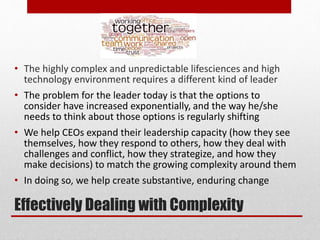
Effectively Dealing with Complexity
• The highly complex and unpredictable lifesciences and high
technology environment requires a different kind of leader
• The problem for the leader today is that the options to
consider have increased exponentially, and the way he/she
needs to think about those options is regularly shifting
• We help CEOs expand their leadership capacity (how they see
themselves, how they respond to others, how they deal with
challenges and conflict, how they strategize, and how they
make decisions) to match the growing complexity around them
• In doing so, we help create substantive, enduring change
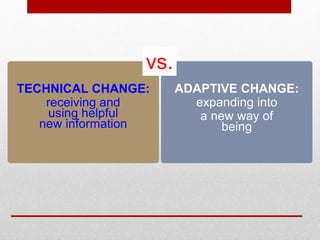
ADAPTIVE CHANGE:
expanding into
a new way of
being
TECHNICAL CHANGE:
receiving and
using helpful
new information
vs.
Blind Spots
“We do not see the world as it is.
We see the world as we are.”
--- The Talmud
Where a New Leader Often Starts
• Leaders are faced with the fact that the world is too complex
for them to manage on their own
• They attempt to manage by banding together with some set of
ideas, or “experts,” that will rescue them from that complexity
• They become overly immersed in their enterprise to the point
where they cannot take appropriate perspectives
• They look for a particular set of existing organizational norms
as to what success looks like
• They are hesitant to directly challenge others or take risks
without the assurance of an “expert” or “advisor”
Where a New Leader Will Get To
• Our goal is to help the leader see the world on their terms and
rely on their thinking about that is necessary; advisers no
longer have “the answer” – but bring possibilities
• We help the leader create his/her own vision; a vision that will
have the most impact for their organization
• Leaders learn to optimally run their ideas through their own
internal set of values and principles (though genuinely curious
and open to the input from others), and thus see a wider set of
options and a more nuanced set of decision criteria
• Most of all, we help cultivate the courage to risk failure in the
pursuit of greater achievement
Resources and Links
• The Sandler Group: sandlergroup.net/
• Leland Sandler Website: lelandsandler.com
• LinkedIn: https://www.linkedin.com/in/lelandsandler
• Facebook: http://facebook.com/thesandlergroup
• Twitter: https://twitter.com/lelandsandler
• Google+: https://plus.google.com/+LelandSandlerExecutiveAdvisor

The Case for Executive Advising- Leland Sandler

  • 1.
    Accelerated Growth ofLeaders The Case for Executive Advising Leland Sandler The Sandler Group, LLC
  • 2.
    The Sandler Group,LLC • The work we do is • Executive Advising • Organizational Transformation • Senior Team Optimization • Amylin Pharmaceuticals • Ardea Biosciences • Baxter Healthcare • Biocept • Boston Scientific • Edwards Lifesciences • Eli Lilly • Entropic Communications • ev3 (Covidien) • Ferring Pharmaceuticals • Kyocera Wireless • OrPro Therapeutics • Palm Computing • Peregrine Semiconductor • Qualcomm
  • 3.
    Effectively Dealing withComplexity • The highly complex and unpredictable lifesciences and high technology environment requires a different kind of leader • The problem for the leader today is that the options to consider have increased exponentially, and the way he/she needs to think about those options is regularly shifting • We help CEOs expand their leadership capacity (how they see themselves, how they respond to others, how they deal with challenges and conflict, how they strategize, and how they make decisions) to match the growing complexity around them • In doing so, we help create substantive, enduring change
  • 4.
    ADAPTIVE CHANGE: expanding into anew way of being TECHNICAL CHANGE: receiving and using helpful new information vs.
  • 5.
    Blind Spots “We donot see the world as it is. We see the world as we are.” --- The Talmud
  • 6.
    Where a NewLeader Often Starts • Leaders are faced with the fact that the world is too complex for them to manage on their own • They attempt to manage by banding together with some set of ideas, or “experts,” that will rescue them from that complexity • They become overly immersed in their enterprise to the point where they cannot take appropriate perspectives • They look for a particular set of existing organizational norms as to what success looks like • They are hesitant to directly challenge others or take risks without the assurance of an “expert” or “advisor”
  • 7.
    Where a NewLeader Will Get To • Our goal is to help the leader see the world on their terms and rely on their thinking about that is necessary; advisers no longer have “the answer” – but bring possibilities • We help the leader create his/her own vision; a vision that will have the most impact for their organization • Leaders learn to optimally run their ideas through their own internal set of values and principles (though genuinely curious and open to the input from others), and thus see a wider set of options and a more nuanced set of decision criteria • Most of all, we help cultivate the courage to risk failure in the pursuit of greater achievement
  • 8.
    Resources and Links •The Sandler Group: sandlergroup.net/ • Leland Sandler Website: lelandsandler.com • LinkedIn: https://www.linkedin.com/in/lelandsandler • Facebook: http://facebook.com/thesandlergroup • Twitter: https://twitter.com/lelandsandler • Google+: https://plus.google.com/+LelandSandlerExecutiveAdvisor

Editor's Notes

  • #5 Technical change is adding skills or information to your current way of thinking, while Adaptive change is transforming or expanding your way of thinking about yourself and the world. Technical Change: Flying an airplane; Becoming a CFA, Surgery Adaptive: Managing Conflict, Taking Risks, Losing Weight Irene example – confusing communicator, unaddressed perf issues, and mistrusted - seen as passive aggressive. As began to work together, saw that all boiled down to one issue – her lack of clear communication (explain). As we looked at that, it became clear knew what she wanted to say, and how to communicate clearly; issue was deep belief that “you don’t rock the boat” – so don’t tell what don’t want to hear. Until able to shift that, wasn’t able to change. Once had bigger view of what is possible, began to change. Adaptive create a community that is willing and able to generate new ideas. Respond to concerns raised by skeptics Build support