Managing People “Up the Curve”
in a High Velocity Environment
Selection, Management and Intervention Determine
Success or Failure of People and the Business
Leland Sandler
Managing Partner
The Sandler Group LLC
The High Velocity Environment
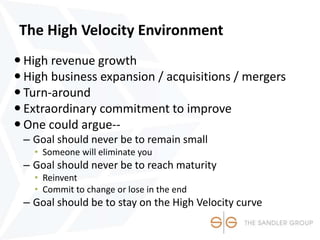
 High revenue growth
 High business expansion / acquisitions / mergers
 Turn-around
 Extraordinary commitment to improve
 One could argue--
– Goal should never be to remain small
• Someone will eliminate you
– Goal should never be to reach maturity
• Reinvent
• Commit to change or lose in the end
– Goal should be to stay on the High Velocity curve
The High Velocity Problem
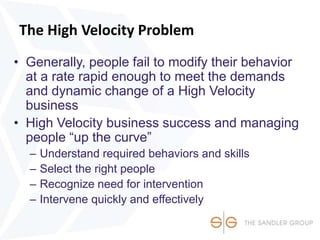
• Generally, people fail to modify their behavior
at a rate rapid enough to meet the demands
and dynamic change of a High Velocity
business
• High Velocity business success and managing
people “up the curve”
– Understand required behaviors and skills
– Select the right people
– Recognize need for intervention
– Intervene quickly and effectively
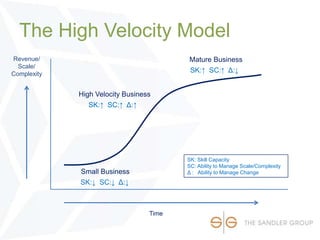
The High Velocity Model
Revenue/
Scale/
Complexity
Time
Small Business
High Velocity Business
Mature Business
SK: Skill Capacity
SC: Ability to Manage Scale/Complexity
Δ : Ability to Manage Change
SK:↑ SC:↑ Δ:↓
SK:↑ SC:↑ Δ:↑
SK:↓ SC:↓ Δ:↓
Small Business Career Experience
• Small Business
– low scale
– low growth
– low change
• Low experience to manage scale and complexity
• Low skill capacity
• Low experience anticipating and managing change
• Executives from Small Business will generally lack
skills for High Velocity
– Must develop skills, and change skills, simultaneously
– Low probability of success
– Better to be in Mature Business to develop skills first
Mature Business Career Experience
• Mature Business
– high scale
– low growth
– low change
• High experience/skill to manage scale and complexity
– More complex than Small Business
– Know what the “answer” looks like
• High skill capacity—big companies train and develop more!
• Low experience managing change without resources
• Executives from Mature Business will have strong, but
potentially narrow, skills to adapt to High Velocity
– Care must be exercised
– Specific assignment to avoid the Small Business weakness
– Changing management skills are the priority—Focus on behavior!
Requirements for High Velocity Business
• High Velocity Business
– Increasing scale
– High growth
– High change
• Executive requirements
– High skill capacity (successfully manage different priorities at a
high level simultaneously)
– Strong capability to manage scale and complexity
– High desire and capacity to manage change
• Most demanding environment
– Focus on those with high skill capacity
– Pay attention to prior work environment and Small Business
experiences
– Assess flexibility, dynamic response, anticipatory skills
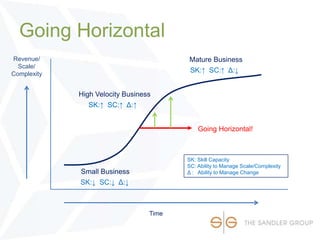
Going Horizontal
Revenue/
Scale/
Complexity
Time
Small Business
High Velocity Business
Mature Business
SK: Skill Capacity
SC: Ability to Manage Scale/Complexity
Δ : Ability to Manage Change
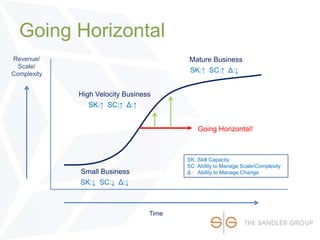
SK:↑ SC:↑ Δ:↓
SK:↑ SC:↑ Δ:↑
SK:↓ SC:↓ Δ:↓
Going Horizontal!
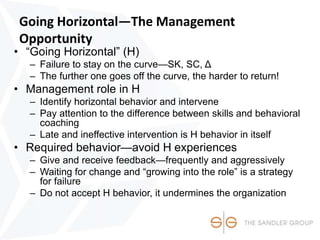
Going Horizontal—The Management
Opportunity
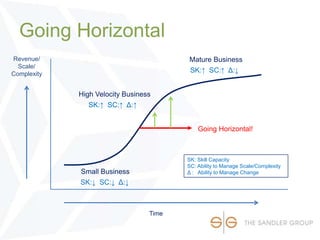
• “Going Horizontal” (H)
– Failure to stay on the curve—SK, SC, Δ
– The further one goes off the curve, the harder to return!
• Management role in H
– Identify horizontal behavior and intervene
– Pay attention to the difference between skills and behavioral
coaching
– Late and ineffective intervention is H behavior in itself
• Required behavior—avoid H experiences
– Give and receive feedback—frequently and aggressively
– Waiting for change and “growing into the role” is a strategy
for failure
– Do not accept H behavior, it undermines the organization
Going Horizontal
Revenue/
Scale/
Complexity
Time
Small Business
High Velocity Business
Mature Business
SK: Skill Capacity
SC: Ability to Manage Scale/Complexity
Δ : Ability to Manage Change
SK:↑ SC:↑ Δ:↓
SK:↑ SC:↑ Δ:↑
SK:↓ SC:↓ Δ:↓
Going Horizontal!
Selection and Management “Up the Curve”
• Define current and future Company stages
• Place the two points on the curve
• Assess role in current and future stages
– Pay attention to SC, SK and Δ
• Assess executive
– Use Small, Mature and High Velocity Business
definitions
– Place the executive in the context of the
Company and role
People Implications
• Do not make the error of domain knowledge
(bias)
• Focus on “transferable skills”
– Analytical approach/skills
– Proven ability to problem solve
– Adaptability to new environments
– Ability to learn
• The ideal candidate has Mature company
development and High Velocity business
experiences
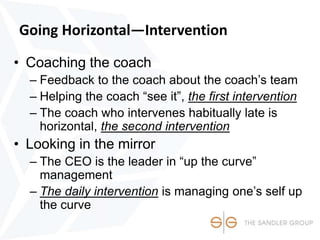
Going Horizontal—Intervention
• Coaching the coach
– Feedback to the coach about the coach’s team
– Helping the coach “see it”, the first intervention
– The coach who intervenes habitually late is
horizontal, the second intervention
• Looking in the mirror
– The CEO is the leader in “up the curve”
management
– The daily intervention is managing one’s self up
the curve
Going Horizontal
Revenue/
Scale/
Complexity
Time
Small Business
High Velocity Business
Mature Business
SK: Skill Capacity
SC: Ability to Manage Scale/Complexity
Δ : Ability to Manage Change
SK:↑ SC:↑ Δ:↓
SK:↑ SC:↑ Δ:↑
SK:↓ SC:↓ Δ:↓
Going Horizontal!
15
Questions & Comments
Leland Sandler
Managing Partner
The Sandler Group, LLC
858-344-6160
www.sandlergroup.net

Managing up the Curve- Leland Sandler

  • 1.
    Managing People “Upthe Curve” in a High Velocity Environment Selection, Management and Intervention Determine Success or Failure of People and the Business Leland Sandler Managing Partner The Sandler Group LLC
  • 2.
    The High VelocityEnvironment  High revenue growth  High business expansion / acquisitions / mergers  Turn-around  Extraordinary commitment to improve  One could argue-- – Goal should never be to remain small • Someone will eliminate you – Goal should never be to reach maturity • Reinvent • Commit to change or lose in the end – Goal should be to stay on the High Velocity curve
  • 3.
    The High VelocityProblem • Generally, people fail to modify their behavior at a rate rapid enough to meet the demands and dynamic change of a High Velocity business • High Velocity business success and managing people “up the curve” – Understand required behaviors and skills – Select the right people – Recognize need for intervention – Intervene quickly and effectively
  • 4.
    The High VelocityModel Revenue/ Scale/ Complexity Time Small Business High Velocity Business Mature Business SK: Skill Capacity SC: Ability to Manage Scale/Complexity Δ : Ability to Manage Change SK:↑ SC:↑ Δ:↓ SK:↑ SC:↑ Δ:↑ SK:↓ SC:↓ Δ:↓
  • 5.
    Small Business CareerExperience • Small Business – low scale – low growth – low change • Low experience to manage scale and complexity • Low skill capacity • Low experience anticipating and managing change • Executives from Small Business will generally lack skills for High Velocity – Must develop skills, and change skills, simultaneously – Low probability of success – Better to be in Mature Business to develop skills first
  • 6.
    Mature Business CareerExperience • Mature Business – high scale – low growth – low change • High experience/skill to manage scale and complexity – More complex than Small Business – Know what the “answer” looks like • High skill capacity—big companies train and develop more! • Low experience managing change without resources • Executives from Mature Business will have strong, but potentially narrow, skills to adapt to High Velocity – Care must be exercised – Specific assignment to avoid the Small Business weakness – Changing management skills are the priority—Focus on behavior!
  • 7.
    Requirements for HighVelocity Business • High Velocity Business – Increasing scale – High growth – High change • Executive requirements – High skill capacity (successfully manage different priorities at a high level simultaneously) – Strong capability to manage scale and complexity – High desire and capacity to manage change • Most demanding environment – Focus on those with high skill capacity – Pay attention to prior work environment and Small Business experiences – Assess flexibility, dynamic response, anticipatory skills
  • 8.
    Going Horizontal Revenue/ Scale/ Complexity Time Small Business HighVelocity Business Mature Business SK: Skill Capacity SC: Ability to Manage Scale/Complexity Δ : Ability to Manage Change SK:↑ SC:↑ Δ:↓ SK:↑ SC:↑ Δ:↑ SK:↓ SC:↓ Δ:↓ Going Horizontal!
  • 9.
    Going Horizontal—The Management Opportunity •“Going Horizontal” (H) – Failure to stay on the curve—SK, SC, Δ – The further one goes off the curve, the harder to return! • Management role in H – Identify horizontal behavior and intervene – Pay attention to the difference between skills and behavioral coaching – Late and ineffective intervention is H behavior in itself • Required behavior—avoid H experiences – Give and receive feedback—frequently and aggressively – Waiting for change and “growing into the role” is a strategy for failure – Do not accept H behavior, it undermines the organization
  • 10.
    Going Horizontal Revenue/ Scale/ Complexity Time Small Business HighVelocity Business Mature Business SK: Skill Capacity SC: Ability to Manage Scale/Complexity Δ : Ability to Manage Change SK:↑ SC:↑ Δ:↓ SK:↑ SC:↑ Δ:↑ SK:↓ SC:↓ Δ:↓ Going Horizontal!
  • 11.
    Selection and Management“Up the Curve” • Define current and future Company stages • Place the two points on the curve • Assess role in current and future stages – Pay attention to SC, SK and Δ • Assess executive – Use Small, Mature and High Velocity Business definitions – Place the executive in the context of the Company and role
  • 12.
    People Implications • Donot make the error of domain knowledge (bias) • Focus on “transferable skills” – Analytical approach/skills – Proven ability to problem solve – Adaptability to new environments – Ability to learn • The ideal candidate has Mature company development and High Velocity business experiences
  • 13.
    Going Horizontal—Intervention • Coachingthe coach – Feedback to the coach about the coach’s team – Helping the coach “see it”, the first intervention – The coach who intervenes habitually late is horizontal, the second intervention • Looking in the mirror – The CEO is the leader in “up the curve” management – The daily intervention is managing one’s self up the curve
  • 14.
    Going Horizontal Revenue/ Scale/ Complexity Time Small Business HighVelocity Business Mature Business SK: Skill Capacity SC: Ability to Manage Scale/Complexity Δ : Ability to Manage Change SK:↑ SC:↑ Δ:↓ SK:↑ SC:↑ Δ:↑ SK:↓ SC:↓ Δ:↓ Going Horizontal!
  • 15.
    15 Questions & Comments LelandSandler Managing Partner The Sandler Group, LLC 858-344-6160 www.sandlergroup.net