ELECTIVE-II
URBAN DESIGN
LECTURE-4
Ar. Ananta Gautam
• Urban design involves arrangement of buildings, public spaces, transport systems, services
and amenities.
• Urban design involves design and coordination of all elements that make up cities and towns
1. Urban pattern and urban fabric
2. Building form, streetscape, roofscapes
3. Connections: Visual and physical
4. Movement structures and systems
5. Public open spaces: Streets, Squares, Spaces between buildings, Parks, Landscape
6. Public infrastructure and amenities
ELEMENTS OF URBAN OF DESIGN
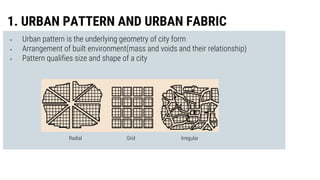
• Urban pattern is the underlying geometry of city form
• Arrangement of built environment(mass and voids and their relationship)
• Pattern qualifies size and shape of a city
1. URBAN PATTERN AND URBAN FABRIC
Radial Grid Irregular
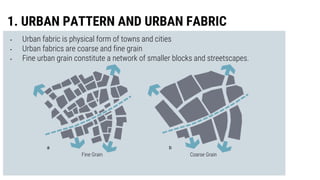
• Urban fabric is physical form of towns and cities
• Urban fabrics are coarse and fine grain
• Fine urban grain constitute a network of smaller blocks and streetscapes.
1. URBAN PATTERN AND URBAN FABRIC
Fine Grain Coarse Grain
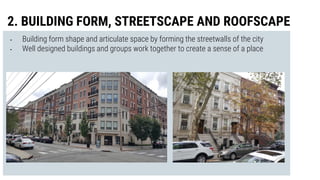
• Building form shape and articulate space by forming the streetwalls of the city
• Well designed buildings and groups work together to create a sense of a place
2. BUILDING FORM, STREETSCAPE AND ROOFSCAPE
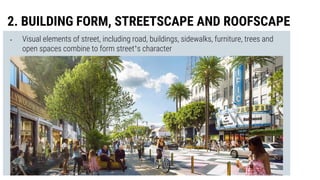
• Visual elements of street, including road, buildings, sidewalks, furniture, trees and
open spaces combine to form street’s character
2. BUILDING FORM, STREETSCAPE AND ROOFSCAPE
• High building and rise of drones permit city to be seen from above
• Presents opportunities for creative and decorative treatments of city
2. BUILDING FORM, STREETSCAPE AND ROOFSCAPE
• Visual: Creating vistas rather than blocked view allows people to move around easily by
linking their current location to destination
• Physical: a network of routes works best when the main streets are full of shops, offices,
public buildings and housing.
• Routes are also successful when they are connected with each other to provide alternative
ways of getting around.
3. CONNECTION: VISUAL AND PHYSICAL
• Interconnected system of streets, roads and paths accommodating pedestrians, cyclists, on-
road public transport, private and emergency vehicles
Good Movement Network are:
• Safe
• Connected
• Prioritize walking, cycling and public transport modes of transport
• Integrate convenient walking, cycling and public transport routes to local destinations
• Provide opportunities for planned and incidental physical activity
4. MOVEMENT STRUCTURE AND SYSTEM
• Streets, Square, Spaces between buildings, Parks, Landscapes
• Street dedicated for common use
• They are sites for celebration, rebellion and for expressing public dissent
• It is often said that urban design is about the space between buildings. Buildings can be seen
as a backdrop to the drama of public life which plays out in the squares and streets of our
towns and cities
• Park is an area of natural, semi-natural or planted space set aside for human enjoyment
and recreation or for the protection of wildlife or natural habitats
• Landscapes are all the visible features of an area of land, often considered in terms of their
aesthetic appeal.
5. PUBLIC OPEN SPACES
• Public infrastructure and amenities are facilities, structures, equipment, services and
institutions that are essential to the economy and quality of life of a nation, region or city.
• Quality of life is the well-being of individuals, communities and societies
• Heath, air, water & food quality, Education, Happiness, Safety, Freedom, Privacy, Public space,
Culture, Profession, Physical activity, Transportation, etc impact quality of life
6. PUBLIC INFRASTRUCTURES AND AMENITIES
THANK
YOU!

URBAN DESIGN-lecture-4.pdf

  • 1.
  • 2.
    • Urban designinvolves arrangement of buildings, public spaces, transport systems, services and amenities. • Urban design involves design and coordination of all elements that make up cities and towns 1. Urban pattern and urban fabric 2. Building form, streetscape, roofscapes 3. Connections: Visual and physical 4. Movement structures and systems 5. Public open spaces: Streets, Squares, Spaces between buildings, Parks, Landscape 6. Public infrastructure and amenities ELEMENTS OF URBAN OF DESIGN
  • 3.
    • Urban patternis the underlying geometry of city form • Arrangement of built environment(mass and voids and their relationship) • Pattern qualifies size and shape of a city 1. URBAN PATTERN AND URBAN FABRIC Radial Grid Irregular
  • 4.
    • Urban fabricis physical form of towns and cities • Urban fabrics are coarse and fine grain • Fine urban grain constitute a network of smaller blocks and streetscapes. 1. URBAN PATTERN AND URBAN FABRIC Fine Grain Coarse Grain
  • 5.
    • Building formshape and articulate space by forming the streetwalls of the city • Well designed buildings and groups work together to create a sense of a place 2. BUILDING FORM, STREETSCAPE AND ROOFSCAPE
  • 6.
    • Visual elementsof street, including road, buildings, sidewalks, furniture, trees and open spaces combine to form street’s character 2. BUILDING FORM, STREETSCAPE AND ROOFSCAPE
  • 7.
    • High buildingand rise of drones permit city to be seen from above • Presents opportunities for creative and decorative treatments of city 2. BUILDING FORM, STREETSCAPE AND ROOFSCAPE
  • 8.
    • Visual: Creatingvistas rather than blocked view allows people to move around easily by linking their current location to destination • Physical: a network of routes works best when the main streets are full of shops, offices, public buildings and housing. • Routes are also successful when they are connected with each other to provide alternative ways of getting around. 3. CONNECTION: VISUAL AND PHYSICAL
  • 9.
    • Interconnected systemof streets, roads and paths accommodating pedestrians, cyclists, on- road public transport, private and emergency vehicles Good Movement Network are: • Safe • Connected • Prioritize walking, cycling and public transport modes of transport • Integrate convenient walking, cycling and public transport routes to local destinations • Provide opportunities for planned and incidental physical activity 4. MOVEMENT STRUCTURE AND SYSTEM
  • 10.
    • Streets, Square,Spaces between buildings, Parks, Landscapes • Street dedicated for common use • They are sites for celebration, rebellion and for expressing public dissent • It is often said that urban design is about the space between buildings. Buildings can be seen as a backdrop to the drama of public life which plays out in the squares and streets of our towns and cities • Park is an area of natural, semi-natural or planted space set aside for human enjoyment and recreation or for the protection of wildlife or natural habitats • Landscapes are all the visible features of an area of land, often considered in terms of their aesthetic appeal. 5. PUBLIC OPEN SPACES
  • 11.
    • Public infrastructureand amenities are facilities, structures, equipment, services and institutions that are essential to the economy and quality of life of a nation, region or city. • Quality of life is the well-being of individuals, communities and societies • Heath, air, water & food quality, Education, Happiness, Safety, Freedom, Privacy, Public space, Culture, Profession, Physical activity, Transportation, etc impact quality of life 6. PUBLIC INFRASTRUCTURES AND AMENITIES
  • 12.