Brainstem Auditory Evoked Potentials
History
2
Sohmer and Feinmesser
 Signal-averaged ECochG studies
Jewett and co-workers
 Identified the short-latency scalp-recorded AEPs as far-field potentials
volume-conducted from the brainstem, described the components and
their properties
 Established the Roman numeral labeling of the peaks
Brainstem Auditory Evoked Potentials
 Following a transient acoustic stimulus, ear and parts of the nervous
system generate a series of electrical signals with latencies ranging
from milliseconds to hundreds of milliseconds
 Recorded from electrodes placed on the skin
 To evaluate noninvasively the function of the ear and portions of the
nervous system activated by the acoustic stimulation
3
BAEPs
4
 Generated by an anatomically distinguishable neuronal subsystem for
sound localization within the brainstem
 BAEPs can be used only to assess the status of the ear, auditory nerve,
and brainstem auditory pathways up through the level of the
mesencephalon
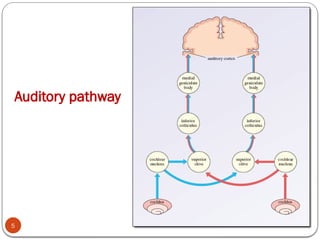
Auditory pathway
5
BAEPs
6
 Ascending projections from the cochlear nucleus are bilateral but are
more extensive contralaterally than ipsilaterally
 Despite this anatomic asymmetry, the BAEPs appear to reflect
predominantly activity in the ipsilateral ascending pathways
BAEPs
7
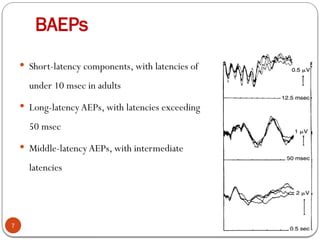
 Short-latency components, with latencies of
under 10 msec in adults
 Long-latency AEPs, with latencies exceeding
50 msec
 Middle-latencyAEPs, with intermediate
latencies
Long-latency AEPs
8
 Affected profoundly by the degree to which the subject is attending to
the stimuli and analyzing stimulus features
 Used as probes of cognitive processes
 Their variability, as well as uncertainty about the precise identity of
their cortical generators, limits their utility for neurologic diagnosis
Middle-latency AEPs
9
 Small
 Subject to contamination by myogenic signals
 Variable from subject to subject
Middle- and Long-latency AEP
10
 generated predominantly by postsynaptic potentials within areas of
cerebral cortex that are activated by the acoustic stimulus
 affected increasingly by the state of the subject and by anesthesia as
their latency increases
Short-latency AEPs
11
Greatest clinical utility because
 Relatively easy to record
 Waveforms and latencies are highly consistent across normal subjects
 Unaffected by the subject's degree of attention to the stimuli and are
almost identical in the waking and sleeping states
 Minor differences related to changes in body temperature
12
Although short-latency AEPs commonly are called brainstem auditory
evoked potentials, this term is not completely accurate because the
roster of generators clearly includes the distal (with respect to the
brainstem) cochlear nerve and may also include the thalamocortical
auditory radiations, neither of which is within the brainstem
Stimulation
13
 Brief acoustic click stimuli that are produced by delivering
monophasic square pulses of 100- sec duration to headphones or
μ
other electromechanical transducers at a rate of about 10 hz
 A rate of exactly 10 hz or another submultiple of the power line
frequency should be avoided because of line frequency artifact
 Stimulus intensity of 60 to 65 db HL is a typical level
 If hearing loss is present, stimulus intensity may be adjusted
accordingly
Stimulation
14
 Stimuli are delivered monaurally
 To prevent contralateral ear stimulation it is masked with continuous
white noise at an intensity 30 to 40 dB below that of the BAEP
stimulus
 Activate region of the cochlea (base) responding to 2,000- to 4,000-
Hz sounds
Stimulation at Several Intensities
15
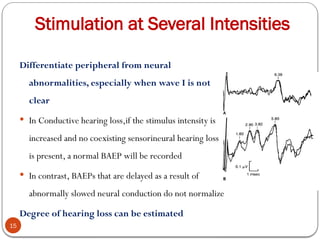
Differentiate peripheral from neural
abnormalities, especially when wave I is not
clear
 In Conductive hearing loss,if the stimulus intensity is
increased and no coexisting sensorineural hearing loss
is present, a normal BAEP will be recorded
 In contrast, BAEPs that are delayed as a result of
abnormally slowed neural conduction do not normalize
Degree of hearing loss can be estimated
Rapid Stimulation
16
 Approximately 10 Hz is used for routine clinical testing
 As the stimulus rate is increased above approximately 10 per sec,
component amplitudes decrease and the peaks tend to become less
well defined
 WaveV is most resistant to these effects
 More rapid rates may be used to facilitate recordings to measure the
waveV threshold
Stimulus clicks according to polarity
17
Compression click (condensation click)
 If the electrical square pulse causes the diaphragm of the acoustic
transducer to move toward the patient's ear
Rarefaction click
 Reversing the polarity of the electrical square pulse
 Generally preferable because BAEP peaks tend to be clearer
Alternative Auditory Stimuli
18
Stimulation with brief tone pips
 To probe specific parts of the cochlea
Acoustic masking
 Used to obtain frequency-specific information from BAEPs
 Relatively poor signal-to-noise ratios
BAEPs by bone-conducted stimuli
19
 Most useful in assessing patients who may have conductive hearing
losses, such as neonates in whom BAEPs performed with air-
conducted stimuli are suggestive of a hearing loss
BAEPs to Electrical Stimuli
20
 Electrical stimulation of eighth nerve fibers through the electrodes of
a cochlear prosthesis
 Used to assess the proximity of these electrodes to the spiral ganglion
during implantation and the adequacy of eighth nerve stimulation
during programming of the processor
 Correlate well with auditory outcomes, and may prove to be useful in
guiding therapy in young children with questionable auditory nerve
integrity
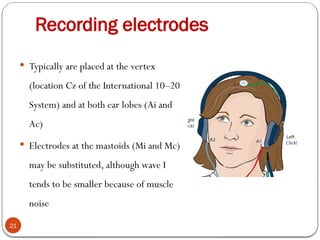
Recording electrodes
21
 Typically are placed at the vertex
(location Cz of the International 10–20
System) and at both ear lobes (Ai and
Ac)
 Electrodes at the mastoids (Mi and Mc)
may be substituted, although wave I
tends to be smaller because of muscle
noise
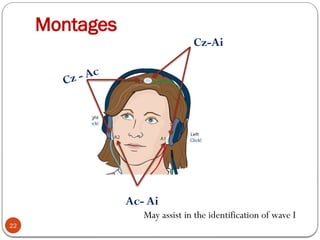
Montages
22
Cz-Ai
Cz - Ac
Ac- Ai
May assist in the identification of wave I
Patient relaxation
23
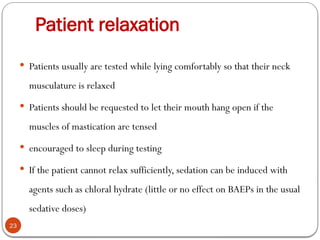
 Patients usually are tested while lying comfortably so that their neck
musculature is relaxed
 Patients should be requested to let their mouth hang open if the
muscles of mastication are tensed
 encouraged to sleep during testing
 If the patient cannot relax sufficiently, sedation can be induced with
agents such as chloral hydrate (little or no effect on BAEPs in the usual
sedative doses)
Data analysis
24
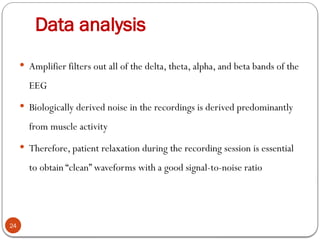
 Amplifier filters out all of the delta, theta, alpha, and beta bands of the
EEG
 Biologically derived noise in the recordings is derived predominantly
from muscle activity
 Therefore, patient relaxation during the recording session is essential
to obtain “clean” waveforms with a good signal-to-noise ratio
Data analysis
25
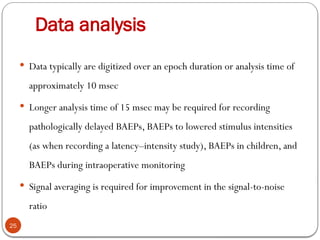
 Data typically are digitized over an epoch duration or analysis time of
approximately 10 msec
 Longer analysis time of 15 msec may be required for recording
pathologically delayed BAEPs, BAEPs to lowered stimulus intensities
(as when recording a latency–intensity study), BAEPs in children, and
BAEPs during intraoperative monitoring
 Signal averaging is required for improvement in the signal-to-noise
ratio
Waveform Identification
26
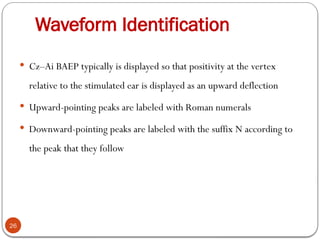
 Cz–Ai BAEP typically is displayed so that positivity at the vertex
relative to the stimulated ear is displayed as an upward deflection
 Upward-pointing peaks are labeled with Roman numerals
 Downward-pointing peaks are labeled with the suffix N according to
the peak that they follow
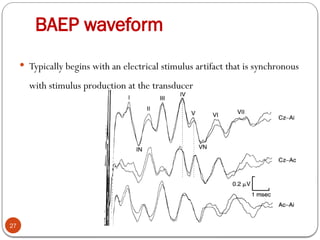
BAEP waveform
27
 Typically begins with an electrical stimulus artifact that is synchronous
with stimulus production at the transducer
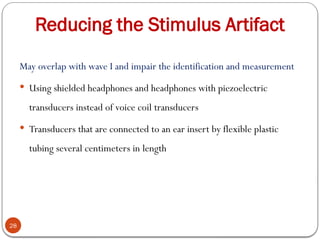
Reducing the Stimulus Artifact
28
May overlap with wave I and impair the identification and measurement
 Using shielded headphones and headphones with piezoelectric
transducers instead of voice coil transducers
 Transducers that are connected to an ear insert by flexible plastic
tubing several centimeters in length
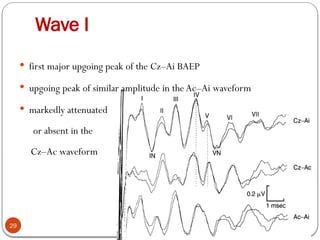
Wave I
29
 first major upgoing peak of the Cz–Ai BAEP
 upgoing peak of similar amplitude in the Ac–Ai waveform
 markedly attenuated
or absent in the
Cz–Ac waveform
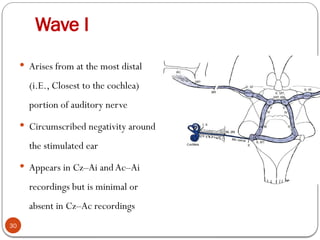
Wave I
30
 Arises from at the most distal
(i.E., Closest to the cochlea)
portion of auditory nerve
 Circumscribed negativity around
the stimulated ear
 Appears in Cz–Ai and Ac–Ai
recordings but is minimal or
absent in Cz–Ac recordings
Cochlear microphonic Vs Wave I
31
 Visible as a separate peak preceding wave I, especially if the stimulus
artifact is small
 Distinguished by reversing the stimulus polarity, which will reverse
the polarity of the cochlear microphonic;Wave I may show a latency
shift, but will not reverse polarity
Bifid wave I
32
 Represents contributions to wave I from different portions of the
cochlea
 Earlier of the two peaks, which reflects activation of the base of the
cochlea, corresponds to the single wave I that is typically present in
the Cz–Ai waveform
 Reversal of stimulus polarity can be used to distinguish a bifid wave I
from a cochlear microphonic followed by (a single) wave I
Techniques to obtain a clearer wave I
33
 Electrode within the external auditory canal
 Ac–Ai recording channel can yield a somewhat larger and clearer wave
I than that in the standard Cz–Ai recording
 Reduction in the stimulus repetition rate
 Increasing the stimulus intensity
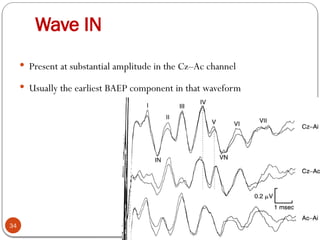
Wave IN
34
 Present at substantial amplitude in the Cz–Ac channel
 Usually the earliest BAEP component in that waveform
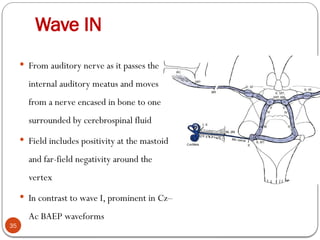
Wave IN
35
 From auditory nerve as it passes the
internal auditory meatus and moves
from a nerve encased in bone to one
surrounded by cerebrospinal fluid
 Field includes positivity at the mastoid
and far-field negativity around the
vertex
 In contrast to wave I, prominent in Cz–
Ac BAEP waveforms
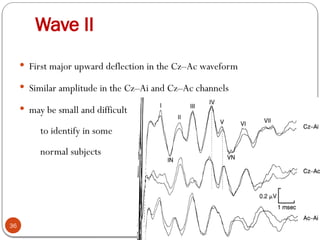
Wave II
36
 First major upward deflection in the Cz–Ac waveform
 Similar amplitude in the Cz–Ai and Cz–Ac channels
 may be small and difficult
to identify in some
normal subjects
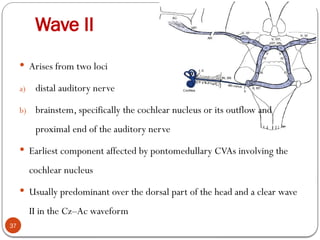
Wave II
37
 Arises from two loci
a) distal auditory nerve
b) brainstem, specifically the cochlear nucleus or its outflow and
proximal end of the auditory nerve
 Earliest component affected by pontomedullary CVAs involving the
cochlear nucleus
 Usually predominant over the dorsal part of the head and a clear wave
II in the Cz–Ac waveform
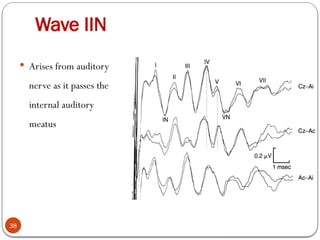
Wave IIN
38
 Arises from auditory
nerve as it passes the
internal auditory
meatus
wave III
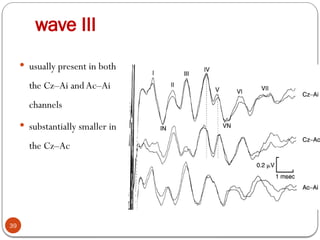
39
 usually present in both
the Cz–Ai and Ac–Ai
channels
 substantially smaller in
the Cz–Ac
Wave III
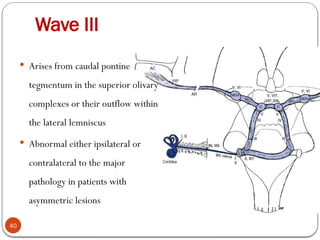
40
 Arises from caudal pontine
tegmentum in the superior olivary
complexes or their outflow within
the lateral lemniscus
 Abnormal either ipsilateral or
contralateral to the major
pathology in patients with
asymmetric lesions
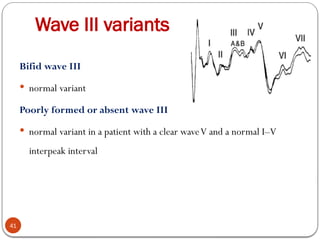
Wave III variants
41
Bifid wave III
 normal variant
Poorly formed or absent wave III
 normal variant in a patient with a clear waveV and a normal I–V
interpeak interval
Role of Descending Pathways in BAEPs
42
 Waves I and II may be quite large or waves II and III are delayed in
latency in patients with rostral brainstem pathology
 probably reflects loss of activity in descending inhibitory pathways
originating in or traversing the region of the inferior colliculus
Waves IV and V
43
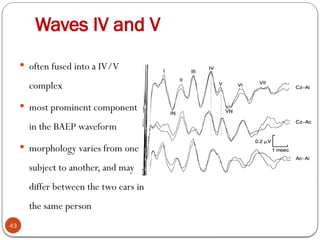
 often fused into a IV/V
complex
 most prominent component
in the BAEP waveform
 morphology varies from one
subject to another, and may
differ between the two ears in
the same person
Waves IV and V
44
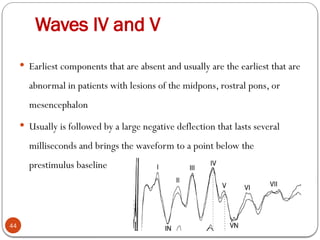
 Earliest components that are absent and usually are the earliest that are
abnormal in patients with lesions of the midpons, rostral pons, or
mesencephalon
 Usually is followed by a large negative deflection that lasts several
milliseconds and brings the waveform to a point below the
prestimulus baseline
Various IV/V complex
morphologies in Cz–Ai waveforms
recorded in normal subjects
45
Totally fused IV/V complex Vs single wave IV or V
46
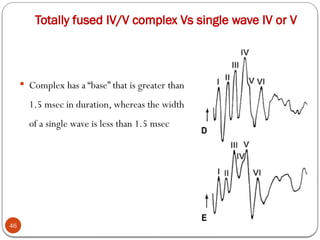
 Complex has a “base” that is greater than
1.5 msec in duration, whereas the width
of a single wave is less than 1.5 msec
Wave IV
47
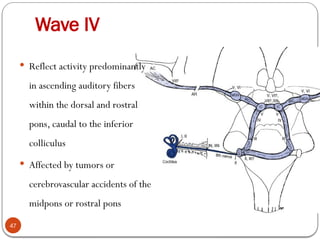
 Reflect activity predominantly
in ascending auditory fibers
within the dorsal and rostral
pons, caudal to the inferior
colliculus
 Affected by tumors or
cerebrovascular accidents of the
midpons or rostral pons
Wave V
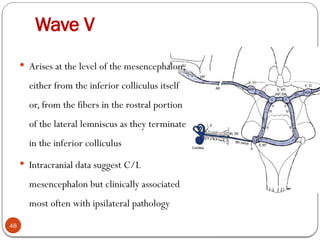
48
 Arises at the level of the mesencephalon,
either from the inferior colliculus itself
or, from the fibers in the rostral portion
of the lateral lemniscus as they terminate
in the inferior colliculus
 Intracranial data suggest C/L
mesencephalon but clinically associated
most often with ipsilateral pathology
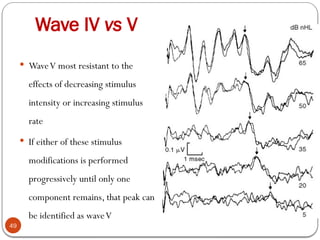
Wave IV vs V
49
 WaveV most resistant to the
effects of decreasing stimulus
intensity or increasing stimulus
rate
 If either of these stimulus
modifications is performed
progressively until only one
component remains, that peak can
be identified as waveV
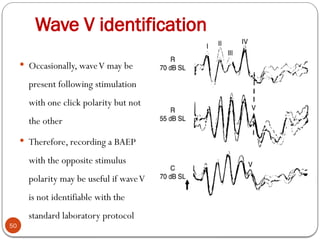
Wave V identification
50
 Occasionally, waveV may be
present following stimulation
with one click polarity but not
the other
 Therefore, recording a BAEP
with the opposite stimulus
polarity may be useful if waveV
is not identifiable with the
standard laboratory protocol
Differential affection of waves IV and V
51
 Multilevel demyelination
 Brainstem infarct
 Small brainstem hemorrhage in the lateral lemniscus
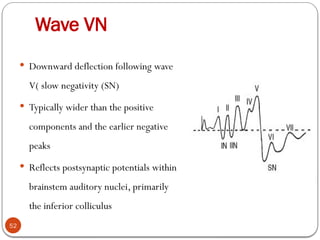
Wave VN
52
 Downward deflection following wave
V( slow negativity (SN)
 Typically wider than the positive
components and the earlier negative
peaks
 Reflects postsynaptic potentials within
brainstem auditory nuclei, primarily
the inferior colliculus
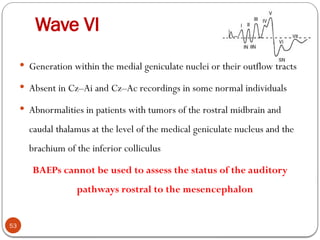
Wave VI
53
 Generation within the medial geniculate nuclei or their outflow tracts
 Absent in Cz–Ai and Cz–Ac recordings in some normal individuals
 Abnormalities in patients with tumors of the rostral midbrain and
caudal thalamus at the level of the medical geniculate nucleus and the
brachium of the inferior colliculus
BAEPs cannot be used to assess the status of the auditory
pathways rostral to the mesencephalon
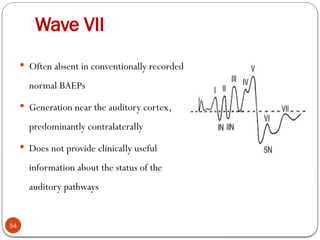
Wave VII
54
 Often absent in conventionally recorded
normal BAEPs
 Generation near the auditory cortex,
predominantly contralaterally
 Does not provide clinically useful
information about the status of the
auditory pathways
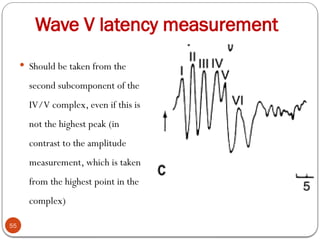
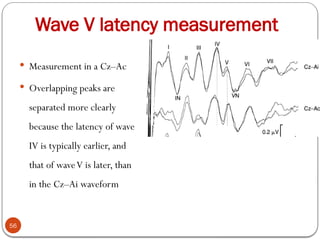
Wave V latency measurement
55
 Should be taken from the
second subcomponent of the
IV/V complex, even if this is
not the highest peak (in
contrast to the amplitude
measurement, which is taken
from the highest point in the
complex)
Wave V latency measurement
56
 Measurement in a Cz–Ac
 Overlapping peaks are
separated more clearly
because the latency of wave
IV is typically earlier, and
that of waveV is later, than
in the Cz–Ai waveform
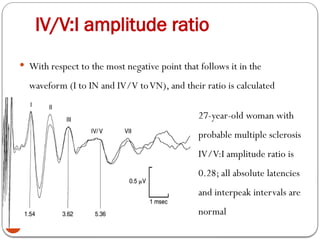
IV/V:I amplitude ratio
57
 With respect to the most negative point that follows it in the
waveform (I to IN and IV/V toVN), and their ratio is calculated
27-year-old woman with
probable multiple sclerosis
IV/V:I amplitude ratio is
0.28; all absolute latencies
and interpeak intervals are
normal
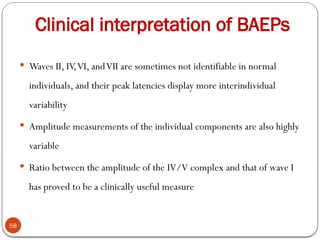
Clinical interpretation of BAEPs
58
 Waves II, IV,VI, andVII are sometimes not identifiable in normal
individuals, and their peak latencies display more interindividual
variability
 Amplitude measurements of the individual components are also highly
variable
 Ratio between the amplitude of the IV/V complex and that of wave I
has proved to be a clinically useful measure
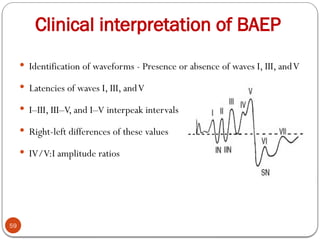
Clinical interpretation of BAEP
59
 Identification of waveforms - Presence or absence of waves I, III, andV
 Latencies of waves I, III, andV
 I–III, III–V, and I–V interpeak intervals
 Right-left differences of these values
 IV/V:I amplitude ratios
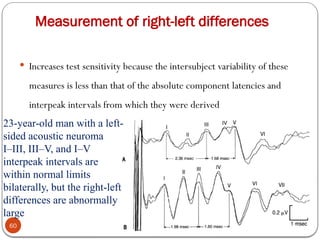
Measurement of right-left differences
60
 Increases test sensitivity because the intersubject variability of these
measures is less than that of the absolute component latencies and
interpeak intervals from which they were derived
23-year-old man with a left-
sided acoustic neuroma
I–III, III–V, and I–V
interpeak intervals are
within normal limits
bilaterally, but the right-left
differences are abnormally
large
Clinical interpretation of BAEPs
61
Peripheral transmission time (PTT)
 Latency of wave I
Central transmission time (CTT)
 I–V interpeak interval
Normative Data
62
 Control data should have been acquired under the same conditions
used to test the patient, including the polarity, rate, and intensity of
the stimulus and the filter settings used for data recording
 Limits of the normal range are typically set at 2.5 or 3 standard
deviations from the mean of normally distributed data
 I–V and III–V interpeak intervals are, on average, shorter in women
than in men
Normative Data
63
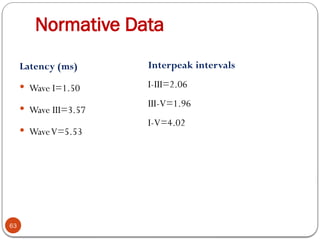
Latency (ms)
 Wave I=1.50
 Wave III=3.57
 WaveV=5.53
Interpeak intervals
I-III=2.06
III-V=1.96
I-V=4.02
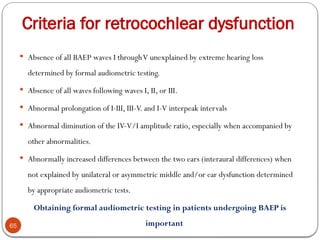
Delay Versus Absence of Components
64
 Evoked potentials represent the summated activity of large
populations of neurons firing in synchrony
 Delay - If delayed uniformly, a delayed evoked potential component
will result
 Absence - If the delay is nonuniform due to temporal dispersion
 Either delay or absence of a BAEP peak indicate dysfunction, but not
necessarily complete loss of activity, in a part of the infratentorial
auditory pathways
Criteria for retrocochlear dysfunction
65
 Absence of all BAEP waves I throughV unexplained by extreme hearing loss
determined by formal audiometric testing.
 Absence of all waves following waves I, II, or III.
 Abnormal prolongation of I-III, III-V. and I-V interpeak intervals
 Abnormal diminution of the IV-V/I amplitude ratio, especially when accompanied by
other abnormalities.
 Abnormally increased differences between the two ears (interaural differences) when
not explained by unilateral or asymmetric middle and/or ear dysfunction determined
by appropriate audiometric tests.
Obtaining formal audiometric testing in patients undergoing BAEP is
important
Abnormalities of Wave I
66
 Reflect peripheral auditory dysfunction, either conductive or cochlear,
or pathology involving the most distal portion of the eighth nerve
 Poorly formed or absent wave I but a clear waveV may reflect high-
frequency hearing loss.
 May reflect intracranial pathology because the cochlea receives its
blood supply from the intracranial circulation via the internal auditory
artery
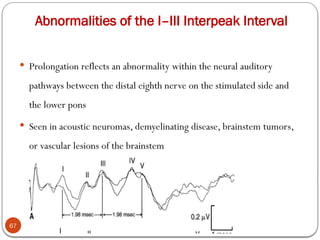
Abnormalities of the I–III Interpeak Interval
67
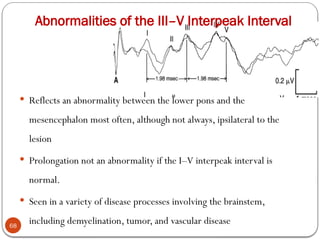
 Prolongation reflects an abnormality within the neural auditory
pathways between the distal eighth nerve on the stimulated side and
the lower pons
 Seen in acoustic neuromas, demyelinating disease, brainstem tumors,
or vascular lesions of the brainstem
Abnormalities of the III–V Interpeak Interval
68
 Reflects an abnormality between the lower pons and the
mesencephalon most often, although not always, ipsilateral to the
lesion
 Prolongation not an abnormality if the I–V interpeak interval is
normal.
 Seen in a variety of disease processes involving the brainstem,
including demyelination, tumor, and vascular disease
Abnormalities of the IV/V:I Amplitude Ratio
69
 Reflects dysfunction within the auditory pathways between the distal
eighth nerve and the mesencephalon
 False increase in ratio in
 Decreasing the stimulus intensity
 Suboptimal placement of theAi recording electrode (may decrease the
amplitude of wave I )
BAEPs and Hearing Loss
70
 can detect subtle neuronal dysfunction that is not clinically apparent
on the neurologic and audiologic examination
 Relatively insensitive to isolated low-frequency hearing losses
BAEPs and Hearing Loss
71
Central pattern
 CTT (I–V interpeak interval) is prolonged
Peripheral pattern
 Wave I is delayed
A single waveform may contain both abnormalities
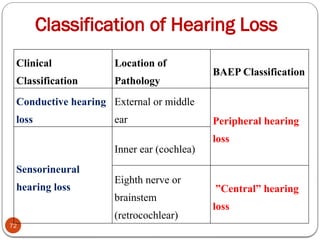
Classification of Hearing Loss
72
Clinical
Classification
Location of
Pathology
BAEP Classification
Conductive hearing
loss
External or middle
ear Peripheral hearing
loss
Sensorineural
hearing loss
Inner ear (cochlea)
Eighth nerve or
brainstem
(retrocochlear)
”Central” hearing
loss
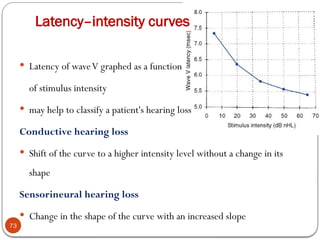
Latency–intensity curves
73
 Latency of waveV graphed as a function
of stimulus intensity
 may help to classify a patient's hearing loss
Conductive hearing loss
 Shift of the curve to a higher intensity level without a change in its
shape
Sensorineural hearing loss
 Change in the shape of the curve with an increased slope
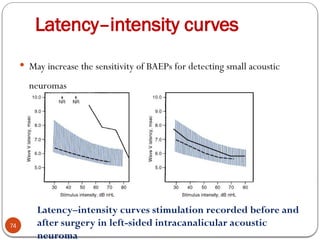
Latency–intensity curves
74
 May increase the sensitivity of BAEPs for detecting small acoustic
neuromas
Latency–intensity curves stimulation recorded before and
after surgery in left-sided intracanalicular acoustic
neuroma
BAEPs abnormal but normal hearing
75
 Unilateral brainstem lesions because the ascending projections from
each ear are bilateral
 Lesions of subsystem involved in sound localization sparing other
portions of the brainstem auditory pathways
 Absence of a component may reflect temporal dispersion rather than
conduction block, so hearing may even be present when there is no
identifiable waveV
BAEPs and functional hearing loss
76
 Abnormal BAEP study demonstrates the existence of pathology within
the auditory system
 Normal study does not prove that the symptoms are psychogenic
 If they maintain a degree of tension in their cranial and neck muscles,
the EMG activity picked up by the recording electrodes may be
sufficient to prevent recording of an interpretable BAEP study
BAEP in Acoustic Neuroma
77
 Abnormal BAEPs in more than 95 % with acoustic neuromas
 Abnormal BAEPs is less in patients with small (less than 1 cm) tumors
 Small, intracanalicular tumors in whom BAEPs to standard high-
intensity stimuli are normal, latency–intensity studies may reveal
abnormal cochlear function resulting from compression of the internal
auditory artery
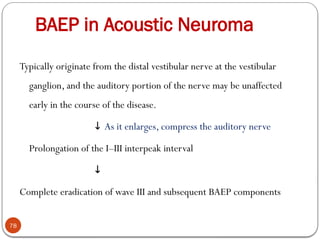
BAEP in Acoustic Neuroma
78
Typically originate from the distal vestibular nerve at the vestibular
ganglion, and the auditory portion of the nerve may be unaffected
early in the course of the disease.
↓ As it enlarges, compress the auditory nerve
Prolongation of the I–III interpeak interval
↓
Complete eradication of wave III and subsequent BAEP components
BAEP in Acoustic Neuroma
79
 Wave II may be relatively spared, a reflection of the contribution to
that component originating in the distal eighth nerve
 Wave I may become delayed as the degree of cochlear ischemia
increases
BAEP in Large Acoustic Neuroma
80
 Infarction of the cochlea may cause elimination of all BAEPs
 Prolongation of the III–V interpeak interval in response to stimulation
of the ear contralateral to the tumor due to compression of brainstem
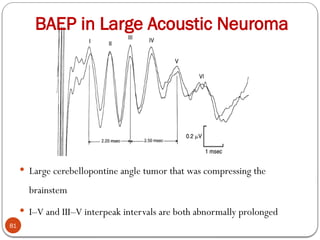
BAEP in Large Acoustic Neuroma
81
 Large cerebellopontine angle tumor that was compressing the
brainstem
 I–V and III–V interpeak intervals are both abnormally prolonged
BAEP in Other Posterior Fossa Tumors
82
 Almost always abnormal in brainstem gliomas and other intrinsic
brainstem tumors except that within the medulla
 Abnormalities in the I–III or III–V interpeak interval, or a
combination of both
 Serial recordings may show deterioration of the BAEPs because of
tumor growth
 Response to treatment can be demonstrated as an improvement in
conduction within the brainstem auditory pathways
BAEP in Cerebrovascular Disease
83
 Usually normal in medullary infarcts or lesions confined to the basis
pontis, cerebral peduncles, and cerebellar hemispheres
 Presence of BAEP abnormalities is associated with an adverse clinical
outcome
 Abnormalities in the I–III or III–V interpeak interval, or a
combination of both, may be seen
 If a cochlear stroke accompanies the brainstem stroke, all BAEP
components will be absent following stimulation of that ear
BAEP in vertebrobasilar TIA
84
 Abnormalities present in most cases
 Findings tend to resolve over time
 Yield lower if recorded after more than a week
 Persistent BAEP changes may represent small infarcts that are
clinically silent
BAEP in Demyelinating Disease
85
 Can demonstrate a residual abnormality related to a prior symptom
that has cleared
 Abnormality rate higher in definite MS and with brainstem lesion.
 Abnormalities in the I–III and/or III–V interpeak interval
 Abnormally small IV/V:I amplitude ratio in the presence of normal
component latencies and interpeak intervals
 Prolongations of the PTT (wave I latency) without any otologic cause
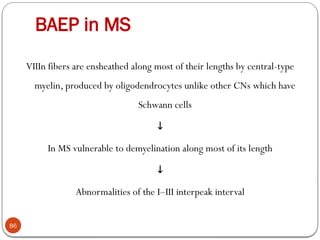
BAEP in MS
86
VIIIn fibers are ensheathed along most of their lengths by central-type
myelin, produced by oligodendrocytes unlike other CNs which have
Schwann cells
↓
In MS vulnerable to demyelination along most of its length
↓
Abnormalities of the I–III interpeak interval
BAEP in Coma
87
 Markedly abnormal BAEPs are likely to have poor neurologic
outcomes attributable to the brainstem damage
 Typically normal in patients with coma caused entirely by
supratentorial disease
 May deteriorate subsequently because of transtentorial herniation
 Abnormal BAEPs in patients with supratentorial infarctions or
hemorrhages are correlated with poor clinical outcomes
BAEP in Coma
88
 Normal-appearing BAEPs in a patient whose examination shows
widespread brainstem dysfunction should prompt suspicion of a
metabolic etiology such as a drug overdose
 BAEPs are highly resistant to central nervous system depressant drugs
BAEP in drug overdose
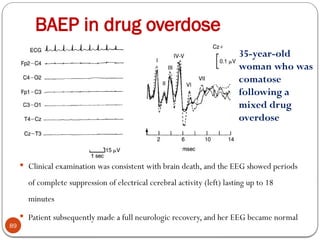
89
 Clinical examination was consistent with brain death, and the EEG showed periods
of complete suppression of electrical cerebral activity (left) lasting up to 18
minutes
 Patient subsequently made a full neurologic recovery, and her EEG became normal
35-year-old
woman who was
comatose
following a
mixed drug
overdose
BAEP in Locked-in syndrome
90
 BAEPs may be either normal or abnormal, depending on the extent to
which the lesion extends outside the ventral pons and involves the
auditory pathways
BAEP in brain death
91
 Contains no identifiable components, or consists of wave I alone, or
contains only a wave I followed by a wave IN
 Rarely, waves II and IIN may also be present and reflect the
contribution to these components from the auditory nerve
 Although consistent with brain death, negative BAEP cannot be used
as evidence that the brainstem is nonfunctional
Intra operative BAEP monitoring
92
 esp during surgery in the cerebellopontine angle with the goal of
preserving auditory nerve function
 bulky earphone replaced by a small insertable earphone
 faster stimulation rate typically about 30 Hz compared with 10 Hz
which allows more rapid signal acquisition
 Stable, robust BAEPs are recorded readily in the presence of general
anesthetic agents
Intra operative BAEP monitoring
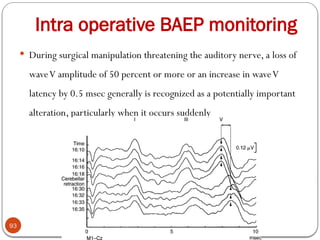
93
 During surgical manipulation threatening the auditory nerve, a loss of
waveV amplitude of 50 percent or more or an increase in waveV
latency by 0.5 msec generally is recognized as a potentially important
alteration, particularly when it occurs suddenly
BAEPs in infants and children
94
 To detect and measure hearing loss in children who cannot be tested
behaviorally
 To evaluate the auditory brainstem pathways in children who may have
neurologic problems
 Requires close cooperation between audiologists and neurologists
because it is impossible to interpret these responses correctly without
paying careful attention to both the ear and the brain.
Thank you
95

Brain stem Evoked Response Audiometry.pptx

  • 1.
  • 2.
    History 2 Sohmer and Feinmesser Signal-averaged ECochG studies Jewett and co-workers  Identified the short-latency scalp-recorded AEPs as far-field potentials volume-conducted from the brainstem, described the components and their properties  Established the Roman numeral labeling of the peaks
  • 3.
    Brainstem Auditory EvokedPotentials  Following a transient acoustic stimulus, ear and parts of the nervous system generate a series of electrical signals with latencies ranging from milliseconds to hundreds of milliseconds  Recorded from electrodes placed on the skin  To evaluate noninvasively the function of the ear and portions of the nervous system activated by the acoustic stimulation 3
  • 4.
    BAEPs 4  Generated byan anatomically distinguishable neuronal subsystem for sound localization within the brainstem  BAEPs can be used only to assess the status of the ear, auditory nerve, and brainstem auditory pathways up through the level of the mesencephalon
  • 5.
  • 6.
    BAEPs 6  Ascending projectionsfrom the cochlear nucleus are bilateral but are more extensive contralaterally than ipsilaterally  Despite this anatomic asymmetry, the BAEPs appear to reflect predominantly activity in the ipsilateral ascending pathways
  • 7.
    BAEPs 7  Short-latency components,with latencies of under 10 msec in adults  Long-latency AEPs, with latencies exceeding 50 msec  Middle-latencyAEPs, with intermediate latencies
  • 8.
    Long-latency AEPs 8  Affectedprofoundly by the degree to which the subject is attending to the stimuli and analyzing stimulus features  Used as probes of cognitive processes  Their variability, as well as uncertainty about the precise identity of their cortical generators, limits their utility for neurologic diagnosis
  • 9.
    Middle-latency AEPs 9  Small Subject to contamination by myogenic signals  Variable from subject to subject
  • 10.
    Middle- and Long-latencyAEP 10  generated predominantly by postsynaptic potentials within areas of cerebral cortex that are activated by the acoustic stimulus  affected increasingly by the state of the subject and by anesthesia as their latency increases
  • 11.
    Short-latency AEPs 11 Greatest clinicalutility because  Relatively easy to record  Waveforms and latencies are highly consistent across normal subjects  Unaffected by the subject's degree of attention to the stimuli and are almost identical in the waking and sleeping states  Minor differences related to changes in body temperature
  • 12.
    12 Although short-latency AEPscommonly are called brainstem auditory evoked potentials, this term is not completely accurate because the roster of generators clearly includes the distal (with respect to the brainstem) cochlear nerve and may also include the thalamocortical auditory radiations, neither of which is within the brainstem
  • 13.
    Stimulation 13  Brief acousticclick stimuli that are produced by delivering monophasic square pulses of 100- sec duration to headphones or μ other electromechanical transducers at a rate of about 10 hz  A rate of exactly 10 hz or another submultiple of the power line frequency should be avoided because of line frequency artifact  Stimulus intensity of 60 to 65 db HL is a typical level  If hearing loss is present, stimulus intensity may be adjusted accordingly
  • 14.
    Stimulation 14  Stimuli aredelivered monaurally  To prevent contralateral ear stimulation it is masked with continuous white noise at an intensity 30 to 40 dB below that of the BAEP stimulus  Activate region of the cochlea (base) responding to 2,000- to 4,000- Hz sounds
  • 15.
    Stimulation at SeveralIntensities 15 Differentiate peripheral from neural abnormalities, especially when wave I is not clear  In Conductive hearing loss,if the stimulus intensity is increased and no coexisting sensorineural hearing loss is present, a normal BAEP will be recorded  In contrast, BAEPs that are delayed as a result of abnormally slowed neural conduction do not normalize Degree of hearing loss can be estimated
  • 16.
    Rapid Stimulation 16  Approximately10 Hz is used for routine clinical testing  As the stimulus rate is increased above approximately 10 per sec, component amplitudes decrease and the peaks tend to become less well defined  WaveV is most resistant to these effects  More rapid rates may be used to facilitate recordings to measure the waveV threshold
  • 17.
    Stimulus clicks accordingto polarity 17 Compression click (condensation click)  If the electrical square pulse causes the diaphragm of the acoustic transducer to move toward the patient's ear Rarefaction click  Reversing the polarity of the electrical square pulse  Generally preferable because BAEP peaks tend to be clearer
  • 18.
    Alternative Auditory Stimuli 18 Stimulationwith brief tone pips  To probe specific parts of the cochlea Acoustic masking  Used to obtain frequency-specific information from BAEPs  Relatively poor signal-to-noise ratios
  • 19.
    BAEPs by bone-conductedstimuli 19  Most useful in assessing patients who may have conductive hearing losses, such as neonates in whom BAEPs performed with air- conducted stimuli are suggestive of a hearing loss
  • 20.
    BAEPs to ElectricalStimuli 20  Electrical stimulation of eighth nerve fibers through the electrodes of a cochlear prosthesis  Used to assess the proximity of these electrodes to the spiral ganglion during implantation and the adequacy of eighth nerve stimulation during programming of the processor  Correlate well with auditory outcomes, and may prove to be useful in guiding therapy in young children with questionable auditory nerve integrity
  • 21.
    Recording electrodes 21  Typicallyare placed at the vertex (location Cz of the International 10–20 System) and at both ear lobes (Ai and Ac)  Electrodes at the mastoids (Mi and Mc) may be substituted, although wave I tends to be smaller because of muscle noise
  • 22.
    Montages 22 Cz-Ai Cz - Ac Ac-Ai May assist in the identification of wave I
  • 23.
    Patient relaxation 23  Patientsusually are tested while lying comfortably so that their neck musculature is relaxed  Patients should be requested to let their mouth hang open if the muscles of mastication are tensed  encouraged to sleep during testing  If the patient cannot relax sufficiently, sedation can be induced with agents such as chloral hydrate (little or no effect on BAEPs in the usual sedative doses)
  • 24.
    Data analysis 24  Amplifierfilters out all of the delta, theta, alpha, and beta bands of the EEG  Biologically derived noise in the recordings is derived predominantly from muscle activity  Therefore, patient relaxation during the recording session is essential to obtain “clean” waveforms with a good signal-to-noise ratio
  • 25.
    Data analysis 25  Datatypically are digitized over an epoch duration or analysis time of approximately 10 msec  Longer analysis time of 15 msec may be required for recording pathologically delayed BAEPs, BAEPs to lowered stimulus intensities (as when recording a latency–intensity study), BAEPs in children, and BAEPs during intraoperative monitoring  Signal averaging is required for improvement in the signal-to-noise ratio
  • 26.
    Waveform Identification 26  Cz–AiBAEP typically is displayed so that positivity at the vertex relative to the stimulated ear is displayed as an upward deflection  Upward-pointing peaks are labeled with Roman numerals  Downward-pointing peaks are labeled with the suffix N according to the peak that they follow
  • 27.
    BAEP waveform 27  Typicallybegins with an electrical stimulus artifact that is synchronous with stimulus production at the transducer
  • 28.
    Reducing the StimulusArtifact 28 May overlap with wave I and impair the identification and measurement  Using shielded headphones and headphones with piezoelectric transducers instead of voice coil transducers  Transducers that are connected to an ear insert by flexible plastic tubing several centimeters in length
  • 29.
    Wave I 29  firstmajor upgoing peak of the Cz–Ai BAEP  upgoing peak of similar amplitude in the Ac–Ai waveform  markedly attenuated or absent in the Cz–Ac waveform
  • 30.
    Wave I 30  Arisesfrom at the most distal (i.E., Closest to the cochlea) portion of auditory nerve  Circumscribed negativity around the stimulated ear  Appears in Cz–Ai and Ac–Ai recordings but is minimal or absent in Cz–Ac recordings
  • 31.
    Cochlear microphonic VsWave I 31  Visible as a separate peak preceding wave I, especially if the stimulus artifact is small  Distinguished by reversing the stimulus polarity, which will reverse the polarity of the cochlear microphonic;Wave I may show a latency shift, but will not reverse polarity
  • 32.
    Bifid wave I 32 Represents contributions to wave I from different portions of the cochlea  Earlier of the two peaks, which reflects activation of the base of the cochlea, corresponds to the single wave I that is typically present in the Cz–Ai waveform  Reversal of stimulus polarity can be used to distinguish a bifid wave I from a cochlear microphonic followed by (a single) wave I
  • 33.
    Techniques to obtaina clearer wave I 33  Electrode within the external auditory canal  Ac–Ai recording channel can yield a somewhat larger and clearer wave I than that in the standard Cz–Ai recording  Reduction in the stimulus repetition rate  Increasing the stimulus intensity
  • 34.
    Wave IN 34  Presentat substantial amplitude in the Cz–Ac channel  Usually the earliest BAEP component in that waveform
  • 35.
    Wave IN 35  Fromauditory nerve as it passes the internal auditory meatus and moves from a nerve encased in bone to one surrounded by cerebrospinal fluid  Field includes positivity at the mastoid and far-field negativity around the vertex  In contrast to wave I, prominent in Cz– Ac BAEP waveforms
  • 36.
    Wave II 36  Firstmajor upward deflection in the Cz–Ac waveform  Similar amplitude in the Cz–Ai and Cz–Ac channels  may be small and difficult to identify in some normal subjects
  • 37.
    Wave II 37  Arisesfrom two loci a) distal auditory nerve b) brainstem, specifically the cochlear nucleus or its outflow and proximal end of the auditory nerve  Earliest component affected by pontomedullary CVAs involving the cochlear nucleus  Usually predominant over the dorsal part of the head and a clear wave II in the Cz–Ac waveform
  • 38.
    Wave IIN 38  Arisesfrom auditory nerve as it passes the internal auditory meatus
  • 39.
    wave III 39  usuallypresent in both the Cz–Ai and Ac–Ai channels  substantially smaller in the Cz–Ac
  • 40.
    Wave III 40  Arisesfrom caudal pontine tegmentum in the superior olivary complexes or their outflow within the lateral lemniscus  Abnormal either ipsilateral or contralateral to the major pathology in patients with asymmetric lesions
  • 41.
    Wave III variants 41 Bifidwave III  normal variant Poorly formed or absent wave III  normal variant in a patient with a clear waveV and a normal I–V interpeak interval
  • 42.
    Role of DescendingPathways in BAEPs 42  Waves I and II may be quite large or waves II and III are delayed in latency in patients with rostral brainstem pathology  probably reflects loss of activity in descending inhibitory pathways originating in or traversing the region of the inferior colliculus
  • 43.
    Waves IV andV 43  often fused into a IV/V complex  most prominent component in the BAEP waveform  morphology varies from one subject to another, and may differ between the two ears in the same person
  • 44.
    Waves IV andV 44  Earliest components that are absent and usually are the earliest that are abnormal in patients with lesions of the midpons, rostral pons, or mesencephalon  Usually is followed by a large negative deflection that lasts several milliseconds and brings the waveform to a point below the prestimulus baseline
  • 45.
    Various IV/V complex morphologiesin Cz–Ai waveforms recorded in normal subjects 45
  • 46.
    Totally fused IV/Vcomplex Vs single wave IV or V 46  Complex has a “base” that is greater than 1.5 msec in duration, whereas the width of a single wave is less than 1.5 msec
  • 47.
    Wave IV 47  Reflectactivity predominantly in ascending auditory fibers within the dorsal and rostral pons, caudal to the inferior colliculus  Affected by tumors or cerebrovascular accidents of the midpons or rostral pons
  • 48.
    Wave V 48  Arisesat the level of the mesencephalon, either from the inferior colliculus itself or, from the fibers in the rostral portion of the lateral lemniscus as they terminate in the inferior colliculus  Intracranial data suggest C/L mesencephalon but clinically associated most often with ipsilateral pathology
  • 49.
    Wave IV vsV 49  WaveV most resistant to the effects of decreasing stimulus intensity or increasing stimulus rate  If either of these stimulus modifications is performed progressively until only one component remains, that peak can be identified as waveV
  • 50.
    Wave V identification 50 Occasionally, waveV may be present following stimulation with one click polarity but not the other  Therefore, recording a BAEP with the opposite stimulus polarity may be useful if waveV is not identifiable with the standard laboratory protocol
  • 51.
    Differential affection ofwaves IV and V 51  Multilevel demyelination  Brainstem infarct  Small brainstem hemorrhage in the lateral lemniscus
  • 52.
    Wave VN 52  Downwarddeflection following wave V( slow negativity (SN)  Typically wider than the positive components and the earlier negative peaks  Reflects postsynaptic potentials within brainstem auditory nuclei, primarily the inferior colliculus
  • 53.
    Wave VI 53  Generationwithin the medial geniculate nuclei or their outflow tracts  Absent in Cz–Ai and Cz–Ac recordings in some normal individuals  Abnormalities in patients with tumors of the rostral midbrain and caudal thalamus at the level of the medical geniculate nucleus and the brachium of the inferior colliculus BAEPs cannot be used to assess the status of the auditory pathways rostral to the mesencephalon
  • 54.
    Wave VII 54  Oftenabsent in conventionally recorded normal BAEPs  Generation near the auditory cortex, predominantly contralaterally  Does not provide clinically useful information about the status of the auditory pathways
  • 55.
    Wave V latencymeasurement 55  Should be taken from the second subcomponent of the IV/V complex, even if this is not the highest peak (in contrast to the amplitude measurement, which is taken from the highest point in the complex)
  • 56.
    Wave V latencymeasurement 56  Measurement in a Cz–Ac  Overlapping peaks are separated more clearly because the latency of wave IV is typically earlier, and that of waveV is later, than in the Cz–Ai waveform
  • 57.
    IV/V:I amplitude ratio 57 With respect to the most negative point that follows it in the waveform (I to IN and IV/V toVN), and their ratio is calculated 27-year-old woman with probable multiple sclerosis IV/V:I amplitude ratio is 0.28; all absolute latencies and interpeak intervals are normal
  • 58.
    Clinical interpretation ofBAEPs 58  Waves II, IV,VI, andVII are sometimes not identifiable in normal individuals, and their peak latencies display more interindividual variability  Amplitude measurements of the individual components are also highly variable  Ratio between the amplitude of the IV/V complex and that of wave I has proved to be a clinically useful measure
  • 59.
    Clinical interpretation ofBAEP 59  Identification of waveforms - Presence or absence of waves I, III, andV  Latencies of waves I, III, andV  I–III, III–V, and I–V interpeak intervals  Right-left differences of these values  IV/V:I amplitude ratios
  • 60.
    Measurement of right-leftdifferences 60  Increases test sensitivity because the intersubject variability of these measures is less than that of the absolute component latencies and interpeak intervals from which they were derived 23-year-old man with a left- sided acoustic neuroma I–III, III–V, and I–V interpeak intervals are within normal limits bilaterally, but the right-left differences are abnormally large
  • 61.
    Clinical interpretation ofBAEPs 61 Peripheral transmission time (PTT)  Latency of wave I Central transmission time (CTT)  I–V interpeak interval
  • 62.
    Normative Data 62  Controldata should have been acquired under the same conditions used to test the patient, including the polarity, rate, and intensity of the stimulus and the filter settings used for data recording  Limits of the normal range are typically set at 2.5 or 3 standard deviations from the mean of normally distributed data  I–V and III–V interpeak intervals are, on average, shorter in women than in men
  • 63.
    Normative Data 63 Latency (ms) Wave I=1.50  Wave III=3.57  WaveV=5.53 Interpeak intervals I-III=2.06 III-V=1.96 I-V=4.02
  • 64.
    Delay Versus Absenceof Components 64  Evoked potentials represent the summated activity of large populations of neurons firing in synchrony  Delay - If delayed uniformly, a delayed evoked potential component will result  Absence - If the delay is nonuniform due to temporal dispersion  Either delay or absence of a BAEP peak indicate dysfunction, but not necessarily complete loss of activity, in a part of the infratentorial auditory pathways
  • 65.
    Criteria for retrocochleardysfunction 65  Absence of all BAEP waves I throughV unexplained by extreme hearing loss determined by formal audiometric testing.  Absence of all waves following waves I, II, or III.  Abnormal prolongation of I-III, III-V. and I-V interpeak intervals  Abnormal diminution of the IV-V/I amplitude ratio, especially when accompanied by other abnormalities.  Abnormally increased differences between the two ears (interaural differences) when not explained by unilateral or asymmetric middle and/or ear dysfunction determined by appropriate audiometric tests. Obtaining formal audiometric testing in patients undergoing BAEP is important
  • 66.
    Abnormalities of WaveI 66  Reflect peripheral auditory dysfunction, either conductive or cochlear, or pathology involving the most distal portion of the eighth nerve  Poorly formed or absent wave I but a clear waveV may reflect high- frequency hearing loss.  May reflect intracranial pathology because the cochlea receives its blood supply from the intracranial circulation via the internal auditory artery
  • 67.
    Abnormalities of theI–III Interpeak Interval 67  Prolongation reflects an abnormality within the neural auditory pathways between the distal eighth nerve on the stimulated side and the lower pons  Seen in acoustic neuromas, demyelinating disease, brainstem tumors, or vascular lesions of the brainstem
  • 68.
    Abnormalities of theIII–V Interpeak Interval 68  Reflects an abnormality between the lower pons and the mesencephalon most often, although not always, ipsilateral to the lesion  Prolongation not an abnormality if the I–V interpeak interval is normal.  Seen in a variety of disease processes involving the brainstem, including demyelination, tumor, and vascular disease
  • 69.
    Abnormalities of theIV/V:I Amplitude Ratio 69  Reflects dysfunction within the auditory pathways between the distal eighth nerve and the mesencephalon  False increase in ratio in  Decreasing the stimulus intensity  Suboptimal placement of theAi recording electrode (may decrease the amplitude of wave I )
  • 70.
    BAEPs and HearingLoss 70  can detect subtle neuronal dysfunction that is not clinically apparent on the neurologic and audiologic examination  Relatively insensitive to isolated low-frequency hearing losses
  • 71.
    BAEPs and HearingLoss 71 Central pattern  CTT (I–V interpeak interval) is prolonged Peripheral pattern  Wave I is delayed A single waveform may contain both abnormalities
  • 72.
    Classification of HearingLoss 72 Clinical Classification Location of Pathology BAEP Classification Conductive hearing loss External or middle ear Peripheral hearing loss Sensorineural hearing loss Inner ear (cochlea) Eighth nerve or brainstem (retrocochlear) ”Central” hearing loss
  • 73.
    Latency–intensity curves 73  Latencyof waveV graphed as a function of stimulus intensity  may help to classify a patient's hearing loss Conductive hearing loss  Shift of the curve to a higher intensity level without a change in its shape Sensorineural hearing loss  Change in the shape of the curve with an increased slope
  • 74.
    Latency–intensity curves 74  Mayincrease the sensitivity of BAEPs for detecting small acoustic neuromas Latency–intensity curves stimulation recorded before and after surgery in left-sided intracanalicular acoustic neuroma
  • 75.
    BAEPs abnormal butnormal hearing 75  Unilateral brainstem lesions because the ascending projections from each ear are bilateral  Lesions of subsystem involved in sound localization sparing other portions of the brainstem auditory pathways  Absence of a component may reflect temporal dispersion rather than conduction block, so hearing may even be present when there is no identifiable waveV
  • 76.
    BAEPs and functionalhearing loss 76  Abnormal BAEP study demonstrates the existence of pathology within the auditory system  Normal study does not prove that the symptoms are psychogenic  If they maintain a degree of tension in their cranial and neck muscles, the EMG activity picked up by the recording electrodes may be sufficient to prevent recording of an interpretable BAEP study
  • 77.
    BAEP in AcousticNeuroma 77  Abnormal BAEPs in more than 95 % with acoustic neuromas  Abnormal BAEPs is less in patients with small (less than 1 cm) tumors  Small, intracanalicular tumors in whom BAEPs to standard high- intensity stimuli are normal, latency–intensity studies may reveal abnormal cochlear function resulting from compression of the internal auditory artery
  • 78.
    BAEP in AcousticNeuroma 78 Typically originate from the distal vestibular nerve at the vestibular ganglion, and the auditory portion of the nerve may be unaffected early in the course of the disease. ↓ As it enlarges, compress the auditory nerve Prolongation of the I–III interpeak interval ↓ Complete eradication of wave III and subsequent BAEP components
  • 79.
    BAEP in AcousticNeuroma 79  Wave II may be relatively spared, a reflection of the contribution to that component originating in the distal eighth nerve  Wave I may become delayed as the degree of cochlear ischemia increases
  • 80.
    BAEP in LargeAcoustic Neuroma 80  Infarction of the cochlea may cause elimination of all BAEPs  Prolongation of the III–V interpeak interval in response to stimulation of the ear contralateral to the tumor due to compression of brainstem
  • 81.
    BAEP in LargeAcoustic Neuroma 81  Large cerebellopontine angle tumor that was compressing the brainstem  I–V and III–V interpeak intervals are both abnormally prolonged
  • 82.
    BAEP in OtherPosterior Fossa Tumors 82  Almost always abnormal in brainstem gliomas and other intrinsic brainstem tumors except that within the medulla  Abnormalities in the I–III or III–V interpeak interval, or a combination of both  Serial recordings may show deterioration of the BAEPs because of tumor growth  Response to treatment can be demonstrated as an improvement in conduction within the brainstem auditory pathways
  • 83.
    BAEP in CerebrovascularDisease 83  Usually normal in medullary infarcts or lesions confined to the basis pontis, cerebral peduncles, and cerebellar hemispheres  Presence of BAEP abnormalities is associated with an adverse clinical outcome  Abnormalities in the I–III or III–V interpeak interval, or a combination of both, may be seen  If a cochlear stroke accompanies the brainstem stroke, all BAEP components will be absent following stimulation of that ear
  • 84.
    BAEP in vertebrobasilarTIA 84  Abnormalities present in most cases  Findings tend to resolve over time  Yield lower if recorded after more than a week  Persistent BAEP changes may represent small infarcts that are clinically silent
  • 85.
    BAEP in DemyelinatingDisease 85  Can demonstrate a residual abnormality related to a prior symptom that has cleared  Abnormality rate higher in definite MS and with brainstem lesion.  Abnormalities in the I–III and/or III–V interpeak interval  Abnormally small IV/V:I amplitude ratio in the presence of normal component latencies and interpeak intervals  Prolongations of the PTT (wave I latency) without any otologic cause
  • 86.
    BAEP in MS 86 VIIInfibers are ensheathed along most of their lengths by central-type myelin, produced by oligodendrocytes unlike other CNs which have Schwann cells ↓ In MS vulnerable to demyelination along most of its length ↓ Abnormalities of the I–III interpeak interval
  • 87.
    BAEP in Coma 87 Markedly abnormal BAEPs are likely to have poor neurologic outcomes attributable to the brainstem damage  Typically normal in patients with coma caused entirely by supratentorial disease  May deteriorate subsequently because of transtentorial herniation  Abnormal BAEPs in patients with supratentorial infarctions or hemorrhages are correlated with poor clinical outcomes
  • 88.
    BAEP in Coma 88 Normal-appearing BAEPs in a patient whose examination shows widespread brainstem dysfunction should prompt suspicion of a metabolic etiology such as a drug overdose  BAEPs are highly resistant to central nervous system depressant drugs
  • 89.
    BAEP in drugoverdose 89  Clinical examination was consistent with brain death, and the EEG showed periods of complete suppression of electrical cerebral activity (left) lasting up to 18 minutes  Patient subsequently made a full neurologic recovery, and her EEG became normal 35-year-old woman who was comatose following a mixed drug overdose
  • 90.
    BAEP in Locked-insyndrome 90  BAEPs may be either normal or abnormal, depending on the extent to which the lesion extends outside the ventral pons and involves the auditory pathways
  • 91.
    BAEP in braindeath 91  Contains no identifiable components, or consists of wave I alone, or contains only a wave I followed by a wave IN  Rarely, waves II and IIN may also be present and reflect the contribution to these components from the auditory nerve  Although consistent with brain death, negative BAEP cannot be used as evidence that the brainstem is nonfunctional
  • 92.
    Intra operative BAEPmonitoring 92  esp during surgery in the cerebellopontine angle with the goal of preserving auditory nerve function  bulky earphone replaced by a small insertable earphone  faster stimulation rate typically about 30 Hz compared with 10 Hz which allows more rapid signal acquisition  Stable, robust BAEPs are recorded readily in the presence of general anesthetic agents
  • 93.
    Intra operative BAEPmonitoring 93  During surgical manipulation threatening the auditory nerve, a loss of waveV amplitude of 50 percent or more or an increase in waveV latency by 0.5 msec generally is recognized as a potentially important alteration, particularly when it occurs suddenly
  • 94.
    BAEPs in infantsand children 94  To detect and measure hearing loss in children who cannot be tested behaviorally  To evaluate the auditory brainstem pathways in children who may have neurologic problems  Requires close cooperation between audiologists and neurologists because it is impossible to interpret these responses correctly without paying careful attention to both the ear and the brain.
  • 95.