Data Governance
Governance
1
© Copyright 2014 Axis Technology, LLC
Data Governance - About
2
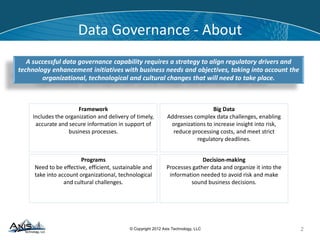
A successful data governance capability requires a strategy to align regulatory drivers and
technology enhancement initiatives with business needs and objectives, taking into account the
organizational, technological and cultural changes that will need to take place.
Framework
Includes the organization and delivery of timely,
accurate and secure information in support of
business processes.
Programs
Need to be effective, efficient, sustainable and
take into account organizational, technological
and cultural challenges.
Decision-making
Processes gather data and organize it into the
information needed to avoid risk and make
sound business decisions.
Big Data
Addresses complex data challenges, enabling
organizations to increase insight into risk,
reduce processing costs, and meet strict
regulatory deadlines.
© Copyright 2014 Axis Technology, LLC
Data Governance - Challenges
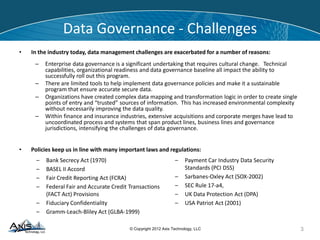
• In the industry today, data management challenges are exacerbated for a number of reasons:
– Enterprise data governance is a significant undertaking that requires cultural change. Technical
capabilities, organizational readiness and data governance baseline all impact the ability to
successfully roll out this program.
– There are limited tools to help implement data governance policies and make it a sustainable
program that ensure accurate secure data.
– Organizations have created complex data mapping and transformation logic in order to create single
points of entry and “trusted” sources of information. This has increased environmental complexity
without necessarily improving the data quality.
– Within finance and insurance industries, extensive acquisitions and corporate merges have lead to
uncoordinated process and systems that span product lines, business lines and governance
jurisdictions, intensifying the challenges of data governance.
– Bank Secrecy Act (1970)
– BASEL II Accord
– Fair Credit Reporting Act (FCRA)
– Federal Fair and Accurate Credit Transactions
(FACT Act) Provisions
– Fiduciary Confidentiality
– Gramm-Leach-Bliley Act (GLBA-1999)
– Payment Car Industry Data Security
Standards (PCI DSS)
– Sarbanes-Oxley Act (SOX-2002)
– SEC Rule 17-a4,
– UK Data Protection Act (DPA)
– USA Patriot Act (2001)
• Policies keep us in line with many important laws and regulations:
3
© Copyright 2014 Axis Technology, LLC
Transfer
Knowledge
Data Governance - Approach
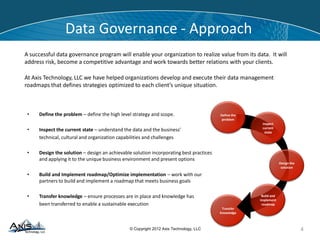
At Axis Technology, LLC we have helped organizations develop and execute their data management
roadmaps that defines strategies optimized to each client’s unique situation.
Define the
problem
Design the
solution
Build and
implement
roadmap
Inspect
current
state
A successful data governance program will enable your organization to realize value from its data. It will
address risk, become a competitive advantage and work towards better relations with your clients.
• Define the problem – define the high level strategy and scope.
• Inspect the current state – understand the data and the business’
technical, cultural and organization capabilities and challenges
• Design the solution – design an achievable solution incorporating best practices
and applying it to the unique business environment and present options
• Build and Implement roadmap/Optimize implementation – work with our
partners to build and implement a roadmap that meets business goals
• Transfer knowledge – ensure processes are in place and knowledge has
been transferred to enable a sustainable execution
4
© Copyright 2014 Axis Technology, LLC
Data Governance - Expertise
5
The following is an example of how a bank’s complex data environment increases risk, the cost to do business and limits the
ability to leverage the full value of the enterprise.
The situation…
In October 2009, the OCC required the bank to begin submitting a quarterly report outlining 35 data elements for commercial
real estate loan across the enterprise with a $10 million or greater commitment. By 2Q 2011 this level of detail must be provided
for all loans of $1 million or greater.
The complexity…
The data needed to generate this report resides on nineteen systems of record in the loan accounting system. While data fields
in the various systems of record are similar, lines of business use the data fields differently - there is no protocol for common
usage.
The approach…
An internal team partnered with Ernst & Young to assist in the production of the initial quarterly report for 3Q 2010. The process
was manually intensive requiring the use of multiple Access and Excel files. All four reports to date have been submitted on
time. The last two reports were accepted 100% fatal error free on first submission.
The cost…
The initial report cost $3.6MM to produce. Subsequent manual execution of this report has a cost of >$1.2MM. Automation of
the report is not possible as all these systems define the elements differently. the report elements may change at any time and
keeping them all in sync is a daunting task.
The DMIS approach…
DMIS will require the identification of key commercial real estate data elements and the description of what can populate those
fields. Standardization of the key data elements will create efficiency gains and greatly reduce the cost of integrating information.
© Copyright 2014 Axis Technology, LLC
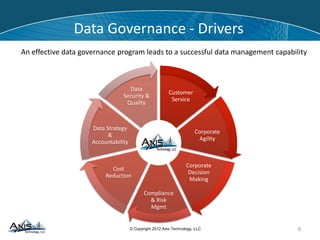
Customer
Service
Corporate
Agility
Corporate
Decision
Making
Compliance
& Risk
Mgmt
Cost
Reduction
Data Strategy
&
Accountability
Data
Security &
Quality
Data Governance - Drivers
6
An effective data governance program leads to a successful data management capability
© Copyright 2014 Axis Technology, LLC
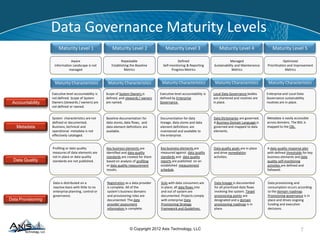
Data Governance Maturity Levels
Maturity CharacteristicsMaturity CharacteristicsMaturity CharacteristicsMaturity Characteristics
Repeatable
Establishing the Baseline
Metrics
Defined
Self-monitoring & Reporting
Progress Metrics
Managed
Sustainability and Maintenance
Metrics
Aware
Information Landscape is not
managed
Maturity Level 4Maturity Level 3Maturity Level 2Maturity Level 1
Maturity Characteristics
Optimized
Prioritization and Improvement
Metrics
Maturity Level 5
Profiling or data quality
measures of data elements are
not in place or data quality
standards are not published.
Data is distributed on a
reactive basis with little to no
enterprise planning, control or
governance.
Scope of System Owners is
defined, and stewards / owners
are named.
Executive level accountability is
defined by Enterprise
Governance.
Local Data Governance bodies
are chartered and routines are
in place.
Executive level accountability is
not defined. Scope of System
Owners (stewards / owners) are
not defined or named.
Enterprise and Local Data
Governance sustainability
routines are in place.
Registration as a data provider
is complete. All of the
system’s business domains
and provisioning roles are
documented. The data
provider assessment
information is complete.
Data provisioning and
consumption occurs according
to the domain roadmap.
Provisioning governance is in
place and drives ongoing
funding and execution
decisions.
Data lineage is documented
for all prioritized data flows
involving the system. Target
provisioning points are
designated and a domain
provisioning roadmap is in
place.
SLAs with data consumers are
in place; all data flows into
and out of system are
documented. Projects comply
with enterprise Data
Provisioning Strategy
Framework and Guidelines.
Data quality goals are in place
and drive remediation
activities.
A data quality response plan
with defined thresholds for key
business elements and data
quality self-monitoring
activities are defined and
followed.
Metadata is easily accessible
across domains. The BDL is
mapped to the CBL.
Baseline documentation for
data stores, data flows, and
data element definitions are
available.
Documentation for data
lineage, data stores and data
element definitions are
maintained and available to
the enterprise.
Data Dictionaries are governed.
A Business Domain Language is
governed and mapped to data
elements.
System characteristics are not
defined or documented.
Business, technical and
operational metadata is not
effectively cataloged.
Accountability
Metadata
Data Quality
Data Provisioning
Key business elements are
measured against data quality
standards and data quality
reports are published on an
established measurement
schedule.
Key business elements are
identified and data quality
standards are created for them
based on analysis of profiling
or data quality measurement
results.
7
© Copyright 2014 Axis Technology, LLC
• Cost
– Increased efficiency reduces costs
– Reduce redundant systems and associated operating costs
– Reduce time and effort needed to verify and correct poor data
• Regulatory
– Reduce risk
– Improve compliance
• Opportunities
– Driving business growth
– Delivering improved client service
– Providing prompt and accurate responses to regulatory requests
– Delivering increased business intelligence from consistent and aggregated data
– Information sharing and coordination across organizations.
– Cross-selling
– Segmenting and targeted service opportunities
Data Governance - Benefits
8
© Copyright 2014 Axis Technology, LLC
www.AxisTechnologyLLC.com
70 Federal Street
Boston, MA 02110
(857) 445-0110
9

Data Governance

  • 1.
  • 2.
    © Copyright 2014Axis Technology, LLC Data Governance - About 2 A successful data governance capability requires a strategy to align regulatory drivers and technology enhancement initiatives with business needs and objectives, taking into account the organizational, technological and cultural changes that will need to take place. Framework Includes the organization and delivery of timely, accurate and secure information in support of business processes. Programs Need to be effective, efficient, sustainable and take into account organizational, technological and cultural challenges. Decision-making Processes gather data and organize it into the information needed to avoid risk and make sound business decisions. Big Data Addresses complex data challenges, enabling organizations to increase insight into risk, reduce processing costs, and meet strict regulatory deadlines.
  • 3.
    © Copyright 2014Axis Technology, LLC Data Governance - Challenges • In the industry today, data management challenges are exacerbated for a number of reasons: – Enterprise data governance is a significant undertaking that requires cultural change. Technical capabilities, organizational readiness and data governance baseline all impact the ability to successfully roll out this program. – There are limited tools to help implement data governance policies and make it a sustainable program that ensure accurate secure data. – Organizations have created complex data mapping and transformation logic in order to create single points of entry and “trusted” sources of information. This has increased environmental complexity without necessarily improving the data quality. – Within finance and insurance industries, extensive acquisitions and corporate merges have lead to uncoordinated process and systems that span product lines, business lines and governance jurisdictions, intensifying the challenges of data governance. – Bank Secrecy Act (1970) – BASEL II Accord – Fair Credit Reporting Act (FCRA) – Federal Fair and Accurate Credit Transactions (FACT Act) Provisions – Fiduciary Confidentiality – Gramm-Leach-Bliley Act (GLBA-1999) – Payment Car Industry Data Security Standards (PCI DSS) – Sarbanes-Oxley Act (SOX-2002) – SEC Rule 17-a4, – UK Data Protection Act (DPA) – USA Patriot Act (2001) • Policies keep us in line with many important laws and regulations: 3
  • 4.
    © Copyright 2014Axis Technology, LLC Transfer Knowledge Data Governance - Approach At Axis Technology, LLC we have helped organizations develop and execute their data management roadmaps that defines strategies optimized to each client’s unique situation. Define the problem Design the solution Build and implement roadmap Inspect current state A successful data governance program will enable your organization to realize value from its data. It will address risk, become a competitive advantage and work towards better relations with your clients. • Define the problem – define the high level strategy and scope. • Inspect the current state – understand the data and the business’ technical, cultural and organization capabilities and challenges • Design the solution – design an achievable solution incorporating best practices and applying it to the unique business environment and present options • Build and Implement roadmap/Optimize implementation – work with our partners to build and implement a roadmap that meets business goals • Transfer knowledge – ensure processes are in place and knowledge has been transferred to enable a sustainable execution 4
  • 5.
    © Copyright 2014Axis Technology, LLC Data Governance - Expertise 5 The following is an example of how a bank’s complex data environment increases risk, the cost to do business and limits the ability to leverage the full value of the enterprise. The situation… In October 2009, the OCC required the bank to begin submitting a quarterly report outlining 35 data elements for commercial real estate loan across the enterprise with a $10 million or greater commitment. By 2Q 2011 this level of detail must be provided for all loans of $1 million or greater. The complexity… The data needed to generate this report resides on nineteen systems of record in the loan accounting system. While data fields in the various systems of record are similar, lines of business use the data fields differently - there is no protocol for common usage. The approach… An internal team partnered with Ernst & Young to assist in the production of the initial quarterly report for 3Q 2010. The process was manually intensive requiring the use of multiple Access and Excel files. All four reports to date have been submitted on time. The last two reports were accepted 100% fatal error free on first submission. The cost… The initial report cost $3.6MM to produce. Subsequent manual execution of this report has a cost of >$1.2MM. Automation of the report is not possible as all these systems define the elements differently. the report elements may change at any time and keeping them all in sync is a daunting task. The DMIS approach… DMIS will require the identification of key commercial real estate data elements and the description of what can populate those fields. Standardization of the key data elements will create efficiency gains and greatly reduce the cost of integrating information.
  • 6.
    © Copyright 2014Axis Technology, LLC Customer Service Corporate Agility Corporate Decision Making Compliance & Risk Mgmt Cost Reduction Data Strategy & Accountability Data Security & Quality Data Governance - Drivers 6 An effective data governance program leads to a successful data management capability
  • 7.
    © Copyright 2014Axis Technology, LLC Data Governance Maturity Levels Maturity CharacteristicsMaturity CharacteristicsMaturity CharacteristicsMaturity Characteristics Repeatable Establishing the Baseline Metrics Defined Self-monitoring & Reporting Progress Metrics Managed Sustainability and Maintenance Metrics Aware Information Landscape is not managed Maturity Level 4Maturity Level 3Maturity Level 2Maturity Level 1 Maturity Characteristics Optimized Prioritization and Improvement Metrics Maturity Level 5 Profiling or data quality measures of data elements are not in place or data quality standards are not published. Data is distributed on a reactive basis with little to no enterprise planning, control or governance. Scope of System Owners is defined, and stewards / owners are named. Executive level accountability is defined by Enterprise Governance. Local Data Governance bodies are chartered and routines are in place. Executive level accountability is not defined. Scope of System Owners (stewards / owners) are not defined or named. Enterprise and Local Data Governance sustainability routines are in place. Registration as a data provider is complete. All of the system’s business domains and provisioning roles are documented. The data provider assessment information is complete. Data provisioning and consumption occurs according to the domain roadmap. Provisioning governance is in place and drives ongoing funding and execution decisions. Data lineage is documented for all prioritized data flows involving the system. Target provisioning points are designated and a domain provisioning roadmap is in place. SLAs with data consumers are in place; all data flows into and out of system are documented. Projects comply with enterprise Data Provisioning Strategy Framework and Guidelines. Data quality goals are in place and drive remediation activities. A data quality response plan with defined thresholds for key business elements and data quality self-monitoring activities are defined and followed. Metadata is easily accessible across domains. The BDL is mapped to the CBL. Baseline documentation for data stores, data flows, and data element definitions are available. Documentation for data lineage, data stores and data element definitions are maintained and available to the enterprise. Data Dictionaries are governed. A Business Domain Language is governed and mapped to data elements. System characteristics are not defined or documented. Business, technical and operational metadata is not effectively cataloged. Accountability Metadata Data Quality Data Provisioning Key business elements are measured against data quality standards and data quality reports are published on an established measurement schedule. Key business elements are identified and data quality standards are created for them based on analysis of profiling or data quality measurement results. 7
  • 8.
    © Copyright 2014Axis Technology, LLC • Cost – Increased efficiency reduces costs – Reduce redundant systems and associated operating costs – Reduce time and effort needed to verify and correct poor data • Regulatory – Reduce risk – Improve compliance • Opportunities – Driving business growth – Delivering improved client service – Providing prompt and accurate responses to regulatory requests – Delivering increased business intelligence from consistent and aggregated data – Information sharing and coordination across organizations. – Cross-selling – Segmenting and targeted service opportunities Data Governance - Benefits 8
  • 9.
    © Copyright 2014Axis Technology, LLC www.AxisTechnologyLLC.com 70 Federal Street Boston, MA 02110 (857) 445-0110 9

Editor's Notes