MARKETINGILEARNEDPLAYING
DUNGEONS&DRAGONS
No, seriously.
BY Ian Lurie, Chairman/Principal, Portent, Inc
@portentint
EVERYTHINGINEEDEDTOKNOWABOUT
Ian Lurie
@portentint
ian@portent.com
portent.co/dndmktg
This is where we are, how to
reach me, and a link to the
link bundle for this talk.
3A LITTLE HISTORY
WHATISTHIS‘D&D’OFWHICHYOUSPEAK?
Now, prepare yourself. You’re about to
dive deeper into nerddom than ever
before.
Before I dig into the marketing stuff, it
helps to get a 1-minute lesson in
Dungeons and Dragons.
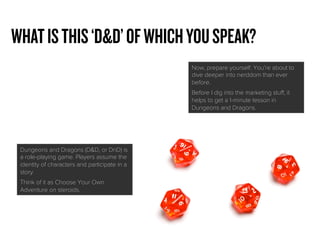
Dungeons and Dragons (D&D, or DnD) is a
role-playing game. Players assume the
identity of characters and participate in a
story.
Think of it as Choose Your Own Adventure
on steroids.
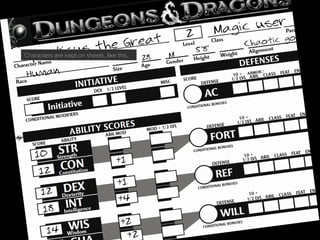
Characters are kept on sheets, like this.
A typical interaction might go like this:
Dungeon Master: You hear a sound down
the hall.
Player: I charge towards it!!!!
Dungeon Master: A swarm of spiders
attacks you.
Player: @)#($*!@
Then the‘combat’is resolved using dice.
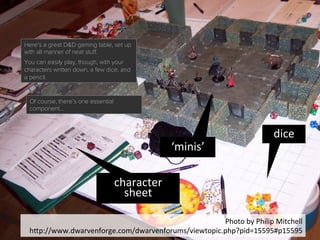
Photo	
  by	
  Philip	
  Mitchell	
  	
  
h.p://www.dwarvenforge.com/dwarvenforums/viewtopic.php?pid=15595#p15595	
  
dice	
  
‘minis’	
  
character	
  
sheet	
  
Here’s a great D&D gaming table, set up
with all manner of neat stuff.
You can easily play, though, with your
characters written down, a few dice, and a
pencil.
Of course, there’s one essential
component…
NERDS
8A LITTLE HISTORY
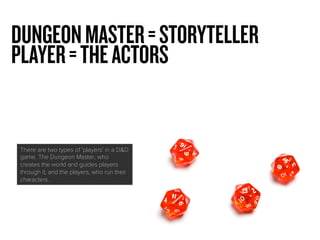
DUNGEONMASTER=STORYTELLER
PLAYER=THEACTORS
There are two types of‘players’in a D&D
game. The Dungeon Master, who creates
the world and guides players through it,
and the players, who run their characters.
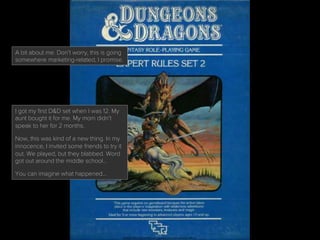
A bit about me. Don’t worry, this is going
somewhere marketing-related, I promise.
I got my first D&D set when I was 12. My
aunt bought it for me. My mom didn’t
speak to her for 2 months.
Now, this was kind of a new thing. In my
innocence, I invited some friends to try it
out. We played, but they blabbed. Word
got out around the middle school…
You can imagine what happened…
I became social roadkill. Now, it wasn’t all
because I played D&D. I was pretty far into
the nerd vortex by then. But D&D didn’t
help. I’ll spare you the details. I stopped
gaming for about 3 years.
But now, I’m going to indulge a bit: I have a
message I need to send to all the
neandrethals who spent their days knocking
books out of my arms, slapping me around
and other fun stuff, then peaked in high
school and and are now making a living
screwing caps onto toothpaste…
HOWYALIKE
MENOW
Suck it.
PEOPLE ARE
WEIRD
LESSON 1
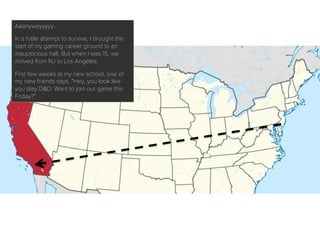
Aaanywayyyyy…
In a futile attempt to survive, I brought the
start of my gaming career ground to an
inaupsicious halt. But when I was 15, we
moved from NJ to Los Angeles.
First few weeks at my new school, one of my
new friends says,“Hey, you look like you play
D&D. Want to join our game this Friday?”
THEREISNONORMAL
PEOPLEAREWEIRD
LESSON 1
This was my first, most excellent lesson.
People are generally weird. The‘normal’ones
become toothpaste cap installers. If, as a
marketer, you can appeal to this, you win,
period.
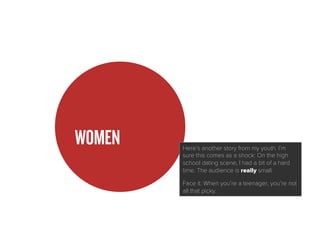
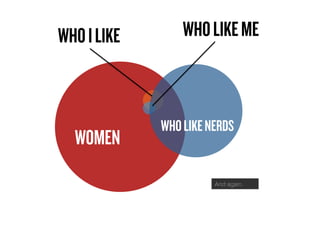
WOMEN Here’s another story from my youth. I’m sure
this comes as a shock: On the high school
dating scene, I had a bit of a hard time. The
audience is really small.
Face it: When you’re a teenager, you’re not all
that picky.
WOMEN
WHOLIKENERDS
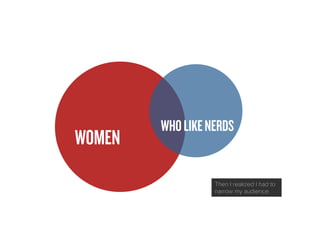
Then I realized I had to
narrow my audience.
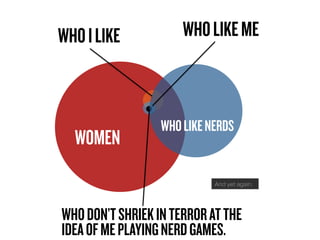
WOMEN
WHOILIKE
WHOLIKENERDS
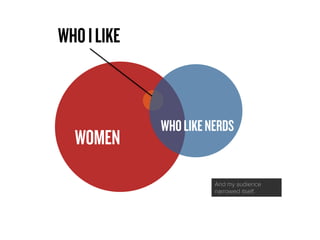
And my audience
narrowed itself.
WOMEN
WHOILIKE WHOLIKEME
WHOLIKENERDS
And again.
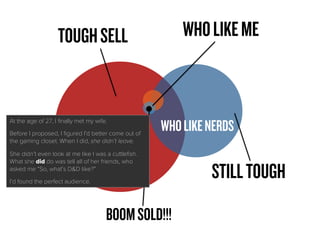
WOMEN
WHOILIKE WHOLIKEME
WHODON’TSHRIEKINTERRORATTHE
IDEAOFMEPLAYINGNERDGAMES.
WHOLIKENERDS
And yet again.
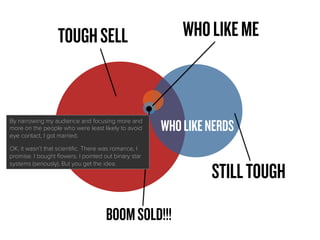
WOMEN
WHOLIKENERDS
TOUGHSELL WHOLIKEME
BOOMSOLD!!!
STILLTOUGH
At the age of 27, I finally met my wife.
Before I proposed, I figured I’d better come out of
the gaming closet. When I did, she didn’t leave.
She didn’t even look at me like I was a cuttlefish.
What she did do was tell all of her friends, who
asked me“So, what’s D&D like?”
I’d found the perfect audience.
WOMEN
WHOLIKENERDS
TOUGHSELL WHOLIKEME
BOOMSOLD!!!
STILLTOUGH
By narrowing my audience and focusing more and
more on the people who were least likely to avoid
eye contact, I got married.
OK, it wasn’t that scientific. There was romance, I
promise. I bought flowers. I pointed out binary star
systems (seriously). But you get the idea.
READWEAREALLWEIRD
(SethGodin)
Seth Godin’s We Are All Weird explains
this entire concept.
Never make the entire marketplace
your audience. Find all the groups of
weird, and speak to them.
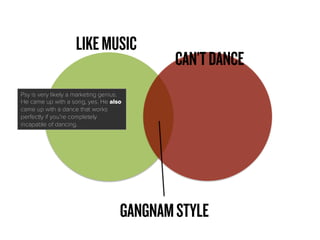
LIKEMUSIC
CAN’TDANCE
GANGNAMSTYLE
Psy is very likely a marketing genius. He
came up with a song, yes. He also
came up with a dance that works
perfectly if you’re completely incapable
of dancing.
No, I won’t demonstrate. Actually, the
entire state of Washington has a
restraining order against me every
trying to do anything other than slow
dance.
Psy found his audience – his‘weird.’It’s
people who like his style of music but
can’t dance. The response was
completely off the charts.
I’m only slightly tongue-in-cheek here.
It really worked whether he meant it to
or not.
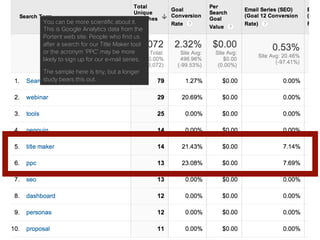
You can be more scientific about it. This
is Google Analytics data from the
Portent web site. People who find us
after a search for our Title Maker tool or
the acronym‘PPC’may be more likely
to sign up for our e-mail series.
The sample here is tiny, but a longer
study bears this out.
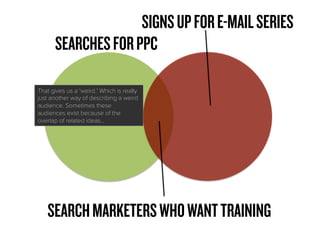
SEARCHESFORPPC
SIGNSUPFORE-MAILSERIES
SEARCHMARKETERSWHOWANTTRAINING
That gives us a‘weird.’Which is really
just another way of describing a weird
audience. Sometimes these audiences
exist because of the overlap of related
ideas…
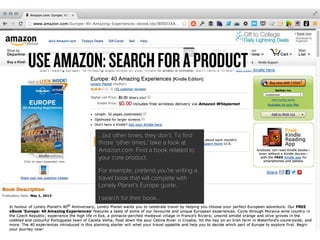
USEAMAZON:SEARCHFORAPRODUCT
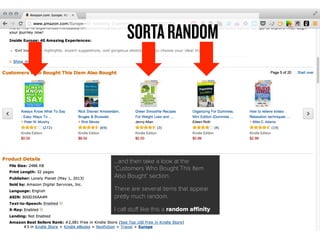
…but other times, they don’t. To find
those‘other times,’take a look at
Amazon.com. Find a book related to
your core product.
For example, pretend you’re writing a
travel book that will compete with
Lonely Planet’s Europe guide.
I search for their book…
SORTARANDOM
…and then take a look at the
‘Customers Who Bought This Item Also
Bought’section.
There are several items that appear
pretty much random.
I call stuff like this a random affinity.
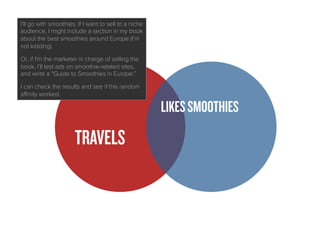
TRAVELS
LIKESSMOOTHIES
I’ll go with smoothies. If I want to sell to a niche
audience, I might include a section in my book
about the best smoothies around Europe (I’m
not kidding).
Or, if I’m the marketer in charge of selling the
book, I’ll test ads on smoothie-related sites,
and write a“Guide to Smoothies in Europe.”
I can check the results and see if this random
affinity worked.
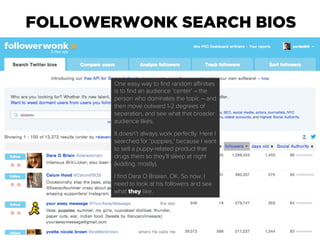
FOLLOWERWONK SEARCH BIOS
One easy way to find random affinities
is to find an audience‘center’– the
person who dominates the topic – and
then move outward 1-2 degrees of
separation, and see what that broader
audience likes.
It doesn’t always work perfectly. Here I
searched for‘puppies,’because I want
to sell a puppy-related product that
drugs them so they’ll sleep at night
(kidding. mostly).
I find Dara O Briaian. OK. So now, I need
to look at his followers and see what
they like.
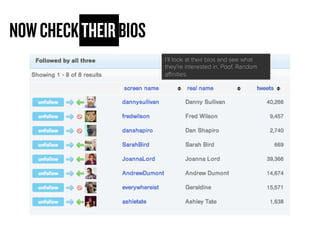
NOWCHECKTHEIRBIOS
I’ll look at their bios and see what
they’re interested in. Poof. Random
affinities.
31A LITTLE HISTORY
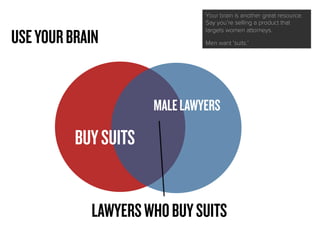
USEYOURBRAIN
BUYSUITS
MALELAWYERS
LAWYERSWHOBUYSUITS
Your brain is another great resource.
Say you’re selling a product that targets
women attorneys.
Men want‘suits.’
32A LITTLE HISTORY
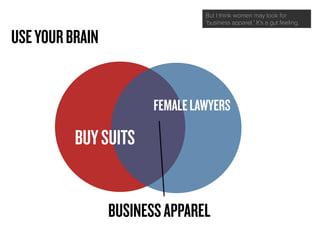
USEYOURBRAIN
BUYSUITS
FEMALELAWYERS
BUSINESSAPPAREL
But I think women may look for
‘business apparel.’It’s a gut feeling.
33A LITTLE HISTORY
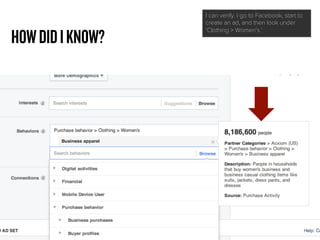
HOWDIDIKNOW?
I can verify. I go to Facebook, start to
create an ad, and then look under
‘Clothing > Women’s.’
34A LITTLE HISTORY
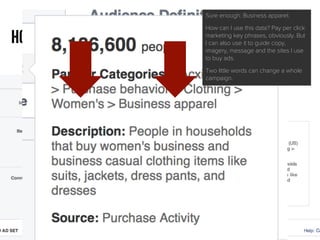
HOWDIDIKNOW?
Sure enough: Business apparel.
How can I use this data? Pay per click
marketing key phrases, obviously. But I
can also use it to guide copy, imagery,
message and the sites I use to buy ads.
Two little words can change a whole
campaign.
PEOPLEAREWEIRD
DON’T FIND 10000 PEOPLE
FIND 10 AUDIENCES OF 1000
So, the rule is: Don’t find one audience
of 10,000. Find 10 audiences of 1,000
and sell to each, precisely.
Focus on the weird. If you’re a gamer, it
might just save your life.
DOTHE
MATH
LESSON 2
Here’s something most folks do not
expect from Dungeons & Dragons…
ARMOR + DEX = ARMOR CLASS
DOUBLE DAMAGE
THAC0 D&D is surprisingly mathematical. Other,
similar games even more so.
I used D&D to improve my kids’math skills.
I’m sneaky that way.
There are all manner of calculations that
can change at any time depending on
conditions.
ARMOR + DEX = ARMOR CLASS
DOUBLE DAMAGE
THAC0
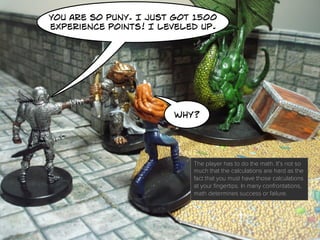
you are so puny. I just got 1500
experience points! I leveled up.
why?
The player has to do the math. It’s not so
much that the calculations are hard as the
fact that you must have those calculations
at your fingertips. In many confrontations,
math determines success or failure.
ARMOR + DEX = ARMOR CLASS
DOUBLE DAMAGE
THAC0
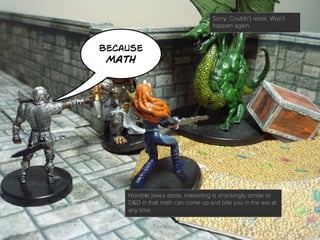
because
math
Sorry. Couldn’t resist. Won’t
happen again.
Horrible jokes aside, marketing is shockingly similar to
D&D in that math can come up and bite you in the ass at
any time.
LTV = VALUE/CUSTOMER
LEAD TO CUSTOMER
VISIT TO LEAD
CLICKS TO SITE
B2B I don’t care if you’re selling to 10 people or 10,000,000.
You need to do the math. Know the essential numbers,
by heart.
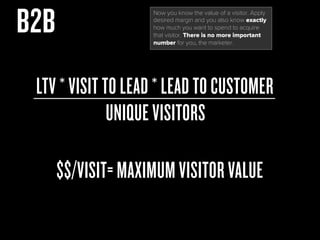
Sell Business-to-Business (B2B)? Figure out the average
value of a visit like so (LTV = LifeTime Value).
LTV * VISIT TO LEAD * LEAD TO CUSTOMER
B2B
UNIQUE VISITORS
$$/VISIT= MAXIMUM VISITOR VALUE
Now you know the value of a visitor. Apply
desired margin and you also know exactly
how much you want to spend to acquire
that visitor. There is no more important
number for you, the marketer.
LTV = VALUE/CUSTOMER
VISIT TO SALE
CLICKS TO SITE
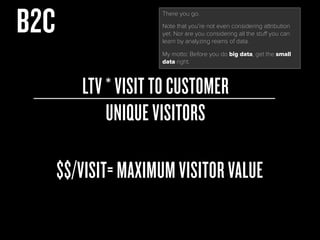
B2C Same goes for Business-To-Consumer (B2C),
although this is easier.
LTV * VISIT TO CUSTOMER
B2C
UNIQUE VISITORS
$$/VISIT= MAXIMUM VISITOR VALUE
There you go.
Note that you’re not even considering attribution
yet. Nor are you considering all the stuff you can
learn by analyzing reams of data.
My motto: Before you do big data, get the small
data right.
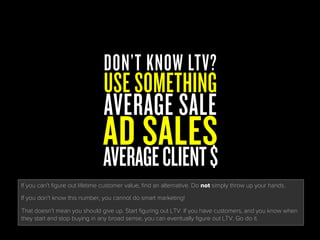
USESOMETHING
AVERAGE SALE
AD SALESAVERAGECLIENT$
DON’T KNOW LTV?
If you can’t figure out lifetime customer value, find an alternative. Do not simply throw up your hands.
If you don’t know this number, you cannot do smart marketing!
That doesn’t mean you should give up. Start figuring out LTV. If you have customers, and you know when
they start and stop buying in any broad sense, you can eventually figure out LTV. Go do it.
MEASURE
Here’s the other half of the‘math’equation. Once
you know your basic numbers, use measurement to
better target, find the‘weird’and apply
segmentation, improve user experience and so on.
I did this all the time in D&D. If my character had X
‘hit points’(your health – if you lose them all, you’re
kind of comatose), and the first 10 times we played
every opponent had 2X hit points, and finally killed
me, it’s time to adjust. Zarth the Destroyer may be
dead, but at least I know how to build my next
character.
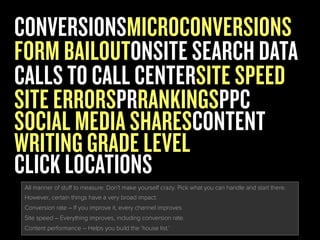
CONVERSIONSMICROCONVERSIONS
FORM BAILOUTONSITE SEARCH DATA
CALLS TO CALL CENTERSITE SPEED
SITE ERRORSPRRANKINGSPPC
SOCIAL MEDIA SHARESCONTENT
WRITING GRADE LEVEL
CLICK LOCATIONS
All manner of stuff to measure. Don’t make yourself crazy. Pick what you can handle and start there.
However, certain things have a very broad impact:
Conversion rate – If you improve it, every channel improves
Site speed – Everything improves, including conversion rate.
Content performance – Helps you build the‘house list.’
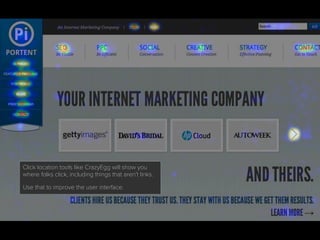
Click location tools like CrazyEgg will show you
where folks click, including things that aren’t links.
Use that to improve the user interface.
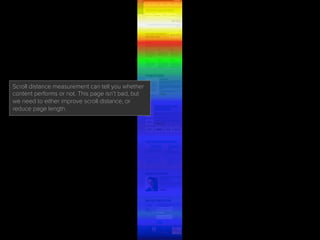
Scroll distance measurement can tell you whether
content performs or not. This page isn’t bad, but we
need to either improve scroll distance, or reduce
page length.
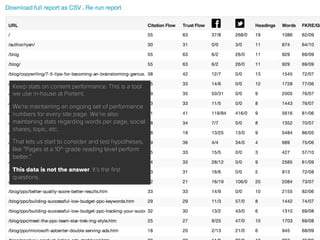
Keep stats on content performance. This is a tool we
use in-house at Portent.
We’re maintaining an ongoing set of performance
numbers for every site page. We’re also maintaining
stats regarding words per page, social shares, topic,
etc.
That lets us start to consider and test hypotheses,
like“Pages at a 10th grade reading level perform
better.”
This data is not the answer. It’s the first questions.
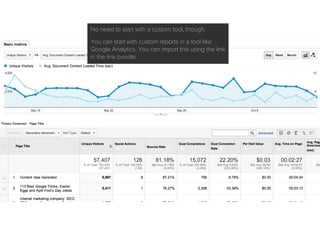
No need to start with a custom tool, though.
You can start with custom reports in a tool like
Google Analytics. You can import this using the link
in the link bundle.
BUT YOU CANNOT
MEASURE EVERYTHING
Great! Measure!!!! Measure!!!! Measure more!!!!
Don’t even go out to lunch without measuring!!!
Yeah. No. You have to be willing to try stuff you can’t
measure. And be prepared to be wrong sometimes,
even if you do the math.
You can measure your way right into paralysis,
because…
RANDOM
HAPPENS
LESSON 3
Random happens. It just does. We’re not selling to
computers. There’s no formula.
We’re selling to highly evolved apes. They change
their minds. And they’re weird.
PEOPLE ARE
WEIRD
LESSON 1
HAPPENS
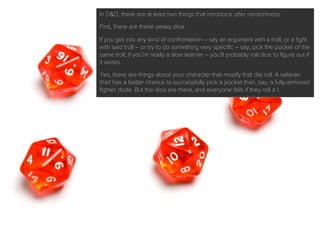
In D&D, there are at least two things that introduce utter randomness.
First, there are these pesky dice.
If you get into any kind of confrontation – say an argument with a troll, or a fight
with said troll – or try to do something very specific – say, pick the pocket of the
same troll, if you’re really a slow learner – you’ll probably roll dice to figure out if it
works.
Yes, there are things about your character that modify that die roll. A veteran thief
has a better chance to successfully pick a pocket than, say, a fully-armored fighter
dude. But the dice are there, and everyone fails if they roll a 1.
Start here
End here
Fun! Adventure!
YAY!!!!!!
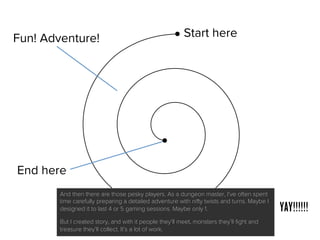
And then there are those pesky players. As a dungeon master, I’ve often spent
time carefully preparing a detailed adventure with nifty twists and turns. Maybe I
designed it to last 4 or 5 gaming sessions. Maybe only 1.
But I created story, and with it people they’ll meet, monsters they’ll fight and
treasure they’ll collect. It’s a lot of work.
Start here
End here
SONOFA…
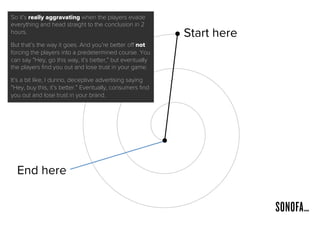
So it’s really aggravating when the players evade
everything and head straight to the conclusion in 2
hours.
But that’s the way it goes. And you’re better off not
forcing the players into a predetermined course. You
can say“Hey, go this way, it’s better,”but eventually
the players find you out and lose trust in your game.
It’s a bit like, I dunno, deceptive advertising saying
“Hey, buy this, it’s better.”Eventually, consumers find
you out and lose trust in your brand.
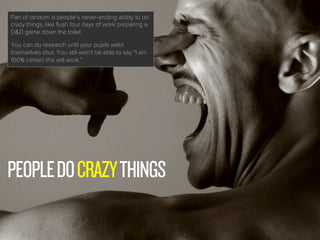
PEOPLEDOCRAZYTHINGS
Part of random is people’s never-ending ability to do
crazy things, like flush four days of work preparing a
D&D game down the toilet.
You can do research until your pupils weld themselves
shut. You still won’t be able to say“I am 100% certain
this will work.”
HAVE A PLANBUT KNOW IT’LL CHANGE
AND BE READY WHEN IT DOES
So yes, have a plan. But understand that no matter
what you do, it’s going to change. And be ready when
it does.
Clients and bosses hate this. They hate it. There’s
always someone out there who will guarantee it.
There’s a simple question you can ask:
“Doesn’t that seem too good to be true?”
Because it probably is.
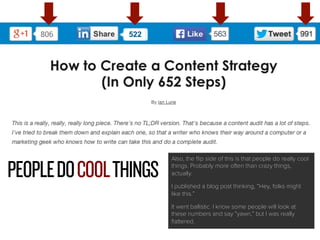
PEOPLEDOCOOLTHINGS
Also, the flip side of this is that people do really cool
things. Probably more often than crazy things,
actually.
I published a blog post thinking,“Hey, folks might like
this.”
It went ballistic. I know some people will look at these
numbers and say“yawn,”but I was really flattered.
RANDOM CAN BE GOOD
So random can also be really good. Don’t fear it.
It’s part of what makes D&D fun – if nothing was
random, and you knew every outcome ahead of time,
it’d be pretty boring.
It’s what can make marketing fun, too. It’s certainly
what makes us valuable. Without random, no one
would need marketers.
FEAR
NOTHING
LESSON 4
Which brings me to the next rule:
Fear nothing (except a few things)
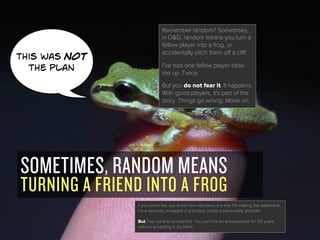
SOMETIMES, RANDOM MEANS
TURNING A FRIEND INTO A FROG
this was Not
the plan
Remember random? Sometimes,
in D&D, random means you turn a
fellow player into a frog, or
accidentally pitch them off a cliff.
I’ve had one fellow player blow me
up. Twice.
But you do not fear it. It happens.
With good players, it’s part of the
story. Things go wrong. Move on.
If you know me, you know how ridiculous it is that I’m making this statement.
I’m a neurosis, wrapped in a phobia, inside a personality disorder.
But, I’ve come to accept this. You can’t be an entrepreneur for 20 years
without accepting it. So there.
EXCEPT THE
SCARY
STUFF
Except there are some things you should be afraid
of. They’re serious. They hurt clients and
consumers.
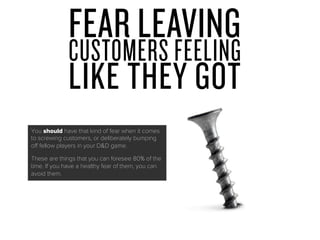
FEAR LEAVING
CUSTOMERS FEELING
LIKE THEY GOT
You should have that kind of fear when it comes to
screwing customers, or deliberately bumping off
fellow players in your D&D game.
These are things that you can foresee 80% of the
time. If you have a healthy fear of them, you can
avoid them.
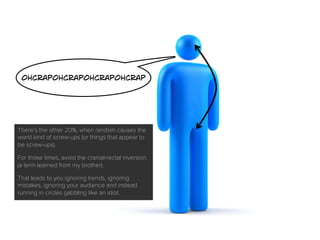
ohcrapohcrapohcrapohcrap
There’s the other 20%, when random causes the
worst kind of screw-ups (or things that appear to
be screw-ups).
For those times, avoid the cranial-rectal inversion
(a term learned from my brother).
That leads to you ignoring trends, ignoring
mistakes, ignoring your audience and instead
running in circles gabbling like an idiot.
DON’T FREAK OUT
Just don’t!!!!!
How you deal with these mistakes may just
make or break your career, or your brand.
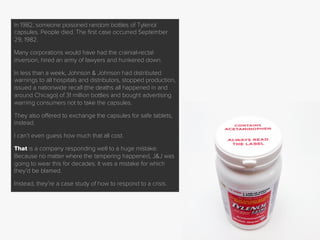
In 1982, someone poisoned random bottles of Tylenol
capsules. People died. The first case occurred September 29,
1982.
Many corporations would have had the crainial-rectal
inversion, hired an army of lawyers and hunkered down.
In less than a week, Johnson & Johnson had distributed
warnings to all hospitals and distributors, stopped production,
issued a nationwide recall (the deaths all happened in and
around Chicago) of 31 million bottles and bought advertising
warning consumers not to take the capsules.
They also offered to exchange the capsules for safe tablets,
instead.
I can’t even guess how much that all cost.
That is a company responding well to a huge mistake.
Because no matter where the tampering happened, J&J was
going to wear this for decades. It was a mistake for which
they’d be blamed.
Instead, they’re a case study of how to respond to a crisis.
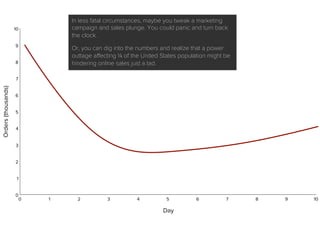
100 1 2 3 4 5 6 7 8 9
10
0
1
2
3
4
5
6
7
8
9
Day
Orders(thousands)
In less fatal circumstances, maybe you tweak a marketing
campaign and sales plunge. You could panic and turn back the
clock.
Or, you can dig into the numbers and realize that a power
outtage affecting ¼ of the United States population might be
hindering online sales just a tad.
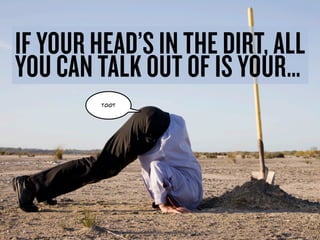
HATERS GONNA HATE
IF YOUR HEAD’S IN THE DIRT, ALL
YOU CAN TALK OUT OF IS YOUR…
TOOT
DON’TGET PARALYZED
Most important, don’t let fear completely
paralyze you.
Back to D&D for a second: If you’re fighting a
horrific monster, and it’s kicking your butt,
yeah, you’re in trouble.
I don’t know if you’ll survive. I guarantee you
won’t survive if you just stand there.
DO
LESSON 5
SOMETHING
For heaven’s sake, don’t just stand there!
HE WHO
ACTSISN’T DEAD
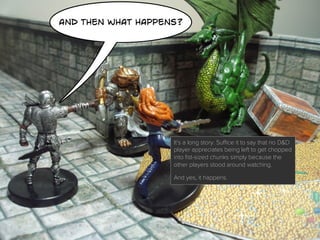
AND THEN WHAT HAPPENS?
It’s a long story. Suffice it to say that no D&D
player appreciates being left to get chopped
into fist-sized chunks simply because the
other players stood around watching.
And yes, it happens.
HE WHO
ACTSISN’T DEAD
In D&D.
Also figuratively in the world of marketing.
SHE WHO
ADAPTSFLOURISHES
Yeah, this too.
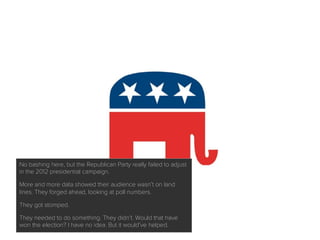
No bashing here, but the Republican Party really failed to adjust
in the 2012 presidential campaign.
More and more data showed their audience wasn’t on land lines.
They forged ahead, looking at poll numbers.
They got stomped.
They needed to do something. They didn’t. Would that have won
the election? I have no idea. But it would’ve helped.
COMPUSA responded to lower in-store performance by doing
nothing. Unless you include reducing in-store salaries, of course.
Conde Nast flew Gourmet Magazine right into the ground by
ignoring everything from site speed and user experience to
organic search and social media. Thud.
HE WHO
SITSON
HISBUTT
GETS IT
KICKED
Sometimes someone else is refusing to budge. There are a few
ways to get them unstuck.
WEBPAGETEST.ORG
Sometimes someone else is refusing to budge. There are a few ways to get them unstuck.
First, appeal to their competitive nature. Here, I’m comparing the load speed of two sites.
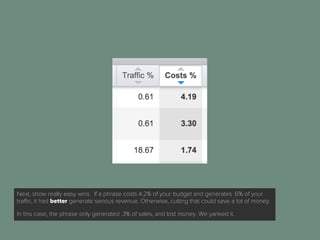
Next, show really easy wins. If a phrase costs 4.2% of your budget and generates .6% of your traffic,
it had better generate serious revenue. Otherwise, cutting that could save a lot of money.
In this case, the phrase only generated .3% of sales, and lost money. We yanked it.
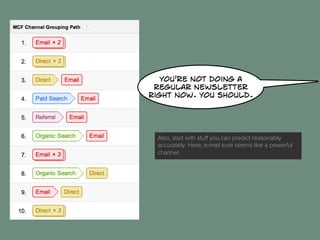
you're not doing a
regular newsletter
right now. you should.
Also, start with stuff you can predict reasonably
accurately. Here, e-mail sure seems like a powerful
channel.
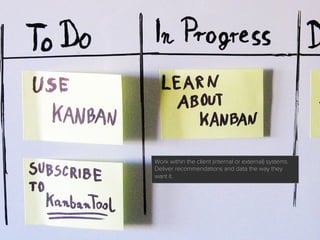
Work within the client (internal or external) systems.
Deliver recommendations and data the way they want
it.
Oh, and bribery never hurt, either.
RETURNONTIME
INVESTED
LESSON 6
Respect the ROTI.
PEOPLE INVEST
TIME FIRST
The first thing most people invest in any
activity is time.
If you want to keep their attention, you need
to generate a good return on time invested
(ROTI).
IF I’M GOING TO BE A SOCIAL OUTCAST,
MAKEITWORTHMYWHILE
Playing D&D requires sacrifices: Staying up
until 3 AM. Eating crappy food. Becoming a
total social outcast.
If I’m going to do those things, it had better be
worth my while from hour 1.
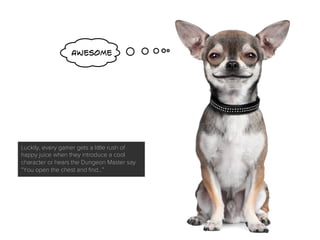
AWESOME
Luckily, every gamer gets a little rush of happy
juice when they introduce a cool character or
hears the Dungeon Master say“You open the
chest and find…”
86A LITTLE HISTORY
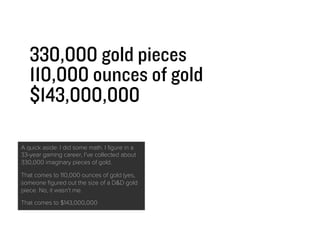
330,000 gold pieces
110,000 ounces of gold
$143,000,000
A quick aside: I did some math. I figure in a 33-
year gaming career, I’ve collected about
330,000 imaginary pieces of gold.
That comes to 110,000 ounces of gold (yes,
someone figured out the size of a D&D gold
piece. No, it wasn’t me.
That comes to $143,000,000
87
EMPIRESTATEBLDG
2750 ft
SPACENEEDLE
MYIMAGINARYWEALTH
If you stacked them up, the pile
would be really tall.
NERD
Whatever.
But here’s the thing: I collected all that fake gold
days or weeks into a particular D&D game. It wasn’t
there, sitting on the imaginary ground, for my
character to collect on day 1.
So, why’d I stick around?
BUT FIRST
A GOOD STORY
A GOOD SETTING
GOOD SNACKS
Something else got me my Return on Time Invested.
Maybe my fellow players brought good snacks. Maybe I had a
crush on a girl in the group (yes, girls do play D&D). Or maybe
we’re just all really good friends.
Regardless, there’s a great ROTI, and I’ll stick around because
of it.
GIVE THEM
ROTI
In marketing, ROTI is an even more obvious requirement.
CONTENT IS YOUR
FIRST PRODUCT
Whether they’re reading a blog post, watching a video,
looking at a product or reading about your Board of Directors,
content is the first product they sample.
Content generates ROTI. There is no escaping this.
That means you have to look to many factors:
SPEED
Site speed – the speed at which a page appears in
a visitor’s browser – may be the single most
important factor in internet marketing.
OK, that’s a bit much.
But think about it: The speed of your site affects all
channel performance, conversion rates, customer
satisfaction, user experience…
It’s a big deal.
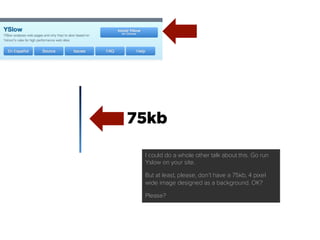
75kb
I could do a whole other talk about this. Go run
Yslow on your site.
But at least, please, don’t have a 75kb, 4 pixel wide
image designed as a background. OK?
Please?
READABILITY
How easy is your copy to read, or images to
view, or videos to watch? Reading online is
hard. You need to make it easier.
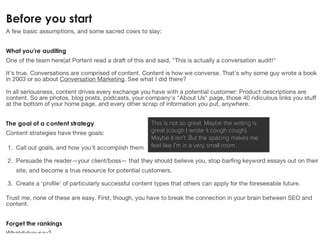
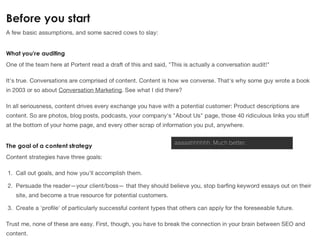
This is not so great. Maybe the writing is
great (cough I wrote it cough cough). Maybe
it isn’t. But the spacing makes me feel like
I’m in a very small room.
aaaaahhhhhh. Much better.
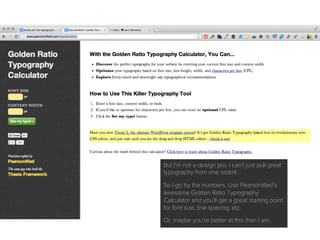
But I’m not a design pro. I can’t just pull great
typography from one nostril.
So I go by the numbers. Use Pearsonified’s
awesome Golden Ratio Typography Calculator
and you’ll get a great starting point for font
size, line spacing, etc.
Or, maybe you’re better at this than I am.
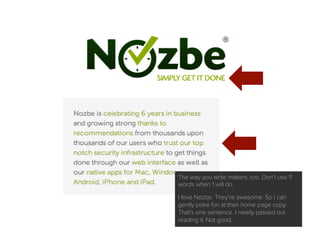
The way you write matters, too. Don’t use 11
words when 1 will do.
I love Nozbe. They’re awesome. So I can gently
poke fun at their home page copy. That’s one
sentence. I nearly passed out reading it. Not
good.
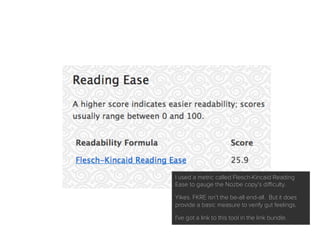
I used a metric called Flesch-Kincaid Reading Ease
to gauge the Nozbe copy’s difficulty.
Yikes. FKRE isn’t the be-all end-all. But it does
provide a basic measure to verify gut feelings.
I’ve got a link to this tool in the link bundle.
SPELLING