Mineral Processing (MN-481)
Presentedby
Dr. BNV Siva Prasad
Assistant Professor
Department of Mining Engineering
Indian Institute of Technology (Banaras Hindu University), Varanasi
Former Scientist, National Institute of Rock Mechanics
sivaprasadbnv.min@itbhu.ac.in ; +91 77268 11680
INTRODUCTION – PART III
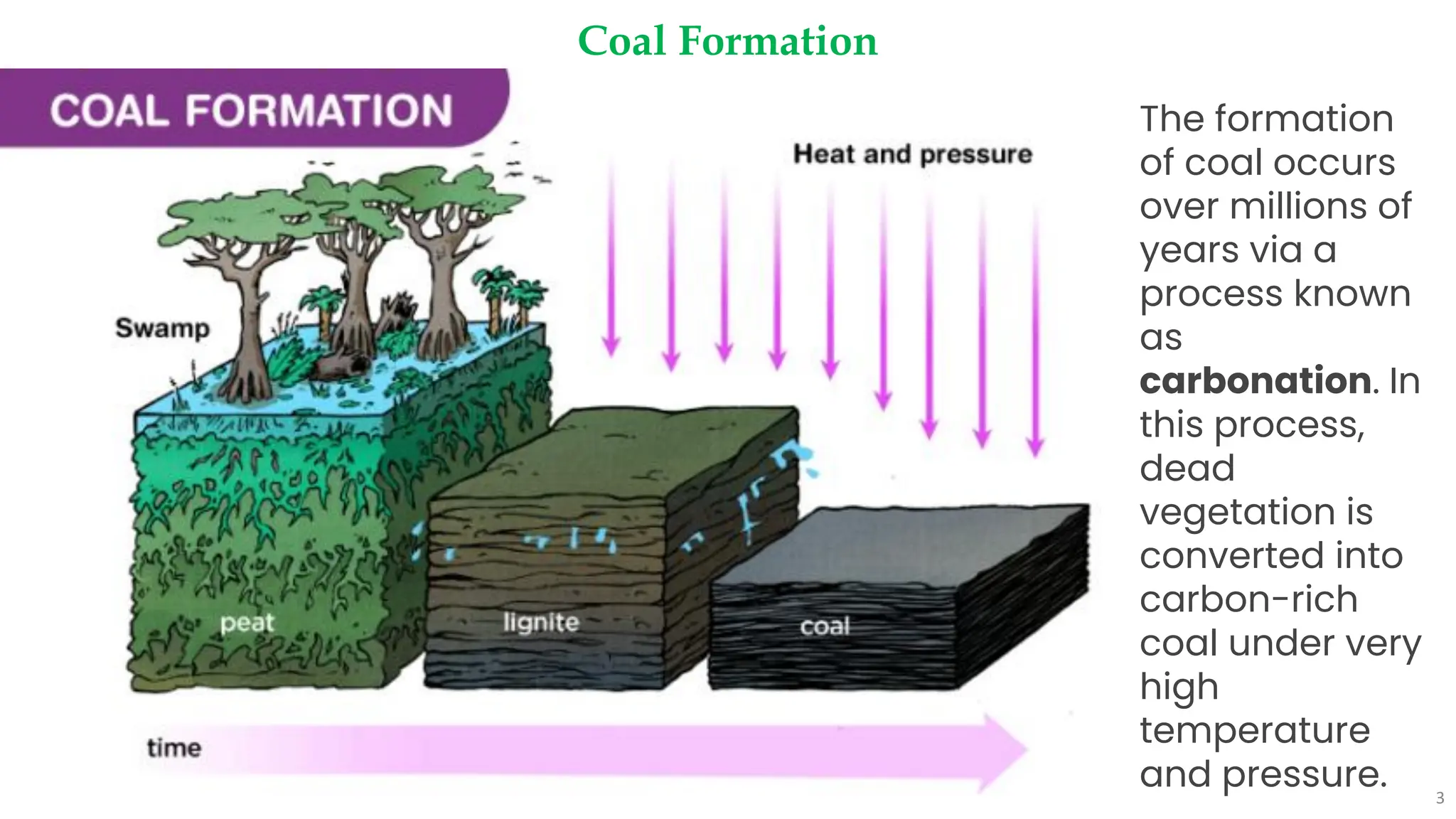
Coal Formation
3
The formation
ofcoal occurs
over millions of
years via a
process known
as
carbonation. In
this process,
dead
vegetation is
converted into
carbon-rich
coal under very
high
temperature
and pressure.
4.
Formation of AccessibleOre Deposits
4
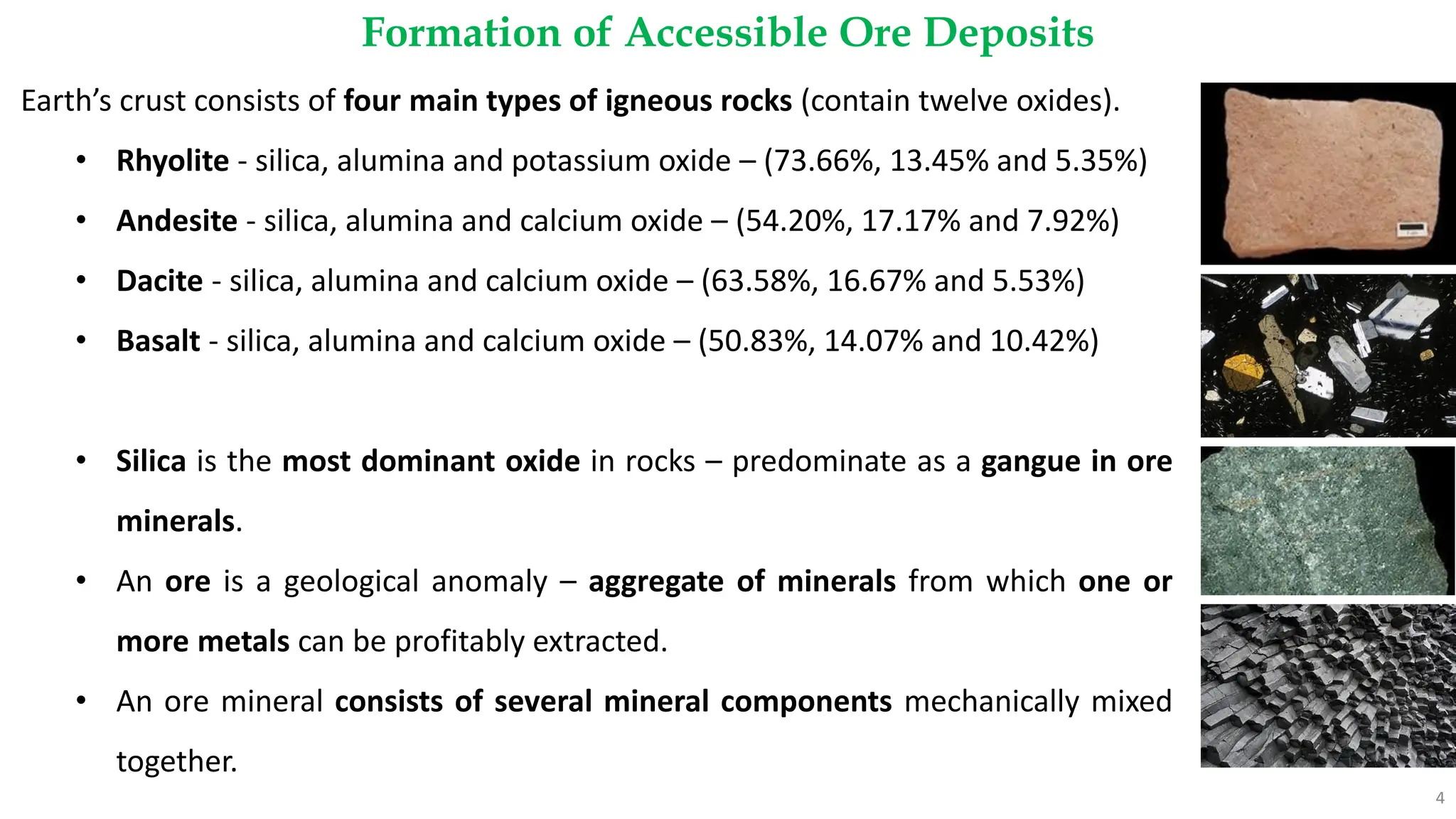
Earth’s crust consists of four main types of igneous rocks (contain twelve oxides).
• Rhyolite - silica, alumina and potassium oxide – (73.66%, 13.45% and 5.35%)
• Andesite - silica, alumina and calcium oxide – (54.20%, 17.17% and 7.92%)
• Dacite - silica, alumina and calcium oxide – (63.58%, 16.67% and 5.53%)
• Basalt - silica, alumina and calcium oxide – (50.83%, 14.07% and 10.42%)
• Silica is the most dominant oxide in rocks – predominate as a gangue in ore
minerals.
• An ore is a geological anomaly – aggregate of minerals from which one or
more metals can be profitably extracted.
• An ore mineral consists of several mineral components mechanically mixed
together.
5.
Mechanisms of AccessibleOre Deposit Formation
5
• Some natural and unusual processes remove minerals, specific elements or compounds
from their original primary, in-accessible ordinary rock locations, transport and
concentrate them by preference at a spot or zone where the transport stops to form
accessible mineral deposits.
• The unusual process may be:
• Physical or chemical weathering of mineral hosting original rocks – to liberate the
mineral values and are thus made ready for transport by rainwater or wind.
• Sorting by the density of the eroded rock – hosted minerals, the usually heavier
mineral values and the lighter gangue minerals.
• Sorting by the solubility of eroded rocks – some may be soluble in water while
others remain insoluble.
Formation of OreDeposits
7
Ore deposit
• Igneous – formed when magma from the earth’s core crystallized into solids in different environments.
• Sedimentary – formed due to sedimentary procedures
• Metamorphic – formed due to high temperature and pressure
• Mineral deposits may also be found existing on their own in layers and bodies of various shapes which
extend over many kilometres in area coverage and of many metres deep
• E.g. – deposits of iron oxides and hydrous aluminium oxide in sediments.
• Ore deposits enclosed in host rocks are divided into two groups on the basis of the time of their formation in
relation to their host rocks
• Syngenetic – formation occurred simultaneously – Igneous or sedimentary origin.
• Epigenetic – formed after the host rocks – Igneous, sedimentary or meta morphic origins.
Ore minerals
- Hypogene or primary deposits
- Supergene or secondary deposits
8.
Igneous Deposits
8
• Magmatic
•Pegmatic
• Hydrothermal
Igneous
Deposits
Magmatic Deposits
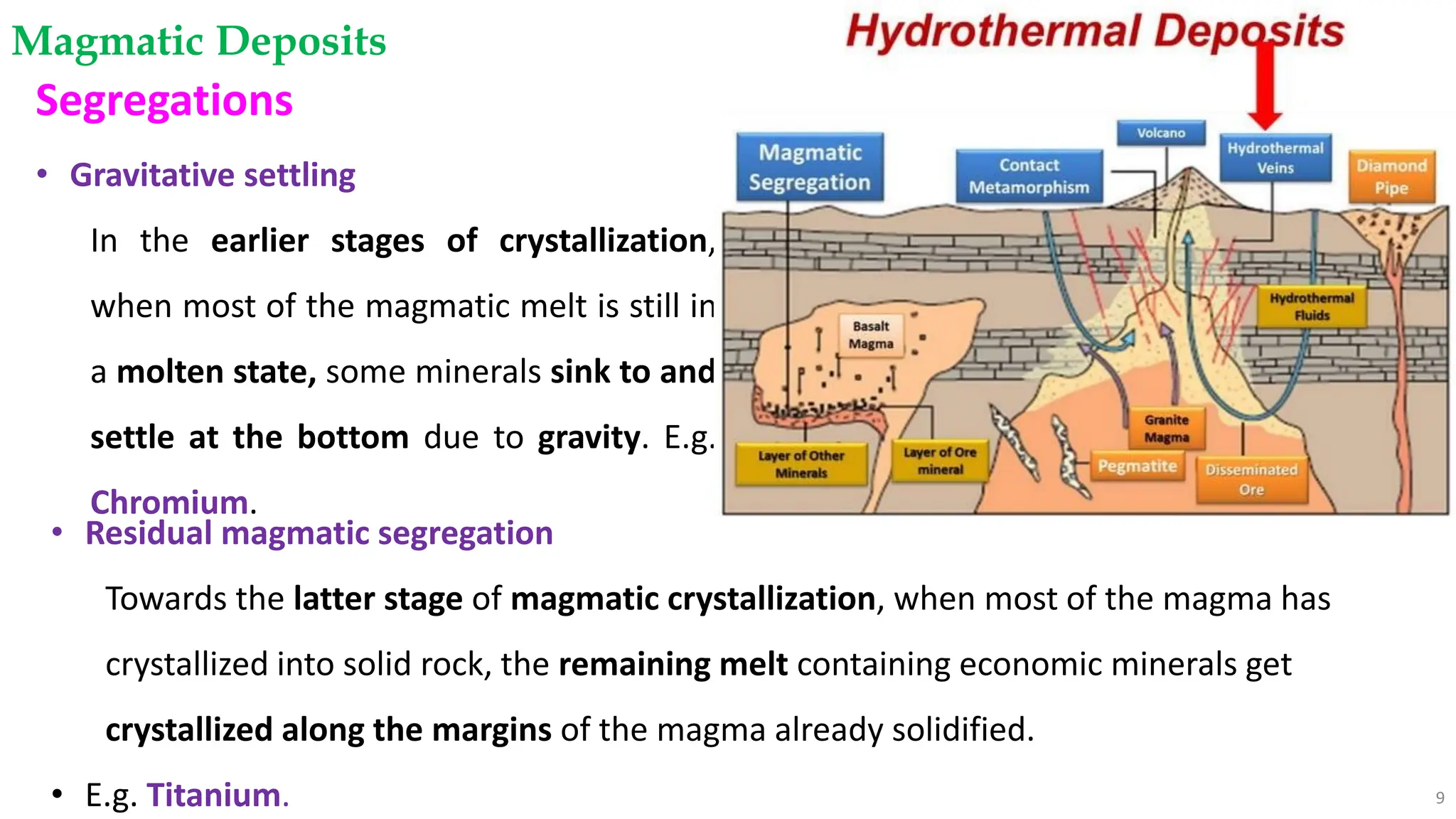
• Initial composition of molten magma forms minerals
of economic value when it crystallizes.
• The value minerals formed may get accumulated at
the bottom or margins or other places within the
cooling magma
• Time of crystallization, size and nature of minerals
decide the mineral economics
• main sources of important metals like gold, uranium
and titanium.
• Accumulation of these economic deposits may occur
at an early or later stage during crystallization and is
thus known as early or late magmatic crystallization.
• Occur as
• Segregations
• Disseminations
• Injections
9.
Magmatic Deposits
9
Segregations
• Gravitativesettling
In the earlier stages of crystallization,
when most of the magmatic melt is still in
a molten state, some minerals sink to and
settle at the bottom due to gravity. E.g.
Chromium.
• Residual magmatic segregation
Towards the latter stage of magmatic crystallization, when most of the magma has
crystallized into solid rock, the remaining melt containing economic minerals get
crystallized along the margins of the magma already solidified.
• E.g. Titanium.
10.
Magmatic Deposits
10
Disseminations
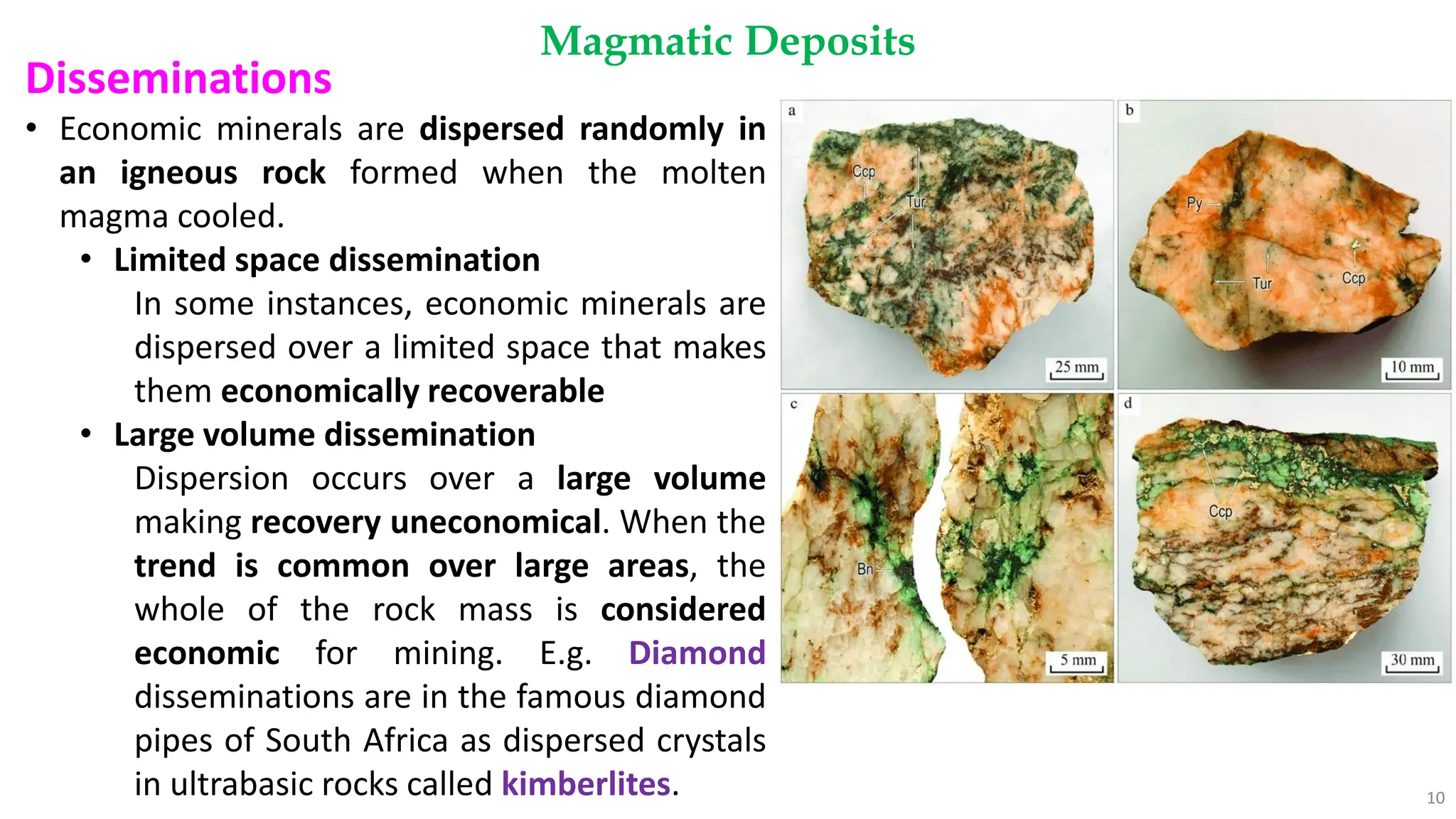
• Economicminerals are dispersed randomly in
an igneous rock formed when the molten
magma cooled.
• Limited space dissemination
In some instances, economic minerals are
dispersed over a limited space that makes
them economically recoverable
• Large volume dissemination
Dispersion occurs over a large volume
making recovery uneconomical. When the
trend is common over large areas, the
whole of the rock mass is considered
economic for mining. E.g. Diamond
disseminations are in the famous diamond
pipes of South Africa as dispersed crystals
in ultrabasic rocks called kimberlites.
11.
Magmatic Deposits
11
Magmatic Injections
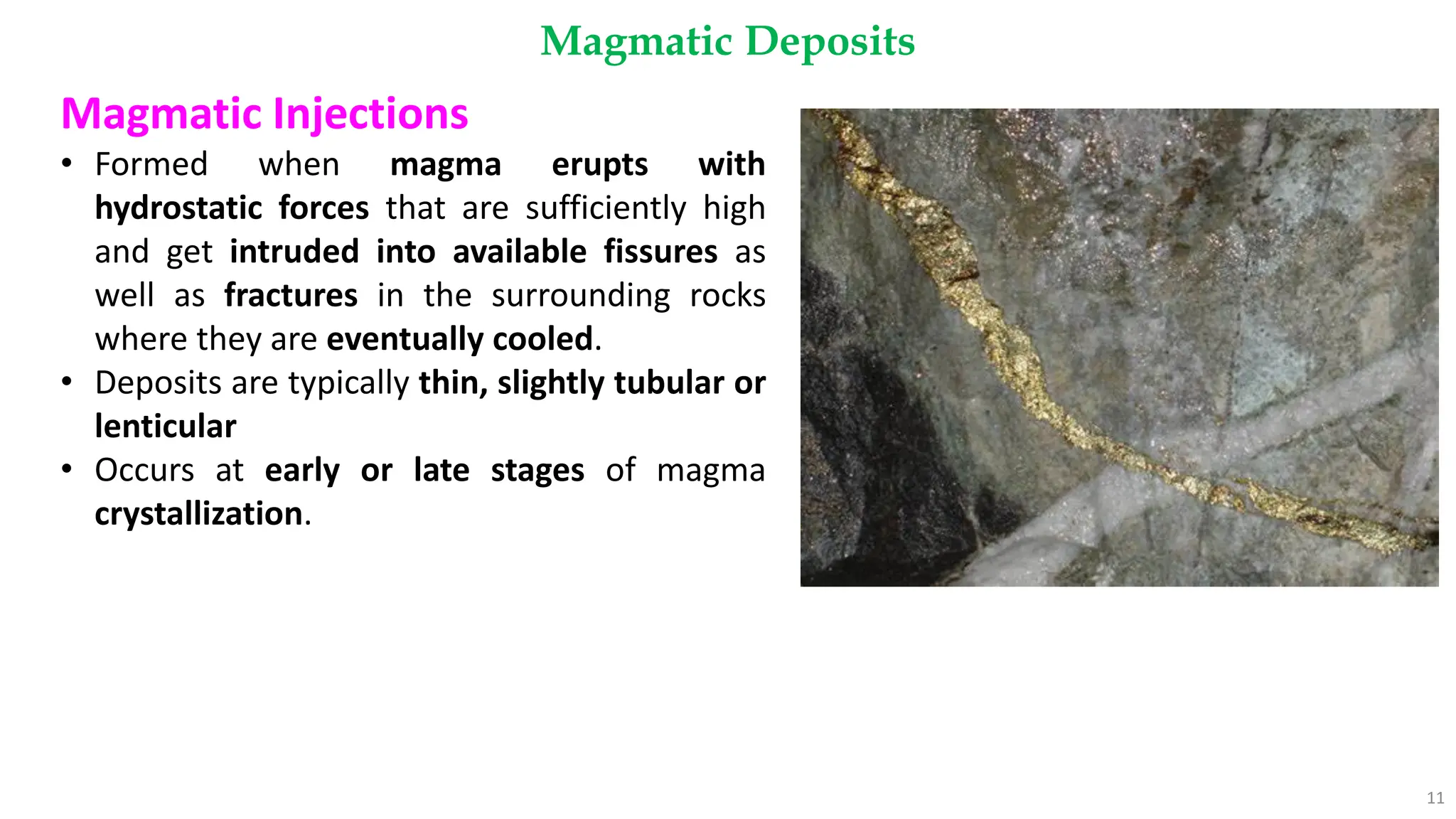
•Formed when magma erupts with
hydrostatic forces that are sufficiently high
and get intruded into available fissures as
well as fractures in the surrounding rocks
where they are eventually cooled.
• Deposits are typically thin, slightly tubular or
lenticular
• Occurs at early or late stages of magma
crystallization.
12.
Pegmatite Deposits
12
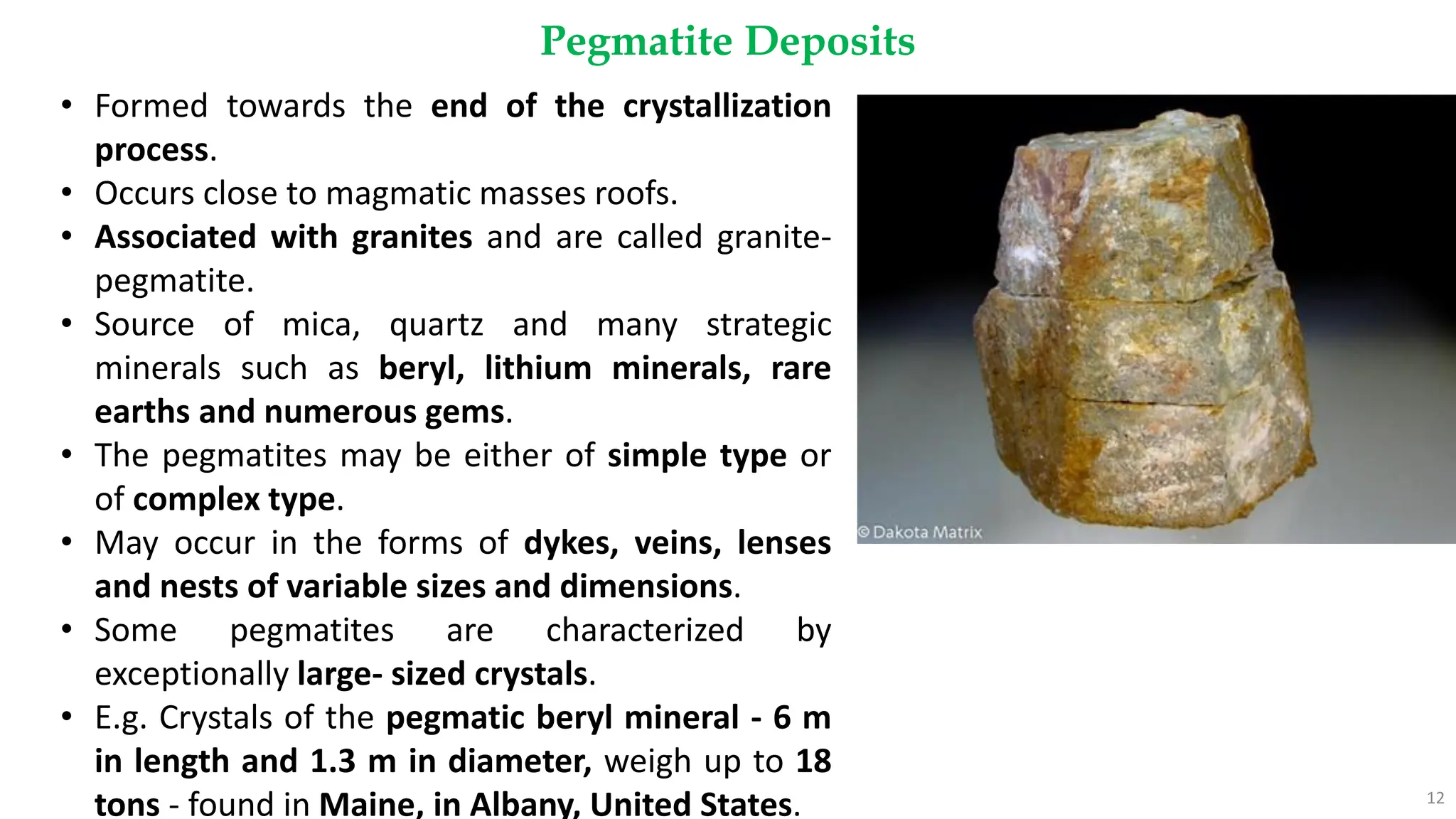
• Formedtowards the end of the crystallization
process.
• Occurs close to magmatic masses roofs.
• Associated with granites and are called granite-
pegmatite.
• Source of mica, quartz and many strategic
minerals such as beryl, lithium minerals, rare
earths and numerous gems.
• The pegmatites may be either of simple type or
of complex type.
• May occur in the forms of dykes, veins, lenses
and nests of variable sizes and dimensions.
• Some pegmatites are characterized by
exceptionally large- sized crystals.
• E.g. Crystals of the pegmatic beryl mineral - 6 m
in length and 1.3 m in diameter, weigh up to 18
tons - found in Maine, in Albany, United States.
13.
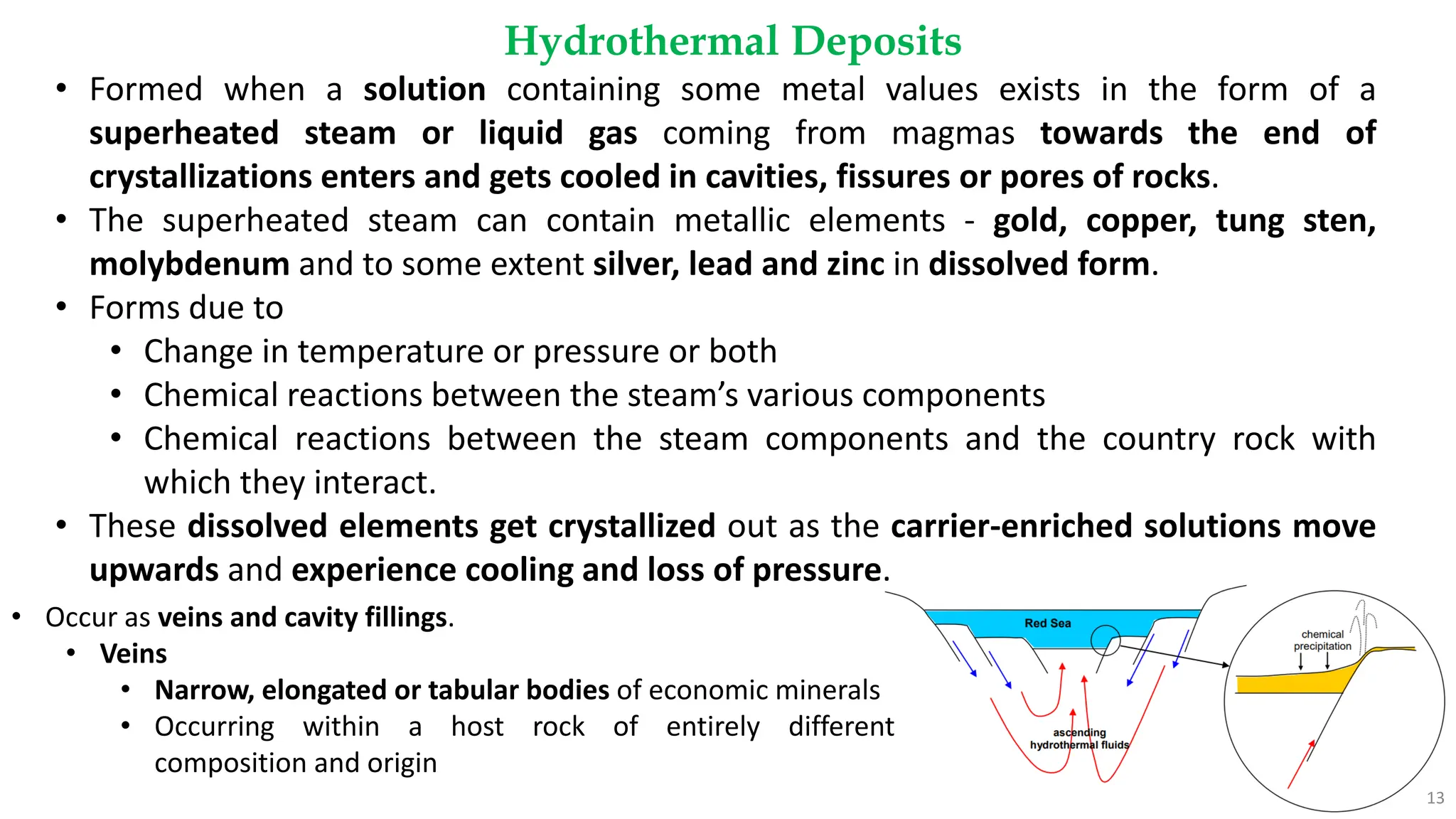
Hydrothermal Deposits
13
• Formedwhen a solution containing some metal values exists in the form of a
superheated steam or liquid gas coming from magmas towards the end of
crystallizations enters and gets cooled in cavities, fissures or pores of rocks.
• The superheated steam can contain metallic elements - gold, copper, tung sten,
molybdenum and to some extent silver, lead and zinc in dissolved form.
• Forms due to
• Change in temperature or pressure or both
• Chemical reactions between the steam’s various components
• Chemical reactions between the steam components and the country rock with
which they interact.
• These dissolved elements get crystallized out as the carrier-enriched solutions move
upwards and experience cooling and loss of pressure.
• Occur as veins and cavity fillings.
• Veins
• Narrow, elongated or tabular bodies of economic minerals
• Occurring within a host rock of entirely different
composition and origin
14.
Hydrothermal Deposits
14
• Metasomatic(replacement) deposits
• Formed from pure hydrothermal (magmatic) deposits
• Due to replacement of some original components by a new component in a solid
state change.
• Commonly formed in rocks of suitable composition which belong to the
carbonate group, that is, limestones and dolomites.
• Igneous rocks have also been found altered by the replacement (metasomatic)
process.
• They contain
• Metals like beryllium, caesium, lithium, niobium, rubidium, tantalum,
thorium, tin, tungsten and uranium
• Non-metals like quartz and fluorite
• Gemstones like amethyst, aquamarine, garnet and topaz.
• May be found as veins, lodes or zones.
• E.g. Porphyry copper-molybdenum deposit. The large magma volume that
formed the porphyritic copper bodies has its origin several kilometres below the
location of the deposit.
15.
Marine Hydrothermal Deposits
15
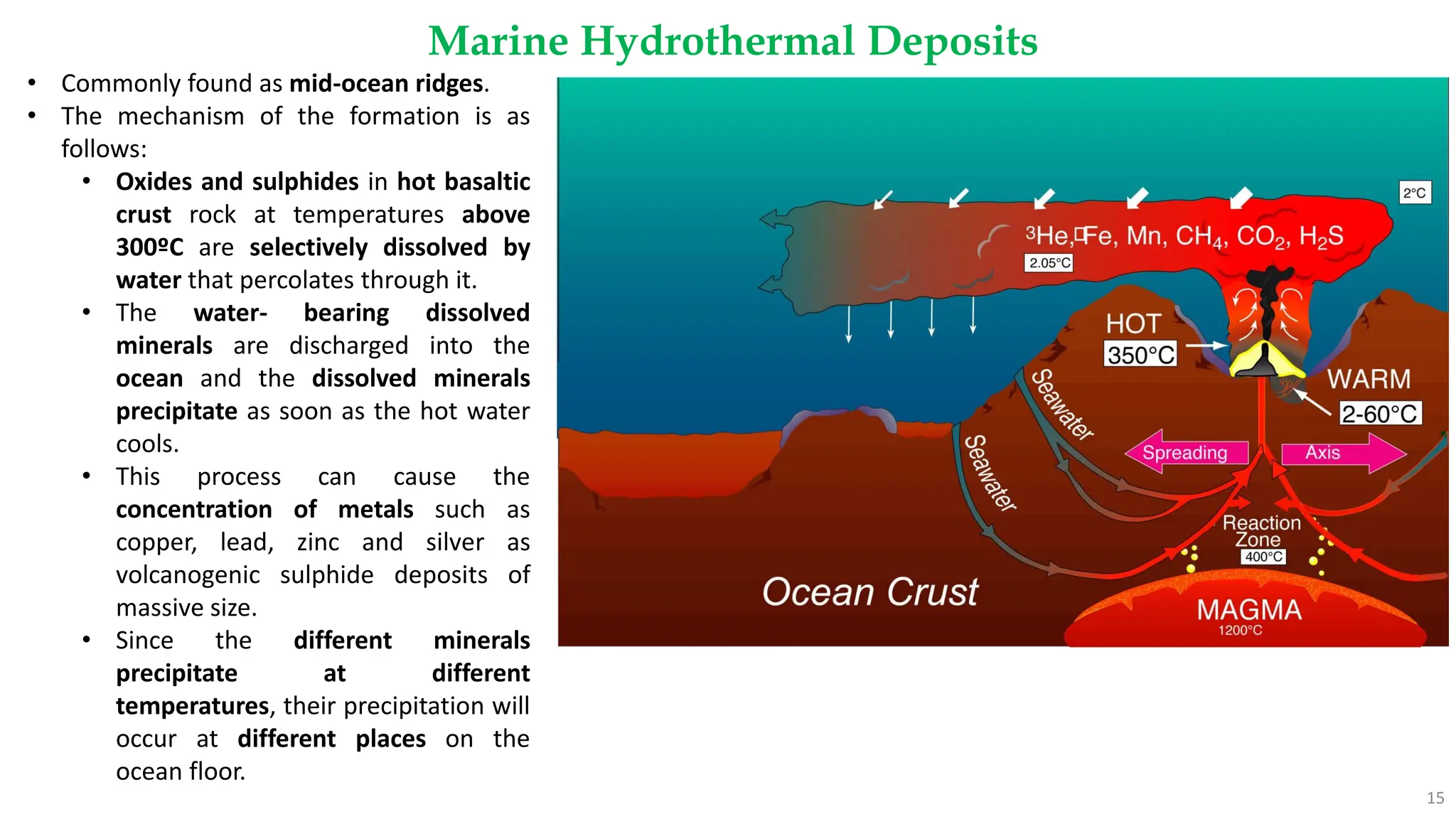
•Commonly found as mid-ocean ridges.
• The mechanism of the formation is as
follows:
• Oxides and sulphides in hot basaltic
crust rock at temperatures above
300ºC are selectively dissolved by
water that percolates through it.
• The water- bearing dissolved
minerals are discharged into the
ocean and the dissolved minerals
precipitate as soon as the hot water
cools.
• This process can cause the
concentration of metals such as
copper, lead, zinc and silver as
volcanogenic sulphide deposits of
massive size.
• Since the different minerals
precipitate at different
temperatures, their precipitation will
occur at different places on the
ocean floor.
16.
Sedimentary Deposits
16
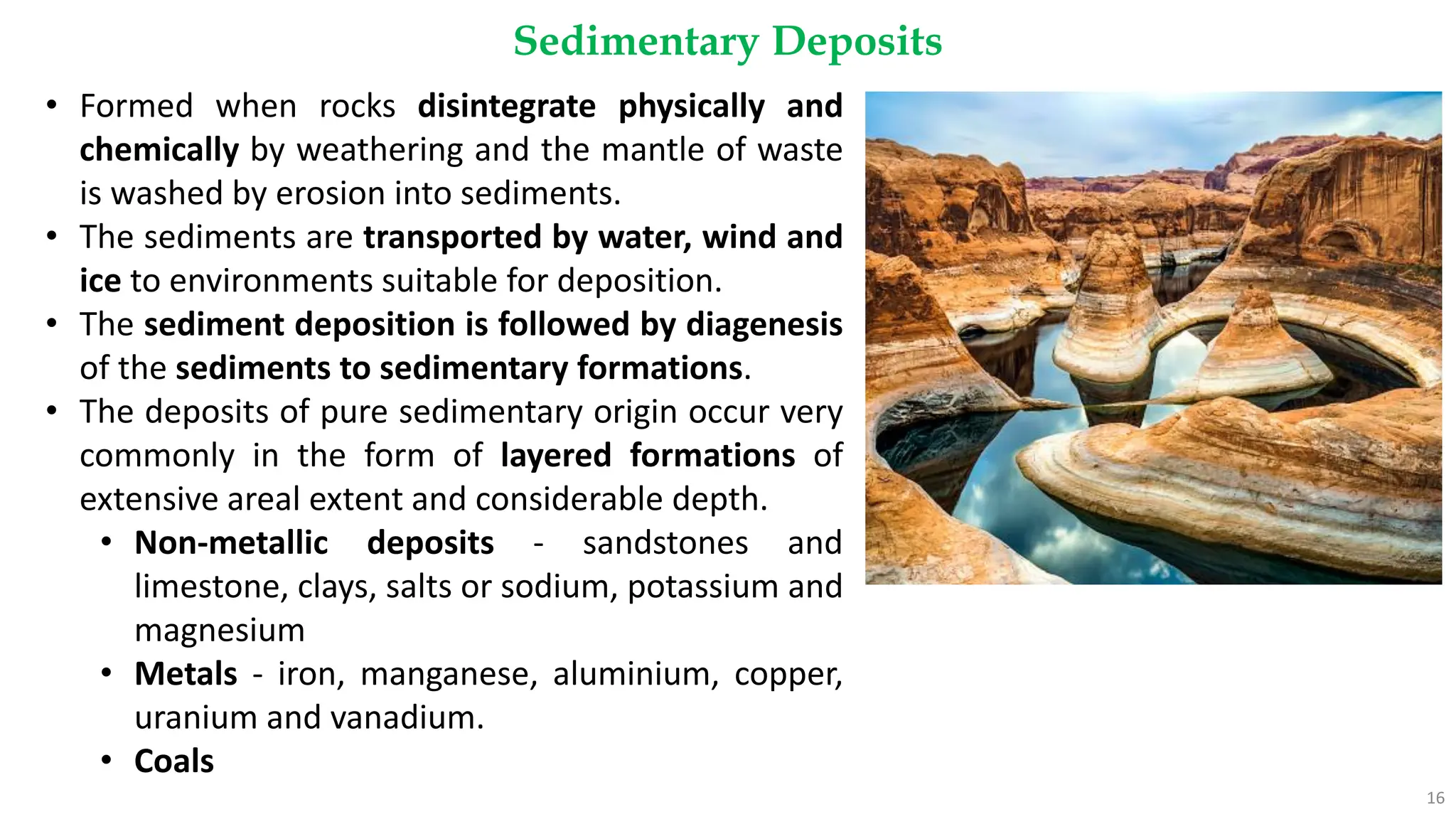
• Formedwhen rocks disintegrate physically and
chemically by weathering and the mantle of waste
is washed by erosion into sediments.
• The sediments are transported by water, wind and
ice to environments suitable for deposition.
• The sediment deposition is followed by diagenesis
of the sediments to sedimentary formations.
• The deposits of pure sedimentary origin occur very
commonly in the form of layered formations of
extensive areal extent and considerable depth.
• Non-metallic deposits - sandstones and
limestone, clays, salts or sodium, potassium and
magnesium
• Metals - iron, manganese, aluminium, copper,
uranium and vanadium.
• Coals
17.
Sedimentary Deposits
17
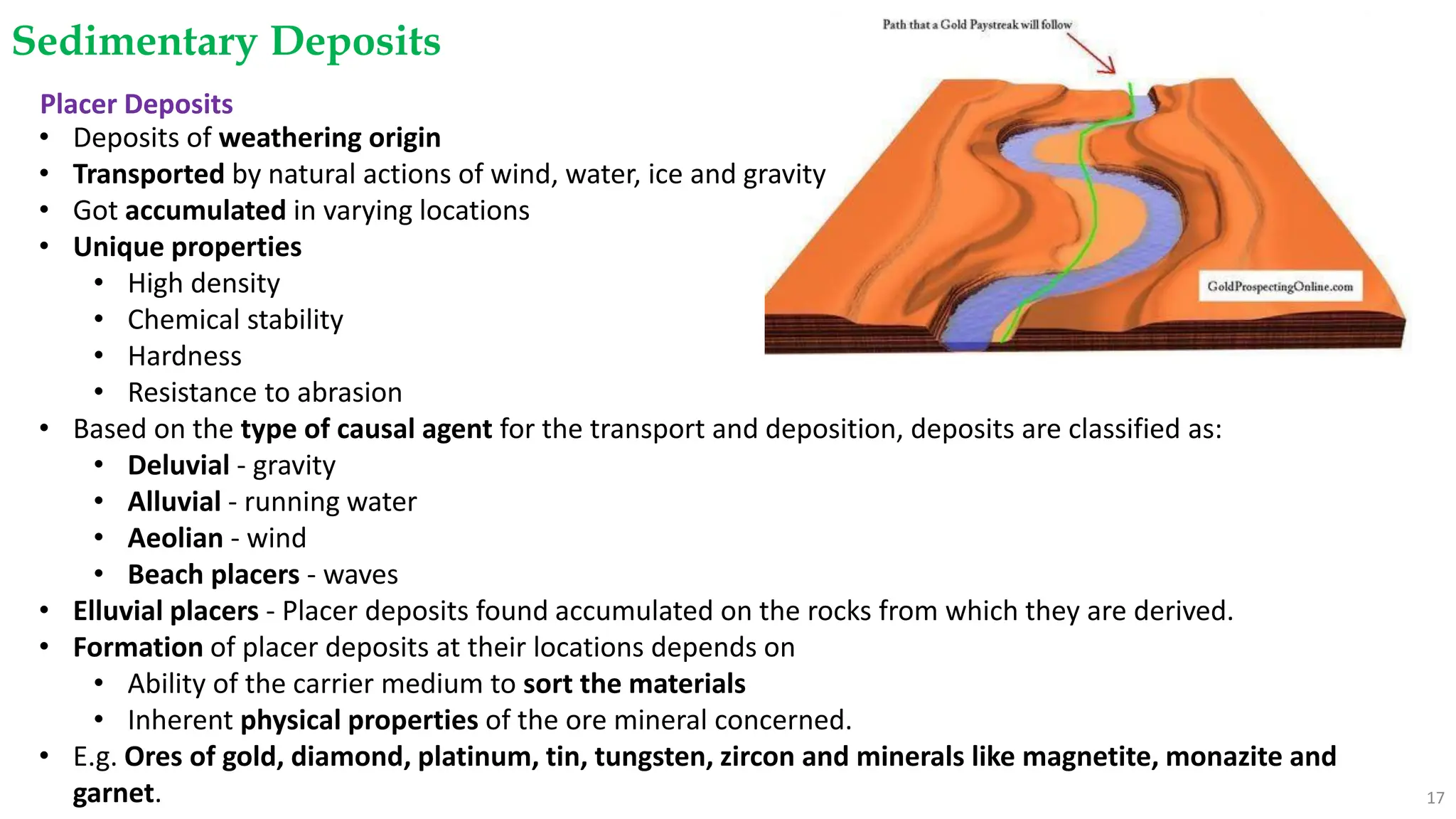
Placer Deposits
•Deposits of weathering origin
• Transported by natural actions of wind, water, ice and gravity
• Got accumulated in varying locations
• Unique properties
• High density
• Chemical stability
• Hardness
• Resistance to abrasion
• Based on the type of causal agent for the transport and deposition, deposits are classified as:
• Deluvial - gravity
• Alluvial - running water
• Aeolian - wind
• Beach placers - waves
• Elluvial placers - Placer deposits found accumulated on the rocks from which they are derived.
• Formation of placer deposits at their locations depends on
• Ability of the carrier medium to sort the materials
• Inherent physical properties of the ore mineral concerned.
• E.g. Ores of gold, diamond, platinum, tin, tungsten, zircon and minerals like magnetite, monazite and
garnet.
18.
Metamorphic Deposits
18
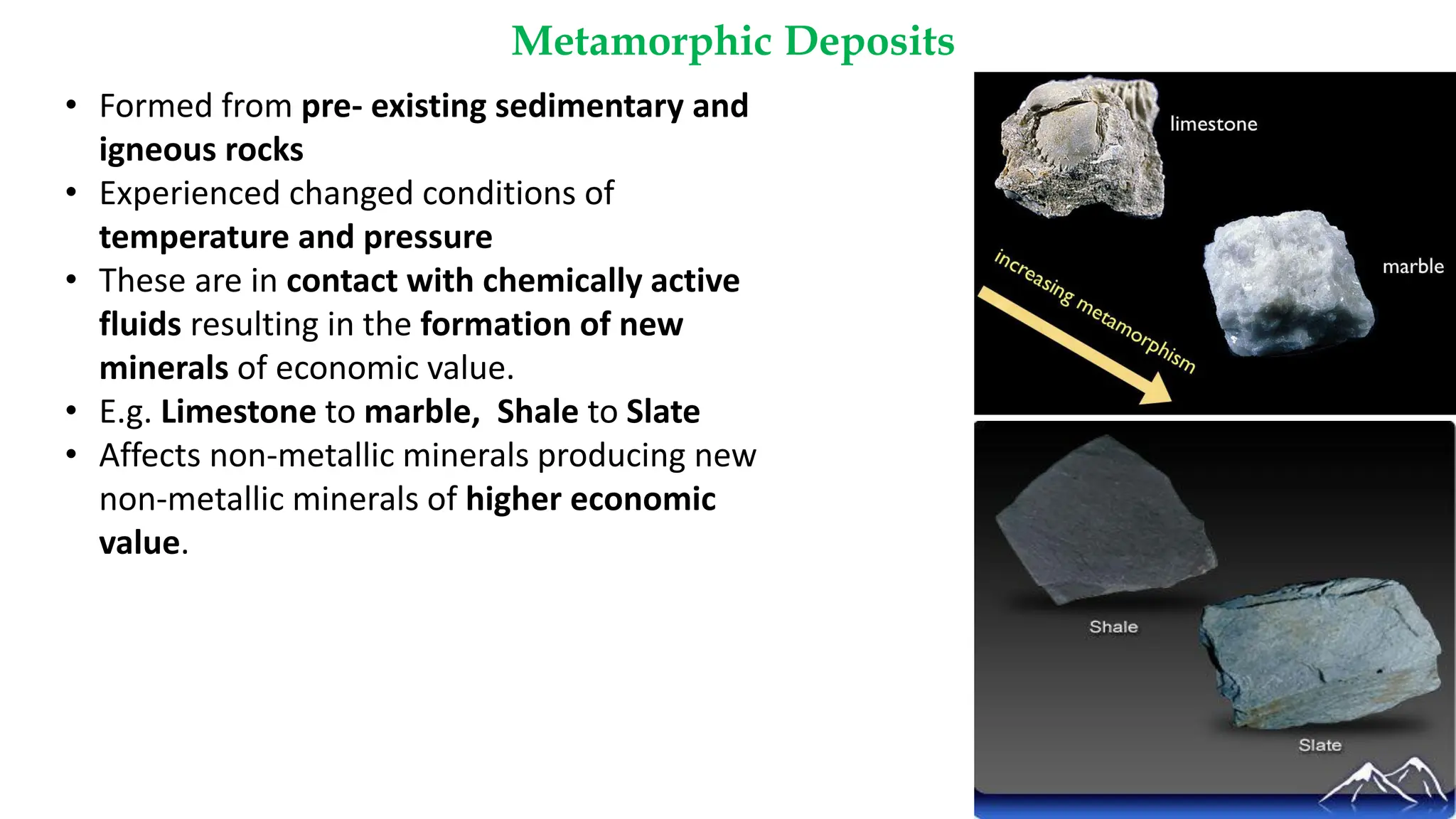
• Formedfrom pre- existing sedimentary and
igneous rocks
• Experienced changed conditions of
temperature and pressure
• These are in contact with chemically active
fluids resulting in the formation of new
minerals of economic value.
• E.g. Limestone to marble, Shale to Slate
• Affects non-metallic minerals producing new
non-metallic minerals of higher economic
value.