INTRODUCTION
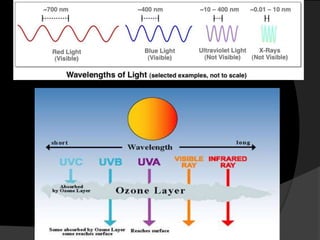
 Ultraviolet(UV) is an electromagnetic radiation with
wavelength from 10nm to 400 nm .shorter than that of
visible light but longer than X-ray.
 These rays are invisible to human eye.
 Natural source of UVR is Sun.
 Artificially can be produced by electric arcs & specialised
lights such as Mercury Vapour lamp,tanning lamp & black
lights.
 Long wavelength UV radiation can cause chemical
reaction & cause many substances to glow or flouresce.
 Also the Biological effect of UV are greater than simple
heating effect ,Hence many practical application of UV
radiation derive from it’s interaction with organic
molecules.
DISCOVERY
 “Ultraviolet” means “Beyond violet” (Latin-
ULTRA-BEYOND). It was discovered in
1801 by German Physicist Johann Wilhelm
Ritter & Vaccum UV (radiation below
200nm),strongly absorbed by air was
discovered by German Physicist Victor
Schumann in 1893
Subtypes
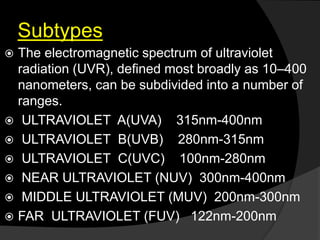
 The electromagnetic spectrum of ultraviolet
radiation (UVR), defined most broadly as 10–400
nanometers, can be subdivided into a number of
ranges.
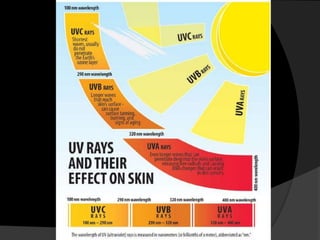
 ULTRAVIOLET A(UVA) 315nm-400nm
 ULTRAVIOLET B(UVB) 280nm-315nm
 ULTRAVIOLET C(UVC) 100nm-280nm
 NEAR ULTRAVIOLET (NUV) 300nm-400nm
 MIDDLE ULTRAVIOLET (MUV) 200nm-300nm
 FAR ULTRAVIOLET (FUV) 122nm-200nm
Solar ultraviolet
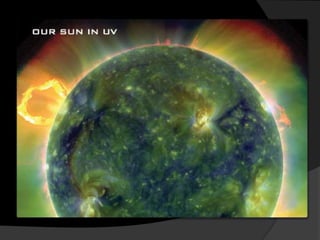
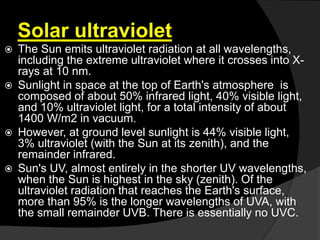
 The Sun emits ultraviolet radiation at all wavelengths,
including the extreme ultraviolet where it crosses into X-
rays at 10 nm.
 Sunlight in space at the top of Earth's atmosphere is
composed of about 50% infrared light, 40% visible light,
and 10% ultraviolet light, for a total intensity of about
1400 W/m2 in vacuum.
 However, at ground level sunlight is 44% visible light,
3% ultraviolet (with the Sun at its zenith), and the
remainder infrared.
 Sun's UV, almost entirely in the shorter UV wavelengths,
when the Sun is highest in the sky (zenith). Of the
ultraviolet radiation that reaches the Earth's surface,
more than 95% is the longer wavelengths of UVA, with
the small remainder UVB. There is essentially no UVC.
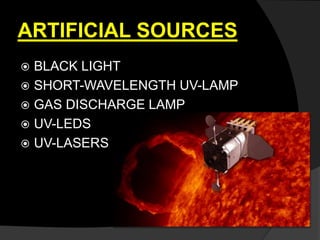
ARTIFICIAL SOURCES
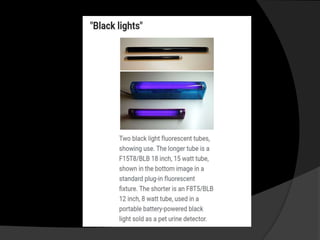
 BLACK LIGHT
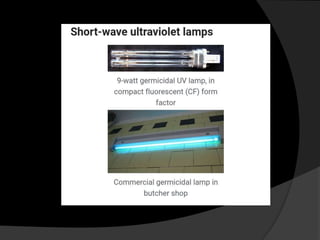
 SHORT-WAVELENGTH UV-LAMP
 GAS DISCHARGE LAMP
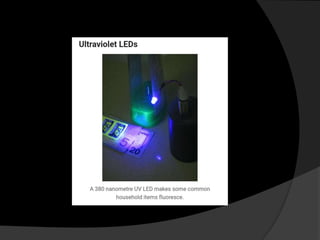
 UV-LEDS
 UV-LASERS
ULTRAVIOLET LIGHT FROM
STARS
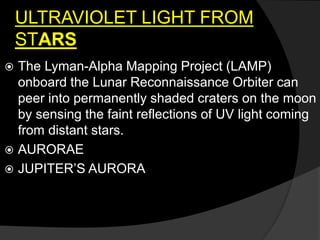
 The Lyman-Alpha Mapping Project (LAMP)
onboard the Lunar Reconnaissance Orbiter can
peer into permanently shaded craters on the moon
by sensing the faint reflections of UV light coming
from distant stars.
 AURORAE
 JUPITER’S AURORA
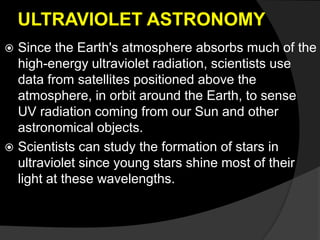
ULTRAVIOLET ASTRONOMY
 Since the Earth's atmosphere absorbs much of the
high-energy ultraviolet radiation, scientists use
data from satellites positioned above the
atmosphere, in orbit around the Earth, to sense
UV radiation coming from our Sun and other
astronomical objects.
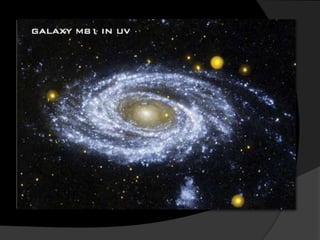
 Scientists can study the formation of stars in
ultraviolet since young stars shine most of their
light at these wavelengths.
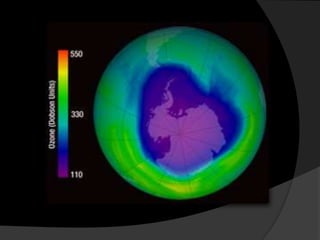
THE OZONE "HOLE"
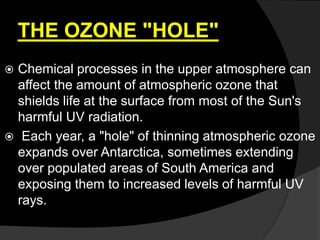
 Chemical processes in the upper atmosphere can
affect the amount of atmospheric ozone that
shields life at the surface from most of the Sun's
harmful UV radiation.
 Each year, a "hole" of thinning atmospheric ozone
expands over Antarctica, sometimes extending
over populated areas of South America and
exposing them to increased levels of harmful UV
rays.
WHY HUMAN EYE’S CAN’T PERCEIVE
UV?
 Because the lens of human eye blocks
most radiation in wavelength range of
300-400nm ,shorter wavelength are
blocked by Cornea.
 Neverthless,the photoreceptors of the
Retina are sensitive to near UV and
people lacking a lens,perceive near UV
as whitish blue or whitish Violet.
HARMFUL EFFECT & BENEFITS
OF UVR
 The impact of ultraviolet radiation on
human health has implications for the
risks and benefits of sun exposure, and
is also implicated in issues such as
fluorescent lamps and health.
 Getting too much sun exposure can be
harmful, but in moderation is beneficial
BENEFITS
 Production of vitamin D
 Improvement of mood
 Incresed energy
 Causes skin condition like Rickets,Vitiligo,Psoriasis
 Higher vitamin D tend to have lower rate of DIABATES,HEART
DISEASES,STROKES, & LOW BLOOD PRESSURE.
 Melanin is an excellent photoprotectant that
absorbs both UVB and UVA radiation and dissipates
the energy as harmless heat, protecting the skin
against both direct and indirect DNA damage.
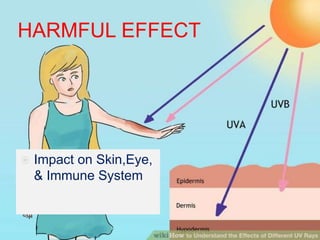
HARMFUL EFFECT
 Impact on Skin,Eye,
& Immune System
Applications
 Because of its ability to cause chemical reactions
and excite fluorescence in materials, ultraviolet
radiation has a number of applications as follows.
 Air purification
 Evolution of enzymes and proteins
 13.5 nm: Extreme ultraviolet lithography
 30–200 nm: Photoionization, ultraviolet photoelectron
spectroscopy,
 standard integrated circuit manufacture by photolithography
 230–365 nm: UVID,
 label tracking, barcodes
 230–400 nm: Optical sensors, various instrumentation
 240–280 nm: Disinfection, decontamination of surfaces and
water (DNA absorption has a peak at 260 nm)
 200–400 nm: Forensic analysis, drug detection
 270–360 nm: Protein analysis, DNA sequencing, drug
discovery
 280–400 nm: Medical imaging of cells
 300–320 nm: Light therapy in medicine
 300–365 nm: Curing of polymers and printer
Source: WIKIPEDIA
NASA science
Slideshare.net
images : Google,com

ULTRAVIOLET WAVES

  • 2.
    INTRODUCTION  Ultraviolet(UV) isan electromagnetic radiation with wavelength from 10nm to 400 nm .shorter than that of visible light but longer than X-ray.  These rays are invisible to human eye.  Natural source of UVR is Sun.  Artificially can be produced by electric arcs & specialised lights such as Mercury Vapour lamp,tanning lamp & black lights.  Long wavelength UV radiation can cause chemical reaction & cause many substances to glow or flouresce.  Also the Biological effect of UV are greater than simple heating effect ,Hence many practical application of UV radiation derive from it’s interaction with organic molecules.
  • 4.
    DISCOVERY  “Ultraviolet” means“Beyond violet” (Latin- ULTRA-BEYOND). It was discovered in 1801 by German Physicist Johann Wilhelm Ritter & Vaccum UV (radiation below 200nm),strongly absorbed by air was discovered by German Physicist Victor Schumann in 1893
  • 5.
    Subtypes  The electromagneticspectrum of ultraviolet radiation (UVR), defined most broadly as 10–400 nanometers, can be subdivided into a number of ranges.  ULTRAVIOLET A(UVA) 315nm-400nm  ULTRAVIOLET B(UVB) 280nm-315nm  ULTRAVIOLET C(UVC) 100nm-280nm  NEAR ULTRAVIOLET (NUV) 300nm-400nm  MIDDLE ULTRAVIOLET (MUV) 200nm-300nm  FAR ULTRAVIOLET (FUV) 122nm-200nm
  • 8.
    Solar ultraviolet  TheSun emits ultraviolet radiation at all wavelengths, including the extreme ultraviolet where it crosses into X- rays at 10 nm.  Sunlight in space at the top of Earth's atmosphere is composed of about 50% infrared light, 40% visible light, and 10% ultraviolet light, for a total intensity of about 1400 W/m2 in vacuum.  However, at ground level sunlight is 44% visible light, 3% ultraviolet (with the Sun at its zenith), and the remainder infrared.  Sun's UV, almost entirely in the shorter UV wavelengths, when the Sun is highest in the sky (zenith). Of the ultraviolet radiation that reaches the Earth's surface, more than 95% is the longer wavelengths of UVA, with the small remainder UVB. There is essentially no UVC.
  • 9.
    ARTIFICIAL SOURCES  BLACKLIGHT  SHORT-WAVELENGTH UV-LAMP  GAS DISCHARGE LAMP  UV-LEDS  UV-LASERS
  • 13.
    ULTRAVIOLET LIGHT FROM STARS The Lyman-Alpha Mapping Project (LAMP) onboard the Lunar Reconnaissance Orbiter can peer into permanently shaded craters on the moon by sensing the faint reflections of UV light coming from distant stars.  AURORAE  JUPITER’S AURORA
  • 14.
    ULTRAVIOLET ASTRONOMY  Sincethe Earth's atmosphere absorbs much of the high-energy ultraviolet radiation, scientists use data from satellites positioned above the atmosphere, in orbit around the Earth, to sense UV radiation coming from our Sun and other astronomical objects.  Scientists can study the formation of stars in ultraviolet since young stars shine most of their light at these wavelengths.
  • 16.
    THE OZONE "HOLE" Chemical processes in the upper atmosphere can affect the amount of atmospheric ozone that shields life at the surface from most of the Sun's harmful UV radiation.  Each year, a "hole" of thinning atmospheric ozone expands over Antarctica, sometimes extending over populated areas of South America and exposing them to increased levels of harmful UV rays.
  • 18.
    WHY HUMAN EYE’SCAN’T PERCEIVE UV?  Because the lens of human eye blocks most radiation in wavelength range of 300-400nm ,shorter wavelength are blocked by Cornea.  Neverthless,the photoreceptors of the Retina are sensitive to near UV and people lacking a lens,perceive near UV as whitish blue or whitish Violet.
  • 19.
    HARMFUL EFFECT &BENEFITS OF UVR  The impact of ultraviolet radiation on human health has implications for the risks and benefits of sun exposure, and is also implicated in issues such as fluorescent lamps and health.  Getting too much sun exposure can be harmful, but in moderation is beneficial
  • 20.
    BENEFITS  Production ofvitamin D  Improvement of mood  Incresed energy  Causes skin condition like Rickets,Vitiligo,Psoriasis  Higher vitamin D tend to have lower rate of DIABATES,HEART DISEASES,STROKES, & LOW BLOOD PRESSURE.  Melanin is an excellent photoprotectant that absorbs both UVB and UVA radiation and dissipates the energy as harmless heat, protecting the skin against both direct and indirect DNA damage.
  • 21.
    HARMFUL EFFECT  Impacton Skin,Eye, & Immune System
  • 22.
    Applications  Because ofits ability to cause chemical reactions and excite fluorescence in materials, ultraviolet radiation has a number of applications as follows.  Air purification  Evolution of enzymes and proteins
  • 23.
     13.5 nm:Extreme ultraviolet lithography  30–200 nm: Photoionization, ultraviolet photoelectron spectroscopy,  standard integrated circuit manufacture by photolithography  230–365 nm: UVID,  label tracking, barcodes  230–400 nm: Optical sensors, various instrumentation  240–280 nm: Disinfection, decontamination of surfaces and water (DNA absorption has a peak at 260 nm)  200–400 nm: Forensic analysis, drug detection  270–360 nm: Protein analysis, DNA sequencing, drug discovery  280–400 nm: Medical imaging of cells  300–320 nm: Light therapy in medicine  300–365 nm: Curing of polymers and printer
  • 24.