Space
Weathering
INTRODUCTION
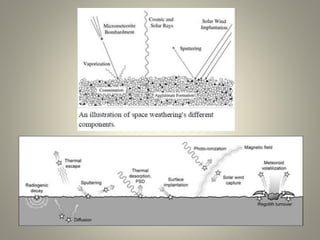
• Space weathering is the damage that occurs to any object
exposed to the harsh environment of outer space. Bodies
without atmospheres (including the Moon, Mercury, the
asteroids, comets, and most of the moons of other planets)
incur many weathering processes:
 Collisions of galactic cosmic rays and solar cosmic rays,
 irradiation, implantation, and sputtering from solar wind
particles, and
 bombardment by different sizes of meteorites and
micrometeorites.
• Space weathering is important because these processes affect
the physical and optical properties of the surface of many
planetary bodies.
• Therefore, it is critical to understand the effects of space
weathering in order to properly interpret remotely sensed
data.
HISTORY
• Much of our knowledge of the space weathering
process comes from studies of the lunar samples
returned by the Apollo program, particularly the lunar
soils.
• The first products of space weathering that were
recognized in lunar soils were "agglutinates".
• These are created when micrometeorites melt a small
amount of material, which incorporates surrounding
glass and mineral fragments into a glass-welded
aggregate ranging in size from a few micrometers to a
few millimeters.
• Space weathering also produces glass splashes;
implanted hydrogen, helium and other gases.
• Until the 1990s there were no improved instruments
Effects on spectral properties
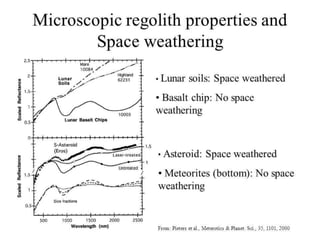
• On the Moon, the spectral effects of space weathering are
threefold: as the lunar surface matures it becomes darker
(the albedo is reduced), redder (reflectance increases with
increasing wavelength), and the depth of its diagnostic
absorption bands are reduced.
• The darkening effects of space weathering are readily seen
by studying lunar craters.
• Young, fresh craters have bright ray systems, because they
have exposed fresh, unweathered material, but over time
those rays disappear as the weathering process darkens the
material.
Space weathering on asteroids
• Space weathering is also thought to occur on
asteroids,though the environment is quite different
from the Moon.
• Impacts in the asteroid belt are slower, and therefore
create less melt and vapor.
• Also, fewer solar wind particles reach the asteroid belt.
• And finally, the higher rate of impactors and lower
gravity of the smaller bodies means that there is more
overturn and the surface exposure ages should be
younger than the lunar surface.
• Therefore, space weathering should occur more
slowly and to a lesser degree on the surfaces of
asteroids
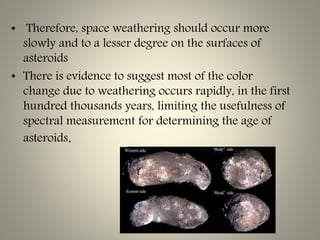
• There is evidence to suggest most of the color
change due to weathering occurs rapidly, in the first
hundred thousands years, limiting the usefulness of
spectral measurement for determining the age of
asteroids.
Space weathering on Mercury
• The environment at Mercury also differs
substantially from the Moon.
• For one thing, it is significantly hotter in the day
(diurnal surface temperature ~100 °C for the
Moon, ~425 °C on Mercury) and colder at night,
which may alter the products of space
weathering.
• In addition, because of its location in the Solar
System, Mercury is also subjected to a slightly
larger flux of micrometeorites that impact at
much higher velocities than the Moon.
• The UV/Vis spectrum of Mercury, as observed
telescopically from Earth, is roughly linear, with a
red slope.
• There are no absorption bands related to Fe-bearing
minerals, such as pyroxene.
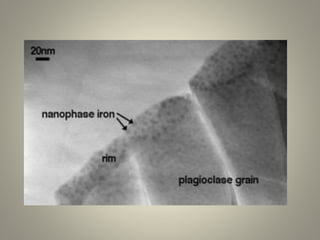
• This means that either there is no iron on the surface
of Mercury, or else the iron in the Febearing
minerals has been weathered to nanophase iron.
Presented By:-
Himadri Samal
M.Sc 1st Year
Reference: WIKIPEDIA
WEB
Presented by:
Himadri Samal
M.Sc 1st Year
Space
Weathering
FLOOD
MANAGEMENT
BY:
HIMADRI SAMAL
M.Sc Applied Geology
1st SEMESTER
Sambalpur University

SPACE WEATHERING

  • 1.
  • 2.
    INTRODUCTION • Space weatheringis the damage that occurs to any object exposed to the harsh environment of outer space. Bodies without atmospheres (including the Moon, Mercury, the asteroids, comets, and most of the moons of other planets) incur many weathering processes:  Collisions of galactic cosmic rays and solar cosmic rays,  irradiation, implantation, and sputtering from solar wind particles, and  bombardment by different sizes of meteorites and micrometeorites. • Space weathering is important because these processes affect the physical and optical properties of the surface of many planetary bodies. • Therefore, it is critical to understand the effects of space weathering in order to properly interpret remotely sensed data.
  • 3.
    HISTORY • Much ofour knowledge of the space weathering process comes from studies of the lunar samples returned by the Apollo program, particularly the lunar soils. • The first products of space weathering that were recognized in lunar soils were "agglutinates". • These are created when micrometeorites melt a small amount of material, which incorporates surrounding glass and mineral fragments into a glass-welded aggregate ranging in size from a few micrometers to a few millimeters. • Space weathering also produces glass splashes; implanted hydrogen, helium and other gases. • Until the 1990s there were no improved instruments
  • 5.
    Effects on spectralproperties • On the Moon, the spectral effects of space weathering are threefold: as the lunar surface matures it becomes darker (the albedo is reduced), redder (reflectance increases with increasing wavelength), and the depth of its diagnostic absorption bands are reduced. • The darkening effects of space weathering are readily seen by studying lunar craters. • Young, fresh craters have bright ray systems, because they have exposed fresh, unweathered material, but over time those rays disappear as the weathering process darkens the material.
  • 8.
    Space weathering onasteroids • Space weathering is also thought to occur on asteroids,though the environment is quite different from the Moon. • Impacts in the asteroid belt are slower, and therefore create less melt and vapor. • Also, fewer solar wind particles reach the asteroid belt. • And finally, the higher rate of impactors and lower gravity of the smaller bodies means that there is more overturn and the surface exposure ages should be younger than the lunar surface.
  • 9.
    • Therefore, spaceweathering should occur more slowly and to a lesser degree on the surfaces of asteroids • There is evidence to suggest most of the color change due to weathering occurs rapidly, in the first hundred thousands years, limiting the usefulness of spectral measurement for determining the age of asteroids.
  • 10.
    Space weathering onMercury • The environment at Mercury also differs substantially from the Moon. • For one thing, it is significantly hotter in the day (diurnal surface temperature ~100 °C for the Moon, ~425 °C on Mercury) and colder at night, which may alter the products of space weathering. • In addition, because of its location in the Solar System, Mercury is also subjected to a slightly larger flux of micrometeorites that impact at much higher velocities than the Moon.
  • 11.
    • The UV/Visspectrum of Mercury, as observed telescopically from Earth, is roughly linear, with a red slope. • There are no absorption bands related to Fe-bearing minerals, such as pyroxene. • This means that either there is no iron on the surface of Mercury, or else the iron in the Febearing minerals has been weathered to nanophase iron.
  • 12.
    Presented By:- Himadri Samal M.Sc1st Year Reference: WIKIPEDIA WEB Presented by: Himadri Samal M.Sc 1st Year Space Weathering FLOOD MANAGEMENT BY: HIMADRI SAMAL M.Sc Applied Geology 1st SEMESTER Sambalpur University