Evaluation question 1
                          In what ways does your media product use,
                         develop or challenge forms and conventions
                                             of real media products?

                    Film poster and magazine cover


Emily Moseley – A2 Evaluation
Film posters- what were their
                              conventions?
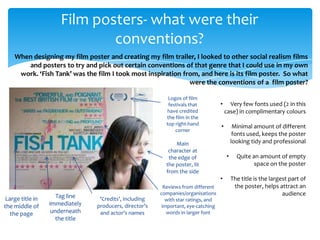
    When designing my film poster and creating my film trailer, I looked to other social realism films
       and posters to try and pick out certain conventions of that genre that I could use in my own
     work. ‘Fish Tank’ was the film I took most inspiration from, and here is its film poster. So what
                                                              were the conventions of a film poster?

                                                            Logos of film
                                                            festivals that           •     Very few fonts used (2 in this
                                                           have credited                 case) in complimentary colours
                                                           the film in the
                                                           top right-hand
                                                                                     •        Minimal amount of different
                                                               corner
                                                                                              fonts used, keeps the poster
                                                               Main                          looking tidy and professional
                                                            character at
                                                            the edge of                  •     Quite an amount of empty
                                                           the poster, lit                            space on the poster
                                                           from the side
                                                                                     •       The title is the largest part of
                                                           Reviews from different             the poster, helps attract an
                     Tag line                            companies/organisations                                   audience
 Large title in                   ‘Credits’, including      with star ratings, and
the middle of     immediately    producers, director’s    important, eye-catching
   the page        underneath     and actor’s names         words in larger font
                     the title
My film poster
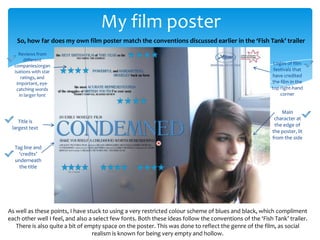
   So, how far does my own film poster match the conventions discussed earlier in the ‘Fish Tank’ trailer
    Reviews from
       different
  companies/organ                                                                                         Logos of film
  isations with star                                                                                      festivals that
     ratings, and                                                                                        have credited
   important, eye-                                                                                       the film in the
   catching words                                                                                        top right-hand
    in larger font                                                                                           corner


                                                                                                             Main
                                                                                                          character at
    Title is
                                                                                                          the edge of
 largest text
                                                                                                         the poster, lit
                                                                                                         from the side
  Tag line and
    ‘credits’
  underneath
    the title


As well as these points, I have stuck to using a very restricted colour scheme of blues and black, which compliment
each other well I feel, and also a select few fonts. Both these ideas follow the conventions of the ‘Fish Tank’ trailer.
   There is also quite a bit of empty space on the poster. This was done to reflect the genre of the film, as social
                                  realism is known for being very empty and hollow.
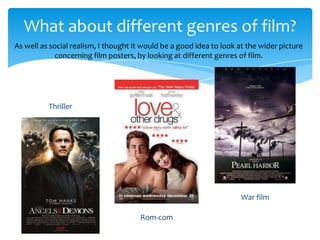
What about different genres of film?
As well as social realism, I thought it would be a good idea to look at the wider picture
            concerning film posters, by looking at different genres of film.


          Thriller


                                                                     War film

                                      Rom-com
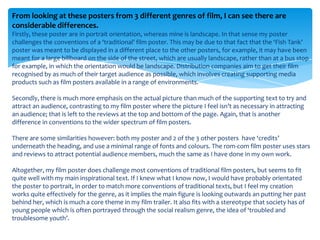
From looking at these posters from 3 different genres of film, I can see there are
considerable differences.
Firstly, these poster are in portrait orientation, whereas mine is landscape. In that sense my poster
challenges the conventions of a ‘traditional’ film poster. This may be due to that fact that the ‘Fish Tank’
poster was meant to be displayed in a different place to the other posters, for example, it may have been
meant for a large billboard on the side of the street, which are usually landscape, rather than at a bus stop
for example, in which the orientation would be landscape. Distribution companies aim to get their film
recognised by as much of their target audience as possible, which involves creating supporting media
products such as film posters available in a range of environments.

Secondly, there is much more emphasis on the actual picture than much of the supporting text to try and
attract an audience, contrasting to my film poster where the picture I feel isn’t as necessary in attracting
an audience; that is left to the reviews at the top and bottom of the page. Again, that is another
difference in conventions to the wider spectrum of film posters.

There are some similarities however: both my poster and 2 of the 3 other posters have ‘credits’
underneath the heading, and use a minimal range of fonts and colours. The rom-com film poster uses stars
and reviews to attract potential audience members, much the same as I have done in my own work.

Altogether, my film poster does challenge most conventions of traditional film posters, but seems to fit
quite well with my main inspirational text. If I knew what I know now, I would have probably orientated
the poster to portrait, in order to match more conventions of traditional texts, but I feel my creation
works quite effectively for the genre, as it implies the main figure is looking outwards an putting her past
behind her, which is much a core theme in my film trailer. It also fits with a stereotype that society has of
young people which is often portrayed through the social realism genre, the idea of ‘troubled and
troublesome youth’.
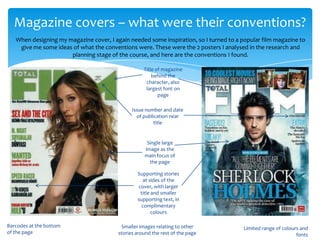
Magazine covers – what were their conventions?
   When designing my magazine cover, I again needed some inspiration, so I turned to a popular film magazine to
    give me some ideas of what the conventions were. These were the 2 posters I analysed in the research and
                      planning stage of the course, and here are the conventions I found.

                                                    Title of magazine
                                                        behind the
                                                     character, also
                                                     largest font on
                                                           page

                                               Issue number and date
                                                 of publication near
                                                         title


                                                     Single large
                                                    image as the
                                                    main focus of
                                                      the page

                                                 Supporting stories
                                                    at sides of the
                                                 cover, with larger
                                                  title and smaller
                                                 supporting text, in
                                                   complimentary
                                                        colours

Barcodes at the bottom                    Smaller images relating to other              Limited range of colours and
of the page                              stories around the rest of the page                                   fonts
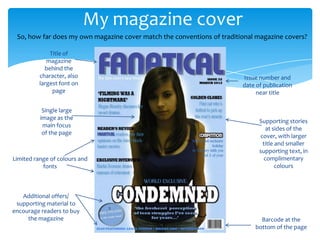
My magazine cover
 So, how far does my own magazine cover match the conventions of traditional magazine covers?

              Title of
             magazine
            behind the
          character, also                                               Issue number and
          largest font on                                               date of publication
               page                                                          near title

           Single large
          image as the
                                                                              Supporting stories
           main focus
                                                                                 at sides of the
           of the page
                                                                              cover, with larger
                                                                               title and smaller
                                                                              supporting text, in
Limited range of colours and                                                    complimentary
           fonts                                                                     colours


   Additional offers/
 supporting material to
encourage readers to buy
     the magazine                                                             Barcode at the
                                                                            bottom of the page
From comparing my magazine cover with that of published magazines, I
have noticed that it fits in particularly well with the conventions
discovered

From analysing the conventions of traditional media, I feel that I can confidently say that my
magazine cover fits in with these conventions quite comfortably. Technical conventions such as the
placement of certain objects on the page has been met, for example the large title of the magazine
behind the main character’s head, and the title of the film it is promoting in front of the character.

I have also used a limited range of colours and fonts. I stuck with a pale, dark blue and white colour
scheme, so that it was also correspond with my film poster, giving the two works continuity, and
hopefully this comes across.

The stories around the outside of the character are there to try and entice readers to buy the
magazine, which is why I added the ‘free stickers’ section in the bottom corner.

One convention I did miss out on however was the additional smaller photographs surrounding the
main image in the centre of the page. If I was to go back, this is something I would’ve definitely
added, to make my cover look more realistic.

Evaluation question-1

  • 1.
    Evaluation question 1 In what ways does your media product use, develop or challenge forms and conventions of real media products? Film poster and magazine cover Emily Moseley – A2 Evaluation
  • 2.
    Film posters- whatwere their conventions? When designing my film poster and creating my film trailer, I looked to other social realism films and posters to try and pick out certain conventions of that genre that I could use in my own work. ‘Fish Tank’ was the film I took most inspiration from, and here is its film poster. So what were the conventions of a film poster? Logos of film festivals that • Very few fonts used (2 in this have credited case) in complimentary colours the film in the top right-hand • Minimal amount of different corner fonts used, keeps the poster Main looking tidy and professional character at the edge of • Quite an amount of empty the poster, lit space on the poster from the side • The title is the largest part of Reviews from different the poster, helps attract an Tag line companies/organisations audience Large title in ‘Credits’, including with star ratings, and the middle of immediately producers, director’s important, eye-catching the page underneath and actor’s names words in larger font the title
  • 3.
    My film poster So, how far does my own film poster match the conventions discussed earlier in the ‘Fish Tank’ trailer Reviews from different companies/organ Logos of film isations with star festivals that ratings, and have credited important, eye- the film in the catching words top right-hand in larger font corner Main character at Title is the edge of largest text the poster, lit from the side Tag line and ‘credits’ underneath the title As well as these points, I have stuck to using a very restricted colour scheme of blues and black, which compliment each other well I feel, and also a select few fonts. Both these ideas follow the conventions of the ‘Fish Tank’ trailer. There is also quite a bit of empty space on the poster. This was done to reflect the genre of the film, as social realism is known for being very empty and hollow.
  • 4.
    What about differentgenres of film? As well as social realism, I thought it would be a good idea to look at the wider picture concerning film posters, by looking at different genres of film. Thriller War film Rom-com
  • 5.
    From looking atthese posters from 3 different genres of film, I can see there are considerable differences. Firstly, these poster are in portrait orientation, whereas mine is landscape. In that sense my poster challenges the conventions of a ‘traditional’ film poster. This may be due to that fact that the ‘Fish Tank’ poster was meant to be displayed in a different place to the other posters, for example, it may have been meant for a large billboard on the side of the street, which are usually landscape, rather than at a bus stop for example, in which the orientation would be landscape. Distribution companies aim to get their film recognised by as much of their target audience as possible, which involves creating supporting media products such as film posters available in a range of environments. Secondly, there is much more emphasis on the actual picture than much of the supporting text to try and attract an audience, contrasting to my film poster where the picture I feel isn’t as necessary in attracting an audience; that is left to the reviews at the top and bottom of the page. Again, that is another difference in conventions to the wider spectrum of film posters. There are some similarities however: both my poster and 2 of the 3 other posters have ‘credits’ underneath the heading, and use a minimal range of fonts and colours. The rom-com film poster uses stars and reviews to attract potential audience members, much the same as I have done in my own work. Altogether, my film poster does challenge most conventions of traditional film posters, but seems to fit quite well with my main inspirational text. If I knew what I know now, I would have probably orientated the poster to portrait, in order to match more conventions of traditional texts, but I feel my creation works quite effectively for the genre, as it implies the main figure is looking outwards an putting her past behind her, which is much a core theme in my film trailer. It also fits with a stereotype that society has of young people which is often portrayed through the social realism genre, the idea of ‘troubled and troublesome youth’.
  • 6.
    Magazine covers –what were their conventions? When designing my magazine cover, I again needed some inspiration, so I turned to a popular film magazine to give me some ideas of what the conventions were. These were the 2 posters I analysed in the research and planning stage of the course, and here are the conventions I found. Title of magazine behind the character, also largest font on page Issue number and date of publication near title Single large image as the main focus of the page Supporting stories at sides of the cover, with larger title and smaller supporting text, in complimentary colours Barcodes at the bottom Smaller images relating to other Limited range of colours and of the page stories around the rest of the page fonts
  • 7.
    My magazine cover So, how far does my own magazine cover match the conventions of traditional magazine covers? Title of magazine behind the character, also Issue number and largest font on date of publication page near title Single large image as the Supporting stories main focus at sides of the of the page cover, with larger title and smaller supporting text, in Limited range of colours and complimentary fonts colours Additional offers/ supporting material to encourage readers to buy the magazine Barcode at the bottom of the page
  • 8.
    From comparing mymagazine cover with that of published magazines, I have noticed that it fits in particularly well with the conventions discovered From analysing the conventions of traditional media, I feel that I can confidently say that my magazine cover fits in with these conventions quite comfortably. Technical conventions such as the placement of certain objects on the page has been met, for example the large title of the magazine behind the main character’s head, and the title of the film it is promoting in front of the character. I have also used a limited range of colours and fonts. I stuck with a pale, dark blue and white colour scheme, so that it was also correspond with my film poster, giving the two works continuity, and hopefully this comes across. The stories around the outside of the character are there to try and entice readers to buy the magazine, which is why I added the ‘free stickers’ section in the bottom corner. One convention I did miss out on however was the additional smaller photographs surrounding the main image in the centre of the page. If I was to go back, this is something I would’ve definitely added, to make my cover look more realistic.