In what ways does your media
product use, develop or challenge
forms and conventions of real
media products?
Beth Whitehead
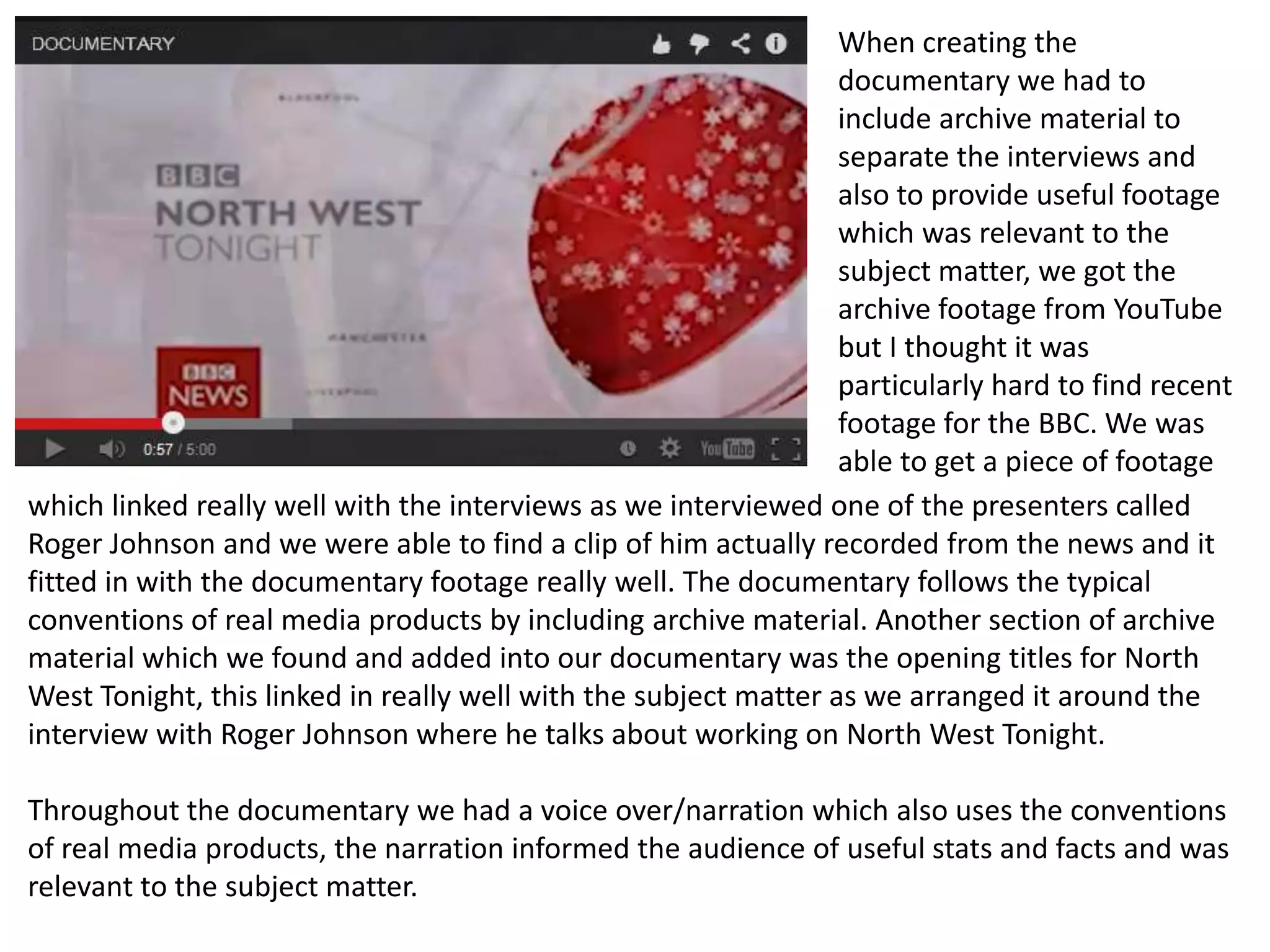
When creating the
documentary we had to
include archive material to
separate the interviews and
also to provide useful footage
which was relevant to the
subject matter, we got the
archive footage from YouTube
but I thought it was
particularly hard to find recent
footage for the BBC. We was
able to get a piece of footage
which linked really well with the interviews as we interviewed one of the presenters called
Roger Johnson and we were able to find a clip of him actually recorded from the news and it
fitted in with the documentary footage really well. The documentary follows the typical
conventions of real media products by including archive material. Another section of archive
material which we found and added into our documentary was the opening titles for North
West Tonight, this linked in really well with the subject matter as we arranged it around the
interview with Roger Johnson where he talks about working on North West Tonight.
Throughout the documentary we had a voice over/narration which also uses the conventions
of real media products, the narration informed the audience of useful stats and facts and was
relevant to the subject matter.
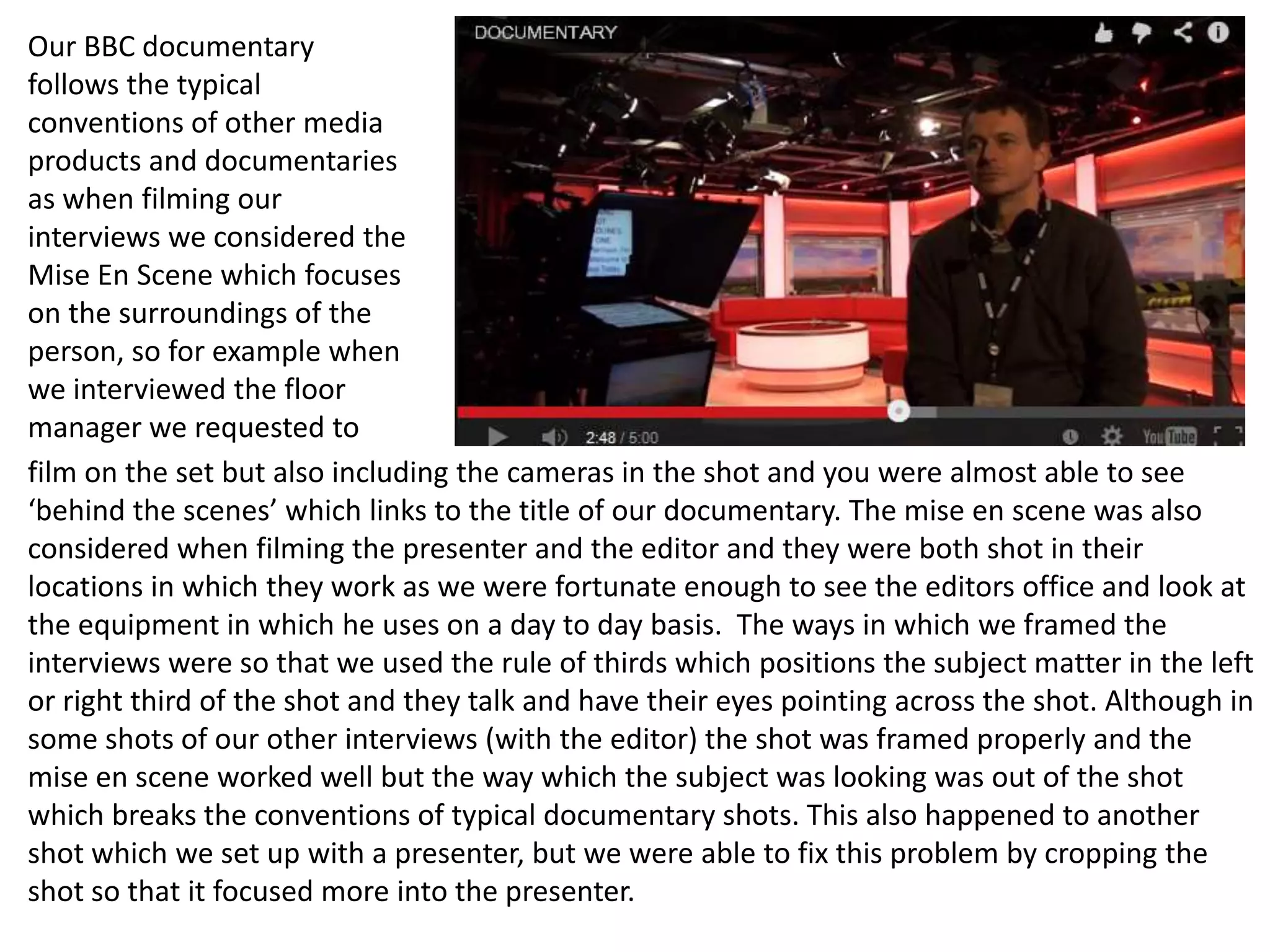
Our BBC documentary
follows the typical
conventions of other media
products and documentaries
as when filming our
interviews we considered the
Mise En Scene which focuses
on the surroundings of the
person, so for example when
we interviewed the floor
manager we requested to
film on the set but also including the cameras in the shot and you were almost able to see
‘behind the scenes’ which links to the title of our documentary. The mise en scene was also
considered when filming the presenter and the editor and they were both shot in their
locations in which they work as we were fortunate enough to see the editors office and look at
the equipment in which he uses on a day to day basis. The ways in which we framed the
interviews were so that we used the rule of thirds which positions the subject matter in the left
or right third of the shot and they talk and have their eyes pointing across the shot. Although in
some shots of our other interviews (with the editor) the shot was framed properly and the
mise en scene worked well but the way which the subject was looking was out of the shot
which breaks the conventions of typical documentary shots. This also happened to another
shot which we set up with a presenter, but we were able to fix this problem by cropping the
shot so that it focused more into the presenter.
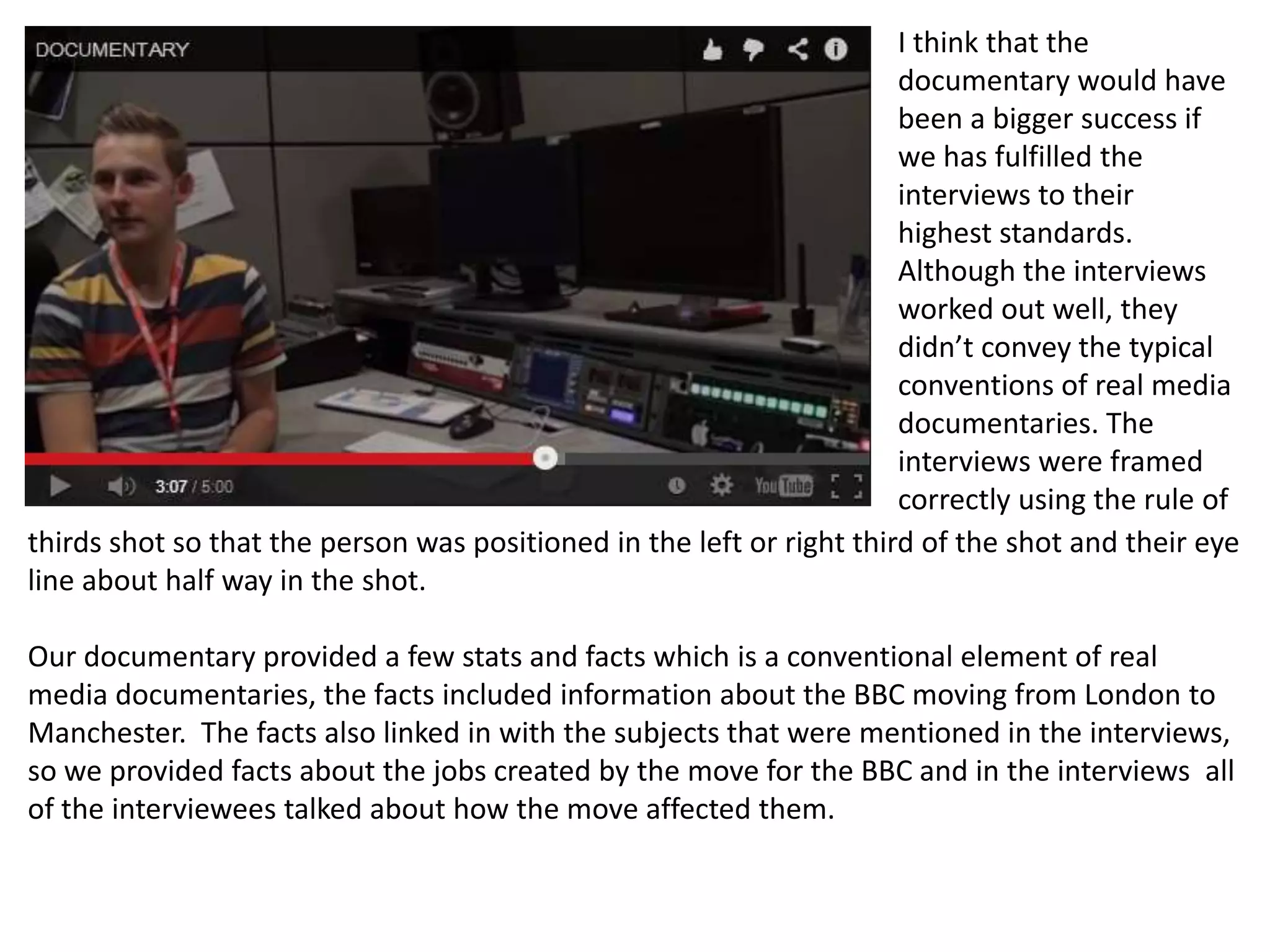
I think that the
documentary would have
been a bigger success if
we has fulfilled the
interviews to their
highest standards.
Although the interviews
worked out well, they
didn’t convey the typical
conventions of real media
documentaries. The
interviews were framed
correctly using the rule of
thirds shot so that the person was positioned in the left or right third of the shot and their eye
line about half way in the shot.
Our documentary provided a few stats and facts which is a conventional element of real
media documentaries, the facts included information about the BBC moving from London to
Manchester. The facts also linked in with the subjects that were mentioned in the interviews,
so we provided facts about the jobs created by the move for the BBC and in the interviews all
of the interviewees talked about how the move affected them.
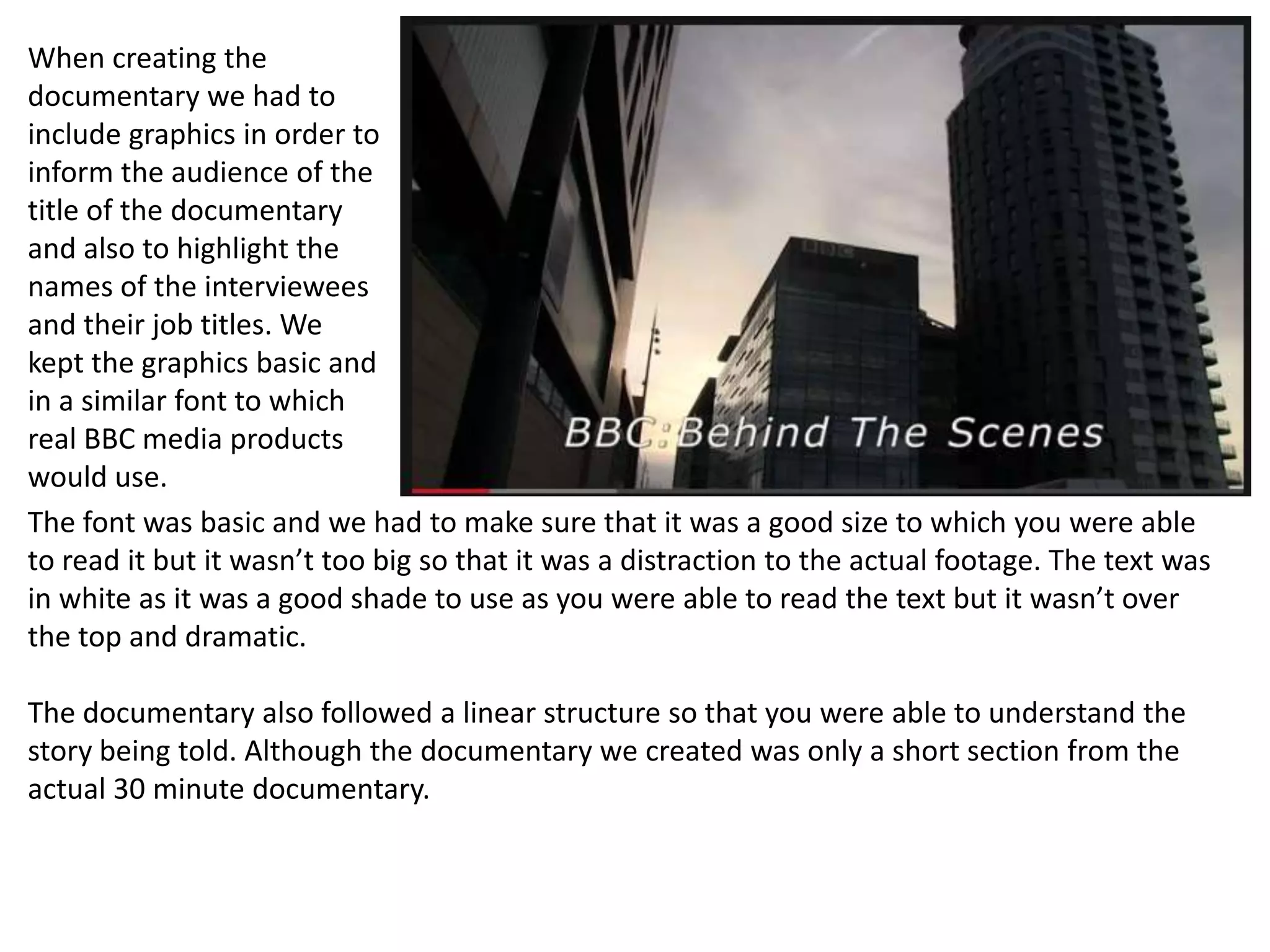
When creating the
documentary we had to
include graphics in order to
inform the audience of the
title of the documentary
and also to highlight the
names of the interviewees
and their job titles. We
kept the graphics basic and
in a similar font to which
real BBC media products
would use.
The font was basic and we had to make sure that it was a good size to which you were able
to read it but it wasn’t too big so that it was a distraction to the actual footage. The text was
in white as it was a good shade to use as you were able to read the text but it wasn’t over
the top and dramatic.
The documentary also followed a linear structure so that you were able to understand the
story being told. Although the documentary we created was only a short section from the
actual 30 minute documentary.

Evaluation question 1

  • 1.
    In what waysdoes your media product use, develop or challenge forms and conventions of real media products? Beth Whitehead
  • 2.
    When creating the documentarywe had to include archive material to separate the interviews and also to provide useful footage which was relevant to the subject matter, we got the archive footage from YouTube but I thought it was particularly hard to find recent footage for the BBC. We was able to get a piece of footage which linked really well with the interviews as we interviewed one of the presenters called Roger Johnson and we were able to find a clip of him actually recorded from the news and it fitted in with the documentary footage really well. The documentary follows the typical conventions of real media products by including archive material. Another section of archive material which we found and added into our documentary was the opening titles for North West Tonight, this linked in really well with the subject matter as we arranged it around the interview with Roger Johnson where he talks about working on North West Tonight. Throughout the documentary we had a voice over/narration which also uses the conventions of real media products, the narration informed the audience of useful stats and facts and was relevant to the subject matter.
  • 3.
    Our BBC documentary followsthe typical conventions of other media products and documentaries as when filming our interviews we considered the Mise En Scene which focuses on the surroundings of the person, so for example when we interviewed the floor manager we requested to film on the set but also including the cameras in the shot and you were almost able to see ‘behind the scenes’ which links to the title of our documentary. The mise en scene was also considered when filming the presenter and the editor and they were both shot in their locations in which they work as we were fortunate enough to see the editors office and look at the equipment in which he uses on a day to day basis. The ways in which we framed the interviews were so that we used the rule of thirds which positions the subject matter in the left or right third of the shot and they talk and have their eyes pointing across the shot. Although in some shots of our other interviews (with the editor) the shot was framed properly and the mise en scene worked well but the way which the subject was looking was out of the shot which breaks the conventions of typical documentary shots. This also happened to another shot which we set up with a presenter, but we were able to fix this problem by cropping the shot so that it focused more into the presenter.
  • 4.
    I think thatthe documentary would have been a bigger success if we has fulfilled the interviews to their highest standards. Although the interviews worked out well, they didn’t convey the typical conventions of real media documentaries. The interviews were framed correctly using the rule of thirds shot so that the person was positioned in the left or right third of the shot and their eye line about half way in the shot. Our documentary provided a few stats and facts which is a conventional element of real media documentaries, the facts included information about the BBC moving from London to Manchester. The facts also linked in with the subjects that were mentioned in the interviews, so we provided facts about the jobs created by the move for the BBC and in the interviews all of the interviewees talked about how the move affected them.
  • 5.
    When creating the documentarywe had to include graphics in order to inform the audience of the title of the documentary and also to highlight the names of the interviewees and their job titles. We kept the graphics basic and in a similar font to which real BBC media products would use. The font was basic and we had to make sure that it was a good size to which you were able to read it but it wasn’t too big so that it was a distraction to the actual footage. The text was in white as it was a good shade to use as you were able to read the text but it wasn’t over the top and dramatic. The documentary also followed a linear structure so that you were able to understand the story being told. Although the documentary we created was only a short section from the actual 30 minute documentary.