In What Ways does your media product
use, develop or challenge forms and
conventions of real media products?
Rachel Louise Jones
Documentary
The documentary does not challenge
any forms and conventions of real
media products as it had no need to
do this. However the documentary
follows most of the codes and
conventions that are necessary for
the documentary to be accurate and
to be at a good standard.
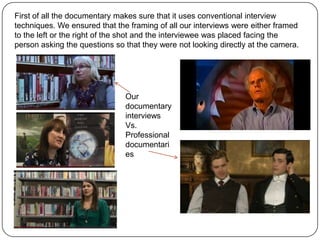
First of all the documentary makes sure that it uses conventional interview
techniques. We ensured that the framing of all our interviews were either framed
to the left or the right of the shot and the interviewee was placed facing the
person asking the questions so that they were not looking directly at the camera.

Our
documentary
interviews
Vs.
Professional
documentari
es
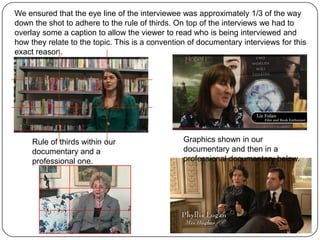
We ensured that the eye line of the interviewee was approximately 1/3 of the way
down the shot to adhere to the rule of thirds. On top of the interviews we had to
overlay some a caption to allow the viewer to read who is being interviewed and
how they relate to the topic. This is a convention of documentary interviews for this
exact reason.

Rule of thirds within our
documentary and a
professional one.

Graphics shown in our
documentary and then in a
professional documentary below.
During the interviews in our
documentary the interviewers
questions are never heard. To cover
up the sections where the questions
had been edited out, we used
cutaways and archive material to
cover the jump cuts that were
present between answers. This is
conventional because it prevents the
shots from jumping and makes the
running of the programme smooth
and effortless.
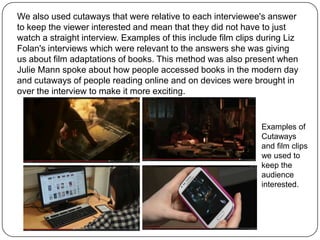
We also used cutaways that were relative to each interviewee's answer
to keep the viewer interested and mean that they did not have to just
watch a straight interview. Examples of this include film clips during Liz
Folan's interviews which were relevant to the answers she was giving
us about film adaptations of books. This method was also present when
Julie Mann spoke about how people accessed books in the modern day
and cutaways of people reading online and on devices were brought in
over the interview to make it more exciting.

Examples of
Cutaways
and film clips
we used to
keep the
audience
interested.
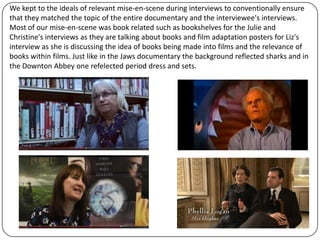
We kept to the ideals of relevant mise-en-scene during interviews to conventionally ensure
that they matched the topic of the entire documentary and the interviewee's interviews.
Most of our mise-en-scene was book related such as bookshelves for the Julie and
Christine's interviews as they are talking about books and film adaptation posters for Liz's
interview as she is discussing the idea of books being made into films and the relevance of
books within films. Just like in the Jaws documentary the background reflected sharks and in
the Downton Abbey one refelected period dress and sets.
Newspaper Advert
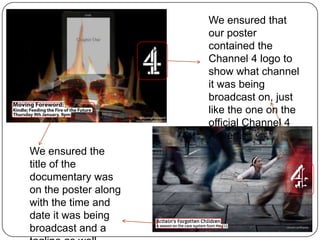
We ensured that
our poster
contained the
Channel 4 logo to
show what channel
it was being
broadcast on, just
like the one on the
official Channel 4
Advert.
We ensured the
title of the
documentary was
on the poster along
with the time and
date it was being
broadcast and a
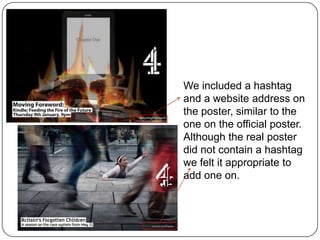
We included a hashtag
and a website address on
the poster, similar to the
one on the official poster.
Although the real poster
did not contain a hashtag
we felt it appropriate to
add one on.

Eval 1

  • 1.
    In What Waysdoes your media product use, develop or challenge forms and conventions of real media products? Rachel Louise Jones
  • 2.
  • 3.
    The documentary doesnot challenge any forms and conventions of real media products as it had no need to do this. However the documentary follows most of the codes and conventions that are necessary for the documentary to be accurate and to be at a good standard.
  • 4.
    First of allthe documentary makes sure that it uses conventional interview techniques. We ensured that the framing of all our interviews were either framed to the left or the right of the shot and the interviewee was placed facing the person asking the questions so that they were not looking directly at the camera. Our documentary interviews Vs. Professional documentari es
  • 5.
    We ensured thatthe eye line of the interviewee was approximately 1/3 of the way down the shot to adhere to the rule of thirds. On top of the interviews we had to overlay some a caption to allow the viewer to read who is being interviewed and how they relate to the topic. This is a convention of documentary interviews for this exact reason. Rule of thirds within our documentary and a professional one. Graphics shown in our documentary and then in a professional documentary below.
  • 6.
    During the interviewsin our documentary the interviewers questions are never heard. To cover up the sections where the questions had been edited out, we used cutaways and archive material to cover the jump cuts that were present between answers. This is conventional because it prevents the shots from jumping and makes the running of the programme smooth and effortless.
  • 7.
    We also usedcutaways that were relative to each interviewee's answer to keep the viewer interested and mean that they did not have to just watch a straight interview. Examples of this include film clips during Liz Folan's interviews which were relevant to the answers she was giving us about film adaptations of books. This method was also present when Julie Mann spoke about how people accessed books in the modern day and cutaways of people reading online and on devices were brought in over the interview to make it more exciting. Examples of Cutaways and film clips we used to keep the audience interested.
  • 8.
    We kept tothe ideals of relevant mise-en-scene during interviews to conventionally ensure that they matched the topic of the entire documentary and the interviewee's interviews. Most of our mise-en-scene was book related such as bookshelves for the Julie and Christine's interviews as they are talking about books and film adaptation posters for Liz's interview as she is discussing the idea of books being made into films and the relevance of books within films. Just like in the Jaws documentary the background reflected sharks and in the Downton Abbey one refelected period dress and sets.
  • 9.
  • 11.
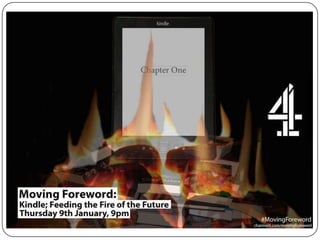
    We ensured that ourposter contained the Channel 4 logo to show what channel it was being broadcast on, just like the one on the official Channel 4 Advert. We ensured the title of the documentary was on the poster along with the time and date it was being broadcast and a
  • 12.
    We included ahashtag and a website address on the poster, similar to the one on the official poster. Although the real poster did not contain a hashtag we felt it appropriate to add one on.