Older
Americans
2012
Key Indicators of Well-Being
Federal Interagency Forum on Aging-Related Statistics
The Federal Interagency Forum on Aging-Related Statistics (Forum) was founded in 1986 to foster
collaboration among Federal agencies that produce or use statistical data on the older population. Forum
agencies as of June 2012 are listed below.
Department of Commerce	
U.S. Census Bureau
http://www.census.gov
Department of Health and Human Services
Administration on Aging
http://www.aoa.gov
Agency for Healthcare Research and Quality
http://www.ahrq.gov
Centers for Medicare and Medicaid Services
http://www.cms.hhs.gov
National Center for Health Statistics
http://www.cdc.gov/nchs
National Institute on Aging
http://www.nia.nih.gov
Office of the Assistant Secretary for Planning and
Evaluation
http://aspe.hhs.gov
Substance Abuse and Mental Health Services
Administration
http://www.samhsa.gov
Department of Housing and Urban
Development
http://www.hud.gov
Department of Labor
Bureau of Labor Statistics
http://www.bls.gov
Employee Benefits Security Administration
http://www.dol.gov/ebsa
Department of Veterans Affairs
http://www.va.gov
Environmental Protection Agency
http://www.epa.gov/
Office of Management and Budget
Office of Statistical and Science Policy
http://www.whitehouse.gov/omb/inforeg_statpolicy
Social Security Administration
Office of Research, Evaluation, and Statistics
http://www.ssa.gov
Copyright information: All material appearing in this report is in the public domain and may be reproduced or copied without permission; citation
as to source, however, is appreciated. Recommended citation: Federal Interagency Forum on Aging-Related Statistics. Older Americans 2012:
Key Indicators of Well-Being. Federal Interagency Forum on Aging-Related Statistics. Washington, DC: U.S. Government Printing Office.
June 2012. Report availability: Single copies of this report are available at no charge through the National Center for Health Statistics while
supplies last. Requests may be sent to the Information Dissemination Staff, National Center for Health Statistics, 3311 Toledo Road, Room 5412,
Hyattsville, MD 20782. Copies may also be ordered by calling 1-866-441-NCHS (6247) or by e-mailing nchsquery@cdc.gov. This report is also
available on the World Wide Web at http://www.agingstats.gov.
Older
Americans
2012
Key Indicators of Well-Being
ii
Foreword
Just last year, the oldest members of the “Baby
Boom” generation (that is, Americans born
between 1946 and 1964) turned 65. As has been
the case since the birth of this cohort, this very
large generation will bring important challenges
to the systems and institutions that support and
enhance American life. Although many Federal
agencies provide data on aspects of older
Americans’ lives, it can be difficult to fit the
pieces together. Thus, it has become increasingly
important for policymakers and the general public
to have an accessible, easy-to-understand portrait
of how older Americans fare.
Older Americans 2012: Key Indicators of Well-
Being (Older Americans 2012) provides a
comprehensive, easy-to-understand picture of
our older population’s health, finances, and
well-being. It is the sixth such chartbook
prepared by the Federal Interagency Forum on
Aging-Related Statistics (Forum). Readers will
find here an accessible compendium of indicators
drawn from the most reliable official statistics.
The indicators are again categorized into five
broad groups: population, economics, health
status, health risks and behaviors, and health
care. In addition, the report contains a special
feature on end-of-life care and place of death.
Many of the estimates reported in Older
Americans 2012 were collected in 2008 and 2009.
Thus, many of the indicators in this report reflect
the experience of older Americans during this
economically challenging time period. What has
yet to be reported here is the longer-term impact
of the recession and its financial disruptions. In
response, the Forum has initiated a closer look
at the earnings, savings, and income of older
Americans, particularly given recent changes
to retirement and pension plans. Those findings
will be shared in a future report.
Although Federal agencies currently collect and
report substantial information on the population
age 65 and over, other important gaps in our
knowledge remain. Two years ago, in Older
Americans 2010, the Forum identified six such
data need areas: caregiving, elder abuse, functioning
and disability, mental health, residential care, and
end of life. In Older Americans 2012, we provide
updated information on the status of data availability
for these specific areas, in addition to the end of
life special feature.
We continue to appreciate users’ requests for
greater detail for many existing indicators of
well-being. We also extend an invitation to all of
our readers and partners to let us know what else
we can do to make our reports and other products
more accessible and useful. Please send your
comments to agingforum@cdc.gov.
The Older Americans reports reflect the Forum’s
commitment to advancing our understanding
of where older Americans stand today and what
they may face tomorrow. I congratulate the
Forum agencies for joining together to present
the American people with such valuable tools
for understanding the well-being of the older
population. Last, but not least, none of this
work would be possible without the continued
cooperation of millions of American citizens
who willingly provide the data that are
summarized and analyzed by staff in the
Federal agencies for the American people.
Katherine K. Wallman
Chief Statistician
Office of Management and Budget
iii
Acknowledgments
Older Americans 2012: Key Indicators of Well-
Being is a report of the Federal Interagency
Forum on Aging-Related Statistics (Forum).
This report was prepared by the Forum’s
planning committee and reviewed by the Forum’s
principal members, which include John Wren,
Administration on Aging (AoA); Steven B.
Cohen, Agency for Healthcare Research and
Quality (AHRQ); Thomas Nardone, Bureau
of Labor Statistics (BLS); Howard Hogan and
Nancy Potok, U.S. Census Bureau; Thomas
Reilly, Centers for Medicare and Medicaid
Services (CMS); Raphael W. Bostic, Department
of Housing and Urban Development (HUD);
Joseph Piacentini, Employee Benefits Security
Administration (EBSA); Kathy Sykes,
Environmental Protection Agency (EPA); Edward
Sondik, National Center for Health Statistics
(NCHS); Richard Suzman, National Institute on
Aging (NIA); Ruth Katz, Office of the Assistant
Secretary for Planning and Evaluation (ASPE),
Department of Health and Human Services;
Katherine K. Wallman, Office of Management
and Budget (OMB); Daryl Kade, Substance
Abuse and Mental Health Services Administration
(SAMHSA); Manuel de la Puente, Social Security
Administration (SSA); and Dat Tran, Department
of Veterans Affairs (VA).
The following members of the Forum agencies
reviewed the chart book and provided valuable
guidance and assistance: Nancy Gordon, U.S.
Census Bureau; Jennifer Madans, NCHS; William
Marton, ASPE; John Haaga, NIA; Anja Decressin,
EBSA; and Susan Grad, SSA.
The Forum’s planning committee members
include Robert Hornyak, AoA; David Kashihara
and D.E.B. Potter, AHRQ; Emy Sok, BLS;
Amy Symens Smith and Samantha Cole, U.S.
Census Bureau; Gerald Riley, CMS; Meena
Bavan, HUD; Miranda Moore, Daniel Puskin
and Song Yi, EBSA; Kathy Sykes, EPA; Ellen
Kramarow and Julie Dawson Weeks, NCHS;
John Phillips, NIA; Helen Zayac Lamont, ASPE;
Jennifer Park and Rochelle Wilkie Martinez, OMB;
Ingrid Goldstrom, Beth Han, and Jennifer Solomon,
SAMHSA; Howard Iams, SSA; Jin Kim, VA; and
the Forum’s Staff Director, Traci Cook.
In addition to the 15 agencies of the Forum, the
Department of Agriculture (USDA) was invited
to contribute to this report. The Forum greatly
appreciates the efforts of Patricia Guenther,
Hazel Hiza, and Kellie O’Connell, Center for
Nutrition Policy and Promotion, USDA, in
providing valuable information from their agency.
Other staff members of Federal agencies who
provided data and assistance include Jennifer
Klocinski, AoA; Rachel Krantz-Kent and
Geoffrey Paulin, BLS; Deborah Kidd, Chris
McCormick, Maggie Murgolo, and Joseph Regan,
CMS; Ellen Baldridge and Rhonda Thompson,
EPA; Carolyn Lynch, HUD; Robin Cohen,
Nazik Elgaddal, Ginny Freid, and Cynthia L.
Ogden, NCHS; Vicky Cahan, NIA; Lynn Fisher,
SSA; and Peter Ahn, and Linda Bergofsky, VA.
The Forum is also indebted to the people outside
the Federal government who contributed to this
chart book: Gwen Fisher, Cathy Liebowitz, and
David Weir, University of Michigan; Xianfen Li,
Harris Corporation.
Member agencies of the Forum provided funds
and valuable staff time to produce this report.
NCHS and its contractor, American Institutes
for Research (AIR), facilitated the production,
printing, and dissemination of this report. Simone
Robers and Melissa Wentzel, AIR, managed
the report’s production process. Katie Mallory,
AIR-MacroSys, designed the layout and
supervised the overall presentation of the report;
Richard Devens, First XV Communications,
provided consultation and editing services.
Patricia L. Wilson, CDC, managed the printing
of the report.
iv
About This Report
Introduction
Older Americans 2012: Key Indicators of Well-
Being (Older Americans 2012) is the sixth in
a series of reports by the Federal Interagency
Forum on Aging-Related Statistics (Forum)
describing the overall condition of the U.S.
population age 65 and over. The reports use
data from over a dozen national data sources
to construct broad indicators of well-being for
the older population and to monitor changes in
these indicators over time. By following these
data trends, the reports make more information
available to target efforts to improve the lives
of older Americans.
The Forum hopes that this report will stimulate
discussions by policymakers and the public,
encourage exchanges between the data and
policy communities, and foster improvements
in Federal data collection on older Americans.
By examining a broad range of indicators,
researchers, policymakers, service providers,
and the Federal government can better understand
the areas of well-being that are improving for
older Americans and the areas of well-being
that require more attention and effort.
Structure of the Report
Older Americans 2012, by presenting data in a
nontechnical, user-friendly format, complements
other more technical and comprehensive
reports produced by the individual Forum
agencies. The report includes 37 indicators
that are grouped into five sections: Population,
Economics, Health Status, Health Risks and
Behaviors, and Health Care.
There is also a special feature on end-of-life
issues. A list of the indicators included in this
report is located in the Table of Contents.
Each indicator includes the following:
ƒƒ An introductory paragraph that describes the
relevance of the indicator to the well-being
of the older population.
ƒƒ One or more charts that graphically describes
important aspects of the data.
ƒƒ Bulleted highlights of salient findings from
the data and other sources.
The data used to develop the indicators are
presented in table format in the back matter of
the report. Data source descriptions and a glossary
are also provided in the back matter of the report.
Selection Criteria for Indicators
Older Americans 2012 presents 37 key indicators
of critical aspects of older people’s lives. The
Forum chose these indicators because they meet
the following criteria:
ƒƒ Easy to understand by a wide range of
audiences.
ƒƒ Based on reliable, nationwide data sponsored,
collected, or disseminated by the Federal
government.
ƒƒ Objectively based on substantial research that
connects the indicator to the well-being of
older Americans.
ƒƒ Balanced so that no single section dominates
the report.
ƒƒ Measured periodically (but not necessarily
annually) so that they can be updated as
appropriate and permit description of trends
over time.
ƒƒ Representative of large segments of the aging
population, rather than one particular group.
Considerations When Examining the
Indicators
The data in Older Americans 2012 usually
describe the U.S. population age 65 and over.
Mutually exclusive and exhaustive age groups
(e.g., age 65–74, 75–84, and 85 and over) are
reported whenever possible.
Data availability and analytical relevance may
affect the specific age groups that are included for
an indicator. For example, because of small sample
sizes in some surveys, statistically reliable data
for the population age 85 and over often are not
available. Conversely, data from the population
younger than age 65 sometimes are included if they
are relevant to the interpretation of the indicator.
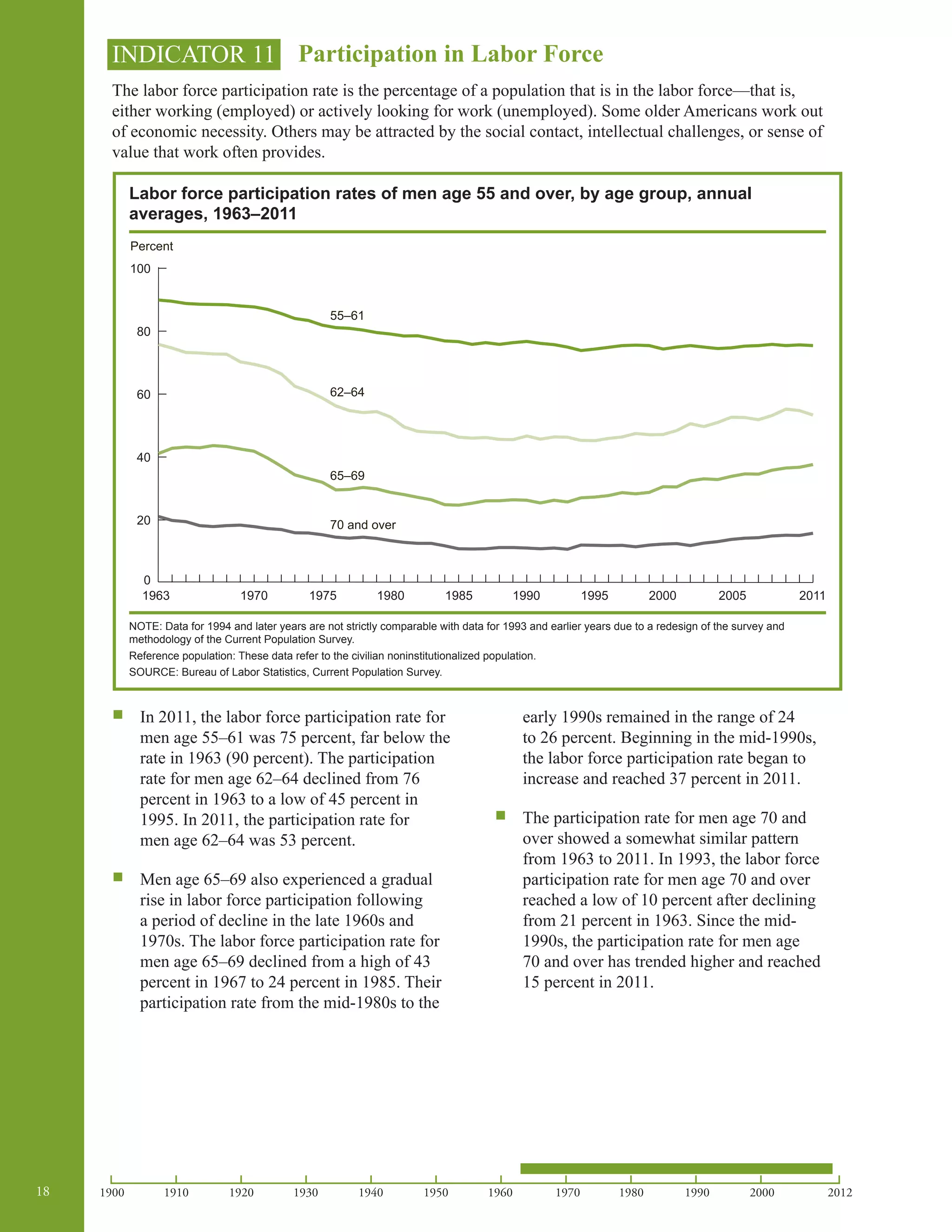
For example, in “Indicator 11: Participation in
the Labor Force,” a comparison with a younger
population enhances the interpretation of the labor
force trends among people age 65 and over.
v
To standardize the age distribution of the age
65 and over population across years, some
estimates have been age adjusted by multiplying
age-specific rates by time-constant weights. If an
indicator has been age adjusted, it will be stated
in the note under the chart(s) as well as under the
corresponding table(s).
The reference population (the base population
sampled at the time of data collection) for each
indicator is clearly labeled under each chart and
table and defined in the glossary. Whenever
possible, the indicators include data on the U.S.
resident population (both people living in the
community and people living in institutions).
However, some indicators show data only for
the civilian noninstitutionalized population.
Because the older population residing in nursing
homes (and other long-term care institutional
settings) is excluded from samples based on the
noninstitutionalized population, caution should
be exercised when attempting to generalize the
findings from these data sources to the entire
population age 65 and over. This is especially true
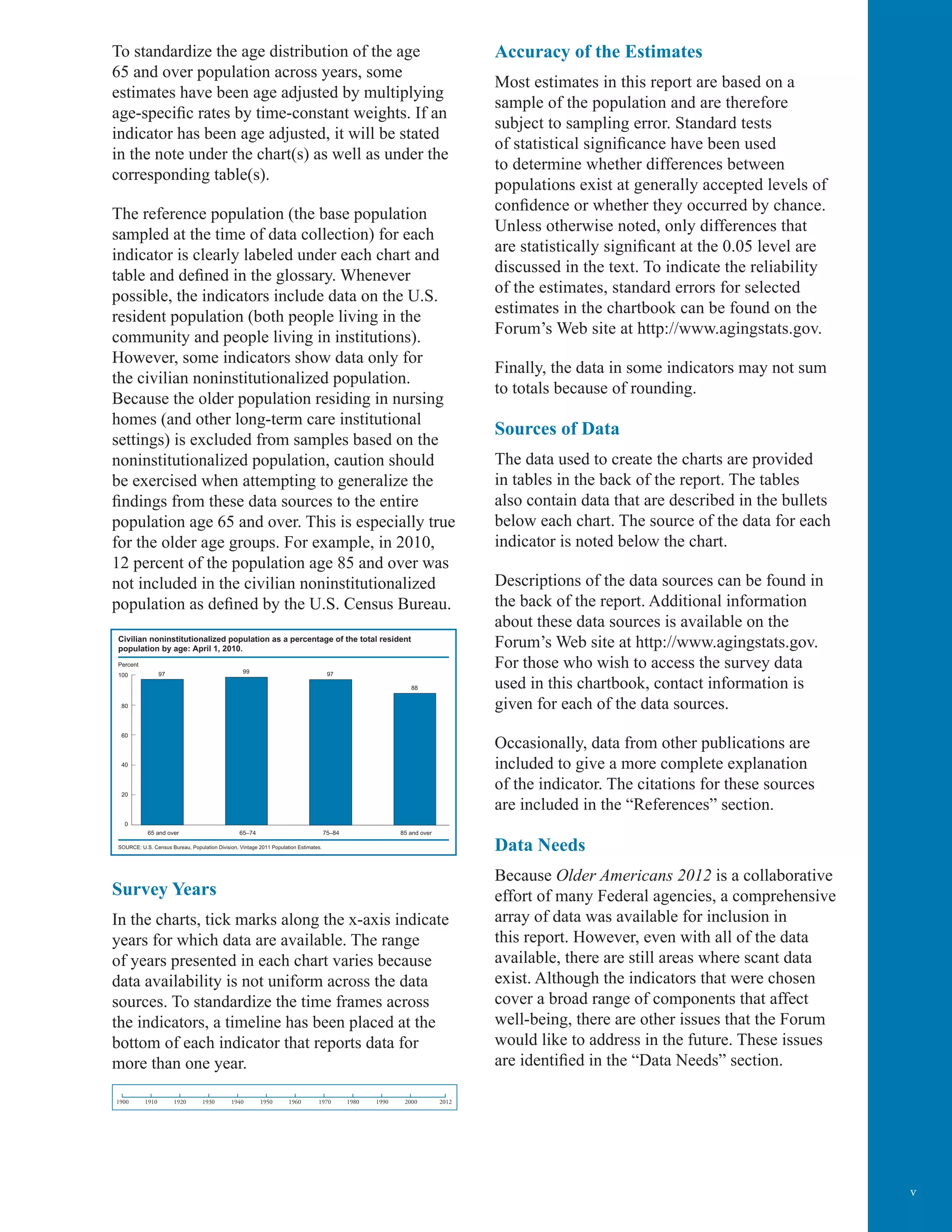
for the older age groups. For example, in 2010,
12 percent of the population age 85 and over was
not included in the civilian noninstitutionalized
population as defined by the U.S. Census Bureau.
100
Percent
80
60
40
20
0
65 and over 65–74 75–84 85 and over
97 99 97
88
SOURCE: U.S. Census Bureau, Population Division, Vintage 2011 Population Estimates.
Civilian noninstitutionalized population as a percentage of the total resident
population by age: April 1, 2010.
Survey Years
In the charts, tick marks along the x-axis indicate
years for which data are available. The range
of years presented in each chart varies because
data availability is not uniform across the data
sources. To standardize the time frames across
the indicators, a timeline has been placed at the
bottom of each indicator that reports data for
more than one year.
201220001990198019701960195019401930192019101900
Accuracy of the Estimates
Most estimates in this report are based on a
sample of the population and are therefore
subject to sampling error. Standard tests
of statistical significance have been used
to determine whether differences between
populations exist at generally accepted levels of
confidence or whether they occurred by chance.
Unless otherwise noted, only differences that
are statistically significant at the 0.05 level are
discussed in the text. To indicate the reliability
of the estimates, standard errors for selected
estimates in the chartbook can be found on the
Forum’s Web site at http://www.agingstats.gov.
Finally, the data in some indicators may not sum
to totals because of rounding.
Sources of Data
The data used to create the charts are provided
in tables in the back of the report. The tables
also contain data that are described in the bullets
below each chart. The source of the data for each
indicator is noted below the chart.
Descriptions of the data sources can be found in
the back of the report. Additional information
about these data sources is available on the
Forum’s Web site at http://www.agingstats.gov.
For those who wish to access the survey data
used in this chartbook, contact information is
given for each of the data sources.
Occasionally, data from other publications are
included to give a more complete explanation
of the indicator. The citations for these sources
are included in the “References” section.
Data Needs
Because Older Americans 2012 is a collaborative
effort of many Federal agencies, a comprehensive
array of data was available for inclusion in
this report. However, even with all of the data
available, there are still areas where scant data
exist. Although the indicators that were chosen
cover a broad range of components that affect
well-being, there are other issues that the Forum
would like to address in the future. These issues
are identified in the “Data Needs” section.
vi
Mission
The Forum’s mission is to encourage cooperation
and collaboration among Federal agencies to
improve the quality and utility of data on the
aging population.
The specific goals of the Forum are:
ƒƒ Widening access to information on the aging
population through periodic publications and
other means.
ƒƒ Promoting communication among data
producers, researchers, and public policy-
makers.
ƒƒ Coordinating the development and use of
statistical databases among Federal agencies.
ƒƒ Identifying information gaps and data
inconsistencies.
ƒƒ Investigating questions of data quality.
ƒƒ Encouraging cross-national research and
data collection on the aging population.
ƒƒ Addressing concerns regarding collection,
access, and dissemination of data.
More Information
If you would like more information about Older
Americans 2012 or other Forum activities,
contact:
Traci Cook
Staff Director
Federal Interagency Forum on Aging-Related
Statistics
3311 Toledo Road, Room 7108
Hyattsville, MD 20782
Phone: (301) 458-4082
Fax: (301) 458-4021
E-mail: agingforum@cdc.gov
Web site: http://www.agingstats.gov
Older Americans on the Internet
Supporting material for this report can be found at
http://www.agingstats.gov. The Web site contains
the following:
ƒƒ Data for all of the indicators in Excel
spreadsheets (with standard errors, when
available).
ƒƒ Data source descriptions.
ƒƒ PowerPoint slides of the charts.
The Forum’s Web site also provides:
ƒƒ Ongoing Federal data resources relevant
to the study of the aging.
ƒƒ Links to aging-related statistical information
on Forum member Web sites.
ƒƒ Other Forum publications (including Data
Sources on Older Americans 2009).
ƒƒ Workshop presentations, papers, and reports.
ƒƒ Agency contacts.
ƒƒ Subject area contact list for Federal statistics.
ƒƒ Information about the Forum.
Additional Online Resources
Administration on Aging
Statistics on the Aging Population
http://www.aoa.gov/AoARoot/Aging_Statistics/
index.aspx
A Profile of Older Americans
http://www.aoa.gov/AoARoot/Aging_Statistics/
Profile/index.aspx
Online Statistical Data on the Aging
http://www.aoa.gov/AoARoot/Aging_Statistics/
Census_Population/census1990/Introduction.aspx
Agency for Healthcare Research and Quality
AHRQ Data and Surveys
http://www.ahrq.gov/data
Bureau of Labor Statistics
Bureau of Labor Statistics Data
http://www.stats.bls.gov/data
U.S. Census Bureau
Statistical Abstract of the United States
http://www.census.gov/compendia/statab
Age Data
http://www.census.gov/population/www/
socdemo/age.html
vii
Longitudinal Employer-Household Dynamics
http://lehd.did.census.gov/led/
Centers for Medicare and Medicaid Services
CMS Research, Statistics, Data, and Systems
http://www.cms.hhs.gov/Research-Statistics-
Data-and-Systems/Research-Statistics-Data-and-
Systems.html
Department of Housing and Urban
Development
Policy Development and Research Information
Services
http://www.huduser.org/
Department of Veterans Affairs
Veteran Data and Information
http://www1.va.gov/vetdata
Employee Benefit Security Administration
EBSA’s Research
http://www.dol.gov/ebsa/publications/research.
html
Environmental Protection Agency
Aging Initiative
http://www.epa.gov/aging
Information Resources
http://www.epa.gov/aging/resources/index.htm
National Center for Health Statistics
Health Data Interactive
http://www.cdc.gov/nchs/hdi.htm
Longitudinal Studies of Aging
http://www.cdc.gov/nchs/lsoa.htm
Health, United States
http://www.cdc.gov/nchs/hus.htm
National Institute on Aging
NIA Centers on the Demography of Aging
http://www.agingcenters.org/
National Archive of Computerized Data on Aging
http://www.icpsr.umich.edu/NACDA
Publicly Available Datasets for Aging-Related
Secondary Analysis
http://www.nia.nih.gov/researchinformation/
scientificresources
Office of the Assistant Secretary for Planning
and Evaluation, HHS
Office of Disability, Aging, and Long-Term Care
Policy
http://www.aspe.hhs.gov/_/office_specific/daltcp.
cfm
Office of Management and Budget
Federal Committee on Statistical Methodology
http://www.fcsm.gov
Social Security Administration
Social Security Administration Statistical
Information
http://www.ssa.gov/policy
Substance Abuse and Mental Health Services
Administration
Center for Behavioral Health Statistics and Quality
http://www.samhsa.gov/data
Center for Mental Health Services
http://www.mentalhealth.samhsa.gov/cmhs/
MentalHealthStatistics
Other Resources
FedStats.gov
http://www.fedstats.gov
viii
ix
Table of Contents
Foreword..........................................................................................................................................................................................ii
Acknowledgments.........................................................................................................................................................................iii
About This Report.........................................................................................................................................................................iv
List of Tables.................................................................................................................................................................................... x
Highlights...................................................................................................................................................................................... xv
Population
Indicator 1. Number of Older Americans ....................................................................................................................... 2
Indicator 2. Racial and Ethnic Composition................................................................................................................... 4
Indicator 3. Marital Status ................................................................................................................................................. 5
Indicator 4. Educational Attainment................................................................................................................................ 6
Indicator 5. Living Arrangements
Indicator 6. Older Veterans
.................................................................................................................................... 8
.............................................................................................................................................10
Economics
Indicator 7. Poverty ..........................................................................................................................................................12
Indicator 8. Income...........................................................................................................................................................13
Indicator 9. Sources of Income........................................................................................................................................14
Indicator 10. Net Worth...................................................................................................................................................16
Indicator 11. Participation in Labor Force.....................................................................................................................18
Indicator 12. Total Expenditures.....................................................................................................................................20
Indicator 13. Housing Problems......................................................................................................................................21
Health Status
Indicator 14. Life Expectancy...........................................................................................................................................24
Indicator 15. Mortality.....................................................................................................................................................26
Indicator 16. Chronic Health Conditions.......................................................................................................................27
Indicator 17. Sensory Impairments and Oral Health...................................................................................................28
Indicator 18. Respondent-Assessed Health Status........................................................................................................29
Indicator 19. Depressive Symptoms................................................................................................................................30
Indicator 20. Functional Limitations..............................................................................................................................32
Health Risks and Behaviors
Indicator 21. Vaccinations................................................................................................................................................36
Indicator 22. Mammography...........................................................................................................................................37
Indicator 23. Diet Quality.................................................................................................................................................38
Indicator 24. Physical Activity ........................................................................................................................................40
Indicator 25. Obesity.........................................................................................................................................................41
Indicator 26. Cigarette Smoking......................................................................................................................................43
Indicator 27. Air Quality...................................................................................................................................................44
Indicator 28. Use of Time.................................................................................................................................................46
Health Care
Indicator 29. Use of Health Care Services......................................................................................................................50
Indicator 30. Health Care Expenditures.........................................................................................................................52
Indicator 31. Prescription Drugs.....................................................................................................................................54
Indicator 32. Sources of Health Insurance.....................................................................................................................56
Indicator 33. Out-of-Pocket Health Care Expenditures...............................................................................................57
Indicator 34. Sources of Payment for Health Care Services.........................................................................................58
Indicator 35. Veterans’ Health Care.................................................................................................................................59
Indicator 36. Residential Services....................................................................................................................................60
Indicator 37. Personal Assistance and Equipment........................................................................................................62
Special Feature
End of Life...........................................................................................................................................................................66
Data Needs....................................................................................................................................................................................71
References......................................................................................................................................................................................75
Tables..............................................................................................................................................................................................81
Data Sources................................................................................................................................................................................155
Glossary.......................................................................................................................................................................................167
x
List of Tables
Population
Indicator 1. Number of Older Americans
Table 1a. Number of people age 65 and over and age 85 and over, selected years 1900–2010 and
projected 2020–2050....................................................................................................................................................................82
Table 1b. Percentage of people age 65 and over and age 85 and over from the 2010 Census and
projected 2020–2050....................................................................................................................................................................82
Table 1c. Population of countries or areas with at least 10 percent of their population age 65 and over, 2010...............83
Table 1d. Percentage of the population age 65 and over, by state, 2010...............................................................................85
Table 1e. Percentage of the population age 65 and over, by county, 2010.............................................................................86
Table 1f. Number and percentage of people age 65 and over and age 85 and over, by sex, 2010......................................86
Indicator 2. Racial and Ethnic Composition
Table 2. Population age 65 and over, by race and Hispanic origin, 2010 and projected 2050............................................86
Indicator 3. Marital Status
Table 3. Marital status of the population age 65 and over, by age group and sex, 2010......................................................87
Indicator 4. Educational Attainment
Table 4a. Educational attainment of the population age 65 and over, selected years 1965–2010......................................88
Table 4b. Educational attainment of the population age 65 and over, by sex and race and Hispanic origin,
2010................................................................................................................................................................................................88
Indicator 5. Living Arrangements
Table 5a. Living arrangements of the population age 65 and over, by sex and race and Hispanic origin, 2010..............89
Table 5b. Population age 65 and over living alone, by sex and age group, selected years 1970–2010...............................89
Indicator 6. Older Veterans
Table 6a. Percentage of population age 65 and over who are veterans, by age group and sex, United States
and Puerto Rico, 2000 and projected 2010 and 2020..............................................................................................................90
Table 6b. Estimated and projected number of veterans age 65 and over, by age group and sex, United States
and Puerto Rico, 2000 and projected 2010 and 2020 .............................................................................................................90
Economics
Indicator 7. Poverty
Table 7a. Percentage of the population living in poverty, by age group, 1959–2010...........................................................91
Table 7b. Percentage of the population age 65 and over living in poverty, by selected characteristics, 2010..................92
Indicator 8. Income
Table 8a. Income distribution of the population age 65 and over, 1974–2010.....................................................................93
Table 8b. Median income of householders age 65 and over, in current and in 2010 dollars, 1974–2010.........................94
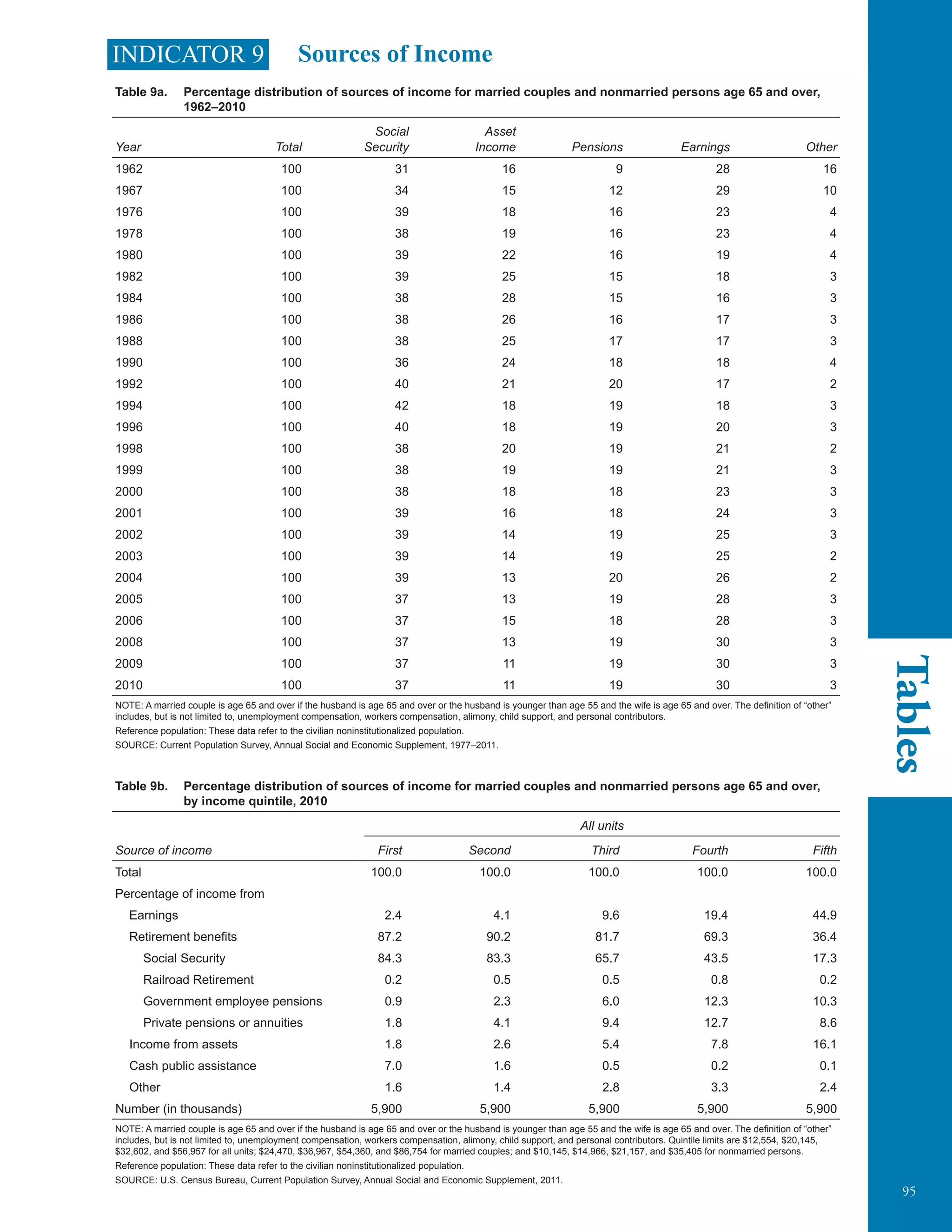
Indicator 9. Sources of Income
Table 9a. Percentage distribution of sources of income for married couples and nonmarried persons age 65
and over, 1962–2010....................................................................................................................................................................95
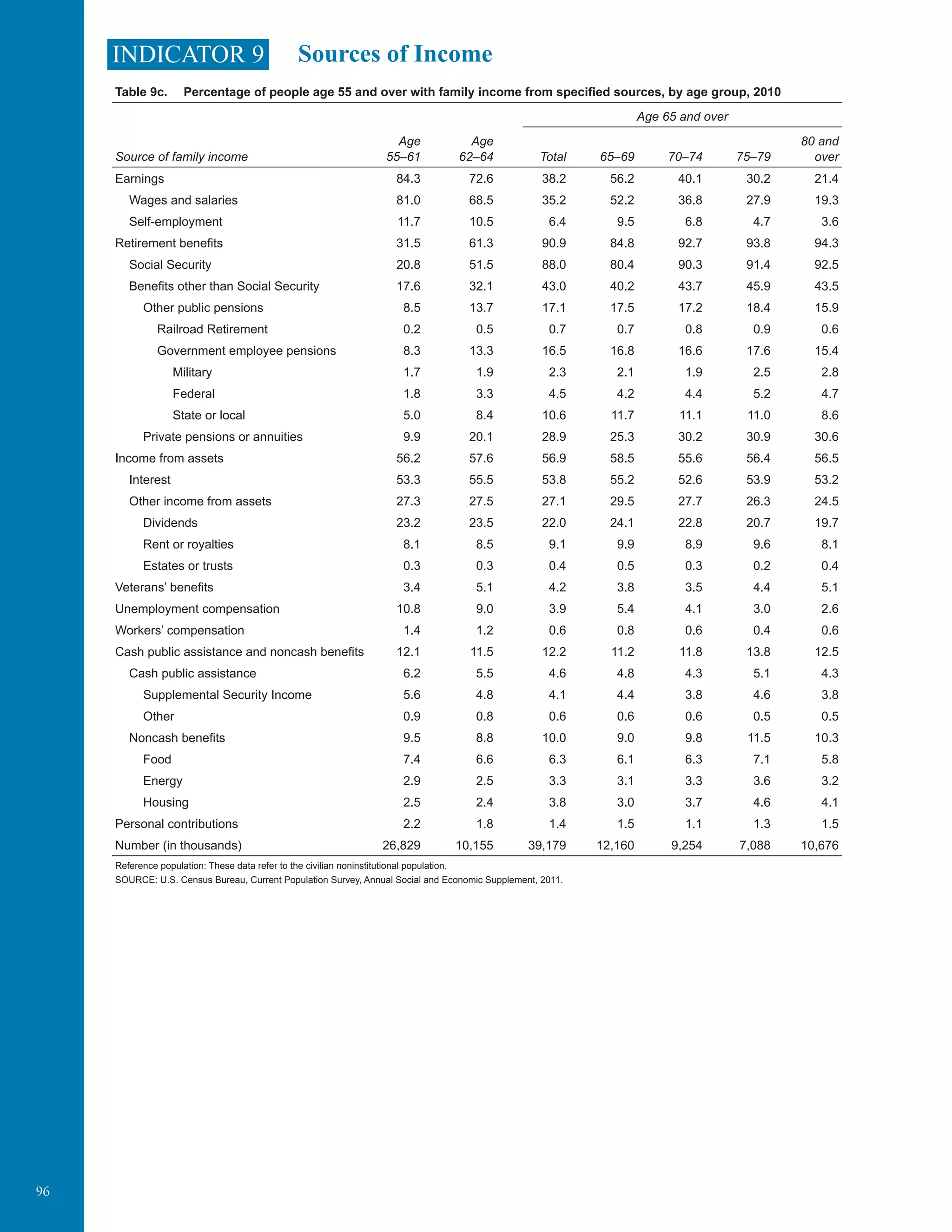
Table 9b. Percentage distribution of sources of income for married couples and nonmarried persons age 65
and over, by income quintile, 2010............................................................................................................................................95
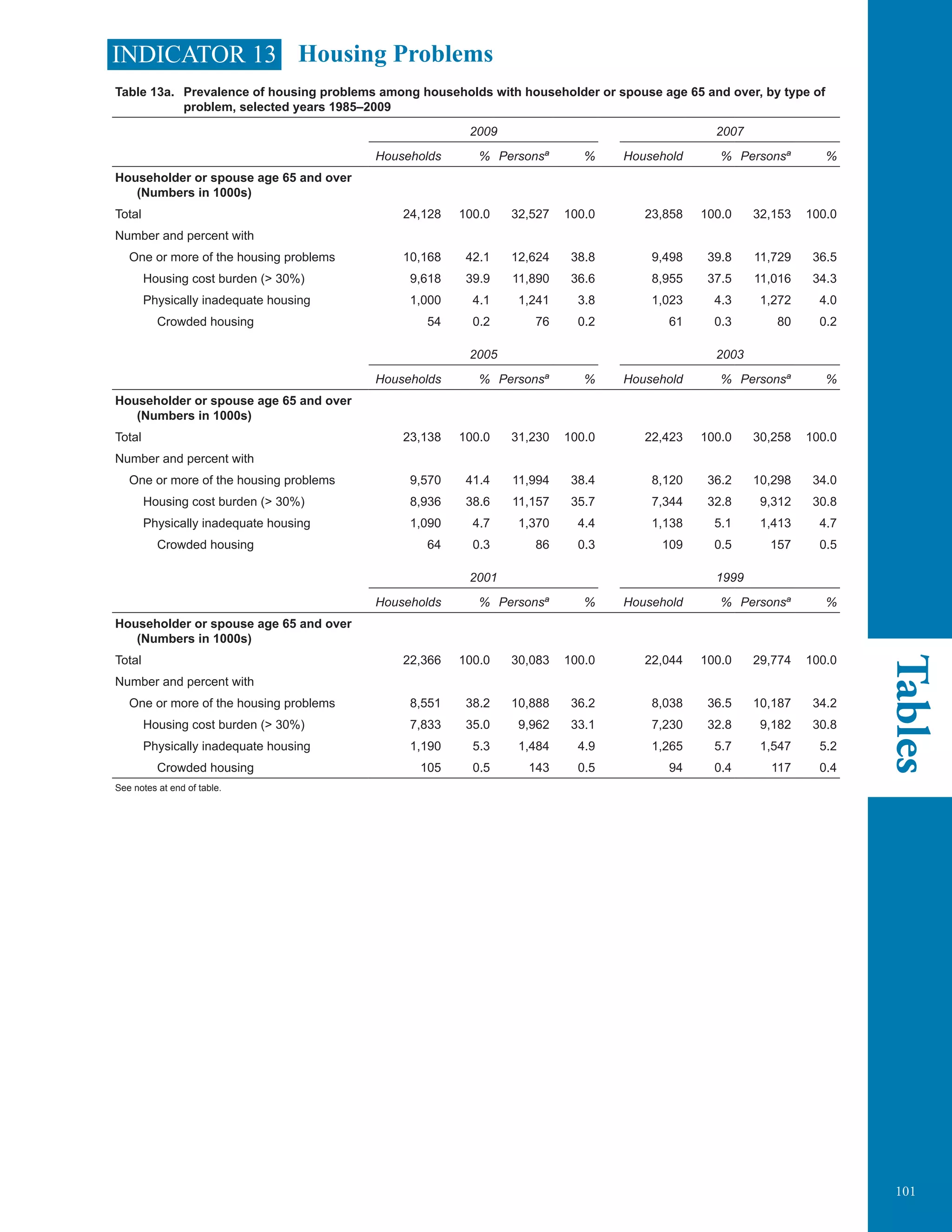
Table 9c. Percentage of people age 55 and over with family income from specified sources, by age group,
2010...............................................................................................................................................................................................96
Indicator 10. Net Worth
Table 10a. Median household net worth of head of household, in 2007 dollars, by selected characteristics
and selected years 1983–2007.....................................................................................................................................................97
Table 10b. Value of household financial assets held in retirement investment accounts by selected
characteristics, 2007.....................................................................................................................................................................97
Indicator 11. Participation in the Labor Force
Table 11. Labor force participation of persons age 55 and over, by sex and age group, annual averages,
1963–2011.....................................................................................................................................................................................98
xi
Indicator 12. Total Expenditures
Table 12. Percentage of total household annual expenditures, by age of reference person, 2010....................................100
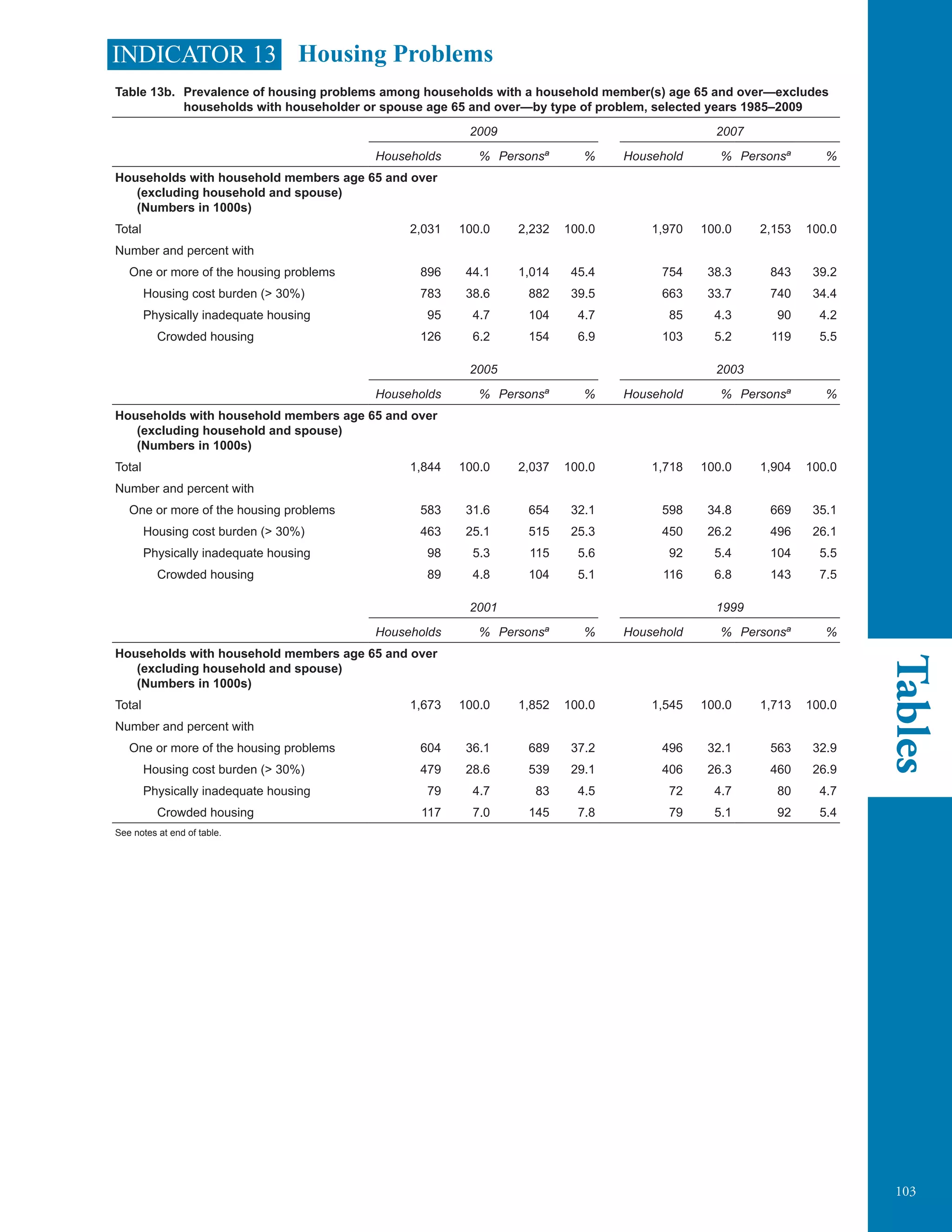
Indicator 13. Housing Problems
Table 13a. Prevalence of housing problems among households with householder or spouse age 65 and over,
by type of problem, selected years 1985–2009........................................................................................................................101
Table 13b. Prevalence of housing problems among households with a household member(s) age 65 and
over—excludes households with householder or spouse age 65 and over—by type of problem, selected
years 1985–2009.........................................................................................................................................................................103
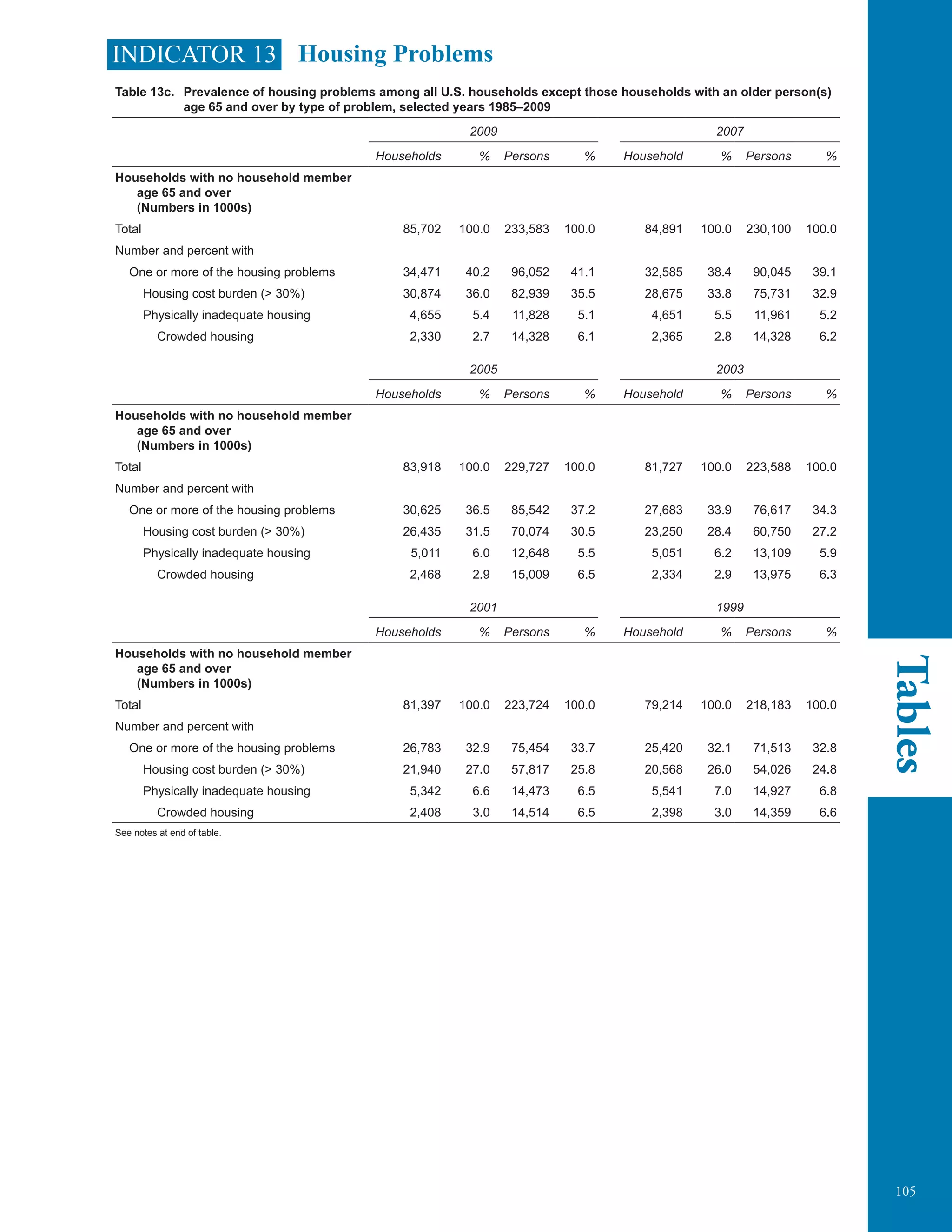
Table 13c. Prevalence of housing problems among all U.S. households except those households with an
older person(s) age 65 and over by type of problem, selected years 1985–2009................................................................105
Table 13d. Prevalence of housing problems among households with householder or spouse age 65 and over
with children, by type of problem, selected years 1985–2009..............................................................................................107
Table 13e. Prevalence of housing problems among households with a household member(s) age 65 and
over with children—excludes households with householder or spouse age 65 and over, by type of problem,
selected years 1985–2009...........................................................................................................................................................109
Table 13f. Prevalence of housing problems among all older households: householder, spouse, or member(s)
age 65 and over, by type of problem, selected years 1985–2009...........................................................................................111
Health Status
Indicator 14. Life Expectancy
Table 14a. Life expectancy, by age and sex, selected years 1900–2009................................................................................113
Table 14b. Life expectancy, by sex, selected race, and age, 2009..........................................................................................113
Table 14c. Average life expectancy at age 65, by sex and selected countries or areas, selected years 1980–2009..........114
Indicator 15. Mortality
Table 15. Death rates for selected leading causes of death among people age 65 and over, 1981–2009.........................115
Indicator 16. Chronic Conditions
Table 16a. Percentage of people age 65 and over who reported having selected chronic health conditions,
by sex and race and Hispanic origin, 2009–2010...................................................................................................................116
Table 16b. Percentage of people age 65 and over who reported having selected chronic health conditions,
1997–1998 through 2009–2010................................................................................................................................................116
Indicator 17. Sensory Impairments and Oral Health
Table 17a. Percentage of people age 65 and over who reported having any trouble hearing, trouble seeing,
or no natural teeth, by selected characteristics, 2010............................................................................................................117
Table 17b. Percentage of people age 65 and over who reported ever having worn a hearing aid, by sex, 2010.............117
Indicator 18. Respondent-Assessed Health Status
Table 18. Percentage of respondent-assessed health status among people age 65 and over, by selected
characteristics, 2008–2010........................................................................................................................................................118
Indicator 19. Depressive Symptoms
Table 19a. Percentage of people age 65 and over with clinically relevant depressive symptoms, by sex,
selected years 1998–2008...........................................................................................................................................................119
Table 19b. Percentage of people age 65 and over with clinically relevant depressive symptoms, by age group
and sex, 2008...............................................................................................................................................................................119
Indicator 20. Functional Limitations
Table 20a. Percentage of Medicare enrollees age 65 and over who have limitations in activities of daily
living (ADLs) or instrumental activities of daily living (IADLs), or who are in a facility, selected years
1992–2009...................................................................................................................................................................................120
Table 20b. Percentage of Medicare enrollees age 65 and over who have limitations in activities of daily
living (ADLs) or instrumental activities of daily living (IADLs), or who are in a facility, by sex, 2009.........................120
Table 20c. Percentage of Medicare enrollees age 65 and over who are unable to perform certain physical
functions, by sex, 1991 and 2009..............................................................................................................................................121
Table 20d. Percentage of Medicare enrollees age 65 and over who are unable to perform any one of five
physical functions, by selected characteristics 2009..............................................................................................................121
xii
Health Risks and Behaviors
Indicator 21. Vaccinations
Table 21a. Percentage of people age 65 and over who reported having been vaccinated against influenza and
pneumococcal disease, by race and Hispanic origin, selected years 1989–2010...............................................................122
Table 21b. Percentage of people age 65 and over who reported having been vaccinated against influenza and
pneumococcal disease, by selected characteristics, 2010......................................................................................................122
Indicator 22. Mammography
Table 22. Percentage of women who reported having had a mammogram within the past two years, by selected
characteristics, selected years 1987–2010...............................................................................................................................123
Indicator 23. Diet Quality
Table 23. Average diet scores, population age 65 and over, by age group, 2007–2008 .....................................................124
Indicator 24. Physical Activity
Table 24a. Percentage of people age 45 and over who reported participating in leisure-time aerobic and muscle-
strengthening activities that meet the 2008 Federal physical activity guidelines, by age group, 1998–2010.................125
Table 24b. Percentage of people age 65 and over who reported participating in leisure-time aerobic and muscle-
strengthening activities that meet the 2008 Federal physical activity guidelines, by sex and race and ethnicity,
2010..............................................................................................................................................................................................125
Indicator 25. Obesity
Table 25. Body weight status among persons 65 years of age and over, by sex and age group, selected years
1976–2010...................................................................................................................................................................................126
Indicator 26. Cigarette Smoking
Table 26a. Percentage of people age 45 and over who are current cigarette smokers, by selected characteristics,
selected years 1965–2010...........................................................................................................................................................127
Table 26b. Cigarette smoking status of people age 18 and over, by sex and age group, 2010...........................................128
Indicator 27. Air Quality
Table 27a. Percentage of people age 65 and over living in counties with “poor air quality,” 2000–2010........................129
Table 27b. Counties with “poor air quality” for any standard in 2010................................................................................130
Indicator 28. Use of Time
Table 28a. Average number of hours per day and percentage of day that people age 55 and over spent doing
selected activities on an average day, by age group, 2010......................................................................................................133
Table 28b. Average number of hours and percentage of total leisure time that people age 55 and over spent
doing selected leisure activities on an average day, by age group, 2010..............................................................................133
Health Care
Indicator 29. Use of Health Care Services
Table 29a. Use of Medicare-covered health care services by Medicare enrollees age 65 and over, 1992–2009.............134
Table 29b. Use of Medicare-covered home health care and skilled nursing facility services by Medicare enrollees
age 65 and over, by age group, 2009.........................................................................................................................................134
Indicator 30. Health Care Expenditures
Table 30a. Average annual health care costs for Medicare enrollees age 65 and over, in 2008 dollars, by age
group, 1992–2008.......................................................................................................................................................................135
Table 30b. Major components of health care costs among Medicare enrollees age 65 and over, 1992 and 2008..........135
Table 30c. Average annual health care costs among Medicare enrollees age 65 and over, by selected
characteristics, 2008...................................................................................................................................................................136
Table 30d. Major components of health care costs among Medicare enrollees age 65 and over, by age group,
2008..............................................................................................................................................................................................137
Table 30e. Percentage of noninstitutionalized Medicare enrollees age 65 and over who reported problems
with access to health care, 1992–2007.....................................................................................................................................137
Indicator 31. Prescription Drugs
Table 31a. Average prescription drug costs and sources of payment among noninstitutionalized Medicare
enrollees age 65 and over, 1992–2008......................................................................................................................................138
Table 31b. Distribution of annual prescription drug costs among noninstitutionalized Medicare enrollees
age 65 and over, 2008.................................................................................................................................................................138
xiii
Indicator 31. Prescription Drugs—continued
Table 31c. Number of Medicare enrollees age 65 and over who enrolled in Part D prescription drug plans or
who were covered by retiree drug subsidy payments, June 2006 and October 2011........................................................139
Table 31d. Average prescription drug costs among noninstitutionalized Medicare enrollees age 65 and over,
by selected characteristics, 2000, 2004, and 2008...................................................................................................................139
Indicator 32. Sources of Health Insurance
Table 32a. Percentage of noninstitutionalized Medicare enrollees age 65 and over with supplemental health
insurance, by type of insurance, 1991–2009...........................................................................................................................140
Table 32b. Percentage of people age 55–64 with health insurance coverage, by type of insurance and poverty
status, 2010..................................................................................................................................................................................140
Indicator 33. Out-of-Pocket Health Care Expenditures
Table 33a. Percentage of people age 55 and over with out-of-pocket expenditures for health care service use,
by age group, 1977, 1987, 1996, and 2000–2009....................................................................................................................141
Table 33b. Out-of-pocket health care expenditures as a percentage of household income among people age 55
and over, by selected characteristics, 1977, 1987, 1996, and 2000–2009............................................................................142
Table 33c. Distribution of total out-of-pocket health care expenditures among people age 55 and over, by type
of health care services and age group, 2000–2009.................................................................................................................144
Indicator 34. Sources of Payment for Health Care Services
Table 34a. Average cost and percentage of sources of payment for health care services for Medicare enrollees
age 65 and over, by type of service, 2008.................................................................................................................................146
Table 34b. Average cost and percentage of sources of payment for health care services for Medicare enrollees
age 65 and over, by income, 2008.............................................................................................................................................146
Indicator 35. Veterans’ Health Care
Table 35. Total number of veterans age 65 and over who are enrolled in or are receiving health care from the
Veterans Health Administration, 1990–2011.........................................................................................................................147
Indicator 36. Residential Services
Table 36a. Percentage of Medicare enrollees age 65 and over residing in selected residential settings, by age
group, 2009..................................................................................................................................................................................148
Table 36b. Percentage of Medicare enrollees age 65 and over with functional limitations, by residential setting,
2009..............................................................................................................................................................................................148
Table 36c. Percent availability of specific services among Medicare enrollees age 65 and over residing in
community housing with services, 2009.................................................................................................................................148
Table 36d. Percent distribution of annual income of Medicare enrollees age 65 and over, by residential setting,
2009..............................................................................................................................................................................................149
Table 36e. Characteristics of services available to Medicare enrollees age 65 and over residing in community
housing with services, 2009......................................................................................................................................................149
Indicator 37. Personal Assistance and Equipment
Table 37a. Percent distribution of noninstitutionalized Medicare enrollees age 65 and over who have limitations
in activities of daily living (ADLs), by type of assistance, selected years 1992–2009........................................................150
Table 37b. Percent distribution of noninstitutionalized Medicare enrollees age 65 and over who have limitations
in activities of daily living (ADLs), by type of assistance and sex, 2009.............................................................................150
Table 37c. Percentage of noninstitutionalized Medicare enrollees age 65 and over who have limitations in
instrumental activities of daily living (IADLs) and who receive personal assistance, by age group, selected years
1992–2009...................................................................................................................................................................................150
Table 37d. Percentage of noninstitutionalized Medicare enrollees age 65 and over who have limitations in
instrumental activities of daily living (IADLs) and who receive personal assistance, by age group and sex, 2009......150
Special Feature
End of Life
Table EL1. Percentage of Medicare decedents age 65 and over who used hospice or intensive care unit/coronary
care unit services in their last 30 days of life, selected years 1999–2009............................................................................151
Table EL2. Percentage of Medicare decedents age 65 and over who used hospice services in their last 30 days of
life, by age, sex, and race, 2009.................................................................................................................................................151
xiv
End of Life—continued
Table EL3. Percentage of Medicare decedents age 65 and over who used intensive care unit/coronary care unit
services in their last 30 days of life, by age, sex, and race, 2009...........................................................................................152
Table EL4. Number and percent distribution of lengths of stay in hospice among Medicare decedents age 65 and
over, 1999 and 2009....................................................................................................................................................................152
Table EL5. Percent distribution of primary diagnoses related to hospice among Medicare decedents age 65 and
over who used hospice services in their last 30 days of life, 1999 and 2009.......................................................................152
Table EL6. Percent distribution of decedents age 65 and over by place of death, 1989–2009..........................................153
Table EL7. Percent distribution of decedents age 65 and over by place of death and sex, 2009......................................153
Table EL8. Percent distribution of decedents age 65 and over by place of death and age group, 2009...........................154
Table EL9. Percent distribution of decedents age 65 and over by place of death and race and ethnicity, 2009.............154
xv
Highlights
Older Americans 2012: Key Indicators of Well-
Being is one in a series of periodic reports to
the Nation on the condition of older adults in
the United States. In this report, 37 indicators
depict the well-being of older Americans in the
areas of demographic characteristics, economic
circumstances, health status, health risks and
behaviors, and cost and use of health care
services. This year’s report also includes a special
feature on the end of life. Selected highlights from
each section of the report follow.
Population
The demographics of aging continue to change
dramatically. The older population is growing
rapidly, and the aging of the “Baby Boomers”
born between 1946 and 1964 (and who began
turning age 65 in 2011), are accelerating this
growth. This large population of older Americans
will be more racially diverse and better educated
than previous generations. Another significant
trend is the increase in the proportion of men
age 85 and over who are veterans.
ƒƒ In 2010, there were 40 million people age 65
and over in the United States, accounting for
13 percent of the total population. The older
population in 2030 is projected to be twice as
large as in 2000, growing from 35 million to
72 million and representing nearly 20 percent
of the total U.S. population (See “Indicator 1:
Number of Older Americans”).
ƒƒ In 1965, 24 percent of the older population
had graduated from high school, and only
5 percent had at least a Bachelor’s degree.
By 2010, 80 percent were high school
graduates or more, and 23 percent had a
Bachelor’s degree or more (See “Indicator 4:
Educational Attainment”).
Economics
There have been decreases in the proportion
of older people living in poverty or in the low-
income group just above the poverty line, both
in recent years and over the longer term. Among
older Americans, the share of income coming
from earnings has increased since the mid-1980s,
partly because more people, especially women,
continue to work past age 55. In addition, net
worth increased almost 80 percent, on average,
for older Americans between 1988 and 2007.
Although most older Americans live in adequate,
affordable housing, some live in costly, physically
inadequate, or crowded housing. Additionally,
major inequalities continue to exist: older blacks
and people without high school diplomas report
smaller economic gains and fewer financial
resources overall.
ƒƒ Between 1974 and 2010, there was a decrease
in the proportion of older people with income
below poverty from 15 percent to 9 percent
and with low income from 35 percent to 26
percent; and an increase in the proportion of
people with high income from 18 percent to
31 percent (See “Indicator 8: Income”).
ƒƒ In 2007, the median net worth of households
headed by white people age 65 and over
($248,300) was almost three times that of
older black households ($87,800). This
difference is less than in 1998 when the
median net worth of households headed by
older white people was about six times
higher than that of households headed by
older black people. The large increase in net
worth in past years may not continue into
the future due to recent declines in housing
values (See “Indicator 10: Net Worth”).
ƒƒ Over the past four decades, labor force
participation rates have risen for women
age 55 and over. This trend continued during
the recent recession. Among men age 55 and
over, the rise in participation rates that started
in the mid-1990s also has continued, although
to a smaller extent. As “Baby Boomers”
approach older ages, they are remaining in
the labor force at higher rates than previous
generations (See “Indicator 11: Participation
in the Labor Force”).
ƒƒ In 2009, approximately 40 percent of older
American households had housing cost
burden (expenditures on housing and utilities
that exceed 30 percent of household income).
In addition to having cost burden as the
most dominant housing problem, crowded
housing was also fairly prevalent for some
older American households with children
in their homes (See “Indicator 13: Housing
Problems”).
xvi
Health Status
Americans are living longer than ever before,
yet their life expectancies lag behind those of
other developed nations. Death rates for certain
diseases have declined over time, while others
have increased. Older age is often accompanied
by increased risk of certain diseases and
disorders. Large proportions of older Americans
report a variety of chronic health conditions such
as hypertension and arthritis. Nevertheless, most
people age 65 and over report their health as
good, very good, or excellent.
ƒƒ Life expectancy at age 65 in the United
States was lower than that of many other
industrialized nations. In 2009, women age
65 in Japan could expect to live on average
3.7 years longer than women in the United
States. Among men, the difference was 1.3
years (See “Indicator 14: Life Expectancy”).
ƒƒ Death rates for heart disease and stroke
declined by slightly more than 50 percent
since 1981. Death rates for chronic lower
respiratory disease increased by 57 percent
in the same time period (See “Indicator 15:
Mortality”).
ƒƒ The prevalence of certain chronic conditions
differed by sex. Women reported higher levels
of arthritis than men (56 percent versus 45
percent). Men reported higher levels of heart
disease (37 percent versus 26 percent) (See
“Indicator 16: Chronic Health Conditions”).
ƒƒ During the period 2008–2010, 76 percent of
people age 65 and over rated their health as
good, very good, or excellent. Non-Hispanic
Whites were more likely to report good health
than their non-Hispanic Black or Hispanic
counterparts (See “Indicator 18: Respondent-
Assessed Health Status”).
Health Risks and Behaviors
Social and lifestyle factors can affect the health
and well-being of older Americans. These
factors include preventive behaviors such as
cancer screenings and routine vaccinations along
with diet, physical activity, obesity, and cigarette
smoking. The quality of the air where people live
also affects health. Many of these health risks and
behaviors have shown long-term improvements,
even though recent estimates indicate no
significant changes.
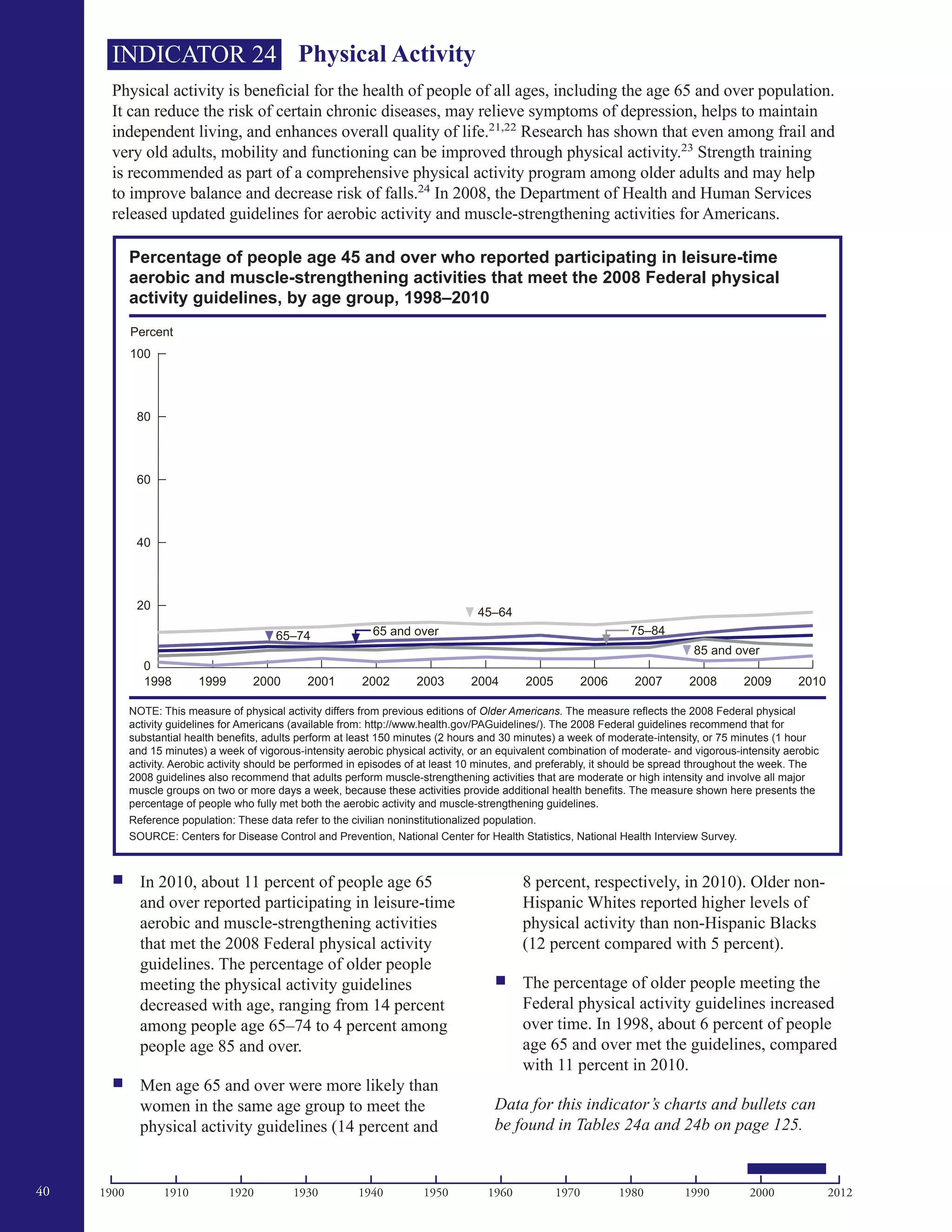
ƒƒ In 2010, about 11 percent of people age 65
and over reported participating in leisure-time
aerobic and muscle-strengthening activities
that met the 2008 Federal physical activity
guidelines (See “Indicator 24: Physical
Activity”).
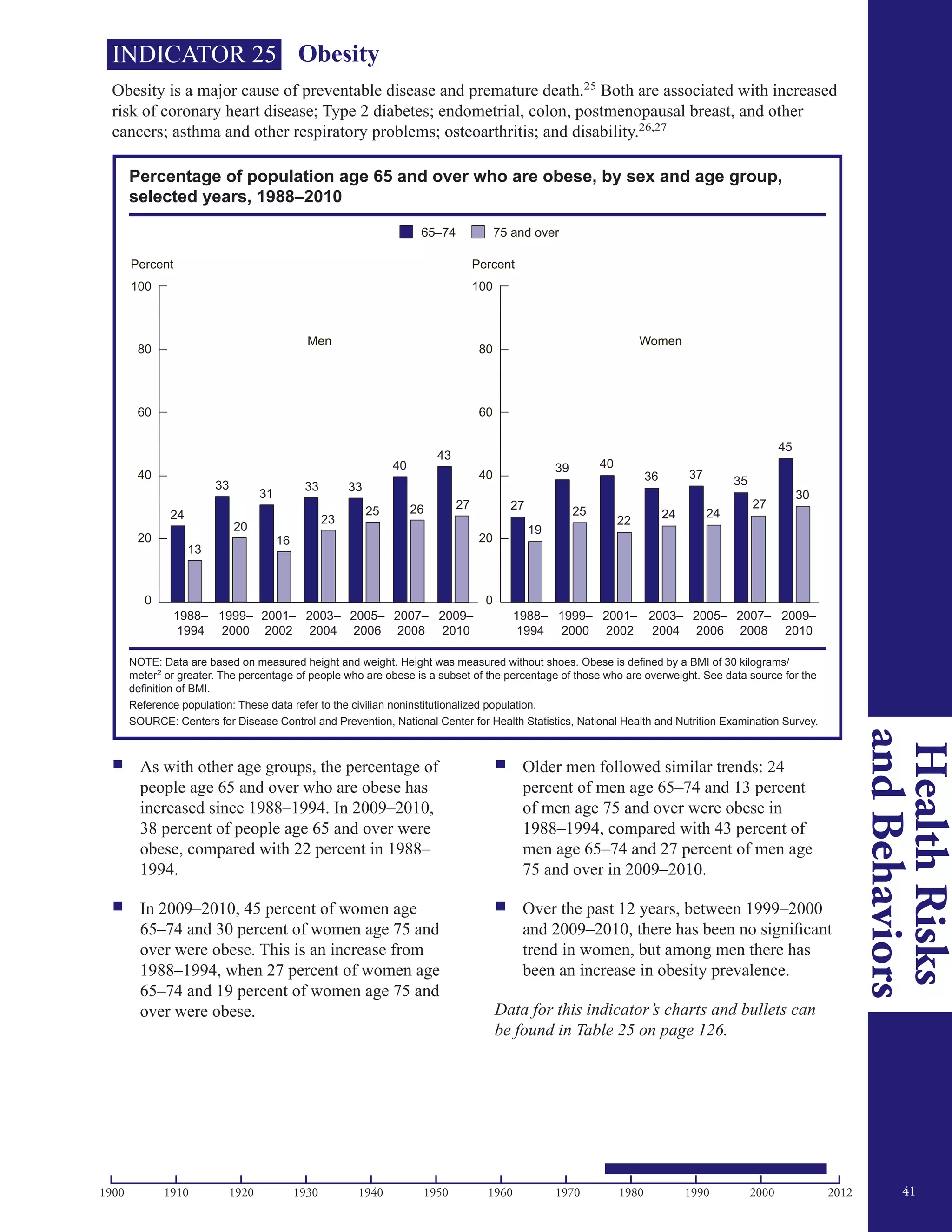
ƒƒ As with other age groups, the percentage of
people age 65 and over who are obese has
increased since 1988–1994. In 2009–2010, 38
percent of people age 65 and over were obese,
compared with 22 percent in 1988–1994.
Over the past several years however, that
trend has leveled off for older women, with
no statistically significant change in obesity
between 1999–2000 and 2009–2010. During
this same time period, the obesity prevalence
increased for older men (See “Indicator 25:
Obesity”).
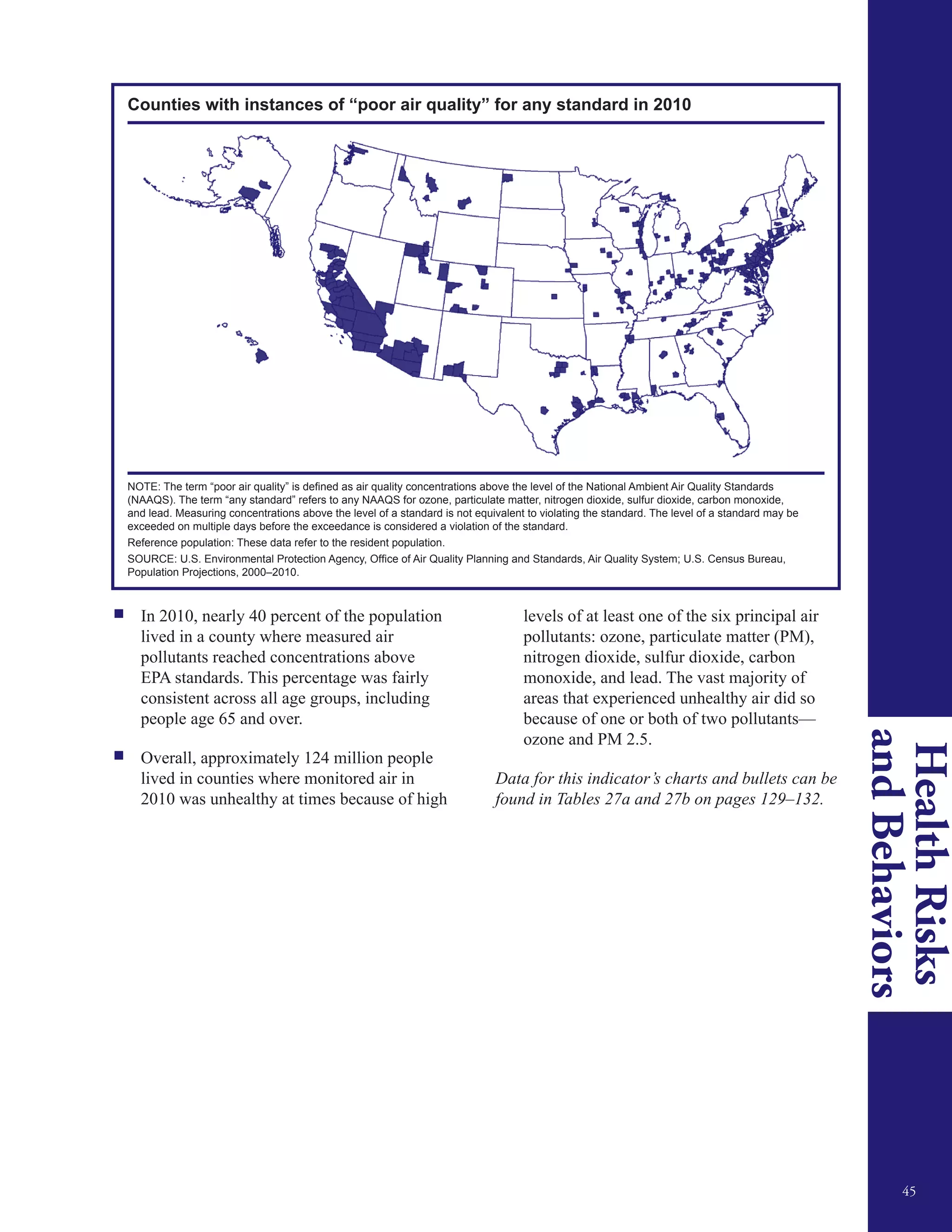
ƒƒ The percentage of people age 65 and over
living in counties that experienced poor air
quality for any air pollutant decreased from
64 percent in 2000 to 36 percent in 2010 (See
“Indicator 27: Air Quality”).
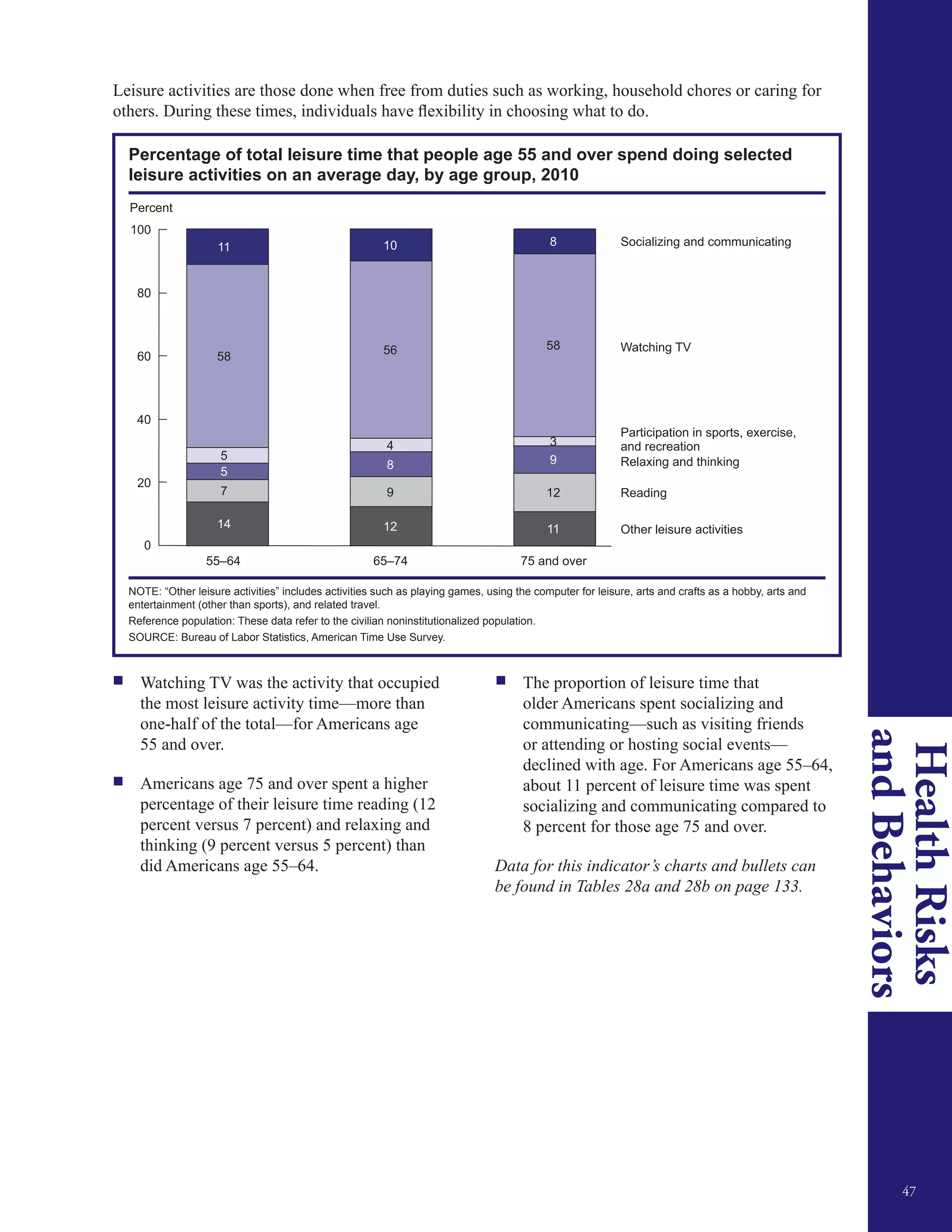
ƒƒ The proportion of leisure time that
older Americans spent socializing and
communicating—such as visiting friends or
attending or hosting social events—declined
with age. For Americans age 55–64, about 11
percent of leisure time was spent socializing
and communicating compared with 8 percent
for those age 75 and over (See “Indicator 28:
Use of Time”).
Health Care
In the 1990’s and early 2000’s, health care
costs rose rapidly for older Americans. However,
average health care costs did not increase further
between 2006 and 2008, after adjustment for
inflation. Older Americans in the poor/near
poor income category continued to spend a high
proportion of their household income on health
care services through 2009. In recent years
increasing numbers of Medicare beneficiaries
enrolled in HMOs and other health plans under
the Medicare Advantage (MA) program.
ƒƒ After adjustment for inflation, health care
costs increased significantly among older
Americans from $9,850 in 1992 to $15,709
in 2008. There was no significant change
between 2006 and 2008 (See “Indicator 30:
Health Care Expenditures”).
xvii
ƒƒ From 1977 to 2009, the percentage of
household income that people age 65 and
over allocated to out-of-pocket spending for
health care services increased among those in
the poor/near poor income category from 12
percent to 22 percent (See “Indicator 33:
Out-of-Pocket Health Care Expenditures”).
ƒƒ Enrollment in health maintenance
organizations (HMOs) and other health plans
under the Medicare Advantage (MA) program
has grown rapidly in recent years. In 2005,
16 percent of Medicare beneficiaries age 65 or
over were enrolled in an MA plan, compared
with 28 percent in 2009 (See “Indicator 32:
Sources of Health Insurance”).
End of Life
In the last decade there has been a substantial
rise in the use of hospice services among older
Americans. During that time, there has also been
a smaller increase in the use of intensive care unit
(ICU) and coronary care unit (CCU) services
at the end of life. The percent of deaths among
older Americans that occurred in hospitals
declined over the last 20 years, with an increase
in the percent dying at home.
ƒƒ Use of hospice in the last month of life
increased from 19 percent of decedents in
1999, to 43 percent in 2009. Use of ICU/CCU
services grew from 22 percent of decedents
in 1999, to 27 percent in 2009.
ƒƒ Neoplasms accounted for 53 percent
of hospice stays in 1999 and only 32
percent in 2009. The next most common
primary diagnoses in 2009 were diseases
of the circulatory system (19 percent) and
symptoms, signs, and ill-defined conditions
(17 percent).
ƒƒ Among older Americans, 49 percent of
deaths occurred in hospitals in 1989,
declining to 32 percent in 2009. The percent
dying at home increased from 15 in 1989,
to 24 percent in 2009.
xviii
Population
1
INDICATOR 1. Number of Older Americans
INDICATOR 2. Racial and Ethnic Composition
INDICATOR 3. Marital Status
INDICATOR 4. Educational Attainment
INDICATOR 5. Living Arrangements
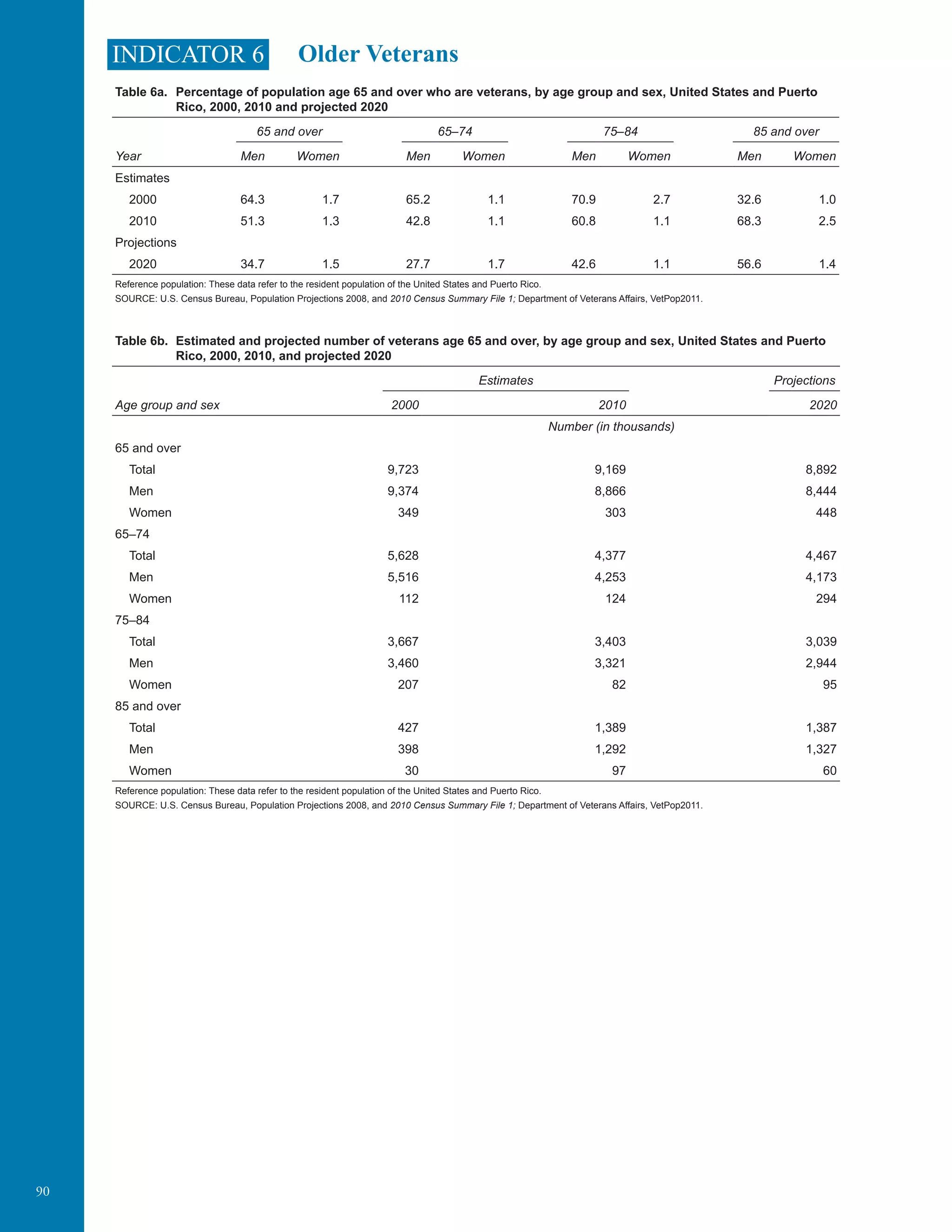
INDICATOR 6. Older Veterans
2
INDICATOR 1 Number of Older Americans
The growth of the population age 65 and over affects many aspects of our society, challenging families,
businesses, health care providers, and policymakers, among others, to meet the needs of aging individuals.
Population age 65 and over and age 85 and over, selected years 1900–2010 and
projected 2020–2050
2010 2020 205020001990198019701960195019401930192019101900
Millions
65 and over
Projected
85 and over
0
20
40
60
80
100
1900 1910 1920 1930 1940 1950 1960 1970 1980 1990 2000 2010 2020 2030 2040 2050
NOTE: These projections are based on Census 2000 and are not consistent with the 2010 Census results. Projections based on the 2010
Census will be released in late 2012.
Reference population: These data refer to the resident population.
SOURCE: U.S. Census Bureau, 1900 to 1940, 1970, and 1980, U.S. Census Bureau, 1983, Table 42; 1950, U.S. Census Bureau, 1953, Table
38; 1960, U.S. Census Bureau, 1964, Table 155; 1990, U.S. Census Bureau, 1991, 1990 Summary Table File; 2000, U.S. Census Bureau, 2001,
Census 2000 Summary File 1; U.S. Census Bureau, Table 1: Intercensal Estimates of the Resident Population by Sex and Age for the U.S.: April
1, 2000 to July 1, 2010 (US-EST00INT-01); U.S. Census Bureau, 2011. 2010 Census Summary File 1; U.S. Census Bureau, Table 2: Projections
of the population by selected age groups and sex for the United States: 2010–2050 (NP2008-t2).
ƒ In 2010, 40 million people age 65 and over
lived in the United States, accounting for
13 percent of the total population. The older
population grew from 3 million in 1900 to 40
million in 2010. The oldest-old population
(those age 85 and over) grew from just over
100,000 in 1900 to 5.5 million in 2010.
ƒ The “Baby Boomers” (those born between
1946 and 1964) started turning 65 in 2011,
and the number of older people will increase
dramatically during the 2010–2030 period.
The older population in 2030 is projected
to be twice as large as their counterparts in
2000, growing from 35 million to 72 million
and representing nearly 20 percent of the total
U.S. population.
ƒ The growth rate of the older population
is projected to slow after 2030, when the
last “Baby Boomers” enter the ranks of the
older population. From 2030 onward, the
proportion age 65 and over will be relatively
stable, at around 20 percent, even though the
absolute number of people age 65 and over is
projected to continue to grow. The oldest-old
population is projected to grow rapidly after
2030, when the “Baby Boomers” move into
this age group.
ƒ The U.S. Census Bureau projects that the
population age 85 and over could grow
from 5.5 million in 2010 to 19 million by
2050. Some researchers predict that death
rates at older ages will decline more rapidly
than is reflected in the U.S. Census Bureau’s
projections, which could lead to faster
growth of this population.1–3
Population
3
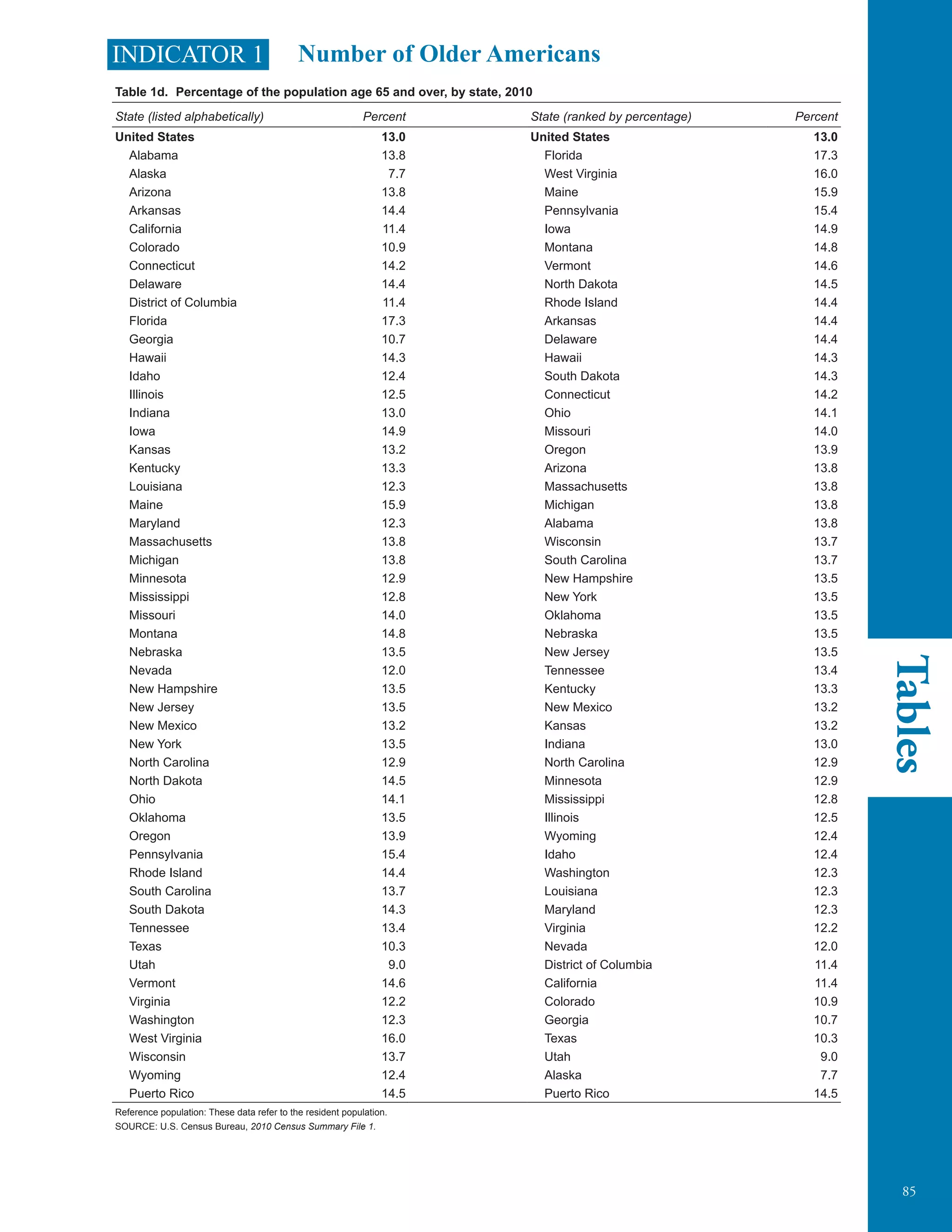
Percentage of population age 65 and over, by county and state, 2010
Reference population: These data refer to the resident population.
SOURCE: U.S. Census Bureau, 2010 Census Summary File 1.
ƒƒ The proportion of the population age 65 and
over varies by state. This proportion is partly
affected by the state fertility and mortality
levels and partly by the number of older and
younger people who migrate to and from
the state. In 2010, Florida had the highest
proportion of people age 65 and over (17
percent). Maine, Pennsylvania, and West
Virginia also had high proportions (over
15 percent).
ƒƒ The proportion of the population age 65
and over varies even more by county. In
2010, 43 percent of Sumter County, Florida,
was age 65 and over, the highest proportion
in the country. In several Florida counties,
the proportion was over 30 percent. At the
other end of the spectrum was Aleutians West
Census Area, Alaska, with only 3.5 percent
of its population age 65 and over.
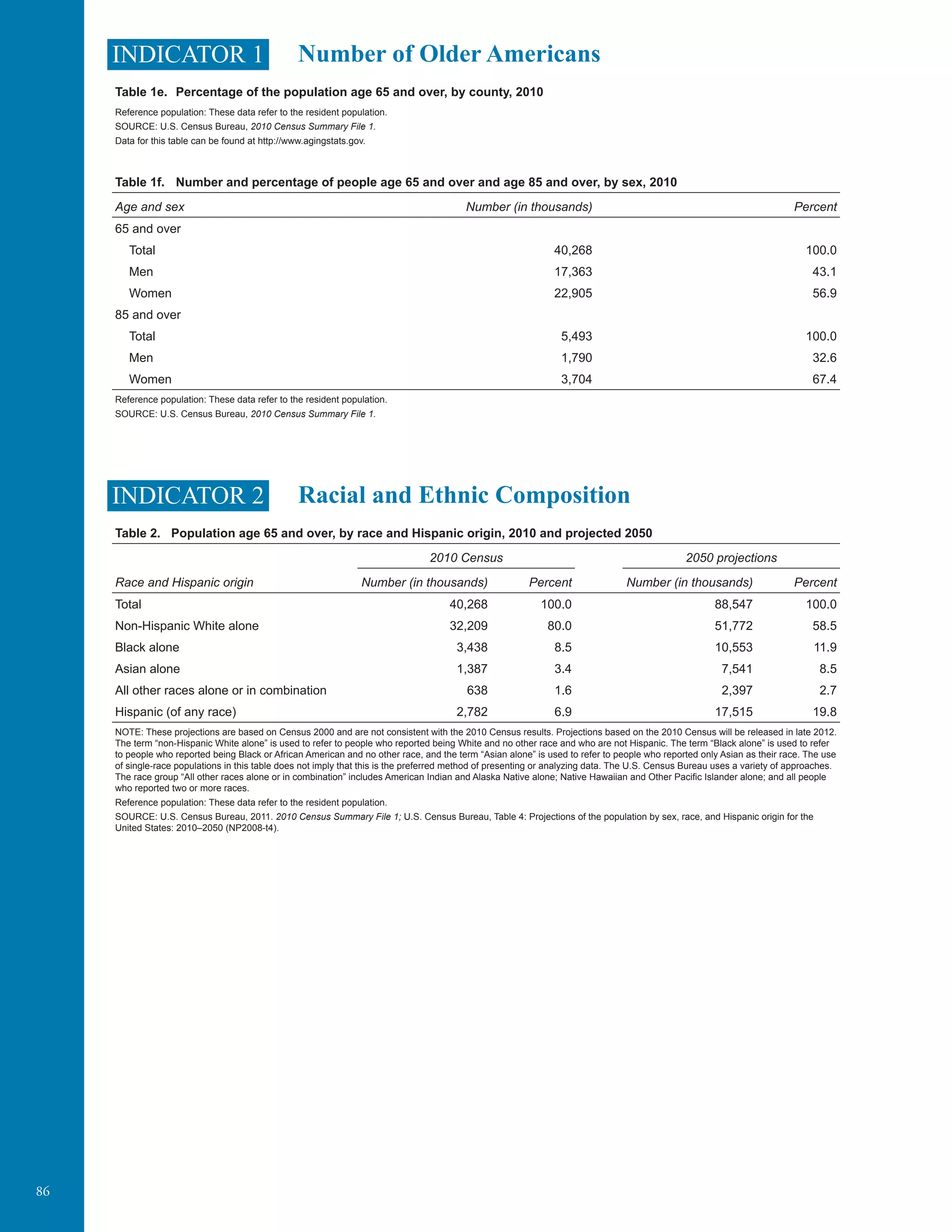
ƒƒ Older women outnumbered older men in
the United States, and the proportion that is
female increased with age. In 2010, women
accounted for 57 percent of the population
age 65 and over and for 67 percent of the
population age 85 and over.
ƒƒ The United States is fairly young for a
developed country, with 13 percent of its
population age 65 and over in 2010. Japan
had the highest percent of age 65 and over
(23 percent) among countries with a
population of at least 1 million. The older
population made up more than 15 percent of
the population in most European countries,
around 20 percent in Germany and Italy.
Data for this indicator’s charts and bullets can
be found in Tables 1a through 1f on pages 82–86.
4
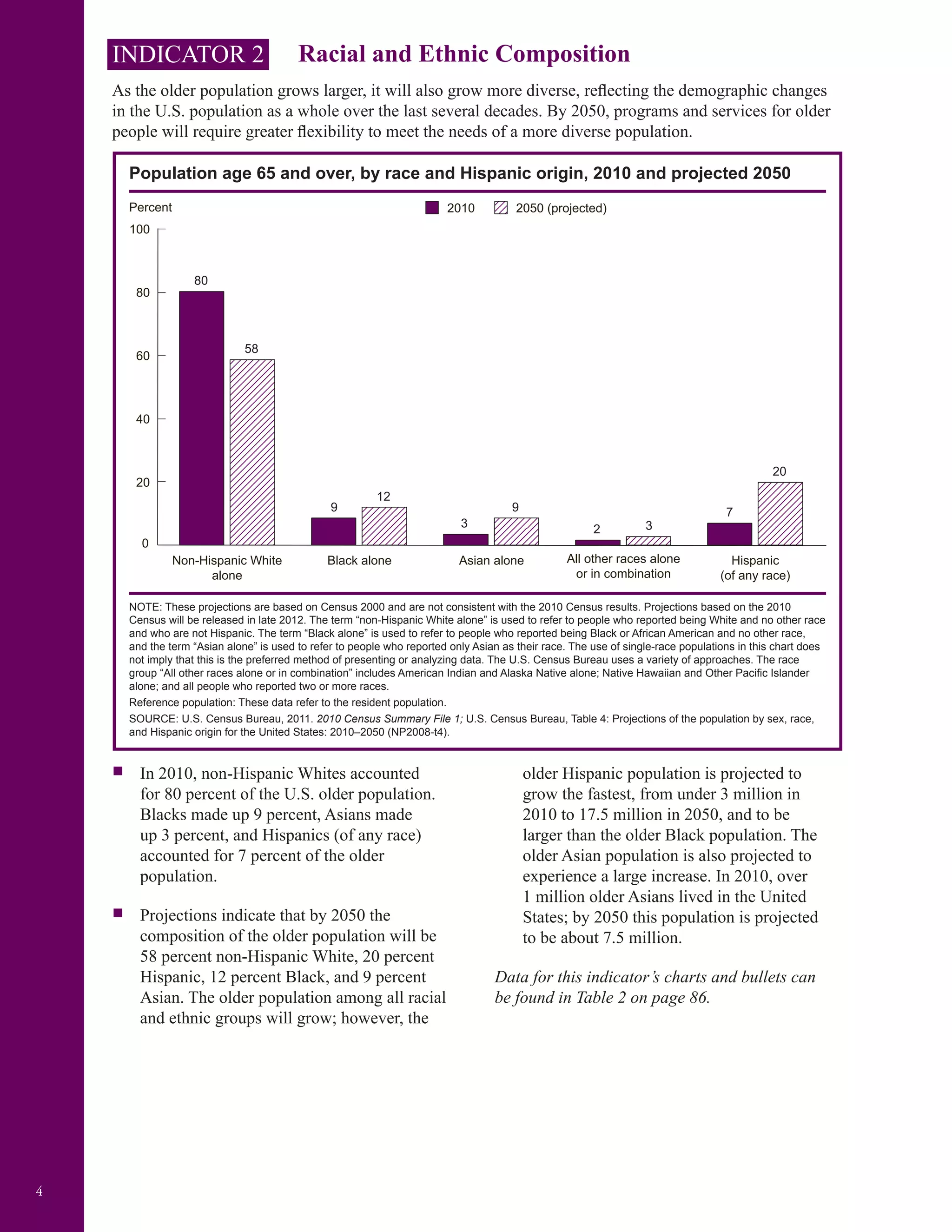
INDICATOR 2 Racial and Ethnic Composition
As the older population grows larger, it will also grow more diverse, reflecting the demographic changes
in the U.S. population as a whole over the last several decades. By 2050, programs and services for older
people will require greater flexibility to meet the needs of a more diverse population.
Population age 65 and over, by race and Hispanic origin, 2010 and projected 2050
100
Percent
80
60
40
20
0
2050 (projected)2010
Non-Hispanic White
alone
Black alone Asian alone Hispanic
(of any race)
80
58
9
12
3
9
2 3
7
20
All other races alone
or in combination
NOTE: These projections are based on Census 2000 and are not consistent with the 2010 Census results. Projections based on the 2010
Census will be released in late 2012. The term “non-Hispanic White alone” is used to refer to people who reported being White and no other race
and who are not Hispanic. The term “Black alone” is used to refer to people who reported being Black or African American and no other race,
and the term “Asian alone” is used to refer to people who reported only Asian as their race. The use of single-race populations in this chart does
not imply that this is the preferred method of presenting or analyzing data. The U.S. Census Bureau uses a variety of approaches. The race
group “All other races alone or in combination” includes American Indian and Alaska Native alone; Native Hawaiian and Other Pacific Islander
alone; and all people who reported two or more races.
Reference population: These data refer to the resident population.
SOURCE: U.S. Census Bureau, 2011. 2010 Census Summary File 1; U.S. Census Bureau, Table 4: Projections of the population by sex, race,
and Hispanic origin for the United States: 2010–2050 (NP2008-t4).
ƒ In 2010, non-Hispanic Whites accounted
for 80 percent of the U.S. older population.
Blacks made up 9 percent, Asians made
up 3 percent, and Hispanics (of any race)
accounted for 7 percent of the older
population.
ƒ Projections indicate that by 2050 the
composition of the older population will be
58 percent non-Hispanic White, 20 percent
Hispanic, 12 percent Black, and 9 percent
Asian. The older population among all racial
and ethnic groups will grow; however, the
older Hispanic population is projected to
grow the fastest, from under 3 million in
2010 to 17.5 million in 2050, and to be
larger than the older Black population. The
older Asian population is also projected to
experience a large increase. In 2010, over
1 million older Asians lived in the United
States; by 2050 this population is projected
to be about 7.5 million.
Data for this indicator’s charts and bullets can
be found in Table 2 on page 86.
Population
5
INDICATOR 3 Marital Status
Marital status can strongly affect one’s emotional and economic well-being. Among other factors, it
influences living arrangements and the availability of caregivers for older Americans with an illness
or disability.
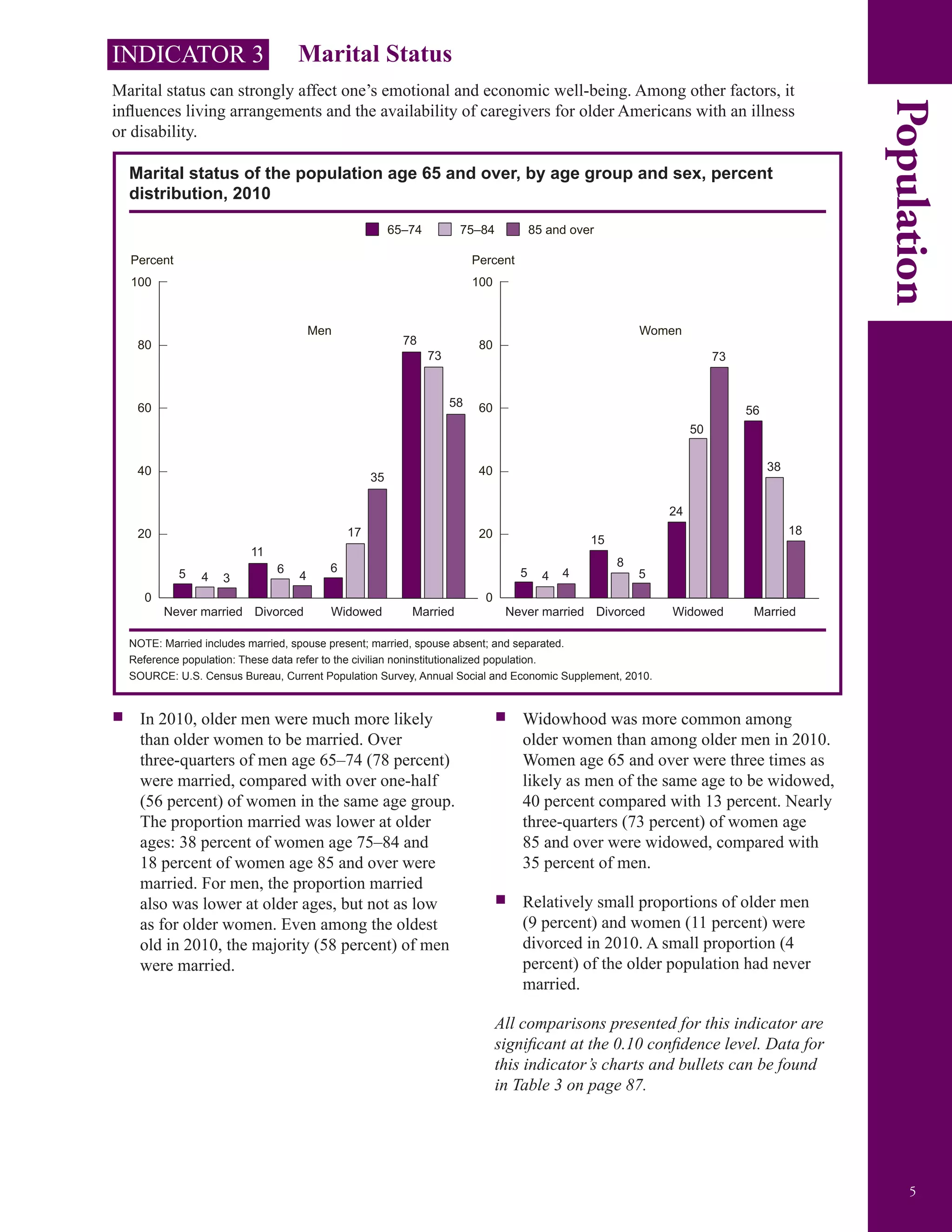
Marital status of the population age 65 and over, by age group and sex, percent
distribution, 2010
Never married Divorced Widowed Married
100
Percent
Men Women
80
60
40
20
0
100
Percent
80
60
40
20
0
75–84 85 and over65–74
Never married Divorced Widowed Married
5 4 3
11
6
4
6
17
35
78
73
58
5 4 4
15
8
5
24
50
73
56
38
18
NOTE: Married includes married, spouse present; married, spouse absent; and separated.
Reference population: These data refer to the civilian noninstitutionalized population.
SOURCE: U.S. Census Bureau, Current Population Survey, Annual Social and Economic Supplement, 2010.
ƒƒ In 2010, older men were much more likely
than older women to be married. Over
three-quarters of men age 65–74 (78 percent)
were married, compared with over one-half
(56 percent) of women in the same age group.
The proportion married was lower at older
ages: 38 percent of women age 75–84 and
18 percent of women age 85 and over were
married. For men, the proportion married
also was lower at older ages, but not as low
as for older women. Even among the oldest
old in 2010, the majority (58 percent) of men
were married.
ƒ Widowhood was more common among
older women than among older men in 2010.
Women age 65 and over were three times as
likely as men of the same age to be widowed,
40 percent compared with 13 percent. Nearly
three-quarters (73 percent) of women age
85 and over were widowed, compared with
35 percent of men.
ƒ Relatively small proportions of older men
(9 percent) and women (11 percent) were
divorced in 2010. A small proportion (4
percent) of the older population had never
married.
All comparisons presented for this indicator are
significant at the 0.10 confidence level. Data for
this indicator’s charts and bullets can be found
in Table 3 on page 87.ƒ
6
INDICATOR 4 Educational Attainment
Educational attainment has effects throughout the life course, which in turn plays a role in well-being at
older ages. Higher levels of education are usually associated with higher incomes, higher standards of
living, and above-average health.
Educational attainment of the population age 65 and over, selected years 1965–2010
201220001990198019701960195019401930192019101900
1965
Percent
0
20
40
60
80
100
High school graduate or more
Bachelor’s degree or more
1970 1975 1980 1985 1990 1995 2000 2005 2010
NOTE: A single question which asks for the highest grade or degree completed is now used to determine educational attainment. Prior to 1995,
educational attainment was measured using data on years of school completed.
Reference population: These data refer to the civilian noninstitutionalized population.
SOURCE: U.S. Census Bureau, Current Population Survey, Annual Social and Economic Supplement, 2010.
ƒƒ In 1965, 24 percent of the older population
had graduated from high school and only 5
percent had at least a Bachelor’s degree. By
2010, 80 percent were high school graduates
or more and 23 percent had a Bachelor’s
degree or more.
ƒƒ In 2010, about 80 percent of older men and
79 percent of older women had at least a
high school diploma. Older men attained
at least a Bachelor’s degree more often
than older women (28 percent compared
with 18 percent).
Population
7
Educational attainment of the population age 65 and over, by race and Hispanic
origin, 2010
100
Percent
80
60
40
20
0
Bachelor’s degree or moreHigh school graduate or more
Total Non-Hispanic White alone Black alone Asian alone Hispanic (of any race)
80
23
84
24
65
15
74
35
47
10
NOTE: The term “non-Hispanic White alone” is used to refer to people who reported being White and no other race and who are not Hispanic.
The term “Black alone” is used to refer to people who reported being Black or African American and no other race, and the term “Asian alone”
is used to refer to people who reported only Asian as their race. The use of single-race populations in this chart does not imply that this is the
preferred method of presenting or analyzing data. The U.S. Census Bureau uses a variety of approaches.
Reference population: These data refer to the civilian noninstitutionalized population.
SOURCE: U.S. Census Bureau, Current Population Survey, Annual Social and Economic Supplement, 2010.
ƒ Despite the overall increase in educational
attainment among older Americans,
substantial educational differences exist
among racial and ethnic groups. In 2010, 84
percent of non-Hispanic Whites age 65 and
over had completed high school. Older Asians
also had a high proportion with at least a high
school education (74 percent). In contrast,
65 percent of older Blacks and 47 percent of
older Hispanics had completed high school.
ƒ In 2010, older Asians had the highest
proportion with at least a Bachelor’s
degree (35 percent). About 24 percent of
older non-Hispanic Whites had this level of
education. The proportions were 15 percent
and 10 percent, respectively, for older Blacks
and Hispanics.
All comparisons presented for this indicator are
significant at the 0.10 confidence level. Data for
this indicator’s charts and bullets can be found
in Tables 4a and 4b on page 88.
8
INDICATOR 5 Living Arrangements
The living arrangements of America’s older population are linked to income, health status, and the
availability of caregivers.
Living arrangements of the population age 65 and over, by sex and race and Hispanic
origin, 2010
100
Percent Women
80
60
40
20
0
100
Percent
80
60
40
20
0
With nonrelatives AloneWith other relativesWith spouse
5
Men
72
6
3
19
74
4
3
19
55
11
5
5
28
79
7
2
12
62
17
15
Total Non-
Hispanic
White alone
Black
alone
Asian
alone
Hispanic
(of any
race)
Total Non-
Hispanic
White alone
Black
alone
Asian
alone
Hispanic
(of any
race)
42
18
2
37
45
13
3
39
23
35
2
39
44
33
2
21
39
36
2
23
NOTE: The calculation of the living arrangements estimates in this chart changed from the previous edition of Older Americans to more
accurately reflect the person’s relationship to the householder, rather than an indication of whether the householder had relatives present in the
household. Living with other relatives indicates no spouse present. Living with nonrelatives indicates no spouse or other relatives present. The
term “non-Hispanic White alone” is used to refer to people who reported being White and no other race and who are not Hispanic. The term
“Black alone” is used to refer to people who reported being Black or African American and no other race, and the term “Asian alone” is used to
refer to people who reported only Asian as their race. The use of single-race populations in this chart does not imply that this is the preferred
method of presenting or analyzing data. The U.S. Census Bureau uses a variety of approaches.
Reference population: These data refer to the civilian noninstitutionalized population.
SOURCE: U.S. Census Bureau, Current Population Survey, Annual Social and Economic Supplement, 2010.
ƒ Older men were more likely to live with their
spouse than were older women. In 2010, 72
percent of older men lived with their spouse,
while less than half (42 percent) of older
women did. In contrast, older women were
twice as likely as older men to live alone
(37 percent and 19 percent, respectively).
ƒ Living arrangements of older people differed
by race and Hispanic origin. Older Black,
Asian, and Hispanic women were more
likely than non-Hispanic White women to
live with relatives other than a spouse. For
example, in 2010, 33 percent of older Asian
women, 35 percent of older Black women,
and 36 percent of older Hispanic women,
lived with other relatives, compared with
only 13 percent of older non-Hispanic White
women. The percentages of Asian, Black and
Hispanic women (33 percent, 35 percent and
36 percent, respectively) were not statistically
different.
ƒ Older non-Hispanic White women and
Black women were more likely than women
of other races to live alone (39 percent
each, compared with about 21 percent for
older Asian women and 23 percent for
older Hispanic women). The percentages
of non-Hispanic White and Black women
(39 percent each) living alone were not
statistically different. Also, the percentages
of older Asian and older Hispanic women
(21 percent and 23 percent, respectively)
living alone were not statistically different.
Population
9
ƒƒ Older Black men lived alone more than twice
as often as older Asian men (28 percent
compared with 12 percent). Older Black
men also lived alone more often than older
non-Hispanic White men (19 percent). The
percentages of older Asian and older Hispanic
men living alone (12 percent and 15 percent,
respectively) were not statistically different.
ƒƒ Older Hispanic men were more likely (17
percent) than non-Hispanic White men (4
percent) to live with relatives other than a
spouse. The percentages of Black and Asian
men living with relatives other than a spouse
were between those for Hispanic men and
non-Hispanic White men, at 12 percent and
8 percent, respectively.
All comparisons presented for this indicator are
significant at the 0.10 confidence level. Data for
this indicator’s charts and bullets can be found
in Tables 5a and 5b on page 89.
10
INDICATOR 6 Older Veterans
Veteran status of America’s older population is associated with higher median family income, lower
percentage of uninsured or coverage by Medicaid, higher percentage of functional limitations in activities
of daily living or instrumental activities of daily living, greater likelihood of having any disability, and
less likelihood of rating their general health status as good or better.4
The large increase in the oldest
segment of the veteran population will continue to have significant ramifications on the demand for
health care services, particularly in the area of long-term care.5
Percentage of population age 65 and over who are veterans, by sex and age group,
United States and Puerto Rico, 2000, 2010, and projected 2020
100
Percent
Women
80
60
40
20
0
100
Percent
80
60
40
20
0
2020 (projected)20102000
Men
12
64
50
35
65 and over
65
43
28
65−74
71
61
43
75−84
33
68
57
85 and over 65 and over 65−74 75−84 85 and over
2 1 2 21 1 3 1 1 31 1
Reference population: These data refer to the resident population of the United States and Puerto Rico.
SOURCE: U.S. Census Bureau, Population Projections 2008, and 2010 Census Summary File 1; Department of Veterans Affairs, VetPop2011.
ƒƒ According to Census 2000, there were 9.7
million veterans age 65 and over in the United
States and Puerto Rico. Two out of three men
age 65 and over were veterans.
ƒ More than 95 percent of veterans age 65
and over are male. As World War II veterans
continue to die and Vietnam veterans continue
to age, the number of male veterans age 65
and over will gradually decline from 9.4
million in 2000 to a projected 8.4 million
in 2020.
ƒ The increase in the proportion of men age
85 and over who are veterans is striking.
The number of men age 85 and over who are
veterans increased from 400,000 in 2000 to
almost 1.3 million in 2010. The proportion
of men age 85 and over who are veterans
increased from 33 percent in 2000
to 68 percent in 2010.
ƒ Between 2000 and 2010, the number of
female veterans age 85 and over increased
from about 30,000 to 97,000 but is projected
to decrease to 60,000 by 2020.
Data for this indicator’s charts and bullets can
be found in Tables 6a and 6b on page 90.
Economics
11
INDICATOR 7. Poverty
INDICATOR 8. Income
INDICATOR 9. Sources of Income
INDICATOR 10. Net Worth
INDICATOR 11. Participation in Labor Force
INDICATOR 12. Total Expenditures
INDICATOR 13. Housing Problems
12
INDICATOR 7 Poverty
Poverty rates are one way to evaluate economic well-being. The official poverty definition is based
on annual money income before taxes and does not include capital gains, earned income tax credits,
or noncash benefits. To determine who is poor, the U.S. Census Bureau compares family income
(or an unrelated individual’s income) with a set of poverty thresholds that vary by family size and
composition and are updated annually for inflation. People identified as living in poverty are at risk
of having inadequate resources for food, housing, health care, and other needs.
Poverty rate of the population living in poverty, by age group, 1959–2010
0
20
40
60
80
100
Percent
1959
65 and over Under 18
18–64
19701965 1975 1980 1985 1990 1995 2000 2005 2010
	 Data not available.	
NOTE: The poverty level is based on money income and does not include noncash benefits such as food stamps. Poverty thresholds reflect
family size and composition and are adjusted each year using the annual average Consumer Price Index. For more detail, see U.S. Census
Bureau Series P-60, No. 239. Poverty status in the Current Population Survey is based on prior year income.
Reference population: These data refer to the civilian noninstitutionalized population.
SOURCE: U.S. Census Bureau, Current Population Survey, Annual Social and Economic Supplement, 2011.
ƒƒ In 1959, 35 percent of people age 65 and over
lived below the poverty threshold. By 2010,
the proportion of the older population living
in poverty had decreased dramatically to
9 percent.
ƒƒ Relative levels of poverty among the different
age groups have changed over time. In 1959,
older people had the highest poverty rate
(35 percent), followed by children (27 percent)
and those in the working ages (17 percent). By
2010, the proportions of the older population
and those of working age living in poverty were
about 9 percent and 14 percent, respectively,
while 22 percent of children lived in poverty.
ƒƒ Poverty rates differed by age and sex among
the older population. Older women (11
percent) were more likely than older men
(7 percent) to live in poverty in 2010. People
age 65–74 had a poverty rate of 8 percent,
compared with 10 percent of those age
75 and over.
ƒƒ Race and ethnicity are related to poverty
among older men. In 2010, older non-Hispanic
White men were less likely than older Black
men, older Hispanic men and older Asian men
to live in poverty; 5 percent compared with
14 percent each for older Black men, older
Hispanic men, and Asian men.
ƒƒ Older non-Hispanic White women (8 percent)
were less likely than older Black women (21
percent), older Hispanic women (21 percent)
and older Asian women (15 percent) to live
in poverty.
All comparisons presented for this indicator are
significant at the 0.10 confidence level. Data for
this indicator’s charts and bullets can be found
in Tables 7a and 7b on pages 91–92.
201220001990198019701960195019401930192019101900
Economics
13201220001990198019701960195019401930192019101900
INDICATOR 8 Income
The percentage of people living below the poverty line does not give a complete picture of the economic
situation of older Americans. Examining the income distribution of the population age 65 and over and
their median income provides additional insights into their economic well-being.
Income distribution of the population age 65 and over, 1974–2010
1974 1980 1990 2000 2010
High income
Middle income
Low income
Poverty
100
Percent
80
60
40
20
0
NOTE: The income categories are derived from the ratio of the family’s income (or an unrelated individual’s income) to the corresponding poverty
threshold. Being in poverty is measured as income less than 100 percent of the poverty threshold. Low income is between 100 percent and 199
percent of the poverty threshold. Middle income is between 200 percent and 399 percent of the poverty threshold. High income is 400 percent or
more of the poverty threshold. Income distribution in the Current Population Survey is based on prior year income.
Reference population: These data refer to the civilian noninstitutionalized population.
SOURCE: U.S. Census Bureau, Current Population Survey, Annual Social and Economic Supplement, 2011.
ƒƒ Since 1974, the proportion of older people
living in poverty and in the low income
group has generally declined so that, by
2010, 9 percent of the older population
lived in poverty and 26 percent of the older
population was in the low income group.
ƒƒ In 2010, people in the middle income group
made up the largest share of older people by
income category (34 percent). The proportion
with a high income has increased over time.
The proportion of the older population having
a high income rose from 18 percent in 1974 to
31 percent in 2010.
ƒƒ The trend in median household income of
the older population also has been positive.
In 1974, the median household income for
householders age 65 and over was $21,100
when expressed in 2010 dollars. By 2010,
the median household income had increased
to $31,410.
All comparisons presented for this indicator are
significant at the 0.10 confidence level. Data for
this indicator’s charts and bullets can be found
in Tables 8a and 8b on pages 93–94.
14 201220001990198019701960195019401930192019101900
INDICATOR 9 Sources of Income
Most older Americans are retired from full-time work. Social Security was developed as a floor of
protection for their incomes, to be supplemented by other pension income, income from assets, and to
some extent, continued earnings. Over time, Social Security has taken on greater importance to many
older Americans.
Percentage distribution of sources of income for married couples and nonmarried
persons age 65 and over, 1962–2010
100
Percent
80
60
40
20
0
100
Percent
80
60
40
20
0
1962 1967 1976 1980 1990 2000 2010
Social Security
Asset income
Pensions
Earnings
Other
31
16
9
28
16
34
15
12
29
10
NOTE: A married couple is age 65 and over if the husband is age 65 and over or the husband is younger than age 55 and the wife is age 65
and over. The definition of “other” includes, but is not limited to, unemployment compensation, workers compensation, alimony, child support,
and personal contributors.
Reference population: These data refer to the civilian noninstitutionalized population.
SOURCE: Current Population Survey, Annual Social and Economic Supplement, 1977–2011.
ƒƒ Since the early 1960s, Social Security has
provided the largest share of aggregate income
for older Americans. The share of income from
pensions increased rapidly in the 1960s and
1970s to a peak in 1992 and has fluctuated
since then at about a fifth of aggregate income.
The share of income from assets peaked in the
mid-1980s and has generally declined since
then. The share from earnings has had the
opposite pattern—declining until the mid-
1980s and generally increasing since then.
ƒƒ In 2010, aggregate income for the population
age 65 and over came largely from four
sources. Social Security provided 37
percent, earnings provided 30 percent,
pensions provided 19 percent, and asset
income accounted for 11 percent.
ƒƒ About 88 percent of people age 65 and over
lived in families (including families of one)
with income from Social Security. About
three-fifths (57 percent) were in families with
income from assets, and two-fifths (43 percent)
with income from pensions. About two-fifths
(38 percent) were in families with earnings.
About 1 in 20 (5 percent) were in families
receiving cash public assistance.
ƒƒ Among married couples and nonmarried
people age 65 and over in the lowest fifth of the
income distribution, Social Security accounted
for 84 percent of aggregate income, and cash
public assistance for another 7 percent. For
those whose income was in the highest income
category, Social Security, pensions, and asset
income each accounted for almost a fifth of
aggregate income, and earnings accounted
for the remaining two-fifths.
Economics
15
Percentage distribution of sources of income for married couples and nonmarried
persons age 65 and over, by income quintile, 2010
100
Percent
80
60
40
20
0
Lowest fifth Second fifth Third fifth Fourth fifth Highest fifth
Social Security
Asset income
Pensions
Earnings
Public assistance
Other
84
2
3
2
7
2
83
3
7
4
3
66
5
16
10
44
8
26
19
3
17
16
19
45
23 0.5
NOTE: A married couple is age 65 and over if the husband is age 65 and over or the husband is younger than age 55 and the wife is age 65
and over. The definition of “other” includes, but is not limited to, unemployment compensation, workers compensation, alimony, child support,
and personal contributors. Quintile limits are $12,600, $20,683, $32,880, and $57,565 for all units; $24,634, $36,288, $53,000, and $86,310 for
married couples; and $10,145, $14,966, $21,157, and $35,405 for nonmarried persons.
Reference population: These data refer to the civilian noninstitutionalized population.
SOURCE: U.S. Census Bureau, Current Population Survey, Annual Social and Economic Supplement, 2011.
ƒƒ For the population age 80 and over, a larger
percentage (92 percent) lived in families
(including families of one) with Social
Security income and a smaller percentage
(21 percent) had earnings compared to the
population age 65–69 (80 percent and 56
percent, respectively).
ƒƒ Pension coverage expanded dramatically
in the two decades after World War II, and
private pensions accounted for an increasing
proportion of income for older people
during the 1960s and early 1970s. In the past
decade, the retirement-plan participation rate
has been stable at about 50 percent of all
private workers on their jobs.6
ƒƒ There has been a major shift in the type
of pensions provided by employers, from
defined-benefit plans (in which a specified
amount is typically paid as a lifetime
annuity) to defined-contribution plans such
as 401(k) plans (in which the amount of
the benefit varies depending on investment
returns). Employers increasingly offer
defined-contribution plans to employees.
The percentage of private workers who
participated in defined-benefit plans decreased
from 32 percent in 1992–93 to 21 percent
in 2005.7
Over the same period, participation
in defined-contribution plans increased from
35 percent to 42 percent. In 2010, employer
plans offered only 20 percent of private
workers a defined-benefit plan and 59 percent
of workers a defined-contribution plan.8
ƒƒ The pension measure includes regular income
from retirement plans. Money taken from
investment retirement accounts (IRAs,
401(k)s, etc.) is largely not captured in the
pension measure because it often is taken as
an irregular distribution. See Data Needs.
Table 10b measures the prevalence of these
accounts for the aged.
Data for this indicator’s charts and bullets can
be found in Tables 9a through 9c on pages 95–96.
16
INDICATOR 10 Net Worth
Net worth (the value of real estate, stocks, bonds, retirement investment accounts and other assets minus
debts) is an important indicator of economic security and well-being. Greater net worth allows a family to
maintain its standard of living when income falls because of job loss, health problems, or family changes
such as divorce.
Median household net worth in 2007 dollars, by race of head of household age 65 and
over, selected years 1983–2007
Dollars, in thousands
White
Black
1983 1989 1992 1995 1998 2001 2004 2007
0
100
200
300
400
$500
NOTE: The Survey of Consumer Finances has replaced the Panel Study of Income Dynamics as the data source for this indicator. Median net
worth is measured in constant 2007 dollars. Net worth includes housing wealth, financial assets, and investment retirement accounts such as
IRAs, Keoghs, and 401(k) type plans. Data are weighted. The term “household” here is similar to the Census Bureau’s household definition. See
Indicator 10 data source for more detail.
Reference population: These data refer to the civilian noninstitutionalized population.
SOURCE: Survey of Consumer Finances.
ƒƒ Overall, between 1983 and 2007, the median
net worth (including the value of retirement
investment accounts) of households headed
by people age 65 and over more than doubled
(from about $103,750 to $220,800). The rate
of change was quite variable over this time
period. The largest increase was 28 percent,
between 1995 and 1998. There was a slight
decrease between 2001 and 2004.
ƒƒ Between 1983 and 2007, the median net
worth of households headed by White
people age 65 and over doubled from about
$122,320 to $248,300. The median net worth
of households headed by Black people age
65 and over increased almost five-fold from
about $17,960 to $87,800.
ƒƒ In 1983, the median net worth of households
headed by White people age 65 and over was
almost seven times that of households headed
by Black people age 65 and over. In 2007, the
median net worth of older White households
was almost three times that of older Black
households.
ƒƒ In 2007, the median net worth of households
headed by married people age 65 and over
(about $300,500) was almost twice that of
households headed by unmarried people
in the same age group (about $165,090).
201220001990198019701960195019401930192019101900
Economics
17201220001990198019701960195019401930192019101900
Median household net worth in 2007 dollars, by educational attainment of head of
household, age 65 and over, selected years 1983–2007
Dollars, in thousands
At least some college
High school diploma only
No high school diploma
1983 1989 1992 1995 1998 2001 2004 2007
0
100
200
300
400
500
$600
NOTE: The Survey of Consumer Finances has replaced the Panel Study of Income Dynamics as the data source for this indicator. Median net
worth is measured in constant 2007 dollars. Net worth includes housing wealth, financial assets, and investment retirement accounts such as
IRAs, Keoghs, and 401(k) type plans. Data are weighted. The term “household” here is similar to the Census Bureau’s household definition. See
Indicator 10 data source for more detail.
Reference population: These data refer to the civilian noninstitutionalized population.
SOURCE: Survey of Consumer Finances.
ƒƒ In both 1983 and 2007, households headed
by people age 65 and over with at least some
college reported a median household net
worth about five times that of households
headed by older people without a high
school diploma.
ƒƒ Between 1983 and 2007, the median net
worth of people age 65 and over without a
high school diploma and with some college
grew at about the same rate (75 percent to
80 percent).
ƒƒ With the shift from traditional defined-benefit
pension plans to investment retirement
accounts such as 401(k) type Individual
Retirement Accounts and Keogh Accounts,
financial assets held in individual retirement
accounts have become prevalent among
older Americans. In 2007, about two-fifths of
families with a family head age 65 and over
held such accounts with a median value of
about $61,000 (Table 10b). These accounts
are more likely to be held by later birth
cohorts with three-fifths of those age 55–64,
half of those age 65–74, and three-tenths of
those age 75 and over owning such accounts.
This probably reflects the establishment
of IRAs in the 1970s, 401(k) regulations
in 1981, and Roth IRAs in the 1990s. Tax
regulations require withdrawal of the money
in these accounts at a rate based on life
expectancy beginning in the year after 70
and a half years of age and ending at the year
of expected death. People rarely withdraw
this account money as annuity payments
or regular payments; rather, most are taken
as ad hoc distributions.
Data for this indicator’s charts and bullets can
be found in Tables 10a and 10b on page 97.
18 201220001990198019701960195019401930192019101900
INDICATOR 11 Participation in Labor Force
The labor force participation rate is the percentage of a population that is in the labor force—that is,
either working (employed) or actively looking for work (unemployed). Some older Americans work out
of economic necessity. Others may be attracted by the social contact, intellectual challenges, or sense of
value that work often provides.
Labor force participation rates of men age 55 and over, by age group, annual
averages, 1963–2011
0
20
40
60
80
100
1963 1970 1975 1980 1985 1990 1995 2000 2005 2011
Percent
55–61
62–64
65–69
70 and over
NOTE: Data for 1994 and later years are not strictly comparable with data for 1993 and earlier years due to a redesign of the survey and
methodology of the Current Population Survey.
Reference population: These data refer to the civilian noninstitutionalized population.
SOURCE: Bureau of Labor Statistics, Current Population Survey.
ƒƒ In 2011, the labor force participation rate for
men age 55–61 was 75 percent, far below the
rate in 1963 (90 percent). The participation
rate for men age 62–64 declined from 76
percent in 1963 to a low of 45 percent in
1995. In 2011, the participation rate for
men age 62–64 was 53 percent.
ƒƒ Men age 65–69 also experienced a gradual
rise in labor force participation following
a period of decline in the late 1960s and
1970s. The labor force participation rate for
men age 65–69 declined from a high of 43
percent in 1967 to 24 percent in 1985. Their
participation rate from the mid-1980s to the
early 1990s remained in the range of 24
to 26 percent. Beginning in the mid-1990s,
the labor force participation rate began to
increase and reached 37 percent in 2011.
ƒƒ The participation rate for men age 70 and
over showed a somewhat similar pattern
from 1963 to 2011. In 1993, the labor force
participation rate for men age 70 and over
reached a low of 10 percent after declining
from 21 percent in 1963. Since the mid-
1990s, the participation rate for men age
70 and over has trended higher and reached
15 percent in 2011.
Economics
19201220001990198019701960195019401930192019101900
Labor force participation rates of women age 55 and over, by age group, annual
averages, 1963–2011
0
20
40
60
80
100
1963 1970 1975 1980 1985 1990 1995 2000 2005 2011
Percent
55–61
62–64
65–69
70 and over
NOTE: Data for 1994 and later years are not strictly comparable with data for 1993 and earlier years due to a redesign of the survey and
methodology of the Current Population Survey.
Reference population: These data refer to the civilian noninstitutionalized population.
SOURCE: Bureau of Labor Statistics, Current Population Survey.
ƒƒ Among women age 55 and over, the labor
force participation rate rose over the past four
decades. The increase has been largest among
women age 55–61, rising from 44 percent in
1963 to 65 percent in 2011, with a majority of
the increase occurring after 1985. For women
age 62–64, 65–69, and 70 and over, most of
the increase in labor force participation began
in the mid-1990s.
ƒƒ The labor force participation rate for
older women reflects changes in the work
experience of successive generations of
women. Many women now in their 60s and
70s did not work outside the home when
they were younger, or they moved in and out
of the labor force. As new cohorts of “Baby
Boom” women approach older ages, they are
participating in the labor force at higher rates
than previous generations. As a result,
65 percent of women age 55–61 were in
the labor force in 2011, compared with 44
percent in 1963. Over the same period, the
labor force participation rate for women age
62–64 increased from 29 to 45 percent, and
the rate for women age 65–69 increased from
17 percent to 27 percent.
ƒƒ The difference between labor force
participation rates for men and women
has narrowed over time. Among people
age 55–61, for example, the gap between
men’s and women’s rates in 2011 was
10 percentage points, compared with 46
percentage points in 1963.
Data for this indicator’s charts and bullets can
be found in Table 11 on pages 98–99.
20
INDICATOR 12 Total Expenditures
Expenditures are another indicator of economic well-being and show how the older population allocates
resources to food, housing, health care, and other needs. Expenditures may change with changes in work
status, health status, or income.
Household annual expenditures by expenditure category, by age of reference person,
percent distribution, 2010
100
Percent
80
60
40
20
0
12.6
7.6
15.9
32.8
11.9
19.2
5.1
13.2
14.2
35.4
12.4
19.7
6.4
11.9
14.7
34.8
12.4
19.8
3.2
15.1
13.6
36.2
12.3
19.6
Personal insurance and pensions
55–64 65 and over 65–74 75 and over
Health care
Transportation
Housing
Food
Other
NOTE: Other expenditures include apparel, personal care, entertainment, reading, education, alcohol, tobacco, cash contributions, and
miscellaneous expenditures. Data from the Consumer Expenditure Survey by age group represent average annual expenditures for consumer
units by the age of reference person, who is the person listed as the owner or renter of the home. For example, the data on people age 65 and
over reflect consumer units with a reference person age 65 or over. The Consumer Expenditure Survey collects and publishes information from
consumer units, which are generally defined as a person or group of people who live in the same household and are related by blood, marriage,
or other legal arrangement (i.e., a family), or people who live in the same household but who are unrelated and financially independent from one
another (e.g., roommates sharing an apartment). A household usually refers to a physical dwelling, and may contain more than one consumer
unit. However, for convenience the term “household” is substituted for “consumer unit” in this text.
Reference population: These data refer to the resident noninstitutionalized population.
SOURCE: Bureau of Labor Statistics, Consumer Expenditure Survey.	
ƒƒ Housing accounted for the largest share,
one-third or more on average, of total
expenditures for all groups of households
with a reference person (i.e., a selected
household owner or renter) age 55 or
over. The share was largest (36 percent)
for households with a reference person
age 75 and over, even though this group
was the most likely to own a home without
a mortgage.
ƒƒ As a share of total expenditures, health care
expenditures increased dramatically with age.
For the age 75 and over group, the share (15
percent) was nearly twice as high as it was
for the age 55–64 group (8 percent), and was
slightly higher than the share the older group
allocates to transportation (14 percent). For
the age 75 and over group, vehicle insurance
accounted for about one-fifth of transportation
expenditures.
ƒƒ Regardless of the age group studied, the share
of total expenditures allocated to food was
about 12 percent. Food at home accounted for
7 to 8 percent of total expenditures, and food
away from home accounted for 4 to 5 percent
of expenditures.
Data for this indicator’s charts and bullets can
be found in Table 12 on page 100.
Economics
21201220001990198019701960195019401930192019101900
INDICATOR 13 Housing Problems
Most older Americans live in adequate, affordable housing. Some, however, live in costly, physically
inadequate, and crowded housing, which can pose serious problems for an older person’s physical or
psychological well-being. Housing cost burden is the most prevalent housing problem for all household
types and has increased over the years.
The prevalence of housing problems is examined for two different groups of older American households
and compared with all other U.S. households. The adequacy of housing for older American households
with children in their home is also discussed.
Percentage of older American households and all other U.S. households that report
housing cost burden, selected years 1985–2009
100
All older-member households (not householder or spouse)
All older-owner/renter households
All other households
Percent
80
60
40
20
0
1985 1989 1995 1997 1999 2001 2003 2005 2007 2009
NOTE: Housing cost burden refers to expenditures on housing and utilities that exceed 30 percent of household income. All older-owner/renter
households are households with a householder or spouse age 65 and over; all older-member households are households with an older member
age 65 and over who is not the householder or spouse; and all other households are households without a person(s) age 65 and over.
Reference population: These data refer to the resident non-institutionalized population. People residing in non-institutional group homes are
excluded.
SOURCE: Department of Housing and Urban Development, American Housing Survey.
ƒƒ Approximately 40 percent of both older-
owner/renter households (households with a
householder or spouse age 65 and over) and
older-member households (households with
an older member age 65 and over who is not
the householder or spouse) have housing
problems. The most prevalent housing
problem is cost burden (expenditures on
housing and utilities that exceed 30 percent
of household income) and it has been
increasing over time. Between 1985 and
2009, the prevalence of cost burden increased
from 31 to 40 percent for older-owner/renter
households and from 18 to 39 percent among
older-member households. In comparison,
the prevalence of housing cost burden for all
other U.S. households (households without a
person(s) age 65 and over) increased from
24 to 36 percent over the same time period.
ƒƒ While cost burden is the most prevalent
housing problem, some households have other
housing problems. They include physically
inadequate housing, such as housing that lacks
complete plumbing or has multiple and major
upkeep problems, and crowded housing, which
is housing that has more household members
than the number of rooms in a unit. In 2009,
Indicator 13 continued on page 22.
22
4 percent of older-owner/renter households
had physically inadequate housing, while
less than one percent had crowded housing.
For older-member households, 5 percent had
physically inadequate housing and 6 percent
had crowded housing in 2009. The prevalence
of these problems was fairly similar for all
other U.S. households, 5 percent of whom had
physically inadequate housing and 3 percent
of whom reported crowded housing in 2009.
Intergenerational Households
ƒƒ Similar to the households described above,
cost burden is the most dominant housing
problem for intergenerational households,
or households with older people (age 65
and over) and children (age 19 or younger)
living in the household. Older-owner/
renter and older-member intergenerational
households are likely to represent households
where grandparents are helping to raise their
grandchildren or where three generations
are living within the same household. From
1985 to 2009, housing cost burden increased
from 26 to 41 percent for older-owner/renter
intergenerational households and from 18 to
45 percent for older-member intergenerational
households.
ƒƒ For some intergenerational households,
crowded housing is fairly prevalent. In 2009,
14 percent of older-member intergenerational
households reported overcrowding.
Percentage of older American households and intergenerational households that
report housing cost burden, selected years 1985–2009
100
All older-member households
Older-owner/renter households with children
All older-owner/renter households
Percent
80
60
40
20
0
Older-member households
with children
1985 1989 1995 1997 1999 2001 2003 2005 2007 2009
NOTE: Housing cost burden refers to expenditures on housing and utilities that exceed 30 percent of household income. All older-owner/renter
households are households with a householder or spouse age 65 and over; all older-member households are households with an older member
age 65 and over who is not the householder or spouse; older-owner/renter households with children are households with a householder or
spouse age 65 and over and children (age 19 or younger); and older-member households with children are households with an older member
age 65 and over and children (age 19 or younger).
Reference population: These data refer to the resident non-institutionalized population. People residing in non-institutional group homes are
excluded.
SOURCE: Department of Housing and Urban Development, American Housing Survey.
201220001990198019701960195019401930192019101900
Data for this indicator’s charts and bullets can be
found in Tables 13a through 13f on pages 101–112.
Health Status
23
INDICATOR 14. Life Expectancy
INDICATOR 15. Mortality
INDICATOR 16. Chronic Health Conditions
INDICATOR 17. Sensory Impairments and Oral Health
INDICATOR 18. Respondent-Assessed Health Status
INDICATOR 19. Depressive Symptoms
INDICATOR 20. Functional Limitations
24 201220001990198019701960195019401930192019101900
INDICATOR 14 Life Expectancy
Life expectancy is a summary measure of the overall health of a population. It represents the average
number of years of life remaining to a person at a given age if death rates were to remain constant. In
the United States, improvements in health have resulted in increased life expectancy and contributed to
the growth of the older population over the past century.
Life expectancy at ages 65 and 85, by sex, selected years 1900–2009
Years of life
0
5
10
15
20
25
Men, at age 65
Women, at age 65
Men, at age 85
Women, at age 85
1900 1910 1920 1930 1940 1950 1960 1970 1980 1990 2000 2009
NOTE: The life expectancies (LEs) for decennial years 1910 to 1990 are based on decennial census data and deaths for a 3-year period
around the census year. The LEs for decennial year 1900 are based on deaths from 1900 to 1902. LEs for years prior to 1930 are based on
the death registration area only. The death registration area increased from 10 states and the District of Columbia in 1900 to the coterminous
United States in 1933. LEs for 2000–2006 are based on a newly revised methodology that uses vital statistics death rates for ages under 66 and
modeled probabilities of death for ages 66 to 100 based on blended vital statistics and Medicare probabilities of dying and may differ from figures
previously published.
Reference population: These data refer to the resident population.
SOURCE: Centers for Disease Control and Prevention, National Center for Health Statistics, National Vital Statistics System.
ƒƒ Americans are living longer than ever before.
Life expectancies at both age 65 and age
85 have increased. Under current mortality
conditions, people who survive to age 65 can
expect to live an average of 19.2 more years,
nearly 5 years longer than people age 65 in
1960. In 2009, the life expectancy of people
who survive to age 85 was 7 years for women
and 5.9 years for men.
ƒƒ Life expectancy varies by race, but the
difference decreases with age. In 2009, life
expectancy at birth was 4.3 years higher
for White people than for Black people.
At age 65, White people can expect to live
an average of 1.3 years longer than Black
people. Among those who survive to age 85,
however, the life expectancy among Black
people is slightly higher (6.8 years) than
White people (6.6 years).
ƒƒ Life expectancy at age 65 in the United States
is lower than that of many other industrialized
nations. In 2009, women age 65 in Japan
could expect to live on average 3.7 years
longer than women in the United States.
Among men, the difference was 1.3 years.
Health
Status
25201220001990198019701960195019401930192019101900
Average life expectancy for women at age 65, by selected countries or areas, selected
years 1980–2009
Years of life
0
5
10
15
20
25
2009
Australia
Japan
Mexico
United Kingdom
United States
1980 1990 2000 2005
SOURCE: Organisation for Economic Co-operation and Development (OECD) Health Data 2011, OECD. StatExtracts, available from: http://
www.oecd.org.
Average life expectancy for men at age 65, by selected countries or areas, selected
years 1980–2009
Years of life
0
5
10
15
20
25
2009
Australia
Japan
United Kingdom
1980 1990 2000 2005
Mexico
United States
SOURCE: Organisation for Economic Co-operation and Development (OECD) Health Data 2011, OECD. StatExtracts, available from: http://
www.oecd.org.
Data for this indicator’s charts and bullets can
be found in Tables 14a through 14c on pages
113–114.
26
INDICATOR 15 Mortality
Overall, death rates in the U.S. population have declined during the past century. But for some diseases,
death rates among older Americans have increased in recent years.
Death rates for selected leading causes of death among people age 65 and over,
1981–2009
Per 100,000
3,000
1981 1985 1990 1995 2000 2005 2009
0
250
500
750
1,000
1,250
1,500
1,750
2,000
2,250
2,500
2,750
Heart disease
ICD-10*
Cancer
Stroke
Chronic lower respiratory diseases
Influenza and pneumonia
Diabetes
Alzheimer’s disease
* Change calculated from 1999 when 10th revision of the International Classification of Diseases (ICD-10) was implemented.
NOTE: Death rates for 1981–1998 are based on the 9th revision of the International Classification of Diseases (ICD-9). Starting in 1999, death
rates are based on ICD-10. For the period 1981–1998, causes were coded using ICD-9 codes that are nearly comparable with the 113 cause list
for the ICD-10 and may differ from previously published estimates. Rates are age-adjusted using the 2000 standard population.
Reference population: These data refer to the resident population.
SOURCE: Centers for Disease Control and Prevention, National Center for Health Statistics, National Vital Statistics System.
ƒƒ In 2009, the leading cause of death among
people age 65 and over was heart disease
(1,156 deaths per 100,000 people), followed
by cancer (982 per 100,000), chronic lower
respiratory diseases (291 per 100,000), stroke
(264 per 100,000), Alzheimer’s disease (184
per 100,000), diabetes (121 per 100,000), and
influenza and pneumonia (104 per 100,000).
ƒƒ Between 1981 and 2009, age-adjusted death
rates for all causes of death among people
age 65 and over declined by 25 percent. Death
rates for heart disease and stroke declined by
more than 50 percent. Death rates for chronic
lower respiratory diseases increased by 57
percent. Age-adjusted death rates for diabetes
were higher in 2009 than in 1981 but have
declined since 2001.
ƒƒ Heart disease and cancer were the top two
leading causes of death in 2009 among all
people age 65 and over, irrespective of sex,
race, or Hispanic origin. Diabetes was the
6th leading cause of death among non-
Hispanic Whites, but the 4th leading cause
among non-Hispanic Blacks and Hispanics.9
ƒƒ Other causes of death varied among older
people by sex and race and Hispanic origin.
For example, men had higher suicide rates
than women at all ages, with the largest
difference occurring at age 85 and over
(43 deaths per 100,000 people for men,
compared with 3 per 100,000 for women).
Non-Hispanic White men age 85 and over
had the highest rate of suicide overall
in 2009, at 47 deaths per 100,000.9
Data for this indicator’s charts and bullets can
be found in Table 15 on page 115.
1900 1910 1920 1930 1940 1950 1960 1970 1980 1990 2000 2012
Health
Status
27
INDICATOR 16 Chronic Health Conditions
Chronic diseases are long-term illnesses that are rarely cured. Chronic diseases such as heart disease,
stroke, cancer, and diabetes are among the most common and costly health conditions. Chronic health
conditions negatively affect quality of life, contributing to declines in functioning and the inability to
remain in the community.10
Many chronic conditions can be prevented or modified with behavioral
interventions. Six of the seven leading causes of death among older Americans are chronic diseases
(see “Indicator 15: Mortality”).
Percentage of people age 65 and over who reported having selected chronic health
conditions, by sex, 2009–2010
100
Percent
80
60
40
20
0
Heart
disease
Hypertension Stroke Asthma Chronic bronchitis
or emphysema
Any
cancer
Diabetes Arthritis
WomenMen
37
26
54
57
9 8 10
13
10 11
28
21
24
18
45
56
NOTE: Data are based on a 2-year average from 2009–2010.
Reference population: These data refer to the civilian noninstitutionalized population.
SOURCE: Centers for Disease Control and Prevention, National Center for Health Statistics, National Health Interview Survey.
ƒƒ The prevalence of certain chronic health
conditions differed by sex. Women reported
higher levels of asthma, arthritis and
hypertension than men. Men reported higher
levels of heart disease, cancer, and diabetes.
ƒƒ There were differences by race and ethnicity
in the prevalence of certain chronic health
conditions. In 2009–2010, among people age
65 and over, non-Hispanic Blacks reported
higher levels of hypertension and diabetes
than non-Hispanic Whites (69 percent
compared with 54 percent for hypertension,
and 32 percent compared with 18 percent
for diabetes). Hispanics also reported higher
levels of diabetes (33 percent) than non-
Hispanic Whites, but lower levels of arthritis
(44 percent compared with 53 percent).
ƒƒ The prevalence of diabetes increased for
all racial and ethnic groups and for men and
women. Overall, the prevalence of diabetes
reported by persons age 65 and over increased
from 13 percent in 1997–1998 to nearly 21
percent in 2009–2010.
Data for this indicator’s charts and bullets can
be found in Tables 16a and 16b on page 116.
28
INDICATOR 17 Sensory Impairments and Oral Health
Vision limitations, hearing limitations, and oral health problems are often thought of as natural signs of
aging. However, early detection and treatment can prevent, or at least postpone, some of the debilitating
physical, social, and emotional effects these impairments can have on the lives of older people. Glasses,
hearing aids, and regular dental care are not covered services under Medicare.
Percentage of people age 65 and over who reported having any trouble hearing,
trouble seeing, or no natural teeth, by sex, 2010
100
Percent
80
60
40
20
0
WomenMen
Any trouble hearing Any trouble seeing No natural teeth
46
31
13
15
24 25
NOTE: Respondents were asked “WITHOUT the use of hearing aids or other listening devices, is your hearing excellent, good, a little trouble
hearing, moderate trouble, a lot of trouble, or are you deaf?” For the purposes of this indicator, the category “Any trouble hearing” includes: “a
little trouble hearing, moderate trouble, a lot of trouble, and deaf.” Regarding their vision, respondents were asked “Do you have any trouble
seeing, even when wearing glasses or contact lenses?” The category “Any trouble seeing” includes those who responded yes or in a subsequent
question report themselves as blind. Lastly, respondents were asked in one question, “Have you lost all of your upper and lower natural
(permanent) teeth?”
Reference population: These data refer to the civilian noninstitutionalized population.
SOURCE: Centers for Disease Control and Prevention, National Center for Health Statistics, National Health Interview Survey.
ƒƒ In 2010, 46 percent of older men and 31
percent of older women reported trouble
hearing. The percentage of older Americans
with trouble hearing was higher for people
age 85 and over (59 percent) than for people
age 65–74 (31 percent). Eleven percent of all
older women and 18 percent of all older men
reported having ever worn a hearing aid.
ƒƒ Vision trouble affected 14 percent of the older
population, 13 percent of men and 15 percent
of women. Among people age 85 and over, 23
percent reported trouble seeing.
ƒƒ The prevalence of edentulism, having no
natural teeth, was higher for people age
85 and over (33 percent) than for people
age 65–74 (19 percent). Socioeconomic
differences were large. Forty-two percent
of older people with family income below
the poverty line reported no natural teeth
compared with 22 percent of people above
the poverty threshold.
Data for this indicator’s charts and bullets can
be found in Tables 17a and 17b on page 117.
Health
Status
29
INDICATOR 18 Respondent-Assessed Health Status
Asking people to rate their health as excellent, very good, good, fair, or poor provides a common indicator
of health easily measured in surveys. It represents physical, emotional, and social aspects of health and
well-being. Respondent-assessed health ratings of poor correlate with higher risks of mortality.11
Percentage of people age 65 and over with respondent-assessed good to excellent
health status by age group and race and Hispanic origin, 2008–2010
100
78
63 63
82
67
66
76
57
60
69
54
52
Percent
80
60
40
20
0
Non-Hispanic
Black
Hispanic or Latino
(of any race)
Non-Hispanic
White
65 and over 65–74 75–84 85 and over
NOTE: Data are based on a 3-year average from 2008–2010. See data sources for the definition of race and Hispanic origin in the National
Health Interview Survey.
Reference population: These data refer to the civilian noninstitutionalized population.
SOURCE: Centers for Disease Control and Prevention, National Center for Health Statistics, National Health Interview Survey.
ƒƒ During the period of 2008–2010, 76 percent
of people age 65 and over rated their health as
good, very good, or excellent. Older men and
women reported similar levels of health.
ƒƒ The proportion of people reporting good to
excellent health was lower among the oldest
age groups. Seventy-nine percent of those age
65–74 reported good or better health. At age
85 and over, 67 percent of people reported
good or better health. This pattern was also
evident within racial and ethnic groups.
ƒƒ Regardless of age, older non-Hispanic White
men and women were more likely to report
good to excellent health than their non-
Hispanic Black and Hispanic counterparts.
Non-Hispanic Blacks and Hispanics were
similar to one another in their positive health
evaluations.
Data for this indicator’s charts and bullets can
be found in Table 18 on page 118.
30
INDICATOR 19 Depressive Symptoms
Depressive symptoms are an important indicator of general well-being and mental health among older
adults. People who report many depressive symptoms often experience higher rates of physical illness,
greater functional disability, and higher health care resource utilization.12
Percentage of people age 65 and over with clinically relevant depressive symptoms,
by sex, selected years 1998–2008
100
Percent
Men Women
80
60
40
20
0
100
Percent
80
60
40
20
0
1998 2000 2002 2004 2006 2008 1998 2000 2002 2004 2006 2008
12 11 12 11 10 11
19 19 18 17 18
16
NOTE: The definition of “clinically relevant depressive symptoms” is four or more symptoms out of a list of eight depressive symptoms from an
abbreviated version of the Center of Epidemiological Studies Depression Scale (CES-D) adapted by the Health and Retirement Study (HRS).
The CES-D scale is a measure of depressive symptoms and is not to be used as a diagnosis of clinical depression. A detailed explanation
concerning the “four or more symptoms” cut-off can be found in the following documentation: http://hrsonline.isrumich.edu/docs/userg/dr-005.pdf.
Proportions are based on weighted data using the preliminary respondent weight from HRS 2008.
Reference population: These data refer to the civilian noninstitutionalized population.
SOURCE: Health and Retirement Study.
ƒƒ Older women were more likely to report
clinically relevant depressive symptoms
than were older men. In 2008, 16 percent of
women age 65 and over reported depressive
symptoms compared with 11 percent of men.
There was no significant change in this sex
difference between 1998 and 2008.
ƒƒ The percentage of people reporting clinically
relevant symptoms remained relatively stable
over the past few years. Between 1998 and
2008, the percentage of men who reported
depressive symptoms ranged between 10
and 12 percent. For women, the percentage
reporting these symptoms ranged between
16 and 19 percent.
201220001990198019701960195019401930192019101900
Health
Status
31
Percentage of people age 65 and over with clinically relevant depressive symptoms,
by age group and sex, 2008
100
Percent
80
60
40
20
0
WomenMenTotal
12
10
15
12
10
14 14
10
17 15
10
18 18 19 18
65–69 70–74 75–79 80–84 85 and over
NOTE: The definition of “clinically relevant depressive symptoms” is four or more symptoms out of a list of eight depressive symptoms from an
abbreviated version of the Center of Epidemiological Studies Depression Scale (CES-D) adapted by the Health and Retirement Study (HRS).
The CES-D scale is a measure of depressive symptoms and is not to be used as a diagnosis of clinical depression. A detailed explanation
concerning the “four or more symptoms” cut-off can be found in the following documentation: http://hrsonline.isrumich.edu/docs/userg/dr-005.pdf.
Proportions are based on weighted data using the preliminary respondent weight from HRS 2008.
Reference population: These data refer to the civilian noninstitutionalized population.
SOURCE: Health and Retirement Study.
ƒƒ The prevalence of depressive symptoms
was related to age. In 2008, the proportion
of people age 65 and over with clinically
relevant symptoms was higher for people age
85 and over (18 percent) than for people in
any of the younger groups (12 to 15 percent).
ƒƒ In 2008, the percentage of men 85 and over
(19 percent) reporting clinically relevant
depressive symptoms was almost twice that of
men in any of the younger age groups (about
10 percent). Prevalence of depression among
women age 65 and older did not follow
this same pattern; the percentage of women
reporting clinically relevant symptoms ranged
between 14 percent and 18 percent, with little
change across the age groups.
Data for this indicator’s charts and bullets can
be found in Tables 19a and 19b on page 119.
32
INDICATOR 20 Functional Limitations
As people age, functioning may be diminished if illness, chronic disease, or injury limits physical and/
or mental abilities. Changes in functional limitation rates have important implications for work and
retirement policies, health and long-term care needs, and the social well-being of the older population.
Percentage of Medicare enrollees age 65 and over who have limitations in activities
of daily living (ADLs) or instrumental activities of daily living (IADLs), or who are in a
long-term care facility, selected years 1992–2009
100
Percent
80
60
40
20
0
1992 1997 2001 2005 2007 2009
6
4
6
20
14
49
5
3
5
17
13
43
5
3
5
17
13
44
4
3
5
18
12
42
4
2
5
18
14
42
4
3
5
18
12
41
Long-term care facility
5 to 6 ADLs
3 to 4 ADLs
1 to 2 ADLs
IADLs only
NOTE: A residence is considered a long-term care facility if it is certified by Medicare or Medicaid; has three or more beds, is licensed as a
nursing home or other long-term care facility, and provides at least one personal care service; or provides 24-hour, 7-day-a-week supervision by
a caregiver. ADL limitations refer to difficulty performing (or inability to perform for a health reason) one or more of the following tasks: bathing,
dressing, eating, getting in/out of chairs, walking, or using the toilet. IADL limitations refer to difficulty performing (or inability to perform for a
health reason) one or more of the following tasks: using the telephone, light housework, heavy housework, meal preparation, shopping, or
managing money. Percents are age-adjusted using the 2000 standard population. Estimates may not sum to the totals because of rounding.
Reference population: These data refer to Medicare enrollees.
SOURCE: Centers for Medicare and Medicaid Services, Medicare Current Beneficiary Survey.
ƒƒ In 2009, about 41 percent of people age
65 and over enrolled in Medicare reported
a functional limitation. Twelve percent
had difficulty performing one or more
instrumental activities of daily living (IADLs)
but had no activities of daily living (ADL)
limitations. Approximately 25 percent had
difficulty with at least one ADL and 4 percent
were in a facility.
ƒƒ The age-adjusted proportion of people age
65 and over with a functional limitation
declined from 49 percent in 1992 to 41
percent in 2009. There was a decrease in the
percent with limitations from 1992 to 1997.
From 1997 to 2009, the overall levels did
not significantly change, although a smaller
proportion of this population was in a facility
compared with earlier years.
ƒƒ Women reported higher levels of functional
limitations than men. In 2009, about
46 percent of female Medicare enrollees
age 65 and over had difficulty with ADLs
or IADLs, or were in a facility, compared
with 35 percent of male Medicare enrollees.
Overall rates of decline since 1992 were
similar for men and women; however, a
higher proportion of women were in facilities
compared with men.
201220001990198019701960195019401930192019101900
Health
Status
33
In addition to ADLs and IADLs, other measures can be used to assess physical, cognitive, and social
functioning. Aspects of physical functioning such as the ability to lift heavy objects, walk two to three
blocks, or reach up over one’s head are more closely linked to physiological capabilities than are ADLs
and IADLs, which also may be influenced by social and cultural role expectations and by changes in
technology.
Percentage of Medicare enrollees age 65 and over who are unable to perform certain
physical functions, by sex, 1991 and 2009
100
Percent
Men Women
80
60
40
20
0
100
Percent
80
60
40
20
0
20091991
8
10
3 3 2 2
14 15
9
7
19 19
Stoop/
kneel
Reach
over
head
Write/
grasp
small
objects
Walk 2−3
blocks
Lift
10 lbs.
Any of
these
five
Stoop/
kneel
Reach
over
head
Write/
grasp
small
objects
Walk 2−3
blocks
Lift
10 lbs.
Any of
these
five
15
18
6
4 3 2
23 21
18
14
32
30
NOTE: Rates for 1991 are age-adjusted to the 2009 population.
Reference population: These data refer to Medicare enrollees.
SOURCE: Centers for Medicare and Medicaid Services, Medicare Current Beneficiary Survey.
ƒƒ Older women reported more problems with
physical functioning than older men did. In
2009, about 30 percent of women reported
they were unable to perform at least one
of five activities, compared with 19 percent
of men.
ƒƒ Problems with physical functioning were
more frequent at older ages. Among men age
65–74, 13 percent reported they were unable
to perform at least one of five activities,
compared with 40 percent of men age 85 and
over. Among women, 19 percent of those age
65–74 were unable to perform at least one
activity, compared with 53 percent of those
age 85 and over.
ƒƒ Physical functioning was related to race and
ethnicity in 2009. Among men, 18 percent
of non-Hispanic Whites were unable to
perform at least one activity, compared with
23 percent of non-Hispanic Blacks. Among
women, 29 percent of non-Hispanic Whites
were unable to perform at least one activity,
compared with 33 percent of non-Hispanic
Blacks.
Data for this indicator’s charts and bullets can
be found in Tables 20a through 20d on pages
120–121.
34
Health Risks and Behaviors
35
INDICATOR 21. Vaccinations
INDICATOR 22. Mammography
INDICATOR 23. Diet Quality
INDICATOR 24. Physical Activity
INDICATOR 25. Obesity
INDICATOR 26. Cigarette Smoking
INDICATOR 27. Air Quality
INDICATOR 28. Use of Time
36 201220001990198019701960195019401930192019101900
INDICATOR 21 Vaccinations
Vaccinations against influenza and pneumococcal disease are recommended for older Americans, who are
at increased risk for complications from these diseases compared with younger individuals.13–16
Influenza
vaccinations are given annually, and pneumococcal vaccinations are usually given once in a lifetime. The
costs associated with these vaccinations are covered under Medicare Part B.
Percentage of people age 65 and over vaccinated against influenza and
pneumococcal disease, by race and Hispanic origin, selected years 1989–2010
100
Percent
80
Influenza
Not Hispanic or Latino White
Influenza
Not Hispanic or Latino Black
Influenza Hispanic or Latino
(of any race)
Pneumococcal disease
Not Hispanic or
Latino White Pneumococcal disease
Not Hispanic or Latino Black
Pneumococcal disease
Hispanic or Latino
(of any race)
60
40
20
0
1989 1991 1993 1994 1995 1997 1998 1999 2000 2001 2002 2003 2004 2005 2006 2007 2008 2009 2010
NOTE: For influenza, the percentage vaccinated consists of people who reported having a flu shot during the past 12 months and does
not include receipt of nasal spray flu vaccinations. For pneumococcal disease, the percentage refers to people who reported ever having a
pneumonia vaccination. See data sources for the definition of race and Hispanic origin in the National Health Interview Survey.
Reference population: These data refer to the civilian noninstitutionalized population.
SOURCE: Centers for Disease Control and Prevention, National Center for Health Statistics, National Health Interview Survey.
ƒƒ In 2010, 63 percent of people age 65 and
over reported receiving a flu shot in the past
12 months; however, there were differences
by race and ethnicity. Sixty-six percent of
non-Hispanic Whites reported receiving a
flu shot, compared with 52 percent of non-
Hispanic Blacks and 54 percent of Hispanics.
ƒƒ In 2010, about 60 percent of people age
65 and over had ever received a pneumonia
vaccination. Despite increases in the rates for
all groups over time, in 2010, non-Hispanic
Whites were more likely to have received
a pneumonia vaccination (64 percent)
compared with non-Hispanic Blacks
(46 percent) or Hispanics (39 percent).
ƒƒ The percentage of older people receiving
vaccinations increased with age. In 2010,
about 70 percent of persons age 85 and
over had received a flu shot, compared
with 68 percent of persons age 75–84 and
59 percent of persons age 65–74. For
pneumonia vaccinations, 68 percent of
persons 85 and over had ever received a
pneumonia vaccination compared with 55
percent of persons age 65–74.
Data for this indicator’s charts and bullets can
be found in Tables 21a and 21b on page 122.
HealthRisks
andBehaviors
37201220001990198019701960195019401930192019101900
INDICATOR 22 Mammography
Health care services and screenings can help prevent disease or detect it at an early, treatable stage.
Mammography has been shown to be effective in reducing breast cancer mortality among women
age 50–74.17
Percentage of women age 50 and over who had a mammogram within the past two
years, by age group, selected years, 1987–2010
Percent
100
80
60
40
20
0
1987 1990 1994 1998 2000 2003 2005 2008 2010
50–64
65 and over
75 and over
65–74
NOTE: Questions concerning the use of mammography differed slightly on the National Health Interview Survey across the years for which data
are shown. For details, see Health, United States 2011, Appendix II.
Reference population: These data refer to the civilian noninstitutionalized population.
SOURCE: Centers for Disease Control and Prevention, National Center for Health Statistics, National Health Interview Survey.
ƒƒ Among women age 65 and over, the
percentage who had a mammogram within
the preceding two years almost tripled
from 23 percent in 1987 to 64 percent in
2010. There was a significant difference in
1987 between the percentage of older non-
Hispanic White women (24 percent) and
the percentage of older non-Hispanic Black
women (14 percent) who reported having
had a mammogram but, in recent years, this
difference has disappeared.
ƒƒ Older women who were poor were less likely
to have had a mammogram in the preceding
two years than older women who were not
poor. In 2010, 51 percent of women age 65
and over who lived in families with incomes
of less than 100 percent of the poverty
threshold reported having had a mammogram.
Among older women living in families
with incomes of 400 percent or more of the
poverty threshold, 75 percent reported having
had a mammogram.
ƒƒ Older women without a high school diploma
were less likely to have had a mammogram
than older women with a high school
diploma. In 2010, 54 percent of women age
65 and over without a high school diploma
reported having had a mammogram in the
preceding two years, compared with 63
percent of women who had a high school
diploma and 71 percent of women who
had at least some college education.
Data for this indicator’s charts and bullets can
be found in Table 22 on page 123.
38
INDICATOR 23 Diet Quality
Dietary intake affects the health of older Americans, because poor diet quality is associated with
cardiovascular disease, hypertension, type 2 diabetes, osteoporosis, and some types of cancer.18
An
index that assesses the multidimensional components of diet is useful in describing diet quality. The
Healthy Eating Index-2005,19,20
developed by the U.S. Department of Agriculture (USDA) Center for
Nutrition Policy and Promotion, measures compliance with the diet-related recommendations of the
2005 Dietary Guidelines for Americans.18
It has 12 components, and a higher score indicates a higher
quality diet. Intakes equal to or better than the standards set for each component are assigned a maximum
score of 100 percent. For the nine adequacy components (e.g., total fruit), no intake gets zero percent,
and scores increase up to 100 percent as the intakes increase towards the standard. The three moderation
components (e.g., sodium) are scored in reverse; that is, excessively high intakes get zero percent and as
intakes decrease toward the standard, scores increase up to 100 percent. Scores are averages across all
adults based on usual dietary intake.
Average diet scores,a
for the population age 65 and over, by age group, 2007–2008
Total
fruit
Whole
fruit
Total
vegetables
DGOVLb
Total
grains
Whole
grains
Milk Meat and
beans
Oils Saturated
fat
Dietary moderation
components
Dietary adequacy components
Sodium Calories
from
SoFAASc
100
A higher score means the average diet is closer to the standard.
100 100 100 100 100
86 86
82
36 35 35
32
58 59
32
37
63
77
73
63
94
59 59
75 and older65–74
100
Score
80
60
40
20
0
a
Scores, reported as percentages in this chart, are average Healthy Eating Index-2005 scores and not the percentages of individuals who meet
the diet quality standards.
b
Dark green and orange vegetables and legumes.
c
Solid fats, alcoholic beverages, and added sugars.
Reference population: These data refer to the resident noninstitutionalized population.
SOURCE: Centers for Disease Control and Prevention, National Center for Health Statistics, National Health and Nutrition Examination Survey,
2007–2008 and U.S. Department of Agriculture, Center for Nutrition Policy and Promotion, MyPyramid Equivalents Database 2007-2008
(preliminary), Healthy Eating Index-2005.
HealthRisks
andBehaviors
39
ƒƒ In 2007–2008, the average diet of older
Americans (age 65 and over) scored 100
percent for only three dietary components:
whole fruit, total grains, and meat and
beans. In other words, diets for these three
components met the standard, while nine
fell short—ranging from 33 percent (sodium)
to 90 percent (total fruit).
ƒƒ The average diet of adults age 75 and over
was superior in quality to the average diet
of their younger counterparts, age 65–74, for
total fruit, whole grains, milk, saturated fat,
and sodium. For total vegetables and oils,
adults’ age 65–74 average diets were better
than those age 75 and over.
ƒƒ Average intakes of calories from solid fats,
alcoholic beverages, and added sugars were
too high and thus remained well below the
quality standards for both age groups.
ƒƒ Major improvements in the nutritional
health of older Americans could be made
by increasing intakes of whole grains, dark
green and orange vegetables and legumes,
and fat-free or low-fat milk products and
by incorporating foods and beverages that
are lower in sodium and have fewer calories
from solid fats, alcoholic beverages, and
added sugars.
Data for this indicator’s charts and bullets can
be found in Table 23 on page 124.
40
INDICATOR 24 Physical Activity
Physical activity is beneficial for the health of people of all ages, including the age 65 and over population.
It can reduce the risk of certain chronic diseases, may relieve symptoms of depression, helps to maintain
independent living, and enhances overall quality of life.21,22
Research has shown that even among frail and
very old adults, mobility and functioning can be improved through physical activity.23
Strength training
is recommended as part of a comprehensive physical activity program among older adults and may help
to improve balance and decrease risk of falls.24
In 2008, the Department of Health and Human Services
released updated guidelines for aerobic activity and muscle-strengthening activities for Americans.
Percentage of people age 45 and over who reported participating in leisure-time
aerobic and muscle-strengthening activities that meet the 2008 Federal physical
activity guidelines, by age group, 1998–2010
100
Percent
45–64
65–74 65 and over 75–84
85 and over
80
60
40
20
0
1998 1999 2000 2001 2002 2003 2004 2005 2006 2007 2008 2009 2010
NOTE: This measure of physical activity differs from previous editions of Older Americans. The measure reflects the 2008 Federal physical
activity guidelines for Americans (available from: http://www.health.gov/PAGuidelines/). The 2008 Federal guidelines recommend that for
substantial health benefits, adults perform at least 150 minutes (2 hours and 30 minutes) a week of moderate-intensity, or 75 minutes (1 hour
and 15 minutes) a week of vigorous-intensity aerobic physical activity, or an equivalent combination of moderate- and vigorous-intensity aerobic
activity. Aerobic activity should be performed in episodes of at least 10 minutes, and preferably, it should be spread throughout the week. The
2008 guidelines also recommend that adults perform muscle-strengthening activities that are moderate or high intensity and involve all major
muscle groups on two or more days a week, because these activities provide additional health benefits. The measure shown here presents the
percentage of people who fully met both the aerobic activity and muscle-strengthening guidelines.
Reference population: These data refer to the civilian noninstitutionalized population.
SOURCE: Centers for Disease Control and Prevention, National Center for Health Statistics, National Health Interview Survey.
ƒƒ In 2010, about 11 percent of people age 65
and over reported participating in leisure-time
aerobic and muscle-strengthening activities
that met the 2008 Federal physical activity
guidelines. The percentage of older people
meeting the physical activity guidelines
decreased with age, ranging from 14 percent
among people age 65–74 to 4 percent among
people age 85 and over.
ƒƒ Men age 65 and over were more likely than
women in the same age group to meet the
physical activity guidelines (14 percent and
8 percent, respectively, in 2010). Older non-
Hispanic Whites reported higher levels of
physical activity than non-Hispanic Blacks
(12 percent compared with 5 percent).
ƒƒ The percentage of older people meeting the
Federal physical activity guidelines increased
over time. In 1998, about 6 percent of people
age 65 and over met the guidelines, compared
with 11 percent in 2010.
Data for this indicator’s charts and bullets can
be found in Tables 24a and 24b on page 125.
201220001990198019701960195019401930192019101900
HealthRisks
andBehaviors
41201220001990198019701960195019401930192019101900
INDICATOR 25 Obesity
Obesity is a major cause of preventable disease and premature death.25
Both are associated with increased
risk of coronary heart disease; Type 2 diabetes; endometrial, colon, postmenopausal breast, and other
cancers; asthma and other respiratory problems; osteoarthritis; and disability.26,27
Percentage of population age 65 and over who are obese, by sex and age group,
selected years, 1988–2010
100
Percent
Men Women
80
60
40
20
0
100
Percent
80
60
40
20
0
75 and over65–74
1988–
1994
1999–
2000
2001–
2002
2003–
2004
2005–
2006
2007–
2008
2009–
2010
1988–
1994
1999–
2000
2001–
2002
2003–
2004
2005–
2006
2007–
2008
2009–
2010
24
13
33
20
31
16
33
23
33
25
40
26
43
27 27
19
39
25
40
22
36
24
37
24
35
27
45
30
NOTE: Data are based on measured height and weight. Height was measured without shoes. Obese is defined by a BMI of 30 kilograms/
meter2
or greater. The percentage of people who are obese is a subset of the percentage of those who are overweight. See data source for the
definition of BMI.
Reference population: These data refer to the civilian noninstitutionalized population.
SOURCE: Centers for Disease Control and Prevention, National Center for Health Statistics, National Health and Nutrition Examination Survey.
ƒƒ As with other age groups, the percentage of
people age 65 and over who are obese has
increased since 1988–1994. In 2009–2010,
38 percent of people age 65 and over were
obese, compared with 22 percent in 1988–
1994.
ƒƒ In 2009–2010, 45 percent of women age
65–74 and 30 percent of women age 75 and
over were obese. This is an increase from
1988–1994, when 27 percent of women age
65–74 and 19 percent of women age 75 and
over were obese.
ƒƒ Older men followed similar trends: 24
percent of men age 65–74 and 13 percent
of men age 75 and over were obese in
1988–1994, compared with 43 percent of
men age 65–74 and 27 percent of men age
75 and over in 2009–2010.
ƒƒ Over the past 12 years, between 1999–2000
and 2009–2010, there has been no significant
trend in women, but among men there has
been an increase in obesity prevalence.
Data for this indicator’s charts and bullets can
be found in Table 25 on page 126.
42
This page is intentionally left blank.
HealthRisks
andBehaviors
43201220001990198019701960195019401930192019101900
INDICATOR 26 Cigarette Smoking
Smoking has been linked to an increased likelihood of cancer, cardiovascular disease, chronic obstructive
lung diseases, and other debilitating health conditions. Among older people, the death rate for chronic
lower respiratory diseases (the third leading cause of death among people age 65 and over) increased
57 percent between 1981 and 2009 (see “Indicator 15: Mortality”). This increase reflects, in part, the
cumulative effects of cigarette smoking over time.28,29
Percentage of people age 65 and over who are current cigarette smokers, by sex,
selected years 1965–2010
100
Percent
Men
Women
80
60
40
20
0
1965 1990198319791974 1995 2000 2005 2010
NOTE: Data starting in 1997 are not strictly comparable with data for earlier years due to the 1997 National Health Interview Survey (NHIS)
questionnaire redesign. Starting with 1993 data, current cigarette smokers were defined as ever smoking 100 cigarettes in their lifetime and
smoking now on every day or some days.
Reference population: These data refer to the civilian noninstitutionalized population.
SOURCE: Centers for Disease Control and Prevention, National Center for Health Statistics, National Health Interview Survey. 	
ƒƒ The percentage of older Americans who were
current cigarette smokers declined between
1965 and 2010. Most of the decrease during
this period was the result of the declining
prevalence of cigarette smoking among men
(from 29 percent in 1965 to 10 percent in
2010). For the same period, the percentage of
women who smoked cigarettes has remained
relatively constant (10 percent in 1965 and 9
percent in 2010).
ƒƒ In 2010, the percentage of older Americans
who were current smokers was similar for
Whites and Blacks.
ƒƒ A large percentage of both men and women
age 65 and over were former smokers.
In 2010, about 53 percent of older men
previously smoked cigarettes, while 29
percent of women age 65 and over were
former smokers.
Data for this indicator’s charts and bullets can be
found in Tables 26a and 26b on pages 127–128.
44
INDICATOR 27 Air Quality
As people age, their bodies are less able to compensate for the effects of environmental hazards. Air
pollution can aggravate chronic heart and lung diseases, leading to increased medication use, more visits
to health care providers, admissions to additional emergency rooms and hospitals, and even death. An
important indicator for environmental health is the percentage of older adults living in areas that have
measured air pollutant concentrations above the level of the Environmental Protection Agency’s (EPA)
national standards. Ozone and particulate matter (PM), especially the smaller, fine particle pollution
called PM 2.5, have the greatest potential to affect the health of older adults. Fine particle pollution
has been linked to premature death, cardiac arrhythmias and heart attacks, asthma attacks, and the
development of chronic bronchitis. Ozone, even at low levels, can exacerbate respiratory diseases such
as chronic obstructive pulmonary disease or asthma.30–34
Percentage of people age 65 and over living in counties with instances of “poor air
quality,” 2000–2010
100
Percent
80
60
40
20
0
2000 2001 2002 2003 2004 2005 2006 2007 2008 2009 2010
Particulate Matter (PM 2.5)
8 hour Ozone
Any standard
NOTE: The term “poor air quality” is defined as air quality concentrations above the level of the National Ambient Air Quality Standards
(NAAQS). The term “any standard” refers to any NAAQS for ozone, particulate matter, nitrogen dioxide, sulfur dioxide, carbon monoxide, and
lead. Data for previous years have been computed using the new daily PM 2.5 standard of 35 micrograms/m3
to enable comparisons over time.
This results in percentages that are not comparable to previous publications of Older Americans. Measuring concentrations above the level
of a standard is not equivalent to violating the standard. The level of a standard may be exceeded on multiple days before the exceedance is
considered a violation of the standard.
Reference population: These data refer to the resident population.
SOURCE: U.S. Environmental Protection Agency, Office of Air Quality Planning and Standards, Air Quality System; U.S. Census Bureau,
Population Projections, 2000–2010.
ƒƒ In 2010, about 32 percent of people age
65 and over lived in counties with poor air
quality for ozone, compared with 52 percent
in 2000.
ƒƒ A comparison of 2000 and 2010 showed a
reduction in exposure to PM 2.5 pollution.
In 2000, about 41 percent of people age 65
and over lived in a county where PM 2.5
concentrations were at times above the EPA
standards, compared with 5 percent of people
age 65 and over in 2010.
ƒƒ The percentage of people age 65 and over
living in counties that experienced poor air
quality for any air pollutant decreased from
64 percent in 2000 to 36 percent in 2010.
201220001990198019701960195019401930192019101900
HealthRisks
andBehaviors
45
Counties with instances of “poor air quality” for any standard in 2010
NOTE: The term “poor air quality” is defined as air quality concentrations above the level of the National Ambient Air Quality Standards
(NAAQS). The term “any standard” refers to any NAAQS for ozone, particulate matter, nitrogen dioxide, sulfur dioxide, carbon monoxide,
and lead. Measuring concentrations above the level of a standard is not equivalent to violating the standard. The level of a standard may be
exceeded on multiple days before the exceedance is considered a violation of the standard.
Reference population: These data refer to the resident population.
SOURCE: U.S. Environmental Protection Agency, Office of Air Quality Planning and Standards, Air Quality System; U.S. Census Bureau,
Population Projections, 2000–2010.
ƒƒ In 2010, nearly 40 percent of the population
lived in a county where measured air
pollutants reached concentrations above
EPA standards. This percentage was fairly
consistent across all age groups, including
people age 65 and over.
ƒƒ Overall, approximately 124 million people
lived in counties where monitored air in
2010 was unhealthy at times because of high
levels of at least one of the six principal air
pollutants: ozone, particulate matter (PM),
nitrogen dioxide, sulfur dioxide, carbon
monoxide, and lead. The vast majority of
areas that experienced unhealthy air did so
because of one or both of two pollutants—
ozone and PM 2.5.
Data for this indicator’s charts and bullets can be
found in Tables 27a and 27b on pages 129–132.
46
INDICATOR 28 Use of Time
How individuals spend their time reflects their financial and personal situations, needs, and desires.
Time-use data show that as Americans get older, they spend more of their time in leisure activities.
Percentage of day that people age 55 and over spend doing selected activities on an
average day, by age group, 2010
100
Percent
80
60
40
20
0
55–64 65–74 75 and over
Other activities
Care for and helping others
Household activities
Purchasing goods and services
Grooming
Eating and drinking
Work and work-related activities
Leisure activities
Sleeping
5
3
4
5
2
9
16
22
35
6
3
4
6
2
10
5
29
37
6
3
3
6
10
1
1
32
39
NOTE: “Other activities” includes activities such as educational activities; organizational, civic, and religious activities; and telephone calls. Chart
includes people who did not work at all.
Reference population: These data refer to the civilian noninstitutionalized population.
SOURCE: Bureau of Labor Statistics, American Time Use Survey.
ƒƒ In 2010, older Americans spent on average
more than one-quarter of their time in leisure
activities. This proportion increased with age:
Americans age 75 and over spent 32 percent
of their time in leisure activities, compared
with 22 percent for those age 55–64.
ƒƒ On an average day, people age 55–64 spent
16 percent of their time (almost four hours)
working or doing work-related activities
compared with 5 percent (about one hour)
for people age 65–74 and 1 percent (about
15 minutes) for people age 75 and over.
HealthRisks
andBehaviors
47
Leisure activities are those done when free from duties such as working, household chores or caring for
others. During these times, individuals have flexibility in choosing what to do.
Percentage of total leisure time that people age 55 and over spend doing selected
leisure activities on an average day, by age group, 2010
100
Percent
80
60
40
20
0
55–64 65–74 75 and over
Reading
Relaxing and thinking
Other leisure activities
Participation in sports, exercise,
and recreation
Watching TV
Socializing and communicating
14
7
5
5
58
11
12
9
8
4
56
10
11
12
9
3
58
8
NOTE: “Other leisure activities” includes activities such as playing games, using the computer for leisure, arts and crafts as a hobby, arts and
entertainment (other than sports), and related travel.
Reference population: These data refer to the civilian noninstitutionalized population.
SOURCE: Bureau of Labor Statistics, American Time Use Survey.
ƒƒ Watching TV was the activity that occupied
the most leisure activity time—more than
one-half of the total—for Americans age
55 and over.
ƒƒ Americans age 75 and over spent a higher
percentage of their leisure time reading (12
percent versus 7 percent) and relaxing and
thinking (9 percent versus 5 percent) than
did Americans age 55–64.
ƒƒ The proportion of leisure time that
older Americans spent socializing and
communicating—such as visiting friends
or attending or hosting social events—
declined with age. For Americans age 55–64,
about 11 percent of leisure time was spent
socializing and communicating compared to
8 percent for those age 75 and over.
Data for this indicator’s charts and bullets can
be found in Tables 28a and 28b on page 133.
48
Health Care
49
INDICATOR 29. Use of Health Care Services
INDICATOR 30. Health Care Expenditures
INDICATOR 31. Prescription Drugs
INDICATOR 32. Sources of Health Insurance
INDICATOR 33. Out-of-Pocket Health Care Expenditures
INDICATOR 34. Sources of Payment for Health Care Services
INDICATOR 35. Veterans’ Health Care
INDICATOR 36. Residential Services
INDICATOR 37. Personal Assistance and Equipment
50 201220001990198019701960195019401930192019101900
INDICATOR 29 Use of Health Care Services
Most older Americans have health insurance through Medicare. Medicare covers a variety of services,
including inpatient hospital care, physician services, hospital outpatient care, home health care, skilled
nursing facility care, hospice services, and (beginning in January 2006) prescription drugs. Utilization
rates for many services change over time because of changes in physician practice patterns, medical
technology, Medicare payment amounts, and patient demographics.
Medicare-covered hospital and skilled nursing facility stays per 1,000 Medicare
enrollees age 65 and over in fee-for-service, 1992–2009
0
50
100
150
200
250
300
350
400
450
500
Stays per 1,000
Hospital stays
Skilled nursing facility stays
1992 1993 1994 1995 1996 1997 1998 1999 2000 2001 2002 2003 2004 2005 2006 2007 2008 2009
NOTE: Data are for Medicare enrollees in fee-for-service only. Beginning in 1994, managed care enrollees were excluded from the denominator
of all utilization rates because utilization data are not available for them. Prior to 1994, managed care enrollees were included in the
denominators; they comprised 7 percent or less of the Medicare population.
Reference population: These data refer to Medicare enrollees.
SOURCE: Centers for Medicare and Medicaid Services, Medicare claims and enrollment data.
ƒƒ Between 1992 and 1999, the hospitalization
rate increased from 306 hospital stays per
1,000 Medicare enrollees to 365 per 1,000.
The rate then decreased to 320 per 1,000
enrollees in 2009. The average length of a
hospital stay decreased from 8.4 days in
1992 to 5.4 days in 2009.
ƒƒ Skilled nursing facility stays increased
significantly from 28 per 1,000 Medicare
enrollees in 1992 to 80 per 1,000 in 2009.
Much of the increase occurred from 1992
to 1997.
Health
Care
51201220001990198019701960195019401930192019101900 201220001990198019701960195019401930192019101900 201220001990198019701960195019401930192019101900 59
Medicare-covered physician and home health care visits per 1,000 Medicare enrollees
age 65 and over in fee-for-service, 1992–2009
1992 1993 1994 1995 1996 1997 1998 1999 2000 2001 2002 2003 2004 2005 2006 2007 2008 2009
0
2,000
4,000
6,000
8,000
10,000
12,000
14,000
16,000
Visits per 1,000
Physician visits and consultations
Home health care visits
NOTE: Data are for Medicare enrollees in fee-for-service only. Physician visits and consultations include all settings, such as physician offices,
hospitals, emergency rooms, and nursing homes. The data base used to generate rates of physician visits and consultations in previous Older
American reports is no longer available. This chart uses a different data base that begins with 1999 data and yields slightly different rates.
Therefore, this chart uses the new data base to estimate rates of physician visits and consultations for all years between 1999 and 2009 to get
a consistently defined trend. Beginning in 1994, managed care enrollees were excluded from the denominator of all utilization rates because
utilization data are not available for them. Prior to 1994, managed care enrollees were included in the denominators; they comprised 7 percent
or less of the Medicare population.
Reference population: These data refer to Medicare enrollees.
SOURCE: Centers for Medicare and Medicaid Services, Medicare claims and enrollment data.
ƒƒ The number of physician visits and
consultations increased from 11,395 per
1,000 Medicare enrollees in 1999 to
15,437 per 1,000 in 2009.
ƒƒ The number of home health care visits per
1,000 Medicare enrollees increased from
3,822 in 1992 to 8,376 in 1996. Home health
care use increased during this period in part
because of an expansion in the coverage
criteria for the Medicare home health care
benefit.35
Home health care visits declined
after 1997 to 2,295 per 1,000 enrollees in
2001. The decline coincided with changes
in Medicare payment policies for home health
care resulting from implementation
of the Balanced Budget Act of 1997. The
visit rate increased thereafter to 3,864 per
1,000 enrollees in 2009.
ƒƒ Use of skilled nursing facility and home
health care increased with age. In 2009,
there were about 33 skilled nursing facility
stays per 1,000 Medicare enrollees age 65–74,
compared with about 222 per 1,000 enrollees
age 85 and over. Home health care agencies
made 1,896 visits per 1,000 enrollees age
65–74, compared with 8,974 per 1,000 for
those age 85 and over.
Data for this indicator’s charts and bullets can
be found in Tables 29a and 29b on page 134.
52
INDICATOR 30 Health Care Expenditures
Older Americans use more health care per capita than any other age group. Health care costs per capita
are increasing at the same time the “Baby Boom” generation is approaching retirement age.
Average annual health care costs for Medicare enrollees age 65 and over, by age
group, 1992–2008
1992 1993 1994 1995 1996 1997 1998 1999 2000 2001 2002 2003 2004 2005 2006 2007 2008
0
2,000
4,000
6,000
8,000
10,000
12,000
14,000
16,000
18,000
20,000
22,000
24,000
$26,000
Dollars
85 and over
75−84
65−74
NOTE: Data include both out-of-pocket costs and costs covered by insurance. Dollars are inflation-adjusted to 2008 using the Consumer Price
Index (Series CPI-U-RS).
Reference population: These data refer to Medicare enrollees.
SOURCE: Centers for Medicare and Medicaid Services, Medicare Current Beneficiary Survey.
ƒƒ After adjusting for inflation, health care
costs increased significantly among older
Americans between 1992 and 2006, but
did not increase in 2007 or 2008. Average
costs were substantially higher at older ages.
ƒƒ Average health care costs varied by
demographic characteristics. Average costs
among non-Hispanic Blacks were $19,839
in 2008, compared with $15,362 among
Hispanics. Low-income individuals incurred
higher health care costs; those with less than
$10,000 in income averaged $21,924 in health
care costs whereas those with more than
$30,000 in income averaged only $13,149.
ƒƒ Costs also varied by health status. Individuals
with no chronic conditions incurred $5,520 in
health care costs on average. Those with five
or more conditions incurred $24,658. Average
costs among residents of long-term care
facilities were $61,318, compared with only
$13,150 among community residents.
ƒƒ Access to health care is determined by a
variety of factors related to the cost, quality,
and availability of health care services. The
percentage of older Americans who reported
they delayed getting care because of cost
declined from about 10 percent in 1992
to about 5 percent in 1997 and remained
relatively constant thereafter. The percentage
who reported difficulty obtaining care varied
between 2 and 3 percent.
201220001990198019701960195019401930192019101900
Health
Care
51201220001990198019701960195019401930192019101900 201220001990198019701960195019401930192019101900 201220001990198019701960195019401930192019101900 5953
Health care costs can be broken down among different types of goods and services. The amount of money
older Americans spend on health care and the type of health care that they receive provide an indication of
the health status and needs of older Americans in different age and income groups.
Major components of health care costs among Medicare enrollees age 65 and over,
1992 and 2008
100
Percent
80
60
40
20
0
1992 2008
32
32
20
4
8
4
24
36
12
3
16
9
Inpatient hospital
Physician/outpatient hospital
Nursing home/long-term
institution
Home health care
Prescription drugs
Other (short-term institution/
hospice/dental)
NOTE: Data include both out-of-pocket costs and costs covered by insurance. Dollars are not inflation-adjusted.
Reference population: These data refer to Medicare enrollees.
SOURCE: Centers for Medicare and Medicaid Services, Medicare Current Beneficiary Survey.
ƒƒ Hospital and physician services are the
largest components of health care costs.
Long-term care facilities accounted for 12
percent of total costs in 2008. Prescription
drugs accounted for 16 percent of health
care costs.
ƒƒ The mix of health care services changed
between 1992 and 2008. Inpatient hospital
care accounted for a lower share of costs in
2008 (24 percent compared with 32 percent
in 1992). Prescription drugs increased in
importance from 8 percent of costs in 1992
to 16 percent in 2008. “Other” costs (short-
term institutions, hospice and dental care)
also increased as a percentage of all costs
(4 percent to 9 percent).
ƒƒ The mix of services varied with age. The
biggest difference occurred for long-term care
facility services; average costs were $6,594
among people age 85 and over, compared
with just $526 among those age 65–74. Costs
of home health care and “other” services also
were higher at older ages.
Data for this indicator’s charts and bullets can
be found in Tables 30a through 30e on pages
135–137.
54
INDICATOR 31 Prescription Drugs
Prescription drug costs have increased rapidly in recent years, as more new drugs become available.
Lack of prescription drug coverage has created a financial hardship for many older Americans. Medicare
coverage of prescription drugs began in January 2006, including a low-income subsidy for beneficiaries
with low incomes and assets.
Average prescription drug costs among noninstitutionalized Medicare beneficiaries
age 65 and over, by sources of payment, 1992–2008
1992 1993 1994 1995 1996 1997 1998 1999 2000 2001 2002 2003 2004 2005 2006 2007 2008
Dollars
0
200
400
600
800
1,000
1,200
1,400
1,600
1,800
2,000
2,200
2,400
2,600
2,800
$3,000
Total
Out-of-pocket
Public
Private
NOTE: Dollars have been inflation-adjusted to 2008 using the Consumer Price Index (Research Series). Reported costs have been adjusted to
account for underreporting of prescription drug use. The adjustment factor changed in 2006 with the initiation of the Medicare Part D prescription
drug program. Public programs include Medicare, Medicaid, Department of Veterans Affairs, and other State and Federal programs.
Reference population: These data refer to Medicare beneficiaries.
SOURCE: Centers for Medicare and Medicaid Services, Medicare Current Beneficiary Survey.
ƒƒ Average prescription drug costs for older
Americans increased rapidly for many years
but were relatively stable from 2005 to 2008.
Average costs per person were $2,834 in 2008.
ƒƒ Average out-of-pocket costs and costs
covered by private insurance decreased
after the introduction of the Medicare Part
D prescription drug program in 2006. There
was a corresponding increase in drug costs
covered by public insurance. Older Americans
paid 60 percent of prescription drug costs out-
of-pocket in 1992, compared with 23 percent
in 2008. Private insurance covered 24 percent
of prescription drug costs in 2008; public
programs covered 53 percent.
ƒƒ Costs varied significantly among individuals.
Approximately 6 percent of older Americans
incurred no prescription drug costs in 2008.
About 15 percent incurred $5,000 or more
in prescription drug costs that year.
ƒƒ Chronic conditions are associated with
high prescription drug costs. In 2008, older
Americans with no chronic conditions
incurred average prescription drug costs
of $1,230. Those with five or more chronic
conditions incurred $5,300 in prescription
drug costs on average.
201220001990198019701960195019401930192019101900
Health
Care
51201220001990198019701960195019401930192019101900 201220001990198019701960195019401930192019101900 201220001990198019701960195019401930192019101900 5955
Under Medicare Part D, beneficiaries may join a stand-alone prescription drug plan or a Medicare
Advantage plan that provides prescription drug coverage in addition to other Medicare-covered services.
In situations where beneficiaries receive drug coverage from a former employer, the former employer
may be eligible to receive a retiree drug subsidy from Medicare to help cover the cost of the drug benefit.
Number of Medicare beneficiaries age 65 and over who enrolled in Part D prescription
drug plans or who were covered by retiree drug subsidy payments, June 2006 and
October 2011
Enrollment in millions
0
25
20
15
10
5
Low-income subsidyNo low-income subsidy
June 2006 October 2011
5.9
12.3
6.5 6.4
17.4
5.9
Part D plan Retiree drug subsidy Part D plan Retiree drug subsidy
Reference population: These data refer to Medicare beneficiaries.
SOURCE: Centers for Medicare and Medicaid Services, Management Information Integrated Repository.
ƒƒ The number of Medicare beneficiaries
enrolled in Part D prescription drug plans
increased from 18.2 million (51 percent of
beneficiaries) in June 2006 to 23.8 million
(58 percent of beneficiaries) in October 2011.
In October 2011, 60 percent of plan enrollees
were in stand-alone plans and 40 percent were
in Medicare Advantage plans. Approximately
5.9 million beneficiaries were covered by
the retiree drug subsidy. Eleven million
beneficiaries who were not in Part D plans
and not covered by the retiree drug subsidy
either had drug coverage through another
source (e.g., TRICARE, Federal Employees
Health Benefits plan, Department of Veterans’
Affairs, current employer) or did not have
drug coverage.
ƒƒ In October 2011, 6.4 million Part D enrollees
were receiving low-income subsidies. Many
of these beneficiaries had drug coverage
through the Medicaid program prior to
enrollment in Part D.
Data for this indicator’s charts and bullets can
be found in Tables 31a through 31d on pages
138–139.
56
INDICATOR 32 Sources of Health Insurance
Nearly all older Americans have Medicare as their primary source of health insurance coverage. Medicare
covers mostly acute care services and requires beneficiaries to pay part of the cost, leaving about half of
health spending to be covered by other sources. Many beneficiaries have supplemental insurance to fill
these gaps and to pay for services not covered by Medicare. Prior to 2006, many beneficiaries received
prescription drug coverage through supplemental insurance. Since January 2006, beneficiaries have had
the option of receiving prescription drug coverage under Medicare through stand-alone prescription drug
plans or through some Medicare Advantage health plans.
Percentage of noninstitutionalized Medicare enrollees age 65 and over with
supplemental health insurance, by type of insurance, 1991–2009
100
Private (employer- or union-sponsored)
Private (Medigap)*
HMO/health plans
Medicaid
Other public
No supplement
Percent
80
60
40
20
0
1991 1992 1993 1994 1995 1996 1997 1998 1999 2000 2001 2002 2003 2004 2005 2006 2007 2008 2009
TRICARE
* Includes people with private supplement of unknown sponsorship.
NOTE: HMO/health plans include Health Maintenance Organizations (HMO), Preferred Provider Organizations (PPO), and private fee-for-service
plans (PFFS). Not all types of plans were available in all years. Since 2003, these types of plans have been known collectively as Medicare
Advantage. Estimates are based on enrollees’ insurance status in the fall of each year. Categories are not mutually exclusive (i.e., individuals may
have more than one supplemental policy). Chart excludes enrollees whose primary insurance is not Medicare (approximately 1 to 3 percent of
enrollees). Medicaid coverage was determined from both survey responses and Medicare administrative records. TRICARE coverage was added
to Medicare Current Beneficiary Survey Access to Care files beginning in 2003. Previous versions of Older Americans did not include data on
TRICARE coverage. Adding TRICARE coverage changes the percentage of enrollees in the “No supplement” group.
Reference population: These data refer to Medicare enrollees.
SOURCE: Centers for Medicare and Medicaid Services, Medicare Current Beneficiary Survey.
ƒƒ Most Medicare enrollees have a private
insurance supplement, either provided by
a former employer or purchased as a Medigap
policy. The percentage with Medicaid
coverage has increased from 10 percent in
2000 to 12 percent in 2009. Between 1991
and 2009, enrollment in Medicare HMOs
and other health plans, which are usually
equivalent to Medicare supplements because
they offer extra benefits, varied between 6
percent and 28 percent. About 9 percent of
Medicare enrollees reported having no health
insurance supplement in 2009.
ƒƒ While almost all older Americans have
health insurance via Medicare, a significant
proportion of people younger than age 65 have
no health insurance. In 2010, about 13 percent
of people age 55–64 were uninsured. The
percentage of people not covered by health
insurance varied by poverty status. In 2010,
about 31 percent of people age 55–64 who
lived either below the poverty level or below
200 percent of the poverty threshold had no
health insurance compared with 7 percent of
people who had incomes greater than or equal
to 200 percent of the poverty threshold.
Data for this indicator’s charts and bullets can
be found in Tables 32a and 32b on page 140.
201220001990198019701960195019401930192019101900
Health
Care
57
INDICATOR 33 Out-of-Pocket Health Care Expenditures
Large out-of-pocket expenditures for health care service use have been shown to encumber access to
care, affect health status and quality of life, and leave insufficient resources for other necessities.36,37
The
percentage of household income that is allocated to health care expenditures is a measure of health care
expense burden placed on older people.
Out-of-pocket health care expenditures as a percentage of household income, among
people age 65 and over, by age group and income category, 1977 and 2009
12
22
11
23
14
21
12
23
65 and over 65–74 75–84
Poor/near poor income category Low/middle/high income category
85 and over 65 and over 65–74 75–84 85 and over
20091977
5 5 5 4
6 6 5 6
100
Percent
80
60
40
20
0
100
Percent
80
60
40
20
0
NOTE: Out-of-pocket health care expenditures exclude personal spending for health insurance premiums. Including expenditures for out-of-
pocket premiums in the estimates of out-of-pocket spending would increase the percentage of household income spent on health care. People
are classified into the “poor/near poor” income category if their household income is below 125 percent of the poverty level; otherwise, people
are classified into the “low/middle/high” income category. The poverty level is calculated according to the U.S. Census Bureau guidelines for
the corresponding year. The ratio of a person’s out-of-pocket expenditures to their household income was calculated based on the person’s per
capita household income. For people whose ratio of out-of-pocket expenditures to income exceeded 100 percent, the ratio was capped at 100
percent. For people with out-of-pocket expenditures and with zero income (or negative income) the ratio was set at 100 percent. For people with
no out-of-pocket expenditures the ratio was set to zero. These methods differ from what was used in Older Americans 2004, which excluded
persons with no out-of-pocket expenditures from the calculations (17 percent of the population 65 and over in 1977, and 4.5 percent of the
population age 65 and over in 2004).
Reference population: These data refer to the civilian noninstitutionalized population.
SOURCE: Agency for Healthcare Research and Quality, Medical Expenditure Panel Survey (MEPS) and MEPS predecessor surveys.
ƒƒ The percentage of people age 65 and over
with out-of-pocket spending for health care
services increased between 1977 and 2009
(from 83 percent to 94 percent).
ƒƒ From 1977 to 2009 the percentage of
household income that people age 65 and
over allocated to out-of-pocket spending for
health care services increased among those
in the poor/near poor income category from
12 percent to 22 percent, whereas for the low/
middle/high income category the percentages
were lower (5 percent) for both years.
ƒƒ In 2009, over two-fifths (41 percent) of out-
of-pocket health care spending by people
age 65 and over was used to purchase
prescription drugs. The percentage of out-
of-pocket spending for prescription drugs
increased from 2000 to 2004 (54 percent to
61 percent, respectively) and then decreased
starting in 2005.
ƒƒ In 2009, people age 85 and over spent a
lower proportion of out-of-pocket dollars
than people age 65–74 on dental services,
office-based medical provider visits, and
prescription drugs but a higher proportion
on hospital care and other health care
(primarily home health care).
Data for this indicator’s charts and bullets can
be found in Tables 33a through 33c on pages
141–145.
58
INDICATOR 34 Sources of Payment for Health Care Services
Medicare covers a little over one-half of the total health care costs of Medicare enrollees age 65 and over.
Medicare’s payments are focused on acute care services such as hospitals and physicians. Historically,
nursing home care, prescription drugs, and dental care have been primarily financed out-of-pocket or
by other payers. Medicare coverage of prescription drugs began in January 2006, including a low-income
subsidy.
Sources of payment for health care services for Medicare enrollees age 65 and over,
by type of service, 2008
100
Percent
80
60
40
20
0
Medicare
Medicaid
Out-of-pocket
Other
Long-term
care facility
DentalPre-
scription
drugs
Out-
patient
hospital
Physician/
medical
Short-
term
institution
Home
health
care
Inpatient
hospital
HospiceAll
Average cost
per enrollee$1,900$390$2,530$1,460$4,170$690$520$3,780$260$15,710
52
41
7
76
1
1
22
45
22
33
69
2
2
2
10
19
63
19
16
81
8
9
92
5
2
1
87
4
1
8
100
60
7
18
15
NOTE: “Other” refers to private insurance, Department of Veterans Affairs, and other public programs.
Reference population: These data refer to Medicare enrollees.
SOURCE: Centers for Medicare and Medicaid Services, Medicare Current Beneficiary Survey.
ƒƒ Medicare paid for 60 percent of the health care
costs of Medicare enrollees age 65 and over in
2008. Medicare financed all of their hospice
costs and most hospital, physician, home
health care, and short-term institution costs.
ƒƒ Medicaid covered 7 percent of health care
costs of Medicare enrollees age 65 and over,
and other payers (primarily private insurers)
covered another 15 percent. Medicare
enrollees age 65 and over paid 18 percent
of their health care costs out-of-pocket, not
including insurance premiums.
ƒƒ In 2008, about 52 percent of long-term care
facility costs for Medicare enrollees age 65
and over were covered by Medicaid; another
41 percent of these costs were paid out-of-
pocket. Forty-five percent of prescription
drug costs for Medicare enrollees age 65 and
over were covered by Medicare, 33 percent
were covered by third-party payers other than
Medicare and Medicaid (consisting mostly
of private insurers), and 22 percent were paid
out-of-pocket. Seventy-six percent of dental
care received by older Americans was paid
out-of-pocket.
ƒƒ Other than Medicare, sources of payment for
health care varied by income. Individuals with
lower incomes relied heavily on Medicaid;
those with higher incomes relied more on
private insurance. As shown in Indicator 33
(Out-of-Pocket Health Care Expenditures),
people in the poor/near poor income category
spent a higher percentage of their household
income on health care services than people in
the low/middle/high income category.
Data for this indicator’s charts and bullets can
be found in Tables 34a and 34b on page 146.
Health
Care
51201220001990198019701960195019401930192019101900 201220001990198019701960195019401930192019101900 201220001990198019701960195019401930192019101900 59
INDICATOR 35 Veterans’ Health Care
The number of veterans age 65 and over who receive health care from the Veterans Health Administration
(VHA), within the Department of Veterans Affairs (VA), has been steadily increasing. This increase may
be because VHA fills important gaps in older veterans’ health care needs not currently covered or fully
covered by Medicare such as long-term care (nursing home care for eligible veterans and community-
based care for all enrolled veterans) and specialized services for the disabled, including acute mental
health services. In addition, as the largest integrated health care system in the country, VHA provides
broad geographic access to these important services in rural and highly rural communities.
Veterans age 65 and over who are enrolled in or are receiving care from the Veterans
Health Administration, 1990–2011
Veteran population age 65 and over
1990 1992 1994 1996 1998 2000 2002 2004 2006 2008 2010 2011
0
2
4
6
8
10
12
Millions
VA enrollees age 65 and over
VA patients age 65 and over
VA health care
reform begins
VA health care
enrollment begins
NOTE: Department of Veterans Affairs (VA) enrollees are veterans who have signed up to receive health care from the Veterans Health
Administration (VHA). VA patients are veterans who have received care each year through VHA, including those who received care but were
not enrolled in VA.
Reference population: These data refer to the total veteran population, VHA enrollment population, and VHA patient population.
SOURCE: Department of Veterans Affairs, Veteran Population Projections; Office of the Assistant Deputy Under Secretary for Health for Policy
and Planning, Fiscal 2011 Year-end Enrollment file linked with VHA Vital Status data (including data from VA, Medicare, and SSA).
ƒƒ In 2011, approximately 2.6 million veterans
age 65 and over received health care from the
VHA. An additional 1.2 million older veterans
were enrolled to receive health care from the
VHA but did not use its services in 2011.
ƒƒ Older veterans continue to turn to VHA for
their health care needs, despite their eligibility
for other sources of health care. VHA
estimates that about 38 percent of its enrollees
age 65 and over are enrolled in Medicare Part
D. Approximately 23 percent of enrollees
age 65 and over have some form of private
insurance. About 15 percent are enrolled in
TRICARE for Life, and 14 percent are eligible
for Medicaid. In contrast, about 5 percent of
VHA enrollees age 65 and over report having
no other public or private coverage.38
ƒƒ In rural and highly rural areas, the number of
VHA enrollees age 65 and over has increased
to about 47 percent of all enrollees. About
70 percent of older enrollees in these areas
used VHA health care in 2011. To further
enable veterans to receive quality health
care services within or near their home
communities, VHA has expanded Home-
Based Primary Care, telehealth and mobile
clinic services, transportation and outreach
services, and Project Access Received Closer
to Home (ARCH).
Data for this indicator’s charts and bullets can
be found in Table 35 on page 147.
60
INDICATOR 36 Residential Services
Most older Americans live independently in traditional communities. Others live in licensed long-term
care facilities, and some live in their communities and have access to various services through their
place of residence. Such services may include meal preparation, laundry and cleaning services, and help
with medications. Availability of such services through the place of residence may help older Americans
maintain their independence and avoid institutionalization.
Percentage of Medicare enrollees age 65 and over in selected residential settings, by
age group, 2009
100
Percent
80
60
40
20
0
65 and over 75–8465–74 85 and over
Community housing
with services
Traditional community
Long-term care facilities
93
3
4
97
1
2
93
3
4
78
8
14
NOTE: Community housing with services applies to respondents who reported they lived in retirement communities or apartments, senior citizen
housing, continuing care retirement facilities, assisted living facilities, staged living communities, board and care facilities/homes, and similar
situations, AND who reported they had access to one or more of the following services through their place of residence: meal preparation;
cleaning or housekeeping services; laundry services; help with medications. Respondents were asked about access to these services, but not
whether they actually used the services. A residence (or unit) is considered a long-term care facility if it is certified by Medicare or Medicaid; or
has 3 or more beds, is licensed as a nursing home or other long-term care facility, and provides at least one personal care service; or provides
24-hour, 7-day-a-week supervision by a non-family, paid caregiver.
Reference population: These data refer to Medicare beneficiaries.
SOURCE: Centers for Medicare and Medicaid Services, Medicare Current Beneficiary Survey.
ƒƒ In 2009, about 3 percent of the Medicare
population age 65 and over resided in
community housing with at least one service
available. Four percent resided in long-term
care facilities. The percentage of people
residing in community housing with services
and in long-term care facilities was higher for
the older age groups; among individuals age
85 and over, 8 percent resided in community
housing with services, and 14 percent
resided in long-term care facilities. Among
individuals age 65–74, about 97 percent
resided in traditional community settings.
ƒƒ Among residents of community housing with
services, 84 percent reported access to meal
preparation services; 80 percent reported
access to housekeeping/cleaning services;
73 percent reported access to laundry
services; and 48 percent reported access
to help with medications. These numbers
reflect percentages reporting availability
of specific services, but not necessarily the
number that actually used these services.
ƒƒ Sixty-two percent of residents in community
housing with services reported that there were
separate charges for at least some services.
Health
Care
51201220001990198019701960195019401930192019101900 201220001990198019701960195019401930192019101900 201220001990198019701960195019401930192019101900 5961
Percentage of Medicare enrollees age 65 and over with functional limitations, by
residential setting, 2009
100
Percent
80
60
40
20
0
Traditional community Community housing
with services
Long-term care
facilities
1–2 ADL limitations
IADL limitations
No functional limitations
3 or more ADL limitations
61
13
18
8
35
14
35
16
5
10
16
68
NOTE: Community housing with services applies to respondents who reported they lived in retirement communities or apartments, senior citizen
housing, continuing care retirement facilities, assisted living facilities, staged living communities, board and care facilities/homes, and similar
situations, AND who reported they had access to one or more of the following services through their place of residence: meal preparation;
cleaning or housekeeping services; laundry services; help with medications. Respondents were asked about access to these services, but not
whether they actually used the services. A residence (or unit) is considered a long-term care facility if it is certified by Medicare or Medicaid;
or has 3 or more beds, is licensed as a nursing home or other long-term care facility, and provides at least one personal care service; or
provides 24-hour, 7-day-a-week supervision by a non-family, paid caregiver. Instrumental Activities of Daily Living (IADL) limitations refer to
difficulty performing (or inability to perform, for a health reason) one or more of the following tasks: using the telephone, light housework, heavy
housework, meal preparation, shopping, managing money. Only the questions on telephone use, shopping, and managing money are asked of
long-term care facility residents. Activities of Daily Living (ADL) limitations refer to difficulty performing (or inability to perform, for a health reason)
the following tasks: bathing, dressing, eating, getting in/out of chairs, toileting. Long-term care facility residents with no limitations may include
individuals with limitations in certain IADLs such as doing light or heavy housework or meal preparation. These questions were not asked of
facility residents.
Reference population: These data refer to Medicare beneficiaries.
SOURCE: Centers for Medicare and Medicaid Services, Medicare Current Beneficiary Survey.
ƒƒ People living in community housing with
services had more functional limitations
than traditional community residents, but
not as many as those living in long-term care
facilities. Fifty-one percent of individuals
living in community housing with services
had at least one activity of daily living (ADL)
limitation compared with 26 percent of
traditional community residents. Among long-
term care facility residents, 84 percent had at
least one ADL limitation. Thirty-five percent
of individuals living in community housing
with services had no ADL or instrumental
activities of daily living (IADL) limitations.
ƒƒ The availability of personal services in
residential settings may explain some of
the observed decline in nursing home use.
ƒƒ Residents of community housing with
services tended to have somewhat lower
incomes than traditional community residents,
and higher incomes than long-term care
facility residents. Forty-one percent of long-
term care facility residents had incomes of
$10,000 or less in 2009, compared with 11
percent of traditional community residents
and 17 percent of residents of community
housing with services.
ƒƒ Over one-half (53 percent) of people living
in community housing with services reported
they could continue living there if they
needed substantial care.
Data for this indicator’s charts and bullets can
be found in Tables 36a through 36e on pages
148–149.
62
INDICATOR 37 Personal Assistance and Equipment
As the proportion of the older population residing in long-term care facilities has declined (see “Indicator
20: Functional Limitations”), the use of personal assistance and/or special equipment among those with
limitations has increased. This assistance helps older people living in the community maintain their
independence.
Percent distribution of noninstitutionalized Medicare enrollees age 65 and over who
have limitations in activities of daily living (ADLs), by types of assistance, selected
years 1992–2009
100
Percent
80
60
40
20
0
Personal assistance
and equipment
Equipment only
Personal assistance only
None
1992 1997 2001 2005 2007 2009
9
28
21
42
6
34
21
39
6
36
22
35
7
36
22
35
6
38
22
34
6
38
23
32
NOTE: ADL limitations refer to difficulty performing (or inability to perform for a health reason) one or more of the following tasks: bathing,
dressing, eating, getting in/out of chairs, walking, or using the toilet. Respondents who report difficulty with an activity are subsequently asked
about receiving help or supervision from another person with the activity and about using special equipment or aids. In this chart, personal
assistance does not include supervision. Percents are age-adjusted using the 2000 standard population.
Reference population: These data refer to noninstitutionalized Medicare enrollees who have limitations with one or more ADLs.
SOURCE: Centers for Medicare and Medicaid Services, Medicare Current Beneficiary Survey.
ƒƒ Between 1992 and 2009, the age-adjusted
proportion of people age 65 and over who
had difficulty with one or more ADLs and
who did not receive personal assistance or
use special equipment with these activities
decreased from 42 percent to 32 percent.
More people were using equipment only—
the percentage increased from 28 percent to
38 percent. The percentage of people who
used personal assistance only decreased from
9 percent to 6 percent.
ƒƒ In 2009, slightly more than two-thirds
of people who had difficulty with one or
more ADLs received personal assistance or
used special equipment: 6 percent received
personal assistance only, 38 percent used
equipment only, and 23 percent used both
personal assistance and equipment.
ƒƒ In 2009, there were no significant differences
in the percent of women and men with
limitations in ADLs who received personal
assistance only. However, men were more
likely than women to receive no assistance
with their limitations.
201220001990198019701960195019401930192019101900
Health
Care
51201220001990198019701960195019401930192019101900 201220001990198019701960195019401930192019101900 201220001990198019701960195019401930192019101900 5963
Percentage of noninstitutionalized Medicare enrollees age 65 and over who have
limitations in instrumental activities of daily living (IADLs) and who receive personal
assistance, by age group, selected years 1992–2009
100
Percent
80
60
40
20
0
75–84 85 and over65–74
1992 1997 2001 2005 2007 2009
59
63
69
62 63
71
61
67
74
63
67
74
65 66
70
65
67 68
NOTE: IADL limitations refer to difficulty performing (or inability to perform for a health reason) one or more of the following tasks: using the
telephone, light housework, heavy housework, meal preparation, shopping, or managing money. Respondents who report difficulty with an
activity are subsequently asked about receiving help from another person with the activity. In this chart, personal assistance does not include
supervision or special equipment.
Reference population: These data refer to noninstitutionalized Medicare enrollees who have limitations with one or more IADLs.
SOURCE: Centers for Medicare and Medicaid Services, Medicare Current Beneficiary Survey.
ƒƒ In 1992, persons 85 and over who had
difficulty with IADLs were more likely
to receive personal assistance than those
with IADL limitations, ages 65–74. In
2009, the percentages between these two
groups were similar.
ƒƒ In 2009, two-thirds of people age 65 and over
who had difficulty with one or more IADLs
received personal assistance.
ƒƒ Men age 75–84 were more likely than women
of the same age group to receive personal
assistance with their IADLs in 2009.
Data for this indicator’s charts and bullets can
be found in Tables 37a through 37d on page 150.
64
65
Special Feature:
End of Life
66 201220001990198019701960195019401930192019101900
SPECIAL FEATURE End of Life
The end of life is a uniquely difficult time for patients and their families. Many issues tend to
arise, including decisions about medical care, formal and informal caregiving, transitions in living
arrangements among community, assisted living, and nursing homes, financial impacts, and whether
to use advance directives and living wills. The previous edition of Older Americans identified this topic
as one of the urgent data needs for which new data collection efforts are needed to address the lack of
knowledge and research. While national data are still lacking in many areas, this special feature will
highlight two important aspects of end-of-life care: the place of death and the type of care received
(hospice and intensive care unit/coronary care unit [ICU/CCU]) in the month prior to death.
The data on type of care received are derived from Medicare claims records. ICU/CCU use often
represents an aggressive style of care, whereas hospice offers a contrasting style emphasizing
palliation and psychosocial support. Many people receive both types of care at the end of life.
Percentage of Medicare decedents age 65 and over who used hospice or intensive
care unit/coronary care unit services in their last 30 days of life, for selected years
1999–2009
100
Percent
80
60
40
20
0
1999 2001
Hospice services
Intensive care unit/
coronary care unit services
2003 2005 2007 2009
NOTE: Chart is based on a 5 percent sample of deaths occurring between February and December of each year.
Reference population: These data refer to Medicare enrollees in fee-for-service.
SOURCE: Centers for Medicare and Medicaid Services, Medicare claims and enrollment data.
ƒƒ Both hospice and ICU/CCU use are common
in the last month of life. In 2009, 43 percent
of elderly decedents used hospice services in
the last 30 days of life, and 27 percent used
ICU/CCU services.
ƒƒ Use of hospice has increased substantially in
recent years, from 19 percent of decedents in
1999 to 43 percent in 2009. Use of ICU/CCU
services has grown more slowly, from 22
percent in 1999 to 27 percent in 2009.
ƒƒ The primary diagnoses associated with
hospice care have changed over time.
Neoplasms accounted for 53 percent
of hospice stays in 1999 and only 32
percent in 2009. The next most common
primary diagnoses in 2009 were diseases
of the circulatory system (19 percent) and
symptoms, signs, and ill-defined conditions
(17 percent).
ƒƒ In 2009, length of stay in hospice varied
considerably, with 34 percent lasting 7 days
or less and 18 percent lasting more than 90
days. The percent of stays lasting more than
90 days increased from 13 percent in 1999
to 18 percent in 2009.
Special
Feature
67
Percentage of Medicare decedents age 65 and over who used hospice or intensive
care unit/coronary care unit services in their last 30 days of life, by age and sex, 2009
100
Percent
80
32
38* 39
44* 44
49*
32
34*
31 31
26
20*
60
40
20
0
Age 65–74 Age 75–84 Age 85 and over Age 65–74 Age 75–84 Age 85 and over
WomenMen
Hospice use Intensive care unit/coronary care unit use
* p < 0.05 for difference between men and women.
NOTE: Chart is based on a 5 percent sample of deaths occuring between February and December of 2009.
Reference population: These data refer to Medicare enrollees in fee-for-service.
SOURCE: Centers for Medicare and Medicaid Services, Medicare claims and enrollment data.
ƒƒ Use of hospice services increased with age
of decedent. Among women, 38 percent of
those dying at age 65–74 received hospice
care, compared with 49 percent of those age
85 and over.
ƒƒ Hospice care was much more common among
White decedents than among Black decedents
or those of other races. In 2009, 44 percent
of White decedents received hospice services
in the last 30 days of life, compared with 34
percent of Blacks and 31 percent of decedents
of other races.
ƒƒ In contrast to hospice, the use of ICU/CCU
services decreased with increasing age of
decedents, especially for those dying at age
85 and over.
ƒƒ Use of ICU/CCU services tended to be lower
among White decedents than among Black
decedents or those of other races, while
differences within age and sex groups were
not always statistically significant. Overall,
26 percent of White decedents used ICU/CCU
services in the last 30 days of life compared
with 32 percent of Black decedents and 33
percent of decedents of other races.
Data for this indicator’s charts and bullets can
be found in Tables EL1 through EL5 on pages
151–152.
68 201220001990198019701960195019401930192019101900
SPECIAL FEATURE End of Life
U.S. death certificates record the place of death of decedents. Where a person dies is the outcome of
many factors, including cause of death, personal preferences, cultural beliefs, availability of social
support, and access to medical and hospice care, among others. The trends in place of death of older
Americans offer insights into the changing nature of end-of-life care in the United States.
Percent distribution of decedents age 65 and over by place of death, 1989–2009
Percent
Hospital–inpatient
Nursing home/long-term care facilities
Residence
Other
1989 1995 2000 2005 2009
0
20
40
60
80
100
NOTE: “Other” includes hospital outpatient or emergency department, including dead on arrival, inpatient hospice facilities, and all other places
and unknown. Beginning in 2003, the term “long-term care facility” was added to the nursing home check box on the death certificate.
Reference population: These data refer to the resident population.
SOURCE: National Vital Statistics System. Mortality public use data files, 1989–2009.
ƒƒ Nearly 1.8 million deaths occurred among
persons age 65 and over in 2009. Thirty-two
percent of these deaths occurred while the
decedent was a hospital inpatient, and 27
percent were in nursing homes or other long-
term care facilities. Twenty-four percent of
deaths to persons age 65 and over occurred
at home.
ƒƒ The percent of deaths that occurred while
the decedent was a hospital inpatient declined
over time, from 49 percent of all deaths to
persons 65 and over in 1989 to 32 percent in
2009. In addition, the percent of decedents
age 65 and over who died at home has
increased from 15 percent in 1989 to 24
percent in 2009.
ƒƒ In 2009, women age 65 and over were more
likely than men to die in nursing homes or
long-term care facilities (31 percent of female
decedents compared with 21 percent of male
decedents).
Special
Feature
69
Percent distribution of decedents age 65 and over by place of death and race and
ethnicity, 2009
100
Percent
80
60
40
20
0
Hispanic American Indian or
Alaska Native
Asian or
Pacific Islander
Non-Hispanic
Black
Non-Hispanic
White
Hospital–inpatient Nursing home/
long-term care facilities
Residence Other
31
38
41 41
44
28
19
16
19
17
24
21
28 27
24
16
22
15 14 15
NOTE: “Other” includes hospital outpatient or emergency department, including dead on arrival, inpatient hospice facilities, and all other places
and unknown.
Reference population: These data refer to the resident population.
SOURCE: National Vital Statistics System. Mortality public use data files, 2009.
ƒƒ The place of death for persons age 65 and
over varied by race and ethnicity. In 2009,
the percent of deaths occurring while a
hospital inpatient was lower for non-Hispanic
White decedents compared with other racial
and ethnic groups. The percent of deaths in a
nursing home or long-term care facility was
higher for non-Hispanic Whites compared
with other groups.
ƒƒ The percent of decedents dying at home
varied only slightly among racial and ethnic
groups, with non-Hispanic Black decedents
having the lowest percent of deaths at home
(21 percent).
ƒƒ Place of death also varied by age within
the 65 and over population. In 2009, 38
percent of decedents age 85 and over died
in a nursing home or long-term care facility,
compared with 12 percent of decedents age
65–74. Younger decedents were more likely
to die while a hospital inpatient compared
with older decedents.
Data for this indicator’s charts and bullets can
be found in Tables EL6 through EL9 on pages
153–154.
70
71
Data Needs
72
In a previous version of Older Americans, the
Federal Interagency Forum on Aging-Related
Statistics (Forum) identified six areas where better
data were needed to support research and policy
efforts related to older Americans: caregiving,
elder abuse, functioning and disability, mental
health and cognitive functioning, pension
measures, and residential care. In this report, the
Forum updates those areas and identifies new data
sources when available. The report also includes
a special feature on end-of-life issues. As statistics
in these areas improve, the Forum will consider
expanding the list of existing indicators for
inclusion in future editions of Older Americans.
Informal Caregiving
Informal (unpaid) family caregivers provide the
majority of assistance that enables chronically
disabled older people to continue to live in
the community rather than in specialized care
facilities. Informal family caregivers of older
people with high levels of personal care needs
can face considerable strain providing such care.
Data on this aspect of caregiving is still needed;
however, to begin addressing these concerns, the
National Health and Aging Trends Study (NHATS)
was initiated. NHATS, a representative study of
older adults, along with a supplemental survey
of informal caregivers, the National Study of
Caregiving (NSOC), will provide researchers and
policy makers with improved national estimates
of caregiving and its impact on care recipients and
caregivers. Annual NHATS data collection began
in May, 2011; NSOC data collection ended in
November, 2011. Public use files are planned for
release in 2012.39
Residential Care
A general shift in state Medicaid long-term-care
policy and independent growth in private-pay
residential care has led to an increasing set of
alternatives to home care and traditional skilled
nursing facilities. Residential care outside of
the traditional nursing home is provided in
diverse settings (e.g., assisted living facilities,
board and care homes, personal care homes,
and continuing-care retirement communities). A
common characteristic is that these places provide
both housing and supportive services. Supportive
services typically include protective oversight and
help with instrumental activities of daily living
(IADLs), such as transportation, meal preparation,
and taking medications, and more basic activities
of daily living (ADLs), such as eating, dressing,
and bathing. Despite the growing role of
residential care, there has been little national
data on the number and characteristics of
facilities and the people living in these settings.
Recently completed, the 2010 National Survey of
Residential Care Facilities (NSRCF)―the first-
ever national survey of residential care providers
with as few as four beds―will fill essential data
gaps related to residential care facilities such as
assisted living communities. With the NSRCF,
both facility- and resident-level data can be
generated to produce estimates of residential
care facilities and their residents. The NSRCF
public use data files were released in December,
2011 and two initial National Center for Health
Statistics (NCHS) Data Briefs, one on facilities
and the other on residents, have been published.40
The NSRCF will fill many data gaps, but it is a
one-time survey. Its replacement is the National
Study of Long-Term Care Providers (NSLTCP),
which is intended to provide national and state
estimates, where possible, of the supply and use
of major types of paid, regulated long-term care
providers. NSLTCP includes residential care
facilities and adult day services centers using
survey data and home health care agencies,
hospices and nursing homes using administrative
data. The NSLTCP survey components will be
fielded for the first time starting in late 2012.
The NSLTCP survey will not routinely collect
person-level data on a sample of residents as the
NSRCF did;41
however, NSLTCP can be used as
a platform to which components may be added to
obtain person-level data.
Elder Abuse
Several expert panels and committees have
reported a “paucity of research” on elder abuse
and neglect. In response to this gap, the National
Institute on Aging (NIA) funded a series of
grants to develop survey methodologies for
abuse and neglect surveillance.42
The CDC (with
the assistance of the member agencies of the
Elder Justice Working Group) has developed
preliminary definitions for elder abuse as a first
step in designing recommended data elements for
use in elder abuse surveillance.43
Additionally,
a new indicator is being included in the Healthy
People 2020 initiative, increasing the number of
73
Data
Needs
states that collect and publicly report incidences
of elder abuse.44
In 2010, the National Academy
of Sciences issued a report of a state-of-the-
science meeting of leading experts on elder abuse
held jointly by the National Institute on Aging
and the National Academy of Sciences.45
The
report highlights recent advances and continuing
challenges. As part of the effort to meet these
challenges, for example, the CDC integrated
questions on elder abuse in a survey on intimate
partner violence that will provide routine data,
a promising prelude to CDC undertaking a full-
scale national prevalence and incidence survey.44
The NAS panel also agreed that more innovative
methods are needed to gather longitudinal data
in this sensitive and complex area.
Functioning and Disability
Information on trends in functioning and
disability is critical for monitoring the health
and well-being of the older population. However,
the concept of disability encompasses many
different dimensions of health and functioning,
and their multifaceted interactions with the
environment. Furthermore, specific definitions of
disability are used by some government agencies
to determine eligibility for benefits. As a result,
disability is often measured in different ways
across surveys, and this has led to disparate
estimates of the prevalence of disability.
Recent developments in the area of measurement
of functioning and disability among the older
population include:
ƒƒ Adoption of a common set of disability
questions originally developed for use on
the American Community Survey (ACS),
across Federal surveys. The National Health
Interview Survey (NHIS) has added these
new measures, which will enable continued
comparison and testing of questions.46
ƒƒ Ongoing data collection of the National
Health and Aging Trends Study (NHATS),
which will provide new estimates of multiple
components of disability.
ƒƒ Ongoing work of the UN-sponsored
Washington Group on Disability Statistics
to test and field a comparable set of disability
questions across countries.4.
Mental Health and Cognitive
Functioning
Depression, anxiety, schizophrenia, and alcohol
and drug misuse and abuse, if untreated, can
be severely impairing, even fatal. Despite
interest and increased efforts to track all of these
disorders among older adults, obtaining national
estimates has proven to be difficult. International
efforts by the Washington Group on Disability
Statistics and the Budapest Initiative48
on
Measuring Health State are underway to develop
comparable short sets of survey questions to
measure cognitive and psychological functioning
along with measures of sensory functioning,
mobility, upper body functioning, pain, fatigue,
communication, and learning. In 2011, an
expert group meeting reviewed results of tested
survey measures and began to develop an
implementation project.
Although there are several studies which report
estimates of the prevalence of Alzheimer’s
Disease (AD) and other age-related cognitive
impairment, one of the major barriers to reliable
national estimates of prevalence is the lack of
uniform diagnostic criteria among the national
surveys that attempt to measure dementia or AD.
A meeting convened by the National Institute on
Aging (NIA) in 2009 to describe the prevalence
of AD and other age-related cognitive impairment
concluded that most of the variation in prevalence
estimates is not driven primarily by the reliability
of the measures or instruments per se, but by
systematic differences in the definition of
dementia.49
Research is underway to address the
challenges in developing consistent indicators
of cognitive and mental health.
Although not intended to be a platform for the
diagnosis of neurological disorders, the NIH
Toolbox on the Assessment of Neurological
and Behavioral Functions will allow different
epidemiological studies to collect harmonized
or comparable measures on many domains of
cognitive, emotional, motor, and sensory function.
The Toolbox will represent an attractive option
for researchers wishing to obtain state-of-the-art
data on cognition, emotion, sensation, and motor
function. NIH Toolbox will be available for use
in Fall 2012, and norms based on a nationally
representative sample of over 5000 English and
Spanish speakers between the ages of 3 and 85
will also be available (http://www.nihtoolbox.org/
default.aspx).
74
Pension Measures
As pension plans shift away from defined-benefit
pensions and annuities to defined-contribution
plans, official statistical sources on income and
poverty fail to measure substantial amounts of
retirement income formerly provided by defined-
benefit pensions. The common practice is to
transfer retirement plan accumulations to IRAs
and to take the money out of IRAs as irregular
payments. These payments are not included
as money income in the most widely used
government surveys. Improved measurement
of withdrawals from retirement investment
accounts (deferred income in IRAs and 401ks)
would result in improved measurement of
retirement income. For Older Americans 2012,
the Forum has modified Indicator 10 (Net Worth)
to better incorporate all types of wealth, including
pension wealth, using the Federal Reserve Board’s
Survey of Consumer Finances (SCF). Previously,
the Panel Study of Income Dynamics was used to
measure Net Worth instead of the SCF.
Additionally, the Forum is working on a report
that documents the ongoing shift towards
defined-contribution plans and IRAs. The report
provides different measurements of yearly
pension withdrawals—the disparities in these
measurements highlight the difficulties of
measuring income for older Americans.
End-of-Life Issues
The previous edition of Older Americans
identified end-of-life issues as an urgent data
need requiring new data collection efforts.
This year’s report addresses some of those data
needs by including an end-of-life special feature
highlighting two important aspects: the place of
death and the type of care received (hospice and
intensive care unit/coronary care unit (ICU/CCU))
in the month prior to death.
The end of life has been the subject of many
studies and reports, including the Health, United
States, 2010 which presents a special feature on
death and dying.50
Data are presented on trends
in the leading causes of death by age group
and place of death, as well as characteristics of
patients receiving hospice care and the services
received by hospice care patients’ families. Types
of medications patients receive from hospice
care are also highlighted. State data include
preventable deaths (e.g., motor-vehicle traffic
fatalities) and average number of intensive care
days in the last 6 months of life for Medicare
beneficiaries.40
References
75
76
1
Horiuchi, S. (2000). Greater lifetime
expectation. Nature 405:744–5.
2
Oeppen, J. and Vaupel, J.W. (2002). Broken
limits to life expectancy. Science 296:1029–31.
3
Tuljapurkar, S., Nan, L., Boe, C. (2000). A
universal pattern of mortality decline in the G8
countries. Nature 405:789–92.
4
Department of Veterans Affairs. Unpublished
analyses: American Community Survey 2005,
Current Population Survey 2004, National Health
Interview Survey 2005, National Long Term Care
Survey 2004, and National Survey of Veterans
2001.
5
Department of Veterans Affairs (2006, October).
Strategic Plan FY 2006–2011.
6
Turner, J.A. and Beller, D.J. (Eds.) (1997).
Table 4.1. Trends in pensions. U.S. Department
of Labor.Washington, DC: U.S. Government
Printing Office and Employee Benefits Research
Institute. Costo, S.L. (2006, February). Trends
in retirement plan coverage over the last decade.
Monthly Labor Review, 129(2). Chart 1, Table 1.
7
Costo, S. L. (2006, February). Trends in
retirement plan coverage over the last decade.
Monthly Labor Review, 129(2), 58. Mackenzie,
G. A. (2010). The Decline of the Traditional
Pension: A Comparative Study of Threats to
Retirement Security. Cambridge, U.K.:
Cambridge University Press.
8
Bureau of Labor Statistics. National
Compensation Survey 2010. Retrieved from
http://www.bls.gov.
9
Centers for Disease Control and Prevention.
National Center for Health Statistics. Health Data
Interactive. Retrieved February 16, 2012 from
http://www.cdc.gov/nchs/hdi.htm.
10
National Center for Chronic Disease Prevention
and Health Promotion (2009). The Power of
Prevention: Chronic disease...the public health
challenge of the 21st century. Retrieved from
http://www.cdc.gov/chronicdisease/pdf/
2009-Power-of-Prevention.pdf.
11
DeSalvo, K.B., Bloser, N., Reynolds, K., et al
(2006, March). Mortality prediction with a
single general self-rated health question: A meta-
analysis. Journal of General Internal Medicine,
21(3), 267–275.
12
Emptage, N.P., Sturm, R., and Robinson,
R.L. (2005). Depression and comorbid pain as
predictors of disability, employment, insurance
status, and health care costs. Psychiatric Services,
56(4):468–74.
13
Centers for Disease Control and Prevention
(2010). Prevention and control of influenza with
vaccines: Recommendations of the Advisory
Committee on Immunization Practices (ACIP).
Morbidity and Mortality Weekly Report, 59
(Early Release), 1–62.
14
Centers for Disease Control and Prevention
(2011). Prevention and control of influenza with
vaccines: Recommendations of the Advisory
Committee on Immunization Practices (ACIP).
Morbidity and Mortality Weekly Report, 60(33),
1128–32.
15
Centers for Disease Control and Prevention
(1997). Prevention of pneumococcal disease:
Recommendations of the Advisory Committee on
Immunization Practices (ACIP). Morbidity and
Mortality Weekly Report, RR–8.
16
Centers for Disease Control and Prevention
(2010). Updated recommendations for prevention
of invasive pneumococcal disease among adults
using the 23-valent pneumococcal polysaccharide
vaccine (PPSV23). Morbidity and Mortality
Weekly Report, 59(34), 1102–06.
17
U.S. Preventive Services Task Force (2009).
Screening for breast cancer: U.S. Preventive
Services Task Force Recommendation Statement.
Annals of Internal Medicine, 151, 716–726.
18
U.S. Department of Agriculture and U.S.
Department of Health and Human Services
(2005). Dietary Guidelines for Americans.
6th ed. Washington, DC: U.S. Government
Printing Office.
19
Guenther, P.M., Reedy, J., and Krebs-Smith,
S.M. (2008). Development of the Healthy Eating
Index—2005. Journal of the American Dietetic
Association, 108, 1896–1901.
77
References
20
Guenther, P.M., Reedy, J., Krebs-Smith,
S.M., and Reeve, B.B. (2008). Evaluation of
the Healthy Eating Index—2005. Journal of the
American Dietetic Association, 108, 1854–64.
21
U.S. Department of Health and Human
Services (1996). Physical activity and health:
A report of the Surgeon General. Atlanta, GA:
Centers for Disease Control and Prevention,
National Center for Chronic Disease Prevention
and Health Promotion.
22
American College of Sports Medicine (1998).
Position stand: Exercise and physical activity for
older adults. Medicine and Science in Sports &
Exercise, 30(6), 992–1008.
23
Butler, R.N., Davis, R., Lewis, C.B., et al
(1998). Physical fitness: Benefits of exercise
for the older patient. Geriatrics, 53(10), 46–62.
24
Christmas, C. and Andersen, R.A. (2000).
Exercise and older patients: Guidelines for the
clinician. Journal of the American Geriatrics
Society, 48(3), 318–24.
25
U.S. Department of Health and Human
Services (2001). The Surgeon General’s call
to action to prevent and decrease overweight
and obesity. Rockville, MD: U.S. Department
of Health and Human Services, Office of the
Surgeon General.
26
U.S. Preventive Services Task Force (2003,
November). Screening for obesity in adults:
Recommendations and rationale. Agency for
Healthcare Research and Quality, Rockville,
MD. Available from: http://www.ahrq.gov/
clinic/3rduspstf/obesity/obesrr.htm.
27
Must, A., Spadano, J., Coakley, E.H., et al.
(1999, October). The disease burden associated
with overweight and obesity. The Journal of the
American Medical Association 282(16):1530–8.
28
Office of the Surgeon General, U.S. Public
Health Service (2004). The health consequences
of smoking: Chronic obstructive lung disease.
Rockville, MD: U.S. Department of Health and
Human Services.
29
U.S. Department of Health and Human
Services (2010). How Tobacco Smoke Causes
Disease: The Biology and Behavioral Basis for
Smoking-Attributable Disease: A Report of the
Surgeon General. Atlanta, GA: U.S. Department
of Health and Human Services, Centers for
Disease Control and Prevention, National Center
for Chronic Disease Prevention and Health
Promotion, Office on Smoking and Health.
30
U.S. Environmental Protection Agency (1996,
July). Air quality criteria for ozone and related
photochemical oxidants, EPA 600-P-93-004aF-cF.
Research Triangle Park, NC: U.S. Environmental
Protection Agency, Office of Research and
Development, National Center for Environmental
Assessment.
31
U.S. Environmental Protection Agency
(1993, August). Air quality criteria for oxides
of nitrogen, EPA 600-8-91-049aF-cF. Research
Triangle Park, NC: U.S. Environmental Protection
Agency, Office of Research and Development,
Environmental Criteria and Assessment Office.
32
U.S. Environmental Protection Agency (2000,
July). Air quality criteria for carbon monoxide,
EPA 600-P-99-001F. Research Triangle Park, NC:
U.S. Environmental Protection Agency, Office
Research and Development, National Center for
Environmental Assessment.
33
U.S. Environmental Protection Agency (2002,
April). Air quality criteria for particulate matter,
third external review draft, Volume II, EPA
600-P-99-002bC. Research Triangle Park, NC:
U.S. Environmental Protection Agency, Office of
Research and Development, National Center for
Environmental Assessment.
34
Pope, C.A., III, Burnett, R.T., Thun, M.J., et al.
(2002). Lung cancer, cardiopulmonary mortality,
and long-term exposure to fine particulate air
pollution. The Journal of the American Medical
Association 287:1132–41.
35
Health Care Financing Administration (1999).
A profile of Medicare home health: Chartbook.
Report no. 1999-771-472. Washington, DC:
U.S. Government Printing Office.
36
Altman, A., Cooper, P.F., and Cunningham,
P.J. (1999). The case of disability in the family:
Impact on health care utilization and expenditures
for nondisabled members. The Milbank Quarterly,
77(1), 39–75.
78
37
Rasell, E., Bernstein, J., and Tang, K. (1994).
The impact of health care financing on family
budgets. International Journal of Health Services,
24(4), 691–714.
38
Office of the Assistant Deputy Under
Secretary for Health, Veterans Health
Administration (2011, July). 2010 Survey of
Veteran Enrollees’Health and Reliance upon VA.
Washington, DC: U.S. Department of Veterans
Affairs. Retrieved from http://www4.va.gov/
HEALTHPOLICYPLANNING/reports1.asp.
39
National Health and Aging Trends Study
(NHATS). The National Health and Aging Trends
Study (updated May 11, 2012). Retrieved May 25,
2012, http://www.nhats.org.
40
U.S. Centers for Disease Control and
Prevention, National Center for Health Statistics
(CDC, NCHS). The National Survey of
Residential Care Facilities (NSRCF). Retrieved
March 3, 2012, from http://www.cdc.gov/nchs/
nsrcf.htm.
41
U.S. Centers for Disease Control and
Prevention, National Center for Health Statistics
(CDC, NCHS). National Study of Long-Term
Care Providers (NSLTCP). Retrieved March 3,
2012, from http://www.cdc.gov/nchs/nsltcp.htm.
42
Centers for Disease Control and Prevention
(2010). Elder Maltreatment: Definition. Retrieved
June 7, 2012, from http://www.cdc.gov/
ViolencePrevention/eldermaltreatment/definitions.
html.
43
Healthy People (2012). Older Adults. Retrieved
June 7, 2012, from http://www.healthypeople.
gov/2020/topicsobjectives2020/overview.
aspx?topicid=31.
44
The National Academic Committee on National
Statistics (2010). Meeting on Research Issues in
Elder Mistreatment and Abuse and Financial Aid:
Meeting Report. Retrieved from http://www.nia.
nih.gov/sites/default/files/meeting-report_1.pdf.
45
Centers for Disease Control and Prevention
(2012). Intimate Partner Violence. Retrieved
June 7, 2012, from http://www.cdc.gov/
ViolencePrevention/intimatepartnerviolence/
index.html.
46
Centers for Disease Control and Prevention
(2011). Disability Questions Tests 2010 File.
Retrieved June 7, 2012, from http://www.cdc.
gov/nchs/nhis/disabilityquestionstests2010.htm.
47
Centers for Disease Control and Prevention
(2009). Washington Group on Disability
Statistics. Retrieved June 7, 2012, from http://
www.cdc.gov/nchs/washington_group.htm.
48
United Nations Statistics Division (2012).
Washington Group on Disability Statistics.
Retrieved June 7, 2012, from http://unstats.un.
org/unsd/methods/citygroup/washington.htm.
49
Anderson, Dallas W. and Brayne, Carol,
eds. (2011, January). Prevalence and Trends
of Alzheimer’s Disease and Other Age-Related
Cognitive Impairment in the United States, 7(1).
Retrieved from http://www.sciencedirect.com/
science/journal/15525260/7/1.
50
National Center for Health Statistics (2011,
February). Health, United States, 2010: With
Special Feature on Death and Dying. Hyattsville,
MD: National Center for Health Statistics.
Retrieved from http://www.ncbi.nlm.nih.gov/
books/NBK54374/.
51
Zuvekas, S., and Cohen, J.W. (2002). A guide
to comparing health care expenditures in the 1996
MEPS to the 1987 NMES. Inquiry 39, pp. 76–86.
52
Polivka AE, Miller SM. The CPS after the
redesign: Refocusing the economic lens.
Bureau of Labor Statistics working paper 269.
March 1995.
53
Explanatory notes and estimates of error.
Employment and Earnings 51(1):269–86. U.S.
Department of Labor, Bureau of Labor Statistics.
January 2004.
54
Cohen, J.W., Taylor, A.K. The provider
system and the changing locus of expenditure
data: Survey strategies from `fee-for-service to
managed care. In: Monheit AC, Wilson R, Arnett
RH III, eds. Informing American health care
policy: The dynamics of medical expenditures and
insurance surveys, 1977–1996. San Francisco,
CA: Jossey-Bass Publishers, 43–66. 1999.
55
Cagetti, M, and M. DeNardi (2008). Wealth
inequality: data and models. Macroeconomic
Dynamics, 12, 285–313.
79
References
56
Meijer, E., L. Karoly, and P.C. Michaud (2010).
Using Matched Survey and Administrative Data
to Estimate Eligibility for the Medicare Part D
Low-Income Subsidy Program. Social Security
Bulletin, 70(2), 63–82.
57
Brian K. Bucks, Arthur B. Kennickell, Traci L.
March, and Keven B. Moore (2009, February).
Changes in U.S. Family Finances from 2004
to 2007: Evidence from the Survey of Consumer
Finances. Federal Reserve Bulletin, pp. A1–A56.
58
Clinical guidelines on the identification,
evaluation, and treatment of overweight and
obesity in adults (1998). Bethesda, MD:
Department of Health and Human Services,
National Heart, Lung, and Blood Institute.
59
U.S. Census Bureau. Poverty definition,
thresholds and guidelines. Retrieved from http://
www.census.gov/hhes/www/poverty/methods/
definitions.html.
80
Tables
81
82
INDICATOR 1 Number of Older Americans
	
Table 1a. Number of people age 65 and over and age 85 and over, selected years 1900–2010 and projected 2020–2050
Year 65 and over 85 and over
Estimates In millions
1900 3.1 0.1
1910 3.9 0.2
1920 4.9 0.2
1930 6.6 0.3
1940 9.0 0.4
1950 12.3 0.6
1960 16.2 0.9
1970 20.1 1.5
1980 25.5 2.2
1990 31.2 3.1
2000 35.0 4.2
2005 36.7 4.7
2010 40.3 5.5
Projections
2020 54.8 6.6
2030 72.1 8.7
2040 81.2 14.2
2050 88.5 19.0
NOTE: These projections are based on Census 2000 and are not consistent with the 2010 Census results. Projections based on the 2010 Census will be released in late 2012.
Reference population: These data refer to the resident population.
SOURCE: U.S. Census Bureau, 1900 to 1940, 1970, and 1980, U.S. Census Bureau, 1983, Table 42; 1950, U.S. Census Bureau, 1953, Table 38; 1960, U.S. Census Bureau,
1964, Table 155; 1990, U.S. Census Bureau, 1991, 1990 Summary Table File; 2000, U.S. Census Bureau, 2001, Census 2000 Summary File 1; U.S. Census Bureau, Table
1: Intercensal Estimates of the Resident Population by Sex and Age for the U.S.: April 1, 2000 to July 1, 2010 (US-EST00INT-01); U.S. Census Bureau, 2011. 2010 Census
Summary File 1; U.S. Census Bureau, Table 2: Projections of the population by selected age groups and sex for the United States: 2010–2050 (NP2008-t2).
	
Table 1b. Percentage of people age 65 and over and age 85 and over from the 2010 Census and projected 2020–2050
Year 65 and over 85 and over
Estimates Percent
1900 4.1 0.2
1910 4.3 0.2
1920 4.7 0.2
1930 5.4 0.2
1940 6.8 0.3
1950 8.1 0.4
1960 9.0 0.5
1970 9.9 0.7
1980 11.3 1.0
1990 12.6 1.2
2000 12.4 1.5
2005 12.4 1.6
2010 13.0 1.8
Projections
2020 16.1 1.9
2030 19.3 2.3
2040 20.0 3.5
2050 20.2 4.3
NOTE: These projections are based on Census 2000 and are not consistent with the 2010 Census results. Projections based on the 2010 Census will be released in late 2012.
Reference population: These data refer to the resident population.
SOURCE: U.S. Census Bureau, 1900 to 1940, 1970, and 1980, U.S. Census Bureau, 1983, Table 42; 1950, U.S. Census Bureau, 1953, Table 38; 1960, U.S. Census
Bureau, 1964, Table 155; 1990, U.S. Census Bureau, 1991, 1990 Summary Table File; 2000, U.S. Census Bureau, 2001, Census 2000 Summary File 1; U.S. Census Bureau,
Table 1: Intercensal Estimates of the Resident Population by Sex and Age for the U.S.: April 1, 2000 to July 1, 2010 (US-EST00INT-01); U.S. Census Bureau, 2011. 2010
Census Summary File 1; U.S. Census Bureau, Table 2: Projections of the population by selected age groups and sex for the United States: 2010–2050 (NP2008-t2).
83
Tables
INDICATOR 1 Number of Older Americans
Table 1c. Population of countries or areas with at least 10 percent of their population age 65 and over, 2010
Population (number in thousands) Percent
Country or area Total 65 and over 65 and over
Japan 127,579 29,103 22.8
Germany 81,644 16,803 20.6
Italy 60,749 12,206 20.1
Greece 10,750 2,081 19.4
Sweden 9,074 1,749 19.3
Austria 8,214 1,490 18.1
Bulgaria 7,149 1,279 17.9
Portugal 10,736 1,906 17.8
Belgium 10,423 1,853 17.8
Estonia 1,291 227 17.6
Finland 5,255 905 17.2
Latvia 2,218 377 17.0
Spain 46,506 7,869 16.9
Croatia 4,487 757 16.9
Hungary 9,992 1,665 16.7
Switzerland 7,623 1,267 16.6
Serbia 7,345 1,221 16.6
Denmark 5,516 914 16.6
Slovenia 2,003 333 16.6
France 64,768 10,692 16.5
United Kingdom 62,348 10,157 16.3
Lithuania 3,545 578 16.3
Georgia 4,601 743 16.2
Czech Republic 10,202 1,619 15.9
Norway 4,676 728 15.6
Ukraine 45,416 7,045 15.5
Canada 33,760 5,231 15.5
Netherlands 16,574 2,570 15.5
Bosnia and Herzegovina 4,622 688 14.9
Romania 21,959 3,248 14.8
Puerto Rico 3,979 579 14.6
Belarus 9,613 1,367 14.2
Australia 21,516 2,957 13.7
Uruguay 3,301 450 13.6
Montenegro 666,730 90 13.5
Poland 38,464 5,174 13.5
Russia 139,390 18,516 13.3
Hong Kong 7,090 946 13.3
See notes at end of table.
84
INDICATOR 1 Number of Older Americans
Table 1c. Population of countries or areas with at least 10 percent of their population age 65 and over, 2010—continued
Population (number in thousands) Percent
Country or area Total 65 and over 65 and over
United States* 308,746 40,268 13.0
New Zealand 4,252 552 13.0
Slovakia 5,470 690 12.6
Macedonia 2,072 239 11.5
Cuba 11,098 1,260 11.4
Ireland 4,623 524 11.3
Korea, South 48,636 5,392 11.1
Argentina 41,343 4,514 10.9
Taiwan 23,025 2,487 10.8
Moldova 3,732 402 10.8
Albania 2,987 307 10.3
Armenia 2,967 305 10.3
Cyprus 1,103 112 10.2
Israel 7,354 733 10.0
* These data are from the 2010 Census, not from the International Data Base.
NOTE: Table excludes countries and areas with less than 1,000,000 population.
SOURCE: U.S. Census Bureau, International Data Base, accessed on December 19, 2011; U.S. Census Bureau, 2010 Census Summary File 1.
85
Tables
	
	 			
INDICATOR 1 Number of Older Americans
Table 1d. Percentage of the population age 65 and over, by state, 2010
State (listed alphabetically) Percent State (ranked by percentage) Percent
United States 13.0 United States 13.0
Alabama 13.8 Florida 17.3
Alaska 7.7 West Virginia 16.0
Arizona 13.8 Maine 15.9
Arkansas 14.4 Pennsylvania 15.4
California 11.4 Iowa 14.9
Colorado 10.9 Montana 14.8
Connecticut 14.2 Vermont 14.6
Delaware 14.4 North Dakota 14.5
District of Columbia 11.4 Rhode Island 14.4
Florida 17.3 Arkansas 14.4
Georgia 10.7 Delaware 14.4
Hawaii 14.3 Hawaii 14.3
Idaho 12.4 South Dakota 14.3
Illinois 12.5 Connecticut 14.2
Indiana 13.0 Ohio 14.1
Iowa 14.9 Missouri 14.0
Kansas 13.2 Oregon 13.9
Kentucky 13.3 Arizona 13.8
Louisiana 12.3 Massachusetts 13.8
Maine 15.9 Michigan 13.8
Maryland 12.3 Alabama 13.8
Massachusetts 13.8 Wisconsin 13.7
Michigan 13.8 South Carolina 13.7
Minnesota 12.9 New Hampshire 13.5
Mississippi 12.8 New York 13.5
Missouri 14.0 Oklahoma 13.5
Montana 14.8 Nebraska 13.5
Nebraska 13.5 New Jersey 13.5
Nevada 12.0 Tennessee 13.4
New Hampshire 13.5 Kentucky 13.3
New Jersey 13.5 New Mexico 13.2
New Mexico 13.2 Kansas 13.2
New York 13.5 Indiana 13.0
North Carolina 12.9 North Carolina 12.9
North Dakota 14.5 Minnesota 12.9
Ohio 14.1 Mississippi 12.8
Oklahoma 13.5 Illinois 12.5
Oregon 13.9 Wyoming 12.4
Pennsylvania 15.4 Idaho 12.4
Rhode Island 14.4 Washington 12.3
South Carolina 13.7 Louisiana 12.3
South Dakota 14.3 Maryland 12.3
Tennessee 13.4 Virginia 12.2
Texas 10.3 Nevada 12.0
Utah 9.0 District of Columbia 11.4
Vermont 14.6 California 11.4
Virginia 12.2 Colorado 10.9
Washington 12.3 Georgia 10.7
West Virginia 16.0 Texas 10.3
Wisconsin 13.7 Utah 9.0
Wyoming 12.4 Alaska 7.7
Puerto Rico 14.5 14.5
Reference population: These data refer to the resident population.
SOURCE: U.S. Census Bureau, 2010 Census Summary File 1.
86
INDICATOR 1 Number of Older Americans
Table 1e. Percentage of the population age 65 and over, by county, 2010	
Reference population: These data refer to the resident population.								
SOURCE: U.S. Census Bureau, 2010 Census Summary File 1.
Data for this table can be found at http://www.agingstats.gov.
Table 1f. Number and percentage of people age 65 and over and age 85 and over, by sex, 2010	
Age and sex Number (in thousands) Percent
65 and over
Total 40,268 100.0
Men 17,363 43.1
Women 22,905 56.9
85 and over
Total 5,493 100.0
Men 1,790 32.6
Women 3,704 67.4
Reference population: These data refer to the resident population.
SOURCE: U.S. Census Bureau, 2010 Census Summary File 1.
INDICATOR 2 Racial and Ethnic Composition
Table 2.	 Population age 65 and over, by race and Hispanic origin, 2010 and projected 2050
Race and Hispanic origin
2010 Census 2050 projections
Number (in thousands) Percent Number (in thousands) Percent
Total 40,268 100.0 88,547 100.0
Non-Hispanic White alone 32,209 80.0 51,772 58.5
Black alone 3,438 8.5 10,553 11.9
Asian alone 1,387 3.4 7,541 8.5
All other races alone or in combination 638 1.6 2,397 2.7
Hispanic (of any race) 2,782 6.9 17,515 19.8
NOTE: These projections are based on Census 2000 and are not consistent with the 2010 Census results. Projections based on the 2010 Census will be released in late 2012.
The term “non-Hispanic White alone” is used to refer to people who reported being White and no other race and who are not Hispanic. The term “Black alone” is used to refer
to people who reported being Black or African American and no other race, and the term “Asian alone” is used to refer to people who reported only Asian as their race. The use
of single-race populations in this table does not imply that this is the preferred method of presenting or analyzing data. The U.S. Census Bureau uses a variety of approaches.
The race group “All other races alone or in combination” includes American Indian and Alaska Native alone; Native Hawaiian and Other Pacific Islander alone; and all people
who reported two or more races.
Reference population: These data refer to the resident population.
SOURCE: U.S. Census Bureau, 2011. 2010 Census Summary File 1; U.S. Census Bureau, Table 4: Projections of the population by sex, race, and Hispanic origin for the
United States: 2010–2050 (NP2008-t4).
87
Tables
INDICATOR 3 Marital Status
Table 3. Marital status of the population age 65 and over, by age group and sex, 2010
Sex and marital status 65 and over 65–74 75–84 85 and over
Both Sexes Percent
Total 100.0 100.0 100.0 100.0
Married 57.6 66.2 52.8 32.0
Widowed 28.1 15.8 36.5 59.6
Divorced 10.0 13.1 7.1 4.4
Never married 4.3 4.9 3.6 4.0
Men
Total 100.0 100.0 100.0 100.0
Married 74.5 78.0 73.2 58.3
Widowed 12.7 6.4 17.2 34.6
Divorced 8.7 11.0 6.1 3.9
Never married 4.1 4.5 3.5 3.2
Women
Total 100.0 100.0 100.0 100.0
Married 44.5 55.9 38.1 18.0
Widowed 39.9 24.0 50.4 72.9
Divorced 11.1 15.0 7.9 4.7
Never married 4.5 5.1 3.6 4.5
NOTE: Married includes married, spouse present; married, spouse absent; and separated.
Reference population: These data refer to the civilian noninstitutionalized population.
SOURCE: U.S. Census Bureau, Current Population Survey, Annual Social and Economic Supplement, 2010.
88
INDICATOR 4 Educational Attainment
Table 4a. Educational attainment of the population age 65 and over, selected years 1965–2010
Educational attainment 1965 1970 1975 1980 1985 1990 1995 2000 2001
Percent
High school graduate or more 23.5 28.3 37.3 40.7 48.2 55.4 63.8 69.5 70.0
Bachelor’s degree or more 5.0 6.3 8.1 8.6 9.4 11.6 13.0 15.6 16.2
2002 2003 2004 2005 2006 2007 2008 2009 2010
High school graduate or more 69.9 71.5 73.1 74.0 75.2 76.1 77.4 78.3 79.5
Bachelor’s degree or more 16.7 17.4 18.7 18.9 19.5 19.2 20.5 21.7 22.5
NOTE: A single question which asks for the highest grade or degree completed is now used to determine educational attainment. Prior to 1995, educational attainment was
measured using data on years of school completed.
Reference population: These data refer to the civilian noninstitutionalized population.
SOURCE: U.S. Census Bureau, Current Population Survey, Annual Social and Economic Supplement, 2010.
	
Table 4b. Educational attainment of the population age 65 and over, by sex and race and Hispanic origin, 2010
Race and Hispanic origin and sex High school graduate or more Bachelor’s degree or more
Percent
Both sexes 79.5 22.5
Non-Hispanic White alone 84.3 24.1
Black alone 64.8 14.5
Asian alone 73.6 35.1
Hispanic (of any race) 47.0 9.5
Men 80.1 28.4
Women 79.0 18.0
NOTE: The term “non-Hispanic White alone” is used to refer to people who reported being White and no other race and who are not Hispanic. The term “Black alone” is used
to refer to people who reported being Black or African American and no other race, and the term “Asian alone” is used to refer to people who reported only Asian as their race.
The use of single-race populations in this table does not imply that this is the preferred method of presenting or analyzing data. The U.S. Census Bureau uses a variety of
approaches.
Reference population: These data refer to the civilian noninstitutionalized population.
SOURCE: U.S. Census Bureau, Current Population Survey, Annual Social and Economic Supplement, 2010.
89
Tables
INDICATOR 5 Living Arrangements
Table 5a. Living arrangements of the population age 65 and over, by sex and race and Hispanic origin, 2010
Selected characteristic With spouse With other relatives With nonrelatives Alone
Men Percent
Total 71.7 5.9 3.4 19.0
Non-Hispanic White alone 74.0 4.2 3.1 18.7
Black alone 54.8 11.5 5.3 28.4
Asian alone 78.7 7.5 2.0 11.9
Hispanic (of any race) 61.9 17.4 5.3 15.4
Women
Total 42.4 17.9 2.4 37.3
Non-Hispanic White alone 44.9 13.3 2.6 39.1
Black alone 23.5 35.2 2.0 39.3
Asian alone 44.4 33.0 1.5 21.1
Hispanic (of any race) 38.7 35.8 2.0 23.4
NOTE: The calculation of the living arrangements estimates in this table changed from the previous edition of Older Americans to more accurately reflect the person’s
relationship to the householder, rather than an indication of whether the householder had relatives present in the household. Living with other relatives indicates no spouse
present. Living with nonrelatives indicates no spouse or other relatives present. The term “non-Hispanic White alone” is used to refer to people who reported being White
and no other race and who are not Hispanic. The term “Black alone” is used to refer to people who reported being Black or African American and no other race, and the term
“Asian alone” is used to refer to people who reported only Asian as their race. The use of single-race populations in this table does not imply that this is the preferred method of
presenting or analyzing data. The U.S. Census Bureau uses a variety of approaches.
Reference population: These data refer to the civilian noninstitutionalized population.
SOURCE: U.S. Census Bureau, Current Population Survey, Annual Social and Economic Supplement, 2010.
	
Table 5b. Population age 65 and over living alone, by sex and age group, selected years 1970–2010
Men Women
Year 65–74 75 and over 65–74 75 and over
Percent
1970 11.3 19.1 31.7 37.0
1980 11.6 21.6 35.6 49.4
1990 13.0 20.9 33.2 54.0
2000 13.8 21.4 30.6 49.5
2003 15.6 22.9 29.6 49.8
2004 15.5 23.2 29.4 49.9
2005 16.1 23.2 28.9 47.8
2006 16.9 22.7 28.5 48.0
2007 16.7 22.0 28.0 48.8
2008 16.3 21.5 29.1 50.1
2009 — — — —
2010 16.4 22.6 27.7 47.4
— Not available.
Reference population: These data refer to the civilian noninstitutionalized population.
SOURCE: U.S. Census Bureau, Current Population Survey, Annual Social and Economic Supplement, 2010.
90
Older VeteransINDICATOR 6
Table 6a.	 Percentage of population age 65 and over who are veterans, by age group and sex, United States and Puerto
Rico, 2000, 2010 and projected 2020
Year
65 and over 65–74 75–84 85 and over
Men Women Men Women Men Women Men Women
Estimates
2000 64.3 1.7 65.2 1.1 70.9 2.7 32.6 1.0
2010 51.3 1.3 42.8 1.1 60.8 1.1 68.3 2.5
Projections
2020 34.7 1.5 27.7 1.7 42.6 1.1 56.6 1.4
Reference population: These data refer to the resident population of the United States and Puerto Rico.
SOURCE: U.S. Census Bureau, Population Projections 2008, and 2010 Census Summary File 1; Department of Veterans Affairs, VetPop2011.
Table 6b.	 Estimated and projected number of veterans age 65 and over, by age group and sex, United States and Puerto
Rico, 2000, 2010, and projected 2020
Age group and sex
Estimates Projections
2000 2010 2020
Number (in thousands)
65 and over
Total 9,723 9,169 8,892
Men 9,374 8,866 8,444
Women 349 303 448
65–74
Total 5,628 4,377 4,467
Men 5,516 4,253 4,173
Women 112 124 294
75–84
Total 3,667 3,403 3,039
Men 3,460 3,321 2,944
Women 207 82 95
85 and over
Total 427 1,389 1,387
Men 398 1,292 1,327
Women 30 97 60
Reference population: These data refer to the resident population of the United States and Puerto Rico.
SOURCE: U.S. Census Bureau, Population Projections 2008, and 2010 Census Summary File 1; Department of Veterans Affairs, VetPop2011.
91
Tables
INDICATOR 7 Poverty
Table 7a.	 Percentage of the population living in poverty, by age group, 1959–2010
Year 65 and over Under 18 18–64 65–74 75–84 85 and over
1959 35.2 27.3 17.0 — — —
1960 — 26.9 — — — —
1961 — 25.6 — — — —
1962 — 25.0 — — — —
1963 — 23.1 — — — —
1964 — 23.0 — — — —
1965 — 21.0 — — — —
1966 28.5 17.6 10.5 — — —
1967 29.5 16.6 10.0 — — —
1968 25.0 15.6 9.0 — — —
1969 25.3 14.0 8.7 — — —
1970 24.6 15.1 9.0 — — —
1971 21.6 15.3 9.3 — — —
1972 18.6 15.1 8.8 — — —
1973 16.3 14.4 8.3 — — —
1974 14.6 15.4 8.3 — — —
1975 15.3 17.1 9.2 — — —
1976 15.0 16.0 9.0 — — —
1977 14.1 16.2 8.8 — — —
1978 14.0 15.9 8.7 — — —
1979 15.2 16.4 8.9 — — —
1980 15.7 18.3 10.1 — — —
1981 15.3 20.0 11.1 — — —
1982 14.6 21.9 12.0 12.4 17.4 21.2
1983 13.8 22.3 12.4 11.9 16.7 21.3
1984 12.4 21.5 11.7 10.3 15.2 18.4
1985 12.6 20.7 11.3 10.6 15.3 18.7
1986 12.4 20.5 10.8 10.3 15.3 17.6
1987 12.5 20.3 10.6 9.9 16.0 18.9
1988 12.0 19.5 10.5 10.0 14.6 17.8
1989 11.4 19.6 10.2 8.8 14.6 18.4
1990 12.2 20.6 10.7 9.7 14.9 20.2
1991 12.4 21.8 11.4 10.6 14.0 18.9
1992 12.9 22.3 11.9 10.6 15.2 19.9
1993 12.2 22.7 12.4 10.0 14.1 19.7
1994 11.7 21.8 11.9 10.1 12.8 18.0
1995 10.5 20.8 11.4 8.6 12.3 15.7
1996 10.8 20.5 11.4 8.8 12.5 16.5
1997 10.5 19.9 10.9 9.2 11.3 15.7
1998 10.5 18.9 10.5 9.1 11.6 14.2
1999 9.7 17.1 10.1 8.8 9.8 14.2
See notes at end of table.
92
PovertyINDICATOR 7
Table 7a.	 Percentage of the population living in poverty, by age group, 1959–2010—continued
Year 65 and over Under 18 18–64 65–74 75–84 85 and over
2000 9.9 16.2 9.6 8.6 10.6 14.5
2001 10.1 16.3 10.1 9.2 10.4 13.9
2002 10.4 16.7 10.6 9.4 11.1 13.6
2003 10.2 17.6 10.8 9.0 11.0 13.8
2004 9.8 17.8 11.3 9.4 9.7 12.6
2005 10.1 17.6 11.1 8.9 10.9 13.4
2006 9.4 17.4 10.8 8.6 10.0 11.4
2007 9.7 18.0 10.9 8.8 9.8 13.0
2008 9.7 19.0 11.7 8.4 10.7 12.7
2009 8.9 20.7 12.9 8.0 9.4 11.6
2010 9.0 22.0 13.7 8.1 9.2 12.3
— Data not available.
NOTE: The poverty level is based on money income and does not include noncash benefits such as food stamps. Poverty thresholds reflect family size and composition
and are adjusted each year using the annual average Consumer Price Index. For more detail, see U.S. Census Bureau Series P-60, No. 239. Poverty status in the Current
Population Survey is based on prior year income.
Reference population: These data refer to the civilian noninstitutionalized population.
SOURCE: U.S. Census Bureau, Current Population Survey, Annual Social and Economic Supplement, 2011.	
Table 7b.	 Percentage of the population age 65 and over living in poverty, by selected characteristics, 2010
Selected characteristic 65 and over
65 and over,
living alone
65 and over,
married couples 65–74 75 and over
Percent
Both Sexes
Total 9.0 16.8 4.2 8.1 10.0
Non-Hispanic White alone 6.8 13.3 3.1 5.8 7.9
Black alone 18.0 30.9 6.6 16.2 20.7
Asian alone 14.6 30.4 11.3 13.3 16.7
Hispanic (of any race) 18.0 35.2 10.2 17.3 19.0
Male
Total 6.7 14.6 4.2 6.5 7.0
Non-Hispanic White alone 5.0 11.2 3.1 4.6 5.4
Black alone 14.2 29.7 6.5 14.8 13.3
Asian alone 14.0 33.0 11.2 12.8 15.8
Hispanic (of any race) 14.2 24.0 10.8 13.9 14.5
Female
Total 10.7 17.8 4.2 9.5 12.1
Non-Hispanic White alone 8.3 14.2 3.1 6.9 9.7
Black alone 20.5 31.4 6.7 17.2 24.7
Asian alone 15.1 29.3 11.5 13.6 17.4
Hispanic (of any race) 20.9 41.5 9.5 19.9 22.4
NOTE: The poverty level is based on money income and does not include noncash benefits such as food stamps. Poverty thresholds reflect family size and composition and
are adjusted each year using the annual average Consumer Price Index. For more details, see U.S. Census Bureau, Series P-60, No. 239. The term “non-Hispanic White
alone” is used to refer to people who reported being White and no other race and who are not Hispanic. The term “Black alone” is used to refer to people who reported being
Black or African American and no other race, and the term “Asian alone” is used to refer to people who reported only Asian as their race. The use of single-race populations in
this table does not imply that this is the preferred method of presenting or analyzing data. The U.S. Census Bureau uses a variety of approaches. 	
Reference population: These data refer to the civilian noninstitutionalized population.
SOURCE: U.S. Census Bureau, Current Population Survey, Annual Social and Economic Supplement, 2011.
93
Tables
IncomeINDICATOR 8
Table 8a.	 Income distribution of the population age 65 and over, 1974–2010
Year Poverty Low income Middle income High income
1974 14.6 34.6 32.6 18.2
1975 15.3 35.0 32.3 17.4
1976 15.0 34.7 31.8 18.5
1977 14.1 35.9 31.5 18.5
1978 14.0 33.4 34.2 18.5
1979 15.2 33.0 33.6 18.2
1980 15.7 33.5 32.4 18.4
1981 15.3 32.8 33.1 18.9
1982 14.6 31.4 33.3 20.7
1983 13.8 29.7 34.1 22.4
1984 12.4 30.2 33.8 23.6
1985 12.6 29.4 34.6 23.4
1986 12.4 28.4 34.4 24.8
1987 12.5 27.8 35.1 24.7
1988 12.0 28.4 34.5 25.1
1989 11.4 29.1 33.6 25.9
1990 12.2 27.0 35.2 25.6
1991 12.4 28.0 36.3 23.3
1992 12.9 28.6 35.6 22.9
1993 12.2 29.8 35.0 23.0
1994 11.7 29.5 35.6 23.2
1995 10.5 29.1 36.1 24.3
1996 10.8 29.5 34.7 25.1
1997 10.5 28.1 35.3 26.0
1998 10.5 26.8 35.3 27.5
1999 9.7 26.2 36.4 27.7
2000 9.9 27.5 35.5 27.1
2001 10.1 28.1 35.2 26.7
2002 10.4 28.0 35.3 26.2
2003 10.2 28.5 33.8 27.5
2004 9.8 28.1 34.6 27.5
2005 10.1 26.6 35.2 28.1
2006 9.4 26.2 35.7 28.6
2007 9.8 26.3 33.3 30.6
2008 9.7 26.5 33.7 30.1
2009 8.9 24.8 35.1 31.2
2010 9.0 25.6 34.0 31.4
NOTE: The income categories are derived from the ratio of the family’s income (or an unrelated individual’s income) to the corresponding poverty threshold. Being in poverty is
measured as income less than 100 percent of the poverty threshold. Low income is between 100 percent and 199 percent of the poverty threshold. Middle income is between
200 percent and 399 percent of the poverty threshold. High income is 400 percent or more of the poverty threshold. Income distribution in the Current Population Survey is
based on prior year income.
Reference population: These data refer to the civilian noninstitutionalized population.
SOURCE: U.S. Census Bureau, Current Population Survey, Annual Social and Economic Supplement, 2011.
94
IncomeINDICATOR 8
Table 8b.	 Median income of householders age 65 and over, in current and in 2010 dollars, 1974–2010
Year Number (in thousands) Current dollars 2010 dollars
1974 14,263 5,292 21,102
1975 14,802 5,585 20,579
1976 14,816 5,962 20,773
1977 15,225 6,347 20,802
1978 15,795 7,081 21,718
1979 16,544 7,879 22,053
1980 16,912 8,781 22,122
1981 17,312 9,903 22,780
1982 17,671 11,041 23,952
1983 17,901 11,718 24,380
1984 18,155 12,799 25,582
1985 18,596 13,254 25,612
1986 18,998 13,845 26,278
1987 19,412 14,443 26,517
1988 19,716 14,923 26,429
1989 20,156 15,771 26,776
1990 20,527 16,855 27,257
1991 20,921 16,975 26,501
1992 20,682 17,135 26,090
1993 20,806 17,751 26,375
1994 21,365 18,095 26,324
1995 21,486 19,096 27,128
1996 21,408 19,448 26,911
1997 21,497 20,761 28,120
1998 21,589 21,729 29,026
1999 22,478 22,797 29,831
2000 22,469 23,083 29,226
2001 22,476 23,118 28,471
2002 22,659 23,152 28,059
2003 23,048 23,787 28,199
2004 23,151 24,516 28,299
2005 23,459 26,036 29,078
2006 23,729 27,798 30,061
2007 24,113 28,305 29,764
2008 24,834 29,744 30,120
2009 25,270 31,354 31,872
2010 25,362 31,408 31,408
Reference population: These data refer to the civilian noninstitutionalized population.
SOURCE: U.S. Census Bureau, Current Population Survey, Annual Social and Economic Supplement, 1975–2011.
95
Tables
INDICATOR 9 Sources of Income
Table 9a. Percentage distribution of sources of income for married couples and nonmarried persons age 65 and over,
1962–2010
Social Asset
Year Total Security Income Pensions Earnings Other
1962 100 31 16 9 28 16
1967 100 34 15 12 29 10
1976 100 39 18 16 23 4
1978 100 38 19 16 23 4
1980 100 39 22 16 19 4
1982 100 39 25 15 18 3
1984 100 38 28 15 16 3
1986 100 38 26 16 17 3
1988 100 38 25 17 17 3
1990 100 36 24 18 18 4
1992 100 40 21 20 17 2
1994 100 42 18 19 18 3
1996 100 40 18 19 20 3
1998 100 38 20 19 21 2
1999 100 38 19 19 21 3
2000 100 38 18 18 23 3
2001 100 39 16 18 24 3
2002 100 39 14 19 25 3
2003 100 39 14 19 25 2
2004 100 39 13 20 26 2
2005 100 37 13 19 28 3
2006 100 37 15 18 28 3
2008 100 37 13 19 30 3
2009 100 37 11 19 30 3
2010 100 37 11 19 30 3
NOTE: A married couple is age 65 and over if the husband is age 65 and over or the husband is younger than age 55 and the wife is age 65 and over. The definition of “other”
includes, but is not limited to, unemployment compensation, workers compensation, alimony, child support, and personal contributors.
Reference population: These data refer to the civilian noninstitutionalized population.
SOURCE: Current Population Survey, Annual Social and Economic Supplement, 1977–2011.
	
Table 9b. Percentage distribution of sources of income for married couples and nonmarried persons age 65 and over,
by income quintile, 2010
All units
Source of income First Second Third Fourth Fifth
Total 100.0 100.0 100.0 100.0 100.0
Percentage of income from
Earnings 2.4 4.1 9.6 19.4 44.9
Retirement benefits 87.2 90.2 81.7 69.3 36.4
Social Security 84.3 83.3 65.7 43.5 17.3
Railroad Retirement 0.2 0.5 0.5 0.8 0.2
Government employee pensions 0.9 2.3 6.0 12.3 10.3
Private pensions or annuities 1.8 4.1 9.4 12.7 8.6
Income from assets 1.8 2.6 5.4 7.8 16.1
Cash public assistance 7.0 1.6 0.5 0.2 0.1
Other 1.6 1.4 2.8 3.3 2.4
Number (in thousands) 5,900 5,900 5,900 5,900 5,900
NOTE: A married couple is age 65 and over if the husband is age 65 and over or the husband is younger than age 55 and the wife is age 65 and over. The definition of “other”
includes, but is not limited to, unemployment compensation, workers compensation, alimony, child support, and personal contributors. Quintile limits are $12,554, $20,145,
$32,602, and $56,957 for all units; $24,470, $36,967, $54,360, and $86,754 for married couples; and $10,145, $14,966, $21,157, and $35,405 for nonmarried persons.
Reference population: These data refer to the civilian noninstitutionalized population.
SOURCE: U.S. Census Bureau, Current Population Survey, Annual Social and Economic Supplement, 2011.
96
INDICATOR 9 Sources of Income
Table 9c. Percentage of people age 55 and over with family income from specified sources, by age group, 2010
Age 65 and over
Age Age 80 and
Source of family income 55–61 62–64 Total 65–69 70–74 75–79 over
Earnings 84.3 72.6 38.2 56.2 40.1 30.2 21.4
Wages and salaries 81.0 68.5 35.2 52.2 36.8 27.9 19.3
Self-employment 11.7 10.5 6.4 9.5 6.8 4.7 3.6
Retirement benefits 31.5 61.3 90.9 84.8 92.7 93.8 94.3
Social Security 20.8 51.5 88.0 80.4 90.3 91.4 92.5
Benefits other than Social Security 17.6 32.1 43.0 40.2 43.7 45.9 43.5
Other public pensions 8.5 13.7 17.1 17.5 17.2 18.4 15.9
Railroad Retirement 0.2 0.5 0.7 0.7 0.8 0.9 0.6
Government employee pensions 8.3 13.3 16.5 16.8 16.6 17.6 15.4
Military 1.7 1.9 2.3 2.1 1.9 2.5 2.8
Federal 1.8 3.3 4.5 4.2 4.4 5.2 4.7
State or local 5.0 8.4 10.6 11.7 11.1 11.0 8.6
Private pensions or annuities 9.9 20.1 28.9 25.3 30.2 30.9 30.6
Income from assets 56.2 57.6 56.9 58.5 55.6 56.4 56.5
Interest 53.3 55.5 53.8 55.2 52.6 53.9 53.2
Other income from assets 27.3 27.5 27.1 29.5 27.7 26.3 24.5
Dividends 23.2 23.5 22.0 24.1 22.8 20.7 19.7
Rent or royalties 8.1 8.5 9.1 9.9 8.9 9.6 8.1
Estates or trusts 0.3 0.3 0.4 0.5 0.3 0.2 0.4
Veterans’ benefits 3.4 5.1 4.2 3.8 3.5 4.4 5.1
Unemployment compensation 10.8 9.0 3.9 5.4 4.1 3.0 2.6
Workers’ compensation 1.4 1.2 0.6 0.8 0.6 0.4 0.6
Cash public assistance and noncash benefits 12.1 11.5 12.2 11.2 11.8 13.8 12.5
Cash public assistance 6.2 5.5 4.6 4.8 4.3 5.1 4.3
Supplemental Security Income 5.6 4.8 4.1 4.4 3.8 4.6 3.8
Other 0.9 0.8 0.6 0.6 0.6 0.5 0.5
Noncash benefits 9.5 8.8 10.0 9.0 9.8 11.5 10.3
Food 7.4 6.6 6.3 6.1 6.3 7.1 5.8
Energy 2.9 2.5 3.3 3.1 3.3 3.6 3.2
Housing 2.5 2.4 3.8 3.0 3.7 4.6 4.1
Personal contributions 2.2 1.8 1.4 1.5 1.1 1.3 1.5
Number (in thousands) 26,829 10,155 39,179 12,160 9,254 7,088 10,676
Reference population: These data refer to the civilian noninstitutional population.
SOURCE: U.S. Census Bureau, Current Population Survey, Annual Social and Economic Supplement, 2011.
97
Tables
INDICATOR 10 Net Worth
Table 10a. Median household net worth of head of household, in 2007 dollars, by selected characteristics and selected
years 1983–2007
In dollars
Selected characteristic 1983 1989 1992 1995 1998 2001 2004 2007
Age of family head
65 and over $103,750 $122,510 $132,780 $136,530 $175,040 $196,960 $195,380 $220,800
45–54 109,360 157,930 113,310 125,320 134,490 157,100 159,030 185,000
55–64 136,880 158,040 164,680 156,160 162,840 216,700 276,770 253,700
65–74 121,110 124,930 142,830 150,000 186,520 208,190 208,890 239,400
75 and over 71,080 116,800 125,750 125,730 160,170 182,870 179,130 213,200
Marital status, family head age 65 and overa
Married 139,870 216,130 219,390 216,570 270,300 332,050 311,030 300,500
Unmarried 67,240 67,620 92,760 103,800 115,770 108,770 132,400 165,090
Race, family head age 65 and over
White 122,320 154,870 157,590 158,310 200,400 252,400 231,110 248,300
Black 17,960 36,770 40,270 33,800 35,960 57,140 57,660 87,800
Education, family head age 65 and over
No high school diploma 58,030 64,400 56,310 77,600 69,260 85,850 59,830 101,800
High school diploma only 132,980 128,790 157,280 144,260 186,270 191,980 193,080 187,200
Some college or more 283,200 392,960 284,930 274,160 307,730 464,630 394,280 510,750
a
Married includes legally married couples; unmarried includes cohabitating couples, separated, divorced, widowed, and never married.
NOTE: The Survey of Consumer Finances has replaced the Panel Study of Income Dynamics as the data source for this indicator. Median net worth is measured in constant
2007 dollars. Net worth includes housing wealth, financial assets, and investment retirement accounts such as IRAs, Keoghs, and 401(k) type plans. Data are weighted. The
term “household” here is similar to the Census Bureau’s household definition. See Indicator 10 data source for more detail.
Reference population: These data refer to the civilian noninstitutionalized population.
SOURCE: Survey of Consumer Finances.
	
Table 10b.	 Value of household financial assets held in retirement investment accounts by selected characteristics, 2007
Selected characteristic
In dollars
Percent holding
25th percentile (for
households with
positive values)
Median (for
households with
positive values)
75th percentile (for
households with
positive values)
Age of family head
65 and over $16,000 $61,000 $180,000 40.8
45–54 21,000 66,000 176,000 64.9
55–64 29,000 98,000 267,000 60.9
65–74 20,000 77,000 206,000 51.7
75 and over 13,000 35,000 110,000 30.0
Marital status, family head age 65 and overa
Married 15,000 61,000 177,000 64.7
Unmarried 7,000 27,000 82,000 40.1
Race, family head age 65 and over
White 13,000 51,000 157,000 57.4
Black 7,000 25,000 65,000 36.6
Education, family head age 65 and over
No high school diploma 5,000 15,000 48,000 21.6
High school diploma only 7,000 29,000 78,000 43.2
Some college or more 15,000 60,000 181,000 66.2
a
Married includes legally married couples; unmarried includes cohabitating couples, separated, divorced, widowed, and never married.
NOTE: The Survey of Consumer Finances has replaced the Panel Study of Income Dynamics as the data source for this indicator. Values are measured in 2007 dollars.
Financial assets held in retirement investment accounts include IRAs, Keoghs, and 401(k) type plans. Data are weighted. The term “household” here is similar to the Census
Bureau’s household definition. See Indicator 10 data source for more detail.
Reference population: These data refer to the civilian noninstitutionalized population.
SOURCE: Survey of Consumer Finances.
98
INDICATOR 11 Participation in the Labor Force
Table 11. Labor force participation of persons age 55 and over, by sex and age group, annual averages, 1963–2011
Men Women
Year 55–61 62–64 65–69 70 and over 55–61 62–64 65–69 70 and over
Percent
1963 89.9 75.8 40.9 20.8 43.7 28.8 16.5 5.9
1964 89.5 74.6 42.6 19.5 44.5 28.5 17.5 6.2
1965 88.8 73.2 43.0 19.1 45.3 29.5 17.4 6.1
1966 88.6 73.0 42.7 17.9 45.5 31.6 17.0 5.8
1967 88.5 72.7 43.4 17.6 46.4 31.5 17.0 5.8
1968 88.4 72.6 43.1 17.9 46.2 32.1 17.0 5.8
1969 88.0 70.2 42.3 18.0 47.3 31.6 17.3 6.1
1970 87.7 69.4 41.6 17.6 47.0 32.3 17.3 5.7
1971 86.9 68.4 39.4 16.9 47.0 31.7 17.0 5.6
1972 85.6 66.3 36.8 16.6 46.4 30.9 17.0 5.4
1973 84.0 62.4 34.1 15.6 45.7 29.2 15.9 5.3
1974 83.4 60.8 32.9 15.5 45.3 28.9 14.4 4.8
1975 81.9 58.6 31.7 15.0 45.6 28.9 14.5 4.8
1976 81.1 56.1 29.3 14.2 45.9 28.3 14.9 4.6
1977 80.9 54.6 29.4 13.9 45.7 28.5 14.5 4.6
1978 80.3 54.0 30.1 14.2 46.2 28.5 14.9 4.8
1979 79.5 54.3 29.6 13.8 46.6 28.8 15.3 4.6
1980 79.1 52.6 28.5 13.1 46.1 28.5 15.1 4.5
1981 78.4 49.4 27.8 12.5 46.6 27.6 14.9 4.6
1982 78.5 48.0 26.9 12.2 46.9 28.5 14.9 4.5
1983 77.7 47.7 26.1 12.2 46.4 29.1 14.7 4.5
1984 76.9 47.5 24.6 11.4 47.1 28.8 14.2 4.4
1985 76.6 46.1 24.4 10.5 47.4 28.7 13.5 4.3
1986 75.8 45.8 25.0 10.4 48.1 28.5 14.3 4.1
1987 76.3 46.0 25.8 10.5 48.9 27.8 14.3 4.1
1988 75.8 45.4 25.8 10.9 49.9 28.5 15.4 4.4
1989 76.3 45.3 26.1 10.9 51.4 30.3 16.4 4.6
1990 76.7 46.5 26.0 10.7 51.7 30.7 17.0 4.7
1991 76.1 45.5 25.1 10.5 52.1 29.3 17.0 4.7
1992 75.7 46.2 26.0 10.7 53.6 30.5 16.2 4.8
1993 74.9 46.1 25.4 10.3 53.8 31.7 16.1 4.7
1994 73.8 45.1 26.8 11.7 55.5 33.1 17.9 5.5
1995 74.3 45.0 27.0 11.6 55.9 32.5 17.5 5.3
1996 74.8 45.7 27.5 11.5 56.4 31.8 17.2 5.2
1997 75.4 46.2 28.4 11.6 57.3 33.6 17.6 5.1
1998 75.5 47.3 28.0 11.1 57.6 33.3 17.8 5.2
1999 75.4 46.9 28.5 11.7 57.9 33.7 18.4 5.5
2000 74.3 47.0 30.3 12.0 58.3 34.1 19.5 5.8
See notes at end of table.
99
Tables
INDICATOR 11 Participation in the Labor Force
Table 11. Labor force participation of persons age 55 and over, by sex and age group, annual averages, 1963–2011—
continued
Men Women
Year 55–61 62–64 65–69 70 and over 55–61 62–64 65–69 70 and over
Percent
2001 74.9 48.2 30.2 12.1 58.9 36.7 20.0 5.9
2002 75.4 50.4 32.2 11.5 61.1 37.6 20.7 6.0
2003 74.9 49.5 32.8 12.3 62.5 38.6 22.7 6.4
2004 74.4 50.8 32.6 12.8 62.1 38.7 23.3 6.7
2005 74.7 52.5 33.6 13.5 62.7 40.0 23.7 7.1
2006 75.2 52.4 34.4 13.9 63.8 41.5 24.2 7.1
2007 75.4 51.7 34.3 14.0 63.8 41.8 25.7 7.7
2008 75.8 53.0 35.6 14.6 64.6 42.0 26.4 8.1
2009 75.4 55.1 36.3 14.8 65.5 44.0 26.6 8.3
2010 75.6 54.6 36.5 14.7 65.6 45.3 27.0 8.3
2011 75.4 53.2 37.4 15.4 65.3 44.7 27.3 8.4
NOTE: Data for 1994 and later years are not strictly comparable with data for 1993 and earlier years due to a redesign of the survey and methodology of the Current
Population Survey.
Reference population: These data refer to the civilian noninstitutionalized population.
SOURCE: Bureau of Labor Statistics, Current Population Survey.
100
INDICATOR 12 Total Expenditures
Table 12. Percentage of total household annual expenditures, by age of reference person, 2010
45–54 55–64 65 and over 65–74 75 and over
Personal insurance and pensions 13.3 12.6 5.1 6.4 3.2
Health care 5.6 7.6 13.2 11.9 15.1
Transportation 16.0 15.9 14.2 14.7 13.6
Housing 32.7 32.8 35.4 34.8 36.2
Food 12.5 11.9 12.4 12.4 12.3
Other 19.9 19.2 19.7 19.8 19.6
NOTE: Other expenditures include apparel, personal care, entertainment, reading, education, alcohol, tobacco, cash contributions, and miscellaneous expenditures. Data
from the Consumer Expenditure Survey by age group represent average annual expenditures for consumer units by the age of reference person, who is the person listed as
the owner or renter of the home. For example, the data on people age 65 and over reflect consumer units with a reference person age 65 or over. The Consumer Expenditure
Survey collects and publishes information from consumer units, which are generally defined as a person or group of people who live in the same household and are related
by blood, marriage, or other legal arrangement (i.e., a family), or people who live in the same household but who are unrelated and financially independent from one another
(e.g., roommates sharing an apartment). A household usually refers to a physical dwelling, and may contain more than one consumer unit. However, for convenience, the term
“household” is substituted for “consumer unit” in this text.
Reference population: These data refer to the resident noninstitutionalized population.
SOURCE: Bureau of Labor Statistics, Consumer Expenditure Survey.
101
Tables
INDICATOR 13 Housing Problems
Table 13a. Prevalence of housing problems among households with householder or spouse age 65 and over, by type of
problem, selected years 1985–2009
2009 2007
Households % Personsa
% Household % Personsa
%
Householder or spouse age 65 and over
(Numbers in 1000s)
Total 24,128 100.0 32,527 100.0 23,858 100.0 32,153 100.0
Number and percent with
One or more of the housing problems 10,168 42.1 12,624 38.8 9,498 39.8 11,729 36.5
Housing cost burden (> 30%) 9,618 39.9 11,890 36.6 8,955 37.5 11,016 34.3
Physically inadequate housing 1,000 4.1 1,241 3.8 1,023 4.3 1,272 4.0
Crowded housing 54 0.2 76 0.2 61 0.3 80 0.2
2005 2003
Households % Personsa
% Household % Personsa
%
Householder or spouse age 65 and over
(Numbers in 1000s)
Total 23,138 100.0 31,230 100.0 22,423 100.0 30,258 100.0
Number and percent with
One or more of the housing problems 9,570 41.4 11,994 38.4 8,120 36.2 10,298 34.0
Housing cost burden (> 30%) 8,936 38.6 11,157 35.7 7,344 32.8 9,312 30.8
Physically inadequate housing 1,090 4.7 1,370 4.4 1,138 5.1 1,413 4.7
Crowded housing 64 0.3 86 0.3 109 0.5 157 0.5
2001 1999
Households % Personsa
% Household % Personsa
%
Householder or spouse age 65 and over
(Numbers in 1000s)
Total 22,366 100.0 30,083 100.0 22,044 100.0 29,774 100.0
Number and percent with
One or more of the housing problems 8,551 38.2 10,888 36.2 8,038 36.5 10,187 34.2
Housing cost burden (> 30%) 7,833 35.0 9,962 33.1 7,230 32.8 9,182 30.8
Physically inadequate housing 1,190 5.3 1,484 4.9 1,265 5.7 1,547 5.2
Crowded housing 105 0.5 143 0.5 94 0.4 117 0.4
See notes at end of table.
102
INDICATOR 13 Housing Problems
Table 13a. Prevalence of housing problems among households with householder or spouse age 65 and over, by type of
problem, selected years 1985–2009—continued
1997 1995
Households % Personsa
% Household % Personsa
%
Householder or spouse age 65 and over
(Numbers in 1000s)
Total 21,455 100.0 29,136 100.0 20,841 100.0 28,221 100.0
Number and percent with
One or more of the housing problems 8,071 37.6 10,163 34.9 7,177 34.4 8,840 31.3
Housing cost burden (> 30%) 7,243 33.8 9,106 31.3 6,306 30.3 7,730 27.4
Physically inadequate housing 1,222 5.7 1,491 5.1 1,251 6.0 1,552 5.5
Crowded housing 98 0.5 131 0.4 67 0.3 89 0.3
1989 1985
Households % Personsa
% Household % Personsa
%
Householder or spouse age 65 and over
(Numbers in 1000s)
Total 20,101 100.0 27,354 100.0 18,896 100.0 25,244 100.0
Number and percent with
One or more of the housing problems 6,827 34.0 8,481 31.0 6,970 36.9 8,527 33.8
Housing cost burden (> 30%) 5,710 28.4 7,031 25.7 5,879 31.1 7,108 28.2
Physically inadequate housing 1,560 7.8 1,959 7.2 1,563 8.3 1,945 7.7
Crowded housing 75 0.4 100 0.4 99 0.5 127 0.5
a
Number of persons age 65 or over.
SOURCE: U.S. Census Bureau and the U.S. Department of Housing and Urban Development, American Housing Survey. Tabulated by U.S. Department of Housing and
Urban Development.
103
Tables
INDICATOR 13 Housing Problems
Table 13b. Prevalence of housing problems among households with a household member(s) age 65 and over—excludes
households with householder or spouse age 65 and over—by type of problem, selected years 1985–2009
2009 2007
Households % Personsa
% Household % Personsa
%
Households with household members age 65 and over
(excluding household and spouse)
(Numbers in 1000s)
Total 2,031 100.0 2,232 100.0 1,970 100.0 2,153 100.0
Number and percent with
One or more of the housing problems 896 44.1 1,014 45.4 754 38.3 843 39.2
Housing cost burden (> 30%) 783 38.6 882 39.5 663 33.7 740 34.4
Physically inadequate housing 95 4.7 104 4.7 85 4.3 90 4.2
Crowded housing 126 6.2 154 6.9 103 5.2 119 5.5
2005 2003
Households % Personsa
% Household % Personsa
%
Households with household members age 65 and over
(excluding household and spouse)
(Numbers in 1000s)
Total 1,844 100.0 2,037 100.0 1,718 100.0 1,904 100.0
Number and percent with
One or more of the housing problems 583 31.6 654 32.1 598 34.8 669 35.1
Housing cost burden (> 30%) 463 25.1 515 25.3 450 26.2 496 26.1
Physically inadequate housing 98 5.3 115 5.6 92 5.4 104 5.5
Crowded housing 89 4.8 104 5.1 116 6.8 143 7.5
2001 1999
Households % Personsa
% Household % Personsa
%
Households with household members age 65 and over
(excluding household and spouse)
(Numbers in 1000s)
Total 1,673 100.0 1,852 100.0 1,545 100.0 1,713 100.0
Number and percent with
One or more of the housing problems 604 36.1 689 37.2 496 32.1 563 32.9
Housing cost burden (> 30%) 479 28.6 539 29.1 406 26.3 460 26.9
Physically inadequate housing 79 4.7 83 4.5 72 4.7 80 4.7
Crowded housing 117 7.0 145 7.8 79 5.1 92 5.4
See notes at end of table.
104
INDICATOR 13 Housing Problems
Table 13b. Prevalence of housing problems among households with a household member(s) age 65 and over—excludes
households with householder or spouse age 65 and over—by type of problem, selected years 1985–2009—
continued
1997 1995
Households % Personsa
% Household % Personsa
%
Households with household members age 65 and over
(excluding household and spouse)
(Numbers in 1000s)
Total 1,520 100.0 1,641 100.0 1,950 100.0 2,107 100.0
Number and percent with
One or more of the housing problems 495 32.6 552 33.6 664 34.1 750 35.6
Housing cost burden (> 30%) 400 26.3 433 26.4 509 26.1 560 26.6
Physically inadequate housing 99 6.5 101 6.2 151 7.7 180 8.5
Crowded housing 68 4.5 93 5.7 83 4.3 110 5.2
1989 1985
Households % Personsa
% Household % Personsa
%
Households with household members age 65 and over
(excluding household and spouse)
(Numbers in 1000s)
Total 1,916 100.0 2,018 100.0 2,015 100.0 2,131 100.0
Number and percent with
One or more of the housing problems 487 25.4 514 25.5 552 27.4 591 27.7
Housing cost burden (> 30%) 346 18.1 363 18.0 372 18.5 390 18.3
Physically inadequate housing 146 7.6 158 7.8 174 8.6 186 8.7
Crowded housing 73 3.8 80 4.0 95 4.7 110 5.2
a
Number of persons (excluding householder and spouse) age 65 or over.
SOURCE: U.S. Census Bureau and the U.S. Department of Housing and Urban Development, American Housing Survey. Tabulated by U.S. Department of Housing and
Urban Development.
105
Tables
INDICATOR 13 Housing Problems
Table 13c. Prevalence of housing problems among all U.S. households except those households with an older person(s)
age 65 and over by type of problem, selected years 1985–2009
2009 2007
Households % Persons % Household % Persons %
Households with no household member
age 65 and over
(Numbers in 1000s)
Total 85,702 100.0 233,583 100.0 84,891 100.0 230,100 100.0
Number and percent with
One or more of the housing problems 34,471 40.2 96,052 41.1 32,585 38.4 90,045 39.1
Housing cost burden (> 30%) 30,874 36.0 82,939 35.5 28,675 33.8 75,731 32.9
Physically inadequate housing 4,655 5.4 11,828 5.1 4,651 5.5 11,961 5.2
Crowded housing 2,330 2.7 14,328 6.1 2,365 2.8 14,328 6.2
2005 2003
Households % Persons % Household % Persons %
Households with no household member
age 65 and over
(Numbers in 1000s)
Total 83,918 100.0 229,727 100.0 81,727 100.0 223,588 100.0
Number and percent with
One or more of the housing problems 30,625 36.5 85,542 37.2 27,683 33.9 76,617 34.3
Housing cost burden (> 30%) 26,435 31.5 70,074 30.5 23,250 28.4 60,750 27.2
Physically inadequate housing 5,011 6.0 12,648 5.5 5,051 6.2 13,109 5.9
Crowded housing 2,468 2.9 15,009 6.5 2,334 2.9 13,975 6.3
2001 1999
Households % Persons % Household % Persons %
Households with no household member
age 65 and over
(Numbers in 1000s)
Total 81,397 100.0 223,724 100.0 79,214 100.0 218,183 100.0
Number and percent with
One or more of the housing problems 26,783 32.9 75,454 33.7 25,420 32.1 71,513 32.8
Housing cost burden (> 30%) 21,940 27.0 57,817 25.8 20,568 26.0 54,026 24.8
Physically inadequate housing 5,342 6.6 14,473 6.5 5,541 7.0 14,927 6.8
Crowded housing 2,408 3.0 14,514 6.5 2,398 3.0 14,359 6.6
See notes at end of table.
106
INDICATOR 13 Housing Problems
Table 13c. Prevalence of housing problems among all U.S. households except those households with an older person(s)
age 65 and over by type of problem, selected years 1985–2009—continued
1997 1995
Households % Persons % Household % Persons %
Households with no household member
age 65 and over
(Numbers in 1000s)
Total 76,512 100.0 214,267 100.0 74,903 100.0 210,905 100.0
Number and percent with
One or more of the housing problems 24,836 32.5 71,539 33.4 24,545 32.8 71,343 33.8
Housing cost burden (> 30%) 19,802 25.9 53,200 24.8 20,135 26.9 54,506 25.8
Physically inadequate housing 5,666 7.4 15,960 7.4 4,969 6.6 14,612 6.9
Crowded housing 2,641 3.5 15,742 7.3 2,404 3.2 14,318 6.8
1989 1985
Households % Persons % Household % Persons %
Households with no household member
age 65 and over
(Numbers in 1000s)
Total 71,666 100.0 206,493 100.0 67,513 100.0 195,416 100.0
Number and percent with
One or more of the housing problems 20,955 29.2 63,022 30.5 21,187 31.4 63,645 32.6
Housing cost burden (> 30%) 15,634 21.8 43,037 20.8 16,382 24.3 45,456 23.3
Physically inadequate housing 5,897 8.2 17,466 8.5 5,636 8.3 16,967 8.7
Crowded housing 2,529 3.5 15,139 7.3 2,303 3.4 13,782 7.1
SOURCE: U.S. Census Bureau and the U.S. Department of Housing and Urban Development, American Housing Survey. Tabulated by U.S. Department of Housing and
Urban Development.
107
Tables
INDICATOR 13 Housing Problems
Table 13d. Prevalence of housing problems among households with householder or spouse age 65 and over with
children, by type of problem, selected years 1985–2009
2009 2007
Households % Personsa
% Household % Personsa
%
Householder or spouse age 65 and over
with children (Numbers in 1000s)
Total 1,001 100.0 1,230 100.0 1,039 100.0 1,272 100.0
Number and percent with
One or more of the housing problems 446 44.6 519 42.2 445 42.8 526 41.4
Housing cost burden (> 30%) 408 40.8 475 38.6 401 38.6 470 36.9
Physically inadequate housing 46 4.6 53 4.3 31 3.0 36 2.8
Crowded housing 44 4.4 57 4.6 55 5.3 70 5.5
2005 2003
Households % Personsa
% Household % Personsa
%
Householder or spouse age 65 and over
with children (Numbers in 1000s)
Total 1,064 100.0 1,297 100.0 1,052 100.0 1,313 100.0
Number and percent with
One or more of the housing problems 482 45.3 565 43.6 427 40.6 529 40.3
Housing cost burden (> 30%) 414 38.9 485 37.4 330 31.4 408 31.1
Physically inadequate housing 79 7.4 86 6.6 64 6.1 75 5.7
Crowded housing 49 4.6 61 4.7 97 9.2 137 10.4
2001 1999
Households % Personsa
% Household % Personsa
%
Householder or spouse age 65 and over
with children (Numbers in 1000s)
Total 1,011 100.0 1,233 100.0 1,000 100.0 1,212 100.0
Number and percent with
One or more of the housing problems 436 43.1 531 43.1 374 37.4 435 35.9
Housing cost burden (> 30%) 329 32.5 388 31.5 285 28.5 329 27.1
Physically inadequate housing 76 7.5 97 7.9 72 7.2 85 7.0
Crowded housing 95 9.4 127 10.3 83 8.3 104 8.6
See notes at end of table.
108
INDICATOR 13 Housing Problems
Table 13d. Prevalence of housing problems among households with householder or spouse age 65 and over with
children, by type of problem, selected years 1985–2009—continued
1997 1995
Households % Personsa
% Household % Personsa
%
Householder or spouse age 65 and over
with children (Numbers in 1000s)
Total 916 100.0 1,117 100.0 1,360 100.0 1,626 100.0
Number and percent with
One or more of the housing problems 371 40.5 440 39.4 525 38.6 623 38.3
Housing cost burden (> 30%) 282 30.8 329 29.5 385 28.3 450 27.7
Physically inadequate housing 89 9.7 106 9.5 136 10.0 155 9.5
Crowded housing 82 9.0 105 9.4 61 4.5 82 5.0
1989 1985
Households % Personsa
% Household % Personsa
%
Householder or spouse age 65 and over
with children (Numbers in 1000s)
Total 923 100.0 1,148 100.0 782 100.0 930 100.0
Number and percent with
One or more of the housing problems 323 35.0 402 35.0 347 44.4 412 44.3
Housing cost burden (> 30%) 192 20.8 235 20.5 200 25.6 233 25.1
Physically inadequate housing 114 12.4 136 11.8 130 16.6 151 16.2
Crowded housing 64 6.9 87 7.6 92 11.8 114 12.3
a
Number of persons age 65 or over.
SOURCE: U.S. Census Bureau and the U.S. Department of Housing and Urban Development, American Housing Survey. Tabulated by U.S. Department of Housing and
Urban Development.
109
Tables
INDICATOR 13 Housing Problems
Table 13e. Prevalence of housing problems among households with a household member(s) age 65 and over with
children—excludes households with householder or spouse age 65 and over, by type of problem, selected
years 1985–2009
2009 2007
Households % Personsa
% Household % Personsa
%
Household members (excluding
household or spouse) age 65 and
over with children (Numbers in 1000s)
Total 815 100.0 930 100.0 785 100.0 878 100.0
Number and percent with
One or more of the housing problems 440 54.0 508 54.6 356 45.4 400 45.6
Housing cost burden (> 30%) 363 44.5 418 44.9 291 37.1 323 36.8
Physically inadequate housing 47 5.8 49 5.3 37 4.7 39 4.4
Crowded housing 114 14.0 132 14.2 98 12.5 113 12.9
2005 2003
Households % Personsa
% Household % Personsa
%
Household members (excluding
household or spouse) age 65 and
over with children (Numbers in 1000s)
Total 808 100.0 895 100.0 743 100.0 837 100.0
Number and percent with
One or more of the housing problems 278 34.4 310 34.6 314 42.3 355 42.4
Housing cost burden (> 30%) 219 27.1 248 27.7 217 29.2 236 28.2
Physically inadequate housing 29 3.6 37 4.1 40 5.4 50 6.0
Crowded housing 72 8.9 74 8.3 108 14.5 134 16.0
2001 1999
Households % Personsa
% Household % Personsa
%
Household members (excluding
household or spouse) age 65 and
over with children (Numbers in 1000s)
Total 732 100.0 802 100.0 622 100.0 703 100.0
Number and percent with
One or more of the housing problems 300 41.0 340 42.4 236 37.9 270 38.4
Housing cost burden (> 30%) 215 29.4 244 30.4 171 27.5 191 27.2
Physically inadequate housing 37 5.1 40 5.0 33 5.3 38 5.4
Crowded housing 110 15.0 124 15.5 71 11.4 84 11.9
See notes at end of table.
110
INDICATOR 13 Housing Problems
Table 13e. Prevalence of housing problems among households with a household member(s) age 65 and over with
children—excludes households with householder or spouse age 65 and over, by type of problem, selected
years 1985–2009—continued
1997 1995
Households % Personsa
% Household % Personsa
%
Household members (excluding
household or spouse) age 65 and
over with children (Numbers in 1000s)
Total 363 100.0 713 100.0 622 100.0 705 100.0
Number and percent with
One or more of the housing problems 242 38.1 282 39.6 262 42.1 313 44.4
Housing cost burden (> 30%) 188 29.6 207 29.0 173 27.8 193 27.4
Physically inadequate housing 35 5.5 35 4.9 60 9.6 75 10.6
Crowded housing 63 9.9 88 12.3 80 12.9 108 15.3
1989 1985
Households % Personsa
% Household % Personsa
%
Household members (excluding
household or spouse) age 65 and
over with children (Numbers in 1000s)
Total 686 100.0 732 100.0 652 100.0 709 100.0
Number and percent with
One or more of the housing problems 205 29.9 228 31.1 221 33.9 246 34.7
Housing cost burden (> 30%) 128 18.7 141 19.3 115 17.6 124 17.5
Physically inadequate housing 61 8.9 73 10.0 70 10.7 74 10.4
Crowded housing 71 10.3 78 10.7 81 12.4 95 13.4
a
Number of persons age 65 or over.
SOURCE: U.S. Census Bureau and the U.S. Department of Housing and Urban Development, American Housing Survey. Tabulated by U.S. Department of Housing and
Urban Development.
111
Tables
INDICATOR 13 Housing Problems
Table 13f. Prevalence of housing problems among all older households: householder, spouse, or member(s) age 65 and
over, by type of problem, selected years 1985–2009
2009 2007
Households % Personsa
% Household % Personsa
%
Householder, spouse, or member(s)
age 65 and over
(Numbers in 1000s)
Total 26,159 100.0 34,759 100.0 25,828 100.0 34,306 100.0
Number and percent with
One or more of the housing problems 11,064 42.3 13,638 39.2 10,252 39.7 12,572 36.6
Housing cost burden (> 30%) 10,401 39.8 12,772 36.7 9,618 37.2 11,756 34.3
Physically inadequate housing 1,095 4.2 1,345 3.9 1,108 4.3 1,362 4.0
Crowded housing 180 0.7 230 0.7 164 0.6 199 0.6
2005 2003
Households % Personsa
% Household % Personsa
%
Householder, spouse, or member(s)
age 65 and over
(Numbers in 1000s)
Total 24,982 100.0 33,267 100.0 24,141 100.0 32,162 100.0
Number and percent with
One or more of the housing problems 10,153 40.6 12,648 38.0 8,718 36.1 10,967 34.1
Housing cost burden (> 30%) 9,399 37.6 11,672 35.1 7,794 32.3 9,808 30.5
Physically inadequate housing 1,188 4.8 1,485 4.5 1,230 5.1 1,517 4.7
Crowded housing 153 0.6 190 0.6 225 0.9 300 0.9
2001 1999
Households % Personsa
% Household % Personsa
%
Householder, spouse, or member(s)
age 65 and over
(Numbers in 1000s)
Total 24,039 100.0 31,935 100.0 23,589 100.0 31,487 100.0
Number and percent with
One or more of the housing problems 9,155 38.1 11,577 36.3 8,534 36.2 10,750 34.1
Housing cost burden (> 30%) 8,312 34.6 10,501 32.9 7,636 32.4 9,642 30.6
Physically inadequate housing 1,269 5.3 1,567 4.9 1,337 5.7 1,627 5.2
Crowded housing 222 0.9 288 0.9 173 0.7 209 0.7
See notes at end of table.
112
INDICATOR 13 Housing Problems
Table 13f. Prevalence of housing problems among all older households: householder, spouse, or member(s) age 65 and
over, by type of problem, selected years 1985–2009—continued
1997 1995
Households % Personsa
% Household % Personsa
%
Householder, spouse, or member(s)
age 65 and over
(Numbers in 1000s)
Total 22,975 100.0 30,777 100.0 22,800 100.0 30,300 100.0
Number and percent with
One or more of the housing problems 8,566 37.3 10,715 34.8 7,841 34.4 9,590 31.6
Housing cost burden (> 30%) 7,643 33.3 9,539 31.0 6,815 29.9 8,290 27.3
Physically inadequate housing 1,321 5.7 1,592 5.2 1,402 6.2 1,732 5.7
Crowded housing 166 0.7 224 0.7 150 0.7 199 0.7
1989 1985
Households % Personsa
% Household % Personsa
%
Householder, spouse, or member(s)
age 65 and over
(Numbers in 1000s)
Total 22,017 100.0 29,372 100.0 20,911 100.0 27,375 100.0
Number and percent with
One or more of the housing problems 7,314 33.2 8,995 30.6 7,522 36.0 9,118 33.3
Housing cost burden (> 30%) 6,056 27.5 7,394 25.2 6,251 29.9 7,498 27.4
Physically inadequate housing 1,706 7.7 2,117 7.2 1,737 8.3 2,131 7.8
Crowded housing 148 0.7 180 0.6 194 0.9 237 0.9
a
Number of persons age 65 or over.
SOURCE: U.S. Census Bureau and the U.S. Department of Housing and Urban Development, American Housing Survey. Tabulated by U.S. Department of Housing and
Urban Development.
113
Tables
INDICATOR 14 Life Expectancy
Table 14a.	 Life expectancy, by age and sex, selected years 1900–2009
Age and sex 1900 1910 1920 1930 1940 1950 1960 1970 1980 1990
At birth
Both sexes 49.2 51.5 56.4 59.2 63.6 68.1 69.9 70.8 73.9 75.4
Men 47.9 49.9 55.5 57.7 61.6 65.5 66.8 67.0 70.1 71.8
Women 50.7 53.2 57.4 60.9 65.9 71.0 73.2 74.6 77.6 78.8
At age 65
Both sexes 11.9 11.6 12.5 12.2 12.8 13.8 14.4 15.0 16.5 17.3
Men 11.5 11.2 12.2 11.7 12.1 12.7 13.0 13.0 14.2 15.1
Women 12.2 12.0 12.7 12.8 13.6 15.0 15.8 16.8 18.4 19.0
At age 85
Both sexes 4.0 4.0 4.2 4.2 4.3 4.7 4.6 5.3 6.0 6.2
Men 3.8 3.9 4.1 4.0 4.1 4.4 4.4 4.7 5.1 5.3
Women 4.1 4.1 4.3 4.3 4.5 4.9 4.7 5.6 6.4 6.7
2000 2001 2002 2003 2004 2005 2006 2007 2008 2009
At birth
Both sexes 76.8 76.9 76.9 77.1 77.5 77.4 77.7 77.9 78.1 78.5
Men 74.1 74.2 74.3 74.5 74.9 74.9 75.1 75.4 75.6 76.0
Women 79.3 79.4 79.5 79.6 79.9 79.9 80.2 80.4 80.6 80.9
At age 65
Both sexes 17.6 17.7 17.8 17.9 18.2 18.2 18.5 18.6 18.8 19.2
Men 16.0 16.2 16.2 16.4 16.7 16.8 17.0 17.2 17.3 17.6
Women 19.0 19.0 19.1 19.2 19.5 19.5 19.7 19.9 20.0 20.3
At age 85
Both sexes 6.1 6.1 6.1 6.1 6.3 6.2 6.4 6.5 6.4 6.7
Men 5.4 5.5 5.4 5.5 5.6 5.6 5.7 5.8 5.7 5.9
Women 6.5 6.5 6.5 6.5 6.7 6.6 6.8 6.8 6.8 7.0
NOTE: The life expectancies (LEs) for decennial years 1910 to 1990 are based on decennial census data and deaths for a 3-year period around the census year. The LEs for
decennial year 1900 are based on deaths from 1900 to 1902. LEs for years prior to 1930 are based on the death registration area only. The death registration area increased
from 10 states and the District of Columbia in 1900 to the coterminous United States in 1933. LEs for 2000–2006 are based on a newly revised methodology that uses vital
statistics death rates for ages under 66 and modeled probabilities of death for ages 66 to 100 based on blended vital statistics and Medicare probabilities of dying and may
differ from figures previously published. 	
Reference population: These data refer to the resident population.
SOURCE: Centers for Disease Control and Prevention, National Center for Health Statistics, National Vital Statistics System.
Table 14b.	 Life expectancy, by sex, selected race, and age, 2009
Age
Total Men Women
White Black White Black White Black
At birth 78.8 74.5 76.4 71.1 81.2 77.6
At age 65 19.1 17.8 17.7 15.8 20.4 19.3
At age 85 6.6 6.8 5.8 5.9 7.0 7.2
NOTE: See data sources for the definition of race and Hispanic origin in the National Vital Statistics System.
Reference population: These data refer to the resident population.	
SOURCE: Centers for Disease Control and Prevention, National Center for Health Statistics, National Vital Statistics System.
114
INDICATOR 14 Life Expectancy
Table 14c.	 Average life expectancy at age 65, by sex and selected countries or areas, selected years 1980–2009
Country
Men Women
1980 1990 2000 2005 2009 1980 1990 2000 2005 2009
Australia 13.7 15.2 16.9 18.1 18.7 17.9 19 20.4 21.4 21.8
Austria 12.9 14.4 16 17 17.7 16.3 18.1 19.6 20.3 21.2
Belgium 12.9 14.3 15.6 16.6 17.5 16.8 18.8 19.7 20.2 21.1
Canada 14.5 15.7 16.5 17.6 — 18.9 19.9 20.2 20.9 —
Chile — 13.7 15.5 16.2 16.8 — 17.2 19.3 19.7 19.9
Czech Republic 11.2 11.7 13.8 14.4 15.2 14.4 15.3 17.3 17.7 18.8
Denmark 13.6 14 15.2 16.1 16.8 17.6 17.9 18.3 19.1 19.5
Estonia — 11.9 12.5 13.1 14.4 — 15.5 16.8 18.1 18.3
Finland 12.6 13.8 15.5 16.8 17.3 17.0 17.8 19.5 20.9 21.5
France 13.6 15.5 16.7 17.7 — 18.2 19.8 21.2 22.0 —
Germany1
12.8 14.0 15.8 16.9 17.6 16.3 17.7 19.6 20.1 20.8
Greece 15.2 15.7 16.1 17.1 18.1 17.0 18.0 18.4 19.2 20.2
Hungary 11.6 12.0 12.7 13.1 13.7 14.6 15.3 16.5 16.9 17.6
Iceland 15.8 16.2 18.1 18.0 18.3 19.1 19.5 19.7 20.7 20.6
Ireland 12.6 13.3 14.6 16.7 17.2 15.7 17.0 18.0 19.8 20.6
Israel2
— 15.7 17.0 18.0 18.9 — 17.8 19.0 20.2 21.2
Italy 13.3 15.2 16.7 17.4 — 17.1 18.9 20.7 21.3 —
Japan 14.6 16.2 17.5 18.1 18.9 17.7 20.0 22.4 23.2 24.0
Korea (Republic of) 10.5 12.4 14.3 15.8 17.1 15.1 16.3 18.2 19.9 21.5
Luxembourg 12.6 14.3 15.5 16.7 17.6 16.5 18.5 20.1 20.4 21.4
Mexico 15.4 16.0 16.5 16.8 16.8 17.0 17.8 18.1 18.2 18.3
Netherlands 13.7 14.4 15.3 16.4 17.4 18.0 18.9 19.2 20.0 20.8
New Zealand 13.2 14.6 16.5 17.7 18.6 17.0 18.3 19.8 20.5 21.1
Norway 14.3 14.6 16.1 17.2 18.0 18.2 18.7 19.9 20.9 21.1
Poland 12.0 12.4 13.6 14.4 14.7 15.5 16.1 17.5 18.6 19.1
Portugal 13.1 14.0 15.4 16.1 17.1 16.1 17.1 18.9 19.4 20.5
Slovak Republic 12.3 12.2 12.9 13.2 13.9 15.4 15.7 16.5 16.9 17.6
Slovenia — 13.2 14.1 15.5 16.3 — 16.7 17.9 19.9 20.1
Spain 14.6 15.5 16.7 17.3 18.3 17.8 19.3 20.8 21.3 22.4
Sweden 14.3 15.3 16.7 17.4 18.2 17.9 19.0 20.0 20.6 21.0
Switzerland 14.3 15.3 17.0 18.1 19.0 18.2 19.7 20.9 21.7 22.2
Turkey 11.7 12.8 13.4 13.9 14.0 12.8 14.3 15.1 15.6 15.9
United Kingdom 12.6 14.0 15.8 17.0 18.1 16.6 17.9 19.0 19.7 20.8
United States 14.1 15.1 16.0 16.8 17.6 18.3 18.9 19.0 19.5 20.3
— Not available.
1
Germany (code DEU) was created 3 October 1990 by the accession of the Democratic Republic of Germany (code DDR) to the then Federal Republic of Germany (code
DEW).
2
The statistical data for Israel are supplied by and under the responsibility of the relevant Israeli authorities. The use of such data by the OECD is without prejudice to the
status of the Golan Heights, East Jerusalem, and Israeli settlements in the West Bank under the terms of international law.
NOTE: Estimates for the United States for 2009 are from the National Vital Statistics System and may differ from the OECD estimates published elsewhere.
SOURCE: Organisation for Economic Co-operation and Development (OECD) Health Data 2011, OECD.StatExtracts, available from: http://www.oecd.org.
115
Tables
INDICATOR 15 Mortality
Table 15.	 Death rates for selected leading causes of death among people age 65 and over, 1981–2009
Year Total
Heart
disease Cancer Stroke
Chronic
lower
respiratory
diseases
Influenza and
pneumonia Diabetes
Alzheimer's
disease
Number per 100,000 population
1981 5,714 2,547 1,056 624 186 207 106 6
1982 5,610 2,503 1,069 585 186 181 102 9
1983 5,685 2,512 1,078 564 204 207 104 16
1984 5,645 2,450 1,087 546 211 214 103 24
1985 5,694 2,431 1,091 531 225 243 103 31
1986 5,629 2,372 1,101 506 228 245 101 35
1987 5,578 2,316 1,106 496 230 237 102 42
1988 5,625 2,306 1,114 489 240 263 105 45
1989 5,457 2,172 1,133 464 240 253 120 47
1990 5,353 2,091 1,142 448 245 258 120 49
1991 5,291 2,046 1,150 435 252 245 121 49
1992 5,205 1,990 1,151 425 253 233 121 49
1993 5,349 2,024 1,159 435 274 248 128 55
1994 5,270 1,952 1,155 434 271 238 133 60
1995 5,265 1,927 1,153 438 271 237 136 65
1996 5,222 1,878 1,141 433 276 234 139 66
1997 5,179 1,827 1,127 424 280 236 140 68
1998 5,168 1,792 1,119 412 269 247 143 67
1999 5,220 1,767 1,126 433 313 167 150 129
2000 5,137 1,695 1,119 423 304 167 150 140
2001 5,044 1,632 1,100 404 301 155 151 148
2002 5,001 1,585 1,091 393 301 161 152 159
2003 4,907 1,525 1,073 373 299 155 151 168
2004 4,699 1,418 1,052 346 284 139 146 171
2005 4,676 1,376 1,041 320 299 142 147 179
2006 4,519 1,297 1,025 297 279 124 137 177
2007 4,418 1,232 1,015 288 281 112 132 178
2008 4,420 1,200 997 277 304 116 128 192
2009 4,300 1,156 982 264 291 104 121 184
Percent change between 1981 and 2009
-24.7 -54.6 -7.0 -57.7 56.7 *-37.9 14.7 *42.7
* Change calculated from 1999 when 10th revision of the International Classification of Disease (ICD-10) was implemented.
NOTE: Death rates for 1981–1998 are based on the 9th revision of the International Classification of Disease (ICD-9). Starting in 1999, death rates are based on ICD-10. For
the period 1981–1998, causes were coded using ICD-9 codes that are most nearly comparable with the 113 cause list for the ICD-10 and may differ from previously published
estimates. Population estimates for July 1, 2000 and July 1, 2001 are postcensal estimates and have been bridged to be consistent with the race categories used in the 1990
Decennial Census. These estimates were produced by the National Center for Health Statistics (NCHS) under a collaborative arrangement with the U.S. Census Bureau.
Population estimates for 1990–1999 are intercensal estimates, based on the 1990 Decennial Census and bridged estimates for 2000. These estimates were produced by the
Population Estimates Program of the U.S. Census Bureau with support from the National Cancer Institute (NCI). For more information on the bridged race population estimates
for 1990–2001, see http://www.cdc.gov/nchs/nvss/bridged_race.htm. Death rates for 1990–2001 may differ from those published elsewhere because of the use of the bridged
intercensal and postcensal population estimates. Rates are age-adjusted using the 2000 standard population. 	
Reference population: These data refer to the resident population.
SOURCE: Centers for Disease Control and Prevention, National Center for Health Statistics, National Vital Statistics System.
116
INDICATOR 16 Chronic Health Conditions
Table 16a. Percentage of people age 65 and over who reported having selected chronic health conditions, by sex and
race and Hispanic origin, 2009–2010
Chronic
Heart Hyper­ bronchitis or Any
disease tension Stroke Asthma emphysema cancer Diabetes Arthritis
Total 30.4 55.9 8.6 11.3 10.3 24.0 20.5 51.2
Men 36.9 54.1 9.1 9.7 9.6 27.6 23.5 44.8
Women 25.5 57.2 8.2 12.5 10.8 21.2 18.2 56.1
Non-Hispanic White 32.1 54.2 8.5 11.3 10.9 26.9 18.0 52.6
Non-Hispanic Black 25.1 69.2 11.7 11.5 8.4 13.9 31.6 51.0
Hispanic 22.2 57.2 7.2 11.1 7.1 10.4 32.5 43.8
NOTE: Data are based on a 2-year average from 2009–2010. See data sources for the definition of race and Hispanic origin in the National Health Interview Survey.
Reference population: These data refer to the civilian noninstitutionalized population.
SOURCE: Centers for Disease Control and Prevention, National Center for Health Statistics, National Health Interview Survey.
Table 16b. Percentage of people age 65 and over who reported having selected chronic health conditions, 1997–1998
through 2009–2010
Heart Hyper­ Emphy­ Chronic Any
Year disease tension Stroke sema Asthma bronchitis cancer Diabetes Arthritis
1997–1998 32.3 46.5 8.2 5.2 7.7 6.4 18.7 13.0 —
1999–2000 29.8 47.4 8.2 5.2 7.4 6.2 19.9 13.7 —
2001–2002 31.5 50.2 8.9 5.0 8.3 6.1 20.8 15.4 —
2003–2004 31.8 51.9 9.3 5.2 8.9 6.0 20.7 16.9 50.0
2005–2006 30.9 53.3 9.3 5.7 10.6 6.1 21.1 18.0 49.5
2007–2008 31.9 55.7 8.8 5.1 10.4 5.4 22.5 18.6 49.5
2009–2010 30.4 55.9 8.6 6.2 11.3 6.2 24.0 20.5 51.2
— Not available.
NOTE: Data are based on 2-year averages.
Reference population: These data refer to the civilian noninstitutionalized population.
SOURCE: Centers for Disease Control and Prevention, National Center for Health Statistics, National Health Interview Survey.
117
Tables
INDICATOR 17 Sensory Impairments and Oral Health
Table 17a. Percentage of people age 65 and over who reported having any trouble hearing, trouble seeing, or no natural
teeth, by selected characteristics, 2010
Sex, age, and poverty status Any trouble hearing Any trouble seeing No natural teeth
Both sexes
65 and over 37.5 14.0 24.3
65–74 31.2 12.2 19.3
75–84 40.3 13.8 29.8
85 and over 58.6 22.5 32.5
Below poverty 31.4 24.0 42.3
Above poverty 37.5 13.1 21.6
Men
65 and over 46.1 12.7 23.5
65–74 41.0 10.5 18.4
75–84 50.8 14.6 30.0
85 and over 61.7 19.5 33.4
Women
65 and over 30.9 14.9 24.9
65–74 22.8 13.6 20.0
75–84 32.4 13.2 29.6
85 and over 57.1 23.9 32.1
NOTE: Respondents were asked “WITHOUT the use of hearing aids or other listening devices, is your hearing excellent, good, a little trouble hearing, moderate trouble, a lot
of trouble, or are you deaf?” For the purposes of this indicator, the category “Any trouble hearing” includes: “a little trouble hearing, moderate trouble, a lot of trouble, and deaf.”
Regarding their vision, respondents were asked “Do you have any trouble seeing, even when wearing glasses or contact lenses?” The category “Any trouble seeing” includes
those who responded yes or in a subsequent question report themselves as blind. Lastly, respondents were asked in one question, “Have you lost all of your upper and lower
natural (permanent) teeth?”
Reference population: These data refer to the civilian noninstitutionalized population.
SOURCE: Centers for Disease Control and Prevention, National Center for Health Statistics, National Health Interview Survey.
	
Table 17b. Percentage of people age 65 and over who reported ever having worn a hearing aid, by sex, 2010
Age group Both sexes Men Women
65 and over 14.3 18.4 11.2
65–74 9.1 12.5 6.2
75–84 15.7 22.9 10.3
85 and over 34.2 40.0 31.4
NOTE: Respondents were asked “Do you now use a hearing aid(s)?” For those who responded no, they were also asked “Have you ever used a hearing aid(s) in the past?”
Reference population: These data refer to the civilian noninstitutionalized population.
SOURCE: Centers for Disease Control and Prevention, National Center for Health Statistics, National Health Interview Survey.
118
INDICATOR 18 Respondent-Assessed Health Status
Table 18. Percentage of people age 65 and over with respondent-assessed good to excellent health status by age group
and race and Hispanic origin, 2008–2010.
Selected characteristics Total
Not Hispanic
or Latino
White only
Not Hispanic
or Latino
Black only
Hispanic
or Latino
(of any race)
Fair or poor health
Both sexes
65 and over 24.4 21.7 37.5 37.3
65–74 20.9 18.1 32.8 34.5
75–84 26.9 23.9 43.4 40.2
85 and over 33.0 30.6 45.8 48.2
Men
65 and over 24.4 22.2 36.3 35.7
65–74 21.2 19.1 32.1 33.0
75–84 27.2 24.7 42.3 39.3
85 and over 34.4 31.8 46.0 45.1
Women
65 and over 24.4 21.3 38.3 38.5
65–74 20.7 17.3 33.3 35.6
75–84 26.8 23.4 44.1 40.8
85 and over 32.3 29.9 45.7 50.2
Good to excellent health
Both sexes
65 and over 75.6 78.3 62.5 62.7
65–74 79.1 81.9 67.2 65.6
75–84 73.1 76.1 56.6 59.9
85 and over 67.0 69.4 54.2 51.8
Men
65 and over 75.6 77.8 63.7 64.3
65–74 78.8 80.9 67.9 67.0
75–84 72.8 75.3 57.8 60.8
85 and over 65.6 68.2 54.0 54.9
Women
65 and over 75.6 78.7 61.8 61.5
65–74 79.3 82.7 66.7 64.4
75–84 73.2 76.7 55.9 59.2
85 and over 67.7 70.1 54.3 49.9
NOTE: Data are based on a 3-year average from 2008–2010. See data sources for the definition of race and Hispanic origin in the National Health Interview Survey.
Reference population: These data refer to the civilian noninstitutionalized population.
SOURCE: Centers for Disease Control and Prevention, National Center for Health Statistics, National Health Interview Survey.
119
Tables
INDICATOR 19 Depressive Symptoms
Table 19a. Percentage of people age 65 and over with clinically relevant depressive symptoms, by sex, selected years	
1998–2008
1998 2000 2002 2004 2006 2008
Both sexes 15.9 15.6 15.4 14.4 14.6 13.7
Men 11.9 11.4 11.5 11.0 10.1 10.7
Women 18.6 18.5 18.0 16.8 17.9 15.7
NOTE: The definition of “clinically relevant depressive symptoms” is four or more symptoms out of a list of eight depressive symptoms from an abbreviated version of the
Center of Epidemiological Studies Depression Scale (CES-D) adapted by the Health and Retirement Study (HRS). The CES-D scale is a measure of depressive symptoms
and is not to be used as a diagnosis of clinical depression. A detailed explanation concerning the “four or more symptoms” cut-off can be found in the following documentation,
http://hrsonline.isrumich.edu/docs/userg/dr-005.pdf. Proportions are based on weighted data using the preliminary respondent weight from HRS 2008.
Reference population: These data refer to the civilian noninstitutionalized population.
SOURCE: Health and Retirement Study.	
Table 19b. Percentage of people age 65 and over with clinically relevant depressive symptoms, by age group and sex,	
2008
Both sexes Men Women
65 and over 13.6 10.7 15.7
65–69 12.3 9.7 14.5
70–74 11.9 9.6 13.7
75–79 13.8 10.1 16.5
80–84 14.6 9.9 17.6
85 and over 18.3 18.9 17.9
NOTE: The definition of “clinically relevant depressive symptoms” is four or more symptoms out of a list of eight depressive symptoms from an abbreviated version of the
Center of Epidemiological Studies Depression Scale (CES-D) adapted by the Health and Retirement Study (HRS). The CES-D scale is a measure of depressive symptoms
and is not to be used as a diagnosis of clinical depression. A detailed explanation concerning the “four or more symptoms” cut-off can be found in the following documentation,
http://hrsonline.isrumich.edu/docs/userg/dr-005.pdf. Proportions are based on weighted data using the preliminary respondent weight from HRS 2008.
Reference population: These data refer to the civilian noninstitutionalized population.
SOURCE: Health and Retirement Study.
120
INDICATOR 20 Functional Limitations
Table 20a. Percentage of Medicare enrollees age 65 and over who have limitations in activities of daily living (ADLs) or
instrumental activities of daily living (IADLs), or who are in a long-term care facility, selected years 1992–2009
1992 1997 2001 2005 2007 2009
Total 48.8 42.5 43.7 42.1 42.2 41.4
IADLs only
1–2 ADLs
13.7
19.6
12.7
16.6
13.4
17.2
12.3
18.3
13.8
17.7
12.1
17.6
3–4 ADLs 6.1 4.9 5.3 4.7 4.5 5.1
5–6 ADLs 3.5 3.2 3.0 2.5 2.3 2.7
Long-term care facility 5.9 5.1 4.8 4.3 3.9 3.9
NOTE: A residence is considered a long-term care facility if it is certified by Medicare or Medicaid; has three or more beds, is licensed as a nursing home or other long-term
care facility, and provides at least one personal care service; or provides 24-hour, 7-day-a-week supervision by a caregiver. ADL limitations refer to difficulty performing (or
inability to perform for a health reason) one or more of the following tasks: bathing, dressing, eating, getting in/out of chairs, walking, or using the toilet. IADL limitations refer to
difficulty performing (or inability to perform for a health reason) one or more of the following tasks: using the telephone, light housework, heavy housework, meal preparation,
shopping, or managing money. Rates are age-adjusted using the 2000 standard population.
Reference population: These data refer to Medicare enrollees.
SOURCE: Centers for Medicare and Medicaid Services, Medicare Current Beneficiary Survey.
Table 20b. Percentage of Medicare enrollees age 65 and over who have limitations in activities of daily living (ADLs) or
instrumental activities of daily living (IADLs), or who are in a long-term care facility, by sex, 2009
Both Sexes Men Women
Total 41.4 35.5 45.8
IADLs only 12.1 9.5 14.2
1–2 ADLs 17.6 16.1 18.8
3–4 ADLs 5.1 4.3 5.8
5–6 ADLs 2.7 2.7 2.6
Long-term care facility 3.9 2.9 4.4
NOTE: A residence is considered a long-term care facility if it is certified by Medicare or Medicaid; has 3 or more beds, is licensed as a nursing home or other long-term
care facility, and provides at least one personal care service; or provides 24-hour, 7-day-a-week supervision by a caregiver. ADL limitations refer to difficulty performing (or
inability to perform for a health reason) one or more of the following tasks: bathing, dressing, eating, getting in/out of chairs, walking, or using the toilet. IADL limitations refer to
difficulty performing (or inability to perform for a health reason) one or more of the following tasks: using the telephone, light housework, heavy housework, meal preparation,
shopping, or managing money. Rates are age-adjusted using the 2000 standard population.
Reference population: These data refer to Medicare enrollees.
SOURCE: Centers for Medicare and Medicaid Services, Medicare Current Beneficiary Survey.
121
Tables
INDICATOR 20 Functional Limitations
Table 20c. Percentage of Medicare enrollees age 65 and over who are unable to perform certain physical functions, by
sex, 1991 and 2009
Function 1991 2009
Men
Stoop/kneel 8.0 10.2
Reach over head 3.1 3.1
Write/grasp small objects 2.3 1.5
Walk 2–3 blocks 14.2 14.5
Lift 10 lbs. 9.4 7.1
Any of these five 19.1 19.0
Women
Stoop/kneel 15.2 17.9
Reach over head 6.2 4.1
Write/grasp small objects 2.6 1.8
Walk 2–3 blocks 23.1 21.4
Lift 10 lbs. 18.4 13.5
Any of these five 32.0 29.7
NOTES: Rates for 1991 are age-adjusted to the 2009 population.
Reference population: These data refer to Medicare enrollees.
SOURCE: Centers for Medicare and Medicaid Services, Medicare Current Beneficiary Survey.
	
Table 20d. Percentage of Medicare enrollees age 65 and over who are unable to perform any one of five physical
functions, by selected characteristics 2009
Selected characteristic Men Women
Age
65–74 12.9 18.7
75–84 22.1 33.7
85 and over 39.6 53.0
Race
White, not Hispanic or Latino 18.4 28.6
Black, not Hispanic or Latino 23.1 33.4
Hispanic or Latino (any race) 20.4 33.6
NOTE: The five physical functions include stooping/kneeling, reaching over the head, writing/grasping small objects, walking 2–3 blocks, and lifting 10 lbs.
Reference population: These data refer to Medicare enrollees.
SOURCE: Centers for Medicare and Medicaid Services, Medicare Current Beneficiary Survey.
122
INDICATOR 21 Vaccinations
Table 21a. Percentage of people age 65 and over who reported having been vaccinated against influenza and	
pneumococcal disease, by race and Hispanic origin, selected years 1989–2010
Year
Influenza Pneumococcal disease
Not Hispanic
or Latino White
Not Hispanic
or Latino Black
Hispanic
or Latino
(of any race)
Not Hispanic
or Latino White
Not Hispanic
or Latino Black
Hispanic
or Latino
(of any race)
1989 32.0 17.7 23.8 15.0 6.2 9.8
1991 42.8 26.5 33.2 21.0 13.2 11.0
1993 53.1 31.1 46.2 28.7 13.1 12.2
1994 56.9 37.7 36.6 30.5 13.9 13.7
1995 60.0 39.5 49.5 34.2 20.5 21.6
1997 65.8 44.6 52.7 45.6 22.2 23.5
1998 65.6 45.9 50.3 49.5 26.0 22.8
1999 67.9 49.7 55.1 53.1 32.3 27.9
2000 66.6 47.9 55.7 56.8 30.5 30.4
2001 65.4 47.9 51.9 57.8 33.9 32.9
2002 68.7 49.5 48.5 60.3 36.9 27.1
2003 68.6 47.8 45.4 59.6 37.0 31.0
2004 67.3 45.7 54.6 60.9 38.6 33.7
2005 63.2 39.6 41.7 60.6 40.4 27.5
2006 67.3 47.1 44.9 62.0 35.6 33.4
2007 69.3 55.7 52.2 62.2 44.1 31.8
2008 69.9 50.2 54.9 64.3 44.5 36.4
2009 69.0 52.9 56.9 64.9 44.8 40.1
2010 65.5 52.1 53.6 63.6 45.9 39.0
NOTE: For influenza, the percentage vaccinated consists of people who reported having a flu shot during the past 12 months and does not include receipt of nasal spray flu
vaccinations. For pneumococcal disease, the percentage refers to people who reported ever having a pneumonia vaccination. See data sources for the definition of race and
Hispanic origin in the National Health Interview Survey.
Reference population: These data refer to the civilian noninstitutionalized population.
SOURCE: Centers for Disease Control and Prevention, National Center for Health Statistics, National Health Interview Survey.
Table 21b. Percentage of people age 65 and over who reported having been vaccinated against influenza and	
pneumococcal disease, by selected characteristics, 2010
Selected characteristic Influenza Pneumococcal disease
Both Sexes 63.3 59.7
Men 63.7 57.6
Women 63.1 61.3
65–74 59.1 54.7
75–84 68.1 65.4
85 and over 70.0 67.7
High school graduate or less 60.3 56.8
More than high school 67.1 63.2
NOTE: For influenza, the percentage vaccinated consists of people who reported having a flu shot during the past 12 months and does not include receipt of nasal spray flu
vaccinations. For pneumococcal disease, the percentage refers to people who reported ever having a pneumonia vaccination.
Reference population: These data refer to the civilian noninstitutionalized population.
SOURCE: Centers for Disease Control and Prevention, National Center for Health Statistics, National Health Interview Survey.
123
Tables
INDICATOR 22 Mammography
Table 22. Percentage of women who reported having had a mammogram within the past two years, by selected	
characteristics, selected years 1987–2010
1987 1990 1991 1993 1994 1998
Women age 40 and over
Age group
40–49 31.9 55.1 55.6 59.9 61.3 63.4
50–64 31.7 56.0 60.3 65.1 66.5 73.7
65 and over 22.8 43.4 48.1 54.2 55.0 63.8
65–74 26.6 48.7 55.7 64.2 63.0 69.4
75 and over 17.3 35.8 37.8 41.0 44.6 57.2
Women age 65 and over
Race and Hispanic origin
White, not Hispanic or Latino 24.0 43.8 49.1 54.7 54.9 64.3
Black, not Hispanic or Latino 14.1 39.7 41.6 56.3 61.0 60.6
Hispanic or Latino * 41.1 40.9 35.7 48.0 59.0
Poverty
Below 100% 13.1 30.8 35.2 40.4 43.9 51.9
100%–199% 19.9 38.6 41.8 47.6 48.8 57.8
200%–399% 27.7 47.4 55.9 60.3 61.0 69.5
400% or more 34.7 61.2 63.0 71.3 73.0 71.1
Education
No high school diploma or GED 16.5 33.0 37.7 44.2 45.6 54.7
High school diploma or GED 25.9 47.5 54.0 57.4 59.1 66.8
Some college or more 32.3 56.7 57.9 64.8 64.3 71.3
1999 2000 2003 2005 2008 2010
Women age 40 and over
Age group
40–49 67.2 64.3 64.4 63.5 61.5 62.3
50–64 76.5 78.7 76.2 71.8 74.2 72.6
65 and over 66.8 67.9 67.7 63.8 65.4 64.4
65–74 73.9 74.0 74.6 72.5 72.6 71.9
75 and over 58.9 61.3 60.6 54.7 57.9 55.7
Women age 65 and over
Race and Hispanic origin
White, not Hispanic or Latino 66.8 68.3 68.1 64.7 66.1 65.0
Black, not Hispanic or Latino 68.1 65.5 65.4 60.5 66.4 60.9
Hispanic or Latino 67.2 68.3 69.5 63.8 59.0 65.2
Poverty
Below 100% 57.6 54.8 57.0 52.3 49.1 50.6
100%–199% 60.2 60.3 62.8 56.1 59.4 55.5
200%–399% 70.0 71.1 72.3 68.6 65.0 67.2
400% or more 76.7 81.9 73.0 72.6 78.3 74.5
Education
No high school diploma or GED 56.6 57.4 56.9 50.7 49.2 54.1
High school diploma or GED 68.4 71.8 69.7 64.3 65.7 62.5
Some college or more 77.1 74.1 75.1 73.0 75.6 70.9
* Estimate is considered unreliable.
NOTE: Questions concerning the use of mammography differed slightly on the National Health Interview Survey across the years for which data are shown. For details, see
Health, United States 2011, Appendix II. The poverty categories shown here differ from previous versions of Older Americans.
Reference population: These data refer to the civilian noninstitutionalized population.
SOURCE: Centers for Disease Control and Prevention, National Center for Health Statistics, National Health Interview Survey.
124
INDICATOR 23 Diet Quality
Table 23. Average diet scores,	 a
population age 65 and over, by age group, 2007–2008
Age group (Years)
65 and over 65–74 75 and over
Total Healthy Eating Index-2005 score 67 66 67
Dietary adequacy componentsb
Total fruit 90 86 94
Whole fruit 100 100 100
Total vegetables 84 86 82
Dark green and orange vegetables and legumes 36 36 35
Total grains 100 100 100
Whole grains 34 32 37
Milk 60 58 63
Meat and beans 100 100 100
Oils 75 77 73
Dietary moderation componentsc
Saturated fat 60 59 63
Sodium 33 32 35
Calories from solid fats, alcoholic beverages, and added sugars 59 59 59
a
Scores are Healthy Eating Index-2005 scores.
b
Higher scores reflect higher intakes.
c
Higher scores reflect lower intakes.
NOTE: The Healthy Eating Index-2005 (HEI-2005) has 12 components, and a higher score indicates a higher quality diet. Intakes equal to or better than the standards set
for each component are assigned a maximum score of 100 percent. For the nine adequacy components (e.g., total fruit), no intake gets 0 percent, and scores increase up to
100 percent of the standard. The three moderation components (e.g., sodium) are scored in reverse; that is, excessively high intakes get 0 percent and as intakes decrease
towards the standard, scores increase up to 100 percent. Scores are averages across all adults and reflect long-term dietary intake.
Reference population: These data refer to the resident noninstitutionalized population.
SOURCE: Centers for Disease Control and Prevention, National Center for Health Statistics, National Health and Nutrition Examination Survey, 2007–2008 and U.S.
Department of Agriculture, Center for Nutrition Policy and Promotion, Healthy Eating Index-2005.
125
Tables
INDICATOR 24 Physical Activity
Table 24a. Percentage of people age 45 and over who reported participating in leisure-time aerobic and muscle-	
strengthening activities that meet the 2008 Federal physical activity guidelines, by age group, 1998–2010
Year 45–64 65 and over 65–74 75–84 85 and over
1998 11.4 5.5 7.0 3.9 2.0
1999 11.9 5.9 7.7 4.5 0.9
2000 12.8 6.9 8.4 5.7 1.9
2001 13.1 6.7 7.7 6.1 3.1
2002 14.2 7.1 8.8 5.8 2.1
2003 14.6 7.6 9.2 6.7 2.9
2004 14.0 7.8 9.7 6.4 3.5
2005 14.4 7.9 10.5 5.7 3.0
2006 13.8 7.5 9.1 6.5 3.0
2007 15.0 7.9 9.5 6.6 4.1
2008 16.3 9.5 11.3 9.3 2.3
2009 16.9 10.0 12.8 7.9 2.8
2010 17.8 10.5 13.6 7.3 4.0
NOTE: This measure of physical activity differs from previous editions of Older Americans. The measure reflects the 2008 Federal Physical Activity Guidelines for Americans
(available from: http://www.health.gov/PAGuidelines/). The 2008 Federal guidelines recommend that for substantial health benefits, adults perform at least 150 minutes (2
hours and 30 minutes) a week of moderate-intensity, or 75 minutes (1 hour and 15 minutes) a week of vigorous-intensity aerobic physical activity, or an equivalent combination
of moderate- and vigorous-intensity aerobic activity. Aerobic activity should be performed in episodes of at least 10 minutes, and preferably, it should be spread throughout the
week. The 2008 guidelines also recommend that adults perform muscle-strengthening activities that are moderate or high intensity and involve all major muscle groups on two
or more days a week, because these activities provide additional health benefits. The measure shown here presents the percentage of people who fully met both the aerobic
activity and muscle-strengthening guidelines.
Reference population: These data refer to the civilian noninstitutionalized population.
SOURCE: Centers for Disease Control and Prevention, National Center for Health Statistics, National Health Interview Survey.
Table 24b. Percentage of people age 65 and over who reported participating in leisure-time aerobic and muscle-	
strengthening activities that meet the 2008 Federal physical activity guidelines, by sex and race and
ethnicity, 2010
Aerobic activity only
All White, not Hispanic or Latino Black, not Hispanic or Latino Hispanic or Latino
Both sexes 10.5 11.5 5.2 5.6
Men 13.6 14.6 7.8 9.0
Women 8.0 9.0 3.6 3.0
NOTE: This measure of physical activity differs from previous editions of Older Americans. The measure reflects the 2008 Federal Physical Activity Guidelines for Americans
(available from: http://www.health.gov/PAGuidelines/). The 2008 Federal guidelines recommend that for substantial health benefits, adults perform at least 150 minutes (2
hours and 30 minutes) a week of moderate-intensity, or 75 minutes (1 hour and 15 minutes) a week of vigorous-intensity aerobic physical activity, or an equivalent combination
of moderate- and vigorous-intensity aerobic activity. Aerobic activity should be performed in episodes of at least 10 minutes, and preferably, it should be spread throughout the
week. The 2008 guidelines also recommend that adults perform muscle-strengthening activities that are moderate or high intensity and involve all major muscle groups on two
or more days a week, because these activities provide additional health benefits. The measure shown here presents the percentage of people who fully met both the aerobic
activity and muscle-strengthening guidelines.
Reference population: These data refer to the civilian noninstitutionalized population.
SOURCE: Centers for Disease Control and Prevention, National Center for Health Statistics, National Health Interview Survey.
126
INDICATOR 25 Obesity
Table 25.	 Body weight status among persons 65 years of age and over, by sex and age group, selected years 1976–2010
Sex and age group 1976–1980 1988–1994 1999–2000 2001–2002 2003–2004 2005–2006 2007–2008 2009–2010
Overweight
Both sexes
65 and over — 60.1 69.0 69.1 70.5 68.6 71.2 72.8
65–74 57.2 64.1 73.5 73.1 74.0 73.8 73.7 77.5
75 and over — 53.9 62.3 63.5 65.9 61.8 68.3 66.2
Men
65 and over — 64.4 73.3 73.1 72.1 73.9 77.0 74.6
65–74 54.2 68.5 77.2 75.4 76.6 79.5 78.7 76.6
75 and over — 56.5 66.4 69.2 65.2 66.3 75.0 71.3
Women
65 and over — 56.9 65.6 66.3 69.2 64.6 66.8 71.3
65–74 59.5 60.3 70.1 71.3 71.7 69.4 69.8 78.2
75 and over — 52.3 59.6 60.1 66.4 58.7 63.7 62.7
Obese
Both sexes
65 and over — 22.2 31.0 29.2 29.7 30.5 32.1 37.8
65–74 17.9 25.6 36.3 35.9 34.6 35.0 36.8 44.2
75 and over — 17.0 23.2 19.8 23.5 24.7 26.7 29.0
Men
65 and over — 20.3 28.7 25.3 28.9 29.7 33.5 36.9
65–74 13.2 24.1 33.4 30.8 33.0 32.9 39.7 42.9
75 and over — 13.2 20.4 16.0 22.7 25.3 25.9 27.3
Women
65 and over — 23.6 32.9 32.1 30.4 31.1 31.1 38.6
65–74 21.5 26.9 38.8 40.1 36.1 36.7 34.6 45.4
75 and over — 19.2 25.1 22.1 24.1 24.4 27.3 30.2
— Data not available.								
NOTE: Data are based on measured height and weight. Height was measured without shoes. Overweight is defined as having a body mass index (BMI) greater than or equal
to 25 kilograms/meter2
. Obese is defined by a BMI of 30 kilograms/meter2
or greater. The percentage of people who are obese is a subset of the percentage of those who are
overweight. See glossary for the definition of BMI. Some data for 2007–2008 have been revised and differ from previous editions of Older Americans.
Reference population: These data refer to the civilian noninstitutionalized population.
SOURCE: Centers for Disease Control and Prevention, National Center for Health Statistics, National Health and Nutrition Examination Survey.
127
Tables
INDICATOR 26 Cigarette Smoking
Table 26a. Percentage of people age 45 and over who are current cigarette smokers, by selected characteristics, selected
years 1965–2010
Total White Black or African American
Sex and year 45–64 65 and over 45–64 65 and over 45–64 65 and over
Men
1965 51.9 28.5 51.3 27.7 57.9 36.4
1974 42.6 24.8 41.2 24.3 57.8 29.7
1979 39.3 20.9 38.3 20.5 50.0 26.2
1983 35.9 22.0 35.0 20.6 44.8 38.9
1985 33.4 19.6 32.1 18.9 46.1 27.7
1987 33.5 17.2 32.4 16.0 44.3 30.3
1988 31.3 18.0 30.0 16.9 43.2 29.8
1990 29.3 14.6 28.7 13.7 36.7 21.5
1991 29.3 15.1 28.0 14.2 42.0 24.3
1992 28.6 16.1 28.1 14.9 35.4 28.3
1993 29.2 13.5 27.8 12.5 42.4 *27.9
1994 28.3 13.2 26.9 11.9 41.2 25.6
1995 27.1 14.9 26.3 14.1 33.9 28.5
1997 27.6 12.8 26.5 11.5 39.4 26.0
1998 27.7 10.4 27.0 10.0 37.3 16.3
1999 25.8 10.5 24.5 10.0 35.7 17.3
2000 26.4 10.2 25.8 9.8 32.2 14.2
2001 26.4 11.5 25.1 10.7 34.3 21.1
2002 24.5 10.1 24.4 9.3 29.8 19.4
2003 23.9 10.1 23.3 9.6 30.1 18.0
2004 25.0 9.8 24.4 9.4 29.2 14.1
2005 25.2 8.9 24.5 7.9 32.4 16.8
2006 24.5 12.6 23.4 12.6 32.6 16.0
2007 22.6 9.3 22.1 8.9 28.4 14.3
2008 24.8 10.5 24.0 9.9 33.6 17.5
2009 24.5 9.5 24.0 9.3 28.9 14.0
2010 23.2 9.7 22.6 9.6 31.8 10.0
See notes at end of table.
128
Total White Black or African American
Sex and year 45–64 65 and over 45–64 65 and over 45–64 65 and over
INDICATOR 26 Cigarette Smoking
Table 26a. Percentage of people age 45 and over who are current cigarette smokers, by selected characteristics, selected
years 1965–2010—continued
Women
1965 32.0 9.6 32.7 9.8 25.7 7.1
1974 33.4 12.0 33.0 12.3 38.9 *8.9
1979 30.7 13.2 30.6 13.8 34.2 *8.5
1983 31.0 13.1 30.6 13.2 36.3 *13.1
1985 29.9 13.5 29.7 13.3 33.4 14.5
1987 28.6 13.7 29.0 13.9 28.4 11.7
1988 27.7 12.8 27.7 12.6 29.5 14.8
1990 24.8 11.5 25.4 11.5 22.6 11.1
1991 24.6 12.0 25.3 12.1 23.4 9.6
1992 26.1 12.4 25.8 12.6 30.9 *11.1
1993 23.0 10.5 23.4 10.5 21.3 *10.2
1994 22.8 11.1 23.2 11.1 23.5 13.6
1995 24.0 11.5 24.3 11.7 27.5 13.3
1997 21.5 11.5 20.9 11.7 28.4 10.7
1998 22.5 11.2 22.5 11.2 25.4 11.5
1999 21.0 10.7 21.2 10.5 22.3 13.5
2000 21.7 9.3 21.4 9.1 25.6 10.2
2001 21.4 †9.1 21.6 9.4 22.6 9.3
2002 21.1 8.6 21.5 8.5 22.2 9.4
2003 20.2 8.3 20.1 8.4 23.3 8.0
2004 19.8 8.1 20.1 8.2 20.9 6.7
2005 18.8 8.3 18.9 8.4 21.0 10.0
2006 19.3 8.3 18.8 8.4 25.5 9.3
2007 20.0 7.6 20.0 8.0 22.6 6.4
2008 20.5 8.3 20.9 8.6 21.3 8.1
2009 19.5 9.5 19.4 9.6 22.7 11.5
2010 19.1 9.3 19.5 9.4 19.8 9.4
* Estimates are considered unreliable. Data preceded by an asterisk have a relative standard error of 20 to 30 percent.
† The value for all women includes other races who may have very low rates of cigarette smoking. Thus, the weighted average for all women is lower than that for the race
groups shown in the table.
NOTE: Data starting in 1997 are not strictly comparable with data for earlier years due to the 1997 National Health Interview Survey (NHIS) questionnaire redesign. Starting
with 1993 data, current cigarette smokers were defined as ever smoking 100 cigarettes in their lifetime and smoking now on every day or some days. See data sources for the
definiton of race and Hispanic origin in the NHIS.
Reference population: These data refer to the civilian noninstitutionalized population.
SOURCE: Centers for Disease Control and Prevention, National Center for Health Statistics, National Health Interview Survey.
	
Table 26b. Cigarette smoking status of people age 18 and over, by sex and age group, 2010
Sex and age group All current smokers Every day smokers Some day smokers Former smokers Non-smokers
Both sexes 19.4 15.1 4.2 21.7 59.0
Men
18–44 23.9 17.3 6.6 14.9 61.2
45–64 23.2 19.5 3.7 28.9 47.9
65 and over 9.7 8.4 1.3 52.5 37.8
Women
18–44 19.1 14.6 4.5 10.6 70.3
45–64 19.1 15.6 3.6 22.5 58.4
65 and over 9.3 7.6 1.7 29.3 61.4
Reference population: These data refer to the civilian noninstitutionalized population.
SOURCE: Centers for Disease Control and Prevention, National Center for Health Statistics, National Health Interview Survey.
129
Tables
INDICATOR 27 Air Quality
Table 27a. Percentage of people age 65 and over living in counties with “poor air quality,” 2000–2010
Pollutant measures 2000 2001 2002 2003 2004 2005 2006 2007 2008 2009 2010
Particulate Matter (PM 2.5) 40.5 38.8 37.9 32.6 23.3 35.1 21.1 23.6 10.7 9.5 4.8
8hr Ozone 51.7 55.1 54.3 54.4 34.8 52.0 49.8 47.8 36.1 16.6 31.6
Any standard 64.2 63.3 62.2 60.7 50.1 60.4 55.9 54.3 41.8 23.7 36.3
NOTE: The term “poor air quality” is defined as air quality concentrations above the level of the National Ambient Air Quality Standards (NAAQS). The term “any standard”
refers to any NAAQS for ozone, particulate matter, nitrogen dioxide, sulfur dioxide, carbon monoxide, and lead. Data for previous years have been computed using the new
daily PM 2.5 standard of 35 micrograms/m3
to enable comparisons over time. This results in percentages that are not comparable to previous publications of Older Americans.
Measuring concentrations above the level of a standard is not equivalent to violating the standard. The level of a standard may be exceeded on multiple days before the
exceedance is considered a violation of the standard.
Reference population: These data refer to the resident population.
SOURCE: U.S. Environmental Protection Agency, Office of Air Quality Planning and Standards, Air Quality System; U.S. Census Bureau, Population Projections, 2000–2010.
130
INDICATOR 27 Air Quality
Table 27b. Counties with “poor air quality” for any standard in 2010
State County State County
Alabama Jefferson County Colorado Jefferson County
Alabama Mobile County Colorado La Plata County
Alabama Pike County Colorado Larimer County
Alaska Fairbanks North Star Borough Colorado Mesa County
Alaska Matanuska-Susitna Borough Connecticut Fairfield County
Arizona Gila County Connecticut Hartford County
Arizona Maricopa County Connecticut Middlesex County
Arizona Pima County Connecticut New Haven County
Arizona Pinal County Connecticut Tolland County
Arizona Santa Cruz County Delaware Kent County
Arizona Yuma County Delaware New Castle County
Arkansas Crittenden County Delaware Sussex County
California Butte County District of Columbia District of Columbia
California Calaveras County Florida Hillsborough County
California Contra Costa County Florida Nassau County
California El Dorado County Georgia Chatham County
California Fresno County Georgia Cobb County
California Imperial County Georgia Fulton County
California Inyo County Georgia Henry County
California Kern County Georgia Rockdale County
California Kings County Hawaii Hawaii County
California Los Angeles County Idaho Franklin County
California Madera County Idaho Shoshone County
California Mariposa County Illinois Cook County
California Merced County Illinois Lake County
California Mono County Illinois Madison County
California Nevada County Illinois Tazewell County
California Placer County Indiana Clark County
California Plumas County Indiana Daviess County
California Riverside County Indiana Delaware County
California Sacramento County Indiana Floyd County
California San Bernardino County Indiana Marion County
California San Diego County Indiana Morgan County
California San Joaquin County Indiana Vigo County
California San Luis Obispo County Indiana Wayne County
California Santa Clara County Iowa Black Hawk County
California Stanislaus County Iowa Linn County
California Tehama County Iowa Muscatine County
California Tulare County Iowa Pottawattamie County
California Ventura County Kansas Saline County
Colorado Alamosa County Kentucky Campbell County
Colorado Archuleta County Kentucky Jefferson County
Colorado Douglas County Kentucky Oldham County
See notes at end of table.
131
Tables
INDICATOR 27 Air Quality
Table 27b.	 Counties with “poor air quality” for any standard in 2010—continued
State County State County
Louisiana Ascension Parish Montana Silver Bow County
Louisiana Bossier Parish Montana Yellowstone County
Louisiana Caddo Parish Nebraska Cass County
Louisiana Calcasieu Parish Nevada Clark County
Louisiana East Baton Rouge Parish New Hampshire Hillsborough County
Louisiana Jefferson Parish New Hampshire Merrimack County
Louisiana Livingston Parish New Jersey Atlantic County
Louisiana St. Bernard Parish New Jersey Bergen County
Louisiana St. Tammany Parish New Jersey Camden County
Louisiana West Baton Rouge Parish New Jersey Cumberland County
Maine Hancock County New Jersey Essex County
Maryland Anne Arundel County New Jersey Gloucester County
Maryland Baltimore County New Jersey Hudson County
Maryland Calvert County New Jersey Hunterdon County
Maryland Carroll County New Jersey Mercer County
Maryland Cecil County New Jersey Middlesex County
Maryland Charles County New Jersey Monmouth County
Maryland Frederick County New Jersey Morris County
Maryland Garrett County New Jersey Ocean County
Maryland Harford County New Jersey Passaic County
Maryland Montgomery County New Jersey Warren County
Maryland Prince George's County New Mexico Doña Ana County
Maryland Washington County New Mexico Luna County
Massachusetts Barnstable County New York Chautauqua County
Massachusetts Bristol County New York Dutchess County
Massachusetts Dukes County New York Jefferson County
Massachusetts Hampshire County New York Putnam County
Michigan Chippewa County New York Queens County
Michigan Ionia County New York Richmond County
Michigan Macomb County New York Rockland County
Michigan Muskegon County New York Suffolk County
Michigan St. Clair County North Carolina Forsyth County
Michigan Wayne County North Carolina Guilford County
Minnesota Dakota County North Carolina Mecklenburg County
Minnesota Ramsey County North Carolina New Hanover County
Mississippi DeSoto County North Carolina Rowan County
Missouri Clay County North Dakota Williams County
Missouri Clinton County Ohio Ashtabula County
Missouri Greene County Ohio Butler County
Missouri Iron County Ohio Clinton County
Missouri Jefferson County Ohio Cuyahoga County
Missouri Lincoln County Ohio Franklin County
Missouri Perry County Ohio Geauga County
Missouri St. Charles County Ohio Hamilton County
Missouri St. Louis County Ohio Jefferson County
Montana Lewis and Clark County Ohio Lake County
See notes at end of table.
132
INDICATOR 27 Air Quality
Table 27b.	 Counties with “poor air quality” for any standard in 2010—continued
State County State County
Ohio Meigs County Texas Galveston County
Ohio Montgomery County Texas Gregg County
Ohio Morgan County Texas Harris County
Ohio Stark County Texas Hood County
Ohio Summit County Texas Jefferson County
Ohio Trumbull County Texas Johnson County
Ohio Warren County Texas Montgomery County
Ohio Washington County Texas Orange County
Pennsylvania Allegheny County Texas Tarrant County
Pennsylvania Armstrong County Utah Box Elder County
Pennsylvania Beaver County Utah Cache County
Pennsylvania Berks County Utah Davis County
Pennsylvania Bucks County Utah Salt Lake County
Pennsylvania Chester County Utah Uintah County
Pennsylvania Clearfield County Utah Utah County
Pennsylvania Dauphin County Utah Weber County
Pennsylvania Delaware County Virginia Arlington County
Pennsylvania Greene County Virginia Charles City County
Pennsylvania Indiana County Virginia Chesterfield County
Pennsylvania Lancaster County Virginia Fairfax County
Pennsylvania Lehigh County Virginia Hanover County
Pennsylvania Mercer County Virginia Henrico County
Pennsylvania Monroe County Virginia Loudoun County
Pennsylvania Montgomery County Virginia Stafford County
Pennsylvania Northampton County Virginia Alexandria City
Pennsylvania Philadelphia County Virginia Hampton City
Pennsylvania Warren County Washington Skagit County
Pennsylvania Westmoreland County West Virginia Berkeley County
Pennsylvania York County West Virginia Brooke County
Rhode Island Washington County West Virginia Hancock County
South Carolina Lexington County West Virginia Marshall County
South Carolina Spartanburg County West Virginia Monongalia County
Tennessee Blount County West Virginia Ohio County
Tennessee Bradley County West Virginia Wood County
Tennessee Hamilton County Wisconsin Brown County
Tennessee Jefferson County Wisconsin Door County
Tennessee Loudon County Wisconsin Kenosha County
Tennessee Sevier County Wisconsin Kewaunee County
Tennessee Shelby County Wisconsin Manitowoc County
Tennessee Sullivan County Wisconsin Milwaukee County
Tennessee Sumner County Wisconsin Oneida County
Texas Bexar County Wisconsin Outagamie County
Texas Brazoria County Wisconsin Ozaukee County
Texas Collin County Wisconsin Racine County
Texas Dallas County Wisconsin Sheboygan County
Texas Denton County Wisconsin Waukesha County
Texas El Paso County
NOTE: The term “poor air quality” is defined as air quality concentrations above the level of the National Ambient Air Quality Standards (NAAQS). The term “any standard”
refers to any NAAQS for ozone, particulate matter, nitrogen dioxide, sulfur dioxide, carbon monoxide, and lead. Measuring concentrations above the level of a standard is not
equivalent to violating the standard. The level of a standard may be exceeded on multiple days before the exceedance is considered a violation of the standard.
Reference population: These data refer to the resident population.
SOURCE: U.S. Environmental Protection Agency, Office of Air Quality Planning and Standards, Air Quality System; U.S. Census Bureau, Population Projections, 2000–2010.
133
Tables
INDICATOR 28 Use of Time
Table 28a. Average number of hours per day and percentage of day that people age 55 and over spent doing selected
activities on an average day, by age group, 2010
55–64 65–74 75 and over
Selected activities
Average
hours
per day
Percent
of day
Average
hours
per day
Percent
of day
Average
hours Percent
per day of day
Sleeping
Leisure activities
Work and work-related activities
Household activities
Caring for and helping others
Eating and drinking
Purchasing goods and services
Grooming
Other activities
8.5
5.2
3.8
2.1
0.4
1.3
0.8
0.7
1.2
35.4
21.8
16.0
8.6
1.6
5.4
3.5
2.7
4.8
8.8
6.9
1.2
2.4
0.4
1.4
0.9
0.6
1.4
36.6
28.6
4.8
10.0
1.8
5.9
3.9
2.7
5.9
9.3
7.7
0.2
2.3
0.2
1.5
0.7
0.6
1.4
38.8
32.0
1.0
9.6
0.7
6.4
3.1
2.6
5.9
NOTE: “Other activities” includes activities such as educational activities; organizational, civic and religious activities; and telephone calls. Table includes people who did not
work at all.
Reference population: These data refer to the civilian noninstitutionalized population.
SOURCE: Bureau of Labor Statistics, American Time Use Survey.
Table 28b. Average number of hours and percentage of total leisure time that people age 55 and over spent doing
selected leisure activities on an average day, by age group, 2010
55–64 65–74 75 and over
Average Average Average
hours Percent of hours Percent of hours Percent of
Selected leisure activities per day leisure time per day leisure time per day leisure time
Socializing and communicating 0.6 11.3 0.7 10.3 0.6 8.0
Watching TV 3.0 57.8 3.8 55.6 4.4 57.7
Participation in sports, exercise,
and recreation 0.3 4.9 0.3 4.3 0.2 3.0
Relaxing and thinking 0.3 5.2 0.5 7.8 0.7 8.6
Reading 0.4 7.1 0.6 9.5 0.9 12.2
Other leisure activities 0.7 13.7 0.8 12.2 0.8 10.6
NOTE: “Other leisure activities” includes activities such as playing games, using the computer for leisure, arts and crafts as a hobby, arts and entertainment (other than sports),
and related travel.
Reference population: These data refer to the civilian noninstitutionalized population.
SOURCE: Bureau of Labor Statistics, American Time Use Survey.
134
INDICATOR 29 Use of Health Care Services
Table 29a. Use of Medicare-covered health care services by Medicare enrollees age 65 and over, 1992–2009
Utilization measure
Year
Hospital
stays
Skilled nursing
facility stays
Physician visits
and consultations
Home health
care visits
Average length
of hospital stay
Rate per thousand Days
1992 306 28 — 3,822 8.4
1993 300 33 — 4,648 8.0
1994 331 43 — 6,352 7.5
1995 336 50 — 7,608 7.0
1996 341 59 — 8,376 6.6
1997 351 67 — 8,227 6.3
1998 354 69 — 5,058 6.1
1999 365 67 11,395 3,708 6.0
2000 361 67 11,490 2,913 6.0
2001 364 69 11,546 2,295 5.9
2002 361 72 12,232 2,358 5.9
2003 359 74 12,662 2,440 5.8
2004 353 75 12,730 2,594 5.7
2005 350 79 13,302 2,770 5.7
2006 343 80 13,193 3,072 5.6
2007 336 81 13,505 3,409 5.6
2008 331 82 13,897 3,609 5.6
2009 320 80 15,437 3,864 5.4
— Data not available.
NOTE: Data are for Medicare enrollees in fee-for-service only. Physician visits and consultations include all settings, such as physician offices, hospitals, emergency rooms,
and nursing homes. The data base used to generate rates of physician visits and consultations in previous Older American reports is no longer available. This table uses
a different data base that begins with 1999 data and yields slightly different rates. Therefore, this table uses the new data base to estimate rates of physician visits and
consultations for all years between 1999 and 2009 to get a consistently defined trend. Beginning in 1994, managed care enrollees were excluded from the denominator of all
utilization rates because utilization data are not available for them. Prior to 1994, managed care enrollees were included in the denominators; they comprised 7 percent or less
of the Medicare population.
Reference population: These data refer to Medicare enrollees.
SOURCE: Centers for Medicare and Medicaid Services, Medicare claims and enrollment data.
	
Table 29b. Use of Medicare-covered home health care and skilled nursing facility services by Medicare enrollees age 65
and over, by age group, 2009
Utilization measure 65–74 75–84 85 and over
Rate per thousand
Skilled nursing facility stays 33 94 222
Home health care visits 1,896 4,768 8,974
NOTE: Data are for Medicare enrollees in fee-for-service only.
Reference population: These data refer to Medicare enrollees.
SOURCE: Centers for Medicare and Medicaid Services, Medicare claims and enrollment data.
135
Tables
INDICATOR 30 Health Care Expenditures
Table 30a. Average annual health care costs for Medicare enrollees age 65 and over, in 2008 dollars, by age group,
1992–2008
Age 1992 1993 1994 1995 1996 1997 1998 1999 2000
Total $9,850 $10,557 $11,377 $11,903 $12,039 $12,304 $12,011 $12,347 $12,816
65–74 7,330 7,658 8,406 8,661 8,714 8,693 8,403 9,374 9,544
75–84 10,779 12,067 12,601 13,025 13,551 13,669 13,362 13,093 13,970
85 and over 19,052 19,750 21,321 22,516 22,042 22,293 22,440 21,683 22,095
Age 2001 2002 2003 2004 2005 2006 2007 2008
Total $13,522 $14,510 $14,645 $14,878 $15,753 $16,105 $15,956 $15,709
65–74 10,281 11,184 11,090 11,059 11,893 12,053 11,927 11,793
75–84 15,037 15,757 16,367 16,202 17,411 17,999 17,893 18,160
85 and over 22,560 23,522 23,013 24,971 24,997 25,270 25,414 23,693
NOTE: Data include both out-of-pocket costs and costs covered by insurance. Dollars are inflation-adjusted to 2008 using the Consumer Price Index (Series CPI-U-RS).
Reference population: These data refer to Medicare enrollees.
SOURCE: Centers for Medicare and Medicaid Services, Medicare Current Beneficiary Survey.
Table 30b. Major components of health care costs among Medicare enrollees age 65 and over, 1992 and 2008
1992 2008
Cost component Average dollars Percent Average dollars Percent
Total $6,551 100 $15,709 100
Inpatient hospital 2,107 32 3,778 24
Physician/outpatient hospital 2,071 32 5,630 36
Nursing home/long-term institution 1,325 20 1,899 12
Home health care 244 4 524 3
Prescription drugs 522 8 2,530 16
Other (short-term institution/hospice/dental) 282 4 1,349 9
NOTE: Data include both out-of-pocket costs and costs covered by insurance. Dollars are not inflation-adjusted.
Reference population: These data refer to Medicare enrollees.
SOURCE: Centers for Medicare and Medicaid Services, Medicare Current Beneficiary Survey.
136
INDICATOR 30 Health Care Expenditures
Table 30c. Average annual health care costs among Medicare enrollees age 65 and over, by selected characteristics,
2008
Characteristics Cost
Total $15,708
Race and ethnicity
Non-Hispanic White 15,526
Non-Hispanic Black 19,839
Hispanic 15,362
Other 12,746
Institutional status
Community 13,150
Institution 61,318
Annual income
Under $10,000 21,924
$10,000–$20,000 17,845
$20,001–$30,000 14,930
$30,001 and over 13,149
Chronic conditions
0 5,520
1–2 10,363
3–4 17,876
5 and over 24,658
Veteran status (men only)
Yes 14,791
No 15,762
NOTE: Data include both out-of-pocket costs and costs covered by insurance. See data sources for the definition of race and Hispanic origin in the Medicare Current
Beneficiary Survey. Chronic conditions include cancer (other than skin cancer), stroke, diabetes, heart disease, hypertension, arthritis, and respiratory conditions (emphysema/
asthma/chronic obstructive pulmonary disease). Annual income includes that of respondent and spouse.
Reference population: These data refer to Medicare enrollees.
SOURCE: Centers for Medicare and Medicaid Services, Medicare Current Beneficiary Survey.
137
Tables
INDICATOR 30 Health Care Expenditures
Table 30d. Major components of health care costs among Medicare enrollees age 65 and over, by age group, 2008
Age
Cost component 65–74 75–84 85 and over
Total $11,793 $18,160 $23,693
Inpatient hospital 2,895 4,661 4,866
Physician/outpatient hospital 4,870 6,731 5,768
Nursing home/long-term institution 526 1,916 6,594
Home health care 292 605 1,142
Prescription drugs 2,471 2,748 2,203
Other (short-term institution/hospice/dental) 738 1,499 3,120
NOTE: Data include both out-of-pocket costs and costs covered by insurance.
Reference population: These data refer to Medicare enrollees.
SOURCE: Centers for Medicare and Medicaid Services, Medicare Current Beneficiary Survey.
	
Table 30e. Percentage of noninstitutionalized Medicare enrollees age 65 and over who reported problems with access to
health care, 1992–2007
1992 1993 1994 1995 1996 1997 1998 1999
Difficulty obtaining care 3.1 2.6 2.6 2.6 2.3 2.4 2.4 2.8
Delayed getting care due
to cost 9.8 9.1 7.6 6.8 5.5 4.8 4.4 4.7
2000 2001 2002 2003 2004 2005 2006 2007
Difficulty obtaining care 2.9 2.8 2.5 2.3 2.3 2.5 2.8 2.7
Delayed getting care due
to cost 4.8 5.1 6.1 5.3 5.3 4.8 5.3 4.6
Reference population: These data refer to noninstitutionalized Medicare beneficiaries.
SOURCE: Centers for Medicare and Medicaid Services, Medicare Current Beneficiary Survey.1
1
MCBS Project. (2011). Health and Health Care of the Medicare Population: Data from the 2007 Medicare Current Beneficiary Survey (prepared under contract to the Centers
for Medicare and Medicaid Services). Rockville, MD: Westat.
138
INDICATOR 31 Prescription Drugs
Table 31a. Average prescription drug costs and sources of payment among noninstitutionalized Medicare enrollees age
65 and over, 1992–2008
1992 1993 1994 1995 1996 1997 1998 1999 2000
Average cost in dollars
Total $649 $861 $914 $959 $1,034 $1,130 $1,307 $1,464 $1,675
Out-of-pocket 390 500 497 503 514 560 605 644 703
Private 165 216 251 283 344 368 457 512 583
Public 94 145 166 173 177 202 245 308 389
2001 2002 2003 2004 2005 2006 2007 2008
Total $1,877 $2,082 $2,238 $2,402 $2,795 $2,720 $2,758 $2,834
Out-of-pocket 750 822 839 870 994 799 677 663
Private 653 759 851 923 1,146 871 684 672
Public 474 502 547 609 655 1,050 1,397 1,499
NOTE: Dollars have been inflation-adjusted to 2008 using the Consumer Price Index (Research Series). Reported costs have been adjusted to account for underreporting of
prescription drug use. The adjustment factor changed in 2006 with the initiation of the Medicare Part D prescription drug program. Public programs include Medicare, Medicaid,
Department of Veterans Affairs, and other State and Federal programs.
Reference population: These data refer to Medicare enrollees.
SOURCE: Centers for Medicare and Medicaid Services, Medicare Current Beneficiary Survey.
	
	
Table 31b. Distribution of annual prescription drug costs among noninstitutionalized Medicare enrollees age 65 and over,
2008
Cost in dollars Percent of enrollees
Total 100.0
$0 6.1
1–499 13.9
500–999 10.5
1,000–1,499 10.2
1,500–1,999 10.2
2,000–2,499 8.3
2,500–2,999 7.4
3,000–3,499 6.2
3,500–3,999 4.9
4,000–4,499 3.9
4,500–4,999 3.1
5,000 or more 15.1
NOTE: Reported costs have been adjusted to account for underreporting of prescription drug use.
Reference population: These data refer to Medicare enrollees.
SOURCE: Centers for Medicare and Medicaid Services, Medicare Current Beneficiary Survey.
139
Tables
INDICATOR 31 Prescription Drugs
Table 31c. Number of Medicare enrollees age 65 and over who enrolled in Part D prescription drug plans or who were
covered by retiree drug subsidy payments, June 2006 and October 2011
Part D benefit categories June 2006 October 2011
All Medicare enrollees age 65 or over 36,052,991 40,752,219
Enrollees in prescription drug plans 18,245,980 23,832,723
Type of plan
Stand-alone plan 12,583,676 14,325,499
Medicare Advantage plan 5,662,304 9,507,224
Low-income subsidy
Yes 5,935,532 6,392,018
No 12,310,448 17,440,705
Retiree drug subsidy 6,498,163 5,850,214
Other 11,308,848 11,069,282
Reference population: These data refer to Medicare enrollees.
SOURCE: Centers for Medicare and Medicaid Services, Management Information Integrated Repository.
Table 31d. Average prescription drug costs among noninstitutionalized Medicare enrollees age 65 and over, by selected
characteristics, 2000, 2004, and 2008
Average cost in dollars
Characteristics 2000 2004 2008
Chronic conditions
0 $628 $912 $1,230
1–2 1,314 1,985 2,276
3–4 2,314 3,243 3,653
5 and over 3,159 4,402 5,299
Annual income
Under $10,001 1,577 2,209 3,530
$10,001–$20,000 1,598 2,371 2,898
$20,001–$30,000 1,790 2,437 2,759
$30,001 and over 1,733 2,495 2,666
NOTE: Dollars have been inflation-adjusted to 2008 using the Consumer Price Index (Research Series). Reported costs have been adjusted to account for underreporting
of prescription drug use. Chronic conditions include cancer (other than skin cancer), stroke, diabetes, heart disease, hypertension, arthritis, and respiratory conditions
(emphysema/asthma/chronic obstructive pulmonary disease). Annual income includes that of respondent and spouse.
Reference population: These data refer to Medicare enrollees.
SOURCE: Centers for Medicare and Medicaid Services, Medicare Current Beneficiary Survey.
140
INDICATOR 32 Sources of Health Insurance
Table 32a. Percentage of noninstitutionalized Medicare enrollees age 65 and over with supplemental health insurance, by
type of insurance, 1991–2009
Type of insurance 1991 1992 1993 1994 1995 1996 1997 1998 1999 2000
Private (employer- or
union-sponsored) 40.7 41.0 40.8 40.3 39.1 37.8 37.6 37.0 35.8 35.9
Private (Medigap)* 44.8 45.0 45.3 45.2 44.3 38.6 35.8 33.9 33.2 33.5
HMO/health plans 6.3 5.9 7.7 9.1 10.9 13.8 16.6 18.6 20.5 20.4
Medicaid 8.9 9.0 9.4 9.9 10.1 9.5 9.4 9.6 9.7 9.9
TRICARE — — — — — — — — — —
Other public 4.0 5.3 5.8 5.5 5.0 4.8 4.7 4.8 5.1 4.9
No supplement 11.3 10.4 9.7 9.3 9.1 9.4 9.2 8.9 9.0 9.7
2001 2002 2003 2004 2005 2006 2007 2008 2009
Private (employer- or
union-sponsored) 36.0 36.1 36.1 36.6 36.1 34.9 35.3 34.2 32.5
Private (Medigap)* 34.5 37.5 34.3 33.7 34.6 32.5 31.5 29.5 27.8
HMO/health plans 18.0 15.5 14.8 15.6 15.5 20.7 21.5 23.2 28.1
Medicaid 10.6 10.7 11.6 11.3 11.8 11.9 11.9 11.7 11.7
TRICARE — — 4.5 4.2 5.1 5.2 5.1 5.4 5.2
Other public 5.4 5.5 5.7 5.2 5.6 4.3 4.0 3.9 3.6
No supplement 10.1 12.3 9.1 9.7 8.9 9.4 10.5 10.5 9.4
* Includes people with private supplement of unknown sponsorship.
— Not available.
NOTE: HMO/health plans include Health Maintenance Organizations (HMO), Preferred Provider Organizations (PPO), and private fee-for-service plans (PFFS). Not all types
of plans were available in all years. Since 2003 these types of plans have been known collectively as Medicare Advantage. Estimates are based on enrollees’ insurance
status in the fall of each year. Categories are not mutually exclusive (i.e., individuals may have more than one supplemental policy). Table excludes enrollees whose primary
insurance is not Medicare (approximately 1 to 3 percent of enrollees). Medicaid coverage was determined from both survey responses and Medicare administrative records.
TRICARE coverage was added to Medicare Current Beneficiary Survey Access to Care files beginning in 2003. Previous versions of Older Americans did not include data on
TRICARE coverage. Adding TRICARE coverage to the table changes the percentage of enrollees in the “No supplement” group.
Reference population: These data refer to Medicare enrollees.
SOURCE: Centers for Medicare and Medicaid Services, Medicare Current Beneficiary Survey.
	
	
Table 32b. Percentage of people age 55–64 with health insurance coverage, by type of insurance and poverty status, 2010
Poverty threshold
Type of insurance Total Below 100 percent 100–199 percent 200 percent or more
Private 71.8 19.0 38.2 84.6
Medicaid 6.5 35.5 13.0 1.8
Medicare 4.4 8.3 12.0 2.5
Other coverage 4.5 6.2 6.1 4.0
Uninsured 12.8 31.0 30.7 7.2
Reference population: These data refer to the civilian noninstitutionalized population.
SOURCE: Centers for Disease Control and Prevention, National Center for Health Statistics, National Health Interview Survey.
141
Tables
INDICATOR 33 Out-of-Pocket Health Care Expenditures
Table 33a. Percentage of people age 55 and over with out-of-pocket expenditures for health care service use, by age
group, 1977, 1987, 1996, and 2000–2009
Age group 1977 1987 1996 2000 2001 2002 2003 2004 2005 2006 2007 2008 2009
65 and over 83.3 88.6 92.4 93.6 94.7 94.4 94.7 95.5 95.0 95.0 94.3 95.0 94.3
55–64 81.9 84.0 89.6 90.2 90.4 90.9 90.4 90.0 90.5 88.9 89.5 90.1 88.5
55–61 81.6 83.9 89.5 89.4 90.2 90.7 89.6 89.5 89.6 88.4 88.7 89.0 88.6
62–64 82.6 84.3 89.7 92.4 91.1 91.3 92.7 91.6 93.3 90.6 91.9 93.0 88.3
65–74 83.4 87.9 91.8 93.3 94.1 94.4 93.7 95.1 94.2 94.1 93.2 94.3 93.8
75–84 83.8 90.0 92.9 93.5 95.6 94.6 95.7 95.8 96.1 96.2 95.3 95.7 94.8
85 and over 80.8 88.6 93.9 95.2 94.6 93.8 95.8 96.3 95.1 95.5 95.6 95.8 95.1
NOTE: Out-of-pocket health care expenditures exclude personal spending for health insurance premiums. Data for the 1987 survey have been adjusted to permit comparability
across years; for details, see Zuvekas and Cohen.51
Reference population: These data refer to the civilian noninstitutionalized population.
SOURCE: Agency for Healthcare Research and Quality, Medical Expenditure Panel Survey (MEPS) and MEPS predecessor surveys.
142
INDICATOR 33 Out-of-Pocket Health Care Expenditures
Table 33b. Out-of-pocket health care expenditures as a percentage of household income among people age 55 and over,
by selected characteristics, 1977, 1987, 1996, and 2000–2009
Selected characteristic 1977 1987 1996 2000 2001 2002 2003
Total
65 and over 7.2 8.8 8.4 9.1 10.0 10.8 11.6
55–64 5.2 5.8 7.1 7.0 7.6 7.1 7.3
55–61 5.1 5.7 6.2 6.1 6.9 6.6 6.9
62–64 5.5 5.9 9.5 9.3 9.6 8.5 8.4
65–74 6.4 7.2 7.7 8.1 8.7 9.5 9.2
75–84 8.8 11.0 9.0 10.4 11.4 11.9 13.4
85 and over 7.9 12.0 9.8 10.1 11.8 12.7 16.4
Income Category
Poor/near poor
65 and over 12.3 15.8 19.2 22.6 23.5 27.6 27.8
55–64 16.1 18.1 30.0 29.9 31.2 27.1 29.9
55–61 17.5 19.8 27.6 28.1 29.6 26.5 30.0
62–64 13.3 14.0 34.3 * 34.9 28.5 29.9
65–74 11.0 13.7 21.6 24.4 25.7 27.7 23.4
75–84 14.4 19.0 18.3 22.9 23.3 28.4 30.2
85 and over 12.4 14.7 * 17.6 18.7 25.7 32.4
Low/middle/high
65 and over 5.4 7.0 5.6 6.3 7.3 7.2 8.0
55–64 3.9 3.7 3.2 3.4 4.2 4.1 4.5
55–61 3.7 3.4 2.9 3.1 3.9 3.8 4.2
62–64 4.2 4.6 3.8 4.3 5.3 5.0 5.5
65–74 5.0 5.9 4.9 5.6 6.2 6.4 6.9
75–84 6.2 8.4 6.3 6.9 8.4 8.2 9.1
85 and over 5.2 10.9 7.8 7.6 9.3 7.9 10.3
Health Status Category
Poor or fair health
65 and over 9.5 11.0 11.7 13.1 13.9 14.6 16.0
55–64 8.7 8.5 13.0 14.1 13.6 13.3 13.3
55–61 8.8 9.0 11.8 12.8 12.9 12.8 12.4
62–64 8.6 7.6 15.9 17.4 15.2 14.7 15.9
65–74 8.7 10.0 10.7 11.8 13.5 14.4 13.8
75–84 11.3 12.4 11.8 14.6 14.7 15.2 17.5
85 and over 8.9 12.2 * 13.8 13.2 13.5 19.5
Excellent, very good, or good health
65 and over 6.1 7.1 6.6 6.7 7.6 8.4 8.9
55–64 3.9 4.6 5.0 4.0 5.2 4.6 5.0
55–61 3.9 4.5 4.1 3.5 4.8 4.4 4.9
62–64 4.1 4.9 7.3 5.6 6.6 5.6 5.4
65–74 5.3 5.4 6.3 6.2 6.2 7.1 6.9
75–84 7.5 9.7 7.2 7.5 9.1 9.6 10.7
85 and over 7.6 11.8 6.4 7.1 10.6 11.9 13.9
See notes at end of table.
143
Tables
INDICATOR 33 Out-of-Pocket Health Care Expenditures
Table 33b. Out-of-pocket health care expenditures as a percentage of household income among people age 55 and over,
by selected characteristics, 1977, 1987, 1996, and 2000–2009—continued
Selected characteristic 2004 2005 2006 2007 2008 2009
Total
65 and over 11.6 10.9 10.0 8.6 8.4 8.1
55–64 7.5 7.1 7.1 6.0 6.2 6.2
55–61 7.1 6.7 6.6 5.8 5.8 5.8
62–64 8.8 8.2 8.5 6.6 7.3 7.4
65–74 10.7 9.2 9.1 7.2 7.0 7.0
75–84 11.8 12.5 10.5 10.0 9.5 9.3
85 and over 14.9 13.0 12.2 10.1 10.7 9.4
Income Category
Poor/near poor
65 and over 29.3 27.6 28.1 21.9 19.4 22.4
55–64 30.0 27.7 28.8 23.3 24.3 26.1
55–61 29.6 27.9 27.7 24.1 24.2 25.1
62–64 30.9 27.3 31.5 21.2 24.4 28.5
65–74 29.0 26.2 29.4 20.2 19.4 23.3
75–84 29.4 28.6 27.9 24.5 18.3 21.5
85 and over 30.0 28.6 24.9 20.0 21.6 22.5
Low/middle/high
65 and over 8.1 7.4 6.0 5.6 5.9 5.2
55–64 4.1 4.2 4.0 3.8 3.8 3.4
55–61 4.0 3.9 3.8 3.5 3.4 3.2
62–64 4.8 5.3 4.8 4.5 4.9 4.0
65–74 7.4 6.2 5.2 4.9 4.8 4.3
75–84 8.2 8.8 6.5 6.1 7.2 6.2
85 and over 11.1 8.2 8.2 7.2 7.4 6.4
Health Status Category
Poor or fair health
65 and over 15.2 15.5 12.9 11.3 11.8 10.5
55–64 13.8 12.7 13.2 10.0 11.3 9.8
55–61 13.5 11.8 12.9 9.8 10.9 10.2
62–64 14.7 15.3 14.0 10.5 12.2 8.8
65–74 14.3 14.3 13.1 11.3 11.4 9.6
75–84 15.4 17.1 13.0 11.3 11.2 11.9
85 and over 17.9 14.5 12.2 11.2 14.4 10.0
Excellent, very good, or good health
65 and over 9.4 8.1 8.2 7.0 6.4 6.8
55–64 5.0 4.9 4.8 4.4 4.1 4.8
55–61 4.5 4.6 4.3 4.3 3.9 4.1
62–64 6.4 5.6 6.3 5.0 4.8 6.8
65–74 8.9 6.6 7.1 5.3 5.0 5.7
75–84 9.3 9.2 8.8 9.2 8.3 7.8
85 and over 12.8 11.9 12.2 9.2 7.9 9.0
* Base is not large enough to produce reliable results.
NOTE: Out-of-pocket health care expenditures exclude personal spending for health insurance premiums. Including expenditures for out-of-pocket premiums in the estimates
of out-of-pocket spending would increase the percentage of household income spent on health care in all years. People are classified into the “poor/near poor” income
category if their household income is below 125 percent of the poverty level; otherwise, people are classified into the “low/middle/high” income category. The poverty level
is calculated according to the U.S. Census Bureau guidelines for the corresponding year. The ratio of a person’s out-of-pocket expenditures to their household income was
calculated based on the person’s per capita household income. For people whose ratio of out-of-pocket expenditures to income exceeded 100 percent, the ratio was capped
at 100 percent. For people with out-of-pocket expenditures and with zero income (or negative income) the ratio was set at 100 percent. For people with no out-of-pocket
expenditures the ratio was set to zero. These methods differ from what was used in Older Americans 2004, which excluded persons with no out-of-pocket expenditures from
the calculations (17 percent of the population age 65 and over in 1977, and 4.5 percent of the population age 65 and over in 2004). Data from the 1987 survey have been
adjusted to permit comparability across years; for details see Zuvekas and Cohen.51
Reference population: These data refer to the civilian noninstitutionalized population.
SOURCE: Agency for Healthcare Research and Quality, Medical Expenditure Panel Survey (MEPS) and MEPS predecessor surveys.
144
INDICATOR 33 Out-of-Pocket Health Care Expenditures
Table 33c. Distribution of total out-of-pocket health care expenditures among people age 55 and over, by type of health
care services and age group, 2000–2009
65 and 85 and
Type of health care service, by year over 55–64 55–61 62–64 65–74 75–84 over
2000
Hospital care 6.4 8.5 7.5 * 7.3 4.6 8.6
Office-based medical provider services 9.8 18.9 19.8 16.7 11.6 9.0 6.0
Dental services 15.8 20.0 21.3 17.0 17.5 15.9 9.6
Prescription drugs 53.6 44.7 44.0 46.5 57.1 51.5 48.0
Other health care 14.3 7.8 7.5 8.7 6.6 19.0 27.9
2001
Hospital care 5.4 9.8 9.4 10.7 5.2 5.8 *
Office-based medical provider services 9.4 19.8 19.9 19.7 10.5 9.6 6.0
Dental services 13.0 18.6 20.0 15.2 15.6 11.9 8.3
Prescription drugs 56.0 45.7 44.3 48.9 57.2 58.9 45.1
Other health care 16.2 6.1 6.4 5.5 11.5 13.8 *
2002
Hospital care 5.0 10.2 9.2 13.1 4.6 5.5 5.1
Office-based medical provider services 10.5 21.3 21.6 20.3 12.3 9.3 7.8
Dental services 14.0 18.1 18.3 17.7 17.6 12.3 6.2
Prescription drugs 58.2 43.8 43.5 44.7 57.9 56.6 65.5
Other health care 12.3 6.6 7.4 4.3 7.7 16.3 15.4
2003
Hospital care 5.2 9.2 8.8 10.1 5.9 4.5 5.1
Office-based medical provider services 8.7 18.8 18.3 19.9 9.4 9.1 5.4
Dental services 11.8 16.7 16.7 16.9 14.5 9.5 9.5
Prescription drugs 58.3 48.5 49.0 47.5 61.3 54.5 59.8
Other health care 16.0 6.8 7.3 5.6 8.9 22.4 20.2
2004
Hospital care 5.0 9.2 10.1 6.9 5.1 4.5 *
Office-based medical provider services 10.1 20.1 18.7 23.6 12.4 9.2 5.3
Dental services 11.8 16.9 18.5 12.8 13.2 12.0 7.5
Prescription drugs 61.4 46.0 45.0 48.7 61.9 64.8 51.9
Other health care 11.8 7.8 7.7 8.1 7.4 9.5 29.5
2005
Hospital care 5.4 12.2 12.8 10.8 5.1 5.7 5.4
Office-based medical provider services 11.4 19.6 19.6 19.9 11.4 12.3 8.7
Dental services 15.3 15.7 16.3 14.3 19.4 12.6 9.8
Prescription drugs 57.8 45.9 44.7 49.0 57.9 59.1 53.3
Other health care 10.1 6.5 6.7 6.1 6.2 10.4 22.7
See notes at end of table.
145
Tables
INDICATOR 33 Out-of-Pocket Health Care Expenditures
Table 33c. Distribution of total out-of-pocket health care expenditures among people age 55 and over, by type of health
care services and age group, 2000–2009—continued
65 and 85 and
Type of health care service, by year over 55–64 55–61 62–64 65–74 75–84 over
2006
Hospital care 7.2 * 9.4 * 6.6 5.9 12.2
Office-based medical provider services 12.3 19.8 20.9 17.4 14.1 11.0 9.5
Dental services 16.2 13.9 15.4 10.6 19.7 15.3 7.6
Prescription drugs 51.1 43.2 48.5 32.0 51.5 53.2 45.2
Other health care 13.2 5.5 5.8 4.9 8.1 14.7 25.5
2007
Hospital care * 12.4 12.6 11.9 4.4 * *
Office-based medical provider services 13.7 22.1 21.7 23.1 15.5 12.7 10.4
Dental services 18.5 21.1 21.3 20.7 21.4 16.4 14.9
Prescription drugs 47.3 38.8 38.8 38.7 49.5 45.4 45.3
Other health care 11.6 5.6 5.7 5.5 9.2 10.2 21.6
2008
Hospital care 6.3 14.2 14.7 13.3 7.3 5.9 4.5
Office-based medical provider services 15.0 23.1 24.0 21.4 17.3 14.9 9.3
Dental services 19.6 19.9 19.8 20.2 21.4 19.8 14.2
Prescription drugs 42.0 35.9 35.8 36.3 44.8 41.2 35.9
Other health care 17.1 6.8 5.8 8.8 9.2 18.2 36.1
2009
Hospital care 10.6 16.0 13.3 * 6.4 14.5 12.7
Office-based medical provider services 15.8 23.2 24.6 20.3 18.8 14.0 11.8
Dental services 18.7 21.6 23.0 18.6 23.0 15.4 15.0
Prescription drugs 41.3 32.2 32.2 32.1 44.2 40.2 36.1
Other health care 13.6 7.0 6.9 7.1 7.7 15.9 24.4
* Estimate not shown due to a relative standard error greater than 30 percent.
NOTE: Out-of-pocket health care expenditures exclude personal spending for health insurance premiums. Hospital care includes hospital inpatient care and care provided in
hospital outpatient departments and emergency rooms. Office-based medical provider services include services provided by medical providers in non-hospital-based medical
offices or clinic settings. Dental services include care provided by any type of dental provider. Prescription drugs include prescribed medications purchased, including refills.
Other health care includes care provided by home health agencies and independent home health providers and expenses for eyewear, ambulance services, orthopedic items,
hearing devices, prostheses, bathroom aids, medical equipment, disposable supplies, and other miscellaneous services. The majority of expenditures in the “other” category
are for home health services and eyeglasses. Estimates might not sum to 100 percent because of rounding.
Reference population: These data refer to the civilian noninstitutionalized population.
SOURCE: Agency for Healthcare Research and Quality, Medical Expenditure Panel Survey (MEPS).
146
INDICATOR 34 Sources of Payment for Health Care Services
Table 34a. Average cost and percentage of sources of payment for health care services for Medicare enrollees age 65
and over, by type of service, 2008
Type of service Average cost Total Medicare Medicaid OOP Other
All $15,710 100 60 7 18 15
Hospice 260 100 100 0 0 0
Inpatient hospital 3,780 100 87 1 4 8
Home health care 520 100 92 1 5 2
Short-term institution 690 100 81 2 8 9
Physician/medical 4,170 100 63 2 19 16
Outpatient hospital 1,460 100 69 2 10 19
Prescription drugs 2,530 100 45 1 22 33
Dental 390 100 1 0 76 22
Long-term care facility 1,900 100 0 52 41 7
NOTE: “OOP” refers to out-of-pocket payments. “Other” refers to private insurance, Department of Veterans Affairs, and other public programs.
Reference population: These data refer to Medicare enrollees.
SOURCE: Centers for Medicare and Medicaid Services, Medicare Current Beneficiary Survey.
	
Table 34b. Average cost and percentage of sources of payment for health care services for Medicare enrollees age 65
and over, by income, 2008
Income Average cost Total Medicare Medicaid OOP Other
All $15,710 100 60 7 18 15
Under $10,000 21,920 100 61 21 12 7
$10,000–$20,000 17,850 100 62 10 16 12
$20,001–$30,000 14,930 100 62 3 20 16
$30,001 and over 13,150 100 57 1 20 22
NOTE: Income refers to annual income of respondent and spouse. “OOP” refers to out-of-pocket payments. “Other” refers to private insurance, Department of Veterans Affairs,
and other public programs.
Reference population: These data refer to Medicare enrollees.
SOURCE: Centers for Medicare and Medicaid Services, Medicare Current Beneficiary Survey.
147
Tables
INDICATOR 35 Veterans’ Health Care
Table 35. Total number of veterans age 65 and over who are enrolled in or are receiving health care from the Veterans
Health Administration, 1990–2011
Year Veteran population VA enrollees VA patients
Number (in millions)
1990 7.9 — 0.9
1991 8.3 — 0.9
1992 8.7 — 1.0
1993 9.0 — 1.0
1994 9.2 — 1.0
1995 9.4 — 1.1
1996 9.7 — 1.1
1997 9.8 — 1.1
1998 9.9 — 1.3
1999 10.0 1.9 1.4
2000 10.0 2.2 1.6
2001 9.9 2.8 1.9
2002 9.9 3.2 2.2
2003 9.8 3.3 2.3
2004 9.6 3.4 2.4
2005 9.5 3.5 2.4
2006 9.4 3.5 2.4
2007 9.3 3.5 2.4
2008 9.2 3.4 2.2
2009 9.2 3.6 2.4
2010 9.2 3.7 2.5
2011 9.4 3.8 2.6
— Data not available.
NOTE: Department of Veterans Affairs (VA) enrollees are veterans who have signed up to receive health care from the Veterans Health Administration (VHA). VA patients
are veterans who have received care each year through VHA, including those who received care but were not enrolled in VA. Death Master File from the Social Security
Administration (SSA) is used to ascertain veteran deaths.
Reference population: These data refer to the total veteran population, VHA enrollment population, and VHA patient population.
SOURCE: Department of Veterans Affairs, Veteran Population Projections; Office of the Assistant Deputy Under Secretary for Health for Policy and Planning, Fiscal 2011 Year-
end Enrollment file linked with VHA Vital Status data (including data from VA, Medicare, and SSA).
148
INDICATOR 36 Residential Services
Table 36a. Percentage of Medicare enrollees age 65 and over residing in selected residential settings, by age group, 2009
Residential setting 65 and over 65–74 75–84 85 and over
Numbers (in thousands)
All settings 34,200 16,900 12,400 4,900
Percent
Total 100.0 100.0 100.0 100.0
Traditional community 93.0 97.4 93.3 77.8
Community housing with services 2.7 1.1 2.9 8.1
Long-term care facilities 4.2 1.5 3.8 14.2
NOTE: Community housing with services applies to respondents who reported they lived in retirement communities or apartments, senior citizen housing, continuing care
retirement facilities, assisted living facilities, staged living communities, board and care facilities/homes, and similar situations, AND who reported they had access to one or
more of the following services through their place of residence: meal preparation, cleaning or housekeeping services, laundry services, or help with medications. Respondents
were asked about access to these services, but not whether they actually used the services. A residence (or unit) is considered a long-term care facility if it is certified by
Medicare or Medicaid; or has 3 or more beds, is licensed as a nursing home or other long-term care facility, and provides at least one personal care service; or provides 24-
hour, 7-day-a-week supervision by a non-family, paid caregiver.
Reference population: These data refer to Medicare beneficiaries.
SOURCE: Centers for Medicare and Medicaid Services, Medicare Current Beneficiary Survey.
	
Table 36b. Percentage of Medicare enrollees age 65 and over with functional limitations, by residential setting, 2009
Traditional Community housing Long term
Functional status community with services care facilities
Total 100.0 100.0 100.0
No functional limitations 61.0 35.3 5.2
IADL limitation only 12.7 14.2 10.4
1–2 ADL limitations 18.2 34.5 16.3
3 or more ADL limitations 8.1 16.1 68.0
NOTE: Community housing with services applies to respondents who reported they lived in retirement communities or apartments, senior citizen housing, continuing care
retirement facilities, assisted living facilities, staged living communities, board and care facilities/homes, and similar situations, AND who reported they had access to one or
more of the following services through their place of residence: meal preparation, cleaning or housekeeping services, laundry services, or help with medications. Respondents
were asked about access to these services, but not whether they actually used the services. A residence (or unit) is considered a long-term care facility if it is certified by
Medicare or Medicaid; or has 3 or more beds, is licensed as a nursing home or other long-term care facility, and provides at least one personal care service; or provides
24-hour, 7-day-a-week supervision by a non-family, paid caregiver. Instrumental Activities of Daily Living (IADL) limitations refer to difficulty performing (or inability to perform,
for a health reason) one or more of the following tasks: using the telephone, light housework, heavy housework, meal preparation, shopping, or managing money. Only
the questions on telephone use, shopping, and managing money are asked of long-term care facility residents. Activities of Daily Living (ADL) limitations refer to difficulty
performing (or inability to perform, for a health reason) the following tasks: bathing, dressing, eating, getting in/out of chairs, or toileting. Long-term care facility residents
with no limitations may include individuals with limitations in certain IADLs: doing light or heavy housework or meal preparation. These questions were not asked of facility
residents.
Reference population: These data refer to Medicare beneficiaries.
SOURCE: Centers for Medicare and Medicaid Services, Medicare Current Beneficiary Survey.
	
-
Table 36c. Percent availability of specific services among Medicare enrollees age 65 and over residing in community
housing with services, 2009
Access to Percent
Prepared meals 84.3
Housekeeping, maid, or cleaning services 80.0
Laundry services 73.1
Help with medications 47.9
NOTE: Community housing with services applies to respondents who reported they lived in retirement communities or apartments, senior citizen housing, continuing care
retirement facilities, assisted living facilities, staged living communities, board and carefacilities/homes, and similar situations, AND who reported they had access to one or
more services listed in the table through their place of residence. Respondents were asked about access to these services, but not whether they actually used the services.
Reference population: These data refer to Medicare beneficiaries.
SOURCE: Centers for Medicare and Medicaid Services, Medicare Current Beneficiary Survey.
149
Tables
INDICATOR 36 Residential Services
Table 36d. Percent distribution of annual income of Medicare enrollees age 65 and over, by residential setting, 2009
Community housing Long term care
Income Traditional community with services facilities
Total 100.0 100.0 100.0
Under $10,000 11.4 16.9 41.1
$10,001–$20,000 22.4 27.1 34.2
$20,001–$30,000 19.7 19.7 10.8
$30,001 and over 46.5 36.3 13.9
NOTE: Community housing with services applies to respondents who reported they lived in retirement communities or apartments, senior citizen housing, continuing care
retirement facilities, assisted living facilities, staged living communities, board and care facilities/homes, and similar situations, AND who reported they had access to one or
more of the following services through their place of residence: meal preparation, cleaning or housekeeping services, laundry services, or help with medications. Respondents
were asked about access to these services, but not whether they actually used the services. A residence (or unit) is considered a long-term care facility if it is certified by
Medicare or Medicaid; or has 3 or more beds, is licensed as a nursing home or other long-term care facility, and provides at least one personal care service; or provides 24-
hour, 7-day-a-week supervision by a non-family, paid caregiver. Income refers to annual income of respondent and spouse. Table excludes data for respondents who reported
only that their income was greater or less than $25,000.
Reference population: These data refer to Medicare beneficiaries.
SOURCE: Centers for Medicare and Medicaid Services, Medicare Current Beneficiary Survey.
	
-
	
Table 36e. Characteristics of services available to Medicare enrollees age 65 and over residing in community housing
with services, 2009
Selected characteristic Percent
Services included in housing costs 100.0
All included 37.6
Some included/some separate 51.7
All separate 10.7
Can continue living there if they need substantial services 100.0
Yes 53.3
No 46.7
NOTE: Community housing with services applies to respondents who reported they lived in retirement communities or apartments, senior citizen housing, continuing care
retirement facilities, assisted living facilities, staged living communities, board and care facilities/homes, and similar situations, AND who reported they had access to one or
more of the following services through their place of residence: meal preparation, cleaning or housekeeping services, laundry services, or help with medications. Respondents
were asked about access to these services, but not whether they actually used the services.
Reference population: These data refer to Medicare beneficiaries.
SOURCE: Centers for Medicare and Medicaid Services, Medicare Current Beneficiary Survey.
150
INDICATOR 37 Personal Assistance and Equipment
Table 37a. Percent distribution of noninstitutionalized Medicare enrollees age 65 and over who have limitations in
activities of daily living (ADLs), by type of assistance, selected years 1992–2009
1992 1997 2001 2005 2007 2009
Personal assistance only 9.2 5.6 6.3 6.6 6.0 6.4
Equipment only 28.3 34.2 36.3 36.3 37.6 38.4
Personal assistance and equipment 20.9 21.4 22.0 21.9 22.1 23.4
None 41.6 38.8 35.3 35.2 34.3 31.9
NOTE: ADL limitations refer to difficulty performing (or inability to perform for a health reason) one or more of the following tasks: bathing, dressing, eating, getting in/out of
chairs, walking, or using the toilet. Respondents who report difficulty with an activity are subsequently asked about receiving help or supervision from another person with the
activity and about using special equipment or aids. In this table, personal assistance does not include supervision.
Reference population: These data refer to noninstitutionalized Medicare enrollees who have limitations with one or more ADLs.
SOURCE: Centers for Medicare and Medicaid Services, Medicare Current Beneficiary Survey.
Table 37b. Percent distribution of noninstitutionalized Medicare enrollees age 65 and over who have limitations in
activities of daily living (ADLs), by type of assistance and sex, 2009
Men Women
Personal assistance only 6.0 6.6
Equipment only 36.4 39.7
Personal assistance and equipment 22.4 24.0
None 35.2 29.7
NOTE: ADL limitations refer to difficulty performing (or inability to perform for a health reason) one or more of the following tasks: bathing, dressing, eating, getting in/out of
chairs, walking, or using the toilet. Respondents who report difficulty with an activity are subsequently asked about receiving help or supervision from another person with the
activity and about using special equipment or aids. In this table, personal assistance does not include supervision.
Reference population: These data refer to noninstitutionalized Medicare enrollees who have limitations with one or more ADLs.
SOURCE: Centers for Medicare and Medicaid Services, Medicare Current Beneficiary Survey.
	
	
Table 37c. Percentage of noninstitutionalized Medicare enrollees age 65 and over who have limitations in instrumental
activities of daily living (IADLs) and who receive personal assistance, by age group, selected years 1992–2009
1992 1997 2001 2005 2007 2009
65 and over 61.6 63.6 65.2 66.4 66.3 66.2
65–74 58.9 61.8 60.9 62.7 65.4 64.8
75–84 63.2 63.2 66.5 67.4 66.0 67.3
85 and over 69.2 71.1 73.7 74.0 69.7 67.6
NOTE: IADL limitations refer to difficulty performing (or inability to perform for a health reason) one or more of the following tasks: using the telephone, light housework, heavy
housework, meal preparation, shopping, or managing money. Respondents who report difficulty with an activity are subsequently asked about receiving help from another
person with the activity. In this table, personal assistance does not include supervision or special equipment.
Reference population: These data refer to noninstitutionalized Medicare enrollees who have limitations with one or more IADLs.
SOURCE: Centers for Medicare and Medicaid Services, Medicare Current Beneficiary Survey.
	
	
Table 37d. Percentage of noninstitutionalized Medicare enrollees age 65 and over who have limitations in instrumental
activities of daily living (IADLs) and who receive personal assistance, by age group and sex, 2009
Men Women
65–74 60.8 66.5
75–84 73.2 64.1
85 and over 70.1 66.4
NOTE: IADL limitations refer to difficulty performing (or inability to perform for a health reason) one or more of the following tasks: using the telephone, light housework, heavy
housework, meal preparation, shopping, or managing money. Respondents who report difficulty with an activity are subsequently asked about receiving help from another
person with the activity. In this table, personal assistance does not include supervision or special equipment.
Reference population: These data refer to noninstitutionalized Medicare enrollees who have limitations with one or more IADLs.
SOURCE: Centers for Medicare and Medicaid Services, Medicare Current Beneficiary Survey.
151
Tables
SPECIAL FEATURE End of Life
Table EL1. Percentage of Medicare decedents age 65 and over who used hospice or intensive care unit/coronary care
unit services in their last 30 days of life, selected years 1999–2009
1999 2001 2003 2005 2007 2009
Hospice 19.2 24.3 29.4 34.3 39.3 42.6
Intensive care unit/coronary care unit 22.0 22.8 23.8 24.5 25.5 27.1
NOTE: Table is based on a 5 percent sample of deaths occurring between February and December of each year.
Reference population: These data refer to Medicare enrollees in fee-for-service.
SOURCE: Centers for Medicare and Medicaid Services, Medicare claims and enrollment data.
Table EL2. Percentage of Medicare decedents age 65 and over who used hospice services in their last 30 days of life, by
age, sex, and race, 2009
Total White Black Other
Age and sex Number Percent Number Percent Number Percent Number Percent
Both Sexes 71,400 42.6 62,400 44.0 6,000 34.3 3,000 31.3
65–74 14,200 34.7 11,800 36.1 1,700 27.8 680 27.4
75–84 24,600 41.4 21,300 42.9 2,200 32.9 1,200 29.3
85 and over 32,600 47.0 29,400 47.9 2,100 41.1 1,200 35.6
Men
65–74 7,700 32.3 6,400 33.4 910 27.8 400 25.9
75–84 10,900 38.8 9,500 40.2 910 32.0 540 25.2
85 and over 9,600 43.5 8,700 44.5 500 35.4 430 32.6
Women
65–74 6,400 37.5 5,300 39.4 800 27.9 290 29.4
75–84 13,700 43.5 11,800 45.1 1,200 33.6 650 32.6
85 and over 23,000 48.5 20,600 49.4 1,600 42.9 740 37.3
NOTE: Table is based on a 5 percent sample of deaths occurring between February and December of 2009.
Reference population: These data refer to Medicare enrollees in fee-for-service.
SOURCE: Centers for Medicare and Medicaid Services, Medicare claims and enrollment data.
152
Table EL3.	 Percentage of Medicare decedents age 65 and over who used intensive care unit/coronary care unit services
in their last 30 days of life, by age, sex, and race, 2009
Age and sex
Total White Black Other
Number Percent Number Percent Number Percent Number Percent
Both Sexes 71,400 27.1 62,400 26.4 6,000 32.1 3,000 32.8
65–74 14,200 32.7 11,800 32.2 1,700 36.0 680 33.5
75–84 24,600 30.9 21,300 30.2 2,200 34.5 1,200 37.2
85 and over 32,600 21.8 29,400 21.3 2,100 26.2 1,200 27.9
Men
65–74 7,700 31.7 6,400 31.6 910 31.9 400 32.7
75–84 10,900 31.3 9,500 30.8 910 31.6 540 39.1
85 and over 9,600 25.8 8,700 25.4 500 28.2 430 31.0
Women
65–74 6,400 33.9 5,300 32.9 810 40.5 290 34.6
75–84 13,700 30.6 11,800 29.7 1,200 36.6 650 35.7
85 and over 23,000 20.2 20,600 19.5 1,600 25.5 740 26.1
NOTE: Table is based on a 5 percent sample of deaths occurring between February and December of 2009.
Reference population: These data refer to Medicare enrollees in fee-for-service.
SOURCE: Centers for Medicare and Medicaid Services, Medicare claims and enrollment data.	
SPECIAL FEATURE End of Life
Table EL4.	 Number and percent distribution of lengths of stay in hospice among Medicare decedents age 65 and over,
1999 and 2009
Length of stay 1999 2009
Number 15,500 30,400
Total 100.0 100.0
1–7 days 31.5 34.1
8–14 days 17.0 15.3
15–30 days 18.1 15.1
31–60 days 14.3 11.7
61–90 days 6.5 6.0
91–180 days 7.9 8.3
181 days or more 4.8 9.6
NOTE: Table is based on a 5 percent sample of deaths occurring between February and December of each year. Length of hospice stay consists of continuous enrollment in
hospice ending within 30 days of death. Length of stay was not available for 126 cases in 1999 and 79 cases in 2009.
Reference population: These data refer to Medicare enrollees in fee-for-service.
SOURCE: Centers for Medicare and Medicaid Services, Medicare claims and enrollment data.	
Table EL5.	 Percent distribution of primary diagnoses related to hospice among Medicare decedents age 65 and over who
used hospice services in their last 30 days of life, 1999 and 2009
Primary diagnosis ICD-9-CM 1999 2009
Number 15,600 30,300
Total 100.0 100.0
Neoplasms 140-208, 230-234 53.4 31.5
Diseases of the circulatory system 390-459 17.2 19.2
Diseases of the respiratory system 460-519 6.6 8.5
Diseases of the nervous system and sense organs 320-389 5.5 7.8
Symptoms, signs, and ill-defined conditions 780-799 5.3 16.8
Diseases of the genitourinary system 580-629 3.2 3.5
Diseases of the digestive system 520-579 1.6 1.4
Other 7.2 11.4
NOTE: Table is based on a 5 percent sample of deaths occurring between February and December of each year. For each decedent the table reflects the most frequent first-
listed diagnosis appearing on hospice claims. Table excludes 124 cases for which a diagnosis could not be determined.
Reference population: These data refer to Medicare enrollees in fee-for-service.
SOURCE: Centers for Medicare and Medicaid Services, Medicare claims and enrollment data.
153
Tables
SPECIAL FEATURE End of Life
Table EL6. Percent distribution of decedents age 65 and over by place of death, 1989–2009
Place of death 1989 1990 1991 1992 1993 1994 1995
Hospital—inpatient 48.7 49.3 48.2 47.0 44.9 43.3 41.9
Nursing home/long-term care facilities 21.3 21.4 21.6 22.30 23.8 24.8 25.7
Residence 15.2 16.4 17.7 18.3 19.0 19.7 20.3
Other 14.9 12.9 12.5 12.4 12.3 12.1 12.2
1996 1997 1998 1999 2000 2001 2002
Hospital—inpatient 40.9 41.3 40.9 40.7 40.0 39.6 38.9
Nursing home/long-term care facilities 26.3 27.2 27.6 27.8 28.2 28.3 28.5
Residence 20.7 20.9 20.9 20.8 21.2 21.3 21.6
Other 12.1 10.6 10.7 10.7 10.7 10.8 11.0
2003 2004 2005 2006 2007 2008 2009
Hospital—inpatient 38.3 37.2 36.6 35.9 35.3 34.4 32.4
Nursing home/long-term care facilities 28.4 28.3 28.5 28.2 27.9 27.3 26.7
Residence 22.2 22.8 22.9 23.5 23.7 23.5 24.3
Other 11.2 11.7 12.0 12.4 13.1 14.8 16.6
NOTE: Other includes hospital outpatient or emergency department, including dead on arrival, inpatient hospice facilities, and all other places and unknown. Beginning in 2003,
the term “long-term care facilities” was added to the nursing home check box on the death certificate.
Reference population: These data refer to the resident population.
SOURCE: National Vital Statistics System. Mortality public use data files, 1989–2009.
	
Table EL7. Percent distribution of decedents age 65 and over by place of death and sex, 2009
Place of death Male Female
Hospital—inpatient 34.8 30.5
Nursing home/long-term care facilities 21.2 31.3
Residence 26.5 22.4
Other 17.5 15.8
NOTE: Other includes hospital outpatient or emergency department, including dead on arrival, inpatient hospice facilities, and all other places and unknown.
Reference population: These data refer to the resident population.
SOURCE: National Vital Statistics System. Mortality public use data files, 2009.
154
SPECIAL FEATURE End of Life
Table EL8.	 Percent distribution of decedents age 65 and over by place of death and age group, 2009
Place of death 65–74 75–84 85 and over
Hospital—inpatient 38.6 35.3 26.6
Nursing home/long-term care facilities 12.4 22.6 38.0
Residence 29.6 25.3 20.5
Other 19.4 16.8 14.9
NOTE: Other includes hospital outpatient or emergency department, including dead on arrival, inpatient hospice facilities, and all other places and unknown.
Reference population: These data refer to the resident population.
SOURCE: National Vital Statistics System. Mortality public use data files, 2009.
Table EL9.	 Percent distribution of decedents age 65 and over by place of death and race and ethnicity, 2009
Place of death
Non-Hispanic
White
Non-Hispanic
Black Hispanic
American Indian
or Alaska Native
Asian or
Pacific Islander
Hospital—inpatient 31.1 38.2 41.1 40.5 43.6
Nursing home/long-term care facilities 28.4 18.8 15.8 19.4 17.2
Residence 24.3 21.3 28.4 26.5 24.4
Other 16.2 21.7 14.8 13.5 14.8
NOTE: Other includes hospital outpatient or emergency department, including dead on arrival, inpatient hospice facilities, and all other places and unknown.
Reference population: These data refer to the resident population.
SOURCE: National Vital Statistics System. Mortality public use data files, 2009.
Data Sources
155
156
Air Quality System
The Air Quality System (AQS) contains
ambient air pollution data collected by the
U.S. Environmental Protection Agency (EPA)
and state, local, and tribal air pollution control
agencies. Data on criteria pollutants consist of
air quality measurements collected by sensitive
equipment at thousands of monitoring stations
located across all 50 states, plus the District
of Columbia, Puerto Rico, and the U.S. Virgin
Islands. Each monitor measures the concentration
of a particular pollutant in the air. Monitoring
data indicate the average pollutant concentration
during a specified time interval, usually 1 hour or
24 hours. AQS also contains meteorological data,
descriptive information about each monitoring
station (including its geographic location and its
operator), and data quality assurance or quality
control information. The system is administered
by EPA, Office of Air Quality Planning and
Standards, Outreach and Information Division,
located in Research Triangle Park, NC.
For more information, contact:
David Mintz
U.S. Environmental Protection Agency
Phone: 919-541-5224
Web site: http://www.epa.gov/ttn/airs/airsaqs
American Housing Survey
The American Housing Survey (AHS) was
mandated by Congress in 1968 to provide data
for evaluating progress toward “a decent home
and a suitable living environment for every
American family.” It is the primary source of
detailed information on housing in the United
States and is used to generate a biennial report
to Congress on the conditions of housing in the
United States, among other reports. The survey
is conducted for the Department of Housing
and Urban Development by the U.S. Census
Bureau. The AHS encompasses a national
survey and 60 metropolitan surveys and is
designed to collect data from the same housing
units for each survey. The national survey, a
representative sample of approximately 85,000
housing units beginning in 2011 (60,000 in prior
years), is conducted biennially in odd-numbered
years; the metropolitan surveys, representative
samples of 4,500 housing units, are conducted
in odd-numbered years on a 4-year cycle. The
AHS collects data about the inventory and
condition of housing in the United States and
the demographics of its inhabitants. The survey
provides detailed data on the types of housing
in the United States and its characteristics
and conditions; financial data on housing
costs, utilities, mortgages, equity loans, and
market value; and demographic data on family
composition, income, education, and race and
ethnicity. Information on neighborhood quality,
walkability, public transportation and recent
movers; the health and safety aspects of a home;
accommodations for older and disabled household
members; doubling up of households; working
from home; and energy efficiency are collected
in rotating supplements to the survey.
Race and Hispanic origin: Data from this survey
are not shown by race and Hispanic origin in this
report.
For more information, contact:
Carolyn Lynch
U.S. Department of Housing and Urban
Development
E-mail: Carolyn.Lynch@hud.gov
Phone: 202-708-1060
Web site: http://www.census.gov/housing/ahs
American Time Use Survey
The American Time Use Survey (ATUS) is a
nationally representative sample survey conducted
for the Bureau of Labor Statistics by the U.S.
Census Bureau. The ATUS measures how people
living in the United States spend their time.
Estimates show the kinds of activities people
do and the time they spend doing them by sex,
age, educational attainment, labor force status,
and other characteristics, as well as by weekday
and weekend day.
ATUS respondents are interviewed one
time about how they spent their time on the
previous day, where they were, and whom
they were with. The survey is a continuous
survey, with interviews conducted nearly every
day of the year and a sample that builds over
time. About 13,000 members of the civilian
noninstitutionalized population age 15 and
over are interviewed each year.
Race and Hispanic origin: Data from this survey
are not shown by race and Hispanic origin in this
report.
157
Data
Sources
For more information, contact:
American Time Use Survey Staff
E-mail: atusinfo@bls.gov
Phone: 202-691-6339
Web site: http://www.bls.gov/tus
Consumer Expenditure Survey
The Consumer Expenditure Survey (CE) is
conducted for the Bureau of Labor Statistics by
the U.S. Census Bureau. The survey contains both
a Diary component and an Interview component.
Data are integrated before publication. The data
presented in this chartbook are derived from the
integrated data available on the CE website. The
published data are weighted to reflect the U.S.
population.
In the interview portion of the CE, respondents
are interviewed once every 3 months for 5
consecutive quarters. Respondents report
information on characteristics of the consumer
unit, which is similar to a household, and
expenditures during each interview. Income
data are collected during the second and fifth
interviews only.
Race and Hispanic origin: Data from this survey
are not shown by race and Hispanic origin in this
report.
For more information, contact:
E-mail: CEXINFO@bls.gov
Phone: 202-691-6900
Web site: http://www.bls.gov/cex
Current Population Survey
The Current Population Survey (CPS) is a
nationally representative sample survey of about
60,000 households conducted monthly for the
Bureau of Labor Statistics (BLS) by the U.S.
Census Bureau. The CPS base survey is the
primary source of information on the labor force
characteristics of the civilian noninstitutionalized
population age 16 and over, including a
comprehensive body of monthly data on the labor
force, employment, unemployment, persons not
in the labor force, hours of work, earnings, and
other demographic and labor force characteristics.
In most months, CPS supplements provide
additional demographic and social data. The
Annual Social and Economic Supplement
(ASEC) is the primary source of detailed
information on income and poverty in the
United States. The ASEC is used to generate the
annual Population Profile of the United States,
reports on geographical mobility and educational
attainment, and is the primary source of detailed
information on income and poverty in the United
States. The ASEC, historically referred to as the
March supplement, now is conducted in February,
March, and April with a sample of about 100,000
addresses. The questionnaire asks about income
from more than 50 sources and records up to 27
different income amounts, including receipt of
many noncash benefits, such as food stamps and
housing assistance.
Race and Hispanic origin: CPS respondents
are asked to identify themselves as belonging to
one or more of six racial groups (White, Black,
American Indian and Alaska Native, Asian,
Native Hawaiian and other Pacific Islander,
and Some Other Race). People who responded
to the question on race by indicating only one
race are referred to as the race alone or single-race
population, and individuals who chose more than
one of the race categories are referred to as the
Two or More Races population.
The CPS includes a separate question on Hispanic
origin. People of Spanish/Hispanic/Latino origin
could identify themselves as Mexican, Puerto
Rican, Cuban, or Other Spanish/Hispanic/Latino.
People of Hispanic origin may be of any race.
The 1994 redesign of the CPS had an impact on
labor force participation rates for older men and
women (See “Indicator 11: Participation in the
Labor Force”). For more information on the effect
of the redesign, see “The CPS After the Redesign:
Refocusing the Economic Lens.”52
For more information regarding the CPS, its
sampling structure, and estimation methodology,
see “Explanatory Notes and Estimates of Error.”53
For more information, contact:
Bureau of Labor Statistics
Department of Labor
E-mail: cpsinfo@bls.gov
Phone: 202-691-6378
Web site: http://www.bls.gov/cps
Additional Web site: http://www.census.gov/cps
158
Decennial Census
Every 10 years, beginning with the first census
in 1790, the United States government conducts
a census, or count, of the entire population as
mandated by the U.S. Constitution. For most
data collections, Census Day was April 1st of the
respective year.
For the 2010 Census, the Bureau devised a short-
form questionnaire that asked for the age, sex,
race, and ethnicity (Hispanic or non-Hispanic)
of each household resident, his or her relationship
to the person filling out the form, and whether the
housing unit was rented or owned by a member
of the household. The census long form, which
for decades collected detailed socioeconomic and
housing data from a sample of the population
on education, housing, jobs, etc., was replaced
by the American Community Survey (ACS), an
ongoing survey of about 250,000 households per
month that gathers largely the same data as its
predecessor.
Race and Hispanic origin: Starting in Census
2000, and continuing in the 2010 Census,
respondents were given the option of selecting
one or more race categories to indicate their
racial identities. People who responded to the
question on race indicating only one of the six
race categories (White, Black, American Indian
and Alaska Native, Asian, Native Hawaiian and
other Pacific Islander, and Some Other Race)
are referred to as the race alone or single-race
population. Individuals who chose more than one
of the race categories are referred to as the Two
or More Races population. The six single-race
categories, which made up nearly 98 percent of all
respondents, and the Two or More Races category
sum to the total population. Because respondents
were given the option of selecting one or more
race categories in Census 2000 and the 2010
Census, these data are not directly comparable
with data from the 1990 or earlier censuses.
As in earlier censuses, the 2010 Census included a
separate question on Hispanic origin. In the 2010
Census, people of Spanish/Hispanic/Latino origin
could identify themselves as Mexican, Mexican
American or Chicano, Puerto Rican, Cuban, or
Another Hispanic, Latino, or Spanish origin.
People of Hispanic origin may be of any race.
For more information, contact:
Age and Special Populations Branch
Phone: 301-763-2378
Web site: http://2010.census.gov/2010census/
Health and Retirement Study
The Health and Retirement Study (HRS) is a
national panel study conducted by the University
of Michigan’s Institute for Social Research
under a cooperative agreement with the National
Institute on Aging. In 1992, the study had an
initial sample of over 12,600 people from the
1931–1941 birth cohort and their spouses.
The HRS was joined in 1993 by a companion
study, Asset and Health Dynamics Among the
Oldest Old (AHEAD), with a sample of 8,222
respondents (born before 1924 who were age
70 and over) and their spouses. In 1998, these
two data collection efforts were combined into
a single survey instrument and field period and
were expanded through the addition of baseline
interviews with two new birth cohorts: Children
of the Depression Age (1924–1930) and War
Babies (1942–1947). The HRS steady-state desig.
calls for the addition of a new 6-year cohort of
Americans entering their 50s every 6 years. So,
the Early Boomer birth cohort (1948–1953) was
added in 2004, the Mid “Baby Boomer” birth
cohort (1954–1959) was added in 2010, and
the Late “Baby Boomers” (1960–1965) will be
added in 2016. The 2010 wave also included an
expansion of the minority sample of Early and
Mid “Baby Boomers”. Telephone follow-ups
are conducted every second year, with proxy
interviews after death. Beginning in 2006, one-
half of the sample has an enhanced face-to-face
interview that includes the collection of physical
measures and biomarker collection. The Aging,
Demographics, and Memory Study (ADAMS)
supplements the HRS with the specific aim
of conducting a population-based study of
dementia. A genome-wide scan is being
completed on approximately 20,000 HRS
participants by the end of 2012 that can
support genetic and genomic studies.
The combined studies, which are collectively
called HRS, have become a steady state sample
that is representative of the entire U.S. population
age 50 and over (excluding people who resided
in a nursing home or other institutionalized
setting at the time of sampling). HRS will
follow respondents longitudinally until they die
(including following people who move into a
nursing home or other institutionalized setting).
The HRS is intended to provide data for
researchers, policy analysts, and program
planners who make major policy decisions that
affect retirement, health insurance, saving, and
economic well-being. The study is designed to
159
Data
Sources
explain the antecedents and consequences of
retirement; examine the relationship between
health, income, and wealth over time; examine
life cycle patterns of wealth accumulation and
consumption; monitor work disability; provide
a rich source of interdisciplinary data, including
linkages with administrative data; monitor
transitions in physical, functional, and cognitive
health in advanced old age; relate late-life changes
in physical and cognitive health to patterns of
spending down assets and income flows; relate
changes in health to economic resources and
intergenerational transfers; and examine how the
mix and distribution of economic, family, and
program resources affect key outcomes, including
retirement, spending down assets, health declines,
and institutionalization.
Race and Hispanic origin: Data from this survey
are not shown by race and Hispanic origin in this
report.
For more information, contact:
Health and Retirement Study
E-mail: hrsquest@isr.umich.edu
Phone: 734-936-0314
Web site: http://hrsonline.isr.umich.edu/
Intercensal Population
Estimates: 2000 to 2010
Intercensal population estimates are produced
for the years between two decennial censuses
when both the beginning and ending populations
are known. They are produced by adjusting the
existing time series of postcensal estimates for the
entire decade to smooth the transition from one
decennial census count to the next. They differ
from the annually released postcensal estimates
because they rely on mathematical formulae that
redistribute the difference between the April 1
postcensal estimate and April 1 census count
for the end of the decade across the postcensal
estimates for that decade. For dates when both
postcensal and intercensal estimates are available,
intercensal estimates are preferred.
The 2000–2010 intercensal estimates reconcile
the postcensal estimates with the 2010 Census
counts and provide a consistent time series of
population estimates that reflect the 2010 Census
results. The 2000–2010 intercensal estimates were
produced for the nation, states, and counties by
demographic characteristics (age, sex, race and
Hispanic origin).
For a more detailed discussion of the methods
used to create the intercensal estimates, see
http://www.census.gov/popest/data/intercensal/
index.html.
For more information, contact:
Population Estimates Branch
Phone: 301-763-2385
Web site: http://www.census.gov/popest/index.
html
International Data Base
The U.S. Census Bureau produces the
International Data Base (IDB), which includes
regularly updated population estimates and
projections for over 200 countries and areas.
The series of estimates and projections provide
a consistent set of demographic indicators,
including population size and growth, mortality,
fertility, and net migration. The IDB is accessible
via the internet at www.census.gov/population/
international/data/idb.
For more information, contact:
Eurasia Branch, International Programs Center
for Demographic and Economic Studies
Phone: 301-763-1360
Web site: http://www.census.gov/population/
international/data/
Medicare Current Beneficiary
Survey
The Medicare Current Beneficiary Survey
(MCBS) is a continuous, multipurpose survey of a
representative sample of the Medicare population
designed to help the Centers for Medicare and
Medicaid Services (CMS) administer, monitor,
and evaluate the Medicare program. The MCBS
collects information on health care use, cost, and
sources of payment; health insurance coverage;
household composition; sociodemographic
characteristics; health status and physical
functioning; income and assets; access to care;
satisfaction with care; usual source of care; and
how beneficiaries get information about Medicare.
MCBS data enable CMS to determine sources
of payment for all medical services used by
Medicare beneficiaries, including copayments,
deductibles, and noncovered services; develop
reliable and current information on the use and
cost of services not covered by Medicare (such
as long-term care); ascertain all types of health
160
insurance coverage and relate coverage to sources
of payment; and monitor the financial effects of
changes in the Medicare program. Additionally,
the MCBS is the only source of multidimensional
person-based information about the characteristics
of the Medicare population and their access to
and satisfaction with Medicare services and
information about the Medicare program. The
MCBS sample consists of Medicare enrollees
in the community and in institutions.
The survey is conducted in three rounds per year,
with each round being four months in length.
MCBS has a multistage, stratified, random sample
design and a rotating panel survey design. Each
panel is followed for 12 interviews. In-person
interviews are conducted using computer-assisted
personal interviewing. A sample of approximately
16,000 people are interviewed in each round.
However, because of the rotating panel design,
only 12,000 people receive all three interviews
in a given calendar year. Information collected
in the survey is combined with information from
CMS administrative data files and made available
through public-use data files.
Race and Hispanic origin: The MCBS defines
race as White, Black, Asian, Native Hawaiian
or Pacific Islander, American Indian or Alaska
Native, and Other. People are allowed to choose
more than one category. There is a separate
question on whether the person is of Hispanic
or Latino origin. The “Other” category in Table
30c consists of people who answered “no” to
the Hispanic/Latino question and who answered
something other than “White” or “Black” to the
race question. People who answer with more than
one racial category are assigned to the “Other”
category.
For more information, contact:
MCBS Staff
E-mail: MCBS@cms.hhs.gov
Web site: http://www.cms.hhs.gov/mcbs
The Research Data Assistance Center
E-mail: resdac@umn.edu
Phone: 888-973-7322
Web site: http://www.resdac.umn.edu
Medical Expenditure Panel
Survey
The Medical Expenditure Panel Survey (MEPS)
is an ongoing annual survey of the civilian
noninstitutionalized population that collects
detailed information on health care use and
expenditures (including sources of payment),
health insurance, income, health status, access,
and quality of care. MEPS, which began in 1996,
is the third in a series of national probability
surveys conducted by the Agency for Healthcare
Research and Quality on the financing and use
of medical care in the United States. MEPS
predecessor surveys are the National Medical
Care Expenditure Survey (NMCES) conducted
in 1977 and the National Medical Expenditure
Survey (NMES) conducted in 1987. Each of
the three surveys (i.e., NMCES, NMES, and
MEPS) used multiple rounds of in-person data
collection to elicit expenditures and sources of
payments for each health care event experienced
by household members during the calendar year.
The current MEPS Household Component (HC)
sample is drawn from respondents to the National
Health Interview Survey (NHIS) conducted by
the National Center for Health Statistics (NCHS).
To yield more complete information on health
care spending and payment sources, followback
surveys of health providers were conducted for a
subsample of events in MEPS (and events in the
MEPS predecessor surveys).
Since 1977, the structure of billing mechanism
for medical services has grown more complex as
a result of increasing penetration of managed care
and health maintenance organizations and various
cost-containment reimbursement mechanisms
instituted by Medicare, Medicaid, and private
insurers. As a result, there has been substantial
discussion about what constitutes an appropriate
measure of health care expenditures. 54
Health
care expenditures presented in this report
refer to what is actually paid for health care
services. More specifically, expenditures are
defined as the sum of direct payments for care
received, including out-of-pocket payments for
care received. This definition of expenditures
differs somewhat from what was used in the
1987 NMES, which used charges (rather than
payments) as the fundamental expenditure
construct. To improve comparability of estimates
between the 1987 NMES and the 1996 and 2001
MEPS, the 1987 data presented in this report were
adjusted using the method described by Zuvekas
and Cohen.51
Adjustments to the 1977 data were
considered unnecessary because virtually all of
the discounting for health care services occurred
after 1977 (essentially equating charges with
payments in 1977).
161
Data
Sources
A number of quality-related enhancements were
made to the MEPS beginning in 2000, including
the fielding of an annual adult self-administered
questionnaire (SAQ). This questionnaire contains
items on patient satisfaction and accountability
measures from the Consumer Assessment of
Healthcare Providers and Systems (CAHPS®
;
previously known as the Consumer Assessment
of Health Plans), the SF-12 physical and mental
health assessment tool, EQ-5D EuroQol 5
dimensions with visual scale (2000–2003), and
several attitude items. Starting in 2004, the K–6
Kessler mental health distress scale and the PH2
two-item depression scale were added to the SAQ.
Race and Hispanic origin: Data from this survey
are not shown by race and Hispanic origin in this
report.
For more information:
MEPS Web site: http://www.meps.ahrq.gov/
mepsweb
National Health Interview
Survey
The National Health Interview Survey (NHIS),
conducted by the National Center for Health
Statistics since 1960, is a continuing nationwide
sample survey in which data are collected during
personal household interviews. NHIS is the
principal source of information on the health
of the civilian, noninstitutionalized, household
population of the United States. A major strength
of this survey lies in the ability to analyze
health measures by many demographic and
socioeconomic characteristics. Sampling and
interviewing are continuous throughout each
year. The sampling plan follows a multistage area
probability design that permits the representative
sampling of households and noninstitutional
group quarters (e.g., college dormitories).
The sampling plan is redesigned after every
decennial census. The current NHIS sample
design oversamples Asian Americans, African
Americans, and Hispanics.
Interviewers collect data on illnesses, injuries,
impairments, and chronic conditions; activity
limitation caused by chronic conditions;
utilization of health services; and other
health topics. Information is also obtained on
personal, social, economic, and demographic
characteristics, including race and ethnicity
and health insurance status. The survey is
reviewed each year, core questionnaire items are
revised every 10–15 years (with major revisions
occurring in 1982 and 1997), and special topics
are added or deleted annually.
NHIS data are used to monitor trends in illness
and disability, to track progress toward achieving
national health objectives, to link behaviors to
health outcomes, and to identify new health
risks. NCHS has conducted a mortality linkage
of NHIS with death certificate records from the
National Death Index (NDI) to allow researchers
to investigate the association of a variety of
health factors with mortality, using the richness
of the NHIS questionnaires. The NHIS Early
Release Program publishes a periodic report on
15 Early Release measures prior to final data
editing and final weighting to provide access to
the most recent information. These estimates are
then updated as each new quarter of NHIS data
becomes available. In addition to these reports,
preliminary microdata files containing selected
NHIS variables are produced as part of the Early
Release Program.
Race and Hispanic origin: Starting with data
year 1999, race-specific estimates in NHIS are
tabulated according to 1997 standards for Federal
data on race and ethnicity and are not strictly
comparable with estimates for earlier years. The
single race categories for data from 1999 and later
conform to 1997 standards and are for people
who reported only one racial group. Prior to data
year 1999, data were tabulated according to the
1977 standards and included people who reported
one race or, if they reported more than one race,
identified one race as best representing their race.
For more information, contact:
NHIS staff
E-mail: nhis@cdc.gov
Phone: 301-458-4901
301-458-4001
Web site: http://www.cdc.gov/nchs/nhis.htm
National Health and Nutrition
Examination Survey
The National Health and Nutrition Examination
Survey (NHANES), conducted by the National
Center for Health Statistics, is a family of cross-
sectional surveys designed to assess the health
and nutritional status of the noninstitutionalized
civilian population through a combination of
health interviews, physical examinations, and
162
laboratory tests. The health interviews are
conducted in respondent’s homes and health
measurements are performed in specially-
designed and equipped mobile examination
centers, which travel to locations throughout
the country. The study team consists of a
physician, medical and health technicians, as
well as dietary and health interviewers. Many of
the study staff are bilingual (English/Spanish).
All health information gathered is held in strict
confidentiality. Each survey’s sample was selected
using a complex, stratified, multistage, probability
sampling design. Interviewers obtain information
on personal and demographic characteristics,
including age, household income, and race
and ethnicity directly from sample persons (or
their proxies). In addition, dietary intake data,
biochemical tests, physical measurements,
and clinical assessments are collected.
The NHANES program began in the early 1960s
and has been conducted as a series of surveys
focusing on different population groups or
health topics and includes the following surveys
conducted on a periodic basis through 1994:
the first, second, and third National Health
Examination Surveys (NHES I, 1960–1962;
NHES II, 1963–1965; and NHES III, 1966–
1970); and the first, second, and third National
Health and Nutritional Examination Surveys
(NHANES I, 1971–1974; NHANES II, 1976–
1980; and NHANES III, 1988–1994). Beginning
in 1999, NHANES became a continuous, annual
survey, which allows increased flexibility in
survey content. Since April 1999, NHANES has
collected data every year from a representative
sample of the civilian noninstitutionalized U.S.
population, newborns and older. To produce
reliable statistics, NHANES over-samples
persons 60 and older, Asian Americans, African
Americans, and Hispanics.
Information collected from the current survey
is comparable with information collected in
previous surveys. This allows health planners
to detect the extent various health problems
and risk factors have changed in the U.S.
population over time. NHANES has collected
data on chronic disease prevalence and conditions
(including undiagnosed conditions) and on
risk factors such as obesity, smoking, elevated
serum cholesterol levels, hypertension, diet
and nutritional status, immunization status,
infectious disease prevalence, health insurance,
and measures of environmental exposures. Other
topics addressed include hearing, vision, mental
health, anemia, diabetes, cardiovascular disease,
osteoporosis, oral health, pharmaceuticals and
dietary supplements used, and physical fitness.
Results from the survey allow scientists to
determine the prevalence of major diseases
and risk factors for diseases, assess nutritional
status and its association with health promotion
and disease prevention, and produce national
references for such measurements as height,
weight, and blood pressure.
Race and Hispanic origin: Data from this survey
are not shown by race and Hispanic origin in this
report.
For more information, contact:
NHANES
E-mail: cdcinfo@cdc.gov
Phone: 800-232-4636
Web site: http://www.cdc.gov/nchs/nhanes.htm
National Vital Statistics System
Through the National Vital Statistics System, the
National Center for Health Statistics collects and
publishes data on births, deaths, fetal deaths, and,
prior to 1996, marriages and divorces occurring
in the United States based on U.S. standard
certificates. The Division of Vital Statistics
obtains information on births and deaths from the
registration offices of each of the 50 states, New
York City, the District of Columbia, Puerto Rico,
the U.S. Virgin Islands, Guam, American Samoa,
and Northern Mariana Islands. Geographic
coverage for births and deaths has been complete
since 1933. By law, the registration of deaths
is the responsibility of the funeral director. The
funeral director obtains demographic data for
the death certificate from an informant. The
physician in attendance at the death is required
to certify the cause of death. Where death is from
other than natural causes, a coroner or medical
examiner may be required to examine the body
and certify the cause of death. The mortality data
file is a fundamental source of cause-of-death
information by demographic characteristics and
for geographic areas such as states. The mortality
file is one of the few sources of comparable
health-related data for smaller geographic areas
in the United States and over a long time period.
Mortality data can be used not only to present
the characteristics of those dying in the United
163
Data
Sources
States but also to determine life expectancy and
to compare mortality trends with other countries.
Data in this report for the entire United States
refer to events occurring within the 50 states
and the District of Columbia.
Race and Hispanic origin: Race and Hispanic
origin are reported separately on the death
certificate. Therefore, data by race shown
in Table 14b include people of Hispanic or
non-Hispanic origin.
For more information, contact:
Mortality Statistics Branch
E-mail: cdcinfo@cdc.gov
Phone: 800-232-4636
Web site: http://www.cdc.gov/nchs/nvss.htm
Population Projections
The 2008 National Population Projections
provide projections of resident population and
demographic components of change (births,
deaths, and net international migration) through
2050. Population projections are available by age,
sex, race and Hispanic origin. The projections
do not precisely agree with population estimates
available elsewhere on the U.S. Census Bureau
website for various reasons. For example, the
2008 National Projections are based on, and
move forward from, Census 2000, whereas the
estimates are updated annually. Where both
estimates and projections are available for a
given time reference, we recommend use of
the population estimates as the measure of the
current population. Below we provide a general
description of the methods used to produce the
2008 National Population Projections.
The projections originate with a base population
from Census 2000 and are produced using
a cohort-component method. Many of the
characteristics of the U.S. resident population,
as measured by Census 2000, are preserved
as demographic patterns that work their way
through the projection period. Using the cohort-
component method, the components of population
change (births, deaths, and net international
migration) are projected for each birth cohort
(persons born in a given year). For each passing
year, we advance the population one year of age.
We update the new age categories using survival
rates and levels of net international migration
projected for the passing year. A new birth cohort
is added to form the population under one year
of age by applying projected age-specific fertility
rates to the female population aged 15 to 49,
and updating the new cohort for the effects of
mortality and net international migration.
The assumptions for the components of change
are based on time series analysis. Because of
limited information about racial characteristics
in the fertility and mortality historical series,
the assumptions were first developed for three
mutually exclusive and exhaustive groups:
Hispanic origin (any race), non-Hispanic Black
alone, and non-Hispanic all other races. These
assumptions were then applied to their respective
detailed racial and ethnic categories to project
the population, which allows us to present the
race categories described above.
For more information see:
http://www.census.gov/population/www/
projections/2008projections.html.
Survey of the Aged, 1963
The major purpose of the 1963 Survey of the
Aged was to measure the economic and social
situations of a representative sample of all people
age 62 and over in the United States in 1963 in
order to serve the detailed information needs of
the Social Security Administration (SSA). The
survey included a wide range of questions on
health insurance, medical care costs, income,
assets and liabilities, labor force participation
and work experience, housing and food expenses,
and living arrangements.
The sample consisted of a representative
subsample (one-half) of the Current Population
Survey (CPS) sample and the full Quarterly
Household Survey. Income was measured using
answers to 17 questions about specific sources.
Results from this survey have been combined
with CPS results from 1971 to the present in
an income time series produced by SSA.
Race and Hispanic origin: Data from this survey
are not shown by race and Hispanic origin in this
report.
For more information, contact:
Brad Trenkamp
E-mail: brad.trenkamp@ssa.gov
Phone: 202-358-6116
Web site: http://www.socialsecurity.gov
164
Survey of Consumer Finances
The Survey of Consumer Finances (SCF) is a
triennial, cross-sectional, national survey of
non-institutionalized Americans conducted by
the Federal Reserve Board with the cooperation
of the Statistics of Income Division of the Internal
Revenue Service. It includes data on household
assets and debts, use of financial services, income,
demographics, and labor force participation.
The survey is considered one of the best sources
for wealth measurement because of its detailed
treatment of assets and debts and because it
oversamples wealthy households.55,56
The data
for the panels of SCF used in this study were
collected by the National Opinion Research
Center at the University of Chicago. The SCF
uses a dual-frame sample consisting of both
a standard random sample and a special over-
sample of wealthier households in order to
correct for the under-representation of high
income families in the survey. It uses multiple
imputation techniques to deal with missing
data, which procedure results in the creation
of five data sets called “implicates”. There are
five implicates for every record. In the SCF,
a household unit is divided into a “primary
economic unit” (PEU)—the family—and
everyone else in the household. The PEU is
intended to be the economically dominant
single person or couple (whether married or
living together as partners) and all other
persons in the household who are financially
interdependent with the economically dominant
person or couple.”57
The Indicator 10 data
represent the PEU which we call households
in the chart and discussion.
Race and Hispanic origin: Data in this report
are shown for race is white or race is black for
the head of the primary economic unit. Data
are not shown by Hispanic origin.
For more information, contact:
Chris Angelov
E-mail: chris.angelov@ssa.gov
Phone: 202-358-6300
Survey of Demographic and
Economic Characteristics of the
Aged, 1968
The 1968 Survey of Demographic and Economic
Characteristics of the Aged was conducted by the
Social Security Administration (SSA) to provide
continuing information on the socioeconomic
status of the older population for program
evaluation. Major issues addressed by the study
include the adequacy of Old-Age, Survivors,
Disability, and Health Insurance benefit levels,
the impact of certain Social Security provisions
on the incomes of the older population, and the
extent to which other sources of income are
received by older Americans.
Data for the 1968 survey were obtained as a
supplement to the Current Medicare Survey, which
yields current estimates of health care services
used and charges incurred by people covered by
the hospital insurance and supplemental medical
insurance programs. Supplemental questions
covered work experience, household relationships,
income, and assets. Income was measured using
answers to 17 questions about specific sources.
Results from this survey have been combined
with results from the Current Population Survey
from 1971 to the present in an income time series
produced by SSA.
Race and Hispanic origin: Data from this survey
are not shown by race and Hispanic origin in this
report.
For more information, contact:
Brad Trenkamp
E-mail: brad.trenkamp@ssa.gov
Phone: 202-358-6116
Web site: http://www.socialsecurity.gov
Survey of Veteran Enrollees’
Health and Reliance Upon VA,
2010
The 2010 Survey of Veteran Enrollees’ Health and
Reliance Upon VA (Survey of Enrollees) is the
eighth in a series of surveys of Veteran enrollees
conducted by the Veterans Health Administration
(VHA) within the Department of Veterans Affairs
(VA), under multiyear Office of Management
and Budget authority. Previous surveys of VHA-
enrolled Veterans were conducted in 1999, 2000,
2002, 2003, 2005, 2007, and 2008. All eight
VHA Surveys of Enrollees consisted of telephone
interviews with stratified random samples
of enrolled Veterans. Over time, the survey
instrument has been modified to reflect
VA management’s need for specific data on
enrolled Veterans.
165
Data
Sources
As with the other surveys in the series, the 2010
Survey of Enrollees sample was stratified by
Veterans Integrated Service Network, enrollment
priority, and type of enrollee (new or past user).
Beginning in 2008, Operation Enduring Freedom/
Operation Iraqi Freedom/Operation New Dawn
enrollees were oversampled in order to provide
more data about this group of Veterans.
Information gathered from the survey includes
socioeconomic characteristics of the enrollee
population, public and private insurance coverage,
pharmaceutical use, tobacco use, health status
measures, and future use of VA health care
services by the Veteran enrollee population.
The 2010 survey included a series of questions
regarding Activities of Daily Living/Instrumental
Activities of Daily Living. The survey includes
these questions periodically, and these questions
were last included in the 2005 Survey of Enrollees.
Telephone interviews averaged 18 minutes
in length. In the 2010 survey, interviews were
conducted beginning on May 28, 2008, over a
course of 12 weeks. Of the approximately 7.8
million eligible enrollees as of September 30,
2009, 42,920 completed interviews in the 2010
telephone survey.
The VHA Survey of Enrollees provides a
fundamental source of data and information
on enrollees that cannot be obtained in any other
way except through surveys and yet are basic
to many VHA activities. The primary purpose
of the survey is to provide critical inputs into
the VA Enrollee Health Care Projection Model
enrollment, patient, and expenditure projections,
and the Secretary’s enrollment level decision
processes. Data from the surveys are also useful
into a variety of strategic analysis areas related
to budget, policy, or legislation.
Race and Hispanic origin: The report displays
ethnicity and race data from this survey at the
national level.
For more information, contact:
Marybeth Matthews
E-mail: Marybeth.Matthews@va.gov
Phone: 414-384-2000, ext. 42359
Web site: http://www4.va.gov/
HEALTHPOLICYPLANNING/reports1.asp
Veteran Population Estimates
and Projections
VA Office of the Chief Actuary (OACT) provided
veteran population projection by key demographic
characteristics such as age and gender as well as
geographic areas. VetPop2007 was last updated
using Census 2000 data, VA administrative data,
and Department of Defense data. VetPop2011
will be released in Summer 2012.
Race and Hispanic origin: Data from this model
are not shown by race and Hispanic origin in this
report.
For more information, contact the Office of the
Chief Actuary:
Lijia Guo
Office of the Chief Actuary
E-mail: lijia.guo@va.gov
Phone: 202-461-1049
166
Glossary
167
168
Activities of daily living (ADLs): Activities
of daily living (ADLs) are basic activities that
support survival, including eating, bathing, and
toileting. See Instrumental activities of daily
living (IADLs).
In the Medicare Current Beneficiary Survey, ADL
disabilities are measured as difficulty performing
(or inability to perform because of a health
reason) one or more of the following activities:
eating, getting in/out of chairs, walking, dressing,
bathing, or toileting.
Asset income: Asset income includes money
income reported in the Current Population Survey
from interest (on savings or bonds), dividends,
income from estates or trusts, and net rental
income. Capital gains are not included.
Assistive device: Assistive device refers to any
item, piece of equipment, or product system,
whether acquired commercially, modified, or
customized, that is used to increase, maintain,
or improve functional capabilities of individuals
with disabilities.
Body mass index (BMI): This is a measure of
body weight adjusted for height that correlates
with body fat. A tool for indicating weight status
in adults, BMI is generally computed using metric
units and is defined as weight divided by height2
or kilograms/meters2
. The categories used in this
report are consistent with those set by the World
Health Organization. For adults 20 years of age
and over, underweight is defined as having a
BMI less than 18.5; healthy weight is defined as
having a BMI of at least 18.5 and less than 25;
overweight is defined as having a BMI equal to
25 or greater; and obese is defined as having a
BMI equal to 30 or greater. To calculate your own
body mass index, go to http://www.nhlbisupport.
com/bmi. For more information about BMI,
see “Clinical guidelines on the identification,
evaluation, and treatment of overweight and
obesity in adults.”58
Cause of death: For the purpose of national
mortality statistics, every death is attributed to
one underlying condition, based on information
reported on the death certificate and using the
international rules for selecting the underlying
cause of death from the conditions stated on the
death certificate. In addition to the underlying
cause, all other conditions reported on the death
certificate are captured and coded and are referred
to as multiple causes of death. Cause of death is
coded according to the appropriate revision of the
International Classification of Diseases (ICD).
Effective with deaths occurring in 1999, the
United States began using the Tenth Revision of
the ICD (ICD–10). Data from earlier time periods
were coded using the appropriate revision of the
ICD for that time period. Changes in classification
of causes of death in successive revisions of the
ICD may introduce discontinuities in cause-of-
death statistics over time. These discontinuities
are measured using comparability ratios.
These measures of discontinuity are essential
to the interpretation of mortality trends. For
further discussion, see the “Mortality Technical
Appendix” available at http://www.cdc.gov/nchs/
data/statab/techap99.pdf.
Cause-of-death ranking: The cause-of-death
ranking for adults is based on the List of 113
Selected Causes of Death. The top-ranking causes
determine the leading causes of death. Certain
causes on the tabulation lists are not ranked if,
for example, the category title represents a group
title (such as “Major cardiovascular diseases”
and “Symptoms, signs, and abnormal clinical and
laboratory findings, not elsewhere classified”) or
the category title begins with the words “Other”
and “All other.” In addition, when a title that
represents a subtotal (such as “Cancer”) is ranked,
its component parts are not ranked. Causes that
are tied receive the same rank; the next cause is
assigned the rank it would have received had the
lower-ranked causes not been tied (i.e., they skip
a rank).
Cigarette smoking: Information about cigarette
smoking in the National Health Interview Survey
is obtained for adults age 18 and over. Although
there has been some variation in question
wording, smokers continue to be defined as
people who have ever smoked 100 cigarettes
and currently smoke. Starting in 1993, current
smokers are identified by asking the following
two questions: “Have you smoked at least 100
cigarettes in your entire life?” and “Do you now
smoke cigarettes every day, some days, or not
at all?” (revised definition). People who smoked
100 cigarettes and who now smoke every day
or some days are defined as current smokers.
Before 1992, current smokers were identified
based on positive responses to the following
two questions: “Have you smoked at least 100
cigarettes in your entire life?” and “Do you
smoke now?” (traditional definition). In 1992,
169
Glossary
cigarette smoking data were collected for a half
sample with one-half the respondents (a one-
quarter sample) using the traditional smoking
questions and the other half of respondents (a
one-quarter sample) using the revised smoking
question. The statistics reported for 1992
combined data collected using the traditional and
the revised questions. The information obtained
from the two smoking questions listed above is
combined to create the variables represented in
Tables 26a and 26b.
Current smoker: There are two categories of
current smokers: people who smoke every day
and people who smoke only on some days.
Former smoker: This category includes people
who have smoked at least 100 cigarettes in their
lifetimes but currently do not smoke at all.
Nonsmoker: This category includes people who
have never smoked at least 100 cigarettes in their
lifetime.
Civilian population: See Population.
Civilian noninstitutionalized population: See
Population.
Death rate: The death rate is calculated by
dividing the number of deaths in a population
in a year by the midyear resident population. For
census years, rates are based on unrounded census
counts of the resident population as of April 1.
Death rates are expressed as the number of deaths
per 100,000 people. The rate may be restricted
to deaths in specific age, race, sex, or geographic
groups or from specific causes of death (specific
rate), or it may be related to the entire population
(crude rate).
Dental services: In the Medicare Current
Beneficiary Survey (Indicators 30 and 34), the
Medical Expenditure Panel Survey (MEPS),
and the data used from the MEPS predecessor
surveys used in this report (Indicator 33) this
category covers expenses for any type of dental
care provider, including general dentists, dental
hygienists, dental technicians, dental surgeons,
orthodontists, endodontists, and periodontists.
Earnings: Earnings are considered money
income reported in the Current Population Survey
from wages or salaries and net income from self-
employment (farm and nonfarm).
Emergency room services: In the Medical
Expenditure Panel Survey (MEPS) and the data
used from the MEPS predecessor surveys used in
this report (Indicator 33), this category includes
expenses for visits to medical providers seen
in emergency rooms (except visits resulting in
a hospital admission). These expenses include
payments for services covered under the basic
facility charge and those for separately billed
physician services. In the Medicare Current
Beneficiary Survey (Indicators 30 and 34)
emergency room services are included as a
hospital outpatient service unless they are
incurred immediately prior to a hospital stay,
in which case they are included as a hospital
inpatient service.
Fee-for-service: This is the method of
reimbursing health care providers on the basis
of a fee for each health service provided to the
insured person.
Group quarters: A group quarters is a place
where people live or stay, in a group living
arrangement that is owned or managed by an
entity or organization providing housing and/
or services for the residents. This is not a typical
household-type living arrangement. These
services may include custodial or medical care as
well as other types of assistance, and residency
is commonly restricted to those receiving these
services. People living in group quarters are
usually not related to each other. The group
quarters definitions used in the 2010 Census are
available in Appendix B at: http://www.census.
gov/prod/cen2010/doc/sf1.pdf.
Head of household: The Survey of Consumer
Finances (SCF) estimates wealth for the “Primary
Economic Unit” which is similar to the Census
Bureau’s Household. The “Primary Economic
Unit” is the economically dominant single person
or couple (whether married or living together as
partners) and all other persons in the household
who are financially interdependent with the
economically dominant person or couple. If a
couple is economically dominant in the PEU,
the head is the male in a mixed sex couple or the
older person in a same-sex couple. If a single
person is economically dominant, that person is
designated as the family head in this report.
Health care expenditures: In the Consumer
Expenditure Survey (Indicator 12), health care
expenditures include out-of-pocket expenditures
170
for health insurance, medical services,
prescription drugs, and medical supplies. In the
Medicare Current Beneficiary Survey (Indicators
30 and 34), health care expenditures include
all expenditures for inpatient hospital, medical,
nursing home, outpatient (including emergency
room visits), dental, prescription drugs, home
health care, and hospice services, including both
out-of-pocket expenditures and expenditures
covered by insurance. Personal spending for
health insurance premiums is excluded. In the
Medical Expenditure Panel Survey (MEPS) and
the data used from the MEPS predecessor surveys
used in this report (Indicator 33), health care
expenditures refers to payments for health care
services provided during the year. (Data from
the 1987 survey have been adjusted to permit
comparability across years; see Zuvekas and
Cohen.51
) Out-of-pocket health care expenditures
are the sum of payments paid to health care
providers by the person, or the person’s family,
for health care services provided during the
year. Health care services include inpatient
hospital, hospital emergency room, and outpatient
department care; dental services; office-based
medical provider services; prescription drugs;
home health care; and other medical equipment
and services. Personal spending for health
insurance premium(s) is excluded.
Health maintenance organization (HMO):
An HMO is a prepaid health plan delivering
comprehensive care to members through
designated providers, having a fixed monthly
payment for health care services, and requiring
members to be in a plan for a specified period
of time (usually 1 year).
Hispanic origin: See specific data source
descriptions.
Home health care/services/visits: Home health
care is care provided to individuals and families
in their places of residence for promoting,
maintaining, or restoring health or for minimizing
the effects of disability and illness, including
terminal illness. In the Medicare Current
Beneficiary Survey and Medicare claims data
(Indicators 29, 30, and 34), home health care
refers to skilled nursing care, physical therapy,
speech language pathology services, occupational
therapy, and home health aide services provided
to homebound patients. In the Medical
Expenditure Panel Survey (Indicator 33), home
health care services are classified into the “Other
health care” category and are considered any paid
formal care provided by home health agencies
and independent home health providers. Services
can include visits by professionals including
nurses, doctors, social workers, and therapists, as
well as home health aides, homemaker services,
companion services, and home-based hospice
care. Home care provided free of charge (informal
care by family members) is not included.
Hospice care/services: Hospice care is a
program of palliative and supportive care services
providing physical, psychological, social, and
spiritual care for dying persons, their families,
and other loved ones by a hospice program or
agency. Hospice services are available in home
and inpatient settings. In the Medicare Current
Beneficiary Survey (MCBS) (Indicators 30 and
34) hospice care includes only those services
provided as part of a Medicare benefit. In MCBS
Indicator 30 (Medicare), hospice services are
included as part of the “Other” category. In
MCBS Indicator 34 (Medicare), hospice services
are included as a separate category. In the Medical
Expenditure Panel Survey (MEPS) (Indicator 33),
hospice care provided in the home (regardless of
the source of payment) is included in the “Other
health care” category, while hospice care provided
in an institutional setting (e.g., nursing home) is
excluded from the MEPS universe.
Hospital care: Hospital care in the Medical
Expenditure Panel Survey (Indicator 33) includes
hospital inpatient care and care provided in
hospital outpatient departments and emergency
rooms. Care can be provided by physicians or
other health practitioners. Payments for hospital
care include payments billed directly by the
hospital and those billed separately by providers
for services provided in the hospital.
Hospital inpatient services: In the Medicare
Current Beneficiary Survey (Indicators 30 and
34) hospital inpatient services include room and
board and all hospital diagnostic and laboratory
expenses associated with the basic facility charge,
as well as emergency room expenses incurred
immediately prior to inpatient stays. Expenses
for hospital stays with the same admission and
discharge dates are included if the Medicare bill
classified the stay as an “inpatient” stay. Payments
for separate billed physician inpatient services
are excluded. In the Medical Expenditure Panel
Survey (Indicator 33) these services include
room and board and all hospital diagnostic and
171
Glossary
laboratory expenses associated with the basic
facility charge, payments for separately billed
physician inpatient services, and emergency
room expenses incurred immediately prior to
inpatient stays. Expenses for reported hospital
stays with the same admission and discharge
dates are also included.
Hospital outpatient services: These services
in the Medicare Current Beneficiary Survey
(Indicators 30 and 34) include visits to both
physicians and other medical providers seen in
hospital outpatient departments or emergency
rooms (provided the emergency room visit does
not result in an inpatient hospital admission),
as well as diagnostic laboratory and radiology
services. Payments for these services include
those covered under the basic facility charge.
Expenses for in-patient hospital stays with the
same admission and discharge dates and classified
on the Medicare bill as “outpatient” are also
included. Separately billed physician services
are excluded.
Hospital stays: Hospital stays in the Medicare
claims data (Indicator 29) refers to admission
to and discharge from a short-stay acute care
hospital.
Housing cost burden: In the American
Housing Survey, housing cost burden is defined
as expenditures on housing and utilities in excess
of 30 percent of household reported income.
Housing expenditures: In the Consumer
Expenditure Survey’s Interview Survey, housing
expenditures include payments for mortgage
interest; property taxes; maintenance, repairs,
insurance, and other expenses; rent; rent as pay
(reduced or free rent for a unit as a form of pay);
maintenance, insurance, and other expenses for
renters; and utilities.
Incidence: Incidence is the number of cases of
disease having their onset during a prescribed
period of time. It is often expressed as a rate,
for example, the incidence of measles per 1,000
children ages 5 to 15 during a specified year.
Incidence is a measure of morbidity or other
events that occur within a specified period of
time. See Prevalence.
Income: In the Current Population Survey,
income includes money income (prior to
payments for personal income taxes, Social
Security, union dues, Medicare deductions, etc.)
from: (1) money wages or salary; (2) net income
from nonfarm self-employment; (3) net income
from farm self-employment; (4) Social Security
or Railroad Retirement; (5) Supplemental
Security Income; (6) public assistance or welfare
payments; (7) interest (on savings or bonds);
(8) dividends, income from estates or trusts,
or net rental income; (9) veterans’ payment or
unemployment and worker’s compensation;
(10) private pensions or government employee
pensions; and (11) alimony or child support,
regular contributions from people not living
in the household, and other periodic income.
Certain money receipts such as capital gains
are not included.
In the Medicare Current Beneficiary Study,
income is for the sample person, or the sample
person and spouse if the sample person was
married at the time of the survey. All sources
of income from jobs, pensions, Social Security
benefits, Railroad Retirement and other retirement
income, Supplemental Security Income, interest,
dividends, and other income sources are included.
Income, household: Household income from the
Medical Expenditure Panel Survey (MEPS) and
the MEPS predecessor surveys used in this report
was created by summing personal income from
each household member to create family income.
Family income was then divided by the number
of people that lived in the household during
the year to create per capita household income.
Potential income sources asked about in the
survey interviews include annual earnings from
wages, salaries, or withdrawals; Social Security
and VA payments; Supplemental Security
Income and cash welfare payments from public
assistance; Temporary Assistance for Needy
Families, formerly known as Aid to Families with
Dependent Children; gains or losses from estates,
trusts, partnerships, C corporations, rent, and
royalties; and a small amount of other income.
See Poverty Indicator 33: Out-of-Pocket Health
Care Expenditures.
Income fifths: A population can be divided into
groups with equal numbers of people based on the
size of their income to show how the population
differs on a characteristic at various income
levels. Income fifths are five groups of equal size,
ordered from lowest to highest income.
172
Inpatient hospital: See Hospital inpatient
services.
Institutions: For the 2010 Census, the Census
Bureau defined institutions as adult correctional
facilities, juvenile facilities, skilled-nursing
facilities, and other institutional facilities such
as mental (psychiatric) hospitals and in-patient
hospice facilities. See Population.
Institutionalized population: See Population.
Instrumental activities of daily living (IADLs):
IADLs are indicators of functional well-being
that measure the ability to perform more complex
tasks than the related activities of daily living
(ADLs). See Activities of daily living (ADLs).
In the Medicare Current Beneficiary Survey.
IADLs are measured as difficulty performing (or
inability to perform because of a health reason)
one or more of the following activities: heavy
housework, light housework, preparing meals,
using a telephone, managing money, or shopping.
Long-term care facility: In the Medicare Current
Beneficiary Survey (MCBS) (Indicators 20 and
36), a residence (or unit) is considered a long-
term care facility if it is certified by Medicare or
Medicaid; has three or more beds, is licensed as
a nursing home or other long-term care facility,
and provides at least one personal care service; or
provides 24-hour, 7-day-a-week supervision by a
non-family, paid caregiver. In MCBS (Indicators
30 and 34), a long-term care facility excludes
“short-term institutions” (e.g., sub-acute care)
stays. See Short-term institution (Indicators 30
and 34), and Skilled nursing home (Indicator 29).
Mammography: Mammography is an X-ray
image of the breast used to detect irregularities
in breast tissue.
Mean: The mean is an average of n numbers
computed by adding the numbers and dividing
by n.
Median: The median is a measure of central
tendency, the point on the scale that divides a
group into two parts.
Medicaid: This nationwide health insurance
program is operated and administered by the
states with Federal financial participation.
Within certain broad, federally determined
guidelines, states decide who is eligible; the
amount, duration, and scope of services covered;
rates of payment for providers; and methods of
administering the program. Medicaid pays for
health care services, community-based supports,
and nursing home care for certain low-income
people. Medicaid does not cover all low-income
people in every state. The program was authorized
in 1965 by Title XIX of the Social Security Act.
Medicare: This nationwide program provides
health insurance to people age 65 and over,
people entitled to Social Security disability
payments for 2 years or more, and people with
end-stage renal disease, regardless of income.
The program was enacted July 30, 1965, as Title
XVIII, Health Insurance for the Aged of the
Social Security Act, and became effective on July
1, 1966. Medicare covers acute care services and
post-acute care settings such as rehabilitation
and long-term care hospitals, and generally does
not cover nursing home care. Prescription drug
coverage began in 2006.
Medicare Advantage: See Medicare Part C.
Medicare Part A: Medicare Part A (Hospital
Insurance) covers inpatient care in hospitals,
critical access hospitals, skilled nursing facilities,
and other post-acute care settings such as
rehabilitation and long-term care hospitals. It also
covers hospice and some home health care.
Medicare Part B: Medicare Part B (Medical
Insurance) covers doctor’s services, outpatient
hospital care, and durable medical equipment.
It also covers some other medical services that
Medicare Part A does not cover, such as physical
and occupational therapy and some home health
care. Medicare Part B also pays for some supplies
when they are medically necessary.
Medicare Part C: With the passage of the
Balanced Budget Act of 1997, Medicare
beneficiaries were given the option to receive
their Medicare benefits through private health
insurance plans, instead of through the original
Medicare plan (Parts A and B). These plans were
known as “Medicare+Choice” or “Part C” plans.
Pursuant to the Medicare Prescription Drug,
Improvement, and Modernization Act of 2003, the
types of plans allowed to contract with Medicare
were expanded, and the Medicare Choice program
became known as “Medicare Advantage.” In
addition to offering comparable coverage to Part
173
Glossary
A and Part B, Medicare Advantage plans may
also offer Part D coverage.
Medicare Part D: Medicare Part D subsidizes
the costs of prescription drugs for Medicare
beneficiaries. It was enacted as part of the
Medicare Prescription Drug, Improvement,
and Modernization Act of 2003 (MMA) and went
into effect on January 1, 2006. Beneficiaries can
obtain the Medicare drug benefit through two
types of private plans: beneficiaries can join a
Prescription Drug Plan (PDP) for drug coverage
only or they can join a Medicare Advantage
plan (MA) that covers both medical services
and prescription drugs (MA-PD). Alternatively,
beneficiaries may receive drug coverage through
a former employer, in which case the former
employer may qualify for a retiree drug subsidy
payment from Medicare.
Medigap: See Supplemental health insurance.
National population adjustment matrix: The
national population adjustment matrix adjusts the
population to account for net underenumeration.
Details on this matrix can be found on the U.S.
Census Bureau website: http://www.census.gov/
population/www/censusdata/adjustment.html.
Noninstitutional group quarters: For the
2010 Census, the Census Bureau defined
noninstitutional group quarters as facilities that
house those who are primarily eligible, able,
or likely to participate in the labor force while
resident. The noninstitutionalized population lives
in noninstitutional group quarters such as college/
university student housing, military quarters,
and other noninstitutional group quarters such as
emergency and transitional shelters for people
experiencing homelessness and group homes.
For more information on noninstitutional group
quarters, please see Appendix B at http://www.
census.gov/prod/cen2010/doc/sf1.pdf.
Obesity: See Body mass index.
Office-based medical provider services: In the
Medical Expenditure Panel Survey (Indicator
33), this category includes expenses for visits
to physicians and other health practitioners seen
in office-based settings or clinics. “Other health
practitioner” includes audiologists, optometrists,
chiropractors, podiatrists, mental health
professionals, therapists, nurses, and physician’s
assistants, as well as providers of diagnostic
laboratory and radiology services. Services
provided in a hospital based setting, including
outpatient department services, are excluded.
Other health care: In the Medicare Current
Beneficiary Survey (Indicator 34), this category
includes short-term institution, hospice, and
dental services. In the Medical Expenditure
Panel Survey (MEPS) (Indicator 33) other health
care includes home health services (formal
care provided by home health agencies and
independent home health providers) and other
medical equipment and services. The latter
includes expenses for eyeglasses, contact lenses,
ambulance services, orthopedic items, hearing
devices, prostheses, bathroom aids, medical
equipment, disposable supplies, alterations/
modifications, and other miscellaneous items
or services that were obtained, purchased, or
rented during the year.
Other income: Other income is total income
minus retirement benefits, earnings, asset income,
and public assistance. It includes, but is not
limited to, unemployment compensation, worker’s
compensation, alimony, and child support.
Outpatient hospital: See Hospital outpatient
services.
Out-of-pocket health care costs: These
are health care costs that are not covered by
insurance.
Overweight: See Body mass index.
Pensions: Pensions include money income
reported in the Current Population Survey from
Railroad Retirement, company or union pensions
(including profit sharing and 401(k) payments),
IRAs, Keoghs, regular payments from annuities
and paid-up life insurance policies, Federal
government pensions, U.S. military pensions,
and state or local government pensions.
Physician/Medical services: In the Medicare
Current Beneficiary Survey (Indicator 34), this
category includes visits to a medical doctor,
osteopathic doctor, and health practitioner as
well as diagnostic laboratory and radiology
services. Health practitioners include audiologists,
optometrists, chiropractors, podiatrists,
mental health professionals, therapists, nurses,
paramedics, and physician’s assistants. Services
provided in a hospital-based setting, including
outpatient department services, are included.
174
Physician/Outpatient hospital: In the Medicare
Current Beneficiary Survey (Indicator 30), this
term refers to “physician/medical services”
combined with “hospital outpatient services.”
Physician visits and consultations: In Medicare
claims data (Indicator 29), physician visits and
consultations include visits and consultations
with primary care physicians, specialists, and
chiropractors in their offices, hospitals (inpatient
and outpatient), emergency rooms, patient homes,
and nursing homes.
Population: Data on populations in the United
States are often collected and published according
to several different definitions. Various statistical
systems then use the appropriate population for
calculating rates.
Resident population: The resident population of
the United States includes people resident in the
50 states and the District of Columbia. It excludes
residents of the Commonwealth of Puerto Rico
and residents of the outlying areas under United
State sovereignty or jurisdiction (principally
American Samoa, Guam, Virgin Islands of
the United States and the Commonwealth
of the Northern Mariana Islands). An area’s
resident population consists of those persons
“usually resident” in that particular area (where
they live and sleep most of the time). The
resident population includes people living in
housing units, nursing homes, and other types
of institutional settings. People whose usual
residence is outside of the United States, such as
the U.S. military and civilian personnel as well as
private U.S. citizens living overseas, are excluded
from the resident population.
Resident noninstitutionalized population: The
resident noninstitutionalized population is the
resident population residing in noninstitutional
group quarters. See also the definitions of Resident
population and Noninstitutional group quarters.
Civilian population: The civilian population is
the U.S. resident population not in the active-
duty Armed Forces.
Civilian noninstitutionalized population:
This population includes all U.S. civilians
residing in noninstitutional group quarters. See
also the definitions of Civilian population and
Noninstitutional group quarters.
Institutionalized population: For the 2010
Census, the Census Bureau defined institutional
group quarters as facilities that house those who
are primarily ineligible, unable, or unlikely to
participate in the labor force while resident.
The institutionalized population is the population
residing in institutional group quarters such as
adult correctional facilities, juvenile facilities,
skilled-nursing facilities, and other institutional
facilities such as mental (psychiatric) hospitals
and in-patient hospice facilities. People living
in noninstitutional group quarters are the
noninstitutionalized population. For more
information on institutional and noninstitutional
group quarters, please see Appendix B at http://
www.census.gov/prod/cen2010/doc/sf1.pdf.
Poverty: The official measure of poverty is
computed each year by the U.S. Census Bureau
and is defined as having income less than 100
percent of the poverty threshold (i.e., $10,458
for one person age 65 and over in 2010).59
Poverty thresholds are the dollar amounts
used to determine poverty status. Each family
(including single-person households) is assigned
a poverty threshold based upon the family’s size
and the ages of the family members. All family
members have the same poverty status. Several
of the indicators included in this report include
a poverty status measure. Poverty status (less
than 100 percent of the poverty threshold) was
computed for “Indicator 7: Poverty,” “Indicator
8: Income,” “Indicator 17: Sensory Impairments
and Oral Health,” “Indicator 22: Mammography,”
“Indicator 32: Sources of Health Insurance,”
and “Indicator 33: Out-of-Pocket Health Care
Expenditures” using the official U.S. Census
Bureau definition for the corresponding year.
In addition, the following income-to-poverty
categories are used in this report.
Indicator 8: Income: The income categories
are derived from the ratio of the family’s money
income (or an unrelated individual’s money
income) to the poverty threshold. Being in
poverty is having income less than 100 percent
of the poverty threshold. Low income is income
between 100 percent and 199 percent of the
poverty threshold (i.e., $10,458 and $20,915 for
one person age 65 and over in 2010). Middle
income is income between 200 percent and 399
percent of the poverty threshold (i.e., between
$20,916 and $41,831 for one person age 65 and
over in 2010). High income is income 400 percent
or more of the poverty threshold.
175
Glossary
Indicator 22: Mammography: Below poverty is
defined as having income less than 100 percent
of the poverty threshold. Above poverty is
grouped into 3 categories: (1) income between
100 percent and 199 percent of the poverty
threshold (2) income between 200 percent and
399 percent of the poverty threshold and (3)
income equal to or greater than 400 percent of the
poverty threshold.
Indicator 32: Sources of Health Insurance:
Below poverty is defined as having income
less than 100 percent of the poverty threshold.
Above poverty is grouped into two categories: (1)
income between 100 percent and 199 percent of
the poverty threshold and (2) income equal to or
greater than 200 percent of the poverty threshold.
Indicator 33: Out-of-Pocket Health Care
Expenditures: Two income categories were used
to examine out-of-pocket health care expenditures
using the Medical Expenditure Panel Survey
(MEPS) and MEPS predecessor survey data. The
categories were expressed in terms of poverty
status (i.e., the ratio of the family’s income to the
Federal poverty thresholds for the corresponding
year), which controls for the size of the family
and the age of the head of the family. The
income categories were (1) poor and near poor
and (2) other income. The poor and near poor
income category includes people in families
with income less than 100 percent of the poverty
line, including those whose losses exceeded their
earnings, resulting in negative income (i.e., the
poor), as well as people in families with income
from 100 percent to less than 125 percent of
the poverty line (i.e., the near poor). The other
income category includes people in families with
income greater than or equal to 125 percent of the
poverty line. See Income, household.
Prescription drugs/medicines: In the Medicare
Current Beneficiary Survey (Indicators 30,
31, 34) and in the Medical Expenditure Panel
Survey (Indicator 33), prescription drugs are all
prescription medications (including refills) except
those provided by the doctor or practitioner as
samples and those provided in an inpatient setting.
Prevalence: Prevalence is the number of cases
of a disease, infected people, or people with some
other attribute present during a particular interval
of time. It is often expressed as a rate (e.g., the
prevalence of diabetes per 1,000 people during a
year). See Incidence.
Private supplemental health insurance: See
Supplemental health insurance.
Public assistance: Public assistance is money
income reported in the Current Population Survey
from Supplemental Security Income (payments
made to low-income people who are age 65 and
over, blind, or disabled) and public assistance or
welfare payments, such as Temporary Assistance
for Needy Families and General Assistance.
Quintiles: See Income fifths.
Race: See specific data source descriptions.
Rate: A rate is a measure of some event, disease,
or condition in relation to a unit of population,
along with some specification of time.
Reference population: The reference population
is the base population from which a sample
is drawn at the time of initial sampling. See
Population.
Respondent-assessed health status: In the
National Health Interview Survey, respondent-
assessed health status is measured by asking
the respondent, “Would you say [your/subject
name’s] health is excellent, very good, good,
fair, or poor?” The respondent answers for all
household members including himself or herself.
Retiree Drug Subsidy: The Retiree Drug
Subsidy is designed to encourage employers to
continue providing retirees with prescription drug
benefits. Under the program, employers may
receive a subsidy of up to 28 percent of the
costs of providing the prescription drug benefit.
Short-term institution: This category in the
Medicare Current Beneficiary Survey (Indicators
30 and 34) includes skilled nursing facility
stays and other short-term (e.g., sub-acute care)
facility stays (e.g., a rehabilitation facility stay).
Payments for these services include Medicare
and other payment sources. See Skilled nursing
facility (Indicator 29), Nursing facility (Indicator
36), and Long-term care facility (Indicators 20,
30, 34, and 37).
Skilled nursing facility stays: Skilled nursing
facility stays in the Medicare claims data
(Indicator 29) refers to admission to and discharge
from a skilled nursing facility, regardless of
the length of stay. See Skilled nursing facility
(Indicator 29).
176
Skilled nursing facility: A skilled nursing facility
(SNF) as defined by Medicare (Indicator 29)
provides short-term skilled nursing care on an
inpatient basis, following hospitalization. These
facilities provide the most intensive care available
outside of inpatient acute hospital care. In the
Medicare Current Beneficiary Survey (Indicators
30 and 34) “skilled nursing facilities” are classified
as a type of “short-term institution.” See Short-
term institution (Indicators 30 and 34), and Long-
term care facility (Indicators 20, 30, 34, and 36).
Social Security benefits: Social Security benefits
include money income reported in the Current
Population Survey from Social Security old-age,
disability, and survivors’ benefits.
Standard population: This is a population in
which the age and sex composition is known
precisely, as a result of a census. A standard
population is used as a comparison group in the
procedure for standardizing mortality rates.
Supplemental health insurance: Supplemental
health insurance is designed to fill gaps in the
original Medicare plan coverage by paying some
of the amounts that Medicare does not pay for
covered services and may pay for certain services
not covered by Medicare. Private Medigap is
supplemental insurance individuals purchase
themselves or through organizations such as
AARP or other professional organizations.
Employer-or union-sponsored supplemental
insurance policies are provided through a
Medicare enrollee’s former employer or union.
For dual-eligible beneficiaries, Medicaid acts as
a supplemental insurer to Medicare. Some
Medicare beneficiaries enroll in HMOs and
other managed care plans that provide many of
the benefits of supplemental insurance, such as
low copayments and coverage of services that
Medicare does not cover.
TRICARE: TRICARE is the Department
of Defense’s regionally managed health care
program for active duty and retired members
of the uniformed services, their families, and
survivors.
TRICARE for Life: TRICARE for Life is
TRICARE’s Medicare wraparound coverage
(similar to traditional Medigap coverage)
for Medicare-eligible uniformed services
beneficiaries and their eligible family members
and survivors.
Veteran: Veterans include those who served
on active duty in the Army, Navy, Air Force,
Marines, Coast Guard, uniformed Public Health
Service, or uniformed National Oceanic and
Atmospheric Administration; Reserve Force and
National Guard called to Federal active duty;
and those disabled while on active duty training.
Excluded are those dishonorably discharged and
those whose only active duty was for training or
State National Guard service.
Veterans’ health care: Health care services
provided by the Veterans Health Administration
(Indicator 35) includes preventive care,
ambulatory diagnosis and treatment, inpatient
diagnosis and treatment, and medications and
supplies. This includes home- and community-
based services (e.g., home health care) and long-
term care institutional services (for those eligible
to receive these services).
The Historical Experience of Three Cohorts of Older Americans:
A Timeline of Selected Events 1923–2012
1929 – Stock market crashes
1941 – Pearl Harbor; United States enters WWII
1945 – Yalta Conference; Cold War begins
1946 – Baby boom begins
1950 – United States enters Korean War
1955 – Nationwide polio vaccination program begins
1964 – United States enters Vietnam War;
baby boom ends
1969 – First man on the moon
1989 – Berlin Wall falls
1980 – First AIDS case is reported to the Centers for
Disease Control and Prevention
1990 – United States enters Persian Gulf War
2001 – September 11: Terrorists attack United States
2003 – United States enters Iraq war
2008 – First Baby Boomers begin to turn 62 years old
and become eligible for Social Security retired
worker benefits
Historical EventsYear1923 Cohort
Born
5 years old
15 years old
25 years old
55 years old
65 years old
75 years old
85 years old
35 years old
45 years old
Born
5 years old
15 years old
45 years old
55 years old
65 years old
75 years old
1933 Cohort
25 years old
35 years old
Born
5 years old
15 years old
25 years old
35 years old
45 years old
55 years old
65 years old
1943 Cohort
1934 – Federal Housing Administration created by
Congress; 1935 – Social Security Act passed;
1937 – U.S. Housing Act passed, establishing
Public Housing
1956 – Women age 62–64 eligible for reduced Social
Security benefits; 1957 – Social Security
Disability Insurance implemented; 1959 –
Section 202 of the Housing Act established,
providing assistance to older adults with low
income; 1961 – Men age 62–64 eligible for
reduced Social Security benefits; 1962 –
Self-Employed Individual Retirement Act
(Keogh Act) passed; 1964 – Civil Rights Act
passed; 1965 – Medicare and Medicaid
established; Older Americans Act passed;
1967 – Age Discrimination in Employment Act
passed
1972 – Formula for Social Security cost-of-living
adjustment established; Social Security
Supplemental Security Income legislation
passed; 1974 – Employee Retirement Income
Security Act (ERISA) passed; IRAs established;
1975 – Age Discrimination Act passed; 1978 –
401(k)s established
1983 – Social Security eligibility age increased for
full benefits; 1984 – Widows entitled to pension
benefits if spouse was vested
1986 – Mandatory retirement eliminated for most
workers; 1987 – Reverse mortgage market
created by the HUD Home Equity Conversion
Program
1990 – Americans with Disabilities Act passed
1996 – Veterans’ Health Care Eligibility Reform Act
passed, creating access to community based
long-term care for all enrollees; 1997 –
Balanced Budget Act passed changing
Medicare payment policies; 2000 – Social
Security earnings test eliminated for full
retirement age; 2003 – Medicare Modernization
Act passed
2005 – Deficit Reduction Act passed realigning
Medicaid incentives to provide noninstitution-
alized long-term care; 2006 – Medicare
presciption drug benefit implemented;
Pension Protection Act passed
Legislative Events
.
.
.
.
1928
.
.
.
.
.
.
.
.
.
.
.
.
.
.
.
.
.
.
.
.
.
.
.
.
.
.
.
.
.
.
.
.
.
.
.
.
.
.
.
.
.
.
.
.
.
.
.
.
.
.
.
.
.
.
.
.
.
.
.
.
.
.
.
.
.
.
.
.
1923
1933
1938
1943
1948
1953
1958
1963
1968
1973
1978
1983
1988
1993
1998
2003
2008
2007 – Economic downturn begins December 2007
2010 – Patient Protection and Affordable Care Act
passed
Global Medical Cures™ | Older Americans- Key Indicators of Well Being

Global Medical Cures™ | Older Americans- Key Indicators of Well Being

  • 1.
  • 2.
    Federal Interagency Forumon Aging-Related Statistics The Federal Interagency Forum on Aging-Related Statistics (Forum) was founded in 1986 to foster collaboration among Federal agencies that produce or use statistical data on the older population. Forum agencies as of June 2012 are listed below. Department of Commerce U.S. Census Bureau http://www.census.gov Department of Health and Human Services Administration on Aging http://www.aoa.gov Agency for Healthcare Research and Quality http://www.ahrq.gov Centers for Medicare and Medicaid Services http://www.cms.hhs.gov National Center for Health Statistics http://www.cdc.gov/nchs National Institute on Aging http://www.nia.nih.gov Office of the Assistant Secretary for Planning and Evaluation http://aspe.hhs.gov Substance Abuse and Mental Health Services Administration http://www.samhsa.gov Department of Housing and Urban Development http://www.hud.gov Department of Labor Bureau of Labor Statistics http://www.bls.gov Employee Benefits Security Administration http://www.dol.gov/ebsa Department of Veterans Affairs http://www.va.gov Environmental Protection Agency http://www.epa.gov/ Office of Management and Budget Office of Statistical and Science Policy http://www.whitehouse.gov/omb/inforeg_statpolicy Social Security Administration Office of Research, Evaluation, and Statistics http://www.ssa.gov Copyright information: All material appearing in this report is in the public domain and may be reproduced or copied without permission; citation as to source, however, is appreciated. Recommended citation: Federal Interagency Forum on Aging-Related Statistics. Older Americans 2012: Key Indicators of Well-Being. Federal Interagency Forum on Aging-Related Statistics. Washington, DC: U.S. Government Printing Office. June 2012. Report availability: Single copies of this report are available at no charge through the National Center for Health Statistics while supplies last. Requests may be sent to the Information Dissemination Staff, National Center for Health Statistics, 3311 Toledo Road, Room 5412, Hyattsville, MD 20782. Copies may also be ordered by calling 1-866-441-NCHS (6247) or by e-mailing nchsquery@cdc.gov. This report is also available on the World Wide Web at http://www.agingstats.gov.
  • 3.
  • 4.
    ii Foreword Just last year,the oldest members of the “Baby Boom” generation (that is, Americans born between 1946 and 1964) turned 65. As has been the case since the birth of this cohort, this very large generation will bring important challenges to the systems and institutions that support and enhance American life. Although many Federal agencies provide data on aspects of older Americans’ lives, it can be difficult to fit the pieces together. Thus, it has become increasingly important for policymakers and the general public to have an accessible, easy-to-understand portrait of how older Americans fare. Older Americans 2012: Key Indicators of Well- Being (Older Americans 2012) provides a comprehensive, easy-to-understand picture of our older population’s health, finances, and well-being. It is the sixth such chartbook prepared by the Federal Interagency Forum on Aging-Related Statistics (Forum). Readers will find here an accessible compendium of indicators drawn from the most reliable official statistics. The indicators are again categorized into five broad groups: population, economics, health status, health risks and behaviors, and health care. In addition, the report contains a special feature on end-of-life care and place of death. Many of the estimates reported in Older Americans 2012 were collected in 2008 and 2009. Thus, many of the indicators in this report reflect the experience of older Americans during this economically challenging time period. What has yet to be reported here is the longer-term impact of the recession and its financial disruptions. In response, the Forum has initiated a closer look at the earnings, savings, and income of older Americans, particularly given recent changes to retirement and pension plans. Those findings will be shared in a future report. Although Federal agencies currently collect and report substantial information on the population age 65 and over, other important gaps in our knowledge remain. Two years ago, in Older Americans 2010, the Forum identified six such data need areas: caregiving, elder abuse, functioning and disability, mental health, residential care, and end of life. In Older Americans 2012, we provide updated information on the status of data availability for these specific areas, in addition to the end of life special feature. We continue to appreciate users’ requests for greater detail for many existing indicators of well-being. We also extend an invitation to all of our readers and partners to let us know what else we can do to make our reports and other products more accessible and useful. Please send your comments to agingforum@cdc.gov. The Older Americans reports reflect the Forum’s commitment to advancing our understanding of where older Americans stand today and what they may face tomorrow. I congratulate the Forum agencies for joining together to present the American people with such valuable tools for understanding the well-being of the older population. Last, but not least, none of this work would be possible without the continued cooperation of millions of American citizens who willingly provide the data that are summarized and analyzed by staff in the Federal agencies for the American people. Katherine K. Wallman Chief Statistician Office of Management and Budget
  • 5.
    iii Acknowledgments Older Americans 2012:Key Indicators of Well- Being is a report of the Federal Interagency Forum on Aging-Related Statistics (Forum). This report was prepared by the Forum’s planning committee and reviewed by the Forum’s principal members, which include John Wren, Administration on Aging (AoA); Steven B. Cohen, Agency for Healthcare Research and Quality (AHRQ); Thomas Nardone, Bureau of Labor Statistics (BLS); Howard Hogan and Nancy Potok, U.S. Census Bureau; Thomas Reilly, Centers for Medicare and Medicaid Services (CMS); Raphael W. Bostic, Department of Housing and Urban Development (HUD); Joseph Piacentini, Employee Benefits Security Administration (EBSA); Kathy Sykes, Environmental Protection Agency (EPA); Edward Sondik, National Center for Health Statistics (NCHS); Richard Suzman, National Institute on Aging (NIA); Ruth Katz, Office of the Assistant Secretary for Planning and Evaluation (ASPE), Department of Health and Human Services; Katherine K. Wallman, Office of Management and Budget (OMB); Daryl Kade, Substance Abuse and Mental Health Services Administration (SAMHSA); Manuel de la Puente, Social Security Administration (SSA); and Dat Tran, Department of Veterans Affairs (VA). The following members of the Forum agencies reviewed the chart book and provided valuable guidance and assistance: Nancy Gordon, U.S. Census Bureau; Jennifer Madans, NCHS; William Marton, ASPE; John Haaga, NIA; Anja Decressin, EBSA; and Susan Grad, SSA. The Forum’s planning committee members include Robert Hornyak, AoA; David Kashihara and D.E.B. Potter, AHRQ; Emy Sok, BLS; Amy Symens Smith and Samantha Cole, U.S. Census Bureau; Gerald Riley, CMS; Meena Bavan, HUD; Miranda Moore, Daniel Puskin and Song Yi, EBSA; Kathy Sykes, EPA; Ellen Kramarow and Julie Dawson Weeks, NCHS; John Phillips, NIA; Helen Zayac Lamont, ASPE; Jennifer Park and Rochelle Wilkie Martinez, OMB; Ingrid Goldstrom, Beth Han, and Jennifer Solomon, SAMHSA; Howard Iams, SSA; Jin Kim, VA; and the Forum’s Staff Director, Traci Cook. In addition to the 15 agencies of the Forum, the Department of Agriculture (USDA) was invited to contribute to this report. The Forum greatly appreciates the efforts of Patricia Guenther, Hazel Hiza, and Kellie O’Connell, Center for Nutrition Policy and Promotion, USDA, in providing valuable information from their agency. Other staff members of Federal agencies who provided data and assistance include Jennifer Klocinski, AoA; Rachel Krantz-Kent and Geoffrey Paulin, BLS; Deborah Kidd, Chris McCormick, Maggie Murgolo, and Joseph Regan, CMS; Ellen Baldridge and Rhonda Thompson, EPA; Carolyn Lynch, HUD; Robin Cohen, Nazik Elgaddal, Ginny Freid, and Cynthia L. Ogden, NCHS; Vicky Cahan, NIA; Lynn Fisher, SSA; and Peter Ahn, and Linda Bergofsky, VA. The Forum is also indebted to the people outside the Federal government who contributed to this chart book: Gwen Fisher, Cathy Liebowitz, and David Weir, University of Michigan; Xianfen Li, Harris Corporation. Member agencies of the Forum provided funds and valuable staff time to produce this report. NCHS and its contractor, American Institutes for Research (AIR), facilitated the production, printing, and dissemination of this report. Simone Robers and Melissa Wentzel, AIR, managed the report’s production process. Katie Mallory, AIR-MacroSys, designed the layout and supervised the overall presentation of the report; Richard Devens, First XV Communications, provided consultation and editing services. Patricia L. Wilson, CDC, managed the printing of the report.
  • 6.
    iv About This Report Introduction OlderAmericans 2012: Key Indicators of Well- Being (Older Americans 2012) is the sixth in a series of reports by the Federal Interagency Forum on Aging-Related Statistics (Forum) describing the overall condition of the U.S. population age 65 and over. The reports use data from over a dozen national data sources to construct broad indicators of well-being for the older population and to monitor changes in these indicators over time. By following these data trends, the reports make more information available to target efforts to improve the lives of older Americans. The Forum hopes that this report will stimulate discussions by policymakers and the public, encourage exchanges between the data and policy communities, and foster improvements in Federal data collection on older Americans. By examining a broad range of indicators, researchers, policymakers, service providers, and the Federal government can better understand the areas of well-being that are improving for older Americans and the areas of well-being that require more attention and effort. Structure of the Report Older Americans 2012, by presenting data in a nontechnical, user-friendly format, complements other more technical and comprehensive reports produced by the individual Forum agencies. The report includes 37 indicators that are grouped into five sections: Population, Economics, Health Status, Health Risks and Behaviors, and Health Care. There is also a special feature on end-of-life issues. A list of the indicators included in this report is located in the Table of Contents. Each indicator includes the following: ƒƒ An introductory paragraph that describes the relevance of the indicator to the well-being of the older population. ƒƒ One or more charts that graphically describes important aspects of the data. ƒƒ Bulleted highlights of salient findings from the data and other sources. The data used to develop the indicators are presented in table format in the back matter of the report. Data source descriptions and a glossary are also provided in the back matter of the report. Selection Criteria for Indicators Older Americans 2012 presents 37 key indicators of critical aspects of older people’s lives. The Forum chose these indicators because they meet the following criteria: ƒƒ Easy to understand by a wide range of audiences. ƒƒ Based on reliable, nationwide data sponsored, collected, or disseminated by the Federal government. ƒƒ Objectively based on substantial research that connects the indicator to the well-being of older Americans. ƒƒ Balanced so that no single section dominates the report. ƒƒ Measured periodically (but not necessarily annually) so that they can be updated as appropriate and permit description of trends over time. ƒƒ Representative of large segments of the aging population, rather than one particular group. Considerations When Examining the Indicators The data in Older Americans 2012 usually describe the U.S. population age 65 and over. Mutually exclusive and exhaustive age groups (e.g., age 65–74, 75–84, and 85 and over) are reported whenever possible. Data availability and analytical relevance may affect the specific age groups that are included for an indicator. For example, because of small sample sizes in some surveys, statistically reliable data for the population age 85 and over often are not available. Conversely, data from the population younger than age 65 sometimes are included if they are relevant to the interpretation of the indicator. For example, in “Indicator 11: Participation in the Labor Force,” a comparison with a younger population enhances the interpretation of the labor force trends among people age 65 and over.
  • 7.
    v To standardize theage distribution of the age 65 and over population across years, some estimates have been age adjusted by multiplying age-specific rates by time-constant weights. If an indicator has been age adjusted, it will be stated in the note under the chart(s) as well as under the corresponding table(s). The reference population (the base population sampled at the time of data collection) for each indicator is clearly labeled under each chart and table and defined in the glossary. Whenever possible, the indicators include data on the U.S. resident population (both people living in the community and people living in institutions). However, some indicators show data only for the civilian noninstitutionalized population. Because the older population residing in nursing homes (and other long-term care institutional settings) is excluded from samples based on the noninstitutionalized population, caution should be exercised when attempting to generalize the findings from these data sources to the entire population age 65 and over. This is especially true for the older age groups. For example, in 2010, 12 percent of the population age 85 and over was not included in the civilian noninstitutionalized population as defined by the U.S. Census Bureau. 100 Percent 80 60 40 20 0 65 and over 65–74 75–84 85 and over 97 99 97 88 SOURCE: U.S. Census Bureau, Population Division, Vintage 2011 Population Estimates. Civilian noninstitutionalized population as a percentage of the total resident population by age: April 1, 2010. Survey Years In the charts, tick marks along the x-axis indicate years for which data are available. The range of years presented in each chart varies because data availability is not uniform across the data sources. To standardize the time frames across the indicators, a timeline has been placed at the bottom of each indicator that reports data for more than one year. 201220001990198019701960195019401930192019101900 Accuracy of the Estimates Most estimates in this report are based on a sample of the population and are therefore subject to sampling error. Standard tests of statistical significance have been used to determine whether differences between populations exist at generally accepted levels of confidence or whether they occurred by chance. Unless otherwise noted, only differences that are statistically significant at the 0.05 level are discussed in the text. To indicate the reliability of the estimates, standard errors for selected estimates in the chartbook can be found on the Forum’s Web site at http://www.agingstats.gov. Finally, the data in some indicators may not sum to totals because of rounding. Sources of Data The data used to create the charts are provided in tables in the back of the report. The tables also contain data that are described in the bullets below each chart. The source of the data for each indicator is noted below the chart. Descriptions of the data sources can be found in the back of the report. Additional information about these data sources is available on the Forum’s Web site at http://www.agingstats.gov. For those who wish to access the survey data used in this chartbook, contact information is given for each of the data sources. Occasionally, data from other publications are included to give a more complete explanation of the indicator. The citations for these sources are included in the “References” section. Data Needs Because Older Americans 2012 is a collaborative effort of many Federal agencies, a comprehensive array of data was available for inclusion in this report. However, even with all of the data available, there are still areas where scant data exist. Although the indicators that were chosen cover a broad range of components that affect well-being, there are other issues that the Forum would like to address in the future. These issues are identified in the “Data Needs” section.
  • 8.
    vi Mission The Forum’s missionis to encourage cooperation and collaboration among Federal agencies to improve the quality and utility of data on the aging population. The specific goals of the Forum are: ƒƒ Widening access to information on the aging population through periodic publications and other means. ƒƒ Promoting communication among data producers, researchers, and public policy- makers. ƒƒ Coordinating the development and use of statistical databases among Federal agencies. ƒƒ Identifying information gaps and data inconsistencies. ƒƒ Investigating questions of data quality. ƒƒ Encouraging cross-national research and data collection on the aging population. ƒƒ Addressing concerns regarding collection, access, and dissemination of data. More Information If you would like more information about Older Americans 2012 or other Forum activities, contact: Traci Cook Staff Director Federal Interagency Forum on Aging-Related Statistics 3311 Toledo Road, Room 7108 Hyattsville, MD 20782 Phone: (301) 458-4082 Fax: (301) 458-4021 E-mail: agingforum@cdc.gov Web site: http://www.agingstats.gov Older Americans on the Internet Supporting material for this report can be found at http://www.agingstats.gov. The Web site contains the following: ƒƒ Data for all of the indicators in Excel spreadsheets (with standard errors, when available). ƒƒ Data source descriptions. ƒƒ PowerPoint slides of the charts. The Forum’s Web site also provides: ƒƒ Ongoing Federal data resources relevant to the study of the aging. ƒƒ Links to aging-related statistical information on Forum member Web sites. ƒƒ Other Forum publications (including Data Sources on Older Americans 2009). ƒƒ Workshop presentations, papers, and reports. ƒƒ Agency contacts. ƒƒ Subject area contact list for Federal statistics. ƒƒ Information about the Forum. Additional Online Resources Administration on Aging Statistics on the Aging Population http://www.aoa.gov/AoARoot/Aging_Statistics/ index.aspx A Profile of Older Americans http://www.aoa.gov/AoARoot/Aging_Statistics/ Profile/index.aspx Online Statistical Data on the Aging http://www.aoa.gov/AoARoot/Aging_Statistics/ Census_Population/census1990/Introduction.aspx Agency for Healthcare Research and Quality AHRQ Data and Surveys http://www.ahrq.gov/data Bureau of Labor Statistics Bureau of Labor Statistics Data http://www.stats.bls.gov/data U.S. Census Bureau Statistical Abstract of the United States http://www.census.gov/compendia/statab Age Data http://www.census.gov/population/www/ socdemo/age.html
  • 9.
    vii Longitudinal Employer-Household Dynamics http://lehd.did.census.gov/led/ Centersfor Medicare and Medicaid Services CMS Research, Statistics, Data, and Systems http://www.cms.hhs.gov/Research-Statistics- Data-and-Systems/Research-Statistics-Data-and- Systems.html Department of Housing and Urban Development Policy Development and Research Information Services http://www.huduser.org/ Department of Veterans Affairs Veteran Data and Information http://www1.va.gov/vetdata Employee Benefit Security Administration EBSA’s Research http://www.dol.gov/ebsa/publications/research. html Environmental Protection Agency Aging Initiative http://www.epa.gov/aging Information Resources http://www.epa.gov/aging/resources/index.htm National Center for Health Statistics Health Data Interactive http://www.cdc.gov/nchs/hdi.htm Longitudinal Studies of Aging http://www.cdc.gov/nchs/lsoa.htm Health, United States http://www.cdc.gov/nchs/hus.htm National Institute on Aging NIA Centers on the Demography of Aging http://www.agingcenters.org/ National Archive of Computerized Data on Aging http://www.icpsr.umich.edu/NACDA Publicly Available Datasets for Aging-Related Secondary Analysis http://www.nia.nih.gov/researchinformation/ scientificresources Office of the Assistant Secretary for Planning and Evaluation, HHS Office of Disability, Aging, and Long-Term Care Policy http://www.aspe.hhs.gov/_/office_specific/daltcp. cfm Office of Management and Budget Federal Committee on Statistical Methodology http://www.fcsm.gov Social Security Administration Social Security Administration Statistical Information http://www.ssa.gov/policy Substance Abuse and Mental Health Services Administration Center for Behavioral Health Statistics and Quality http://www.samhsa.gov/data Center for Mental Health Services http://www.mentalhealth.samhsa.gov/cmhs/ MentalHealthStatistics Other Resources FedStats.gov http://www.fedstats.gov
  • 10.
  • 11.
    ix Table of Contents Foreword..........................................................................................................................................................................................ii Acknowledgments.........................................................................................................................................................................iii AboutThis Report.........................................................................................................................................................................iv List of Tables.................................................................................................................................................................................... x Highlights...................................................................................................................................................................................... xv Population Indicator 1. Number of Older Americans ....................................................................................................................... 2 Indicator 2. Racial and Ethnic Composition................................................................................................................... 4 Indicator 3. Marital Status ................................................................................................................................................. 5 Indicator 4. Educational Attainment................................................................................................................................ 6 Indicator 5. Living Arrangements Indicator 6. Older Veterans .................................................................................................................................... 8 .............................................................................................................................................10 Economics Indicator 7. Poverty ..........................................................................................................................................................12 Indicator 8. Income...........................................................................................................................................................13 Indicator 9. Sources of Income........................................................................................................................................14 Indicator 10. Net Worth...................................................................................................................................................16 Indicator 11. Participation in Labor Force.....................................................................................................................18 Indicator 12. Total Expenditures.....................................................................................................................................20 Indicator 13. Housing Problems......................................................................................................................................21 Health Status Indicator 14. Life Expectancy...........................................................................................................................................24 Indicator 15. Mortality.....................................................................................................................................................26 Indicator 16. Chronic Health Conditions.......................................................................................................................27 Indicator 17. Sensory Impairments and Oral Health...................................................................................................28 Indicator 18. Respondent-Assessed Health Status........................................................................................................29 Indicator 19. Depressive Symptoms................................................................................................................................30 Indicator 20. Functional Limitations..............................................................................................................................32 Health Risks and Behaviors Indicator 21. Vaccinations................................................................................................................................................36 Indicator 22. Mammography...........................................................................................................................................37 Indicator 23. Diet Quality.................................................................................................................................................38 Indicator 24. Physical Activity ........................................................................................................................................40 Indicator 25. Obesity.........................................................................................................................................................41 Indicator 26. Cigarette Smoking......................................................................................................................................43 Indicator 27. Air Quality...................................................................................................................................................44 Indicator 28. Use of Time.................................................................................................................................................46 Health Care Indicator 29. Use of Health Care Services......................................................................................................................50 Indicator 30. Health Care Expenditures.........................................................................................................................52 Indicator 31. Prescription Drugs.....................................................................................................................................54 Indicator 32. Sources of Health Insurance.....................................................................................................................56 Indicator 33. Out-of-Pocket Health Care Expenditures...............................................................................................57 Indicator 34. Sources of Payment for Health Care Services.........................................................................................58 Indicator 35. Veterans’ Health Care.................................................................................................................................59 Indicator 36. Residential Services....................................................................................................................................60 Indicator 37. Personal Assistance and Equipment........................................................................................................62 Special Feature End of Life...........................................................................................................................................................................66 Data Needs....................................................................................................................................................................................71 References......................................................................................................................................................................................75 Tables..............................................................................................................................................................................................81 Data Sources................................................................................................................................................................................155 Glossary.......................................................................................................................................................................................167
  • 12.
    x List of Tables Population Indicator1. Number of Older Americans Table 1a. Number of people age 65 and over and age 85 and over, selected years 1900–2010 and projected 2020–2050....................................................................................................................................................................82 Table 1b. Percentage of people age 65 and over and age 85 and over from the 2010 Census and projected 2020–2050....................................................................................................................................................................82 Table 1c. Population of countries or areas with at least 10 percent of their population age 65 and over, 2010...............83 Table 1d. Percentage of the population age 65 and over, by state, 2010...............................................................................85 Table 1e. Percentage of the population age 65 and over, by county, 2010.............................................................................86 Table 1f. Number and percentage of people age 65 and over and age 85 and over, by sex, 2010......................................86 Indicator 2. Racial and Ethnic Composition Table 2. Population age 65 and over, by race and Hispanic origin, 2010 and projected 2050............................................86 Indicator 3. Marital Status Table 3. Marital status of the population age 65 and over, by age group and sex, 2010......................................................87 Indicator 4. Educational Attainment Table 4a. Educational attainment of the population age 65 and over, selected years 1965–2010......................................88 Table 4b. Educational attainment of the population age 65 and over, by sex and race and Hispanic origin, 2010................................................................................................................................................................................................88 Indicator 5. Living Arrangements Table 5a. Living arrangements of the population age 65 and over, by sex and race and Hispanic origin, 2010..............89 Table 5b. Population age 65 and over living alone, by sex and age group, selected years 1970–2010...............................89 Indicator 6. Older Veterans Table 6a. Percentage of population age 65 and over who are veterans, by age group and sex, United States and Puerto Rico, 2000 and projected 2010 and 2020..............................................................................................................90 Table 6b. Estimated and projected number of veterans age 65 and over, by age group and sex, United States and Puerto Rico, 2000 and projected 2010 and 2020 .............................................................................................................90 Economics Indicator 7. Poverty Table 7a. Percentage of the population living in poverty, by age group, 1959–2010...........................................................91 Table 7b. Percentage of the population age 65 and over living in poverty, by selected characteristics, 2010..................92 Indicator 8. Income Table 8a. Income distribution of the population age 65 and over, 1974–2010.....................................................................93 Table 8b. Median income of householders age 65 and over, in current and in 2010 dollars, 1974–2010.........................94 Indicator 9. Sources of Income Table 9a. Percentage distribution of sources of income for married couples and nonmarried persons age 65 and over, 1962–2010....................................................................................................................................................................95 Table 9b. Percentage distribution of sources of income for married couples and nonmarried persons age 65 and over, by income quintile, 2010............................................................................................................................................95 Table 9c. Percentage of people age 55 and over with family income from specified sources, by age group, 2010...............................................................................................................................................................................................96 Indicator 10. Net Worth Table 10a. Median household net worth of head of household, in 2007 dollars, by selected characteristics and selected years 1983–2007.....................................................................................................................................................97 Table 10b. Value of household financial assets held in retirement investment accounts by selected characteristics, 2007.....................................................................................................................................................................97 Indicator 11. Participation in the Labor Force Table 11. Labor force participation of persons age 55 and over, by sex and age group, annual averages, 1963–2011.....................................................................................................................................................................................98
  • 13.
    xi Indicator 12. TotalExpenditures Table 12. Percentage of total household annual expenditures, by age of reference person, 2010....................................100 Indicator 13. Housing Problems Table 13a. Prevalence of housing problems among households with householder or spouse age 65 and over, by type of problem, selected years 1985–2009........................................................................................................................101 Table 13b. Prevalence of housing problems among households with a household member(s) age 65 and over—excludes households with householder or spouse age 65 and over—by type of problem, selected years 1985–2009.........................................................................................................................................................................103 Table 13c. Prevalence of housing problems among all U.S. households except those households with an older person(s) age 65 and over by type of problem, selected years 1985–2009................................................................105 Table 13d. Prevalence of housing problems among households with householder or spouse age 65 and over with children, by type of problem, selected years 1985–2009..............................................................................................107 Table 13e. Prevalence of housing problems among households with a household member(s) age 65 and over with children—excludes households with householder or spouse age 65 and over, by type of problem, selected years 1985–2009...........................................................................................................................................................109 Table 13f. Prevalence of housing problems among all older households: householder, spouse, or member(s) age 65 and over, by type of problem, selected years 1985–2009...........................................................................................111 Health Status Indicator 14. Life Expectancy Table 14a. Life expectancy, by age and sex, selected years 1900–2009................................................................................113 Table 14b. Life expectancy, by sex, selected race, and age, 2009..........................................................................................113 Table 14c. Average life expectancy at age 65, by sex and selected countries or areas, selected years 1980–2009..........114 Indicator 15. Mortality Table 15. Death rates for selected leading causes of death among people age 65 and over, 1981–2009.........................115 Indicator 16. Chronic Conditions Table 16a. Percentage of people age 65 and over who reported having selected chronic health conditions, by sex and race and Hispanic origin, 2009–2010...................................................................................................................116 Table 16b. Percentage of people age 65 and over who reported having selected chronic health conditions, 1997–1998 through 2009–2010................................................................................................................................................116 Indicator 17. Sensory Impairments and Oral Health Table 17a. Percentage of people age 65 and over who reported having any trouble hearing, trouble seeing, or no natural teeth, by selected characteristics, 2010............................................................................................................117 Table 17b. Percentage of people age 65 and over who reported ever having worn a hearing aid, by sex, 2010.............117 Indicator 18. Respondent-Assessed Health Status Table 18. Percentage of respondent-assessed health status among people age 65 and over, by selected characteristics, 2008–2010........................................................................................................................................................118 Indicator 19. Depressive Symptoms Table 19a. Percentage of people age 65 and over with clinically relevant depressive symptoms, by sex, selected years 1998–2008...........................................................................................................................................................119 Table 19b. Percentage of people age 65 and over with clinically relevant depressive symptoms, by age group and sex, 2008...............................................................................................................................................................................119 Indicator 20. Functional Limitations Table 20a. Percentage of Medicare enrollees age 65 and over who have limitations in activities of daily living (ADLs) or instrumental activities of daily living (IADLs), or who are in a facility, selected years 1992–2009...................................................................................................................................................................................120 Table 20b. Percentage of Medicare enrollees age 65 and over who have limitations in activities of daily living (ADLs) or instrumental activities of daily living (IADLs), or who are in a facility, by sex, 2009.........................120 Table 20c. Percentage of Medicare enrollees age 65 and over who are unable to perform certain physical functions, by sex, 1991 and 2009..............................................................................................................................................121 Table 20d. Percentage of Medicare enrollees age 65 and over who are unable to perform any one of five physical functions, by selected characteristics 2009..............................................................................................................121
  • 14.
    xii Health Risks andBehaviors Indicator 21. Vaccinations Table 21a. Percentage of people age 65 and over who reported having been vaccinated against influenza and pneumococcal disease, by race and Hispanic origin, selected years 1989–2010...............................................................122 Table 21b. Percentage of people age 65 and over who reported having been vaccinated against influenza and pneumococcal disease, by selected characteristics, 2010......................................................................................................122 Indicator 22. Mammography Table 22. Percentage of women who reported having had a mammogram within the past two years, by selected characteristics, selected years 1987–2010...............................................................................................................................123 Indicator 23. Diet Quality Table 23. Average diet scores, population age 65 and over, by age group, 2007–2008 .....................................................124 Indicator 24. Physical Activity Table 24a. Percentage of people age 45 and over who reported participating in leisure-time aerobic and muscle- strengthening activities that meet the 2008 Federal physical activity guidelines, by age group, 1998–2010.................125 Table 24b. Percentage of people age 65 and over who reported participating in leisure-time aerobic and muscle- strengthening activities that meet the 2008 Federal physical activity guidelines, by sex and race and ethnicity, 2010..............................................................................................................................................................................................125 Indicator 25. Obesity Table 25. Body weight status among persons 65 years of age and over, by sex and age group, selected years 1976–2010...................................................................................................................................................................................126 Indicator 26. Cigarette Smoking Table 26a. Percentage of people age 45 and over who are current cigarette smokers, by selected characteristics, selected years 1965–2010...........................................................................................................................................................127 Table 26b. Cigarette smoking status of people age 18 and over, by sex and age group, 2010...........................................128 Indicator 27. Air Quality Table 27a. Percentage of people age 65 and over living in counties with “poor air quality,” 2000–2010........................129 Table 27b. Counties with “poor air quality” for any standard in 2010................................................................................130 Indicator 28. Use of Time Table 28a. Average number of hours per day and percentage of day that people age 55 and over spent doing selected activities on an average day, by age group, 2010......................................................................................................133 Table 28b. Average number of hours and percentage of total leisure time that people age 55 and over spent doing selected leisure activities on an average day, by age group, 2010..............................................................................133 Health Care Indicator 29. Use of Health Care Services Table 29a. Use of Medicare-covered health care services by Medicare enrollees age 65 and over, 1992–2009.............134 Table 29b. Use of Medicare-covered home health care and skilled nursing facility services by Medicare enrollees age 65 and over, by age group, 2009.........................................................................................................................................134 Indicator 30. Health Care Expenditures Table 30a. Average annual health care costs for Medicare enrollees age 65 and over, in 2008 dollars, by age group, 1992–2008.......................................................................................................................................................................135 Table 30b. Major components of health care costs among Medicare enrollees age 65 and over, 1992 and 2008..........135 Table 30c. Average annual health care costs among Medicare enrollees age 65 and over, by selected characteristics, 2008...................................................................................................................................................................136 Table 30d. Major components of health care costs among Medicare enrollees age 65 and over, by age group, 2008..............................................................................................................................................................................................137 Table 30e. Percentage of noninstitutionalized Medicare enrollees age 65 and over who reported problems with access to health care, 1992–2007.....................................................................................................................................137 Indicator 31. Prescription Drugs Table 31a. Average prescription drug costs and sources of payment among noninstitutionalized Medicare enrollees age 65 and over, 1992–2008......................................................................................................................................138 Table 31b. Distribution of annual prescription drug costs among noninstitutionalized Medicare enrollees age 65 and over, 2008.................................................................................................................................................................138
  • 15.
    xiii Indicator 31. PrescriptionDrugs—continued Table 31c. Number of Medicare enrollees age 65 and over who enrolled in Part D prescription drug plans or who were covered by retiree drug subsidy payments, June 2006 and October 2011........................................................139 Table 31d. Average prescription drug costs among noninstitutionalized Medicare enrollees age 65 and over, by selected characteristics, 2000, 2004, and 2008...................................................................................................................139 Indicator 32. Sources of Health Insurance Table 32a. Percentage of noninstitutionalized Medicare enrollees age 65 and over with supplemental health insurance, by type of insurance, 1991–2009...........................................................................................................................140 Table 32b. Percentage of people age 55–64 with health insurance coverage, by type of insurance and poverty status, 2010..................................................................................................................................................................................140 Indicator 33. Out-of-Pocket Health Care Expenditures Table 33a. Percentage of people age 55 and over with out-of-pocket expenditures for health care service use, by age group, 1977, 1987, 1996, and 2000–2009....................................................................................................................141 Table 33b. Out-of-pocket health care expenditures as a percentage of household income among people age 55 and over, by selected characteristics, 1977, 1987, 1996, and 2000–2009............................................................................142 Table 33c. Distribution of total out-of-pocket health care expenditures among people age 55 and over, by type of health care services and age group, 2000–2009.................................................................................................................144 Indicator 34. Sources of Payment for Health Care Services Table 34a. Average cost and percentage of sources of payment for health care services for Medicare enrollees age 65 and over, by type of service, 2008.................................................................................................................................146 Table 34b. Average cost and percentage of sources of payment for health care services for Medicare enrollees age 65 and over, by income, 2008.............................................................................................................................................146 Indicator 35. Veterans’ Health Care Table 35. Total number of veterans age 65 and over who are enrolled in or are receiving health care from the Veterans Health Administration, 1990–2011.........................................................................................................................147 Indicator 36. Residential Services Table 36a. Percentage of Medicare enrollees age 65 and over residing in selected residential settings, by age group, 2009..................................................................................................................................................................................148 Table 36b. Percentage of Medicare enrollees age 65 and over with functional limitations, by residential setting, 2009..............................................................................................................................................................................................148 Table 36c. Percent availability of specific services among Medicare enrollees age 65 and over residing in community housing with services, 2009.................................................................................................................................148 Table 36d. Percent distribution of annual income of Medicare enrollees age 65 and over, by residential setting, 2009..............................................................................................................................................................................................149 Table 36e. Characteristics of services available to Medicare enrollees age 65 and over residing in community housing with services, 2009......................................................................................................................................................149 Indicator 37. Personal Assistance and Equipment Table 37a. Percent distribution of noninstitutionalized Medicare enrollees age 65 and over who have limitations in activities of daily living (ADLs), by type of assistance, selected years 1992–2009........................................................150 Table 37b. Percent distribution of noninstitutionalized Medicare enrollees age 65 and over who have limitations in activities of daily living (ADLs), by type of assistance and sex, 2009.............................................................................150 Table 37c. Percentage of noninstitutionalized Medicare enrollees age 65 and over who have limitations in instrumental activities of daily living (IADLs) and who receive personal assistance, by age group, selected years 1992–2009...................................................................................................................................................................................150 Table 37d. Percentage of noninstitutionalized Medicare enrollees age 65 and over who have limitations in instrumental activities of daily living (IADLs) and who receive personal assistance, by age group and sex, 2009......150 Special Feature End of Life Table EL1. Percentage of Medicare decedents age 65 and over who used hospice or intensive care unit/coronary care unit services in their last 30 days of life, selected years 1999–2009............................................................................151 Table EL2. Percentage of Medicare decedents age 65 and over who used hospice services in their last 30 days of life, by age, sex, and race, 2009.................................................................................................................................................151
  • 16.
    xiv End of Life—continued TableEL3. Percentage of Medicare decedents age 65 and over who used intensive care unit/coronary care unit services in their last 30 days of life, by age, sex, and race, 2009...........................................................................................152 Table EL4. Number and percent distribution of lengths of stay in hospice among Medicare decedents age 65 and over, 1999 and 2009....................................................................................................................................................................152 Table EL5. Percent distribution of primary diagnoses related to hospice among Medicare decedents age 65 and over who used hospice services in their last 30 days of life, 1999 and 2009.......................................................................152 Table EL6. Percent distribution of decedents age 65 and over by place of death, 1989–2009..........................................153 Table EL7. Percent distribution of decedents age 65 and over by place of death and sex, 2009......................................153 Table EL8. Percent distribution of decedents age 65 and over by place of death and age group, 2009...........................154 Table EL9. Percent distribution of decedents age 65 and over by place of death and race and ethnicity, 2009.............154
  • 17.
    xv Highlights Older Americans 2012:Key Indicators of Well- Being is one in a series of periodic reports to the Nation on the condition of older adults in the United States. In this report, 37 indicators depict the well-being of older Americans in the areas of demographic characteristics, economic circumstances, health status, health risks and behaviors, and cost and use of health care services. This year’s report also includes a special feature on the end of life. Selected highlights from each section of the report follow. Population The demographics of aging continue to change dramatically. The older population is growing rapidly, and the aging of the “Baby Boomers” born between 1946 and 1964 (and who began turning age 65 in 2011), are accelerating this growth. This large population of older Americans will be more racially diverse and better educated than previous generations. Another significant trend is the increase in the proportion of men age 85 and over who are veterans. ƒƒ In 2010, there were 40 million people age 65 and over in the United States, accounting for 13 percent of the total population. The older population in 2030 is projected to be twice as large as in 2000, growing from 35 million to 72 million and representing nearly 20 percent of the total U.S. population (See “Indicator 1: Number of Older Americans”). ƒƒ In 1965, 24 percent of the older population had graduated from high school, and only 5 percent had at least a Bachelor’s degree. By 2010, 80 percent were high school graduates or more, and 23 percent had a Bachelor’s degree or more (See “Indicator 4: Educational Attainment”). Economics There have been decreases in the proportion of older people living in poverty or in the low- income group just above the poverty line, both in recent years and over the longer term. Among older Americans, the share of income coming from earnings has increased since the mid-1980s, partly because more people, especially women, continue to work past age 55. In addition, net worth increased almost 80 percent, on average, for older Americans between 1988 and 2007. Although most older Americans live in adequate, affordable housing, some live in costly, physically inadequate, or crowded housing. Additionally, major inequalities continue to exist: older blacks and people without high school diplomas report smaller economic gains and fewer financial resources overall. ƒƒ Between 1974 and 2010, there was a decrease in the proportion of older people with income below poverty from 15 percent to 9 percent and with low income from 35 percent to 26 percent; and an increase in the proportion of people with high income from 18 percent to 31 percent (See “Indicator 8: Income”). ƒƒ In 2007, the median net worth of households headed by white people age 65 and over ($248,300) was almost three times that of older black households ($87,800). This difference is less than in 1998 when the median net worth of households headed by older white people was about six times higher than that of households headed by older black people. The large increase in net worth in past years may not continue into the future due to recent declines in housing values (See “Indicator 10: Net Worth”). ƒƒ Over the past four decades, labor force participation rates have risen for women age 55 and over. This trend continued during the recent recession. Among men age 55 and over, the rise in participation rates that started in the mid-1990s also has continued, although to a smaller extent. As “Baby Boomers” approach older ages, they are remaining in the labor force at higher rates than previous generations (See “Indicator 11: Participation in the Labor Force”). ƒƒ In 2009, approximately 40 percent of older American households had housing cost burden (expenditures on housing and utilities that exceed 30 percent of household income). In addition to having cost burden as the most dominant housing problem, crowded housing was also fairly prevalent for some older American households with children in their homes (See “Indicator 13: Housing Problems”).
  • 18.
    xvi Health Status Americans areliving longer than ever before, yet their life expectancies lag behind those of other developed nations. Death rates for certain diseases have declined over time, while others have increased. Older age is often accompanied by increased risk of certain diseases and disorders. Large proportions of older Americans report a variety of chronic health conditions such as hypertension and arthritis. Nevertheless, most people age 65 and over report their health as good, very good, or excellent. ƒƒ Life expectancy at age 65 in the United States was lower than that of many other industrialized nations. In 2009, women age 65 in Japan could expect to live on average 3.7 years longer than women in the United States. Among men, the difference was 1.3 years (See “Indicator 14: Life Expectancy”). ƒƒ Death rates for heart disease and stroke declined by slightly more than 50 percent since 1981. Death rates for chronic lower respiratory disease increased by 57 percent in the same time period (See “Indicator 15: Mortality”). ƒƒ The prevalence of certain chronic conditions differed by sex. Women reported higher levels of arthritis than men (56 percent versus 45 percent). Men reported higher levels of heart disease (37 percent versus 26 percent) (See “Indicator 16: Chronic Health Conditions”). ƒƒ During the period 2008–2010, 76 percent of people age 65 and over rated their health as good, very good, or excellent. Non-Hispanic Whites were more likely to report good health than their non-Hispanic Black or Hispanic counterparts (See “Indicator 18: Respondent- Assessed Health Status”). Health Risks and Behaviors Social and lifestyle factors can affect the health and well-being of older Americans. These factors include preventive behaviors such as cancer screenings and routine vaccinations along with diet, physical activity, obesity, and cigarette smoking. The quality of the air where people live also affects health. Many of these health risks and behaviors have shown long-term improvements, even though recent estimates indicate no significant changes. ƒƒ In 2010, about 11 percent of people age 65 and over reported participating in leisure-time aerobic and muscle-strengthening activities that met the 2008 Federal physical activity guidelines (See “Indicator 24: Physical Activity”). ƒƒ As with other age groups, the percentage of people age 65 and over who are obese has increased since 1988–1994. In 2009–2010, 38 percent of people age 65 and over were obese, compared with 22 percent in 1988–1994. Over the past several years however, that trend has leveled off for older women, with no statistically significant change in obesity between 1999–2000 and 2009–2010. During this same time period, the obesity prevalence increased for older men (See “Indicator 25: Obesity”). ƒƒ The percentage of people age 65 and over living in counties that experienced poor air quality for any air pollutant decreased from 64 percent in 2000 to 36 percent in 2010 (See “Indicator 27: Air Quality”). ƒƒ The proportion of leisure time that older Americans spent socializing and communicating—such as visiting friends or attending or hosting social events—declined with age. For Americans age 55–64, about 11 percent of leisure time was spent socializing and communicating compared with 8 percent for those age 75 and over (See “Indicator 28: Use of Time”). Health Care In the 1990’s and early 2000’s, health care costs rose rapidly for older Americans. However, average health care costs did not increase further between 2006 and 2008, after adjustment for inflation. Older Americans in the poor/near poor income category continued to spend a high proportion of their household income on health care services through 2009. In recent years increasing numbers of Medicare beneficiaries enrolled in HMOs and other health plans under the Medicare Advantage (MA) program. ƒƒ After adjustment for inflation, health care costs increased significantly among older Americans from $9,850 in 1992 to $15,709 in 2008. There was no significant change between 2006 and 2008 (See “Indicator 30: Health Care Expenditures”).
  • 19.
    xvii ƒƒ From 1977to 2009, the percentage of household income that people age 65 and over allocated to out-of-pocket spending for health care services increased among those in the poor/near poor income category from 12 percent to 22 percent (See “Indicator 33: Out-of-Pocket Health Care Expenditures”). ƒƒ Enrollment in health maintenance organizations (HMOs) and other health plans under the Medicare Advantage (MA) program has grown rapidly in recent years. In 2005, 16 percent of Medicare beneficiaries age 65 or over were enrolled in an MA plan, compared with 28 percent in 2009 (See “Indicator 32: Sources of Health Insurance”). End of Life In the last decade there has been a substantial rise in the use of hospice services among older Americans. During that time, there has also been a smaller increase in the use of intensive care unit (ICU) and coronary care unit (CCU) services at the end of life. The percent of deaths among older Americans that occurred in hospitals declined over the last 20 years, with an increase in the percent dying at home. ƒƒ Use of hospice in the last month of life increased from 19 percent of decedents in 1999, to 43 percent in 2009. Use of ICU/CCU services grew from 22 percent of decedents in 1999, to 27 percent in 2009. ƒƒ Neoplasms accounted for 53 percent of hospice stays in 1999 and only 32 percent in 2009. The next most common primary diagnoses in 2009 were diseases of the circulatory system (19 percent) and symptoms, signs, and ill-defined conditions (17 percent). ƒƒ Among older Americans, 49 percent of deaths occurred in hospitals in 1989, declining to 32 percent in 2009. The percent dying at home increased from 15 in 1989, to 24 percent in 2009.
  • 20.
  • 21.
    Population 1 INDICATOR 1. Numberof Older Americans INDICATOR 2. Racial and Ethnic Composition INDICATOR 3. Marital Status INDICATOR 4. Educational Attainment INDICATOR 5. Living Arrangements INDICATOR 6. Older Veterans
  • 22.
    2 INDICATOR 1 Numberof Older Americans The growth of the population age 65 and over affects many aspects of our society, challenging families, businesses, health care providers, and policymakers, among others, to meet the needs of aging individuals. Population age 65 and over and age 85 and over, selected years 1900–2010 and projected 2020–2050 2010 2020 205020001990198019701960195019401930192019101900 Millions 65 and over Projected 85 and over 0 20 40 60 80 100 1900 1910 1920 1930 1940 1950 1960 1970 1980 1990 2000 2010 2020 2030 2040 2050 NOTE: These projections are based on Census 2000 and are not consistent with the 2010 Census results. Projections based on the 2010 Census will be released in late 2012. Reference population: These data refer to the resident population. SOURCE: U.S. Census Bureau, 1900 to 1940, 1970, and 1980, U.S. Census Bureau, 1983, Table 42; 1950, U.S. Census Bureau, 1953, Table 38; 1960, U.S. Census Bureau, 1964, Table 155; 1990, U.S. Census Bureau, 1991, 1990 Summary Table File; 2000, U.S. Census Bureau, 2001, Census 2000 Summary File 1; U.S. Census Bureau, Table 1: Intercensal Estimates of the Resident Population by Sex and Age for the U.S.: April 1, 2000 to July 1, 2010 (US-EST00INT-01); U.S. Census Bureau, 2011. 2010 Census Summary File 1; U.S. Census Bureau, Table 2: Projections of the population by selected age groups and sex for the United States: 2010–2050 (NP2008-t2). ƒ In 2010, 40 million people age 65 and over lived in the United States, accounting for 13 percent of the total population. The older population grew from 3 million in 1900 to 40 million in 2010. The oldest-old population (those age 85 and over) grew from just over 100,000 in 1900 to 5.5 million in 2010. ƒ The “Baby Boomers” (those born between 1946 and 1964) started turning 65 in 2011, and the number of older people will increase dramatically during the 2010–2030 period. The older population in 2030 is projected to be twice as large as their counterparts in 2000, growing from 35 million to 72 million and representing nearly 20 percent of the total U.S. population. ƒ The growth rate of the older population is projected to slow after 2030, when the last “Baby Boomers” enter the ranks of the older population. From 2030 onward, the proportion age 65 and over will be relatively stable, at around 20 percent, even though the absolute number of people age 65 and over is projected to continue to grow. The oldest-old population is projected to grow rapidly after 2030, when the “Baby Boomers” move into this age group. ƒ The U.S. Census Bureau projects that the population age 85 and over could grow from 5.5 million in 2010 to 19 million by 2050. Some researchers predict that death rates at older ages will decline more rapidly than is reflected in the U.S. Census Bureau’s projections, which could lead to faster growth of this population.1–3
  • 23.
    Population 3 Percentage of populationage 65 and over, by county and state, 2010 Reference population: These data refer to the resident population. SOURCE: U.S. Census Bureau, 2010 Census Summary File 1. ƒƒ The proportion of the population age 65 and over varies by state. This proportion is partly affected by the state fertility and mortality levels and partly by the number of older and younger people who migrate to and from the state. In 2010, Florida had the highest proportion of people age 65 and over (17 percent). Maine, Pennsylvania, and West Virginia also had high proportions (over 15 percent). ƒƒ The proportion of the population age 65 and over varies even more by county. In 2010, 43 percent of Sumter County, Florida, was age 65 and over, the highest proportion in the country. In several Florida counties, the proportion was over 30 percent. At the other end of the spectrum was Aleutians West Census Area, Alaska, with only 3.5 percent of its population age 65 and over. ƒƒ Older women outnumbered older men in the United States, and the proportion that is female increased with age. In 2010, women accounted for 57 percent of the population age 65 and over and for 67 percent of the population age 85 and over. ƒƒ The United States is fairly young for a developed country, with 13 percent of its population age 65 and over in 2010. Japan had the highest percent of age 65 and over (23 percent) among countries with a population of at least 1 million. The older population made up more than 15 percent of the population in most European countries, around 20 percent in Germany and Italy. Data for this indicator’s charts and bullets can be found in Tables 1a through 1f on pages 82–86.
  • 24.
    4 INDICATOR 2 Racialand Ethnic Composition As the older population grows larger, it will also grow more diverse, reflecting the demographic changes in the U.S. population as a whole over the last several decades. By 2050, programs and services for older people will require greater flexibility to meet the needs of a more diverse population. Population age 65 and over, by race and Hispanic origin, 2010 and projected 2050 100 Percent 80 60 40 20 0 2050 (projected)2010 Non-Hispanic White alone Black alone Asian alone Hispanic (of any race) 80 58 9 12 3 9 2 3 7 20 All other races alone or in combination NOTE: These projections are based on Census 2000 and are not consistent with the 2010 Census results. Projections based on the 2010 Census will be released in late 2012. The term “non-Hispanic White alone” is used to refer to people who reported being White and no other race and who are not Hispanic. The term “Black alone” is used to refer to people who reported being Black or African American and no other race, and the term “Asian alone” is used to refer to people who reported only Asian as their race. The use of single-race populations in this chart does not imply that this is the preferred method of presenting or analyzing data. The U.S. Census Bureau uses a variety of approaches. The race group “All other races alone or in combination” includes American Indian and Alaska Native alone; Native Hawaiian and Other Pacific Islander alone; and all people who reported two or more races. Reference population: These data refer to the resident population. SOURCE: U.S. Census Bureau, 2011. 2010 Census Summary File 1; U.S. Census Bureau, Table 4: Projections of the population by sex, race, and Hispanic origin for the United States: 2010–2050 (NP2008-t4). ƒ In 2010, non-Hispanic Whites accounted for 80 percent of the U.S. older population. Blacks made up 9 percent, Asians made up 3 percent, and Hispanics (of any race) accounted for 7 percent of the older population. ƒ Projections indicate that by 2050 the composition of the older population will be 58 percent non-Hispanic White, 20 percent Hispanic, 12 percent Black, and 9 percent Asian. The older population among all racial and ethnic groups will grow; however, the older Hispanic population is projected to grow the fastest, from under 3 million in 2010 to 17.5 million in 2050, and to be larger than the older Black population. The older Asian population is also projected to experience a large increase. In 2010, over 1 million older Asians lived in the United States; by 2050 this population is projected to be about 7.5 million. Data for this indicator’s charts and bullets can be found in Table 2 on page 86.
  • 25.
    Population 5 INDICATOR 3 MaritalStatus Marital status can strongly affect one’s emotional and economic well-being. Among other factors, it influences living arrangements and the availability of caregivers for older Americans with an illness or disability. Marital status of the population age 65 and over, by age group and sex, percent distribution, 2010 Never married Divorced Widowed Married 100 Percent Men Women 80 60 40 20 0 100 Percent 80 60 40 20 0 75–84 85 and over65–74 Never married Divorced Widowed Married 5 4 3 11 6 4 6 17 35 78 73 58 5 4 4 15 8 5 24 50 73 56 38 18 NOTE: Married includes married, spouse present; married, spouse absent; and separated. Reference population: These data refer to the civilian noninstitutionalized population. SOURCE: U.S. Census Bureau, Current Population Survey, Annual Social and Economic Supplement, 2010. ƒƒ In 2010, older men were much more likely than older women to be married. Over three-quarters of men age 65–74 (78 percent) were married, compared with over one-half (56 percent) of women in the same age group. The proportion married was lower at older ages: 38 percent of women age 75–84 and 18 percent of women age 85 and over were married. For men, the proportion married also was lower at older ages, but not as low as for older women. Even among the oldest old in 2010, the majority (58 percent) of men were married. ƒ Widowhood was more common among older women than among older men in 2010. Women age 65 and over were three times as likely as men of the same age to be widowed, 40 percent compared with 13 percent. Nearly three-quarters (73 percent) of women age 85 and over were widowed, compared with 35 percent of men. ƒ Relatively small proportions of older men (9 percent) and women (11 percent) were divorced in 2010. A small proportion (4 percent) of the older population had never married. All comparisons presented for this indicator are significant at the 0.10 confidence level. Data for this indicator’s charts and bullets can be found in Table 3 on page 87.ƒ
  • 26.
    6 INDICATOR 4 EducationalAttainment Educational attainment has effects throughout the life course, which in turn plays a role in well-being at older ages. Higher levels of education are usually associated with higher incomes, higher standards of living, and above-average health. Educational attainment of the population age 65 and over, selected years 1965–2010 201220001990198019701960195019401930192019101900 1965 Percent 0 20 40 60 80 100 High school graduate or more Bachelor’s degree or more 1970 1975 1980 1985 1990 1995 2000 2005 2010 NOTE: A single question which asks for the highest grade or degree completed is now used to determine educational attainment. Prior to 1995, educational attainment was measured using data on years of school completed. Reference population: These data refer to the civilian noninstitutionalized population. SOURCE: U.S. Census Bureau, Current Population Survey, Annual Social and Economic Supplement, 2010. ƒƒ In 1965, 24 percent of the older population had graduated from high school and only 5 percent had at least a Bachelor’s degree. By 2010, 80 percent were high school graduates or more and 23 percent had a Bachelor’s degree or more. ƒƒ In 2010, about 80 percent of older men and 79 percent of older women had at least a high school diploma. Older men attained at least a Bachelor’s degree more often than older women (28 percent compared with 18 percent).
  • 27.
    Population 7 Educational attainment ofthe population age 65 and over, by race and Hispanic origin, 2010 100 Percent 80 60 40 20 0 Bachelor’s degree or moreHigh school graduate or more Total Non-Hispanic White alone Black alone Asian alone Hispanic (of any race) 80 23 84 24 65 15 74 35 47 10 NOTE: The term “non-Hispanic White alone” is used to refer to people who reported being White and no other race and who are not Hispanic. The term “Black alone” is used to refer to people who reported being Black or African American and no other race, and the term “Asian alone” is used to refer to people who reported only Asian as their race. The use of single-race populations in this chart does not imply that this is the preferred method of presenting or analyzing data. The U.S. Census Bureau uses a variety of approaches. Reference population: These data refer to the civilian noninstitutionalized population. SOURCE: U.S. Census Bureau, Current Population Survey, Annual Social and Economic Supplement, 2010. ƒ Despite the overall increase in educational attainment among older Americans, substantial educational differences exist among racial and ethnic groups. In 2010, 84 percent of non-Hispanic Whites age 65 and over had completed high school. Older Asians also had a high proportion with at least a high school education (74 percent). In contrast, 65 percent of older Blacks and 47 percent of older Hispanics had completed high school. ƒ In 2010, older Asians had the highest proportion with at least a Bachelor’s degree (35 percent). About 24 percent of older non-Hispanic Whites had this level of education. The proportions were 15 percent and 10 percent, respectively, for older Blacks and Hispanics. All comparisons presented for this indicator are significant at the 0.10 confidence level. Data for this indicator’s charts and bullets can be found in Tables 4a and 4b on page 88.
  • 28.
    8 INDICATOR 5 LivingArrangements The living arrangements of America’s older population are linked to income, health status, and the availability of caregivers. Living arrangements of the population age 65 and over, by sex and race and Hispanic origin, 2010 100 Percent Women 80 60 40 20 0 100 Percent 80 60 40 20 0 With nonrelatives AloneWith other relativesWith spouse 5 Men 72 6 3 19 74 4 3 19 55 11 5 5 28 79 7 2 12 62 17 15 Total Non- Hispanic White alone Black alone Asian alone Hispanic (of any race) Total Non- Hispanic White alone Black alone Asian alone Hispanic (of any race) 42 18 2 37 45 13 3 39 23 35 2 39 44 33 2 21 39 36 2 23 NOTE: The calculation of the living arrangements estimates in this chart changed from the previous edition of Older Americans to more accurately reflect the person’s relationship to the householder, rather than an indication of whether the householder had relatives present in the household. Living with other relatives indicates no spouse present. Living with nonrelatives indicates no spouse or other relatives present. The term “non-Hispanic White alone” is used to refer to people who reported being White and no other race and who are not Hispanic. The term “Black alone” is used to refer to people who reported being Black or African American and no other race, and the term “Asian alone” is used to refer to people who reported only Asian as their race. The use of single-race populations in this chart does not imply that this is the preferred method of presenting or analyzing data. The U.S. Census Bureau uses a variety of approaches. Reference population: These data refer to the civilian noninstitutionalized population. SOURCE: U.S. Census Bureau, Current Population Survey, Annual Social and Economic Supplement, 2010. ƒ Older men were more likely to live with their spouse than were older women. In 2010, 72 percent of older men lived with their spouse, while less than half (42 percent) of older women did. In contrast, older women were twice as likely as older men to live alone (37 percent and 19 percent, respectively). ƒ Living arrangements of older people differed by race and Hispanic origin. Older Black, Asian, and Hispanic women were more likely than non-Hispanic White women to live with relatives other than a spouse. For example, in 2010, 33 percent of older Asian women, 35 percent of older Black women, and 36 percent of older Hispanic women, lived with other relatives, compared with only 13 percent of older non-Hispanic White women. The percentages of Asian, Black and Hispanic women (33 percent, 35 percent and 36 percent, respectively) were not statistically different. ƒ Older non-Hispanic White women and Black women were more likely than women of other races to live alone (39 percent each, compared with about 21 percent for older Asian women and 23 percent for older Hispanic women). The percentages of non-Hispanic White and Black women (39 percent each) living alone were not statistically different. Also, the percentages of older Asian and older Hispanic women (21 percent and 23 percent, respectively) living alone were not statistically different.
  • 29.
    Population 9 ƒƒ Older Blackmen lived alone more than twice as often as older Asian men (28 percent compared with 12 percent). Older Black men also lived alone more often than older non-Hispanic White men (19 percent). The percentages of older Asian and older Hispanic men living alone (12 percent and 15 percent, respectively) were not statistically different. ƒƒ Older Hispanic men were more likely (17 percent) than non-Hispanic White men (4 percent) to live with relatives other than a spouse. The percentages of Black and Asian men living with relatives other than a spouse were between those for Hispanic men and non-Hispanic White men, at 12 percent and 8 percent, respectively. All comparisons presented for this indicator are significant at the 0.10 confidence level. Data for this indicator’s charts and bullets can be found in Tables 5a and 5b on page 89.
  • 30.
    10 INDICATOR 6 OlderVeterans Veteran status of America’s older population is associated with higher median family income, lower percentage of uninsured or coverage by Medicaid, higher percentage of functional limitations in activities of daily living or instrumental activities of daily living, greater likelihood of having any disability, and less likelihood of rating their general health status as good or better.4 The large increase in the oldest segment of the veteran population will continue to have significant ramifications on the demand for health care services, particularly in the area of long-term care.5 Percentage of population age 65 and over who are veterans, by sex and age group, United States and Puerto Rico, 2000, 2010, and projected 2020 100 Percent Women 80 60 40 20 0 100 Percent 80 60 40 20 0 2020 (projected)20102000 Men 12 64 50 35 65 and over 65 43 28 65−74 71 61 43 75−84 33 68 57 85 and over 65 and over 65−74 75−84 85 and over 2 1 2 21 1 3 1 1 31 1 Reference population: These data refer to the resident population of the United States and Puerto Rico. SOURCE: U.S. Census Bureau, Population Projections 2008, and 2010 Census Summary File 1; Department of Veterans Affairs, VetPop2011. ƒƒ According to Census 2000, there were 9.7 million veterans age 65 and over in the United States and Puerto Rico. Two out of three men age 65 and over were veterans. ƒ More than 95 percent of veterans age 65 and over are male. As World War II veterans continue to die and Vietnam veterans continue to age, the number of male veterans age 65 and over will gradually decline from 9.4 million in 2000 to a projected 8.4 million in 2020. ƒ The increase in the proportion of men age 85 and over who are veterans is striking. The number of men age 85 and over who are veterans increased from 400,000 in 2000 to almost 1.3 million in 2010. The proportion of men age 85 and over who are veterans increased from 33 percent in 2000 to 68 percent in 2010. ƒ Between 2000 and 2010, the number of female veterans age 85 and over increased from about 30,000 to 97,000 but is projected to decrease to 60,000 by 2020. Data for this indicator’s charts and bullets can be found in Tables 6a and 6b on page 90.
  • 31.
    Economics 11 INDICATOR 7. Poverty INDICATOR8. Income INDICATOR 9. Sources of Income INDICATOR 10. Net Worth INDICATOR 11. Participation in Labor Force INDICATOR 12. Total Expenditures INDICATOR 13. Housing Problems
  • 32.
    12 INDICATOR 7 Poverty Povertyrates are one way to evaluate economic well-being. The official poverty definition is based on annual money income before taxes and does not include capital gains, earned income tax credits, or noncash benefits. To determine who is poor, the U.S. Census Bureau compares family income (or an unrelated individual’s income) with a set of poverty thresholds that vary by family size and composition and are updated annually for inflation. People identified as living in poverty are at risk of having inadequate resources for food, housing, health care, and other needs. Poverty rate of the population living in poverty, by age group, 1959–2010 0 20 40 60 80 100 Percent 1959 65 and over Under 18 18–64 19701965 1975 1980 1985 1990 1995 2000 2005 2010 Data not available. NOTE: The poverty level is based on money income and does not include noncash benefits such as food stamps. Poverty thresholds reflect family size and composition and are adjusted each year using the annual average Consumer Price Index. For more detail, see U.S. Census Bureau Series P-60, No. 239. Poverty status in the Current Population Survey is based on prior year income. Reference population: These data refer to the civilian noninstitutionalized population. SOURCE: U.S. Census Bureau, Current Population Survey, Annual Social and Economic Supplement, 2011. ƒƒ In 1959, 35 percent of people age 65 and over lived below the poverty threshold. By 2010, the proportion of the older population living in poverty had decreased dramatically to 9 percent. ƒƒ Relative levels of poverty among the different age groups have changed over time. In 1959, older people had the highest poverty rate (35 percent), followed by children (27 percent) and those in the working ages (17 percent). By 2010, the proportions of the older population and those of working age living in poverty were about 9 percent and 14 percent, respectively, while 22 percent of children lived in poverty. ƒƒ Poverty rates differed by age and sex among the older population. Older women (11 percent) were more likely than older men (7 percent) to live in poverty in 2010. People age 65–74 had a poverty rate of 8 percent, compared with 10 percent of those age 75 and over. ƒƒ Race and ethnicity are related to poverty among older men. In 2010, older non-Hispanic White men were less likely than older Black men, older Hispanic men and older Asian men to live in poverty; 5 percent compared with 14 percent each for older Black men, older Hispanic men, and Asian men. ƒƒ Older non-Hispanic White women (8 percent) were less likely than older Black women (21 percent), older Hispanic women (21 percent) and older Asian women (15 percent) to live in poverty. All comparisons presented for this indicator are significant at the 0.10 confidence level. Data for this indicator’s charts and bullets can be found in Tables 7a and 7b on pages 91–92. 201220001990198019701960195019401930192019101900
  • 33.
    Economics 13201220001990198019701960195019401930192019101900 INDICATOR 8 Income Thepercentage of people living below the poverty line does not give a complete picture of the economic situation of older Americans. Examining the income distribution of the population age 65 and over and their median income provides additional insights into their economic well-being. Income distribution of the population age 65 and over, 1974–2010 1974 1980 1990 2000 2010 High income Middle income Low income Poverty 100 Percent 80 60 40 20 0 NOTE: The income categories are derived from the ratio of the family’s income (or an unrelated individual’s income) to the corresponding poverty threshold. Being in poverty is measured as income less than 100 percent of the poverty threshold. Low income is between 100 percent and 199 percent of the poverty threshold. Middle income is between 200 percent and 399 percent of the poverty threshold. High income is 400 percent or more of the poverty threshold. Income distribution in the Current Population Survey is based on prior year income. Reference population: These data refer to the civilian noninstitutionalized population. SOURCE: U.S. Census Bureau, Current Population Survey, Annual Social and Economic Supplement, 2011. ƒƒ Since 1974, the proportion of older people living in poverty and in the low income group has generally declined so that, by 2010, 9 percent of the older population lived in poverty and 26 percent of the older population was in the low income group. ƒƒ In 2010, people in the middle income group made up the largest share of older people by income category (34 percent). The proportion with a high income has increased over time. The proportion of the older population having a high income rose from 18 percent in 1974 to 31 percent in 2010. ƒƒ The trend in median household income of the older population also has been positive. In 1974, the median household income for householders age 65 and over was $21,100 when expressed in 2010 dollars. By 2010, the median household income had increased to $31,410. All comparisons presented for this indicator are significant at the 0.10 confidence level. Data for this indicator’s charts and bullets can be found in Tables 8a and 8b on pages 93–94.
  • 34.
    14 201220001990198019701960195019401930192019101900 INDICATOR 9Sources of Income Most older Americans are retired from full-time work. Social Security was developed as a floor of protection for their incomes, to be supplemented by other pension income, income from assets, and to some extent, continued earnings. Over time, Social Security has taken on greater importance to many older Americans. Percentage distribution of sources of income for married couples and nonmarried persons age 65 and over, 1962–2010 100 Percent 80 60 40 20 0 100 Percent 80 60 40 20 0 1962 1967 1976 1980 1990 2000 2010 Social Security Asset income Pensions Earnings Other 31 16 9 28 16 34 15 12 29 10 NOTE: A married couple is age 65 and over if the husband is age 65 and over or the husband is younger than age 55 and the wife is age 65 and over. The definition of “other” includes, but is not limited to, unemployment compensation, workers compensation, alimony, child support, and personal contributors. Reference population: These data refer to the civilian noninstitutionalized population. SOURCE: Current Population Survey, Annual Social and Economic Supplement, 1977–2011. ƒƒ Since the early 1960s, Social Security has provided the largest share of aggregate income for older Americans. The share of income from pensions increased rapidly in the 1960s and 1970s to a peak in 1992 and has fluctuated since then at about a fifth of aggregate income. The share of income from assets peaked in the mid-1980s and has generally declined since then. The share from earnings has had the opposite pattern—declining until the mid- 1980s and generally increasing since then. ƒƒ In 2010, aggregate income for the population age 65 and over came largely from four sources. Social Security provided 37 percent, earnings provided 30 percent, pensions provided 19 percent, and asset income accounted for 11 percent. ƒƒ About 88 percent of people age 65 and over lived in families (including families of one) with income from Social Security. About three-fifths (57 percent) were in families with income from assets, and two-fifths (43 percent) with income from pensions. About two-fifths (38 percent) were in families with earnings. About 1 in 20 (5 percent) were in families receiving cash public assistance. ƒƒ Among married couples and nonmarried people age 65 and over in the lowest fifth of the income distribution, Social Security accounted for 84 percent of aggregate income, and cash public assistance for another 7 percent. For those whose income was in the highest income category, Social Security, pensions, and asset income each accounted for almost a fifth of aggregate income, and earnings accounted for the remaining two-fifths.
  • 35.
    Economics 15 Percentage distribution ofsources of income for married couples and nonmarried persons age 65 and over, by income quintile, 2010 100 Percent 80 60 40 20 0 Lowest fifth Second fifth Third fifth Fourth fifth Highest fifth Social Security Asset income Pensions Earnings Public assistance Other 84 2 3 2 7 2 83 3 7 4 3 66 5 16 10 44 8 26 19 3 17 16 19 45 23 0.5 NOTE: A married couple is age 65 and over if the husband is age 65 and over or the husband is younger than age 55 and the wife is age 65 and over. The definition of “other” includes, but is not limited to, unemployment compensation, workers compensation, alimony, child support, and personal contributors. Quintile limits are $12,600, $20,683, $32,880, and $57,565 for all units; $24,634, $36,288, $53,000, and $86,310 for married couples; and $10,145, $14,966, $21,157, and $35,405 for nonmarried persons. Reference population: These data refer to the civilian noninstitutionalized population. SOURCE: U.S. Census Bureau, Current Population Survey, Annual Social and Economic Supplement, 2011. ƒƒ For the population age 80 and over, a larger percentage (92 percent) lived in families (including families of one) with Social Security income and a smaller percentage (21 percent) had earnings compared to the population age 65–69 (80 percent and 56 percent, respectively). ƒƒ Pension coverage expanded dramatically in the two decades after World War II, and private pensions accounted for an increasing proportion of income for older people during the 1960s and early 1970s. In the past decade, the retirement-plan participation rate has been stable at about 50 percent of all private workers on their jobs.6 ƒƒ There has been a major shift in the type of pensions provided by employers, from defined-benefit plans (in which a specified amount is typically paid as a lifetime annuity) to defined-contribution plans such as 401(k) plans (in which the amount of the benefit varies depending on investment returns). Employers increasingly offer defined-contribution plans to employees. The percentage of private workers who participated in defined-benefit plans decreased from 32 percent in 1992–93 to 21 percent in 2005.7 Over the same period, participation in defined-contribution plans increased from 35 percent to 42 percent. In 2010, employer plans offered only 20 percent of private workers a defined-benefit plan and 59 percent of workers a defined-contribution plan.8 ƒƒ The pension measure includes regular income from retirement plans. Money taken from investment retirement accounts (IRAs, 401(k)s, etc.) is largely not captured in the pension measure because it often is taken as an irregular distribution. See Data Needs. Table 10b measures the prevalence of these accounts for the aged. Data for this indicator’s charts and bullets can be found in Tables 9a through 9c on pages 95–96.
  • 36.
    16 INDICATOR 10 NetWorth Net worth (the value of real estate, stocks, bonds, retirement investment accounts and other assets minus debts) is an important indicator of economic security and well-being. Greater net worth allows a family to maintain its standard of living when income falls because of job loss, health problems, or family changes such as divorce. Median household net worth in 2007 dollars, by race of head of household age 65 and over, selected years 1983–2007 Dollars, in thousands White Black 1983 1989 1992 1995 1998 2001 2004 2007 0 100 200 300 400 $500 NOTE: The Survey of Consumer Finances has replaced the Panel Study of Income Dynamics as the data source for this indicator. Median net worth is measured in constant 2007 dollars. Net worth includes housing wealth, financial assets, and investment retirement accounts such as IRAs, Keoghs, and 401(k) type plans. Data are weighted. The term “household” here is similar to the Census Bureau’s household definition. See Indicator 10 data source for more detail. Reference population: These data refer to the civilian noninstitutionalized population. SOURCE: Survey of Consumer Finances. ƒƒ Overall, between 1983 and 2007, the median net worth (including the value of retirement investment accounts) of households headed by people age 65 and over more than doubled (from about $103,750 to $220,800). The rate of change was quite variable over this time period. The largest increase was 28 percent, between 1995 and 1998. There was a slight decrease between 2001 and 2004. ƒƒ Between 1983 and 2007, the median net worth of households headed by White people age 65 and over doubled from about $122,320 to $248,300. The median net worth of households headed by Black people age 65 and over increased almost five-fold from about $17,960 to $87,800. ƒƒ In 1983, the median net worth of households headed by White people age 65 and over was almost seven times that of households headed by Black people age 65 and over. In 2007, the median net worth of older White households was almost three times that of older Black households. ƒƒ In 2007, the median net worth of households headed by married people age 65 and over (about $300,500) was almost twice that of households headed by unmarried people in the same age group (about $165,090). 201220001990198019701960195019401930192019101900
  • 37.
    Economics 17201220001990198019701960195019401930192019101900 Median household networth in 2007 dollars, by educational attainment of head of household, age 65 and over, selected years 1983–2007 Dollars, in thousands At least some college High school diploma only No high school diploma 1983 1989 1992 1995 1998 2001 2004 2007 0 100 200 300 400 500 $600 NOTE: The Survey of Consumer Finances has replaced the Panel Study of Income Dynamics as the data source for this indicator. Median net worth is measured in constant 2007 dollars. Net worth includes housing wealth, financial assets, and investment retirement accounts such as IRAs, Keoghs, and 401(k) type plans. Data are weighted. The term “household” here is similar to the Census Bureau’s household definition. See Indicator 10 data source for more detail. Reference population: These data refer to the civilian noninstitutionalized population. SOURCE: Survey of Consumer Finances. ƒƒ In both 1983 and 2007, households headed by people age 65 and over with at least some college reported a median household net worth about five times that of households headed by older people without a high school diploma. ƒƒ Between 1983 and 2007, the median net worth of people age 65 and over without a high school diploma and with some college grew at about the same rate (75 percent to 80 percent). ƒƒ With the shift from traditional defined-benefit pension plans to investment retirement accounts such as 401(k) type Individual Retirement Accounts and Keogh Accounts, financial assets held in individual retirement accounts have become prevalent among older Americans. In 2007, about two-fifths of families with a family head age 65 and over held such accounts with a median value of about $61,000 (Table 10b). These accounts are more likely to be held by later birth cohorts with three-fifths of those age 55–64, half of those age 65–74, and three-tenths of those age 75 and over owning such accounts. This probably reflects the establishment of IRAs in the 1970s, 401(k) regulations in 1981, and Roth IRAs in the 1990s. Tax regulations require withdrawal of the money in these accounts at a rate based on life expectancy beginning in the year after 70 and a half years of age and ending at the year of expected death. People rarely withdraw this account money as annuity payments or regular payments; rather, most are taken as ad hoc distributions. Data for this indicator’s charts and bullets can be found in Tables 10a and 10b on page 97.
  • 38.
    18 201220001990198019701960195019401930192019101900 INDICATOR 11Participation in Labor Force The labor force participation rate is the percentage of a population that is in the labor force—that is, either working (employed) or actively looking for work (unemployed). Some older Americans work out of economic necessity. Others may be attracted by the social contact, intellectual challenges, or sense of value that work often provides. Labor force participation rates of men age 55 and over, by age group, annual averages, 1963–2011 0 20 40 60 80 100 1963 1970 1975 1980 1985 1990 1995 2000 2005 2011 Percent 55–61 62–64 65–69 70 and over NOTE: Data for 1994 and later years are not strictly comparable with data for 1993 and earlier years due to a redesign of the survey and methodology of the Current Population Survey. Reference population: These data refer to the civilian noninstitutionalized population. SOURCE: Bureau of Labor Statistics, Current Population Survey. ƒƒ In 2011, the labor force participation rate for men age 55–61 was 75 percent, far below the rate in 1963 (90 percent). The participation rate for men age 62–64 declined from 76 percent in 1963 to a low of 45 percent in 1995. In 2011, the participation rate for men age 62–64 was 53 percent. ƒƒ Men age 65–69 also experienced a gradual rise in labor force participation following a period of decline in the late 1960s and 1970s. The labor force participation rate for men age 65–69 declined from a high of 43 percent in 1967 to 24 percent in 1985. Their participation rate from the mid-1980s to the early 1990s remained in the range of 24 to 26 percent. Beginning in the mid-1990s, the labor force participation rate began to increase and reached 37 percent in 2011. ƒƒ The participation rate for men age 70 and over showed a somewhat similar pattern from 1963 to 2011. In 1993, the labor force participation rate for men age 70 and over reached a low of 10 percent after declining from 21 percent in 1963. Since the mid- 1990s, the participation rate for men age 70 and over has trended higher and reached 15 percent in 2011.
  • 39.
    Economics 19201220001990198019701960195019401930192019101900 Labor force participationrates of women age 55 and over, by age group, annual averages, 1963–2011 0 20 40 60 80 100 1963 1970 1975 1980 1985 1990 1995 2000 2005 2011 Percent 55–61 62–64 65–69 70 and over NOTE: Data for 1994 and later years are not strictly comparable with data for 1993 and earlier years due to a redesign of the survey and methodology of the Current Population Survey. Reference population: These data refer to the civilian noninstitutionalized population. SOURCE: Bureau of Labor Statistics, Current Population Survey. ƒƒ Among women age 55 and over, the labor force participation rate rose over the past four decades. The increase has been largest among women age 55–61, rising from 44 percent in 1963 to 65 percent in 2011, with a majority of the increase occurring after 1985. For women age 62–64, 65–69, and 70 and over, most of the increase in labor force participation began in the mid-1990s. ƒƒ The labor force participation rate for older women reflects changes in the work experience of successive generations of women. Many women now in their 60s and 70s did not work outside the home when they were younger, or they moved in and out of the labor force. As new cohorts of “Baby Boom” women approach older ages, they are participating in the labor force at higher rates than previous generations. As a result, 65 percent of women age 55–61 were in the labor force in 2011, compared with 44 percent in 1963. Over the same period, the labor force participation rate for women age 62–64 increased from 29 to 45 percent, and the rate for women age 65–69 increased from 17 percent to 27 percent. ƒƒ The difference between labor force participation rates for men and women has narrowed over time. Among people age 55–61, for example, the gap between men’s and women’s rates in 2011 was 10 percentage points, compared with 46 percentage points in 1963. Data for this indicator’s charts and bullets can be found in Table 11 on pages 98–99.
  • 40.
    20 INDICATOR 12 TotalExpenditures Expenditures are another indicator of economic well-being and show how the older population allocates resources to food, housing, health care, and other needs. Expenditures may change with changes in work status, health status, or income. Household annual expenditures by expenditure category, by age of reference person, percent distribution, 2010 100 Percent 80 60 40 20 0 12.6 7.6 15.9 32.8 11.9 19.2 5.1 13.2 14.2 35.4 12.4 19.7 6.4 11.9 14.7 34.8 12.4 19.8 3.2 15.1 13.6 36.2 12.3 19.6 Personal insurance and pensions 55–64 65 and over 65–74 75 and over Health care Transportation Housing Food Other NOTE: Other expenditures include apparel, personal care, entertainment, reading, education, alcohol, tobacco, cash contributions, and miscellaneous expenditures. Data from the Consumer Expenditure Survey by age group represent average annual expenditures for consumer units by the age of reference person, who is the person listed as the owner or renter of the home. For example, the data on people age 65 and over reflect consumer units with a reference person age 65 or over. The Consumer Expenditure Survey collects and publishes information from consumer units, which are generally defined as a person or group of people who live in the same household and are related by blood, marriage, or other legal arrangement (i.e., a family), or people who live in the same household but who are unrelated and financially independent from one another (e.g., roommates sharing an apartment). A household usually refers to a physical dwelling, and may contain more than one consumer unit. However, for convenience the term “household” is substituted for “consumer unit” in this text. Reference population: These data refer to the resident noninstitutionalized population. SOURCE: Bureau of Labor Statistics, Consumer Expenditure Survey. ƒƒ Housing accounted for the largest share, one-third or more on average, of total expenditures for all groups of households with a reference person (i.e., a selected household owner or renter) age 55 or over. The share was largest (36 percent) for households with a reference person age 75 and over, even though this group was the most likely to own a home without a mortgage. ƒƒ As a share of total expenditures, health care expenditures increased dramatically with age. For the age 75 and over group, the share (15 percent) was nearly twice as high as it was for the age 55–64 group (8 percent), and was slightly higher than the share the older group allocates to transportation (14 percent). For the age 75 and over group, vehicle insurance accounted for about one-fifth of transportation expenditures. ƒƒ Regardless of the age group studied, the share of total expenditures allocated to food was about 12 percent. Food at home accounted for 7 to 8 percent of total expenditures, and food away from home accounted for 4 to 5 percent of expenditures. Data for this indicator’s charts and bullets can be found in Table 12 on page 100.
  • 41.
    Economics 21201220001990198019701960195019401930192019101900 INDICATOR 13 HousingProblems Most older Americans live in adequate, affordable housing. Some, however, live in costly, physically inadequate, and crowded housing, which can pose serious problems for an older person’s physical or psychological well-being. Housing cost burden is the most prevalent housing problem for all household types and has increased over the years. The prevalence of housing problems is examined for two different groups of older American households and compared with all other U.S. households. The adequacy of housing for older American households with children in their home is also discussed. Percentage of older American households and all other U.S. households that report housing cost burden, selected years 1985–2009 100 All older-member households (not householder or spouse) All older-owner/renter households All other households Percent 80 60 40 20 0 1985 1989 1995 1997 1999 2001 2003 2005 2007 2009 NOTE: Housing cost burden refers to expenditures on housing and utilities that exceed 30 percent of household income. All older-owner/renter households are households with a householder or spouse age 65 and over; all older-member households are households with an older member age 65 and over who is not the householder or spouse; and all other households are households without a person(s) age 65 and over. Reference population: These data refer to the resident non-institutionalized population. People residing in non-institutional group homes are excluded. SOURCE: Department of Housing and Urban Development, American Housing Survey. ƒƒ Approximately 40 percent of both older- owner/renter households (households with a householder or spouse age 65 and over) and older-member households (households with an older member age 65 and over who is not the householder or spouse) have housing problems. The most prevalent housing problem is cost burden (expenditures on housing and utilities that exceed 30 percent of household income) and it has been increasing over time. Between 1985 and 2009, the prevalence of cost burden increased from 31 to 40 percent for older-owner/renter households and from 18 to 39 percent among older-member households. In comparison, the prevalence of housing cost burden for all other U.S. households (households without a person(s) age 65 and over) increased from 24 to 36 percent over the same time period. ƒƒ While cost burden is the most prevalent housing problem, some households have other housing problems. They include physically inadequate housing, such as housing that lacks complete plumbing or has multiple and major upkeep problems, and crowded housing, which is housing that has more household members than the number of rooms in a unit. In 2009, Indicator 13 continued on page 22.
  • 42.
    22 4 percent ofolder-owner/renter households had physically inadequate housing, while less than one percent had crowded housing. For older-member households, 5 percent had physically inadequate housing and 6 percent had crowded housing in 2009. The prevalence of these problems was fairly similar for all other U.S. households, 5 percent of whom had physically inadequate housing and 3 percent of whom reported crowded housing in 2009. Intergenerational Households ƒƒ Similar to the households described above, cost burden is the most dominant housing problem for intergenerational households, or households with older people (age 65 and over) and children (age 19 or younger) living in the household. Older-owner/ renter and older-member intergenerational households are likely to represent households where grandparents are helping to raise their grandchildren or where three generations are living within the same household. From 1985 to 2009, housing cost burden increased from 26 to 41 percent for older-owner/renter intergenerational households and from 18 to 45 percent for older-member intergenerational households. ƒƒ For some intergenerational households, crowded housing is fairly prevalent. In 2009, 14 percent of older-member intergenerational households reported overcrowding. Percentage of older American households and intergenerational households that report housing cost burden, selected years 1985–2009 100 All older-member households Older-owner/renter households with children All older-owner/renter households Percent 80 60 40 20 0 Older-member households with children 1985 1989 1995 1997 1999 2001 2003 2005 2007 2009 NOTE: Housing cost burden refers to expenditures on housing and utilities that exceed 30 percent of household income. All older-owner/renter households are households with a householder or spouse age 65 and over; all older-member households are households with an older member age 65 and over who is not the householder or spouse; older-owner/renter households with children are households with a householder or spouse age 65 and over and children (age 19 or younger); and older-member households with children are households with an older member age 65 and over and children (age 19 or younger). Reference population: These data refer to the resident non-institutionalized population. People residing in non-institutional group homes are excluded. SOURCE: Department of Housing and Urban Development, American Housing Survey. 201220001990198019701960195019401930192019101900 Data for this indicator’s charts and bullets can be found in Tables 13a through 13f on pages 101–112.
  • 43.
    Health Status 23 INDICATOR 14.Life Expectancy INDICATOR 15. Mortality INDICATOR 16. Chronic Health Conditions INDICATOR 17. Sensory Impairments and Oral Health INDICATOR 18. Respondent-Assessed Health Status INDICATOR 19. Depressive Symptoms INDICATOR 20. Functional Limitations
  • 44.
    24 201220001990198019701960195019401930192019101900 INDICATOR 14Life Expectancy Life expectancy is a summary measure of the overall health of a population. It represents the average number of years of life remaining to a person at a given age if death rates were to remain constant. In the United States, improvements in health have resulted in increased life expectancy and contributed to the growth of the older population over the past century. Life expectancy at ages 65 and 85, by sex, selected years 1900–2009 Years of life 0 5 10 15 20 25 Men, at age 65 Women, at age 65 Men, at age 85 Women, at age 85 1900 1910 1920 1930 1940 1950 1960 1970 1980 1990 2000 2009 NOTE: The life expectancies (LEs) for decennial years 1910 to 1990 are based on decennial census data and deaths for a 3-year period around the census year. The LEs for decennial year 1900 are based on deaths from 1900 to 1902. LEs for years prior to 1930 are based on the death registration area only. The death registration area increased from 10 states and the District of Columbia in 1900 to the coterminous United States in 1933. LEs for 2000–2006 are based on a newly revised methodology that uses vital statistics death rates for ages under 66 and modeled probabilities of death for ages 66 to 100 based on blended vital statistics and Medicare probabilities of dying and may differ from figures previously published. Reference population: These data refer to the resident population. SOURCE: Centers for Disease Control and Prevention, National Center for Health Statistics, National Vital Statistics System. ƒƒ Americans are living longer than ever before. Life expectancies at both age 65 and age 85 have increased. Under current mortality conditions, people who survive to age 65 can expect to live an average of 19.2 more years, nearly 5 years longer than people age 65 in 1960. In 2009, the life expectancy of people who survive to age 85 was 7 years for women and 5.9 years for men. ƒƒ Life expectancy varies by race, but the difference decreases with age. In 2009, life expectancy at birth was 4.3 years higher for White people than for Black people. At age 65, White people can expect to live an average of 1.3 years longer than Black people. Among those who survive to age 85, however, the life expectancy among Black people is slightly higher (6.8 years) than White people (6.6 years). ƒƒ Life expectancy at age 65 in the United States is lower than that of many other industrialized nations. In 2009, women age 65 in Japan could expect to live on average 3.7 years longer than women in the United States. Among men, the difference was 1.3 years.
  • 45.
    Health Status 25201220001990198019701960195019401930192019101900 Average life expectancyfor women at age 65, by selected countries or areas, selected years 1980–2009 Years of life 0 5 10 15 20 25 2009 Australia Japan Mexico United Kingdom United States 1980 1990 2000 2005 SOURCE: Organisation for Economic Co-operation and Development (OECD) Health Data 2011, OECD. StatExtracts, available from: http:// www.oecd.org. Average life expectancy for men at age 65, by selected countries or areas, selected years 1980–2009 Years of life 0 5 10 15 20 25 2009 Australia Japan United Kingdom 1980 1990 2000 2005 Mexico United States SOURCE: Organisation for Economic Co-operation and Development (OECD) Health Data 2011, OECD. StatExtracts, available from: http:// www.oecd.org. Data for this indicator’s charts and bullets can be found in Tables 14a through 14c on pages 113–114.
  • 46.
    26 INDICATOR 15 Mortality Overall,death rates in the U.S. population have declined during the past century. But for some diseases, death rates among older Americans have increased in recent years. Death rates for selected leading causes of death among people age 65 and over, 1981–2009 Per 100,000 3,000 1981 1985 1990 1995 2000 2005 2009 0 250 500 750 1,000 1,250 1,500 1,750 2,000 2,250 2,500 2,750 Heart disease ICD-10* Cancer Stroke Chronic lower respiratory diseases Influenza and pneumonia Diabetes Alzheimer’s disease * Change calculated from 1999 when 10th revision of the International Classification of Diseases (ICD-10) was implemented. NOTE: Death rates for 1981–1998 are based on the 9th revision of the International Classification of Diseases (ICD-9). Starting in 1999, death rates are based on ICD-10. For the period 1981–1998, causes were coded using ICD-9 codes that are nearly comparable with the 113 cause list for the ICD-10 and may differ from previously published estimates. Rates are age-adjusted using the 2000 standard population. Reference population: These data refer to the resident population. SOURCE: Centers for Disease Control and Prevention, National Center for Health Statistics, National Vital Statistics System. ƒƒ In 2009, the leading cause of death among people age 65 and over was heart disease (1,156 deaths per 100,000 people), followed by cancer (982 per 100,000), chronic lower respiratory diseases (291 per 100,000), stroke (264 per 100,000), Alzheimer’s disease (184 per 100,000), diabetes (121 per 100,000), and influenza and pneumonia (104 per 100,000). ƒƒ Between 1981 and 2009, age-adjusted death rates for all causes of death among people age 65 and over declined by 25 percent. Death rates for heart disease and stroke declined by more than 50 percent. Death rates for chronic lower respiratory diseases increased by 57 percent. Age-adjusted death rates for diabetes were higher in 2009 than in 1981 but have declined since 2001. ƒƒ Heart disease and cancer were the top two leading causes of death in 2009 among all people age 65 and over, irrespective of sex, race, or Hispanic origin. Diabetes was the 6th leading cause of death among non- Hispanic Whites, but the 4th leading cause among non-Hispanic Blacks and Hispanics.9 ƒƒ Other causes of death varied among older people by sex and race and Hispanic origin. For example, men had higher suicide rates than women at all ages, with the largest difference occurring at age 85 and over (43 deaths per 100,000 people for men, compared with 3 per 100,000 for women). Non-Hispanic White men age 85 and over had the highest rate of suicide overall in 2009, at 47 deaths per 100,000.9 Data for this indicator’s charts and bullets can be found in Table 15 on page 115. 1900 1910 1920 1930 1940 1950 1960 1970 1980 1990 2000 2012
  • 47.
    Health Status 27 INDICATOR 16 ChronicHealth Conditions Chronic diseases are long-term illnesses that are rarely cured. Chronic diseases such as heart disease, stroke, cancer, and diabetes are among the most common and costly health conditions. Chronic health conditions negatively affect quality of life, contributing to declines in functioning and the inability to remain in the community.10 Many chronic conditions can be prevented or modified with behavioral interventions. Six of the seven leading causes of death among older Americans are chronic diseases (see “Indicator 15: Mortality”). Percentage of people age 65 and over who reported having selected chronic health conditions, by sex, 2009–2010 100 Percent 80 60 40 20 0 Heart disease Hypertension Stroke Asthma Chronic bronchitis or emphysema Any cancer Diabetes Arthritis WomenMen 37 26 54 57 9 8 10 13 10 11 28 21 24 18 45 56 NOTE: Data are based on a 2-year average from 2009–2010. Reference population: These data refer to the civilian noninstitutionalized population. SOURCE: Centers for Disease Control and Prevention, National Center for Health Statistics, National Health Interview Survey. ƒƒ The prevalence of certain chronic health conditions differed by sex. Women reported higher levels of asthma, arthritis and hypertension than men. Men reported higher levels of heart disease, cancer, and diabetes. ƒƒ There were differences by race and ethnicity in the prevalence of certain chronic health conditions. In 2009–2010, among people age 65 and over, non-Hispanic Blacks reported higher levels of hypertension and diabetes than non-Hispanic Whites (69 percent compared with 54 percent for hypertension, and 32 percent compared with 18 percent for diabetes). Hispanics also reported higher levels of diabetes (33 percent) than non- Hispanic Whites, but lower levels of arthritis (44 percent compared with 53 percent). ƒƒ The prevalence of diabetes increased for all racial and ethnic groups and for men and women. Overall, the prevalence of diabetes reported by persons age 65 and over increased from 13 percent in 1997–1998 to nearly 21 percent in 2009–2010. Data for this indicator’s charts and bullets can be found in Tables 16a and 16b on page 116.
  • 48.
    28 INDICATOR 17 SensoryImpairments and Oral Health Vision limitations, hearing limitations, and oral health problems are often thought of as natural signs of aging. However, early detection and treatment can prevent, or at least postpone, some of the debilitating physical, social, and emotional effects these impairments can have on the lives of older people. Glasses, hearing aids, and regular dental care are not covered services under Medicare. Percentage of people age 65 and over who reported having any trouble hearing, trouble seeing, or no natural teeth, by sex, 2010 100 Percent 80 60 40 20 0 WomenMen Any trouble hearing Any trouble seeing No natural teeth 46 31 13 15 24 25 NOTE: Respondents were asked “WITHOUT the use of hearing aids or other listening devices, is your hearing excellent, good, a little trouble hearing, moderate trouble, a lot of trouble, or are you deaf?” For the purposes of this indicator, the category “Any trouble hearing” includes: “a little trouble hearing, moderate trouble, a lot of trouble, and deaf.” Regarding their vision, respondents were asked “Do you have any trouble seeing, even when wearing glasses or contact lenses?” The category “Any trouble seeing” includes those who responded yes or in a subsequent question report themselves as blind. Lastly, respondents were asked in one question, “Have you lost all of your upper and lower natural (permanent) teeth?” Reference population: These data refer to the civilian noninstitutionalized population. SOURCE: Centers for Disease Control and Prevention, National Center for Health Statistics, National Health Interview Survey. ƒƒ In 2010, 46 percent of older men and 31 percent of older women reported trouble hearing. The percentage of older Americans with trouble hearing was higher for people age 85 and over (59 percent) than for people age 65–74 (31 percent). Eleven percent of all older women and 18 percent of all older men reported having ever worn a hearing aid. ƒƒ Vision trouble affected 14 percent of the older population, 13 percent of men and 15 percent of women. Among people age 85 and over, 23 percent reported trouble seeing. ƒƒ The prevalence of edentulism, having no natural teeth, was higher for people age 85 and over (33 percent) than for people age 65–74 (19 percent). Socioeconomic differences were large. Forty-two percent of older people with family income below the poverty line reported no natural teeth compared with 22 percent of people above the poverty threshold. Data for this indicator’s charts and bullets can be found in Tables 17a and 17b on page 117.
  • 49.
    Health Status 29 INDICATOR 18 Respondent-AssessedHealth Status Asking people to rate their health as excellent, very good, good, fair, or poor provides a common indicator of health easily measured in surveys. It represents physical, emotional, and social aspects of health and well-being. Respondent-assessed health ratings of poor correlate with higher risks of mortality.11 Percentage of people age 65 and over with respondent-assessed good to excellent health status by age group and race and Hispanic origin, 2008–2010 100 78 63 63 82 67 66 76 57 60 69 54 52 Percent 80 60 40 20 0 Non-Hispanic Black Hispanic or Latino (of any race) Non-Hispanic White 65 and over 65–74 75–84 85 and over NOTE: Data are based on a 3-year average from 2008–2010. See data sources for the definition of race and Hispanic origin in the National Health Interview Survey. Reference population: These data refer to the civilian noninstitutionalized population. SOURCE: Centers for Disease Control and Prevention, National Center for Health Statistics, National Health Interview Survey. ƒƒ During the period of 2008–2010, 76 percent of people age 65 and over rated their health as good, very good, or excellent. Older men and women reported similar levels of health. ƒƒ The proportion of people reporting good to excellent health was lower among the oldest age groups. Seventy-nine percent of those age 65–74 reported good or better health. At age 85 and over, 67 percent of people reported good or better health. This pattern was also evident within racial and ethnic groups. ƒƒ Regardless of age, older non-Hispanic White men and women were more likely to report good to excellent health than their non- Hispanic Black and Hispanic counterparts. Non-Hispanic Blacks and Hispanics were similar to one another in their positive health evaluations. Data for this indicator’s charts and bullets can be found in Table 18 on page 118.
  • 50.
    30 INDICATOR 19 DepressiveSymptoms Depressive symptoms are an important indicator of general well-being and mental health among older adults. People who report many depressive symptoms often experience higher rates of physical illness, greater functional disability, and higher health care resource utilization.12 Percentage of people age 65 and over with clinically relevant depressive symptoms, by sex, selected years 1998–2008 100 Percent Men Women 80 60 40 20 0 100 Percent 80 60 40 20 0 1998 2000 2002 2004 2006 2008 1998 2000 2002 2004 2006 2008 12 11 12 11 10 11 19 19 18 17 18 16 NOTE: The definition of “clinically relevant depressive symptoms” is four or more symptoms out of a list of eight depressive symptoms from an abbreviated version of the Center of Epidemiological Studies Depression Scale (CES-D) adapted by the Health and Retirement Study (HRS). The CES-D scale is a measure of depressive symptoms and is not to be used as a diagnosis of clinical depression. A detailed explanation concerning the “four or more symptoms” cut-off can be found in the following documentation: http://hrsonline.isrumich.edu/docs/userg/dr-005.pdf. Proportions are based on weighted data using the preliminary respondent weight from HRS 2008. Reference population: These data refer to the civilian noninstitutionalized population. SOURCE: Health and Retirement Study. ƒƒ Older women were more likely to report clinically relevant depressive symptoms than were older men. In 2008, 16 percent of women age 65 and over reported depressive symptoms compared with 11 percent of men. There was no significant change in this sex difference between 1998 and 2008. ƒƒ The percentage of people reporting clinically relevant symptoms remained relatively stable over the past few years. Between 1998 and 2008, the percentage of men who reported depressive symptoms ranged between 10 and 12 percent. For women, the percentage reporting these symptoms ranged between 16 and 19 percent. 201220001990198019701960195019401930192019101900
  • 51.
    Health Status 31 Percentage of peopleage 65 and over with clinically relevant depressive symptoms, by age group and sex, 2008 100 Percent 80 60 40 20 0 WomenMenTotal 12 10 15 12 10 14 14 10 17 15 10 18 18 19 18 65–69 70–74 75–79 80–84 85 and over NOTE: The definition of “clinically relevant depressive symptoms” is four or more symptoms out of a list of eight depressive symptoms from an abbreviated version of the Center of Epidemiological Studies Depression Scale (CES-D) adapted by the Health and Retirement Study (HRS). The CES-D scale is a measure of depressive symptoms and is not to be used as a diagnosis of clinical depression. A detailed explanation concerning the “four or more symptoms” cut-off can be found in the following documentation: http://hrsonline.isrumich.edu/docs/userg/dr-005.pdf. Proportions are based on weighted data using the preliminary respondent weight from HRS 2008. Reference population: These data refer to the civilian noninstitutionalized population. SOURCE: Health and Retirement Study. ƒƒ The prevalence of depressive symptoms was related to age. In 2008, the proportion of people age 65 and over with clinically relevant symptoms was higher for people age 85 and over (18 percent) than for people in any of the younger groups (12 to 15 percent). ƒƒ In 2008, the percentage of men 85 and over (19 percent) reporting clinically relevant depressive symptoms was almost twice that of men in any of the younger age groups (about 10 percent). Prevalence of depression among women age 65 and older did not follow this same pattern; the percentage of women reporting clinically relevant symptoms ranged between 14 percent and 18 percent, with little change across the age groups. Data for this indicator’s charts and bullets can be found in Tables 19a and 19b on page 119.
  • 52.
    32 INDICATOR 20 FunctionalLimitations As people age, functioning may be diminished if illness, chronic disease, or injury limits physical and/ or mental abilities. Changes in functional limitation rates have important implications for work and retirement policies, health and long-term care needs, and the social well-being of the older population. Percentage of Medicare enrollees age 65 and over who have limitations in activities of daily living (ADLs) or instrumental activities of daily living (IADLs), or who are in a long-term care facility, selected years 1992–2009 100 Percent 80 60 40 20 0 1992 1997 2001 2005 2007 2009 6 4 6 20 14 49 5 3 5 17 13 43 5 3 5 17 13 44 4 3 5 18 12 42 4 2 5 18 14 42 4 3 5 18 12 41 Long-term care facility 5 to 6 ADLs 3 to 4 ADLs 1 to 2 ADLs IADLs only NOTE: A residence is considered a long-term care facility if it is certified by Medicare or Medicaid; has three or more beds, is licensed as a nursing home or other long-term care facility, and provides at least one personal care service; or provides 24-hour, 7-day-a-week supervision by a caregiver. ADL limitations refer to difficulty performing (or inability to perform for a health reason) one or more of the following tasks: bathing, dressing, eating, getting in/out of chairs, walking, or using the toilet. IADL limitations refer to difficulty performing (or inability to perform for a health reason) one or more of the following tasks: using the telephone, light housework, heavy housework, meal preparation, shopping, or managing money. Percents are age-adjusted using the 2000 standard population. Estimates may not sum to the totals because of rounding. Reference population: These data refer to Medicare enrollees. SOURCE: Centers for Medicare and Medicaid Services, Medicare Current Beneficiary Survey. ƒƒ In 2009, about 41 percent of people age 65 and over enrolled in Medicare reported a functional limitation. Twelve percent had difficulty performing one or more instrumental activities of daily living (IADLs) but had no activities of daily living (ADL) limitations. Approximately 25 percent had difficulty with at least one ADL and 4 percent were in a facility. ƒƒ The age-adjusted proportion of people age 65 and over with a functional limitation declined from 49 percent in 1992 to 41 percent in 2009. There was a decrease in the percent with limitations from 1992 to 1997. From 1997 to 2009, the overall levels did not significantly change, although a smaller proportion of this population was in a facility compared with earlier years. ƒƒ Women reported higher levels of functional limitations than men. In 2009, about 46 percent of female Medicare enrollees age 65 and over had difficulty with ADLs or IADLs, or were in a facility, compared with 35 percent of male Medicare enrollees. Overall rates of decline since 1992 were similar for men and women; however, a higher proportion of women were in facilities compared with men. 201220001990198019701960195019401930192019101900
  • 53.
    Health Status 33 In addition toADLs and IADLs, other measures can be used to assess physical, cognitive, and social functioning. Aspects of physical functioning such as the ability to lift heavy objects, walk two to three blocks, or reach up over one’s head are more closely linked to physiological capabilities than are ADLs and IADLs, which also may be influenced by social and cultural role expectations and by changes in technology. Percentage of Medicare enrollees age 65 and over who are unable to perform certain physical functions, by sex, 1991 and 2009 100 Percent Men Women 80 60 40 20 0 100 Percent 80 60 40 20 0 20091991 8 10 3 3 2 2 14 15 9 7 19 19 Stoop/ kneel Reach over head Write/ grasp small objects Walk 2−3 blocks Lift 10 lbs. Any of these five Stoop/ kneel Reach over head Write/ grasp small objects Walk 2−3 blocks Lift 10 lbs. Any of these five 15 18 6 4 3 2 23 21 18 14 32 30 NOTE: Rates for 1991 are age-adjusted to the 2009 population. Reference population: These data refer to Medicare enrollees. SOURCE: Centers for Medicare and Medicaid Services, Medicare Current Beneficiary Survey. ƒƒ Older women reported more problems with physical functioning than older men did. In 2009, about 30 percent of women reported they were unable to perform at least one of five activities, compared with 19 percent of men. ƒƒ Problems with physical functioning were more frequent at older ages. Among men age 65–74, 13 percent reported they were unable to perform at least one of five activities, compared with 40 percent of men age 85 and over. Among women, 19 percent of those age 65–74 were unable to perform at least one activity, compared with 53 percent of those age 85 and over. ƒƒ Physical functioning was related to race and ethnicity in 2009. Among men, 18 percent of non-Hispanic Whites were unable to perform at least one activity, compared with 23 percent of non-Hispanic Blacks. Among women, 29 percent of non-Hispanic Whites were unable to perform at least one activity, compared with 33 percent of non-Hispanic Blacks. Data for this indicator’s charts and bullets can be found in Tables 20a through 20d on pages 120–121.
  • 54.
  • 55.
    Health Risks andBehaviors 35 INDICATOR 21. Vaccinations INDICATOR 22. Mammography INDICATOR 23. Diet Quality INDICATOR 24. Physical Activity INDICATOR 25. Obesity INDICATOR 26. Cigarette Smoking INDICATOR 27. Air Quality INDICATOR 28. Use of Time
  • 56.
    36 201220001990198019701960195019401930192019101900 INDICATOR 21Vaccinations Vaccinations against influenza and pneumococcal disease are recommended for older Americans, who are at increased risk for complications from these diseases compared with younger individuals.13–16 Influenza vaccinations are given annually, and pneumococcal vaccinations are usually given once in a lifetime. The costs associated with these vaccinations are covered under Medicare Part B. Percentage of people age 65 and over vaccinated against influenza and pneumococcal disease, by race and Hispanic origin, selected years 1989–2010 100 Percent 80 Influenza Not Hispanic or Latino White Influenza Not Hispanic or Latino Black Influenza Hispanic or Latino (of any race) Pneumococcal disease Not Hispanic or Latino White Pneumococcal disease Not Hispanic or Latino Black Pneumococcal disease Hispanic or Latino (of any race) 60 40 20 0 1989 1991 1993 1994 1995 1997 1998 1999 2000 2001 2002 2003 2004 2005 2006 2007 2008 2009 2010 NOTE: For influenza, the percentage vaccinated consists of people who reported having a flu shot during the past 12 months and does not include receipt of nasal spray flu vaccinations. For pneumococcal disease, the percentage refers to people who reported ever having a pneumonia vaccination. See data sources for the definition of race and Hispanic origin in the National Health Interview Survey. Reference population: These data refer to the civilian noninstitutionalized population. SOURCE: Centers for Disease Control and Prevention, National Center for Health Statistics, National Health Interview Survey. ƒƒ In 2010, 63 percent of people age 65 and over reported receiving a flu shot in the past 12 months; however, there were differences by race and ethnicity. Sixty-six percent of non-Hispanic Whites reported receiving a flu shot, compared with 52 percent of non- Hispanic Blacks and 54 percent of Hispanics. ƒƒ In 2010, about 60 percent of people age 65 and over had ever received a pneumonia vaccination. Despite increases in the rates for all groups over time, in 2010, non-Hispanic Whites were more likely to have received a pneumonia vaccination (64 percent) compared with non-Hispanic Blacks (46 percent) or Hispanics (39 percent). ƒƒ The percentage of older people receiving vaccinations increased with age. In 2010, about 70 percent of persons age 85 and over had received a flu shot, compared with 68 percent of persons age 75–84 and 59 percent of persons age 65–74. For pneumonia vaccinations, 68 percent of persons 85 and over had ever received a pneumonia vaccination compared with 55 percent of persons age 65–74. Data for this indicator’s charts and bullets can be found in Tables 21a and 21b on page 122.
  • 57.
    HealthRisks andBehaviors 37201220001990198019701960195019401930192019101900 INDICATOR 22 Mammography Healthcare services and screenings can help prevent disease or detect it at an early, treatable stage. Mammography has been shown to be effective in reducing breast cancer mortality among women age 50–74.17 Percentage of women age 50 and over who had a mammogram within the past two years, by age group, selected years, 1987–2010 Percent 100 80 60 40 20 0 1987 1990 1994 1998 2000 2003 2005 2008 2010 50–64 65 and over 75 and over 65–74 NOTE: Questions concerning the use of mammography differed slightly on the National Health Interview Survey across the years for which data are shown. For details, see Health, United States 2011, Appendix II. Reference population: These data refer to the civilian noninstitutionalized population. SOURCE: Centers for Disease Control and Prevention, National Center for Health Statistics, National Health Interview Survey. ƒƒ Among women age 65 and over, the percentage who had a mammogram within the preceding two years almost tripled from 23 percent in 1987 to 64 percent in 2010. There was a significant difference in 1987 between the percentage of older non- Hispanic White women (24 percent) and the percentage of older non-Hispanic Black women (14 percent) who reported having had a mammogram but, in recent years, this difference has disappeared. ƒƒ Older women who were poor were less likely to have had a mammogram in the preceding two years than older women who were not poor. In 2010, 51 percent of women age 65 and over who lived in families with incomes of less than 100 percent of the poverty threshold reported having had a mammogram. Among older women living in families with incomes of 400 percent or more of the poverty threshold, 75 percent reported having had a mammogram. ƒƒ Older women without a high school diploma were less likely to have had a mammogram than older women with a high school diploma. In 2010, 54 percent of women age 65 and over without a high school diploma reported having had a mammogram in the preceding two years, compared with 63 percent of women who had a high school diploma and 71 percent of women who had at least some college education. Data for this indicator’s charts and bullets can be found in Table 22 on page 123.
  • 58.
    38 INDICATOR 23 DietQuality Dietary intake affects the health of older Americans, because poor diet quality is associated with cardiovascular disease, hypertension, type 2 diabetes, osteoporosis, and some types of cancer.18 An index that assesses the multidimensional components of diet is useful in describing diet quality. The Healthy Eating Index-2005,19,20 developed by the U.S. Department of Agriculture (USDA) Center for Nutrition Policy and Promotion, measures compliance with the diet-related recommendations of the 2005 Dietary Guidelines for Americans.18 It has 12 components, and a higher score indicates a higher quality diet. Intakes equal to or better than the standards set for each component are assigned a maximum score of 100 percent. For the nine adequacy components (e.g., total fruit), no intake gets zero percent, and scores increase up to 100 percent as the intakes increase towards the standard. The three moderation components (e.g., sodium) are scored in reverse; that is, excessively high intakes get zero percent and as intakes decrease toward the standard, scores increase up to 100 percent. Scores are averages across all adults based on usual dietary intake. Average diet scores,a for the population age 65 and over, by age group, 2007–2008 Total fruit Whole fruit Total vegetables DGOVLb Total grains Whole grains Milk Meat and beans Oils Saturated fat Dietary moderation components Dietary adequacy components Sodium Calories from SoFAASc 100 A higher score means the average diet is closer to the standard. 100 100 100 100 100 86 86 82 36 35 35 32 58 59 32 37 63 77 73 63 94 59 59 75 and older65–74 100 Score 80 60 40 20 0 a Scores, reported as percentages in this chart, are average Healthy Eating Index-2005 scores and not the percentages of individuals who meet the diet quality standards. b Dark green and orange vegetables and legumes. c Solid fats, alcoholic beverages, and added sugars. Reference population: These data refer to the resident noninstitutionalized population. SOURCE: Centers for Disease Control and Prevention, National Center for Health Statistics, National Health and Nutrition Examination Survey, 2007–2008 and U.S. Department of Agriculture, Center for Nutrition Policy and Promotion, MyPyramid Equivalents Database 2007-2008 (preliminary), Healthy Eating Index-2005.
  • 59.
    HealthRisks andBehaviors 39 ƒƒ In 2007–2008,the average diet of older Americans (age 65 and over) scored 100 percent for only three dietary components: whole fruit, total grains, and meat and beans. In other words, diets for these three components met the standard, while nine fell short—ranging from 33 percent (sodium) to 90 percent (total fruit). ƒƒ The average diet of adults age 75 and over was superior in quality to the average diet of their younger counterparts, age 65–74, for total fruit, whole grains, milk, saturated fat, and sodium. For total vegetables and oils, adults’ age 65–74 average diets were better than those age 75 and over. ƒƒ Average intakes of calories from solid fats, alcoholic beverages, and added sugars were too high and thus remained well below the quality standards for both age groups. ƒƒ Major improvements in the nutritional health of older Americans could be made by increasing intakes of whole grains, dark green and orange vegetables and legumes, and fat-free or low-fat milk products and by incorporating foods and beverages that are lower in sodium and have fewer calories from solid fats, alcoholic beverages, and added sugars. Data for this indicator’s charts and bullets can be found in Table 23 on page 124.
  • 60.
    40 INDICATOR 24 PhysicalActivity Physical activity is beneficial for the health of people of all ages, including the age 65 and over population. It can reduce the risk of certain chronic diseases, may relieve symptoms of depression, helps to maintain independent living, and enhances overall quality of life.21,22 Research has shown that even among frail and very old adults, mobility and functioning can be improved through physical activity.23 Strength training is recommended as part of a comprehensive physical activity program among older adults and may help to improve balance and decrease risk of falls.24 In 2008, the Department of Health and Human Services released updated guidelines for aerobic activity and muscle-strengthening activities for Americans. Percentage of people age 45 and over who reported participating in leisure-time aerobic and muscle-strengthening activities that meet the 2008 Federal physical activity guidelines, by age group, 1998–2010 100 Percent 45–64 65–74 65 and over 75–84 85 and over 80 60 40 20 0 1998 1999 2000 2001 2002 2003 2004 2005 2006 2007 2008 2009 2010 NOTE: This measure of physical activity differs from previous editions of Older Americans. The measure reflects the 2008 Federal physical activity guidelines for Americans (available from: http://www.health.gov/PAGuidelines/). The 2008 Federal guidelines recommend that for substantial health benefits, adults perform at least 150 minutes (2 hours and 30 minutes) a week of moderate-intensity, or 75 minutes (1 hour and 15 minutes) a week of vigorous-intensity aerobic physical activity, or an equivalent combination of moderate- and vigorous-intensity aerobic activity. Aerobic activity should be performed in episodes of at least 10 minutes, and preferably, it should be spread throughout the week. The 2008 guidelines also recommend that adults perform muscle-strengthening activities that are moderate or high intensity and involve all major muscle groups on two or more days a week, because these activities provide additional health benefits. The measure shown here presents the percentage of people who fully met both the aerobic activity and muscle-strengthening guidelines. Reference population: These data refer to the civilian noninstitutionalized population. SOURCE: Centers for Disease Control and Prevention, National Center for Health Statistics, National Health Interview Survey. ƒƒ In 2010, about 11 percent of people age 65 and over reported participating in leisure-time aerobic and muscle-strengthening activities that met the 2008 Federal physical activity guidelines. The percentage of older people meeting the physical activity guidelines decreased with age, ranging from 14 percent among people age 65–74 to 4 percent among people age 85 and over. ƒƒ Men age 65 and over were more likely than women in the same age group to meet the physical activity guidelines (14 percent and 8 percent, respectively, in 2010). Older non- Hispanic Whites reported higher levels of physical activity than non-Hispanic Blacks (12 percent compared with 5 percent). ƒƒ The percentage of older people meeting the Federal physical activity guidelines increased over time. In 1998, about 6 percent of people age 65 and over met the guidelines, compared with 11 percent in 2010. Data for this indicator’s charts and bullets can be found in Tables 24a and 24b on page 125. 201220001990198019701960195019401930192019101900
  • 61.
    HealthRisks andBehaviors 41201220001990198019701960195019401930192019101900 INDICATOR 25 Obesity Obesityis a major cause of preventable disease and premature death.25 Both are associated with increased risk of coronary heart disease; Type 2 diabetes; endometrial, colon, postmenopausal breast, and other cancers; asthma and other respiratory problems; osteoarthritis; and disability.26,27 Percentage of population age 65 and over who are obese, by sex and age group, selected years, 1988–2010 100 Percent Men Women 80 60 40 20 0 100 Percent 80 60 40 20 0 75 and over65–74 1988– 1994 1999– 2000 2001– 2002 2003– 2004 2005– 2006 2007– 2008 2009– 2010 1988– 1994 1999– 2000 2001– 2002 2003– 2004 2005– 2006 2007– 2008 2009– 2010 24 13 33 20 31 16 33 23 33 25 40 26 43 27 27 19 39 25 40 22 36 24 37 24 35 27 45 30 NOTE: Data are based on measured height and weight. Height was measured without shoes. Obese is defined by a BMI of 30 kilograms/ meter2 or greater. The percentage of people who are obese is a subset of the percentage of those who are overweight. See data source for the definition of BMI. Reference population: These data refer to the civilian noninstitutionalized population. SOURCE: Centers for Disease Control and Prevention, National Center for Health Statistics, National Health and Nutrition Examination Survey. ƒƒ As with other age groups, the percentage of people age 65 and over who are obese has increased since 1988–1994. In 2009–2010, 38 percent of people age 65 and over were obese, compared with 22 percent in 1988– 1994. ƒƒ In 2009–2010, 45 percent of women age 65–74 and 30 percent of women age 75 and over were obese. This is an increase from 1988–1994, when 27 percent of women age 65–74 and 19 percent of women age 75 and over were obese. ƒƒ Older men followed similar trends: 24 percent of men age 65–74 and 13 percent of men age 75 and over were obese in 1988–1994, compared with 43 percent of men age 65–74 and 27 percent of men age 75 and over in 2009–2010. ƒƒ Over the past 12 years, between 1999–2000 and 2009–2010, there has been no significant trend in women, but among men there has been an increase in obesity prevalence. Data for this indicator’s charts and bullets can be found in Table 25 on page 126.
  • 62.
    42 This page isintentionally left blank.
  • 63.
    HealthRisks andBehaviors 43201220001990198019701960195019401930192019101900 INDICATOR 26 CigaretteSmoking Smoking has been linked to an increased likelihood of cancer, cardiovascular disease, chronic obstructive lung diseases, and other debilitating health conditions. Among older people, the death rate for chronic lower respiratory diseases (the third leading cause of death among people age 65 and over) increased 57 percent between 1981 and 2009 (see “Indicator 15: Mortality”). This increase reflects, in part, the cumulative effects of cigarette smoking over time.28,29 Percentage of people age 65 and over who are current cigarette smokers, by sex, selected years 1965–2010 100 Percent Men Women 80 60 40 20 0 1965 1990198319791974 1995 2000 2005 2010 NOTE: Data starting in 1997 are not strictly comparable with data for earlier years due to the 1997 National Health Interview Survey (NHIS) questionnaire redesign. Starting with 1993 data, current cigarette smokers were defined as ever smoking 100 cigarettes in their lifetime and smoking now on every day or some days. Reference population: These data refer to the civilian noninstitutionalized population. SOURCE: Centers for Disease Control and Prevention, National Center for Health Statistics, National Health Interview Survey. ƒƒ The percentage of older Americans who were current cigarette smokers declined between 1965 and 2010. Most of the decrease during this period was the result of the declining prevalence of cigarette smoking among men (from 29 percent in 1965 to 10 percent in 2010). For the same period, the percentage of women who smoked cigarettes has remained relatively constant (10 percent in 1965 and 9 percent in 2010). ƒƒ In 2010, the percentage of older Americans who were current smokers was similar for Whites and Blacks. ƒƒ A large percentage of both men and women age 65 and over were former smokers. In 2010, about 53 percent of older men previously smoked cigarettes, while 29 percent of women age 65 and over were former smokers. Data for this indicator’s charts and bullets can be found in Tables 26a and 26b on pages 127–128.
  • 64.
    44 INDICATOR 27 AirQuality As people age, their bodies are less able to compensate for the effects of environmental hazards. Air pollution can aggravate chronic heart and lung diseases, leading to increased medication use, more visits to health care providers, admissions to additional emergency rooms and hospitals, and even death. An important indicator for environmental health is the percentage of older adults living in areas that have measured air pollutant concentrations above the level of the Environmental Protection Agency’s (EPA) national standards. Ozone and particulate matter (PM), especially the smaller, fine particle pollution called PM 2.5, have the greatest potential to affect the health of older adults. Fine particle pollution has been linked to premature death, cardiac arrhythmias and heart attacks, asthma attacks, and the development of chronic bronchitis. Ozone, even at low levels, can exacerbate respiratory diseases such as chronic obstructive pulmonary disease or asthma.30–34 Percentage of people age 65 and over living in counties with instances of “poor air quality,” 2000–2010 100 Percent 80 60 40 20 0 2000 2001 2002 2003 2004 2005 2006 2007 2008 2009 2010 Particulate Matter (PM 2.5) 8 hour Ozone Any standard NOTE: The term “poor air quality” is defined as air quality concentrations above the level of the National Ambient Air Quality Standards (NAAQS). The term “any standard” refers to any NAAQS for ozone, particulate matter, nitrogen dioxide, sulfur dioxide, carbon monoxide, and lead. Data for previous years have been computed using the new daily PM 2.5 standard of 35 micrograms/m3 to enable comparisons over time. This results in percentages that are not comparable to previous publications of Older Americans. Measuring concentrations above the level of a standard is not equivalent to violating the standard. The level of a standard may be exceeded on multiple days before the exceedance is considered a violation of the standard. Reference population: These data refer to the resident population. SOURCE: U.S. Environmental Protection Agency, Office of Air Quality Planning and Standards, Air Quality System; U.S. Census Bureau, Population Projections, 2000–2010. ƒƒ In 2010, about 32 percent of people age 65 and over lived in counties with poor air quality for ozone, compared with 52 percent in 2000. ƒƒ A comparison of 2000 and 2010 showed a reduction in exposure to PM 2.5 pollution. In 2000, about 41 percent of people age 65 and over lived in a county where PM 2.5 concentrations were at times above the EPA standards, compared with 5 percent of people age 65 and over in 2010. ƒƒ The percentage of people age 65 and over living in counties that experienced poor air quality for any air pollutant decreased from 64 percent in 2000 to 36 percent in 2010. 201220001990198019701960195019401930192019101900
  • 65.
    HealthRisks andBehaviors 45 Counties with instancesof “poor air quality” for any standard in 2010 NOTE: The term “poor air quality” is defined as air quality concentrations above the level of the National Ambient Air Quality Standards (NAAQS). The term “any standard” refers to any NAAQS for ozone, particulate matter, nitrogen dioxide, sulfur dioxide, carbon monoxide, and lead. Measuring concentrations above the level of a standard is not equivalent to violating the standard. The level of a standard may be exceeded on multiple days before the exceedance is considered a violation of the standard. Reference population: These data refer to the resident population. SOURCE: U.S. Environmental Protection Agency, Office of Air Quality Planning and Standards, Air Quality System; U.S. Census Bureau, Population Projections, 2000–2010. ƒƒ In 2010, nearly 40 percent of the population lived in a county where measured air pollutants reached concentrations above EPA standards. This percentage was fairly consistent across all age groups, including people age 65 and over. ƒƒ Overall, approximately 124 million people lived in counties where monitored air in 2010 was unhealthy at times because of high levels of at least one of the six principal air pollutants: ozone, particulate matter (PM), nitrogen dioxide, sulfur dioxide, carbon monoxide, and lead. The vast majority of areas that experienced unhealthy air did so because of one or both of two pollutants— ozone and PM 2.5. Data for this indicator’s charts and bullets can be found in Tables 27a and 27b on pages 129–132.
  • 66.
    46 INDICATOR 28 Useof Time How individuals spend their time reflects their financial and personal situations, needs, and desires. Time-use data show that as Americans get older, they spend more of their time in leisure activities. Percentage of day that people age 55 and over spend doing selected activities on an average day, by age group, 2010 100 Percent 80 60 40 20 0 55–64 65–74 75 and over Other activities Care for and helping others Household activities Purchasing goods and services Grooming Eating and drinking Work and work-related activities Leisure activities Sleeping 5 3 4 5 2 9 16 22 35 6 3 4 6 2 10 5 29 37 6 3 3 6 10 1 1 32 39 NOTE: “Other activities” includes activities such as educational activities; organizational, civic, and religious activities; and telephone calls. Chart includes people who did not work at all. Reference population: These data refer to the civilian noninstitutionalized population. SOURCE: Bureau of Labor Statistics, American Time Use Survey. ƒƒ In 2010, older Americans spent on average more than one-quarter of their time in leisure activities. This proportion increased with age: Americans age 75 and over spent 32 percent of their time in leisure activities, compared with 22 percent for those age 55–64. ƒƒ On an average day, people age 55–64 spent 16 percent of their time (almost four hours) working or doing work-related activities compared with 5 percent (about one hour) for people age 65–74 and 1 percent (about 15 minutes) for people age 75 and over.
  • 67.
    HealthRisks andBehaviors 47 Leisure activities arethose done when free from duties such as working, household chores or caring for others. During these times, individuals have flexibility in choosing what to do. Percentage of total leisure time that people age 55 and over spend doing selected leisure activities on an average day, by age group, 2010 100 Percent 80 60 40 20 0 55–64 65–74 75 and over Reading Relaxing and thinking Other leisure activities Participation in sports, exercise, and recreation Watching TV Socializing and communicating 14 7 5 5 58 11 12 9 8 4 56 10 11 12 9 3 58 8 NOTE: “Other leisure activities” includes activities such as playing games, using the computer for leisure, arts and crafts as a hobby, arts and entertainment (other than sports), and related travel. Reference population: These data refer to the civilian noninstitutionalized population. SOURCE: Bureau of Labor Statistics, American Time Use Survey. ƒƒ Watching TV was the activity that occupied the most leisure activity time—more than one-half of the total—for Americans age 55 and over. ƒƒ Americans age 75 and over spent a higher percentage of their leisure time reading (12 percent versus 7 percent) and relaxing and thinking (9 percent versus 5 percent) than did Americans age 55–64. ƒƒ The proportion of leisure time that older Americans spent socializing and communicating—such as visiting friends or attending or hosting social events— declined with age. For Americans age 55–64, about 11 percent of leisure time was spent socializing and communicating compared to 8 percent for those age 75 and over. Data for this indicator’s charts and bullets can be found in Tables 28a and 28b on page 133.
  • 68.
  • 69.
    Health Care 49 INDICATOR 29.Use of Health Care Services INDICATOR 30. Health Care Expenditures INDICATOR 31. Prescription Drugs INDICATOR 32. Sources of Health Insurance INDICATOR 33. Out-of-Pocket Health Care Expenditures INDICATOR 34. Sources of Payment for Health Care Services INDICATOR 35. Veterans’ Health Care INDICATOR 36. Residential Services INDICATOR 37. Personal Assistance and Equipment
  • 70.
    50 201220001990198019701960195019401930192019101900 INDICATOR 29Use of Health Care Services Most older Americans have health insurance through Medicare. Medicare covers a variety of services, including inpatient hospital care, physician services, hospital outpatient care, home health care, skilled nursing facility care, hospice services, and (beginning in January 2006) prescription drugs. Utilization rates for many services change over time because of changes in physician practice patterns, medical technology, Medicare payment amounts, and patient demographics. Medicare-covered hospital and skilled nursing facility stays per 1,000 Medicare enrollees age 65 and over in fee-for-service, 1992–2009 0 50 100 150 200 250 300 350 400 450 500 Stays per 1,000 Hospital stays Skilled nursing facility stays 1992 1993 1994 1995 1996 1997 1998 1999 2000 2001 2002 2003 2004 2005 2006 2007 2008 2009 NOTE: Data are for Medicare enrollees in fee-for-service only. Beginning in 1994, managed care enrollees were excluded from the denominator of all utilization rates because utilization data are not available for them. Prior to 1994, managed care enrollees were included in the denominators; they comprised 7 percent or less of the Medicare population. Reference population: These data refer to Medicare enrollees. SOURCE: Centers for Medicare and Medicaid Services, Medicare claims and enrollment data. ƒƒ Between 1992 and 1999, the hospitalization rate increased from 306 hospital stays per 1,000 Medicare enrollees to 365 per 1,000. The rate then decreased to 320 per 1,000 enrollees in 2009. The average length of a hospital stay decreased from 8.4 days in 1992 to 5.4 days in 2009. ƒƒ Skilled nursing facility stays increased significantly from 28 per 1,000 Medicare enrollees in 1992 to 80 per 1,000 in 2009. Much of the increase occurred from 1992 to 1997.
  • 71.
    Health Care 51201220001990198019701960195019401930192019101900 201220001990198019701960195019401930192019101900 20122000199019801970196019501940193019201910190059 Medicare-covered physician and home health care visits per 1,000 Medicare enrollees age 65 and over in fee-for-service, 1992–2009 1992 1993 1994 1995 1996 1997 1998 1999 2000 2001 2002 2003 2004 2005 2006 2007 2008 2009 0 2,000 4,000 6,000 8,000 10,000 12,000 14,000 16,000 Visits per 1,000 Physician visits and consultations Home health care visits NOTE: Data are for Medicare enrollees in fee-for-service only. Physician visits and consultations include all settings, such as physician offices, hospitals, emergency rooms, and nursing homes. The data base used to generate rates of physician visits and consultations in previous Older American reports is no longer available. This chart uses a different data base that begins with 1999 data and yields slightly different rates. Therefore, this chart uses the new data base to estimate rates of physician visits and consultations for all years between 1999 and 2009 to get a consistently defined trend. Beginning in 1994, managed care enrollees were excluded from the denominator of all utilization rates because utilization data are not available for them. Prior to 1994, managed care enrollees were included in the denominators; they comprised 7 percent or less of the Medicare population. Reference population: These data refer to Medicare enrollees. SOURCE: Centers for Medicare and Medicaid Services, Medicare claims and enrollment data. ƒƒ The number of physician visits and consultations increased from 11,395 per 1,000 Medicare enrollees in 1999 to 15,437 per 1,000 in 2009. ƒƒ The number of home health care visits per 1,000 Medicare enrollees increased from 3,822 in 1992 to 8,376 in 1996. Home health care use increased during this period in part because of an expansion in the coverage criteria for the Medicare home health care benefit.35 Home health care visits declined after 1997 to 2,295 per 1,000 enrollees in 2001. The decline coincided with changes in Medicare payment policies for home health care resulting from implementation of the Balanced Budget Act of 1997. The visit rate increased thereafter to 3,864 per 1,000 enrollees in 2009. ƒƒ Use of skilled nursing facility and home health care increased with age. In 2009, there were about 33 skilled nursing facility stays per 1,000 Medicare enrollees age 65–74, compared with about 222 per 1,000 enrollees age 85 and over. Home health care agencies made 1,896 visits per 1,000 enrollees age 65–74, compared with 8,974 per 1,000 for those age 85 and over. Data for this indicator’s charts and bullets can be found in Tables 29a and 29b on page 134.
  • 72.
    52 INDICATOR 30 HealthCare Expenditures Older Americans use more health care per capita than any other age group. Health care costs per capita are increasing at the same time the “Baby Boom” generation is approaching retirement age. Average annual health care costs for Medicare enrollees age 65 and over, by age group, 1992–2008 1992 1993 1994 1995 1996 1997 1998 1999 2000 2001 2002 2003 2004 2005 2006 2007 2008 0 2,000 4,000 6,000 8,000 10,000 12,000 14,000 16,000 18,000 20,000 22,000 24,000 $26,000 Dollars 85 and over 75−84 65−74 NOTE: Data include both out-of-pocket costs and costs covered by insurance. Dollars are inflation-adjusted to 2008 using the Consumer Price Index (Series CPI-U-RS). Reference population: These data refer to Medicare enrollees. SOURCE: Centers for Medicare and Medicaid Services, Medicare Current Beneficiary Survey. ƒƒ After adjusting for inflation, health care costs increased significantly among older Americans between 1992 and 2006, but did not increase in 2007 or 2008. Average costs were substantially higher at older ages. ƒƒ Average health care costs varied by demographic characteristics. Average costs among non-Hispanic Blacks were $19,839 in 2008, compared with $15,362 among Hispanics. Low-income individuals incurred higher health care costs; those with less than $10,000 in income averaged $21,924 in health care costs whereas those with more than $30,000 in income averaged only $13,149. ƒƒ Costs also varied by health status. Individuals with no chronic conditions incurred $5,520 in health care costs on average. Those with five or more conditions incurred $24,658. Average costs among residents of long-term care facilities were $61,318, compared with only $13,150 among community residents. ƒƒ Access to health care is determined by a variety of factors related to the cost, quality, and availability of health care services. The percentage of older Americans who reported they delayed getting care because of cost declined from about 10 percent in 1992 to about 5 percent in 1997 and remained relatively constant thereafter. The percentage who reported difficulty obtaining care varied between 2 and 3 percent. 201220001990198019701960195019401930192019101900
  • 73.
    Health Care 51201220001990198019701960195019401930192019101900 201220001990198019701960195019401930192019101900 2012200019901980197019601950194019301920191019005953 Health care costs can be broken down among different types of goods and services. The amount of money older Americans spend on health care and the type of health care that they receive provide an indication of the health status and needs of older Americans in different age and income groups. Major components of health care costs among Medicare enrollees age 65 and over, 1992 and 2008 100 Percent 80 60 40 20 0 1992 2008 32 32 20 4 8 4 24 36 12 3 16 9 Inpatient hospital Physician/outpatient hospital Nursing home/long-term institution Home health care Prescription drugs Other (short-term institution/ hospice/dental) NOTE: Data include both out-of-pocket costs and costs covered by insurance. Dollars are not inflation-adjusted. Reference population: These data refer to Medicare enrollees. SOURCE: Centers for Medicare and Medicaid Services, Medicare Current Beneficiary Survey. ƒƒ Hospital and physician services are the largest components of health care costs. Long-term care facilities accounted for 12 percent of total costs in 2008. Prescription drugs accounted for 16 percent of health care costs. ƒƒ The mix of health care services changed between 1992 and 2008. Inpatient hospital care accounted for a lower share of costs in 2008 (24 percent compared with 32 percent in 1992). Prescription drugs increased in importance from 8 percent of costs in 1992 to 16 percent in 2008. “Other” costs (short- term institutions, hospice and dental care) also increased as a percentage of all costs (4 percent to 9 percent). ƒƒ The mix of services varied with age. The biggest difference occurred for long-term care facility services; average costs were $6,594 among people age 85 and over, compared with just $526 among those age 65–74. Costs of home health care and “other” services also were higher at older ages. Data for this indicator’s charts and bullets can be found in Tables 30a through 30e on pages 135–137.
  • 74.
    54 INDICATOR 31 PrescriptionDrugs Prescription drug costs have increased rapidly in recent years, as more new drugs become available. Lack of prescription drug coverage has created a financial hardship for many older Americans. Medicare coverage of prescription drugs began in January 2006, including a low-income subsidy for beneficiaries with low incomes and assets. Average prescription drug costs among noninstitutionalized Medicare beneficiaries age 65 and over, by sources of payment, 1992–2008 1992 1993 1994 1995 1996 1997 1998 1999 2000 2001 2002 2003 2004 2005 2006 2007 2008 Dollars 0 200 400 600 800 1,000 1,200 1,400 1,600 1,800 2,000 2,200 2,400 2,600 2,800 $3,000 Total Out-of-pocket Public Private NOTE: Dollars have been inflation-adjusted to 2008 using the Consumer Price Index (Research Series). Reported costs have been adjusted to account for underreporting of prescription drug use. The adjustment factor changed in 2006 with the initiation of the Medicare Part D prescription drug program. Public programs include Medicare, Medicaid, Department of Veterans Affairs, and other State and Federal programs. Reference population: These data refer to Medicare beneficiaries. SOURCE: Centers for Medicare and Medicaid Services, Medicare Current Beneficiary Survey. ƒƒ Average prescription drug costs for older Americans increased rapidly for many years but were relatively stable from 2005 to 2008. Average costs per person were $2,834 in 2008. ƒƒ Average out-of-pocket costs and costs covered by private insurance decreased after the introduction of the Medicare Part D prescription drug program in 2006. There was a corresponding increase in drug costs covered by public insurance. Older Americans paid 60 percent of prescription drug costs out- of-pocket in 1992, compared with 23 percent in 2008. Private insurance covered 24 percent of prescription drug costs in 2008; public programs covered 53 percent. ƒƒ Costs varied significantly among individuals. Approximately 6 percent of older Americans incurred no prescription drug costs in 2008. About 15 percent incurred $5,000 or more in prescription drug costs that year. ƒƒ Chronic conditions are associated with high prescription drug costs. In 2008, older Americans with no chronic conditions incurred average prescription drug costs of $1,230. Those with five or more chronic conditions incurred $5,300 in prescription drug costs on average. 201220001990198019701960195019401930192019101900
  • 75.
    Health Care 51201220001990198019701960195019401930192019101900 201220001990198019701960195019401930192019101900 2012200019901980197019601950194019301920191019005955 Under Medicare Part D, beneficiaries may join a stand-alone prescription drug plan or a Medicare Advantage plan that provides prescription drug coverage in addition to other Medicare-covered services. In situations where beneficiaries receive drug coverage from a former employer, the former employer may be eligible to receive a retiree drug subsidy from Medicare to help cover the cost of the drug benefit. Number of Medicare beneficiaries age 65 and over who enrolled in Part D prescription drug plans or who were covered by retiree drug subsidy payments, June 2006 and October 2011 Enrollment in millions 0 25 20 15 10 5 Low-income subsidyNo low-income subsidy June 2006 October 2011 5.9 12.3 6.5 6.4 17.4 5.9 Part D plan Retiree drug subsidy Part D plan Retiree drug subsidy Reference population: These data refer to Medicare beneficiaries. SOURCE: Centers for Medicare and Medicaid Services, Management Information Integrated Repository. ƒƒ The number of Medicare beneficiaries enrolled in Part D prescription drug plans increased from 18.2 million (51 percent of beneficiaries) in June 2006 to 23.8 million (58 percent of beneficiaries) in October 2011. In October 2011, 60 percent of plan enrollees were in stand-alone plans and 40 percent were in Medicare Advantage plans. Approximately 5.9 million beneficiaries were covered by the retiree drug subsidy. Eleven million beneficiaries who were not in Part D plans and not covered by the retiree drug subsidy either had drug coverage through another source (e.g., TRICARE, Federal Employees Health Benefits plan, Department of Veterans’ Affairs, current employer) or did not have drug coverage. ƒƒ In October 2011, 6.4 million Part D enrollees were receiving low-income subsidies. Many of these beneficiaries had drug coverage through the Medicaid program prior to enrollment in Part D. Data for this indicator’s charts and bullets can be found in Tables 31a through 31d on pages 138–139.
  • 76.
    56 INDICATOR 32 Sourcesof Health Insurance Nearly all older Americans have Medicare as their primary source of health insurance coverage. Medicare covers mostly acute care services and requires beneficiaries to pay part of the cost, leaving about half of health spending to be covered by other sources. Many beneficiaries have supplemental insurance to fill these gaps and to pay for services not covered by Medicare. Prior to 2006, many beneficiaries received prescription drug coverage through supplemental insurance. Since January 2006, beneficiaries have had the option of receiving prescription drug coverage under Medicare through stand-alone prescription drug plans or through some Medicare Advantage health plans. Percentage of noninstitutionalized Medicare enrollees age 65 and over with supplemental health insurance, by type of insurance, 1991–2009 100 Private (employer- or union-sponsored) Private (Medigap)* HMO/health plans Medicaid Other public No supplement Percent 80 60 40 20 0 1991 1992 1993 1994 1995 1996 1997 1998 1999 2000 2001 2002 2003 2004 2005 2006 2007 2008 2009 TRICARE * Includes people with private supplement of unknown sponsorship. NOTE: HMO/health plans include Health Maintenance Organizations (HMO), Preferred Provider Organizations (PPO), and private fee-for-service plans (PFFS). Not all types of plans were available in all years. Since 2003, these types of plans have been known collectively as Medicare Advantage. Estimates are based on enrollees’ insurance status in the fall of each year. Categories are not mutually exclusive (i.e., individuals may have more than one supplemental policy). Chart excludes enrollees whose primary insurance is not Medicare (approximately 1 to 3 percent of enrollees). Medicaid coverage was determined from both survey responses and Medicare administrative records. TRICARE coverage was added to Medicare Current Beneficiary Survey Access to Care files beginning in 2003. Previous versions of Older Americans did not include data on TRICARE coverage. Adding TRICARE coverage changes the percentage of enrollees in the “No supplement” group. Reference population: These data refer to Medicare enrollees. SOURCE: Centers for Medicare and Medicaid Services, Medicare Current Beneficiary Survey. ƒƒ Most Medicare enrollees have a private insurance supplement, either provided by a former employer or purchased as a Medigap policy. The percentage with Medicaid coverage has increased from 10 percent in 2000 to 12 percent in 2009. Between 1991 and 2009, enrollment in Medicare HMOs and other health plans, which are usually equivalent to Medicare supplements because they offer extra benefits, varied between 6 percent and 28 percent. About 9 percent of Medicare enrollees reported having no health insurance supplement in 2009. ƒƒ While almost all older Americans have health insurance via Medicare, a significant proportion of people younger than age 65 have no health insurance. In 2010, about 13 percent of people age 55–64 were uninsured. The percentage of people not covered by health insurance varied by poverty status. In 2010, about 31 percent of people age 55–64 who lived either below the poverty level or below 200 percent of the poverty threshold had no health insurance compared with 7 percent of people who had incomes greater than or equal to 200 percent of the poverty threshold. Data for this indicator’s charts and bullets can be found in Tables 32a and 32b on page 140. 201220001990198019701960195019401930192019101900
  • 77.
    Health Care 57 INDICATOR 33 Out-of-PocketHealth Care Expenditures Large out-of-pocket expenditures for health care service use have been shown to encumber access to care, affect health status and quality of life, and leave insufficient resources for other necessities.36,37 The percentage of household income that is allocated to health care expenditures is a measure of health care expense burden placed on older people. Out-of-pocket health care expenditures as a percentage of household income, among people age 65 and over, by age group and income category, 1977 and 2009 12 22 11 23 14 21 12 23 65 and over 65–74 75–84 Poor/near poor income category Low/middle/high income category 85 and over 65 and over 65–74 75–84 85 and over 20091977 5 5 5 4 6 6 5 6 100 Percent 80 60 40 20 0 100 Percent 80 60 40 20 0 NOTE: Out-of-pocket health care expenditures exclude personal spending for health insurance premiums. Including expenditures for out-of- pocket premiums in the estimates of out-of-pocket spending would increase the percentage of household income spent on health care. People are classified into the “poor/near poor” income category if their household income is below 125 percent of the poverty level; otherwise, people are classified into the “low/middle/high” income category. The poverty level is calculated according to the U.S. Census Bureau guidelines for the corresponding year. The ratio of a person’s out-of-pocket expenditures to their household income was calculated based on the person’s per capita household income. For people whose ratio of out-of-pocket expenditures to income exceeded 100 percent, the ratio was capped at 100 percent. For people with out-of-pocket expenditures and with zero income (or negative income) the ratio was set at 100 percent. For people with no out-of-pocket expenditures the ratio was set to zero. These methods differ from what was used in Older Americans 2004, which excluded persons with no out-of-pocket expenditures from the calculations (17 percent of the population 65 and over in 1977, and 4.5 percent of the population age 65 and over in 2004). Reference population: These data refer to the civilian noninstitutionalized population. SOURCE: Agency for Healthcare Research and Quality, Medical Expenditure Panel Survey (MEPS) and MEPS predecessor surveys. ƒƒ The percentage of people age 65 and over with out-of-pocket spending for health care services increased between 1977 and 2009 (from 83 percent to 94 percent). ƒƒ From 1977 to 2009 the percentage of household income that people age 65 and over allocated to out-of-pocket spending for health care services increased among those in the poor/near poor income category from 12 percent to 22 percent, whereas for the low/ middle/high income category the percentages were lower (5 percent) for both years. ƒƒ In 2009, over two-fifths (41 percent) of out- of-pocket health care spending by people age 65 and over was used to purchase prescription drugs. The percentage of out- of-pocket spending for prescription drugs increased from 2000 to 2004 (54 percent to 61 percent, respectively) and then decreased starting in 2005. ƒƒ In 2009, people age 85 and over spent a lower proportion of out-of-pocket dollars than people age 65–74 on dental services, office-based medical provider visits, and prescription drugs but a higher proportion on hospital care and other health care (primarily home health care). Data for this indicator’s charts and bullets can be found in Tables 33a through 33c on pages 141–145.
  • 78.
    58 INDICATOR 34 Sourcesof Payment for Health Care Services Medicare covers a little over one-half of the total health care costs of Medicare enrollees age 65 and over. Medicare’s payments are focused on acute care services such as hospitals and physicians. Historically, nursing home care, prescription drugs, and dental care have been primarily financed out-of-pocket or by other payers. Medicare coverage of prescription drugs began in January 2006, including a low-income subsidy. Sources of payment for health care services for Medicare enrollees age 65 and over, by type of service, 2008 100 Percent 80 60 40 20 0 Medicare Medicaid Out-of-pocket Other Long-term care facility DentalPre- scription drugs Out- patient hospital Physician/ medical Short- term institution Home health care Inpatient hospital HospiceAll Average cost per enrollee$1,900$390$2,530$1,460$4,170$690$520$3,780$260$15,710 52 41 7 76 1 1 22 45 22 33 69 2 2 2 10 19 63 19 16 81 8 9 92 5 2 1 87 4 1 8 100 60 7 18 15 NOTE: “Other” refers to private insurance, Department of Veterans Affairs, and other public programs. Reference population: These data refer to Medicare enrollees. SOURCE: Centers for Medicare and Medicaid Services, Medicare Current Beneficiary Survey. ƒƒ Medicare paid for 60 percent of the health care costs of Medicare enrollees age 65 and over in 2008. Medicare financed all of their hospice costs and most hospital, physician, home health care, and short-term institution costs. ƒƒ Medicaid covered 7 percent of health care costs of Medicare enrollees age 65 and over, and other payers (primarily private insurers) covered another 15 percent. Medicare enrollees age 65 and over paid 18 percent of their health care costs out-of-pocket, not including insurance premiums. ƒƒ In 2008, about 52 percent of long-term care facility costs for Medicare enrollees age 65 and over were covered by Medicaid; another 41 percent of these costs were paid out-of- pocket. Forty-five percent of prescription drug costs for Medicare enrollees age 65 and over were covered by Medicare, 33 percent were covered by third-party payers other than Medicare and Medicaid (consisting mostly of private insurers), and 22 percent were paid out-of-pocket. Seventy-six percent of dental care received by older Americans was paid out-of-pocket. ƒƒ Other than Medicare, sources of payment for health care varied by income. Individuals with lower incomes relied heavily on Medicaid; those with higher incomes relied more on private insurance. As shown in Indicator 33 (Out-of-Pocket Health Care Expenditures), people in the poor/near poor income category spent a higher percentage of their household income on health care services than people in the low/middle/high income category. Data for this indicator’s charts and bullets can be found in Tables 34a and 34b on page 146.
  • 79.
    Health Care 51201220001990198019701960195019401930192019101900 201220001990198019701960195019401930192019101900 20122000199019801970196019501940193019201910190059 INDICATOR 35 Veterans’ Health Care The number of veterans age 65 and over who receive health care from the Veterans Health Administration (VHA), within the Department of Veterans Affairs (VA), has been steadily increasing. This increase may be because VHA fills important gaps in older veterans’ health care needs not currently covered or fully covered by Medicare such as long-term care (nursing home care for eligible veterans and community- based care for all enrolled veterans) and specialized services for the disabled, including acute mental health services. In addition, as the largest integrated health care system in the country, VHA provides broad geographic access to these important services in rural and highly rural communities. Veterans age 65 and over who are enrolled in or are receiving care from the Veterans Health Administration, 1990–2011 Veteran population age 65 and over 1990 1992 1994 1996 1998 2000 2002 2004 2006 2008 2010 2011 0 2 4 6 8 10 12 Millions VA enrollees age 65 and over VA patients age 65 and over VA health care reform begins VA health care enrollment begins NOTE: Department of Veterans Affairs (VA) enrollees are veterans who have signed up to receive health care from the Veterans Health Administration (VHA). VA patients are veterans who have received care each year through VHA, including those who received care but were not enrolled in VA. Reference population: These data refer to the total veteran population, VHA enrollment population, and VHA patient population. SOURCE: Department of Veterans Affairs, Veteran Population Projections; Office of the Assistant Deputy Under Secretary for Health for Policy and Planning, Fiscal 2011 Year-end Enrollment file linked with VHA Vital Status data (including data from VA, Medicare, and SSA). ƒƒ In 2011, approximately 2.6 million veterans age 65 and over received health care from the VHA. An additional 1.2 million older veterans were enrolled to receive health care from the VHA but did not use its services in 2011. ƒƒ Older veterans continue to turn to VHA for their health care needs, despite their eligibility for other sources of health care. VHA estimates that about 38 percent of its enrollees age 65 and over are enrolled in Medicare Part D. Approximately 23 percent of enrollees age 65 and over have some form of private insurance. About 15 percent are enrolled in TRICARE for Life, and 14 percent are eligible for Medicaid. In contrast, about 5 percent of VHA enrollees age 65 and over report having no other public or private coverage.38 ƒƒ In rural and highly rural areas, the number of VHA enrollees age 65 and over has increased to about 47 percent of all enrollees. About 70 percent of older enrollees in these areas used VHA health care in 2011. To further enable veterans to receive quality health care services within or near their home communities, VHA has expanded Home- Based Primary Care, telehealth and mobile clinic services, transportation and outreach services, and Project Access Received Closer to Home (ARCH). Data for this indicator’s charts and bullets can be found in Table 35 on page 147.
  • 80.
    60 INDICATOR 36 ResidentialServices Most older Americans live independently in traditional communities. Others live in licensed long-term care facilities, and some live in their communities and have access to various services through their place of residence. Such services may include meal preparation, laundry and cleaning services, and help with medications. Availability of such services through the place of residence may help older Americans maintain their independence and avoid institutionalization. Percentage of Medicare enrollees age 65 and over in selected residential settings, by age group, 2009 100 Percent 80 60 40 20 0 65 and over 75–8465–74 85 and over Community housing with services Traditional community Long-term care facilities 93 3 4 97 1 2 93 3 4 78 8 14 NOTE: Community housing with services applies to respondents who reported they lived in retirement communities or apartments, senior citizen housing, continuing care retirement facilities, assisted living facilities, staged living communities, board and care facilities/homes, and similar situations, AND who reported they had access to one or more of the following services through their place of residence: meal preparation; cleaning or housekeeping services; laundry services; help with medications. Respondents were asked about access to these services, but not whether they actually used the services. A residence (or unit) is considered a long-term care facility if it is certified by Medicare or Medicaid; or has 3 or more beds, is licensed as a nursing home or other long-term care facility, and provides at least one personal care service; or provides 24-hour, 7-day-a-week supervision by a non-family, paid caregiver. Reference population: These data refer to Medicare beneficiaries. SOURCE: Centers for Medicare and Medicaid Services, Medicare Current Beneficiary Survey. ƒƒ In 2009, about 3 percent of the Medicare population age 65 and over resided in community housing with at least one service available. Four percent resided in long-term care facilities. The percentage of people residing in community housing with services and in long-term care facilities was higher for the older age groups; among individuals age 85 and over, 8 percent resided in community housing with services, and 14 percent resided in long-term care facilities. Among individuals age 65–74, about 97 percent resided in traditional community settings. ƒƒ Among residents of community housing with services, 84 percent reported access to meal preparation services; 80 percent reported access to housekeeping/cleaning services; 73 percent reported access to laundry services; and 48 percent reported access to help with medications. These numbers reflect percentages reporting availability of specific services, but not necessarily the number that actually used these services. ƒƒ Sixty-two percent of residents in community housing with services reported that there were separate charges for at least some services.
  • 81.
    Health Care 51201220001990198019701960195019401930192019101900 201220001990198019701960195019401930192019101900 2012200019901980197019601950194019301920191019005961 Percentage of Medicare enrollees age 65 and over with functional limitations, by residential setting, 2009 100 Percent 80 60 40 20 0 Traditional community Community housing with services Long-term care facilities 1–2 ADL limitations IADL limitations No functional limitations 3 or more ADL limitations 61 13 18 8 35 14 35 16 5 10 16 68 NOTE: Community housing with services applies to respondents who reported they lived in retirement communities or apartments, senior citizen housing, continuing care retirement facilities, assisted living facilities, staged living communities, board and care facilities/homes, and similar situations, AND who reported they had access to one or more of the following services through their place of residence: meal preparation; cleaning or housekeeping services; laundry services; help with medications. Respondents were asked about access to these services, but not whether they actually used the services. A residence (or unit) is considered a long-term care facility if it is certified by Medicare or Medicaid; or has 3 or more beds, is licensed as a nursing home or other long-term care facility, and provides at least one personal care service; or provides 24-hour, 7-day-a-week supervision by a non-family, paid caregiver. Instrumental Activities of Daily Living (IADL) limitations refer to difficulty performing (or inability to perform, for a health reason) one or more of the following tasks: using the telephone, light housework, heavy housework, meal preparation, shopping, managing money. Only the questions on telephone use, shopping, and managing money are asked of long-term care facility residents. Activities of Daily Living (ADL) limitations refer to difficulty performing (or inability to perform, for a health reason) the following tasks: bathing, dressing, eating, getting in/out of chairs, toileting. Long-term care facility residents with no limitations may include individuals with limitations in certain IADLs such as doing light or heavy housework or meal preparation. These questions were not asked of facility residents. Reference population: These data refer to Medicare beneficiaries. SOURCE: Centers for Medicare and Medicaid Services, Medicare Current Beneficiary Survey. ƒƒ People living in community housing with services had more functional limitations than traditional community residents, but not as many as those living in long-term care facilities. Fifty-one percent of individuals living in community housing with services had at least one activity of daily living (ADL) limitation compared with 26 percent of traditional community residents. Among long- term care facility residents, 84 percent had at least one ADL limitation. Thirty-five percent of individuals living in community housing with services had no ADL or instrumental activities of daily living (IADL) limitations. ƒƒ The availability of personal services in residential settings may explain some of the observed decline in nursing home use. ƒƒ Residents of community housing with services tended to have somewhat lower incomes than traditional community residents, and higher incomes than long-term care facility residents. Forty-one percent of long- term care facility residents had incomes of $10,000 or less in 2009, compared with 11 percent of traditional community residents and 17 percent of residents of community housing with services. ƒƒ Over one-half (53 percent) of people living in community housing with services reported they could continue living there if they needed substantial care. Data for this indicator’s charts and bullets can be found in Tables 36a through 36e on pages 148–149.
  • 82.
    62 INDICATOR 37 PersonalAssistance and Equipment As the proportion of the older population residing in long-term care facilities has declined (see “Indicator 20: Functional Limitations”), the use of personal assistance and/or special equipment among those with limitations has increased. This assistance helps older people living in the community maintain their independence. Percent distribution of noninstitutionalized Medicare enrollees age 65 and over who have limitations in activities of daily living (ADLs), by types of assistance, selected years 1992–2009 100 Percent 80 60 40 20 0 Personal assistance and equipment Equipment only Personal assistance only None 1992 1997 2001 2005 2007 2009 9 28 21 42 6 34 21 39 6 36 22 35 7 36 22 35 6 38 22 34 6 38 23 32 NOTE: ADL limitations refer to difficulty performing (or inability to perform for a health reason) one or more of the following tasks: bathing, dressing, eating, getting in/out of chairs, walking, or using the toilet. Respondents who report difficulty with an activity are subsequently asked about receiving help or supervision from another person with the activity and about using special equipment or aids. In this chart, personal assistance does not include supervision. Percents are age-adjusted using the 2000 standard population. Reference population: These data refer to noninstitutionalized Medicare enrollees who have limitations with one or more ADLs. SOURCE: Centers for Medicare and Medicaid Services, Medicare Current Beneficiary Survey. ƒƒ Between 1992 and 2009, the age-adjusted proportion of people age 65 and over who had difficulty with one or more ADLs and who did not receive personal assistance or use special equipment with these activities decreased from 42 percent to 32 percent. More people were using equipment only— the percentage increased from 28 percent to 38 percent. The percentage of people who used personal assistance only decreased from 9 percent to 6 percent. ƒƒ In 2009, slightly more than two-thirds of people who had difficulty with one or more ADLs received personal assistance or used special equipment: 6 percent received personal assistance only, 38 percent used equipment only, and 23 percent used both personal assistance and equipment. ƒƒ In 2009, there were no significant differences in the percent of women and men with limitations in ADLs who received personal assistance only. However, men were more likely than women to receive no assistance with their limitations. 201220001990198019701960195019401930192019101900
  • 83.
    Health Care 51201220001990198019701960195019401930192019101900 201220001990198019701960195019401930192019101900 2012200019901980197019601950194019301920191019005963 Percentage of noninstitutionalized Medicare enrollees age 65 and over who have limitations in instrumental activities of daily living (IADLs) and who receive personal assistance, by age group, selected years 1992–2009 100 Percent 80 60 40 20 0 75–84 85 and over65–74 1992 1997 2001 2005 2007 2009 59 63 69 62 63 71 61 67 74 63 67 74 65 66 70 65 67 68 NOTE: IADL limitations refer to difficulty performing (or inability to perform for a health reason) one or more of the following tasks: using the telephone, light housework, heavy housework, meal preparation, shopping, or managing money. Respondents who report difficulty with an activity are subsequently asked about receiving help from another person with the activity. In this chart, personal assistance does not include supervision or special equipment. Reference population: These data refer to noninstitutionalized Medicare enrollees who have limitations with one or more IADLs. SOURCE: Centers for Medicare and Medicaid Services, Medicare Current Beneficiary Survey. ƒƒ In 1992, persons 85 and over who had difficulty with IADLs were more likely to receive personal assistance than those with IADL limitations, ages 65–74. In 2009, the percentages between these two groups were similar. ƒƒ In 2009, two-thirds of people age 65 and over who had difficulty with one or more IADLs received personal assistance. ƒƒ Men age 75–84 were more likely than women of the same age group to receive personal assistance with their IADLs in 2009. Data for this indicator’s charts and bullets can be found in Tables 37a through 37d on page 150.
  • 84.
  • 85.
  • 86.
    66 201220001990198019701960195019401930192019101900 SPECIAL FEATUREEnd of Life The end of life is a uniquely difficult time for patients and their families. Many issues tend to arise, including decisions about medical care, formal and informal caregiving, transitions in living arrangements among community, assisted living, and nursing homes, financial impacts, and whether to use advance directives and living wills. The previous edition of Older Americans identified this topic as one of the urgent data needs for which new data collection efforts are needed to address the lack of knowledge and research. While national data are still lacking in many areas, this special feature will highlight two important aspects of end-of-life care: the place of death and the type of care received (hospice and intensive care unit/coronary care unit [ICU/CCU]) in the month prior to death. The data on type of care received are derived from Medicare claims records. ICU/CCU use often represents an aggressive style of care, whereas hospice offers a contrasting style emphasizing palliation and psychosocial support. Many people receive both types of care at the end of life. Percentage of Medicare decedents age 65 and over who used hospice or intensive care unit/coronary care unit services in their last 30 days of life, for selected years 1999–2009 100 Percent 80 60 40 20 0 1999 2001 Hospice services Intensive care unit/ coronary care unit services 2003 2005 2007 2009 NOTE: Chart is based on a 5 percent sample of deaths occurring between February and December of each year. Reference population: These data refer to Medicare enrollees in fee-for-service. SOURCE: Centers for Medicare and Medicaid Services, Medicare claims and enrollment data. ƒƒ Both hospice and ICU/CCU use are common in the last month of life. In 2009, 43 percent of elderly decedents used hospice services in the last 30 days of life, and 27 percent used ICU/CCU services. ƒƒ Use of hospice has increased substantially in recent years, from 19 percent of decedents in 1999 to 43 percent in 2009. Use of ICU/CCU services has grown more slowly, from 22 percent in 1999 to 27 percent in 2009. ƒƒ The primary diagnoses associated with hospice care have changed over time. Neoplasms accounted for 53 percent of hospice stays in 1999 and only 32 percent in 2009. The next most common primary diagnoses in 2009 were diseases of the circulatory system (19 percent) and symptoms, signs, and ill-defined conditions (17 percent). ƒƒ In 2009, length of stay in hospice varied considerably, with 34 percent lasting 7 days or less and 18 percent lasting more than 90 days. The percent of stays lasting more than 90 days increased from 13 percent in 1999 to 18 percent in 2009.
  • 87.
    Special Feature 67 Percentage of Medicaredecedents age 65 and over who used hospice or intensive care unit/coronary care unit services in their last 30 days of life, by age and sex, 2009 100 Percent 80 32 38* 39 44* 44 49* 32 34* 31 31 26 20* 60 40 20 0 Age 65–74 Age 75–84 Age 85 and over Age 65–74 Age 75–84 Age 85 and over WomenMen Hospice use Intensive care unit/coronary care unit use * p < 0.05 for difference between men and women. NOTE: Chart is based on a 5 percent sample of deaths occuring between February and December of 2009. Reference population: These data refer to Medicare enrollees in fee-for-service. SOURCE: Centers for Medicare and Medicaid Services, Medicare claims and enrollment data. ƒƒ Use of hospice services increased with age of decedent. Among women, 38 percent of those dying at age 65–74 received hospice care, compared with 49 percent of those age 85 and over. ƒƒ Hospice care was much more common among White decedents than among Black decedents or those of other races. In 2009, 44 percent of White decedents received hospice services in the last 30 days of life, compared with 34 percent of Blacks and 31 percent of decedents of other races. ƒƒ In contrast to hospice, the use of ICU/CCU services decreased with increasing age of decedents, especially for those dying at age 85 and over. ƒƒ Use of ICU/CCU services tended to be lower among White decedents than among Black decedents or those of other races, while differences within age and sex groups were not always statistically significant. Overall, 26 percent of White decedents used ICU/CCU services in the last 30 days of life compared with 32 percent of Black decedents and 33 percent of decedents of other races. Data for this indicator’s charts and bullets can be found in Tables EL1 through EL5 on pages 151–152.
  • 88.
    68 201220001990198019701960195019401930192019101900 SPECIAL FEATUREEnd of Life U.S. death certificates record the place of death of decedents. Where a person dies is the outcome of many factors, including cause of death, personal preferences, cultural beliefs, availability of social support, and access to medical and hospice care, among others. The trends in place of death of older Americans offer insights into the changing nature of end-of-life care in the United States. Percent distribution of decedents age 65 and over by place of death, 1989–2009 Percent Hospital–inpatient Nursing home/long-term care facilities Residence Other 1989 1995 2000 2005 2009 0 20 40 60 80 100 NOTE: “Other” includes hospital outpatient or emergency department, including dead on arrival, inpatient hospice facilities, and all other places and unknown. Beginning in 2003, the term “long-term care facility” was added to the nursing home check box on the death certificate. Reference population: These data refer to the resident population. SOURCE: National Vital Statistics System. Mortality public use data files, 1989–2009. ƒƒ Nearly 1.8 million deaths occurred among persons age 65 and over in 2009. Thirty-two percent of these deaths occurred while the decedent was a hospital inpatient, and 27 percent were in nursing homes or other long- term care facilities. Twenty-four percent of deaths to persons age 65 and over occurred at home. ƒƒ The percent of deaths that occurred while the decedent was a hospital inpatient declined over time, from 49 percent of all deaths to persons 65 and over in 1989 to 32 percent in 2009. In addition, the percent of decedents age 65 and over who died at home has increased from 15 percent in 1989 to 24 percent in 2009. ƒƒ In 2009, women age 65 and over were more likely than men to die in nursing homes or long-term care facilities (31 percent of female decedents compared with 21 percent of male decedents).
  • 89.
    Special Feature 69 Percent distribution ofdecedents age 65 and over by place of death and race and ethnicity, 2009 100 Percent 80 60 40 20 0 Hispanic American Indian or Alaska Native Asian or Pacific Islander Non-Hispanic Black Non-Hispanic White Hospital–inpatient Nursing home/ long-term care facilities Residence Other 31 38 41 41 44 28 19 16 19 17 24 21 28 27 24 16 22 15 14 15 NOTE: “Other” includes hospital outpatient or emergency department, including dead on arrival, inpatient hospice facilities, and all other places and unknown. Reference population: These data refer to the resident population. SOURCE: National Vital Statistics System. Mortality public use data files, 2009. ƒƒ The place of death for persons age 65 and over varied by race and ethnicity. In 2009, the percent of deaths occurring while a hospital inpatient was lower for non-Hispanic White decedents compared with other racial and ethnic groups. The percent of deaths in a nursing home or long-term care facility was higher for non-Hispanic Whites compared with other groups. ƒƒ The percent of decedents dying at home varied only slightly among racial and ethnic groups, with non-Hispanic Black decedents having the lowest percent of deaths at home (21 percent). ƒƒ Place of death also varied by age within the 65 and over population. In 2009, 38 percent of decedents age 85 and over died in a nursing home or long-term care facility, compared with 12 percent of decedents age 65–74. Younger decedents were more likely to die while a hospital inpatient compared with older decedents. Data for this indicator’s charts and bullets can be found in Tables EL6 through EL9 on pages 153–154.
  • 90.
  • 91.
  • 92.
    72 In a previousversion of Older Americans, the Federal Interagency Forum on Aging-Related Statistics (Forum) identified six areas where better data were needed to support research and policy efforts related to older Americans: caregiving, elder abuse, functioning and disability, mental health and cognitive functioning, pension measures, and residential care. In this report, the Forum updates those areas and identifies new data sources when available. The report also includes a special feature on end-of-life issues. As statistics in these areas improve, the Forum will consider expanding the list of existing indicators for inclusion in future editions of Older Americans. Informal Caregiving Informal (unpaid) family caregivers provide the majority of assistance that enables chronically disabled older people to continue to live in the community rather than in specialized care facilities. Informal family caregivers of older people with high levels of personal care needs can face considerable strain providing such care. Data on this aspect of caregiving is still needed; however, to begin addressing these concerns, the National Health and Aging Trends Study (NHATS) was initiated. NHATS, a representative study of older adults, along with a supplemental survey of informal caregivers, the National Study of Caregiving (NSOC), will provide researchers and policy makers with improved national estimates of caregiving and its impact on care recipients and caregivers. Annual NHATS data collection began in May, 2011; NSOC data collection ended in November, 2011. Public use files are planned for release in 2012.39 Residential Care A general shift in state Medicaid long-term-care policy and independent growth in private-pay residential care has led to an increasing set of alternatives to home care and traditional skilled nursing facilities. Residential care outside of the traditional nursing home is provided in diverse settings (e.g., assisted living facilities, board and care homes, personal care homes, and continuing-care retirement communities). A common characteristic is that these places provide both housing and supportive services. Supportive services typically include protective oversight and help with instrumental activities of daily living (IADLs), such as transportation, meal preparation, and taking medications, and more basic activities of daily living (ADLs), such as eating, dressing, and bathing. Despite the growing role of residential care, there has been little national data on the number and characteristics of facilities and the people living in these settings. Recently completed, the 2010 National Survey of Residential Care Facilities (NSRCF)―the first- ever national survey of residential care providers with as few as four beds―will fill essential data gaps related to residential care facilities such as assisted living communities. With the NSRCF, both facility- and resident-level data can be generated to produce estimates of residential care facilities and their residents. The NSRCF public use data files were released in December, 2011 and two initial National Center for Health Statistics (NCHS) Data Briefs, one on facilities and the other on residents, have been published.40 The NSRCF will fill many data gaps, but it is a one-time survey. Its replacement is the National Study of Long-Term Care Providers (NSLTCP), which is intended to provide national and state estimates, where possible, of the supply and use of major types of paid, regulated long-term care providers. NSLTCP includes residential care facilities and adult day services centers using survey data and home health care agencies, hospices and nursing homes using administrative data. The NSLTCP survey components will be fielded for the first time starting in late 2012. The NSLTCP survey will not routinely collect person-level data on a sample of residents as the NSRCF did;41 however, NSLTCP can be used as a platform to which components may be added to obtain person-level data. Elder Abuse Several expert panels and committees have reported a “paucity of research” on elder abuse and neglect. In response to this gap, the National Institute on Aging (NIA) funded a series of grants to develop survey methodologies for abuse and neglect surveillance.42 The CDC (with the assistance of the member agencies of the Elder Justice Working Group) has developed preliminary definitions for elder abuse as a first step in designing recommended data elements for use in elder abuse surveillance.43 Additionally, a new indicator is being included in the Healthy People 2020 initiative, increasing the number of
  • 93.
    73 Data Needs states that collectand publicly report incidences of elder abuse.44 In 2010, the National Academy of Sciences issued a report of a state-of-the- science meeting of leading experts on elder abuse held jointly by the National Institute on Aging and the National Academy of Sciences.45 The report highlights recent advances and continuing challenges. As part of the effort to meet these challenges, for example, the CDC integrated questions on elder abuse in a survey on intimate partner violence that will provide routine data, a promising prelude to CDC undertaking a full- scale national prevalence and incidence survey.44 The NAS panel also agreed that more innovative methods are needed to gather longitudinal data in this sensitive and complex area. Functioning and Disability Information on trends in functioning and disability is critical for monitoring the health and well-being of the older population. However, the concept of disability encompasses many different dimensions of health and functioning, and their multifaceted interactions with the environment. Furthermore, specific definitions of disability are used by some government agencies to determine eligibility for benefits. As a result, disability is often measured in different ways across surveys, and this has led to disparate estimates of the prevalence of disability. Recent developments in the area of measurement of functioning and disability among the older population include: ƒƒ Adoption of a common set of disability questions originally developed for use on the American Community Survey (ACS), across Federal surveys. The National Health Interview Survey (NHIS) has added these new measures, which will enable continued comparison and testing of questions.46 ƒƒ Ongoing data collection of the National Health and Aging Trends Study (NHATS), which will provide new estimates of multiple components of disability. ƒƒ Ongoing work of the UN-sponsored Washington Group on Disability Statistics to test and field a comparable set of disability questions across countries.4. Mental Health and Cognitive Functioning Depression, anxiety, schizophrenia, and alcohol and drug misuse and abuse, if untreated, can be severely impairing, even fatal. Despite interest and increased efforts to track all of these disorders among older adults, obtaining national estimates has proven to be difficult. International efforts by the Washington Group on Disability Statistics and the Budapest Initiative48 on Measuring Health State are underway to develop comparable short sets of survey questions to measure cognitive and psychological functioning along with measures of sensory functioning, mobility, upper body functioning, pain, fatigue, communication, and learning. In 2011, an expert group meeting reviewed results of tested survey measures and began to develop an implementation project. Although there are several studies which report estimates of the prevalence of Alzheimer’s Disease (AD) and other age-related cognitive impairment, one of the major barriers to reliable national estimates of prevalence is the lack of uniform diagnostic criteria among the national surveys that attempt to measure dementia or AD. A meeting convened by the National Institute on Aging (NIA) in 2009 to describe the prevalence of AD and other age-related cognitive impairment concluded that most of the variation in prevalence estimates is not driven primarily by the reliability of the measures or instruments per se, but by systematic differences in the definition of dementia.49 Research is underway to address the challenges in developing consistent indicators of cognitive and mental health. Although not intended to be a platform for the diagnosis of neurological disorders, the NIH Toolbox on the Assessment of Neurological and Behavioral Functions will allow different epidemiological studies to collect harmonized or comparable measures on many domains of cognitive, emotional, motor, and sensory function. The Toolbox will represent an attractive option for researchers wishing to obtain state-of-the-art data on cognition, emotion, sensation, and motor function. NIH Toolbox will be available for use in Fall 2012, and norms based on a nationally representative sample of over 5000 English and Spanish speakers between the ages of 3 and 85 will also be available (http://www.nihtoolbox.org/ default.aspx).
  • 94.
    74 Pension Measures As pensionplans shift away from defined-benefit pensions and annuities to defined-contribution plans, official statistical sources on income and poverty fail to measure substantial amounts of retirement income formerly provided by defined- benefit pensions. The common practice is to transfer retirement plan accumulations to IRAs and to take the money out of IRAs as irregular payments. These payments are not included as money income in the most widely used government surveys. Improved measurement of withdrawals from retirement investment accounts (deferred income in IRAs and 401ks) would result in improved measurement of retirement income. For Older Americans 2012, the Forum has modified Indicator 10 (Net Worth) to better incorporate all types of wealth, including pension wealth, using the Federal Reserve Board’s Survey of Consumer Finances (SCF). Previously, the Panel Study of Income Dynamics was used to measure Net Worth instead of the SCF. Additionally, the Forum is working on a report that documents the ongoing shift towards defined-contribution plans and IRAs. The report provides different measurements of yearly pension withdrawals—the disparities in these measurements highlight the difficulties of measuring income for older Americans. End-of-Life Issues The previous edition of Older Americans identified end-of-life issues as an urgent data need requiring new data collection efforts. This year’s report addresses some of those data needs by including an end-of-life special feature highlighting two important aspects: the place of death and the type of care received (hospice and intensive care unit/coronary care unit (ICU/CCU)) in the month prior to death. The end of life has been the subject of many studies and reports, including the Health, United States, 2010 which presents a special feature on death and dying.50 Data are presented on trends in the leading causes of death by age group and place of death, as well as characteristics of patients receiving hospice care and the services received by hospice care patients’ families. Types of medications patients receive from hospice care are also highlighted. State data include preventable deaths (e.g., motor-vehicle traffic fatalities) and average number of intensive care days in the last 6 months of life for Medicare beneficiaries.40
  • 95.
  • 96.
    76 1 Horiuchi, S. (2000).Greater lifetime expectation. Nature 405:744–5. 2 Oeppen, J. and Vaupel, J.W. (2002). Broken limits to life expectancy. Science 296:1029–31. 3 Tuljapurkar, S., Nan, L., Boe, C. (2000). A universal pattern of mortality decline in the G8 countries. Nature 405:789–92. 4 Department of Veterans Affairs. Unpublished analyses: American Community Survey 2005, Current Population Survey 2004, National Health Interview Survey 2005, National Long Term Care Survey 2004, and National Survey of Veterans 2001. 5 Department of Veterans Affairs (2006, October). Strategic Plan FY 2006–2011. 6 Turner, J.A. and Beller, D.J. (Eds.) (1997). Table 4.1. Trends in pensions. U.S. Department of Labor.Washington, DC: U.S. Government Printing Office and Employee Benefits Research Institute. Costo, S.L. (2006, February). Trends in retirement plan coverage over the last decade. Monthly Labor Review, 129(2). Chart 1, Table 1. 7 Costo, S. L. (2006, February). Trends in retirement plan coverage over the last decade. Monthly Labor Review, 129(2), 58. Mackenzie, G. A. (2010). The Decline of the Traditional Pension: A Comparative Study of Threats to Retirement Security. Cambridge, U.K.: Cambridge University Press. 8 Bureau of Labor Statistics. National Compensation Survey 2010. Retrieved from http://www.bls.gov. 9 Centers for Disease Control and Prevention. National Center for Health Statistics. Health Data Interactive. Retrieved February 16, 2012 from http://www.cdc.gov/nchs/hdi.htm. 10 National Center for Chronic Disease Prevention and Health Promotion (2009). The Power of Prevention: Chronic disease...the public health challenge of the 21st century. Retrieved from http://www.cdc.gov/chronicdisease/pdf/ 2009-Power-of-Prevention.pdf. 11 DeSalvo, K.B., Bloser, N., Reynolds, K., et al (2006, March). Mortality prediction with a single general self-rated health question: A meta- analysis. Journal of General Internal Medicine, 21(3), 267–275. 12 Emptage, N.P., Sturm, R., and Robinson, R.L. (2005). Depression and comorbid pain as predictors of disability, employment, insurance status, and health care costs. Psychiatric Services, 56(4):468–74. 13 Centers for Disease Control and Prevention (2010). Prevention and control of influenza with vaccines: Recommendations of the Advisory Committee on Immunization Practices (ACIP). Morbidity and Mortality Weekly Report, 59 (Early Release), 1–62. 14 Centers for Disease Control and Prevention (2011). Prevention and control of influenza with vaccines: Recommendations of the Advisory Committee on Immunization Practices (ACIP). Morbidity and Mortality Weekly Report, 60(33), 1128–32. 15 Centers for Disease Control and Prevention (1997). Prevention of pneumococcal disease: Recommendations of the Advisory Committee on Immunization Practices (ACIP). Morbidity and Mortality Weekly Report, RR–8. 16 Centers for Disease Control and Prevention (2010). Updated recommendations for prevention of invasive pneumococcal disease among adults using the 23-valent pneumococcal polysaccharide vaccine (PPSV23). Morbidity and Mortality Weekly Report, 59(34), 1102–06. 17 U.S. Preventive Services Task Force (2009). Screening for breast cancer: U.S. Preventive Services Task Force Recommendation Statement. Annals of Internal Medicine, 151, 716–726. 18 U.S. Department of Agriculture and U.S. Department of Health and Human Services (2005). Dietary Guidelines for Americans. 6th ed. Washington, DC: U.S. Government Printing Office. 19 Guenther, P.M., Reedy, J., and Krebs-Smith, S.M. (2008). Development of the Healthy Eating Index—2005. Journal of the American Dietetic Association, 108, 1896–1901.
  • 97.
    77 References 20 Guenther, P.M., Reedy,J., Krebs-Smith, S.M., and Reeve, B.B. (2008). Evaluation of the Healthy Eating Index—2005. Journal of the American Dietetic Association, 108, 1854–64. 21 U.S. Department of Health and Human Services (1996). Physical activity and health: A report of the Surgeon General. Atlanta, GA: Centers for Disease Control and Prevention, National Center for Chronic Disease Prevention and Health Promotion. 22 American College of Sports Medicine (1998). Position stand: Exercise and physical activity for older adults. Medicine and Science in Sports & Exercise, 30(6), 992–1008. 23 Butler, R.N., Davis, R., Lewis, C.B., et al (1998). Physical fitness: Benefits of exercise for the older patient. Geriatrics, 53(10), 46–62. 24 Christmas, C. and Andersen, R.A. (2000). Exercise and older patients: Guidelines for the clinician. Journal of the American Geriatrics Society, 48(3), 318–24. 25 U.S. Department of Health and Human Services (2001). The Surgeon General’s call to action to prevent and decrease overweight and obesity. Rockville, MD: U.S. Department of Health and Human Services, Office of the Surgeon General. 26 U.S. Preventive Services Task Force (2003, November). Screening for obesity in adults: Recommendations and rationale. Agency for Healthcare Research and Quality, Rockville, MD. Available from: http://www.ahrq.gov/ clinic/3rduspstf/obesity/obesrr.htm. 27 Must, A., Spadano, J., Coakley, E.H., et al. (1999, October). The disease burden associated with overweight and obesity. The Journal of the American Medical Association 282(16):1530–8. 28 Office of the Surgeon General, U.S. Public Health Service (2004). The health consequences of smoking: Chronic obstructive lung disease. Rockville, MD: U.S. Department of Health and Human Services. 29 U.S. Department of Health and Human Services (2010). How Tobacco Smoke Causes Disease: The Biology and Behavioral Basis for Smoking-Attributable Disease: A Report of the Surgeon General. Atlanta, GA: U.S. Department of Health and Human Services, Centers for Disease Control and Prevention, National Center for Chronic Disease Prevention and Health Promotion, Office on Smoking and Health. 30 U.S. Environmental Protection Agency (1996, July). Air quality criteria for ozone and related photochemical oxidants, EPA 600-P-93-004aF-cF. Research Triangle Park, NC: U.S. Environmental Protection Agency, Office of Research and Development, National Center for Environmental Assessment. 31 U.S. Environmental Protection Agency (1993, August). Air quality criteria for oxides of nitrogen, EPA 600-8-91-049aF-cF. Research Triangle Park, NC: U.S. Environmental Protection Agency, Office of Research and Development, Environmental Criteria and Assessment Office. 32 U.S. Environmental Protection Agency (2000, July). Air quality criteria for carbon monoxide, EPA 600-P-99-001F. Research Triangle Park, NC: U.S. Environmental Protection Agency, Office Research and Development, National Center for Environmental Assessment. 33 U.S. Environmental Protection Agency (2002, April). Air quality criteria for particulate matter, third external review draft, Volume II, EPA 600-P-99-002bC. Research Triangle Park, NC: U.S. Environmental Protection Agency, Office of Research and Development, National Center for Environmental Assessment. 34 Pope, C.A., III, Burnett, R.T., Thun, M.J., et al. (2002). Lung cancer, cardiopulmonary mortality, and long-term exposure to fine particulate air pollution. The Journal of the American Medical Association 287:1132–41. 35 Health Care Financing Administration (1999). A profile of Medicare home health: Chartbook. Report no. 1999-771-472. Washington, DC: U.S. Government Printing Office. 36 Altman, A., Cooper, P.F., and Cunningham, P.J. (1999). The case of disability in the family: Impact on health care utilization and expenditures for nondisabled members. The Milbank Quarterly, 77(1), 39–75.
  • 98.
    78 37 Rasell, E., Bernstein,J., and Tang, K. (1994). The impact of health care financing on family budgets. International Journal of Health Services, 24(4), 691–714. 38 Office of the Assistant Deputy Under Secretary for Health, Veterans Health Administration (2011, July). 2010 Survey of Veteran Enrollees’Health and Reliance upon VA. Washington, DC: U.S. Department of Veterans Affairs. Retrieved from http://www4.va.gov/ HEALTHPOLICYPLANNING/reports1.asp. 39 National Health and Aging Trends Study (NHATS). The National Health and Aging Trends Study (updated May 11, 2012). Retrieved May 25, 2012, http://www.nhats.org. 40 U.S. Centers for Disease Control and Prevention, National Center for Health Statistics (CDC, NCHS). The National Survey of Residential Care Facilities (NSRCF). Retrieved March 3, 2012, from http://www.cdc.gov/nchs/ nsrcf.htm. 41 U.S. Centers for Disease Control and Prevention, National Center for Health Statistics (CDC, NCHS). National Study of Long-Term Care Providers (NSLTCP). Retrieved March 3, 2012, from http://www.cdc.gov/nchs/nsltcp.htm. 42 Centers for Disease Control and Prevention (2010). Elder Maltreatment: Definition. Retrieved June 7, 2012, from http://www.cdc.gov/ ViolencePrevention/eldermaltreatment/definitions. html. 43 Healthy People (2012). Older Adults. Retrieved June 7, 2012, from http://www.healthypeople. gov/2020/topicsobjectives2020/overview. aspx?topicid=31. 44 The National Academic Committee on National Statistics (2010). Meeting on Research Issues in Elder Mistreatment and Abuse and Financial Aid: Meeting Report. Retrieved from http://www.nia. nih.gov/sites/default/files/meeting-report_1.pdf. 45 Centers for Disease Control and Prevention (2012). Intimate Partner Violence. Retrieved June 7, 2012, from http://www.cdc.gov/ ViolencePrevention/intimatepartnerviolence/ index.html. 46 Centers for Disease Control and Prevention (2011). Disability Questions Tests 2010 File. Retrieved June 7, 2012, from http://www.cdc. gov/nchs/nhis/disabilityquestionstests2010.htm. 47 Centers for Disease Control and Prevention (2009). Washington Group on Disability Statistics. Retrieved June 7, 2012, from http:// www.cdc.gov/nchs/washington_group.htm. 48 United Nations Statistics Division (2012). Washington Group on Disability Statistics. Retrieved June 7, 2012, from http://unstats.un. org/unsd/methods/citygroup/washington.htm. 49 Anderson, Dallas W. and Brayne, Carol, eds. (2011, January). Prevalence and Trends of Alzheimer’s Disease and Other Age-Related Cognitive Impairment in the United States, 7(1). Retrieved from http://www.sciencedirect.com/ science/journal/15525260/7/1. 50 National Center for Health Statistics (2011, February). Health, United States, 2010: With Special Feature on Death and Dying. Hyattsville, MD: National Center for Health Statistics. Retrieved from http://www.ncbi.nlm.nih.gov/ books/NBK54374/. 51 Zuvekas, S., and Cohen, J.W. (2002). A guide to comparing health care expenditures in the 1996 MEPS to the 1987 NMES. Inquiry 39, pp. 76–86. 52 Polivka AE, Miller SM. The CPS after the redesign: Refocusing the economic lens. Bureau of Labor Statistics working paper 269. March 1995. 53 Explanatory notes and estimates of error. Employment and Earnings 51(1):269–86. U.S. Department of Labor, Bureau of Labor Statistics. January 2004. 54 Cohen, J.W., Taylor, A.K. The provider system and the changing locus of expenditure data: Survey strategies from `fee-for-service to managed care. In: Monheit AC, Wilson R, Arnett RH III, eds. Informing American health care policy: The dynamics of medical expenditures and insurance surveys, 1977–1996. San Francisco, CA: Jossey-Bass Publishers, 43–66. 1999. 55 Cagetti, M, and M. DeNardi (2008). Wealth inequality: data and models. Macroeconomic Dynamics, 12, 285–313.
  • 99.
    79 References 56 Meijer, E., L.Karoly, and P.C. Michaud (2010). Using Matched Survey and Administrative Data to Estimate Eligibility for the Medicare Part D Low-Income Subsidy Program. Social Security Bulletin, 70(2), 63–82. 57 Brian K. Bucks, Arthur B. Kennickell, Traci L. March, and Keven B. Moore (2009, February). Changes in U.S. Family Finances from 2004 to 2007: Evidence from the Survey of Consumer Finances. Federal Reserve Bulletin, pp. A1–A56. 58 Clinical guidelines on the identification, evaluation, and treatment of overweight and obesity in adults (1998). Bethesda, MD: Department of Health and Human Services, National Heart, Lung, and Blood Institute. 59 U.S. Census Bureau. Poverty definition, thresholds and guidelines. Retrieved from http:// www.census.gov/hhes/www/poverty/methods/ definitions.html.
  • 100.
  • 101.
  • 102.
    82 INDICATOR 1 Numberof Older Americans Table 1a. Number of people age 65 and over and age 85 and over, selected years 1900–2010 and projected 2020–2050 Year 65 and over 85 and over Estimates In millions 1900 3.1 0.1 1910 3.9 0.2 1920 4.9 0.2 1930 6.6 0.3 1940 9.0 0.4 1950 12.3 0.6 1960 16.2 0.9 1970 20.1 1.5 1980 25.5 2.2 1990 31.2 3.1 2000 35.0 4.2 2005 36.7 4.7 2010 40.3 5.5 Projections 2020 54.8 6.6 2030 72.1 8.7 2040 81.2 14.2 2050 88.5 19.0 NOTE: These projections are based on Census 2000 and are not consistent with the 2010 Census results. Projections based on the 2010 Census will be released in late 2012. Reference population: These data refer to the resident population. SOURCE: U.S. Census Bureau, 1900 to 1940, 1970, and 1980, U.S. Census Bureau, 1983, Table 42; 1950, U.S. Census Bureau, 1953, Table 38; 1960, U.S. Census Bureau, 1964, Table 155; 1990, U.S. Census Bureau, 1991, 1990 Summary Table File; 2000, U.S. Census Bureau, 2001, Census 2000 Summary File 1; U.S. Census Bureau, Table 1: Intercensal Estimates of the Resident Population by Sex and Age for the U.S.: April 1, 2000 to July 1, 2010 (US-EST00INT-01); U.S. Census Bureau, 2011. 2010 Census Summary File 1; U.S. Census Bureau, Table 2: Projections of the population by selected age groups and sex for the United States: 2010–2050 (NP2008-t2). Table 1b. Percentage of people age 65 and over and age 85 and over from the 2010 Census and projected 2020–2050 Year 65 and over 85 and over Estimates Percent 1900 4.1 0.2 1910 4.3 0.2 1920 4.7 0.2 1930 5.4 0.2 1940 6.8 0.3 1950 8.1 0.4 1960 9.0 0.5 1970 9.9 0.7 1980 11.3 1.0 1990 12.6 1.2 2000 12.4 1.5 2005 12.4 1.6 2010 13.0 1.8 Projections 2020 16.1 1.9 2030 19.3 2.3 2040 20.0 3.5 2050 20.2 4.3 NOTE: These projections are based on Census 2000 and are not consistent with the 2010 Census results. Projections based on the 2010 Census will be released in late 2012. Reference population: These data refer to the resident population. SOURCE: U.S. Census Bureau, 1900 to 1940, 1970, and 1980, U.S. Census Bureau, 1983, Table 42; 1950, U.S. Census Bureau, 1953, Table 38; 1960, U.S. Census Bureau, 1964, Table 155; 1990, U.S. Census Bureau, 1991, 1990 Summary Table File; 2000, U.S. Census Bureau, 2001, Census 2000 Summary File 1; U.S. Census Bureau, Table 1: Intercensal Estimates of the Resident Population by Sex and Age for the U.S.: April 1, 2000 to July 1, 2010 (US-EST00INT-01); U.S. Census Bureau, 2011. 2010 Census Summary File 1; U.S. Census Bureau, Table 2: Projections of the population by selected age groups and sex for the United States: 2010–2050 (NP2008-t2).
  • 103.
    83 Tables INDICATOR 1 Numberof Older Americans Table 1c. Population of countries or areas with at least 10 percent of their population age 65 and over, 2010 Population (number in thousands) Percent Country or area Total 65 and over 65 and over Japan 127,579 29,103 22.8 Germany 81,644 16,803 20.6 Italy 60,749 12,206 20.1 Greece 10,750 2,081 19.4 Sweden 9,074 1,749 19.3 Austria 8,214 1,490 18.1 Bulgaria 7,149 1,279 17.9 Portugal 10,736 1,906 17.8 Belgium 10,423 1,853 17.8 Estonia 1,291 227 17.6 Finland 5,255 905 17.2 Latvia 2,218 377 17.0 Spain 46,506 7,869 16.9 Croatia 4,487 757 16.9 Hungary 9,992 1,665 16.7 Switzerland 7,623 1,267 16.6 Serbia 7,345 1,221 16.6 Denmark 5,516 914 16.6 Slovenia 2,003 333 16.6 France 64,768 10,692 16.5 United Kingdom 62,348 10,157 16.3 Lithuania 3,545 578 16.3 Georgia 4,601 743 16.2 Czech Republic 10,202 1,619 15.9 Norway 4,676 728 15.6 Ukraine 45,416 7,045 15.5 Canada 33,760 5,231 15.5 Netherlands 16,574 2,570 15.5 Bosnia and Herzegovina 4,622 688 14.9 Romania 21,959 3,248 14.8 Puerto Rico 3,979 579 14.6 Belarus 9,613 1,367 14.2 Australia 21,516 2,957 13.7 Uruguay 3,301 450 13.6 Montenegro 666,730 90 13.5 Poland 38,464 5,174 13.5 Russia 139,390 18,516 13.3 Hong Kong 7,090 946 13.3 See notes at end of table.
  • 104.
    84 INDICATOR 1 Numberof Older Americans Table 1c. Population of countries or areas with at least 10 percent of their population age 65 and over, 2010—continued Population (number in thousands) Percent Country or area Total 65 and over 65 and over United States* 308,746 40,268 13.0 New Zealand 4,252 552 13.0 Slovakia 5,470 690 12.6 Macedonia 2,072 239 11.5 Cuba 11,098 1,260 11.4 Ireland 4,623 524 11.3 Korea, South 48,636 5,392 11.1 Argentina 41,343 4,514 10.9 Taiwan 23,025 2,487 10.8 Moldova 3,732 402 10.8 Albania 2,987 307 10.3 Armenia 2,967 305 10.3 Cyprus 1,103 112 10.2 Israel 7,354 733 10.0 * These data are from the 2010 Census, not from the International Data Base. NOTE: Table excludes countries and areas with less than 1,000,000 population. SOURCE: U.S. Census Bureau, International Data Base, accessed on December 19, 2011; U.S. Census Bureau, 2010 Census Summary File 1.
  • 105.
    85 Tables INDICATOR 1Number of Older Americans Table 1d. Percentage of the population age 65 and over, by state, 2010 State (listed alphabetically) Percent State (ranked by percentage) Percent United States 13.0 United States 13.0 Alabama 13.8 Florida 17.3 Alaska 7.7 West Virginia 16.0 Arizona 13.8 Maine 15.9 Arkansas 14.4 Pennsylvania 15.4 California 11.4 Iowa 14.9 Colorado 10.9 Montana 14.8 Connecticut 14.2 Vermont 14.6 Delaware 14.4 North Dakota 14.5 District of Columbia 11.4 Rhode Island 14.4 Florida 17.3 Arkansas 14.4 Georgia 10.7 Delaware 14.4 Hawaii 14.3 Hawaii 14.3 Idaho 12.4 South Dakota 14.3 Illinois 12.5 Connecticut 14.2 Indiana 13.0 Ohio 14.1 Iowa 14.9 Missouri 14.0 Kansas 13.2 Oregon 13.9 Kentucky 13.3 Arizona 13.8 Louisiana 12.3 Massachusetts 13.8 Maine 15.9 Michigan 13.8 Maryland 12.3 Alabama 13.8 Massachusetts 13.8 Wisconsin 13.7 Michigan 13.8 South Carolina 13.7 Minnesota 12.9 New Hampshire 13.5 Mississippi 12.8 New York 13.5 Missouri 14.0 Oklahoma 13.5 Montana 14.8 Nebraska 13.5 Nebraska 13.5 New Jersey 13.5 Nevada 12.0 Tennessee 13.4 New Hampshire 13.5 Kentucky 13.3 New Jersey 13.5 New Mexico 13.2 New Mexico 13.2 Kansas 13.2 New York 13.5 Indiana 13.0 North Carolina 12.9 North Carolina 12.9 North Dakota 14.5 Minnesota 12.9 Ohio 14.1 Mississippi 12.8 Oklahoma 13.5 Illinois 12.5 Oregon 13.9 Wyoming 12.4 Pennsylvania 15.4 Idaho 12.4 Rhode Island 14.4 Washington 12.3 South Carolina 13.7 Louisiana 12.3 South Dakota 14.3 Maryland 12.3 Tennessee 13.4 Virginia 12.2 Texas 10.3 Nevada 12.0 Utah 9.0 District of Columbia 11.4 Vermont 14.6 California 11.4 Virginia 12.2 Colorado 10.9 Washington 12.3 Georgia 10.7 West Virginia 16.0 Texas 10.3 Wisconsin 13.7 Utah 9.0 Wyoming 12.4 Alaska 7.7 Puerto Rico 14.5 14.5 Reference population: These data refer to the resident population. SOURCE: U.S. Census Bureau, 2010 Census Summary File 1.
  • 106.
    86 INDICATOR 1 Numberof Older Americans Table 1e. Percentage of the population age 65 and over, by county, 2010 Reference population: These data refer to the resident population. SOURCE: U.S. Census Bureau, 2010 Census Summary File 1. Data for this table can be found at http://www.agingstats.gov. Table 1f. Number and percentage of people age 65 and over and age 85 and over, by sex, 2010 Age and sex Number (in thousands) Percent 65 and over Total 40,268 100.0 Men 17,363 43.1 Women 22,905 56.9 85 and over Total 5,493 100.0 Men 1,790 32.6 Women 3,704 67.4 Reference population: These data refer to the resident population. SOURCE: U.S. Census Bureau, 2010 Census Summary File 1. INDICATOR 2 Racial and Ethnic Composition Table 2. Population age 65 and over, by race and Hispanic origin, 2010 and projected 2050 Race and Hispanic origin 2010 Census 2050 projections Number (in thousands) Percent Number (in thousands) Percent Total 40,268 100.0 88,547 100.0 Non-Hispanic White alone 32,209 80.0 51,772 58.5 Black alone 3,438 8.5 10,553 11.9 Asian alone 1,387 3.4 7,541 8.5 All other races alone or in combination 638 1.6 2,397 2.7 Hispanic (of any race) 2,782 6.9 17,515 19.8 NOTE: These projections are based on Census 2000 and are not consistent with the 2010 Census results. Projections based on the 2010 Census will be released in late 2012. The term “non-Hispanic White alone” is used to refer to people who reported being White and no other race and who are not Hispanic. The term “Black alone” is used to refer to people who reported being Black or African American and no other race, and the term “Asian alone” is used to refer to people who reported only Asian as their race. The use of single-race populations in this table does not imply that this is the preferred method of presenting or analyzing data. The U.S. Census Bureau uses a variety of approaches. The race group “All other races alone or in combination” includes American Indian and Alaska Native alone; Native Hawaiian and Other Pacific Islander alone; and all people who reported two or more races. Reference population: These data refer to the resident population. SOURCE: U.S. Census Bureau, 2011. 2010 Census Summary File 1; U.S. Census Bureau, Table 4: Projections of the population by sex, race, and Hispanic origin for the United States: 2010–2050 (NP2008-t4).
  • 107.
    87 Tables INDICATOR 3 MaritalStatus Table 3. Marital status of the population age 65 and over, by age group and sex, 2010 Sex and marital status 65 and over 65–74 75–84 85 and over Both Sexes Percent Total 100.0 100.0 100.0 100.0 Married 57.6 66.2 52.8 32.0 Widowed 28.1 15.8 36.5 59.6 Divorced 10.0 13.1 7.1 4.4 Never married 4.3 4.9 3.6 4.0 Men Total 100.0 100.0 100.0 100.0 Married 74.5 78.0 73.2 58.3 Widowed 12.7 6.4 17.2 34.6 Divorced 8.7 11.0 6.1 3.9 Never married 4.1 4.5 3.5 3.2 Women Total 100.0 100.0 100.0 100.0 Married 44.5 55.9 38.1 18.0 Widowed 39.9 24.0 50.4 72.9 Divorced 11.1 15.0 7.9 4.7 Never married 4.5 5.1 3.6 4.5 NOTE: Married includes married, spouse present; married, spouse absent; and separated. Reference population: These data refer to the civilian noninstitutionalized population. SOURCE: U.S. Census Bureau, Current Population Survey, Annual Social and Economic Supplement, 2010.
  • 108.
    88 INDICATOR 4 EducationalAttainment Table 4a. Educational attainment of the population age 65 and over, selected years 1965–2010 Educational attainment 1965 1970 1975 1980 1985 1990 1995 2000 2001 Percent High school graduate or more 23.5 28.3 37.3 40.7 48.2 55.4 63.8 69.5 70.0 Bachelor’s degree or more 5.0 6.3 8.1 8.6 9.4 11.6 13.0 15.6 16.2 2002 2003 2004 2005 2006 2007 2008 2009 2010 High school graduate or more 69.9 71.5 73.1 74.0 75.2 76.1 77.4 78.3 79.5 Bachelor’s degree or more 16.7 17.4 18.7 18.9 19.5 19.2 20.5 21.7 22.5 NOTE: A single question which asks for the highest grade or degree completed is now used to determine educational attainment. Prior to 1995, educational attainment was measured using data on years of school completed. Reference population: These data refer to the civilian noninstitutionalized population. SOURCE: U.S. Census Bureau, Current Population Survey, Annual Social and Economic Supplement, 2010. Table 4b. Educational attainment of the population age 65 and over, by sex and race and Hispanic origin, 2010 Race and Hispanic origin and sex High school graduate or more Bachelor’s degree or more Percent Both sexes 79.5 22.5 Non-Hispanic White alone 84.3 24.1 Black alone 64.8 14.5 Asian alone 73.6 35.1 Hispanic (of any race) 47.0 9.5 Men 80.1 28.4 Women 79.0 18.0 NOTE: The term “non-Hispanic White alone” is used to refer to people who reported being White and no other race and who are not Hispanic. The term “Black alone” is used to refer to people who reported being Black or African American and no other race, and the term “Asian alone” is used to refer to people who reported only Asian as their race. The use of single-race populations in this table does not imply that this is the preferred method of presenting or analyzing data. The U.S. Census Bureau uses a variety of approaches. Reference population: These data refer to the civilian noninstitutionalized population. SOURCE: U.S. Census Bureau, Current Population Survey, Annual Social and Economic Supplement, 2010.
  • 109.
    89 Tables INDICATOR 5 LivingArrangements Table 5a. Living arrangements of the population age 65 and over, by sex and race and Hispanic origin, 2010 Selected characteristic With spouse With other relatives With nonrelatives Alone Men Percent Total 71.7 5.9 3.4 19.0 Non-Hispanic White alone 74.0 4.2 3.1 18.7 Black alone 54.8 11.5 5.3 28.4 Asian alone 78.7 7.5 2.0 11.9 Hispanic (of any race) 61.9 17.4 5.3 15.4 Women Total 42.4 17.9 2.4 37.3 Non-Hispanic White alone 44.9 13.3 2.6 39.1 Black alone 23.5 35.2 2.0 39.3 Asian alone 44.4 33.0 1.5 21.1 Hispanic (of any race) 38.7 35.8 2.0 23.4 NOTE: The calculation of the living arrangements estimates in this table changed from the previous edition of Older Americans to more accurately reflect the person’s relationship to the householder, rather than an indication of whether the householder had relatives present in the household. Living with other relatives indicates no spouse present. Living with nonrelatives indicates no spouse or other relatives present. The term “non-Hispanic White alone” is used to refer to people who reported being White and no other race and who are not Hispanic. The term “Black alone” is used to refer to people who reported being Black or African American and no other race, and the term “Asian alone” is used to refer to people who reported only Asian as their race. The use of single-race populations in this table does not imply that this is the preferred method of presenting or analyzing data. The U.S. Census Bureau uses a variety of approaches. Reference population: These data refer to the civilian noninstitutionalized population. SOURCE: U.S. Census Bureau, Current Population Survey, Annual Social and Economic Supplement, 2010. Table 5b. Population age 65 and over living alone, by sex and age group, selected years 1970–2010 Men Women Year 65–74 75 and over 65–74 75 and over Percent 1970 11.3 19.1 31.7 37.0 1980 11.6 21.6 35.6 49.4 1990 13.0 20.9 33.2 54.0 2000 13.8 21.4 30.6 49.5 2003 15.6 22.9 29.6 49.8 2004 15.5 23.2 29.4 49.9 2005 16.1 23.2 28.9 47.8 2006 16.9 22.7 28.5 48.0 2007 16.7 22.0 28.0 48.8 2008 16.3 21.5 29.1 50.1 2009 — — — — 2010 16.4 22.6 27.7 47.4 — Not available. Reference population: These data refer to the civilian noninstitutionalized population. SOURCE: U.S. Census Bureau, Current Population Survey, Annual Social and Economic Supplement, 2010.
  • 110.
    90 Older VeteransINDICATOR 6 Table6a. Percentage of population age 65 and over who are veterans, by age group and sex, United States and Puerto Rico, 2000, 2010 and projected 2020 Year 65 and over 65–74 75–84 85 and over Men Women Men Women Men Women Men Women Estimates 2000 64.3 1.7 65.2 1.1 70.9 2.7 32.6 1.0 2010 51.3 1.3 42.8 1.1 60.8 1.1 68.3 2.5 Projections 2020 34.7 1.5 27.7 1.7 42.6 1.1 56.6 1.4 Reference population: These data refer to the resident population of the United States and Puerto Rico. SOURCE: U.S. Census Bureau, Population Projections 2008, and 2010 Census Summary File 1; Department of Veterans Affairs, VetPop2011. Table 6b. Estimated and projected number of veterans age 65 and over, by age group and sex, United States and Puerto Rico, 2000, 2010, and projected 2020 Age group and sex Estimates Projections 2000 2010 2020 Number (in thousands) 65 and over Total 9,723 9,169 8,892 Men 9,374 8,866 8,444 Women 349 303 448 65–74 Total 5,628 4,377 4,467 Men 5,516 4,253 4,173 Women 112 124 294 75–84 Total 3,667 3,403 3,039 Men 3,460 3,321 2,944 Women 207 82 95 85 and over Total 427 1,389 1,387 Men 398 1,292 1,327 Women 30 97 60 Reference population: These data refer to the resident population of the United States and Puerto Rico. SOURCE: U.S. Census Bureau, Population Projections 2008, and 2010 Census Summary File 1; Department of Veterans Affairs, VetPop2011.
  • 111.
    91 Tables INDICATOR 7 Poverty Table7a. Percentage of the population living in poverty, by age group, 1959–2010 Year 65 and over Under 18 18–64 65–74 75–84 85 and over 1959 35.2 27.3 17.0 — — — 1960 — 26.9 — — — — 1961 — 25.6 — — — — 1962 — 25.0 — — — — 1963 — 23.1 — — — — 1964 — 23.0 — — — — 1965 — 21.0 — — — — 1966 28.5 17.6 10.5 — — — 1967 29.5 16.6 10.0 — — — 1968 25.0 15.6 9.0 — — — 1969 25.3 14.0 8.7 — — — 1970 24.6 15.1 9.0 — — — 1971 21.6 15.3 9.3 — — — 1972 18.6 15.1 8.8 — — — 1973 16.3 14.4 8.3 — — — 1974 14.6 15.4 8.3 — — — 1975 15.3 17.1 9.2 — — — 1976 15.0 16.0 9.0 — — — 1977 14.1 16.2 8.8 — — — 1978 14.0 15.9 8.7 — — — 1979 15.2 16.4 8.9 — — — 1980 15.7 18.3 10.1 — — — 1981 15.3 20.0 11.1 — — — 1982 14.6 21.9 12.0 12.4 17.4 21.2 1983 13.8 22.3 12.4 11.9 16.7 21.3 1984 12.4 21.5 11.7 10.3 15.2 18.4 1985 12.6 20.7 11.3 10.6 15.3 18.7 1986 12.4 20.5 10.8 10.3 15.3 17.6 1987 12.5 20.3 10.6 9.9 16.0 18.9 1988 12.0 19.5 10.5 10.0 14.6 17.8 1989 11.4 19.6 10.2 8.8 14.6 18.4 1990 12.2 20.6 10.7 9.7 14.9 20.2 1991 12.4 21.8 11.4 10.6 14.0 18.9 1992 12.9 22.3 11.9 10.6 15.2 19.9 1993 12.2 22.7 12.4 10.0 14.1 19.7 1994 11.7 21.8 11.9 10.1 12.8 18.0 1995 10.5 20.8 11.4 8.6 12.3 15.7 1996 10.8 20.5 11.4 8.8 12.5 16.5 1997 10.5 19.9 10.9 9.2 11.3 15.7 1998 10.5 18.9 10.5 9.1 11.6 14.2 1999 9.7 17.1 10.1 8.8 9.8 14.2 See notes at end of table.
  • 112.
    92 PovertyINDICATOR 7 Table 7a. Percentage of the population living in poverty, by age group, 1959–2010—continued Year 65 and over Under 18 18–64 65–74 75–84 85 and over 2000 9.9 16.2 9.6 8.6 10.6 14.5 2001 10.1 16.3 10.1 9.2 10.4 13.9 2002 10.4 16.7 10.6 9.4 11.1 13.6 2003 10.2 17.6 10.8 9.0 11.0 13.8 2004 9.8 17.8 11.3 9.4 9.7 12.6 2005 10.1 17.6 11.1 8.9 10.9 13.4 2006 9.4 17.4 10.8 8.6 10.0 11.4 2007 9.7 18.0 10.9 8.8 9.8 13.0 2008 9.7 19.0 11.7 8.4 10.7 12.7 2009 8.9 20.7 12.9 8.0 9.4 11.6 2010 9.0 22.0 13.7 8.1 9.2 12.3 — Data not available. NOTE: The poverty level is based on money income and does not include noncash benefits such as food stamps. Poverty thresholds reflect family size and composition and are adjusted each year using the annual average Consumer Price Index. For more detail, see U.S. Census Bureau Series P-60, No. 239. Poverty status in the Current Population Survey is based on prior year income. Reference population: These data refer to the civilian noninstitutionalized population. SOURCE: U.S. Census Bureau, Current Population Survey, Annual Social and Economic Supplement, 2011. Table 7b. Percentage of the population age 65 and over living in poverty, by selected characteristics, 2010 Selected characteristic 65 and over 65 and over, living alone 65 and over, married couples 65–74 75 and over Percent Both Sexes Total 9.0 16.8 4.2 8.1 10.0 Non-Hispanic White alone 6.8 13.3 3.1 5.8 7.9 Black alone 18.0 30.9 6.6 16.2 20.7 Asian alone 14.6 30.4 11.3 13.3 16.7 Hispanic (of any race) 18.0 35.2 10.2 17.3 19.0 Male Total 6.7 14.6 4.2 6.5 7.0 Non-Hispanic White alone 5.0 11.2 3.1 4.6 5.4 Black alone 14.2 29.7 6.5 14.8 13.3 Asian alone 14.0 33.0 11.2 12.8 15.8 Hispanic (of any race) 14.2 24.0 10.8 13.9 14.5 Female Total 10.7 17.8 4.2 9.5 12.1 Non-Hispanic White alone 8.3 14.2 3.1 6.9 9.7 Black alone 20.5 31.4 6.7 17.2 24.7 Asian alone 15.1 29.3 11.5 13.6 17.4 Hispanic (of any race) 20.9 41.5 9.5 19.9 22.4 NOTE: The poverty level is based on money income and does not include noncash benefits such as food stamps. Poverty thresholds reflect family size and composition and are adjusted each year using the annual average Consumer Price Index. For more details, see U.S. Census Bureau, Series P-60, No. 239. The term “non-Hispanic White alone” is used to refer to people who reported being White and no other race and who are not Hispanic. The term “Black alone” is used to refer to people who reported being Black or African American and no other race, and the term “Asian alone” is used to refer to people who reported only Asian as their race. The use of single-race populations in this table does not imply that this is the preferred method of presenting or analyzing data. The U.S. Census Bureau uses a variety of approaches. Reference population: These data refer to the civilian noninstitutionalized population. SOURCE: U.S. Census Bureau, Current Population Survey, Annual Social and Economic Supplement, 2011.
  • 113.
    93 Tables IncomeINDICATOR 8 Table 8a. Income distribution of the population age 65 and over, 1974–2010 Year Poverty Low income Middle income High income 1974 14.6 34.6 32.6 18.2 1975 15.3 35.0 32.3 17.4 1976 15.0 34.7 31.8 18.5 1977 14.1 35.9 31.5 18.5 1978 14.0 33.4 34.2 18.5 1979 15.2 33.0 33.6 18.2 1980 15.7 33.5 32.4 18.4 1981 15.3 32.8 33.1 18.9 1982 14.6 31.4 33.3 20.7 1983 13.8 29.7 34.1 22.4 1984 12.4 30.2 33.8 23.6 1985 12.6 29.4 34.6 23.4 1986 12.4 28.4 34.4 24.8 1987 12.5 27.8 35.1 24.7 1988 12.0 28.4 34.5 25.1 1989 11.4 29.1 33.6 25.9 1990 12.2 27.0 35.2 25.6 1991 12.4 28.0 36.3 23.3 1992 12.9 28.6 35.6 22.9 1993 12.2 29.8 35.0 23.0 1994 11.7 29.5 35.6 23.2 1995 10.5 29.1 36.1 24.3 1996 10.8 29.5 34.7 25.1 1997 10.5 28.1 35.3 26.0 1998 10.5 26.8 35.3 27.5 1999 9.7 26.2 36.4 27.7 2000 9.9 27.5 35.5 27.1 2001 10.1 28.1 35.2 26.7 2002 10.4 28.0 35.3 26.2 2003 10.2 28.5 33.8 27.5 2004 9.8 28.1 34.6 27.5 2005 10.1 26.6 35.2 28.1 2006 9.4 26.2 35.7 28.6 2007 9.8 26.3 33.3 30.6 2008 9.7 26.5 33.7 30.1 2009 8.9 24.8 35.1 31.2 2010 9.0 25.6 34.0 31.4 NOTE: The income categories are derived from the ratio of the family’s income (or an unrelated individual’s income) to the corresponding poverty threshold. Being in poverty is measured as income less than 100 percent of the poverty threshold. Low income is between 100 percent and 199 percent of the poverty threshold. Middle income is between 200 percent and 399 percent of the poverty threshold. High income is 400 percent or more of the poverty threshold. Income distribution in the Current Population Survey is based on prior year income. Reference population: These data refer to the civilian noninstitutionalized population. SOURCE: U.S. Census Bureau, Current Population Survey, Annual Social and Economic Supplement, 2011.
  • 114.
    94 IncomeINDICATOR 8 Table 8b. Median income of householders age 65 and over, in current and in 2010 dollars, 1974–2010 Year Number (in thousands) Current dollars 2010 dollars 1974 14,263 5,292 21,102 1975 14,802 5,585 20,579 1976 14,816 5,962 20,773 1977 15,225 6,347 20,802 1978 15,795 7,081 21,718 1979 16,544 7,879 22,053 1980 16,912 8,781 22,122 1981 17,312 9,903 22,780 1982 17,671 11,041 23,952 1983 17,901 11,718 24,380 1984 18,155 12,799 25,582 1985 18,596 13,254 25,612 1986 18,998 13,845 26,278 1987 19,412 14,443 26,517 1988 19,716 14,923 26,429 1989 20,156 15,771 26,776 1990 20,527 16,855 27,257 1991 20,921 16,975 26,501 1992 20,682 17,135 26,090 1993 20,806 17,751 26,375 1994 21,365 18,095 26,324 1995 21,486 19,096 27,128 1996 21,408 19,448 26,911 1997 21,497 20,761 28,120 1998 21,589 21,729 29,026 1999 22,478 22,797 29,831 2000 22,469 23,083 29,226 2001 22,476 23,118 28,471 2002 22,659 23,152 28,059 2003 23,048 23,787 28,199 2004 23,151 24,516 28,299 2005 23,459 26,036 29,078 2006 23,729 27,798 30,061 2007 24,113 28,305 29,764 2008 24,834 29,744 30,120 2009 25,270 31,354 31,872 2010 25,362 31,408 31,408 Reference population: These data refer to the civilian noninstitutionalized population. SOURCE: U.S. Census Bureau, Current Population Survey, Annual Social and Economic Supplement, 1975–2011.
  • 115.
    95 Tables INDICATOR 9 Sourcesof Income Table 9a. Percentage distribution of sources of income for married couples and nonmarried persons age 65 and over, 1962–2010 Social Asset Year Total Security Income Pensions Earnings Other 1962 100 31 16 9 28 16 1967 100 34 15 12 29 10 1976 100 39 18 16 23 4 1978 100 38 19 16 23 4 1980 100 39 22 16 19 4 1982 100 39 25 15 18 3 1984 100 38 28 15 16 3 1986 100 38 26 16 17 3 1988 100 38 25 17 17 3 1990 100 36 24 18 18 4 1992 100 40 21 20 17 2 1994 100 42 18 19 18 3 1996 100 40 18 19 20 3 1998 100 38 20 19 21 2 1999 100 38 19 19 21 3 2000 100 38 18 18 23 3 2001 100 39 16 18 24 3 2002 100 39 14 19 25 3 2003 100 39 14 19 25 2 2004 100 39 13 20 26 2 2005 100 37 13 19 28 3 2006 100 37 15 18 28 3 2008 100 37 13 19 30 3 2009 100 37 11 19 30 3 2010 100 37 11 19 30 3 NOTE: A married couple is age 65 and over if the husband is age 65 and over or the husband is younger than age 55 and the wife is age 65 and over. The definition of “other” includes, but is not limited to, unemployment compensation, workers compensation, alimony, child support, and personal contributors. Reference population: These data refer to the civilian noninstitutionalized population. SOURCE: Current Population Survey, Annual Social and Economic Supplement, 1977–2011. Table 9b. Percentage distribution of sources of income for married couples and nonmarried persons age 65 and over, by income quintile, 2010 All units Source of income First Second Third Fourth Fifth Total 100.0 100.0 100.0 100.0 100.0 Percentage of income from Earnings 2.4 4.1 9.6 19.4 44.9 Retirement benefits 87.2 90.2 81.7 69.3 36.4 Social Security 84.3 83.3 65.7 43.5 17.3 Railroad Retirement 0.2 0.5 0.5 0.8 0.2 Government employee pensions 0.9 2.3 6.0 12.3 10.3 Private pensions or annuities 1.8 4.1 9.4 12.7 8.6 Income from assets 1.8 2.6 5.4 7.8 16.1 Cash public assistance 7.0 1.6 0.5 0.2 0.1 Other 1.6 1.4 2.8 3.3 2.4 Number (in thousands) 5,900 5,900 5,900 5,900 5,900 NOTE: A married couple is age 65 and over if the husband is age 65 and over or the husband is younger than age 55 and the wife is age 65 and over. The definition of “other” includes, but is not limited to, unemployment compensation, workers compensation, alimony, child support, and personal contributors. Quintile limits are $12,554, $20,145, $32,602, and $56,957 for all units; $24,470, $36,967, $54,360, and $86,754 for married couples; and $10,145, $14,966, $21,157, and $35,405 for nonmarried persons. Reference population: These data refer to the civilian noninstitutionalized population. SOURCE: U.S. Census Bureau, Current Population Survey, Annual Social and Economic Supplement, 2011.
  • 116.
    96 INDICATOR 9 Sourcesof Income Table 9c. Percentage of people age 55 and over with family income from specified sources, by age group, 2010 Age 65 and over Age Age 80 and Source of family income 55–61 62–64 Total 65–69 70–74 75–79 over Earnings 84.3 72.6 38.2 56.2 40.1 30.2 21.4 Wages and salaries 81.0 68.5 35.2 52.2 36.8 27.9 19.3 Self-employment 11.7 10.5 6.4 9.5 6.8 4.7 3.6 Retirement benefits 31.5 61.3 90.9 84.8 92.7 93.8 94.3 Social Security 20.8 51.5 88.0 80.4 90.3 91.4 92.5 Benefits other than Social Security 17.6 32.1 43.0 40.2 43.7 45.9 43.5 Other public pensions 8.5 13.7 17.1 17.5 17.2 18.4 15.9 Railroad Retirement 0.2 0.5 0.7 0.7 0.8 0.9 0.6 Government employee pensions 8.3 13.3 16.5 16.8 16.6 17.6 15.4 Military 1.7 1.9 2.3 2.1 1.9 2.5 2.8 Federal 1.8 3.3 4.5 4.2 4.4 5.2 4.7 State or local 5.0 8.4 10.6 11.7 11.1 11.0 8.6 Private pensions or annuities 9.9 20.1 28.9 25.3 30.2 30.9 30.6 Income from assets 56.2 57.6 56.9 58.5 55.6 56.4 56.5 Interest 53.3 55.5 53.8 55.2 52.6 53.9 53.2 Other income from assets 27.3 27.5 27.1 29.5 27.7 26.3 24.5 Dividends 23.2 23.5 22.0 24.1 22.8 20.7 19.7 Rent or royalties 8.1 8.5 9.1 9.9 8.9 9.6 8.1 Estates or trusts 0.3 0.3 0.4 0.5 0.3 0.2 0.4 Veterans’ benefits 3.4 5.1 4.2 3.8 3.5 4.4 5.1 Unemployment compensation 10.8 9.0 3.9 5.4 4.1 3.0 2.6 Workers’ compensation 1.4 1.2 0.6 0.8 0.6 0.4 0.6 Cash public assistance and noncash benefits 12.1 11.5 12.2 11.2 11.8 13.8 12.5 Cash public assistance 6.2 5.5 4.6 4.8 4.3 5.1 4.3 Supplemental Security Income 5.6 4.8 4.1 4.4 3.8 4.6 3.8 Other 0.9 0.8 0.6 0.6 0.6 0.5 0.5 Noncash benefits 9.5 8.8 10.0 9.0 9.8 11.5 10.3 Food 7.4 6.6 6.3 6.1 6.3 7.1 5.8 Energy 2.9 2.5 3.3 3.1 3.3 3.6 3.2 Housing 2.5 2.4 3.8 3.0 3.7 4.6 4.1 Personal contributions 2.2 1.8 1.4 1.5 1.1 1.3 1.5 Number (in thousands) 26,829 10,155 39,179 12,160 9,254 7,088 10,676 Reference population: These data refer to the civilian noninstitutional population. SOURCE: U.S. Census Bureau, Current Population Survey, Annual Social and Economic Supplement, 2011.
  • 117.
    97 Tables INDICATOR 10 NetWorth Table 10a. Median household net worth of head of household, in 2007 dollars, by selected characteristics and selected years 1983–2007 In dollars Selected characteristic 1983 1989 1992 1995 1998 2001 2004 2007 Age of family head 65 and over $103,750 $122,510 $132,780 $136,530 $175,040 $196,960 $195,380 $220,800 45–54 109,360 157,930 113,310 125,320 134,490 157,100 159,030 185,000 55–64 136,880 158,040 164,680 156,160 162,840 216,700 276,770 253,700 65–74 121,110 124,930 142,830 150,000 186,520 208,190 208,890 239,400 75 and over 71,080 116,800 125,750 125,730 160,170 182,870 179,130 213,200 Marital status, family head age 65 and overa Married 139,870 216,130 219,390 216,570 270,300 332,050 311,030 300,500 Unmarried 67,240 67,620 92,760 103,800 115,770 108,770 132,400 165,090 Race, family head age 65 and over White 122,320 154,870 157,590 158,310 200,400 252,400 231,110 248,300 Black 17,960 36,770 40,270 33,800 35,960 57,140 57,660 87,800 Education, family head age 65 and over No high school diploma 58,030 64,400 56,310 77,600 69,260 85,850 59,830 101,800 High school diploma only 132,980 128,790 157,280 144,260 186,270 191,980 193,080 187,200 Some college or more 283,200 392,960 284,930 274,160 307,730 464,630 394,280 510,750 a Married includes legally married couples; unmarried includes cohabitating couples, separated, divorced, widowed, and never married. NOTE: The Survey of Consumer Finances has replaced the Panel Study of Income Dynamics as the data source for this indicator. Median net worth is measured in constant 2007 dollars. Net worth includes housing wealth, financial assets, and investment retirement accounts such as IRAs, Keoghs, and 401(k) type plans. Data are weighted. The term “household” here is similar to the Census Bureau’s household definition. See Indicator 10 data source for more detail. Reference population: These data refer to the civilian noninstitutionalized population. SOURCE: Survey of Consumer Finances. Table 10b. Value of household financial assets held in retirement investment accounts by selected characteristics, 2007 Selected characteristic In dollars Percent holding 25th percentile (for households with positive values) Median (for households with positive values) 75th percentile (for households with positive values) Age of family head 65 and over $16,000 $61,000 $180,000 40.8 45–54 21,000 66,000 176,000 64.9 55–64 29,000 98,000 267,000 60.9 65–74 20,000 77,000 206,000 51.7 75 and over 13,000 35,000 110,000 30.0 Marital status, family head age 65 and overa Married 15,000 61,000 177,000 64.7 Unmarried 7,000 27,000 82,000 40.1 Race, family head age 65 and over White 13,000 51,000 157,000 57.4 Black 7,000 25,000 65,000 36.6 Education, family head age 65 and over No high school diploma 5,000 15,000 48,000 21.6 High school diploma only 7,000 29,000 78,000 43.2 Some college or more 15,000 60,000 181,000 66.2 a Married includes legally married couples; unmarried includes cohabitating couples, separated, divorced, widowed, and never married. NOTE: The Survey of Consumer Finances has replaced the Panel Study of Income Dynamics as the data source for this indicator. Values are measured in 2007 dollars. Financial assets held in retirement investment accounts include IRAs, Keoghs, and 401(k) type plans. Data are weighted. The term “household” here is similar to the Census Bureau’s household definition. See Indicator 10 data source for more detail. Reference population: These data refer to the civilian noninstitutionalized population. SOURCE: Survey of Consumer Finances.
  • 118.
    98 INDICATOR 11 Participationin the Labor Force Table 11. Labor force participation of persons age 55 and over, by sex and age group, annual averages, 1963–2011 Men Women Year 55–61 62–64 65–69 70 and over 55–61 62–64 65–69 70 and over Percent 1963 89.9 75.8 40.9 20.8 43.7 28.8 16.5 5.9 1964 89.5 74.6 42.6 19.5 44.5 28.5 17.5 6.2 1965 88.8 73.2 43.0 19.1 45.3 29.5 17.4 6.1 1966 88.6 73.0 42.7 17.9 45.5 31.6 17.0 5.8 1967 88.5 72.7 43.4 17.6 46.4 31.5 17.0 5.8 1968 88.4 72.6 43.1 17.9 46.2 32.1 17.0 5.8 1969 88.0 70.2 42.3 18.0 47.3 31.6 17.3 6.1 1970 87.7 69.4 41.6 17.6 47.0 32.3 17.3 5.7 1971 86.9 68.4 39.4 16.9 47.0 31.7 17.0 5.6 1972 85.6 66.3 36.8 16.6 46.4 30.9 17.0 5.4 1973 84.0 62.4 34.1 15.6 45.7 29.2 15.9 5.3 1974 83.4 60.8 32.9 15.5 45.3 28.9 14.4 4.8 1975 81.9 58.6 31.7 15.0 45.6 28.9 14.5 4.8 1976 81.1 56.1 29.3 14.2 45.9 28.3 14.9 4.6 1977 80.9 54.6 29.4 13.9 45.7 28.5 14.5 4.6 1978 80.3 54.0 30.1 14.2 46.2 28.5 14.9 4.8 1979 79.5 54.3 29.6 13.8 46.6 28.8 15.3 4.6 1980 79.1 52.6 28.5 13.1 46.1 28.5 15.1 4.5 1981 78.4 49.4 27.8 12.5 46.6 27.6 14.9 4.6 1982 78.5 48.0 26.9 12.2 46.9 28.5 14.9 4.5 1983 77.7 47.7 26.1 12.2 46.4 29.1 14.7 4.5 1984 76.9 47.5 24.6 11.4 47.1 28.8 14.2 4.4 1985 76.6 46.1 24.4 10.5 47.4 28.7 13.5 4.3 1986 75.8 45.8 25.0 10.4 48.1 28.5 14.3 4.1 1987 76.3 46.0 25.8 10.5 48.9 27.8 14.3 4.1 1988 75.8 45.4 25.8 10.9 49.9 28.5 15.4 4.4 1989 76.3 45.3 26.1 10.9 51.4 30.3 16.4 4.6 1990 76.7 46.5 26.0 10.7 51.7 30.7 17.0 4.7 1991 76.1 45.5 25.1 10.5 52.1 29.3 17.0 4.7 1992 75.7 46.2 26.0 10.7 53.6 30.5 16.2 4.8 1993 74.9 46.1 25.4 10.3 53.8 31.7 16.1 4.7 1994 73.8 45.1 26.8 11.7 55.5 33.1 17.9 5.5 1995 74.3 45.0 27.0 11.6 55.9 32.5 17.5 5.3 1996 74.8 45.7 27.5 11.5 56.4 31.8 17.2 5.2 1997 75.4 46.2 28.4 11.6 57.3 33.6 17.6 5.1 1998 75.5 47.3 28.0 11.1 57.6 33.3 17.8 5.2 1999 75.4 46.9 28.5 11.7 57.9 33.7 18.4 5.5 2000 74.3 47.0 30.3 12.0 58.3 34.1 19.5 5.8 See notes at end of table.
  • 119.
    99 Tables INDICATOR 11 Participationin the Labor Force Table 11. Labor force participation of persons age 55 and over, by sex and age group, annual averages, 1963–2011— continued Men Women Year 55–61 62–64 65–69 70 and over 55–61 62–64 65–69 70 and over Percent 2001 74.9 48.2 30.2 12.1 58.9 36.7 20.0 5.9 2002 75.4 50.4 32.2 11.5 61.1 37.6 20.7 6.0 2003 74.9 49.5 32.8 12.3 62.5 38.6 22.7 6.4 2004 74.4 50.8 32.6 12.8 62.1 38.7 23.3 6.7 2005 74.7 52.5 33.6 13.5 62.7 40.0 23.7 7.1 2006 75.2 52.4 34.4 13.9 63.8 41.5 24.2 7.1 2007 75.4 51.7 34.3 14.0 63.8 41.8 25.7 7.7 2008 75.8 53.0 35.6 14.6 64.6 42.0 26.4 8.1 2009 75.4 55.1 36.3 14.8 65.5 44.0 26.6 8.3 2010 75.6 54.6 36.5 14.7 65.6 45.3 27.0 8.3 2011 75.4 53.2 37.4 15.4 65.3 44.7 27.3 8.4 NOTE: Data for 1994 and later years are not strictly comparable with data for 1993 and earlier years due to a redesign of the survey and methodology of the Current Population Survey. Reference population: These data refer to the civilian noninstitutionalized population. SOURCE: Bureau of Labor Statistics, Current Population Survey.
  • 120.
    100 INDICATOR 12 TotalExpenditures Table 12. Percentage of total household annual expenditures, by age of reference person, 2010 45–54 55–64 65 and over 65–74 75 and over Personal insurance and pensions 13.3 12.6 5.1 6.4 3.2 Health care 5.6 7.6 13.2 11.9 15.1 Transportation 16.0 15.9 14.2 14.7 13.6 Housing 32.7 32.8 35.4 34.8 36.2 Food 12.5 11.9 12.4 12.4 12.3 Other 19.9 19.2 19.7 19.8 19.6 NOTE: Other expenditures include apparel, personal care, entertainment, reading, education, alcohol, tobacco, cash contributions, and miscellaneous expenditures. Data from the Consumer Expenditure Survey by age group represent average annual expenditures for consumer units by the age of reference person, who is the person listed as the owner or renter of the home. For example, the data on people age 65 and over reflect consumer units with a reference person age 65 or over. The Consumer Expenditure Survey collects and publishes information from consumer units, which are generally defined as a person or group of people who live in the same household and are related by blood, marriage, or other legal arrangement (i.e., a family), or people who live in the same household but who are unrelated and financially independent from one another (e.g., roommates sharing an apartment). A household usually refers to a physical dwelling, and may contain more than one consumer unit. However, for convenience, the term “household” is substituted for “consumer unit” in this text. Reference population: These data refer to the resident noninstitutionalized population. SOURCE: Bureau of Labor Statistics, Consumer Expenditure Survey.
  • 121.
    101 Tables INDICATOR 13 HousingProblems Table 13a. Prevalence of housing problems among households with householder or spouse age 65 and over, by type of problem, selected years 1985–2009 2009 2007 Households % Personsa % Household % Personsa % Householder or spouse age 65 and over (Numbers in 1000s) Total 24,128 100.0 32,527 100.0 23,858 100.0 32,153 100.0 Number and percent with One or more of the housing problems 10,168 42.1 12,624 38.8 9,498 39.8 11,729 36.5 Housing cost burden (> 30%) 9,618 39.9 11,890 36.6 8,955 37.5 11,016 34.3 Physically inadequate housing 1,000 4.1 1,241 3.8 1,023 4.3 1,272 4.0 Crowded housing 54 0.2 76 0.2 61 0.3 80 0.2 2005 2003 Households % Personsa % Household % Personsa % Householder or spouse age 65 and over (Numbers in 1000s) Total 23,138 100.0 31,230 100.0 22,423 100.0 30,258 100.0 Number and percent with One or more of the housing problems 9,570 41.4 11,994 38.4 8,120 36.2 10,298 34.0 Housing cost burden (> 30%) 8,936 38.6 11,157 35.7 7,344 32.8 9,312 30.8 Physically inadequate housing 1,090 4.7 1,370 4.4 1,138 5.1 1,413 4.7 Crowded housing 64 0.3 86 0.3 109 0.5 157 0.5 2001 1999 Households % Personsa % Household % Personsa % Householder or spouse age 65 and over (Numbers in 1000s) Total 22,366 100.0 30,083 100.0 22,044 100.0 29,774 100.0 Number and percent with One or more of the housing problems 8,551 38.2 10,888 36.2 8,038 36.5 10,187 34.2 Housing cost burden (> 30%) 7,833 35.0 9,962 33.1 7,230 32.8 9,182 30.8 Physically inadequate housing 1,190 5.3 1,484 4.9 1,265 5.7 1,547 5.2 Crowded housing 105 0.5 143 0.5 94 0.4 117 0.4 See notes at end of table.
  • 122.
    102 INDICATOR 13 HousingProblems Table 13a. Prevalence of housing problems among households with householder or spouse age 65 and over, by type of problem, selected years 1985–2009—continued 1997 1995 Households % Personsa % Household % Personsa % Householder or spouse age 65 and over (Numbers in 1000s) Total 21,455 100.0 29,136 100.0 20,841 100.0 28,221 100.0 Number and percent with One or more of the housing problems 8,071 37.6 10,163 34.9 7,177 34.4 8,840 31.3 Housing cost burden (> 30%) 7,243 33.8 9,106 31.3 6,306 30.3 7,730 27.4 Physically inadequate housing 1,222 5.7 1,491 5.1 1,251 6.0 1,552 5.5 Crowded housing 98 0.5 131 0.4 67 0.3 89 0.3 1989 1985 Households % Personsa % Household % Personsa % Householder or spouse age 65 and over (Numbers in 1000s) Total 20,101 100.0 27,354 100.0 18,896 100.0 25,244 100.0 Number and percent with One or more of the housing problems 6,827 34.0 8,481 31.0 6,970 36.9 8,527 33.8 Housing cost burden (> 30%) 5,710 28.4 7,031 25.7 5,879 31.1 7,108 28.2 Physically inadequate housing 1,560 7.8 1,959 7.2 1,563 8.3 1,945 7.7 Crowded housing 75 0.4 100 0.4 99 0.5 127 0.5 a Number of persons age 65 or over. SOURCE: U.S. Census Bureau and the U.S. Department of Housing and Urban Development, American Housing Survey. Tabulated by U.S. Department of Housing and Urban Development.
  • 123.
    103 Tables INDICATOR 13 HousingProblems Table 13b. Prevalence of housing problems among households with a household member(s) age 65 and over—excludes households with householder or spouse age 65 and over—by type of problem, selected years 1985–2009 2009 2007 Households % Personsa % Household % Personsa % Households with household members age 65 and over (excluding household and spouse) (Numbers in 1000s) Total 2,031 100.0 2,232 100.0 1,970 100.0 2,153 100.0 Number and percent with One or more of the housing problems 896 44.1 1,014 45.4 754 38.3 843 39.2 Housing cost burden (> 30%) 783 38.6 882 39.5 663 33.7 740 34.4 Physically inadequate housing 95 4.7 104 4.7 85 4.3 90 4.2 Crowded housing 126 6.2 154 6.9 103 5.2 119 5.5 2005 2003 Households % Personsa % Household % Personsa % Households with household members age 65 and over (excluding household and spouse) (Numbers in 1000s) Total 1,844 100.0 2,037 100.0 1,718 100.0 1,904 100.0 Number and percent with One or more of the housing problems 583 31.6 654 32.1 598 34.8 669 35.1 Housing cost burden (> 30%) 463 25.1 515 25.3 450 26.2 496 26.1 Physically inadequate housing 98 5.3 115 5.6 92 5.4 104 5.5 Crowded housing 89 4.8 104 5.1 116 6.8 143 7.5 2001 1999 Households % Personsa % Household % Personsa % Households with household members age 65 and over (excluding household and spouse) (Numbers in 1000s) Total 1,673 100.0 1,852 100.0 1,545 100.0 1,713 100.0 Number and percent with One or more of the housing problems 604 36.1 689 37.2 496 32.1 563 32.9 Housing cost burden (> 30%) 479 28.6 539 29.1 406 26.3 460 26.9 Physically inadequate housing 79 4.7 83 4.5 72 4.7 80 4.7 Crowded housing 117 7.0 145 7.8 79 5.1 92 5.4 See notes at end of table.
  • 124.
    104 INDICATOR 13 HousingProblems Table 13b. Prevalence of housing problems among households with a household member(s) age 65 and over—excludes households with householder or spouse age 65 and over—by type of problem, selected years 1985–2009— continued 1997 1995 Households % Personsa % Household % Personsa % Households with household members age 65 and over (excluding household and spouse) (Numbers in 1000s) Total 1,520 100.0 1,641 100.0 1,950 100.0 2,107 100.0 Number and percent with One or more of the housing problems 495 32.6 552 33.6 664 34.1 750 35.6 Housing cost burden (> 30%) 400 26.3 433 26.4 509 26.1 560 26.6 Physically inadequate housing 99 6.5 101 6.2 151 7.7 180 8.5 Crowded housing 68 4.5 93 5.7 83 4.3 110 5.2 1989 1985 Households % Personsa % Household % Personsa % Households with household members age 65 and over (excluding household and spouse) (Numbers in 1000s) Total 1,916 100.0 2,018 100.0 2,015 100.0 2,131 100.0 Number and percent with One or more of the housing problems 487 25.4 514 25.5 552 27.4 591 27.7 Housing cost burden (> 30%) 346 18.1 363 18.0 372 18.5 390 18.3 Physically inadequate housing 146 7.6 158 7.8 174 8.6 186 8.7 Crowded housing 73 3.8 80 4.0 95 4.7 110 5.2 a Number of persons (excluding householder and spouse) age 65 or over. SOURCE: U.S. Census Bureau and the U.S. Department of Housing and Urban Development, American Housing Survey. Tabulated by U.S. Department of Housing and Urban Development.
  • 125.
    105 Tables INDICATOR 13 HousingProblems Table 13c. Prevalence of housing problems among all U.S. households except those households with an older person(s) age 65 and over by type of problem, selected years 1985–2009 2009 2007 Households % Persons % Household % Persons % Households with no household member age 65 and over (Numbers in 1000s) Total 85,702 100.0 233,583 100.0 84,891 100.0 230,100 100.0 Number and percent with One or more of the housing problems 34,471 40.2 96,052 41.1 32,585 38.4 90,045 39.1 Housing cost burden (> 30%) 30,874 36.0 82,939 35.5 28,675 33.8 75,731 32.9 Physically inadequate housing 4,655 5.4 11,828 5.1 4,651 5.5 11,961 5.2 Crowded housing 2,330 2.7 14,328 6.1 2,365 2.8 14,328 6.2 2005 2003 Households % Persons % Household % Persons % Households with no household member age 65 and over (Numbers in 1000s) Total 83,918 100.0 229,727 100.0 81,727 100.0 223,588 100.0 Number and percent with One or more of the housing problems 30,625 36.5 85,542 37.2 27,683 33.9 76,617 34.3 Housing cost burden (> 30%) 26,435 31.5 70,074 30.5 23,250 28.4 60,750 27.2 Physically inadequate housing 5,011 6.0 12,648 5.5 5,051 6.2 13,109 5.9 Crowded housing 2,468 2.9 15,009 6.5 2,334 2.9 13,975 6.3 2001 1999 Households % Persons % Household % Persons % Households with no household member age 65 and over (Numbers in 1000s) Total 81,397 100.0 223,724 100.0 79,214 100.0 218,183 100.0 Number and percent with One or more of the housing problems 26,783 32.9 75,454 33.7 25,420 32.1 71,513 32.8 Housing cost burden (> 30%) 21,940 27.0 57,817 25.8 20,568 26.0 54,026 24.8 Physically inadequate housing 5,342 6.6 14,473 6.5 5,541 7.0 14,927 6.8 Crowded housing 2,408 3.0 14,514 6.5 2,398 3.0 14,359 6.6 See notes at end of table.
  • 126.
    106 INDICATOR 13 HousingProblems Table 13c. Prevalence of housing problems among all U.S. households except those households with an older person(s) age 65 and over by type of problem, selected years 1985–2009—continued 1997 1995 Households % Persons % Household % Persons % Households with no household member age 65 and over (Numbers in 1000s) Total 76,512 100.0 214,267 100.0 74,903 100.0 210,905 100.0 Number and percent with One or more of the housing problems 24,836 32.5 71,539 33.4 24,545 32.8 71,343 33.8 Housing cost burden (> 30%) 19,802 25.9 53,200 24.8 20,135 26.9 54,506 25.8 Physically inadequate housing 5,666 7.4 15,960 7.4 4,969 6.6 14,612 6.9 Crowded housing 2,641 3.5 15,742 7.3 2,404 3.2 14,318 6.8 1989 1985 Households % Persons % Household % Persons % Households with no household member age 65 and over (Numbers in 1000s) Total 71,666 100.0 206,493 100.0 67,513 100.0 195,416 100.0 Number and percent with One or more of the housing problems 20,955 29.2 63,022 30.5 21,187 31.4 63,645 32.6 Housing cost burden (> 30%) 15,634 21.8 43,037 20.8 16,382 24.3 45,456 23.3 Physically inadequate housing 5,897 8.2 17,466 8.5 5,636 8.3 16,967 8.7 Crowded housing 2,529 3.5 15,139 7.3 2,303 3.4 13,782 7.1 SOURCE: U.S. Census Bureau and the U.S. Department of Housing and Urban Development, American Housing Survey. Tabulated by U.S. Department of Housing and Urban Development.
  • 127.
    107 Tables INDICATOR 13 HousingProblems Table 13d. Prevalence of housing problems among households with householder or spouse age 65 and over with children, by type of problem, selected years 1985–2009 2009 2007 Households % Personsa % Household % Personsa % Householder or spouse age 65 and over with children (Numbers in 1000s) Total 1,001 100.0 1,230 100.0 1,039 100.0 1,272 100.0 Number and percent with One or more of the housing problems 446 44.6 519 42.2 445 42.8 526 41.4 Housing cost burden (> 30%) 408 40.8 475 38.6 401 38.6 470 36.9 Physically inadequate housing 46 4.6 53 4.3 31 3.0 36 2.8 Crowded housing 44 4.4 57 4.6 55 5.3 70 5.5 2005 2003 Households % Personsa % Household % Personsa % Householder or spouse age 65 and over with children (Numbers in 1000s) Total 1,064 100.0 1,297 100.0 1,052 100.0 1,313 100.0 Number and percent with One or more of the housing problems 482 45.3 565 43.6 427 40.6 529 40.3 Housing cost burden (> 30%) 414 38.9 485 37.4 330 31.4 408 31.1 Physically inadequate housing 79 7.4 86 6.6 64 6.1 75 5.7 Crowded housing 49 4.6 61 4.7 97 9.2 137 10.4 2001 1999 Households % Personsa % Household % Personsa % Householder or spouse age 65 and over with children (Numbers in 1000s) Total 1,011 100.0 1,233 100.0 1,000 100.0 1,212 100.0 Number and percent with One or more of the housing problems 436 43.1 531 43.1 374 37.4 435 35.9 Housing cost burden (> 30%) 329 32.5 388 31.5 285 28.5 329 27.1 Physically inadequate housing 76 7.5 97 7.9 72 7.2 85 7.0 Crowded housing 95 9.4 127 10.3 83 8.3 104 8.6 See notes at end of table.
  • 128.
    108 INDICATOR 13 HousingProblems Table 13d. Prevalence of housing problems among households with householder or spouse age 65 and over with children, by type of problem, selected years 1985–2009—continued 1997 1995 Households % Personsa % Household % Personsa % Householder or spouse age 65 and over with children (Numbers in 1000s) Total 916 100.0 1,117 100.0 1,360 100.0 1,626 100.0 Number and percent with One or more of the housing problems 371 40.5 440 39.4 525 38.6 623 38.3 Housing cost burden (> 30%) 282 30.8 329 29.5 385 28.3 450 27.7 Physically inadequate housing 89 9.7 106 9.5 136 10.0 155 9.5 Crowded housing 82 9.0 105 9.4 61 4.5 82 5.0 1989 1985 Households % Personsa % Household % Personsa % Householder or spouse age 65 and over with children (Numbers in 1000s) Total 923 100.0 1,148 100.0 782 100.0 930 100.0 Number and percent with One or more of the housing problems 323 35.0 402 35.0 347 44.4 412 44.3 Housing cost burden (> 30%) 192 20.8 235 20.5 200 25.6 233 25.1 Physically inadequate housing 114 12.4 136 11.8 130 16.6 151 16.2 Crowded housing 64 6.9 87 7.6 92 11.8 114 12.3 a Number of persons age 65 or over. SOURCE: U.S. Census Bureau and the U.S. Department of Housing and Urban Development, American Housing Survey. Tabulated by U.S. Department of Housing and Urban Development.
  • 129.
    109 Tables INDICATOR 13 HousingProblems Table 13e. Prevalence of housing problems among households with a household member(s) age 65 and over with children—excludes households with householder or spouse age 65 and over, by type of problem, selected years 1985–2009 2009 2007 Households % Personsa % Household % Personsa % Household members (excluding household or spouse) age 65 and over with children (Numbers in 1000s) Total 815 100.0 930 100.0 785 100.0 878 100.0 Number and percent with One or more of the housing problems 440 54.0 508 54.6 356 45.4 400 45.6 Housing cost burden (> 30%) 363 44.5 418 44.9 291 37.1 323 36.8 Physically inadequate housing 47 5.8 49 5.3 37 4.7 39 4.4 Crowded housing 114 14.0 132 14.2 98 12.5 113 12.9 2005 2003 Households % Personsa % Household % Personsa % Household members (excluding household or spouse) age 65 and over with children (Numbers in 1000s) Total 808 100.0 895 100.0 743 100.0 837 100.0 Number and percent with One or more of the housing problems 278 34.4 310 34.6 314 42.3 355 42.4 Housing cost burden (> 30%) 219 27.1 248 27.7 217 29.2 236 28.2 Physically inadequate housing 29 3.6 37 4.1 40 5.4 50 6.0 Crowded housing 72 8.9 74 8.3 108 14.5 134 16.0 2001 1999 Households % Personsa % Household % Personsa % Household members (excluding household or spouse) age 65 and over with children (Numbers in 1000s) Total 732 100.0 802 100.0 622 100.0 703 100.0 Number and percent with One or more of the housing problems 300 41.0 340 42.4 236 37.9 270 38.4 Housing cost burden (> 30%) 215 29.4 244 30.4 171 27.5 191 27.2 Physically inadequate housing 37 5.1 40 5.0 33 5.3 38 5.4 Crowded housing 110 15.0 124 15.5 71 11.4 84 11.9 See notes at end of table.
  • 130.
    110 INDICATOR 13 HousingProblems Table 13e. Prevalence of housing problems among households with a household member(s) age 65 and over with children—excludes households with householder or spouse age 65 and over, by type of problem, selected years 1985–2009—continued 1997 1995 Households % Personsa % Household % Personsa % Household members (excluding household or spouse) age 65 and over with children (Numbers in 1000s) Total 363 100.0 713 100.0 622 100.0 705 100.0 Number and percent with One or more of the housing problems 242 38.1 282 39.6 262 42.1 313 44.4 Housing cost burden (> 30%) 188 29.6 207 29.0 173 27.8 193 27.4 Physically inadequate housing 35 5.5 35 4.9 60 9.6 75 10.6 Crowded housing 63 9.9 88 12.3 80 12.9 108 15.3 1989 1985 Households % Personsa % Household % Personsa % Household members (excluding household or spouse) age 65 and over with children (Numbers in 1000s) Total 686 100.0 732 100.0 652 100.0 709 100.0 Number and percent with One or more of the housing problems 205 29.9 228 31.1 221 33.9 246 34.7 Housing cost burden (> 30%) 128 18.7 141 19.3 115 17.6 124 17.5 Physically inadequate housing 61 8.9 73 10.0 70 10.7 74 10.4 Crowded housing 71 10.3 78 10.7 81 12.4 95 13.4 a Number of persons age 65 or over. SOURCE: U.S. Census Bureau and the U.S. Department of Housing and Urban Development, American Housing Survey. Tabulated by U.S. Department of Housing and Urban Development.
  • 131.
    111 Tables INDICATOR 13 HousingProblems Table 13f. Prevalence of housing problems among all older households: householder, spouse, or member(s) age 65 and over, by type of problem, selected years 1985–2009 2009 2007 Households % Personsa % Household % Personsa % Householder, spouse, or member(s) age 65 and over (Numbers in 1000s) Total 26,159 100.0 34,759 100.0 25,828 100.0 34,306 100.0 Number and percent with One or more of the housing problems 11,064 42.3 13,638 39.2 10,252 39.7 12,572 36.6 Housing cost burden (> 30%) 10,401 39.8 12,772 36.7 9,618 37.2 11,756 34.3 Physically inadequate housing 1,095 4.2 1,345 3.9 1,108 4.3 1,362 4.0 Crowded housing 180 0.7 230 0.7 164 0.6 199 0.6 2005 2003 Households % Personsa % Household % Personsa % Householder, spouse, or member(s) age 65 and over (Numbers in 1000s) Total 24,982 100.0 33,267 100.0 24,141 100.0 32,162 100.0 Number and percent with One or more of the housing problems 10,153 40.6 12,648 38.0 8,718 36.1 10,967 34.1 Housing cost burden (> 30%) 9,399 37.6 11,672 35.1 7,794 32.3 9,808 30.5 Physically inadequate housing 1,188 4.8 1,485 4.5 1,230 5.1 1,517 4.7 Crowded housing 153 0.6 190 0.6 225 0.9 300 0.9 2001 1999 Households % Personsa % Household % Personsa % Householder, spouse, or member(s) age 65 and over (Numbers in 1000s) Total 24,039 100.0 31,935 100.0 23,589 100.0 31,487 100.0 Number and percent with One or more of the housing problems 9,155 38.1 11,577 36.3 8,534 36.2 10,750 34.1 Housing cost burden (> 30%) 8,312 34.6 10,501 32.9 7,636 32.4 9,642 30.6 Physically inadequate housing 1,269 5.3 1,567 4.9 1,337 5.7 1,627 5.2 Crowded housing 222 0.9 288 0.9 173 0.7 209 0.7 See notes at end of table.
  • 132.
    112 INDICATOR 13 HousingProblems Table 13f. Prevalence of housing problems among all older households: householder, spouse, or member(s) age 65 and over, by type of problem, selected years 1985–2009—continued 1997 1995 Households % Personsa % Household % Personsa % Householder, spouse, or member(s) age 65 and over (Numbers in 1000s) Total 22,975 100.0 30,777 100.0 22,800 100.0 30,300 100.0 Number and percent with One or more of the housing problems 8,566 37.3 10,715 34.8 7,841 34.4 9,590 31.6 Housing cost burden (> 30%) 7,643 33.3 9,539 31.0 6,815 29.9 8,290 27.3 Physically inadequate housing 1,321 5.7 1,592 5.2 1,402 6.2 1,732 5.7 Crowded housing 166 0.7 224 0.7 150 0.7 199 0.7 1989 1985 Households % Personsa % Household % Personsa % Householder, spouse, or member(s) age 65 and over (Numbers in 1000s) Total 22,017 100.0 29,372 100.0 20,911 100.0 27,375 100.0 Number and percent with One or more of the housing problems 7,314 33.2 8,995 30.6 7,522 36.0 9,118 33.3 Housing cost burden (> 30%) 6,056 27.5 7,394 25.2 6,251 29.9 7,498 27.4 Physically inadequate housing 1,706 7.7 2,117 7.2 1,737 8.3 2,131 7.8 Crowded housing 148 0.7 180 0.6 194 0.9 237 0.9 a Number of persons age 65 or over. SOURCE: U.S. Census Bureau and the U.S. Department of Housing and Urban Development, American Housing Survey. Tabulated by U.S. Department of Housing and Urban Development.
  • 133.
    113 Tables INDICATOR 14 LifeExpectancy Table 14a. Life expectancy, by age and sex, selected years 1900–2009 Age and sex 1900 1910 1920 1930 1940 1950 1960 1970 1980 1990 At birth Both sexes 49.2 51.5 56.4 59.2 63.6 68.1 69.9 70.8 73.9 75.4 Men 47.9 49.9 55.5 57.7 61.6 65.5 66.8 67.0 70.1 71.8 Women 50.7 53.2 57.4 60.9 65.9 71.0 73.2 74.6 77.6 78.8 At age 65 Both sexes 11.9 11.6 12.5 12.2 12.8 13.8 14.4 15.0 16.5 17.3 Men 11.5 11.2 12.2 11.7 12.1 12.7 13.0 13.0 14.2 15.1 Women 12.2 12.0 12.7 12.8 13.6 15.0 15.8 16.8 18.4 19.0 At age 85 Both sexes 4.0 4.0 4.2 4.2 4.3 4.7 4.6 5.3 6.0 6.2 Men 3.8 3.9 4.1 4.0 4.1 4.4 4.4 4.7 5.1 5.3 Women 4.1 4.1 4.3 4.3 4.5 4.9 4.7 5.6 6.4 6.7 2000 2001 2002 2003 2004 2005 2006 2007 2008 2009 At birth Both sexes 76.8 76.9 76.9 77.1 77.5 77.4 77.7 77.9 78.1 78.5 Men 74.1 74.2 74.3 74.5 74.9 74.9 75.1 75.4 75.6 76.0 Women 79.3 79.4 79.5 79.6 79.9 79.9 80.2 80.4 80.6 80.9 At age 65 Both sexes 17.6 17.7 17.8 17.9 18.2 18.2 18.5 18.6 18.8 19.2 Men 16.0 16.2 16.2 16.4 16.7 16.8 17.0 17.2 17.3 17.6 Women 19.0 19.0 19.1 19.2 19.5 19.5 19.7 19.9 20.0 20.3 At age 85 Both sexes 6.1 6.1 6.1 6.1 6.3 6.2 6.4 6.5 6.4 6.7 Men 5.4 5.5 5.4 5.5 5.6 5.6 5.7 5.8 5.7 5.9 Women 6.5 6.5 6.5 6.5 6.7 6.6 6.8 6.8 6.8 7.0 NOTE: The life expectancies (LEs) for decennial years 1910 to 1990 are based on decennial census data and deaths for a 3-year period around the census year. The LEs for decennial year 1900 are based on deaths from 1900 to 1902. LEs for years prior to 1930 are based on the death registration area only. The death registration area increased from 10 states and the District of Columbia in 1900 to the coterminous United States in 1933. LEs for 2000–2006 are based on a newly revised methodology that uses vital statistics death rates for ages under 66 and modeled probabilities of death for ages 66 to 100 based on blended vital statistics and Medicare probabilities of dying and may differ from figures previously published. Reference population: These data refer to the resident population. SOURCE: Centers for Disease Control and Prevention, National Center for Health Statistics, National Vital Statistics System. Table 14b. Life expectancy, by sex, selected race, and age, 2009 Age Total Men Women White Black White Black White Black At birth 78.8 74.5 76.4 71.1 81.2 77.6 At age 65 19.1 17.8 17.7 15.8 20.4 19.3 At age 85 6.6 6.8 5.8 5.9 7.0 7.2 NOTE: See data sources for the definition of race and Hispanic origin in the National Vital Statistics System. Reference population: These data refer to the resident population. SOURCE: Centers for Disease Control and Prevention, National Center for Health Statistics, National Vital Statistics System.
  • 134.
    114 INDICATOR 14 LifeExpectancy Table 14c. Average life expectancy at age 65, by sex and selected countries or areas, selected years 1980–2009 Country Men Women 1980 1990 2000 2005 2009 1980 1990 2000 2005 2009 Australia 13.7 15.2 16.9 18.1 18.7 17.9 19 20.4 21.4 21.8 Austria 12.9 14.4 16 17 17.7 16.3 18.1 19.6 20.3 21.2 Belgium 12.9 14.3 15.6 16.6 17.5 16.8 18.8 19.7 20.2 21.1 Canada 14.5 15.7 16.5 17.6 — 18.9 19.9 20.2 20.9 — Chile — 13.7 15.5 16.2 16.8 — 17.2 19.3 19.7 19.9 Czech Republic 11.2 11.7 13.8 14.4 15.2 14.4 15.3 17.3 17.7 18.8 Denmark 13.6 14 15.2 16.1 16.8 17.6 17.9 18.3 19.1 19.5 Estonia — 11.9 12.5 13.1 14.4 — 15.5 16.8 18.1 18.3 Finland 12.6 13.8 15.5 16.8 17.3 17.0 17.8 19.5 20.9 21.5 France 13.6 15.5 16.7 17.7 — 18.2 19.8 21.2 22.0 — Germany1 12.8 14.0 15.8 16.9 17.6 16.3 17.7 19.6 20.1 20.8 Greece 15.2 15.7 16.1 17.1 18.1 17.0 18.0 18.4 19.2 20.2 Hungary 11.6 12.0 12.7 13.1 13.7 14.6 15.3 16.5 16.9 17.6 Iceland 15.8 16.2 18.1 18.0 18.3 19.1 19.5 19.7 20.7 20.6 Ireland 12.6 13.3 14.6 16.7 17.2 15.7 17.0 18.0 19.8 20.6 Israel2 — 15.7 17.0 18.0 18.9 — 17.8 19.0 20.2 21.2 Italy 13.3 15.2 16.7 17.4 — 17.1 18.9 20.7 21.3 — Japan 14.6 16.2 17.5 18.1 18.9 17.7 20.0 22.4 23.2 24.0 Korea (Republic of) 10.5 12.4 14.3 15.8 17.1 15.1 16.3 18.2 19.9 21.5 Luxembourg 12.6 14.3 15.5 16.7 17.6 16.5 18.5 20.1 20.4 21.4 Mexico 15.4 16.0 16.5 16.8 16.8 17.0 17.8 18.1 18.2 18.3 Netherlands 13.7 14.4 15.3 16.4 17.4 18.0 18.9 19.2 20.0 20.8 New Zealand 13.2 14.6 16.5 17.7 18.6 17.0 18.3 19.8 20.5 21.1 Norway 14.3 14.6 16.1 17.2 18.0 18.2 18.7 19.9 20.9 21.1 Poland 12.0 12.4 13.6 14.4 14.7 15.5 16.1 17.5 18.6 19.1 Portugal 13.1 14.0 15.4 16.1 17.1 16.1 17.1 18.9 19.4 20.5 Slovak Republic 12.3 12.2 12.9 13.2 13.9 15.4 15.7 16.5 16.9 17.6 Slovenia — 13.2 14.1 15.5 16.3 — 16.7 17.9 19.9 20.1 Spain 14.6 15.5 16.7 17.3 18.3 17.8 19.3 20.8 21.3 22.4 Sweden 14.3 15.3 16.7 17.4 18.2 17.9 19.0 20.0 20.6 21.0 Switzerland 14.3 15.3 17.0 18.1 19.0 18.2 19.7 20.9 21.7 22.2 Turkey 11.7 12.8 13.4 13.9 14.0 12.8 14.3 15.1 15.6 15.9 United Kingdom 12.6 14.0 15.8 17.0 18.1 16.6 17.9 19.0 19.7 20.8 United States 14.1 15.1 16.0 16.8 17.6 18.3 18.9 19.0 19.5 20.3 — Not available. 1 Germany (code DEU) was created 3 October 1990 by the accession of the Democratic Republic of Germany (code DDR) to the then Federal Republic of Germany (code DEW). 2 The statistical data for Israel are supplied by and under the responsibility of the relevant Israeli authorities. The use of such data by the OECD is without prejudice to the status of the Golan Heights, East Jerusalem, and Israeli settlements in the West Bank under the terms of international law. NOTE: Estimates for the United States for 2009 are from the National Vital Statistics System and may differ from the OECD estimates published elsewhere. SOURCE: Organisation for Economic Co-operation and Development (OECD) Health Data 2011, OECD.StatExtracts, available from: http://www.oecd.org.
  • 135.
    115 Tables INDICATOR 15 Mortality Table15. Death rates for selected leading causes of death among people age 65 and over, 1981–2009 Year Total Heart disease Cancer Stroke Chronic lower respiratory diseases Influenza and pneumonia Diabetes Alzheimer's disease Number per 100,000 population 1981 5,714 2,547 1,056 624 186 207 106 6 1982 5,610 2,503 1,069 585 186 181 102 9 1983 5,685 2,512 1,078 564 204 207 104 16 1984 5,645 2,450 1,087 546 211 214 103 24 1985 5,694 2,431 1,091 531 225 243 103 31 1986 5,629 2,372 1,101 506 228 245 101 35 1987 5,578 2,316 1,106 496 230 237 102 42 1988 5,625 2,306 1,114 489 240 263 105 45 1989 5,457 2,172 1,133 464 240 253 120 47 1990 5,353 2,091 1,142 448 245 258 120 49 1991 5,291 2,046 1,150 435 252 245 121 49 1992 5,205 1,990 1,151 425 253 233 121 49 1993 5,349 2,024 1,159 435 274 248 128 55 1994 5,270 1,952 1,155 434 271 238 133 60 1995 5,265 1,927 1,153 438 271 237 136 65 1996 5,222 1,878 1,141 433 276 234 139 66 1997 5,179 1,827 1,127 424 280 236 140 68 1998 5,168 1,792 1,119 412 269 247 143 67 1999 5,220 1,767 1,126 433 313 167 150 129 2000 5,137 1,695 1,119 423 304 167 150 140 2001 5,044 1,632 1,100 404 301 155 151 148 2002 5,001 1,585 1,091 393 301 161 152 159 2003 4,907 1,525 1,073 373 299 155 151 168 2004 4,699 1,418 1,052 346 284 139 146 171 2005 4,676 1,376 1,041 320 299 142 147 179 2006 4,519 1,297 1,025 297 279 124 137 177 2007 4,418 1,232 1,015 288 281 112 132 178 2008 4,420 1,200 997 277 304 116 128 192 2009 4,300 1,156 982 264 291 104 121 184 Percent change between 1981 and 2009 -24.7 -54.6 -7.0 -57.7 56.7 *-37.9 14.7 *42.7 * Change calculated from 1999 when 10th revision of the International Classification of Disease (ICD-10) was implemented. NOTE: Death rates for 1981–1998 are based on the 9th revision of the International Classification of Disease (ICD-9). Starting in 1999, death rates are based on ICD-10. For the period 1981–1998, causes were coded using ICD-9 codes that are most nearly comparable with the 113 cause list for the ICD-10 and may differ from previously published estimates. Population estimates for July 1, 2000 and July 1, 2001 are postcensal estimates and have been bridged to be consistent with the race categories used in the 1990 Decennial Census. These estimates were produced by the National Center for Health Statistics (NCHS) under a collaborative arrangement with the U.S. Census Bureau. Population estimates for 1990–1999 are intercensal estimates, based on the 1990 Decennial Census and bridged estimates for 2000. These estimates were produced by the Population Estimates Program of the U.S. Census Bureau with support from the National Cancer Institute (NCI). For more information on the bridged race population estimates for 1990–2001, see http://www.cdc.gov/nchs/nvss/bridged_race.htm. Death rates for 1990–2001 may differ from those published elsewhere because of the use of the bridged intercensal and postcensal population estimates. Rates are age-adjusted using the 2000 standard population. Reference population: These data refer to the resident population. SOURCE: Centers for Disease Control and Prevention, National Center for Health Statistics, National Vital Statistics System.
  • 136.
    116 INDICATOR 16 ChronicHealth Conditions Table 16a. Percentage of people age 65 and over who reported having selected chronic health conditions, by sex and race and Hispanic origin, 2009–2010 Chronic Heart Hyper­ bronchitis or Any disease tension Stroke Asthma emphysema cancer Diabetes Arthritis Total 30.4 55.9 8.6 11.3 10.3 24.0 20.5 51.2 Men 36.9 54.1 9.1 9.7 9.6 27.6 23.5 44.8 Women 25.5 57.2 8.2 12.5 10.8 21.2 18.2 56.1 Non-Hispanic White 32.1 54.2 8.5 11.3 10.9 26.9 18.0 52.6 Non-Hispanic Black 25.1 69.2 11.7 11.5 8.4 13.9 31.6 51.0 Hispanic 22.2 57.2 7.2 11.1 7.1 10.4 32.5 43.8 NOTE: Data are based on a 2-year average from 2009–2010. See data sources for the definition of race and Hispanic origin in the National Health Interview Survey. Reference population: These data refer to the civilian noninstitutionalized population. SOURCE: Centers for Disease Control and Prevention, National Center for Health Statistics, National Health Interview Survey. Table 16b. Percentage of people age 65 and over who reported having selected chronic health conditions, 1997–1998 through 2009–2010 Heart Hyper­ Emphy­ Chronic Any Year disease tension Stroke sema Asthma bronchitis cancer Diabetes Arthritis 1997–1998 32.3 46.5 8.2 5.2 7.7 6.4 18.7 13.0 — 1999–2000 29.8 47.4 8.2 5.2 7.4 6.2 19.9 13.7 — 2001–2002 31.5 50.2 8.9 5.0 8.3 6.1 20.8 15.4 — 2003–2004 31.8 51.9 9.3 5.2 8.9 6.0 20.7 16.9 50.0 2005–2006 30.9 53.3 9.3 5.7 10.6 6.1 21.1 18.0 49.5 2007–2008 31.9 55.7 8.8 5.1 10.4 5.4 22.5 18.6 49.5 2009–2010 30.4 55.9 8.6 6.2 11.3 6.2 24.0 20.5 51.2 — Not available. NOTE: Data are based on 2-year averages. Reference population: These data refer to the civilian noninstitutionalized population. SOURCE: Centers for Disease Control and Prevention, National Center for Health Statistics, National Health Interview Survey.
  • 137.
    117 Tables INDICATOR 17 SensoryImpairments and Oral Health Table 17a. Percentage of people age 65 and over who reported having any trouble hearing, trouble seeing, or no natural teeth, by selected characteristics, 2010 Sex, age, and poverty status Any trouble hearing Any trouble seeing No natural teeth Both sexes 65 and over 37.5 14.0 24.3 65–74 31.2 12.2 19.3 75–84 40.3 13.8 29.8 85 and over 58.6 22.5 32.5 Below poverty 31.4 24.0 42.3 Above poverty 37.5 13.1 21.6 Men 65 and over 46.1 12.7 23.5 65–74 41.0 10.5 18.4 75–84 50.8 14.6 30.0 85 and over 61.7 19.5 33.4 Women 65 and over 30.9 14.9 24.9 65–74 22.8 13.6 20.0 75–84 32.4 13.2 29.6 85 and over 57.1 23.9 32.1 NOTE: Respondents were asked “WITHOUT the use of hearing aids or other listening devices, is your hearing excellent, good, a little trouble hearing, moderate trouble, a lot of trouble, or are you deaf?” For the purposes of this indicator, the category “Any trouble hearing” includes: “a little trouble hearing, moderate trouble, a lot of trouble, and deaf.” Regarding their vision, respondents were asked “Do you have any trouble seeing, even when wearing glasses or contact lenses?” The category “Any trouble seeing” includes those who responded yes or in a subsequent question report themselves as blind. Lastly, respondents were asked in one question, “Have you lost all of your upper and lower natural (permanent) teeth?” Reference population: These data refer to the civilian noninstitutionalized population. SOURCE: Centers for Disease Control and Prevention, National Center for Health Statistics, National Health Interview Survey. Table 17b. Percentage of people age 65 and over who reported ever having worn a hearing aid, by sex, 2010 Age group Both sexes Men Women 65 and over 14.3 18.4 11.2 65–74 9.1 12.5 6.2 75–84 15.7 22.9 10.3 85 and over 34.2 40.0 31.4 NOTE: Respondents were asked “Do you now use a hearing aid(s)?” For those who responded no, they were also asked “Have you ever used a hearing aid(s) in the past?” Reference population: These data refer to the civilian noninstitutionalized population. SOURCE: Centers for Disease Control and Prevention, National Center for Health Statistics, National Health Interview Survey.
  • 138.
    118 INDICATOR 18 Respondent-AssessedHealth Status Table 18. Percentage of people age 65 and over with respondent-assessed good to excellent health status by age group and race and Hispanic origin, 2008–2010. Selected characteristics Total Not Hispanic or Latino White only Not Hispanic or Latino Black only Hispanic or Latino (of any race) Fair or poor health Both sexes 65 and over 24.4 21.7 37.5 37.3 65–74 20.9 18.1 32.8 34.5 75–84 26.9 23.9 43.4 40.2 85 and over 33.0 30.6 45.8 48.2 Men 65 and over 24.4 22.2 36.3 35.7 65–74 21.2 19.1 32.1 33.0 75–84 27.2 24.7 42.3 39.3 85 and over 34.4 31.8 46.0 45.1 Women 65 and over 24.4 21.3 38.3 38.5 65–74 20.7 17.3 33.3 35.6 75–84 26.8 23.4 44.1 40.8 85 and over 32.3 29.9 45.7 50.2 Good to excellent health Both sexes 65 and over 75.6 78.3 62.5 62.7 65–74 79.1 81.9 67.2 65.6 75–84 73.1 76.1 56.6 59.9 85 and over 67.0 69.4 54.2 51.8 Men 65 and over 75.6 77.8 63.7 64.3 65–74 78.8 80.9 67.9 67.0 75–84 72.8 75.3 57.8 60.8 85 and over 65.6 68.2 54.0 54.9 Women 65 and over 75.6 78.7 61.8 61.5 65–74 79.3 82.7 66.7 64.4 75–84 73.2 76.7 55.9 59.2 85 and over 67.7 70.1 54.3 49.9 NOTE: Data are based on a 3-year average from 2008–2010. See data sources for the definition of race and Hispanic origin in the National Health Interview Survey. Reference population: These data refer to the civilian noninstitutionalized population. SOURCE: Centers for Disease Control and Prevention, National Center for Health Statistics, National Health Interview Survey.
  • 139.
    119 Tables INDICATOR 19 DepressiveSymptoms Table 19a. Percentage of people age 65 and over with clinically relevant depressive symptoms, by sex, selected years 1998–2008 1998 2000 2002 2004 2006 2008 Both sexes 15.9 15.6 15.4 14.4 14.6 13.7 Men 11.9 11.4 11.5 11.0 10.1 10.7 Women 18.6 18.5 18.0 16.8 17.9 15.7 NOTE: The definition of “clinically relevant depressive symptoms” is four or more symptoms out of a list of eight depressive symptoms from an abbreviated version of the Center of Epidemiological Studies Depression Scale (CES-D) adapted by the Health and Retirement Study (HRS). The CES-D scale is a measure of depressive symptoms and is not to be used as a diagnosis of clinical depression. A detailed explanation concerning the “four or more symptoms” cut-off can be found in the following documentation, http://hrsonline.isrumich.edu/docs/userg/dr-005.pdf. Proportions are based on weighted data using the preliminary respondent weight from HRS 2008. Reference population: These data refer to the civilian noninstitutionalized population. SOURCE: Health and Retirement Study. Table 19b. Percentage of people age 65 and over with clinically relevant depressive symptoms, by age group and sex, 2008 Both sexes Men Women 65 and over 13.6 10.7 15.7 65–69 12.3 9.7 14.5 70–74 11.9 9.6 13.7 75–79 13.8 10.1 16.5 80–84 14.6 9.9 17.6 85 and over 18.3 18.9 17.9 NOTE: The definition of “clinically relevant depressive symptoms” is four or more symptoms out of a list of eight depressive symptoms from an abbreviated version of the Center of Epidemiological Studies Depression Scale (CES-D) adapted by the Health and Retirement Study (HRS). The CES-D scale is a measure of depressive symptoms and is not to be used as a diagnosis of clinical depression. A detailed explanation concerning the “four or more symptoms” cut-off can be found in the following documentation, http://hrsonline.isrumich.edu/docs/userg/dr-005.pdf. Proportions are based on weighted data using the preliminary respondent weight from HRS 2008. Reference population: These data refer to the civilian noninstitutionalized population. SOURCE: Health and Retirement Study.
  • 140.
    120 INDICATOR 20 FunctionalLimitations Table 20a. Percentage of Medicare enrollees age 65 and over who have limitations in activities of daily living (ADLs) or instrumental activities of daily living (IADLs), or who are in a long-term care facility, selected years 1992–2009 1992 1997 2001 2005 2007 2009 Total 48.8 42.5 43.7 42.1 42.2 41.4 IADLs only 1–2 ADLs 13.7 19.6 12.7 16.6 13.4 17.2 12.3 18.3 13.8 17.7 12.1 17.6 3–4 ADLs 6.1 4.9 5.3 4.7 4.5 5.1 5–6 ADLs 3.5 3.2 3.0 2.5 2.3 2.7 Long-term care facility 5.9 5.1 4.8 4.3 3.9 3.9 NOTE: A residence is considered a long-term care facility if it is certified by Medicare or Medicaid; has three or more beds, is licensed as a nursing home or other long-term care facility, and provides at least one personal care service; or provides 24-hour, 7-day-a-week supervision by a caregiver. ADL limitations refer to difficulty performing (or inability to perform for a health reason) one or more of the following tasks: bathing, dressing, eating, getting in/out of chairs, walking, or using the toilet. IADL limitations refer to difficulty performing (or inability to perform for a health reason) one or more of the following tasks: using the telephone, light housework, heavy housework, meal preparation, shopping, or managing money. Rates are age-adjusted using the 2000 standard population. Reference population: These data refer to Medicare enrollees. SOURCE: Centers for Medicare and Medicaid Services, Medicare Current Beneficiary Survey. Table 20b. Percentage of Medicare enrollees age 65 and over who have limitations in activities of daily living (ADLs) or instrumental activities of daily living (IADLs), or who are in a long-term care facility, by sex, 2009 Both Sexes Men Women Total 41.4 35.5 45.8 IADLs only 12.1 9.5 14.2 1–2 ADLs 17.6 16.1 18.8 3–4 ADLs 5.1 4.3 5.8 5–6 ADLs 2.7 2.7 2.6 Long-term care facility 3.9 2.9 4.4 NOTE: A residence is considered a long-term care facility if it is certified by Medicare or Medicaid; has 3 or more beds, is licensed as a nursing home or other long-term care facility, and provides at least one personal care service; or provides 24-hour, 7-day-a-week supervision by a caregiver. ADL limitations refer to difficulty performing (or inability to perform for a health reason) one or more of the following tasks: bathing, dressing, eating, getting in/out of chairs, walking, or using the toilet. IADL limitations refer to difficulty performing (or inability to perform for a health reason) one or more of the following tasks: using the telephone, light housework, heavy housework, meal preparation, shopping, or managing money. Rates are age-adjusted using the 2000 standard population. Reference population: These data refer to Medicare enrollees. SOURCE: Centers for Medicare and Medicaid Services, Medicare Current Beneficiary Survey.
  • 141.
    121 Tables INDICATOR 20 FunctionalLimitations Table 20c. Percentage of Medicare enrollees age 65 and over who are unable to perform certain physical functions, by sex, 1991 and 2009 Function 1991 2009 Men Stoop/kneel 8.0 10.2 Reach over head 3.1 3.1 Write/grasp small objects 2.3 1.5 Walk 2–3 blocks 14.2 14.5 Lift 10 lbs. 9.4 7.1 Any of these five 19.1 19.0 Women Stoop/kneel 15.2 17.9 Reach over head 6.2 4.1 Write/grasp small objects 2.6 1.8 Walk 2–3 blocks 23.1 21.4 Lift 10 lbs. 18.4 13.5 Any of these five 32.0 29.7 NOTES: Rates for 1991 are age-adjusted to the 2009 population. Reference population: These data refer to Medicare enrollees. SOURCE: Centers for Medicare and Medicaid Services, Medicare Current Beneficiary Survey. Table 20d. Percentage of Medicare enrollees age 65 and over who are unable to perform any one of five physical functions, by selected characteristics 2009 Selected characteristic Men Women Age 65–74 12.9 18.7 75–84 22.1 33.7 85 and over 39.6 53.0 Race White, not Hispanic or Latino 18.4 28.6 Black, not Hispanic or Latino 23.1 33.4 Hispanic or Latino (any race) 20.4 33.6 NOTE: The five physical functions include stooping/kneeling, reaching over the head, writing/grasping small objects, walking 2–3 blocks, and lifting 10 lbs. Reference population: These data refer to Medicare enrollees. SOURCE: Centers for Medicare and Medicaid Services, Medicare Current Beneficiary Survey.
  • 142.
    122 INDICATOR 21 Vaccinations Table21a. Percentage of people age 65 and over who reported having been vaccinated against influenza and pneumococcal disease, by race and Hispanic origin, selected years 1989–2010 Year Influenza Pneumococcal disease Not Hispanic or Latino White Not Hispanic or Latino Black Hispanic or Latino (of any race) Not Hispanic or Latino White Not Hispanic or Latino Black Hispanic or Latino (of any race) 1989 32.0 17.7 23.8 15.0 6.2 9.8 1991 42.8 26.5 33.2 21.0 13.2 11.0 1993 53.1 31.1 46.2 28.7 13.1 12.2 1994 56.9 37.7 36.6 30.5 13.9 13.7 1995 60.0 39.5 49.5 34.2 20.5 21.6 1997 65.8 44.6 52.7 45.6 22.2 23.5 1998 65.6 45.9 50.3 49.5 26.0 22.8 1999 67.9 49.7 55.1 53.1 32.3 27.9 2000 66.6 47.9 55.7 56.8 30.5 30.4 2001 65.4 47.9 51.9 57.8 33.9 32.9 2002 68.7 49.5 48.5 60.3 36.9 27.1 2003 68.6 47.8 45.4 59.6 37.0 31.0 2004 67.3 45.7 54.6 60.9 38.6 33.7 2005 63.2 39.6 41.7 60.6 40.4 27.5 2006 67.3 47.1 44.9 62.0 35.6 33.4 2007 69.3 55.7 52.2 62.2 44.1 31.8 2008 69.9 50.2 54.9 64.3 44.5 36.4 2009 69.0 52.9 56.9 64.9 44.8 40.1 2010 65.5 52.1 53.6 63.6 45.9 39.0 NOTE: For influenza, the percentage vaccinated consists of people who reported having a flu shot during the past 12 months and does not include receipt of nasal spray flu vaccinations. For pneumococcal disease, the percentage refers to people who reported ever having a pneumonia vaccination. See data sources for the definition of race and Hispanic origin in the National Health Interview Survey. Reference population: These data refer to the civilian noninstitutionalized population. SOURCE: Centers for Disease Control and Prevention, National Center for Health Statistics, National Health Interview Survey. Table 21b. Percentage of people age 65 and over who reported having been vaccinated against influenza and pneumococcal disease, by selected characteristics, 2010 Selected characteristic Influenza Pneumococcal disease Both Sexes 63.3 59.7 Men 63.7 57.6 Women 63.1 61.3 65–74 59.1 54.7 75–84 68.1 65.4 85 and over 70.0 67.7 High school graduate or less 60.3 56.8 More than high school 67.1 63.2 NOTE: For influenza, the percentage vaccinated consists of people who reported having a flu shot during the past 12 months and does not include receipt of nasal spray flu vaccinations. For pneumococcal disease, the percentage refers to people who reported ever having a pneumonia vaccination. Reference population: These data refer to the civilian noninstitutionalized population. SOURCE: Centers for Disease Control and Prevention, National Center for Health Statistics, National Health Interview Survey.
  • 143.
    123 Tables INDICATOR 22 Mammography Table22. Percentage of women who reported having had a mammogram within the past two years, by selected characteristics, selected years 1987–2010 1987 1990 1991 1993 1994 1998 Women age 40 and over Age group 40–49 31.9 55.1 55.6 59.9 61.3 63.4 50–64 31.7 56.0 60.3 65.1 66.5 73.7 65 and over 22.8 43.4 48.1 54.2 55.0 63.8 65–74 26.6 48.7 55.7 64.2 63.0 69.4 75 and over 17.3 35.8 37.8 41.0 44.6 57.2 Women age 65 and over Race and Hispanic origin White, not Hispanic or Latino 24.0 43.8 49.1 54.7 54.9 64.3 Black, not Hispanic or Latino 14.1 39.7 41.6 56.3 61.0 60.6 Hispanic or Latino * 41.1 40.9 35.7 48.0 59.0 Poverty Below 100% 13.1 30.8 35.2 40.4 43.9 51.9 100%–199% 19.9 38.6 41.8 47.6 48.8 57.8 200%–399% 27.7 47.4 55.9 60.3 61.0 69.5 400% or more 34.7 61.2 63.0 71.3 73.0 71.1 Education No high school diploma or GED 16.5 33.0 37.7 44.2 45.6 54.7 High school diploma or GED 25.9 47.5 54.0 57.4 59.1 66.8 Some college or more 32.3 56.7 57.9 64.8 64.3 71.3 1999 2000 2003 2005 2008 2010 Women age 40 and over Age group 40–49 67.2 64.3 64.4 63.5 61.5 62.3 50–64 76.5 78.7 76.2 71.8 74.2 72.6 65 and over 66.8 67.9 67.7 63.8 65.4 64.4 65–74 73.9 74.0 74.6 72.5 72.6 71.9 75 and over 58.9 61.3 60.6 54.7 57.9 55.7 Women age 65 and over Race and Hispanic origin White, not Hispanic or Latino 66.8 68.3 68.1 64.7 66.1 65.0 Black, not Hispanic or Latino 68.1 65.5 65.4 60.5 66.4 60.9 Hispanic or Latino 67.2 68.3 69.5 63.8 59.0 65.2 Poverty Below 100% 57.6 54.8 57.0 52.3 49.1 50.6 100%–199% 60.2 60.3 62.8 56.1 59.4 55.5 200%–399% 70.0 71.1 72.3 68.6 65.0 67.2 400% or more 76.7 81.9 73.0 72.6 78.3 74.5 Education No high school diploma or GED 56.6 57.4 56.9 50.7 49.2 54.1 High school diploma or GED 68.4 71.8 69.7 64.3 65.7 62.5 Some college or more 77.1 74.1 75.1 73.0 75.6 70.9 * Estimate is considered unreliable. NOTE: Questions concerning the use of mammography differed slightly on the National Health Interview Survey across the years for which data are shown. For details, see Health, United States 2011, Appendix II. The poverty categories shown here differ from previous versions of Older Americans. Reference population: These data refer to the civilian noninstitutionalized population. SOURCE: Centers for Disease Control and Prevention, National Center for Health Statistics, National Health Interview Survey.
  • 144.
    124 INDICATOR 23 DietQuality Table 23. Average diet scores, a population age 65 and over, by age group, 2007–2008 Age group (Years) 65 and over 65–74 75 and over Total Healthy Eating Index-2005 score 67 66 67 Dietary adequacy componentsb Total fruit 90 86 94 Whole fruit 100 100 100 Total vegetables 84 86 82 Dark green and orange vegetables and legumes 36 36 35 Total grains 100 100 100 Whole grains 34 32 37 Milk 60 58 63 Meat and beans 100 100 100 Oils 75 77 73 Dietary moderation componentsc Saturated fat 60 59 63 Sodium 33 32 35 Calories from solid fats, alcoholic beverages, and added sugars 59 59 59 a Scores are Healthy Eating Index-2005 scores. b Higher scores reflect higher intakes. c Higher scores reflect lower intakes. NOTE: The Healthy Eating Index-2005 (HEI-2005) has 12 components, and a higher score indicates a higher quality diet. Intakes equal to or better than the standards set for each component are assigned a maximum score of 100 percent. For the nine adequacy components (e.g., total fruit), no intake gets 0 percent, and scores increase up to 100 percent of the standard. The three moderation components (e.g., sodium) are scored in reverse; that is, excessively high intakes get 0 percent and as intakes decrease towards the standard, scores increase up to 100 percent. Scores are averages across all adults and reflect long-term dietary intake. Reference population: These data refer to the resident noninstitutionalized population. SOURCE: Centers for Disease Control and Prevention, National Center for Health Statistics, National Health and Nutrition Examination Survey, 2007–2008 and U.S. Department of Agriculture, Center for Nutrition Policy and Promotion, Healthy Eating Index-2005.
  • 145.
    125 Tables INDICATOR 24 PhysicalActivity Table 24a. Percentage of people age 45 and over who reported participating in leisure-time aerobic and muscle- strengthening activities that meet the 2008 Federal physical activity guidelines, by age group, 1998–2010 Year 45–64 65 and over 65–74 75–84 85 and over 1998 11.4 5.5 7.0 3.9 2.0 1999 11.9 5.9 7.7 4.5 0.9 2000 12.8 6.9 8.4 5.7 1.9 2001 13.1 6.7 7.7 6.1 3.1 2002 14.2 7.1 8.8 5.8 2.1 2003 14.6 7.6 9.2 6.7 2.9 2004 14.0 7.8 9.7 6.4 3.5 2005 14.4 7.9 10.5 5.7 3.0 2006 13.8 7.5 9.1 6.5 3.0 2007 15.0 7.9 9.5 6.6 4.1 2008 16.3 9.5 11.3 9.3 2.3 2009 16.9 10.0 12.8 7.9 2.8 2010 17.8 10.5 13.6 7.3 4.0 NOTE: This measure of physical activity differs from previous editions of Older Americans. The measure reflects the 2008 Federal Physical Activity Guidelines for Americans (available from: http://www.health.gov/PAGuidelines/). The 2008 Federal guidelines recommend that for substantial health benefits, adults perform at least 150 minutes (2 hours and 30 minutes) a week of moderate-intensity, or 75 minutes (1 hour and 15 minutes) a week of vigorous-intensity aerobic physical activity, or an equivalent combination of moderate- and vigorous-intensity aerobic activity. Aerobic activity should be performed in episodes of at least 10 minutes, and preferably, it should be spread throughout the week. The 2008 guidelines also recommend that adults perform muscle-strengthening activities that are moderate or high intensity and involve all major muscle groups on two or more days a week, because these activities provide additional health benefits. The measure shown here presents the percentage of people who fully met both the aerobic activity and muscle-strengthening guidelines. Reference population: These data refer to the civilian noninstitutionalized population. SOURCE: Centers for Disease Control and Prevention, National Center for Health Statistics, National Health Interview Survey. Table 24b. Percentage of people age 65 and over who reported participating in leisure-time aerobic and muscle- strengthening activities that meet the 2008 Federal physical activity guidelines, by sex and race and ethnicity, 2010 Aerobic activity only All White, not Hispanic or Latino Black, not Hispanic or Latino Hispanic or Latino Both sexes 10.5 11.5 5.2 5.6 Men 13.6 14.6 7.8 9.0 Women 8.0 9.0 3.6 3.0 NOTE: This measure of physical activity differs from previous editions of Older Americans. The measure reflects the 2008 Federal Physical Activity Guidelines for Americans (available from: http://www.health.gov/PAGuidelines/). The 2008 Federal guidelines recommend that for substantial health benefits, adults perform at least 150 minutes (2 hours and 30 minutes) a week of moderate-intensity, or 75 minutes (1 hour and 15 minutes) a week of vigorous-intensity aerobic physical activity, or an equivalent combination of moderate- and vigorous-intensity aerobic activity. Aerobic activity should be performed in episodes of at least 10 minutes, and preferably, it should be spread throughout the week. The 2008 guidelines also recommend that adults perform muscle-strengthening activities that are moderate or high intensity and involve all major muscle groups on two or more days a week, because these activities provide additional health benefits. The measure shown here presents the percentage of people who fully met both the aerobic activity and muscle-strengthening guidelines. Reference population: These data refer to the civilian noninstitutionalized population. SOURCE: Centers for Disease Control and Prevention, National Center for Health Statistics, National Health Interview Survey.
  • 146.
    126 INDICATOR 25 Obesity Table25. Body weight status among persons 65 years of age and over, by sex and age group, selected years 1976–2010 Sex and age group 1976–1980 1988–1994 1999–2000 2001–2002 2003–2004 2005–2006 2007–2008 2009–2010 Overweight Both sexes 65 and over — 60.1 69.0 69.1 70.5 68.6 71.2 72.8 65–74 57.2 64.1 73.5 73.1 74.0 73.8 73.7 77.5 75 and over — 53.9 62.3 63.5 65.9 61.8 68.3 66.2 Men 65 and over — 64.4 73.3 73.1 72.1 73.9 77.0 74.6 65–74 54.2 68.5 77.2 75.4 76.6 79.5 78.7 76.6 75 and over — 56.5 66.4 69.2 65.2 66.3 75.0 71.3 Women 65 and over — 56.9 65.6 66.3 69.2 64.6 66.8 71.3 65–74 59.5 60.3 70.1 71.3 71.7 69.4 69.8 78.2 75 and over — 52.3 59.6 60.1 66.4 58.7 63.7 62.7 Obese Both sexes 65 and over — 22.2 31.0 29.2 29.7 30.5 32.1 37.8 65–74 17.9 25.6 36.3 35.9 34.6 35.0 36.8 44.2 75 and over — 17.0 23.2 19.8 23.5 24.7 26.7 29.0 Men 65 and over — 20.3 28.7 25.3 28.9 29.7 33.5 36.9 65–74 13.2 24.1 33.4 30.8 33.0 32.9 39.7 42.9 75 and over — 13.2 20.4 16.0 22.7 25.3 25.9 27.3 Women 65 and over — 23.6 32.9 32.1 30.4 31.1 31.1 38.6 65–74 21.5 26.9 38.8 40.1 36.1 36.7 34.6 45.4 75 and over — 19.2 25.1 22.1 24.1 24.4 27.3 30.2 — Data not available. NOTE: Data are based on measured height and weight. Height was measured without shoes. Overweight is defined as having a body mass index (BMI) greater than or equal to 25 kilograms/meter2 . Obese is defined by a BMI of 30 kilograms/meter2 or greater. The percentage of people who are obese is a subset of the percentage of those who are overweight. See glossary for the definition of BMI. Some data for 2007–2008 have been revised and differ from previous editions of Older Americans. Reference population: These data refer to the civilian noninstitutionalized population. SOURCE: Centers for Disease Control and Prevention, National Center for Health Statistics, National Health and Nutrition Examination Survey.
  • 147.
    127 Tables INDICATOR 26 CigaretteSmoking Table 26a. Percentage of people age 45 and over who are current cigarette smokers, by selected characteristics, selected years 1965–2010 Total White Black or African American Sex and year 45–64 65 and over 45–64 65 and over 45–64 65 and over Men 1965 51.9 28.5 51.3 27.7 57.9 36.4 1974 42.6 24.8 41.2 24.3 57.8 29.7 1979 39.3 20.9 38.3 20.5 50.0 26.2 1983 35.9 22.0 35.0 20.6 44.8 38.9 1985 33.4 19.6 32.1 18.9 46.1 27.7 1987 33.5 17.2 32.4 16.0 44.3 30.3 1988 31.3 18.0 30.0 16.9 43.2 29.8 1990 29.3 14.6 28.7 13.7 36.7 21.5 1991 29.3 15.1 28.0 14.2 42.0 24.3 1992 28.6 16.1 28.1 14.9 35.4 28.3 1993 29.2 13.5 27.8 12.5 42.4 *27.9 1994 28.3 13.2 26.9 11.9 41.2 25.6 1995 27.1 14.9 26.3 14.1 33.9 28.5 1997 27.6 12.8 26.5 11.5 39.4 26.0 1998 27.7 10.4 27.0 10.0 37.3 16.3 1999 25.8 10.5 24.5 10.0 35.7 17.3 2000 26.4 10.2 25.8 9.8 32.2 14.2 2001 26.4 11.5 25.1 10.7 34.3 21.1 2002 24.5 10.1 24.4 9.3 29.8 19.4 2003 23.9 10.1 23.3 9.6 30.1 18.0 2004 25.0 9.8 24.4 9.4 29.2 14.1 2005 25.2 8.9 24.5 7.9 32.4 16.8 2006 24.5 12.6 23.4 12.6 32.6 16.0 2007 22.6 9.3 22.1 8.9 28.4 14.3 2008 24.8 10.5 24.0 9.9 33.6 17.5 2009 24.5 9.5 24.0 9.3 28.9 14.0 2010 23.2 9.7 22.6 9.6 31.8 10.0 See notes at end of table.
  • 148.
    128 Total White Blackor African American Sex and year 45–64 65 and over 45–64 65 and over 45–64 65 and over INDICATOR 26 Cigarette Smoking Table 26a. Percentage of people age 45 and over who are current cigarette smokers, by selected characteristics, selected years 1965–2010—continued Women 1965 32.0 9.6 32.7 9.8 25.7 7.1 1974 33.4 12.0 33.0 12.3 38.9 *8.9 1979 30.7 13.2 30.6 13.8 34.2 *8.5 1983 31.0 13.1 30.6 13.2 36.3 *13.1 1985 29.9 13.5 29.7 13.3 33.4 14.5 1987 28.6 13.7 29.0 13.9 28.4 11.7 1988 27.7 12.8 27.7 12.6 29.5 14.8 1990 24.8 11.5 25.4 11.5 22.6 11.1 1991 24.6 12.0 25.3 12.1 23.4 9.6 1992 26.1 12.4 25.8 12.6 30.9 *11.1 1993 23.0 10.5 23.4 10.5 21.3 *10.2 1994 22.8 11.1 23.2 11.1 23.5 13.6 1995 24.0 11.5 24.3 11.7 27.5 13.3 1997 21.5 11.5 20.9 11.7 28.4 10.7 1998 22.5 11.2 22.5 11.2 25.4 11.5 1999 21.0 10.7 21.2 10.5 22.3 13.5 2000 21.7 9.3 21.4 9.1 25.6 10.2 2001 21.4 †9.1 21.6 9.4 22.6 9.3 2002 21.1 8.6 21.5 8.5 22.2 9.4 2003 20.2 8.3 20.1 8.4 23.3 8.0 2004 19.8 8.1 20.1 8.2 20.9 6.7 2005 18.8 8.3 18.9 8.4 21.0 10.0 2006 19.3 8.3 18.8 8.4 25.5 9.3 2007 20.0 7.6 20.0 8.0 22.6 6.4 2008 20.5 8.3 20.9 8.6 21.3 8.1 2009 19.5 9.5 19.4 9.6 22.7 11.5 2010 19.1 9.3 19.5 9.4 19.8 9.4 * Estimates are considered unreliable. Data preceded by an asterisk have a relative standard error of 20 to 30 percent. † The value for all women includes other races who may have very low rates of cigarette smoking. Thus, the weighted average for all women is lower than that for the race groups shown in the table. NOTE: Data starting in 1997 are not strictly comparable with data for earlier years due to the 1997 National Health Interview Survey (NHIS) questionnaire redesign. Starting with 1993 data, current cigarette smokers were defined as ever smoking 100 cigarettes in their lifetime and smoking now on every day or some days. See data sources for the definiton of race and Hispanic origin in the NHIS. Reference population: These data refer to the civilian noninstitutionalized population. SOURCE: Centers for Disease Control and Prevention, National Center for Health Statistics, National Health Interview Survey. Table 26b. Cigarette smoking status of people age 18 and over, by sex and age group, 2010 Sex and age group All current smokers Every day smokers Some day smokers Former smokers Non-smokers Both sexes 19.4 15.1 4.2 21.7 59.0 Men 18–44 23.9 17.3 6.6 14.9 61.2 45–64 23.2 19.5 3.7 28.9 47.9 65 and over 9.7 8.4 1.3 52.5 37.8 Women 18–44 19.1 14.6 4.5 10.6 70.3 45–64 19.1 15.6 3.6 22.5 58.4 65 and over 9.3 7.6 1.7 29.3 61.4 Reference population: These data refer to the civilian noninstitutionalized population. SOURCE: Centers for Disease Control and Prevention, National Center for Health Statistics, National Health Interview Survey.
  • 149.
    129 Tables INDICATOR 27 AirQuality Table 27a. Percentage of people age 65 and over living in counties with “poor air quality,” 2000–2010 Pollutant measures 2000 2001 2002 2003 2004 2005 2006 2007 2008 2009 2010 Particulate Matter (PM 2.5) 40.5 38.8 37.9 32.6 23.3 35.1 21.1 23.6 10.7 9.5 4.8 8hr Ozone 51.7 55.1 54.3 54.4 34.8 52.0 49.8 47.8 36.1 16.6 31.6 Any standard 64.2 63.3 62.2 60.7 50.1 60.4 55.9 54.3 41.8 23.7 36.3 NOTE: The term “poor air quality” is defined as air quality concentrations above the level of the National Ambient Air Quality Standards (NAAQS). The term “any standard” refers to any NAAQS for ozone, particulate matter, nitrogen dioxide, sulfur dioxide, carbon monoxide, and lead. Data for previous years have been computed using the new daily PM 2.5 standard of 35 micrograms/m3 to enable comparisons over time. This results in percentages that are not comparable to previous publications of Older Americans. Measuring concentrations above the level of a standard is not equivalent to violating the standard. The level of a standard may be exceeded on multiple days before the exceedance is considered a violation of the standard. Reference population: These data refer to the resident population. SOURCE: U.S. Environmental Protection Agency, Office of Air Quality Planning and Standards, Air Quality System; U.S. Census Bureau, Population Projections, 2000–2010.
  • 150.
    130 INDICATOR 27 AirQuality Table 27b. Counties with “poor air quality” for any standard in 2010 State County State County Alabama Jefferson County Colorado Jefferson County Alabama Mobile County Colorado La Plata County Alabama Pike County Colorado Larimer County Alaska Fairbanks North Star Borough Colorado Mesa County Alaska Matanuska-Susitna Borough Connecticut Fairfield County Arizona Gila County Connecticut Hartford County Arizona Maricopa County Connecticut Middlesex County Arizona Pima County Connecticut New Haven County Arizona Pinal County Connecticut Tolland County Arizona Santa Cruz County Delaware Kent County Arizona Yuma County Delaware New Castle County Arkansas Crittenden County Delaware Sussex County California Butte County District of Columbia District of Columbia California Calaveras County Florida Hillsborough County California Contra Costa County Florida Nassau County California El Dorado County Georgia Chatham County California Fresno County Georgia Cobb County California Imperial County Georgia Fulton County California Inyo County Georgia Henry County California Kern County Georgia Rockdale County California Kings County Hawaii Hawaii County California Los Angeles County Idaho Franklin County California Madera County Idaho Shoshone County California Mariposa County Illinois Cook County California Merced County Illinois Lake County California Mono County Illinois Madison County California Nevada County Illinois Tazewell County California Placer County Indiana Clark County California Plumas County Indiana Daviess County California Riverside County Indiana Delaware County California Sacramento County Indiana Floyd County California San Bernardino County Indiana Marion County California San Diego County Indiana Morgan County California San Joaquin County Indiana Vigo County California San Luis Obispo County Indiana Wayne County California Santa Clara County Iowa Black Hawk County California Stanislaus County Iowa Linn County California Tehama County Iowa Muscatine County California Tulare County Iowa Pottawattamie County California Ventura County Kansas Saline County Colorado Alamosa County Kentucky Campbell County Colorado Archuleta County Kentucky Jefferson County Colorado Douglas County Kentucky Oldham County See notes at end of table.
  • 151.
    131 Tables INDICATOR 27 AirQuality Table 27b. Counties with “poor air quality” for any standard in 2010—continued State County State County Louisiana Ascension Parish Montana Silver Bow County Louisiana Bossier Parish Montana Yellowstone County Louisiana Caddo Parish Nebraska Cass County Louisiana Calcasieu Parish Nevada Clark County Louisiana East Baton Rouge Parish New Hampshire Hillsborough County Louisiana Jefferson Parish New Hampshire Merrimack County Louisiana Livingston Parish New Jersey Atlantic County Louisiana St. Bernard Parish New Jersey Bergen County Louisiana St. Tammany Parish New Jersey Camden County Louisiana West Baton Rouge Parish New Jersey Cumberland County Maine Hancock County New Jersey Essex County Maryland Anne Arundel County New Jersey Gloucester County Maryland Baltimore County New Jersey Hudson County Maryland Calvert County New Jersey Hunterdon County Maryland Carroll County New Jersey Mercer County Maryland Cecil County New Jersey Middlesex County Maryland Charles County New Jersey Monmouth County Maryland Frederick County New Jersey Morris County Maryland Garrett County New Jersey Ocean County Maryland Harford County New Jersey Passaic County Maryland Montgomery County New Jersey Warren County Maryland Prince George's County New Mexico Doña Ana County Maryland Washington County New Mexico Luna County Massachusetts Barnstable County New York Chautauqua County Massachusetts Bristol County New York Dutchess County Massachusetts Dukes County New York Jefferson County Massachusetts Hampshire County New York Putnam County Michigan Chippewa County New York Queens County Michigan Ionia County New York Richmond County Michigan Macomb County New York Rockland County Michigan Muskegon County New York Suffolk County Michigan St. Clair County North Carolina Forsyth County Michigan Wayne County North Carolina Guilford County Minnesota Dakota County North Carolina Mecklenburg County Minnesota Ramsey County North Carolina New Hanover County Mississippi DeSoto County North Carolina Rowan County Missouri Clay County North Dakota Williams County Missouri Clinton County Ohio Ashtabula County Missouri Greene County Ohio Butler County Missouri Iron County Ohio Clinton County Missouri Jefferson County Ohio Cuyahoga County Missouri Lincoln County Ohio Franklin County Missouri Perry County Ohio Geauga County Missouri St. Charles County Ohio Hamilton County Missouri St. Louis County Ohio Jefferson County Montana Lewis and Clark County Ohio Lake County See notes at end of table.
  • 152.
    132 INDICATOR 27 AirQuality Table 27b. Counties with “poor air quality” for any standard in 2010—continued State County State County Ohio Meigs County Texas Galveston County Ohio Montgomery County Texas Gregg County Ohio Morgan County Texas Harris County Ohio Stark County Texas Hood County Ohio Summit County Texas Jefferson County Ohio Trumbull County Texas Johnson County Ohio Warren County Texas Montgomery County Ohio Washington County Texas Orange County Pennsylvania Allegheny County Texas Tarrant County Pennsylvania Armstrong County Utah Box Elder County Pennsylvania Beaver County Utah Cache County Pennsylvania Berks County Utah Davis County Pennsylvania Bucks County Utah Salt Lake County Pennsylvania Chester County Utah Uintah County Pennsylvania Clearfield County Utah Utah County Pennsylvania Dauphin County Utah Weber County Pennsylvania Delaware County Virginia Arlington County Pennsylvania Greene County Virginia Charles City County Pennsylvania Indiana County Virginia Chesterfield County Pennsylvania Lancaster County Virginia Fairfax County Pennsylvania Lehigh County Virginia Hanover County Pennsylvania Mercer County Virginia Henrico County Pennsylvania Monroe County Virginia Loudoun County Pennsylvania Montgomery County Virginia Stafford County Pennsylvania Northampton County Virginia Alexandria City Pennsylvania Philadelphia County Virginia Hampton City Pennsylvania Warren County Washington Skagit County Pennsylvania Westmoreland County West Virginia Berkeley County Pennsylvania York County West Virginia Brooke County Rhode Island Washington County West Virginia Hancock County South Carolina Lexington County West Virginia Marshall County South Carolina Spartanburg County West Virginia Monongalia County Tennessee Blount County West Virginia Ohio County Tennessee Bradley County West Virginia Wood County Tennessee Hamilton County Wisconsin Brown County Tennessee Jefferson County Wisconsin Door County Tennessee Loudon County Wisconsin Kenosha County Tennessee Sevier County Wisconsin Kewaunee County Tennessee Shelby County Wisconsin Manitowoc County Tennessee Sullivan County Wisconsin Milwaukee County Tennessee Sumner County Wisconsin Oneida County Texas Bexar County Wisconsin Outagamie County Texas Brazoria County Wisconsin Ozaukee County Texas Collin County Wisconsin Racine County Texas Dallas County Wisconsin Sheboygan County Texas Denton County Wisconsin Waukesha County Texas El Paso County NOTE: The term “poor air quality” is defined as air quality concentrations above the level of the National Ambient Air Quality Standards (NAAQS). The term “any standard” refers to any NAAQS for ozone, particulate matter, nitrogen dioxide, sulfur dioxide, carbon monoxide, and lead. Measuring concentrations above the level of a standard is not equivalent to violating the standard. The level of a standard may be exceeded on multiple days before the exceedance is considered a violation of the standard. Reference population: These data refer to the resident population. SOURCE: U.S. Environmental Protection Agency, Office of Air Quality Planning and Standards, Air Quality System; U.S. Census Bureau, Population Projections, 2000–2010.
  • 153.
    133 Tables INDICATOR 28 Useof Time Table 28a. Average number of hours per day and percentage of day that people age 55 and over spent doing selected activities on an average day, by age group, 2010 55–64 65–74 75 and over Selected activities Average hours per day Percent of day Average hours per day Percent of day Average hours Percent per day of day Sleeping Leisure activities Work and work-related activities Household activities Caring for and helping others Eating and drinking Purchasing goods and services Grooming Other activities 8.5 5.2 3.8 2.1 0.4 1.3 0.8 0.7 1.2 35.4 21.8 16.0 8.6 1.6 5.4 3.5 2.7 4.8 8.8 6.9 1.2 2.4 0.4 1.4 0.9 0.6 1.4 36.6 28.6 4.8 10.0 1.8 5.9 3.9 2.7 5.9 9.3 7.7 0.2 2.3 0.2 1.5 0.7 0.6 1.4 38.8 32.0 1.0 9.6 0.7 6.4 3.1 2.6 5.9 NOTE: “Other activities” includes activities such as educational activities; organizational, civic and religious activities; and telephone calls. Table includes people who did not work at all. Reference population: These data refer to the civilian noninstitutionalized population. SOURCE: Bureau of Labor Statistics, American Time Use Survey. Table 28b. Average number of hours and percentage of total leisure time that people age 55 and over spent doing selected leisure activities on an average day, by age group, 2010 55–64 65–74 75 and over Average Average Average hours Percent of hours Percent of hours Percent of Selected leisure activities per day leisure time per day leisure time per day leisure time Socializing and communicating 0.6 11.3 0.7 10.3 0.6 8.0 Watching TV 3.0 57.8 3.8 55.6 4.4 57.7 Participation in sports, exercise, and recreation 0.3 4.9 0.3 4.3 0.2 3.0 Relaxing and thinking 0.3 5.2 0.5 7.8 0.7 8.6 Reading 0.4 7.1 0.6 9.5 0.9 12.2 Other leisure activities 0.7 13.7 0.8 12.2 0.8 10.6 NOTE: “Other leisure activities” includes activities such as playing games, using the computer for leisure, arts and crafts as a hobby, arts and entertainment (other than sports), and related travel. Reference population: These data refer to the civilian noninstitutionalized population. SOURCE: Bureau of Labor Statistics, American Time Use Survey.
  • 154.
    134 INDICATOR 29 Useof Health Care Services Table 29a. Use of Medicare-covered health care services by Medicare enrollees age 65 and over, 1992–2009 Utilization measure Year Hospital stays Skilled nursing facility stays Physician visits and consultations Home health care visits Average length of hospital stay Rate per thousand Days 1992 306 28 — 3,822 8.4 1993 300 33 — 4,648 8.0 1994 331 43 — 6,352 7.5 1995 336 50 — 7,608 7.0 1996 341 59 — 8,376 6.6 1997 351 67 — 8,227 6.3 1998 354 69 — 5,058 6.1 1999 365 67 11,395 3,708 6.0 2000 361 67 11,490 2,913 6.0 2001 364 69 11,546 2,295 5.9 2002 361 72 12,232 2,358 5.9 2003 359 74 12,662 2,440 5.8 2004 353 75 12,730 2,594 5.7 2005 350 79 13,302 2,770 5.7 2006 343 80 13,193 3,072 5.6 2007 336 81 13,505 3,409 5.6 2008 331 82 13,897 3,609 5.6 2009 320 80 15,437 3,864 5.4 — Data not available. NOTE: Data are for Medicare enrollees in fee-for-service only. Physician visits and consultations include all settings, such as physician offices, hospitals, emergency rooms, and nursing homes. The data base used to generate rates of physician visits and consultations in previous Older American reports is no longer available. This table uses a different data base that begins with 1999 data and yields slightly different rates. Therefore, this table uses the new data base to estimate rates of physician visits and consultations for all years between 1999 and 2009 to get a consistently defined trend. Beginning in 1994, managed care enrollees were excluded from the denominator of all utilization rates because utilization data are not available for them. Prior to 1994, managed care enrollees were included in the denominators; they comprised 7 percent or less of the Medicare population. Reference population: These data refer to Medicare enrollees. SOURCE: Centers for Medicare and Medicaid Services, Medicare claims and enrollment data. Table 29b. Use of Medicare-covered home health care and skilled nursing facility services by Medicare enrollees age 65 and over, by age group, 2009 Utilization measure 65–74 75–84 85 and over Rate per thousand Skilled nursing facility stays 33 94 222 Home health care visits 1,896 4,768 8,974 NOTE: Data are for Medicare enrollees in fee-for-service only. Reference population: These data refer to Medicare enrollees. SOURCE: Centers for Medicare and Medicaid Services, Medicare claims and enrollment data.
  • 155.
    135 Tables INDICATOR 30 HealthCare Expenditures Table 30a. Average annual health care costs for Medicare enrollees age 65 and over, in 2008 dollars, by age group, 1992–2008 Age 1992 1993 1994 1995 1996 1997 1998 1999 2000 Total $9,850 $10,557 $11,377 $11,903 $12,039 $12,304 $12,011 $12,347 $12,816 65–74 7,330 7,658 8,406 8,661 8,714 8,693 8,403 9,374 9,544 75–84 10,779 12,067 12,601 13,025 13,551 13,669 13,362 13,093 13,970 85 and over 19,052 19,750 21,321 22,516 22,042 22,293 22,440 21,683 22,095 Age 2001 2002 2003 2004 2005 2006 2007 2008 Total $13,522 $14,510 $14,645 $14,878 $15,753 $16,105 $15,956 $15,709 65–74 10,281 11,184 11,090 11,059 11,893 12,053 11,927 11,793 75–84 15,037 15,757 16,367 16,202 17,411 17,999 17,893 18,160 85 and over 22,560 23,522 23,013 24,971 24,997 25,270 25,414 23,693 NOTE: Data include both out-of-pocket costs and costs covered by insurance. Dollars are inflation-adjusted to 2008 using the Consumer Price Index (Series CPI-U-RS). Reference population: These data refer to Medicare enrollees. SOURCE: Centers for Medicare and Medicaid Services, Medicare Current Beneficiary Survey. Table 30b. Major components of health care costs among Medicare enrollees age 65 and over, 1992 and 2008 1992 2008 Cost component Average dollars Percent Average dollars Percent Total $6,551 100 $15,709 100 Inpatient hospital 2,107 32 3,778 24 Physician/outpatient hospital 2,071 32 5,630 36 Nursing home/long-term institution 1,325 20 1,899 12 Home health care 244 4 524 3 Prescription drugs 522 8 2,530 16 Other (short-term institution/hospice/dental) 282 4 1,349 9 NOTE: Data include both out-of-pocket costs and costs covered by insurance. Dollars are not inflation-adjusted. Reference population: These data refer to Medicare enrollees. SOURCE: Centers for Medicare and Medicaid Services, Medicare Current Beneficiary Survey.
  • 156.
    136 INDICATOR 30 HealthCare Expenditures Table 30c. Average annual health care costs among Medicare enrollees age 65 and over, by selected characteristics, 2008 Characteristics Cost Total $15,708 Race and ethnicity Non-Hispanic White 15,526 Non-Hispanic Black 19,839 Hispanic 15,362 Other 12,746 Institutional status Community 13,150 Institution 61,318 Annual income Under $10,000 21,924 $10,000–$20,000 17,845 $20,001–$30,000 14,930 $30,001 and over 13,149 Chronic conditions 0 5,520 1–2 10,363 3–4 17,876 5 and over 24,658 Veteran status (men only) Yes 14,791 No 15,762 NOTE: Data include both out-of-pocket costs and costs covered by insurance. See data sources for the definition of race and Hispanic origin in the Medicare Current Beneficiary Survey. Chronic conditions include cancer (other than skin cancer), stroke, diabetes, heart disease, hypertension, arthritis, and respiratory conditions (emphysema/ asthma/chronic obstructive pulmonary disease). Annual income includes that of respondent and spouse. Reference population: These data refer to Medicare enrollees. SOURCE: Centers for Medicare and Medicaid Services, Medicare Current Beneficiary Survey.
  • 157.
    137 Tables INDICATOR 30 HealthCare Expenditures Table 30d. Major components of health care costs among Medicare enrollees age 65 and over, by age group, 2008 Age Cost component 65–74 75–84 85 and over Total $11,793 $18,160 $23,693 Inpatient hospital 2,895 4,661 4,866 Physician/outpatient hospital 4,870 6,731 5,768 Nursing home/long-term institution 526 1,916 6,594 Home health care 292 605 1,142 Prescription drugs 2,471 2,748 2,203 Other (short-term institution/hospice/dental) 738 1,499 3,120 NOTE: Data include both out-of-pocket costs and costs covered by insurance. Reference population: These data refer to Medicare enrollees. SOURCE: Centers for Medicare and Medicaid Services, Medicare Current Beneficiary Survey. Table 30e. Percentage of noninstitutionalized Medicare enrollees age 65 and over who reported problems with access to health care, 1992–2007 1992 1993 1994 1995 1996 1997 1998 1999 Difficulty obtaining care 3.1 2.6 2.6 2.6 2.3 2.4 2.4 2.8 Delayed getting care due to cost 9.8 9.1 7.6 6.8 5.5 4.8 4.4 4.7 2000 2001 2002 2003 2004 2005 2006 2007 Difficulty obtaining care 2.9 2.8 2.5 2.3 2.3 2.5 2.8 2.7 Delayed getting care due to cost 4.8 5.1 6.1 5.3 5.3 4.8 5.3 4.6 Reference population: These data refer to noninstitutionalized Medicare beneficiaries. SOURCE: Centers for Medicare and Medicaid Services, Medicare Current Beneficiary Survey.1 1 MCBS Project. (2011). Health and Health Care of the Medicare Population: Data from the 2007 Medicare Current Beneficiary Survey (prepared under contract to the Centers for Medicare and Medicaid Services). Rockville, MD: Westat.
  • 158.
    138 INDICATOR 31 PrescriptionDrugs Table 31a. Average prescription drug costs and sources of payment among noninstitutionalized Medicare enrollees age 65 and over, 1992–2008 1992 1993 1994 1995 1996 1997 1998 1999 2000 Average cost in dollars Total $649 $861 $914 $959 $1,034 $1,130 $1,307 $1,464 $1,675 Out-of-pocket 390 500 497 503 514 560 605 644 703 Private 165 216 251 283 344 368 457 512 583 Public 94 145 166 173 177 202 245 308 389 2001 2002 2003 2004 2005 2006 2007 2008 Total $1,877 $2,082 $2,238 $2,402 $2,795 $2,720 $2,758 $2,834 Out-of-pocket 750 822 839 870 994 799 677 663 Private 653 759 851 923 1,146 871 684 672 Public 474 502 547 609 655 1,050 1,397 1,499 NOTE: Dollars have been inflation-adjusted to 2008 using the Consumer Price Index (Research Series). Reported costs have been adjusted to account for underreporting of prescription drug use. The adjustment factor changed in 2006 with the initiation of the Medicare Part D prescription drug program. Public programs include Medicare, Medicaid, Department of Veterans Affairs, and other State and Federal programs. Reference population: These data refer to Medicare enrollees. SOURCE: Centers for Medicare and Medicaid Services, Medicare Current Beneficiary Survey. Table 31b. Distribution of annual prescription drug costs among noninstitutionalized Medicare enrollees age 65 and over, 2008 Cost in dollars Percent of enrollees Total 100.0 $0 6.1 1–499 13.9 500–999 10.5 1,000–1,499 10.2 1,500–1,999 10.2 2,000–2,499 8.3 2,500–2,999 7.4 3,000–3,499 6.2 3,500–3,999 4.9 4,000–4,499 3.9 4,500–4,999 3.1 5,000 or more 15.1 NOTE: Reported costs have been adjusted to account for underreporting of prescription drug use. Reference population: These data refer to Medicare enrollees. SOURCE: Centers for Medicare and Medicaid Services, Medicare Current Beneficiary Survey.
  • 159.
    139 Tables INDICATOR 31 PrescriptionDrugs Table 31c. Number of Medicare enrollees age 65 and over who enrolled in Part D prescription drug plans or who were covered by retiree drug subsidy payments, June 2006 and October 2011 Part D benefit categories June 2006 October 2011 All Medicare enrollees age 65 or over 36,052,991 40,752,219 Enrollees in prescription drug plans 18,245,980 23,832,723 Type of plan Stand-alone plan 12,583,676 14,325,499 Medicare Advantage plan 5,662,304 9,507,224 Low-income subsidy Yes 5,935,532 6,392,018 No 12,310,448 17,440,705 Retiree drug subsidy 6,498,163 5,850,214 Other 11,308,848 11,069,282 Reference population: These data refer to Medicare enrollees. SOURCE: Centers for Medicare and Medicaid Services, Management Information Integrated Repository. Table 31d. Average prescription drug costs among noninstitutionalized Medicare enrollees age 65 and over, by selected characteristics, 2000, 2004, and 2008 Average cost in dollars Characteristics 2000 2004 2008 Chronic conditions 0 $628 $912 $1,230 1–2 1,314 1,985 2,276 3–4 2,314 3,243 3,653 5 and over 3,159 4,402 5,299 Annual income Under $10,001 1,577 2,209 3,530 $10,001–$20,000 1,598 2,371 2,898 $20,001–$30,000 1,790 2,437 2,759 $30,001 and over 1,733 2,495 2,666 NOTE: Dollars have been inflation-adjusted to 2008 using the Consumer Price Index (Research Series). Reported costs have been adjusted to account for underreporting of prescription drug use. Chronic conditions include cancer (other than skin cancer), stroke, diabetes, heart disease, hypertension, arthritis, and respiratory conditions (emphysema/asthma/chronic obstructive pulmonary disease). Annual income includes that of respondent and spouse. Reference population: These data refer to Medicare enrollees. SOURCE: Centers for Medicare and Medicaid Services, Medicare Current Beneficiary Survey.
  • 160.
    140 INDICATOR 32 Sourcesof Health Insurance Table 32a. Percentage of noninstitutionalized Medicare enrollees age 65 and over with supplemental health insurance, by type of insurance, 1991–2009 Type of insurance 1991 1992 1993 1994 1995 1996 1997 1998 1999 2000 Private (employer- or union-sponsored) 40.7 41.0 40.8 40.3 39.1 37.8 37.6 37.0 35.8 35.9 Private (Medigap)* 44.8 45.0 45.3 45.2 44.3 38.6 35.8 33.9 33.2 33.5 HMO/health plans 6.3 5.9 7.7 9.1 10.9 13.8 16.6 18.6 20.5 20.4 Medicaid 8.9 9.0 9.4 9.9 10.1 9.5 9.4 9.6 9.7 9.9 TRICARE — — — — — — — — — — Other public 4.0 5.3 5.8 5.5 5.0 4.8 4.7 4.8 5.1 4.9 No supplement 11.3 10.4 9.7 9.3 9.1 9.4 9.2 8.9 9.0 9.7 2001 2002 2003 2004 2005 2006 2007 2008 2009 Private (employer- or union-sponsored) 36.0 36.1 36.1 36.6 36.1 34.9 35.3 34.2 32.5 Private (Medigap)* 34.5 37.5 34.3 33.7 34.6 32.5 31.5 29.5 27.8 HMO/health plans 18.0 15.5 14.8 15.6 15.5 20.7 21.5 23.2 28.1 Medicaid 10.6 10.7 11.6 11.3 11.8 11.9 11.9 11.7 11.7 TRICARE — — 4.5 4.2 5.1 5.2 5.1 5.4 5.2 Other public 5.4 5.5 5.7 5.2 5.6 4.3 4.0 3.9 3.6 No supplement 10.1 12.3 9.1 9.7 8.9 9.4 10.5 10.5 9.4 * Includes people with private supplement of unknown sponsorship. — Not available. NOTE: HMO/health plans include Health Maintenance Organizations (HMO), Preferred Provider Organizations (PPO), and private fee-for-service plans (PFFS). Not all types of plans were available in all years. Since 2003 these types of plans have been known collectively as Medicare Advantage. Estimates are based on enrollees’ insurance status in the fall of each year. Categories are not mutually exclusive (i.e., individuals may have more than one supplemental policy). Table excludes enrollees whose primary insurance is not Medicare (approximately 1 to 3 percent of enrollees). Medicaid coverage was determined from both survey responses and Medicare administrative records. TRICARE coverage was added to Medicare Current Beneficiary Survey Access to Care files beginning in 2003. Previous versions of Older Americans did not include data on TRICARE coverage. Adding TRICARE coverage to the table changes the percentage of enrollees in the “No supplement” group. Reference population: These data refer to Medicare enrollees. SOURCE: Centers for Medicare and Medicaid Services, Medicare Current Beneficiary Survey. Table 32b. Percentage of people age 55–64 with health insurance coverage, by type of insurance and poverty status, 2010 Poverty threshold Type of insurance Total Below 100 percent 100–199 percent 200 percent or more Private 71.8 19.0 38.2 84.6 Medicaid 6.5 35.5 13.0 1.8 Medicare 4.4 8.3 12.0 2.5 Other coverage 4.5 6.2 6.1 4.0 Uninsured 12.8 31.0 30.7 7.2 Reference population: These data refer to the civilian noninstitutionalized population. SOURCE: Centers for Disease Control and Prevention, National Center for Health Statistics, National Health Interview Survey.
  • 161.
    141 Tables INDICATOR 33 Out-of-PocketHealth Care Expenditures Table 33a. Percentage of people age 55 and over with out-of-pocket expenditures for health care service use, by age group, 1977, 1987, 1996, and 2000–2009 Age group 1977 1987 1996 2000 2001 2002 2003 2004 2005 2006 2007 2008 2009 65 and over 83.3 88.6 92.4 93.6 94.7 94.4 94.7 95.5 95.0 95.0 94.3 95.0 94.3 55–64 81.9 84.0 89.6 90.2 90.4 90.9 90.4 90.0 90.5 88.9 89.5 90.1 88.5 55–61 81.6 83.9 89.5 89.4 90.2 90.7 89.6 89.5 89.6 88.4 88.7 89.0 88.6 62–64 82.6 84.3 89.7 92.4 91.1 91.3 92.7 91.6 93.3 90.6 91.9 93.0 88.3 65–74 83.4 87.9 91.8 93.3 94.1 94.4 93.7 95.1 94.2 94.1 93.2 94.3 93.8 75–84 83.8 90.0 92.9 93.5 95.6 94.6 95.7 95.8 96.1 96.2 95.3 95.7 94.8 85 and over 80.8 88.6 93.9 95.2 94.6 93.8 95.8 96.3 95.1 95.5 95.6 95.8 95.1 NOTE: Out-of-pocket health care expenditures exclude personal spending for health insurance premiums. Data for the 1987 survey have been adjusted to permit comparability across years; for details, see Zuvekas and Cohen.51 Reference population: These data refer to the civilian noninstitutionalized population. SOURCE: Agency for Healthcare Research and Quality, Medical Expenditure Panel Survey (MEPS) and MEPS predecessor surveys.
  • 162.
    142 INDICATOR 33 Out-of-PocketHealth Care Expenditures Table 33b. Out-of-pocket health care expenditures as a percentage of household income among people age 55 and over, by selected characteristics, 1977, 1987, 1996, and 2000–2009 Selected characteristic 1977 1987 1996 2000 2001 2002 2003 Total 65 and over 7.2 8.8 8.4 9.1 10.0 10.8 11.6 55–64 5.2 5.8 7.1 7.0 7.6 7.1 7.3 55–61 5.1 5.7 6.2 6.1 6.9 6.6 6.9 62–64 5.5 5.9 9.5 9.3 9.6 8.5 8.4 65–74 6.4 7.2 7.7 8.1 8.7 9.5 9.2 75–84 8.8 11.0 9.0 10.4 11.4 11.9 13.4 85 and over 7.9 12.0 9.8 10.1 11.8 12.7 16.4 Income Category Poor/near poor 65 and over 12.3 15.8 19.2 22.6 23.5 27.6 27.8 55–64 16.1 18.1 30.0 29.9 31.2 27.1 29.9 55–61 17.5 19.8 27.6 28.1 29.6 26.5 30.0 62–64 13.3 14.0 34.3 * 34.9 28.5 29.9 65–74 11.0 13.7 21.6 24.4 25.7 27.7 23.4 75–84 14.4 19.0 18.3 22.9 23.3 28.4 30.2 85 and over 12.4 14.7 * 17.6 18.7 25.7 32.4 Low/middle/high 65 and over 5.4 7.0 5.6 6.3 7.3 7.2 8.0 55–64 3.9 3.7 3.2 3.4 4.2 4.1 4.5 55–61 3.7 3.4 2.9 3.1 3.9 3.8 4.2 62–64 4.2 4.6 3.8 4.3 5.3 5.0 5.5 65–74 5.0 5.9 4.9 5.6 6.2 6.4 6.9 75–84 6.2 8.4 6.3 6.9 8.4 8.2 9.1 85 and over 5.2 10.9 7.8 7.6 9.3 7.9 10.3 Health Status Category Poor or fair health 65 and over 9.5 11.0 11.7 13.1 13.9 14.6 16.0 55–64 8.7 8.5 13.0 14.1 13.6 13.3 13.3 55–61 8.8 9.0 11.8 12.8 12.9 12.8 12.4 62–64 8.6 7.6 15.9 17.4 15.2 14.7 15.9 65–74 8.7 10.0 10.7 11.8 13.5 14.4 13.8 75–84 11.3 12.4 11.8 14.6 14.7 15.2 17.5 85 and over 8.9 12.2 * 13.8 13.2 13.5 19.5 Excellent, very good, or good health 65 and over 6.1 7.1 6.6 6.7 7.6 8.4 8.9 55–64 3.9 4.6 5.0 4.0 5.2 4.6 5.0 55–61 3.9 4.5 4.1 3.5 4.8 4.4 4.9 62–64 4.1 4.9 7.3 5.6 6.6 5.6 5.4 65–74 5.3 5.4 6.3 6.2 6.2 7.1 6.9 75–84 7.5 9.7 7.2 7.5 9.1 9.6 10.7 85 and over 7.6 11.8 6.4 7.1 10.6 11.9 13.9 See notes at end of table.
  • 163.
    143 Tables INDICATOR 33 Out-of-PocketHealth Care Expenditures Table 33b. Out-of-pocket health care expenditures as a percentage of household income among people age 55 and over, by selected characteristics, 1977, 1987, 1996, and 2000–2009—continued Selected characteristic 2004 2005 2006 2007 2008 2009 Total 65 and over 11.6 10.9 10.0 8.6 8.4 8.1 55–64 7.5 7.1 7.1 6.0 6.2 6.2 55–61 7.1 6.7 6.6 5.8 5.8 5.8 62–64 8.8 8.2 8.5 6.6 7.3 7.4 65–74 10.7 9.2 9.1 7.2 7.0 7.0 75–84 11.8 12.5 10.5 10.0 9.5 9.3 85 and over 14.9 13.0 12.2 10.1 10.7 9.4 Income Category Poor/near poor 65 and over 29.3 27.6 28.1 21.9 19.4 22.4 55–64 30.0 27.7 28.8 23.3 24.3 26.1 55–61 29.6 27.9 27.7 24.1 24.2 25.1 62–64 30.9 27.3 31.5 21.2 24.4 28.5 65–74 29.0 26.2 29.4 20.2 19.4 23.3 75–84 29.4 28.6 27.9 24.5 18.3 21.5 85 and over 30.0 28.6 24.9 20.0 21.6 22.5 Low/middle/high 65 and over 8.1 7.4 6.0 5.6 5.9 5.2 55–64 4.1 4.2 4.0 3.8 3.8 3.4 55–61 4.0 3.9 3.8 3.5 3.4 3.2 62–64 4.8 5.3 4.8 4.5 4.9 4.0 65–74 7.4 6.2 5.2 4.9 4.8 4.3 75–84 8.2 8.8 6.5 6.1 7.2 6.2 85 and over 11.1 8.2 8.2 7.2 7.4 6.4 Health Status Category Poor or fair health 65 and over 15.2 15.5 12.9 11.3 11.8 10.5 55–64 13.8 12.7 13.2 10.0 11.3 9.8 55–61 13.5 11.8 12.9 9.8 10.9 10.2 62–64 14.7 15.3 14.0 10.5 12.2 8.8 65–74 14.3 14.3 13.1 11.3 11.4 9.6 75–84 15.4 17.1 13.0 11.3 11.2 11.9 85 and over 17.9 14.5 12.2 11.2 14.4 10.0 Excellent, very good, or good health 65 and over 9.4 8.1 8.2 7.0 6.4 6.8 55–64 5.0 4.9 4.8 4.4 4.1 4.8 55–61 4.5 4.6 4.3 4.3 3.9 4.1 62–64 6.4 5.6 6.3 5.0 4.8 6.8 65–74 8.9 6.6 7.1 5.3 5.0 5.7 75–84 9.3 9.2 8.8 9.2 8.3 7.8 85 and over 12.8 11.9 12.2 9.2 7.9 9.0 * Base is not large enough to produce reliable results. NOTE: Out-of-pocket health care expenditures exclude personal spending for health insurance premiums. Including expenditures for out-of-pocket premiums in the estimates of out-of-pocket spending would increase the percentage of household income spent on health care in all years. People are classified into the “poor/near poor” income category if their household income is below 125 percent of the poverty level; otherwise, people are classified into the “low/middle/high” income category. The poverty level is calculated according to the U.S. Census Bureau guidelines for the corresponding year. The ratio of a person’s out-of-pocket expenditures to their household income was calculated based on the person’s per capita household income. For people whose ratio of out-of-pocket expenditures to income exceeded 100 percent, the ratio was capped at 100 percent. For people with out-of-pocket expenditures and with zero income (or negative income) the ratio was set at 100 percent. For people with no out-of-pocket expenditures the ratio was set to zero. These methods differ from what was used in Older Americans 2004, which excluded persons with no out-of-pocket expenditures from the calculations (17 percent of the population age 65 and over in 1977, and 4.5 percent of the population age 65 and over in 2004). Data from the 1987 survey have been adjusted to permit comparability across years; for details see Zuvekas and Cohen.51 Reference population: These data refer to the civilian noninstitutionalized population. SOURCE: Agency for Healthcare Research and Quality, Medical Expenditure Panel Survey (MEPS) and MEPS predecessor surveys.
  • 164.
    144 INDICATOR 33 Out-of-PocketHealth Care Expenditures Table 33c. Distribution of total out-of-pocket health care expenditures among people age 55 and over, by type of health care services and age group, 2000–2009 65 and 85 and Type of health care service, by year over 55–64 55–61 62–64 65–74 75–84 over 2000 Hospital care 6.4 8.5 7.5 * 7.3 4.6 8.6 Office-based medical provider services 9.8 18.9 19.8 16.7 11.6 9.0 6.0 Dental services 15.8 20.0 21.3 17.0 17.5 15.9 9.6 Prescription drugs 53.6 44.7 44.0 46.5 57.1 51.5 48.0 Other health care 14.3 7.8 7.5 8.7 6.6 19.0 27.9 2001 Hospital care 5.4 9.8 9.4 10.7 5.2 5.8 * Office-based medical provider services 9.4 19.8 19.9 19.7 10.5 9.6 6.0 Dental services 13.0 18.6 20.0 15.2 15.6 11.9 8.3 Prescription drugs 56.0 45.7 44.3 48.9 57.2 58.9 45.1 Other health care 16.2 6.1 6.4 5.5 11.5 13.8 * 2002 Hospital care 5.0 10.2 9.2 13.1 4.6 5.5 5.1 Office-based medical provider services 10.5 21.3 21.6 20.3 12.3 9.3 7.8 Dental services 14.0 18.1 18.3 17.7 17.6 12.3 6.2 Prescription drugs 58.2 43.8 43.5 44.7 57.9 56.6 65.5 Other health care 12.3 6.6 7.4 4.3 7.7 16.3 15.4 2003 Hospital care 5.2 9.2 8.8 10.1 5.9 4.5 5.1 Office-based medical provider services 8.7 18.8 18.3 19.9 9.4 9.1 5.4 Dental services 11.8 16.7 16.7 16.9 14.5 9.5 9.5 Prescription drugs 58.3 48.5 49.0 47.5 61.3 54.5 59.8 Other health care 16.0 6.8 7.3 5.6 8.9 22.4 20.2 2004 Hospital care 5.0 9.2 10.1 6.9 5.1 4.5 * Office-based medical provider services 10.1 20.1 18.7 23.6 12.4 9.2 5.3 Dental services 11.8 16.9 18.5 12.8 13.2 12.0 7.5 Prescription drugs 61.4 46.0 45.0 48.7 61.9 64.8 51.9 Other health care 11.8 7.8 7.7 8.1 7.4 9.5 29.5 2005 Hospital care 5.4 12.2 12.8 10.8 5.1 5.7 5.4 Office-based medical provider services 11.4 19.6 19.6 19.9 11.4 12.3 8.7 Dental services 15.3 15.7 16.3 14.3 19.4 12.6 9.8 Prescription drugs 57.8 45.9 44.7 49.0 57.9 59.1 53.3 Other health care 10.1 6.5 6.7 6.1 6.2 10.4 22.7 See notes at end of table.
  • 165.
    145 Tables INDICATOR 33 Out-of-PocketHealth Care Expenditures Table 33c. Distribution of total out-of-pocket health care expenditures among people age 55 and over, by type of health care services and age group, 2000–2009—continued 65 and 85 and Type of health care service, by year over 55–64 55–61 62–64 65–74 75–84 over 2006 Hospital care 7.2 * 9.4 * 6.6 5.9 12.2 Office-based medical provider services 12.3 19.8 20.9 17.4 14.1 11.0 9.5 Dental services 16.2 13.9 15.4 10.6 19.7 15.3 7.6 Prescription drugs 51.1 43.2 48.5 32.0 51.5 53.2 45.2 Other health care 13.2 5.5 5.8 4.9 8.1 14.7 25.5 2007 Hospital care * 12.4 12.6 11.9 4.4 * * Office-based medical provider services 13.7 22.1 21.7 23.1 15.5 12.7 10.4 Dental services 18.5 21.1 21.3 20.7 21.4 16.4 14.9 Prescription drugs 47.3 38.8 38.8 38.7 49.5 45.4 45.3 Other health care 11.6 5.6 5.7 5.5 9.2 10.2 21.6 2008 Hospital care 6.3 14.2 14.7 13.3 7.3 5.9 4.5 Office-based medical provider services 15.0 23.1 24.0 21.4 17.3 14.9 9.3 Dental services 19.6 19.9 19.8 20.2 21.4 19.8 14.2 Prescription drugs 42.0 35.9 35.8 36.3 44.8 41.2 35.9 Other health care 17.1 6.8 5.8 8.8 9.2 18.2 36.1 2009 Hospital care 10.6 16.0 13.3 * 6.4 14.5 12.7 Office-based medical provider services 15.8 23.2 24.6 20.3 18.8 14.0 11.8 Dental services 18.7 21.6 23.0 18.6 23.0 15.4 15.0 Prescription drugs 41.3 32.2 32.2 32.1 44.2 40.2 36.1 Other health care 13.6 7.0 6.9 7.1 7.7 15.9 24.4 * Estimate not shown due to a relative standard error greater than 30 percent. NOTE: Out-of-pocket health care expenditures exclude personal spending for health insurance premiums. Hospital care includes hospital inpatient care and care provided in hospital outpatient departments and emergency rooms. Office-based medical provider services include services provided by medical providers in non-hospital-based medical offices or clinic settings. Dental services include care provided by any type of dental provider. Prescription drugs include prescribed medications purchased, including refills. Other health care includes care provided by home health agencies and independent home health providers and expenses for eyewear, ambulance services, orthopedic items, hearing devices, prostheses, bathroom aids, medical equipment, disposable supplies, and other miscellaneous services. The majority of expenditures in the “other” category are for home health services and eyeglasses. Estimates might not sum to 100 percent because of rounding. Reference population: These data refer to the civilian noninstitutionalized population. SOURCE: Agency for Healthcare Research and Quality, Medical Expenditure Panel Survey (MEPS).
  • 166.
    146 INDICATOR 34 Sourcesof Payment for Health Care Services Table 34a. Average cost and percentage of sources of payment for health care services for Medicare enrollees age 65 and over, by type of service, 2008 Type of service Average cost Total Medicare Medicaid OOP Other All $15,710 100 60 7 18 15 Hospice 260 100 100 0 0 0 Inpatient hospital 3,780 100 87 1 4 8 Home health care 520 100 92 1 5 2 Short-term institution 690 100 81 2 8 9 Physician/medical 4,170 100 63 2 19 16 Outpatient hospital 1,460 100 69 2 10 19 Prescription drugs 2,530 100 45 1 22 33 Dental 390 100 1 0 76 22 Long-term care facility 1,900 100 0 52 41 7 NOTE: “OOP” refers to out-of-pocket payments. “Other” refers to private insurance, Department of Veterans Affairs, and other public programs. Reference population: These data refer to Medicare enrollees. SOURCE: Centers for Medicare and Medicaid Services, Medicare Current Beneficiary Survey. Table 34b. Average cost and percentage of sources of payment for health care services for Medicare enrollees age 65 and over, by income, 2008 Income Average cost Total Medicare Medicaid OOP Other All $15,710 100 60 7 18 15 Under $10,000 21,920 100 61 21 12 7 $10,000–$20,000 17,850 100 62 10 16 12 $20,001–$30,000 14,930 100 62 3 20 16 $30,001 and over 13,150 100 57 1 20 22 NOTE: Income refers to annual income of respondent and spouse. “OOP” refers to out-of-pocket payments. “Other” refers to private insurance, Department of Veterans Affairs, and other public programs. Reference population: These data refer to Medicare enrollees. SOURCE: Centers for Medicare and Medicaid Services, Medicare Current Beneficiary Survey.
  • 167.
    147 Tables INDICATOR 35 Veterans’Health Care Table 35. Total number of veterans age 65 and over who are enrolled in or are receiving health care from the Veterans Health Administration, 1990–2011 Year Veteran population VA enrollees VA patients Number (in millions) 1990 7.9 — 0.9 1991 8.3 — 0.9 1992 8.7 — 1.0 1993 9.0 — 1.0 1994 9.2 — 1.0 1995 9.4 — 1.1 1996 9.7 — 1.1 1997 9.8 — 1.1 1998 9.9 — 1.3 1999 10.0 1.9 1.4 2000 10.0 2.2 1.6 2001 9.9 2.8 1.9 2002 9.9 3.2 2.2 2003 9.8 3.3 2.3 2004 9.6 3.4 2.4 2005 9.5 3.5 2.4 2006 9.4 3.5 2.4 2007 9.3 3.5 2.4 2008 9.2 3.4 2.2 2009 9.2 3.6 2.4 2010 9.2 3.7 2.5 2011 9.4 3.8 2.6 — Data not available. NOTE: Department of Veterans Affairs (VA) enrollees are veterans who have signed up to receive health care from the Veterans Health Administration (VHA). VA patients are veterans who have received care each year through VHA, including those who received care but were not enrolled in VA. Death Master File from the Social Security Administration (SSA) is used to ascertain veteran deaths. Reference population: These data refer to the total veteran population, VHA enrollment population, and VHA patient population. SOURCE: Department of Veterans Affairs, Veteran Population Projections; Office of the Assistant Deputy Under Secretary for Health for Policy and Planning, Fiscal 2011 Year- end Enrollment file linked with VHA Vital Status data (including data from VA, Medicare, and SSA).
  • 168.
    148 INDICATOR 36 ResidentialServices Table 36a. Percentage of Medicare enrollees age 65 and over residing in selected residential settings, by age group, 2009 Residential setting 65 and over 65–74 75–84 85 and over Numbers (in thousands) All settings 34,200 16,900 12,400 4,900 Percent Total 100.0 100.0 100.0 100.0 Traditional community 93.0 97.4 93.3 77.8 Community housing with services 2.7 1.1 2.9 8.1 Long-term care facilities 4.2 1.5 3.8 14.2 NOTE: Community housing with services applies to respondents who reported they lived in retirement communities or apartments, senior citizen housing, continuing care retirement facilities, assisted living facilities, staged living communities, board and care facilities/homes, and similar situations, AND who reported they had access to one or more of the following services through their place of residence: meal preparation, cleaning or housekeeping services, laundry services, or help with medications. Respondents were asked about access to these services, but not whether they actually used the services. A residence (or unit) is considered a long-term care facility if it is certified by Medicare or Medicaid; or has 3 or more beds, is licensed as a nursing home or other long-term care facility, and provides at least one personal care service; or provides 24- hour, 7-day-a-week supervision by a non-family, paid caregiver. Reference population: These data refer to Medicare beneficiaries. SOURCE: Centers for Medicare and Medicaid Services, Medicare Current Beneficiary Survey. Table 36b. Percentage of Medicare enrollees age 65 and over with functional limitations, by residential setting, 2009 Traditional Community housing Long term Functional status community with services care facilities Total 100.0 100.0 100.0 No functional limitations 61.0 35.3 5.2 IADL limitation only 12.7 14.2 10.4 1–2 ADL limitations 18.2 34.5 16.3 3 or more ADL limitations 8.1 16.1 68.0 NOTE: Community housing with services applies to respondents who reported they lived in retirement communities or apartments, senior citizen housing, continuing care retirement facilities, assisted living facilities, staged living communities, board and care facilities/homes, and similar situations, AND who reported they had access to one or more of the following services through their place of residence: meal preparation, cleaning or housekeeping services, laundry services, or help with medications. Respondents were asked about access to these services, but not whether they actually used the services. A residence (or unit) is considered a long-term care facility if it is certified by Medicare or Medicaid; or has 3 or more beds, is licensed as a nursing home or other long-term care facility, and provides at least one personal care service; or provides 24-hour, 7-day-a-week supervision by a non-family, paid caregiver. Instrumental Activities of Daily Living (IADL) limitations refer to difficulty performing (or inability to perform, for a health reason) one or more of the following tasks: using the telephone, light housework, heavy housework, meal preparation, shopping, or managing money. Only the questions on telephone use, shopping, and managing money are asked of long-term care facility residents. Activities of Daily Living (ADL) limitations refer to difficulty performing (or inability to perform, for a health reason) the following tasks: bathing, dressing, eating, getting in/out of chairs, or toileting. Long-term care facility residents with no limitations may include individuals with limitations in certain IADLs: doing light or heavy housework or meal preparation. These questions were not asked of facility residents. Reference population: These data refer to Medicare beneficiaries. SOURCE: Centers for Medicare and Medicaid Services, Medicare Current Beneficiary Survey. - Table 36c. Percent availability of specific services among Medicare enrollees age 65 and over residing in community housing with services, 2009 Access to Percent Prepared meals 84.3 Housekeeping, maid, or cleaning services 80.0 Laundry services 73.1 Help with medications 47.9 NOTE: Community housing with services applies to respondents who reported they lived in retirement communities or apartments, senior citizen housing, continuing care retirement facilities, assisted living facilities, staged living communities, board and carefacilities/homes, and similar situations, AND who reported they had access to one or more services listed in the table through their place of residence. Respondents were asked about access to these services, but not whether they actually used the services. Reference population: These data refer to Medicare beneficiaries. SOURCE: Centers for Medicare and Medicaid Services, Medicare Current Beneficiary Survey.
  • 169.
    149 Tables INDICATOR 36 ResidentialServices Table 36d. Percent distribution of annual income of Medicare enrollees age 65 and over, by residential setting, 2009 Community housing Long term care Income Traditional community with services facilities Total 100.0 100.0 100.0 Under $10,000 11.4 16.9 41.1 $10,001–$20,000 22.4 27.1 34.2 $20,001–$30,000 19.7 19.7 10.8 $30,001 and over 46.5 36.3 13.9 NOTE: Community housing with services applies to respondents who reported they lived in retirement communities or apartments, senior citizen housing, continuing care retirement facilities, assisted living facilities, staged living communities, board and care facilities/homes, and similar situations, AND who reported they had access to one or more of the following services through their place of residence: meal preparation, cleaning or housekeeping services, laundry services, or help with medications. Respondents were asked about access to these services, but not whether they actually used the services. A residence (or unit) is considered a long-term care facility if it is certified by Medicare or Medicaid; or has 3 or more beds, is licensed as a nursing home or other long-term care facility, and provides at least one personal care service; or provides 24- hour, 7-day-a-week supervision by a non-family, paid caregiver. Income refers to annual income of respondent and spouse. Table excludes data for respondents who reported only that their income was greater or less than $25,000. Reference population: These data refer to Medicare beneficiaries. SOURCE: Centers for Medicare and Medicaid Services, Medicare Current Beneficiary Survey. - Table 36e. Characteristics of services available to Medicare enrollees age 65 and over residing in community housing with services, 2009 Selected characteristic Percent Services included in housing costs 100.0 All included 37.6 Some included/some separate 51.7 All separate 10.7 Can continue living there if they need substantial services 100.0 Yes 53.3 No 46.7 NOTE: Community housing with services applies to respondents who reported they lived in retirement communities or apartments, senior citizen housing, continuing care retirement facilities, assisted living facilities, staged living communities, board and care facilities/homes, and similar situations, AND who reported they had access to one or more of the following services through their place of residence: meal preparation, cleaning or housekeeping services, laundry services, or help with medications. Respondents were asked about access to these services, but not whether they actually used the services. Reference population: These data refer to Medicare beneficiaries. SOURCE: Centers for Medicare and Medicaid Services, Medicare Current Beneficiary Survey.
  • 170.
    150 INDICATOR 37 PersonalAssistance and Equipment Table 37a. Percent distribution of noninstitutionalized Medicare enrollees age 65 and over who have limitations in activities of daily living (ADLs), by type of assistance, selected years 1992–2009 1992 1997 2001 2005 2007 2009 Personal assistance only 9.2 5.6 6.3 6.6 6.0 6.4 Equipment only 28.3 34.2 36.3 36.3 37.6 38.4 Personal assistance and equipment 20.9 21.4 22.0 21.9 22.1 23.4 None 41.6 38.8 35.3 35.2 34.3 31.9 NOTE: ADL limitations refer to difficulty performing (or inability to perform for a health reason) one or more of the following tasks: bathing, dressing, eating, getting in/out of chairs, walking, or using the toilet. Respondents who report difficulty with an activity are subsequently asked about receiving help or supervision from another person with the activity and about using special equipment or aids. In this table, personal assistance does not include supervision. Reference population: These data refer to noninstitutionalized Medicare enrollees who have limitations with one or more ADLs. SOURCE: Centers for Medicare and Medicaid Services, Medicare Current Beneficiary Survey. Table 37b. Percent distribution of noninstitutionalized Medicare enrollees age 65 and over who have limitations in activities of daily living (ADLs), by type of assistance and sex, 2009 Men Women Personal assistance only 6.0 6.6 Equipment only 36.4 39.7 Personal assistance and equipment 22.4 24.0 None 35.2 29.7 NOTE: ADL limitations refer to difficulty performing (or inability to perform for a health reason) one or more of the following tasks: bathing, dressing, eating, getting in/out of chairs, walking, or using the toilet. Respondents who report difficulty with an activity are subsequently asked about receiving help or supervision from another person with the activity and about using special equipment or aids. In this table, personal assistance does not include supervision. Reference population: These data refer to noninstitutionalized Medicare enrollees who have limitations with one or more ADLs. SOURCE: Centers for Medicare and Medicaid Services, Medicare Current Beneficiary Survey. Table 37c. Percentage of noninstitutionalized Medicare enrollees age 65 and over who have limitations in instrumental activities of daily living (IADLs) and who receive personal assistance, by age group, selected years 1992–2009 1992 1997 2001 2005 2007 2009 65 and over 61.6 63.6 65.2 66.4 66.3 66.2 65–74 58.9 61.8 60.9 62.7 65.4 64.8 75–84 63.2 63.2 66.5 67.4 66.0 67.3 85 and over 69.2 71.1 73.7 74.0 69.7 67.6 NOTE: IADL limitations refer to difficulty performing (or inability to perform for a health reason) one or more of the following tasks: using the telephone, light housework, heavy housework, meal preparation, shopping, or managing money. Respondents who report difficulty with an activity are subsequently asked about receiving help from another person with the activity. In this table, personal assistance does not include supervision or special equipment. Reference population: These data refer to noninstitutionalized Medicare enrollees who have limitations with one or more IADLs. SOURCE: Centers for Medicare and Medicaid Services, Medicare Current Beneficiary Survey. Table 37d. Percentage of noninstitutionalized Medicare enrollees age 65 and over who have limitations in instrumental activities of daily living (IADLs) and who receive personal assistance, by age group and sex, 2009 Men Women 65–74 60.8 66.5 75–84 73.2 64.1 85 and over 70.1 66.4 NOTE: IADL limitations refer to difficulty performing (or inability to perform for a health reason) one or more of the following tasks: using the telephone, light housework, heavy housework, meal preparation, shopping, or managing money. Respondents who report difficulty with an activity are subsequently asked about receiving help from another person with the activity. In this table, personal assistance does not include supervision or special equipment. Reference population: These data refer to noninstitutionalized Medicare enrollees who have limitations with one or more IADLs. SOURCE: Centers for Medicare and Medicaid Services, Medicare Current Beneficiary Survey.
  • 171.
    151 Tables SPECIAL FEATURE Endof Life Table EL1. Percentage of Medicare decedents age 65 and over who used hospice or intensive care unit/coronary care unit services in their last 30 days of life, selected years 1999–2009 1999 2001 2003 2005 2007 2009 Hospice 19.2 24.3 29.4 34.3 39.3 42.6 Intensive care unit/coronary care unit 22.0 22.8 23.8 24.5 25.5 27.1 NOTE: Table is based on a 5 percent sample of deaths occurring between February and December of each year. Reference population: These data refer to Medicare enrollees in fee-for-service. SOURCE: Centers for Medicare and Medicaid Services, Medicare claims and enrollment data. Table EL2. Percentage of Medicare decedents age 65 and over who used hospice services in their last 30 days of life, by age, sex, and race, 2009 Total White Black Other Age and sex Number Percent Number Percent Number Percent Number Percent Both Sexes 71,400 42.6 62,400 44.0 6,000 34.3 3,000 31.3 65–74 14,200 34.7 11,800 36.1 1,700 27.8 680 27.4 75–84 24,600 41.4 21,300 42.9 2,200 32.9 1,200 29.3 85 and over 32,600 47.0 29,400 47.9 2,100 41.1 1,200 35.6 Men 65–74 7,700 32.3 6,400 33.4 910 27.8 400 25.9 75–84 10,900 38.8 9,500 40.2 910 32.0 540 25.2 85 and over 9,600 43.5 8,700 44.5 500 35.4 430 32.6 Women 65–74 6,400 37.5 5,300 39.4 800 27.9 290 29.4 75–84 13,700 43.5 11,800 45.1 1,200 33.6 650 32.6 85 and over 23,000 48.5 20,600 49.4 1,600 42.9 740 37.3 NOTE: Table is based on a 5 percent sample of deaths occurring between February and December of 2009. Reference population: These data refer to Medicare enrollees in fee-for-service. SOURCE: Centers for Medicare and Medicaid Services, Medicare claims and enrollment data.
  • 172.
    152 Table EL3. Percentageof Medicare decedents age 65 and over who used intensive care unit/coronary care unit services in their last 30 days of life, by age, sex, and race, 2009 Age and sex Total White Black Other Number Percent Number Percent Number Percent Number Percent Both Sexes 71,400 27.1 62,400 26.4 6,000 32.1 3,000 32.8 65–74 14,200 32.7 11,800 32.2 1,700 36.0 680 33.5 75–84 24,600 30.9 21,300 30.2 2,200 34.5 1,200 37.2 85 and over 32,600 21.8 29,400 21.3 2,100 26.2 1,200 27.9 Men 65–74 7,700 31.7 6,400 31.6 910 31.9 400 32.7 75–84 10,900 31.3 9,500 30.8 910 31.6 540 39.1 85 and over 9,600 25.8 8,700 25.4 500 28.2 430 31.0 Women 65–74 6,400 33.9 5,300 32.9 810 40.5 290 34.6 75–84 13,700 30.6 11,800 29.7 1,200 36.6 650 35.7 85 and over 23,000 20.2 20,600 19.5 1,600 25.5 740 26.1 NOTE: Table is based on a 5 percent sample of deaths occurring between February and December of 2009. Reference population: These data refer to Medicare enrollees in fee-for-service. SOURCE: Centers for Medicare and Medicaid Services, Medicare claims and enrollment data. SPECIAL FEATURE End of Life Table EL4. Number and percent distribution of lengths of stay in hospice among Medicare decedents age 65 and over, 1999 and 2009 Length of stay 1999 2009 Number 15,500 30,400 Total 100.0 100.0 1–7 days 31.5 34.1 8–14 days 17.0 15.3 15–30 days 18.1 15.1 31–60 days 14.3 11.7 61–90 days 6.5 6.0 91–180 days 7.9 8.3 181 days or more 4.8 9.6 NOTE: Table is based on a 5 percent sample of deaths occurring between February and December of each year. Length of hospice stay consists of continuous enrollment in hospice ending within 30 days of death. Length of stay was not available for 126 cases in 1999 and 79 cases in 2009. Reference population: These data refer to Medicare enrollees in fee-for-service. SOURCE: Centers for Medicare and Medicaid Services, Medicare claims and enrollment data. Table EL5. Percent distribution of primary diagnoses related to hospice among Medicare decedents age 65 and over who used hospice services in their last 30 days of life, 1999 and 2009 Primary diagnosis ICD-9-CM 1999 2009 Number 15,600 30,300 Total 100.0 100.0 Neoplasms 140-208, 230-234 53.4 31.5 Diseases of the circulatory system 390-459 17.2 19.2 Diseases of the respiratory system 460-519 6.6 8.5 Diseases of the nervous system and sense organs 320-389 5.5 7.8 Symptoms, signs, and ill-defined conditions 780-799 5.3 16.8 Diseases of the genitourinary system 580-629 3.2 3.5 Diseases of the digestive system 520-579 1.6 1.4 Other 7.2 11.4 NOTE: Table is based on a 5 percent sample of deaths occurring between February and December of each year. For each decedent the table reflects the most frequent first- listed diagnosis appearing on hospice claims. Table excludes 124 cases for which a diagnosis could not be determined. Reference population: These data refer to Medicare enrollees in fee-for-service. SOURCE: Centers for Medicare and Medicaid Services, Medicare claims and enrollment data.
  • 173.
    153 Tables SPECIAL FEATURE Endof Life Table EL6. Percent distribution of decedents age 65 and over by place of death, 1989–2009 Place of death 1989 1990 1991 1992 1993 1994 1995 Hospital—inpatient 48.7 49.3 48.2 47.0 44.9 43.3 41.9 Nursing home/long-term care facilities 21.3 21.4 21.6 22.30 23.8 24.8 25.7 Residence 15.2 16.4 17.7 18.3 19.0 19.7 20.3 Other 14.9 12.9 12.5 12.4 12.3 12.1 12.2 1996 1997 1998 1999 2000 2001 2002 Hospital—inpatient 40.9 41.3 40.9 40.7 40.0 39.6 38.9 Nursing home/long-term care facilities 26.3 27.2 27.6 27.8 28.2 28.3 28.5 Residence 20.7 20.9 20.9 20.8 21.2 21.3 21.6 Other 12.1 10.6 10.7 10.7 10.7 10.8 11.0 2003 2004 2005 2006 2007 2008 2009 Hospital—inpatient 38.3 37.2 36.6 35.9 35.3 34.4 32.4 Nursing home/long-term care facilities 28.4 28.3 28.5 28.2 27.9 27.3 26.7 Residence 22.2 22.8 22.9 23.5 23.7 23.5 24.3 Other 11.2 11.7 12.0 12.4 13.1 14.8 16.6 NOTE: Other includes hospital outpatient or emergency department, including dead on arrival, inpatient hospice facilities, and all other places and unknown. Beginning in 2003, the term “long-term care facilities” was added to the nursing home check box on the death certificate. Reference population: These data refer to the resident population. SOURCE: National Vital Statistics System. Mortality public use data files, 1989–2009. Table EL7. Percent distribution of decedents age 65 and over by place of death and sex, 2009 Place of death Male Female Hospital—inpatient 34.8 30.5 Nursing home/long-term care facilities 21.2 31.3 Residence 26.5 22.4 Other 17.5 15.8 NOTE: Other includes hospital outpatient or emergency department, including dead on arrival, inpatient hospice facilities, and all other places and unknown. Reference population: These data refer to the resident population. SOURCE: National Vital Statistics System. Mortality public use data files, 2009.
  • 174.
    154 SPECIAL FEATURE Endof Life Table EL8. Percent distribution of decedents age 65 and over by place of death and age group, 2009 Place of death 65–74 75–84 85 and over Hospital—inpatient 38.6 35.3 26.6 Nursing home/long-term care facilities 12.4 22.6 38.0 Residence 29.6 25.3 20.5 Other 19.4 16.8 14.9 NOTE: Other includes hospital outpatient or emergency department, including dead on arrival, inpatient hospice facilities, and all other places and unknown. Reference population: These data refer to the resident population. SOURCE: National Vital Statistics System. Mortality public use data files, 2009. Table EL9. Percent distribution of decedents age 65 and over by place of death and race and ethnicity, 2009 Place of death Non-Hispanic White Non-Hispanic Black Hispanic American Indian or Alaska Native Asian or Pacific Islander Hospital—inpatient 31.1 38.2 41.1 40.5 43.6 Nursing home/long-term care facilities 28.4 18.8 15.8 19.4 17.2 Residence 24.3 21.3 28.4 26.5 24.4 Other 16.2 21.7 14.8 13.5 14.8 NOTE: Other includes hospital outpatient or emergency department, including dead on arrival, inpatient hospice facilities, and all other places and unknown. Reference population: These data refer to the resident population. SOURCE: National Vital Statistics System. Mortality public use data files, 2009.
  • 175.
  • 176.
    156 Air Quality System TheAir Quality System (AQS) contains ambient air pollution data collected by the U.S. Environmental Protection Agency (EPA) and state, local, and tribal air pollution control agencies. Data on criteria pollutants consist of air quality measurements collected by sensitive equipment at thousands of monitoring stations located across all 50 states, plus the District of Columbia, Puerto Rico, and the U.S. Virgin Islands. Each monitor measures the concentration of a particular pollutant in the air. Monitoring data indicate the average pollutant concentration during a specified time interval, usually 1 hour or 24 hours. AQS also contains meteorological data, descriptive information about each monitoring station (including its geographic location and its operator), and data quality assurance or quality control information. The system is administered by EPA, Office of Air Quality Planning and Standards, Outreach and Information Division, located in Research Triangle Park, NC. For more information, contact: David Mintz U.S. Environmental Protection Agency Phone: 919-541-5224 Web site: http://www.epa.gov/ttn/airs/airsaqs American Housing Survey The American Housing Survey (AHS) was mandated by Congress in 1968 to provide data for evaluating progress toward “a decent home and a suitable living environment for every American family.” It is the primary source of detailed information on housing in the United States and is used to generate a biennial report to Congress on the conditions of housing in the United States, among other reports. The survey is conducted for the Department of Housing and Urban Development by the U.S. Census Bureau. The AHS encompasses a national survey and 60 metropolitan surveys and is designed to collect data from the same housing units for each survey. The national survey, a representative sample of approximately 85,000 housing units beginning in 2011 (60,000 in prior years), is conducted biennially in odd-numbered years; the metropolitan surveys, representative samples of 4,500 housing units, are conducted in odd-numbered years on a 4-year cycle. The AHS collects data about the inventory and condition of housing in the United States and the demographics of its inhabitants. The survey provides detailed data on the types of housing in the United States and its characteristics and conditions; financial data on housing costs, utilities, mortgages, equity loans, and market value; and demographic data on family composition, income, education, and race and ethnicity. Information on neighborhood quality, walkability, public transportation and recent movers; the health and safety aspects of a home; accommodations for older and disabled household members; doubling up of households; working from home; and energy efficiency are collected in rotating supplements to the survey. Race and Hispanic origin: Data from this survey are not shown by race and Hispanic origin in this report. For more information, contact: Carolyn Lynch U.S. Department of Housing and Urban Development E-mail: Carolyn.Lynch@hud.gov Phone: 202-708-1060 Web site: http://www.census.gov/housing/ahs American Time Use Survey The American Time Use Survey (ATUS) is a nationally representative sample survey conducted for the Bureau of Labor Statistics by the U.S. Census Bureau. The ATUS measures how people living in the United States spend their time. Estimates show the kinds of activities people do and the time they spend doing them by sex, age, educational attainment, labor force status, and other characteristics, as well as by weekday and weekend day. ATUS respondents are interviewed one time about how they spent their time on the previous day, where they were, and whom they were with. The survey is a continuous survey, with interviews conducted nearly every day of the year and a sample that builds over time. About 13,000 members of the civilian noninstitutionalized population age 15 and over are interviewed each year. Race and Hispanic origin: Data from this survey are not shown by race and Hispanic origin in this report.
  • 177.
    157 Data Sources For more information,contact: American Time Use Survey Staff E-mail: atusinfo@bls.gov Phone: 202-691-6339 Web site: http://www.bls.gov/tus Consumer Expenditure Survey The Consumer Expenditure Survey (CE) is conducted for the Bureau of Labor Statistics by the U.S. Census Bureau. The survey contains both a Diary component and an Interview component. Data are integrated before publication. The data presented in this chartbook are derived from the integrated data available on the CE website. The published data are weighted to reflect the U.S. population. In the interview portion of the CE, respondents are interviewed once every 3 months for 5 consecutive quarters. Respondents report information on characteristics of the consumer unit, which is similar to a household, and expenditures during each interview. Income data are collected during the second and fifth interviews only. Race and Hispanic origin: Data from this survey are not shown by race and Hispanic origin in this report. For more information, contact: E-mail: CEXINFO@bls.gov Phone: 202-691-6900 Web site: http://www.bls.gov/cex Current Population Survey The Current Population Survey (CPS) is a nationally representative sample survey of about 60,000 households conducted monthly for the Bureau of Labor Statistics (BLS) by the U.S. Census Bureau. The CPS base survey is the primary source of information on the labor force characteristics of the civilian noninstitutionalized population age 16 and over, including a comprehensive body of monthly data on the labor force, employment, unemployment, persons not in the labor force, hours of work, earnings, and other demographic and labor force characteristics. In most months, CPS supplements provide additional demographic and social data. The Annual Social and Economic Supplement (ASEC) is the primary source of detailed information on income and poverty in the United States. The ASEC is used to generate the annual Population Profile of the United States, reports on geographical mobility and educational attainment, and is the primary source of detailed information on income and poverty in the United States. The ASEC, historically referred to as the March supplement, now is conducted in February, March, and April with a sample of about 100,000 addresses. The questionnaire asks about income from more than 50 sources and records up to 27 different income amounts, including receipt of many noncash benefits, such as food stamps and housing assistance. Race and Hispanic origin: CPS respondents are asked to identify themselves as belonging to one or more of six racial groups (White, Black, American Indian and Alaska Native, Asian, Native Hawaiian and other Pacific Islander, and Some Other Race). People who responded to the question on race by indicating only one race are referred to as the race alone or single-race population, and individuals who chose more than one of the race categories are referred to as the Two or More Races population. The CPS includes a separate question on Hispanic origin. People of Spanish/Hispanic/Latino origin could identify themselves as Mexican, Puerto Rican, Cuban, or Other Spanish/Hispanic/Latino. People of Hispanic origin may be of any race. The 1994 redesign of the CPS had an impact on labor force participation rates for older men and women (See “Indicator 11: Participation in the Labor Force”). For more information on the effect of the redesign, see “The CPS After the Redesign: Refocusing the Economic Lens.”52 For more information regarding the CPS, its sampling structure, and estimation methodology, see “Explanatory Notes and Estimates of Error.”53 For more information, contact: Bureau of Labor Statistics Department of Labor E-mail: cpsinfo@bls.gov Phone: 202-691-6378 Web site: http://www.bls.gov/cps Additional Web site: http://www.census.gov/cps
  • 178.
    158 Decennial Census Every 10years, beginning with the first census in 1790, the United States government conducts a census, or count, of the entire population as mandated by the U.S. Constitution. For most data collections, Census Day was April 1st of the respective year. For the 2010 Census, the Bureau devised a short- form questionnaire that asked for the age, sex, race, and ethnicity (Hispanic or non-Hispanic) of each household resident, his or her relationship to the person filling out the form, and whether the housing unit was rented or owned by a member of the household. The census long form, which for decades collected detailed socioeconomic and housing data from a sample of the population on education, housing, jobs, etc., was replaced by the American Community Survey (ACS), an ongoing survey of about 250,000 households per month that gathers largely the same data as its predecessor. Race and Hispanic origin: Starting in Census 2000, and continuing in the 2010 Census, respondents were given the option of selecting one or more race categories to indicate their racial identities. People who responded to the question on race indicating only one of the six race categories (White, Black, American Indian and Alaska Native, Asian, Native Hawaiian and other Pacific Islander, and Some Other Race) are referred to as the race alone or single-race population. Individuals who chose more than one of the race categories are referred to as the Two or More Races population. The six single-race categories, which made up nearly 98 percent of all respondents, and the Two or More Races category sum to the total population. Because respondents were given the option of selecting one or more race categories in Census 2000 and the 2010 Census, these data are not directly comparable with data from the 1990 or earlier censuses. As in earlier censuses, the 2010 Census included a separate question on Hispanic origin. In the 2010 Census, people of Spanish/Hispanic/Latino origin could identify themselves as Mexican, Mexican American or Chicano, Puerto Rican, Cuban, or Another Hispanic, Latino, or Spanish origin. People of Hispanic origin may be of any race. For more information, contact: Age and Special Populations Branch Phone: 301-763-2378 Web site: http://2010.census.gov/2010census/ Health and Retirement Study The Health and Retirement Study (HRS) is a national panel study conducted by the University of Michigan’s Institute for Social Research under a cooperative agreement with the National Institute on Aging. In 1992, the study had an initial sample of over 12,600 people from the 1931–1941 birth cohort and their spouses. The HRS was joined in 1993 by a companion study, Asset and Health Dynamics Among the Oldest Old (AHEAD), with a sample of 8,222 respondents (born before 1924 who were age 70 and over) and their spouses. In 1998, these two data collection efforts were combined into a single survey instrument and field period and were expanded through the addition of baseline interviews with two new birth cohorts: Children of the Depression Age (1924–1930) and War Babies (1942–1947). The HRS steady-state desig. calls for the addition of a new 6-year cohort of Americans entering their 50s every 6 years. So, the Early Boomer birth cohort (1948–1953) was added in 2004, the Mid “Baby Boomer” birth cohort (1954–1959) was added in 2010, and the Late “Baby Boomers” (1960–1965) will be added in 2016. The 2010 wave also included an expansion of the minority sample of Early and Mid “Baby Boomers”. Telephone follow-ups are conducted every second year, with proxy interviews after death. Beginning in 2006, one- half of the sample has an enhanced face-to-face interview that includes the collection of physical measures and biomarker collection. The Aging, Demographics, and Memory Study (ADAMS) supplements the HRS with the specific aim of conducting a population-based study of dementia. A genome-wide scan is being completed on approximately 20,000 HRS participants by the end of 2012 that can support genetic and genomic studies. The combined studies, which are collectively called HRS, have become a steady state sample that is representative of the entire U.S. population age 50 and over (excluding people who resided in a nursing home or other institutionalized setting at the time of sampling). HRS will follow respondents longitudinally until they die (including following people who move into a nursing home or other institutionalized setting). The HRS is intended to provide data for researchers, policy analysts, and program planners who make major policy decisions that affect retirement, health insurance, saving, and economic well-being. The study is designed to
  • 179.
    159 Data Sources explain the antecedentsand consequences of retirement; examine the relationship between health, income, and wealth over time; examine life cycle patterns of wealth accumulation and consumption; monitor work disability; provide a rich source of interdisciplinary data, including linkages with administrative data; monitor transitions in physical, functional, and cognitive health in advanced old age; relate late-life changes in physical and cognitive health to patterns of spending down assets and income flows; relate changes in health to economic resources and intergenerational transfers; and examine how the mix and distribution of economic, family, and program resources affect key outcomes, including retirement, spending down assets, health declines, and institutionalization. Race and Hispanic origin: Data from this survey are not shown by race and Hispanic origin in this report. For more information, contact: Health and Retirement Study E-mail: hrsquest@isr.umich.edu Phone: 734-936-0314 Web site: http://hrsonline.isr.umich.edu/ Intercensal Population Estimates: 2000 to 2010 Intercensal population estimates are produced for the years between two decennial censuses when both the beginning and ending populations are known. They are produced by adjusting the existing time series of postcensal estimates for the entire decade to smooth the transition from one decennial census count to the next. They differ from the annually released postcensal estimates because they rely on mathematical formulae that redistribute the difference between the April 1 postcensal estimate and April 1 census count for the end of the decade across the postcensal estimates for that decade. For dates when both postcensal and intercensal estimates are available, intercensal estimates are preferred. The 2000–2010 intercensal estimates reconcile the postcensal estimates with the 2010 Census counts and provide a consistent time series of population estimates that reflect the 2010 Census results. The 2000–2010 intercensal estimates were produced for the nation, states, and counties by demographic characteristics (age, sex, race and Hispanic origin). For a more detailed discussion of the methods used to create the intercensal estimates, see http://www.census.gov/popest/data/intercensal/ index.html. For more information, contact: Population Estimates Branch Phone: 301-763-2385 Web site: http://www.census.gov/popest/index. html International Data Base The U.S. Census Bureau produces the International Data Base (IDB), which includes regularly updated population estimates and projections for over 200 countries and areas. The series of estimates and projections provide a consistent set of demographic indicators, including population size and growth, mortality, fertility, and net migration. The IDB is accessible via the internet at www.census.gov/population/ international/data/idb. For more information, contact: Eurasia Branch, International Programs Center for Demographic and Economic Studies Phone: 301-763-1360 Web site: http://www.census.gov/population/ international/data/ Medicare Current Beneficiary Survey The Medicare Current Beneficiary Survey (MCBS) is a continuous, multipurpose survey of a representative sample of the Medicare population designed to help the Centers for Medicare and Medicaid Services (CMS) administer, monitor, and evaluate the Medicare program. The MCBS collects information on health care use, cost, and sources of payment; health insurance coverage; household composition; sociodemographic characteristics; health status and physical functioning; income and assets; access to care; satisfaction with care; usual source of care; and how beneficiaries get information about Medicare. MCBS data enable CMS to determine sources of payment for all medical services used by Medicare beneficiaries, including copayments, deductibles, and noncovered services; develop reliable and current information on the use and cost of services not covered by Medicare (such as long-term care); ascertain all types of health
  • 180.
    160 insurance coverage andrelate coverage to sources of payment; and monitor the financial effects of changes in the Medicare program. Additionally, the MCBS is the only source of multidimensional person-based information about the characteristics of the Medicare population and their access to and satisfaction with Medicare services and information about the Medicare program. The MCBS sample consists of Medicare enrollees in the community and in institutions. The survey is conducted in three rounds per year, with each round being four months in length. MCBS has a multistage, stratified, random sample design and a rotating panel survey design. Each panel is followed for 12 interviews. In-person interviews are conducted using computer-assisted personal interviewing. A sample of approximately 16,000 people are interviewed in each round. However, because of the rotating panel design, only 12,000 people receive all three interviews in a given calendar year. Information collected in the survey is combined with information from CMS administrative data files and made available through public-use data files. Race and Hispanic origin: The MCBS defines race as White, Black, Asian, Native Hawaiian or Pacific Islander, American Indian or Alaska Native, and Other. People are allowed to choose more than one category. There is a separate question on whether the person is of Hispanic or Latino origin. The “Other” category in Table 30c consists of people who answered “no” to the Hispanic/Latino question and who answered something other than “White” or “Black” to the race question. People who answer with more than one racial category are assigned to the “Other” category. For more information, contact: MCBS Staff E-mail: MCBS@cms.hhs.gov Web site: http://www.cms.hhs.gov/mcbs The Research Data Assistance Center E-mail: resdac@umn.edu Phone: 888-973-7322 Web site: http://www.resdac.umn.edu Medical Expenditure Panel Survey The Medical Expenditure Panel Survey (MEPS) is an ongoing annual survey of the civilian noninstitutionalized population that collects detailed information on health care use and expenditures (including sources of payment), health insurance, income, health status, access, and quality of care. MEPS, which began in 1996, is the third in a series of national probability surveys conducted by the Agency for Healthcare Research and Quality on the financing and use of medical care in the United States. MEPS predecessor surveys are the National Medical Care Expenditure Survey (NMCES) conducted in 1977 and the National Medical Expenditure Survey (NMES) conducted in 1987. Each of the three surveys (i.e., NMCES, NMES, and MEPS) used multiple rounds of in-person data collection to elicit expenditures and sources of payments for each health care event experienced by household members during the calendar year. The current MEPS Household Component (HC) sample is drawn from respondents to the National Health Interview Survey (NHIS) conducted by the National Center for Health Statistics (NCHS). To yield more complete information on health care spending and payment sources, followback surveys of health providers were conducted for a subsample of events in MEPS (and events in the MEPS predecessor surveys). Since 1977, the structure of billing mechanism for medical services has grown more complex as a result of increasing penetration of managed care and health maintenance organizations and various cost-containment reimbursement mechanisms instituted by Medicare, Medicaid, and private insurers. As a result, there has been substantial discussion about what constitutes an appropriate measure of health care expenditures. 54 Health care expenditures presented in this report refer to what is actually paid for health care services. More specifically, expenditures are defined as the sum of direct payments for care received, including out-of-pocket payments for care received. This definition of expenditures differs somewhat from what was used in the 1987 NMES, which used charges (rather than payments) as the fundamental expenditure construct. To improve comparability of estimates between the 1987 NMES and the 1996 and 2001 MEPS, the 1987 data presented in this report were adjusted using the method described by Zuvekas and Cohen.51 Adjustments to the 1977 data were considered unnecessary because virtually all of the discounting for health care services occurred after 1977 (essentially equating charges with payments in 1977).
  • 181.
    161 Data Sources A number ofquality-related enhancements were made to the MEPS beginning in 2000, including the fielding of an annual adult self-administered questionnaire (SAQ). This questionnaire contains items on patient satisfaction and accountability measures from the Consumer Assessment of Healthcare Providers and Systems (CAHPS® ; previously known as the Consumer Assessment of Health Plans), the SF-12 physical and mental health assessment tool, EQ-5D EuroQol 5 dimensions with visual scale (2000–2003), and several attitude items. Starting in 2004, the K–6 Kessler mental health distress scale and the PH2 two-item depression scale were added to the SAQ. Race and Hispanic origin: Data from this survey are not shown by race and Hispanic origin in this report. For more information: MEPS Web site: http://www.meps.ahrq.gov/ mepsweb National Health Interview Survey The National Health Interview Survey (NHIS), conducted by the National Center for Health Statistics since 1960, is a continuing nationwide sample survey in which data are collected during personal household interviews. NHIS is the principal source of information on the health of the civilian, noninstitutionalized, household population of the United States. A major strength of this survey lies in the ability to analyze health measures by many demographic and socioeconomic characteristics. Sampling and interviewing are continuous throughout each year. The sampling plan follows a multistage area probability design that permits the representative sampling of households and noninstitutional group quarters (e.g., college dormitories). The sampling plan is redesigned after every decennial census. The current NHIS sample design oversamples Asian Americans, African Americans, and Hispanics. Interviewers collect data on illnesses, injuries, impairments, and chronic conditions; activity limitation caused by chronic conditions; utilization of health services; and other health topics. Information is also obtained on personal, social, economic, and demographic characteristics, including race and ethnicity and health insurance status. The survey is reviewed each year, core questionnaire items are revised every 10–15 years (with major revisions occurring in 1982 and 1997), and special topics are added or deleted annually. NHIS data are used to monitor trends in illness and disability, to track progress toward achieving national health objectives, to link behaviors to health outcomes, and to identify new health risks. NCHS has conducted a mortality linkage of NHIS with death certificate records from the National Death Index (NDI) to allow researchers to investigate the association of a variety of health factors with mortality, using the richness of the NHIS questionnaires. The NHIS Early Release Program publishes a periodic report on 15 Early Release measures prior to final data editing and final weighting to provide access to the most recent information. These estimates are then updated as each new quarter of NHIS data becomes available. In addition to these reports, preliminary microdata files containing selected NHIS variables are produced as part of the Early Release Program. Race and Hispanic origin: Starting with data year 1999, race-specific estimates in NHIS are tabulated according to 1997 standards for Federal data on race and ethnicity and are not strictly comparable with estimates for earlier years. The single race categories for data from 1999 and later conform to 1997 standards and are for people who reported only one racial group. Prior to data year 1999, data were tabulated according to the 1977 standards and included people who reported one race or, if they reported more than one race, identified one race as best representing their race. For more information, contact: NHIS staff E-mail: nhis@cdc.gov Phone: 301-458-4901 301-458-4001 Web site: http://www.cdc.gov/nchs/nhis.htm National Health and Nutrition Examination Survey The National Health and Nutrition Examination Survey (NHANES), conducted by the National Center for Health Statistics, is a family of cross- sectional surveys designed to assess the health and nutritional status of the noninstitutionalized civilian population through a combination of health interviews, physical examinations, and
  • 182.
    162 laboratory tests. Thehealth interviews are conducted in respondent’s homes and health measurements are performed in specially- designed and equipped mobile examination centers, which travel to locations throughout the country. The study team consists of a physician, medical and health technicians, as well as dietary and health interviewers. Many of the study staff are bilingual (English/Spanish). All health information gathered is held in strict confidentiality. Each survey’s sample was selected using a complex, stratified, multistage, probability sampling design. Interviewers obtain information on personal and demographic characteristics, including age, household income, and race and ethnicity directly from sample persons (or their proxies). In addition, dietary intake data, biochemical tests, physical measurements, and clinical assessments are collected. The NHANES program began in the early 1960s and has been conducted as a series of surveys focusing on different population groups or health topics and includes the following surveys conducted on a periodic basis through 1994: the first, second, and third National Health Examination Surveys (NHES I, 1960–1962; NHES II, 1963–1965; and NHES III, 1966– 1970); and the first, second, and third National Health and Nutritional Examination Surveys (NHANES I, 1971–1974; NHANES II, 1976– 1980; and NHANES III, 1988–1994). Beginning in 1999, NHANES became a continuous, annual survey, which allows increased flexibility in survey content. Since April 1999, NHANES has collected data every year from a representative sample of the civilian noninstitutionalized U.S. population, newborns and older. To produce reliable statistics, NHANES over-samples persons 60 and older, Asian Americans, African Americans, and Hispanics. Information collected from the current survey is comparable with information collected in previous surveys. This allows health planners to detect the extent various health problems and risk factors have changed in the U.S. population over time. NHANES has collected data on chronic disease prevalence and conditions (including undiagnosed conditions) and on risk factors such as obesity, smoking, elevated serum cholesterol levels, hypertension, diet and nutritional status, immunization status, infectious disease prevalence, health insurance, and measures of environmental exposures. Other topics addressed include hearing, vision, mental health, anemia, diabetes, cardiovascular disease, osteoporosis, oral health, pharmaceuticals and dietary supplements used, and physical fitness. Results from the survey allow scientists to determine the prevalence of major diseases and risk factors for diseases, assess nutritional status and its association with health promotion and disease prevention, and produce national references for such measurements as height, weight, and blood pressure. Race and Hispanic origin: Data from this survey are not shown by race and Hispanic origin in this report. For more information, contact: NHANES E-mail: cdcinfo@cdc.gov Phone: 800-232-4636 Web site: http://www.cdc.gov/nchs/nhanes.htm National Vital Statistics System Through the National Vital Statistics System, the National Center for Health Statistics collects and publishes data on births, deaths, fetal deaths, and, prior to 1996, marriages and divorces occurring in the United States based on U.S. standard certificates. The Division of Vital Statistics obtains information on births and deaths from the registration offices of each of the 50 states, New York City, the District of Columbia, Puerto Rico, the U.S. Virgin Islands, Guam, American Samoa, and Northern Mariana Islands. Geographic coverage for births and deaths has been complete since 1933. By law, the registration of deaths is the responsibility of the funeral director. The funeral director obtains demographic data for the death certificate from an informant. The physician in attendance at the death is required to certify the cause of death. Where death is from other than natural causes, a coroner or medical examiner may be required to examine the body and certify the cause of death. The mortality data file is a fundamental source of cause-of-death information by demographic characteristics and for geographic areas such as states. The mortality file is one of the few sources of comparable health-related data for smaller geographic areas in the United States and over a long time period. Mortality data can be used not only to present the characteristics of those dying in the United
  • 183.
    163 Data Sources States but alsoto determine life expectancy and to compare mortality trends with other countries. Data in this report for the entire United States refer to events occurring within the 50 states and the District of Columbia. Race and Hispanic origin: Race and Hispanic origin are reported separately on the death certificate. Therefore, data by race shown in Table 14b include people of Hispanic or non-Hispanic origin. For more information, contact: Mortality Statistics Branch E-mail: cdcinfo@cdc.gov Phone: 800-232-4636 Web site: http://www.cdc.gov/nchs/nvss.htm Population Projections The 2008 National Population Projections provide projections of resident population and demographic components of change (births, deaths, and net international migration) through 2050. Population projections are available by age, sex, race and Hispanic origin. The projections do not precisely agree with population estimates available elsewhere on the U.S. Census Bureau website for various reasons. For example, the 2008 National Projections are based on, and move forward from, Census 2000, whereas the estimates are updated annually. Where both estimates and projections are available for a given time reference, we recommend use of the population estimates as the measure of the current population. Below we provide a general description of the methods used to produce the 2008 National Population Projections. The projections originate with a base population from Census 2000 and are produced using a cohort-component method. Many of the characteristics of the U.S. resident population, as measured by Census 2000, are preserved as demographic patterns that work their way through the projection period. Using the cohort- component method, the components of population change (births, deaths, and net international migration) are projected for each birth cohort (persons born in a given year). For each passing year, we advance the population one year of age. We update the new age categories using survival rates and levels of net international migration projected for the passing year. A new birth cohort is added to form the population under one year of age by applying projected age-specific fertility rates to the female population aged 15 to 49, and updating the new cohort for the effects of mortality and net international migration. The assumptions for the components of change are based on time series analysis. Because of limited information about racial characteristics in the fertility and mortality historical series, the assumptions were first developed for three mutually exclusive and exhaustive groups: Hispanic origin (any race), non-Hispanic Black alone, and non-Hispanic all other races. These assumptions were then applied to their respective detailed racial and ethnic categories to project the population, which allows us to present the race categories described above. For more information see: http://www.census.gov/population/www/ projections/2008projections.html. Survey of the Aged, 1963 The major purpose of the 1963 Survey of the Aged was to measure the economic and social situations of a representative sample of all people age 62 and over in the United States in 1963 in order to serve the detailed information needs of the Social Security Administration (SSA). The survey included a wide range of questions on health insurance, medical care costs, income, assets and liabilities, labor force participation and work experience, housing and food expenses, and living arrangements. The sample consisted of a representative subsample (one-half) of the Current Population Survey (CPS) sample and the full Quarterly Household Survey. Income was measured using answers to 17 questions about specific sources. Results from this survey have been combined with CPS results from 1971 to the present in an income time series produced by SSA. Race and Hispanic origin: Data from this survey are not shown by race and Hispanic origin in this report. For more information, contact: Brad Trenkamp E-mail: brad.trenkamp@ssa.gov Phone: 202-358-6116 Web site: http://www.socialsecurity.gov
  • 184.
    164 Survey of ConsumerFinances The Survey of Consumer Finances (SCF) is a triennial, cross-sectional, national survey of non-institutionalized Americans conducted by the Federal Reserve Board with the cooperation of the Statistics of Income Division of the Internal Revenue Service. It includes data on household assets and debts, use of financial services, income, demographics, and labor force participation. The survey is considered one of the best sources for wealth measurement because of its detailed treatment of assets and debts and because it oversamples wealthy households.55,56 The data for the panels of SCF used in this study were collected by the National Opinion Research Center at the University of Chicago. The SCF uses a dual-frame sample consisting of both a standard random sample and a special over- sample of wealthier households in order to correct for the under-representation of high income families in the survey. It uses multiple imputation techniques to deal with missing data, which procedure results in the creation of five data sets called “implicates”. There are five implicates for every record. In the SCF, a household unit is divided into a “primary economic unit” (PEU)—the family—and everyone else in the household. The PEU is intended to be the economically dominant single person or couple (whether married or living together as partners) and all other persons in the household who are financially interdependent with the economically dominant person or couple.”57 The Indicator 10 data represent the PEU which we call households in the chart and discussion. Race and Hispanic origin: Data in this report are shown for race is white or race is black for the head of the primary economic unit. Data are not shown by Hispanic origin. For more information, contact: Chris Angelov E-mail: chris.angelov@ssa.gov Phone: 202-358-6300 Survey of Demographic and Economic Characteristics of the Aged, 1968 The 1968 Survey of Demographic and Economic Characteristics of the Aged was conducted by the Social Security Administration (SSA) to provide continuing information on the socioeconomic status of the older population for program evaluation. Major issues addressed by the study include the adequacy of Old-Age, Survivors, Disability, and Health Insurance benefit levels, the impact of certain Social Security provisions on the incomes of the older population, and the extent to which other sources of income are received by older Americans. Data for the 1968 survey were obtained as a supplement to the Current Medicare Survey, which yields current estimates of health care services used and charges incurred by people covered by the hospital insurance and supplemental medical insurance programs. Supplemental questions covered work experience, household relationships, income, and assets. Income was measured using answers to 17 questions about specific sources. Results from this survey have been combined with results from the Current Population Survey from 1971 to the present in an income time series produced by SSA. Race and Hispanic origin: Data from this survey are not shown by race and Hispanic origin in this report. For more information, contact: Brad Trenkamp E-mail: brad.trenkamp@ssa.gov Phone: 202-358-6116 Web site: http://www.socialsecurity.gov Survey of Veteran Enrollees’ Health and Reliance Upon VA, 2010 The 2010 Survey of Veteran Enrollees’ Health and Reliance Upon VA (Survey of Enrollees) is the eighth in a series of surveys of Veteran enrollees conducted by the Veterans Health Administration (VHA) within the Department of Veterans Affairs (VA), under multiyear Office of Management and Budget authority. Previous surveys of VHA- enrolled Veterans were conducted in 1999, 2000, 2002, 2003, 2005, 2007, and 2008. All eight VHA Surveys of Enrollees consisted of telephone interviews with stratified random samples of enrolled Veterans. Over time, the survey instrument has been modified to reflect VA management’s need for specific data on enrolled Veterans.
  • 185.
    165 Data Sources As with theother surveys in the series, the 2010 Survey of Enrollees sample was stratified by Veterans Integrated Service Network, enrollment priority, and type of enrollee (new or past user). Beginning in 2008, Operation Enduring Freedom/ Operation Iraqi Freedom/Operation New Dawn enrollees were oversampled in order to provide more data about this group of Veterans. Information gathered from the survey includes socioeconomic characteristics of the enrollee population, public and private insurance coverage, pharmaceutical use, tobacco use, health status measures, and future use of VA health care services by the Veteran enrollee population. The 2010 survey included a series of questions regarding Activities of Daily Living/Instrumental Activities of Daily Living. The survey includes these questions periodically, and these questions were last included in the 2005 Survey of Enrollees. Telephone interviews averaged 18 minutes in length. In the 2010 survey, interviews were conducted beginning on May 28, 2008, over a course of 12 weeks. Of the approximately 7.8 million eligible enrollees as of September 30, 2009, 42,920 completed interviews in the 2010 telephone survey. The VHA Survey of Enrollees provides a fundamental source of data and information on enrollees that cannot be obtained in any other way except through surveys and yet are basic to many VHA activities. The primary purpose of the survey is to provide critical inputs into the VA Enrollee Health Care Projection Model enrollment, patient, and expenditure projections, and the Secretary’s enrollment level decision processes. Data from the surveys are also useful into a variety of strategic analysis areas related to budget, policy, or legislation. Race and Hispanic origin: The report displays ethnicity and race data from this survey at the national level. For more information, contact: Marybeth Matthews E-mail: Marybeth.Matthews@va.gov Phone: 414-384-2000, ext. 42359 Web site: http://www4.va.gov/ HEALTHPOLICYPLANNING/reports1.asp Veteran Population Estimates and Projections VA Office of the Chief Actuary (OACT) provided veteran population projection by key demographic characteristics such as age and gender as well as geographic areas. VetPop2007 was last updated using Census 2000 data, VA administrative data, and Department of Defense data. VetPop2011 will be released in Summer 2012. Race and Hispanic origin: Data from this model are not shown by race and Hispanic origin in this report. For more information, contact the Office of the Chief Actuary: Lijia Guo Office of the Chief Actuary E-mail: lijia.guo@va.gov Phone: 202-461-1049
  • 186.
  • 187.
  • 188.
    168 Activities of dailyliving (ADLs): Activities of daily living (ADLs) are basic activities that support survival, including eating, bathing, and toileting. See Instrumental activities of daily living (IADLs). In the Medicare Current Beneficiary Survey, ADL disabilities are measured as difficulty performing (or inability to perform because of a health reason) one or more of the following activities: eating, getting in/out of chairs, walking, dressing, bathing, or toileting. Asset income: Asset income includes money income reported in the Current Population Survey from interest (on savings or bonds), dividends, income from estates or trusts, and net rental income. Capital gains are not included. Assistive device: Assistive device refers to any item, piece of equipment, or product system, whether acquired commercially, modified, or customized, that is used to increase, maintain, or improve functional capabilities of individuals with disabilities. Body mass index (BMI): This is a measure of body weight adjusted for height that correlates with body fat. A tool for indicating weight status in adults, BMI is generally computed using metric units and is defined as weight divided by height2 or kilograms/meters2 . The categories used in this report are consistent with those set by the World Health Organization. For adults 20 years of age and over, underweight is defined as having a BMI less than 18.5; healthy weight is defined as having a BMI of at least 18.5 and less than 25; overweight is defined as having a BMI equal to 25 or greater; and obese is defined as having a BMI equal to 30 or greater. To calculate your own body mass index, go to http://www.nhlbisupport. com/bmi. For more information about BMI, see “Clinical guidelines on the identification, evaluation, and treatment of overweight and obesity in adults.”58 Cause of death: For the purpose of national mortality statistics, every death is attributed to one underlying condition, based on information reported on the death certificate and using the international rules for selecting the underlying cause of death from the conditions stated on the death certificate. In addition to the underlying cause, all other conditions reported on the death certificate are captured and coded and are referred to as multiple causes of death. Cause of death is coded according to the appropriate revision of the International Classification of Diseases (ICD). Effective with deaths occurring in 1999, the United States began using the Tenth Revision of the ICD (ICD–10). Data from earlier time periods were coded using the appropriate revision of the ICD for that time period. Changes in classification of causes of death in successive revisions of the ICD may introduce discontinuities in cause-of- death statistics over time. These discontinuities are measured using comparability ratios. These measures of discontinuity are essential to the interpretation of mortality trends. For further discussion, see the “Mortality Technical Appendix” available at http://www.cdc.gov/nchs/ data/statab/techap99.pdf. Cause-of-death ranking: The cause-of-death ranking for adults is based on the List of 113 Selected Causes of Death. The top-ranking causes determine the leading causes of death. Certain causes on the tabulation lists are not ranked if, for example, the category title represents a group title (such as “Major cardiovascular diseases” and “Symptoms, signs, and abnormal clinical and laboratory findings, not elsewhere classified”) or the category title begins with the words “Other” and “All other.” In addition, when a title that represents a subtotal (such as “Cancer”) is ranked, its component parts are not ranked. Causes that are tied receive the same rank; the next cause is assigned the rank it would have received had the lower-ranked causes not been tied (i.e., they skip a rank). Cigarette smoking: Information about cigarette smoking in the National Health Interview Survey is obtained for adults age 18 and over. Although there has been some variation in question wording, smokers continue to be defined as people who have ever smoked 100 cigarettes and currently smoke. Starting in 1993, current smokers are identified by asking the following two questions: “Have you smoked at least 100 cigarettes in your entire life?” and “Do you now smoke cigarettes every day, some days, or not at all?” (revised definition). People who smoked 100 cigarettes and who now smoke every day or some days are defined as current smokers. Before 1992, current smokers were identified based on positive responses to the following two questions: “Have you smoked at least 100 cigarettes in your entire life?” and “Do you smoke now?” (traditional definition). In 1992,
  • 189.
    169 Glossary cigarette smoking datawere collected for a half sample with one-half the respondents (a one- quarter sample) using the traditional smoking questions and the other half of respondents (a one-quarter sample) using the revised smoking question. The statistics reported for 1992 combined data collected using the traditional and the revised questions. The information obtained from the two smoking questions listed above is combined to create the variables represented in Tables 26a and 26b. Current smoker: There are two categories of current smokers: people who smoke every day and people who smoke only on some days. Former smoker: This category includes people who have smoked at least 100 cigarettes in their lifetimes but currently do not smoke at all. Nonsmoker: This category includes people who have never smoked at least 100 cigarettes in their lifetime. Civilian population: See Population. Civilian noninstitutionalized population: See Population. Death rate: The death rate is calculated by dividing the number of deaths in a population in a year by the midyear resident population. For census years, rates are based on unrounded census counts of the resident population as of April 1. Death rates are expressed as the number of deaths per 100,000 people. The rate may be restricted to deaths in specific age, race, sex, or geographic groups or from specific causes of death (specific rate), or it may be related to the entire population (crude rate). Dental services: In the Medicare Current Beneficiary Survey (Indicators 30 and 34), the Medical Expenditure Panel Survey (MEPS), and the data used from the MEPS predecessor surveys used in this report (Indicator 33) this category covers expenses for any type of dental care provider, including general dentists, dental hygienists, dental technicians, dental surgeons, orthodontists, endodontists, and periodontists. Earnings: Earnings are considered money income reported in the Current Population Survey from wages or salaries and net income from self- employment (farm and nonfarm). Emergency room services: In the Medical Expenditure Panel Survey (MEPS) and the data used from the MEPS predecessor surveys used in this report (Indicator 33), this category includes expenses for visits to medical providers seen in emergency rooms (except visits resulting in a hospital admission). These expenses include payments for services covered under the basic facility charge and those for separately billed physician services. In the Medicare Current Beneficiary Survey (Indicators 30 and 34) emergency room services are included as a hospital outpatient service unless they are incurred immediately prior to a hospital stay, in which case they are included as a hospital inpatient service. Fee-for-service: This is the method of reimbursing health care providers on the basis of a fee for each health service provided to the insured person. Group quarters: A group quarters is a place where people live or stay, in a group living arrangement that is owned or managed by an entity or organization providing housing and/ or services for the residents. This is not a typical household-type living arrangement. These services may include custodial or medical care as well as other types of assistance, and residency is commonly restricted to those receiving these services. People living in group quarters are usually not related to each other. The group quarters definitions used in the 2010 Census are available in Appendix B at: http://www.census. gov/prod/cen2010/doc/sf1.pdf. Head of household: The Survey of Consumer Finances (SCF) estimates wealth for the “Primary Economic Unit” which is similar to the Census Bureau’s Household. The “Primary Economic Unit” is the economically dominant single person or couple (whether married or living together as partners) and all other persons in the household who are financially interdependent with the economically dominant person or couple. If a couple is economically dominant in the PEU, the head is the male in a mixed sex couple or the older person in a same-sex couple. If a single person is economically dominant, that person is designated as the family head in this report. Health care expenditures: In the Consumer Expenditure Survey (Indicator 12), health care expenditures include out-of-pocket expenditures
  • 190.
    170 for health insurance,medical services, prescription drugs, and medical supplies. In the Medicare Current Beneficiary Survey (Indicators 30 and 34), health care expenditures include all expenditures for inpatient hospital, medical, nursing home, outpatient (including emergency room visits), dental, prescription drugs, home health care, and hospice services, including both out-of-pocket expenditures and expenditures covered by insurance. Personal spending for health insurance premiums is excluded. In the Medical Expenditure Panel Survey (MEPS) and the data used from the MEPS predecessor surveys used in this report (Indicator 33), health care expenditures refers to payments for health care services provided during the year. (Data from the 1987 survey have been adjusted to permit comparability across years; see Zuvekas and Cohen.51 ) Out-of-pocket health care expenditures are the sum of payments paid to health care providers by the person, or the person’s family, for health care services provided during the year. Health care services include inpatient hospital, hospital emergency room, and outpatient department care; dental services; office-based medical provider services; prescription drugs; home health care; and other medical equipment and services. Personal spending for health insurance premium(s) is excluded. Health maintenance organization (HMO): An HMO is a prepaid health plan delivering comprehensive care to members through designated providers, having a fixed monthly payment for health care services, and requiring members to be in a plan for a specified period of time (usually 1 year). Hispanic origin: See specific data source descriptions. Home health care/services/visits: Home health care is care provided to individuals and families in their places of residence for promoting, maintaining, or restoring health or for minimizing the effects of disability and illness, including terminal illness. In the Medicare Current Beneficiary Survey and Medicare claims data (Indicators 29, 30, and 34), home health care refers to skilled nursing care, physical therapy, speech language pathology services, occupational therapy, and home health aide services provided to homebound patients. In the Medical Expenditure Panel Survey (Indicator 33), home health care services are classified into the “Other health care” category and are considered any paid formal care provided by home health agencies and independent home health providers. Services can include visits by professionals including nurses, doctors, social workers, and therapists, as well as home health aides, homemaker services, companion services, and home-based hospice care. Home care provided free of charge (informal care by family members) is not included. Hospice care/services: Hospice care is a program of palliative and supportive care services providing physical, psychological, social, and spiritual care for dying persons, their families, and other loved ones by a hospice program or agency. Hospice services are available in home and inpatient settings. In the Medicare Current Beneficiary Survey (MCBS) (Indicators 30 and 34) hospice care includes only those services provided as part of a Medicare benefit. In MCBS Indicator 30 (Medicare), hospice services are included as part of the “Other” category. In MCBS Indicator 34 (Medicare), hospice services are included as a separate category. In the Medical Expenditure Panel Survey (MEPS) (Indicator 33), hospice care provided in the home (regardless of the source of payment) is included in the “Other health care” category, while hospice care provided in an institutional setting (e.g., nursing home) is excluded from the MEPS universe. Hospital care: Hospital care in the Medical Expenditure Panel Survey (Indicator 33) includes hospital inpatient care and care provided in hospital outpatient departments and emergency rooms. Care can be provided by physicians or other health practitioners. Payments for hospital care include payments billed directly by the hospital and those billed separately by providers for services provided in the hospital. Hospital inpatient services: In the Medicare Current Beneficiary Survey (Indicators 30 and 34) hospital inpatient services include room and board and all hospital diagnostic and laboratory expenses associated with the basic facility charge, as well as emergency room expenses incurred immediately prior to inpatient stays. Expenses for hospital stays with the same admission and discharge dates are included if the Medicare bill classified the stay as an “inpatient” stay. Payments for separate billed physician inpatient services are excluded. In the Medical Expenditure Panel Survey (Indicator 33) these services include room and board and all hospital diagnostic and
  • 191.
    171 Glossary laboratory expenses associatedwith the basic facility charge, payments for separately billed physician inpatient services, and emergency room expenses incurred immediately prior to inpatient stays. Expenses for reported hospital stays with the same admission and discharge dates are also included. Hospital outpatient services: These services in the Medicare Current Beneficiary Survey (Indicators 30 and 34) include visits to both physicians and other medical providers seen in hospital outpatient departments or emergency rooms (provided the emergency room visit does not result in an inpatient hospital admission), as well as diagnostic laboratory and radiology services. Payments for these services include those covered under the basic facility charge. Expenses for in-patient hospital stays with the same admission and discharge dates and classified on the Medicare bill as “outpatient” are also included. Separately billed physician services are excluded. Hospital stays: Hospital stays in the Medicare claims data (Indicator 29) refers to admission to and discharge from a short-stay acute care hospital. Housing cost burden: In the American Housing Survey, housing cost burden is defined as expenditures on housing and utilities in excess of 30 percent of household reported income. Housing expenditures: In the Consumer Expenditure Survey’s Interview Survey, housing expenditures include payments for mortgage interest; property taxes; maintenance, repairs, insurance, and other expenses; rent; rent as pay (reduced or free rent for a unit as a form of pay); maintenance, insurance, and other expenses for renters; and utilities. Incidence: Incidence is the number of cases of disease having their onset during a prescribed period of time. It is often expressed as a rate, for example, the incidence of measles per 1,000 children ages 5 to 15 during a specified year. Incidence is a measure of morbidity or other events that occur within a specified period of time. See Prevalence. Income: In the Current Population Survey, income includes money income (prior to payments for personal income taxes, Social Security, union dues, Medicare deductions, etc.) from: (1) money wages or salary; (2) net income from nonfarm self-employment; (3) net income from farm self-employment; (4) Social Security or Railroad Retirement; (5) Supplemental Security Income; (6) public assistance or welfare payments; (7) interest (on savings or bonds); (8) dividends, income from estates or trusts, or net rental income; (9) veterans’ payment or unemployment and worker’s compensation; (10) private pensions or government employee pensions; and (11) alimony or child support, regular contributions from people not living in the household, and other periodic income. Certain money receipts such as capital gains are not included. In the Medicare Current Beneficiary Study, income is for the sample person, or the sample person and spouse if the sample person was married at the time of the survey. All sources of income from jobs, pensions, Social Security benefits, Railroad Retirement and other retirement income, Supplemental Security Income, interest, dividends, and other income sources are included. Income, household: Household income from the Medical Expenditure Panel Survey (MEPS) and the MEPS predecessor surveys used in this report was created by summing personal income from each household member to create family income. Family income was then divided by the number of people that lived in the household during the year to create per capita household income. Potential income sources asked about in the survey interviews include annual earnings from wages, salaries, or withdrawals; Social Security and VA payments; Supplemental Security Income and cash welfare payments from public assistance; Temporary Assistance for Needy Families, formerly known as Aid to Families with Dependent Children; gains or losses from estates, trusts, partnerships, C corporations, rent, and royalties; and a small amount of other income. See Poverty Indicator 33: Out-of-Pocket Health Care Expenditures. Income fifths: A population can be divided into groups with equal numbers of people based on the size of their income to show how the population differs on a characteristic at various income levels. Income fifths are five groups of equal size, ordered from lowest to highest income.
  • 192.
    172 Inpatient hospital: SeeHospital inpatient services. Institutions: For the 2010 Census, the Census Bureau defined institutions as adult correctional facilities, juvenile facilities, skilled-nursing facilities, and other institutional facilities such as mental (psychiatric) hospitals and in-patient hospice facilities. See Population. Institutionalized population: See Population. Instrumental activities of daily living (IADLs): IADLs are indicators of functional well-being that measure the ability to perform more complex tasks than the related activities of daily living (ADLs). See Activities of daily living (ADLs). In the Medicare Current Beneficiary Survey. IADLs are measured as difficulty performing (or inability to perform because of a health reason) one or more of the following activities: heavy housework, light housework, preparing meals, using a telephone, managing money, or shopping. Long-term care facility: In the Medicare Current Beneficiary Survey (MCBS) (Indicators 20 and 36), a residence (or unit) is considered a long- term care facility if it is certified by Medicare or Medicaid; has three or more beds, is licensed as a nursing home or other long-term care facility, and provides at least one personal care service; or provides 24-hour, 7-day-a-week supervision by a non-family, paid caregiver. In MCBS (Indicators 30 and 34), a long-term care facility excludes “short-term institutions” (e.g., sub-acute care) stays. See Short-term institution (Indicators 30 and 34), and Skilled nursing home (Indicator 29). Mammography: Mammography is an X-ray image of the breast used to detect irregularities in breast tissue. Mean: The mean is an average of n numbers computed by adding the numbers and dividing by n. Median: The median is a measure of central tendency, the point on the scale that divides a group into two parts. Medicaid: This nationwide health insurance program is operated and administered by the states with Federal financial participation. Within certain broad, federally determined guidelines, states decide who is eligible; the amount, duration, and scope of services covered; rates of payment for providers; and methods of administering the program. Medicaid pays for health care services, community-based supports, and nursing home care for certain low-income people. Medicaid does not cover all low-income people in every state. The program was authorized in 1965 by Title XIX of the Social Security Act. Medicare: This nationwide program provides health insurance to people age 65 and over, people entitled to Social Security disability payments for 2 years or more, and people with end-stage renal disease, regardless of income. The program was enacted July 30, 1965, as Title XVIII, Health Insurance for the Aged of the Social Security Act, and became effective on July 1, 1966. Medicare covers acute care services and post-acute care settings such as rehabilitation and long-term care hospitals, and generally does not cover nursing home care. Prescription drug coverage began in 2006. Medicare Advantage: See Medicare Part C. Medicare Part A: Medicare Part A (Hospital Insurance) covers inpatient care in hospitals, critical access hospitals, skilled nursing facilities, and other post-acute care settings such as rehabilitation and long-term care hospitals. It also covers hospice and some home health care. Medicare Part B: Medicare Part B (Medical Insurance) covers doctor’s services, outpatient hospital care, and durable medical equipment. It also covers some other medical services that Medicare Part A does not cover, such as physical and occupational therapy and some home health care. Medicare Part B also pays for some supplies when they are medically necessary. Medicare Part C: With the passage of the Balanced Budget Act of 1997, Medicare beneficiaries were given the option to receive their Medicare benefits through private health insurance plans, instead of through the original Medicare plan (Parts A and B). These plans were known as “Medicare+Choice” or “Part C” plans. Pursuant to the Medicare Prescription Drug, Improvement, and Modernization Act of 2003, the types of plans allowed to contract with Medicare were expanded, and the Medicare Choice program became known as “Medicare Advantage.” In addition to offering comparable coverage to Part
  • 193.
    173 Glossary A and PartB, Medicare Advantage plans may also offer Part D coverage. Medicare Part D: Medicare Part D subsidizes the costs of prescription drugs for Medicare beneficiaries. It was enacted as part of the Medicare Prescription Drug, Improvement, and Modernization Act of 2003 (MMA) and went into effect on January 1, 2006. Beneficiaries can obtain the Medicare drug benefit through two types of private plans: beneficiaries can join a Prescription Drug Plan (PDP) for drug coverage only or they can join a Medicare Advantage plan (MA) that covers both medical services and prescription drugs (MA-PD). Alternatively, beneficiaries may receive drug coverage through a former employer, in which case the former employer may qualify for a retiree drug subsidy payment from Medicare. Medigap: See Supplemental health insurance. National population adjustment matrix: The national population adjustment matrix adjusts the population to account for net underenumeration. Details on this matrix can be found on the U.S. Census Bureau website: http://www.census.gov/ population/www/censusdata/adjustment.html. Noninstitutional group quarters: For the 2010 Census, the Census Bureau defined noninstitutional group quarters as facilities that house those who are primarily eligible, able, or likely to participate in the labor force while resident. The noninstitutionalized population lives in noninstitutional group quarters such as college/ university student housing, military quarters, and other noninstitutional group quarters such as emergency and transitional shelters for people experiencing homelessness and group homes. For more information on noninstitutional group quarters, please see Appendix B at http://www. census.gov/prod/cen2010/doc/sf1.pdf. Obesity: See Body mass index. Office-based medical provider services: In the Medical Expenditure Panel Survey (Indicator 33), this category includes expenses for visits to physicians and other health practitioners seen in office-based settings or clinics. “Other health practitioner” includes audiologists, optometrists, chiropractors, podiatrists, mental health professionals, therapists, nurses, and physician’s assistants, as well as providers of diagnostic laboratory and radiology services. Services provided in a hospital based setting, including outpatient department services, are excluded. Other health care: In the Medicare Current Beneficiary Survey (Indicator 34), this category includes short-term institution, hospice, and dental services. In the Medical Expenditure Panel Survey (MEPS) (Indicator 33) other health care includes home health services (formal care provided by home health agencies and independent home health providers) and other medical equipment and services. The latter includes expenses for eyeglasses, contact lenses, ambulance services, orthopedic items, hearing devices, prostheses, bathroom aids, medical equipment, disposable supplies, alterations/ modifications, and other miscellaneous items or services that were obtained, purchased, or rented during the year. Other income: Other income is total income minus retirement benefits, earnings, asset income, and public assistance. It includes, but is not limited to, unemployment compensation, worker’s compensation, alimony, and child support. Outpatient hospital: See Hospital outpatient services. Out-of-pocket health care costs: These are health care costs that are not covered by insurance. Overweight: See Body mass index. Pensions: Pensions include money income reported in the Current Population Survey from Railroad Retirement, company or union pensions (including profit sharing and 401(k) payments), IRAs, Keoghs, regular payments from annuities and paid-up life insurance policies, Federal government pensions, U.S. military pensions, and state or local government pensions. Physician/Medical services: In the Medicare Current Beneficiary Survey (Indicator 34), this category includes visits to a medical doctor, osteopathic doctor, and health practitioner as well as diagnostic laboratory and radiology services. Health practitioners include audiologists, optometrists, chiropractors, podiatrists, mental health professionals, therapists, nurses, paramedics, and physician’s assistants. Services provided in a hospital-based setting, including outpatient department services, are included.
  • 194.
    174 Physician/Outpatient hospital: Inthe Medicare Current Beneficiary Survey (Indicator 30), this term refers to “physician/medical services” combined with “hospital outpatient services.” Physician visits and consultations: In Medicare claims data (Indicator 29), physician visits and consultations include visits and consultations with primary care physicians, specialists, and chiropractors in their offices, hospitals (inpatient and outpatient), emergency rooms, patient homes, and nursing homes. Population: Data on populations in the United States are often collected and published according to several different definitions. Various statistical systems then use the appropriate population for calculating rates. Resident population: The resident population of the United States includes people resident in the 50 states and the District of Columbia. It excludes residents of the Commonwealth of Puerto Rico and residents of the outlying areas under United State sovereignty or jurisdiction (principally American Samoa, Guam, Virgin Islands of the United States and the Commonwealth of the Northern Mariana Islands). An area’s resident population consists of those persons “usually resident” in that particular area (where they live and sleep most of the time). The resident population includes people living in housing units, nursing homes, and other types of institutional settings. People whose usual residence is outside of the United States, such as the U.S. military and civilian personnel as well as private U.S. citizens living overseas, are excluded from the resident population. Resident noninstitutionalized population: The resident noninstitutionalized population is the resident population residing in noninstitutional group quarters. See also the definitions of Resident population and Noninstitutional group quarters. Civilian population: The civilian population is the U.S. resident population not in the active- duty Armed Forces. Civilian noninstitutionalized population: This population includes all U.S. civilians residing in noninstitutional group quarters. See also the definitions of Civilian population and Noninstitutional group quarters. Institutionalized population: For the 2010 Census, the Census Bureau defined institutional group quarters as facilities that house those who are primarily ineligible, unable, or unlikely to participate in the labor force while resident. The institutionalized population is the population residing in institutional group quarters such as adult correctional facilities, juvenile facilities, skilled-nursing facilities, and other institutional facilities such as mental (psychiatric) hospitals and in-patient hospice facilities. People living in noninstitutional group quarters are the noninstitutionalized population. For more information on institutional and noninstitutional group quarters, please see Appendix B at http:// www.census.gov/prod/cen2010/doc/sf1.pdf. Poverty: The official measure of poverty is computed each year by the U.S. Census Bureau and is defined as having income less than 100 percent of the poverty threshold (i.e., $10,458 for one person age 65 and over in 2010).59 Poverty thresholds are the dollar amounts used to determine poverty status. Each family (including single-person households) is assigned a poverty threshold based upon the family’s size and the ages of the family members. All family members have the same poverty status. Several of the indicators included in this report include a poverty status measure. Poverty status (less than 100 percent of the poverty threshold) was computed for “Indicator 7: Poverty,” “Indicator 8: Income,” “Indicator 17: Sensory Impairments and Oral Health,” “Indicator 22: Mammography,” “Indicator 32: Sources of Health Insurance,” and “Indicator 33: Out-of-Pocket Health Care Expenditures” using the official U.S. Census Bureau definition for the corresponding year. In addition, the following income-to-poverty categories are used in this report. Indicator 8: Income: The income categories are derived from the ratio of the family’s money income (or an unrelated individual’s money income) to the poverty threshold. Being in poverty is having income less than 100 percent of the poverty threshold. Low income is income between 100 percent and 199 percent of the poverty threshold (i.e., $10,458 and $20,915 for one person age 65 and over in 2010). Middle income is income between 200 percent and 399 percent of the poverty threshold (i.e., between $20,916 and $41,831 for one person age 65 and over in 2010). High income is income 400 percent or more of the poverty threshold.
  • 195.
    175 Glossary Indicator 22: Mammography:Below poverty is defined as having income less than 100 percent of the poverty threshold. Above poverty is grouped into 3 categories: (1) income between 100 percent and 199 percent of the poverty threshold (2) income between 200 percent and 399 percent of the poverty threshold and (3) income equal to or greater than 400 percent of the poverty threshold. Indicator 32: Sources of Health Insurance: Below poverty is defined as having income less than 100 percent of the poverty threshold. Above poverty is grouped into two categories: (1) income between 100 percent and 199 percent of the poverty threshold and (2) income equal to or greater than 200 percent of the poverty threshold. Indicator 33: Out-of-Pocket Health Care Expenditures: Two income categories were used to examine out-of-pocket health care expenditures using the Medical Expenditure Panel Survey (MEPS) and MEPS predecessor survey data. The categories were expressed in terms of poverty status (i.e., the ratio of the family’s income to the Federal poverty thresholds for the corresponding year), which controls for the size of the family and the age of the head of the family. The income categories were (1) poor and near poor and (2) other income. The poor and near poor income category includes people in families with income less than 100 percent of the poverty line, including those whose losses exceeded their earnings, resulting in negative income (i.e., the poor), as well as people in families with income from 100 percent to less than 125 percent of the poverty line (i.e., the near poor). The other income category includes people in families with income greater than or equal to 125 percent of the poverty line. See Income, household. Prescription drugs/medicines: In the Medicare Current Beneficiary Survey (Indicators 30, 31, 34) and in the Medical Expenditure Panel Survey (Indicator 33), prescription drugs are all prescription medications (including refills) except those provided by the doctor or practitioner as samples and those provided in an inpatient setting. Prevalence: Prevalence is the number of cases of a disease, infected people, or people with some other attribute present during a particular interval of time. It is often expressed as a rate (e.g., the prevalence of diabetes per 1,000 people during a year). See Incidence. Private supplemental health insurance: See Supplemental health insurance. Public assistance: Public assistance is money income reported in the Current Population Survey from Supplemental Security Income (payments made to low-income people who are age 65 and over, blind, or disabled) and public assistance or welfare payments, such as Temporary Assistance for Needy Families and General Assistance. Quintiles: See Income fifths. Race: See specific data source descriptions. Rate: A rate is a measure of some event, disease, or condition in relation to a unit of population, along with some specification of time. Reference population: The reference population is the base population from which a sample is drawn at the time of initial sampling. See Population. Respondent-assessed health status: In the National Health Interview Survey, respondent- assessed health status is measured by asking the respondent, “Would you say [your/subject name’s] health is excellent, very good, good, fair, or poor?” The respondent answers for all household members including himself or herself. Retiree Drug Subsidy: The Retiree Drug Subsidy is designed to encourage employers to continue providing retirees with prescription drug benefits. Under the program, employers may receive a subsidy of up to 28 percent of the costs of providing the prescription drug benefit. Short-term institution: This category in the Medicare Current Beneficiary Survey (Indicators 30 and 34) includes skilled nursing facility stays and other short-term (e.g., sub-acute care) facility stays (e.g., a rehabilitation facility stay). Payments for these services include Medicare and other payment sources. See Skilled nursing facility (Indicator 29), Nursing facility (Indicator 36), and Long-term care facility (Indicators 20, 30, 34, and 37). Skilled nursing facility stays: Skilled nursing facility stays in the Medicare claims data (Indicator 29) refers to admission to and discharge from a skilled nursing facility, regardless of the length of stay. See Skilled nursing facility (Indicator 29).
  • 196.
    176 Skilled nursing facility:A skilled nursing facility (SNF) as defined by Medicare (Indicator 29) provides short-term skilled nursing care on an inpatient basis, following hospitalization. These facilities provide the most intensive care available outside of inpatient acute hospital care. In the Medicare Current Beneficiary Survey (Indicators 30 and 34) “skilled nursing facilities” are classified as a type of “short-term institution.” See Short- term institution (Indicators 30 and 34), and Long- term care facility (Indicators 20, 30, 34, and 36). Social Security benefits: Social Security benefits include money income reported in the Current Population Survey from Social Security old-age, disability, and survivors’ benefits. Standard population: This is a population in which the age and sex composition is known precisely, as a result of a census. A standard population is used as a comparison group in the procedure for standardizing mortality rates. Supplemental health insurance: Supplemental health insurance is designed to fill gaps in the original Medicare plan coverage by paying some of the amounts that Medicare does not pay for covered services and may pay for certain services not covered by Medicare. Private Medigap is supplemental insurance individuals purchase themselves or through organizations such as AARP or other professional organizations. Employer-or union-sponsored supplemental insurance policies are provided through a Medicare enrollee’s former employer or union. For dual-eligible beneficiaries, Medicaid acts as a supplemental insurer to Medicare. Some Medicare beneficiaries enroll in HMOs and other managed care plans that provide many of the benefits of supplemental insurance, such as low copayments and coverage of services that Medicare does not cover. TRICARE: TRICARE is the Department of Defense’s regionally managed health care program for active duty and retired members of the uniformed services, their families, and survivors. TRICARE for Life: TRICARE for Life is TRICARE’s Medicare wraparound coverage (similar to traditional Medigap coverage) for Medicare-eligible uniformed services beneficiaries and their eligible family members and survivors. Veteran: Veterans include those who served on active duty in the Army, Navy, Air Force, Marines, Coast Guard, uniformed Public Health Service, or uniformed National Oceanic and Atmospheric Administration; Reserve Force and National Guard called to Federal active duty; and those disabled while on active duty training. Excluded are those dishonorably discharged and those whose only active duty was for training or State National Guard service. Veterans’ health care: Health care services provided by the Veterans Health Administration (Indicator 35) includes preventive care, ambulatory diagnosis and treatment, inpatient diagnosis and treatment, and medications and supplies. This includes home- and community- based services (e.g., home health care) and long- term care institutional services (for those eligible to receive these services).
  • 199.
    The Historical Experienceof Three Cohorts of Older Americans: A Timeline of Selected Events 1923–2012 1929 – Stock market crashes 1941 – Pearl Harbor; United States enters WWII 1945 – Yalta Conference; Cold War begins 1946 – Baby boom begins 1950 – United States enters Korean War 1955 – Nationwide polio vaccination program begins 1964 – United States enters Vietnam War; baby boom ends 1969 – First man on the moon 1989 – Berlin Wall falls 1980 – First AIDS case is reported to the Centers for Disease Control and Prevention 1990 – United States enters Persian Gulf War 2001 – September 11: Terrorists attack United States 2003 – United States enters Iraq war 2008 – First Baby Boomers begin to turn 62 years old and become eligible for Social Security retired worker benefits Historical EventsYear1923 Cohort Born 5 years old 15 years old 25 years old 55 years old 65 years old 75 years old 85 years old 35 years old 45 years old Born 5 years old 15 years old 45 years old 55 years old 65 years old 75 years old 1933 Cohort 25 years old 35 years old Born 5 years old 15 years old 25 years old 35 years old 45 years old 55 years old 65 years old 1943 Cohort 1934 – Federal Housing Administration created by Congress; 1935 – Social Security Act passed; 1937 – U.S. Housing Act passed, establishing Public Housing 1956 – Women age 62–64 eligible for reduced Social Security benefits; 1957 – Social Security Disability Insurance implemented; 1959 – Section 202 of the Housing Act established, providing assistance to older adults with low income; 1961 – Men age 62–64 eligible for reduced Social Security benefits; 1962 – Self-Employed Individual Retirement Act (Keogh Act) passed; 1964 – Civil Rights Act passed; 1965 – Medicare and Medicaid established; Older Americans Act passed; 1967 – Age Discrimination in Employment Act passed 1972 – Formula for Social Security cost-of-living adjustment established; Social Security Supplemental Security Income legislation passed; 1974 – Employee Retirement Income Security Act (ERISA) passed; IRAs established; 1975 – Age Discrimination Act passed; 1978 – 401(k)s established 1983 – Social Security eligibility age increased for full benefits; 1984 – Widows entitled to pension benefits if spouse was vested 1986 – Mandatory retirement eliminated for most workers; 1987 – Reverse mortgage market created by the HUD Home Equity Conversion Program 1990 – Americans with Disabilities Act passed 1996 – Veterans’ Health Care Eligibility Reform Act passed, creating access to community based long-term care for all enrollees; 1997 – Balanced Budget Act passed changing Medicare payment policies; 2000 – Social Security earnings test eliminated for full retirement age; 2003 – Medicare Modernization Act passed 2005 – Deficit Reduction Act passed realigning Medicaid incentives to provide noninstitution- alized long-term care; 2006 – Medicare presciption drug benefit implemented; Pension Protection Act passed Legislative Events . . . . 1928 . . . . . . . . . . . . . . . . . . . . . . . . . . . . . . . . . . . . . . . . . . . . . . . . . . . . . . . . . . . . . . . . . . . . 1923 1933 1938 1943 1948 1953 1958 1963 1968 1973 1978 1983 1988 1993 1998 2003 2008 2007 – Economic downturn begins December 2007 2010 – Patient Protection and Affordable Care Act passed