SUB:NURSING ADMINASTRATION
CLASS PRESENTATION
ON
QUALITY ASURANCE IN NURSING
PRESENTED BY
Shatarupa Barman
INTRODUCTION:- Nurses are accountable to the
society for the quality of nursing care . More over
ensuring quality has become important in the health
care system due to modern health care technology ,
increased competition , privatization and awerness
among the clients. Nurese have accountability
towards the patient care , keeping in mind the
patient’s right, cost of health services demands
quality assurance in nursing.
HISTORICAL PERSPECTIVE OF QUALITY ASSURANCE:-
 Quality notion in health care dates back to mid
nineteenth century in England. In 1842 Dr. Edwin
Chandwik, a public health activist and a pioneer from
Britain recommended structural elements of public
health ‘sanitary police’ to monitor the sanitary
condition.
In 1854, Florence Nightingale , a leading nusre during
the European Crimean war , written several quality
criteria in nursing care considered to be first nursing
care standards in history.
In 1918, the American College of surgeon provided the
criteria and standards for accreditation for Hospital
standardization programme, adopted by Joint
commision on Accredition of Hospital(JCAHO) in 1952.
In 1966, Avedes Donabedian first introduced three
measure of quality: structure , process and outcome
for monitoring and assessing the quality of care.
In INDIA , a consumers protection Act was
implemented in 1986. US Agency of International
Development (USAID), funded a multi-million dollar,
the Quality Assurance in developing project in 1990,to
introduce Quality Assurance in developing countries .
In New Millennium , for accreditation of health care
organization WHO has taken the lead.
CONCEPT OF QUALITY:-
The concepts of quality in health care were
grounded in the works of industrial experts . In
industries , the importance of quality first began to
be appreciated in 1940s and in 1950s.
The quality is defined is various ways:-
“ Quality is the degree to a product
confirms to specification and workmanship
standards’ . ( John D maclellan).
The quality is defined as “ the degree to which
the patient care services increases the
probability of desired outcomes and reduce the
probability of undesired outcomes given the
current stage of knowledge”. ( Joint commision
for Accreditation of Health Care Organisation).
APPROACH TO QUALITY:-
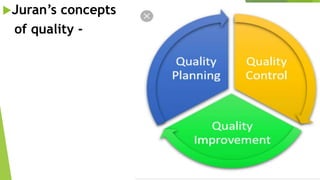
Juran developed a three part approach to
Quality:- Quality planning, quality control and
quality improvement.
 Quality planning involves- determining who the
customers are and what their needs are , then
developing products based on those needs
desinging processes to produce those products.
Juran’s concepts
of quality -
Quality control is the evaluation of performance
to identify discrepancies between actual
performance and goals;
Quality improvement establishes and
infrastructure and the project team to carry out
process improvement .
PURPOSES OF QUALITY:-
◾ To meet needs and expectation of the customers
both external and internal .
◾ To meet increased demand for effective and
appropriate care.
◾Need for standardization and variance control.
◾To minimize the errors and further eliminated to
attain excellence in care.
◾ To bring improvement in care and services.
.
▪️ To bring efficiency in the use of health care
resources and effectiveness in the delivery of
health care services .
▪️To fulfill the desire for recognition and to strive
for excellence
▪️ To have an benchmarking i.e. attract recognition
in the field and will encourage other individual ,
organisations or systems to emulate and follow.
 QUALITY ASSURANCE:-
“ Quality Assurance is a judgement concerning the process
of care, based on the extents to which that care contributes
to valued outcomes” (Donabedian,1982)
“ Quality assurance is the defining of nursing practice
through well written nursing standards as a basis for
evaluation on improvement of client care.”( Marker 1998)
“ Quality assurance is defined as making sure that the services
provided by the hospital are the best possible in a giving
existing resources and current medical knoledge.” ( WHO , 1992)
TOTAL QUALITY MANAGEMENT:-
 Quality management is becoming integral to the
delivery of health care. It is considered more
organized a coordinated and integrated approach to
manage / improve processes that affect patient
outcomes . It is an organized and integrated system of
continuous quality improvement aimed at meeting
customers’ expectations”.
Contributortributors to TQM):-
Total quality management was the work of Deming , Juran and
Crosby. Their contributions to TQM are regarded as three
paths , and one journey.
OBJECTIVE OF TQM:-
 To establish specific quality goal.
 To improve quality as a responsibilty shared by all
employees.
 To educate and train the employees.
 To formally recognize efforts to improve quality.
To identify specific projects that promise to improve
quality.
To provide necessary resources , both real and
financial .
 To regard employees as not only a provider but also a
user of services or results . Produced by antecedent
events in the process of rendering or episode or
regimen of care .
PRINCIPLES OF TQM:-
It is a multidiscplinary process and interdisciplinary
approach to examine organization process .
It is an overall approach to management to identify
problems and follow a process similar to that used in
nursing process .
It should be focused on work process, customer
orientation and statistical data analysis .
The emphsis on management accountability
work and continous improvement.
It needs systems, tools and techniques that can
convert this approach into realities.
Creating client focus , long range plan,
continuous improvement , daily process
management and employees involvement.
MODELS OF QUALITY ASSURANCE / MANAGEMENT
IN NURSING:
AMERICAN NURSES’ ASSOCIATION ( ANA ) MODEL:-
This model is given by Long and Black in 1975. This is the first
proposed and accepted model of quality assurance , which was
meant for the nursing profession but was used by various
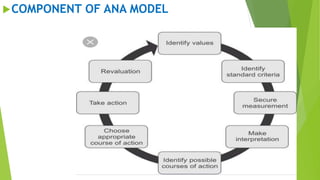
other professional in the health care. This is a cyclic model . It
helps in self determination of patient and family , nursing
health orientations, Patient’s right to quality care and nursing
contribution.
COMPONENT OF ANA MODEL
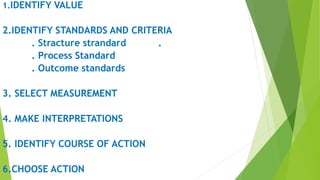
1.IDENTIFY VALUE
2.IDENTIFY STANDARDS AND CRITERIA
. Stracture strandard .
. Process Standard
. Outcome standards
3. SELECT MEASUREMENT
4. MAKE INTERPRETATIONS
5. IDENTIFY COURSE OF ACTION
6.CHOOSE ACTION
7. TAKE ACTION
8 REEVALUATION
 IDENTIFY VALUE:- In the ANA value identification looks as
such issue as patient /client, philosophy , needs and right
from an economic, social , psychology and spritual
perspective and values philosophy of health care
organization and providers of nursing services.
 IDENTIFY STANDARDS AND CRITERIA:- Identification of
standards and criteria for quality assurance begins with
writing of philosophy and objective of organization. The
philosophy and objectives of an agency serve to identify the
structural standards of the agency.
↪️Structural standards :- Standards of structure are defined by
licensing or accreding agency . Another standard of structure includes
organizational charts , which shows supervisory methods ,
communication patterns and staff patterns and sometimes staff
assignment .
↪️ Process standard:- A process standard is more specific apraisal of
quality of care being given by agency care provider. An agency can
choose to use standards of care set froth by professional organization
or agency can use nursing process and apply it to the activities of the
nurses as activities of nurses as activities correspond to the procedure
of care defined by the agency.
↪️ Outcome standards:- Outcome standards reveal end results of
nursing care.
 SELECT MEASURMENT:-
Measurements needed to determine degree of atainment of
criteria and standards are:
Nursing audit, utilization’s review and review of agency of
documents , self studies and review of physical facilities are
used to measure structural standards; Peer review , client
classification , admission , readmission , discharge data and
morbidity data are used to measure outcome standards .
 MAKE INTERPRETATION :-
The degree to which the predetermined criteria are
met is the basis for interpolation about the strength
and weakness of program . The rate compliance is
compared against the expected level of criteria
accomplishment.
IDENTIFY THE COURSE OF ACTION :-
If the compliance level is above the normal or the
expected level , there is great value in conveying
positive feedback and reinforcement. If the
compliance level is below the expected level , it is
essential to improve the situation . It is necessary to
identify the cause of deficiency , then it is important
to identify various solution of problems.
 CHOOSE ACTION :-
Usually various alternative course of action are
available to remedy a deficiency . Thus it is vital weigh
the prose and cons of each alterntative while
considering the environmental context and the
availability of resources . In the recent that more than
one cause of deficiency had been identified ; action
may be needed to deal with each contributing factor.
TAKE ACTION :- It is important to firmly establish
accountability for the action to be action . It is
essential to answer the questions of who will do ,
What? By when? This step then concluded with actual
implemented of the propsed course of action.
REEVALUATION :- The final step of Q A process
involves an evaluation of the result of action . The
assesment is accomplishment in the say same way as
the orginal assesment and begins the QA cycle again.
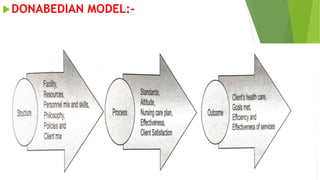
DONABEDIAN MODEL:-
 DONABEDIAN quality framework is recognised as a method of
measuring quality structure, process and outcome in the mid
of 1960.
◾STRUCTURE:- As the input to the health care system to
include both human and physical resources associated with the
delivery of the health care to the patient .
◾PROCESSES:- Includes all procedure and activities required to
delivery care by provider and support system.
◾OUTCOMES:- Include results and output of the care process
e.g. – morbidity and mortality rate, patient’s satisfaction.
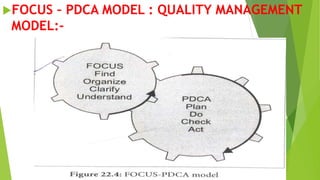
FOCUS – PDCA MODEL : QUALITY MANAGEMENT
MODEL:-
FOCUS PDCA is actually an acronym used for an approach
to problem solving and FOCUS stands for
 (I) Find a process to improve
(ii)Organize a team that knows the process ,
(iii)Clarify current knowldege of process,
(iv) understand the problem ,
 (v)selecting after understanding the problem and
selecting the solution.
Use PDCA model – (i)Plan the improvement effort
(ii)Do the plan , follow all step of action plan.
(iii)Check the difference in results (iv) Act on these
results i,e, write policy , train the staff and continue
monitor.
◾QUALITY EVALUATION SYSTEM IN HEALTH CARE:-
Audit systems
Quality awards
Peer assessment
Utilizattion review
Evaluation studies
Clients’ satisfaction
Incident review
Quality control
AUDIT SYSTEMS:- Audits are being done through
retrospective review of documentation and records
against a set of predetermined criteria.
QUALITY AWARDS:- There are various awards that are
given to that organization who maintain quality in
many countries e.g. the European Foundation for
Quality Management
( EFQM) .
PEER ASSESSMENT :-
It is a process whereby one health care practitioner
usually a physician will evaluate the care of a peer and
assist change toward better outcome. These are
designed to monitor client specific aspect of care
appropriate for certain level of care. The audit has
been the major tool used by peer review committee to
ascertain quality of care.
 UTILIZATION REVIEW:- There are three types of utilization of
review :
◾PROSPECTIVE:- Assessment of the necessity of care before
giving services.
◾CONCURRENT:- Review of necessity of care while the care is
given.
◾RETROSPECTIVE:- Analysis of the neccessity of services
received by the client after the care has being given.
 EVALUATION STUDIES:- Evaluation studies can be conducted
by using various quality assurance model . The main model
are Donabedian structure proccess outcome model ; the
tracer model; the sentinel model etc.
 CLIENTS’ SATISFACTION:- Client satisfaction can be assessed
using person or telephone interviews and mailed
questionnaire. Data from client satisfaction surveys are used
to measure strucure process and outcome of care given.
 INCIDENT REVIEW :- During a patient’s hospitalization several
incidents may occur which has a bearing on the treatment
and patient’s final recovery .
The critical incident may be : delayed attendance by a
physician/nurse , wrong adminstration medication , negligence
in caring out procedure.
 QUALITY CONTROL:- This system is also used to reduce the
variation in the process to provide a prediactable outcome
such as in the International Organization for Standardization
(ISO)approach.
REGULATORY APPROACHES :-
Licensure
Accreditation
certification
Credentialing
 LICENSURE:- Licensure is usually a governmental /council
approach to ensuring that individuals and organizations meet
minimum standards to protect the health and well-being of
public.
 ACCREDITATIONS:- Accreditation is defined as a process of
validation in which colleges , universities and other
institutions of higher learning are evaluated and certify it’s
competency authority and credibility.
 CERTIFICATION:- Certification is the confirmation of or
certifying certain characteristics of an objects , person or
organization through documentary proof.
 CREDENTIALING:-
It is generally defined as the formal recognition of
professional or technical competence and attainment of
minimum standards . It has four main objectives:
- To produce quality product
- To confer a unique identify
- To protect care provider and public
- To control quality.
IMPROVEMENT OF QUALITY IN HEALTH CARE
APPROACHES :-
◾ LEAN THINKING ( Lean manufacturing )
The concept was developed by Taiichi ochno at Toyota
based on the ideas of thinker like Benjamin Franklin ,
Frank Gilberth , F.w Tylor and Henry Ford. The term
“lean” was introduced by Womack and Jones in “Lean
thinking : Banish waste and create wealth in your
corporation”.
 LEAN AIMS AT CUSTOMER FOCUS - Defining and increasing
value to the customer.
It means smooth process flow , doing only these
activities that add customer value and eliminating all
other activities that don’t elimination of waste of
resources ( time, manpower, machine, materials) in
every area and every stage is at the core of lean .
BASIC STEPS IMPLENTING LEAN OPERATIONS:1
1.Define the value in the eyes of the customer.
2.Identify the activities that create value.
3.Identify the value stream , the sequence of
activities
4.Eliminate activities that do not add values
5. Allow the customer to “pull” products /
services ( increasing demands rather than pushing
( by over production / supply ).
6. Improve the process ( strat all over again)
5 S SYSTEM OF ORGANIZATION :-
1.Sort
2.Set in order
3.Shine
4.Standardize
5.Sustain
APPLICATION IN THE HOSPITAL SCENARIO:-
1. Cleaning up the cluttered places in Accident & Emergency
department as well as operation theatre by removing all
the unused /unnecessary equipment/stores.
2. Redistributing the unused / idle equipment to other areas
3. Freeing the space and making it easier for the staff as well
as patient to move around with reduction of accident
hazards for the patient as well as staff.
4.Reducing the inventory stores and equipment by
introducing just in time concept.
5. Significant reduction of wating time in the As E
department by simplifying the patients sign in the
process.( registration )
⚫ FACTOR AFFECTING QUALITY ASSURANCE:-
 Lack of resources
 Personal problems
 Unreasonable patients and attendants
 Improper maintenance
 Absence of accreditation laws .
 Legal redress
Lack of incident review procedures.
Lack of good hospital information system.
Absence of conducting patient satisfaction
surveys.
◾IMPACT OF QUALITY ASSURANCE IN NURSING:-
 Nurses are accountable for their action .
Nurse can deliver a high standard of care .
Guaranteeing standards of care to the public
Nurese are actively involved in audit consumer
relatives.
Improved the overall quality of nursing care .
Improves all types of documentation and
communication .
Helps in professional growth .
Helps to maintain international standard .
Helps to compare the standard with another
institution .
Avoid malpractice and bias .
 SUMMERIZATION
CONCLUSION:-
Quality assurance programme will helps to improve
the quality of nursing care and professional
development . Individuals with help the profession
actions and be answerable to the recipients for their
care.
BIBLIOGRAPHY: -
1. Vati jogindra, principles and practice of nursing
Management and Administration, Second edition -2020, joypee
brother medical publishers,page no- 506-515
2. Vati jogindra, Nursing Foundation : concept and
prescriptives, First edition-2015 page nom – 307-311
3. Joshi Sk , Quality Management in Hospital ,Joypee brother
medical publishers, First edition -2009 ,Page nom- 25 -27.
ADMINISTRATION - shatarupa barman.pptx

ADMINISTRATION - shatarupa barman.pptx

  • 1.
    SUB:NURSING ADMINASTRATION CLASS PRESENTATION ON QUALITYASURANCE IN NURSING PRESENTED BY Shatarupa Barman
  • 2.
    INTRODUCTION:- Nurses areaccountable to the society for the quality of nursing care . More over ensuring quality has become important in the health care system due to modern health care technology , increased competition , privatization and awerness among the clients. Nurese have accountability towards the patient care , keeping in mind the patient’s right, cost of health services demands quality assurance in nursing.
  • 3.
    HISTORICAL PERSPECTIVE OFQUALITY ASSURANCE:-  Quality notion in health care dates back to mid nineteenth century in England. In 1842 Dr. Edwin Chandwik, a public health activist and a pioneer from Britain recommended structural elements of public health ‘sanitary police’ to monitor the sanitary condition.
  • 4.
    In 1854, FlorenceNightingale , a leading nusre during the European Crimean war , written several quality criteria in nursing care considered to be first nursing care standards in history. In 1918, the American College of surgeon provided the criteria and standards for accreditation for Hospital standardization programme, adopted by Joint commision on Accredition of Hospital(JCAHO) in 1952. In 1966, Avedes Donabedian first introduced three measure of quality: structure , process and outcome for monitoring and assessing the quality of care.
  • 5.
    In INDIA ,a consumers protection Act was implemented in 1986. US Agency of International Development (USAID), funded a multi-million dollar, the Quality Assurance in developing project in 1990,to introduce Quality Assurance in developing countries . In New Millennium , for accreditation of health care organization WHO has taken the lead.
  • 6.
    CONCEPT OF QUALITY:- Theconcepts of quality in health care were grounded in the works of industrial experts . In industries , the importance of quality first began to be appreciated in 1940s and in 1950s. The quality is defined is various ways:- “ Quality is the degree to a product confirms to specification and workmanship standards’ . ( John D maclellan).
  • 7.
    The quality isdefined as “ the degree to which the patient care services increases the probability of desired outcomes and reduce the probability of undesired outcomes given the current stage of knowledge”. ( Joint commision for Accreditation of Health Care Organisation).
  • 8.
    APPROACH TO QUALITY:- Jurandeveloped a three part approach to Quality:- Quality planning, quality control and quality improvement.  Quality planning involves- determining who the customers are and what their needs are , then developing products based on those needs desinging processes to produce those products.
  • 9.
  • 10.
    Quality control isthe evaluation of performance to identify discrepancies between actual performance and goals; Quality improvement establishes and infrastructure and the project team to carry out process improvement .
  • 11.
    PURPOSES OF QUALITY:- ◾To meet needs and expectation of the customers both external and internal . ◾ To meet increased demand for effective and appropriate care. ◾Need for standardization and variance control. ◾To minimize the errors and further eliminated to attain excellence in care. ◾ To bring improvement in care and services. .
  • 12.
    ▪️ To bringefficiency in the use of health care resources and effectiveness in the delivery of health care services . ▪️To fulfill the desire for recognition and to strive for excellence ▪️ To have an benchmarking i.e. attract recognition in the field and will encourage other individual , organisations or systems to emulate and follow.
  • 13.
     QUALITY ASSURANCE:- “Quality Assurance is a judgement concerning the process of care, based on the extents to which that care contributes to valued outcomes” (Donabedian,1982) “ Quality assurance is the defining of nursing practice through well written nursing standards as a basis for evaluation on improvement of client care.”( Marker 1998) “ Quality assurance is defined as making sure that the services provided by the hospital are the best possible in a giving existing resources and current medical knoledge.” ( WHO , 1992)
  • 14.
    TOTAL QUALITY MANAGEMENT:- Quality management is becoming integral to the delivery of health care. It is considered more organized a coordinated and integrated approach to manage / improve processes that affect patient outcomes . It is an organized and integrated system of continuous quality improvement aimed at meeting customers’ expectations”.
  • 15.
    Contributortributors to TQM):- Totalquality management was the work of Deming , Juran and Crosby. Their contributions to TQM are regarded as three paths , and one journey. OBJECTIVE OF TQM:-  To establish specific quality goal.  To improve quality as a responsibilty shared by all employees.  To educate and train the employees.  To formally recognize efforts to improve quality.
  • 16.
    To identify specificprojects that promise to improve quality. To provide necessary resources , both real and financial .  To regard employees as not only a provider but also a user of services or results . Produced by antecedent events in the process of rendering or episode or regimen of care .
  • 17.
    PRINCIPLES OF TQM:- Itis a multidiscplinary process and interdisciplinary approach to examine organization process . It is an overall approach to management to identify problems and follow a process similar to that used in nursing process . It should be focused on work process, customer orientation and statistical data analysis .
  • 18.
    The emphsis onmanagement accountability work and continous improvement. It needs systems, tools and techniques that can convert this approach into realities. Creating client focus , long range plan, continuous improvement , daily process management and employees involvement.
  • 19.
    MODELS OF QUALITYASSURANCE / MANAGEMENT IN NURSING: AMERICAN NURSES’ ASSOCIATION ( ANA ) MODEL:- This model is given by Long and Black in 1975. This is the first proposed and accepted model of quality assurance , which was meant for the nursing profession but was used by various other professional in the health care. This is a cyclic model . It helps in self determination of patient and family , nursing health orientations, Patient’s right to quality care and nursing contribution.
  • 20.
  • 21.
    1.IDENTIFY VALUE 2.IDENTIFY STANDARDSAND CRITERIA . Stracture strandard . . Process Standard . Outcome standards 3. SELECT MEASUREMENT 4. MAKE INTERPRETATIONS 5. IDENTIFY COURSE OF ACTION 6.CHOOSE ACTION
  • 22.
  • 23.
     IDENTIFY VALUE:-In the ANA value identification looks as such issue as patient /client, philosophy , needs and right from an economic, social , psychology and spritual perspective and values philosophy of health care organization and providers of nursing services.  IDENTIFY STANDARDS AND CRITERIA:- Identification of standards and criteria for quality assurance begins with writing of philosophy and objective of organization. The philosophy and objectives of an agency serve to identify the structural standards of the agency.
  • 24.
    ↪️Structural standards :-Standards of structure are defined by licensing or accreding agency . Another standard of structure includes organizational charts , which shows supervisory methods , communication patterns and staff patterns and sometimes staff assignment . ↪️ Process standard:- A process standard is more specific apraisal of quality of care being given by agency care provider. An agency can choose to use standards of care set froth by professional organization or agency can use nursing process and apply it to the activities of the nurses as activities of nurses as activities correspond to the procedure of care defined by the agency. ↪️ Outcome standards:- Outcome standards reveal end results of nursing care.
  • 25.
     SELECT MEASURMENT:- Measurementsneeded to determine degree of atainment of criteria and standards are: Nursing audit, utilization’s review and review of agency of documents , self studies and review of physical facilities are used to measure structural standards; Peer review , client classification , admission , readmission , discharge data and morbidity data are used to measure outcome standards .
  • 26.
     MAKE INTERPRETATION:- The degree to which the predetermined criteria are met is the basis for interpolation about the strength and weakness of program . The rate compliance is compared against the expected level of criteria accomplishment.
  • 27.
    IDENTIFY THE COURSEOF ACTION :- If the compliance level is above the normal or the expected level , there is great value in conveying positive feedback and reinforcement. If the compliance level is below the expected level , it is essential to improve the situation . It is necessary to identify the cause of deficiency , then it is important to identify various solution of problems.
  • 28.
     CHOOSE ACTION:- Usually various alternative course of action are available to remedy a deficiency . Thus it is vital weigh the prose and cons of each alterntative while considering the environmental context and the availability of resources . In the recent that more than one cause of deficiency had been identified ; action may be needed to deal with each contributing factor.
  • 29.
    TAKE ACTION :-It is important to firmly establish accountability for the action to be action . It is essential to answer the questions of who will do , What? By when? This step then concluded with actual implemented of the propsed course of action. REEVALUATION :- The final step of Q A process involves an evaluation of the result of action . The assesment is accomplishment in the say same way as the orginal assesment and begins the QA cycle again.
  • 30.
  • 31.
     DONABEDIAN qualityframework is recognised as a method of measuring quality structure, process and outcome in the mid of 1960. ◾STRUCTURE:- As the input to the health care system to include both human and physical resources associated with the delivery of the health care to the patient . ◾PROCESSES:- Includes all procedure and activities required to delivery care by provider and support system. ◾OUTCOMES:- Include results and output of the care process e.g. – morbidity and mortality rate, patient’s satisfaction.
  • 32.
    FOCUS – PDCAMODEL : QUALITY MANAGEMENT MODEL:-
  • 33.
    FOCUS PDCA isactually an acronym used for an approach to problem solving and FOCUS stands for  (I) Find a process to improve (ii)Organize a team that knows the process , (iii)Clarify current knowldege of process, (iv) understand the problem ,  (v)selecting after understanding the problem and selecting the solution. Use PDCA model – (i)Plan the improvement effort (ii)Do the plan , follow all step of action plan. (iii)Check the difference in results (iv) Act on these results i,e, write policy , train the staff and continue monitor.
  • 34.
    ◾QUALITY EVALUATION SYSTEMIN HEALTH CARE:- Audit systems Quality awards Peer assessment Utilizattion review Evaluation studies Clients’ satisfaction Incident review Quality control
  • 35.
    AUDIT SYSTEMS:- Auditsare being done through retrospective review of documentation and records against a set of predetermined criteria. QUALITY AWARDS:- There are various awards that are given to that organization who maintain quality in many countries e.g. the European Foundation for Quality Management ( EFQM) .
  • 36.
    PEER ASSESSMENT :- Itis a process whereby one health care practitioner usually a physician will evaluate the care of a peer and assist change toward better outcome. These are designed to monitor client specific aspect of care appropriate for certain level of care. The audit has been the major tool used by peer review committee to ascertain quality of care.
  • 37.
     UTILIZATION REVIEW:-There are three types of utilization of review : ◾PROSPECTIVE:- Assessment of the necessity of care before giving services. ◾CONCURRENT:- Review of necessity of care while the care is given. ◾RETROSPECTIVE:- Analysis of the neccessity of services received by the client after the care has being given.
  • 38.
     EVALUATION STUDIES:-Evaluation studies can be conducted by using various quality assurance model . The main model are Donabedian structure proccess outcome model ; the tracer model; the sentinel model etc.  CLIENTS’ SATISFACTION:- Client satisfaction can be assessed using person or telephone interviews and mailed questionnaire. Data from client satisfaction surveys are used to measure strucure process and outcome of care given.
  • 39.
     INCIDENT REVIEW:- During a patient’s hospitalization several incidents may occur which has a bearing on the treatment and patient’s final recovery . The critical incident may be : delayed attendance by a physician/nurse , wrong adminstration medication , negligence in caring out procedure.  QUALITY CONTROL:- This system is also used to reduce the variation in the process to provide a prediactable outcome such as in the International Organization for Standardization (ISO)approach.
  • 40.
  • 41.
     LICENSURE:- Licensureis usually a governmental /council approach to ensuring that individuals and organizations meet minimum standards to protect the health and well-being of public.  ACCREDITATIONS:- Accreditation is defined as a process of validation in which colleges , universities and other institutions of higher learning are evaluated and certify it’s competency authority and credibility.  CERTIFICATION:- Certification is the confirmation of or certifying certain characteristics of an objects , person or organization through documentary proof.
  • 42.
     CREDENTIALING:- It isgenerally defined as the formal recognition of professional or technical competence and attainment of minimum standards . It has four main objectives: - To produce quality product - To confer a unique identify - To protect care provider and public - To control quality.
  • 43.
    IMPROVEMENT OF QUALITYIN HEALTH CARE APPROACHES :- ◾ LEAN THINKING ( Lean manufacturing ) The concept was developed by Taiichi ochno at Toyota based on the ideas of thinker like Benjamin Franklin , Frank Gilberth , F.w Tylor and Henry Ford. The term “lean” was introduced by Womack and Jones in “Lean thinking : Banish waste and create wealth in your corporation”.
  • 44.
     LEAN AIMSAT CUSTOMER FOCUS - Defining and increasing value to the customer. It means smooth process flow , doing only these activities that add customer value and eliminating all other activities that don’t elimination of waste of resources ( time, manpower, machine, materials) in every area and every stage is at the core of lean .
  • 45.
    BASIC STEPS IMPLENTINGLEAN OPERATIONS:1 1.Define the value in the eyes of the customer. 2.Identify the activities that create value. 3.Identify the value stream , the sequence of activities 4.Eliminate activities that do not add values
  • 46.
    5. Allow thecustomer to “pull” products / services ( increasing demands rather than pushing ( by over production / supply ). 6. Improve the process ( strat all over again)
  • 47.
    5 S SYSTEMOF ORGANIZATION :- 1.Sort 2.Set in order 3.Shine 4.Standardize 5.Sustain
  • 48.
    APPLICATION IN THEHOSPITAL SCENARIO:- 1. Cleaning up the cluttered places in Accident & Emergency department as well as operation theatre by removing all the unused /unnecessary equipment/stores. 2. Redistributing the unused / idle equipment to other areas 3. Freeing the space and making it easier for the staff as well as patient to move around with reduction of accident hazards for the patient as well as staff.
  • 49.
    4.Reducing the inventorystores and equipment by introducing just in time concept. 5. Significant reduction of wating time in the As E department by simplifying the patients sign in the process.( registration )
  • 50.
    ⚫ FACTOR AFFECTINGQUALITY ASSURANCE:-  Lack of resources  Personal problems  Unreasonable patients and attendants  Improper maintenance  Absence of accreditation laws .  Legal redress
  • 51.
    Lack of incidentreview procedures. Lack of good hospital information system. Absence of conducting patient satisfaction surveys.
  • 52.
    ◾IMPACT OF QUALITYASSURANCE IN NURSING:-  Nurses are accountable for their action . Nurse can deliver a high standard of care . Guaranteeing standards of care to the public Nurese are actively involved in audit consumer relatives. Improved the overall quality of nursing care .
  • 53.
    Improves all typesof documentation and communication . Helps in professional growth . Helps to maintain international standard . Helps to compare the standard with another institution . Avoid malpractice and bias .
  • 54.
  • 55.
    CONCLUSION:- Quality assurance programmewill helps to improve the quality of nursing care and professional development . Individuals with help the profession actions and be answerable to the recipients for their care.
  • 56.
    BIBLIOGRAPHY: - 1. Vatijogindra, principles and practice of nursing Management and Administration, Second edition -2020, joypee brother medical publishers,page no- 506-515 2. Vati jogindra, Nursing Foundation : concept and prescriptives, First edition-2015 page nom – 307-311 3. Joshi Sk , Quality Management in Hospital ,Joypee brother medical publishers, First edition -2009 ,Page nom- 25 -27.