PRESENTATED BY
CAN YOU GUASS
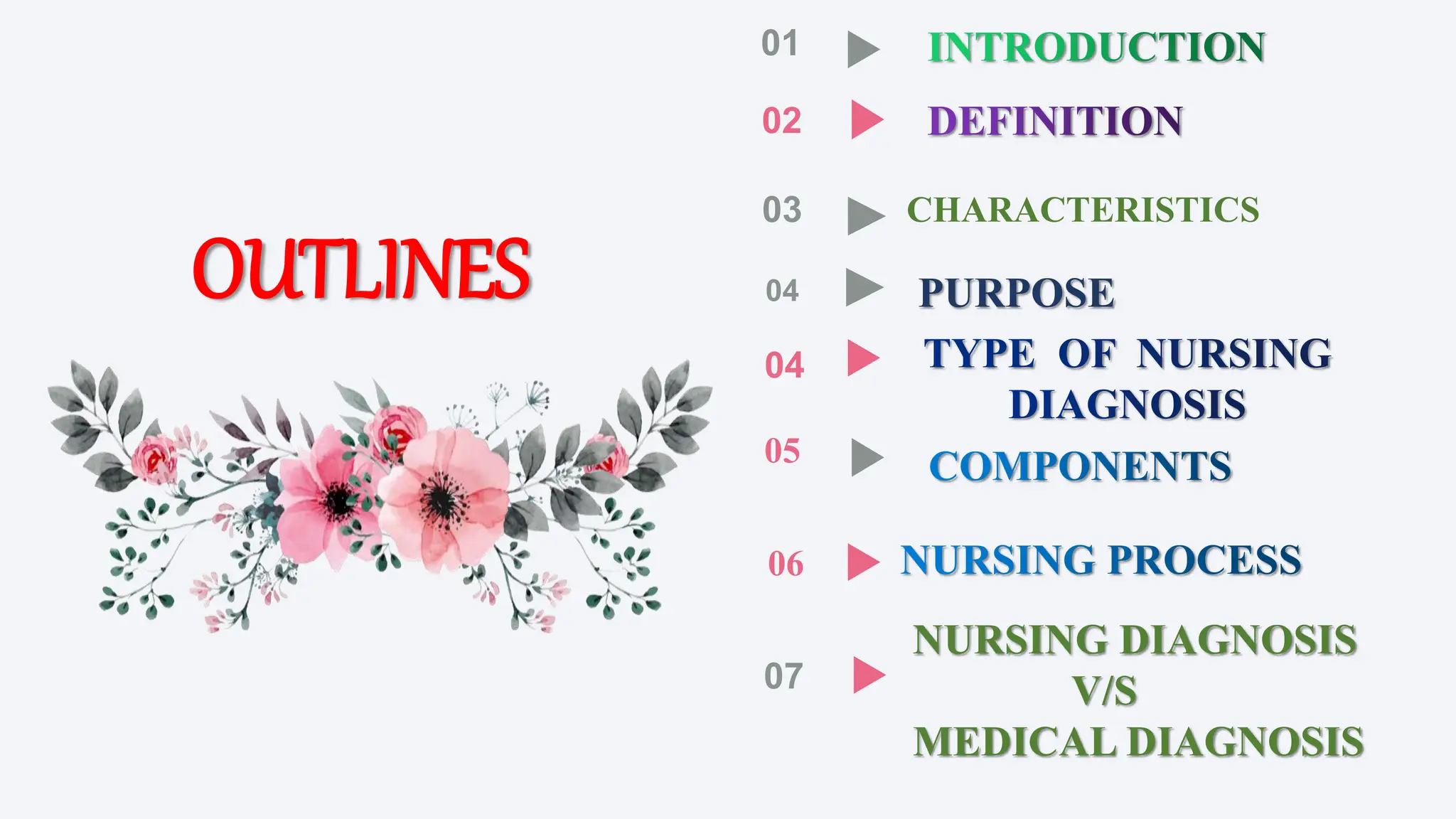
OUTLINES
01
03
02
04
PURPOSE
05
07
NURSING DIAGNOSIS
V/S
MEDICAL DIAGNOSIS
06
CHARACTERISTICS
04
INTRODUCTION
Cont.....
• Diagnosis is the second phase of nursing process. it is often
referred to as analysis as well as problem identification or nursing
diagnosis .
• Diagnosing - Refers to the reasoning process .
• Diagnosis - A statement or conclusion regarding the nature of
phenomenon .
DEFINITION
• A nursing diagnosis is a clinical judgement about individuals of community
responses to actual or potential health problem.
• Nursing diagnosis provides the basis for selection of nursing interventions to
achieve outcomes for which the nurse is accountable. - ‘NANDA’ 1990.
• A clinical judgement about individuals of community responses to actual or
potential health problem.
• Nursing diagnosis provides the basis for selection of nursing interventions to
achieve outcomes for which the nurse is accountable.
CONT......
CHARACTERISTICS OF NURSING DIAGNOSIS
 Characteristics are the cluster of signs and symptoms
that indicate the presence of a particular diagnostic label.
i ) For Actual Nursing Diagnosis
ii) For Risk Nursing Diagnosis
CONT......
 It states a clear and concise health problem.
 It is derived from existing evidences about the client.
 It is the basis for planning and carrying out nursing care.
 It is potentially amenable to nursing therapy.
PROBLEM
- FOCUSED
NURSING
DIAGNOSIS
HEALTH
PROMOTION
NURSING
DIAGNOSIS
RISK
NURSING
DIAGNOSIS
SYNDROME
NURSING
DIAGNOSIS
TYPES OF NURSING DIAGNOSIS
FORMULATION OF NURSING DIAGNOSTIC STATEMENT
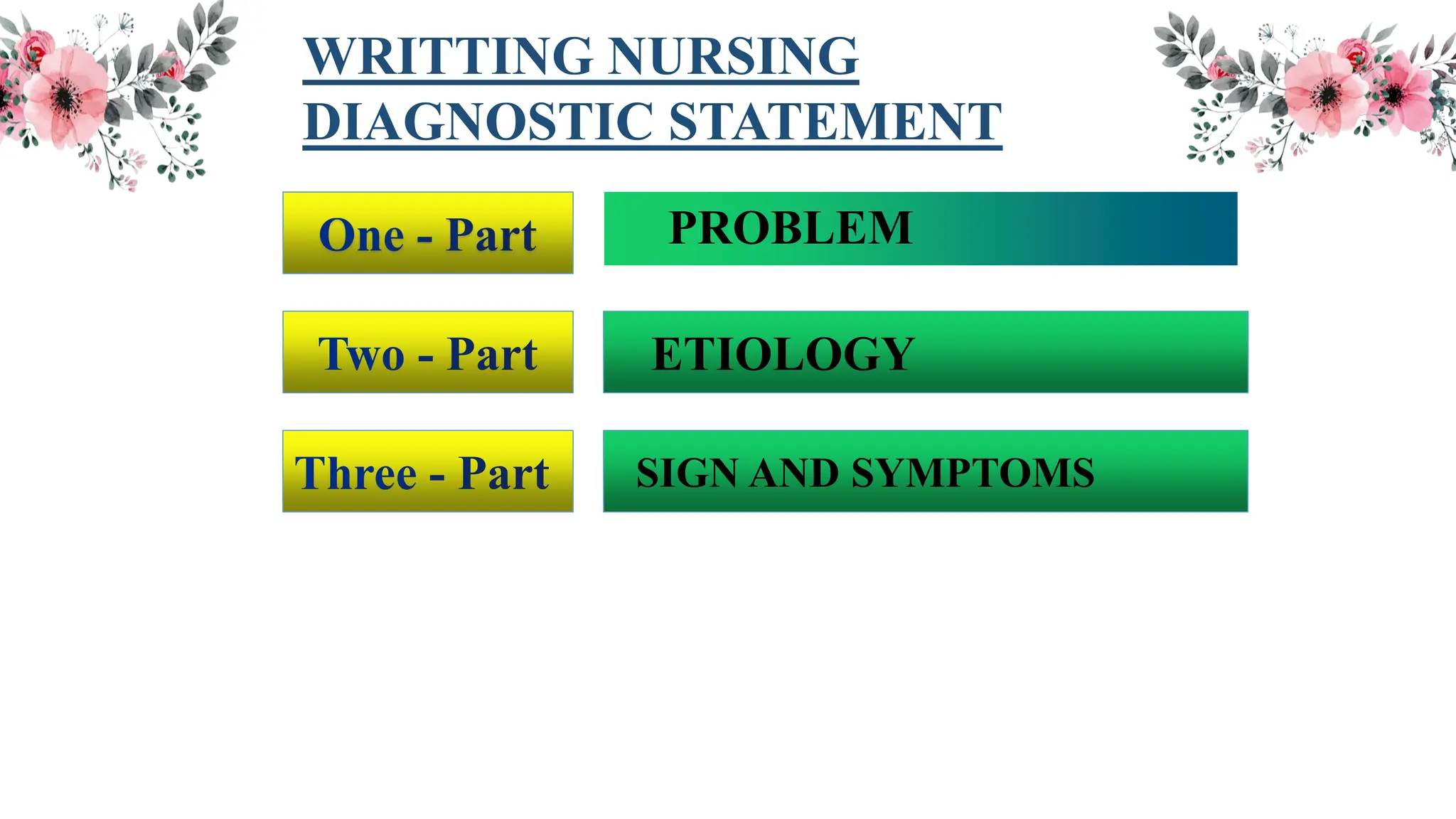
The basic format for a diagnostic statement is problem related
to etiology" however nurses must be able to write one, two
and three part diagnostic statement, as well as some variation
of each.
CONT.......
• Derived from physiological, sociocultural, developmental, and
spiritual dimensions of client.
• Derived from actual and potential problem.
PROBLEM
ETIOLOGY
SIGN AND SYMPTOMS
WRITTING NURSING
DIAGNOSTIC STATEMENT
Components of a Nursing Diagnosis
Acute Pain Related to tissue As evidenced by statement of
a Ischemia "I feel severe pain on my chest
(P)roblem (E)tiology (S)igns and symptoms
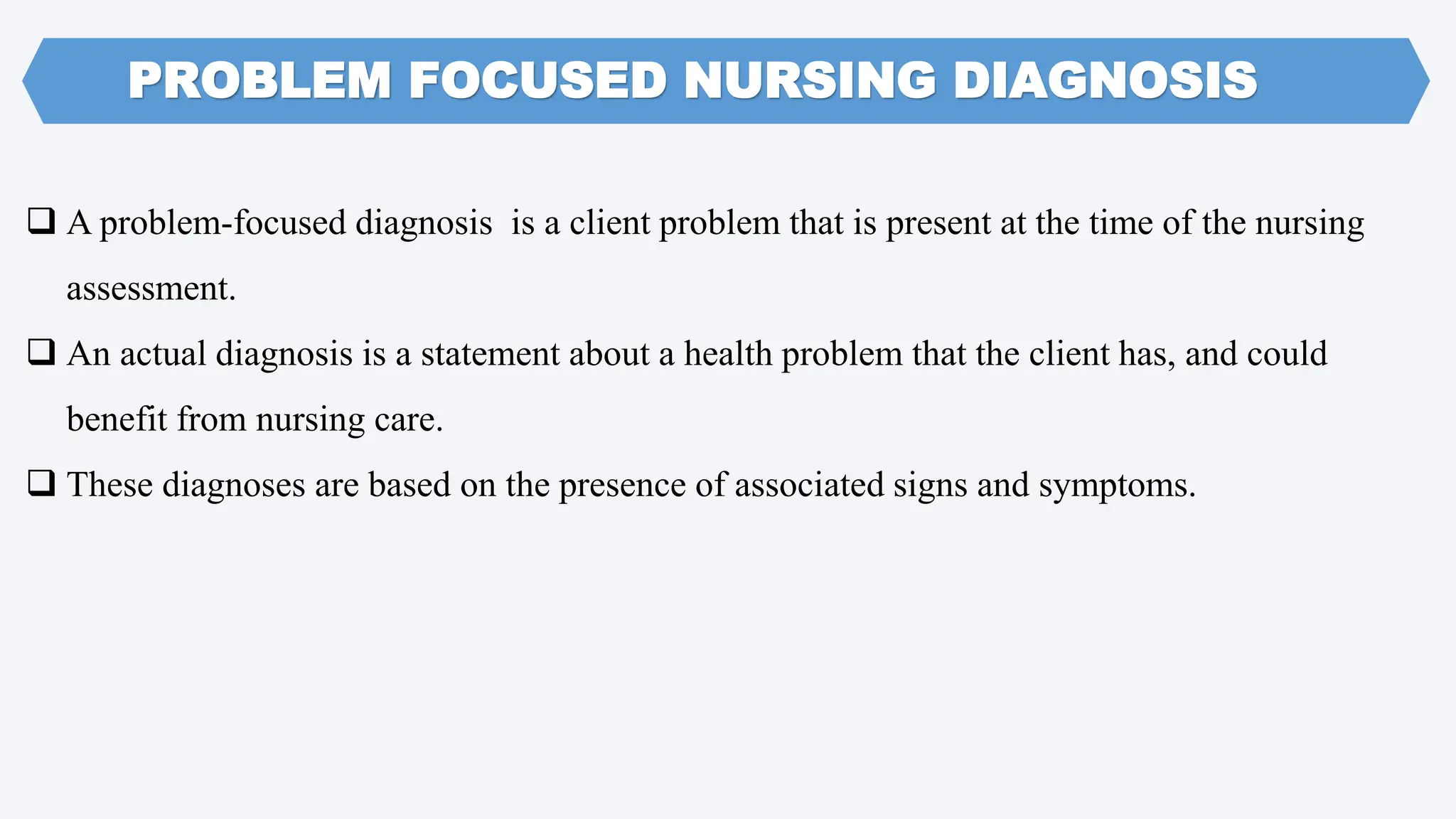
PROBLEM FOCUSED NURSING DIAGNOSIS
 A problem-focused diagnosis is a client problem that is present at the time of the nursing
assessment.
 An actual diagnosis is a statement about a health problem that the client has, and could
benefit from nursing care.
 These diagnoses are based on the presence of associated signs and symptoms.
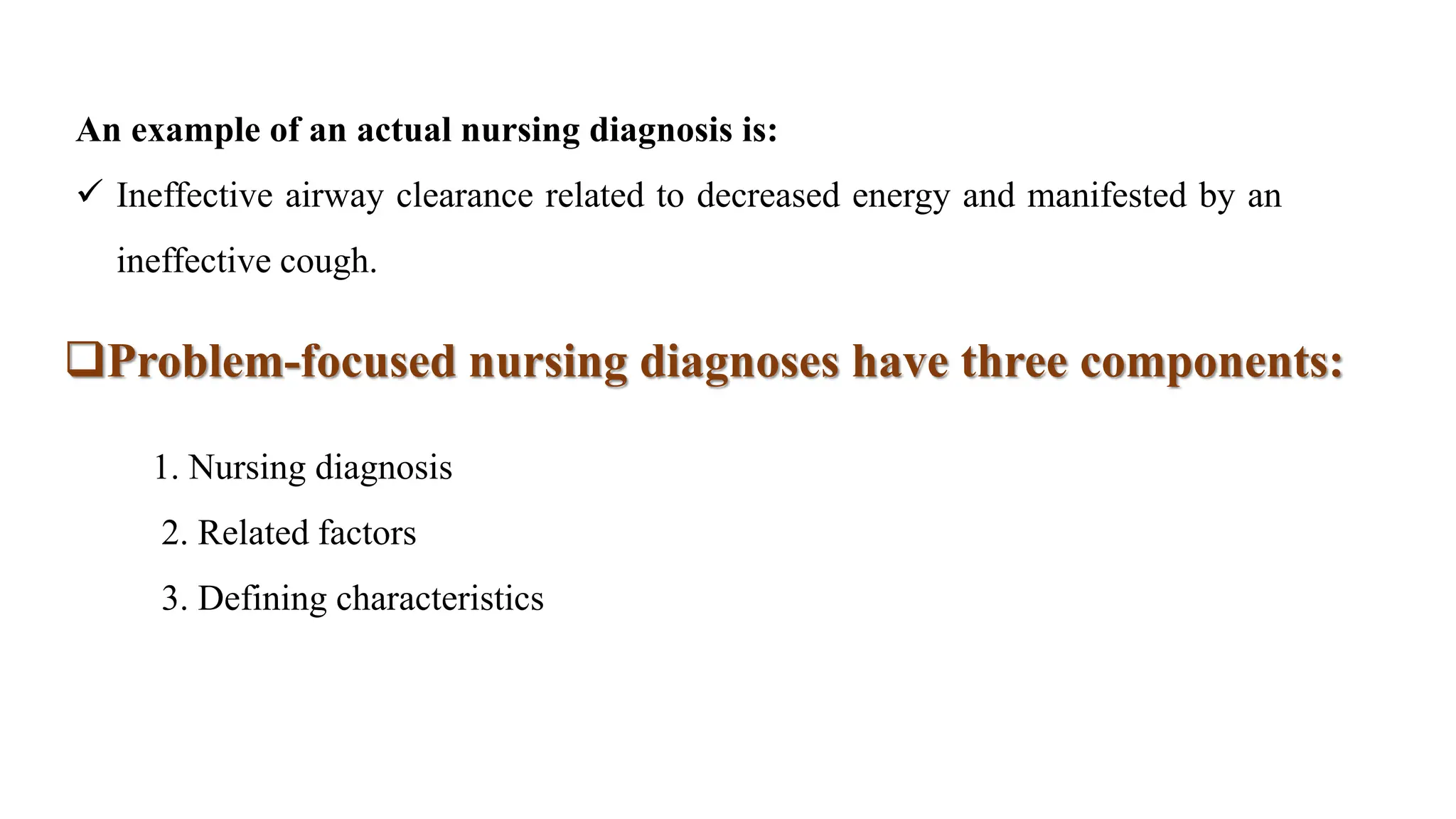
Problem-focused nursing diagnoses have three components:
1. Nursing diagnosis
2. Related factors
3. Defining characteristics
An example of an actual nursing diagnosis is:
 Ineffective airway clearance related to decreased energy and manifested by an
ineffective cough.
 A risk nursing diagnosis describes human responses to health conditions/life processes that
will possibly develop in a vulnerable individual, family, or community.
 These are clinical judgment that a problem does not exist, but the presence of risk factors
indicates that a problem is likely to develop unless nurses intervene. The individual (or group)
is more susceptible to develop the problem than others in the same or a similar situation
because of risk factors.
RISK NURSING DIAGNOSIS
 Examples of risk nursing diagnosis are:
 Risk for Infection related to surgical side incension.
Components of a risk nursing diagnosis include:
 Risk diagnostic label
 Risk factors
HEALTH PROMOTION NURSING DIAGNOSIS
• Health promotion diagnosis is a clinical judgment about motivation and desire to
increase well-being.
• Health promotion diagnosis is concened in the individual, family, or community
transition from a specific level of wellness to a higher level of wellness.
Examples of health promotion diagnosis:
 Readiness for Enhanced Spiritual Well Being
 Readiness for Enhanced Family Coping
 Readiness for Enhanced Parenting
SYNDROME NURSING DIAGNOSIS
 A syndrome nursing diagnosis statement is a clinical judgment, which is
associated with a cluster of predicted high-risk or actual nursing diagnosis,
related to a certain situation or event.
 A syndrome diagnosis is a clinical judgment concerning with a cluster of
problem or risk nursing diagnoses that are predicted to present because of a
certain situation or event.
 It is a diagnosis that is associated with a cluster of other nursing diagnosis .
 Chronic Pain Syndrome
 Post-trauma Syndrome
 Impaired physical mobility Possible Nursing Diagnosis
NURSING PROCESS
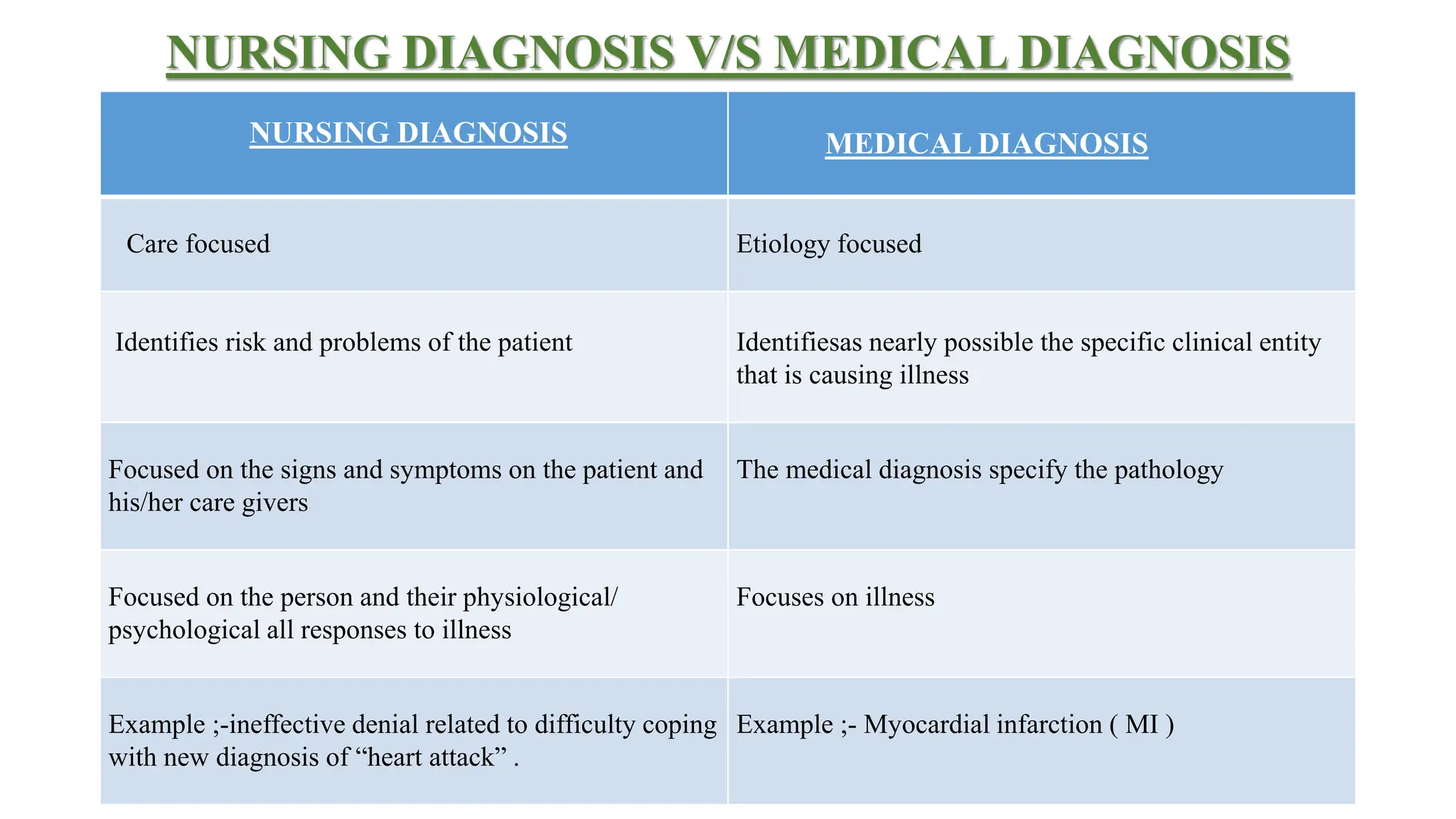
NURSING DIAGNOSIS V/S MEDICAL DIAGNOSIS
NURSING DIAGNOSIS MEDICAL DIAGNOSIS
Care focused Etiology focused
Identifies risk and problems of the patient Identifiesas nearly possible the specific clinical entity
that is causing illness
Focused on the signs and symptoms on the patient and
his/her care givers
The medical diagnosis specify the pathology
Focused on the person and their physiological/
psychological all responses to illness
Focuses on illness
Example ;-ineffective denial related to difficulty coping
with new diagnosis of “heart attack” .
Example ;- Myocardial infarction ( MI )
COMMUNICATION
QUALITY
IMPROVEMENT
Standard for
nursing practice
Identification of
appropriate
goals
Acutity
information
Assist in discharge
planning
CONCLUSION
Nursing diagnosis is a diagnosis that is based upon the response of the patient to the medical
condition. This is why it is called a ‘nursing diagnosis' because these are things that have a
specific action that is related to what nurses have autonomy to take action about. Nurses treat
the patient with everything that is related to human response to a specific disease. This
includes anything that is a physical, mental, and spiritual type of response. Simply put, a
nursing diagnosis is care focused.
• POTTER AND PERRYS fundamentals of nursing 7th edition , Pg No - 253 - 258.
• D Elakkuvana Bhaskara Raj EMMESS first edition 2022 Nursing foundation - II pg no. 26-30 .
• JAYPEE I Clement test book of nursing fundamental JAPEE BROTHERS Medical publishers (p) Ltd .
• Gordon, M. (1982). Nursing diagnosis: Process and application. New York: McGraw-Hill.
• Ackley, B. J., & Ladwig, G. B. (2010). Nursing Diagnosis Handbook-E-Book: An Evidence-Based Guide to Planning
Care. Elsevier Health Sciences.
• NANDA-I Nursing Diagnosis: Herdman, H. T., & Kamitsuru, S. (Eds.). (2017). NANDA International Nursing
Diagnoses: Definitions & Classification 2018-2020. Thieme.
• NANDA. International. (2014). Nursing Diagnoses 2012-14: Definitions and Classification. Wiley.
Formulation on Nursing Diagnosis pptx

Formulation on Nursing Diagnosis pptx

  • 1.
  • 2.
  • 4.
  • 5.
  • 6.
    Cont..... • Diagnosis isthe second phase of nursing process. it is often referred to as analysis as well as problem identification or nursing diagnosis . • Diagnosing - Refers to the reasoning process . • Diagnosis - A statement or conclusion regarding the nature of phenomenon .
  • 7.
  • 8.
    • A nursingdiagnosis is a clinical judgement about individuals of community responses to actual or potential health problem. • Nursing diagnosis provides the basis for selection of nursing interventions to achieve outcomes for which the nurse is accountable. - ‘NANDA’ 1990. • A clinical judgement about individuals of community responses to actual or potential health problem. • Nursing diagnosis provides the basis for selection of nursing interventions to achieve outcomes for which the nurse is accountable. CONT......
  • 9.
    CHARACTERISTICS OF NURSINGDIAGNOSIS  Characteristics are the cluster of signs and symptoms that indicate the presence of a particular diagnostic label. i ) For Actual Nursing Diagnosis ii) For Risk Nursing Diagnosis
  • 10.
    CONT......  It statesa clear and concise health problem.  It is derived from existing evidences about the client.  It is the basis for planning and carrying out nursing care.  It is potentially amenable to nursing therapy.
  • 11.
  • 12.
    FORMULATION OF NURSINGDIAGNOSTIC STATEMENT The basic format for a diagnostic statement is problem related to etiology" however nurses must be able to write one, two and three part diagnostic statement, as well as some variation of each.
  • 13.
    CONT....... • Derived fromphysiological, sociocultural, developmental, and spiritual dimensions of client. • Derived from actual and potential problem.
  • 14.
    PROBLEM ETIOLOGY SIGN AND SYMPTOMS WRITTINGNURSING DIAGNOSTIC STATEMENT
  • 15.
    Components of aNursing Diagnosis Acute Pain Related to tissue As evidenced by statement of a Ischemia "I feel severe pain on my chest (P)roblem (E)tiology (S)igns and symptoms
  • 16.
    PROBLEM FOCUSED NURSINGDIAGNOSIS  A problem-focused diagnosis is a client problem that is present at the time of the nursing assessment.  An actual diagnosis is a statement about a health problem that the client has, and could benefit from nursing care.  These diagnoses are based on the presence of associated signs and symptoms.
  • 17.
    Problem-focused nursing diagnoseshave three components: 1. Nursing diagnosis 2. Related factors 3. Defining characteristics An example of an actual nursing diagnosis is:  Ineffective airway clearance related to decreased energy and manifested by an ineffective cough.
  • 18.
     A risknursing diagnosis describes human responses to health conditions/life processes that will possibly develop in a vulnerable individual, family, or community.  These are clinical judgment that a problem does not exist, but the presence of risk factors indicates that a problem is likely to develop unless nurses intervene. The individual (or group) is more susceptible to develop the problem than others in the same or a similar situation because of risk factors. RISK NURSING DIAGNOSIS
  • 19.
     Examples ofrisk nursing diagnosis are:  Risk for Infection related to surgical side incension. Components of a risk nursing diagnosis include:  Risk diagnostic label  Risk factors
  • 20.
    HEALTH PROMOTION NURSINGDIAGNOSIS • Health promotion diagnosis is a clinical judgment about motivation and desire to increase well-being. • Health promotion diagnosis is concened in the individual, family, or community transition from a specific level of wellness to a higher level of wellness.
  • 21.
    Examples of healthpromotion diagnosis:  Readiness for Enhanced Spiritual Well Being  Readiness for Enhanced Family Coping  Readiness for Enhanced Parenting
  • 22.
    SYNDROME NURSING DIAGNOSIS A syndrome nursing diagnosis statement is a clinical judgment, which is associated with a cluster of predicted high-risk or actual nursing diagnosis, related to a certain situation or event.  A syndrome diagnosis is a clinical judgment concerning with a cluster of problem or risk nursing diagnoses that are predicted to present because of a certain situation or event.  It is a diagnosis that is associated with a cluster of other nursing diagnosis .
  • 23.
     Chronic PainSyndrome  Post-trauma Syndrome  Impaired physical mobility Possible Nursing Diagnosis
  • 24.
  • 26.
    NURSING DIAGNOSIS V/SMEDICAL DIAGNOSIS NURSING DIAGNOSIS MEDICAL DIAGNOSIS Care focused Etiology focused Identifies risk and problems of the patient Identifiesas nearly possible the specific clinical entity that is causing illness Focused on the signs and symptoms on the patient and his/her care givers The medical diagnosis specify the pathology Focused on the person and their physiological/ psychological all responses to illness Focuses on illness Example ;-ineffective denial related to difficulty coping with new diagnosis of “heart attack” . Example ;- Myocardial infarction ( MI )
  • 27.
    COMMUNICATION QUALITY IMPROVEMENT Standard for nursing practice Identificationof appropriate goals Acutity information Assist in discharge planning
  • 30.
    CONCLUSION Nursing diagnosis isa diagnosis that is based upon the response of the patient to the medical condition. This is why it is called a ‘nursing diagnosis' because these are things that have a specific action that is related to what nurses have autonomy to take action about. Nurses treat the patient with everything that is related to human response to a specific disease. This includes anything that is a physical, mental, and spiritual type of response. Simply put, a nursing diagnosis is care focused.
  • 31.
    • POTTER ANDPERRYS fundamentals of nursing 7th edition , Pg No - 253 - 258. • D Elakkuvana Bhaskara Raj EMMESS first edition 2022 Nursing foundation - II pg no. 26-30 . • JAYPEE I Clement test book of nursing fundamental JAPEE BROTHERS Medical publishers (p) Ltd . • Gordon, M. (1982). Nursing diagnosis: Process and application. New York: McGraw-Hill. • Ackley, B. J., & Ladwig, G. B. (2010). Nursing Diagnosis Handbook-E-Book: An Evidence-Based Guide to Planning Care. Elsevier Health Sciences. • NANDA-I Nursing Diagnosis: Herdman, H. T., & Kamitsuru, S. (Eds.). (2017). NANDA International Nursing Diagnoses: Definitions & Classification 2018-2020. Thieme. • NANDA. International. (2014). Nursing Diagnoses 2012-14: Definitions and Classification. Wiley.