Sales Promotion
The wonders and the wounds
Promotion Mix /
Communication Mix (PR)
 Sales Promotion
 PR
 Selling
 Advertising
 Below the line
 Above the line
Two Types of Sales Promotion
 Consumer Promotion
 Trade Promotion
What do we want the
consumers and trade to do?
 Buy More
 Buy Now
A sales promotion should
be
 Temporary – if not the consumers
would not believe it the next time
 Great Value Added – they should
find reason to buy now and more
Trends on Sales Promotion
 ¾ of the marketing budget is allocated
to sales promotion
 In 1995, 51% of total adspend represents
trade promotions. 24% on media
spending 22% on consumer promotion
 Growth in the coupon segment is
tremendous in aspirational markets
 Americans redeem more than 7 billion
coupons annually.
Why the Growth???
 Instant results
 Faster implementation
 Measurable
 Relatively easy and inexpensive
The Downside of Sales
Promotion
 Brand Erosion
 Profitability increase is relatively low
 Implementation cost and problems
 Orients marketing managers
towards short term results
What a sales promotion
should be….
 Lets go back to the basics
 Should hit the consumer at a particular
behavioral stage
 Are marketing communication activities
that change the price/value relationship
of a product / service perceived by the
target
 Generating immediate sales
 Altering long term brand value
Planning Sales Promotion
 Who is our target set of consumers?
 What is the reason for that behavior
 What is the goal of the program
 Is there a meaningful economics
attached to sales promotion
Types of Buyers
 Loyals
 Buy a particular brand on a more or less
consistent basis
 Competitive loyals
 People who are loyal to the competing
brand
 Switchers
 Purchase of various brands in one category
 Price buyers
 Non Users
Results that are needed ….
 Loyals
 Reinforce behavior
 Increase consumption
 Change buying timing
 Competitive loyals
 Break loyalty
 Encourage brand switching
 Switchers
 Persuade to buy the “right” brand more often
 Price
 Value added to make price less important
 Non users
 Create awareness, create category worth
Types of Sales Promotions
 Coupon
 Bonus Packs
 In pack, On pack, and Near Pack
 Specialty container
 Continuity program
 Refund
 Sweepstakes
 Contest
 Through the mail Premium
 Sampling
 Price off
 Trade deal
 Cause related promotion
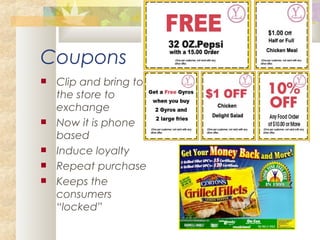
Coupons
 Clip and bring to
the store to
exchange
 Now it is phone
based
 Induce loyalty
 Repeat purchase
 Keeps the
consumers
“locked”
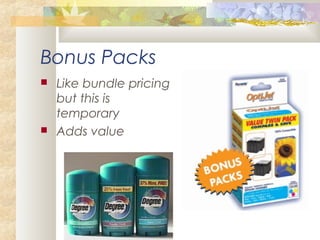
Bonus Packs
 Like bundle pricing
but this is
temporary
 Adds value
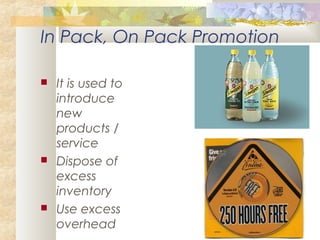
In Pack, On Pack Promotion
 It is used to
introduce
new
products /
service
 Dispose of
excess
inventory
 Use excess
overhead
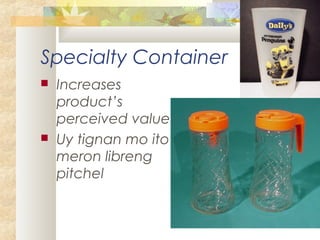
Specialty Container
 Increases
product’s
perceived value
 Uy tignan mo ito
meron libreng
pitchel
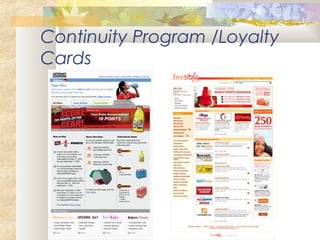
Continuity Program /Loyalty
Cards
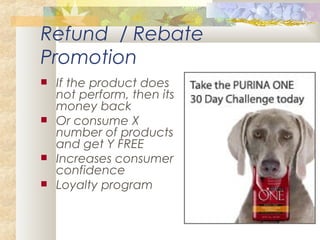
Refund / Rebate
Promotion
 If the product does
not perform, then its
money back
 Or consume X
number of products
and get Y FREE
 Increases consumer
confidence
 Loyalty program
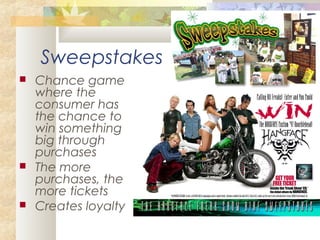
Sweepstakes
 Chance game
where the
consumer has
the chance to
win something
big through
purchases
 The more
purchases, the
more tickets
 Creates loyalty
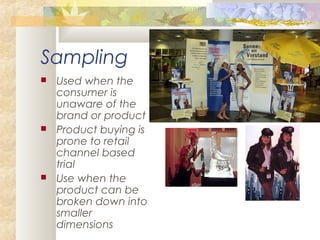
Sampling
 Used when the
consumer is
unaware of the
brand or product
 Product buying is
prone to retail
channel based
trial
 Use when the
product can be
broken down into
smaller
dimensions
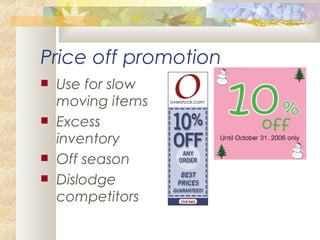
Price off promotion
 Use for slow
moving items
 Excess
inventory
 Off season
 Dislodge
competitors
Choose the right promotion
for the right situation
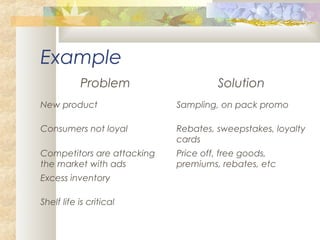
Example
Problem Solution
New product Sampling, on pack promo
Consumers not loyal Rebates, sweepstakes, loyalty
cards
Competitors are attacking
the market with ads
Price off, free goods,
premiums, rebates, etc
Excess inventory
Shelf life is critical
Consumer Promotion
 To induce immediate off take from
the shelf
 To induce trial
 To buy more of your products
 To buy immediately
Trade Promotion
 Encourages your trade channel to
load up
 Move inventory from the company
to the warehouse of the trade
 Distributor or Key Accounts
 Deals with promotional tools for staff
and sales people who are involved
with the trade.
Sell in (PUSH STRATEGY)
 Trade Promotion based on
 Volume – buy a certain volume to
attain a high discount
 Prompt Payment – pay on time and
get a discount
 Free goods – using new products or
slow moving products as promotional
items
Volume Promotion
 It motivates the dealer to buy more
 Example
 10+1 promotion – buy 10 boxes get
one free
 Volume discounts
 Bundle promotion – feature a new
product as freebie
Advertising Promotion
 Cooperative advertising
 Coke and Julie’s Bakeshop
 Lock in to the outlet to exclusively sell
your brand
Cooperative Promotion
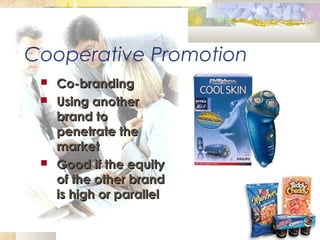
 Co-brandingCo-branding
 Using anotherUsing another
brand tobrand to
penetrate thepenetrate the
marketmarket
 Good if the equityGood if the equity
of the other brandof the other brand
is high or parallelis high or parallel
Co-branding
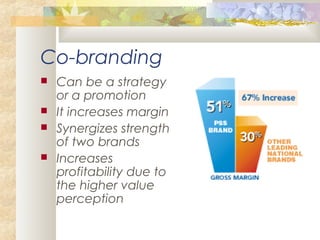
 Can be a strategy
or a promotion
 It increases margin
 Synergizes strength
of two brands
 Increases
profitability due to
the higher value
perception
Free Goods
 Better
profitability
 Moves higher
volume
 Economies of
scale
Trade Advertising
 Advertisements used as a basis for
booking sales
 Rationale is consumers will look for a
brand that has ad support
Massive advertising always leads
to higher trade acceptance
Trade will only stock items that will
sell
Personal Selling
Direct Selling
Distribution Selling
Outlet Selling
Direct Sales
 One of the recent
trends in consumer
marketing
 Direct hit to consumers
 Smaller ad spending
Direct sales
 Uses human capital as resource
 Offering high earnings to those who
do not have businesses
 Home based
 People get people strategy
 Very sound business model
How do they profit?
 Gross Margin 40%
 1st
level Commission – 10%
 2nd
level commission – 8%
 3rd
Level commission – 5%
 AT this point, the company still earns
and yet the number of networks
grow….
Direct Sales
 Meaningful to sales people
 The consumer saves money
 Answer to the crisis of power of
retail channels
Distribution Selling
 Sales efforts to cover geographic
region
 Cover relevant distribution channels
 Example:
 Bonheur Marketing
Bonheur Marketing
 Former exclusive distributor of
Marlboro and Philip Morris
 Covers outlets such as
 Supermarkets
 Sari sari stores
 Sub distriutors
 Dealers
 Luzon wide
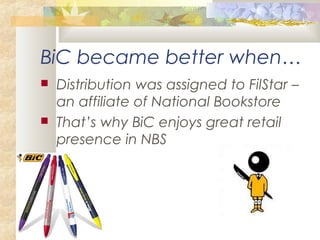
BiC became better when…
 Distribution was assigned to FilStar –
an affiliate of National Bookstore
 That’s why BiC enjoys great retail
presence in NBS
Public Relations
Advertising
Key things to remember
 Creative brief
 Copy strategy
 Execution methods
 Media
 Media Planning
 Success tracking
Creative Brief
 Brand elements
 Target segment
 Reason to buy
 Current behavior
 Current perception
 Desired impression
Copy Strategy
 Tagline
 Plot
 Mood and Tone
 Reason to believe
 Execution
 Media
 Media Plan
Media Plan
 Medium
 Above the line
 Below the line
 Loading
 Front
 Back
 Seasonal
 Flat
Media
 TVC
 Print
 Radio
 Internet
 CPM (clicks per million)
 Ad click
 Ad impressions
 Banner or button advertisement
 Click through
 Cost per click
 Spam
 URL
Media
 Billboard – of course they will stay
 Mall panels
 Comfort ads
 Transit ads
 Non traditional
 Corporate gifts
 Leaflets
Media Plan
 Using each medium optimally to
achieve brand objectives
 It is all about making the right mix or
right allocation of budgets
 Hitting consumers where it matters
most
Executions
 Humor
 MTV
 Slice of life
 Celebrity endorser
 Testimonial
 Image model – can be a competent
looking person
 Performance test
Just make sure they do not…
 Laugh and forget which brand is
being advertised
 Remember the story in the ad and
then forget about the brand
 Remember the song and then…
ano nga palang brand yun?!
Things you should remember
 Matrix or charts or altering SWOT with
TOWS analysis (which by the way is not a
marketing tool but a central
management tool) DON’T BUY THE IDEA
 The basics still work – and it will sans a
few alterations
 IMC is integrating all communication
materials under one big idea
Remember
 Life is a journey of learning
 The moment you get cocky is the time
you die
 Mistakes are best teachers
 Do not believe all teachers too… some
of them have issues as well… pick good
mentors
 Don’t label anything – good or bad
 Know thy Dharma – know what you are
here for
Remember
 Detachment is a great tool
 Make yourself competent – goal is
not to be employed but
employable
 Don’t make yourself stagnant –
even if your family or husband is rich
 Have FAITH
Remember
 PR competence is as important as
knowledge
 Be the best you can ever be (not
Alipin Sagigigilid all your life)
Thank you for such a
wonderful semester… really

Sales Promotion

  • 1.
  • 2.
    Promotion Mix / CommunicationMix (PR)  Sales Promotion  PR  Selling  Advertising  Below the line  Above the line
  • 3.
    Two Types ofSales Promotion  Consumer Promotion  Trade Promotion
  • 4.
    What do wewant the consumers and trade to do?  Buy More  Buy Now
  • 5.
    A sales promotionshould be  Temporary – if not the consumers would not believe it the next time  Great Value Added – they should find reason to buy now and more
  • 6.
    Trends on SalesPromotion  ¾ of the marketing budget is allocated to sales promotion  In 1995, 51% of total adspend represents trade promotions. 24% on media spending 22% on consumer promotion  Growth in the coupon segment is tremendous in aspirational markets  Americans redeem more than 7 billion coupons annually.
  • 7.
    Why the Growth??? Instant results  Faster implementation  Measurable  Relatively easy and inexpensive
  • 8.
    The Downside ofSales Promotion  Brand Erosion  Profitability increase is relatively low  Implementation cost and problems  Orients marketing managers towards short term results
  • 9.
    What a salespromotion should be….  Lets go back to the basics  Should hit the consumer at a particular behavioral stage  Are marketing communication activities that change the price/value relationship of a product / service perceived by the target  Generating immediate sales  Altering long term brand value
  • 10.
    Planning Sales Promotion Who is our target set of consumers?  What is the reason for that behavior  What is the goal of the program  Is there a meaningful economics attached to sales promotion
  • 11.
    Types of Buyers Loyals  Buy a particular brand on a more or less consistent basis  Competitive loyals  People who are loyal to the competing brand  Switchers  Purchase of various brands in one category  Price buyers  Non Users
  • 12.
    Results that areneeded ….  Loyals  Reinforce behavior  Increase consumption  Change buying timing  Competitive loyals  Break loyalty  Encourage brand switching  Switchers  Persuade to buy the “right” brand more often  Price  Value added to make price less important  Non users  Create awareness, create category worth
  • 13.
    Types of SalesPromotions  Coupon  Bonus Packs  In pack, On pack, and Near Pack  Specialty container  Continuity program  Refund  Sweepstakes  Contest  Through the mail Premium  Sampling  Price off  Trade deal  Cause related promotion
  • 14.
    Coupons  Clip andbring to the store to exchange  Now it is phone based  Induce loyalty  Repeat purchase  Keeps the consumers “locked”
  • 15.
    Bonus Packs  Likebundle pricing but this is temporary  Adds value
  • 16.
    In Pack, OnPack Promotion  It is used to introduce new products / service  Dispose of excess inventory  Use excess overhead
  • 17.
    Specialty Container  Increases product’s perceivedvalue  Uy tignan mo ito meron libreng pitchel
  • 18.
  • 19.
    Refund / Rebate Promotion If the product does not perform, then its money back  Or consume X number of products and get Y FREE  Increases consumer confidence  Loyalty program
  • 20.
    Sweepstakes  Chance game wherethe consumer has the chance to win something big through purchases  The more purchases, the more tickets  Creates loyalty
  • 21.
    Sampling  Used whenthe consumer is unaware of the brand or product  Product buying is prone to retail channel based trial  Use when the product can be broken down into smaller dimensions
  • 22.
    Price off promotion Use for slow moving items  Excess inventory  Off season  Dislodge competitors
  • 23.
    Choose the rightpromotion for the right situation
  • 24.
    Example Problem Solution New productSampling, on pack promo Consumers not loyal Rebates, sweepstakes, loyalty cards Competitors are attacking the market with ads Price off, free goods, premiums, rebates, etc Excess inventory Shelf life is critical
  • 25.
    Consumer Promotion  Toinduce immediate off take from the shelf  To induce trial  To buy more of your products  To buy immediately
  • 29.
    Trade Promotion  Encouragesyour trade channel to load up  Move inventory from the company to the warehouse of the trade  Distributor or Key Accounts  Deals with promotional tools for staff and sales people who are involved with the trade.
  • 30.
    Sell in (PUSHSTRATEGY)  Trade Promotion based on  Volume – buy a certain volume to attain a high discount  Prompt Payment – pay on time and get a discount  Free goods – using new products or slow moving products as promotional items
  • 31.
    Volume Promotion  Itmotivates the dealer to buy more  Example  10+1 promotion – buy 10 boxes get one free  Volume discounts  Bundle promotion – feature a new product as freebie
  • 32.
    Advertising Promotion  Cooperativeadvertising  Coke and Julie’s Bakeshop  Lock in to the outlet to exclusively sell your brand
  • 33.
    Cooperative Promotion  Co-brandingCo-branding Using anotherUsing another brand tobrand to penetrate thepenetrate the marketmarket  Good if the equityGood if the equity of the other brandof the other brand is high or parallelis high or parallel
  • 34.
    Co-branding  Can bea strategy or a promotion  It increases margin  Synergizes strength of two brands  Increases profitability due to the higher value perception
  • 35.
    Free Goods  Better profitability Moves higher volume  Economies of scale
  • 36.
    Trade Advertising  Advertisementsused as a basis for booking sales  Rationale is consumers will look for a brand that has ad support
  • 37.
    Massive advertising alwaysleads to higher trade acceptance Trade will only stock items that will sell
  • 38.
  • 39.
    Direct Sales  Oneof the recent trends in consumer marketing  Direct hit to consumers  Smaller ad spending
  • 40.
    Direct sales  Useshuman capital as resource  Offering high earnings to those who do not have businesses  Home based  People get people strategy  Very sound business model
  • 41.
    How do theyprofit?  Gross Margin 40%  1st level Commission – 10%  2nd level commission – 8%  3rd Level commission – 5%  AT this point, the company still earns and yet the number of networks grow….
  • 42.
    Direct Sales  Meaningfulto sales people  The consumer saves money  Answer to the crisis of power of retail channels
  • 43.
    Distribution Selling  Salesefforts to cover geographic region  Cover relevant distribution channels  Example:  Bonheur Marketing
  • 44.
    Bonheur Marketing  Formerexclusive distributor of Marlboro and Philip Morris  Covers outlets such as  Supermarkets  Sari sari stores  Sub distriutors  Dealers  Luzon wide
  • 45.
    BiC became betterwhen…  Distribution was assigned to FilStar – an affiliate of National Bookstore  That’s why BiC enjoys great retail presence in NBS
  • 46.
  • 47.
  • 48.
    Key things toremember  Creative brief  Copy strategy  Execution methods  Media  Media Planning  Success tracking
  • 49.
    Creative Brief  Brandelements  Target segment  Reason to buy  Current behavior  Current perception  Desired impression
  • 50.
    Copy Strategy  Tagline Plot  Mood and Tone  Reason to believe  Execution  Media  Media Plan
  • 51.
    Media Plan  Medium Above the line  Below the line  Loading  Front  Back  Seasonal  Flat
  • 52.
    Media  TVC  Print Radio  Internet  CPM (clicks per million)  Ad click  Ad impressions  Banner or button advertisement  Click through  Cost per click  Spam  URL
  • 53.
    Media  Billboard –of course they will stay  Mall panels  Comfort ads  Transit ads  Non traditional  Corporate gifts  Leaflets
  • 54.
    Media Plan  Usingeach medium optimally to achieve brand objectives  It is all about making the right mix or right allocation of budgets  Hitting consumers where it matters most
  • 55.
    Executions  Humor  MTV Slice of life  Celebrity endorser  Testimonial  Image model – can be a competent looking person  Performance test
  • 56.
    Just make surethey do not…  Laugh and forget which brand is being advertised  Remember the story in the ad and then forget about the brand  Remember the song and then… ano nga palang brand yun?!
  • 57.
    Things you shouldremember  Matrix or charts or altering SWOT with TOWS analysis (which by the way is not a marketing tool but a central management tool) DON’T BUY THE IDEA  The basics still work – and it will sans a few alterations  IMC is integrating all communication materials under one big idea
  • 58.
    Remember  Life isa journey of learning  The moment you get cocky is the time you die  Mistakes are best teachers  Do not believe all teachers too… some of them have issues as well… pick good mentors  Don’t label anything – good or bad  Know thy Dharma – know what you are here for
  • 59.
    Remember  Detachment isa great tool  Make yourself competent – goal is not to be employed but employable  Don’t make yourself stagnant – even if your family or husband is rich  Have FAITH
  • 60.
    Remember  PR competenceis as important as knowledge  Be the best you can ever be (not Alipin Sagigigilid all your life)
  • 61.
    Thank you forsuch a wonderful semester… really