Evaluating & Assessing
Student Work
image source
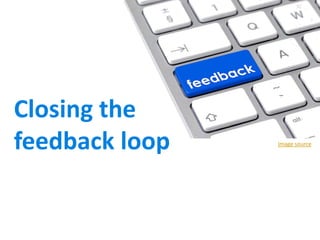
Closing the
feedback loop image source
Formative1
2 Summative
In general. . .
 Maximize instruction to students.
In general. . .
 Maximize instruction to students.
 Minimize the paper load.
In general. . .
 Maximize instruction to students.
 Minimize the paper load.
 Avoid doing the student’s work.
In general. . .
 Maximize instruction to students.
 Minimize the paper load.
 Avoid doing the student’s work.
 Grade as little and as late in
the process as possible.
FOCUS
From Global
image source
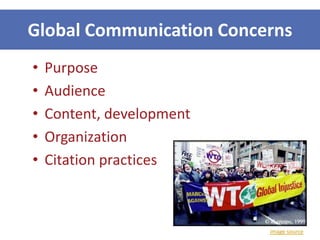
Global Communication Concerns
• Purpose
• Audience
• Content, development
• Organization
• Citation practices
image source
To Local
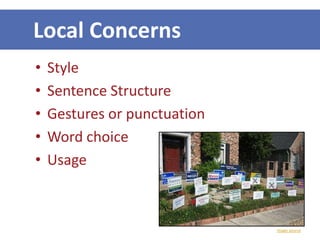
Local Concerns
• Style
• Sentence Structure
• Gestures or punctuation
• Word choice
• Usage
image source
3 Steps to Focused Feedback:
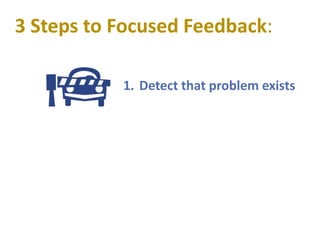
1. Detect that problem exists
3 Steps to Focused Feedback:
1. Detect that problem exists
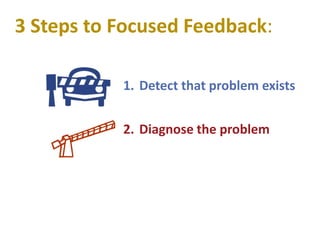
2. Diagnose the problem
3 Steps to Focused Feedback:
1. Detect that problem exists
2. Diagnose the problem
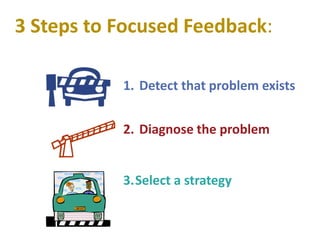
3.Select a strategy
Offer bite-sized advice
METHODS
who responds?
how?
Layers of feedback: SELF
Self
Self-critique on SMART Board
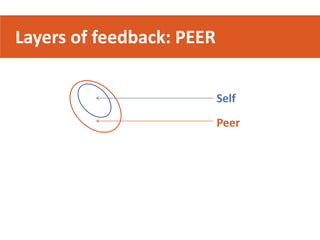
Layers of feedback: PEER
Self
Peer
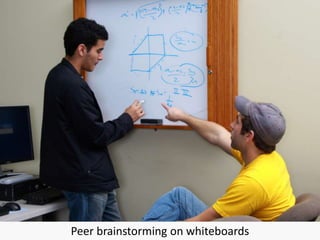
Peer brainstorming on whiteboards
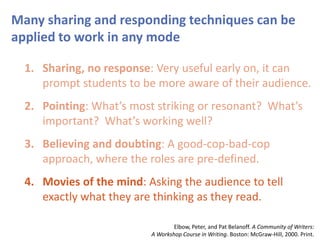
Many sharing and responding techniques can be
applied to work in any mode
Elbow, Peter, and Pat Belanoff. A Community of Writers:
A Workshop Course in Writing. Boston: McGraw-Hill, 2000. Print.
Many sharing and responding techniques can be
applied to work in any mode
1. Sharing, no response: Very useful early on, it can
prompt students to be more aware of their audience.
Elbow, Peter, and Pat Belanoff. A Community of Writers:
A Workshop Course in Writing. Boston: McGraw-Hill, 2000. Print.
Many sharing and responding techniques can be
applied to work in any mode
1. Sharing, no response: Very useful early on, it can
prompt students to be more aware of their audience.
2. Pointing: What’s most striking or resonant? What’s
important? What’s working well?
Elbow, Peter, and Pat Belanoff. A Community of Writers:
A Workshop Course in Writing. Boston: McGraw-Hill, 2000. Print.
Many sharing and responding techniques can be
applied to work in any mode
1. Sharing, no response: Very useful early on, it can
prompt students to be more aware of their audience.
2. Pointing: What’s most striking or resonant? What’s
important? What’s working well?
3. Believing and doubting: A good-cop-bad-cop
approach, where the roles are pre-defined.
Elbow, Peter, and Pat Belanoff. A Community of Writers:
A Workshop Course in Writing. Boston: McGraw-Hill, 2000. Print.
Many sharing and responding techniques can be
applied to work in any mode
1. Sharing, no response: Very useful early on, it can
prompt students to be more aware of their audience.
2. Pointing: What’s most striking or resonant? What’s
important? What’s working well?
3. Believing and doubting: A good-cop-bad-cop
approach, where the roles are pre-defined.
4. Movies of the mind: Asking the audience to tell
exactly what they are thinking as they read.
Elbow, Peter, and Pat Belanoff. A Community of Writers:
A Workshop Course in Writing. Boston: McGraw-Hill, 2000. Print.
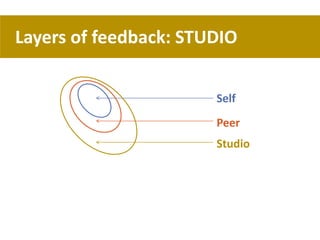
Layers of feedback: STUDIO
Self
Peer
Studio
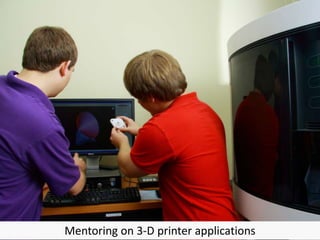
Mentoring on 3-D printer applications
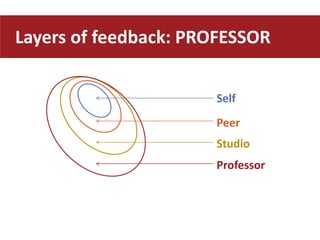
Layers of feedback: PROFESSOR
Self
Peer
Studio
Professor
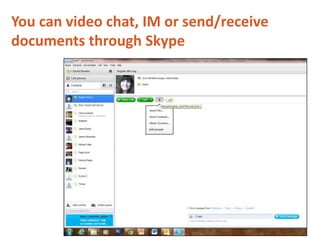
Skype conference with professor
You can video chat, IM or send/receive
documents through Skype
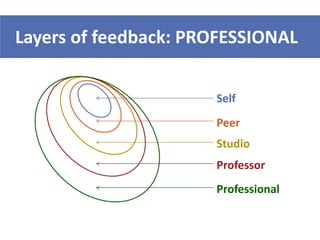
Self
Peer
Studio
Professor
Professional
Layers of feedback: PROFESSIONAL
Professional demonstration on factory tour
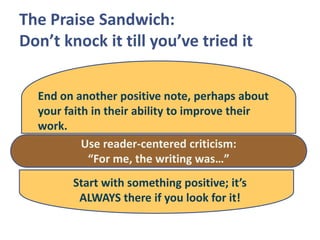
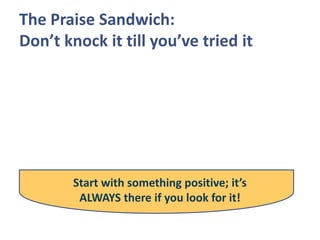
The Praise Sandwich:
Don’t knock it till you’ve tried it
The Praise Sandwich:
Don’t knock it till you’ve tried it
Start with something positive; it’s
ALWAYS there if you look for it!
The Praise Sandwich:
Don’t knock it till you’ve tried it
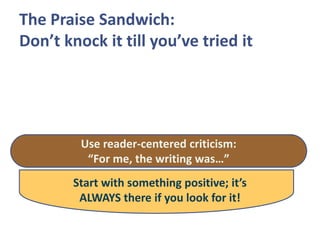
Use reader-centered criticism:
“For me, the writing was…”
Start with something positive; it’s
ALWAYS there if you look for it!
The Praise Sandwich:
Don’t knock it till you’ve tried it
Use reader-centered criticism:
“For me, the writing was…”
Start with something positive; it’s
ALWAYS there if you look for it!
End on another positive note, perhaps about
your faith in their ability to improve their
work.
RUBRICS
making them
work for you
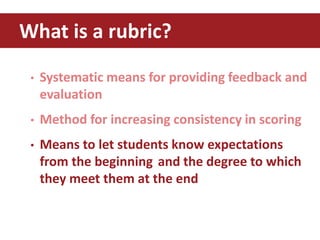
What is a rubric?
• Systematic means for providing feedback and
evaluation
What is a rubric?
• Systematic means for providing feedback and
evaluation
• Method for increasing consistency in scoring
What is a rubric?
• Systematic means for providing feedback and
evaluation
• Method for increasing consistency in scoring
• Means to let students know expectations
from the beginning and the degree to which
they meet them at the end
What is a rubric?
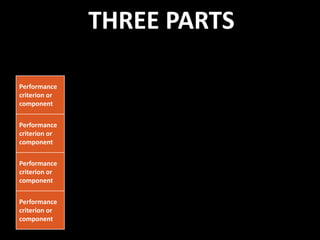
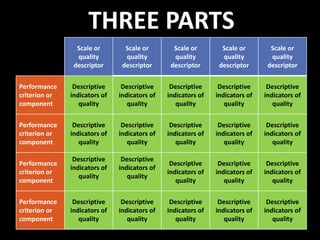
THREE PARTS
THREE PARTS
Performance
criterion or
component
Performance
criterion or
component
Performance
criterion or
component
Performance
criterion or
component
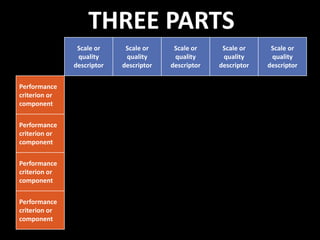
THREE PARTS
Scale or
quality
descriptor
Scale or
quality
descriptor
Scale or
quality
descriptor
Scale or
quality
descriptor
Scale or
quality
descriptor
Performance
criterion or
component
Performance
criterion or
component
Performance
criterion or
component
Performance
criterion or
component
THREE PARTS
Scale or
quality
descriptor
Scale or
quality
descriptor
Scale or
quality
descriptor
Scale or
quality
descriptor
Scale or
quality
descriptor
Performance
criterion or
component
Descriptive
indicators of
quality
Descriptive
indicators of
quality
Descriptive
indicators of
quality
Descriptive
indicators of
quality
Descriptive
indicators of
quality
Performance
criterion or
component
Descriptive
indicators of
quality
Descriptive
indicators of
quality
Descriptive
indicators of
quality
Descriptive
indicators of
quality
Descriptive
indicators of
quality
Performance
criterion or
component
Descriptive
indicators of
quality
Descriptive
indicators of
quality
Descriptive
indicators of
quality
Descriptive
indicators of
quality
Descriptive
indicators of
quality
Performance
criterion or
component
Descriptive
indicators of
quality
Descriptive
indicators of
quality
Descriptive
indicators of
quality
Descriptive
indicators of
quality
Descriptive
indicators of
quality
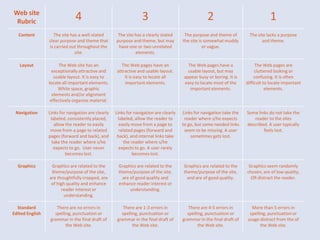
Web site
Rubric
4 3 2 1
Content The site has a well-stated
clear purpose and theme that
is carried out throughout the
site.
The site has a clearly stated
purpose and theme, but may
have one or two unrelated
elements.
The purpose and theme of
the site is somewhat muddy
or vague.
The site lacks a purpose
and theme.
Layout The Web site has an
exceptionally attractive and
usable layout. It is easy to
locate all important elements.
White space, graphic
elements and/or alignment
effectively organize material.
The Web pages have an
attractive and usable layout.
It is easy to locate all
important elements.
The Web pages have a
usable layout, but may
appear busy or boring. It is
easy to locate most of the
important elements.
The Web pages are
cluttered looking or
confusing. It is often
difficult to locate important
elements.
Navigation Links for navigation are clearly
labeled, consistently placed,
allow the reader to easily
move from a page to related
pages (forward and back), and
take the reader where s/he
expects to go. User never
becomes lost.
Links for navigation are clearly
labeled, allow the reader to
easily move from a page to
related pages (forward and
back), and internal links take
the reader where s/he
expects to go. A user rarely
becomes lost.
Links for navigation take the
reader where s/he expects
to go, but some needed links
seem to be missing. A user
sometimes gets lost.
Some links do not take the
reader to the sites
described. A user typically
feels lost.
Graphics Graphics are related to the
theme/purpose of the site,
are thoughtfully cropped, are
of high quality and enhance
reader interest or
understanding.
Graphics are related to the
theme/purpose of the site,
are of good quality and
enhance reader interest or
understanding.
Graphics are related to the
theme/purpose of the site,
and are of good quality.
Graphics seem randomly
chosen, are of low quality,
OR distract the reader.
Standard
Edited English
There are no errors in
spelling, punctuation or
grammar in the final draft of
the Web site.
There are 1-3 errors in
spelling, punctuation or
grammar in the final draft of
the Web site.
There are 4-5 errors in
spelling, punctuation or
grammar in the final draft of
the Web site.
More than 5 errors in
spelling, punctuation or
usage distract from the of
the Web site.
How do I design a rubric?
• Determine key criteria to effective response:
process & product
How do I design a rubric?
• Determine key criteria to effective response:
process & product
• Consider all aspects of rhetorical triangle:
communicator, audience, subject & purpose, text,
context
How do I design a rubric?
• Determine key criteria to effective response:
process & product
• Consider all aspects of rhetorical triangle:
communicator, audience, subject &
purpose, text, context
• Define key criteria
How do I design a rubric?
• Determine key criteria to effective response:
process & product
• Consider all aspects of rhetorical triangle:
communicator, audience, subject &
purpose, text, context
• Define key criteria
• Decide on analytic or holistic; general or task specific
• Leave space for comments
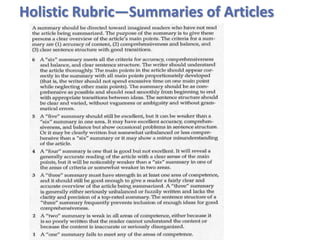
How do I design a rubric?
Holistic Rubric—Summaries of Articles
How do I use a rubric?
• as part of the assignment
How do I use a rubric?
• as part of the assignment
• to guide peer response
How do I use a rubric?
• as part of the assignment
• to guide peer response
• to guide instructor feedback
How do I use a rubric?
• as part of the assignment
• to guide peer response
• to guide instructor feedback
• when assigning a grade
How do I use a rubric?
CAUTIONS
• Limit the number of performance criteria &
scale divisions
CAUTIONS
• Limit the number of performance criteria &
scale divisions
• Avoid grading twice
CAUTIONS
• Limit the number of performance criteria &
scale divisions
• Avoid grading twice
• Let the rubric reflect instruction rather than
direct it
CAUTIONS
• Limit the number of performance criteria &
scale divisions
• Avoid grading twice
• Let the rubric reflect instruction rather than
direct it
• Avoid using a rubric when specific feedback
is needed
CAUTIONS
CONSIDER…
• Not using quality descriptors but making
brief comments instead
CONSIDER…
• Not using quality descriptors but making
brief comments instead
• Weighing the scale on critical categories
CONSIDER…
• Not using quality descriptors but making
brief comments instead
• Weighing the scale on critical categories
• Using verbal scales rather than numerical
scales
CONSIDER…
• Not using quality descriptors but making
brief comments instead
• Weighing the scale on critical categories
• Using verbal scales rather than numerical
scales
• Engaging students in creation of the rubric
CONSIDER…
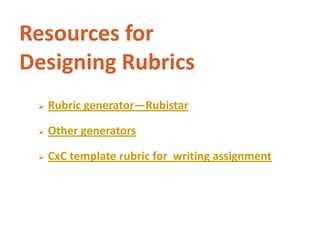
 Rubric generator—Rubistar
 Other generators
 CxC template rubric for writing assignment
Resources for
Designing Rubrics
WEB SITE ASSESSMENT
EXERCISE
 Slides on ESL, common errors, etc. to use if
time.
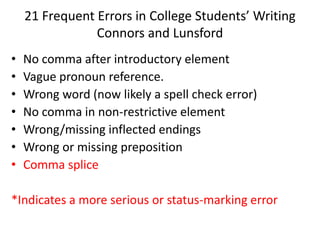
21 Frequent Errors in College Students’ Writing
Connors and Lunsford
• No comma after introductory element
• Vague pronoun reference.
• Wrong word (now likely a spell check error)
• No comma in non-restrictive element
• Wrong/missing inflected endings
• Wrong or missing preposition
• Comma splice
*Indicates a more serious or status-marking error
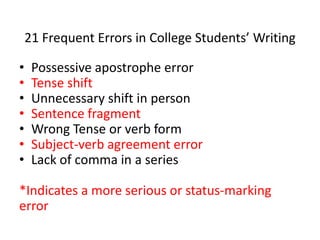
21 Frequent Errors in College Students’ Writing
• Possessive apostrophe error
• Tense shift
• Unnecessary shift in person
• Sentence fragment
• Wrong Tense or verb form
• Subject-verb agreement error
• Lack of comma in a series
*Indicates a more serious or status-marking
error
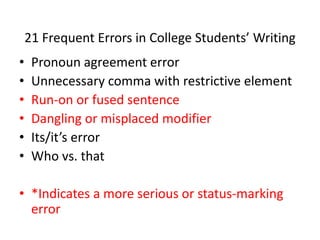
21 Frequent Errors in College Students’ Writing
• Pronoun agreement error
• Unnecessary comma with restrictive element
• Run-on or fused sentence
• Dangling or misplaced modifier
• Its/it’s error
• Who vs. that
• *Indicates a more serious or status-marking
error
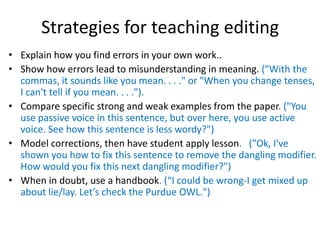
Strategies for teaching editing
• Explain how you find errors in your own work..
• Show how errors lead to misunderstanding in meaning. ("With the
commas, it sounds like you mean. . . ." or "When you change tenses,
I can't tell if you mean. . . .").
• Compare specific strong and weak examples from the paper. ("You
use passive voice in this sentence, but over here, you use active
voice. See how this sentence is less wordy?")
• Model corrections, then have student apply lesson. ("Ok, I've
shown you how to fix this sentence to remove the dangling modifier.
How would you fix this next dangling modifier?")
• When in doubt, use a handbook. (“I could be wrong-I get mixed up
about lie/lay. Let’s check the Purdue OWL.")
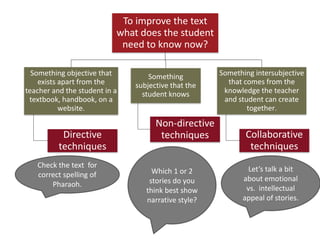
To improve the text
what does the student
need to know now?
Something objective that
exists apart from the
teacher and the student in a
textbook, handbook, on a
website.
Directive
techniques
Something
subjective that the
student knows
Non-directive
techniques
Something intersubjective
that comes from the
knowledge the teacher
and student can create
together.
Collaborative
techniques
Check the text for
correct spelling of
Pharaoh.
Which 1 or 2
stories do you
think best show
narrative style?
Let’s talk a bit
about emotional
vs. intellectual
appeal of stories.
Strategies for
Teaching Editing
You need not mark every error you
see.
FST
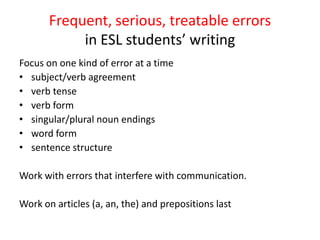
Frequent, serious, treatable errors
in ESL students’ writing
Focus on one kind of error at a time
• subject/verb agreement
• verb tense
• verb form
• singular/plural noun endings
• word form
• sentence structure
Work with errors that interfere with communication.
Work on articles (a, an, the) and prepositions last
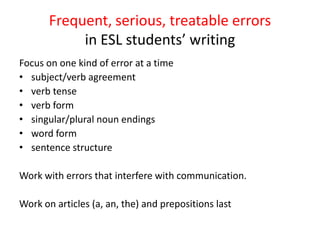
Frequent, serious, treatable errors
in ESL students’ writing
Focus on one kind of error at a time
• subject/verb agreement
• verb tense
• verb form
• singular/plural noun endings
• word form
• sentence structure
Work with errors that interfere with communication.
Work on articles (a, an, the) and prepositions last
image source

Evaluating and Assessing Student Work

  • 1.
  • 2.
  • 3.
  • 4.
    In general. ..  Maximize instruction to students.
  • 5.
    In general. ..  Maximize instruction to students.  Minimize the paper load.
  • 6.
    In general. ..  Maximize instruction to students.  Minimize the paper load.  Avoid doing the student’s work.
  • 7.
    In general. ..  Maximize instruction to students.  Minimize the paper load.  Avoid doing the student’s work.  Grade as little and as late in the process as possible.
  • 8.
  • 9.
  • 10.
    Global Communication Concerns •Purpose • Audience • Content, development • Organization • Citation practices image source
  • 11.
  • 12.
    Local Concerns • Style •Sentence Structure • Gestures or punctuation • Word choice • Usage image source
  • 13.
    3 Steps toFocused Feedback:
  • 14.
    3 Steps toFocused Feedback: 1. Detect that problem exists
  • 15.
    3 Steps toFocused Feedback: 1. Detect that problem exists 2. Diagnose the problem
  • 16.
    3 Steps toFocused Feedback: 1. Detect that problem exists 2. Diagnose the problem 3.Select a strategy
  • 17.
  • 19.
  • 20.
  • 21.
  • 22.
    Layers of feedback:PEER Self Peer
  • 23.
  • 24.
    Many sharing andresponding techniques can be applied to work in any mode Elbow, Peter, and Pat Belanoff. A Community of Writers: A Workshop Course in Writing. Boston: McGraw-Hill, 2000. Print.
  • 25.
    Many sharing andresponding techniques can be applied to work in any mode 1. Sharing, no response: Very useful early on, it can prompt students to be more aware of their audience. Elbow, Peter, and Pat Belanoff. A Community of Writers: A Workshop Course in Writing. Boston: McGraw-Hill, 2000. Print.
  • 26.
    Many sharing andresponding techniques can be applied to work in any mode 1. Sharing, no response: Very useful early on, it can prompt students to be more aware of their audience. 2. Pointing: What’s most striking or resonant? What’s important? What’s working well? Elbow, Peter, and Pat Belanoff. A Community of Writers: A Workshop Course in Writing. Boston: McGraw-Hill, 2000. Print.
  • 27.
    Many sharing andresponding techniques can be applied to work in any mode 1. Sharing, no response: Very useful early on, it can prompt students to be more aware of their audience. 2. Pointing: What’s most striking or resonant? What’s important? What’s working well? 3. Believing and doubting: A good-cop-bad-cop approach, where the roles are pre-defined. Elbow, Peter, and Pat Belanoff. A Community of Writers: A Workshop Course in Writing. Boston: McGraw-Hill, 2000. Print.
  • 28.
    Many sharing andresponding techniques can be applied to work in any mode 1. Sharing, no response: Very useful early on, it can prompt students to be more aware of their audience. 2. Pointing: What’s most striking or resonant? What’s important? What’s working well? 3. Believing and doubting: A good-cop-bad-cop approach, where the roles are pre-defined. 4. Movies of the mind: Asking the audience to tell exactly what they are thinking as they read. Elbow, Peter, and Pat Belanoff. A Community of Writers: A Workshop Course in Writing. Boston: McGraw-Hill, 2000. Print.
  • 29.
    Layers of feedback:STUDIO Self Peer Studio
  • 30.
    Mentoring on 3-Dprinter applications
  • 31.
    Layers of feedback:PROFESSOR Self Peer Studio Professor
  • 32.
  • 33.
    You can videochat, IM or send/receive documents through Skype
  • 34.
  • 35.
  • 36.
    The Praise Sandwich: Don’tknock it till you’ve tried it
  • 37.
    The Praise Sandwich: Don’tknock it till you’ve tried it Start with something positive; it’s ALWAYS there if you look for it!
  • 38.
    The Praise Sandwich: Don’tknock it till you’ve tried it Use reader-centered criticism: “For me, the writing was…” Start with something positive; it’s ALWAYS there if you look for it!
  • 39.
    The Praise Sandwich: Don’tknock it till you’ve tried it Use reader-centered criticism: “For me, the writing was…” Start with something positive; it’s ALWAYS there if you look for it! End on another positive note, perhaps about your faith in their ability to improve their work.
  • 41.
  • 42.
    What is arubric?
  • 43.
    • Systematic meansfor providing feedback and evaluation What is a rubric?
  • 44.
    • Systematic meansfor providing feedback and evaluation • Method for increasing consistency in scoring What is a rubric?
  • 45.
    • Systematic meansfor providing feedback and evaluation • Method for increasing consistency in scoring • Means to let students know expectations from the beginning and the degree to which they meet them at the end What is a rubric?
  • 46.
  • 47.
    THREE PARTS Performance criterion or component Performance criterionor component Performance criterion or component Performance criterion or component
  • 48.
    THREE PARTS Scale or quality descriptor Scaleor quality descriptor Scale or quality descriptor Scale or quality descriptor Scale or quality descriptor Performance criterion or component Performance criterion or component Performance criterion or component Performance criterion or component
  • 49.
    THREE PARTS Scale or quality descriptor Scaleor quality descriptor Scale or quality descriptor Scale or quality descriptor Scale or quality descriptor Performance criterion or component Descriptive indicators of quality Descriptive indicators of quality Descriptive indicators of quality Descriptive indicators of quality Descriptive indicators of quality Performance criterion or component Descriptive indicators of quality Descriptive indicators of quality Descriptive indicators of quality Descriptive indicators of quality Descriptive indicators of quality Performance criterion or component Descriptive indicators of quality Descriptive indicators of quality Descriptive indicators of quality Descriptive indicators of quality Descriptive indicators of quality Performance criterion or component Descriptive indicators of quality Descriptive indicators of quality Descriptive indicators of quality Descriptive indicators of quality Descriptive indicators of quality
  • 50.
    Web site Rubric 4 32 1 Content The site has a well-stated clear purpose and theme that is carried out throughout the site. The site has a clearly stated purpose and theme, but may have one or two unrelated elements. The purpose and theme of the site is somewhat muddy or vague. The site lacks a purpose and theme. Layout The Web site has an exceptionally attractive and usable layout. It is easy to locate all important elements. White space, graphic elements and/or alignment effectively organize material. The Web pages have an attractive and usable layout. It is easy to locate all important elements. The Web pages have a usable layout, but may appear busy or boring. It is easy to locate most of the important elements. The Web pages are cluttered looking or confusing. It is often difficult to locate important elements. Navigation Links for navigation are clearly labeled, consistently placed, allow the reader to easily move from a page to related pages (forward and back), and take the reader where s/he expects to go. User never becomes lost. Links for navigation are clearly labeled, allow the reader to easily move from a page to related pages (forward and back), and internal links take the reader where s/he expects to go. A user rarely becomes lost. Links for navigation take the reader where s/he expects to go, but some needed links seem to be missing. A user sometimes gets lost. Some links do not take the reader to the sites described. A user typically feels lost. Graphics Graphics are related to the theme/purpose of the site, are thoughtfully cropped, are of high quality and enhance reader interest or understanding. Graphics are related to the theme/purpose of the site, are of good quality and enhance reader interest or understanding. Graphics are related to the theme/purpose of the site, and are of good quality. Graphics seem randomly chosen, are of low quality, OR distract the reader. Standard Edited English There are no errors in spelling, punctuation or grammar in the final draft of the Web site. There are 1-3 errors in spelling, punctuation or grammar in the final draft of the Web site. There are 4-5 errors in spelling, punctuation or grammar in the final draft of the Web site. More than 5 errors in spelling, punctuation or usage distract from the of the Web site.
  • 51.
    How do Idesign a rubric?
  • 52.
    • Determine keycriteria to effective response: process & product How do I design a rubric?
  • 53.
    • Determine keycriteria to effective response: process & product • Consider all aspects of rhetorical triangle: communicator, audience, subject & purpose, text, context How do I design a rubric?
  • 54.
    • Determine keycriteria to effective response: process & product • Consider all aspects of rhetorical triangle: communicator, audience, subject & purpose, text, context • Define key criteria How do I design a rubric?
  • 55.
    • Determine keycriteria to effective response: process & product • Consider all aspects of rhetorical triangle: communicator, audience, subject & purpose, text, context • Define key criteria • Decide on analytic or holistic; general or task specific • Leave space for comments How do I design a rubric?
  • 56.
  • 57.
    How do Iuse a rubric?
  • 58.
    • as partof the assignment How do I use a rubric?
  • 59.
    • as partof the assignment • to guide peer response How do I use a rubric?
  • 60.
    • as partof the assignment • to guide peer response • to guide instructor feedback How do I use a rubric?
  • 61.
    • as partof the assignment • to guide peer response • to guide instructor feedback • when assigning a grade How do I use a rubric?
  • 63.
  • 64.
    • Limit thenumber of performance criteria & scale divisions CAUTIONS
  • 65.
    • Limit thenumber of performance criteria & scale divisions • Avoid grading twice CAUTIONS
  • 66.
    • Limit thenumber of performance criteria & scale divisions • Avoid grading twice • Let the rubric reflect instruction rather than direct it CAUTIONS
  • 67.
    • Limit thenumber of performance criteria & scale divisions • Avoid grading twice • Let the rubric reflect instruction rather than direct it • Avoid using a rubric when specific feedback is needed CAUTIONS
  • 68.
  • 69.
    • Not usingquality descriptors but making brief comments instead CONSIDER…
  • 70.
    • Not usingquality descriptors but making brief comments instead • Weighing the scale on critical categories CONSIDER…
  • 71.
    • Not usingquality descriptors but making brief comments instead • Weighing the scale on critical categories • Using verbal scales rather than numerical scales CONSIDER…
  • 72.
    • Not usingquality descriptors but making brief comments instead • Weighing the scale on critical categories • Using verbal scales rather than numerical scales • Engaging students in creation of the rubric CONSIDER…
  • 73.
     Rubric generator—Rubistar Other generators  CxC template rubric for writing assignment Resources for Designing Rubrics
  • 74.
  • 75.
     Slides onESL, common errors, etc. to use if time.
  • 76.
    21 Frequent Errorsin College Students’ Writing Connors and Lunsford • No comma after introductory element • Vague pronoun reference. • Wrong word (now likely a spell check error) • No comma in non-restrictive element • Wrong/missing inflected endings • Wrong or missing preposition • Comma splice *Indicates a more serious or status-marking error
  • 77.
    21 Frequent Errorsin College Students’ Writing • Possessive apostrophe error • Tense shift • Unnecessary shift in person • Sentence fragment • Wrong Tense or verb form • Subject-verb agreement error • Lack of comma in a series *Indicates a more serious or status-marking error
  • 78.
    21 Frequent Errorsin College Students’ Writing • Pronoun agreement error • Unnecessary comma with restrictive element • Run-on or fused sentence • Dangling or misplaced modifier • Its/it’s error • Who vs. that • *Indicates a more serious or status-marking error
  • 79.
    Strategies for teachingediting • Explain how you find errors in your own work.. • Show how errors lead to misunderstanding in meaning. ("With the commas, it sounds like you mean. . . ." or "When you change tenses, I can't tell if you mean. . . ."). • Compare specific strong and weak examples from the paper. ("You use passive voice in this sentence, but over here, you use active voice. See how this sentence is less wordy?") • Model corrections, then have student apply lesson. ("Ok, I've shown you how to fix this sentence to remove the dangling modifier. How would you fix this next dangling modifier?") • When in doubt, use a handbook. (“I could be wrong-I get mixed up about lie/lay. Let’s check the Purdue OWL.")
  • 80.
    To improve thetext what does the student need to know now? Something objective that exists apart from the teacher and the student in a textbook, handbook, on a website. Directive techniques Something subjective that the student knows Non-directive techniques Something intersubjective that comes from the knowledge the teacher and student can create together. Collaborative techniques Check the text for correct spelling of Pharaoh. Which 1 or 2 stories do you think best show narrative style? Let’s talk a bit about emotional vs. intellectual appeal of stories.
  • 81.
    Strategies for Teaching Editing Youneed not mark every error you see. FST
  • 82.
    Frequent, serious, treatableerrors in ESL students’ writing Focus on one kind of error at a time • subject/verb agreement • verb tense • verb form • singular/plural noun endings • word form • sentence structure Work with errors that interfere with communication. Work on articles (a, an, the) and prepositions last
  • 83.
    Frequent, serious, treatableerrors in ESL students’ writing Focus on one kind of error at a time • subject/verb agreement • verb tense • verb form • singular/plural noun endings • word form • sentence structure Work with errors that interfere with communication. Work on articles (a, an, the) and prepositions last
  • 84.

Editor's Notes

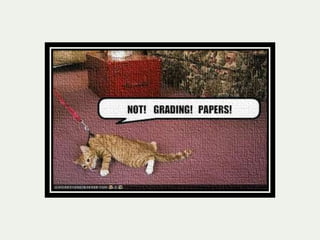
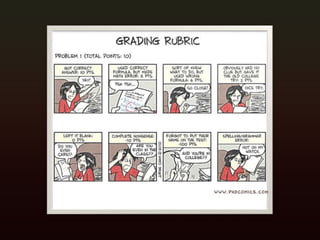
  • #2 What’s wrong with this picture?No one has yet earned an A or a B. Could be the teacher’s aim as much as the student’s performanceStudents aren’t likely to learn anything from the process—feedback will not affect performance.
  • #3 Wouldn’t it be nice . . . . If there were a feedback key on our computers, what would we want it to do?(Get their ideas about what useful feedback might entail.) Sometimes you hear the phrase, “Closing the feedback loop.” It suggests that feedback needs to do something, to be used some how, to help students learn.
  • #4 There are lots of different activities that involve responding to student work: feedback, evaluating, assessing, grading, comments. Whatever we call it, we need to be clear about the aim of our comments and that’s where these two terms come into ply:Formative feedback takes place when the project is still being shaped, it’s more of a teaching/learning activitySummative feedback is an assessment on a final project, often in the form of a grade. While the student can still learn from our comments at this point, they are more likely to be applied to the next project (if applicable) rather than to the project at hand.What happens when we confuse these to kinds of feedback?Putting a grade on formative feedback can sometimes stop work. Hey, a C is good enough for me!Treating a final product as if it might still be revised wastes time that could be spent shaping work on the next one.To provide effective and efficient feedback on students’ communication, you’ll need to focus your efforts and decide an appropriate method for delivering feedback. To help you focus your feedback, I want you to remember three things:A global positioning systemLSU’s Easy StreetsAnd Hershey’s miniatures
  • #9 To provide maximize instruction to students, you’ll need to focus your efforts. To help you do so, I want you to remember three things:A Garmin global positioning systemLSU’s Easy StreetsAnd Hershey’s miniaturesTo see what these visuals mean, we’ll work with the assignment and text at your seat.
  • #11 Global concerns are features of communication such as purpose, audience, content and development, and organization—the kinds of concerns that will have a big impact on the success of a communication. Without the writer’s successful attention to global concerns from the very beginning, it is less likely to matter if the local concerns are met or not.Given the religious studies assignment, what are some of the global concerns? How well does the student address them?
  • #13 Local concerns such as style, sentence structure, word choice, gestures in speech or punctuation in writing or usage can’t make up for global weaknesses in a communication.What does it matter if the student fixes the punctuation, wrong words, and agreement errors in the introduction if the essay itself doesn’t meet the assignment? Or if the student decides later to scrap the intro and begin again?So when you’re giving students’ feedback on a draft or a practice session, use your GPS to hone in on the global concerns first and don’t be distracted by the local ones.Often the student will take care of local concerns when revising the global concerns.
  • #14 That’s where the Easy Streets come in. There are three steps to focused feedback that lead to effective revision, which is after all, the primary purpose for giving feedback on drafts.Before a student can improve a communication project, she needs to realize something could be better, something needs fixed, diagnose why it isn’t working, and select a strategy to fix it. A teacher can use this same process to comment on a draft. Your introduction led me to think you’d cover a, b, and c in your speech, but it seems like you’First you detect that a problem exits—that the bar won’t go up or in the case of a speech you realize you said you were going to do x , y, and z, but you never never get to z.The ideas seem to be in a random order.The listener gets lost in your explanationNext, you need to diagnose the problem. I forgot my wand or it isn’t working or the attendant is asleep or in the case of writingThese items aren’t parallel. I may need to define some terms or give an example. I start out chronologically then I switch to what’s most/ least important.Finally, you select a strategy. Roll down your window and wave the wand again, back up and pull forward more slowly, or hit the gas and break off the arm. Or in the case of writing, you decide to Consult a handbook.Show more than tell. Outline and then rearrange.
  • #15 That’s where the Easy Streets come in. There are three steps to focused feedback that lead to effective revision, which is after all, the primary purpose for giving feedback on drafts.Before a student can improve a communication project, she needs to realize something could be better, something needs fixed, diagnose why it isn’t working, and select a strategy to fix it. A teacher can use this same process to comment on a draft. Your introduction led me to think you’d cover a, b, and c in your speech, but it seems like you’First you detect that a problem exits—that the bar won’t go up or in the case of a speech you realize you said you were going to do x , y, and z, but you never never get to z.The ideas seem to be in a random order.The listener gets lost in your explanationNext, you need to diagnose the problem. I forgot my wand or it isn’t working or the attendant is asleep or in the case of writingThese items aren’t parallel. I may need to define some terms or give an example. I start out chronologically then I switch to what’s most/ least important.Finally, you select a strategy. Roll down your window and wave the wand again, back up and pull forward more slowly, or hit the gas and break off the arm. Or in the case of writing, you decide to Consult a handbook.Show more than tell. Outline and then rearrange.
  • #16 That’s where the Easy Streets come in. There are three steps to focused feedback that lead to effective revision, which is after all, the primary purpose for giving feedback on drafts.Before a student can improve a communication project, she needs to realize something could be better, something needs fixed, diagnose why it isn’t working, and select a strategy to fix it. A teacher can use this same process to comment on a draft. Your introduction led me to think you’d cover a, b, and c in your speech, but it seems like you’First you detect that a problem exits—that the bar won’t go up or in the case of a speech you realize you said you were going to do x , y, and z, but you never never get to z.The ideas seem to be in a random order.The listener gets lost in your explanationNext, you need to diagnose the problem. I forgot my wand or it isn’t working or the attendant is asleep or in the case of writingThese items aren’t parallel. I may need to define some terms or give an example. I start out chronologically then I switch to what’s most/ least important.Finally, you select a strategy. Roll down your window and wave the wand again, back up and pull forward more slowly, or hit the gas and break off the arm. Or in the case of writing, you decide to Consult a handbook.Show more than tell. Outline and then rearrange.
  • #17 That’s where the Easy Streets come in. There are three steps to focused feedback that lead to effective revision, which is after all, the primary purpose for giving feedback on drafts.Before a student can improve a communication project, she needs to realize something could be better, something needs fixed, diagnose why it isn’t working, and select a strategy to fix it. A teacher can use this same process to comment on a draft. Your introduction led me to think you’d cover a, b, and c in your speech, but it seems like you’First you detect that a problem exits—that the bar won’t go up or in the case of a speech you realize you said you were going to do x , y, and z, but you never never get to z.The ideas seem to be in a random order.The listener gets lost in your explanationNext, you need to diagnose the problem. I forgot my wand or it isn’t working or the attendant is asleep or in the case of writingThese items aren’t parallel. I may need to define some terms or give an example. I start out chronologically then I switch to what’s most/ least important.Finally, you select a strategy. Roll down your window and wave the wand again, back up and pull forward more slowly, or hit the gas and break off the arm. Or in the case of writing, you decide to Consult a handbook.Show more than tell. Outline and then rearrange.
  • #18 Now for the Hershey’s miniatures—offer a variety of bite-sized advice best suited to the student and the situation.For example--For a research paper, look at the introduction with its statement of the problem or thesis.A few days later, look at a segment for development and coherence and use of sources.Then close to the due date, look at the first five entries of the Works Cited for correct documentation.You won’t be doing any more reading than if you were trying to go through the whole draft.The way in which you deliver you bite-sized advice depends on the situation
  • #19 The timing of our feedback is also important.While it’s good advice to grade as little and as late in the process as possible,it’s also good to give as feedback as early as possible so that students have time to incorporate your changes. Extensive feedback on final papers that end up in the trash can is not a productive use of your time.
  • #21 There are many layers of feedback; the first is self-assessment and/or reflection.
  • #22 There is a variety of methods and tools that students can use to think critically about their own communications: SMART Boards, tip sheets, spellcheckers, etc.Sometimes, the best way to check something is simply to read it aloud; the mouth will find errors the eyes routinely miss. Students will often find problems that would otherwise elude them if they can put a draft away long enough to achieve some objective distance or “fresh eyes.”
  • #23 Peer review is often ordered, but rarely taught.
  • #24 Group work is often required but methods are rarely taught. Many of Peter Elbow’s peer review strategies work well in non-writing situations.
  • #25 Some sort of calibration is necessary to make sure that peers reviewers have some credibility-passing out the rubric can be a good approach.
  • #26 Some sort of calibration is necessary to make sure that peers reviewers have some credibility-passing out the rubric can be a good approach.
  • #27 Some sort of calibration is necessary to make sure that peers reviewers have some credibility-passing out the rubric can be a good approach.
  • #28 Some sort of calibration is necessary to make sure that peers reviewers have some credibility-passing out the rubric can be a good approach.
  • #29 Some sort of calibration is necessary to make sure that peers reviewers have some credibility-passing out the rubric can be a good approach.
  • #30 There are 4 studios on campus, as you all know, and each focuses on different areas of communication. Most studios have monitors who can give basic help to students on how to use equipment; mentors, who have more experience and can give feedback at a higher level; and instructors, who are experienced educators.
  • #31 Many of our monitors and mentors specialize in a specific communication mode and/or method. Lance, in the red shirt, is an expert in 3-d modeling, and could probably teach a few professors about using SolidWorks and other CAD/CAM software.
  • #33 Nobody knows how best to meet your assignments’ requirements as well as you, the teacher. Conferencing can be an efficient way to make sure your students stay on track with their assignments, which can make grading final projects easier. However, students can be cynical about conferences. Make sure they workHow can you be sure you are seeing a student’s best effort at a conference?Conferencing can be done easily via Skype. There are several advantages to Skyping with the students: 1. No travel involved, 2. Follow-up info can be given as the students need it, via video call or IM, 3. You can control the flow by changing your settings, 4. Documents can be shared via Skype
  • #36 Bringing in professionals from industry can add credibility to the lessons you’ve already taught. It can also help keep instructors attuned to how things are being done in industry as technology evolves.
  • #37 Humans respond better to criticism when it is coupled with praise.
  • #38 Humans respond better to criticism when it is coupled with praise.
  • #39 Humans respond better to criticism when it is coupled with praise.
  • #40 Humans respond better to criticism when it is coupled with praise.
  • #41 We hope you’re still not feeling that evaluating students’ communication projects is a difficult as trying to take your reluctant cat for a walk, but if you are, then why not try rubrics?
  • #63 Be sure the rubric is working for you and your students, not against you. Focus on the categories you’ve taught and are most important. Decide if you want to use numbers (quantitative feedback) or comments (qualitative feedback).
  • #81 As you offer focused feedback, determine what the student communicator—the writer, speaker, visual designer—needs to know to improve the text.If it’s objective knowledge that exists in a source beyond you or the student, be directive. Tell the student where to find the information. If a student needs help with Chicago Manual of Style—direct her to the source. Show her how to use it.If the student needs to identify subjective knowledge—information that resides only in the student--such as what do you want to write about or what happened in the experiment, use non-directive techniques such as open ended questions.If the student needs help creating new knowledge, knowledge that does not yet exist in the student, an outside source, or the teacher—such as how to organize a paper or how to develop his ideas, then a collaborative approach will work well. For example, you might work together to understand genre based needs (such as helping the student discover ways to make a newsletter more appealing to his audience) or to clarify what the writer wants to convey by asking probing questions or to clarify places in the document that are confusing by letting the student know how a reader reacts to a text.Bite-sized advice tailored to the student’s needs is indeed focused feedback.
  • #82 Feedback is not editing. If you’re editing a student’s paper, correcting all of the mistakes, you’re learning more than the student.