Building constructive feedback
Ann Wilson, Learning and Teaching at Navitas
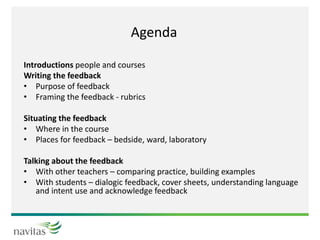
Agenda
Introductions people and courses
Writing the feedback
• Purpose of feedback
• Framing the feedback - rubrics
Situating the feedback
• Where in the course
• Places for feedback – bedside, ward, laboratory
Talking about the feedback
• With other teachers – comparing practice, building examples
• With students – dialogic feedback, cover sheets, understanding language
and intent use and acknowledge feedback
Introductions people and courses
Agenda
Writing the feedback
• Purpose of feedback
• Framing the feedback - rubrics
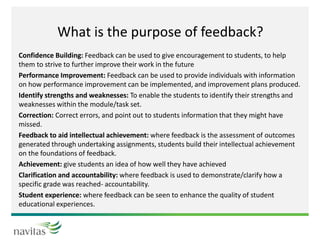
What is the purpose of feedback?
Confidence Building: Feedback can be used to give encouragement to students, to help
them to strive to further improve their work in the future
Performance Improvement: Feedback can be used to provide individuals with information
on how performance improvement can be implemented, and improvement plans produced.
Identify strengths and weaknesses: To enable the students to identify their strengths and
weaknesses within the module/task set.
Correction: Correct errors, and point out to students information that they might have
missed.
Feedback to aid intellectual achievement: where feedback is the assessment of outcomes
generated through undertaking assignments, students build their intellectual achievement
on the foundations of feedback.
Achievement: give students an idea of how well they have achieved
Clarification and accountability: where feedback is used to demonstrate/clarify how a
specific grade was reached- accountability.
Student experience: where feedback can be seen to enhance the quality of student
educational experiences.
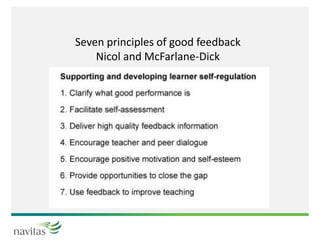
Seven principles of good feedback
Nicol and McFarlane-Dick
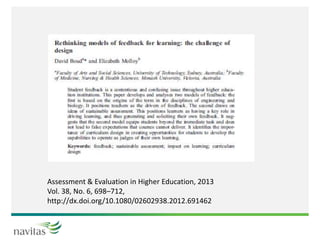
Assessment & Evaluation in Higher Education, 2013
Vol. 38, No. 6, 698–712,
http://dx.doi.org/10.1080/02602938.2012.691462
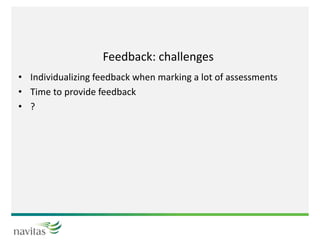
Feedback: challenges
• Individualizing feedback when marking a lot of assessments
• Time to provide feedback
• ?
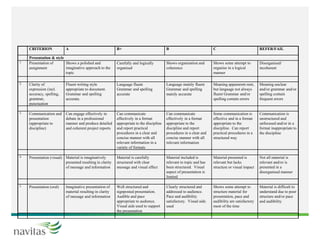
CRITERION A B+ B C REFER/FAIL
Presentation & style
1 Presentation of
assignment
Shows a polished and
imaginative approach to the
topic
Carefully and logically
organised
Shows organisation and
coherence
Shows some attempt to
organise in a logical
manner
Disorganised/
incoherent
2 Clarity of
expression (incl.
accuracy, spelling,
grammar,
punctuation
Fluent writing style
appropriate to document.
Grammar and spelling
accurate.
Language fluent
Grammar and spelling
accurate
Language mainly fluent
Grammar and spelling
mainly accurate
Meaning appararent-rent,
but language not always
fluent Grammar and/or
spelling contain errors
Meaning unclear
and/or grammar and/or
spelling contain
frequent errors
3 Communication and
presentation
(appropriate to
discipline)
Can engage effectively in
debate in a professional
manner and produce detailed
and coherent project reports
Can communicate
effectively in a format
appropriate to the discipline
and report practical
procedures in a clear and
concise manner with all
relevant information in a
variety of formats
Can communicate
effectively in a format
appropriate to the
discipline and report
procedures in a clear and
concise manner with all
relevant information
Some communication is
effective and in a format
appropriate to the
discipline. Can report
practical procedures in a
structured way
Communication is
unstructured and
unfocused and/or in a
format inappropriate to
the discipline
4 Presentation (visual) Material is imaginatively
presented resulting in clarity
of message and information
Material is carefully
structured with clear
message and visual effect
Material included is
relevant to topic and has
been structured. Visual
aspect of presentation is
limited
Material presented is
relevant but lacks
structure or visual impact
Not all material is
relevant and/or is
presented in a
disorganised manner
5 Presentation (oral) Imaginative presentation of
material resulting in clarity
of message and information
Well structured and
signposted presentation.
Audible and pace
appropriate to audience.
Visual aids used to support
the presentation
Clearly structured and
addressed to audience.
Pace and audibility
satisfactory. Visual aids
used
Shows some attempt to
structure material for
presentation, pace and
audibility are satisfactory
most of the time
Material is difficult to
understand due to poor
structure and/or pace
and audibility
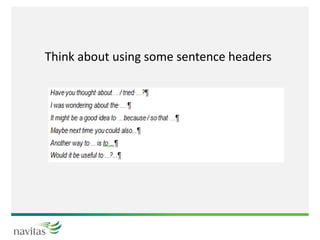
Think about using some sentence headers
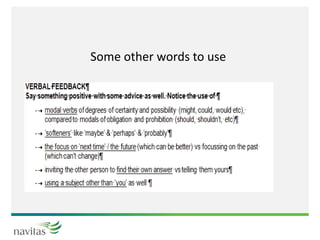
Some other words to use
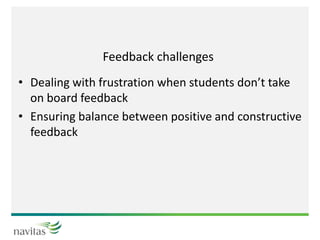
Feedback challenges
• Dealing with frustration when students don’t take
on board feedback
• Ensuring balance between positive and constructive
feedback
Situating the feedback
• Where in the course will the feedback apply
• Places for feedback – bedside, ward,
laboratory
Assessment strategy
• What are the assessments in the
course/programme?
• How do the assessments fit across
course//programme
• Where are the opportunities for feedforward?
Places for feedback
• Ward
• Bedside
• Laboratory
Agenda
Talking about the feedback
• With other teachers – comparing practice,
building examples
Talking with teachers
• Rubrics
• http://www.schrockguide.net/assessment-
and-rubrics.html
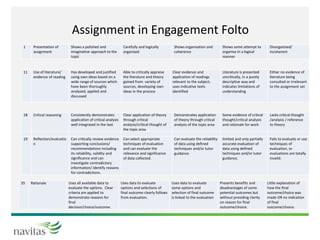
Assignment in Engagement Folto
1 Presentation of
assignment
Shows a polished and
imaginative approach to the
topic
Carefully and logically
organised
Shows organisation and
coherence
Shows some attempt to
organise in a logical
manner
Disorganised/
incoherent
11 Use of literature/
evidence of reading
Has developed and justified
using own ideas based on a
wide range of sources which
have been thoroughly
analysed, applied and
discussed
Able to critically appraise
the literature and theory
gained from variety of
sources, developing own
ideas in the process
Clear evidence and
application of readings
relevant to the subject;
uses indicative texts
identified
Literature is presented
uncritically, in a purely
descriptive way and
indicates limitations of
understanding
Either no evidence of
literature being
consulted or irrelevant
to the assignment set
18 Critical reasoning Consistently demonstrates
application of critical analysis
well integrated in the text
Clear application of theory
through critical
analysis/critical thought of
the topic area
Demonstrates application
of theory through critical
analysis of the topic area
Some evidence of critical
thought/critical analysis
and rationale for work
Lacks critical thought
/analysis / reference
to theory
19 Reflection/evaluatio
n
Can critically review evidence
supporting conclusions/
recommendations including
its reliability, validity and
significance and can
investigate contradictory
information/ identify reasons
for contradictions.
Can select appropriate
techniques of evaluation
and can evaluate the
relevance and significance
of data collected.
Can evaluate the reliability
of data using defined
techniques and/or tutor
guidance.
limited and only partially
accurate evaluation of
data using defined
techniques and/or tutor
guidance.
Fails to evaluate or use
techniques of
evaluation, or
evaluations are totally
invalid.
35 Rationale Uses all available data to
evaluate the options. Clear
criteria are applied to
demonstrate reasons for
final
decision/choice/outcome.
Uses data to evaluate
options and selections of
final outcome clearly follows
from evaluation.
Uses data to evaluate
some options and
selection of final outcome
is linked to the evaluation
Presents benefits and
disadvantages of some
potential outcomes but
without providing clarity
on reason for final
outcome/choice.
Little explanation of
how the final
outcome/choice was
made OR no indication
of final
outcome/choice.
Using the rubric to generate the feedback
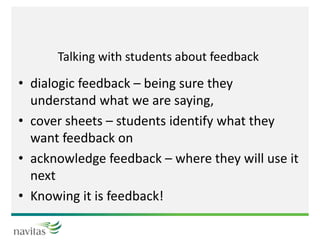
Talking with students about feedback
• dialogic feedback – being sure they
understand what we are saying,
• cover sheets – students identify what they
want feedback on
• acknowledge feedback – where they will use it
next
• Knowing it is feedback!
Any further questions?
Thank you for your participation

Making feedback more constructive

  • 1.
    Building constructive feedback AnnWilson, Learning and Teaching at Navitas
  • 2.
    Agenda Introductions people andcourses Writing the feedback • Purpose of feedback • Framing the feedback - rubrics Situating the feedback • Where in the course • Places for feedback – bedside, ward, laboratory Talking about the feedback • With other teachers – comparing practice, building examples • With students – dialogic feedback, cover sheets, understanding language and intent use and acknowledge feedback
  • 3.
  • 4.
    Agenda Writing the feedback •Purpose of feedback • Framing the feedback - rubrics
  • 5.
    What is thepurpose of feedback?
  • 6.
    What is thepurpose of feedback? Confidence Building: Feedback can be used to give encouragement to students, to help them to strive to further improve their work in the future Performance Improvement: Feedback can be used to provide individuals with information on how performance improvement can be implemented, and improvement plans produced. Identify strengths and weaknesses: To enable the students to identify their strengths and weaknesses within the module/task set. Correction: Correct errors, and point out to students information that they might have missed. Feedback to aid intellectual achievement: where feedback is the assessment of outcomes generated through undertaking assignments, students build their intellectual achievement on the foundations of feedback. Achievement: give students an idea of how well they have achieved Clarification and accountability: where feedback is used to demonstrate/clarify how a specific grade was reached- accountability. Student experience: where feedback can be seen to enhance the quality of student educational experiences.
  • 7.
    Seven principles ofgood feedback Nicol and McFarlane-Dick
  • 8.
    Assessment & Evaluationin Higher Education, 2013 Vol. 38, No. 6, 698–712, http://dx.doi.org/10.1080/02602938.2012.691462
  • 9.
    Feedback: challenges • Individualizingfeedback when marking a lot of assessments • Time to provide feedback • ?
  • 10.
    CRITERION A B+B C REFER/FAIL Presentation & style 1 Presentation of assignment Shows a polished and imaginative approach to the topic Carefully and logically organised Shows organisation and coherence Shows some attempt to organise in a logical manner Disorganised/ incoherent 2 Clarity of expression (incl. accuracy, spelling, grammar, punctuation Fluent writing style appropriate to document. Grammar and spelling accurate. Language fluent Grammar and spelling accurate Language mainly fluent Grammar and spelling mainly accurate Meaning appararent-rent, but language not always fluent Grammar and/or spelling contain errors Meaning unclear and/or grammar and/or spelling contain frequent errors 3 Communication and presentation (appropriate to discipline) Can engage effectively in debate in a professional manner and produce detailed and coherent project reports Can communicate effectively in a format appropriate to the discipline and report practical procedures in a clear and concise manner with all relevant information in a variety of formats Can communicate effectively in a format appropriate to the discipline and report procedures in a clear and concise manner with all relevant information Some communication is effective and in a format appropriate to the discipline. Can report practical procedures in a structured way Communication is unstructured and unfocused and/or in a format inappropriate to the discipline 4 Presentation (visual) Material is imaginatively presented resulting in clarity of message and information Material is carefully structured with clear message and visual effect Material included is relevant to topic and has been structured. Visual aspect of presentation is limited Material presented is relevant but lacks structure or visual impact Not all material is relevant and/or is presented in a disorganised manner 5 Presentation (oral) Imaginative presentation of material resulting in clarity of message and information Well structured and signposted presentation. Audible and pace appropriate to audience. Visual aids used to support the presentation Clearly structured and addressed to audience. Pace and audibility satisfactory. Visual aids used Shows some attempt to structure material for presentation, pace and audibility are satisfactory most of the time Material is difficult to understand due to poor structure and/or pace and audibility
  • 11.
    Think about usingsome sentence headers
  • 12.
  • 13.
    Feedback challenges • Dealingwith frustration when students don’t take on board feedback • Ensuring balance between positive and constructive feedback
  • 14.
    Situating the feedback •Where in the course will the feedback apply • Places for feedback – bedside, ward, laboratory
  • 15.
    Assessment strategy • Whatare the assessments in the course/programme? • How do the assessments fit across course//programme • Where are the opportunities for feedforward?
  • 16.
    Places for feedback •Ward • Bedside • Laboratory
  • 17.
    Agenda Talking about thefeedback • With other teachers – comparing practice, building examples
  • 18.
    Talking with teachers •Rubrics • http://www.schrockguide.net/assessment- and-rubrics.html
  • 19.
    Assignment in EngagementFolto 1 Presentation of assignment Shows a polished and imaginative approach to the topic Carefully and logically organised Shows organisation and coherence Shows some attempt to organise in a logical manner Disorganised/ incoherent 11 Use of literature/ evidence of reading Has developed and justified using own ideas based on a wide range of sources which have been thoroughly analysed, applied and discussed Able to critically appraise the literature and theory gained from variety of sources, developing own ideas in the process Clear evidence and application of readings relevant to the subject; uses indicative texts identified Literature is presented uncritically, in a purely descriptive way and indicates limitations of understanding Either no evidence of literature being consulted or irrelevant to the assignment set 18 Critical reasoning Consistently demonstrates application of critical analysis well integrated in the text Clear application of theory through critical analysis/critical thought of the topic area Demonstrates application of theory through critical analysis of the topic area Some evidence of critical thought/critical analysis and rationale for work Lacks critical thought /analysis / reference to theory 19 Reflection/evaluatio n Can critically review evidence supporting conclusions/ recommendations including its reliability, validity and significance and can investigate contradictory information/ identify reasons for contradictions. Can select appropriate techniques of evaluation and can evaluate the relevance and significance of data collected. Can evaluate the reliability of data using defined techniques and/or tutor guidance. limited and only partially accurate evaluation of data using defined techniques and/or tutor guidance. Fails to evaluate or use techniques of evaluation, or evaluations are totally invalid. 35 Rationale Uses all available data to evaluate the options. Clear criteria are applied to demonstrate reasons for final decision/choice/outcome. Uses data to evaluate options and selections of final outcome clearly follows from evaluation. Uses data to evaluate some options and selection of final outcome is linked to the evaluation Presents benefits and disadvantages of some potential outcomes but without providing clarity on reason for final outcome/choice. Little explanation of how the final outcome/choice was made OR no indication of final outcome/choice.
  • 20.
    Using the rubricto generate the feedback
  • 21.
    Talking with studentsabout feedback • dialogic feedback – being sure they understand what we are saying, • cover sheets – students identify what they want feedback on • acknowledge feedback – where they will use it next • Knowing it is feedback!
  • 22.
    Any further questions? Thankyou for your participation