Connectivist Learning and the
    Personal Learning
       Environment

        Stephen Downes
     University of Wollongong
          April 3, 2009
The Plan….
•   The Connectivist Learning Model
•   What Personal Learning Looks Like
•   The Connectivist Online Course
•   The gRSShopper PLE
•   Free Learning
•   Designing Connectivist Learning
Learning…
• Two major aspects:
• ‘knowledge’ is to be organized in a
  certain way
• - ‘knowing’ is like ‘recognizing’, ie.,
  pattern matching
Connectivism
• The theory that knowledge and
  learning can be described and
  explained using network principles
• ‘Learning’ is not to acquire a set of
  facts, but rather, to develop or ‘grow’
  into a certain neural configuration
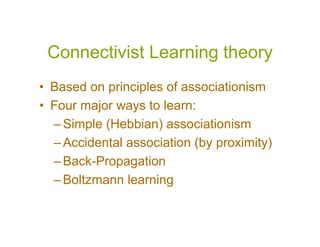
Connectivist Learning theory
• Based on principles of associationism
• Four major ways to learn:
  – Simple (Hebbian) associationism
  – Accidental association (by proximity)
  – Back-Propagation
  – Boltzmann learning
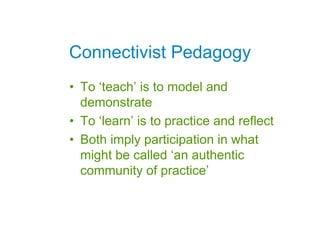
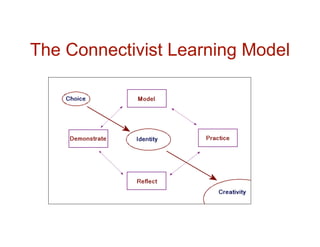
Connectivist Pedagogy
• To ‘teach’ is to model and
  demonstrate
• To ‘learn’ is to practice and reflect
• Both imply participation in what
  might be called ‘an authentic
  community of practice’
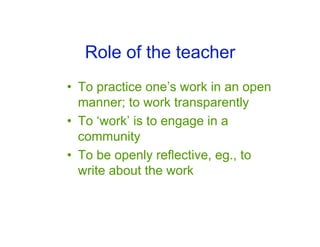
Role of the teacher
• To practice one’s work in an open
  manner; to work transparently
• To ‘work’ is to engage in a
  community
• To be openly reflective, eg., to
  write about the work
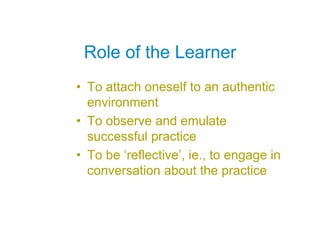
Role of the Learner
• To attach oneself to an authentic
  environment
• To observe and emulate
  successful practice
• To be ‘reflective’, ie., to engage in
  conversation about the practice
The Connectivist Learning Model
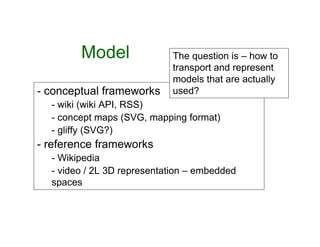
Model               The question is – how to
                            transport and represent
                            models that are actually
- conceptual frameworks     used?
  - wiki (wiki API, RSS)
  - concept maps (SVG, mapping format)
  - gliffy (SVG?)
- reference frameworks
  - Wikipedia
  - video / 2L 3D representation – embedded
  spaces
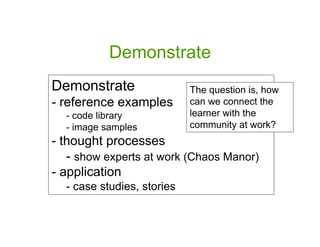
Demonstrate
Demonstrate                 The question is, how
- reference examples        can we connect the
  - code library            learner with the
  - image samples           community at work?
- thought processes
   - show experts at work (Chaos Manor)
- application
  - case studies, stories
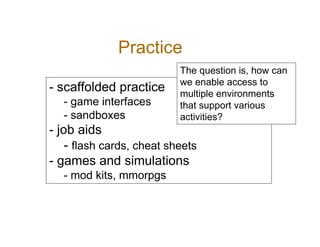
Practice
                           The question is, how can
                           we enable access to
- scaffolded practice      multiple environments
   - game interfaces       that support various
   - sandboxes             activities?
- job aids
    - flash cards, cheat sheets
- games and simulations
   - mod kits, mmorpgs
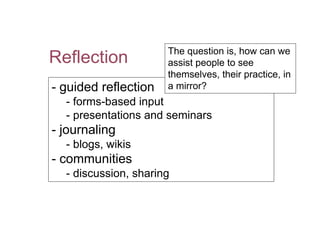
The question is, how can we
Reflection            assist people to see
                      themselves, their practice, in
- guided reflection   a mirror?
  - forms-based input
  - presentations and seminars
- journaling
  - blogs, wikis
- communities
  - discussion, sharing
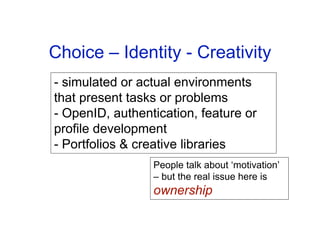
Choice – Identity - Creativity
- simulated or actual environments
that present tasks or problems
- OpenID, authentication, feature or
profile development
- Portfolios & creative libraries
                 People talk about ‘motivation’
                 – but the real issue here is
                 ownership
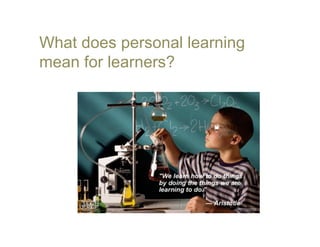
What does personal learning
mean for learners?
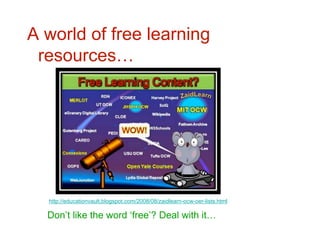
A world of free learning
 resources…


  http://educationvault.blogspot.com/2008/08/zaidlearn-ocw-oer-lists.html

  Don’t like the word ‘free’? Deal with it…
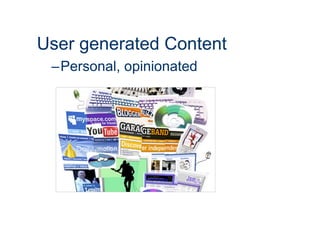
User generated Content
 –Personal, opinionated
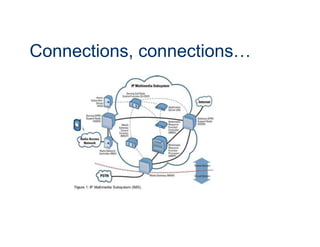
Connections, connections…
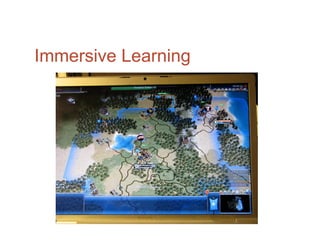
Immersive Learning
New Roles
 – For students - as creators of learning
 – For teachers - as coaches and mentors
 – For the rest of us - as teachers
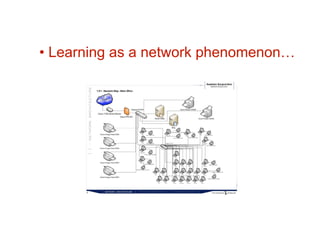
• Learning as a network phenomenon…
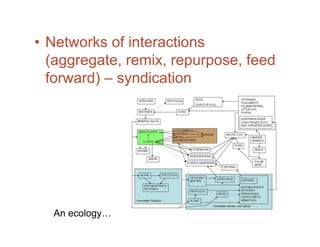
• Networks of interactions
  (aggregate, remix, repurpose, feed
  forward) – syndication


  An ecology…
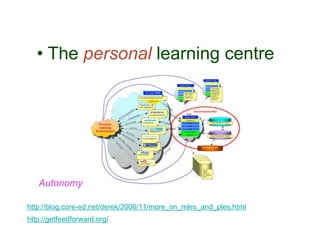
• The personal learning centre


   Autonomy

http://blog.core-ed.net/derek/2006/11/more_on_mles_and_ples.html
http://getfeedforward.org/
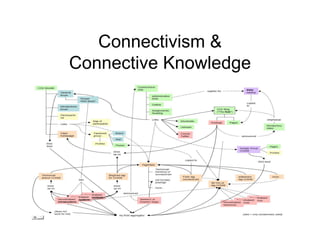
Connectivism &
Connective Knowledge
The Best Example…
• 12 week course, readings, activities…
• The course on connectivism is probably
  the best (early) example of what we
  mean
  – We began with the course itself – what we
    wanted to cover
  – We then added communications tools
  – And then the students took over…
Overview…
• George Siemens and I ushered roughly
  2200 students through a 12 week online
  course
• Some of these paid tuition and are
  getting credit, but most of them
  attended the ‘open’ course
The Course
• Offered through the University of
  Manitoba
  – 12 weeks long
  – credit in Certificate in Adult and Continuing
    Education and Certificate in Emerging
    Technologies for Learning
  – Explored the concepts of connectivism and
    connective knowledge
Connectivism
“At its heart, connectivism is the thesis
that knowledge is distributed across a
network of connections, and therefore
that learning consists of the ability to
construct and traverse those networks.”
What Connectivism Is
http://halfanhour.blogspot.com/2007/02/what-connectivism-is.html
Course Components
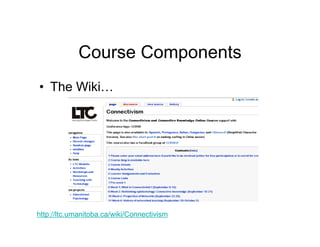
• The Wiki…


http://ltc.umanitoba.ca/wiki/Connectivism
Course Components (2)
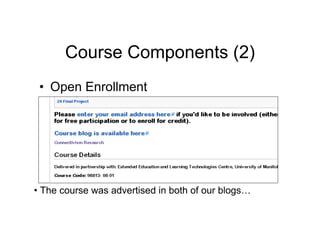
 • Open Enrollment


• The course was advertised in both of our blogs…
Course Components
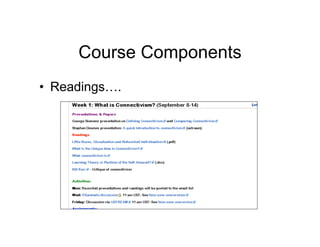
• Readings….
Course Components (3)
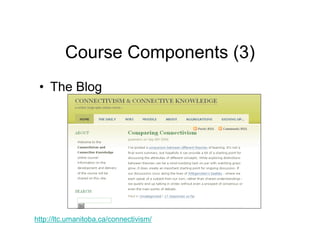
 • The Blog


http://ltc.umanitoba.ca/connectivism/
Course Components
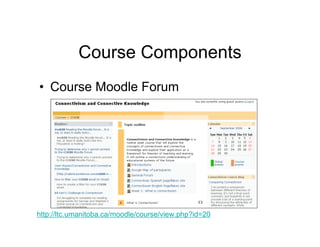
• Course Moodle Forum


http://ltc.umanitoba.ca/moodle/course/view.php?id=20
Course Components
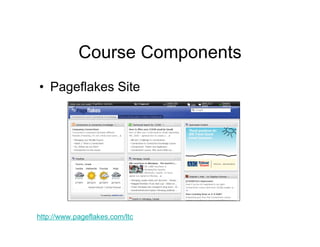
• Pageflakes Site


http://www.pageflakes.com/ltc
Course Components
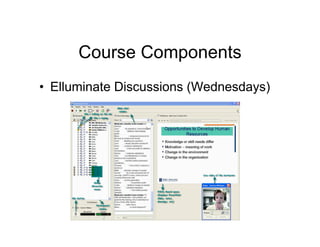
• Elluminate Discussions (Wednesdays)
Course Components
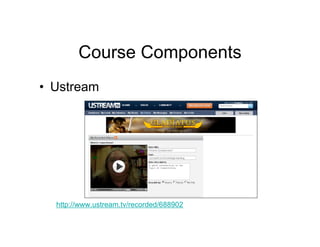
• Ustream


  http://www.ustream.tv/recorded/688902
Course Components
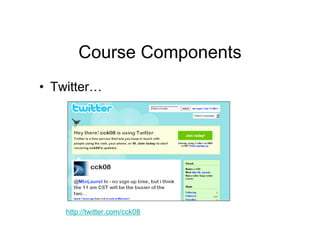
• Twitter…


    http://twitter.com/cck08
Course Components
• gRSShopper…
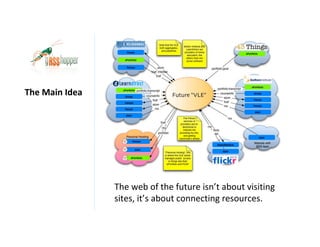
The
Main
Idea


                The
web
of
the
future
isn’t
about
visiting
                sites,
it’s
about
connecting
resources.
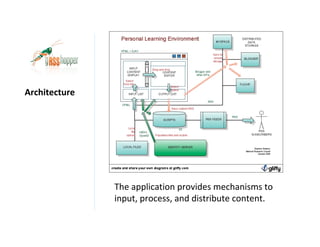
Architecture


               The
application
provides
mechanisms
to
               input,
process,
and
distribute
content.
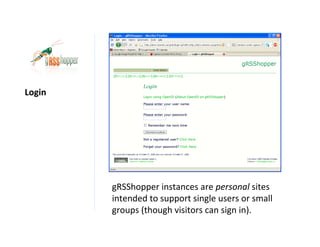
Login


        gRSShopper
instances
are
personal
sites
        intended
to
support
single
users
or
small
        groups
(though
visitors
can
sign
in).
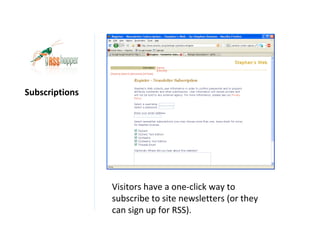
Subscriptions


                Visitors
have
a
one‐click
way
to
                subscribe
to
site
newsletters
(or
they
                can
sign
up
for
RSS).
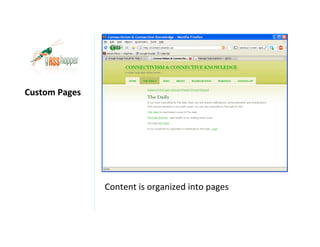
Custom
Pages


               Content
is
organized
into
pages
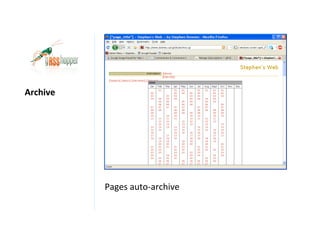
Archive


          Pages
auto‐archive
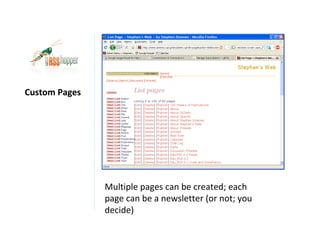
Custom
Pages


               Multiple
pages
can
be
created;
each
               page
can
be
a
newsletter
(or
not;
you
               decide)
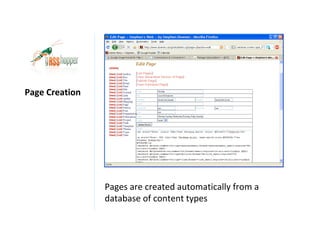
Page
Creation


                Pages
are
created
automatically
from
a
                database
of
content
types
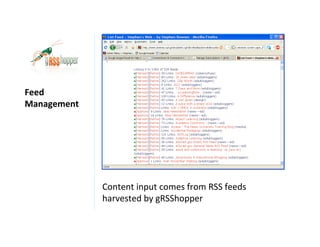
Feed
Management


             Content
input
comes
from
RSS
feeds
             harvested
by
gRSShopper
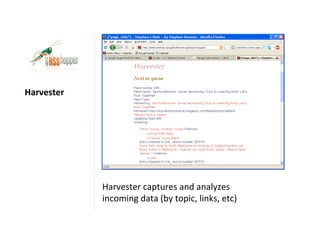
Harvester


            Harvester
captures
and
analyzes
            incoming
data
(by
topic,
links,
etc)
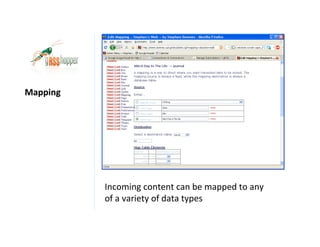
Mapping


          Incoming
content
can
be
mapped
to
any
          of
a
variety
of
data
types
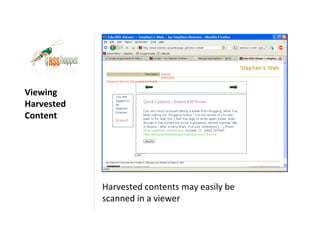
Viewing
Harvested
Content


            Harvested
contents
may
easily
be
            scanned
in
a
viewer
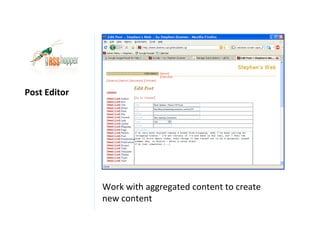
Post
Editor


              Work
with
aggregated
content
to
create
              new
content
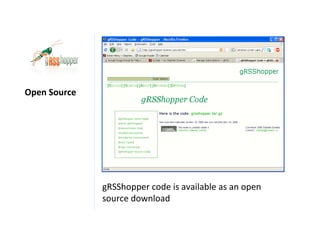
Open
Source


              gRSShopper
code
is
available
as
an
open
              source
download
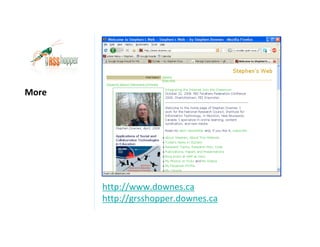
More


       http://www.downes.ca
       http://grsshopper.downes.ca
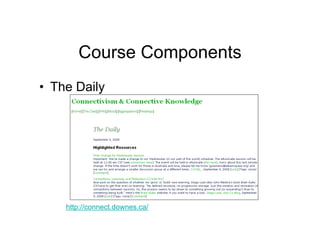
Course Components
• The Daily


    http://connect.downes.ca/
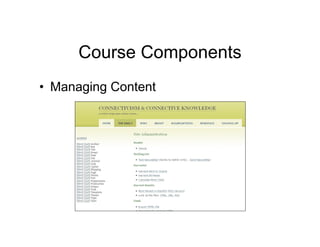
Course Components
• Managing Content
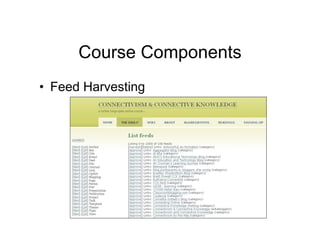
Course Components
• Feed Harvesting
Course Components
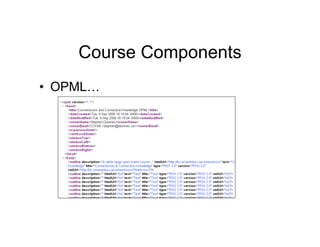
• OPML…
Course Components
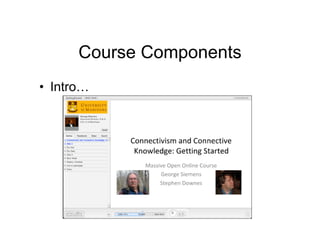
• Intro…
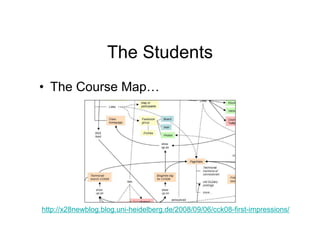
The Students
• The Course Map…


http://x28newblog.blog.uni-heidelberg.de/2008/09/06/cck08-first-impressions/
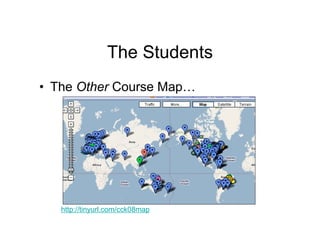
The Students
• The Other Course Map…


   http://tinyurl.com/cck08map
The Students
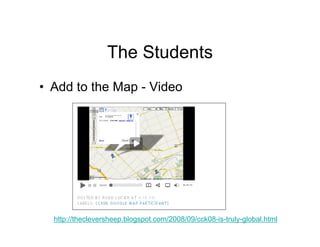
• Add to the Map - Video


  http://thecleversheep.blogspot.com/2008/09/cck08-is-truly-global.html
The Students
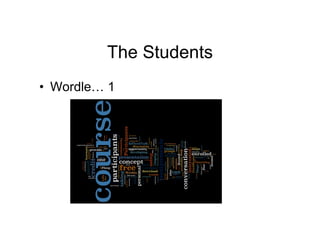
• Wordle… 1
The Students
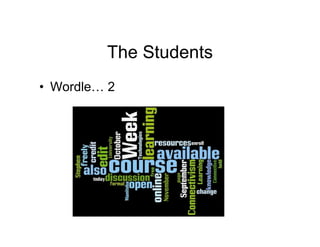
• Wordle… 2
The Students
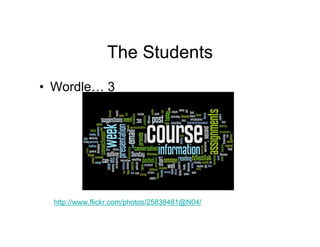
• Wordle… 3


  http://www.flickr.com/photos/25838481@N04/
The Students
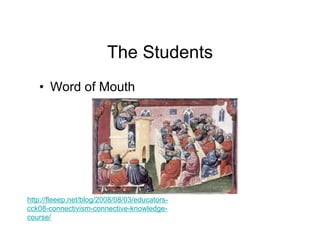
   • Word of Mouth


http://fleeep.net/blog/2008/08/03/educators-
cck08-connectivism-connective-knowledge-
course/
The Students
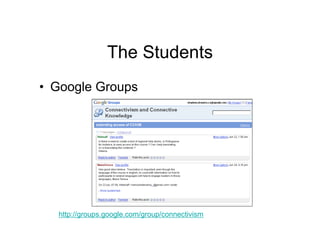
• Google Groups


  http://groups.google.com/group/connectivism
The Students
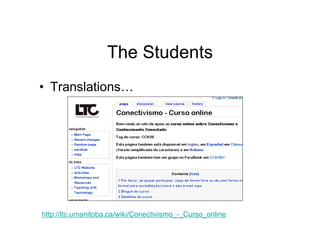
• Translations…


http://ltc.umanitoba.ca/wiki/Conectivismo_-_Curso_online
The Students
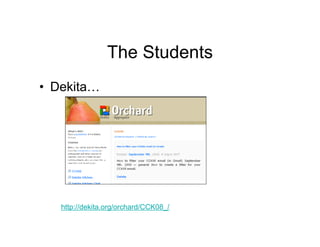
• Dekita…


   http://dekita.org/orchard/CCK08_/
The Students
•   Second Life…
•   Diigo…
•   de.l.icio.us
•   WordPress…
Free Learning
• The picture of learning you should have
  is one of a large set of connected nodes
  (like the neurons in a brain)
• Teachers are nodes, students are
  nodes
• Both teaching and learning consists of
  sending and receiving communications
  to other nodes
• The learning in such a picture happens
  in two ways:
• First, society learning as the network of
  connections between individuals takes
  shape
• Second, individuals learn as the
  process of being a node shapes
  connections in their own brains
• The communications between nodes
  were, in former days, text based
  (consisting of language)
• The materials used for such
  communications were free - the letters,
  the words, the grammar, the syntax
• Nobody owned language (though there
  are pressures to change that)
• Communications today are in the form
  of (what might be called) multimedia
  objects
• We send cultural artifacts back and
  forth to each other, as though the were
  words
• Example: lolcats, YouTube videos,
  Flickr images, the rest
• Cultural artifacts, as the new language,
  need to be free - otherwise we can’t
  communicate - otherwise, we are
  stifled, muted
• The free movement of cultural artifacts
  fosters learning - the hindered
  movement of such artifacts fosters
  control
• Al Gore - The Assault on Reason -
  clearly describes the consequences of
  this
• Gore: a society that used to think for
  itself (through reading) is now one that
  has its thinking done for it (through
  television)
Understanding ed delivery
• Today’s dominant understanding of
  educational technology is as a system
• This needs to be contrasted (as before)
  with one based on standards
• By this I do not mean ‘learning object
  metadata’ (which is totally a publisher
  mindset)
• Educational institutions need to think of
  their offerings as entities that will be a
  part of, and interact with, the larger
  environment
• For example, again: the photo editor
  that connects to Flickr
• Think about what an art appreciation
  resource would do with Flickr photos
• Not just that - they need to use this data
  to form composite wholes
• Eg. The application that takes photos
  tagged ‘St. Peters’ to create an image
  built from thousands of Flickr photos
• (This is the fundamental understanding
  behind connectivism)
• Educational institutions need to:
  – Make resources available for use in other
    contexts (rather than having students come
    to them)
  – Such material will be offered to people
    automatically, in other contexts, and may
    or may not be used (deal with it)
• Resources will be offered:
  – Student-selected, from a ‘library’ (which
    you share with other ‘publishers’)
  – Event-driven, by the system, which will
    offer a resource at an appropriate time
  – Time-driven (think of Tony Hirst’s RSS-
    driven course)
  – Instructor (or mentor, or coach) driven - as
    in a blog offering or RSS feed
• These resources need to:
  – Be able to learn about the environment
    they are being offered in
  – Be able to learn about the student
  – And to get this information, not just locally,
    but from anywhere on the internet
  – Communicate state and other information
    to other (authorized) systems and services
Where we are
• Not ‘there’ yet…
• Institutions do not (yet) understand how
  to deliver to external systems
• But we are seeing first signs - eg.,
  iTunes University
• We may see it inside ‘courses’ first - but
  the long-term trend is to open delivery
The Principles
1. Diversity

We want to encourage students to
  engage in diverse readings, diverse
  environments, diverse discussions
The Principles
2. Autonomy

We want students to chart their own
 course, to select their own software, to
 pursue their own learning
The Principles
3. Interaction / Connectedness

The knowledge in this course emerges as
 a result of the connections among the
 students and staff – and is not some
 ‘content’ shoveled from experts to
 recipients
The Principles
4. Openness

We don’t draw barriers between ‘in’ and
 ‘out’ – which means we can
 accommodate the full engaged, the
 partially engaged, and the rest –
 creating strong ties and weak ties
Thanks!
http://www.downes.ca
Wollongong 090408232854-phpapp01

Wollongong 090408232854-phpapp01

  • 1.
    Connectivist Learning andthe Personal Learning Environment Stephen Downes University of Wollongong April 3, 2009
  • 2.
    The Plan…. • The Connectivist Learning Model • What Personal Learning Looks Like • The Connectivist Online Course • The gRSShopper PLE • Free Learning • Designing Connectivist Learning
  • 3.
    Learning… • Two majoraspects: • ‘knowledge’ is to be organized in a certain way • - ‘knowing’ is like ‘recognizing’, ie., pattern matching
  • 4.
    Connectivism • The theorythat knowledge and learning can be described and explained using network principles • ‘Learning’ is not to acquire a set of facts, but rather, to develop or ‘grow’ into a certain neural configuration
  • 5.
    Connectivist Learning theory •Based on principles of associationism • Four major ways to learn: – Simple (Hebbian) associationism – Accidental association (by proximity) – Back-Propagation – Boltzmann learning
  • 6.
    Connectivist Pedagogy • To‘teach’ is to model and demonstrate • To ‘learn’ is to practice and reflect • Both imply participation in what might be called ‘an authentic community of practice’
  • 7.
    Role of theteacher • To practice one’s work in an open manner; to work transparently • To ‘work’ is to engage in a community • To be openly reflective, eg., to write about the work
  • 8.
    Role of theLearner • To attach oneself to an authentic environment • To observe and emulate successful practice • To be ‘reflective’, ie., to engage in conversation about the practice
  • 9.
  • 10.
    Model The question is – how to transport and represent models that are actually - conceptual frameworks used? - wiki (wiki API, RSS) - concept maps (SVG, mapping format) - gliffy (SVG?) - reference frameworks - Wikipedia - video / 2L 3D representation – embedded spaces
  • 11.
    Demonstrate Demonstrate The question is, how - reference examples can we connect the - code library learner with the - image samples community at work? - thought processes - show experts at work (Chaos Manor) - application - case studies, stories
  • 12.
    Practice The question is, how can we enable access to - scaffolded practice multiple environments - game interfaces that support various - sandboxes activities? - job aids - flash cards, cheat sheets - games and simulations - mod kits, mmorpgs
  • 13.
    The question is,how can we Reflection assist people to see themselves, their practice, in - guided reflection a mirror? - forms-based input - presentations and seminars - journaling - blogs, wikis - communities - discussion, sharing
  • 14.
    Choice – Identity- Creativity - simulated or actual environments that present tasks or problems - OpenID, authentication, feature or profile development - Portfolios & creative libraries People talk about ‘motivation’ – but the real issue here is ownership
  • 15.
    What does personallearning mean for learners?
  • 16.
    A world offree learning resources… http://educationvault.blogspot.com/2008/08/zaidlearn-ocw-oer-lists.html Don’t like the word ‘free’? Deal with it…
  • 17.
    User generated Content –Personal, opinionated
  • 18.
  • 19.
  • 20.
    New Roles –For students - as creators of learning – For teachers - as coaches and mentors – For the rest of us - as teachers
  • 21.
    • Learning asa network phenomenon…
  • 22.
    • Networks ofinteractions (aggregate, remix, repurpose, feed forward) – syndication An ecology…
  • 23.
    • The personallearning centre Autonomy http://blog.core-ed.net/derek/2006/11/more_on_mles_and_ples.html http://getfeedforward.org/
  • 24.
  • 25.
    The Best Example… •12 week course, readings, activities… • The course on connectivism is probably the best (early) example of what we mean – We began with the course itself – what we wanted to cover – We then added communications tools – And then the students took over…
  • 26.
    Overview… • George Siemensand I ushered roughly 2200 students through a 12 week online course • Some of these paid tuition and are getting credit, but most of them attended the ‘open’ course
  • 27.
    The Course • Offeredthrough the University of Manitoba – 12 weeks long – credit in Certificate in Adult and Continuing Education and Certificate in Emerging Technologies for Learning – Explored the concepts of connectivism and connective knowledge
  • 28.
    Connectivism “At its heart,connectivism is the thesis that knowledge is distributed across a network of connections, and therefore that learning consists of the ability to construct and traverse those networks.” What Connectivism Is http://halfanhour.blogspot.com/2007/02/what-connectivism-is.html
  • 29.
    Course Components • TheWiki… http://ltc.umanitoba.ca/wiki/Connectivism
  • 30.
    Course Components (2) • Open Enrollment • The course was advertised in both of our blogs…
  • 31.
  • 32.
    Course Components (3) • The Blog http://ltc.umanitoba.ca/connectivism/
  • 33.
    Course Components • CourseMoodle Forum http://ltc.umanitoba.ca/moodle/course/view.php?id=20
  • 34.
    Course Components • PageflakesSite http://www.pageflakes.com/ltc
  • 35.
    Course Components • ElluminateDiscussions (Wednesdays)
  • 36.
    Course Components • Ustream http://www.ustream.tv/recorded/688902
  • 37.
    Course Components • Twitter… http://twitter.com/cck08
  • 38.
  • 39.
    The
Main
Idea The
web
of
the
future
isn’t
about
visiting sites,
it’s
about
connecting
resources.
  • 40.
    Architecture The
application
provides
mechanisms
to input,
process,
and
distribute
content.
  • 41.
    Login gRSShopper
instances
are
personal
sites intended
to
support
single
users
or
small groups
(though
visitors
can
sign
in).
  • 42.
    Subscriptions Visitors
have
a
one‐click
way
to subscribe
to
site
newsletters
(or
they can
sign
up
for
RSS).
  • 43.
    Custom
Pages Content
is
organized
into
pages
  • 44.
    Archive Pages
auto‐archive
  • 45.
    Custom
Pages Multiple
pages
can
be
created;
each page
can
be
a
newsletter
(or
not;
you decide)
  • 46.
    Page
Creation Pages
are
created
automatically
from
a database
of
content
types
  • 47.
    Feed Management Content
input
comes
from
RSS
feeds harvested
by
gRSShopper
  • 48.
    Harvester Harvester
captures
and
analyzes incoming
data
(by
topic,
links,
etc)
  • 49.
    Mapping Incoming
content
can
be
mapped
to
any of
a
variety
of
data
types
  • 50.
    Viewing Harvested Content Harvested
contents
may
easily
be scanned
in
a
viewer
  • 51.
    Post
Editor Work
with
aggregated
content
to
create new
content
  • 52.
    Open
Source gRSShopper
code
is
available
as
an
open source
download
  • 53.
    More http://www.downes.ca http://grsshopper.downes.ca
  • 54.
    Course Components • TheDaily http://connect.downes.ca/
  • 55.
  • 56.
  • 57.
  • 58.
  • 59.
    The Students • TheCourse Map… http://x28newblog.blog.uni-heidelberg.de/2008/09/06/cck08-first-impressions/
  • 60.
    The Students • TheOther Course Map… http://tinyurl.com/cck08map
  • 61.
    The Students • Addto the Map - Video http://thecleversheep.blogspot.com/2008/09/cck08-is-truly-global.html
  • 62.
  • 63.
  • 64.
    The Students • Wordle…3 http://www.flickr.com/photos/25838481@N04/
  • 65.
    The Students • Word of Mouth http://fleeep.net/blog/2008/08/03/educators- cck08-connectivism-connective-knowledge- course/
  • 66.
    The Students • GoogleGroups http://groups.google.com/group/connectivism
  • 67.
  • 68.
    The Students • Dekita… http://dekita.org/orchard/CCK08_/
  • 69.
    The Students • Second Life… • Diigo… • de.l.icio.us • WordPress…
  • 70.
    Free Learning • Thepicture of learning you should have is one of a large set of connected nodes (like the neurons in a brain) • Teachers are nodes, students are nodes • Both teaching and learning consists of sending and receiving communications to other nodes
  • 71.
    • The learningin such a picture happens in two ways: • First, society learning as the network of connections between individuals takes shape • Second, individuals learn as the process of being a node shapes connections in their own brains
  • 72.
    • The communicationsbetween nodes were, in former days, text based (consisting of language) • The materials used for such communications were free - the letters, the words, the grammar, the syntax • Nobody owned language (though there are pressures to change that)
  • 73.
    • Communications todayare in the form of (what might be called) multimedia objects • We send cultural artifacts back and forth to each other, as though the were words • Example: lolcats, YouTube videos, Flickr images, the rest
  • 74.
    • Cultural artifacts,as the new language, need to be free - otherwise we can’t communicate - otherwise, we are stifled, muted • The free movement of cultural artifacts fosters learning - the hindered movement of such artifacts fosters control
  • 75.
    • Al Gore- The Assault on Reason - clearly describes the consequences of this • Gore: a society that used to think for itself (through reading) is now one that has its thinking done for it (through television)
  • 76.
    Understanding ed delivery •Today’s dominant understanding of educational technology is as a system • This needs to be contrasted (as before) with one based on standards • By this I do not mean ‘learning object metadata’ (which is totally a publisher mindset)
  • 77.
    • Educational institutionsneed to think of their offerings as entities that will be a part of, and interact with, the larger environment • For example, again: the photo editor that connects to Flickr • Think about what an art appreciation resource would do with Flickr photos
  • 78.
    • Not justthat - they need to use this data to form composite wholes • Eg. The application that takes photos tagged ‘St. Peters’ to create an image built from thousands of Flickr photos • (This is the fundamental understanding behind connectivism)
  • 79.
    • Educational institutionsneed to: – Make resources available for use in other contexts (rather than having students come to them) – Such material will be offered to people automatically, in other contexts, and may or may not be used (deal with it)
  • 80.
    • Resources willbe offered: – Student-selected, from a ‘library’ (which you share with other ‘publishers’) – Event-driven, by the system, which will offer a resource at an appropriate time – Time-driven (think of Tony Hirst’s RSS- driven course) – Instructor (or mentor, or coach) driven - as in a blog offering or RSS feed
  • 81.
    • These resourcesneed to: – Be able to learn about the environment they are being offered in – Be able to learn about the student – And to get this information, not just locally, but from anywhere on the internet – Communicate state and other information to other (authorized) systems and services
  • 82.
    Where we are •Not ‘there’ yet… • Institutions do not (yet) understand how to deliver to external systems • But we are seeing first signs - eg., iTunes University • We may see it inside ‘courses’ first - but the long-term trend is to open delivery
  • 83.
    The Principles 1. Diversity Wewant to encourage students to engage in diverse readings, diverse environments, diverse discussions
  • 84.
    The Principles 2. Autonomy Wewant students to chart their own course, to select their own software, to pursue their own learning
  • 85.
    The Principles 3. Interaction/ Connectedness The knowledge in this course emerges as a result of the connections among the students and staff – and is not some ‘content’ shoveled from experts to recipients
  • 86.
    The Principles 4. Openness Wedon’t draw barriers between ‘in’ and ‘out’ – which means we can accommodate the full engaged, the partially engaged, and the rest – creating strong ties and weak ties
  • 87.