@barry_dyck 
blogs.hsd.ca/barrydyck 
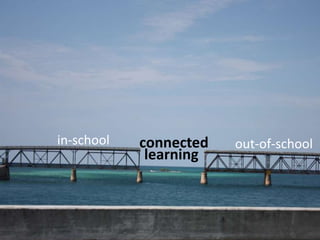
connectedlearning 
GerryShaw (Own work) [CC-BY-SA-3.0 (http://creativecommons.org/licenses/by-sa/3.0)], via Wikimedia Commons
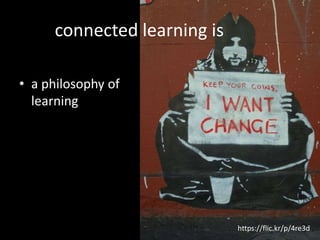
connected learning is 
• a philosophy of 
learning 
https://flic.kr/p/4re3d
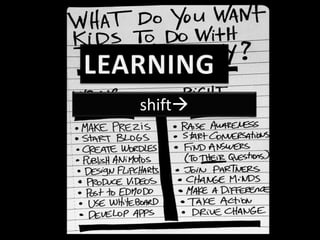
shift
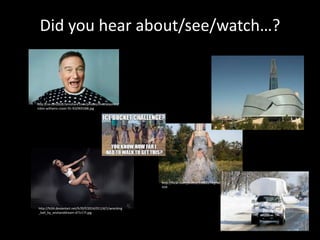
Did you hear about/see/watch…? 
http://us.cdn2828.fansshare.com/photos/thecrazyones/ 
robin-williams-cover-ftr-932905588.jpg 
http://flickr.com/photos/22882274@N04/14848289 
439 
http://fc04.deviantart.net/fs70/f/2014/011/d/1/wrecking 
_ball_by_wishanddream-d71r17l.jpg
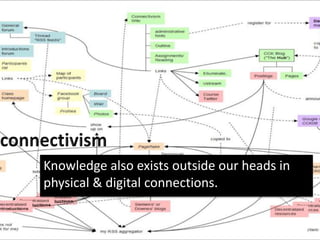
Knowledge also exists outside our heads in 
physical & digital connections.
connected knowledge
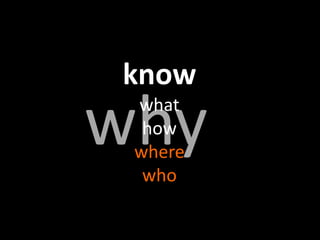
know 
what 
how 
where 
who 
why
What you know is far less important than 
what you can do with what you know. 
Tony Wagner
What’s our foundation? 
Albert Bridge [CC-BY-SA-2.0 (http://creativecommons.org/licenses/by-sa/2.0)], via Wikimedia Commons
Complexity begets uncertainty. 
https://www.youtube.com/watch?v=mOheTsPx220
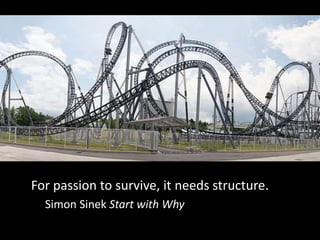
For passion to survive, it needs structure. 
Simon Sinek Start with Why
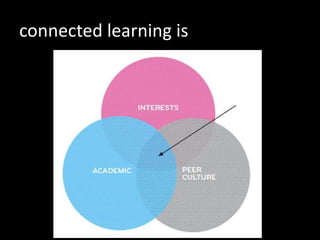
connected learning is
relationships 
• knowing is about being known 
• it is about belonging 
By Jordan Thevenow-Harrison (Flickr: DSC00134) [CC-BY-SA-2.0 (http://creativecommons.org/licenses/by-sa/2.0)], via Wikimedia Commons
• “…tightly organized and managed 
activities leave little room for 
problem-finding and creativity” 
(Getzels & Csikszentmihalyi, 1976). 
https://flic.kr/p/5anoq
school home 
http://costofchicken.com/wp-content/uploads/2012/02/2012-02- 
08_Economics_Class_Portrait_2407_UNC_3630x2061.jpg connected 
learning 
popular 
culture peers 
http://www.flickr.com/photos/tupwanders/83092660/
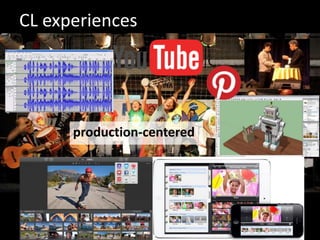
CL experiences 
production-centered
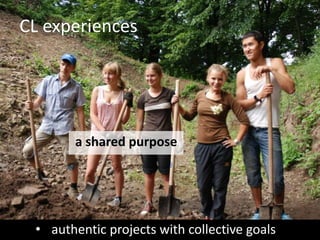
CL experiences 
a shared purpose 
• authentic projects with collective goals
openly networked 
• multi-disciplinary 
• different start-end 
• open access 
By Conspiritech (Own work) [Public domain], via Wikimedia Commons 
CL experiences
Design Principles for Connected Learning 
• everyone can participate 
• learning happens by doing 
• challenge is constant 
• everything is interconnected 
Ideal Knot final rendering
demand 
supply
in-school connected out-of-school 
learning
“If education is 
supposed to cater to 
kids, it is the 
responsibility of 
educators to adapt to 
the new generation, 
whether it be culturally 
or technologically.” 
Parth N 
By MOs810 (Own work) [GFDL (http://www.gnu.org/copyleft/fdl.html) or CC-BY-SA-4.0-3.0-2.5-2.0-1.0 
(http://creativecommons.org/licenses/by-sa/4.0-3.0-2.5-2.0-1.0)], via Wikimedia Commons
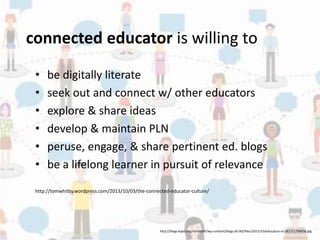
connected educator is willing to 
• be digitally literate 
• seek out and connect w/ other educators 
• explore & share ideas 
• develop & maintain PLN 
• peruse, engage, & share pertinent ed. blogs 
• be a lifelong learner in pursuit of relevance 
http://tomwhitby.wordpress.com/2013/10/03/the-connected-educator-culture/ 
http://blogs.kqed.org/mindshift/wp-content/blogs.dir/42/files/2013/10/educators-e1382721798938.jpg
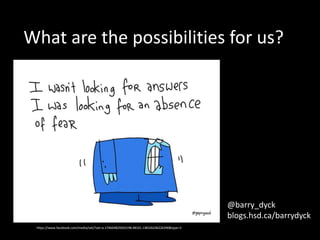
What are the possibilities for us? 
https://www.facebook.com/media/set/?set=a.174604829265198.48101.138326246226390&type=3 
@barry_dyck 
blogs.hsd.ca/barrydyck
Notes 
• For more on connected learning see 
http://connectedlearning.tv/what-is-connected- 
learning

Learning is Social: Connected Learning

  • 1.
    @barry_dyck blogs.hsd.ca/barrydyck connectedlearning GerryShaw (Own work) [CC-BY-SA-3.0 (http://creativecommons.org/licenses/by-sa/3.0)], via Wikimedia Commons
  • 2.
    connected learning is • a philosophy of learning https://flic.kr/p/4re3d
  • 3.
  • 4.
    Did you hearabout/see/watch…? http://us.cdn2828.fansshare.com/photos/thecrazyones/ robin-williams-cover-ftr-932905588.jpg http://flickr.com/photos/22882274@N04/14848289 439 http://fc04.deviantart.net/fs70/f/2014/011/d/1/wrecking _ball_by_wishanddream-d71r17l.jpg
  • 5.
    Knowledge also existsoutside our heads in physical & digital connections.
  • 6.
  • 7.
    know what how where who why
  • 8.
    What you knowis far less important than what you can do with what you know. Tony Wagner
  • 9.
    What’s our foundation? Albert Bridge [CC-BY-SA-2.0 (http://creativecommons.org/licenses/by-sa/2.0)], via Wikimedia Commons
  • 10.
    Complexity begets uncertainty. https://www.youtube.com/watch?v=mOheTsPx220
  • 12.
    For passion tosurvive, it needs structure. Simon Sinek Start with Why
  • 13.
  • 14.
    relationships • knowingis about being known • it is about belonging By Jordan Thevenow-Harrison (Flickr: DSC00134) [CC-BY-SA-2.0 (http://creativecommons.org/licenses/by-sa/2.0)], via Wikimedia Commons
  • 15.
    • “…tightly organizedand managed activities leave little room for problem-finding and creativity” (Getzels & Csikszentmihalyi, 1976). https://flic.kr/p/5anoq
  • 17.
    school home http://costofchicken.com/wp-content/uploads/2012/02/2012-02- 08_Economics_Class_Portrait_2407_UNC_3630x2061.jpg connected learning popular culture peers http://www.flickr.com/photos/tupwanders/83092660/
  • 18.
  • 19.
    CL experiences ashared purpose • authentic projects with collective goals
  • 20.
    openly networked •multi-disciplinary • different start-end • open access By Conspiritech (Own work) [Public domain], via Wikimedia Commons CL experiences
  • 21.
    Design Principles forConnected Learning • everyone can participate • learning happens by doing • challenge is constant • everything is interconnected Ideal Knot final rendering
  • 23.
  • 24.
  • 25.
    “If education is supposed to cater to kids, it is the responsibility of educators to adapt to the new generation, whether it be culturally or technologically.” Parth N By MOs810 (Own work) [GFDL (http://www.gnu.org/copyleft/fdl.html) or CC-BY-SA-4.0-3.0-2.5-2.0-1.0 (http://creativecommons.org/licenses/by-sa/4.0-3.0-2.5-2.0-1.0)], via Wikimedia Commons
  • 26.
    connected educator iswilling to • be digitally literate • seek out and connect w/ other educators • explore & share ideas • develop & maintain PLN • peruse, engage, & share pertinent ed. blogs • be a lifelong learner in pursuit of relevance http://tomwhitby.wordpress.com/2013/10/03/the-connected-educator-culture/ http://blogs.kqed.org/mindshift/wp-content/blogs.dir/42/files/2013/10/educators-e1382721798938.jpg
  • 27.
    What are thepossibilities for us? https://www.facebook.com/media/set/?set=a.174604829265198.48101.138326246226390&type=3 @barry_dyck blogs.hsd.ca/barrydyck
  • 28.
    Notes • Formore on connected learning see http://connectedlearning.tv/what-is-connected- learning

Editor's Notes

  • #2 Think of a student who said, “Why do we have to do this?” “When am I ever going to need this? I was that “why” student from Kindergarten through university. I wanted to make sense of things. I wanted to know how they connected. I remember when I was leader of our youth group at church in high school, late ’70s and parents were concerned about the “bad” music we were listening to. I researched and prepared a presentation on music and called a meeting with the parents. I don’t remember what I said, but after the meeting, I distinctly remember discussing the parents’ music (CCR, The Stones) with them. We connected. There was a transparency. They could now empathize with the cultural shift. We found common ground. In my 26 years of teaching, I’ve been drawn to the students who asked why. They have driven me to reflect on and to improve my practice. Placing the students at the center of learning changed by role as a teacher, most profoundly in the last four years evolving the Learning Project, a flexible learning environment for elective courses for students in grades 9-12 at Landmark Collegiate. Much of what I’m going to share has come from my experiences, reading dialoging, reflecting. My learning is ongoing, I’m passionate about how we make learning relevant. It starts by seeing the learners as relevant. What’s so different now? I invite comments.
  • #3 The work that I’m using to frame this presentation is from the Connected Learning Research Network. Connected learning is realized when a young person is able to pursue a personal interest or passion with the support of friends and caring adults, and is able to link this learning and interest to academic achievement, career success or civic engagement. Example of Casey Peters. We have developed from a predominantly transmission idea of knowledge, that knowledge is something you know about, an “is” thing that you can transfer from teacher to student. Our current curriculum is built on a constructivist idea, the idea that the reader of a text or idea actively constructs and makes their own meaning from their background knowledge and experiences. In this digital, connected world, George Siemens who created a connectivist idea of learning to suggest that what we “know” exists both in us and in our connected networks: people and machines. In addition to knowing what and how, we need to “know where” and “know who.” We all want knowledge in context and we all want to learn if we are going to do something with that knowledge.
  • #5 How do we connect? When we learn something, we want to share it with others. Learning is a social act. It is a connecting act.
  • #10 We are working with the tree metaphor where our job is to produce seedlings. A connected model of learning is about growing an ecosystem with a broad variety of life forms, interdependent. There is no clear beginning and end. Connections head in all directions. It can be very overwhelming.
  • #11 Complex problems require complex solutions. And as humans, we naturally avoid uncertainty. Who needs the stress? We are at historical crossroads and we don’t know exactly where to go. Or why we should.
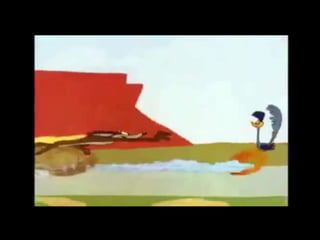
  • #12 The understanding that we want to catch always seems to escape our grasp. You’ve got to admire Coyote’s passion though. But passion isn’t enough.
  • #13 Don’t want you to get the idea that this is all open, chaotic, unstructured. It’s not.
  • #14 knowledge is wide (crowdsourcing) boundary-free (citizen-experts) populist (flattening of levels) “other” credentialed (slash.dot) unsettled
  • #16 I like Keith Hamon’s analogy of the open spaces on a soccer pitch, where the best players will go and make something happen. Wayne Gretzky was like that as well.
  • #17 When I started the flexible learning environment at LC, I’ve never forget the response of a grade 12 girl when asked, “What do YOU want to learn?” replied, “No one has ever asked me that before.”
  • #19 Three things make up connected learning experiences. DIY, Maker Movement, Minecraft EDU.
  • #21 Think transparent. There is no edge, no shape, no foundation. The tree metaphor is replaced with not another metaphor, but rather, a lens rhizome. We are connecting ideas to ideas (hashtags), people to ideas, and people to people. We know enough about facts to know that there is much disagreement. We can become more sure in our limited facts or learn to better understand how ideas connect, interrelate…
  • #24 Traditional education is driven by supply. We have the knowledge to give. We have lots of it. We know it’s not possible to deliver all the curriculum, but we fear students will be missing out if we don’t cover as much as possible. In connected learning, the interest demands of the students are addressed and given more prominence. This is frightening because it’s quite possible won’t know the answers their questions. It places us in a position of ignorance. And no one wants to be the person who doesn’t know. But that’s the new reality. The more you know, the more you know how little you know. How can we make the connections and draw on students’ competencies? A focus of student competence rather than on deficit is the foundation for building a network of knowledge.
  • #25 “CL celebrates the marriage of in-school and out-of-school learning by bridging the gap between elements learned in the classroom to the student's social and cultural experiences.” I asked some students whom I worked with last year what they learned from being in a self-directed learning environment. I remember three comments: failing isn't failing here you have to push yourself and stay motivated I learned about learning how to learn and I learned about me.
  • #26 George Siemens says, “To be adaptive is to be perpetually current.”
  • #27 What are some steps we can take?