Ethos, Pathos, and
Logos
The Rhetorical Appeals
 What is rhetoric?
 We often associate rhetoric with politicians;
for example, “He uses empty rhetoric.”

Rhetoric

 However, we will be working with
rhetoric as the study and practice of
strategic communication:
 “The strategic use of the various
modes of language (spoken, written,
body, visual, etc.) to create meaning
and/or argument” (GFC, 2013, 747).
Other
Definitions of
Rhetoric

 “Rhetoric is the use of words—either
spoken or written—as well as visuals to
achieve some goal” (Roen, Glau, &
Maid,2012, p. 1).
 “The faculty of observing, in a given
case, the available means of
persuasion.”
 Aristotle
 Acts of persuasion can be
classified into the following three
rhetorical appeals:

Rhetorical
Appeals

 Ethos: Appeal to credibility
 Pathos: Appeal to emotions
 Logos: Appeal to logic
 Ethos appeals to credibility using:
 Authority
 Reputation
 Values

Ethos

 Ethos represents the overall persona of the
speaker/writer and his/her attempt to be
authoritative.
 The following Nike commercial employs
ethos by fitting its message to the celebrity
(a form of authority) who endorses it:
 http://www.youtube.com/watch?v=tmc8Slg
1VIQ
Ethos
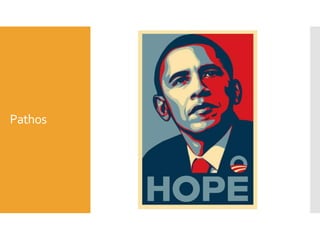
 Pathos appeals to the emotions,
values, and beliefs of the audience.

Pathos

 In this clip from Mad Men, Dom Draper
evokes a nostalgic emotion of longing
through a combination of images and
words.
 http://www.youtube.com/watch?v=s
uRDUFpsHus
Pathos
 Logos appeals to reasoning and
numbers. It is also represented by wellorganized argumentation and internal
consistency.

Logos

 This anti-tobacco PSA is based on a
single powerful statistic:
 http://www.youtube.com/watch?v=Y_56BQmY_e8
Logos
Rhetorical
Appeals

 Note that, although the rhetorical
appeals have different focuses, they can
work together, sometimes
simultaneously, to create an effective
message. For example, the creation of a
logical, well-organized argument is most
clearly an example of logos, but it can
also promote the writer’s ethos by
making him/her look well-informed and
professional.
 The Rhetorical and Visual Analysis is
worth 100 points, or 10% of your overall
grade.

Rhetorical/
Visual
Analysis

 3-5 pages
 APA format
 Should following academic writing
conventions
 Examine the instructions and rubric on
Blackboard for more information.
For the Rhetorical and Visual Analysis, you are
supposed to do the following:
1.

Assignment
Checklist

Choose a persuasive document with visual and
textual characteristics to analyze.

2.

Analyze its audience.

3.

Analyze the writer/artist’s use of the rhetorical
appeals (ethos, pathos, and logos).

4.

Examine whether or not the rhetorical appeals
are effective for the intended audience.
The document you are going to analyze needs to
meet certain criteria:
1.

Rhetorical/
Visual
Analysis

The speaker/writer must be trying to persuade
his/her audience.

2.

You need to pick a text with a visual (that is, it
needs to have both words and a visual such as
pictures or a video).

3.

The text and visual need to have enough
substance to carry you through a 3-5 page
analysis.
Rhetorical/
Visual
Analysis

You need to choose an object of analysis that has both
written/spoken text and visuals. For example:
 Lyrics and a professional/official music video
 A political cartoon
 An opinion piece with a visual
 An advertisement or poster with a substantial
amount of text
 A commercial (analyze the visuals separate from
the spoken text)

Rhetorical Appeals

  • 1.
    Ethos, Pathos, and Logos TheRhetorical Appeals
  • 2.
     What isrhetoric?  We often associate rhetoric with politicians; for example, “He uses empty rhetoric.” Rhetoric  However, we will be working with rhetoric as the study and practice of strategic communication:  “The strategic use of the various modes of language (spoken, written, body, visual, etc.) to create meaning and/or argument” (GFC, 2013, 747).
  • 3.
    Other Definitions of Rhetoric  “Rhetoricis the use of words—either spoken or written—as well as visuals to achieve some goal” (Roen, Glau, & Maid,2012, p. 1).  “The faculty of observing, in a given case, the available means of persuasion.”  Aristotle
  • 4.
     Acts ofpersuasion can be classified into the following three rhetorical appeals: Rhetorical Appeals  Ethos: Appeal to credibility  Pathos: Appeal to emotions  Logos: Appeal to logic
  • 5.
     Ethos appealsto credibility using:  Authority  Reputation  Values Ethos  Ethos represents the overall persona of the speaker/writer and his/her attempt to be authoritative.  The following Nike commercial employs ethos by fitting its message to the celebrity (a form of authority) who endorses it:  http://www.youtube.com/watch?v=tmc8Slg 1VIQ
  • 6.
  • 7.
     Pathos appealsto the emotions, values, and beliefs of the audience. Pathos  In this clip from Mad Men, Dom Draper evokes a nostalgic emotion of longing through a combination of images and words.  http://www.youtube.com/watch?v=s uRDUFpsHus
  • 8.
  • 9.
     Logos appealsto reasoning and numbers. It is also represented by wellorganized argumentation and internal consistency. Logos  This anti-tobacco PSA is based on a single powerful statistic:  http://www.youtube.com/watch?v=Y_56BQmY_e8
  • 10.
  • 11.
    Rhetorical Appeals  Note that,although the rhetorical appeals have different focuses, they can work together, sometimes simultaneously, to create an effective message. For example, the creation of a logical, well-organized argument is most clearly an example of logos, but it can also promote the writer’s ethos by making him/her look well-informed and professional.
  • 12.
     The Rhetoricaland Visual Analysis is worth 100 points, or 10% of your overall grade. Rhetorical/ Visual Analysis  3-5 pages  APA format  Should following academic writing conventions  Examine the instructions and rubric on Blackboard for more information.
  • 13.
    For the Rhetoricaland Visual Analysis, you are supposed to do the following: 1. Assignment Checklist Choose a persuasive document with visual and textual characteristics to analyze. 2. Analyze its audience. 3. Analyze the writer/artist’s use of the rhetorical appeals (ethos, pathos, and logos). 4. Examine whether or not the rhetorical appeals are effective for the intended audience.
  • 14.
    The document youare going to analyze needs to meet certain criteria: 1. Rhetorical/ Visual Analysis The speaker/writer must be trying to persuade his/her audience. 2. You need to pick a text with a visual (that is, it needs to have both words and a visual such as pictures or a video). 3. The text and visual need to have enough substance to carry you through a 3-5 page analysis.
  • 15.
    Rhetorical/ Visual Analysis You need tochoose an object of analysis that has both written/spoken text and visuals. For example:  Lyrics and a professional/official music video  A political cartoon  An opinion piece with a visual  An advertisement or poster with a substantial amount of text  A commercial (analyze the visuals separate from the spoken text)