Theories of Ethics Amali N Ediriweera Dept. of HRM UoK
Theories of Ethics (Cont.) Utilitarianism examine an action’s effects to decide whether it is morally correct Action is morally right if the total net benefit of the action exceeds the total net benefit of any other action Assumes a person can assess all costs and benefits of an action
Theories of Ethics (Cont.) Utilitarianism (cont.) Assessment of net benefits includes any important indirect effects Example:  assessing the effects of pollutant discharge from a factory on the immediate surrounding environment and those down stream or down wind from the factory
Utilitarianism (cont.) offers the greatest good for the greatest number encourages efficiency and productivity may ignore the rights of some stakeholders most businesspeople subscribe to this view
Theories of Ethics (Cont.) Utilitarianism (cont.) Two main limitations Hard to use in difficult to quantify situations Does not include  rights and justice Other ethical theories meet these objections
Theories of Ethics (Cont.) Rights Right:  a  person’s just claim or entitlement Focuses on the person’s actions or the actions of others toward the person Legal rights:  defined by a system of laws Moral rights:   based on ethical standards Purpose: let a person freely pursue certain actions without interference from others
Theories of Ethics (Cont.) Rights (cont.) Features Respect the rights of others Lets people act as equals Moral justification of a person’s action may present obstacles to high productivity and efficiency
Variety of Legal Rights Civil Rights Minorities’ Rights Women’s Rights Disabled People’s Right Employee Rights Consumer Rights Shareholder Rights Children Rights Animal Rights Etc,
Theories of Ethics (Cont.) Justice Looks at the balance of benefits and burdens distributed among members of a group Can result from the application of rules, policies, or laws that apply to a society or a group protect the interests of stakeholders who may be underrepresented or lack power encourages a sense of entitlement that might make employees reduce risk taking, innovation, and productivity
Theories of Ethics (Cont.) Egoism Self-centered form of ethics Two forms of ethical egoism:  individual and universal Individual ethical egoism Judges actions only by their effects on one’s interests
Theories of Ethics (Cont.) Egoism (cont.) Universal ethical egoism Can include the interests of others when assessing one’s actions Still self-centered:  pursuing pleasure and avoiding pain “ Enlightened self-interest.”  Considers the interests of others because the person wants others to do the same toward him or her
Theories of Ethics (Cont.) Questions from the ethical theories Utilitarianism:   does the action yield the greatest net benefits? Rights:   does the action negatively affect someone’s moral rights? Justice:   does the action give a fair distribution of costs and benefits among those affected? Egoism:   will the action lead to other people behaving toward me in a way I would like?
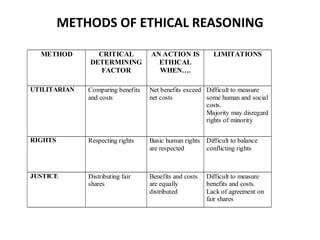
METHODS OF ETHICAL REASONING
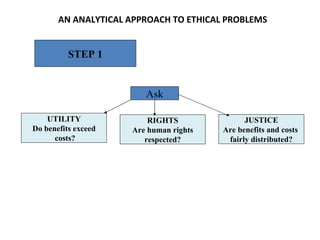
AN ANALYTICAL APPROACH TO ETHICAL PROBLEMS Ask UTILITY Do benefits exceed  costs? RIGHTS Are human rights respected? JUSTICE Are benefits and costs  fairly distributed? STEP 1
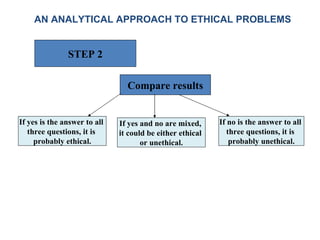
AN ANALYTICAL APPROACH TO ETHICAL PROBLEMS Compare results If yes is the answer to all  three questions, it is  probably ethical. If yes and no are mixed,  it could be either ethical  or unethical. If no is the answer to all  three questions, it is  probably unethical. STEP 2
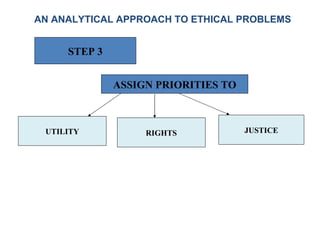
AN ANALYTICAL APPROACH TO ETHICAL PROBLEMS ASSIGN PRIORITIES TO UTILITY RIGHTS JUSTICE STEP 3

Ethics lesson 4

  • 1.
    Theories of EthicsAmali N Ediriweera Dept. of HRM UoK
  • 2.
    Theories of Ethics(Cont.) Utilitarianism examine an action’s effects to decide whether it is morally correct Action is morally right if the total net benefit of the action exceeds the total net benefit of any other action Assumes a person can assess all costs and benefits of an action
  • 3.
    Theories of Ethics(Cont.) Utilitarianism (cont.) Assessment of net benefits includes any important indirect effects Example: assessing the effects of pollutant discharge from a factory on the immediate surrounding environment and those down stream or down wind from the factory
  • 4.
    Utilitarianism (cont.) offersthe greatest good for the greatest number encourages efficiency and productivity may ignore the rights of some stakeholders most businesspeople subscribe to this view
  • 5.
    Theories of Ethics(Cont.) Utilitarianism (cont.) Two main limitations Hard to use in difficult to quantify situations Does not include rights and justice Other ethical theories meet these objections
  • 6.
    Theories of Ethics(Cont.) Rights Right: a person’s just claim or entitlement Focuses on the person’s actions or the actions of others toward the person Legal rights: defined by a system of laws Moral rights: based on ethical standards Purpose: let a person freely pursue certain actions without interference from others
  • 7.
    Theories of Ethics(Cont.) Rights (cont.) Features Respect the rights of others Lets people act as equals Moral justification of a person’s action may present obstacles to high productivity and efficiency
  • 8.
    Variety of LegalRights Civil Rights Minorities’ Rights Women’s Rights Disabled People’s Right Employee Rights Consumer Rights Shareholder Rights Children Rights Animal Rights Etc,
  • 9.
    Theories of Ethics(Cont.) Justice Looks at the balance of benefits and burdens distributed among members of a group Can result from the application of rules, policies, or laws that apply to a society or a group protect the interests of stakeholders who may be underrepresented or lack power encourages a sense of entitlement that might make employees reduce risk taking, innovation, and productivity
  • 10.
    Theories of Ethics(Cont.) Egoism Self-centered form of ethics Two forms of ethical egoism: individual and universal Individual ethical egoism Judges actions only by their effects on one’s interests
  • 11.
    Theories of Ethics(Cont.) Egoism (cont.) Universal ethical egoism Can include the interests of others when assessing one’s actions Still self-centered: pursuing pleasure and avoiding pain “ Enlightened self-interest.” Considers the interests of others because the person wants others to do the same toward him or her
  • 12.
    Theories of Ethics(Cont.) Questions from the ethical theories Utilitarianism: does the action yield the greatest net benefits? Rights: does the action negatively affect someone’s moral rights? Justice: does the action give a fair distribution of costs and benefits among those affected? Egoism: will the action lead to other people behaving toward me in a way I would like?
  • 13.
  • 14.
    AN ANALYTICAL APPROACHTO ETHICAL PROBLEMS Ask UTILITY Do benefits exceed costs? RIGHTS Are human rights respected? JUSTICE Are benefits and costs fairly distributed? STEP 1
  • 15.
    AN ANALYTICAL APPROACHTO ETHICAL PROBLEMS Compare results If yes is the answer to all three questions, it is probably ethical. If yes and no are mixed, it could be either ethical or unethical. If no is the answer to all three questions, it is probably unethical. STEP 2
  • 16.
    AN ANALYTICAL APPROACHTO ETHICAL PROBLEMS ASSIGN PRIORITIES TO UTILITY RIGHTS JUSTICE STEP 3