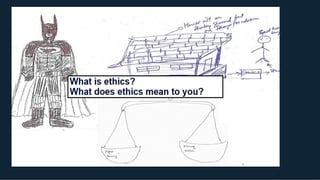
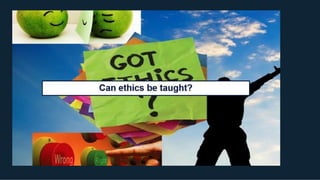
What is Ethics?
What does ethics mean to you?
Draw a picture or metaphor that represents how you see ethics
6
Workshop Activities In one word - "What is Ethics?”
Individual vs Organisational?
What you think is the core difference
between individual and organisational responsibility?
Individual responsibility refers to the moral and legal obligation of a person to take
ownership of their actions and decisions, and the consequences that result from them. This
includes taking responsibility for one's own personal and professional development, as well
as fulfilling one's duties and obligations to others.
Organizational responsibility refers to the obligation of an organization, as a whole, to act
ethically and in accordance with the law, and to consider the impact of its actions on
society, the environment and its stakeholders. This includes issues such as diversity,
equity, and inclusion, environmental sustainability, and the treatment of employees.
An organization also has a responsibility to its stakeholders, including shareholders,
customers, employees, and suppliers, to act in their best interests and to ensure the long-
term success and sustainability of the organization.
"Accountability Ethics" - what does it means?
Think about the role of the teacher and the student, how are both participants accountable
to each other in a learning relationship?
Ethical Perspectives
9
Personal ethics
• We possess personal values derived from the influence of our own culture and people
e.g.
• parents and other family members
• friends and peer groups
• respected authorities
• We practice personal ethics every day, as a member of our family, as a friend and as
a member of our community
Various Perspectives
continued …
10
Professional ethics
• Defined and safeguarded by professional bodies such as the CPA, ACS, PMI,
PMBOK
• Defined in a Code of Ethics
• Safeguarded by disciplining members who fail to act according to the code
• Unethical behaviour by a member brings disrepute to the whole profession
Various Perspectives
continued …
11
Ethics and the law
• Ethics has to do with responsible decision-making
• It is ethical to obey the law
• Ethics goes beyond the law as it usually involves a personal choice not covered by
law
• In very special circumstances it may be ethical to break the law, e.g. driving carefully
through a red light in an emergency
• Access information
Various Perspectives
continued …
12
Ethics and religion
• Religions normally have an associated moral (ethical) code
• Religion certainly has been and continues to be a strong influence in the exercise of
ethical behaviour
• A person does not have to be religious to be ethical
Various Perspectives
continued …
13
Ethics and philosophy
• Philosophers as a group have long been concerned with ethical behaviour and the
basis of ethical decisions
• The ethical theories have been developed over time by a philosophers in the Western
tradition
• -process of systematising, defending and recommending
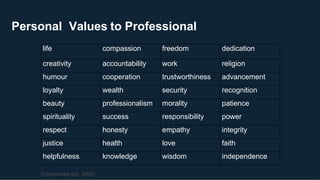
Personal Values to Professional
life compassion freedom dedication
creativity accountability work religion
humour cooperation trustworthiness advancement
loyalty wealth security recognition
beauty professionalism morality patience
spirituality success responsibility power
respect honesty empathy integrity
justice health love faith
helpfulness knowledge wisdom independence
(icarevalues.org, 2005)
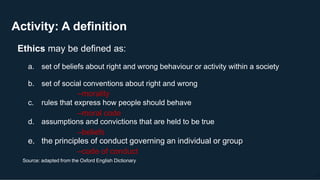
Activity: A definition
15
Source: adapted from the Oxford English Dictionary
Ethics may be defined as:
a. set of beliefs about right and wrong behaviour or activity within a society
b. set of social conventions about right and wrong
–morality
c. rules that express how people should behave
–moral code
d. assumptions and convictions that are held to be true
–beliefs
e. the principles of conduct governing an individual or group
–code of conduct
Values
16
Values may be defined as:
a. the inner judgements or beliefs that determine how a person behaves
b. habits that incline people to do what is acceptable
–virtues e.g. fairness , respect
c. system of rules that tell us what we can and cannot do
–laws
d. one’s personal beliefs about right and wrong
–morals
Ethics and Values Terminology
continued …
17
• Ethics is a set of beliefs about right and wrong behaviour within a
society
• Values are the inner judgments or beliefs that determine how a
person behaves
• The terms ‘Ethics’ and ‘Values’ are NOT interchangeable => values
impact/drive our ethics
• Beliefs drive Behaviour
• Values influence Ethics
• Ethics lead to Actions
Advantages of Learning Ethics
21
• According to Bok (1976)
• Helps to develop an awareness of issues that may lay in hidden
situations
• Develop a capacity for moral reasoning – right or wrong
• Clarify moral aspirations
• Professionals will set higher standards for themselves it they have
first encountered the moral problems in a learning environment
Activity 3: What are Ethics
When you ask "is it OK to ...?“, you are asking about Ethics…
• You have the opportunity to cheat on a test, you friend came to you and said he has the answers for
the exam, do you want them? And you’re thinking is it Morally ok for me to take this opportunity?
• Similar to downloading movies and songs from the illegal platform
• Downloading journal articles from XX website for learning purpose – is this a right thing to do?
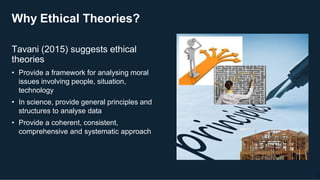
Why Ethical Theories?
Tavani (2015) suggests ethical
theories
• Provide a framework for analysing moral
issues involving people, situation,
technology
• In science, provide general principles and
structures to analyse data
• Provide a coherent, consistent,
comprehensive and systematic approach
26
Ethical Frameworks
27
Frameworks derive from philosophy and provide other ways
to think about ethical dilemmas
Three important frameworks are:
• Virtue ethics
• Deontology
• Consequentialism (Utilitarianism)
Each of these is a huge and complicated field of study, we'll
skim the surface this week
Virtue ethics
28
Virtue ethics suggests that being a virtuous person is
the pathway to ethical behaviour
Virtues are positive character traits
Roots in Ancient Greek philosophy
The ACS Code of Ethics is virtue-based
Honesty, Competence, Professionalism…
Deontology - Kant
30
Broadly speaking, deontology means using rules to determine
morality
Also called "Duty-based ethics"
Behaving ethically means following the rules
A code of conduct is an example of a deontology
Various efforts have been made to create rules based on other,
more sophisticated ethical frameworks
There is some evidence that your own brain builds rules to make fast decisions
Consequentialism (Utilitarianism)
31
Consequentialism asks you to think about the morality of an action
based on its consequences
"Utility" here is a way of describing how good the consequences of an action are.
The most popular type of utility is to maximize the greatest happiness
for the most people
An action is morally right if its consequences lead to happiness (absence of pain), and
wrong if it ends in unhappiness (pain)
Can you think of other measures of utility?
As with most consequence-based frameworks, in Consequentialism the
ends justify the means
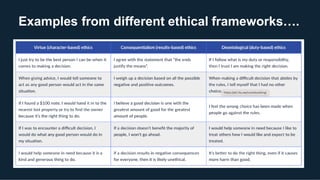
Examples from different ethical frameworks….
Ethical decision making
• What are the difficulties with making ethical decisions?
• Have you ever made a difficult choice? How did you decide what to
do?
Why is the study of ethics important?
To understand whether and why our opinions are worth holding. Have you
examined your life? As an data scientist/computer scientist/cybersecurity expert,
what are your basic goals? Are they compatible with other values that you have? If
you need to choose between keeping a job and violating your professional
responsibilities, what would you do? When your responsibility to family clashes
with your responsibility to your job, how do you resolve the conflict?
To identify the basic ethical principles that can be applied to action. We must learn
the principles of ethics, which govern human behaviour, so that we can apply them
to the difficult ethical situations we face.
Ethical dilemmas
38
Be warned! Ethical dilemmas do not always
have nice answers
That's why they're called "dilemmas"
Let's look at a classic ethical dilemma
Activity 5: Ethical Dilemma (Trolley Car)
39
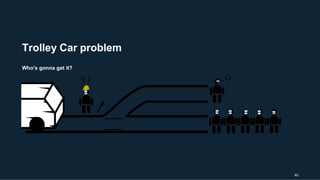
There is a runaway tram barrelling down the railway tracks.
Ahead, on the tracks, there are five people tied up and unable
to move. The trolley is headed straight for them.
You are standing some distance off in the train yard, next to a
lever. If you pull this lever, the trolley will switch to a different
set of tracks. However, you notice that there is one person on
the side track.
Trolley Car problem
Who's gonna get it?
40
Trolley car
41
You have two options:
Do nothing, and the trolley kills the five people on the
main track.
Pull the lever, diverting the trolley onto the side track
where it will kill one person.
Which is the most ethical choice?
Activity 6: Hospital waiting room
42
There are six patients in hospital waiting for organ
transplants. Five will die without organ transplants and
the sixth has a minor condition.
You are the Chief Medical Officer and note that you
could harvest the organs from the sixth patient to
transplant to save the other five.
Hospital waiting room
43
You have two options:
Do nothing, and the five patients will die.
Order the harvesting of all organs from the
sixth patient to save the five.
Which is the most ethical choice?
Activity 7: Trolley vs Hospital
44
Did you answer both of these in the same way?
What was different about these two scenarios?
And what makes that difference important
How would you respond if the numbers were different?
Instead of five, what if it's 50 people? 500? 5 million?
What if the one person was part of your family?
Are IT & Supervised Learning (AI/ML) ethics
unique?
Computers/IT/Supervised learning have several unique aspects:
Large scale data collection and analysis
Inevitable complexity and unreliability of software
They pervade many areas of our lives
They also create new entities, such as websites, video games, viruses and various miniaturised devices
Unique and clearly gives rise to situations which have never happened before
These raise many ethical issues including privacy and accountability
Artificial Intelligence is the broader "concept of machines being able to carry out tasks in a way that we
would consider “smart".
Machine Learning is "a current application of AI based around the idea that we should really just be
able to give machines access to data and let them learn for themselves."
A supervised learning algorithm
Humans often have biases and prejudices.
Example:
In 2014, Hudson (bank) approved 1,886 mortgages in the
market that includes New Jersey and sections of New York
and Connecticut, federal mortgage data show. Only 25 of
those loans went to black borrowers (minority).
A supervised learning algorithm, trained on this data, would
learn some of these biases.
Impact of Unethical
Practices
Unethical practices in computer science
can have far-reaching consequences,
including loss of trust, legal
repercussions, and societal harm. For
example, data breaches can lead to
identity theft and financial loss, while
biased algorithms can perpetuate
discrimination and inequality. It is
essential to address these issues to
ensure the ethical use of technology.
51
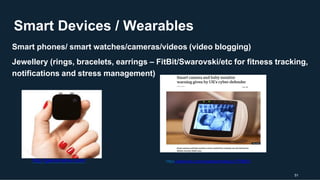
Smart Devices / Wearables
Smart phones/ smart watches/cameras/videos (video blogging)
Jewellery (rings, bracelets, earrings – FitBit/Swarovski/etc for fitness tracking,
notifications and stress management)
http://getnarrative.com/ https://www.bbc.com/news/technology-51706631
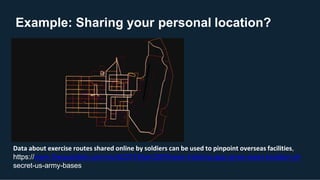
Example: Sharing your personal location?
Data about exercise routes shared online by soldiers can be used to pinpoint overseas facilities,
https://www.theguardian.com/world/2018/jan/28/fitness-tracking-app-gives-away-location-of-
secret-us-army-bases
Data and AI Ethics considerations:
• Privacy – smartphones, online activity, facial recognition
• Lack of transparency - AI-based algorithms bank loans, college
admissions, and job offers
• Bias and discrimination - Real-world bias can lead to algorithmic bias.
• Lack of governance and accountability – Who governs AI Systems and
data? Who authorizes data collection, storage, and destruction. Who
creates ethical standards and norms?
NEW OR CAN WE CAN WE USE REASONING WITH
BY ANALOGY OR NEED A NEW APPROACH?
SOME THOUGHT TO TAKE AWAY…
Ethics is the study of our morals, or values (or choose the definition you prefer)
Many of personal principles and our laws are based on ethics
For example, our criminal justice system, anti-discrimination laws
Ethics is fundamental to any society
It applies to basic aspects of social structure, such as the form of government and
other institutions
It also applies to specific issues on a daily basis
How we interact with others
Ethics has been studied for millennia, but is constantly being challenged as new
situations arise
ABOUT ASSESSMENTS
ASSESSMENT 1: Case Study Analysis
The University of Adelaide Slide 59
This assessment is worth 20% of your overall grade.
Due date: Monday, 3rd March 5:00pm (Week 5)
Word Limit: 650 - 1000 words (+/- 10%) excl. references
Mode: individual
Why?
The purpose of this assessment is to prepare students for further analysis and to
test knowledge of foundational material in the course. Students will develop their
skills in reviewing a scenario or case study. This will confirm that they are able to
apply knowledge of human factors and ethical issues and consider solutions that
take into account human and ethical factors.
START WORKING ON YOUR ASSESSMENT
#1 and SEE YOU IN NEXT TUTORIAL
We continue with appling your learning of the ethical principles:
• Ethics in media
• Digital footprint
• Profiling
• Ethics and disclosure

W02_HEFCS_Ethics Fundamentals -pages.pdf

  • 1.
    What is Ethics? Whatdoes ethics mean to you? Draw a picture or metaphor that represents how you see ethics
  • 2.
  • 3.
    Workshop Activities Inone word - "What is Ethics?”
  • 4.
    Individual vs Organisational? Whatyou think is the core difference between individual and organisational responsibility?
  • 5.
    Individual responsibility refersto the moral and legal obligation of a person to take ownership of their actions and decisions, and the consequences that result from them. This includes taking responsibility for one's own personal and professional development, as well as fulfilling one's duties and obligations to others. Organizational responsibility refers to the obligation of an organization, as a whole, to act ethically and in accordance with the law, and to consider the impact of its actions on society, the environment and its stakeholders. This includes issues such as diversity, equity, and inclusion, environmental sustainability, and the treatment of employees. An organization also has a responsibility to its stakeholders, including shareholders, customers, employees, and suppliers, to act in their best interests and to ensure the long- term success and sustainability of the organization.
  • 6.
    "Accountability Ethics" -what does it means? Think about the role of the teacher and the student, how are both participants accountable to each other in a learning relationship?
  • 7.
    Ethical Perspectives 9 Personal ethics •We possess personal values derived from the influence of our own culture and people e.g. • parents and other family members • friends and peer groups • respected authorities • We practice personal ethics every day, as a member of our family, as a friend and as a member of our community
  • 8.
    Various Perspectives continued … 10 Professionalethics • Defined and safeguarded by professional bodies such as the CPA, ACS, PMI, PMBOK • Defined in a Code of Ethics • Safeguarded by disciplining members who fail to act according to the code • Unethical behaviour by a member brings disrepute to the whole profession
  • 9.
    Various Perspectives continued … 11 Ethicsand the law • Ethics has to do with responsible decision-making • It is ethical to obey the law • Ethics goes beyond the law as it usually involves a personal choice not covered by law • In very special circumstances it may be ethical to break the law, e.g. driving carefully through a red light in an emergency • Access information
  • 10.
    Various Perspectives continued … 12 Ethicsand religion • Religions normally have an associated moral (ethical) code • Religion certainly has been and continues to be a strong influence in the exercise of ethical behaviour • A person does not have to be religious to be ethical
  • 11.
    Various Perspectives continued … 13 Ethicsand philosophy • Philosophers as a group have long been concerned with ethical behaviour and the basis of ethical decisions • The ethical theories have been developed over time by a philosophers in the Western tradition • -process of systematising, defending and recommending
  • 12.
    Personal Values toProfessional life compassion freedom dedication creativity accountability work religion humour cooperation trustworthiness advancement loyalty wealth security recognition beauty professionalism morality patience spirituality success responsibility power respect honesty empathy integrity justice health love faith helpfulness knowledge wisdom independence (icarevalues.org, 2005)
  • 13.
    Activity: A definition 15 Source:adapted from the Oxford English Dictionary Ethics may be defined as: a. set of beliefs about right and wrong behaviour or activity within a society b. set of social conventions about right and wrong –morality c. rules that express how people should behave –moral code d. assumptions and convictions that are held to be true –beliefs e. the principles of conduct governing an individual or group –code of conduct
  • 14.
    Values 16 Values may bedefined as: a. the inner judgements or beliefs that determine how a person behaves b. habits that incline people to do what is acceptable –virtues e.g. fairness , respect c. system of rules that tell us what we can and cannot do –laws d. one’s personal beliefs about right and wrong –morals
  • 15.
    Ethics and ValuesTerminology continued … 17 • Ethics is a set of beliefs about right and wrong behaviour within a society • Values are the inner judgments or beliefs that determine how a person behaves • The terms ‘Ethics’ and ‘Values’ are NOT interchangeable => values impact/drive our ethics • Beliefs drive Behaviour • Values influence Ethics • Ethics lead to Actions
  • 17.
    Advantages of LearningEthics 21 • According to Bok (1976) • Helps to develop an awareness of issues that may lay in hidden situations • Develop a capacity for moral reasoning – right or wrong • Clarify moral aspirations • Professionals will set higher standards for themselves it they have first encountered the moral problems in a learning environment
  • 18.
    Activity 3: Whatare Ethics When you ask "is it OK to ...?“, you are asking about Ethics… • You have the opportunity to cheat on a test, you friend came to you and said he has the answers for the exam, do you want them? And you’re thinking is it Morally ok for me to take this opportunity? • Similar to downloading movies and songs from the illegal platform • Downloading journal articles from XX website for learning purpose – is this a right thing to do?
  • 19.
    Why Ethical Theories? Tavani(2015) suggests ethical theories • Provide a framework for analysing moral issues involving people, situation, technology • In science, provide general principles and structures to analyse data • Provide a coherent, consistent, comprehensive and systematic approach 26
  • 20.
    Ethical Frameworks 27 Frameworks derivefrom philosophy and provide other ways to think about ethical dilemmas Three important frameworks are: • Virtue ethics • Deontology • Consequentialism (Utilitarianism) Each of these is a huge and complicated field of study, we'll skim the surface this week
  • 21.
    Virtue ethics 28 Virtue ethicssuggests that being a virtuous person is the pathway to ethical behaviour Virtues are positive character traits Roots in Ancient Greek philosophy The ACS Code of Ethics is virtue-based Honesty, Competence, Professionalism…
  • 22.
    Deontology - Kant 30 Broadlyspeaking, deontology means using rules to determine morality Also called "Duty-based ethics" Behaving ethically means following the rules A code of conduct is an example of a deontology Various efforts have been made to create rules based on other, more sophisticated ethical frameworks There is some evidence that your own brain builds rules to make fast decisions
  • 23.
    Consequentialism (Utilitarianism) 31 Consequentialism asksyou to think about the morality of an action based on its consequences "Utility" here is a way of describing how good the consequences of an action are. The most popular type of utility is to maximize the greatest happiness for the most people An action is morally right if its consequences lead to happiness (absence of pain), and wrong if it ends in unhappiness (pain) Can you think of other measures of utility? As with most consequence-based frameworks, in Consequentialism the ends justify the means
  • 24.
    Examples from differentethical frameworks….
  • 25.
    Ethical decision making •What are the difficulties with making ethical decisions? • Have you ever made a difficult choice? How did you decide what to do?
  • 26.
    Why is thestudy of ethics important? To understand whether and why our opinions are worth holding. Have you examined your life? As an data scientist/computer scientist/cybersecurity expert, what are your basic goals? Are they compatible with other values that you have? If you need to choose between keeping a job and violating your professional responsibilities, what would you do? When your responsibility to family clashes with your responsibility to your job, how do you resolve the conflict? To identify the basic ethical principles that can be applied to action. We must learn the principles of ethics, which govern human behaviour, so that we can apply them to the difficult ethical situations we face.
  • 27.
    Ethical dilemmas 38 Be warned!Ethical dilemmas do not always have nice answers That's why they're called "dilemmas" Let's look at a classic ethical dilemma
  • 28.
    Activity 5: EthicalDilemma (Trolley Car) 39 There is a runaway tram barrelling down the railway tracks. Ahead, on the tracks, there are five people tied up and unable to move. The trolley is headed straight for them. You are standing some distance off in the train yard, next to a lever. If you pull this lever, the trolley will switch to a different set of tracks. However, you notice that there is one person on the side track.
  • 29.
    Trolley Car problem Who'sgonna get it? 40
  • 30.
    Trolley car 41 You havetwo options: Do nothing, and the trolley kills the five people on the main track. Pull the lever, diverting the trolley onto the side track where it will kill one person. Which is the most ethical choice?
  • 31.
    Activity 6: Hospitalwaiting room 42 There are six patients in hospital waiting for organ transplants. Five will die without organ transplants and the sixth has a minor condition. You are the Chief Medical Officer and note that you could harvest the organs from the sixth patient to transplant to save the other five.
  • 32.
    Hospital waiting room 43 Youhave two options: Do nothing, and the five patients will die. Order the harvesting of all organs from the sixth patient to save the five. Which is the most ethical choice?
  • 33.
    Activity 7: Trolleyvs Hospital 44 Did you answer both of these in the same way? What was different about these two scenarios? And what makes that difference important How would you respond if the numbers were different? Instead of five, what if it's 50 people? 500? 5 million? What if the one person was part of your family?
  • 34.
    Are IT &Supervised Learning (AI/ML) ethics unique? Computers/IT/Supervised learning have several unique aspects: Large scale data collection and analysis Inevitable complexity and unreliability of software They pervade many areas of our lives They also create new entities, such as websites, video games, viruses and various miniaturised devices Unique and clearly gives rise to situations which have never happened before These raise many ethical issues including privacy and accountability Artificial Intelligence is the broader "concept of machines being able to carry out tasks in a way that we would consider “smart". Machine Learning is "a current application of AI based around the idea that we should really just be able to give machines access to data and let them learn for themselves."
  • 35.
    A supervised learningalgorithm Humans often have biases and prejudices. Example: In 2014, Hudson (bank) approved 1,886 mortgages in the market that includes New Jersey and sections of New York and Connecticut, federal mortgage data show. Only 25 of those loans went to black borrowers (minority). A supervised learning algorithm, trained on this data, would learn some of these biases.
  • 36.
    Impact of Unethical Practices Unethicalpractices in computer science can have far-reaching consequences, including loss of trust, legal repercussions, and societal harm. For example, data breaches can lead to identity theft and financial loss, while biased algorithms can perpetuate discrimination and inequality. It is essential to address these issues to ensure the ethical use of technology.
  • 37.
    51 Smart Devices /Wearables Smart phones/ smart watches/cameras/videos (video blogging) Jewellery (rings, bracelets, earrings – FitBit/Swarovski/etc for fitness tracking, notifications and stress management) http://getnarrative.com/ https://www.bbc.com/news/technology-51706631
  • 38.
    Example: Sharing yourpersonal location? Data about exercise routes shared online by soldiers can be used to pinpoint overseas facilities, https://www.theguardian.com/world/2018/jan/28/fitness-tracking-app-gives-away-location-of- secret-us-army-bases
  • 39.
    Data and AIEthics considerations: • Privacy – smartphones, online activity, facial recognition • Lack of transparency - AI-based algorithms bank loans, college admissions, and job offers • Bias and discrimination - Real-world bias can lead to algorithmic bias. • Lack of governance and accountability – Who governs AI Systems and data? Who authorizes data collection, storage, and destruction. Who creates ethical standards and norms? NEW OR CAN WE CAN WE USE REASONING WITH BY ANALOGY OR NEED A NEW APPROACH?
  • 40.
    SOME THOUGHT TOTAKE AWAY… Ethics is the study of our morals, or values (or choose the definition you prefer) Many of personal principles and our laws are based on ethics For example, our criminal justice system, anti-discrimination laws Ethics is fundamental to any society It applies to basic aspects of social structure, such as the form of government and other institutions It also applies to specific issues on a daily basis How we interact with others Ethics has been studied for millennia, but is constantly being challenged as new situations arise
  • 41.
  • 42.
    ASSESSMENT 1: CaseStudy Analysis The University of Adelaide Slide 59 This assessment is worth 20% of your overall grade. Due date: Monday, 3rd March 5:00pm (Week 5) Word Limit: 650 - 1000 words (+/- 10%) excl. references Mode: individual Why? The purpose of this assessment is to prepare students for further analysis and to test knowledge of foundational material in the course. Students will develop their skills in reviewing a scenario or case study. This will confirm that they are able to apply knowledge of human factors and ethical issues and consider solutions that take into account human and ethical factors.
  • 43.
    START WORKING ONYOUR ASSESSMENT #1 and SEE YOU IN NEXT TUTORIAL We continue with appling your learning of the ethical principles: • Ethics in media • Digital footprint • Profiling • Ethics and disclosure