PGS 612 – Agricultural
Research, Research Ethics and
Rural Development
Prepared by
Dr.J.MEENAMBIGAI
Assistant Professor
Department of Agricultural Extension
Faculty of Agriculture
Annamalai University
RESEARCH ETHICS
Concept
Research ethics involves the application of
fundamental ethical principles to a variety of topics
involving research, including scientific research.
These include the design and implementation of
research involving human experimentation, animal
experimentation, various aspects of academic scandal,
including scientific misconduct (such as fraud,
fabrication of data and plagiarism), whistle blowing;
regulation of research, etc.
Cont…..
Research ethics is most developed as a concept in
medical research.
The key agreement here is the 1964 Declaration of
Helsinki.
The Nuremberg Code is a former agreement, but with
many still important notes.
Research in the social sciences presents a different set
of issues than those in medical research.
Research Ethics
The term ethics derives from the Greek
word ethos, meaning “character.”
Ethics: moral principles of right and wrong
Research ethics: incorporating ethical principles
into research practice
Definition: “research ethics” refers to a diverse set
of values, norms and institutional regulations that
help constitute and regulate scientific activity.
Objectives of Research Ethics
To protect human participants
To ensure that research is conducted in a way
that serves interests of individuals, groups
and/or society as a whole
To examine specific research activities and
projects for their ethical soundness,
protection of confidentiality and the process
of informed consent
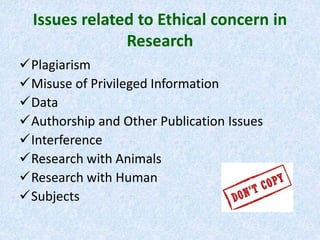
Issues related to Ethical concern in
Research
Plagiarism
Misuse of Privileged Information
Data
Authorship and Other Publication Issues
Interference
Research with Animals
Research with Human
Subjects
Areas of Academic misconduct
Plagiarism
Fabrication and falsification
Non-publication of data
Faulty data-gathering procedures
Poor data storage and retention
Misleading authorship
Sneaky publication practices
Codes and policies for research ethics
Given the importance of ethics for the conduct of
research, it should come as no surprise that many
different professional associations, government
agencies, and universities have adopted specific codes,
rules, and policies relating to research ethics.
 National Institutes of Health (NIH)
 National Science Foundation (NSF)
 Food and Drug Administration (FDA)
 Environmental Protection Agency (EPA)
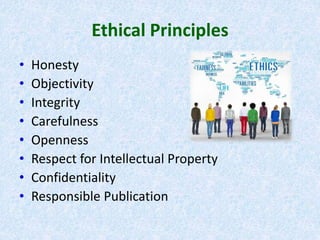
Ethical Principles
• Honesty
• Objectivity
• Integrity
• Carefulness
• Openness
• Respect for Intellectual Property
• Confidentiality
• Responsible Publication
Cont…..
• Responsible Mentoring
• Respect for colleagues
• Social Responsibility
• Non-Discrimination
• Competence
• Legality
• Animal Care
• Human Subjects Protection
Acceptable research practices
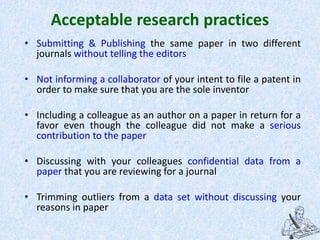
• Submitting & Publishing the same paper in two different
journals without telling the editors
• Not informing a collaborator of your intent to file a patent in
order to make sure that you are the sole inventor
• Including a colleague as an author on a paper in return for a
favor even though the colleague did not make a serious
contribution to the paper
• Discussing with your colleagues confidential data from a
paper that you are reviewing for a journal
• Trimming outliers from a data set without discussing your
reasons in paper
Cont…..
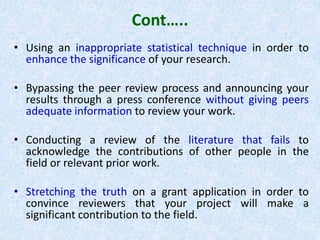
• Using an inappropriate statistical technique in order to
enhance the significance of your research.
• Bypassing the peer review process and announcing your
results through a press conference without giving peers
adequate information to review your work.
• Conducting a review of the literature that fails to
acknowledge the contributions of other people in the
field or relevant prior work.
• Stretching the truth on a grant application in order to
convince reviewers that your project will make a
significant contribution to the field.
Cont…..
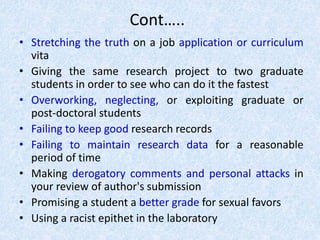
• Stretching the truth on a job application or curriculum
vita
• Giving the same research project to two graduate
students in order to see who can do it the fastest
• Overworking, neglecting, or exploiting graduate or
post-doctoral students
• Failing to keep good research records
• Failing to maintain research data for a reasonable
period of time
• Making derogatory comments and personal attacks in
your review of author's submission
• Promising a student a better grade for sexual favors
• Using a racist epithet in the laboratory
Cont…..
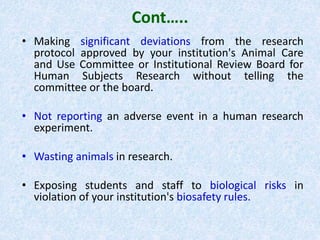
• Making significant deviations from the research
protocol approved by your institution's Animal Care
and Use Committee or Institutional Review Board for
Human Subjects Research without telling the
committee or the board.
• Not reporting an adverse event in a human research
experiment.
• Wasting animals in research.
• Exposing students and staff to biological risks in
violation of your institution's biosafety rules.
Cont…..
• Rejecting a manuscript for publication without even
reading it
• Sabotaging someone's work
• Stealing supplies, books, or data
• Rigging an experiment so you know how it will turn out
• Making unauthorized copies of data, papers, or computer
programs
• Deliberately overestimating the clinical significance of a
new drug in order to obtain economic benefits
Different professional ethics codes or institutional policies.
The 3 Rs: Replacement, Reduction
and Refinement
 Replacement: Techniques that totally or partially replace
the use of animals for scientific purposes must be sought
and used wherever possible.
 Reduction: Each project must use no more than the
minimum number of animals necessary to ensure scientific
and statistical validity.
 Refinement: Animals must be suitable for the scientific
purpose taking into account their biological characteristics
including behaviour, genetic attributes and nutritional,
microbiological and general health status.
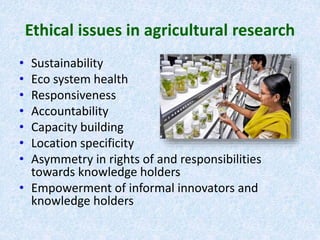
Ethical issues in agricultural research
• Sustainability
• Eco system health
• Responsiveness
• Accountability
• Capacity building
• Location specificity
• Asymmetry in rights of and responsibilities
towards knowledge holders
• Empowerment of informal innovators and
knowledge holders
Ethical Principles in Research
• Voluntary Participation (Informed consent- Components,
deception – procedures)
• No harm to the subjects - Non-malfeasance - Do no harm
(commission or omission) minimize harm
• PAC: PRIVACY, ANONYMITY AND CONFIDENTIALITY
• Beneficence - promotion of wellbeing (maximize benefit)
• Autonomy - make own decisions
• Integrity
APA Ethics Code Standard 8: Research
& Publication
• Institutional Approval
• Informed Consent to Research
• Informed Consent for Recording Voices & Images
• Client/Patient, Student, & Subordinate Research
Participants
• Dispensing with Informed Consent
• Offering Inducements for Research Participation
• Deception in Research
Cont…..
Debriefing
Humane Care & Use of Animals in Research
Reporting Research Results
Plagiarism
Publication Credit
Duplicate Publication of Data
Sharing Research for Verification
Reviewers
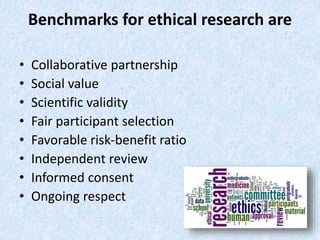
Benchmarks for ethical research are
• Collaborative partnership
• Social value
• Scientific validity
• Fair participant selection
• Favorable risk-benefit ratio
• Independent review
• Informed consent
• Ongoing respect
Research ethics

Research ethics

  • 1.
    PGS 612 –Agricultural Research, Research Ethics and Rural Development Prepared by Dr.J.MEENAMBIGAI Assistant Professor Department of Agricultural Extension Faculty of Agriculture Annamalai University
  • 2.
  • 3.
    Concept Research ethics involvesthe application of fundamental ethical principles to a variety of topics involving research, including scientific research. These include the design and implementation of research involving human experimentation, animal experimentation, various aspects of academic scandal, including scientific misconduct (such as fraud, fabrication of data and plagiarism), whistle blowing; regulation of research, etc.
  • 4.
    Cont….. Research ethics ismost developed as a concept in medical research. The key agreement here is the 1964 Declaration of Helsinki. The Nuremberg Code is a former agreement, but with many still important notes. Research in the social sciences presents a different set of issues than those in medical research.
  • 5.
    Research Ethics The termethics derives from the Greek word ethos, meaning “character.” Ethics: moral principles of right and wrong Research ethics: incorporating ethical principles into research practice Definition: “research ethics” refers to a diverse set of values, norms and institutional regulations that help constitute and regulate scientific activity.
  • 6.
    Objectives of ResearchEthics To protect human participants To ensure that research is conducted in a way that serves interests of individuals, groups and/or society as a whole To examine specific research activities and projects for their ethical soundness, protection of confidentiality and the process of informed consent
  • 7.
    Issues related toEthical concern in Research Plagiarism Misuse of Privileged Information Data Authorship and Other Publication Issues Interference Research with Animals Research with Human Subjects
  • 8.
    Areas of Academicmisconduct Plagiarism Fabrication and falsification Non-publication of data Faulty data-gathering procedures Poor data storage and retention Misleading authorship Sneaky publication practices
  • 9.
    Codes and policiesfor research ethics Given the importance of ethics for the conduct of research, it should come as no surprise that many different professional associations, government agencies, and universities have adopted specific codes, rules, and policies relating to research ethics.  National Institutes of Health (NIH)  National Science Foundation (NSF)  Food and Drug Administration (FDA)  Environmental Protection Agency (EPA)
  • 10.
    Ethical Principles • Honesty •Objectivity • Integrity • Carefulness • Openness • Respect for Intellectual Property • Confidentiality • Responsible Publication
  • 11.
    Cont….. • Responsible Mentoring •Respect for colleagues • Social Responsibility • Non-Discrimination • Competence • Legality • Animal Care • Human Subjects Protection
  • 12.
    Acceptable research practices •Submitting & Publishing the same paper in two different journals without telling the editors • Not informing a collaborator of your intent to file a patent in order to make sure that you are the sole inventor • Including a colleague as an author on a paper in return for a favor even though the colleague did not make a serious contribution to the paper • Discussing with your colleagues confidential data from a paper that you are reviewing for a journal • Trimming outliers from a data set without discussing your reasons in paper
  • 13.
    Cont….. • Using aninappropriate statistical technique in order to enhance the significance of your research. • Bypassing the peer review process and announcing your results through a press conference without giving peers adequate information to review your work. • Conducting a review of the literature that fails to acknowledge the contributions of other people in the field or relevant prior work. • Stretching the truth on a grant application in order to convince reviewers that your project will make a significant contribution to the field.
  • 14.
    Cont….. • Stretching thetruth on a job application or curriculum vita • Giving the same research project to two graduate students in order to see who can do it the fastest • Overworking, neglecting, or exploiting graduate or post-doctoral students • Failing to keep good research records • Failing to maintain research data for a reasonable period of time • Making derogatory comments and personal attacks in your review of author's submission • Promising a student a better grade for sexual favors • Using a racist epithet in the laboratory
  • 15.
    Cont….. • Making significantdeviations from the research protocol approved by your institution's Animal Care and Use Committee or Institutional Review Board for Human Subjects Research without telling the committee or the board. • Not reporting an adverse event in a human research experiment. • Wasting animals in research. • Exposing students and staff to biological risks in violation of your institution's biosafety rules.
  • 16.
    Cont….. • Rejecting amanuscript for publication without even reading it • Sabotaging someone's work • Stealing supplies, books, or data • Rigging an experiment so you know how it will turn out • Making unauthorized copies of data, papers, or computer programs • Deliberately overestimating the clinical significance of a new drug in order to obtain economic benefits
  • 17.
    Different professional ethicscodes or institutional policies. The 3 Rs: Replacement, Reduction and Refinement  Replacement: Techniques that totally or partially replace the use of animals for scientific purposes must be sought and used wherever possible.  Reduction: Each project must use no more than the minimum number of animals necessary to ensure scientific and statistical validity.  Refinement: Animals must be suitable for the scientific purpose taking into account their biological characteristics including behaviour, genetic attributes and nutritional, microbiological and general health status.
  • 18.
    Ethical issues inagricultural research • Sustainability • Eco system health • Responsiveness • Accountability • Capacity building • Location specificity • Asymmetry in rights of and responsibilities towards knowledge holders • Empowerment of informal innovators and knowledge holders
  • 19.
    Ethical Principles inResearch • Voluntary Participation (Informed consent- Components, deception – procedures) • No harm to the subjects - Non-malfeasance - Do no harm (commission or omission) minimize harm • PAC: PRIVACY, ANONYMITY AND CONFIDENTIALITY • Beneficence - promotion of wellbeing (maximize benefit) • Autonomy - make own decisions • Integrity
  • 20.
    APA Ethics CodeStandard 8: Research & Publication • Institutional Approval • Informed Consent to Research • Informed Consent for Recording Voices & Images • Client/Patient, Student, & Subordinate Research Participants • Dispensing with Informed Consent • Offering Inducements for Research Participation • Deception in Research
  • 21.
    Cont….. Debriefing Humane Care &Use of Animals in Research Reporting Research Results Plagiarism Publication Credit Duplicate Publication of Data Sharing Research for Verification Reviewers
  • 22.
    Benchmarks for ethicalresearch are • Collaborative partnership • Social value • Scientific validity • Fair participant selection • Favorable risk-benefit ratio • Independent review • Informed consent • Ongoing respect