Abortion and Bioethics.
Dr. Nana P. Njotang,
Senior Lecturer, FMBS, University
Yaounde I.
M1
Objectives.
• Define abortions.
• Name and discuss the different types of abortions.
• Name some maternal and foetal indications of
therapeutic abortion.
• Name some investigations required to confirm
diagnoses.
• Know the legal implications surrounding induced or
voluntary termination of pregnancy.
Plan.
• Definition.
• Classification of abortions.
Spontaneous
Induced /voluntary/ unsafe abortion.
Therapeutic abortion.
• Statistics on abortion.
• Diagnostic technique for foetal malformations.
• Indications for therapeutic abortions (foetal, maternal).
• Legal status of abortion in Cameroon.
• Perinatal medicine.
Definition.
• Termination pregnancy <28 weeks 0r <22weeks, birth
weight <900g or <500g.
• Spontaneous abortion, sub-classed into threatened,
inevitable, incomplete, complete and missed abortions.
• Induced/voluntary/unsafe abortions.
• Therapeutic abortions.
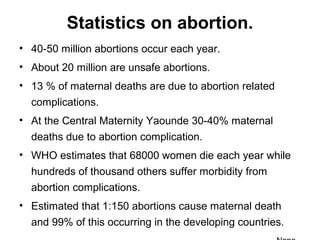
Statistics on abortion.
• 40-50 million abortions occur each year.
• About 20 million are unsafe abortions.
• 13 % of maternal deaths are due to abortion related
complications.
• At the Central Maternity Yaounde 30-40% maternal
deaths due to abortion complication.
• WHO estimates that 68000 women die each year while
hundreds of thousand others suffer morbidity from
abortion complications.
• Estimated that 1:150 abortions cause maternal death
and 99% of this occurring in the developing countries.
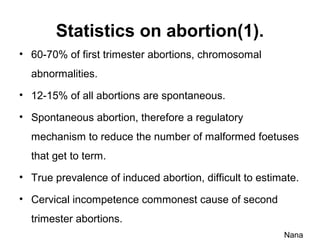
Statistics on abortion(1).
• 60-70% of first trimester abortions, chromosomal
abnormalities.
• 12-15% of all abortions are spontaneous.
• Spontaneous abortion, therefore a regulatory
mechanism to reduce the number of malformed foetuses
that get to term.
• True prevalence of induced abortion, difficult to estimate.
• Cervical incompetence commonest cause of second
trimester abortions.
Nana
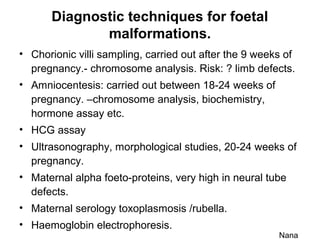
Diagnostic techniques for foetal
malformations.
• Chorionic villi sampling, carried out after the 9 weeks of
pregnancy.- chromosome analysis. Risk: ? limb defects.
• Amniocentesis: carried out between 18-24 weeks of
pregnancy. –chromosome analysis, biochemistry,
hormone assay etc.
• HCG assay
• Ultrasonography, morphological studies, 20-24 weeks of
pregnancy.
• Maternal alpha foeto-proteins, very high in neural tube
defects.
• Maternal serology toxoplasmosis /rubella.
• Haemoglobin electrophoresis.
Nana
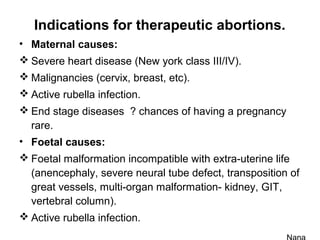
Indications for therapeutic abortions.
• Maternal causes:
 Severe heart disease (New york class III/IV).
 Malignancies (cervix, breast, etc).
 Active rubella infection.
 End stage diseases ? chances of having a pregnancy
rare.
• Foetal causes:
 Foetal malformation incompatible with extra-uterine life
(anencephaly, severe neural tube defect, transposition of
great vessels, multi-organ malformation- kidney, GIT,
vertebral column).
 Active rubella infection.
Legal status of abortion in Cameroon.
• Law on abortion is restrictive.
• Abortion legalised when the health of the mother is at
serious risk, foetal malformation incompatible with extra-
uterine life or when pregnancy resulted from rape or
incest.
• This is found in article 337-339 of the penal code.
• Demand to terminate pregnancy must be signed by
treating physician and counter signed by two other
colleagues.
• Demand is addressed to the minister of public heath,
through the head of the health faciity.
Perinatal medicine.
• New area of sub-specialisation in Obstetrics and
Gynaecology.
• Deals with prenatal diagnosis of some hereditary
diseases.
• Intra-uterine management, may include venopuncture,
intra-uterine transfusion and termination of pregnancy
where authorised by the law.
• Technology not available in our milieu today.
Nana
Conclusion.
• The law on abortion is restrictive.
• Abortion is punishable by law to the provider, the
aborted and sometimes the middle man.
• Unsafe abortion may lead to serious maternal morbidity
and mortality.
• However, the practice is still common in the developing
countries, for several reasons: law is restrictive, financial
constraint, fear of stigmatisation, protection of the
provider, lack of male support, fear of parents and then
desire to further education.
• It is worth emphasizing that abortion services be offered
women under the conditions authorised by the law.

Abortion and bioethics m1

  • 1.
    Abortion and Bioethics. Dr.Nana P. Njotang, Senior Lecturer, FMBS, University Yaounde I. M1
  • 2.
    Objectives. • Define abortions. •Name and discuss the different types of abortions. • Name some maternal and foetal indications of therapeutic abortion. • Name some investigations required to confirm diagnoses. • Know the legal implications surrounding induced or voluntary termination of pregnancy.
  • 3.
    Plan. • Definition. • Classificationof abortions. Spontaneous Induced /voluntary/ unsafe abortion. Therapeutic abortion. • Statistics on abortion. • Diagnostic technique for foetal malformations. • Indications for therapeutic abortions (foetal, maternal). • Legal status of abortion in Cameroon. • Perinatal medicine.
  • 4.
    Definition. • Termination pregnancy<28 weeks 0r <22weeks, birth weight <900g or <500g. • Spontaneous abortion, sub-classed into threatened, inevitable, incomplete, complete and missed abortions. • Induced/voluntary/unsafe abortions. • Therapeutic abortions.
  • 5.
    Statistics on abortion. •40-50 million abortions occur each year. • About 20 million are unsafe abortions. • 13 % of maternal deaths are due to abortion related complications. • At the Central Maternity Yaounde 30-40% maternal deaths due to abortion complication. • WHO estimates that 68000 women die each year while hundreds of thousand others suffer morbidity from abortion complications. • Estimated that 1:150 abortions cause maternal death and 99% of this occurring in the developing countries.
  • 6.
    Statistics on abortion(1). •60-70% of first trimester abortions, chromosomal abnormalities. • 12-15% of all abortions are spontaneous. • Spontaneous abortion, therefore a regulatory mechanism to reduce the number of malformed foetuses that get to term. • True prevalence of induced abortion, difficult to estimate. • Cervical incompetence commonest cause of second trimester abortions. Nana
  • 7.
    Diagnostic techniques forfoetal malformations. • Chorionic villi sampling, carried out after the 9 weeks of pregnancy.- chromosome analysis. Risk: ? limb defects. • Amniocentesis: carried out between 18-24 weeks of pregnancy. –chromosome analysis, biochemistry, hormone assay etc. • HCG assay • Ultrasonography, morphological studies, 20-24 weeks of pregnancy. • Maternal alpha foeto-proteins, very high in neural tube defects. • Maternal serology toxoplasmosis /rubella. • Haemoglobin electrophoresis. Nana
  • 8.
    Indications for therapeuticabortions. • Maternal causes:  Severe heart disease (New york class III/IV).  Malignancies (cervix, breast, etc).  Active rubella infection.  End stage diseases ? chances of having a pregnancy rare. • Foetal causes:  Foetal malformation incompatible with extra-uterine life (anencephaly, severe neural tube defect, transposition of great vessels, multi-organ malformation- kidney, GIT, vertebral column).  Active rubella infection.
  • 9.
    Legal status ofabortion in Cameroon. • Law on abortion is restrictive. • Abortion legalised when the health of the mother is at serious risk, foetal malformation incompatible with extra- uterine life or when pregnancy resulted from rape or incest. • This is found in article 337-339 of the penal code. • Demand to terminate pregnancy must be signed by treating physician and counter signed by two other colleagues. • Demand is addressed to the minister of public heath, through the head of the health faciity.
  • 10.
    Perinatal medicine. • Newarea of sub-specialisation in Obstetrics and Gynaecology. • Deals with prenatal diagnosis of some hereditary diseases. • Intra-uterine management, may include venopuncture, intra-uterine transfusion and termination of pregnancy where authorised by the law. • Technology not available in our milieu today. Nana
  • 11.
    Conclusion. • The lawon abortion is restrictive. • Abortion is punishable by law to the provider, the aborted and sometimes the middle man. • Unsafe abortion may lead to serious maternal morbidity and mortality. • However, the practice is still common in the developing countries, for several reasons: law is restrictive, financial constraint, fear of stigmatisation, protection of the provider, lack of male support, fear of parents and then desire to further education. • It is worth emphasizing that abortion services be offered women under the conditions authorised by the law.