Ethical Perspectives
Act Centered
Ethical Perspectives
Act Centered
 Deontology- Duty
Ethical Perspectives
Act Centered
 Deontology- Duty
 Teleology- Consequences
Ethical Perspectives
Act Centered
 Deontology- Duty
 Teleology- Consequences
Agent Centered
Ethical Perspectives
Act Centered
 Deontology- Duty
 Teleology- Consequences
Agent Centered
 Virtue Ethics- Moral Character
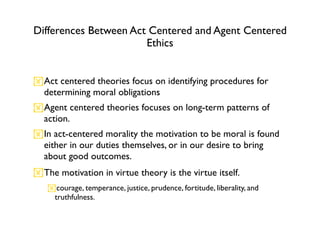
Differences Between Act Centered and Agent Centered
                       Ethics
Differences Between Act Centered and Agent Centered
                       Ethics


Act centered theories focus on identifying procedures for
 determining moral obligations
Differences Between Act Centered and Agent Centered
                       Ethics


Act centered theories focus on identifying procedures for
 determining moral obligations
Agent centered theories focuses on long-term patterns of
 action.
Differences Between Act Centered and Agent Centered
                       Ethics


Act centered theories focus on identifying procedures for
 determining moral obligations
Agent centered theories focuses on long-term patterns of
 action.
In act-centered morality the motivation to be moral is found
 either in our duties themselves, or in our desire to bring
 about good outcomes.
Differences Between Act Centered and Agent Centered
                       Ethics


Act centered theories focus on identifying procedures for
 determining moral obligations
Agent centered theories focuses on long-term patterns of
 action.
In act-centered morality the motivation to be moral is found
 either in our duties themselves, or in our desire to bring
 about good outcomes.
The motivation in virtue theory is the virtue itself.
Differences Between Act Centered and Agent Centered
                       Ethics


Act centered theories focus on identifying procedures for
 determining moral obligations
Agent centered theories focuses on long-term patterns of
 action.
In act-centered morality the motivation to be moral is found
 either in our duties themselves, or in our desire to bring
 about good outcomes.
The motivation in virtue theory is the virtue itself.
   courage, temperance, justice, prudence, fortitude, liberality, and
    truthfulness.
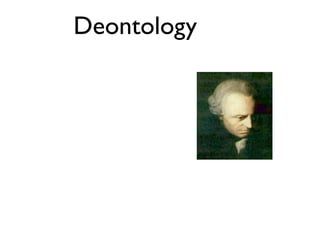
Deontology
Deontology
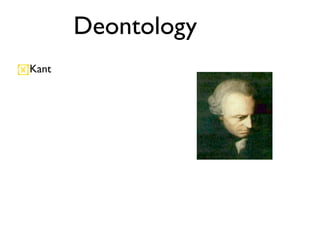
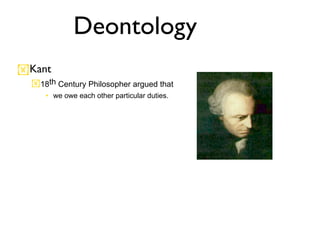
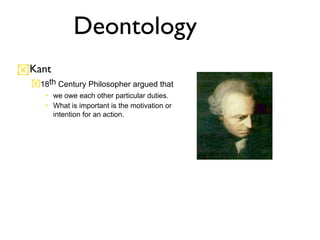
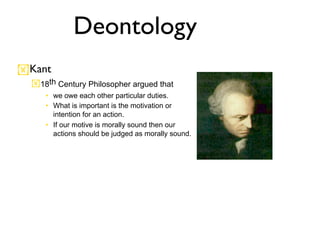
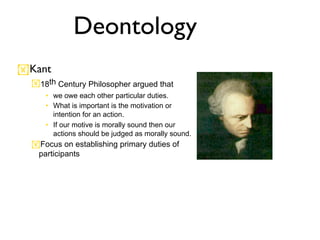
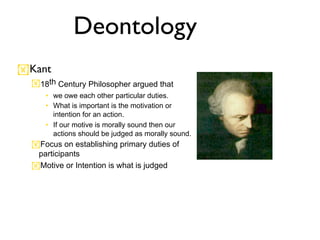
Kant
Deontology
Kant
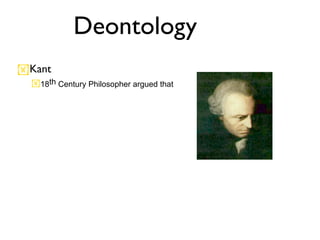
  18th Century Philosopher argued that
Deontology
Kant
  18th Century Philosopher argued that
     • we owe each other particular duties.
Deontology
Kant
  18th Century Philosopher argued that
     • we owe each other particular duties.
     • What is important is the motivation or
       intention for an action.
Deontology
Kant
  18th Century Philosopher argued that
     • we owe each other particular duties.
     • What is important is the motivation or
       intention for an action.
     • If our motive is morally sound then our
       actions should be judged as morally sound.
Deontology
Kant
  18th Century Philosopher argued that
     • we owe each other particular duties.
     • What is important is the motivation or
       intention for an action.
     • If our motive is morally sound then our
       actions should be judged as morally sound.
  Focus on establishing primary duties of
   participants
Deontology
Kant
  18th Century Philosopher argued that
     • we owe each other particular duties.
     • What is important is the motivation or
       intention for an action.
     • If our motive is morally sound then our
       actions should be judged as morally sound.
  Focus on establishing primary duties of
   participants
  Motive or Intention is what is judged
Kantian Ethics
Kantian Ethics
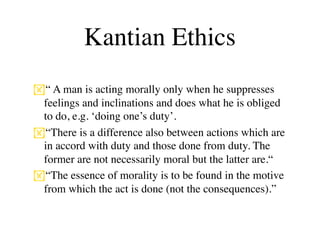
“ A man is acting morally only when he suppresses
 feelings and inclinations and does what he is obliged
 to do, e.g. ‘doing one’s duty’.
Kantian Ethics
“ A man is acting morally only when he suppresses
 feelings and inclinations and does what he is obliged
 to do, e.g. ‘doing one’s duty’.
“There is a difference also between actions which are
 in accord with duty and those done from duty. The
 former are not necessarily moral but the latter are.“
Kantian Ethics
“ A man is acting morally only when he suppresses
 feelings and inclinations and does what he is obliged
 to do, e.g. ‘doing one’s duty’.
“There is a difference also between actions which are
 in accord with duty and those done from duty. The
 former are not necessarily moral but the latter are.“
“The essence of morality is to be found in the motive
 from which the act is done (not the consequences).”
The Hypothetical
  Imperative
The Hypothetical
          Imperative
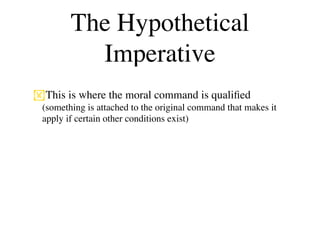
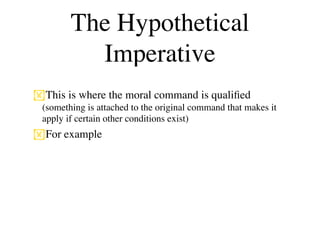
This is where the moral command is qualified
 (something is attached to the original command that makes it
 apply if certain other conditions exist)
The Hypothetical
          Imperative
This is where the moral command is qualified
 (something is attached to the original command that makes it
 apply if certain other conditions exist)
For example
The Hypothetical
          Imperative
This is where the moral command is qualified
 (something is attached to the original command that makes it
 apply if certain other conditions exist)
For example
  ‘treat others with respect if you want to be treated with
   respect.’ These types of moral imperatives can be seen as
   providing a ‘means to an end’. The action is based on
   perceived consequences.
The Categorical
  Imperative
The Categorical
           Imperative
Actions are defined without qualification such as
The Categorical
            Imperative
Actions are defined without qualification such as
  ‘treat others with respect,’ or ‘always tell the truth’.
The Categorical
           Imperative
Actions are defined without qualification such as
  ‘treat others with respect,’ or ‘always tell the truth’.
  No consideration is given to the consequences (or ends)
   that might result from actions taken in accordance with
   these imperatives.
The Categorical
           Imperative
Actions are defined without qualification such as
  ‘treat others with respect,’ or ‘always tell the truth’.
  No consideration is given to the consequences (or ends)
   that might result from actions taken in accordance with
   these imperatives.
  These imperatives, like other persons, are ends in
   themselves.
The Categorical
           Imperative
Actions are defined without qualification such as
  ‘treat others with respect,’ or ‘always tell the truth’.
  No consideration is given to the consequences (or ends)
   that might result from actions taken in accordance with
   these imperatives.
  These imperatives, like other persons, are ends in
   themselves.
 “The Golden Rule”
The Categorical
           Imperative
Actions are defined without qualification such as
  ‘treat others with respect,’ or ‘always tell the truth’.
  No consideration is given to the consequences (or ends)
   that might result from actions taken in accordance with
   these imperatives.
  These imperatives, like other persons, are ends in
   themselves.
 “The Golden Rule”
   ‘Act towards others as you would want them to act
   towards you’
Rule Deontology
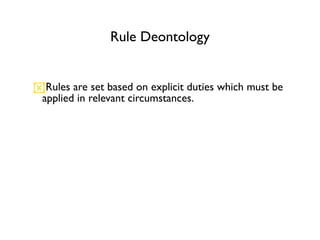
Rule Deontology


Rules are set based on explicit duties which must be
 applied in relevant circumstances.
Rule Deontology


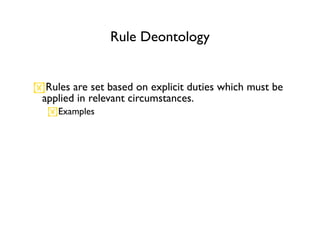
Rules are set based on explicit duties which must be
 applied in relevant circumstances.
   Examples
Rule Deontology


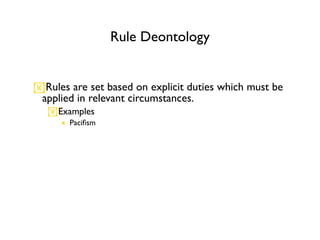
Rules are set based on explicit duties which must be
 applied in relevant circumstances.
   Examples
      • Pacifism
Rule Deontology


Rules are set based on explicit duties which must be
 applied in relevant circumstances.
   Examples
      • Pacifism
      • Non-judgementalism, or confidentiality in some models of
        counselling
Rule Deontology


Rules are set based on explicit duties which must be
 applied in relevant circumstances.
   Examples
      • Pacifism
      • Non-judgementalism, or confidentiality in some models of
        counselling
Duties might include :-
Rule Deontology


Rules are set based on explicit duties which must be
 applied in relevant circumstances.
   Examples
      • Pacifism
      • Non-judgementalism, or confidentiality in some models of
        counselling
Duties might include :-
   “always tell the truth”
Rule Deontology


Rules are set based on explicit duties which must be
 applied in relevant circumstances.
   Examples
      • Pacifism
      • Non-judgementalism, or confidentiality in some models of
        counselling
Duties might include :-
   “always tell the truth”
    “do no harm”
Rule Deontology


Rules are set based on explicit duties which must be
 applied in relevant circumstances.
   Examples
      • Pacifism
      • Non-judgementalism, or confidentiality in some models of
        counselling
Duties might include :-
   “always tell the truth”
    “do no harm”
    “serve needs before wants”
Intuitionism
Intuitionism
Intuitionism holds that there are several moral
 principles serving as a class or standard for
 right action.
Intuitionism
Intuitionism holds that there are several moral
 principles serving as a class or standard for
 right action.
These principles are self evident- known to be
 right through intuition in the sense that the
 rightness or wrongness of an action is obvious
 to us (but not in the sense of intuition as a ‘hunch’ that
  something may be true)
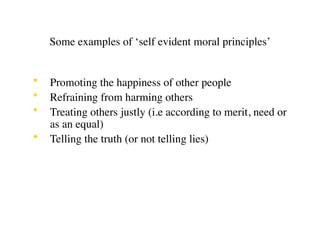
Some examples of ‘self evident moral principles’


•   Promoting the happiness of other people
Some examples of ‘self evident moral principles’


•   Promoting the happiness of other people
•   Refraining from harming others
Some examples of ‘self evident moral principles’


•   Promoting the happiness of other people
•   Refraining from harming others
•   Treating others justly (i.e according to merit, need or
    as an equal)
Some examples of ‘self evident moral principles’


•   Promoting the happiness of other people
•   Refraining from harming others
•   Treating others justly (i.e according to merit, need or
    as an equal)
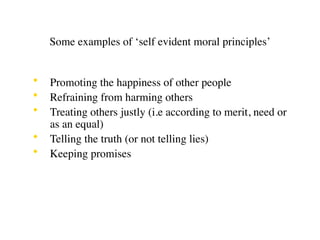
•   Telling the truth (or not telling lies)
Some examples of ‘self evident moral principles’


•   Promoting the happiness of other people
•   Refraining from harming others
•   Treating others justly (i.e according to merit, need or
    as an equal)
•   Telling the truth (or not telling lies)
•   Keeping promises
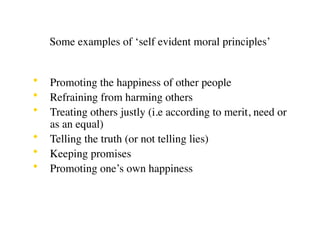
Some examples of ‘self evident moral principles’


•   Promoting the happiness of other people
•   Refraining from harming others
•   Treating others justly (i.e according to merit, need or
    as an equal)
•   Telling the truth (or not telling lies)
•   Keeping promises
•   Promoting one’s own happiness
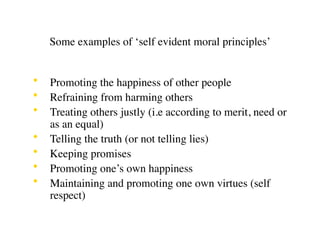
Some examples of ‘self evident moral principles’


•   Promoting the happiness of other people
•   Refraining from harming others
•   Treating others justly (i.e according to merit, need or
    as an equal)
•   Telling the truth (or not telling lies)
•   Keeping promises
•   Promoting one’s own happiness
•   Maintaining and promoting one own virtues (self
    respect)
Act Deontology
Act Deontology

Duties are not defined before the act which is
 being judged
Act Deontology

Duties are not defined before the act which is
 being judged
Opposed to rules in principle because each
 situation is unique. The Context in which actions
 take place must be taken into account.
Act Deontology

Duties are not defined before the act which is
 being judged
Opposed to rules in principle because each
 situation is unique. The Context in which actions
 take place must be taken into account.
Moral Duty= Be true to yourself/Act with
 integrity
Scenario
 Michael works as a staff nurse on a specialist unit for people with neurological disorders.
  Elizabeth, a twenty six year old school teacher who has recently given birth to her first baby,
  was admitted with a history of muscle weakness and changes in sensation in her legs and
  lower body. Following initial investigations the medical team feel that the most likely diagnosis
  is multiple sclerosis.
 It is very difficult to predict how each patient’s MS will progress during the early stages of the
  disease. Some may deteriorate rapidly and become unable to care for themselves within a few
  years but in many cases patients with multiple sclerosis recover well after the first episode
  and enter a period of remission which may last twenty or more years.The medical team have
  a policy of not giving patients a diagnosis of MS during the first episode and prefer to wait
  until the patient has had a further episodes before they tell the patient the diagnosis.
 Elizabeth, who is making good progress and is regaining most of her physical abilities, has
  asked Michael what the results of the medical tests have shown.
 What duties do you think Michael might have? Who to? How should he act?
Health Ethics
Health Ethics
 “All work for health, every last bit of it, is at
  some point inspired by a human value that
  has been chosen from alternatives. This sets
  the decision over what the health service
  should be doing, what it should look like, not
  in an unassailable objective position, but
  firmly on the shoulders of those people with
  the power to change it. All health workers are
  included in this number…” (Seedhouse, D
  (1988) Ethics: The Heart of Health Care
  Chichester, John Wiley p57)
Further Reading
Henry, I.C and Pashley, G ( 1990) Health
 Ethics Lancaster, Quay Publishing
Raphael, D.D (1994) Moral Philosophy (2nd
 edition) Oxford, Oxford University Press
Seedhouse, D (1988) Ethics: The Heart of
 Health Care Chichester, John Wiley

Ethics and Consequences

  • 1.
  • 2.
  • 3.
  • 4.
    Ethical Perspectives Act Centered Deontology- Duty Teleology- Consequences
  • 5.
    Ethical Perspectives Act Centered Deontology- Duty Teleology- Consequences Agent Centered
  • 6.
    Ethical Perspectives Act Centered Deontology- Duty Teleology- Consequences Agent Centered Virtue Ethics- Moral Character
  • 7.
    Differences Between ActCentered and Agent Centered Ethics
  • 8.
    Differences Between ActCentered and Agent Centered Ethics Act centered theories focus on identifying procedures for determining moral obligations
  • 9.
    Differences Between ActCentered and Agent Centered Ethics Act centered theories focus on identifying procedures for determining moral obligations Agent centered theories focuses on long-term patterns of action.
  • 10.
    Differences Between ActCentered and Agent Centered Ethics Act centered theories focus on identifying procedures for determining moral obligations Agent centered theories focuses on long-term patterns of action. In act-centered morality the motivation to be moral is found either in our duties themselves, or in our desire to bring about good outcomes.
  • 11.
    Differences Between ActCentered and Agent Centered Ethics Act centered theories focus on identifying procedures for determining moral obligations Agent centered theories focuses on long-term patterns of action. In act-centered morality the motivation to be moral is found either in our duties themselves, or in our desire to bring about good outcomes. The motivation in virtue theory is the virtue itself.
  • 12.
    Differences Between ActCentered and Agent Centered Ethics Act centered theories focus on identifying procedures for determining moral obligations Agent centered theories focuses on long-term patterns of action. In act-centered morality the motivation to be moral is found either in our duties themselves, or in our desire to bring about good outcomes. The motivation in virtue theory is the virtue itself. courage, temperance, justice, prudence, fortitude, liberality, and truthfulness.
  • 13.
  • 14.
  • 15.
    Deontology Kant 18thCentury Philosopher argued that
  • 16.
    Deontology Kant 18thCentury Philosopher argued that • we owe each other particular duties.
  • 17.
    Deontology Kant 18thCentury Philosopher argued that • we owe each other particular duties. • What is important is the motivation or intention for an action.
  • 18.
    Deontology Kant 18thCentury Philosopher argued that • we owe each other particular duties. • What is important is the motivation or intention for an action. • If our motive is morally sound then our actions should be judged as morally sound.
  • 19.
    Deontology Kant 18thCentury Philosopher argued that • we owe each other particular duties. • What is important is the motivation or intention for an action. • If our motive is morally sound then our actions should be judged as morally sound. Focus on establishing primary duties of participants
  • 20.
    Deontology Kant 18thCentury Philosopher argued that • we owe each other particular duties. • What is important is the motivation or intention for an action. • If our motive is morally sound then our actions should be judged as morally sound. Focus on establishing primary duties of participants Motive or Intention is what is judged
  • 21.
  • 22.
    Kantian Ethics “ Aman is acting morally only when he suppresses feelings and inclinations and does what he is obliged to do, e.g. ‘doing one’s duty’.
  • 23.
    Kantian Ethics “ Aman is acting morally only when he suppresses feelings and inclinations and does what he is obliged to do, e.g. ‘doing one’s duty’. “There is a difference also between actions which are in accord with duty and those done from duty. The former are not necessarily moral but the latter are.“
  • 24.
    Kantian Ethics “ Aman is acting morally only when he suppresses feelings and inclinations and does what he is obliged to do, e.g. ‘doing one’s duty’. “There is a difference also between actions which are in accord with duty and those done from duty. The former are not necessarily moral but the latter are.“ “The essence of morality is to be found in the motive from which the act is done (not the consequences).”
  • 25.
  • 26.
    The Hypothetical Imperative This is where the moral command is qualified (something is attached to the original command that makes it apply if certain other conditions exist)
  • 27.
    The Hypothetical Imperative This is where the moral command is qualified (something is attached to the original command that makes it apply if certain other conditions exist) For example
  • 28.
    The Hypothetical Imperative This is where the moral command is qualified (something is attached to the original command that makes it apply if certain other conditions exist) For example ‘treat others with respect if you want to be treated with respect.’ These types of moral imperatives can be seen as providing a ‘means to an end’. The action is based on perceived consequences.
  • 29.
    The Categorical Imperative
  • 30.
    The Categorical Imperative Actions are defined without qualification such as
  • 31.
    The Categorical Imperative Actions are defined without qualification such as ‘treat others with respect,’ or ‘always tell the truth’.
  • 32.
    The Categorical Imperative Actions are defined without qualification such as ‘treat others with respect,’ or ‘always tell the truth’. No consideration is given to the consequences (or ends) that might result from actions taken in accordance with these imperatives.
  • 33.
    The Categorical Imperative Actions are defined without qualification such as ‘treat others with respect,’ or ‘always tell the truth’. No consideration is given to the consequences (or ends) that might result from actions taken in accordance with these imperatives. These imperatives, like other persons, are ends in themselves.
  • 34.
    The Categorical Imperative Actions are defined without qualification such as ‘treat others with respect,’ or ‘always tell the truth’. No consideration is given to the consequences (or ends) that might result from actions taken in accordance with these imperatives. These imperatives, like other persons, are ends in themselves.  “The Golden Rule”
  • 35.
    The Categorical Imperative Actions are defined without qualification such as ‘treat others with respect,’ or ‘always tell the truth’. No consideration is given to the consequences (or ends) that might result from actions taken in accordance with these imperatives. These imperatives, like other persons, are ends in themselves.  “The Golden Rule”  ‘Act towards others as you would want them to act towards you’
  • 36.
  • 37.
    Rule Deontology Rules areset based on explicit duties which must be applied in relevant circumstances.
  • 38.
    Rule Deontology Rules areset based on explicit duties which must be applied in relevant circumstances. Examples
  • 39.
    Rule Deontology Rules areset based on explicit duties which must be applied in relevant circumstances. Examples • Pacifism
  • 40.
    Rule Deontology Rules areset based on explicit duties which must be applied in relevant circumstances. Examples • Pacifism • Non-judgementalism, or confidentiality in some models of counselling
  • 41.
    Rule Deontology Rules areset based on explicit duties which must be applied in relevant circumstances. Examples • Pacifism • Non-judgementalism, or confidentiality in some models of counselling Duties might include :-
  • 42.
    Rule Deontology Rules areset based on explicit duties which must be applied in relevant circumstances. Examples • Pacifism • Non-judgementalism, or confidentiality in some models of counselling Duties might include :- “always tell the truth”
  • 43.
    Rule Deontology Rules areset based on explicit duties which must be applied in relevant circumstances. Examples • Pacifism • Non-judgementalism, or confidentiality in some models of counselling Duties might include :- “always tell the truth”  “do no harm”
  • 44.
    Rule Deontology Rules areset based on explicit duties which must be applied in relevant circumstances. Examples • Pacifism • Non-judgementalism, or confidentiality in some models of counselling Duties might include :- “always tell the truth”  “do no harm”  “serve needs before wants”
  • 45.
  • 46.
    Intuitionism Intuitionism holds thatthere are several moral principles serving as a class or standard for right action.
  • 47.
    Intuitionism Intuitionism holds thatthere are several moral principles serving as a class or standard for right action. These principles are self evident- known to be right through intuition in the sense that the rightness or wrongness of an action is obvious to us (but not in the sense of intuition as a ‘hunch’ that something may be true)
  • 48.
    Some examples of‘self evident moral principles’
  • 49.
    Some examples of‘self evident moral principles’ • Promoting the happiness of other people
  • 50.
    Some examples of‘self evident moral principles’ • Promoting the happiness of other people • Refraining from harming others
  • 51.
    Some examples of‘self evident moral principles’ • Promoting the happiness of other people • Refraining from harming others • Treating others justly (i.e according to merit, need or as an equal)
  • 52.
    Some examples of‘self evident moral principles’ • Promoting the happiness of other people • Refraining from harming others • Treating others justly (i.e according to merit, need or as an equal) • Telling the truth (or not telling lies)
  • 53.
    Some examples of‘self evident moral principles’ • Promoting the happiness of other people • Refraining from harming others • Treating others justly (i.e according to merit, need or as an equal) • Telling the truth (or not telling lies) • Keeping promises
  • 54.
    Some examples of‘self evident moral principles’ • Promoting the happiness of other people • Refraining from harming others • Treating others justly (i.e according to merit, need or as an equal) • Telling the truth (or not telling lies) • Keeping promises • Promoting one’s own happiness
  • 55.
    Some examples of‘self evident moral principles’ • Promoting the happiness of other people • Refraining from harming others • Treating others justly (i.e according to merit, need or as an equal) • Telling the truth (or not telling lies) • Keeping promises • Promoting one’s own happiness • Maintaining and promoting one own virtues (self respect)
  • 57.
  • 58.
    Act Deontology Duties arenot defined before the act which is being judged
  • 59.
    Act Deontology Duties arenot defined before the act which is being judged Opposed to rules in principle because each situation is unique. The Context in which actions take place must be taken into account.
  • 60.
    Act Deontology Duties arenot defined before the act which is being judged Opposed to rules in principle because each situation is unique. The Context in which actions take place must be taken into account. Moral Duty= Be true to yourself/Act with integrity
  • 61.
    Scenario  Michael worksas a staff nurse on a specialist unit for people with neurological disorders. Elizabeth, a twenty six year old school teacher who has recently given birth to her first baby, was admitted with a history of muscle weakness and changes in sensation in her legs and lower body. Following initial investigations the medical team feel that the most likely diagnosis is multiple sclerosis.  It is very difficult to predict how each patient’s MS will progress during the early stages of the disease. Some may deteriorate rapidly and become unable to care for themselves within a few years but in many cases patients with multiple sclerosis recover well after the first episode and enter a period of remission which may last twenty or more years.The medical team have a policy of not giving patients a diagnosis of MS during the first episode and prefer to wait until the patient has had a further episodes before they tell the patient the diagnosis.  Elizabeth, who is making good progress and is regaining most of her physical abilities, has asked Michael what the results of the medical tests have shown.  What duties do you think Michael might have? Who to? How should he act?
  • 62.
  • 63.
    Health Ethics  “Allwork for health, every last bit of it, is at some point inspired by a human value that has been chosen from alternatives. This sets the decision over what the health service should be doing, what it should look like, not in an unassailable objective position, but firmly on the shoulders of those people with the power to change it. All health workers are included in this number…” (Seedhouse, D (1988) Ethics: The Heart of Health Care Chichester, John Wiley p57)
  • 64.
    Further Reading Henry, I.Cand Pashley, G ( 1990) Health Ethics Lancaster, Quay Publishing Raphael, D.D (1994) Moral Philosophy (2nd edition) Oxford, Oxford University Press Seedhouse, D (1988) Ethics: The Heart of Health Care Chichester, John Wiley