 CulturalValues & Ethics in Cross Boarder Businesses
Culture and Ethics
Culture reflects the moral values: Introduction
 Culture refers to the outlook, attitudes, values, goals, and practices shared by a group,
organization, or society.
 Interpretation of what is moral is influenced by cultural norms, and different cultures
can have different beliefs about what is right and wrong.
 According to the theory of cultural relativism, there is no singular truth on which to base
ethical or moral behavior, as our interpretations of truths are influenced by our own
culture.
 Culture has a tremendous influence on ethics and its application in a business setting. In
fact, we can argue that culture and ethics cannot be separated, because ethical norms
have been established over time by and make sense to people who share the same
background, language, and customs.
Key Terms
 Ethnocentric: Of the idea or belief that one’s own culture
is more important than, or superior to, other cultures.
 Moral relativism: Refers to any of several philosophical
positions concerned with the differences in moral
judgments among different people and across different
cultures.
 Norms: Rules or laws that govern a group’s or a society’s
behaviors.
Business Encounters Culture
 Case Study:1
Ethics: Introduction
 Ethics - accepted principles of right or wrong that govern the conduct of a
person, the members of a profession, or the actions of an organization
 Business ethics are the accepted principles of right or wrong governing the
conduct of business people
 Ethical strategy is a strategy, or course of action, that does not violate these
accepted principles
Importance of Cultural Values &
Ethics in Cross Border Business
 First of all, Ethical behavior combined with skills and professionalism is able to
ensure sustainable development, rather than a short- term profit, which brings
disastrous results after a certain period of time. Ethical behavior ensures awareness
and concern for the future and for the right way of action in each particular
situation.
 Secondly, Ethical behavior establishes a healthy and pleasant cooperation climate
for all the parties involved in a deal, making them feel comfortable with each other.
 Thirdly, Acting in accordance with moral values is crucial for deserving clients'
attention and support and achieving a significant competitive advantage in a
particular market segment.
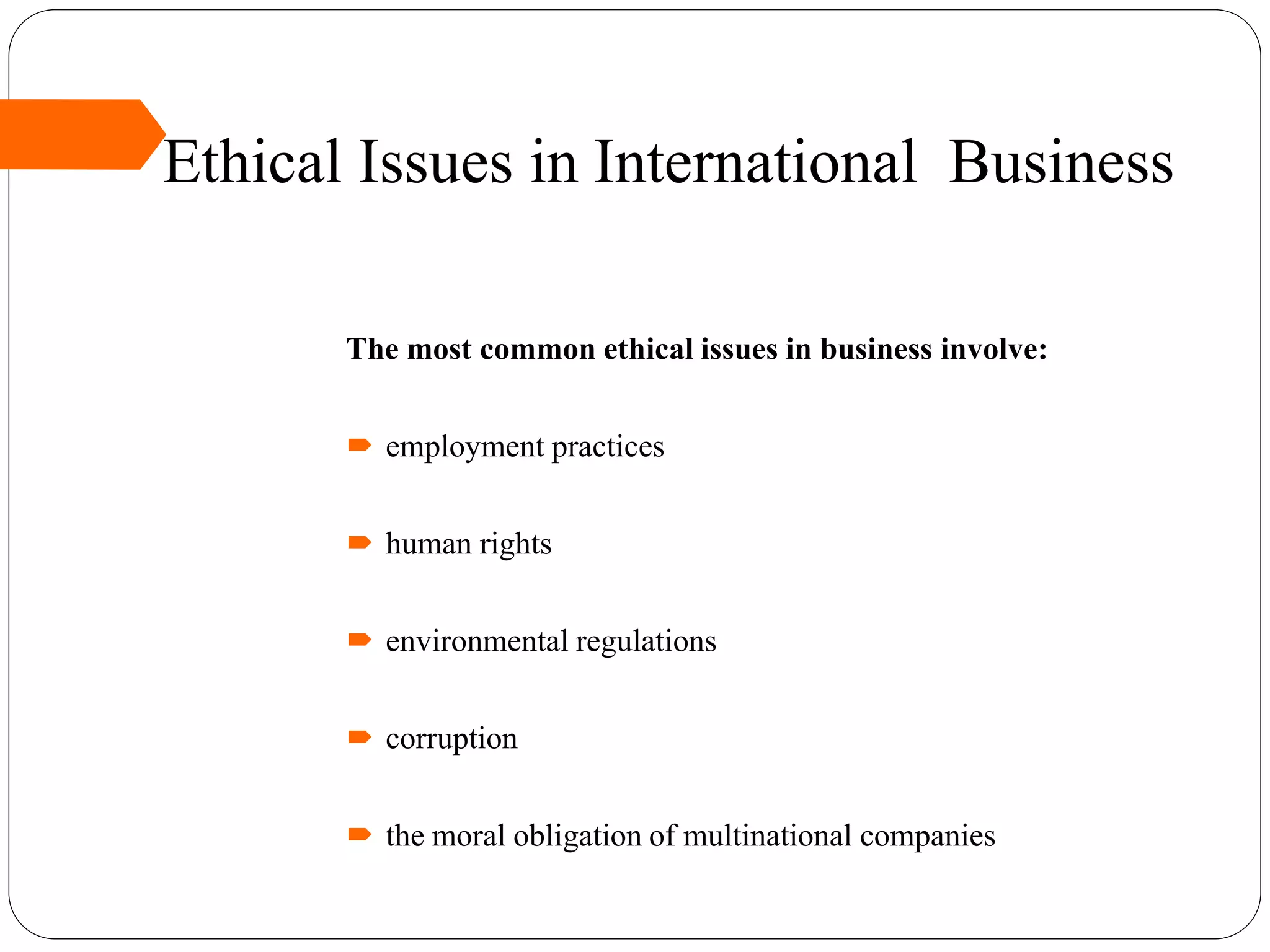
Ethical Issues in International Business
The most common ethical issues in business involve:
 employment practices
 human rights
 environmental regulations
 corruption
 the moral obligation of multinational companies
• Employment Practices:
If work conditions in a host nation are clearly
inferior to those in a multinational’s home
nation, should companies apply:
- Home country standards
- Host country standards
- Something in between
Human Rights:
In developed countries, basic human rights such
as freedom of association, freedom of speech,
freedom of assembly, and freedom of
movement, are taken for granted .
In other countries, these rights may not exist
 Environmental Pollution:
Ethical issues arise when environmental regulations in host
nations are far inferior to those in the home nation.
Environmental questions take on added importance because
some parts of the environment are a public good that no one
owns, but anyone can despoil.
The tragedy of the commons occurs when a resource held in
common by all, but owned by no one, is overused by
individuals, resulting in its degradation.
Corruption
In the United States, the Foreign
Corrupt Practices Act outlawed the
practice of paying bribes to foreign
government officials in order to gain
business.
The Convention on Combating
Bribery of Foreign Public Officials in
International Business Transactions
adopted by the Organization for
Economic Cooperation and
Development (OECD) obliges
member states to make the bribery of
foreign public officials a criminal
offense.
 Moral Obligations:
Social responsibility refers to the idea that business people should take the social
consequences of economic actions into account when making business decisions,
and that there should be a presumption in favor of decisions that have both good
economic and good social consequences .
People argue that businesses need to recognize their noblesse oblige and give
something back to the societies that have made their success possible.
Now a Days many MNCs are supporting this notion, and has made it company policy
to give back to the community. For example, in Algeria the One MNC built two
desalination plants to provide drinking water to residents in Salah.
Ethical Dilemmas: Case
Study-2
 Managers often face situations where the appropriate course of action
is not clear
 Situations in which none of the available alternatives seems
ethically acceptable
 They exist because real world decisions are complex, difficult to
frame, and involve various consequences that are difficult to quantify.
CORPORATE CODE OF ETHICS
Motivations for Corporate responsibility
 Unethical and irresponsible behavior can result in legal headaches
 Customer actions such as boycotts
 Unethical behavior can affect employee morale
 Bad publicity is going to cost the sales
Culture and Ethics

Culture and Ethics

  • 1.
     CulturalValues &Ethics in Cross Boarder Businesses Culture and Ethics
  • 2.
    Culture reflects themoral values: Introduction  Culture refers to the outlook, attitudes, values, goals, and practices shared by a group, organization, or society.  Interpretation of what is moral is influenced by cultural norms, and different cultures can have different beliefs about what is right and wrong.  According to the theory of cultural relativism, there is no singular truth on which to base ethical or moral behavior, as our interpretations of truths are influenced by our own culture.  Culture has a tremendous influence on ethics and its application in a business setting. In fact, we can argue that culture and ethics cannot be separated, because ethical norms have been established over time by and make sense to people who share the same background, language, and customs.
  • 3.
    Key Terms  Ethnocentric:Of the idea or belief that one’s own culture is more important than, or superior to, other cultures.  Moral relativism: Refers to any of several philosophical positions concerned with the differences in moral judgments among different people and across different cultures.  Norms: Rules or laws that govern a group’s or a society’s behaviors.
  • 4.
  • 5.
    Ethics: Introduction  Ethics- accepted principles of right or wrong that govern the conduct of a person, the members of a profession, or the actions of an organization  Business ethics are the accepted principles of right or wrong governing the conduct of business people  Ethical strategy is a strategy, or course of action, that does not violate these accepted principles
  • 6.
    Importance of CulturalValues & Ethics in Cross Border Business  First of all, Ethical behavior combined with skills and professionalism is able to ensure sustainable development, rather than a short- term profit, which brings disastrous results after a certain period of time. Ethical behavior ensures awareness and concern for the future and for the right way of action in each particular situation.  Secondly, Ethical behavior establishes a healthy and pleasant cooperation climate for all the parties involved in a deal, making them feel comfortable with each other.  Thirdly, Acting in accordance with moral values is crucial for deserving clients' attention and support and achieving a significant competitive advantage in a particular market segment.
  • 7.
    Ethical Issues inInternational Business The most common ethical issues in business involve:  employment practices  human rights  environmental regulations  corruption  the moral obligation of multinational companies
  • 8.
    • Employment Practices: Ifwork conditions in a host nation are clearly inferior to those in a multinational’s home nation, should companies apply: - Home country standards - Host country standards - Something in between Human Rights: In developed countries, basic human rights such as freedom of association, freedom of speech, freedom of assembly, and freedom of movement, are taken for granted . In other countries, these rights may not exist
  • 9.
     Environmental Pollution: Ethicalissues arise when environmental regulations in host nations are far inferior to those in the home nation. Environmental questions take on added importance because some parts of the environment are a public good that no one owns, but anyone can despoil. The tragedy of the commons occurs when a resource held in common by all, but owned by no one, is overused by individuals, resulting in its degradation.
  • 10.
    Corruption In the UnitedStates, the Foreign Corrupt Practices Act outlawed the practice of paying bribes to foreign government officials in order to gain business. The Convention on Combating Bribery of Foreign Public Officials in International Business Transactions adopted by the Organization for Economic Cooperation and Development (OECD) obliges member states to make the bribery of foreign public officials a criminal offense.
  • 11.
     Moral Obligations: Socialresponsibility refers to the idea that business people should take the social consequences of economic actions into account when making business decisions, and that there should be a presumption in favor of decisions that have both good economic and good social consequences . People argue that businesses need to recognize their noblesse oblige and give something back to the societies that have made their success possible. Now a Days many MNCs are supporting this notion, and has made it company policy to give back to the community. For example, in Algeria the One MNC built two desalination plants to provide drinking water to residents in Salah.
  • 12.
    Ethical Dilemmas: Case Study-2 Managers often face situations where the appropriate course of action is not clear  Situations in which none of the available alternatives seems ethically acceptable  They exist because real world decisions are complex, difficult to frame, and involve various consequences that are difficult to quantify.
  • 13.
    CORPORATE CODE OFETHICS Motivations for Corporate responsibility  Unethical and irresponsible behavior can result in legal headaches  Customer actions such as boycotts  Unethical behavior can affect employee morale  Bad publicity is going to cost the sales