Lectures 6-7: Deontological &
Consequential Ethics
Let’s now explore
Deontological
Ethics:
Deontological Ethics
We should choose actions based on their inherent,
intrinsic worth; evangelical approaches to ethics are
deontological because it presupposes Scripture as
revelation.
“Deontological” comes from the Greek word “deon”,
meaning that which is binding, in particular a binding
duty. So, you are bound to your duty.
Deontological Framework:
● An action is right if and only if (iff) it is in accordance with a
moral rule or principle.
● This is a purely formal specification, forging a link
between the concepts of right and action and moral rule,
and gives one no guidance until one knows what a moral
rule is.
Deontological Framework:
● Therefore, the links between right action,
moral rule, and rationality based upon
moral rule + given by God or required by
natural or laid on us by reason or required
by rationality or would command universal
rational acceptance or would by the object
of choice of all rational being—are all
essential aspects to any deontological
framework.
Deontological Framework:
● So, the next thing the theory needs is a premise about that: A moral rule
is one that would have been historically:
A. Theistic:
1. Given to us by God;
2. Is required by Natural Law (theistic connection);
B. Secular (though can still be connected to God):
1. Is laid on us by reason.
2. Is required by rationality;
3. Would command universal acceptance;
4. Would be the object of choice of all rational beings.
Deontological Ethics
It holds that acts are right or wrong in and of
themselves because of the kinds of acts they are and
not simply because of their ends or consequences.
- The ends do not justify the means.
- A good end or purpose does not justify a bad
actions.
- You are duty-bound; binding is not dependent on
consequences, no matter if it is painful or
pleasurable.
Deontological Ethics
For example:
1. You are duty-bound to keep your promise to be
faithful to your spouse, even if a more attractive
person comes along.
2. You are duty-bound to always telling the truth, even
if it cost you a job.
Duty is not based on what is pleasant or beneficial, but rather
upon the obligation itself.
Deontological Ethics
For example, a deontologist might argue that a
promise ought to be kept simply because it is right to
keep a promise, regardless whether the doing so will
have good or bad consequences.
In contrast, a utilitarian will argue that we should
keep our promises only when keeping them results in
better consequences than the alternatives.
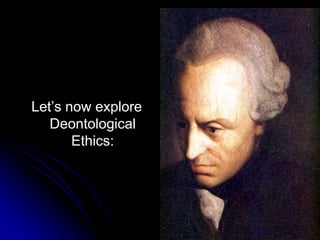
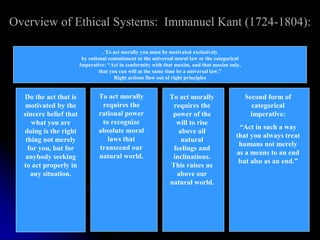
Overview of Ethical Systems: Immanuel Kant (1724-1804):
. To act morally you must be motivated exclusively
by rational commitment to the universal moral law or the categorical
Imperative: “Act in conformity with that maxim, and that maxim only,
that you can will at the same time be a universal law.”
Right actions flow out of right principles
To act morally
requires the
power of the
will to rise
above all
natural
feelings and
inclinations.
This raises us
above our
natural world.
To act morally
requires the
rational power
to recognize
absolute moral
laws that
transcend our
natural world.
Second form of
categorical
imperative:
“Act in such a way
that you always treat
humans not merely
as a means to an end
but also as an end.”
Do the act that is
motivated by the
sincere belief that
what you are
doing is the right
thing not merely
for you, but for
anybody seeking
to act properly in
any situation.
Basic Terms to Know:
1. Deontological Ethics: "rule or duty-based morality; ...emphasizes
right action over good consequences“
2. a priori: "not in any way derived from experience or dependent
upon it"; concepts derived a priori are universal rules that determine,
in advance, the conditions for knowledge in a particular domain
3. maxim: rule of conduct;
4. Hypothetical imperative: an action that is good only as a means to
something else;
5. Categorical imperative: an action that is good in itself and
conforms to reason; categorical imperatives act as universal rules
governing a situation regardless of circumstance
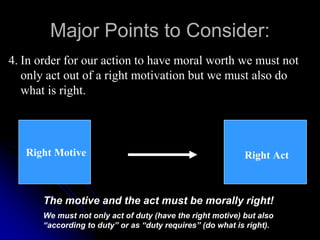
Major Points to Consider:
4. In order for our action to have moral worth we must not
only act out of a right motivation but we must also do
what is right.
Right Motive Right Act
The motive and the act must be morally right!
We must not only act of duty (have the right motive) but also
“according to duty” or as “duty requires” (do what is right).
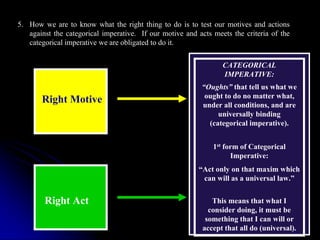
5. How we are to know what the right thing to do is to test our motives and actions
against the categorical imperative. If our motive and acts meets the criteria of the
categorical imperative we are obligated to do it.
Right Motive
Right Act
CATEGORICAL
IMPERATIVE:
“Oughts” that tell us what we
ought to do no matter what,
under all conditions, and are
universally binding
(categorical imperative).
1st form of Categorical
Imperative:
“Act only on that maxim which
can will as a universal law.”
This means that what I
consider doing, it must be
something that I can will or
accept that all do (universal).
The following are 4 examples
famously used by Kant.
1st example: Suicide
“Whenever continuing to live will bring
more pain than pleasure, I shall commit
suicide out of self-love.”
1.Suicide can’t be a universal law for one can’t will that
would be universal will.
2. Remember, suicide would be morally right if and only if
the person who is thinking about suicide can consistently
will that suicide be a universal law.
1st Example: Suicide:
● A man reduced to despair by a series of misfortunes feels wearied
of life, but is still so far in possession of his reason that he can ask
himself whether it would not be contrary to his duty to himself to take
his own life. Now he inquires whether the maxim of his action could
become a universal law of nature. His maxim is: 'From self-love I
adopt it as a principle to shorten my life when its longer duration is
likely to bring more evil than satisfaction.' It is asked then simply
whether this principle founded on self-love can become a universal
law of nature. Now we see at once that a system of nature of which
it should be a law to destroy life by means of the very feeling whose
special nature it is to impel to the improvement of life would
contradict itself and, therefore, could not exist as a system of nature;
hence that maxim cannot possibly exist as a universal law of nature
and, consequently, would be wholly inconsistent with the supreme
principle of all duty." (Quoted from the Fundamental Principles of the
Metaphysic of Morals, as translated by T.K. Abbott)
11. Advantages of Kant’s Moral Theory:
Fairness, Consistency, and morally equal treatment of all people
for they are intrinsically valuable.
Emphasizes the Law of Non-contradiction; we would not will
anything that is not rational.
Emphasizes doing what is morally right (it is our duty).
It is universally binding and Impartial-in order for an action to
be morally permissible, we should be able to will it for all.
Criticisms against Deontological Ethics:
Duty centered ethics stressing obedience to rules,
as opposed to result-centered or utilitarian ethics.
1. No clear way to resolve moral duties when they come into conflict with each
other.
2. Deontological ethics are consequential moral systems in disguise enshrined
in customs and law have been known to give the best consequences.
3. Do not readily allow for gray areas because they are based on absolutes.
4. Which duties qualify given time or location: Are old duties still valid?
5. Human welfare and misery: Some principles may result in a clash with what
is best for human welfare & prescribe actions which cause human misery.
6. Rule worship: The refusal to break a generously beneficial rule in those
areas in which it is not most beneficial is rule worship.
7. Exclusive focus on “rationality” ignores our relations to & with other human
beings.
There is no clear way to deal with moral conflicts
consider the following:
a. Killer comes to the door: If a killer comes to the door and
ask for a friend of yours inside whom he intends to kill,
you must tell the truth (illustration by Kant).
But there is only one exceptionless rule in Kant’s philosophy and that
is given in the categorical imperative: We are never permitted to do
what we cannot will as a universal law or what violates the
requirement to treat persons as persons.
Kant may not give us adequate help in deciding what to do when moral
conflicts are involved because in the above example, both to tell the
truth and preserve life are moral obligations.
Regarding Impartiality & Rationality:
b. Kant’s moral philosophy is its belief in impartiality; in
order for an action to be rally permissible, we should be
able to will it for all.
However, persons do differ in significant ways (gender, race, age,
and talents). In what way does morality require that everyone be
treated equally and in what does it perhaps require that different
person be treated differently (e.g., gender).
c. Kant’s stress on rationality may be considered to be too
male-oriented, too Westernized. It is subject to the
continental critique of structure (Foucault).
Criticisms against Deontological Ethics:
1. What about moral conflict between two
morally right principles.
2. From where or whom do we get our
principles? Nature? God?
3. If from nature, that assumes that what is in
nature is actually good? How do we define
nature?
Consequential Ethics:
We choose the actions that bring about the best
outcomes. There are many kinds of consequential
forms of ethics. Let’s consider the following:
- Egoism: we should always act to maximize our
own individual interests.
A. Consequential Ethics:
We choose the actions that
bring about the best outcomes:
- Egoism: we should always act to maximize our own
individual interests.
- Utilitarianism: we should act to maximize the
happiness of all affected by the action.
A closer look at Utilitarianism:
● This theory that holds that an act is right or wrong according to
the utility or value of its consequences.
● An act that produces more good than harm has greater value
than act that produces more harm than good.
A closer look at Utilitarianism:
● Utilitarianism believe in the value of ethical laws in
helping people determine which action will probably
bring about the greatest good for the greatest
number of people.
● While they are not against laws or values
(antinomians), they are not absolutists either.
● Every act is judged by its results, not by it intrinsic
and universal value.
A closer look at Utilitarianism:
● In order to do determine the best consequence,
some argue that you must add up the happiness in
one person and then multiply the total happiness in
the total number of people and subtract the total
pain.
● If the result is positive then the action is good.
● If the result is negative then the action is bad.
A closer look at Utilitarianism:
● Uses of Utilitarian Ethics in terms of Pleasure vs.
Pain (Peter Singer):
1. When we testify the safety of a new shampoo,
we drip the shampoo in concentrated form into the
eye of rabbits, causing them terrible pain. But
does shampoo leaving your hair lustrous and
manageable, sufficient to justify the infliction of so
much suffering?
Problems with Utilitarianism:
1. The end does not justify the means.
An act is not automatically good simply because it has a
good goal.
The road to destruction is paved with good intentions
(Prov. 14:12).
Ex. President Nixon’s goal of national security was
noble, but the criminal activity of Watergate was not
justified.
Problems with Utilitarianism:
2. Utilitarian acts have no intrinsic value.
Ex. The attempt to save a life is not an intrinsically
valuable act.
No benevolence, no sacrifice, no love has any value
unless it happens to have good results.
Ex. If forced to choose to save either a medical doctor
or a poor child from a destructive house fire, one is
obligated to save the medical doctor.
Problems with Utilitarianism:
3. People are subject to the greater good of
statistics:
Ex. If forced to choose to save either a medical
doctor or a poor child from a destructive house
fire, one is obligated to save the medical doctor
because we know he is able to help people; we
don’t know the future of the child.
Problems with Utilitarianism:
4. The need for an absolute standard:
Relative norms do no stand alone. They
must be relative to something which is not
relative. So, unless there is a standard, how
can they know what is the greater good.
Problems with Utilitarianism:
5. The “end” is an ambiguous term:
If the utilitarian contends that ethics should
be based on what will bring the best results
in the long run, how long is “long?” A few
years? a life-time? Eternity? Anything
beyond the immediate present is outside of
the human range.
Problems with Utilitarianism:
6. Ambiguous as well in determining whether
the “end” means “for the greatest number”
or for “all individuals.”
Could good could be achieved for the most
people if basic rights were denied to some
people? Is this intuitively right?
Problems with Utilitarianism:
Pleasure vs. Pain:
● Pain and Pleasure are not exact
opposites. Is this true?
● How do you measure pain and
pleasure?
● Can pain be beneficial over and against
pleasure?
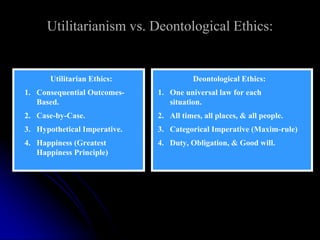
Utilitarianism vs. Deontological Ethics:
Utilitarian Ethics:
1. Consequential Outcomes-
Based.
2. Case-by-Case.
3. Hypothetical Imperative.
4. Happiness (Greatest
Happiness Principle)
Deontological Ethics:
1. One universal law for each
situation.
2. All times, all places, & all people.
3. Categorical Imperative (Maxim-rule)
4. Duty, Obligation, & Good will.
Infographic
Instructions in group prepare a
infographic
● Aristoteles Yerenia / Yanela
● Immanuel Kant Enedelquis / Aneth
● Stuart Mill Mitzi
● Karl Marx Jonathan / Rafaela
● John Dewey Alba /
● Max Stirner

Lecturess_6-7_Consequential_and_Deontological_Ethics.pptx

  • 1.
    Lectures 6-7: Deontological& Consequential Ethics
  • 2.
  • 3.
    Deontological Ethics We shouldchoose actions based on their inherent, intrinsic worth; evangelical approaches to ethics are deontological because it presupposes Scripture as revelation. “Deontological” comes from the Greek word “deon”, meaning that which is binding, in particular a binding duty. So, you are bound to your duty.
  • 4.
    Deontological Framework: ● Anaction is right if and only if (iff) it is in accordance with a moral rule or principle. ● This is a purely formal specification, forging a link between the concepts of right and action and moral rule, and gives one no guidance until one knows what a moral rule is.
  • 5.
    Deontological Framework: ● Therefore,the links between right action, moral rule, and rationality based upon moral rule + given by God or required by natural or laid on us by reason or required by rationality or would command universal rational acceptance or would by the object of choice of all rational being—are all essential aspects to any deontological framework.
  • 6.
    Deontological Framework: ● So,the next thing the theory needs is a premise about that: A moral rule is one that would have been historically: A. Theistic: 1. Given to us by God; 2. Is required by Natural Law (theistic connection); B. Secular (though can still be connected to God): 1. Is laid on us by reason. 2. Is required by rationality; 3. Would command universal acceptance; 4. Would be the object of choice of all rational beings.
  • 7.
    Deontological Ethics It holdsthat acts are right or wrong in and of themselves because of the kinds of acts they are and not simply because of their ends or consequences. - The ends do not justify the means. - A good end or purpose does not justify a bad actions. - You are duty-bound; binding is not dependent on consequences, no matter if it is painful or pleasurable.
  • 8.
    Deontological Ethics For example: 1.You are duty-bound to keep your promise to be faithful to your spouse, even if a more attractive person comes along. 2. You are duty-bound to always telling the truth, even if it cost you a job. Duty is not based on what is pleasant or beneficial, but rather upon the obligation itself.
  • 9.
    Deontological Ethics For example,a deontologist might argue that a promise ought to be kept simply because it is right to keep a promise, regardless whether the doing so will have good or bad consequences. In contrast, a utilitarian will argue that we should keep our promises only when keeping them results in better consequences than the alternatives.
  • 10.
    Overview of EthicalSystems: Immanuel Kant (1724-1804): . To act morally you must be motivated exclusively by rational commitment to the universal moral law or the categorical Imperative: “Act in conformity with that maxim, and that maxim only, that you can will at the same time be a universal law.” Right actions flow out of right principles To act morally requires the power of the will to rise above all natural feelings and inclinations. This raises us above our natural world. To act morally requires the rational power to recognize absolute moral laws that transcend our natural world. Second form of categorical imperative: “Act in such a way that you always treat humans not merely as a means to an end but also as an end.” Do the act that is motivated by the sincere belief that what you are doing is the right thing not merely for you, but for anybody seeking to act properly in any situation.
  • 11.
    Basic Terms toKnow: 1. Deontological Ethics: "rule or duty-based morality; ...emphasizes right action over good consequences“ 2. a priori: "not in any way derived from experience or dependent upon it"; concepts derived a priori are universal rules that determine, in advance, the conditions for knowledge in a particular domain 3. maxim: rule of conduct; 4. Hypothetical imperative: an action that is good only as a means to something else; 5. Categorical imperative: an action that is good in itself and conforms to reason; categorical imperatives act as universal rules governing a situation regardless of circumstance
  • 12.
    Major Points toConsider: 4. In order for our action to have moral worth we must not only act out of a right motivation but we must also do what is right. Right Motive Right Act The motive and the act must be morally right! We must not only act of duty (have the right motive) but also “according to duty” or as “duty requires” (do what is right).
  • 13.
    5. How weare to know what the right thing to do is to test our motives and actions against the categorical imperative. If our motive and acts meets the criteria of the categorical imperative we are obligated to do it. Right Motive Right Act CATEGORICAL IMPERATIVE: “Oughts” that tell us what we ought to do no matter what, under all conditions, and are universally binding (categorical imperative). 1st form of Categorical Imperative: “Act only on that maxim which can will as a universal law.” This means that what I consider doing, it must be something that I can will or accept that all do (universal).
  • 14.
    The following are4 examples famously used by Kant.
  • 15.
    1st example: Suicide “Whenevercontinuing to live will bring more pain than pleasure, I shall commit suicide out of self-love.” 1.Suicide can’t be a universal law for one can’t will that would be universal will. 2. Remember, suicide would be morally right if and only if the person who is thinking about suicide can consistently will that suicide be a universal law.
  • 16.
    1st Example: Suicide: ●A man reduced to despair by a series of misfortunes feels wearied of life, but is still so far in possession of his reason that he can ask himself whether it would not be contrary to his duty to himself to take his own life. Now he inquires whether the maxim of his action could become a universal law of nature. His maxim is: 'From self-love I adopt it as a principle to shorten my life when its longer duration is likely to bring more evil than satisfaction.' It is asked then simply whether this principle founded on self-love can become a universal law of nature. Now we see at once that a system of nature of which it should be a law to destroy life by means of the very feeling whose special nature it is to impel to the improvement of life would contradict itself and, therefore, could not exist as a system of nature; hence that maxim cannot possibly exist as a universal law of nature and, consequently, would be wholly inconsistent with the supreme principle of all duty." (Quoted from the Fundamental Principles of the Metaphysic of Morals, as translated by T.K. Abbott)
  • 17.
    11. Advantages ofKant’s Moral Theory: Fairness, Consistency, and morally equal treatment of all people for they are intrinsically valuable. Emphasizes the Law of Non-contradiction; we would not will anything that is not rational. Emphasizes doing what is morally right (it is our duty). It is universally binding and Impartial-in order for an action to be morally permissible, we should be able to will it for all.
  • 18.
    Criticisms against DeontologicalEthics: Duty centered ethics stressing obedience to rules, as opposed to result-centered or utilitarian ethics. 1. No clear way to resolve moral duties when they come into conflict with each other. 2. Deontological ethics are consequential moral systems in disguise enshrined in customs and law have been known to give the best consequences. 3. Do not readily allow for gray areas because they are based on absolutes. 4. Which duties qualify given time or location: Are old duties still valid? 5. Human welfare and misery: Some principles may result in a clash with what is best for human welfare & prescribe actions which cause human misery. 6. Rule worship: The refusal to break a generously beneficial rule in those areas in which it is not most beneficial is rule worship. 7. Exclusive focus on “rationality” ignores our relations to & with other human beings.
  • 19.
    There is noclear way to deal with moral conflicts consider the following: a. Killer comes to the door: If a killer comes to the door and ask for a friend of yours inside whom he intends to kill, you must tell the truth (illustration by Kant). But there is only one exceptionless rule in Kant’s philosophy and that is given in the categorical imperative: We are never permitted to do what we cannot will as a universal law or what violates the requirement to treat persons as persons. Kant may not give us adequate help in deciding what to do when moral conflicts are involved because in the above example, both to tell the truth and preserve life are moral obligations.
  • 20.
    Regarding Impartiality &Rationality: b. Kant’s moral philosophy is its belief in impartiality; in order for an action to be rally permissible, we should be able to will it for all. However, persons do differ in significant ways (gender, race, age, and talents). In what way does morality require that everyone be treated equally and in what does it perhaps require that different person be treated differently (e.g., gender). c. Kant’s stress on rationality may be considered to be too male-oriented, too Westernized. It is subject to the continental critique of structure (Foucault).
  • 21.
    Criticisms against DeontologicalEthics: 1. What about moral conflict between two morally right principles. 2. From where or whom do we get our principles? Nature? God? 3. If from nature, that assumes that what is in nature is actually good? How do we define nature?
  • 22.
    Consequential Ethics: We choosethe actions that bring about the best outcomes. There are many kinds of consequential forms of ethics. Let’s consider the following: - Egoism: we should always act to maximize our own individual interests.
  • 23.
    A. Consequential Ethics: Wechoose the actions that bring about the best outcomes: - Egoism: we should always act to maximize our own individual interests. - Utilitarianism: we should act to maximize the happiness of all affected by the action.
  • 24.
    A closer lookat Utilitarianism: ● This theory that holds that an act is right or wrong according to the utility or value of its consequences. ● An act that produces more good than harm has greater value than act that produces more harm than good.
  • 25.
    A closer lookat Utilitarianism: ● Utilitarianism believe in the value of ethical laws in helping people determine which action will probably bring about the greatest good for the greatest number of people. ● While they are not against laws or values (antinomians), they are not absolutists either. ● Every act is judged by its results, not by it intrinsic and universal value.
  • 26.
    A closer lookat Utilitarianism: ● In order to do determine the best consequence, some argue that you must add up the happiness in one person and then multiply the total happiness in the total number of people and subtract the total pain. ● If the result is positive then the action is good. ● If the result is negative then the action is bad.
  • 27.
    A closer lookat Utilitarianism: ● Uses of Utilitarian Ethics in terms of Pleasure vs. Pain (Peter Singer): 1. When we testify the safety of a new shampoo, we drip the shampoo in concentrated form into the eye of rabbits, causing them terrible pain. But does shampoo leaving your hair lustrous and manageable, sufficient to justify the infliction of so much suffering?
  • 28.
    Problems with Utilitarianism: 1.The end does not justify the means. An act is not automatically good simply because it has a good goal. The road to destruction is paved with good intentions (Prov. 14:12). Ex. President Nixon’s goal of national security was noble, but the criminal activity of Watergate was not justified.
  • 29.
    Problems with Utilitarianism: 2.Utilitarian acts have no intrinsic value. Ex. The attempt to save a life is not an intrinsically valuable act. No benevolence, no sacrifice, no love has any value unless it happens to have good results. Ex. If forced to choose to save either a medical doctor or a poor child from a destructive house fire, one is obligated to save the medical doctor.
  • 30.
    Problems with Utilitarianism: 3.People are subject to the greater good of statistics: Ex. If forced to choose to save either a medical doctor or a poor child from a destructive house fire, one is obligated to save the medical doctor because we know he is able to help people; we don’t know the future of the child.
  • 31.
    Problems with Utilitarianism: 4.The need for an absolute standard: Relative norms do no stand alone. They must be relative to something which is not relative. So, unless there is a standard, how can they know what is the greater good.
  • 32.
    Problems with Utilitarianism: 5.The “end” is an ambiguous term: If the utilitarian contends that ethics should be based on what will bring the best results in the long run, how long is “long?” A few years? a life-time? Eternity? Anything beyond the immediate present is outside of the human range.
  • 33.
    Problems with Utilitarianism: 6.Ambiguous as well in determining whether the “end” means “for the greatest number” or for “all individuals.” Could good could be achieved for the most people if basic rights were denied to some people? Is this intuitively right?
  • 34.
    Problems with Utilitarianism: Pleasurevs. Pain: ● Pain and Pleasure are not exact opposites. Is this true? ● How do you measure pain and pleasure? ● Can pain be beneficial over and against pleasure?
  • 35.
    Utilitarianism vs. DeontologicalEthics: Utilitarian Ethics: 1. Consequential Outcomes- Based. 2. Case-by-Case. 3. Hypothetical Imperative. 4. Happiness (Greatest Happiness Principle) Deontological Ethics: 1. One universal law for each situation. 2. All times, all places, & all people. 3. Categorical Imperative (Maxim-rule) 4. Duty, Obligation, & Good will.
  • 36.
    Infographic Instructions in groupprepare a infographic ● Aristoteles Yerenia / Yanela ● Immanuel Kant Enedelquis / Aneth ● Stuart Mill Mitzi ● Karl Marx Jonathan / Rafaela ● John Dewey Alba / ● Max Stirner