FACULTY OF MECHANICAL & MANUFACTURING ENGINEERING
MANAGEMENT & PROFESSIONAL ETHICS(BDU20503)
Members:
AMAL IQMAL B. ADNAN AD110189
MUHAMMAD HAZWAN B. AB RASHID AD110095
NIK MUHAMMAD HISHAMUDDIN B. NICK HAMASHOLDIN AD110140
Ethical theories does not reflect on the ethical
values, but it does try to bring a systematic
thinking to bear the phenomenon of ethic.
Many people had evaluate and criticize some
of these opinions and practices to provide a
reflective account of an essential human
activity.
There are several ethics theories and each
theories have their own ideas and flaw.
Some of the famous theories is as follow:
1) Natural Law
2) Deontology
3) Virtue theory
4) Utilitarianism
5) Right Ethic Theory
6) Casuist
 Attributed to Aristotle (man should live
according to an inherent human nature).
 Can be contrasted with man-made or judicial
law.
 But both may change over time.
 State that people should adhere their
obligations when analyzing an ethical
dilemma.
 He/she must follow the obligations because
it is consider ethically correct.
 The flaw with this theory is there is no
rationale or logical basis in deciding any
duty.
 The fact that sometimes a person’s duties
conflict.
 Asks what a “good person” would do in that
situation.
 It discuss such timeless and cross-cultural
virtues such as courage, temperance,
wisdom, justice, faith, and charity.
 A weakness of this theory is it does not take
into consideration a person’s change in moral
character.
Utilitarianism is divided into 2 categories:-
1) Act Utilitarianism
2) Rule Utilitarianism
A person performs the acts that benefit the
most people, regardless of personal feelings
or the societal constraints such as laws.
Takes into account the law ad is concerned
with fairness which means it seek to benefit
the most people but through the fairest and
most just means available
 The flaw with this theory is that it is associated
with predicting the future.
 No human can be certain that their predictions will
be true.
 This will lead to unexpected results making this
theory unethical as time passes because his/her
choice did not benefit the most people as he/she
predicted.
 Right are considered to be ethically correct
and valid since a large or ruling population
endorses them.
 For example, a person may say that her
friend may borrow the car for the afternoon,
therefore, the friend now has a right to the
car for the afternoon.
 The major flaw of this theory is however that one
must decipher what the characteristics of a right
are in society.
 Therefore, in order for this theory to be useful, it
must be used in conjunction with other theory that
will consistently explain the goals of the society.
 Compares a current ethical dilemma with
examples of similar ethical dilemma and
their outcomes.
 This will allow a person the create a best
possible solution according to other’s or past
experience.
 The downside of this theory is that there may not
be a set of similar examples for the given ethical
dilemma.
 Also, this theory assume that the result of the
current ethical dilemma will be similar to results in
the examples.
Analysis of Issues in Ethical
Problems
 Understand all of the issues involved.
 Once these issues are determined, frequently a
solution to the problem becomes apparent.
Issues Involved in
understanding Ethical Problem
Inquiries
Factual
MoralConceptual
 They involve what is actually known about a case.
 Though seem easy but are not always clear and may be
controversial.
 Abortion rights (its an unclear fact)
Ex: Abortion issue. There is great controversy over the point
at which point life begins and at which point a fetus can be
legally protected.
Ex: Global warming. Greenhouse gases such as CO2 trap
heat in the atmosphere and cause global warming. It is
thought that the majority of this gas emanates from
industrial plants and cars. If this is the case, engineers
may be asked to design better products and redesign older
ones. However the global warming procedure is barely
understood and the need of curtailment of the emission of
these gases is still controversial.
 To do with the meaning or applicability of an idea.
 What constitutes a bribe as opposed to an acceptable
gift?
 In case of bribe the value of the gift is probably a well
known fact. What isn't known is whether accepting it
will lead to unfair influence on a business decision.
 Not clear cut and lead controversies as well.
 Relate to morals of an act/individual etc
 Once the factual and conceptual issues are
resolved, it is usually clear which moral concept
applies.
 E.g: A bribe offered by a sales representative, once
its determined whether it is simply a bribe or is
really a bribe, then the appropriate action is
obvious.
 If we determine that is indeed a bribe, then it
cannot ethically be accepted.
…
 Factual issues
 Can be resolved through research to establish the truth.
It is not always possible to achieve a final determination
of the truth that everyone can agree on, but generally
further research helps clarify the situation, can increase
the areas of an agreement and can sometimes achieve
consensus on the facts.
…
 Conceptual Issues:
 Can be resolved by agreeing on the meaning of terms
and concepts, sometimes agreement isn't possible but as
with factual issues further analysis of the concepts at
least clarifies some of the issues and helps to facilitate
agreement.
…
 Moral Issues:
 Can be resolved by agreement as to which moral
principles are pertinent (important) and how they hold be
applied.
 Useful for situations in which the applicable moral
principles are clear but there seems to be great deal of
gray area about which ethical principle applies.
 It is performed by drawing a line along which various
examples and hypothetical situations are placed.
 Our company would like to dispose of slightly toxic
(Poisonous) waste by dumping it into a local lake from
which a nearby town gets its drinking water.
 How can we determine if this practice is acceptable ?
 Let start by defining the problem and the positive and
negative paradigm.
…
 Problem:
 A company dumps waste in lake.
 The lake  water supply for a village
 Dump concentration 5 ppm (parts per million)
 Environmental Protecting Agency (EPA) limit 10 ppm
 At 5 ppm no health problems and consumers would not
be able to detect compound in their drinking water is
expected.
…
 Positive Paradigm
 The water supply for the town should be clean and safe.
 Negative Paradigm
 Toxic levels of waste are put into the lake.
Negative Paradigm (NP) Positive Paradigm (PP)
Dump toxic levels
of waste in lake
Water should be
clean and safe
1. The company dumps the chemical into the lake.
At 5 ppm the chemical will be harmless but the
town water will have an unusual taste.
2. The chemical can be effectively removed by the
towns existing water treatment system.
3. The chemical can be removed by the town with
new equipment that will be purchased by the
company.
4. The chemical can be removed by the town with
new equipment for which the taxpayer will pay.
…
5) Occasionally exposure to the chemical can make people feel it
but this only lasts for an hour and is rare
6) At 5 ppm, some people can get fairly sick but the sickness only
lasts a week and there is no long term harm.
7) Equipment can be installed at the plant to further reduce the
waste level to 1 ppm
(One could go on for a long time creating more and more test
examples. Generally where your problem fits along the line is
obvious with only a few examples but the exercise should be
continued with more examples until it is clear what the proper
resolution is.)
6 5 4 1 7 2,3
NP PP
...
 It may be clear that there is a gap in the knowledge.
 In this case the organization might need more
information on seasonal variations in waste
concentration and water usage of the town.
 Information on potential interactions of the chemical
with other pollutants such as runoff of pesticides from
local farms.
 Note that there is some subjectivity in determining
exactly where along the line each of the examples fit.
…
 Our problem can be inserted in between 1 and 7 along
the line.
6 5 4 1 P 7 2,3
…
 Ti is clear that dumping the toxic waste is probably a
morally acceptable choice since no humans will be
harmed and the waste levels will be well below those
that could cause any harm.
 Since it is somewhat far from the positive paradigm
there are probably better choices that can be made and
the company should investigate these alternatives.
Problem with Line Drawing
It can be
used to reach
false
conclusion.
 It will be helpful for analyzing a variety of cases,
especially those in which there is a sequence of
events to be considered or a series of consequence
that flows from each decision.
 It gives a visual picture of a situation and allows
you to readily see the consequences that flow from
each decision.
 One has to be as objective as possible. Otherwise it
will be possible to draw any conclusion one wants
even one that is clearly wrong.
 The flow chart should be much larger and more. Of
course, complex to thoroughly cover the entire
problem.
 The key to effective use of flow charts for solving
ethical problems is to be creative in determining
possible outcomes and scenarios and also to do not be
shy about getting a negative answer and deciding to
stop the project.
References:
1. Source: Fleddermann, C. B., Engineering
Ethics, 2nd Edition, 2004, Pearson
Education, India.
No duty of the engineer is more important than duty to
protect the safety and well being of the public. Safety
must be so importance to the engineer.
 Definition of Safety, Risks and accident
 Safety and risk factor
 Safety and engineer
 Designing for safety
What is SAFETY?
The condition of being safe,
freedom from danger, risk, or
injury.
the condition of being protected against
physical, social, spiritual, financial,
political, emotional, occupational,
psychological, educational or other types
or consequences of failure,
damage, error, accidents, harm or any
other event which could be considered
non-desirable.)
 Engineers have a responsibility to society to produce
products that are safe.
 Safety is a very unclear term. But also very precise.
Unclear because safety is a value judgment
 Safety must come with the concept of risk. It is
imposibble to build anything to be completely risk-
free.How much risk is appropriate? How safe is safe
enough?
What is RISK?
A probability or threat of damage, injur
y, liability, loss, or any
other negative occurrence that is
caused
by external or internal vulnerabilities
the potential that a
chosen action or activity
(including the choice of in
action) will lead to a loss
(an undesirable outcome))
And spend of your substance in
the cause of Allah, and make not
your own hands contribute to
(your) destruction but do good
for Allah loveth those who do
good.
 Voluntary vs. involuntary risk
 Many consider something safer if they knowingly take on the
risk, but find it unsafe if forced to do so. If the property values
are low enough, some people will be tempted to buy a
house near a plant that emits low levels of a toxic waste into
the air.
 Short term vs. long term consequences
 Something that might cause a short-lived illness or disability
seems safer than something that will result in permanent
disability. An activity which may cause a leg to be broken is
preferred to spinal fracture. A broken leg will recover in a
couple of months. Spinal fractures, however, can lead to
permanent disability.
 Expected probability
 Swimming at a beach where jelly fish is abundant would be
unacceptable. However, at the same beach, the risk of a shark
attack is low enough that it doesn’t deter anybody from
swimming
 Reversible effects
 Something will seem less risky if the bad effects are ultimately
reversible
 Threshold levels for risk
 Something that is risky only at high exposures will seem safer than
something with uniform exposure to risk. An activity whose harm
is delayed for many years will seem much less risky than
something with an immediate effect
 Delayed vs. immediate risk
 Smoking cigarette kills slowly vs. skydiving will kill immediately. Is
skydiving more risky?...
How can we be sure that our designs as
engineers are safe?
There are four criteria that must be met to
ensure a safe design:
 A design must comply with the applicable laws.
 An acceptable design must meet the standard of “accepted
engineering practice.”
 Alternative designs that are potentially safer must be explored.
 The engineer must foresee potential misuses of the product by
the customer.
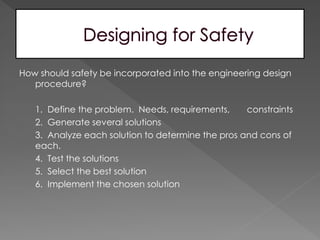
How should safety be incorporated into the engineering design
procedure?
1. Define the problem. Needs, requirements, constraints
2. Generate several solutions
3. Analyze each solution to determine the pros and cons of
each.
4. Test the solutions
5. Select the best solution
6. Implement the chosen solution
What is
ACCIDENT?
An unplanned, uncontrolled
event which has led to or could
have led to injury to people,
damage to plant, machinery or
the environment or some other
loss.
unforeseen and unplanned event or
circumstance, often with lack of
intention or necessity. it usually implies a
generally negative outcome which may
have been avoided or prevented
had circumstances leading up to the
accident)
 Procedural, engineered or systemic
› Procedural (most common; didn’t follow
procedures)
› Engineered (flaws in design)
› Systemic (complex systems)
 Better to prevent accidents
 If accident occurs, thorough study needed, and
results circulated
 Physical and non-physical
 Physical examples of accidents include unintended collisions
or falls, being injured by touching something sharp, hot, or
electrical, or ingesting poison.
 Non-physical examples are unintentionally revealing a
secret or otherwise saying something incorrectly, forgetting
an appointment, etc
 By activity
 Accidents during the execution of work or arising out of it are
called work accidents
 In contrast, leisure-related accidents are mainly sports injuries
Ethical Problem Solving Techniques Note

Ethical Problem Solving Techniques Note

  • 1.
    FACULTY OF MECHANICAL& MANUFACTURING ENGINEERING MANAGEMENT & PROFESSIONAL ETHICS(BDU20503) Members: AMAL IQMAL B. ADNAN AD110189 MUHAMMAD HAZWAN B. AB RASHID AD110095 NIK MUHAMMAD HISHAMUDDIN B. NICK HAMASHOLDIN AD110140
  • 3.
    Ethical theories doesnot reflect on the ethical values, but it does try to bring a systematic thinking to bear the phenomenon of ethic. Many people had evaluate and criticize some of these opinions and practices to provide a reflective account of an essential human activity.
  • 4.
    There are severalethics theories and each theories have their own ideas and flaw. Some of the famous theories is as follow: 1) Natural Law 2) Deontology 3) Virtue theory 4) Utilitarianism 5) Right Ethic Theory 6) Casuist
  • 5.
     Attributed toAristotle (man should live according to an inherent human nature).  Can be contrasted with man-made or judicial law.  But both may change over time.
  • 6.
     State thatpeople should adhere their obligations when analyzing an ethical dilemma.  He/she must follow the obligations because it is consider ethically correct.  The flaw with this theory is there is no rationale or logical basis in deciding any duty.  The fact that sometimes a person’s duties conflict.
  • 7.
     Asks whata “good person” would do in that situation.  It discuss such timeless and cross-cultural virtues such as courage, temperance, wisdom, justice, faith, and charity.  A weakness of this theory is it does not take into consideration a person’s change in moral character.
  • 8.
    Utilitarianism is dividedinto 2 categories:- 1) Act Utilitarianism 2) Rule Utilitarianism
  • 9.
    A person performsthe acts that benefit the most people, regardless of personal feelings or the societal constraints such as laws.
  • 10.
    Takes into accountthe law ad is concerned with fairness which means it seek to benefit the most people but through the fairest and most just means available
  • 11.
     The flawwith this theory is that it is associated with predicting the future.  No human can be certain that their predictions will be true.  This will lead to unexpected results making this theory unethical as time passes because his/her choice did not benefit the most people as he/she predicted.
  • 12.
     Right areconsidered to be ethically correct and valid since a large or ruling population endorses them.  For example, a person may say that her friend may borrow the car for the afternoon, therefore, the friend now has a right to the car for the afternoon.
  • 13.
     The majorflaw of this theory is however that one must decipher what the characteristics of a right are in society.  Therefore, in order for this theory to be useful, it must be used in conjunction with other theory that will consistently explain the goals of the society.
  • 14.
     Compares acurrent ethical dilemma with examples of similar ethical dilemma and their outcomes.  This will allow a person the create a best possible solution according to other’s or past experience.
  • 15.
     The downsideof this theory is that there may not be a set of similar examples for the given ethical dilemma.  Also, this theory assume that the result of the current ethical dilemma will be similar to results in the examples.
  • 17.
    Analysis of Issuesin Ethical Problems  Understand all of the issues involved.  Once these issues are determined, frequently a solution to the problem becomes apparent.
  • 18.
    Issues Involved in understandingEthical Problem Inquiries Factual MoralConceptual
  • 19.
     They involvewhat is actually known about a case.  Though seem easy but are not always clear and may be controversial.  Abortion rights (its an unclear fact)
  • 20.
    Ex: Abortion issue.There is great controversy over the point at which point life begins and at which point a fetus can be legally protected. Ex: Global warming. Greenhouse gases such as CO2 trap heat in the atmosphere and cause global warming. It is thought that the majority of this gas emanates from industrial plants and cars. If this is the case, engineers may be asked to design better products and redesign older ones. However the global warming procedure is barely understood and the need of curtailment of the emission of these gases is still controversial.
  • 21.
     To dowith the meaning or applicability of an idea.  What constitutes a bribe as opposed to an acceptable gift?  In case of bribe the value of the gift is probably a well known fact. What isn't known is whether accepting it will lead to unfair influence on a business decision.  Not clear cut and lead controversies as well.
  • 22.
     Relate tomorals of an act/individual etc  Once the factual and conceptual issues are resolved, it is usually clear which moral concept applies.  E.g: A bribe offered by a sales representative, once its determined whether it is simply a bribe or is really a bribe, then the appropriate action is obvious.  If we determine that is indeed a bribe, then it cannot ethically be accepted.
  • 23.
    …  Factual issues Can be resolved through research to establish the truth. It is not always possible to achieve a final determination of the truth that everyone can agree on, but generally further research helps clarify the situation, can increase the areas of an agreement and can sometimes achieve consensus on the facts.
  • 24.
    …  Conceptual Issues: Can be resolved by agreeing on the meaning of terms and concepts, sometimes agreement isn't possible but as with factual issues further analysis of the concepts at least clarifies some of the issues and helps to facilitate agreement.
  • 25.
    …  Moral Issues: Can be resolved by agreement as to which moral principles are pertinent (important) and how they hold be applied.
  • 26.
     Useful forsituations in which the applicable moral principles are clear but there seems to be great deal of gray area about which ethical principle applies.  It is performed by drawing a line along which various examples and hypothetical situations are placed.
  • 27.
     Our companywould like to dispose of slightly toxic (Poisonous) waste by dumping it into a local lake from which a nearby town gets its drinking water.  How can we determine if this practice is acceptable ?  Let start by defining the problem and the positive and negative paradigm.
  • 28.
    …  Problem:  Acompany dumps waste in lake.  The lake  water supply for a village  Dump concentration 5 ppm (parts per million)  Environmental Protecting Agency (EPA) limit 10 ppm  At 5 ppm no health problems and consumers would not be able to detect compound in their drinking water is expected.
  • 29.
    …  Positive Paradigm The water supply for the town should be clean and safe.  Negative Paradigm  Toxic levels of waste are put into the lake.
  • 30.
    Negative Paradigm (NP)Positive Paradigm (PP) Dump toxic levels of waste in lake Water should be clean and safe
  • 31.
    1. The companydumps the chemical into the lake. At 5 ppm the chemical will be harmless but the town water will have an unusual taste. 2. The chemical can be effectively removed by the towns existing water treatment system. 3. The chemical can be removed by the town with new equipment that will be purchased by the company. 4. The chemical can be removed by the town with new equipment for which the taxpayer will pay.
  • 32.
    … 5) Occasionally exposureto the chemical can make people feel it but this only lasts for an hour and is rare 6) At 5 ppm, some people can get fairly sick but the sickness only lasts a week and there is no long term harm. 7) Equipment can be installed at the plant to further reduce the waste level to 1 ppm (One could go on for a long time creating more and more test examples. Generally where your problem fits along the line is obvious with only a few examples but the exercise should be continued with more examples until it is clear what the proper resolution is.)
  • 33.
    6 5 41 7 2,3 NP PP
  • 34.
    ...  It maybe clear that there is a gap in the knowledge.  In this case the organization might need more information on seasonal variations in waste concentration and water usage of the town.  Information on potential interactions of the chemical with other pollutants such as runoff of pesticides from local farms.  Note that there is some subjectivity in determining exactly where along the line each of the examples fit.
  • 35.
    …  Our problemcan be inserted in between 1 and 7 along the line. 6 5 4 1 P 7 2,3
  • 36.
    …  Ti isclear that dumping the toxic waste is probably a morally acceptable choice since no humans will be harmed and the waste levels will be well below those that could cause any harm.  Since it is somewhat far from the positive paradigm there are probably better choices that can be made and the company should investigate these alternatives.
  • 37.
    Problem with LineDrawing It can be used to reach false conclusion.
  • 38.
     It willbe helpful for analyzing a variety of cases, especially those in which there is a sequence of events to be considered or a series of consequence that flows from each decision.  It gives a visual picture of a situation and allows you to readily see the consequences that flow from each decision.  One has to be as objective as possible. Otherwise it will be possible to draw any conclusion one wants even one that is clearly wrong.
  • 42.
     The flowchart should be much larger and more. Of course, complex to thoroughly cover the entire problem.  The key to effective use of flow charts for solving ethical problems is to be creative in determining possible outcomes and scenarios and also to do not be shy about getting a negative answer and deciding to stop the project.
  • 43.
    References: 1. Source: Fleddermann,C. B., Engineering Ethics, 2nd Edition, 2004, Pearson Education, India.
  • 45.
    No duty ofthe engineer is more important than duty to protect the safety and well being of the public. Safety must be so importance to the engineer.  Definition of Safety, Risks and accident  Safety and risk factor  Safety and engineer  Designing for safety
  • 46.
    What is SAFETY? Thecondition of being safe, freedom from danger, risk, or injury. the condition of being protected against physical, social, spiritual, financial, political, emotional, occupational, psychological, educational or other types or consequences of failure, damage, error, accidents, harm or any other event which could be considered non-desirable.)
  • 47.
     Engineers havea responsibility to society to produce products that are safe.  Safety is a very unclear term. But also very precise. Unclear because safety is a value judgment  Safety must come with the concept of risk. It is imposibble to build anything to be completely risk- free.How much risk is appropriate? How safe is safe enough?
  • 48.
    What is RISK? Aprobability or threat of damage, injur y, liability, loss, or any other negative occurrence that is caused by external or internal vulnerabilities the potential that a chosen action or activity (including the choice of in action) will lead to a loss (an undesirable outcome))
  • 49.
    And spend ofyour substance in the cause of Allah, and make not your own hands contribute to (your) destruction but do good for Allah loveth those who do good.
  • 50.
     Voluntary vs.involuntary risk  Many consider something safer if they knowingly take on the risk, but find it unsafe if forced to do so. If the property values are low enough, some people will be tempted to buy a house near a plant that emits low levels of a toxic waste into the air.  Short term vs. long term consequences  Something that might cause a short-lived illness or disability seems safer than something that will result in permanent disability. An activity which may cause a leg to be broken is preferred to spinal fracture. A broken leg will recover in a couple of months. Spinal fractures, however, can lead to permanent disability.
  • 51.
     Expected probability Swimming at a beach where jelly fish is abundant would be unacceptable. However, at the same beach, the risk of a shark attack is low enough that it doesn’t deter anybody from swimming  Reversible effects  Something will seem less risky if the bad effects are ultimately reversible  Threshold levels for risk  Something that is risky only at high exposures will seem safer than something with uniform exposure to risk. An activity whose harm is delayed for many years will seem much less risky than something with an immediate effect  Delayed vs. immediate risk  Smoking cigarette kills slowly vs. skydiving will kill immediately. Is skydiving more risky?...
  • 52.
    How can webe sure that our designs as engineers are safe? There are four criteria that must be met to ensure a safe design:
  • 53.
     A designmust comply with the applicable laws.  An acceptable design must meet the standard of “accepted engineering practice.”  Alternative designs that are potentially safer must be explored.  The engineer must foresee potential misuses of the product by the customer.
  • 54.
    How should safetybe incorporated into the engineering design procedure? 1. Define the problem. Needs, requirements, constraints 2. Generate several solutions 3. Analyze each solution to determine the pros and cons of each. 4. Test the solutions 5. Select the best solution 6. Implement the chosen solution
  • 55.
    What is ACCIDENT? An unplanned,uncontrolled event which has led to or could have led to injury to people, damage to plant, machinery or the environment or some other loss. unforeseen and unplanned event or circumstance, often with lack of intention or necessity. it usually implies a generally negative outcome which may have been avoided or prevented had circumstances leading up to the accident)
  • 56.
     Procedural, engineeredor systemic › Procedural (most common; didn’t follow procedures) › Engineered (flaws in design) › Systemic (complex systems)  Better to prevent accidents  If accident occurs, thorough study needed, and results circulated
  • 57.
     Physical andnon-physical  Physical examples of accidents include unintended collisions or falls, being injured by touching something sharp, hot, or electrical, or ingesting poison.  Non-physical examples are unintentionally revealing a secret or otherwise saying something incorrectly, forgetting an appointment, etc  By activity  Accidents during the execution of work or arising out of it are called work accidents  In contrast, leisure-related accidents are mainly sports injuries