1.6 Classical Theories
Every day we are confronted with questions of right and wrong.
These questions can appear to be very simple (Is it always wron
g to lie?), as well as very complicated (Is it ever right to go to
war?). Ethics is the study of those questions and suggests variou
s ways we might solve them.
Here we will look at three traditional theories that have a long h
istory and that provide a great deal of guidance in struggling wi
th moral problems; we will also see that each theory has its
own difficulties. Ethics can offer a great deal of insight into the
issues of right and wrong;
however, we will also discover that ethics generally won't provi
de a simple solution on which everyone can agree.
Classical Theories
The classical ethical theories in a nutshell, with a short lesson i
n application.
Utilitarianism
A natural way to see whether an act is the right thing to do (or t
he wrong thing to do) is to look at its results, or consequences.
Utilitarianism argues that, given a set of choices, the act we
should choose is that which produces the best results for the gre
atest number affected by that choice.
Definition of Utilitarianism
After helping their mother clean the attic, John and Mary are tol
d they can each have a cookie. When they open the cookie jar, o
nly one is left. What do you think would be the fairest solution f
or John and Mary?
Those who follow utilitarianism suggest that there is an obvious
solution that is fair, and it may be one that appeals to common
sense as well: John and Mary should share the cookie. Since
each has an equal right to it, they should split it in half. They m
ay not get what they want—each wants the entire cookie—
but both are better off with half a cookie than with no cookie. D
ividing the cookie produces the greatest good for the greatest nu
mber. This is the fundamental principle of utilitarianism: One
should choose to do that which produces a better outcome for th
e largest number of people.
The cookie example is, of course, a very simple case, but it allo
ws us to introduce some of the
terminology philosophers use to examine ethical choices. Here,
for instance, we might call the
pleasure John and Mary get from the cookie their "utility"; a sta
ndard assumption among
ethicists, economists, and many others is that people seek to ma
ximize their utility. Thus, Mary would like to maximize her utili
ty by having the entire cookie, but that conflicts with John's
desire to maximize his utility (by also having the entire cookie).
We should also see that part of this calculation is to minimize p
ain or suffering; a choice that maximizes utility may often be on
e that produces the least harm, given the options available. Utili
tarianism is the theory that
people should choose that which maximizes the utility of all tho
se who are affected by a given act.
Unfortunately, many ethical problems aren't as easy to solve as
the cookie example. At this
point, however, we see the basic utilitarian principle and how to
apply it. Now we can start to make it a bit more precise. Accor
ding to utilitarianism, one should always act in a way that
produces the greatest good for the greatest number of people rel
ative to any other way one
might act, or act in a way that maximizes the utility of all affect
ed by an act, relative to any alternative to that act.
Examples of Utilitarianism
iStockphoto/Thinkstock
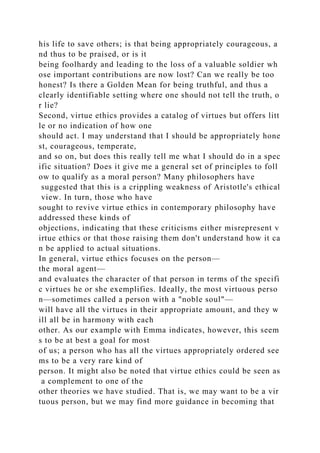
Paying taxes decreases an individual's happiness, but a utilitaria
n might argue that taxes are good because they fund institutions
such as schools that can increase utility for a very large number
of people.
A couple of examples should make clear how one might go abou
t applying this utilitarian
principle. One of the most common ways is to adopt a rule—
a law, in this case—
against shoplifting. While the shoplifter may maximize his utilit
y by shoplifting, the utility of the store owner is obviously not
maximized, and if rules against shoplifting weren't enforced,
prices would go up for all the other customers. So here, the grea
test number of people (the
shop owner and the customers) achieve the greatest amount of g
ood by preventing as much
shoplifting as possible. This seems like common sense, and that
is one thing that makes
utilitarianism very attractive. Consider a tax that people in a giv
en community pay for their very good public schools. No one li
kes to pay taxes, and any tax will decrease an individual's
happiness. But the school system in question not only provides t
he students with a high-
quality education (thus increasing the utility of the students and
their parents); it also makes
the housing in that community more valuable, and thus increase
s the utility of all those who
own houses there, not just parents with children. The utilitarian
might argue that a relatively
small decrease in happiness brought about by the tax creates an
increase in happiness for a
very large number of people, and thus is the correct thing to do.
Act Utilitarianism and Rule Utilitarianism
We will see some more details that affect how one applies this u
tilitarian principle when we
look at specific examples. It may already be clear that there can
be problems in applying it;
some make technical distinctions within utilitarianism, such as
differentiating between
actutilitarianism and rule utilitarianism. Generally speaking, an
act utilitarian looks at a
specific act: Does this act produce the greatest good for the grea
test number, given the various options available? If so, the act u
tilitarian says that this act is what should be done. The rule
utilitarian may, in some cases, disagree, contending that one sho
uld do things that, as a rule,
generate the greatest good for the greatest number. It may, for i
nstance, turn out that cheating on a specific exam will produce,
in this specific case, the greatest good for the greatest number B
ut, in general, cheating will not have that result, so the rule utili
tarian will say cheating is
wrong in this case, while an act utilitarian may say this specific
act is okay. As we will see, many others will challenge, for diff
erent reasons, the very idea of using the principle of utility as a
guide for making moral and ethical decisions. We can look at on
e of them here.
Challenges to Utilitarianism
Bernard Williams (1929–
2003) put forth one of the most famous problems for utilitariani
sm. An explorer accidentally
walks into a small village just as 20 natives are about to be shot
. She is told by the village chief
that it is a great honor for a visitor to shoot one of these natives
, and because of that, if she
shoots one native, the other 19 will be set free. If she declines,
however, all 20 will be shot. It
seems, as Williams points out, that the utilitarian principle mak
es it quite clear that the greatest good for the greatest number is
produced by the explorer shooting one native, and that any
other alternative will not produce as good a result. However, the
explorer has profound
objections to taking another person's life; thus, we might wonde
r about an ethical theory that
insists that doing so in this case is not just an option but is in fa
ct the right thing to do. Although we aren't often in the situation
of this explorer, it is easy to imagine situations where one
might confront this problem. For instance, should you do somet
hing that your boss tells you to do but that you think is morally
wrong, even though it will produce good results for the
company?
Utilitarianism gives us what seems to be a clear and fairly easy
principle to apply to ethical
problems and so determine the right thing to do in specific case
s. It also seems to be an idea
that appeals to common sense and is often regarded, therefore, a
s one that most people use
even when they don't realize they are applying a specific ethical
theory. As we go along, we will see in many cases that utilitari
anism does do this, providing clear solutions to ethical challeng
es that are simple, easy to explain, and easy to justify; it seems
to be an obvious, common-
sense response to those challenges. Unfortunately, we will also
see that it can produce—
as it may do in the case of the explorer—
results that conflict with our sense of right and wrong. We will
also recognize that it isn't always easy to determine what, exactl
y, is the "greatest good," or how we can decide what the
relevant group is when we consider the good for the "greatest nu
mber." We may also discover conflicts between short-
term and long-
term goods when applying utilitarianism. As we will continue to
discover, ethical principles can
frequently give us guidance and clarify ethical problems, but th
ey usually don't guarantee a
result on which everyone will agree.
Deontology
Rather than looking at the consequences of an act, deontology l
ooks at the reason for which an act is done, and the rule accordi
ng to which one chooses to act. Deontology doesn't deny that
acts have consequences; rather, it insists that those consequence
s should not play a role in our moral evaluation of such acts.
Definition of Deontology
Utilitarianism is sometimes called a consequentialist theory bec
ause it evaluates whether an act is right or wrong in terms of the
act's consequences. In contrast to consequentialist theories, a n
umber of different approaches suggest distinct ways of evaluati
ng the morality of an act.
Perhaps the most famous of these is deontology. Coming from t
he Greek deon, which means
"duty," deontology (sometimes referred to as duty ethics) focuse
s on what we are obligated to do as rational moral agents. It is p
articularly important to see that the deontologist does not say th
at actions do not have consequences; rather, the deontologist ins
ists that actions should not be evaluated on the basis of the actio
n's consequences. Again, we can try to bring out the idea of this
theory with a simple example; later, we will apply it to conside
rably more complex situations.
Examples of Deontology
A computer hacker accesses your online banking account and pr
oceeds to drain your account.
Clearly, when you discover this, you think what the hacker has
done is wrong. But is it due to
the consequences of his act? After all, his utility is increased by
exactly the same amount as yours is decreased. The amount the
hacker gets is precisely the amount you lose, so this is what
would be called a zero-
sum game. We may feel that what the hacker has done is immor
al, but the consequences don't necessarily show that. Is there an
other way of looking at his act and seeing why it is immoral?
iStockphoto/Thinkstock
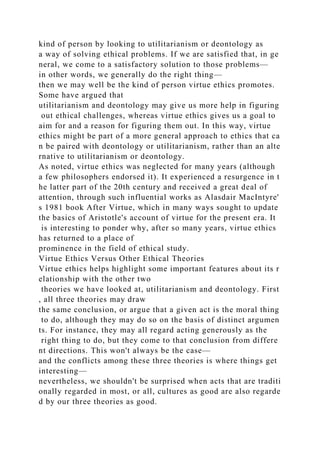
Deontologist Immanuel Kant (1724–1804)
The deontologist argues that we have a duty, or an obligation, to
treat other people with
respect; human beings have dignity, and we must take that digni
ty into consideration when
dealing with them. (We also expect others to respect our dignity
when they deal with us.) As
the most famous deontologist, Immanuel Kant (1724–
1804), put it, we should never treat another person only as a me
ans to our ends, or goals, but
should regard other people as ends in themselves. In other word
s, I can't simply use a person to get what I want, nor can someo
ne use me to get what he or she wants. We have to consider
the other person's needs and desires, respect them, and try to av
oid violating them. To give a
very simple example: If I'm late to an appointment, I can't run
over the pedestrians who are in my way simply to achieve my g
oal of being on time. (We probably already knew that.)
What does the deontologist say about the case of the computer h
acker? His goal, evidently,
was to steal your money. He used you to achieve that goal and f
ailed to respect your human
dignity. This is why the deontologist says the hacker's actions a
re wrong. Notice that the
deontologist didn't take into consideration the results of the act.
Perhaps the hacker needed to feed his family, travel to visit a d
ying relative, or donate to a local charity. What he needed (or w
anted) the money for is irrelevant to the evaluation of his act; th
e only relevant thing here for the deontologist is that the compu
ter hacker violated the general rule that you don't steal from oth
ers.
Universal Rule Test
We can also say that the hacker's actions failed what is called th
e universalization test. One way to know if an act is the right thi
ng to do is to ask: Would this act always be the right thing to do
, for everyone, in the same circumstances? It seems pretty obvio
us that we do not want
everyone to be allowed to empty out others' bank accounts, so t
his act can't be universalized.
Another simple example will clarify this idea but will also start
to reveal why some critics of
deontology regard it as conflicting with common sense or as bei
ng too rigid. Traditionally,
people are taught from an early age to tell the truth. The deontol
ogist might, therefore, put
forth this rule: "Never lie." This will show respect for other pe
ople by telling them the truth and can be universalized in that o
ne should always tell the truth. In other words, if I lie to a perso
n, I am failing to respect that person's right to be told the truth;
such an act, as a violation of the
rule "Never lie," would therefore be wrong. One may see in the
example of lying why the Golden Rule—
treat others as you would want to be treated—
is similar to deontological thinking. We don't want to be lied to,
so we should not lie to others. We expect people to tell the trut
h, and we can be very dismayed, and even harmed, when they do
not. The Golden Rule gives us a pretty good idea of how deonto
logy proceeds, but it has its
limitations. The Golden Rule asserts that I should treat others as
I wish to be treated. But what
if I only have sardine sandwiches and blueberry juice every nig
ht for supper; would that make it a good idea to insist that anyo
ne who comes to my house for supper only be given sardine
sandwiches and blueberry juice? Should I treat them as I would
wish to be treated?
Imagine a young girl sees a Santa Claus in the mall and asks her
mother if Santa really exists and delivers presents to girls and b
oys who have been good. Should the mother tell the truth, or
should she lie to her daughter? Some might say that the daughte
r is so young—
perhaps not having reached the traditional "age of reason"—
that in this case it is okay to lie (or at least not tell the truth). O
n that view, the principle "Never lie" isn't violated. But what if
I've been planning a surprise party for my wife and have had to
go to great lengths in order to bring her friends in from all acros
s the United States? If my wife asks, "Are you throwing a surpri
se party for me?" should I tell her the truth? That ruins the surpr
ise for everyone involved, but I have treated her with the respec
t she deserves. If I lie to her, to
maintain the surprise, don't I violate our rule and fail to treat h
er as a person—fail to treat her as an end-in-herself—
and thus do something wrong? We may be tempted to say, "It is
okay to lie in some situations, but not others," but then we have
the problem of trying to figure out which situations do allow lyi
ng and which do not. In addition, we must justify violating our
original rule that seemed, at
first, to make sense. We might try to include in our ethical rules
"Don't ask questions you don't want answered truthfully," but, t
hen again, we add another complication. One of the attractive fe
atures of deontology is the clarity of its rules. But changing the
simple rule "Never lie" to the
rule "Never lie except in certain situations or where the other pe
rson, who is sufficiently
mature, has asked you a question that may not be the kind of qu
estion one should ask
expecting a truthful answer" makes things quite a bit more diffi
cult in applying the rule to specific situations.
Challenges to Deontology
We saw that utilitarianism has a certain advantage in seeming to
appeal to common sense.
Clearly, deontology can claim that same advantage, in that one
of its most famous versions is
the Golden Rule. The Golden Rule is ancient and can be found i
n such different civilizations as
Egypt, India, and ancient Greece, as well as in many religions i
ncluding Buddhism, Christianity,
Hinduism, Judaism, and Islam. What is probably the best-
known version comes from the Christian Bible: "Do to others w
hat you would have them do to you" (Matthew 7:12 New Interna
tional Version). In other words, if you don't like being stolen
from, you shouldn't steal from others; if you don't like someone
cutting in line in front of you,
you should not cut in line in front of her. You don't want to be t
reated by others as simply some kind of "thing," so you yourself
shouldn't treat others that way. The appeal of this approach
may be clear from the fact that parents often use this as one of t
he easiest ways to explain to
children, even very young children, the difference between right
and wrong. Just consider how many times parents ask their chil
dren, "How would you like it if someone did that to you?"
But, as we have already noticed, and will continue to see, deont
ology can lead to results that
conflict with common sense and what we might regard as our or
dinary conceptions of right
and wrong. Yet again, we discover that an ethical view may hav
e many things going for it, but it can also confront ethical chall
enges that are difficult to solve. As we saw with utilitarianism,
deontology may provide very useful guidance and be quite helpf
ul in clarifying the ethical issues we have to deal with, but we
may be expecting too much from it—or any ethical theory—
if we think it will solve all such ethical problems, and solve the
m in a way, which is satisfactory to everyone involved.
Virtue Ethics
Virtue ethics is distinct from both utilitarianism and deontology
. Rather than focusing on the
consequences of the act we wish to evaluate, or the reason or rul
e that guides the action, we
look at the character of the person performing the act. Virtue et
hics, thus, seeks to determine
not what makes an act good but what makes a person virtuous.
Definition of Virtue Ethics
Emma is a senior in college; she makes excellent grades, is pop
ular, pretty, funny, and a
talented athlete. She has a reputation for being very honest and
very generous. She knows how to have a good time, but she nev
er drinks too much or gets out of control. She does, however, so
metimes seem to brag a little too much about her accomplishme
nts and seems a bit arrogant about her looks, her achievements,
and her popularity. Once, when some gang members were threat
ening one of her friends, Emma stepped in, calmed the situation
down, and got her friend out of trouble.
Emma is an example of a person who is close to the ideal person
, according to virtue ethics,
possessing all the characteristics of a virtuous person and havin
g all but one in the proper
proportion. Virtue ethics emphasizes the moral, or virtuous, per
son who exemplifies moral behavior.
Emma, of course, has a character flaw: She lacks modesty and is
a bit vain. Nevertheless, she
does demonstrate the other virtues that virtue ethics identifies a
s the characteristics of the
noble person. These characteristics include courage, temperance
, generosity, pride, amiability, honesty, wittiness, friendship, an
d modesty. While lists of such virtues may vary from
philosopher to philosopher, the general idea is pretty clear. The
virtuous, or ethical, person will possess a certain set of characte
ristics in the correct amount and in harmony with each other.
The character of Emma offers a specific example of the way virt
ue ethicists think about right
and wrong. Virtue ethics focuses on the person's character and
what makes, in general, a
person a good (virtuous) person. Aristotle, who is given credit f
or the first systematic account of virtue ethics in the West (it is
a very prominent and old theme in Chinese philosophy)
emphasizes specific virtues. Those who possess them in an appr
opriate way, and in harmony
with each other, will be regarded as moral and serve as example
s of morality to others.
iStockphoto/Thinkstock
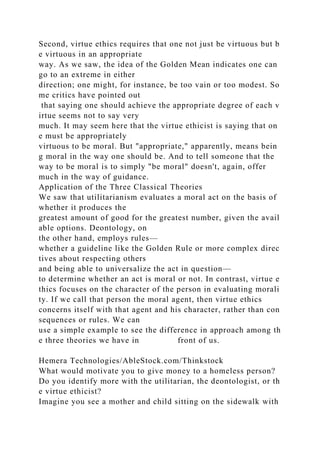
Aristotle cited a number of characteristics that make a person vi
rtuous.
What kind of virtues does Aristotle have in mind? He specifies
a number of virtues, some of
which have already been mentioned, including courage, generos
ity, honesty, pride, and
modesty. He also mentions one that is perhaps less common, te
mperance, or being moderate
in one's appetites and desires. For example, one should neither
indulge in overeating nor
deprive oneself entirely of the enjoyment food can bring. Tempe
rance illustrates Aristotle's
general approach: that these virtues should be reflected in a pers
on's character but should
never be taken to an extreme. Thus, one who has too little coura
ge is a coward, whereas one
who has too much courage is foolhardy. The virtuous person wi
ll have courage in the proper
amount. On this view, we should see what is known as the Gold
en Mean, possessing virtue but never having too little or too mu
ch of it. The truly virtuous person will have all the Aristotelian
virtues and possess them in the appropriate amount and in balan
ce or harmony with each
other. In our example, Emma is close to becoming truly moral o
r virtuous, she lacks modesty
and thus needs to find its Golden Mean in order to become truly
moral or virtuous.
Examples of Virtue Ethics
Rachel is a bomb technician in the military, with the dangerous
job of disposing of, or rendering harmless, explosives, in partic
ular improvised explosive devices (IEDs). Rachel's commanding
officer has described to her a situation that needs attention: An
IED has been located in an urban
area, but because of its construction, it may be particularly sen
sitive and, thus, difficult to
disarm. Because of the risks involved, the officer does not want
to order anyone to take on this mission, but he is asking for vol
unteers.
Courage is, of course, an important virtue, and one that Aristotl
e frequently mentioned. If
Rachel simply volunteers, without giving the task any evaluatio
n, fails to take any precautions in approaching such a dangerous
job, and immediately runs to where the IED has been located in
order to disarm it, we might say that she is foolhardy. On the ot
her hand, if she absolutely
refuses to consider the mission, and in fact runs in the opposite
direction from the IED's
location and hides under her bed, we might regard Rachel as a b
it of a coward. In this case,
Rachel could achieve the Golden Mean by being courageous: vo
lunteering for the mission, but
taking all the precautions she can to eliminate the risks involved
. This could be one way of
striking a balance between being foolhardy and being cowardly;
but, as this example
demonstrates, there may be differences in what can be taken to
be the correct or virtuous
action. Might it be prudent to recognize that the risks are too gr
eat? As we will see frequently
in ethical debates, there may not be one absolutely right way of
applying ethical theory to
specific ethical questions.
Challenges to Virtue Ethics
Aristotle's view, as found particularly in his Nichomachean Ethi
cs, was for centuries a key text in ethics. It became less influent
ial in the 18th and 19th centuries, in part because of the
development of the other ethical theories we have looked at, util
itarianism and deontology.
There were other reasons that it seemed less satisfactory as a rig
orous treatment of ethical
ideas. Two particular problems have been identified as generati
ng problems for virtue ethics.
First, it is not clear that it is possible to identify a complete list
of virtues, or that everyone
would even agree on such a list if it were possible to provide on
e. Would we all agree on what
precisely constituted a given virtue and its appropriate degree? I
s, for instance, generosity
always a virtue? One might suggest that it is, but how do we det
ermine what its Golden Mean is Will everyone agree on when o
ne is too generous or too stingy? A soldier in war may sacrifice
his life to save others; is that being appropriately courageous, a
nd thus to be praised, or is it
being foolhardy and leading to the loss of a valuable soldier wh
ose important contributions are now lost? Can we really be too
honest? Is there a Golden Mean for being truthful, and thus a
clearly identifiable setting where one should not tell the truth, o
r lie?
Second, virtue ethics provides a catalog of virtues but offers litt
le or no indication of how one
should act. I may understand that I should be appropriately hone
st, courageous, temperate,
and so on, but does this really tell me what I should do in a spec
ific situation? Does it give me a general set of principles to foll
ow to qualify as a moral person? Many philosophers have
suggested that this is a crippling weakness of Aristotle's ethical
view. In turn, those who have
sought to revive virtue ethics in contemporary philosophy have
addressed these kinds of
objections, indicating that these criticisms either misrepresent v
irtue ethics or that those raising them don't understand how it ca
n be applied to actual situations.
In general, virtue ethics focuses on the person—
the moral agent—
and evaluates the character of that person in terms of the specifi
c virtues he or she exemplifies. Ideally, the most virtuous perso
n—sometimes called a person with a "noble soul"—
will have all the virtues in their appropriate amount, and they w
ill all be in harmony with each
other. As our example with Emma indicates, however, this seem
s to be at best a goal for most
of us; a person who has all the virtues appropriately ordered see
ms to be a very rare kind of
person. It might also be noted that virtue ethics could be seen as
a complement to one of the
other theories we have studied. That is, we may want to be a vir
tuous person, but we may find more guidance in becoming that
kind of person by looking to utilitarianism or deontology as
a way of solving ethical problems. If we are satisfied that, in ge
neral, we come to a satisfactory solution to those problems—
in other words, we generally do the right thing—
then we may well be the kind of person virtue ethics promotes.
Some have argued that
utilitarianism and deontology may give us more help in figuring
out ethical challenges, whereas virtue ethics gives us a goal to
aim for and a reason for figuring them out. In this way, virtue
ethics might be part of a more general approach to ethics that ca
n be paired with deontology or utilitarianism, rather than an alte
rnative to utilitarianism or deontology.
As noted, virtue ethics was neglected for many years (although
a few philosophers endorsed it). It experienced a resurgence in t
he latter part of the 20th century and received a great deal of
attention, through such influential works as Alasdair MacIntyre'
s 1981 book After Virtue, which in many ways sought to update
the basics of Aristotle's account of virtue for the present era. It
is interesting to ponder why, after so many years, virtue ethics
has returned to a place of
prominence in the field of ethical study.
Virtue Ethics Versus Other Ethical Theories
Virtue ethics helps highlight some important features about its r
elationship with the other two
theories we have looked at, utilitarianism and deontology. First
, all three theories may draw
the same conclusion, or argue that a given act is the moral thing
to do, although they may do so on the basis of distinct argumen
ts. For instance, they may all regard acting generously as the
right thing to do, but they come to that conclusion from differe
nt directions. This won't always be the case—
and the conflicts among these three theories is where things get
interesting—
nevertheless, we shouldn't be surprised when acts that are traditi
onally regarded in most, or all, cultures as good are also regarde
d by our three theories as good.
Second, virtue ethics requires that one not just be virtuous but b
e virtuous in an appropriate
way. As we saw, the idea of the Golden Mean indicates one can
go to an extreme in either
direction; one might, for instance, be too vain or too modest. So
me critics have pointed out
that saying one should achieve the appropriate degree of each v
irtue seems not to say very
much. It may seem here that the virtue ethicist is saying that on
e must be appropriately
virtuous to be moral. But "appropriate," apparently, means bein
g moral in the way one should be. And to tell someone that the
way to be moral is to simply "be moral" doesn't, again, offer
much in the way of guidance.
Application of the Three Classical Theories
We saw that utilitarianism evaluates a moral act on the basis of
whether it produces the
greatest amount of good for the greatest number, given the avail
able options. Deontology, on
the other hand, employs rules—
whether a guideline like the Golden Rule or more complex direc
tives about respecting others
and being able to universalize the act in question—
to determine whether an act is moral or not. In contrast, virtue e
thics focuses on the character of the person in evaluating morali
ty. If we call that person the moral agent, then virtue ethics
concerns itself with that agent and his character, rather than con
sequences or rules. We can
use a simple example to see the difference in approach among th
e three theories we have in front of us.
Hemera Technologies/AbleStock.com/Thinkstock
What would motivate you to give money to a homeless person?
Do you identify more with the utilitarian, the deontologist, or th
e virtue ethicist?
Imagine you see a mother and child sitting on the sidewalk with
what appears to be all their
possessions. Presumably, they are homeless and could use some
help, and you decide to give
them $10. The utilitarian observes that by giving $10, you mak
e yourself a bit less well off, but make the mother and her child
much better off; thus, giving the $10 produces the greatest
good for the greatest number and is the right thing to do. The de
ontologist, on the other hand, adopts the rule that you should, w
hen possible, help those who are worse off than you. (Or, in
terms of the Golden Rule, if you were in the position of the mot
her, you might well want
someone to give you some help.) Thus, in accordance with this r
ule, the deontologist claims
that giving the $10 is the right thing to do. The virtue ethicist, o
n the other hand, considers your character. You can spare, witho
ut too much sacrifice, $10, and the generous person should do s
o. Since generosity is a virtue, the virtuous person will regard g
iving the $10 as the right thing to do.
Here we see that all three theories come to very similar conclusi
ons (although for different
reasons). This won't always be the case, of course; there are sig
nificant disagreements among
utilitarians themselves as well as, naturally, among utilitarians,
deontologists, and virtue
ethicists. As we will now begin to see, there are significant resp
onses to ethical questions that
reject these theories as a whole, and offer a different way of thi
nking about ethics and about doing the right thing.
Revised 30 Dec 2016 /mg
MPPA Program
(11-Week On Campus)
PA 582-01
Healthcare Policy
Winter Term 2017
COURSE TYPE:
The majority of professor-led contact hours take place in a
traditional classroom. The overall nature of the course is
“traditional”, although required Blackboard components have
also been included.
INSTRUCTOR INFORMATION:
Name: Marilyn Gesch, Ph.D.
Phone Numbers: 805-493-3794 (MPPA Office)
Office Location: n/a
Office Hours: By email or appointment
Email: [email protected]
TIME / PLACE:
x Term Dates: November 21, 2016 – February 16, 2017, first
meeting is Wednesday, Nov. 23, 2016.
x Weekly Class Meeting: Wednesday, 7:00 – 9:50 PM
x Classroom: Humanities, 107
x Last Day to Add: Monday, December 5, 2016
x Last Day to Drop (without a “w” or financial penalty):
Monday, December 5, 2016
x Last Day to Withdraw (without academic penalty): Tuesday,
January 17, 2017
READINGS:
Readings will be available on the course website or through the
Pearson Library’s online databases. Refer to the Course
Calendar.
COURSE DESCRIPTION:
This course provides an overview of medical sociology and its
contribution to understanding health policy, focusing on
the American health care system. We will study health care
policy from a sociological perspective, which means
we will explore the social contexts in which medicine, health,
illness, and health care delivery are situated. Major topics
include health inequalities, medical cultures, and the economic
markets and politics that affect our health care system. In
the first weeks of the course we will look at the social
conditions underlying the experience of health and illness. In
the remainder of the course, we will look at the variety of
players in policy making – including but not limited to the
patients themselves, medical professionals, medical industries,
insurers, government agencies, and politicians.
mailto:[email protected]
MPPA 582-01, Healthcare Policy, Winter 2017_rev 30Dec2016
mg Page 2
TECHNOLOGY REQUIREMENTS:
CLU utilizes Blackboard to enhance course learning and achieve
the designated student learning outcomes.
Technology requirements for the Blackboard system can be
found at the following website:
http://www.callutheran.edu/ctl/Blackboard.php
OUTLINE OF STUDENT LEARNING OBJECTIVES:
Students will obtain skills and knowledge in the following
areas:
1. understanding and applying sociological concepts and
approaches to medicine and health care policy,
2. developing analytical skills in relation to contemporary
health care debates,
3. collaborating with the instructor and other members of the
class in a critical assessment of course readings
and materials, and,
4. practicing and improving both oral presentation and written
communication skills.
Because we will be engaging with contemporary and often
controversial issues within the field of healthcare policymaking,
you are expected to think critically about the subject matter
which means reading assigned books and articles and
considering authors’ arguments in light of each week’s topic
area.
LEARNING OUTCOMES:
The MPPA Program at California Lutheran University’s School
of Management has been designed to achieve a total of nine
learning outcomes. While each course alone, including this
present one, teaches only towards a subset of those nine
outcomes, all of them will be accomplished by students upon
successful completion of their program.
1. FUNDAMENTALS: Graduates of the School of Management
are equipped with knowledge of the essential concepts and tools
in their professional field, as well as the ability to relate and
apply theoretical concepts into practical situations both within
their
discipline and across disciplines.
2. PLANNING AND ORGANIZATION: Graduates of the School
of Management have the ability to plan, organize, direct and
control effectively in contemporary organizations.
3. INDIVIDUAL COMPETENCIES: Graduates of the School of
Management have individual competencies related to critical
and
creative thinking, integrity and ethical judgment, and the ability
to function in a complex and demanding professional
environment.
4. INTERPERSONAL COMPETENCIES: Graduates of the
School of Management have interpersonal competencies related
to
effective and appropriate communication and collaboration that
support and enhance their individual and organizational
effectiveness.
5. GLOBAL ENVIRONMENT: Graduates of the School of
Management have a sound understanding of the global
environment
and its importance to organizational effectiveness, as well as
the ability to successfully operate in an international context.
6. LEADERSHIP AND CHANGE: Graduates of the School of
Management are able to demonstrate effective and principled
leadership including the ability to influence organizations in
complex and changing environments.
7. PUBLIC MANAGEMENT SKILLS: Graduates of the Master
of Public Policy and Administration have knowledge of project
management, evaluation of policy alternatives, collaboration,
communication and team building, which allow them to
effectively
work with communities, policy makers and other stakeholders
on a wide range of policy issues.
8. ETHICS: Graduates of the Master of Public Policy and
Administration are able to evaluate and apply ethical values to
policy
practice.
9. RESEARCH AND POLICY ANALYSIS: Graduates of the
Master of Public Policy and Administration are able to conduct
research
and apply relevant analysis to public administration and policy.
Information on which learning outcomes are addressed in this
course can be found in the section on “Assessments and
Learning Outcomes” below.
http://www.callutheran.edu/ctl/Blackboard.php
MPPA 582-01, Healthcare Policy, Winter 2017_rev 30Dec2016
mg Page 3
DIDACTIC APPROACH:
This course rests on several components – self-study, lectures,
interaction, as well as practice and application:
x Self-Study
o Preparation in self-study by students before lecture to become
familiar with new material and to stimulate
thinking, generate ideas and questions.
x Lecture
o Presentation of topics in class by instructor using PowerPoint
slides.
x Student-Instructor Interaction
o Discussion of selected questions, finding examples, and
answering questions in the weekly forum.
o Direct interaction between student and instructor.
x Practice and Application
o Preparation of weekly assignments by students.
o Participation in discussion boards.
o Deepening of concepts in discussion.
o Policy project / presentation on a selected topic.
ASSESSMENT:
Assessment in this course is based on multiple elements. Each
form of assessment addresses different (sometimes
multiple) learning outcomes and each form of assessment
requires a different set of knowledge, skills and abilities:
Attendance and Participation: Attendance at all sessions,
including weekly online forums, is critical toward the
fulfillment of course requirements. Students should come to
class each week prepared to discuss the readings for
that day as well as any assignments associated with them. A
10% reduction in a student’s final grade will be assessed
for each unexcused absence from class or the online forum.
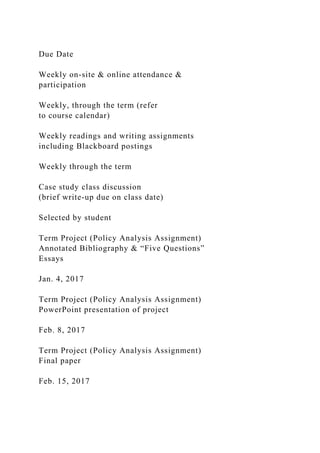
SUMMARY TABLE OF ASSIGNMENT DEADLINES AND
DUE DATES:
Assessment
Due Date
Weekly on-site & online attendance &
participation
Weekly, through the term (refer
to course calendar)
Weekly readings and writing assignments
including Blackboard postings
Weekly through the term
Case study class discussion
(brief write-up due on class date)
Selected by student
Term Project (Policy Analysis Assignment)
Annotated Bibliography & “Five Questions”
Essays
Jan. 4, 2017
Term Project (Policy Analysis Assignment)
PowerPoint presentation of project
Feb. 8, 2017
Term Project (Policy Analysis Assignment)
Final paper
Feb. 15, 2017
MPPA 582-01, Healthcare Policy, Winter 2017_rev 30Dec2016
mg Page 4
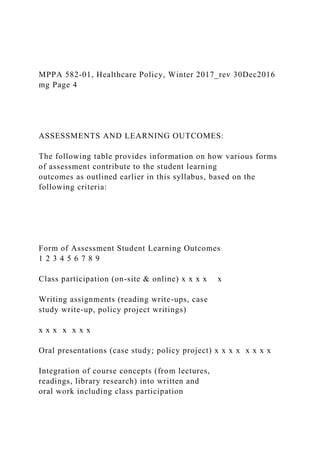
ASSESSMENTS AND LEARNING OUTCOMES:
The following table provides information on how various forms
of assessment contribute to the student learning
outcomes as outlined earlier in this syllabus, based on the
following criteria:
Form of Assessment Student Learning Outcomes
1 2 3 4 5 6 7 8 9
Class participation (on-site & online) x x x x x
Writing assignments (reading write-ups, case
study write-up, policy project writings)
x x x x x x x
Oral presentations (case study; policy project) x x x x x x x x
Integration of course concepts (from lectures,
readings, library research) into written and
oral work including class participation
x x x x x x
MPPA 582-01, Healthcare Policy, Winter 2017_rev 30Dec2016
mg Page 5
SCHEDULE OF TOPICS AND ACTIVITIES
2016
Week 1, Nov. 23: Introduction; Sociological Perspective on
Health and Illness
The course syllabus, readings and other materials will be
available on our Blackboard web page.
1. Review of course materials and requirements; sign up for (1)
policy project topic, and, (2)
date/topic for case study discussion.
2. Overview of sociological concepts important to
understanding a sociological perspective
on health and illness and the debates on health care reform.
3. Discussion of required reading.
Required Reading: Donald A. Barr, “Health, Health Care, and
the Market Economy,” Chapter 2
in Introduction to U.S. Health Policy ©2011 [Bb]
Assignment: Prepare a one-page summary of the reading and
turn in print copy to instructor.
Week 2, Nov. 30: Political Context of Health Care Reform
Required Readings: Morone, James A., “Morality, politics, and
health care,” in Policy Challenges
in Modern Health Care, Mechanic et al., eds., ©2006 [Bb]; and,
Barr, Donald A., Chapter 1, in
Introduction to U.S. Health Policy (Johns Hopkins Univ. Press,
3rd edition, ©2011) [Bb]
Assignment: Who are some of the players in health care reform,
according to this week’s authors,
and what kinds of pressures and ideologies do they bring to the
debates? Post to your journal page
a 300-500 word summary that draws on the required readings to
answer the questions above.
Discussion Board: Post a response to the weekly discussion
question; respond to others’ postings
and questions.
Week 3, Dec. 7: Social Conditions of Disease
Required Readings: Phelan, Link & Tehranifar, “Social
conditions as fundamental causes of
health inequalities” in Mechanic, Policy Challenges… ©2006
[Bb]; and, McKinlay, “A case for
refocusing upstream,” in The Sociology of Health and Illness:
Critical Perspectives, Peter
Conrad, ed. ©2001 [Bb]
Assignment: Post on your journal page a 300-500 word
assessment of either the Link and Phelan
or the McKinlay article. (Note: You prepare for class by reading
both required readings, but write
up this assignment using only one of the articles.) This should
include a summary of the author’s
argument(s) and any supporting evidence provided. In
conclusion, make note of your questions
and critique of the work.
Discussion Board: Post a response to the weekly discussion
question; respond to others’ postings
and questions.
Case Study Question: Go to Handouts on the course Blackboard
page for information
about case study questions.
MPPA 582-01, Healthcare Policy, Winter 2017_rev 30Dec2016
mg Page 6
Week 4, Dec. 14: Health Inequalities (Poverty, Race/Ethnicity,
Gender)
Required Readings: Williams, David R., and Michelle
Sternthal. “Understanding racial-ethnic
disparities in health.” Journal of Health and Social Behavior
(JHSB) ©2010 [Bb]; Riecker,
Patricia P. and Chloe E. Bird. “Rethinking Gender Differences
in Health.” The Journal of
Gerontology, vol. 60B, 40-47. ©2005 [Bb]
Assignment: “Media Moment”: Post a minimum 300-word
analysis of a news article or story
(with source) on the Blackboard forum for this date. Address
the issues identified in the required
readings regarding some aspect of the issue of health disparities
in the U.S. healthcare system.
Discussion Board Question: Post on this week’s discussion
board; respond to others’ postings
and questions.
Case Study Question: Go to Handouts on the course Blackboard
page for information about
case study questions.
* * Holiday Break, Dec. 16, 2016, to Jan. 2, 2017 * *
Prepare Annotated Bibliography & “Five Questions” Essay To
Turn In January 4
2017
Week 5, Jan. 4: Patient Experience of Illness
First Project Assignment Due: Annotated Bibliography & Five
Questions Essay
Required Readings: Charmaz, Kathy. “The Body, Identity, and
Self: Adapting to Impairment”
©1999 [Bb].
Discussion Board Question: Provide your analysis of the patient
experience of illness,
according to the Charmaz article. What are her images of the
patient, and how do these
perspectives impact healthcare policy? Post your response, and
respond to others’ postings and
questions.
Class Discussion of Policy Project Essays for All Students:
Come to class prepared to talk
about what you have learned about your policy topic thus far,
what concepts from readings and
lectures seem to fit your topic best, and what questions you
think still need to be answered.
Week 6, Jan. 11: Norms of Medical Culture
Required Readings: Freidson, Eliot, “Dilemmas in the Doctor-
Patient Relationship,” in Kornblum
& Smith, eds., The Healing Experience ©1994 [Bb]; Stevens,
Rosemary, “Medical Specialization
as American Health Policy,” in History & Health Policy in the
U.S., Stevens et al. ©2006 [Bb]
Discussion Board Question: Drawing on the required readings,
post a brief essay identifying and
describing some of the customs that define how medical
professionals operate every day (i.e.,
interactions with patients, other professionals, and medical
suppliers and industries).
Case Study Question: Go to Handouts on the course Blackboard
page for information about
case study questions.
MPPA 582-01, Healthcare Policy, Winter 2017_rev 30Dec2016
mg Page 7
Week 7, Jan. 18: The Changing Health Care Environment:
Medical Institutions
Required Readings: Budrys, Grace. “Hospitals and Other
Health Care Organizations.” From Our
Unsystematic Health Care System, 2d ed., pp. 39-55, ©2005.
[Bb]; Hoffman, Beatrix, “Emergency
Rooms: The Reluctant Safety Net,” History & Health Policy in
the U.S., Stevens et al. ©2006 [Bb]
Discussion Board Assignment: “Media Moment”: Post a
minimum 300-word analysis of a news
article or story (with source) on the weekly forum. Discuss how
hospitals are being affected by the
2010 PPACA. Draw on the required readings to put these
changes in context of what these authors
observe (for ex., will the roles of ERs change, or the
relationships between hospitals and medical
professionals?). As with other discussion boards, read and
respond to others’ postings and
questions.
Case Study Question: Go to Handouts on the course Blackboard
page for information about
case study questions.
Week 8, Jan. 25: The Changing Health Care Environment:
Medical Industries
Required Readings: Conrad, Peter & Valerie Leiter,
“Medicalization, Markets and Consumers”
(JHSB) ©2004 [Bb]
Assignment: Turn in a 300-500 word essay drawing on ideas
from the Conrad et al. article
on how medical industries shape what we think of as illness and
what we do about it.
Discussion Board Question: Post a response to the weekly
discussion question; respond to
others’ postings and questions.
Case Study Question: Go to Handouts on the course Blackboard
page for information about
case study questions.
Week 9, Feb. 1: Structuring Health Care: What’s Politically
Possible?
Required Readings: Cockerham, William C., “Global Health
Care,” in Medical Sociology, 12th
ed., ©2012 [Bb]
Assignment: Drawing on the Cockerham material, turn in a 300-
500 word essay arguing for those
aspects of health care reform that you believe provide the best
evidence for addressing sociological
issues of equal access, patient needs, accountability, role of
profit, etc.
Case Study Question: Go to Handouts on the course Blackboard
page for information about case
study questions.
Week 10 (Feb. 8) reserved for Student Presentations
* FINAL PAPERS ARE DUE Feb. 15 and E-MAILED TO
INSTRUCTOR.*
DISCLAIMER: This information sheet may change prior to or
during the term to accommodate
changing circumstances. Every effort will be made to alert
students in a timely manner to any
alterations that occur.
MPPA 582-01, Healthcare Policy, Winter 2017_rev 30Dec2016
mg Page 8
DESCRIPTION OF ASSIGNMENTS
WEEKLY WRITING ASSIGNMENTS AND ONLINE
DISCUSSIONS:
In addition to the readings, each week you will prepare short
assignments that you will post online
on your journal page, accessible only by the instructor.
You will also be responsible for participating in a weekly online
forum with your classmates.
Two of these forums will focus on discussions of media stories
researched and submitted by
students; topics for the remaining forums will be assigned by
the instructor. The earlier you place
your initial post, the more time you will have to check in and
interact with additional posts.
Writing assignments are subject to the general requirements for
written work as stated above, and
assessed on how well your essay covers the conditions in the
assignment description. Blackboard
postings must be made no later than the date and time specified
for each one on the Course
Calendar. For example, article summaries must appear on your
journal page no later than midnight
Mondays.
The article summaries are based on the required readings for the
week. The focus of each week’s
summary is provided in the Course Calendar; look for the
weekly “Assignment.” Your essay is
graded on how well you respond to the question posed and
summarize key arguments and
evidence used in the readings that address the point. Due
midnight on Saturdays prior to the class
meeting. Follow up posts required.
A Media Moment posting is your summary and analysis of a
contemporary news story that meets
the topic requirement (read “Assignment” description for that
week). Your news source must be a
major news service, and in your posting you must provide a
working link to the full story or scan
and upload a print version. Briefly describe the issue raised by
the story and make a connection to
our course readings and discussion, highlighting social factors
that are present or absent from the
account. Due midnight on Saturdays prior to the class meeting.
Follow up posts required.
CASE STUDY DISCUSSION and WRITE-UP
Each student will select a case study (see Course Calendar,
weekly “Case Study”) and prepare
to lead discussion for the last hour of class that includes an
overview of the substantive topic for
that date and embeds it in that week’s key ideas. Your case
study work will be graded on how well
you integrate conceptual material from the required readings,
critique the readings that address the
case study issues, and generate discussion with the class on
your topic.
What to do:
(1) Start with the week’s required readings. Focus on those
pieces of evidence and/or arguments
that are important for understanding how to formulate or
evaluate health policy in your case
study area.
(2) The second step is to investigate current regulations in
place, both at the state and federal
levels. Most agencies have published this information on their
websites.
(3) Then, using library databases, such as JSTOR, Lexis-Nexis
and Medical Sciences (ProQuest),
find at least one relevant research article on that issue and at
least one relevant news story
that take issue with, illustrate or extend the issues and
arguments provided in the reading. Keep
track of the citations and provide that list to the instructor.
(4) Develop a presentation to the class explaining key concepts
and major issues in that subject
MPPA 582-01, Healthcare Policy, Winter 2017_rev 30Dec2016
mg Page 9
area based on your readings. Summarize main arguments, being
careful to identify key
policymakers on this issue as well as their claims as to the
major problems and solutions.
9 Organize your presentation in such a way that your summary
of the key issues in your
case study link to ideas from the required readings for that
week.
9 Approach your presentation by asking “What are the issues in
this case study?” and
“what social factors affect these conditions?”
9 Be succinct in your report: Don’t spend a lot of time and
space recapping readings page
by page. Your presentation to the class (at least 12 to15
minutes) should focus on telling
us what is important in order to understand the issue and
summarize those points for
your readers.
9 Use of PowerPoint is not required.
(5) Follow up your overview with a series of discussion
questions (about 4-5) for the class to
consider in terms of potential public policy issues. Discussion
should be a minimum of 20
minutes.
(6) Turn in your list of references to instructor the night of the
case study.
TERM PROJECT: Policy Analysis Assignments
There are three graded components to your term project, a
policy analysis paper:
(1) Annotated Bibliography & “Five Questions” Essay (writing
assignment)
(2) Class presentation (PowerPoint)
(3) Final paper (writing assignment)
The first assignment gets you started on researching and
analyzing information for your final
paper, first, engaging you with library research on academic
sources for your topic, and second,
engaging you with key concepts from the early weeks of the
course (both lectures and required
readings) as they relate to your topic.
This assignment should follow proper formatting (double-
spaced, one-inch margins, 12pt font),
spell-checks and grammar- checks available in your word
processing program, and follow the
specific instructions of the assignment.
Annotated Bibliography and Topic History
9 You will research your topic in library databases and report
on what you have found.
9 An annotated bibliography means that the structure of this
paper will be a list of the sources
you have found (correctly formatted) with one- to two-
paragraph descriptions of each.
9 Each description will include a brief summary of the research
findings and arguments presented
by the authors, plus a statement from you on why you find this
article relevant to your topic.
9 A minimum of eight (8) scholarly works from peer-reviewed
journals are required; additional
bibliographic material should include relevant readings from
our course materials. You may
also find media sources helpful to your study, but you will have
to defend their credibility in
order to use them.
9 This assignment concludes with a 350-500 word summary of
this topic’s history as a policy
issue (see the description of the final paper).
MPPA 582-01, Healthcare Policy, Winter 2017_rev 30Dec2016
mg Page 10
“Five Questions”:
9 You will write responses to five (5) questions provided by the
instructor, each response
approximately 350-500 words long.
9 These questions will help you identify and evaluate:
� the role of the governing body that you are targeting with
your proposal;
� the two opposing policy positions and their claimsmakers
(i.e. those who are supporting
each position and their investment in that stance); and,
� your integration of conceptual material from weekly readings
and class discussions
through midterm, including:
x types of moral perspectives;
x political alliances and relative political power of policy
proposals;
x impact of social factors/social conditions on issue and
proposed solutions;
x current and projected disparities in healthcare use and
outcomes.
It is expected that you will be building on these writings as you
proceed through the term.
PRESENTATION OF POLICY PAPER: Papers will be presented
in class at our final
meeting. Presentations should be five (5) minutes in length,
using a PowerPoint format. They
should be concise and convincing. Following the presentation,
time will be allowed for class
members to ask questions and discuss the pros and cons of each
policy issue.
Your final product will be a typewritten paper, 12-15 pages in
length, presenting your
analysis of a key health policy area being considered by state,
local or federal government entities.
In general, your analysis should provide background and
description of the topic area, and an
explication and sociological analysis of multiple perspectives
that are part of the contemporary
debates. Your sources must include both class readings and
research from scholarly journals. You
will make use of and build on information and analyses
provided in your first two assignments to
complete the tasks listed below.
In addition to general requirements for written work, your paper
must include:
(1) The historical background of the issue, particularly prior
programs or approaches used by
industries or governments. You will identify how current
policies developed, what they were
designed to do, and identify gaps or problems as well as
successes. Stick to relevant aspects
of the history that are shaping today’s debates.
(2) Comparison of two key positions on this question and the
health models or solutions
each propose. Describe key elements of each proposal and
discuss how each proposal is
likely to solve the problems or gaps in current policies. Identify
each proposal’s advocates,
or claimsmakers (i.e., who has vested interests in the
approach?), and summarize the
evidence these groups provide to support their arguments.
Finally, identify the “winners” and
“losers” of each proposal in contrast to the status quo, or
current policy. Provide your reasoned
assessment of the political prospects each approach might have
for adoption.
(3) Important to your analysis is your evaluation of these
proposals from a sociological
perspective, specifically addressing relevant research and
concepts that look at: (a) a patient’s or
consumer’s perspective, (b) the operation of medical norms in
this context, (c) the changing
role of health care provision, and (d) the impact of a policy
change on health financial
markets, integrating relevant course readings into your analysis.
It is critical to your analysis
that you include discussion of the aspects of the new healthcare
law that affect your issue.
MPPA 582-01, Healthcare Policy, Winter 2017_rev 30Dec2016
mg Page 11
Sources must include course readings as well as research from
peer-reviewed academic
journals.
Final write-up of the paper is due at 7 p.m. on Wednesday of
Finals Week and
emailed to the instructor.
Choose one of the following for your policy analysis paper.
1. Public Health and Rights to Privacy: Should medical
providers be bound by Public
Health policies? Recently, a nurse who was exposed to the
Ebola virus refused quarantine
rules imposed by the legislature and health department of New
Jersey. What were the
arguments on both sides? What roles did science, cultural
values and norms, and political
posturing play in policymaking? What other factors were
involved? What are implications
for other issues in which private and public health sectors must
collaborate?
2. Is unregulated economic growth good for our health?
Scientists argue that diminishing
biodiversity in our ecosystems world-wide, much of it due to
unrestricted development and
other human activity, will affect our health in the future. Are
there ways we can grow an
economy and maintain diversity in the environment?
3. Health care digitization and other new technologies in your
doctor’s office: Physicians
and their staffs are facing increased pressures to digitize
medical records, and recruit and
maintain a remote client base through telemedicine practices,
i.e., incorporate new
technologies into their practices. Are these new practices
changing the doctor-patient
relationship? What do both doctors and patients think about the
changes? And, what
roles are medical industries, healthcare corporations, and
governments playing in
effecting certain changes?
4. Making the rules regarding women’s contraceptive choices:
One of most
controversial (and litigated) provision of the PPACA is the
obligation of employer plans to
cover contraceptive services under prevention. Businesses that
oppose coverage have
challenged the law and won concessions. What are the origins
of this debate, both in the
construction of the law and in the history of women’s
contraceptive choices in America?
What implications does this have for women’s health care and
for future policymaking?
Should private businesses be able to block access to health care
for women?
5. What should government do in response to the problem of
access to health care?: The
Obama administration developed a health care policy that
addressed the tens of millions of
Americans who in 2010 were uninsured (and millions more who
were underinsured). What
provisions of the PPACA attempt to create a more inclusive
system? What are the values
and politics behind them? What are the arguments opposed? Did
the PPACA go far
enough, as others contend the U.S. should transition to a
federally-funded "Medicare for
Everybody” universal health insurance system?
6. What role should medical professionals have in military anti-
terrorism practices?:
Since the exposure of abuse of detainees at Abu Gharib in Iraq
in 2003, critics have
questioned the role of psychiatrists in the justification of torture
practices by military
interrogators. Should physicians and psychiatrists provide
information that helps determine
how much and what kind of mistreatment could be delivered to
detainees of the military
during interrogations? Is there a point where a doctor’s
obligation to “do no harm” is
suspended during times of war?
MPPA 582-01, Healthcare Policy, Winter 2017_rev 30Dec2016
mg Page 12
7. Immigrants and health care laws: In 1994 Californians passed
an initiative,
subsequently ruled unconstitutional, that included a provision
requiring medical personnel
to refuse care to undocumented immigrants. More recently, the
Obama administration has
ruled that while young undocumented immigrants may be
allowed to be “lawfully present”
in the U.S. (for schooling or work), they would not be eligible
for health benefits under the
new health care law. What are the obligations of a society to
those within its borders? Is
health care different from other kinds of “benefits”? How have
other countries addressed
this issue?
8. Are there limits to the uses of medical technology?: Should
genetic screening be used in
hiring and contracting by employers, insurers, and
governments? Is genetic
enhancement an acceptable use of technology? These and other
questions can be
explored in determining at what point the costs of technologies
(in terms of harm to
persons or communities) outweigh the benefits.
9. Technology and doctor/patient interaction: How are new
medical technologies changing
the doctor- patient encounter, as well as doctors’ approaches to
clinical care? Is the use (or
overuse of testing) improving diagnostic accuracy, or is this
more myth than fact? What
evidence speaks to what the balance should be between
subjective observation and
laboratory data in a doctor’s deliberations? Does the new health
care law have something to
say about the use of technologies in patient care?
10. Off-label marketing of drugs: A common practice by
physicians, and heavily
promoted by drug companies, off-label use of drugs was given a
boost by an appeals court
decision in New York supporting marketing of drugs for uses
not approved by the FDA.
What are the pros and cons of this decision for doctors and
patients? What should be the
responsibilities of drug manufacturers, and what would be an
appropriate governmental
policy on this issue?
11. Should medical providers be allowed to deny medications on
grounds of
conscience?: First pharmacists, and then, with the new
provisions in the 2010 health care
law, hospitals are exercising moral or religious grounds to gain
exception to the mandate
to provide birth control medications. Should exceptions be
allowed? How should religious
claims be weighed against individual rights?
12. Should state legislatures or U.S. Congress regulate
fracking? We are immersed in a new
era of oil booms in North Dakota, Pennsylvania, and, more
recently, Central California.
Water infused with “various chemicals” (unidentified, to date)
is blasted deep underground –
below farms, close to water tables, handled by workers. Are
these chemicals and processes
harming workers or the environment? What responsibility do
these companies have, not only
to the environment which they are changing, but to workers and
residents who may be
affected by their practices?
13. What’s the future for employer-based health care coverage?:
At one time, employers
willingly offered health care benefits as they competed with
each other for workers. With
outsourcing in the global labor market, high health care costs in
the U.S., and a troubled
economy, employers have implemented strategies for reducing
their costs. What are some
pre-2010 business strategies and current trends, and how does
the ACA address them?
14. Drug shortages, high-priced generics, and American health:
Drug shortages have
MPPA 582-01, Healthcare Policy, Winter 2017_rev 30Dec2016
mg Page 13
Assessment Points
Weekly attendance in class and online participation (postings in
forum, discussion boards)
20
Weekly writing assignments (journal) 15
Case study class discussion (with brief write-up) 15
Policy Project: Annotated bibliography & “Five Questions”
Essays; class discussion Jan. 4
20
Policy Project: PowerPoint presentation in class 10
Policy Project: Final Paper 20
increased dramatically in the last decade, nearly tripling. In
especially short supply is a
generic version of an important cancer drug. What is the threat
to public health? What’s
wrong with the drug production and distribution system? What
have Congress and the FDA
done in response? How can private enterprise and government
agencies address this
problem?
15. Health Care and the poor: Community health providers who
treat the poor find they cycle
in and out of care due to periods of homelessness, jail time, and
other barriers, disrupting
medical regimens. What are implications for individual health
and public health? What
provisions of the ACA can help address these issues?
Proposing an Alternative Topic
If you prefer to work on a topic not listed above, you must
submit a proposal (typewritten,
single-spaced, due no later than our first class meeting)
addressing each of these points and
arguing why your topic is relevant to health care policymaking
as well as recent health care
reforms:
(1) state your key policy question (examples provided above);
(2) state what level of governance is involved at which a policy
decision should be made
(local, state, federal; specific agency), and provide the rationale
for why that governmental
entity is critical for this issue;
(3) identify 2 key positions on this issue, including how each
identifies the problem and what
each proposes for a solution; for example, using a topic above,
DTC advertising of
pharmaceuticals is argued by some as improving patient choice
and by others as
inventing demand – what is each side identifying as a problem,
and what do they suggest
be done about it?
(4) outline sources of evidence each position puts forth in its
claims; and,
(5) finally, looking at the topic areas for each week of this
course, consider which you expect to
be most relevant for your topic and why; for example, DTC
advertising of prescription
drugs is relevant to the study of the patient empowerment
movement as well as the study
of medical industries and the role of profit-making in health-
related fields.
GRADING:
Grading in this class will be based on the following elements
and the grading scale provided below:
Percentage Grade
>94% A
90% to 93% A-
87% to 89% B+
84% to 86% B
80% to 83% B-
77% to 79% C+
74% to 76% C
70% to 73% C-
67% to 69% D+
64% to 66% D
60% to 63% D-
<60% F
MPPA 582-01, Healthcare Policy, Winter 2017_rev 30Dec2016
mg Page 14
GRADING STANDARDS
MPPA 582-01, Healthcare Policy, Winter 2017_rev 30Dec2016
mg Page 15
STUDENT WORKLOAD FOR THIS COURSE:
This is an 11-week, three credit unit course that consists of a
minimum of 45 hours of instructor-led components
and a minimum of 90 hours of non-instructor led, independent
activities. A detailed breakdown of times (1 hour = 50
minutes) and activities can be found from the following table:
Activity Instructor-Led Independent
Remarks
Weekly Course Weekly Course
Lecture/class discussion 3 33 Instructor-led lecture &
discussion
Readings 3 33 Assigned by instructor
Blackboard postings 1.5 12 Assigned by instructor (8 wks)
Case study 2 10 Assigned by instructor
Policy paper preparation 30
Policy paper presentation 1 4
Policy paper written report 20
TOTALS 48 103
COURSE POLICIES:
1. There are aspects of health care policymaking that are quite
controversial. I ask that we maintain a civil
dialogue on all subjects, being open to ideas that may be new to
us, and respecting others’ opinions if
different from our own.
2. It is also important to be “unitaskers” in the classroom when
it comes to our use of electronic
devices. To encourage keeping our attention on the topic at
hand, I ask that use of personal electronic
devices be limited to breaks and before and after class.
3. There are a variety of assignments in this course. It is
recommended that you develop habits to keep track of
upcoming deadlines and contact the instructor when conflicts or
problems arise. Materials
submitted past the given deadlines (including online posts) are
subject to penalties of 10 percentage points
per day.
COURSE EVALUATIONS:
All course evaluations are conducted online. Your feedback is
important to us. You will receive an email
message reminding you when the website is open for your
feedback. The link is: http://courseval.callutheran.edu
ACADEMIC INTEGRITY:
The educational programs of California Lutheran University are
designed and dedicated to achieve academic
excellence, honesty and integrity at every level of student life.
Part of CLU’s dedication to academic excellence is our
commitment to academic honesty. Students, faculty, staff and
administration share the responsibility for maintaining
high levels of scholarship on campus. Any behavior or act
which might be defined as “deceitful” or “dishonest”
will meet with appropriate disciplinary sanctions, including
dismissal from the University, suspension, grade F in a
course or various forms of academic probation. Policies and
procedures regarding academic honesty are contained
in the faculty and student handbooks.
Plagiarism, cheating, unethical computer use and facilitation of
academic dishonest are examples of behavior that
will result in disciplinary sanctions. Plagiarism includes, but is
not limited to:
x Word for word copying without using quotation marks or
presenting the work as yours
x Using the ideas or work of others without acknowledgement
x Not citing quoted material. Students must cite sources for any
information that is not either the result
of original research or common knowledge.
http://courseval.callutheran.edu/
MPPA 582-01, Healthcare Policy, Winter 2017_rev 30Dec2016
mg Page 16
PEARSON LIBRARY:
At CLU we won't tell you what to think — we'll teach you how
to think. You'll learn how to gather information, analyze
and synthesize. Don't worry about the "gathering"... that's the
easy part. We have technicians, information specialists,
and trainers to help you find the information you need. Pearson
Library provides access to scholarly books, journals,
ebooks, and databases of full text articles from scholarly
journals. To begin using these materials, visit the library
web page http://www.callutheran.edu/iss/research/. Librarians
are available to assist you at the Thousand Oaks
campus or via Meebo chat on the Library’s home page or
emailing [email protected] You may contact
the library at (805) 493-3250. If you attend classes at one of
CLU’s satellite locations, see
http://www.callutheran.edu/iss/research/satellite.php for the full
range of services provided.
CLU WRITING CENTER:
Experienced Writing Center tutors help CLU's undergraduate
and graduate students with their writing projects:
reading free writes to find the best ideas; refining thesis
statements; showing students how to structure paragraphs;
and using specific exercises to improve sentence syntax. They
work with whole classes as well as with individual
students on the style guidelines required for papers in the
various disciplines. All enrolled CLU students are invited
to make use of the Writing Center’s services. For additional
information, please visit
http://www.callutheran.edu/writing_center/, call 805- 493-3257,
or email [email protected] in order to
schedule an appointment or contact.
DISABILITY STATEMENT:
California Lutheran University is committed to providing
reasonable accommodations in compliance with ADA of
1990 and Section 504 of the Rehabilitation Act of 1973 to
students with documented disabilities. If you are a
student requesting accommodations for this course, please
contact your professor at the beginning of the semester
and register with the Accessibility Resource Coordinator for the
facilitation and verification of need. The
Accessibility Resource Coordinator is located in the Center for
Academic and Accessibility Resources (CAAR)
Office, and can be contacted by calling 805.493.3878 or by
completing the online form at
http://www.callutheran.edu/car/contact/.
INSTRUCTOR BIO:
Dr. Gesch earned her doctorate in Sociology at The University
of California-Santa Barbara. She completed a two-
year Post-doctoral Fellowship at The University of California-
Los Angeles in the HIV/AIDS research training
program, with an emphasis on public health systems. She has
worked with the Ventura County Public Health
Department in investigating local HIV prevention practices. Her
approach to the study of health policymaking
comes from this perspective as a sociologist, looking at the
field of medicine and health care delivery not only in
terms of their structures but of those who populate them – the
professionals and corporate CEOs, as well as
those whom they serve. Her approach to policymaking spans the
micro and macro – from the patient perspective
and ways in which patients influence policy, to the broader
context of the influence of social institutions and cultural
beliefs and practices.
DISCLAIMER:
This syllabus may change from time to time to accommodate
changing circumstances. Every effort will be made to alert
students to changes that occur in a timely manner.
http://www.callutheran.edu/iss/research/
mailto:[email protected]
http://www.callutheran.edu/iss/research/satellite.php
http://www.callutheran.edu/writing_center/
mailto:[email protected]
http://www.callutheran.edu/car/contact/
MPPA 582-01 Healthcare Policy Winter 2017
‘Five Questions’ Essays
Due Wed., January 4, 2017, in class
This assignment gets you started on analyzing information
you’ve gathered so far on your policy
topic. It is a writing assignment (see page 10 of the syllabus),
due the fifth week of the term, on
January 4, 2017. The questions will help you outline your ideas
for your policy paper as well as tap
into the conceptual material from this course in order to make
your case for why this is an important
policy to evaluate.
While I expect you to explore these questions as thoroughly
as possible with your topic, it is
assumed that these are provisional responses with what you
have learned about your topic to date. I
expect that you will be building on this work as you proceed
through the term.
FIVE QUESTIONS - - SEVEN STEPS
Task
1. Policy History: Provide some background on the health issue
you are researching. What
aspects of earlier debates (key arguments, rhetoric, etc.) have
shaped current
controversies on this topic?
2. Two Sides: What are the two opposing positions in the
contemporary debate and who
are the key proponents of each? Describe what each side
proposes is the problem and how
they intend to solve it, then relate what you know about who the
claimsmakers are (the
advocates of each side) and what stake they have in the
outcomes.
Making use of concepts from our course readings:
3. In what ways do these policy positions reflect an individual
vs a social factors model of
disease or approach to health care? Is there a moral dimension
to the debate?
4. How do social conditions play a role in understanding these
policy positions? Is there an
issue with access to appropriate resources, and, if so, what
would they be in this particular
case? Are there “upstream” factors that divide the positions, or
are they ignored by both
sides? If the latter, give an example of what is missing from the
debate.
5. Are there disparities among different social groups in regards
to this issue (e.g., different
disease rates, differential access to treatments or facilities,
different experiences of disease
progression, etc.)? Do these disparities figure in to the current
debate? If not, why not?
6. Annotated Bibliography: This is your report of research you
have done on your topic in the
library’s databases of peer-reviewed journals. Cite these sources
and include a paragraph
description summarizing key ideas from that article that are
relevant to your topic. Use one of
the major citation formats (e.g., APA or Chicago Manual of
Style), just be consistent with
what you choose. Attach this to your Five Essays paper.
7. Finally, place your name and the due date on the top of the
first page or on the cover page of
your paper. Be sure to spell-check and grammar-check your
writing before turning it in. You
will be graded on the quality, organization, and clarity of your
work.
Bring a printed copy of your paper to turn in.
** Keep in mind that your role in this project is to be a policy
analyst, not a policy advocate. **
Your goal is to present two positions fairly, providing the
evidence that each side uses to argue for
its position. Your analysis of this evidence should be grounded
in using the conceptual tools
presented by our authors in the class readings.

1.6 Classical TheoriesEvery day we are confronted with questions.docx

  • 1.
    1.6 Classical Theories Everyday we are confronted with questions of right and wrong. These questions can appear to be very simple (Is it always wron g to lie?), as well as very complicated (Is it ever right to go to war?). Ethics is the study of those questions and suggests variou s ways we might solve them. Here we will look at three traditional theories that have a long h istory and that provide a great deal of guidance in struggling wi th moral problems; we will also see that each theory has its own difficulties. Ethics can offer a great deal of insight into the issues of right and wrong; however, we will also discover that ethics generally won't provi de a simple solution on which everyone can agree. Classical Theories The classical ethical theories in a nutshell, with a short lesson i n application. Utilitarianism A natural way to see whether an act is the right thing to do (or t he wrong thing to do) is to look at its results, or consequences. Utilitarianism argues that, given a set of choices, the act we should choose is that which produces the best results for the gre atest number affected by that choice. Definition of Utilitarianism After helping their mother clean the attic, John and Mary are tol d they can each have a cookie. When they open the cookie jar, o nly one is left. What do you think would be the fairest solution f or John and Mary? Those who follow utilitarianism suggest that there is an obvious solution that is fair, and it may be one that appeals to common sense as well: John and Mary should share the cookie. Since each has an equal right to it, they should split it in half. They m ay not get what they want—each wants the entire cookie— but both are better off with half a cookie than with no cookie. D ividing the cookie produces the greatest good for the greatest nu
  • 2.
    mber. This isthe fundamental principle of utilitarianism: One should choose to do that which produces a better outcome for th e largest number of people. The cookie example is, of course, a very simple case, but it allo ws us to introduce some of the terminology philosophers use to examine ethical choices. Here, for instance, we might call the pleasure John and Mary get from the cookie their "utility"; a sta ndard assumption among ethicists, economists, and many others is that people seek to ma ximize their utility. Thus, Mary would like to maximize her utili ty by having the entire cookie, but that conflicts with John's desire to maximize his utility (by also having the entire cookie). We should also see that part of this calculation is to minimize p ain or suffering; a choice that maximizes utility may often be on e that produces the least harm, given the options available. Utili tarianism is the theory that people should choose that which maximizes the utility of all tho se who are affected by a given act. Unfortunately, many ethical problems aren't as easy to solve as the cookie example. At this point, however, we see the basic utilitarian principle and how to apply it. Now we can start to make it a bit more precise. Accor ding to utilitarianism, one should always act in a way that produces the greatest good for the greatest number of people rel ative to any other way one might act, or act in a way that maximizes the utility of all affect ed by an act, relative to any alternative to that act. Examples of Utilitarianism iStockphoto/Thinkstock Paying taxes decreases an individual's happiness, but a utilitaria n might argue that taxes are good because they fund institutions such as schools that can increase utility for a very large number of people. A couple of examples should make clear how one might go abou
  • 3.
    t applying thisutilitarian principle. One of the most common ways is to adopt a rule— a law, in this case— against shoplifting. While the shoplifter may maximize his utilit y by shoplifting, the utility of the store owner is obviously not maximized, and if rules against shoplifting weren't enforced, prices would go up for all the other customers. So here, the grea test number of people (the shop owner and the customers) achieve the greatest amount of g ood by preventing as much shoplifting as possible. This seems like common sense, and that is one thing that makes utilitarianism very attractive. Consider a tax that people in a giv en community pay for their very good public schools. No one li kes to pay taxes, and any tax will decrease an individual's happiness. But the school system in question not only provides t he students with a high- quality education (thus increasing the utility of the students and their parents); it also makes the housing in that community more valuable, and thus increase s the utility of all those who own houses there, not just parents with children. The utilitarian might argue that a relatively small decrease in happiness brought about by the tax creates an increase in happiness for a very large number of people, and thus is the correct thing to do. Act Utilitarianism and Rule Utilitarianism We will see some more details that affect how one applies this u tilitarian principle when we look at specific examples. It may already be clear that there can be problems in applying it; some make technical distinctions within utilitarianism, such as differentiating between actutilitarianism and rule utilitarianism. Generally speaking, an act utilitarian looks at a specific act: Does this act produce the greatest good for the grea
  • 4.
    test number, giventhe various options available? If so, the act u tilitarian says that this act is what should be done. The rule utilitarian may, in some cases, disagree, contending that one sho uld do things that, as a rule, generate the greatest good for the greatest number. It may, for i nstance, turn out that cheating on a specific exam will produce, in this specific case, the greatest good for the greatest number B ut, in general, cheating will not have that result, so the rule utili tarian will say cheating is wrong in this case, while an act utilitarian may say this specific act is okay. As we will see, many others will challenge, for diff erent reasons, the very idea of using the principle of utility as a guide for making moral and ethical decisions. We can look at on e of them here. Challenges to Utilitarianism Bernard Williams (1929– 2003) put forth one of the most famous problems for utilitariani sm. An explorer accidentally walks into a small village just as 20 natives are about to be shot . She is told by the village chief that it is a great honor for a visitor to shoot one of these natives , and because of that, if she shoots one native, the other 19 will be set free. If she declines, however, all 20 will be shot. It seems, as Williams points out, that the utilitarian principle mak es it quite clear that the greatest good for the greatest number is produced by the explorer shooting one native, and that any other alternative will not produce as good a result. However, the explorer has profound objections to taking another person's life; thus, we might wonde r about an ethical theory that insists that doing so in this case is not just an option but is in fa ct the right thing to do. Although we aren't often in the situation of this explorer, it is easy to imagine situations where one might confront this problem. For instance, should you do somet hing that your boss tells you to do but that you think is morally
  • 5.
    wrong, even thoughit will produce good results for the company? Utilitarianism gives us what seems to be a clear and fairly easy principle to apply to ethical problems and so determine the right thing to do in specific case s. It also seems to be an idea that appeals to common sense and is often regarded, therefore, a s one that most people use even when they don't realize they are applying a specific ethical theory. As we go along, we will see in many cases that utilitari anism does do this, providing clear solutions to ethical challeng es that are simple, easy to explain, and easy to justify; it seems to be an obvious, common- sense response to those challenges. Unfortunately, we will also see that it can produce— as it may do in the case of the explorer— results that conflict with our sense of right and wrong. We will also recognize that it isn't always easy to determine what, exactl y, is the "greatest good," or how we can decide what the relevant group is when we consider the good for the "greatest nu mber." We may also discover conflicts between short- term and long- term goods when applying utilitarianism. As we will continue to discover, ethical principles can frequently give us guidance and clarify ethical problems, but th ey usually don't guarantee a result on which everyone will agree. Deontology Rather than looking at the consequences of an act, deontology l ooks at the reason for which an act is done, and the rule accordi ng to which one chooses to act. Deontology doesn't deny that acts have consequences; rather, it insists that those consequence s should not play a role in our moral evaluation of such acts. Definition of Deontology Utilitarianism is sometimes called a consequentialist theory bec ause it evaluates whether an act is right or wrong in terms of the
  • 6.
    act's consequences. Incontrast to consequentialist theories, a n umber of different approaches suggest distinct ways of evaluati ng the morality of an act. Perhaps the most famous of these is deontology. Coming from t he Greek deon, which means "duty," deontology (sometimes referred to as duty ethics) focuse s on what we are obligated to do as rational moral agents. It is p articularly important to see that the deontologist does not say th at actions do not have consequences; rather, the deontologist ins ists that actions should not be evaluated on the basis of the actio n's consequences. Again, we can try to bring out the idea of this theory with a simple example; later, we will apply it to conside rably more complex situations. Examples of Deontology A computer hacker accesses your online banking account and pr oceeds to drain your account. Clearly, when you discover this, you think what the hacker has done is wrong. But is it due to the consequences of his act? After all, his utility is increased by exactly the same amount as yours is decreased. The amount the hacker gets is precisely the amount you lose, so this is what would be called a zero- sum game. We may feel that what the hacker has done is immor al, but the consequences don't necessarily show that. Is there an other way of looking at his act and seeing why it is immoral? iStockphoto/Thinkstock Deontologist Immanuel Kant (1724–1804) The deontologist argues that we have a duty, or an obligation, to treat other people with respect; human beings have dignity, and we must take that digni ty into consideration when dealing with them. (We also expect others to respect our dignity when they deal with us.) As the most famous deontologist, Immanuel Kant (1724– 1804), put it, we should never treat another person only as a me
  • 7.
    ans to ourends, or goals, but should regard other people as ends in themselves. In other word s, I can't simply use a person to get what I want, nor can someo ne use me to get what he or she wants. We have to consider the other person's needs and desires, respect them, and try to av oid violating them. To give a very simple example: If I'm late to an appointment, I can't run over the pedestrians who are in my way simply to achieve my g oal of being on time. (We probably already knew that.) What does the deontologist say about the case of the computer h acker? His goal, evidently, was to steal your money. He used you to achieve that goal and f ailed to respect your human dignity. This is why the deontologist says the hacker's actions a re wrong. Notice that the deontologist didn't take into consideration the results of the act. Perhaps the hacker needed to feed his family, travel to visit a d ying relative, or donate to a local charity. What he needed (or w anted) the money for is irrelevant to the evaluation of his act; th e only relevant thing here for the deontologist is that the compu ter hacker violated the general rule that you don't steal from oth ers. Universal Rule Test We can also say that the hacker's actions failed what is called th e universalization test. One way to know if an act is the right thi ng to do is to ask: Would this act always be the right thing to do , for everyone, in the same circumstances? It seems pretty obvio us that we do not want everyone to be allowed to empty out others' bank accounts, so t his act can't be universalized. Another simple example will clarify this idea but will also start to reveal why some critics of deontology regard it as conflicting with common sense or as bei ng too rigid. Traditionally, people are taught from an early age to tell the truth. The deontol ogist might, therefore, put
  • 8.
    forth this rule:"Never lie." This will show respect for other pe ople by telling them the truth and can be universalized in that o ne should always tell the truth. In other words, if I lie to a perso n, I am failing to respect that person's right to be told the truth; such an act, as a violation of the rule "Never lie," would therefore be wrong. One may see in the example of lying why the Golden Rule— treat others as you would want to be treated— is similar to deontological thinking. We don't want to be lied to, so we should not lie to others. We expect people to tell the trut h, and we can be very dismayed, and even harmed, when they do not. The Golden Rule gives us a pretty good idea of how deonto logy proceeds, but it has its limitations. The Golden Rule asserts that I should treat others as I wish to be treated. But what if I only have sardine sandwiches and blueberry juice every nig ht for supper; would that make it a good idea to insist that anyo ne who comes to my house for supper only be given sardine sandwiches and blueberry juice? Should I treat them as I would wish to be treated? Imagine a young girl sees a Santa Claus in the mall and asks her mother if Santa really exists and delivers presents to girls and b oys who have been good. Should the mother tell the truth, or should she lie to her daughter? Some might say that the daughte r is so young— perhaps not having reached the traditional "age of reason"— that in this case it is okay to lie (or at least not tell the truth). O n that view, the principle "Never lie" isn't violated. But what if I've been planning a surprise party for my wife and have had to go to great lengths in order to bring her friends in from all acros s the United States? If my wife asks, "Are you throwing a surpri se party for me?" should I tell her the truth? That ruins the surpr ise for everyone involved, but I have treated her with the respec t she deserves. If I lie to her, to maintain the surprise, don't I violate our rule and fail to treat h er as a person—fail to treat her as an end-in-herself—
  • 9.
    and thus dosomething wrong? We may be tempted to say, "It is okay to lie in some situations, but not others," but then we have the problem of trying to figure out which situations do allow lyi ng and which do not. In addition, we must justify violating our original rule that seemed, at first, to make sense. We might try to include in our ethical rules "Don't ask questions you don't want answered truthfully," but, t hen again, we add another complication. One of the attractive fe atures of deontology is the clarity of its rules. But changing the simple rule "Never lie" to the rule "Never lie except in certain situations or where the other pe rson, who is sufficiently mature, has asked you a question that may not be the kind of qu estion one should ask expecting a truthful answer" makes things quite a bit more diffi cult in applying the rule to specific situations. Challenges to Deontology We saw that utilitarianism has a certain advantage in seeming to appeal to common sense. Clearly, deontology can claim that same advantage, in that one of its most famous versions is the Golden Rule. The Golden Rule is ancient and can be found i n such different civilizations as Egypt, India, and ancient Greece, as well as in many religions i ncluding Buddhism, Christianity, Hinduism, Judaism, and Islam. What is probably the best- known version comes from the Christian Bible: "Do to others w hat you would have them do to you" (Matthew 7:12 New Interna tional Version). In other words, if you don't like being stolen from, you shouldn't steal from others; if you don't like someone cutting in line in front of you, you should not cut in line in front of her. You don't want to be t reated by others as simply some kind of "thing," so you yourself shouldn't treat others that way. The appeal of this approach may be clear from the fact that parents often use this as one of t he easiest ways to explain to
  • 10.
    children, even veryyoung children, the difference between right and wrong. Just consider how many times parents ask their chil dren, "How would you like it if someone did that to you?" But, as we have already noticed, and will continue to see, deont ology can lead to results that conflict with common sense and what we might regard as our or dinary conceptions of right and wrong. Yet again, we discover that an ethical view may hav e many things going for it, but it can also confront ethical chall enges that are difficult to solve. As we saw with utilitarianism, deontology may provide very useful guidance and be quite helpf ul in clarifying the ethical issues we have to deal with, but we may be expecting too much from it—or any ethical theory— if we think it will solve all such ethical problems, and solve the m in a way, which is satisfactory to everyone involved. Virtue Ethics Virtue ethics is distinct from both utilitarianism and deontology . Rather than focusing on the consequences of the act we wish to evaluate, or the reason or rul e that guides the action, we look at the character of the person performing the act. Virtue et hics, thus, seeks to determine not what makes an act good but what makes a person virtuous. Definition of Virtue Ethics Emma is a senior in college; she makes excellent grades, is pop ular, pretty, funny, and a talented athlete. She has a reputation for being very honest and very generous. She knows how to have a good time, but she nev er drinks too much or gets out of control. She does, however, so metimes seem to brag a little too much about her accomplishme nts and seems a bit arrogant about her looks, her achievements, and her popularity. Once, when some gang members were threat ening one of her friends, Emma stepped in, calmed the situation down, and got her friend out of trouble. Emma is an example of a person who is close to the ideal person , according to virtue ethics,
  • 11.
    possessing all thecharacteristics of a virtuous person and havin g all but one in the proper proportion. Virtue ethics emphasizes the moral, or virtuous, per son who exemplifies moral behavior. Emma, of course, has a character flaw: She lacks modesty and is a bit vain. Nevertheless, she does demonstrate the other virtues that virtue ethics identifies a s the characteristics of the noble person. These characteristics include courage, temperance , generosity, pride, amiability, honesty, wittiness, friendship, an d modesty. While lists of such virtues may vary from philosopher to philosopher, the general idea is pretty clear. The virtuous, or ethical, person will possess a certain set of characte ristics in the correct amount and in harmony with each other. The character of Emma offers a specific example of the way virt ue ethicists think about right and wrong. Virtue ethics focuses on the person's character and what makes, in general, a person a good (virtuous) person. Aristotle, who is given credit f or the first systematic account of virtue ethics in the West (it is a very prominent and old theme in Chinese philosophy) emphasizes specific virtues. Those who possess them in an appr opriate way, and in harmony with each other, will be regarded as moral and serve as example s of morality to others. iStockphoto/Thinkstock Aristotle cited a number of characteristics that make a person vi rtuous. What kind of virtues does Aristotle have in mind? He specifies a number of virtues, some of which have already been mentioned, including courage, generos ity, honesty, pride, and modesty. He also mentions one that is perhaps less common, te mperance, or being moderate in one's appetites and desires. For example, one should neither
  • 12.
    indulge in overeatingnor deprive oneself entirely of the enjoyment food can bring. Tempe rance illustrates Aristotle's general approach: that these virtues should be reflected in a pers on's character but should never be taken to an extreme. Thus, one who has too little coura ge is a coward, whereas one who has too much courage is foolhardy. The virtuous person wi ll have courage in the proper amount. On this view, we should see what is known as the Gold en Mean, possessing virtue but never having too little or too mu ch of it. The truly virtuous person will have all the Aristotelian virtues and possess them in the appropriate amount and in balan ce or harmony with each other. In our example, Emma is close to becoming truly moral o r virtuous, she lacks modesty and thus needs to find its Golden Mean in order to become truly moral or virtuous. Examples of Virtue Ethics Rachel is a bomb technician in the military, with the dangerous job of disposing of, or rendering harmless, explosives, in partic ular improvised explosive devices (IEDs). Rachel's commanding officer has described to her a situation that needs attention: An IED has been located in an urban area, but because of its construction, it may be particularly sen sitive and, thus, difficult to disarm. Because of the risks involved, the officer does not want to order anyone to take on this mission, but he is asking for vol unteers. Courage is, of course, an important virtue, and one that Aristotl e frequently mentioned. If Rachel simply volunteers, without giving the task any evaluatio n, fails to take any precautions in approaching such a dangerous job, and immediately runs to where the IED has been located in order to disarm it, we might say that she is foolhardy. On the ot her hand, if she absolutely
  • 13.
    refuses to considerthe mission, and in fact runs in the opposite direction from the IED's location and hides under her bed, we might regard Rachel as a b it of a coward. In this case, Rachel could achieve the Golden Mean by being courageous: vo lunteering for the mission, but taking all the precautions she can to eliminate the risks involved . This could be one way of striking a balance between being foolhardy and being cowardly; but, as this example demonstrates, there may be differences in what can be taken to be the correct or virtuous action. Might it be prudent to recognize that the risks are too gr eat? As we will see frequently in ethical debates, there may not be one absolutely right way of applying ethical theory to specific ethical questions. Challenges to Virtue Ethics Aristotle's view, as found particularly in his Nichomachean Ethi cs, was for centuries a key text in ethics. It became less influent ial in the 18th and 19th centuries, in part because of the development of the other ethical theories we have looked at, util itarianism and deontology. There were other reasons that it seemed less satisfactory as a rig orous treatment of ethical ideas. Two particular problems have been identified as generati ng problems for virtue ethics. First, it is not clear that it is possible to identify a complete list of virtues, or that everyone would even agree on such a list if it were possible to provide on e. Would we all agree on what precisely constituted a given virtue and its appropriate degree? I s, for instance, generosity always a virtue? One might suggest that it is, but how do we det ermine what its Golden Mean is Will everyone agree on when o ne is too generous or too stingy? A soldier in war may sacrifice
  • 14.
    his life tosave others; is that being appropriately courageous, a nd thus to be praised, or is it being foolhardy and leading to the loss of a valuable soldier wh ose important contributions are now lost? Can we really be too honest? Is there a Golden Mean for being truthful, and thus a clearly identifiable setting where one should not tell the truth, o r lie? Second, virtue ethics provides a catalog of virtues but offers litt le or no indication of how one should act. I may understand that I should be appropriately hone st, courageous, temperate, and so on, but does this really tell me what I should do in a spec ific situation? Does it give me a general set of principles to foll ow to qualify as a moral person? Many philosophers have suggested that this is a crippling weakness of Aristotle's ethical view. In turn, those who have sought to revive virtue ethics in contemporary philosophy have addressed these kinds of objections, indicating that these criticisms either misrepresent v irtue ethics or that those raising them don't understand how it ca n be applied to actual situations. In general, virtue ethics focuses on the person— the moral agent— and evaluates the character of that person in terms of the specifi c virtues he or she exemplifies. Ideally, the most virtuous perso n—sometimes called a person with a "noble soul"— will have all the virtues in their appropriate amount, and they w ill all be in harmony with each other. As our example with Emma indicates, however, this seem s to be at best a goal for most of us; a person who has all the virtues appropriately ordered see ms to be a very rare kind of person. It might also be noted that virtue ethics could be seen as a complement to one of the other theories we have studied. That is, we may want to be a vir tuous person, but we may find more guidance in becoming that
  • 15.
    kind of personby looking to utilitarianism or deontology as a way of solving ethical problems. If we are satisfied that, in ge neral, we come to a satisfactory solution to those problems— in other words, we generally do the right thing— then we may well be the kind of person virtue ethics promotes. Some have argued that utilitarianism and deontology may give us more help in figuring out ethical challenges, whereas virtue ethics gives us a goal to aim for and a reason for figuring them out. In this way, virtue ethics might be part of a more general approach to ethics that ca n be paired with deontology or utilitarianism, rather than an alte rnative to utilitarianism or deontology. As noted, virtue ethics was neglected for many years (although a few philosophers endorsed it). It experienced a resurgence in t he latter part of the 20th century and received a great deal of attention, through such influential works as Alasdair MacIntyre' s 1981 book After Virtue, which in many ways sought to update the basics of Aristotle's account of virtue for the present era. It is interesting to ponder why, after so many years, virtue ethics has returned to a place of prominence in the field of ethical study. Virtue Ethics Versus Other Ethical Theories Virtue ethics helps highlight some important features about its r elationship with the other two theories we have looked at, utilitarianism and deontology. First , all three theories may draw the same conclusion, or argue that a given act is the moral thing to do, although they may do so on the basis of distinct argumen ts. For instance, they may all regard acting generously as the right thing to do, but they come to that conclusion from differe nt directions. This won't always be the case— and the conflicts among these three theories is where things get interesting— nevertheless, we shouldn't be surprised when acts that are traditi onally regarded in most, or all, cultures as good are also regarde d by our three theories as good.
  • 16.
    Second, virtue ethicsrequires that one not just be virtuous but b e virtuous in an appropriate way. As we saw, the idea of the Golden Mean indicates one can go to an extreme in either direction; one might, for instance, be too vain or too modest. So me critics have pointed out that saying one should achieve the appropriate degree of each v irtue seems not to say very much. It may seem here that the virtue ethicist is saying that on e must be appropriately virtuous to be moral. But "appropriate," apparently, means bein g moral in the way one should be. And to tell someone that the way to be moral is to simply "be moral" doesn't, again, offer much in the way of guidance. Application of the Three Classical Theories We saw that utilitarianism evaluates a moral act on the basis of whether it produces the greatest amount of good for the greatest number, given the avail able options. Deontology, on the other hand, employs rules— whether a guideline like the Golden Rule or more complex direc tives about respecting others and being able to universalize the act in question— to determine whether an act is moral or not. In contrast, virtue e thics focuses on the character of the person in evaluating morali ty. If we call that person the moral agent, then virtue ethics concerns itself with that agent and his character, rather than con sequences or rules. We can use a simple example to see the difference in approach among th e three theories we have in front of us. Hemera Technologies/AbleStock.com/Thinkstock What would motivate you to give money to a homeless person? Do you identify more with the utilitarian, the deontologist, or th e virtue ethicist? Imagine you see a mother and child sitting on the sidewalk with
  • 17.
    what appears tobe all their possessions. Presumably, they are homeless and could use some help, and you decide to give them $10. The utilitarian observes that by giving $10, you mak e yourself a bit less well off, but make the mother and her child much better off; thus, giving the $10 produces the greatest good for the greatest number and is the right thing to do. The de ontologist, on the other hand, adopts the rule that you should, w hen possible, help those who are worse off than you. (Or, in terms of the Golden Rule, if you were in the position of the mot her, you might well want someone to give you some help.) Thus, in accordance with this r ule, the deontologist claims that giving the $10 is the right thing to do. The virtue ethicist, o n the other hand, considers your character. You can spare, witho ut too much sacrifice, $10, and the generous person should do s o. Since generosity is a virtue, the virtuous person will regard g iving the $10 as the right thing to do. Here we see that all three theories come to very similar conclusi ons (although for different reasons). This won't always be the case, of course; there are sig nificant disagreements among utilitarians themselves as well as, naturally, among utilitarians, deontologists, and virtue ethicists. As we will now begin to see, there are significant resp onses to ethical questions that reject these theories as a whole, and offer a different way of thi nking about ethics and about doing the right thing. Revised 30 Dec 2016 /mg
  • 18.
    MPPA Program (11-Week OnCampus) PA 582-01 Healthcare Policy Winter Term 2017 COURSE TYPE: The majority of professor-led contact hours take place in a traditional classroom. The overall nature of the course is “traditional”, although required Blackboard components have also been included. INSTRUCTOR INFORMATION: Name: Marilyn Gesch, Ph.D. Phone Numbers: 805-493-3794 (MPPA Office) Office Location: n/a Office Hours: By email or appointment Email: [email protected] TIME / PLACE: x Term Dates: November 21, 2016 – February 16, 2017, first meeting is Wednesday, Nov. 23, 2016. x Weekly Class Meeting: Wednesday, 7:00 – 9:50 PM x Classroom: Humanities, 107 x Last Day to Add: Monday, December 5, 2016
  • 19.
    x Last Dayto Drop (without a “w” or financial penalty): Monday, December 5, 2016 x Last Day to Withdraw (without academic penalty): Tuesday, January 17, 2017 READINGS: Readings will be available on the course website or through the Pearson Library’s online databases. Refer to the Course Calendar. COURSE DESCRIPTION: This course provides an overview of medical sociology and its contribution to understanding health policy, focusing on the American health care system. We will study health care policy from a sociological perspective, which means we will explore the social contexts in which medicine, health, illness, and health care delivery are situated. Major topics include health inequalities, medical cultures, and the economic markets and politics that affect our health care system. In the first weeks of the course we will look at the social conditions underlying the experience of health and illness. In the remainder of the course, we will look at the variety of players in policy making – including but not limited to the patients themselves, medical professionals, medical industries, insurers, government agencies, and politicians. mailto:[email protected] MPPA 582-01, Healthcare Policy, Winter 2017_rev 30Dec2016 mg Page 2
  • 20.
    TECHNOLOGY REQUIREMENTS: CLU utilizesBlackboard to enhance course learning and achieve the designated student learning outcomes. Technology requirements for the Blackboard system can be found at the following website: http://www.callutheran.edu/ctl/Blackboard.php OUTLINE OF STUDENT LEARNING OBJECTIVES: Students will obtain skills and knowledge in the following areas: 1. understanding and applying sociological concepts and approaches to medicine and health care policy, 2. developing analytical skills in relation to contemporary health care debates, 3. collaborating with the instructor and other members of the class in a critical assessment of course readings and materials, and, 4. practicing and improving both oral presentation and written communication skills. Because we will be engaging with contemporary and often controversial issues within the field of healthcare policymaking, you are expected to think critically about the subject matter which means reading assigned books and articles and considering authors’ arguments in light of each week’s topic area. LEARNING OUTCOMES:
  • 21.
    The MPPA Programat California Lutheran University’s School of Management has been designed to achieve a total of nine learning outcomes. While each course alone, including this present one, teaches only towards a subset of those nine outcomes, all of them will be accomplished by students upon successful completion of their program. 1. FUNDAMENTALS: Graduates of the School of Management are equipped with knowledge of the essential concepts and tools in their professional field, as well as the ability to relate and apply theoretical concepts into practical situations both within their discipline and across disciplines. 2. PLANNING AND ORGANIZATION: Graduates of the School of Management have the ability to plan, organize, direct and control effectively in contemporary organizations. 3. INDIVIDUAL COMPETENCIES: Graduates of the School of Management have individual competencies related to critical and creative thinking, integrity and ethical judgment, and the ability to function in a complex and demanding professional environment. 4. INTERPERSONAL COMPETENCIES: Graduates of the School of Management have interpersonal competencies related to effective and appropriate communication and collaboration that support and enhance their individual and organizational
  • 22.
    effectiveness. 5. GLOBAL ENVIRONMENT:Graduates of the School of Management have a sound understanding of the global environment and its importance to organizational effectiveness, as well as the ability to successfully operate in an international context. 6. LEADERSHIP AND CHANGE: Graduates of the School of Management are able to demonstrate effective and principled leadership including the ability to influence organizations in complex and changing environments. 7. PUBLIC MANAGEMENT SKILLS: Graduates of the Master of Public Policy and Administration have knowledge of project management, evaluation of policy alternatives, collaboration, communication and team building, which allow them to effectively work with communities, policy makers and other stakeholders on a wide range of policy issues. 8. ETHICS: Graduates of the Master of Public Policy and Administration are able to evaluate and apply ethical values to policy practice. 9. RESEARCH AND POLICY ANALYSIS: Graduates of the Master of Public Policy and Administration are able to conduct research and apply relevant analysis to public administration and policy.
  • 23.
    Information on whichlearning outcomes are addressed in this course can be found in the section on “Assessments and Learning Outcomes” below. http://www.callutheran.edu/ctl/Blackboard.php http://www.callutheran.edu/ctl/Blackboard.php MPPA 582-01, Healthcare Policy, Winter 2017_rev 30Dec2016 mg Page 3 DIDACTIC APPROACH: This course rests on several components – self-study, lectures, interaction, as well as practice and application: x Self-Study o Preparation in self-study by students before lecture to become familiar with new material and to stimulate thinking, generate ideas and questions. x Lecture o Presentation of topics in class by instructor using PowerPoint slides. x Student-Instructor Interaction
  • 24.
    o Discussion ofselected questions, finding examples, and answering questions in the weekly forum. o Direct interaction between student and instructor. x Practice and Application o Preparation of weekly assignments by students. o Participation in discussion boards. o Deepening of concepts in discussion. o Policy project / presentation on a selected topic. ASSESSMENT: Assessment in this course is based on multiple elements. Each form of assessment addresses different (sometimes multiple) learning outcomes and each form of assessment requires a different set of knowledge, skills and abilities: Attendance and Participation: Attendance at all sessions, including weekly online forums, is critical toward the fulfillment of course requirements. Students should come to class each week prepared to discuss the readings for that day as well as any assignments associated with them. A 10% reduction in a student’s final grade will be assessed for each unexcused absence from class or the online forum. SUMMARY TABLE OF ASSIGNMENT DEADLINES AND DUE DATES: Assessment
  • 25.
    Due Date Weekly on-site& online attendance & participation Weekly, through the term (refer to course calendar) Weekly readings and writing assignments including Blackboard postings Weekly through the term Case study class discussion (brief write-up due on class date) Selected by student Term Project (Policy Analysis Assignment) Annotated Bibliography & “Five Questions” Essays Jan. 4, 2017 Term Project (Policy Analysis Assignment) PowerPoint presentation of project Feb. 8, 2017 Term Project (Policy Analysis Assignment) Final paper Feb. 15, 2017
  • 26.
    MPPA 582-01, HealthcarePolicy, Winter 2017_rev 30Dec2016 mg Page 4 ASSESSMENTS AND LEARNING OUTCOMES: The following table provides information on how various forms of assessment contribute to the student learning outcomes as outlined earlier in this syllabus, based on the following criteria: Form of Assessment Student Learning Outcomes 1 2 3 4 5 6 7 8 9 Class participation (on-site & online) x x x x x Writing assignments (reading write-ups, case study write-up, policy project writings) x x x x x x x Oral presentations (case study; policy project) x x x x x x x x Integration of course concepts (from lectures, readings, library research) into written and oral work including class participation
  • 27.
    x x xx x x MPPA 582-01, Healthcare Policy, Winter 2017_rev 30Dec2016 mg Page 5 SCHEDULE OF TOPICS AND ACTIVITIES 2016 Week 1, Nov. 23: Introduction; Sociological Perspective on Health and Illness The course syllabus, readings and other materials will be available on our Blackboard web page. 1. Review of course materials and requirements; sign up for (1) policy project topic, and, (2) date/topic for case study discussion. 2. Overview of sociological concepts important to understanding a sociological perspective on health and illness and the debates on health care reform. 3. Discussion of required reading. Required Reading: Donald A. Barr, “Health, Health Care, and the Market Economy,” Chapter 2 in Introduction to U.S. Health Policy ©2011 [Bb]
  • 28.
    Assignment: Prepare aone-page summary of the reading and turn in print copy to instructor. Week 2, Nov. 30: Political Context of Health Care Reform Required Readings: Morone, James A., “Morality, politics, and health care,” in Policy Challenges in Modern Health Care, Mechanic et al., eds., ©2006 [Bb]; and, Barr, Donald A., Chapter 1, in Introduction to U.S. Health Policy (Johns Hopkins Univ. Press, 3rd edition, ©2011) [Bb] Assignment: Who are some of the players in health care reform, according to this week’s authors, and what kinds of pressures and ideologies do they bring to the debates? Post to your journal page a 300-500 word summary that draws on the required readings to answer the questions above. Discussion Board: Post a response to the weekly discussion question; respond to others’ postings and questions. Week 3, Dec. 7: Social Conditions of Disease Required Readings: Phelan, Link & Tehranifar, “Social conditions as fundamental causes of health inequalities” in Mechanic, Policy Challenges… ©2006 [Bb]; and, McKinlay, “A case for refocusing upstream,” in The Sociology of Health and Illness: Critical Perspectives, Peter
  • 29.
    Conrad, ed. ©2001[Bb] Assignment: Post on your journal page a 300-500 word assessment of either the Link and Phelan or the McKinlay article. (Note: You prepare for class by reading both required readings, but write up this assignment using only one of the articles.) This should include a summary of the author’s argument(s) and any supporting evidence provided. In conclusion, make note of your questions and critique of the work. Discussion Board: Post a response to the weekly discussion question; respond to others’ postings and questions. Case Study Question: Go to Handouts on the course Blackboard page for information about case study questions. MPPA 582-01, Healthcare Policy, Winter 2017_rev 30Dec2016 mg Page 6 Week 4, Dec. 14: Health Inequalities (Poverty, Race/Ethnicity, Gender)
  • 30.
    Required Readings: Williams,David R., and Michelle Sternthal. “Understanding racial-ethnic disparities in health.” Journal of Health and Social Behavior (JHSB) ©2010 [Bb]; Riecker, Patricia P. and Chloe E. Bird. “Rethinking Gender Differences in Health.” The Journal of Gerontology, vol. 60B, 40-47. ©2005 [Bb] Assignment: “Media Moment”: Post a minimum 300-word analysis of a news article or story (with source) on the Blackboard forum for this date. Address the issues identified in the required readings regarding some aspect of the issue of health disparities in the U.S. healthcare system. Discussion Board Question: Post on this week’s discussion board; respond to others’ postings and questions. Case Study Question: Go to Handouts on the course Blackboard page for information about case study questions. * * Holiday Break, Dec. 16, 2016, to Jan. 2, 2017 * * Prepare Annotated Bibliography & “Five Questions” Essay To Turn In January 4 2017 Week 5, Jan. 4: Patient Experience of Illness
  • 31.
    First Project AssignmentDue: Annotated Bibliography & Five Questions Essay Required Readings: Charmaz, Kathy. “The Body, Identity, and Self: Adapting to Impairment” ©1999 [Bb]. Discussion Board Question: Provide your analysis of the patient experience of illness, according to the Charmaz article. What are her images of the patient, and how do these perspectives impact healthcare policy? Post your response, and respond to others’ postings and questions. Class Discussion of Policy Project Essays for All Students: Come to class prepared to talk about what you have learned about your policy topic thus far, what concepts from readings and lectures seem to fit your topic best, and what questions you think still need to be answered. Week 6, Jan. 11: Norms of Medical Culture Required Readings: Freidson, Eliot, “Dilemmas in the Doctor- Patient Relationship,” in Kornblum & Smith, eds., The Healing Experience ©1994 [Bb]; Stevens, Rosemary, “Medical Specialization as American Health Policy,” in History & Health Policy in the U.S., Stevens et al. ©2006 [Bb]
  • 32.
    Discussion Board Question:Drawing on the required readings, post a brief essay identifying and describing some of the customs that define how medical professionals operate every day (i.e., interactions with patients, other professionals, and medical suppliers and industries). Case Study Question: Go to Handouts on the course Blackboard page for information about case study questions. MPPA 582-01, Healthcare Policy, Winter 2017_rev 30Dec2016 mg Page 7 Week 7, Jan. 18: The Changing Health Care Environment: Medical Institutions Required Readings: Budrys, Grace. “Hospitals and Other Health Care Organizations.” From Our Unsystematic Health Care System, 2d ed., pp. 39-55, ©2005. [Bb]; Hoffman, Beatrix, “Emergency Rooms: The Reluctant Safety Net,” History & Health Policy in the U.S., Stevens et al. ©2006 [Bb] Discussion Board Assignment: “Media Moment”: Post a
  • 33.
    minimum 300-word analysisof a news article or story (with source) on the weekly forum. Discuss how hospitals are being affected by the 2010 PPACA. Draw on the required readings to put these changes in context of what these authors observe (for ex., will the roles of ERs change, or the relationships between hospitals and medical professionals?). As with other discussion boards, read and respond to others’ postings and questions. Case Study Question: Go to Handouts on the course Blackboard page for information about case study questions. Week 8, Jan. 25: The Changing Health Care Environment: Medical Industries Required Readings: Conrad, Peter & Valerie Leiter, “Medicalization, Markets and Consumers” (JHSB) ©2004 [Bb] Assignment: Turn in a 300-500 word essay drawing on ideas from the Conrad et al. article on how medical industries shape what we think of as illness and what we do about it. Discussion Board Question: Post a response to the weekly discussion question; respond to others’ postings and questions. Case Study Question: Go to Handouts on the course Blackboard
  • 34.
    page for informationabout case study questions. Week 9, Feb. 1: Structuring Health Care: What’s Politically Possible? Required Readings: Cockerham, William C., “Global Health Care,” in Medical Sociology, 12th ed., ©2012 [Bb] Assignment: Drawing on the Cockerham material, turn in a 300- 500 word essay arguing for those aspects of health care reform that you believe provide the best evidence for addressing sociological issues of equal access, patient needs, accountability, role of profit, etc. Case Study Question: Go to Handouts on the course Blackboard page for information about case study questions. Week 10 (Feb. 8) reserved for Student Presentations * FINAL PAPERS ARE DUE Feb. 15 and E-MAILED TO INSTRUCTOR.* DISCLAIMER: This information sheet may change prior to or during the term to accommodate changing circumstances. Every effort will be made to alert students in a timely manner to any
  • 35.
    alterations that occur. MPPA582-01, Healthcare Policy, Winter 2017_rev 30Dec2016 mg Page 8 DESCRIPTION OF ASSIGNMENTS WEEKLY WRITING ASSIGNMENTS AND ONLINE DISCUSSIONS: In addition to the readings, each week you will prepare short assignments that you will post online on your journal page, accessible only by the instructor. You will also be responsible for participating in a weekly online forum with your classmates. Two of these forums will focus on discussions of media stories researched and submitted by students; topics for the remaining forums will be assigned by the instructor. The earlier you place your initial post, the more time you will have to check in and interact with additional posts. Writing assignments are subject to the general requirements for written work as stated above, and assessed on how well your essay covers the conditions in the assignment description. Blackboard postings must be made no later than the date and time specified
  • 36.
    for each oneon the Course Calendar. For example, article summaries must appear on your journal page no later than midnight Mondays. The article summaries are based on the required readings for the week. The focus of each week’s summary is provided in the Course Calendar; look for the weekly “Assignment.” Your essay is graded on how well you respond to the question posed and summarize key arguments and evidence used in the readings that address the point. Due midnight on Saturdays prior to the class meeting. Follow up posts required. A Media Moment posting is your summary and analysis of a contemporary news story that meets the topic requirement (read “Assignment” description for that week). Your news source must be a major news service, and in your posting you must provide a working link to the full story or scan and upload a print version. Briefly describe the issue raised by the story and make a connection to our course readings and discussion, highlighting social factors that are present or absent from the account. Due midnight on Saturdays prior to the class meeting. Follow up posts required. CASE STUDY DISCUSSION and WRITE-UP Each student will select a case study (see Course Calendar, weekly “Case Study”) and prepare to lead discussion for the last hour of class that includes an
  • 37.
    overview of thesubstantive topic for that date and embeds it in that week’s key ideas. Your case study work will be graded on how well you integrate conceptual material from the required readings, critique the readings that address the case study issues, and generate discussion with the class on your topic. What to do: (1) Start with the week’s required readings. Focus on those pieces of evidence and/or arguments that are important for understanding how to formulate or evaluate health policy in your case study area. (2) The second step is to investigate current regulations in place, both at the state and federal levels. Most agencies have published this information on their websites. (3) Then, using library databases, such as JSTOR, Lexis-Nexis and Medical Sciences (ProQuest), find at least one relevant research article on that issue and at least one relevant news story that take issue with, illustrate or extend the issues and arguments provided in the reading. Keep track of the citations and provide that list to the instructor. (4) Develop a presentation to the class explaining key concepts and major issues in that subject MPPA 582-01, Healthcare Policy, Winter 2017_rev 30Dec2016
  • 38.
    mg Page 9 areabased on your readings. Summarize main arguments, being careful to identify key policymakers on this issue as well as their claims as to the major problems and solutions. 9 Organize your presentation in such a way that your summary of the key issues in your case study link to ideas from the required readings for that week. 9 Approach your presentation by asking “What are the issues in this case study?” and “what social factors affect these conditions?” 9 Be succinct in your report: Don’t spend a lot of time and space recapping readings page by page. Your presentation to the class (at least 12 to15 minutes) should focus on telling us what is important in order to understand the issue and summarize those points for your readers. 9 Use of PowerPoint is not required. (5) Follow up your overview with a series of discussion questions (about 4-5) for the class to consider in terms of potential public policy issues. Discussion should be a minimum of 20 minutes. (6) Turn in your list of references to instructor the night of the case study.
  • 39.
    TERM PROJECT: PolicyAnalysis Assignments There are three graded components to your term project, a policy analysis paper: (1) Annotated Bibliography & “Five Questions” Essay (writing assignment) (2) Class presentation (PowerPoint) (3) Final paper (writing assignment) The first assignment gets you started on researching and analyzing information for your final paper, first, engaging you with library research on academic sources for your topic, and second, engaging you with key concepts from the early weeks of the course (both lectures and required readings) as they relate to your topic. This assignment should follow proper formatting (double- spaced, one-inch margins, 12pt font), spell-checks and grammar- checks available in your word processing program, and follow the specific instructions of the assignment. Annotated Bibliography and Topic History 9 You will research your topic in library databases and report on what you have found. 9 An annotated bibliography means that the structure of this paper will be a list of the sources you have found (correctly formatted) with one- to two- paragraph descriptions of each.
  • 40.
    9 Each descriptionwill include a brief summary of the research findings and arguments presented by the authors, plus a statement from you on why you find this article relevant to your topic. 9 A minimum of eight (8) scholarly works from peer-reviewed journals are required; additional bibliographic material should include relevant readings from our course materials. You may also find media sources helpful to your study, but you will have to defend their credibility in order to use them. 9 This assignment concludes with a 350-500 word summary of this topic’s history as a policy issue (see the description of the final paper). MPPA 582-01, Healthcare Policy, Winter 2017_rev 30Dec2016 mg Page 10 “Five Questions”: 9 You will write responses to five (5) questions provided by the instructor, each response approximately 350-500 words long. 9 These questions will help you identify and evaluate: � the role of the governing body that you are targeting with your proposal;
  • 41.
    � the twoopposing policy positions and their claimsmakers (i.e. those who are supporting each position and their investment in that stance); and, � your integration of conceptual material from weekly readings and class discussions through midterm, including: x types of moral perspectives; x political alliances and relative political power of policy proposals; x impact of social factors/social conditions on issue and proposed solutions; x current and projected disparities in healthcare use and outcomes. It is expected that you will be building on these writings as you proceed through the term. PRESENTATION OF POLICY PAPER: Papers will be presented in class at our final meeting. Presentations should be five (5) minutes in length, using a PowerPoint format. They should be concise and convincing. Following the presentation, time will be allowed for class members to ask questions and discuss the pros and cons of each policy issue. Your final product will be a typewritten paper, 12-15 pages in length, presenting your analysis of a key health policy area being considered by state, local or federal government entities.
  • 42.
    In general, youranalysis should provide background and description of the topic area, and an explication and sociological analysis of multiple perspectives that are part of the contemporary debates. Your sources must include both class readings and research from scholarly journals. You will make use of and build on information and analyses provided in your first two assignments to complete the tasks listed below. In addition to general requirements for written work, your paper must include: (1) The historical background of the issue, particularly prior programs or approaches used by industries or governments. You will identify how current policies developed, what they were designed to do, and identify gaps or problems as well as successes. Stick to relevant aspects of the history that are shaping today’s debates. (2) Comparison of two key positions on this question and the health models or solutions each propose. Describe key elements of each proposal and discuss how each proposal is likely to solve the problems or gaps in current policies. Identify each proposal’s advocates, or claimsmakers (i.e., who has vested interests in the approach?), and summarize the evidence these groups provide to support their arguments. Finally, identify the “winners” and “losers” of each proposal in contrast to the status quo, or current policy. Provide your reasoned
  • 43.
    assessment of thepolitical prospects each approach might have for adoption. (3) Important to your analysis is your evaluation of these proposals from a sociological perspective, specifically addressing relevant research and concepts that look at: (a) a patient’s or consumer’s perspective, (b) the operation of medical norms in this context, (c) the changing role of health care provision, and (d) the impact of a policy change on health financial markets, integrating relevant course readings into your analysis. It is critical to your analysis that you include discussion of the aspects of the new healthcare law that affect your issue. MPPA 582-01, Healthcare Policy, Winter 2017_rev 30Dec2016 mg Page 11 Sources must include course readings as well as research from peer-reviewed academic journals. Final write-up of the paper is due at 7 p.m. on Wednesday of Finals Week and emailed to the instructor.
  • 44.
    Choose one ofthe following for your policy analysis paper. 1. Public Health and Rights to Privacy: Should medical providers be bound by Public Health policies? Recently, a nurse who was exposed to the Ebola virus refused quarantine rules imposed by the legislature and health department of New Jersey. What were the arguments on both sides? What roles did science, cultural values and norms, and political posturing play in policymaking? What other factors were involved? What are implications for other issues in which private and public health sectors must collaborate? 2. Is unregulated economic growth good for our health? Scientists argue that diminishing biodiversity in our ecosystems world-wide, much of it due to unrestricted development and other human activity, will affect our health in the future. Are there ways we can grow an economy and maintain diversity in the environment? 3. Health care digitization and other new technologies in your doctor’s office: Physicians and their staffs are facing increased pressures to digitize medical records, and recruit and maintain a remote client base through telemedicine practices, i.e., incorporate new
  • 45.
    technologies into theirpractices. Are these new practices changing the doctor-patient relationship? What do both doctors and patients think about the changes? And, what roles are medical industries, healthcare corporations, and governments playing in effecting certain changes? 4. Making the rules regarding women’s contraceptive choices: One of most controversial (and litigated) provision of the PPACA is the obligation of employer plans to cover contraceptive services under prevention. Businesses that oppose coverage have challenged the law and won concessions. What are the origins of this debate, both in the construction of the law and in the history of women’s contraceptive choices in America? What implications does this have for women’s health care and for future policymaking? Should private businesses be able to block access to health care for women? 5. What should government do in response to the problem of access to health care?: The Obama administration developed a health care policy that addressed the tens of millions of Americans who in 2010 were uninsured (and millions more who were underinsured). What provisions of the PPACA attempt to create a more inclusive system? What are the values and politics behind them? What are the arguments opposed? Did
  • 46.
    the PPACA gofar enough, as others contend the U.S. should transition to a federally-funded "Medicare for Everybody” universal health insurance system? 6. What role should medical professionals have in military anti- terrorism practices?: Since the exposure of abuse of detainees at Abu Gharib in Iraq in 2003, critics have questioned the role of psychiatrists in the justification of torture practices by military interrogators. Should physicians and psychiatrists provide information that helps determine how much and what kind of mistreatment could be delivered to detainees of the military during interrogations? Is there a point where a doctor’s obligation to “do no harm” is suspended during times of war? MPPA 582-01, Healthcare Policy, Winter 2017_rev 30Dec2016 mg Page 12 7. Immigrants and health care laws: In 1994 Californians passed an initiative, subsequently ruled unconstitutional, that included a provision requiring medical personnel to refuse care to undocumented immigrants. More recently, the Obama administration has
  • 47.
    ruled that whileyoung undocumented immigrants may be allowed to be “lawfully present” in the U.S. (for schooling or work), they would not be eligible for health benefits under the new health care law. What are the obligations of a society to those within its borders? Is health care different from other kinds of “benefits”? How have other countries addressed this issue? 8. Are there limits to the uses of medical technology?: Should genetic screening be used in hiring and contracting by employers, insurers, and governments? Is genetic enhancement an acceptable use of technology? These and other questions can be explored in determining at what point the costs of technologies (in terms of harm to persons or communities) outweigh the benefits. 9. Technology and doctor/patient interaction: How are new medical technologies changing the doctor- patient encounter, as well as doctors’ approaches to clinical care? Is the use (or overuse of testing) improving diagnostic accuracy, or is this more myth than fact? What evidence speaks to what the balance should be between subjective observation and laboratory data in a doctor’s deliberations? Does the new health care law have something to say about the use of technologies in patient care?
  • 48.
    10. Off-label marketingof drugs: A common practice by physicians, and heavily promoted by drug companies, off-label use of drugs was given a boost by an appeals court decision in New York supporting marketing of drugs for uses not approved by the FDA. What are the pros and cons of this decision for doctors and patients? What should be the responsibilities of drug manufacturers, and what would be an appropriate governmental policy on this issue? 11. Should medical providers be allowed to deny medications on grounds of conscience?: First pharmacists, and then, with the new provisions in the 2010 health care law, hospitals are exercising moral or religious grounds to gain exception to the mandate to provide birth control medications. Should exceptions be allowed? How should religious claims be weighed against individual rights? 12. Should state legislatures or U.S. Congress regulate fracking? We are immersed in a new era of oil booms in North Dakota, Pennsylvania, and, more recently, Central California. Water infused with “various chemicals” (unidentified, to date) is blasted deep underground – below farms, close to water tables, handled by workers. Are these chemicals and processes
  • 49.
    harming workers orthe environment? What responsibility do these companies have, not only to the environment which they are changing, but to workers and residents who may be affected by their practices? 13. What’s the future for employer-based health care coverage?: At one time, employers willingly offered health care benefits as they competed with each other for workers. With outsourcing in the global labor market, high health care costs in the U.S., and a troubled economy, employers have implemented strategies for reducing their costs. What are some pre-2010 business strategies and current trends, and how does the ACA address them? 14. Drug shortages, high-priced generics, and American health: Drug shortages have MPPA 582-01, Healthcare Policy, Winter 2017_rev 30Dec2016 mg Page 13 Assessment Points Weekly attendance in class and online participation (postings in forum, discussion boards) 20
  • 50.
    Weekly writing assignments(journal) 15 Case study class discussion (with brief write-up) 15 Policy Project: Annotated bibliography & “Five Questions” Essays; class discussion Jan. 4 20 Policy Project: PowerPoint presentation in class 10 Policy Project: Final Paper 20 increased dramatically in the last decade, nearly tripling. In especially short supply is a generic version of an important cancer drug. What is the threat to public health? What’s wrong with the drug production and distribution system? What have Congress and the FDA done in response? How can private enterprise and government agencies address this problem? 15. Health Care and the poor: Community health providers who treat the poor find they cycle in and out of care due to periods of homelessness, jail time, and other barriers, disrupting medical regimens. What are implications for individual health and public health? What provisions of the ACA can help address these issues? Proposing an Alternative Topic If you prefer to work on a topic not listed above, you must submit a proposal (typewritten, single-spaced, due no later than our first class meeting)
  • 51.
    addressing each ofthese points and arguing why your topic is relevant to health care policymaking as well as recent health care reforms: (1) state your key policy question (examples provided above); (2) state what level of governance is involved at which a policy decision should be made (local, state, federal; specific agency), and provide the rationale for why that governmental entity is critical for this issue; (3) identify 2 key positions on this issue, including how each identifies the problem and what each proposes for a solution; for example, using a topic above, DTC advertising of pharmaceuticals is argued by some as improving patient choice and by others as inventing demand – what is each side identifying as a problem, and what do they suggest be done about it? (4) outline sources of evidence each position puts forth in its claims; and, (5) finally, looking at the topic areas for each week of this course, consider which you expect to be most relevant for your topic and why; for example, DTC advertising of prescription drugs is relevant to the study of the patient empowerment movement as well as the study of medical industries and the role of profit-making in health- related fields.
  • 52.
    GRADING: Grading in thisclass will be based on the following elements and the grading scale provided below: Percentage Grade >94% A 90% to 93% A- 87% to 89% B+ 84% to 86% B 80% to 83% B- 77% to 79% C+ 74% to 76% C 70% to 73% C- 67% to 69% D+ 64% to 66% D 60% to 63% D- <60% F MPPA 582-01, Healthcare Policy, Winter 2017_rev 30Dec2016 mg Page 14 GRADING STANDARDS
  • 53.
    MPPA 582-01, HealthcarePolicy, Winter 2017_rev 30Dec2016 mg Page 15 STUDENT WORKLOAD FOR THIS COURSE: This is an 11-week, three credit unit course that consists of a minimum of 45 hours of instructor-led components and a minimum of 90 hours of non-instructor led, independent activities. A detailed breakdown of times (1 hour = 50 minutes) and activities can be found from the following table: Activity Instructor-Led Independent Remarks Weekly Course Weekly Course Lecture/class discussion 3 33 Instructor-led lecture & discussion Readings 3 33 Assigned by instructor Blackboard postings 1.5 12 Assigned by instructor (8 wks) Case study 2 10 Assigned by instructor Policy paper preparation 30 Policy paper presentation 1 4 Policy paper written report 20 TOTALS 48 103 COURSE POLICIES:
  • 54.
    1. There areaspects of health care policymaking that are quite controversial. I ask that we maintain a civil dialogue on all subjects, being open to ideas that may be new to us, and respecting others’ opinions if different from our own. 2. It is also important to be “unitaskers” in the classroom when it comes to our use of electronic devices. To encourage keeping our attention on the topic at hand, I ask that use of personal electronic devices be limited to breaks and before and after class. 3. There are a variety of assignments in this course. It is recommended that you develop habits to keep track of upcoming deadlines and contact the instructor when conflicts or problems arise. Materials submitted past the given deadlines (including online posts) are subject to penalties of 10 percentage points per day. COURSE EVALUATIONS: All course evaluations are conducted online. Your feedback is important to us. You will receive an email message reminding you when the website is open for your feedback. The link is: http://courseval.callutheran.edu ACADEMIC INTEGRITY:
  • 55.
    The educational programsof California Lutheran University are designed and dedicated to achieve academic excellence, honesty and integrity at every level of student life. Part of CLU’s dedication to academic excellence is our commitment to academic honesty. Students, faculty, staff and administration share the responsibility for maintaining high levels of scholarship on campus. Any behavior or act which might be defined as “deceitful” or “dishonest” will meet with appropriate disciplinary sanctions, including dismissal from the University, suspension, grade F in a course or various forms of academic probation. Policies and procedures regarding academic honesty are contained in the faculty and student handbooks. Plagiarism, cheating, unethical computer use and facilitation of academic dishonest are examples of behavior that will result in disciplinary sanctions. Plagiarism includes, but is not limited to: x Word for word copying without using quotation marks or presenting the work as yours x Using the ideas or work of others without acknowledgement x Not citing quoted material. Students must cite sources for any information that is not either the result of original research or common knowledge. http://courseval.callutheran.edu/ MPPA 582-01, Healthcare Policy, Winter 2017_rev 30Dec2016
  • 56.
    mg Page 16 PEARSONLIBRARY: At CLU we won't tell you what to think — we'll teach you how to think. You'll learn how to gather information, analyze and synthesize. Don't worry about the "gathering"... that's the easy part. We have technicians, information specialists, and trainers to help you find the information you need. Pearson Library provides access to scholarly books, journals, ebooks, and databases of full text articles from scholarly journals. To begin using these materials, visit the library web page http://www.callutheran.edu/iss/research/. Librarians are available to assist you at the Thousand Oaks campus or via Meebo chat on the Library’s home page or emailing [email protected] You may contact the library at (805) 493-3250. If you attend classes at one of CLU’s satellite locations, see http://www.callutheran.edu/iss/research/satellite.php for the full range of services provided. CLU WRITING CENTER: Experienced Writing Center tutors help CLU's undergraduate and graduate students with their writing projects: reading free writes to find the best ideas; refining thesis statements; showing students how to structure paragraphs; and using specific exercises to improve sentence syntax. They work with whole classes as well as with individual students on the style guidelines required for papers in the various disciplines. All enrolled CLU students are invited to make use of the Writing Center’s services. For additional
  • 57.
    information, please visit http://www.callutheran.edu/writing_center/,call 805- 493-3257, or email [email protected] in order to schedule an appointment or contact. DISABILITY STATEMENT: California Lutheran University is committed to providing reasonable accommodations in compliance with ADA of 1990 and Section 504 of the Rehabilitation Act of 1973 to students with documented disabilities. If you are a student requesting accommodations for this course, please contact your professor at the beginning of the semester and register with the Accessibility Resource Coordinator for the facilitation and verification of need. The Accessibility Resource Coordinator is located in the Center for Academic and Accessibility Resources (CAAR) Office, and can be contacted by calling 805.493.3878 or by completing the online form at http://www.callutheran.edu/car/contact/. INSTRUCTOR BIO: Dr. Gesch earned her doctorate in Sociology at The University of California-Santa Barbara. She completed a two- year Post-doctoral Fellowship at The University of California- Los Angeles in the HIV/AIDS research training program, with an emphasis on public health systems. She has worked with the Ventura County Public Health Department in investigating local HIV prevention practices. Her approach to the study of health policymaking comes from this perspective as a sociologist, looking at the field of medicine and health care delivery not only in terms of their structures but of those who populate them – the
  • 58.
    professionals and corporateCEOs, as well as those whom they serve. Her approach to policymaking spans the micro and macro – from the patient perspective and ways in which patients influence policy, to the broader context of the influence of social institutions and cultural beliefs and practices. DISCLAIMER: This syllabus may change from time to time to accommodate changing circumstances. Every effort will be made to alert students to changes that occur in a timely manner. http://www.callutheran.edu/iss/research/ mailto:[email protected] http://www.callutheran.edu/iss/research/satellite.php http://www.callutheran.edu/writing_center/ mailto:[email protected] http://www.callutheran.edu/car/contact/ MPPA 582-01 Healthcare Policy Winter 2017 ‘Five Questions’ Essays Due Wed., January 4, 2017, in class This assignment gets you started on analyzing information you’ve gathered so far on your policy
  • 59.
    topic. It isa writing assignment (see page 10 of the syllabus), due the fifth week of the term, on January 4, 2017. The questions will help you outline your ideas for your policy paper as well as tap into the conceptual material from this course in order to make your case for why this is an important policy to evaluate. While I expect you to explore these questions as thoroughly as possible with your topic, it is assumed that these are provisional responses with what you have learned about your topic to date. I expect that you will be building on this work as you proceed through the term. FIVE QUESTIONS - - SEVEN STEPS Task 1. Policy History: Provide some background on the health issue you are researching. What aspects of earlier debates (key arguments, rhetoric, etc.) have shaped current controversies on this topic?
  • 60.
    2. Two Sides:What are the two opposing positions in the contemporary debate and who are the key proponents of each? Describe what each side proposes is the problem and how they intend to solve it, then relate what you know about who the claimsmakers are (the advocates of each side) and what stake they have in the outcomes. Making use of concepts from our course readings: 3. In what ways do these policy positions reflect an individual vs a social factors model of disease or approach to health care? Is there a moral dimension to the debate? 4. How do social conditions play a role in understanding these policy positions? Is there an issue with access to appropriate resources, and, if so, what would they be in this particular case? Are there “upstream” factors that divide the positions, or are they ignored by both sides? If the latter, give an example of what is missing from the debate. 5. Are there disparities among different social groups in regards
  • 61.
    to this issue(e.g., different disease rates, differential access to treatments or facilities, different experiences of disease progression, etc.)? Do these disparities figure in to the current debate? If not, why not? 6. Annotated Bibliography: This is your report of research you have done on your topic in the library’s databases of peer-reviewed journals. Cite these sources and include a paragraph description summarizing key ideas from that article that are relevant to your topic. Use one of the major citation formats (e.g., APA or Chicago Manual of Style), just be consistent with what you choose. Attach this to your Five Essays paper. 7. Finally, place your name and the due date on the top of the first page or on the cover page of your paper. Be sure to spell-check and grammar-check your writing before turning it in. You will be graded on the quality, organization, and clarity of your work. Bring a printed copy of your paper to turn in. ** Keep in mind that your role in this project is to be a policy analyst, not a policy advocate. **
  • 62.
    Your goal isto present two positions fairly, providing the evidence that each side uses to argue for its position. Your analysis of this evidence should be grounded in using the conceptual tools presented by our authors in the class readings.