GE6075-Engineering Ethics
M.Jagadeesh, Assistant Professor, Information Technology,
MNM Jain Engineering College, Chennai
Unit 2
Senses of 'Engineering Ethics' - variety of
moral issues - types of inquiry - moral
dilemmas – moral autonomy - Kohlberg's
theory - Gilligan's theory - consensus and
controversy – Models of Professional
Roles -theories about right action - Self-
interest - customs and religion - uses of
ethical theories.
MORALS
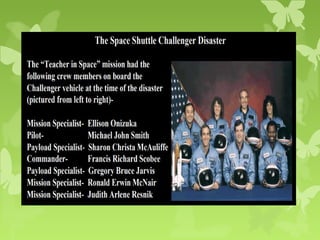
Morals are guiding principles that every citizen
should hold.
Morals are foundational concepts defined on
both an individual and societal level.
At the most basic level, morals are the
knowledge of the difference between right and
wrong.
Engineering Ethics
Engineering Ethics is the activity and discipline
aimed at
 Understanding the moral values that ought to
guide engineering profession or practice,
 Resolving moral issues in engineering, and
 Justifying the moral judgments in engineering.
It deals with set of moral problems and issues
connected with engineering.
“An engineer has to be well qualified, well
informed & committed to his obligations to the
society”
WHY STUDY ENGINEERING ETHICS
 What is the point in studying engineering ethics?
Students of engineering receive inputs in
 basic engineering sciences
 Design
 Manufacture
 Technical Problems Solving Abilities
 Software skills.
A technically gifted engineer but ethically weak
engineer may cause harm & damage to the society
WHY STUDY ENGINEERING ETHICS
What can be gained from taking a course in ethics?
Increased awareness of importance due high profile
engineering failures.
Engineering decisions can impact public health,
safety, business practices and politics. Engineers
should be aware of moral effects as they make
decisions in the workplace.
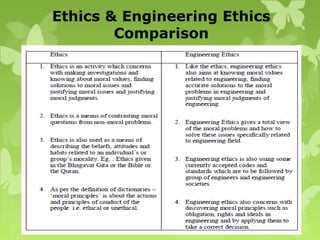
Ethics & Engineering Ethics
Comparison
Goal of Engineering Ethics
What is the need of studying engineering ethics?
Engineers should have a clear
concept on related theories
and standards involved in
identifying and enlisting the
types of ethical issues that is
likely to occur
Senses of Engineering Ethics
 Ethics is an activity and area of inquiry. It is
the activity of understanding moral values,
resolving moral issues and the area of study
resulting from that activity.
 When we speak of ethical problems, issues and
controversies, we mean to distinguish them
from non moral problems.
 Ethics is used to refer to the particular set of
beliefs, attitudes and habits that a person or
group displays concerning moralities.
 Ethics and its grammatical variants can be used
as synonyms for ‘morally correct’.
SENSES OF ENGINEERING ETHICS
 There are two different senses (meanings) of
engineering ethics, namely the Normative and the
Descriptive senses.
 The normative sense include:
(a)Knowing moral values, finding accurate solutions to
moral problems and justifying moral judgments in
engineering practices,
(b)Study of decisions, policies, and values that are
morally desirable in the engineering practice and
research, and
(c)Using codes of ethics and standards and applying
them in their transactions by engineers.
 The descriptive sense refers to what specific
individual or group of engineers believe and act,
without justifying their beliefs or actions.
Examples for moral issues
 Challenger Explosion, the accidents at the
nuclear plants at Chernobyl and Three Mile
Island and the Chemical plant at Bhopal, the
Exxon Valdez oil spill.
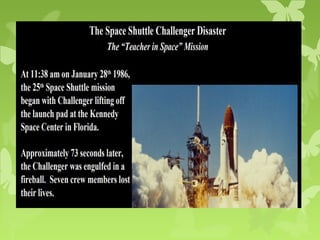
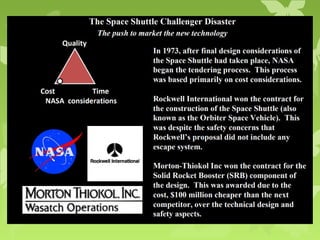
Challenger Explosion
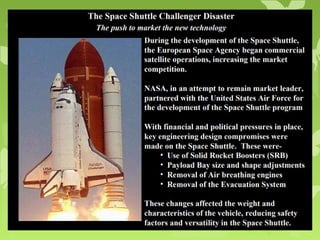
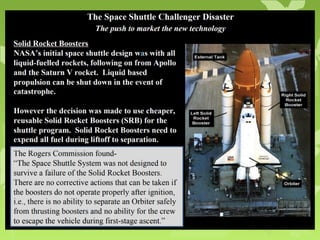
Analyze the details of the Challenger disaster
and then examine if and how principles actors
in this tragedy behaved as responsible
experimenters within the framework of the
engineering as experimentation model.
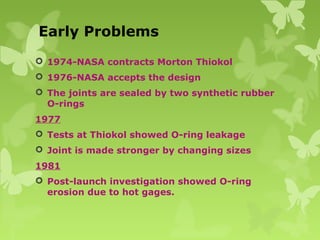
Early Problems
 1974-NASA contracts Morton Thiokol
 1976-NASA accepts the design
 The joints are sealed by two synthetic rubber
O-rings
1977
 Tests at Thiokol showed O-ring leakage
 Joint is made stronger by changing sizes
1981
 Post-launch investigation showed O-ring
erosion due to hot gages.
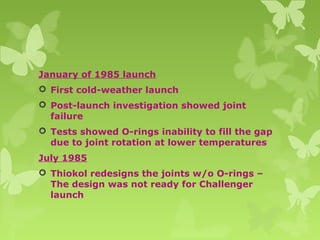
January of 1985 launch
 First cold-weather launch
 Post-launch investigation showed joint
failure
 Tests showed O-rings inability to fill the gap
due to joint rotation at lower temperatures
July 1985
 Thiokol redesigns the joints w/o O-rings –
The design was not ready for Challenger
launch
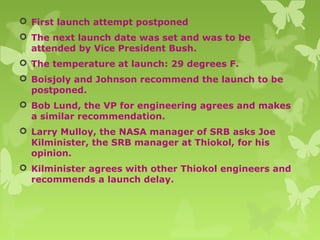
 First launch attempt postponed
 The next launch date was set and was to be
attended by Vice President Bush.
 The temperature at launch: 29 degrees F.
 Boisjoly and Johnson recommend the launch to be
postponed.
 Bob Lund, the VP for engineering agrees and makes
a similar recommendation.
 Larry Mulloy, the NASA manager of SRB asks Joe
Kilminister, the SRB manager at Thiokol, for his
opinion.
 Kilminister agrees with other Thiokol engineers and
recommends a launch delay.
 After discussion with Mason,Lund reverses
his decision regarding launch!
 Thiokol recommend
 The overnight temperatures drop to 8 F
 The temperature of SRB at launch is 28 F
 There is an immediate blow-by of hot gas at
launch. The seal fails quickly over an arc of
70 degrees.
 The by-products of combustion forms a
glassy oxide that reseals the joint.
 The brittle oxide is shattered
 Hot gases quickly burn through the liquid
rocket booster
Approaches or Varieties
 There are conventionally two approaches in the
study of ethics:
1. Micro-ethics which deals with decisions and
problems made by individuals, professionals,
and companies. This term is more about some
typical and everyday problems, which play an
important role in the field of engineering and in
the profession of an engineer.
2. Macro-ethics which deals with the societal
problems on a regional/national level. This term
deals with all the social problems which are
unknown and suddenly burst out on a regional
or national level.
How moral issues are related with
(i) Organization (ii) Environment
and (iii)Society
 Organizational Related: Most of the engineers are not
self-employed, they are employees of some
organization or other. As an employee, an Engineer
should utilize his / her skills in the benefit of the
organization and should take decisions in the interest of
the organization.
 Environment Related: It is very essential to use the
resources carefully without depleting them. An engineer
should take care of not to spoil the nature resources.
 Society Related: An engineer is expected to have a
certain amount of social responsibility in addition to his
core activities. Thus, his motive should not be solely to
earn money at the cost of society interest.
Where and How do Moral
Problems arise in Engineering?
Inspite of the engineers’ full attention and care,
sometimes the product or project may be unsafe
or less useful. This may be due to
1) The product or project may be designed for
early obsolescence (outdated)
2) due to under pressure because of running out
of time, budgetary etc
3) by ignorance on the size of the project,
4) because of the large number of a products sold
on the mass market, people may be affected.
MORAL PROBLEMS IN ENGINEERING
(SOME EXAMPLES)
 An inspector discovered faulty construction equipment
and applied a violation tag, preventing its use. The
supervisor, a construction manager viewed the case as a
minor abrasion of the safety regulations and ordered the
removal of the tag to speed up the project. When the
inspector objected to this, he was threatened with
disciplinary action.
 An electric utility company applied for a permit to
operate a nuclear power plant. The licensing agency was
interested in knowing what emergency measures had
been established for humans safety in case of reactor
malfunctioning. The utility engineers described the
alarm system and arrangements with local hospitals for
treatment. They did not emphasize that this measures
applied to plant personnel only and that they had no
plans for the surrounding population. When enquired
about their omission, they said it was not their
responsibility.
MORAL PROBLEMS IN ENGINEERING
(SOME EXAMPLES)
 A chemical plant dumped wastes in a landfill.
Hazardous substances found their way into the
underground water table. The plant’s engineers were
aware of the situation but did not change the method
of disposal because their competitors did it the same
cheap way, and no law explicitly forbade the practice.
 Electronics Company ABC geared up for production of
its own version of a popular new item. The product
was not yet ready for sale, but even so, pictures and
impressive specifications appeared in
advertisements. Prospective customers were led to
believe that it was available off the shelf and were
drawn away from competing lines.
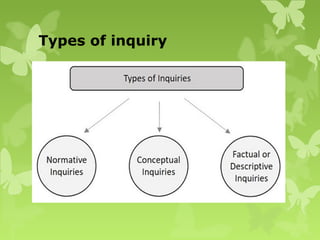
Types of inquiry
Normative
Normative Inquiry refers to the description
that describes what one ought to do under
a specific circumstance. Helps to identify
the values that should guide individuals
and groups.
Some of the questions are:
 How far engineers are obligated to protect public safety in given
situations?
 When should engineers start whistle blowing on dangerous practices of
their employers?
 Whose values are primary in taking a moral decision, employee, public or
government?
 Why are engineers obligated to protect public safety?
 When is government t justified in interfering on such issues and why?
CONCEPTUAL INQUIRES
Conceptual Inquiry refers to the description
of the meaning of concepts, principles and
issues related to engineering ethics.
Some of the questions are:
 What is ‘SAFETY’ and how is it related to ‘RISK’
 ‘Protect the safety, health and welfare of public’-
What does this statement mean?
 What is a bribe?
 What is a ‘profession’ and who are ‘professionals’?
FACTUAL (DESCRIPTIVE)
INQUIRIES
Factual Inquiry or the descriptive inquiry
help to provide the facts for understanding
and finding solutions to the value based
issues.
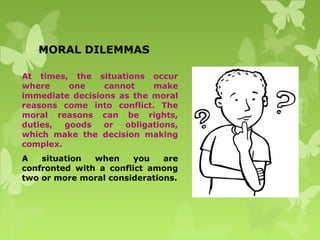
MORAL DILEMMAS
At times, the situations occur
where one cannot make
immediate decisions as the moral
reasons come into conflict. The
moral reasons can be rights,
duties, goods or obligations,
which make the decision making
complex.
A situation when you are
confronted with a conflict among
two or more moral considerations.
Example 1- moral dilemma
 The hijacked plane with 200 people is
approaching a building with 50,000
people.
 Vote! Will you shoot down the plane?
 You cannot subscribe to both principles
in the case.
Example 2-Moral Dilemma
For example, suppose one gives a promise to his
friend that he will meet him on the evening of a
particular day, but unfortunately on the same day
his brother has met with an accident and he has to
take him to hospital. The dilemma here consists of
a conflict between the duty to keep promise and
obligations to his brother. In this situation, to
solve his moral problem, he can make a phone call
to his friend and make apology for his inability to
come. So, from the above it is clear that the duty
to keep promise always has two different and
conflicting applications.
When does a moral dilemma
arise?
 Conflicts
 Lack of Self confidence
 Mental illness
Types of moral dilemmas
 Problem of vagueness: It may be unclear to
individuals which, if any moral considerations or
principles apply to situations
 Problem of conflicting reasons: It may be perfectly
clear which moral principles apply to ones
situations.
 The problem of disagreement: Reasonable and
responsible individuals and group may disagree
about how to interpret, apply and balance moral
reasons in particular situations.
Steps in confronting moral
dilemmas
1. Identify the relevant moral factors and reasons.
2. Gather all available facts that are pertinent to the
moral factors involved.
3. Rank the moral considerations in order of
importance.
4. Consider alternative courses of action as ways of
resolving the dilemma.
5. Talk with colleagues and seek their suggestions.
6. Arrive at a carefully reasoned judgment.
Moral Autonomy
1. self-governing or self-determining
2. acting independently
3. Moral autonomy can be viewed as the skill and
habit of thinking rationally about the ethically
issues on the basis of moral concern.
4. Moral autonomy is concerned with the
independent attitude of a person related to ethical
issues. It helps to improve the self- determination
among the individuals.
SKILLS FOR IMPROVING MORAL
AUTONOMY
1. Proficiency in recognizing moral problems and issues in engineering.
2. Skill to process, clarify and understand the arguments against the
moral issues
3. Ability to suggest the solutions to moral issues on the basis of facts
4. Awareness of alternate responses to issues and creative solutions
for practical difficulties.
5. Sensitivity to genuine difficulties and refinements.
6. Increased precision in the use of a common ethical language, which
is necessary in order to be able to express and defend one’s moral
views to others.
7. Appreciation of possibilities of using rational dialogue in resolving
moral conflicts and the need for tolerance of differences in
perspective among orally reasonable people.
8. A sense of importance of integrating one’s professional life and
personal convictions i.e. maintaining one’s moral integrity.
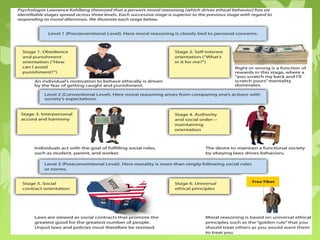
Kohlberg’s Theory of moral
development
Lawrence Kohlberg was, for many years, a
professor at Harvard University. He became
famous for his work there beginning in the
early 1970s. He started as a developmental
psychologist and then moved to the field of
moral education. He was particularly well-
known for his theory of moral development.
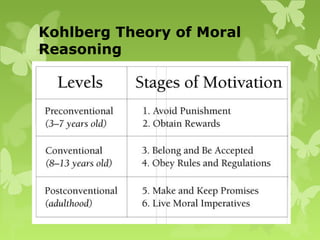
Kohlberg believed that people progressed in
their moral reasoning (i.e., in their bases for
ethical behavior) through a series of stages. He
believed that there were six identifiable stages
which could be more generally classified into
three levels.
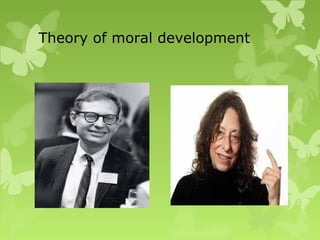
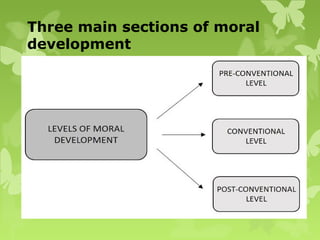
Theory of moral development
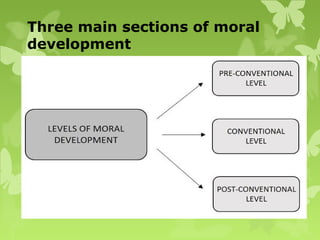
Three main sections of moral
development
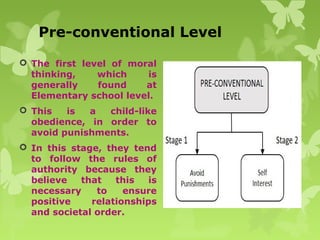
Pre-conventional Level
 The first level of moral
thinking, which is
generally found at
Elementary school level.
 This is a child-like
obedience, in order to
avoid punishments.
 In this stage, they tend
to follow the rules of
authority because they
believe that this is
necessary to ensure
positive relationships
and societal order.
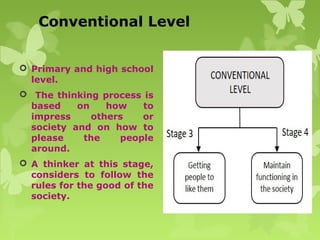
Conventional Level
 Primary and high school
level.
 The thinking process is
based on how to
impress others or
society and on how to
please the people
around.
 A thinker at this stage,
considers to follow the
rules for the good of the
society.
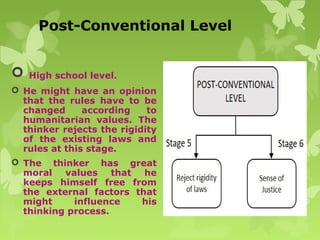
Post-Conventional Level
 High school level.
 He might have an opinion
that the rules have to be
changed according to
humanitarian values. The
thinker rejects the rigidity
of the existing laws and
rules at this stage.
 The thinker has great
moral values that he
keeps himself free from
the external factors that
might influence his
thinking process.
Kohlberg Theory of Moral
Reasoning
Gilligan’s Theory
Carol Gilligan, a psychological theorist was born on
Nov 28, 1936 in the New York city. She pursued her
doctorate degree in Social Psychology from the Harvard
University. Gilligan was a research assistant for
Lawrence Kohlberg, but she eventually became
independent and criticized some of his theories.
Carol Gilligan opines that Kohlberg’s theories are
biased upon the male thinking process. According to
Gilligan, Kohlberg seemed to have studied only
privileged men and boys. She believed that women face
a lot of psychological challenges and they are not moral
widgets. The women’s point of view on moral
development involves caring which shows its effect on
human relationships.
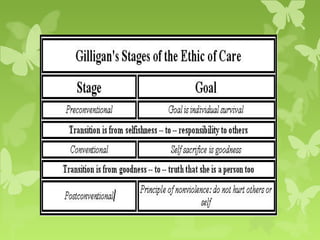
Hence she proposed a theory which has the same
three stages of Kohlberg but with different stages of
moral development.
Three main sections of moral
development
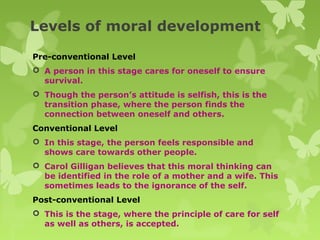
Levels of moral development
Pre-conventional Level
 A person in this stage cares for oneself to ensure
survival.
 Though the person’s attitude is selfish, this is the
transition phase, where the person finds the
connection between oneself and others.
Conventional Level
 In this stage, the person feels responsible and
shows care towards other people.
 Carol Gilligan believes that this moral thinking can
be identified in the role of a mother and a wife. This
sometimes leads to the ignorance of the self.
Post-conventional Level
 This is the stage, where the principle of care for self
as well as others, is accepted.
It was stated that the post-
conventional level of Kohlberg is not
attained by women. But Carol
Gilligan researched and found that
the post-conventional level of
thinking is not being easy for women
to go through because they care for
the relationships.
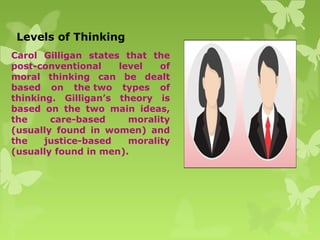
Levels of Thinking
Carol Gilligan states that the
post-conventional level of
moral thinking can be dealt
based on the two types of
thinking. Gilligan’s theory is
based on the two main ideas,
the care-based morality
(usually found in women) and
the justice-based morality
(usually found in men).
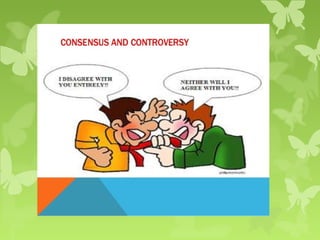
MEANING
o CONSENSUS
 agreement.
 Ex: The consensus of the universities is that
they should conduct university exam twice in a
year.
o CONTROVERSY-DISAGREEMENT /Argument
 All individuals will not arrive at same verdict
during their exercising their moral autonomy.
Need of Consensus and Controversy
The consensus and the controversies are
playing the vital roles while considering the
moral autonomy.
When an individual exercises the moral
autonomy, he cannot get the same results as
others get in applying moral autonomy. Surely
there must be some moral differences i.e. the
results or verdicts will be of controversy. This
kind of disagreements is unavoidable. These
disagreements require some tolerances among
individuals those who are autonomous,
reasonable and responsible.
Relationship between Consensus,
Authority
 One major goal of engineering ethics is to
promote authority while exercising
consensus.
 Consensus concerning the role of authority.
 Ex: Teachers having authority over students
and managers having authority over
engineers. • So authority provides framework
in which learning ,tolerance , consensus take
place.
Another Example
 The conductor of a music orchestra has
authority over the musicians and his
authority is respected by them by consensus
as otherwise the music performance will
suffer.
 Hence the authority and autonomy and
consensus are compatible
Professions and Professionalism
Profession means a job or an occupation, that
helps a person to earn for his living. The main
criteria of a profession involves the following.
1.Knowledge-Knowing how and knowing that
2.Organization-controlled by the professional
members
3.Public Good-serves for public
Professional and professionalism
 A "professional" is someone who gets paid for
a type of work;
 whereas "professionalism" depends
upon competence in doing that work…"the key
to quality and efficiency".
 “Professional” can be referred to a person
whereas “Professionalism” is a person's
quality.
Models of Professional Engineers
An engineer who is a professional, has some
tasks to perform by which he acts as any of the
following, which can be termed as Models of
Professional Engineers.
Savior − A person who saves someone or
something from any danger is called a Savior. An
engineer who saves a group of people or a
company from a technical danger can also be
called a Savior.
Guardian − A person who knows the direction
towards a better future is known to be the
Guardian for the same. An engineer who knows
the direction in which there is scope for the
technology to develop can also be called
a Guardian.
Models of Professional Engineers
 Bureaucratic Servant − A person who is loyal and can
solve problems when they occur using his own skills, is
a Bureaucratic servant.
 Social Servant − A person who works for the benefit of
the society without any selfish interest and does not
work on any business grounds, is called a Social
servant.
 Social Enabler or Catalyst − A person who makes the
society understand its welfare and works towards the
benefits of the people in it, is a Social Enabler.
 Game Player − A person who plays a game according to
the rules given is a Game player in general. An engineer
who acts as neither a servant nor a master, but provides
his services and plans his works according to the
economic game rules in a given time, can be termed as a
Game player.
Ethical Theories
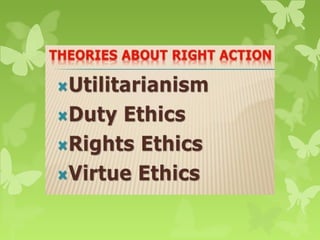
Theories about Right Action
Moral theory
To provide a variety of theories as to what
matters morally.
A moral theory is a mechanism for assessing
whether a particular action or rule is ethically
justified.
Theory of Right Action: Which actions are morally
permissible, which are morally required, and which
are morally prohibited?
What is the basis of all value?
What marks a character trait as a virtue?
A Thought Experiment
The Trolley Problem:
nytimes.com
A Thought Experiment
The Trolley Problem:
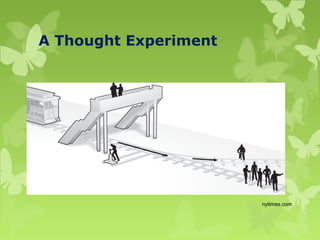
“There is a runaway trolley barreling down
the railway tracks. Ahead, on the tracks, there
are five people; the trolley is headed straight
for them. There is no way that they can get off
the track before the train hits them. You are
standing some distance off in the train yard,
next to a lever. If you pull this lever, the
trolley will switch to a different set of tracks.
Unfortunately, you notice that there is one
person on the side track. If you divert the
trolley, it will hit this other person for sure.”
A Thought Experiment
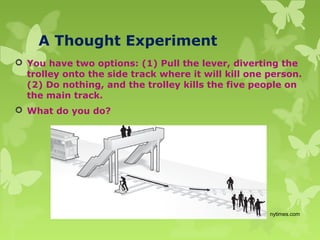
 You have two options: (1) Pull the lever, diverting the
trolley onto the side track where it will kill one person.
(2) Do nothing, and the trolley kills the five people on
the main track.
 What do you do?
nytimes.com
What are right actions ?
Right actions are the ones that produce the greatest
satisfaction of the preferences of the affected
persons.
In analyzing an issue in this approach, we have to:
(a)Identify the various courses of action available to us.
(b)Ask who will be affected by each action and what benefits
or harms will be derived from each.
(c)Choose the action that will produce the greatest benefits
and the least harm. The ethical action is the one that
provides the greatest good for the greatest number.
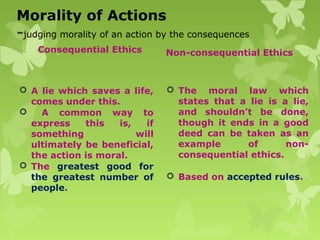
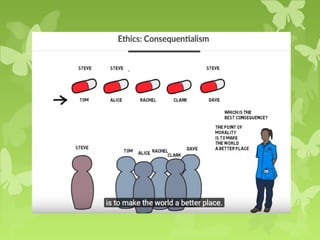
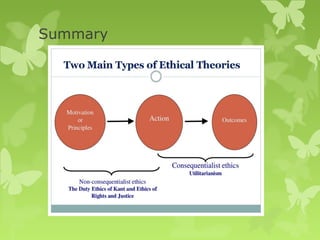
Morality of Actions
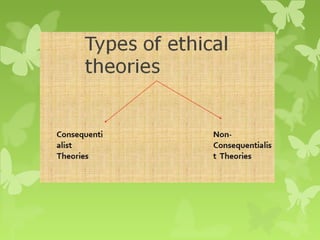
-judging morality of an action by the consequences
Consequential Ethics
 A lie which saves a life,
comes under this.
 A common way to
express this is, if
something will
ultimately be beneficial,
the action is moral.
 The greatest good for
the greatest number of
people.
Non-consequential Ethics
 The moral law which
states that a lie is a lie,
and shouldn’t be done,
though it ends in a good
deed can be taken as an
example of non-
consequential ethics.
 Based on accepted rules.
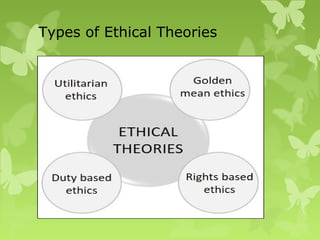
Types of Ethical Theories
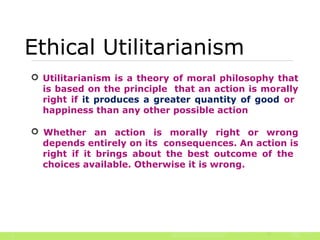
Ethical Utilitarianism
 Utilitarianism is a theory of moral philosophy that
is based on the principle that an action is morally
right if it produces a greater quantity of good or
happiness than any other possible action
 Whether an action is morally right or wrong
depends entirely on its consequences. An action is
right if it brings about the best outcome of the
choices available. Otherwise it is wrong.
What are these ethics?
Consider the cost-benefit analysis in engineering.
A typical cost-benefit analysis identifies the good
and bad consequences of some action or policy. It
weighs the total good against total bad and then
compares the results to similar tallies of the
consequences of alternative actions or rules. This
supports the idea of maximizing benefits against
cost.
Utilitarianism
Two types of utilitarianism :
Act utilitarianism
The ACT UTILITARIAN theory proposed by J.S. Mill
focuses on actions, rather than on general rules. An
action is right, if it generates the most overall good for
the most people involved.
Rule utilitarianism
The RULE UTILITARIAN theory, developed by Richard
Brandt , stressed on the rules, such as ‘do not steal’, ‘do
no harm others’, ‘do not bribe’, as of primary importance.
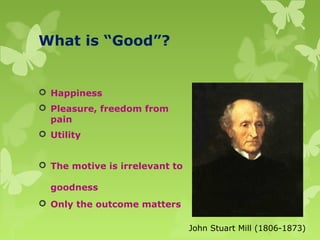
What is “Good”?
 Happiness
 Pleasure, freedom from
pain
 Utility
 The motive is irrelevant to
goodness
 Only the outcome matters
John Stuart Mill (1806-1873)
Duty or Deontological
Theories
• One example of deontological theory is Kant’s
Duty Ethics proposed by Immanuel Kant (1724-
1804)
• According to him ,the morality of an action is
based on the rightness or wrongness of the
action itself, not on the consequence of the
action.
• As rational beings we must follow certain
maxims and rules .
Duty or Deontological
Ethics
• Deontological (duty-based) theories are of the view that
morality of an action is solely dependent on the quality
of action. i.e., whether it follows a rule , irrespective of
the consequences of that action.
• Consequences do NOT matter !
• Morality depends only on the intension behind the act.
• When faced with an ethical situation, then, the process is
simply one of identifying one’s duty and making the
appropriate decision.
Rawl two basic moral principles-
Ethics of Justice
(1)Each person is entitled to the most extensive
amount of liberty compatible with an equal
amount for others, and
(2)differences in social power and economic
benefits are justified only when they are
likely to benefit every one, including
members of the most disadvantaged groups.
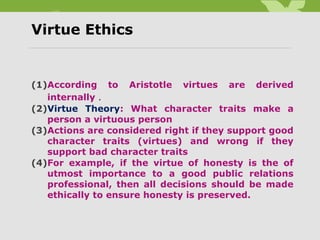
Virtue Ethics
(1)According to Aristotle virtues are derived
internally .
(2)Virtue Theory: What character traits make a
person a virtuous person
(3)Actions are considered right if they support good
character traits (virtues) and wrong if they
support bad character traits
(4)For example, if the virtue of honesty is the of
utmost importance to a good public relations
professional, then all decisions should be made
ethically to ensure honesty is preserved.
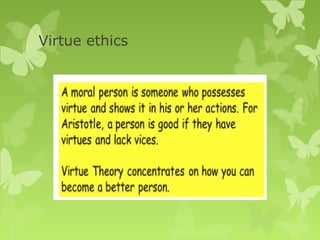
Virtue ethics
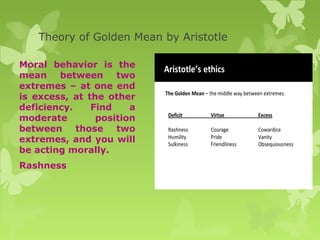
Theory of Golden Mean by Aristotle
Moral behavior is the
mean between two
extremes – at one end
is excess, at the other
deficiency. Find a
moderate position
between those two
extremes, and you will
be acting morally.
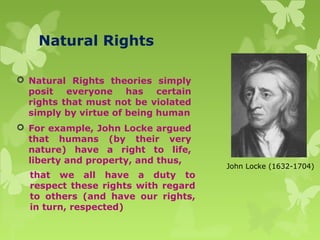
Rashness
that we all have a duty to
respect these rights with regard
to others (and have our rights,
in turn, respected)
 Natural Rights theories simply
posit everyone has certain
rights that must not be violated
simply by virtue of being human
 For example, John Locke argued
that humans (by their very
nature) have a right to life,
liberty and property, and thus,
John Locke (1632-1704)
Natural Rights
Summary
Testing ethical theories
Five widely used tests for evaluating ethical
theories:
1. The theory must be clear
2. It must be consistent
3. Neither the theory nor its defense can rely upon
false information
4. It must be sufficiently comprehensive to provide
guidance in specific situations of interest to us.
5. It must be compatible with our most carefully
considered moral convictions about concrete
situations.
Self-interest
 Self-interest is being good and acceptable to
oneself. It is pursuing what is good for
oneself.
 It is very ethical to possess self-interest.
 As per utilitarian theory, this interest should
provide for the respect of others also.
 Duty ethics recognizes this aspect as duties
to ourselves. Then only one can help others.
 Right ethicist stresses our rights to pursue
our own good.
 Virtue ethics also accepts the importance of
self-respect
What is ethical egoism?
 Egoism is self-respect.
 A person who respects him/herself can
respect the rights of others.
 A person who does not respect her/himself
cannot and does not respect the rights of
others.
 It deals with self-interest. Each person is the
best judge of their own self-interest and is
responsible for maximizing their own
interest.
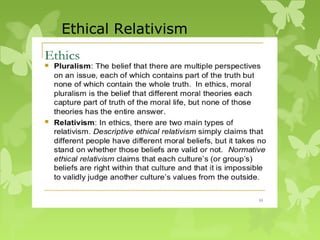
Ethical Relativism
Ethical Relativism and Ethical
Egoism
 Ethical egoism – the view that right action
consist in producing ones own good.
 Ethical relativism – the view that right action
is merely what the law and customs of one„s
society require.
Religion
 Religions have played major roles in shaping
moral views and moral values, over geographical
regions.
 Christianity has influenced the Western countries,
Islam in the Middle-East countries, Buddhism and
Hinduism in Asia, and Confucianism in China.
 Further, there is a strong psychological link
between the moral and religious beliefs of people
following various religions and faiths. Religions
support moral responsibility.
 They have set high moral standards. Faith in the
religions provides trust and this trust inspires
people to be moral.
 The religions insist on tolerance and moral
concern for others. Many professionals who
possess religious beliefs are motivated
 Each religion lays stress on certain high moral
standards. For example, Hinduism holds polytheistic
(many gods) view, and virtues of devotion and
surrender to high order.
 Christianity believes in one deity and emphasizes on
virtues of Love, Faith, and Hope. Buddhism is non-
theistic and focuses on compassion and Islam on
one deity and adherence of ishan (piety or pursuit of
excellence) and prayer.
 Judaism stresses the virtue of ‘tsedakah’
(righteousness). But many religious sects have
adopted poor moral standards, e.g., many religious
sects do not recognize equal rights for women.
 The right to worship is denied for some people.
 People are killed in the name of or to promote
religion.
 Thus, conflicts exist between the ‘secular’ and
religious people and between one religion and
another.
Uses of Ethical Theories
Ethical theories are very useful in
 understanding and resolving moral dilemmas.
 In estimating the professional obligations
and ideals.
 Determine to what extent, the obligations can
be exercised in a given situation.
References
 https://www.tutorialspoint.com/engineering_ethics/

Engineering Ethics

  • 1.
    GE6075-Engineering Ethics M.Jagadeesh, AssistantProfessor, Information Technology, MNM Jain Engineering College, Chennai
  • 2.
    Unit 2 Senses of'Engineering Ethics' - variety of moral issues - types of inquiry - moral dilemmas – moral autonomy - Kohlberg's theory - Gilligan's theory - consensus and controversy – Models of Professional Roles -theories about right action - Self- interest - customs and religion - uses of ethical theories.
  • 4.
    MORALS Morals are guidingprinciples that every citizen should hold. Morals are foundational concepts defined on both an individual and societal level. At the most basic level, morals are the knowledge of the difference between right and wrong.
  • 5.
    Engineering Ethics Engineering Ethicsis the activity and discipline aimed at  Understanding the moral values that ought to guide engineering profession or practice,  Resolving moral issues in engineering, and  Justifying the moral judgments in engineering. It deals with set of moral problems and issues connected with engineering. “An engineer has to be well qualified, well informed & committed to his obligations to the society”
  • 6.
    WHY STUDY ENGINEERINGETHICS  What is the point in studying engineering ethics? Students of engineering receive inputs in  basic engineering sciences  Design  Manufacture  Technical Problems Solving Abilities  Software skills. A technically gifted engineer but ethically weak engineer may cause harm & damage to the society
  • 7.
    WHY STUDY ENGINEERINGETHICS What can be gained from taking a course in ethics? Increased awareness of importance due high profile engineering failures. Engineering decisions can impact public health, safety, business practices and politics. Engineers should be aware of moral effects as they make decisions in the workplace.
  • 8.
    Ethics & EngineeringEthics Comparison
  • 9.
    Goal of EngineeringEthics What is the need of studying engineering ethics? Engineers should have a clear concept on related theories and standards involved in identifying and enlisting the types of ethical issues that is likely to occur
  • 10.
    Senses of EngineeringEthics  Ethics is an activity and area of inquiry. It is the activity of understanding moral values, resolving moral issues and the area of study resulting from that activity.  When we speak of ethical problems, issues and controversies, we mean to distinguish them from non moral problems.  Ethics is used to refer to the particular set of beliefs, attitudes and habits that a person or group displays concerning moralities.  Ethics and its grammatical variants can be used as synonyms for ‘morally correct’.
  • 11.
    SENSES OF ENGINEERINGETHICS  There are two different senses (meanings) of engineering ethics, namely the Normative and the Descriptive senses.  The normative sense include: (a)Knowing moral values, finding accurate solutions to moral problems and justifying moral judgments in engineering practices, (b)Study of decisions, policies, and values that are morally desirable in the engineering practice and research, and (c)Using codes of ethics and standards and applying them in their transactions by engineers.  The descriptive sense refers to what specific individual or group of engineers believe and act, without justifying their beliefs or actions.
  • 12.
    Examples for moralissues  Challenger Explosion, the accidents at the nuclear plants at Chernobyl and Three Mile Island and the Chemical plant at Bhopal, the Exxon Valdez oil spill.
  • 13.
    Challenger Explosion Analyze thedetails of the Challenger disaster and then examine if and how principles actors in this tragedy behaved as responsible experimenters within the framework of the engineering as experimentation model.
  • 20.
    Early Problems  1974-NASAcontracts Morton Thiokol  1976-NASA accepts the design  The joints are sealed by two synthetic rubber O-rings 1977  Tests at Thiokol showed O-ring leakage  Joint is made stronger by changing sizes 1981  Post-launch investigation showed O-ring erosion due to hot gages.
  • 21.
    January of 1985launch  First cold-weather launch  Post-launch investigation showed joint failure  Tests showed O-rings inability to fill the gap due to joint rotation at lower temperatures July 1985  Thiokol redesigns the joints w/o O-rings – The design was not ready for Challenger launch
  • 22.
     First launchattempt postponed  The next launch date was set and was to be attended by Vice President Bush.  The temperature at launch: 29 degrees F.  Boisjoly and Johnson recommend the launch to be postponed.  Bob Lund, the VP for engineering agrees and makes a similar recommendation.  Larry Mulloy, the NASA manager of SRB asks Joe Kilminister, the SRB manager at Thiokol, for his opinion.  Kilminister agrees with other Thiokol engineers and recommends a launch delay.
  • 23.
     After discussionwith Mason,Lund reverses his decision regarding launch!  Thiokol recommend  The overnight temperatures drop to 8 F  The temperature of SRB at launch is 28 F  There is an immediate blow-by of hot gas at launch. The seal fails quickly over an arc of 70 degrees.  The by-products of combustion forms a glassy oxide that reseals the joint.  The brittle oxide is shattered  Hot gases quickly burn through the liquid rocket booster
  • 28.
    Approaches or Varieties There are conventionally two approaches in the study of ethics: 1. Micro-ethics which deals with decisions and problems made by individuals, professionals, and companies. This term is more about some typical and everyday problems, which play an important role in the field of engineering and in the profession of an engineer. 2. Macro-ethics which deals with the societal problems on a regional/national level. This term deals with all the social problems which are unknown and suddenly burst out on a regional or national level.
  • 29.
    How moral issuesare related with (i) Organization (ii) Environment and (iii)Society  Organizational Related: Most of the engineers are not self-employed, they are employees of some organization or other. As an employee, an Engineer should utilize his / her skills in the benefit of the organization and should take decisions in the interest of the organization.  Environment Related: It is very essential to use the resources carefully without depleting them. An engineer should take care of not to spoil the nature resources.  Society Related: An engineer is expected to have a certain amount of social responsibility in addition to his core activities. Thus, his motive should not be solely to earn money at the cost of society interest.
  • 30.
    Where and Howdo Moral Problems arise in Engineering? Inspite of the engineers’ full attention and care, sometimes the product or project may be unsafe or less useful. This may be due to 1) The product or project may be designed for early obsolescence (outdated) 2) due to under pressure because of running out of time, budgetary etc 3) by ignorance on the size of the project, 4) because of the large number of a products sold on the mass market, people may be affected.
  • 31.
    MORAL PROBLEMS INENGINEERING (SOME EXAMPLES)  An inspector discovered faulty construction equipment and applied a violation tag, preventing its use. The supervisor, a construction manager viewed the case as a minor abrasion of the safety regulations and ordered the removal of the tag to speed up the project. When the inspector objected to this, he was threatened with disciplinary action.  An electric utility company applied for a permit to operate a nuclear power plant. The licensing agency was interested in knowing what emergency measures had been established for humans safety in case of reactor malfunctioning. The utility engineers described the alarm system and arrangements with local hospitals for treatment. They did not emphasize that this measures applied to plant personnel only and that they had no plans for the surrounding population. When enquired about their omission, they said it was not their responsibility.
  • 32.
    MORAL PROBLEMS INENGINEERING (SOME EXAMPLES)  A chemical plant dumped wastes in a landfill. Hazardous substances found their way into the underground water table. The plant’s engineers were aware of the situation but did not change the method of disposal because their competitors did it the same cheap way, and no law explicitly forbade the practice.  Electronics Company ABC geared up for production of its own version of a popular new item. The product was not yet ready for sale, but even so, pictures and impressive specifications appeared in advertisements. Prospective customers were led to believe that it was available off the shelf and were drawn away from competing lines.
  • 33.
  • 34.
    Normative Normative Inquiry refersto the description that describes what one ought to do under a specific circumstance. Helps to identify the values that should guide individuals and groups. Some of the questions are:  How far engineers are obligated to protect public safety in given situations?  When should engineers start whistle blowing on dangerous practices of their employers?  Whose values are primary in taking a moral decision, employee, public or government?  Why are engineers obligated to protect public safety?  When is government t justified in interfering on such issues and why?
  • 35.
    CONCEPTUAL INQUIRES Conceptual Inquiryrefers to the description of the meaning of concepts, principles and issues related to engineering ethics. Some of the questions are:  What is ‘SAFETY’ and how is it related to ‘RISK’  ‘Protect the safety, health and welfare of public’- What does this statement mean?  What is a bribe?  What is a ‘profession’ and who are ‘professionals’?
  • 36.
    FACTUAL (DESCRIPTIVE) INQUIRIES Factual Inquiryor the descriptive inquiry help to provide the facts for understanding and finding solutions to the value based issues.
  • 37.
    MORAL DILEMMAS At times,the situations occur where one cannot make immediate decisions as the moral reasons come into conflict. The moral reasons can be rights, duties, goods or obligations, which make the decision making complex. A situation when you are confronted with a conflict among two or more moral considerations.
  • 38.
    Example 1- moraldilemma  The hijacked plane with 200 people is approaching a building with 50,000 people.  Vote! Will you shoot down the plane?  You cannot subscribe to both principles in the case.
  • 39.
    Example 2-Moral Dilemma Forexample, suppose one gives a promise to his friend that he will meet him on the evening of a particular day, but unfortunately on the same day his brother has met with an accident and he has to take him to hospital. The dilemma here consists of a conflict between the duty to keep promise and obligations to his brother. In this situation, to solve his moral problem, he can make a phone call to his friend and make apology for his inability to come. So, from the above it is clear that the duty to keep promise always has two different and conflicting applications.
  • 40.
    When does amoral dilemma arise?  Conflicts  Lack of Self confidence  Mental illness
  • 41.
    Types of moraldilemmas  Problem of vagueness: It may be unclear to individuals which, if any moral considerations or principles apply to situations  Problem of conflicting reasons: It may be perfectly clear which moral principles apply to ones situations.  The problem of disagreement: Reasonable and responsible individuals and group may disagree about how to interpret, apply and balance moral reasons in particular situations.
  • 42.
    Steps in confrontingmoral dilemmas 1. Identify the relevant moral factors and reasons. 2. Gather all available facts that are pertinent to the moral factors involved. 3. Rank the moral considerations in order of importance. 4. Consider alternative courses of action as ways of resolving the dilemma. 5. Talk with colleagues and seek their suggestions. 6. Arrive at a carefully reasoned judgment.
  • 43.
    Moral Autonomy 1. self-governingor self-determining 2. acting independently 3. Moral autonomy can be viewed as the skill and habit of thinking rationally about the ethically issues on the basis of moral concern. 4. Moral autonomy is concerned with the independent attitude of a person related to ethical issues. It helps to improve the self- determination among the individuals.
  • 44.
    SKILLS FOR IMPROVINGMORAL AUTONOMY 1. Proficiency in recognizing moral problems and issues in engineering. 2. Skill to process, clarify and understand the arguments against the moral issues 3. Ability to suggest the solutions to moral issues on the basis of facts 4. Awareness of alternate responses to issues and creative solutions for practical difficulties. 5. Sensitivity to genuine difficulties and refinements. 6. Increased precision in the use of a common ethical language, which is necessary in order to be able to express and defend one’s moral views to others. 7. Appreciation of possibilities of using rational dialogue in resolving moral conflicts and the need for tolerance of differences in perspective among orally reasonable people. 8. A sense of importance of integrating one’s professional life and personal convictions i.e. maintaining one’s moral integrity.
  • 45.
    Kohlberg’s Theory ofmoral development Lawrence Kohlberg was, for many years, a professor at Harvard University. He became famous for his work there beginning in the early 1970s. He started as a developmental psychologist and then moved to the field of moral education. He was particularly well- known for his theory of moral development. Kohlberg believed that people progressed in their moral reasoning (i.e., in their bases for ethical behavior) through a series of stages. He believed that there were six identifiable stages which could be more generally classified into three levels.
  • 46.
    Theory of moraldevelopment
  • 47.
    Three main sectionsof moral development
  • 48.
    Pre-conventional Level  Thefirst level of moral thinking, which is generally found at Elementary school level.  This is a child-like obedience, in order to avoid punishments.  In this stage, they tend to follow the rules of authority because they believe that this is necessary to ensure positive relationships and societal order.
  • 49.
    Conventional Level  Primaryand high school level.  The thinking process is based on how to impress others or society and on how to please the people around.  A thinker at this stage, considers to follow the rules for the good of the society.
  • 50.
    Post-Conventional Level  Highschool level.  He might have an opinion that the rules have to be changed according to humanitarian values. The thinker rejects the rigidity of the existing laws and rules at this stage.  The thinker has great moral values that he keeps himself free from the external factors that might influence his thinking process.
  • 52.
    Kohlberg Theory ofMoral Reasoning
  • 53.
    Gilligan’s Theory Carol Gilligan,a psychological theorist was born on Nov 28, 1936 in the New York city. She pursued her doctorate degree in Social Psychology from the Harvard University. Gilligan was a research assistant for Lawrence Kohlberg, but she eventually became independent and criticized some of his theories. Carol Gilligan opines that Kohlberg’s theories are biased upon the male thinking process. According to Gilligan, Kohlberg seemed to have studied only privileged men and boys. She believed that women face a lot of psychological challenges and they are not moral widgets. The women’s point of view on moral development involves caring which shows its effect on human relationships. Hence she proposed a theory which has the same three stages of Kohlberg but with different stages of moral development.
  • 54.
    Three main sectionsof moral development
  • 55.
    Levels of moraldevelopment Pre-conventional Level  A person in this stage cares for oneself to ensure survival.  Though the person’s attitude is selfish, this is the transition phase, where the person finds the connection between oneself and others. Conventional Level  In this stage, the person feels responsible and shows care towards other people.  Carol Gilligan believes that this moral thinking can be identified in the role of a mother and a wife. This sometimes leads to the ignorance of the self. Post-conventional Level  This is the stage, where the principle of care for self as well as others, is accepted.
  • 56.
    It was statedthat the post- conventional level of Kohlberg is not attained by women. But Carol Gilligan researched and found that the post-conventional level of thinking is not being easy for women to go through because they care for the relationships.
  • 58.
    Levels of Thinking CarolGilligan states that the post-conventional level of moral thinking can be dealt based on the two types of thinking. Gilligan’s theory is based on the two main ideas, the care-based morality (usually found in women) and the justice-based morality (usually found in men).
  • 60.
    MEANING o CONSENSUS  agreement. Ex: The consensus of the universities is that they should conduct university exam twice in a year. o CONTROVERSY-DISAGREEMENT /Argument  All individuals will not arrive at same verdict during their exercising their moral autonomy.
  • 61.
    Need of Consensusand Controversy The consensus and the controversies are playing the vital roles while considering the moral autonomy. When an individual exercises the moral autonomy, he cannot get the same results as others get in applying moral autonomy. Surely there must be some moral differences i.e. the results or verdicts will be of controversy. This kind of disagreements is unavoidable. These disagreements require some tolerances among individuals those who are autonomous, reasonable and responsible.
  • 62.
    Relationship between Consensus, Authority One major goal of engineering ethics is to promote authority while exercising consensus.  Consensus concerning the role of authority.  Ex: Teachers having authority over students and managers having authority over engineers. • So authority provides framework in which learning ,tolerance , consensus take place.
  • 63.
    Another Example  Theconductor of a music orchestra has authority over the musicians and his authority is respected by them by consensus as otherwise the music performance will suffer.  Hence the authority and autonomy and consensus are compatible
  • 64.
    Professions and Professionalism Professionmeans a job or an occupation, that helps a person to earn for his living. The main criteria of a profession involves the following. 1.Knowledge-Knowing how and knowing that 2.Organization-controlled by the professional members 3.Public Good-serves for public
  • 65.
    Professional and professionalism A "professional" is someone who gets paid for a type of work;  whereas "professionalism" depends upon competence in doing that work…"the key to quality and efficiency".  “Professional” can be referred to a person whereas “Professionalism” is a person's quality.
  • 66.
    Models of ProfessionalEngineers An engineer who is a professional, has some tasks to perform by which he acts as any of the following, which can be termed as Models of Professional Engineers. Savior − A person who saves someone or something from any danger is called a Savior. An engineer who saves a group of people or a company from a technical danger can also be called a Savior. Guardian − A person who knows the direction towards a better future is known to be the Guardian for the same. An engineer who knows the direction in which there is scope for the technology to develop can also be called a Guardian.
  • 67.
    Models of ProfessionalEngineers  Bureaucratic Servant − A person who is loyal and can solve problems when they occur using his own skills, is a Bureaucratic servant.  Social Servant − A person who works for the benefit of the society without any selfish interest and does not work on any business grounds, is called a Social servant.  Social Enabler or Catalyst − A person who makes the society understand its welfare and works towards the benefits of the people in it, is a Social Enabler.  Game Player − A person who plays a game according to the rules given is a Game player in general. An engineer who acts as neither a servant nor a master, but provides his services and plans his works according to the economic game rules in a given time, can be termed as a Game player.
  • 68.
  • 69.
    Moral theory To providea variety of theories as to what matters morally. A moral theory is a mechanism for assessing whether a particular action or rule is ethically justified. Theory of Right Action: Which actions are morally permissible, which are morally required, and which are morally prohibited? What is the basis of all value? What marks a character trait as a virtue?
  • 70.
    A Thought Experiment TheTrolley Problem: nytimes.com
  • 71.
    A Thought Experiment TheTrolley Problem: “There is a runaway trolley barreling down the railway tracks. Ahead, on the tracks, there are five people; the trolley is headed straight for them. There is no way that they can get off the track before the train hits them. You are standing some distance off in the train yard, next to a lever. If you pull this lever, the trolley will switch to a different set of tracks. Unfortunately, you notice that there is one person on the side track. If you divert the trolley, it will hit this other person for sure.”
  • 72.
    A Thought Experiment You have two options: (1) Pull the lever, diverting the trolley onto the side track where it will kill one person. (2) Do nothing, and the trolley kills the five people on the main track.  What do you do? nytimes.com
  • 73.
    What are rightactions ? Right actions are the ones that produce the greatest satisfaction of the preferences of the affected persons. In analyzing an issue in this approach, we have to: (a)Identify the various courses of action available to us. (b)Ask who will be affected by each action and what benefits or harms will be derived from each. (c)Choose the action that will produce the greatest benefits and the least harm. The ethical action is the one that provides the greatest good for the greatest number.
  • 75.
    Morality of Actions -judgingmorality of an action by the consequences Consequential Ethics  A lie which saves a life, comes under this.  A common way to express this is, if something will ultimately be beneficial, the action is moral.  The greatest good for the greatest number of people. Non-consequential Ethics  The moral law which states that a lie is a lie, and shouldn’t be done, though it ends in a good deed can be taken as an example of non- consequential ethics.  Based on accepted rules.
  • 77.
  • 79.
    Ethical Utilitarianism  Utilitarianismis a theory of moral philosophy that is based on the principle that an action is morally right if it produces a greater quantity of good or happiness than any other possible action  Whether an action is morally right or wrong depends entirely on its consequences. An action is right if it brings about the best outcome of the choices available. Otherwise it is wrong.
  • 80.
    What are theseethics? Consider the cost-benefit analysis in engineering. A typical cost-benefit analysis identifies the good and bad consequences of some action or policy. It weighs the total good against total bad and then compares the results to similar tallies of the consequences of alternative actions or rules. This supports the idea of maximizing benefits against cost.
  • 81.
    Utilitarianism Two types ofutilitarianism : Act utilitarianism The ACT UTILITARIAN theory proposed by J.S. Mill focuses on actions, rather than on general rules. An action is right, if it generates the most overall good for the most people involved. Rule utilitarianism The RULE UTILITARIAN theory, developed by Richard Brandt , stressed on the rules, such as ‘do not steal’, ‘do no harm others’, ‘do not bribe’, as of primary importance.
  • 82.
    What is “Good”? Happiness  Pleasure, freedom from pain  Utility  The motive is irrelevant to goodness  Only the outcome matters John Stuart Mill (1806-1873)
  • 84.
    Duty or Deontological Theories •One example of deontological theory is Kant’s Duty Ethics proposed by Immanuel Kant (1724- 1804) • According to him ,the morality of an action is based on the rightness or wrongness of the action itself, not on the consequence of the action. • As rational beings we must follow certain maxims and rules .
  • 85.
    Duty or Deontological Ethics •Deontological (duty-based) theories are of the view that morality of an action is solely dependent on the quality of action. i.e., whether it follows a rule , irrespective of the consequences of that action. • Consequences do NOT matter ! • Morality depends only on the intension behind the act. • When faced with an ethical situation, then, the process is simply one of identifying one’s duty and making the appropriate decision.
  • 87.
    Rawl two basicmoral principles- Ethics of Justice (1)Each person is entitled to the most extensive amount of liberty compatible with an equal amount for others, and (2)differences in social power and economic benefits are justified only when they are likely to benefit every one, including members of the most disadvantaged groups.
  • 88.
    Virtue Ethics (1)According toAristotle virtues are derived internally . (2)Virtue Theory: What character traits make a person a virtuous person (3)Actions are considered right if they support good character traits (virtues) and wrong if they support bad character traits (4)For example, if the virtue of honesty is the of utmost importance to a good public relations professional, then all decisions should be made ethically to ensure honesty is preserved.
  • 89.
  • 90.
    Theory of GoldenMean by Aristotle Moral behavior is the mean between two extremes – at one end is excess, at the other deficiency. Find a moderate position between those two extremes, and you will be acting morally. Rashness
  • 95.
    that we allhave a duty to respect these rights with regard to others (and have our rights, in turn, respected)  Natural Rights theories simply posit everyone has certain rights that must not be violated simply by virtue of being human  For example, John Locke argued that humans (by their very nature) have a right to life, liberty and property, and thus, John Locke (1632-1704) Natural Rights
  • 96.
  • 97.
    Testing ethical theories Fivewidely used tests for evaluating ethical theories: 1. The theory must be clear 2. It must be consistent 3. Neither the theory nor its defense can rely upon false information 4. It must be sufficiently comprehensive to provide guidance in specific situations of interest to us. 5. It must be compatible with our most carefully considered moral convictions about concrete situations.
  • 98.
    Self-interest  Self-interest isbeing good and acceptable to oneself. It is pursuing what is good for oneself.  It is very ethical to possess self-interest.  As per utilitarian theory, this interest should provide for the respect of others also.  Duty ethics recognizes this aspect as duties to ourselves. Then only one can help others.  Right ethicist stresses our rights to pursue our own good.  Virtue ethics also accepts the importance of self-respect
  • 99.
    What is ethicalegoism?  Egoism is self-respect.  A person who respects him/herself can respect the rights of others.  A person who does not respect her/himself cannot and does not respect the rights of others.  It deals with self-interest. Each person is the best judge of their own self-interest and is responsible for maximizing their own interest.
  • 100.
  • 101.
    Ethical Relativism andEthical Egoism  Ethical egoism – the view that right action consist in producing ones own good.  Ethical relativism – the view that right action is merely what the law and customs of one„s society require.
  • 102.
    Religion  Religions haveplayed major roles in shaping moral views and moral values, over geographical regions.  Christianity has influenced the Western countries, Islam in the Middle-East countries, Buddhism and Hinduism in Asia, and Confucianism in China.  Further, there is a strong psychological link between the moral and religious beliefs of people following various religions and faiths. Religions support moral responsibility.  They have set high moral standards. Faith in the religions provides trust and this trust inspires people to be moral.  The religions insist on tolerance and moral concern for others. Many professionals who possess religious beliefs are motivated
  • 103.
     Each religionlays stress on certain high moral standards. For example, Hinduism holds polytheistic (many gods) view, and virtues of devotion and surrender to high order.  Christianity believes in one deity and emphasizes on virtues of Love, Faith, and Hope. Buddhism is non- theistic and focuses on compassion and Islam on one deity and adherence of ishan (piety or pursuit of excellence) and prayer.  Judaism stresses the virtue of ‘tsedakah’ (righteousness). But many religious sects have adopted poor moral standards, e.g., many religious sects do not recognize equal rights for women.  The right to worship is denied for some people.  People are killed in the name of or to promote religion.  Thus, conflicts exist between the ‘secular’ and religious people and between one religion and another.
  • 104.
    Uses of EthicalTheories Ethical theories are very useful in  understanding and resolving moral dilemmas.  In estimating the professional obligations and ideals.  Determine to what extent, the obligations can be exercised in a given situation.
  • 105.