School of Library & Information Science http://slisweb.sjsu.edu 
Ethical Issues in Reference: Challenges and Solutions 
Lili Luo, Ph.D. 
San José State University
School of Library & Information Science http://slisweb.sjsu.edu
School of Library & Information Science http://slisweb.sjsu.edu 
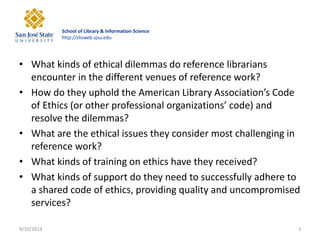
•What kinds of ethical dilemmas do reference librarians encounter in the different venues of reference work? 
•How do they uphold the American Library Association’s Code of Ethics (or other professional organizations’ code) and resolve the dilemmas? 
•What are the ethical issues they consider most challenging in reference work? 
•What kinds of training on ethics have they received? 
•What kinds of support do they need to successfully adhere to a shared code of ethics, providing quality and uncompromised services? 
9/10/2014 
3
School of Library & Information Science http://slisweb.sjsu.edu 
•An online survey sent to three listservs: LIBREF-L, ILI-L, and DIG-REF 
•212 valid responses -- 80% work in an academic library, 16.9% in a public library, and 3.1% in a special library. 
9/10/2014 
4
School of Library & Information Science http://slisweb.sjsu.edu 
9/10/2014 
5 
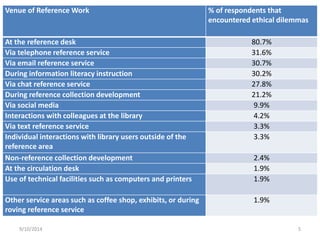
Venue of Reference Work 
% of respondents that encountered ethical dilemmas 
At the reference desk 
80.7% 
Via telephone reference service 
31.6% 
Via email reference service 
30.7% 
During information literacy instruction 
30.2% 
Via chat reference service 
27.8% 
During reference collection development 
21.2% 
Via social media 
9.9% 
Interactions with colleagues at the library 
4.2% 
Via text reference service 
3.3% 
Individual interactions with library users outside of the reference area 
3.3% 
Non-reference collection development 
2.4% 
At the circulation desk 
1.9% 
Use of technical facilities such as computers and printers 
1.9% 
Other service areas such as coffee shop, exhibits, or during roving reference service 
1.9%
School of Library & Information Science http://slisweb.sjsu.edu 
9/10/2014 
6 
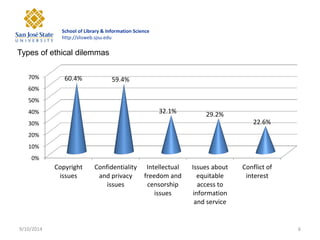
0% 
10% 
20% 
30% 
40% 
50% 
60% 
70% 
Copyright 
issues 
Confidentiality 
and privacy 
issues 
Intellectual 
freedom and 
censorship 
issues 
Issues about 
equitable 
access to 
information 
and service 
Conflict of 
interest 
60.4% 
59.4% 
32.1% 
29.2% 
22.6% 
Types of ethical dilemmas
School of Library & Information Science http://slisweb.sjsu.edu 
9/10/2014 
7 
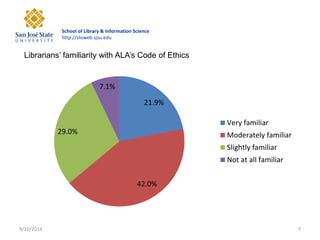
21.9% 
42.0% 
29.0% 
7.1% 
Very familiar 
Moderately familiar 
Slightly familiar 
Not at all familiar 
Librarians’ familiarity with ALA’s Code of Ethics
School of Library & Information Science http://slisweb.sjsu.edu 
9/10/2014 
8 
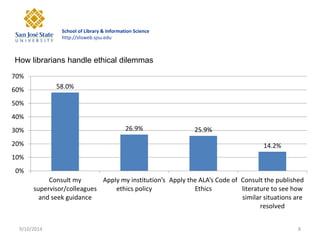
58.0% 
26.9% 
25.9% 
14.2% 
0% 
10% 
20% 
30% 
40% 
50% 
60% 
70% 
Consult my 
supervisor/colleagues 
and seek guidance 
Apply my institution’s ethics policy 
Apply the ALA’s Code of Ethics 
Consult the published 
literature to see how 
similar situations are 
resolved 
How librarians handle ethical dilemmas
School of Library & Information Science http://slisweb.sjsu.edu 
9/10/2014 
9 
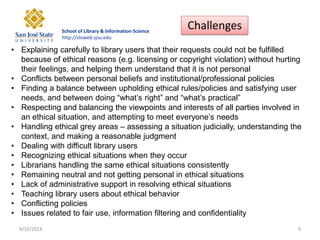
•Explaining carefully to library users that their requests could not be fulfilled because of ethical reasons (e.g. licensing or copyright violation) without hurting their feelings, and helping them understand that it is not personal 
•Conflicts between personal beliefs and institutional/professional policies 
•Finding a balance between upholding ethical rules/policies and satisfying user needs, and between doing “what’s right” and “what’s practical” 
•Respecting and balancing the viewpoints and interests of all parties involved in an ethical situation, and attempting to meet everyone’s needs 
•Handling ethical grey areas – assessing a situation judicially, understanding the context, and making a reasonable judgment 
•Dealing with difficult library users 
•Recognizing ethical situations when they occur 
•Librarians handling the same ethical situations consistently 
•Remaining neutral and not getting personal in ethical situations 
•Lack of administrative support in resolving ethical situations 
•Teaching library users about ethical behavior 
•Conflicting policies 
•Issues related to fair use, information filtering and confidentiality 
Challenges
School of Library & Information Science http://slisweb.sjsu.edu 
9/10/2014 
10 
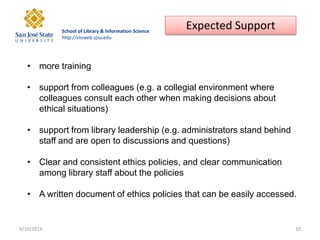
•more training 
•support from colleagues (e.g. a collegial environment where colleagues consult each other when making decisions about ethical situations) 
•support from library leadership (e.g. administrators stand behind staff and are open to discussions and questions) 
•Clear and consistent ethics policies, and clear communication among library staff about the policies 
•A written document of ethics policies that can be easily accessed. 
Expected Support
School of Library & Information Science http://slisweb.sjsu.edu 
9/10/2014 
11
School of Library & Information Science http://slisweb.sjsu.edu 
9/10/2014 
12 
Questions? lili.luo@sjsu.edu @foxfish

Ethical Issues in Reference: Challenges and Solutions

  • 1.
    School of Library& Information Science http://slisweb.sjsu.edu Ethical Issues in Reference: Challenges and Solutions Lili Luo, Ph.D. San José State University
  • 2.
    School of Library& Information Science http://slisweb.sjsu.edu
  • 3.
    School of Library& Information Science http://slisweb.sjsu.edu •What kinds of ethical dilemmas do reference librarians encounter in the different venues of reference work? •How do they uphold the American Library Association’s Code of Ethics (or other professional organizations’ code) and resolve the dilemmas? •What are the ethical issues they consider most challenging in reference work? •What kinds of training on ethics have they received? •What kinds of support do they need to successfully adhere to a shared code of ethics, providing quality and uncompromised services? 9/10/2014 3
  • 4.
    School of Library& Information Science http://slisweb.sjsu.edu •An online survey sent to three listservs: LIBREF-L, ILI-L, and DIG-REF •212 valid responses -- 80% work in an academic library, 16.9% in a public library, and 3.1% in a special library. 9/10/2014 4
  • 5.
    School of Library& Information Science http://slisweb.sjsu.edu 9/10/2014 5 Venue of Reference Work % of respondents that encountered ethical dilemmas At the reference desk 80.7% Via telephone reference service 31.6% Via email reference service 30.7% During information literacy instruction 30.2% Via chat reference service 27.8% During reference collection development 21.2% Via social media 9.9% Interactions with colleagues at the library 4.2% Via text reference service 3.3% Individual interactions with library users outside of the reference area 3.3% Non-reference collection development 2.4% At the circulation desk 1.9% Use of technical facilities such as computers and printers 1.9% Other service areas such as coffee shop, exhibits, or during roving reference service 1.9%
  • 6.
    School of Library& Information Science http://slisweb.sjsu.edu 9/10/2014 6 0% 10% 20% 30% 40% 50% 60% 70% Copyright issues Confidentiality and privacy issues Intellectual freedom and censorship issues Issues about equitable access to information and service Conflict of interest 60.4% 59.4% 32.1% 29.2% 22.6% Types of ethical dilemmas
  • 7.
    School of Library& Information Science http://slisweb.sjsu.edu 9/10/2014 7 21.9% 42.0% 29.0% 7.1% Very familiar Moderately familiar Slightly familiar Not at all familiar Librarians’ familiarity with ALA’s Code of Ethics
  • 8.
    School of Library& Information Science http://slisweb.sjsu.edu 9/10/2014 8 58.0% 26.9% 25.9% 14.2% 0% 10% 20% 30% 40% 50% 60% 70% Consult my supervisor/colleagues and seek guidance Apply my institution’s ethics policy Apply the ALA’s Code of Ethics Consult the published literature to see how similar situations are resolved How librarians handle ethical dilemmas
  • 9.
    School of Library& Information Science http://slisweb.sjsu.edu 9/10/2014 9 •Explaining carefully to library users that their requests could not be fulfilled because of ethical reasons (e.g. licensing or copyright violation) without hurting their feelings, and helping them understand that it is not personal •Conflicts between personal beliefs and institutional/professional policies •Finding a balance between upholding ethical rules/policies and satisfying user needs, and between doing “what’s right” and “what’s practical” •Respecting and balancing the viewpoints and interests of all parties involved in an ethical situation, and attempting to meet everyone’s needs •Handling ethical grey areas – assessing a situation judicially, understanding the context, and making a reasonable judgment •Dealing with difficult library users •Recognizing ethical situations when they occur •Librarians handling the same ethical situations consistently •Remaining neutral and not getting personal in ethical situations •Lack of administrative support in resolving ethical situations •Teaching library users about ethical behavior •Conflicting policies •Issues related to fair use, information filtering and confidentiality Challenges
  • 10.
    School of Library& Information Science http://slisweb.sjsu.edu 9/10/2014 10 •more training •support from colleagues (e.g. a collegial environment where colleagues consult each other when making decisions about ethical situations) •support from library leadership (e.g. administrators stand behind staff and are open to discussions and questions) •Clear and consistent ethics policies, and clear communication among library staff about the policies •A written document of ethics policies that can be easily accessed. Expected Support
  • 11.
    School of Library& Information Science http://slisweb.sjsu.edu 9/10/2014 11
  • 12.
    School of Library& Information Science http://slisweb.sjsu.edu 9/10/2014 12 Questions? lili.luo@sjsu.edu @foxfish