Group 5 - Ethical Hacking & Cyber Security
Team Members –
Ankit
Gandharkar
Karishma
Maurya
Tejinder Singh
Sidhu
Shweta Shinde Supriya Chaurasia
Agenda
• What is cyber attack?
• What is cyber security?
• Why cyber security?
• Fundamental goals of cyber security
• What are cyber threats?
• Who is hacker & it’s types?
• What is ethical hacking?
• Roles and responsibilities of ethical hacker
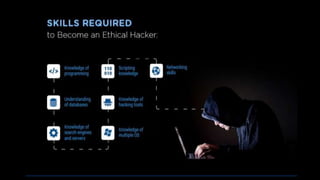
• Skills of ethical hacker
• Phases of Ethical hacking
• Tips to avoid getting hacked
• Careers in ethical hacking & cyber security
What is Cyber Attack?
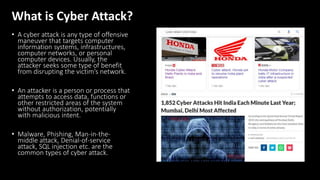
• A cyber attack is any type of offensive
maneuver that targets computer
information systems, infrastructures,
computer networks, or personal
computer devices. Usually, the
attacker seeks some type of benefit
from disrupting the victim’s network.
• An attacker is a person or process that
attempts to access data, functions or
other restricted areas of the system
without authorization, potentially
with malicious intent.
• Malware, Phishing, Man-in-the-
middle attack, Denial-of-service
attack, SQL injection etc. are the
common types of cyber attack.
What is Cyber Security?
• Cyber security is the practice of defending computers, servers, mobile
devices, electronic systems, networks, and data from malicious
attacks.
• It's also known as information technology security or electronic
information security.
• The term applies in a variety of contexts, from business to mobile
computing, and can be divided into a few common categories. Such as
Network security, Application security, Information security &
Operational security.
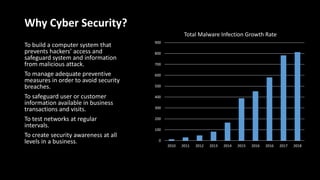
Why Cyber Security?
To build a computer system that
prevents hackers’ access and
safeguard system and information
from malicious attack.
To manage adequate preventive
measures in order to avoid security
breaches.
To safeguard user or customer
information available in business
transactions and visits.
To test networks at regular
intervals.
To create security awareness at all
levels in a business. 0
100
200
300
400
500
600
700
800
900
2010 2011 2012 2013 2014 2015 2016 2016 2017 2018
Total Malware Infection Growth Rate
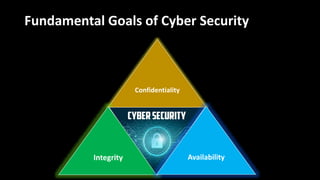
Fundamental Goals of Cyber Security
Confidentiality
Integrity Availability
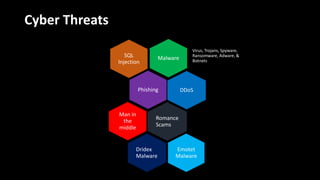
Cyber Threats
Malware
Virus, Trojans, Spyware,
Ransomware, Adware, &
Botnets
SQL
Injection
Phishing DDoS
Romance
Scams
Man in
the
middle
Dridex
Malware
Emotet
Malware
Who is Hacker?
“Hacker" is someone who explores
methods for breaching defenses &
exploiting weaknesses in a
computer system or network.
Hacking is the act of finding
possible entry points which exist in
a computer system or network and
entering into one of these. Hacking
is usually carried out to gain
unauthorized access to a computer
system or network for negative
purposes such as to harm or steal
the sensitive information from the
computer.
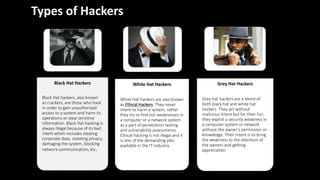
Types of Hackers
Black Hat Hackers
Black Hat hackers, also known
as crackers, are those who hack
in order to gain unauthorized
access to a system and harm its
operations or steal sensitive
information. Black Hat hacking is
always illegal because of its bad
intent which includes stealing
corporate data, violating privacy,
damaging the system, blocking
network communication, etc.
White Hat Hackers
White Hat hackers are also known
as Ethical Hackers. They never
intent to harm a system, rather
they try to find out weaknesses in
a computer or a network system
as a part of penetration testing
and vulnerability assessments.
Ethical hacking is not illegal and it
is one of the demanding jobs
available in the IT industry.
Grey Hat Hackers
Grey hat hackers are a blend of
both black hat and white hat
hackers. They act without
malicious intent but for their fun,
they exploit a security weakness in
a computer system or network
without the owner’s permission or
knowledge. Their intent is to bring
the weakness to the attention of
the owners and getting
appreciation.
What is Ethical Hacking?
• Ethical Hacking is an authorized practice of bypassing system security to
identify potential data breaches and threats in a network. This information
is then used by the organization to improve the system security, to minimize
or eliminate any potential attacks.
• The company that owns the system or network allows Cyber Security
experts to perform such activities in order to test the system’s defenses.
Thus, unlike malicious hacking, this process is planned, approved, and more
importantly, legal.
• Ethical hackers duplicate the techniques and methods followed by malicious
hackers in order to find out the system discrepancies, replicating all the
latter’s steps to find out how a system attack occurred or may occur.
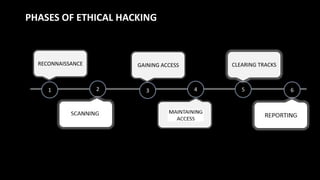
1 2 3 4 5 6
RECONNAISSANCE CLEARING TRACKSGAINING ACCESS
PHASES OF ETHICAL HACKING
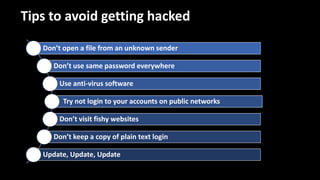
Tips to avoid getting hacked
Don’t open a file from an unknown sender
Don’t use same password everywhere
Use anti-virus software
Try not login to your accounts on public networks
Don’t visit fishy websites
Don’t keep a copy of plain text login
Update, Update, Update
Ethical Hacking & Cyber Security Careers
• Network Security Engineer
• Cyber Security Analyst
• Security Architect
• Cyber Security Manager
• Chief Information Security Officer (CISO)
• Certified Ethical Hacker (CEH)
References
• https://www.kaspersky.co.in/resource-center/definitions/what-is-cyber-
security
• https://www.simplilearn.com/what-is-ethical-hacking-
articletps://www.simplilearn.com/top-cyber-security-jobs-india-article
• https://www.safetydetectives.com/blog/ransomware-statistics/
• https://www.rfwireless-world.com/Terminology/Advantages-and-
Disadvantages-of-Ethical-Hacking.html
• https://purplesec.us/protect-business-cyber-attacks/
• https://www.news18.com/news/tech/1852-cyber-attacks-hit-india-each-
minute-last-year-mumbai-delhi-most-affected-2295963.html
• https://www.youtube.com/
THANK YOU

Ethical hacking & cyber security

  • 2.
    Group 5 -Ethical Hacking & Cyber Security Team Members – Ankit Gandharkar Karishma Maurya Tejinder Singh Sidhu Shweta Shinde Supriya Chaurasia
  • 3.
    Agenda • What iscyber attack? • What is cyber security? • Why cyber security? • Fundamental goals of cyber security • What are cyber threats? • Who is hacker & it’s types? • What is ethical hacking? • Roles and responsibilities of ethical hacker • Skills of ethical hacker • Phases of Ethical hacking • Tips to avoid getting hacked • Careers in ethical hacking & cyber security
  • 4.
    What is CyberAttack? • A cyber attack is any type of offensive maneuver that targets computer information systems, infrastructures, computer networks, or personal computer devices. Usually, the attacker seeks some type of benefit from disrupting the victim’s network. • An attacker is a person or process that attempts to access data, functions or other restricted areas of the system without authorization, potentially with malicious intent. • Malware, Phishing, Man-in-the- middle attack, Denial-of-service attack, SQL injection etc. are the common types of cyber attack.
  • 6.
    What is CyberSecurity? • Cyber security is the practice of defending computers, servers, mobile devices, electronic systems, networks, and data from malicious attacks. • It's also known as information technology security or electronic information security. • The term applies in a variety of contexts, from business to mobile computing, and can be divided into a few common categories. Such as Network security, Application security, Information security & Operational security.
  • 7.
    Why Cyber Security? Tobuild a computer system that prevents hackers’ access and safeguard system and information from malicious attack. To manage adequate preventive measures in order to avoid security breaches. To safeguard user or customer information available in business transactions and visits. To test networks at regular intervals. To create security awareness at all levels in a business. 0 100 200 300 400 500 600 700 800 900 2010 2011 2012 2013 2014 2015 2016 2016 2017 2018 Total Malware Infection Growth Rate
  • 8.
    Fundamental Goals ofCyber Security Confidentiality Integrity Availability
  • 9.
    Cyber Threats Malware Virus, Trojans,Spyware, Ransomware, Adware, & Botnets SQL Injection Phishing DDoS Romance Scams Man in the middle Dridex Malware Emotet Malware
  • 10.
    Who is Hacker? “Hacker"is someone who explores methods for breaching defenses & exploiting weaknesses in a computer system or network. Hacking is the act of finding possible entry points which exist in a computer system or network and entering into one of these. Hacking is usually carried out to gain unauthorized access to a computer system or network for negative purposes such as to harm or steal the sensitive information from the computer.
  • 11.
    Types of Hackers BlackHat Hackers Black Hat hackers, also known as crackers, are those who hack in order to gain unauthorized access to a system and harm its operations or steal sensitive information. Black Hat hacking is always illegal because of its bad intent which includes stealing corporate data, violating privacy, damaging the system, blocking network communication, etc. White Hat Hackers White Hat hackers are also known as Ethical Hackers. They never intent to harm a system, rather they try to find out weaknesses in a computer or a network system as a part of penetration testing and vulnerability assessments. Ethical hacking is not illegal and it is one of the demanding jobs available in the IT industry. Grey Hat Hackers Grey hat hackers are a blend of both black hat and white hat hackers. They act without malicious intent but for their fun, they exploit a security weakness in a computer system or network without the owner’s permission or knowledge. Their intent is to bring the weakness to the attention of the owners and getting appreciation.
  • 12.
    What is EthicalHacking? • Ethical Hacking is an authorized practice of bypassing system security to identify potential data breaches and threats in a network. This information is then used by the organization to improve the system security, to minimize or eliminate any potential attacks. • The company that owns the system or network allows Cyber Security experts to perform such activities in order to test the system’s defenses. Thus, unlike malicious hacking, this process is planned, approved, and more importantly, legal. • Ethical hackers duplicate the techniques and methods followed by malicious hackers in order to find out the system discrepancies, replicating all the latter’s steps to find out how a system attack occurred or may occur.
  • 15.
    1 2 34 5 6 RECONNAISSANCE CLEARING TRACKSGAINING ACCESS PHASES OF ETHICAL HACKING
  • 16.
    Tips to avoidgetting hacked Don’t open a file from an unknown sender Don’t use same password everywhere Use anti-virus software Try not login to your accounts on public networks Don’t visit fishy websites Don’t keep a copy of plain text login Update, Update, Update
  • 17.
    Ethical Hacking &Cyber Security Careers • Network Security Engineer • Cyber Security Analyst • Security Architect • Cyber Security Manager • Chief Information Security Officer (CISO) • Certified Ethical Hacker (CEH)
  • 18.
    References • https://www.kaspersky.co.in/resource-center/definitions/what-is-cyber- security • https://www.simplilearn.com/what-is-ethical-hacking- articletps://www.simplilearn.com/top-cyber-security-jobs-india-article •https://www.safetydetectives.com/blog/ransomware-statistics/ • https://www.rfwireless-world.com/Terminology/Advantages-and- Disadvantages-of-Ethical-Hacking.html • https://purplesec.us/protect-business-cyber-attacks/ • https://www.news18.com/news/tech/1852-cyber-attacks-hit-india-each- minute-last-year-mumbai-delhi-most-affected-2295963.html • https://www.youtube.com/
  • 19.