MODULE TITLE-2 Ethical Dimension
and understanding Ethical Foundation
of IT.
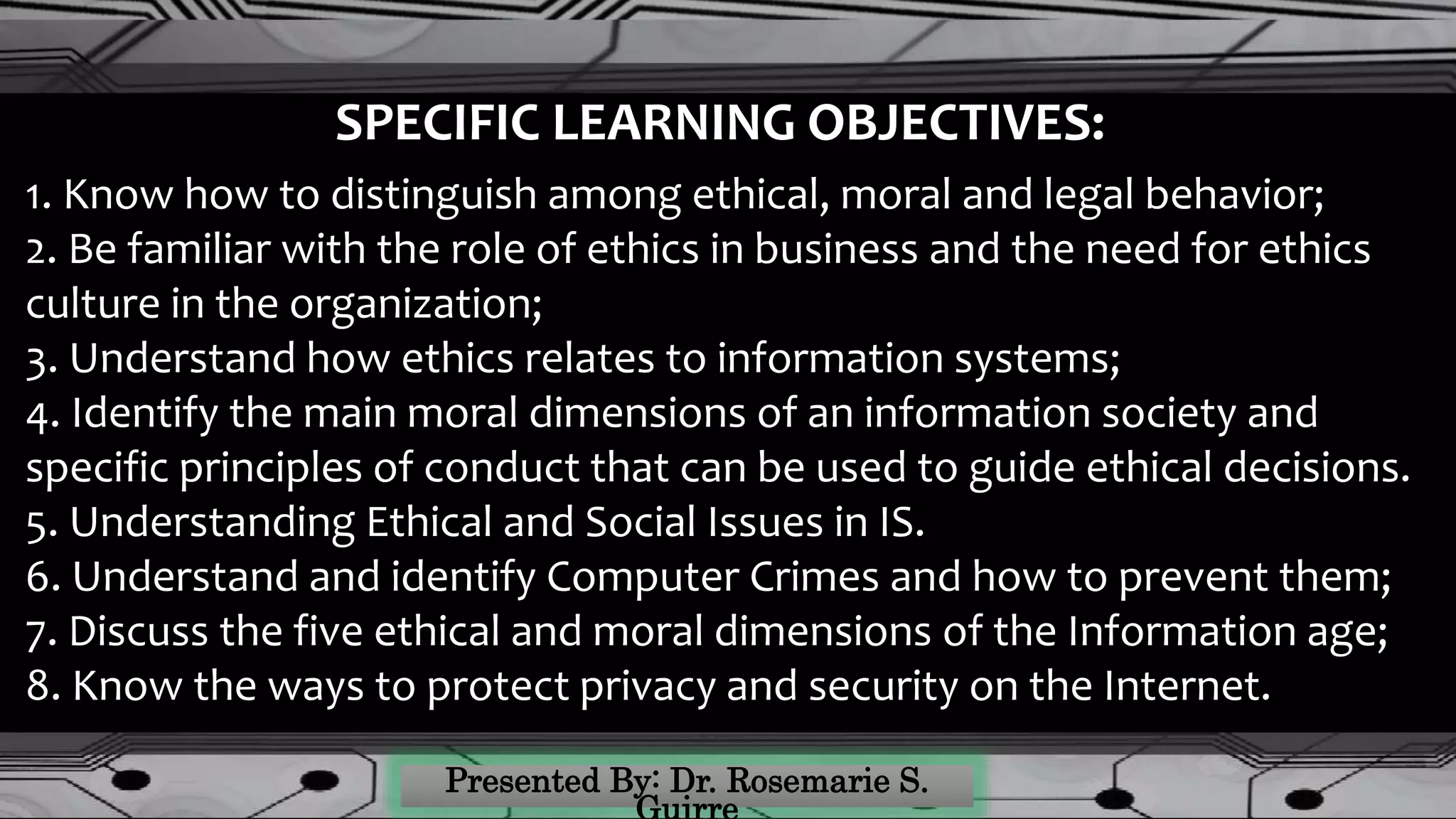
SPECIFIC LEARNING OBJECTIVES:
1. Know how to distinguish among ethical, moral and legal behavior;
2. Be familiar with the role of ethics in business and the need for ethics
culture in the organization;
3. Understand how ethics relates to information systems;
4. Identify the main moral dimensions of an information society and
specific principles of conduct that can be used to guide ethical decisions.
5. Understanding Ethical and Social Issues in IS.
6. Understand and identify Computer Crimes and how to prevent them;
7. Discuss the five ethical and moral dimensions of the Information age;
8. Know the ways to protect privacy and security on the Internet.
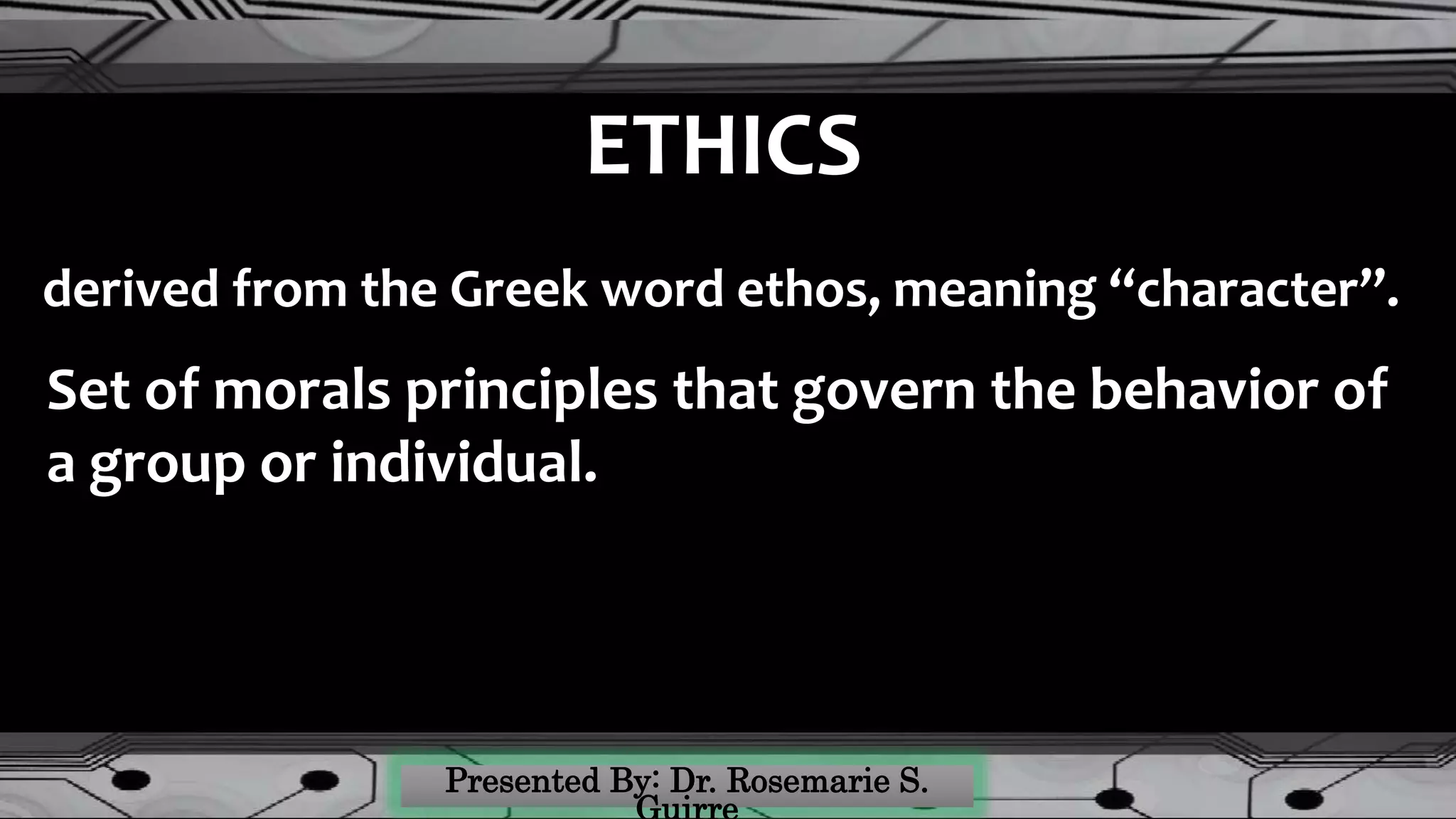
ETHICS
derived from the Greek word ethos, meaning “character”.
Set of morals principles that govern the behavior of
a group or individual.
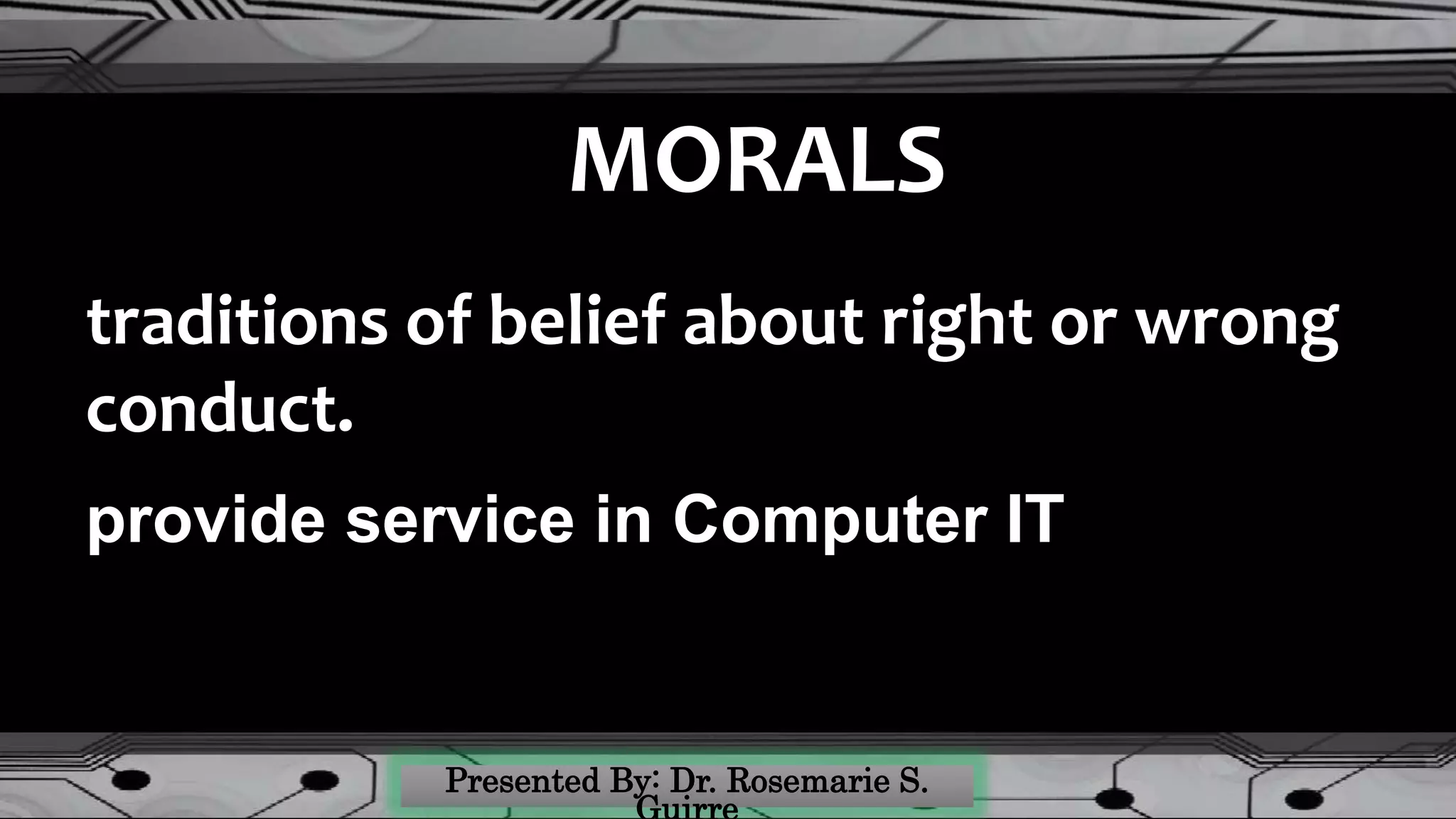
traditions of belief about right or wrong
conduct.
MORALS
provide service in Computer IT
COMPUTER LAW
is mostly an eclectic amalgamation of
concepts from existing law, which are
applied to the relatively new
technologies of computer hardware and
software, e-mail, and the Internet.
IS-PQS 213.2.1 The Ethical Dimension
The transformation factor implies that IT has
transformed the ways in which things are done. It
has made things simpler and improved the quality
of life. For example, with the advent of e-mail,
communication acquired a whole new meaning in
terms of speed and ease of operation.
IS-PQS 213.2.1 The Ethical Dimension
Ethical issues in information systems
have been given new urgency by the
rise of the Internet and electronic
commerce
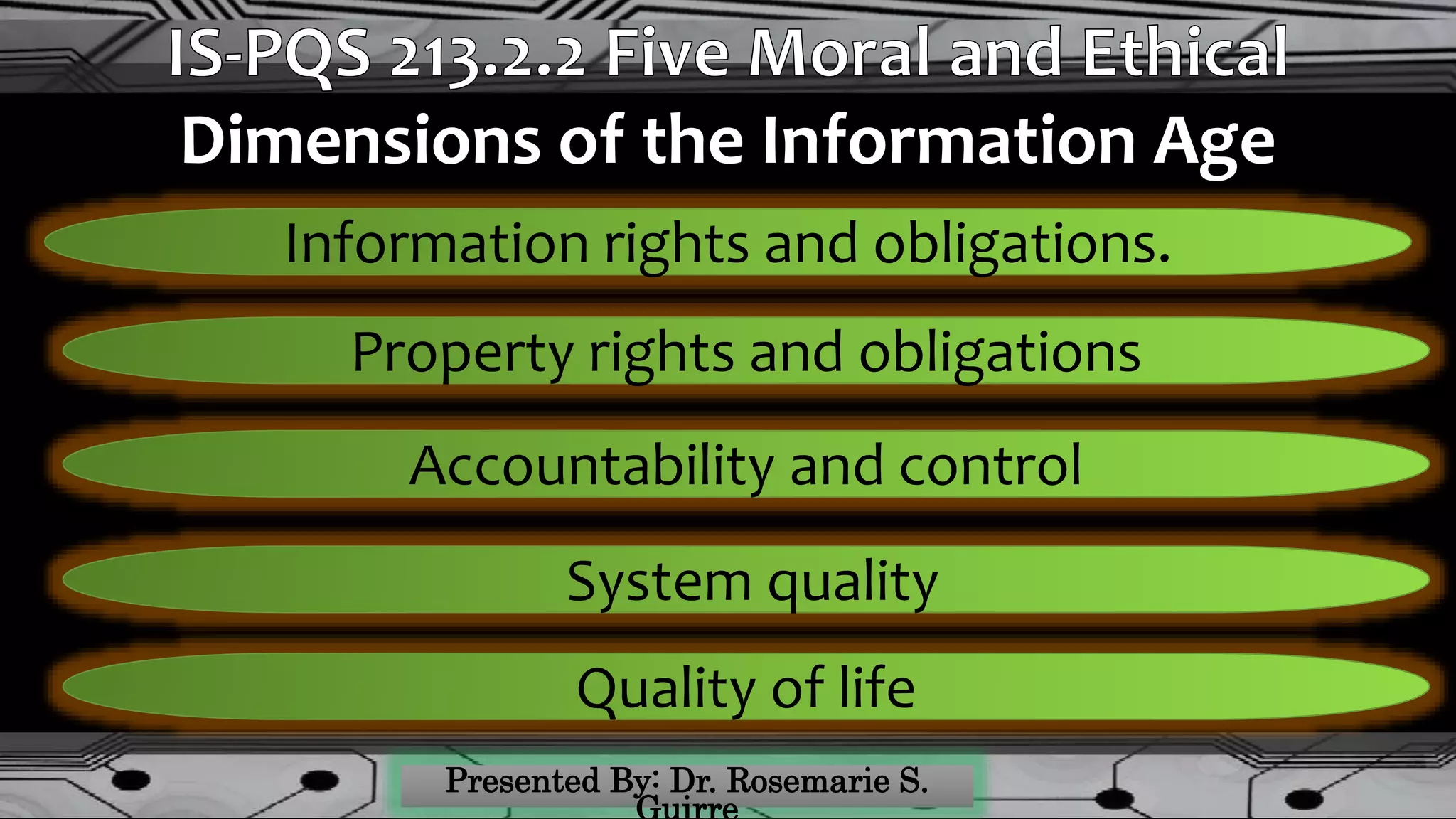
Dimensions of the Information Age
Information rights and obligations.
Property rights and obligations
Accountability and control
System quality
Quality of life
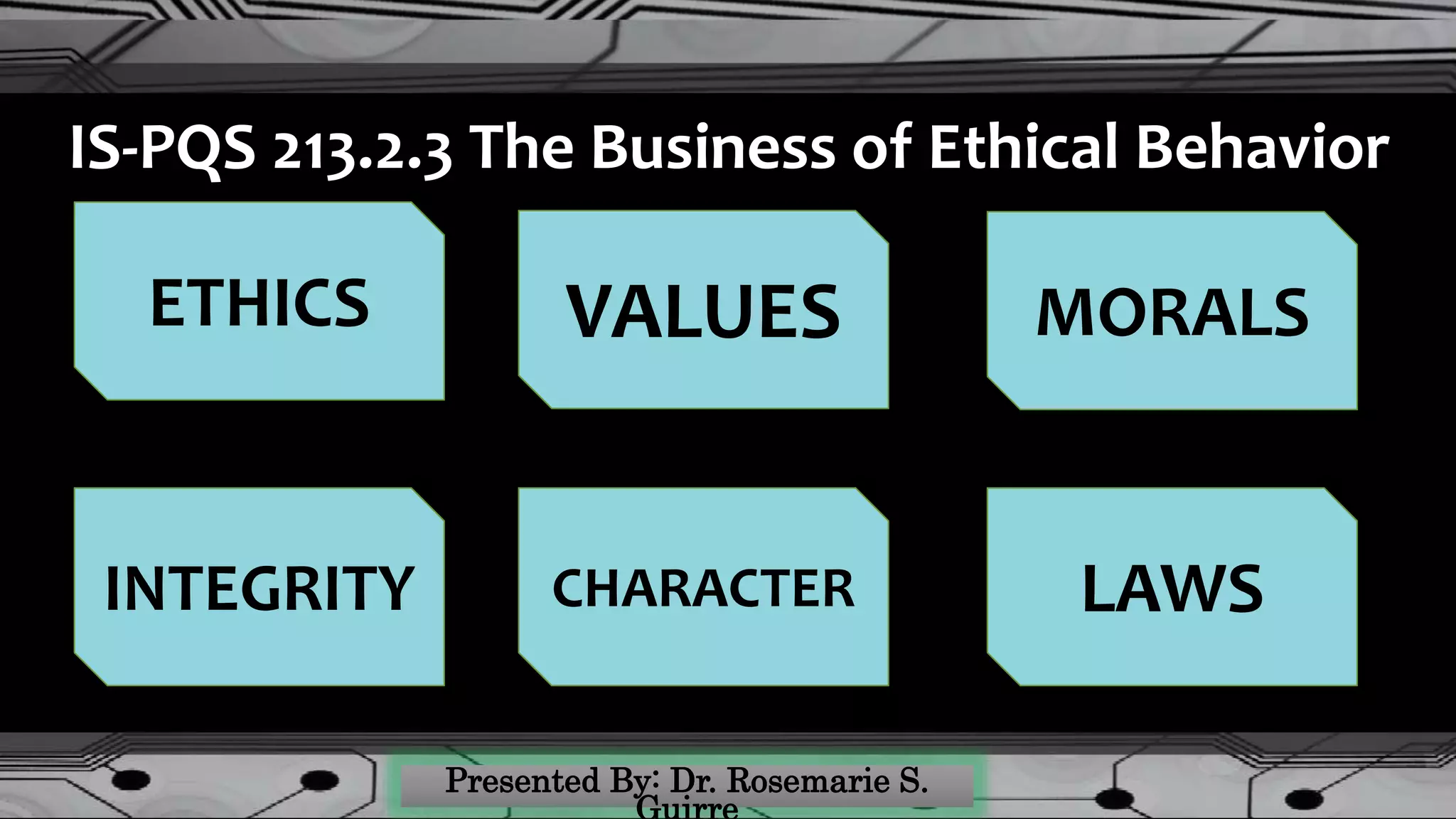
IS-PQS 213.2.3 The Business of Ethical Behavior
ETHICS VALUES MORALS
INTEGRITY CHARACTER LAWS
How to Enforce
Ethical
Practices?
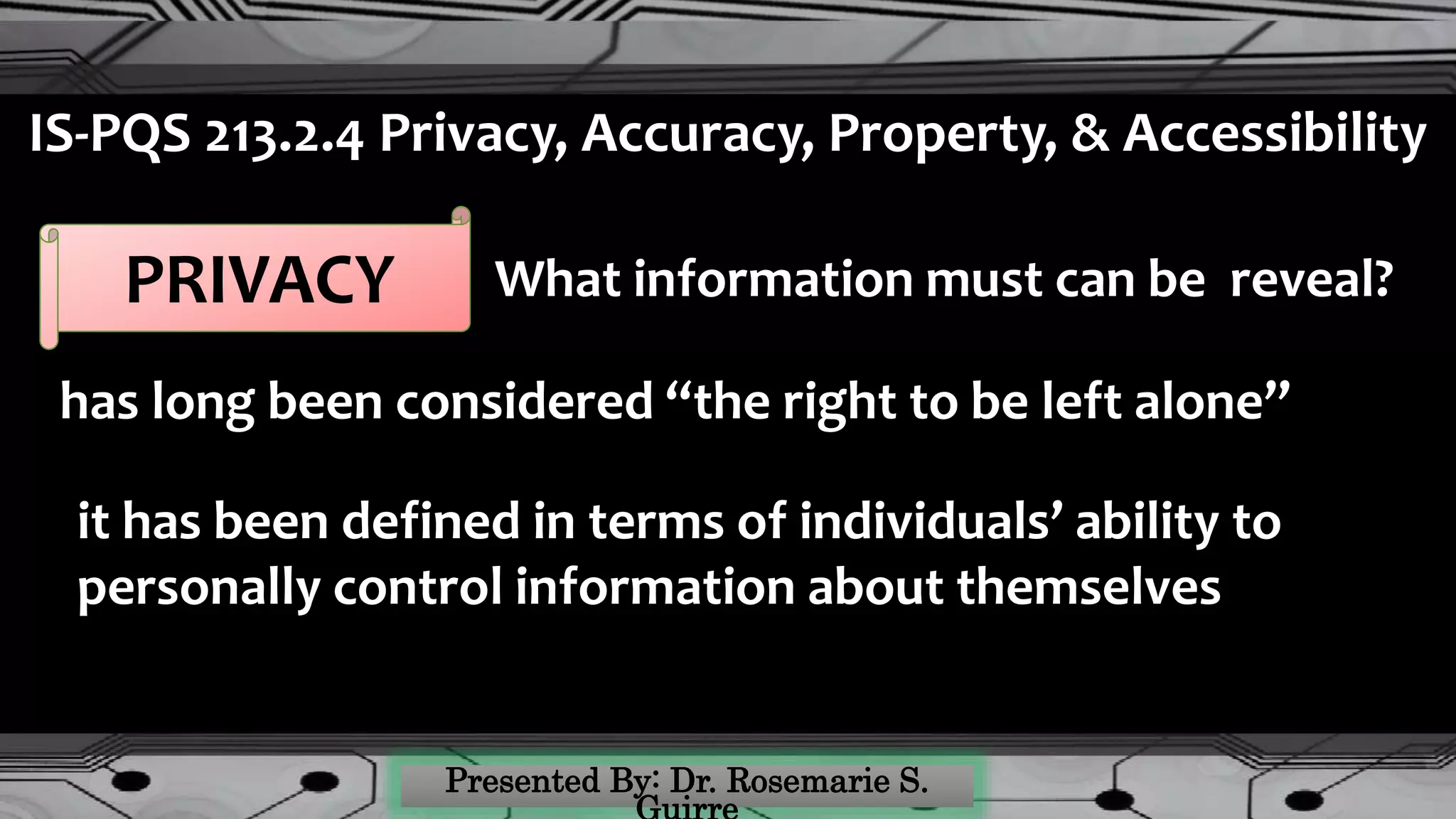
IS-PQS 213.2.4 Privacy, Accuracy, Property, & Accessibility
PRIVACY
has long been considered “the right to be left alone”
it has been defined in terms of individuals’ ability to
personally control information about themselves
What information must can be reveal?
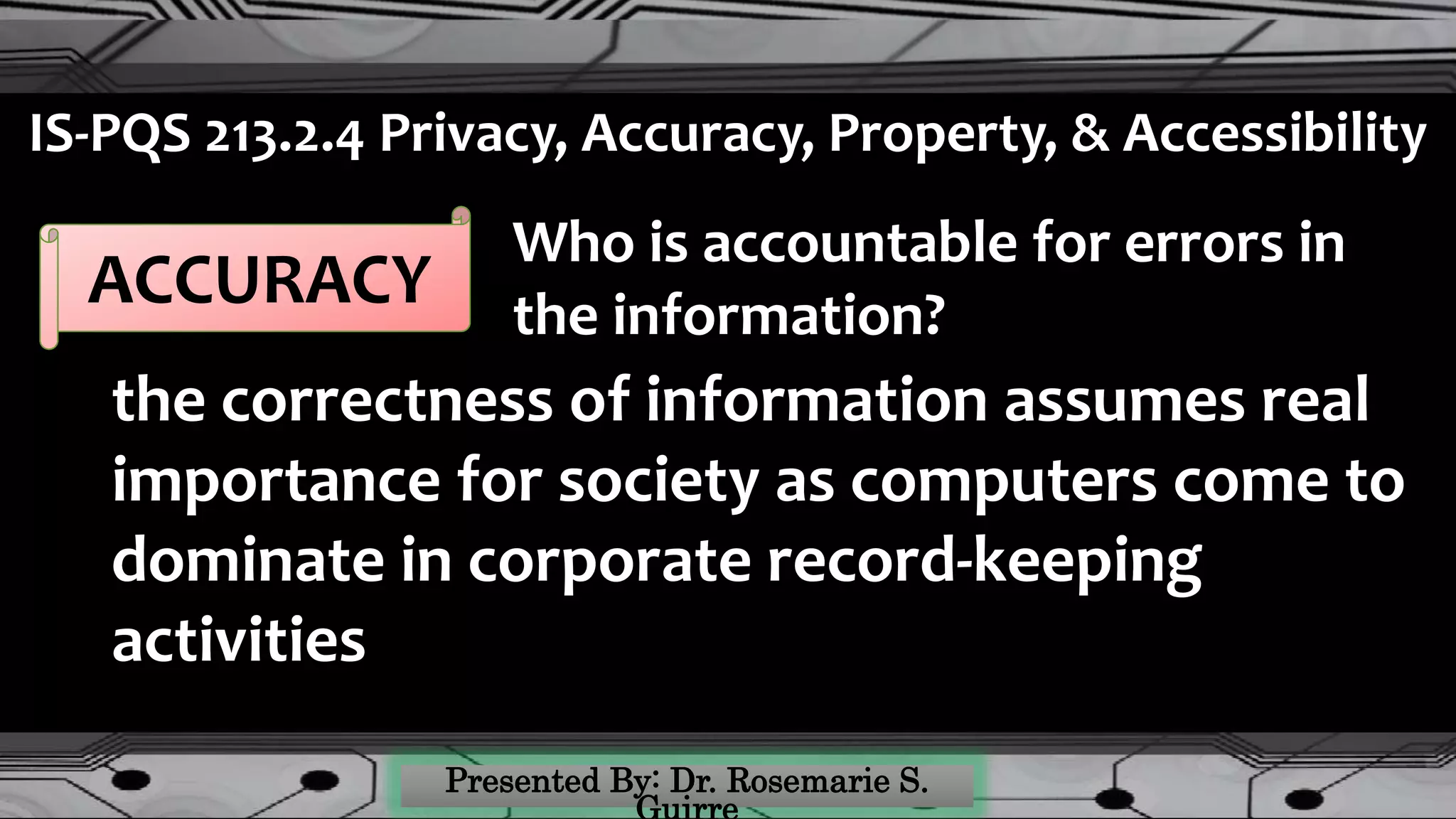
IS-PQS 213.2.4 Privacy, Accuracy, Property, & Accessibility
ACCURACY
the correctness of information assumes real
importance for society as computers come to
dominate in corporate record-keeping
activities
Who is accountable for errors in
the information?
IS-PQS 213.2.4 Privacy, Accuracy, Property, & Accessibility
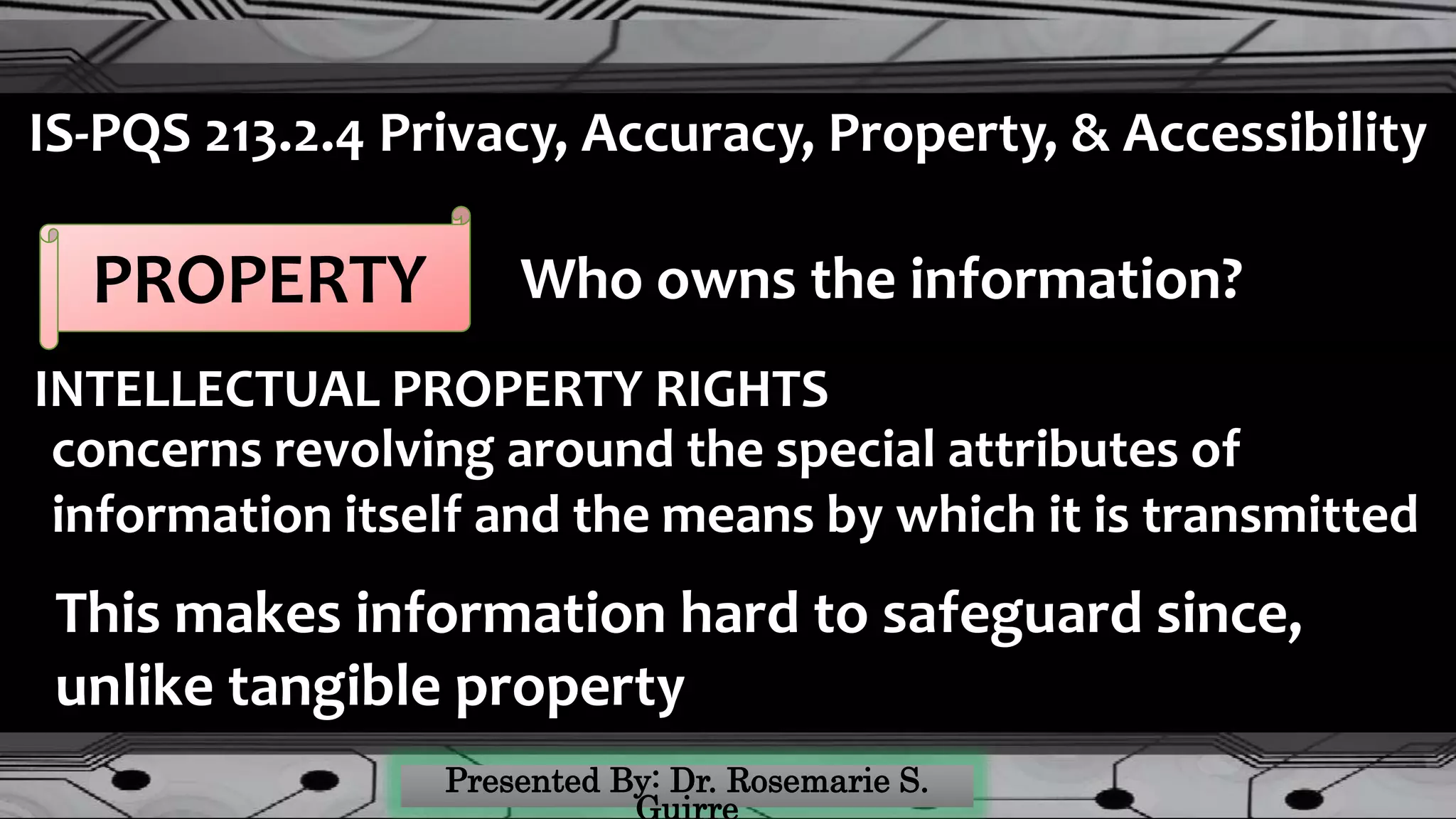
PROPERTY Who owns the information?
INTELLECTUAL PROPERTY RIGHTS
concerns revolving around the special attributes of
information itself and the means by which it is transmitted
This makes information hard to safeguard since,
unlike tangible property
IS-PQS 213.2.4 Privacy, Accuracy, Property, & Accessibility
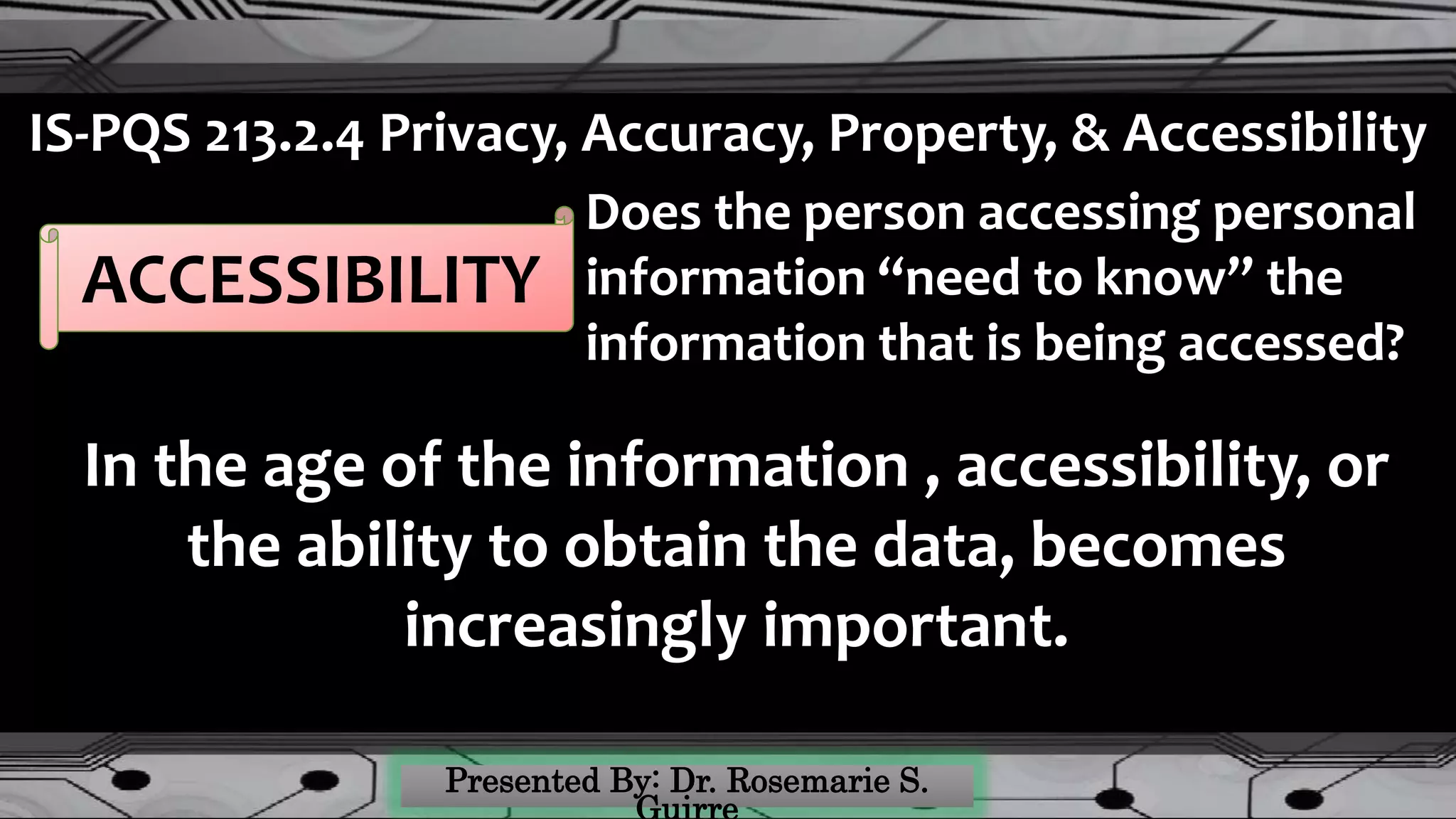
ACCESSIBILITY
Does the person accessing personal
information “need to know” the
information that is being accessed?
In the age of the information , accessibility, or
the ability to obtain the data, becomes
increasingly important.
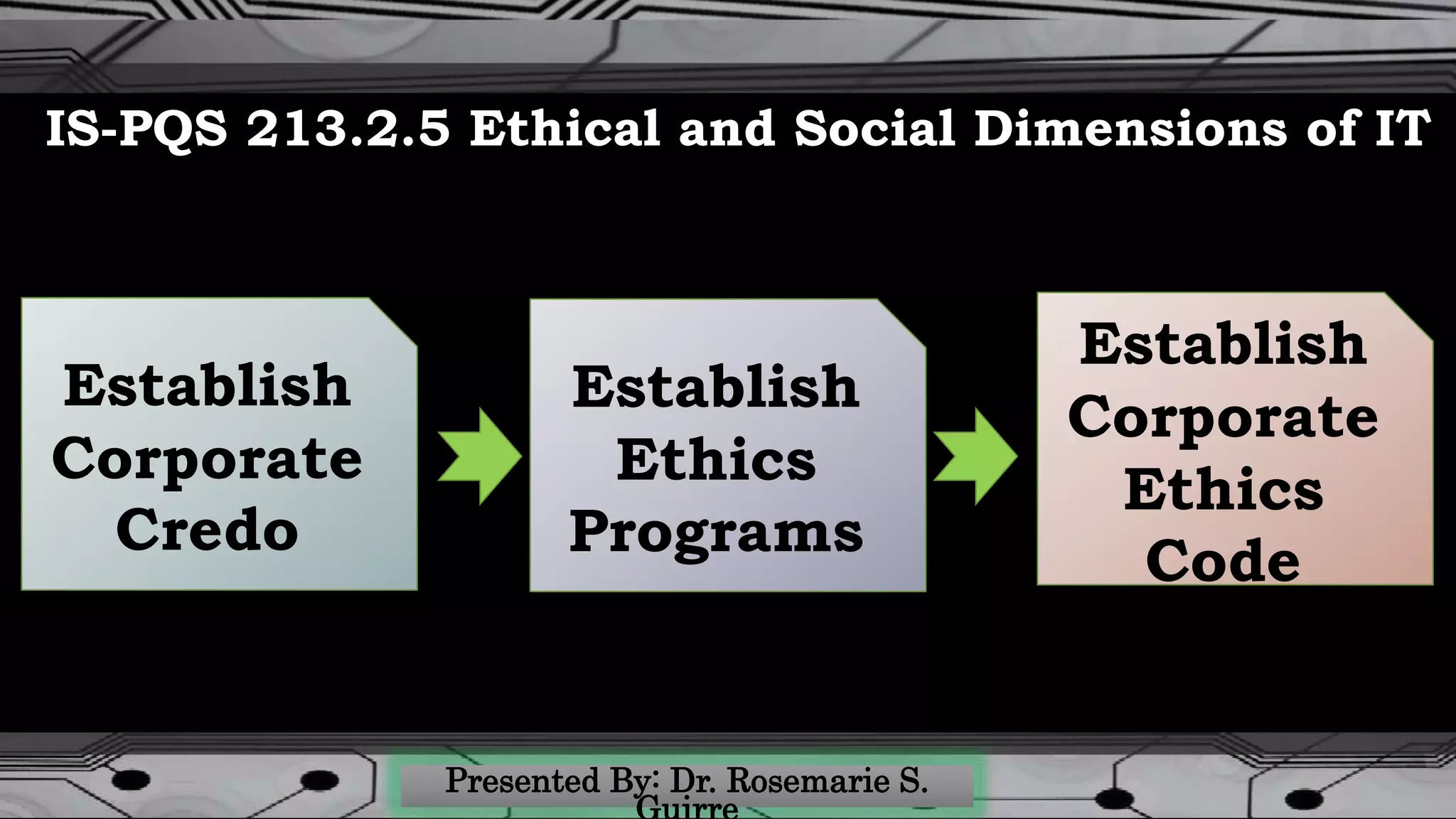
IS-PQS 213.2.5 Ethical and Social Dimensions of IT
Establish
Corporate
Credo
Establish
Ethics
Programs
Establish
Corporate
Ethics
Code
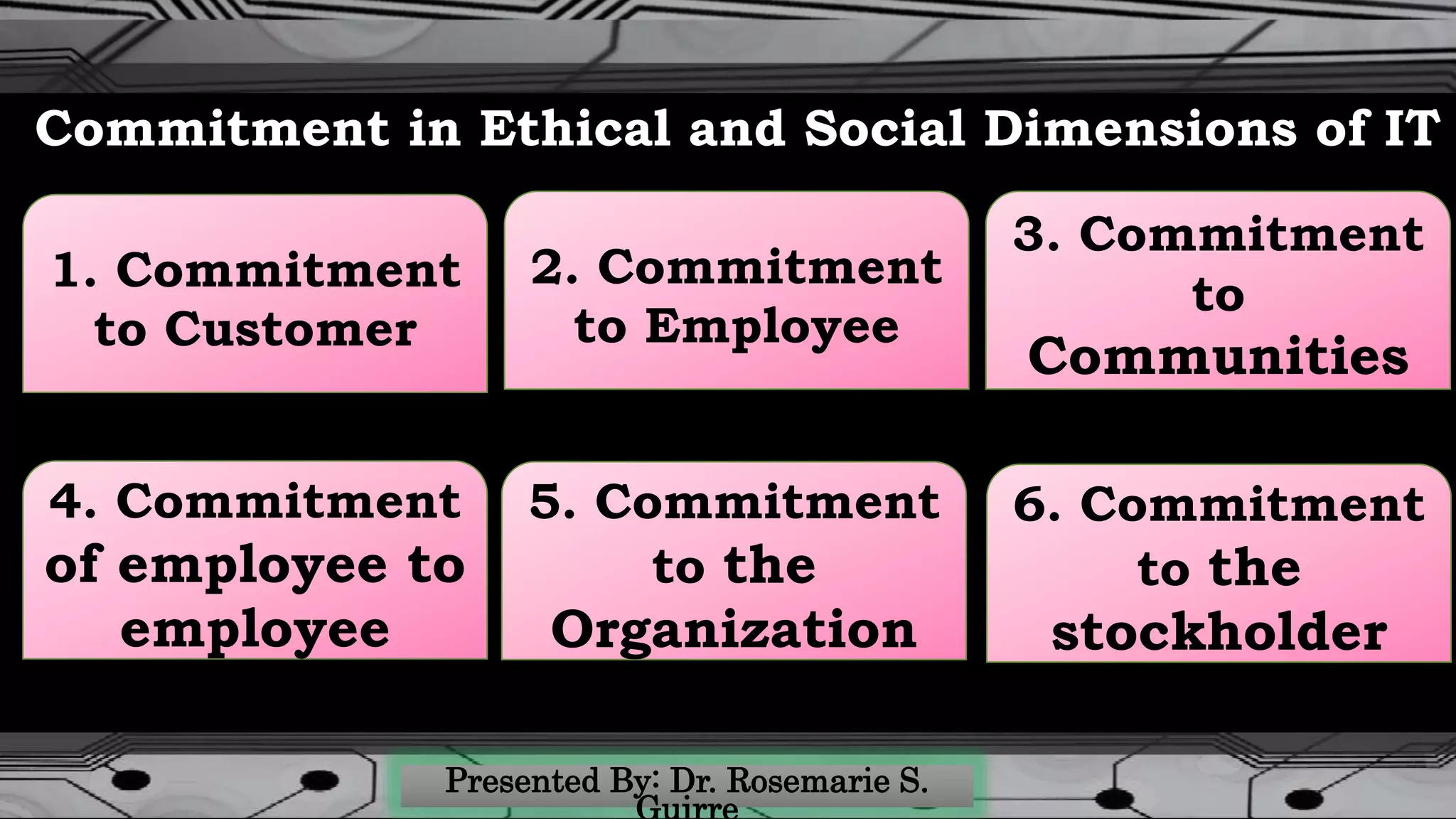
Commitment in Ethical and Social Dimensions of IT
1. Commitment
to Customer
2. Commitment
to Employee
3. Commitment
to
Communities
4. Commitment
of employee to
employee
5. Commitment
to the
Organization
6. Commitment
to the
stockholder
IS-PQS 213.2.6 Privacy
Issues
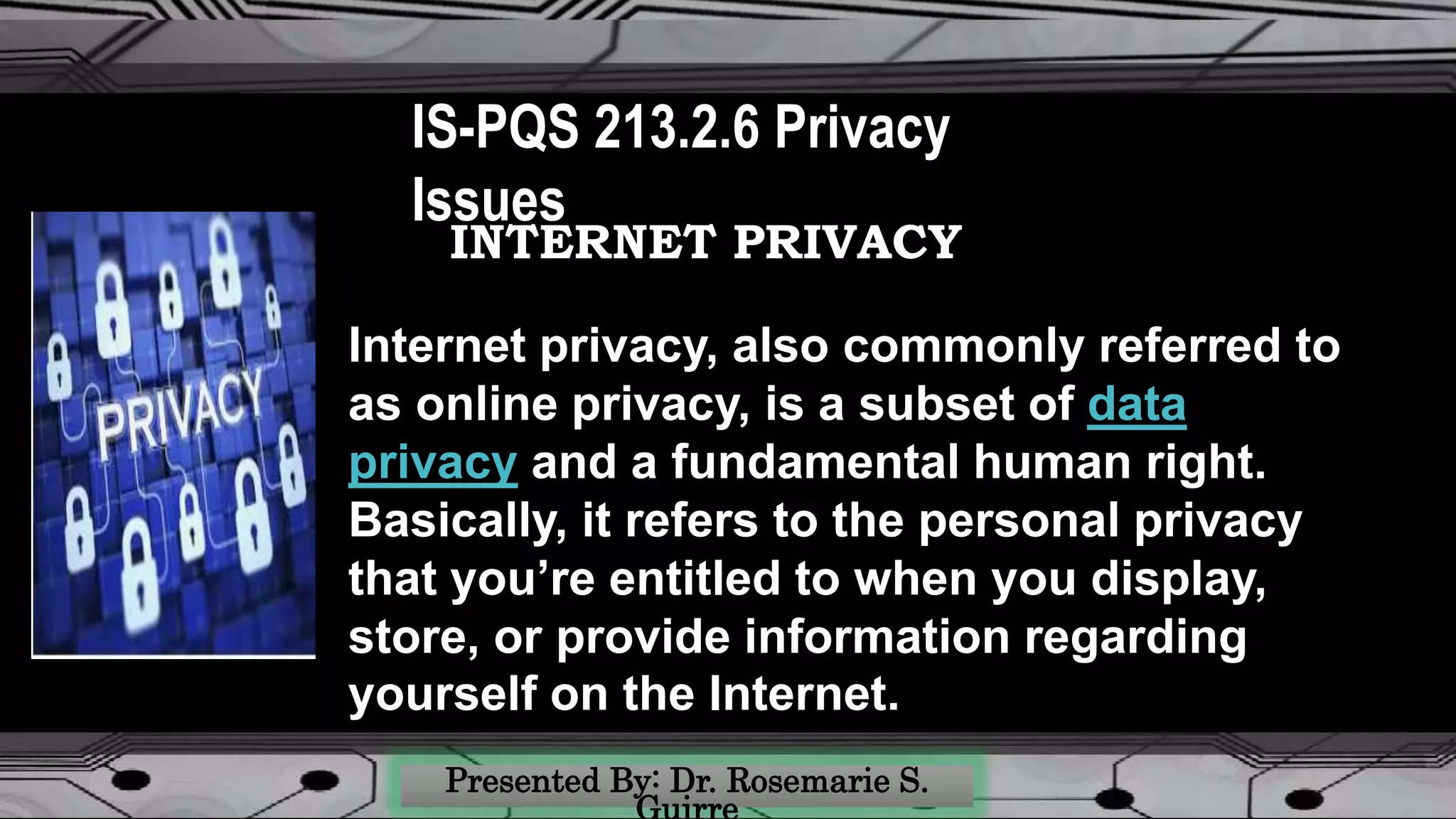
INTERNET PRIVACY
Internet privacy, also commonly referred to
as online privacy, is a subset of data
privacy and a fundamental human right.
Basically, it refers to the personal privacy
that you’re entitled to when you display,
store, or provide information regarding
yourself on the Internet.
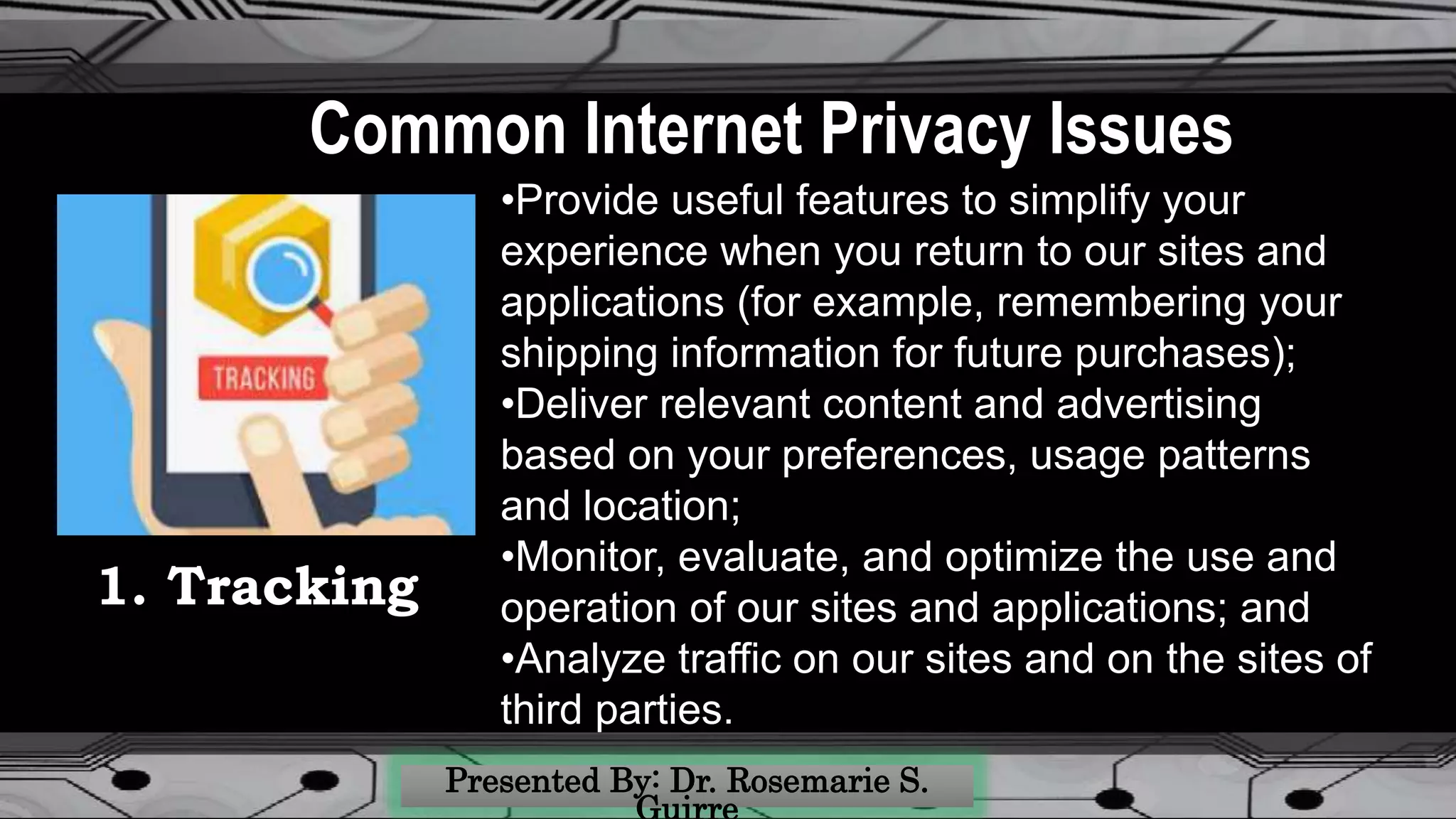
Common Internet Privacy Issues
•Provide useful features to simplify your
experience when you return to our sites and
applications (for example, remembering your
shipping information for future purchases);
•Deliver relevant content and advertising
based on your preferences, usage patterns
and location;
•Monitor, evaluate, and optimize the use and
operation of our sites and applications; and
•Analyze traffic on our sites and on the sites of
third parties.
1. Tracking
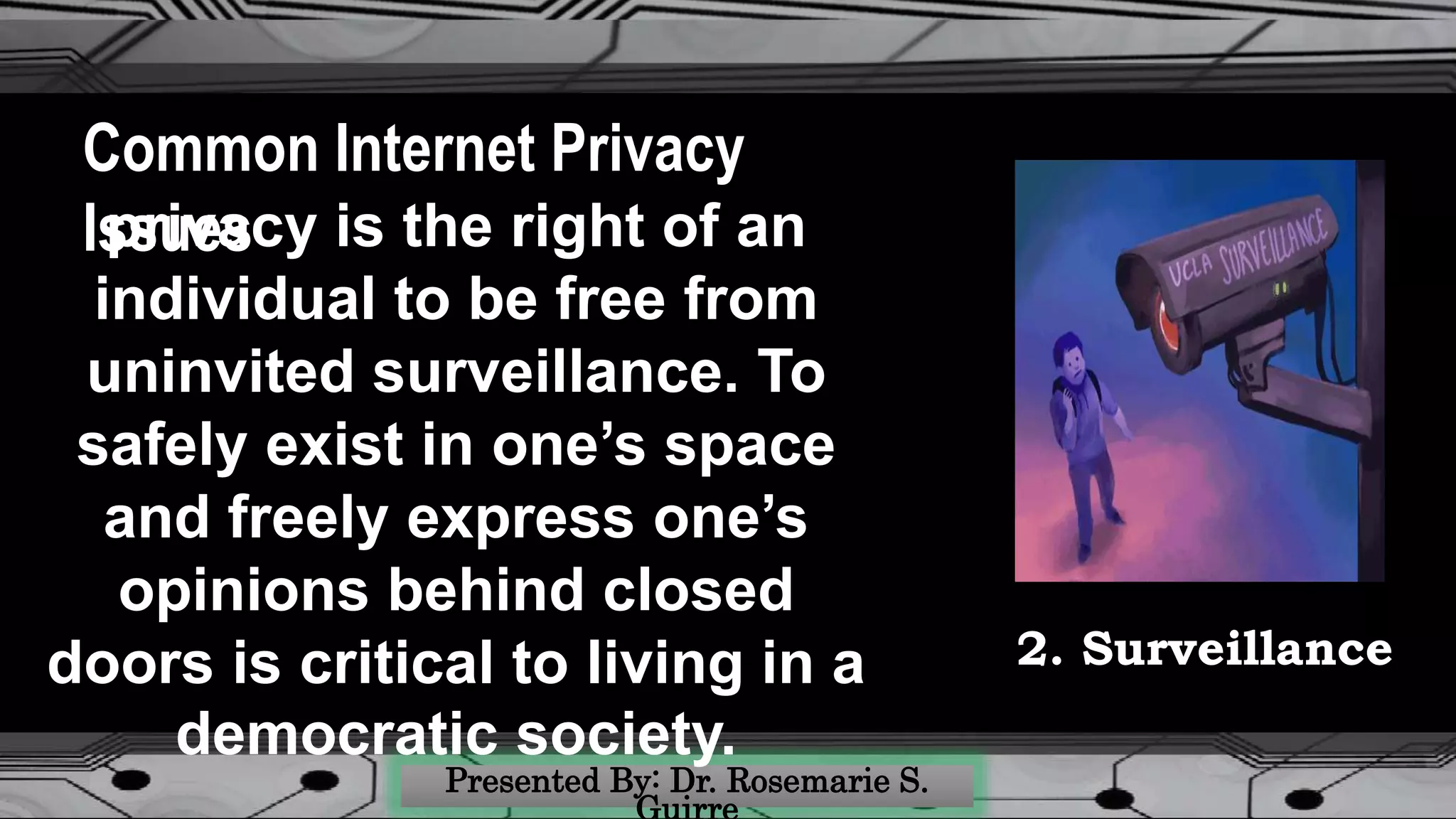
Common Internet Privacy
Issuesprivacy is the right of an
individual to be free from
uninvited surveillance. To
safely exist in one’s space
and freely express one’s
opinions behind closed
doors is critical to living in a
democratic society.
2. Surveillance
Common Internet Privacy
Issuesis the act of stealing digital
information stored on computers,
servers, or electronic devices of
an unknown victim with the intent
to compromise privacy or obtain
confidential information.
3. Theft
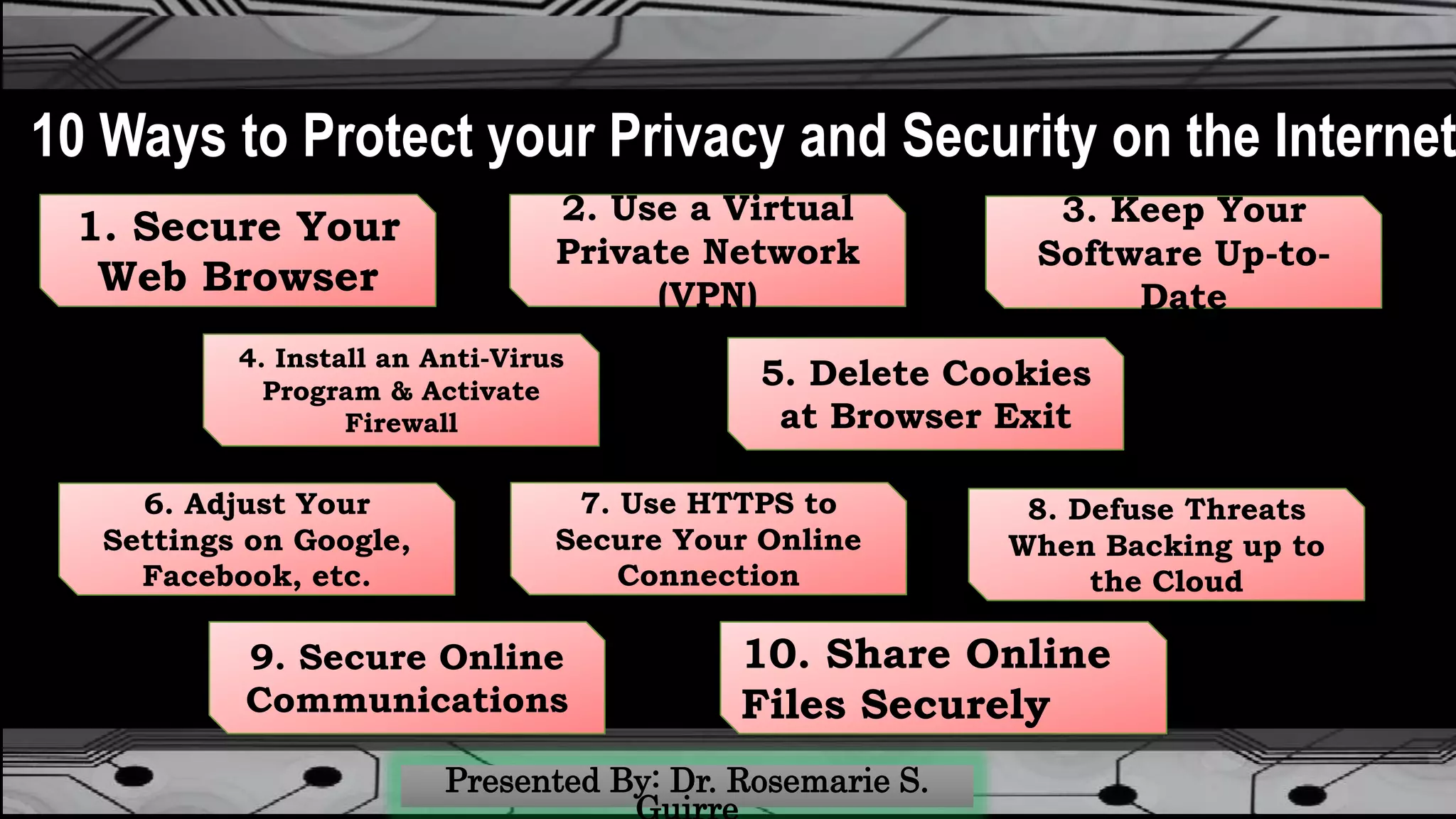
10 Ways to Protect your Privacy and Security on the Internet
1. Secure Your
Web Browser
2. Use a Virtual
Private Network
(VPN)
3. Keep Your
Software Up-to-
Date
4. Install an Anti-Virus
Program & Activate
Firewall
5. Delete Cookies
at Browser Exit
6. Adjust Your
Settings on Google,
Facebook, etc.
7. Use HTTPS to
Secure Your Online
Connection
8. Defuse Threats
When Backing up to
the Cloud
9. Secure Online
Communications
10. Share Online
Files Securely
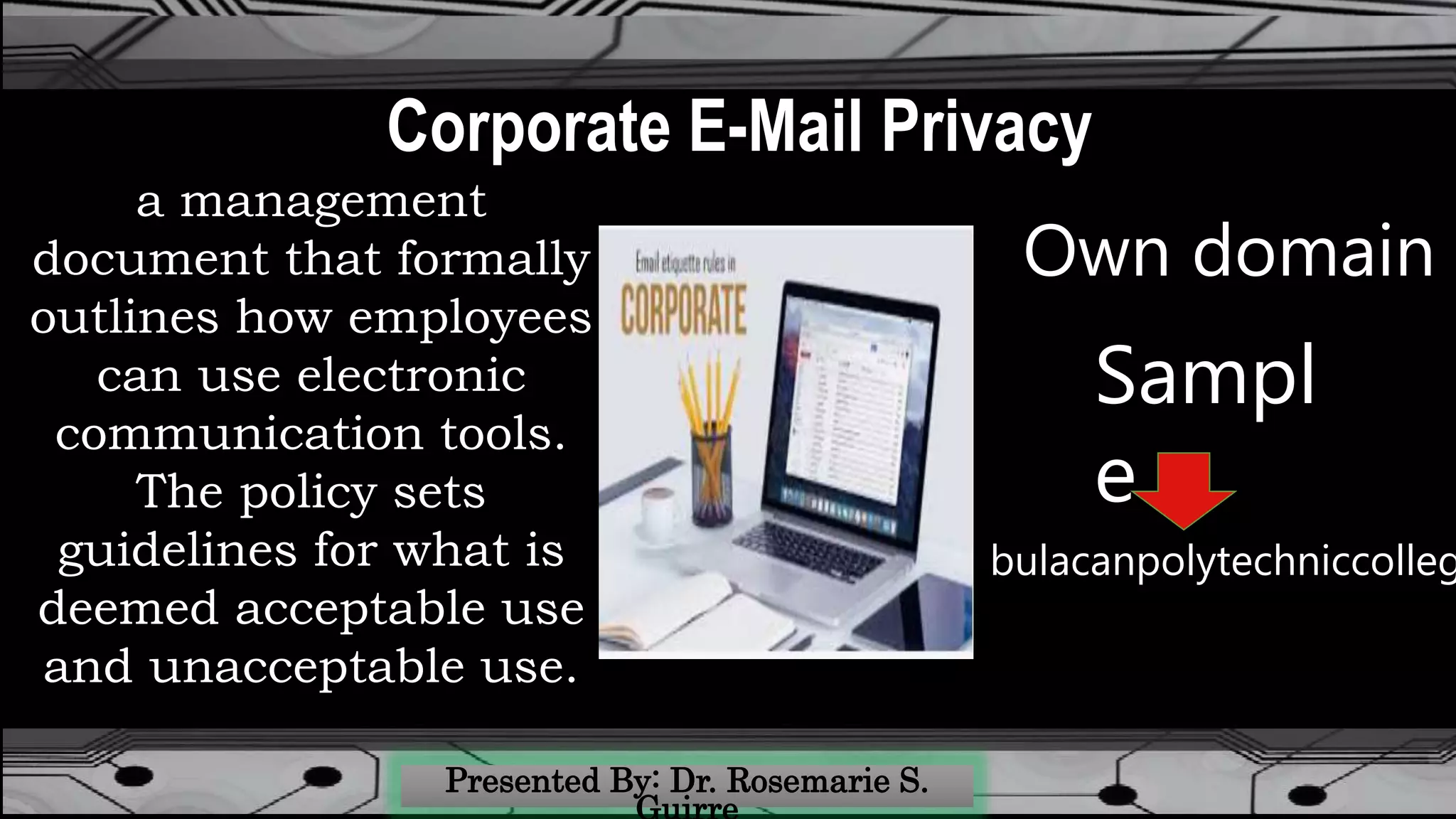
Corporate E-Mail Privacy
a management
document that formally
outlines how employees
can use electronic
communication tools.
The policy sets
guidelines for what is
deemed acceptable use
and unacceptable use.
Own domain
Sampl
e
bulacanpolytechniccolleg
COMPUTER MATCHING
refers to the computerized comparison of records
for the purpose of establishing or verifying
eligibility for a federal benefit program or for
recouping payments or delinquent debts under such
programs.
The Computer Matching and Privacy
Protection Act of 1988 (the Act)
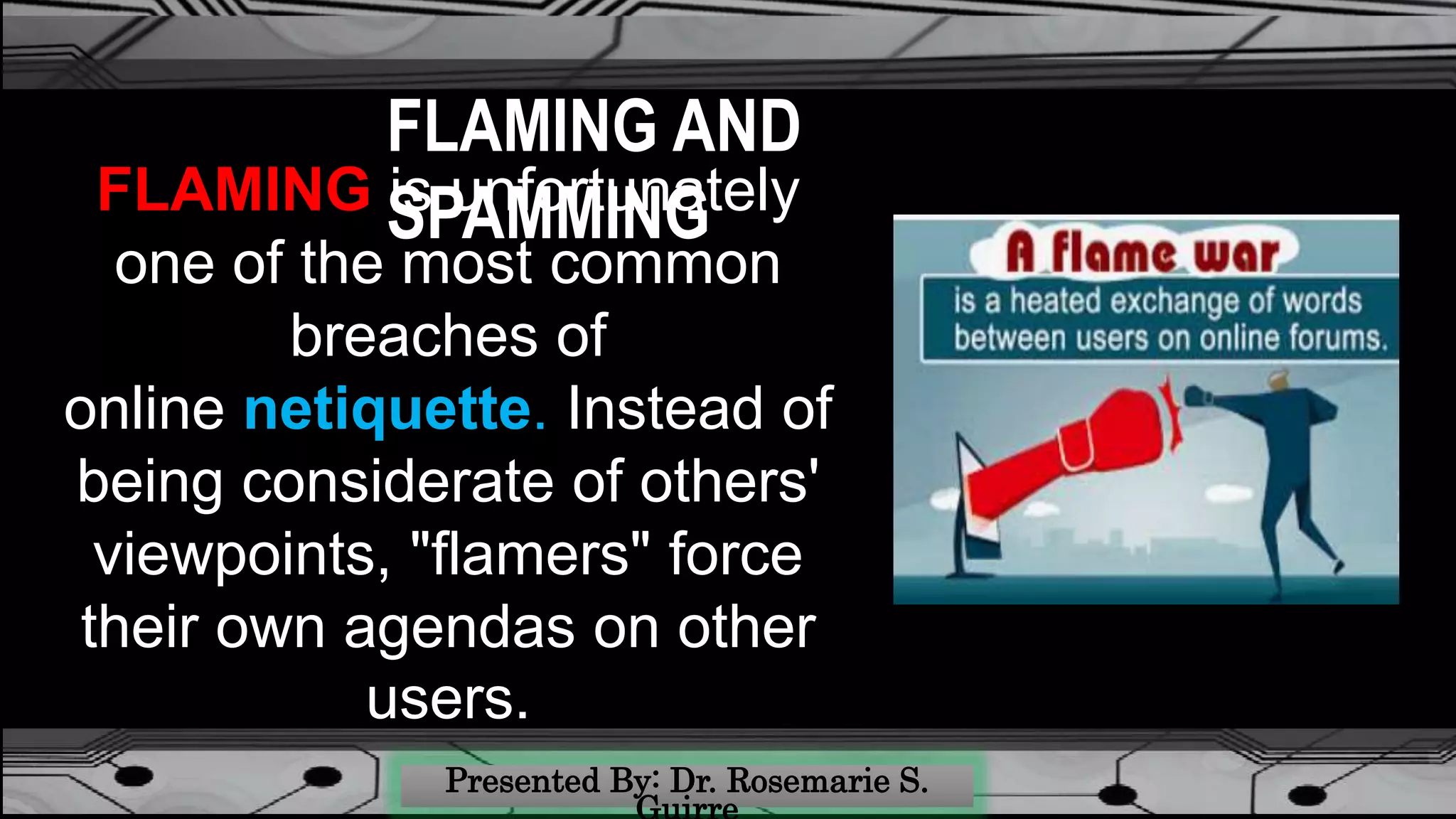
FLAMING AND
SPAMMINGFLAMING is unfortunately
one of the most common
breaches of
online netiquette. Instead of
being considerate of others'
viewpoints, "flamers" force
their own agendas on other
users.
FLAMING AND
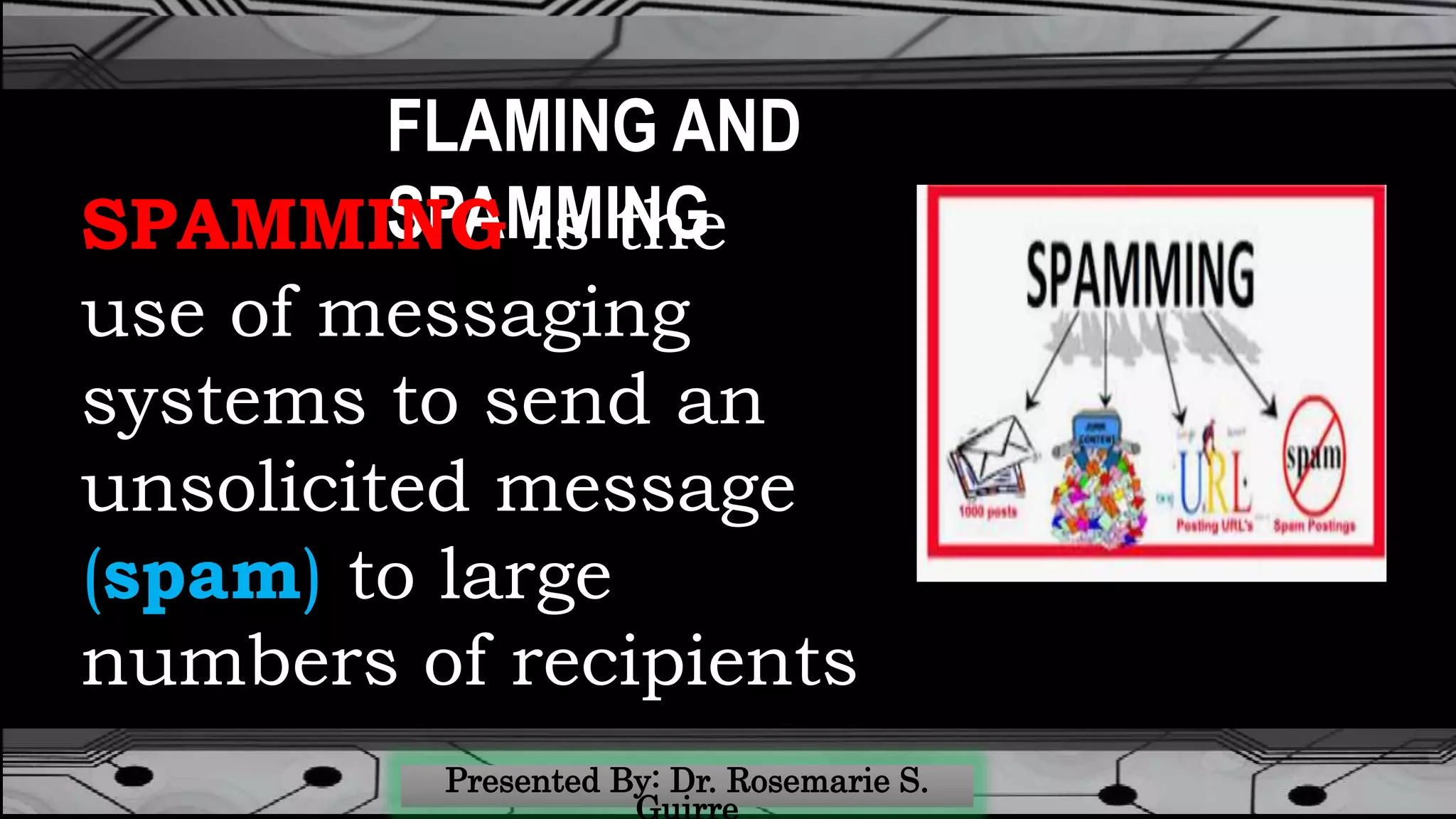
SPAMMINGSPAMMING is the
use of messaging
systems to send an
unsolicited message
(spam) to large
numbers of recipients
Ethical Dimension and understanding Ethical Foundation of IT

Ethical Dimension and understanding Ethical Foundation of IT

  • 1.
    MODULE TITLE-2 EthicalDimension and understanding Ethical Foundation of IT.
  • 2.
    SPECIFIC LEARNING OBJECTIVES: 1.Know how to distinguish among ethical, moral and legal behavior; 2. Be familiar with the role of ethics in business and the need for ethics culture in the organization; 3. Understand how ethics relates to information systems; 4. Identify the main moral dimensions of an information society and specific principles of conduct that can be used to guide ethical decisions. 5. Understanding Ethical and Social Issues in IS. 6. Understand and identify Computer Crimes and how to prevent them; 7. Discuss the five ethical and moral dimensions of the Information age; 8. Know the ways to protect privacy and security on the Internet.
  • 3.
    ETHICS derived from theGreek word ethos, meaning “character”. Set of morals principles that govern the behavior of a group or individual.
  • 4.
    traditions of beliefabout right or wrong conduct. MORALS provide service in Computer IT
  • 5.
    COMPUTER LAW is mostlyan eclectic amalgamation of concepts from existing law, which are applied to the relatively new technologies of computer hardware and software, e-mail, and the Internet.
  • 6.
    IS-PQS 213.2.1 TheEthical Dimension The transformation factor implies that IT has transformed the ways in which things are done. It has made things simpler and improved the quality of life. For example, with the advent of e-mail, communication acquired a whole new meaning in terms of speed and ease of operation.
  • 7.
    IS-PQS 213.2.1 TheEthical Dimension Ethical issues in information systems have been given new urgency by the rise of the Internet and electronic commerce
  • 8.
    Dimensions of theInformation Age Information rights and obligations. Property rights and obligations Accountability and control System quality Quality of life
  • 9.
    IS-PQS 213.2.3 TheBusiness of Ethical Behavior ETHICS VALUES MORALS INTEGRITY CHARACTER LAWS
  • 10.
  • 11.
    IS-PQS 213.2.4 Privacy,Accuracy, Property, & Accessibility PRIVACY has long been considered “the right to be left alone” it has been defined in terms of individuals’ ability to personally control information about themselves What information must can be reveal?
  • 12.
    IS-PQS 213.2.4 Privacy,Accuracy, Property, & Accessibility ACCURACY the correctness of information assumes real importance for society as computers come to dominate in corporate record-keeping activities Who is accountable for errors in the information?
  • 13.
    IS-PQS 213.2.4 Privacy,Accuracy, Property, & Accessibility PROPERTY Who owns the information? INTELLECTUAL PROPERTY RIGHTS concerns revolving around the special attributes of information itself and the means by which it is transmitted This makes information hard to safeguard since, unlike tangible property
  • 14.
    IS-PQS 213.2.4 Privacy,Accuracy, Property, & Accessibility ACCESSIBILITY Does the person accessing personal information “need to know” the information that is being accessed? In the age of the information , accessibility, or the ability to obtain the data, becomes increasingly important.
  • 15.
    IS-PQS 213.2.5 Ethicaland Social Dimensions of IT Establish Corporate Credo Establish Ethics Programs Establish Corporate Ethics Code
  • 16.
    Commitment in Ethicaland Social Dimensions of IT 1. Commitment to Customer 2. Commitment to Employee 3. Commitment to Communities 4. Commitment of employee to employee 5. Commitment to the Organization 6. Commitment to the stockholder
  • 17.
    IS-PQS 213.2.6 Privacy Issues INTERNETPRIVACY Internet privacy, also commonly referred to as online privacy, is a subset of data privacy and a fundamental human right. Basically, it refers to the personal privacy that you’re entitled to when you display, store, or provide information regarding yourself on the Internet.
  • 18.
    Common Internet PrivacyIssues •Provide useful features to simplify your experience when you return to our sites and applications (for example, remembering your shipping information for future purchases); •Deliver relevant content and advertising based on your preferences, usage patterns and location; •Monitor, evaluate, and optimize the use and operation of our sites and applications; and •Analyze traffic on our sites and on the sites of third parties. 1. Tracking
  • 19.
    Common Internet Privacy Issuesprivacyis the right of an individual to be free from uninvited surveillance. To safely exist in one’s space and freely express one’s opinions behind closed doors is critical to living in a democratic society. 2. Surveillance
  • 20.
    Common Internet Privacy Issuesisthe act of stealing digital information stored on computers, servers, or electronic devices of an unknown victim with the intent to compromise privacy or obtain confidential information. 3. Theft
  • 21.
    10 Ways toProtect your Privacy and Security on the Internet 1. Secure Your Web Browser 2. Use a Virtual Private Network (VPN) 3. Keep Your Software Up-to- Date 4. Install an Anti-Virus Program & Activate Firewall 5. Delete Cookies at Browser Exit 6. Adjust Your Settings on Google, Facebook, etc. 7. Use HTTPS to Secure Your Online Connection 8. Defuse Threats When Backing up to the Cloud 9. Secure Online Communications 10. Share Online Files Securely
  • 22.
    Corporate E-Mail Privacy amanagement document that formally outlines how employees can use electronic communication tools. The policy sets guidelines for what is deemed acceptable use and unacceptable use. Own domain Sampl e bulacanpolytechniccolleg
  • 23.
    COMPUTER MATCHING refers tothe computerized comparison of records for the purpose of establishing or verifying eligibility for a federal benefit program or for recouping payments or delinquent debts under such programs. The Computer Matching and Privacy Protection Act of 1988 (the Act)
  • 24.
    FLAMING AND SPAMMINGFLAMING isunfortunately one of the most common breaches of online netiquette. Instead of being considerate of others' viewpoints, "flamers" force their own agendas on other users.
  • 25.
    FLAMING AND SPAMMINGSPAMMING isthe use of messaging systems to send an unsolicited message (spam) to large numbers of recipients

Editor's Notes

  • #3 At the end of this module the student MUST be able: 1. Know how to distinguish among ethical, moral and legal behavior; 2. Be familiar with the role of ethics in business and the need for ethics culture in the organization; 3. Understand how ethics relates to information systems; 4. Identify the main moral dimensions of an information society and specific principles of conduct that can be used to guide ethical decisions. 5. Understanding Ethical and Social Issues in IS. 6. Understand and identify Computer Crimes and how to prevent them; 7. Discuss the five ethical and moral dimensions of the Information age; 8. Know the ways to protect privacy and security on the Internet.
  • #4 TOPICS OF DISCUSSION COVERAGE: Introduction Ethics in computer use is getting more attention today than ever before. Society in general is paying attention primarily because of the recognition that the computer can invade an individual’s rights to privacy. Within the business world, one of the main reasons for the attention is how software piracy is eroding the revenues of software vendors to the tune of billions of dollars each year. However, the subject of computer ethics goes much deeper than privacy and privacy issues. The computer is a powerful social tool that can help or harm society in many ways, it all depends on how it is used. What are Ethics? We are all guided in our actions by ethics. The word ethics is derived from the Greek word ethos, meaning “character”. Ethics is a suite (group, collection) of guiding beliefs, standards, or ideals that pervades (encompasses) an individual or a group or community of people. All individuals are accountable to their community for their behavior. The community can exist in such forms as a barangay, city, province, nation, or profession. Ethics is a set of moral principles that govern the behavior of a group or individual. Therefore, computer ethics is set of moral principles that regulate the use of computers. Some common issues of computer ethics include intellectual property rights (such as copyrighted electronic content), privacy concerns, and how computers affect society.
  • #5 What are Morals? Morals are traditions of belief about right or wrong conduct. Morals are social institutions with a history and a list of rules. We begin to learn the rules of moral behavior as children: “Don’t pull your sister’s hair.” “Always say Thank you.” As we grow and mature physically and mentally, we learn the rules that are our society expects us to follow. These rules of conduct are our morals. Empirical IS research has studied differences in users' attitudes and in moral judgments regarding ethical computer-related behavior. Moral computer provide service in Computer IT. Computer Desktop & Laptop Repairing, Office Networking, Assembling new computer, Technical support or Computer AMC service provide by Moral Computer Companies can collect information about individuals using computer programs and even use the information for their benefit without morality.
  • #6 computer law is mostly an eclectic amalgamation of concepts from existing law, which are applied to the relatively new technologies of computer hardware and software, e-mail, and the Internet. However, there are several reasons why it is convenient to have a separate classification for computer law: Laws are formal rules of conduct that a sovereign authority, as the government, imposes on its subjects or citizen. Until recently, there were very few laws governing computer use. The computer is fairly an innovation and the legal system has had time for keeping up. The first case of computer crime occurred in 1966 when a programmer for a bank put a patch in a program so that it would not flag his account as being withdrawn. He would continue writing checks even though there was no money in the account. The ruse (scam, deception) worked until the computer went down, the manual processing revealed the unplugged, overdrawn balance. The programmer was not charged for committing a crime, since no laws were on the books. Rather, he was charged with making false entries in bank records.
  • #7 Ethical and Social Dimensions of Information Technology: The transformation factor implies that IT has transformed the ways in which things are done. It has made things simpler and improved the quality of life. For example, with the advent of e-mail, communication acquired a whole new meaning in terms of speed and ease of operation.
  • #8 Ethical issues in information systems have been given new urgency by the rise of the Internet and electronic commerce. Internet and digital firm technologies make it easier than ever to assemble, integrate, and distribute information, unleashing new concerns about the appropriate use of customer information, the protection of personal privacy, and the protection of intellectual property.
  • #9 The major ethical, social, and political issues raised by information systems include the following moral dimensions: Information rights and obligations. What information rights do individuals and organizations possess concerning information about themselves? What can they protect? What obligations do individuals and organizations have concerning this information? 2. Property rights and obligations. How will traditional intellectual property rights be protected in a digital society in which tracing and accounting for ownership are difficult and ignoring such property rights is so easy? 3. Accountability and control. Who can and will be held accountable and liable for the harm done to individual and collective information and property rights? 4. System quality. What standards of data and system quality should we demand to protect individual rights and the safety of society? 5. Quality of life. What values should be preserved in an information-and knowledge-based society? Which institutions should we protect from violation? Which cultural values and practices are supported by new information technology?
  • #10 In a business setting, ethical behavior is behavior that means applies the principles of honesty and fairness to relationships with coworkers and customers. Ethical individuals make an effort to treat everyone with whom they come in contact as they would want to be treated themselves. When we hear the word ethical, several ideas come to mind, most notably good (versus bad) and right (versus wrong). Six concepts form the foundation of trust upon which ethical business practice is built: Ethics: Ethics refers to a set of rules that describes what is acceptable conduct in society. Ethics serve as a guide to moral daily living and helps us judge whether our behavior can be justified. Values: Values are defined as the acts, customs, and institutions that a group of people regards favorably. Morals: Morals are a set of rules or modes of conduct on which society is based. Certain moral elements are universal, such as the laws forbidding homicide and the basic duties of doing good and furthering the wellbeing of others. Morals and ethics are very similar; both pertain to society’s ideas of right and wrong. Integrity: To have integrity is, to be honest, and sincere. Integrity is defined as adhering to a moral code in daily decision making. Integrity Put simply when people and businesses possess integrity, it means they can be trusted. Character: Character drives what we do when no one is looking. Each person can build, change, or even destroy his or her character. We can build our character through the way we live—by thinking good thoughts and performing good acts. Laws: The law is a series of rules and regulations designed to express the needs of the people. Laws frequently provide us with a sense of right and wrong and guide our behavior, but not always. While murder is against the law, it does not stop someone from killing another out of hatred, anger, or in defense of personal philosophy. It is worth noting that an illegal act can be ethical. One of the most famous examples is Martin Luther King, Jr.’s violation of the law with marches and sit-ins during the fight against segregation. These six concepts—ethics, values, morals, integrity, character, and laws— form the foundation of ethical business practices.
  • #11 Establishing an ethical standard for business conduct involves more than a written policy. The most compelling support for an ethical standard is adherence to and enforcement of that standard by those who institute it and by those for whom it is written. More than briefings and policies handed out to every single employee, our behavior, practice, and deeds are the foundation for creating an ethical standard and making it stick.
  • #12 Consider several areas of information ethics in which the control of information is crucial. Richard O. Mason identified four such areas, which can be summarized by the acronym PAPA: Privacy, Accuracy, Property, and Accessibility. What information must people reveal about themselves to others? Are there some things that people do not have to reveal about themselves? Can the information that people provide be used to identify their personal preferences or history when they don’t want those preferences to be known? Can the information that people provide be used for purposes other than those for which they were told that it would be used? PRIVACY Many consider privacy to be the most important area in which their interests need to be a safeguard. Privacy has long been considered “the right to be left alone”. While it has been argued that so many different definitions exist that it is hard to satisfactorily define the term, it is fundamentally about protections from intrusion and information gathering by others. Typically, it has been defined in terms of individuals’ ability to personally control information about themselves. But requiring individuals to control their own information would severely limit what is private.
  • #13 Consider several areas of information ethics in which the control of information is crucial. Richard O. Mason identified four such areas, which can be summarized by the acronym PAPA: Privacy, Accuracy, Property, and Accessibility. ACCURACY Who is responsible for the reliability, authenticity, and accuracy of information? Who is accountable for errors in the information? The accuracy or the correctness of information assumes real importance for society as computers come to dominate in corporate record-keeping activities. When records are inputted incorrectly, who is to blame?
  • #14 Consider several areas of information ethics in which the control of information is crucial. Richard O. Mason identified four such areas, which can be summarized by the acronym PAPA: Privacy, Accuracy, Property, and Accessibility. Property Who owns the information? Who owns the channels of distribution, and how should they be regulated? What is the fair price of information that is exchanged? One of the most complex issues we face as a society is the question of intellectual property rights. There are substantial economic and ethical concerns surrounding these rights; concerns revolving around the special attributes of information itself and the means by which it is transmitted. Any individual item of information can be extremely costly to produce in the first instance. Yet, once it is produced, that information has the illusive quality of being easy to reproduce and to share with others. Moreover, this replication can take place without destroying the original. This makes information hard to safeguard since, unlike tangible property, it becomes communicable and hard to keep it to one’s self. It is even difficult to secure appropriate reimbursements when somebody else uses your information.
  • #15 Consider several areas of information ethics in which the control of information is crucial. Richard O. Mason identified four such areas, which can be summarized by the acronym PAPA: Privacy, Accuracy, Property, and Accessibility. Accessibility What information does a person or organization have a right to obtain, with what protection, and under what conditions? Who can access personal information in the files? Does the person accessing personal information “need to know” the information that is being accessed? In the age of the information worker, accessibility, or the ability to obtain the data, becomes increasingly important. Would-be users of information must first gain the physical ability to access online information resources, which broadly means they must access computational systems. Second and more important, they then must gain access to information itself. In this sense, the issue of access is closely linked to that of property.
  • #16 Information systems raise new ethical questions for both individuals and societies because they create opportunities for intense social change. These issues have five moral dimensions: information rights and obligations, property rights and obligations, system quality, quality of life, and accountability, and control. How Ethical Culture must be Imposed? The task of top management is to see to it that its concept of ethics permeates (invades, pervades) the organization, filtering down through the ranks to touch every employee. The executives achieve this implement in a three-tiered fashion in the form of a corporate credo (principle), ethics programs, and tailored corporate codes. Figure 2.1 Top-level Management imposes the Ethics Culture in a Top-Down manner
  • #17  1. Commitment to Customer. The first commitment is to provide our customers with quality products and services that are innovative and technologically responsive to their current requirements. 2. Commitment to Employee. The second commitment is to establish an environment for our employees that promotes professional growth, encourages each person to achieve his or her highest potential, and promotes individual creativity and responsibility. 3. Commitment to Communities. The commitment of the organization to the communities that it serves. The organization must continue to strive to improve the quality of life through support to community organizations and projects. 4. Commitment of employee to employee. Every employee must be committed to promoting a climate of mutual respect, integrity, and professional relationships characterized by open and honest communication within and across all levels of the organization. 5. Commitment to the Organization. As an employee, he strives to understand and adhere to the policies and objectives, act professionally, and give his/her best effort to improve his organization. 6. Commitment to the stockholder. The sixth commitment is to the stockholder, to continue to provide consistent growth and a superior rate of return on their investments, to maintain a position and reputation as a leading financial institution, to protect stockholder’s investments, and to provide full and timely information.
  • #18 Internet privacy is becoming a growing concern these days for people of all ages. Companies track your behavior across websites to serve you with highly relevant advertisements, making it essential for you to have an encrypted online connection This can include both personally-identifying information (PII) as well as non-personally identifying information, such as your behavior on a website. Without Internet privacy, all your activities are subject to being collected and analyzed by interested parties!
  • #19 When you browse the Internet, you may have noticed those pesky ads following you where you go that are based on your earlier web searches or visits to websites. Well, that’s because your movements are tracked by websites, advertisers, etc. 1. ONLINE TRACKING TECHNOLOGIES AND ADVERTISING We and certain service providers operating on our behalf collect information about your activity, or activity on devices associated with you, on our sites and applications using tracking technologies such as cookies, Flash cookies, pixels, tags, software development kits, application program interfaces, and Web beacons. Definitions for some of the tracking technologies listed, as well as information about your choices with respect to them, are available below. This tracking data may be used for many purposes including, for example, to: Provide useful features to simplify your experience when you return to our sites and applications (for example, remembering your shipping information for future purchases); Deliver relevant content and advertising based on your preferences, usage patterns and location; Monitor, evaluate, and optimize the use and operation of our sites and applications; and Analyze traffic on our sites and on the sites of third parties. Facebook knows what you're doing on other sites and in real life. ... Facebook released a tool that lets people see how it tracks their "off-Facebook activity." The social network tracks the websites, apps, and even real-life stores that users visit in order to target highly-tailored ads to them
  • #20 2. Surveillance Some governments spy on their citizens online to supposedly assist law enforcement agencies. Take, for instance, the UK’s Investigatory Powers Act that authorizes mass surveillance and allows the government to legally monitor the Internet usage of its citizens. Internet companies (ISPs), TelCos, as well as other communication service providers are required to retain customers’ Internet connection records for a year, which can be obtained by government authorities and used in investigations – even if you’re not related to them in any way!
  • #21 3. Theft A staggering 17 million Americans have been affected by identity theft in 2017, according to Javelin Strategy. Cybercriminals use malware, spyware, and phishing techniques to break into your online accounts or device and steal your personal information to engage in activities like identity theft. The victims, of course, end up losing most or all of their hard-earned money, just because they didn’t exercise caution when it comes to opening attachments, instant messages, or emails from unknown sources is the act of stealing digital information stored on computers, servers, or electronic devices of an unknown victim with the intent to compromise privacy or obtain confidential information. Information can include anything from financial information, like credit card numbers or bank accounts, to personal information, like social security numbers, drivers license numbers, and health records. Once only the problem of large businesses and organizations, data theft is a growing problem for everyday computer users.
  • #22 1. Secure Your Web Browser Your browser is the main program you use to go online, so make sure that you take the necessary steps to secure it. After all, cybercriminals can take advantage of loopholes in browsers to access the personal data on your device. To protect your online privacy and security, we’d recommend that you follow the recommendations in our ultimate browser security guide. 2. Use a Virtual Private Network (VPN) Using a VPN is the best way to protect your Internet privacy. Not only does it change your IP address and assign you a new one based on the VPN server you’re connected to, but it also protects your incoming and outgoing traffic with military-grade encryption. As a result, your online activities and personal information stay secure and private from snoopers. PureVPN is regarded as the best VPN when it comes to online privacy and security, and for all the right reasons. 3. Keep Your Software Up-to-Date If you leave vulnerabilities in your software, chances are that the bad guys will exploit them! Keep your operating system, browser, as well as other software (like Adobe Flash and Java) up to date to ensure that you don’t miss out on new features and security fixes. If you find it a hassle to manually apply updates, you can always use tools to automate your software updates. 4. Install an Anti-Virus Program & Activate Firewall You can keep your safe from harmful content on the Internet with a few simple precautions. A strong anti-virus program will keep your device free from all types of malware, such as spyware, viruses, Trojans, etc. You should also activate your firewall to keep unwanted network traffic at bay. The good news is that most operating systems come with it built-in. 5. Delete Cookies at Browser Exit You should delete cookies regularly as they’re used by websites, advertisers, and other third parties to track you online. While you can clear your cookies manually, you’re better off configuring your browser to automatically delete them at the end of the browsing session. If you don’t know how to, follow our guide to deleting browsing cookies automatically at browser exit. 6. Adjust Your Settings on Google, Facebook, etc. Take advantage of the options that are available to you. Big Internet companies such as Facebook and Google usually give you options to opt-out of some, if not all, of their personalization and tracking. For example, you can manage your ads preferences on Facebook from here, while Google allows you to turn off ads personalization from here. 7. Use HTTPS to Secure Your Online Connection If you are on a website that uses HTTPS, likely, any personal data flowing between you and the website is probably being monitored by trackers or potentially intercepted and stolen by malicious hackers. These entities are commonly referred to as man-in-the-middle. An HTTPS or Secure Sockets Layer (SSL) encrypts your online communication with that website. If you are on any website especially a shopping website, you should ensure that you have an HTTPS connection. For the utmost online privacy and security, you should resort to a VPN service. 8. Defuse Threats When Backing up to the Cloud In today’s era, we constantly back up our pictures and other files on the cloud. Backing up on the cloud comes packed with its own privacy issues. Anyone could intercept your internet connection and view the data you are backing up or downloading from the cloud. To defuse this threat, it’s advised that you use state-of-the-art AES 256-bit encryption that will secure your internet connection, meaning you can download and upload sensitive information without worrying about anyone tapping in on your private data. 9. Secure Online Communications Most of your online communications platforms are unsecured. While numerous messaging apps offer end-to-end encryption, security experts advise adding an additional layer of encryption to your online communication. As far as emails and messaging on chat apps are concerned, you should opt for reputable services such as Signal, Telegram, etc. When it comes to emails, use secure mail services. 10. Share Online Files Securely Securely share files with anyone on the web by password protecting them. With a password protecting your PDF or any other file, you can rest assured that it is only viewed by the intended recipient.
  • #23 A corporate email policy is a management document that formally outlines how employees can use electronic communication tools. The policy sets guidelines for what is deemed acceptable use and unacceptable use. A company should have a corporate email policy in place to warn and guide employees against email threats such as phishing attacks. The policy may place limits on what types of files employees are able to open, download, or exchange with others. The policy should outline what to do if an employee receives an offensive email, to protect against legal liability. A corporate email policy may also include language covering personal usage of corporate communications systems, stating whether personal emails are accepted if there are certain times of day during which personal emails can be sent, and if personal emails should be saved to a separate folder. Detailed guidance about prohibited content and the treatment of confidential data should also be included. Compliance and email retention may also be addressed.
  • #24 Computer matching refers to the computerized comparison of records for the purpose of establishing or verifying eligibility for a federal benefit program or for recouping payments or delinquent debts under such programs. The Computer Matching and Privacy Protection Act of 1988 regulates the use of computer matching by federal agencies. However, matches performed for statistical, research, law enforcement, tax, and certain other purposes are not subject to such regulation. A matching program can be subject to the requirements of the Computer Matching Act if records from a Privacy Act system of records are used during the program. If the Federal Privacy Act records are matched against State or local records, then the State or local matching program can be subject to the new matching requirements.
  • #25 The main difference between the two is the objective by which they are sent. Spamming promotes something that may be useful to the receiver of the email, while flaming is only intended to attack other people through the use of foul language. FLAMING is unfortunately one of the most common breaches of online netiquette. Instead of being considerate of others' viewpoints, "flamers" force their own agendas on other users. This is because users may misunderstand the intent of a another user's message or forum posting.
  • #26 The main difference between the two is the objective by which they are sent. Spamming promotes something that may be useful to the receiver of the email, while flaming is only intended to attack other people through the use of foul language. FLAMING is unfortunately one of the most common breaches of online netiquette. Instead of being considerate of others' viewpoints, "flamers" force their own agendas on other users. This is because users may misunderstand the intent of a another user's message or forum posting.