Ethical and Social
Issues in Information
Systems
BY: GROUP 3
MARK JAN M. MANLANGIT
ANALYN OMADTO
ANDREA ORAA
JERICHO F. BERNARDO
KIETH ESPARAS
Definition of Ethics
 Ethics refers to the principles of
right and wrong that individuals,
acting as free moral agents, use
to make choices to guide their
behaviors.
Ethical issues in information
systems have been given
new urgency by the rise of
the Internet and electronic
commerce.
 Internet and digital firm technologies
make it easier than ever to assemble,
integrate, and distribute information,
unleashing new concerns about the
appropriate use of customer information,
the protection of personal privacy, and
the protection of intellectual property
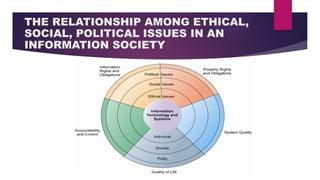
THE RELATIONSHIP AMONG ETHICAL,
SOCIAL, POLITICAL ISSUES IN AN
INFORMATION SOCIETY
A model for thinking about ethical, social, and political
Issues
Society as a calm pond
IT as rock dropped in pond, creating ripples
of new situations not covered by old rules
Social and political institutions cannot
respond overnight to these ripples—it may
take years to develop etiquette,
expectations, laws
Five moral dimensions of the
information age
1. Information rights and obligations
2. Property rights and obligations
3. Accountability and control
4. System quality
5. Quality of life
Key technology trends that raise ethical issues
1. Doubling of computer power
 More organizations depend on computer systems for critical
operations.
2. Rapidly declining data storage costs
 Organizations can easily maintain detailed databases on
individuals.
3. Networking advances and the Internet
 Copying data from one location to another and accessing
personal data from remote locations are much easier.
Key technology trends that raise ethical issues
4. Advances in data analysis techniques
 Profiling
Combining data from multiple sources to create dossiers of
detailed information on individuals
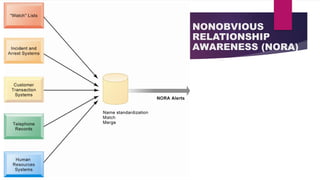
 Nonobvious relationship awareness (NORA)
Combining data from multiple sources to find obscure
hidden connections that might help identify criminals or
terrorists
5. Mobile device growth
 Tracking of individual cell phones
NONOBVIOUS
RELATIONSHIP
AWARENESS (NORA)
Basic concepts for ethical analysis
 Responsibility:
 Accepting the potential costs, duties, and obligations for
decisions
 Accountability:
 Mechanisms for identifying responsible parties
 Liability:
 Permits individuals (and firms) to recover damages done to them
 Due process:
 Laws are well-known and understood, with an ability to appeal
to higher authorities
Five-step ethical analysis
1. Identify and clearly describe the facts.
2. Define the conflict or dilemma and identify the
higher-order values involved.
3. Identify the stakeholders.
4. Identify the options that you can reasonably
take.
5. Identify the potential consequences of your
options.
Information rights: privacy and freedom in the Internet
age
 Privacy:
 Claim of individuals to be left alone, free from
surveillance or interference from other individuals,
organizations, or state; claim to be able to control
information about yourself
 In the United States, privacy protected by:
 First Amendment (freedom of speech)
 Fourth Amendment (unreasonable search and seizure)
 Additional federal statues (e.g., Privacy Act of 1974)
Fair Information Practices (FIP)
 The Information should not from the personal record
which is secret.
 People have a right for accessing, overseeing, looking
and changing all data about themselves.
 There is no one can accessing personal data for anything
without permission.
 System Manager have responsibility to keep data save.
 Government has a right for accessing all relationship
between companies.
Internet challenges to privacy
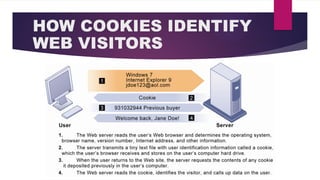
 Cookies
Identify browser and track visits to site
Super cookies (Flash cookies)
 Web beacons (Web bugs)
Tiny graphics embedded in e-mails and Web pages
Monitor who is reading e-mail message or visiting site
 Spyware
Surreptitiously installed on user’s computer
May transmit user’s keystrokes or display unwanted ads
 Google services and behavioral targeting
HOW COOKIES IDENTIFY
WEB VISITORS
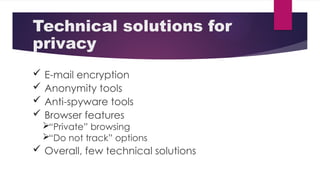
Technical solutions for
privacy
 E-mail encryption
 Anonymity tools
 Anti-spyware tools
 Browser features
“Private” browsing
“Do not track” options
 Overall, few technical solutions
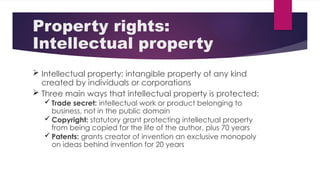
Property rights:
Intellectual property
 Intellectual property: intangible property of any kind
created by individuals or corporations
 Three main ways that intellectual property is protected:
 Trade secret: intellectual work or product belonging to
business, not in the public domain
 Copyright: statutory grant protecting intellectual property
from being copied for the life of the author, plus 70 years
 Patents: grants creator of invention an exclusive monopoly
on ideas behind invention for 20 years
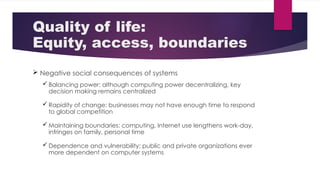
Quality of life:
Equity, access, boundaries
 Negative social consequences of systems
 Balancing power: although computing power decentralizing, key
decision making remains centralized
 Rapidity of change: businesses may not have enough time to respond
to global competition
 Maintaining boundaries: computing, Internet use lengthens work-day,
infringes on family, personal time
 Dependence and vulnerability: public and private organizations ever
more dependent on computer systems
Quality of life:
Equity, access, boundaries
 Computer crime and abuse
 Computer crime: commission of illegal acts through use of
computer or against a computer system—computer may be
object or instrument of crime
 Computer abuse: unethical acts, not illegal
 Spam: high costs for businesses in dealing with spam
 Employment:
 Reengineering work resulting in lost jobs
 Equity and access—the digital divide:
 Certain ethnic and income groups in the United States less likely to
have computers or Internet access
Quality of life:
Equity, access, boundaries
 Health risks
 Repetitive stress injury (RSI)
 Largest source is computer keyboards
 Carpal tunnel syndrome (CTS)
 Computer vision syndrome (CVS)
 Eyestrain and headaches related to screen use
 Techno stress
 Aggravation, impatience, fatigue
Case Study
 FBI have a carnivore which is a program who
can search people data secretly from the
internet.
 Some people agree when FBI use carnivore for
preventing USA from terrorist or criminal.
 In other side people disagree with carnivore
because their privacy was invaded.
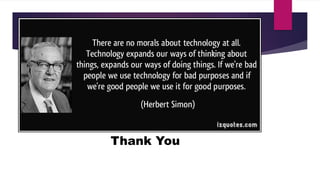
Thank You

Ethical_and_Social_Issues_in_Information_Systems.pptx

  • 1.
    Ethical and Social Issuesin Information Systems BY: GROUP 3 MARK JAN M. MANLANGIT ANALYN OMADTO ANDREA ORAA JERICHO F. BERNARDO KIETH ESPARAS
  • 3.
    Definition of Ethics Ethics refers to the principles of right and wrong that individuals, acting as free moral agents, use to make choices to guide their behaviors.
  • 4.
    Ethical issues ininformation systems have been given new urgency by the rise of the Internet and electronic commerce.
  • 5.
     Internet anddigital firm technologies make it easier than ever to assemble, integrate, and distribute information, unleashing new concerns about the appropriate use of customer information, the protection of personal privacy, and the protection of intellectual property
  • 6.
    THE RELATIONSHIP AMONGETHICAL, SOCIAL, POLITICAL ISSUES IN AN INFORMATION SOCIETY
  • 7.
    A model forthinking about ethical, social, and political Issues Society as a calm pond IT as rock dropped in pond, creating ripples of new situations not covered by old rules Social and political institutions cannot respond overnight to these ripples—it may take years to develop etiquette, expectations, laws
  • 8.
    Five moral dimensionsof the information age 1. Information rights and obligations 2. Property rights and obligations 3. Accountability and control 4. System quality 5. Quality of life
  • 9.
    Key technology trendsthat raise ethical issues 1. Doubling of computer power  More organizations depend on computer systems for critical operations. 2. Rapidly declining data storage costs  Organizations can easily maintain detailed databases on individuals. 3. Networking advances and the Internet  Copying data from one location to another and accessing personal data from remote locations are much easier.
  • 10.
    Key technology trendsthat raise ethical issues 4. Advances in data analysis techniques  Profiling Combining data from multiple sources to create dossiers of detailed information on individuals  Nonobvious relationship awareness (NORA) Combining data from multiple sources to find obscure hidden connections that might help identify criminals or terrorists 5. Mobile device growth  Tracking of individual cell phones
  • 11.
  • 12.
    Basic concepts forethical analysis  Responsibility:  Accepting the potential costs, duties, and obligations for decisions  Accountability:  Mechanisms for identifying responsible parties  Liability:  Permits individuals (and firms) to recover damages done to them  Due process:  Laws are well-known and understood, with an ability to appeal to higher authorities
  • 13.
    Five-step ethical analysis 1.Identify and clearly describe the facts. 2. Define the conflict or dilemma and identify the higher-order values involved. 3. Identify the stakeholders. 4. Identify the options that you can reasonably take. 5. Identify the potential consequences of your options.
  • 14.
    Information rights: privacyand freedom in the Internet age  Privacy:  Claim of individuals to be left alone, free from surveillance or interference from other individuals, organizations, or state; claim to be able to control information about yourself  In the United States, privacy protected by:  First Amendment (freedom of speech)  Fourth Amendment (unreasonable search and seizure)  Additional federal statues (e.g., Privacy Act of 1974)
  • 15.
    Fair Information Practices(FIP)  The Information should not from the personal record which is secret.  People have a right for accessing, overseeing, looking and changing all data about themselves.  There is no one can accessing personal data for anything without permission.  System Manager have responsibility to keep data save.  Government has a right for accessing all relationship between companies.
  • 16.
    Internet challenges toprivacy  Cookies Identify browser and track visits to site Super cookies (Flash cookies)  Web beacons (Web bugs) Tiny graphics embedded in e-mails and Web pages Monitor who is reading e-mail message or visiting site  Spyware Surreptitiously installed on user’s computer May transmit user’s keystrokes or display unwanted ads  Google services and behavioral targeting
  • 17.
  • 18.
    Technical solutions for privacy E-mail encryption  Anonymity tools  Anti-spyware tools  Browser features “Private” browsing “Do not track” options  Overall, few technical solutions
  • 19.
    Property rights: Intellectual property Intellectual property: intangible property of any kind created by individuals or corporations  Three main ways that intellectual property is protected:  Trade secret: intellectual work or product belonging to business, not in the public domain  Copyright: statutory grant protecting intellectual property from being copied for the life of the author, plus 70 years  Patents: grants creator of invention an exclusive monopoly on ideas behind invention for 20 years
  • 20.
    Quality of life: Equity,access, boundaries  Negative social consequences of systems  Balancing power: although computing power decentralizing, key decision making remains centralized  Rapidity of change: businesses may not have enough time to respond to global competition  Maintaining boundaries: computing, Internet use lengthens work-day, infringes on family, personal time  Dependence and vulnerability: public and private organizations ever more dependent on computer systems
  • 21.
    Quality of life: Equity,access, boundaries  Computer crime and abuse  Computer crime: commission of illegal acts through use of computer or against a computer system—computer may be object or instrument of crime  Computer abuse: unethical acts, not illegal  Spam: high costs for businesses in dealing with spam  Employment:  Reengineering work resulting in lost jobs  Equity and access—the digital divide:  Certain ethnic and income groups in the United States less likely to have computers or Internet access
  • 22.
    Quality of life: Equity,access, boundaries  Health risks  Repetitive stress injury (RSI)  Largest source is computer keyboards  Carpal tunnel syndrome (CTS)  Computer vision syndrome (CVS)  Eyestrain and headaches related to screen use  Techno stress  Aggravation, impatience, fatigue
  • 23.
    Case Study  FBIhave a carnivore which is a program who can search people data secretly from the internet.  Some people agree when FBI use carnivore for preventing USA from terrorist or criminal.  In other side people disagree with carnivore because their privacy was invaded.
  • 25.