Ethics In Information Technology 3rd Edition George Reynolds
Ethics In Information Technology 3rd Edition George Reynolds
Ethics In Information Technology 3rd Edition George Reynolds
Ethics In Information Technology 3rd Edition George Reynolds
Ethics In Information Technology 3rd Edition George Reynolds
1.
Ethics In InformationTechnology 3rd Edition
George Reynolds download
https://ebookbell.com/product/ethics-in-information-
technology-3rd-edition-george-reynolds-2417762
Explore and download more ebooks at ebookbell.com
2.
Here are somerecommended products that we believe you will be
interested in. You can click the link to download.
Ethics In Information Technology 6th Edition Reynolds George
https://ebookbell.com/product/ethics-in-information-technology-6th-
edition-reynolds-george-32694028
Ethics In Information Technology A Practical Guide Cognitive
Approaches In Cloud And Edge Computing 1st Edition G K Awari
https://ebookbell.com/product/ethics-in-information-technology-a-
practical-guide-cognitive-approaches-in-cloud-and-edge-computing-1st-
edition-g-k-awari-43895284
Ethics In Information Technology 5th Edition George Reynolds
https://ebookbell.com/product/ethics-in-information-technology-5th-
edition-george-reynolds-10405790
Contemporary Issues In Ethics And Information Technology Robert A
Schultz
https://ebookbell.com/product/contemporary-issues-in-ethics-and-
information-technology-robert-a-schultz-930068
3.
Information Technology EthicsConcepts And Practices In The Digital
World 1st Edition Hajer Kefi
https://ebookbell.com/product/information-technology-ethics-concepts-
and-practices-in-the-digital-world-1st-edition-hajer-kefi-51571466
Ethics In The Ai Technology And Information Age Michael Boylan
https://ebookbell.com/product/ethics-in-the-ai-technology-and-
information-age-michael-boylan-49134716
Readings And Cases In Information Security Law And Ethics Michael E
Whitman Herbert J Mattord
https://ebookbell.com/product/readings-and-cases-in-information-
security-law-and-ethics-michael-e-whitman-herbert-j-mattord-4106844
The Scope Of Information Ethics Challenges In Education Technology
Communications Medicine And Other Domains Robert Hauptman
https://ebookbell.com/product/the-scope-of-information-ethics-
challenges-in-education-technology-communications-medicine-and-other-
domains-robert-hauptman-37043642
The Art Of Mind Ethics You In The Information Society Liisa Janssens
Ed
https://ebookbell.com/product/the-art-of-mind-ethics-you-in-the-
information-society-liisa-janssens-ed-10451880
6.
E T HI C S I N I N F O R M A T I O N
T E C H N O L O G Y
Third Edition
E T HI C S I N I N F O R M A T I O N
T E C H N O L O G Y
George W. Reynolds
Australia • Brazil • Japan • Korea • Mexico • Singapore • Spain • United Kingdom • United States
Third Edition
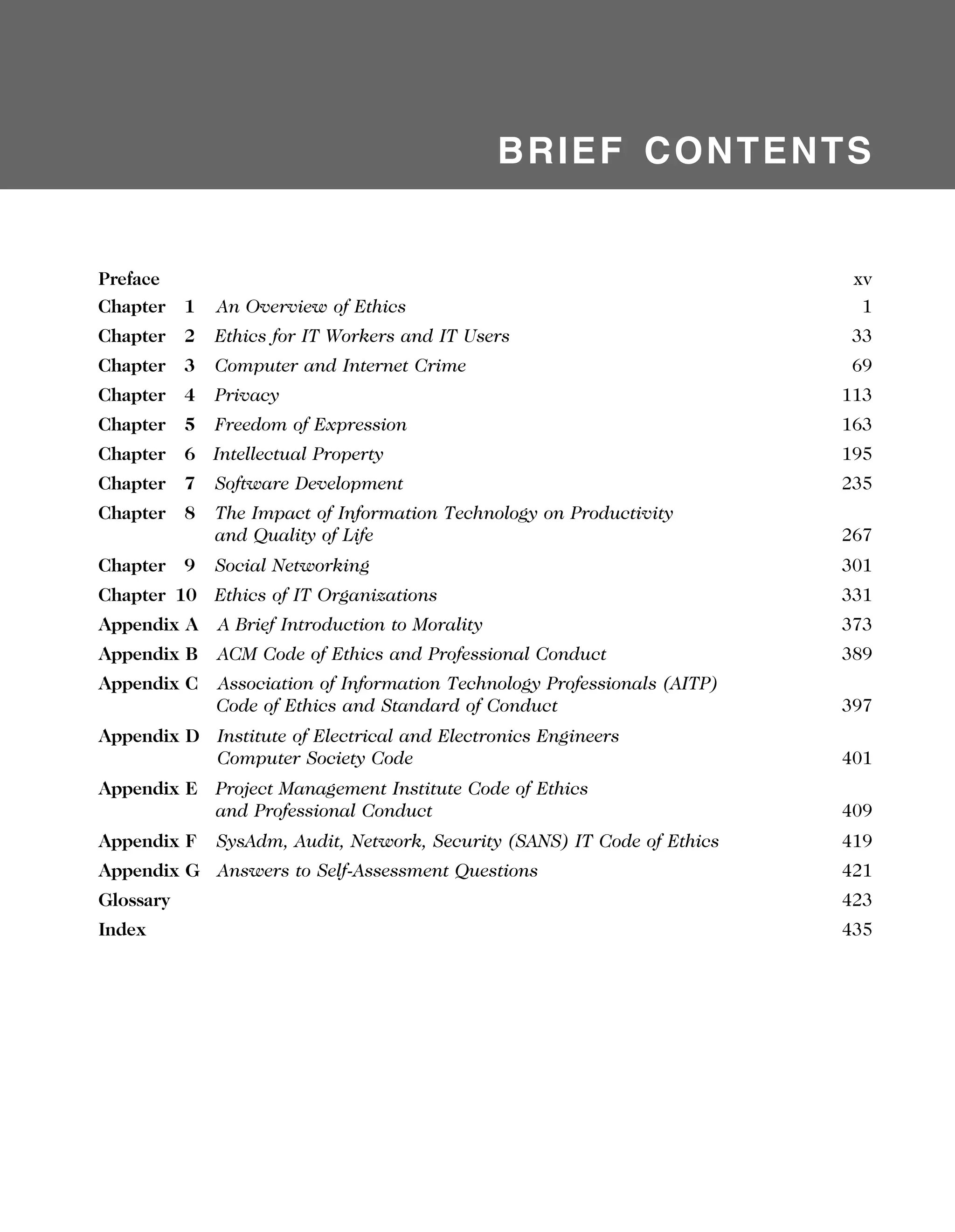
Preface xv
Chapter 1An Overview of Ethics 1
Chapter 2 Ethics for IT Workers and IT Users 33
Chapter 3 Computer and Internet Crime 69
Chapter 4 Privacy 113
Chapter 5 Freedom of Expression 163
Chapter 6 Intellectual Property 195
Chapter 7 Software Development 235
Chapter 8 The Impact of Information Technology on Productivity
and Quality of Life 267
Chapter 9 Social Networking 301
Chapter 10 Ethics of IT Organizations 331
Appendix A A Brief Introduction to Morality 373
Appendix B ACM Code of Ethics and Professional Conduct 389
Appendix C Association of Information Technology Professionals (AITP)
Code of Ethics and Standard of Conduct 397
Appendix D Institute of Electrical and Electronics Engineers
Computer Society Code 401
Appendix E Project Management Institute Code of Ethics
and Professional Conduct 409
Appendix F SysAdm, Audit, Network, Security (SANS) IT Code of Ethics 419
Appendix G Answers to Self-Assessment Questions 421
Glossary 423
Index 435
BRIEF CONTENTS
Preface xv
Chapter 1An Overview of Ethics 1
Vignette 1
Dubious Methods Used to Investigate Leaks by Hewlett-Packard Board Members 1
What Is Ethics? 3
Definition of Ethics 3
The Importance of Integrity 4
The Difference Between Morals, Ethics, and Laws 4
Ethics in the Business World 5
Why Fostering Good Business Ethics Is Important 6
Improving Corporate Ethics 10
Creating an Ethical Work Environment 14
Including Ethical Considerations in Decision Making 16
Ethics in Information Technology 20
Summary 22
Self-Assessment Questions 23
Discussion Questions 24
What Would You Do? 24
Cases 26
End Notes 30
Chapter 2 Ethics for IT Workers and IT Users 33
Vignette 33
IT Technicians Fired After Reporting Child Porn 33
IT Professionals 37
Are IT Workers Professionals? 37
The Changing Professional Services Industry 37
Professional Relationships That Must Be Managed 38
Professional Codes of Ethics 46
Professional Organizations 47
Certification 49
Government Licensing 52
IT Professional Malpractice 53
IT Users 54
Common Ethical Issues for IT Users 54
Supporting the Ethical Practices of IT Users 55
Summary 58
TABLE OF CONTENTS
13.
Self-Assessment Questions 59
DiscussionQuestions 60
What Would You Do? 60
Cases 62
End Notes 66
Chapter 3 Computer and Internet Crime 69
Vignette 69
Trading Scandal at Société Générale 69
IT Security Incidents: A Major Concern 73
Why Computer Incidents Are So Prevalent 74
Types of Exploits 75
Types of Perpetrators 81
Federal Laws for Prosecuting Computer Attacks 86
Implementing Trustworthy Computing 87
Risk Assessment 89
Establishing a Security Policy 91
Educating Employees, Contractors, and Part-Time Workers 92
Prevention 93
Detection 97
Response 97
Summary 101
Self-Assessment Questions 101
Discussion Questions 103
What Would You Do? 103
Cases 105
End Notes 109
Chapter 4 Privacy 113
Vignette 113
Privacy Concerns Abound with New IRS Systems 113
Privacy Protection and the Law 116
Information Privacy 117
Privacy Laws, Applications, and Court Rulings 118
Key Privacy and Anonymity Issues 132
Identity Theft 132
Consumer Profiling 136
Treating Consumer Data Responsibly 139
Workplace Monitoring 140
Advanced Surveillance Technology 142
Summary 145
Self-Assessment Questions 147
Discussion Questions 148
What Would You Do? 149
Cases 151
End Notes 158
viii Table of Contents
14.
Chapter 5 Freedomof Expression 163
Vignette 163
Sexting 163
First Amendment Rights 167
Obscene Speech 169
Defamation 169
Freedom of Expression: Key Issues 169
Controlling Access to Information on the Internet 170
Anonymity on the Internet 175
Defamation and Hate Speech 178
Corporate Blogging 180
Pornography 180
Summary 184
Self-Assessment Questions 185
Discussion Questions 187
What Would You Do? 187
Cases 188
End Notes 192
Chapter 6 Intellectual Property 195
Vignette 195
RIAA Fights Music Piracy 195
What Is Intellectual Property? 197
Copyrights 198
Copyright Term 198
Eligible Works 198
Fair Use Doctrine 199
Software Copyright Protection 199
The Prioritizing Resources and Organization for Intellectual
Property (PRO-IP) Act of 2008 200
General Agreement on Tariffs and Trade (GATT) 200
The WTO and the WTO TRIPS Agreement (1994) 200
The World Intellectual Property Organization (WIPO) Copyright Treaty (1996) 201
The Digital Millennium Copyright Act (1998) 202
Patents 203
Software Patents 204
Software Cross-Licensing Agreements 205
Defensive Publishing and Patent Trolls 205
Submarine Patents and Patent Farming 206
Trade Secrets 207
Trade Secret Laws 208
Employees and Trade Secrets 208
Key Intellectual Property Issues 210
Plagiarism 210
Reverse Engineering 212
Open Source Code 213
Table of Contents ix
15.
Competitive Intelligence 215
Cybersquatting219
Summary 221
Self-Assessment Questions 223
Discussion Questions 224
What Would You Do? 225
Cases 226
End Notes 231
Chapter 7 Software Development 235
Vignette 235
Boeing Dreamliner Faces a Few Bumps in the Road 235
Strategies for Engineering Quality Software 238
The Importance of Software Quality 240
Software Product Liability 241
Software Development Process 244
Capability Maturity Model Integration 245
Key Issues in Software Development 247
Development of Safety-Critical Systems 247
Quality Management Standards 251
Summary 253
Self-Assessment Questions 254
Discussion Questions 255
What Would You Do? 256
Cases 258
End Notes 262
Chapter 8 The Impact of Information Technology on Productivity
and Quality of Life 267
Vignette 267
Western Cape Striving to Eliminate the Digital Divide 267
The Impact of IT on the Standard of Living and Worker Productivity 270
IT Investment and Productivity 270
The Digital Divide 275
The Impact of IT on Healthcare Costs 280
Electronic Health Records 282
Use of Mobile and Wireless Technology in the Healthcare Industry 284
Telemedicine 284
Medical Information Web Sites for Laypeople 285
Summary 288
Self-Assessment Questions 289
Discussion Questions 290
What Would You Do? 291
Cases 292
End Notes 296
x Table of Contents
16.
Chapter 9 SocialNetworking 301
Vignette 301
Twitter Emerges as News Source for Iran Protesters 301
What Is a Social Networking Web Site? 304
Business Applications of Online Social Networking 306
Social Network Advertising 306
The Use of Social Networks in the Hiring Process 307
Social Shopping Web Sites 309
Social Networking Ethical Issues 310
Cyberbullying 310
Cyberstalking 311
Encounters with Sexual Predators 312
Uploading of Inappropriate Material 312
Online Virtual Worlds 313
Crime in Virtual Worlds 315
Educational and Business Uses of Virtual Worlds 316
Summary 318
Self-Assessment Questions 319
Discussion Questions 320
What Would You Do? 321
Cases 321
End Notes 325
Chapter 10 Ethics of IT Organizations 331
Vignette 331
Problems with the Suppliers 331
Key Ethical Issues for Organizations 334
The Need for Nontraditional Workers 334
Contingent Workers 335
Advantages of Using Contingent Workers 337
Disadvantages of Using Contingent Workers 337
Deciding When to Use Contingent Workers 337
H-1B Workers 339
H-1B Application Process 341
Using H-1B Workers Instead of U.S. Workers 342
Potential Exploitation of H-1B Workers 342
Outsourcing 342
Offshore Outsourcing 343
Pros and Cons of Offshore Outsourcing 345
Strategies for Successful Offshore Outsourcing 346
Whistle-Blowing 347
Protection for Whistle-Blowers 347
Whistle-Blowing Protection for Private-Sector Workers 349
Dealing with a Whistle-Blowing Situation 349
Green Computing 352
ICT Industry Code of Conduct 354
Table of Contents xi
17.
Summary 356
Self-Assessment Questions357
Discussion Questions 358
What Would You Do? 359
Cases 361
End Notes 366
Appendix A A Brief Introduction to Morality 373
Introduction 373
The Knotty Question of Goodness 374
Relativism: Why “Common Sense” Won’t Work 375
Egoism vs. Altruism 376
Deontology, or the Ethics of Logical Consistency and Duty 378
Happy Consequences, or Utilitarianism 380
Promises and Contracts 382
A Return to the Greeks: The Good Life of Virtue 383
Feminism and the Ethics of Care 385
Pluralism 386
Summary 387
Appendix B ACM Code of Ethics and Professional Conduct 389
Preamble 389
1. General Moral Imperatives 390
2. More Specific Professional Responsibilities 392
3. Organizational Leadership Imperatives 394
4. Compliance with the Code 395
Appendix C Association of Information Technology Professionals (AITP)
Code of Ethics and Standard of Conduct 397
Code of Ethics 397
Standard of Conduct 398
Appendix D Institute of Electrical and Electronics Engineers
Computer Society Code 401
Software Engineering Code of Ethics and Professional Practice 401
Appendix E Project Management Institute Code of Ethics and
Professional Conduct 409
Chapter 1. Vision and Applicability 409
Chapter 2. Responsibility 411
Chapter 3. Respect 412
Chapter 4. Fairness 413
Chapter 5. Honesty 414
xii Table of Contents
18.
Appendix A 415
A.1History of this Standard 415
A.2 Process Used to Create this Standard 416
Appendix B 416
B.1 Glossary 416
Appendix F SysAdm, Audit, Network, Security (SANS) IT Code of Ethics 419
Appendix G Answers to Self-Assessment Questions 421
Glossary 423
Index 435
Table of Contents xiii
We are excitedto publish the third edition of Ethics in Information Technology. This new
edition builds on the success of the previous editions and meets the need for a resource that
helps readers understand many of the legal, ethical, and societal issues associated with IT.
We have responded to the feedback from our first and second edition adopters, students, and
other reviewers to create an improved text. We think you will be pleased with the results.
Ethics in Information Technology, Third Edition, fills a void of practical business infor-
mation for business managers and IT professionals. The typical introductory information
systems book devotes one chapter to ethics and IT, which cannot possibly cover the full
scope of ethical issues related to IT. Such limited coverage does not meet the needs of busi-
ness managers and IT professionals—the people who are primarily responsible for addres-
sing ethical issues in the workplace. What is missing is an examination of the different
ethical situations that arise in IT as well as practical advice for addressing these issues.
Ethics in Information Technology, Third Edition, has enough substance for an instruc-
tor to use it in a full-semester course in computer ethics. You can also use the book as a
reading supplement for such courses as Introduction to Management Information Systems,
Principles of Information Technology, Managerial Perspective of Information Technology,
Computer Security, E-Commerce, and so on.
W H A T ’ S N E W
Ethics in Information Technology, Third Edition, has been updated and revised to incorpo-
rate the many new developments and ethical issues that have arisen since the last edition.
Two new chapters have been added: Chapter 9, “Social Networking,” and Chapter 10,
“Ethics of IT Organizations.” All opening vignettes, as well as over 80 percent of the end-of-
chapter cases, are new. Most of the real-world examples in each chapter have also been
updated. Based on reviewer feedback, we have substantially increased the number of “Self-
Assessment Questions” as well as the number of “What Would You Do?” exercises. We think
you will like these changes and additions.
O R G A N I Z A T I O N
Each of the 10 chapters in this book addresses a different aspect of ethics in information
technology:
• Chapter 1, “An Overview of Ethics,” provides an introduction to ethics, ethics
in business, and the relevance of discussing ethics in IT. The chapter also dis-
cusses philosophical approaches to ethical decision making, and suggests a
model for ethical decision making.
PREFACE
21.
• Chapter 2,“Ethics for IT Workers and IT Users,” explains the importance of
ethics in the business relationships of IT professionals, and it discusses the
roles that certification and licensing can play in legitimizing professional stan-
dards. The chapter also emphasizes the significance of IT professional organiza-
tions and their codes of ethics. The chapter touches on some ethical issues
faced by IT users—including software piracy, inappropriate use of computing
resources, and inappropriate sharing of information—and offers advice on how
to support the ethical practices of IT users.
• Chapter 3, “Computer and Internet Crime,” describes the types of ethical deci-
sions that IT professionals must make, as well as the business needs they must
balance when dealing with security issues. In addition to providing a useful
classification of computer crimes and their perpetrators, the chapter explains
both how to implement trustworthy computing to manage security vulnerabil-
ities and how to respond to specific security incidents to fix problems quickly
and improve ongoing security measures.
• Chapter 4, “Privacy,” covers the issue of privacy, explains how the use of IT
affects privacy rights, and discusses several key pieces of legislation that have
addressed privacy rights over the years. The chapter explains how the personal
information that businesses gather using IT can be used to obtain or keep cus-
tomers (or to monitor employees). It also discusses the concerns of privacy
advocates regarding how much information can be gathered, with whom it can
be shared, how the information is gathered in the first place, and how it is used.
These concerns also extend to the information-gathering practices of law
enforcement and government.
• Chapter 5, “Freedom of Expression,” addresses issues raised by the growing use
of the Internet as a means for freedom of expression, while examining the types
of speech that are protected by the First Amendment of the U.S. Constitution.
The chapter also covers the ways in which the ease and anonymity with which
Internet users communicate can pose problems for people who might be
adversely affected by such communication, and it discusses attempts (using
legislation and technology) to control access to Internet content that is unsuit-
able for children or unnecessary in a business environment.
• Chapter 6, “Intellectual Property,” defines intellectual property and explains
the varying degrees of ownership protection offered by copyright, patent, and
trade secret laws. The chapter discusses several key issues that are relevant
to ethics in IT, including plagiarism, reverse engineering of software, open
source code, competitive intelligence gathering, and cybersquatting.
• Chapter 7, “Software Development,” provides a thorough discussion of the soft-
ware development process and the importance of software quality. The chapter
covers issues that software manufacturers must consider when deciding “how good
is good enough?” with regard to their software products—particularly when the
software is safety-critical and its failure can cause loss of human life. Topics include
product liability, risk analysis, different approaches to quality assurance testing,
and processes and standards that may be adopted to achieve quality goals.
• Chapter 8, “The Impact of Information Technology on Productivity and the
Quality of Life,” examines the effect that IT has had on the standard of living and
xvi Preface
22.
worker productivity indeveloped countries. The chapter also discusses the dig-
ital divide, and profiles some programs that are designed to close that gap. The
chapter closes with a look at IT’s impact on health care and healthcare costs.
• Chapter 9, “Social Networking,” discusses how people use social networks,
identifies common business uses of social networks, and examines many of the
ethical issues associated with the use of social networks. The chapter also
touches on virtual life communities and the ethical issues associated with
virtual worlds.
• Chapter 10, “Ethics of IT Organizations,” covers a range of ethical issues facing
IT organizations, including those associated with the use of nontraditional
workers, such as temporary workers, contractors, consulting firms, H-1B work-
ers, and offshore-outsourced workers. The chapter discusses the risks, protec-
tions, and ethical decisions related to whistle-blowing, and presents a process
for safely and effectively handling a whistle-blowing situation. In addition to
introducing the concept of green computing, the chapter discusses the ethical
issues that both IT manufacturers and IT users face when a company is consid-
ering how to transition to green computing—and at what cost. Finally, the
chapter examines a code of conduct for the electronics and information and
communications technology (ICT) industries designed to address ethical issues
in the areas of worker safety and fairness, environmental responsibility, and
business efficiency. The chapter explains what has been done so far and what
still needs to be done to continue this work.
• Appendix A provides an in-depth discussion of how ethics and moral codes
developed through time. Appendices B through F consist of the codes of ethics
for several important IT professional organizations. Appendix G provides
answers to the end-of-chapter Self-Assessment Questions.
P E D A G O G Y
Ethics in Information Technology, Third Edition, employs a variety of pedagogical features
to enrich the learning experience and provide interest for the instructor and student:
• Opening Quotation. Each chapter begins with a quotation to stimulate interest
in the chapter material.
• Vignette. At the beginning of each chapter, a brief real-world example illus-
trates the issues to be discussed and piques the reader’s interest.
• Questions to Consider. Carefully crafted focus questions follow the vignette to
further highlight topics that are covered in the chapter.
• Learning Objectives. Learning objectives appear at the start of each chapter.
They are presented in the form of questions for students to consider while read-
ing the chapter.
• Key Terms. Key terms appear in bold in the text and are defined in the glossary
at the end of the book.
• Manager’s Checklist. Each checklist provides a practical and useful list of ques-
tions to consider when making a business decision.
Preface xvii
23.
End-of-Chapter Material
To helpstudents retain key concepts and expand their understanding of important IT con-
cepts and relationships, the following sections are included at the end of every chapter:
• Summary. Each chapter includes a summary of the key issues raised. These
items relate to the Learning Objectives for each chapter.
• Self-Assessment Questions. These questions help students review and test their
understanding of key chapter concepts. The answers to the Self-Assessment
Questions are included in Appendix G.
• Discussion Questions. These more open-ended questions help instructors gen-
erate class discussion to move students deeper into the concepts and help them
explore the numerous aspects of ethics in IT.
• What Would You Do? These exercises present realistic dilemmas that
encourage students to think critically about the ethical principles presented
in the text.
• Cases. In each chapter, three real-world cases reinforce important ethical prin-
ciples and IT concepts, and show how real companies have addressed ethical
issues associated with IT. Questions after each case focus students on its key
issues and ask them to apply the concepts presented in the chapter.
A B O U T T H E A U T H O R
George W. Reynolds brings a wealth of computer and industrial experience to this project,
with more than 30 years of experience in government, institutional, and commercial IS
organizations. He has authored over 20 texts and has taught at the University of Cincinnati,
Xavier University (Ohio), Miami University (Ohio), and the College of Mount St. Joseph.
T E A C H I N G T O O L S
The following supplemental materials are available when this book is used in a classroom
setting. All of these tools are provided to the instructor on a single CD-ROM. You can also
find some of these materials on the Cengage Learning Web site at www.cengage.com/mis.
• Electronic Instructor’s Manual. The Instructor’s Manual that accompanies this
textbook includes additional instructional material to assist in class prepara-
tion, including suggestions for lecture topics. It also includes solutions to all
end-of-chapter exercises.
• ExamView®
. This textbook is accompanied by ExamView, a powerful testing
software package that allows instructors to create and administer printed, com-
puter (LAN-based), and Internet exams. ExamView includes hundreds of ques-
tions that correspond to the topics covered in this text, enabling students to
generate detailed study guides that include page references for further review.
The computer-based and Internet testing components allow students to take
exams at their computers, and save the instructor time by grading each exam
automatically.
xviii Preface
24.
• PowerPoint Presentations.This book comes with Microsoft PowerPoint slides
for each chapter. The slides can be included as a teaching aid for classroom
presentation, made available to students on the network for chapter review,
or printed for classroom distribution. The slides are fully customizable. Instruc-
tors can either add their own slides for additional topics they introduce to the
class or delete slides they won’t be covering.
• Figure Files. Figure files allow instructors to create their own presentations
using figures taken directly from the text.
• Blackboard®
and WebCT™
Level 1 Online Content. If you use Blackboard or
WebCT, the test bank for this textbook is available at no cost in a simple,
ready-to-use format. Go to www.cengage.com/coursetechnology and search for
this textbook to download the test bank.
A C K N O W L E D G M E N T S
I want to thank a number of people who helped greatly in the creation of this book: Charles
McCormick Jr., Senior Acquisitions Editor, for his belief in and encouragement of this proj-
ect; Jennifer Feltri, Content Product Manager, for guiding the book through the production
process; Kate Hennessy Mason, Senior Product Manager, for overseeing and directing this
effort; Mary Pat Shaffer, Development Editor, for her tremendous support, many useful sug-
gestions, and helpful edits; Naomi Friedman, for writing many of the vignettes and cases;
and my many students at Miami University and the University of Cincinnati, who provided
excellent ideas and constructive feedback on the text. I also wish to thank Clancy Martin for
writing Appendix A. In addition, I want to thank a marvelous set of reviewers who offered
many useful suggestions:
Valerie Akuna, Estrella Mountain Community College
Pat Artz, Bellevue University
Kathryn Baalman, Webster University–Saint Louis
Scott Burrell, Collins College
Kuan-Chou Chen, Purdue University Calumet
Elaine Crable, Xavier University
Becky Cunningham, Arkansas Tech University
Lee Falta, Bellingham Technical College
Maria Raquel Garcia, Franklin Pierce University
Jonathan Jelen, Polytechnic Institute of NYU
Cynthia Jensen, Jacksonville State University
Diana Johnson, The College of St. Scholastica
Carol Kalen, Rockford College
Chuck Lund, Central Lakes College
Elizabeth McCarthy, Kirkwood Community College
Michael Nelson, Hodges University
Nancy O’Geary-Smith, Kirkwood Community College
Richard Smith, The University of Findlay
Sandy Vitale, McHenry County College
Preface xix
25.
I’d also liketo thank the reviewers who helped shape the second edition:
Karen Williams, University of Texas at San Antonio
Catharine Kuchar, Southern Institute for Business and Professional Ethics,
Decatur, GA
Cherie Ann Sherman, Ramapo College of New Jersey
Jeff Stewart, PhD, Macon State College
Last of all, thanks to my family for all their support, and for giving me the time to write
this text.
—George W. Reynolds
xx Preface
26.
E T HI C S I N I N F O R M A T I O N
T E C H N O L O G Y
Third Edition
C H AP T E R 1
AN OVERVIEW OF ETHICS
Q U O T E
Ethics must begin at the top of an organization. It is a leadership issue, and the chief exec-
utive must set the example.
—Edward Hennessy, CEO, Allied Signal1
V I G N E T T E
Dubious Methods Used to Investigate Leaks by Hewlett-Packard
Board Members
On September 5, 2006, Newsweek published a story revealing that Hewlett-Packard (HP) chairman
Patricia Dunn authorized an internal investigation of HP board members beginning sometime in 2005.
Dunn suspected one or more board members of leaking information about HP’s long-term strategy to
the news media. One such article appeared on the technology Web site CNET in January 2006.2
Making such confidential information public could have a significant impact on the competitiveness of
the company and impact its share price.
Three private detectives involved in the investigation allegedly engaged in pretexting—the use
of false pretenses—to gain access to the telephone records of HP directors, certain employees, and
nine journalists. The detectives allegedly obtained and used the targeted individuals’ Social Security
numbers to impersonate those individuals in calls to the phone company, with the goal of obtaining
private phone records.
29.
The California stateattorney general filed criminal charges against Dunn, Kevin Hunsaker—senior
legal counsel and director of ethics and standards of business conduct—and the three outside investi-
gators.3
Dunn admitted that she oversaw the investigation but said she never had any knowledge that
illegal methods were used. All charges were eventually dropped against Dunn. Hunsaker and two of the
detectives involved pleaded no contest to fraudulent wire communications, a misdemeanor. The judge
agreed to drop the charges if they completed 96 hours of community service. The third detective
charged in the case agreed to act as a witness for the prosecution and thus escaped criminal
proceedings.4
Eventually, the state settled a separate civil complaint against the company. HP agreed to pay
$14.5 million to cover fines and legal costs, and also agreed to strengthen its corporate governance
practices. The settlement did not involve any admission or conclusion of guilt on the part of HP.5
When the scandal broke, one HP board member, Tom Perkins, resigned to protest the methods
Dunn used in the investigation. In the aftermath, Dunn and Hunsaker also resigned from the board.
George Keyworth, a 21-year member of the HP board of directors, was identified by Dunn as being the
one who leaked the information, and he also resigned.
Throughout the scandal, investors continued to show faith in HP, and the price of the stock rose
steadily from a level of $32 per share in July 2006 to over $43 per share in early January 2007.
Questions to Consider
1. Which issue is more disconcerting—the fact that a board member leaked confidential infor-
mation about the firm or the tactics used to investigate the leak? Defend your position.
2. Can the use of pretexting to gain information ever be justified? Is it considered legal under
any circumstances?
2
Chapter 1
30.
L E AR N I N G O B J E C T I V E S
As you read this chapter, consider the following questions:
1. What is ethics, and why is it important to act according to a code of ethics?
2. Why is business ethics becoming increasingly important?
3. What are organizations doing to improve their business ethics?
4. Why are organizations interested in fostering good business ethics?
5. What approach can you take to ensure ethical decision making?
6. What trends have increased the risk of using information technology in an unethical
manner?
W H A T I S E T H I C S ?
Each society forms a set of rules that establishes the boundaries of generally accepted
behavior. These rules are often expressed in statements about how people should behave,
and they fit together to form the moral code by which a society lives. Unfortunately, the dif-
ferent rules often have contradictions, and people are sometimes uncertain about which
rule to follow. For instance, if you witness a friend copy someone else’s answers while taking
an exam, you might be caught in a conflict between loyalty to your friend and the value of
telling the truth. Sometimes the rules do not seem to cover new situations, and an individual
must determine how to apply existing rules or develop new ones. You may strongly support
personal privacy, but what rules do you think are acceptable for governing the appropriate
use of company resources, such as e-mail and Internet access?
The term morality refers to social conventions about right and wrong that are so widely
shared that they become the basis for an established consensus. However, individual views
of what is moral may vary by age, cultural group, ethnic background, religion, life experi-
ences, education, and gender. There is widespread agreement on the immorality of murder,
theft, and arson, but other behaviors that are accepted in one culture might be unacceptable
in another. Even within the same society, people can have strong disagreements over impor-
tant moral issues. In the United States, for example, issues such as abortion, the death pen-
alty, and gun control are continuously debated, and both sides feel that their arguments
are on solid moral ground.
Definition of Ethics
Ethics is a set of beliefs about right and wrong behavior within a society. Ethical behavior
conforms to generally accepted norms—many of which are almost universal. However,
although nearly everyone would agree that lying and cheating are unethical, opinions about
what constitutes ethical behavior often vary dramatically. For example, attitudes toward
software piracy—that is, the practice of illegally making copies of software or enabling
others to access software to which they are not entitled—range from strong opposition to
acceptance of the practice as a standard approach to conducting business. In 2007, 38 per-
cent of all software in circulation worldwide was pirated—at a cost of nearly $48 billion
(USD). The highest piracy rate—93 percent—was in Armenia; Bangladesh, Azerbaijan, and
3
An Overview of Ethics
31.
Moldova all hadpiracy rates of 92 percent. The lowest piracy rates were in the United States
(20%), Luxembourg (21%), and New Zealand (22%).6
As children grow, they learn complicated tasks—walking, talking, swimming, riding
a bike, writing the alphabet—that they perform out of habit for the rest of their lives.
People also develop habits that make it easier to choose between what society considers
good or bad. Virtues are habits that incline people to do what is acceptable, and vices
are habits of unacceptable behavior. Fairness, generosity, and loyalty are examples of vir-
tues, while vanity, greed, envy, and anger are considered vices. People’s virtues and vices
help define their personal value system—the complex scheme of moral values by which
they live.
The Importance of Integrity
Your moral principles are statements of what you believe to be rules of right conduct. As a
child, you may have been taught not to lie, cheat, or steal. As an adult facing more complex
decisions, you often reflect on your principles when you consider what to do in different situa-
tions: Is it okay to lie to protect someone’s feelings? Should you intervene with a coworker
who seems to have a chemical dependency problem? Is it acceptable to exaggerate your work
experience on a résumé? Can you cut corners on a project to meet a tight deadline?
A person who acts with integrity acts in accordance with a personal code of principles.
One approach to acting with integrity—one of the cornerstones of ethical behavior—is to
extend to all people the same respect and consideration that you expect to receive from
others. Unfortunately, consistency can be difficult to achieve, particularly when you are in
a situation that conflicts with your moral standards. For example, you might believe it is
important to do as your employer requests while also believing that you should be fairly
compensated for your work. Thus, if your employer insists that you do not report the over-
time hours that you have worked due to budget constraints, a moral conflict arises. You can
do as your employer requests or you can insist on being fairly compensated, but you cannot
do both. In this situation, you may be forced to compromise one of your principles and act
with an apparent lack of integrity.
Another form of inconsistency emerges if you apply moral standards differently accord-
ing to the situation or people involved. To be consistent and act with integrity, you must
apply the same moral standards in all situations. For example, you might consider it morally
acceptable to tell a little white lie to spare a friend some pain or embarrassment, but would
you lie to a work colleague or customer about a business issue to avoid unpleasantness?
Clearly, many ethical dilemmas are not as simple as right versus wrong but involve choices
between right versus right. As an example, for some people it is “right” to protect the Alas-
kan wildlife from being spoiled and also “right” to find new sources of oil to maintain U.S.
reserves, but how do they balance these two concerns?
The Difference Between Morals, Ethics, and Laws
Morals are one’s personal beliefs about right and wrong, while the term ethics describes
standards or codes of behavior expected of an individual by a group (nation, organization,
profession) to which an individual belongs. For example, the ethics of the law profession
demand that defense attorneys defend an accused client to the best of their ability, even if
4
Chapter 1
32.
they know thatthe client is guilty of the most heinous and morally objectionable crime one
could imagine.
Law is a system of rules that tells us what we can and cannot do. Laws are enforced
by a set of institutions (the police, courts, law-making bodies). Legal acts are acts that con-
form to the law. Moral acts conform with what an individual believes to be the right thing
to do. Laws can proclaim an act as legal, although many people may consider the act
immoral—for example, abortion.
The remainder of this chapter provides an introduction to ethics in the business world.
It discusses the importance of ethics in business, outlines what businesses can do to
improve their ethics, provides advice on creating an ethical work environment, and suggests
a model for ethical decision making. The chapter concludes with a discussion of ethics as
it relates to information technology (IT).
E T H I C S I N T H E B U S I N E S S W O R L D
Ethics has risen to the top of the business agenda because the risks associated with inappro-
priate behavior have increased, both in their likelihood and in their potential negative
impact. In the past decade, we have seen the failure of major corporations such as Enron
and WorldCom due to accounting scandals. We have watched the collapse of financial insti-
tutions due to unwise and unethical decision making over the approval of mortgages and
lines of credit to unqualified individuals and organizations. We have also witnessed numer-
ous corporate officers and senior managers sentenced to prison terms for their unethical
behavior. Clearly, unethical behavior has led to serious negative consequences that have
had a major global impact.
Several trends have increased the likelihood of unethical behavior. First, for many orga-
nizations, greater globalization has created a much more complex work environment that
spans diverse cultures and societies, making it much more difficult to apply principles and
codes of ethics consistently. For example, numerous U.S. companies have garnered negative
publicity for moving operations to third-world countries, where employees work in condi-
tions that would not be acceptable in most developed parts of the world.
Second, in today’s recessionary economic climate, organizations are extremely chal-
lenged to maintain revenue and profits. Some organizations are sorely tempted to resort to
unethical behavior to maintain profits. For example, the Peanut Corporation of America
allegedly shipped tainted products from its plant in Georgia, which led to a salmonella
outbreak in 2008 that killed at least eight people and sickened over 550 people in 43
states.7
Employees, shareholders, and regulatory agencies are increasingly sensitive to viola-
tions of accounting standards, failures to disclose substantial changes in business condi-
tions, nonconformance with required health and safety practices, and production of unsafe
or substandard products. Such heightened vigilance raises the risk of financial loss for busi-
nesses that do not foster ethical practices or that run afoul of required standards. There is
also a risk of criminal and civil lawsuits resulting in fines and/or incarceration for
individuals.
A classic example of the many risks of unethical decision making can be found in the
Enron accounting scandal. In 2000, Enron employed over 22,000 people and had annual
5
An Overview of Ethics
33.
revenue of $101billion. During 2001, it was revealed that much of Enron’s revenue was the
result of deals with limited partnerships, which it controlled. In addition, as a result of faulty
accounting, many of Enron’s debts and losses were not reported in its financial statements.
As the accounting scandal unfolded, Enron shares dropped from $90 per share to less than
$1 per share, and the company was forced to file for bankruptcy in December 2001. The
Enron case was notorious, but many other corporate scandals have recently occurred in
spite of safeguards enacted as a result of the Enron debacle. Here are just a few examples
from around the world:
• As discussed in the opening vignette, Hewlett-Packard hired investigators to
identify members of its board of directors who were responsible for leaking con-
fidential company information to the press.
• Comverse Technology develops, designs, manufactures, and supports computer
and telecommunications systems for multimedia communications. It provides
its products to more than 500 service providers in over 130 countries. In
2008, the company’s founder and former CEO Jacob Alexander admitted he
backdated Comverse stock options for personal gain and is being sued by the
firm for $70 million.8
• The chairman of the India-based outsourcing firm Satyam Computer Services
admitted he falsified his firm’s profits for years—by as much as $1 billion. The
revelation represents India’s largest ever corporate scandal.9
• Two separate scandals, just weeks apart in 2006, caused China to lose ground
in its effort to catch up with advanced countries in building its own computer
chips. Work on the Haxin chip—a digital signal processing chip—was halted
and its lead designer disgraced when it was revealed to be a copy of a U.S.
design. Shortly after, the state-supported R & D effort to build the Arca-3 CPU
chip had to be delayed when it was uncovered that the research funds had been
embezzled.10
This is just a small sample of the scandals that have led to an increased focus on busi-
ness ethics within many IT organizations.
Why Fostering Good Business Ethics Is Important
Organizations have at least five good reasons for promoting a work environment in which
employees are encouraged to act ethically when making business decisions:
1. Gaining the good will of the community
2. Creating an organization that operates consistently
3. Fostering good business practices
4. Protecting the organization and its employees from legal action
5. Avoiding unfavorable publicity
Gaining the Good Will of the Community
Although organizations exist primarily to earn profits or provide services to customers, they
also have some fundamental responsibilities to society. Often they declare these responsibil-
ities in a formal statement of their company’s principles or beliefs (see Figure 1-1 for an
example).
6
Chapter 1
34.
“Technology companies arewaking up to the fact that they have to attract and main-
tain loyalty with their customers,” says Carol Cone, head of Boston marketing consulting
firm Cone, Inc., which helps develop corporate giving programs. “Philanthropy allows a
company to demonstrate its values in action and present a human face to its stake-
holders.”11
(A stakeholder is someone who stands to gain or lose, depending on how a
situation is resolved.) As a result, many organizations initiate or support socially responsible
activities, which include making contributions to charitable organizations and nonprofit
institutions, providing benefits for employees in excess of any legal requirements, and
devoting organizational resources to initiatives that are more socially desirable than profit-
able. Table 1-1 provides a few examples of some of the many socially responsible activities
supported by major IT organizations.
Our Values
As a company, and as individuals, we value integrity, honesty, openness, personal excel-
lence, constructive self-criticism, continual self-improvement, and mutual respect. We are
committed to our customers and partners and have a passion for technology. We take on
big challenges, and pride ourselves on seeing them through. We hold ourselves account-
able to our customers, shareholders, partners, and employees by honoring our commit-
ments, providing results, and striving for the highest quality.
Source: Accessed at www.microsoft.com/about/default.mspx.
FIGURE 1-1 Microsoft’s statement of values
TABLE 1-1 Examples of IT organizations’ socially responsible activities
Organization Example of socially responsible activity
Google, Inc. Donated $33 million in free ads to nonprofit organizations in low-income areas12
Hewlett-Packard Employees work to implement technology solutions to benefit residents of central
city communities13
IBM Awards millions of dollars of grants each year to support the arts
Intel Supplied 100,000 computers to schools in low-income neighborhoods14
Microsoft Matches its employees’ direct contributions to thousands of nonprofit
organizations15
SAP America Awards up to nine undergraduate students a $10,000 scholarship each academic
year16
Yahoo! Allows employees to take time off to develop technology applications to aid chari-
table organizations17
7
An Overview of Ethics
35.
The good willthat socially responsible activities create can make it easier for corpora-
tions to conduct their business. For example, a company known for treating its employees
well will find it easier to compete for the best job candidates. On the other hand, companies
viewed as harmful to their community may suffer a disadvantage. For example, a corpora-
tion that pollutes the air and water (see Figure 1-2) may find that adverse publicity reduces
sales, impedes relationships with some business partners, and attracts unwanted govern-
ment attention.
Creating an Organization That Operates Consistently
Organizations develop and abide by values to create an organizational culture and to define
a consistent approach for dealing with the needs of their stakeholders—shareholders,
employees, customers, suppliers, and the community. Such consistency means that employ-
ees know what is expected of them and can employ the organization’s values to help them
in their decision making. Consistency also means that shareholders, customers, suppliers,
and the community know what they can expect of the organization—that it will behave in
the future much as it has in the past. It is especially important for multinational or global
organizations to present a consistent face to their shareholders, customers, and suppliers
no matter where those stakeholders live or operate their business. Although each company’s
value system is different, many share the following values:
• Operate with honesty and integrity, staying true to organizational principles
• Operate according to standards of ethical conduct, in words and action
• Treat colleagues, customers, and consumers with respect
• Strive to be the best at what matters most to the organization
• Value diversity
• Make decisions based on facts and principles
FIGURE 1-2 Corporations that harm a community place themselves at a disadvantage
8
Chapter 1
36.
Fostering Good BusinessPractices
In many cases, good ethics can mean good business and improved profits. Companies that
produce safe and effective products avoid costly recalls and lawsuits. Companies that pro-
vide excellent service retain their customers instead of losing them to competitors. Compa-
nies that develop and maintain strong employee relations suffer lower turnover rates and
enjoy better employee morale. Suppliers and other business partners often place a priority
on working with companies that operate in a fair and ethical manner.
On the other hand, bad ethics can lead to bad business results. For example, according
to the American Customer Satisfaction Index—an annual quality survey conducted by the
University of Michigan—consumers rated their satisfaction with their personal computer
manufacturer 3 percent lower in 2007 than in 2006.18
Dell was especially hard hit. Its rating
dropped 5 percent due to customers’ perception of service and product reliability, a drop
that likely cost it millions of dollars in lost sales. While this drop in customer satisfaction
was generally linked to service and reliability on the survey, a lawsuit filed by New York
Attorney General Andrew Cuomo proved that some of those issues were actually the result
of deliberate consumer fraud on the part of Dell. In May 2007, a judge found that Dell failed
to provide the timely on-site technical support that customers were entitled to, frustrated
customers seeking telephone tech support through long wait times and frequent transfers,
failed to provide promised rebates, and failed to deliver on promises of no-interest-rate
financing. At one time Dell was the world’s largest personal computer manufacturer, but
over a period of a few years it lost that spot to Hewlett-Packard, with many industry experts
citing poor customer service as a major factor.19
Likewise, bad ethics can have a negative impact on employees, many of whom can
develop negative attitudes if they perceive a difference between their own values and those
stated or implied by an organization’s actions. In such an environment, employees may sup-
press their tendency to act in a manner that seems ethical to them and instead act in a man-
ner that will protect them against anticipated punishment. When such a discrepancy
between employee and organizational ethics occurs, it destroys employee commitment to
organizational goals and objectives, creates low morale, fosters poor performance, erodes
employee involvement in organizational improvement initiatives, and builds indifference
to the organization’s needs.
Protecting the Organization and Its Employees from Legal Action
In a 1909 ruling (United States v. New York Central & Hudson River Railroad Co.), the
U.S. Supreme Court established that an employer can be held responsible for the acts of its
employees even if the employees act in a manner contrary to corporate policy and their
employer’s directions.20
The principle established is called respondeat superior, or “let the
master answer.” An example of the application of this principle can be found in the collapse
in 2002 of Arthur Andersen, one of the “Big Five” international accounting firms. Andersen
was indicted by the Department of Justice for obstruction of justice for the shredding of
documents associated with the auditing work that a few of its partners performed for
Enron.21
Andersen was forced to relinquish its auditing license. It closed its U.S. offices due
to lack of clients, and some 26,000 employees lost their jobs.
A coalition of several legal organizations, including the Association of Corporate
Counsel, the U.S. Chamber of Commerce, the National Association of Manufacturers, the
National Association of Criminal Defense Lawyers, and the New York State Association of
9
An Overview of Ethics
37.
Criminal Defense Lawyers,argues that organizations should “be able to escape criminal lia-
bility if they have acted as responsible corporate citizens, making strong efforts to prevent
and detect misconduct in the workplace.”22
One way to do this is to establish effective
ethics and compliance programs.
Indeed, in 1991, the Department of Justice established sentencing guidelines that sug-
gest more lenient treatment for convicted executives if their companies have ethics pro-
grams. Fines for criminal violations can be lowered by up to 80 percent if the organization
has implemented an ethics management program and cooperates with authorities.23
Avoiding Unfavorable Publicity
The public reputation of a company strongly influences the value of its stock, how consu-
mers regard its products and services, the degree of oversight it receives from government
agencies, and the amount of support and cooperation it receives from its business partners.
Thus, many organizations are motivated to build a strong ethics program to avoid negative
publicity. If an organization is perceived as operating ethically, customers, business part-
ners, shareholders, consumer advocates, financial institutions, and regulatory bodies will
usually regard it more favorably.
Improving Corporate Ethics
Research by the Ethics Resource Center found that only one in four organizations has a
well-implemented ethics and compliance program. The Ethics Resource Center has defined
the following characteristics of a successful ethics program:
• Employees are willing to seek advice about ethics issues.
• Employees feel prepared to handle situations that could lead to misconduct.
• Employees are rewarded for ethical behavior.
• The organization does not reward success obtained through questionable
means.
• Employees feel positively about their company.24
The risk of unethical behavior is increasing, so the improvement of business ethics is
becoming more important. The following sections explain some of the actions corporations
can take to improve business ethics.
Appointing a Corporate Ethics Officer
A corporate ethics officer (also called a corporate compliance officer) provides an orga-
nization with vision and leadership in the area of business conduct. Organizations send a
clear message to employees about the importance of ethics and compliance in their decision
about who will be in charge of the effort and to whom that individual will report. Ideally, the
corporate ethics officer should be a well-respected, senior-level manager who reports
directly to the CEO. Ethics officers come from diverse backgrounds, such as legal staff,
human resources, finance, auditing, security, or line operations.
The presence of a corporate ethics officer has become increasingly common. Not sur-
prisingly, a rapid increase in the appointment of corporate ethics officers typically follows
the revelation of a major business scandal. The first flurry of appointments began following
a series of defense-contracting scandals during the administration of Ronald Reagan—when
firms used bribes to gain inside information that they could use to improve their contract
10
Chapter 1
38.
bids. A secondspike in appointments came in the early 1990s, following the new U.S. sen-
tencing guidelines that promised decreased fines for firms that adopted ethics programs. A
third surge followed the myriad accounting scandals of the early 2000s. Another increase
in appointments can be expected in the aftermath of the mortgage loan scandals uncovered
in 2008.
Typically the ethics officer tries to establish an environment that encourages ethical
decision making through the actions described in this chapter. Specific responsibilities
include:
• Responsibility for compliance—that is, ensuring that ethical procedures are put
into place and consistently adhered to throughout the organization
• Responsibility for creating and maintaining the ethics culture that the highest
level of corporate authority wishes to have
• Responsibility for being a key knowledge and contact person on issues relating
to corporate ethics and principles25
Unfortunately, simply naming a corporate ethics officer does not automatically improve
an organization’s ethics; hard work and effort are required to establish and provide ongoing
support for an organizational ethics program.
Ethical Standards Set by Board of Directors
The board of directors is responsible for the careful and responsible management of an orga-
nization. In a for-profit organization, the board’s primary objective is to oversee the organi-
zation’s business activities and management for the benefit of all stakeholders, including
shareholders, employees, customers, suppliers, and the community. In a nonprofit organiza-
tion, the board reports to a different set of stakeholders, particularly the local community
that the nonprofit serves.
The board fulfills some of its responsibilities directly and assigns others to various com-
mittees. The board is not normally responsible for day-to-day management and operations;
these responsibilities are delegated to the organization’s management team. However, the
board is responsible for supervising the management team.
Board members are expected to conduct themselves according to the highest standards
for personal and professional integrity, while setting the standard for company-wide ethical
conduct and ensuring compliance with laws and regulations. Employees will “get the mes-
sage” if board members set an example of high-level ethical behavior. If they don’t set a
good example, employees will get that message as well. Importantly, board members must
create an environment in which employees feel they can seek advice about appropriate
business conduct, raise issues, and report misconduct through appropriate channels. Unfor-
tunately, while nearly half of all employees surveyed saw some form of ethical misconduct
in 2007, less than 60 percent of those employees reported the misconduct to management,
primarily because they feared retaliation of some kind or felt that no action would be taken
even if they did report it. Regrettably, one in eight employees did experience some form of
retaliation.26
Establishing a Corporate Code of Ethics
A code of ethics is a statement that highlights an organization’s key ethical issues and iden-
tifies the overarching values and principles that are important to the organization and its
11
An Overview of Ethics
39.
decision making. Thecode frequently includes a set of formal, written statements about the
purpose of the organization, its values, and the principles that should guide its employees’
actions. An organization’s code of ethics applies to its directors, officers, and employees.
The code of ethics focuses employees on areas of ethical risk relating to their role in the
organization, offers guidance to help them recognize and deal with ethical issues, and pro-
vides mechanisms for reporting unethical conduct and fostering a culture of honesty and
accountability within the organization. The code of ethics helps ensure that employees
abide by the law, follow necessary regulations, and behave in an ethical manner.
The Sarbanes-Oxley Act of 2002 was passed in response to public outrage over several
major accounting scandals, including those at Enron, WorldCom, Tyco, Adelphia, Global
Crossing, and Qwest—plus numerous restatements of financial reports by other companies,
which clearly demonstrated a lack of oversight within corporate America. The goal of the
bill was to renew investors’ trust in corporate executives and their firm’s financial reports.
The act led to significant reforms in the content and preparation of disclosure documents
by public companies.
For example, Section 404 of the act states that annual reports must contain a statement
signed by the CEO and CFO attesting that the information contained in all of the firm’s
Securities and Exchange Commission filings is accurate. The company must also submit to
an audit to prove that it has controls in place to ensure accurate information. The penalties
for false attestation can include up to 20 years in prison and significant monetary fines for
senior executives. Section 406 of the act also requires public companies to disclose whether
they have a code of ethics and to disclose any waiver of the code for certain members of
senior management. The Securities and Exchange Commission also approved significant
reforms by the NYSE and NASDAQ that, among other things, require companies listed with
them to have codes of ethics that apply to all employees, senior management, and
directors.
A code of ethics cannot gain company-wide acceptance unless it is developed with
employee participation and fully endorsed by the organization’s leadership. It must also be
easily accessible by employees, shareholders, business partners, and the public. The code
of ethics must continually be applied to a company’s decision making and emphasized as
an important part of its culture. Breaches in the code of ethics must be identified and dealt
with appropriately so that the code’s relevance is not undermined.
In March 2007, Business Ethics magazine rated U.S.-based, publicly held companies
based on a statistical analysis of corporate service to seven stakeholder groups—employees,
customers, community, minorities and women, shareholders, the environment, and non-U.
S. stakeholders. The top IT company, based on performance between 2000 and 2007, was
Intel Corporation, the world’s largest computer chip maker. A summary of Intel’s code of
ethics is shown in Figure 1-3. A more detailed version is spelled out in a 22-page document
(Intel Code of Conduct, May 2007, found at www.intel.com/intel/finance/docs/code-of-con-
duct.pdf), which offers employees guidelines designed to deter wrongdoing, promote honest
and ethical conduct, and comply with applicable laws and regulations. Intel’s Code of
Conduct also expresses its policies regarding the environment, health and safety, intellectu-
al property, diversity, nondiscrimination, supplier expectations, privacy, and business
continuity.
12
Chapter 1
40.
Conducting Social Audits
Anincreasing number of organizations conduct social audits of their policies and practices.
In a social audit, an organization reviews how well it is meeting its ethical and social
responsibility goals, and communicates its new goals for the upcoming year. This informa-
tion is shared with employees, shareholders, investors, market analysts, customers, suppli-
ers, government agencies, and the communities in which the organization operates. For
example, each year Intel prepares its Corporate Responsibility Report, which summarizes
the firm’s progress toward meeting its ethical and social responsibility goals. A partial sum-
mary of this report is presented in Table 1-2.
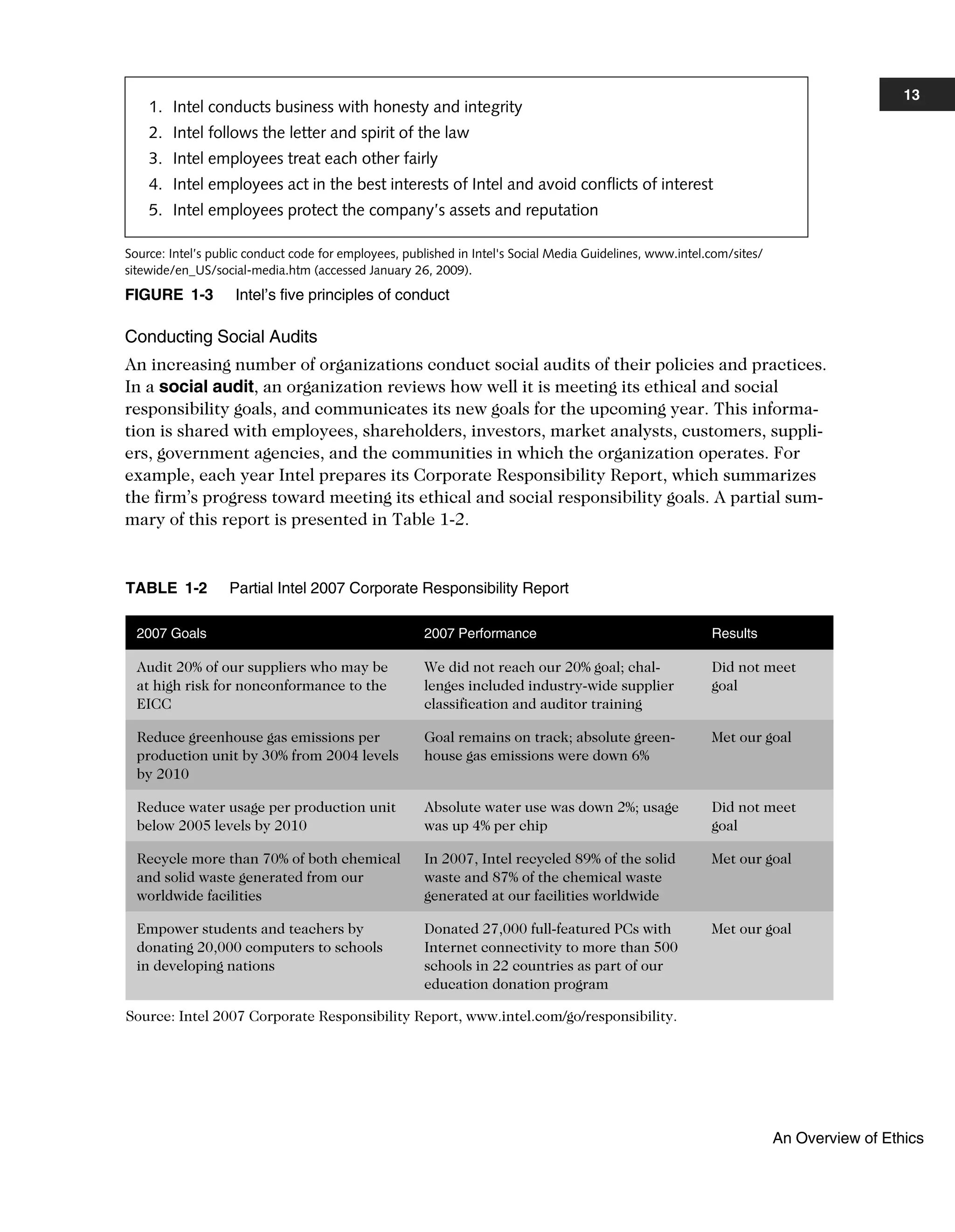
1. Intel conducts business with honesty and integrity
2. Intel follows the letter and spirit of the law
3. Intel employees treat each other fairly
4. Intel employees act in the best interests of Intel and avoid conflicts of interest
5. Intel employees protect the company’s assets and reputation
Source: Intel’s public conduct code for employees, published in Intel's Social Media Guidelines, www.intel.com/sites/
sitewide/en_US/social-media.htm (accessed January 26, 2009).
FIGURE 1-3 Intel’s five principles of conduct
TABLE 1-2 Partial Intel 2007 Corporate Responsibility Report
2007 Goals 2007 Performance Results
Audit 20% of our suppliers who may be
at high risk for nonconformance to the
EICC
We did not reach our 20% goal; chal-
lenges included industry-wide supplier
classification and auditor training
Did not meet
goal
Reduce greenhouse gas emissions per
production unit by 30% from 2004 levels
by 2010
Goal remains on track; absolute green-
house gas emissions were down 6%
Met our goal
Reduce water usage per production unit
below 2005 levels by 2010
Absolute water use was down 2%; usage
was up 4% per chip
Did not meet
goal
Recycle more than 70% of both chemical
and solid waste generated from our
worldwide facilities
In 2007, Intel recycled 89% of the solid
waste and 87% of the chemical waste
generated at our facilities worldwide
Met our goal
Empower students and teachers by
donating 20,000 computers to schools
in developing nations
Donated 27,000 full-featured PCs with
Internet connectivity to more than 500
schools in 22 countries as part of our
education donation program
Met our goal
Source: Intel 2007 Corporate Responsibility Report, www.intel.com/go/responsibility.
13
An Overview of Ethics
41.
Requiring Employees toTake Ethics Training
The ancient Greek philosophers believed that personal convictions about right and wrong
behavior could be improved through education. Today, most psychologists agree with them.
Lawrence Kohlberg, the late Harvard psychologist, found that many factors stimulate a per-
son’s moral development, but one of the most crucial is education. Other researchers have
repeatedly supported the idea that people can continue their moral development through
further education, such as working case studies and examining contemporary issues.
Thus, an organization’s code of ethics must be promoted and continually communicat-
ed within the organization, from top to bottom. Organizations can do this by showing
employees examples of how to apply the code of ethics in real life. One approach is through
a comprehensive ethics education program that encourages employees to act responsibly
and ethically. Such programs are often presented in small workshop formats in which
employees apply the organization’s code of ethics to hypothetical but realistic case studies.
Employees may also be given examples of recent company decisions based on principles
from the code of ethics. It is critical that such training increase the percentage of employees
who report incidents of misconduct; thus, employees must be shown effective ways of
reporting such incidents. In addition, they must be reassured that such feedback will be
acted on and that they will not be subjected to retaliation.
Ethics training not only makes employees more aware of a company’s code of ethics
and how to apply it, but also demonstrates that the company intends to operate in an ethical
manner. The existence of formal training programs can also reduce a company’s liability
in the event of legal action.
Including Ethical Criteria in Employee Appraisals
Managers can ensure that employees are meeting performance expectations if they monitor
employee behavior and provide feedback; however, a recent survey of HR professionals revealed
that only 43 percent of organizations include ethical conduct as part of an employee’s perfor-
mance appraisal.27
Those that do so base a portion of their employees’ performance evaluations
on treating others fairly and with respect; operating effectively in a multicultural environment;
accepting personal accountability for meeting business needs; continually developing others and
themselves; and operating openly and honestly with suppliers, customers, and other employees.
These factors are considered along with the more traditional criteria used in performance apprai-
sals, such as an employee’s overall contribution to moving the business ahead, successful com-
pletion of projects and tasks, and maintenance of good customer relations.
Creating an Ethical Work Environment
Most employees want to perform their jobs successfully and ethically, but good employees
sometimes make bad ethical choices. Employees in highly competitive workplaces often feel
pressure from aggressive competitors, cutthroat suppliers, unrealistic budgets, unforgiving
quotas, tight deadlines, and bonus incentives. Employees may also be encouraged to do
“whatever it takes” to get the job done. Such environments can make some employees feel
pressure to engage in unethical conduct to meet management’s expectations, especially if
the organization has no corporate code of ethics and no strong examples of senior manage-
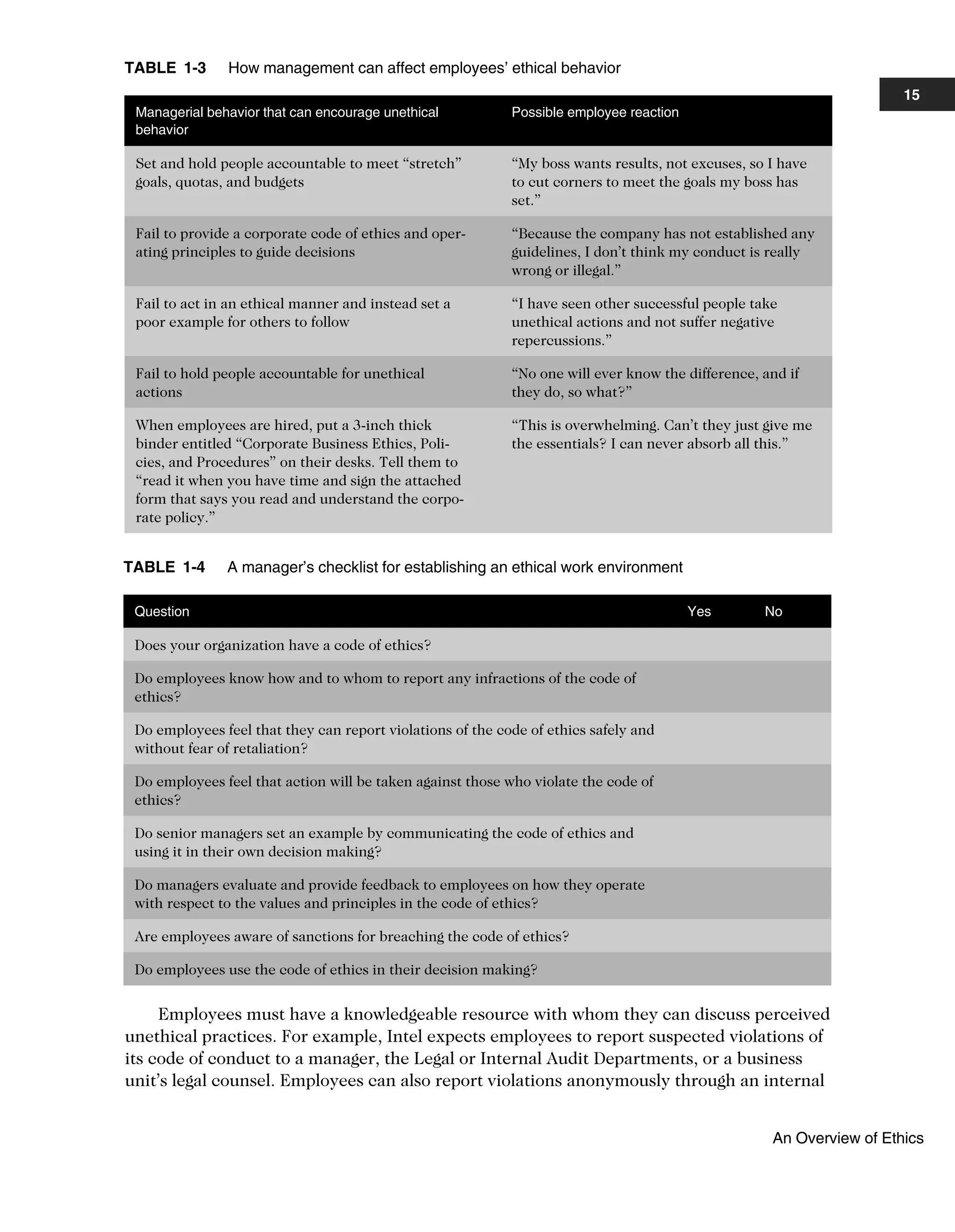
ment practicing ethical behavior. Table 1-3 shows how management’s behavior can result
in unethical employee behavior; Table 1-4 provides a manager’s checklist for establishing
an ethical workplace (the preferred answer to each question in this table is yes).
14
Chapter 1
42.
Employees must havea knowledgeable resource with whom they can discuss perceived
unethical practices. For example, Intel expects employees to report suspected violations of
its code of conduct to a manager, the Legal or Internal Audit Departments, or a business
unit’s legal counsel. Employees can also report violations anonymously through an internal
TABLE 1-3 How management can affect employees’ ethical behavior
Managerial behavior that can encourage unethical
behavior
Possible employee reaction
Set and hold people accountable to meet “stretch”
goals, quotas, and budgets
“My boss wants results, not excuses, so I have
to cut corners to meet the goals my boss has
set.”
Fail to provide a corporate code of ethics and oper-
ating principles to guide decisions
“Because the company has not established any
guidelines, I don’t think my conduct is really
wrong or illegal.”
Fail to act in an ethical manner and instead set a
poor example for others to follow
“I have seen other successful people take
unethical actions and not suffer negative
repercussions.”
Fail to hold people accountable for unethical
actions
“No one will ever know the difference, and if
they do, so what?”
When employees are hired, put a 3-inch thick
binder entitled “Corporate Business Ethics, Poli-
cies, and Procedures” on their desks. Tell them to
“read it when you have time and sign the attached
form that says you read and understand the corpo-
rate policy.”
“This is overwhelming. Can’t they just give me
the essentials? I can never absorb all this.”
TABLE 1-4 A manager’s checklist for establishing an ethical work environment
Question Yes No
Does your organization have a code of ethics?
Do employees know how and to whom to report any infractions of the code of
ethics?
Do employees feel that they can report violations of the code of ethics safely and
without fear of retaliation?
Do employees feel that action will be taken against those who violate the code of
ethics?
Do senior managers set an example by communicating the code of ethics and
using it in their own decision making?
Do managers evaluate and provide feedback to employees on how they operate
with respect to the values and principles in the code of ethics?
Are employees aware of sanctions for breaching the code of ethics?
Do employees use the code of ethics in their decision making?
15
An Overview of Ethics
43.
Web site dedicatedto ethics. Senior management at Intel has made it clear that any employ-
ee can report suspected violations of corporate business principles without fear of reprisal
or retaliation.
Including Ethical Considerations in Decision Making
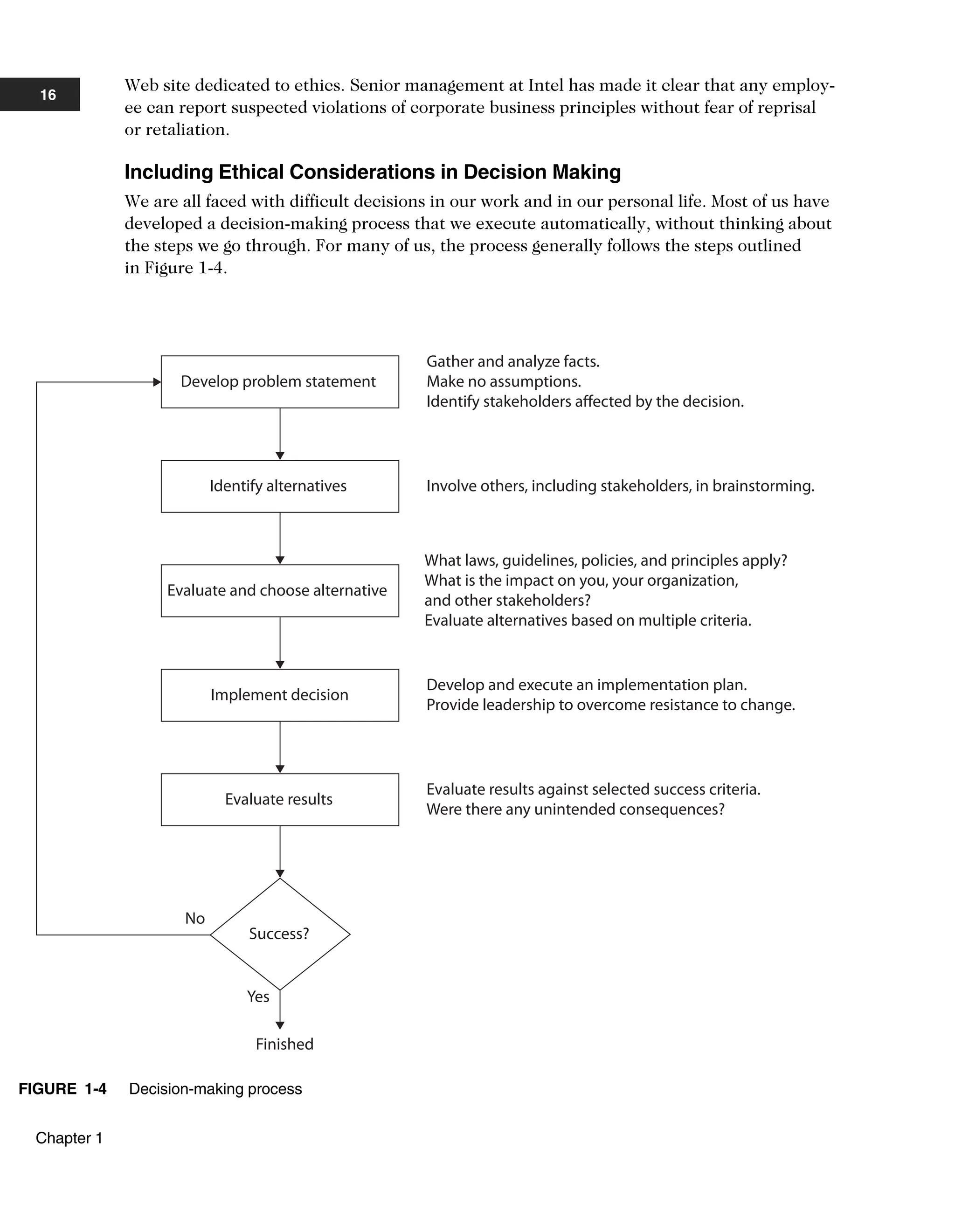
We are all faced with difficult decisions in our work and in our personal life. Most of us have
developed a decision-making process that we execute automatically, without thinking about
the steps we go through. For many of us, the process generally follows the steps outlined
in Figure 1-4.
Develop problem statement
Identify alternatives
Evaluate and choose alternative
Implement decision
Finished
Success?
Evaluate results
Gather and analyze facts.
Make no assumptions.
Identify stakeholders affected by the decision.
Involve others, including stakeholders, in brainstorming.
What laws, guidelines, policies, and principles apply?
What is the impact on you, your organization,
and other stakeholders?
Evaluate alternatives based on multiple criteria.
Develop and execute an implementation plan.
Provide leadership to overcome resistance to change.
Evaluate results against selected success criteria.
Were there any unintended consequences?
Yes
No
FIGURE 1-4 Decision-making process
16
Chapter 1
44.
The following sectionsdiscuss this decision-making process further and point out where
and how ethical considerations need to be brought into the process.
Develop a Problem Statement
A problem statement is a clear, concise description of the issue that needs to be addressed.
A good problem statement answers the following questions: What do people observe that
causes them to think there is a problem? Who is directly affected by the problem? Is there
anyone else affected? How often does it occur? What is the impact of the problem? How
serious is the problem? Development of a problem statement is the most critical step in the
decision-making process. Without a clear statement of the problem or the decision to be
made, it is useless to proceed. Obviously, if the problem is stated incorrectly, the decision
will not solve the problem.
One must gather and analyze facts to develop a good problem statement. Seek informa-
tion and opinions from a variety of people to broaden your frame of reference. During this
process, you must be extremely careful not to make assumptions about the situation. Simple
situations can sometimes turn into complex controversies because no one takes the time
to gather the facts. For example, you might see your boss receive what appears to be an
employment application from a job applicant and then throw the application into the trash
after the applicant leaves. This would violate your organization’s policy to treat each appli-
cant with respect and to maintain a record of all applications for one year. You could report
your boss for failure to follow the policy, or you could take a moment to speak directly to
your boss. You might be pleasantly surprised to find out that the situation was not as it
appeared. Perhaps the “applicant” was actually a salesperson promoting a product for which
your company had no use, and the “application” was marketing literature.
Part of developing a good problem statement involves identifying the stakeholders and
their positions on the issue. Stakeholders often include others beyond those directly
involved in an issue. Identifying the stakeholders helps you understand the impact of your
decision and could help you make a better decision. Unfortunately, it may also cause you
to lose sleep from wondering how you might affect the lives of others. By involving stake-
holders in the decision, you gain their support for the recommended course of action. What
is at stake for each stakeholder? What does each stakeholder value, and what outcome does
each stakeholder want? Do some stakeholders have a greater stake because they have spe-
cial needs or because the organization has special obligations to them? To what degree
should they be involved in the decision?
The following list includes one example of a good problem statement as well as two
examples of poor problem statements:
• Good problem statement: Our product supply organization is continually run-
ning out of stock of finished products, creating an out-of-stock situation on over
15 percent of our customer orders, resulting in over $300,000 in lost sales per
month.
• Poor problem statement: We need to implement a new inventory control sys-
tem. (This is a possible solution, not a problem statement.)
• Poor problem statement: We have a problem with finished product inventory.
(This is not specific enough.)
17
An Overview of Ethics
45.
Identify Alternatives
During thisstage of decision making, it is ideal to enlist the help of others, including stake-
holders, to identify several alternative solutions to the problem. Brainstorming with just one
other person will reduce your chances of identifying a broad range of alternatives and deter-
mining the best solution. On the other hand, there are times when it is inappropriate to
involve others in solving a problem that you are not at liberty to discuss. In providing parti-
cipants information about the problem to be solved, offer just the facts, without your opin-
ion, so you don’t influence others to accept your solution.
During any brainstorming process, try not to be critical of ideas, as any negative criti-
cism will tend to “shut down” the group, and the flow of ideas will dry up. Simply write down
the ideas as they are suggested.
Evaluate and Choose an Alternative
Once a set of alternatives has been identified, the group attempts to evaluate them based
on numerous criteria, such as effectiveness at addressing the issue, the extent of risk associ-
ated with each alternative, cost, and time to implement. An alternative that sounds attrac-
tive but that is not feasible will not help solve the problem.
As part of the evaluation process, weigh various laws, guidelines, and principles that may
apply. You certainly do not want to violate a law that can lead to a fine or imprisonment for
yourself or others. Are there any corporate policies or guidelines that apply? Does the orga-
nizational code of ethics offer guidance? Do any of your own personal principles apply?
Also consider the likely consequences of each alternative from several perspectives—
What is the impact on you, your organization, other stakeholders (including your suppliers
and customers), and the environment?
The alternative selected should be ethically and legally defensible; be consistent with
the organization’s policies and code of ethics; take into account the impact on others; and,
of course, provide a good solution to the problem.
Philosophers have developed many approaches to aid in ethical decision making. Four
of the most common approaches, which are summarized in Table 1-5 and discussed below,
provide a framework for decision makers to reflect on the acceptability of their actions
and evaluate their moral judgments. People must find the appropriate balance between all
applicable laws, corporate principles, and moral guidelines to help them make decisions.
(For a more in-depth discussion of ethics and moral codes, see Appendix A.)
TABLE 1-5 Four common approaches to ethical decision making
Approach to dealing with moral issues Principle
Virtue ethics approach The ethical choice best reflects moral virtues in yourself and
your community.
Utilitarian approach The ethical choice produces the greatest excess of benefits
over harm.
Fairness approach The ethical choice treats everyone the same and shows no
favoritism or discrimination.
Common good approach The ethical choice advances the common good.
18
Chapter 1
46.
Virtue Ethics Approach
Thevirtue ethics approach to decision making focuses on how you should behave and
think about relationships if you are concerned with your daily life in a community. It does
not define a formula for ethical decision making, but suggests that when faced with a com-
plex ethical dilemma, people do either what they are most comfortable doing or what they
think a person they admire would do. The assumption is that people are guided by their vir-
tues to reach the “right” decision. A proponent of virtue ethics believes that a disposition
to do the right thing is more effective than following a set of principles and rules, and that
people should perform moral acts out of habit, not introspection.
Virtue ethics can be applied to the business world by equating the virtues of a good
businessperson with those of a good person. However, businesspeople face situations that
are peculiar to business, so they may need to tailor their ethics accordingly. For example,
honesty and openness when dealing with others are generally considered virtuous; however,
a corporate purchasing manager who is negotiating a multimillion dollar deal might need
to be vague in discussions with potential suppliers.
A problem with the virtue ethics approach is that it doesn’t provide much of a guide for
action. The definition of virtue cannot be worked out objectively; it depends on the
circumstances—you work it out as you go. For example, bravery is a great virtue in many
circumstances, but in others it may be foolish. The right thing to do in a situation depends
on which culture you’re in and what the cultural norm dictates.
Utilitarian Approach
The utilitarian approach to ethical decision making states that you should choose the
action or policy that has the best overall consequences for all people who are directly or
indirectly affected. The goal is to find the single greatest good by balancing the interests of
all affected parties.
Utilitarianism fits easily with the concept of value in economics and the use of
cost-benefit analysis in business. Business managers, legislators, and scientists weigh the
benefits and harm of policies when deciding whether to invest resources in building a new
plant in a foreign country, to enact a new law, or to approve a new prescription drug.
A complication of this approach is that measuring and comparing the values of certain
benefits and costs is often difficult if not impossible. How do you assign a value to human life
or to a pristine wildlife environment? It can also be difficult to predict the full benefits and
harm that result from a decision.
Fairness Approach
The fairness approach focuses on how fairly actions and policies distribute benefits and
burdens among people affected by the decision. The guiding principle of this approach is
to treat all people the same. However, decisions made with this approach can be influenced
by personal bias toward a particular group, and the decision makers may not even realize
their bias. If the intended goal of an action or a policy is to provide benefits to a target group,
other affected groups may consider the decision unfair.
Common Good Approach
The common good approach to decision making is based on a vision of society as a
community whose members work together to achieve a common set of values and goals.
Decisions and policies that use this approach attempt to implement social systems,
19
An Overview of Ethics
47.
institutions, and environmentsthat everyone depends on and that benefit all people.
Examples include an effective education system, a safe and efficient transportation system,
and accessible and affordable health care.
As with the other approaches to ethical decision making, there are complications with
the common good approach. People clearly have different ideas about what constitutes the
common good, which makes consensus difficult. In addition, maintaining the common good
often requires some groups to bear greater costs than others—for instance, homeowners pay
property taxes to support public schools, but apartment dwellers do not.
Implement Decision
Once the alternative is selected, it should be implemented in an efficient, effective, and
timely manner. This is much easier said than done, since people tend to resist change. In
fact, the bigger the change, the greater is the resistance to it. Communication is the key to
helping people accept a change. It is imperative that someone whom the stakeholders trust
and respect answer the following questions: Why are we doing this? What is wrong with the
current way we do things? What are the benefits of the new way for you? A transition plan
must be defined to explain to people how they will move from the old way of doing things
to the new way. It is essential that the transition be seen as relatively easy and pain free.
Evaluate the Results
After the solution to the problem has been implemented, monitor the results to see if the
desired effect was achieved, and observe its impact on the organization and the various
stakeholders. Were the success criteria fully met? Were there any unintended conse-
quences? This evaluation may indicate that further refinements are needed. If so, return
to the problem development step, refine the problem statement as necessary, and work
through the process again.
E T H I C S I N I N F O R M A T I O N T E C H N O L O G Y
The growth of the Internet, the ability to capture and store vast amounts of personal data,
and greater reliance on information systems in all aspects of life have increased the risk that
information technology will be used unethically. In the midst of the many IT breakthroughs
in recent years, the importance of ethics and human values has been underemphasized—
with a range of consequences. Here are some examples that raise public concern about the
ethical use of information technology:
• Many employees might have their e-mail and Internet access monitored while
at work, as employers struggle to balance their need to manage important com-
pany assets and work time with employees’ desire for privacy and self-
direction.
• Millions of people have downloaded music and movies at no charge and in
apparent violation of copyright laws at tremendous expense to the owners of
those copyrights.
• Organizations contact millions of people worldwide through unsolicited e-mail
(spam) as an extremely low-cost marketing approach.
20
Chapter 1
48.
• Hackers breakinto databases of financial and retail institutions to steal custom-
er information, then use it to commit identity theft—opening new accounts and
charging purchases to unsuspecting victims.
• Students around the world have been caught downloading material from the
Web and plagiarizing content for their term papers.
• Web sites plant cookies or spyware on visitors’ hard drives to track their online
purchases and activities.
This book is based on two fundamental tenets. First, the general public does not under-
stand the critical importance of ethics as it applies to IT, as too much emphasis has been
placed on technical issues. Unlike most conventional tools, IT has a profound effect on soci-
ety. IT professionals and users need to recognize this fact when they formulate policies that
will have legal ramifications and affect the well-being of millions of consumers.
The second tenet on which this book is based is that in the business world, important
decisions are too often left to the technical experts. General business managers must
assume greater responsibility for these decisions, but to do so they must be able to make
broad-minded, objective decisions based on technical savvy, business know-how, and a
sense of ethics. They must also try to create a working environment in which ethical dilem-
mas can be discussed openly, objectively, and constructively.
Thus, the goals of this text are to educate people about the tremendous impact of ethi-
cal issues in the successful and secure use of information technology; to motivate people
to recognize these issues when making business decisions; and to provide tools, approaches,
and useful insights for making ethical decisions.
21
An Overview of Ethics
49.
Summary
• Even withinthe same society, people can have strong disagreements over important
moral issues.
• Ethics has risen to the top of the business agenda because the risks associated with
inappropriate behavior have increased, both in their likelihood and in their potential
negative impact.
• Organizations have at least five good reasons for promoting a work environment in
which they encourage employees to act ethically: (1) to gain the good will of the com-
munity, (2) to create an organization that operates consistently, (3) to foster good
business practices, (4) to protect the organization and its employees from legal
action, and (5) to avoid unfavorable publicity.
• An organization with a successful ethics program is one in which employees are will-
ing to seek advice about ethical issues that arise; employees feel prepared to handle
situations that could lead to misconduct; employees are rewarded for ethical behav-
ior; the organization does not reward success gained through questionable means;
and employees feel positively about their company.
• The corporate ethics officer (or corporate compliance officer) ensures that ethical
procedures are installed and consistently adhered to throughout the organization,
creates and maintains the ethics culture, and serves as a key resource on issues
relating to corporate principles and ethics.
• Managers’ behavior and expectations can strongly influence employees’ ethical
behavior.
• Most of us have developed a simple decision-making model that includes these
steps: (1) develop a problem statement, (2) identify alternatives, (3) evaluate and
choose an alternative, (4) implement the decision, and (5) evaluate the results.
• One can incorporate ethical considerations into decision making by identifying and
involving the stakeholders; weighing various laws, guidelines, and principles—
including the organization’s code of ethics—that may apply; and considering the
impact of the decision on you, your organization, stakeholders, your customers and
suppliers, and the environment.
• Philosophers have developed many approaches to ethical decision making. Four
common philosophies are the virtue ethics approach, the utilitarian approach, the
fairness approach, and the common good approach.
22
Chapter 1
50.
Self-Assessment Questions
The answersto the Self-Assessment Questions can be found in Appendix G.
Choose the word(s) that best complete the following sentences.
1. Statements about how people should behave fit together to form the _________________
by which a society lives.
2. A(n) _________________ is a moral habit that inclines people to do what is considered
acceptable.
3. The _________________ that socially responsible activities create can make it easier for
corporations to conduct their business.
4. _________________ means that employees know what is expected of them, and they can
employ the organizational values to help them in their decision making.
5. That an employer can be held responsible for the acts of its employee even if the employee
acts in a manner contrary to corporate policy and the employer’s direction is based on the
principle called _________________.
6. The public _________________ of an organization strongly influences the value of its stock,
how consumers regard its products and services, the degree of oversight it receives from
government agencies, and the amount of support and cooperation it receives from its busi-
ness partners.
7. The corporate ethics officer provides the organization with _________________ and
_________________ in the area of business conduct.
8. The _________________ is responsible for the careful and responsible management of an
organization.
9. _________________ requires public companies to disclose whether they have codes of
ethics and disclose any waiver to their code of ethics for certain members of senior
management.
10. The goal of the Sarbanes-Oxley Act was to _________________.
11. _________________ highlights an organization’s key ethical issues and identifies the over-
arching values and principles that are important to the organization and its decision-making
process.
12. A(n) _________________ enables an organization to review how well it is meeting its ethical
and social responsibility goals, and communicate new goals for the upcoming year.
13. _________________ makes employees more aware of a company’s code of ethics and how
to apply it, as well as demonstrates that the company intends to operate in an ethical
manner.
14. The most important part of the decision-making process is _________________.
15. The _________________ approach to ethical decision making states that you should
choose the action or policy that has the best overall consequences for all people who are
directly or indirectly affected.
16. _________________ is a process for generating a number of alternative solutions to a
problem.
23
An Overview of Ethics
51.
Discussion Questions
1. Thereare many ethical issues about which people hold very strong opinions—abortion, gun
control, and the death penalty, to name a few. If you were a team member on a project with
someone whom you knew held an opinion different from yours on one of these issues, would
it affect your ability to work effectively with this person? Why or why not?
2. What do you think are the most important factors that helped you define your own personal
code of ethics?
3. Do you think that ethics in business is improving or getting worse? Defend your position.
4. Do you believe that an organization should be able to escape criminal liability for the acts
of its employees if it has acted as a responsible corporate citizen, making strong efforts to
prevent and detect misconduct in the workplace? Why or why not?
5. The Ethics Resource Center identified five characteristics of a successful ethics program.
Suggest a sixth characteristic, and defend your choice.
6. Which incident has a greater negative impact on an organization—an unethical act per-
formed by an hourly worker or the same act performed by a senior manager of the organiza-
tion? Explain your answer fully. Should the hourly worker be treated differently than the
senior manager who committed the unethical act? Why or why not?
7. It is a common and acceptable practice for managers to hold people accountable to meet
“stretch” goals, quotas, and budgets. How can this be done in a way that does not encourage
unethical behavior on the part of employees?
8. Is every action that is legal also ethical? Can you describe an action that is legal but ethically
wrong? Is every ethical action also legal? Is the law, not ethics, the only guide that business
managers need to consider? Explain.
9. Do you think it is easier to establish an ethical work environment in a nonprofit organization?
Why or why not?
10. This chapter discusses four approaches to dealing with moral issues. Identify and briefly
summarize each one. Do you believe one perspective is better than the others? If so, which
one and why?
11. Is it possible for an employee to be successful in the workplace without acting ethically?
What Would You Do?
Use the five-step decision-making process to analyze the following situations and recommend a
course of action.
1. Imagine that you are Hewlett-Packard’s new chairman of the board, CEO, and president
Mark Hurd, who succeeded Patricia Dunn. What actions would you take for HP to regain its
reputation as a highly ethical organization?
2. You are the customer service manager for a small software manufacturer. The newest addi-
tion to your 10-person team is Aubrey, a recent college graduate. She is a little overwhelmed
by the volume of calls, but is learning quickly and doing her best to keep up. Today, as you
24
Chapter 1
52.
performed your monthlyreview of employee e-mail, you were surprised to see that Aubrey
is corresponding with employment agencies. One message says, “Aubrey, I’m sorry you
don’t like your new job. We have lots of opportunities that I think would much better match
your interests. Please call me and let’s talk further.” You’re shocked and alarmed. You had
no idea she was unhappy, and your team desperately needs her help to handle the
onslaught of calls generated by the newest release of software. If you’re going to lose her,
you’ll need to find a replacement quickly. You know that Aubrey did not intend for you to see
the e-mail, but you can’t ignore what you saw. Should you confront Aubrey and demand to
know her intentions? Should you avoid any confrontation and simply begin seeking her
replacement? Could you be misinterpreting the e-mail? What should you do?
3. A coworker calls you at 9:00 a.m. at work and asks for a favor. He is having car trouble and
will be an hour late for work. He explains that he has already been late for work twice this
month and that a third time will cost him four hours of pay. He asks you to stop by his cubicle,
turn his computer on, and place some papers on the desk so that it appears that he is in. You
have worked on some small projects with this coworker and have gone to lunch together.
He seems nice enough and does his share of the work, but you are not sure what to tell him.
What would you do?
4. While mingling with friends at a party, you mention a recent promotion that has put you in
charge of evaluating bids for a large computer hardware contract. A few days later, you
receive a dinner invitation at the home of an acquaintance who also attended the party. Over
cocktails, the conversation turns to the contract you are managing. Your host seems remark-
ably well-informed about the bidding process and likely bidders. You volunteer information
about the potential value of the contract and briefly outline the criteria your firm will use to
select the winner. At the end of the evening, the host surprises you by revealing that he is
a consultant for several companies in the computer hardware market. Later that night your
mind is racing. Did you reveal information that could provide a supplier with a competitive
advantage? What are the potential business risks and ethical issues in this situation? Should
you report the conversation to someone? If so, whom should you talk to, and what would you
say?
5. You are a recent graduate of a well-respected business school, but you are having problems
getting a job. You worked with a professional résumé service to develop a well-written
résumé and placed it on several Web sites; you also sent it directly to contacts at a dozen
companies. So far you have not even had an invitation for an interview. You know that one
of your shortcomings is that you have no real job experience to speak of. You are consider-
ing beefing up your résumé by exaggerating the extent of the class project you worked on for
a few weeks under the supervision of your brother-in-law. You could reword the résumé to
make it sound as if you were actually employed and that your responsibilities were greater
than they actually were. What should you do?
6. You have just completed interviewing three candidates for an entry-level position in your
organization. One candidate is the friend of a coworker who has implored you to give his
friend a chance. The candidate is the weakest of the three but has sufficient skills and knowl-
edge to adequately fill the position. Would you hire this candidate?
25
An Overview of Ethics
53.
Cases
1. Computer Associates:A Firm with a Scandal-Riddled Past
Computer Associates (CA) is a multinational computer software company founded in 1980 and
headquartered in Islandia, New York. In 1989, it became the first software organization to gener-
ate $1 billion in sales.28
Today CA employs nearly 14,000 people in 150 offices spread across
more than 45 countries. Its 2008 annual revenue was $4.3 billion.
In 1997, the chairman of Computer Sciences Corporation (CSC), Van Honeycutt, filed a $50
million bribery and extortion suit against CA’s founder, chairman, and CEO Charles Wang. Honey-
cutt claimed that Wang had offered him a $102.5 million bribe to sell the company to CA for
$100 per share.29
Van Honeycutt further alleged that when he did not accept the offer, CA execu-
tives “threatened to wrongfully harm CSC if it refused to agree to a transaction” at $98 per share.
It was a few weeks after this alleged incident that CA launched a hostile takeover bid. Eventually
the two companies dropped all lawsuits related to CA’s takeover attempt and announced a major
expansion of their global software licensing agreements.30
In 1999, a CA shareholder objecting to Wang’s compensation package took Wang and two
other executives to court and kept them from receiving a $1.1 billion payout. As a result, Wang had
to settle for a total compensation of $675 million for 1999—making him the highest paid executive
in the United States. This amounted to one of the largest executive compensation packages in his-
tory at that time, and came at a time when CA’s earnings and stock price had fallen.31
The vice president of finance of CA pleaded guilty to conspiracy to commit securities fraud
and obstruction of justice in April 2004. The fraud involved backdating contracts worth hundreds
of millions of dollars to pump up the company’s quarterly earnings both to meet analysts’ expecta-
tions and to make the firm’s stock look more attractive to investors.32
The former CFO and a for-
mer senior vice president were also suspected of playing a role in the fraud.
In April 2004, Sanjay Kumar—chairman and CEO since Wang’s retirement in 2002—resigned
under pressure from the board, which feared he would become embroiled in the growing account-
ing scandal.33
Also that month, the company restated its financial results from 2000 and 2001 to
reflect $2.2 billion in revenue that was booked prematurely. Kumar was charged with securities
fraud, conspiracy, and obstruction of justice in September 2004. Kumar was eventually found
guilty and sentenced to 12 years in jail.
CA agreed to pay $225 million to shareholders in restitution in order to defer criminal prosecu-
tion. CA said it would cut its workforce by 800 to help pay the restitution. Also as part of the agree-
ment, an outside monitor was assigned to track CA’s financial reporting for one and a half years.
CA also agreed to assist the government in retrieving any compensation and bonuses awarded
based on the fraudulent financial results.34
In more bad news for CA’s Kumar, the indictment against him was revised in July 2005 to
include charges that he offered a $3.7 million bribe to discourage a business client from revealing
CA’s fraudulent accounting practices.35
As a result of these various scandals, many CA board members and executives were replaced
between 2004 and 2006, including the CEO, chairman of the board, executive vice president of devel-
opment, CFO, COO, CTO, chief marketing officer, chief administrative officer, and co-general counsel.
Most of these executives were sentenced to jail, fined millions of dollars, or both.
26
Chapter 1
54.
Discussion Questions
1. CAexecutives involved in the accounting scandal were not accused of reporting bogus con-
tracts or hiding major problems in the business. The contracts that were backdated were real
sales agreements. Was this really a crime? Should the individuals have been punished so
harshly?
2. In December 2004, CA appointed Patrick J. Gnazzo as senior chief compliance officer to
demonstrate to the government and shareholders that the firm would take measures to oper-
ate ethically. Gnazzo served in this role at United Technologies for 10 years and had been
a member of the board of directors of the Ethics Officers Association. Gnazzo reported to a
new executive vice president and general counsel at CA as well as the board’s Compliance
Committee. Outline some of the actions Gnazzo might have taken in his first six months on
the job.
3. John Swainson, a 26-year veteran of IBM, joined CA in November 2004 as CEO and presi-
dent. His first few months with the firm were rough—major customers threatened to dump the
firm; some products were behind schedule and were of poor quality; executives had to be
fired for breaking company rules; accountants continued to find past mistakes; and many
newly hired executives had to be brought on board. What sort of leadership could he have
demonstrated to show that he was determined to avoid future scandals at CA?
4. CA has been hit with numerous scandals since the late 1990s. These scandals raise ques-
tions about how successful the firm might have been if not for the amount of time its execu-
tives had to spend on these distractions. Compare the revenue growth and stock price of
CA to that of some of its competitors over the time period 2004–2008. (Be sure to use CA’s
corrected figures!) Can you detect any impact of these scandals on CA’s performance? What
else might explain the difference in performance?
2. Dell Inc. Merely Tough on Suppliers or a Bully?
Dell Computers designs, develops, manufactures, markets, sells, and supports a range of pro-
ducts, including desktop personal computers, servers and networking products, storage, mobile
products, software and peripherals, and services. In many cases, these products are customized
to individual customer requirements. Dell’s recent annual sales were $64 billion, which generated
$2.8 billion in net income. The company employs about 80,000 people and is headquartered in
Round Rock, Texas.
A key component of Dell’s business model is the elimination of resellers by selling directly
to customers. Dell employs a build-to-order manufacturing process that enables customers to
direct-order servers and workstations custom-made to their specifications. In addition, Dell can ful-
fill and ship orders within four days. This all requires an amazing supply-chain system that
includes hundreds of suppliers around the globe functioning seamlessly to enable Dell to operate
with a near-zero amount of finished goods inventory. Indeed, Dell has no warehouses to store fin-
ished goods but is still able to assemble 80,000 computers every day.36
Two advantages of carry-
ing a minimal amount of inventory are:
1. When a new computer component, say a faster CPU chip, comes out, Dell can more quick-
ly sell its existing inventory of computers with the old chip and get to market with computers
based on the new faster CPU weeks earlier than its competitors.
27
An Overview of Ethics
at Canton andin Japan. This form of painting the face seems to be
exactly of the same nature as savage painting.”
The likeness of this painting to that of our clowns is of course
quite obvious.
Sometimes the painting of the body has a practical advantage.
The Andaman Islanders plaster themselves with a mixture of lard
and coloured earth, which protects their skin from the heat and
mosquitoes; but, as Dr. Tylor points out, they go off into love of
display when they proceed to draw lines on the paint with their
fingers, or when a dandy will colour one side of his face red and the
other olive-green, and make an ornamental border-line where the
two colours meet down his chest and abdomen.
Fashions in paint were quite as slavishly followed as any other,
and, as we see, have died hard. It is not a very far cry from painting
to tattooing. Of savages, Théophile Gautier has said that, having no
clothes to embroider, they embroider themselves. Scar tattooing is
connected with various rites such as are followed when a brave
arrives at manhood, and certainly tattooing serves to indicate the
family or tribe to which the ornamented person belongs. There is no
doubt, however, that the intention of much tattooing is to increase
individual beauty. Excellent examples of this are to be found in the
case of the Maoris, whose faces were most elaborately covered with
designs. We are kindly permitted to reproduce some of the drawings
which General Robley has made from specimens in his magnificent
collection (see Plate X, Figure D). The practice now, however, is
dying out. Of the Formosans it is said that their skins are covered
with flower patterns until they look like damask.
Tattooing was practised by the old inhabitants of this country, by
the Jews and the earliest Egyptians: it is still carried on in modern
Egypt, chiefly on the chin, on the back of the hands, the arms and
feet, the middle of the bosom, and the forehead. It survives
principally in the case of the women of the lower classes and in the
country. Among European sailors and among the lower classes, and
even occasionally those up in high social scale, we find tattooing
57.
carried on, thoughthe original idea of ornamentation is lost when
the decoration is covered by clothing.
We have seen occasionally at shows—such as that organized by
Barnum—white people who have been tattooed to a very great
extent, and even in the case of Europeans the patterns tend to take
off the bare look even of the white skin. No doubt the desire to
make permanent such ornamentation as that obtained by painting,
led to the introduction of tattooing, and just as some marks suggest
that they are copied from amulets, so some amulets show traces of
having been derived from tattoo patterns. Mr. Lovett has pointed out
to us that possibly the floral designs worked on the backs of the
bodices of the women of Marken, in Holland, may have originated
from tattooing, but no doubt careful research would show some
other and undoubted instances.
The painting of the face, which is intended to heighten its beauty
and hide the ravages of time, is quite another matter. It survives to
the present day, but luckily it is much less common in this country
than it was a few years ago. It does not, however, seem to have
been at all in vogue in England until the Middle Ages, though
cosmetics and false complexions were made use of by ladies in
Roman times.
Fairholt42 quotes from an old French poem of the thirteenth
century which describes the wares of a mercer who declares, “I have
cotton with which they rouge, and whitening with which they whiten
themselves.” The cotton took the place of the hare’s foot that is now
used in making up, to rub colour on the cheeks.
At this point we might consider patches, the use of which made it
possible to ornament the skin with patterns that could be removed
at will. These patches came into fashion in Charles I’s reign, but
were banned by the Puritans. As soon, however, as Charles II came
into his own again, they made their appearance once more, and
took various fantastic shapes: owls, rings, crescents, and crowns; a
coach and horses was particularly fashionable, and in the time of
Queen Anne it was possible to tell the political views of fashionable
ladies by their faces and their fans. Party feeling ran very high at this
58.
time, and thosewho were neutral wore patches on both cheeks, a
Whig lady on the right side only, while a High Church Tory dame only
adorned the left, and she wore suspended from her wrist a fan on
which was depicted a scene from the trial of Dr. Sacheverell at
Westminster Hall.
Red and white paint was at the same time universally employed
by women of fashion, who, as Miss Helen Gordon43 says, had
perforce to keep their lovers at a respectful distance, lest a kiss
“snatched by a forward one might transfer the complexion of the
mistress to the admirer.” The untimely decease of more than one
famous beauty was attributed to the paint with which she
besmeared her countenance, a notable instance being the death of
Lady Coventry, whose husband had been wont to chase her round
the dinner-table in his determined efforts to remove the deleterious
compound from her face with his serviette. According to Walpole,
Lady Mary Wortley Montagu used the cheapest white paint
obtainable, and left it so long on her skin that it had literally to be
scraped off. It may be inferred that these fine ladies rarely washed;
but “the age was careless in that respect, personal cleanliness at a
discount, and the essence pot consequently in great demand.”
We spoke just now of fans, which can, perhaps, be considered an
article of dress as they are very often fastened to the person. There
seems no doubt but that at first fans did not close, and were made
of feathers like those still in use in the East from whence they are
derived. Probably in the beginning, leaves were used as fans, and
palm-leaf fans are still to be seen. Fans were in general use in the
sixteenth century, and the folding one appeared in the next.
Sometimes, as at the end of the eighteenth century, large green
fans, called sunshades, were used out of doors in the same way as a
modern parasol now is. There is another use of the fan still to be
noted in China, namely, for blowing up a fire, and from this we no
doubt get the expression of “fanning the flame.”
Painting apparently was not only practised by women, for male
courtiers at the end of the sixteenth century occasionally coloured
their faces. If we are to believe some of the writers in the
59.
newspapers of to-day,men of leisure are not a whit better nor less
foolish now.
Of masks as an ordinary everyday addition to costume we have no
survivals, except in connection with some balls and an occasional
burglary; but masks such as we see on the 5th of November will
remind us, like the face of the clown, of primitive face-painting, and
also of the many curious head-dresses and masks which savages
wear at certain ceremonies and dances. It is easy to produce
grotesque effects by means of masks, and the discomfort that would
arise from the paint is thereby avoided.
The practice of wearing masks, and indeed dominoes, by private
individuals came from Venice. In the sixteenth and seventeenth
centuries masks made of black satin and velvet often formed part of
the toilet of society ladies. At one period the wearing of them was
restricted to the times of carnivals; at another, the nobility alone
were allowed to use them, and now we only see masks at fancy-
dress balls. Of the unwritten laws that rule the wearing of the mask,
Mrs. Aria says44: “Whether worn privately or in public, its disguise
has at all times and in all countries been respected as inviolably
sacred. To the masked the greatest extravagance of language and
gesture is permitted. He is allowed to indulge in acrid personalities
and proclaim scathing truths, which, even if addressed to the
monarch himself, go unrebuked. To strike a mask is a serious
offence, while in no class of society, however degraded, would any
one dare to unmask a woman. Yet another prerogative entitles the
masked to invite any woman present, whether masked or not, to
dance with him, etiquette decreeing that the queen of the land may
not claim exemption from this rule. Dear to romance is the masked
highwayman, who flourished until the advent of railways robbed him
of his occupation; and a grim figure is ever the masked headsman.”
61.
W
XXIX
STAGE COSTUMES
THE HARLEQUIN,PANTALOON, COLUMBINE, AND ACROBAT
HILE Punch has left the stage and is now a puppet, some of his
coadjutors are with us, for the harlequinade is still introduced
into many pantomimes at Christmas, and special plays have been
written in which these characters appear. The harlequin, who gives
his name to what is now an interlude, was some thousand or two
years back one of the important personages in the old Italian
comedy which gave us Punch, and which we have already
mentioned in a previous chapter.
Harlequin was versatile and many-sided, and he still keeps up his
slap-dash character. It is true that harlequin does not now speak,
any more than does the columbine, and we may trace the evolution
of the Italian Mimi, or buffoons, into the Pantomimi, who were tragic
actors. They, by means of certain well-understood signs and
gestures, were able to play tragedies in the open air under
conditions which would have prevented their voices from being
heard. In some theatres also the actors were not allowed by the
authorities to speak. Originally the harlequin was a mime. He had a
shaven head, a sooty face—for the mimi blackened their faces like
our modern niggers—he had flat, unshod feet and a patched coat of
many colours which he derived from the ancient peasants of Italy.
Some have seen in the wand of the harlequin a descendant of the
rod of Mercury, and have sought for a prototype of the modern
pantomime in pagan mysteries. In England, however, we have
turned the harlequin into a magician, and his wand is perhaps the
gilt wooden sword which belonged to the clown or fool all the world
62.
over. Now alsowe have the character in what Mr. Calthrop terms his
tight-fitting lizard-skin of flashing golden colours, for the patches on
his rags have now given place to a symmetrical pattern (see Figure
158).
There have been many celebrated harlequins who have devoted
their lives to the development of this character, and there is an
interesting case which Disraeli45 gives in his “Curiosities of
Literature,” in which, as part of a quit-rent or feudal tenure—
whenever the Abbot of Figéac entered this town—the Lord of
Montbron, dressed in a harlequin’s coat, with one of his legs bare,
has to lead the prelate’s horse by its bridle to the abbey.
Fig. 158.—The dress of a modern harlequin.
In the clown and the pantaloon we still have the dress of
Elizabethan times (see Figures 157 and 159). The paint on the
former, as we have seen, will carry us back to times of remote
antiquity. His hat is of a shape well known in early English history,
and he himself is English all through. The pantaloon, again, is
Italian. Both he and his Venetian breeches get their names from St.
Pantaleone, one of the patron saints of Venice. Pantaleone was by
63.
no means anuncommon patronymic in that place. In order to
reconcile the statements that the dress of the pantaloon is
Elizabethan and his nether garments are Venetian, which might
appear to be mutually contradictory, it must be pointed out that the
Venetian breeches had been introduced in the days of earlier Tudors,
and were still in vogue when Elizabeth was on the throne. The
pantaloon’s red and green colours and his red heels are also, as we
have indicated, Elizabethan.
Fig. 159.—A pantaloon, showing an Elizabethan costume of
which Venetian breeches form part.
The columbine, who, like the harlequin, does not speak, and so
keeps up the pantomime character, wears the ballet dress of early
Victorian times. Originally she was a female harlequin, or
harlequinne, and her dress of spangles is still sometimes used in
fancy-dress dances. Of the other characters, who once assisted
those that we have described, we have none left. Scaramouch
persisted for some time, and was, like the harlequin and columbine,
a pantomimist. He has gone even from Punch and Judy, though the
doctor still remains.
64.
Though not strictlya theatrical performer, but seen in the circus,
the music-hall, and still also as a wandering mountebank, we have
the acrobat. His dress is simple and eminently suitable for the work
which he has to do; it consists of a vest, of very short trunk hose or
breeches, and long Florentine hose, or, as we now call them, tights.
Though such a costume was worn in the reigns of the early Tudors,
in detail the breeches are very much like those which were worn by
Lord Darnley, the husband of Mary Queen of Scots. Doubtless also in
the tights which are so familiar on the stage we have a survival
similar to that seen in the acrobat, the clown, and the knights of the
older orders.
65.
G
XXX
NIGHTDRESS
BANDS ON NIGHTGOWNS—NIGHTCAPS—NIGHTATTIRE WORN IN THE STREET
OING to bed can hardly be called a ceremony; but the dress in
which the bulk of humanity now sleeps can claim to be a special
one. There are, of course, many people, who are not mere casual
tramps, who sleep in their everyday clothes. Drovers who have to go
to out-of-the-way places with cattle, where they can never be sure
of getting a lodging, will sleep possibly after merely removing their
outer coat, and it stands to reason that men engaged in this
business can hardly be bothered to carry luggage with them. Any
survivals that we may have to deal with in the case of our airiest
dresses will not take us very far back into history, because our
ancestors, from all accounts, went to an extreme which is the
opposite to that which we have just been mentioning, and instead of
keeping on all their clothes at night, they took them all off and put
on no others. Mr. Calthrop46 graphically describes a scene which he
supposes to be taking place in the reign of William Rufus. A lady is
disturbed while getting ready for bed by a cry of “sanctuary,” and
watches from her window until the fugitive is let into the church by
the monks. In concluding his story, Mr. Calthrop says, “The night is
cold. The lady pulls a curtain across the window, and then, stripping
herself of her chemise, she gets into bed.”
A man’s nightshirt is severe in cut like that which he wears in the
day, and the sides are slit up in both garments as they are in the
dalmatic and the tunics worn by the Anglo-Saxons, which were like a
day shirt, longer behind than in front. A survival of the latter as an
outer garment is to be seen in the short smocks worn by labourers
66.
Fig. 160.—The bandsthat survive on a
lady’s nightdress.
Fig. 161.—A woman’s
nightcap, still worn in
Wiltshire.
who dig drains and do similar work. The lady’s nightgown may be
elegantly ornamented with lace in the same way as are the linen
garments which she wears in the daytime; but very often we find a
large collar edged with lace, which recalls the falling band which we
have had so often to mention. (See Figure 160.)
To a great extent sleeping suits of a coat and trousers, which are
known by the name of pyjamas, have taken the place of the man’s
nightshirt. These have the merit of making a man look more
presentable if called up on an emergency. We shall see, if we
contrast male and female fashions, that it has always been
customary for the costume of women to follow that of men, though
most ladies draw the line at adopting trousers. We have heard,
however, of one young lady at least who does by night what she will
not do by day, for she has given up her nightgown in favour of
pyjamas.
Here and there we find that nightcaps are still worn. That
belonging to an old lady, which we figure (see Figure 161), came
from the village of Bishopstone in Wiltshire, where no fewer than
twelve old ladies, all of them over eighty, still wear such a head-
dress at night. Nightcaps were worn by men in the time of the
67.
Tudors, and thatof Queen Elizabeth, as is shown by the following
extract from a bill of 1547: “Pd. for two nyght caps of vellvet for
them, 8s. 0d.”47
They were very elaborately embroidered at this time, and in
Mary’s reign were mentioned in a sumptuary law. Old men still wear
nightcaps, and the one we figure was used until lately at South
Stoke in Oxfordshire. It is of the familiar style that we associate with
such a head-dress, and has a tassel on the top. (See Figure 162.)
Fig. 162.—A man’s nightcap, from Oxfordshire.
In the time of Queen Anne ladies wore their nightdresses, or
night-rails as they were called, in the streets, and the fashion seems
to have been in vogue at later times, though every means were
taken to try and abolish it. It was not until a murderess was
persuaded to appear at her execution in a bedgown that the fad was
relinquished.
68.
H
XXXI
THE DRESS OFANIMALS
NATURAL REPRESENTATIVES OF CLOTHES—HORSE TRAPPINGS—AMULETS ON
HARNESS—DOGS’ DISGUISES—FASHIONS IN THE FORM OF ANIMALS
ERE and there in the animal kingdom we find that creatures
protect themselves from injury by building up cases and
coverings from extraneous materials, and these may very well be
compared with the armour and clothes of mankind. Protection may
be gained by merely securing something ready made to take the
place of a coat, as is done in the case of the hermit-crab or “soldier,”
which covers itself with the shell of some dead mollusc. The caddis
worm, or larva of the caddis fly, builds its home of sticks and stones
or twigs, and thereby not only preserves its soft body from injury,
but also harmonizes with its surroundings, in the same way as does
the soldier on active service in time of war.
To gain protection, also, some molluscs when building their shells
introduce stones and other shells and corals into the edifice, so that
they become indistinguishable from the sea-bottom on which they
lie. Many caterpillars cover themselves with bits of leaves, and even
with the help of silk make spiral shells that might easily be mistaken
for those of snails. The silk also, from which many of our gay clothes
are made, is spun by the silkworm, which, like the larva of many
moths, produces it in order to protect the chrysalis while it rests.
We are occupied here, however, with the coverings of animals that
they owe to man, and first and foremost of those creatures which
have come in for his polite attentions is the horse.
We may recall the armour by which the chargers of the old knights
were protected, and the trappings or emblazoned coverings that
69.
were put overthis in the same way as the surcoat was made to
cover the armour of the knights. (See Figure 84.) The trappings
were often made of coloured satin, and were embroidered with gold
and silver, and at the exhibition held by the Burlington Fine Arts
Society in 1905 a chasuble of red velvet was shown, embroidered
with the arms of England in gold, which was apparently made from a
horse-trapper of the fourteenth century. Figure 84 well shows how
the horses carried the armorial bearings of their masters.
In the ostrich-feather ornaments and the velvet trappings of
modern funeral horses, we still have some remnants of the days of
chivalry.
To-day horse clothing, though not intended to be of an
ornamental character, we should imagine, is still often decorated
with a monogram of the horse’s owner.
Perhaps one of the most interesting survivals in connection with
horses is to be found in the brasses which decorate those used for
carts and waggons. Dr. Plowright48 has shown that many of these
ornaments, which are really amulets put on to the harness with a
view to protecting the horses against the evil eye, are of Moorish
origin. He contrasts their style with the ornamental details shown in
the Alhambra, and he figures a number which take the form of a
crescent, or a crescent enclosing an eight-rayed star, and others in
which the ornament shows eyes and eyebrows conventionalized. In
other cases we get the fleur-de-lys treated in an arabesque way, the
escallop shell and the mystic interlaced triangles (which were
considered the talisman of talismans, and are known as the seal of
Solomon or the shield of David), with a crescent in the centre. Miss
Lina Eckenstein49 figures many other horse brasses which can be
compared with those worn by Roman cart-horses. Among them is
the crescent, which was also worn by women carved in ivory, and by
certain senators as ornaments on their shoes.
The crescent is made from a thin plate of metal, and is worn by
children on the west coast of India, with the points upwards, as a
protection against the evil eye, and gold ornaments of similar shape
are among those which were worn in ancient Peru.
70.
The moon, fromtimes of remote antiquity, has been represented
by a ring for the full moon and a half-ring or sickle for the crescent.
Miss Eckenstein does not, however, carry the origin of the horse
amulets back to the stone stage of civilization, but she thinks that
the crescent represents two boars’ tusks joined together by a thong,
and the horse-amulet now worn in Italy shows the thinness and
sharpness of curve that would be evident in one which was made
out of boars’ tusks.
Fig. 163.—An English horse amulet in the form of a
crescent. The flat places near the tips of the horns are
evidence that the form is derived from two boars’ tusks.
We may point out that in some English crescents the hollows
which one tusk makes by wearing against its fellow are represented
by little flat places on the horns of the crescent near their tips. (See
Figure 163.)
The brasses seen in England to-day are worn on the face-plate,
breast-plate, and martingale. On grand occasions, such as May Day
celebrations, and the cart-horse parade of Whit Monday, brasses are
specially put on, though there is a tendency now for them to be
stamped out of thin metal instead of being cast, with the result that
they soon wear out. German horses wear the crescent on a strap
which dangles below the right ear.
The English crescent from harness will be found to match those
which are represented on the horses on Trajan’s column and other
monuments. The same design is to be seen also on the harness of
71.
camels and elephants.The most important symbol besides the moon
is that of the sun, which is worn on the top of the head between the
ears.
Heraldic brasses are not uncommon, and the heart-shaped amulet
is also seen; it is possible, too, that this form may be connected with
that of the flint arrows, which we have already mentioned as being
worn as amulets. In Egypt, an amulet hung on a cow is said to
protect the woman who owns it, and Miss Eckenstein suggests a
similar origin in the case of the heart worn by horses. A brass
showing a horse rampant, came from the estate of the Duke of
Norfolk at Arundel, and it will be seen on looking at the arms of the
nobleman in question that this device forms one of the supporters of
his shield.
In prehistoric Egypt the slate palettes on which malachite was
ground for face painting were often in the form of two birds, with
their bodies put back to back, and their heads fully shown, and
when this form degenerates it becomes a kind of heart-shaped
shield. Professor Petrie has pointed out that when this decoration is
used, as on coffins and elsewhere, it is often thought to be merely a
shield. Possibly the heart-shaped amulet may have some connection
with this.
Fig. 164.—An English horse amulet showing both the heart
and the sun.
An amulet found by Professor Vellucci in Umbria consisted of an
arrow-head sewn upon a piece of scarlet cloth, which was of a heart
72.
shape, and wasintended doubtless to emphasize the heart
significance. Another horse amulet, obtained by Miss Eckenstein
from Sicily, also consists of a piece of scarlet cloth cut into the shape
of a heart and decorated with tinsel.
An English horse brass seen in Figure 164 shows both the heart
and the sun.
While on the subject of horses, one might allude to the wisps of
straw which are twisted in the mane and tail of cart-horses when
they are for sale at markets and fairs. Horses were sacrificed in the
old days; and as the slaying of domestic animals was supposed to
secure fruitfulness, the horse became identified as a corn spirit, and
the killing of horses formed a necessary incident of the harvest. The
deity Demeter took upon himself the semblance of a mare, and the
word mare is applied in the Midlands to the last uncut ears of corn,
at which the sickles are thrown in order to bring them down. It is
possible that the wisps of straw worn by horses are connected with
these ideas.
A very curious and interesting custom is represented on the
trappings of the horses ridden by the officers of the 10th Hussars.
These trappings are ornamented on full-dress occasions with cowry
shells; and to find a parallel to this we have to go to the East, where
the head-stalls of the camels and mules are covered with the shells,
while round their necks and those of donkeys there may hang an
ornament or bell on a band which is similarly decorated. It will be
noted that there is a pendant from the head of the Hussar horse
which resembles that of the mule of the Holy Land. There is no
doubt but that originally these ornaments were really amulets, and it
is said that they are a survival of ancient phallic worship. (See
Figures 165-7.)
Cowry shells were once generally used by the Hussars, and were
revived in the case of the 10th Hussars in connection with service in
India.
73.
Fig. 165.—The cowry-shellornaments on the head of an
officer’s charger of the 10th Hussars. The pendant recalls
that on mules in Palestine.
Toby, as we have seen, is decorated with an Elizabethan ruff, but
the wearing of collars and bells by pet animals is a remnant of a very
old custom, and on early mediæval brasses in this country, dogs are
often seen decorated with collars—sometimes bearing their actual
names—and with bells. Now the wearing of a collar is enforced by
law as a means of identification. All dogs found without collars may
be considered as strays, and the regulation followed, as is well
known, upon the muzzling order by which hydrophobia was
practically stamped out.
74.
Fig. 166.—Cowry shellson an Eastern mule, hanging like
the pendant of the 10th Hussars.
Fig. 167.—Cowry shells on the head-stall of a camel from
Palestine.
Mr. C. J. Cornish50 once considered the subject of animals’ clothes,
and made some interesting remarks on horses’ hats and sun-
bonnets. He described the following sight, met with in Kensington
Gore: First came a costermonger with his horse duly “hatted” and
75.
the hat trimmedwith ribbon; next came a lady wearing a hat, in a
victoria. Her horse also had a hat, and both hats had pink flowers in
them.
In Holland, cows wear rain-proof jackets all the winter, and coats
for show cattle are quite the fashion in England. Mr. Cornish says
that a really smart Jersey cow would not like to be seen at a show
without her luggage—“a chest containing, not only her sleeping
jacket, but her brushes and combs, cosmetics and horn protectors.
She puts on, or has put on, a smarter jacket in the daytime if she
has to stand in a draughty place; if she is not sleeping out it does
not so much matter. There are many ladies who would almost go
without a jacket themselves rather than see their best animals go to
a show without proper clothes.”
In the North lambs are provided with waterproof coats when going
on to the hills. These garments are called “brats,” and the name has
been transferred not only to the young sheep themselves, but also
to human babies. We are all familiar with the clothes which monkeys
wear when they go about with organs, and the big apes which are
exhibited at shows are sometimes even clothed in the dress suit of
conventionality. Johanna, the chimpanzee which was at Barnum’s
exhibition, looked very effective in her petticoats, and the penguins
at the Zoo, when performing tricks, wear coats, while animal actors
are often dressed to suit their parts.
There is one case at least in which animals are disguised by
dressing them up. There was a duck-decoy dog which was known to
Mr. Cornish, which, in the first instance, grew as much like a fox as it
was possible for a dog to be. This proved exceedingly attractive to
the ducks, which seem to have an irresistible impulse to swim after a
fox in order to see what he is about. In a short time, however, they
get used to a particular dog, and their curiosity dies away. Then the
dog’s master supplies him with a disguise in the shape of a jacket
made of sheepskin. Furthermore, when this palls a rough woollen
jacket of a black colour is brought into requisition, and the dog
apparently knows the meaning of the whole performance. In other
76.
cases the disguiseof a decoy dog takes the shape of a foxskin with
its brush.
Racing dogs, prize dogs, and pet dogs also have their coats, and
we have heard even of bracelets for poodles, while there are
fashions which regulate the way in which the hair of these dogs
should be cut. Just as men and women deform themselves, so they
mutilate their animals by the clipping of their ears and the
shortening of their tails—practices which are worse than the dubbing
of the birds’ combs in the old days of cock-fighting, for the infliction
of one slight injury probably prevented many.
This deforming of animals is a savage custom, for Hottentots twist
the horns of their cattle and sheep, while a number of horns are
produced in Africa by splitting the budding horns of the young
animals. Though not obviously causing any deformity, there is one
fashion which, though condemned by most people, is still followed
by otherwise cultured and humane people. We refer to the bearing-
rein with which horses’ heads are kept in unnatural, uncomfortable,
and constrained positions.
If, however, we consider animal fashions as a whole, and bring
under discussion the colours and peculiarities of the fur or feathers
that cover their bodies, we shall find that men from quite early times
have amused themselves with producing all manner of curious and
striking appearances. The fact is, that the ordinary conditions and
dangers of life in the open, which would soon eliminate any
creatures out of harmony with their surroundings, do not act in the
case of domesticated animals very much; and this has been a help.
We have, therefore, white rats, piebald mice, gold fishes—some
even with several tails—yellow canaries, frizzled bantams, hairless
dogs, hornless cattle, booted bantams, and top-knotted fowls, as
well as hosts of patterns and forms that are hardly to be numbered.
There is an adage that “like produces like,” but the student of
heredity has recently become aware of the fact that animals of a
certain colour may not always produce offspring which resemble
them in this respect; but that in order to get the tint required for
77.
show purposes, parentsof some particular but unfashionable colour
should be chosen.
The colour of animals is taken into consideration in connection
with ceremonies. White elephants have to be treated as if they were
gods, and proverbially cost much to keep. Black horses are usually
used at funerals; white or grey horses, which are much decorated
with the badges and insignia of the regiments, carry the kettledrums
of the cavalry. The Scots Greys take their name from their horses,
which are all grey, like those with which, it is said, they were
supplied by William III in Flanders. Spotted Dalmatian hounds are
those which are chosen to run by the side of carriages, while circus
horses exhibit much variety of colouring.
Whips are perhaps a little beside the subject, though there are
fashions with regard to them. Not long ago it was customary for the
whip stick in connection with a smart turn-out to have a bend in it.
In various parts of the East the camel driver carries in a graceful
manner a red forked stick, and one of this form was used as a
sceptre in ancient Egypt from 5000 B.C. downwards, so that we meet
with a very interesting, if humble, survival of what was once a royal
ornament.
78.
I
XXXII
COLOUR
IMPORTANCE OF COLOUR—INSTINCTIVELOVE OF BRIGHT HUES—DESIRABILITY
OF COLOURED CLOTHES AND GAY SCENES—COLOUR AND COMPLEXION
T has been apparent throughout this book, as it is in everyday
life, that colour plays a tremendous part. Not only has it often a
great significance, but its presence or absence must also have a
considerable effect upon the minds of the people at large. One
cannot help thinking that if women were to dress as a whole in the
same quiet, or let us say solemn, tints which are characteristic of
men in their everyday life, how much we should lose. Yet that there
is a craving for bright colours is shown in every direction, and that
they are attractive to those who do not themselves have an
opportunity of wearing them is also obvious. The High Church clergy
in this country make use of the coloured vestments that had
developed in the Roman Catholic Church previous to the
Reformation, and which have been proclaimed illegal.
The new universities vie with the older seats of learning in the
colours which they choose for gowns and hoods. It is merely a
question of expense which prevents the fancy-dress dance from
being more common than it is. The pageants which have been held
in various parts of this country, and the profits which have been
made in many cases, bear out what we have said. Men, as shown by
the red coats which they don for hunting and golfing, the colours in
which they ride steeplechases or play hockey, or the dresses in
which they bathe, seek as far as possible during their leisure hour
pursuits to go back to bright array.
79.
Plays also arepopular which are cast in the times when
picturesque attire flourished or which borrow it from Oriental
countries. The significance of colour is exceedingly far reaching. The
ordinary liveries of Royalty in this country are red; the red shirt of
the followers of Garibaldi, the red cap of Liberty in the French
Revolution, the red rose of Lancaster, call to mind great struggles.
The platelayer, it is said, is instructed to wear a red tie so that on
emergency it may be used as a danger signal. A red ribbon worn in
the hair of a girl in some places on the Continent shows that she is
engaged to be married, and it is with a red rag that the chulos in the
bull fight enrage the bull. The term “born in the purple” alludes to
this colour having been that adopted by emperors and kings in the
past. Yellow is a favourite colour with gipsies; the women wear
yellow kerchiefs and yellow beads, while the men favour yellow
neckties. Mr. Yoxall51 points out that this colour was worn by
mediæval Jews, and had a contemptuous or degrading significance.
We have seen that yellow has been chosen as a mourning colour in
Oriental countries, and possibly it was adopted on some particular
occasion by gipsies like the black worms that we have mentioned in
the lace of military uniforms, and has never been entirely left off
since.
Among savages, yellow comes next in popularity to red, and it is
said that young children are also fond of red, but are inclined to
prefer yellow. The latter colour is not so stimulating as red, and this
is well shown by the fact that the red light used in photographic
works was found to cause so much mental irritation on the part of
the workers that it has been abandoned in many cases in favour of
orange. As regards the preference of older persons, it has been
found that schoolgirls are more precocious than boys in the
discrimination of colours, and never prefer orange to any other
colour, yet they choose yellow rather than green, and usually than
violet, but never prefer it to red or blue.
As age goes on, male students shift their liking towards the violet
end of the spectrum which is the favourite one with men, while
women keep to the red. Blue is associated in this country with the
80.
boat race heldbetween representatives of the two old Universities of
Oxford and Cambridge, and blue is usually taken to represent the
Liberal side in political elections. The blue blouse of the butcher is
characteristic, and, as we have found, is a still better instance of the
survival of a trade costume than that seen in the case of servants.
The colour, it is said, was chosen, as blood stains are not so
noticeable upon it as upon other tints. A black habit is that which the
clergy adopt when not engaged in religious duties, while white has
for centuries been used by them when conducting services. The
same two colours, if we can so call them, are to be found in
mourning, and to them a man is now restricted when he appears in
ordinary Court or evening dress. The use of colour merely as a
distinguishing mark without any deeper origin or special significance
is so general that we shall touch upon it, and recall one or two
instances with which we have previously met.
The gorgeous dresses of the Masons and the bright green scarfs
of their humbler brethren, the Foresters, are further evidences of the
love which civilized man still retains of dressing himself up. It is only
but little less strongly developed apparently in him than it is in his
children and in savage people.
We pointed out that red, although a special character of the British
Army, is very far from being the universal colour of the uniform. We
have had to deal with blue, buff, white, and black among the other
colours that are to be seen adorning the bodies of our soldiers. The
colours of heraldry no longer appear on our persons, except when
we wear favours such as ribbons of red, white, and blue that come
from national flags, and here we may recall that the standards of our
regiments are called their “colours,” and illustrate not only
regimental but national history. The part that colour plays in the
hoods and gowns of academical dress has on more than one
occasion occupied our attention. Various coloured veils serve to
differentiate the sisters of a religious order, while the ribbons and
mantles of the knightly orders serve a similar purpose. It seems a
great pity that at the present day the chapters or meetings of these
Orders are seldom if ever held, and it would surely be interesting
81.
Welcome to ourwebsite – the perfect destination for book lovers and
knowledge seekers. We believe that every book holds a new world,
offering opportunities for learning, discovery, and personal growth.
That’s why we are dedicated to bringing you a diverse collection of
books, ranging from classic literature and specialized publications to
self-development guides and children's books.
More than just a book-buying platform, we strive to be a bridge
connecting you with timeless cultural and intellectual values. With an
elegant, user-friendly interface and a smart search system, you can
quickly find the books that best suit your interests. Additionally,
our special promotions and home delivery services help you save time
and fully enjoy the joy of reading.
Join us on a journey of knowledge exploration, passion nurturing, and
personal growth every day!
ebookbell.com