Microcredentials:
Benefits and Challenges
STEM Taught
Postgraduate
Group 2021
Professor Rebecca Ferguson
formerly Academic Lead Open University Microcredentials
What are
microcredentials?
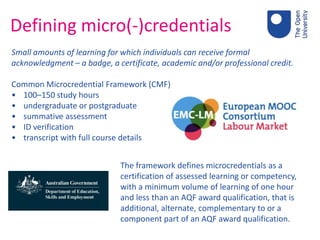
Defining micro(-)credentials
Common Microcredential Framework (CMF)
• 100–150 study hours
• undergraduate or postgraduate
• summative assessment
• ID verification
• transcript with full course details
The framework defines microcredentials as a
certification of assessed learning or competency,
with a minimum volume of learning of one hour
and less than an AQF award qualification, that is
additional, alternate, complementary to or a
component part of an AQF award qualification.
Small amounts of learning for which individuals can receive formal
acknowledgment – a badge, a certificate, academic and/or professional credit.
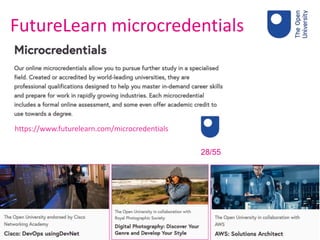
FutureLearn microcredentials
https://www.futurelearn.com/microcredentials
28/55
Benefits of
microcredentials
Benefits of
microcredentials
Expanding learning opportunities
Recognising learning
Strengthening employment-related learning
Making money
https://microcredentials.eu/microbol-desk-research-report/
International interest
Income for MOOC platforms
Open University aims
• Reach new and different learner populations.
• Access international markets
• Innovate our approach to the development and
delivery of content
• Build our relationships with industry/professional
body partners
Microcredential
challenges
Student support
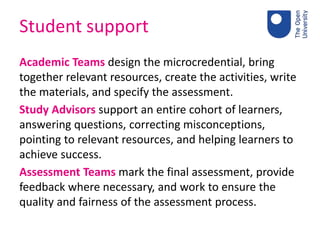
Academic Teams design the microcredential, bring
together relevant resources, create the activities, write
the materials, and specify the assessment.
Study Advisors support an entire cohort of learners,
answering questions, correcting misconceptions,
pointing to relevant resources, and helping learners to
achieve success.
Assessment Teams mark the final assessment, provide
feedback where necessary, and work to ensure the
quality and fairness of the assessment process.
Microcredential teams
Students or learners?
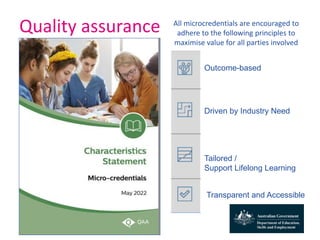
Quality assurance All microcredentials are encouraged to
adhere to the following principles to
maximise value for all parties involved
Outcome-based
Driven by Industry Need
Tailored /
Support Lifelong Learning
Transparent and Accessible
Photo by Sen
on Unsplash
Stackable: building qualifications
Sharing
expertise
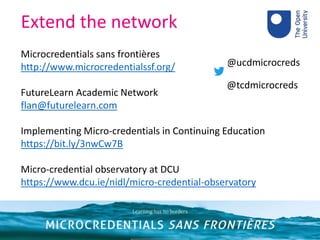
Extend the network
Microcredentials sans frontières
http://www.microcredentialssf.org/
FutureLearn Academic Network
flan@futurelearn.com
Implementing Micro-credentials in Continuing Education
https://bit.ly/3nwCw7B
Micro-credential observatory at DCU
https://www.dcu.ie/nidl/micro-credential-observatory
@ucdmicrocreds
@tcdmicrocreds
r3beccaf.wordpress.com
twitter.com/R3beccaF
www.slideshare.net/R3beccaF

Microcredentials benefits and challenges.pptx

Editor's Notes

  • #2 Implementing Microcredentials. Title page. Professor Rebecca Ferguson formerly Academic Lead Open University Microcredentials Four images representing microcredentials currently offered by The Open University.
  • #3 Divider slide with title ‘What are microcredentials?’
  • #4 Different definitions of microcredentials. Rebecca’s is ‘Small amounts of learning for which individuals can receive formal acknowledgment – a badge, a certificate, academic and/or professional credit.’ The European MOOC Consortium sets out criteria under its Common Microcredential Framework: 100–150 study hours, undergraduate or postgraduate, summative assessment, ID verification, and transcript with full course details The Australian government framework ‘defines microcredentials as a certification of assessed learning or competency, with a minimum volume of learning of one hour and less than an AQF award qualification, that is additional, alternate, complementary to or a component part of an AQF award qualification.’
  • #5 The FutureLearn description of microcredentials together with a link to their microcredentials and an image of three microcredentials currently on offer. Of the 55 microcredentials currently offered by FutureLearn, 28 are produced by The Open University
  • #6 Divider slide with title ‘Why microcredentials?’
  • #7 Divider slide with title ‘Why microcredentials?’ Ggives the responses: expanding learning opportunities, recognizing learning, strengthening employment-related learning, and making money
  • #8 International interest. Front cover of ‘Making micro-credentials work for learners, employers and providers’ by Professor Beverley Oliver Front cover of the executive summary of ‘A European Approach to Micro-credentials : Output of the Mic-credentials Higher Education Consultation Group, December 2020’ Tirle of the National Microcredentials Framework, November 2021’ from the Australian Government Department of Education, Skills and Employment Title of ‘Micro-credentials in South Australia: Consultation Outcomes Report’
  • #9 Heading: Income for MOOC platforms. Shows adverts forUdacity’s Nanodegrees programs, Coursera’s Professional Certificate and MasterTrack Certificate, and pathways from EdX including the MicroBachelors Program, MicroMasters program, professional certificate, Xseries and Online Master’s Degree.
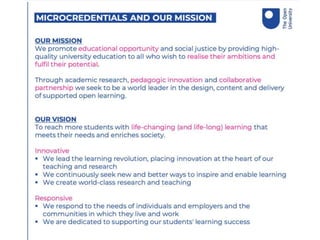
  • #10 Text explaining how The Open University is linking microcredentials with its mission, in terms of educational opportunity, pedagogic innovation and collaborative partnership. Also explaining the link of microcredentials with the OpenUniversity vision of reaching more students with life-changing and life-long learning.
  • #11 The Open University’s original aims for its microcredentials programme: Reach new and different learner populations. Access international markets Innovate our approach to the development and delivery of content Build our relationships with industry/professional body partners
  • #12 Divider slise: Microcredential challenges
  • #13 Academic Teams design the microcredential, bring together relevant resources, create the activities, write the materials, and specify the assessment. Study Advisors support an entire cohort of learners, answering questions, correcting misconceptions, pointing to relevant resources, and helping learners to achieve success. Assessment Teams mark the final assessment, provide feedback where necessary, and work to ensure the quality and fairness of the assessment process.
  • #14 Diagram showing the different roles involved in developing a microcredentials programme. These fall into six main groups: internal alignment, educators, support, outward facing, project team and learners
  • #15 Are the people who enrol for these courses students or learners? Will they have access to, for example, university clubs, university sports facilities or the university library?
  • #16 Quality Assurance. Image of the UK’s Quality Assurance Agency Characteristics Statement for Micro-credentials. Also four principles for microcredentials from the Australian government: outcome based, driven by industry need, tailored / support lifelong learning, transparent and accessible
  • #17 Stackable: building qualifications Photo by Sen on Unsplash of Lego bricks
  • #18 Divider slide on sharing expertise
  • #19 Links to resources, organisations and Twitter accounts: Microcredentials sans frontières http://www.microcredentialssf.org/ FutureLearn Academic Network flan@futurelearn.com Implementing Micro-credentials in Continuing Education https://bit.ly/3nwCw7B Micro-credential observatory at DCU https://www.dcu.ie/nidl/micro-credential-observatory @ucdmicrocreds @tcdmicrocreds
  • #20 Final slide with picture of the presenter and links to her blog, Twitter account and Slideshare r3beccaf.wordpress.com twitter.com/R3beccaF www.slideshare.net/R3beccaF