Open learner models
(OLMs) and learning
analytics dashboards: A
systematic review
Robert Bodily, Judy Kay, Vincent Aleven, Ioana Jivet, Dan Davis, Franceska Xhakaj, Katrien Verbert
Overview
Why OLM research is relevant to LAK (Judy)
A little history and background about OLMs (Judy)
Results & Highlights (Ioana)
Comparing OLMs and LAK dashboard (Dan)
Implications for future work (Dan)
Why is OLM research
relevant for LAK?
What was the motivation for this work?
Motivation
To bring together two strands of research:
Learner-focused learning analytics
Open Learner Models (OLMs)
A little history
OLMs …..
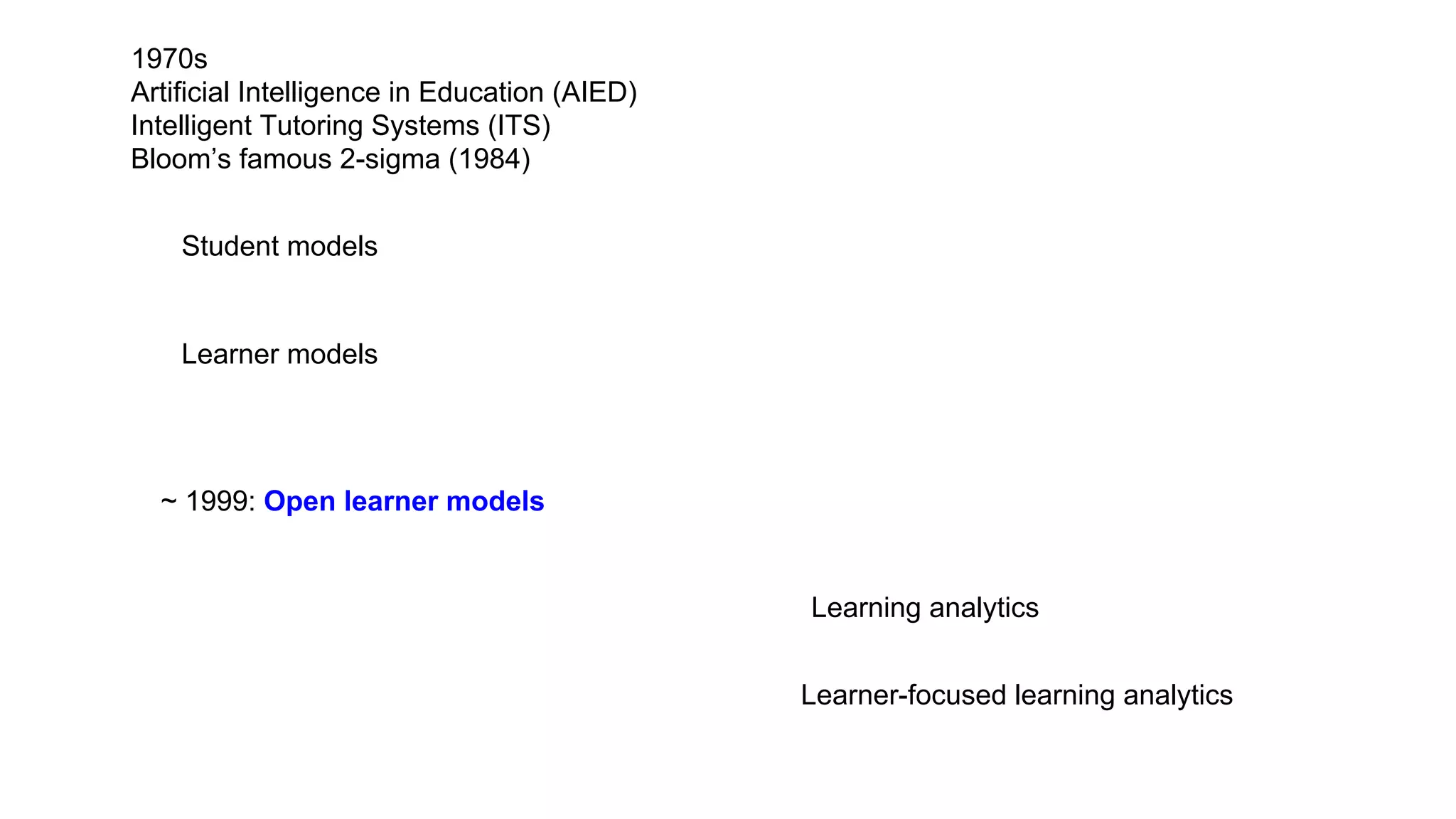
~ 1999: Open learner models
Learner-focused learning analytics
Learner models
Student models
1970s
Artificial Intelligence in Education (AIED)
Intelligent Tutoring Systems (ITS)
Bloom’s famous 2-sigma (1984)
Learning analytics
~ 1999: Open learner models
Learner-focused learning analytics
Learner models
Student models
1970s
Artificial Intelligence in Education (AIED)
Intelligent Tutoring Systems (ITS)
Bloom’s famous 2-sigma (1984)
Learning analytics
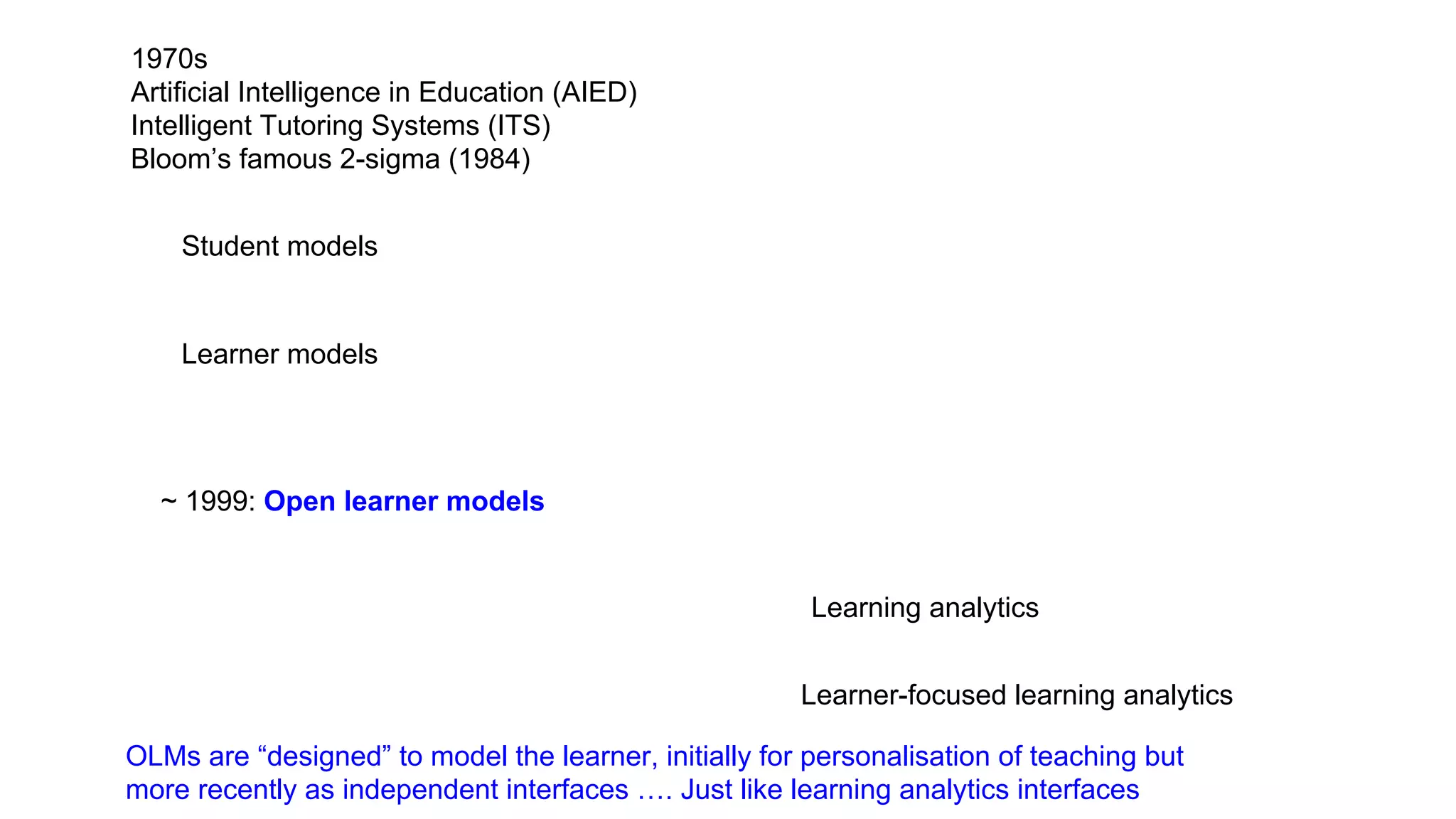
OLMs are “designed” to model the learner, initially for personalisation of teaching but
more recently as independent interfaces …. Just like learning analytics interfaces
What is an Open Learner
Model (OLM)?
How is it similar to learner
oriented learning analytics?
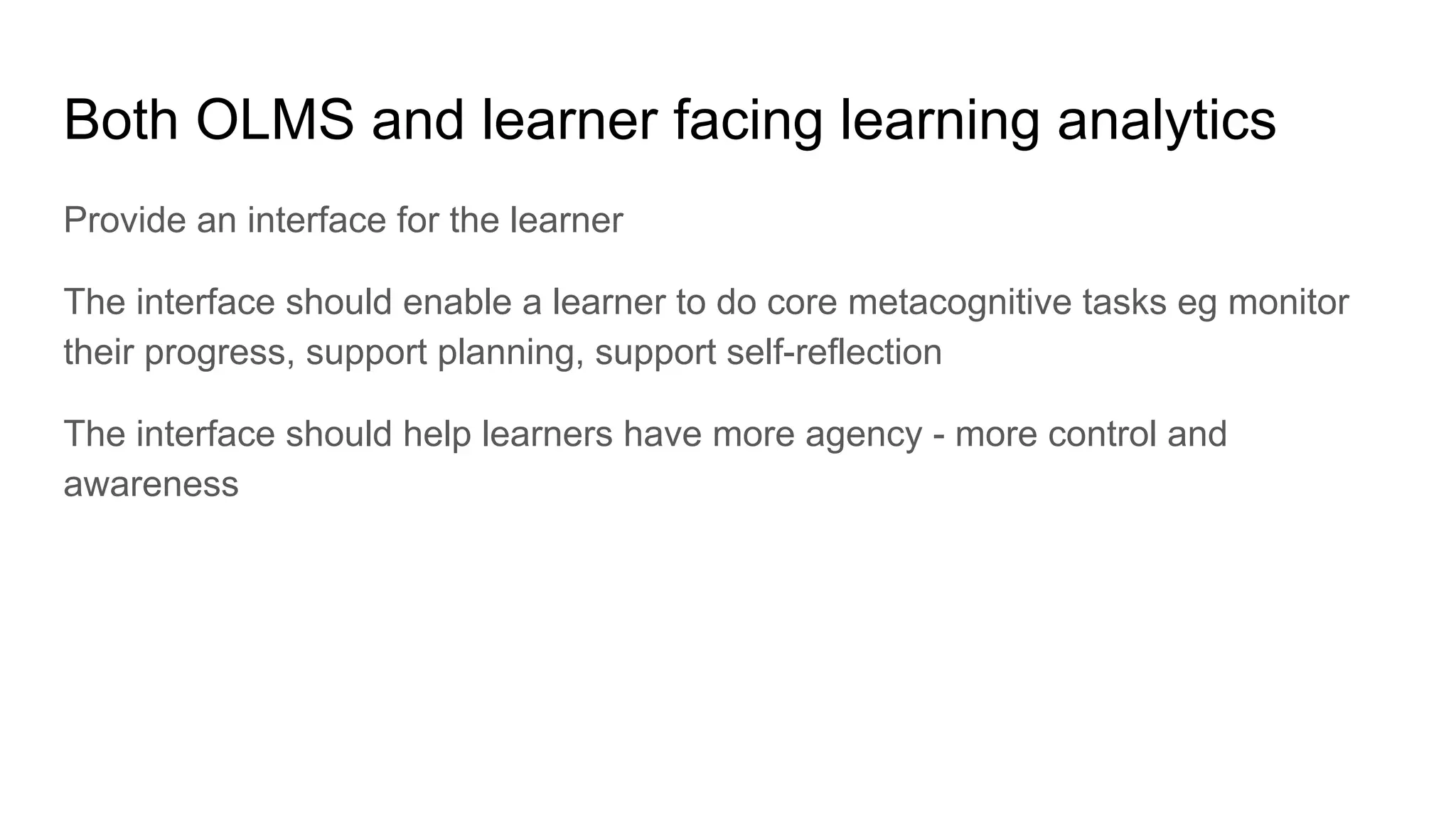
Both OLMS and learner facing learning analytics
Provide an interface for the learner
The interface should enable a learner to do core metacognitive tasks eg monitor
their progress, support planning, support self-reflection
The interface should help learners have more agency - more control and
awareness
How is it different from
learning analytics?
OLM - Developed in parallel to (research) platform
LAD - Developed independently
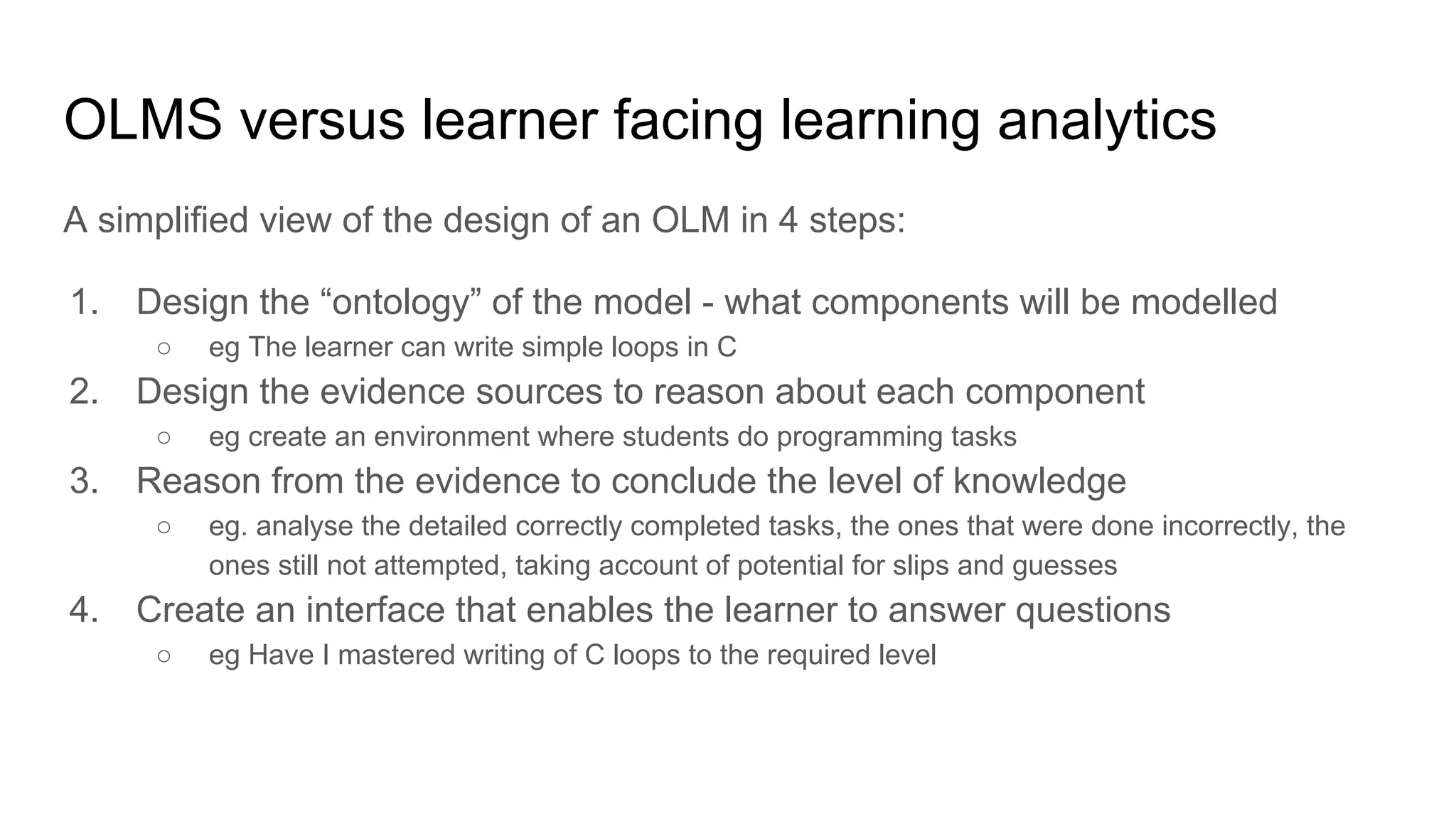
OLMS versus learner facing learning analytics
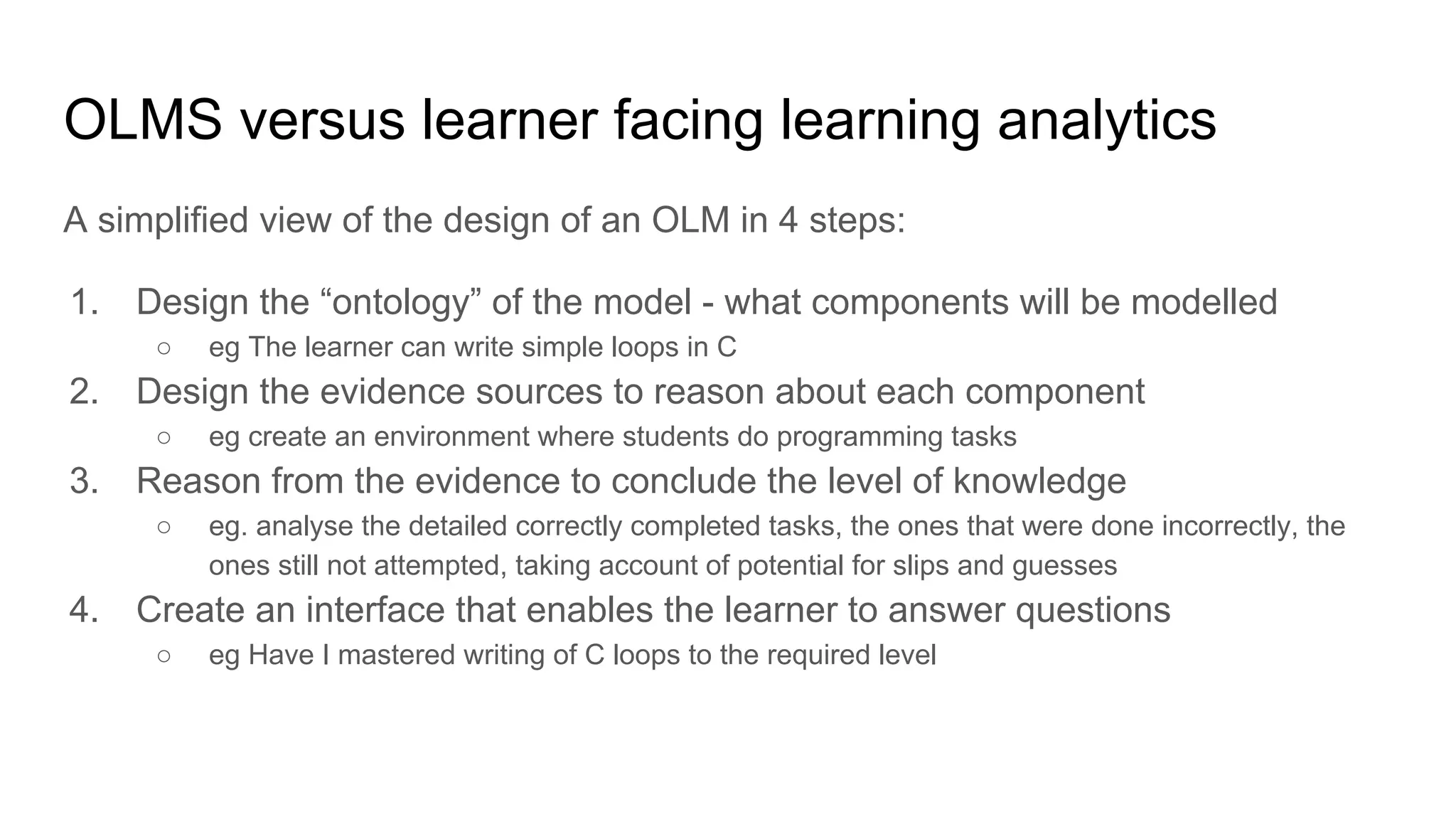
A simplified view of the design of an OLM in 4 steps:
1. Design the “ontology” of the model - what components will be modelled
○ eg The learner can write simple loops in C
2. Design the evidence sources to reason about each component
○ eg create an environment where students do programming tasks
3. Reason from the evidence to conclude the level of knowledge
○ eg. analyse the detailed correctly completed tasks, the ones that were done incorrectly, the
ones still not attempted, taking account of potential for slips and guesses
4. Create an interface that enables the learner to answer questions
○ eg Have I mastered writing of C loops to the required level
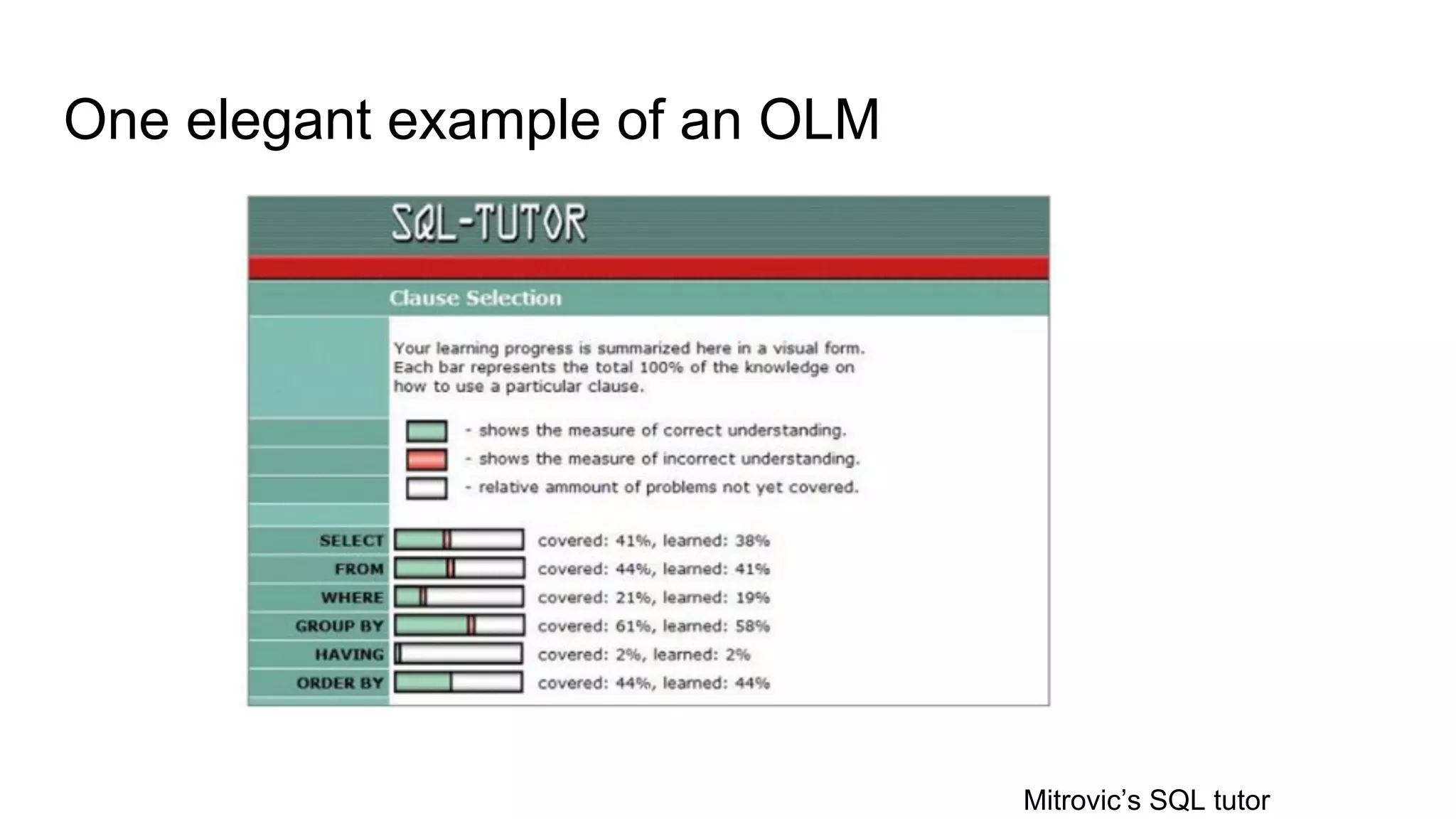
One elegant example of an OLM
Mitrovic’s SQL tutor
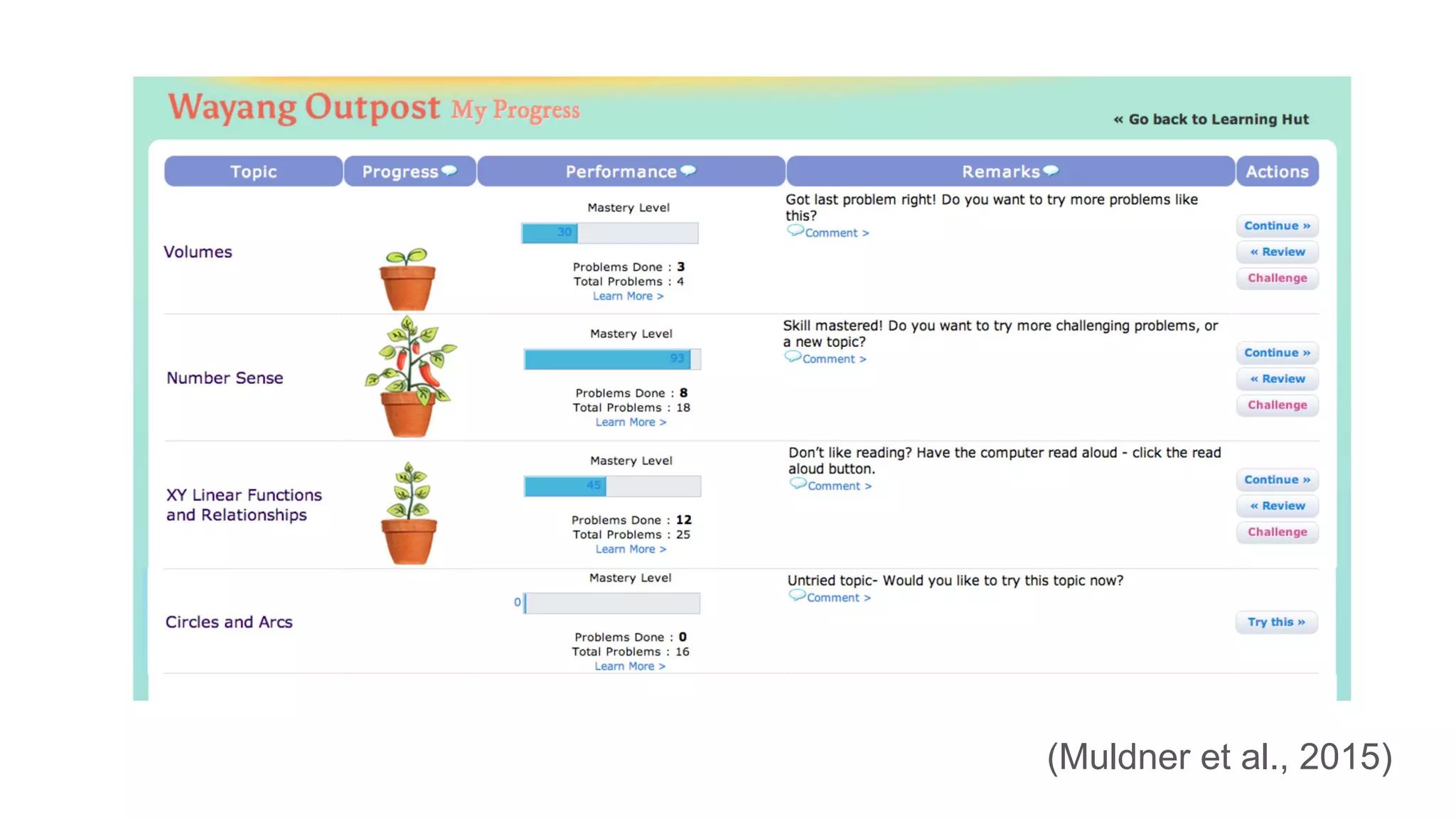
(Muldner et al., 2015)
Methodology
Methodology
- Search Method
- Inclusion Criteria
- Code book & coding
- Compare to LAD review (Bodily, 2017)
Key Findings & Highlights
Trends in OLM Research
● Publication venue
● Authors
● Top cited articles
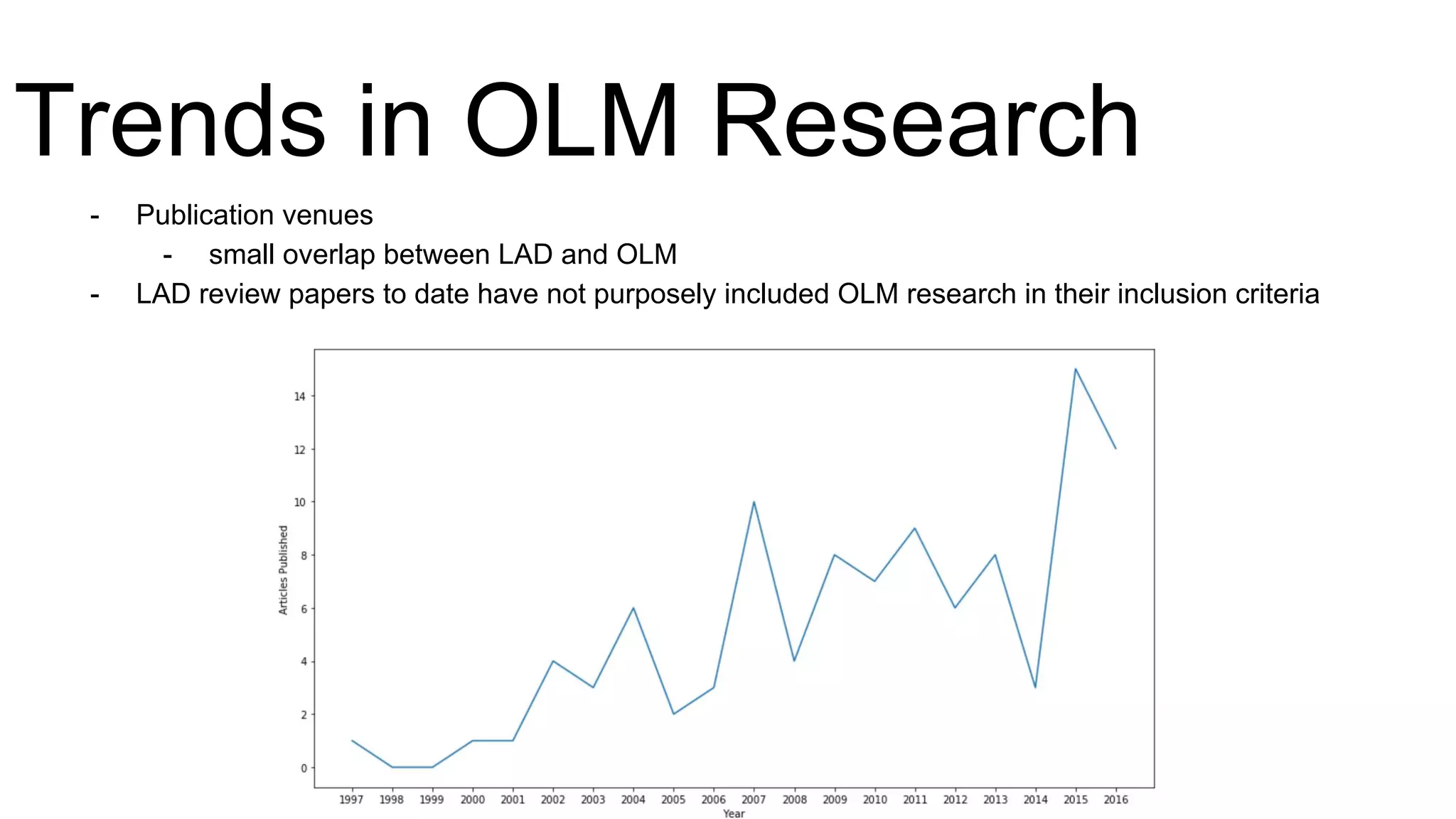
● Publications over time
- Publication venues
- small overlap between LAD and OLM
- LAD review papers to date have not purposely included OLM research in their inclusion criteria
Trends in OLM Research
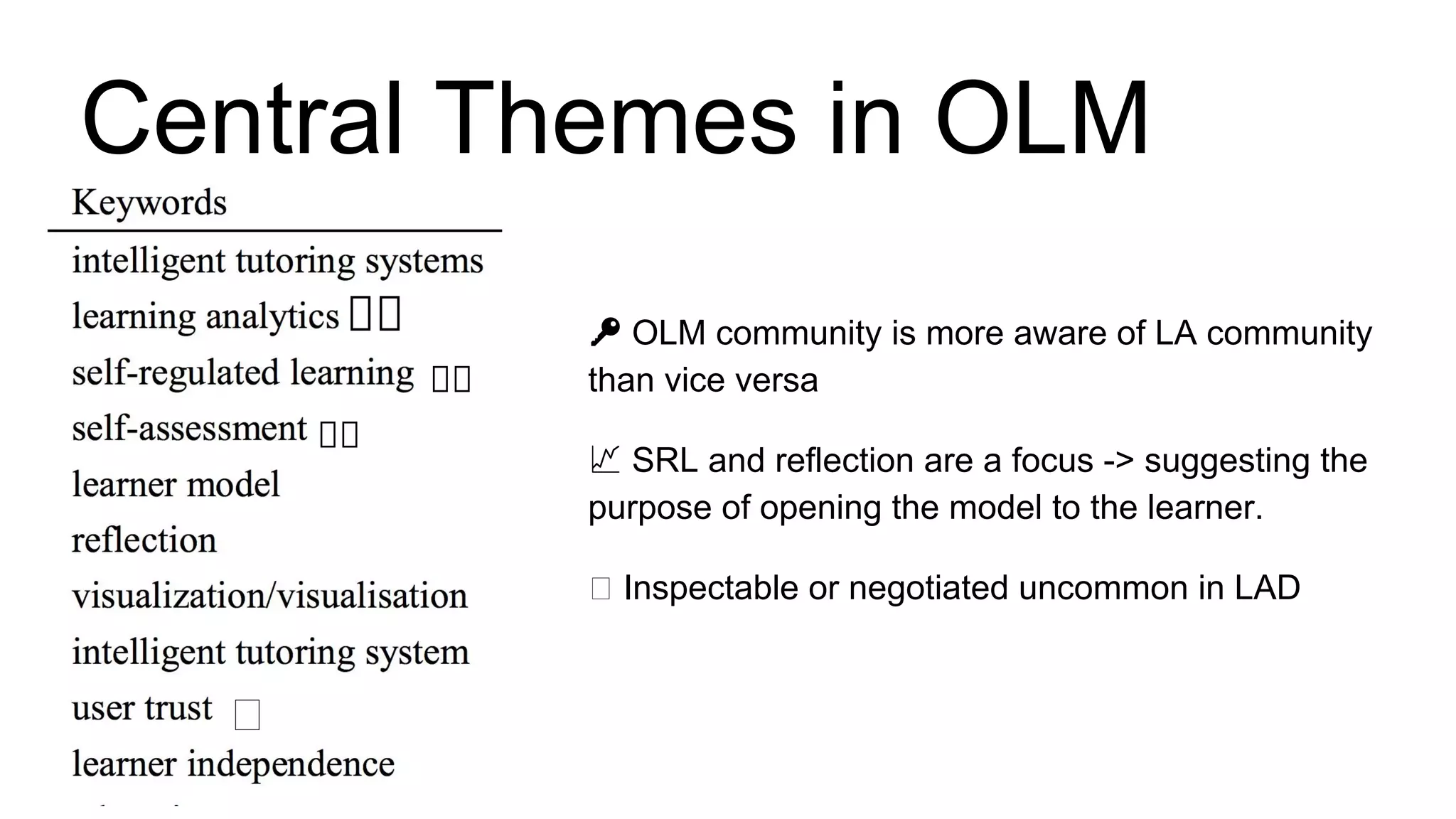
Central Themes in OLM
OLM community is more aware of LA community
than vice versa
SRL and reflection are a focus -> suggesting the
purpose of opening the model to the learner.
Inspectable or negotiated uncommon in LAD
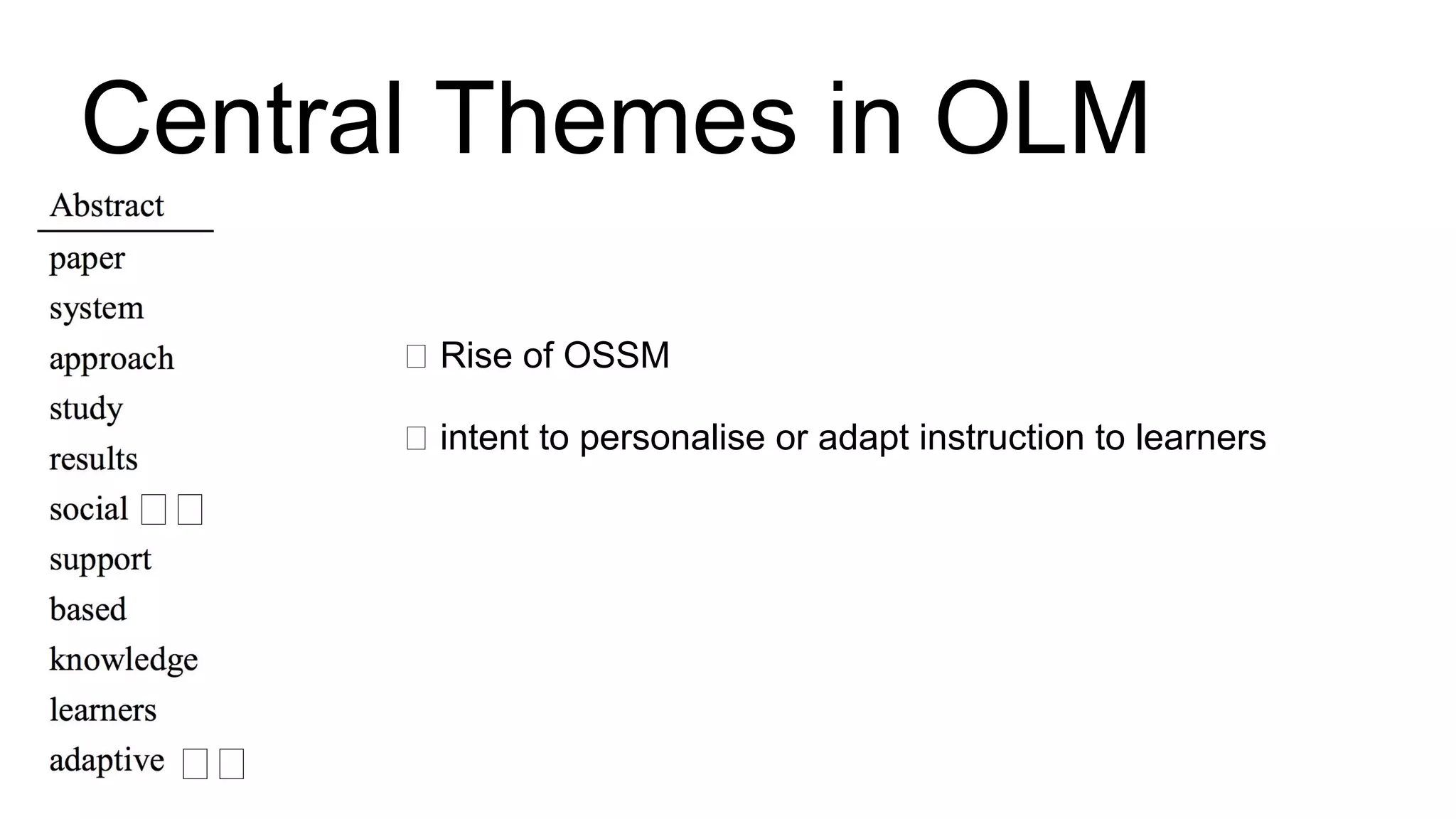
Central Themes in OLM
Rise of OSSM
intent to personalise or adapt instruction to learners
Central Themes in OLM
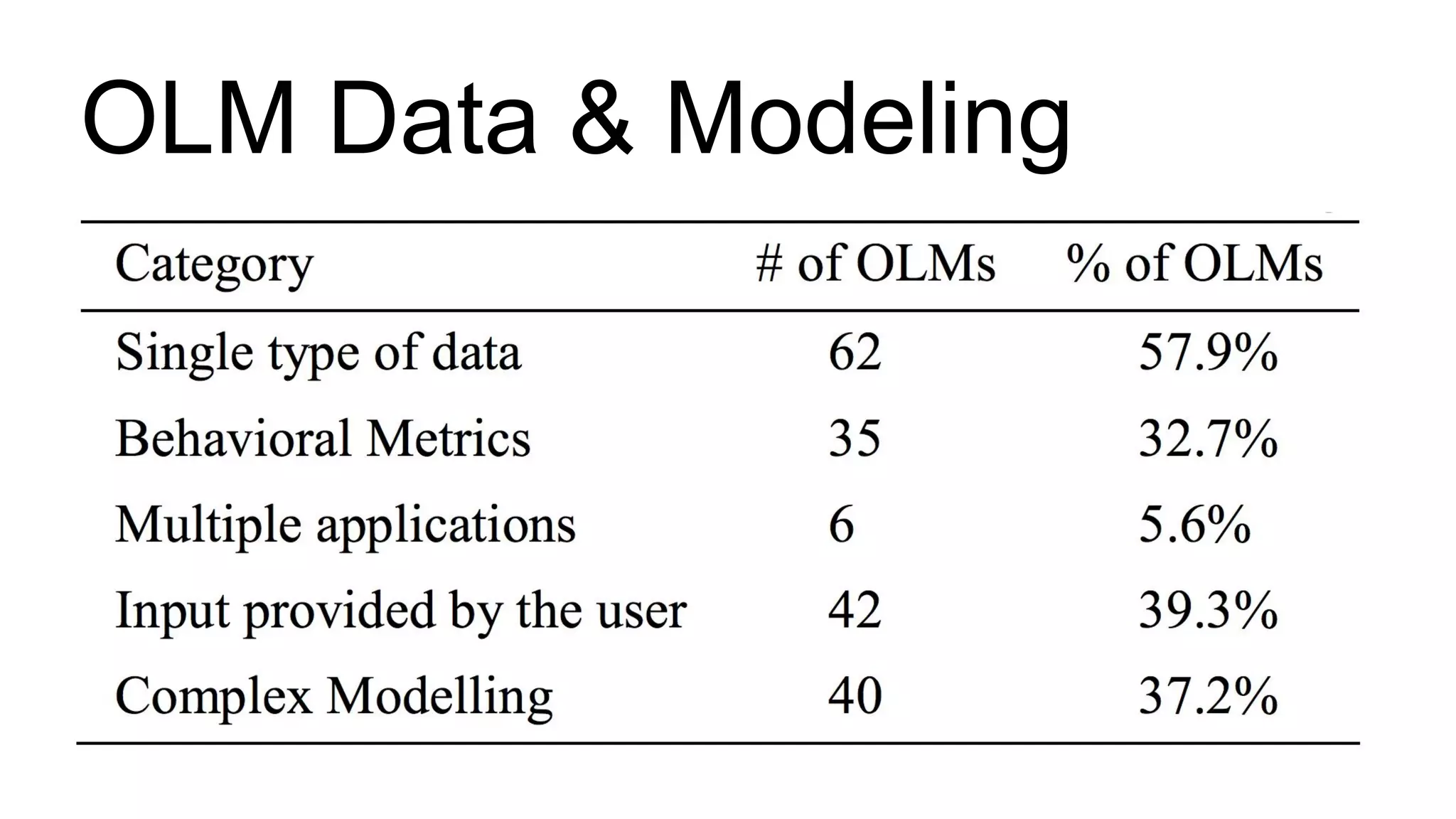
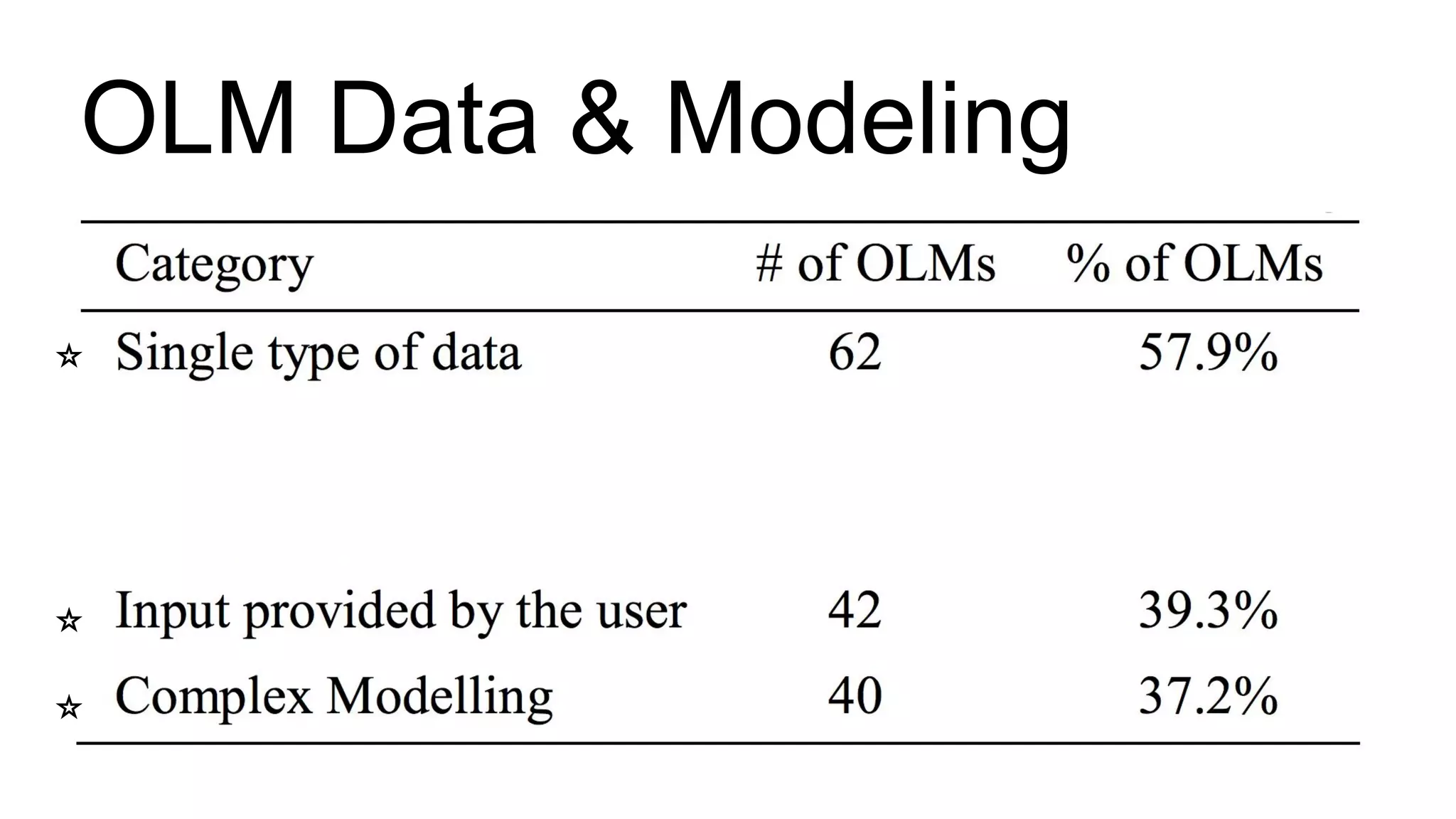
OLM Data & Modeling
OLM Data & Modeling
OLM Data & Modeling
⭐
⭐
⭐
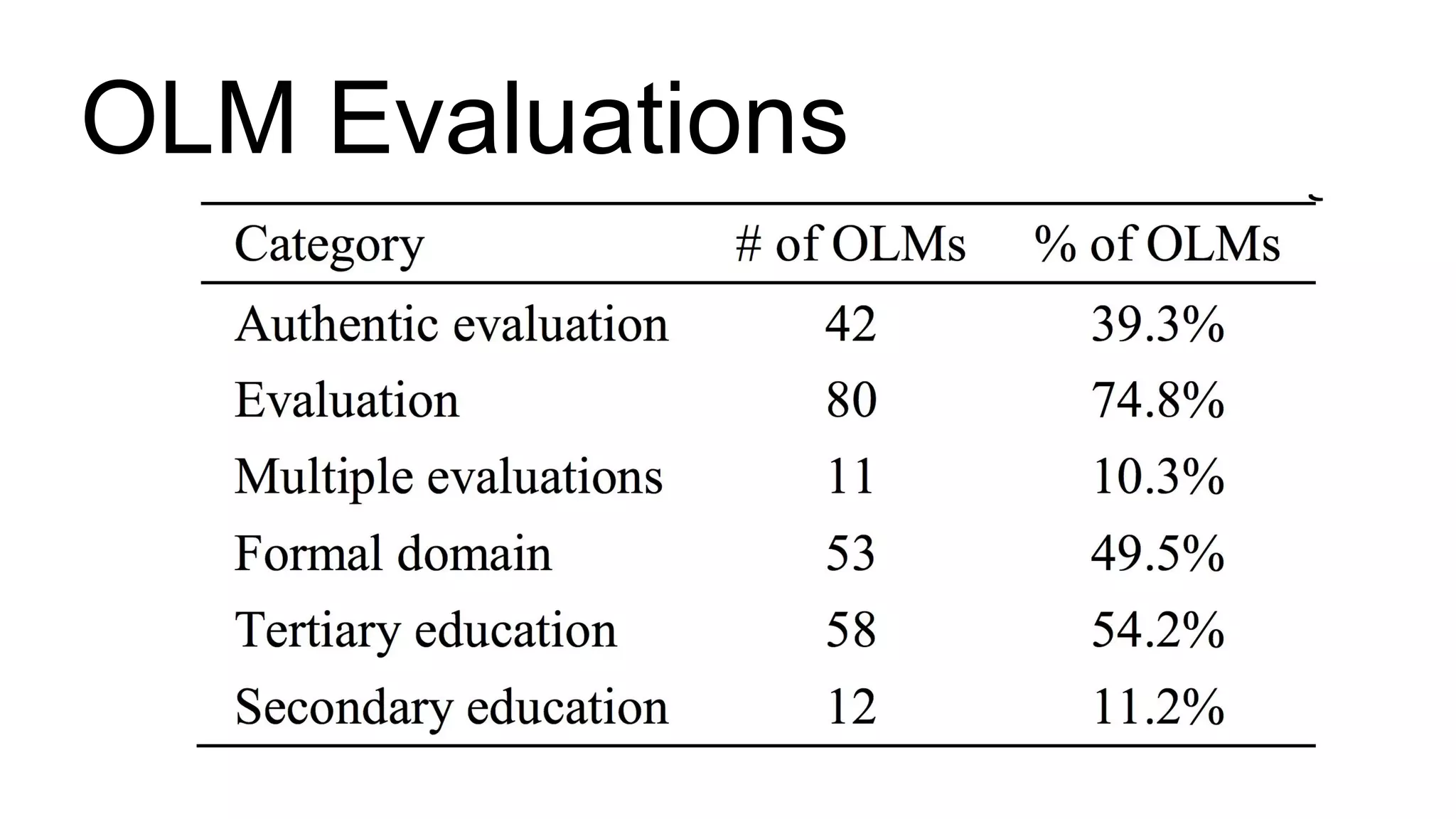
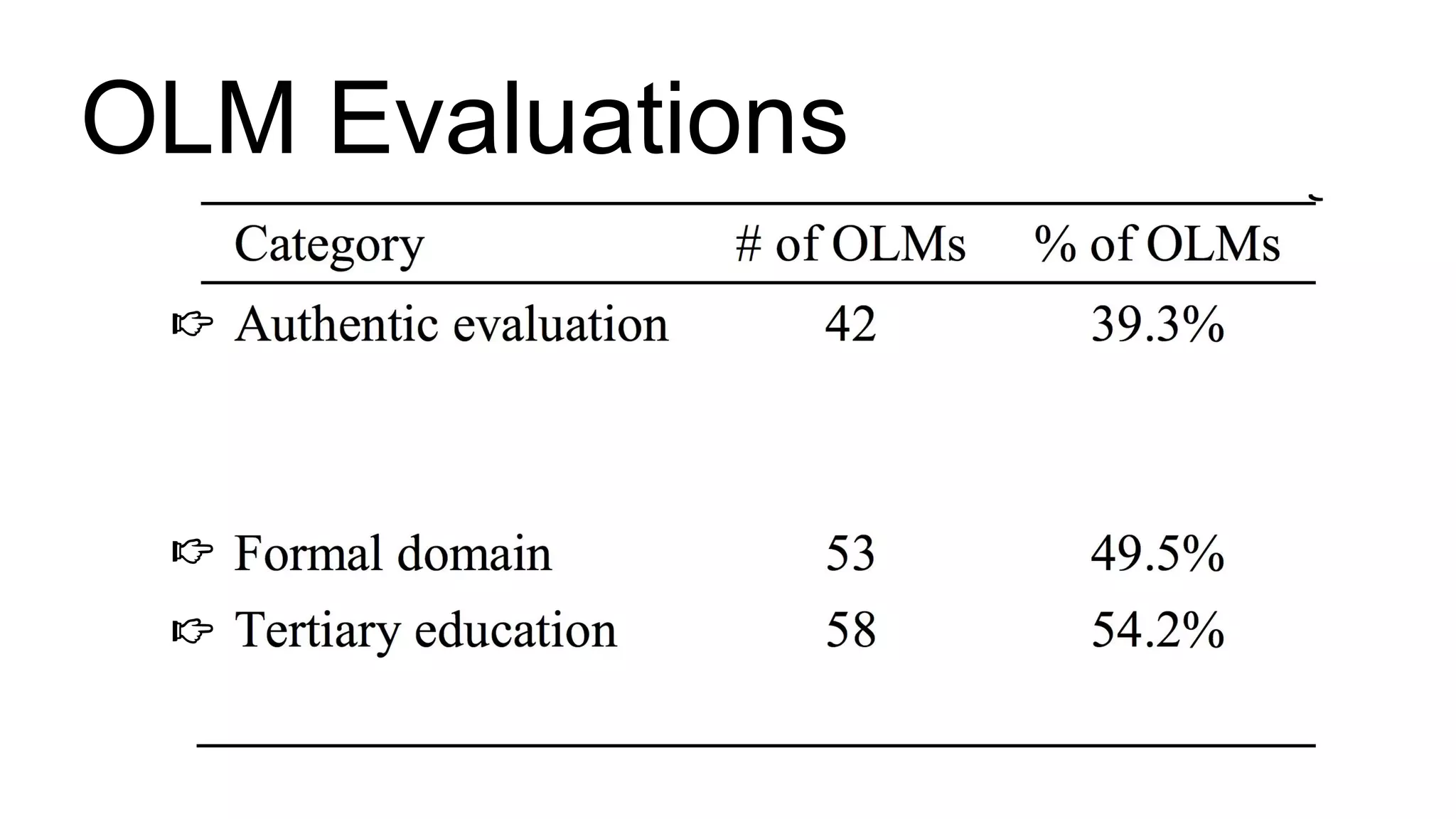
OLM Evaluations
OLM Evaluations
OLM Evaluations
Comparing OLM & LAD
Comparing OLM & LAD
✅
✅
✅
✅
✅
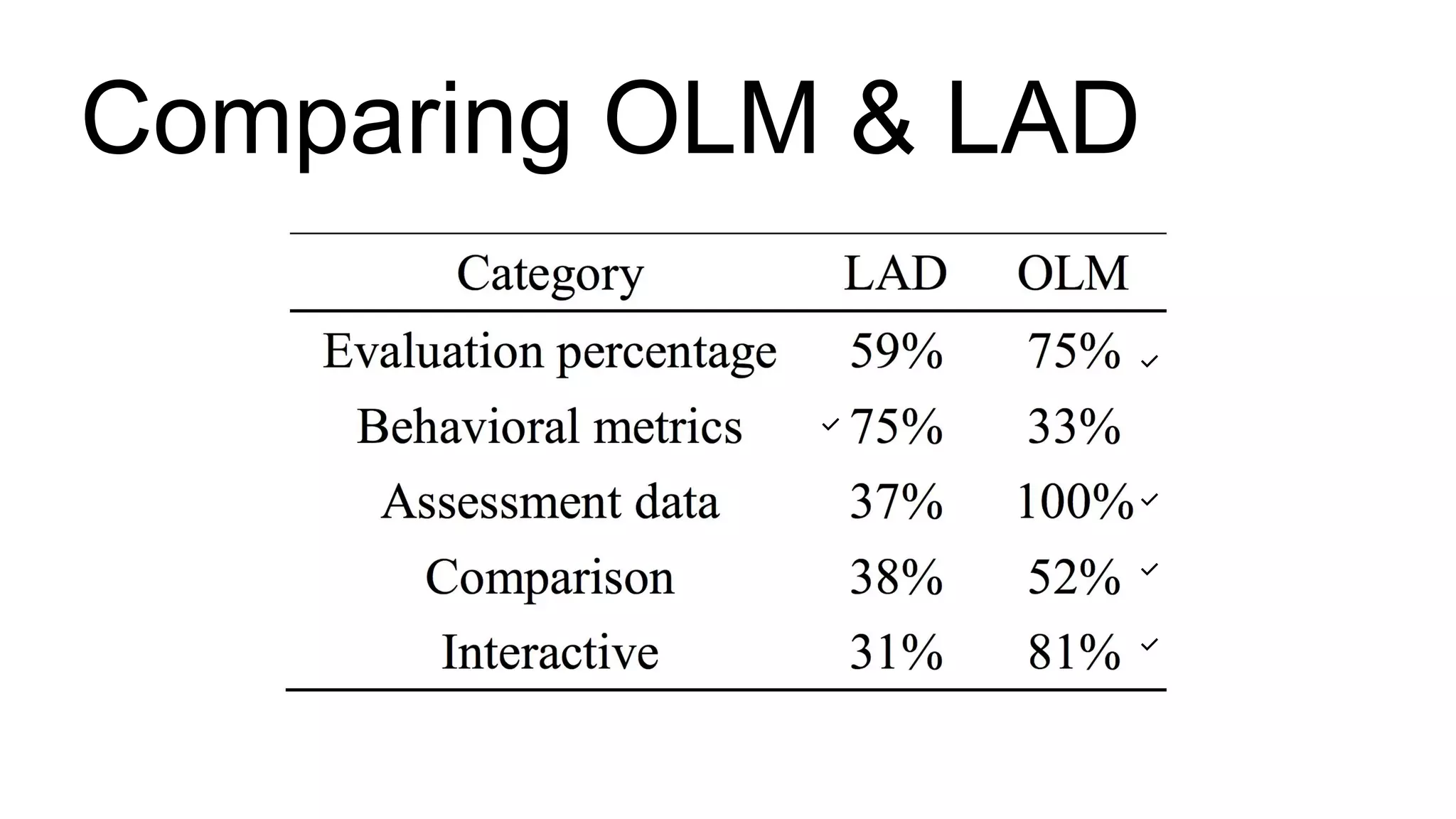
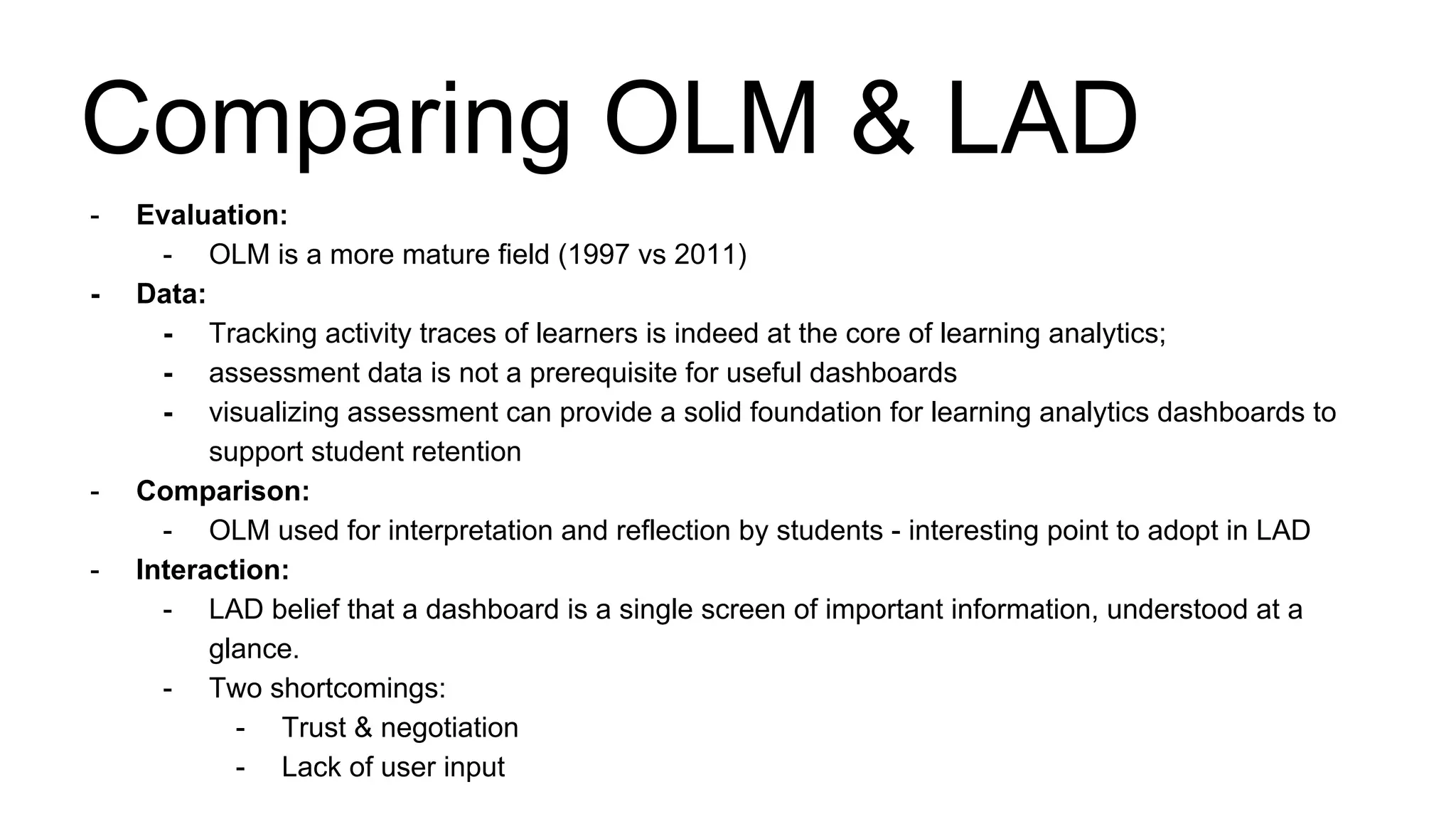
- Evaluation:
- OLM is a more mature field (1997 vs 2011)
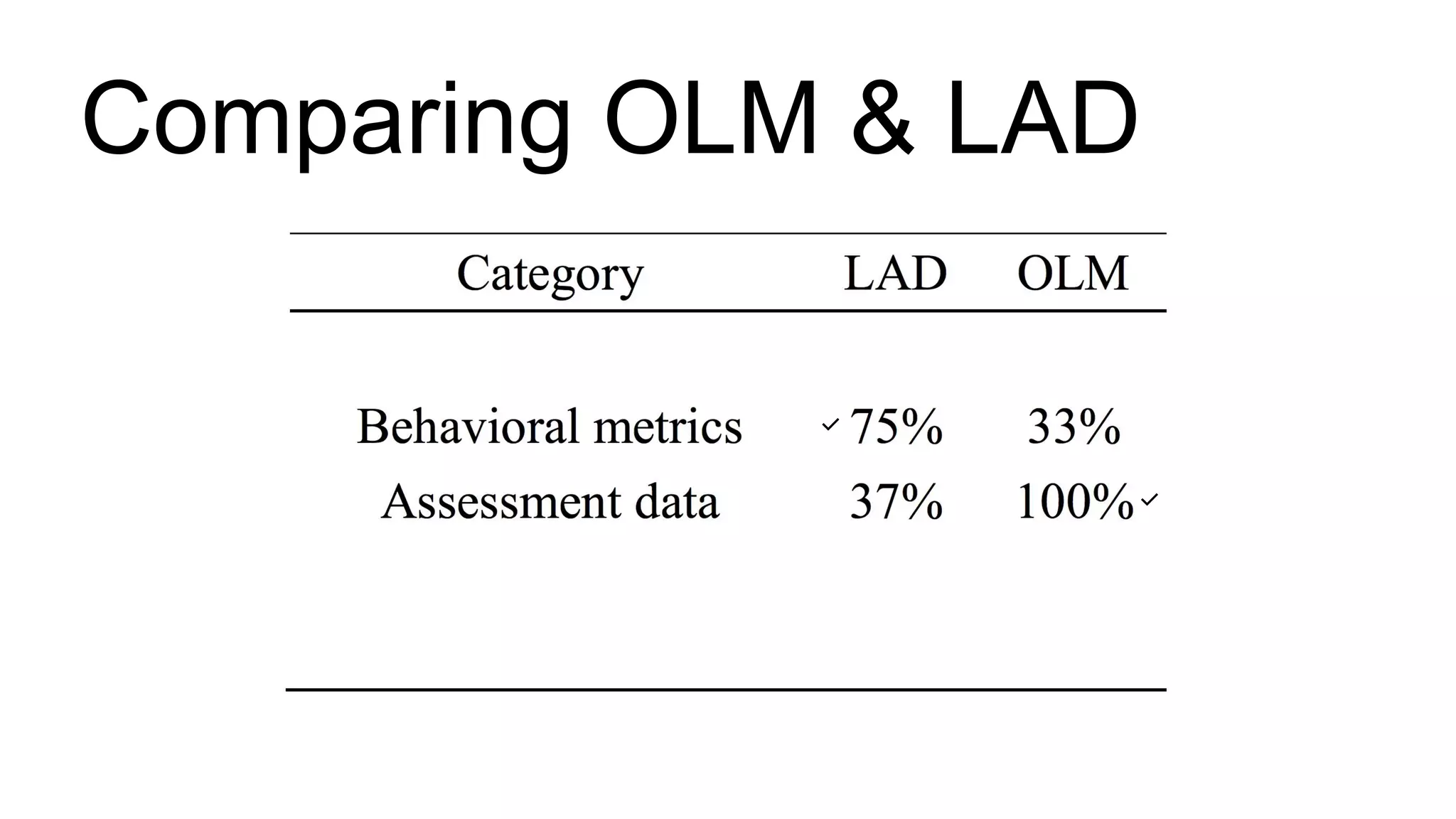
- Data:
- Tracking activity traces of learners is indeed at the core of learning analytics;
- assessment data is not a prerequisite for useful dashboards
- visualizing assessment can provide a solid foundation for learning analytics dashboards to
support student retention
- Comparison:
- OLM used for interpretation and reflection by students - interesting point to adopt in LAD
- Interaction:
- LAD belief that a dashboard is a single screen of important information, understood at a
glance.
- Two shortcomings:
- Trust & negotiation
- Lack of user input
Comparing OLM & LAD
Comparing OLM & LAD
✅
✅
✅
✅
✅
OLMS versus learner facing learning analytics
A simplified view of the design of an OLM in 4 steps:
1. Design the “ontology” of the model - what components will be modelled
○ eg The learner can write simple loops in C
2. Design the evidence sources to reason about each component
○ eg create an environment where students do programming tasks
3. Reason from the evidence to conclude the level of knowledge
○ eg. analyse the detailed correctly completed tasks, the ones that were done incorrectly, the
ones still not attempted, taking account of potential for slips and guesses
4. Create an interface that enables the learner to answer questions
○ eg Have I mastered writing of C loops to the required level
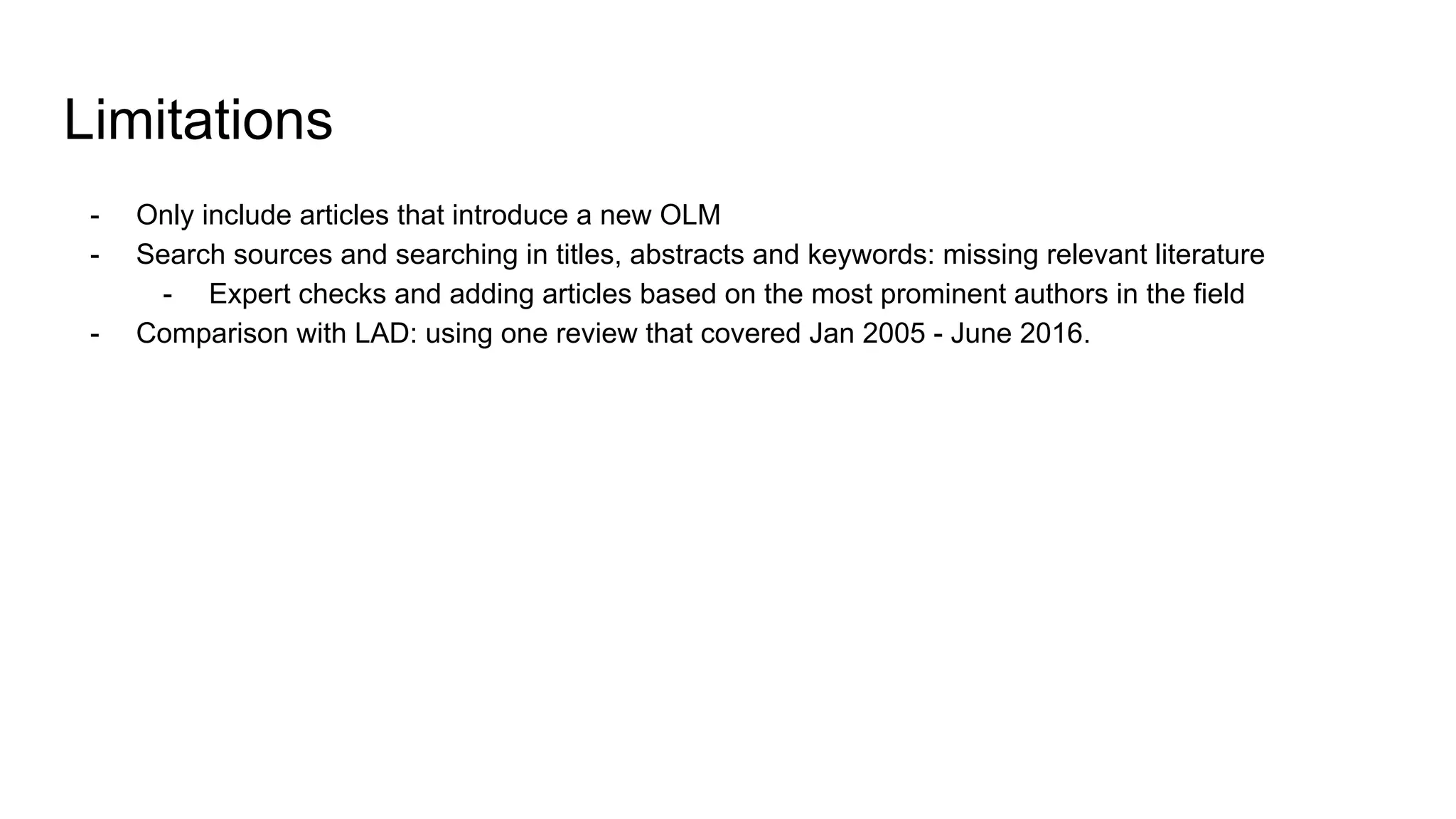
Limitations
- Only include articles that introduce a new OLM
- Search sources and searching in titles, abstracts and keywords: missing relevant literature
- Expert checks and adding articles based on the most prominent authors in the field
- Comparison with LAD: using one review that covered Jan 2005 - June 2016.
Implications for the future
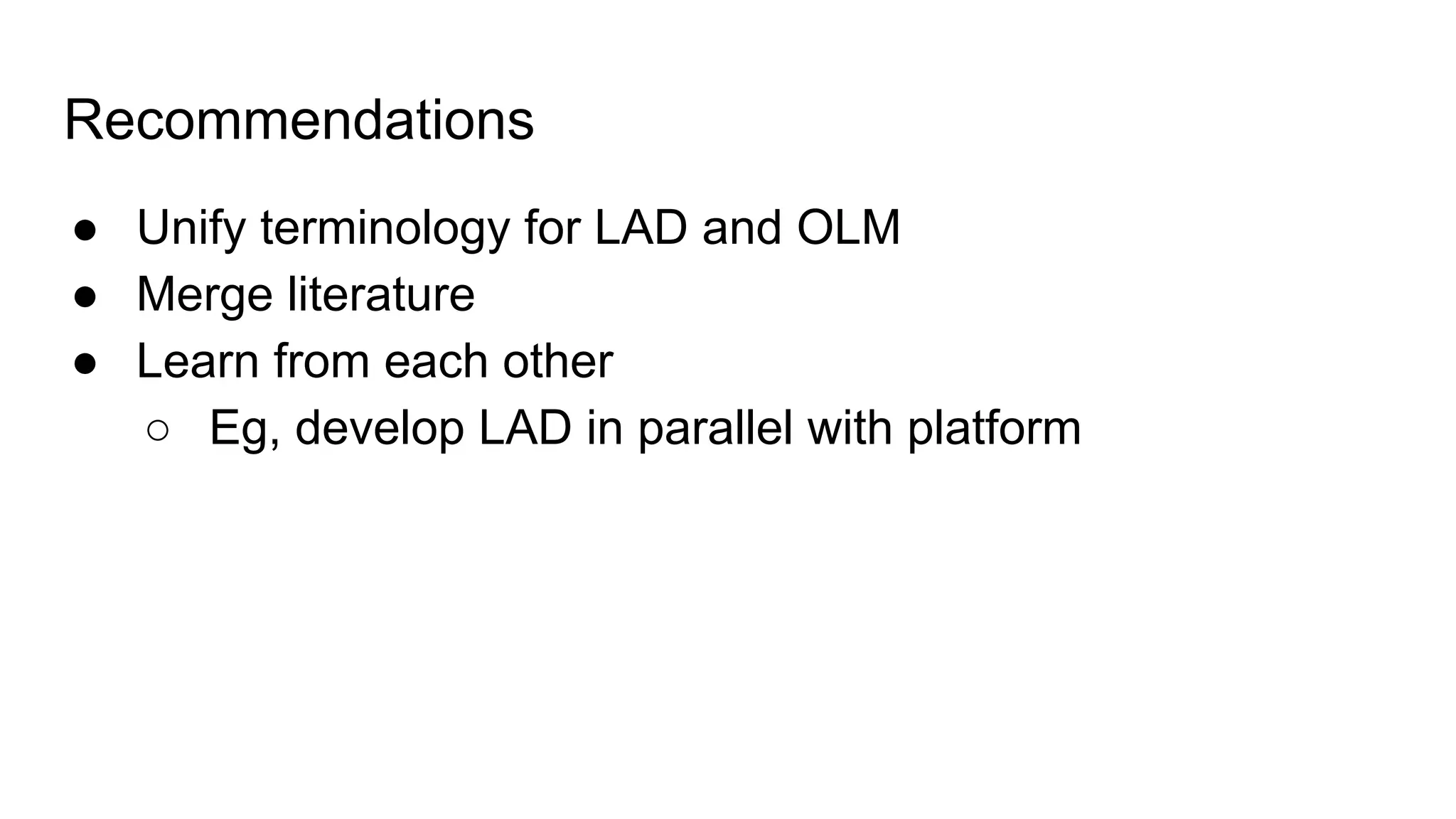
Recommendations
● Unify terminology for LAD and OLM
● Merge literature
● Learn from each other
○ Eg, develop LAD in parallel with platform

Open learner models (OLMs) and learning analytics dashboards: A systematic review

  • 1.
    Open learner models (OLMs)and learning analytics dashboards: A systematic review Robert Bodily, Judy Kay, Vincent Aleven, Ioana Jivet, Dan Davis, Franceska Xhakaj, Katrien Verbert
  • 2.
    Overview Why OLM researchis relevant to LAK (Judy) A little history and background about OLMs (Judy) Results & Highlights (Ioana) Comparing OLMs and LAK dashboard (Dan) Implications for future work (Dan)
  • 3.
    Why is OLMresearch relevant for LAK? What was the motivation for this work?
  • 4.
    Motivation To bring togethertwo strands of research: Learner-focused learning analytics Open Learner Models (OLMs)
  • 5.
  • 6.
    ~ 1999: Openlearner models Learner-focused learning analytics Learner models Student models 1970s Artificial Intelligence in Education (AIED) Intelligent Tutoring Systems (ITS) Bloom’s famous 2-sigma (1984) Learning analytics
  • 7.
    ~ 1999: Openlearner models Learner-focused learning analytics Learner models Student models 1970s Artificial Intelligence in Education (AIED) Intelligent Tutoring Systems (ITS) Bloom’s famous 2-sigma (1984) Learning analytics OLMs are “designed” to model the learner, initially for personalisation of teaching but more recently as independent interfaces …. Just like learning analytics interfaces
  • 8.
    What is anOpen Learner Model (OLM)?
  • 9.
    How is itsimilar to learner oriented learning analytics?
  • 10.
    Both OLMS andlearner facing learning analytics Provide an interface for the learner The interface should enable a learner to do core metacognitive tasks eg monitor their progress, support planning, support self-reflection The interface should help learners have more agency - more control and awareness
  • 11.
    How is itdifferent from learning analytics? OLM - Developed in parallel to (research) platform LAD - Developed independently
  • 12.
    OLMS versus learnerfacing learning analytics A simplified view of the design of an OLM in 4 steps: 1. Design the “ontology” of the model - what components will be modelled ○ eg The learner can write simple loops in C 2. Design the evidence sources to reason about each component ○ eg create an environment where students do programming tasks 3. Reason from the evidence to conclude the level of knowledge ○ eg. analyse the detailed correctly completed tasks, the ones that were done incorrectly, the ones still not attempted, taking account of potential for slips and guesses 4. Create an interface that enables the learner to answer questions ○ eg Have I mastered writing of C loops to the required level
  • 13.
    One elegant exampleof an OLM Mitrovic’s SQL tutor
  • 14.
  • 16.
  • 17.
    Methodology - Search Method -Inclusion Criteria - Code book & coding - Compare to LAD review (Bodily, 2017)
  • 18.
    Key Findings &Highlights
  • 19.
    Trends in OLMResearch ● Publication venue ● Authors ● Top cited articles ● Publications over time
  • 20.
    - Publication venues -small overlap between LAD and OLM - LAD review papers to date have not purposely included OLM research in their inclusion criteria Trends in OLM Research
  • 21.
  • 22.
    OLM community ismore aware of LA community than vice versa SRL and reflection are a focus -> suggesting the purpose of opening the model to the learner. Inspectable or negotiated uncommon in LAD Central Themes in OLM
  • 23.
    Rise of OSSM intentto personalise or adapt instruction to learners Central Themes in OLM
  • 24.
    OLM Data &Modeling
  • 25.
    OLM Data &Modeling
  • 26.
    OLM Data &Modeling ⭐ ⭐ ⭐
  • 27.
  • 28.
  • 29.
  • 30.
  • 31.
    Comparing OLM &LAD ✅ ✅ ✅ ✅ ✅
  • 32.
    - Evaluation: - OLMis a more mature field (1997 vs 2011) - Data: - Tracking activity traces of learners is indeed at the core of learning analytics; - assessment data is not a prerequisite for useful dashboards - visualizing assessment can provide a solid foundation for learning analytics dashboards to support student retention - Comparison: - OLM used for interpretation and reflection by students - interesting point to adopt in LAD - Interaction: - LAD belief that a dashboard is a single screen of important information, understood at a glance. - Two shortcomings: - Trust & negotiation - Lack of user input Comparing OLM & LAD
  • 33.
    Comparing OLM &LAD ✅ ✅ ✅ ✅ ✅
  • 34.
    OLMS versus learnerfacing learning analytics A simplified view of the design of an OLM in 4 steps: 1. Design the “ontology” of the model - what components will be modelled ○ eg The learner can write simple loops in C 2. Design the evidence sources to reason about each component ○ eg create an environment where students do programming tasks 3. Reason from the evidence to conclude the level of knowledge ○ eg. analyse the detailed correctly completed tasks, the ones that were done incorrectly, the ones still not attempted, taking account of potential for slips and guesses 4. Create an interface that enables the learner to answer questions ○ eg Have I mastered writing of C loops to the required level
  • 35.
    Limitations - Only includearticles that introduce a new OLM - Search sources and searching in titles, abstracts and keywords: missing relevant literature - Expert checks and adding articles based on the most prominent authors in the field - Comparison with LAD: using one review that covered Jan 2005 - June 2016.
  • 36.
  • 38.
    Recommendations ● Unify terminologyfor LAD and OLM ● Merge literature ● Learn from each other ○ Eg, develop LAD in parallel with platform