Awareness is not enough. Pitfalls of learning
analytics dashboards in the educational practice
Ioana Jivet, Maren Scheffel, Hendrik Drachsler, Marcus Specht
Welten Institute
Open University of the Netherlands
ioana.jivet@ou.nl
Source: https://www.flickr.com/photos/bruneluniversity/12926707974/
Learning analytics dashboards
… “single displays that aggregate different indicators about learner(s),
learning process(es) and/or learning context(s) into one or multiple
visualisations”
Schwendimann, B. A., Rodriguez-Triana, M. J., Vozniuk, A., Prieto, L. P., Boroujeni, M. S., Holzer, A., ... & Dillenbourg,
P. (2017). Perceiving learning at a glance: A systematic literature review of learning dashboard research. IEEE
Transactions on Learning Technologies, 10(1), 30-41.
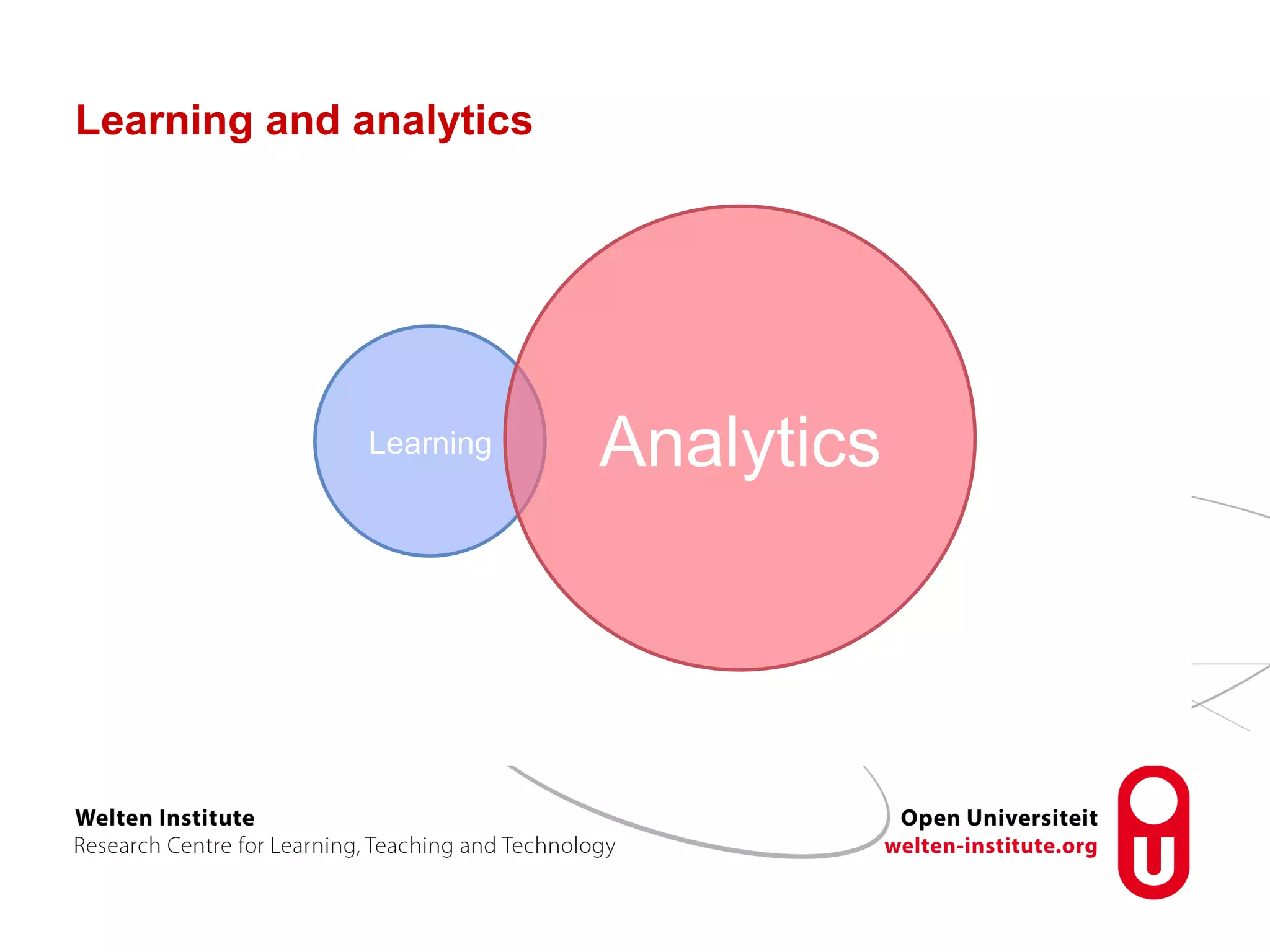
Learning and analytics
Learning Analytics
Other learning analytics dashboard reviews
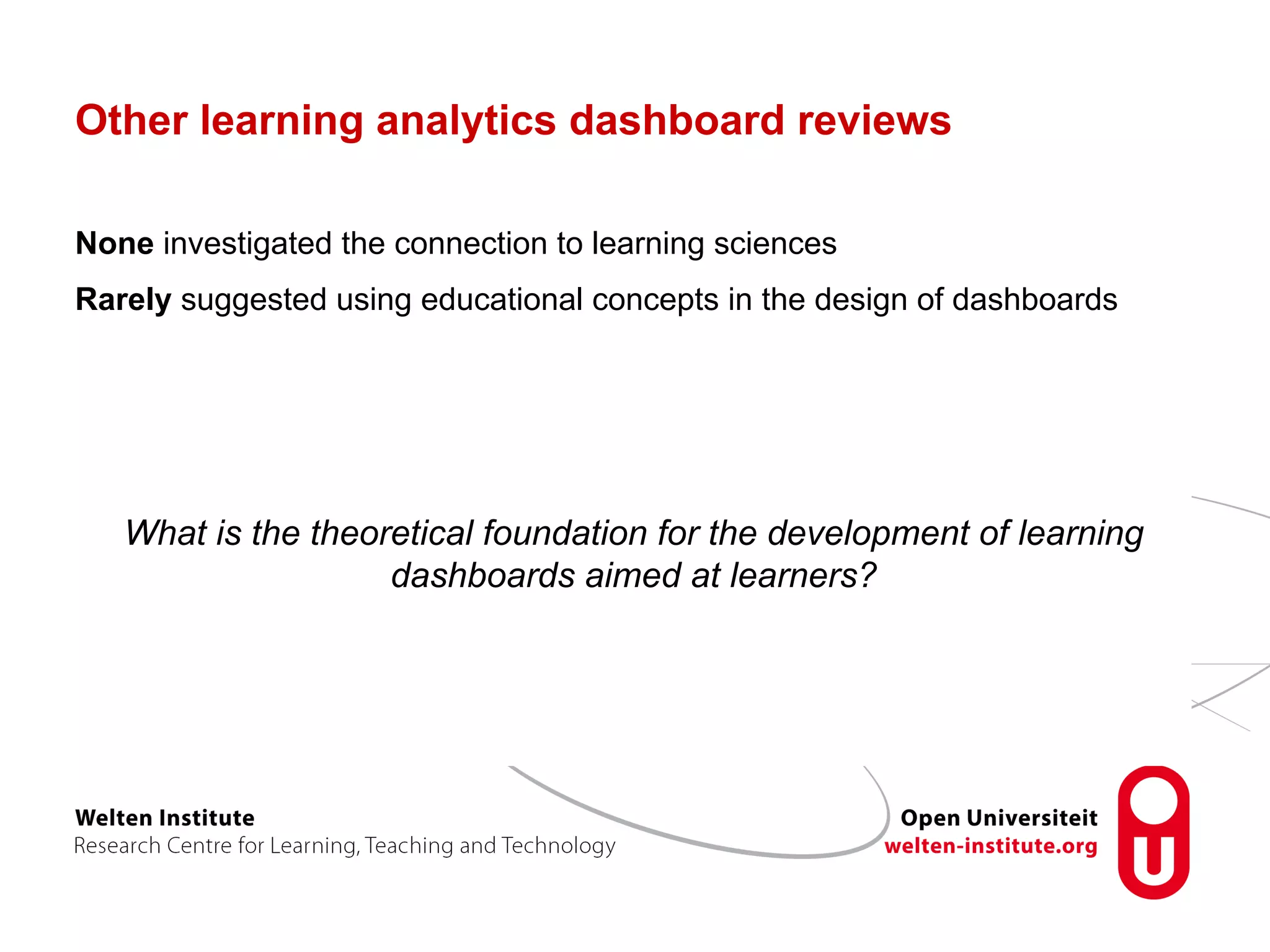
None investigated the connection to learning sciences
Rarely suggested using educational concepts in the design of dashboards
What is the theoretical foundation for the development of learning
dashboards aimed at learners?
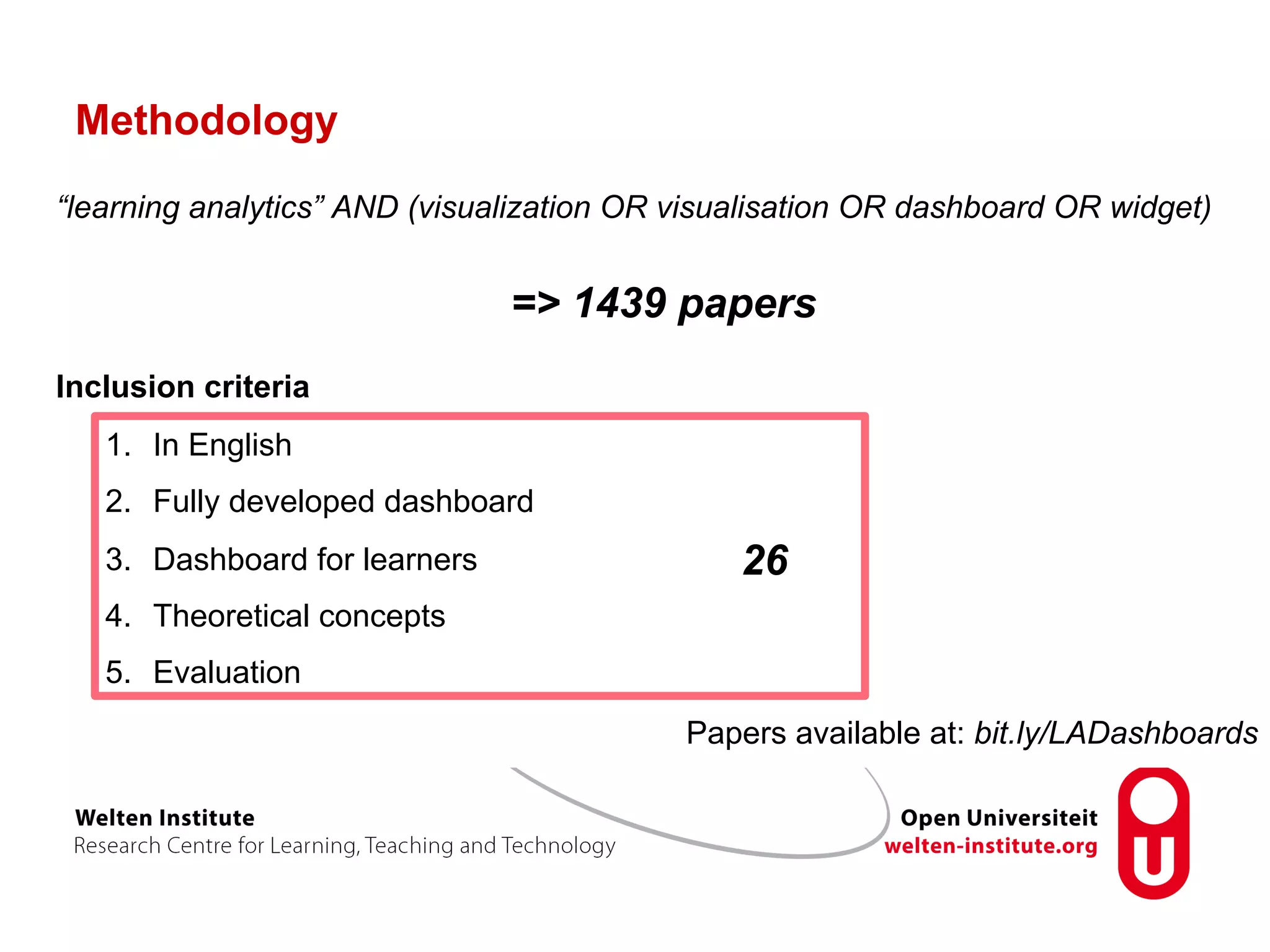
Methodology
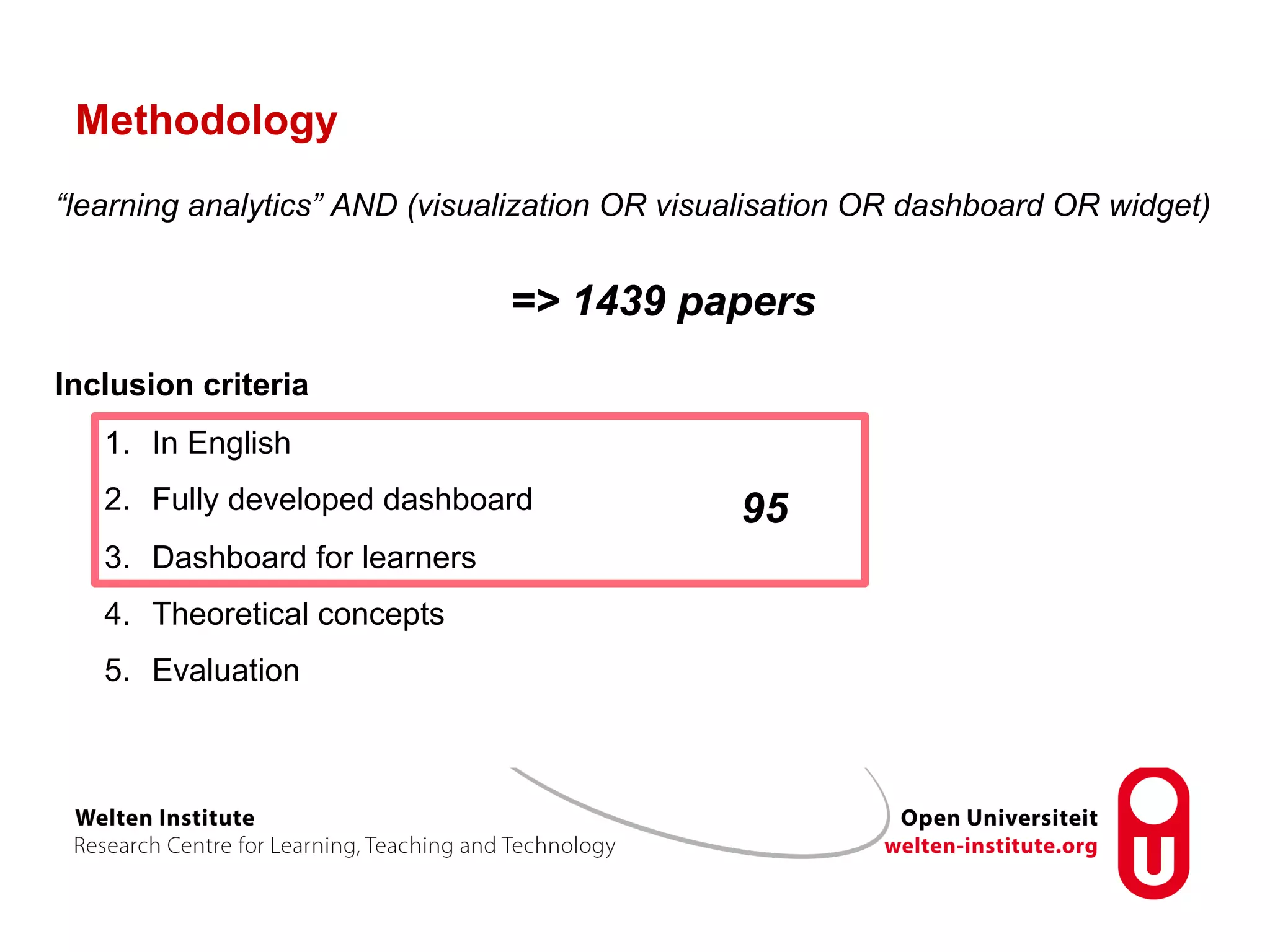
“learning analytics” AND (visualization OR visualisation OR dashboard OR widget)
=> 1439 papers
Inclusion criteria
1.  In English
2.  Fully developed dashboard
3.  Dashboard for learners
4.  Theoretical concepts
5.  Evaluation
95
Methodology
“learning analytics” AND (visualization OR visualisation OR dashboard OR widget)
=> 1439 papers
Inclusion criteria
1.  In English
2.  Fully developed dashboard
3.  Dashboard for learners
4.  Theoretical concepts
5.  Evaluation
26
Papers available at: bit.ly/LADashboards
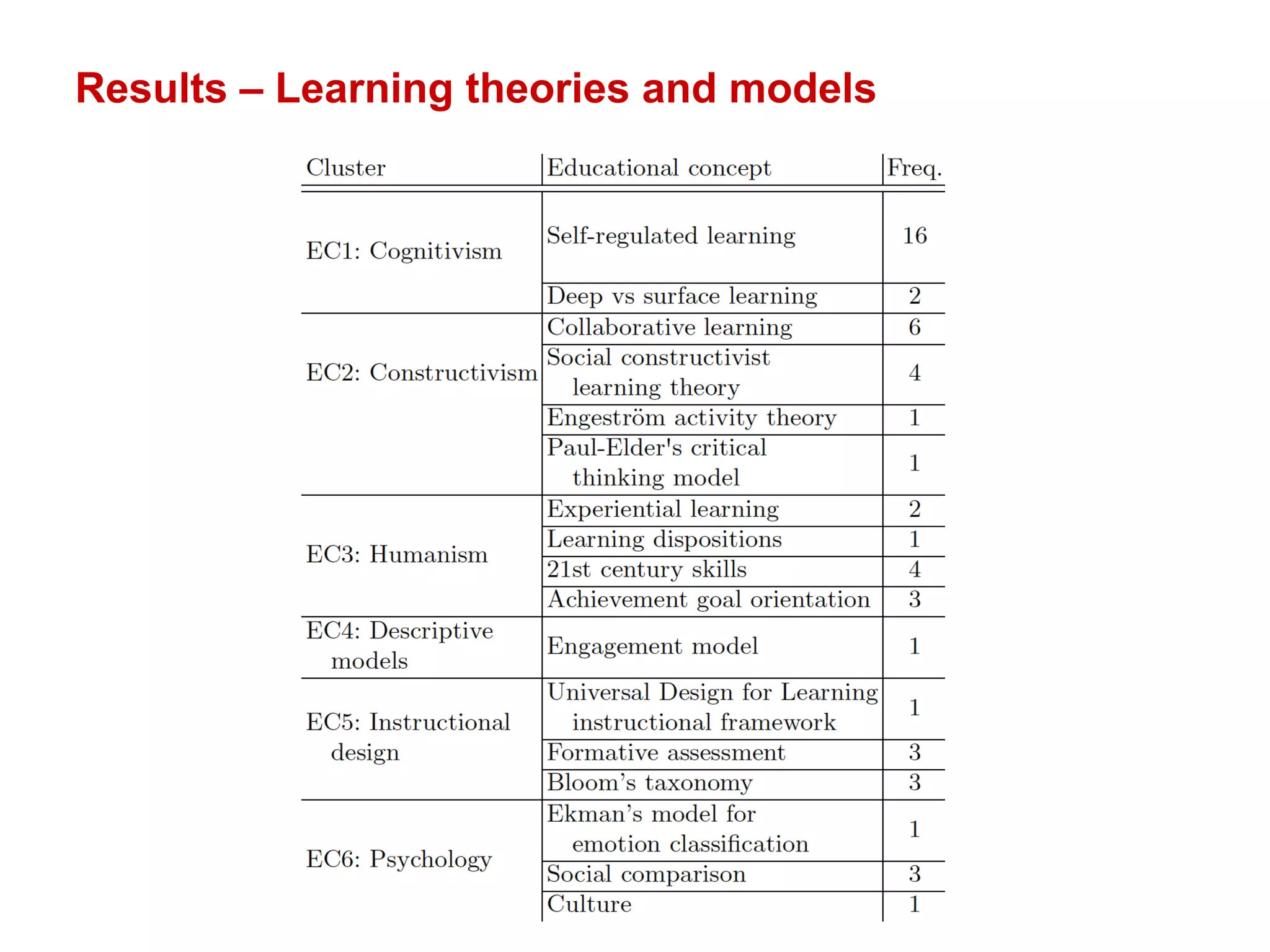
Results – Learning theories and models
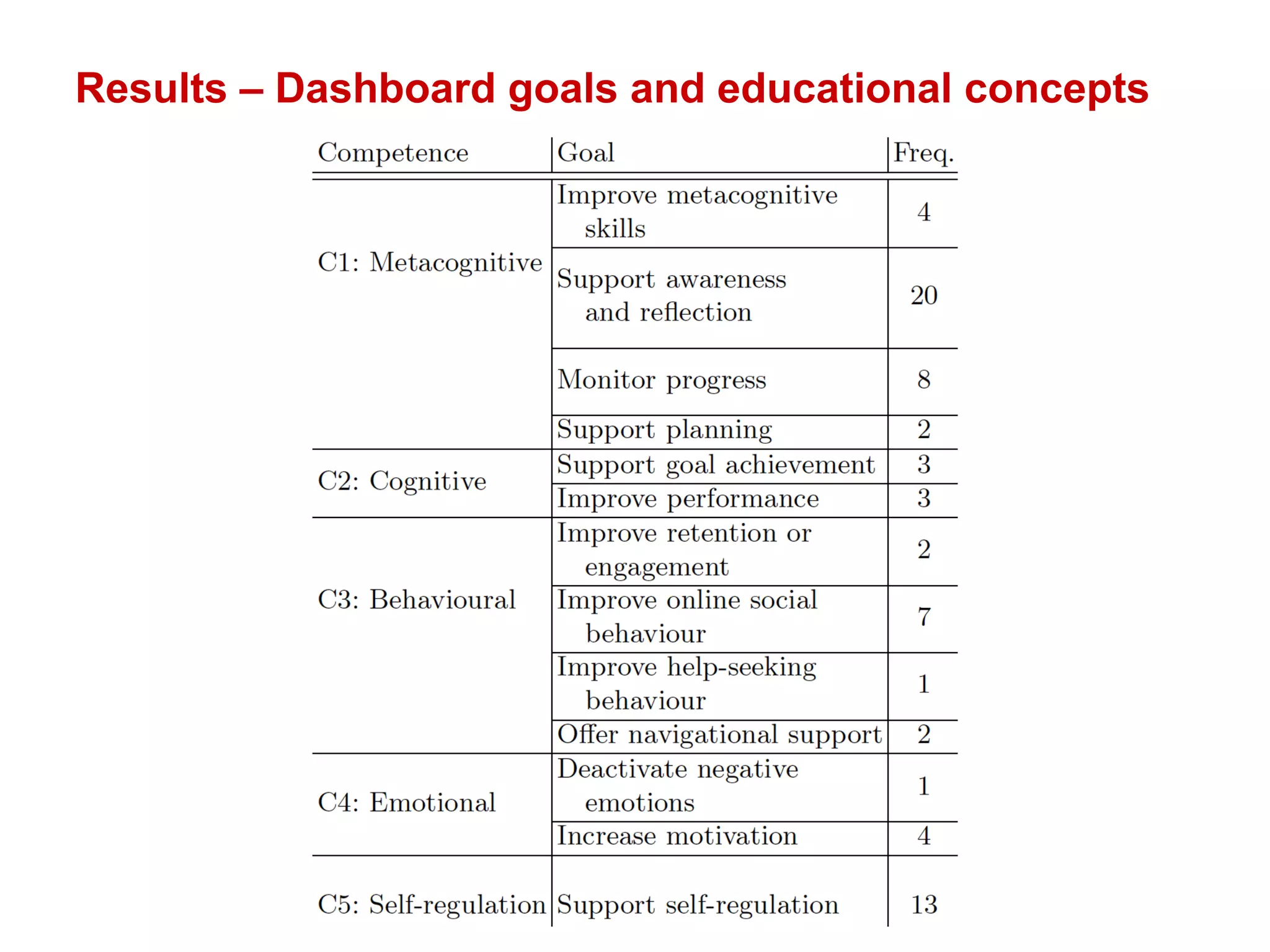
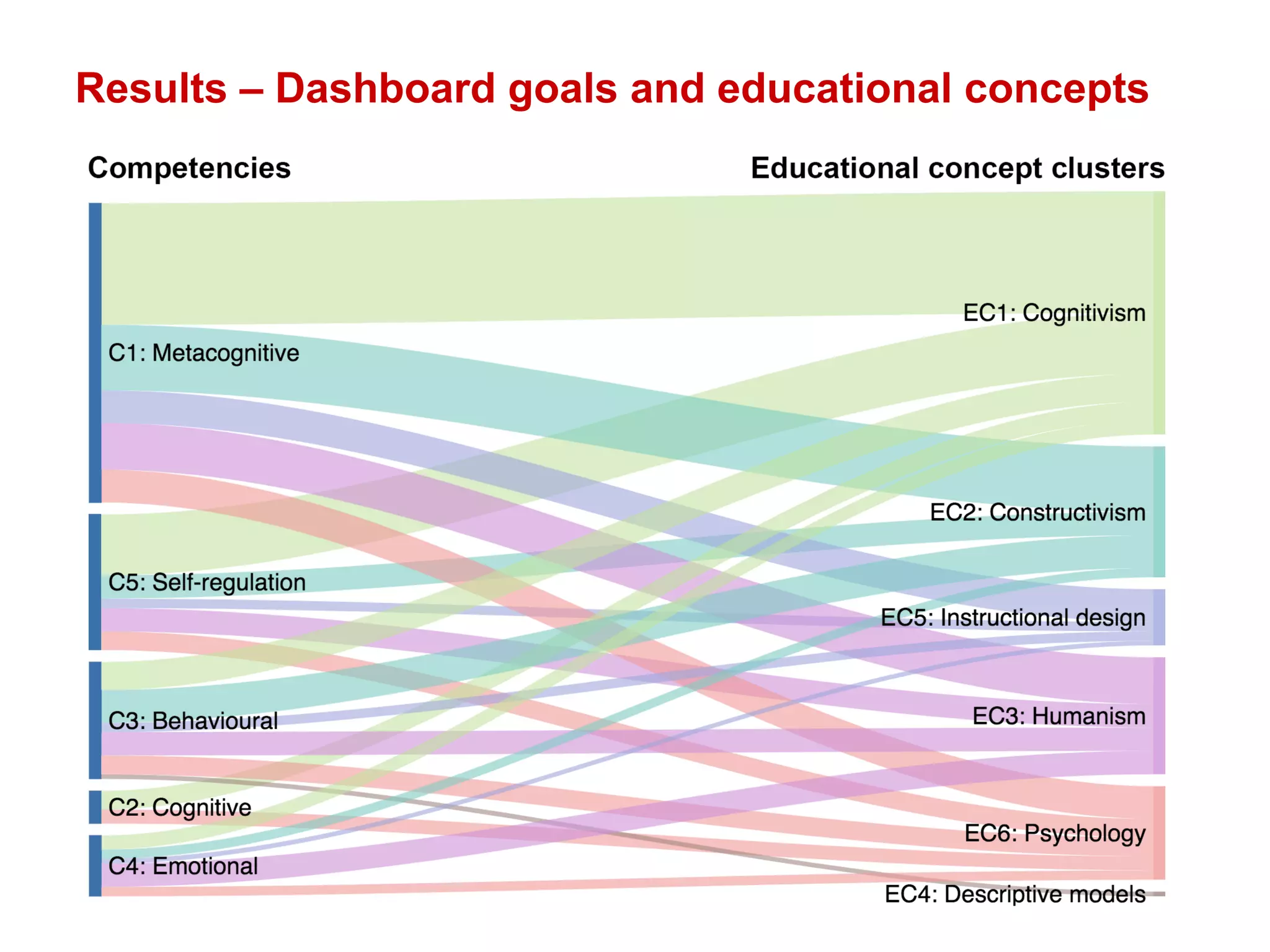
Results – Dashboard goals and educational concepts
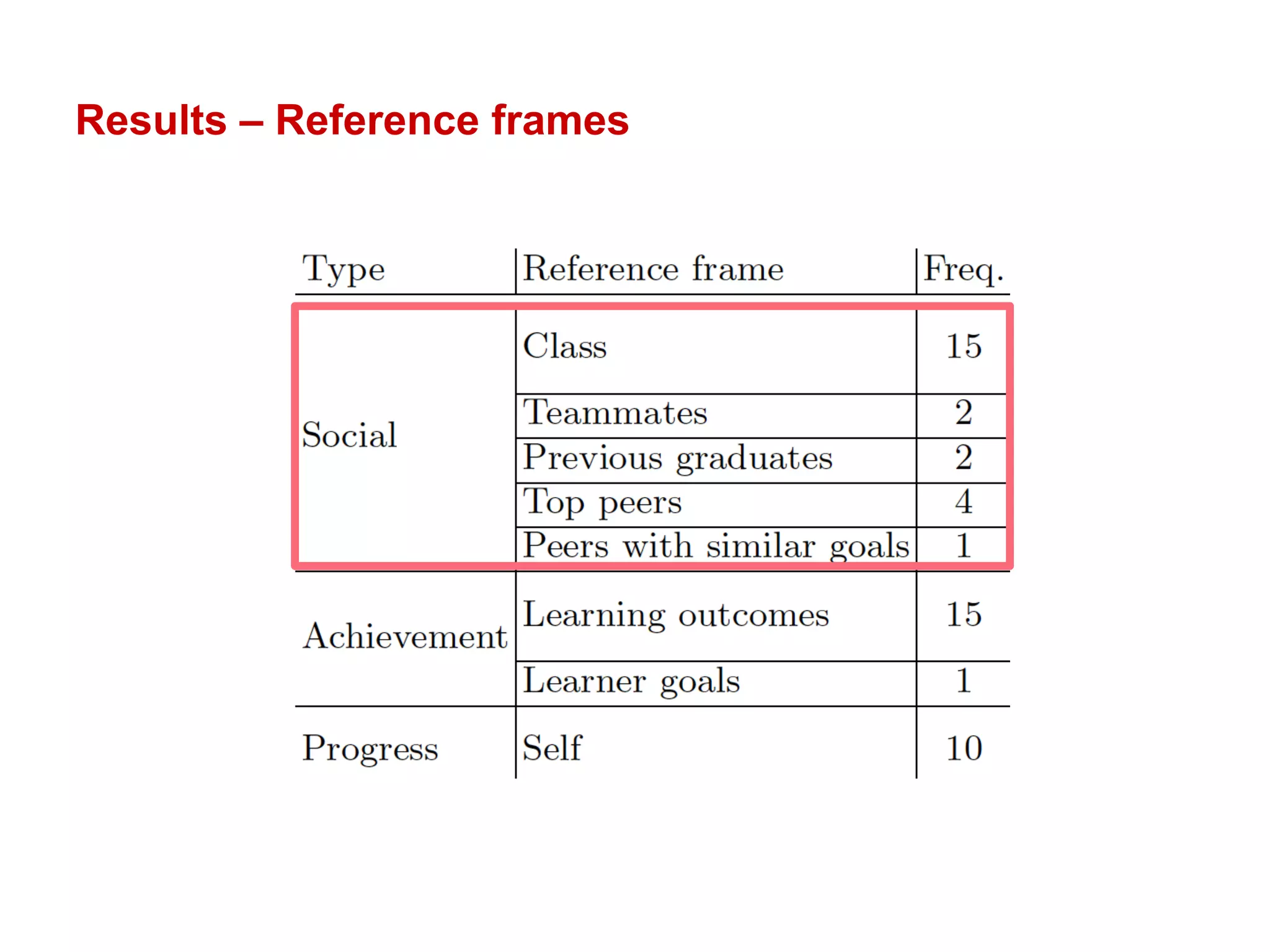
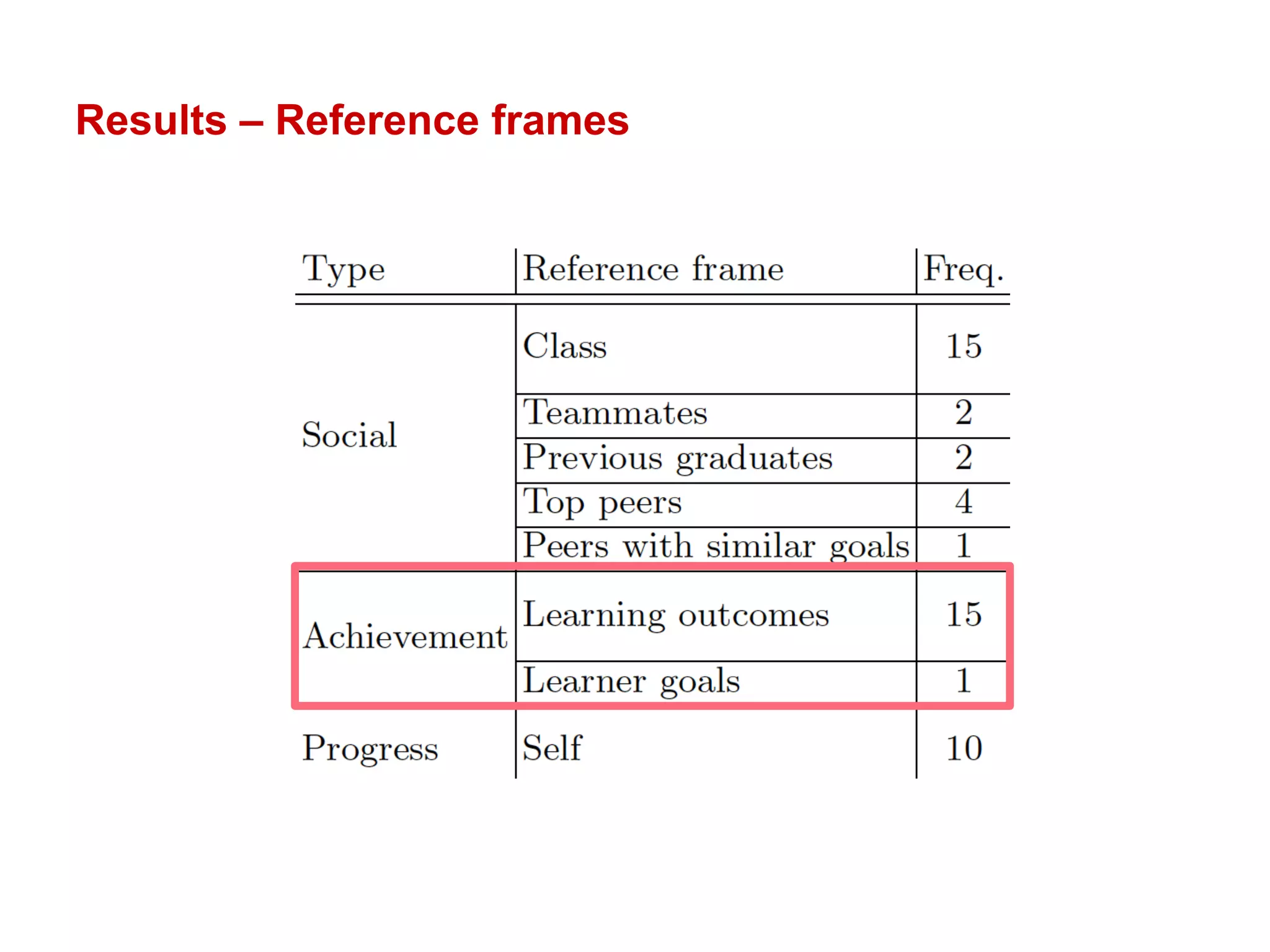
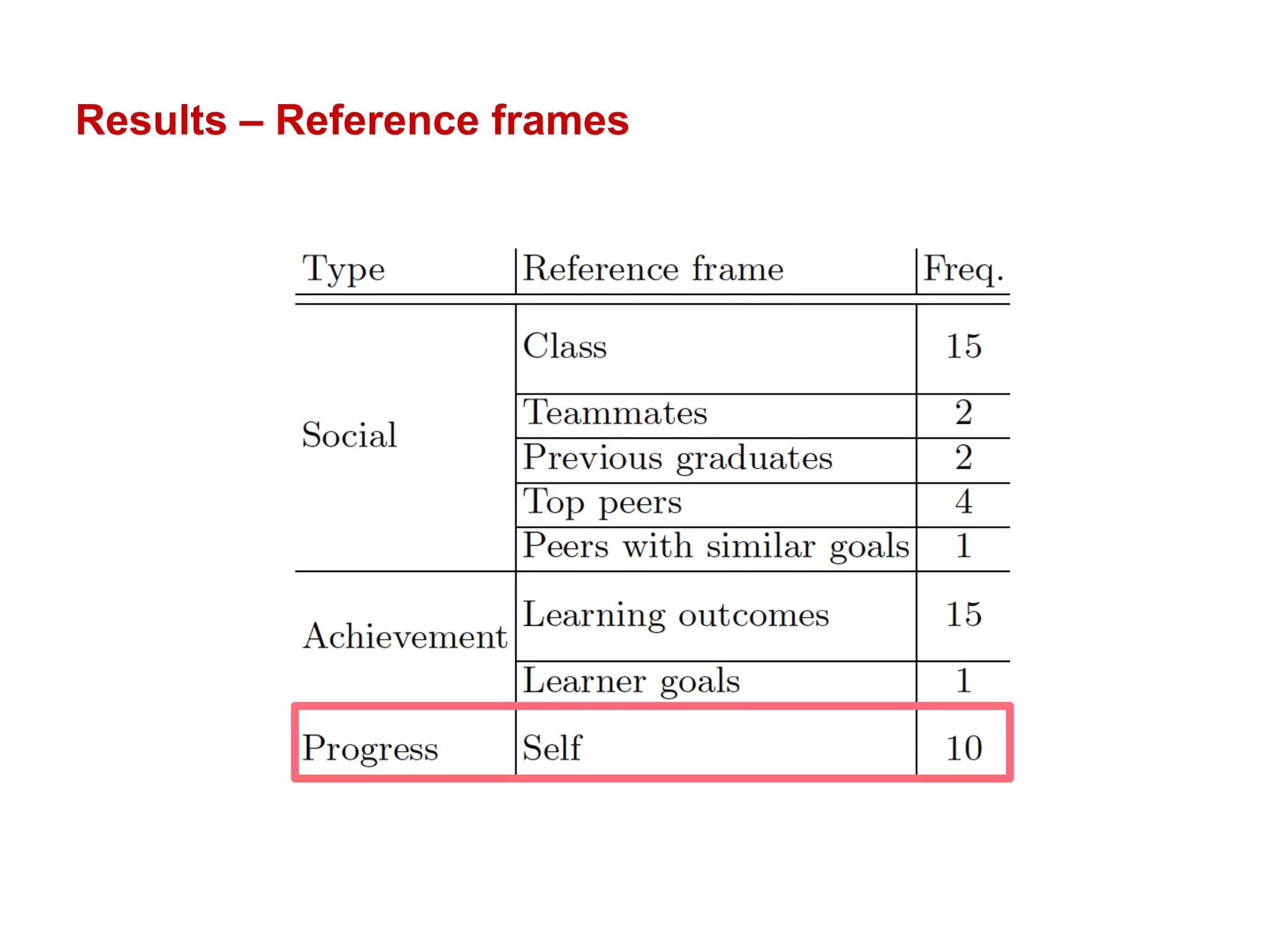
Results – Reference frames
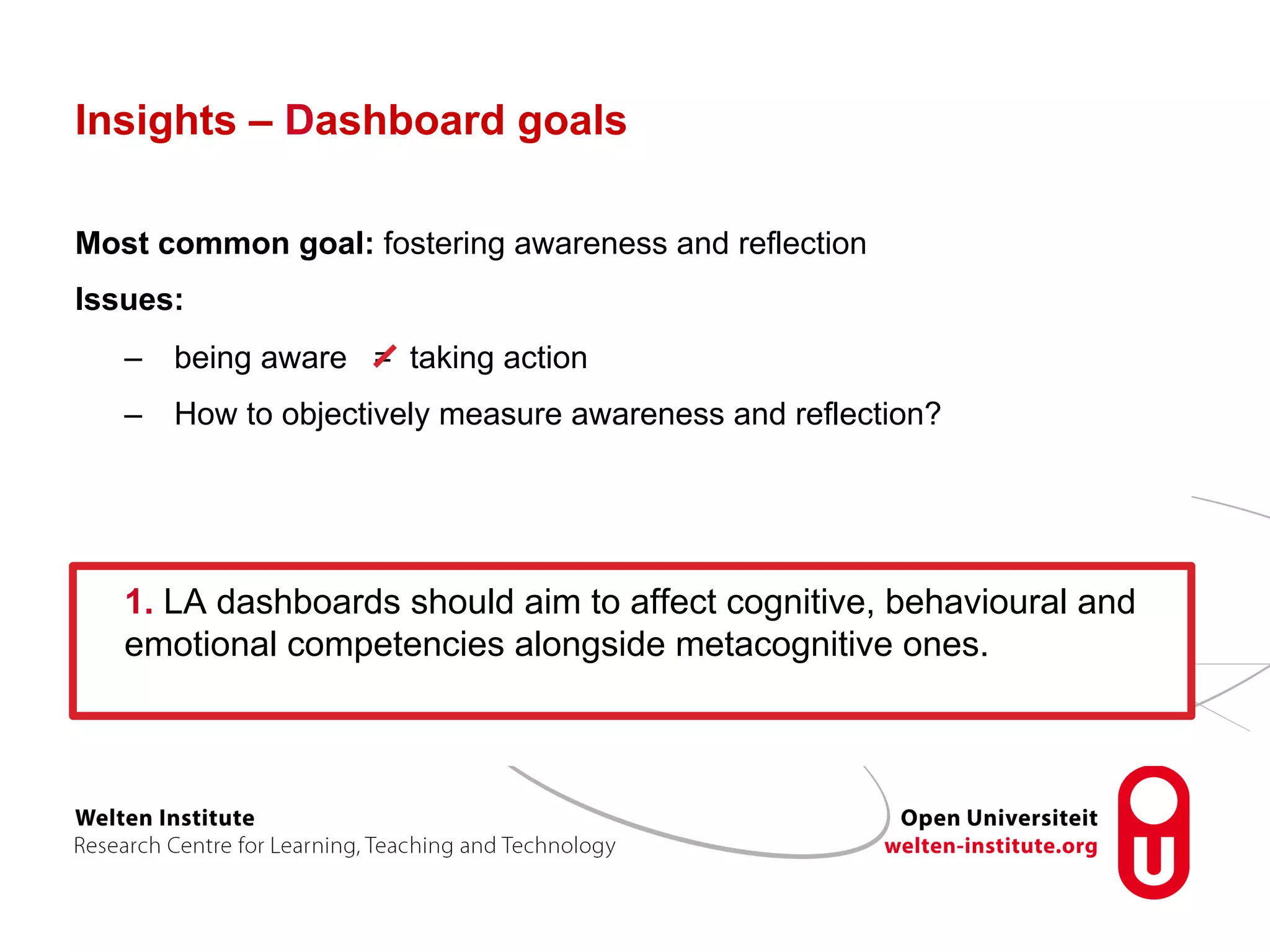
Insights – Dashboard goals
Most common goal: fostering awareness and reflection
Issues:
–  being aware = taking action
–  How to objectively measure awareness and reflection?
1. LA dashboards should aim to affect cognitive, behavioural and
emotional competencies alongside metacognitive ones.
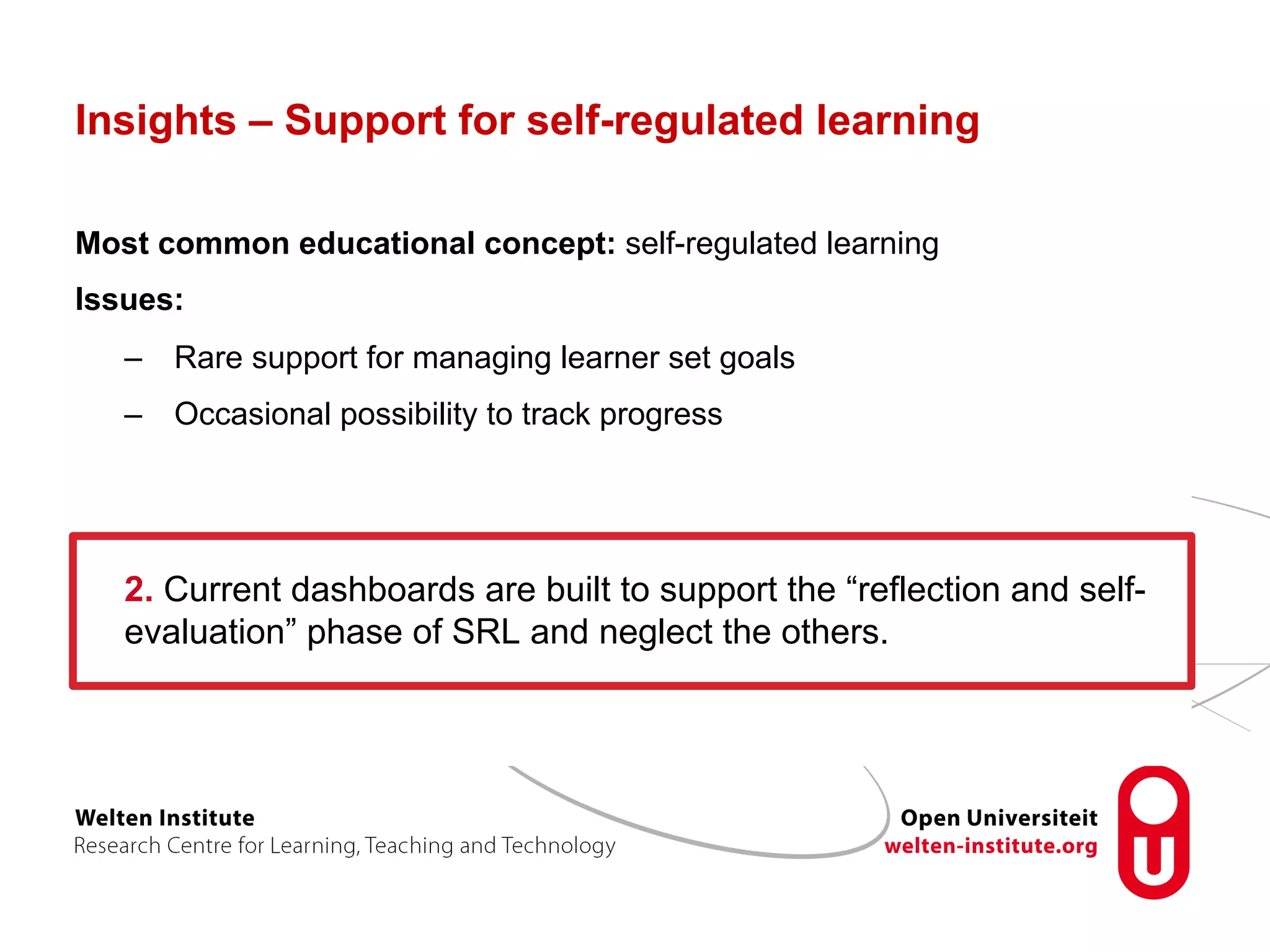
Insights – Support for self-regulated learning
Most common educational concept: self-regulated learning
Issues:
–  Rare support for managing learner set goals
–  Occasional possibility to track progress
2. Current dashboards are built to support the “reflection and self-
evaluation” phase of SRL and neglect the others.
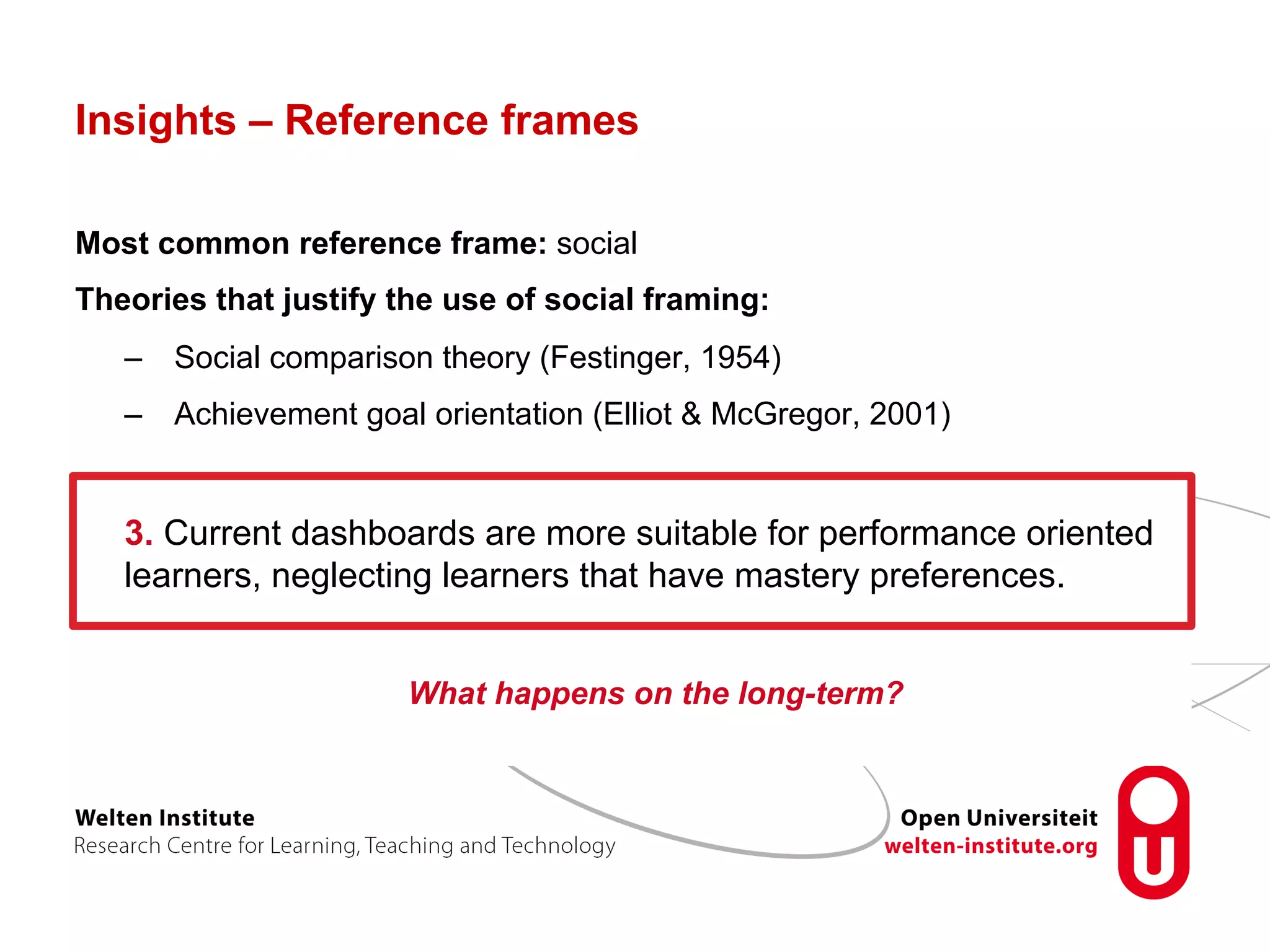
Insights – Reference frames
Most common reference frame: social
Theories that justify the use of social framing:
–  Social comparison theory (Festinger, 1954)
–  Achievement goal orientation (Elliot & McGregor, 2001)
3. Current dashboards are more suitable for performance oriented
learners, neglecting learners that have mastery preferences.
What happens on the long-term?
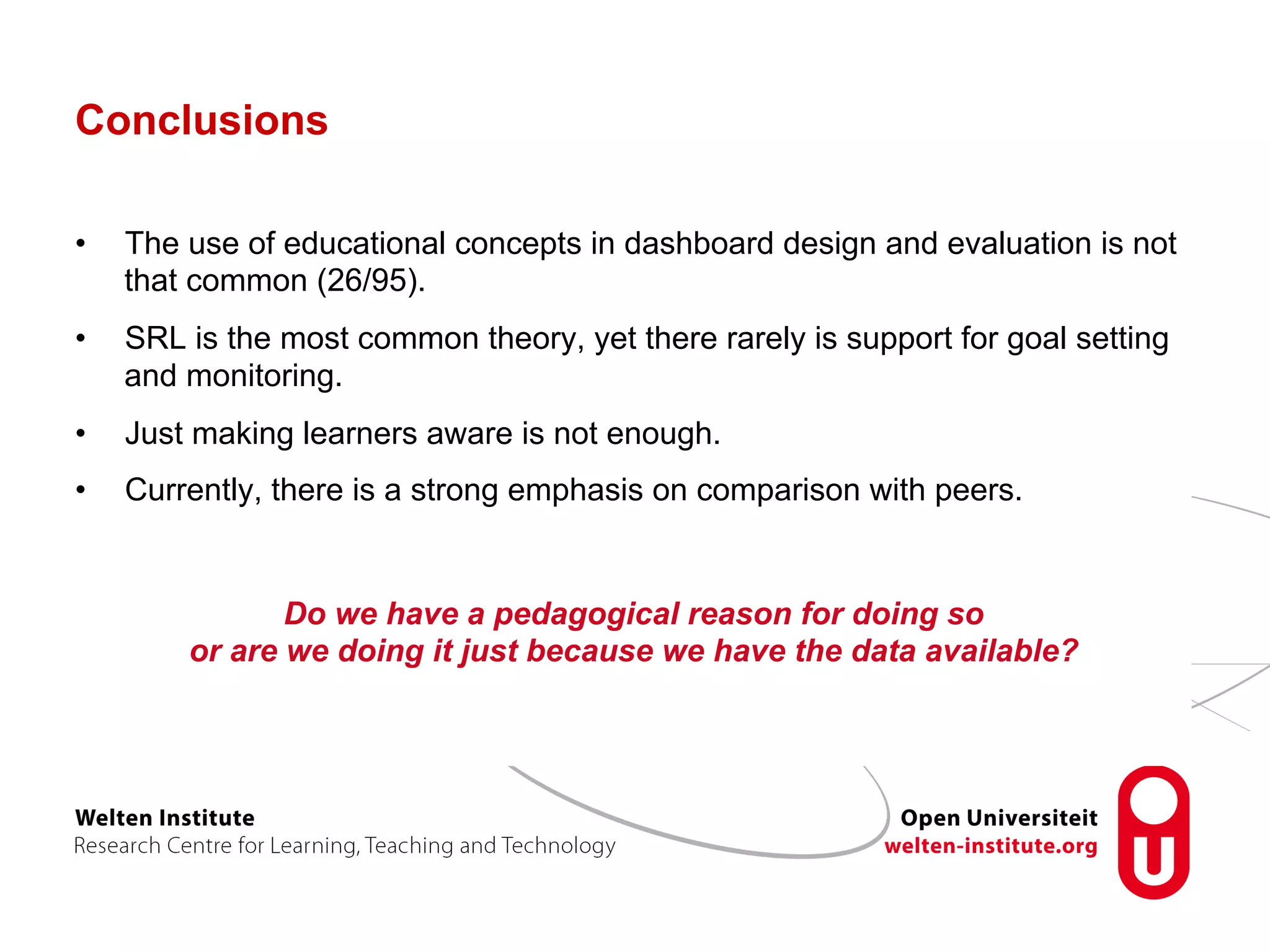
Conclusions
•  The use of educational concepts in dashboard design and evaluation is not
that common (26/95).
•  SRL is the most common theory, yet there rarely is support for goal setting
and monitoring.
•  Just making learners aware is not enough.
•  Currently, there is a strong emphasis on comparison with peers.
Do we have a pedagogical reason for doing so
or are we doing it just because we have the data available?

Awareness is not enough. Pitfalls of learning analytics dashboards in the educational practice

  • 1.
    Awareness is notenough. Pitfalls of learning analytics dashboards in the educational practice Ioana Jivet, Maren Scheffel, Hendrik Drachsler, Marcus Specht Welten Institute Open University of the Netherlands ioana.jivet@ou.nl
  • 2.
  • 3.
    Learning analytics dashboards …“single displays that aggregate different indicators about learner(s), learning process(es) and/or learning context(s) into one or multiple visualisations” Schwendimann, B. A., Rodriguez-Triana, M. J., Vozniuk, A., Prieto, L. P., Boroujeni, M. S., Holzer, A., ... & Dillenbourg, P. (2017). Perceiving learning at a glance: A systematic literature review of learning dashboard research. IEEE Transactions on Learning Technologies, 10(1), 30-41.
  • 4.
  • 5.
    Other learning analyticsdashboard reviews None investigated the connection to learning sciences Rarely suggested using educational concepts in the design of dashboards What is the theoretical foundation for the development of learning dashboards aimed at learners?
  • 6.
    Methodology “learning analytics” AND(visualization OR visualisation OR dashboard OR widget) => 1439 papers Inclusion criteria 1.  In English 2.  Fully developed dashboard 3.  Dashboard for learners 4.  Theoretical concepts 5.  Evaluation 95
  • 7.
    Methodology “learning analytics” AND(visualization OR visualisation OR dashboard OR widget) => 1439 papers Inclusion criteria 1.  In English 2.  Fully developed dashboard 3.  Dashboard for learners 4.  Theoretical concepts 5.  Evaluation 26 Papers available at: bit.ly/LADashboards
  • 8.
    Results – Learningtheories and models
  • 9.
    Results – Dashboardgoals and educational concepts
  • 10.
    Results – Dashboardgoals and educational concepts
  • 11.
  • 12.
  • 13.
  • 14.
    Insights – Dashboardgoals Most common goal: fostering awareness and reflection Issues: –  being aware = taking action –  How to objectively measure awareness and reflection? 1. LA dashboards should aim to affect cognitive, behavioural and emotional competencies alongside metacognitive ones.
  • 15.
    Insights – Supportfor self-regulated learning Most common educational concept: self-regulated learning Issues: –  Rare support for managing learner set goals –  Occasional possibility to track progress 2. Current dashboards are built to support the “reflection and self- evaluation” phase of SRL and neglect the others.
  • 16.
    Insights – Referenceframes Most common reference frame: social Theories that justify the use of social framing: –  Social comparison theory (Festinger, 1954) –  Achievement goal orientation (Elliot & McGregor, 2001) 3. Current dashboards are more suitable for performance oriented learners, neglecting learners that have mastery preferences. What happens on the long-term?
  • 17.
    Conclusions •  The useof educational concepts in dashboard design and evaluation is not that common (26/95). •  SRL is the most common theory, yet there rarely is support for goal setting and monitoring. •  Just making learners aware is not enough. •  Currently, there is a strong emphasis on comparison with peers. Do we have a pedagogical reason for doing so or are we doing it just because we have the data available?