
Contents
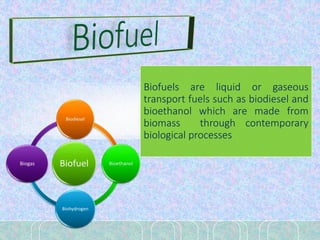
Biofuels are liquid or gaseous
transport fuels such as biodiesel and
bioethanol which are made from
biomass through contemporary
biological processes
Biofuels are renewable and sustainable
They burn cleaner than fossil fuels
Reduced danger of an environmental disaster
Lower emissions of greenhouse gases
Advantages of Biofuel
Cost benefit
There is no emission of hazardous gases
Locally available in every region of the world.
To reduce our dependence on depleting fossil fuels
The energy release per unit mass of biofuel is equal the energy
released from the unit mass of fossil fuels.
What Is Algae?
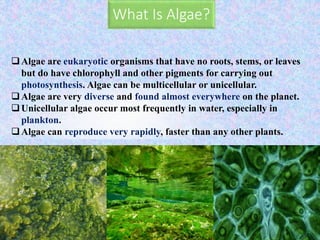
Algae are eukaryotic organisms that have no roots, stems, or leaves
but do have chlorophyll and other pigments for carrying out
photosynthesis. Algae can be multicellular or unicellular.
Algae are very diverse and found almost everywhere on the planet.
Unicellular algae occur most frequently in water, especially in
plankton.
Algae can reproduce very rapidly, faster than any other plants.
Algae grow fast
Algae do not compete with agriculture
Algae can purify wastewaters
Energy output
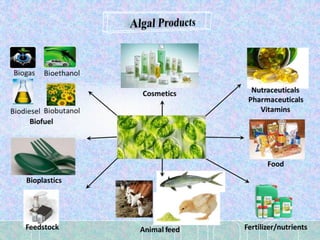
Microalgal biomass can be used for fuel, feed and food
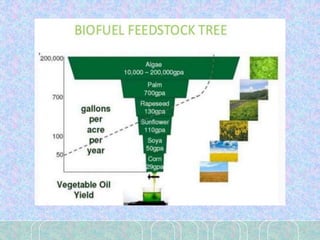
Yields more usable biomass, with higher lipid concentration
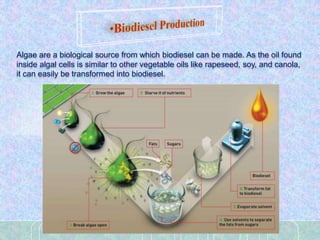
Algae are a biological source from which biodiesel can be made. As the oil found
inside algal cells is similar to other vegetable oils like rapeseed, soy, and canola,
it can easily be transformed into biodiesel.
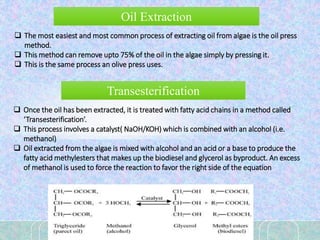
Oil Extraction
 The most easiest and most common process of extracting oil from algae is the oil press
method.
 This method can remove upto 75% of the oil in the algae simply by pressing it.
 This is the same process an olive press uses.
Transesterification
 Once the oil has been extracted, it is treated with fatty acid chains in a method called
‘Transesterification’.
 This process involves a catalyst( NaOH/KOH) which is combined with an alcohol (i.e.
methanol)
 Oil extracted from the algae is mixed with alcohol and an acid or a base to produce the
fatty acid methylesters that makes up the biodiesel and glycerol as byproduct. An excess
of methanol is used to force the reaction to favor the right side of the equation
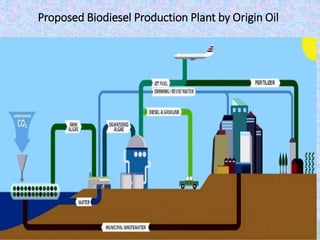
Proposed Biodiesel Production Plant by Origin Oil
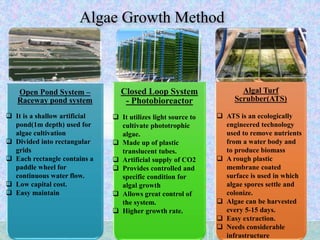
Algae Growth Method
Open Pond System –
Raceway pond system
Closed Loop System
- Photobioreactor
Algal Turf
Scrubber(ATS)
 It is a shallow artificial
pond(1m depth) used for
algae cultivation
 Divided into rectangular
grids
 Each rectangle contains a
paddle wheel for
continuous water flow.
 Low capital cost.
 Easy maintain
 It utilizes light source to
cultivate phototrophic
algae.
 Made up of plastic
translucent tubes.
 Artificial supply of CO2
 Provides controlled and
specific condition for
algal growth
 Allows great control of
the system.
 Higher growth rate.
 ATS is an ecologically
engineered technology
used to remove nutrients
from a water body and
to produce biomass
 A rough plastic
membrane coated
surface is used in which
algae spores settle and
colonize.
 Algae can be harvested
every 5-15 days.
 Easy extraction.
 Needs considerable
infrastructure
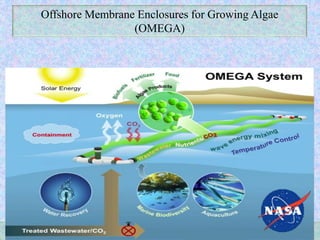
Offshore Membrane Enclosures for Growing Algae
(OMEGA)
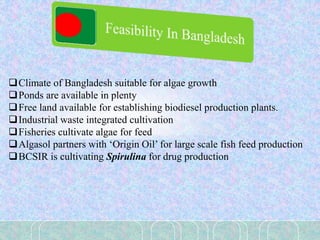
Climate of Bangladesh suitable for algae growth
Ponds are available in plenty
Free land available for establishing biodiesel production plants.
Industrial waste integrated cultivation
Fisheries cultivate algae for feed
Algasol partners with ‘Origin Oil’ for large scale fish feed production
BCSIR is cultivating Spirulina for drug production
References
http://www.climatetechwiki.org/technology/bio-hydrocarbon-fuels
http://www.fao.org/docrep/w7241e/w7241e0h.htm
https://microbewiki.kenyon.edu/index.php/Biodiesel_from_Algae_Oil
http://www.besustainablemagazine.com/cms2/intesusal-sustainable-microalgae-biofuel-
production-visible-to-the-naked-eye/
https://en.wikipedia.org/wiki/Algae_fuel
http://inforenewableenergy.blogspot.com/2014/12/production-of-biofuels-based-on-
algae.html
https://www.nap.edu/read/13437/chapter/5#82
Algae for Biofuel & Energy - Michael A. Borowitzka & Navid R. Moheimani
http://www.oilgae.com/algae/har/har.html
https://www.researchgate.net/profile/Imrose_Bin_Muhit/publication/274640703_Prospect_
of_Algal_Biodiesel_Production_in_Bangladesh_Overview_from_Developed_Countries/links/5
52dc6ed0cf29b22c9c504b6.pdf
Biodiesel Production from Microalgae

Biodiesel Production from Microalgae

  • 2.
  • 3.
    Biofuels are liquidor gaseous transport fuels such as biodiesel and bioethanol which are made from biomass through contemporary biological processes
  • 5.
    Biofuels are renewableand sustainable They burn cleaner than fossil fuels Reduced danger of an environmental disaster Lower emissions of greenhouse gases
  • 6.
    Advantages of Biofuel Costbenefit There is no emission of hazardous gases Locally available in every region of the world. To reduce our dependence on depleting fossil fuels The energy release per unit mass of biofuel is equal the energy released from the unit mass of fossil fuels.
  • 7.
    What Is Algae? Algaeare eukaryotic organisms that have no roots, stems, or leaves but do have chlorophyll and other pigments for carrying out photosynthesis. Algae can be multicellular or unicellular. Algae are very diverse and found almost everywhere on the planet. Unicellular algae occur most frequently in water, especially in plankton. Algae can reproduce very rapidly, faster than any other plants.
  • 8.
    Algae grow fast Algaedo not compete with agriculture Algae can purify wastewaters Energy output Microalgal biomass can be used for fuel, feed and food Yields more usable biomass, with higher lipid concentration
  • 13.
    Algae are abiological source from which biodiesel can be made. As the oil found inside algal cells is similar to other vegetable oils like rapeseed, soy, and canola, it can easily be transformed into biodiesel.
  • 14.
    Oil Extraction  Themost easiest and most common process of extracting oil from algae is the oil press method.  This method can remove upto 75% of the oil in the algae simply by pressing it.  This is the same process an olive press uses. Transesterification  Once the oil has been extracted, it is treated with fatty acid chains in a method called ‘Transesterification’.  This process involves a catalyst( NaOH/KOH) which is combined with an alcohol (i.e. methanol)  Oil extracted from the algae is mixed with alcohol and an acid or a base to produce the fatty acid methylesters that makes up the biodiesel and glycerol as byproduct. An excess of methanol is used to force the reaction to favor the right side of the equation
  • 15.
    Proposed Biodiesel ProductionPlant by Origin Oil
  • 16.
    Algae Growth Method OpenPond System – Raceway pond system Closed Loop System - Photobioreactor Algal Turf Scrubber(ATS)  It is a shallow artificial pond(1m depth) used for algae cultivation  Divided into rectangular grids  Each rectangle contains a paddle wheel for continuous water flow.  Low capital cost.  Easy maintain  It utilizes light source to cultivate phototrophic algae.  Made up of plastic translucent tubes.  Artificial supply of CO2  Provides controlled and specific condition for algal growth  Allows great control of the system.  Higher growth rate.  ATS is an ecologically engineered technology used to remove nutrients from a water body and to produce biomass  A rough plastic membrane coated surface is used in which algae spores settle and colonize.  Algae can be harvested every 5-15 days.  Easy extraction.  Needs considerable infrastructure
  • 17.
    Offshore Membrane Enclosuresfor Growing Algae (OMEGA)
  • 19.
    Climate of Bangladeshsuitable for algae growth Ponds are available in plenty Free land available for establishing biodiesel production plants. Industrial waste integrated cultivation Fisheries cultivate algae for feed Algasol partners with ‘Origin Oil’ for large scale fish feed production BCSIR is cultivating Spirulina for drug production
  • 20.