EMPOWERMENT
TECHNOLOGIES
J O H N C A R L O L . R O L L O N
Quarter 1-Week 4
C R E C E N C I A D R U C I L A L O P E Z S H S
Imaging and
Design for Visual
Message Using
Infographics
MELC
Use image manipulation
techniques on existing images to
change or enhance their current
state to communicate a message
for a specific purpose.
Principles of
Visual Message
Design Using
Infographics
We, humans, highly depend in
our sense of sight, that’s why it
is said that we are ‘visual
creatures’. Text information
can be very detailed but to
most people it fails to ‘visualize’
the message.
INTRODUCTION
Showing a table of sales in
a year will take time to be
fully analyzed but can be
easily understood with the
smart use of graphics.
INTRODUCTION
There are softwares that can be used
in creating Infographics most
requires advanced knowledge and
skills to make or need internet
connection to use. With the use of a
prior application that we discussed
earlier, Microsoft Excel, that is
effective, practical and easy to learn.
WHAT'S
IN
This module will tackle the
use of infographics in
improving the presentation
of information. The focus
will be on what
infographics are and how
to make them using
Microsoft Excel.
WHAT'S
NEW
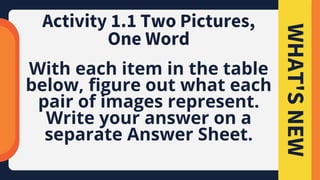
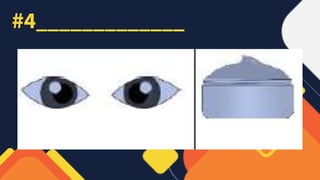
With each item in the table
below, figure out what each
pair of images represent.
Write your answer on a
separate Answer Sheet.
Activity 1.1 Two Pictures,
One Word
#1_____________
#2_____________
#3_____________
#4_____________
#5_____________
WHAT
IS
IT
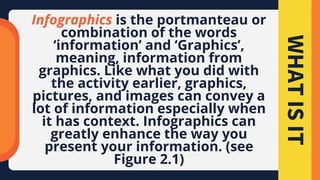
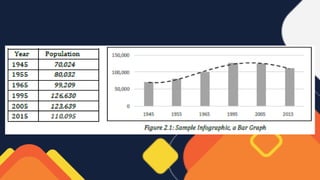
Infographics is the portmanteau or
combination of the words
‘information’ and ‘Graphics’,
meaning, information from
graphics. Like what you did with
the activity earlier, graphics,
pictures, and images can convey a
lot of information especially when
it has context. Infographics can
greatly enhance the way you
present your information. (see
Figure 2.1)
WHAT
IS
IT
As seen in Figure 2.1, the
graph through the use of
shapes and lines, gives the
reader a visual
interpretation of the data.
The main purpose of an
infographic is to engage and
to make understanding
easier.
WHAT
IS
IT
Remember that infographics
are not used to make
documents more appealing,
but the use of graphical
elements that will improve
how quickly and easily an
idea or information is
presented
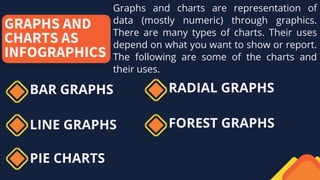
GRAPHS AND
CHARTS AS
INFOGRAPHICS
Graphs and charts are representation of
data (mostly numeric) through graphics.
There are many types of charts. Their uses
depend on what you want to show or report.
The following are some of the charts and
their uses.
BAR GRAPHS
LINE GRAPHS
PIE CHARTS
RADIAL GRAPHS
FOREST GRAPHS
BAR GRAPHS
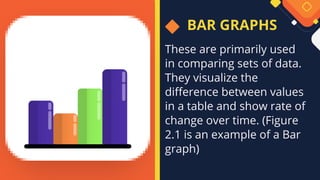
These are primarily used
in comparing sets of data.
They visualize the
difference between values
in a table and show rate of
change over time. (Figure
2.1 is an example of a Bar
graph)
LINE GRAPHS
These are similar with bar
graphs in terms of use,
with a difference that line
graphs are more suitable
in showing trends.
PIE CHARTS
These are circular
statistical graphical
representation of
proportion or
percentage.
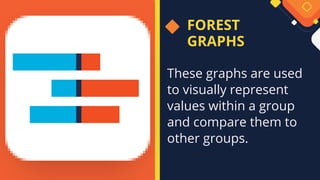
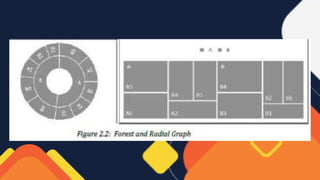
FOREST
GRAPHS
These graphs are used
to visually represent
values within a group
and compare them to
other groups.
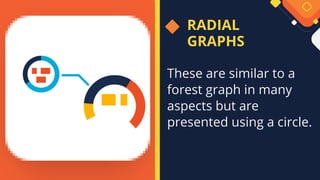
RADIAL
GRAPHS
These are similar to a
forest graph in many
aspects but are
presented using a circle.
67% 75% 80%
CREATING
INFOGRAPHICS USING
EXCEL
1. In your desktop, create a
document named ‘Sales
Data’. (Always remember to
save your progress by
pressing Ctrl + S.)
WHAT
IS
IT
WHAT
IS
IT
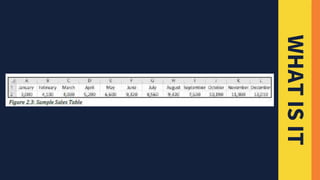
2. In your work area, copy the
set of data. (see Figure 2.3)
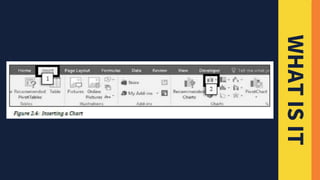
3. Drag select A1 to L2, then in
the ribbon press Insert then
in the charts section, click the
desired chart. For example,
click Insert Column Chart or
Area Chart. (See Figure 2.4)
WHAT
IS
IT
WHAT
IS
IT
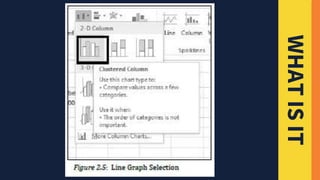
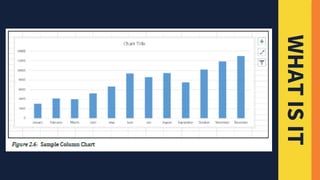
4. A dropdown window will
appear as seen in Figure 2.5,
in the 2-D Column section,
select Clustered Column. It
will create a graph as seen in
Figure 2.6.
WHAT
IS
IT
WHAT
IS
IT
5. To rename, double click the
name of the graph then type
the “Sale Rending Graph”
(Steps 5 to 7 are already
tackled in earlier modules.
You may refer to Module 2.2
“Working with Spreadsheets”
for more detailed
instructions)
WHAT
IS
IT
6. To resize, click the graph
then click and drag any of the
eight handles in the edges of
the graph.
7. To reposition the graph,
click and drag the graph to
the desired position.
WHAT
IS
IT
8. You can copy and paste the
graph to other Microsoft
Office application. To copy
press Ctrl + C then press Ctrl +
V to paste.
WHAT
IS
IT
WHAT
IS
IT
67% 75% 80%
INFOGRAPHIC IMAGE AND
GRAPHICAL FORMATTING
The visual preference of people
when it comes to gathering
data must not be discounted.
When making an infographic
specifically a graph, it is
necessary it is tailored to our
target audience. In MS excel
there are options in editing,
manipulating and formatting
visual elements in our graph.
WHAT
IS
IT
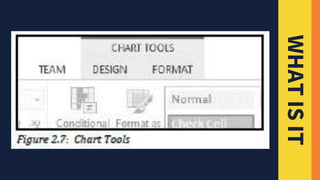
1. To access the Chart Tools
where Design and Format
Menu tools can be found you
must first select any Graph
that you want to edit. In the
ribbon. The said Menu tools
will be available as seen on
figure 2.7
WHAT
IS
IT
DESIGN TOOLS
WHAT
IS
IT
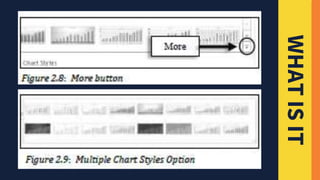
2. Click on Design, In the
Chart Styles section click
More (as seen on figure 2.8). It
will expand and display
multiple Chart Styles options
as seen on Figure 2.9.
WHAT
IS
IT
WHAT
IS
IT
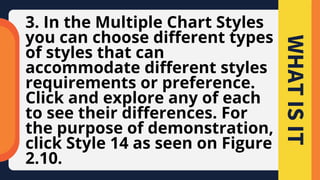
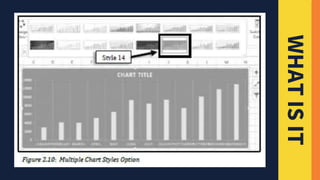
3. In the Multiple Chart Styles
you can choose different types
of styles that can
accommodate different styles
requirements or preference.
Click and explore any of each
to see their differences. For
the purpose of demonstration,
click Style 14 as seen on Figure
2.10.
WHAT
IS
IT
WHAT
IS
IT
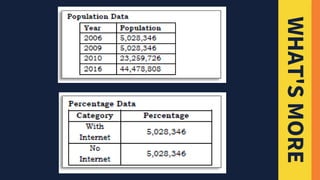
With a group of five (5) students,
create an excel document and name
it “ICT in the Philippines Data”.
Create two tabs. Name the first one
as Line Graph, the second one as Pie
Graph. In the Bar Graph tab, create a
bar graph using the data in
Population Data below. In the Pie
Graph tab, create a bar graph using
the data in Percentage Data.
WHAT'S
MORE
ACTIVITY 1.2 GRAPH THE DATA
WHAT'S
MORE
1. What are the importance
of infographics in presenting
data or information?
2. Which graph works best in
showing change over time?
Compare the graphs used.
WHAT
I
HAVE
LEARNED
Survey at least 25 people on
which color from red, yellow,
blue, green, violet and orange
do they prefer. Record the
result of your survey.
WHAT
I
CAN
DO
ACTIVITY 1.3 SURVEY GRAPHING
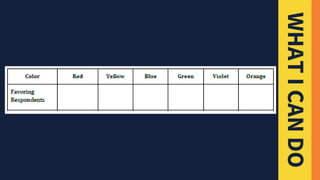
Create an excel document and
name it “Color Survey Data and
Graph”. Create two tabs. Name the
first one as Data, the second one as
Graph. In the Data tab create a
table following the format below
and write the results in your table.
In the Graph tab, create a Bar
Graph based on the data from the
Data tab.
WHAT
I
CAN
DO
ACTIVITY 1.3 SURVEY GRAPHING
WHAT
I
CAN
DO
THANK
YOU!!!

ETECH Q1 Wk4-Infographics.pptx

  • 1.
    EMPOWERMENT TECHNOLOGIES J O HN C A R L O L . R O L L O N Quarter 1-Week 4 C R E C E N C I A D R U C I L A L O P E Z S H S
  • 2.
    Imaging and Design forVisual Message Using Infographics
  • 3.
    MELC Use image manipulation techniqueson existing images to change or enhance their current state to communicate a message for a specific purpose.
  • 4.
  • 5.
    We, humans, highlydepend in our sense of sight, that’s why it is said that we are ‘visual creatures’. Text information can be very detailed but to most people it fails to ‘visualize’ the message. INTRODUCTION
  • 6.
    Showing a tableof sales in a year will take time to be fully analyzed but can be easily understood with the smart use of graphics. INTRODUCTION
  • 7.
    There are softwaresthat can be used in creating Infographics most requires advanced knowledge and skills to make or need internet connection to use. With the use of a prior application that we discussed earlier, Microsoft Excel, that is effective, practical and easy to learn.
  • 8.
    WHAT'S IN This module willtackle the use of infographics in improving the presentation of information. The focus will be on what infographics are and how to make them using Microsoft Excel.
  • 9.
    WHAT'S NEW With each itemin the table below, figure out what each pair of images represent. Write your answer on a separate Answer Sheet. Activity 1.1 Two Pictures, One Word
  • 10.
  • 11.
  • 12.
  • 13.
  • 14.
  • 15.
    WHAT IS IT Infographics is theportmanteau or combination of the words ‘information’ and ‘Graphics’, meaning, information from graphics. Like what you did with the activity earlier, graphics, pictures, and images can convey a lot of information especially when it has context. Infographics can greatly enhance the way you present your information. (see Figure 2.1)
  • 17.
    WHAT IS IT As seen inFigure 2.1, the graph through the use of shapes and lines, gives the reader a visual interpretation of the data. The main purpose of an infographic is to engage and to make understanding easier.
  • 18.
    WHAT IS IT Remember that infographics arenot used to make documents more appealing, but the use of graphical elements that will improve how quickly and easily an idea or information is presented
  • 19.
    GRAPHS AND CHARTS AS INFOGRAPHICS Graphsand charts are representation of data (mostly numeric) through graphics. There are many types of charts. Their uses depend on what you want to show or report. The following are some of the charts and their uses. BAR GRAPHS LINE GRAPHS PIE CHARTS RADIAL GRAPHS FOREST GRAPHS
  • 20.
    BAR GRAPHS These areprimarily used in comparing sets of data. They visualize the difference between values in a table and show rate of change over time. (Figure 2.1 is an example of a Bar graph)
  • 21.
    LINE GRAPHS These aresimilar with bar graphs in terms of use, with a difference that line graphs are more suitable in showing trends.
  • 22.
    PIE CHARTS These arecircular statistical graphical representation of proportion or percentage.
  • 23.
    FOREST GRAPHS These graphs areused to visually represent values within a group and compare them to other groups.
  • 24.
    RADIAL GRAPHS These are similarto a forest graph in many aspects but are presented using a circle.
  • 26.
  • 27.
    1. In yourdesktop, create a document named ‘Sales Data’. (Always remember to save your progress by pressing Ctrl + S.) WHAT IS IT
  • 28.
  • 29.
    2. In yourwork area, copy the set of data. (see Figure 2.3) 3. Drag select A1 to L2, then in the ribbon press Insert then in the charts section, click the desired chart. For example, click Insert Column Chart or Area Chart. (See Figure 2.4) WHAT IS IT
  • 30.
  • 31.
    4. A dropdownwindow will appear as seen in Figure 2.5, in the 2-D Column section, select Clustered Column. It will create a graph as seen in Figure 2.6. WHAT IS IT
  • 32.
  • 33.
    5. To rename,double click the name of the graph then type the “Sale Rending Graph” (Steps 5 to 7 are already tackled in earlier modules. You may refer to Module 2.2 “Working with Spreadsheets” for more detailed instructions) WHAT IS IT
  • 34.
    6. To resize,click the graph then click and drag any of the eight handles in the edges of the graph. 7. To reposition the graph, click and drag the graph to the desired position. WHAT IS IT
  • 35.
    8. You cancopy and paste the graph to other Microsoft Office application. To copy press Ctrl + C then press Ctrl + V to paste. WHAT IS IT
  • 36.
  • 37.
    67% 75% 80% INFOGRAPHICIMAGE AND GRAPHICAL FORMATTING
  • 38.
    The visual preferenceof people when it comes to gathering data must not be discounted. When making an infographic specifically a graph, it is necessary it is tailored to our target audience. In MS excel there are options in editing, manipulating and formatting visual elements in our graph. WHAT IS IT
  • 39.
    1. To accessthe Chart Tools where Design and Format Menu tools can be found you must first select any Graph that you want to edit. In the ribbon. The said Menu tools will be available as seen on figure 2.7 WHAT IS IT DESIGN TOOLS
  • 40.
  • 41.
    2. Click onDesign, In the Chart Styles section click More (as seen on figure 2.8). It will expand and display multiple Chart Styles options as seen on Figure 2.9. WHAT IS IT
  • 42.
  • 43.
    3. In theMultiple Chart Styles you can choose different types of styles that can accommodate different styles requirements or preference. Click and explore any of each to see their differences. For the purpose of demonstration, click Style 14 as seen on Figure 2.10. WHAT IS IT
  • 44.
  • 45.
    With a groupof five (5) students, create an excel document and name it “ICT in the Philippines Data”. Create two tabs. Name the first one as Line Graph, the second one as Pie Graph. In the Bar Graph tab, create a bar graph using the data in Population Data below. In the Pie Graph tab, create a bar graph using the data in Percentage Data. WHAT'S MORE ACTIVITY 1.2 GRAPH THE DATA
  • 46.
  • 47.
    1. What arethe importance of infographics in presenting data or information? 2. Which graph works best in showing change over time? Compare the graphs used. WHAT I HAVE LEARNED
  • 48.
    Survey at least25 people on which color from red, yellow, blue, green, violet and orange do they prefer. Record the result of your survey. WHAT I CAN DO ACTIVITY 1.3 SURVEY GRAPHING
  • 49.
    Create an exceldocument and name it “Color Survey Data and Graph”. Create two tabs. Name the first one as Data, the second one as Graph. In the Data tab create a table following the format below and write the results in your table. In the Graph tab, create a Bar Graph based on the data from the Data tab. WHAT I CAN DO ACTIVITY 1.3 SURVEY GRAPHING
  • 50.
  • 51.